Library Marketing –Using Technology, Tools and Tenacity to Showcase Your Library
This issue is Sponsored by EBSCO Information Services
Edited by Kathleen McEvoy (Vice President of Communications)
Begins on Page 12
If Rumors Were Horses
To quote the age-old dad joke, “Is it hot enough for you out there?” We’ve had a heat wave here in SC with temperature indexes over 100! Whew! Thank goodness for air conditioning. Lots of news and updates so let’s dive in!
Legal Issues
OCLC has filed a lawsuit against Clarivate and its subsidiaries, Clarivate Analytics, Ex Libris, and ProQuest. “Claims in the suit include tortious interference with contracts and prospective business relationships and conspiracy to interfere with contracts and business relationships.” (https://librarytechnology.org/pr/27396) Clarivate has issued a statement (https://clarivate.com/news/clarivate-statement-on-oclc-lawsuit/) and OCLC has filed for and been granted a temporary restraining order as of June 27 (https://www.infodocket. com/2022/06/15/oclc-files-lawsuit-against-clarivate-analytics-worldcat-metadoormetadata/). Do y’all remember the Supreme Court decision in Feist Publication Inc. versus Rural Telephone Service (1991)? Food for study. We will definitely be keeping our eye on this story for further developments and for the possibility of a session for the Charleston Conference or a future Charleston In Between!
E-Book Ordering Made Easy
With the widest range of e-book acquisition models, access options and platforms in the industry, GOBI enables libraries to choose the customized acquisition approach that works for their unique needs.
When libraries order e-books in GOBI, they can:
Choose from more than 25 publisher and aggregator platforms and the broadest range of acquisition models, including DDA, EBA and eCollections
Benefit from deduplication for all orders, across models and formats
Save staff time spent selecting relevant titles while being confident in what is being acquired
Simplify your library workflow with GOBI.
Against the Grain (ISSN: 1043-2094) (USPS: 012-618), Copyright 2022 by the name Against the Grain, LLC is published six times a year in February, April, June, September, November, and December/ January by Against the Grain, LLC. Business and Editorial Offices: PO Box 799, 1712 Thompson Ave., Sullivan’s Island, SC 29482. Accounting and Circulation Offices: same. Subscribe online at https://www.charleston-hub.com/membership-options/
Editor:
Katina Strauch (Retired, College of Charleston)
Associate Editors:
Cris Ferguson (Murray State)
Tom Gilson (Retired, College of Charleston)
Matthew Ismail (Charleston Hub)
Research Editors:
Judy Luther (Informed Strategies)
Assistants to the Editor: Ileana Jacks
Toni Nix (Just Right Group, LLC)
International Editor:
Rossana Morriello (Politecnico di Torino)
Contributing
Editors:
Glenda Alvin (Tennessee State University)
Deni Auclair (De Gruyter)
Rick Anderson (Brigham Young University)
Sever Bordeianu (U. of New Mexico)
Todd Carpenter (NISO)
Eleanor Cook (East Carolina University)
Will Cross (NC State University)
Anne Doherty (Choice)
Michelle Flinchbaugh (U. of MD Baltimore County)
Joyce Dixon-Fyle (DePauw University)
Michael Gruenberg (Gruenberg Consulting, LLC)
Chuck Hamaker (Retired, UNC, Charlotte)
Bob Holley (Retired, Wayne State University)
Donna Jacobs (MUSC)
Ramune Kubilius (Northwestern University)
Myer Kutz (Myer Kutz Associates, Inc.)
Tom Leonhardt (Retired)
Stacey Marien (American University)
Jack Montgomery (Georgia Southern University Libraries)
Bowles & Carver, Old English Cuts & Illustrations. Grafton, More Silhouettes. Ehmcke, Graphic Trade Symbols By German Designers. Grafton, Ready-to-Use Old-Fashioned Illustrations. The Chap Book Style.
Production & Ad Sales: Toni Nix, Just Right Group, LLC., P.O. Box 412, Cottageville, SC 29435, phone: 843-835-8604 fax: 843-835-5892 <justwrite@lowcountry.com>
Advertising Information: Toni Nix, phone: 843-835-8604, fax: 843-835-5892 <justwrite@lowcountry.com>
Publisher: A. Bruce Strauch
Send correspondence, press releases, etc., to: Katina Strauch, Editor, Against the Grain, LLC Post Office Box 799 Sullivan’s Island, SC 29482 cell: 843-509-2848 <kstrauch@comcast.net>
EconLit provides the coverage most needed by scholars to make new discoveries, develop important insights, and contribute valuable research to the economics community.
• Peer-Reviewed Journal Articles
• Working Papers
• PhD Dissertations
• Books and Book Reviews
• Collective Volume Articles
Professionally classified, updated weekly, and including over 1.6 million records, EconLit covers economics literature published over the last 130 years from leading institutions in 74 countries.
In combination with the optional full-text package of over 500 journals, including the prestigious AEA journals, EconLit provides a comprehensive library of economics literature. Contact us at www.econlit.org for a custom quote or a trial subscription.
From Your (wheelchairing) Editor:
Iwas just walking from one room to another and tripped over a ledge! Who would have guessed that I broke my tibia (loadbearing bone) in my good right leg! There’s so much to learn! These PT and OT people are really fabulous!
Anyway, the team has continued to work on ATG for June and what a great issue it is. I did not realize the reach of the John Cotton Dana Award and have learned so much. This issue, “Library Marketing – Using Technology, Tools and Tenacity to Showcase Your Library,” highlights the winners of this year’s JCD award and what academic librarians can learn from them. Guest edited by Kathleen McEvoy, Vice President of Communications, EBSCO Information Services, there are contributions from libraries across the country.
Articles include a Q&A with Kandace Foreman, Deputy Director of Marketing and Communications at the DC Public Library; discussion of how Spartanburg County Libraries improved census participation; Fort Worth Public Library’s Amplify 817 music-streaming platform designed to promote Fort Worth-based musicians and allow the community to find local music and listen to it for free; how Edmonton Public Library revitalized their central library during the pandemic shut-down; and tips to run a successful John Cotton Dana Award campaign from previous winner Anchorage Public Library.
We also have another installation of the “And They Were There” reports from the 2021 Charleston Conference, organized by column editor Ramune Kubilius (Northwestern University) and a report on the Council of Science Editors 2022 Meeting from Heather Staines (DeltaThink). ATG Interviews features three engaging conversations with Kerry Ward, the Executive Director of the American Library Association’s new division, Core: Leadership, Infrastructure, Futures; Alicia Wise, Executive
Letters to the Editor
Send letters to <kstrauch@comcast.net>, phone 843-509-2848, or snail mail: Against the Grain, Post Office Box 799, Sullivan’s Island, SC 29482. You can also send a letter to the editor from the Charleston Hub at http://www.charleston-hub.com/contact-us/
Dear Katina:
Director of CLOCKSS; and Joanna Ball, Managing Director, Directory of Open Access Journals (DOAJ).
And last but not least by any means, our Back Talk column this issue is from the inimitable Ann Okerson and features personal and professional updates, including coverage of the Charleston In Between session on the Ukraine conflict. “OK, deep breath: There are lots of things about how this world is changing that are terrifying and appalling. Even librarians can’t do everything that needs doing, but we can do some things and it’s impressive to see how well our community is rallying.” Well said, Ann!
Well, I just got a call from my orthopedist and have an appointment tomorrow! Hooray. Hope there is good news. Meanwhile, y’all have a great hot summer!
Love, Yr. Ed.
Rumors continued from page 1
Exciting News from The Charleston Advisor
The Charleston Advisor has been acquired by independent, non-profit publisher Annual Reviews as of June 1, 2022. “We are pleased to welcome The Charleston Advisor to Annual Reviews,” said Richard Gallagher, Publisher, and Editor-In-Chief. “It is a good fit with our mission to synthesize and integrate knowledge and expands our horizons by providing high quality reviews of products and services for library teams at academic and research institutions, a new group of readers for us.” Founded in July 1999, The Charleston Advisor publishes detailed product reviews of proprietary and freely available web-based resources for the library market. Reviewed product types include databases, pricing tools, scholarly journals, collections. Over 800 searchable expert reviews, peer-reviewed by the library community, are currently available to help optimize library services.
continued on page 8
I am really glad we got to see each other briefly this past November at the Charleston Conference. Thank you for showing me the pictures of your family too! 2021 was certainly an interesting year — appearing in Against the Grain was certainly a highlight. I hope your 2022 is off to a good start and please know we are all grateful for all that you do to move the library industry forward. All the best, Dustin
Dustin Holland (President and CEO, Better World Books) <dholland@betterworldbooks.com> betterworldbooks.com
Rumors continued from page 6
And an Update from The Charleston Report
The final issue of The Charleston Report, v.26, no.6, May/June 2022 was distributed on June 21, 2022. “For history buffs, we are offering Open Access to the (almost) complete Charleston Report archives. We are missing only one issue, v.1, no.3. In the issues, interested parties will find a snapshot of our industry — libraries, publishers, agents, and technology — as all has changed over a 26-year period. Fun reading for sure!” says Becky Lenzini, President of The Charleston Company. Be sure to check out The Charleston Report Open Access Archive, now available for your historical reading at https://www.charleston-hub.com/media/ the-charleston-report/.
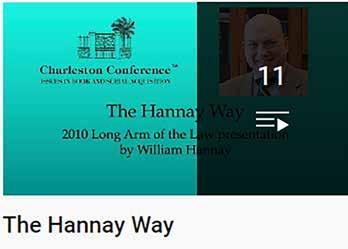
“The Hannay Way”
Personal and Professional Updates
Bob Schatz has left the building… Bob announced his retirement on LinkedIn in April: “Some of you may have seen the announcement that went out from Knowledge Unlatched today, with my blessing, announcing my upcoming retirement. My last day at KU will be Tuesday. This is the result of a conversation I started with them nearly a year ago.” Bob’s newest venture has been launching a blog called “Traversing the Muddle” (traversingthemuddle.com) and already has several posts and over 1,000 views under his belt. Before working at Knowledge Unlatched, Bob had a long and varied career at Coutts, BioMed Central, and more.
Ivy Anderson retired some time ago from the University of California’s California Digital Library and has been enjoying retirement with her husband and her gorgeous Collie named Sadie. Ivy shared this video of her performance at a summer recital of the Adagio movement from Mozart’s last piano sonata in D major, K.576. https://www.youtube.com/ watch?v=jz7gSge3geo Brava! Beautiful!
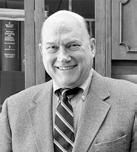
Many of you remember Bill Hannay fondly from his years of presenting in the Long Arm of the Law panel at the annual Charleston Conference. He was a partner at Schiff Hardin LLP in Chicago, IL, who specialized in federal and state antitrust law, intellectual property law, and other trade regulation laws, and was the author or editor of nine books on antitrust and intellectual property law, including The Corporate Counsel’s Guide to Unfair Competition, published by Thomson Reuter’s West Publishing. Bill presented on legal cases and topics affecting the world of libraries and publishing, and he did so with an ineffable sense of humor and verbal charm. His signature move was to write hilarious original lyrics to a showtune or other familiar piece of music that tied in with his presentation topic, earning him the nickname “The Singing Lawyer” amongst conference attendees. We tragically lost Bill in 2020, and the Charleston Conference would like to remember him with a smile, as he would have wanted. We’ve created a playlist called “The Hannay Way” including each of his presentations from 2010-2019 on our YouTube channel at https://youtube.com/ playlist?list=PLIGLt62pr1M7PFt8NkeqfVzckiZR27EdN. Take a look, and we hope you enjoy this compilation in memorial to our friend Bill!
Excited to hear that Charles Watkinson, Associate University Librarian at University of Michigan and Director of the Michigan University Press is stepping into a new role as President of the Association of University Presses. He succeeded 2021-2022 President Lisa Bayer, director of the University of Georgia Press, at the ALA meeting in Washington, DC. Congratulations Charles!
Christine Anderson, our Marketing and Communications Manager for the Charleston Hub and the current Administrative Coordinator at the Kimbel Library and Bryan Information Commons at Coastal Carolina University has been named Director of Archives at USC Lancaster’s Native American Studies Center! Way to go Christy, and we are so glad to hear you’ll still be working with us here at the Hub!
Former professional baseball player turned motivational speaker and author Chris Singleton released his third book, Baseball Around the World: How the World Plays the Game, on June 17 to honor his mother. On June 17, 2015, his mother, Sharonda Coleman-Singleton, was murdered along with eight other victims by a white supremacist at Mother Emanuel AME Church in Charleston. Singleton united his city and inspired the entire nation by forgiving the man who murdered his mother and stating, “love is stronger than hate.”
As part of his personal healing and to help others, Singleton has written two books: Different: A Story About Loving Your Neighbor, a tribute to Singleton’s late mother; and Your Life Matters , a story about the empowerment of black children. Different was a best seller in its category and has been featured by numerous outlets, including The Obama Foundation. For more information about Singleton, please visit www.chrissingleton. com. We also honor and remember Cynthia Graham Hurd, a librarian at the Charleston County Public Library and at the Addlestone Library at the College of Charleston, who was also killed in the Mother Emanuel shooting along with the other members of her prayer group.
Recent and Upcoming Meetings
In-person conference travel seems to be opening back up again, as we’ve seen from recent industry events. Leah Hinds, our Executive Director, attended the SSP meeting and reports back that it had a great turnout with lots of energizing, informative sessions and opportunities for networking and spur
<https://www.charleston-hub.com/media/atg/>
The Charleston ADVISOR
“The Charleston Advisor serves up timely editorials and columns, standalone and comparative reviews, and press releases, among other features. Produced by folks with impeccable library and publishing credentials ...[t]his is a title you should consider...”
— Magazines for Libraries, eleventh edition, edited by Cheryl LaGuardia with consulting editors Bill Katz and Linda Sternberg Katz (Bowker, 2002).
• Over 750 reviews now available
• Web edition and database provided with all subscriptions
• Unlimited IP filtered or name/password access
• Full backfile included
• Comparative reviews of aggregators featured
• Leading opinions in every issue
$295.00 for libraries $495.00 for all others
❏ Yes! Enter My Subscription For One Year. ❏ Yes, I am Interested in being a Reviewer. Name Title Organization Address
City/State/Zip Phone Fax
Email Signature ✓
of the moment meetings. “It was great to attend and present at the SSP meeting! Lisa Hinchliffe and I hosted an interactive Charleston Trendspotting Initiative session designed to identify trends and forecast their impacts on the information industry,” says Leah. “I was able to meet up with friends and colleagues, make some new business connections, hear cool history of the city of Chicago from the keynote Dilla Thomas, and enjoy delicious Chicago eats.”
We asked Courtney McAllister, Vice President/President Elect of NASIG (and a Charleston Conference Director!), for an update on their annual meeting: “During NASIG’s 37th annual conference, in-person attendees assembled in Baltimore, MD, while remote participants viewed session recordings and chatted on Discord and social media. The program encompassed a wide range of scholarly communication topics, such as Open Access, Open Educational Resources, bibliodiversity, Controlled Digital Lending, library discovery, and more. The conference was bookended by two excellent Vision Sessions that candidly addressed pressing challenges facing library workers, vendors, publishers, and researchers. During the opening Vision Session, Professor Sarah Lamdan outlined critical issues surrounding data privacy, vendor-library power dynamics, and the burgeoning analytics industry. The conference concluded with a Vision Panel, entitled, Progress, Not Perfection: DEI Work within Information Organizations. Panelists Dr. Kawana Bright, Sarah Dupont, and Maha Kumaran shared their experiences with Diversity, Equity, and Inclusion work in libraries. Their perspectives and insights inspired lively, respectful discussion and left all attendees with possibilities and challenges to contemplate after the conference ended.”
ALA has reported a busy in-person return with over 14,000 attendees flocking to Washington, DC, for their first in-person gathering since COVID-19 sent everything to virtual. Andrew Albanese reports in Publishers Weekly, “Publishers and vendors on the show floor were also encouraged, with many telling PW that traffic in the exhibit hall was steady, lines for books signings at publisher booths were long, and enthusiasm generally ran high…”
The 51st annual LIBER conference will be held in Odense, Denmark, from July 5-8. This will also be their first in-person gathering since 2019, and the event is sold out. Leah Hinds will be attending and plans to write a conference report to give us all the details!
Charleston Conference News
We have lots going on as we’re planning for the upcoming 2022 Charleston Conference. Big news with two new vendors we’re excited to be working with! Cadmore Media will be our new platform for the conference agenda and virtual conference. Cadmore was one of the finalists for the Charleston Premiers last year. They’re a great fit for us since they’re in the scholarly communications industry and have lots of experience with hybrid events and streaming video. And we’ve upgraded our Call for Papers proposal form to the Ex Ordo platform! This will streamline the review and communications process, as well as provide an easier way to create the conference schedule in a format that integrates with Cadmore. We’re looking forward to working with both of these great groups of people!
continued on page 20
<https://www.charleston-hub.com/media/atg/>
Bet You Missed It — Press Clippings — In the News
Carefully Selected by Your Crack Staff of News Sleuths
Column Editor: Bruce Strauch (The Citadel, Emeritus) <bruce.strauch@gmail.com>
Still Going Strong at 89
Lady Antonia Fraser gave birth to six children and then sat down and wrote “Mary Queen of Scots.” She was 36, and her life changed overnight. She’s now finished her 30th novel.
She grew up precocious. A history of England book she read as a child rocked her. “It was like suddenly discovering this huge pageant behind me, and I could go and wander about in it.” Her mother had written acclaimed historical biographies, and Antonia was gripped by the fever.
In “The Case of the Married Woman,” she writes about Caroline Norton, a well-born woman and prolific writer. In 1836, her husband accused her of adultery and took away their children plus her copyright in her work. She was found innocent of adultery, but still lost everything.
Nonetheless, her advocacy led to the Custody of Infants Act in 1839, the first feminist legislation in English history.
See: Emily Borrow, “Antonia Fraser,” The Wall Street Journal, April 16-17, 2022, p.C6.
Read With Elon and Become a Billionaire
J.E. Gordon, Structures: Or Why Things Don’t Fall Down; (2) Walter Isaacson, Benjamin Franklin: An American Life; (3) Walter Isaacson, Einstein: His Life and Universe ; (4) Nick Bostrom, Superintelligence: Paths, Dangers, Strategies; (5) Erik Conway and Naomi Oreskes, Merchants of Doubt; (6) William Golding, Lord of the Flies; (7) Peter Thiel, Zero to One: Notes on Startups or How to Build the Future; (8) Isaac Asimov, The Foundation.
See: Marguerite Ward @FORWARDIST; “Billionaire Elon Musk credits his success to these 8 books,” Feb. 21, 2022; www. cnbc.com/2017/02/21.
Obit of Note
Jack Higgins (1929-2022) sold his first novel in 1959 for $100. Then he wrote 30 more at about the same rate. Then he heard about a German plot to kidnap Churchill. This became a runaway 1975 success called The Eagle Has Landed. Higgins grew up in Belfast surrounded by sectarian violence, served in the army, taught school, and wrote on the side. After Eagle sold 50 million copies and had a hit film with Michael Caine and Donald Sutherland, Higgins went into tax exile on the island of Jersey. He churned out best-sellers on a diet of champagne and bacon sandwiches.
See: “The British veteran who churned out best-selling thrillers,” The Week, April 29, 2022, p.35.
Let’s Read About Walking
Rebecca Solnit, Wanderlust (2000) (walking to stir up your mind); (2) Simon Armitage, Walking Home (2013) (walking 260 miles of the Pennine Way and giving pub poetry readings at night to make money); (3) W.G. Sebald, The Rings of Saturn (1995) (walking in SE England while ruminating on everything imaginable); (4) Robert Macfarlane, The Old Ways (2012) (subtle ways we’re shaped by landscape through which we move); (5) Matsuo Basho, Narrow Road to the Interior (1998) (prose travelogue meets haiku).
See: David Guterson, “Five Best,” The Wall Street Journal, March 12-13, 2022, p.C8. Guterson is the famous author of “Snow Falling on Cedars” and “The Final Case.”
Origins of High-Tech Crime
As soon as there was telegraph, there were intruders tapping it. The telegraph stock ticker of 1867 really brought out the con artists. Wires to commercial houses were tapped and diverted to other businesses. Bogus messages of wild price fluctuations could start a panic.
Private betting parlors would be tapped as seen in the Paul Newman movie “The Sting.” The wire-tappers would intercept race results and signal middlemen to place bets.
See: Brian Hochman, “The Wiretappers Who Invented a High-Tech Crime,” The Wall Street Journal , April 2-3, 2022, p.C5. Hochman is the author of “The Listeners: A History of Wiretapping in the United States,” published by Harvard University Press.
Let’s Read Classics Derivatives
Jane Smiley, A Thousand Acres (1991) (King Lear moved to Iowa); (2) Pat Barker, The Silence of the Girls (2018) (The Iliad from a female perspective); (3) Jean Rys, Wide Sargasso Sea (1966) (Jane Eyre prequel); (4) Anne Carson, Autobiography of Red (1998) (gay Herakles); (5) Michael Cunningham, The Hours (1998) (spin-off of Virginia Woolf’s Mrs. Dalloway).
See: Dinitia Smith, “Five Best,” The Wall Street Journal, May 7-8, 2002, p. C8. Dinitia is the author of “The Prince,” a retelling of Henry James’ “The Golden Bowl.”
<https://www.charleston-hub.com/media/atg/>
A New Type of Transformative Agreement for Research Publishing in Biology
“A sustainable path to open publication of biomedical research is a long-sought objective among the many science communication initiatives at Cold Spring Harbor. Our transformational offerings provide a model for any research-intensive institution whose scientists wish to make their articles openly available in these long-established, prestigious, not-for-profit journals.”
— Dr. John Inglis, Publisher of CSHL Press, co-founder of bioR χiv and medR χiv
Turn your subscription license into an OA publishing license — Immediate benefits for your authors and no extra cost for most institutions
Subscribers to Cold Spring Harbor Laboratory Press (CSHLP) journals who renew for 2022 now have the option to adopt a Transformative License Agreement. This allows corresponding authors from your institution to publish unlimited OA articles (once accepted for publication), while giving your users access to the complete collection of CSHLP journals.
Transformative license agreements offer a fully OA publishing option for your researchers whose papers are accepted at Genes & Development, Genome Research, Learning & Memory, RNA, and Molecular Case Studies.
Benefits include:
• Unlimited open access publication in CSHLP research journals
• Access to the complete collection of CSHLP journals
• No additional cost for most current subscribers (some minimums apply)
• bioRχiv at your institution:
° receive a branded channel on bioRχiv for preprints posted by authors at your institution (includes medRχiv postings)
° authors can save time when posting to bioRχiv by also transmitting a paper to any of more than 180 journals from 50+ publishers
Present your institution as an “end to end” open access advocate for the biological sciences.
Library Marketing — What Academic Libraries Can Learn from Winners of the John Cotton Dana Awards and Librarians Focused on Public Relations
By Kathleen McEvoy (Vice President of Communications, EBSCO Information Services) <KMcEvoy@EBSCO.COM>
Library Marketing covers a variety of approaches — how does a library’s staff communicate with users to help them know about new resources, collections or tools; changes in hours or new programming; staff changes and research support as well as larger issues of advocacy, library support, and community engagement. How do institutions, be they academic, school or public libraries, position themselves, their staff and services to raise awareness and increase usage? How do they provide for the needs of their users and encourage them to return, online or in-person? How do they take advantage of staff knowledge, research tools and the collections that librarians have built to serve the needs of their communities? In thinking about an entire online issue dedicated to library marketing, our thoughts at EBSCO Information Services turned to the work we do with the John Cotton Dana Awards (JCD) and our own NoveList division’s efforts to help libraries tell their stories.
The John Cotton Dana Awards
For the John Cotton Dana Awards, we work with the American Library Association’s Core Division, the judges (who are past JCD winners), and the H.W. Wilson Foundation, which funds the $10,000 grants given to libraries each year. The awards are the most prestigious awards given out at ALA and focus on public relations efforts. In some form or another, these awards have been handed out since 1940 and we at EBSCO Information Services are proud to carry on the tradition of working with ALA and The H.W. Wilson Foundation to support these awards. The JCD awards are open to libraries of all types, and while this issue features public libraries, the most recent academic winners have similar campaigns designed to raise awareness and funding, promote new resources, communicate changes, and bring more users to the library.
In 2015, three academic libraries were John Cotton Data Award winners. The Loyola University Chicago Libraries’ entry, Celebrate Gorey, was an outreach campaign related to an exhibition of the works of writer and artist Edward Gorey which raised funds for endowments and increased membership in the libraries’ Friend’s Group while also increasing awareness of the Libraries’ Special Collections. The University Libraries worked together to bring the first major exhibition of Gorey’s work to his native Chicago — including more than 1,300 rare items. The University Libraries worked with multiple partners on the campaign including the Loyola University Museum of Art and the Edward Gorey Charitable Trust. The University of Maryland Libraries also won for Thinking Big — a campaign to increase awareness of UBorrow, which is an interlibrary loan service that was being introduced to students, faculty and staff because the university had joined the Big Ten. The libraries were looking to promote the academic benefits associated with membership in the athletic conference. The third JCD academic library winner in 2015 was the Hesburgh Library at the University of Notre Dame. The library used the 50th anniversary of its own building,
where the famous mural Word of Life, affectionately known as “touchdown Jesus,” is painted. The Word of Life campaign was created to build awareness of the library and its services.
In 2016, Northwestern Libraries won a JCD Award for their UnDead Tech campaign. UnDead Tech was a social media campaign, the goal of which was to crowdsource donations of old cables and power cords. These resources were needed to access the data stored on digital devices that were long outdated including laptops and cell phones. This unique digital preservation-related campaign used a zombie theme not only to solicit the donations but to increase awareness of access issues related to outdated hardware. The next year, the University of Tennessee Libraries won a JCD Award for a marketing campaign addressing the challenge of connecting subject-matter experts with students and faculty. The campaign was called Information Is Our Game and it leveraged a sports theme to highlight staff expertise. The library staff created trading cards, videos and social media posts of librarians that showcased each staff member’s particular information professional skills.
The latest academic winner is from this year. Rochester Institute of Technology Library’s (RIT) Wallace on Ice campaign came from the need to close the campus’ one library, the Wallace Library, for two years as it underwent a largescale reconstruction project. The plan was to relocate the library to the Ritter Ice Arena which had been the home of RIT’s hockey team. Making this decision during the COVID pandemic created challenges which started with simply making students and faculty aware of the move. Many had missed the initial announcement altogether, so the RIT library created a campaign to eliminate confusion about the move and to take advantage of the unconventionality of the library’s temporary home. Engaging with students and faculty began with a naming contest where Wallace on Ice was born. The library was able to build awareness of the benefits of the new space by creatively using hocky-related themes including pre-season and behind-the-scenes materials. RIT and the seven other 2022 John Cotton Dana Award winners will be celebrated, along with the 16 winners from the past two years, at ALA in Washington, DC.
Library Marketing — How NoveList Librarians Created a Tool to Help Library Staff Market Their Services
EBSCO Information Services’ NoveList division, a company initially created by librarians, has worked with library staff for more than 25 years. As engagement became a core need, NoveList developed LibraryAware creating email, social media, website and print resources — essentially a toolkit for library marketing — that provides resources for library promotion and advocacy to help library staff engage with users and to help tell the story of libraries. Danielle Borasky, MLIS, Vice President of NoveList, says libraries need to promote themselves all the time “All libraries share a common goal — to engage and support the
<https://www.charleston-hub.com/media/atg/>
OverDrive Academic –Your best source for ebooks & audiobooks
Why do hundreds of colleges and universities partner with OverDrive Academic?
With 3.4 million titles, we o er a selection and depth that can’t be beat. Popular Reading | New Releases | Curriculum Support | Scholarly & Academic titles
Visit company.overdrive.com/academic-libraries to learn more.
needs of their community — regardless of whether they serve a community of students or a community of citizens. And they should not be afraid to market and promote their good work. It’s important to let people know about the impact the library is making.” Borasky says libraries need to be where the users are. “People need to find libraries in their inboxes, see them on social media, read about them in the newspapers, and hear about great library services from their friends.”
LibraryAware makes it easy for library staff to communicate changes and promote collections, programs and events with ready-made templates and an every-expanding range of items. To give you a sense for how LibraryAware is used, Brooke Savoie, Public Relations Librarian, Lafouche Parish Library, provided some feedback saying its prepared content and templates is a time saver. “I’ll pull up LibraryAware and there will be new items and I don’t have to put a lot of my time into it. For example, I saw all those new 1,000 Books Before Kindergarten templates and updated our whole program with the new graphics you had. It didn’t take me any time at all because you had it all there. It was effortless. We wouldn’t have updated our look if it was up to me, I don’t have time. I love that you had the reading logs, a certificate, you
even had the sign for the child to hold in the photo and items to share on social media.”
Saving time and providing resources that allow libraries to engage with users is just a start. Regardless of whether a library has specific tools, a trained staff, an interested Friends’ Group or a creative team, by undertaking library marketing campaigns, they are able to communicate with users and create the stories that showcase what is happening in their libraries, highlight the impact libraries have on their communities and help libraries reach out and engage with users. By marketing their services, library staff can also give users and supporters a way to advocate for the library — passing on the success stories of patrons, highlighting library resources, collections and activities and reaching out to its audience to showcase the value of libraries.
LibraryAware is primarily a tool for public libraries and the majority of John Cotton Dana Award winners through the years have been public libraries but, as you will read from previous JCD winners in this issue, the goals are the same, the skills are transferable and all library staff share the need to communicate with users, patrons, students, faculty and researchers of all types.
<https://www.charleston-hub.com/media/atg/>
Q&A with 2018 John Cotton Dana Award Winner, DC Public Library
By Celia Zampitella (Communications Specialist, EBSCO Information Services)
EBSCO Information Services spoke with Kandace Foreman, Deputy Director of Marketing and Communications at the DC Public Library, about its award-winning goDigital Portal and its campaign theme: Watch. Read. Listen. Learn.
Briefly describe your winning campaign. What was the goal?
The DC Public Library’s goDigital Working Group, a knowledgeable cross-functional section of library staff and web development consultants, launched goDigital. It’s an easy-touse web portal that exists inside the library’s main website, which allows users to find everything related to the library’s online digital collection in one, user-friendly location.
The working group was charged with increasing the awareness and usage of the library’s digital collection through a citywide awareness campaign. The working group adopted a simple, but catchy campaign name, goDigital, which left little need for an elaborate explanation of what the customer could expect. The primary target audience had not taken advantage of the wealth of online resources available at the library and were identified as District residents, ages 18-64 that live in wards 7 and 8 (east of the river). Additionally, the working group conducted primary research. The data from surveys and focus groups informed how the project was developed.
“Implementing public relations helps to keep our community invested in what we do. DC Public Library was especially mindful to keep the community engaged with the development of goDigital.”
The campaign theme (Watch. Read. Listen. Learn.) divides the campaign into four action verbs that resonate with customers. Customers are unaware of library jargon, but they know what they want to do when at the library. Therefore, the more than one hundred online resources were curated by the action verbs Watch, Read, Listen and Learn to help users quickly find what they want.
How has implementing public relations at your library improved its community involvement?
Implementing public relations helps to keep our community invested in what we do. DC Public Library was especially mindful to keep the community engaged with the development of goDigital.
During our primary research, we collected data to better understand customer and staff knowledge about the digital resources offered at the DC Public Library. Three different types of surveys were administered — Voice of Patron, in-branch and staff.
Voice of Patron (VoP)
Voice of Patron collects both survey and behavioral data. Typically Voice of Patron is used as a research component before website architecture is built; however, this time it was used to help shape the digital campaign. The survey was customized to digital users instead of overall website usage. Data analysis included crowdsourcing/weighing responses to make sense of qualitative data.
The Voice of Patron survey had ten questions and was administered through the Library’s website. A pop-up screen displayed on random user screens asking if they would like to participate in a survey. In addition to the Library’s website, the survey code was hosted on OverDrive, Freegal, Zinio, LibGuides and the Library catalog. The survey was available for about eight weeks. We collected 1,303 responses.
In-Branch
Eight library locations in the primary target audience areas were identified to host an in-branch survey. Six library volunteers administered a 10-question survey via iPads over a four-week period. We collected 100 surveys.
Staff
DC Public Library staff were given the opportunity to share their ideas about the digital campaign. An electronic survey,
<https://www.charleston-hub.com/media/atg/>
available through Google Forms, was released to staff for a period of four weeks. The 10-question survey collected data about staff’s knowledge of digital offerings, their comfort level with promoting digital resources and their suggestions for website improvements. Nearly one-third (185) of the staff responded to the survey. As encouragement to complete the survey, staff were offered a chance to win a goDigital Essentials Kit chock full of fun items like a smartphone armband, tablet stand, dual earbuds and USB car charger hub.
Focus Groups
A series of internal and external focus groups were held to find out what staff and public users thought about a prototype of the Library’s goDigital website and supporting print collateral. Their feedback was used to make final adjustments to the website and print materials before launching the awareness campaign. Participants were given a goDigital Essentials Kit chock full of fun items like a smartphone armband, tablet stand, dual earbuds and USB car charger hub and refreshments.
In summary, employing public relations helps:
• To deliver products and services that the community wants
• To make the community feel vested in what the library does
• To inspire the community to promote library services and products
What Were the Lessons Learned?
There were several lessons learned that will be incorporated into future projects. First, it was invaluable to have staff and the public involved during the planning. The insights learned from each group played a significant role in how the final product and awareness campaign was developed. Second, meeting with various stakeholders to keep them informed about the project and the progress was extremely helpful. In fact, having an open and frequent line of communication made it easier to execute the project. Third, frequent monitoring of the project was tremendously helpful. The team was able to adjust tactics to help reach our website visits goal. Tactics included creating anchor links and placing paid social media ads with a call-to-action.
In the end:
• goDigital website visits were 14 percent above the goal
• Digital library usage with residents east of the river increased by 24 percent, 14 percent above the goal
• Overall, digital library circulation increased by 36 percent, 26 percent above the goal.
What are some tips that you would give to other librarians that would like to learn more about marketing their library?
I would recommend creating an educational plan that fits in with your work/life schedule. Commit to learning something new once a month. Various options include reading articles, joining a professional organization and participating in chapter events or taking a class. Some of these options like Lynda.com and Universal Class might already be available through your library.
Chat Groups
• LinkedIn Marketing Groups
• Facebook SEO Groups Online Learning
• MarketingProfs
• Lynda.com
• Universal Class
• Udemy
• YouTube
Professional Organizations
• American Marketing Association
• Public Relations Society of America
• Library Marketing and Outreach Interest Group
• Project Management Institute
What piece of advice would you give libraries that were considering applying for the John Cotton Dana awards?
The following best practices should provide you with everything you need to submit a winning John Cotton Dana Award entry.
• Do your best work: This should go without saying. Whether you apply for an award or not, always put your best work forward. Ultimately, you are responsible for the success or failure, and the work is a direct reflection of you.
continued on page 20
<https://www.charleston-hub.com/media/atg/>
How Spartanburg County Libraries Improved Census Participation
By Andy Flynt (Director of Information Services, Spartanburg County Public Libraries)
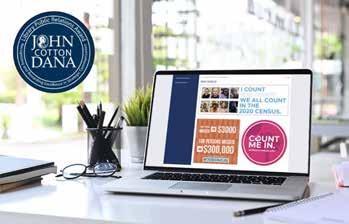
During conversations in early 2019, Spartanburg County Librarian Todd Stephens offered to have the Spartanburg County Public Libraries lead the efforts for the county’s government to encourage residents to participate in the 2020 Census. The goal was to surpass the county’s 2010 Census selfresponse rate of 66.1 percent. Here is how we did it.
In the late summer and into the fall of 2019, we made great strides by involving local elected officials in efforts to educate residents on the importance of the Census. Our first efforts centered around the “You Count” campaign, where we created literature in English, Spanish and Russian to be distributed at local festivals, hitting on various demographics in the county. The results of our efforts lead to targets being surpassed by almost all local municipalities, which brought our Census campaign to the attention of an ensuing advertising partner Neue South, who had been working separately with the Census Bureau to encourage participation throughout the state of South Carolina.
Going into the winter of 2020, we had lined up deliberate and well-conceived plans to reach our goal, including our next wave of print and electronic communications and in-person events with more than 50 community partners. We were set to have encouraged Census participation starting at the end of March 2020 via our communications and events, through the end of the collection in June 2020.
We moved from well-planned and well-prepared plans to on-the-fly events and communications methods that were
implemented in a rapidly changing environment. Even as our libraries remained closed through the early months of the pandemic, library staff helped our partners promote Census participation through emergency food boxes and online communication.
As the country shut down, we prepared and distributed lawn signs that were placed in all of our communities at intersections and in heavily trafficked areas. We attempted phone banks (unsuccessful) and communications via geofencing (highly successful!) and texting.
Even with the pandemic, some of our plans remained unchanged. We ran a billboard campaign on four of the busiest transportation lines in our county along with an electronic billboard near the area hospital. A grant from the American Library Association also enabled us to place moving billboards on city buses encouraging Census participation through the spring and summer.
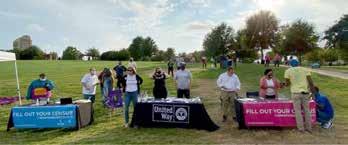
As we emerged from the strictest lockdowns, libraries encouraged Census participation through some of our community’s first socially distanced in-person events. We also began going to the local community college to encourage participation.
Census completion deadlines were extended by the federal government, so we worked with the hospital to promote Census participation at their local COVID testing sites. We continued to develop online marketing tools for our partners and provide them with pre-written emails to share with their clients to promote participation.
“As we emerged from the strictest lockdowns, libraries encouraged Census participation through some of our community’s first socially distanced inperson events. We also began going to the local community college to encourage participation.”
As soon as schools opened in the fall, we piggybacked on other groups’ efforts to provide school supplies in our communities, with a push towards Census completion. Mixing traditional and new methods of communicating with our communities, we were able to reach a lot of different parts of Spartanburg.
For libraries who want to apply for the John Cotton Dana Award, there were four main components that drove our success. First, we have an awesome community, and we reached out early to our local government, non-profit and for-profit communities. Second, we involved these partners in the process every step of the way. Third, we were unafraid to take chances and learn new skills and techniques. And last, we followed through. Even when we were discouraged by the pandemic of a lifetime and the race to complete the Census moved from a two-month sprint to a six-month marathon, we continued to work with our partners and encouraged and lifted each other up. Early outreach,
continued on page 20
<https://www.charleston-hub.com/media/atg/>
Then COVID hit.
John Cotton Dana Award Winner’s “Amplify 817” Campaign: Music to Fort Worth’s Ears
By Todd Overman (Communications Specialist, Fort Worth Public Library)
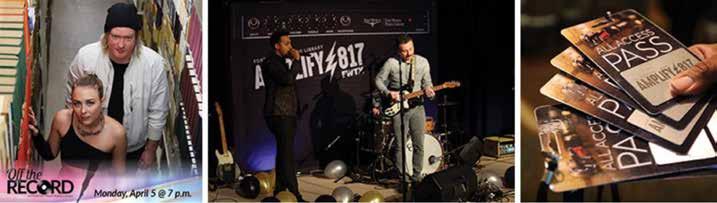
Amplify 817 is a music-streaming platform designed to promote Fort Worth-based musicians and allow the community to find local music and listen to it for free. When the Fort Worth Public Library launched the initiative on Feb. 14, 2020, we were challenged to market a service that few libraries provide, while realizing the core audience for the program stretches beyond our typical patron base.
The annual Visit Fort Worth luncheon provided the event at which Amplify 817 was presented to 800+ influential members of the community. Each table featured a 3D cardboard “amplifier” centerpiece branded with the Amplify 817 logo and a brief description of the program. Sponsors of the luncheon whose support helped fund the cost of printing the mini amps were displayed on the amp as well.
We created an “All Access Pass” similar to a backstage concert pass, complete with a lanyard. Affixed on the front was a specially printed metal library card branded with “Amplify 817.” On the back were instructions on how to use the library card, along with a longer description of the Amplify 817 program. Additional branded collateral included amplifier coasters, guitar picks and a small poster. Staff members who served as program ambassadors at the event wore matching rock inspired Amplify 817 T-shirts.
Our promotional space outside of the ballroom featured a larger-than-life backdrop that was designed to look like an oversized amplifier (again branded with “Amplify 817”). The first four musical acts accepted into Amplify 817 were present for a meet-and-greet with guests and to take photos in front of the backdrop. The launch efforts were well-received by the musicians, the community and our partners.
The uniqueness of the program to our area helped us land several key media placements, which helped expand the reach of the initial launch. Fort Worth is part of the fifth largest media market in the United States and breaking into the competitive news cycle was very important for our message reach. Additionally, an in-depth story with our CBS affiliate gained reach as far as Houston.
“Overall, the real successes from the campaign have come in engaging with Fort Worth citizens who don’t always think of the Fort Worth Public Library or regularly use our resources.”
While building an audience for Amplify 817, we knew events at live music venues would be key to sustaining the excitement. However, a month after the launch, COVID-19 forced venues to temporarily close, forcing us to pivot to nearly exclusive online and social media marketing.
We were already tuned into out-of-the-box thinking for Amplify 817. We try to keep in mind with all our projects and campaigns that sometimes seemingly crazy ideas are the best ideas, and we can learn a lot from trying new things.
Because in-person concerts were off the table, our staff prerecorded performances from seven artists staged at two of our libraries —— socially distanced and without in-person audiences. The finished piece was edited as an “Amplified New Year’s Eve” and live streamed on YouTube. It was a heavy lift for our small staff, but it was worth our efforts to evoke a live music environment and showcase some of the diverse talent featured
<https://www.charleston-hub.com/media/atg/>
DSM-5-TR™ and essential new resources are available for students and practitioners
PsychiatryOnline.org offers the most comprehensive online access available for psychiatric textbooks, journals and professional development tools including DSM-5-TR™ and The American Journal of Psychiatry. This virtual library is a key resource used in the teaching and study of psychiatry, psychology, and other mental health disciplines as well as for diagnosis, treatment, and professional development.
Contact us for more information or to purchase a subscription: Email: institutions@psych.org Phone: 202-559-3729
Priority Code: AP2203A
on Amplify 817. At the same time, we recorded interviews and specific performances for our “Off The Record” videos in which our music librarian interviews local artists about their music and influences.
The initiative’s marketing is evolving as we’ve been through two more rounds of adding additional artists to the Amplify 817 family in 2021. The look and feel of our graphics is changing, but still evokes the “cool” factor we began with. We have recorded additional “Off The Record” episodes, and new in 2021, we use our “Library News” blog to highlight the new artists with music-review style posts. We now have dedicated social media accounts for Amplify 817, but we often share posts from them on the library’s main feeds.
As an ongoing effort, we share artist graphics on our various social media platforms, along with photos, blog posts, links to Amplify 817 pages and “Off The Record” promos or episodes in which they are featured. They are encouraged to share pieces on their social media.
Overall, the real successes from the campaign have come in engaging with Fort Worth citizens who don’t always think of the Fort Worth Public Library or regularly use our resources. We are strengthening our relationships with those in the local music industry and helping to create a stronger collaboration between artists in an environment where that was already becoming normal. Striving to serve the entire city is a major goal of our strategic plan through supporting arts and culture and community vitality. We recognize that local musicians are essentially small business owners, and a better climate for entrepreneurship can help boost the city’s economy.
The grant from our John Cotton Dana Award is being used to enhance our future library marketing projects.
<https://www.charleston-hub.com/media/atg/>
Q&A with 2018 John Cotton Dana Award Winner, DC Public Library continued from page 15
• Let research get you started: Don’t just follow your hunch or a co-worker’s opinion. Make the time to conduct primary research or pull historical data that will help inform your project.
• Have a Solid Plan: Have an understanding of why you are working on a project. Identify the problem and develop measurable goals.
• Collaboration is key: Have you ever heard the saying “two heads are better than one?” Collaborating with partners or co-workers helps you stay focused, allows you to delegate tasks, provides a sounding board for ideas, and expands the knowledge and experience available for the project.
• Engage Stakeholders: It’s important that you know who your stakeholders are. It will be to your advantage to proactively keep them informed about the project. Receiving buy-in from your stakeholders will ensure that you have a successful project. And remember, stakeholders can include anyone that has an interest in your library including the public, library board, elected officials and executive staff.
• Monitor Performance: To ensure that your project stays on track, you have to constantly monitor performance. Monitoring will tell you if the project is performing as expected. If the project is underperforming, you have an opportunity to make adjustments that will hopefully have a positive impact on performance.
constant communication, taking chances and continuing to follow through on our communications and plan helped us achieve our goals.
The value of our public relations effort was tangible and intangible. Through our efforts, we insured that the residents of Spartanburg County received their fair share of South Carolina’s $13 billion in federal aid each year. More importantly, we successfully created new relationships and partnerships while fostering old ones. These efforts have led us to better outreach in previously underserved communities in our county, and we will continue to improve outreach with the John Cotton Dana Award grant from H.W. Wilson.
Rumors continued from page 9
We’re also taking a different approach to hybrid this year. There will be two events — the in-person conference that will be held in Charleston from November 1-4, and the virtual conference that will be held online through the Cadmore platform from November 14-18. This will allow us to focus on creating the best possible experience for our attendees, presenters, sponsors, and vendors for each unique event.
Registration is now open at https://www.charleston-hub. com/the-charleston-conference/ for conference attendance,
Vendor Showcase exhibit booths, the Charleston Premiers, and for sponsorships and advertising. We can’t wait to see you in November!
That’s it for now. Remember to check the Charleston Hub website for all the latest news and updates, and to sign up for our email newsletter to get the news delivered straight to your inbox. Happy Summer!
<https://www.charleston-hub.com/media/atg/>
How Spartanburg County Libraries Improved Census Participation continued from page 16
DRIVING INNOVATION THROUGH ENGINEERING KNOWLEDGE
JOURNALS • CONFERENCE PROCEEDINGS • EBOOKS
The ASME Digital Collection
ASME’s authoritative online reference for the mechanical engineering and related research communities. It provides unparalleled depth, breadth, and quality of peer-reviewed content:
• ASME’s Journals from 1959—present
• ASME’s Conference Proceedings from 2000—present, plus select proceedings back to 1955
• ASME’s eBooks from 1993—present, plus select titles back to 1944
For more information visit asmedigitalcollection.asme.org
The American Society of Mechanical Engineers® ASME®
Features of The ASME Digital Collection include:
• Powerful search tools that retrieve content simultaneously from journals, conference proceedings, and eBooks
• Advanced filtering tools to refine search results by keywords, topics, journal citations, image captions, and date range
• Topic Collections for specific subject areas
• Online eBooks in full HTML
• Enhanced user experience (UX), providing simplified navigation and inline figures & tables
• Responsive web pages for better desktop and mobile experience
• Links to CrossRef, Google Scholar, and Web of Science to discover citing articles
• Tools for citation export
• Ability to share links by social media and email
• Email alerts for saved searches and newly published content
• COUNTER 5/SUSHI compliant
• Shibboleth institutional login
• Indexed in leading abstracting and indexing (A&I) services To order ASME Subscription Packages contact Warren
How Edmonton Public Library’s Revitalization Led to a John Cotton Dana Award
By Celia Zampitella (Communications Specialist, EBSCO Information Services)
Edmonton Public Library CEO Pilar Martinez recounts the opening of its revitalized central library, Stanley A. Milner Library, an award-winning John Cotton Dana (JCD) campaign.
Describe your award-winning JCD campaign. What was the goal?
The revitalization of the Edmonton Public Library’s (EPL) central library, the Stanley A. Milner Library, was a construction journey that took three and a half years to complete. While we had plans in 2020 for a grand celebration in person, we, like everyone else, had to adjust during the COVID-19 pandemic and the ever-evolving health restrictions. To facilitate a grand opening celebration befitting of the occasion, we expanded our limited in-person event while working within the health guidelines and added an online component, the Virtual Milner Open House.
Our main goal for the Virtual Open House was to create excitement around the reopening of our Milner Library and increase awareness around the transformational revitalization and expanded spaces. The theme of our Open House was “One fantastic new library. Choose your way to experience it.” We wanted to engage Edmontonians and give them a glimpse inside our beautiful new facility and encourage them to visit. As part of the programming, we created a fun and engaging social media campaign that included contests, a mix of virtual and live sessions and a scavenger hunt to find a plush toy, Stanley the Bear. We also created 31 feature videos that included tours of our spaces and interviews with subject matter experts. I was fortunate enough to participate in an interview with Mr. Stanley A. Milner, our library namesake, biggest champion and dear friend who passed away in 2021.
For the Virtual Open House program, we focused on engaging with EPL staff and external experts to create and share our renewed spaces, programs, collections and resources on all EPLowned channels: social media, our library website, in-branch communication tools (such as the LCD and checkout screens), staff and customer newsletters and targeted emails. We worked with social media influencers and pitched media for further amplification.
Our EPL staff shared their passion and expertise through showcasing our new programs and services and did an excellent job. It was a real treat to see the enthusiasm and pride that staff had in highlighting the services in their respective areas.
Over the course of the first week and despite a capacity limit of only 200 people, EPL welcomed more than 5,500 in-person visits and reached more than 61,000 people online. Our “EPL from Home” videos were viewed more than one million times and our website received more than 2.2 million unique page views in 2020.
COVID-19 and the public’s safety were always top of mind and a challenge we had to consider. In addition to the everchanging health restrictions, we also faced uncertainty about our ability to fully open due to the pandemic and mandated temporary closure of public libraries. In addition, materials were delayed or unavailable due to global supply chain issues. As this building project was EPL’s largest capital project to date, we recognized the incredible amount of work invested to bring the project to life. A year earlier while the building was still under construction, there were some negative comments made on social media about the façade of the building, which were taken into consideration. While we didn’t have control over COVID-19 or other delays, we were able to lead and influence the updates focused on services and building. We really leaned on the expertise of our Marketing and Communications Team to produce engaging content highlighting before and after videos and sneak peeks into our bright, beautiful welcoming library.
How has implementing public relations at your library improved its community involvement?
“Through actively listening to customer feedback from our social media channels, newsletters and online chat, we continually maintain high engagement with our customers and a strong understanding of community needs.”
EPL is a community-led organization. We have a serviceled philosophy framework that is about engaging our community members — this philosophy applies, not only to our front-line staff, but to everyone who interacts with our customers, including our Marketing and Communications Team. Through actively listening to customer feedback from our social media channels, newsletters and online chat, we continually maintain high engagement with our customers and a strong understanding of community needs. We try to position EPL as a positive force in our city. Our Marketing and Communications Team provides expertise and different frames of reference that a library staff may not have, and I think it’s made all the difference in how EPL is positioned in Edmonton. People recognize EPL as a real asset and I believe it has a lot to do with how we present our brand, communicate and respond to challenges. Much of our success depends on our staff being able to strategically and
<https://www.charleston-hub.com/media/atg/>
NOTE: This is the version without the
8 Library Services That Will... Ma ke You Smi le. Make You Smile.
1) Publishing Sources - Almost 200,000 at our disposal
2) New Title Selection Plan - Immediate notification
3) Electronic Ordering - Simple online ordering system
4) Early Release Program - Immediate availability guarantee
5) Cataloging - We do the busy-work for you
6) Comprehensive Reporting - Up-to-the-minute order status
7) Duplicate Order Alert - We’re on guard, you avoid hassles
actively manage circumstances as they arise, while reinforcing our core values, leveraging our brand integrity and presenting our organization in a positive light.
What are some tips that you would give to other librarians who would like to learn more about marketing their library?
To successfully market a library, it’s important to respect the expertise, the profession and the people in those marketing and communication roles as they are able to focus on customer experience, identify needs and brainstorm creative solutions using a different lens. I would also suggest tapping into other resources, whether that’s looking outside the library community for marketing-related conferences, reading books or contacting marketing and communications teams in other libraries or organizations that you admire and asking for some tips. As library workers, we are known to really love words and sometimes I think less is more and brevity is key. People want to laugh and have something to remember, and often adding humor is the way to go, so remember to have some fun with it.
What piece of advice would you give libraries considering applying for the John Cotton Dana Awards?
“ Things always go smoothly with Emery-Pratt. Their people are knowledgeable, and always provide friendly, rapid service.”
Receiving the John Cotton Dana Awards is such an honor, and EPL has the unique distinction of winning the award twice (previously for our library rebrand in 2011). I would encourage libraries that are interested in applying for the John Cotton Dana Awards to speak to the impact and the outcomes of the initiative, as well as any challenges that were overcome, as concisely and articulately as possible.
How did you use the John Cotton Dana grant money at your library?
Since winning the award, we used the John Cotton Dana grant money to launch our Ready. Set. READ! fundraising initiative in partnership with Dolly Parton’s Imagination Library. The initiative will provide books to children aged 0-5 who reside in areas of the city that are most socially and economically vulnerable. Through research, we know that having access to books at an early age, reading and libraries do make a difference in the children’s success in school later in life. To date, we have raised $330,000 and we are grateful to have been able to kickstart the campaign with the John Cotton Dana grant money.
<https://www.charleston-hub.com/media/atg/>
Tips to Run a Successful John Cotton Dana Award Campaign from Anchorage Public Library
By Misty Rose Nesvick (Communications Relations Coordinator, Anchorage Public Library)
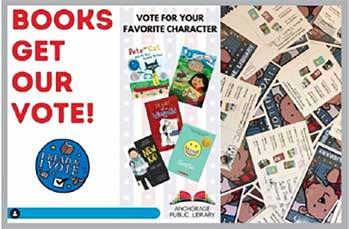
Hear from Anchorage Public Library’s (APL) Communications Relations Coordinator on tips for marketing your library and the “Books Get Our Vote” campaign that led APL to winning a 2021 John Cotton Dana Award.
As libraries evolve from pillars of shhh and books, to vibrant, engaged centers of information, education and community, the need for strategic marketing and public relations has become clear. Since implementing a more deliberate focus on marketing and communications in 2018, Anchorage Public Library has seen direct results in the following areas:
• Increased support from library champions. These members of the community are quick to lend their time, voice and financial resources to support the library when we ask. APL established regular communication via social media, e-mail and a cohesive brand strategy that keeps us front and forward in patrons’ minds. We make it easy for our patrons to answer the call when we ask.
• Improved connection between community partners and city departments. A marketing strategy with clear goals, themes and performance metrics makes it easy for partners to amplify library messaging or incorporate our goals into their own campaigns. We recently completed a successful co-marketing campaign for the launch of a new transit bus route to our main library location.
Most library staff didn’t get into the business of libraries to be marketers. While it’s helpful to have a dedicated marketing professional in your library system, librarians shouldn’t be afraid to take on this task. The “trick” is to remember marketing, advertising and public relations are a skill set just like library science. It can be overwhelming to find the best way to learn so I recommend five tips:
• Get a brand book and stick with it. Keeping it simple including a small number of standard colors, fonts and logos makes it easier for any staff member to support marketing efforts whether it’s making a social media graphic or an in-house flyer.
• Consider your audience. Libraries may serve everyone, but you can’t successfully market to everyone all the time. Learning about the demographics is an important part of marketing. When you consider a new campaign think about exactly who you’re targeting. A fun way to do this is picture what that person looks like when they walk into the library. How old are they? Where did they just come from and where are they going to after their visit? Do they have internet access or are they coming to the library to be connected? Smaller is better. You can always target a different group next time.
• Time is money. While many aspects of public relations seem “free” (social media, earned media) staff time is still a limited commodity. Do less things well vs trying to be everywhere at once.
• Hop on trends but stay on mission. Sea shanties and dance challenges are fun to watch, but how do they relate to the library? Tying in items from your collection help make it library relevant but still fun.
• Find trusted peers and experts. Find a library whose campaigns and strategies you love and reach out to them. Join groups like Urban Libraries Council or Library Marketing Conference. Look to traditional marketing experts and then adapt those tactics to library land. Retail marketers and non-profits have been at the public relations game longer than libraries. Some of my favorites include Social Media Examiner, American Marketing Association , AdWeek and Public Relations Society of America
Once APL was firing on all cylinders with renewed marketing energy, we knew we wanted to shoot for the moon and try for a John Cotton Dana Award. With that in mind, we approached three larger scale campaigns with the framework of the JCD application as our base so when it came time to apply we had the data and creative samples at the ready.
“Books Get Our Vote” was chosen as our submission project because it incorporated so many types of public relations and had the most defined metrics.
It started with two of Alaska’s statewide and local challenges, following national trends — low reading scores in elementary school students and low voter turnout. We believed by creating something that combined literacy and voter education we would increase an interest in reading and civic participation with one joint program.
With a population of about 300,000 people and municipal land encompassing an area roughly equal in size to the entire state of Delaware, Anchorage is a sprawling city home to moose, bears and humans alike. As the largest library system in the state, APL often leads as a hub for statewide initiatives and programs that can address both municipal and statewide issues.
We surveyed possible partner libraries throughout the state to gage interest level, as well as their needs for a voter participation
<https://www.charleston-hub.com/media/atg/>
literacy program. Using those results, we worked to design a program where kids under 18 would vote for a book character for president.
We further defined our target audience to grades 1-6 and parents/ caregivers of voting age. The program metrics and original goals then had to be adjusted due to COVID-19. For statewide participation, our revised goal was to have a presence in at least 25 Alaskan communities and distribute 10,000 ballots. Within the community of Anchorage, we hoped school libraries would distribute at least 20 percent of our materials with library buildings picking up the remainder. The goal was to increase our presence as a trusted brand and community partner.
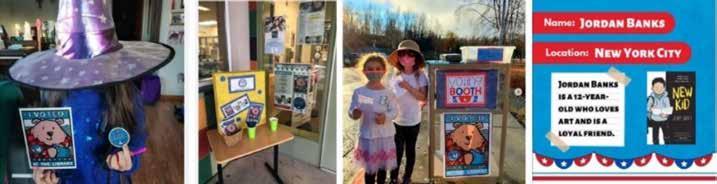
The initial plan was to set up ballot boxes inside of library locations and school libraries. COVID forced us to think outside the library to distribute materials by activity packets, relying more heavily on community partners. We then had to hope that people engaged with the program and returned them. This meant we also had to step up our marketing efforts since we would not have built in in building traffic.
To market the program, libraries released information on multiple channels both locally and statewide. Additional public facing marketing efforts focused on the active voting window and included:
• Special voting/civics themed Facebook Live virtual storytime led by library staff
• Recorded YouTube suffrage themed storytime led by a volunteer dressed as a suffragette
• Extended Facebook Event to allow for multiple posting to the targeted program audience without spamming full library audience.
• Local celebrities making videos endorsing candidates. These videos were edited to include book information and voting directions. (Facebook)
• Social media posts from partner school librarians (Facebook/Instagram/Twitter)
• Social media posts from participating libraries (Facebook/Instagram)
• Posters in open libraries or windows of closed libraries
• Distribution of materials through school libraries and afterschool providers
For a program conducted while the schools and libraries were all physically closed and the city was in a version of lock down, this was remarkably successful.
We ended with 27 libraries participating, six of those were Anchorage community groups with 21 additional Alaskan communities represented. We distributed materials for voting for 7,920 participants. While we did not set a goal for the “return rate” we wanted, we were quite pleased to receive 1,081 ballots back.
When we began planning this program and marketing initiative, we were excited about the possibilities of spreading awareness of the library, fantastic children’s literature and voting. We were thrilled to see many social media posts of children proudly casting their ballots at home and in socially distanced voting set ups. Additionally, getting other people to help spread the library’s marketing for free was the greatest success of all.
APL will be using our grant money for a 2022 re-engagement campaign targeting youth with an emphasis on coming back to library buildings after more than two years of COVID- impacted service, including more than a year of closed buildings.
Column Editor: Corey Seeman (Director, Kresge Library Services, Ross School of Business, University of Michigan) <cseeman@umich.edu> Twitter @cseeman
Column Editor’s Note: It is a beautiful day in Ypsilanti, Michigan as I write this and enjoy the beautiful sunshine outside my window. Behind me is my pup Runyon, fast asleep on the chair in my home office and Cosmo the cat is asleep on the bed. There are days like this where the prospect of working remotely seems like a real luxury and a blessing. The classical music is playing from Detroit’s WRCJ 90.9 FM. It could seem like there is not a care in the world.
However, as many of us know, what appears to be an idyllic picture might shield an alternative reality that is harder to navigate. Many people struggle with mental illnesses or have loved ones, friends, co-workers or neighbors who do the same.
I bring this up because of the theme that developed in this issue’s review. I have always let my reviewers pick the books they would like to review and incorporate the finished reviews when the arrive back to me. So in many ways, the only themes to a typical column is chance and opportunity. But this time, the scope of our own mental issues comes into play very clearly.
Included in these reviews are works encouraging us to incorporate mindfulness in your library, struggling with mental illness in the librarian profession, understanding and harnessing the culture of creativity and exploring the world of artificial intelligence. The common thread of these works captures one of the critical aspects of librarianship, creating a safe and nurturing environment for our patrons, our staff and our community.
Maybe these works will fit in nicely on your personal bookshelf or your library collection. Our goal here is to help you find good ways to invest your collection budgets.
Special thanks to my wonderful and patient reviewers who built this issue: Kathleen Baril (Ohio Northern University), Janet Crum (University of Arizona), Carolyn Filippelli (University of Arkansas – Fort Smith), Julie Huskey (Tennessee State University), Jennifer Matthews (Rowan University), and Sally Ziph (University of Michigan). I very much appreciate their efforts to share their reviews with the broader library community.
Charney, Madeline; Colvin, Jenny, and Moniz, Richard. Recipes for Mindfulness in Your Library: Supporting Resilience and Mindful Engagement. Chicago: ALA Editions, 2019. 978-08389-1783-1 paper. 132 pp. $49.99
Reviewed by Sally Ziph (Instruction/Reference Services Librarian, Kresge Library Services, University of Michigan, Ann Arbor) <sweston@umich.edu>
Mindfulness practice has become popular in many circles from mental health to business and to education. The benefits of mindfulness are many, including personal resilience in stressful situations, better heart health, and even changed brain structure. And, according to this book’s authors, mindfulness can also be utilized in ways that support social justice efforts and community engagement.
This book includes strategies and program ideas for academic and public libraries in the area of educating individuals to the benefits of mindfulness. There are fifteen chapters that are divided by the editors into four sections, including: Library as Hub, Innovative Services, Personal Practice, and Teaching Research. Each section includes several chapters written by librarians and other professionals with library or yoga experience. Topics include meditation apps, reflective writing, journaling, and tools for helping students to overcome research anxiety.
If you would like to be a reviewer for Against the Grain, please write me at <cseeman@umich.edu>. If you are a publisher and have a book you would like to see reviewed in a future column, please also write me directly. You can also find out more about the Reader’s Roundup here — https://sites.google.com/view/ squirrelman/atg-readers-roundup.
Happy reading and be nutty! — Corey
The authors are all academic librarians at different schools and with different roles. Madeleine Charney serves as a research services librarian at the University of Massachusetts Amherst. Jenny Colvin, MLS, is the assistant director for Outreach Services at Furman University Libraries. And Dr. Richard Moniz serves as the director of library services at the Horry-Georgetown Technical College in South Carolina. Charney and Colvin also share an interest in “contemplative pedagogy.” Colvin is a co-founder of the Contemplative Pedagogy Interest Group within ACRL. Moniz is the author of multiple books on library management and academic libraries.
Given the kind of stress that library staff (and everyone else) have been experiencing over the last two years during the pandemic, I definitely think mindfulness and its practices could be incorporated within library professional development and programming in valuable ways. Mindfulness has so many
<https://www.charleston-hub.com/media/atg/>
Pictured here is Runyon hanging out in his dad’s home office.
documented benefits for body and mind that I think library users (academic and public, especially) would welcome this sort of programming in their libraries. For example, the Ross School of Business at the University of Michigan had an active inperson meditation group before the pandemic, and meditation has proven to be very popular on the campus at large. This is a well-organized and comprehensive volume of “recipes” that definitely deserves a place on the shelves of librarians interested in programming that promotes the mental and physical health of their users.
ATG Reviewer Rating: I need this available somewhere in my shared network. (I probably do not need this book, but it would be nice to get it within three to five days via my network catalog.)
Dube, Miranda and Wade, Carrie (editors). LIS Interrupted: Intersections of Mental Illness and Library Work. Sacramento: Library Juice Press, 2021. 9781634001083 346 pages. $35.00. Please see http://litwinbooks.com
Reviewed by Kathleen Baril (Director, Heterick Memorial Library, Ohio Northern University) <k-baril@onu.edu>
The library world, like the larger society it reflects, is only recently beginning to examine how inclusive it is as a profession. Most works analyzing the library profession’s inclusiveness have focused on ethnicity and race. Although there have been many studies and works around mental illness and library users, especially in regard to working with the homeless, there is less literature about librarians and library professionals with mental illness.
The editors, Miranda Dube and Carrie Wade, have assembled in this work a large collection of both personal narratives and critical essays. Both authors are librarians, Miranda Dube is the founder of Librarians for Survivors that provides training for librarians to work with domestic and sexual violence survivors and Carrie Wade is a health sciences librarian at the University of Wisconsin-Milwaukee.
The book is divided into three sections of authored chapters titled “The Process of Becoming,” “Critical Perspectives and Narratives” and “The Situated Experience.” The first section focuses on personal narratives of individuals in the library field with various conditions ranging from ADHD to depression. In this section authors also describe their experiences as library students and/or their experiences in their first positions and how they adjusted. The second section, “Critical Perspectives and Narratives” takes a wider look at a variety of issues related to mental illness and the library workplace including disclosing a mental illness at work, Library of Congress Subject Headings and mental health conditions, and working in public service and mental illness. The third section, “The Situated Experience” focuses on personal narratives from well-established library professionals.
The personal narratives in this book are especially insightful as the authors share the challenges they face every day. For example, in the first chapter by Kaelyn Leonard, she shares the barriers she met when asking for accommodations as an online student with ADHD. When she asked for transcriptions of recorded lectures, she was told note-taking services were only offered to in-person students. In another chapter, Allison Rand writes about coping with PTSD after being near the Boston Marathon bombing and how it affected her afterwards in library
Guide to the ATG Reviewer Ratings
The ATG Reviewer Rating is being included for each book reviewed. Corey came up with this rating to reflect our collaborative collections and resource sharing means and thinks it will help to classify the importance of these books.
• I need this book on my nightstand. (This book is so good, that I want a copy close at hand when I am in bed.)
• I need this on my desk. (This book is so valuable, that I want my own copy at my desk that I will share with no one.)
• I need this in my library. (I want to be able to get up from my desk and grab this book off the shelf, if it’s not checked out.)
• I need this available somewhere in my shared network. (I probably do not need this book, but it would be nice to get it within three to five days via my network catalog.)
• I’ll use my money elsewhere. (Just not sure this is a useful book for my library or my network.)
school and as she looked for a job. Another writer, Jodene R. Peck Pappas, shares that her depression and obsessive-compulsive personality disorder (OCPD) have made it difficult for her to even write her chapter in this book.
The “Critical Perspectives and Narratives:” section provides wider views of mental health subjects and library work which provide some important perspectives for library practices and policies. One chapter covers when and if you should disclose your mental health condition at work while another examines mental health, emotional labor and working in public services.
Overall this book is an important addition to the library literature and the only complaint would be that this book has only just begun to cover this very large topic.
ATG Reviewer Rating: I need this in my library. (I want to be able to get up from my desk and grab this book off the shelf, if it’s not checked out.)
Issitt, Micah T. Opinions Throughout History: Robotics & Artificial Intelligence. Armenia, NY: Grey House Publishing. 2020. 9781642654813. ISBN. 490 pages, $195.00
Reviewed by Julie Huskey (Head of Cataloging, Tennessee State University, Brown-Daniel Library) <jhuskey@tnstate.edu>
Independent scholar and journalist Micah T. Issitt has authored several other volumes in the Opinions Throughout History series from Grey House Publishing. Here he takes on a topic that, the reader quickly realizes, is inextricable from technology in general. Tools capable of amazing feats have been part of human storytelling almost from the beginning; the author illustrates this in the opening chapter, with excerpts from Homer’s Odyssey and Iliad. By Chapter Three of the twenty-eight chronological (but overlapping) chapters, after a brief mention of machines in the Industrial Revolution, the emphasis turns to the twentieth century.
<https://www.charleston-hub.com/media/atg/>
The format is similar to other volumes in the series and opens with an nine page timeline, starting with 8000 BCE and limited to robotics and Artificial Intelligence (AI); The “Historical Snapshots” in the appendix is broader, but it is still technologyheavy. Also, the appendix includes a glossary of approximately 160 entries. The volume is heavily illustrated with black-andwhite images, virtually of which all are from Wikimedia.
Each chapter opens with a summary, followed by a short list of relevant terms. Two of the more interesting articles include discussions of Karel Čapek’s 1920 play, “Rossum’s Universal Robot,” and a 2016 article by Gideon Lewis-Kraus from Wired, “Check-in with the Velociraptor, at the World’s First Robot Hotel”). Each chapter concludes with a few questions and a list of works cited, all but a few of which include URLs.
Chapters cover machines in industry, medicine (ranging from artificial joints to robotic surgery), and warfare. Robots as toys and in popular culture are also discussed.
The author sometimes delves into more technical topics in this work. The chapter on quantum computing is the most sophisticated, but even there, it finds it necessary to define “atom.”
Overall, it is a cynical look at the role of robotics and AI ; the overall theme is that they have simply not lived up to their hype, and perhaps they have harmed society more than they have helped. There is much coverage of worker displacement and invasions of privacy.
The index is adequate but not extensive; for instance, the Mechanical Turk receives several pages, but it is mentioned neither in the chapter headings nor in the index. The work would have benefitted from tighter editing; terms are used inconsistently, metric conversions are imprecise, and the index entry for Max Planck appears with the M’s. The layout within chapters is sometimes confusing.
As with most of the other volumes in the series, Robotics & Artificial Intelligence falls somewhere between a textbook and a reference book. It will be useful to high school and undergraduate students, especially in the humanities and social sciences, exploring the history of technology. It is an optional, but interesting, purchase.
ATG Reviewer Rating: I need this available somewhere in my shared network. (I probably do not need this book, but it would be nice to get it within three to five days via my network catalog.)
Khosrow-Pour, Mehdi (ed.) Encyclopedia of Criminal Activities and the Deep Web. Hershey, PA: IGI Global, 2020. 978-1-52259715-5 (hardcover); 978-1-5225-9716-2 (eBook). 3 v. (1162 p. + glossary and index), $2450.
Reviewed by Janet Crum (Director, Health Sciences Library, University of Arizona, Tucson, AZ) <janetcrum@arizona.edu>
Like most technologies, the Internet began being used for criminal activity almost as soon as it came into existence. The international scope and decentralized structure of the Internet make it an ideal tool for scammers, traffickers, and other criminals to use to ply their trade. According to the FBI’s 2020 Internet Crime Report, the FBI’s Internet Crime Complaint Center received “791,790 complaints of suspected Internet crime — an increase of more than 300,000 complaints from 2019 — and reported losses exceeding $4.2 billion.”
(See https://www.fbi.gov/news/pressrel/press-releases/ fbi-releases-the-internet-crime-complaint-center-2020internet-crime-report-including-covid-19-scam-statistics .) Since the FBI is a United States agency, one can presume that those complaints reflect only a small percentage of cybercrimes committed around the world. Clearly, computer crime is a large and lucrative activity and one that can affect anyone who uses the Internet.
This three-volume encyclopedia from IGI Global attempts to provide comprehensive, multidisciplinary coverage of this important topic. It contains 79 articles by over 130 contributors from 30 countries. The articles are written primarily by academics and government researchers. Articles are organized into five sections that cover the gamut of online nefariousness: Cybercriminal Profiles, Understanding Cybercrime, and the Realities of the Dark Web; Cyberwarfare, Cybersecurity, Spyware, and Regulatory Policies and Solutions; Drug Trafficking, Human Trafficking, and the Sexual Exploitation of Children; Financial Fraud, Identity Theft, and Social Manipulation Through Social Media; and Security Tools and Solutions, Human-Based Cyber Defence, and the Social Understanding of Threats. Each volume also includes a glossary and comprehensive list of references; I will have more to say about those shortly.
This set is a substantive work that provides detailed information, including reports of original research, related to various forms of cybercrime. Many articles are well-written and well-organized, covering their topics with both breadth and depth. Explanations are at an appropriate level for undergraduates with extensive citations to both popular and academic literature. Of particular interest is the work’s global perspective, especially on topics often presented by United States media in US-centric ways (e.g., “fake news”).
Unfortunately, this work has significant weaknesses that make me reluctant to recommend it for purchase by libraries, especially given its high cost. First and of most concern is the uneven quality of the articles and an apparent lack of effective editing. Some articles are too narrowly focused to be appropriate for an encyclopedia (e.g., Human Trafficking and Cyber Laws in Malaysia or An IBE-Based Authenticated Key Transfer Protocol on Elliptic Curves). Others are too poorly written to be useful. In one case, large chunks of the article consisted of quoted passages from other works, cobbled together without the author providing any connecting prose for context or coherence. Some graphics seemed little more than decorative, and several articles were filled with grammatical errors and typos, including misspellings in headers and, in at least one case, the title of the article. Overall, the encyclopedia would have benefitted from more careful, thoughtful editing and proofreading.
Perhaps the most bewildering feature of this work is the fact that each print volume contains a comprehensive glossary, list of contributors, and index. Note that these are not separate, volume-level resources but the same glossary, list of contributors, and index — totaling over 200 pages — repeated verbatim in each volume. This much repetition adds bulk and, presumably, cost, while adding only minimal value.
Overall, Encyclopedia of Criminal Activities and the Deep Web is a useful work that addresses an important set of topics, but I recommend it with significant reservations due to its high price and the aforementioned concerns.
ATG Reviewer Rating: I need this available somewhere in my shared network. (I probably do not need this book, but it would be nice to get it within three to five days via my network catalog.)
<https://www.charleston-hub.com/media/atg/>
Lotts, Megan. Advancing a Culture of Creativity in Libraries: Programming and Engagement. Chicago, Il: ALA Editions | ALA Neal-Schuman, 2021 978-0838949474 $48.95.
Reviewed by Carolyn Filippelli (Reference Librarian, University of Arkansas – Fort
Smith) <Carolyn.Filippelli@uafs.edu>
Author Megan Lotts is the Arts Librarian at Rutgers, the State University of New Jersey-New Brunswick. Her publication is a very timely book that will be useful to many librarians figuring out ways to publicize and connect the resources and services of libraries with diverse campus and community clientele. Highlighting the importance and value of incorporating creativity and play as a vital foundation of all ventures, the author provides good advice and details for starting, working through, and assessing projects. It underscores the importance of collaboration, partnerships with communities of interest, promoting library visibility, and assessment. Throughout, the value of creativity and play are emphasized as a foundation for successful efforts to confront current issues facing libraries.
This handbook shares practical tips and novel ideas for engagement and outreach in libraries. The author describes how the use of creative activities and experiments (such as Lego Maker, the Bubbler, zines, button making, makerspaces, etc.) can provide practical and effective means to tackle challenges such as budget cuts, social issues, pandemics, and other issues facing our profession today.
The current large number of advertisements for Outreach and Engagement Librarians and Student Success Librarians is an indication that libraries recognize the importance of making connections with communities and promoting relevance of their resources. With examples and advice provided in this book, librarians now have the tools and encouragement needed to put projects into action. This is just the guidebook to provide the impetus that many librarians may need to get started on projects in their own libraries.
The appendices are valuable tools and resources in this work. Appendix A, “Event, Exhibits, Outreach, and Engagement,” provides a guide for planning, managing, and assessing a project. Assessment, as described here, provides for inclusion of diverse assessment tools and use of both quantitative and qualitative data to demonstrate impact. Appendix B is a Checklist for recording ideas, details, and creative possibilities. The bibliography is very useful for further reading, especially on creativity and the value of play.
Other similar toolkits are available for library outreach projects. However, this book is distinguished by the diversity of projects included, the details and guidelines for planning and assessment, and the encouragement needed for implementation.
ATG Reviewer Rating: I need this in my library. (I want to be able to get up from my desk and grab this book off the shelf, if it’s not checked out.)
Murray-Rust, Catherine. Library Next: Seven Action Steps for Reinvention. Chicago: ALA Editions, 2021. 978-0-8389-48392. 110 p. $54.99 (paper).
Reviewed by Janet Crum (Director, Health Sciences Library, University of Arizona, Tucson, AZ) <janetcrum@arizona.edu>
In the two decades prior to the COVID-19 pandemic, libraries faced challenging times and constant— often unpleasant— change. Budgets were cut. Collection costs rose faster than budgets, resulting in wave after wave of cancellations. When staff departed the library, they were often not replaced, leaving remaining staff to do more work for the same salary, because raises were few and far between. Outdated spaces needed renovation, and too many academic administrators who controlled library purse strings questioned the value of libraries in the age of Google.
In Library Next, Catherine Murray-Rust challenges library leaders to be bold and to engage with our communities to create positive change despite these challenges. Or, as she states in the preface, “I am writing this book to help all of us who value libraries to face squarely and come to terms with our uncertain future” (viii).
Murray-Rust describes herself as a change agent and “library disrupter” (viii). She recently retired as Dean of Libraries at Georgia Tech, previously served as Dean of Libraries at Colorado State, and held senior leadership positions at Oregon State and Cornell. While at Georgia Tech, she oversaw the renovation of two campus library buildings and creation of a collection storage facility shared with Emory University.
Her book is organized around seven action steps intended to help library leaders, “navigate these rapidly-changing times and prepare for a brighter future” (viii). Those steps are:
1. Look outside your social circle, profession, and organization for ideas and inspiration.
2. Be curious about the future.
3. Make bold, public plans.
4. Cultivate relationships with allies and champions.
5. Create successful change.
6. Implement a framework for action and innovation.
7. Focus on impact.
Each step gets its own chapter. In each of these chapters, that particular step is illustrated with examples drawn from the author’s career. Chapters end with a summary of takeaways, a table showing how leaders can shift their approach (e.g., from, “waiting for allies and champions to appear,” to, “seeking out allies and champions” (60), and a list of suggested activities to implement the action step.
Murray-Rust writes in a clear, engaging style and is an effective storyteller. The result is a unique combination of library memoir, advice from an experienced mentor, and leadership guide. Aspiring, new, and experienced library leaders will find the book thought-provoking and useful.
ATG Reviewer Rating: I need this in my library. (I want to be able to get up from my desk and grab this book off the shelf, if it’s not checked out.)
Information Law: Compliance for Librarians, Information Professionals, and Knowledge Managers. London: Facet Publishing, 2020. 9781783303663, $63.00
Reviewed by Jennifer Matthews (Collection Strategy Librarian, Rowan University) <matthewsj@rowan.edu>
Information Law: Compliance for Librarians, Information Professionals, and Knowledge Managers is a reference work regarding United Kingdom (UK) copyright law as of November 2019. Oppenheim, Muir, & Korn compiled this work to assist library, information, and knowledge (LIK) workers about copyright practices so that they would be better informed. The authors are strong advocates of ongoing training of staff and organizational stakeholders surrounding copyright practices as a way to better negotiate data retention, freedom of information inquiries, organizational policies, documentation, systems, etc.
The authors are all experts in the field of information law and libraries. Charles Oppenheim is an Honorary Fellow of CILIP, a member of the Legal Advisory Board of the European Commission, and of the Libraries and Archives Copyright Alliance. Naomi Korn is a managing director of NKCC, the consulting firm that she founded. Adrienne Muir is Professor of Information Management at Robert Gordon University, UK.
The book is organized around the “compliance methodology” developed by Oppenheim, Muir, & Korn. This methodology is meant to aid LIK workers to establish frameworks that assist with copyright compliance in a “risk-aware environment” that also optimizes access and use (p. xix). The authors use this methodology throughout the eleven chapters to explain UK copyright in a clear and approachable manner. As such, the chapters feature an introduction to their subject, case studies
Booklover — Pondering Poetry
and definitions for applicability, top tips for practical use, and further reading in certain areas. Also included is a discussion of the GDPR (European Union General Data Protection Regulation Act) and what organizations should be cognizant of in their overall practices and policies.
The book begins with a general introduction to UK copyright over chapters one through three and then moves to an introduction to law governance in chapter four. Chapter five covers the need for policies including the use of checklists and how to resolve conflicts. Chapters six through eight provide examples of how to put copyright policies into practice at various organizations through procedures, documentation, and activities, while chapter ten advocates for the ongoing training needed to keep all interested parties up-to-date. Finally, chapter 11 discusses future areas surrounding UK copyright and issues that should be considered.
As part of the accessibility of this book, Oppenheim, Muir, & Korn have also included five Appendixes that include possible policy examples, a sample data protection policy, a sample private organization contractual terms for online access to a database service, and a template for data protection privacy. These examples allow the reader to adapt a model for usage from the text rather than starting from scratch thus incorporating the ideas presented throughout the book into practice.
If organizations and LIK workers generally incorporated a regular review of copyright policies as well as a training schedule as suggested by Oppenheim, Muir, & Korn, these workers would find this work accessible and easy to read. Thus, this book would be a good edition to any training program for those that are involved with UK copyright practices.
ATG Reviewer Rating: I need this available somewhere in my shared network. (I probably do not need this book, but it would be nice to get it within three to five days via my network catalog.)
Column Editor: Donna Jacobs (Retired, Medical University of South Carolina, Charleston, SC 29425) <donna.jacobs55@gmail.com>
Unfortunately, the previous Booklover column had a title with a foreshadowing: “Rhyme, Russian, Revolution, and Reason.” And as events unfolded on the international front, I kept thinking about Brodsky and his statement about Anna Akhmatova’s poems: “They will survive because language is older than state and because prosody always survives history. In fact, it hardly needs history; all it needs is a poet, and Akhmatova was just that.” Maybe pondering poetry, rhythms and sounds is timely and necessary.
Of the 118 laureates listed from 1901-2021, 51 list poetry among their literature genre. At random, the following poems of four Nobel Literature Laureates were chosen for pondering:
“Marseilles”
by Frédéric Mistral (1904)
“Thou fair Marseilles, who openest on the sea Thy haughty eyes and gazest languidly, As though naught else were worthy to behold, And, though the winds rage, dreamest but of gold, When Lazarus preached to thee, thou didst begin Those eyes to close, and see the night within, And to the fountain of l’Huveaune speeding, The source whereof Magdaleue’s tears were feeding, Didst wash thy sins away; and in this hour Art proud once more; but other storms may lower. Forget not, then, amid thy revelries, Whose tears they are that bathe thine olive-trees!”
<https://www.charleston-hub.com/media/atg/>
“Kingfisher”
by Giosuè Alessandro Michele Carducci (1906)
“Not under a steel nib that scratches in nasty furrows its dull thoughts onto dry white paper; but under the ripe sun, as breezes gust through wide-open clearings beside a swift stream, the heart’s sighs, dwindling into infinity, are born, the sweet, wistful flower of melody is born. Here redolent May shines in rose-scented air, brilliant the hollow eyes, hearts asleep in their chests; the heart sleeps, but ears are easily roused by the chromatic cries of La Gioconda.
O Muses’ altar of green, white-capped above the sea. Alcman leads the chaste choir:
“I want to fly with you, maidens, fly into a dance, as the kingfisher flies drawn by halcyons: he flies with halcyons over spindrift waves in a gale, kingfisher, purple herald of spring.”
“Nothing Is Like Waiting Times”
by Erik Axel Karfeldt (1931)
“Nothing is like waiting times, spring flood weeks, budding times, no may a days spread as the clarifying April.
Get on the last slip of the trail, the forest gives its dull coolness and his deep whisper to it.
I want to donate the lust of summer for the first straws, which glitter in a dark pine sink, and the drill of the first thrush.
Nothing is like times of longing, waiting years, engagement times. No spring a shimmer spreads as a secret heartbeat. Rarely meet, divorce soon, dream of everything sweet and dangerous life in its womb bears!
Golden fruit may shake others; I want to linger and give up, in my garden I want to watch, while the trees are budding there.”
“Oceans”
by Juan Roman Jiménez (1956)
“I have a feeling that my boat has struck, down there in the depths, against a great thing.
And nothing happens! Nothing...Silence...Waves...
— Nothing happens? Or has everything happened, and are we standing now, quietly, in the new life?”
In addition to the enjoying the “prosody” of these poets’ wordcraft, their biographical information offers insight. Some have extensive biographical information. Others just a bit. Can one speculate on what were the influencers in their lives and thus their writing or is it a known fact? Toward this answer: 1) Frédéric Mistral — born 1830 in Maillane France. Studied law. His lifelong passion was the restoration of the Provence language. He donated his portion of the Nobel Prize money to the creation of the Museum at Arles and it’s collections from Provence. Mistral shared the 1904 Nobel Prize in Literature with José Echegaray y Eizaguirre. Mistral’s award was “in recognition of the fresh originality and true inspiration of his poetic production, which faithfully reflects the natural scenery and native spirit of his people, and, in addition, his significant work as a Provençal philologist.”; 2) Giosuè Alessandro Michele Carducci — born 1835 in Italy. He was the official national poet of modern Italy and the first Italian to win the Nobel Prize in Literature. His 1906 award was “not only in consideration of his deep learning and critical research, but above all as a tribute to the creative energy, freshness of style, and lyrical force which characterize his poetic masterpieces.”; 3) Erik Axel Karfeldt — born 1864 in Sweden. Karfeldt’s biographical information does offer a bit of intrigue. It was rumored that he was offered and declined the award in 1919. He changed his name from Erik Axel Eriksson to distance himself from his father’s criminal past. In 1904, he was elected to chair #11 in the Swedish Academy; 1905 elected member to the Nobel Institute of the Academy; 1907 elected to the Nobel Committee; and finally in 1912 became the permanent secretary to the Academy. He was awarded the 1931 Nobel Prize in Literature posthumously. After 1974, the Statutes of the Nobel Foundation stipulate that a Nobel Prize cannot be awarded posthumously; 4) Juan Ramón Jiménez — born 1881 in Spain. He studied law but never practiced. Jiménez was awarded the 1956 Nobel Prize in Literature “for his lyrical poetry, which in Spanish language constitutes an example of high spirit and artistical purity.”
Jiménez’s “Oceans” ends with a poignant question for pondering and as Brodsky poses — maybe all history needs is a poet to challenge us as we contemplate and begin to live our future.
<https://www.charleston-hub.com/media/atg/>
LEGAL ISSUES
Section Editors: Bruce Strauch (Retired, The Citadel) <bruce.strauch@gmail.com> Jack Montgomery (Georgia Southern University) <jmontgomery@georgiasouthern.edu>
Legally Speaking — States Unsuccessful in Providing Financial Relief of eBook Terms for Libraries
Column Editor: Anthony Paganelli (Western Kentucky University) <Anthony.Paganelli@wku.edu>
Due to consumer behaviors during and post-pandemic, as well as high economic inflation, available electronic resources are in high demand, which includes eBooks. While libraries are a financially viable resource for lower income consumers to access information, eBook providers continue to make access to eBooks difficult for libraries. Currently, publishers are setting extreme prices and terms for eBook purchases by libraries.
For example, Amazon withholds eBook titles published within the Amazon publishing department from libraries that includes such popular authors as Mindy Kaling, Trevor Noah, Andy Weir, and Michael Pollan, who all have a publishing agreement with Amazon. This means that libraries cannot purchase an eBook of these authors for their patrons (Statt, 2021).
Amazon’s global marketing chief of Amazon Publishing, Mikyla Bruder stated in an email to the Washington Post’s Geoffrey Fowler, “It’s not clear to us that current digital library lending models fairly balance the interests of authors and library patrons. We see this as an opportunity to invent a new approach to help expand readership and serve library patrons, while at the same time safeguarding author interests, including income and royalties” (Statt, 2021). Based on the statement, Amazon is noting that revenues received from electronic resources is an important decision for excluding eBooks from libraries, as many online businesses seek to increase revenues through online services, as evident during and following the Covid-19 Pandemic.
and provide eBooks and information to their patrons, which has gained the attention of government agencies. For instance, the U.S. House of Representatives on the Judiciary (2019) began an investigation into the digital markets regarding antitrust. The committee investigated three main areas: “Documenting competition problems in digital markets; Examining whether dominant firms are engaging in anti-competitive conduct; and Assessing whether existing antitrust laws, competition policies, and current enforcement levels are adequate to address these issues.”
In a statement by the chair of the committee Jerrold Nadler (D-NY) on November 13, 2019, the chairman noted that specific tech businesses control a significant portion of businesses, which included Google, Facebook, and Amazon. The statement stated, “Google controls over 90% of the global search market and Facebook captures over 80% of all global social media revenue. By some estimates, Amazon controls about half of all online commerce in the U.S.” (Nadler, 2019).
For instance, the pandemic had an inequality impact on offline and online businesses. According to Bloom, et al. (2021), “offline firms are much more negatively impacted than online firms as the online economy has been largely able to escape the worst of the pandemic. Large employers have likewise fared much better than small employers and non-employers. In particular, small offline firms are significantly worse off than their larger online counterparts: non-employer firms who receive less than 50% of their revenue online lost over 45% of their sales while 20+ employee firms with at least 50% of their revenue online lost only 10%. This highlights the great inequality of the economic impact of Covid-19.”
Despite the demand and increase of revenue for online services in larger corporations, eBook providers and publishers continue to make it difficult financially for libraries to purchase
As per request of the committee, the American Libraries Association (ALA) made a statement to the U.S. House of Representatives Committee on the Judiciary on October 15, 2019. They noted that the demand for digital content is growing among library patrons, which libraries are trying to maintain the demand. ALA (2019) stated, “However, unfair behavior by digital market actors — and the outdated public policies that have enabled them — is doing concrete harm to libraries as consumers in digitals markets.”
The statement also noted that “if these abuses go unchecked, America’s competitiveness and our cultural heritage as a nation are at risk.” (ALA, 2019).
Furthermore, ALA mentioned that libraries have spent over $40 billion on digital content over the past 10 years. However, they provided an example of how eBook providers and publishers are setting the prices and terms for libraries. The statement noted the eBook The Codebreakers by David Kahn is priced to consumers for $59.99 for a lifetime. Yet, the same eBook cost the library $239.99 for one copy, which can only be lent to one person at a time and the library can only keep the eBook for two years. Furthermore, if the library would like to extend the term for four years, the library would pay $479.98 or for 20 years the library would pay $2,399.90. ALA also addressed the
<https://www.charleston-hub.com/media/atg/>
terms excluding libraries from titles or allowing accesses to titles after release dates, “Denying or delaying new content to libraries certainly is a market failure. It also prevents libraries from accomplishing their democratizing mission of providing equal access to information to American citizens” (ALA, 2019).
The indifferences between the libraries and the public consumers of eBooks by the eBook providers is significant, as indicated by the ALA statement to the U.S. House of Representatives. This is also evident in lawsuits against Apple, Amazon, and other leading publishers regarding eBook price fixing a few years ago, which is encouraging state lawmakers to intervene on behalf of libraries.
State Legislation
Maryland, New York, and Rhode Island are the first states to lead the initiative against eBook publishers and providers on behalf of the libraries. On January 26, 2021, the New York Senate introduced a bill (S2890B, 2021) to address the different agreements between publishers and libraries. The bill titled “An act to amend the general business law, in relation to requiring publishers to offer licenses for electronic books to libraries under reasonable terms” addressed several issues with the terms set forth by eBook providers. First, “A limitation on the number of users to whom the libraries may simultaneously provide access to the electronic books.” Second, “A limitation on the number of days the libraries may provide a user with access to the electronic books.” Third, “The use of technological protection measures that would prevent a user from (A) maintaining access to the electronic books beyond the access period set forth in the license, and (B) providing other users with access to the electronic books.” In addition, the bill stated, “such reasonable terms shall not include a limitation on the number of licenses for electronic books libraries may purchase at the same date available to the public.”
Despite the bill being passed unanimously in the New York Assembly and strongly supported by the New York Library Association, the bill was vetoed by the New York Governor Kathy Hochul (D). The president of ALA Patty Wong noted the disappointment in the governor’s veto, “Governor Hochul’s decision to veto S2890B/A5837B is unfortunate and disappointing. Protecting New Yorkers’ access to digital books through the library is critical to ensuring equitable access to information for all” (ALA News, 2022). The statement from ALA also noted that they will continue to negotiate directly with publishers regarding eBooks, while they continue to work with federal and state agencies to advocate for libraries.
While New York was the second state to introduce an eBook regulation bill in support of libraries, Maryland was the first state to create similar legislation, which was approved by the legislators and Governor Larry Hogan (R). However, even before the bill was passed, the Association of American Publishers (AAP) provided written testimony in opposition, which they later filed a lawsuit against Brian E. Frosh (the Attorney General of the State of Maryland) on December 9, 2021. The AAP’s argument was that the law was mandating any eBook licensed to a consumer in Maryland also had to provide a license to the Maryland libraries for a “reasonable term,” which was forcing a transaction and therefore unconstitutional due to their right to distribute copyrighted works.
Judge Deborah L. Boardman ruled in favor of the publishers and was noted in the opinion that granted the injunction,
because the publishers challenged the Maryland Law “that requires publishers who offer to license ‘electronic literary products’ to ‘the public’ to offer to license the same products to Maryland public libraries on ‘reasonable terms.’” (Price, 2022). The preliminary junction was issued and became permanent in April 2022, as the Maryland Attorney General concluded that the state would no longer pursue the lawsuit any further, which officially ended the law.
Rhode Island is another state that is attempting to create a law regarding eBooks and libraries, but with the addition of schools and educational institutions within the bill. As of May 18, 2022, the Rhode Island Senate is moving forward with the Senate Bill S2842 that addresses eBook reasonable terms. The bill also has similar language as the New York and Maryland bills, which included the statement, “Any publisher who offers a contract or license for acquisition of electronic books and digital audiobooks to the public in Rhode Island shall offer to license such books to libraries and to elementary and secondary schools and educational institutions in the state on reasonable terms that would permit libraries, schools and educational institutions to provide their users and students with access to such electronic books.”
According to Albanese (2022), the Rhode Island bill has also included a significant change “that explicitly mandates that any e-book and digital audiobook license ‘that limits the rights of a library or school under the U.S. Copyright Act shall not be enforceable’ under Rhode Island state law.” Of course, this bill will be debated the same as the New York and Maryland bills. As for other states, Albanese (2022) was not optimistic that states with similar bills will be successful. Those states include Connecticut, Illinois, Missouri, and Tennessee.
However, until a governmental policy is established, eBook publishers and providers will continue their business models that will remain costly to libraries and the patrons that rely on access to literary information electronically. Hopefully, the state’s initiatives will gain the attention of federal agencies to create a policy nationwide that will establish a new business model to satisfy the publishing industry, while supporting the libraries.
References
ALA (2019). U.S. House of Representatives Committee on the Judiciary Competition in Digital Markets. Retrieved from https://www.ala.org/news/sites/ala.org.news/files/content/ mediapresscenter/CompetitionDigitalMarkets.pdf
ALA News. (2022). ALA disappointed in New York Governor’s rejection of ebook equity legislation. Retrieved from https:// www.ala.org/news/press-releases/2022/01/ala-disappointednew-york-governors-rejection-ebook-equity-legislation
Albanese, A. (2021). New York Legislature passes library E-Book bill. Publisher Weekly. Retrieved from https://www. publishersweekly.com/pw/by-topic/industry-news/libraries/ article/86637-new-york-legislature-passes-library-e-book-bill. html
Albanese, A. (2022). Rhode Island advances its library E-Book bill. Publisher Weekly. Retrieved from https://www. publishersweekly.com/pw/by-topic/industry-news/libraries/ article/89385-rhode-island-advances-its-library-e-book-law. html
continued on page 35
<https://www.charleston-hub.com/media/atg/>
Questions & Answers — Copyright Column
Column Editor: Will Cross (Director of the Open Knowledge Center and Head of Information Policy, NC State University Libraries) <wmcross@ncsu.edu> ORCID: 0000-0003-1287-1156
QUESTION: A university administrator asks, “What is the CCB, and how will it impact my campus community?”
ANSWER: In past columns we have discussed the “Copyright Alternative in Small-Claims Enforcement Act,” or “CASE Act.”
The Act creates a Copyright Claims Board (CCB), a non-judicial tribunal housed at the Copyright Office, to decide copyright infringement cases. The CCB can award monetary relief of up to $30,000 per proceeding. Early library engagement with CASE/CCB focused on an opt-out option that permitted libraries to opt out of participation in CCB claims and instead require the copyright owner to re-file the action in federal court if the copyright owner wishes to continue to pursue the matter. After active engagement from the library community, the Copyright Office ruled that library opt-out also applied to library employees acting within the scope of their duties.
In the spring of 2022, the Copyright Claims Board was launched at: https://ccb.gov/. As of this writing it has not begun to hear claims but is expected to do so in the near future. In response, universities have begun to develop informational pages and libguides about the CCB to prepare everyone on campus to understand what the CCB is, how it applies to them, and how to respond if they receive a notice under the law. In order to support this work, Rachael Samberg, the Scholarly Communication Officer & Program Director at the University of California, Berkeley and Katherine Klosek, the Director of Information Policy at the Association of Research Libraries (ARL) have developed a new “CASE Act Toolkit.” The Toolkit provides an overview of the CASE Act and the new CCB. It also spells out which stakeholders on campus may be impacted by the new law and provides guidance on university responses including the decision by libraries to opt out and sample communication from libraries to library staff. You can find the full toolkit, including a set of checklists for responding and model text here: https:// www.arl.org/case-act-toolkit/.
QUESTION: A faculty scholar asks, “I heard something about a TV show that was going to be canceled due to issues with copyright and an NFT. What is an NFT, and how does it relate to copyright?”
ANSWER: The specific news story that made the rounds in May of 2022 dealt with the actor and writer Seth Green, perhaps best-known for roles in the late 1990s and early 2000s such as Scott Evil in the Austin Powers films or as the character of Oz in the TV show Buffy the Vampire Slayer. In recent years, Green has worked primarily as a writer and producer and in 2022 he was developing a show based around a non-fungible token (NFT) called Bored Ape #8398, which he had licensed for a television series. Unfortunately, Green was phished (tricked into revealing confidential information) and the NFT was taken and unlawfully sold to a third party.
For those unfamiliar with NFTs, they are basically unique digital items such as images or videos that are tracked on the blockchain. You can read a lighthearted overview of NFTs here: https://www.theverge.com/22310188/nft-explainer-what-isblockchain-crypto-art-faq. For now, it is enough to know that Green had a unique digital asset that was taken without his
lawful consent and sold to a third party. Since Green’s show was based on the NFT, there was concern that the show could not go forward.
In order to explore and explain this case, Cornell law professor James Grimmelmann shared a lengthy discussion about NFT ownership and how copyright and real property law might address Green’s plight. Grimmelmann argues that NFT’s are clearly property under the law and that the hacker “stole” the NFT so that they had possession while Green remained the rightful owner. This issue is complicated by the technical nuances of the blockchain and by some specific licensing language, but Grimmelmann concludes that Green is still the lawful owner.
The claim of the third party who purchased the NFT from the hacker is more complicated and Grimmelmann walks through the challenges in sorting out whether the purchase was done in good faith as understood in a variety of potential jurisdictions that may be relevant to this decentralized digital asset. Further, Grimmelmann argues that the real crux of the issue is that the license attached to the NFT should (but does not) spell out ownership, sublicensing, and many other fundamental issues. In short, he concludes, “NFT copyright license needs to deal with the possibility of theft. There are numerous different ways that a license could try to salvage the situation. But the BAYC license doesn’t even try. To repeat myself, it is not fit for purpose.” You can read Grimmelmann’s full discussion here: https:// threadreaderapp.com/thread/1529462029416902658.html
This discussion of NFTs is especially relevant to university communities since a number of university stakeholders and institutions have decided to enter the NFT marketplace themselves. Faculty such as University of Kentucky law professor Brian Frye have released NFT’s as part of their scholarship on law and technology. In 2021, the University of Berkeley auctioned off a NFT based on the Nobel Prize-winning research behind cancer immunotherapy for about $54,360 — or 22 ETH (Ether), the cryptocurrency in which it was sold — netting the campus about $50,000. Assuming others follow suit and explore releasing their own NFTs, academic authors and institutions would be welladvised to follow Professor Grimmelmann’s advice and make sure their legal language and the relevant policies are in order.
QUESTION: A librarian asks, “Who owns copyright in an open textbook created by a faulty author with funding and support from the library?”
ANSWER: This seemingly-simple question is the focus of a recent article that I co-authored with Lindsey Gumb, a librarian and open educator working at Roger Williams University. The question is an important one since open educational resources (OER), by definition, require an open license that must be assigned by the rightsholder.
Unfortunately, copyright law does not provide a simple answer. Ownership in academic works has always been a complex issue. Of course, the default presumption in the law is that works made as part of employment are often “works made for hire” that belong to the institution. This assumption, however, has historically been altered by an “educator’s” or
<https://www.charleston-hub.com/media/atg/>
“teacher’s exception” that grants faculty the rights to their own academic work in some cases. This “educator’s exception” was not included in the 1976 Copyright Act and is likely not in force today so ownership of academic works today is generally defined instead by local institutional policies. These policies often describe a baseline of ownership by faculty (but not always by staff or students) that can be changed in cases where faculty creators receive unusual support from the institution such as a financial support, course release, and so forth.
In order to map out how local policies may differ, Gumb and I reviewed policies for 109 institutions that belong to the Open Education Network, one of the largest and most active open education communities. We also conducted a survey of people at these institutions who engage in support for open education, asking them how they understood and applied their local policies. What we found was that many policies took significantly different approaches to ownership, especially in cases where the university library provided funding and support for OER development. On the ground, open educators and those that support OER often relied on informal agreements and a presumed set of assumptions about “traditional” practice.
You can read the article here: https://www.jcel-pub.org/article/ view/14946
. Following up: I wanted to share two other resources as an addendum to recent items discussed in this column. In the last issue I wrote about the retirement of Justice Stephen Breyer and his impact on libraries and copyright. In addition to the resources I shared there, ARL has also recently released a wonderful reflection from Jonathan Band, who, for many years, has represented and advised the Association of Research Libraries (ARL) on copyright issues. Focusing closely on the two most significant copyright opinions by Breyer, Band’s reflection paints a compelling picture of Breyer’s impact on copyright law as well as his “deep understanding of the impact of copyright on libraries, an appreciation for the historic mission of libraries in promoting cultural heritage and making information accessible to the public, and an effort to apply the copyright law in a manner that does not interfere with this mission.” The reflection is succinct but quite insightful and definitely worth a read: https://www.arl.org/news/ justice-breyer-copyright-and-libraries-apaper-by-jonathan-band/
In many cases, these shared expectations were enough to support successful collaboration and the creation of a new, openly-licensed resource. In too many cases, unfortunately, confusion about ownership led to issues that harmed or even halted a promising project. In many others, it was not clear that the actual owner under the institutional policy had assigned any open license, leading to nominal OER that did not, in fact, have a valid license attached. We conclude that this is a significant issue that should be addressed either in updated policies or at least in clear licenses or memoranda of understanding (MOU).
Legally
Speaking continued from page 33
Bloom, N., Fletcher, R.S., & Yeh, E. (2021). The impact of Covid-19 on US firms. National Bureau of Economic Research: Working Paper Series . Retrieved from http://www.nber.org/ papers/w28314.
Handler, S. (2022). Publishers win preliminary injunction in library E-Book fight. Bloomberg Law. Retrieved from https:// news.bloomberglaw.com/ip-law/publishers-win-preliminaryinjunction-in-library-e-book-fight
Nadler, J. (2019). Chairman Nadler statement at subcommittee hearing on “Online Platforms and Market Power, Part 4: Perspectives of the Antitrust Agencies.” U.S. House of Representatives on the Judicary: Press Release . Retrieved from https://judiciary.house.gov/news/documentsingle. aspx?DocumentID=2148.
NY Senate Bill S2890B. (2021). An act to amend the general business law, in relation to requiring publishers to offer licenses for electronic books to libraries under reasonable terms. Retrieved from https://www.nysenate.gov/legislation/ bills/2021/s2890/amendment/b.
In addition, I regularly work to share new copyright resources in this column and a new resource has emerged that I wanted to be sure received wide attention. The Open Copyright Education Advisory Network (OCEAN) is a new initiative designed to address cultural heritage professionals’ need for up-to-date, reliable, and consistent copyright education. The advisory board is made up of leaders in academic copyright education and they are sharing course recording freely for anyone to use. You can find out more about OCEAN at their website: https://sites.google.com/umich.edu/ oceancopyright/home?authuser=0.
Price, G. (2022). Court rules in favor of publishers in Maryland E-Book lawsuit, preliminary junction granted. InfoDocket . Retrieved from https://www.infodocket.com/2022/02/17/judgerules-in-favor-of-publishers-in-maryland-e-book-lawsuitpreliminary-injunction-granted/.
RI Senate Bill S2842 (2022). Electronic book licenses to libraries. Retrieved from https://webserver.rilegislature.gov/ BillText22/SenateText22/S2842.pdf
Statt, N. (2021). Amazon withholds its ebooks from libraries because it prefers you pay instead: Amazon’s publishing arm has refused to sell digital books to libraries. The Verge. Retrieved from https://www.theverge.com/2021/3/10/22323434/amazonpublishing-library-lending-access-refuse-overdrive-libby
U.S. House Committee on the Judiciary. (2019). Digital Markets Investigation. Retrieved from https://judiciary.house. gov/issues/issue/?IssueID=14921.
<https://www.charleston-hub.com/media/atg/>
And They Were There — Reports of Meetings 2021 Charleston Conference
Column Editor: Ramune K. Kubilius (Galter Health Sciences Library & Learning Center, Northwestern
University
Feinberg School of Medicine) <r-kubilius@northwestern.edu>
Column Editor’s Note: Thanks to the Charleston Conference attendees, both those who attended on-site and virtually, who agreed to write brief reports highlighting and spotlighting their 2021 Charleston Conference experience. The conference moved to a hybrid format in 2021 and that presented both opportunities as well as challenges for registered attendees. All registrants had the opportunity to view recordings, to re-visit sessions they saw “live,” or to visit sessions they missed. Without a doubt, there are more Charleston Conference sessions than there were volunteer reporters for Against the Grain, so the coverage is just a snapshot. In 2021, reporters were invited to either provide general impressions on what caught their attention, or to select sessions on which they would report.
There are many ways to learn more about the 2021 conference. Some presenters posted their slides and handouts in the online conference schedule. Please visit the conference site, https:// www.charleston-hub.com/the-charleston-conference/, and link to selected videos, interviews, as well as to blog reports written by Charleston Conference blogger, Donald Hawkins, https:// www.charleston-hub.com/category/blogs/chsconfnotes/. The 2021 Charleston Conference Proceedings will be published in 2022, in partnership with University of Michigan Press. — RKK
CONCURRENT SESSION REPORTS
FRIDAY, NOVEMBER 5, 2021
Our Work Impacts Your Work: Outreach Strategies to Promote “Invisible” Library Operations
Reported by Sara F. Hess (Pennsylvania State University) <sfh5542@psu.edu>
Presented by Hannah McKelvey (Montana State University) and Rachelle McLain (Montana State University)
McLain and McKelvey discussed the development and presentation of a series of faculty-focused workshops on topics related to collection development. Consisting of six workshops, the goals of this series include increasing transparency around the acquisitions process; understanding how faculty use library resources; and increasing faculty support for the library’s collections decisions. The presenters have partnered with Montana State University’s Center for Faculty Excellence and use the CFE’s and library’s communication channels to promote the workshop series to faculty. The workshop series began in Fall 2021 and is scheduled to continue through the end of the 2021-2022 academic year. While the presenters found a high degree of support and enthusiasm for the workshop series from the CFE, faculty, and their library coworkers, participation has not been as high as they had anticipated based on that support. They are optimistic that participants will take what they learn back to their departments and colleagues and that
participation will increase in the future, particularly as the COVID-19 pandemic wanes and faculty gain more bandwidth for professional development.
LONG ARM OF THE LAW REPORT FRIDAY, NOVEMBER 5, 2021
The Long Arm of the Law
Reported by Natalie Henri-Bennett (Auburn University) <neb0021@auburn.edu>
Presented by Lila Bailey (Internet Archive), Ann Okerson (CRL, Moderator) and Kevin L. Smith (University of Kansas) — https://2021charlestonconference.pathable.co/meetings/ virtual/HgkFLcoCQENQLp4po
Smith, Dean of Libraries and Professor of Law, discussed the legality of legislation proposed and passed in New York and Maryland, respectively, that requires affordable electronic book licensing options for public libraries. These laws address the iniquity of some publishers licensing only to academic libraries but not public libraries. Smith discussed the challenges to these laws brought by The Association of American Publishers (AAP) and Senator Tillis, a Republican from North Carolina, both of which argued that §301 of the Copyright Law takes legal precedence. Smith concludes by saying that their overall argument may backfire: placing publishers in the sights of antitrust legislation.
Bailey, Policy Council for the Internet Archive, discussed the issues surrounding the copyright infringement case filed against them by four publishers. Bailey explained that the Archive temporarily suspended the 1:1 lending protocol for the Digital Lending Library in order to serve teachers whose classroom books were left in schools following lockdown. Bailey referenced established library practices and international human rights laws in defense of the Internet Archive. She then described the small scale of materials in dispute. The publishers list only 127 books in the lawsuit, but ask that 1.4 million Internet Archive books in physical and digital form be destroyed. She said that libraries have the right to buy, own, and preserve their materials, but that licensing agreements do not allow for such freedoms. “That’s what the lawsuit against the Internet Archive is really about,” Bailey says. “It’s about the right for libraries to own our collections [and] to perform our traditional functions like preservation and lending regardless of media type.” (Recording time 45:33). She closes by proposing that publishers support digital ownership.
This session is available for viewing in the conference YouTube channel: https://youtu.be/90YaKo4dbhg Charleston Conference blogger, Donald Hawkins, wrote a blog post about this session: The Long Arm of the LawCharleston Hub (charleston-hub.com)
<https://www.charleston-hub.com/media/atg/>
CONCURRENT SESSION REPORTS
FRIDAY, NOVEMBER 5, 2021
Whole Book ILL: On the Road Toward a Scalable Solution
Reported by Susannah Benedetti (University of North Carolina Wilmington) <benedettis@uncw.edu>
Presented by Sylvia Bonadio (Brill), Allen Jones (The New School), George Machovec (Colorado Alliance), Lisa Nachtigall (Oxford University Press) and Whitney Murphy (ProQuest) — https://2021charlestonconference.pathable.co/meetings/ virtual/ANjzQN2982r4Jpgfq
Presenters described an exciting new pilot involving libraries, publishers, and vendors that allows whole eBook interlibrary loan (E-ILL) – a milestone and major industry shift. Six publishers and four library cohorts (serving 625,000+ users) are using the ProQuest LibCentral platform to provide intra-cohort lending of ebooks. Libraries load ProQuest MARC records into the catalog, and patrons discover and request an eBook. The lending library generates a time-limited URL that is shared with the borrower. The lending library loses access to one concurrent access during the loan, after which the link expires and the concurrent license is reactivated. Highlighted benefits include data for publishers and libraries about what titles are loaned vs. what is used; the opportunity for publishers to disseminate their authors’ work under controlled stewardship, thereby not “selling a single book to the entire state of California”; the ability to make decisions on purchasing at time of need; and the opportunity for publishers to learn how ILL works in practice and “get under the hood.” The pilot allows libraries and publishers to break the ice and see what is really possible with intra-cohort lending, and use it as a sizing opportunity for a long-term, scalable E-ILL product.
A Conversation on Streaming Video Acquisition: Post-Pandemic Acquisition Processes and Sustainability of License Models in Academic Libraries
Reported by Angela Strait (Marshall University, Huntington, WV) <strait@marshall.edu>
Presented by Cathy Austin (Mississippi State University), Manuel Ostos (Pennsylvania State University), Julia Proctor (Penn State University Libraries) and Leigh Tinik (Penn State University Libraries) — 2021 Charleston Library Conference: Virtual Meeting Details (pathable.co)
This conversation was hosted by four academic librarians. Purchasing models for academic libraries and video content are very different than individual and public library models. While all video can be expensive, streaming video is extremely expensive for academic libraries, and while more vendors are making platforms available, the pricing models are really hard to swallow from a budget standpoint. Financial resources are already strained by the COVID-19 pandemic, and resources may not be licensed for presentation in an academic library or classroom. The many avenues to explore and discuss were offered in this informative presentation, including vendor contracts, and how to best make your users aware of the services available and how to use them. Presenters also discussed how they managed to make streaming video content available to
users when their universities shut down during the pandemic. These same strategies can still be utilized now that our society is trying to get back to normal. A lengthy, informative question and answer session winds down the presentation, and several files and slides are available in the presentation area.
State of The Academic Library: Library Leaders Share What Makes Institutions Thrive
Reported by Alison Roth (ProQuest, now part of Clarivate) <alison.roth@proquest.com>
Presented by Katy Aronoff (Ex Libris / ProQuest, Moderator), Kathleen Bauer (Trinity College), Kate McCready (University of Minnesota Libraries), Alison Roth (ProQuest, now part of Clarivate) and Elijah Scott (Florida Virtual Campus) — 2021 Charleston Library Conference (pathable.co)
How does your academic library compare to your peer libraries across North America? What are the emerging trends in today’s academic libraries, and what are institutions doing to prepare for tomorrow?
A group of library leaders discussed these questions — and more — in a Charleston panel discussion titled “State of The Academic Library: Library Leaders Share What Makes Institutions Thrive.”
The panel was conducted — fittingly — in a hybrid setting, and featured Elijah Scott, Executive Director of Library Services for the Florida Virtual Campus consortium; Kathleen Bauer, Director of Collections, Discovery and Access Services at Trinity College; and Kate McCready, Interim Associate University Librarian at the University of Minnesota Libraries. Their discussion was moderated by Katy Aronoff, Senior Director of Solutions Architecture at Ex Libris/ProQuest.
Their lively conversation was based on the results of the third-annual “State of Academic Libraries” report, conducted by Library Journal and commissioned by Ex Libris, a ProQuest Company. Not surprisingly, some of most critical issues that emerged in both the survey and the discussion were funding and collection development; diversity, equity and inclusion; remote learning; and learning affordability. Each topic was tackled by all three panelists, who discussed the different way their libraries are responding.
You can find a full writeup of the session by this reporter in the ProQuest blog site here.
Libraries and Literacies: Navigating the Intricacies of Media, Science, & Data Literacy
Reported by Sara F. Hess (Pennsylvania State University) <sfh5542@psu.edu>
Presented by Dan Chibnall (Drake University), Sarah Morris (Emory University), Zina O’Leary (The Australia and New Zealand School of Government) and Rosalind Tedford (Wake Forest University) — https://2021charlestonconference. pathable.co/meetings/virtual/hry3uPBDN2HzNEXh7
This session opened with an acknowledgment of how the information environment around the COVID-19 pandemic has laid bare the vulnerabilities of our information ecosystem. The session focused specifically on media, science, data, and
<https://www.charleston-hub.com/media/atg/>
algorithmic literacy; each panelist focused on a specific facet of one of those literacies. O’Leary discussed the need for students to see science and the way it is reported in the media as something that does not exist in a vacuum. She made the point that students need to be willing to ask questions about the data they see and use. Morris talked more broadly about media literacy and the nuances and differences in the definitions of mis-, dis-, and mal-information. She argued that one-shot instructions sessions are not always the best forum to teach students how to grapple with these topics. Chibnall focused on science literacy and teaching students to be able to act as translators who can communicate science information to members of the public. He talked about using the pandemic to highlight how scientific information moves at a different pace than the news and society. Tedford discussed data literacy and algorithmic literacy. She noted that because of the examples of bad information students are seeing, they are more engaged now than they have been in the past.
NEAPOLITAN SESSION
FRIDAY, NOVEMBER 5, 2021
Early Career Researchers: How the Pandemic Shaped Their Views on Publishing and the Library
Reported by Ramune K. Kubilius (Northwestern University Feinberg School of Medicine) <r-kubilius@northwestern.edu>
Presented by Suzie Allard (University of Tennessee), Cris Ferguson (Murray State University, Moderator), David Sims (University of Tennessee), Carol Tenopir (University of Tennessee) and Anthony Watkinson (Ciber Research) — 2021 Charleston Library Conference: App Home (pathable.co)
The session featured findings from an ongoing international 8 country research project looking at early career researchers (ECRs), with the most recent focus framed by the backdrop of the pandemic. First, a synopsis was provided of earlier interview results from pre-Pandemic (Part 1), dating back to 2015-2018. Then, what role will libraries have in 5 years? A “tale of extremes,” either pro-library or libraries as a gateway to journals and a place to put dissertations. The reality
check for librarians is that ECRs don’t give libraries much thought since researchers focus on their own specific needs- data repositories and indexing data. Surveyed researcher quotes indicated that some also don’t see a role for libraries in the open access, rather than subscriptionbased journal world. (An interesting mention was made about relationship management.) Interestingly, most interviewees didn’t think that the pandemic changed their behaviors, though some shared that they had more time to write, dissemination was all digital, workarounds were found for networking, and they see the increasing role of social media. U.S. and U.K. ECRs had similar views and practices, while ECRs in other countries were more varied. Unsurprisingly, ECRs love gold OA, but greatly dislike APCs; some are seeing the benefits of transformative agreements. Regarding scholarly publishing trends and the central role of journals in 5 years — the timespan was deemed to be too short to see major changes. So, there is much to continue learning in future studies (and Charleston Conference presentations), about ECRs, their communication behaviors, and attitudes. (As noted in the last presentation slide, more information can be found at: Ciber-research.com/Harbingers-2).
Well this completes the Session Reports we received from the 2021 Charleston Conference. The General Reports can be found in the February 2022 issue of ATG (v.34#1, p.30-33), and the first portion of Session Reports can be found in the April 2022 issue of ATG (v.34#2, p.46-52). Visit the Charleston Hub at https:// www.charleston-hub.com/membership-options/ to subscribe to ATG online. Current subscribers can view the ATG archives at https://www.charleston-hub.com/media/atgall/.
Again we’d like to send a big thank you to all of the attendees who agreed to write short reports that highlight sessions they attended. Presentation materials (PowerPoint slides, handouts, etc.) and recordings of most sessions are available to Conference Attendees on the Charleston Conference event site at https://2021charlestonconference.pathable.co/. Or visit the Charleston Hub at https://www.charleston-hub.com/thecharleston-conference/. — KS
<https://www.charleston-hub.com/media/atg/>
2022 CHARLESTON CONFERENCE
“The Charleston Conference is an incredibly stimulating venue. I am tired afterwards, but get so many great ideas, network with my colleagues, and learn what is going on I recommend it highly ”
Phoenix Rising: The Council of Science Editors’ 2022 Annual Meeting
by Heather Staines (Director of Community Engagement and Senior Consultant, Delta Think) <heather.staines@gmail.com>
On May 1-3, over one hundred and thirty attendees gathered at the Renaissance Phoenix Downtown to conduct their first in person meeting since spring 2019. In a scaled down program designed to be “right-sized” for the smaller audience, in person, mixed offering, and remote sessions covered topics of perennial interest such as peer review, journal editorial policies, and new technologies, as well as newer subjects around diversity, equity and inclusion, new formats, and transitioning journals to OA. Co-chairs Kelly Hadsell (Federation of State Medical Boards) and Heather Staines (Delta Think) emerged tired but pleased by the reception of the long-awaited event. Next up, all session recordings are now available to in person registrants and virtual attendees, followed by some interactive sessions in the coming summer.
Due to budgetary constraints, we decided not to do a synchronous hybrid meeting, but to focus instead on capturing presentations and session interaction as smoothly as possible. The technical support staff were responsive, and, most importantly, did not make any of the moderators or speakers feel technically challenged when moving things along. When planning events in our present circumstances, you can’t have too much technical support. Attendees remarked about how well things played out and thankfully had little awareness of the rapidly changing behind-the-scenes developments to accommodate shifting presenter circumstances both onsite and online.
communication (and played two songs she had written to demonstrate the effectiveness of her strategies). In addition to being a powerful speaker and talented performer, Zoe developed a low-cost effective treatment to help non-verbal stroke patients regain their speech.
Lisa Janicke Hinchliffe of the University of Illinois at Urbana-Champaign and Roger Schonfeld of Ithaka S+R kicked off day two of the meeting with a presentation focused on key trends in scholarly communications, which aligned well with the content for the meeting. Their joint presentation helped attendees peek beyond the immediate horizon to consider how their work connects with the wider scholarly ecosystem, including libraries, publishers, and technology vendors.
From a personal standpoint, I most enjoyed seeing folks “in real life.” We scaled back the meeting space to coincide with the lower attendance, and things felt roomy but not sparse. With attendees required to provide proof of vaccination and to wear masks, the safeguards put in place operated as they were intended. One attendee notified the organizers (and close contacts) of a positive test and immediately quarantined, and any concerned participants were offered free testing as well as the option of attending the second day by Zoom. To my knowledge, no additional positive cases were reported.
We were fortunate to have two wonderful plenary sessions. The opening keynote was given by Ms. Zoe Swann, a PhD candidate in Neuroscience at nearby Arizona State University, who spoke about non-traditional science
In addition to organizing interactive sessions around the recorded meeting content, CSE will continue to offer a virtual component in the Fall Symposium, which is designed to be a more intimate and interactive online experience. By creating a variety of in person and online offerings, CSE hopes to meet the needs of members and non-members alike.
<https://www.charleston-hub.com/media/atg/>
Learning Belongs in the Library — Supporting the First-Year Research and Writing Experience
Column Editor: David Parker (Lived Places and Underline Science; Phone: 201-673-8784) <david@parkerthepublisher.com>
In the fall of 1997, I was a graduate teaching assistant leading a section of a social sciences overview course that was included in the writing across the curriculum catalog. Each incoming first-year student at the university, regardless of major, was required to satisfy a writing across the curriculum course. The final requirement for the course was a four to six page paper that selected a social science discipline, e.g., anthropology or history, and explored a chosen person, topic, or country through basic practices of the chosen discipline. For example, a student might have chosen anthropology as the discipline and the Miskitu people as the subject. The student writer would then apply basic anthropological concepts like cultural relativism or ethnography to a four to six page paper about the Miskitu. From the perspective of a seasoned graduate student, it seemed a simple assignment. From the perspective of a new-to-university student engaged in a first-year experience, it was a daunting task.
I quickly learned that new college students must be supported on three interlocking dimensions: 1. They must develop basic research and information literacy skills. 2. They need to have available research resources appropriate to their experience level and 3. I, as a teacher, needed to design my course with resources that engaged and inspired what I now refer to as early career academics. More on each of these three topics below:
1. Develop Basic Research and Information Literacy Skills:
There are fundamental questions first year college students need help addressing. How do I select an appropriate research topic? How do I begin the search and validation process for sources to address my research topic? How do I establish the authority of the sources I use? How do I structure my research paper and what elements should it include? And how do I properly cite my sources?
Guiding first-year students through these questions and helping them produce a respectable research paper is a top concern of librarians, staff in the writing center, and faculty who teach introductory, writing-intensive courses. For those of us who work in the development and provisioning of products to support the university, addressing the needs of first year students must be a top priority. And we can take our lead from faculty and staff deploying methods such as scaffolding or chunking the research process. We should ask how our product design process supports the methodology and infrastructure our customer institutions have developed to teach basic research and writing skills.1
2. Provide Entry-level Content and Databases for Conducting Research:
The next step for our intrepid, first-year academic, with research topic in hand, is to begin the actual research; that is to dive into the abundant resources available from the library and otherwise. It is at this point that we would do well to recognize that primary sources, data sets, journals, and scholarly monographs developed with advanced researchers in mind are not very friendly for beginning college students. And, likewise, the user interfaces, search facets, and subject browses that “house” these content formats are typically developed with fairly sophisticated users guiding the requirements.
We should be curating, designing, and building research resources with first year students for first year students. Our product development practices should be based on seeking out the input of early-career researchers and the faculty and staff that support them. The sources we curate to populate these databases should be aimed at beginning college students. The platforms and user interfaces we build should be based on the best examples of simple-to-use products highlighted by the librarians and instructors we support.
If our aim is to encourage and empower first and second year students in developing solid research and writing skills, we must also provide content and databases uniquely designed for their developing research capabilities.
3. Design Courses with Rich and Engaging Media:
Professors and faculty that develop courses for first and second year college students have special requirements. Introductory and principles level courses are often very large; sometimes surpassing 100 or even 200 students. And if large enrollments are not a primary concern, then engaging and maintaining the interest and focus of students coming from secondary classrooms is paramount. The center for teaching and learning offers instructional designers to support faculty in developing these courses. Our role in education technology and library services is to ensure that we are curating and equipping librarians, faculty, and instructional designers with content that supports the design of engaging, multimedia, interactive courses.
Early career academic students and researchers will produce better research questions and make better use of the information literacy resources and subject databases we develop if the courses that generate the research assignments are highly engaging. This means we in the library services companies need to be curating and aggregating the very best of streaming video, virtual reality, podcasts, audiobooks, open educational resources (OERs), and other emerging media into database and product solutions. We should be designing into our products quizzing and gradebook support. And these solutions need to be delivered in platforms that easily integrate in learning management systems with tools to make off-campus access seamless and fast.
We have faced so much disruption in the past several years and this has surely fallen especially hard on incoming college students. We must redouble our collective efforts to increase the likelihood of first year researcher success. From the library platform and product side, this means we should be building products and tools that aid faculty and library staff in teaching basic research skills, information literacy skills, deliver easyto-use content and database design, and provide faculty with curated multimedia content for creating courses that deeply engage first and second year college students.
Endnotes
1. A super example of scaffolding the research process from Modesto Junior College: https://libguides. mjc.edu/researchassignments/scaffolding.
<https://www.charleston-hub.com/media/atg/>
Let’s Get Technical — OER Program at Middle Tennessee State University through a Tennessee Board of Regents Grant
By Suzanne Mangrum (Acquisitions Librarian, Middle Tennessee State University) <suzanne.mangrum@mtsu.edu>
and Susan J. Martin (Chair, Collection Development and Management, Associate Professor, Middle Tennessee State University) <Susan.Martin@mtsu.edu>
Open Educational Resources (OER) have gained popularity in the last decade due to the increased focus on the retention and graduation rates in universities in the U.S. Our university sought to explore Open Educational Resources to support student success by removing cost barriers to course materials as part of our Quest for Student Success 2025 Campus Plan. I joined a group of people from across campus in early 2019 to explore OER initiatives at other schools and pursue grant opportunities. After two unsuccessful applications, we were awarded a grant from the Tennessee Board of Regents in the amount of $100,000. This article briefly explores how we organized and supported this program with some thoughts on future actions.
Our grant team consists of The Vice Provost of Academic Affairs, two teaching faculty members, two Instructional Designers, and one librarian. We also recruited an advisory committee with members from each college, particularly college leaders. This group helps us develop a broad-based understanding of opportunities and threats and disseminate information across campus.
A full version of our grant is on our website, https://www. mtsu.edu/oer/. Our project outcomes are as follows:
For Faculty:
• A deeper understanding of how OER can address the challenges that face underrepresented students
• Broader awareness of OER
• A recognition that equity in OER requires the engagement of underrepresented faculty
• The adoption, adaptation, and creation of OER for MTSU classes to provide a more equitable educational environment
• Engagement of underrepresented faculty to vet, adapt, and produce OER
For Students:
• Spend less money on textbooks and required course materials
• Have first-day access to course materials
• Experience increased course completion, persistence, and course grades
• Perform better in gateway courses and those with high D-F-W rates
Although students are the primary beneficiaries of OER in the classroom, the effort to get there is laid on faculty. As this audience knows well, publishing is not free, and the amount of work placed on faculty and support structures is significant. Therefore, the majority of our grant was used to provide minigrants to faculty to convert traditional curriculum to OER. Our
grant funding structure is as follows:
• Small-Scale Alteration. Projects involve learning material revision projects for a single course. Typical projects result in replacing an existing costly textbook, lab manual, or electronic homework/test platform with an OER alternative of similar quality.
° Minimum Award: $500. Maximum Award: $2,000.
° $500 maximum per team member
• Medium-Scale Conversion. Projects result in OER adoption by multiple instructors and include replacing all or nearly all student learning material in a course with OER.
° Minimum Award: $1,000. Maximum Award: $5,000.
° $1,000 maximum per team member.
• Large-Scale Transformation. Projects result in the adoption, adaptation, or creation of OER materials for gateway courses that affect many students annually. These projects include creating faculty development materials and should also result in courses that can be easily adapted for online delivery.
° Minimum Award: $3,000. Maximum Award: $7,500
° $1,500 maximum per team member
We were awarded the grant on December 18, 2020, with a deadline to complete our program by December 31, 2021. It was known from the outset that it would be necessary to request a no-cost extension of one semester. This allowed us time to market, educate, and recruit faculty to apply for the grant in the spring of 2021, use the summer of 2021 to convert courses to OER, pilot new OER courses in the Fall of 2021, and finally work on assessment and reporting in the Spring of 2022.
Since we did not have time to host year-long faculty learning communities, we decided to do a series of workshops in the spring of 2021. We began to advertise our grant and workshop series through campus and local news outlets. The workshops began in February of 2021 and were designed to take faculty through the process of OER discovery to find reliable OER for their curriculum as well as the process of adapting and creating OER. We also wanted to market and educate the faculty on the specifics of the mini-grants. Our workshop series covered the following information. These workshops, as well as others, are posted on our website.
• OER basics — facts and fallacies
• Exploring the process of finding and then adopting, adapting, or creating OER
• A discussion on how OER leads to positive changes in the classroom by allowing the practice of open pedagogy and vetting OER for specific courses
<https://www.charleston-hub.com/media/atg/>
• OER as inclusive practice, and since this was the final workshop, an overview of the grant process
We created a grant application via a Google form on our website. The first page requested (and explained) the award category (small, medium, and large) and the dollar amount requested. It also asked for the project impact. The project impact was determined as these three data:
• Estimated number of students impacted annually
• Projected total annual student cost savings
• Average projected cost savings per student
The project impact was based on data that were collected on the second page of the form. The table asked for the following information:
• Course number and name
• number of course sections
• estimated annual enrollment
• cost per student for all currently required learning materials
• cost per student for all proposed required learning materials
• savings per student after proposed OER
• total annual projected student savings (estimated annual enrollment multiplied by savings per student).
We kept the narrative portion of the application to one page and divided this into five areas (Overview, description of the learning materials, action plan, sustainability plan) with textboxes for each response. This approach gave us precisely the information we needed and hopefully made the process less painful for the applicants. The fourth and final page was a table for personnel budget and other project expenses. We also requested that they include a letter of support of the project from their chair.
The grant committee devised a rubric for evaluating responses, and the grants were reviewed by size (small, medium, and large) by different groups composed of members of the grant committee and the faculty advisory team. We awarded the grants just before the end of the semester. In all, we awarded 15 grants to 50 faculty members in the fall of 2021, and the amount awarded was approximately $60,000. At the beginning of the process, we met with awardees and had a check-in meeting with each team in July of 2021. Awardees could request meetings with the grant steering committee members as needed.
high enrollment course to move their OER to the Pressbooks platform. This will affect at least nine course sections. If more instructors adopt the textbook, that number could grow to 50+ sections. That would make Pressbooks a good investment for the foreseeable future.
In the fall of 2021, seven of the 15 grants piloted completed OER curriculum for their courses. Five piloted partial OER material in addition to their traditional curriculum, and three grants created auxiliary material for their students. We are currently in the process of assessment. A great deal of storytelling needs to be done over the next year to share how OER can make a difference at MTSU, but the pilot courses look promising.
Our assessment plan called for comparing students in course sections using OER to sections not using OER. We were not able to get the overall assessment program in place for an allencompassing survey. Fortunately, one grantee developed a preand-post survey for her section that we adopted. The grantees who had the correct IRB permissions could implement the post-survey if not both. The survey gathers some demographic information such as household income, but it mainly asks students to rank their perceived use and access to the textbook before and after the course. There are also opportunities for students to share their experiences and opinions on textbooks in general and the text assigned for the course in particular. The assessment team also completed some follow-up focus groups to get more responses to the use of OER in the classroom before our final grant report at the end of February.
The OER Steering Committee has elected to remain after the grant has ended. Like so many before us, the grant has taught us valuable lessons on training, support, and other pieces of infrastructure needed to support OER. We will build out this support system, and we will continue to seek funding. We are fortunate to have an excellent balance of administration, faculty, and support personnel on the committee, and there are future projects on our campus where OER would fit in very well. Two current examples are the current large-scale redesign of the general education program and a renewed focus on moving degree programs fully online. We hope to continue workshops, training, and our website to promote OER as a viable option when faculty are considering ways to refresh or redevelop their curriculum.
During the spring of 2020, we also embarked on a vigorous exploration of publishing platforms for OER. We knew that platforms would require some level of support, but it was difficult to ascertain how much. Furthermore, we needed to reduce the learning curve as much as possible because there were only 12 weeks to get courses ready to pilot. In the end, we opted for Pressbooks. Pressbooks has a hefty price tag, and we had to ask the library to cover the cost. However, Pressbooks also comes with an impressive support structure and a robust, easy-to-use suite of tools for authors. In addition to this, many of the established OER textbooks that were chosen for adaption were Pressbooks. Downloading and converting existing material within a useful editor offered substantial time savings. Four of the current 15 projects are using Pressbooks at this time. The textbooks included on Pressbooks include two multi-section general education courses, and we expect another
Our library is also firmly committed to supporting open access publishing. In addition to this campus OER project, the scholarly communications unit would like to create an open press for monographs. The support structures would serve a variety of open publishing needs, including the adaption and creation of OER. We have so far to go. Starting a program while simultaneously discovering and building the infrastructure along the way will always be a halting way to move forward. But we are moving OER forward, and students benefit from this work. Our success so far is gratifying, and the evolution process is clearer than it was a year ago.
Bibliography
Quest 2025: Middle Tennessee State University Quest for Student Success 2025. Page 10. Accessed on https://issuu.com/ mtsumag/docs/quest2025
Torsney, Cheryl, et. al. Embracing Equity through OER: A Grant Proposal to the Tennessee Board of Regents. November 2020.
<https://www.charleston-hub.com/media/atg/>
Optimizing Library Services — Library Collections and DEIA: Progress and Opportunities
By Ms.
Julia Gelfand (Applied Sciences, Engineering, & Public Health Librarian, UCI Libraries, University of California – Irvine, USA) <jgelfand@uci.edu>
and Ms. Sarah Lester (Librarian, College of Engineering, Kennedy Library, California Polytechnic State University) <salester@calpoly.edu>
and Ms. Cheyenne Heckermann (Marketer, IGI Global) <checkermann@igi-global.com>
Column Editor’s Note: Recognizing the continued challenges librarians face around the necessity for implementing Diversity, Equity, Inclusion, and Accessibility (DEIA), Julia Gelfand, Applied Sciences, Engineering, & Public Health Librarian, and Sarah Lester, College of Engineering Librarian, write about progress and opportunities in integrating DEIA in library practices and selection decisions. As a stalwart supporter of the DEIA movement, IGI Global can collaborate with institutions on transformative agreements in support of social justice, and offers a selection of DEIA titles, including our Diversity, Equity, and Inclusion e-Book Collection. 40% of IGI Global’s researchers come from non-western countries. — CH & GR
Earlier columns have addressed different aspects of how to optimize library services that will promote, encourage and support Diversity, Equity, Inclusion and Accessibility (DEIA) and whether library collections are indeed acquiring diverse content. By combining those themes, nearly a year later, after two years of a pandemic, and the social uprising following the murder of George Floyd, we ask what current actions are being taken in libraries and whether the DEIA movement is indeed showing any new focus or differences in relationships with publishers and information providers.
More recently, we saw some of the controversies erupting across the national horizon when Senators sitting on the Judiciary Committee questioned a new Supreme Court Justice nominee about content found in school and public libraries because of the covered social issues. These Senators cannot imagine how young and old Americans are currently struggling with these stories and information, and they are calling for the removal of these texts. This narrow determination of why citizens can’t choose what sources they want to read, rather than have access to only materials that are pre-selected by a radical few who share a belief system that may be in dire opposition to one’s own values is mystifying and politically biased. Banned Book Week is another example of noting what titles and content are being removed from the public by those that think that they can determine what readers can choose to read. In their 2021 ten most challenged books list, the ALA reported the highest number of books banned in a single year (729) since 2020. By celebrating and sharing those titles, including works by beloved authors such as Maya Angelou, it allows people to understand the ways banning eliminates readers from having choices to learn, explore and make their own decisions about the lives they want to live. The entire notion of not giving the public the choice of what they want to read at the time of need dilutes the democratic principles of public education, lifelonglearning and responses to inquisitiveness. The result increases limits and restricts access to issues of social concern, identity
models, and other human conditions with which not everyone is always comfortable. This is especially troubling in what we like to consider a safe environment: the library. Where else do people go but to libraries and published scholarship to read and explore more about whatever they choose to learn?
The roles of libraries are changing as libraries define their sense of relevance to their stakeholders, be it elected civic officials, library trustees and regents, and school and campus administrators. It is more than just library collections that must be addressed by taking actions changing the balance of equity, diversity and inclusion in libraries and in publishing. When referring to library collections, we need to consider the entire infrastructure of where those collections reside, what they contain, who selects and processes them, how they are made accessible and marketed to readers and from where they came. The latter refers to the publishing world which also shares some of the weaknesses of a large global enterprise in that it is led by mostly highly educated white leaders. The ALA Policy Manual states:
“Diversity is a fundamental value of association and its members, and is reflected in its commitment to recruiting people of color with disabilities to the profession and to the promotion and development of library collections and services for all people.”
Addressing disparities among role models in academic settings will contribute to advancing opportunities for new generations of students to consider options for their own careers and also for giving back or paying forward the chances they can realize when demographic disparities are reduced. Mentorship goes a long way in promoting chances for career exploration and advancement. Together libraries and publishers have begun to discuss such concerns by assessing their lists and looking inward at their staffs and decisionmakers, holding webinars and conferences that look at how systemic some of these issues are and what can remedy them. The entire scholarly communications horizon suggests that by embracing more openness with structures, procedures and outputs, barriers are reduced and access increases. Amy Brandt, Director of the MIT Press, stated at the 2020 NISO Plus Conference, “Open is not enough,” as we must “question the ownership and diversity of research infrastructure. The future of knowledge depends on building an open and diverse research infrastructure.”
Library collections have morphed to different heights during the pandemic with greater reliance on digital resources and responding to how to best reflect the values inspired by diversity, equity, inclusion, and accessibility (DEIA). As many libraries continue to develop strategic planning processes and incorporate a DEIA component, we are observing how this contributed to actionable work in libraries. Writing from the
<https://www.charleston-hub.com/media/atg/>
perch of academic libraries, and reflecting on the last two years, the most pressing issues include the following elements to be discussed in more detail. Diversity shows itself in many different aspects of library collections and implies embracing differences. Content comes from a variety of sources — large and small commercial publishers, university presses, scholarly societies, government agencies, non-profit bodies, and self-published works. Scholarly content also finds itself well published by commercial publishers which can afford to pay out larger signing bonuses and royalties for content sold than other more typical scholarly publishers. The range of diversity extends differently between books or monographs and journals and varies among disciplines. Still, authors and editors are mostly from privileged white backgrounds. It is important for libraries to work with smaller publishers who have made it a point to ensure that their authorship includes a more diverse range of backgrounds. In academe, we see the humanities in an ongoing crisis with less demand, STM publishing intensifies in the serials marketplace, and digital initiatives proliferate in both the humanities and sciences. The rise of the business major has shifted interests and collections across academe. It also is visible in the closer alignment of business information resources with other subject matter. When libraries assess their commitments to diversity they examine the following elements:
• Authorship — Are underrepresented, marginalized or indigenous authors growing in the library’s collection? Are women, people of color, from different parts of the world, who are giving new voices to experiences and are able to tell their stories without being highly edited by “white elites” in publishing houses primarily in the US or Britain?
• Language — Are we using less stereotypical descriptors to define sourcing like not relying upon terms such as third world, underdeveloped, or marginalized, but will consider using southern hemisphere, global south/north, developing nations, and Sub-Sahara, where distinctions of economics are used that are not demeaning, patronizing and categorically inaccurate.
Equity recognizes that the way readers and users access materials may differ based on various limitations be it socioeconomic, educational opportunity, or location. In many ways the increase in availability of open access (OA) materials decreases these limitations. However, because of the digital divide, much of that is still dependent upon programs that provide free or low-cost access to the internet, computers and technology overall.
Inclusion may be reflected with multilingual, multi-format content that allows readers and users to access content in original submitted languages as well as via translation and to gain the special attributes of sound, texture, relationships that one can detect with film, objects, audio, and mixed media. Recognizing talents of authors, actors, performers, and creators who are sighted, deaf, or have any form of disability opens up a landscape of output that should be considered as any other submission for its merits. The translation is for all to “participate fully, be respected, and be treated in an equitable manner.” (Creating a Social Justice Mindset: Diversity, Inclusion and Social Justice in the Collections Directorate of the MIT Libraries, 2017:8).
Accessibility has always included providing support to students who need special attention for visual impairments, hearing losses, mobility issues. We are now challenged by how to provide access to new technology as well.
For representation in literature, we have learned a lot from the recent Black Lives Matter movements about racial stereotyping, gender and sexuality identification, religious freedoms, bringing up the fact that we need to hear from a range of populations authoring such materials and being the subject of that content.
Social Justice, probably the component most left off the checklist, expands on the under-represented side and forces issues about analysis, understanding, filling gaps in history, not repeating the past and urges the discussion of fairness, equity, and inclusion in the way we talk about history, race, and academia.
Regarding affordability, the cost of books and journals for libraries has skyrocketed amidst reduced budgets. Textbooks have challenged students to go without and libraries are not always able to provide access to or license eBooks needed for remote instruction due to publishers who saw their potential revenue models erode when individual students’ purchasing declined.
Library materials budgets have not kept up with inflation much less provided room to expand collections.
Open Educational Resources (OERs) have shifted mindsets for faculty to either create or use materials that are already in library collections to use in classroom teaching reducing the costs for educational materials by relying on new content released by open publishing initiatives. This is one example of expanding the open movements that include open access, open data, open source, open peer review, and many other ways to launch openness in how we engage, communicate, collaborate and conduct ourselves while rethinking traditional business models.
Scholarly Communications take on best practices for how to treat scholarly outputs and offer a future for new beginnings by creating new partnerships. This includes campus publishing opportunities. Institutional repositories have made OA copies of published outputs and scholarship available to readers behind the paywall and provides a space for institutions to emphasize why OA mandates can be achieved. Additionally, libraries and institutions can work with small- and medium-sized publishers, including IGI Global, to collaborate on a unique and tailored publishing agreement that includes OA options.
Transforming new operational models are guiding models to achieve these goals and include the following practices at many libraries:
• Collection Development Diversity Statements are more plentiful and common indicating how “Valuesbased diversity has a valid place in libraries’ strategic thinking,” and is broadening the understanding of “diversity of thought, diversity in approach, and diversity in ideas.” (Harris, 2014).
• Collection Strategies Diversity Statements–such as from MIT Collections Directorate and other policy statements
• Appoint Library Diversity Officers to assure that all library employees are fully cognizant of practicing DEIA objectives, and that library services and collections share such a commitment
• Train staff to be experts in global gender equality to the extent possible
• Expand the sourcing of materials to reflect DEIA principles, adding materials from non-traditional sources and venues, promoting them to wider user communities
<https://www.charleston-hub.com/media/atg/>
• Review author credits making sure greater representation of authors/editors/contributors reflect all forms of diversity to ensure that publications are reflective of the breadth of researchers working in these areas rather than tokenizing individual BIPOC researchers.
• Increase the scope of coverage within curricular and subject guidelines to reflect DEIA to the extent needed for library user community showcasing student body profiles and demographics
• Highlight DEIA actions so that library users and readers become aware of these inclusions
• Offer ways for library users to become more aware of resources and content that meet their information needs though library guides, exhibits, programming, and basic services
• Promote range of Open Practices in all information use, knowledge creation, publishing options and career aspirations
• Contribute to the shaping of the collections that publishers and information providers are compiling to address DEIA themes–the idea of a collection may be an easy fix, but is not always the only solution to easy collection development decisions, when librarians may want to select content more independently that meets their institution’s specific policy goals. By having increased flexibility for acquiring, spending resources and building collection breadth and depth is highly individualized by a library’s collection scope.
• Relationship building with publishing partners who share DEIA commitments as well as open practices that lead to transformative agreements, and other mutually shared values.
As Science and Engineering Librarians, we are committed to the efforts our colleagues are engaged in through professional affiliations, like those of the American Society of Engineering Education (ASEE) which has a Commission on Diversity, Equity and Inclusion and is working to:
“1) increase visibility and discussion of DEI issues; 2) develop guidance to foster inclusive environments in which all engineers thrive; and 3) facilitate and encourage adaptation of strategies to promote the empowerment of all through the work of the commission, guided by the CDEI strategic framework.”
We expect these goals to translate into programming, instructional and publishing outputs from this society as well as its many sister associations with tracking to measure its work and impact in these critical areas. In addition, we expect to stay informed about efforts underway that contribute to new and novel ways to consider and incorporate DEIA activities in collections. Something to look forward to is the work underway at the University of Toronto, where a team of science librarians are exploring how equity, diversity, and inclusion in collection development practices in STEM fields that will address:
• Where should we focus our “EDI” efforts in collection development practices in STEM areas?
• How can we increase practical knowledge, authenticity, and accountability among STEM librarians with collection development responsibilities while acknowledging the complexity and multidimensional aspect of EDI? (contact Naz Torabi at <naz.torabi@ utoronto.ca>)
We must do our own parts to promote DEIA principles in our own library collections, with users, potential authors and future generations of readers.
In all these areas progress has been made, but our collective work remains. Publishers, researchers, and librarians have shown a desire to improve conditions for users with marginalized identities. There are notable efforts to better understand the ways that libraries have contributed to social structures that uphold white supremacy.
References
Baildon, M., et al (2017). Creating a Social Justice Mindset: Diversity, Inclusion, and social Justice in the collections Directorate of the MIT Libraries. https://dspace.mit.edu/ handle/1721.1/108771.
Brand, A. (2020). The Other I-Word: Infrastructure and the Future of Knowledge. Inaugural address of NISO Plus Conference, February 25. https://niso.cadmoremedia.com/Title/ d92d5178-20b2-4ba8-9682-2923f63ad211.
Harris, RC. (2014). Quoted in Eyeing the New Diversity: An Emerging Paradigm for Recruitment and Retention by Alexia Hudson-Ward. American Libraries, August 18. https:// americanlibrariesmagazine.org/2014/08/18/eyeing-the-newdiversity/.
“National Library Week kicks off with State of America’s Libraries Report, annual ‘Top 10 Most Challenged Books’ list and a new campaign to fight book bans”, American Library Association, April 4, 2022. http://www.ala.org/news/pressreleases/2022/04/national-library-week-kicks-state-americas-libraries-report-annual-top-10
Recommended Reading
Kauffman, Rhonda & Anderson, Martina. (2020). Diversity, Inclusion, and Social Justice in Library Technical Services. In Stacey Marien, ed. Library Technical Services: Adapting to a Changing Environment . West Lafayette, IN: Purdue University, 213-236. https://www.opencommons.uconn.edu/ cgi/viewcontent.cgi?article=1070&context=libr_pubs.
Roh, C., Inefuku, H., Sugimoto, C. and Gelfand, J. (2021). Diversity in Scholarly Publishing: Creating a More Inclusive Future. Virtual program of the ACRL Publications Coordinating Council presented at ALA 2021. https://www.eventscribe.net/2021/ALAAnnual/fsPopup.asp?Mode=presInfo&PresentationID=872177.
Green, H., Roh, C., Shorish, Y., York, M. and Schaffner, M. (2022). Community-Based Solutions to Shared Challenges: Innovating Together for Inclusion, Equity, and Justice in Scholarly Communications. Panel Discussion, Project Muse Meets, April 5.
Column Editor’s End Note: If you are interested in learning how you can support your faculty’s DEIA research efforts in DEIA, visit our Accessibility and Assistive Technologies, Diversity, Equity, and Inclusion, Gifted and Special Education, Religious and Indigenous Studies, Women’s Studies, and other Emerging Topic e-Collections pages for information on coverage and more. For questions or assistance on these e-Collections, title lists, or transformative agreements, contact <eresources@igi-global.com>.
<https://www.charleston-hub.com/media/atg/>
Biz of Digital — An IR Workflow and its Ethics: Extending Services beyond the Privileged who can Afford to Pay APCs
Column Editor: Michelle Flinchbaugh (Acquisitions and Digital Scholarship Services Librarian, Albin O. Kuhn Library & Gallery, University of Maryland Baltimore County, 1000 Hilltop Circle, Baltimore, MD 21250; Phone: 410-455-6754; Fax: 410-455-1598) <flinchba@umbc.edu>
The Assignment – Just Fold in the Cheese
The assignment was maddeningly simple: Increase the size of the institutional repository (IR). I suspect I looked as bewildered as the character David Rose in the hit television show Schitt’s Creek as his mother Moira instructed him to just “fold in the cheese” while making a recipe without any further guidance on how to accomplish such a goal.1 Though our electronic theses and dissertations (ETD) collection grew at a regular pace every semester, Texas Tech University (TTU) Libraries’ ThinkTech faculty research collection2 sat with just a couple hundred works (overwhelmingly by librarian authors) to show for its decade-long existence. Several of my library colleagues had been given the faculty research collection assignment before me, and all of them had experienced burnout attempting to make the slightest progress in pleading with faculty authors to self-archive their research articles. The anecdotal evidence at our university was that many of the faculty were resistant to open access (OA) publication, and they knew even less about institutional repositories. As much as I believed in ThinkTech’s ability to showcase TTU faculty research, increase the citation impact of this work, and provide a venue for gray literature not available elsewhere, I found myself not entirely disagreeing with Dorothea Salo’s 2008 assessment of institutional repositories as “roach motels” languishing without engagement.3 And yet, the task remained for me to increase the size of the faculty research collection in the IR.
The Approach — A One-Person Open Access Extravaganza
I received the IR assignment in 2020 as the COVID-19 pandemic raged. It would not be feasible for me in such an environment to copy a previous colleague’s approach by cultivating one-on-one, in-person relationships with faculty members to gain their trust and then coaching them through the process of self-archiving, certainly not while they were dealing with their own pandemic-related difficulties. Rather, in early 2021, my supervisor and I worked together with our Web Librarian to download from Scopus (which uses data from Unpaywall4) a list of articles by Texas Tech authors indicated to have been published OA. The overwhelming majority of works included in this list were published under Creative Commons licenses, giving me the right to distribute the articles as I saw fit so long as I provided proper attribution. This content freedom presented me with a conundrum. In the same “roach motel” article, Salo asserted that repository managers need not seek permission from authors to deposit work already fully available online in order to save staff time and encourage active repository development.5 As true as this is, I still felt uncomfortable not involving faculty more towards the beginning of the process. How could the library be expected to build the goodwill necessary to expand trust in our advocacy for OA scholarship if it appeared
to some faculty members like we were going behind their backs to build our own brand?
I devised a compromise wherein I would email authors ahead of adding their articles to the collection. In these emails, I would inform them that as the curator of the faculty research collection, I was pleased to see that they had published a recent article open access and that I would be adding their work to the repository within the week, provided they had no objections. If they were uncomfortable, it would be incumbent on them to let me know; otherwise, I would not wait for their explicit permission. I would also offer to evaluate their CVs for other OA publications, a model of mediated repository deposit I learned from colleagues at the University of Houston.6 Once the article was in the collection, I would send a follow-up message with the work’s new repository-based persistent identifier, asking the faculty member to review the full item record and let me know if I needed to add or edit anything. Simply sending these emails not only alleviated any anxiety I might have experienced with proactive repository deposit, but they also introduced both the collection and me to the faculty and let them decide how much they wanted to be involved in the work.
With this workflow in place, I was off to the races. From April to December 2021, I contacted the TTU faculty authors of 44 works, using the open access article list from Scopus. As of this writing, only once has an author replied to me asking that I not add their article to the collection, a request I have dutifully respected. Of the authors I have contacted, 15 of them replied to me with their CV or a list of other publications for me to evaluate for OA terms of use and upload to the repository. Throughout the year, several authors also proactively submitted their work for deposit. Ultimately, for the cost of one faculty librarian’s time, the TTU Libraries saw its IR faculty research collection increase from 219 works by 273 authors at the end of 2020 to 521 works by 1,470 authors by the end of 2021. In other words, the ThinkTech faculty research collection doubled in 2021. While this collection is still relatively small, certainly compared to our ETD collection, this progress is remarkable given that it was completed by one person who worked on the project part-time.
The Problem — Check Your Gold OA Privilege
I highly recommend this workflow for those similarly tasked with the solo project of expanding small institutional repositories. I am also highly critical of this workflow as a primary means of adding open access works to an institutional repository collection. By primarily and proactively depositing articles published in hybrid journals under publisher OA models that require article processing charges (APCs), commonly referred to as “gold OA,” this workflow unintentionally upholds a system that excludes authors who are unable to find the funds to pay these often-exorbitant fees.
continued on page 49
<https://www.charleston-hub.com/media/atg/>
The Digital Toolbox — How Libraries are Playing an Important Role in Supporting Mental Health on Campus
Column Editor: Steve Rosato (Director and Business Development Executive, OverDrive Professional,
<srosato@overdrive.com>
One of the few positive developments related to COVID-19 has been an increase in mental health awareness. This is especially true among young people and college students, with many expressing increased stress and anxiety due to the pandemic. As seen in the chart below, colleges have doubled their spend since 2019 (+113%) on mental health-related ebooks and audiobooks. Student usage of these titles has also significantly increased.
According to Infobase Editor-In-Chief Jim Chambers, “All students worry about tests and papers, about their social life and other everyday issues. The Mayo Clinic reports that up to 44% also report experiencing symptoms of clinical anxiety and depression. Assuming many others share these symptoms without reporting them, it’s conceivable that more than half of college students struggle with mental health during their student years. The Clinic also cited suicide as the third leading cause of death among college students.”
Chambers continues, “While a variety of factors contributes to these troubling statistics, prevention and treatment of mental illness can help students reach a positive outcome. Many students who seek treatment for anxiety, depression and other mental disorders experience significant improvement and recovery, but the hardest step is often asking for help. Administrators, librarians and campus services play an essential role in reducing the stigma associated with mental health issues by prioritizing and providing information and access to health care resources.”
With many colleges and universities now working to expand their support for student mental health, let’s explore how the libraries at Rogers State University (OK) and Northeast Lakeview College (Alamo Colleges District—TX) are playing an important role in this process.
Cleveland, OH 44125)
Rogers State University
Collection Development and Outreach Librarian Michelle Owens reports that Rogers State University (RSU) in Oklahoma, like many institutions, has experienced an increase in requests for titles about happiness and self-care throughout the pandemic.
“In response, we purchased additional titles, curated OverDrive (digital book) collections and hosted multiple popular virtual events that featured resources and title lists on these topics,” she said.
Owens said RSU Libraries works closely with the psychology and community counseling programs and student organizations such as the RSU Student Social Justice League, and regularly receives title requests from these groups. In support of the campus’ observation of events like Mental Wealth Day, National Coming Out Day and National Eating Disorder Awareness Week, RSU Libraries also selects related titles and curates OverDrive digital collections for promotion over social media.
“… colleges have doubled their spend since 2019 (+113%) on mental health-related eBooks and audiobooks.”
“We often collaborate with RSU Student Affairs, specifically our campus counselors, to support and promote their initiatives by using our resources,” she added. “This might mean we purchase titles the counselors recommend or create resource lists to be printed or for social media promotion. We create digital collection displays, design online guides and co-host events.”
Owens noted that in the past few years, RSU Libraries has also increased its inter-departmental outreach to host more fun and co-curricular academic events in person and virtually to support students. This includes the annual RSU Resume and Cover Letter Workshop with Student Support Services and Career Services as well as housing the campus Community Cupboard with Residential Life.
Northeast Lakeview College
Northeast Lakeview College in Texas Director of Library Services Victoria A. Hart, MSLIS, said the library purchases books — both physical and digital — in the areas of mental health, self-care and personal wellbeing for the purpose of recreational reading, not just curriculum support. She also shared a unique project the library has undertaken.
“To support mental health, we recently collaborated with a corporate sponsor to start a ‘Zen Garden’ on campus for meditation and reflection,” she said. “Their financial support includes purchasing materials supporting meditation and selfcare. When completed, we will market the materials and garden in a way that encourages they be used together.”