
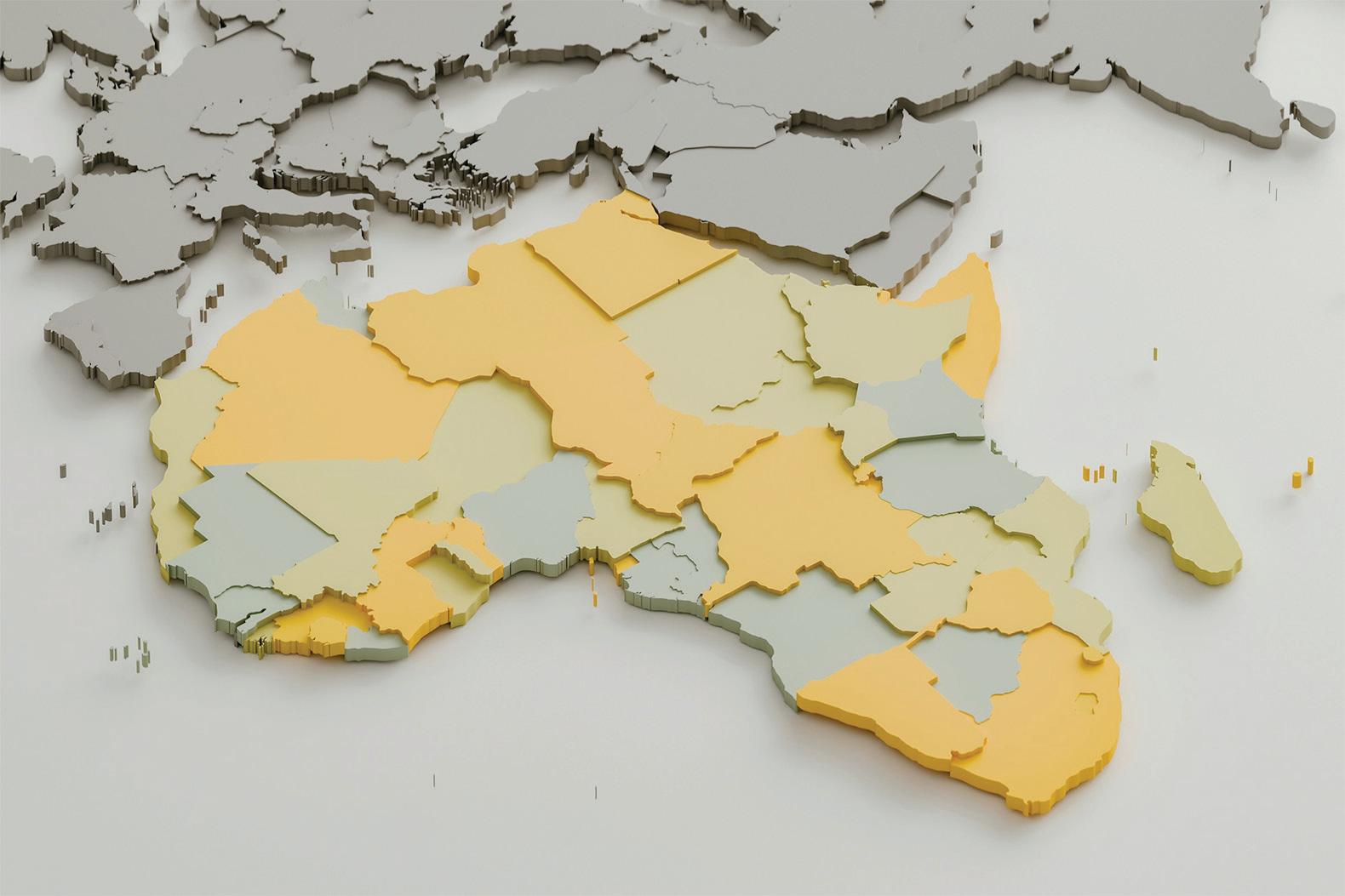
Reimagining Collection Development in African Libraries
Guest Edited by Buhle Mbambo-Thata (University Librarian, National University of Lesotho) Begins on Page 8
Highlights from Katina’s Tea Time
Column Editor: Caroline Goldsmith (Associate Director, The Charleston Hub) <caroline@charlestonlibraryconference.com>
Column Editor’s Note: “Tea Time With Katina and Leah” is a weekly series of articles published on the Charleston Hub. In this column, Katina Strauch, (Founder, Charleston Conference and Editor Emeritus, Against the Grain), shares news snippets, science articles and opinion pieces that she reads throughout the week and finds interesting, and it also features some updates from Katina herself! Here are some recent highlights from this series, and you can find all of the “Tea Time” articles here on our site. — CG
Let’s begin with tidbits from Katina! After a recent injury and time in recovery, we’re delighted that Katina is back home and on the mend.
I’m glad to be out of rehab! Home! The rehab group is excellent, and I miss them already!! Now to start Tea Time again!
Exciting to see in PW that book production is alive and well! Book output topped four million in 2025!! 32.5 percent over 2024!! A lot of us read and publish books! And we are seeing more self-publishing! Wonderful! publishersweekly.com
6
INTRODUCING THE PHYSICS ARCHIVE
Explore 120 years of groundbreaking research with The Physics Archive—granting your institution perpetual access to discipline-shaping research charting every theory, application, and advancement, on any device, forever.
AN EXTENSIVE COLLECTION: Access over 120 years of groundbreaking physics research, spanning a wide range of topics and sub-disciplines.
PERPETUAL ACCESS: With a one-time purchase, your institution can secure perpetual access to The Physics Archive, ensuring continuous availability of valuable resources.
NO DRM RESTRICTIONS: Unlock researchers’ needs with industry-leading permissive contract language and user permissions. No digital rights management.
TRUE ONE-TIME PURCHASE: Enjoy the simplicity of a true one-time purchase with no annual or maintenance fees, providing your institution with uninterrupted access without recurring costs.
UNLIMITED USE FOR UNLIMITED USERS: Benefit from unlimited access for an unlimited number of users, allowing researchers, students, and faculty to explore the archive from anywhere.

Ready to Get Started? Contact us
Against the Grain (ISSN: 1043-2094), Copyright 2026 by the name Against the Grain is published five times a year in February, April, June, September, and November by Annual Reviews. Mailing Address: Annual Reviews, PO Box 10139, Palo Alto, CA 94303-0139. Subscribe online at https://www.charleston-hub.com/ membership-options/
Editor Emerita:
Katina Strauch (College of Charleston, Retired)
Editor:
Leah Hinds (Charleston Hub)
Manager:
Caroline Goldsmith (Charleston Hub)
Research Editor: Judy Luther (Informed Strategies)
International Editor:
Rossana Morriello (Politecnico di Torino)
Contributing Editors:
Glenda Alvin (Tennessee State University)
Rick Anderson (Brigham Young University)
Sever Bordeianu (U. of New Mexico)
Todd Carpenter (NISO)
Ashley Krenelka Chase (Stetson Univ. College of Law)
Eleanor Cook (East Carolina University)
Kyle K. Courtney (Harvard University)
Cris Ferguson (Murray State)
Michelle Flinchbaugh (U. of MD Baltimore County)
Dr. Sven Fund (Fullstopp)
Tom Gilson (College of Charleston, Retired)
Michael Gruenberg (Gruenberg Consulting, LLC)
Bob Holley (Wayne State University, Retired)
Matthew Ismail (Charleston Briefings)
Donna Jacobs (MUSC, Retired)
Ramune Kubilius (Northwestern University)
Myer Kutz (Myer Kutz Associates, Inc.)
Tom Leonhardt (Retired)
Stacey Marien (American University)
Jack Montgomery (Retired)
Lesley Rice Montgomery (Tulane University)
Alayne Mundt (American University)
Bob Nardini (Retired)
Jim O’Donnell (Arizona State University)
Ann Okerson (Center for Research Libraries)
David Parker (Lived Places Publishing)
Genevieve Robinson (IGI Global)
Steve Rosato (OverDrive Academic)
Jared Seay (College of Charleston)
Corey Seeman (University of Michigan)
Bruce Strauch (The Citadel, Emeritus)
Lindsay Wertman (IGI Global)
Graphics:
Bowles & Carver, Old English Cuts & Illustrations. Grafton, More Silhouettes. Ehmcke, Graphic Trade Symbols By German Designers. Grafton, Ready-to-Use Old-Fashioned Illustrations. The Chap Book Style.
Publisher:
Annual Reviews, PO Box 10139 Palo Alto, CA 94303-0139
Production & Ad Sales: Toni Nix, Just Right Group, LLC., P.O. Box 412, Cottageville, SC 29435, phone: 843-835-8604
<justwrite@lowcountry.com>
Advertising Information: Toni Nix, phone: 843-835-8604
<justwrite@lowcountry.com>
Send correspondence, press releases, etc., to: Leah Hinds, Editor, Against the Grain <leah@charlestonlibraryconference.com>
Authors’ opinions are to be regarded as their own. All rights reserved. Produced in the United States of America. Against the Grain is copyright ©2026
AGAINST THE GRAIN – ISSUE HIGHLIGHTS
BOOKSELLING AND VENDING
Brepols Online Databases
How Bibliographies Drive Innovation
Discover the Citation Plugin
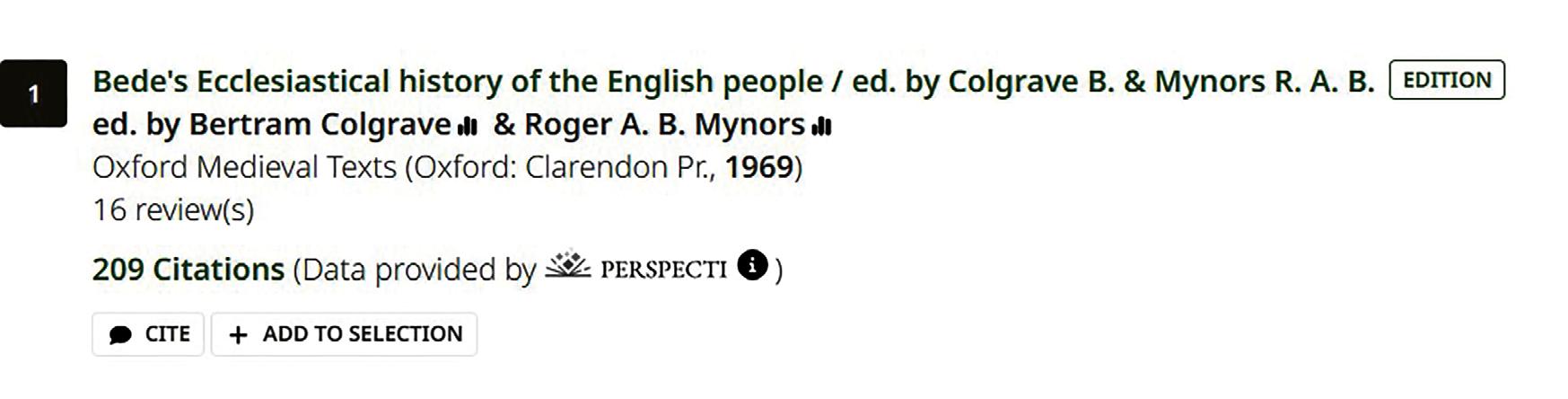
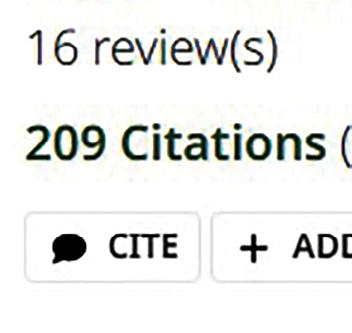
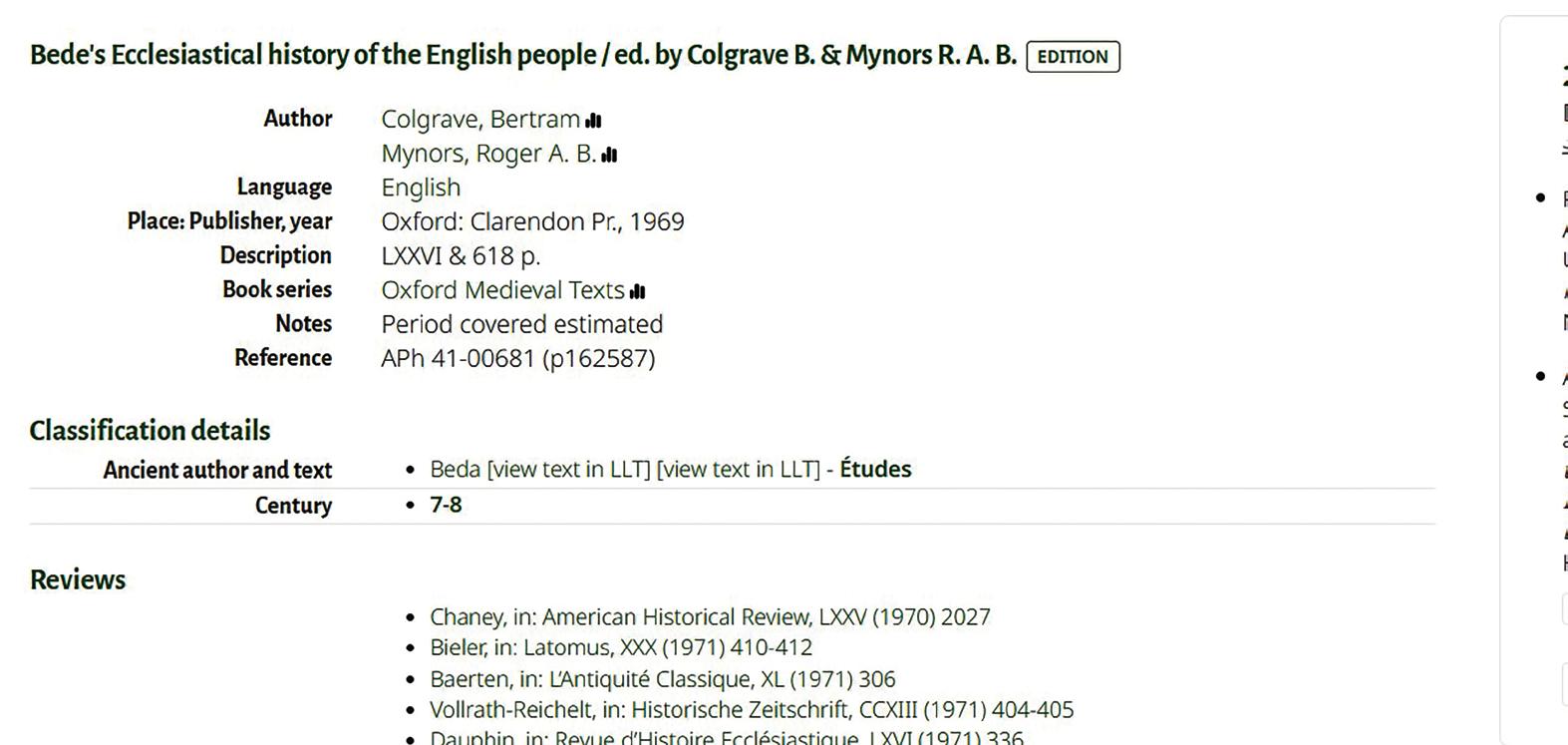
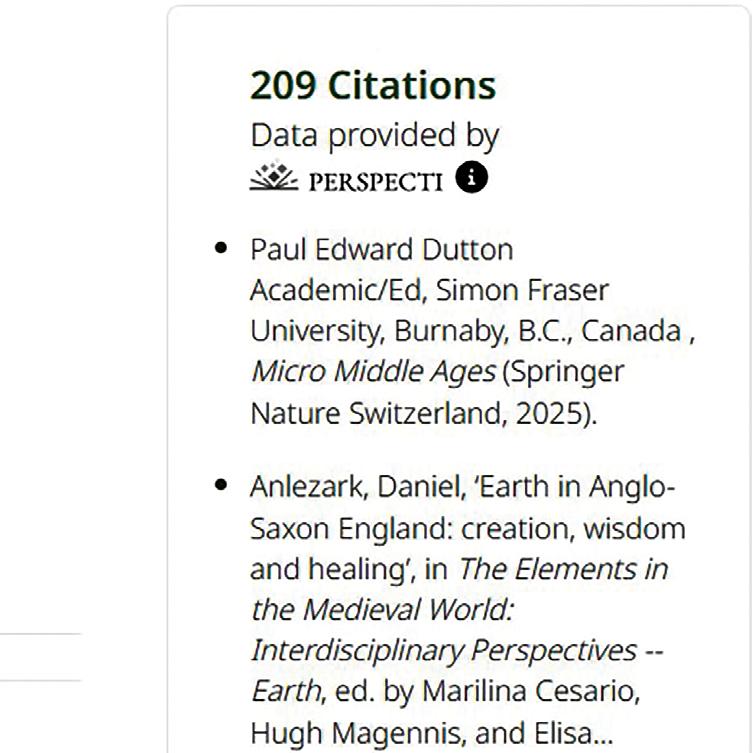
Starting December 2025, Brepolis Bibliographies include citation information through a new citation plugin. This tool provides the total number of citations along with the bibliographical de details of the citing publications.
Citation information is sourced from Pespecti , Brepols’ upcoming database on research in the Humanities (more info: www.perspecti.net).
While the database Perspecti remains under development, the citation count is projected to increase substantially as content is added. Newly registered citations will be added monthly.
Citations in Brepolis Bibliographies*
*L’Année Philologique, International Medieval Bibliography, Bibliographie de civilisation médiévale, International Bibliography of Humanism and the Renaissance, Index Religiosus, Bibliography of British and Irish History
Since December 2025, the number of citations has increased by more than 75%!
about.brepolis.net
www.brepolis.net
brepolis@brepols.net
Letters to the Editor
Send letters to <editors@against-the-grain.com>, or you can also send a letter to the editor from the Charleston Hub at http://www.charleston-hub.com/contact-us/.
Dear Leah Hinds:
Many thanks for the invitation to your conference Charleston In Between 2026. The program is very exciting and inspiring, especially the session 2.
I am very interested in these questions, because I am working on my PHD thesis concerning scholarly communication and the development of the scholarly article (working title: The deconstruction of the scientific article), it is important for me to observe the ongoing discussions and trends in this matter; please see also my publication “Scientific communication – on the brink of the next evolution.”
So, I hope to gain more views and opinions concerning the scholarly output.
I am looking forward to the conference.
With best regards,
Anne-Katharina Weilenmann (MSc Library and Information Management) <weilenmann@shinternet.ch>
Highlights from Katina’s Tea Times continued from page 1
Have you noticed that ATG and Benya books are doing our part? Benya is asking for submissions of new books at benyabooks.com! What are you waiting for? Plus, according to 1000 libraries, today is storytelling day!
In memory of Ward Shaw, the next Fiesole Retreat (2026) will be in Tubingen, Germany on April 13-15. Topics such as using collections newly and innovatively to make them available through LLMs and AI, data mining and creating new networks, preserving integrity, collective actions for trust and impact. Conveners will include Angelika Zirker, Hanna Fischer, Gaeton Rappo and countless others to tackle these complex issues. See you there! AUPress is also having a meeting June 13-15, 2026 in Seattle, Washington.
Ramune sends word of a Linkover podcast interview with our own Conference Director, Courtney McAllister. Courtney is also the editor of a new book, From Chaos to Order: Addressing
AGAINST THE GRAIN ADVERTISING DEADLINES
VOLUME 38 — 2026
Issue Ad Reservation Camera-Ready
February 2026 01/08/26 01/22/26
April 2026 02/19/26 03/12/26
June 2026 04/16/26 05/07/26
September 2026 06/11/26 07/09/26
November 2026 08/20/26 09/10/26
FOR MORE INFORMATION CONTACT
Toni Nix
<justwrite@lowcountry.com>
Phone: 843-835-8604
Against the Grain / April 2026
Dear Ms. Weilenmann,
Thank you very much for your kind message and for your interest in Charleston In Between 2026. We are delighted to hear that the program resonates with you, and especially that Session 2 aligns so closely with your doctoral research.
Your work on scholarly communication and the evolution of the scientific article sounds highly relevant to the discussions we hope to foster in Berlin. Observing and debating emerging forms of scholarly output and communication is very much at the heart of this conference, and we are pleased that you will be joining us in that conversation. Thank you as well for sharing your publication!
We very much look forward to welcoming you to Berlin or online, and to the exchanges that will undoubtedly emerge during the conference.
With best regards, Leah
Leah Hinds (Executive Director, Charleston Hub) <leah@charlestonlibraryconference.com>
Cognitive Overload in the Learning Journey. This book explores the multifaceted role cognitive load has on one’s learning journey, while introducing actionable approaches and resources to help bolster success. Congrats Courtney!!! Until next time ... Love, Katina
More From February 12, 2026:
What Does Excellence Really Mean and How Do We Achieve It? Brad Stulberg starts his new book, The Way of Excellence, by clarifying what his subject is not. “Excellence isn’t perfectionism. It isn’t optimization. It isn’t obsession or flow or happiness.” Setting that straight is important, the author tells Nice News, because hustle culture has co-opted the concept and alienated the average person. Indeed, this isn’t a status reserved for a select few genetically blessed individuals at the top of their game. As Stulberg puts it, “excellence is for everyone.”
The 2026 Close-up Photographer of the Year Contest Zooms In on Nature’s Wonder. “Australian photographer Ross Gudgeon’s image of the inside of a cauliflower soft coral is now a two-time photography contest champion. Not only did “Fractal Forest” claim the top spot in the 2025 Australian Geographic Nature Photographer of the Year competition, but it also just won the seventh annual Close-up Photographer of the Year contest. The latter shines a spotlight on nature via macro, micro, and close-up imagery across 11 categories. It was launched in 2018 by Tracy and Dan Calder, a married couple who work in the photo magazine industry and live in the U.K. Tracy called this “the toughest competition yet,” per a press release.”
We’ll be featuring more highlights from “Tea Time” in upcoming issues of Against the Grain. You can read all of these articles (and see each new article posted every week) in their entirety here. Thanks, y’all!
<https://www.charleston-hub.com/media/atg/>



Reimagining Collection Development in African Libraries — Insights from Benin, Uganda, and Zimbabwe
By Buhle Mbambo-Thata (University Librarian, National University of Lesotho) <b.mbambo-thata@nul.ls>
Introduction
Across the African continent, libraries are navigating moments of profound transition. While this issue has “Africa” in its title it does not present “the voice of Africa” in collection development. Africa is a continent with 54 countries. Each has its own laws, language and practices. This issue provides insights into Eastern, Southern, and Western Africa countries namely, Uganda, Zimbabwe, and Benin, while one article speaks to the regions of Southern Africa.
In the countries covered in this issue, the pressures of digital transformation, shifting user expectations, demand for inclusive collections, and constrained budgets are converging in ways that demand both creativity and courage. This special issue of Against the Grain brings together voices from Benin, Uganda, and Zimbabwe — three countries whose library sectors are charting distinct paths toward more responsive, inclusive, and sustainable collection development.
What emerges from these contributions is not a single narrative but varied strategies reflecting local realities and in situ innovations. These case studies indicate how libraries are rising up to the challenges and devising methods to mitigate their challenges, as they position themselves as custodians of research and learning content in the 21st century.
Emerging Trends
Digital Transformation: Aspirations and Realities
Digital access remains both a promise and a challenge. Libraries in all three countries are embracing eResources, institutional repositories, and digitization initiatives, yet the pace of progress is uneven. Contributors from Uganda call for collaborations and a policy environment that would expand access to scholarly databases. Southern Africa libraries are experimenting with the power of transformative agreements facilitated by open access publishing to reduce costs and increase flexibility, while Benin’s institutions are including institutional repositories and open access resources in collection development strategies.
While the institutions seek to include digital access to open access resources, limited bandwidth, high subscription costs, and infrastructural gaps complicate the transition to hybrid or fully digital collections. The articles in this issue underscore that digital transformation in African libraries is not merely a technical project, it is a socioeconomic one, requiring investment, policy support, and capacity building.
Funding, Partnerships,
and the Politics of Access
Collection development in these contexts is inseparable from the realities of funding. Libraries in Benin, Uganda, and Zimbabwe continue to operate under financial constraints that shape every acquisition decision. Yet scarcity has also sparked
innovation. Contributors highlight the growing importance of:
• Innovative collaborations
• International partnerships that support training, digitization, and resource sharing
• Open access advocacy as a strategy for expanding scholarly visibility
• Decolonization of collections to align collections with local needs
These approaches reflect a pragmatic understanding that libraries cannot rely solely on traditional acquisition models. Instead, they are cultivating networks of support that extend beyond national borders while remaining grounded in local priorities.
The Evolving Role of the Librarian
Perhaps the most compelling insight from this special issue is the evolving identity of the African librarian. No longer confined to the role of selector or gatekeeper, today’s librarians are negotiators, digital stewards, educators, and cultural advocates. They are navigating complex ecosystems of technology, policy, and community expectations. Their work is both technical and deeply human.
The articles from Benin, Uganda, and Zimbabwe reveal professionals who are not merely responding to change but actively shaping it — often with limited resources but abundant determination.
Summary of Individual Articles
Below is a summary of what each individual article covers as they engage with collection development practices and challenges in African academic libraries from Benin, Uganda, Zimbabwe, and Southern Africa. Key themes include:
1. Diversity, Equity, and Inclusion (DEI) in African Libraries: The article by Methembe Mhlope from Zimbabwe emphasizes the need for DEI in collections, addressing colonial legacies, language barriers, and resource disparities. The article places emphasis on the need for DEI, especially by integrating indigenous knowledge, addressing colonial legacies, and developing appropriate access models. It is common knowledge that many African libraries hold collections that reflect colonial past, and the collections are in languages of former colonizers. The article is informed by the decolonization of collections framework that calls for collections that center around indigenous knowledge. It advocates for integrating indigenous knowledge, developing hybrid access models, and reforming policies to promote equity and local perspectives.
<https://www.charleston-hub.com/media/atg/>
































































































































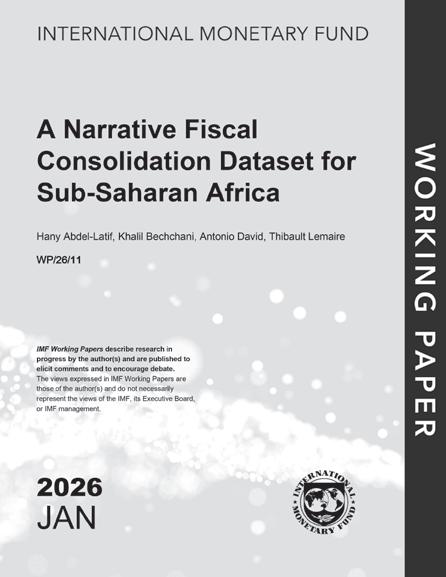

































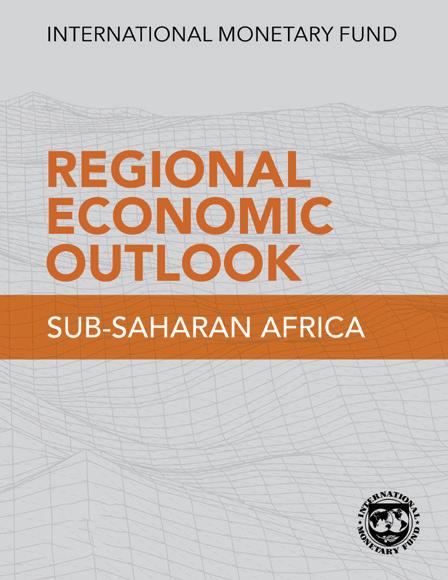
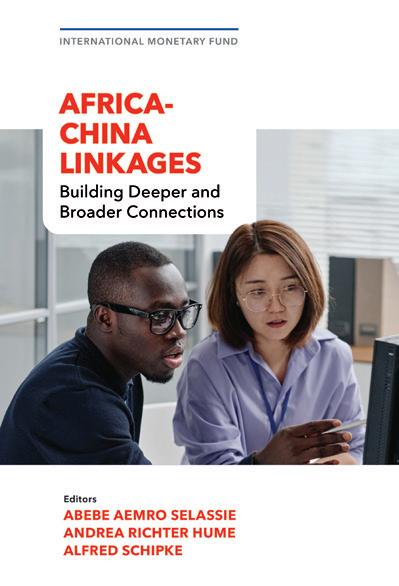
IMF Publications with a regional focus






















2. University of Abomey-Calavi (UAC): The article by Joseph Sagbohan from Benin advocates for integrating open access (OA) resources and institutional repositories to overcome financial constraints. The OA posts that are open access resources and institutional repositories can be integrated as costeffective strategies, particularly at the University of Abomey-Calavi (UAC); however, effective integration of OA requires updated policies and user training. The article proposes an approach that involves policy updates, user training, and leveraging best practices to enhance access, visibility, and sustainability of scholarly resources.
3. Open Access in Southern Africa: Primrose Godini, writing from Zimbabwe, conducted a systematic review of literature of adoption of transformative agreements in Southern Africa. Her article indicates that open access (OA) initiatives are growing in the region, with benefits like greater research visibility and cost reduction. Challenges include uneven adoption of initiatives, infrastructure gaps, and policy fragmentation in the countries of Southern Africa. The review recommends regional coordination of policy, capacity building, and investment to maximize OA benefits to the research community.
4. Ugandan University Libraries: Stephanas Galinnya, writing from Uganda, indicates that collections in university libraries in Uganda are moderately

Global economics at your fingertips



adequate but are hampered by limited funding, inadequate staffing, outdated infrastructure, and weak collaboration. Improvement strategies include policy-driven acquisitions, professional development, stakeholder engagement, technology investment, and institutional collaboration.
Overall, the articles underscore the importance of open access, inclusive, and sustainable collection development in African academic libraries, calling for increased investment, policy reform, capacity building, and regional collaboration.
Conclusion
This special issue gives readers insights to collection development practices in three different countries and in Southern African regions. These case studies demonstrate how information flows and intersects with local knowledge systems, where digital ambitions meet infrastructural realities, and how libraries remain essential to research and development.
The experiences of Benin, Uganda, and Zimbabwe remind us that innovation is not the exclusive domain of well-resourced institutions. It thrives wherever librarians are willing to innovate, build alliances, and center the needs of their research communities and institutions. As the global library community grapples with questions of equity, sustainability, and cultural representation, the insights from this issue offer both inspiration and a challenge: to imagine collection development not as a static function, but as a dynamic, context-responsive practice that honors the diversity of human knowledge.
<https://www.charleston-hub.com/media/atg/>
Advancing Diversity, Equity, and Inclusion in African Academic Library Collections: Challenges, Strategies, and Transformative Potential
By Methembe M. Mhlope (Research Support Librarian, Gwanda State University) <methembe.mhlope@gsu.ac.zw>
Abstract
This article examines the critical imperative of advancing diversity, equity, and inclusion (DEI) in African academic library collections within the broader context of decolonization and institutional transformation. Drawing on theoretical frameworks, including Afrikology and Critical Theory, as well as policy frameworks such as the UNESCO Declaration on Indigenous Languages, this analysis provides an examination of the systemic challenges facing African academic libraries. These challenges include colonial legacies, linguistic hegemony, resource constraints, policy gaps, and infrastructural disparities. Through illustrative case studies, it documents innovative approaches to collection development, digital preservation, and community engagement that center on indigenous knowledge systems and African perspectives. While significant progress has been made, particularly in institutional repository development and multilingual collection building, the discussion underscores the unfulfilled opportunities and transformative potential. The article argues that transformative change requires moving beyond neutrality to active DEI commitments, developing contextualized hybrid access models that bridge digital divides, integrating indigenous knowledge, and implementing culturally appropriate metadata practices. The article presents a comprehensive implementation roadmap encompassing policy reform, culturally sensitive stakeholder engagement, capacity building, and continuous assessment frameworks. The article concludes with actionable recommendations for advancing equity-centered collection development that honors indigenous knowledge while embracing global scholarly engagement.
Where Are We in Terms of DEI?
The diversity, equity, and inclusion (DEI) movement is fundamentally meant to amplify the voices and interests of the underrepresented, the voiceless, the “underdogs,” and the marginalized. In general, the underrepresented and marginalized are usually the minority within a given context. In the case of Africa and its academic library collections, however, it is the voice of the majority — the African voice itself — that has been marginalized and underrepresented. Academic libraries in Africa stand at a critical juncture in their historical evolution, facing the urgent need to transform their collections, which have long reflected colonial epistemologies and Westerncentric knowledge systems. This is especially relevant in the current digital knowledge landscape where historical legacies of colonialism, coupled with contemporary challenges in resource allocation and technological infrastructure, often perpetuate exclusionary practices in collection development (Adarkwah et al. 2024). The call for DEI in African academic library collections is not merely an administrative reform, but a fundamental
reimagining of whose knowledge is valued, preserved, and made accessible within institutions of higher learning across the continent (Ocholla 2020). This transformative agenda emerges from decades of critique regarding the marginalization of African scholarship, indigenous knowledge systems, and local languages in favor of resources that perpetuate what Ndlovu-Gatsheni (2013) terms the “coloniality of knowledge” — the ongoing structures that determine whose knowledge counts and whose is rendered invisible.
The imperative for DEI in African academic libraries, therefore, must be understood within this post-colonial landscape where academic libraries inherited collection development practices designed to serve colonial interests rather than African intellectual traditions or needs (Zimu-Biyela and Chisita 2023). Consequently, re-evaluating traditional acquisition practices and integrating intentional DEI strategies becomes crucial for academic libraries in Africa to genuinely represent their diverse user communities and contribute to decolonizing knowledge (Ocholla 2020). As Zimu-Biyela and Chisita (2023) powerfully argue, it is imperative that “African Librarianship” decolonizes in line with the contextual needs of the library communities served, particularly indigenous communities of Africa. Contemporary movements for decolonization in African higher education, exemplified by student protests such as South Africa’s #FeesMustFall and #RhodesMustFall, have brought renewed urgency to questions of representation, access, and epistemic justice in academic institutions (Ocholla 2020; Le Grange 2021; Zimu-Biyela and Chisita 2023). These movements challenge libraries to examine not only what materials they collect but also how they organize, describe, and provide access to knowledge. The burning question, therefore, remains: how can libraries dismantle ideologies and inherited systems of knowledge organization plagued with systemic biases, while simultaneously building collections that authentically represent the continent’s rich intellectual and cultural diversity?
This article provides a comprehensive analysis of the current state of DEI in African academic library collections, examining both the systemic barriers and the transformative strategies being implemented across the continent. It begins by establishing the theoretical foundations that guide decolonization and DEI efforts, including Afrikology, Critical Theory, and international policy frameworks. It then analyzes the multifaceted challenges facing African libraries, from resource scarcity to digital divides. Through case studies from South Africa, West Africa, and East Africa, the article highlights practical approaches to advancing inclusion and equity. Finally, it presents an implementation roadmap with actionable recommendations for policy development, capacity building, and assessment that can guide libraries toward truly transformative collection development practices.
<https://www.charleston-hub.com/media/atg/>
About Katina
Katina is a digital publication that uniquely addresses the value of librarians to society and elevates their role as trusted stewards of knowledge. Named after Katina Strauch, the visionary founder of the Charleston Conference, it is written by and for the international communities of librarians, vendors, and publishers.
Katina’s mission is to improve library and information science and inspire a sense of fulfillment among its worldwide professionals. It delivers content that is easy to understand, engaging, informative, and accurate, covering key topics, emerging trends, and transformative technologies and products, while also exploring the ongoing evolution of library practice. It covers key topics, emerging trends, transformative technologies, and library resources, and offers guidance on career and organizational development. By celebrating librarian contributions to open science, scholarship, and the enrichment of society, Katina aims to provide a springboard for community discussion and engagement through three content sections.
Tiered institutional subscription pricing for 2026 is:
$595 for MLIS schools and very high research output institutions
$395 for all other PhD, Masters, and 4-year institutions
$295 for 2-year institutions
Katina Features and Editors:

Editor-in-Chief: Curtis Brundy
Dean of University Libraries, University of Massachusetts Amhurst cbrundy@umass.edu
The Future of Work: Offers practical insight into the technologies, skills, and strategies shaping library practice in a rapidly changing world.
Interim Senior Editor: Curtis Brundy Katina-Work@Annualreviews.org


Resource Reviews: Builds on the groundwork set by The Charleston Advisor to provide critical reviews of products and resources for the information industry.
Senior Editor: Jill Emery
Collection Development and Management Librarian, Portland State University
Katina-Reviews@annualreviews.org
Open Knowledge: Addresses the evolving roles of libraries and librarians and their contributions towards an open knowledge ecosystem.
Senior Editor: Kate McCready
Program Director for Open Publishing, Big Ten Academic Alliance
Katina-Open@annualreviews.org
Leah Hinds, Managing Editor and Executive Director, lhinds@annualreviews.org
Elizabeth Weiss, Associate Managing Editor, eweiss@annualreviews.org
KATINA IS PUBLISHING UNDER THE SUBSCRIBE TO OPEN (S2O) PROGRAM
How Do We Move from Here?
The advancement of DEI in African academic library collections rests upon the need to not only decolonize but also to “re-Africanize” what and how knowledge is created, managed, shared, and preserved. The historical and predominant record and ideology of “African” content is, in itself, inherently flawed and distorted as it is rooted in Westernized systems and biases. Decolonizing and re-Africanizing knowledge, therefore, require a total transformation and paradigm shift towards a new value system and ideology. This can be done by drawing inspiration from a combination of theoretical frameworks that challenge Western knowledge dominance and center African ways of knowing. These frameworks provide both a critique of existing systems and blueprints for transformation, addressing the three interconnected dimensions of coloniality: coloniality of power, coloniality of knowledge, and coloniality of being (NdlovuGatsheni 2013; Zimu-Biyela and Chisita 2023). This is because the frameworks pose fundamental questions: who generates knowledge? For what purpose? Why have indigenous knowledge systems been systematically devalued? (Zimu-Biyela and Chisita 2023). For African academic libraries, addressing coloniality of knowledge means examining not only collection gaps but also the entire infrastructure of knowledge organization which was designed to serve colonial interests. Understanding these theoretical foundations is therefore essential for librarians and information professionals seeking to move beyond superficial DEI initiatives toward fundamental structural change.
Afrikology: An Indigenous Epistemological Framework
The theory of Afrikology is “an all-inclusive epistemology rooted in African cosmology that seeks to retrace knowledge evolution from its source to current epistemologies, establishing new science for generating and accessing knowledge for sustainable use” (Zimu-Biyela and Chisita 2023, 9). The framework challenges the notion that “valid knowledge production” began with “European enlightenment” or that African knowledge systems represent merely “primitive” precursors to “modern” Western science (Akinwale 2012). Instead, Afrikology positions African ways of knowing, including oral traditions, indigenous cosmologies, and community-based knowledge systems, as sophisticated epistemologies in their own right, deserving of equal status in academic collections and scholarly discourse. It therefore invokes a new value system and embodies an inclusive approach to how knowledge is created and applied. For library collection development, this means actively seeking out and prioritizing African scholarship, oral histories, and indigenous knowledge documentation rather than treating these as supplementary to Western-produced materials.
Critical Theory: A Lens to Critique Existing Power Structures
Critical theory can be broadly understood as a philosophical approach that critiques society and culture, aiming to reveal and challenge power structures. It goes beyond seeking to understand social realities by also seeking to actively change them, liberating individuals from oppressive circumstances (Mehra 2021; Barr-Walker and Sharifi 2019). The theory “advocates for emancipatory transformation in knowledge access and representation,” challenging libraries to examine not only what they collect but also whose interests are served by existing collection development practices (Zimu-Biyela and Chisita 2023). It therefore provides a new way of thinking and seeing, of not taking anything at face value but to think critically about each decision and activity, which has given birth to Critical Librarianship.
Critical librarianship applies the tenets of critical theory to the field of library and information science. It fundamentally rejects the notion of libraries as neutral spaces, arguing that neutrality is unachievable and can be harmful to marginalized groups (Barr-Walker and Sharifi 2019). It exposes how seemingly neutral technical practices like cataloging rules, classification schemes, and subject headings actually engrain particular worldviews and power relations. It encourages deep reflection on how inequality and outdated ideologies, often rooted in Western thought, continue to impact library practices, from classification systems to access policies (Weaver et al. 2024). For instance, the classification of African religions under “other religions” or the cataloging of indigenous languages under “other languages” reflects and reinforces hierarchies of knowledge that position Western knowledge as universal and African knowledge as particular, alternative, marginal, or outdated. Critical librarians would argue that truly equitable collections require not just adding diverse materials but fundamentally rethinking how knowledge is organized and described.
International Policy Frameworks: Positioning the Movement in Global Discourse
Beyond theoretical frameworks, international policy initiatives also provide institutional mandates and practical guidance for advancing DEI in library collections. Two frameworks stand out for their particular relevance to the African context:
The UNESCO Declaration on Indigenous Languages (2022-2032) establishes an international framework that promotes the integration of indigenous languages into sustainable development, the preservation of intangible heritage, and support for mother-tongue education initiatives. This framework recognizes that linguistic diversity is inseparable from knowledge diversity, and that libraries play a crucial role in preserving and promoting linguistic heritage.
The IFLA Indigenous Matters Action Plan (2021-2022) emphasized libraries’ role in promoting indigenous peoples’ rights to language, knowledge access, and cultural preservation through targeted initiatives and advocacy. This framework moved beyond theoretical commitments to concrete action items, including developing culturally appropriate cataloging practices, ensuring indigenous communities’ control over their own knowledge, and building collections that reflect indigenous worldviews and values.
Together, these theoretical and policy frameworks provide a firm foundation for transforming African academic library collections beyond token gestures of inclusion toward fundamental reimagining of collection development priorities, knowledge organization systems, and access practices. They guide librarians as they navigate the complex work of building collections that honor African knowledge while engaging global scholarship.
What Are the Challenges and Barriers to DEI?
African academic libraries face significant challenges in advancing DEI principles. These barriers are multifaceted, interconnected, and deeply rooted in historical legacies, economic constraints, and ongoing global inequalities in knowledge production and dissemination. Understanding these challenges and their complexity is essential for developing effective strategies to overcome them.
<https://www.charleston-hub.com/media/atg/>


“The Creative Destruction of Scholarly Communication”
Hybrid: Attend in Berlin or Online
Keynote: Creative Destruction: An Overview by Philippe Aghion (Collège de France and London School of Economics; Co-recipient of 2025 Nobel Prize in Economics)
The event venue has been generously provided by a sponsorship from Wiley.
Venue Address: Wiley VCH Verlag GmbH & Co, Rotherstraße 21, 10245 Berlin, Germany
Agenda and Registration:

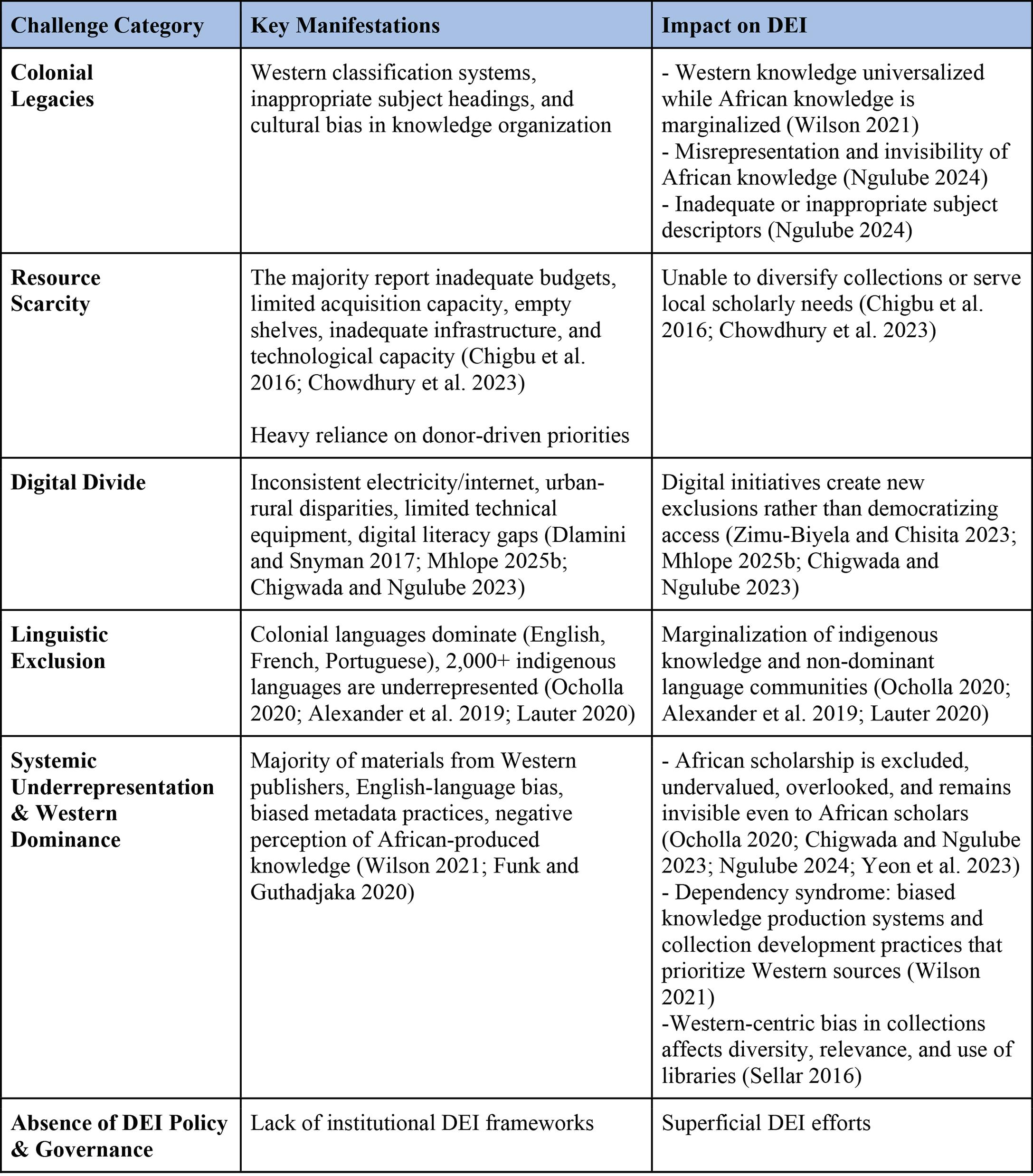
These challenges interact to create significant barriers to advancing DEI in African academic library collections. Yet as the next section demonstrates, innovative approaches are emerging across the continent that address these challenges through policy reform, technological innovation, and communitycentered practices.
the Grain / April 2026
What Has Been Done?
While the challenges are significant, African academic libraries are pioneering innovative approaches to advancing diversity, equity, and inclusion that offer models for transformation. The following table summarizes case studies from across the continent illustrating how libraries are implementing DEI
<https://www.charleston-hub.com/media/atg/>
Table 1: Challenges and Barriers to DEI
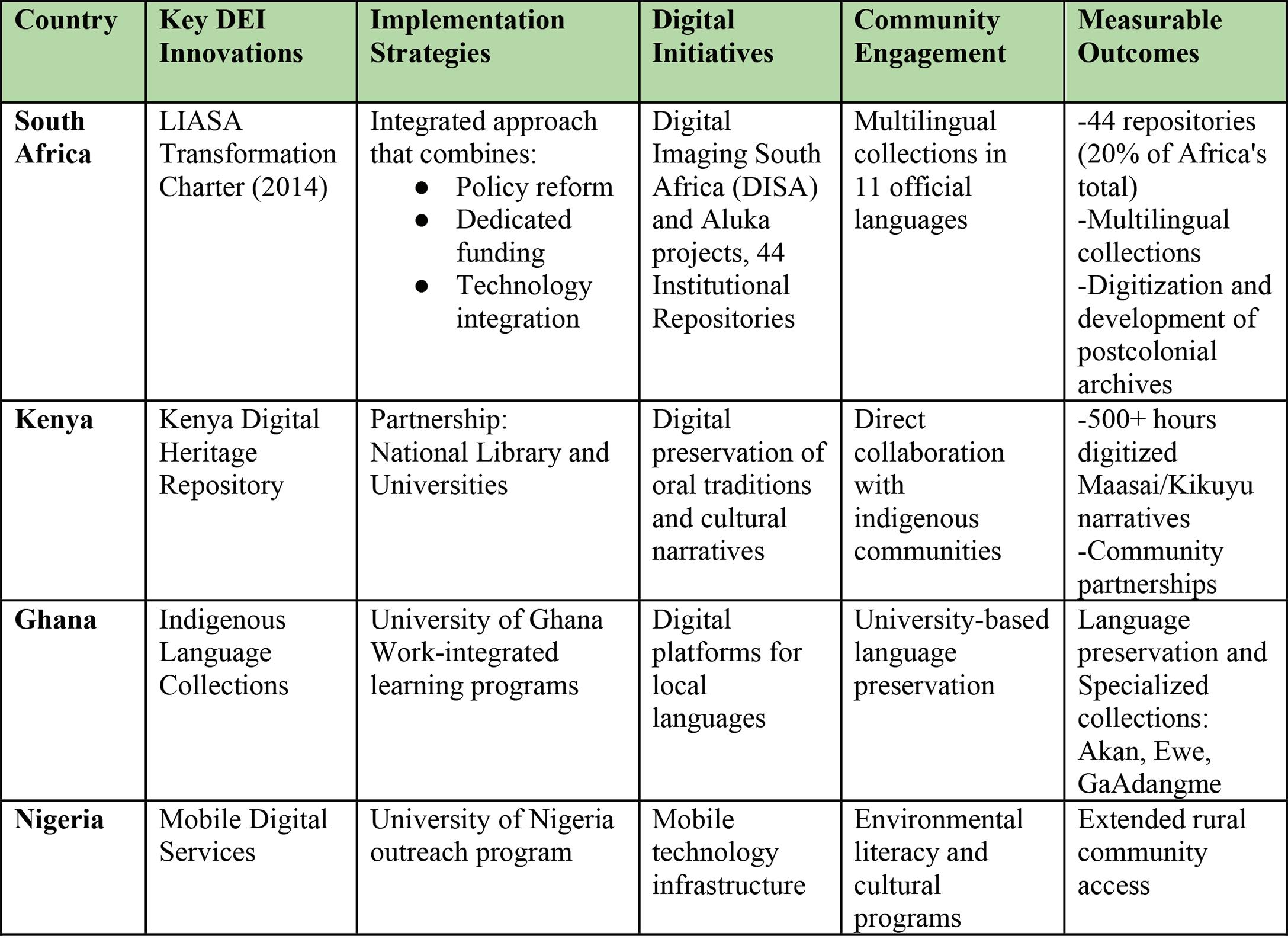
principles through policy reform, technological innovation, and community engagement. These examples demonstrate that meaningful change is possible even in resource-constrained environments when libraries prioritize equity and center indigenous knowledge systems.
South Africa has established itself as a continental leader in transformative library practices by integrating policy reform, sustained and dedicated funding, and technological infrastructure to address historical inequities rooted in apartheid. Central to this effort is the LIASA Transformation Charter (2014), which envisions accessible, multilingual, and community-responsive library services through an ecosystem approach linking universities, government, NGOs, and communities (Zimu-Biyela and Chisita 2023). This policy framework is reinforced by the Department of Arts and Culture Conditional Grant, which funds the development of libraries with emphasis on indigenous language resources. Most notably, South Africa’s leadership is also evident in its robust institutional repository landscape, accounting for about 20% of Africa’s total. Universities have created substantial infrastructure for preserving and providing access to local scholarship (Dlamini and Snyman 2017) with examples such as the University of Pretoria and the University of Cape Town advancing open access, indigenous knowledge preservation, multilingual materials, and innovative publishing models (Ocholla 2020). The success of the Digital Imaging South
Africa (DISA) project and the Aluka initiative spearheaded by the University of KwaZulu-Natal provides a classic example of digitizing and providing open access to indigenous materials in the post-colonial era. Collectively, these initiatives not only expand digitization and access but also provide alternatives that challenge entrenched hierarchies that privilege Western knowledge, positioning South African libraries as drivers of equity and epistemic transformation.
West African academic libraries exemplify innovative approaches to DEI through community engagement and indigenous language integration, demonstrating that transformation can be achieved through creativity and partnership rather than extensive infrastructure. In Ghana, work-integrated learning programs link indigenous language preservation with digital platforms, as seen in the University of Ghana Library’s collections in Akan, Ewe, and Ga-Adangme, which incorporate oral traditions and cultural knowledge while providing students with practical training. Nigeria, by contrast, has advanced community outreach through mobile digital services that deliver resources and literacy training to rural populations, directly addressing the digital divide and embedding sustainability initiatives within cultural contexts. Together, these models highlight how African librarianship decolonizes knowledge systems by valuing local languages, traditions, and community needs while expanding equitable access to information.
<https://www.charleston-hub.com/media/atg/>
Table 2: Regional Case Studies & Innovations in DEI Implementation
In East Africa, libraries have advanced digital heritage preservation by prioritizing oral tradition documentation and culturally sensitive methodologies that respect community ownership of knowledge. The Kenya Digital Heritage repository, developed through partnerships between the Kenya National Library Service and university libraries, exemplifies this approach by digitizing over 500 hours of Maasai and Kikuyu stories while collaborating with elders to contextualize and catalog materials using indigenous metadata systems. This ensures that preservation captures both content and cultural meaning, challenging Western classification norms.
What Can We Learn?
Examining these different case studies reveals several crosscutting lessons for advancing DEI in African academic library collections:
Policy Frameworks are the Way to Go: South Africa’s success demonstrates that explicit policy commitments such as the LIASA Transformation Charter provide essential mandates and accountability mechanisms for transformation. Policy alone may be insufficient, but it creates institutional legitimacy and provides frameworks for action.
Community Partnership is Essential: Whether South Africa’s collaborative multi-stakeholder ecosystem, Ghana’s work-integrated learning, Nigeria’s outreach mobile services, or Kenya’s oral history preservation, successful initiatives center on community needs and partner with community knowledge holders rather than imposing external priorities.
Technology Enables but Does Not Guarantee Equity: Institutional repositories, digital heritage initiatives, and online platforms offer powerful tools for expanding access, but technology must be implemented thoughtfully to avoid creating new forms of exclusion (Zimu-Biyela and Chisita 2023; Mhlope 2025b; Chigwada and Ngulube 2023). Hybrid models that balance digital and physical access are therefore crucial.
Multilingualism is Non-Negotiable: All three regions demonstrate commitment to linguistic diversity, recognizing that genuine inclusion requires serving communities in their own languages rather than imposing linguistic uniformity.
These case studies demonstrate that advancing DEI in African academic libraries is not merely aspirational but actively underway across the continent. While challenges remain significant, the initiatives documented here provide models and inspiration for libraries seeking to transform their collections and services. There still remains, however, opportunities and untapped potential that would provide practical strategies and solutions that can be adapted across different contexts, building on the successes documented in these regional examples.
What More Can We Do?
Building on the theoretical foundations, challenges, and regional case studies already examined, there is transformative potential and comprehensive practical strategies that can be utilized for advancing DEI in African academic library collections. These strategies address the multifaceted nature of the barriers and challenges, encompassing policy reform, inclusive acquisition practices, community engagement, contextual digital transformation, and capacity building.
Essentially, these approaches are designed to be adaptable to different institutional contexts, recognizing that African academic libraries operate in diverse environments with varying resources and constraints.
Moving from Neutrality to Active DEI Commitments
A foundational principle for advancing DEI is the recognition that neutrality does very little to challenge or change the status quo. There is a need to make explicit commitments to representation and inclusion through formal, dynamic collection policies that integrate indigenous knowledge and actively address historical imbalances. The policies should adapt to changing needs and evolving best practices, integrate DEI frameworks, and have accountability measures. In other words, academic libraries should explicitly and actively decolonize knowledge and integrate indigenous knowledge in their collections, as seen in the example of South Africa through the LIASA Transformation Charter.
This, however, is no simple matter due to the “paradox of decolonization” (Ocholla 2020), which in practice brings many dilemmas for librarians. How can African academic librarians reject Western knowledge systems’ dominance and effectively build indigenous collections while lacking robust indigenous infrastructures and being heavily dependent on Western technologies and systems? Should acquisitions prioritize local publishers even when their materials may lack the production quality or distribution networks of Western publishers? How can libraries effectively decolonize when the very infrastructure of academic publishing, including peer review systems, journal indexing, and scholarly communication platforms, remains structured around Western norms? What is quality, and how is it measured when it comes to indigenous knowledge systems? Is there justifiable demand and an appetite for indigenous knowledge, and is the requisite expertise throughout the whole knowledge ecosystem for validation, quality control, management etc. available? This therefore shows that moving from neutrality to action should not be a matter of emotion, of Indigenous versus the West, or “settling old scores.” Rather, DEI commitments require pragmatic, complementary, and thoughtful integration of Indigenous and Western approaches, systems, and technologies, which should be adapted to local contexts and needs.
Proactive Acquisition and Publisher Diversification
Wilson (2021, 14) rightly states that, “Perhaps the most effective means of reducing bias in collection development is to introduce a plurality and diversity of voices and experience in the selection process.” In this regard, addressing systemic inequalities in African library collections requires proactive strategies to identify collection gaps and acquire materials from diverse sources. Libraries should dedicate specific funds to diversify acquisitions, seek out African and Global South Publishers, and support local authors and publishers. This means that DEI implications should be considered in every major collection development decision, whether subscription or purchase. Libraries should critically evaluate whether each resource represents diverse perspectives, furthers institutional DEI commitments, and serves all users equitably. Such considerations would ensure that DEI commitments are integral to decision-making rather than as performative afterthoughts. Although the section on the challenges already highlighted that the majority of African academic libraries report inadequate budgets, the examined case studies reveal how resource constraints can paradoxically inspire innovation. Nigeria’s
<https://www.charleston-hub.com/media/atg/>

DOI: 10.3998/mpub.14621062
178 pages | 6 x 9
25 b&w illustrations
Paper | 2025 | $2495 US
ISBN 978-1-941269-61-9
Open Access
ISBN 978-1-941269-62-6
For information on bulk orders or discounts, please contact:
Jamie Jones
Director of Sales, Marketing, and Outreach at Michigan Publishing jojamie@umich.edu
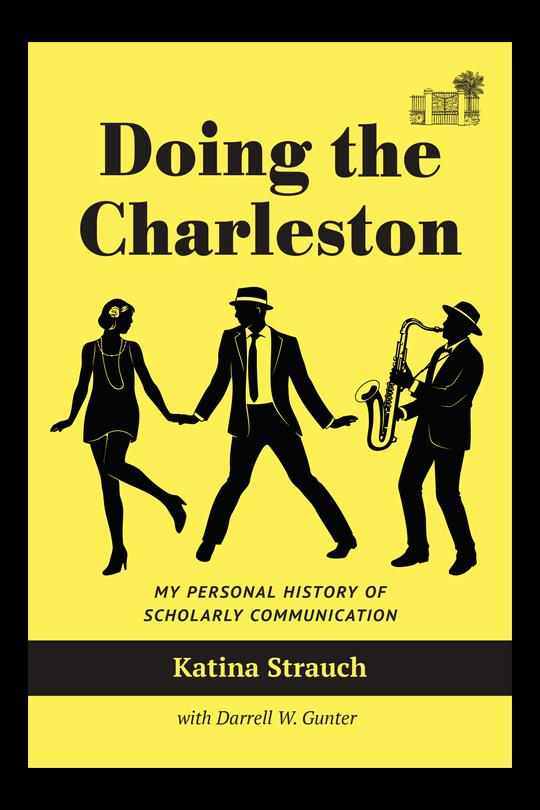
DOING THE CHARLESTON
My Personal History of Scholarly Communication
Katina Strauch with Darrell W. Gunter
In 1980, Katina Strauch started the Charleston Conference: Issues in Book and Serial Acquisition to bring together librarians, publishers, and vendors to discuss issues shared by the three groups The meeting has continued annually and boasts over 3,000 attendees in person and virtually This memoir is Katina’s diary and story of the Charleston Conference and its development concurrently with her career as a professional librarian. Over the last 45 years, there have been massive changes in scholarly communication, changes that Katina has been at the heart of Where and what will the library and publishing professions develop next? The sky’s the limit to reimagining! Let’s go
mobile library outreach services reaching rural communities, Ghana’s work-integrated learning programs leveraging student labor, and Kenya’s community partnership approaches to oral history preservation all represent creative and contextual responses to limited resources leveraging community knowledge, community engagement, and open-source technologies. This “innovation birthed by constraint” may ultimately produce more sustainable and contextually appropriate models than simply importing resource-intensive Western approaches. However, creativity cannot fully compensate for severe resource shortfalls. Libraries cannot acquire materials without acquisition budgets and maintain digital infrastructure without technical support. Advocacy for increased library funding, therefore, remains essential if DEI efforts are to materialize.
Equity Centered Digital Transformation
As has already been established, the challenge of the digital divide provides both barriers and opportunities. On one end, institutional repositories, open access platforms, and digital heritage initiatives offer unprecedented opportunities for preserving and providing access to previously marginalized knowledge. The growth of institutional repositories across Africa represents significant infrastructure for preserving local scholarship and demonstrates digital technology’s transformative potential (Dlamini and Snyman 2017; Dlamini 2020). Libraries should leverage repositories as platforms for indigenous knowledge preservation, oral history archives, and multilingual scholarship as exemplified by South African universities. Repository policies should ensure that diverse materials are prioritized for digitization and that metadata practices respect cultural protocols (Mhlope 2025a; 2025b). It is important to note that while there has been significant growth in institutional repositories in Africa, this is not close or uniform across different countries and regions, with South Africa leading the way, while some countries have very little development in that area. There is, therefore, still a lot to be done in digital transformation.
On the other hand, this digital divide in infrastructure, connectivity, and literacy risks creating new forms of exclusion that undermine equity goals. While open-access repositories and institutional archives can diversify collections and democratize access, uneven internet connectivity and digital literacy gaps risk excluding vulnerable populations (Funk and Guthadjaka 2020; Mhlope 2025b). Digital initiatives designed to expand access may in fact, perpetuate imbalances and primarily benefit already privileged urban populations with reliable connectivity, while leaving rural and underresourced communities further behind. This therefore necessitates a hybrid approach that strategically combines digital and physical access, incorporating mobile-first design with offline capabilities, developing digital platforms with multilingual interfaces, and technological innovation with vigorous digital literacy programs. This would be aimed at leveraging technology while mitigating its exclusionary risks, ensuring that digital transformation serves DEI rather than undermining it.
Although Artificial Intelligence (AI) raises legitimate concerns about furthering existing biases and cultural appropriateness issues, it also offers tremendous potential for creating multilingual interfaces and analyzing collections for diversity gaps. Critical implementation that centers on context, equity, and cultural sensitivity could leverage AI to advance rather than undermine DEI goals.
Indigenous Knowledge Systems Integration
Genuine DEI efforts would be incomplete without integrating indigenous knowledge systems into academic library collections. This requires specialized approaches that respect cultural protocols while making knowledge accessible for research and education through ethical community engagement, contextappropriate documentation methods, and decolonized metadata practices.
Indigenous knowledge integration must begin with ethical engagement that respects community ownership and control, and honors cultural values. This means that libraries should develop appropriate protocols for documentation and preservation, obtain informed consent for documentation projects, ensure communities retain rights over their knowledge, and respect restrictions on sacred or sensitive information (Callison et al. 2021; Mdhluli et al. 2021; Mhlope 2025b; Chigwada and Ngulube 2023). Libraries should develop protocols grounded on theories such as Afrikology and critical theory discussed above and aligned with international standards such as the CARE Principles for Indigenous Data Governance.
There is also a need for appropriate documentation methods as oral traditions require specialized documentation approaches that preserve not just content but context, performance, and cultural significance. The Kenya Digital Heritage repository example provides such a model, having digitized indigenous narratives using culturally appropriate methodologies.
Describing such indigenous knowledge materials also requires moving beyond Western classification schemes to develop culturally appropriate metadata. This is because, unlike conventional systems, indigenous knowledge systems are usually dynamic and context specific. Describing such knowledge, therefore, might include adopting indigenous classification systems, using indigenous language terminology for subject description, and creating contextual information that explains cultural significance. The goal is to produce metadata that enables discovery while accurately representing knowledge from indigenous perspectives.
Capacity Building and Critical Librarianship
Implementing the DEI strategies already outlined requires African librarians and information professionals who possess not only technical skills but also critical awareness of the dynamics of power, privilege, and equity in knowledge systems. Capacity building initiatives, such as training librarians in critical librarianship, critical cataloguing, anti-bias collection practices, and the cultivation of communities of practice, are essential to overcoming entrenched inequities and advancing inclusive collection development (Zimu-Biyela and Chisita 2023).
Critical librarianship training, aimed at equipping professionals to recognize and critique power structures, develop a culture of self-examination and awareness of personal biases and assumptions, and the conviction to advocate for change, will help librarians assess collection development decisions and their impact on DEI.
Complementary anti-bias collection development training would guide librarians to recognize selection biases, adopt decolonial cataloguing practices, and create culturally appropriate metadata. As digital transformation accelerates, librarians must also acquire equity-centered technological competencies, including inclusive repository management and culturally relevant digital literacy facilitation (Chigwada and Ngulube 2023; Ngulube 2024). All this can be effectively
<https://www.charleston-hub.com/media/atg/>
driven by creating DEI communities of practice to create a network of DEI champions across institutions for collaboration, mentorship, and collective advocacy, enabling librarians to co-create contextually relevant frameworks for institutional transformation.
Where to From Here?
Advancing DEI in African academic library collections requires deliberate and systematic implementation that will actualize principles, commitments, and strategies into concrete action. This entails a comprehensive implementation roadmap that guides libraries through the process of transforming collections:
1. Comprehensive collection assessment: true transformation begins with an understanding of the current state through a comprehensive assessment to establish baselines that can be used for measuring progress (Wilson 2021). Such DEI assessments require both quantitative and qualitative approaches and should analyze the various dimensions of diversity — linguistic diversity, author diversity, publisher diversity, subject coverage, and format diversity.
2. Dynamic policy reform: effective DEI policies should adapt to changing needs and must have explicit DEI commitments in terms of targets, priority areas, requirements, and mandates. Collection development policies should also specify how DEI considerations are factored in the selection and evaluation of materials and establish accountability mechanisms for reporting and transparency. Above all, such policies should be fit for purpose (Wilson 2021; Zimu-Biyela and Chisita 2023).
3. Stakeholder engagement and partnership development: transformation requires partnerships with diverse stakeholders who can provide expertise, recommend resources, and ensure collections serve authentic community needs. Strategic partnerships include publishers and suppliers, academic departments, and the community (Wilson 2021) for collaborative collection development and metadata creation.
4. Operationalization and building capacity for change: policies and partnerships must be operationalized through staff capacity building for systemic change (Zimu-Biyela and Chisita 2023), proactive acquisition, transformation of technical services practices, and digital infrastructure development.
5. Continuous assessment, evaluation, improvement, and advocacy: implementation must be accompanied by ongoing evaluation, tracking progress through periodic assessments with dashboards for visualizing key metrics; demonstrating impact by measuring against set goals and documenting success stories; and building institutional support for continued DEI investment through advocacy.
Conclusion
This comprehensive examination of diversity, equity, and inclusion in African academic library collections reveals both the urgency and the possibility of transformation. African libraries stand at a crossroad, confronting colonial legacies that continue
to shape collection development, knowledge organization, and access practices while simultaneously pioneering innovative approaches that reimagine what equitable library services can look like. The vision is for academic libraries to become vibrant centers of knowledge diversity where users encounter their own languages, cultures, and knowledge systems represented with dignity and depth; where researchers access robust collections of African scholarship alongside global materials; where indigenous knowledge holders see their wisdom preserved and valued; where classification systems reflect African ontologies; where digital platforms bridge rather than deepen divides; and where every user, regardless of language, location, or background, finds collections that speak to and serve their needs. Realizing this vision requires libraries to move beyond neutrality to active commitment, beyond token and performative diversity to structural transformation, and beyond isolated initiatives to sustained institutional change. African academic libraries have the opportunity and the imperative to lead in creating knowledge systems that honor all forms of knowing, serve all users equitably, and contribute to more just and inclusive collections.
References
Adarkwah, Michael Agyemang, Ekene Francis Okagbue, Oluwasegun A. Oladipo, et al. 2024. “Exploring the Transformative Journey of Academic Libraries in Africa before and after COVID-19 and in the Generative AI Era.” The Journal of Academic Librarianship 50 (4): 102900. https://doi.org/10.1016/j. acalib.2024.102900
Akinwale, A. 2012. “Digitisation of Indigenous Knowledge for Natural Resources Management in Africa.” https://www. semanticscholar.org/paper/Digitisation-of-IndigenousKnowledge-for-Natural-in-Akinwale/90d0a364e8abd869721aa bd4cdaf1e2fe5025127
Alexander, Steven M., Jennifer F. Provencher, Dominique A. Henri, Jessica J. Taylor, and Steven J. Cooke. 2019. “Bridging Indigenous and Science-Based Knowledge in Coastal-Marine Research, Monitoring, and Management in Canada: A Systematic Map Protocol.” Environmental Evidence 8 (1): 15. https://doi. org/10.1186/s13750-019-0159-1
Barr-Walker, Jill, and Claire Sharifi. 2019. “Critical Librarianship in Health Sciences Libraries: An Introduction.” Journal of the Medical Library Association JMLA 107 (2). https:// doi.org/10.5195/jmla.2019.620
Callison, Camille, Ann Ludbrook, Victoria Owen, and Kim Nayyer. 2021. “Engaging Respectfully With Indigenous Knowledges.” Kula Knowledge Creation Dissemination and Preservation Studies 5 (1). https://doi.org/10.18357/kula.146
Chigbu, Emmanuel Dickson, Ezinne O. Njoku, and Ngozi Uzoagba. 2016. “Management and Usage of Open Access Scholarly Online Resources in University Libraries in Nigeria: Librarians’ Viewpoints.” The Electronic Library 34 (6): 974–84. https://doi.org/10.1108/EL-08-2015-0140
Chigwada, Josiline P., and Patrick Ngulube. 2023. “Librarians’ Role in the Preservation and Dissemination of Indigenous Knowledge.” IFLA Journal 50 (2): 242–56. https://doi. org/10.1177/03400352231217270
Chowdhury, Gobinda, Julie McLeod, Paul Lihoma, Solomon Teferra, and Richard Wato. 2023. “Promoting Access to Indigenous Information in Africa: Challenges and Requirements.” Information Development 39 (3): 611–23. https:// doi.org/10.1177/02666669211048488
<https://www.charleston-hub.com/media/atg/>
Dlamini, Ncamsile Nombulelo, and Maritha Snyman. 2017. “Institutional Repositories in Africa: Obstacles and Challenges.” Library Review 66 (6/7): 535–48. https://doi.org/10.1108/LR03-2017-0021
Dlamini, Petros N. 2020. “Use of Information and Communication Technologies Tools to Capture, Store, and Disseminate Indigenous Knowledge.” In Indigenous Studies: Breakthroughs in Research and Practice, edited by Information Resources Management Association, 325-347. Hershey, PA: IGI Global Scientific Publishing. https://doi.org/10.4018/9781-7998-0423-9.ch018
Funk, Johanna, and Kathy Guthadjaka. 2020. “Indigenous Authorship on Open and Digital Platforms: Social Justice Processes and Potential.” Journal of Interactive Media in Education 2020 (1): 6. https://doi.org/10.5334/jime.560
Lauter, Olga. 2020. “Challenges in Combining Indigenous and Scientific Knowledge in the Arctic.” Preprint, SocArXiv, June 18. https://doi.org/10.31235/osf.io/kvn2c
Le Grange, L. 2021. “(Individual) Responsibility in Decolonising the University Curriculum.” South African Journal of Higher Education 35 (1): 4–20. https://doi.org/10.20853/351-4416
Mdhluli, Tsetselelane D., Sekgothe Mokgoatšana, Kugara S. Lee, and Lucky Vuma. 2021. “Knowledge Management: Preserving, Managing and Sharing Indigenous Knowledge Through Digital Library.” HTS Teologiese Studies / Theological Studies 77 (2). https://doi.org/10.4102/hts.v77i2.6795
Mehra, Bharat. 2021. “Elfreda Annmary Chatman in the 21st Century.” Journal of Critical Library and Information Studies 3 (3). https://doi.org/10.24242/jclis.v3i3.142
Mhlope, Methembe Melusi. 2025a. “Bridging Traditions: Indigenous Knowledge Management in the age of Open Science.” In Indigenous Knowledge Management in the Open Science Framework, edited by Josiline Chigwada and Patrick Ngulube, 101-132. Hershey, PA: IGI Global Scientific Publishing. https:// doi.org/10.4018/979-8-3373-0204-1.ch005
Mhlope, Methembe Melusi. 2025b. “Navigating the Digital Divide: Preserving Indigenous Knowledge in the Information Age.” In Indigenous Knowledge Management in the Open Science Framework, edited by Josiline Chigwada and Patrick Ngulube, 49-76. Hershey, PA: IGI Global Scientific Publishing. https:// doi.org/10.4018/979-8-3373-0204-1.ch003
Ndlovu-Gatsheni, Sabelo J. 2013. Coloniality of Power in Postcolonial Africa: Myths of Decolonization. Codesria Book Series. CODESRIA. https://publication.codesria.org/index.php/pub/ catalog/download/72/450/978?inline=1
Ngulube, Patrick. 2024. “From Orality to Digital Assets: Managing Indigenous Knowledge in Africa in the Wake of the Open Science Movement.” The Serials Librarian 84 (5–8): 71–85. https://doi.org/10.1080/0361526X.2023.2296880
Ocholla, Dennis. 2020. “Decolonizing Higher Education in Africa: Implications and Possibilities for University Libraries.” College & Research Libraries News 81 (6): 289. https://doi. org/10.5860/crln.81.6.289
Sellar, Melanie. 2016. “Strategies for Engaging in International Librarianship: Misconceptions and Opportunities.” School of Information Student Research Journal 6 (1). https://doi. org/10.31979/2575-2499.060102
Weaver, Kari D., Kate Mercer, and Stephanie Mutch. 2024. “This Habit Is Hard to Break: How to Incorporate Different Voices in STEM Information Literacy.” Issues in Science and Technology Librarianship, no. 105 (March). https://doi.org/10.29173/istl2796
Wilson, Kevin. 2021. Decolonising Library Collections: Contemporary Issues, Practical Steps and Examples from London School of Economics. In Narrative Expansions: Interpreting Decolonisation in Academic Libraries , edited by Jess Crilly and Regina Everitt, 225-250. Facet Publishing. https://www.facetpublishing.co.uk/page/detail/narrativeexpansions/?k=9781783304974
Yeon, Jieun, Melissa J. Smith, Tyler Youngman, and Beth Patin. 2023. “Epistemicide Beyond Borders.” The International Journal of Information Diversity & Inclusion (IJIDI) 7 (1/2). https://doi. org/10.33137/ijidi.v7i1/2.39251
Zimu-Biyela, Acquinatta Nomusa, and Collence Takaingenhamo Chisita. 2023. “Why Decolonisation and ReAfricanisation of Librarianship Is Not an Option but a Necessity for Africa?” IFLA WLIC. https://openscholar.dut.ac.za/server/ api/core/bitstreams/612e309e-296b-46f1-9eec-736e7969a0fb/ content
the Grain / April 2026
<https://www.charleston-hub.com/media/atg/>
Open Access and Institutional Repositories: Integrating Free Scholarly Resources into Collection Development at UAC
By Joseph Sagbohan (University of Abomey-Calavi – UAC) <joseph.sagbohan@gmail.com> ORCID: https://orcid.org/0000-0001-5669-2534
Abstract
At the University of Abomey-Calavi (UAC), sustained financial constraints have increasingly challenged the library’s ability to maintain comprehensive and up-to-date academic collections.
As reliance on traditional print materials and subscriptionbased electronic resources becomes less viable, open access (OA) resources and institutional repositories (IRs) have emerged as practical and strategically important alternatives for supporting teaching, learning, and research. Despite their growing global relevance, these free scholarly resources are not yet systematically integrated into UAC’s collection development practices, resulting in missed opportunities for access, visibility, and institutional impact.
This article reflects on how OA resources and institutional repositories can be more deliberately incorporated into collection development at UAC. Drawing on an examination of existing library practices, stakeholder perspectives, and comparable experiences from other academic institutions, it considers the current level of awareness, use, and perceived value of OA and IRs within the university community. Rather than advancing a purely technical solution, the discussion emphasizes how librarians, faculty, and administrators understand — and sometimes hesitate to engage with — open scholarly resources.
The findings suggest that while UAC generates a substantial body of scholarly output, much of it remains difficult to discover or reuse, and OA resources are often consulted informally rather than curated intentionally. This situation points to the need for clearer policies, shared evaluation criteria, and greater professional support for librarians tasked with selecting and promoting open content. Integrating OA and IRs into collection development is therefore less a question of replacing paid resources than of redefining the library’s role from acquisition focused to access-oriented and collaborative.
By situating OA and institutional repositories within everyday collection development decisions, UAC can move toward a more sustainable, inclusive, and visible scholarly ecosystem. Such an approach not only alleviates budgetary pressure but also strengthens the university’s contribution to open science and reinforces the library’s relevance in a rapidly evolving information landscape.
Key Words: Open Access (OA), Institutional Repositories, Collection Development, Sustainable Collection Management, Research Accessibility, and UAC.
Introduction
The rapid growth of Open Access (OA) publishing and institutional repositories (IRs) has profoundly transformed scholarly communication and collection development practices

worldwide. Academic libraries, particularly in resource-constrained contexts, are increasingly challenged to provide broad, equitable access to scholarly information while facing rising subscription costs and budgetary limitations. Within this environment, OA and IRs offer strategic opportunities to expand collections, enhance institutional visibility, and support teaching, learning, and research without a proportional financial burden.
At the University of Abomey-Calavi (UAC), the largest public university in Benin, the need to strengthen access to scholarly resources is especially critical. Integrating free scholarly resources — through Open Access initiatives and a robust institutional repository — into collection development policies aligns with global best practices and supports national and regional research priorities. This article adopts a practitioneroriented, evidence-based, and reflective approach, emphasizing practical implications for collection development, licensing alternatives, sustainability, and user-centered access.
Literature Review
Open Access is commonly defined as the free, immediate, online availability of research outputs, coupled with the rights to use these materials fully in the digital environment (Budapest Open Access Initiative, 2002). The literature identifies two principal OA pathways: the gold route (OA journals) and the green route (self-archiving in repositories). Institutional repositories serve as key infrastructures for the green OA model, enabling universities to collect, preserve, and disseminate the intellectual output of their communities (Crow, 2002).
Studies consistently highlight the role of OA and IRs in increasing research visibility, citation impact, and institutional prestige (Swan, 2010; Pinfield, 2015). For libraries, OA resources are no longer peripheral supplements but integral components of collection development strategies (Horava, 2010). The professional literature emphasizes that collection development librarians must move beyond acquisition-centric models toward curation, integration, and assessment of diverse content streams, including free and openly licensed materials.
In African and Global South contexts, OA has been widely recognized as a tool for reducing knowledge inequities (Chan et al., 2011). However, the literature also notes persistent challenges: lack of clear policies, insufficient technical infrastructure, limited staff capacity, and concerns about quality control and the sustainability of OA resources (Dulle & MinishiMajanja, 2011). These findings underscore the importance of institutional frameworks that deliberately integrate OA and IRs into formal collection development policies rather than treating them as ad hoc solutions.
<https://www.charleston-hub.com/media/atg/>
Methodology
This study adopts a qualitative-descriptive methodology with complementary quantitative elements, consistent with Against the Grain’s emphasis on practice-informed research. Data collection combined:
1. Document analysis of UAC library policies, strategic plans, and existing digital collections;
2. Surveys administered to faculty members, researchers, and librarians to assess awareness, usage, and perceptions of OA and IRs;
3. Semi-structured interviews with key stakeholders, including library administrators and ICT staff, to identify operational challenges and strategic priorities.
Data were analyzed thematically, focusing on alignment between OA/IR practices and collection development objectives, resource integration workflows, and perceived value for users.
Results
The findings indicate that the University of Abomey-Calavi (UAC) already generates a substantial body of scholarly output, including theses, dissertations, journal articles, conference papers, and institutional reports. However, we observed that a large proportion of this content remains underutilized or effectively invisible beyond the institution. Limited dissemination channels and the absence of systematic selfarchiving practices appear to be the primary barriers to wider access and reuse.
Although faculty awareness of Open Access (OA) principles is gradually increasing, this awareness has not yet translated into consistent deposit behaviors. From the library perspective, this gap highlights a disconnect between institutional research production and library-mediated access mechanisms.
Library collections at UAC continue to rely predominantly on print holdings, supplemented by a small number of licensed electronic resources that are often vulnerable to budget fluctuations.
In this context, respondents increasingly perceive OA journals, open textbooks, and freely accessible databases as essential complements — and in some cases practical substitutes — for paid resources. Nevertheless, our findings suggest that the lack of a formal institutional repository policy, coupled with inconsistent metadata standards, significantly undermines the discoverability, interoperability, and long-term preservation of these resources.
Discussion
Rather than reiterating normative arguments in favor of Open Access, this discussion emphasizes practical integration into everyday collection development workflows. At UAC, OA and institutional repositories should not be treated merely as cost-saving alternatives, but as strategic assets that reshape how collections are built, maintained, and evaluated. This requires a gradual but deliberate shift — from ownership to access, from selection to curation, and from passive acquisition to active engagement with faculty as content producers.
Our analysis suggests that such a transition is as much cultural as it is technical. Librarians are increasingly positioned not only as selectors of external resources, but also as facilitators
of institutional knowledge dissemination. This expanded role aligns with contemporary collection development practices that emphasize visibility, impact, and sustainability over volume alone.
Quality assurance emerged as a central concern among librarians, reflecting apprehensions about the credibility and durability of OA resources. These concerns resonate with broader professional discussions that emphasize the need for transparent evaluation criteria, including peer-review mechanisms, publisher reputation, metadata quality, and platform sustainability.
From our perspective, addressing these concerns requires targeted capacity building. Training librarians to assess OA resources critically and embedding OA discovery tools into existing library systems can help normalize OA within collection development decisions rather than treating it as peripheral.
Lessons Learned
One key lesson from the UAC experience is that the successful integration of Open Access into collection development does not depend solely on technological infrastructure. It requires clear policies, shared standards, and sustained librarian engagement. When OA resources are actively curated, evaluated, and aligned with institutional priorities, they move from being ad hoc supplements to becoming integral components of a resilient and responsive academic library collection.
Proposed Framework
Based on the findings, a proposed framework for integrating OA and IRs into collection development at UAC includes:
1. Policy Alignment: Adoption of an institutional Open Access and repository policy explicitly linked to the library’s collection development policy.
2. Infrastructure: Deployment or strengthening of an open-source institutional repository platform (e.g., DSpace) with standardized metadata and interoperability protocols.
3. Content Integration: Systematic identification, selection, and cataloging of high-quality OA resources alongside subscribed materials in the library discovery system.
4. Stakeholder Engagement: Advocacy and training programs for faculty and researchers on self-archiving, copyright, and open licenses.
5. Assessment and Sustainability: Continuous evaluation of OA resource usage, relevance, and impact, ensuring long-term preservation and institutional support.
This framework reflects contemporary calls for flexible, scalable, and user-centered collection development models.
Conclusion and Recommendations
Open Access and institutional repositories represent transformative opportunities for collection development at UAC. When strategically integrated, free scholarly resources can enhance access, visibility, and sustainability of academic collections while supporting the university’s research mission. This article demonstrates that successful integration depends less on technology alone than on policy coherence, professional capacity, and sustained institutional commitment.
<https://www.charleston-hub.com/media/atg/>
It is recommended that UAC: (1) formally adopt an Open Access and institutional repository policy; (2) invest in repository infrastructure and continuous staff training; (3) systematically embed Open Access resources into routine collection development workflows; and (4) actively promote a culture of openness within the academic community. For collection librarians, this integration requires a deliberate shift from ownership-based acquisition toward a stewardship role that prioritizes curation, evaluation, and long-term access to openly available scholarly content. Through these measures, the UAC Library can position itself as a central actor in scholarly communication and knowledge dissemination in Benin and beyond.
Bibliographic References
Budapest Open Access Initiative. “Read the Budapest Open Access Initiative.” 2002.
Crow, Raym. “The Case for Institutional Repositories: A SPARC Position Paper.” ARL, no. 223 (August 2002): 1-4.
Dyas-Correia, Sharon, and Reggie Devakos. “Open Access and Collection Development Policies: Two Solitudes?” In Proceedings of the IFLA World Library and Information Congress. The Hague: IFLA, 2014.
Ezema, Ifeanyi J., and Omwoyo B. Onyancha. “Open Access Publishing in Africa: Advancing Research Outputs to Global Visibility.” African Journal of Library, Archives and Information Science 27, no. 2 (2017): 97–115.
Horava, Tony. “Challenges and Possibilities for Collection Management in a Digital Age.” Library Resources & Technical Services 54, no. 3 (2010): 142–152.
Lynch, Clifford A. “Institutional Repositories: Essential Infrastructure for Scholarship in the Digital Age.” portal: Libraries and the Academy 3, no. 2 (2003): 327–336.
Linda L. Phillips, and Stephanie R. Williams. “Collection Development Embraces the Digital Age: A Review of the Literature, 1997–2003.” Library Resources & Technical Services 48, no. 4 (2004): 273–299.
Pinfield, Stephen. “Making Open Access Work: The State of the Art in Providing Open Access to Scholarly Literature.” Online Information Review 39, no. 5 (2015): 604–636.
Suber, Peter. Open Access . Cambridge, MA: MIT Press, 2012.
<https://www.charleston-hub.com/media/atg/>
Open Access as Transformative Model in Scholarly Communication: Identifying Key Trends, Major Benefits, Persistent Challenges, and Future Research Directions in Southern Africa (2014-2025)

By Primerose Godini (Scholarly Communication Librarian, Women’s University in Africa (WUA), 549 Arcturus Road, Manresa Park, Harare) <primgodini@gmail.com> or <pgodini@wua.ac.zw>
Abstract
Introduction: Open Access (OA) has emerged as a transformative model in global scholarly communication, promising to democratize access to research and enhance knowledge dissemination. However, its adoption and impact in Southern Africa remain underexplored despite the region’s growing research output and unique socioeconomic contexts.
Methods: A systematic literature review was adopted to identify key trends, major benefits, persistent challenges, and future research directions regarding Open Access as a transformative model in scholarly communication in Southern Africa from 2014 to 2025. The comprehensive systematic literature review followed PRISMA guidelines. Multiple databases were searched including Scopus, PubMed, Google Scholar, and regional African databases. Inclusion criteria encompassed studies focused on OA models in Southern African countries published between 2014-2025 in English. Two independent reviewers screened titles, abstracts, and full texts. Data extraction followed a standardized form, and risk of bias was assessed using ROBINS-I criteria. The search identified 126 records, with 32 studies meeting inclusion criteria after deduplication and screening.
Results: The review revealed four major trends: (1) institution-led OA initiatives predominantly through repositories and policies, (2) growing awareness but uneven adoption patterns, (3) emergence of local OA journals, and (4) integration with research data management frameworks. Key benefits included increased research visibility, cost reduction, enhanced global collaboration, research impact, and improved knowledge equity. Persistent challenges comprised funding constraints, technical infrastructure limitations, policy fragmentation, and researcher awareness gaps. Future research priorities emphasized policy harmonization, capacity building, and regional collaboration frameworks.
Recommendations: Open Access shows transformative potential in Southern Africa but requires coordinated regional approaches to address systemic barriers. The evidence supports targeted interventions in policy development, infrastructure investment, and capacity building to realize OA’s full benefits for the region’s scholarly communication ecosystem.
Keywords: Open Access, Scholarly Communication, Southern Africa, and Academic Publishing.
Introduction
Open Access (OA) represents a fundamental paradigm shift in scholarly communication, challenging traditional subscription-
based models that have historically limited access to research outputs (Frank, Foster, & Pagliari, 2023; Strydom et al., 2022). The movement, which gained momentum in the early 2000s with landmark declarations such as the Budapest Open Access Initiative (2002) and the Berlin Declaration (2003), advocates for free, immediate, and unrestricted access to scholarly literature (Gasparyan et al., 2019). This transformation promises to democratize knowledge, accelerate scientific discovery, and enhance research impact through broader dissemination and accessibility (Trotter et al., 2014; Ajibade & Muchaonyerwa, 2023; Ciavarella & Colangelo, 2025; Ndegwa & Kuchma, 2024). However, the adoption and implementation of OA models vary significantly across different geographic regions and institutional contexts, reflecting diverse economic, technological, and policy landscapes that shape scholarly communication practices (Le Roux, 2024; Artigas, Gungula, & Laakso, 2022; Catumbela, 2023; Kodua-Ntim & Fombad, 2024).
In the context of Southern Africa, a region characterized by emerging economies, diverse linguistic communities, and rapidly expanding higher education sectors, the adoption of Open Access presents both unprecedented opportunities and unique challenges (Page et al., 2021). The region, comprising 16 countries including major research producers such as South Africa, Zimbabwe, Zambia, Tanzania and Namibia, has witnessed substantial growth in research output over the past decade, with universities increasingly seeking to enhance their global visibility and impact (Said & Tandi, 2014; Mgonzo & Yonah, 2014; Kell & Czerniewicz, 2017; Sterne et al., 2016; Matiquite & Rodrigues, 2022). This growth trajectory coincides with global trends toward open science and knowledge democratization, positioning Southern Africa as a critical case study for understanding how OA models can be adapted to serve diverse socioeconomic and institutional contexts (Artigas, Gungula, & Laakso, 2022; Catumbela, 2023; Matiquite & Rodrigues, 2022). The region’s colonial history, linguistic diversity, and varying levels of technological infrastructure create a complex environment where traditional scholarly communication models may not adequately serve local research communities or facilitate meaningful participation in global academic discourse (Chigwada and Ngulube, 2025; Chewe et al., 2021; Shoroma & Bopape, 2023).
The transformative potential of Open Access in Southern Africa extends beyond mere accessibility improvements to encompass broader questions of research equity, knowledge sovereignty, and sustainable development (Kodua-Ntim & Fombad, 2024; Gideon & Samzugi, 2024; Mbughuni, Mtega, & Malekani, 2024). For academic institutions in resourceconstrained environments, OA models offer pathways to
<https://www.charleston-hub.com/media/atg/>
reduce subscription costs while simultaneously increasing the visibility and impact of locally produced research (Phiri, 2018; Kalusopa et al., 2020; Leonard, 2025; Subaveerapandiyan & Sinha, 2025). Furthermore, the democratization of access aligns with broader social justice imperatives and development goals, potentially enabling greater participation of local communities, policymakers, and practitioners in research-informed decisionmaking processes (Gideon & Samzugi, 2024; Mbughuni, Mtega, & Malekani, 2024). However, the transition to OA models also presents significant challenges, including concerns about article processing charges (APCs), quality assurance mechanisms, technical infrastructure requirements, and the sustainability of emerging OA initiatives within institutions that may lack robust financial and technical support systems (Chirisa & Ngoepe, 2024; Muneja, 2023).
Despite the growing importance of Open Access in global scholarly communication and its potential significance for Southern African research communities (Raju & Maharaj, 2025; Leonard, 2025), comprehensive systematic reviews examining OA adoption, benefits, and challenges in this specific regional context remain limited. Existing literature tends to focus on individual institutional case studies or broader continental perspectives that may not capture the nuanced experiences and needs of Southern African countries (Chewe et al., 2021; Ezechukwu, Adewole-Odeshi, & Onobrakpor, 2024; Shoroma & Bopape, 2023). This gap in knowledge limits our understanding of how OA models can be effectively implemented and sustained in contexts characterized by diverse economic conditions, varying levels of technological infrastructure, and different policy environments. Moreover, the rapid evolution of OA models and technologies necessitates periodic systematic assessments to identify emerging trends, evaluate intervention effectiveness, and inform evidence-based policy development.
The study seeks to address this knowledge gap by providing a comprehensive analysis of Open Access as a transformative model in scholarly communication within Southern Africa from 2014 to 2025. This timeframe captures the period of significant OA expansion globally while encompassing the most recent developments in regional OA initiatives and policy frameworks (Chirisa & Ngoepe, 2024; Muneja, 2023; Matiquite & Rodrigues, 2022). The review aims to synthesize available evidence on key trends in OA adoption, major benefits realized by institutions and researchers, persistent challenges that impede implementation, and future research directions that could enhance the transformative impact of OA in the region. By employing rigorous systematic review methodology and focusing specifically on the Southern African context, this study seeks to provide actionable insights for policymakers, institutional leaders, researchers, and funding organizations working to advance open science initiatives in the region.
The findings of this review have implications that extend beyond academic publishing to encompass broader questions of knowledge equity, research capacity building, and sustainable development in Southern Africa. Understanding how OA models function within diverse institutional and national contexts can inform the design of more effective and culturally appropriate open science policies and initiatives. Furthermore, the identification of persistent challenges and future research priorities can guide resource allocation and strategic planning efforts aimed at maximizing the transformative potential of OA in advancing scholarly communication and knowledge democratization throughout the region. This systematic review therefore contributes to both the theoretical understanding of
OA adoption in developing contexts and the practical knowledge needed to support evidence-based decision-making in scholarly communication policy and practice.
Methods
Study Design
A systematic literature review was conducted in accordance with the Preferred Reporting Items for Systematic Reviews and Meta-Analyses (PRISMA) 2020 guidelines (Page et al., 2021). The review protocol was developed a priori to ensure systematic and transparent methodology throughout the research process. The study aimed to provide a comprehensive synthesis of existing evidence on Open Access as a transformative model in scholarly communication within Southern Africa, employing rigorous systematic review methods to minimize bias and enhance the reliability of findings.
Search Strategy
A comprehensive search strategy was developed in consultation with information specialists and refined through iterative testing to optimize sensitivity and specificity. The search encompassed multiple academic databases and gray literature sources to ensure comprehensive coverage of relevant studies. Primary databases included Scopus, PubMed, Google Scholar, and specialized regional databases including the African Journals Online (AJOL) platform and South African bibliographic databases. The search strategy employed both controlled vocabulary terms and free-text keywords, adapted appropriately for each database’s indexing system and search functionality. The core search terms included combinations of “Open Access,” “scholarly communication,” “academic publishing,” “scientific publishing,” and geographic terms encompassing all Southern African Development Community (SADC) countries. Specific country names included in the search strategy were: Angola, Botswana, Comoros, Democratic Republic of Congo, Eswatini, Lesotho, Madagascar, Malawi, Mauritius, Mozambique, Namibia, Seychelles, South Africa, Tanzania, Zambia, and Zimbabwe. Additional terms related to OA models (Gold, Green, Diamond, and Hybrid), institutional repositories and scholarly communication trends were incorporated to capture studies addressing various aspects of OA implementation and impact. The search strategy was designed to be inclusive while maintaining focus on the specific geographic and thematic scope of the review.
Inclusion and Exclusion Criteria
Inclusion criteria was developed using the Population, Intervention, Comparator, Outcomes, and Study design (PICOS) framework to ensure systematic and transparent study selection. The population of interest comprised scholarly communication stakeholders, including researchers, institutions, publishers, and policymakers within Southern African countries. Interventions or exposures of interest included any Open Access publishing models, policies, or initiatives implemented within the specified geographic region. Comparators included traditional subscription-based publishing models where applicable, though studies without explicit comparators were also eligible if they provided relevant insights into OA implementation or impact.
Eligible outcomes encompassed trends in OA adoption, benefits realized through OA implementation, challenges encountered in OA initiatives, adoption patterns among researchers and institutions, impact on scholarly communication practices, and future directions or recommendations for OA development. Study designs included observational studies, case
<https://www.charleston-hub.com/media/atg/>
studies, surveys, policy analyses, institutional reports, theses and dissertations, and other empirical or analytical studies providing relevant evidence on OA in Southern Africa. The temporal scope was restricted to studies published between January 1, 2014, and September 11, 2025, to capture the period of significant global OA expansion while including the most recent developments in the region.
Exclusion criteria were applied to maintain focus and methodological rigor. Studies focusing exclusively on regions outside Southern Africa were excluded, as were publications before 2014 or after 2025. Non-English language publications were excluded due to resource constraints, though this limitation was noted as a potential source of bias. Abstract-only publications without sufficient detail for meaningful analysis were excluded, as were purely technical papers focused solely on software or platform development without addressing policy, adoption, or impact implications. Duplicate publications across databases were identified and removed during the screening process.
Study Selection Process
The study selection process was conducted in two phases by independent reviewers to minimize selection bias and ensure comprehensive identification of relevant studies. Initially, titles and abstracts of all retrieved records were screened against the inclusion and exclusion criteria using a standardized screening form. Disagreements between reviewers were resolved through discussion and consultation with a third reviewer when necessary. Studies deemed potentially relevant during title and abstract screening proceeded to full-text evaluation.
During full-text screening, the complete articles were assessed for eligibility using the same inclusion and exclusion criteria, with additional attention to methodological quality and relevance to the research questions. Studies that met all inclusion criteria were included in the final synthesis, while excluded studies were documented with reasons for exclusion to maintain transparency and enable replication of the review process. The screening process was facilitated by systematic documentation of decisions and regular calibration exercises between reviewers to ensure consistency in application of selection criteria.
Data Extraction
Data extraction was conducted using a standardized form developed specifically for this review and pilot-tested on a subset of included studies. The extraction form captured study characteristics including author information, publication year, study design, geographic focus (specific countries within Southern Africa), study population or participants, sample size where applicable, and data collection methods employed. Content-related data extraction focused on OA models discussed (Gold, Green, Diamond, Hybrid), primary themes addressed (trends, benefits, challenges, future directions), institutional focus (universities, publishers, government agencies, academic libraries), and key findings related to each research question.
Methodological quality indicators were also extracted, including data collection methods, sample representativeness, potential sources of bias, and overall study quality assessments. Specific attention was paid to extracting quantitative data available, including adoption rates, cost analyses, impact metrics, and other numerical indicators of OA implementation or effects. Qualitative findings were systematically extracted and categorized according to the main themes of the review. Data extraction was performed independently by trained reviewers,
with regular quality checks and calibration exercises to ensure consistency and completeness of extracted information.
Risk of Bias Assessment
Risk of bias assessment was conducted using the Risk Of Bias In Non-randomized Studies - of Interventions (ROBINS-I) tool (Sterne et al., 2016), adapted for the observational and descriptive studies typical of scholarly communication research. The ROBINS-I framework evaluates bias across seven domains: confounding, selection of participants, classification of interventions, deviations from intended interventions, missing data, measurement of outcomes, and selection of reported results. Each domain was assessed as having low, moderate, serious, or critical risk of bias, with an overall risk of bias judgment assigned based on the most concerning domain.
Given the nature of scholarly communication research, particular attention was paid to selection bias in survey studies, reporting bias in institutional case studies, and confounding factors that might influence OA adoption patterns. The assessment process was conducted independently by two reviewers, with disagreements resolved through discussion and consensus. Risk of bias assessments were used to inform the interpretation of findings and to identify studies requiring cautious interpretation due to methodological limitations.
Data Synthesis and Analysis
Data synthesis employed both narrative and quantitative approaches, depending on the nature and quality of available evidence. Quantitative data were analyzed descriptively, with calculation of frequencies, percentages, and summary statistics where appropriate. Trends over time were analyzed using graphical displays and descriptive statistics to identify patterns in OA adoption, policy development, and research output. Geographic analyses examined variations in OA implementation across different Southern African countries, identifying regional patterns and country-specific factors influencing adoption.
Thematic analysis was employed for qualitative findings, with systematic coding of benefits, challenges, and recommendations reported across studies. Themes were developed inductively from the data while maintaining alignment with the review’s research questions. The synthesis process involved iterative refinement of themes and categories to ensure comprehensive coverage of findings while avoiding redundancy. Meta-analysis was not feasible due to the heterogeneity of study designs, outcomes, and reporting methods across included studies.
The synthesis process culminated in the development of evidence-based conclusions regarding trends, benefits, challenges, and future directions for OA in Southern Africa. Findings were interpreted in light of the methodological quality of contributing studies and the overall strength of available evidence. Limitations of the review methodology and potential sources of bias were explicitly acknowledged and discussed in relation to the reliability and generalizability of findings.
Results
Study Selection and Characteristics
The comprehensive database search yielded 126 records from multiple sources, including 100 records from Scopus, 20 from Google Scholar, 1 from PubMed, and 5 from regional African databases and web searches (Page et al., 2021). After removing duplicates, 121 unique records remained for title and abstract screening. Following systematic screening against inclusion
<https://www.charleston-hub.com/media/atg/>
and exclusion criteria, 32 studies met the eligibility requirements and were included in the final synthesis. The PRISMA flow diagram, as shown in Figure 1, illustrates the complete study selection process, including reasons for exclusion at each stage.
The included studies represented diverse research approaches and geographic coverage within Southern Africa. Study designs comprised surveys and questionnaire studies (n=9, 28.1%), case studies (n=7, 21.9%), policy analyses (n=6, 18.8%), document analyses (n=5, 15.6%), mixed methods studies (n=3, 9.4%), and interview-based studies (n=2, 6.3%). The predominance of survey and case study approaches reflects the exploratory nature of OA research in the region, with many studies focusing on understanding adoption patterns and institutional experiences rather than testing specific interventions or policies.
Figure 2 shows that geographically, South Africa dominated the research landscape, being the focus of 7 studies (21.9%), reflecting the country’s position as the largest research producer in the region. Namibia, Tanzania, Zambia and Zimbabwe each appeared in 4-6 studies, while other countries including Botswana, Angola and Mozambique were represented in 1-2 studies each. This geographic distribution mirrors the research capacity and output patterns across Southern Africa, with more developed research systems generating more studies on scholarly communication practices. However, the limited representation of some countries, Comoros, Democratic Republic of Congo, Eswatini, Lesotho, Madagascar, Malawi, Mauritius, and Seychelles, highlights potential gaps
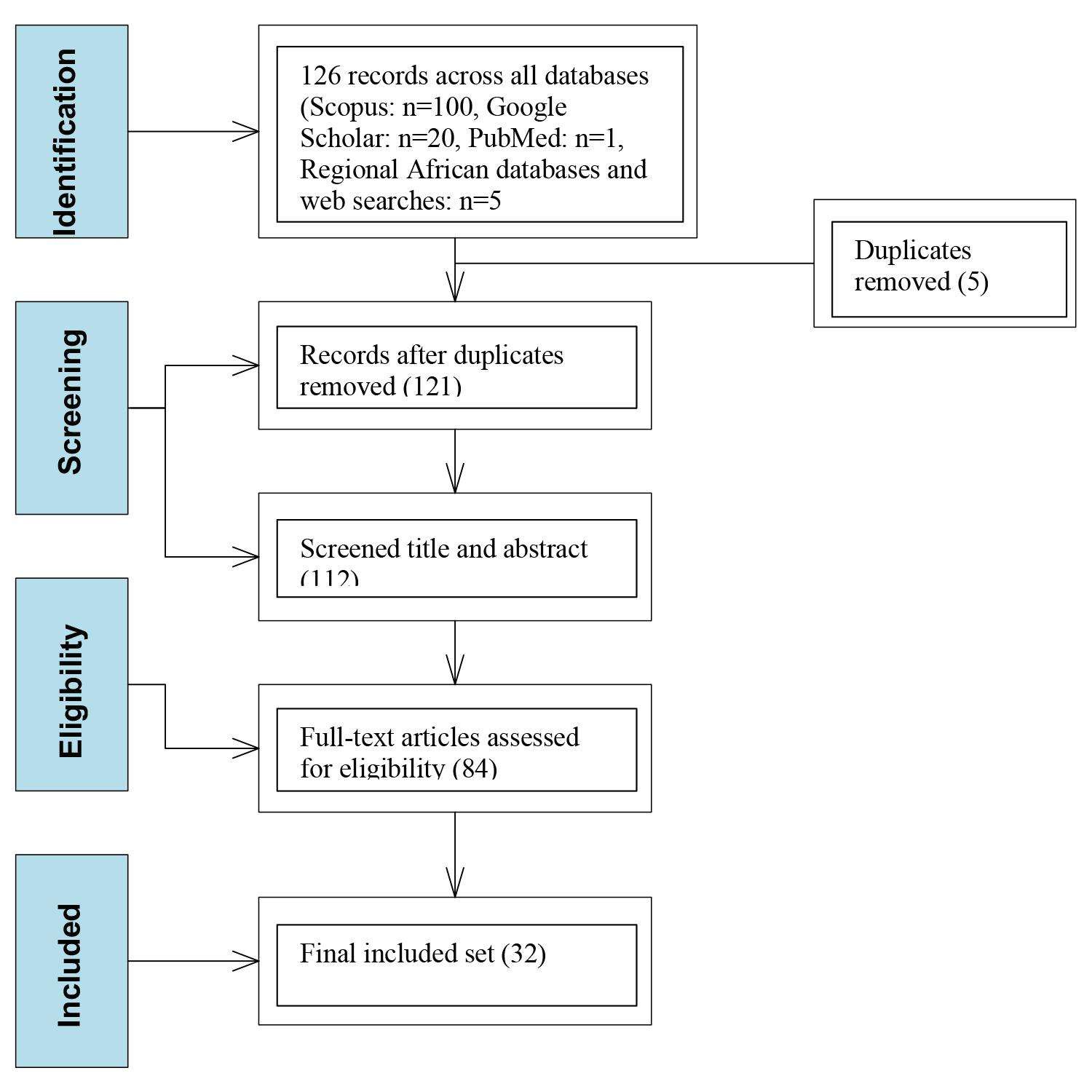
in understanding OA implementation across the full regional context.
Figure 3 show that temporally, the included studies showed an increasing trend over the review period, with 4 studies published in 2014-2015, 4 in 2016-2017, 4 in 2018-2019, 6 in 2020-2021, 6 in 2022-2023, and 8 in 2024-2025. This pattern reflects growing scholarly attention to OA issues in Southern Africa, coinciding with global expansion of OA initiatives and increasing institutional focus on research visibility and impact. The concentration of studies in the latter half of the review period suggests that OA has become an increasingly prominent concern for Southern African research communities and institutions.
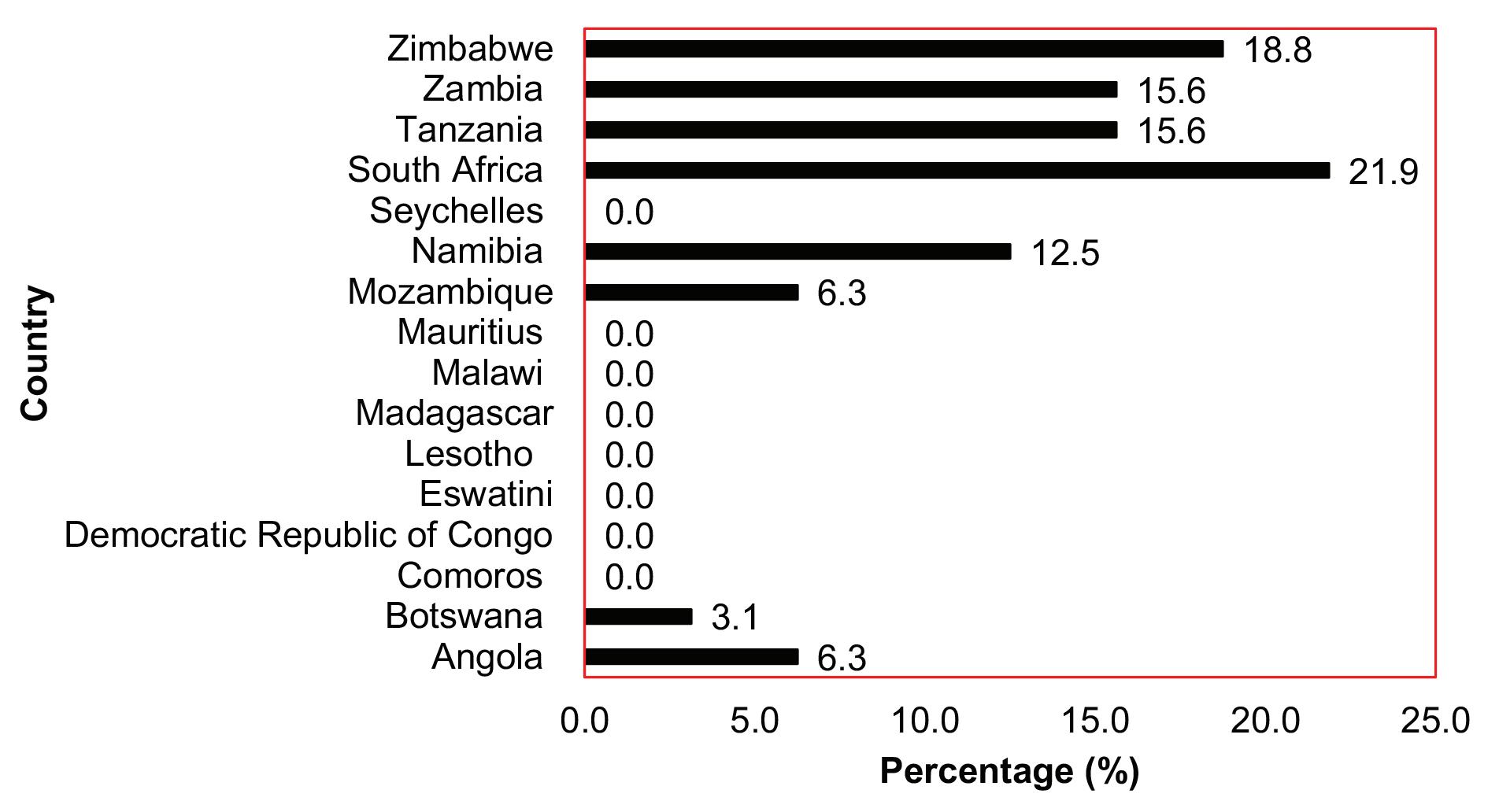
The review also examined the distribution of Open Access (OA) models across the included studies in Table 1, reveals heterogeneous landscape shaped by institutional capacity, funding mechanisms, and researcher preferences. Gold OA was the most frequently reported
<https://www.charleston-hub.com/media/atg/>
Figure 1 PRISMA article selection flowchart
Figure 2 Open Access Research Distribution by Country
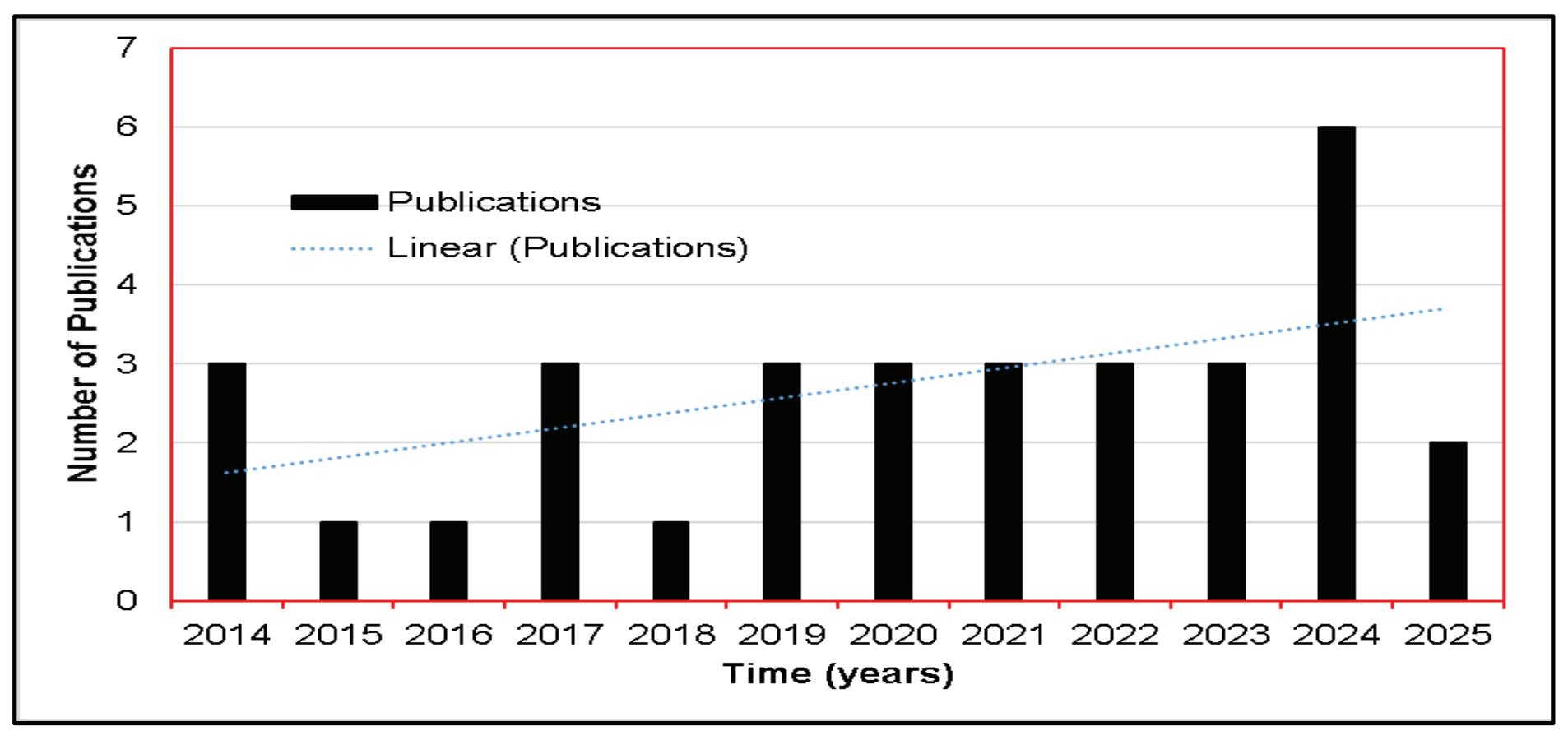
pathway, accounting for 34.4% of studies (n=11), typically involving publisher-hosted platforms supported through article processing charges (APCs) (Artigas, 2022; Kodua-Ntim & Fombad, 2024). Green OA followed closely, representing 28.1% (n=9), with self-archiving in institutional repositories emerging as a highly sustainable and cost-free option for authors (Yule & Beukes-Amiss, 2017; Artigas, Gungula, & Laakso, 2022; Chewe et al., 2021). Diamond OA, observed in 15.6% (n=5) of studies, highlighted community-driven publishing initiatives that offered no-fee access and demonstrated strong sustainability potential despite limited scale (Mbughuni, Mtega, & Malekani, 2024). Hybrid OA appeared in 12.5% (n=4) of studies, but its reliance on subscription journals with optional OA fees was judged to have low sustainability and high costs to authors, limiting its uptake in resource-constrained contexts (Chirisa & Ngoepe, 2024; Chisita & Fombad, 2020). Finally, Bronze OA was the least represented, comprising 9.4% (n=3), characterized by free-to-read access but restricted reuse rights and low sustainability (Ciavarella & Colangelo, 2025). Collectively, these findings underscore the predominance of Gold and Green OA pathways in the African context, while also pointing to the promise of Diamond OA as an equitable alternative and the persistent challenges associated with Hybrid and Bronze models.
Risk of Bias Assessment
Risk of bias was assessed across 32 studies using the ROBINS-I framework, which evaluates seven domains: confounding, selection of participants, classification of interventions, deviations from intended interventions, missing data,
measurement of outcomes, and selection of reported results as shown in Figure 4. The most critical source of bias was confounding, with 21 studies (66%) rated as serious and only 11 (34%) as moderate, indicating limited control for institutional or contextual factors influencing Open Access (OA) adoption. Participant selection showed moderate risk in 23 studies (72%) and low risk in 9 (28%), often due to convenience sampling and narrow institutional representation. Classification of interventions was generally robust, with 28 studies (88%) rated low risk and only 4 (12%) moderate.
Deviations from intended interventions were mostly wellmanaged, with 20 studies (63%) showing low risk and 12 (37%) moderate, typically where OA policies were inconsistently implemented. Missing data posed a moderate risk in 27 studies (84%), especially in survey-based research affected by non-response and incomplete reporting. Measurement of outcomes was uniformly rated moderate across all studies (100%), reflecting reliance on subjective indicators and limited validation of instruments. Similarly, selection of reported results was rated moderate in all cases, with concerns about selective emphasis on positive findings in institutional case studies.
Overall, 21 studies (66%) were judged to have a serious risk of bias, while 11 (34%) were rated moderate. No study achieved a low overall risk rating. These findings suggest that while the evidence base provides valuable insights into OA adoption in Southern Africa, methodological limitations particularly in confounding and reporting domains necessitate cautious interpretation. The predominance of moderate and serious bias underscores the need for more rigorous study designs and transparent reporting practices in future OA research.
Key Trends in Open Access Adoption
The synthesis of included studies revealed four major trends characterizing OA adoption in Southern Africa between 2014 and 2025. First, institution-led initiatives emerged as the dominant driver of OA implementation, with universities taking primary responsibility for developing OA policies, establishing institutional repositories, and providing researcher support
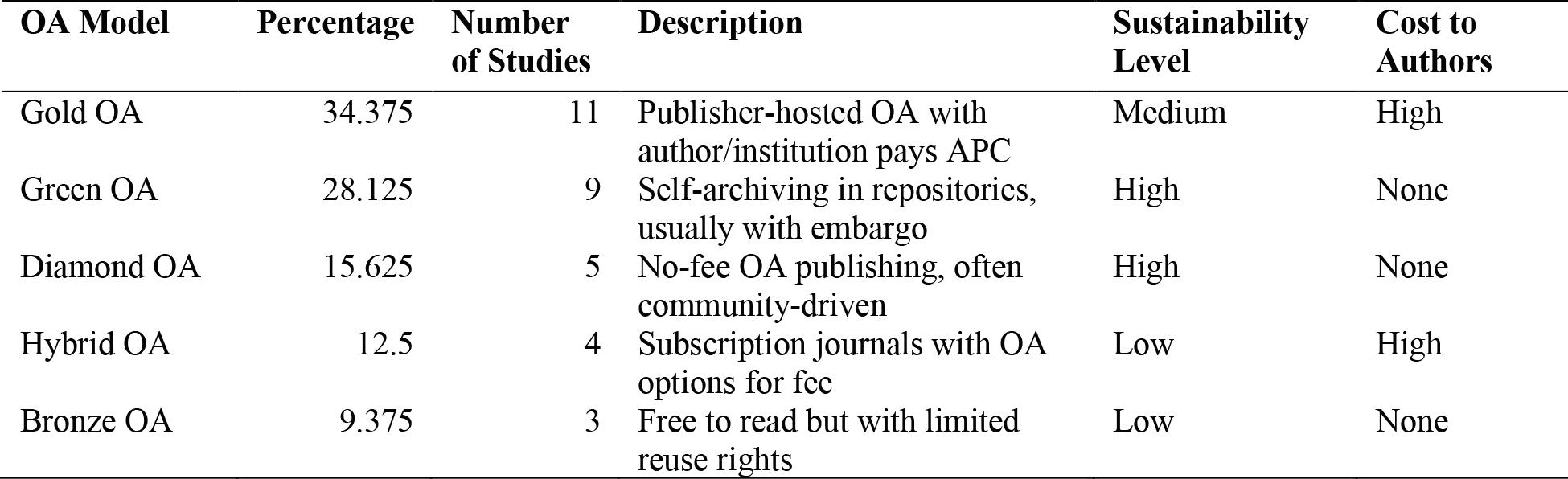
<https://www.charleston-hub.com/media/atg/>
Figure 3 Open Access Research Publications in Southern Africa 2014-2025
Table 1 Open Access Model Distribution in Southern Africa
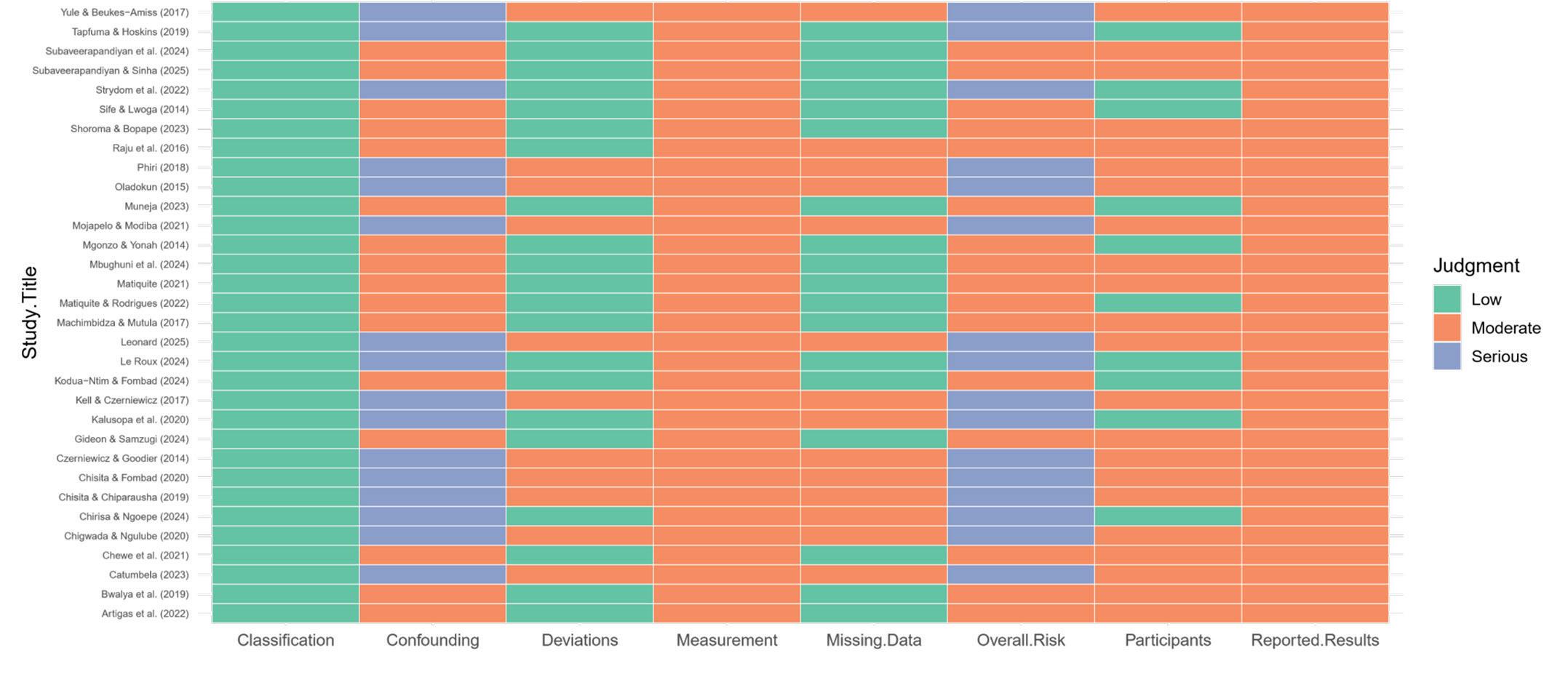
services (Kalusopa et al., 2020; Leonard, 2025; Bwalya et al., 2019; Phiri, 2018; Mgonzo & Yonah, 2014). This pattern contrasts with some other regions where national mandates or funder requirements have played more prominent roles in driving OA adoption (Frank, Foster, & Pagliari, 2023; Strydom et al., 2022). Southern African institutions have typically developed OA initiatives in response to global trends and institutional strategic goals rather than external mandates, resulting in diverse approaches and varying levels of implementation across the region (Siyao et al., 2017; Tapfuma, & Hoskins, 2019; Ajibade & Muchaonyerwa, 2023; Artigas, Gungula, & Laakso, 2022).
The second major trend involved growing awareness of OA among researchers and institutional leaders, coupled with uneven adoption patterns across disciplines, institutions, and countries. Multiple studies documented high levels of awareness regarding OA concepts and potential benefits, with 70-85% of surveyed researchers reporting familiarity with OA publishing options (Raju & Maharaj, 2025; Subaveerapandiyan & Sinha, 2025). However, this awareness did not consistently translate into adoption behaviors, with actual OA publishing rates remaining substantially lower than awareness levels would suggest (Ciavarella & Colangelo, 2025; Ndegwa & Kuchma, 2024). This awareness-adoption gap was particularly pronounced in certain disciplines and among researchers without institutional support for APCs or repository deposit activities (Chewe et al., 2021; Gideon & Samzugi, 2024).
Third, the emergence of local OA journals represented a significant development in the regional scholarly communication landscape. Several studies documented the establishment of new OA journals by universities and professional organizations, often focused on addressing local research priorities and providing accessible venues for regional scholarship (Matiquite & Rodrigues, 2022; Gideon & Samzugi, 2024; Chigwada & Ngulube, 2025; Chisita & Chiparausha, 2019). This trend reflects efforts to develop indigenous publishing capacity while ensuring broad accessibility of locally relevant research (Chigwada & Ngulube, 2025; Ezechukwu, Adewole-Odeshi, & Onobrakpor, 2024). However, concerns about quality assurance, sustainability, and international recognition were frequently noted as challenges accompanying this expansion of local OA publishing options (Chirisa & Ngoepe, 2024; Muneja, 2023).
The fourth major trend involved increasing integration of OA initiatives with broader research data management and institutional research support frameworks (Muneja, 2023; Chirisa & Ngoepe, 2024). Universities increasingly positioned OA as part of comprehensive research support services, linking repository development with data management planning, research impact assessment, and international collaboration facilitation (Gideon & Samzugi, 2024; Mbughuni, Mtega, & Malekani, 2024; Musisi & Mutwiri, 2024). This integrated approach reflected growing recognition that OA implementation requires systematic institutional commitment and cannot be effectively addressed through isolated policy or technical interventions alone (Page et al., 2021).
Major Benefits of Open Access Implementation
The analysis revealed five primary categories of benefits associated with OA implementation in Southern African contexts as shown in Table 2. Increased research visibility emerged as the most frequently cited benefit, mentioned in 84.4% of included studies and supported by both quantitative metrics and researcher perceptions. Institutions reported enhanced discoverability of their research outputs through OA repositories and journals, with several studies documenting increased download rates, citation counts, and international collaboration opportunities following OA implementation (Ajibade & Muchaonyerwa, 2023; Chewe et al., 2021; Strydom et al., 2022; Ciavarella & Colangelo, 2025; Tapfuma & Hoskins, 2019). This visibility benefit was particularly valued by institutions seeking to enhance their international profiles and attract research partnerships or funding opportunities (Ndegwa & Kuchma, 2024; Leonard, 2025). Overall, increased visibility is supported by strong evidence, with quantitative data available through citation and readership metrics, and its regional relevance is high given the need to amplify African scholarship globally.
Enhanced knowledge equity and social impact represented the second major benefit category, emphasized in 75.0% of studies as a key motivation for OA adoption. Knowledge equity is supported by strong evidence, though quantitative data remain limited, and its regional relevance is high as it directly addresses disparities in access across Southern Africa (Gideon &
<https://www.charleston-hub.com/media/atg/>
Figure 4 ROBINS−I Risk of Bias Heatmap
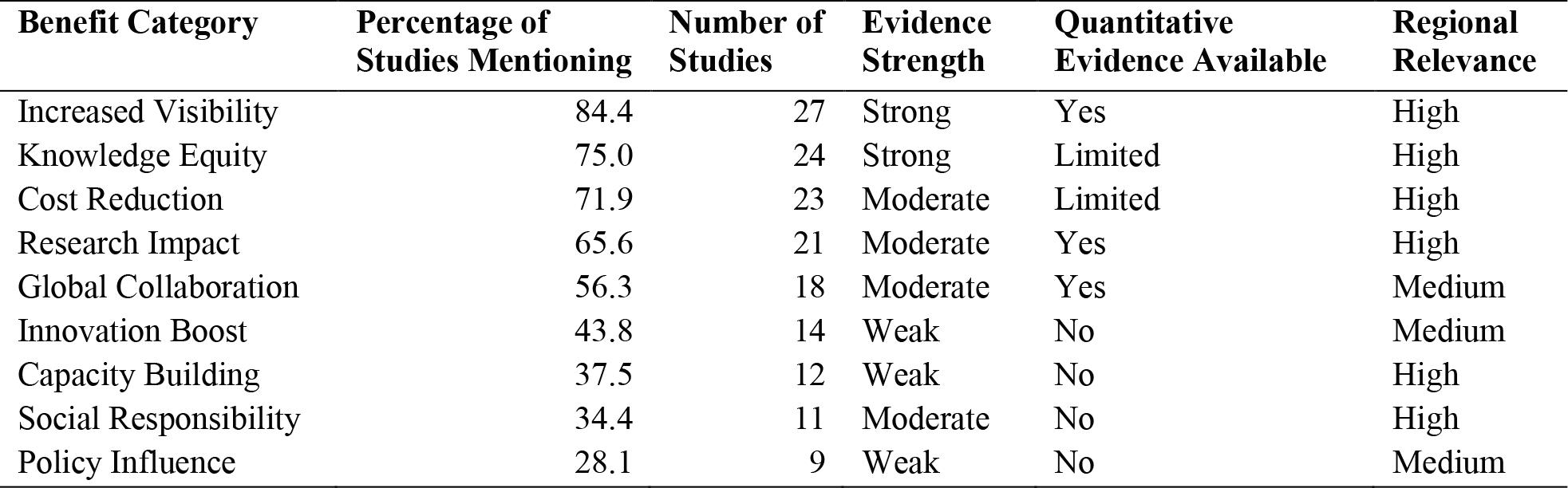
Samzugi, 2024; Mbughuni, Mtega, & Malekani, 2024; Shoroma & Bopape, 2023; Catumbela, 2023). Researchers and institutional leaders frequently framed OA as fulfilling social responsibility obligations to make publicly funded research freely available to local communities, policymakers, and practitioners (Chirisa & Ngoepe, 2024; Ezechukwu, Adewole-Odeshi, & Onobrakpor, 2024). This benefit was particularly salient in contexts where subscription-based access limited the availability of research to potential users outside well-funded academic institutions (Kalusopa et al., 2020; Matiquite & Rodrigues, 2022). Several studies provided examples of research being used by government agencies, national government organizations, and community organizations following OA publication, demonstrating practical applications of the equity argument.
Cost reduction and resource optimization comprised the third benefit category, though with more mixed evidence regarding actual financial impacts. While 71.9% of studies mentioned potential cost savings as a driver for OA adoption, actual cost analyses were limited and showed variable results (Chewe et al., 2021; Kodua-Ntim & Fombad, 2024; Catumbela, 2023). Some institutions reported reduced library subscription costs following OA implementation, while others noted increased costs associated with APC payments and repository maintenance (Chirisa & Ngoepe, 2024; Muneja, 2023). The cost benefit appeared most pronounced for institutions with high subscription costs and limited APC obligations, suggesting that financial impacts vary significantly based on institutional context and OA model implementation (Subaveerapandiyan & Sinha, 2025; Raju & Maharaj, 2025). Cost reduction is supported by moderate evidence, with limited quantitative validation, and its regional relevance is high given the financial constraints faced by many institutions in the region.
Research impact represented the fourth major benefit, documented in 65.6% of studies through both quantitative metrics and qualitative researcher reports. Several studies provided evidence of increased citation rates, international co-authorships, and research collaboration opportunities following OA implementation (Frank, Foster, & Pagliari, 2023; Ajibade & Muchaonyerwa, 2023; Shoroma & Bopape, 2023). However, the causal relationship between OA and impact remained difficult to establish definitively, with studies acknowledging multiple factors that might influence research visibility and collaboration patterns (Machimbidza & Mutula, 2017; Chisita & Chiparausha, 2019; Ciavarella & Colangelo, 2025; Ndegwa & Kuchma, 2024). Nevertheless, the perception of enhanced impact was consistently reported as a motivating factor for researcher and institutional OA
adoption (Leonard, 2025; Gideon & Samzugi, 2024). Research impact is supported by moderate evidence, with quantitative data available through citation analyses, and its regional relevance is high as it amplifies the influence of Southern African research outputs.
Open Access was also associated with enhanced opportunities for international collaboration, reported in 56.3% of studies (n=18). Evidence strength was moderate, with several studies documenting quantitative indicators such as coauthorship patterns and crossinstitutional partnerships (Mbughuni, Mtega, & Malekani, 2024; Raju & Maharaj, 2025; Subaveerapandiyan & Sinha, 2025). OA platforms facilitated greater visibility of Southern African research outputs, enabling scholars to connect with global networks and participate in collaborative projects (Artigas, Gungula, & Laakso, 2022; Catumbela, 2023). While regional relevance was judged medium due to uneven uptake across institutions, the findings underscore OA’s role in bridging geographic divides and fostering integration into the global research community.
The potential of OA to stimulate innovation was noted in 43.8% of studies (n=14), though evidence strength was weak and largely qualitative. Studies highlighted how OA initiatives contributed to experimentation with new publishing models, repository development, and institutional learning processes (Matiquite & Rodrigues, 2022; Chirisa & Ngoepe, 2024; Muneja, 2023; Ezechukwu et al., 2024). Although quantitative validation was lacking, OA was perceived as a catalyst for policy innovation and technical skill development, particularly in emerging research systems (Chewe et al., 2021; Gideon & Samzugi, 2024). Regional relevance was assessed as medium, reflecting OA’s role in supporting adaptive responses to evolving scholarly communication needs.
Capacity building benefits were identified in 37.5% of studies (n=12), with weak evidence strength and no quantitative data available. Nevertheless, OA initiatives were reported to enhance institutional capacity through training, infrastructure development, and policy formulation (Kalusopa et al., 2020; Shoroma & Bopape, 2023; Mbughuni, Mtega, & Malekani, 2024; Catumbela, 2023; Chisita & Chiparausha, 2016; Chisita & Chiparausha, 2019; Chigwada & Ngulube, 2025). These efforts contributed to strengthening local scholarly communication systems and building resilience in resourceconstrained environments (Ezechukwu et al., 2024; Gideon & Samzugi, 2024). Regional relevance was high, as capacity building aligns closely with the developmental priorities of Southern African institutions seeking to expand their research output and visibility.
<https://www.charleston-hub.com/media/atg/>
Table 2 Major Benefits of Open Access in Southern Africa
OA adoption was framed as a matter of social responsibility in 34.4% of studies (n=11), with moderate evidence strength but no quantitative validation. Researchers and institutions emphasized the ethical imperative of making publicly funded research freely accessible to communities, policymakers, and practitioners (Chewe et al., 2021; Gideon & Samzugi, 2024; Matiquite & Rodrigues, 2022). This framing positioned OA as a mechanism for advancing equity and justice, ensuring that knowledge produced within the region contributes to societal development (Subaveerapandiyan & Sinha, 2025; Kodua-Ntim & Fombad, 2024; Mbughuni et al., 2024). Regional relevance was high, reflecting the alignment of OA with broader social justice and development goals in Southern Africa.
Finally, the potential of OA to shape institutional and national policy frameworks was reported in 28.1% of studies (n=9). Evidence strength was weak, with limited empirical support, but qualitative findings suggested that OA initiatives informed policy debates and institutional strategies (KoduaNtim & Fombad, 2024; Catumbela, 2023; Chirisa & Ngoepe, 2024; Muneja, 2023). While regional relevance was medium, these findings highlight OA’s emerging role in influencing governance structures and promoting harmonization of scholarly communication policies (Ezechukwu et al., 2024; Gideon & Samzugi, 2024). Greater systematic evaluation will be required to substantiate OA’s policy impact and guide evidencebased decision making in the region.
Persistent Challenges to Open Access Adoption
Despite documented benefits, the synthesis revealed significant challenges that continue to impede OA adoption and limit its transformative potential in Southern Africa as shown in Table 3. Funding constraints emerged as the most frequently cited challenge, mentioned in 78.1% of studies and identified as a primary barrier to sustainable OA implementation. Article processing charges (APCs) were consistently highlighted as problematic, with researchers reporting inability to publish in preferred OA journals due to cost barriers (Chigwada & Ngulube, 2025; Chewe et al., 2021; Chirisa & Ngoepe, 2024; Chisita & Chiparausha, 2019; Tapfuma, 2019). Institutional APC support programs were limited in scope and sustainability, often covering only a small fraction of researcher needs or focusing on specific disciplines or funding sources (Kalusopa et al., 2020; Kodua-Ntim & Fombad, 2024). Overall, funding constraints represent a high severity challenge with difficult addressability, requiring high resource commitments, and are most acute in smaller institutions and countries with limited research budgets compared to relatively better-resourced systems in South Africa (Czerniewicz et al., 2014: Leonard, 2025; Subaveerapandiyan & Sinha, 2025).
Technical infrastructure limitations represented the second major challenge category, affecting 65.6% of studies and encompassing both institutional and national-level constraints. Repository development and maintenance required technical expertise and resources that many institutions struggled to provide consistently (Chisita & Fombad 2020; Artigas, Gungula, & Laakso, 2022; Catumbela, 2023). Internet connectivity issues, server reliability problems, and limited technical support capacity were frequently cited as obstacles to effective OA implementation (Muneja, 2023; Shoroma & Bopape, 2023; Kodua & Fombad, 2024). These infrastructure challenges were particularly pronounced in smaller institutions and countries with less developed technological infrastructure, creating disparities in OA capacity across the region (Chewe et al., 2021; Gideon & Samzugi, 2024). Technical infrastructure challenges
are of high severity, have medium addressability through long-term investment, demand very high resource requirements, and vary regionally with stronger systems in South Africa and weaker capacity in countries such as Malawi, Lesotho, and Zambia (Subaveerapandiyan et al., 2024; Sterne et al., 2016; Chisita & Chiparausha, 2019).
Policy gaps and coordination challenges comprised the third major obstacle, identified in 59.4% of studies as limiting the effectiveness and sustainability of OA initiatives. Most countries lacked comprehensive national OA policies, leaving institutional initiatives to develop in isolation without broader strategic coordination (Catumbela, 2023; Kodua-Ntim & Fombad, 2024). This fragmentation resulted in duplicated efforts, incompatible systems, and missed opportunities for resource sharing and collaborative development (Kodua-Ntim & Fombad, 2024; Ezechukwu, Adewole-Odeshi, & Onobrakpor, 2024). Even where institutional policies existed, enforcement mechanisms and integration with broader research evaluation systems were often inadequate (Matiquite & Rodrigues, 2022; Chirisa & Ngoepe, 2024). Policy gaps are a moderate severity challenge with medium addressability through harmonization and governance reforms, requiring high resource investment in policy development, and are more pronounced in countries without national OA frameworks compared to South Africa where institutional policies are more established.
Researcher awareness and cultural barriers represented the fourth significant challenge, affecting 53.1% of studies despite high reported awareness levels. While researchers generally understood OA concepts, many lacked detailed knowledge about specific OA options, quality indicators, or practical implementation steps (Ajibade & Muchaonyerwa, 2023; Shoroma & Bopape, 2023). Concerns about predatory publishing, peer review quality, and career advancement implications created reluctance to adopt OA practices even among supportive researchers (Ciavarella & Colangelo, 2025; Ndegwa & Kuchma, 2024). Disciplinary cultures that prioritized traditional high-impact journals also created barriers to OA adoption, particularly in fields where OA options were perceived as less prestigious or rigorous (Chewe et al., 2021; Gideon & Samzugi, 2024). Researcher awareness challenges are of moderate severity, highly addressable through training and outreach, requiring medium resource commitments, and vary regionally with stronger awareness in South Africa and Botswana compared to lower levels in peripheral institutions across Mozambique and Zimbabwe (Matiquite, 2021; Chisita & Chiparausha, 2019).
Quality assurance concerns constituted the fifth major challenge category, particularly relevant for emerging local OA initiatives. About 43.8% of the studies documented ongoing concerns about peer review standards, editorial capacity, and long-term viability of new OA journals and repositories (Matiquite & Rodrigues, 2022; Chirisa & Ngoepe, 2024). These concerns were exacerbated by limited resources for quality assurance systems and uncertainty about sustainable funding models for OA infrastructure and services (Catumbela, 2023; Ezechukwu et al., 2024). The challenge of maintaining quality while expanding access created tensions that institutions struggled to resolve effectively. Quality concerns are a moderate severity challenge, moderately addressable through improved editorial standards and indexing, requiring medium resource investments. They are more pronounced in institutions with entrenched traditional publishing cultures compared to newer community-driven OA initiatives.
<https://www.charleston-hub.com/media/atg/>
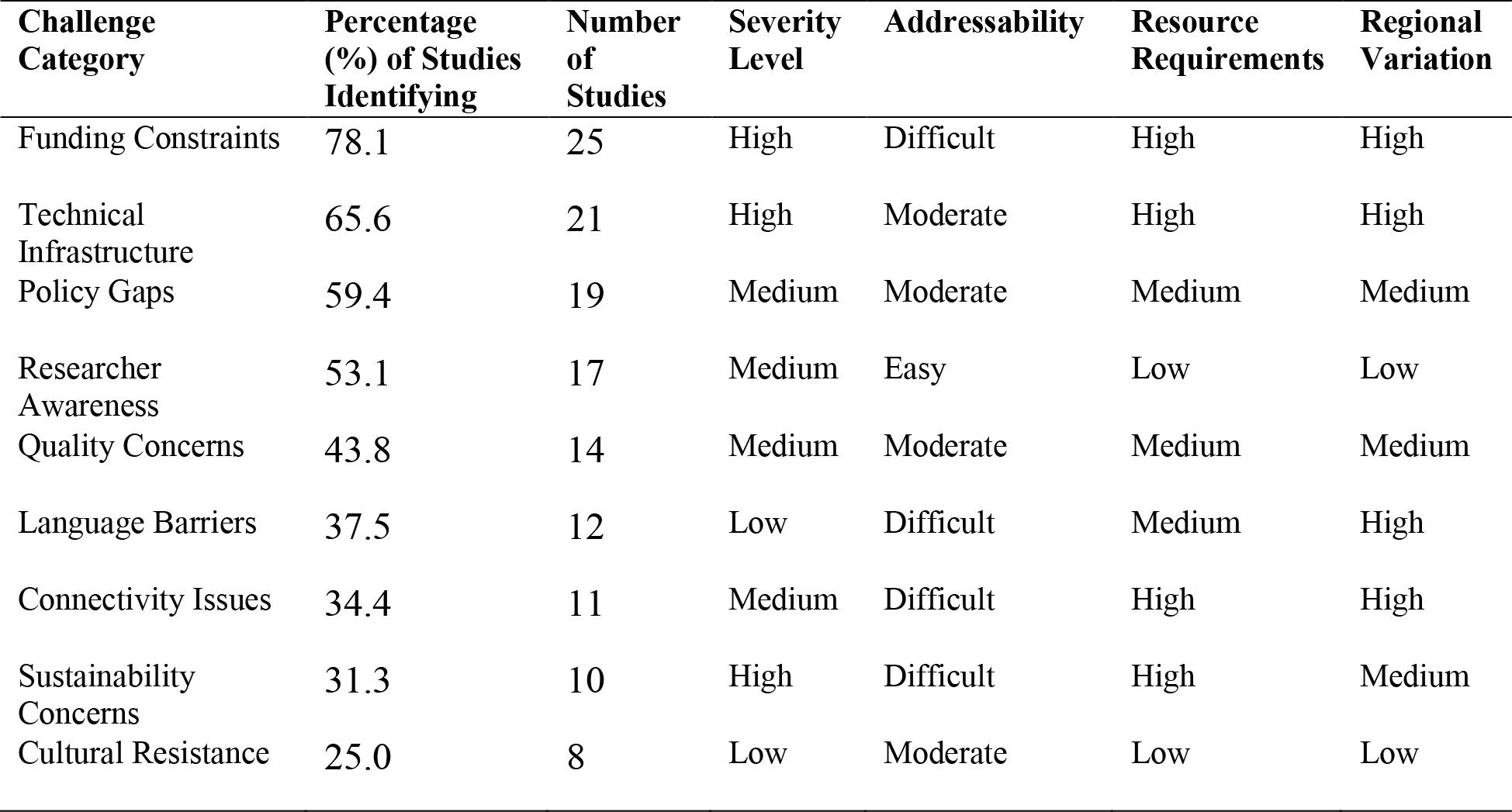
Language diversity across Southern Africa presents a significant obstacle to equitable Open Access (OA) adoption. While English dominates scholarly publishing, this creates exclusionary effects for researchers and communities whose primary languages differ (Chigwada & Ngulube, 2025; Gideon & Samzugi, 2024). Evidence from the reviewed studies indicates that 37.5% reported language-related challenges, particularly in terms of accessibility for policymakers, practitioners, and local communities (Mbughuni, Mtega, & Malekani, 2024; Chewe et al., 2021). The absence of multilingual OA platforms and translation mechanisms reinforces inequities, limiting the reach and impact of regionally relevant research outputs (Shoroma & Bopape, 2023; Kodua-Ntim & Fombad, 2024). Overall, language barriers present a low severity challenge that is highly addressable through translation initiatives, requiring medium resource investment, and are most pronounced in countries with strong indigenous language use compared to English-dominant contexts such as South Africa.
Technical infrastructure limitations, especially poor internet connectivity, remain a persistent challenge. Connectivity issues are a high severity challenge with medium addressability, demanding very high resource commitments for broadband and infrastructure, and vary significantly between urban centers with reliable access and rural or peripheral regions where connectivity remains poor (Muneja, 2023; Chewe et al., 2021; Musisi & Mutwiri, 2024). Studies highlighted that 34.4% of cases reported connectivity-related barriers, with rural and under-resourced institutions disproportionately affected. Researchers in these contexts struggle to upload publications, access repositories, or engage with OA platforms due to unreliable or slow internet services (Chirisa & Ngoepe, 2024; Gideon & Samzugi, 2024). This digital divide undermines the democratizing potential of OA, as access to knowledge continues to be mediated by infrastructural inequalities between urban and peripheral institutions (Catumbela, 2023; Matiquite & Rodrigues, 2022).
Sustainability of OA initiatives emerged as a recurrent theme, with 31.3% of studies identifying funding and resource
constraints as critical barriers. Institutional repositories and local OA journals often face difficulties maintaining long-term viability due to reliance on donor support, limited technical expertise, and inadequate financial planning (Kalusopa et al., 2020; Chigwada & Ngulube, 2025). Concerns about the sustainability of APC-based models further complicate adoption in resource-constrained environments (Kodua-Ntim & Fombad, 2024; Ezechukwu et al., 2024). Without stable funding mechanisms and institutional commitment, OA initiatives risk becoming short-lived projects rather than enduring components of scholarly communication systems (Muneja, 2023; Gideon & Samzugi, 2024). Sustainability concerns are a high severity challenge with medium addressability, requiring high financial and technical resources, and are more acute in smaller institutions and countries with limited research budgets compared to relatively stronger systems in South Africa (Mojapelo & Modiba, 2021).
Cultural and institutional resistance also shapes OA adoption patterns and it is a moderate severity challenge that is highly addressable through awareness campaigns and quality assurance mechanisms, requiring medium resource investment, and is more pronounced in institutions with entrenched traditional publishing cultures than in newer or community-driven initiatives. Approximately 25.0% of studies reported reluctance among researchers and institutions, often linked to perceptions of OA journals as lower prestige outlets or concerns about quality assurance (Chewe et al., 2021; Shoroma & Bopape, 2023). Institutional inertia, where traditional publishing practices remain deeply embedded, slows the transition toward OA models. In some cases, resistance stems from fears of intellectual property loss or diminished control over research outputs (Ajibade & Muchaonyerwa, 2023; Gideon & Samzugi, 2024). These cultural barriers highlight the need for awareness campaigns, training, and policy frameworks that address misconceptions and build trust in OA as a legitimate and impactful scholarly communication model (Catumbela, 2023; Kodua-Ntim & Fombad, 2024).
<https://www.charleston-hub.com/media/atg/>
Table 3 Persistent Challenges to Open Access Adoption in Southern Africa
Future Research Directions and Recommendations
The synthesis of included studies revealed five priority areas for future research and development in Southern African OA contexts as shown in Table 4. Regional collaboration and coordination emerged as the highest priority, with a mean priority score of 4.8 out of 5.0 across studies providing recommendations. Despite high implementation difficulty and resource requirements, its expected impact was judged very high, reflecting the transformative potential of coordinated frameworks across Southern African countries. Multiple studies emphasized the need for coordinated regional approaches to OA policy development, infrastructure sharing, and capacity building initiatives (Kalusopa et al., 2020; Chigwada & Ngulube, 2025; Kodua-Ntim & Fombad, 2024; Gideon & Samzugi, 2024). Specific recommendations included developing regional OA policies, establishing shared repository networks, and creating collaborative funding mechanisms for APC support and infrastructure development (Catumbela, 2023; Mbughuni, Mtega, & Malekani, 2024).
Capacity building and training programs represented the second priority area, with a mean score of 4.6 out of 5.0, reflecting widespread recognition that successful OA implementation requires systematic skill development across multiple stakeholder groups. Implementation difficulty was judged medium, with medium-term feasibility and moderate resource requirements. The expected impact was rated high, as capacity building directly addresses researcher awareness gaps, technical skill development, and institutional readiness. Studies recommended comprehensive training programs for researchers, librarians, administrators, and policymakers, covering topics ranging from OA publishing options to repository management and policy development (Chewe et al., 2021; Shoroma & Bopape, 2023; Phiri, 2018; Saide & Lwoga, 2014). The need for culturally appropriate and contextually relevant training materials was emphasized, along with sustainable delivery mechanisms that could reach researchers across the region (Matiquite & Rodrigues, 2022; Gideon & Samzugi, 2024).
Policy harmonization and development constituted the third priority, scoring 4.5 out of 5.0 and reflecting concerns about fragmented policy landscapes limiting OA effectiveness. This direction was judged high in implementation difficulty and resource requirements, but its expected impact was very high. Recommendations focused on developing national OA
policies that align with international best practices while addressing local contexts and constraints (Kodua-Ntim & Fombad, 2024; Ezechukwu, Adewole-Odeshi, & Onobrakpor, 2024). Studies emphasized the need for policies that integrate OA requirements with research funding, evaluation, and career advancement systems to create meaningful incentives for adoption (Catumbela, 2023; Subaveerapandiyan & Sinha, 2025).
Infrastructure development and sustainability represented the fourth priority area, with a score of 4.1 out of 5.0, encompassing both technical and organizational infrastructure needs. Implementation difficulty and resource requirements were judged very high, with a long-term horizon, but the expected impact was consistently rated high. Studies recommended investments in repository technology, metadata standards, preservation systems, and interoperability frameworks that could support long-term OA sustainability (Sterne et al., 2016; Artigas, Gungula, & Laakso, 2022; Muneja, 2023). The need for sustainable funding models and organizational structures to support ongoing infrastructure maintenance and development was consistently emphasized (Kodua-Ntim & Fombad, 2024).
Evaluation and impact assessment emerged as the fifth priority, scoring 3.9 out of 5.0, reflecting the need for better evidence regarding OA effectiveness and impact in Southern African contexts. This direction was judged medium in implementation difficulty and resource requirements, with a medium-term horizon and moderate expected impact. Studies recommended longitudinal research on OA adoption patterns, impact assessments of existing initiatives, and comparative analyses of different OA models and implementation approaches (Ciavarella & Colangelo, 2025). The development of appropriate metrics and evaluation frameworks for assessing OA impact in resource-constrained contexts was identified as a particular need (Frank, Foster, & Pagliari, 2023; Leonard, 2025).
The potential role of artificial intelligence (AI) in strengthening Open Access (OA) systems was highlighted in 56.3% of studies (n=18), with a priority score of 4.2/5.0. AI integration was judged to have high implementation difficulty and resource requirements, reflecting the technical expertise and infrastructure needed to operationalize such innovations (Strydom et al., 2022; Ciavarella & Colangelo, 2025). Nevertheless, the expected impact was consistently rated high, as AI tools could enhance efficiency in repository management, automate metadata generation, and improve discoverability of
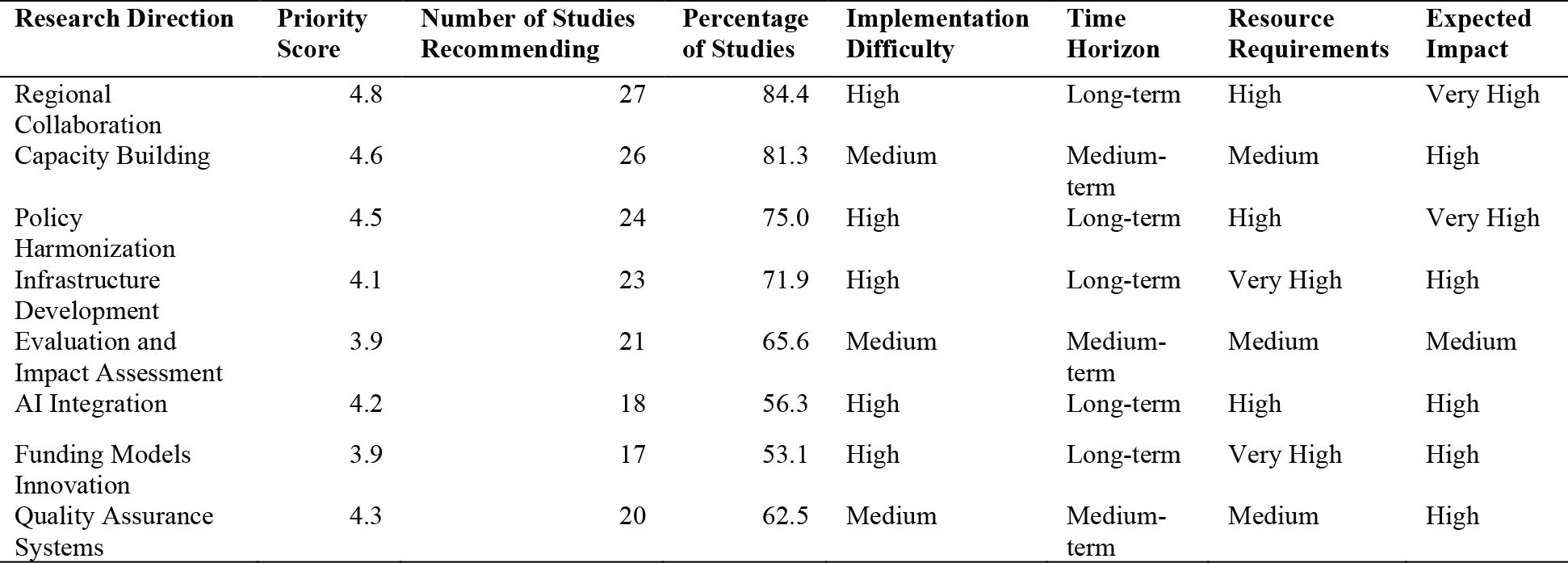
Table 4 Future Research Directions Priority Ranking in Southern Africa
<https://www.charleston-hub.com/media/atg/>
research outputs (Gideon & Samzugi, 2024). With a long-term horizon, AI integration represents a transformative direction for OA in Southern Africa, though its success will depend on sustained investment and capacity development.
Sustainable financing mechanisms for OA initiatives were recommended in 53.1% of studies (n=17), with a priority score of 3.9/5.0. This direction was judged to have high implementation difficulty and very high resource requirements, reflecting the complexity of designing equitable and durable funding structures. Proposed innovations included institutional consortia, government subsidies, and community - driven models that reduce reliance on article processing charges (APCs) (Chigwada & Ngulube, 2025; Kodua-Ntim & Fombad, 2024; Ezechukwu et al., 2024). While the expected impact was rated high, the long-term horizon underscores the need for coordinated policy and financial planning to ensure that OA initiatives remain viable beyond initial donor or project-based support (Catumbela, 2023; Subaveerapandiyan & Sinha, 2025).
The importance of strengthening quality assurance mechanisms in OA publishing was emphasized in 62.5% of studies (n=20), with a priority score of 4.3/5.0. Evidence suggested that credibility concerns and perceptions of lower prestige remain barriers to OA adoption, making robust peer review, editorial standards, and indexing practices essential (Chigwada & Ngulube, 2025; Chewe et al., 2021; Phiri, 2018). Implementation difficulty and resource requirements were judged medium, with a medium-term horizon, but the expected impact was rated high More recent studies emphasized robust peer review, editorial standards, and indexing practices as essential for credibility (Matiquite & Rodrigues, 2022; Chirisa & Ngoepe, 2024; Gideon & Samzugi, 2024). By enhancing trust and legitimacy, quality assurance systems can help position Southern African OA journals as credible venues for scholarly communication, thereby supporting both local and global recognition of regional research outputs (Leonard, 2025; Raju & Maharaj, 2025).
Discussion
Main Findings
This systematic review provides the first comprehensive synthesis of evidence regarding Open Access as a transformative model in scholarly communication within Southern Africa, revealing a complex landscape of opportunities and challenges that characterizes OA implementation in emerging research systems. The evidence demonstrates that OA has gained significant traction across the region, with institution-led initiatives servi ng as the primary driver of adoption and implementation (Chisita & Chiparausha, 2019; Chewe et al., 2021). This pattern reflects both the entrepreneurial capacity of Southern African universities and the absence of strong national policy frameworks that might provide more coordinated approaches to OA development (Raju et al., 2016; Kodua-Ntim & Fombad, 2024).
The documented benefits of OA implementation align closely with global evidence while demonstrating particular relevance for Southern African contexts characterized by resource constraints and limited access to traditional scholarly literature. The emphasis on knowledge equity and social impact reflects the strong social justice orientation of many Southern African institutions and their commitment to addressing historical inequities in knowledge access and production (Matheka et al., 2014; Gideon & Samzugi, 2024; Mbughuni, Mtega, & Malekani, 2024). However, the persistent challenges identified
in this review highlight the complex barriers that limit OA’s transformative potential, particularly in contexts where financial resources, technical infrastructure, and policy support remain constrained (Ajibade & Muchaonyerwa, 2023; Ciavarella & Colangelo, 2025).
The awareness-adoption gap documented across multiple studies represents a particularly significant finding, suggesting that successful OA implementation requires more than researcher education and awareness-raising activities (Shoroma & Bopape, 2023; Raju & Maharaj, 2025). This gap indicates the need for systematic approaches that address structural barriers, provide practical support, and create meaningful incentives for OA adoption (Subaveerapandiyan & Sinha, 2025). The finding that institution-led initiatives have been most successful suggests that coordinated institutional commitment, rather than individual researcher motivation alone, may be essential for sustainable OA transformation (Matiquite & Rodrigues, 2022; Gideon & Samzugi, 2024).
Implications for Policy and Practice
The findings of this review have several important implications for policymakers, institutional leaders, and other stakeholders working to advance OA in Southern Africa. First, the success of institution-led initiatives suggests that universities and research institutions should be positioned as key drivers of OA transformation, with appropriate support and resources to develop comprehensive OA strategies (Chigwada & Ngulube, 2025; Chewe et al., 2021; Leonard, 2025). However, the limitations of fragmented institutional approaches also indicate the need for regional coordination mechanisms that can facilitate resource sharing, standard development, and collaborative problem-solving (Sterne et al., 2016; Kodua-Ntim & Fombad, 2024; Gideon & Samzugi, 2024).
Second, the persistent challenge of funding constraints requires innovative approaches to APC support and sustainable OA financing. Traditional models based on individual researcher or institutional APC payments may not be viable in resourceconstrained contexts (Chirisa & Ngoepe, 2024). Catumbela (2023) and Subaveerapandiyan & Sinha (2025) suggested the need for alternative approaches such as institutional publishing programs, diamond OA models, or regional funding consortia. The success of repository-based Green OA approaches in several contexts suggests that immediate access can be achieved through lower-cost models while longer-term solutions for Gold OA financing are developed (Ajibade & Muchaonyerwa, 2023; Ciavarella & Colangelo, 2025).
Third, the infrastructure challenges identified in this review point to the need for coordinated investment in technical capacity and sustainable support systems. Regional approaches to repository development, metadata standardization, and preservation systems could provide economies of scale while ensuring interoperability and long-term sustainability (Sterne et al., 2016; Chigwada & Ngulube, 2025; Artigas, Gungula, & Laakso, 2022; Muneja, 2023). The integration of OA initiatives with broader research data management and institutional research support frameworks appears to offer promising approaches for maximizing resource efficiency and institutional impact (Chewe et al., 2021; Gideon & Samzugi, 2024; KoduaNtim & Fombad, 2024).
Fourth, the quality and sustainability concerns raised across multiple studies indicate the need for robust quality assurance mechanisms and sustainable governance models for emerging OA initiatives. This includes developing appropriate peer review standards, editorial training programs, and quality indicators
<https://www.charleston-hub.com/media/atg/>
that can support researcher confidence while maintaining accessibility and equity principles (Matiquite & Rodrigues, 2022; Chirisa & Ngoepe, 2024). The establishment of regional quality assurance networks and collaborative editorial support systems could help address capacity constraints while maintaining standards (Catumbela, 2023; Gideon & Samzugi, 2024; Leonard, 2025).
Comparison with Global Literature
The findings of this review show both similarities and important differences compared to OA implementation experiences in other global contexts. The institution-led nature of OA adoption in Southern Africa mirrors patterns observed in other emerging research systems, where national policy frameworks may be less developed and institutional entrepreneurship plays a more prominent role (Chigwada & Ngulube, 2025; Chisita & Chiparausha, 2019; Chewe et al., 2021; Leonard, 2025). However, the particular emphasis on knowledge equity and social impact reflects the specific historical and socioeconomic contexts of Southern African countries and their commitment to addressing colonial legacies in knowledge production and access (Gideon & Samzugi, 2024; Mbughuni, Mtega, & Malekani, 2024; Subaveerapandiyan & Sinha, 2025).
The persistence of funding constraints as a primary barrier aligns with global evidence regarding APC affordability challenges, but the severity and scope of these constraints in Southern African contexts may be more pronounced than in higher-income regions (Chirisa & Ngoepe, 2024; Kodua-Ntim & Fombad, 2024). The success of repository-based approaches in this context mirrors findings from other regions where Green OA has provided accessible pathways for OA implementation (Oladokun, 2015; Ajibade & Muchaonyerwa, 2023; Ciavarella & Colangelo, 2025). However, the integration with research data management appears to be more advanced in some Southern African contexts than in comparable regions (Artigas, Gungula, & Laakso, 2022; Muneja, 2023; Gideon & Samzugi, 2024).
The infrastructure challenges documented in this review reflect broader patterns observed in developing country contexts, but the specific combination of connectivity, technical capacity, and resource constraints creates a unique implementation environment (Sterne et al., 2016; Catumbela, 2023; Ezechukwu, Adewole-Odeshi, & Onobrakpor, 2024).
The emphasis on local journal development as an OA strategy appears to be more pronounced in Southern Africa than in some other regions, reflecting both the desire for indigenous publishing capacity and the need for accessible venues for locally relevant research (Matiquite & Rodrigues, 2022; Gideon & Samzugi, 2024; Leonard, 2025).
Strengths and Limitations
This systematic review represents the first comprehensive synthesis of evidence on OA implementation in Southern Africa, providing a rigorous methodological approach to understanding regional patterns and experiences. The use of multiple databases and systematic screening procedures enhances confidence in the comprehensiveness of the evidence base (Page et al., 2021; Chigwada & Ngulube, 2025; Chewe et al., 2021), while the ROBINS-I risk of bias assessment provides transparent evaluation of study quality (Sterne et al., 2016). The focus on a specific regional context allows for detailed analysis of contextual factors that might be obscured in broader global reviews (Leonard, 2025).
However, several limitations must be acknowledged. The predominance of studies of some Southern African countries
like South Africa, Zimbabwe and Tanzania may limit the generalizability of findings to in Southern Africa with different research capacity and infrastructure levels (Shoroma & Bopape, 2023; Matiquite & Rodrigues, 2022; Mbughuni et al., 2024). The exclusion of non-English publications may have introduced bias, particularly given the linguistic diversity of the region and the possibility that relevant research has been published in Portuguese, French, or indigenous languages (Catumbela, 2023; Gideon & Samzugi, 2024). The relatively small number of included studies and the heterogeneity of study designs limited the ability to conduct quantitative meta-analyses or draw definitive conclusions about the effectiveness of specific interventions.
The temporal scope of the review, while capturing recent developments, may not fully reflect the rapidly evolving nature of OA implementation and policy development in the region (Matiquite & Rodrigues, 2022; Ezechukwu, Adewole-Odeshi, & Onobrakpor, 2024). The reliance on published literature may have introduced publication bias, potentially underrepresenting negative findings or unsuccessful implementation experiences. Finally, the observational nature of most included studies limits the ability to establish causal relationships between OA implementation and reported outcomes, requiring cautious interpretation of benefit and impact claims (Chewe et al., 2021; Chirisa & Ngoepe, 2024; Leonard, 2025).
Future Research Priorities
Based on the findings of this review, several priority areas for future research can be identified. First, longitudinal studies tracking OA adoption patterns and impact over time would provide valuable evidence regarding the sustainability and effectiveness of different implementation approaches. Such studies should include both quantitative metrics of adoption and qualitative assessments of institutional and researcher experiences to provide comprehensive understanding of OA transformation processes (Chigwada & Ngulube, 2025; Chewe et al., 2021; Leonard, 2025).
Second, comparative analyses of different OA models and implementation strategies within Southern African contexts would help identify best practices and inform evidence-based policy development. These studies should examine both successful initiatives and implementation challenges to provide balanced perspectives on effective approaches (Chisita & Chiparausha, 2019; Matiquite & Rodrigues, 2022; Kodua-Ntim & Fombad, 2024; Subaveerapandiyan & Sinha, 2025). Particular attention should be paid to cost-effectiveness analyses that can inform resource allocation decisions in resource-constrained environments (Catumbela, 2023; Gideon & Samzugi, 2024).
Third, evaluation research assessing the impact of specific interventions and policy initiatives would strengthen the evidence base for OA advocacy and implementation. Such research should employ rigorous evaluation designs and appropriate control groups to enable causal inference regarding intervention effectiveness (Sterne et al., 2016; Ezechukwu, Adewole-Odeshi, & Onobrakpor, 2024; Ciavarella & Colangelo, 2025). The development of context-appropriate evaluation frameworks and metrics would support more systematic assessment of OA initiatives across the region (Ajibade & Muchaonyerwa, 2023; Raju & Maharaj, 2025).
Fourth, research examining the sustainability of OA initiatives and the factors that support long-term viability would inform strategic planning and resource allocation decisions. This includes studies of funding models, governance structures,
<https://www.charleston-hub.com/media/atg/>
and organizational approaches that can support sustainable OA implementation in resource-constrained contexts (Chigwada & Ngulube, 2025; Chirisa & Ngoepe, 2024; Kodua-Ntim & Fombad, 2024). The role of regional collaboration and coordination mechanisms in supporting sustainability should be a particular focus of such research (Catumbela, 2023; Gideon & Samzugi, 2024; Leonard, 2025).
Finally, research examining the broader impacts of OA implementation on knowledge equity, research capacity, and social development outcomes would provide evidence regarding the transformative potential of OA in Southern African contexts (Chewe et al., 2021; Mbughuni, Mtega, & Malekani, 2024; Subaveerapandiyan & Sinha, 2025). Such research should employ appropriate methodologies for assessing complex social impacts while maintaining realistic expectations regarding attribution and causality in complex social systems (Ajibade & Muchaonyerwa, 2023; Gideon & Samzugi, 2024; Ciavarella & Colangelo, 2025).
Conclusion
This systematic literature review provides comprehensive evidence that Open Access has emerged as a significant force in Southern African scholarly communication, with demonstrable potential for transformative impact on research accessibility, visibility, and equity. The review reveals a dynamic landscape characterized by entrepreneurial institutional initiatives, growing researcher awareness, and increasing integration of OA with broader research support frameworks. However, the evidence also highlights persistent challenges related to funding, infrastructure, policy coordination, and sustainability that limit the full realization of OA’s transformative potential in the region. The findings of this review should inform strategic planning and resource allocation decisions by policymakers, institutional leaders, funding organizations, and other stakeholders working to advance Open Science in Southern Africa. The evidence supports targeted interventions in policy development, infrastructure investment, capacity building, and regional coordination as priority areas for maximizing the transformative impact of Open Access in the region’s scholarly communication ecosystem. As Southern Africa continues to develop its research capacity and strengthen its position in global knowledge networks, Open Access represents both an opportunity and an imperative for ensuring that the benefits of scholarly knowledge are accessible to all who can benefit from them. This systematic review represents the first comprehensive synthesis of evidence on OA implementation in Southern Africa, providing a rigorous methodological approach to understanding regional patterns and experiences. The use of multiple databases and systematic screening procedures enhances confidence in the comprehensiveness of the evidence base, while the ROBINS-I risk of bias assessment provides transparent evaluation of study quality. The focus on a specific regional context allows for detailed analysis of contextual factors that might be obscured in broader global reviews. However, some limitations must be acknowledged with regards to the limited temporal scope, exclusion of non-English publications, relatively small number of included studies and the observational nature of most included studies. Based on the findings of this review future research should prioritize longitudinal studies tracking OA adoption patterns and impact over time, comparative analyses of different OA models and implementation, assessing the impact of specific interventions and policy initiatives and examining the sustainability of OA initiatives and the factors that support long-term viability within Southern Africa.
References
Ajibade, P. and Muchaonyerwa, N. 2023. Promotion of open access publications and visibility by institutions in South Africa. South African Journal of Libraries and Information Science, 89(1), 1-14.
Artigas, W., Gungula, E. W., & Laakso, M. 2022. Open Access in Angola: A Survey Among Higher Education Institutions. Scientometrics, 127(7), 3977-3993.
Budapest Open Access Initiative. 2002. Budapest Open Access Initiative. https://www.budapestopenaccessinitiative.org/read/ Bwalya, T., Mkulama, C. M., & Mwalimu, E. C. 2019. Perception of Lecturers and Researchers towards Open Access Journals: A Case Study of the University of Zambia. In T. Kwanya et al. (Eds.), International Conference on Information and Knowledge Management (Kenya) Nairobi, Kenya, 2018: Digital Technologies for Information and Knowledge Management. Edited by The Technical University of Kenya, (33-39).
Catumbela, E. 2023. “The Challenges of Diamond Journals in the Face of Various Sustainability Models: The Case of Angola.” Cumbre Global sobre Acceso Abierto Diamante Global Summit on Diamond Open Access Cimeira Global sobre, October 23-27, 2023, edited by Martha Patricia Zarza Delgado, et al.; Coordinación general de Arianna Becerril García. - 1a ed - Ciudad Autónoma de Buenos Aires : CLACSO, 91.
Ciavarella, T. & Colangelo, E. 2025. The Changing Landscape of Open Access Policies and Transformative Agreements. SCIENCE, 48(1), 43. https://doi.org/10.36591/SE-4801-04
Chewe, P., et al. 2021. Open Access Scholarly Communication Practices at the University of Zambia. Library Philosophy and Practice, (6556).
Chigwada, J. & Ngulube, P. 2025. Implementation of Open Access Initiatives in Academic Libraries in Zimbabwe. Journal of Librarianship and Scholarly Communication, 12(2), eP18254. https://doi.org/10.31274/jlsc.18254
Chirisa, N., & Ngoepe, M. 2024. Publish or Perish? Innovative Models for Scholarly Publishing in Zimbabwe. Information Development. https://doi.org/10.1177/02666669241289916
Chisita, C., & Chiparausha, B. 2019. Open Access Initiatives in Zimbabwe: Case of Academic Libraries. The Journal of Academic Libraries, 45 2019), 1–8. https://doi.org/10.1016/j. acalib.2019.102047
Chisita, C. T. & Chiparausha, B. 2021. An Institutional Repository in a Developing Country: Security and Ethical Encounters at the Bindura University of Science Education, Zimbabwe’, New Review of Academic Librarianship, 27(1), 130143. doi: 10.1080/13614533.2020.1824925.
Chisita, C. T., & Fombad, M. C. 2020. Conundrum of Resource Sharing in Zimbabwe: A Case of Academic Libraries. Information Discovery and Delivery, 48(4), 179-186. https://www. researchgate.net/publication/340291671
Czerniewicz, L. & Goodier, S. 2014. Open Access in South Africa: A Case Study and Reflections. South African Journal of Science, 110 (9-10), (2014): 01-09.
Ezechukwu, O., Adewole-Odeshi, E., & Onobrakpor, U. 2024. Exploring the Global Visibility of African Scholarly Communication: A Comparative Analysis of Open Access Repositories in Africa. Folia Turistica, 38(24), 154-170. https:// apcz.umk.pl/FT/article/view/49595
Frank, J., Foster, R., & Pagliari, C. 2023. Open Access Publishing – Noble Intention, Flawed Reality. Social Science & Medicine, (317), 115592. https://doi.org/10.1016/j.socscimed.2022.115592
Gasparyan, A. Y., et al. 2019. Comprehensive Approach to Open Access Publishing: Platforms and Tools. Journal of
<https://www.charleston-hub.com/media/atg/>
Katina is a digital publication that addresses the value of librarians to society and elevates their role as trusted stewards of knowledge. Named after Katina Strauch, the visionary founder of the Charleston Conference, it is written by and for the international communities of librarians, vendors, and publishers and covers content across three core sections:
Resource Reviews, which provides critical reviews of products and resources for the information industry.
Open Knowledge, which addresses the evolving roles of libraries and librarians and their contributions toward an open knowledge ecosystem
The Future of Work , which offers practical insight into library careers and organizational development
www.katinamagazine.org
Ar ticle Proposals

our
Katina welcomes proposals from authors interested in contributing to any of our three sections We encourage prospective authors to familiarize themselves with the content of the publication before submitting a proposal . Our readership is broad and varied in their level of experience in the industry, from early career to advanced management level and beyond. Our goal is to provide easy-to-understand, engaging, informative, and accurate content that will be of general interest to the entire library and scholarly communications community.
Korean Medical Science, 34(27), e184. https://doi.org/10.3346/ jkms.2019.34.e184
Gideon, H., & Samzugi, A. S. 2024. The Role of Institutional Repositories in Facilitating Scholarly Communication at the Open University of Tanzania and University of Dar es Salaam. University of Dares Salaam Library Journal, 19(1), 85-105. doi: 10.4314/udslj.v19i1.7
Kalusopa, T., et al. 2020. Research Productivity, Visibility, and Impact at the University of Namibia: Building a Framework for Open Access and Research Data Management. In Ngulube, P. (Ed.) Handbook of Research on Connecting Research Methods for Information Science Research, 489-516. IGI Global.
Kell, C., & Czerniewicz, L. 2017. Visibility of Scholarly Research and Changing Research Communication Practices: A Case Study from Namibia. In Esposito, A. Research 2.0 and the Impact of Digital Technologies on Scholarly Inquiry, 97-116. IGI Global. https://www.researchgate.net/publication/311068758
Kodua-Ntim, K., & Fombad, M. 2024. Challenges and Strategies for Open Access in South Africa: A Knowledge Management Approach. Information Development. https://doi. org/10.1177/02666669241257188
Le Roux, E. 2024. Access and Trust in Scholarly Communication and Scholarly Publishing. South African Journal of Science, 120. https://doi.org/10.17159/sajs.2024/20110
Leonard, A. 2025. Impact of Open Access Repository in Higher Education Institutions: A Case of the University of Namibia (UNAM) Institutional Repository (IR). Journal of Librarianship and Scholarly Communication, 13(1). https://doi. org/10.31274/jlsc.16936
Machimbidza, T., & Mutula, S. 2017. Factors Influencing the Behaviour of Academics Towards Peer-reviewed Electronic Journals in Zimbabwean State Universities. South African Journal of Libraries and Information Science, 83(2), 42-51. https://doi. org/10.7553/83-2-1688
Matheka, D. M., Nderitu, J., Mutonga, D., Otiti, M. I., Siegel, K., & Demaio, A. R. 2014. Open Access: Academic Publishing and its Implications for Knowledge Equity in Kenya. Globalization and Health, 10, 26. https://doi.org/10.1186/1744-8603-10-26
Matiquite, P. 2021. Scholarly Communication among Agriculture Researchers in Mozambique. NJINGA e SEPÉ: Revista Internacional de Culturas, Línguas Africanas e Brasileiras, 1(2), 343-361.
Matiquite, P., & Rodrigues, R. S. 2022. Scholarly Publishing in Mozambique: Research Institutions, Researchers, and Articles. Scholarly and Research Communication, 13 (1). https://doi. org/10.22230/src.2022v13n1a403
Mbughuni, A. S., Mtega, W. P., & Malekani, A. W. 2024. Self-archiving of Scholarly Publications for Improved Access to Local Content in Tanzania: A Study of Open Access Institutional Repositories in Universities in Tanzania. Journal of Librarianship and Information Science, 56(3), 581-593. https:// doi.org/10.1177/09610006231155182
Mgonzo, W. J., & Yonah, Z. O. 2014. A Review of Open Access Publication in Tanzania. International Journal of Engineering and Computer Science, 3(9), 8159-8165.
Mojapelo, M., & Modiba, M. T. 2021. Expanding Roles and Services of Academic Libraries in Achieving Sustainable Development in South Africa. Mousaion, 39(1). https://unisapressjournals.co.za/index.php/LIS/article/ download/7383/4897/46312
Muneja, P. 2023. Open Science and Policy Interface: The Tanzania Perspective. East African Journal of Science, Technology and Innovation, 4(3), 1-14. doi.org/10.37425/eajsti.v4i3.771
Musisi, J.B. & Mutwiri, C. 2024. Assessing Digital
the Grain / April 2026
Preservation Strategies Implemented for the Institutional Repository in Kaimosi Friends University Library. Regional Journal of Information and Knowledge Management, 9(1), 1-10.
Oladokun, O. 2015. Scholarly Communication in a Digital Environment: Populating the Institutional Repository of the University of Botswana. Libri, 65(1), 48-56.
Page, M. J., et al. 2021. The PRISMA 2020 Statement: An Updated Guideline for Reporting Systematic Reviews. BMJ, 372, n71. https://doi.org/10.1136/bmj.n71
Phiri, L. 2018. Research Visibility in the Global South: Towards Increased Online Visibility of Scholarly Research Output in Zambia. IEEE International Conference in Information and Communication Technologies.
Raju, R., & Maharaj, S. 2025. The African Platform for Open Scholarship Advancing Diamond Open Access and Inclusivity. Journal of Librarianship and Scholarly Communication, 12(2). https://doi.org/10.31274/jlsc.18278
Raju, R., Claassen, J., & Moll, E. 2016. Researchers Adapting to Open Access Journal Publishing: The Case of the University of Cape Town. South African Journal of Libraries and Information Science, 82(2), 34-45.
Said Sife, A., & Tandi Lwoga, E. 2014. Publication Productivity and Scholarly Impact Of Academic Librarians in Tanzania: A Scientometric Analysis. New Library World, 115(11/12), 527-541. https://www.suaire.sua.ac.tz/bitstreams/07843f97-957e-446594c8-4c08e35bb78a/download
Shoroma, M. A., & Bopape, S. 2023. Examining the Diffusion and Adoption of Open Access Publishing among Academics at the University of Limpopo, South Africa. Mousaion: South African Journal of Information Studies, 41(1). https://unisapressjournals. co.za/index.php/LIS/article/view/11619
Siyao, P. O., Whong, F. M., & Martin-Yeboah, E. 2017. Academic Libraries in four Sub-Saharan Africa Countries and their Role in Propagating Open Science. IFLA Journal, 43(3), 242-255. https://doi.org/10.1177/0340035217712263
Sterne, J. A., Hernán, M. A., Reeves, B. C., Savović, J., Berkman, N. D., Viswanathan, M., … & Higgins, J. P. 2016. ROBINS-I: A Tool for Assessing Risk of Bias in Non-randomised Studies of Interventions. BMJ, 355, i4919. https://doi.org/10.1136/bmj. i4919
Strydom, A., et al. 2022. Open Access and its Potential Impact on Public Health–A South African Perspective. Frontiers in Research Metrics and Analytics, 7, 975109. https://doi. org/10.3389/frma.2022.975109
Subaveerapandiyan, A., & Sinha, P. 2025. Assessing Scholarly Communication Competence in Zambian Library Professionals. Global Knowledge, Memory and Communication, 74(9/10), 32743291.
Subaveerapandiyan, A., Subramani, S., Yadav, U., Mushanga, K., & Amees, M. 2024. Assessing the Use of Scholarly Communication Platforms in Zambia. Libri, 74(1), 15-28. https://www.researchgate.net/publication/378716316
Tapfuma, M. M., & Hoskins, R. G. 2019. Open Science Disrupting the Status Quo in Academic Libraries: A Perspective of Zimbabwe. The Journal of Academic Librarianship, 45(4), 406-412.
Trotter, H., et al. 2014. Seeking Impact and Visibility: Scholarly Communication in Southern Africa. African Minds https://www.africanminds.co.za/wp-content/ uploads/2014/05/9781920677510-content2.pdf
Yule, W., & Beukes-Amiss, C. M. 2017. Scholarly Communication: The Value of Repositories and e-portfolios at the University of Namibia (UNAM). International Journal of Library and Information Science, 9(7), 58-65.
<https://www.charleston-hub.com/media/atg/>
Challenges and Strategies in Collection Development: Insights from Ugandan University Libraries
By Stephanas Galinnya (University Librarian, Ndejje University) <sgalinnya@ndejjeuniversity.ac.ug> or <galinnyastephan@gmail.com>
Abstract
Collection development is a critical function of university libraries, ensuring the provision of relevant, current, and accessible resources to support teaching, learning, and research. This study explores the state of library collections, the importance of collection development, internal and external challenges, staff and infrastructure gaps, academic staff involvement, and strategies for improvement in Ugandan university libraries (Bakker, C., Koos, J., Hoogland, M., Rand, D., & Alpi, 2023; Jadhav, M., Jadhav, S., & Dhawle, 2023). Data were collected through qualitative responses from academic and library staff, focusing on themes such as adequacy, relevance, accessibility, budgetary constraints, policy gaps, and collaboration mechanisms. Findings indicate that while library collections are moderately adequate and generally relevant, challenges including limited funding, inadequate staffing and skills, outdated infrastructure, weak collaboration with academic departments, and high costs of eResources impede optimal collection development (Motuma, B., Alemneh, D., & Jimma, 2024; Mushtaq, M. and Shah, 2023). Respondents emphasized the importance of policy-driven acquisition, professional development, stakeholder engagement, technological investment, and inter-library collaboration. The study concludes that effective collection development requires coordinated institutional, governmental, and donor support, coupled with strategic planning and capacity building, to enhance the quality and accessibility of library resources in Ugandan universities (Mtega & Msungu, 2015; Okello-Obura & Kigongo-Bukenya, 2011).
Keywords: Collection Development, University Libraries, Uganda, Academic Resources, Digital Libraries, Library Policy, and Stakeholder Collaboration.
Introduction
University libraries play a pivotal role in supporting teaching, learning, and research by providing access to relevant, current, and comprehensive information resources (Tammaro, 2025; Nehra & Bansode, 2024). Effective collection development ensures that academic programs are well-supported, research outputs are enriched, and students and faculty have equitable access to knowledge. In contemporary higher education, libraries must balance physical and digital resources, maintain alignment with curricular needs, and adapt to technological and pedagogical changes (Mrva-Montoya et al., 2025).
In Uganda, university libraries face unique challenges that affect collection development. These include limited financial resources, inadequate staffing, gaps in professional skills, and constraints in ICT infrastructure (Okello-Obura & Kigongo-Bukenya, 2011; Mtega & Msungu, 2015). Moreover, external factors such as the high cost of international journals, licensing restrictions, and evolving national education and ICT policies influence the ability of libraries to acquire and maintain relevant materials (UNESCO, 2020). Studies
have highlighted that many African university libraries struggle with outdated collections, underutilized eResources, and insufficient stakeholder engagement in acquisition processes (Okello-Obura & Kigongo-Bukenya, 2011; Alemna & Sam, 2006).
Despite these challenges, libraries remain central to academic success, providing materials that support curriculum delivery, independent learning, and research innovation. Understanding the current state of collection development, the associated challenges, and potential strategies is crucial for improving library services and academic outcomes (Omeluzor, S., Molokwu, U., Dika, S., & Anene, 2023; Sabilillah, Z., Rizal, E., & Rukmana, 2025). This study explores these dimensions in Ugandan university libraries, focusing on adequacy, relevance, accessibility, policy and budgetary influences, staff and infrastructure capacity, stakeholder collaboration, and the role of inter-library partnerships (Nosheen & Sohail, 2025).
Methodology
Research Design
This study employed a qualitative descriptive design to explore experiences, perceptions, and challenges related to library collection development (Marinclin et al., 2024). This approach allowed for an in-depth understanding of the perspectives of academic and library staff regarding the adequacy, accessibility, relevance, and management of library collections.
Participants and Sampling
Participants included academic staff and library personnel from multiple Ugandan universities, selected through purposive sampling to ensure representation from faculties, schools, and library management teams. Participants were chosen based on their knowledge of library resources, involvement in teaching and research, and familiarity with collection development processes (Munyoro et al., 2025).
Data Collection
Data were collected using open-ended questionnaires and semi-structured interviews, which focused on the following key areas:
1. Adequacy, relevance, and accessibility of library collections.
2. Importance of collection development in supporting teaching, learning, and research.
3. Internal challenges affecting collection development, including staff, budget, and infrastructure.
4. External factors influencing resource acquisition, such as funding limitations, licensing costs, and national policies.
<https://www.charleston-hub.com/media/atg/>
5. Communication and collaboration between academic departments and the library.
6. Strategies for improving collection development and recommendations for institutional support (Marinclin et al., 2024; Mrva-Montoya et al., 2025; Nehra & Bansode, 2024).
Data Analysis
Responses were analysed thematically, with patterns and recurring themes identified across participants’ narratives. The analysis focused on:
• Internal and external challenges affecting collection development.
• Perceptions of collection adequacy, relevance, and accessibility.
• Stakeholder engagement and collaboration.
• Recommendations for policy, practice, and capacity building (Abubakar & Ahmed, 2020).
Qualitative synthesis enabled the development of comprehensive results, which were subsequently interpreted in the discussion section to draw implications for library policy, practice, and inter-university collaboration.
Ethical Considerations
Participation was voluntary, and informed consent was obtained from all participants. Confidentiality and anonymity were maintained throughout the research process, and findings were reported in aggregate to protect individual identities.
Results
Adequacy, Relevance, and Accessibility
The study found that library collections are moderately adequate for core disciplines and academic programs, with digital resources enhancing accessibility (Munshi et al., 2025). Physical collections occasionally include outdated materials, particularly in emerging fields. Accessibility is improved through online catalogs, databases, and remote access platforms, although infrastructural gaps such as unreliable internet and limited ICT equipment hinder optimal use (UNESCO, 2020).
Importance of Collection Development
Respondents emphasized that collection development is central to supporting curricula, enhancing student learning, and advancing research. Well-curated collections ensure alignment with academic programs, facilitate independent learning, foster critical thinking, and provide access to updated research materials (Nosheen & Sohail, 2025; Sinha et al., 2025)
Internal Challenges
Key internal challenges include:
• Limited funding and budget cuts (Okello-Obura & Kigongo-Bukenya, 2011)
• Shortage of qualified staff and professional development gaps (Nehra & Bansode, 2024)
• Lack of formal collection development policies (Abubakar & Ahmed, 2020)
• Weak collaboration between academic departments and the library (Mtega & Msungu, 2015)
• Inefficient communication channels and slow procurement processes
External Challenges
External factors affecting collection development include:
• High subscription costs for journals and databases (UNESCO, 2020)
• Licensing and copyright restrictions
• National and regional policy limitations (Ugandan NCHE, 2021)
• Poor national ICT infrastructure
• Currency fluctuations affecting the cost of imported resources
Staff, Technology, and Infrastructure
Significant gaps were identified in:
• Staff skills and training for digital collection management
• ICT infrastructure, including internet bandwidth and library management systems
• Physical space and equipment to support both print and electronic collections (Mrva-Montoya et al., 2025; Munyoro et al., 2025)
Academic Staff Involvement
Academic staff are moderately involved in recommending resources, often mediated through department heads. While reading lists guide acquisitions, inconsistent participation affects alignment with curricula and research needs (Alemna & Sam, 2006; Okello-Obura & Kigongo-Bukenya, 2011).
Strategies for Improvement
Proposed strategies include:
• Developing and implementing formal collection development policies
• Strengthening faculty and departmental collaboration
• Continuous professional development for library staff
• Investment in ICT infrastructure and digital platforms (UNESCO, 2020)
• Inter-library collaboration through consortia and shared repositories
• Regular collection evaluation and user education initiatives
Institutional and External Support
Support from universities, governments, donors, and library networks is crucial, including:
• Adequate budgets and timely disbursement (Mtega & Msungu, 2015)
• Grants and subsidies for e-resources
• Policy support for library infrastructure and resourcesharing initiatives
Discussion
The findings confirm that while Ugandan university libraries provide generally relevant and accessible collections, challenges both internal and external limit the effectiveness of collection development. Funding limitations, staff shortages, policy gaps, and weak faculty-librarian collaboration are major barriers, consistent with prior research in African university libraries
<https://www.charleston-hub.com/media/atg/>
(Okello-Obura & Kigongo-Bukenya, 2011; Mtega & Msungu, 2015).
Digital resources improve accessibility, but infrastructural constraints hinder optimal utilization. Stakeholder engagement is essential to align resources with curricula and research needs. Strategic planning, professional development, policy implementation, technological investment, and inter-library collaboration emerge as key enablers for effective collection development (UNESCO, 2020).
Recommendations
1. Institutional support and budget allocation: Prioritise funding for acquisitions, eResources, infrastructure, and staff training (Mtega & Msungu, 2015).
2. Policy development and implementation: Develop formal collection development policies and review them regularly (Marinclin et al., 2024).
3. Stakeholder engagement: Strengthen academic staff involvement and establish structured communication channels (Nosheen & Sohail, 2025).
4. Capacity building: Implement continuous professional development for librarians.
5. Technology and infrastructure: Invest in library management systems, internet bandwidth, and digital platforms (UNESCO, 2020).
6. Inter-library collaboration: Engage in consortia, shared repositories, and interlibrary loans (Nosheen & Sohail, 2025).
7. User education and awareness: Conduct training and feedback surveys for students and staff.
8. Government and donor support: Secure grants, subsidies, and infrastructure support for library development (Ugandan NCHE, 2021).
Conclusion
Effective collection development is a cornerstone of academic excellence. While Ugandan university libraries maintain moderately adequate collections, challenges including limited funding, staffing shortages, policy gaps, and weak collaboration impede optimal performance. Addressing these challenges requires coordinated institutional, governmental, and donor support, strategic planning, professional development, technological investment, and inter-library collaboration. Implementing these strategies will ensure that library collections remain relevant, accessible, and responsive, ultimately enhancing teaching, learning, and research outcomes in Ugandan universities (Mtega & Msungu, 2015; Okello-Obura & Kigongo-Bukenya, 2011; UNESCO, 2020).
References
Bakker, C., Koos, J., Hoogland, M., Rand, D., & Alpi, K. (2023). An Exploration of Journals Requested by Health Sciences Libraries Through DOCLINE Interlibrary Loan During the Early COVID-19 Pandemic. Issues in Science and Technology Librarianship, (103). https://doi.org/10.29173/istl2744
Jadhav, M., Jadhav, S., & Dhawle, G. (2023). An ICT based Collection Development Model for Engineering College’s Libraries: Challenges and problems. International Journal of Advanced Academic Studies , 5(12), 01–05. https://doi. org/10.33545/27068919.2023.v5.i12a.1081
Marinclin, A., Idlbek, R., & Popović, M. (2024). Application of Artificial Intelligence in Academic Libraries. Bosniaca, 2024(29), 221–238. https://doi.org/10.37083/bosn.2024.29.221
Motuma, B., Alemneh, D., & Jimma, W. (2024). Exploring the Challenges of e-resources Acquisition to Enhance Access and the Enabling Factors to Embrace Patron-driven e-resources Acquisition in Ethiopian University Libraries. Information Development.
Mrva-Montoya, A., Kaeding, J., & Chen, H. (2025). Print Disability and Public Libraries in Australia: Challenges and Opportunities. Journal of the Australian Library and Information Association, 74(2), 238–254. https://doi.org/10.1080/24750158 .2025.2467471
Munshi, S. A., Biswas, A., & Barsha, S. (2025). Librarians’ Self-Efficacy in Digital Literacy Skills: An Investigation of Librarians Working in Libraries of Government-Aided Colleges in West Bengal. Science and Technology Libraries, 44(1), 14–28. https://doi.org/10.1080/0194262X.2023.2286650
Munyoro, J., Machimbidza, T., & Mutula, S. (2025). A Framework for the Entrenchment of Intellectual Property (IP) Information Services in Zimbabwe’s University Libraries. Information Development , 41(1), 216–228. https://doi. org/10.1177/02666669231163800
Mushtaq, M. and Shah, M. (2023). Collection Development Policies and Practices: A Survey of Public Libraries in Punjab, Pakistan. Journal of Social Sciences Review, 3(1), 519–532. https:// doi.org/10.54183/jssr.v3i1.201
Nehra, S. S., & Bansode, S. Y. (2024). Exploring the Prospects and Perils of Integrating Artificial Intelligence and ChatGPT in Academic and Research Libraries (ARL): Challenges and Opportunity. Journal of Web Librarianship , 18(3), 111–132. https://doi.org/10.1080/19322909.2024.2390413
Nosheen, A., & Sohail, M. (2025). An Investigation on the Digital Collection Development Competency and Training Needs of Library Professionals in Pakistan. International Information and Library Review, 57(1), 25–34. https://doi.org/10.1080/1057 2317.2024.2409604
Omeluzor, S. U., Molokwu, U. E., Dika, S. I, & Anene, O. E. (2023). Factors Affecting the Development of E-Library in Universities in Nigeria. Information Impact Journal of Information and Knowledge Management, 13(2), 26–46. https:// doi.org/10.4314/iijikm.v13i2.3
Sabilillah, Z., Rizal, E., & Rukmana, E. (2025). Research on Library Collaboration Through the Google Scholar Database: A Narrative Literature Review (2017–2023). Information Journal of Library and Information Science, 5(2), 194–208. https://doi. org/10.24198/inf.v5i2.46862
Sinha, P., A, S., & Sinha, M. K. (2025). Research Data Management Services in Academic Libraries: A Comparative Study of South Asia and Southeast Asia. Global Knowledge, Memory and Communication, 74(3–4), 777–793. https://doi. org/10.1108/GKMC-01-2023-0033
Tammaro, A. M. (2025). Editorial: “The Journey and Challenges of Transdisciplinarity in the Development of Community-Centered Digital Libraries.” Digital Library Perspectives, 41(3), 399–402. https://doi.org/10.1108/DLP-062025-207
UNESCO. (2020). Digital Libraries in Higher Education: Challenges and Strategies for Developing Countries. Paris: UNESCO Publishing.
Ugandan National Council for Higher Education (NCHE). (2021). Standards and Guidelines for Higher Education Institutions in Uganda. Kampala: NCHE.
<https://www.charleston-hub.com/media/atg/>
Booklover — Artistry with Periods.
Column Editor: Donna Jacobs (Retired, Medical University of South Carolina, Charleston, SC 29425) <donna.jacobs55@gmail.com>
Coming into the final stretch of this literary adventure to read one piece of literature penned by every Nobel Laureate in Literature is becoming a challenge. Like all long adventures, diligence, resourcefulness and persistence are key! More and more there is the additional adventure of sleuthing out the availability of an author’s works. Fortunately access to multiple libraries, the internet and the increasing effort to digitalize or provide audio books helps. Where once I was at a loss, I’m now finding that technology most probably has created the avenue by which I can complete the list that is now under 20 Laureates.
John Galsworthy was one of the authors whose lack of availability for works had previously created a challenge for reading opportunities. Galsworthy was awarded the 1932 Nobel Prize in Literature “for his distinguished art of narration which takes its highest form in The Forsyte Saga.” Project Gutenberg provided several eBooks by Galsworthy including all three volumes of The Forsyte Saga plus pictures of the binding and a portrait of John Galsworthy that appears in one of the volumes. The Complete Essays of John Galsworthy was also available via Project Gutenberg as of 2004. A quick perusal of the essays provided such poetic beauty in the wordcraft that it was an easy choice between the two. (I’ll take the Nobel Committee at their word on The Forsyte Saga.) Couple the eBook’s availability with a brief review of The Complete Essays of John Galsworthy that included this accolade: “Overall, The Complete Essays serves not only as a testament to Galsworthy’s literary genius but also as a mirror to the societal issues that continue to echo today,” and I knew I had made the right choice.
Sidebar behind the scenes: In addition to reading the works of the Nobel laureates, I read a bit of background/biographical material about each one. I have a lovely digital document entitled “Nobel Laureates in Literature” which features all the Laureates up to 2009. It also includes background on Alfred Nobel, the process, the prizes, the committee, and the foundation. Over the years, I’ve been curious why some authors have extensive information in this document and others maybe a page or two. Galsworthy is again one of the authors where fewer pages are written about him and more pages are written with a cataloging of works, references and links.
Thus, in a nutshell, Kingston Hill in Surrey, England is the birthplace of Galsworthy. He came into this world on the large estate of his established wealthy family in August of 1867. Later Kingston Hill would become the site of three schools: Marymount International, Rokeby Preparatory School, and Holy Cross. Galsworthy was encouraged to train as a barrister. His appetite for this career track was less than enthusiastic, and instead he saw a path in traveling to monitor the family’s shipping enterprises. In this endeavor he met John Conrad, the Polish novelist, and they established a close friendship. He published his first collection, From the Four Winds, in 1897 under the pseudonym of John Sinjohn but considered The Island Pharisees (1904) his first important work. The first of The Forsyte Saga, the piece of work acknowledged by the Nobel committee, came to print in 1904. The Complete Essays of John Galsworthy include 27 essays under four major categories: “Concerning Life, Part 1; Concerning Life, Part 2; Concerning
Letters; and Censorship and Art” and were written over a period of time in the early 1900s. The Inn of Tranquility introduces “Concerning Life, Part 1” and “Vague Thoughts on Art” concludes under “Censorship and Art.” The little gems included in this collection are quite a joy to read while bringing thought-provoking shifts. Enjoy a few excerpts.
The Inn of Tranquility begins “Under a burning blue sky, among the pine-trees and junipers, the cypresses and olives of that Odyssean coast, we came one afternoon on a pink house bearing the legend: ‘Osteria di Tranquillita,’; and, partly because of the name, and partly because we did not expect to find a house at all in those goat-haunted groves above the waves, we tarried for contemplation.”
Words transport one to this tranquil spot but the perspective soon shifts when the proprietor enters the story: “Having passed a few more compliments, we saluted and walked on; and, coming presently to the edge of the cliff, lay down on the thyme and the crumbled leaf-dust. All the small singing birds had long been shot and eaten; there came to us no sound but that of the waves swimming in on a gentle south wind. The wanton creatures seemed stretching out white arms to the land, flying desperately from a sea of such stupendous serenity; and over their bare shoulders their hair floated back, pale in the sunshine. If the air was void of sound, it was full of scent — that delicious and enlivening perfume of mingled gum, and herbs, and sweet wood being burned somewhere a long way off; and a silky, golden warmth slanted on to us through the olives and umbrella pines. Large wine-red violets were growing near. On such a cliff might Theocritus have lain, spinning his songs; on that divine sea Odysseus should have passed. And we felt that presently the goat-god must put his head forth from behind a rock.”
Is the thought that if you kill all the song birds, the tranquility of silence enters? It is quite the juxtaposition essay to comprehend. Gorgeous artistry of words designed for beauty but introducing a harsh behind-the-scene situation that is created for the reader to contemplate along with the traveler.
“Vague Thoughts on Art” begins “It was on a day of rare beauty that I went out into the fields to try and gather these few thoughts. So golden and sweetly hot it was, that they came lazily, and with a flight no more coherent or responsible than the swoop of the very swallows; and, as in a play or poem, the result is conditioned by the conceiving mood, so I knew would be the nature of my diving, dipping, pale-throated, fork-tailed words. But, after all — I thought, sitting there — I need not take my critical pronouncements seriously. I have not the firm soul of the critic. It is not my profession to know things for certain, and to make others feel that certainty. On the contrary, I am often wrong —a luxury no critic can afford. And so, invading as I was the realm of others, I advanced with a light pen, feeling that none, and least of all myself, need expect me to be right.”
And oh, how it continues with thoughts that don’t seem so vague. The words create thoughts that entice you to retire into nature on a warm pleasant day with pen, paper and the hope of words to flow.
Seek out Project Gutenberg and soak in the thoughts.
<https://www.charleston-hub.com/media/atg/>
LEGAL ISSUES
Questions & Answers — Copyright Column
Column Editor: Kyle K. Courtney, Esq. (Executive Director, Social Law, Boston, MA) <kcourtney@ socialaw.com>
Column Editor’s Note: I’m excited to share some news: I’ve accepted the role of Executive Director of Social Law, and I’ll be leaving Harvard Library after an incredible 15-year journey. Harvard has been my professional home, from my early days as a book runner to most recently as Director of Copyright and Information Policy. I’m deeply grateful for the colleagues, mentors, and partners who trusted me with meaningful work at the intersection of libraries, law, and access. I’m thrilled to bring this experience to Social Law, an institution with a powerful public mission and a long history of serving the legal community. I am excited to keep working alongside many of you in new ways. Thank you to everyone who supported, challenged, and inspired me. And the ATG “Copyright Column” will continue! — KKC
From a Librarian Trying to Keep Up with Copyright News
This has been one of those months where it feels like you need three browsers open at once. The U.S. Supreme Court weighed in on whether an Internet service provider can be held responsible for subscribers’ piracy. The D.C. Circuit reinforced a bright line rule about human authorship that, for practical purposes, pushes certain AI outputs into the public domain. And, quietly but steadily, state lawmakers keep filing eBook bills, with support of the library community, that builds on Connecticut’s new eBook law, designed to avoid the federal preemption trap that toppled earlier state efforts. All of those land on the same desk in the same week, which raises an obvious question.
Why do these three stories feel connected, even though one is about Internet access, one is about AI, and one is about library eBooks?
ANSWER: Because each one is, in its own way, about where copyright draws the boundaries of responsibility and access. Cox Communications is about secondary liability, meaning when a party that is not the direct infringer can still be liable for infringement by others. Thaler is about authorship, meaning what kinds of “works” copyright will even recognize in the first place. The state eBook bills are about licensing power and market structure, meaning how libraries can negotiate access to digital books in a world where we buy fewer things outright and license more things temporarily.
For libraries, the throughline is practical: who has legal duties, who has legal rights, and who gets to decide the terms of access. Those questions show up whether the “platform” is broadband service, generative AI, or an eBook distributor. And they show up in the day-to-day work of librarians who are asked, sometimes with very little warning, to explain why a patron can borrow a print book for free but sits on a six-month waiting list for a digital copy.
Let’s start with the Cox Communications case. What did the Supreme Court actually decide, and what did it not decide?

ANSWER : On March 25, 2026, the Supreme Court unanimously ruled in favor of Cox Communications in a long-running copyright dispute brought by major record labels including Sony Music. The Court reversed the judgment that held Cox contributorily liable for its subscribers’ infringement, focusing on the difference between knowing that infringement exists in the world and intentionally encouraging it or designing a service for it.
What it did decide is crucial for how we talk about “platform responsibility.” The Court framed contributory infringement as requiring a form of culpable participation, not merely providing a general-purpose service that people can misuse. The opinion emphasized that Cox provided ordinary Internet service, which has countless lawful uses, and that the record did not support treating Cox as an intentional inducer of infringement.
What it did not decide is equally important. The Court did not announce that Internet service providers are never liable. It narrowed the circumstances under which a provider can be tagged as a contributory infringer, and it signaled that intent and purposeful encouragement are doing real work in the analysis. It also did not resolve every possible theory of secondary liability in the Internet ecosystem. In fact, the Supreme Court granted certiorari on contributory liability and denied review on vicarious liability, leaving the latter to the lower courts’ handling.
For librarians, the key takeaway is not “piracy is fine now.” It is that the Court reaffirmed a principle that shows up across copyright doctrine: liability is not supposed to attach just because you provide infrastructure that can be misused. That matters for access intermediaries, like libraires, and it also matters for the next topic, which is AI.
Does the Cox case change the way we should think about libraries, universities, or vendors being forced to act as “copyright police”?
ANSWER: It reinforces a line that librarians have been living with for a long time. Libraries, like Internet providers, operate in the business of enabling lawful access. Our job is not to monitor and punish users in anticipation of possible misuse. Of course, libraries comply with the law, and of course we respond to specific legal obligations when they arise. But a world in which access providers are required to proactively investigate and terminate users based on allegations would be a world that chills lawful use.
<https://www.charleston-hub.com/media/atg/>
That concern was part of Cox’s argument, including the worry that aggressive termination policies can sever Internet access for schools, hospitals, and families that rely on connectivity for essential services. Even if libraries are not parties to that case, the logic resonates. Copyright is not meant to deputize every intermediary into a rights enforcement machine, especially where the intermediary is offering a general-purpose service that is overwhelmingly used for legitimate ends.
At a deeper level, the Cox case reminds us that copyright has limits. It is not a universal tort for “facilitating” something that rightsholders dislike. Courts still ask whether the defendant’s behavior looks like intentional participation in infringement. That framing will likely be invoked again and again, not only in broadband disputes, but also in fights about search, indexing, AI tools, and other access technologies.
Now the Thaler case AI copyright case. When people say it is about “AI and the public domain,” what do they mean?
ANSWER: They mean something deceptively simple. If a “work” does not qualify for copyright protection, it is not protected by copyright. In the United States, that generally means it is free for the public to use without permission. In March 2025, the U.S. Court of Appeals for the District of Columbia Circuit affirmed the Copyright Office’s denial of registration for an image that Stephen Thaler said was generated autonomously by his AI system, which he named the Creativity Machine.
The D.C. Circuit’s core holding was that the Copyright Act requires human authorship. Because Thaler listed a non-human entity as the sole author, the Office properly refused registration. The court also rejected Thaler’s alternative arguments, including efforts to claim authorship indirectly through his role as the system’s creator or through a work-made-for-hire theory.
Here is where the “public domain” piece comes in. If an output is truly generated without human authorship, and if no other human creative contribution is present in a way copyright recognizes, then there may be no copyright to assert. In practical terms, that can place the output into a public-domain-like status, not because a court “dedicated” it to the public, but because copyright never attached.
That sounds like a big deal. Is Thaler basically telling us that AI-generated works can never be copyrighted?
ANSWER : Not exactly. Thaler is best read as a clear statement about the outer boundary, not as a comprehensive rule about all AI-assisted creativity.
The D.C. Circuit’s holding turns on Thaler’s own framing. He insisted that the Creativity Machine was the sole author and that the work was created autonomously. The court took him at his word and applied the human authorship requirement. That does not necessarily resolve cases where a human uses AI as a tool, shapes the output, selects among results, edits the final form, or otherwise contributes creative expression that copyright can recognize.
But the case still matters for libraries and educators because it clarifies something we can communicate to our communities. There is a difference between AI-assisted works that include recognizable human authorship and AI-autonomous works where the claim is “the machine did it.” Thaler helps draw that line.
The public domain implications also matter for cultural institutions. Libraries and archives are constantly thinking
about what can be reused freely, what requires permissions, and what can be shared. Thaler suggests that some AI outputs may be freer to reuse than people assume, especially when vendors or creators try to claim sweeping proprietary control over machine-generated content while simultaneously describing it as autonomous.
How does Thaler intersect with the bigger AI copyright debates we have been having about training data, outputs, and licensing?
ANSWER: It pushes on a different pressure point than the training cases, but it is part of the same ecosystem. Training disputes often focus on whether copying works into a training process is fair use, and whether outputs can substitute for originals. Thaler is about whether some outputs have copyright at all.
That matters for market narratives. If a company claims its AI outputs are fully autonomous and yet also demands exclusive copyright control, Thaler makes that posture harder. Conversely, if companies want copyright protection for outputs, they may be incentivized to describe the human role more clearly. That may lead to more careful documentation of creative workflows, and perhaps more disputes about how much human contribution is enough.
For libraries, it suggests a second practical lesson. We should pay attention not only to the inputs that train systems but also to the legal status of the outputs those systems generate. If outputs are unprotected, they may be reusable in ways that support teaching, remixing, and open educational resources. If outputs incorporate protected material, different rules apply. The job of “keeping up” is often the job of sorting which bucket we are in, and explaining it without pretending the law is more settled than it is.
Now the eBook update. You mentioned Connecticut’s approach and new bills in places like Rhode Island, Illinois, Hawaii, Minnesota, D.C., and New Jersey. What is the core idea behind this wave?
ANSWER: The core idea is to make the non-negotiable eBook licensing terms more reflective of the library mission.
Earlier state eBook laws, especially Maryland’s 2021 statute, attempted to require (or force) publishers to offer eBooks to libraries on “reasonable terms.” A federal court blocked that law in 2022, holding that it was preempted by federal copyright law. That history has shaped the strategy ever since, and Connecticut’s 2025 law is a notable example of a pivot.
Connecticut’s act generally prohibits publicly funded libraries from entering into or renewing certain eBook and digital audiobook license agreements that contain specified library restrictive terms. It is, in a sense, a library-side contracting rule, aimed at changing leverage and market behavior through collective action. Connecticut also uses a trigger approach in which effectiveness depends on other states adopting similar measures so that leverage is not isolated to one jurisdiction.
That approach is now being echoed in new filings and proposals. Rhode Island’s House bill H7606 is framed as limiting enforcement of unfair contract terms for licensing electronic books or digital audiobooks to libraries. Illinois has HB5236, described by the Illinois General Assembly as targeting prohibited provisions in contracts licensing electronic literary materials to libraries, and treating violations as unlawful
<https://www.charleston-hub.com/media/atg/>
under the state’s consumer fraud framework. Hawaii’s HB2577 describes limits and restrictions on licensing contracts for electronic literary materials, and its official measure page notes a CT-style trigger clause, delaying enforcement until at least one other state enacts a similar law. Minnesota’s SF3685 is introduced as prohibiting certain terms in electronic book and digital audiobook license agreements or contracts for public libraries. New Jersey’s developing proposal has been covered in state-focused reporting, and the New Jersey Legislature bill is S1674.
What is the “quick update” librarians should take from this state law activity, without getting lost in the weeds of every bill number?
ANSWER: Three things.
First, the movement is building. The defeat of Maryland’s law and New York’s veto did not end the policy push. It reshaped it. State lawmakers and library advocates (including my own non-profit, the eBook Study Group) are experimenting with legal designs that try to survive preemption challenges while still addressing the real-world problem of terms that libraries experience as unfair, short-lived, and highly restrictive.
Second, more states filing similar bills matters even if no single bill passes tomorrow. Many of these proposals are designed around the idea of momentum and combined leverage. Connecticut’s trigger concept reflects the basic reality that publishers will not renegotiate industry-wide terms because of one state acting alone.
Third, the policy arguments remain the same ones librarians hear at the service desk and in budget meetings. Digital access is essential infrastructure, and yet libraries often face giving up their core mission of preservation and access because of timelimited clauses added to digital copies. That mismatch is why lawmakers keep returning to this topic, and why the details of the bills keep evolving.
Bringing it together, what should a librarian say to a colleague who asks, “What happened in copyright this month that I actually need to know?”
ANSWER: I would say this.
On March 25, 2026, the Supreme Court decided Cox Communications v. Sony Music Entertainment , and it did so unanimously. The Court rejected a broad theory that would have made an Internet provider contributorily liable for users’ infringement simply because it provided access and knew infringement happened. Intent and purposeful encouragement mattered. That is a reminder that copyright does not automatically turn every access intermediary into an enforcement agent.
On March 18, 2025, the D.C. Circuit decided Thaler v. Perlmutter, and it reaffirmed the human authorship requirement. A work claimed to be authored solely by an AI system did not qualify for copyright. That is a reminder that some AI outputs may sit outside copyright entirely, which has real public-domain implications for reuse and teaching.
And across statehouses, a new wave of eBook bills is being filed, aimed at changing the terms libraries can accept and building multi-state leverage rather than reenacting the same preemption vulnerabilities. You can point to Rhode Island H7606, Illinois HB5236, Hawaii HB2577, Minnesota SF3685, and New Jersey S1674, and more as current examples of that momentum.
The overall message is that copyright is still what it has always been for libraries. It is a system of limits as much as a system of rights. It defines where responsibility begins and ends, it defines what counts as protected expression, and it defines what kinds of access terms we can negotiate, challenge, or reshape through policy. Keeping up is not just reading the headlines. It is translating those limits into workable practices that serve patrons, support creators, and keep libraries from having their mission dictated by non-negotiable licenses.
Copyright law itself has always implicitly represented that libraries serve part of copyright’s “public purpose,” and much of the state testimony on these eBook bills reflects a growing sense that today’s eBook licensing terms too often fail to honor the library mission.
Still Seeking Columnist for Legally Speaking Column!
Are you a law librarian, or do you have experience with legal issues in libraries? We’re looking for a new editor for the “Legally Speaking” column. In this role, the column editor would write on legal issues in librarianship and scholarly communication, solicit articles from other authors, or a combination of both. There are five issues per year (February, April, June, September, November) having these editorial deadlines. Please contact us at editors@against-the-grain.com if you’re interested in finding out more! Or if you have suggestions/nominations for someone else who would be a good fit. Thank you!
<https://www.charleston-hub.com/media/atg/>
And They Were There — Reports of Meetings 2025 Charleston Conference
Column Editor: Caroline Goldsmith (Associate Director, The Charleston Hub) <caroline@charlestonlibraryconference.com>
Column Editor’s Note: Thanks to the Charleston Conference attendees, both those who attended in person and those who attended virtually, who agreed to write brief reports highlighting their 2025 Charleston Conference experience. Our in-person event was held November 3-7, 2025 in historic downtown Charleston, with the virtual event following on November 1721, 2025. The virtual event included recorded presentations from the in-person event followed by live Q&A sessions with speakers as well as exclusive “virtual only” content. There were more Charleston Conference sessions than there were volunteer reporters for Against the Grain, so the coverage is just a snapshot.
There are many ways to learn more about the 2025 conference. Please visit the Charleston Conference YouTube site, https://www.youtube.com/user/CharlestonConference/ videos?app=desktop, for selected interviews and videos, and the conference site, https://www.charleston-hub.com/thecharleston-conference/ for links to conference information. The 2025 Charleston Conference Proceedings will be published in 2026, in partnership with University of Michigan Press.
In this issue, we have the second installment of Conference reports, including some “favorites” roundups, reports on the poster sessions and the 25th Health Sciences Lively Discussion! You can find the first batch of reports from the February issue here. Thank you again to all of our volunteer reporters! — CG
My Three Favorite Concurrent Sessions/Presentations from the 2025 Charleston Conference (and why)
Reported by Breezy Silver (Business Collections Librarian, Michigan State University) <silverbr@msu.edu>
The Charleston Conference provides many opportunities to learn from valuable sessions, but my favorite three this year were:
1. Demystifying Database Product Management: It included representatives from EBSCO and Sage and moderated by a librarian at Stanford. Gaining insight into vendors’ work on their databases was helpful. While the presentation goes into detail, basically they work to balance competing users’ needs, and to gain insight they seek input from users and track usage statistics. The data is used to inform decisions and, after testing their resources for various types of users, the databases designs are set up with functionalities to meet different users’ needs.
2. Between a Bot and a Hard Place: This session by librarians from Wake Forest University was interesting because there were practical suggestions on how to handle AI tools being added by vendors to their products. For example, when evaluating AI tools, there is the need to consider user privacy and costs but also thinking about what users are doing. If the AI function to summarize an article is not turned
on, students could upload the article to another AI tool.

3. Stopwatch Session 6 had four quick presentations: 1) Practical Subject-Based Library Budget Allocation in a Bilingual International University, 2) How to Sustain an Archival Program Even When Your Staff is Cut, 3) Change Management in the Age of Perpetual Overload: Updated Strategies for Library Workers, and 4) Making the Cut: What to Do When the Budget Tightens by librarians and from Zayed University, Seattle Pacific University, and Vanderbilt, and a vendor, Atypon. Unfortunately, budget cuts and burnout are common experiences. It was amazing to see the remarkable work and suggestions provided by the presenters. For example, the budget allocation speaker detailed their process including the use of a formula that left the audience gasping.
My Three Favorite Concurrent Sessions/Presentations from the 2025 Charleston Conference (and why)
Reported By Peter Kooger (Serials Management Librarian, University of Michigan Library) <pkooger@umich.edu>
1. Bot War: Will evil AI-scraping bots succeed in destroying our open digital libraries? – Tim Lloyd (LibLynx), Niels Stern (OAPEN & DOAB (Directory of Open Access Books), Tim McGeary Duke University), and Eric Hellman (Project Gutenberg)
In this session I learned about the struggle to keep Open Access websites and platforms like Project Gutenberg afloat amidst the deluge of traffic from web crawlers using open data to train AI models. In a recent investigation, 86% of the traffic was automated (a.k.a. bots). The biggest spike they saw was 221 million requests in one hour. The panelists believe this new pattern of usage has made our current approach to open resources unsustainable. This is a fascinating predicament because library efforts to increase the accessibility of information have also increased their vulnerability to exploitation. We will need new strategies to keep collections open, accessible, and secure in the age of AI.
2. The Pulse of AI in Academic Libraries – Cynthia Hudson Vitale (Johns Hopkins University), Leo Lo (University of Virginia), and Oren Beit-Arie (Clarivate)
This session cut through the hype, noise, and confusion surrounding AI usage in libraries, and presented a clear perspective on how to approach AI adoption. A survey found that 56% of library staff are learning about AI independently, but most would prefer structured training opportunities. Leo Lo presented three factors needed to successfully assess and implement AI: Clarity (why use AI?), Capacity (is the infrastructure in place?), and Culture (is experimentation
<https://www.charleston-hub.com/media/atg/>
encouraged at your institution?). I appreciated this session because it provided a clear, practical framework for evaluating our readiness to adopt AI in libraries.
3. Leading in a Time of Crisis – Xan Arch (Portland State University), Judith Russell (University of Florida Libraries), Del Hornbuckle (Howard University Libraries) and. Moderator, Jim O’Donnell (Arizona State University)
I won’t say too much about Thursday’s plenary session since the majority of attendees were there, but it was inspiring and encouraging to hear the panelists describe facing significant challenges yet staying committed to their institutions’ core values. The message that came through loud and clear is that the communities we serve deserve the best collections, spaces, and services that we can offer, and we will continue to fight to provide them.
LIVELY LUNCH DISCUSSION
Public Health Information in Today’s Landscape: Stakeholders, Trust, and Sources (25th Health Sciences Lively Discussion)
Reported by Ramune K. Kubilius (Collection Development, Special Projects Librarian, Galter Library, Northwestern University Feinberg School of Medicine) <r-kubilius@northwestern.edu>
Presented by Javier Crespo (National Public Health Coordination Office of the National Library of Medicine); Toby Green (Coherent Digital LLC); Ramune Kubilius (Northwestern University Feinberg School of Medicine); and Gwen Jones (independent consultant, moderator).
Note: Gwen Evans (independent consultant) substituted as moderator for Kim Steinle (Health Affairs) who helped plan but was unable to attend the session.
Moderator Evans introduced the session to upwards of 40 attendees, showing the slide “What is public health?” differentiating public health from health care. Following annual tradition, Kubilius spotlighted scholarly publishing landscape news since the previous Charleston Conference (covered in the “Developments” handout, DOI: https://doi. org/10.18131/9b8ve-jec81 ), reminiscing about the first 24 sessions’ topics — different formats, specific user groups’ needs, and more. Moving to the 2025 session focus, Kubilius summarized a public health information landscape that encompasses a wide array of resources sought by academic sector educators and students, and also many public health professionals working in the field. Changes to public health information resources and data produced by societies and U.S. government agencies created challenges; librarians spearheaded recovery and workaround initiatives. The Medical Library Association’s Public Health / Health Administration Caucus 50th anniversary year projects included caucus member and peer surveys that surfaced job duty realities, partnership needs, and continuing education expectations. Crespo described the Public Health Digital Library ( Public Health Digital Library | NNLM), unfamiliar to some attendees, a licensed resource collection available to subscriber member public health departments that otherwise do not have access. PDHL includes a partner library component. Challenges include publisher changes, user requests for additional
resources in varied public health domains, and uncertain future U.S. government PHDL funding. Coherent Digital co-founder Green is passionate about grey literature. (Earlier, Kubilius mentioned Coherent Digital’s announcement of the Policy Commons 2025 Open Collection —“rescue-to-open” program to preserve at-risk government funded information and data). Using a humorous global healthcare rankings scenario, Green illustrated systematic review searching challenges, pointing out that it makes sense to seek solutions for capturing and organizing grey literature, so results and references can be “brought over” to reference management tools designed for more traditional information genres. In retrospect, public health information was a fortuitous choice for 2025’s session — it warrants continued future attention.
What I Learned After Visiting the 2025 Charleston Conference Poster Sessions
Reported By Ramune K. Kubilius (Collection Development, Special Projects Librarian, Galter Library, Northwestern University Feinberg School of Medicine)
<r-kubilius@northwestern.edu>
Posters were a popular presentation format in 2025. There were three on-site poster sessions (the first called “AI Poster Pavilion,” with 11 posters), and during virtual week, a virtual poster Q&A session (for 5 posters). This is a reflection on a visit to Wednesday and Thursday afternoon poster sessions, featuring a total of 35 posters! Organizers made attempts to group posters under broad themes, as “AI themed” posters were grouped in their own session (not visited by this reporter). After visiting the two aforementioned 2025 poster sessions, what came to mind was the panorama of research (assessment and more). Here are just a few examples. Library teams continued to do collection-related research — comparing a genre or group of products (e.g., therapy videos for curricular use, poster #23), assessing their collections (e.g., for diverse content, poster #46), and library spaces (e.g., for print collection growth, poster #35). There were reports of evaluations over time — services (e.g., an article on demand service over a 10-year span, poster #13), and a licensing model (e.g., streaming video PDA model over 3 years, poster #15). More direct contributions to the research enterprise included partnerships (e.g., “extending the library beyond the library,” poster #30) and ensuring trustworthy research data storage (e.g., during transitions, poster #28). Libraries and/or their larger institutions belong to communities and membership organizations, striving to ensure scientific data repository excellence globally (e.g., poster #39). It is hoped that poster presenters fielded interesting and challenging questions and had a chance to visit other posters. This is a good format to visually present research project findings, to engage in person with those who express interest (the virtual Q&A experience likely differed). 2025 poster presenters have potential opportunities for continued work, even collaborations, in these and other areas.
(Full agenda: Agenda - Charleston Hub); posters spotlighted here:
13. Analysis of On-Demand Service Model: A 10 Year Review — Presented by Cetoria Tomberlin (Indiana University Indianapolis) and Kevin Petsche (Indiana University Indianapolis)
<https://www.charleston-hub.com/media/atg/>
15. Smart Streaming, Smarter Spending: 3 Years of Cost Savings with Kanopy’s PDA Model — Presented by Todd Rix (Coastal Carolina University)
23. The Therapist on Film: Evaluating Video Packages of Therapy Sessions for Use in the Curriculum — Presented by Carin Graves (Michigan State University)
28. Charting the Course: Navigating Research Data Storage in a Time of Transition — Presented by Jordan Kaufman (The University of Tennessee) and Brianne Dosch (The University of Tennessee)
30. Supporting Research through Partnerships: Extending the Library Beyond the Library — Presented by Doralyn Rossmann (Montana State University) and Jason Clark (Montana State University)
35. Let It Grow!: How A Community College Assessed Physical Materials Space to Ensure Sustainable Growth — Presented by Brady Cross (Tri-County Technical College)
39. The World Data System: Serving as a Voice for Trusted Data Repositories as a Critical Piece of the Scientific Enterprise — Presented by Meredith Goins (World Data System, International Program Office (WDS-IPO))
46. An Emerging Practice for a Largescale DEI Audit of an Academic Library Collection: Using the Checklist Method to Improve Collection Diversity — Presented by Cory Craig (University of California, Davis)
What I Learned After Visiting the 2025 Charleston Conference Poster Sessions
Reported By Elizabeth Fairall (Head of Collections, Olin Library, Rollins College) <efairall@rollins.edu>
I attended the poster session held on Thursday, November 6, beginning with “Improving Organizational Workflows & Communication between Departments at the University of South Florida Libraries,” presented by John Abresch in collaboration with Matt Torrence. They used Smartsheets, a cloud-based project management tool, to create a ticketing
system to streamline transactions between technical and public services. The internal form helps them track orders, course reserve requests, and resource sharing; it also includes fields for Library of Congress classification and requesting department information giving them additional data to analyze. USF was able to hire a person who is responsible for managing the form; functioning like a concierge, this person completes the form on behalf of the requestor. The system addresses the challenge many libraries face of having siloed departments, which can impede the ordering of necessary items. The new workflow allows staff to easily track requests from submission through final disposition. It has helped expedite services and support institutional assessment.
I concluded the session with “Quiet Power, Bold Impact: the Importance of Emotional Intelligence for Library Leaders.” This poster was presented by Dr. Rachel Hooper, Head of Reference for Troy University and is based on Dr. Hooper’s dissertation, Emotional Intelligence and Personality Traits of Library Leaders: a Multiple Regression Study, in which she studied personality traits of library leaders and how that impacted their emotional intelligence. She suggested that people interested in learning more about emotional intelligence follow up with Daniel Goleman’s book, Working with Emotional Intelligence, J. A. Lehner’s 2020 article in Critical Librarianship, “Teamwork, Emotional Intelligence, and the Skills Organizations Need Now,” and Nancy Rossiter’s chapter, “Global Leadership,” in Making a Difference: Leadership and Academic Libraries. She also created a LibGuide where you can access her full reference list and recommended readings.
This concludes the second installment of reports from the 2025 Charleston Conference. Make sure to check out the next batch of reports in the June, 2026 issue to see some reports on individual sessions held throughout the conference week in Charleston and also some reports on sessions held during the virtual event. You can view recordings of conference sessions, podcast interviews and our new Charleston Conference leadership interview series on our YouTube channel. Thank you again to our volunteer reporters!
<https://www.charleston-hub.com/media/atg/>
Seeing the Whole Board — Between Silence and Sound Bites, Who Speaks, Who Can’t, and Why It Matters. Part One, Your Next Move.
Column Editor: Kathleen McEvoy (Senior Policy Fellow, The EveryLibrary Institute) <kathleen.mcevoy@everylibrary.org>
Iwas recently part of a closing keynote address that my colleagues and I called Between Silence and Sound Bites, Who Speaks, Who Can’t, and Why It Matters. Our goal was to address the increasing pressure library professionals face to make sure their work resonates.
While we were focusing on early- to mid-career professionals, the conversation was far reaching, addressing some of the core issues faced by academic institutions, their libraries, and their content and technology providers. In trying to set the stage, I mentioned the data scientist and political pollster Joshua Doss who was talking about the ways our world has changed from the 2010s to today. In those earlier times, Doss said conversations were about routes and destinations pointing out that we may have disagreed about the routes to get where we were going, but we were generally in agreement that we were headed to the same place. He said that today we not only disagree on where we are going but also whether we should be going there together.
This fundamental shift has been core to helping me understand the environment around which we operate. As someone who’s first job as a journalist was covering a speech by then President Ronald Reagan, a speech about Captive Nations Week, I’ve seen a lot and recognize the shift in our discourse, politics, and society. But what I also realize is that for many women and men coming of age today, what I might see as abnormal over the past ten or 11 years, is for them, normal. It is what they know, and how they may believe politics, communication, and relationships are supposed to be. While some early career librarians may recall a world before 2015, it is likely that the chaos, pace of change, and rancor of the past 11 years has been normalized. The pandemic ushered in an era of isolation stripped of community, social media and the attention culture captured our online activity, and influencers became a part of our culture while engagement became commodified.
Going back to Joshua Doss, he was recently talking about the documentary The Manosphere and said, “when you take a group of people and convince them to malnourish themselves on community, once they get a little bit of community, they binge it. So much so that any of the logic that would normally bring them out of their ideology becomes useless, because what they have now is more important than ideology. They have community.” I mentioned this same quote in the introduction to the keynote because I wanted to bring it into the discussion of how we start to talk to people. How do we understand power and where it sits? How do we empower ourselves to direct our careers and understand the pressures higher education and scholarly research are facing?
One of the phrases my fellow presenters, Dean of Libraries at Smith College, Nancy S. Kirkpatrick, and Director of Monroe C. Gutman Library at the Harvard Graduate School of Education at Harvard, Alex Hodges, kept coming back to was: Change your focus, change your future. Our goal was to help people start to see
things in a different way, to change or challenge our perspectives and understand who we’re talking to a little bit better. The goal being to better understand and manage those relationships, the pressures and goals of others so we can come to a collective consensus pathway to move the conversation forward — even if we don’t agree. In thinking about how to speak out and when, we were really addressing how to understand power structures. If we could understand how decisions are made, we could help people understand how to speak to power.
My experience includes 20+ years working as a communications professional in the library space, including direct experience in Government Relations and lobbying for and against libraryrelated legislation. In my current role as a Senior Policy Fellow at the EveryLibrary Institute, I focus on the academic space and the changes therein because of policy, technology, funding, rhetoric, and public opinion. Nancy’s experience includes her previous work as a lawyer, her roles leading consortia and both large and small academic libraries. Alex has extensive experience in academic libraries, education, and a focus on both professional development and “purpose, purpose, purpose.” While both Nancy and Alex were providing their professional opinions and not speaking on behalf of their institutions, their depth of knowledge and dedication to the profession allowed them to speak directly to the audience and leverage their experiences to not just talk the talk but to show they have the blisters from the walk itself.
When I was working in the corporate world, I came up with a phrase “widening the bench.” It was a way to consider how to approach early- and mid-career library professionals who, in two or three chess moves, would be deans, directors, or University Librarians. At the time, I wanted the librarians I met or who interacted with me at a conference or user group to have a good impression of the company and its products and to begin or strengthen any relationships with decision makers or future decision makers. I pondered a similar approach when considering the presentation. If we were speaking to library professionals who were earlier in their careers, how would we talk to them about their own bench? Conferences such as Charleston are great opportunities to submit proposals, to meet librarians with similar interests, both personally and professionally, make connections, and learn from one another. So, my question was how do you start thinking about those chess moves that you’re making and thinking strategically about your own career?
For Nancy, her pathway was always in administration and management either because she was the only librarian at an institution or because she was able to move up quickly within library management. She said, “I’ve always been in a position where I felt comfortable expressing how I felt on an issue or being the expert on the library, even if I really wasn’t, but to the other people in the room I was. She did admit that she has self-censored at times in her career. While working at a
<https://www.charleston-hub.com/media/atg/>
publicly-funded school in a conservative state she said, “while I probably didn’t hold back too much because I am who I am, I definitely self-censored in those moments knowing that I was ... reporting to a Provost who reported to a president who reported to a board who reported to the governor in a state where I didn’t always even feel comfortable existing.” She added that people will have multiple experiences and will face different comfort levels about speaking up. “If you are comfortable, if you can do it, if you come from a position of privilege of power in your role or whatever and you can that’s amazing, and if you can’t that’s okay too because there are folks out here who can.”
For Alex, who grew up in Florida and whose career kept moving him north, he said even though he moved from a traditional red state to the DC area and then on to Cambridge, Massachusetts, the well-being of libraries and librarians has always been an issue, “no matter what kind of state one lives in or no matter what your politics are. We generally want to provide services and access and ensure accessibility ... and we’re in this work together.” He said concerns and fears for himself and his team are part of his daily life, and he has had to think about how to protect himself and his team as well as consider his own career path. He didn’t deny that there were times that he had concerns, but he used a quote from Franklin Roosevelt’s 1933 inaugural address, in which he talked about fearing “fear itself.” For Alex the part of the address that he was thinking about during the presentation was when FDR said, “this is preeminently the time to speak the truth, the whole truth, frankly and boldly.”
I am a big collector of quotes so I’m always happy to hear a quote, and the FDR quote reminded me of something I’ve seen Russian chess grandmaster Garry Kasparov say, “Lies are the loyalty test,” or “repeating the lie is the loyalty test.” In that safe space where we were talking about when to speak and how to be strategic, both quotes resonate with the idea of performing in a difficult environment. I often frame it as having this large sphere of concern and a much smaller sphere of influence, so how do you find like minds and invite others into that sphere of influence? In addition to considering how you act upon your concerns, which organizations you support, how you speak up, how you show up, it’s important to layer on an understanding of power and how to do power mapping and who you have to influence and when in the process you can do it effectively.
In understanding who controls library budgets and staffing and which departments will make natural allies and how to reach out to them, library professionals can ensure the library doesn’t remain the institutions best kept secret. It’s about how do you make sure everyone understands that the library, what you know and love about libraries, can be connected to its essential role.
How do you make sure that the connection, those specifics, are on a sheet of paper that the people who are speaking on your behalf have available to them. In public relations, it is called a one-sheet. It helps your lobbyists, department heads, provosts, deans and directors know and understand the library, its staff, and its impact, because that can change power. Understanding how decisions are made, how influence occurs, who has influence, and who is meeting and when, can help you map power. Power mapping helps to understand where influence can occur, which relations need to be made, and which connections, data, and documents will help influence decision making. It’s those staffers who are talking about the budget, who are talking about donors, who are talking about issues that are important to your stakeholders, whether it’s your new provost, or your new university president, or the board members.
As I mentioned during the presentation, “I think libraries are really well equipped to track that information and to figure out where those connection points are and start to redraw that power map to include the library and to include library resources and make the connection between those tangible things. The chief financial officer cares about this. This is what I’m going to tell [the CFO] about the library.”
Nancy mentioned that library professionals are not always in the room when the library is being discussed, which makes it essential to have a coherent message about the library and its impact and to make sure stakeholders understand that message. She described it as a need to “edit what it is we’re saying and check where we’re coming from to begin with.” One way to change your focus to change your future is to get out of the doom spiral that seems ever present. Nancy warned that it is difficult to accomplish important work in that environment. She said, “What is the message that matters? And who is the appropriate messenger that will be in that room is what I think about. And how can I give them what they need in a sound bite or in a paragraph or a briefing, that I prepare ahead of time, and send to them and make sure that they’re prepared to tell our story in a compelling way and to tell it in a way that matters to the recipient.” Having the right message for the right recipient is important. A message about student retention or research grant funding will resonate differently depending on the audience as Nancy described. “If I’m talking to the CFO, I’m having a totally different conversation than I’m having if I’m talking to the faculty assembly or to the folks on the library team ... knowing how to craft and change that message and that narrative and knowing how to train someone else softly to deliver it if you can’t be there, I think is critical.”
In the June issue, we’ll continue to explore these issues.
<https://www.charleston-hub.com/media/atg/>
Libraries, Leadership, and Synergies — Serials Decision Analytics Part 1
From GreenGlass Raw Data to First Decision Insights with Excel, Relational Database Design, and AI Machine Learning Strategies
Column Editor: Antje Mays (Collection Analysis Librarian, University of Kentucky Libraries) <antjemays@uky.edu>
Column Editor’s Note: Libraries in need of data-informed collection decisions face challenges when the obtainable data are raw starting points more than fully formed decision insights. In this practical example of GreenGlass for Serials analysis projects in a large flagship R1 university library system, this first of two articles portrays philosophical aims and first steps from raw data to decision insights. This first article begins with the analysis projects’ philosophical premise and operational goals, along with impediments to ready gleaning of the needed insights from the raw data. This article also shows how these impediments informed analytical next steps toward transforming the raw data into the needed insights with spreadsheets, relational database design, and machine-learning strategies for turning the fragmented and incongruous parts of holdings comparison data into fully formed decision insights. The next article covers the logical underpinnings and technical processes of designing the relational database and AI machine learning mechanisms, the tangible results, and how the analytics-guided results yielded the multifaceted insights needed for the library system’s informed collection decisions. — AM
Introduction
As libraries face finite shelf space and growing trends toward repurposing library spaces, retention decisions for large segments of print collections gain urgency. This urgency becomes especially acute in the realm of large runs of print serials. Potential options include outright withdrawal, digital replacement,1 retention due to unique content not available in digital formats but important to the journal-covered disciplines, and obligatory retention to honor previously established collaborative content preservation commitments.2 Complicating factors are library size and complexity, web of consortial and cooperative preservation agreements and retention commitments, urgency of time horizons for repurposing of spaces, acuteness of physical space pressures, and difficulties arising from incomplete decision data.
Library Philosophy and GreenGlass Workflows
Framing the context for GreenGlass projects: The University of Kentucky Libraries have undertaken print-serials decision projects with a view to thoughtful collection decisions about large runs of print serials situated in several of our library spaces. In our flagship R1 university library system, decisions are influenced not only by titles’ availability to ourselves in alternate forms and in other libraries. As library communities look to the large research libraries to preserve print materials for future availability, the large research libraries themselves face collection stewardship roles extending beyond their own collections and researcher communities, a contributing factor
in collection retention decisions. Stewardship examples include cooperative retention commitments with Scholars Trust, collaborative topic-focused research-collection arrangements with other institutions, safekeeping of materials held by few other libraries nationwide and the library’s own home state, and stewardship of unique content to be safeguarded from print withdrawals. Deep collection focus on Kentucky and Appalachia and specializations including energy research are but two examples of intentional collection strengths exerting intellectual influence over retention decisions. Sound collection decisions cannot occur in a vacuum; contextually informed and nuance-sensitive decisions simultaneously require a broad sweep of information on one hand and depth of detail on the other hand.
We chose OCLC’s GreenGlass3 for Serials analysis tool for foundational data to launch our print-serials decision analysis projects. OCLC’s GreenGlass for Serials4 is a more recent product modelled on its long-established GreenGlass for Monographs. 5 GreenGlass offers intuitive web-based reporting and at-a-glance overviews of holdings across comparator libraries and archival repositories. The tool is highly customizable to analysis projects’ needs. GreenGlass has successfully supported monograph retention and withdrawal decisions6 in contexts including space-repurposing for other student success uses7 and group analysis toward systematizing collaborative print monograph-collecting among multiple institutions.8 Recent case studies highlight the benefits of datainformed serials decisions, including contexts of repurposing print spaces for new uses.9
Our GreenGlass Serials project preparations included identifying the print serials by targeted locations, extracting the corresponding print serials records from our library system via Alma Analytics and sending OCLC those files, finetuning locations targeted for each analysis, and determining comparators for meaningful evaluation of the targeted print serials. Comparators for the GreenGlass analyses included digital archives with perpetual rights and cooperative content preservation partners with borrowing and lending provisions for member libraries. For digital comparators, we chose JSTOR10 and HathiTrust11 public domain coverage, as well as the dark archive Portico.12 For cooperative print retention partners, we chose Scholars Trust,13 and the Center for Research Libraries14 Serials and JSTOR projects. For the newest serials analysis project encompassing a large share of science titles, we added Linda Hall Library of Science, Engineering and Technology15 as our seventh comparator. The OCLC GreenGlass data also included holding comparisons with two research libraries in our region. However, knowing that comparator libraries share prevailing space trends’ risks to print holdings prompted us to forego factoring these comparator libraries’ holdings into our own print-run decisions. OCLC ran the data on our project-specific
<https://www.charleston-hub.com/media/atg/>
serial titles, then provided user-friendly data tables showing at-a-glance comparisons between our libraries’ holdings and each comparator’s holdings. Title data included bibliographic information, locations, call numbers, as well as unique identifiers including OCLC number, ISSN, and the library’s bibliographic ID number for each title and unique holdings ID. The unique holdings ID is specific for each location of any given title, especially important for titles with holdings portions spread across multiple locations. Holdings data for each title included start and end year, number of years in the holdings span, and holding details, shown for our own library system and also for each comparator.
The GreenGlass Serials projects’ data were retrievable from the portal in query-based subsets by individual comparator and “any” or “substantial” holdings matches. Also available was a master table of all titles, with and without holdings matches with all comparators. Our first GreenGlass project covered 16,658 serial holding records; the newest project comprised 9,828 serial holding records. HathiTrustcovered titles were shown in one holding details data field combining in-copyright timeframes and full access to titles in the public domain. These HathiTrust titles were retrievable in entirety or, alternatively, as a subset of only those titles whose coverage included public-domain timeframes. Scholars Trust retention commitments were shown in one combined holding details data field, organized within said field by individual contributing libraries and shared repositories.
Decision review occurred in concert with our collection advisory committee, a group of academic liaisons representing major subject clusters (STEM, Health Sciences, Humanities, Fine Arts & Design, Social Sciences). Communicating relevant decision factors required condensing large amounts of information into reader-friendly form to guard against overwhelming colleagues with large, unwieldy spreadsheets that would bury the key decision factors under a mass of data providing supporting detail but secondary to informing retention deliberations.
Analyses were performed with OCLC GreenGlass for Serials, additional bibliographic descriptors and holding data pulled from our Ex Libris system with Alma Analytics, relational database design to combine details from multiple data sources and SQL queries for granular holdings-coverage analysis, and AI machine learning to wrest holdings-overlap insights from fragmented and gap-ridden comparators’ holding details. The insights were then distilled, noted with initial recommendations, and shared with the collection advisory committee for retention review in form of at-a-glance spreadsheets, with additional cross-library colleagues involved with updating the catalog and follow-on processing.
Analytical Frameworks
Decision analyses considered alternate forms of access, digital ownership and perpetual purchase options, cooperative retention obligations, and special-topic stewardship commitments.
1. Alternative access through archives: What print runs have withdrawal potential due to fully replicated holdings in comparator archives and digital alternatives with perpetual ownership? Special stewardship factor for research-library decisions: How can we reduce physical footprint while ensuring that the comparators’ coverage completely overlaps our print holdings?
Data needed for answers:
a. Which titles in permanent comparator archives fully overlap with our libraries’ print holdings, accounting for gaps in comparator holdings?
b. Which titles in comparator archives overlap partially with our own holdings?
c. Which partial overlaps across multiple comparators combine into full overlaps with our own holdings?
2. Alternative access through existing digital ownership: What print runs are already replicated through existing perpetual ownership of digital archives and back files? How completely do these digital vehicles replicate our print runs?
Data needed for answers:
a. Collection data retrieved through library system’s analytics module.
b. Reference data table of perpetually owned digital resources.
c. Title-specific coverage details and comparison against physical holdings.
3. For digital purchase considerations: Which titles are published by societies and publishers that offer digital publisher packages, and what degrees of completeness do these packages provide?
Data needed for answers:
a. Publishers pulled from data tables.
b. Titles clustered by publisher.
c. Publisher inquiries and offerings.
4. What physical impact will result from withdrawing the safe-to-remove print runs?
Data needed for answers:
a. Number of physical items corresponding with print runs slated for withdrawal.
b. Which print runs must we keep in order to honor previously established cooperative retention commitments?
c. Title lists of our retention commitments to Scholars Trust.
5. Which print runs must be kept in order to preserve content with few or no other holdings in the United States and in Kentucky?
Data needed for answers:
a. Number of OCLC holdings in all US libraries for each title.
b. Number of OCLC holdings for all Kentucky libraries for each title.
6. Which print runs require further decision scrutiny due to geographically unique content and dedicated areas of intentional collection strengths?
Data needed for answers:
a. Subject analysis from call numbers and subjectheading fields.
<https://www.charleston-hub.com/media/atg/>
Data Challenges and Finetuning Strategies Toward Decision Insights
Meaningful decision support rests on a foundation of fully present and structurally consistent data throughout. Despite the abundance of vendor webinars and tutorials, very little professional literature covers GreenGlass Serials projects, a testament to the inherent difficulties of serials analyses. Serials analysis is more complex than monograph analysis, complicated by data inconsistencies such as variations in holdings and coverage notations. Missing and inconsistent data can thwart even powerful and sophisticated analytical tools, factors which undermine comprehensive serials analysis.16 Approximate coverage matches in GreenGlass data can suffice for libraries looking to other libraries’ holdings and stable digital content,17 but libraries with more complex data needs encounter difficulties in wresting granular insights from inconsistent or incomplete data.18 Comparators’ holding details are ingested into the GreenGlass data tables but not normalized, leading to the following data challenges in our own GreenGlass for Serials analyses:
Gaps in holdings: GreenGlass marks titles as “any” or “substantial” match based on comparison of start and end years of our library holdings against each comparator’s holdings. Closer scrutiny of holding details revealed that start and end years mask holding gaps and thus do not represent true holdings for many serial titles. For our large research library’s stewardship responsibilities to wider library communities, holdings start and end years alone therefore do not suffice for comparison; our decisions must be grounded in exact coverage of titles under physical withdrawal consideration in order to guard against overlooked gaps in comparator coverage causing accidental removal of titles that should have been retained. Gaps and inconsistencies were especially pervasive throughout Scholars Trust and HathiTrust coverage. Solutions for finetuning strategies entailed relational database design and SQL queries for first-pass identification of full and partial holding overlaps, followed by machine learning for large-scale matching of holding details to verify true overlaps accounting for gaps in the actual holdings.
Notation inconsistencies for holding details: Notations varied widely between our library holdings and each comparator’s holdings. Types of inconsistencies included out-of-sequence listings of holding details, holding gaps throughout, and differing notations for volume and issue numbering and their corresponding dates. Out-of-sequence holding details obscured the reality of actual holdings. Volume/issue-notation discrepancies were particularly acute in journals with nested numberings for series, volumes, and issues, different languages denoting published units — for example Volume, Tôme, Band, Jahrgang, Anno, Año, Année, Anul, Series, Folge, Reihe — and various abbreviations including vol., v., Jg., Jahrg., Ser., Reihe, Abt., and Sect. Such mixed notations were observed frequently within a given title’s singular Holding Details data field. This data patchwork made comparing trueto-fact holdings very difficult: Successful scripts for large-scale analysis require data consistency; lacking uniformity therefore impedes scripts. The potpourri of data variability hampers human visual overlap
verifications, also slowing creation of training data for machine-learning-based holdings matching at scale. Solutions entailed relational database design, SQL queries, and machine learning for holdings matching to overcome the data inconsistencies.
Scholars Trust composite holdings: The Scholars Trust Holding Details field combines holdings committed by individual contributing member libraries and regional repositories in one field, resulting in often large patchworks of highly irregular data. Solutions entailed parsing Scholars Trust holdings into separate data fields for each contributing member to simplify the holdings comparisons and to exclude our own Scholars Trust retention commitments from the decision pool. Machine learning aided comparisons across holding details.
HathiTrust’s in-copyright and public-domain coverage: GreenGlass has Yes/No data fields for HathiTrust’s presence of public-domain and in-copyright coverage respectively. This feature facilitates narrowing the HathiTrust titles to only those with coverage in the public domain. However, the HathiTrust Holding Details field combines in-copyright and public-domain coverage, resulting in large data patchworks — only the public-domain holdings warrant comparison against our library holdings for physical collection decisions, as only HathiTrust’s public-domain holdings constitute digital surrogates. Furthermore, the holding details and notations are out-of-sequence and varied, complicating holdings comparisons. Solutions entailed parsing HathiTrust holding details into two separate fields for incopyright and public-domain holdings, creating separate fields for public-domain holding-start and -end years, holding details, and calculated year spans for publicdomain holdings for targeted comparisons against our library holdings. Machine learning aided comparisons across holding details.
Workflow considerations: Queries built into the GreenGlass portal facilitated extraction of title coverage by individual comparator. Closer scrutiny revealed holding overlaps with two or more comparators for a significant portion of serial titles. Comparator-bycomparator evaluation of print title coverage would result in encountering a given title multiple times across multiple comparators without built-in verification of prior title decisions from an earlier comparator list. Such workflows would be impractical for evaluating so many titles. Efficiency solutions entailed downloading the all-titles GreenGlass master spreadsheet for at-a-glance overview of all overlap information. This approach eliminated switching between individual comparators’ coverage spreadsheets, thereby enabling us to address each title only once per analysis phase.
From Raw Data to Decision Insights
GreenGlass provided an excellent starting point, pooling data from numerous sources to present a user-friendly at-a-glance overview of title-specific coverage in our chosen comparators. The data challenges rested largely with data inconsistencies and holding gaps across many titles. These data challenges necessitated targeted analytical methods to glean decision insights — the logical underpinnings and technical processes follow in the next article.
endnotes on page 54
<https://www.charleston-hub.com/media/atg/>
Endnotes
1. Susan E. Swogger “The Interactive Web – Weeding Bound Serials Based upon Licensed Perpetual and Open Access to Digital Journals.” Journal of Electronic Resources in Medical Libraries 20, no. 4 (2023): 174–79. doi:10.1080/15424065.2023.2278642
2. Ze’ev Schneider. “Tools and Techniques for the Effective and Responsible Management of Print Journal Back-Runs in an Academic Library: Lessons from a Case Study.” Serials Review 50, no. 1/2 (2024): 1–11. doi:10.1080/00987913.2024.2411654
3. OCLC. GreenGlass. Product Website, 2026. https://www.oclc.org/en/greenglass.html
4. OCLC. “Decision Support for Serials.” GreenGlass, Product Webpage, 2026. https://www.oclc.org/en/greenglass.html#greenglasscta
5. Andy Breeding, Katy Gabrio, Ann Roll, and Barbara M. Pope. “Serials Analysis Directions Part 2: Finding Gems, Pulling Weeds, and Reclaiming Space: Case Studies from GreenGlass for Serials.” NASIG Proceedings 37 (2023):112-119. doi:10.3998/nasig.4028
6. Marie Day and Xueying Chen. “How We Used OCLC’s GreenGlass to Manage Monographs.” Computers in Libraries 43, no. 3 (2023): 4–7.
7. Tim Held, 2018. “Curating, Not Weeding.” Technical Services Quarterly 35 (2): 133–43. doi:10.1080/07317131.2018.1422882
8. Helen N. Levenson. “Michigan Shared Print Initiative and GreenGlass for Groups for Data Analysis in Developing a Collaborative Collective Collection.” Journal of Interlibrary Loan, Document Delivery & Electronic Reserve 25, no. 3–5 (2015): 89–105. doi:10.1 080/1072303X.2016.1254701
9. Breeding et al., “Serials Analysis Directions Part 2,” 112-119.
10. ITHAKA. JSTOR. https://www.jstor.org/
11. HathiTrust. HathiTrust Digital Library https://www.hathitrust.org/
12. ITHAKA. Portico: Working with Libraries and Publishers to Preserve Scholarly Content. https://www.portico.org/
13. Association of Southeastern Research Libraries. Scholars Trust – Cooperative Journal Retention https://www.aserl.org/programs/jretain/
14. Center for Research Libraries https://www.crl.edu/
15. Linda Hall Library of Science, Engineering and Technology. https://www.lindahall.org/
16. Donna Guerin and James Simon, moderated by Andy Breeding. “Practical Tips for Selecting, Implementing, and Using GreenGlass for Serials.” Panel, September 26, 2024. https://www.oclc.org/en/events/2024/practical-tips-for-selecting-implementing-usinggreenglass-for-serials-sept-fy25.html
17. Janice G. Schuster, Ray Stein, and Sarah DeVito Thompson. “Using OCLC GreenGlass for Serials for a Serials Analysis and Weeding Project in an Academic Library.” Journal of Electronic Resources Librarianship 36, no. 3 (September 2024):235-244. doi:10.1080/ 1941126X.2024.2390805
18. Luca Filippi, Rebecca Tatterson, Jen Montavon-Green, Michelle Elaine Colquitt, Amanda Calabrese, Julie Schaeffer, and Selena Chau. 2023. “Serials Spoken Here.” Serials Review 49 (3/4): 116–24. doi:10.1080/00987913.2023.2174400
<https://www.charleston-hub.com/media/atg/>
Wandering the Web — Subcultures, Part I: The Role of Costuming
By Jack Gilbert Montgomery, MLS (Librarian, Professor Emeritus, Western Kentucky University Libraries)
Column Editor: Lesley
Rice Montgomery, MLIS (Catalog Librarian II, Tulane University Libraries’ Technical Services Department)
Introduction
Jack Montgomery, my guest editor for this month, is providing online reference resources while writing on a topic that has intrigued him for years, namely the background history and current social trends relating to subcultures. His focus in this column article is an investigation of the role of costuming in a wide variety of demographic groups, including diehard folks in Scotland who continue to wear kilts in the traditional manner, despite oftentimes frigid weather conditions in their native country. Jack also will describe New Age activities at Fairy/Faerie Festivals and will take a look at modern Steampunk, Cosplay, Ren Faires, and at so many more trends. In the next issue of Against the Grain, he will analyze several intriguing sites in “Subcultures, Part II: Lifestyles.” — Lesley
Author’s Introduction
The next two “Wandering the Web” entries will examine various popular subcultures with the idea of providing the reference librarian with a ready-made guide to each of the subcultures profiled. The study of subcultures has fascinated scholars for most of the last century. For an excellent guide to the subject of subcultures, please search the University of Reading, Department of History’s site entitled “Subcultures: Interdisciplinary Network for the Study of Subcultures, Popular Music and Social Change” at https://www.reading.ac.uk/history/ research/Subcultures/ . In this article we are focusing on subcultures with distinctive modes and styles of dress associated with their participation in the subculture. — Jack
Scottish Tartans: What really is under that kilt?
History. The website https://scottishtartansmuseum.org/ education/early-kilt/ provides a comprehensive, well-researched narrative of the early history of the kilt published by the Scottish Tartans Museum and Heritage Center, Inc., located in Franklin, North Carolina, “a non-profit 501(c)3 incorporation dedicated to the history and traditions of Scottish Highland Dress” since 1994. Logically organized by subject, the site provides a comprehensive guide to the distinctive features of this unique form of garment. As an example, in the Education section you can explore the history of the various tartans, including the Irish and German modern versions, tartan terminology, and a guide link to clan or family tartans. This website is highly recommended for those Americans who wish to explore their Scottish heritage and to learn if wearing a kilt would be right for them.
As Fashion. If you are not as enthralled with Scottish heritage but still like the idea of the kilt for everyday wear, there are stores that sells the kilt as a fashion statement without taking the heritage aspect into account. Simply search the

term “Unikilt” and you will find several online stores, as well as a Facebook page and a YouTube “Survival Kilt Review” from 2020 on the useful Utilikilt at https://www. youtube.com/watch?v=9umwvS6cg-s
Fairies: Not just lights in the woods anymore.
The fantasy world of the fairy and the lore surrounding them has long enchanted people in Europe, in the United Kingdom and even in America, where the belief in such entities migrated with the colonists. Throughout the 19th century there were various revivals of fairy-belief in literature associated with Victorian Romanticism. This movement began at the end of the 18th century, and it has been theorized that it was a response to the rationality of the Age of Enlightenment and to the harshness of industrialism in Europe. The reemergence of the belief surrounding fairies embraced and promoted the use of the imagination and a romanticized view of man’s place within the natural world. In recent times, the belief in fairies has been tied to the response to the imposition of technology. Now highly commercialized, it manifests itself in magazines, fashions, and even in outdoor Renaissance fairs held all over the world. (See the Ren Faire entry below.) To find local and national fairy festivals, you should search terms like “Fairy festival” or “Faerie fest” or “fairycore” and scroll down though the offerings. Here is an example of what you will find: https://www. nyfaeriefestival.com/. To examine the fashions surrounding this cultural movement, a good place to start is https://www. fashiongonerogue.com/aesthetic/fairycore-outfits/. This site provides a well-written article on the fashions that have emerged from the fairy movement.
http://www.fairiesworld.com/fairy-festivals.shtml This is a comprehensive site covering all aspects of the fairy revival that constitutes “a directory of fairy information, fantasy art, and folklore.” The site is organized and designed by topics with internal links. Under “Fairy Poems,” you will find an exhaustive list of poetry sites by genre, such as “Pixie Poems” and “Mermaid Poems.” If I had to recommend to a patron one source for contemporary information on the fairy subculture, this would be the site.
https://www.faemagazine.com/summer-fairy-festivals-2025/ This is a product of the English publications FAE Magazine and enchantment Magazine where all manner of information and merchandise can be purchased, including copies of the magazine in downloadable form, fairy-oriented music, artwork, books, and even tickets to events that feature the fairy lifestyle. Logically arranged drop-down menus provide easy access.
Steampunk: All aboard the Airship.
If one attends any of the multiple science fiction conventions and festivals, one is almost certain to encounter individuals
<https://www.charleston-hub.com/media/atg/>
dressed in a unique combination of what appears to be a fashion style that looks like a cross between 19th century Victorian and Wild West costuming, melding history with odd technology containing clockworks, robots, and old metal gadgets. This is Steampunk, a subgenre of science fiction and a design aesthetic that reimagines a future that might have been if steam had remained a dominant form of energy. There is an excellent short article on the movement published by Grinnell College in their “Subcultures and Sociology” series https://haenfler.sites. grinnell.edu/steampunk/. Steampunk remains an active trend, although it peaked in popularity in the mid-2000s. This niche subculture and aesthetic persists through specialized fashion, dedicated festivals, and a continued presence in the media. People within the Steampunk subculture usually create their own costumes and adopt a persona when wearing the outfits. Those in the Steampunk movement have a wealth of sources and are guided by their own music with bands like Abney Park https://www.abneypark.com/ and movies like Mortal Engines, The Aeronauts, and Poor Things. It also has a sophisticated commercial segment for those who wish to purchase the “look” rather than sew it themselves. Excellent examples of this commercialism can be found at https://my-steampunk-style. com/ and https://steampunkstyler.com/.
Cosplay: So much more than just playing dress up!
The term Cosplay is an abbreviation of “costume play” and refers to a performance-based subculture where participants (cosplayers) wear costumes and accessories to represent specific characters from media like anime, manga, video games, and film. Often called a hobby by the media, Cosplay is more than a hobby; it is a complex subculture dedicated to taking fandom to a serious life-changing level, and cosplayers often take on the characteristics and personality of the character they embody. Many use this escape from reality to create an identity for better or worse. Cosplay has a wide popularity with participants from all over the world.
Cosplay began in the early part of the 20th century, and the first costuming began at the 1939 First World Science Fiction Convention in New York City. For an interesting history of the movement, see https://en.wikipedia.org/wiki/Cosplay. Another informative article about the subculture can be found in “An Overview of Cosplay: Exploring the Subculture” at https://theartifice.com/cosplay-overview/
A major site which features profiles of members in the Cosplay community as well as a topic-based discussion is located at http://www.cosplay.com/. To explore the commercial aspects of Cosplay, just use search terms like “Cosplay costuming” which will lead you to sites like https://www.miccostumes.com/ and https://www.procosplay.com/. Both of these have extensive online catalogs of Cosplay costumes.
Historical Reenactors: So much more than playing soldier.
Many Americans have, on various holidays and anniversaries, visited historic parks and battlefields to witness groups in costume acting out either daily life or famous historical battles. These people are interested in becoming personally involved in history rather than just being a witness to it. If there is one site that defines the historical military reenactment movement, this is the site: http://www.reenactor.net/. It is well-organized and easy to navigate with a wide range of topics, chat rooms, and links to vendors and events. Additionally, historical reenactment often presents the daily life of historical communities as opposed
to only military themes. For excellent articles on historical reenactment and the living history movement, see “Historical Reenactment and Living History” at https://www.ebsco.com/ research-starters/history/historical-reenactment-and-livinghistory and “Living History” at https://en.wikipedia.org/wiki/ Living_history.
Teddy Boys: The fifties live on in the U.K.
Teddy Boys or Teds as they are called first appeared in Great Britain in 1954 when the country was still recovering socially from World War II. This subculture has its origins in the tough working-class neighborhoods of the industrial North. In fact, the famous Beatles initially dressed as Teds. Today, certain segments of the population continue to celebrate the Teddy Boy lifestyle. It is now considered a niche subculture, consisting of some original members from the 1950s, revivalists from the 1970s, and younger enthusiasts. Their distinctive hairstyles and clothes, along with their preference for rockabilly music and artists like Bo Diddley and Gene Vincent, continues as a trend, with members often filling night clubs and town halls every weekend. There also are Teddy Girls, but they have never been as wide ranging as their male counterparts. The sites https://www.nervous.co.uk/teddy-boys and https://blog. britishnewspaperarchive.co.uk/2020/04/07/a-look-at-theteddy-boys-of-the-1950s/ provide essays on the origins of the Teddy Boys.
Ren Faires: “In a medieval mood.”
For the uninitiated, a Renaissance festival or Ren Faire can appear bizarre and often absurd. This themed festival often held outdoors attempts to simulate a 16th or 17th century English village or a medieval European market and seems to be an exercise in make-believe for adults. To an extent, that perception is correct. These events began in California and were designed for cultural immersion, featuring costumed performers, jousting tournaments, handmade, artisanal craft, along with themed foods like smoked turkey legs. People in character attempt to speak in Elizabethan English and bow to each other. In terms of costuming, attendees frequently wear historical or fantasy costumes, such as pirates, fairies, or royalty.
The first Renaissance Pleasure Faire was held in 1963 in California. Some fairs focus on historical accuracy; many incorporate fantasy elements, making them a blend of history and Cosplay. (See above entries on Fairies and Cosplay.) They often are associated with the Society for Creative Anachronism (SCA) https://www.sca.org/. To access the costuming of the Renaissance Faire movement, try search terms like “Ren Faire fashion,” which will produce vender sites like https:// holyclothing.com and https://renaissancewardrobe.com. To delve deeper into the history of fashion in this period, search the Renaissance section of the “Epoch of Fashion” site https:// www.epochs-of-fashion.com/the-epochs/renaissance/ and “The Ultimate Guide to Renaissance Dress” on the “Exquisite Costumes” blog site at https://exquisitecostumes.com/blog/ ultimate-guide-to-renaissance-dress . Finally, to access an exhaustive guide to articles on different types and styles of Ren Faire garb, search the costume guide at https://renfair.com
Goth Subculture: The macabre as a fashion statement.
First appearing in the 1970s and 1980s in England and then in the United States as an offshoot of the post-punk scene, Goths are characterized by a romanticized fascination with
<https://www.charleston-hub.com/media/atg/>
death, psychological nihilism, personal isolation, Gothic and dystopian literature, horror films like the original Dracula, Tim Burton’s Edward Scissorhands, and Beetlejuice, as well as music by Bauhaus, Siouxsie and the Banshees, and the Cure, to name a few. Soon the Goth subculture was evolving toward a more theatrical, gloomy, and romantic aesthetic. Goth music, fashion, and art soon reflected the idea of embracing one’s darker side as a social posture.
As for costuming, Goths focus on dark clothing, often with leather and lace, and with a 19th century Victorian influence. Hairstyles often reflect chaos and madness and usually the hair is dyed black. To get an overview of the movement, you can refer your patrons to Study.com’s video “Goth Subculture: Overview, Beliefs and Music” at https://study.com/academy/lesson/whatis-the-goth-subculture.html and to Underground England’s “The Story of Subculture: Goth” at https://undergroundengland.com/the-story-of-subculture-goth/ which has an entire series of articles on Goth culture.
It must be noted that there are numerous variations of the Goth subculture as found in Scummy Bear’s article “22 Goth Style Types: A Complete and Comprehensive Guide of Goth Subcultures” at https://www.scummybears. com/blogs/news/goth-style?srsltid=AfmBOor9Ux2HXV7F uaA_IHdJDJgonDJox5dlPiuGEauNRkZ5Z92_fqto . Scummy Bear’s site will deliver an analysis of each style and how to dress appropriately. Just use the drop-down menus. As Goth costuming has evolved, the styles which once were strictly DIY are now very commercial. Search terms like “Goth fashion” and “Goth style” will lead you to a multitude of vendors. Another excellent guide to Goth fashion is located at the Attitude Clothing site https://www.attitudeclothing.co.uk/blog/gothicfashion-history-everything-you-need-to-know/.
<https://www.charleston-hub.com/media/atg/>
Access Granted — The Barriers We Fail to See
Column Editor: Michelle K. Hahn (Disability Advocate and Librarian) <michellekhahn@gmail.com>
Accessibility isn’t a checklist — compliance is only the floor, and disability inclusion means going beyond the minimum. This column explores how we get there, one win at a time.
This started as a presentation given to an audience interested in library facilities management. The presentation was about simple wins: practical, low-cost fixes. Writing about it for a different audience, I found myself sitting with the examples differently, focusing less on the individual fixes and more on what they have in common: who we’re designing for and who we’re not. That is the segregation between abled and disabled users. The easy wins are just the evidence, and the only reason they haven’t happened yet is that no one noticed enough to do them.
Picture a signpost with two arrows: one pointing toward abled, the other toward disabled. Every design choice points in one direction or the other, and most of the time, we don’t realize which way we’re pointing.
My intent here is not to call out willful ignorance but to point out unconscious unawareness. I’m not saying we did this on purpose. I’m saying we missed it.
A question: the last time you walked into your library, what was your first thought? Was it “I wonder how a person with mobility issues would get around here?” Was it the second or the third thought? Maybe the tenth? I’ll be the first to admit — it wasn’t mine, either.

decisions get made, and I know that every choice about how a space is configured or how a resource is delivered is a passive choice about who gets access and who doesn’t. These aren’t active choices to exclude; they are failures to actively include. Each example I describe here is a moment where someone meant well and still drew the line between access and in-access without realizing it.
To set the stage: the Americans with Disabilities Act (ADA) requirements are the absolute minimum for access. Even when a space meets those minimums, it doesn’t guarantee accessibility. Our perceptions about accessibility deceive us. So let’s talk about the inconspicuous physical barriers, which, if they aren’t in your way, usually go unnoticed, or at most are dismissed as personal annoyance.
Whether you’ve experienced it yet or not, a natural part of everyone’s life is disability. In fact, the disabled community is the only minority group anyone can join — and many can leave — at any time. If you aren’t already disabled, you are only temporarily able-bodied.
I like to say I am a recovering ableist.
I was only temporarily able-bodied until I was not, and now I am simply disabled.
I became disabled as an adult, so I remember a life where none of this was in my way, and I know what I never noticed before. I didn’t see it until I had to. Some of my disabilities are physical, which is why I take the elevator instead of the stairs. My glasses signal my visual disability, but my hearing aid is discreet. Until I was on this side of it, I didn’t notice any of it. I’m not standing on higher ground, but I got moved to a place where I had no choice but to notice.
As a librarian with broad and deep experience, I help build infrastructure, I know how the systems work, I know where the
The space where your library holds events, meetings, and social gatherings is a prime location for accessibility improvements. Just because a doorway is wide enough to be ADA compliant doesn’t mean it’s easy to open. It may be challenging to push or pull, denying access for many and therefore failing to comply in other ways. The ideal solution, an automatic opener activated by a button or motion sensor, is the most costly. But there’s an immediate fix that costs nothing: the door closer, i.e., that hydraulic arm mounted at the top of the door that pulls it shut behind you, has an adjustable valve that controls how much force is needed to open it. A screwdriver and five minutes can make a heavy door manageable.
You can find many easy wins just by doing a walkthrough. Consider a table with chairs that back up to a wall. When the space is unoccupied, and the chairs are pushed in, there may be enough clearance to meet the minimum required aisle width of three feet. But if someone is sitting there, or a chair is left askew, the space becomes non-compliant. Seating areas are among the most easily overlooked barriers because when you see a chair in your way and can physically move it, you just push it in and move on. Pausing that reflex and noticing the potential barrier is the win.
Wander through your library sometime. Stop every once in a while. Where are the restrooms in relation to where you’re standing? Can you see signage pointing in their direction? What about service points? Meeting spaces? Signage and informational materials are the easiest wins of all.
I know the prevailing sentiment is that “no one reads the signs.” But here is the problem with that analysis: you’re only counting the people who made it to your desk to ask the question answered by the sign. You’re not counting the people who couldn’t find what they needed and left without asking, because finding the desk to ask requires more effort than reading a sign. So what if some people don’t read them? The people who need them truly rely on them. And the people who need the signs and don’t find them just turn around and leave, instead of paying the disability tax you levy on them for looking for help.
<https://www.charleston-hub.com/media/atg/>
Photo 1: Graphic of a signpost with one sign panel for abled and one sign panel for disabled.
Signs at entrances that warn about known barriers. Directional signage pointing to alternate routes and accessible entrances. Emergency exit plans. On every “reach out for help” sign, include a phone number so people can call rather than travel to find assistance. Put up table tents encouraging users to push in chairs, move obstacles, and keep aisles clear. The signs you think no one reads might be the only reason someone stays.
Interactive displays are another well-intentioned effort that can accidentally exclude. I once encountered a beautiful origami display — a large bookcase filled with books and models, with paper available for visitors to try it themselves. The paper was on the highest shelf. I am just over five feet tall and couldn’t get to the paper just by reaching up, I have a mobility impairment and couldn’t stand on my tiptoes, and the display wasn’t near a service desk. The fix was simple: move the paper to a lower shelf and add a sign with the nearest service desk location and a phone number. The critical point is to think outside of your experience. Even if something is within your reach, it’s not within everyone’s.
I’ve heard variations of “my voice carries pretty well,” from presenters and audience members alike, as a reason not to use a microphone. The microphone isn’t for you. It’s for the person who can’t hear you, and for everyone else tired of yelling to repeat something. As a presenter, when someone asks you a question, even into a microphone, repeat it before you answer. Not everyone heard it the first time. As for your own voice: asking “can you hear me?” only gets a response from those who can, so you have no idea whether you need to adjust. Instead, ask those who can hear you to raise their hands. The absence of hands tells you what the silence won’t.
Without lived experience, it can be hard to imagine all the possible barriers. That’s where the community comes in. The disability motto is nihil de nobis, sine nobis — nothing about us without us. Find your local accessibility experts: a city commission, a disabilities services office, an advocacy organization. If none exists, get a group together. The disability community, which makes up about 19% of the population, wants to be involved in improving access. Just ask us.
Sometimes all you need to do is move something. A Kik-Step left in an aisle? Move it (but not just to a different aisle). A book truck blocking a range? Get more creative about placement. A sandwich board sign in a walkway promoting an event? It’s directing foot traffic while blocking wheelchair traffic. Move it to the side.
Maybe you’ve placed a trash can directly underneath a paper towel dispenser to catch the drips and discarded paper towels. I’ve seen this in restrooms everywhere. Wheelchair users cannot reach the paper towels because the trash can is in the way. Move it. And more importantly, communicate the change to facilities staff so it sticks. I always move them, and I always find them right back where they were the next time.
The outside matters, too. Damaged asphalt in an accessible parking aisle, uneven pavement, extra-long distances to entrances, the long way around to find a curb cut — these may not be within the library’s control, but they are reportable and fixable by those responsible. All you have to do is pay attention. I once reported a crosswalk signal almost entirely blocked by a tree branch. It was fixed within an hour. And by the way: it’s accessible parking, not handicap parking. Language matters, too.
And it’s not just the physical spaces. I’ve heard variations of “it doesn’t work with a screen reader, but it looks cool” spoken without irony in professional settings. If that doesn’t give you pause, it should.
You’re on one side of the signpost or the other, and shifting between them is how you win.
Noticing is just the beginning. The real work is building a culture where staff feel empowered to report barriers, where colleagues understand why these changes matter, and where disabled users are involved in shaping their own experience. When I presented on this topic, I provided an audio description of myself and described each slide visually, creating a more equitable experience for anyone who is blind, has low vision, or is colorblind. Was it necessary for that audience? Probably not. But accessibility isn’t about guessing who needs it, it’s about making sure it’s there when someone does.
Pay attention and question your reflexes. That’s the difference between space that technically meets ADA minimums and a space that is genuinely accessible. The barriers are out there. Take notice, and put some changes in the win column.
<https://www.charleston-hub.com/media/atg/>
Photo 3: Trash can underneath paper towel dispenser and in front of bathroom sink.
Photo 2: Large bookcase with origami book display. Origami paper available for visitors on top shelf circled in red.
Biz of Digital — Making Data Matter: Research Data Management at Florida International University
By Sonia Santana
Arroyo (Research & Data Repository Manager, Florida International University Libraries, 11200 SW 8th St, Miami, FL 33199; Phone: 305-348-6485) <sonsanta@fiu.edu>
Column Editor: Michelle Flinchbaugh (Digital Scholarship Services Librarian, Albin O. Kuhn Library & Gallery, University of Maryland Baltimore County, 1000 Hilltop Circle, Baltimore, MD 21250; Phone: 410-455-3544) <flinchba@umbc.edu>
The landscape of academic research has fundamentally shifted toward data-intensive methods and open science principles. What was once acceptable practice (keeping data on personal hard drives, responding to “data available upon request” queries when convenient, or letting datasets languish in forgotten folders) no longer meets the expectations of funders, publishers, or the research community itself. For academic libraries, this shift presents both a challenge and an opportunity: how to support researchers in managing their data effectively while building sustainable, scalable infrastructure.
At Florida International University Libraries, this recognition led to the development of comprehensive RDM services centered around the FIU Research Data Portal, built on Dataverse technology. The portal serves as FIU’s interdisciplinary data archive, reflecting a growing understanding that effective data management isn’t just about compliance. It’s about maximizing research impact, enhancing reproducibility, and building a culture of data sharing that benefits the entire research community.
The Case for Institutional Data Services
The rationale for robust data management services comes from multiple directions. Data sharing is one of the cornerstones of modern science that enables large-scale analyses and reproducibility. It is a scientific norm and an important part of research ethics in all disciplines, increasingly endorsed by publishers, funders, and the scientific community.1 Beyond compliance, researchers who share their data see tangible benefits: studies with accessible data receive approximately 25% more citations than those without.2 Yet many researchers struggle with basic data organization, documentation, and preservation (challenges that libraries are uniquely positioned to address).
The hidden costs of poor data management are substantial. Hard drive failures, software obsolescence, staff turnover, and inadequate documentation all contribute to data loss that can cost enormous amounts in time and resources to reconstruct. Academic studies document that research data faces significant risk of becoming inaccessible over extended periods without proper archiving protocols.3 These challenges affect researchers across all disciplines and data types, from highly structured quantitative datasets to qualitative research materials and complex computational outputs.
An Evolutionary Approach to Service Development
FIU’s data services didn’t emerge fully formed but evolved strategically over more than a decade. This partnership approach
positions the library as an active collaborator in research success rather than a passive storage facility, allowing the library and researchers to benefit mutually from data management infrastructure and support.
The foundation began with the establishment of the Geographic Information Systems (GIS) Center in 1998, initially funded by FIU’s Academic Affairs and Sponsored Research to serve as a centralized hub for teaching and research in geospatial sciences across the university. As the GIS Center’s services grew, it became apparent that faculty, researchers, and students needed support for broader data types beyond geospatial data.4 This targeted investment in geospatial sciences proved pivotal, creating the foundation for comprehensive, cross-disciplinary data services.
In 2012, the GIS Center conducted a comprehensive survey of graduate students and faculty to determine their data management needs. The survey results showed an overwhelming need for data storage and support services, including tutorials and workshops, across all disciplines. In response, the interim dean of libraries appointed a Task Force for Research Data Curation and Policy, charged with developing a planning document depicting the supporting staff structure, infrastructure, workflow, stakeholders, and funding models.5
The survey findings proved crucial: researchers needed both storage solutions and training, a dual need that would shape FIU’s integrated approach to data services.
The resulting 2013 planning document proposed both technical infrastructure and a service model, including Data Management Planning, Data Management Support, and Data Sharing and Archiving. However, this analysis also revealed that efforts in data management at the institution were highly decentralized, and that both the Libraries and university lacked the resources to implement all levels of services and related infrastructure simultaneously.6
This resource reality became a turning point in the Library’s approach to data services. Instead of waiting for significant external funding or pursuing the resource-intensive topdown model initially proposed, the Library chose to build incrementally from existing strengths.
Such a pragmatic strategy leveraged existing expertise within the GIS Center and secured funding through internal Technology Fee grants. These competitive grants, proposed by students, faculty, and staff, provided crucial funding for IT infrastructure, cloud storage, and services needed to establish a research data repository. This approach allowed the Library to respond to actual user needs while developing staff expertise and institutional buy-in organically.7
<https://www.charleston-hub.com/media/atg/>
Equally important to securing funding was developing the human capacity to deliver data services. The Library recognized that staff expertise could be cultivated through professional development rather than requiring entirely new positions.
Strategically, the Library used existing human resources, encouraging motivated staff to pursue professional development and training in data management specialties. The institutional repository coordinator, recognizing that data curation falls within the category of preservation and sharing of institutional intellectual property, led the implementation effort for the research data repository. Meanwhile, research associate positions within the GIS Center were redefined to include geospatial data and metadata services, creating a distributed expertise model that proved both sustainable and responsive to evolving needs.8
These strategic choices in funding and staffing ultimately shaped the structure of FIU’s data services. The evolutionary approach allowed services to emerge organically based on demonstrated need and available capacity.
Through this collaborative approach, the Library initially developed three interconnected service areas9 that have since evolved to meet current researcher needs:
Data Literacy: The Library, through the Research & Data Repository Manager, plays a vital role in promoting data literacy skills within the university community. This includes providing training and resources on data analysis, visualization, interpretation, and ethical considerations surrounding data use in order to empower researchers and students to work with data effectively and evaluate information critically, while also building the data literacy skills of library faculty and staff.
Research Consultation: The Research & Data Repository Manager plays a substantial role in assisting researchers, faculty, and students in effectively managing their data throughout the research lifecycle. This includes providing guidance on data collection, organization, documentation, analysis, mapping and visualization, and archiving. By offering data consultation support, the Research & Data Repository Manager enables researchers to enhance the quality and reliability of their data-driven research, contributing to their academic pursuits.
Infrastructure: The Library facilitates access to platforms and services for the dissemination and archiving of research data. This includes a library-hosted repository for the long-term accessibility of student and facultygenerated data. By promoting open and transparent access and use of data, the Library fosters collaboration, reproducibility, and the advancement of knowledge.
The FIU Research Data Portal: Infrastructure for Impact
The centerpiece of FIU Libraries’ RDM services is the FIU Research Data Portal ( https://rdm.fiu.edu/dataverse/index. html ), launched in 2019 to provide secure, reliable, and professionally maintained infrastructure for the university research community. The portal serves as an interdisciplinary data archive that supports access and reuse of research data produced at FIU. Built on Dataverse, Harvard’s open-source data repository software, the portal enables researchers to share, preserve, cite, explore, and analyze their data throughout the research lifecycle.
The platform was selected because it supports a wide range of disciplinary metadata schemas, follows FAIR data principles,
has a strong community of support, and provides the flexibility required to support diverse users at the university. Dataverse facilitates broader dissemination by making data easily accessible for replication and reuse, thereby enhancing visibility and academic credit for researchers, journals, data authors, publishers, data distributors, and affiliated institutions.
Technical Infrastructure and Specifications
FIU’s Research Data Portal operates within the library’s dPanther IT framework, a robust hybrid computing infrastructure supported by the university’s Division of IT (DoIT) and an AWS computing platform. Data and applications hosted on the dPanther platform are backed up daily, with a one-year version retention policy. The infrastructure is fortified with customized application firewalls, offering protection against a range of major web-based threats.
The portal supports various file formats, including tabular, text, image, and more, with flexible access settings including file restriction options. Key features include automatic version control for data files, citation generation for datasets, and Digital Object Identifiers (DOIs) assigned to each dataset and its individual files to ensure persistent and citable references. Each dataset published in Dataverse is accompanied by comprehensive metadata to enhance discoverability, including key details such as title, creator, publication date, and keywords. Additionally, subject-specific metadata fields capture information relevant to the data’s discipline, ensuring that datasets are easily searchable and accessible to a broad audience of researchers, educators, and the public.
Access to datasets is made openly discoverable and publicly accessible for educational, research, and non-profit purposes. Users must acknowledge that they have fully read and accepted both the Dataverse Terms of Use and FIU’s Terms of Use. The university also promotes adherence to the Dataverse Community Norms, which emphasize the importance of data citations, Creative Commons licensing, maintaining the anonymity of human subjects, and complying with third-party API application terms. By default, the FIU Research Data Portal applies a Creative Commons Zero (CC0) Public Domain Dedication waiver to all uploaded materials (Creative Commons CC0 1.0 Universal). The library provides free data hosting for datasets up to 100GB, with uploads through the web interface best suited for individual files under 2GB. For datasets exceeding 100GB or requiring technical assistance, researchers are encouraged to contact the Research & Data Repository Manager early in the research planning process. Figure 1 illustrates the research data lifecycle phases supported by the FIU Research Data Portal.
The FIU Research Data Portal provides direct support during the Plan, Share, and Preserve phases (shown in dark and medium green in Figure 1), while researchers maintain control during active research phases. The portal and services specifically support the data management infrastructure aspects rather than the active research activities. The Collection, Processing, and Analysis phases (shown in gray) remain in researchers’ expert hands, using the tools and methodologies specific to their disciplines.
The portal addresses researchers’ most pressing needs through its key features. Every dataset receives a permanent Digital Object Identifier (DOI), making it citable and ensuring researchers receive proper credit when others build upon their work. The system supports flexible access controls, allowing researchers to make data publicly available, restrict access to specific collaborators, or implement embargo periods for
<https://www.charleston-hub.com/media/atg/>
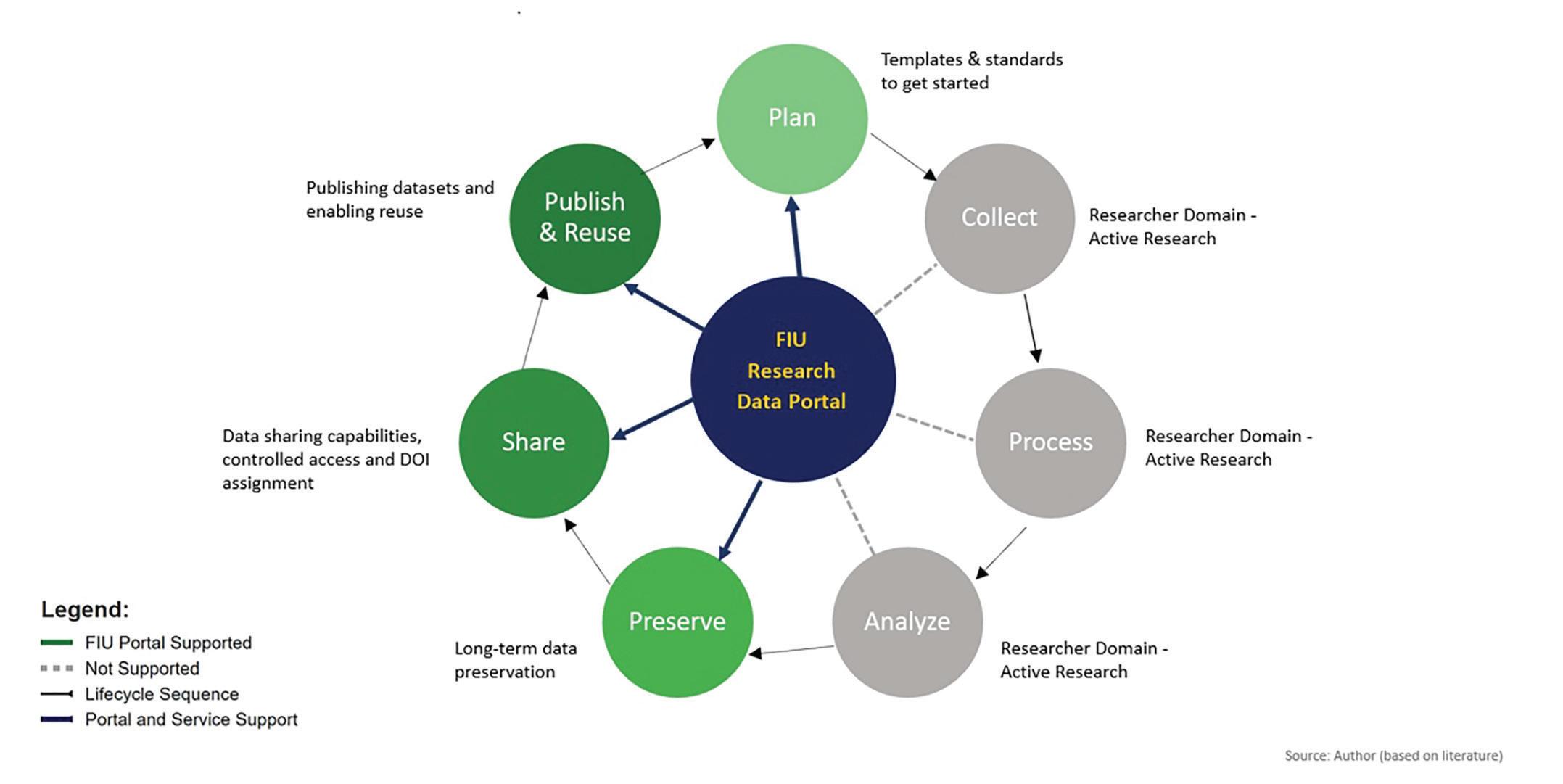
sensitive datasets. The portal tracks usage statistics, allowing researchers to see who’s accessing and downloading their data, valuable information for demonstrating research impact in grant applications and promotion materials.
Since its launch, the FIU Research Data Portal has demonstrated significant impact and adoption across the research community, reflecting active use and reuse of research data by the scholarly community. The portal integrates with researchers’ existing workflows rather than adding burdensome new requirements (see Figure 2). Researchers can organize their data through the main portal for maximum visibility or through departmental collections for project-specific organization while maintaining departmental identity.
Building Services Beyond Technology
While the technical infrastructure is essential, FIU Libraries recognize that technology alone doesn’t create a culture of effective data management. The approach combines the portal with comprehensive support services designed to meet researchers where they are in their data management journey.
The Research & Data Repository Manager provides consultative services throughout the data lifecycle, offering guidance on data management plan development, metadata creation, copyright and licensing considerations, and quality control for uploaded datasets. The philosophy is advisory rather than prescriptive, helping researchers develop systems that work for their specific research contexts while adhering to best practices and funder requirements.
A significant component of the work involves education around fundamental data management practices. Many researchers have never received formal training in file naming conventions, folder organization, version control, or documentation standards. The Library provides workshops and training on research data management best practices, addressing practical skills while situating them within the broader context of research integrity, reproducibility, and career advancement.
The emphasis is that good data management is not extra work but rather about working smarter by creating systems that save time, reduce stress, and enable more efficient collaboration.
Challenges and Practical Lessons
Implementing comprehensive data services has not been without challenges. Common concerns addressed include researchers’ time constraints (“I don’t have time for this”), doubts about data value (“My data isn’t interesting to others”), fears about being scooped (“What if someone steals my research?”), and uncertainty about proper practices (“I don’t know how to organize data properly”). These concerns require patient, personalized responses that acknowledge legitimate worries while providing practical solutions.
Starting small has proven crucial for both researchers and library services. Encouraging researchers to begin with one dataset, implement one organizational system, or complete one data management plan makes the process less overwhelming. Similarly, library services can start with core infrastructure and basic support, expanding gradually as expertise develops and resources allow. The goal isn’t perfection from day one but rather incremental improvement that builds toward sustainable practices.
Another key lesson involves meeting researchers’ immediate needs while encouraging long-term thinking. Researchers facing grant submission deadlines need quick assistance with data management plans. Those responding to journal data sharing requirements need immediate guidance on repository selection and metadata creation. By addressing these immediate needs effectively, trust is built and value is demonstrated, creating opportunities for deeper engagement with data management principles over time.
Resource constraints shaped a strategic focus on building capacity across the existing workforce rather than seeking new positions.10 Librarians working with students and faculty developed data literacy skills to support research methodologies
<https://www.charleston-hub.com/media/atg/>
Figure 1: Research Data Lifecycle Phases Supported by the FIU Research Data Portal
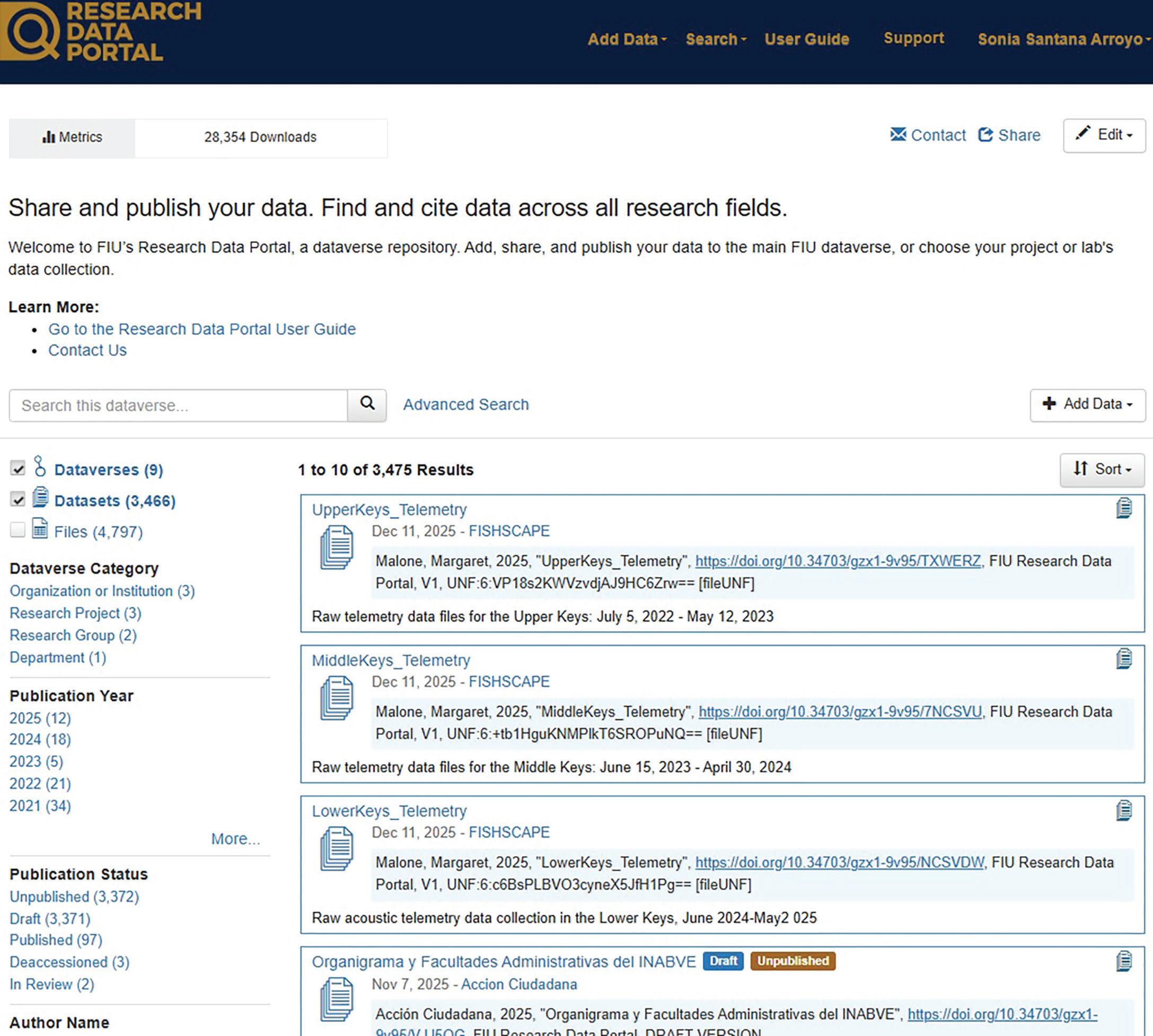
across all disciplines, not just STEM fields, through professional development time and cross-campus partnerships.
Looking Forward: Sustainability and Growth
As research becomes increasingly data-intensive and collaborative, the role of libraries in supporting data management will only grow. Literature on research data management confirms that emerging challenges include managing extremely large datasets that strain storage infrastructure, supporting new data types from evolving research methods, ensuring long-term preservation as file formats and software change, and helping researchers navigate complex legal and ethical considerations around data sharing.11
For FIU Libraries, priorities moving forward include expanding capacity to support large-scale datasets, enhancing integration between the FIU Research Data Portal and other research infrastructure systems, developing discipline-specific
guidance that addresses unique data management needs across fields, and continuing to build the culture of data sharing through education and community engagement.
The investment in research data services reflects a fundamental shift in how the library’s role in supporting scholarship is understood. Libraries are no longer simply providing access to published research but are actively supporting the creation, management, and preservation of the research data that underlies that scholarship. This work requires new expertise, new infrastructure, and new ways of collaborating with researchers, but it’s essential for ensuring that research data remains accessible, usable, and impactful for years to come.
As services continue to scale strategically within the university to match the pace of rising data literacy requirements at all degree levels and disciplines, structures for services, roles, and the extent of knowledge required must remain open to reconsideration.12
<https://www.charleston-hub.com/media/atg/>
Figure 2: FIU Research Data Portal Interface
Conclusion
The FIU Research Data Portal, powered by Dataverse and supported by comprehensive consultation and training services, exemplifies this approach. Since its launch, the portal has facilitated genuine adoption across disciplines, demonstrating meaningful impact through active use and reuse of research data by the scholarly community. Its success stems from meeting researchers where they are: integrating with existing workflows, providing flexible access controls and permanent DOIs, and offering personalized support throughout the data lifecycle.
For institutions developing similar services, the key lessons are clear: start with reliable, standards-based infrastructure;
provide practical, accessible support; emphasize career benefits alongside compliance; build gradually while learning from each interaction; and recognize that data services succeed when they serve genuine researcher needs. Research data is too valuable to lose, too important to hide, and too impactful to leave uncredited, making library-led data services essential for maximizing the return on research investment for researchers, institutions, and society as a whole.
For more information about FIU Libraries’ Research Data Management services, visit https://rdm.fiu.edu/ or contact rdm@fiu.edu.
Endnotes
1. Luka Tedersoo et al., “Data Sharing Practices and Data Availability upon Request Differ across Scientific Disciplines,” Scientific Data 8, no. 1 (2021): 192, https://doi.org/10.1038/s41597-021-00981-0.
2. Giovanni Colavizza et al., “The Citation Advantage of Linking Publications to Research Data,” PLOS ONE 15, no. 4 (2020): e0230416, https://doi.org/10.1371/journal.pone.0230416
3. Timothy H. Vines et al., “The Availability of Research Data Declines Rapidly with Article Age,” Current Biology 24, no. 1 (2014): 94–97, https://doi.org/10.1016/j.cub.2013.11.014
4. Jill Krefft, Jamie Rogers, Molly Castro, Elana Karshmar, and Rebecca Bakker, “Engaging Communities to Build a Culture of Data Mutualism with Limited Resources,” in Higher Education in the Era of Generative Artificial Intelligence, ed. Nancy W. Gleason (Singapore: Palgrave Macmillan, 2025), 255–67, https://digitalcommons.fiu.edu/record/17729?ln=en&v=pdf.
5. Krefft et al., “Engaging Communities,” 255–67.
6. Krefft et al., “Engaging Communities,” 255–67.
7. Zhaohui J. Fu, Levente Juhasz, Jill V. Krefft, Davina Ter-Ghazaryan, and Boyuan Guan, “Library-Based Data Curation, Management and Interdisciplinary Research at Florida International University: Reciprocal Use of Data through Collaboration” (paper presented at the IASSIST 2022 Conference, Gothenburg, Sweden, June 2022), https://digitalcommons.fiu.edu/record/17691.
8. Fu et al., “Library-Based Data Curation.”
9. Krefft et al., “Engaging Communities,” 255–67.
10. Krefft et al., “Engaging Communities,” 255–67.
11. Angeliki Andrikopoulou, Jennifer Rowley, and Geoff Walton, “Research Data Management (RDM) and the Evolving Identity of Academic Libraries and Librarians: A Literature Review,” New Review of Academic Librarianship 28, no. 4 (2022): 349–65, https://doi.org/10.1080/13614533.2021.1964549; Arslan Sheikh, Amara Malik, and Rubina Adnan, “Evolution of Research Data Management in Academic Libraries: A Review of the Literature,” Information Development 41, no. 2 (2025): 305–19, https://doi. org/10.1177/02666669231157405.
12. Krefft et al., “Engaging Communities,” 265–67.
<https://www.charleston-hub.com/media/atg/>
The Digital Toolbox — Vendor Proofing Your Collection: Building Resilient, Sustainable Academic Library Collections
Column Editor: Steve Rosato (Director of Digital Book Services for Academic Libraries, OverDrive, Cleveland, OH 44125) <srosato@overdrive.com>
Academic libraries today operate within an increasingly concentrated information marketplace. Publishers merge, platforms consolidate, and pricing models tighten, creating new pressures on institutions that rely on stable and affordable access to scholarly content. In this environment, “vendor proofing” isn’t about rejecting vendors; it’s about intentionally designing a collection strategy that remains resilient regardless of market shifts, business failures, or sudden changes in licensing terms. It means future-proofing access for students and scholars while supporting a healthy and sustainable scholarly ecosystem.
Diversifying Content Sources
Building a resilient collection is diversifying the sources of content. Overreliance on a single publisher or platform can place the library in an untenable position when prices rise or content shifts. Academic libraries benefit from spreading purchases across multiple providers, incorporating a mix of formats, and avoiding long-term “big deals” that lock budgets in place for years. The increasing sophistication of usage analytics can guide this diversification, helping librarians see where their collections are overly dependent on one vendor and where they might rebalance. Platforms that offer strong reporting can support smarter decision-making and reduce unnecessary duplication.
Prioritizing Ownership and Stable Access Models
Ownership remains another critical pillar of vendor-proofing. Where possible, libraries are right to prioritize models that guarantee perpetual access, multi-user availability, and fewer access restrictions. Perpetual, unlimited - user ebooks are ideal, but they cannot realistically form the entirety of any academic collection. These models often depend on economic conditions that cannot sustain authors, editors, or publishing infrastructure at scale. Aiming to secure perpetual or stable access to high-value materials offers meaningful protection against future disruptions.
Strengthening Open and Community-Owned Infrastructure
Investing in open and community-owned infrastructure continues to grow in importance. Institutional repositories, open monograph initiatives, and diamond OA journals strengthen the scholarly commons and reduce long-term dependency on commercial vendors. As budgets shift away from expensive package deals, libraries can redirect those funds into open infrastructure that broadens access and aligns with academic values. Supporting this ecosystem directly stabilizes the library’s own long-term access strategy by ensuring that key research outputs remain openly available and preserved.
Leveraging Consortia Collaboration for Stability
No library operates alone, which is why consortia collaboration remains one of the most powerful tools for vendor-proofing. Consortia can bring price transparency, negotiation leverage, and shared ownership models that individual institutions cannot
achieve on their own. They also offer room for creative and flexible solutions that support the diverse needs of their member libraries.
Strengthening Licensing for Long-Term Protection
Licensing itself is an area where libraries can advocate strongly for their users. Predictable pricing, clear post-cancellation terms, guaranteed access stability, reasonable DRM, ILL permissions, and provisions for course use all strengthen the library’s ability to provide equitable and uninterrupted access. Libraries benefit from approaching licensing as a strategic negotiation, seeking transparency, minimizing nondisclosure requirements, and establishing clear expectations before contracts are signed. Partners often appreciate when libraries share their term preferences early, allowing both sides to navigate agreements more effectively.
Using Data and Budget Flexibility to Drive Sustainability
A vendor-proofed collection also requires a flexible, data - driven budgeting approach. Cost- per- use data helps identify resources that no longer justify their price, making it easier to redirect funds to higher-impact materials or essential services. Regular, structured review cycles reduce the tendency to renew by default, and tiered funding priorities provide an anchor when budgets shift or emergency cuts arise.
Faculty engagement remains one of the strongest forces for resilience. When librarians openly share usage data, cost data, and explanations of unsustainable pricing models, faculty become allies rather than skeptics during difficult cancellations or transitions. Involving them early in evaluating alternatives and helping them understand the real budget pressures libraries face, builds trust and shared responsibility.
On the technology side, integrations with campus systems and other library tools can significantly reduce staff workload and mitigate long-term dependence.
Exit Plans for Every Vendor
Finally, every vendor relationship benefits from a clear and regularly updated exit plan. Knowing what content is owned, what is leased, what is at risk, and how preservation access operates allows libraries to respond confidently to cancellations, sudden price increases, or outages. Testing post-cancellation access, documenting fallback plans, and knowing which alternative resources can be activated quickly all contribute to a smoother transition when disruptions occur.
Ultimately, vendor-proofing is about stewardship. It is about ensuring that the academic library’s mission to provide stable, equitable, and enduring access to knowledge can withstand the unpredictable shifts of the information marketplace. By building a collection strategy that is diversified, community-supported, preservation-minded, data-driven, and transparent, libraries can protect their users while also supporting a healthier scholarly ecosystem.
<https://www.charleston-hub.com/media/atg/>
ATG Interviews Phillip Bradley Consultant on AI and the Internet
Interview conducted by Michael Upshall <michael@consultmu.co.uk>
This is a lightly edited transcript of a conversation between Michael Upshall, Editor, Charleston Briefings and Guest Host for ATG the Podcast, and Phillip Bradley, who has recently retired from over 40 years training librarians.
Phil has titled his life story “From CD-ROM to AI.” He decided as a child he wanted to be a librarian, took a degree in librarianship, and worked for the British Council, where he became involved in training, an activity that took him around the world. He took an interest in CD-ROMs, and joined pioneer CD-ROM publisher Silver Platter. He describes his first experiences with the Internet in the early ’90s, his training courses on how the Internet worked, and how to use search engines, then social media. Finally, he comments on current developments with AI, and the role of the information professional; he argues that librarians have a crucial role as the most powerful and important information professionals in society. He expresses frustration over the lack of appreciation for librarians’ contributions, and seeks to reaffirm their identity as essential figures within organizations.

from UK universities about how to put promotional videos together. I was also involved in answering questions about universities and colleges in the UK. Generally, I just sort of fell into teaching a whole variety of different things. The Council got me to go abroad, and my first trip was to Lesotho in southern Africa, where I had to run a two-week course on the basics of librarianship, which was the first time I’d ever really done anything of that kind of length. I really enjoyed it.
MU: It’s quite a jump from starting at the British Council to teaching all about librarianship. Didn’t you find it alarming?
PB: I was somewhat taken back, but my boss said, you can teach people, you’re really good at it. She’d seen something in me that I hadn’t. So, I took her at her word. I went to Lesotho. I trained people on the basics of librarianship for two weeks. They got a lot out of the course. I had sort of carved a new niche out for myself! I started to do more training for British Council offices around the world teaching aspects of librarianship, reference work and things of that nature. I really enjoyed doing it.
The full interview can be viewed at: https://youtu.be/ XFHAZ-J_xZs
Michael Upshall: Phil, you started your career studying librarianship?
Philip Bradley: I did, yeah. I was quite a precocious child, I think. I was looking at the kind of career I wanted, and I was in the library, checking different career things out, and I thought, I’m in a library. Why don’t I become a librarian? So, I had a careers interview at school and I said, I want to be a librarian. I remember the woman saying to me, “Is that because you like books?” I said, “No, it’s because I want the power.” She gave me a blank look, and I said it’s a powerful profession. You don’t need to know anything. You just need to know how to find things. And once you know how to find things, that makes you a very powerful person — that’s what I’m interested in being able to do. That was what started me off on the career.
I got my degree in librarianship from the Polytechnic of North London [now London Metropolitan University]. Then I went to work for the British Council, [a UK government organization that promotes Britain abroad]. That was when I got involved in training: a lot of people from overseas offices would come to the UK, and I discovered that I quite liked teaching. That started my whole career of teaching people about information work. We had many education fairs in the Far East, and I got involved in teaching representatives
MU: You subsequently worked with Silver Platter, a pioneer publisher of CD-ROMs?
PB: At a conference, I saw CD-ROMs being demonstrated for the first time, and I thought this is just the most remarkable thing! If I’ve got any skills at all, it’s being able to see which technologies are going to become important. The British Council wasn’t interested in exploring CD-ROM, so I took a leap of faith and a 60% salary cut and moved to Silver Platter to become their technical support director for Europe. Now, bear in mind, I knew a little bit about computers, but I didn’t know an awful lot, yet Silver Platter said it would be easier to train a librarian how to work with technical stuff than to train a technical person to work with librarians. I like to think that they were right with that! I had to learn how CD-ROMs worked, how to install CD-ROM drives into different computers. I was on the end of the phone when librarians would ask how to get a computer up and running with a CD-ROM, and I was saying I know it doesn’t work, is that because you put the CD disk in the wrong way up, or have you turned the CD-ROM drive on? It was really basic, but at that point, nobody knew anything! I got asked to write my first book about going online and CD-ROM technology: the similarities and differences. That was the first time I thought about writing, which again, I found I really enjoyed. So my role slowly morphed in the five or six years I was at Silver Platter, from technical support and wandering around the country and appearing at shows and conferences, always spending my time with librarians, demonstrating to them how our software worked, teaching them how to search using the software we had
<https://www.charleston-hub.com/media/atg/>
at the time. Silver Platter was a very enterprising and I think enlightened organization at that point. Then they decided they wanted to have a training department, so I became the global director of training, where I spent a good couple of years.
A training organization in the UK asked me if I would like to run training courses on CD-ROM for them. I checked with Silver Platter and they said, fine, go ahead, because it was promoting them. So, I started running my own courses for librarians on the basics of CD-ROM, installing drives. I would get a whole bunch of computers, and I would get them to insert interface cards and how to install the software. In those days it was much more complicated than now: you had to edit various batch files on the computer before the whole thing could work. I really enjoyed teaching that. That was about 1993 or 1994, and in the background, I’d seen this thing called the Internet. I got a connection to the Internet around the end of 1991, and I spent a lot of time playing around with it, and I could see similarities and parallels with CD-ROM technology, so for quite some time I was seeing two parallel technological paths developing within the information industry.
MU: CD-ROM turned out to be quite a fleeting technology, which didn’t last as long as people had anticipated. Why do you think it had such an influence?
PB: CD-ROM was incredibly important, and I don’t think people realized how important it was. Before CD-ROM, to search a database was very expensive, very complicated. You had to have a specialized computer that could do all of that for you, and they were quite rare. Online searching was a very complicated process — a very arcane process — and not many people were able to do it. Information was kept to a small number of professionals. When CD-ROM came along, it changed the role of the information professional from gatekeeper to facilitator; for the first time, your end users in your organization were able to get access to information themselves — they’d never really been able to do that before, and rather than ask the librarian for the information they needed, or search through a reference book, they were able to search a database that wasn’t in their room; we were involved in the first networking of CD-ROM databases in the country. We were one of the pioneers in the entire world. I spent a lot of time teaching librarians how to network CD-ROM drives. CD-ROM really did open out the world of information from information professionals to end users.
But what it also did quite crucially was introduce to librarians the idea and the option to start playing around with computers, to be able to open computers up, to install interface cards, to work with their technical support departments. It meant they were able to extend the reach of their library beyond that room in the university, or school, or bank, or whatever else it might happen to be. They were able to get outreach for the first time: they were able to teach a lot of their users or their patrons, patrons if you prefer the American version, how to do Internet searching. It gave them an ability to learn new skills and to move beyond the confines of the book, beyond the confines of the physical library that they happen to find themselves in. That, over the next three or four years, really was an opportunity for growth for the information profession.
One of the things that I found very irritating was that when we got to the point of being able to network CD-ROM drives, the technical support departments in the universities, schools, banks, wherever, suddenly got interested in it and said, this is for us, this is our role, this is our job. You’re just a librarian, you’re not gonna be able to do that. I found that incredibly frustrating,
because it had shown librarians that they were capable of doing much more than simply dealing with books and finding out facts in reference works, and so on. They were able to see for the first time there was a different future available for them, but it was kind of stolen away from them. But by then, the idea that information could get out to a much wider variety of people was becoming fairly commonplace. People were beginning to expect that, yeah, if I need to get some bibliographic data on something, I can just log into it from my computer on my desk and get what I need. It sounds really stupid these days, but in the early 1990s, it wasn’t something that was common. You didn’t get CD-ROM drives in computers. Then, we went through the period when you would buy a new computer with a CD-ROM drive attached to it. Now, we’ve gone full circle, where CD-ROM drives, DVD drives, what have you, are no longer required. But at that time, it really was an exciting development: an explosion of technology, skills, and understanding about how information could be democratized and could be made available to a much wider group of people, and for me, very importantly, it meant that librarians were able to take on new roles as facilitator, as trainer, of the people in the organization. They suddenly became really important at the center of the organization, able to get information and spread it out to people in a way that had never been possible before. It raised the profile of the library, and, most importantly, the librarian in the organization. Yeah, it was short lived, if you can say five or six years was short lived, but it was an incredibly important period of time.
MU: You used the word empowerment, but is it true to say that empowerment hasn’t been shared in the library community? You tend to get a divide between technically competent and less technical staff.
PB: Yeah, one of the things that has always frustrated me about librarians, through my entire career, is that they haven’t really appreciated how important, how valuable and powerful their job is. If I’ve tried to do anything during the 30 or 40 years I’ve spent in the industry, it is trying to get librarians to understand we are the most powerful and important profession in the world. You can come back to me and say, yeah, doctors are more important than librarians, and maybe engineers are more important than librarians or computers. But I would then come back and say, doctors are really important — but how did they learn to become a doctor? They had to train; they had to learn. Where did they learn? They had to go to a library. They had to ask an information professional. Every powerful profession in the world is powerful because they’ve learned what they needed to from librarians, information professionals. Every single profession needs librarians and library services. I maintain, as I have always done, that librarians are the most important and most powerful information profession, bar none. Doctors, scientists, engineers, you can include all of them; librarians are more powerful.
The frustration I’ve had during my career is that a lot of librarians haven’t been able to understand that. If I had a pound for every time somebody would say to me, “I’m just a librarian,” I’d unfortunately be very rich; but it’s something I heard a lot. You are not just a librarian, you are the librarian, you are a really important person. You’re the person in your organization that everybody needs to come to; the library should be the touchstone that every other department has to come to, the central core of how your organization, your university, your bank, your school, whatever it happens to be, the center of everything the organization does. The public library needs to be at the center of the entire community, and needs to be able
<https://www.charleston-hub.com/media/atg/>
to support that community, to help that community grow, to provide whatever requirements and information that community needs to help it prosper. Libraries are incredibly important, and I think the majority of librarians understand that to continue the work that they’re doing, they need a really good understanding of technological skills: how to search the Internet, how to utilize social media, how to work with AI, because they need to be able to pass that information to other people, because librarians ultimately are facilitators, and that’s what we have always done. It’s just that we’re now in a position to do it in a different way. I don’t think, and this will probably raise a few eyebrows, libraries are about books; they’ve never been about books. Libraries are about providing access to information, to democratizing information, to getting that information to the people that need it in the best possible, quickest, fastest, most effective way. And for millennia, that’s been with books. And so, it’s understandable that people do tend to link a library with a collection of books. But you can get a collection of books in a bookshop. It’s not a library. You can get a collection of books in a charity shop: that’s not a library. The library is not bound and defined and constrained by the physical item. It is defined by the librarian who uses whatever they need: a book, journal, magazine, newspaper, computer. It’s the librarian who gets information to people in the most effective way possible.
To do that, librarians have to have a skill set, which is far more than working with books: they need to understand technology on a daily basis. They need to be able to manipulate it to do what they want to do. Throughout my career, from CD-ROM all of the way through to AI, is that some librarians are able to take the technological advancement that’s been made available and make it their own and push the library forward as the source of information. Whether the source of information is in a book or magazine, or in a bibliographic database, or created with AI, it’s the role of the information professional to get the information in the most effective way, and to get it out to the end users as effectively and quickly as possible. The most effective librarians are always the ones who can pick the technology up, make it their own, introduce it to the rest of their organization and teach how to use it, and then move on and do the next thing that they need to. That for me is the definition of a good librarian or an information professional. It’s not somebody that’s good at stamping books. That’s not what being a librarian to me is about.
MU: With the arrival of the Internet and search engines like Google in the late ’90s, many people thought the library had become irrelevant, because everyone could do searches for themselves. What was the role for the librarian when Google came along?
PB: Yeah, I think I will pick you up on one point there. The Internet, certainly for me, started in 1991, 1992, as it did for a lot of other academic librarians. Admittedly, it was at a very fledgling point at that time: we didn’t have graphical user interfaces. If you wanted to get something from the Internet, you had to use things like Veronica, Archie, Jughead. You would use Usenet groups to discuss things. When I first started using the Internet in the very early ’90s, the only graphics you got were ASCII graphics — it was all just words. I was blown away that you could have email addresses and answers in hours rather than days or weeks, because you had to send a letter of some sort. That was an incredible change. It sounds silly to say it now, but in those days the fact that you were able to actually instantly have a conversation with somebody on the other side of the world was unheard of. It just didn’t happen, because you couldn’t afford to phone people. A very tempting aspect of the
Internet was that it was democratizing information, the access and communications people could have with people. I ran my first Internet course in, I think it was 1994, and I spent a lot of time trying to get librarians to understand how the Internet worked, what it was, what its advantages and disadvantages were. By then, we had just started to get early browsers like Netscape. I wrote a couple of books in the early days about how information professionals could and should start using the Internet. In 1995, I said to the same company that I use that asked me to teach courses on CD-ROM technology, there’s this Internet thing, you might want to think about doing some courses on that. And they said that’s a good idea, go away and create one. So, I created half day courses on the Internet for medical librarians, for social science, and so on. For a lot of librarians, that really was pretty much their first introduction to using the communications aspect of computers. They’d got familiar with computers, because they’d used CD-ROM technology: how to turn them on, how a mouse worked, and stuff like that. In the early days I would teach librarians and other people how a mouse worked, because they didn’t know. I had to say, if you move this thing here, that moves on the screen. It sounds ridiculous to say it now, but in those early days, nobody understood this. It was a completely new world for them.
Because I was running more training courses, I went part time with Silver Platter. Around 1995, I became an independent Internet consultant, predominantly running training courses. I would teach charities; I taught a number of government bodies like the House of Commons Library, Law Library, GCHQ and the European Parliament. In the early days, we had early search engines like Yahoo, Ask Jeeves, Northern Light, and obviously the big one being AltaVista. I spent a lot of time learning about the syntax of different search engines. When I ran a training course, I would say, “Which search engine do you use?” And the delegates on the courses would come up with five or six different search engines, and I would write them all down, and we would go through the advantages and disadvantages of each of them. By 1999, I wrote my first book, The Advanced Internet Searcher’s Handbook . Google wasn’t mentioned, because Google didn’t exist. When I produced the second edition in 2001, it got a fleeting reference because it still was in its infancy. It was only by the third edition that I was able to dedicate an entire chapter to Google. By then, when I was running my courses and saying, which search engines do you use? Just Google, Google, Google. I found that quite frustrating because I knew there were other search engines that would do different things: a search engine for images, a search engine for videos, search engines specific to different countries, directory-based search engines, and free text-based search engines. I spent a lot of time getting information professionals to realize that there was a lot more than Google.
One of the things I said about Google, which blew people’s minds then, and I think to an extent does now: Google is not a search engine. Google is an advertising platform that uses search to push adverts at people. That’s all that it’s ever done. Google has never, ever had an interest in search per se. They added functionality to keep people on their search engine, as opposed to going to other search engines. It was great what they did; very clever to show people adverts that related to the subject of their search. But Google was a one-trick pony. Google Maps, Gmail, and so on, they’re great. But it’s still all based around the idea of a tool good enough to get people to
<https://www.charleston-hub.com/media/atg/>
come back and use it time and time again. Make sure that it’s not good enough, so people will get the answer to their query and go away. Make sure that it’s functional enough, so that most of the time it works. But there are times when you think, oh, there’s an advert that might give me the answer. They click on the advert and go off and do that. Peak Google was about 2011, 2012. That was when it had its greatest amount of functionality. At that point, it was a reasonably good search engine. It was good for information professionals because we were able to understand all of the different syntax and the functionality, which the majority of users didn’t get because as users, they just want the answer to their question. That, again, was a skill that information professionals were able to learn for themselves, how to use different search engines, to broaden out the breadth and functionality available, and to push that back out into their organizations or into their communities, and further this concept of being facilitator rather than gatekeeper.
By 2011, 2012, Google had reached such a monopoly, it was able to discount a lot of what it had been doing. They’d worked quite closely with librarians for a couple of years, and then when they realized they didn’t need the librarians anymore, they just dropped the librarians. Google in many ways has been extraordinarily detrimental to the world of information and search. I’ve never particularly liked Google; Google is, and always will be, a money-making exercise. Yeah, I use the search engine, same as everybody else, until fairly recently. But that doesn’t mean I like it. I certainly don’t. I think it was about 2005 or 2006 when I started to say that Google isn’t going to be here forever. Google will at some point die. I knew that Google was not going to be the answer to information professionals’ prayers for the next 10, 20, 30 decades, because it was functionally flawed, it wasn’t designed to find information, it was designed to push adverts. Once you understand that about Google, everything else they do makes complete sense. It meant that they could get rid of the really good functionality that they had, because, they could say, most people don’t use it. We’ll do all of the searching for them. It meant that they could throw adverts at people in much greater numbers. If you look at the early pages of Google results, and then at the stuff that you get today, the early pages were quite sparse when it came to adverts. Google is at the moment in the fight of its life about AI. But even back then, there were other search engines that worked as well, if not better. I spent a lot of my time trying to make librarians aware of that. I was for a small period of time one of the Microsoft search champs as they dubbed us; we all gathered in Seattle and spent a few days working with Microsoft, looking at their search engines, and saying what worked and what didn’t work. It was quite an exciting thing to actually be involved with that.
Alongside that, it was writing web pages, writing websites. That was the first opportunity that librarians had to produce content for themselves and to make it available on the Internet for other people to find. People were able to promote their library to a much wider group of people than they’d ever been able to do before by creating their own web pages and indeed their own websites. For two or three years, I happily was teaching people HTML coding and how to put websites together. During this period, because I’d been writing books, because I’d been talking at conferences and exhibitions and things in the UK, I was getting invitations to train or to speak at conferences around the world. I visited something like 40 or 50 different countries. I’ve been around the world a couple of times, spoken at conferences on all of the continents except Antarctica. I’ve taught in the shadow
of an active volcano. I’ve had a Russian soldier point an AK47 at me. I’ve taught in some bizarre and strange places, and I’ve loved all of it. I never thought for a second that getting a degree in librarianship would be my passport to going around the world and teaching and training. But indeed, it has. The idea that people have paid me money to travel to a different country and just talk to them, I still find ridiculous, but I thoroughly enjoyed doing it.
We then started to get Web2, and of course that morphed into social media, and that completely exploded. Everything became out of control, and I spent a lot of time trying to get librarians to understand that social media was going to be a benefit because they could push out their facilitation role even further. They had a much wider way of getting information out and publishing information to people than they’d had before. But at the same time, we were getting organizations panicking. As they’d done with the Internet, I had organizations that said, “We’ll have the Internet in our organization over my dead body.” I think somebody at the British Council said that at one point. People were constantly trying to block access to information: no, you can’t use Facebook, or you can’t use social media. It was getting librarians to realize the importance of social media and how to utilize social media tools to promote the library and make the library a key component of what an organization was doing within a social media context. I started running training courses on social media, how to use different tools, how to create videos to promote what your library was doing.
I spent the next five or ten years on two different tracks. One was continuing to talk about Internet search; the second was getting librarians to raise the profile of their library using social media. Lots of librarians really loved it, that they absolutely embraced it. It was an absolute joy to be working in that area. I spent ten years writing a column for CILIP, the Chartered Institute of Library and Information Professionals in the UK. I was working in three different areas: writing, teaching, and talking at conferences and exhibitions around the world. It was a role I created for myself; those different elements seemed to work quite nicely together.
MU: You mentioned how Google encouraged people to go straight to answers without worrying about search. Of course, GenAI goes even further; it provides you with answers without any search results. Does it alarm you, as an information professional?
PB: It depends entirely on your definition of what an information professional does. If you are still linked to the idea that an information professional deals with books and information, then AI is a threat. If your view of an information professional is somewhat different, a person who facilitates access to information, who is very political. I don’t think that this is stressed enough: being an information professional should be a political act, because access to information is anarchic. Organizations, governments, and so on want to control that as much as they possibly can. We’re seeing a lot of that in the UK at the moment, with the ironic online safety bill, which is nothing of the sort. If an information professional can get around that, their role becomes again teaching, facilitating, and getting people to exercise their critical analytical skills. The role of the professional now is morphing. We need to teach people about misinformation, disinformation, propaganda, the way political parties manipulate information. We need to look at organizations that produce AI tools and work out the hidden biases behind those tools, to be able to spread that information. So, I don’t think, in that respect, AI is a threat to the information
<https://www.charleston-hub.com/media/atg/>
profession at all. Most end users are just going to pop a question into ChatGPT, or whichever one they prefer, get the answer, and won’t think about it. They’ll just say, okay. Even some lawyers have assumed that what ChatGPT has said about a particular case law is true, and actually ChatGPT has made it up. You would think that if anybody was going to have critical analytical skills, it would be a lawyer, but apparently that’s not the case. The people with analytical skills are the information professionals. They are more important and more attuned with what’s going on than lawyers, than doctors.
Obviously, human beings have to be involved in the production of AI content. You can’t just let AI tools do what they want. One of my concerns is that people would use AI to create content that they’ll then put online; AI will then come along and scrape the AI content and reproduce it. You’ll just get AI feeding itself, and errors are going to get magnified as a result. I’m less concerned about how AI and so on scrape their data. I know that it is something that does concern a lot of people and the whole copyright issue. I had at least five or six of my books scraped by OpenAI, which helped train their models. I really don’t care. It makes no difference to me whatsoever.
But I get how people are concerned about that. AI has got lots of other threats, if you want to use that term. It’s a very anarchic technology, but then any good technology is going to be an anarchic. The whole translation industry, for example, is completely dead. The way in which one of the central pillars of using the Internet of using advertising. That’s pretty much on its last legs now. Google is really struggling because it has always ignored stuff. Google thinks it knows best, and really it doesn’t. Google just continues to talk to itself. That’s why Google is so far behind. Having said that, Google’s Gemini, you know, is a really nice product. I’ve spent a lot of time playing with it, and it’s getting really good these days. I think that they are coming back into the game. But for Google, that central pillar of adverts is now crumbling away, and they’ve got to change the way that they work.
In 18 months’ time we’re going to look back and think, I remember that, wasn’t that weird? Why were we so happy with that for 15 or 20 years? How very strange that was. We don’t yet know the effect that AI will have. We are with AI now, the way that we were with the Internet back in ’94 or early ’95. We knew something was going on. Things were going to be different. But we didn’t have any concept of how different things were going to become. AI is going to be more important than mobile phone technology, more important than the Internet, more important than both combined. We just don’t know what’s going to happen, so we need to keep a very close watch on AI developments. Because we’re in an information age — and who are the best people to deal with AI technology in an information age? It’s information professionals. Once again, the profession that is central to the development. The uptake and use of technology has been the information profession right from when we started with CD-ROM all of the way through to AI.
When COVID hit, I basically retired. I thought that’s it. I’ve done everything. Then I saw somebody talking about ChatGPT, and I thought, well, take a quick look. Within five minutes, I was hooked. I realized how important it was. I realized that I wanted to learn about that, and when I learn about something, I want to teach it to other people. So, for the last two or three years, it brought me out of retirement to train librarians, not physically any longer. It happens by Zoom. I’ve lost count of how many thousands I’ve trained now. But it’s always to get them to understand, to appreciate how AI technology works,
how they can utilize that technology for themselves. How they can empower firstly themselves with the information available, and then empower their user community, in their bank, or their university, or in their public library community. It’s just another opportunity for information professionals to facilitate, to make things more aware, to make things easier for people to understand, to raise an awareness of the dangers of different kinds of technology. That is for me the role of an information professional. It’s nothing to do with books. It’s something to do with information, but it’s mostly about facilitating and helping user communities come to grips with how the world is changing, how they’re able to understand it, and how they’re able to make the most of it. That’s why the library in an organization needs to be the central core to everything that organization does. Because if it’s not, that organization is going to fail. Because the information professional, and the library or the information center, whatever you want to call it, that’s the central hub. If that’s there, everything can come into that central hub. Information professionals can work with that and pull data from here and put it out over there and see somebody’s doing some work here and tell somebody else that work’s being done there and can sort of like oil everything that the organization does. If there isn’t a library information center, if there isn’t a librarian or an information professional, that organization is doing lots of different bits in different places. It’s disparate and it’s going to fail.
So yeah, I’m going to say, AI, it’s great. It’s wonderful. It’s fantastic things. It’s also very dangerous because people will just go ask a question, get an answer and think, okay, great. It’s a huge opportunity for information professionals to once again grasp that net of technology, as they did with CD-ROM, as they did with the early Internet, as they did with search, as they did with social media, grasp that net of technology, learn how to use it, learn how to get that information out to their different user communities. So, I don’t see AI as a threat at all to the profession. If you see an information professional as somebody that arranges books on shelves, yeah, their time is over. But that’s not what an information professional to me, has ever been about.
MU: Phil, it’s been great listening to your stories of empowerment of information professionals.
PB: That’s very kind. Thank you. You haven’t asked me, so I’m going to leave you with one thing. If you’re looking at this as an information professional, please be incredibly proud of what you do. You are the most important people in your organization. Never, ever, say you’re just a librarian. You should go into your organization and say, “I am the librarian. I am the person that can help you do this. I am incredibly important,” because you really are. There’s no greater role in this world than being an information professional; grab that and love it, and be proud you’re an information professional. There’s nothing better in the world!
MU: Very well said. Thanks very much, Phil.
PB: You’re welcome.
<https://www.charleston-hub.com/media/atg/>
ATG PROFILES ENCOURAGED

Stephanas Galinnya University Librarian
Ndejje University
P.O. Box 7088, Kampala Phone: +256774511307
<galinnyastephan@gmail.com> or <sgalinnya@ndejjeuniversity.ac.ug> https://ndejjeuniversity.ac.ug/
BORN AND LIVED: Kampala Uganda.
PROFESSIONAL CAREER AND ACTIVITIES: Library and information services practitioner. Carry out activities such as library management and administration, collection development, referencing trainings, plagiriasm and open publishing trainings, scholarly communications activities.
FAMILY: Married with five sons and among them two are twins.
IN MY SPARE TIME: Listening to gospel and country music.
FAVORITE BOOKS: Things Fall Apart and Animal Farm
PHILOSOPHY: Love serving children.
MOST MEMORABLE CAREER ACHIEVEMENT: Achieving my Master’s Degree in Information Technology and my forthcoming achievement in PhD in Information Technology.
GOAL I HOPE TO ACHIEVE FIVE YEARS FROM NOW: Ensure our Library Services have High Tech Services.

Primerose Godini
Scholarly Communication Librarian Women’s University in Africa House Number 6 Digby Road New Malbrough, Harare, Zimbabwe Phone: +263773454292 <primgodini@gmail.com> or <pgodini@wua.ac.zw> www.wua.ac.zw
BORN AND LIVED: Born in Masvingo Province at Chimombe Rural Hospital. Lived in Gutu and Harare.
EARLY LIFE: Did my primary education at Hwiru Primary School in Gutu, High School at Gutu High School.
PROFESSIONAL CAREER AND ACTIVITIES: Primerose Godini is a Zimbabwean library and information professional currently serving as a Scholarly Communication Librarian at the Women’s University in Africa (WUA). Her career reflects progressive growth in academic librarianship and strong engagement with open science, research visibility, ILS training, and digital scholarship. Previous Roles: Library Assistant at Zimbabwe EzekielGuti University (2015-2019) and Great Zimbawe University (20192023). Education: Master’s Degree in Library and Information Science, Bachelor of Honours Degree in Library and Information Sciece and National Diploma in LIS.
FAMILY: Married and a mother of 3 children.
IN MY SPARE TIME: Travelling, Watching Movies, Reading novels, and Cooking.
FAVORITE BOOKS: John Grisham novels.
PET PEEVES: None.
PHILOSOPHY: As a librarian at the Women’s University in Africa, I believe in advancing equitable access to information as a foundation for women’s
empowerment and academic success, aligned with WUA’s mission to reduce gender disparity. My work prioritizes intellectual freedom, integrity, and inclusive service that supports teaching, learning, and research through reference assistance, information literacy, and digital resource access. I embrace open access, emerging technologies, and research visibility initiatives to strengthen knowledge sharing and support FAIR-aligned practices. Guided by compassion and professionalism, I aim to build a transformative, gender-responsive library that uplifts all learners.
MOST MEMORABLE CAREER ACHIEVEMENT: In 2024 and 2025, l coordinated successful research support workshops for staff and students, l have also presented papers at the UbuntuNet 2025 Conference and Charleston Asia 2026 Conference, and lastly in 2025 l graduated with a Masters Degree in Library and Information Science.
GOAL I HOPE TO ACHIEVE FIVE YEARS FROM NOW: Five years from now, I hope to become a leading expert in scholarly communication and research data management within Zimbabwe and the region. Building on my current role as Scholarly Communication Librarian at the Women’s University in Africa, I aim to develop advanced open-science services, strengthen institutional repository systems, and lead national and regional initiatives that promote research visibility, open access, and digital scholarship. My goal is to contribute meaningfully to transforming academic libraries into innovation-driven, data-empowered knowledge centers. I also hope to have attained a PhD in Library and Information Sceince.

Methembe Melusi Mhlope Research Support Librarian Gwanda State University Box 30 Epoch Mine, Filabusi, Zimbabwe Phone: +(263) 84-2824724 Ext 2051
+263771433367
<methembe.mhlope@gsu.ac.zw> or <mhlopemelusi@gmail.com> https://library.gsu.ac.zw/
BORN AND LIVED: Bulawayo, Zimbabwe.
PROFESSIONAL CAREER AND ACTIVITIES: Methembe Melusi Mhlope is a Research Support Librarian at Gwanda State University with expertise in research support and assessment, digital curation, and research data management. In his current role, he leads research support and digital scholarship initiatives, conducts bibliometric and research assessment, and provides training on ethical data and information practices for faculty and students. In previous roles, he oversaw metadata standards, acquisitions, and support for open-source software implementations, and also taught library systems as a teaching assistant at the National University of Science and Technology. His academic qualifications include an MSc and BSc (Hons) in Library and Information Science from the National University of Science and Technology, Zimbabwe. He was a 2022 Young African Library Leaders Fellow and a travel grant recipient to attend the 2024 Fiesole Retreat Conference in Cape Town. He is a published researcher with research interests that include bibliometrics and research impact assessment, open science, indigenous knowledge management, and research data management.
FAMILY: Married and a father to two amazing sons.
IN MY SPARE TIME: Making acapella music, doing voice-overs, gardening, and travelling.
<https://www.charleston-hub.com/media/atg/>
FAVORITE BOOKS: Think and Grow Rich by Napoleon Hill, The 7 Habits of Highly Effective People by Stephen Covey, Things Fall Apart by Chinua Achebe, and Nervous Conditions by Tsitsi Dangarembga.
PET PEEVES: Bad grammar, typos, people who do not take responsibility or accountability.
PHILOSOPHY: “Whatever is worth doing, is worth doing well” — Phillip Stanhope.
MOST MEMORABLE CAREER ACHIEVEMENT: Attaining my Master of Science Degree.
GOAL I HOPE TO ACHIEVE FIVE YEARS FROM NOW: Getting a PhD and setting up a not-for-profit organization for developing and supporting libraries in marginalized communities.
HOW/WHERE DO I SEE THE INDUSTRY IN FIVE YEARS: Heavily transformed library and information services due to the integration of artificial intelligence, the need for digital-first services, the growing trend of immersive technologies and smart infrastructure, and the possibilities brought by the open science and equity movements. This will no doubt necessitate the creation of new roles and an evolution of existing ones, a shift in priorities, and the restructuring of the industry as we know it. Concerningly, these developments unfold against a background of the digital divide, funding disparities, and massive skills gaps.

Joseph Sagbohan
Library and Information Sciences Specialist, Open Science Advocate University of Abomey-Calavi 01 BP 2009
Phone: +229 01 97 58 25 53 <joseph.sagbohan@gmail.com> https://www.uac.bj/
BORN AND LIVED: Born in Benin and lived in Benin (Abomey-Calavi).
EARLY LIFE: Joseph Sagbohan was born on February 25, 1969. He completed his primary education at École primaire du Lac and École primaire Saint Pierre in Cotonou, where he obtained the Certificat d’Études Primaires Élémentaires (CEPE) in 1980.
He later pursued secondary education in the field of Literature, earning his High School Diploma in 1993. His academic orientation toward literature reflected an early intellectual curiosity and a strong inclination toward the humanities.
From childhood, he developed a deep love for books, reading, and philosophical literature. Regular visits to libraries nurtured his appreciation for organized knowledge and access to information. This early fascination with books and learning environments strongly influenced his academic and professional trajectory.
Following his secondary education, he chose to specialize in Library and Information Sciences at the Université d’Abomey-Calavi in AbomeyCalavi, Benin, marking the beginning of his professional commitment to librarianship, research support, and knowledge organization.
PROFESSIONAL CAREER AND ACTIVITIES: Joseph Sagbohan is a Benin-based academic professional and library science specialist currently working in École Polytechnique d’Abomey-Calavi, a constituent school of the Université d’Abomey-Calavi located in Abomey-Calavi, Bénin.
Academic and Professional Roles include: Enseignant-chercheur in Library and Information Science. Instructor of: Bibliothéconomie (Library Science); Sciences de l’information; and Méthodologie de recherche. Engaged in research activities, conference participation, and academic communications.
Administrative and Leadership Responsibilities include: Chef du Service de la Documentation, de l’Audiovisuel et des Archives at EPAC; Supervision and management of documentary and archival collections (physical and digital); Development and strengthening of institutional repositories and digital documentation systems; and Involvement in library modernization and infrastructure rehabilitation projects.
Research and Academic Interests include: Ingénierie pédagogique; E-learning and educational technologies; Open Science and Diamond Open Access; Institutional policy development in scholarly communication; and Academic library transformation and digital knowledge infrastructures.
Engagement and Contributions include: Participation in policy discussions related to Open Access in Africa; Contribution to institutional development initiatives; and Active involvement in curriculum design and academic capacity building.
FAMILY: Father of four children (girls and boys).
IN MY SPARE TIME: I value visiting libraries and cultural or knowledge spaces, activities that reinforce my passion for learning and the preservation and dissemination of knowledge. Beyond reading, I take interest in exploring developments in education, research, and digital technologies that support learning and access to information.
These personal interests complement his professional engagement in librarianship, research, and educational innovation, reflecting a lifelong commitment to knowledge, culture, and intellectual development.
FAVORITE BOOKS: L’Etranger, by Albert Camus: A classic philosophical novel that explores the meaning of existence, human freedom, and the absurd.
PET PEEVES: Frustrated by disrespect for books and library resources and by academic dishonesty such as misuse of information. I also dislike disorganization and the spread of misinformation, which undermine access to reliable knowledge and effective research.
PHILOSOPHY: He believes that knowledge is a powerful tool for personal development and social progress. Guided by a lifelong passion for books and learning, he considers libraries not only as places where information is stored, but also as spaces that promote intellectual freedom, critical thinking, and equal access to knowledge.
MOST MEMORABLE CAREER ACHIEVEMENT: Leading the strengthening and modernization of library, audiovisual, and archival services at the École Polytechnique d’Abomey-Calavi of the Université d’Abomey-Calavi. This work has helped improve access to academic information and better support teaching and research.
GOAL I HOPE TO ACHIEVE FIVE YEARS FROM NOW: Within the next five years, I aim to implement a fully functional Institutional Repository at the Université d’Abomey-Calavi. This initiative will enhance access to scholarly resources, support research, and promote open access to knowledge across Benin.
HOW/WHERE DO I SEE THE INDUSTRY IN FIVE YEARS: In five years, the Library and Information Science field in Benin will be increasingly digital, open-access oriented, and central to research and education. Libraries will serve as hubs for knowledge creation, digital scholarship, and lifelong learning. Professionals will focus on managing information, promoting data literacy, and integrating new technologies to improve access and collaboration.
<https://www.charleston-hub.com/media/atg/>
LIBRARY PROFILES ENCOURAGED

Gwanda State University Library
Gwanda State University Box 30 Epoch Mine Filabusi, Zimbabwe
Phone: +(263) 84-2824724 Ext 2051 or +263771433367
https://library.gsu.ac.zw/
BACKGROUND/HISTORY: The university is a relatively young and very small university and the library is still developing and setting up.
TYPES OF MATERIALS YOU BUY (EBOOKS, TEXTBOOKS, DVDS, VIDEO STREAMING SERVICES, DATABASES, OTHER): Textbooks. WHAT TECHNOLOGIES DOES YOUR LIBRARY USE TO SERVE MOBILE USERS? Gadget-responsive Library website, OpenAthens Connect remote access solution, social media communication tools.
DOES YOUR LIBRARY HAVE AN ILS OR ARE YOU PART OF A COLLABORATIVE ILS? Yes, the library uses Koha open-source ILS.
DO YOU HAVE A DISCOVERY SYSTEM? No.
DOES YOUR LIBRARY HAVE A COLLECTION DEVELOPMENT OR SIMILAR DEPARTMENT? Yes.
IF SO, WHAT IS YOUR BUDGET AND WHAT TYPES OF MATERIALS ARE YOU PURCHASING? PRINT OR ELECTRONIC OR BOTH? Both. WHAT PROPORTION OF YOUR MATERIALS ARE LEASED AND NOT OWNED? 70%.
WHAT DO YOU THINK YOUR LIBRARY WILL BE LIKE IN FIVE YEARS? A fully established library. WHAT EXCITES OR FRIGHTENS YOU ABOUT THE NEXT FIVE YEARS? The opportunities and risks associated with the integration of artificial intelligence.

Ndejje University Library P.O.Box 7088
Kampala Phone: +256774511307
https:ndejjeuniversity.ac.ug/
BACKGROUND/HISTORY: University library established in 1992 when the university started in the same year to date.
NUMBER OF STAFF AND RESPONSIBILITIES: 12 staff members which include 9 Professional Librarians covering Referencing Services, Circulations Services, and Materials Processing; 2 Administrative Assistants; and 1 Records Management Officer in University Central registry.
OVERALL LIBRARY BUDGET: One Billion Uganda Shillings. WHAT TECHNOLOGIES DOES YOUR LIBRARY USE TO SERVE MOBILE USERS? None.
DOES YOUR LIBRARY HAVE AN ILS OR ARE YOU PART OF A COLLABORATIVE ILS? Yes, we use KOHA.
DO YOU HAVE A DISCOVERY SYSTEM? No.
DOES YOUR LIBRARY HAVE A COLLECTION DEVELOPMENT OR SIMILAR DEPARTMENT? It is within the University Librarian’s office.
IF SO, WHAT IS YOUR BUDGET AND WHAT TYPES OF MATERIALS ARE YOU PURCHASING? PRINT OR ELECTRONIC OR BOTH? From our total budget, half of it is used for Print materials (five hundred million shillings). The remaining balance is used for electronic services and recurrent expenditures.
WHAT PROPORTION OF YOUR MATERIALS ARE LEASED AND NOT OWNED? None.
WHAT DO YOU THINK YOUR LIBRARY WILL BE LIKE IN FIVE YEARS? We shall have digitized the old periodical collection, including dissertations and thesis, as well as a new library building in place. And improving the ambitions of other campus libraries to serve our users.
WHAT EXCITES OR FRIGHTENS YOU ABOUT THE NEXT FIVE YEARS? What excites is the way technology evolves and what frightens is whether AI fellow is leaving us actively in business.
IS THERE ANYTHING ELSE YOU THINK OUR READERS SHOULD KNOW? They should understand that libraries are the center for academic and research excellence even if technology takes up the space but the libraries will be useful and supportive all through.

Women’s University In Africa
Stand No. 549 Arcturus Road, Manresa Park, P.O. Box GD 32 Greendale, Harare, Zimbabwe
Phone: : +263-242-459601
https://www.wua.ac.zw/library/
BACKGROUND/HISTORY: The Women’s University in Africa Library was established alongside the university in 2002 to support its mission of reducing gender disparities through education. Its purpose is to provide academic and research resources for students and staff. Over time, the library expanded its services to include reference support, information literacy training, research assistance, and digital access through e-resources, the OPAC, and the institutional repository. It has 5 statellite campus libraries which are Harare, Marondera, Mutare, Kadoma and Bulawayo. It continues to modernise with computing facilities and online tools. The library is managed by the University Librarian, Ms. Plaxedes Chaitezvi, and Deputy Librarian Doctor Nancy Kwangwa, and remains central to WUA’s gender-responsive academic mandate.
NUMBER OF STAFF AND RESPONSIBILITIES: It has 13 staff members comprising of the University Librarian (Ms P Chaitezvi), Deputy Librarian (Dr N Kwangwa), 4 Assistant Librarians, 3 Satellite Campus Libraians and 4 Library Assistants. The Library has our sections headed by Assistant Libraians these are: Reader Services, Scholarly Communication, Technical (Collection Development) services and Systems department.
OVERALL LIBRARY BUDGET: 150 000.
TYPES OF MATERIALS YOU BUY (EBOOKS, TEXTBOOKS, DVDS, VIDEO STREAMING SERVICES, DATABASES, OTHER): eBooks and textbooks, databases.
WHAT TECHNOLOGIES DOES YOUR LIBRARY USE TO SERVE MOBILE USERS? Online Public Access Catalogue (OPAC), Women’s University in Africa Institutional Repository (WUAIR), e-resources, Open Access Resources, Library Website and Digital Services, and Computing and Internet Access Support.
<https://www.charleston-hub.com/media/atg/>
DOES YOUR LIBRARY HAVE AN ILS OR ARE YOU PART OF A COLLABORATIVE ILS? Yes.
DO YOU HAVE A DISCOVERY SYSTEM? Yes. DOES YOUR LIBRARY HAVE A COLLECTION DEVELOPMENT OR SIMILAR DEPARTMENT? Yes.
IF SO, WHAT IS YOUR BUDGET AND WHAT TYPES OF MATERIALS ARE YOU PURCHASING? PRINT OR ELECTRONIC OR BOTH: eBooks, ejournals, physical books.
WHAT PROPORTION OF YOUR MATERIALS ARE LEASED AND NOT OWNED? Reference books and hard copy dissertations.
WHAT DO YOU THINK YOUR LIBRARY WILL BE LIKE IN FIVE YEARS? Over the next five years, the WUA Library will evolve into a mobile-first, digitally empowered research hub. Key priorities include implementing a discovery system for unified searching, expanding e-resources, and strengthening the institutional repository. The library will introduce structured research data management services, enhance information literacy training, and support open access publishing. Digitization of unique collections, improved Wi-Fi and technology access, and expanded support for distance learners in Malawi and Zambia will be central. Staff upskilling, AI-enabled user support, and community-focused outreach will ensure an inclusive, gender-responsive, modern academic library aligned with WUA’s mission.
WHAT EXCITES OR FRIGHTENS YOU ABOUT THE NEXT FIVE YEARS? The next five years are exciting because they offer opportunities to transform services through stronger digital access, innovative research support, and gender-responsive technologies that better serve WUA’s diverse learners. Expanding mobile-first tools, open access resources, and discovery systems promises greater equity, visibility, and academic empowerment. At the same time, rapid technological change can be daunting especially the pressure to sustain funding, keep pace with AI-driven tools, maintain digital infrastructure, and upskill staff fast enough. Balancing innovation with resource constraints, while ensuring inclusivity for all learners, remains both the challenge and the motivation for meaningful progress
IS THERE ANYTHING ELSE YOU THINK OUR READERS SHOULD KNOW? The Library conducts Information and Digital Skills training sessions on rolling basis, these can be virtual or physical. The main campus libray has a writing centre which can be useful to students and staff who need one on one assistsnce on research. The library also conducts three workshops every semester, these are to do with tools for literature discovery, academic intergrity and ethical use of AI for research and learning.
COMPANY PROFILES ENCOURAGED
Women’s University in Africa
Stand No. 549 Arcturus Road, Manresa Park, P.O. Box GD 32 Greendale, Harare, Zimbabwe
Phone: +263-242-459601
https://www.wua.ac.zw/
AFFILIATED COMPANIES: Association of African Universities (AAU), World Technology Universities Network (WTUN).
OFFICERS: Founding Officers are Prof. Hope Cynthia Sadza and Dr. Fay King Chung. The Chancellor is Dr. Divine Simbi-Ndhlukula, Vice Chancellor is Prof. Sunungurai Dominica Chingarande, Pro VC Chancellor is Prof. Chipo Hungwe.
ASSOCIATION MEMBERSHIPS, ETC.: Association of African Universities (AAU), World Technology Universities Network (WTUN).
KEY PRODUCTS AND SERVICES: It offers academic undergraduate and postgraduate programs across 3 Faculties which are: Faculty of Agricultural, Environmental & Health Sciences, Faculty of Management & Entrepreneurial Sciences, and Faculty of Social & Gender Transformative Sciences. It also offers community development, gender equity advocacy programs addressing challenges such as gender-based violence, women’s empowerment, and social transformation.
CORE MARKETS/CLIENTELE: Students with enrolment of 85% for women and 15 % for men. Currently it has 5547 students.
NUMBER OF EMPLOYEES: 360.
HISTORY AND BRIEF DESCRIPTION OF YOUR COMPANY/ PUBLISHING PROGRAM: Women’s University in Africa (WUA) is a private institution that was co-founded by two visionaries, Professor Hope Cynthia Sadza and Dr. Fay King Chung. The institution was established through a Trust Deed 692/2001 and granted authority to operate as a university by the Parliament of Zimbabwe through Statutory Instrument 130 of 2004. The University is currently operating at five campuses in Zimbabwe, namely, the Harare campus, the Bulawayo, the Kadoma campus, the Mutare campus and the Marondera campus. The University has significant student numbers in Malawi and Zambia through Open & Distance Learning (ODL). In 2002, the University opened its doors with a student body of 145 students with a specific mandate to address gender disparities and foster equity in university education. Currently, the University has 5,500 students. Since its first graduation ceremony in 2005 and including the 2025 class, WUA has churned out 17,278 graduates, of which 13,740 are females and 3,538 are males.
IS THERE ANYTHING ELSE THAT YOU THINK WOULD BE OF INTEREST TO OUR READERS? WUA is one of the very few universities in Africa created specifically to address gender inequality in higher education. Its 85% women, 15% men enrollment policy distinguishes it from conventional universities and positions it as a leader in the fight for gender equity. The university is not only an academic institution but also a powerful hub for gender advocacy and community engagement. It actively participates in initiatives addressing gender-based violence, women’s empowerment, and social development.
<https://www.charleston-hub.com/media/atg/>
downtown. He’d been lured there by the killers. The police got the bomb-setter and eventually more or less got the guys who’d hired him, but powerful figures behind the scenes are still suspected. In those stories and in everything he wrote, Jon’s Phoenix patriotism was always on display.
I’d met him at a book signing a few years ago at the marvelous Poisoned Pen Bookshop in Scottsdale (for our money, the best mystery bookshop in America), and then a couple of years ago he got in touch offering his papers to the ASU Library. We jumped at the chance. Particularly under the leadership of library colleague Nancy Godoy, we’ve been remaking our archival mission to be broadly inclusive of all kinds of stories of Phoenix and the region. (This is Arizona, and another colleague Alex Soto, shares this vision. Alex is Director of the Labriola National American Indian Data Center, the most ambitious academic collection of Native American materials to be led by an indigenous director. Alex comes from the Tohono O’odham nation, which stretches from Arizona down

across the border into northern Mexico.) My mantra has been that the Library should be sure to collect papers and memorabilia from people who didn’t grow up expecting to leave their papers to an archive one day. Nancy’s mantra, in the world of “community-driven archives” is more direct: “Center the most marginalized, and the rest will be taken care of.” With Jon Talton’s papers, we’ll have a resource that actively draws upon and reflects a lot of what is important about Phoenix that doesn’t otherwise get enough respect and attention. Jon will fit right in.
So we’ll miss him; we already do. We enjoyed getting together with him and Susan when they came down here in the winter and were just thinking of doing so again when the sad news came. But it feels right and righteous to be able to tell some stories about him and do what we can to make his words echo for a next generation. Sit levis terra, the old Romans would say: may the earth rest light upon him.
<https://www.charleston-hub.com/media/atg/>
The beanie’s name is “I ❤ Arizona.”
Back Talk — Jon Talton, a Great Arizonan and a Great American
Column Editor: Jim O’Donnell (University Librarian, Arizona State University) <jod@asu.edu>
The world lost a little history this winter, and at ASU we’re doing what we can to get it back. This is a story about a friend, but it’s also a story about library archives and what can become of them.
Jon Talton passed away in Seattle on January 28, still active as a columnist for the Seattle Times. He was somebody we had admired for a long time, since his first fiction work in 2001 (Concrete Desert), and then got to know him and spend time with him and his wife Susan. The ASU Library gladly committed to taking his papers into the University Library’s archives.
Jon was living in Seattle, in a condo in Belltown a few blocks from Amazon headquarters. It was a kind of exile because he’d taken the job and moved there after he was tarred and feathered and ridden out of his native Phoenix in 2007. (Wasn’t it Mark Twain who said of such an experience that if it wasn’t for the honor of it, he’d just as soon pass?) You need to hear the story.
Jon grew up in the old Phoenix, when open country separated the city from neighboring Scottsdale and when one drove through the stockyards on Van Buren to head out past Papago Park and across the two lane bridge into the little town of Tempe where, when Jon was a kid, the State had just renamed Arizona State Teachers College (formerly Tempe Normal School) to simply Arizona State College. He was still a kid when a petition drive upgraded the college to Arizona State University over the objections of the Board of Regents and all the politicians.

ASU’s president is proud to claim that we are the only university ever brought into existence by a vote of the people, and he grounds the University’s public-serving mission in that literal vote of confidence.
Jon’s first vocation was caring for people as one of the earliest generation of Emergency Medical Technicians (upgraded from the previous generation’s “ambulance driver”), but he soon turned his hand to journalism — when the word “journalist” wasn’t in universal use. Jon was a reporter, plain and simple, and that old-fashioned name for the craft still seems the right way to describe him. A real reporter knows the city, knows the neighborhoods, spends time out and about listening to people and asking questions, and comes back to the typewriter to tell the stories. Jon was on the street but cut a dapper figure in suits with suspenders and in summer, in Phoenix, a seersucker suit and hat.
ADVERTISER’S INDEX
He was smart and fearless and restless. At various times he had jobs elsewhere, as far afield as San Diego and Denver and Dayton and Charlotte, before coming back to Phoenix 25 years ago as a columnist for the Arizona Republic . He published an illustrated history of Phoenix (still in print and worth reading) and spoke truth to power. The state legislature he thought was a “kookocracy,” and he was fiercely outspoken in his criticism of what he called the “real estate industrial complex” that was turning an agricultural paradise into desert sprawl with mini-McMansions stretching to the horizon. Outsiders may not appreciate some of the wackiness of, for example, the real estate developers who will tell us not to worry about water because, after all, houses use less water per acre than farms do.
So Jon got ridden out of town, fired from the Republic for doing his job. (To their credit, the good people now at the Republic made discreet amends by publishing a handsome extended obituary when he passed, as if to say, “Yeah, we were much better off with him than without him.”) So he wrote his columns next in Seattle, mainly about economic issues, and with his other hand he was also writing murder mysteries set in the Phoenix neighborhood he used to live in.
A couple of the recent mysteries, notably The Bomb Shelter, told some unsettlingly true stories about Phoenix a generation ago, as when the brave reporter Don Bolles was blown to bits in his car chasing a possible source at the Clarendon Hotel continued on page 75
<https://www.charleston-hub.com/media/atg/>
Papago Park in the old days.


Against the Grain wants your support!
About Against the Grain
TO ADVERTISE IN ATG
Contact Toni Nix at <justwrite@lowcountry.com>
Click the links below for information on how to Subscribe, Submit Content, or Contact Us “Join
Against the Grain (ISSN: 1043-2094) is your key to the latest news about libraries, publishers, book jobbers, and subscription agents. Our goal is to link publishers, vendors, and librarians by reporting on the issues, literature, and people that impact the world of books and journals. ATG’s eJournal, with an open rate of over 48%, is published five times a year (February, April, June, September, and November) and distributed to ATG subscribers, Charleston Library Conference attendees, and registered members on the Charleston Hub.
Find ATG on the Charleston Hub at www.charleston-hub.com