Why lubricant electrical properties matter
August 2021
© 2021. Afton Chemical Corporation is a wholly owned subsidiary of NewMarket Corporation (NYSE:NEU). 08/21. The information in this bulletin is, to our best knowledge, sure and accurate, but all recommendations or suggestions are made without guarantee since the conditions of use are beyond our control. Afton Chemical Corporation and its affiliates disclaim any liability incurred in connection with the use of these data or suggestions. Furthermore, nothing contained herein shall be construed as a recommendation to use any product in conflict with existing patents covering any material or its use.
2
Why lubricant electrical properties matter Why are electrical properties relevant for lubricants? As vehicle drivetrains become increasingly electrified, lubricants will encounter more and more new hardware. Not just eMotors, but a wide range of electrical components used in battery modules and power electronics – all of which may be integrated into a compact eAxle or hybrid system. New hardware means lubricants are coming into contact with new materials including metals, magnets, insulators and plastics. They are also experiencing different operating conditions, being subjected to electric fields, high rotational speeds and greater thermal stress.
1. Electrical conductivity / resistivity and impedance When an electric field is applied to a fluid, current will only flow if the fluid contains enough free charge carriers (charged particles, such as electrons) with sufficient freedom to move through the fluid. This tendency to allow the movement of charge is called electrical conductivity, typically expressed as pS/m (picoSiemens per metre). Most lubricants don’t contain lots of free charge carriers, so have low electrical conductivity. This means they act as insulators, preventing electric current flowing from the eMotor to the surrounding housing and thereby avoiding potential electric shock. Despite being insulators, lubricants must still dissipate static charge; see next section.
Electrical properties are playing a greater role in lubricant formulation, especially for dedicated solutions like electrified transmission fluid (ETF). Over time, thermal breakdown and oxidation can significantly affect a lubricant’s electrical properties so maintaining performance with age is also a focus.
Highly refined mineral oils and some synthetic fluids are naturally good insulators with low electrical conductivity, also known as dielectric fluids. The term ‘dielectric’ was coined in the 19th century by William Whewell, combining ‘dia’ (the Greek word for ‘through’) with ‘electric’ to describe a fluid that allows an electric field to pass through it, but does have enough free charge carriers to allow electric current to flow.
eMotor
Which electrical properties are important? We’ll look at the most commonly measured lubricant electrical properties and why they are important: 1. 2. 3. 4.
Electrical conductivity / resistivity Relative permittivity Dielectric dissipation factor Breakdown voltage
These properties are now increasingly tested for after fluid has been lab-aged to ensure it will function effectively despite the additional thermal stress of cooling an eMotor.
In an alternating current (AC) circuit, where the current regularly reverses direction, the opposite of conductivity is impedance. Impedance is made up of two components: • Resistivity – the opposition to current flow, ie how much a fluid resists the movement of electrical charge, expressed in Ohm-metres. • Reactance – the opposition to a change in the direction of current flow, also measured in Ohms. In a direct current (DC) circuit, where current only flows in one direction, there is only resistivity.
© 2021. Afton Chemical Corporation is a wholly owned subsidiary of NewMarket Corporation (NYSE:NEU). 08/21. The information in this bulletin is, to our best knowledge, sure and accurate, but all recommendations or suggestions are made without guarantee since the conditions of use are beyond our control. Afton Chemical Corporation and its affiliates disclaim any liability incurred in connection with the use of these data or suggestions. Furthermore, nothing contained herein shall be construed as a recommendation to use any product in conflict with existing patents covering any material or its use.
3
Why lubricant electrical properties matter 2. Relative permittivity
3. Dielectric Dissipation factor
In a dielectric fluid, the charged particles that aren’t free to move around and conduct current can still orient their positive and negative poles with the applied electric field. This is called polarisation.
In normal AC, the undulating waveforms of current and voltage are perfectly aligned or ‘in phase’.
Polarisation uses energy, which means that a dielectric fluid effectively stores some electrical energy whenever its particles polarise. A fluid’s overall electrical ‘absorbency’ thanks to this polarisation is called its capacitance, expressed in farads per metre (F/m). Comparing a fluid’s capacitance to that of a vacuum, which is low but not zero, gives us the relative permittivity of the fluid. Relative permittivity is a ratio and therefore a dimensionless measure. It used to be called the ‘dielectric constant’ but this term is no longer recommended. If molecules in the fluid are unable to fully reorient themselves in an alternating electric field, some of this electrical energy will be lost as heat: this is called dielectric loss. Relative permittivity should ideally be low for lubricants, because storing up large amounts of electrical charge can lead to a sudden electrical discharge, which causes hardware failure and presents a risk to personal safety.
However, when AC is applied to a dielectric fluid, the oscillating electric field causes the positive and negative charges in the fluid to become aligned much like a magnet has poles. The alignment and unalignment of charges will occur as the current alternates causing the current and voltage phases to come out of sync. In an ideal dielectric fluid, which acts like a capacitor, the current will lead the voltage phase by exactly 90 degrees, because current will be at its greatest (peaking) only when the voltage is changing fastest (as its sinusoidal wave crosses zero).
Most dielectric fluids are not ideal, though. Impurities in the fluid can create resistive current, reducing this 90 degree phase shift by a number of degrees: this is called the loss angle.
© 2021. Afton Chemical Corporation is a wholly owned subsidiary of NewMarket Corporation (NYSE:NEU). 08/21. The information in this bulletin is, to our best knowledge, sure and accurate, but all recommendations or suggestions are made without guarantee since the conditions of use are beyond our control. Afton Chemical Corporation and its affiliates disclaim any liability incurred in connection with the use of these data or suggestions. Furthermore, nothing contained herein shall be construed as a recommendation to use any product in conflict with existing patents covering any material or its use.
4
Why lubricant electrical properties matter The tangent of this loss angle is known as the dissipation factor, which is essentially a measure of how much energy is absorbed when current is applied to a fluid. This absorbed energy is usually lost as heat. In other words, the dissipation factor tells you how inefficient an insulator the fluid is. A low dissipation factor is desirable for a dielectric fluid. Dissipation factor is closely related to power factor (the sine of the loss angle). The terms may be used interchangeably for really good insulating oils with a very small loss angle. You may also hear dissipation factor referred to as tan delta (i.e. the tangential angle of the difference (delta) between the waves) or dielectric loss factor. Dissipation factor is a dimensionless measure.
4. Breakdown voltage A large enough electrical field will increase the number of free charge carriers within a fluid, which in turn will increase its conductivity and reduce its resistivity.
What influences lubricant electrical properties? Alignment and unalignment of charges will occur as the current alternates causing the current and voltage phases to come out of sync. The main factors that affect lubricant electrical properties are: 1. 2. 3. 4.
Temperature and viscosity Electrical field strength and frequency Ageing and contamination Fluid composition
1. Temperature and viscosity Electrical conductivity increases (resistivity decreases) with rising temperature because heat energy reduces the fluid’s viscosity and excites charged particles, allowing them to move more freely. A rise in conductivity means the breakdown voltage is also lowered. Relative permittivity decreases with temperature. This is because heat energy increases the level of agitation in the particles: this prevents them from orienting as effectively with the electrical field. Dissipation factor increases with rising temperature as the charge can more readily dissipate.
2. Electrical field strength and frequency A large enough electrical field will increase the number of free charge carriers within a fluid, increasing conductivity and reducing resistivity until the breakdown voltage is reached. Typically though, the breakdown voltage of lubricant is well above the voltage level at which EV equipment operates. This process is a chain reaction that will continue to escalate until the fluid suddenly switches from insulator to conductor. At this point an electrostatic discharge or electric arc will occur. For a given fluid, this dielectric breakdown will happen at a particular breakdown voltage. The higher the voltage at which this breakdown occurs, the greater the fluid’s dielectric strength.
Increasing the frequency of alternating voltage lowers a fluid’s relative permittivity, because its charge carriers cannot keep up with the faster reversals of orientation.
Dielectric strength is expressed in volts (or kilovolts) across a specified fluid thickness (in cm or mm).
3. Ageing / Contamination
A higher frequency also lowers the fluid’s resistivity, as the charge carriers that can’t keep up need less energy to orient themselves.
Lubricant contamination may be internal, generated within the fluid due to ageing processes, or may come from the external environment. Polar contaminants increase a fluid’s electrical conductivity, so conductivity generally increases with age.
© 2021. Afton Chemical Corporation is a wholly owned subsidiary of NewMarket Corporation (NYSE:NEU). 08/21. The information in this bulletin is, to our best knowledge, sure and accurate, but all recommendations or suggestions are made without guarantee since the conditions of use are beyond our control. Afton Chemical Corporation and its affiliates disclaim any liability incurred in connection with the use of these data or suggestions. Furthermore, nothing contained herein shall be construed as a recommendation to use any product in conflict with existing patents covering any material or its use.
5
Why lubricant electrical properties matter Internal contaminants include the acidic by-products of lubricant oxidation and solid particles, including wear metals from motors and gears and pieces of seal or insulation material that have degraded over time. Such contaminants will also increase the fluid’s dissipation factor.
As conductivity is influenced by impurities and ionic components it is a good indicator of oil quality; this test is valuable for fresh and aged oil.
Carrying out electrical property tests after lab oxidation testing or accelerated ageing is a method growing in importance for assessing a fluid’s ability to withstand the increased thermal load associated with cooling an eMotor. Water ingress also increases conductivity, although its impact may not be consistent throughout the lubricated system. For example near the hotter eMotor water may boil off from the lubricant, but as this moisture condenses again it will increase electrical conductivity elsewhere in the system.
4. Fluid composition The choice of base oil, viscosity modifiers and other additives will all influence the number of charged species in finished lubricant, and therefore its electrical properties. Many additives work at the surface of components, so to varying degrees may be polar by design. Some viscosity modifier (VM) additives contain polar species that increase conductivity, while non-dispersant type VMs have minimal impact on electrical properties as they contain nonpolar species. Combining the right choice of base oil with the right additive package can enable improved electrical properties without sacrificing other performance needs.
Electrical property tests
Test outline Sufficient test oil is placed in a cylindrical cell to cover two electrodes; the temperature of the fluid is measured. As conductivity varies with temperature, this test is normally carried out across the range of expected operating temperatures, with suitable rest times in between. A voltage (AC or DC) is applied across the electrodes and the resulting current measured using a suitably sensitive, calibrated meter. This test can also be done in-line, on fluid that is moving through a system in a controlled fashion.
Determining whether a lubricant is suitable for use in a given EV application includes laboratory testing for electrical properties. The most relevant test methods and appropriate limits are still being determined, but the following standard tests are currently being used. Conductivity and resistivity are often measured at the same time – one being the mathematical inverse of the other. The same may be done for relative permittivity and dissipation factor.
ASTM D2624 – ELECTRICAL CONDUCTIVITY What it measures This measures the electrical conductivity at rest, of aviation and distillate fuels.
Results After initial stabilisation the highest reading is recorded and expressed as a conductivity value in picoSiemens per metre (pS/m). Anything below 1 pS/m is recorded as 1. Low conductivity is desirable in a lubricating oil for EV use.
© 2021. Afton Chemical Corporation is a wholly owned subsidiary of NewMarket Corporation (NYSE:NEU). 08/21. The information in this bulletin is, to our best knowledge, sure and accurate, but all recommendations or suggestions are made without guarantee since the conditions of use are beyond our control. Afton Chemical Corporation and its affiliates disclaim any liability incurred in connection with the use of these data or suggestions. Furthermore, nothing contained herein shall be construed as a recommendation to use any product in conflict with existing patents covering any material or its use.
6
Why lubricant electrical properties matter ASTM D1169 – SPECIFIC RESISTANCE (RESISTIVITY) What it measures This test method measures the steady-state DC resistivity of electrical insulating fluids – which is a measure of their electrical insulating properties. This can be carried out on fresh or aged fluid. If dissipation factor is to be measured at the same time, it should be done before this test. Test outline 70ml test oil is placed in a clean, dry cylindrical cell to cover two electrodes set 2mm apart. Temperature is set using a heater, typically to between 20 and 110 degrees C although it can be even higher and the test may be repeated at a range of temperatures. Electrification time is 60 seconds, with a field strength of between 200 and 1200 V/mm using direct polarity; voltage and current are recorded. Test cell electrodes are short circuited for 5 minutes and a second measurement taken using the reverse polarity. This test is then repeated with another sample of the same oil, held at the same temperature. Results Resistivity is calculated from the average voltage and current measurements using direct and reverse polarity. If within the permitted variance, the average resistivity of the two samples is the final result. High resistivity reflects a low content of charged species; this usually suggests a low concentration of conductive contaminants or polar species, which is desirable in a lubricating oil for EV use.
ASTM D924 – DISSIPATION FACTOR AND RELATIVE PERMITTIVITY What it measures This measures dielectric loss in an electrical insulating fluid exposed to an AC field, and the energy that is lost as heat. It also measures the relative permittivity of a dielectric fluid.
temperature, and an alternating voltage with field strength between 200 – 1200 V/mm is applied at a frequency of 45-65 Hz. Relative Permittivity: The empty 3-terminal test cell has its electrodes subjected to voltage between 200 – 1200 V/mm, at a frequency of 45-65 Hz: the capacitance of the air-filled cell is measured. The cell is then filled with test fluid and the capacitance measured again. Either test is performed at precise temperatures: usually 25 and 100°C. Two consecutive measurements are taken and if within the permitted variance, averaged to give the final result. Results The cell capacitance gives the dissipation factor, expressed as a decimal or a percentage. The relative permittivity is calculated from cell capacitance using air (approximates a vacuum) vs capacitance using fluid. A low dissipation factor indicates low AC dielectric losses, which is desirable in a lubricating oil for EV use. Contamination, ageing and oxidation of the oil will all raise the dissipation factor: this makes the test a useful indicator of oil condition. A low relative permittivity indicates the fluid is an effective insulator. Fresh, clean and dry lubricant should have a very low dissipation factor and relative permittivity.
IEC 60247 – RELATIVE PERMITTIVITY, DIELECTRIC DISSIPATION FACTOR AND DC RESISTIVITY What it measures This standard is more commonly used in Europe and also measures capacitance in order to establish the above properties, which give a good indication of oil quality and contamination. The latter two properties are particularly sensitive to contamination. Test outline As applying DC voltage can influence a fluid’s later response to AC voltage, the relative permittivity and dissipation factor should be measured first, followed by 1 minute of short circuiting the electrodes, followed by the DC resistivity measurements.
This test can be used on fresh or aged fluid, as a useful measure of oil quality and contamination.
The 3-terminal test cell (it can have just 2 if only measuring resistivity), is filled with test fluid for measuring dissipation factor and with dry air followed by test fluid for measuring relative permittivity.
Test outline Dissipation factor: A 3-terminal cell is filled with test fluid and held at a specified
An AC voltage at a frequency from 40-62 HZ is applied to the cell for a fixed amount of time, to generate an electrical
© 2021. Afton Chemical Corporation is a wholly owned subsidiary of NewMarket Corporation (NYSE:NEU). 08/21. The information in this bulletin is, to our best knowledge, sure and accurate, but all recommendations or suggestions are made without guarantee since the conditions of use are beyond our control. Afton Chemical Corporation and its affiliates disclaim any liability incurred in connection with the use of these data or suggestions. Furthermore, nothing contained herein shall be construed as a recommendation to use any product in conflict with existing patents covering any material or its use.
7
Why lubricant electrical properties matter stress of 0.03-1 kV/mm, at a fixed temperature (typically 90°C although an alternative temperature may be specified). A second sample of test fluid is used to repeat the measurement. If within permitted variance, these two readings are sufficient. For DC resistivity measurement, the fluid-filled test cell is electrified for 60 seconds. The electrodes are then shortcircuited for 5 minutes before repeating the measurement with a second sample. Results The two tan delta measurements are averaged to give the dissipation factor.
Results The result is the mean of 5 consecutive readings within a permitted range of variance. The disc-shaped electrodes used in D877 usually give a lower result than D1816; this is because the electric field becomes concentrated around points and edges of electrodes, triggering dielectric breakdown sooner. A sufficiently high breakdown voltage is desirable for lubricants being used in EVs.
IEC 60516 - BREAKDOWN VOLTAGE
The two relative capacitances (air-filled vs fluid- filled) are averaged to give the relative permittivity. The two resistivity readings are averaged to give the resistivity in ohms.
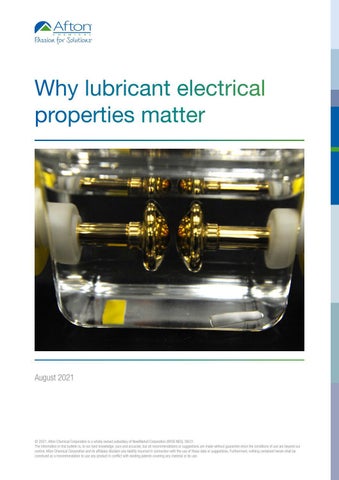
ASTM D877 AND D1816 – BREAKDOWN VOLTAGE What these measure These standards measure a fresh insulating fluid’s ability to withstand electrical stress. This ability is reduced by the presence of contamination, although a high dielectric breakdown voltage does not mean a fluid is necessarily contaminant-free. Test outline Both tests use a pair of electrodes that face each other and are immersed in test fluid at room temperature (recorded, between 20-30°C). Alternating voltage is applied at a frequency of 45-65 Hz, and increased at a fixed rate to determine the point at which dielectric breakdown occurs (ie the fluid starts to conduct current). D877 includes: • Disc-shaped electrodes with a 2.54mm gap between them. • Applied voltage that rises at a set rate of 3 kV/s. • Consecutive readings on the same sample at 1-minute intervals, or a fresh fill for each. D1816 includes: • Rounded, mushroom-shaped ‘VDE’ electrodes with a 2mm gap (this may be reduced to 1mm if dielectric breakdown not achieved with 2mm gap) • Applied voltage that rises at a set rate of 0.5 kV/s. • Consecutive readings on the same sample at 1-minute intervals. • Sample continuously stirred throughout test procedure.
What it measures Like ASTM D877 and D1816, this also measures an insulating fluid’s ability to withstand electrical stress. It can be used with fresh or used oil samples, as it indicates the presence of particulate and / or water contamination. Test outline The method is similar to the above, although carried out at a room temperature of 20°C and using alternating voltage with a frequency of 48-62 Hz. • Either brass ball or VDE electrodes can be used, with a 2.5mm gap between them. • Applied voltage rises at a rate of 2 kV/s. • Stirring during the test is recommended. Results The result is the mean of 6 consecutive readings, taken at 2-minute intervals within a permitted range of variance. When using VDE electrodes, IEC 60516 usually gives a higher breakdown voltage than D1816, because the electrode gap is wider and voltage rise rate faster.
© 2021. Afton Chemical Corporation is a wholly owned subsidiary of NewMarket Corporation (NYSE:NEU). 08/21. The information in this bulletin is, to our best knowledge, sure and accurate, but all recommendations or suggestions are made without guarantee since the conditions of use are beyond our control. Afton Chemical Corporation and its affiliates disclaim any liability incurred in connection with the use of these data or suggestions. Furthermore, nothing contained herein shall be construed as a recommendation to use any product in conflict with existing patents covering any material or its use.
8
Why lubricant electrical properties matter How significant are these electrical tests for EV lubricants? These tests were created for oils in power transformers or oilfilled circuit breakers and switches. It is not yet fully understood how relevant they are for electric vehicle lubricants.
As supplied voltage for eMotor becomes higher, this becomes more important to maintain integrate of eMotor insulation. Higher the PD inception voltage the better the insulation performance. This demonstrates the fluid’s ability to support eMotor longevity.
Emerging OEM specifications indicate divergent views: many are currently based on existing ATF-style fluids used in hybrid or electric vehicles. Many OEMs want these lubricants to have minimal electrical conductivity, (i.e. to have electrical insulating properties) yet also allow static charge to dissipate. Electrical property testing for dedicated EV fluids may need to differ from these in some respects, but most OEMs have yet to specify oils from first principles. Whatever a fluid’s starting specification, maintaining appropriate electrical properties throughout its lifespan is critical. Electrical property tests provide a very useful measure of fluid quality as it ages – particularly with respect to contamination from water, wear particles and the by-products of oxidation. Given the thermal stress that EV lubricants are regularly subjected to, this will become an increasingly important way to monitor fluid durability.
Anti-corona testing for EV lubricants A further test is coming to the forefront that relates to the phenomenon of electrical corona: localised hot, fluorescent and audible discharges that can occur in air exposed to a sufficiently strong electric field. In an eMotor, the electric field is most concentrated around the insulated copper end windings and stator vent slot, where lubricant is sprayed for direct cooling.
Image above shows the Corona Discharge Effect As this is fundamentally a test of compatibility and not electrical properties it is not described in detail below, although its increasing popularity in China makes it of interest.
Electrical corona can be generated in air gaps that may arise inside or between the insulated copper wires of the eMotor windings. It is important that EV lubricants do not cause any compatibility issues with insulation materials that may contribute to the formation of such air gaps. Corona generate nitrogen oxide, ozone and heat, all of which can cause further degeneration of the insulation, the copper windings and even the lubricant itself, ultimately damaging the eMotor. This anti-corona test therefore examines the lubricant’s compatibility with eMotor insulation materials by exposing it to sudden peaks of electrical field strength and seeing how long it takes before corona are observed – with and without the presence of water. Another method to evaluate anti-corona (or called partial discharge, PD) performance is to measure PD inception voltage, above which starts to generate PD. © 2021. Afton Chemical Corporation is a wholly owned subsidiary of NewMarket Corporation (NYSE:NEU). 08/21. The information in this bulletin is, to our best knowledge, sure and accurate, but all recommendations or suggestions are made without guarantee since the conditions of use are beyond our control. Afton Chemical Corporation and its affiliates disclaim any liability incurred in connection with the use of these data or suggestions. Furthermore, nothing contained herein shall be construed as a recommendation to use any product in conflict with existing patents covering any material or its use.
9
Why lubricant electrical properties matter Are dedicated EV lubricants the way forward? Formulating dedicated EV oils is not straightforward, as many additives typically used to enhance lubricant performance are polar in nature, with the potential to impact electrical properties such as conductivity.
Excellent control of electrical conductivity after ageing It also scores highly for fluid stability, ensuring that these important electrical properties are retained as the lubricant ages.
Fluids using HiTEC® 35701 ETF additive offers electrical properties equivalent or better than other commercial fluids
Achieving the right blend of electrical properties while meeting cooling, mechanical, friction and viscosity requirements is a considerable challenge that has been successfully overcome by HiTEC® 35701 ETF additive, Afton’s first dedicated lubricant additive for direct-cooled eAxles.
For more information about HiTEC® 35701 ETF additive, contact your Afton sales representative.
When used to formulate dedicated Electrified Transmission Fluid, this additive package demonstrates strong all-round performance, including electrical properties.
© 2021. Afton Chemical Corporation is a wholly owned subsidiary of NewMarket Corporation (NYSE:NEU). 08/21. The information in this bulletin is, to our best knowledge, sure and accurate, but all recommendations or suggestions are made without guarantee since the conditions of use are beyond our control. Afton Chemical Corporation and its affiliates disclaim any liability incurred in connection with the use of these data or suggestions. Furthermore, nothing contained herein shall be construed as a recommendation to use any product in conflict with existing patents covering any material or its use.