eMotor cooling benefits from OEM partnership
May 2021
© 2021. Afton Chemical Corporation is a wholly owned subsidiary of NewMarket Corporation (NYSE:NEU). 05/21. The information in this bulletin is, to our best knowledge, sure and accurate, but all recommendations or suggestions are made without guarantee since the conditions of use are beyond our control. Afton Chemical Corporation and its affiliates disclaim any liability incurred in connection with the use of these data or suggestions. Furthermore, nothing contained herein shall be construed as a recommendation to use any product in conflict with existing patents covering any material or its use.
2
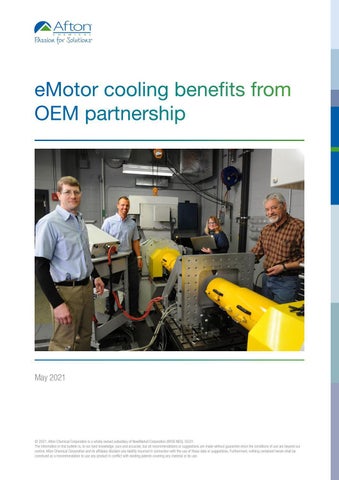
eMotor cooling benefits from OEM partnership OEM predevelopment teams face a daunting set of questions when designing new drivetrain hardware. How will this interact with the lubricant? Will it work? If it does, how long will it work for? What will failure look like? Resolving these questions as early as possible by working closely with OEMs lies at the heart of Afton’s ethos. This approach often leads Afton to devise new and more appropriate tests with greater predictive value; a joint paper on eMotor cooling published by Mercedes-Benz AG and Afton includes one such example. ‘Typically, OEMs will identify fluid properties they deem most relevant for new hardware and then specify the required performance using available tests, hoping this will effectively predict behaviour in the lubricating environment,’ says Arthur Petuchow, OEM Relationship Manager at Afton. Without close cooperation during predevelopment, this OEM specification might be the only information that a chemist receives before they have to determine the optimal blend of base oil and performance additives. For the OEM, defining performance using only existing, available tests in the absence of tests closer to the actual application might end up missing the mark. ‘For electrified drivetrains, the set of relevant fluid properties in the specification will expand to include things like electrical conductivity, compatibility with new materials, and fluid stability under thermal stress, all of which makes formulation more challenging,’ explains Petuchow. ‘And, given that most standard electrical property tests are based on non-automotive applications, their usefulness in predicting fluid behaviour in an electrified drivetrain is questionable.’ ‘When it came to optimising the performance and reliability of their new eMotor, the OEM chose to work with Afton at a very early stage,’ says Anna Plaatje, Afton’s Senior OEM Technical Service Engineer. ‘Our close collaboration them allowed us to devise a bespoke rig test in just six months, a third of the usual time, which mimics the actual distribution of oil in an eMotor. This meant we could apply controlled heat where it actually occurs in the windings, and fully assess the real world impact of cooling and compatibility on the eMotor and fluid.’
‘Designing, machining and building a test rig like this involves significant capital investment on Afton’s part,’ explains Plaatje, ‘but it is so valuable. It enables us to fully explore what is happening mechanically and work more closely with the OEM to anticipate potential challenges in the field and formulate solutions in advance.’ Afton chemists, working in parallel with in-house mechanical engineers, developed a more advanced electrical transmission fluid (ETF) designed to improve eMotor cooling, with appropriate electrical properties as well as the more conventional demands of wear protection, friction characteristics and compatibility. The team also worked to enhance the fluid’s thermal stability and resilience, knowing this would be critical for reliability in the real world. ‘Devising our own tests means we can dive much deeper to deliver maximum added value to our partners,’ explains Plaatje. ‘Unlike a test laboratory, we’re not restricted to assessing defined parameters using defined tests. We can be much more open-ended in our approach, which enables us to better establish correlations, sometimes unlocking new routes for development and progress before the real world testing phase even begins. That’s what makes my role as the interface between OEMs, our mechanical engineers and our chemistry experts so exciting.’ Using thermally optimised ETF resulted in a 2-3% improvement in peak torque efficiency in the OEM’s eMotor prototype over a severe lifetime test, without any compatibility issues arising. This demonstrates the potential added value that can arise from early partnerships. ‘Collaborating on this project enabled us to develop a relevant test that makes a valuable tool for predicting long-term field performance,’ concludes Petuchow. ‘Ultimately, that’s what we at Afton offer our OEM and Tier 1 customers: performance, not just chemicals. We define the chemistry in the fluid, the OEM defines the hardware, but only together can we truly understand and improve how they interact.’
The result of this collaboration has been published in a joint paper. The OEM conducted the thermal modelling to identify relevant fluid parameters and supplied its pre-production hardware, around which Afton designed and built the test rig for practical examination and validation.
© 2021. Afton Chemical Corporation is a wholly owned subsidiary of NewMarket Corporation (NYSE:NEU). 05/21. The information in this bulletin is, to our best knowledge, sure and accurate, but all recommendations or suggestions are made without guarantee since the conditions of use are beyond our control. Afton Chemical Corporation and its affiliates disclaim any liability incurred in connection with the use of these data or suggestions. Furthermore, nothing contained herein shall be construed as a recommendation to use any product in conflict with existing patents covering any material or its use.