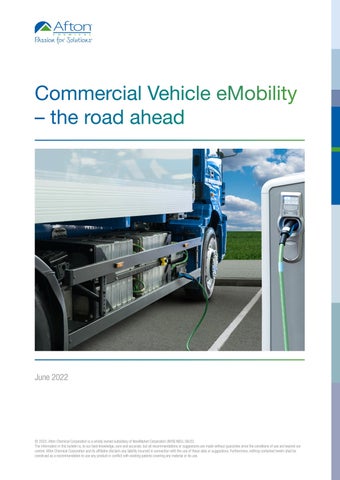
Commercial Vehicle eMobility – the road ahead
June 2022
© 2022. Afton Chemical Corporation is a wholly owned subsidiary of NewMarket Corporation (NYSE:NEU). 06/22. The information in this bulletin is, to our best knowledge, sure and accurate, but all recommendations or suggestions are made without guarantee since the conditions of use are beyond our control. Afton Chemical Corporation and its affiliates disclaim any liability incurred in connection with the use of these data or suggestions. Furthermore, nothing contained herein shall be construed as a recommendation to use any product in conflict with existing patents covering any material or its use.
2
Commercial Vehicle eMobility – the road ahead eMobility is bringing change, not just for the Passenger car market but for Commercial Vehicles too. This article is the first in a series, looking at eMobility and the accelerating Commercial Vehicle development, the challenges slowing this down, and the expected pace and direction of electrification. Highlighting how the latest dedicated EV lubricant technologies can help manage the divergent hardware designs that are emerging and maximise reliability and efficiency. What do we mean by eMobility? eMobility is a global megatrend that covers far more than just the degree to which vehicle propulsion is electrified. All four pillars of eMobility – Connected, Automated, Shared/Service and Electrified – will impact the hardware, configurations, operating modes and lubrication of commercial vehicles (CVs), both on and off road. On road
Electrification will have the most obvious impact on CV lubrication, however the other three areas will also exert an influence by shaping the way commercial vehicles are used and their operating priorities.
Where is eMobility heading? Take the future of connectivity: on-road this will support platooning, allowing CVs to group closely together for safer, more efficient driving using less fuel. Being fully connected can enhance logistics, enabling literal justin-time delivery. Off-road, this could facilitate precision farm management or better coordination between mining excavators and trucks, enhancing productivity and safety. Full on-road automation would allow truck drivers to rest during long-haul journeys, reducing the amount of downtime caused by tacho restrictions. The more limited and controlled off-road work sites could see fully automated CVs becoming widespread much sooner; Rio Tinto has already ordered a fleet of autonomous Caterpillar trucks and blast drills for one of its Western Australian mines, to be integrated with its Mine Automation System. On-road shared services could include the likes of automated groupage, allowing users to hire space on a truck rather than a whole vehicle. This type of service is simplified when you can see the precise whereabouts and destinations of connected CVs. Some countries are already offering Uber-style services for off-road CVs: the HelloTractor and Trringo apps supply tractors (with drivers) on demand, across Africa and India respectively.
Off road
Electrification already has a secure foothold in some on-road applications. Urban buses, with fixed routes and regular returns to hub, are well suited to full battery electric operation. Hybrid power is well placed to optimise the start-stop urban journeys of vehicles such as refuse trucks. Urban delivery is the next obvious candidate for widespread electrification, whether this ultimately takes the form of electrified trucks or perhaps, for last-mile delivery, drones. Long-haul freight brings greater challenges; both BEV and hybrid options are currently being pursued by OEMs. Off-road electrification is also under way. Off road CVs have such diverse uses that some applications will be particularly well suited to hybridisation or full electrification. For locations with an electricity supply on site – most notably, farms or mines that produce their own renewable energy from biomass, solar or wind, full electric vehicles could be very attractive.
© 2022. Afton Chemical Corporation is a wholly owned subsidiary of NewMarket Corporation (NYSE:NEU). 06/22. The information in this bulletin is, to our best knowledge, sure and accurate, but all recommendations or suggestions are made without guarantee since the conditions of use are beyond our control. Afton Chemical Corporation and its affiliates disclaim any liability incurred in connection with the use of these data or suggestions. Furthermore, nothing contained herein shall be construed as a recommendation to use any product in conflict with existing patents covering any material or its use.
3
Commercial Vehicle eMobility – the road ahead The burden of investment for OEMs to advance in each of these areas at the same time is so large as to shape the industry. It is driving unprecedented collaboration, mergers, alliances and partnerships between rival companies as they seek to share the financial load. For operators, electrification may change vehicle ownership strategies. Full electric versions are currently much more expensive to buy than ICEs, but may benefit from considerably reduced running costs throughout their working life. This changes the balance of up-front vs variable cost in usage. A future shift towards full electric could therefore swing CV operators away from vehicle ownership and towards a leasing model.
How fast is CV electrification moving? Electrification is arguably the fastest evolving area of on - road CV eMobility, because it is being directly driven by CO2 - focused emissions legislation. Legislations around the world demand that emissions be reduced by an increasing percentage relative to a baseline year, but this means variation between regions, because each had a different start point. However, as emissions limits become more stringent, OEMs everywhere will need to electrify to an increasing degree to avoid potential fines.
To meet the 2025 target, the most likely strategy for European CV OEMs will include a continued focus on vehicle and ICE efficiency, as well as some hybridisation; however, hybridisation is not ideally suited to the constant speeds and loads of long-haul freight. Cost, payload weight and total cost of ownership (TCO) are likely to dictate the choice of powertrain by application, until full electric technology is mature enough to handle the demands of all CV applications. To meet the 2030 requirements, significant electrification (whether BECV, fuel cell (FCCV) or hybrid (HECV)) will be a necessary part of an OEM’s CV fleet mix. In the US, California has taken the lead by announcing a zero emissions strategy. Its Advanced Clean Trucks regulation, introduced mid 2020, phases out the use of diesel power entirely. From 2045, it will be mandatory for all new CV sales to be zero-emissions, shifting the focus away from hybrids to BECVs or FCCVs. If the 15 states that typically follow California’s legislative lead also adopt the ACT, >15% of all US commercial vehicles could be impacted. Electrified buses are already well established in cities around the world, representing around 50% of global new bus sales in 2021. Much of that figure is driven by strong support for battery electric buses in China. ICE buses are expected to shrink to a mere 15% share of new bus sales worldwide over the coming two decades. The rate of CV electrification is likely to be led by Europe and China, with the US following fast. Progress is expected to be much slower in India, the largest Asian market outside China. Here, the focus is still on 2- and 3-wheelers rather than CVs. Medium and Heavy Duty Truck Sales 3,000,000
2,500,000
Source: : ICCT, CO2 STANDARDS FOR HEAVY-DUTY VEHICLES IN THE EUROPEAN UNION, April 2019. Licensed under CC BY-SA 4.0
In Europe, the level of financial penalties is set to take two significant jumps for OEMs not meeting the -15% CO2 emissions target in 2025 and just five years later, the -30% CO2 emissions target in 2030. Hefty financial penalties for those not meeting the targets will drive OEM choices. As an example, if an OEM did not improve the CO2 emissions of a 2019 large truck (>3.5mt), the fine in 2030 would be ~€125,000 per vehicle!
2,000,000
1,500,000
1,000,000
500,000
0 2015
2020 China
2025 Europe
© 2022. Afton Chemical Corporation is a wholly owned subsidiary of NewMarket Corporation (NYSE:NEU). 06/22. The information in this bulletin is, to our best knowledge, sure and accurate, but all recommendations or suggestions are made without guarantee since the conditions of use are beyond our control. Afton Chemical Corporation and its affiliates disclaim any liability incurred in connection with the use of these data or suggestions. Furthermore, nothing contained herein shall be construed as a recommendation to use any product in conflict with existing patents covering any material or its use.
2030 India
Japan
2035 Rest of World
2040
2045 U.S.
4
Commercial Vehicle eMobility – the road ahead The Middle East and ASEAN markets are harder to forecast, while Latin America and Africa are expected to be the last regions to electrify their CVs. Regardless of the regional differences in pace, many cities around the world are already targeting zero or ultra-low emissions in order to improve local air quality and public health.
Is there a role for hybrids? Zero and ultra-low emissions legislation means we will likely see a steady increase of medium and heavy on-road hybrid sales. Forecasts differ in scale, but the start of this rapid growth is generally agreed to be around 2030.
The future of CV The economic productivity and efficiency of a vehicle, offset by the Total Cost of Ownership (TCO) is the driving force for commercial vehicle operations. The overarching pressure to conserve resources, reduce emissions and save money means that whatever is ahead for eMobility developments and whatever forms these may take, new lubricant technology will be required – at the heart of which will be efficiency. Whilst commercial vehicles continue to eVolve, Afton will ensure our technology is also moving into an efficient future! The next article in this series will look at potential electrified solutions. Watch this space for part 2!
© 2022. Afton Chemical Corporation is a wholly owned subsidiary of NewMarket Corporation (NYSE:NEU). 06/22. The information in this bulletin is, to our best knowledge, sure and accurate, but all recommendations or suggestions are made without guarantee since the conditions of use are beyond our control. Afton Chemical Corporation and its affiliates disclaim any liability incurred in connection with the use of these data or suggestions. Furthermore, nothing contained herein shall be construed as a recommendation to use any product in conflict with existing patents covering any material or its use.