JANUARY 2021
V12
SYMPHONY
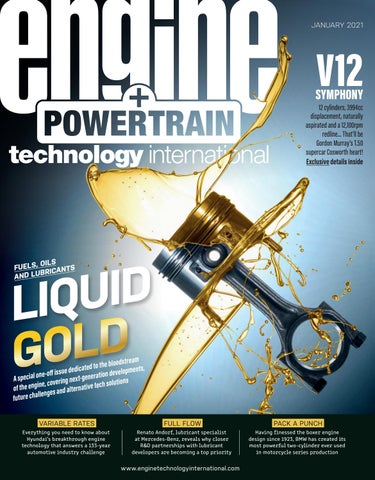
12 cylinders, 3994cc displacement, naturally aspirated and a 12,100rpm redline… That’ll be Gordon Murray’s T.50 supercar Cosworth heart! Exclusive details inside
OILS FUELS, TS BRICAN A ND L U
am e bloodstre s, th to d te a en t dedic e-off issue t-generation developm n o l ia c e p s A ne x e, covering native tech solutions in g n e e th f o alter enges and ll a h c e r tu fu VARIABLE RATES
FULL FLOW
PACK A PUNCH
Everything you need to know about Hyundai’s breakthrough engine technology that answers a 133-year automotive industry challenge
Renato Andorf, lubricant specialist at Mercedes-Benz, reveals why closer R&D partnerships with lubricant developers are becoming a top priority
Having finessed the boxer engine design since 1923, BMW has created its most powerful two-cylinder ever used in motorcycle series production
www.enginetechnologyinternational.com
OIL AND LUBRICANT TESTING
RAPIDLY EVOLVING POWERTRAIN STRATEGIES ARE REQUIRING A NEW GENERATION OF SOPHISTICATED, TAILOR-MADE LUBRICANTS WITHIN EVER-TIGHTENING DEADLINES. SO HOW ARE SUPPLIERS KEEPING PACE?
FORMUL A FOR CHANGE Words:
Alex Grant
ew discussions have truly united the world’s disparate political viewpoints like climate change. Despite a couple of notable outliers, CO2 reduction is a common goal worldwide, but there is no silver bullet for achieving it. Furthermore, varying regulations, driving conditions and even fuel infrastructure increase the challenges, not only for manufacturers but for the lubricant industry too. “A decade ago an OEM would change their factory-fill lubricant around once every 10 years,” comments Craig Jones, technology
54 Engine Technology International.com / January 2021
manager, consumer engine lubricants, at Lubrizol. “That’s now five years, which is quite a big step change. Manufacturers have had to develop powertrains to meet CO2 requirements, and a correctly designed engine oil specification can enable CO2 reductions. The pace of change has sped up, and the lubricants industry has had to keep up.” Market volatility is unprecedented. Within the last 10 years, Europe (and to some extent America) has gone through a boom-and-bust cycle with diesel, the Chinese market has swollen exponentially, and electrification is very quickly becoming mainstream. But conventional combustion engine technology
OIL AND LUBRICANT TESTING
“Physical engine testing is still the most capable method of reproducing the subtle nuances” Phil Carden, technical specialist, Ricardo
Electric realities E-fluid Although large markets are beginning to indicate phase-out targets for combustion engines, lubricant developers are finding new opportunities to utilize their experience in electric vehicles. Shell launched its first ultra-low-viscosity e-fluid range last May, and the demands are broader: these not only minimize friction but also assist cooling, which is vital for improving energy efficiency. The operating environment is very different. Adam Banks, e-mobility technical expert at Afton Chemical, says low-viscosity lubricants encounter a motor spinning at up to 30,000rpm, requiring a focus on anti-foaming properties. The ongoing trend toward energy efficiency for next-generation electric vehicles means these fluids will play an increasingly important role. “The first generation have had what we call a dry e-motor, cooled by glycol with a jacket and air gap. The next generation of electric vehicles is going to be direct oil cooled. Although oil does not conduct heat as well as glycol does, because you can apply it directly actually it works out to be much more efficient. You can get more range from a direct oil-cooled battery or oil-cooled e-motor,” he says. “Then the next generation after that will be multi-speed [transmissions]. That means some sort of shifting device, and a requirement for friction properties in the oil. We developed a prototype product for that, so that we can deliver that transmission performance as well as the electric motor cooling.”
MAIN IMAGE: Shell is collaborating with OEMs now more than ever, with Shell scientists joining the manufacturers’ R&D teams ABOVE: There is now a greater focus on oil during the gearbox design process
is evolving too, with the increasing popularity of gasoline direct-injection (GDI) systems and new challenges developing more quickly than regulations. Jones highlights the ACEA European Oil Sequences and ILSAC GF-6 standards, both of which include additional testing for low-viscosity grades, and both of which have been delayed. As GDI engines have presented additional (and not necessarily uniform) lowspeed pre-ignition (LSPI) issues, which can be exacerbated or mitigated by the additive pack, OEMs have pushed for their own benchmarks in the interim. North America’s voluntary API SN Plus standard, released in 2018, includes testing for LSPI mitigation measures, but Jones says it is limited in scope as it only tests fresh lubricants. SAE-published studies have highlighted that, in longer drain intervals, some formulations can cause LSPI issues as they age. PSA already includes long-term mitigation requirements in its specifications, and Lubrizol expects such testing to become more common. “GDI is a much more severe environment than the old port fuel injection gasoline engines,” Jones continues. “We have seen a significant increase in GDI engines, and tests that need to be run to get an oil approved. Certain additive components used in engine oil formulations had a negative impact on LSPI, some had a positive. So you have to go through that learning process.”
TEAM GAME
Collaboration is vital. Ian Shannon, general manager for B2C lubricants technology at Shell, says manufacturer co-development has started to become much more common: “The company is increasingly embedding its own scientists within OEM research and development departments, and oils are being designed in tandem with engine components, becoming an integral part of powertrain performance. This closer relationship also enables more accurate vehicle oil condition and oil drain algorithms.” Transmission design is taking a similar route, according to Barry James, the chief technical officer and head of R&D at Romax: “In the last five years, instead of an oil being just a grade and considered only as an afterthought when designing a gearbox, you now have to consider it as a component at the start of the process. So there’s much more
Engine Technology International.com / January 2021 55
OIL AND LUBRICANT TESTING
collaboration between the manufacturer of the gearbox and manufacturer of the oil.” Good data is the foundation. Romax details the frictional behavior early in the development process using a mini-traction machine (MTM), which in turn underpins more accurate simulations. With mounting pressure to shorten development cycles, digitization allows a much wider range of operating conditions to be demonstrated. James continues, “The use of simulation has increased enormously. A new lubricant formula used to require so much testing to understand its performance in real life and this is really expensive. The process still does involve some testing. The MTM is a physical test; we can’t look at the chemistry and know the effect of additives. However, when someone formulates a lubricant sample in a laboratory now, they’re able to test it quickly on the MTM and then give us the
As electrification ramps up across the industry, companies such as BP are having to test for a wide range of behaviors as well as for IC engine inactivity
New environments Integration Progressive electrification of combustion engines introduces new challenges for lubricant developers, potentially testing a much broader range of user behaviors and engines that can spend longer periods inactive. Castrol’s vice president of OEM technology, Dave Hall foresees the associated higher fuel and water levels in engine oil becoming a bigger focus during development. “Specification parameters and tests may appear to ensure appropriate performance in these areas,” he explains. “The OEMs would prefer hybrid and non-hybrid specifications and formulations to be the same, and it may be that non-hybrid specifications evolve to encompass the new requirements of their hybrid counterparts.” The challenges differ for transmission lubricants. Barry James of Romax says lubricants already have to be suitable for mechanical and electrical components, which is reshaping how OEM departments and oil suppliers work together. “Increasingly the electrical simulation activity has an influence on the mechanical engineering. We are having to integrate those into a multi-physics environment, in that the e-machine, power electronics and gearbox need to be engineered together” he says. “The interaction between the motor and the gearbox really needs to be done in the same department, on the same simulation package in order to get the most optimized design. Most new companies are operating departments that are designing them together as opposed to separate entities.”
frictional data, which goes straight into the simulation. This close integration of simulation with a simpler physical test provides a rapid insight into that sample’s performance in real life.” Simulation has a specific role to play. Patrick Niven, senior manager, industry solutions product management at Siemens Digital Industries Software, expects increased digitization of the development process as suppliers look to meet a wider range of operating conditions without the attached cost and time penalties of physical testing. But, he adds, phase changes, material properties and computational times are harder to model. “Materials modeling helps identify candidate formulations, while simulation of the applications in which the lubricant is used help to understand the benefits of improved performance, new application methods and patterns, minimal coating thicknesses, fill volumes, etc. Additionally, their contribution to engineout emissions, a hot topic in discussions regarding the life of the internal combustion engine, is a growing interest in simulation,” he explains. “With reduced investment in conventional internal combustion engine lubricants there is a growing need for increased usage of simulation to fill the void left by the reduced amount of expensive physical testing.”
SIM MODELING
In turn, this is being enabled by increasingly capable software. Matthias Hensel, senior R&D engineer at
56 Engine Technology International.com / January 2021
OIL AND LUBRICANT TESTING
Track to road Testing Physical testing remains an important part of lubricant development, and Shell’s Ian Shannon says the company views motorsport partnerships as a useful proving ground. The company has technical partnerships with teams in Formula 1, DTM and the World Rally Championship, and oil formulation is crucial: a fifth of Scuderia Ferrari’s lap time improvements between 2014 and 2017 were put down to the lubricants that the team was using. Fuel efficiency and technical challenges on track are similar to road vehicles, and experiences are shared, Shannon says. “The teams are employing the same evolved engine designs – downsized turbocharged engines – so in that racetrack environment we’re aiming to
formulate products to deliver maximum engine performance without compromising on durability. It also gives us insight into how we can formulate for future engine designs.” The scope of testing also extends to batteryelectric vehicles. Partnerships with Nissan and Mahindra Formula E teams are offering opportunities to develop and test e-fluids too. “We are working with a number of electric vehicle OEMs to address battery thermal management issues through a fluid management approach. It’s an area where we’re actually able to bring Shell lubricant technology to good use in our e-thermal fluids,” Shannon continues. “We’re really trying to leverage that motorsport ‘laboratory’, almost, and bring that into modern formulations.”
“The long-term prospects of the internal combustion engine are being questioned widely” Patrick Niven, senior manager, industry solutions product management, Siemens Digital Industries Software
Afton Chemical, says that molecular-level simulation is enabling better understanding of mechanical and chemical interactions. However, the complexities of modeling entire powertrains, including the different contacts within them, is much harder to do accurately. “A fully digital development of a lubricant would require small-scale molecular models to describe the behavior of fluid and chemistry for mechanical contact as well as chemical interactions. At this point the models would not even be describing the whole system yet, but only very small subsets independently from each other. More layers of simulation and modeling would be required until the behavior of a lubricant in a system, which would be relevant for the application, could be described,” he notes. “Such a model would only work if we would understand, and have access to, all parameters on all levels describing the modeled system.” The capabilities of physical testing are also expanding. Phil Carden, technical specialist at Ricardo, says the company is developing radio-activated surfaces to enable more sensitive measurement of friction properties over a wider operating range. It’s a recognition that even similar engines can exhibit very different fuel economy behavior with changes to oil viscosity. He explains, “Physical engine testing is still the most capable method of reproducing the subtle nuances of mechanical, chemical and thermal interaction that the oil is exposed to. Each lubricant is a complex mixture of base
Motorsport remains a crucial part of lubricant development for companies such as Shell. The demands of the track provide an insight into the durability of a lubricant and the demands of future passenger vehicles
oil, additives, combustion products, water and unburned fuel. It must work well with a wide range of surfaces and contact types in every engine. The contact surfaces and the oil behavior change with time as the engine runs-in and the oil is damaged by oxidation, combustion products and shearing.” But the automotive industry faces bigger uncertainties than most. Contraction of development times has become common for most industries, but Niven says those working with combustion engines face an added issue of potential obsolescence, which is adding to the uncertainties ahead. “The long-term prospects of the internal combustion engine are being questioned widely,” he continues. “Assuredly it will be around for the next few decades in some shape and form, but how much, for how long? This puts additional pressure on suppliers to reduce investment costs in new enginespecific lubricants as they diversify their technology portfolios.” So although the regulatory landscape and OEM roadmaps are aligned in pursuit of CO2 reductions, there remains no perfect technical solution for stakeholders to unite behind. The only certainty is more change, and at an ever-increasing pace.
Engine Technology International.com / January 2021 57