STUDY ABROAD Discover new things about yourself and find your place in the world by going abroad.
A world-class intercultural educational organization; a global movement to develop and activate global citizens AFS Intercultural Programs India is an international, voluntary, non-governmental, non-profit organization that provides intercultural learning opportunities to help people develop the knowledge, skills and understanding needed to create a more just and peaceful world.
HOST AN AFSer Experience your world through the eyes of a young person from another country.
SCHOOLS Implement AFS Intercultural Learning Programs at your school for your students & educators.
VOLUNTEER Join a Global community of changemakers & serve a change agent in your community.
Newsletter Your source to stay up to date with AFS Intercultural Programs India’s activities, events & opportunities www.india.afs.org | india@afs.org
Editorial
The Importance of Global Competence in a Multicultural World While we are given all the right tools and resources to excel in the world of academics, we aren’t taught on how to work and live in a globalized world – a world that requires a distinct set of skills, knowledge, and understanding. If you’re working in a multicultural environment, you must learn the ABCs of being in that environment – the dos and don’ts – otherwise, you yourself will be creating a hurdle for your own growth and adjustment. One has to learn to respect the cultural diversity and acquire the tips to navigate through the journey where you not only see yourself as a learner but also as an experiential learner. When we work for a multicultural team, we face challenges in the field of communication and understanding, and have to deal with cultural differences, surprises, and microaggressions etc. and when we try to integrate ourselves with the multicultural team to foster confidence, trust, and inclusivity, we hit a wall. We don’t know how different cultures have different ways of seeing and reacting to the same situation. Imagine a French guy giving feedback on an important meeting to an Indian. As per his cultural setting, his communication style might be very direct which might be interpreted by Indian as rude and unacceptable. Another quick example from Indian context is our way of showing respect: we call our elders Sir or Ma’am and if they are relatives, we call them Aunty or Uncle, but when a person from another cultural setting comes to India, it’s hard for them to understand Indian concept of respect; they’d rather call everyone with their first name. In many cultures, respect is demanded while in others it’s earned. Our ways might be different, but our end results are the same. Whether it’s low-context communication adapted by Italians or Germans or high-context communication adapted by Africans or Chinese, one needs to learn how to react appropriately while respecting the native culture. Seeing how one needs to learn the ABCs of navigating in a multicultural workplace, the most significant question to ask yourself right now is -- what’d you do if you are in a situation where you don’t know how to react or take forward the experience of being in a new cultural setting? Will you distant yourself and think that the situation would pass? Or will you think of learning and preparing yourself with the right knowledge, skills, and understanding so that you can learn to respect, observe and reflect on other cultures and make sense of the experience you face? In the last decade, I have seen thousands of students, of different age group from various background, who went abroad and came to India on cultural exchange programs, and they all accede with the fact that being in a new cultural setting is a challenging experience. They go through many ups and down. At times, they don’t know what to do, what to ask and how to ask, but fortunately, with the curriculum prepared by AFS and facilitated during orientation by Qualified Trainers, participants learn to navigate through the different cultural setting.
Aadil F.
Chief Marketing and Development Officer AFS Intercultural Programs India
Page 02 | February 2019 | Newsletter | AFS India
AFS prides itself in offering curriculum-based training and workshops to the participants who go on AFS exchange programs. We also have Qualified Trainers who provide exclusive training to the educators, students and other stakeholders on Global Competency that helps them increase their intercultural competence. With the introduction of this amazing and thorough educational product offered by AFS -- Global Competence Certificate -- anyone who is participating in an international experience can build their global competence. The certification is designed in a way where learners can be interculturally competent and be ready to experience a new culture setting with a new perspective and understanding. GCC maximizes learners ability to cope up in a different cultural setting by helping them increase empathy and curiosity – skills that help you become a global citizen. Intercultural Skills and Global Competence are appreciated in today’s workplace. The 21st-century workplace prefers employees who can collaborate, connect and co-create with a diverse, multicultural environment. We need to reflect on the skills which we have and the power skills which we need to develop. Once you’re done with the assessment, participate in a training or course, online or offline, to become more interculturally competent and take the first step towards being a global competent person with knowledge, skills, and understanding to create a just and peaceful world.
Photo: Presidents with Board Members & Staffs
Volunteerism Annual Presidents, Board Members & Staffs Meeting 2019
#AFSEffect Annual Presidents, Board Members & Staffs Meeting 2019 took place in New Delhi from 8th to 11th February, 2019 where 17 Presidents and 6 Board Members came together to discuss strategies and plan of action for the year of 2019. During the three day meet, various sessions were conducted to update, inform and share new updates with everyone. These are:
Gallery Walk | My Chapter: This session was based on the preparation done by the chapter heads before they joined the Presidents Meet. Each of the chapter heads were given the task to prepare posters, powerpoint presentation etc. to showcase their chapter’s achievements, accomplishments and challenges of 2018. With the concept of gallery walk, each chapter was given 8-10 minutes to showcase their chapter growth, engagement and development. The session’s main objective to showcase the hardwork put in by chapter volunteers in the last year and recognize their commitment in a bigger platform.
#Testimonials Highlights of 2018: The objective of the session was to share the journey of AFS India in 2018 in various programs and departments. The session was also aimed at acknowledging and showcasing the hard work done by the chapters, volunteers and schools through 2018. Highlights were shared with a special focus on unique measures, first time or large scale significant initiatives or contributions.
From this Presidents Meet I learned: ——The necessary skills to be a successful president from other presidents, board members, and staff. ——About the concept of incomplete leader ——Ways of involving every volunteer in the chapter. ——That the The Ethos of AFS which is totally service oriented. ——Information regarding AFS IND Network from Updates as well as Operational Excellence. ——Elevator’s Talk and Delegation of Work Page 03 | February 2019 | Newsletter | AFS India
Page 04 | February 2019 | Newsletter | AFS India
Discussions between Board Members & Presidents with Staffers: This objective based session provided a platform for board members, presidents and staffers to engage in a discussion and interaction. During this session, board members explored their role in the chapter towards creating chapter engagement and development. They learned how they can contribute more by being part of the chapter meeting, activities and events. Introduction to Workplace, Learning Module for Chapter Growth & updates on Elections: In 2019, new programs, activities and events are planned in accordance with AFS India and Network Strategy. Through this session, our aim was to enlighten and share the new developments in AFS India such as Workplace, Learning Module for Chapter Growth & Election. Leadership Development Program: A whole-day was focused on Leadership Development Program for Presidents. Participants engaged on the topic of how leadership is very important and how they must give time to learn to be a better leader. Through the Incomplete Leader model, participants learned how they should keep on improving by learning new skills and talents so that they can create more awareness of AFS as an organization and advance its mission. The one-day program focused on providing an understanding and importance of Incomplete Leader. During the program, participants were asked to reflect in detail of the four attributes of the incomplete leader: —— Sensemaking, —— Relating, —— Visioning and —— Inventing. They were also told about the significance of communication and how it helps them to relate to 4 attributes. The program helped the participants understand that no leader is perfect; a leader doesn’t have to know each and everything; or should be able to resolve each and every query or challenges on its own; or have to come up with ideas alone to make a new plan of actions. A leader should be one who is continuously learning, asking help from others and keep reflecting on their strengths and weaknesses, and in that process, finding others who can help them overcome their weaknesses or the skills they lack. Operational Excellence: Operational Excellence session was designed to updates to Presidents on a few fronts of AFS India so that they feel empowered. A few topics that were discussed during the session were: AFS Mission Statement, Out Impact Goals from Network Strategy; Core Values and Attributes of AFS; AFS India Vision 2020; Volunteer Strategic Plan Vision; Chapter Meeting; Financial Chart etc. Plan of Action: Plan of Action aimed towards helping chapter heads realign their strategies and build a plan of action for 2019. Each of the Presidents worked with staff members to set their goals, activities, events etc. for 2019. Constant feedback and assessment was given by the staff to improve on the plan of action. Chapter heads also committed to the program numbers and volunteer development programs. Annual Presidents, Board Members & Staffs Meeting 2019 ended with a thank you note from National Director. Board Chairperson & National Director appreciated the Presidents & talked about the hard work they are putting in chapter and how their advancement is helping AFS be a leader in volunteerism. We’d like to thank you everyone for taking out time and being part of the Meet. Page 05 | February 2019 | Newsletter | AFS India
Photo: In Traditional Dress with Friends
YES | Sponsored Program #KLYES “I felt that we are somehow able to contribute in making someone’s life better”
By Lakshmi Sharma | YES 2018 participant from Bangalore | Hosted in the USA “I had one of the best time of my exchange program during the first week of February. I got an opportunity to attend ISGLC, (Iowa student global leadership conference). It was an amazing experience to meet 120 exchange student from 49 countries. I was able to talk to most of them in those two days and one of the best thing that happened was meeting “Dean Jacob” a motivational speaker and an explorer who taught us a lot about leadership and gave us hope to never stop dreaming because no problem is bigger than our goal. His every word was so inspiring and powerful that it gave everyone so much hope to achieve their goals no matter what. We also got to wear our traditional dress and talk about our country. It was good to know about different countries and their cultures and tell about our country and cultures. It made me feel very proud to talk about my country in front of so many people from different countries. It was awesome to meet everyone, we had fun and learned a lot as well. At the end of the day, we got to volunteer in packing the food for almost 20,000 kids in need. I felt very happy doing that, I felt that we are somehow able to contribute in making someone’s life better. It was one of my life changing conference. I loved it and made many new friends.”
Page 06 | February 2019 | Newsletter | AFS India
The Kennedy-Lugar Youth Exchange and Study (YES) program was established by Congress in October 2002 in response to the events of September 11, 2001.
EDUCATION
The program is funded through the U.S. Department of State and sponsored by the Bureau of Educational & Cultural Affairs (ECA) to provide scholarships for high school students from 40 countries to spend up to one academic year in the United States. Students live with host families, attend high schools, engage in activities to learn about American society and values, acquire leadership skills, and help educate Americans about their countries and cultures.
Photo: Group photo during Re-Entry Orientation
Asia Kakehashi Project | Sponsored Program #KakehashiProject Asia Kakehashi National Level Re-entry Orientation Prime Minister Shinzo Abe created the initiative to strengthen relations between Japan and the rest of Asia. The program, called Kakehashi (Japanese for “building bridges”), will provide full scholarships for 1,000 Asian high school students to study in Japan’s public and private high schools over the next five years. Together with 40,000 of their Japanese peers, these students will develop greater global competence and understanding of each other’s countries. AFS Japan has been appointed by the national Ministry of Education, Culture, Sports, Science and Technology (MEXT) to run the Kakehashi project, focused on facilitating intercultural exchange and understanding between teenagers in Japan and 20 other Asian countries.
It gives us immense pleasure to share that AFS India conducted the first Re-Entry Orientation for Asia Kakehashi project students for 2018 batch on 18th Feb 2019 at AFS India National office Delhi. Our heartfelt gratitude to the Ministry of Education, Culture, Sports, Science, and Technology (MEXT) for this wonderful scholarship and opportunity to the students. It was a great experience to recruit students not only from India but also from Bhutan, Bangladesh, Pakistan and Nepal for the very first time. We also want to thank AFS Japan for their continuous support and guidance round the clock. The orientation was conducted by the staff helping them ease their adjustment process by providing them a supportive environment, ideas, and intercultural awareness. Our best wishes to the students for their future endeavour!
Page 07 | February 2019 | Newsletter | AFS India
Hosting | Programs My New Experience In India
By Elisa Zucconi | Year Program from Italy | Hosted in Nashik
#Italy “It’s already 6 months since I’m in India. Not only did I get a chance to discover this amazing country, but also myself. I spend a lot of time exploring the community, dancing with my friends and from that, I started loving Indian music, so much that it has become a part of my daily routine to listen to my favorite songs. I also started attending a music class where I learned how to play drums and guitar. One day my music teacher asked me and Louisa to sing some songs during the annual academy’s concerts. I was very excited and scared, especially when he asked us to sing a Marathi song. That evening, as soon as I reached home, I started reading the lyrics and tried to sing it with the
help of my host sister. It was very difficult and funny to pronounce those words and I only had just 2 to 3 days left for the performance. At the day of the concert, everyone was excited about hearing us singing in Marathi and I was not able to believe that I was about to sing the song that I had danced for last 5 months laughing. It was a funny day, but very special, especially when I had to stay for 1 minute without breathing for song “Zing Zing Zing Zing”. It was very hard to be concentrate on singing and not dancing as the song was full of energy. I will always remember this experience and now I can say to be proud that I can sing and dance on one of my favorite songs!”
Photo: Singing Songs during Concert
Page 08 | February 2019 | Newsletter | AFS India
Photo: Getting award in the school
Hosting | Programs Winning An Award
#Italy Giulia Gonnella, on Year Program from the Italy hosted in Vadodara, has won an award at her host school, Anand Vidya Vihar on the 7th of February, on the occasion of founder’s day. The School awarded some of the best and deserving students, and Giulia was one of the awardee. By Guilia Gonnella | Year Program from the Italy | Hosted in Vadodara “In the morning, I was very glad to receive an invitation card for my host parents. That meant I was also going to receive an award! To be called on the stage, after a long introduction from my proud teachers, was an honor and unique feeling for me and my parents. It made me feel really part of my school, proud of being the student I am. If I think about July, when I entered AVV for the first time, I can’t believe that time went so fast. If I think about how much longer is my path now, not only in my school but in general here in India, I really can’t imagine that in a few months all this will be only
a memory. Nowadays, my life is in India, my customs and my habits have become Indian. My family is Indian. It was sometimes hard, in the first months, to accept all the differences and to adapt in every situation but now all these differences have become a part of my everyday life, and it will be weird to leave all the things and relationships I’ve built here. I can really say that my second life will always be here in India, and half of me too. Here I’ve found a family that was exactly like my family, and they found a daughter that, as my parents always say, was the combination of them both, and the combination of their both sons. Nowadays, I look and treat them as my second family, as if I’ve spent half of my life in their house, and I feel that I will be always able to count on them, in every situation. Despite my year of exchange in India will end, my love for this country, these people, these customs and most of all my family will never change. I’m already thinking about how many times I will come back, and how wonderful it will be to hug everyone again and again!” Page 09 | February 2019 | Newsletter | AFS India
Photo: With friends
Impact of YES Program | Alumni Stories “We live in different countries, but we all have the same heart beating in our chests” By Shruti Bishnoi | YES 2016 Alumni from Indore
#KLYESAlumni “Writing about my program experience always takes me back to the day while I sat in the flight, by the window seat, looking down and getting intimidated by the lights of my dream city-New York; it was a breathtaking view which I can never forget. It was not until I met the old Indian friends of mine personally that I discovered and felt that I have changed a lot. I was smiling more now and was seen less grumpy which according to them was really good change. I could sense what a person wanted to say and what a person was feeling at a point of time just by observing their body language, expressions, and gestures. It was like I was a whole new person with a few modifications. We were supposed to do 20 hours of community service as the requirement for the YES program and so I started doing it just to fulfill that. Later when I completed the requirement, I found myself deeply driven by the sense of giving back and doing every bit I could to help others. I ended up giving 50 hours of my program to the community service and volunteering. What lot of us fail to understand is the importance of volunteering and giving away to the community. Just because we pay taxes and the government and in turn, they provide services to the nation using them, we call it community service but in a true sense, it is all about going out of your comfort zone to know the pain others encounter and to sit with them and see the world from their perspective and finally integrate them in our society -- this is what I learned during my exchange program; it was indeed a golden lesson. I still continue to Page 10 | February 2019 | Newsletter | AFS India
work with this organization full of beautiful souls who sowed the seed of world integrity in me. Presently, I am playing the role of local coordinator for the Indore chapter and working closely with the NSLI-Y students who are being hosted by The Emerald Heights International School, Indore. This is my way of giving back to this organization and the world. One of the major impact of this program in my life worth mentioning is that before going on the program I was one of the sheep from the herd who was influenced by others and wanted to pursue a career in engineering. My journey to the USA was a self-exploration voyage. I came to know about my weaknesses and my strengths. I was no longer longing to become something which I did not really have a passion for. It was like I was following a mirage in a desert. When you attend an international conference with the students all over the world and have the strength to speak about your own country and truly play the role of an ambassador, it really shoots up your self-confidence and makes you aware about who you are. After coming to India I switched my stream to Management. I participated in the Education week and got a chance to present a power presentation on India in host school i.e. Carroll High School. It was a great opportunity to discuss the similarities and differences between American and Indian culture. I was privileged to get to know about what Americans think about India. We also discussed Indian politics and religions and cleared the misconceptions that the Americans had about India. Being in another country makes you question people about their culture, but that time it was my turn to answer. I gave my host school a chance to question on various issues of India. I gave them the opportunity which they don’t get every day in their lives and took this opportunity to break all the stereotypes. I believe that whoever participates in this program is changing the lives of many. I highly recommend this program. I can only say, “We live in different countries, but we all have the same heart beating in our chests”.
Photo: Arun With Kids
Impact of YES Program | Alumni Stories “Fly and explore the world around you, never let yourself down by society’s set standards” By Arun Sharma | YES 2010 Alumni from Delhi
#KLYESAlumni “Imagine children of 5-10 years walking 7 to 8 km one way to reach the school where they go to get an education. The path they’ve chosen is not easy, sometimes crossing the jungle, sometimes crossing a river, sometimes its harsh rains and other times the wildlife. In order to ensure that the efforts of the parents and the children are not wasted, I now work with the Government schools in Goa. I work as a Project Manager in the south Goa region with a project called Goa’s Systematic School improvement program initiated by Adhyayan Foundation and Directorate of Education, Goa. We work on building the capacity of the system which includes the teachers, block level officers, Hub leaders, and the cluster schools. Most primary schools are single teacher schools where their work pressure is a constant. I help them surmount such situations and develop them so that the learning inside the classroom never stops and can reach its maximum potentials. It is done through undertaking training system leaders to undertake collaborative, evidence-based, multi-stakeholder evaluations against the Shaala Siddhi benchmark (holistic school evaluation framework), coaching and mentoring hub leaders and system leader (CRPs, BRPs, ADEIs) to support the improvement of their clusters, conducting spot checks of schools per month, conducting 1-3 professional development sessions for the hub leaders and system leaders per month, ensuring regular documentation of evidence, tracking and monitoring impact of the program and developing the program strategy for the next phase.
Seeing all these actions live on the ground gives me a reassuring feeling and strengthens my belief in a legitimate education system and its importance. This will definitely develop our children as leaders for tomorrow who will bring about positive sustainable changes around them which will create a ripple effect all over. There were major changes that I witnessed within myself. I viewed myself confident and clear with thoughts. I became aware of the impact I as an individual holds. The relationships I build taught me that global peace is not a thing of imagination rather we can co-exist together with empathy and respect. The exchange year completely transformed me with respect to the thought I carry, the actions I take, words I speak and the relationship I make. The age when I went for the program I was molding myself to be a more global and an impactful individual. I learn that magic happens only out of one’s comfort zone. Until and unless we push ourselves out of that comforting space every day, then only change is possible. It is not an impossible thing; we just need to be regular on reflecting our actions and its impact around us. I would definitely recommend the exchange program to the youth of India. It gives an immense amount of exposure and confidence at an age when you are very much open to accepting the new learning. It makes you more tolerant of other cultures and lifestyle. One becomes a person who understands the value of peace and unity across the globe. My message for Indian youth is that- “Fly and explore the world around you, never let yourself down by society’s set standards. Set your own benchmarks and live a life full of joy and impact. Push yourself from your comfort zone to experience the magic”
Page 11 | February 2019 | Newsletter | AFS India
Photo: Jonathan in Japan
JENESYS | Sponsored Program Lessons From My Japan Foreign Exchange Trip
By Jonathan Donald Syiemlieh, Jenesys 2018 Alumni from Delhi Hosted in Japan
#JENESYS2018 “I have always been fascinated by the uniqueness and evolution of Japanese culture. The Japan-East Asia Network of Exchange for Students and Youths (JENESYS) program 2018 has given me the opportunity to appreciate Japan’s diverse culture and art, the perspectives of the Japanese society and also given me a better understanding about the politics and economics of Japan. JENESYS 2018 has helped me create an environment of learning new languages and enrich my experience through participation at crosscultural events and interaction with the local people. I participated in the JENESYS 2018 exchange program organized by AFS India from the 4-12th December 2018. Although, the vast majority of the people in Japan did not speak English, what impressed me most was the level of courtesy given to strangers which in my opinion is the true test of courteousness. Being polite to our friends and peers is normal but indicating respect to an individual you may never encounter again is the purest form of civility and respect. Some instances which I noticed on a daily basis which also highlighted that the Japanese people have a strong feeling that their work was meaningful. A department store employee bows before customers coming and exiting the store, similarly the train and bus conductor bows on entering and exiting. All this is done irrespective whether the store/ bus /train is at its peak or non-peak time. Virtues like humility and civility are rooted in Japan’s history and language, providing a model example that we fellow Indian’s can draw from. Page 12 | February 2019 | Newsletter | AFS India
My interaction with our Japanese home-stay families (Kai San and Kayaka San) in Oita Prefecture has helped me become much more socially adaptable as well as have a better insight about the lives, perceptions, and aspirations of the local people. This program has allowed me to build professional relationships with the locals, learn from experienced AFS professionals and become socially adaptable & resilient. In Japan, there’s a right way to do everything. When dining with your family, you slurp the ramen noodles soup and miso soup loudly to exhibit enjoyment. Similarly, you don’t pour your own sake; you pour each other’s sake. You should finish everything off your plate when you order something to show respect to the restaurant staff, else it’s considered to be disrespectful. This program has given me the prospect to sharpen my ability to facilitate the outreach and dissemination to the general public of India about Japan’s politics, economics, history, culture, society and diplomatic relations. I sincerely owe my gratitude to the entire AFS team in New Delhi and Japan for their tireless efforts and coordination. My stay in Japan enabled me to experience interesting cultural aspects which helped me understand them better. For instance, Bowing is an important part of Japanese culture. It is one of the many ways that Japanese people make an effort to show respect to each other. Prior to my trip to Japan, I was of the opinion that Japanese people bow when they first greet each other. However, this act of bowing happens throughout every conversation and sometimes almost constantly. I do think this is something that should be acknowledged for showing respect to everyone you meet whether they have earned that respect or not. Cleanliness is not just a personal issue in Japan, but a public one. The value of cleanliness is deep-rooted in Shintoism and Buddhism. The link between religion and bathing is longstanding. Bathing is central to both Shintoism and Buddhism. Evil is associated with dirtiness, good with cleanliness. Wherever we went, the roads were spotlessly clean, the top of the factories and furnaces were clean
with no soot visible which is usually the case from chimneys of factories. There wasn’t any garbage scattered around and waste was segregated and recycled. Waste is classified into glass, magazines & books, paper, plastic, wet waste, and other waste. Food waste is used as organic matter for farming. I was told that kids at school are given the responsibility of keeping the school spick and span. Throughout my journey, I saw beautifully manicured trees which had been curated from the early stages of growth in anticipation of future visual pleasures. Japanese culture holds great respect for order, tranquility and maintaining the beauty of public space to get more enjoyment from each day. Japanese values are based on an innate understanding that their island nation is resource-bound. For instance, in Japanese culture, it is almost sinful to waste even a grain of rice (mottainai). Housing is tiny. Everywhere, people realize they must conserve and recycle. Another everyday object that fascinated me was the beautiful manhole covers trod on by thousands of people. I had spoken to a few locals and they stated that in Japan, manhole covers are an expression of community identity and a unique application where public art meets public utility. It was part of the government’s plan to generate awareness and grow acceptance of costly upgrades to the central sewerage system in the 1980s that allowed communities to create their very own cover designs. Although, it was a costintensive exercise the effort was a huge success. People have deeply entrenched traditions about removing their shoes before entering homes and other indoor places. A house could become dirty if people entered wearing mud-covered footwear. Other places where one may be required to remove their footwear include shrines, temples, and hot springs resorts. We had to remove our shoes at educational institutes in Fukuoka as well as in local shops which rented kimonos as well as in hot springs in Oita prefecture. The Japanese also use certain phrases very regularly like ‘Ganbatte’ which translates into doing your best or ‘Sho ga nai’ which translates into don’t worry about what you can’t control. In my opinion, I think it’s a positive way of letting go of situations beyond your control. We all could benefit from letting go of some of that stress. I also observed that when its family time, the Japanese household takes out time to spend with one another in spite of being across different locations or occupied with study/ work. This was noticeable in our home-stay with our host families.
To be able to keep a focus on any and everything takes a lot of patience and concentration. Restaurants and confectioneries in Japan master their skills so perfectly. A Japanese tea drinking shop better known as a kissaten exhibits meticulous procedure in tea making or coffee making right from the grinding of the beans, to the way they pour the water and serve. We participated in the tea making ceremony in Oita which displayed much finesse and craft. The dedication and focus in mastering a single craft are quite inspiring and they do it with so much subtlety. That’s a thing I noticed in Japan, the deep personal investment people invest in their work. The word shokunin, which has no direct translation, means something like “master or mastery of one’s profession,” and it captures the way Japanese workers spend every day trying to be better at what they do. I have also noticed that the Japanese always strive to improve themselves even if they are already experts in the craft they do. For instance, tempura masters in a restaurant in Oita prefecture are constantly researching on which new produce or fish would make a good fry. Be it tempura or tea making, they are always so mindful of how things can be improved further. The amalgamation of traditional and cultural practices with today’s modern society is something I truly appreciate. This was very visible in the upbringing of the children in the host family’s house. Children although grown up and working professionals in an era of modernism still practice traditional values of meditation and respect towards elders maintaining a balance. Living life clutter free is one positive aspect of Japanese lifestyle I want to inculcate. The ability to live a more minimalist life with respect to lifestyle and home environment is a step in the right direction. There have quite a couple of instances when I’ve been so astonished at how the Japanese were able to conceptualize something so great yet so simple! It’s definitely inspiring, encouraging, and challenging me to think out of the box and live more fully with less stress. Japan offers a revitalizing example of how human beings can live together, how they can accept their frailties, and how civilization and nature can coexist. This is what I have imbibed and want to take forward. I would like to express my appreciation towards the AFS team in India and Japan for the brilliant coordination process throughout the program and my host family in Oita prefecture, Kai San and Kayaka San for giving me a memorable time to be cherished lifelong.”
Photo: With friends
Page 13 | February 2019 | Newsletter | AFS India
Photo: Blood Donation Camp
Volunteerism Blood Donation Camp
By Bhasker A. Patel, Volunteer, Anand Chapter
#AFSchangemaker “On 3rd February 2019, AFS Anand Chapter arranged a blood donation camp in association with Red Cross Society, Anand with the support of two other NGOs. It was a well-planned program. Prior to the event, on 2nd February we also organized an awareness campaign amongst the people regarding the importance of blood donation. We also created a selfie point beside the awareness camp where people came not just to click their photographs but also to enquire about this campaign as well. We informed them about the importance of blood donation, place, date and time of the camp that was supposed to be arranged on the 3rd of Feb. There was an arrangement of lemon juice, breakfast and tea/coffee for the donors. Also, a gift was given by the Red Cross Society. Another gift was given in the form of INR 100 voucher. We also arranged a stall of goods which were prepared by the handicapped and special students. The voucher of INR 100 could be used here at the stall to buy some goods. Lastly, the vouchers were encashed by the NGOs. This was like an indirect donation to the school and gift to the donors by NGOs. We collected 168 units (bottles) blood out of which 60 units (bottles) were from AFS volunteers and their supporters. This was our little try towards community service as blood is the high need of the hospitals and society.”
Page 14 | February 2019 | Newsletter | AFS India
Marathon for DIVYANG Children’s
Photo: During Marathon
By Bankim Mehta, Volunteer, Vadodara Chapter
#AFSchangemaker “On 2nd February 2019, a few of volunteers of AFS Vadodara chapter volunteered in Unity Run for Sports Awareness at Pradarshan Maidan Vadodara. The program went very well. There were more than 50 special children’s took part in this marathon formerly and thereafter regular students from college and school also participated in 2.5 km marathon. Prizes were given by the Chief Guest Mr. Rajendra Trivedi, who is a speaker of Gujarat Legislative Assembly and was the Minister of Gujarat for Sports, Youth and Cultural activities department and Pilgrimage Development. Everyone enjoyed the event. We are thankful to all volunteers who were present for the program.”
Volunteerism Health Awareness Workshop For Rural Students in Nashik By Anita Bhamare, Volunteer, Nashik Chapter
#AFSchangemaker “Under the Leadership Development Program, a Community Service Program was organized where some volunteers of AFS Nashik chapter went to a school named Janta Vidyalay Shivde at Tal-Sinner, Dist-Nashik on 8th February 2019 to conduct a health awareness camp majorly focusing on menstrual hygiene for girls and oral hygiene for boys. We had a total of 16 Volunteers including doctors and host students. We were warmly welcomed by the school. We started the program by briefly introducing the school about AFS India. After this, we started with the awareness workshop. In the menstrual hygiene workshop for girls, we covered several topics like what is the menstrual cycle, why and how does the menstrual cycle take place, benefits of using sanitary napkins, diseases, and precautions related to it, Superstition and beliefs connected to it and why it’s necessary to get regular periods etc. The sessions were taken by Dr. Varsha More, Mansi Shine, and me. The other volunteers also assisted us with different things during the whole activity. There were 95 to 100 school girls were present for the session. After having an interactive session them we came to know that around 40% of the girls were not aware of the sanitary
napkins. In the question and answer activity, we asked the girls to write down their questions in the We gave girls the paper and told them to write down any queries, doubts or questions regarding Menstrual issue. We got amazing number of questions from girls for example 1.Why boys don’t menstruate or why periods come after 30 days, etc. At the end of the session, we gave a sanitary napkin to all girls and showed them how to use it properly? Through this workshop, we realized that we need to focus more on spreading awareness of menstrual hygiene and to conduct such more sessions/workshops in rural areas. Alternatively, we also conducted a dental check-up for the boys. It was headed by Dr. Snehal. She focused on oral and dental hygiene and delivered topics such as how to keep your teeth clean and keep them healthy lifelong. All volunteers did a great job. Special thanks to the doctors who accompanied us in this event and also Ms. Manisha Bhole(volunteer, AFS Nashik) who, being the teacher of this school helped us in permission for this workshop and also looked after all the arrangements in the school.”
Photo: Health Awareness Workshop
Page 15 | February 2019 | Newsletter | AFS India
AFS Mission
AFS Intercultural Programs is an international, voluntary, non-governmental, non-profit organization that provides intercultural learning opportunities to help people develop the knowledge, skills and understanding needed to create a more just and peaceful world.
AFS Values
AFS enables people to act as responsible global citizens working for peace and understanding in a diverse world. It acknowledges that peace is a dynamic concept threatened by injustice, inequity, and intolerance. AFS seeks to affirm faith in the dignity and worth of every human being and of all nations and cultures. It encourages respect for human rights and fundamental freedoms without distinction as to race, sex, language, religion or social status. AFS activities are based on our core values of dignity, respect for differences, harmony, sensitivity and tolerance.
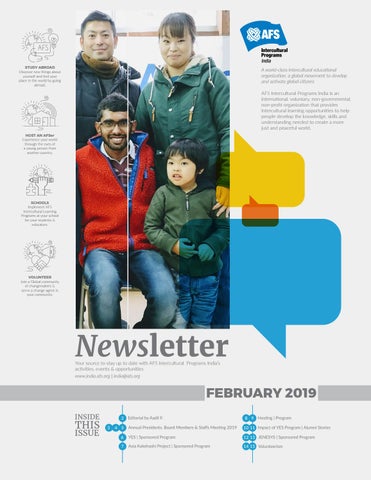
Cover Photo: Namit Pai from Jabalpur Designed by Aadil F. For any suggestions, or sharing stories or experiences, please write at aadil.fahim@afs.org Learn more about AFS at india.afs.org Be inspired by our history at india.afs.org/afs-timeline/ Connect with us at: facebook.com/afsindia youtube.com/afsindiaofficial twitter.com/IndiaAFS instagram.com/afs_india/
AFS Intercultural Programs India Anand Bhawan, 12, Hailey Road, New Delhi - 110001 Office:+91-11-42512498/41501672/41540827 www.india.afs.org | india@afs.org