AfroRanking — Pharmacy Startup & Expansion in Africa
AFRORANKING — PHARMACY BUSINESS INTELLIGENCE
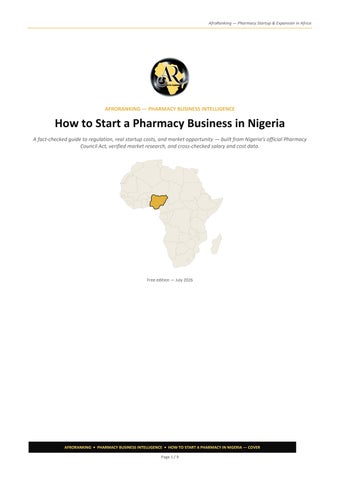
How to Start a Pharmacy Business in Nigeria A fact-checked guide to regulation, real startup costs, and market opportunity — built from Nigeria's official Pharmacy Council Act, verified market research, and cross-checked salary and cost data.
Free edition — July 2026
AFRORANKING • PHARMACY BUSINESS INTELLIGENCE • HOW TO START A PHARMACY IN NIGERIA — COVER Page 1 / 9
AfroRanking — Pharmacy Startup & Expansion in Africa
Why This Guide Exists Most "how to start a pharmacy in Nigeria" content online is either a paid business-plan template with no visible sourcing, or a promotional piece for a specific software vendor. This guide is neither. Every figure below is traceable to a named source — an official regulation, a peer-reviewed study, an independent market research firm, or a cross-checked salary survey — and is tagged with a confidence level so you know how much weight to put on it.
USD 1.97B → 3.18B
₦20M – ₦50M
Retail pharmacy market, 2024→2031
Market size (BlueWeave)
21,892 only 59% actively practicing
Realistic CAPEX range
Registered pharmacists
Want the full sourced report + interactive simulator for Nigeria and 6 other African markets? Get the Pharmacy Business Toolkit for Africa — afroranking.com/pharmacy-business-toolkit-for-africa/ This guide is for general information and does not constitute legal, financial, or investment advice. Regulatory fees and rules change — confirm current requirements directly with the Pharmacy Council of Nigeria (pcn.gov.ng) and the Corporate Affairs Commission before acting. It is also not a substitute for a local market survey of your specific site.
1 — Market Opportunity: How Big, and How Fast Nigeria's retail pharmacy market was valued at USD 1.97 billion in 2024, projected to reach USD 3.18 billion by 2031 — a 7.08% compound annual growth rate, according to BlueWeave Consulting's 2025 market report. This is the most narrowly scoped, retail-specific figure available and the one this guide treats as the primary benchmark.
Why estimates vary so widely Zoom out to the broader pharmaceutical market (including manufacturing, wholesale, and hospital supply, not just retail) and estimates diverge sharply across research firms — a pattern worth understanding rather than averaging away.
AFRORANKING • PHARMACY BUSINESS INTELLIGENCE • MARKET OPPORTUNITY Page 2 / 9
AfroRanking — Pharmacy Startup & Expansion in Africa
Research firm
Scope / horizon
Projected CAGR
DrugPatentWatch
Pharma market to 2030
5.3%
BlueWeave Consulting
Retail pharmacy only, to 2031
7.08%
Precision Business Insights
Pharmaceuticals, to 2032
8.1%
Coherent Market Insights
Pharmaceuticals, to 2033
9.5%
The spread (5.3%–9.5%) reflects different market definitions and forecast horizons more than genuine disagreement about direction — every firm agrees the market is growing, none of them agrees on precisely how fast. Treat any single-figure claim you encounter elsewhere with the same caution this guide applies to its own numbers.
What's driving the growth ●
A demographic base of roughly 220 million people, with population continuing to expand.
●
Rising non-communicable disease burden — cardiovascular disease, chronic respiratory conditions, diabetes, and cancer together account for a substantial and growing share of deaths in Nigeria, driving sustained demand for regular medication.
●
A government policy push toward local manufacturing: in June 2024, President Bola Tinubu signed an Executive Order targeting local production capacity sufficient to meet 50% of domestic pharmaceutical demand — part of a broader "backward integration" strategy moving from importing finished drugs, to local packaging, to local formulation, and eventually API (Active Pharmaceutical Ingredient) production.
●
A retail landscape that remains fragmented, with no single dominant chain — a documented gap that independent market-entry analyses (including a Walgreens market-entry strategy assessment) have flagged as a genuine opening for well-run independents and small chains.
Sources: BlueWeave Consulting, Nigeria Retail Pharmacy Market report (2025); DrugPatentWatch regulatory/strategic comparison (Jan 2026); Precision Business Insights and Coherent Market Insights Nigeria pharmaceutical market reports; Retail Pharmacy in Nigeria — Walgreens Entry Strategy market-entry analysis.
The distribution margin structure Industry commentary citing McKinsey analysis suggests that cumulative markups from manufacturer to patient across Nigeria's multi-tier distribution chain can reach roughly 80% in total, with retail pharmacies and distributors each typically adding on the order of 30–40% at their respective stages. This is directional industry commentary, not an audited statistic, but it is a useful reference point for margin planning. Source: TC Health, "Pharmacy Benefit Management in Nigeria" (citing McKinsey estimates). Confidence: Medium — industry commentary, not a primary statistical release. AFRORANKING • PHARMACY BUSINESS INTELLIGENCE • MARKET OPPORTUNITY Page 3 / 9
AfroRanking — Pharmacy Startup & Expansion in Africa
2 — The Regulatory Pathway Nigeria's pharmacy sector answers to two separate bodies, and conflating them is a common early mistake. The Pharmacy Council of Nigeria (PCN) — established under the Pharmacy Council of Nigeria (Establishment) Act, 2022 — regulates pharmacy practice: registering pharmacists and pharmacy technicians, and inspecting, licensing, and registering pharmaceutical premises. NAFDAC, a separate agency, regulates the products themselves. A compliant pharmacy needs a PCN premises licence and to sell only NAFDAC-registered products.
The ownership rule that changes your cap table A company or chain retail pharmacy cannot be owned outright by non-pharmacists. Under Section 27(3) of the 2022 Act, a Nigerian or foreign company operating a chain retail or community pharmacy must have Nigerian-registered pharmacist(s) on its board of directors, solely or jointly owning at least 40% of company shares. A pharmacist who falsely claims this ownership share commits an offence punishable by a fine equal to the value of the shares claimed, or up to two years' imprisonment, or both.
For a wholesale, import, export, storage, or distribution business, the bar is lower but still real: at least one board member must be a registered pharmacist who is also a shareholder — the specific 40% threshold applies to chain retail/community pharmacies, not to this category.
The Superintendent Pharmacist Every pharmaceutical premises must operate under the direct supervision of a registered Superintendent Pharmacist. If a premises operates without one for 30 continuous days, its registration automatically lapses — meaning the business cannot legally trade until a new Superintendent is appointed and registered. This singlepoint-of-failure risk is worth planning for explicitly, particularly for an investor who is not a pharmacist and depends entirely on a hired Superintendent. Cross-checked salary data across multiple independent sources (Glassdoor, Profolio, and Nigerian job-listing sites) converges on a working range: entry-level pharmacists earn roughly ₦120,000–250,000 per month, rising to ₦400,000–800,000 or more for experienced pharmacists — a reasonable planning band for a Superintendent Pharmacist's monthly compensation, which sits toward the middle-to-upper end of this range given the minimum two-year post-registration experience requirement.
AFRORANKING • PHARMACY BUSINESS INTELLIGENCE • REAL STARTUP COSTS Page 4 / 9
AfroRanking — Pharmacy Startup & Expansion in Africa
3 — Registering an Online or Hybrid Pharmacy (2026 Rules) Nigeria's Electronic Pharmacy Regulations, 2026 replaced the 2021 online-pharmacy rules and formally recognised two categories of operator: Electronic Pharmaceutical Service Providers (EPSPs), which directly sell and dispense to consumers, and Electronic Pharmacy Aggregators (EPAs), third-party platforms that connect multiple EPSPs to consumers without owning the products themselves. Both must operate under a licensed Superintendent Pharmacist linked to a registered physical premises — and each Superintendent Pharmacist may register only one electronic pharmacy.
All transactions route through the National Electronic Pharmacy Platform (NEPP), a centralized system launched in 2025 for prescription verification, transaction traceability, and data governance. The 2026 rules also expressly prohibit cross-border sales except in narrowly defined lifesaving circumstances, and add consumer return rights for expired or tampered products. Sources: Pharmacy Council of Nigeria (Establishment) Act, 2022 (official gazette); PCN Electronic Pharmacy Regulations 2026 review — Mondaq/Stren & Blan Partners legal analysis; Salient Advisory regulatory brief; Businessday NG legal review; Pharmaceutical Society of Nigeria official statement.
4 — Real Startup Costs There is no single correct number here — cost depends heavily on format, city, and how much of the process you outsource. What follows is every cost band this guide could independently verify, with its source and confidence level, rather than one blended average.
AFRORANKING • PHARMACY BUSINESS INTELLIGENCE • REAL STARTUP COSTS Page 5 / 9
AfroRanking — Pharmacy Startup & Expansion in Africa
CAPEX: the one-off investment Cost item
Range
Total CAPEX (independent urban pharmacy)
₦20,000,000 – ₦50,000,000
Confidence
Source
●●○ Medium
Nigerian startupcost guides, crosschecked vs. documented case
CAC business registration
₦50,000 – ₦200,000
●●○ Medium
Nigerian companyformation guidance; AfroRanking published estimate
PCN + NAFDAC licensing (combined)
₦500,000 – ₦1,500,000+, scaledependent
●●○ Medium
AfroRanking published Nigeria estimate
PCN premises inspection fee, per visit
₦10,000 (first 2 visits) / ₦20,000 (after)
●●● High
PCN premises registration guideline
●○○ Low
Third-party investor-guide estimate, not independently corroborated
Initial inventory (small format)
₦2,000,000 – ₦4,000,000
Where a single figure appears in only one uncorroborated source, it is tagged Low confidence and should be treated as a starting hypothesis, not a budget line to commit to.
OPEX: the monthly running cost Cost item
Range
Confidence
Rent (Lagos/Abuja, modest but decent premises)
₦125,000 – ₦330,000/month
●●○ Medium
Superintendent Pharmacist salary
₦150,000 – ₦650,000/month, experience-dependent
●●○ Medium
Backup power (generator/inverter + fuel)
Consistently a top-3 monthly OPEX line
●●○ Medium
Two independent Nigerian salary-data sources put rent estimates in a materially lower band (as low as ₦40,000– ₦85,000/month, based on a two-year prepaid lease figure of ₦1–2 million). This guide presents the higher, more consistently cited ₦125,000–₦330,000/month range as its primary estimate, but the divergence itself is worth flagging: get an actual quote for your specific neighborhood before budgeting either figure.
A real documented case: Abuja A publicly documented Abuja pharmacy business plan requested ₦40,000,000 in total funding, with ₦11,540,000 in annual operating expenses against a projected ₦9,716,667 in annual net profit — implying a payback of approximately 4.1 years on that specific project (₦40M ÷ ₦9.72M). This is one real, named case, not a market average, and other claims of much faster payback (12–14 months) found elsewhere online are not independently corroborated and are not used in this guide.
AFRORANKING • PHARMACY BUSINESS INTELLIGENCE • REAL STARTUP COSTS Page 6 / 9
AfroRanking — Pharmacy Startup & Expansion in Africa
5 — Common Mistakes That Sink New Pharmacies ●
Budgeting only for opening day. Funding fit-out and initial stock while underestimating the operating runway needed before reaching steady cash flow is a frequent cause of early cash-burn failure.
●
Getting the product mix wrong. Sourced guidance converges on a working mix of roughly 70% generics complemented by OTC and front-shop products; skewing far from this narrows revenue and resilience.
●
Treating the 40% ownership rule as a footnote. Investors structuring a chain without a Nigerian pharmacist holding at least 40% of shares on the board discover the problem only when PCN registration is refused — after capital is committed.
●
Ignoring NEPP integration for hybrid or delivery models. This is a distinct, evolving compliance cost that pure brick-and-mortar plans often skip entirely.
●
Missing the renewal calendar. The 31 January (practising fee) and 31 March (premises retention) deadlines are strict — missing them triggers automatic fines or closure risk, not a grace period.
●
Trusting a single online cost figure. As this guide's own cost tables show, credible sources diverge by 2–3x on rent and inventory — a single quoted number, without a range and a source, should be treated as marketing copy until verified.
6 — Frequently Asked Questions Q. Do I need to be a pharmacist myself to own a pharmacy in Nigeria? Not necessarily, but the structure matters. An individual retail pharmacy must be owned by a registered pharmacist. If you are not a pharmacist, common structures include a partnership where a pharmacist takes an equity stake in exchange for the professional licence, or hiring a Superintendent Pharmacist on salary while you retain ownership of the underlying company (outside the chain-retail 40% rule, which applies specifically to chain formats). Q. What's the actual difference between a PCN premises licence and a PPMV licence? A PCN premises licence, requiring a supervising Superintendent Pharmacist, is needed to sell prescription-only and scheduled drugs. A Patent & Proprietary Medicine Vendor (PPMV) licence is a lighter, lower-barrier alternative covering OTC-only categories, without requiring a registered pharmacist on-site. Many first-time entrepreneurs start with a PPMV shop and expand to a full PCN licence later. Q. How long does PCN premises registration actually take? This guide could not find an officially published timeline and does not invent one. The process runs through a location-approval visit, build-out, a final inspection, and certificate issuance — treat it as a multi-week to multimonth process and confirm current timelines directly with PCN. Q. Is the ₦20–50 million CAPEX figure realistic for a small pharmacy, or only a mid-size one? It's aimed at an independent urban pharmacy of modest-to-mid size. A very lean, PPMV-only format in a smaller town could start meaningfully lower; a multi-room, cold-chain-heavy pharmacy in a prime Lagos or Abuja location could exceed the top of this range. Treat ₦20–50M as a planning band for the most common format, not a hard ceiling or floor. AFRORANKING • PHARMACY BUSINESS INTELLIGENCE • NEXT STEP Page 7 / 9
AfroRanking — Pharmacy Startup & Expansion in Africa
Q. Can a foreigner own a pharmacy business in Nigeria? The 2022 Act's ownership rules for chain retail pharmacies apply to "Nigerian or foreign company" alike — a foreign-owned company can operate a chain, provided Nigerian-registered pharmacist(s) hold at least 40% of shares on the board, per Section 27(3). This guide has not independently verified additional foreign-investment or immigration requirements beyond the PCN ownership rule, and recommends specialist legal advice on that separate question. Q. What happens if my Superintendent Pharmacist resigns suddenly? The premises' registration lapses if it operates without a Superintendent Pharmacist for 30 continuous days. In practice, this means the business cannot legally trade past that window until a replacement is appointed and registered — a real operational risk worth planning a contingency for before it happens, not after. Q. Do I need a separate NAFDAC registration if I already have a PCN premises licence? Yes — they cover different things. PCN licenses the premises and the professionals; NAFDAC registers the actual medicines and products sold. A compliant pharmacy needs both a PCN premises licence and to stock only NAFDACregistered products. Q. Where can I model my own numbers instead of using this guide's ranges? The companion AfroRanking Pharmacy Startup & Expansion in Africa toolkit includes an interactive simulator that lets you replace every range in this guide with your own real rent, staff, and stock quotes, and generates a 5-year financial projection and a shareable PDF report. See the final page for details.
Next Step: The Full Nigeria Toolkit This guide gives you the regulatory map and verified cost ranges. The full AfroRanking Pharmacy Startup & Expansion in Africa toolkit turns those ranges into a model built around your own numbers. Included
What it gives you
55-page sourced report
Full Nigeria chapter plus six other African markets (Senegal, Kenya, Ghana, South Africa, Côte d'Ivoire, Rwanda) for comparison, each confidence-tagged and sourceregistered.
Interactive HTML simulator
Your own CAPEX, OPEX, and financing structure, with a live 5-year projection and a "configuration health" check before you export.
Investor-ready PDF export
One click produces a 6-page report with five explained charts you can bring straight to a bank or partner.
Get the full toolkit directly at the link below: ●
Pharmacy Business Toolkit for Africa — afroranking.com/pharmacy-business-toolkit-for-africa/
●
Continental overview — afroranking.com/en/opening-a-pharmacy-in-africa/
●
Business plan writing services — afroranking.com/en/writing-a-business-plan-in-africa/
AFRORANKING • PHARMACY BUSINESS INTELLIGENCE • NEXT STEP Page 8 / 9
AfroRanking — Pharmacy Startup & Expansion in Africa
Source Register Source (click to open)
Used for
Pharmacy Council of Nigeria (Establishment) Act, 2022
Ownership rules, Superintendent Pharmacist requirement, penalties, renewal deadlines
PCN — Guidelines for Registration of Pharmacists and Pharmaceutical Premises
Registration steps, inspection fees, siting rules
Ekpenyong et al., Journal of Pharmaceutical Policy and Practice, 2018
Pharmacist workforce statistics and regional distribution
BlueWeave Consulting — Nigeria Retail Pharmacy Market report
Primary market-size and growth figure
Salient Advisory — Nigeria's Electronic Pharmacy Regulations
Electronic Pharmacy Regulations 2026 analysis
AfroRanking — Opening a Pharmacy in Africa
Licensing cost estimate, product-mix guidance
Additional sources referenced (no stable direct-document link available):
●
DrugPatentWatch, Precision Business Insights, Coherent Market Insights — broader pharmaceutical market CAGR range
●
Retail Pharmacy in Nigeria — Walgreens Entry Strategy — market fragmentation context
●
TC Health (citing McKinsey) — distribution markup structure
●
Glassdoor, Profolio, NigerianPrice, HotNigerianJobs — cross-checked pharmacist/Superintendent salary range
This guide does not include claims from sources that could not be independently corroborated, including a widely circulated "14-month breakeven" figure and a specific inventory-loss-reduction statistic attributed to a named software vendor — both omitted rather than repeated unverified.
AFRORANKING • PHARMACY BUSINESS INTELLIGENCE • SOURCES Page 9 / 9