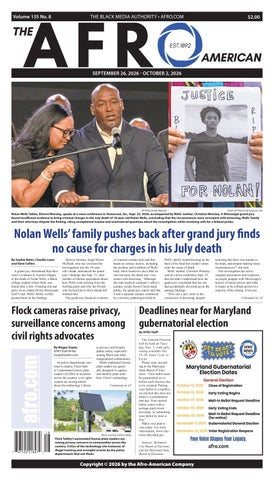
Volume 135 No. 8
THE BLACK MEDIA AUTHORITY • AFRO.COM
$2.00
$2.00
SEPTEMBER 26, 2026 - OCTOBER 2, 2026
AP Photo/Emilie Megnien
Credit: AP Photo/Yuki Iwamura, File
Nolan Wells’ father, Elmore Wonsley, speaks at a news conference in Stonecrest, Ga., Sept. 22, 2026, accompanied by Wells’ mother, Christine Wonsley. A Mississippi grand jury found insufficient evidence to bring criminal charges in the July death of 18-year-old Nolan Wells, concluding that the circumstances were consistent with drowning. Wells’ family and their attorneys dispute the finding, citing unexplained trauma and unanswered questions about the investigation while renewing calls for a federal probe.
Nolan Wells’ family pushes back after grand jury finds no cause for charges in his July death By Sophie Bates, Claudia Lauer and Dave Collins A grand jury determined that there wasn’t evidence to warrant charges in the death of Nolan Wells, a Black college student whose body was found after a July 4 boating trip and party on an island off the Mississippi Gulf Coast. Wells’ family swiftly pushed back on the findings.
District Attorney Angel Myers McIlrath, who has overseen the investigation into the 18-yearold’s death, announced the grand jury’s findings late Sept. 21, after months of intense speculation about how Wells went missing from the bustling party and why the friends who ferried him to Horn Island left without him. The grand jury found no evidence
of criminal conduct and said that based on various factors, including the position and condition of Wells’ body when found two days after he was last seen, his death was “consistent with drowning.” Although the state medical examiner’s office’s autopsy results haven’t been made public, the grand jury report said that it and a separate autopsy conducted by a forensic pathologist hired by
afro.com
Flock cameras raise privacy, surveillance concerns among civil rights advocates By Megan Sayles AFRO Staff Writer msayles@afro.com As police departments continue to deploy Flock Safety’s automated license plate readers (ALPRs) in localities across the country, civil rights experts are raising alarms about the technology’s threat
to privacy and broader public safety, especially among Black and other marginalized communities. While traditional license plate readers are generally designed to capture and identify plate numbers, Flock’s technology Continued on A5
Photo courtesy of Flock Safety
Flock Safety’s automated license plate readers are raising privacy concerns in communities across the country. Critics of the technology cite instances of illegal tracking and wrongful arrests by the police departments that use them.
Wells’ family found bruising on the back of his head but couldn’t determine the cause of death. Wells’ mother, Christine Wonsley, said at a news conference Sept. 22 that she didn’t understand how the grand jury concluded that her son had accidentally drowned given the autopsy findings. “How can a jury come to the conclusion of drowning, despite
knowing that there was trauma to his body, and despite hearing many inconsistencies?” she said. The investigation has led to rampant speculation and suspicion as people grapple with Mississippi’s history of racial tension and what it means to be a Black person in a majority white setting. Everyone Continued on A3
Deadlines near for Maryland gubernatorial election By AFRO Staff The General Election will be held on Tuesday, Nov. 3, with early voting available Oct. 22–29, from 7 a.m. to 8 p.m. Please note, according to the Maryland State Board of Elections, “Your ballot must be postmarked on or before each election day to be counted. Putting your ballot in a mailbox on election day does not mean it is postmarked that day. Your mailed ballot comes with a postage-paid return envelope, so submitting your ballot by mail is free.” Make your plan to vote today. For more information, www.elections.maryland.gov Sources: Baltimore City Board of Elections and the Maryland State Board of Elections.
Copyright © 2026 by the Afro-American Company
A2 The Afro-American September 26, 2026 - October 2, 2026
WHAT’S TRENDING ON AFRO.COM
News outlets sue 47th president over lost White House access, citing ‘blatant violation’ of First Amendment By Jocelyn Noveck CNN, MS NOW and Politico on Sept. 21 sued President Donald Trump’s administration days after they were barred from White House grounds, calling the selective ban — based on the content of their coverage — a “blatant violation” of the First Amendment. Trump said on social media that he “cherished” a free press but not “FAKE NEWS.” “White House access is a privilege — not a right,” the administration said, in a post on social media. The extraordinary ban of the three news outlets’ reporters, which began over the weekend, represented a clear escalation of Trump’s long-running efforts — in the courts and through administrative action — to restrict news coverage he finds objectionable. They were also the latest test of First Amendment protections in the United States, where the government is constitutionally forbidden from restricting the press. The Constitution, the banned news outlets said in their lawsuit, “does not allow a
AP Photo/Jose Luis Magana
CNN, MS NOW and Politico are suing after their reporters were barred from the White House, arguing that the selective restrictions based on their coverage violate First Amendment protections. Shown here, the empty James Brady Press Briefing Room seen at the White House, Sept. 19, 2026, in Washington, D.C. president or any other government official to deprive the press of their First Amendment rights and liberty and property interests with no notice or process based solely on his dislike of the content of their reporting.” The three outlets filed the joint lawsuit two days after their reporters were blocked from the White House and prevented from doing their jobs. The reporters’ entry
Your History • Your Community • Your News
The Afro-American Newspapers Baltimore Office • Corporate Headquarters 233 E. Redwood Street 6th Floor, Suite 600G Baltimore, Maryland 21202 410-554-8200 Customer Service, Home Delivery and Subscriptions: 410-554-8200 customerservice@afro.com Founded by John Henry Murphy Sr., August 13, 1892 Chairman of the Board/Publisher - Frances Murphy Draper (Publisher Emeritus - John J. Oliver Jr.) President - Benjamin Murphy Phillips IV VP of Marketing and Technology - Kevin E. Peck Director Digital Solutions - Dana Peck Receptionist - Wanda Pearson - 410-554-8200, ext. 246 Director of Operations
Andrè Draper - 410-554-8200
Director of Finance
Bonnie Deanes - 410-554-8242
Director of Sales Robert Walker-Smith - 410-554-8200 rwalker-smith@afro.com Editorial Managing Editor - Alexis Taylor - 410-554-8257 Editorial Assistant - Ama Brown-Parson Evening / Weekend Editor - Zenitha Prince Archivist - Savannah Wood- 410-554-8277 Baltimore Circulation/Distribution Manager Andrè Draper - 410-554-8200 Creative Design and Content Matthew McDonald
Washington Office 1140 3rd Street, N.E., 2nd Floor Washington, D.C. 20002-6723 202-332-0080 • Fax: 410-554-8213 (Washington Publisher Emerita - Frances L. Murphy II) Director of Operations - Andrè Draper - 410-554-8200
,GHQWLÀFDWLRQ 6WDWHPHQW
THE AFRO AMERICAN – (USPS 040-800) is published weekly by The Afro American Company, 233 E. Redwood Street, 6th Fl., Ste. 600G, Baltimore, MD 21202.
6XEVFULSWLRQ 5DWH 1 Year - $100.00 Print & Digital ($40 Digital Only) (Price includes tax). Checks for subscriptions should be made payable to: The Afro American Company, 233 E. Redwood Street, 6th Fl., Ste. 600G, Baltimore, MD 21202. 3HULRGLFDOV SRVWDJH SDLG DW %DOWLPRUH 0' DQG DGGLWLRQDO PDLOLQJ RIÀFHV POSTMASTER: 6HQG DGGUHVVHV FKDQJHV WR THE AFRO AMERICAN, 233 E. Redwood Street, 6th Fl., Ste. 600G, Baltimore, MD 21202.
badges were disabled Sept. 19, a day after Trump had suddenly announced he was barring the outlets because of reporting he considered “fake news.”
CNN is removed from pool duties, and other outlets take a stand in solidarity
On the morning of Sept. 21, the banned TV networks were reporting from an intersection just outside the White House complex. CNN, meanwhile, was removed from its pool duties, which are shared by the five major networks. It had been scheduled to cover the president’s trip to New York for the United Nations General Assembly. In an email to members, the TV pool said there would be no replacement coverage — and other networks would suspend their own pool coverage indefinitely. “Effective today, the TV pool will not be covering events designated as pool coverage of the President,” said the email, seen by The Associated Press, from the current chair of the pool, Fox’s Washington bureau chief, Bryan Boughton. “This follows the White House’s position preventing CNN from fulfilling its assigned pool duties.” Other news outlets also took steps in solidarity. The AP joined a number of news organizations, including The
Washington Post and The New York Times, in a decision not to publish photographs of presidential events on Sept. 21. The White House did not respond directly to a request for comment on the lawsuit. But in a news release posted on X, it said of the three banned outlets, “The First Amendment protects their right to publish; it does not entitle them to a hard pass, briefing room seat, or place in the press pool.” Vice President JD Vance, meanwhile, told reporters that the journalism of the three outlets is “effectively far-left propaganda,” and said they were still allowed to report — just not to have offices in the White House.
The lawsuit claims a ‘direct assault’ on the First Amendment In his second term, Trump and his Republican administration have upped the ante and punished certain media outlets. Trump has also lashed out at individual reporters in person or over social media, sometimes in strikingly personal terms — insulting them in briefings or in his recent speech at the White House Correspondents’ Association dinner. “This morning, we notified the government that we are filing a lawsuit today to protect our First Amendment rights
and defend the principle that the government does not decide what the press reports or publishes,” the banned outlets said in a joint statement posted early Sept. 21 on X. “Left unchallenged, this threatens press freedom and the public’s right to independent journalism free from government interference.” In the joint complaint, accompanied by a separate request for a temporary restraining order blocking enforcement of the bans, the outlets said, “This ban could not be a more direct assault on the First Amendment nor a more blatant violation of our most fundamental constitutional principles.” In legal terms, it’s known as “viewpoint discrimination” — the government singling out specific media outlets for the content of what they say or publish. That legal principle is at issue in many of the court cases around Trump’s treatment of the media and would likely be at play this time. Jameel Jaffer, executive director of the Knight First Amendment Institute at Columbia University, called the White House move “an attack both on press freedom and the public’s right to independent information about the government.” “The president’s decision to bar news organizations from the White House for the content of their reporting is a flagrant violation of the First Amendment,” said Jaffer, whose institute is filing a brief to support the lawsuit. The case has been assigned to U.S. District Judge Timothy Kelly, whom Trump nominated during his first term in the White House.
Reporters were barred Sept. 19 from their White House offices On Sept. 19, White House reporters from the two cable networks — Betsy Klein of CNN and Akayla Gardner of MS NOW — went live to
report they’d been turned away, their press badges deactivated, when arriving for their jobs at the White House. Soon after, Politico said its White House reporter Cheyenne Haslett was also denied entry and had her badge confiscated. The WHCA’s president, Jacqui Heinrich, called on the Trump administration to immediately restore the three outlets’ access. “The implications extend beyond these organizations: a standard used to exclude one news outlet because of its coverage could be applied to any outlet in the future,” Heinrich said. The current showdown follows the president’s decision last year to bar AP reporters from the Oval Office, Air Force One and some events in retaliation for the news outlet’s decision not to follow his lead in changing the name of the Gulf of Mexico, which lies partially in Mexican and other waters. The AP said it would note when appropriate that Trump had ordered it renamed the “Gulf of America.” The AP filed suit and the case is ongoing. Since returning to office, Trump has pursued other legal action against a variety of different outlets, including The New York Times, The Wall Street Journal and the BBC. His administration is also involved in a long-simmering confrontation involving ABC over renewal of its broadcast licenses. It was not known how long the standoff between the White House and some members of the media would continue. But the effects of missing pool coverage were clear later Monday as Trump showed off a new White House helicopter landing pad — with no TV cameras to record the moment or catch what he was saying. This article was originally published by The Associated Press (AP). AP reporter Michael Kunzelman contributed to this report.
Police believe Black man found hanging in Maryland died from suicide By Megan Sayles AFRO Staff Writer msayles@afro.com A Black man was found hanging outside in the 9300 block of D’Arcy Road in Upper Marlboro, Md.,. on Sept. 20, prompting an investigation by the Prince George’s County Police Department (PGPD). Police say no evidence of foul play has been discovered at this time but the case remains open. “Based on the preliminary investigation, to include speaking to those who knew the decedent and learning about his background, investigators believe this was a suicide,” said PGPD in a Sept. 20 statement on Facebook. According to PGPD, officers found the man, who has yet to be identified, after getting reports of an individual hanging at approximately 7:55 a.m. on Sept. 20. The man was pronounced dead at the scene.
Unsplash / Scott Rodgerson
Police in Upper Marlboro, Md., believe a Black man found hanging on Sept. 20 died by suicide. Prince George’s County Executive Aisha Braveboy responded to the incident in a statement on Sept. 21. “I know this incident has been deeply upsetting for many residents who witnessed the scene or heard about it throughout the day,” said County Executive Aisha day,” Braveboy said. “Police Chief Nader and I met with community members to answer
questions and provide information on available mental health resources.” Though investigators believe the death was a suicide, the circumstances have evoked images of lynching and its legacy in the U.S. At-large Councilwoman Wala Blegay addressed this history in a Sept. 21 statement, saying she was “deeply saddened and disturbed” by
the death. “My heart goes out to his family, loved ones and everyone in our community who has been impacted by this heartbreaking loss. I also recognize how deeply painful and disturbing the circumstances of this death are, particularly for members of our Black community,” Blegay said. “The image of a Black man hanging from a tree carries a painful history in this country, and I understand the fear, concern and questions this incident has raised.” She emphasized the need for a clear understanding of what happened and for authorities to keep the public informed. “Our community deserves a thorough investigation and clear, transparent communication as additional facts become available,” continued Blegay. Individuals with information regarding the man’s death can call PGPD detectives at 301-516-2512.
September 26, 2026 - October 2, 2026 The Afro-American A3
Nolan Wells
support these narratives,” she said. Attorneys for three of Wells’ friends who have been subjected to widespread, unsubstantiated online rumors that they contributed to his death said the grand jury’s report is a weight off their clients’ shoulders. “He said that he felt like he could breathe for the first time,” attorney Tyler Cox said of one of Wells’ friends. “This doesn’t bring Nolan back at all, but this can at least put them on a path where they can finally mourn Nolan now that they’ve been officially cleared of any wrongdoing.”
Continued from A1 else in the group that traveled with Wells to the island is white. Attorneys for friends of Wells who are white and have been the subject of online rumors and accusations hailed the report’s findings, with one saying his client can now properly grieve. During its investigation into whether crimes were committed, the grand jury issued 132 subpoenas and heard from 43 witnesses through direct testimony, sworn statements and recorded interviews, according to the report. It weighed evidence, including cellphone data and forensic reports, videos and GPS data.
Wells’ family rejects the findings
Lawyers for Wells’ family, including civil rights attorney Ben Crump, said the grand jury’s report yielded more questions than answers, and they accused the district attorney of ending the investigation despite not determining what caused blunt force trauma to the back of Wells’ head and body. “All other causes must be ruled out prior to certifying a death as drowning,” Crump, whose team released the final version of the independent autopsy report Sept. 22, said at the news conference. “What is another cause the district attorney failed to rule out? Blunt force trauma ... Common sense tells you that this child did not just drown.” A witness testified to the grand jury that he saw Wells slip awkwardly off the side of a boat around 3:30 p.m. on July 4, but that Wells continued to socialize after the fall and didn’t appear injured, the report said. The panel said it couldn’t determine whether the fall caused the bruising on Wells’ body.
Questions remain about what led to Wells’ death
AP Photo/John Amis
Christine Wonsley looks at a photo of her deceased son Nolan Wells, as husband Elmore Wonsley (left), stands at her side during the National Urban League’s annual conference on July 30, in Nashville, Tenn. page, and that this lacked empathy. “Last night was a reminder that our son’s life does not matter to those who hold positions that are supposed to serve and protect the public,” Wonsley said, struggling through tears. “Nolan is loved. He is cherished. He is honored. And he did not deserve to have his life taken away so suddenly.” Crump and others renewed their request Sept. 22 for the U.S. Department of Justice to conduct an independent investigation, and called on McIlrath to release the investigation file and the state medical examiner’s full autopsy report. Kristen Clarke, general counsel for the NAACP and a former head of the DOJ’s Civil Rights Division, said it would make sense for the Justice Department to open an investigation given that the island is a federally maintained and patrolled barrier island.
“How can a jury come to the conclusion of drowning, despite knowing that there was trauma to his body, and despite hearing many inconsistencies?” – Christine Wonsley, mother of Nolan Wells Wonsley said she was informed of the grand jury’s findings only minutes before McIlrath posted a video about them on her office’s Facebook
At Wells’ funeral, the Rev. Al Sharpton invoked the state’s racist history during his eulogy, including the lynching of Emmett Till
and assassination of Medgar Evers. “Mississippi’s history painfully teaches us exactly why families should never be expected to simply accept unanswered questions surrounding the death of a young Black person,” Sharpton said in a statement Sept. 22. “Transparency and accountability matter. The truth matters. Nolan’s life mattered.” Shortly after Wells was found dead, Jackson County sheriff’s officials said investigators didn’t suspect foul play, sparking widespread concerns about whether law enforcement would conduct a thorough investigation. McIlrath repeatedly promised a fair and thorough investigation into his death.
Prosecutor defends the probe and condemns ‘false narratives’
In her 15-minute video announcing the grand jury findings, McIlrath expressed frustration about inaccurate speculation about what happened to Wells. She also said lawyers for Wells’ family told her office last month that their own investigation found no evidence of crimes. “What I cannot accept, what I cannot ignore, is that false narratives that Nolan’s death was somehow racially motivated, and that this is a case of another young Black man denied justice by a racist, corrupt system, were perpetuated and allowed to spread. There is not a shred of evidence to
RESERVE THE TABLE EVERYONE’S TALKING ABOUT. Book a night out that gives back through United Way of Central Maryland’s Dine United campaign. Reserve an exclusive dining experience or find a partner restaurant and help fund United Way's programs to support those who are working hard but struggling to make ends meet.
Reserve your table
uwcm.org/DineUnited
THANK YOU TO OUR IN-KIND SPONSOR
THANK YOU TO OUR PARTNERS & SUPPORTERS
Wells’ parents and their lawyers voiced suspicions after Wells’ friends left the island without him, saying he wanted to stay behind and talk to a girl. Wells’ phone was on the boat that took him to the island, which was later towed partway back to the mainland after taking on water. Crump and Wells’ parents have cast doubt on why a teenager would choose to stay on an island without his phone. They also speculated that messages on his phone had been tampered with and alleged that his friends were reluctant to turn over his phone and keys. The grand jury was given a report from Crump’s experts on the contents of Wells’ phone, though the specific contents weren’t detailed in the grand jury’s redacted report. The grand jury found that it wasn’t unusual or suspicious for people to return from the island on boats they didn’t take to get there, according to the report. And it noted that Wells’ phone wasn’t the only one to travel back to the mainland without its owner that day. The report also said that although alcohol was found in Wells’ body, the result was highly unreliable because the testing involved decompositional fluid. Such fluid examined after someone’s death may include alcohol consumed during life as well as ethanol generated after death by microbial fermentation, it said. The grand jury report concluded with the panel expressing sympathy for Wells’ family. “The evidence received in this matter convinced the Grand Jury of Mr. Wells’ outstanding character,” it said. This article was originally published by The Associated Press. Collins reported from Hartford, Conn., and Lauer reported from Philadelphia.
A4 The Afro-American September 26, 2026 - October 2, 2026
COMMENTARY
Black unemployment is falling, but the racial economic divide continues By Dedrick AsanteMuhammad As noted in the Joint Center’s “State of the Black Labor Market” report, the 2026 August jobs report delivered encouraging news. The economy added 162,000 jobs, exceeding expectations. Black unemployment has declined meaningfully over the course of 2026, falling from 7.3 percent in January to 6.0 percent in August. To put that in perspective, the Black unemployment rate averaged roughly 10.0 percent during the 2000s and 10.8 percent during the 2010s. The most recent unemployment data rate reflects a labor market that, by historical standards, is low but compared to other contemporary American communities has the highest rate of unemployment. A 6.0
percent Black unemployment rate still sits nearly two full percentage points above the overall national rate of 4.1 percent and well above the 3.7 percent rate for white workers. That persistent inequality is a fixture of the American economy across booms, recessions, and recoveries alike and this current administration and congress appears to have no will to address racial inequality particularly as it relates to African Americans. And when we look beyond the headline unemployment number, the picture grows more complicated. Between January and August 2026, the Black labor force shrank by approximately 288,000 people. Black employment was essentially flat over those eight months, declining by roughly 3,000. The labor force participation rate declined from 62.7 percent
in January to 61.6 percent in August. These numbers show that the Black labor market still has much room for improvement. Perhaps most importantly, this labor market is not being experienced equally across Black communities. The first eight months of 2026 produced notably different realities for Black men and Black women. Black men saw the steadiest improvement. Their unemployment rate declined from 8.1 percent in January to 6.2 percent in August, with consistent month-over-month drops from April onward. Employment also increased in several industries where Black men are concentrated, including transportation and warehousing, construction, and manufacturing. Transportation and warehousing added approximately 5,000 jobs in August, construction added
Courtesy photo
Dedrick AsanteMuhammad is president of the Joint Center for Political and Economic Studies. approximately 22,000, and manufacturing added approximately 16,000. That trajectory is genuinely positive. The story for Black women is more uneven.
We open the door for young people, but are we helping them walk through it? By Kanika Cousine What happens when a young person can dream, but their circumstances keep getting in the way? I know something about that question because I was once that young person. At 15, while in foster care, I had to get an internship to afford clothes and other necessities. I remember worrying about where I could work so I wouldn’t have to keep wearing hand-me-downs or repeating the same clothes. I should have been thinking about school clubs, my grades and my future. Instead, I was thinking about what I needed to get through the present. Today, I see young people facing similar pressures. There are opportunities
available—internships, scholarships, workforce programs and pathways to college and careers. But opportunity alone isn’t always enough.
The support has to follow them
A young person may receive an internship and still worry about transportation, money, family responsibilities or keeping up with school. Those pressures don’t disappear because they walk through the door of an opportunity. They come with them. And sometimes, so does the emotional weight. A 2025 systematic review of 65 papers representing 39 U.S. studies found that financial strain was associated with poorer health and well-being among children and adolescents, including
more depressive symptoms among adolescents. That doesn’t mean financial hardship automatically causes depression or anxiety. Young people experience difficult circumstances differently. But we cannot ignore the effects of constant financial stress on a young person’s ability to focus, participate, and plan for the future.
My perspective is not a clinical diagnosis. It is a lived one.
I have been on the receiving end of these partnerships. We have welcomed young people into our worksites. Still, when a young person arrives, carrying challenges that affect their ability to participate, the support system does not always accompany
them. That is the gap we need to address.
Opportunity should come with support
If we are going to connect young people to opportunities, we also have to think about what happens after they walk through the door. Schools, internship programs, workforce organizations, and community groups can work together to create a stronger network of support. That could include mentors, peer support groups, trusted adult check-ins, and partnerships with organizations that provide mental health services and other resources. It doesn’t mean every program has to become a mental-health provider.
Their unemployment rate swung from 6.5 percent in January up to 7.7 percent in February, dropped, rose again, and eventually settled at 5.9 percent in August. But their labor force participation tells a more sobering story — falling from 60.7 percent in January to 58.4 percent in August. The industries where Black women are most represented — health care, education, social assistance, and government — saw mixed results. Health care added approximately 13,000 jobs in August and social assistance added approximately 16,000, but federal employment declined by approximately 5,000 and state government employment declined by approximately 10,000. The ongoing erosion of government employment carries outsized consequences for Black women who have historically relied on public-sector careers as a foundation for economic stability and middle-class opportunity. The broader question, though, is not simply whether the Black labor market is improving. It is whether it is improving fast enough and deeply enough to make a dent in the structural
economic inequality that defines the Black experience in America. The racial wealth divide did not emerge from unemployment alone, and it will not be resolved by employment alone. But the labor market is where most families build whatever economic security they have. When the majority of Black Americans are living in asset poverty — as our research has consistently documented — even modest disruptions in employment or labor force attachment can have cascading effects on household stability, debt, and long-term wealth accumulation. So where does that leave us? In a place that calls for honesty about what this moment is and what it is not. Some indicators of Black labor market conditions are improving. Black unemployment is trending downward and remains low by historical standards. But a labor market that is good by historical comparison is not the same as a labor market that is strong enough to build wealth, bridge racial inequality, and deliver the kind of broad-based economic security that Black communities need and deserve.
It means we should know who can help when a young person needs more than an opportunity. Because we cannot keep working in silos and expect young people to navigate the gaps between us. A school may know the student. An internship program may be familiar with the workplace. A community organization may know the resources. Imagine what could happen if those pieces worked together. Young people don’t need us to lower our expectations. They need us to build stronger support around the opportunities we are already giving them. We have to stop assuming that giving a young person an opportunity means the work is finished. Sometimes, opening the door is only the beginning. The real question is whether we are willing to walk through it with them.
Kanika Cousine is founder of Journey of A Dreamer INC, an organization that works to empower youth in underserved communities via enrichment resources and workforce development.
Feeding the world through policy and community By Rev. Dr. Heber Brown III Bread for the World recently held its annual Advocacy Summit in Washington, D.C. As a board member, I was honored to be part of conversations on how public policies affect people experiencing hunger and poverty. People from all walks of life and all backgrounds united with the common goal of developing institutions that advance food security. This moment was especially full of policy discussions as midterm season is in full swing across the country. Leaders are itching to advance on the campaign trail. They are more likely to be on the ground listening to what we have to say, so the opportunity is ripe to share what we care about. We can ask them what they will do to reduce hunger and improve food security for those in poverty. We can push for accountability.
Courtesy photo
Rev. Dr. Heber Brown III is an author, local business leader, community organizer and founder of The Black Church Food Security Network. But first, we must
understand the current policies and context today that create and maintain food apartheid. As of the 2017 Census, Black farmers were reported to own just 0.32 percent of U.S. farmland, a number which has been continuously decreasing over the past century. They are denied grants disproportionately to their white counterparts and earn approximately one-seventh of the income that their white counterparts bring in. Land ownership is steadily being stripped from us. In the last year and a half, the Supplemental Nutrition Assistance Program (SNAP) has been on the chopping block many times. Since July of 2025, well over 3.5 million people have been pushed out of the program as a result of cuts in the federal budget. Newly enacted work requirements unjustly require people to qualify themselves to eat. SNAP’s program for Women, Infants and Children
(WIC) is facing even further underfunding. Recent cuts will take away over $141 million in funds to feed over 5 million new mothers and young children — particularly funds designated for fresh fruits and vegetables. They are literally taking food out of the mouths of children. This says nothing of the centuries of racism, blocked resources and stolen land that brought us here today. It barely scratches the surface of all the factors influencing security today. We are facing hateful rhetoric, regressive social policies, global instability and widespread threats to Black, Brown and immigrant communities. All this uncertainty makes us feel vulnerable. It makes food security and, indeed, any economic stability more tenuous. There is no question that we need change; now is the moment to demand it from our leaders. Just as there are
policies that harm access to nutritious food, there are certainly policies that can expand access. We can remove work requirements for SNAP that pick and choose who gets to eat without regard for what they are going through. We can expand funding and access so that no one is left without nutritious food to sustain them. We can enact reparations to return land and opportunities to Black communities, and we can support the Black farmers and organizations working to feed people. But, as we raise our voices for policy change, we must not overlook actions in our own neighborhoods. I will always fight for a more representative government which supports the needs of our people. However, the government is still imperfect to say the least; we cannot wait for them while hunger runs rampant. We can take matters
Courtesy photo
into our own hands. Community organizing and self-reliance offers security especially when our government fails us; this is what we work for at The Black Church Food Security Network. We meet people where they are. We grow the food ourselves and distribute it throughout the community. We work together to build autonomy within our own communities. Such an immense issue as food insecurity cannot be wholly solved by one channel or one institution alone. It takes policy advocacy, community organizing and self-reliance moving hand-in-hand. Progress is possible when we approach it as a united front. As Bread for the World reminded us through the advocacy summit, hunger is not inevitable. It is possible to make change. If we come together to uplift our communities and advance essential policies, we can create an environment where people are not only fed, but they are in a better position to feed themselves.
The opinions on this page are those of the writers and not necessarily those of the AFRO. Send letters to The Afro-American ∙ 233 E. Redwood Street, Suite 600G Baltimore, MD 21202 or fax to 1-877-570-9297 or e-mail to editor@afro.com
September 26, 2026 - October 2, 2026 The Afro-American A5
Lionel Richie is taking a break from performing following a heart procedure By Maria Sherman Lionel Richie is taking a break from touring as he recovers from a heart procedure, a representative for the singer confirmed in a statement to The Associated Press on Sept. 23. Richie underwent a common procedure for atrial fibrillation, or A-fib, and the “doctor said everything went perfectly,” it read. “Lionel is doing great but will take some time off and will be back on stage soon.” A-fib is a quivering or irregular heartbeat that is a worrisome stage-setter for blood clots, stroke and heart failure. Some researchers believe more than 10 million Americans have it — most of them older. The 77-year-old singer also postponed two concerts earlier this year, in June, after falling ill. And in August, reports of Richie checking
himself into a hospital after a performance in St. Louis made the rounds online. Richie was scheduled to perform with Earth, Wind & Fire Saturday in San Francisco, Sept. 30 in Chicago and Oct. 3 in Columbus, Ohio. According to his website, he is currently scheduled to launch his “King of Hearts” residency shows at Las Vegas’ the Wynn in October and November. The Oscar and four-time Grammy Award-winning Richie launched his career with The Commodores before becoming a successful solo artist. In addition to his well-known hits like “Hello,” Richie co-wrote the iconic charity single “We Are the World” with Michael Jackson and has sold over 100 million records. He is also a judge on “American Idol.” This article was originally published by The Associated Press.
Flock cameras Continued from A1 uses artificial intelligence (AI) to collect and analyze a broader range of information about vehicles such as their make, model and color. Supporters of Flock cameras view the technology as an important tool for fighting crime and identifying suspects. Opponents, however, argue that the cameras enable “pattern of life” tracking—a surveillance and data analysis method used to document and map people’s daily habits, routines and movements. “They can reveal very intimate details about a person’s life. It could be what political meetings they go to, what religious institutions they attend, what doctors’ offices they go to and even where they sleep at night,” said Chad Marlow, senior policy counsel at the ACLU. “You can gain an enormous amount of information and that information can be used to target individuals or groups for almost any reason.” In recent years, Flock cameras have come under increased scrutiny for incidents of misuse and abuse by the agencies that deploy them. The Institute for Justice (IJ), a Virginia-based nonprofit, public interest law firm, has recorded more than 200 of these instances. In San Jose, Calif., an unnamed police officer was fired in September after using the system to share the location of a domestic violence victim with her abuser. In DeKalb County, Ga., a driver was wrongfully pulled over twice after the cameras incorrectly flagged her new car for insurance violations. In Akron, Ohio, in 2025, a police department analyst and officer used the system to track a local activist, Autumn Riddle, who had been critical of police. “It’s really become a nationwide surveillance network where a police officer who might not have access to someone’s movements can suddenly, because of Flock, access that information where they wouldn’t have been able to do that without Flock,” said Leah Frazier, director of the Digital Justice Initiative at the Lawyers’ Committee for Civil Rights Under Law. Both Frazier and Marlow emphasized that surveillance has historically been disproportionately used to target African Americans and other communities of color. A recent study by Christopher Newport University professors found that Flock cameras were disproportionately concentrated in Black and high-poverty communities across Hampton Roads, Va. “They can be used as an excuse to either continue or even increase the overdeployment of police into Black communities,” said Marlow. “We’ve even seen them used to target specific Black communities for fine and fee enforcement so that local communities can raise tax dollars from Black and low-income communities, instead of doing things like increasing property taxes, which falls more heavily on White and wealthier communities.” Flock has disputed the characterization of its technology as a live-tracking system, describing its ALPRs as a searchable
Photo by Jordan Strauss/Invision/AP
Lionel Richie is recovering from a heart procedure. The 77-year-old singer announced that he is taking a break from the stage to focus on his health.
investigative tool for specific public safety purposes. The company says each image captured by a Flock camera represents a standalone vehicle event rather than a continuous record of people’s movements. It also said agencies own and control the data generated by their cameras, and that data sharing is not enabled by default. In August, Flock announced that it changed its recommended data retention period from 30 days to seven days and introduced “Evidence Mode,” which allows detectives to preserve specific ALPR data for active investigations when information is needed beyond the retention period. The company also addressed incidents of abuse with its technology. “Abuse of Flock technology, at any level, is unacceptable,” said a Flock spokesperson in an Aug. 13 blog post. “We have strengthened safeguards over the past nine years, from basic audit logs to proactive monitoring. Sixteen weeks ago, we introduced Audit Assistance, which detects abnormal activity and flags it for administrator review. In recent weeks, those reviews have been associated with arrests of several law enforcement officers who allegedly abused the system.” Flock said it is now requiring all of its law enforcement customers to adopt this feature by the end of the year. Still, some states and localities have already begun to ban, pause or deactivate the use of Flock’s ALPRs amid concerns about their misuse or abuse. Marlow said communities that continue using ALPRs should impose strict limits on how the technology can be used, including prohibiting its use for immigration or abortion enforcement. He also called for restrictions on data sharing, including requiring a judicial warrant before police can share ALPR data outside their department, as well as a 48-hour data retention period. “Even with guardrails in place, there are still plenty of risks from using these things,” said Marlow. “Only a ban will actually get us to a place of true safety and privacy for the public.” The controversy surrounding Flock’s ALPRs reflects a broader debate over how AI is being applied day-to-day and how it should be regulated. In 2024, Democratic lawmakers introduced the AI Civil Rights Act, which sought to establish protections against discrimination in the use of artificial intelligence and automated decision-making systems. That year, the bill stalled in committee. But it was reintroduced in 2025 and remains pending in Congress. Frazier emphasized that the passage of this legislation is critical, especially as AI becomes increasingly integrated into everyday life. “It’s a lot bigger than Flock cameras. AI is being deployed in so many high consequence contexts in people’s lives that there really should be guardrails,” said Frazier. “AI can make decisions about or contribute to decisions about whether someone has access to housing, employment, how much they’re paying for a car loan or whether they can get a loan in the first place.”
“They can be used as an excuse to either continue or even increase the overdeployment of police into Black communities.” – Chad Marlow, ACLU Senior Policy Counsel
TOM JONES
SUNDAY, OCTOBER 4
BUY TICKETS
Scan the QR code to buy tickets or visit livech.com/maryland
Must be 21. Please play responsibly. For help, visit mdgamblinghelp.org or call 1-800-GAMBLER. ©2026
A6 The Afro-American September 26, 2026 - October 2, 2026
Prostate cancer survivors advocate for earlier annual screenings By D. Kevin McNeir Special to the AFRO
Photo Courtesy Lamont Mitchell
Native Washingtonian Lamont Mitchell, 70, is a D.C. grassroots activist who, after completing treatment for prostate cancer, educates men locally and across the U.S. with his male wellness initiative, Know Your Numbers DC. He also has a podcast “District Vitals,” which he launched earlier this month.
From outward appearances, Lamont Mitchell and Wayne Singleton might have very little in common. Mitchell is chairman of the Anacostia Coordinating Council. Singleton is an acclaimed musician and cattle farmer who proudly traces his roots to Lewisburg, La. While they clearly share an obvious bond as fellow African-American men, what connects them most significantly is the fact that they are both prostate cancer survivors. Mitchell, 70, a Howard University alum and staunch grassroots activist has never smoked, consumes neither alcohol nor meat, walks each day and plays tennis regularly. So, understandably, he was taken aback when an annual checkup suggested he might have cancer. “We were just coming out of the COVID-19 pandemic when I had a routine physical and learned that I had a PSA (prostate-specific antigen) blood level of 29, which indicated that I might have prostate cancer,” Mitchell said. “Of course, with a level of 4 to 4.5 being considered the normal range, I was floored. It was a gut punch.” Further tests confirmed his doctor’s suspicions: Mitchell
had prostate cancer. That was April 2023. He was immediately hospitalized and underwent radiation treatment. Throughout the process, he maintained a daily journal, describing his treatment and his feelings. He said he wanted to take his family on the journey with him. “My mother was a breast cancer survivor, but after years of believing she’d beaten it, the cancer returned and led to her death. I knew how devastating cancer could be,” Mitchell said. “From Day 1, after being diagnosed, I set myself on an intensive path to learn more about my family’s health history and to understand the most successful treatment options available.” Nine months after beginning treatment, Mitchell rang the bell at Memorial Sloan Kettering Cancer Center New York. He had completed his prescribed health regiment. Singleton’s background and journey, however, was profoundly different. The self-described “authentic Creole,” who grew up jumping off roofs, walking barefoot and fermenting a love for Zydeco music, was the picture of perfect health when at 33, he was diagnosed with prostate cancer. “I was preparing to go overseas with my band when my wife insisted that I finally make good on my promise to get a complete physical,” said Singleton, who had long followed a daily workout schedule in his home-based gym and had no symptoms suggesting he might have cancer. His tests revealed he had early-onset prostate cancer for which he was treated without the use of radiation. However, cancer did impact his fertility. Fortunately, he and his wife had already been blessed with two sons. Now 45 and cancer free, Singleton serves as a volunteer for the American Cancer Society and routinely uses the stage as his platform for advocacy. “During each performance, I talk about how early screening for prostate cancer saves
lives and how Black men should talk with their doctor before symptoms appear–not after,” Singleton said. His doctors couldn’t explain why someone so young and otherwise healthy would contract prostate cancer. However, data confirms that the disease develops more often in Black men, and when it does develop in these men, they tend to be younger. Singleton said he realizes he has a lot to be thankful for. “My sons, now grown up, have joined me with my band, Wayne and Same Ol’ Two Step, and I’ve invested wisely, so the future is bright,” Singleton said. “Of course, I’m grateful because of how my doctors helped me overcome my disease. But I really owe it all to my wife. She was the reason I got tested in the first place and she kept pushing until I agreed.”
at once. “More men are being diagnosed with prostate cancer, and a growing share of those cases are happening at a more advanced stage,” Dr. Dahut said. “That tells us screening conversations are happening too late for too many men, particularly those at high risk for the disease.” Those who are interested in determining if they are at risk for developing prostate cancer, can participate in a free, online tool, ACS CancerRisk360. However, race still matters. Compared with White men, Black men are nearly 70 percent more likely to be diagnosed with prostate cancer and two times more likely to die from the disease. And for all men, regardless of race, the chance of having prostate cancer rises rapidly after age 50.
Statistics, especially those connected to Black men, should not be ignored
Mitchell’s message: Reach one, teach one
The American Cancer Society (ACS) encourages men to talk with their doctor about their personal risk for prostate cancer and whether screening is right for them, taking into account their age, health condition, and family history. According to the ACS’s Cancer Statistics 2026 report, the number of new cases continued to increase by 3 percent per year from 2014 to 2022, with the steepest rise occurring in advanced-stage diagnoses. The report estimates that in 2026, 333,830 new cases of prostate cancer will be diagnosed in the U.S. and 36,320 men will die from the disease. Despite the numbers, there is good news. The increase in prostate cancer diagnoses is largely due to more men being screened which creates opportunities for early intervention and improved patient outcomes. Still, experts say too many men are still not being screened early enough. Dr. William Dahut, ACS chief scientific officer, said he’s seeing two things happen
In January 2024, Mitchell launched his website, Know Your Numbers DC (www. kyndc.com), partnering with other stakeholders, to elevate health education and expand access to preventative resources for historically underserved populations. Mitchell said the response has been phenomenal. “I’ve been back to speak at Sloan Kettering in Harlem, appeared on several television programs, and facilitated group sessions at local churches,” said Mitchell, who recently committed to speaking to at least 20 groups during Prostate Cancer Awareness Month. “I’ve just launched a podcast series, ‘District Vitals,’ that will bring policymakers, healthcare providers, and cancer survivors together in conversations leading to healthier futures for men, especially Black men,” he said. “And I remind brothers that while I rang the bell to signal the end of my treatment, and while my cancer is undetectable, you’re only as good as your last blood test.”
Photo Courtesy Wayne Singleton
Wayne Singleton, a proud Creole born and raised in Lewisburg, La., continues to volunteer for the American Cancer Society as a spokesman after battling and defeating prostate cancer. Now 45, Singleton was only 33 years old when he was diagnosed.
September 26, 2026 - October 2, 2026 The Afro-American A7
Morgan State ends 17-year drought against Towson with 41-26 victory By Morgan State University The Morgan State University football team made history Sept. 19, defeating Towson, 41-26, at Johnny Unitas Stadium to snap a 17-year losing streak against the Tigers and capture the Battle for Greater Baltimore. Playing before a crowd of 10,900 — the second-largest attendance in Towson football history — the Bears improved to 3-1, marking the first time Morgan State has opened a season 3-1 since 2009, when the Bears started that season 5-1 and finished with a 6-5 winning record. The win also marked the 31st meeting between Morgan State and Towson and gave the Bears their first victory over the Tigers since 2009. Senior quarterback Cameron Edge completed 14 of 23 passes for 209 yards and two touchdowns, helping lead a balanced Morgan State offensive attack. Morgan State scored on three consecutive possessions in the first half to turn an early 3-0 deficit into a 21-3 advantage. Edge connected with senior running back Marquez Spells on a 6-yard touchdown pass with 9:14 remaining in the first quarter to give the Bears their first lead of the night. Morgan extended its advantage early in the second quarter when redshirt senior Jordan Barnett powered into the end
Photo by Tayquan Fitzgerald
Morgan State football defeats Towson 41-26 at Johnny Unitas Stadium, ending a 17-year losing streak and capturing the Battle for Greater Baltimore. zone from 3 yards out, capping a nine-play, 80-yard drive. Just over two minutes later, Edge found redshirt junior wideout Joseph Towler for a 40-yard touchdown strike, giving the Bears a 21-3 lead with 12:00 remaining in the half. Towson (0-4) answered with a pair of field goals from Zaydaan Faridi, but Morgan maintained control heading into halftime. Sophomore Alex Amaya connected on a 27-yard field goal with two seconds remaining in the second quarter to send the Bears into the locker room with a 24-6 lead. Towson cut into the deficit in the third quarter when
Aaron Enterline hauled in an 18-yard touchdown pass from Andrew Indorf, making it 24-13. Morgan responded in the fourth. With 13:22 remaining, the Bears ran a trick play, when sophomore wideout Dante Archie connected with sophomore Justin Perry on a 37-yard touchdown pass to push the Bears’ lead back to 31-13. Towson answered with a 41-yard touchdown reception by Aaron Enterline with 11:48 remaining, but the Bears delivered one of the game’s biggest plays just seconds later. Redshirt senior Keith
Jenkins Jr. fielded the ensuing kickoff and raced 95 yards for a touchdown, giving Morgan a 38-20 advantage just 15 seconds after Towson’s score. Jenkins finished the night by accounting for 213 all-purpose yards. The Tigers continued to battle, pulling within 38-26 on a 2-yard touchdown reception by CJ Schaeffer with 6:08 remaining. Morgan’s defense then held firm, and Amaya capped the scoring with a 20yard field goal with 3:01 left to make it 41-26. For Edge, the key to handling the significance of the rivalry was preparation.
“You just take it one day at a time,” Edge said. “You’ve got to win Monday through Friday before you ever get to the game on Saturday. Just put a good week of preparation together and build on what we’ve been doing week in, week out. We have a lot to clean up, a lot to build off of, but it’s a good win for the program and we’re happy to keep building.” With the magnitude of the Battle for Greater Baltimore, Edge said head coach Damon Wilson emphasized keeping the moment from becoming bigger than the game itself. “He just said, ‘Take it one
play at a time,’” Edge said. “Football is football at the end of the day. No matter if it’s a rivalry or not, you just have to do your job one play at a time.” Wilson praised the Bears’ overall performance, particularly their execution in critical situations. “From a player standpoint, I think the guys played well today defensively,” Wilson said. “In the red zone, they did a really good job offensively. We showed some of our playmakers today, and it was really good to see. And special teams played sound — special teams with a kickoff return and also being able to block a field goal. So I’m really excited about the guys’ performance.” For Wilson, ending Morgan’s long drought against Towson carried significance beyond the final score. “When I took the job at Morgan State, I understood how important it was,” Wilson said. “If you want to have a rivalry, both teams have to do their part, and the last 10, 15 years, we hadn’t done our part. So for me, it was really, I want to say, personal with regards to winning that ball game.” Morgan had come close in recent seasons, but Wilson said the Bears understood that they needed to finish the job. “We’ve been really close the last few years,” Wilson said. “But like I said, you don’t win ball games until you deserve to win the ball games. And we did what we needed to do and showed that we deserved to win today.” See more on AFRO.com
Tuskegee University makes history with inaugural soccer season By Ariyana Griffin Special to the AFRO Tuskegee University added men’s and women’s soccer to its athletic program for the first time in its 145-year history, making it one of fewer than 40 Historically Black colleges or universities (HBCUs) that offer the sport. Matthew Tarpley, the head men’s soccer coach, was born and raised in Atlanta, where he grew up playing soccer. His love for the sport grew into coaching at the high school, club and collegiate levels. Eventually, he began recruiting talent for Faulkner University in Montgomery, Ala. In late 2025, he received a call from Reginald Ruffin, Tuskegee’s athletic director, about the historic steps Tuskegee was taking to innovate its sports program. “Tuskegee didn’t have soccer goals, didn’t have soccer balls, didn’t have soccer uniforms,” Coach Tarpley told the AFRO. “They literally knew nothing about soccer except they had a real passion to start their programs. I knew bits and pieces about the university, everybody knows who the Tuskegee Airmen are…I knew it was a worldclass HBCU.” Tarpley took the opportunity to learn more about the campus and its history by taking a campus tour. “The more I learned about the university, the more I realized this really is a special place. And, to be afforded the
Meta / Tuskegee University
Dr. Mark A. Brown, president of Tuskegee University, shows off his skills with members of the institutions’ first soccer team for women.
Meta (Instagram)/ Skegeemsoccer
Members of the Tuskegee University Men’s Soccer Team visit the U.S. Soccer Federation. opportunity to do something historic at such a historical university, the opportunity was just too good to pass up. So I jumped at the chance when they offered me the position right before the Christmas break in December; in January, I signed on officially,”said Tarpley. The university announced it would launch its inaugural season of men’s and women’s soccer in February of 2026, and the response from current
and incoming students was massive. “Two days after I was announced as the head coach, I had 84 emails from high schoolers all over the country wanting to come and play soccer at Tuskegee. We keep recruiting - I have a spreadsheet currently with all of the 2027 high school graduates that are interested in coming to Tuskegee to play. It’s about 140 kids on our spreadsheet,” Tarpley said.
Christopher Remily, a senior transfer Sports Management major and captain of the men’s team, shared that he is proud to be a part of Tuskegee’s growing legacy and to bring a sport he loves so much to the forefront. “Soccer is really my life and my passion. I’ve been playing since I was about three years old, so honestly I’ve had soccer in my life for longer than I can remember life without it,” Remily told the AFRO. “Soccer has shaped so much of who I am today. It has taught me discipline, leadership, teamwork, perseverance, and how to handle both success and failure. It has also given me opportunities to travel to beautiful places, meet amazing people, and have experiences I probably never would have had without the game. When I look back on my life, so many of my best memories and biggest lessons
are connected to soccer, and that is why the game means so much to me.” Remily shared that being the first-ever captain “has been an amazing experience because we know we are creating the foundation for everyone who comes after us. Being chosen as the first captain in Tuskegee men’s soccer history is something I’m extremely proud of, but I also understand the responsibility that comes with it. We are the group helping establish the standards, culture, and identity of the program from the very beginning,” he told the AFRO. “There are definitely challenges that come with being part of a first-year program, but I think that makes the experience even more rewarding. Every accomplishment means a little more because we know we are doing something that has never been done here before. Years
from now, no matter how much the program grows, we will always be able to say we were the group that helped start it,” said Remily. Soccer, or football, is known as “The Global Game,” it has a community of over 4 billion people, including viewers and players across over 200 countries and territories globally. The sport has continued to grow its fanbase, especially in the United States, where over 11 states and regions hosted matches for the 2026 World Cup. “If you look at the US national team, this summer during the World Cup, in their knockout round stage match versus Belgium they started three white players and they started eight young Black men. Obviously, young Black men are looking to play soccer. It’s a growing sport,” said Tarpley. See more on AFRO.com
A8 The Afro-American September 26, 2026 - October 2, 2026
BALTIMORE AREA AFRO EDITORIAL
Franklyn Baker was good for United Way of Central Maryland By Dr. Frances “Toni” Draper AFRO Publisher and CEO Franklyn Baker’s departure as president and CEO of United Way of Central Maryland brings to a close nearly 10 years of leadership at one of the region’s most important nonprofit institutions. By any fair accounting of his tenure, Baker was good
for United Way of Central Maryland. He helped transform an organization known primarily for workplace giving into one that was more visible in neighborhoods, more attentive to data, more willing to provide direct services and more deliberate about listening to the people it Continued on A9
Kendra Bryant /AFRO Photos
The Meals on Wheels Central Maryland headquarters is set to open in 2028 at 701 Swann Ave., Baltimore, MD 21229.
Meals on Wheels Central Maryland celebrates relocation to Edmondson Village By Kendra Bryant Special to the AFRO Meals on Wheels Central Maryland (MOWCM) broke ground on its new headquarters located at Edmondson Village Shopping Center on Sept. 14. Organization leaders and elected officials gathered to celebrate the $54 million project. “We will continue to be trusted community partners who stand ready to serve the next generation and the growing community of older adults,” said Stephanie Archer-Smith, executive director and CEO of MOWCM. “We will be your neighbors. One who shares your goal of creating a safe and healthy community. The 4.25-acre headquarters, called the “Recipe for the Future,” will include a state-of-the-art kitchen designed to increase meal production from 5,000 to 15,000 meals. “Meals on Wheels understands something that’s really fundamental,” said Delegate Malcolm P. Ruff (D-District
41). “The meal that they provide is not just sustenance, but it’s the knock on the door, the human contact, the dignity and independence that sometimes could make the difference between life or death.” According to the National Institute of Aging, research has linked social isolation and loneliness among older adults to increased risks for a variety of physical and mental conditions, including high blood pressure, heart disease, cognitive decline, Alzheimer’s disease and even death. “The mission of Meals on Wheels of Central Maryland is profoundly connected to Maryland’s long-term goal of preparing for longer lives,” said Carmel Roques, secretary of the Maryland Department of Aging. “The goal for all of us is not just to live a longer life, but to live a better longer life. A life that is healthy, financially secure and engaged with and valued by our communities.” The project is expected to bring more than 150 jobs to the Edmonson community and contribute to the local economy.
“We see this groundbreaking for what it is. It’s proof that caring for our seniors and building our workforce, the local economy and placement are not separate goals, but all a part of the same project,” said Rosa Cruz, assistant deputy mayor for the city of Baltimore. “This is a place where redlining was not just a thought or an idea but a real thing,” said Ruff. “It is a history that causes anxiety throughout the community. The people of this community have been asking for this type of sustained investment for decades. We’re turning the story from whether West Baltimore is a place where investment can happen to a place where we’re thinking about how quickly we can make good investments happen.” For 66 years, MOWCM has operated with a mission to provide healthy meals and personal connections to Marylanders ages 60 and older, people with disabilities and those who are homebound, Continued on A9
Courtesy photo
Franklyn Baker’s nearly decade-long tenure at United Way of Central Maryland expanded the organization’s focus on housing stability, working families, education, economic opportunity and neighborhood-based partnerships. While the organization now faces financial challenges, the commentary argues those difficulties should be weighed alongside the measurable reach and community impact achieved during Baker’s leadership.
Park Heights residents weigh in on Baltimore’s next violence prevention plan By Megan Sayles AFRO Staff Writer msayles@afro.com The Mayor’s Office of Neighborhood Safety and
Engagement (MONSE) visited the Park Heights community on Sept. 16 in its latest listening session for Baltimore’s next comprehensive violence prevention plan (CVPP).
AFRO Photo/Megan Sayles
Park Heights resident Kelly Sparks says mental health and trauma must be addressed for effective violence interventions. The discussion took place at Park Heights Academy during a listening session on Baltimore’s next comprehensive violence prevention plan (CVPP) on Sept. 16.
The next CVPP will guide the city’s approach to public safety over the next five years and come as the city has made strides in violent crime and homicide reduction. Residents gathered at Park Heights Academy to voice their concerns, but they began by sharing what public safety meant to them. “When I think of a safe community, I think of a walkable community,” said Yolanda E. Jiggetts. “If you can walk in your community and visit stores, parks and things like that, that’s safe.” Another resident, Norman Watkins, said public safety is about quality of life, which he also connected to having a walkable neighborhood. Right now, he believes quality of life is lacking in Park Heights. “We have a bad quality of life up here right now,” said Watkins. “You can’t send your kids to the store to get bread without them being harassed. As long as you have that, then all the other programs don’t matter.” Residents also discussed areas of public safety where they believe the city needs to do more. Kelly Sparks, a resident and nonprofit leader, called for
AFRO Photo/Megan Sayles
Park Heights resident Yolanda Jiggetts calls for greater community engagement from the city as it relates to public safety programming across neighborhoods. The conversation took place on Sept. 16 during a listening session on Baltimore’s next comprehensive violence prevention plan (CVPP). greater attention to the mental health needs of people who are affected by violence and commit violence. “Before we can get a safer community, we have to deal with mental health and trauma,” Sparks said. “When you’re talking about gun violence, gang prevention and Continued on A9
2
Past 7 days
82 2026 Total as of 9/23
A9 The Afro-American September 26, 2026 - October 2, 2026
AFRO Photo/Megan Sayles
Park Heights resident Danelle Pinder says out-of-school-time programs need funding support from the city to continue providing alternatives to violence for young people. The conversation took place on Sept. 16 at Park Heights Academy. Kendra Bryant /AFRO Photos
Delegate Malcolm P. Ruff (D-District 41) leads the audience in the Edmonson Village call, “EA, EA, Whoooo.”
Violence prevention plan
Meals on Wheels
Continued from A8
Continued from A8
The organization now has more than 100 staff members and 1,800 volunteers. “When COVID-19 happened, demand absolutely
serving Marylanders across Baltimore City to Montgomery County.
Statement of Ownership, Management, and Circulation (All Periodicals Publications Except Requester Publications)
1. Publication Title
2. Publication Number
AFRO AMERICAN NEWSPAPER
3. Filing Date
0040 _- 0800
09/21/2026
4. Issue Frequency
5. Number of Issues Published Annually
WEEKLY
52
6. Annual Subscription Price
$120 PRINT/$60 DIGITAL Contact Person
7. Complete Mailing Address of Known Office of Publication (Not printer) (Street, city, county, state, and ZIP+4 ®)
BONNIE DEANES
233 E. REDWOOD STREET, STE 600G BALTIMORE, MD 21202
Telephone (Include area code)
(410) 554-8242
surged,” said Wade Barnes, president of MOWCM. “Our team got creative and they bought us time. But creativity has a ceiling and we’ve reached ours. We are out of space and out of capacity while more of our neighbors need us every single month. We went looking for a new home and we couldn’t be any prouder that we landed here.” The building is expected to open in 2028 at 701 Swann Ave. in Baltimore.
conflict resolutions, we have to deal with that component first.” Jiggetts stressed that the city needs to be more intentional about keeping community members informed about ongoing programs, resources and initiatives related to public safety. “A lot of times, there are active programs going on, and people still don’t know about
them,” said Jiggetts. “You have to utilize partners and make sure you have buy-in from people who are doing the work.” Danelle Pinder, resident and youth-focused nonprofit founder, said greater support from the city is needed to sustain programs that provide services and opportunities for young people. She described the financial strain her organization, Excellence and Ambition,
and other out-of-schooltime (OST) programs are facing as federal funding cuts threaten key sources of support. “For a lot of the young people who come to us, we are giving them an alternative, especially those of us that provide stipends and entrepreneurship-focused programs,” said Pinder. “If we shut down, they’re going to end up back on the corners again.” Baltimore is expected to finalize and release the next CVPP this fall.
helped people remain housed, supported students who suddenly needed technology and connectivity, and worked with government, corporations and other nonprofits to respond to rapidly changing needs. The organization’s 211 service remained an essential point of connection for people seeking housing, food, utility assistance, health services and other help. In fiscal year 2024 alone, United Way reported answering more than 115,000 calls through 211 in Central Maryland. Baker also understood the importance of partnerships. United Way worked with businesses, foundations, governments, schools, nonprofits and neighborhood organizations across Baltimore City and Anne Arundel, Baltimore, Carroll, Harford and Howard counties. That collaborative approach helped United Way remain relevant at a time when philanthropy itself was changing and the traditional workplace-giving model that built the United Way movement was no longer enough. The organization changed internally as well. United Way of Central Maryland was named a Baltimore Sun Top Workplace for three consecutive years, from 2021 through 2023. It received recognition for diversity in leadership, and Baker himself was recognized by organizations, including The Daily Record, the Baltimore Business Journal, Baltimore magazine, the Greater Baltimore Committee and the Baltimore Sun. One of the clearest measures of the organization’s reach came as United Way celebrated its 100th anniversary. Rather than simply looking backward, United Way used the centennial to raise money for the future. Its United for Our Futures campaign reached its $20 million goal, with plans to strengthen
and expand programs serving families, young people, veterans and neighborhoods. That is a substantial record. It would be incomplete, however, to assess Baker’s tenure without acknowledging the financial challenges United Way now faces. The organization’s own audited financial statements document significant financial strain, while recent reporting by The Baltimore Banner and other local outlets has detailed staff reductions and delays in some grant payments. Those issues deserve attention, transparency and responsible stewardship. But they should not eclipse the broader record of service, innovation and measurable impact. No chief executive does this work alone. Baker would undoubtedly be the first to recognize the staff, board members, donors, volunteers, corporate partners, nonprofit organizations and residents who helped make the accomplishments of these years possible. Still, leadership matters. Franklyn Baker helped move United Way of Central Maryland closer to the people it serves. Housing stability, working families, young people and economic opportunity became central to the organization’s work. That is part of the record his successor inherits. United Way now has difficult work ahead. Its next leaders will have to stabilize its finances, maintain the confidence of donors and partners and preserve the programs people depend upon. They should also build on what worked because the full record tells us something worth saying plainly: Franklyn Baker was good for United Way of Central Maryland. He was good for the communities United Way serves.
8. Complete Mailing Address of Headquarters or General Business Office of Publisher (Not printer)
Franklyn Baker
9. Full Names and Complete Mailing Addresses of Publisher, Editor, and Managing Editor (Do not leave blank) Publisher (Name and complete mailing address)
DR. FRANCES MURPHY DRAPER 233 E. REDWOOD STREET, STE 600G BALTIMORE, MD 21202 Editor (Name and complete mailing address)
Continued from A8
ALEXIS TAYLOR 233 E. REDWOOD STREET, STE 600G BALTIMORE, MD 21202 Managing Editor (Name and complete mailing address)
ALEXIS TAYLOR 233 E. REDWOOD STREET, STE 600G BALTIMORE, MD 21202 10. Owner (Do not leave blank. If the publication is owned by a corporation, give the name and address of the corporation immediately followed by the names and addresses of all stockholders owning or holding 1 percent or more of the total amount of stock. If not owned by a corporation, give the names and addresses of the individual owners. If owned by a partnership or other unincorporated firm, give its name and address as well as those of each individual owner. If the publication is published by a nonprofit organization, give its name and address.) Full Name Complete Mailing Address
11. Known Bondholders, Mortgagees, and Other Security Holders Owning or Holding 1 Percent or More of Total Amount of Bonds, Mortgages, or None Other Securities. If none, check box Full Name
Complete Mailing Address
13. Publication Title
14. Issue Date for Circulation Data Below
AFRO AMERICAN NEWSPAPER
09/19/2026
15. Extent and Nature of Circulation
Average No. Copies No. Copies of Single Each Issue During Issue Published 12. Tax Status (For completion by nonprofit organizations authorized to mail at nonprofit rates) (Check one) Preceding 12 Months Nearest to Filing Date
The purpose, function, and nonprofit status of this organization and the exempt status for federal income tax purposes: Has Not Changed During Preceding 12 Months a. Total Number of Copies (Net press run)
Has Changed During Preceding 12 Months (Publisher must submit explanation of change with this statement)
Paid Subscriptions Stated on PS Form 3541 (Include paid NOTICE: See our privacy policy on www.usps.com. PS Form 3526, July(1) 2014Mailed [PageOutside-County 1 of 4 (see instructions page 4)] PSN: 7530-01-000-9931 PRIVACY 883 904 distribution above nominal rate, advertiser’s proof copies, and exchange copies) b. Paid Circulation (2) Mailed In-County Paid Subscriptions Stated on PS Form 3541 (Include paid distribution above nominal rate, advertiser’s proof copies, and exchange copies) (By Mail and 13. Publication Title Outside Paid Distribution Outside the Mails Including Sales Through Dealers and Carriers, (3) NEWSPAPER theAMERICAN Mail) AFRO Street Vendors, Counter Sales, and Other Paid Distribution Outside USPS® Distribution by Other Classes of Mail Through the USPS 15. Extent and Nature ofPaid Circulation (4) (e.g., First-Class Mail®)
735
10
09/19/2026
11
Average No. 9 Copies No. Copies8of Single Each Issue During Issue Published Preceding 12 Months Nearest to Filing Date
c. Total Paid Distribution [Sum of 15b (1), (2), (3), and (4)] a. Total Number of Copies (Net press run) d. Free or Nominal Rate Distribution (By Mail b. Paid and Circulation Outside (By Mail the Mail) and Outside the Mail)
729
14. Issue Date for Circulation Data Below
1631
(1)
Free or Nominal Rate Outside-County Copies included on PS Form 3541 (1) Mailed Outside-County Paid Subscriptions Stated on PS Form 3541 (Include paid distribution above nominal rate, advertiser’s proof copies, and exchange copies) (2) Free or Nominal Rate In-County Copies Included on PS Form 3541 (2) (3)
Mailed In-County Paid Subscriptions Stated on PS Form 3541 (Include paid Free or Nominal Copies at Other Classes the USPS distribution aboveRate nominal rate,Mailed advertiser’s proof copies,Through and exchange copies) (e.g., First-Class Mail)
(4) (3)
Paid Distribution Outside the Mails Including Sales Through Dealers and Carriers, Free or Nominal Rate Distribution Outside the Mail (Carriers or other means) Street Vendors, Counter Sales, and Other Paid Distribution Outside USPS®
1658
30
31
883 21
904 15
729
735
10
11
PaidRate Distribution by Other of Mail Through the USPS e. Total Free or (4) Nominal Distribution (SumClasses of 15d (1), (2), (3) and (4)) (e.g., First-Class Mail®)
51 9
46 8
f. Total (Sum[Sum of 15cofand c. Total Distribution Paid Distribution 15b15e) (1), (2), (3), and (4)]
1726 1631
1765 1658
30 44
31 61
d. or not Distributed (1) Free(See or Nominal Rate to Outside-County included on PS Form 3541 g. Free Copies Instructions Publishers #4 Copies (page #3)) Nominal Rate Distribution (2) Free or Nominal Rate In-County Copies Included on PS Form 3541 h. (By TotalMail (Sum of 15f and g) and 16. Electronic Copy Circulation Free or Nominal Rate Copies Mailed at Other Classes Through the USPS Outside (3) (e.g., First-Class Mail) i. Percent the Mail)Paid (15c divided by 15f times 100)
Statement of Ownership, Management, and Circulation 21 15 (All Periodicals Publications Except Requester Publications) 1770 1826
Average No. Copies Each Issue During Preceding 12 Months (4) Free or Nominal Rate Distribution Outside the Mail (Carriers or other means) * If you are claiming electronic copies, go to line 16 on page 3. If you are not claiming electronic copies, skip to line 17 on page 3. a. Paid Electronic Copies 4446 e. Total Free or Nominal Rate Distribution (Sum of 15d (1), (2), (3) and (4))
No. Copies of Single Issue Published Nearest to Filing Date
4490
b. Total Paid Print Copies (Line 15c) + Paid Electronic Copies (Line 16a)
51 6077
46 4490
f. Total Distribution (Sum of 15c and 15e) c. Total Print Distribution (Line 15f) + Paid Electronic Copies (Line 16a)
1726 6172
1765 6255
44 98.46%
61 71.78%
1770
1826
g. Copies not Distributed (See Instructions to Publishers #4 (page #3)) d. Percent Paid (Both Print & Electronic Copies) (16b divided by 16c Í 100) h. Total (Sum of 15f and g) � I certify that 50% of all my distributed copies (electronic and print) are paid above a nominal price. i. Percent Paid (15c divided by 15f times 17. Publication of Statement of 100) Ownership
* If you are claiming electronic copies, go to line 16 on page 3. If you are not claiming electronic copies, skip to line 17 on page 3. � If the publication is a general publication, publication of this statement is required. Will be printed Publication not required.
9/26/26 in the ________________________ issue of this publication.
3526, July 2014 (Page Publisher, 2 of 4) PS 18. Form Signature and Title of Editor, Business Manager, or Owner
Date
Statement of Ownership, Management, and 09/21/2026 Circulation (All Periodicals Publications Except Requester Publications)
I16. certify that all Copy information furnished on this form is true and complete. I understand that anyone who furnishes false or misleading information on this form Electronic Circulation Average No. Copies and/or No. Copies of Single or who omits material or information requested on the form may be subject to criminal sanctions (including fines and imprisonment) civil sanctions Each Issue During Issue Published (including civil penalties). Preceding 12 Months Nearest to Filing Date a. Paid Electronic Copies
4446
4490
b. Total Paid Print Copies (Line 15c) + Paid Electronic Copies (Line 16a)
6077
4490
3526, 2014 (Page 2 of 4) + Paid Electronic Copies (Line 16a) PS Form c. Total PrintJuly Distribution (Line 15f)
6172
6255
98.46%
71.78%
d. Percent Paid (Both Print & Electronic Copies) (16b divided by 16c Í 100)
�
I certify that 50% of all my distributed copies (electronic and print) are paid above a nominal price.
17. Publication of Statement of Ownership � If the publication is a general publication, publication of this statement is required. Will be printed
Publication not required.
9/26/26 in the ________________________ issue of this publication. 18. Signature and Title of Editor, Publisher, Business Manager, or Owner
Date
09/21/2026 I certify that all information furnished on this form is true and complete. I understand that anyone who furnishes false or misleading information on this form or who omits material or information requested on the form may be subject to criminal sanctions (including fines and imprisonment) and/or civil sanctions (including civil penalties).
PS Form 3526, July 2014 (Page 3 of 4)
PRIVACY NOTICE: See our privacy policy on www.usps.com.
was created to serve. And Central Maryland benefited. When Baker became president and CEO in November 2016, he talked about making an impact “one person, one household and one community at a time.” Over the years that followed, that philosophy increasingly could be seen in United Way’s work. Housing, for example, became much more than an abstract policy concern. During the pandemic, United Way became a major partner in eviction prevention. In 2021, it announced an expansion of its Strategic Targeted Eviction Prevention program backed by $43 million in federal emergency rental assistance, with the potential to help approximately 3,100 additional households avoid eviction. An earlier phase had assisted approximately 935 households. By fiscal year 2024, United Way reported that its STEP program had benefited 3,384 people, approved 1,484 households for assistance and distributed nearly $9.9 million to prevent eviction. Its longer-running Family Stability Program reported serving more than 2,700 families and more than 5,000 school-age children, with more than 98 percent of participating families remaining housed. Those are not simply numbers on an annual report. They represent children who did not have to change schools unexpectedly, parents who did not have to wonder where their families would sleep and households that gained time to regain their footing. Baker also pushed United Way to pay closer attention to people who work every day but still cannot afford the basics.
Through its continuing focus on ALICE — Asset Limited, Income Constrained, Employed — United Way helped give language and visibility to an economic reality many Maryland families already understood: Having a job does not necessarily mean making enough money to afford housing, child care, food, transportation and health care. That research helped broaden the public conversation about poverty and financial instability beyond traditional federal poverty measures. United Way also became more deeply involved in education and family support. Its Family Centers provide child care, early education and other services to parents and children, including parenting students working to finish high school. Young Men United created pathways to education, mentoring, scholarships and economic opportunity for young men of color. The Neighborhood Grants program put resources directly into smaller organizations doing work on the ground. The Changemaker Challenge backed people with ideas for solving problems where they live, including a $500,000 investment in local innovators in 2021 and more than $600,000 made available through the regional competition in 2024. That approach reflected something important about Baker’s leadership: Residents were not simply recipients of services. They were also treated as leaders, innovators and partners. Then came COVID-19. Like nonprofit leaders across the country, Baker had to lead through circumstances no strategic plan could have anticipated. United Way raised millions for pandemic relief, distributed food and household supplies,
September 26, 2026 - October 2, 2026 The Afro-American A10
Baltimore County African American Cultural Festival celebrates 30 years By Ronald Christian Jr. Special to the AFRO Organizers, community leaders and residents celebrated the 30th anniversary of the Baltimore County African American Cultural Festival (BCAACF) on Sept.19. The event has long served as a celebration of past, present and future African-American excellence. This year, the festival once again took place at Patriots Plaza in Towson, Md. Vendors and attendees alike came together to enjoy the festival, which began with libations and a rendition of the Black National Anthem, “Lift Every Voice and Sing,” elegantly delivered by one of the BCAAF’s scholarship awardees Jenaiah Dunmore. Local leaders presented citations to members of the community who have excelled in their service to others, such as BCAACF President Kendrick Tilghman and April Owens, the first African-American woman to serve as battalion chief for the Baltimore County Fire Department. All AFRO Photos / Ronald Christian Jr.
Tanya Kirton, of Baltimore of Dreadz -N- Headz, displays her natural body and hair care products.
April Owens receives a citation from Baltimore County Councilman Julian Jones (D-District 4) for being the first African-American woman to serve as battalion chief for the Baltimore County Fire Department.
Jerin Scott and his two sons Jerjuan and Nathaniel Scott enjoying quality time while perusing the vendor village.
Festival attendees communing with each other in celebration of community, culture, and excellence.
Founders of Emmarria Education, Andre and Evelyn Freeman, work to provide tutoring and job training for people of all ages.
Sunny Coleman, of Memphis, Tenn., shows off products from her skincare business, Skintentional.
Baltimore County African American Cultural Festival President Kendrick Tilghman addresses those gathered for the event’s 30th anniversary.
To purchase this digital photo page or photos contact editor@afro.com
September 26, 2026 - October 2, 2026 The Afro-American A11
WASHINGTON AREA
Kohoutek Toastmasters Club honors founder, Mattie B. Jones, 101, with name change By Kendra Bryant Special to the AFRO
On the opening day of the
The Kohoutek Toastmasters Club recently changed its name to honor its founder, 101-year-old Toastmaster Mattie B. Jones. Along with the celebration of the name change, Jones will also soon celebrate her 102nd birthday on Sept. 30. Jones was born in Goldsboro, N.C., to Dennis and Ruth Coor Best. She grew up in a family with four brothers and five sisters. She earned a bachelor’s degree from Fayetteville State University and later a master’s degree from Hampton University, becoming the first person in her family to attend college. Jones has always had a love for sports, particularly basketball, which she played in high school and college. She later began her career as a teacher and served as a girls basketball coach in Georgia before moving to Norfolk, Va. “I feel loved by everybody,” said Jones during the name-changing ceremony. “I have a tear or two in my eyes just thinking about it.” Jones became interested in Toastmasters while accompanying her husband, George - Dorothy Robinson, Treasurer T. Jones, to lunch of the Kohoutek-Mattie B. Jones meetings in the U.S. Toastmasters Club Food and Drug Administration in Rockville, Md. Due to her schedule as an educator, she was unable to become a member of the club. After realizing that there was not a local branch near her, she gathered her husband and friend, charter member Dr. Marie Harris Aldridge, to create her own at the Pennsylvania Avenue Baptist Church in Washington, D.C. “As long as I’ve been able to speak, I have always wanted to go to the front to say speeches and sing solos,” said
Continued on A12
Continued on A12
AFRO Photo / Ariyana Griffin
Rep. Lauren Underwood (D-Ill.-14) (left), Dr. Rose Pierre-Louis, Dr. Jamila Perritt, Shanita Alvarez-Crawley and Dr. Aza Nedhari lead a conversation about Black maternal health, mental health and legislation that can significantly help Black women during and after pregnancy.
Congressional Black Caucus Foundation’s 55th Annual Legislative Conference brings thousands to nation’s capital By Alexis Taylor AFRO Managing Editor Thousands poured into the Walter E. Washington Convention Center for the 55th Annual Legislative Conference (ALC), hosted by the Congressional Black Caucus Foundation (CBCF) Sept. 16-20. United under the theme of “Rooted, Ready and Rising,” attendees came together with community leaders from around the country and members of the Congressional Black Caucus (CBC) for a variety of forums and panel discussions focused on business, education, health, homeownership, voting and more. U.S. Rep. Terri Sewell (D-Ala.-07), who serves as
Photo courtesy of Flickr / Maryland Gov Pics
Maryland Gov. Wes Moore and First Lady Dawn Moore attend the Congressional Black Caucus Foundation’s Phoenix Awards. chair of the CBCF’s board of directors, said this year was particularly special for those
involved because it marked milestone anniversaries. “Fifty-five years ago,
when the Congressional Black Caucus was founded, there were just 13 members–12 men and one woman, the indomitable Shirley Chisholm,” said Sewell. “Today, in 2026, there are 62 members of the Congressional Black Caucus and more than half of us are women. We’re even chaired by a woman, none other than Chairwoman Yvette Clark.” The Congressional Black Caucus was founded in 1971. In 1976, CBCF, a nonprofit and educational institute engaged in nonpartisan public policy research, was launched.
Day One
“She’s a trailblazer. She cares for people, and her heart is really into Toastmasters.”
Protestors express concern over future of Kennedy Center By Gary Fields Thousands of people joined outside the John F. Kennedy Center for the Performing Arts late Sept. 18 to protest President Donald Trump’s plans for the facility, lending their voices to a chorus of organizations and individuals who have been horrified that he might make good on his threat to close and tear down the storied institution. The crowd streamed in from the nearest subway stop, crowding streets in the Foggy Bottom area of Washington and locking down traffic as they walked, many carrying signs, as they joined in “Hands Around the Kennedy Center.” At one point some held hands and formed a human chain around the center. Chris Raleigh, co-founder of Hands Off the Arts, which set up the gathering, said in an interview that he hoped the event would show that people are willing to fight to keep Trump’s plans for the building at bay. One of the most iconic buildings on the Potomac River waterfront, the Kennedy Center has been a focus of Trump’s remake of Washington since 2025, when he began installing favorites onto its governing board. Late last year, he had his name placed on the center. A judge ruled that Trump’s name was illegally added and
ordered it removed. The Kennedy Center board, which is aligned with the president, voted Sept. 15 to close the center indefinitely for repairs hours after U.S. District Judge Christopher Cooper blocked their plans to return Trump’s name to the building. On Sept. 17, the judge ordered the Kennedy Center to provide 30 days’ notice before making any major physical changes to the building, including demolishing it. Raleigh said he, like others, is concerned that Trump could take the step without notifying the court. “Look at the East Wing,” he said. “We got up one morning and there was a giant hole there.” Raleigh said the Kennedy Center is more in the public eye than the East Wing was. He added he doesn’t believe the president fully understands why people are so upset “but that’s our job right? This may be the line that no one expected but this is where the line is going to be.”
A landmark of the performing arts has gone silent Protesters talked about the importance of the center as the pinnacle of the nation’s performing arts world. Bud Wilkinson, a local member of the arts community, set up a chalkboard with Trump’s name written on it
AP Photo/ J. Scott Applewhite
Thousands gather outside the Kennedy Center on Sept. 18 to protest the 47th president’s plans for the facility, including concerns that it could be demolished. The demonstration came after the center’s board voted to close indefinitely and a federal judge ordered 30 days’ notice before major physical changes. hundreds of times. Protesters flocked to him to erase the names and replace them with hearts. “The Kennedy Center is vital to the arts in Washington. We need it. We need this,” Wilkinson said. “This is not just about putting the president’s name on the Kennedy Center. It’s about censoring the
performances and the programming. That’s what started all this. So that’s what the nitty-gritty really is about this. So I want to replace all of this with love. That’s why there’s a heart.” Alina Baciu talked about the opportunities and relationships Continued on A12
0
Past 7 days
74 2026 Total as of 9/23
A12 The Afro-American September 26, 2026 - October 2, 2026
Kennedy Center Continued from A11 that students at the Duke Ellington School of the Arts have with the center and how those relationships might be impacted by what’s going on. Her daughter had numerous opportunities to take advantage of all the center had to offer as a student at Duke Ellington, she said. “I mean, they borrowed the beautiful costumes and the beautiful dresses from the Washington National Opera for their performances at Duke Ellington,” she said. They also performed on the center’s Millennium Stage.
“All of those things have gone away because of this craziness. And it just hurts my heart,” Baciu said. Laura Steinberg, a volunteer for the last 10 years, said the loss of performances has already been heart-rending. “This reminds me of that picture from Tiananmen Square, where that young man stood in front of the tank,” she said of the throngs present. “This was my visceral response to this. I’ll stand in front of the wrecking ball if it’s going to come to that. My guess is many of these people would come down because we saw what he did to the East Wing. Nobody
thought he would actually do it. So I think the shock has mobilized people.” The Sept. 18 demonstration followed a tumultuous week in federal courts in Washington where filings and counter-filings flooded the courts as the administration continues pushing for the president’s vanity projects. The administration has made substantive steps to begin work on a number of projects, despite the fact they are still being litigated. Such projects include Trump’s triumphal arch and the administration’s takeover of East Potomac Golf Links and the U.S. Institute of Peace.
Speaking from the Oval Office, Trump said he was willing to save the center, which he said was losing money. He did not address a question about demolishing it. “We have a lot of people working very hard on it to save it,” he said. “I can save it easily, but why should we be doing that and then raise money for the rest of our lives to keep it afloat? Because that’s what you have to do, if we get no recognition. I think the Trump administration should be recognized as having saved the Kennedy Center.” This article was originally published by The Associated Press.
Toastmasters Club Continued from A11 Jones.“When I heard of Toastmasters, I was ready to jump in. Some people still don’t know what a Toastmaster is. So if I get a chance, I’ll go tell them what it’s all about.” Toastmasters International was founded in 1924, but while women were allowed to attend meetings they could not become members until 1973. “She’s a trailblazer,” said Dorothy Robinson, treasurer of the now Kohoutek-Mattie B. Jones Toastmasters Club. “She cares for people, and her heart is really into Toastmasters.” The inspiration for the name change came from Robinson. When she became a member of the club in 2004, Jones’ was the first face she saw. “As I was driving around the city, I saw streets and schools named after African Americans,” said Robinson. “I thought about Ms. Mattie and how she founded the club. I thought about how much she
has meant to our club.” Harold Blackford Jr. has been a member of the Club since 2010. He upholds the Distinguished Toastmaster designation and serves on the Kohutek-Mattie B. Jones Toastmasters Club celebration committee. “You can join a lot of groups, but Mattie has a way of making it family,” said Blackford Jr. “Family is the key ingredient to our group. You need that when you’re speaking before an audience.” Blackford remembers a moment that warmed his heart. “I recall a speech that I made during a masters challenge and I didn’t think I did too well,” said Blackford. “But the person that came to tap me on the shoulder and said, ‘You did fine and you’re going to do better,’ was Ms. Mattie. That reassurance is so important because that’s what in particular helped me to grow into other leadership positions not only in Toastmasters, but in other areas where I
Harold Blackford Jr.
The Kohoutek-Mattie B. Jones Toastmaster Club was founded on Jan. 1, 1974. Shown here, Brenda Thomas (left), Cora L. Clark, Mattie B. Jones, Dr. Marrie Harris Aldridge, Stephanie Alston and Dorothy Robinson. In the second row, from left, Alonzo White, Charlene G. Wallace, Juneous Pettijohn and Harold Blackford Jr. worked and participated.” Keeping the name “Kohoutek,” the moniker given to what some call the “comet of the century,” was significant for Jones. She named the organization after the comet was discovered in December 1973. The organization was later chartered on Jan. 1, 1974. “We thought and thought for two meetings, but couldn’t agree on a name,” said Jones, in a Kohoutek history poem. “... There’s a comet in the sky and it’s making the headlines.
We decided to vote and we counted each neck. The club had a name after the comet, “Kohoutek.” Jones has always been an active member of the community, as her daughters, Debra Wiliams and Lynette Epps, reflect on their mother’s ventures in starting drama and church groups.. “She has always been a person [who] had a way of convincing people to join,” said Epps. “The quiet person with the big stick, that’s how I
think of her.” Epps is also a former member of the Kohoutek-Mattie B. Jones Toastmasters Club. “Mama was always about being inclusive. If she set her mind to doing it, she always wanted to involve other people,” said Epps. “I was always very shy. When I joined Toastmasters, it helped. I found that even in some job interviews, we’d end up talking about it instead of discussing the actual job.” Toastmasters is a club
dedicated to teaching members leadership skills through professionalism and practiced public speaking. “I’ve always been interested in leadership training and public speaking, so I became involved with Toastmasters at my job,” said Blackford. “I enjoyed the meetings and later joined. I’ve gotten more confident speaking before people, especially as a musician. I was more of a quiet, shy person and Toastmasters challenged that.”
Annual Legislative Conference Continued from A11 conference, members of the Divine Nine held a conversation on civic engagement and voter turnout. Moderated by Jotaka Eaddy, founder of Win With Black Women and member of Delta Sigma Theta Sorority, Inc., the discussion left attendees with a charge to take as many voters to the polls as possible. Rep. James E. Clyburn (D-S.C.-06) reminded all in the room of how important one ballot can be. “Reconstruction came to an end by a single vote,” he said. “That made [Rutherford B.] Hayes president of the United States by a vote of 185 to 184. He began what came to be known as ‘Jim Crow.’” “Jim Crow became the law of the land by a single vote—no big waves of public [outcry]. When people say ‘It’s never been like this before,’ that’s because they don’t know the history,” he said. The veteran congressman, a member of Omega Psi Phi Fraternity, Inc., implored members of the Divine Nine to put in the work necessary to get more voters to the polls. “We’ve got to get every chapter of every Divine Nine to become a voter registration office and when that’s over, you need to become a voter mobilization office,” he said. “We’ve got to win this election or our children and grandchildren will experience the life of our parents and grandparents.”
Day Two
U.S. Rep. Jennifer McClellan (D-Va.-04) held a special session on mental health on Sept. 17. Titled, “Ready to Rise: Addressing the Black Mental Health Crisis,” the panel’s participants included Shairi Turner, chief health officer of the Crisis Text Line. Turner explained that “a mental health crisis is when the need outweighs the resources.” “The urgency I see is amongst our young Black children,”she said. “Young Black children ages 5-12 have suicide rates that are twice that of their white counterparts. The fact that they could conceive of taking their own
life and then take action on it makes it a public health and public policy epidemic.” “How does a 5- or 6-year-old take their own life? There’s plenty of data on it,” Turner said. “It’s suffocation and strangulation (hanging), firearms that are not locked and ingestion (poison). I say those things not to be dramatic but so that we know what to look for when we have young people who are distressed.” Turner said there is a crisis amongst youth. “They’re texting in about loneliness,” she said. “They’re texting in about relationship issues. The rate of conversations about bullying in Black children is greater than white children.” Turner said adults should try to get ahead of mental health statistics and connect with youth before issues spiral out of control. “Ask them what’s going on at school. Don’t ask them ‘yes’ or ‘no’ questions. Ask to get deeper, and sit and be willing to listen. The statistics are jarring, but they’re also actionable,” said Turner. “We did a report on what young people in crisis need from their communities. And that showed us that in addition to mental health support, they needed outdoor spaces–our parks and recreation. They needed team sports. They needed music and arts programs. Some of the many of the things that are first cut out of curricula.” Maryland Gov. Wes Moore made multiple appearances throughout the conference. During a Sept. 17 roundtable discussion with members of the local press, Moore spoke on a variety of topics. When it comes to economic equity, Moore said if America is serious about reducing the income gap that has long existed in the U.S., more feasible pathways must be developed so African Americans can secure greater wealth. “Blacks have made progress over the past several decades in income levels but we’re far behind when it comes to wealth – that is when one owns more than they owe,” Moore said. “Wealth allows a person to pass on assets to the next generation. But over the past 20 years, the GDP has declined by $20 trillion because of the racial wealth gap. You only have
to do the math to conclude that bigotry is expensive.” Moore was asked about the need for government regulations on artificial intelligence (AI). “Without regulations imposed by the federal government, AI may prove detrimental to our lives which is why we’re looking at imposing additional regulations at the state level in Maryland,” Moore said. “I believe in the promise of more improved services when it comes to things like healthcare or education under AI, but not if the process remains unregulated.” Moore described the president’s position on the potential dangers of AI as “laughable.” “He’s not spending his time regulating AI because he’s profiting from it,” Moore said. “But among the nation’s governors, there’s bipartisan support when it comes to the need for tech companies to be better regulated to safeguard all Americans.”
AFRO Photo / Ariyana Griffin
Civil rights attorney Lee Merritt (left) and the Rev. Dr. Jamal Bryant address the crowd in a discussion about Black mental health, suicide and lynchings.
Day Three
On the third day of the conference, discussions led by community members, legislators and experts touched on a variety of topics including veterans affairs and Black maternal health. One key topic of discussion was the mysterious death of Nolan Wells in July and the hanging deaths of other Black people around the country. The Rev. Dr. Jamal Bryant and civil rights attorney Lee Merritt set the stage for a conversation with various attorneys, medical professionals and community and organization leaders to discuss the intersection of justice, forensics and the law. Dr. Roger Mitchell Jr., a forensic pathologist and the 126th president of the National Medical Association, former president of Howard University Hospital and Howard University pathology professor, spoke about the importance of accurate investigations. “We know that every single death that is a hanging – whether inside a building, in a room closet or outside from a tree – needs to be investigated like a homicide unless proven otherwise,” he said. Mitchell explained that one of the problems is that he is one of only 50
AFRO Photo / James Fields
Nicole Austin-Hillery (left), Congressional Black Caucus Foundation (CBCF) president and CEO, kicks off the 55th Annual Legislative Conference alongside U.S. Rep. Terri Sewell (D-Ala.-07), who serves as chair of the CBCF’s board of directors. Black forensic pathologists in the country, which can lead to injustices and discrimination against Black persons even in death.
Auxiliary and Weekend Events
Though the panel sessions concluded on Sept. 18, the ALC signature events carried through the weekend. On Sept. 18, the CBCF Black Party featured the likes of Dru Hill and DJ D-Nice. On Sept. 19, the Annual Day of Healing Prayer Breakfast took place
with legendary gospel artist John P. Kee making an appearance. On that same day, the Phoenix Awards took place, honoring actress Viola Davis, civil rights leader and former legislator and ambassador Andrew Young, Congresswoman Joyce Beatty (D-Ohio-District 3) and former Virginia Gov. L. Douglas Wilder, the first Black man ever elected to serve as governor. AFRO Freelancer Ariyana Griffin contributed to this report.
September 26, 2026 - October 2, 2026 The Afro-American A13
55th ALC Day of Healing Prayer Breakfast encourages attendees to ‘fight back’ By D. Kevin McNeir Special to the AFRO One of the most uplifting traditions that has become a fixture each year when the Congressional Black Caucus Foundation’s Annual Legislative Conference (ALC) convenes in Washington, D.C., is the Day of Healing Prayer Breakfast. On Sept. 19, hundreds of worshippers were once again encouraged to stay on the battlefield despite the unprecedented obstacles they now face. Rev. Dr. George L. Parks Jr., senior servant of Metropolitan Baptist Church located in Largo, Md., delivered the keynote address in a sermon entitled, “Fight Back.” Parks shared the following statement after his sermon. “‘Fight Back’ was a message of resilience in the face of overwhelming evil. Babylon is any place that attempts to imprison your body, colonize your mind, hijack your history, and muzzle your witness,” Parks said, emphasizing that despite the challenges, “we are a people of hope.” Parks went on to review the current social and political climate in America and how African Americans have been disproportionately impacted. “Black people in America know difficult seasons,” Parks said. “We know what it means to worship while wounded, to organize while oppressed, to vote while our voices are challenged, and to keep believing when circumstances tell us to surrender. “We have never simply waited for change to arrive. We prayed. We organized. We educated. We advocated. We voted. We sacrificed. We acted. That is our inheritance and it is our instruction for this hour,” he said. As the pastor of one of the nation’s most
historic Black congregations, founded in 1864 and originally based in the District, Parks said African Americans must remain committed to the church’s legacy of faith in action in efforts to achieve justice for all members of the community. “The Black Church has never had the luxury of separating faith from the fight. This is not the time to retreat. It is time to remember who we have always been,” he said. “I left the prayer breakfast with one conviction and I carry it still: hope is not something we will surrender… . We have survived difficult seasons before. We have seen what God can do through faithful, courageous people.” Musical guest for the prayer breakfast, John P. Kee, was honored by the audience with a standing ovation. The salute was both for his long-standing gospel career, but also his perseverance during recent health challenges. Kee contracted necrotizing fasciitis (a severe flesh-eating bacterial infection) that left him immobile and unresponsive for days. Six months before the necrotizing fasciitis, he was diagnosed with prostate cancer and underwent radiation and difficult hormone treatments. He credited his own music with helping save his life during his recovery. “Playing my music helped pull me through because the words that I had proclaimed to the world were now being fed back to me,” Kee said. Kee brought the audience to their feet time and time again – many raising their hands in praise and wiping tears from their eyes. But for Kee, who remained humble throughout the service, an old saying in the Black Church tradition seemed evident: No testimony without a test. All AFRO Photos / Patricia McDougall, except where noted
Young gospel singer Mekhi McClain sings “Lift Every Voice and Sing” at the CBC Day of Healing Prayer Breakfast.
Shown here, Derek Smith (left), CEO of Marinship; Councilwoman LaWana SlackMayfield of Charlotte, N.C.; Mark Adams, workforce development manager for Teichert Services Group; Dr.Colette Harris Mathews, a trustee for Los Rios Community College in California, and Cheryl Brownlee, CEO of CB Communications.
Rev. Dr. George L. Parks Jr., of Metropolitan Baptist Church, delivers a powerful speech at the CBC Day of Healing Prayer Breakfast in D.C.
Carolyn Wilbourn (left); Victoria Fore, Janice Wilbourn and Karen Kelley (back) check out the CBC vendors room.
Erica Black (left), of Rising Sun First Baptist Church; First Lady Candice Burns and Pastor Engel D. Burns share a moment.
Sister Saadiqa Muhammad (left), Sister Claudette Marie Muhammad and Sister L. Khadijah Muhammad (right) make an appearance at the Congressional Black Caucus Day of Healing Breakfast.
Photo Courtesy of Imagine Photography 96
Betty Entzminger, Ms. Senior D.C. 2026, graces the Congressional Black Caucus Breakfast.
Dr. Freddie Haynes III, pastor of Friendship West Baptist Church; Congresswoman Joyce Beatty (D-Ohio-3), Rosalind Adams and Dr. Michael Eric Dyson enjoy the Day of Healing Prayer Breakfast.
Legendary gospel singer John P. Kee delivers an inspirational message in song during the 55th Annual Legislative Conference Day of Healing Prayer Breakfast on Sept. 19 in Washington, D.C.
To purchase this digital photo page or photos contact editor@afro.com
A14 The Afro-American September 26, 2026 - October 2, 2026
BALTIMORE Payment Policy for legal notice advertisements.
Effective immediately, The Afro American Newspapers will require prepayment for publication of all legal notices Payment will be accepted in the form of checks, credit card or money order. Any returned checks will be subject to a $25.00 processing fee and may result in the suspension of any future advertising at our discretion. LEGAL NOTICES
FOR CHARTER AMENDMENT FOR CHARTER AMENDMENT
AGAINST CHARTER AMENDMENT AGAINST CHARTER AMENDMENT QUESTION E CHARTER AMENDMENT QUESTION - CONTRACT E BIDDING AND AWARDS CHARTER AMENDMENT - CONTRACT BIDDING AND AWARDS Question E amends the City Charter to remove the requirement of awarding a amends contract the to the bidder, removes process for Question E Citylowest Charter to remove the the requirement of resolving and to removes provisions governing bidprocess bonds and awarding tie a bids, contract the lowest bidder, removesthe the for performance bonds required byprovisions some contractors. resolving tie bids, and removes governing the bid bonds and performance bonds required by some contractors. FOR CHARTER AMENDMENT FOR CHARTER AMENDMENT
AGAINST CHARTER AMENDMENT AGAINST CHARTER AMENDMENT QUESTION F CHARTER AMENDMENT- QUESTION LEGISLATION, F BUDGET AND BOARD OF ESTIMATES BUDGET AND BOARD CHARTER AMENDMENTLEGISLATION, OF ESTIMATES Question F amends the City Charter’s legislation process, the annual budget process, and the the City role of the Board of Estimates. It shortens the Question F amends Charter’s legislation process, the annual amount of time inand which the Mayor can veto legislation It passed by the budget process, the role of the Board of Estimates. shortens City Council andinthe amount of time theveto Citylegislation Council has to override amount of time which the Mayor can passed by the the CityMayor’s Council veto. and the amount of time the City Council has to override the Mayor’s veto. The Amendment also eliminates the preliminary budget hearing process and transfers the Board Estimates tobudget the Mayor the The Amendment alsofrom eliminates theof preliminary hearing responsibility to preparefrom andthe submit theofproposed budget process and transfers Board Estimates to thebefore MayorApril the 30 each year.toThe City and Council must adopt the budget at least responsibility prepare submit thethen proposed budget before April eight days before beginning the then fiscaladopt year the on July 1, and any 30 each year. Thethe City Council of must budget at least veto veto override process must be fiscal completed by then. eightand days before the beginning of the year on July 1, and any veto and veto override process must be completed by then. The Amendment removes the current $1 million dollar cap on the amount that may be used as the a contingent fund for emergencies The Amendment removes current $1 million dollar cap or onother the unexpected needs. It allows the Finance Director and the Planning amount that may be used as a contingent fund for emergencies or other Commission to make new recommendations about unexpected needs. It allows the Finance Director andthe the proposed Planning budget after ittoismake submitted the City Council about and allows the City Commission new to recommendations the proposed Council to addit amounts based before budget after is submitted toon thethose City recommendations Council and allows the final City passage. alsoon transfers from the Board ofbefore Estimates Council toThe addAmendment amounts based those recommendations final to the Finance Director or also the Planning theofauthority to passage. The Amendment transfers Commission from the Board Estimates make appropriation recommendations outside of the to the supplemental Finance Director or the Planning Commission the authority to annual budget process. make supplemental appropriation recommendations outside of the annual budget process. The Amendment transfers from the Board of Estimates to the Finance Department the transfers responsibility The Amendment from to theestimate Board of revenues Estimates and to theformulate Finance the annual rates for all propertytotaxes, and transfers Board Department the responsibility estimate revenues from and the formulate of to the Director the and responsibility estimate any theEstimates annual rates forFinance all property taxes, transfers to from the Board surpluses. It also the Board of Estimates the Mayor of Estimates to thetransfers Financefrom Director the responsibility to to estimate any the authority to increase or from decrease the salaries of municipal surpluses. It also transfers the Board of Estimates to theofficers Mayor in budget. or decrease the salaries of municipal officers thepreparing authoritythe to increase in preparing the budget. The Amendment removes from the Charter a number of other duties assigned to the Board of Estimates, executing The Amendment removes from theincluding Charter formulating a number ofand other duties the fiscaltopolicy of the City, advertising contracts,and establishing assigned the Board of Estimates, includingfor formulating executing the fiscal process for ofprofessional services contracts and establishing for bidder policy the City, advertising for contracts, prequalification, emergency contracts, fixing and salaryfor andbidder wage the process forapproving professional services contracts scales of employees, approving collective bargaining agreements, prequalification, approving emergency contracts, fixing salary and wage determining bonds of City officials, collective establishing procedures for paying scales of employees, approving bargaining agreements, or releasing bonds claims of against or claims held by theprocedures City, fixing for the paying salary determining City officials, establishing of the State’s Attorney’s Office, approving expenditures or officials releasinginclaims against or claims held and by the City, fixing the salary for new improvements. These roles couldand be given to other agencies of officials in the State’s Attorney’s Office, approving expenditures or by City ordinance. fordepartments new improvements. These roles could be given to other agencies or departments by City ordinance. FOR CHARTER AMENDMENT FOR CHARTER AMENDMENT
AGAINST CHARTER AMENDMENT AGAINST CHARTER AMENDMENT QUESTION G CHARTER AMENDMENT - FRANCHISES QUESTION G AND MINOR PRIVILEGES CHARTER AMENDMENT - FRANCHISES AND MINOR PRIVILEGES Question G amends the City Charter language governing how the City allowsGthird parties use certain property. It adds the City’s Question amends theto City CharterCity language governing how the stormwater system to the City property that cannot or City allows third parties to list useofcertain City property. It addsbe thesold City’s rented out as a franchise. It clarifies that space the City’s stormwater system to the list of City property thatin cannot be conduit sold or system out canas bea rented out as a franchise, theinconduit system still rented franchise. It clarifies that but space the City’s conduit cannot be sold. The Amendment also simplifies theconduit generalsystem provisions system can be rented out as a franchise, but the still governing franchise such the grants. cannot be sold. Theagreements Amendmentand alsoother simplifies general provisions governing franchise agreements and other such grants. The Amendment updates the language for granting minor privileges to use a portion of City property by clarifying the definition of minor The Amendment updates the language for granting minor privileges privilege, includingoftemporary and by permanent and permitting to use a portion City property clarifyingvarieties, the definition of minor privilege, including temporary and permanent varieties, and permitting minor privileges to be further identified and defined by ordinance. It also removes the Board of Estimates’ authority to grant minor privileges, along with related processes, and instead allows minor privileges to be granted by an executive agency under a new process to be established by City ordinance. The Amendment also eliminates certain obsolete provisions in the Charter pertaining to street railways and trackless trolleys. FOR CHARTER AMENDMENT
AGAINST CHARTER AMENDMENT
QUESTION H CHARTER AMENDMENT - DEPARTMENT OF WATER AND WASTEWATER Question H establishes in the City Charter a new Department of Water and Wastewater, which will be supervised and directed by a Director. It transfers from the Department of Public Works to this new Department the responsibility to oversee the City’s water supply system and its wastewater system along with related duties.
For More Information: Please call us.
LEGAL NOTICES
LEGAL NOTICES
ANNE ARUNDEL COUNTY CAREER OPPORTUNITIES
BOARD OF LIQUOR LICENSE COMMISSIONERS FOR BALTIMORE CITY NOTICE—SPECIAL AD – SEPTEMBER 22, 2026
Administrative Specialist II Automotive Maintenance Supervisor Combination Inspector Computerized Maintenance Management System (Program Specialist II) Deputy Director Bureau of Utility Operations Deputy Sheriff - Lateral Entry Engineer III Equipment Operator II - Highways Equipment Operator II - Waste Management Services Equipment Operator III - Utilities Infrastructure Facilities Maintenance Mechanic I/II Financial Clerk II Firearms Examiner Maintenance Worker II - Highways Police Communications Operator II Police Officer - Lateral Police Officer, Entry Level Professional Tree Crew Worker Review Analyst (Planning Technician II) Senior Engineer Senior Equipment Operator, Waste Management Services Senior Special Investigator Sheriff’s Communications Operator Solid Waste Mechanic Stormwater Management Inspector (Environmental Control Inspector) Traffic Maintenance Worker II Utilities Crew Leader I Utilities Emergency Response Technician Utilities Infrastructure Program Manager Utility Asset Manager
Visit our website at www.aacounty.org for additional information and to apply online. You may access the internet at any Anne Arundel County library, or visit our office at 2660 Riva Road in Annapolis, MD. Deadlines to apply posted on the website.
Petitions have been filed by the following applicants for licenses to sell alcoholic beverages at the premises set opposite their respective names. The real property for these applications will be posted on or about October 5, 2026. Written protests concerning any application will be accepted until and including the time of the hearing. Public hearings may be scheduled on or after October 15, 2026 at 10:30 AM in the Liquor Board Hearing Room, located at 200 St. Paul Place, Suite 2300, Baltimore, Maryland 21202. Please visit baltimorecity.gov/ llb under the link for “Hearing Schedules” for confirmation of the date, time, and place for all matters being heard by the Board. 1. CLASS “B”, BEER, WINE & LIQUOR LICENSE (ARENA) Applicant: TPB Concessions, LLC T/a The Ostend - Robert Turk Goldstein Petition: New Arena license requesting live entertainment and outdoor table service (Amended) Premises: 555 W. Ostend Street 21230 (City Council District: 10th; State Legislative District: 46th)
City of Baltimore Department of Finance Bureau of Procurement Sealed proposals addressed to the Board of Estimates of Baltimore will be Received until, but not later than 11:00 am local time on the following dates for the stated requirements. October 21, 2026 • MOWING of GRASS in MEDIANS, RIGHT of WAYS, SPECIALIZED LANDSCAPED FLOWER PLANTING BEDS– RFQ-000854 • SIGN LANGUAGE INTERPRETATION SERVICES-RFQ-000855 • YARD WASTE COMPOSTING SERVICES-RFQ-000853 ENTIRE SOLICITATION CAN BE VIEWED AND DOWNLOADED BY VISITING THE WEBSITE: https://wd1.myworkdaysite.com/supplier/ baltimorecity/SupplierSite
WASHINGTON CLASSIFIED SUPERIOR COURT OF THE DISTRICT OF COLUMBIA PROBATE DIVISION ADMINISTRATION NO. 2026ADM000704 CHARLES C CHRISTIAN Name of Decedent NATHAN A NEAL, ESQ LAW OFFICES OF NEAL AND HANEY, PLLC 209 KENNEDY STREET NW WASHINGTON, DC 20011-5214 Notice of Appointment, Notice to Creditors and Notice to Unknown Heirs ERIK P. CHRISTIAN whose address(es) is 1729 JUNIPER STREET NW, WASHINGTON, DC 20012 was appointed Personal Representative of the estate of CHARLES C CHRISTIAN who died on MARCH 21, 2019, without a Will and will serve without Court supervision. All unknown heirs and heirs whose whereabouts are unknown shall enter their appearance In this proceeding. Objections to such, appointment shall be filed With the Register of Wills, D.C., Building A, 515 5th Street, N.W., 3rd Floor, Washington, D.C. 20001, on or before MARCH 11, 2027, Claims against the decedent shall be presented to the undersigned with a copy to the Register of Wills or filed with the Register of Wills with a copy to the undersigned, on or before MARCH 11, 2027 or be forever barred. Persons believed to be heirs or legatees of the decedent who do not receive a copy of this notice by mail within 25 days of its publication shall so inform the Register of Wills, including name, address and relationship. Date of first publication: SEPTEMBER 11, 2026 Name of newspaper and/or periodical: Daily Washington Law Reporter AFRO American Newspapers ERIK P CHRISTIAN Personal Representative TRUE TEST COPY REGISTER OF WILLS 09/11, 09/18, 09/25/26
STAY IN TOUCH WITH THE AFRO
SUPERIOR COURT OF THE DISTRICT OF COLUMBIA PROBATE DIVISION ADMINISTRATION NO. 2026ADM000942 SHERRELL M. COOK Name of Decedent KHALFANI DRUMMER, ESQ 14310 BENTLEY PARK DR BURTONSVILLE, MD 20866 Notice of Appointment, Notice to Creditors and Notice to Unknown Heirs KEITH S COOK whose address(es) is 5021 3RD ST. NW, WASHINGTON, DC 20011 was appointed Personal Representative of the estate of SHERRELL M. COOK who died on MAY 26, 2022, without a Will and will serve without Court supervision. All unknown heirs and heirs whose whereabouts are unknown shall enter their appearance In this proceeding. Objections to such, appointment shall be filed With the Register of Wills, D.C., Building A, 515 5th Street, N.W., 3rd Floor, Washington, D.C. 20001, on or before MARCH 25, 2027, Claims against the decedent shall be presented to the undersigned with a copy to the Register of Wills or filed with the Register of Wills with a copy to the undersigned, on or before MARCH 25, 2027 or be forever barred. Persons believed to be heirs or legatees of the decedent who do not receive a copy of this notice by mail within 25 days of its publication shall so inform the Register of Wills, including name, address and relationship. Date of first publication: SEPTEMBER 25, 2026 Name of newspaper and/or periodical: Daily Washington Law Reporter AFRO American Newspapers KEITH S. COOK Personal Representative TRUE TEST COPY REGISTER OF WILLS 09/26, 10/03, 10/10/26
Think Think that’s that’s scary? scary? Sharks can be terrifying. Sharks can be terrifying. But what’s really But scary, what’s andreally evenscary, and even deadly, is distracted deadly, driving. is distracted driving.
The Amendment also removes from the Charter the requirement that bureaus within the Department of Public Works must be established or abolished by City ordinance. City of Baltimore Department of Finance Bureau of Procurement Sealed proposals addressed to the Board of Estimates of Baltimore will be Received until, but not later than 11:00 am local time on the following dates for the stated requirements. October 7, 2026 • SNOW REMOVAL SERVICES-RFQ-000858 • ARMED UNIFORMED SECURITY GUARD SERVICESRFQ-000847 • DECALS and STRIPING for CITY VEHICLES and EQUIPMENTRFQ-000848 ENTIRE SOLICITATION CAN BE VIEWED AND DOWNLOADED BY VISITING THE WEBSITE: https://wd1.myworkdaysite.com/supplier/ baltimorecity/SupplierSite
Eyes forward. Eyes forward. Don’t driveDon’t distracted. drive distracted.
September 26, 2026 - October 2, 2026 The Afro-American A15
WHERE
THE
MONEY
GOES.
Thanks to the support of our players, the Maryland Lottery contributed $681.6 million to Maryland’s schools, public health and safety initiatives and other state programs in Fiscal Year 2026. We also paid more than $1.69 billion in prizes to players. Not bad. We’d like to think we generated a few million smiles as well. When you play, everybody wins.
Learn how to play within your limits at mdlottery.com/playresponsibly. For help, call 1-800-GAMBLER. Must be 18 years or older to play.
A16 The Afro-American September 26, 2026 - October 2, 2026