Volume 134 No. 22
THE BLACK MEDIA AUTHORITY • AFRO.COM
$2.00
$2.00
DECEMBER 27, 2025 - JANUARY 2, 2026
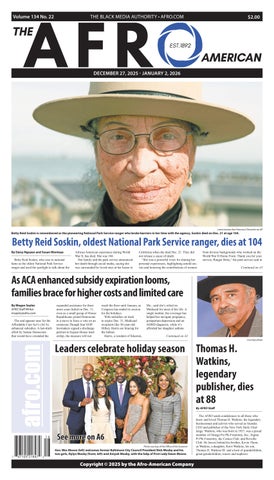
Lance Iversen/San Francisco Chronicle via AP
Betty Reid Soskin is remembered as the pioneering National Park Service ranger who broke barriers in her time with the agency. Soskin died on Dec. 21 at age 104.
Betty Reid Soskin, oldest National Park Service ranger, dies at 104
By Daisy Nguyen and Susan Montoya Betty Reid Soskin, who rose to national fame as the oldest National Park Service ranger and used the spotlight to talk about the
African American experience during World War II, has died. She was 104. Her family and the park service announced her death through social media, saying she was surrounded by loved ones at her home in
California when she died Dec. 21. They did not release a cause of death. “She was a powerful voice for sharing her personal experiences, highlighting untold stories and honoring the contributions of women
from diverse backgrounds who worked on the World War II Home Front. Thank you for your service, Ranger Betty,” the park service said in Continued on A3
As ACA enhanced subsidy expiration looms, families brace for higher costs and limited care By Megan Sayles AFRO Staff Writer msayles@afro.com The end appears near for the Affordable Care Act’s (ACA) enhanced subsidies. A last-ditch effort by Senate Democrats that would have extended the
expanded assistance for three more years failed on Dec. 11, even as a small group of House Republicans joined Democrats in a move to force a vote on an extension.Though four GOP lawmakers signed a discharge petition to bypass House leadership, the measure will not
reach the floor until January, as Congress has ended its session for the holidays. With subsidies on track to expire Dec. 31, Medicaid recipients like 30-year-old Hillary Harris are bracing for the fallout. Harris, a resident of Sikeston,
Mo., said she’s relied on Medicaid for most of her life. A single mother, the coverage has helped her navigate pregnancy, postpartum depression and an ADHD diagnosis, while it’s afforded her daughter asthma Continued on A3
afro.com
Courtesy photo
Leaders celebrate holiday season Thomas H. Watkins, legendary publisher, dies at 88 By AFRO Staff
See more on A6 Photo courtesy of the Office of the Governor
Gov. Wes Moore (left) welcomes former Baltimore City Council President Nick Mosby and his two girls, Nylyn Mosby (front, left) and Aniyah Mosby, with the help of First Lady Dawn Moore.
Copyright © 2025 by the Afro-American Company
The AFRO sends condolences to all those who knew and loved Thomas H. Watkins, the legendary businessman and activist who served as founder, CEO and publisher of the New York Daily Challenge. Watkins, who was born in 1937, was a proud member of Omega Psi Phi Fraternity, Inc., Sigma Pi Phi Fraternity, the Comus Club, and Reveille Club. He leaves behind his brother, Kevin Thomas Watkins, a daughter, Kerri Watkins, his son, Thomas H. Watkins III and a host of grandchildren, great-grandchildren, nieces and nephews.
A2 The Afro-American December 27, 2025 - January 2, 2026
2025: A year we wrote (and prayed) our way through By Dr. Frances “Toni” Murphy Draper AFRO CEO and Publisher As we close the pages on 2025, we do so clear-eyed about the moment we are living in and grounded in the responsibility we carry. Journalism, especially Black journalism, is not simply about recounting events. It is about memory, witness and insisting that what happens in our communities is neither disposable nor distortable. This year, we wrote about what was happening to us and around us, locally and nationally, urgently and thoughtfully. We wrote about symbols and stories—coins and monuments, museums and memory—and the quiet but consequential decisions about whose history is preserved and whose is questioned. We defended Black institutions, including the African American Museum of History and Culture, because history is not a luxury item. It is infrastructure. We wrote about violence in places that should be sacred and safe: shootings on college campuses, in schools and in sanctuaries. We wrote not to sensationalize pain, but to refuse its normalization. We insisted that safety, dignity and peace are not unreasonable expectations. We wrote about children, not only their protection but their preparation—about
Photo courtesy of Johns Hopkins University / Will Kirk
Dr. Frances “Toni” Murphy Draper is CEO and publisher of AFRO News.This week, she reflects on the challenges and triumphs of 2025. teaching financial literacy early, and about Black health, because freedom and wellness are inseparable. We examined disparities in maternal health, chronic disease, mental health, access to care and environmental conditions, understanding that health is a policy issue, an economic issue and a community issue. We wrote about elders, honoring them and listening to them, and about Black cemeteries and the fight for recognition and dignity in death, because respect does not expire when life ends. We wrote about Black businesses, lifting them up
Your History • Your Community • Your News
The Afro-American Newspapers
Baltimore Office • Corporate Headquarters 233 E. Redwood Street 6th Floor, Suite 600G Baltimore, Maryland 21202 410-554-8200 Customer Service, Home Delivery and Subscriptions: 410-554-8200 customerservice@afro.com Founded by John Henry Murphy Sr., August 13, 1892 Chairman of the Board/Publisher - Frances Murphy Draper (Publisher Emeritus - John J. Oliver Jr.) President - Benjamin Murphy Phillips IV VP of Marketing and Technology - Kevin E. Peck Director Digital Solutions - Dana Peck Receptionist - Wanda Pearson - 410-554-8200, ext. 246 Director of Operations
Andrè Draper - 410-554-8200
Director of Finance
Bonnie Deanes - 410-554-8242
Executive Director/Director of Advertising
Lenora Howze - 410-554-8271 - lhowze@afro.com
Director of Community & Public Relations Diane W. Hocker - 410-554-8243
Editorial
Managing Editor - Alexis Taylor - 410-554-8257 Editorial Assistant - Ama Brown-Parson Evening / Weekend Editor - Zenitha Prince
Archivist - Savannah Wood- 410-554-8277 Baltimore Circulation/Distribution Manager Andrè Draper - 410-554-8200 Production Department - 410-554-8200
Washington Office 1140 3rd Street, N.E., 2nd Floor Washington, D.C. 20002-6723 202-332-0080 • (Washington Publisher Emerita - Frances L. Murphy II) Director of Operations - Andrè Draper - 410-554-8200
,GHQWLÀFDWLRQ 6WDWHPHQW
THE AFRO AMERICAN – (USPS 040-800) is published weekly by The Afro American Company, 233 E. Redwood Street, 6th Fl., Ste. 600G, Baltimore, MD 21202.
6XEVFULSWLRQ 5DWH 1 Year - $100.00 Print & Digital ($40 Digital Only) (Price includes tax). Checks for subscriptions should be made payable to: The Afro American Company, 233 E. Redwood Street, 6th Fl., Ste. 600G, Baltimore, MD 21202. 3HULRGLFDOV SRVWDJH SDLG DW %DOWLPRUH 0' DQG DGGLWLRQDO PDLOLQJ RIÀFHV POSTMASTER: 6HQG DGGUHVVHV FKDQJHV WR THE AFRO AMERICAN, 233 E. Redwood Street, 6th Fl., Ste. 600G, Baltimore, MD 21202.
and naming economic realities plainly. Ownership still matters. Circulation of dollars still matters. Community economics remain community survival. We wrote about culture and conduct—about joy and accountability—not to police Blackness, but to affirm that how we show up still carries meaning, especially for the next generation watching closely. And yes, we wrote about sports, because community is also built through shared pride. We reflected on the longevity of LeBron James’ career, celebrated progress in sports where representation has lagged, including a milestone NHL Draft with 10 Black players selected. We marked defining cultural moments—from Beyoncé’s Album of the Year win at the Grammy Awards to Kendrick Lamar’s Super Bowl halftime performance—affirming that Black creativity continues to set the standard. We wrote close to home, because Baltimore and Washington are not footnotes to the national story; they are often
where it becomes real first. We carefully covered Baltimore City and Washington, D.C. government, including the leadership of Brandon M. Scott and Muriel Bowser, as well as the work of Gov. Wes Moore, the only sitting Black governor in the nation. We reported honestly on public safety while acknowledging progress. Baltimore’s crime rates moved in the right direction this year, reminding us that accountability, community effort and smart policy matter. We covered hundreds of social, civic, faith-based and community events and organizations, because everyday people doing faithful work rarely make headlines, yet they are the backbone of our cities. And we did not only report on our community— we gathered with it. We paraded at our annual High Tea, recognized veterans and Department of Public Works employees, convened Who’s Who in Black Baltimore, hosted our Juneteenth Breakfast, Salute to Veterans and Black Business Matters Expo events and marked
moments that strengthened community ties. We also celebrated legacy in distinctive ways, producing a 24-page commemorative ebook honoring the 150th running of the Preakness Stakes and the inaugural Preakness Festival, capturing not only a historic sporting moment, but Baltimore’s place within it. 2025 was a consequential year for journalism and the free press, particularly for the Black Press, as independence, truth and trust were tested in new and familiar ways. We wrote about voting rights under renewed attack, about the rollback of diversity, equity and inclusion, and about how a three-letter acronym was deliberately turned into a four-letter word. We wrote about the damage done when leadership traffics in cruelty, especially toward women, and how language from the top shapes culture below. We encountered a moment that crystallized much of this: a potential advertiser suggested that our name— standing for Black truth and self-definition for more than a century—might need to change to earn their support. We declined. Survival without integrity is not sustainability. We also paused to mark loss, reflecting on elders like Viola Fletcher, Assata Shakur and H. Rap Brown. We also took time to honor the passing of cultural icons such as Angie Stone and Sly Stone. Throughout the year, we shared glimpses from our extensive archives, work continuing through AFRO Charities, which is preserving and expanding access to irreplaceable Black history. Preservation is resistance. We also continued to build forward technologically. We expanded our digital footprint across Facebook, Instagram, X, LinkedIn, YouTube, TikTok, Nextdoor, and Apple News. We extended video
coverage, deepened audio storytelling through podcasts such as The Chicken Boxx, and for many stories on AFRO.com, readers can now listen as well as read. As we embrace responsible uses of artificial intelligence, we are enhancing storytelling, accessibility, archiving, audience engagement and efficiency—without compromising accuracy or trust. Technology is not replacing journalism at the AFRO, it is strengthening it. That work did not go unnoticed. This year, our journalists, photographers, editors, designers and digital teams earned multiple local and national journalism awards, and the AFRO was named among the nation’s top Black news outlets on Feedspot’s curated lists—affirmation of the excellence our staff brings to this work every day. Above all, we are grateful to God. We have come this far by faith, sustained by purpose and perseverance. None of this happens without people. We thank our writers, columnists, photographers, editors, designers, social media, video, digital, sales, business and administrative teams; our board members and shareholders; our advertisers and sponsors; and our partners, including the National Newspaper Publishers Association and Word In Black. And to our readers and subscribers, thank you. You are not passive consumers. You are partners. 2025 marked our 133rd year of publication, and our 133 for 133 campaign reflects that milestone—133 years of uninterrupted Black-owned journalism—and what it will take to sustain this work for generations to come. It is not about nostalgia. It is about necessity. If this year affirmed anything, it is that journalism still matters. Local journalism matters. Black journalism matters. Still here. Still writing. Still standing.
Bearing witness: A year of reporting and resistance By Alexis Taylor AFRO Managing Editor
It’s no secret that 2025 was a challenging year for not only members of the Black Press, but news media organizations across the country. Those who weren’t under direct, targeted attack from the current presidential administration felt the pressure, as those in power publicly encouraged a disdain for anything dealing with the word “Black.” Still, African-American media companies and leaders stood strong. Covering local, national and international news in 2025 has been a challenge eased only by the assurance that the articles we write and publish will make change. From Black maternal mortality to the gender pay gap, I can only hope that my words have sparked conversation and–more importantly–action. Looking back over the past 12 months, my top moments are clear. In March, I had an opportunity to record the stories of nurses, five years into a world still off-kilter from COVID-19. On April 29, I saw the women of the 6888th Central Postal Directory Battalion receive their long overdue Congressional Gold Medal.
I think the moment that made me most proud was when I learned that Florida’s Raiford Prison had banned a May special edition of the AFRO from inmates who receive the paper. Officials labeled our coverage of George Floyd, the fifth anniversary of his death, the promises broken and the change that still needs to happen as a threat to security and rehabilitation initiatives. It let me know that we are doing something right. In that same month, most humbling, was seeing my name and face in Editor and Publisher Magazine, the trade magazine of my industry, as a member of the “Editor’s Extraordinaire, Class of 2025.” In June, the residents of Baltimore helped me understand how they persevere, 10 years after the death of Freddie Gray. In August, Hurricane Katrina survivors from Mississippi broadened my view of the tragedies that took place 20 years ago. And on Oct. 16, at 6 a.m. in the morning, I was honored to watch the men who organized the 1995 Million Man March pour libations, discuss the work that still needs to be done and celebrate the 30th anniversary of the largest demonstration of Black men in history. Though it was tough at times, our small editorial
Courtesy photo
Alexis Taylor serves as managing editor of the AFROAmerican Newspapers. This week, she discusses top moments of 2025 and looks ahead to 2026. department, with the help of the community, truly made miracles happen in 2025. I am very appreciative of the support and leadership of our publisher, Dr. Frances “Toni” Murphy Draper, and every writer, photographer, intern and team member who helped pull together the weekly edition of the paper, while
also working on news for our website and special projects like the AFRO special, “Preakness Festival 150: A Celebration of Heritage and Style.” Despite all efforts and against all odds, we are still here…going strong, “pleading our own cause” and looking forward to the “good trouble” of 2026.
December 27, 2025 - January 2, 2026 The Afro-American A3
Urban One celebrates 45 years of media innovation and community impact By Tashi McQueen AFRO Staff Writer tmcqueen@afro.com Urban One, an African-American-led media conglomerate, celebrated its 45th anniversary in 2025, marking decades of growth from a single radio station founded by the renowned Cathy Hughes. Urban One, the parent company of TV One, Radio One, Reach Media, iOne Digital, One Solution and Cleo TV, is now one of the largest African-American content providers in the U.S. Hughes created the company on Oct. 2, 1980, forging a path of her own and creating space for Black people to be at the forefront of news and entertainment that matters to them. Hughes reflected on her journey and purpose behind creating Radio One. “I always knew that I wanted to be in radio,” said Hughes. “I felt it, I loved it, I listened to it, and I analyzed just how I could strategically fit in.” She also spoke to her lasting impact on urban radio. “I created a format that changed urban radio called ‘The Quiet Storm,’” said Hughes. She described it as the most successful venture in urban radio, changing how DJs, people who create a program of music on radio or other mediums, operate. “At one time, anything that
Courtesy photo
Cathy Hughes, founder of Urban One, is the pioneering media executive who created a major platform for Black voices in news and entertainment. dealt with the African-American community in terms of air personalities, it was assumed that they would be doing what was then called ‘jive talking,’” said Hughes. “‘The Quiet Storm’ allowed African-American air personalities as well as White air personalities who targeted a Black listening audience to literally be themselves and sound – quite frankly – less buffoonish.” Ventures like Radio One helped pave the way for Black people on air, at a time when they were not allowed to host radio shows until the 1950s, when Black people began owning radio stations and placing media personalities on the airwaves.
A Radio One host and political legend, former Maryland State Sen. Larry Young, shared his thoughts on this milestone. Young said the more than 25 years he’s spent with Radio One hosting his iconic show, the “Larry Young Morning Show,” was instrumental in reaffirming his commitment to public service. “Our job was to be as close to the community and assess the community’s position and stand with the community on the issues that mattered,” said Young, 76. “We became the microphone for the neighborhood groups that were suffering and getting no attention. “My radio audience wasn’t an audience, they became my family,” said Young.
In recent years and extending into 2026, Hughes said Urban One has expanded into Spanish-speaking markets, further enlarging that family. “One of the strategies for our growth and development is to service our Brown brothers and sisters and not just the Black community,” said Hughes. To meet the growing demand, Urban One has expanded its Spanish-language radio programming in the Midwest, including markets such as Cleveland, Ohio, and Indianapolis, Ind. In the Washington, D.C., area, Urban One changed one of its FM frequencies to a Spanish-language tropical music station featuring reggaeton and bachata. “It’s important for you to grow with your audience,” said Hughes. “It’s important for you to recognize what the consumer desires. We probably are one of the most research-oriented radio companies in the business … because we try to ascertain on a weekly basis what it is that our audience wants to hear and what they want to do and what’s important to them.” Tiara Laniece, an on-air personality, said her first three months at Urban One have taught her more about radio than she ever expected. At Urban One, Laniece said she is focused on listening and understanding the audience, particularly young people.
Courtesy photo
Larry Young, former Maryland state senator and longtime Radio One host, reflects fondly on the legacy of the media organization and his contributions to it over the years.
Courtesy photo
Tiara Laniece, a new on-air personality at Urban One, is hoping to connect with and understand the perspectives of younger audience. She emphasized the importance of recognizing how youth experiences differ from previous generations, shaped by social and economic changes. “I love going into new opportunities guided by my passion and learning new things,” which is what
ACA subsidy
Betty Reid Soskin
Continued from A1
Continued from A1
Harris, a resident of Sikeston, Mo., said she’s relied on Medicaid for most of her life. A single mother, the coverage has helped her navigate pregnancy, postpartum depression and an ADHD diagnosis, while it’s afforded her daughter asthma and allergy medications. “I’m concerned because, for instance, with my child’s asthma, her doctor and I noticed that she was coughing really bad all throughout the night, no matter the weather, when she was just using a cough medicine. This asthma inhaler that he gave her, which was Medicaid-covered, wiped that out completely,” said Harris. “Will I have to choose between an inhaler or cough syrup, or an inhaler or nasal spray when they’re working hand-in-hand?” This kind of picking and choosing also raises alarm about Harris being able to obtain her ADHD medication, which she depends on to manage daily life and care for her 9-year-old. “As far as my prescription, with cuts, that could provide delay. I am on what they consider a drug to where if I stopped taking it for three or four days, I experience withdrawal symptoms. I’m crashing, I’m not able to focus and I’m not able to work,” said Harris. “That concerns me because it’s not just me who’s on things like this. What about diabetics who have to choose between insulin or high blood pressure medication? What about the elderly who are hanging on for dear life to their heart monitors and they have to choose?” A report from KFF, a nonpartisan health policy nonprofit, revealed that the average ACA Marketplace enrollee currently receiving a subsidy would see their annual premium payments more than double if the enhanced premium tax credits expire— rising from $888 in 2025 to an
a statement. When she was 85, the longtime community activist was hired as an interpretive ranger at the Rosie the Riveter WWII Home Front National Historical Park in Richmond, Ca. The site at a former shipyard and other parts of the working-class city honors American civilians, including the women who worked in war-related industries, who worked on the homefront during the war. Soskin helped plan the park while working as a state legislative aide. She played a key role in shaping and designing the park by ensuring that it included the oftentimes overlooked contributions of Black men and women. They include the 202 Black sailors who were killed in the July 1944 explosion at Port Chicago, on the northeastern flank of San Francisco Bay, where they were assigned to a segregated unit, loading munitions onto cargo ships bound for the Pacific Theater. Unsafe working conditions led 50 survivors of the blast to refuse loading munitions. They were court-martialed and convicted of mutiny in a trial that exposed
Photo courtesy of Sam Gwesinie
Photo courtesy of Hillary Harris
Sam Gwesinie is a 22-yearold mother of two living in Minneapolis. She’s concerned that the end of enhanced Affordable Care Act subsidies could put the mental health services she relies on at risk.
Hillary Harris is a 30-year-old single mother living in Sikeston, Mo. She’s been a Medicaid recipient for nearly all of her life and worries she may need to pick between medications for herself and her daughter as enhanced subsidies expire on Dec. 31.
estimated $1,904 in 2026. Health care advocacy organizations, like Families USA, have issued statements warning that such steep increases could force enrollees to forgo insurance entirely or move to lower-level plans with higher deductibles. “As more people go uninsured or underinsured, they will delay necessary care, leading to worsening health conditions and putting more burden on expensive and overcrowded emergency rooms,” said Anthony Wright, executive director of Families USA, in a Dec. 11 statement. “Letting these tax credits expire will force over four million to lose coverage, millions more to pay thousands of dollars more and drive up costs for everyone.” Harris, who referred to herself as a problem solver, noted that she’s already thinking about strategies for navigating these changes. She said she could try to space out her appointments or rely on emergency care if necessary. However, she emphasized that these are coping mechanisms rather than real solutions. “If I’m having to choose between my Adderall and my child’s inhaler, as a mother I’m going to choose my child every time. If I have to choose
between her therapy and my Adderall—because I know I have to show up as her mother—I’m going to choose my Adderall over her therapy,” said Harris. “But, all of these things go hand-in-hand with how we function and thrive, and it’s not fair for us to choose between one or the other because of cuts.” Read more on AFRO.com
systemic racial inequality in the Navy. As a Black woman, Soskin worked as a clerk for the allBlack boilermaker’s union in Richmond. She advocated for telling the stories of the “non Rosies” who didn’t get to help build the battleships because of the color of their skin. “Rosie the Riveter represents the White woman’s experience on the homefront during the war, but as a woman of color, I was never recognized for my work,” she wrote in an October 2020 essay for Newsweek. “I had never understood that I had been involved in the building of the ships. Because at the time, I was 20 years old. I didn’t realize what my role was until I began to go back and recount it for others. It was rather amazing.” Those who got to meet Soskin during visits to the park took to social media Dec. 22 to say it was an honor and that she was an amazing woman. One described her as a jewel of the park system, while others said she served as a great inspiration for young rangers. Born in 1921, Soskin wore many hats throughout her life — a mother, daughter, musician, author, political activist,
working at Urban One offers, Laniece said. As Urban One looks ahead to another 45 years, remaining committed to community needs will continue to be its foundation. For more arts and entertainment highlights from 2025, please see B2.
wife, record store owner, songwriter, painter, grandmother, great-grandmother, prolific blogger and more, as her family recounted. Her family posted on social media that she had led “a fully packed life and was ready to leave.” While a public memorial has yet to be announced, the family said people can share their affection for Soskin through donations to a school that had been renamed in her honor: Betty Reid Soskin Middle School in El Sobrante, California. She had just celebrated her birthday with a visit to the school in September, cheers erupting as she waved to excited children. In 1995, Soskin was named Woman of the Year by the California State Legislature and about a decade later she received the National WWII Museum’s Silver Service Medallion. She explored her nine decades of living through extraordinary moments of history in her 2018 autobiography “Sign My Name to Freedom: A Memoir of a Pioneering Life.” Read more on AFRO.com
A4 The Afro-American December 27, 2025 - January 2, 2026
COMMENTARY
During the holidays, rest is a radical act for Black women By Joshua Lev Perrin Word in Black In a season of joy — and burnout — slowing down is a form of strategy, survival and resistance. As the year winds down, so do many of us. Or at least, we try. For Black women who lead in movements, ministries, nonprofits, classrooms and boardrooms, the holidays can bring a mix of joy and exhaustion. Cooking and caretaking. Reunions and reminders. Festivities, yes — but also fatigue. In a culture that often demands our labor and denies our rest, the holidays become a site of quiet resistance. It’s where we slip away from the grind, if only briefly, to remember that our worth is not tied to productivity. As Tricia Hersey of The Nap Ministry
reminds us: “Rest is a form of resistance because it disrupts and pushes back against capitalism and white supremacy.” In her words, “Rest is a birthright.”
Why rest is political for Black women
This truth resonates especially during the holidays — a season where expectations run high and so does burnout. For Black women, rest isn’t just personal. It’s political, ancestral and necessary. Audre Lorde, the legendary poet and activist, once wrote: “Caring for myself is not self-indulgence, it is self-preservation, and that is an act of political warfare.” It’s a quote that’s been passed down like scripture in many circles, a reminder that caring for ourselves is also a way of protecting our communities. When we prioritize our healing, we
Photo courtesy of LinkedIn / Joshua Levi Perrin
Joshua Levi Perrin is a writer for Unerased: Black Women Speak. This week, he discusses the radical act of rest during the holiday season. shift the terms of survival.
Rest as resistance, not indulgence
Mental health advocate and actress Taraji P. Henson has been vocal about the toll that chronic stress and uncertainty
take on Black communities. During the early months of the COVID-19 pandemic, she spoke candidly about how quickly pressure can accumulate, noting, “Anxiety and stress builds up quickly with so many changes every day, and if you’re anything like me, you need somebody to lean on, to talk to, to help manage your anxiety.” Her call was not just personal, but collective — a reminder that seeking support is a necessity, not a weakness. That refusal to perform exhaustion is echoed by many Black women who are crafting new models of leadership. Models rooted in care, ease and boundaries. For some, it’s spending the holidays in solitude. For others, it’s reconnecting with chosen family. And for many, it’s unplugging altogether — no emails, no updates, no “just one quick call.”
A paradigm shift rooted in care
The Black Emotional and Mental Health Collective (BEAM) champions this shift. Their work reminds us that healing isn’t an individual responsibility — it’s a collective process. They promote rest, grief work and emotional justice as central to Black liberation. During the holidays, that looks like more than bubble baths and candles. It’s about reimagining how we care for ourselves and each other. And as Maya Angelou once affirmed, “You alone are enough. You have nothing to prove to anybody.” That message feels especially urgent now, in a world that constantly demands receipts for our rest, metrics for our downtime.
Rest is survival and strategy
The Nap Ministry calls this
“resting as reparations.” It’s a powerful idea — that rest itself is part of the work. That stillness is a strategy. That holiday recharge is not an escape from our roles but a return to ourselves. So whether it’s lighting candles or saying no, taking a nap or taking a walk, the practice of rest is sacred. And for Black women, it’s also strategic. We do not rest because we are weak. We rest because we are wise. Because we know the world will not slow down for us. Because we’ve learned through burnout and brilliance, that slowing down is how we survive. This holiday season, may we honor that truth. May we honor ourselves, just as our fierce Black women leaders told us to. This commentary was originally published by Word in Black.
MacKenzie Scott’s gift is a chance to rewrite the future of HBCUs By Antonio White Recent reports revealed that billionaire MacKenzie Scott donated approximately $740 million to 16 historically Black colleges and universities (HBCUs), bringing her total support to an estimated $1.3 billion over five years. In a higher-education landscape defined by political hostility, chronic underfunding, and widening racial inequity, Scott’s gifts delivered something HBCUs rarely receive: unrestricted capital and trust — the freedom to make decisions on their own terms. That alone is revolutionary. Traditional philanthropy often arrives with strings attached: donor-directed programs, spending restrictions, and reporting requirements that can take up enormous staff time and administrative bandwidth — especially for institutions already operating with lean teams. These guardrails limit how leaders can apply funds to their most urgent priorities.
Courtesy photo
Antonio White is founder of 480 Advisors. He is a former deputy assistant secretary at the U.S. Department of the Treasury and chief of communications at the Federal Housing Finance Agency. This week, he discusses the importance of philanthropist MacKenzie Scott’s investment into historically Black institutions across the country. Scott’s approach recognizes something obvious yet long denied: HBCU presidents and their leadership teams are the experts on what their students
and communities need. This generosity also arrives at a moment of profound crisis for future graduates. Federal officials recently confirmed that states have underfunded land-grant HBCUs by more than $13 billion over the past three decades. Meanwhile, political attacks on diversity, equity, and inclusion (DEI) programs, rising food and housing costs, and industry-wide disruption driven by artificial intelligence have left many Black students questioning whether higher education can still deliver mobility. Scott’s gift is not just philanthropy; it is a counterweight to a political project designed to shrink opportunity. HBCU leaders now have a once-in-a-generation chance to address affordability and build durable institutional power. Their first priority must be students — the most financially vulnerable stakeholders. Already, an estimated 90 percent of HBCU students rely on federal or
state aid. Pell Grants have not kept pace with tuition. Surveys from the Hope Center also show that Black students experience disproportionate rates of food and housing insecurity, making persistence and graduation harder even before loan repayment begins. With crippling, historic student debt levels already forcing recent grads to delay home purchases and retirement saving, and home ownership costs being at their highest in history, directly attacking university costs for students would directly contributed to wealth building economic opportunity. Researchers back this claim: analysts tracking Morehouse graduates after Robert Smith’s historic $34 million gift to Morehouse’s 2019 graduating class will save $1 million more over their lifetime with student debt being eliminated as a savings barrier. Scott’s gift gives HBCU leaders the chance to replicate that kind of generational impact in their own way.
The second priority must be strengthening university endowments — the financial engines that determine longterm stability, independence, and academic capacity. Endowments are not symbolic; they are power. They allow universities to weather recessions, recruit top faculty, expand research, and invest in students without pleading with legislatures for support. For most of the last century, HBCUs were excluded from the donor networks, capital markets, and federal research pipelines that enabled predominantly white institutions to build multibillion-dollar endowments. Compounding returns widened the gap every year. Right now, HBCUs account for 3 percent of U.S. institutions but cumulative endowments represent under 1 percent of all university endowments. Scott’s gift presents a rare opportunity to correct that imbalance. Third, capital projects should be approached with strategic discipline. Buildings
matter: safe dorms, modern labs, and updated facilities shape student outcomes. But unrestricted cash should not be swallowed by construction costs that can be financed elsewhere through tax credits, public-private partnerships, and mission-driven lenders. Morgan State University offers an instructive model: by leveraging more than $20 million in New Markets Tax Credits, the university attracted additional financing to redevelop the Northwood Plaza area and construct a new business school — all while preserving institutional funds for affordability, research, and academic growth. If HBCU leaders center resilience, affordability, and sustainability, Scott’s gifts can catalyze more than onetime improvements. They can stabilize enrollment, expand research capacity, and revive neighborhoods that have endured generations of disinvestment. See more on AFRO.com.
Hidden in code: How tech reinvents Jim Crow barriers to housing By Alice T. Crowe Black Americans have struggled to build wealth in America through property ownership. Owning land meant freedom. Government policies like redlining and restrictive covenants cheated Black families and communities out of wealth. Jim Crow’s color-coded paper maps were just one ruse in a trick bag of tactics used to normalize segregation and deny equitable distribution of resources to Black areas. In the 1930s, the Home Owners’ Loan Corporation created red zones where large numbers of Black residents lived, marking them “hazardous” or at risk. Loan officers, appraisers and real estate professionals used these maps to decide who was approved for a mortgage and who was denied. Those tattered, dusty maps might be better suited to museum exhibits.
Courtesy photo
Alice T. Crowe is a lawyer, entrepreneur and author who has practiced law for over 25 years in New York. This week, she shares insight on prejudice in real estate tech. However, the red zone map strategies are still at work today. Now, federal funding cuts to housing programs will make it harder to defend against these schemes. The latest redlining barriers are tucked away in algorithms that determine credit scores, target advertisements, set insurance rates
and even decide which neighborhoods receive investment in digital infrastructure. The result is the resuscitation of an aged, rickety Jim Crow who many believed was dealt a death blow by the 1968 Fair Housing Act. That legislation made it illegal to discriminate in the sale or rental of a home. Despite the efforts to beat back Jim Crow policies, his barriers to Black homeownership still stand today. The Black-White gap in homeownership rates was the same in 2020 as it was in 1970, just two years after the passage of the Fair Housing Act of 1968. Current-day redlining practices are digital, making it easier to undermine and destroy thriving Black neighborhoods, denying Black homeowners or those seeking housing equal access to available properties on the market. The use of technology may make this seem innocent or even random
because the blatant signs of racism are not as obvious. The unseen hand that does Jim Crow’s dirty work is hidden in the computer code that powers the devices that give us information. In its subtle way, technology facilitates the same result as Jim Crow laws; it helps exclude people based on race, ethnicity or socioeconomic status. Who are the culprits who uphold the Jim Crow barriers? Housing market professionals. Housing market professionals are the gatekeepers of the housing market. According to Elizabeth Korver-Glenn, author of Race Brokers and assistant professor of sociology at the University of North Carolina - Chapel Hill, “Housing market professionals are race and racism brokers. They subvert real estate business as usual. Housing market professionals, especially those who are White, actively create racially unequal housing markets
and urban landscapes. They do so by using racist ideas to inform how they implement professional norms and policies and how they distribute their professional resources, including authority, knowledge and capital.” Here’s how digital redlining works. Black people who live in a specific zip code searching online for housing will never see all of the available listings in their feeds. They were redlined out and never knew it. Zip codes are used to target people within specific demographics. This is called IP targeting, and it allows companies to show advertisements to specific IP addresses from their lists. An ad may show up to everyone in a particular area, except in specific zip codes where there are mostly Black residents. Businesses can focus their advertising on specific homes or groups of dwellings within defined locations. This seems harmless, but it’s not. Three
housing organizations filed a lawsuit in 2018 against Facebook, alleging its advertising platform helped landlords and real estate brokers exclude people of color, families with children, women, people with disabilities and other protected groups from receiving ads. The lawsuit was settled. With the hidden hand of technology, private listing networks do the dirty work of restrictive covenants — clauses in deeds that barred homeowners from selling to Black people. Homes listed on private listing networks are marketed outside public platforms and made available only to a select group of agents and brokers within the network. Some are even by invitation only. These networks are not transparent. They deny equal access and make sure that White homeowners can sell their houses exclusively to other Whites. See more on AFRO.com.
The opinions on this page are those of the writers and not necessarily those of the AFRO. Send letters to The Afro-American ∙ 233 E. Redwood Street, Suite 600G Baltimore, MD 21202 or fax to 1-877-570-9297 or e-mail to editor@afro.com
December 27, 2025 - January 2, 2026 The Afro-American A5
BALTIMORE-AREA Baltimore launches new housing partnership to support youth and families at risk of homelessness By Victoria Mejicanos AFRO Staff Writer vmejicanos@afro.com Baltimore City Mayor Brandon M. Scott announced a partnership between the Mayor’s Office of Homeless Services (MOHS), the Baltimore City Department of Social Services (BCDSS) and other local nonprofits Dec. 4, to ensure families who are at risk or currently facing homelessness can be rapidly placed in permanent housing with adequate additional support to maintain stability. “Every young person in Baltimore deserves a safe place to call home and the support they need to thrive,” said Scott in a press release sent to the AFRO. “Tackling youth homelessness is not just about housing — it’s
about dignity, opportunity, and giving our young people the foundation to build a better future.” Through the partnership, BCDSS will refer older youth in need of assistance to Restorations Gardens 1, a 44-unit development. Younger families at risk of homelessness will be referred to the Geraldine Young Family Life Center, a 12-unit housing site operated by the YMCA of Central Maryland. BCDSS will also fund case management for the youth it refers for services and MOHS will oversee and manage contracted services. Donald Eaddy, vice president of youth development and community health at the YMCA in Central Maryland said he is “thrilled” about
the partnership according to the release. “These funds will allow us to reduce barriers for individuals seeking to maintain stable housing in Baltimore City and help ensure that our communities continue to thrive,” said Eaddy. At the Geraldine Young Family Life Center, young parents and their children will receive life skills workshops, educational programming and connections to community resources, as well as permanent housing and one year of aftercare support, according to the release. The Housing Authority of Baltimore City is providing housing vouchers while Homes for America, a nonprofit housing development corporation, used an
American Rescue Plan Act grant from Baltimore City and the state to renovate the units where youth will live. Restoration Gardens 1 opened in 2010. “Homes for America is grateful for the incredible collaboration among so many public sector partners to bring both new capital investments and robust supportive services to the residents of “This alignment of will, resources and partnership will benefit the current and future residents for years to come,” said President and CEO of Homes for America Dana Johnson in a statement. The agreement for these services runs from July 1, 2025, through June 30, 2029, with one-year renewal options to follow.
Photo courtesy of the Baltimore City Office of the Mayor / J.J. McQueen
Baltimore City Mayor Brandon M. Scott is working to address homelessness in Charm City. The Mayor’s Office of Homeless Services, the Baltimore City Department of Social Services and local nonprofits are partnering to help families facing or at risk of homelessness secure permanent housing and support services.
First public hearing held for the future of Baltimore Collegiate School for Boys By Mekhi Abbott Special to the AFRO mabbott@afro.com
AFRO Photo/ Mekhi Abbott
Zachary Clark and his mom, Maya Clark, share their personal testimony about the impact the Baltimore Collegiate School for Boys has had on their family.
AFRO Photo/ Mekhi Abbott
Najee Christopher and his mother, Jeanine Kelly, tell the AFRO why it is important that Baltimore Collegiate School for Boys stays open.
A public hearing regarding the future of Baltimore Collegiate School for Boys (Baltimore Collegiate) was held Dec. 11 at the Baltimore City Public Schools District Office. Parents and students are pleading with the local school board once again to keep the institution open. This marks the second time in the past three years that Baltimore Collegiate is at risk of shutting down, as the school barely escaped closure in 2023. Students, parents, teachers, administrators and both city and state officials have come together to speak on the impact and importance of Baltimore Collegiate, citing improved literary skills among students, personal development and necessary male mentorship for students who do not have male role models in their households or in their communities outside of Baltimore Collegiate. Student Zachary Clark spoke on why it was crucial that the school stay open. “It is important to me because I have seen all these different changes within myself. I’ve gone through a lot of trauma before entering this school like losing my mother and being adopted,” said Clark. “My sister and I pushed through it, and I love it at Baltimore Collegiate,” he said. Zachary continued to talk about how empowered he feels at Baltimore Collegiate and how the school is building him up to be a better man not only today but also in the future. “If the school shuts down, I don’t know what I am going to do,” said Zachary. “The brotherhood I feel at this school is very powerful because when I walk into the classroom, I can feel
every emotion. I can be sad, mad, whatever. But everyone there will support me and just help me through it as if they were my actual brothers.” Zachary’s adopted mom, Maya Clark, also spoke about the impact the school has had on her son. “His teachers are awesome. He feels cherished at this school. This is his first time making the honor roll. I am a single mom. ... I don’t know how to tie a tie. Being at a school where they’re teaching how to do that and greet people as they come into the room is something that goes beyond traditional education. Just imagine be-
to other schools throughout the city, including accepting students with low literacy levels and dealing with the unique hardships of managing the budgets set for charter schools. Charter schools are forced to deal with issues regarding building maintenance, a budget item that traditional schools do not have to deal with. Najee Christopher, a sixth-grader at Baltimore Collegiate, spoke about how the school is actively breaking the school-to-prison pipeline in Baltimore. “It is important for the school not to shut down because these boys, similar to me, want to go somewhere
we were at actually wanted to medicate him instead of getting to the root of what the problem was,” said Kelly. “When we got to Baltimore Collegiate, I explained my son’s situation to the principal and that I originally thought he might have to repeat a grade. He said he’s going to put him in his proper grade and if they have to move him they will, but let’s give him a chance. He ended up passing with flying colors. His grades went from ‘35’ and ‘45’ to ‘85s.’” Avent has plans to help the school get back on track financially, including reportedly negotiating a deal with an undisclosed buyer for the
“It is important for the school not to shut down because these boys, similar to me, want to go somewhere in life.” ing at a school with majority Black boys and when you walk by, they have great manners. [They are] teaching these young boys how to be gentlemen,” she said. Maya Clark told the AFRO that at her son’s previous school, he could speak French but did not know how to read. Baltimore Collegiate serves as the only all-boys public charter school in the city. Baltimore City Schools officials are recommending the closure of the institution due to low test scores and financial mismanagement. Baltimore Collegiate is also currently operating with roughly 300 students enrolled, which is below the 480 student minimum allowed. The board did credit the school for improved instruction and getting families more involved. Baltimore Collegiate Chief Executive Officer Edwin Avent argues that his school faces a different set of challenges when compared
in life. They already have jail cells for kids who grow up with no education and no father,” said Najee. “I don’t want the boys at Baltimore Collegiate to end up like that. We want to be greater than some of the stuff we see from people outside or people who attend other schools.” Christopher’s mom, Jeanine Kelly, spoke about how Baltimore Collegiate completely changed her son’s educational experience and outlook. “Before, it was a struggle to get him to do his homework and take school seriously. The other schools
charter school’s building, which would reduce rent by $20,000 a month. Additionally, he has proposed installing a workforce program and a pre-K which will serve as additional revenue sources for Baltimore Collegiate. A second public hearing is scheduled for Jan. 8, 2026, from 5:30 to 7:30 p.m. The meeting will also take place at the District Office, located at 200 E. North Ave. Registration to comment will be open from 3 p.m. to 5 p.m. For more information and ways to support the fight to keep Baltimore Collegiate open, visit https://baltimorecollegiate.com/renewal/.
132
0
Past Seven Days
2025 Total
A6 The Afro-American December 27, 2025 - January 2, 2026
Maryland First Lady Dawn Moore shares a moment with Chezia Cager at the Dec. 15 holiday reception. Gov. Wes Moore (left) strikes a pose at the Dec. 17 holiday reception for media professionals with Pepperdine professor and journalist, Dr. Nii-Quartelai Quartey.
Maryland Gov. Wes Moore gets into holiday spirit with First Lady Dawn Moore By AFRO Staff The holidays have officially arrived in Annapolis, Md., with Maryland Gov. Wes Moore welcoming state leaders, media professionals and members of the public to the Government House of Maryland.
The mansion has served as the residence of the Maryland governor for more than 150 years, but for the first time in history, visitors are greeted by a African-American governor and an inspiring portrait of abolitionist Frederick Douglass at the door.
Holiday reception attendees were able to speak with the governor, while also enjoying good food and great music while networking and celebrating the holiday season. All photos courtesy of Flickr / MarylandGovPics, Polly Irungu and Anthony DePanise
Eze Jackson, director of outreach and distribution for the Baltimore Beat, snaps a Christmas photo on Dec. 17 with the publication’s editor-in-chief and co-founder, Lisa Snowden.
Fellowship of Christian Athletes host annual dinner By Bonnie Booker and Rache Heggins
Courtesy photo
Members of the community and proud family and friends attend the 2025 Fellowship of Christian Athletes Dinner.
When I own a home, I’ll finally get a dog.
The Baltimore Fellowship of Christian Athletes (FCA) held its third annual Christmas party on Dec. 12 at Loyola University Maryland. Baltimore FCA is a chapter under the non-profit national organization. The organization has been in existence since 1954. Its vision is to see the world transformed by Jesus Christ through the influence of coaches and athletes. At the party, several Baltimore City students and athletes, who have been impacted by Baltimore FCA gave testimonials of how they came to live for Jesus Christ and to boldly share their faith with classmates during huddle sessions. The Baltimore FCA is led by Sirena Alford (Multi-Area Director), along with her staff, board and committee members. They sponsor young men and women athletes and coaches to go to camps, receive scholarships toward college needs, and much more. The staff and huddle coaches guide the student-led Bible study huddle
Courtesy photo
Shown here, members of the Poly Worship Band, Anderson Santana Mateo (left) and Fred Corea. meetings. They also learn leadership and life skills. Often we hear about youth getting into trouble, so it is very refreshing to hear about and see the results of this vital organization’s commitment to give youth in underserved communities the opportunity to succeed. In addition to feasting on a delicious variety of mouthwatering appetizers and mini-desserts, the
attendees were blessed by the gifted Singing Sensations youth choir and the Poly HS FCA band. Baltimore FCA is faith-funded through donations. We thank all of our sponsors, donors, partners and friends for their generosity. Please support this life changing organization by giving. Visit the website: www.baltimoreFCA.org Consider making this great organization your cause.
Let’s work together to make it possible. Visit mtb.com/firsthouse or call 1-800-936-0969 to get started today.
Courtesy photo
Equal Housing Lender. ©2025 M&T Bank. Member FDIC. NMLS #381076
ret040405 CRA Mortgage Ads – Baltimore Afro American
The Singing Sensations, led by Dr. Hollie Hood-Mincey, perform at the Fellowship of Christian Athletes Dinner on Dec. 12 at Loyola University Maryland.
December 27, 2025 - January 2, 2026 The Afro-American A7
WASHINGTON-AREA Judge responds to lawsuit against HUD filed by leaders in D.C., Maryland and 20 other states By Deborah Bailey Contributing Editor A U.S. District Court Judge issued a temporary halt to changes in a U.S. Housing and Urban Development (HUD) program that would have left thousands of Marylanders homeless. On Dec. 22, U.S. District Court Judge Mary McElroy barred HUD from implementing changes to the federal government’s Continuum of Care Program, in response to a lawsuit supported by Maryland Attorney General Anthony G. Brown and a coalition of 21 other states and the District of Columbia. A second lawsuit was filed by 11 local governments and non-profit organizations on behalf of recipients of HUD Continuum of Care funding. “This ruling keeps roofs over the heads of more than 4,000 Marylanders who were at risk of going homeless under the administration’s
“Continuity of housing and stability for vulnerable populations is clearly in the public interest.” inhumane policy,” said Brown, in a statement issued in response to the ruling. HUD’s Continuum of Care program represents the largest national resource for a wide range of housing-vulnerable persons, according to the National Alliance to End Homelessness. More than 170,000 persons nationwide would have been at immediate risk of homelessness if changes proposed by HUD in November would have been allowed to proceed.
This year, the Metropolitan Washington Council of Governments (COG) Homeless Services Planning and Coordinating Committee did their annual regional point-in-time (PIT) count of homeless in Washington, D.C. and surrounding areas on Jan. 29. According to information released by COG, “the 2025 PIT enumeration resulted in a total count of 9,659 individuals experiencing homelessness.” The number represents a drop in the number of homeless people by 115 persons when compared to the
point-in-time count from 2024. Still, there is more to be done. “Continuity of housing and stability for vulnerable populations is clearly in the public interest,” McElroy said during the two-hour hearing. HUD Secretary Scott Turner issued an abrupt policy change in the Continuum of Care program, announcing a new notice of funding opportunity (NOFO) with significant cuts in funding available for permanent housing, instead prioritizing transitional housing. Tests would be put in place for those receiving housing support from HUD. Additionally, HUD removed the program’s two-year grant cycle, replacing it with a one-year cycle. “HUD has adopted new policies, without any meaningful public input, which reverse the agency’s longstanding support for Housing First policies and fundamentally undermine the goal of providing
Unsplash / Tingey Injury Law Firm
A federal judge is taking action to protect thousands at risk of homelessness in Washington, D.C., Maryland and beyond. dependable housing,” stated the lawsuit. “A Housing First model provides stable housing to individuals without preconditions like sobriety or minimum income.”
D.C. delegate seat draws crowded field ahead of 2026 midterms By Tashi McQueen AFRO Staff Writer tmcqueen@afro.com The 2026 Washington, D.C. election for the nonvoting House delegate seat is drawing a wide field of candidates as debates intensify over the city’s future political representation. Incumbent Eleanor Holmes Norton, 88, who has held the seat since 1991, intends to run for re-election next year but faces a crowded race and calls to step aside. With presidential actions and stated intentions to take over local power in D.C., the stakes for the seat are higher than ever, with many viewing the race as an opportunity to reshape how the District is represented in Congress. Among the candidates who have declared their intention to run are D.C. Councilman Robert White (D-At-Large); D.C. Councilwoman Brooke Pinto (D-Ward 2); Kinney Zalesne, a Democratic strategist; and Jacque Patterson, president of the D.C. State Board of Education. The primary is scheduled for June 16, 2026, followed by the general election on Nov. 3, 2026. Norton declined to offer comment on her campaign to the AFRO. Pinto said her decision to run was driven by concerns over federal overreach and leadership during a critical moment for the city. “Watching the president’s attacks on D.C., I knew our city was at a turning point,” said Pinto. “I know our city needs leadership that can tackle the challenges we’re facing today and effectively fight back on behalf of our residents, and that’s why I’m running for Congress.” Pinto has served D.C.
Photo courtesy of the Council of the District of Columbia
D.C. Councilwoman Brooke Pinto (D) represents Ward 2 and is running for the city’s nonvoting House delegate seat in 2026, citing concerns about federal overreach and the need to defend local control.
Photo courtesy of the Council of the District of Columbia
D.C. Councilman Robert White (D), an at-large member and fifthgeneration Washingtonian, is seeking the nonvoting House delegate seat, emphasizing his personal ties to the city and experience working in Congress. residents in several roles, including as an assistant D.C. attorney general, where she fought for Home Rule and D.C.’s sovereignty. During more than five years on the City Council, she has worked on legislation aimed at public safety, economic opportunity and education. “I think this moment requires every one of us to think about how we’re fighting for the community we love, and how best to fight back against the massive federal overreach that threatens many of our basic
freedoms,” said Pinto. “I think it’s critically important that the next congressperson from D.C. understand how we can use the tools of the federal government to deliver new opportunities for D.C., including transferring some national park land to local control, tackling rising costs [and] building more affordable housing.” White said changes in the federal government and growing pressure on the District compelled him to enter the race. “I was compelled to fight to protect my hometown and D.C.’s local government before it was too late,” said White. “I’m stepping up because our city deserves leaders who love this place enough to fight for it.” A fifth-generation Washingtonian, White emphasized his personal connection to the city and his understanding of residents’ struggles. “I know what it’s like to grow up in a single parent household
struggling to keep a roof over our head, I know what it’s like to be counted out and I know what it’s like to overcome adversity and tough times to fight for my chance to thrive,” said White. “That’s the story of so many of us who grew up here and the story of our city. We’ve been down and counted out. We have fought and built back and turned challenges into pride.” White also highlighted his experience working in Congress, including five years as Norton’s legislative counsel. He has served nine years in elected office. “She taught me the power of the delegate seat even though we in D.C. don’t have a full vote,” said White. “Now, as an at-large councilmember, I appreciate both the concerns and hopes of D.C. residents across all eight wards.” White said his priorities include expanding education opportunities, building on
universal prekindergarten, addressing the lack of safe, healthy and affordable housing, and advancing statehood. Kinney said her decision to run was shaped by her experience watching how federal decisions affect the District. “I’ve seen how power actually moves in Washington, and how decisions made without D.C. at the table affect our economy, our schools, our hospitals, and our basic rights,” said Kinney. “This felt like the right moment to step up to run because the threats facing D.C. are immediate and complex.” She pointed to her experience working at both the local and federal levels. “I know how power moves in Washington, and I’m not afraid to push back when Congress tries to override our laws, interfere with our budget, or treat D.C. as an afterthought,” said Kinney. “I know how to build relationships, and I know how to pick a fight when it matters.” When asked about supporting Black Washingtonians, Pinto referenced her work on the Robert F. Kennedy Stadium deal, which secured 6,000 affordable homes and reserved 15 percent of jobs for ex-offender citizens. Kinney said she would
prioritize protecting the District’s budget to ensure funding for schools, affordable housing, job training and neighborhood safety is not blocked. “That means pushing back on federal interference and making sure Black families can stay, work, and build a future in the city,” said Kinney. “Black residents are the backbone of this city, and the disparities they face are not accidental, they’re the result of decades of policy choices made without D.C. having full power.” Patterson said he is running to bring generational change, fight for budget autonomy and statehood, and ensure vulnerable communities are not left behind. “At the age of 88, I think it’s that time where we give those warriors their flowers and we say we’re ready to take that baton on because ... it’s time to be able to address some of the newer issues that are popping up in this generation,” said Patterson. If elected, Patterson said he hopes to secure budget autonomy so local D.C. dollars cannot be held “hostage” by Congress, advocate for statehood and continue grassroots engagement across the city.
Photo courtesy of the D.C. Board of Education
Jacque Patterson, president of the D.C. State Board of Education, is running for the city’s nonvoting House delegate seat, citing the need for generational change.
AP Photo/Ben Curtis
Congresswoman Eleanor Holmes Norton (D) has served as D.C.’s nonvoting House delegate since 1991 and is up for re-election in the 2026 race.
Courtesy photo
Kinney Zalesne, a Democratic strategist with local and federal government experience, is a candidate for D.C.’s nonvoting House delegate seat.
127
Past Seven Days
2
2025 Total
A8 The Afro-American December 27, 2025 - January 2, 2026
Annual UDC holiday celebration brings faculty, staff together By Patricia McDougall The University of the District of Columbia (UDC) “Firebirds” held the president’s annual holiday celebration for faculty and staff on Dec. 19. The event was hosted
by UDC President Maurice D. Edington and First Lady Tonya Barge Edington. Faculty and staff enjoyed the food and took to the dance floor to have a good time. AFRO Photos/ Patricia McDougall
Dr. Michelle Chatman (left), an associate professor in the College of Arts and Sciences at UDC, and M. Ama Giddens, a licensed graduate professional counselor for the institution, enjoy the president’s holiday celebration.
Shantell Forney (front, left), Monica Gaskin, Elizabeth Jordan and Dr. Lee Brian Reba (back) show some holiday spirit.
Dr. Anteneh Girma (left), Anne Lankford and Dr. Pradeep Behera from UDC’s School of Engineering and Applied Sciences, enjoy the event.
Denise Slaughter, special assistant to the Office of Institutional Advancement shows her UDC pride.
Two plans, same promise… we got you.
Dr. Maurice D. Edington and Tonya Barge Edington serve as president and first lady of the University of the District of Columbia (UDC).
Shown here, UDC staff members Samantha Garvin (left), Zillard Wesley and Donte Brooks.
From Medicaid to the new Healthy DC plan, two coverage options designed to fit your life today.
University of the District of Columbia staff and faculty leave it all on the dance floor.
Find the right plan for you. Don’t miss open enrollment! Now through January 31.
UDC Board Chair Warner H. Session speaks to those gathered for the holiday party on Dec. 19.
Fatima Elshobokshy (left) the director of the Center for the Advancement of Learning at UDC;, Angela Wade, director of Enterprise Applications; and Malva Reid, director of graduate education, fellowship together.
December 27, 2025 - January 2, 2026 The Afro-American B1
2025 highlights: Historic elections, social movements and global shifts By Andrea Stevens AFRO Staff Writer astevens@afro.com The year 2025 delivered moments that reshaped politics, culture and daily life across the globe. Voters in several states had their say at the polls, activists demanded change and Black elected officials across all levels of government worked to challenge the 47th president,
his executive orders and the policies handed down by his administration. There were lawsuits and public demonstrations, but also community and coalition-building. Through it all, the Black community remained resilient. From historic firsts to sobering reminders of the work to come in 2026, take a look at the moments that left a lasting mark to be remembered well beyond the calendar year.
AP Photo/John Locher
Rebuilding Black Neighborhoods In the wake of the Jan. 7 fire that spread devastation across the Los Angeles County, Calif. area, a group of Black architects, engineers and other experts came together to form the Altadena Rebuild Coalition. The organization supported recovery and reconstruction efforts after thousands of homes in Altadena, Calif., were destroyed by the fire that began near Eaton Canyon.
AP Photo/J. Scott Applewhite
Multistate coalition takes on DOGE On Feb. 7, Maryland Attorney General Anthony Brown alongside 19 other attorneys general sued the 47th president’s administration after Department of Government Efficiency (DOGE) staffers, led by Tesla billionaire Elon Musk, were granted access to the Treasury Department’s central payment system. The coalition argued that the move violated federal law and endangered Americans’ sensitive, private data and could allow political appointees, like Musk, to disrupt funds for Social Security, Medicare and Medicaid and more. The lawsuit resulted in a court blocking unauthorized access to Treasury payment systems, but the case remains ongoing. The fight was the first in many against DOGE, which ravaged the federal workforce with layoffs throughout the year.
AP Photo/ Jacquelyn Martin
Jamal Bryant Target Boycott On Ash Wednesday, March 5, Pastor Jamal Bryant began a 40-day fast from the big box retail store chain Target. What was supposed to be a short time of abstaining from the store because they slashed their diversity, equity and inclusion efforts turned into a year-long boycott that is still going strong. The company has lost billions of dollars of dollars as consumers decided to fight for equality with the power of the dollar.
Courtesy photo Facebook
13 year old breaks Dr. King’s record set in 1944 In March, Joshua Suddith was accepted into Morehouse College at just 13 years old, breaking the previous record set by Dr. Martin Luther King Jr. at 15 years old.
AP Photo/Stephanie Scarbrough
AP Photo/Rebecca S. Gratz
Marylander leaders react after Supreme Court rules that Kilmar Abrego Garcia be returned to state The U.S. Supreme Court ordered the U.S. government to facilitate the return of Kilmar Abrego Garcia, a Salvadoran immigrant who lived in Maryland and was wrongfully deported on April 10. Following the ruling, Maryland’s federal delegation released statements calling on the 47th president to act swiftly to return Abrego Garcia to the states. However, his homecoming did not come until later in the year and his fate is still uncertain.
Omaha, Neb. elects first Black mayor
AP Photo/Alessandra Tarantino
The first American Pope A U.S. citizen was named head of the Catholic Church in 2025. Pope Leo XIV was elected to the role on May 8, making history as the first American pope. The new pope’s background sparked conversation, as his Black roots were put under the microscope.
Omaha, Neb., made history on June 9 with the election of its first Black mayor, John Ewing, marking a milestone in a city long shaped by racial and political divides. The victory signaled changing voter priorities in a competitive Midwestern battleground. Later in the year, on Nov. 4, Black leaders were elected to serve as mayors across the country, including Sharon Owens in Syracuse, N.Y., Dorcey Applyrs in Albany, N.Y., and Mary Sheffield in Detroit. All are the first Black women mayors in their respective areas.
AP Photo/Eric Gay
States challenge SNAP suspension during longest shutdown of federal government in history Unsplash / Element5 Digital
A win for HBCUs Historically Black colleges and universities (HBCUs) saw increased funding of over $1 billion and higher enrollment. Philanthropist MacKenzie Scott donated to multiple HBCUs, including $63 million to Morgan State University in October, followed by another $38 million to University of Maryland Eastern Shore later in the month and $50 million to Bowie State University in November.
On Oct. 28, a number of state attorneys general sued the U.S. Department of Agriculture (USDA) and Secretary Brooke Rollins for halting the Supplemental Nutrition Assistance Program (SNAP) on Oct. 28. Payments from the program to millions of the vulnerable Americans were put in jeopardy because of the government shutdown. On Oct. 31, a federal court deemed the suspension unlawful and ordered the benefits to be paid. The fight came during the longest shutdown in federal history, which lasted from Oct. 1 to Nov. 12.
AP Photo/LM Otero
Jasmine Crockett announces Senate run U.S. Rep. Jasmine Crockett (D-Texas- District 30) launched a campaign Dec. 8 to serve as the next U.S. senator from Texas. Crockett made a name for herself as the outspoken legislator from the Lone Star State long before 2025.
B2 The Afro-American December 27, 2025 - January 2, 2026
Black culture didn’t just show up in 2025—it shaped the year By Ericka Alston Buck Special to the AFRO eabuck@afro.com The past 12 months have been a beautiful display on Black excellence in the arts. Take a look at some of the top moments below.
2. Roberta Flack dies
Black film continued expanding its storytelling range with the introduction of Ryan Coogler’s 2025 supernatural horror film “Sinners,” which debuted in April—signaling a continued appetite for genre-bending stories rooted in Black imagination and complexity.
Music, as always, carried us through the year. The culture mourned Roberta Flack, the kind of artist who could turn tenderness into a national language. The songstress whose songs taught generations how to feel without apology died on Feb. 24.
AP Photo/Richard Shotwell
4. Black designer makes history at the Academy Awards
AP Photo/Frank Franklin II
Meta (Instagram)/ Cowboy Carter tour
1. Beyoncé wins Best Country Album at the Grammy Awards
On Feb. 2 Beyoncé made headlines when her “Cowboy Carter” album took the awards for Album of the Year and Best Country Album. Later in the year, Grammy officials would announce that no one would ever win the latter award again. In June, the Recording Academy created two new categories—one for traditional country album and one for best contemporary country album—and did away with the Best Country Album title altogether. Beyoncé’s “Cowboy Carter” tour went on to become a cultural moment of its own, inspiring new songs, viral line dances and choreography that spilled into cookouts, festivals and backyard barbecues. Mrs. Carter’s album reaffirmed how Black music continues to shape collective joy.
3. Kendrick Lamar takes over Super Bowl LIV
By the time Kendrick Lamar took over the Super Bowl Halftime stage on Feb. 9, 2025 had already announced itself as a year where Black culture refused to be ornamental. Super Bowl LIX placed Black artistry front and center, with Lamar headlining and appearances made by R&B artist SZA, legendary actor Samuel L. Jackson and sports icon Serena Williams. It was only right that New Orleans native Jon Baptiste perform the national anthem, as the game was played in his hometown. The opener paid tribute to the excellence of historically Black institutions, featuring Southern University’s Human Jukebox marching band. Kendrick turned the world’s biggest broadcast into a celebration of Black musical tradition and institutional pride. It also officially crowned him king in the feud with artist Drake, which began last year.
On March 2 Hollywood marked the year with a moment that demanded to be remembered. Costume designer Paul Tazewell made history as the first Black man to win the Academy Award for Best Costume Design for “Wicked” — a victory that wasn’t just about spectacle or fantasy, but about long overdue visibility in a creative lane where Black men are rarely centered. It was a quiet but seismic shift, felt deeply by artists who’ve spent decades shaping worlds without recognition. Still, the year wasn’t defined by awards season alone.
5. Coogler takes the big screen by storm
Screenshot/ Instagram AP Photo/Evan Agostini
6. Met Gala honors dandyism
The 2025 Met Gala took place on May 5 at the The Metropolitan Museum of Art under the theme of “Superfine: Tailoring Black Style.” The gala and the accompanying exhibit paid tribute to Black dandyism, a style made popular during the Harlem Renaissance. The museum describes dandyism as clothing, furniture, art and more that sprung from the “intersection of African and European style traditions.”.
7. A “Boots on the Ground” takeover
AP Photo/Evan Agostini
Let’s not forget how the fun of summer 2025 was impacted by the viral sensation “Boots on the Ground: Where Them Fans At?” by 803Fresh. The contagious line dance anthem brought out the denim-and-boots combination, with fans clacking nationwide.
8. Ralph Lauren pays tribute to Black tradition and style In July, Ralph Lauren paid homage to Oak Bluffs’ “legacy as a cultural haven for Black communities” in Martha’s Vineyard, Mass. The collection of items included twill jackets, pleated wool trousers, linen Spelman University blazers, Morehouse sweaters, hats, maritime inspired shirts and more.
9. Sean “Diddy” Combs trial splits entertainment community
National conversations around consent and assault grew heavier in the music community this year. The criminal trial of Sean “Diddy” Combs unfolded in real time, prompting overdue discussions about power, accountability and the cost of silence in entertainment. Regardless of Combs’ Oct. 3 sentencing to 50 months in prison on charges related to prostitution, the moment marked a cultural shift - one
where influence no longer guarantees insulation.
10. Brandy and Monica hit the road
The Boy is Mine Tour brought two iconic artists together, Brandy and Monica, in a live celebration of Black musical history. The tour pulled together two women rumored to be at odds in the past, reminding audiences that collaboration and evolution can coexist–and that eras never die–they echo. The tour, which began on Oct. 18 in Cincinnati, was a hit nationwide and ended in December.
11. Dave Chappelle finishes 2025 with a laugh
Christmas came early for comedy fans who have followed the decades-long career of comedian Dave Chappelle. “The Unstoppable,” a new stand-up special filmed in Chappelle’s hometown of Washington, D.C., was released in December 2025 on Netflix.
AFRO reporters talk top stories, lessons learned in 2025 By AFRO Staff Since 1892 AFRO reporters, photographers, editors and publishers have kept the publication going with a commitment to recording Black history, serving the community and seeking change. This year was no different. With an amazing group of tenacious reporters unafraid to ask the tough questions, the AFRO was able to cover everything from health and education to politics, public safety, business and more. Read below to learn a bit about the reporters and the work done in 2025.
legacy. This year, I took home four awards from MDDC and my story on the passing of renowned poet and author Nikki Giovanni earned first place at the National Newspaper Publishers Association (NNPA) awards. These achievements were humbling and serve as a powerful reminder that I’m on the right track. Beyond the accolades, I am thankful for the opportunity to honor the lives of several significant Black leaders. By attending their services and speaking with their loved ones, I worked to convey the deep legacies they left behind. While I might not have been eager for this task in the past, I have grown to appreciate the beauty in documenting the final chapters of a life well-lived. Many more stories and voices from this past year have left a lasting impression on me, and for those connections, I am truly
Black news and education can save lives and help people feel seen.
gives us purpose, motivation and strength to stay in the fight. It’s why our communities—many of which have faced decades of disinvestment— take matters into their own hands. From demanding new parks and school improvements, to neighborhood beautification efforts, to showing up for local businesses and protesting big-box retailers, I’ve witnessed the Black community refuse to surrender. I vow to continue illuminating our struggle, resilience, collective action and wins in 2026.
Megan Sayles
Tashi McQueen
AFRO Staff Writer Looking back on 2025, I thank the Lord Jesus for another year of contributing to the AFRO’s vital mission: shining a light on and uplifting the Black community with the information that matters most. One of my proudest moments was attending the Maryland, Delaware, District of Columbia Press Association (MDDC) awards. I had the honor of reporting on AFRO News taking home more than 25 awards. I was thrilled to personally contribute to our award-winning
thankful.
Andrea Stevens
AFRO Staff Writer I covered an array of topics this year, from politics, health and entertainment to community events. Most moving for me were my pieces on postpartum health. I have learned that
AFRO Staff Writer This year, more than ever before, I learned that being a journalist can be an act of resistance—especially working for a media company like the AFRO. We were created more than 130 years ago to champion racial equality, the advancement of our community and Black achievement. Though the injustices we face today may not seem as blatant as the segregation, discrimination and lynching of the past, 2025 taught me that we’re fighting many of the same core battles: Who gets to vote, who is protected by the law, who can afford to live in their own communities and whose history and humanity are recognized by society. As journalists at the AFRO, we confront oppression by giving a voice to the marginalized, speaking truth in the face of censorship and misinformation and holding people in power accountable. Amid the hurdles of this year, I’ve learned that we cannot survive without hope. Hope
Victoria Mejicanos
AFRO Staff Writer The most moving moment from my time at the AFRO this year was learning that as a result of my reporting on credit gaps in Baltimore, the Maryland Bankers Association and Coppin State University’s (CSU) Center for Strategic Entrepreneurship hosted a Community Conversation on credit equity, bringing together leaders from across the state to discuss actionable solutions. It was a great reminder of the power of journalism and that my location (I live in California) is not a limitation to quality work.
B3 The Afro-American December 27, 2025 - January 2, 2026
Remembering Black leaders and icons who died in 2025 Herb Brown
By Tashi McQueen AFRO Staff Writer tmcqueen@afro.com
Herb Brown, Baltimore businessman, civic leader and World War II veteran, died on Nov. 4 at 101. He founded Mondawmin Travel Agency in 1968, one of two Black-owned businesses in the West Baltimore mall, and co-founded the Vanguard Organization, helping elect several Black politicians, including state Sen. Verda Welcome.
This week, the AFRO reflects on the lives and legacies left behind by leaders, entertainers and noted members of the community. Take a look at the notable Black figures who died in 2025, leaving behind loved ones and legacies that will surely last beyond their lifetime.
Marshawn Kneeland
AP Photo/ Jordan Strauss
AP Photo/J.Scott Applewhite
Alexis Herman
Alexis Herman, the first Black U.S. secretary of labor, died on April 25 at age 77. Born in Mobile, Ala., on July 16, 1947, she contributed to American politics and women’s rights.
Sam Moore
AP Photo/Brandon Dill, File
Sam Moore, the electrifying tenor behind the legendary soul duo Sam & Dave, died Jan. 10 in Coral Gables, Fla., from complications following surgery. He was 89. Celebrated for hits such as “Soul Man,” “Hold On, I’m Coming,” and “When Something Is Wrong with My Baby,” Moore helped define 1960s soul music alongside partner Dave Prater. Signed to Atlantic Records and nurtured at Stax by Isaac Hayes and David Porter, the duo earned Grammy honors and Rock & Roll Hall of Fame induction in 1992. After overcoming addiction, Moore enjoyed a long career, performing for six U.S. presidents and earning admiration from generations of artists.
She served as secretary of labor under President Bill Clinton (D) from 1997 to 2001. Prior to that, she held positions in social work and civil rights advocacy, including social worker for Catholic Charities in 1969 and director of the Women’s Bureau at the U.S. Department of Labor. She was known for her dedication to minority and women’s workplace rights.
Malcolm-Jamal Warner
Malcolm-Jamal Warner, actor and poet, died on July 20 at 54 from drowning while on vacation in Costa Rica. Best known as Theodore “Theo” Huxtable on “The Cosby Show,” Warner earned an Emmy nomination for his eight-season performance. Fans remembered him as a relatable representation of Black youth and as a positive portrayal of Black middle-class family life on television.
Norman Hutchins, pastor and gospel singer, died on June 5 at age 62. Born Sept. 27, 1962, in Delaware, he began preaching at age 8 and was ordained at 12. Hutchins launched his solo music career in 1992, releasing 10 albums over 21 years, seven of which charted on Billboard’s Gospel Albums chart. He earned multiple Dove and Stellar Award nominations and a Grammy nomination.
Danielle Spencer
AP Photo
Sly Stone
AP Photo/Mark J. Terrill, File
Sly Stone, musician and funk pioneer, died on June 9 at age 82. As frontman of Sly and the Family Stone, he fused gospel, soul, rock, funk and psychedelia into a sound that defined the late 1960s and early 1970s. Hits like “Everyday People” and “Dance to the Music” promoted unity, equality and social change.
Esaw Snipes-Garner
Danielle Spencer, actress known for depicting Dee Thomas on “What’s Happening,” died on Aug. 11 at 60 of gastric cancer and cardiac arrest. Born June 24, 1965, in the Bronx, N.Y., she was the first Black female child to feature regularly in a network TV series. Her legacy is recognized at the Smithsonian’s National Museum of African American History and Culture.
Vivian Ayers Allen
Vivian Ayers Allen, poet and cultural activist, died on Aug. 18 at 102. She authored “Spice of Dawns” and the verse novel “Hawk,” advocating for arts education and literacy. She was Rice University’s first African-American faculty member and influenced generations of youth and the arts.
Esaw Snipes-Garner, mother and activist, died on June 18 at age 58. She became known for her advocacy following the death of her husband, Eric Garner, in 2014, which sparked national discussion on police brutality.
AP Photo/Lennox McLendon, File
George Foreman, legendary boxer, Olympic champion and entrepreneur, died March 21 at age 76. He won a heavyweight gold medal at the 1968 Olympics and became world heavyweight champion in 1973. Despite his loss to Muhammad Ali in the 1974 “Rumble in the Jungle,” he staged a comeback in 1994 and regained the heavyweight crown at age 45, becoming the oldest man to win the title in boxing history. Outside the ring, he became a household name with the George Foreman Grill.
Viola Ford Fletcher, one of the last known survivors of the 1921 Tulsa Race Massacre, died on Nov. 24 at 111. She was 7 years old when the massacre destroyed Greenwood, Tulsa’s thriving Black neighborhood, uprooting her family. In later years, she worked to preserve Greenwood’s memory and advocate for justice.
Assata Shakur, political activist and Black Panther Party member, died on Sept. 29 in Cuba. Born JoAnne Deborah Byron on July 16, 1947, she later adopted the name Assata Shakur. She became a prominent voice for freedom and justice and fled to Cuba after a life sentence for involvement in a state trooper’s death.
Arthur Jones
Arthur Jones, former Baltimore Ravens defensive lineman and Super Bowl champion, died at 39 on Oct. 3. He helped the Ravens win the 2013 Super Bowl and later played for the Indianapolis Colts and Washington Commanders. He was the older brother of Ultimate Fighting Championship (UFC) fighter Jon Jones and former Ravens player Chandler Jones.
Mosie “Mama” Burks, gospel pioneer and lead vocalist of the Mississippi Mass Choir, died on July 7 at 92. Born June 18, 1933, in Harpersville, Miss., she brought gospel staples such as “They Got the Word,” “I’m Not Tired Yet,” and “This Morning When I Rose” to life with her iconic voice, defining the choir’s mission and sound worldwide.
AP Photo/Wong Maye-E
Jimmy Cliff, the charismatic and pioneering reggae star and actor, died Nov. 24 at 81. The native Jamaican delivered classics like “Many Rivers to Cross,” “You Can Get it If You Really Want” and “Vietnam,” and starred in the seminal “The Harder They Come.”
Ike Turner Jr., Grammy-winning musician and son of Tina and Ike Turner Sr., died on Oct. 4 at 67 of kidney failure. He began touring with his father at age 13 and later earned a Grammy for Best Traditional Blues Album for his contributions to “Risin’ With the Blues.”
Dr. Paulette C. Walker
Dr. Paulette C. Walker, former national president of Delta Sigma Theta Sorority and educator, died on Oct. 8 at 77. She served as the 25th national president from 2013 to 2017 and influenced countless students throughout her career as a teacher, counselor, assistant principal and supervisor of state and federal programs. Courtesy photo
Bishop Reginald T. Jackson
Lynn Hamilton, best known as Verdie Foster on “The Waltons” and nurse Donna Harris on “Sanford and Son,” died on June 19 at age 95 in Chicago. Her career included roles on “Gunsmoke,” “The Young and the Restless,” “Good Times,” “Dangerous Women,” and more than 130 episodes of “Generations.”
Mosie “Mama” Burks
Jimmy Cliff
Ike Turner Jr.
Lynn Hamilton
George Foreman
Viola Ford Fletcher
Assata Shakur
Rahaman Ali, boxer and youngest brother of Muhammad Ali, died on Aug. 1 in Louisville, Ky., at age 82. He boxed professionally in the 1960s and 1970s and also served as his brother’s sparring partner and corner man.
After her early hip-hop work, Stone transitioned into soulful R&B and neo-soul. Her 1999 solo debut, “Black Diamond,” launched a career spanning more than two decades, producing hits including “No More Rain (In This Cloud),” “Brotha” and “Wish I Didn’t Miss You.”
Dr. Earl S. Richardson, Morgan State president from 1984 to 2010, died at 81 on Sept. 13. He led the university through its “Renaissance,” expanding doctoral programs and adding schools including Architecture and Planning, Social Work, and Global Journalism and Communication.
Photo courtesy Dhoruba bin Wahid via New York Amsterdam News
AP Photo/Timothy D. Easley
Angie Stone, a soul and R&B singer and songwriter, died on March 1 at the age of 63 in a car crash in Montgomery, Ala. Born Angela Laverne Brown on Dec. 18, 1961, in Columbia, S.C., she began her career as a teenager by co‑founding The Sequence, a female rap trio and one of the first all-women groups signed to the emerging hiphop industry.
Dr. Earl S. Richardson
Marshawn Kneeland, defensive end for the Dallas Cowboys, died on Nov. 6 at 24. Police are investigating his death as a potential suicide. Drafted in the second round of the 2024 NFL Draft out of Western Michigan, he played in 18 games and scored his first NFL touchdown by recovering a blocked punt.
Norman Hutchins
Rahaman Ali
Angie Stone
Photos courtesy of Meta (Facebook) / Morgan State University
Photo by Cheryl Gerber/Invision/AP, File
Photo courtesy of March Funeral Homes
Dr. Clayton C. Stansbury Jr.
Dr. Clayton C. Stansbury Jr., educator and Morgan State University alumnus, died on Aug. 30 at 93. Born March 20, 1932, in Havre de Grace, Md., he served as a counselor and dean of the Honors College. His funeral on Sept. 16 drew hundreds of students, alumni, faculty and friends.
D’Angelo
D’Angelo, Grammy-winning neosoul star, died on Oct. 14 at 51 after a long battle with cancer. Born Michael Archer on Feb. 11, 1974, he rose to fame with his 1995 debut, “Brown Sugar,” and helped define the neo-soul movement with his 2000 album “Voodoo,” featuring the track “Untitled (How Does It Feel).
Bishop Reginald T. Jackson, a longtime leader of the African Methodist Episcopal Church and an outspoken civil and social justice advocate, died Nov. 25 at age 71. Jackson, who was consecrated as the 132nd bishop of the AME Church in July 2012, most recently served as presiding prelate of the AME Church’s Second Episcopal District, which includes Maryland, Virginia, North Carolina and Washington, D.C. The Dover, Del., native, in his more than five decades of ministry, combined faith and activism, championing voting rights, education equity and economic justice across New Jersey, Georgia and beyond. Continued on B4
B4 The Afro-American December 27, 2025 - January 2, 2026
Icons
Continued from B3
Top 10 sports moments of 2025 By Victoria Mejicanos AFRO Staff Writer
Courtesy The Washington Informer
James L. Wright Jr.
James L. Wright Jr., the internationally respected former AFRO reporter and editor, died at age 62 on Dec. 2.
In 2025 Black athletes gave record-breaking performances while also making historic deals on and off the court. From Jalen Hurts leading the Eagles in a landmark Super Bowl matchup to Coco Gauff capturing her second Grand Slam title, the year provided plenty of highlights. Take a look at some of the top moments in sports from the past 12 months.
Wright was a resolute and focused sports, political and public affairs reporter who also served as a city editor for the AFRO-American Newspaper for many years. At the time of his death, he worked as business and political correspondent for the Washington Informer. Wright will be greatly missed by his AFRO News family.
AP Photo/Matt Slocumae
Two Black quarterbacks shine in Super Bowl LIX AP Photo/Rebecca Blackwell
Marcus Freeman becomes first Black head coach in major NCAA championship At the top of the year, Notre Dame’s head football coach Marcus Freeman, became the first Black head coach to make it to the NCAA College Football Playoff National Championship. Notre Dame defeated Penn State 27-24 in the Orange Bowl semifinal game, but fell to Ohio State in the finals on Jan. 20.
AP Photo/Chris Carlson
Coach Dawn Staley recognized Coach Dawn Staley, head coach for the women on the University of South Carolina’s basketball team, is an NCAA basketball icon for both the men and women’s divisions. On April 30 she was honored with a statue in Colombia, South Carolina for her achievements as leader of the Lady Gamecocks for 17 years.
Thomas Fordham Institute
Rod Paige
Rod Paige, the first African American to serve as U.S. secretary of education and a central architect of the No Child Left Behind Act, died Dec. 9 at age 92. Appointed by President George W. Bush, Paige helped implement the 2002 law that set nationwide testing standards and imposed consequences on schools that failed to meet benchmarks, a framework modeled on reforms he pioneered as superintendent of the Houston Independent School District.
Black excellence took center stage at Super Bowl LIX on Feb. 9 as the Philadelphia Eagles and the Kansas City Chiefs squared off at the Caesars Superdome in New Orleans. Patrick Mahomes couldn’t boost the Chiefs to a Super Bowl three-peat. Eagles quarterback Jalen Hurts led his team to a 40-22 victory. It was only the second time in NFL history that two Black quarterbacks led their teams in the annual matchup, happening first in 2023 when Hurts and Mahomes faced off.
Coach Staley is a threetime Olympic gold medalist, Hall of Fame player, and one of the winningest coaches in NCAA women’s basketball history. She is the only Black coach in NCAA history—men’s or women’s—with multiple national titles.
AP Photo/Damian Dovarganes
Black athletes break records in hockey draft The National Hockey League (NHL) made history with a record number of Black players being drafted on June 27-28. The NHL drafted more than 20 players of color, including at least 10 Black athletes, making it the most diverse class the league has seen. AP Photo/Aurelien Morissard
Coco Gauff wins big Coco Gauff won her second Grand Slam title on June 7. At only 21, Gauff became the first American to win the French Open since Serena Williams in 2015.
Shown here, Kashawn Aitcheson (left), with NHL commissioner Gary Bettman after being drafted by the New York Islanders during the NHL hockey draft Friday, June 27, 2025, in Los Angeles.
AP Photo/Darron Cummings
Bubba Wallace makes NASCAR history Bubba Wallace became the first Black NASCAR driver to win the Brickyard 400, a major race on the Indianapolis Motor Speedway. Wallace won on July 27 despite a late rain delay, two overtimes and concerns over running out of fuel.
AP Photo/Matthias Schrader
Noah Lyles makes his mark on international stage Noah Lyles won his fourth consecutive 200-meter world title at the World Athletics Championships in Tokyo on Sept. 19. This win, with Lyles running 19.52 seconds, tied Lyles with Usain Bolt’s four-peat from 2009 to 2015.
Though he only served as secretary from 2001 to 2005, he remained engaged in education into his 90s, returning to Jackson State – where he formerly coached – as interim president.
AP Photo/Jae C. Hong
Mookie Betts
AP Photo/Rick Scuteri
A’ja Wilson keeps scores on and off the court The Las Vegas Aces capped off their third WNBA championship Oct. 10 with a 97-86 win over host Phoenix Mercury. A’ja Wilson posted 31 points, nine rebounds, four assists, three blocks and two steals. The game also ended a historic WNBA season for Wilson, who became the first WNBA player ever to win the regular-season MVP award, Defensive Player of the Year and Finals MVP award in a single season.
Courtesy photo
Charles F. Robinson III
Charles F. Robinson III, a veteran journalist and news director, died on Dec. 15. He was a leader of the Black Press and a key member of the Maryland Public Television team, where he’d worked for the past six years. He was known for being a help to the younger generation of journalists, providing them with opportunities like speaking with lawmakers and helping them visit the Maryland State House to sit in on sessions.
The win came just months after Wilson celebrated a major accomplishment off of the court: the release of The A’One, a shoe designed in partnership with Nike. AP Photo/Jae C. Hong
LeBron James makes history LeBron James began his 23rd NBA season, making his career the official longest in the league’s history on Nov. 18. The previous record of 22 seasons was held by Vince Carter. James, 40, had been sidelined since the start of training camp due to issues with sciatica, keeping him out of the preseason and the Lakers’ first 14 games of the regular season. His first game of the season ended in victory with a 140-126 win over the Utah Jazz.
On Oct. 23 Mookie Betts was announced as winner of the 2025 Fielding Bible Award at the shortstop position. Just days later, on Oct. 28, he won the Roberto Clemente Award, an honor reserved for the one MLB player that “best represents the game through extraordinary character, community involvement, philanthropy and positive contributions both on and off the field,” according to the organization. Betts won the award for his work as founder of 5050 Foundation, an organization aimed at helping youth improve themselves mentally, physically, financially and emotionally. AP Photo/Julia Demaree Nikhinson
Mo’ne Davis chosen in first draft for the Women’s Pro Baseball League The Women’s Pro Baseball League held its first draft ever on Nov. 20, with Los Angeles drafting Mo’ne Davis 10th overall. Davis beat out 600 women from 10 countries for a spot on the team. She rose to fame when she pitched for the Taney Dragons in Philadelphia and is the first Little League player to appear on the cover of Sports Illustrated.
December 27, 2025 - January 2, 2026 The Afro-American B5
BUILDING, THRIVING, CELEBRATING:
Charm City wins from 2025 Gov. Moore addresses Key Bridge collapse’s impact with Turner Station business owners
By Megan Sayles AFRO Staff Writer msayles@afro.com The year 2025 was a year of growth, creativity and community empowerment for Baltimoreans. The highlights below showcase the people, places and projects shaping a stronger, more vibrant Charm City.
January
Maryland Gov. Wes Moore (D) led a business roundtable in Turner Station on the March 26 anniversary of the Key Bridge collapse. At the top of the roundtable, business owners shared their experiences running their company since the Bridge collapse. They shared stories of shock, overwhelming community support and perseverance. Moore acknowledged the strong sense of community within Turner Station, recognizing it as something that has helped the county and state recover.
preceded by the first-ever Preakness Festival, an effort spearheaded by First Lady Dawn Moore that included music, arts and community events. It culminated with Journalism and his jockey Umberto Rispoli claiming the top prize.
June
Photo courtesy of Coppin State University/Institutional Advancement Team
October
Coppin State University celebrates 125th anniversary
April
Photo Courtesy of the Baltimore Office of the Mayor / J.J. McQueen
City kicks off 2025 with a bang
On Jan. 1, the Baltimore Office of the Promotion of the Arts (BOPA) started the new year with fun at the Inner Harbor amphitheater. Soul Cannon and DJ Curtis of C. James Experience hit the stage before fireworks kicked off a fresh start for the city. Shown here, Baltimore City Mayor Brandon Scott addressing the crowd, with wife, Hana Pugh Scott, looking on.
February
Baltimore Pride turns 50
Baltimore experiences fewest homicides in a single month
Associated Black Charities celebrates 40th anniversary
In April, Baltimore had five homicides, the lowest on record in a single month. Through the close of the month, homicides and nonfatal shootings were down 31.6 percent and 27.1 percent respectively.
May
Reginald F. Lewis Museum of Maryland African American History and Culture
Photo Courtesy of the Baltimore Office of the Mayor / J.J. McQueen
Baltimore’s inaugural Black History Month Parade
The city of Baltimore held its first-ever Black History Month Parade on Feb. 17. Its theme was a “A Walk in Legacy,” honoring the deep history of Black trailblazers, leaders and achievement in the city.
AFRO Photo / Alexis Taylor
Shannetta R. Griffin takes over as head of BWI
Shannetta R. Griffin was named the new executive director and CEO of the Maryland Aviation Administration (MAA) on April 4. As part of her role, she oversees operations of the Baltimore/Washington International Thurgood Marshall Airport (BWI), Martin State Airport and Maryand’s regional aviation assistance program. Griffin took over for Ricky Smith, who left Baltimore to lead Hartsfield-Jackson Atlanta International Airport. She officially started in her new position on April 7.
On May 8, supporters of the Reginald F. Lewis Museum of Maryland African American History and Culture from Baltimore and beyond gathered at the M&T Bank Exchange to celebrate the institution’s 20 years of service to the community. The museum debuted an exhibit on its namesake, “TITAN: The Legacy of Reginald F. Lewis,” in February. The exhibit on Lewis will be on view until April 2026.
Baltimore Pride celebrated its 50th anniversary from June 8 to June 15 under the theme, “50 Shades of Pride.” The weeklong gathering marked five decades of the city honoring the LGBTQ+ community’s contributions to society and promoting inclusion and acceptance. The festival included the annual Pride Parade, Pride in the Park at Druid Hill Park and block parties. Shown here, Christle Nwora (left), Trent Johnson and Glory Nwora enjoy the 2025 Pride Parade in Baltimore.
July
Morgan makes strides in research commitments, economic impact
In July, Morgan State University marked a number of wins, including exceeding $100 million in research commitments for the first time in the historically Black university’s history and growing its annual economic impact on Maryland from $1 billion in 2021 to now $1.5 billion.
August
AFRO NEWS turns 133
On Aug. 13, AFRO News turned 133 years old. Founded in 1892, the paper has sustained and thrives today with Dr. Frances “Toni” Murphy Draper at the helm.
Afro Charities breaks ground on Upton Mansion redevelopment
On Feb. 28. Afro Charities broke ground on the Upton Mansion. The West Baltimore building is the future home of Afro Charities, the AFRO Archives and the AFRO News teams. Shown here, Baltimore City Mayor Brandon M. Scott (left) alongside former AFRO Publisher Jake Oliver; current AFRO Publisher and CEO Dr. Frances “Toni” Draper; Sen. Chris Van Hollen (D-Md.); Congressman Kweisi Mfume (DMd.-07), Afro Charities Executive Director Savannah Wood; Maryland Comptroller Brooke E. Lierman; Maryland Secretary of Housing and Community Development, Jacob R. Day; Alice Kennedy, commissioner of the Baltimore City Department of Housing and Community Development (obscured, with turquoise jacket), and Wanda Gibson Best, executive director of the Upton Planning Committee.
March
AFRO Photo / Alexis Taylor
Groundbreaking on Congressman Elijah Cummings Recreation Center
May 9 marked the start of construction for the new Congressman Elijah Cummings Recreation Center in Southwest Baltimore, which is set to replace the Curtis Bay Recreation Center. The site, located across the street from Curtis Bay Elementary, will include an indoor gymnasium, fitness center, locker rooms and space for community-led festivals and events. It was named in honor of Baltimore civil rights legend, Elijah Cummings, who died in 2019.
Inaugural Preakness Festival and 150th Preakness Stakes
AFRO Photo / Tashi McQueen
After a decades-long campaign, construction of a new library for Park Heights started on Aug. 27. The West Baltimore community has been without a library since 2001. As part of the $19.3 million project, C.C. Jackson Park will also be upgraded with an expanded walking loop, new fitness station, a pavilion, larger playgrounds, athletic field and community green space.
September
Baltimore’s first Black- and womenowned bodega opens
Chopped Broadway Bodega and Deli became the city’s first Black- and woman-owned bodega on May 5. Started by Ernestine Chambers and Naté Gordon, the shop sells chopped heroes and hoagies inspired by those sold in New York’s bodegas. Unfortunately, a fire and flood forced Chambers and Gordon to relocate their concept to R. House in November. The pair are continuing to rebuild and have started a GoFundMe.
The 150th Preakness Stakes took place at Pimlico Race Course on May 17 in West Baltimore’s Park Heights neighborhood, bringing tens of thousands of spectators to watch—and place bets on—the historic event. The race, the middle jewel of thoroughbred racing’s Triple Crown, was
On Oct. 18, alumni, students, faculty and community leaders gathered to celebrate Coppin State University’s 125th anniversary during a black-tie gala at the Baltimore Marriott Waterfront. The historically Black university launched the largest fundraising effort in its history, the BE MORE Capital Campaign. The goal was to raise $25 million by the 125th anniversary. By the end of the anniversary gala the university had reached $25.5 million.
Associated Black Charities (ABC) held its 2025 anniversary gala under the theme, “40 Years of Triumph and Truth,” on June 14 at The Hall At Live! Casino. The event commemorated four decades of the Baltimore-based organization’s commitment to eliminating structural racism, closing the racial wealth gap and fostering thriving Black communities across Maryland.
Groundbreaking on New Park Heights Library and C.C. Jackson Park Expansion
AFRO Photo / Alexis Taylor
the church came into being at a time when African Americans had to fight for both their physical and religious freedoms. Today, the church serves as one of the city’s most enduring symbols of faith, resilience and purpose.
Photo courtesy of Bethel AME Church (1911 Souvenir Program)
Bethel AME Church celebrates 240 years
On Oct. 26, Bethel AME Church celebrated their 240th Anniversary Sunday with guest preacher and former pastor, Bishop John R. Bryant. The church’s history dates back to 1785, when Richard Allen, a young lay preacher with the Black Methodist Episcopal Church (MEC), became involved with a Baltimore church that had free African Americans in the pews. Allen didn’t have long at his station, as roughly a year into his assignment dissent arose between the church leadership and Black congregants. According to information released by the church, some of the African-American members of the body decided to break off and begin meeting on their own. They called themselves the African Methodist Society, which evolved into the Bethel AME Church that still stands strong in 2025. “In 1801 a preacher by the name of Daniel Coker joined the Bethel prayer group. In 1811, he became the first official pastor as Bethel was incorporated and named the African Methodist Bethel Church of Baltimore City,” reads the church history. “In 1816, Rev. Daniel Coker led a Bethel delegation to a conference called by that same Rev. Richard Allen in Philadelphia. At the conference, the African Methodist Episcopal (AME) Church was created with Richard Allen being consecrated the founding bishop of the denomination. The largest delegation at the conference was from Bethel Baltimore. Thus, Bethel AME Church – Baltimore is one of the founding congregations of the AME Church.”
December
Charm City Circulator expands transportation access in East Baltimore Courtesy photo
Metropolitan United Methodist Church (MUMC) celebrates 200th anniversary
Metropolitan United Methodist Church (MUMC), led today by Rev. Rodney Hudson (shown here), celebrated its 200th anniversary as a historically Black institution in Baltimore on Sept. 13 at Forum Caterers. Established in the early 19th century,
On Dec. 7, the Charm City Circulator, a free transportation service, extended its Green Route to East Baltimore neighborhoods, including Broadway East, Oliver and East Baltimore Midway. The expansion connects more residents to major destinations across the city, like downtown, the Johns Hopkins Hospital campus and multiple Metro stations, while adding new services to areas, including the Inner Harbor, Orleans Street, North Broadway and North Avenue.
B6 The Afro-American December 27, 2025 - January 2, 2026
Year of unprecedented change leaves Washingtonians in a state of flux By D. Kevin McNeir Special to the AFRO kmcneir@afro.com While change is an inevitable aspect of the human condition, 2025 was a year in which those who live or work in Washington, D.C., faced challenges, controversies and surprising conclusions that might best be described as unprecedented. As the nation’s capital, one would expect many of the changes to occur within the political terrain. However, Washingtonians also experienced a new frontier in the entertainment, sports, business and education terrain. Below are noteworthy occurrences that impacted D.C.’s African-American community– some for the better, others for the worst.
AP Photo/Matt Krohn
For the Washington Commanders, what a difference a year makes
After reaching the NFC Championship game during the 2024-2025 season, Commanders fever was running high this year, with fans looking for more last second heroics fueled by last season’s Rookie of the Year quarterback, Jayden Daniels. But the team floundered and
failed to make the playoffs, unable to repeat their 12-5 record and ending the current season at 4-11 amidst a bevy of injuries, including several experienced by Daniels. Win or lose, D.C. football fans love their Commanders and hope for better things next year.
Trayon White defies the odds to regain Ward 8 D.C. Council seat in special election
Political rivals Sheila Bunn and Trayon White shook hands and exchanged pleasantries outside of the local favorite Player’s Lounge in Southeast Washington after White emerged victorious, despite previously being ousted from the council by his peers and facing federal charges for bribery and accused of steering government contracts to selected individuals. White was declared the winner of the City Council Ward 8 special election on July 15 by the Associated Press shortly before 11 p.m. “I’m elated and encouraged because despite the naysayers, the voters have spoken,” White said, adding, “We sent a message to the D.C. Council that Trayon White is here to stay.” With 80 percent of the vote in, White garnered 1,987 votes (29.7 percent), followed by fellow Democrats Bunn with 1,627 votes (24.3 percent), Mike Austin (1,584 votes, 23.7 percent) and Salim Adolfo (1,495 votes, 22.3 percent). Residents must now await the outcome of his trial, which begins around March 23, 2026, after the date was pushed back from an original January 2026 setting.
Pressure from congressional Republicans leads to the elimination of Black Lives Matter Plaza
City crews in Washington, D.C., began removing the “Black Lives Matter” mural and dismantling the plaza on March 10, 2025 – an action that was the result of pressure from Republican members of Congress who vowed
AP Photo
Before and after images of the Black Lives Matter Plaza and mural on 16th Street after congressional Republicans pushed for the mural’s removal. to withhold federal transportation funding unless the street mural was removed, and the area renamed “Liberty Plaza.” Mayor Muriel Bowser ordered the removal to avoid numerous financial penalties. Rep. Andrew Clyde (R-Ga.) introduced legislation in March which called for the removal of the mural and the renaming of the plaza to secure federal funding. The plaza and mural, located on 16th Streeet, was was created in June 2020. Bowser acknowledged the historical significance of the site but said removal and remodeling of the area had to be done to avoid “disastrous” loss of federal funding for the city.
Kamala Harris shows that she still has voters’ support after garnering soldout D.C. crowds on book tour
For only the second time since losing a hard-fought race for the White House in 2024 and bidding adieu to Washington, D.C., former vice president Kamala Harris returned to the capital on Oct. 9, garnering the pomp and circumstance often reserved for popes, potentates and Hollywood’s superstars. Harris’ return to D.C. and appearance at the Warner Theatre represented the latest leg on a nationwide tour as she discusses her new book, “107 Days.” Harris may have lost her bid for president last year, but from the long lines of eager ticketholders for two fireside chats, both of which sold out, it remained clear that many Americans still support the former vice president. “People are in pain and on edge today and they’re fearful of what the next three years will bring,” she said. “I hope my book and the conversations I have with Americans on this tour allow people to see that we are in this fight together.”
A NEW CHAPTER BEGINS: WELCOME TO BROADMEAD AT RIDGEBROOK For over 45 years, Broadmead has been more than a place to live — it’s been a warm and welcoming Life Plan Community where neighbors become friends, creativity flourishes, and every voice is valued. Now, we’re thrilled to invite you to be part of our next chapter: our first-ever off-site expansion, Broadmead at Ridgebrook.* Offering 80 elegant apartment homes crafted for comfort and independence, set within 60+ acres and featuring comprehensive campus-to-campus shared amenities.
AFRO Photo / Alexis Taylor
Sheila Carson, protesting the federal takeover of Washington, D.C.
Washingtonians express mixed but predominantly negative feelings about deployment of the National Guard to the District
It’s History in the Making at Broadmead… Curious to Learn More? Visit Broadmead.org/Ridgebrook, or reach out to us at information@broadmead.org or 443-578-8008. 443-578-8008 | Broadmead.org 13801 York Road ∙ Cockeysville, MD 21030 *Broadmead's expansion is pending approval by the Maryland Department of Aging. All representations of Broadmead at Ridgebrook campus and buildings shown within are pre-construction renderings and subject to change.
®
Bowser and the D.C. Attorney General, strongly criticized the move as authoritarian and an unlawful use of federal power. Moreover, residents said they were leery of the Trump administration’s motives and considered the deployment as a political power move because of its mostly-Black population and Democratic leadership.
In August, the president, based on unsubstantiated data that Washington, D.C. was facing troubling, deadly and unprecedented crime and homicide rates, deployed the National Guard to the District. Many viewed it as presidential overreach and a real threat to the city’s limited autonomy. In addition, many Washingtonians, at least those willing to speak on the record, said the presence of armed troops was frightening and did not make them safer, despite the administration’s claims of tackling “out of control” crime. Local officials, including Mayor Muriel
AP Photo/Jose Luis Magana
Smith gives impassioned farewell speech, challenges ‘haters’ as interim MPD chief steps up
On Dec. 8 Bowser announced that MPD Chief Pamela A. Smith would be stepping down. She released a statement affirming Smith’s efforts and success in reducing the city’s homicide rate. Days later, she was accused by Republicans in Congress of manipulating crime data. Smith, who joined MPD in 2022 as its chief equity officer, counts as the first African-American woman to serve as police chief – a role in which she served in an acting capacity in July 2023 before being unanimously confirmed by the D.C. Council on Nov. 7, 2023. Bowser announced Dec. 17 the appointment of Jeffery Carroll as interim police chief in the District. According to a news release from Bowser’s office, Carroll currently serves as Metropolitan Police Department (MPD) executive assistant chief of specialized operations, a position to which he was appointed by Smith in November 2023. In a Dec. 19 press conference that has since gone viral, Smith addressed colleagues and delivered a pointed message to those who she identified as her “haters,” vehemently denying allegations that she manipulated crime data. “Never would I compromise my integrity, never would I compromise 28 years in law enforcement for a few folks who couldn’t stand to be held accountable,” Smith said during her 13-minute speech. “And if I had to do it all over again, I’d do it again.” Smith concluded her remarks with references to her faith and belief in a higher power. “I’m going to the Bible when I say to my haters, F you,” she said, noting that the “F” stands for another powerful “F-word.” “I forgive you,” she said. “The same folks who said in that report that they changed their numbers– and I did not, the report is very clear, I did not direct anyone– you should investigate those folks,” said Smith, before doing her final walk out.
B7 The Afro-American December 27, 2025 - January 2, 2026
Payment Policy for legal notice advertisements.
Effective immediately, The Afro AmericanNewspapers will require prepayment for publication of all legal notices. Payment will be accepted in the form of checks, credit card or money order. Any returned checks will be subject to a $25.00 processing fee and may result in the suspension of any future advertising at our discretion. LEGAL NOTICES SUPERIOR COURT OF THE DISTRICT OF COLUMBIA PROBATE DIVISION 2025FEP000158 AUGUST 14, 2010 Date of Death ARTHUR LEE BUTTS JR Name of Decedent NOTICE OF APPOINTMENT OF FOREIGN PERSONAL REPRESENTATIVE AND NOTICE TO CREDITORS SHELLEY L. BUTTS whose address is 7606 CASTLE DR CLINTON MD, 20735 was appointed representative of the estate of ARTHUR LEE BUTTS JR. deceased, by the MARYLAND Court for PRINCE GEORGE’S County, State of MARYLAND, on JULY 11, 2012. Service of process may be made upon DONALD MOORE, 1904 TREMONT ST SE, WASHINGTON, DC 20020 whose designation as District of Columbia agent has been filed with the Register of Wills, D.C. The decedent owned the following District of Columbia real property: 1867 ALABAMA AVE SE, WASHINGTON, DC 20020. The decedent owned District of Columbia personal property. Claims against the decedent may be presented to the undersigned and filed with the Register of Wills for the District of Columbia, Building A, 515 5th Street, N.W., 3rd Floor, Washington, D.C. 20001 within 6 months from the date of first publication of this notice. Date of first publication: DECEMBER 26,2025 Name of newspaper, and/or periodical: Daily Washington Law Reporter AFRO-American SHELLEY L. BUTTS Personal Reperesenative TRUE TEST COPY REGISTER OF WILLS 12.26.25, 1.02, 1.09.26
LEGAL NOTICES
LEGAL NOTICES
SUPERIOR COURT OF THE DISTRICT OF COLUMBIA PROBATE DIVISION ADMINISTRATION NO. 2025ADM001258 MILDRED A. FOSTER Name of Decedent KARL L. CHEN 9701 APOLLO DRIVE, SUITE 381 LARGO, MD 20774 Attorney Notice of Appointment, Notice to Creditors and Notice to Unknown Heirs REGINA D. WHITE , whose address is 9306 WELLINGTON STREET, LANHAM MD, 20706 was appointed Personal Representative of the estate of MILDRED A. FOSTER who died on SEPTEMBER 12, 2015 with a Will and will serve without Court supervision. All unknown heirs and heirs whose whereabouts are unknown shall enter their appearance In this proceeding. Objections to such, appointment shall be filed With the Register of Wills, D.C., Building A, 515 5th Street, N.W., 3rd Floor, Washington, D.C. 20001, on or before JUNE 19, 2026. Claims against the decedent shall be presented to the undersigned with a copy to the Register of Wills or filed with the Register of Wills with a copy to the undersigned, on or before JUNE 19, 2026 , or be forever barred. Persons believed to be heirs or legatees of the decedent who do not receive a copy of this notice by mail within 25 days of its publication shall so inform the Register of Wills, including name, address and relationship. Date of first publication: DECEMBER 19, 2025 Name of newspaper and/or periodical: Washington Law Reporter AFRO American Newspapers
SUPERIOR COURT OF THE DISTRICT OF COLUMBIA PROBATE DIVISION ADMINISTRATION NO. 2025ADM000672 WARREN SINGLETARY JR Name of Decedent Notice of Appointment, Notice to Creditors and Notice to Unknown Heirs ANNETTE SINGLETARY, whose address is 7902 VELTRI DRIVE, FRT WASHINGTON, MD 20744 was appointed Personal Representative of the estate of WARREN SINGLETARY who died on FEBRUARY 16, 2025 with a Will and will serve without Court supervision. All unknown heirs and heirs whose whereabouts are unknown shall enter their appearance In this proceeding. Objections to such, appointment shall be filed With the Register of Wills, D.C., Building A, 515 5th Street, N.W., 3rd Floor, Washington, D.C. 20001, on or before JUNE 19, 2026. Claims against the decedent shall be presented to the undersigned with a copy to the Register of Wills or filed with the Register of Wills with a copy to the undersigned, on or before JUNE 19, 2026 , or be forever barred. Persons believed to be heirs or legatees of the decedent who do not receive a copy of this notice by mail within 25 days of its publication shall so inform the Register of Wills, including name, address and relationship. Date of first publication: DECEMBER 19, 2025 Name of newspaper and/or periodical: Washington Law Reporter AFRO American Newspapers
REGINA D. WHITE Personal Representative
For More Information Please call the number above
AFRO.com AFRO .com •Your History •Your Community •Your News
Scan for information on AFRO events
ANNETTE SINGLETARY Personal Representative TRUE TEST COPY REGISTER OF WILLS 12/19, 12/26/25, 1/2/26
TRUE TEST COPY REGISTER OF WILLS 12/19, 12/26/25, 1/2/26
STAY IN TOUCH WITH AFRO MEDIA
Facebook.com/AfricanAmericanNews Instagram.com/AfroNews
Gun injuries are the #1 cause of death for children and teens in America. Be part of the solution at AgreeToAgree.org
Twitter.com/AfroNews
Source: Gun Violence in the U.S. 2022, Johns Hopkins Center for Gun Violence Solutions.
Q
Think that’s scary? Sharks can be terrifying. But what’s really scary, and even deadly, is distracted driving.
PLAN SO YOUR FUTURE FOLLOWS SUIT. Start building your retirement plan at
ThisIsPretirement.org Eyes forward. Don’t drive distracted.
Q
December 27, 2025 - January 2, 2026 The Afro-American B8
Payment Policy for legal notice advertisements.
Effective immediately, The Afro American Newspapers will require prepayment for publication of all legal notices Payment will be accepted in the form of checks, credit card or money order. Any returned checks will be subject to a $25.00 processing fee and may result in the suspension of any future advertising at our discretion.
For More Information Please call the number above
LEGAL NOTICES
#Dadication
CITY OF BALTIMORE DEPARTMENT OF TRANSPORTATION PUBLIC NOTICE Harbor Connector Service Change and Water Transit Strategic Plan Notice of Opportunity for Public Hearing Baltimore City’s Department of Transportation hereby notifies the general public and all other interested parties that a public hearing will be held to discuss proposed enhancements to the Harbor Connector service and gain feedback on the Water Transit Strategic Plan. BCDOT is completing an update of the Water Transit Strategic Plan. The Water Transit Strategic Plan is Baltimore’s updated vision for the future of maritime activities in our city. Building on the 2015 plan, this new strategy looks ahead over the next decade to guide investments in water transit, ensure proper maintenance of our maritime infrastructure, and support the continued operation of the Harbormaster Office. To maximize the efficiency of Harbor Connector services based on data analysis, BCDOT proposes Harbor Connector Routes 2 and Routes 3 to begin service at 6:45 a.m. and 7:00 a.m, respectively, instead of 6:00 a.m. To provide more service to Maritime Park, Route 2 will travel to Maritime Park as well as Locust Point and Canton Waterfront Park. Route 2 frequency will adjust to every 45 minutes. Route 2 will also no longer operate between 10:10 a.m. and 3:40 p.m. The public hearing will be held from 6 to 7:30 p.m. on January 21, 2026 at Frederick Douglass-Isaac Myers Maritime Park Museum, 1431 Thames Street, Baltimore, MD 21231. BCDOT will be accepting comments on these changes until 6:00 p.m. EST on January 23, 2026. All comments should be sent to: Brett Thorne, Interim Assistant Deputy Director of Planning & Sustainable Transportation, Baltimore City Department of Transportation, Transportation Services Division, 417 E. Fayette Street, 7th Floor, Baltimore, MD, 21202, Email: brett.thorne@baltimorecity.gov, Phone: 443-970-4454 Veronica P. McBeth, DIRECTOR DEPARTMENT OF TRANSPORTATION
ANNE ARUNDEL COUNTY CAREER OPPORTUNITIES 911 Dispatcher (Police Communications Operator II) Customer Service Representative Detention Officer Equipment Operator I, Highways Facilities Maintenance Mechanic II Facilities Maintenance Supervisor Landfill Supervisor Maintenance Worker II, Highways Office Support Assistant II Oracle Report Writer Planner II - Research & GIS Police Officer - Lateral Police Officer, Entry Level Roads Maintenance Supervisor Senior Equipment Operator - Waste Management Services Sheriff’s Communications Operator Solid Waste Mechanic Traffic Maintenance Worker II Utilities Maintenance Crew Leader Utilities Operations - Systems Programmer II Utilities Support Worker II Utility Systems Technician I Wastewater System Technician I Electrical Inspector (Construction Code Inspector) Fire Protection Engineer Watershed Protection and Restoration Senior Inspector Stormwater Management Inspector
Visit our website at www.aacounty.org for additional information and to apply on-line. You may access the Internet at any Anne Arundel County library, or visit our office at 2660 Riva Road in Annapolis, MD. Deadlines to apply posted on the website. An Equal Opportunity/Drug Free/Smoke Free Employer
fatherhood.gov
Scan for information on AFRO events
AFRO .com