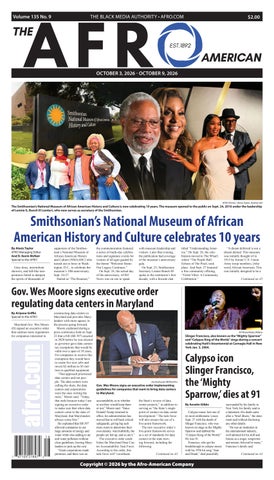
Volume 135 No. 9
THE BLACK MEDIA AUTHORITY • AFRO.COM
$2.00
$2.00
OCTOBER 3, 2026 - OCTOBER 9, 2026
AFRO Photos / Alexis Taylor, Andrew Hal
The Smithsonian’s National Museum of African American History and Culture is now celebrating 10 years. The museum opened to the public on Sept. 24, 2016 under the leadership of Lonnie G. Bunch III (center), who now serves as secretary of the Smithsonian.
Smithsonian’s National Museum of African American History and Culture celebrates 10 years
By Alexis Taylor AFRO Managing Editor And D. Kevin McNeir Special to the AFRO Gray skies, intermittent showers, and fall-like temperatures failed to dampen the spirits of thousands of
supporters of the Smithsonian’s National Museum of African American History and Culture (NMAAHC) who turned out in force in Washington, D.C., to celebrate the museum’s 10th anniversary, Sept. 24-27. Hailed as “The Reunion,”
the commemoration featured a series of multi-day celebrations and signature events for visitors of all ages guided by the theme “Welcome Home: Our Legacy Continues.” On Sept. 24, the actual day of the anniversary, AFRO News was on site to speak
with museum leadership and visitors. Later that evening, the publication had coverage of the museum’s anniversary gala. On Sept. 25, Smithsonian Secretary Lonnie Bunch III spoke to the institution’s first decade, with a fireside chat
titled “Understanding America.” On Sept. 26, the celebration moved to The Wharf, where “The Purple Ball: Echoes of The Pearl, took place. And Sept. 27 featured a free community offering, “Violet Vibes: A Community Celebration.”
“A dream deferred is not a dream denied. This museum was initially thought of in 1915 by former U.S. Union Army troop members, [who were] African American. This was initially designed to be a Continued on A5
Gov. Wes Moore signs executive order regulating data centers in Maryland By Ariyana Griffin Special to the AFRO
afro.com
Maryland Gov. Wes Moore (D) signed an executive order that outlines more regulations for companies interested in
constructing data centers in Maryland and provides Marylanders with more agency in the process going forward. Moore explained during a press conference held on Sept. 23 that a bill (SB 397) enacted in 2020 before he was elected as governor gave data centers tax exemptions that would be valid over a span of 10 years. For companies to receive this exemption they would have to create five new jobs and invest $2 million to $5 million in qualified equipment. “That approach prioritized data centers and not people. The data centers were calling the shots, the data centers and corporations were the ones writing the rules,” Moore said. “Today, that ends because today I am signing an executive order to make sure that when data centers come to the state of Maryland, that Marylanders always come first.” He explained that SB 397 allowed companies to use large amounts of energy and water while also adding to air and water pollution without clear guidelines, leaving Marylanders to pick up the cost. “Giant corporations made promises, and there was no
AP Photo/Kathy Willens
Slinger Francisco, also known as the “Mighty Sparrow” and “Calypso King of the World,” sings during a concert celebrating Haiti’s bicentennial at Carnegie Hall in New York Jan. 3, 2004.
Joe Andrucyk/ MDGovPics
Gov. Wes Moore signs an executive order implementing guidelines for companies that want to bring data centers to Maryland. accountability as to whether or not they would keep them or not,” Moore said. “Since Donald Trump returned to office, his administration has moved fast to roll back critical safeguards, giving big tech more room to determine their own destiny. And truthfully, the people are fed up, and so am I.” The executive order establishes the Maryland Data Center Accountability Task Force. According to the order, this task force will “coordinate
the State’s review of data center projects,” in addition to serving as “the State’s single point of contact on data center development.” The task force will also ensure the use of a five-point framework. The new executive order’s five-point framework serves as a set of standards for data centers in the state moving forward, including the following: Continued on A3
Calypso icon Slinger Francisco, the ‘Mighty Sparrow,’ dies at 91 By Anselm Gibbs Calypso music lost one of its most emblematic voices Sept. 27 with the death of Slinger Francisco, who was known on stage as the Mighty Sparrow and dubbed the “Calypso King of the World.” He was 91. Francisco, who got his breakthrough in calypso music with his 1956 hit song “Jean and Dinah,” died peacefully
Copyright © 2026 by the Afro-American Company
surrounded by his family in New York, his family said in a statement. His death came after a “brief illness,” the statement said without disclosing any other details. “He was an institution in the entertainment industry, well admired for his skill and finesse as a singer, songwriter and mentor; beloved by many,” Francisco’s family said. Continued on A3
A2 The Afro-American October 3, 2026 - October 9, 2026
WHAT’S TRENDING ON AFRO.COM National initiative calls for Black men to vote early on Oct. 24 By Andrew Hall Special to the AFRO Organizations from around the country are uniting to mobilize Black men to vote early on Oct. 24. The National Black Man Voter Day 2026 initiative is led by 100 Black Men of America, in partnership with the NAACP, National Urban League, Black Men Vote and Woke Vote. Together, the organizations aim to engage, educate and ensure that Black men vote ahead of the Nov. 3 midterm general election. A national organizing call took place Sept. 22. Leaders explained the importance of this mission. Dr. Wes Bellamy, a board member of 100 Black Men of America, said the coalition’s goal is to have 100,000 Black men participate in early voting. “As long as you are registered to vote, go vote on Saturday, Oct. 24,” Bellamy said to those who joined the call. “We want to move 100,000 brothers to be engaged in the electoral process and voting.” Michael Bland, executive director of Black Men Vote,
AP Photo/Morry Gash
National Black Man Voter Day 2026 will be held on Oct. 24. The initiative is aimed at mobilizing Black men ahead of the Nov. 3 midterm general election. Organizers say the goal is for 100,000 Black men to participate in early voting on National Black Man Voter Day. said Black men hold a unique position this election cycle. “Black men are the last persuadable base that is left in the country. When we vote, when we have our Million Man Voting March to the Polls and our Black Man
Your History • Your Community • Your News
The Afro-American Newspapers Baltimore Office • Corporate Headquarters 233 E. Redwood Street 6th Floor, Suite 600G Baltimore, Maryland 21202 410-554-8200
Voter Day on Oct. 24, we will shift the power and shift the conversation to the needs of our community,” he said. “Black men have now taken over the highest unemployment in this country. So if you needed a reason to vote, hopefully that gave you a reason.” Bellamy described voting as the first step in a broader process of civic engagement. “Nobody’s coming to save us, nobody’s going to do this work for us. We are going to save ourselves and we recognize that voting is just the first part of the marathon,” he said. “Voting is really just the
“Black men are the last persuadable base that is left in the country. When we vote, when we have our Million Man Voting March to the Polls and our Black Man Voter Day on Oct. 24, we will shift the power and shift the conversation to the needs of our community.” – Michael Bland, Executive Director of Black Men Vote first two to three miles of the process.”
“After that, it’s attending our school board meetings,
attending our city council meetings. Then going into the state house and activating. Communicating with our congressperson, making sure that we’re joining the missions,” he continued. “Brothers, you don’t have to run this marathon alone. We are running this race together, and that’s the power and the beauty of us.” Bland built on Bellamy’s call to action by emphasizing the need for unity. “We are not just going back to our individual silos. If you’re a party of one, you’re a party of none. When the states pass their budgets and nobody shows up, they’ll pass whatever ... they want, but when 100 strong or 500 strong show up, it would demand them to pay attention,” Bland said. “I promise you, our presence alone will move a vote.” Bellamy also noted the role Black women can play in the movement. “Sisters, this is not us against y’all. This is not a situation where we are looking to push the sisters away. We want a senate of brothers, but we also know that we love and need our sisters,” he said. “We’re always open to taking feedback and getting help spreading the word. If you have a son, brother, cousin, dad, nephew, best friend, husband or boyfriend ... we want them to join us in this effort.” Two more organizing calls will take place on Oct. 6 and Oct. 20 at 7 p.m. on Zoom. More information on how to get involved can be found at blackmanvoterday.org.
Customer Service, Home Delivery and Subscriptions: 410-554-8200 customerservice@afro.com Founded by John Henry Murphy Sr., August 13, 1892 Chairman of the Board/Publisher - Frances Murphy Draper (Publisher Emeritus - John J. Oliver Jr.) President - Benjamin Murphy Phillips IV VP of Marketing and Technology - Kevin E. Peck Director Digital Solutions - Dana Peck Receptionist - Wanda Pearson - 410-554-8200, ext. 246 Director of Operations
Andrè Draper - 410-554-8200
Director of Finance
Bonnie Deanes - 410-554-8242
Director of Sales Robert Walker-Smith - 410-554-8200 rwalker-smith@afro.com Editorial Managing Editor - Alexis Taylor - 410-554-8257 Editorial Assistant - Ama Brown-Parson Evening / Weekend Editor - Zenitha Prince
ACLU of the District of Columbia
Archivist - Savannah Wood- 410-554-8277 Baltimore Circulation/Distribution Manager Andrè Draper - 410-554-8200 Creative Design and Content Matthew McDonald
Washington Office 1140 3rd Street, N.E., 2nd Floor Washington, D.C. 20002-6723 202-332-0080 • Fax: 410-554-8213 (Washington Publisher Emerita - Frances L. Murphy II) Director of Operations - Andrè Draper - 410-554-8200
,GHQWLÀFDWLRQ 6WDWHPHQW
THE AFRO AMERICAN – (USPS 040-800) is published weekly by The Afro American Company, 233 E. Redwood Street, 6th Fl., Ste. 600G, Baltimore, MD 21202.
6XEVFULSWLRQ 5DWH 1 Year - $100.00 Print & Digital ($40 Digital Only) (Price includes tax). Checks for subscriptions should be made payable to: The Afro American Company, 233 E. Redwood Street, 6th Fl., Ste. 600G, Baltimore, MD 21202. 3HULRGLFDOV SRVWDJH SDLG DW %DOWLPRUH 0' DQG DGGLWLRQDO PDLOLQJ RIÀFHV POSTMASTER: 6HQG DGGUHVVHV FKDQJHV WR THE AFRO AMERICAN, 233 E. Redwood Street, 6th Fl., Ste. 600G, Baltimore, MD 21202.
Can't register by the deadline or make it on Election Day?
October 3, 2026 - October 9, 2026 The Afro-American A3
AFRO EDITORIAL
White House press ban is a warning the Black Press cannot ignore By Dr. Frances Murphy Draper AFRO CEO and Publisher The White House does not belong to Donald Trump. It belongs to the American people. And Black Americans have particular reason to care about who gets inside, who gets to ask questions and who gets to report back to the communities most affected by decisions made there. For nearly 200 years, the Black Press has existed in part because we could not depend on others to tell our stories, ask our questions or challenge those in power on our behalf. Access has never been an abstract issue for us. In 1944, Harry S. McAlpin became the first Black journalist to cover a presidential news conference, even as the White House Correspondents’ Association refused him membership. Decades later, as recently as 2022, the National Newspaper Publishers Association celebrated obtaining a White House hard pass for its national correspondent as a historic achievement. That history matters now. Trump’s decision to bar CNN, MS NOW and Politico from the White House may involve three large national news organizations, but the principle reaches far beyond them. If government access can depend on whether those in power approve of a news organization’s coverage, smaller outlets and historically excluded journalists have every reason to pay attention. So do the people we serve. The Trump administration is making consequential decisions involving diversity, equity and inclusion, the federal workforce and how American history — including African-American history — is presented at institutions such as the Smithsonian. These are not peripheral issues for Black America. They directly affect our jobs, our institutions, our history and how that history is told. We need journalists in the
Moore
Continued from A1
Ratepayers and Grid Protection
Corporations have to pay their own utility and infrastructure costs without putting strain on Maryland families. “Maryland families should not pay more for utilities because a large corporation is choosing to strain the grid. Data centers have got to pay their own way … or they need to go away,” Moore stated.
Economic Benefit for Marylanders
The data centers must provide jobs and opportunities for Marylanders, including partnerships, apprenticeships, labor unions and workforce training.
Community Must Have a Say
Communities will be made aware of data centers and what is being planned before a decision is made. “Communities deserve to be heard; they deserve a real say in what happens in their communities,” Moore said. “Our administration will always stand with the people, and the state will not go around a local community’s ‘no.’”
Environmental protections.
The state will begin taking a closer look at water, power and air usage to help protect
room asking about them. There is another part of this story Black journalists cannot ignore: Trump’s own documented treatment of Black women reporters who have questioned him. He called veteran White House correspondent April Ryan a “loser” and “very nasty.” He told CNN’s Abby Phillip that she asked “a lot of stupid questions.” When PBS correspondent Yamiche Alcindor asked whether his use of the word “nationalist” was emboldening white nationalists, Trump called the question “racist.” And at the 2024 National Association of Black Journalists (NABJ) convention, ABC News correspondent Rachel Scott opened an interview by asking Trump about his record and previous comments concerning Black people and Black journalists. Rather than simply answer, Trump attacked the way she asked the question, calling her introduction rude and saying he had never been asked a question in such a “horrible manner.” NABJ had already condemned Trump years earlier for repeated verbal attacks on Black women journalists. That history provides important context for what is happening today. Journalists are not above criticism. We should be accurate. We should correct mistakes. We should distinguish fact from opinion. Legitimate national security concerns should be taken seriously. And presidents have every right to challenge our reporting. But there is a difference between criticizing the press and controlling access to it. Trump initially announced the ban while denouncing the three organizations as “fake news.” The administration later offered additional arguments involving professionalism, decorum and the publication of sensitive or classified national-security information. Those arguments are now being tested in court. the state. “Maryland’s water and Maryland’s air must be protected,” said Moore. “That means protecting our treasure, the Chesapeake Bay, respecting our precious farmland, and ensuring that beloved communities that have already carried too much of a burden are now not being asked to carry more.”
Transparency and Accountability
Companies coming to Maryland must provide transparency for the public through a public dashboard. Corporations will have to submit public proposals that the public can go back and hold them accountable to. “Marylanders will be able to see what a company has proposed, how much electricity and how much water it expects to use, and how it plans to meet those needs,” the governor said. “They will be able to see what has been asked of the state and whether all of the commitments being made are being kept.” He expressed that his administration will begin working with the General Assembly immediately to repeal the tax exemption and data center bill, as a way to put Maryland families first. “I am unapologetic about my desire for economic growth. I want Maryland to be the best place in the world to change the world. I want Maryland to lead on innovation in this era,” Moore said.
NABJ President Errin Haines (top left), is raising the alarm about recent restrictions placed on members of the media by the 47th president and his administration. Her warning comes after the blatant disrespect of reporters such as White House Correspondents April Ryan (top right) and Yamiche Alcindor (bottom, left), in addition to ABC’s Senior Political Correspondent Rachel Scott. At a Sept. 23 hearing, U.S. District Judge Timothy Kelly questioned whether the administration had followed existing federal appellate precedent when it removed the organizations’ access. He lifted the ban for a two-week period. The legal process moves quickly. The situation could change before this editorial is published. Our concern does not depend on the timing or outcome of that ruling. The larger question remains: Should an administration be able to determine which journalists retain access based on its judgment of their reporting? We believe the answer
should not depend on whether the president likes the story, the question or the person asking it. Other news organizations clearly recognize the stakes. ABC, CBS, CNN, Fox News and NBC suspended their pooled television coverage after CNN was prevented from carrying out its scheduled White House pool assignment. The Reporters Committee for Freedom of the Press, joined by 50 media outlets and industry organizations, also went to court in support of restoring access. That solidarity matters. So does NABJ’s voice. NABJ President Errin
Dan Cox, the Republican nominee for Maryland’s 2026 gubernatorial election, criticized Gov. Wes Moore for his stance on data centers. “He believes if he prevails in November, he can then easily greenlight the takeover of Maryland’s farmland. We cannot allow that to happen,” Cox stated in a press release. “We MUST protect our Maryland cropland. It is a finite resource. Once it’s gone, it’s gone. Tell him, ‘NO MOORE!’” Still, Moore is touting his wins and said putting rules in place regarding data centers is beneficial for Marylanders. The governor said that Maryland now has “over $14 billion in private investment” in the state and has added over “60,000 new businesses” while having a “4.1 percent” unemployment rate. He said that the “job growth rate over the past six months has not only beaten the national average, it has almost doubled it.” He expressed that economic growth cannot come at the expense or demise of Marylanders. “Our families come first, and our children come first, not a developer’s timeline and not a corporation’s bottom line,” Moore said. “We will use every tool that we have at our disposal to make sure that no family and no community is left behind – this executive order makes that clear, and it is effective immediately.”
Haines put the issue plainly: government officials should not be able to reward favorable reporting with access or withhold access as punishment for scrutiny. “The White House belongs to the American people,” Haines said. Exactly. The Black Press has spent nearly two centuries making certain Black people were included among those Americans. When Freedom’s Journal was founded in 1827, Samuel Cornish and John Russwurm declared, “We wish to plead our own cause.” The AFRO
has carried that responsibility since 1892. That work has never depended on whether people in power liked our questions. It cannot now. Access to the White House is not about prestige, proximity to power or a coveted seat in a briefing room. It is about whether the people we serve can know what their government is doing in their name. Black journalists fought too long for access to treat it as a favor. And the Black Press has too much history with exclusion to be silent about who gets pushed out of the room.
Francisco
Continued from A1
The Mighty Sparrow will be remembered as “a defining voice of our culture, a master storyteller and a towering figure whose music helped carry calypso from Trinidad and Tobago to the world,” the Trinbago Unified Calypsonians’ Organisation said in a statement. Born in the coastal town of Grand Roy, Grenada, in July 1935, Francisco was just a toddler when he migrated with his parents to Trinidad and Tobago in 1937. Trinidad and Tobago is the birthplace of calypso music, and it’s where the name and persona of the Mighty Sparrow would later emerge to produce a list of hit songs in the genre: “Both of Them,” “Congo Man,” “Mr. Walker,” “The Lizard” and many more. “Birdie,” as Francisco was also affectionately known, recorded hundreds of songs and produced dozens of albums in a career that spanned six decades. He performed in several countries around the world, including at famous venues such as New York City’s Madison Square Garden. Throughout his career, Francisco’s goal was to advance the calypso art form, according to Trinidadian cultural historian and author
AP Photo/Tim Larsen
Mighty Sparrow Slinger Francisco received an honoree award at the Bollywood Music Awards in Atlantic City, N.J. on Nov. 4, 2006. Dr. Rudolph Ottley. “The Mighty Sparrow was the supreme entertainer, a cultural revolutionary and one of the world’s greatest calypsonians,” Dr. Ottley told The Associated Press. Tributes to the iconic performer have flooded in from around the world. Barbados Prime Minister Mia Mottley said “Birdie” was an ambassador for the entire Caribbean community, saying “he belonged to all of us.” “For seventy years, the Mighty Sparrow has been woven into our Caribbean
civilization,” Mottley said in a statement. “Listen to his recordings and you hear our history. Calypso gave the ordinary West Indian a voice. Sparrow carried it to the world with incomparable genius.” Trinidad and Tobago has honored the composer and performer with national awards, and in 1987 the University of the West Indies conferred an honorary Doctor of Letters on Francisco. This article was originally published by The Associated Press.
A4 The Afro-American October 3, 2026 - October 9, 2026
COMMENTARY
Standing for truth, paving the way: Celebrating Smithsonian Secretary Lonnie G. Bunch III By Vedet ColemanRobinson, Ph.D. There are careers measured by titles, institutions and accolades. Then there are those rare careers measured by how many people are able to walk farther because someone cleared the path before them. Secretary Lonnie G. Bunch III is one of those people. As he prepares to retire from the Smithsonian Institution after nearly four decades of service, the Association of African American Museums (AAAM) honors a leader whose impact reaches far beyond one institution, one museum or one generation. This moment is especially significant as we mark the 10th anniversary of the National Museum of African American History and Culture. Since opening its doors in 2016, the museum has transformed the national
cultural landscape and reinforced a truth that Secretary Bunch has carried throughout his career: African American history is not separate from American history. It is essential to understanding America itself. For historians, Secretary Bunch has demonstrated what it means to place history in service to the public. He has consistently reminded this nation that understanding America requires the courage to confront the fullness of the American story. That means telling not only the chapters that are comfortable, but also those that challenge us, complicate our understanding of the past and ultimately bring us closer to the truth. For those of us in the African-American museum field, his significance is deeply personal. He is one of us. Long before he became
secretary of the Smithsonian and before the National Museum of African American History and Culture opened on the National Mall, Secretary Bunch was doing the work familiar to so many AAAM members: researching, collecting, interpreting, preserving, educating and helping communities understand the value of their own histories. Those beginnings matter. They remind us that his historic achievements were rooted in the very institutions and professional traditions that form the foundation of our field. What Secretary Bunch accomplished through the creation of the National Museum of African American History and Culture changed the landscape of museums in America. His leadership also influenced the museum field more broadly by
demonstrating the power of rigorous scholarship, community engagement, institutional courage and public history practiced at the highest level. He expanded what generations of museum professionals could imagine for themselves. When we watched him lead, we saw what was possible for our careers. When we watched him build, we imagined what was possible for our institutions. When he rose to lead the Smithsonian, he demonstrated that someone grounded in African American museums and community-centered public history could reach the highest levels of the profession without abandoning those roots. That representation matters. At a time when museums and historians remain essential to protecting the historical record, Secretary Bunch’s legacy leaves us with a responsibility: tell the full truth,
Courtesy photo
Vedet Coleman-Robinson, Ph.D., serves as president and CEO of the Association of African American Museums. preserve the stories entrusted to us, strengthen our institutions and create space for the next generation.
Secretary Bunch helped pave the road. Now it is our responsibility to keep walking it.
Unshackling our people: A framework to end mass incarceration By Caitlin Radigan Mass incarceration is not an abstract policy problem, and having experienced incarceration myself, I know it demands our immediate attention. Nearly 2 million people, many of whom are Black or Latino, wake up in jails and prisons across the U.S. This is a 900 percent increase since 1925. Black Americans comprise 33 percent of the prison population despite being only about 13 percent of the U.S. population. This is not coincidental; it is the direct result of policies designed to replace slavery and Jim Crow with a new system of racialized control. As part of “The Black Papers,” a policy agenda for Black liberation, we outline a framework rooted not only in research, but in lived experience: prevention, diversion, decarceration, restoration and abolition. Prevention means investing in the root causes of harm: lack of housing, inequitable education and the absence of
Courtesy photo
Caitlin Radigan is a formerly incarcerated advocate, mother and writer. healing-centered, youth-driven programs. Safety is not created by surveillance or punishment; it is cultivated through opportunity, stability and care.
Accordingly, school-based policing and surveillance that disproportionately target Black and Brown youth must be eliminated, with funding redirected toward Black-led
violence interruption initiatives and restorative justice programs that provide support proactively. Community-based diversion models should be expanded, especially those implemented before charges are filed or court processes begin. Diversion looks like decriminalizing poverty, substance use and acts of survival—behaviors frequently penalized rather than addressed through supportive care. Rather than involving police in mental health crises, youth conflicts or homelessness, we must fund and deploy trained crisis responders who center on de-escalation and trauma-informed care. Decarceration can mean repealing mandatory minimums, eliminating cash bail and closing detention centers. For my own family, this is not theoretical. My brother-inlaw remains incarcerated in Indiana under a decades-long sentence while family members advocate for his release amid serious health concerns.
Families like ours experience incarceration alongside the person serving the sentence. But the human cost of incarceration is only part of the equation. Decarceration is not only a moral imperative; it also makes economic sense. The economic multiplier effect of community investment far exceeds the costs of incarceration. The U.S. spends approximately $80 billion annually on incarceration—more than the federal education budget. This means we spend $35,000 for every incarcerated person annually. In contrast, effective community-based programs cost $3,000–$15,000 per person annually and achieve recidivism rates below 30 percent. Restoration requires centering directly impacted leadership in reentry and policy design. Mass incarceration has perpetuated a narrative that people who are incarcerated are beyond redemption, but we reject that narrative. We can replace the current system with one rooted in healing, accountability and meaningful
reintegration. Abolition is both a longterm goal and a strategic framework. At its core, abolition means addressing the real causes of harm—poverty, trauma, and lack of resources—rather than punishing people for the symptoms of those problems. It also recognizes that the current system cannot simply be reformed because it is working as it was designed: to control and harm Black communities. Abolition does not mean immediately closing all prisons or abandoning accountability. It is not unrealistic or disconnected from other struggles. It poses a simple, yet powerful question: What must be built to render prisons obsolete? The answer is clear—communities where everyone has housing, healthcare, education, meaningful work and belonging, and where harm is addressed through healing and transformation rather than punishment. See more on AFRO.com
We are failing our young people, and we need to be angry about it By Michael Eugene Johnson Every day, a child dies or is misdirected because we are not listening to their cries. They are asking for help, and too often all we give them are speeches, excuses and parties that do nothing to change their lives. A society that expects young people to make good choices must first be honest about how little it is doing to help them make those choices. We cannot keep telling our youth to stay out of trouble while refusing to give them anything better to do, anything better to hope for, or anyone better to guide them. I am angry because this failure is not new. We know what young people need. They need safe places. They
Courtesy photo
Michael Eugene Johnson is creator of Pikes Studio Cinema and cofounder of Black Men Unifying Black Men. need mentors. They need after-school programs, sports,
arts, jobs, counseling and adults who actually show
up. Yet year after year, we underfund these things, close community centers, ignore struggling schools and then act shocked when children fall through the cracks. That is not confusion. That is neglect. We find money for celebrations, photo opportunities and empty promises, but when it comes to a recreation center, a youth counselor, a summer job program or a place where a child can feel safe and valued, suddenly there is no budget. That should make us angry. It should make us ashamed. It should make us demand better. Young people are not asking for miracles. They are asking to be seen, heard and given a chance. When we refuse to provide that, we are not just failing them — we
are helping create the very problems we later complain about. Every neighborhood should have places where young people can learn, create, work and belong. Recreation centers, theaters, apprenticeships, tutoring programs, mental health support and youth employment opportunities are not luxuries. They are necessities. If we can invest in parties, politics and appearances, then we can invest in children. And let us stop pretending this is someone else’s responsibility. Parents have a responsibility. Schools have a responsibility. Churches have a responsibility. Businesses have a responsibility. Community leaders have a responsibility. Government has a responsibility. But too
many of us are comfortable talking about “the youth” while doing almost nothing for them. We should be furious that so many children are left to raise themselves in a world that demands excellence from them but gives them so little in return. We should be furious that we wait until tragedy strikes before we act. We should be furious that we keep asking young people to be better while refusing to be better for them. If we truly care about safer streets, stronger families and a better future, then we must stop ignoring the cries of our young people. We must stop celebrating ourselves and start serving them. The future is already speaking. The question is whether we will finally listen.
The opinions on this page are those of the writers and not necessarily those of the AFRO. Send letters to The Afro-American ∙ 233 E. Redwood Street, Suite 600G Baltimore, MD 21202 or fax to 1-877-570-9297 or e-mail to editor@afro.com
October 3, 2026 - October 9, 2026 The Afro-American A5
NMAAHC Continued from A1 monument, but here we are. Over 100 years later, we’ve welcomed our 14 millionth visitor,” said NMAAHC Curator Mary Elliot. “The museum has changed over time. We’ve been consistent in terms of the quality of experience; the level of storytelling; the nuances in our history–making sure that we bring those forward so people can really reflect on who we were, who we are and who we want to be.” Elliot joined the museum’s team of experts in 2011, years before it had a physical building. She said one major change has been in the sheer number of artifacts housed within the museum. “We’ve had more opportunities to bring in more objects. We started with no objects, now we have 48,000 objects. We’ve really extended our reach by going out into the field, working with community members, but also online. We have our digital feature, the Searchable Museum, which is really dynamic and award winning.” Dr. Michelle Commander, NMAAHC deputy director, gave the AFRO insight on where the museum will be in another 10 years. “We are committed to staying true to our mission and to our responsibility to the American people to tell the full story of African American history and culture. One area I am particularly excited about is our work in community cultivation, which will extend many of the Museum’s programs and relationships beyond Washington,” she said, in a statement sent to the AFRO. “We want to build on the extraordinary external-facing work we have already undertaken and deepen our partnerships with communities across the nation. We understand that not everyone will be able to come to Washington, D.C.; for many families, the cost and time required to travel can be prohibitive.” Commander said that “the next decade will be about meeting people where they are— listening, learning, building meaningful partnerships, and creating new ways for communities to connect with the Museum and the histories with which we have been entrusted.” Like any family reunion, visitors, supporters, community partners and friends of the museum reflected on the arduous but fulfilling journey that has shaped the museum over the past 10 years. Some shared stories about how the museum has preserved and elevated African American history, while others expressed their hopes that its mission will remain undeterred for the benefit of generations to come. “It’s important for African Americans to preserve and acknowledge our history and the museum has served as a tremendous way to provide interactive learning for my son who is homeschooled,” said Brigette Squire, whose 13-year-old son, Matthew Stewart, is in the eighth grade. “He’s especially interested in learning about the achievements we’ve accomplished in entertainment, businesses, sports, the military, and in the Civil Rights Movement.” Squire said that she has been “careful to explain how there are those who want to rewrite and diminish our story, suggesting that we came to America voluntarily and were not treated like property.” “The truth has been unsettling to him but the museum’s existence, exhibits, and programs have been instrumental
Photo courtesy of NMAAHC / Reginald Cunningham
Members of the Sainted Trap Choir perform during the Violet Vibes celebration.
NMAAHC Timeline of Events 1915
Committee of Colored Citizens A committee forms to ensure proper treatment of African American veterans attending a commemoration of the 50th anniversary of the Civil War in Washington, D.C.
1916
National Memorial Association Members of the 1915 committee launch the National Memorial Association (NMA) to advocate for a national memorial to Negro Soldiers and Sailors in Washington, D.C.
1916-1928
Ferdinand Lee As NMA president, Lee works to get a bill passed to erect a monument, and later a National Negro Memorial Building. Congressional hearings occur in 1919, 1924, and 1928.
1929
Photo courtesy of NMAAHC / Reginald Cunningham
Tone Stith shows off his talent during the National Museum of African American History and Culture’s Sept. 27 anniversary celebration, Violet Vibes. in him learning the truth about African American history,” she told the AFRO. “My fear is that–without the NMAAHC–we may be unable to access and pass on the truth to future generations.” Since opening Sept. 24, 2016, the museum has welcomed more than 14 million visitors from 200 countries and hosted more than 26,000 school groups. Social media channels have generated nearly 897 million impressions and garnered more than 1.1 million followers. Recognized globally for innovation in exhibitions, education and digital engagement, NMAAHC has received more than 100 awards. Candace Jenkins, Howard University Law School alumni, said as a mother and grandmother, she hopes the museum will find more ways to attract youth through its doors. “I can only imagine what my parents and grandparents experienced during their lives because of discrimination, segregation and racism, and I find efforts by those who seek to erase that history as heinous – even evil,” said Jenkins. “Many of those stories were passed on orally. Now, we have a place where exhibits and programs transmit that history. But more has to be done to attract youth to the museum. Youth experience the world and learn
differently than I did as a child of the 60s. But they remain eager to learn – to learn the truth about their ancestors.” One Ward 7 parent and community activist Patricia Stamper said the museum has provided numerous opportunities for her to explain the Black experience to her two sons, Pete, 11, and Patrick 7, both of whom are impacted by learning disabilities. “We often visit the museum as a family outing and sometimes the exhibits lead to intense conversations,” Stamper said. “My oldest son’s birthday is close to the day on which Emmett Till was born and I wanted him to see the memorial, including the casket, which they’ve now removed. He did not understand the issue – why whistling at a white woman was dangerous. So, it was powerful to be able to show him.” Stamper said she wants her sons to learn history by seeing, touching, and experiencing it – not through the lens of artificial intelligence. She also expressed her dissatisfaction with the president’s efforts to whitewash history. “Our ancestors built this country on their backs and by shedding blood,” Stamper said. “As a mother of two Black boys, I need them to know their history. And it’s not just Black history but
American history that the president is trying to rewrite. “When my boys are adults, I want them to have some passion that I have for telling and passing on our stories about how we got over. If we don’t know and therefore cannot share the truth, who will?” Jackson Brooks, 12, said he loves visiting museums because they help him understand what people have accomplished despite the hurdles they faced in their lives. “I’d really like to see an exhibit about Bob Marley,” Brooks told AFRO News. “His music was so good…he helped bring Black people together in unity,” Jackson said. “I’m interested in becoming an artist and even though I’m doing well in school, I prefer photos over words. I’d rather see it than read it.” Jackson, in words well beyond his age, said it’s not good for people to attempt to erase Black history. “I understand that history is full of events that are both positive and negative,” Jackson said. “But history is history and no one has the right to erase the truth. Black people overcame slavery and turned their pain into a revolution, even becoming the first Black president of America. Black people faced hardships but we survived. That’s who we are.”
President Calvin Coolidge On March 4, President Coolidge signs Public Law 107 creating a presidentially appointed commission to plan for, design, and erect a memorial building.
1933 President Franklin Roosevelt disbands the commission and moves oversight to the Department of the Interior, where plans languish.
Jan. 30, 2006
Selection of the fiveacre museum site on the National Mall near the Washington Monument
Oct. 1, 2007
Selection of Freelon Bond, pre-design and architectural-programming consultants
Jan. 19, 2008
NMAAHC launches first “Save Our African American Treasures” program in Chicago
Oct. 27, 2008
Pre-design: Master facilities programming
November 2008
Completion of the master exhibition planning, facilities planning and programming report
January 2009
Opening of NMAAHC Gallery at the Smithsonian’s National Museum of American History
February 2009
Architectural design competition begins
April 14, 2009
Freelon Adjaye Bond/ SmithGroup selected as the architectural team for the museum
July 12, 2011
Construction firm, Clark/ Smoot/Russell begins planning for the construction of the building
Feb. 22, 2012
Groundbreaking
November 2012
1950s- 1960s
First concrete pour
The U.S. Interior Department unsuccessfully leads efforts to bring the museum to life.
Nov. 17, 2013
1980s Rep. John Lewis begins introducing bills on an annual basis to create a Smithsonian museum dedicated to African-American history.
Dec. 16, 2003 President George W. Bush signs the legislation creating the National Museum of African American History and Culture (NMAAHC)
October 2004 Founding 19-member NMAAHC Council appointed by the Smithsonian Board of Regents
March 14, 2005 Lonnie G. Bunch III named founding director of NMAAHC
Cranes install the first iconic artifacts, a Jim Crow-era railroad car and Louisiana State Penitentiary (Angola) prison guard tower, into the museum
October 2014
Steel topping out; last steel member lifted for structural framing
January 2015
Above-grade steel and concrete superstructure is complete to the roof level; glass installation begins on fifth floor
April 14, 2015
Glass enclosure complete; the first of 3,600 bronze-colored “Corona” panels installed
Sept. 24, 2016
NMAAHC opens to the public. Source: National Museum of African American History and Culture
A6 The Afro-American October 3, 2026 - October 9, 2026
The forest Rev. Jeremiah Wright planted is still growing As the legendary Chicago pastor approaches 85, the ministers, scholars and leaders he mentored reflect on the lessons — and love — that shaped their lives. By Rev. Dorothy S. Boulware Word In Black The Rev. Jeremiah A. Wright Jr. sat quietly as a screen full of his spiritual children told him what his life had meant to theirs. There was laughter, teasing, testimony and, more than once, tears. Panelists leaned toward their cameras as memories returned. Some rocked in their seats. Others paused to steady their voices. Wright, approaching his 85th birthday, listened. The Samuel DeWitt Proctor Conference gathered pastors, scholars, educators, an attorney and a consultant for a virtual “Critical Conversation: We Are the Legacy!” This was not a recitation of Wright’s résumé. It was a family conversation about the pastor, teacher, and mentor behind the public figure.
‘You Have Planted a Forest’
The Rev. Iva E. Carruthers, general secretary emerita of the conference, opened the celebration by placing Wright within the continuum of Black prophetic witness. She described him as a living libation whose ministry merged Christian faith, African tradition and social action. Carruthers recalled nearly 50 years of shared friendship, work, joy and pain. “You have planted a forest,” Carruthers told Wright.
AP Photo/J. Scott Applewhite
Rev. Jeremiah A. Wright Jr., longtime pastor of Chicago’s Trinity United Church of Christ, speaks at a National Press Club breakfast in Washington, D.C., April 28, 2008. Wright’s decades of ministry and mentorship continue to influence pastors, scholars and community leaders. That forest filled the screen. Attorney Natasha Robinson remembered joining Chicago’s Trinity United Church of Christ with her family in 1981. Wright led the church for 36 years until his retirement in early 2008. She was 7 when she joined, and misunderstood the Free South Africa sign outside the church. She thought joining Trinity might win her a free trip to South Africa. The room erupted in laughter, but the misunderstanding opened into something deeper. Trinity became the place where Robinson learned who she was in God’s sight and in her own. When schools miseducated Black children during the week, Robinson said, Trinity recalibrated them on
weekends. Scholars, artists and activists introduced children to Africa, Black history, politics and faith. Consultant Nakia Green saw the same theology embodied in Trinity’s structure. Before diversity, equity and inclusion became corporate language, she said, Wright placed women in executive leadership, created shared leadership between women and men and ensured that people with disabilities could participate.
‘One Final Act of Love’
Then the Rev. Neichelle Guidry, dean of Sisters Chapel at Spelman College, slowed the room down. Guidry remembered being a young minister assisting Wright at a graveside service.
They had been in many rooms together, but this was their first time alone. She was nervous. Wright sensed it and turned the committal service into a teaching moment. He showed her how to take two roses from the arrangement resting on or near the casket. As the final words were spoken, the roses were placed across one another in the form of a cross. It was, Guidry recalled, “one final act of love.” The roses transformed the moment. Wright was teaching more than ritual. He was teaching presence — how a minister remains attentive to a family at the place where language begins to fail. Guidry said she carries that lesson into her ministry with students at Spelman College. In an era when ministry is often measured by platforms, branding and visibility, Wright modeled the ministry that matters when people need it most.
Afrocentric Scholar, Faithful Christian
The Rev. Devon Jerome Crawford, senior pastor of Third Baptist Church of San Francisco, first encountered Wright’s preaching as a Morehouse College student. He saw a prophetic giant who held biblical scholarship, Black history, pastoral care, Africa and America together without contradiction. When Crawford later interned at Trinity, Wright listened to his questions and
made him feel seen. Crawford learned that ministry’s power is found not only in what a preacher proclaims but in what that preacher pours into people. Dr. Greg Carr, former chair of the Department of Afro-American Studies at Howard University, described Wright as a road map for being an African intellectual in the world — a preacher who refused to choose between African-centered scholarship and Christian faith. The Rev. Bernard L. Richardson, dean of the Andrew Rankin Memorial Chapel at Howard University, focused on Wright’s authenticity and endurance. Ministers, he said, must learn how to keep standing when they are wounded or left alone. Wright modeled that discipline after excerpts from his sermons were used to turn him into a political controversy during Barack Obama’s 2008 presidential campaign. The Rev. Jamar A. Boyd II, pastor of Kenwood United Church of Christ in Chicago, brought the conversation back to mentoring. After graduating from seminary during the pandemic, Boyd was uncertain about several ministry opportunities. He called Wright and they talked for three hours.
‘What is God Telling You to Do?’
Boyd expected the elder preacher to give him an answer. Instead, Wright redirected him toward discernment: “What is God telling you to do?” Years later, when Boyd was preparing to eulogize
his predecessor at the Chicago church, he again went to Wright. They worked through three Scripture passages. Wright helped Boyd understand that the eulogy would also be his first defining sermon as Kenwood’s pastor. Near the end, the Rev. Dr. Frederick D. Haynes III, pastor of Friendship-West Baptist Church in Dallas, who is running for a Texas congressional seat, joined from the campaign trail. He rejected any attempt to let cable news define Wright and spoke instead of the man who helped fill the void when Haynes’ father died during his adolescence. “I’ve never missed being fathered,” Haynes said. When Wright finally spoke, he leaned into humor, joking about his unfamiliarity with public speaking. Then he turned toward gratitude. “Thank you,” he said. The words were brief, but the emotion in the room was not. Richardson closed in prayer, entrusting Wright, his family and their future to God. The evening answered its own title. Wright’s legacy is not confined to recorded sermons, a famous congregation or a painful season in national politics. It lives in ministers who know how to stand at gravesides, mentors who make room for young leaders and Black people who refuse to separate faith from intellect, identity or justice. The forest was on the screen. And it is still growing. This article was originally published by Word In Black.
Bishop Antoine McClurkin turns healing, education and faith into a ministry of purpose By Rev. Dorothy S. Boulware Special to the AFRO Bishop Antoine O’Neal McClurkin has spent nearly four decades preaching the Gospel, but these days he is thinking as much about what happens after the sermon as what happens in the pulpit. “After you worship, after you get up, after you dry your tears, the work is there,” McClurkin said. That conviction is helping define a significant season for the veteran pastor and bishop. McClurkin is celebrating another milestone in ministry. He recently earned a Master of Divinity from the Samuel DeWitt Proctor School of Theology at Virginia Union University (STVU) and is beginning a new term as president of the United Council of Christian Community Churches of Maryland and Vicinity (UCCCC). Taken together, the milestones might look like a season of achievement. McClurkin sees something different: responsibility. “You’ve been called to acknowledge it,” he said of the inequities he sees around him. “Now teach it. Grab it. Own it. Make it your own and teach it.” That sense of responsibility has grown during 34 years
of preaching and 20 years of pastoring, currently at The Hill in Jessup, Md. McClurkin has long understood the church as more than a Sunday gathering place. His ministry requires looking beyond the sanctuary at poverty, violence, educational disparities and economic inequities affecting the communities the church is called to serve. His recent seminary experience sharpened that focus. “I could see disenfranchisement,” McClurkin said. “I fought to have a heart for socioeconomic reform and things like that. But I got to see it and hear it [and] it expanded my consciousness. But it also invoked compassion.” For McClurkin, those issues are not abstract theological arguments. They have names, neighborhoods and ZIP codes. He remembers serving people who lived in East Baltimore, but still had never traveled to the Inner Harbor, despite being only 14 or 15 blocks away. “In my mind, how could this be?” he said. The question helped shape a ministry committed to confronting what he calls “uneven distributions” — the reality that opportunity, resources and even basic freedoms available in one community can remain beyond reach in another. His studies at the Proctor
School gave him new language and tools for work he was already doing. Christian ethics was particularly influential, helping him connect theology with the everyday responsibility of living out one’s beliefs. “You can’t just talk it,” McClurkin said. “You’ve got to live it out.” That philosophy also informs his leadership of the UCCCC. As he begins another term as president, McClurkin will lead a fellowship whose mission includes strengthening churches, training people for ministry and encouraging churches to serve the poor and those in need. His presidency comes at a time when Black churches and their leaders are confronting familiar problems in new forms — economic inequality, community violence, political uncertainty and questions about the church’s relevance to younger generations. McClurkin believes preparation matters. So does learning. His grandparents planted that lesson before he was old enough to imagine decades of preaching, a bishop’s title or denominational leadership. “Learn every day,” they told him when he was in kindergarten. More than 27 years after leaving a classroom,
McClurkin carried those same words back into one. “I know and I believe I will write it in as a subclause to the Great Commission: Learn every day,” he said. “Every day that we wake up, there is something to learn that you may know, may not know, or you need to know.” Earning the master’s in divinity degree was particularly meaningful because getting there required McClurkin to confront doubts born from one of the most difficult periods of his life. In 2015, he endured a life-threatening illness that kept him moving between hospitals and rehabilitation from May 11 until Dec. 23. He spent time on life support and said the ordeal affected his memory. Months later, he returned to the pulpit using a walker. A decade later, the preacher who once wondered whether his memory could withstand graduate school completed the degree. “I continuously stand in awe of God,” he said. “I’m living the goodness of God.” The experience has affected his family, too. McClurkin believes his children have witnessed something more lasting than their father receiving a diploma. “We heard Daddy say it. Now we see him do it,” he said, describing what he
Courtesy photo
Bishop Antoine O’Neal McClurkin celebrates a new season of ministry after earning a Master of Divinity and beginning another term as president of the United Council of Christian Community Churches of Maryland and Vicinity. believes they have seen. It is the same lesson he hopes Black men, fathers, ministers and others watching his journey will take from this season. “It’s never too late,” McClurkin said. “And you’ll know you’re able to do it once you start.” For McClurkin, however, neither a ministry milestone, another term as president nor the degree represents a finish line. They point toward what comes next. He has developed a Bible study series called “Budgeting the Blessing,” built around the idea that gifts from God carry obligations.
“When God blesses you, whether it’s financially or with intellect, it’s not yours,” he said. “It has to be shared.” Perhaps that is the clearest description of McClurkin’s ministry at this stage: Whatever God has given him — years, education, influence or another opportunity to lead — must be put to work. A decade after fighting his way back to a pulpit on a walker, McClurkin believes the message of this season is remarkably simple. “God has called me to preach and minister and teach generations,” he said. “And I believe this is a defining moment that says, now live. Now live.”
October 3, 2026 - October 9, 2026 The Afro-American A7
Howard grad Kennedi Reece shines in ‘A Different World’ reboot By Ronda Racha Penrice Special to the AFRO Graduating from Howard University in May didn’t conclude Kennedi Reece’s Black college experience. Now, she’s enrolled in a different kind of historically Black college and university (HBCU) – the legendary, fictional Hillman College, where the hit sitcom “A Different World,” takes place. Now showing on Netflix, the reboot of the beloved classic series reached No. 1 on the platform’s US TV list within days of its release. Reece plays Hazel, a church girl full of surprises. She joins a tradition and fandom that started nearly 40 years ago when the stars of “A Different World” first took to the screen. Launching Sept. 24— the same day the very first season premiered on NBC in 1987—the sequel doubles down on them both. All 10 episodes of the first season of the “A Different World” sequel are currently streaming on Netflix. “A Different World” was originally welcomed as a spinoff of “The Cosby Show,” starring Lisa Bonet as Denise Huxtable, the wayward daughter attending the fictional alma mater of her parents. At the time, some believed season one of the 1987 series didn’t paint a full picture of life at an HBCU. When Debbie Allen took over for season two, everything changed. Drawing upon her own Howard University experiences, Allen infused the show with HBCU authenticity and moved to center the slow-burn romance between Southern belle Whitley Gilbert and math genius Dwayne Wayne. Both Jasmine Guy and Kadeem Hardison reprised their iconic roles for the series sequel.
AP Photo via Netflix
Howard University grad Kennedi Reece has moved from being a historically Black college student to portraying one on Netflix. Reece portrays the character of “Hazel,” on the iconic television series “A Different World,” which has made a comeback. Felicia Pride, a Baltimore native, is both creator and showrunner for the 2026 version of “A Different World.” The storyline revolves around Whitley and Dwayne’s youngest child Deborah Wayne, played by “Hell’s Kitchen” Tony and Grammy winner Maleah Joi Moon. Deborah Wayne’s Hillman chapter includes her own romance with Shaquille Johnson, the superstar quarterback played by Cornell Young IV. Johnson is the son of Ron Johnson, played by Darryl M.
Bell in the original series. Other freshmen classmates include roommate Rashida DuVall, who hails from Compton. Rashida is played by Alijah Kai, and her mother both in the series and in real life is no other than Tichina Arnold, who plays the character of Darlene Duvall. Chibuikem Uche takes on the role of British-Nigerian-Ghanaian Kojo Achebe, an emerging streetwear designer. And Jordan Aaron Hall is seen as Amir, a Hillman student who refuses to be defined by his
sexuality. Reece joined the fold in an unusual, but magical way. “My audition process was a little bit different than everyone else’s,” said Reece, who grew up in the Chicago suburb of Wheaton. “Ms. Debbie came to Howard to audition students there, and that’s how I found out about it. I got an email from the coordinators of my program: ‘Untitled HBCU Project auditioning here.’ I submitted a self-tape and acting reel. I literally
threw together monologues that I had for class and I got an audition.” Reece admits that she didn’t think much of it. “I really was just like, ‘Oh, that was such a great experience … I got to perform in front of Debbie Allen,’” she recalled. “And then a few weeks later, I got an email talking about how they were interested, and now we’re here.” Playing Hazel is a great fit for Reece. “I’m really happy I was chosen for the role of Hazel because, honestly, I feel very similar to her in some ways,” she said. “She’s from the Chicago suburbs, so that’s also a connection that we have. But she’s a very sweet girl. She’s very kind. She is a God-fearing girl. She’s a pastor’s kid, and she is experienced, but also very naive, kind of like a walking contradiction. She is just a sweet soul, and she’s so excited to be at Hillman, like it’s been her dream forever.” Hazel’s outlook about Hillman is something the musical theater alum relates to most. “When I first got to Howard, I was very bright-eyed and bushy-tailed. I was very much trying to experience everything and wanted to be involved in everything. And that’s the same thing with Hazel,” said Reece. “I just feel like she was so excited, and she was so ready to be involved on campus. So both of our drives and like passion for just community and the social aspect of getting to know people, I feel like I was able to bring a lot of myself to her in that way.” Reece personally knows the impact “A Different World” had on increasing HBCU enrollment. “My dad went to Morehouse, and a big part of
why he went to Morehouse was because of ‘A Different World,’ and he was always talking about it,” Reece shared. Because of that connection with her dad and the show’s impact, Reece was drawn to “A Different World” before enrolling in Howard. “I think I watched the show for the first time in high school, and so it was really nice to be able to just be a part of a community that cherished HBCU culture,” she said. Of course, back then Reece never imagined she’d work with any of them. She admits that it was hard for her to believe at first. “I’d be walking to my trailer, and Cree Summer is just walking around, and I was like, “Oh, wow, we’re co-workers– like, that’s my coworker,” she said. “But we’re more than that too.” “The chemistry between the younger generation carried over to the OGs as well. We were welcomed into this community and this legacy so well by the OG cast,” Reece continued. “ They’re truly a part of our family, and we’re a part of theirs.” Reece said that during the show, the original cast members “were always offering advice.” “They were always in our corner, making sure that we were OK, saying if we needed anything, we could always reach out to them,” she added.“It was surreal.” Reece spoke to how she went from being star struck to feeling like a member of the family. “‘I saw these people on my TV,’” she recalled, of her excitement to be in proximity to well-known celebrities. “It quickly just turned into the new normal, because these are my people now.”
AP photo / Quantrell Colbert via Netflix Netflix via AP
Legendary actress Debbie Allen shines in the reboot of “A Different World.”
Shown here, Chibuikem Uche (left), Cornell Young IV and Jordan Aaron Hall in a scene from “A Different World.”
Daniel Delgado Jr. / Netflix via AP
Cornell Young IV portrays Hillman football player Shaquille Johnson in season one of the “A Different World” series, which recently returned with a mix of old and new cast members.
AP photo via Netflix
Jasmine Guy (left) and Kadeem Hardison, members of the original “A Different World” cast, make a return to Hillman.
A8 The Afro-American October 3, 2026 - October 9, 2026
In seeking the ‘best’ education for my Black son, what did we ask him to sacrifice? By Dr. Karsonya Whitehead Recently, Nikole Hannah-Jones wrote an essay in The New York Times Magazine that has stayed with me. She reflected on a choice she and her husband made 10 years ago about where their daughter would go to school. She chose a mostly Black school because she believed in the collective responsibility to challenge segregation and educational inequality. Years later, their daughter asked the questions that every parent dreads: Did you know? Did you know what I was losing when you made that choice for me? Hannah-Jones does not offer herself an easy answer. Neither will I. I read her essay and immediately thought about the choice my husband and I made in the opposite direction. We sent our sons to predominantly white private schools. We wanted what most parents want. A strong education. Opportunity. Preparation. Access. As a former Baltimore City public middle school teacher, I knew some of the challenges they might face, and I wanted to protect them and prepare them. We simply wanted them to have a good education.
What I knew then
My oldest son, Kofi, was 6 years old the first time I watched him discover that being Black might make him a target. He was in first grade at an independent school in Baltimore. One day during recess, some of the boys created a game. They called it: “Let’s Get the Black Boy.” There was only one Black boy in the grade. My son. So, he ran. Years later, I wrote about that day. I remembered the car ride home, when he asked me so many questions. What did it mean to be Black? Was being Black
something we chose? My husband and I talked late into the night about what it meant for him to run and what might have happened if the boys caught him. And where were the teachers? That night, while my 6-year-old tried to understand his Blackness, I stood in front of the mirror, getting ready to confront his teachers and his school. I practiced what I would say and tried to find the courage to say it. I also remembered what my father taught me: when we face racism and injustice, staying silent can be its own kind of complicity. I did not realize it at the time, but my son was starting two kinds of education. The school taught him academics. America was teaching him about race. I was trying hard to help him get through the second without losing what he could gain from the first. This is not new. Black people in this country have always had to learn both. I was 7 when someone I thought was my best friend called me the n-word. I did not even know what it meant until I told my Nana, who then had the same talk with me that I was now having with my son. I used to think, maybe foolishly or hopefully, that the conversation about being Black in America would end with me. I was wrong then, and I am still wrong now.
What my son knew then
Ten years later, Kofi told the story himself. On Nov. 17, 2017, The Washington Post published his essay: “At my Baltimore school, we played ‘Let’s get the black boy.’ I was the black boy.” He was almost 17. What struck me then, and still does, is that he remembered what the other children probably forgot. He remembered running. He remembered being the only Black boy. He remembered learning that there were really two communities at his school: one inside the
classroom, where teachers tried to include him, and another outside, with weekend gatherings and playdates where our family was rarely invited. He also wrote something I think about often. He said he was still running against that 6-year-old boy. But he also made himself a promise. If he faced racism again, he wanted to stand instead of run. That line means even more to me now, because racism did find him again.
And then came college
Kofi went to Rhodes College. Another predominantly white institution. And in September 2021, a banana was taped to the dorm-room door of Black students he knew. By then, my son was no longer the 6-year-old boy running across a playground. He was president of Men of Distinction, a Black male student organization on campus. And this time, he stood. He spoke publicly. He challenged the institution. He pushed for a stronger response. He told local reporters that students of color at predominantly white institutions can learn to keep their heads down and continue moving forward. But this time, he said, they were planting their feet and saying: Enough is enough. Six years old in elementary school: Run. Almost 17 in high school: Write. Almost 20 in college: Stand. There is a temptation here to shape this into a beautiful story about resilience and courage. I refuse to do that. Racism did not make my son strong. He became strong even though he had to face racism. That is not the same thing. No Black child should have to be chased on a playground to learn courage. No Black teenager should have to explain racism to white classmates to find his voice. No Black college student should have to face racial
Courtesy photo
Dr. Karsonya “Kaye” Wise Whitehead is a historian of Black life in America, a professor at Loyola University Maryland, and the host of “Today With Dr. Kaye” on WEAA. She is also the 30th president of the Association for the Study of African American Life and History (ASALH). Shown here, Whitehead, with her son, Kofi. humiliation to become a leader. We can be proud of what our children become without pretending that everything they went through was needed for them to grow.
So, was it worth it?
This is where the question gets complicated. Because I cannot honestly tell you that sending our sons into predominantly white educational environments was simply a mistake; it was not. Kofi finished eighth grade at Calvert School, graduated from Gilman School, and then from Rhodes College. All of these were mostly white schools. He got opportunities, met people who broadened
his view, grew intellectually, and built relationships. He also learned about himself and the world. Now, he can look back and appreciate much of what those schools gave him. We also made sure to create cultural experiences outside of school. Through friends and family trips, he was surrounded by Black people who loved, encouraged, and truly saw him. He learned Black history, studied Black art, read books by Black authors, and went to Homecoming at Lincoln University (my HBCU). He was surrounded by the richness, beauty, and brilliance of Black culture in America. And yet, I am his mother.
And because I am his mother, I also remember what those schools asked him to carry. Maybe this is where the conversation about Black children and education gets more complicated than the choices we often give parents: public or private, mostly Black or mostly white, neighborhood or selective, integration or community, opportunity or belonging. What if those are not the only questions? What if we also need to ask: What does this school ask my Black child to give up in exchange for what it offers? See more on AFRO.com
Parents trust report cards more than test scores, with consequences for kids By Jill Barshay Most parents want to help their children succeed. We check report cards, ask about homework and try to help our kids study. When that fails, we sometimes hire tutors. But in an era of rising grades, it’s easy to be misled. A new study reviewed by The Hechinger Report found that parents often assume everything is fine when their child’s report card shows mostly A’s, even when standardized test scores slide. That assumption may underestimate the help and guidance their child needs. In an online experiment, researchers at Oregon State University and the University of Chicago created hypothetical fifth graders, whom they called Stacey and Robert, and asked more than 2,000 parents how they would advise the children’s parents to respond to different scenarios of grades and test scores. Test scores were expressed
as percentile ranks on standardized tests, such as the annual state tests that public school children take each spring, so that parents could compare Stacey and Robert with those of other children nationwide. And study participants were given an imaginary $100 per week to “spend” however they wished. Options included enrolling the child in an after-school program, hiring a tutor or saving the money for a vacation or bills. They could also invest their own time, such as helping with homework or reading together. Parents advised increasing time and money spent when both grades and test scores were low. Parents were less likely to provide extra help or resources when grades were high and only test scores were low. The researchers found that parents were more likely to step in when grades were low but test scores were higher. More than 70 percent of the parents said they trust grades more than tests for making
decisions about their own child, and fewer than 9 percent said they had more confidence in tests. The findings appear in a draft paper that has not yet been published in a peer-reviewed journal and may still be revised. It was publicly circulated by the Becker Friedman Institute for Economics at the University of Chicago this month. As test scores have fallen nationwide while grades have risen, the researchers believe that parents may be underinvesting in their children. “Parents are the key to children’s success,” said Ariel Kalil of the University of Chicago. “What you need is for parents to be making investments in their kids’ skill development, and you need that parental effort to be happening early and often. Anything that depresses parent investment is a problem.” Kalil is concerned that this underinvestment in children is more pronounced in low-income communities, where,
she said, high grades are often issued for below-grade-level skills. After the COVID-19 pandemic, schools struggled to persuade families to enroll in free tutoring and summer programs to make up for months of disrupted instruction. Many report cards showed solid grades, reducing the urgency for parents to act. Paired with other recent research on long-term academic and economic consequences, this study strengthens the case that grade inflation isn’t harmless. Inflated grades may feel encouraging, but they can send false signals both to students, who may study less, and to parents, who may see less reason to step in. Ultimately, it not only hurts individuals but also American labor force skills and future economic growth, the researchers argue. Kalil, a behavioral scientist, believes that parents have more confidence in grades because they are familiar and easier to understand. Meanwhile, score
Shutterstock / Cheryl Casey
Parents may assume their child is doing fine when the report card shows mostly A’s, even if standardized test scores are slipping. That assumption can overlook the extra support or guidance the child may need. reports are complicated, and even many well-educated parents are confused about scaled scores and percentile rankings. A survey that accompanied the online experiment revealed that a sizable share of parents don’t trust standardized tests. Forty percent of the parents in the study said that tests were biased. Almost 30 percent thought student scores were a reflection of family income. Fewer than 20 percent of parents thought tests captured
their children’s skills. Kalil says there’s another psychological phenomenon at play even for parents who understand and value standardized tests: the tendency to ignore bad news when it is paired with good news. “If the report card is all A’s, there’s a cognitive bias towards sticking your head in the sand and rejecting the bad information,” said Kalil. See more on AFRO.com
October 3, 2026 - October 9, 2026 The Afro-American A9
WASHINGTON AREA
Family demands justice in police-involved shooting death of Tawfiq Abdul Haqq in Suitland, Md. Members of the community believe Haqq was unfairly shot after being identified and engaged by officers. Family and friends are calling his death completely unjustified. According to the Independent Investigations Division (IID) of the Maryland Office of the Attorney General, the officer responsible for Haqq’s death is Corbin Davis, a
By DaQuan Lawrence, Ph.D. Special to the AFRO DLawrence@afro.com
Judy Schloss Photography
On Sept. 18, 2026, the Washington, D.C.-based Wanda Alston Foundation, which supports LGBTQ+ homeless youth in the District, held its fall fundraiser and honored local youth champions. Shown here, Japer Bowles (left), director of the Mayor’s Office of LGBTQ Affairs, Partner of the Year Award; Elizabeth Pace, president and executive director of the Monumental Sports & Entertainment Foundation, Community Impact Award; Rayceen Pendarvis, community activist; Cesar Toledo, executive director, Wanda Alston Foundation; D.C. Councilmember Robert White (At-large), Lifetime Achievement Award; and D.C. Councilmember Zachary Parker (D-Ward 5), honorary host.
Wanda Alston Foundation hosts fall fundraiser to address homelessness among DC’s LGBTQ youth By D. Kevin McNeir Special to the AFRO Washington, D.C., may be America’s crown jewel, hailed for its historic beginnings and majestic monuments, but it’s also a city which has held the ignoble distinction of having one of the highest per-capita rates of homelessness in the U.S. According to the official 2026 Pointin-Time (PIT) Count, 5,363 individuals are currently facing homelessness in the District – a 4.4 percent increase from the previous year. As for D.C.’s LGBTQ+ youth, the situation is far more grave, with nearly 40 percent without shelter, many either forced out of their homes or fleeing abusive environments. Fortunately, one local nonprofit organization, the Wanda Alston Foundation (WAF), formed in 2008 to honor the legacy of Alston, an LGBTQ+ activist and organizer in D.C., has emerged as a leader in providing services for and reducing homelessness among the city’s gay, queer, and transgender youth. On Sept. 18, the Foundation hosted its fall fundraiser on a penthouse rooftop in
Photo Courtesy of The Wanda Alston Foundation
The Wanda Alston Foundation, a devoted organization that provides housing for homeless LGBTQ+ youth, is now partnering with the self-care company, TOA Waters. Southwest D.C., during which Executive Director Cesar Toledo honored several local LGBTQ+ youth champions and shared some of the organization’s upcoming plans.
“I’m happy to report that through generous donations, we have surpassed our $60,000 fundraising goal and can move forward with our strategic plan, Queer Legacy, Bold Future,” said Toledo. “Homelessness among the youth we serve has reached a national crisis and we see it firsthand here in the District of Columbia among both young queer people who move to D.C. in search of community and long-time queer residents who are being priced out and without housing.” In June, WAF and Loyola Marymount University surveyed over 300 queer people (Out and Counted), in the District, ages 18 to 30, which revealed that one in four LGBTQ+ young adults experienced housing instability in their lifetime, with some moving frequently and others couch surfing. A 2025 Youth Count of 846 young people from The Community Partnership revealed nearly one in three unhoused youth in D.C. were LGBTQ+. D.C. Mayor Muriel Bowser, in a statement, applauded the efforts of the Continued on A10
Faith, labor and civil rights leaders unite in D.C. to launch ‘People’s Revival’ By Dr. Deborah Bailey AFRO Contributing Editor
Residents of the Prince George’s County community recently gathered at Capital Christian Fellowship church located in Lanham, Md., calling for justice in the police killing of Tawfiq Abdul Haqq, known to his family as Bernard Gibson III. Haqq was slain by an on-duty officer on Aug. 21
Continued on A10
Statement of Ownership, Management, and Circulation (All Periodicals Publications Except Requester Publications)
1. Publication Title
2. Publication Number
AFRO AMERICAN NEWSPAPER
3. Filing Date
0040 _- 0800
09/21/2026
4. Issue Frequency
5. Number of Issues Published Annually
WEEKLY
52
6. Annual Subscription Price
$120 PRINT/$60 DIGITAL
7. Complete Mailing Address of Known Office of Publication (Not printer) (Street, city, county, state, and ZIP+4 ®)
Contact Person
BONNIE DEANES
233 E. REDWOOD STREET, STE 600G BALTIMORE, MD 21202
Telephone (Include area code)
(410) 554-8242
8. Complete Mailing Address of Headquarters or General Business Office of Publisher (Not printer)
9. Full Names and Complete Mailing Addresses of Publisher, Editor, and Managing Editor (Do not leave blank) Publisher (Name and complete mailing address)
DR. FRANCES MURPHY DRAPER 233 E. REDWOOD STREET, STE 600G BALTIMORE, MD 21202 Editor (Name and complete mailing address)
ALEXIS TAYLOR 233 E. REDWOOD STREET, STE 600G BALTIMORE, MD 21202 Managing Editor (Name and complete mailing address)
ALEXIS TAYLOR 233 E. REDWOOD STREET, STE 600G BALTIMORE, MD 21202 10. Owner (Do not leave blank. If the publication is owned by a corporation, give the name and address of the corporation immediately followed by the names and addresses of all stockholders owning or holding 1 percent or more of the total amount of stock. If not owned by a corporation, give the names and addresses of the individual owners. If owned by a partnership or other unincorporated firm, give its name and address as well as those of each individual owner. If the publication is published by a nonprofit organization, give its name and address.) Full Name Complete Mailing Address
11. Known Bondholders, Mortgagees, and Other Security Holders Owning or Holding 1 Percent or More of Total Amount of Bonds, Mortgages, or None Other Securities. If none, check box Full Name
Complete Mailing Address
13. Publication Title
14. Issue Date for Circulation Data Below
AFRO AMERICAN NEWSPAPER
09/19/2026
15. Extent and Nature of Circulation
Average No. Copies No. Copies of Single Each Issue During Issue Published Preceding 12 Months Nearest to Filing Date 12. Tax Status (For completion by nonprofit organizations authorized to mail at nonprofit rates) (Check one) The purpose, function, and nonprofit status of this organization and the exempt status for federal income tax purposes: a. Total Number of Copies (Net press run) Has Not Changed During Preceding 12 Months
Has Changed During Preceding 12 Months (Publisher must submit explanation of change with this statement) (1) Mailed Outside-County Paid Subscriptions Stated on PS Form 3541 (Include paid 883 904 nominal rate,page advertiser’s proof copies, and exchange copies) PS Form 3526, July 2014 distribution [Page 1 of 4above (see instructions 4)] PSN: 7530-01-000-9931 PRIVACY NOTICE: See our privacy policy on www.usps.com. b. Paid Circulation (2) Mailed In-County Paid Subscriptions Stated on PS Form 3541 (Include paid distribution above nominal rate, advertiser’s proof copies, and exchange copies) (By Mail and 13. Publication Title Outside Paid Distribution Outside the Mails Including Sales Through Dealers and Carriers, AFRO (3) NEWSPAPER theAMERICAN Mail) Street Vendors, Counter Sales, and Other Paid Distribution Outside USPS® 15. Extent and Nature ofPaid Circulation Distribution by Other Classes of Mail Through the USPS (4) (e.g., First-Class Mail®)
729
735
14. Issue Date for Circulation Data Below
10
11
09/19/2026
Average No. Copies No. Copies of Single 9 During 8 Each Issue Issue Published Preceding 12 Months Nearest to Filing Date
c. Total Paid Distribution [Sum of 15b (1), (2), (3), and (4)] a. Total Number of Copies (Net press run)
1631
1658
d. Free or Nominal Rate Distribution b. Paid (By Mail Circulation and (By Mail Outside and the Mail) Outside the Mail)
30 883
31 904
(1) Free or Nominal Rate Outside-County Copies included on PS Form 3541 (1) Mailed Outside-County Paid Subscriptions Stated on PS Form 3541 (Include paid distribution above nominal rate, advertiser’s proof copies, and exchange copies) (2) Free or Nominal Rate In-County Copies Included on PS Form 3541 Mailed In-County Paid Subscriptions Stated on PS Form 3541 (Include paid (2) distribution aboveRate nominal rate,Mailed advertiser’s proof copies,Through and exchange copies) Free or Nominal Copies at Other Classes the USPS (3) (e.g., First-Class Mail) (3) (4)
Paid Distribution Outside the Mails Including Sales Through Dealers and Carriers, ® Free NominalCounter Rate Distribution the Distribution Mail (Carriers or other means) StreetorVendors, Sales, andOutside Other Paid Outside USPS
21
15
729
735
10
11
PaidRate Distribution by Other of Mail Through the USPS e. Total Free or (4) Nominal Distribution (SumClasses of 15d (1), (2), (3) and (4)) (e.g., First-Class Mail®)
51 9
46 8
c. Paid Distribution 15b15e) (1), (2), (3), and (4)] f. Total Distribution (Sum[Sum of 15cofand
1726 1631
1765 1658
Statement of Ownership, Management, and Circulation 30 31 44 61 (All Periodicals Publications Except Requester Publications)
d. Free or (1) Free or Nominal Rate Outside-County Copies included on PS Form 3541 g. Copies Nominalnot Distributed (See Instructions to Publishers #4 (page #3)) Rate Free or Nominal Rate In-County Copies Included on PS Form 3541 Distribution 16. Electronic Copy(2) Circulation h. (By TotalMail (Sum of 15f and g) and Free or Nominal Rate Copies Mailed at Other Classes Through the USPS Outside (3) (e.g., First-Class Mail) the Mail)Paid i. Percent
21
Average No. Copies 1770 Each Issue During Preceding 12 Months
15
No. Copies of Single 1826 Issue Published Nearest to Filing Date
(15c divided by 15f times 100) a. Paid Electronic 4446 (4) Copies Free or Nominal Rate Distribution Outside the Mail (Carriers or other means) * If you are claiming electronic copies, go to line 16 on page 3. If you are not claiming electronic copies, skip to line 17 on page 3.
4490
b. Total Free Paid or Print Copies (Line 15c) + Paid Electronic Copies 16a) e. Total Nominal Rate Distribution (Sum of 15d (1), (2), (Line (3) and (4))
6077 51
c. Total Print Distribution (Line 15f) + Paid Electronic Copies (Line 16a) f. Total Distribution (Sum of 15c and 15e)
6172 1726
6255 1765
98.46% 44
71.78% 61
1770
1826
d. Percent Paid (Both Print & Electronic Copies) (16b divided by 16c Í 100) g. Copies not Distributed (See Instructions to Publishers #4 (page #3)) I certify that 50% of all my distributed copies (electronic and print) are paid above a nominal price. h. Total (Sum of 15f and g)
�
4490 46
17. Publication of Statement of Ownership i. Percent Paid (15c divided by 15f times 100) � If the publication is a general publication, publication of this statement is required. Will be printed Publication not required. * If you are claiming electronic copies, go to line 16 on page 3. If you are not claiming electronic copies, skip to line 17 on page 3. 9/26/26 in the ________________________ issue of this publication. 18. Signature and Title of Editor, Publisher, Business Manager, or Owner
Date
PS Form 3526, July 2014 (Page 2 of 4)
09/21/2026
Yusef Jackson, president and CEO of the Rainbow PUSH Coalition, joined leaders of the Progressive National Baptist Convention (PNBC) and AFL-CIO to announce a new southern strategy combining major faith, labor and civil rights organizations determined to impact the U.S. midterm elections in November by ensuring vulnerable groups are registered and get to the polls. The three organizations will join forces in what they have named “The People’s Revival” to bolster voter turnout across hot spots in four southern states: Atlanta; Charlotte, N.C.; Charleston, S.C.; Houston and Dallas, Texas. Each state selected for the campaign has competitive statewide elections. “November is going to be the beginning of our movement, not the end of our movement. We have to fight eternally,” Jackson said adamantly to ministers, lay
Statement of Ownership, Management, and Circulation Publications Except Publications) I certify that all information furnished on this(All form isPeriodicals true and complete. I understand that anyone who furnishes Requester false or misleading information on this form 16.who Electronic Copy Circulation or omits material or information requested on the form may be subject to criminal sanctions (including fines and imprisonment) civil sanctions Average No. Copies and/or No. Copies of Single (including civil penalties). Each Issue During Issue Published Preceding 12 Months
Nearest to Filing Date
a. Paid Electronic Copies
4446
4490
b. Total Paid Print Copies (Line 15c) + Paid Electronic Copies (Line 16a)
6077
4490
c. Total Print Distribution (Line 15f) + Paid Electronic Copies (Line 16a) PS Form 3526, July 2014 (Page 2 of 4)
6172
6255
98.46%
71.78%
d. Percent Paid (Both Print & Electronic Copies) (16b divided by 16c Í 100)
�
I certify that 50% of all my distributed copies (electronic and print) are paid above a nominal price.
17. Publication of Statement of Ownership � If the publication is a general publication, publication of this statement is required. Will be printed
Publication not required.
9/26/26 in the ________________________ issue of this publication. 18. Signature and Title of Editor, Publisher, Business Manager, or Owner
Date
09/21/2026 I certify that all information furnished on this form is true and complete. I understand that anyone who furnishes false or misleading information on this form or who omits material or information requested on the form may be subject to criminal sanctions (including fines and imprisonment) and/or civil sanctions (including civil penalties).
PS Form 3526, July 2014 (Page 3 of 4)
PRIVACY NOTICE: See our privacy policy on www.usps.com.
Yusef Jackson speaks to pastors and leaders from PNBC and AFL-CIO who gathered at Zion Baptist Church in Washington, D.C., for the launch of the “People’s Revival.” The initiative aims to support voter participation during the Nov. 3 midterm elections. persons and organizers from the three organizations gathered Sept. 22 at Zion Baptist Church in Washington, D.C., for the launch. “So, let’s make sure that we develop the maturity to fight, vote on our numbers and on our economic interest,
and then hold our politicians accountable,” Jackson concluded. PNBC has coordinated a series of local churches, historically Black colleges and universities and community centers that will host joint assemblies and organizing
activities. AFL-CIO will host rallies in labor halls, bringing together local labor groups in each location as well as recruit and train 50,000 election protection volunteers to monitor polls nationwide.
1
Past 7 days
PS Form 3526, July 2014 (Page 3 of 4)
See more on AFRO.com
75 2026 Total as of 9/30
PRIVACY NOTICE: See our privacy policy on www.usps.com.
A10 The Afro-American October 3, 2026 - October 9, 2026
Residents press Prince George’s Council for local jobs, fair wages on Sphere project By Dr. Deborah Bailey The AFRO Contributing Editor Prince George’s County residents spoke out about the proposed National Harbor Sphere project Sept. 22. Residents packed into the County Council’s chambers and overflow rooms demanding clarity and assurances on a variety of issues, chief among them, hiring and fair wages for county residents working on the project. The Council invited residents to the listening session on Sept. 22 to gather feedback and community input on the proposed 6000-seat, $1.4 billion entertainment venue called The Sphere located at National Harbor in Prince George’s County. The proposed venue is modeled after a larger site with the same name currently operating in Las Vegas. In July, the council approved a resolution creating an Extraordinary Development District at National Harbor in preparation for the project. However, the council stopped short of authorizing labor agreements or taking additional action on the project.
From the first to the final speaker, concern about local jobs and the absence of labor agreements connected with the project took center stage. “Our tax dollars must be used to create an investment in our community. Labor agreements governing the construction of the facility are essential to guaranteeing that this project prioritizes local hiring and delivers high-quality apprenticeships for local residents,” said Maryland State Delegate Rev. Dr. Jamila Woods, who serves District 26, where the Sphere is slated for construction. “We urge you to require that the Sphere Entertainment Company sign labor agreements with local unions before you authorize any taxpayer subsidy to support the project,” Woods continued, saying that the original development of National Harbor included signed labor agreements. Lamar Mutts, representing the Eastern Atlantic States Regional Council of Carpenters, said labor groups tried unsuccessfully to reach out to the Sphere team to talk about collaborating with local labor. “MSG and Sphere
Photo courtesy Sphere Entertainment and Peterson Cos.
Shown here, a rendering of the Sphere project proposed for National Harbor. Entertainment if you want to be our partner, then be a partner. Invest in Prince George’s County contractors, workers and young people and put that commitment in a PLA (project labor agreement),” Mutts said adamantly with half the room representing labor and trade union workers standing in support of his testimony. Utility demands and traffic congestion were two additional concerns echoed repeatedly during the two-hour listening session with more than 40 residents giving testimony. Environmental advocate Stacey Hartwell challenged council members to ensure The
Sphere project pays for its own electricity. “We need to know its electricity demand, required utility infrastructure and most importantly who pays? Prince George’s rate payers should not subsidize rich people’s projects. They should pay for its own electricity and infrastructure use,” Hartwell said. “Traffic is already bad enough … We have a strong commute crossing Woodrow Wilson Bridge, not to mention 210 and Oxen Hill Road. An additional attraction in our area would only exacerbate the already horrendous situation,” said Sharon Lawrence, president of Livingston Woods
LGBTQ Continued from A9 Foundation. “We know that our LGBTQ youth have special needs,” Bowser said. “We know they’ve been bullied in school, bullied at home, bullied out in the world. And they, more than any other group, don’t have a safe place to live. So, our focus on the Wanda Alston Foundation is critical to a very vulnerable group of people.” Rayceen Pendarvis, a highly-regarded D.C. activist for the queer community, shared memories about Wanda Alston, who dedicated her life to fighting for justice and, despite intense opposition, was a driving force behind the creation of the Mayor’s Office of LGBTQ+ Affairs. “Wanda was a dear friend and a co-activist for many years, so naturally I wanted to be here to honor her spirit and the foundation named in her honor,” Pendarvis said. “The work they do is amazing and it’s so special because of the times in which we are now living. “Given the severity of the challenges in D.C., the Foundation does a fabulous job in providing services and
Haqq Continued from A9 two-year member of the Prince George’s County Police Department (PGPD) who was assigned to the District 4 Special Assignment Team. Davis wore a body-camera. IID typically releases such documentation within 20 business days of an incident. Body-camera footage of Haqq’s shooting was released on Sept. 21, weeks after the reported incident, while IID conducted an investigation. Attorney William H. “Billy” Murphy Jr., founder of Murphy, Falcon and Murphy law firm, which is representing the Gibson family in this matter, called the shooting completely unjustified during his remarks and shared his perspective of the situation with AFRO News. “We don’t know everything,
Judy Schloss Photography
Maya Parker is an alumni of the Wanda Alston Foundation. She secured housing and wraparound services that enabled her to matriculate at Morgan State University, earn a degree in social work and to achieve her dreams. housing for our youth. As for Wanda, who was a force to be reckoned with, we must continue the work that she pioneered either through financial donations or by volunteering our time and talents.” Honorees and others share their thoughts about WAF A highlight of the evening included the recognition of
this year’s LGBTQ+ youth champions: Councilmember Robert White (At-Large), Lifetime Achievement Award; Japer Bowles, director of the Mayor’s Office of LGBTQ Affairs, Partner of the Year Award; and The Washington Capitals, Community Impact Award. Bowles emphasized the importance of forming partnerships to successfully tackle
significant challenges like homelessness. “Housing is not just about having a roof over your head,” Bowles said. “It’s also about stability, dignity, and making it possible for our youth to dream about the future. That’s why the partnerships represented by the people here tonight are so important – individuals and organizations who are willing
but what we do know is what our eyes have told us when we look at the video, and that is the officer shot this young man through the driver’s side window,” said Murphy. During the video, viewers can see that 33-year-old Haqq was followed while driving and pulled over after contact was initiated by PGPD. The bodycam footage shows that Davis ran to the vehicle and screamed for Haqq not to move as he was parking his vehicle, then shot at Haqq four times while he was still in his driver’s seat. While many police shootings and police-civilian conflicts are suspected to be racially motivated, the video shows that there were a number of Black officers present. No one seems to impede Officer Davis’ actions as the situation escalated, leading to the fatal shooting of the young Black father. Murphy said the officer’s
behavior was totally unjustifiable and not self-defense. “It looks like the officer just lost his mind and decided to take him out. Tawfiq Haqq did not deserve the death penalty,” Murphy said. During the rally, state Delegate Malcolm Ruff (D-District 41), who is an attorney with Murphy, Falcon and Murphy, said of the video, “We now have hardcore evidence of exactly why Tawfiq/Bernard was snatched away from us. We will not rest until justice is served.” Ruff added, “He was shot and killed by PGPD three days before his 34th birthday. There must be accountability.” After the rally, Ruff shared his thoughts with AFRO News on how the presence of Black officers did not prevent Haqq’s unlawful murder, the importance of the legal system finding justice for the Gibson family, and police
accountability. “The thin blue line has no respect for race,” he said. “Certainly we have seen so many instances of Black officers who have taken on the culture of that thin blue line. “In this situation, it looks like a rush to judgement by this officer and he became the judge, jury and executioner on the scene and that’s exactly what our civil liberties are designed to protect all of us from,” Ruff continued. Haqq was a beloved son, father and community member who profoundly contributed to those he encountered. During the rally, family members and close friends shared their feelings and thoughts and reflected on Haqq’s life and impact on his family and community. According to Mike Slaughter, a cousin of Haqq, he was affectionately known as the “life of the party” by family
Homeowners Association in nearby Oxen Hill. County Council President Krystal Oriadha assured residents that while the council appreciated the potential economic benefits The Sphere proposes for the county and state, county residents were their first priority. “We’re making sure that our residents who are the most impacted, who live in the vicinity, [that] their voices are heard and that we have a strong community impact agreement. We want to make sure our small and minority businesses right here in Prince George’s County are at the center of this
opportunity,” Oriadha said. “We also want to make sure our labor partners have a seat at the table.” County Council members must complete a series of steps before the Sphere project becomes official. The council is considering local incentive funding of up to $215 million that would be assessed from county residents for the project. Council members are hoping to hold hearings and a vote on the local incentive funding and a final approval of the project in October due to restrictions imposed by the county charter.
to ask, ‘How can I help?’” The Wanda Alston Foundation, headquartered at 1827 Wiltberger St. NW, operates residential and program facilities across the city to support unhoused and at-risk LGBTQ+ youth (ages 16–24). It also maintains Alston’s Place, located in Ward 1, that provides transitional housing beds and intensive support amenities, and programs in Southeast D.C. that include client housing apartments and community initiatives located in Ward 8’s Congress Heights neighborhood. Earlier this year, WAF launched a culinary program aimed at training LGBTQ youth with cooking skills for future employment. Stuart Anderson, a political activist and community volunteer in Ward 8, said he attended the event after his interest was piqued about the Foundation. “The Wanda Alston Foundation recently extended their services into Ward 8, so I came out to learn more about its history and its services,” Anderson said. “The two most pressing issues in Ward 8 are homelessness and food insecurity and food access. Any organization that is working to elevate these problems is one with which I want to be
more actively involved.” D.C. Councilmember Zachary Parker, of Ward 5, served as an honorary host and had nothing but praise for the Foundation. “They’re doing life-saving work particularly with providing housing assistance in D.C.,” Parker said. “It’s a significant issue as nearly 40 percent of homeless youth identify as LGBTQ. We’ve got to do more and WAF is leading the way. That’s why I am thrilled to support WAF whose work stands in the gap for so many youth in the District, providing wraparound services and housing.” For Maya Parker, who went on to matriculate at Morgan State University after securing shelter at a WAF facility and receiving services that helped her regain her dignity, the Foundation changed the trajectory of her life. “I don’t know where I would be without the help and support of the Wanda Alston Foundation,” said Parker, who has been recognized as a leading youth advocate for the LGBTQ+ homeless community. “I remain committed to sharing the good news about the Foundation and passing it on so others can benefit as I have.”
members and close friends, and was deeply interested in boxing, finance, investing and stocks. “He meant so much to me and the family,” Slaughter said. Haqq’s father, Bernard Gibson Jr., shared that dealing with the death of his son has been very challenging and possibly the most difficult period of his life. “Bernard was a wonderful dad. He loved his kids so much, and if you could see his baby girl and son interact with him you’d know how much love he had,” Gibson Jr. said. Haqq was also known to provide care for children in his community in addition to his leadership within his home and family. “His children will miss him so dearly. I told him all the time ‘You are great,’” Gibson Jr. said. See more on AFRO.com
Meta (Facebook)/ Prince George’s County, Office of the Sheriff
Nearly 200 community members gather at Capital Christian Fellowship in Lanham, Md., to honor Tawfiq Abdul Haqq and demand transparency and accountability following his fatal shooting by a Prince George’s County police officer.
NMAAHC marks 10 years with multi-day celebration The Smithsonian’s National Museum of African American History and Culture (NMAAHC) held a gala on Sept. 24 to commemorate the museum’s 10 year anniversary. A star-studded red carpet featured politicians, entrepreneurs and entertainers. The event was one of many that celebrated a decade of service for NMAAHC, including the Sept. 25 “Understanding America” fireside chat, the Purple Ball on Sept. 26 and “Violet Vibes: A Community Celebration,” held Sept. 27.
October 3, 2026 - October 9, 2026 The Afro-American A12
BALTIMORE AREA
AFRO Photos / Kendra Bryant
Candice Crenshaw (left), director of education and outreach for the Maryland Commission on Civil Rights (MCCR), receives the Icon Award from MCCR Executive Director Cleveland L. Horton II and her mother, Free Demmons.
2026 Annual Civil Rights Gala honors Travis E. Mitchell to serve as president of community leaders, the Reginald F. Lewis Museum organizations Photo courtesy of The Reginald F. Lewis Museum of Maryland African American History and Culture
By Alanah Nichole Davis Special to the AFRO
A Morgan State University alumnus will soon take the reins of Maryland’s largest African-American museum. Travis E. Mitchell has been selected as the next president of the Reginald F. Lewis Museum of Maryland African American History and Culture and will officially step into the role in November. Mitchell will lead the museum’s work of documenting, preserving and sharing African-American history and culture in Maryland. He takes over from Terri Lee Freeman, who is retiring after nearly six years of leading the museum. A native of Raleigh, N.C., Mitchell comes to the museum from Maryland Public Television (MPT), where he is closing out his time as chief content officer and senior vice president. He told the AFRO that he’s a longtime admirer of Reginald F. Lewis because of their similar backgrounds.
“Reginald F. Lewis had a big impact on me as a student at Morgan State University,” said Mitchell, a former reporter with the Winston-Salem Chronicle who got his start as editor-in-chief of Morgan’s campus newspaper. “I found inspiration in his personal story and his desire to launch a museum that celebrated African American history and culture before he died. That really motivated me — that all of us have a responsibility to preserve our history and our culture, and where we have come from.” Mitchell recently attended the opening of the museum’s newest exhibition, “The Lines We Cross: 250 Years of Maryland Forging America.” He told those in attendance that stewarding the museum is in his DNA, calling it the capstone of everything he’s done, from media to nonprofits and filmmaking. He credited his mother with instilling confidence that has guided him
Continued on A13
By Kendra Bryant Special to the AFRO
Courtesy photo
Travis E. Mitchell will succeed Terri Freeman as the new president of the Reginald F. Lewis Museum of Maryland African American History and Culture.
Baltimore turns to Susquehanna River to supplement drinking water supply By Megan Sayles AFRO Staff Writer msayles@afro.com Some Baltimore residents could notice some changes in their water’s taste, odor or color as the Department of Public Works (DPW) prepares to draw water from the Susquehanna River to supplement the city’s drinking water supply beginning in October. The move comes amid ongoing drought conditions in the area. According to DPW, it will not impact the safety of the city’s drinking water. “Susquehenna water will be blended with reservoir water, then treated and tested before reaching customers,” said DPW in a Sept. 21 release. “Baltimore’s drinking water will continue to meet drinking water standards.” Typically, Baltimore gets its drinking water from the Loch Raven, Prettyboy and Liberty reservoirs, but according to DPW, that supply has been
Nappy.co/ CreateHERStock
Residents in Baltimore County and East Baltimore City could notice changes in their water’s taste, odor and color as the Baltimore City Department of Public Works moves to blend water from the Susquehanna River with reservoir water. The temporary measure comes amid ongoing drought conditions affecting the region. declining due to a regional drought. The Susquehanna River serves as Baltimore’s emergency water source during severe drought conditions, and DPW said the city has tapped the river for water in
the past. The agency told the AFRO that the duration of this shift will depend on rainfall and the recovery of the city’s reservoirs. Residents who are supplied by Montebello water treatment plants will primarily
receive the blended water, including those who live in eastern Baltimore City and Baltimore County. DPW said residents supplied by the Liberty system are not expected to get Susquehanna water. DPW’s temporary change underscores a broader environmental challenge: the finite supply of fresh water. Fred Tutman, founder of Patuxent Riverkeeper and the nation’s only Black riverkeeper, explained that drawing water from another source can help address immediate shortages but it does not resolve longer-term questions about water capacity, conservation and planning. “People keep missing the point, which is that we’re running out of water and we need to conserve it,” said Tutman. “We can probably stretch it, but it’s going to require some very proactive stuff rather than ‘robbing Peter to pay Continued on A13
The Maryland Commission on Civil Rights (MCCR) and the Maryland Commission on Civil Rights Foundation marked the 2026 Annual Civil Rights Gala on Sept. 26 at Maryland Live! Casino and Hotel with the theme of “Healing Our Communities, Honoring Our Humanity.” This year’s keynote speaker was award-winning journalist Roland Martin. His speech was inspired by a scene from the television series “Scandal” in which Olivia Pope, played by Kerry Washington, speaks with her father, Eli Pope, played by Joe Morton. In the scene, Eli tells his daughter, “You have no idea what is currently happening. You’re skipping around in a field full of bombs and mistaking them for daisies.” “I believe what often happens is that when we are in the middle of a war, a lot of us are moving and operating as if it’s a picnic,” said Martin. “When I think about what is happening today in this country, I really think that people are running around in fields of daisies, but bombs are going off all around us.” Martin addressed comparisons between the struggles faced by previous generations and current political conditions. “I often hear people say, ‘Well we got through slavery, so we can get through whatever Trump does.’ But
1
Past 7 days
you didn’t get through it,” said Martin. “I hear ‘we’re not our ancestors,’ and my response is often that they’re right. If we were truly our ancestors, there’s no way we would be as quiet or complacent as I believe many of us are today.” Martin also discussed Project 2025 using a football analogy, comparing the plan to a team handing its opponent its offensive and defensive playbooks before a game. He pointed to what he described as a recurring pattern involving movements within the Black community and opposition to those movements, referencing the Civil Rights Movement and Black Lives Matter movement. “When I look at the history I look at land being stolen and all of these things that have happened,” said Martin. “I need people to understand that what we’re dealing with today is not the first time we’ve seen this. We’ve seen this before. If you want to understand the present, you better go read about the past, because history repeats itself. When you have any period of Black success, you’re going to have the white backlash as fierce as possible. There was an attack on Black Lives Matter, critical race theory, woke and DEI.” Martin discussed the Civil Rights Act of 1964 and what he described as its broader impact on the rights of African Americans, women and other people of color. Continued on A13
83 2026 Total as of 9/30
October 3, 2026 - October 9, 2026 The Afro-American A13
Baltimore County extends data center moratorium amid community concerns By Megan Sayles AFRO Staff Writer msayles@afro.com The Baltimore County Council unanimously voted to extend its moratorium on data center development on Sept. 22. The construction of new data centers will now be paused until Dec. 31, 2027, giving the Baltimore County Planning Board more time to study their potential environmental and infrastructure impacts. Before the vote, Councilmembers David Marks (R-District 5), Mike Ertel (D-District 6), Nino Mangione (R-District 3), Todd K. Crandell (R-District 7) and Izzy Patoka (D-District 2), co-sponsors of the bill, shared testimony in support of the extension. “In discussions I’ve had with young folks, older adults, people from different communities and people from different backgrounds, there is broad-based support to pause data center development in Baltimore County,” said Patoka. “I haven’t spoken to a single resident, not one person that I represent who says this pause until Dec. 31 isn’t the right way to go.” Crandell said extending the moratorium is especially necessary because data center developers have not come before the council to address how they would mitigate or alleviate the public’s concerns.
“The moratorium is the most appropriate thing to do because the industry has not come forward and told us what the allegations have been from the public in terms of environmental impact and energy costs,” said Crandell. “The industry has not come to us and explained all of these things in a way that we can say, yes, this is an appropriate economic development opportunity for Baltimore County.” The vote follows questions raised by Baltimore County residents about where data centers could be built if and when the moratorium is lifted. Woodlawn resident Veneitia Bell previously expressed concerns about Councilman Julian Jones’ (D-District 4) stance on the facilities, particularly as he seeks to become the next county executive. Jones voted in favor of the moratorium extension on Sept. 22 and asked to be added as a co-sponsor of the bill, but did not speak during the council’s discussion before the vote. Bell still remembers Jones’ previous support for Bill 54-24, which confined data center development to areas east of Pulaski Highway or south of Liberty Road. Those areas include where Jones lives, as well as several predominantly Black communities that could bear the brunt of any associated environmental and infrastructure
strains. “From what I’ve read and understand, data centers are a drain on electric and water systems,” said Bell. “There’s also air pollution and noise, which, of course, then brings down property values.” Bill 54-24 passed the Baltimore County Council 6-1 in the summer of 2024. Patoka was the only council member to oppose it due to his concerns about data centers’ impacts. The areas zoned for the facilities’ development include the communities of Randallstown, Lochearn, Milford Mill and Woodlawn—all majority-Black. A year later, a proposal surfaced for a 150-megawatt, 42acre data center at the former Social Security Administration headquarters in Woodlawn. Bell questioned whether the legislation’s geographic restrictions disproportionately steered data center development toward Black and Brown communities. “In effect, it may have included non-Black and nonBrown communities, but I’m not aware of data centers going in other places at that magnitude,” said Bell. “What Councilman Jones did know was that they excluded large parts of the county that I don’t think coincidentally just happen to be the affluent, majority-white communities.” Jones previously told the
AFRO he does not support data center development at this time, saying it’s become clear to him that “the public has no appetite for it.” He argued that the primary focus of Bill 54-24 was establishing specific zoning regulations for battery storage, although it also included provisions governing data center development. “To be quite frank, data centers were not on the radar at that time,” said Jones. “I think maybe the people may have been a little further than we were in terms of understanding.” The councilman also said he did not believe the bill was designed to target the county’s marginalized communities. “I don’t think it was ever intended to somehow slight Black or Brown people,” said Jones. “I think it was just available locations that people were looking at in terms of battery storage.” Data centers have emerged as an economic development strategy for municipalities seeking to expand tax bases and generate revenue, despite the environmental and infrastructure impacts associated with their development. Bell said she believes the potential economic benefits are a large part of their appeal to elected officials. “They are popular with politicians because it gives them
Gala
Water Continued from A12 Paul,’ or taking water from one place and moving it to some other place.” As pressure on water supplies grows, Tutman said it’s unclear whether all communities will have equal access to clean drinking water. “Does that mean only people with money will have access to really clean, potable water?” Tutman said. “Maybe.” Through his work with Patuxent Riverkeeper, a Maryland-based environmental advocacy
Mitchell Continued from A12 throughout a decades-long career in media. “The biggest thing that my mother taught me is don’t ever
the opportunity to take tax revenues and other benefits that they think they’re going to derive from the data centers and solve their financial problems, lower property
taxes and put in schools and parks,” said Bell. “I see that, except that in the case of Baltimore County they’re doing it at the expense of certain communities.” and the worth of all people. Love, kindness, compassion and inclusion are powerful weapons against hatred and injustice.” MCCR Executive Director Cleveland L. Horton II thanked his staff and commissioners for their dedication to their work. “They have families, they experience loss and face disappointments, they have difficult days,” said Horton. “Yet, they continue to show up. They show up because somewhere in Maryland, someone needs them to. At a time where we are witnessing attacks on civil rights, history, institutions and attempts to erase, minimize and roll back progress that generations before us sacrificed so much to achieve, these are the people who refuse to look the other way.” Horton presented the MCCR Icon Award to Candice Crenshaw, MCCR director of education and outreach.
the press, scared to use their voice. This is a time for people not to be scared. If there’s ever a time for people to truly be modern day Frederick Douglasses and Harriet
Tubmans, it is now. You cannot be the generation where things stop on your watch. We have so many organizations, but the question is, ‘How can we have that many
organizations, but they’re not fully committed to the cause of liberation?’” Aside from Martin’s riveting address, the gala also included an awards presentation
to recognize community leaders and organizations for their contributions across Maryland. Dominique Sessa, a disability advocate, was honored with the Individual Community Impact Award. The Social Justice Alliance, a collaborative effort between Bowie State University and the University of Maryland, earned the Agency Community Impact Award. Willie Pearl Mackey King, civil rights activist, was presented the Glendora C. Hughes Award. King worked closely with Dr. Martin Luther King Jr. and transcribed his notable “Letter from Birmingham Jail.” She recalled sitting on her knees and taping the letter together. “Today, I speak to seminaries, schools and churches about the importance of creating community,” said King. “My work teaches that we must recognize the value
organization, Tutman said he’s learned some communities take for granted that water can meet state standards while still being unpleasant to drink. “The state of Maryland currently regards things like color, taste and appearance as esthetic,” said Tutman. “As long as the water’s missing bacteria, you can pretty much sell it to anybody. Worse, you can make them buy it.” Baltimore City Councilwoman Phylicia Porter (D-District 10), who chairs the council’s Public Health and Environment Committee, also raised concerns about the broader decline of
the city’s reservoir levels. The councilwoman said the city has experienced reduced water availability for the last three years. “We can’t fight Mother Nature. We want to make sure that we work in line with Mother Nature,” said Porter. “We also, from a council perspective, need to make sure we’re monitoring the issue with our appropriate agencies, DPW and others, and sharing it out with the community that our water is still clean and drinkable.” DPW addressed the potential for environmental impacts from the temporary measure in a statement to the
AFRO. “At this time, DPW anticipates minimal withdrawals from the Susquehanna River to adequately supplement raw water amounts from the Loch Raven Reservoir,” said DPW. “DPW does not anticipate any negative environmental effects as a result of the minimal withdrawals.” Voluntary water restrictions remain in effect for Baltimore. DPW asks residents to reduce water use by limiting garden and lawn watering; avoiding car and driveway washing; repairing leaks; taking shorter showers and running only full dishwasher and washing machine loads.
Councilwoman Phylicia Porter (D-District 10) chairs the Baltimore City Council’s Public Health and Environment Committee.
let anybody tell you that you’re at risk. You are at promise,” he said. “My mother gave me a sense of resiliency, a sense of belief, where I did not bow down to the words of others that tried to limit my potential.” Mitchell recalled a full-circle moment tied to his mother:
she took him to a rally for the Wilmington 10 at Saint Augustine’s University in Raleigh, N.C., shortly after Reginald F. Lewis, then a young lawyer. According to a representative of the museum, Lewis represented the Wilmington 10 and served as counsel to the
Commission for Racial Justice. Rev. Dr. Benjamin Franklin Chavis Jr., one of the Wilmington 10, was among those who spoke. Mitchell said the experience showed him his own place in history and instilled a lasting belief: if they could fight for justice and win, so could he.
“I believe that this is the greatest job in the world for me because it resonates with my purpose, it resonates with my experience and it resonates with my passion,” said Mitchell, who also emphasized that these kinds of roles, and progress overall for Black
Continued from A12 “They realized we had a new generation of young white Americans, Latin Americans, Asian Americans who were beginning to understand the reality of race in America…and were aligning on those interests,” said Martin. “If we understand the historical nature of civil rights in this country, civil rights in America have always been received as a result of Black pain, death and blood.” Martin called on the audience to take action. He challenged community organizations, fraternities, sororities and political figures to become more involved in addressing issues facing communities across the country. “We have too many people who are scared,” said Martin. “Scared of the challenge,
Unsplash / Eric Stoynov
Baltimore County’s moratorium on data center development will extend through Dec. 31, 2027, following a unanimous vote by the Baltimore County Council on Sept. 22.
AFRO Photos / Kendra Bryant
The Social Justice Alliance is a collaborative effort between Bowie State University and the University of Maryland. The organization earned the Agency Community Impact Award. Shown here, Dr. Rashawn Ray (left); Rick Collins; Steve Stephens II; Dr. Jeanette Snider; Dr. Matasha Harris; Dawn Collins; Dr. Aminta H. Breaux; Nora J. Bamberg and Cleveland L. Horton II.
Photo courtesy of the City of Baltimore
folks, come with sacrifice. “Making history involves changing moments, and history makers change eras. I learned that sacrifice, individual sacrifice, is what history makers must do in order to produce a harvest for future generations.”
A14 The Afro-American October 3, 2026 - October 9, 2026
Founder of Beadly Speaking Jewelry, Dyon Davidson (left), and Keombre McLaughlin, empower patrons through the arts.
Community comes together for Health, Hope and Harmony Festival By Ronald Christian Jr. Special to the AFRO The Health, Hope, and Harmony Festival pulled local organizations, residents and community partners together in a family-friendly environment Sept. 26. The event, organized by HopeWell Cancer Support, Morgan CARES and Friends of Collington Square Park, was free to the public and held at the Hoen and Co. Lithograph Building on the 2100 block of E. Biddle St. The festival provided wellness resources, education on support for families with young children and a sense of unity and joy through music, shared activities and vendors. Geniece Leake, outreach coordinator for Sharebaby, was on hand to speak with festival goers, uplift the community and present information on how to get diapers and other essentials to families in need with children aged 0 to 5. Dyon Davidson and Keombre McLaughlin facilitated a jewelry making station on behalf of Beadly Speaking Jewelry, an organization focused on empowering youth and adults with creativity, self expression and economic growth. The event worked its way to a close with a site wide line dance activity, syncing everyone to one rhythm. Veronica Land-Davis, executive director of HopeWell Cancer Support, said the collaboration between all groups and organizers involved was crucial. “The more we join forces, the healthier communities are,” she said. HopeWell Cancer Support offers resources that help improve the psychological well being of those impacted by cancer, including diagnosed patients, their families and people grieving the loss of a
Attendees enjoy the atmosphere of the Health, Hope, and Harmony Festival, held inside of the Hoen and Co. Lithograph Building on Sept. 26.
Myshae Dunn and Tony Jones, of Morgan State University’s Center for Urban Crime and Violence Reduction, attend the Health, Hope, and Harmony Festival on Sept. 26.
Geniece Leake, of Sharebaby, presents materials to assist families with young children. loved one. “The whole point is building community,” said Land-Davis. “We have a robust program for children ages 5 to 17 who have adults in their lives that are dealing with cancer. These little ones, they see mommy losing their hair, they see daddy losing their hair, and they just don’t have the support.” Morgan CARES, the community engagement part of the Center for Urban Health Disparities Research and Innovation at Morgan State University, was on
hand to provide free produce, health screenings and access to available resources to the community. Program Manager Emma Mitchell and Program Director Adriana Forest gave insight on what the organization does. “We believe that the university should not be the sole entity determining research priorities, but instead that community residents should have a voice and a say in what is being researched, who is engaged, the questions that are being asked [and] how the findings are being shared,”
said Mitchell. Forest spoke to how Morgan Cares operates differently from other programs that do research. “People are appreciative of the ways that we’re trying to go about doing research,” said Forest. “Doing community-based participatory research is not the traditional approach. Traditionally, researchers come to a community, and they sort of dictate and sort of move about the research however they want to, and we’re doing things differently.” The grassroots approach
Artist Antoinette H. Hagerich (left) works to complete a face painting for Nailah Bradley. to community research is refreshing and allows Morgan CARES to attend to the matters that are important to the people, and discover ways to meet their most pertinent needs. Another organization, Banner Neighborhoods Community Corp., is working hard to help residents of East Baltimore. John Shaia, director of Banner Seniors, is just one of many proud
East Baltimoreans working to improve the community. “One of our core missions at my organization is to empower the residents of East Baltimore, and it takes a village to raise the village,” said Shaia. “We are the village … able to engage and to empower and to uplift the folks in East Baltimore.” All AFRO Photos / Ronald Christian Jr.
To purchase this digital photo page or photos contact editor@afro.com
October 3, 2026 - October 9, 2026 The Afro-American A15
BALTIMORE Payment Policy for legal notice advertisements.
Effective immediately, The Afro American Newspapers will require prepayment for publication of all legal notices Payment will be accepted in the form of checks, credit card or money order. Any returned checks will be subject to a $25.00 processing fee and may result in the suspension of any future advertising at our discretion. LEGAL NOTICES FOR CHARTER AMENDMENT
AGAINST CHARTER AMENDMENT
QUESTION E CHARTER AMENDMENT - CONTRACT BIDDING AND AWARDS Question E amends the City Charter to remove the requirement of awarding a contract to the lowest bidder, removes the process for resolving tie bids, and removes provisions governing the bid bonds and performance bonds required by some contractors. FOR CHARTER AMENDMENT
AGAINST CHARTER AMENDMENT
QUESTION F CHARTER AMENDMENT- LEGISLATION, BUDGET AND BOARD OF ESTIMATES Question F amends the City Charter’s legislation process, the annual budget process, and the role of the Board of Estimates. It shortens the amount of time in which the Mayor can veto legislation passed by the City Council and the amount of time the City Council has to override the Mayor’s veto.
LEGAL NOTICES BOARD OF LIQUOR LICENSE COMMISSIONERS FOR BALTIMORE CITY NOTICE—SPECIAL AD – SEPTEMBER 22, 2026 Petitions have been filed by the following applicants for licenses to sell alcoholic beverages at the premises set opposite their respective names. The real property for these applications will be posted on or about October 5, 2026. Written protests concerning any application will be accepted until and including the time of the hearing. Public hearings may be scheduled on or after October 15, 2026 at 10:30 AM in the Liquor Board Hearing Room, located at 200 St. Paul Place, Suite 2300, Baltimore, Maryland 21202. Please visit baltimorecity.gov/ llb under the link for “Hearing Schedules” for confirmation of the date, time, and place for all matters being heard by the Board.
WASHINGTON CLASSIFIED
The Amendment removes the current $1 million dollar cap on the amount that may be used as a contingent fund for emergencies or other unexpected needs. It allows the Finance Director and the Planning Commission to make new recommendations about the proposed budget after it is submitted to the City Council and allows the City Council to add amounts based on those recommendations before final passage. The Amendment also transfers from the Board of Estimates to the Finance Director or the Planning Commission the authority to make supplemental appropriation recommendations outside of the annual budget process.
SUPERIOR COURT OF THE DISTRICT OF COLUMBIA PROBATE DIVISION ADMINISTRATION NO. 2026ADM000942 SHERRELL M. COOK Name of Decedent KHALFANI DRUMMER, ESQ 14310 BENTLEY PARK DR BURTONSVILLE, MD 20866 Notice of Appointment, Notice to Creditors and Notice to Unknown Heirs KEITH S COOK whose address(es) is 5021 3RD ST. NW, WASHINGTON, DC 20011 was appointed Personal Representative of the estate of SHERRELL M. COOK who died on MAY 26, 2022, without a Will and will serve without Court supervision. All unknown heirs and heirs whose whereabouts are unknown shall enter their appearance In this proceeding. Objections to such, appointment shall be filed With the Register of Wills, D.C., Building A, 515 5th Street, N.W., 3rd Floor, Washington, D.C. 20001, on or before MARCH 25, 2027, Claims against the decedent shall be presented to the undersigned with a copy to the Register of Wills or filed with the Register of Wills with a copy to the undersigned, on or before MARCH 25, 2027 or be forever barred. Persons believed to be heirs or legatees of the decedent who do not receive a copy of this notice by mail within 25 days of its publication shall so inform the Register of Wills, including name, address and relationship. Date of first publication: SEPTEMBER 25, 2026 Name of newspaper and/or periodical: Daily Washington Law Reporter AFRO American Newspapers
The Amendment removes from the Charter a number of other duties assigned to the Board of Estimates, including formulating and executing the fiscal policy of the City, advertising for contracts, establishing the process for professional services contracts and for bidder prequalification, approving emergency contracts, fixing salary and wage scales of employees, approving collective bargaining agreements, determining bonds of City officials, establishing procedures for paying or releasing claims against or claims held by the City, fixing the salary of officials in the State’s Attorney’s Office, and approving expenditures for new improvements. These roles could be given to other agencies or departments by City ordinance. FOR CHARTER AMENDMENT
AGAINST CHARTER AMENDMENT
QUESTION G CHARTER AMENDMENT - FRANCHISES AND MINOR PRIVILEGES Question G amends the City Charter language governing how the City allows third parties to use certain City property. It adds the City’s stormwater system to the list of City property that cannot be sold or rented out as a franchise. It clarifies that space in the City’s conduit system can be rented out as a franchise, but the conduit system still cannot be sold. The Amendment also simplifies the general provisions governing franchise agreements and other such grants. The Amendment updates the language for granting minor privileges to use a portion of City property by clarifying the definition of minor privilege, including temporary and permanent varieties, and permitting minor privileges to be further identified and defined by ordinance. It also removes the Board of Estimates’ authority to grant minor privileges, along with related processes, and instead allows minor privileges to be granted by an executive agency under a new process to be established by City ordinance. The Amendment also eliminates certain obsolete provisions in the Charter pertaining to street railways and trackless trolleys. FOR CHARTER AMENDMENT
AGAINST CHARTER AMENDMENT
QUESTION H CHARTER AMENDMENT - DEPARTMENT OF WATER AND WASTEWATER
STAY IN TOUCH WITH THE AFRO
1. CLASS “B”, BEER, WINE & LIQUOR LICENSE (ARENA) Applicant: TPB Concessions, LLC T/a The Ostend - Robert Turk Goldstein Petition: New Arena license requesting live entertainment and outdoor table service (Amended) Premises: 555 W. Ostend Street 21230 (City Council District: 10th; State Legislative District: 46th)
The Amendment also eliminates the preliminary budget hearing process and transfers from the Board of Estimates to the Mayor the responsibility to prepare and submit the proposed budget before April 30 each year. The City Council must then adopt the budget at least eight days before the beginning of the fiscal year on July 1, and any veto and veto override process must be completed by then.
The Amendment transfers from the Board of Estimates to the Finance Department the responsibility to estimate revenues and formulate the annual rates for all property taxes, and transfers from the Board of Estimates to the Finance Director the responsibility to estimate any surpluses. It also transfers from the Board of Estimates to the Mayor the authority to increase or decrease the salaries of municipal officers in preparing the budget.
For More Information: Please call us.
KEITH S. COOK Personal Representative TRUE TEST COPY REGISTER OF WILLS 09/26, 10/03, 10/10/26
Think that’s scary? Sharks can be terrifying. But what’s really scary, and even deadly, is distracted driving.
Question H establishes in the City Charter a new Department of Water and Wastewater, which will be supervised and directed by a Director. It transfers from the Department of Public Works to this new Department the responsibility to oversee the City’s water supply system and its wastewater system along with related duties. The Amendment also removes from the Charter the requirement that bureaus within the Department of Public Works must be established or abolished by City ordinance.
City of Baltimore Department of Finance Bureau of Procurement Sealed proposals addressed to the Board of Estimates of Baltimore will be Received until, but not later than 11:00 am local time on the following dates for the stated requirements. October 7, 2026 MOWING of GRASS in MEDIANS, RIGHT of WAYS, SPECIALIZED LANDSCAPED FLOWER/PLANTING BEDS RFQ-000854 October 21, 2026 TRASH REMOVAL and RECYCLING SERVICES BCC-RFQ-000863 ENTIRE SOLICITATION CAN BE VIEWED AND DOWNLOADED BY VISITING THE WEBSITE: cityservices.baltimorecity.gov/suppliers/ bid-opportunities
Eyes forward. Don’t drive distracted.
A16 The Afro-American October 3, 2026 - October 9, 2026