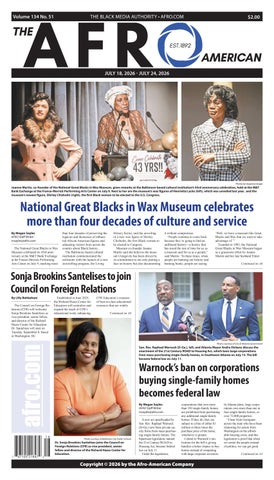
Volume 134 No. 51
THE BLACK MEDIA AUTHORITY • AFRO.COM
$2.00
$2.00
JULY 18, 2026 - JULY 24, 2026
Photos by Quamina Image
Joanne Martin, co-founder of the National Great Blacks in Wax Museum, gives remarks at the Baltimore-based cultural institution’s 43rd anniversary celebration, held at the M&T Bank Exchange at the France-Merrick Performing Arts Center on July 9. Next to her are the museum’s wax figures of Henrietta Lacks (left), which was unveiled last year, and the museum’s newest figure, Shirley Chisholm (right), the first Black woman to be elected to the U.S. Congress.
National Great Blacks in Wax Museum celebrates more than four decades of culture and service By Megan Sayles AFRO Staff Writer msayles@afro.com The National Great Blacks in Wax Museum celebrated its 43rd anniversary at the M&T Bank Exchange at the France-Merrick Performing Arts Center on July 9, marking more
than four decades of preserving the legacies and likenesses of influential African American figures and educating visitors from across the country about Black history. The Baltimore-based cultural institution commemorated the milestone with the launch of a new storytelling program, the Living
History Series, and the unveiling of a new wax figure of Shirley Chisholm, the first Black woman to be elected to Congress. Museum co-founder Joanne Martin said she believes the museum’s longevity has been driven by its commitment to not only putting a face on history but also documenting
it without compromise. “People continue to come back because they’re going to find an unfiltered history—a history that has stood the test of time for us as a museum and for us as a people,” said Martin. “In these times, when people are banning our history and banning books, people are saying:
‘Well, we have a museum like Great Blacks and Wax that we want to take advantage of.’” Founded in 1983, the National Great Blacks in Wax Museum began as a grassroots effort by Joanne Martin and her late husband Elmer Continued on A6
Sonja Brookins Santelises to join Council on Foreign Relations By Lilly Behbehani
CFR Education’s creation of best-in-class educational resources that are widely Continued on A6
Photo courtesy of City of Atlanta Government
afro.com
The Council on Foreign Relations (CFR) will welcome Sonja Brookins Santelises as vice president, senior fellow, and director of the Richard Haass Center for Education. Dr. Santelises will start on Tuesday, September 8, based in Washington, DC.
Established in June 2025, the Richard Haass Center for Education will centralize and expand the reach of CFR’s educational work, enhancing
Sen. Rev. Raphael Warnock (D-Ga.), left, and Atlanta Mayor Andre Dickens discuss the enactment of the 21st Century ROAD to Housing Act, which bans large corporations from mass-purchasing single-family homes, in Southwest Atlanta on July 13. The bill became federal law on July 11.
Warnock’s ban on corporations buying single-family homes becomes federal law By Megan Sayles AFRO Staff Writer msayles@afro.com
Photo courtesy of Baltimore City Public Schools
Dr. Sonja Brookins Santelises joins the Council on Foreign Relations (CFR) as vice president, senior fellow and director of the Richard Haass Center for Education.
A new act spearheaded by Sen. Rev. Raphael Warnock (D-Ga.) now bans private equity firms from mass-purchasing single-family homes. The bipartisan legislation, named the 21st Century ROAD to Housing Act, became federal law on July 11. Under the legislation,
corporations that own more than 350 single-family homes are prohibited from purchasing any additional single-family homes. If they do, they are subject to a fine of either $1 million or three times the purchase price of the home, whichever is greater. Central to Warnock’s motivation for the bill is giving families a better chance to buy homes instead of competing with large corporate investors.
Copyright © 2026 by the Afro-American Company
In Atlanta alone, large corporations own more than one in four single-family homes, or over 72,000 properties. “I hear from Georgians across the state who have been clamoring for action from Washington on the affordable housing crisis, and this legislation is proof that when we center the people instead of politics, we can get good Continued on A3
A2 The Afro-American July 18, 2026 - July 24, 2026
WHAT’S TRENDING ON AFRO.COM
As cyclospora illnesses surge to a record, health officials eye lettuce as a possible cause By Mike Stobbe
Infections from the diarrhea-causing parasite cyclospora are surging, with state-level data suggesting that 2026 is already the nation’s worst year for reported cases. More than 30 states have reported infections this year, and current data from them shows the number of infections surpassing the record U.S. mark of about 4,700 set in 2019. The illness is not usually life threatening and is typically treated with antibiotics. Health officials have not yet definitively identified what is causing the infections. On July 14 federal health officials said there may be different infection patterns in different places, although they believe cases in at least four states — Michigan, Ohio, Kentucky and West Virginia — are linked.
Michigan officials blame lettuce
In Michigan — where more than 3,300 cases have been reported — officials say early information points to lettuce or salad greens as a possible culprit.
After conducting more than 1,000 interviews with patients, “early information has shown lettuce as a common product that regularly comes up during the investigation,” said Natasha Bagdasarian, the Michigan health department’s chief medical executive. Because of that commonality and because produce has been behind some past cyclospora outbreaks, Michigan officials advised consumers to buy whole heads of lettuce, discard the outer layers and thoroughly wash what is left. They also suggested people avoid bagged lettuce and pre-mixed salad kits. On July 14, the Taco Bell restaurant chain issued a statement saying it had “voluntarily and temporarily removed limited ingredients at select restaurants as a precautionary measure. We will continue to closely monitor the situation and follow the guidance of public health authorities.” In a call with reporters on July 14, federal health officials did not directly respond to a question about whether they are looking at Taco Bell or any specific food vendor or distributor.
Your History • Your Community • Your News
The Afro-American Newspapers Baltimore Office • Corporate Headquarters 233 E. Redwood Street 6th Floor, Suite 600G Baltimore, Maryland 21202 410-554-8200 Customer Service, Home Delivery and Subscriptions: 410-554-8200 customerservice@afro.com Founded by John Henry Murphy Sr., August 13, 1892 Chairman of the Board/Publisher - Frances Murphy Draper (Publisher Emeritus - John J. Oliver Jr.) President - Benjamin Murphy Phillips IV VP of Marketing and Technology - Kevin E. Peck Director Digital Solutions - Dana Peck Receptionist - Wanda Pearson - 410-554-8200, ext. 246 Director of Operations
Andrè Draper - 410-554-8200
Director of Finance
Bonnie Deanes - 410-554-8242
Director of Sales Robert Walker-Smith - 410-554-8200 rwalker-smith@afro.com Editorial Managing Editor - Alexis Taylor - 410-554-8257 Editorial Assistant - Ama Brown-Parson Evening / Weekend Editor - Zenitha Prince Archivist - Savannah Wood- 410-554-8277 Baltimore Circulation/Distribution Manager Andrè Draper - 410-554-8200 Creative Design and Content Matthew McDonald
Washington Office 1140 3rd Street, N.E., 2nd Floor Washington, D.C. 20002-6723 202-332-0080 • Fax: 410-554-8213 (Washington Publisher Emerita - Frances L. Murphy II) Director of Operations - Andrè Draper - 410-554-8200
,GHQWLÀFDWLRQ 6WDWHPHQW
THE AFRO AMERICAN – (USPS 040-800) is published weekly by The Afro American Company, 233 E. Redwood Street, 6th Fl., Ste. 600G, Baltimore, MD 21202.
6XEVFULSWLRQ 5DWH 1 Year - $100.00 Print & Digital ($40 Digital Only) (Price includes tax). Checks for subscriptions should be made payable to: The Afro American Company, 233 E. Redwood Street, 6th Fl., Ste. 600G, Baltimore, MD 21202. 3HULRGLFDOV SRVWDJH SDLG DW %DOWLPRUH 0' DQG DGGLWLRQDO PDLOLQJ RIÀFHV POSTMASTER: 6HQG DGGUHVVHV FKDQJHV WR THE AFRO AMERICAN, 233 E. Redwood Street, 6th Fl., Ste. 600G, Baltimore, MD 21202.
“FDA certainly is continuing its traceback investigation on multiple produce items, also including locations that are reported by the case patients before they became sick,” said Donald Prater, The U.S. Food and Drug Administration’s Acting Deputy Commissioner for Food, in response.
Cyclospora causes ‘explosive’ diarrhea
Cyclospora is a microscopic, spherical parasite that commonly causes watery diarrhea “with frequent and sometimes explosive bowel movements,” according to the U.S. Centers for Disease Control and Prevention. Outbreaks tend to occur most often in the late spring and summer. The heat-loving parasite infects the bowels and spreads through feces. In the past, people have been infected by consuming fruits or vegetables that were exposed to feces-contaminated irrigation water. The illness, called cyclosporiasis, is less common than foodborne illnesses caused by other germs, including salmonella and E. coli. Many cases are never linked to a specific food or
other source and, for years, few U.S. cyclospora outbreaks were reported. But the number started rising about a decade ago, with a particularly notable spike in 2018 and 2019. Experts say it’s likely that cyclospora cases historically were underreported, in part because some common tests used to check for food poisoning have not been geared to detect cyclospora. They attribute the increasing trend in cases to climate change and better detection. On July 14, CDC officials issued a health alert that said that since May 1, the agency is aware of 1,645 confirmed domestic cases and more than 5,100 that require further analysis to confirm whether the infections were acquired in the U.S. The reports come from 34 states, and no deaths have been reported, the CDC said. The true number of cases is likely larger than what has been reported so far because some people may have milder illnesses that they don’t seek care for, said Gwen Biggerstaff, deputy director of CDC’s Division of Foodborne, Waterborne, and Environmental Diseases, in the
call with reporters. It can take days to weeks for someone exposed to the parasite to develop symptoms. It’s not clear to what extent people currently are being infected, or whether many of the exposures happened earlier. But Biggerstaff said official expect that case numbers will continue to grow through August. The CDC also posted information about the investigation of an outbreak affecting the four states. The federal alert did not detail how many reports came from each state. But Michigan officials have reported more than 3,300 cases, officials in northwest Ohio said they have seen more than 1,100, New York City officials counted more than 400 and Illinois reported more than 200. Officials do not think all can be tied to a common source. In Illinois, for example, more than half the people with infections said they had traveled outside the United States, and at least some may have been infected elsewhere. But Michigan officials believe a large share of their total is likely due to a linked domestic
Photo courtesy of the Centers for Disease Control and Prevention via AP
This undated photo, taken through a microscope, shows cyclospora cayetanensis oocysts. The parasite is currently wreaking havoc in multiple states. outbreak. CDC officials did not go into detail about why they currently think cases in Michigan, Ohio, Kentucky and West Virginia are part of the same outbreak. Associated Press writer DeeAnn Durbin in Detroit contributed to this report. The Associated Press Health and Science Department receives support from the Howard Hughes Medical Institute’s Department of Science Education and the Robert Wood Johnson Foundation. The AP is solely responsible for all content. This article was originally published The Associated Press.
Alicia Brown arrested on warrants related to disappearance of daughter, Ailea Brown By Megan Sayles AFRO Staff Writer msayles@afro.com Alicia Denise Brown, who has been wanted by Baltimore County Police on warrants related to the disappearance of her 10-year-old daughter Ailea Brown, was apprehended by Georgia authorities on July 6. The Hart County Sheriff’s Office confirmed that deputies conducted a felony traffic stop in response to a be-on-the-lookout alert for a vehicle traveling north on Interstate 85. The driver was later identified as Brown and taken into custody without incident, according to the Hart County Sheriff’s Office. “Authorities confirmed Brown was wanted by the Baltimore County Police Department on warrants stemming from the disappearance of a 10-year-old child who was reported missing in 2019,” wrote the Hart County Sheriff’s Office in a July 7 Facebook post. “Brown was also wanted by the Fulton County Sheriff’s Office on felony charges of interference with child custody. Both jurisdictions confirmed the warrants were valid, and Maryland authorities advised they would extradite.” According to the Hart County Sheriff’s Office, two young children were safely recovered from the vehicle during Alicia Brown’s apprehension. While police did not identify either of the children as Ailea Brown—who would be 17 today—her father, Durrell Williams, said she remained missing on a July 7 episode of the WHUR-FM’s “The Nina Brown and Joe Clair Show.” Williams told the radio show hosts that he was still confident that Ailea Brown is alive. “She’s alive. She’s definitely alive, I can confirm that.
Photo courtesy of Hart County Sheriff’s Office
Alicia Brown, 37, is waiting to be extradited to Maryland after Georgia police arrested her during a felony traffic stop on July 6. Alicia Brown is wanted by the Baltimore County Police Department on outstanding warrants related to the 2019 disappearance of her 10-year-old daughter Ailea Brown. I’ve always known that. I’ve always known pretty much what was going on,” Williams told the hosts. “To be honest with you, I hate that it had to be who they have in custody because that’s still her mom, and all of this was for nothing.” Ailea Brown went missing from Reisterstown, Md., on May 25, 2019, according to the Baltimore County Police Department. Police confirmed that a white SUV was seen in the area around the time she disappeared. Weeks later, the department reported that it had no reason to believe it was a stranger abduction. Her disappearance came on the heels of a lengthy custody battle between Williams and Alicia Brown, which ended with Williams being granted full custody of Ailea Brown. Alicia Brown quickly emerged as a central suspect. On “The Nina Brown and Joe Clair Show,” Williams thanked supporters who have
continued to keep his daughter’s disappearance in the public eye over the last seven years before sharing a personal message for her. “I hope you understand that no matter who this was, they would have treated this the same way. You do not just take another child from another parent and go about it like it’s OK,” Williams said on the show. “This is not OK. This is against the law. In time, I hope you can understand that this is the truth, and I still miss you. I can’t wait to see you.” In May, Alicia Brown made headlines for a separate incident involving her estranged husband Darian Morgan, also known as Atlanta radio personality “Big Tigger.” Alicia Brown claimed that Morgan pushed her into a door during an argument, causing her to sustain a facial injury. The couple’s teenaged son was reportedly in the home at the time. Morgan was arrested June 20 on charges of aggravated
Photo courtesy of the Baltimore County Police Department
Ailea Brown, who would be 17 today, remains missing. Ailea Brown disappeared from Reisterstown, Md., in 2019 following the conclusion of a lengthy custody battle between her parents Alicia Denise Brown and Durrell Williams, which ended in Williams being granted full custody. battery, battery and third degree cruelty to children. A judge granted Alicia Brown a temporary protective order against him. Morgan has denied the allegations, but as video of the two in an altercation became public, he announced July 5 he was stepping away from “The Big Tigger Morning Show” on V-103.
Tracee Ellis Ross makes Broadway debut By Mark Kennedy Tracee Ellis Ross is starting to notice the small things that bring her happiness: The satisfying click of a curling iron, say, or the taste of olives. It’s sort of her job right now. The actor and producer made her Broadway debut starting July 7 in “Every Brilliant Thing,” one of the more uplifting and joyful plays this summer, even if it delves into the subject of depression. It’s the story of a narrator who compiles a list of the things to prove to his or her depressed mother that life is worth living — like ducklings, spaghetti Bolognese and dancing in public. No. 999,996 is: “Peeling off a sheet of wallpaper in one intact piece.” “What is incredible when you start doing this is that you really do start to notice things that you never thought of before,” says Ross. “They’re everywhere and that’s why this piece is so beautiful: It changes the way you see the world.”
Ross will convince audience members to join in
Ross steps into the Broadway role originated by Daniel Radcliffe and then held by Mariska Hargitay. It’s a solo show, but the audience helps, with some asked to read items from scraps of paper and others pretend to drive a car, craft a sock puppet or act as the narrator’s parent. During the production, Ross helps select and convince audience members to join her in the show, wandering the
aisles to chat as patrons first file in. She’ll be looking for kindness — and even some resistance. “It is a sense of being of service to the material and a little bit of reluctance is actually a special quality in the roles that we need to cast,” she says. Written by Duncan Macmillan with Jonny Donahoe, “Every Brilliant Thing” allows its narrator to ad-lib and change some of the “brilliant things” to fit their background. So “wearing a cape ” for Radcliffe can be turned to “tutus” in Ross’ case. “The list has to feel authentic to them,” says Macmillan. “What they would have found brilliant at different stages of their life, that’s changed from person to person.” The play gets a rewrite for the new performer and is adjusted according to their age and background — a favorite cereal or cartoon — who they may have had a crush on as a teen and what movies they might have found brilliant along the way. “They have their own personal reasons for connecting with material, but they are also incredibly funny, open, generous, humble people that we root for,” Macmillan says. The play runs only 70 minutes, but Ross never takes a break, does crowd work and she’s basically been asked to memorize a 40-page monologue during just a three-week rehearsal period. “It felt like I was swallowing a whale and learning how to digest it through my fingers and through my body and through my voice and
through my heart,” she says. Ross has had Broadway on her bucket list Ross, who graduated from Brown University and studied acting at The William Esper Studio, started her career auditioning for theater, films and TV. She’s become best-known for roles in shows like “Black-ish” and “Girlfriends.” Broadway was always on her bucket list, but she says starring in a play that connects with other people in a hopeful way hits “my sweet spot.” “It’s a story that is about something real that so much of us are struggling with, but yet it is told through the lens of the lifeline of what makes life worth living — just everything that could be on a bucket list for me,” she says. “Sometimes hope can feel like a daunting idea in the face of feelings and also facts, but I do think that having the ability and the map to reach for other things can balance out those moments in a way that gives you an opening to the next.” She resisted the temptation of watching Radcliffe or Hargitay in the role: “It’s hard for me once I get somebody else’s performance or idea in my head.” Asked for one more personal brilliant thing and Ross, one of five children, is quick with an answer: “That moment when you and your siblings glance at each other because you know exactly what’s happening and only the five of us know but nobody else does.” This article was originally published by The Associated Press.
July 18, 2026 - July 24, 2026 The Afro-American A3
AP photo/ Richard Shotwell
Tracee Ellis Ross is making her Broadway debut in “Every Brilliant Thing,” one of the more uplifting and joyful plays this summer, even if it delves into the subject of depression.
Sen. Warnock Continued from A1 policy done,” said Warnock in a July 11 news release. “I’m proud to have contributed to increasing our nation’s housing and lowering costs for hardworking Georgia families.” The 21st Century ROAD to Housing Act drew significant bipartisan support. After passing both the House and Senate, the bill became law without the 47th president’s signature after he neither signed nor vectored it within the constitutionally required 10-day period. Revenue generated under the legislation’s fines will be used to bolster new housing construction and financial assistance programs
for first-time homebuyers. In addition to placing new restrictions on private equity firms, the legislation incorporates measures from Warnock’s Appraisal Modernization Act, which allows homeowners to request a second appraisal to help address appraisal bias. It also includes provisions from several other bills, including authorizing $1 billion in grants for local governments to incentivize new housing construction, increased federal funding for affordable housing construction and streamlined federal permitting and environmental requirements for affordable housing projects. Atlanta Mayor Andre Dickens joined Warnock in Southwest Atlanta’s Adamsville
neighborhood to celebrate the bill becoming federal law on July 13. Dickens called the legislation a “pivotal moment for housing affordability.” “The provisions that the senator fought for give cities additional tools to protect neighborhoods, expand opportunities for first-time homebuyers and help responsible local landlords compete on a more level playing field,” said Dickens during the July 13 press conference. “That’s why I want to offer my sincere thanks to Senator Warnock.” “His leadership has helped move forward bipartisan legislation that acknowledges the challenges cities are facing and provides meaningful solutions for families who just
want the opportunity to own a home and start building wealth,” he continued. Civil rights attorney Benjamin Crump also took to social media to praise Warnock’s work. “Homeownership opens the door to stability, opportunity and generational wealth. Thanks to Sen. Raphael Warnock’s leadership, legislation is now federal law preventing large institutional investors that own 350 or more single-family homes from buying additional existing single-family homes,” wrote Crump on X (Twitter), on July 13. “This will help more hardworking families pursue the dream of owning a home.”
A4 The Afro-American July 18, 2026 - July 24, 2026
COMMENTARY
The two July 4ths: Which did you celebrate? By Dr. John E. Warren It was like “A Tale of Two Cities” – the best of times and the worst of times. It was the best of times for the hundreds of immigrants that were sworn in as U.S. naturalized citizens across this great land. Their swearing in was a manifestation of the provisions of the 14th Amendment creating citizenship status for persons not born in this country; a provision of the 14th Amendment to the Constitution just as important as citizenship by birth. This is the provision that President Trump tried to get the U.S. Supreme Court to nullify; the birthright citizenship case which the Court rejected.
Many often recite the Preamble to the Declaration of Independence which states, among other things: “We hold these truths to be self-evident, that all men are created equal, that they are endowed by their Creator with certain unalienable Rights; that among these are Life, Liberty and the Pursuit of Happiness, That to secure these rights, Governments are instituted among men, deriving their just powers from the consent of the governed … .” But there are many among us that are being denied those very rights today as evidenced by armed troops on the streets of our cities and federal agents killing and imprisoning immigrants, citizens and anyone who appears to be out of step with this
administration. And so, amid the recent Independence Day celebrations, parades and millions of dollars worth of fireworks many of us questioned in the immortal words of Frederick Douglass, raised as a rhetorical question during a speech at a 76th anniversary celebration of America’s independence in 1852: “What, to the American slave (Black people), is your 4th of July? Today, 174 years later, the question is still all too real. For those of us concerned about the police state and kingship that Donald Trump would establish, let us take heart in the fact that today we have tools that Douglass did not have. In addition to the Constitution with its 13th, 14th, and 15th
Amendments, the only thing we lack to make change is the will to get involved and do so. Let’s start right where we live. Let’s start with the issue of making sure that each of us can vote, register and prepare to do so. Let’s take another look at how we are spending the few dollars we have. Let’s take another look at who we can help as a part of our collective and prepare to use our numbers like never before in all that we do. Let’s create our own fireworks that will last all year long with our involvement and collective agreement to help ourselves before we expect others to do so, and in all this, let’s make a lasting reality out of the change that Frederick Douglass envisioned.
Courtesy photo
Dr. John E. Warren is publisher of the San Diego Voice and Viewpoint Newspaper. He also serves as chairman of the Board of Directors for the National Newspaper Publishers Association.
The basis of freedom: Reclaiming land as an act of liberation By Rev. Dr. Heber Brown III I often look to our ancestors to guide my service to the Black community today. They connect me to the movement that has been and is ongoing. Recently, I have been reflecting on two such inspiring ancestors: Malcolm X and Queen Mother Audley Moore. These two leaders at the vanguard of Pan-Africanism and the reparations movement understood the importance of securing land to build power. As Malcolm X said, “Revolution is based on land. Land is the basis of all independence. Land is the basis of freedom, justice and equality.” Queen Mother Moore, in a 1975 speech, declared, “We believe African captives in the USA will not have freedom until they have land of their own.” Through their wisdom and the examples of so many others, we see how Black-owned land is a source of cultural memory and spiritual grounding. When we hold land, we find freedom.
Courtesy photo
The Rev. Dr. Heber Brown III is a community organizer, local business leader and founder of the Black Church Food Security Network. This week, he speaks on the importance of land ownership for members of the Black community. I learned this firsthand through my great-grandparents’ lives “down the country” in rural Virginia. That land
was a respite of sorts from the ravages of racial capitalism found in the city. It was an oasis amid a society that burdens Black people in so many ways. The whole family benefited from having significant landholdings to care for themselves. There was pride in self-sufficiency. Economic sovereignty joins these attributes that land gives us. Since Black people have lost land — due to racial violence, the discriminatory impact of “heirs’ property” and exclusion from banking and farm programs — our overall wealth has decreased. According to the Federation of Southern Cooperatives, Black people owned 16 million to 19 million acres of rural land in 1910, compared to less than 3 million acres today. This is partly why I founded The Black Church Food Security Network. Pairing Black farmers with churches who own land ties together food justice, community and freedom. While food pantries and food drives are necessary efforts to fulfill an immediate need for
those who experience food insecurity, they are not enough. Securing land, infrastructure and the means of production is the key to overcoming food apartheid in our communities. It must also be a primary component of reparations. African leaders, led by President John Dramani Mahama of Ghana, recently coordinated a United Nations resolution that finally declared that the trafficking of enslaved Africans was the “gravest crime against humanity,” urging the need for reparations as the next step. There is no peace in the world, leaders said, without healing and reparative justice for Africans across the diaspora. This closely echoes the words of Brother Malcolm; he said our redress should be seen as a violation of human rights, and now the global record acknowledges it as such. Though further support and action is still required, the UN resolution marks an important step towards the goals of our ancestors. Queen Mother Moore long advocated for “the long overdue debt of forty acres and two mules,
[repaid] in land.” Malcolm X similarly strongly advocated for reparations for land for Black Americans, as the U.S. government has shown is possible. Both of these leaders sought to bring the issues of land and justice in front of the UN. Now that those issues are there, we hold the hope of progress. As Queen Mother Moore asserted, our spirits were never removed from Africa. We are still connected to that land and heritage. We have achieved much, but reparations — through land and other means — are required to be truly free from exploitation. All roads lead back to land ownership. Colonizers erroneously see land as a portal to access resources, from precious minerals, to oil, timber and even people. For the rest of us, land signals security and communal self-reliance. So, farmers, churches and communities continue working hand-in-hand. This is the unfinished work of our ancestors. It is up to us to continue their legacy of liberation through collective land ownership.
LinkedIn / Beverly Moran
Courtesy photo / Joint Center
THE HEAD OF HOUSEHOLD ILLUSION:
The tax break that skips the mothers it was built to help By Beverly Moran and LaToya B. Parker The head of household filing status is popularly understood as a tax break for single mothers, a modest acknowledgment that raising children alone costs more than doing it with a partner. That image is not wrong exactly. Roughly 79 percent of head of household filers are women, and the status was created in 1951 specifically to ease the tax burden on unmarried taxpayers supporting dependents. Roughly 21 million tax returns claim the status, about 1 in every 7 filed. But the way the head of household is designed contradicts the way it is perceived. Rather than targeting need, it distributes its largest benefits to the filers who need it least. And the mismatch is no longer academic because the status itself is now a target. Consider income. Drawing on IRS Statistics of Income microdata, researchers found that in 2011 a taxpayer at the 25th percentile of the income distribution filing as head of household saved about 23 dollars a year, while a taxpayer at the 75th percentile saved 1,573 dollars, a 68-fold gap. The mechanism is structural rather than incidental. Head of household status works by raising the income thresholds at which higher tax brackets apply, so the benefit
accrues only after a filer’s income has climbed above them. Low earners have crossed few or none. The Tax Policy Center estimates that only about 8 percent of the lowest-income families with children benefit from the status at all, since many owe no federal income tax to offset in the first place. Race and gender compound this mismatch. The IRS collects no information on filers’ race or sex, which is why this dimension has rarely been measured directly rather than inferred. Census data that simulates tax filing status closes that gap. Black people constitute 25.5 percent of all head of household filers, roughly 1.8 times their 14 percent share of the general population. Black filers claiming the status are 84.5 percent female. Black women alone make up 21.6 percent of every head of household filer in the country. The group most associated with the policy’s image is overrepresented among its filers, while the design ensures the smallest benefits flow to those with the least income. This pattern is not new to tax scholarship. In 1996, Moran and Whitford showed that seemingly race-neutral provisions rest on household patterns that are demographically more common among White married couples than Black ones, so a nominally neutral rule produces racially disparate
outcomes without ever mentioning race. The pattern begins with marriage itself. As of 2024, 48 percent of Black adults had never married, compared with 29 percent of nonBlack adults, so a code in which marriage frequently delivers a tax bonus averaging more than $3,000 while the unmarried head of household receives $23 at the bottom of the income scale is not neutral in effect. For Black women raising families on a single income, it is double jeopardy. They are penalized once by a benefit structure that pays the most to the highest earners, and again by a code built around a household form they are statistically least likely to occupy. Head of household adds a further design flaw to that lineage. Its benefit does not scale with the number of dependents a filer supports. A parent raising one child receives the same benefit as a parent raising four, unlike the Child Tax Credit or the Earned Income Tax Credit. Family size determines how far a household’s income must stretch, and any analysis of how the tax code treats Black families that fails to account for it will get the story wrong. The political stakes are current rather than historical. Project 2025 called for eliminating the status outright, and a Senate bill drafted by the Niskanen Center would raise taxes on roughly two-thirds
Beverly Moran (left) is professor emerita of law at Vanderbilt University. LaToya B. Parker, PhD, directs the Tax Policy and Wealth Program at the Joint Center for Political and Economic Studies. of single-parent households to help fund an expanded Child Tax Credit. That trade deserves scrutiny, because the credit as currently designed already leaves out many children in the lowest-income families, whose parents earn too little to receive the full amount. Head of household survived last year’s One Big Beautiful Bill Act, but the Earned Income Tax Credit shows how little that guarantees. A precertification requirement aimed at the credit was stripped from that same law on procedural grounds, and it is already back on the target list as the next reconciliation package takes shape. Unmarried taxpayers, filing head of household or single, receive roughly three-quarters of all Earned Income Tax Credit dollars, so the credit crackdown and the repeal proposals converge on the same families. Provisions that support single parents do not leave the chopping
block. They wait on it. None of this argues for preserving head of household as it stands. The scholars who documented its regressive design have proposed replacing the status with a flat perchild credit, a reform that would produce net gains for roughly the bottom four income deciles. A redesigned benefit should grow with the number of children a parent raises and reach families whose earnings are too low to owe much income tax. The real choice is between redesigning this benefit so that it reaches the single mothers it was named for, and quietly raising taxes on those same women while pointing to a tax break most of them barely receive. Repeal without redesign would fall hardest on Black women, who are 1 in 5 of the filers this status touches. A policy whose image and whose design point in opposite directions cannot be defended by its image alone.
The opinions on this page are those of the writers and not necessarily those of the AFRO. Send letters to The Afro-American ∙ 233 E. Redwood Street, Suite 600G Baltimore, MD 21202 or fax to 1-877-570-9297 or e-mail to editor@afro.com
July 18, 2026 - July 24, 2026 The Afro-American A5
From answering the call to joining the celebration
20k
10k
$2MM
veterans hired since 2015
more to be hired by 2031
donated in FIFA World Cup 2026™ tickets
We’ve proudly been serving communities around the country for 240 years. Here in Greater Maryland, we have an ongoing commitment to the veterans who make us stronger — helping them access careers, transition programs, housing, and now unforgettable experiences like FIFA World Cup 2026™ tickets.
What would you like the power to do? ®
Learn more at BofA.com/Celebrating250 Tickets provided through Veteran Tickets Foundation (Vet Tix), a 501(c)(3) nonprofit. Availability is limited and subject to eligibility, registration, verification and Vet Tix/1st Tix terms. Bank of America is a promotional sponsor of FIFA World Cup 2026™. Ticket figures are based on Bank of America’s June 3, 2026 announcement; military hiring figures are based on its September 17, 2025 announcement. Image is illustrative and has been digitally enhanced using artificial intelligence. Equal employment opportunity for persons with disabilities and veterans. ©2026 Bank of America Corporation. All rights reserved.
A6 The Afro-American July 18, 2026 - July 24, 2026
Sonja Brookins Santelises Continued from A1 and readily available to educators and learners in secondary and postsecondary classrooms across the country. Importantly, in this fraught political moment, the center will also equip educators to teach their students about global affairs through civil discourse and respectful dialogue. “I am delighted to welcome Sonja to the Council,” said CFR President Michael Froman. “Her expertise in public education and civic leadership will strengthen CFR’s mission to promote informed discussions of the world’s most consequential issues. She brings the same dedication to expanding access, building institutional capacity, and fostering civil discourse that defined her decade of transformative leadership to the Richard Haass Center for Education.” A nationally recognized leader and educator,
Dr. Santelises has spent her career advancing educational opportunities and championing academic excellence for all young people. At CFR, she will lead the Richard Haass Center for Education, overseeing the CFR’s education initiatives and efforts to promote civil discourse and global learning in secondary and postsecondary classrooms across the country. “I could not be more excited to join CFR and the Haass Center team with its expanding focus on civil discourse and global affairs literacy. This work aligns with my passion and desire to equip educators and students with the tools and spaces to engage in rigorous and thoughtful learning,” said Dr. Santelises. “I look forward to sharing my experience while enhancing my own knowledge base in this important work.” Most recently, Dr. Santelises served for
a decade as CEO of Baltimore City Public Schools, becoming the district’s longest-serving leader since 1946. During her tenure, she led one of the nation’s largest and most complex school systems, overseeing a $1.9 billion annual budget while building strategic partnerships with national philanthropic and civic organizations to expand opportunities for students. During her tenure, the district reduced the number of low-performing schools, increased students’ access to high-quality learning resources, and secured significant investments in school infrastructure. Dr. Santelises also serves as the superintendent in residence at the Yale School of Management’s Broad Center, where she leads content facilitation for the Fellowship for Public Education Leadership cohort.
Dr. Santelises was named the Maryland Superintendent of the Year by the Public School Superintendents’ Association of Maryland and received the John Hope Alumni Award from Brown University. She was a finalist for the School Superintendents Association’s 2026 Superintendent of the Year Award and named one of Maryland’s Most Admired CEOs by the Maryland Daily Record. Dr. Santelises was the chair of the Council of the Great City Schools, which gathers eighty-two of the nation’s largest urban public school systems in a coalition dedicated to the improvement of education for children in inner cities. She holds a BA from Brown University, an MA from Columbia University, and an EdD from Harvard University. This press release was originally published by The Council on Foreign Relations.
National Great Blacks in Wax Museum Continued from A1 Martin. A social work professor at Morgan State University, Elmer Martin believed that cultural development was key to a community’s development. This philosophy would become the basis for the institution’s establishment, which marked the first wax museum in Baltimore and the first wax museum centered on African-American history in the country. In 1980, the Martins used money they had saved for a down payment on a home to purchase their first four wax figures: Mary McLeod Bethune, Frederick Douglass, Nat Turner and John Brown. With them, the couple started a traveling exhibit, showcasing the figures in schools, churches and shopping malls. By 1983, the Martins had their first brick-and-mortar space, a small storefront museum in downtown Baltimore, and their collection of wax figures had grown to 22. Five years later, the found its permanent home on the 1600 block of East North Avenue with the grand opening of a 10,000 square-foot facility. The relocation to the East Baltimore corridor, which faced disinvestment, was rooted in Elmer Martin’s philosophy of leveraging cultural enrichment to stimulate neighborhood revitalization. Today, the National Great Blacks in Wax Museum maintains over 150 life-sized wax figures of prominent African Americans, spanning politics, civil rights, science, education and entertainment. It also houses a slave ship replica, depicting the 400-year history of the transatlantic slave trade. When asked what she believes her late husband would think of the museum’s 43-year legacy, Joanner Martin said his cousin told her he would be proud of her. After Elmer Martin died in 2001, Joanne Martin said she began
Photo by Quamina Image
Congressman Kweisi Mfume (D-Md.) converses with Baltimore City Council President Zeke Cohen during the National Great Blacks in Wax Museum’s 43rd anniversary celebration on July 9. to think seriously about mortality. These considerations pushed her to begin planning for the museum’s future leadership, with William Redman and Eboni Yahuda among those she hopes will continue its mission.
“I want them to continue to understand that it’s all about the children— the generations that are here now and the ones yet to be born. That should always be their focus,” said Martin. “It’s something bigger than me and
“People continue to come back because they’re going to find an unfiltered history.” - Joanne Martin, Co-founder of the National Great Blacks in Wax Museum Most important to Joanne Martin is that every successor understands the museum’s purpose extends beyond preserving history—it is about inspiring future generations.
bigger than Elmer.” The museum’s July 9 anniversary celebration was attended by community leaders, supporters, entrepreneurs and local officials, including Sen.
Photo by Quamina Image
Standing next to a wax figure of Henrietta Lacks, Sen. Cory McCray (D-District 45) addresses the crowd during the National Great Blacks in Wax Museum’s 43rd anniversary celebration on July 9. McCray represents the district where the historic institution is located.
Cory McCray (D-District 45) and Congressman Kweisi Mfume (D-Md.) McCray, who has looked to Joanne Martin as a mentor, praised her and her husband’s vision. “For 43 years, the National Great Blacks in Wax Museum has done more than preserve history—it has challenged each generation to learn from it, be inspired by it and build upon it,” McCray. “As a proud son of Baltimore, I can remember visiting the museum as an elementary school student and for the first time, seeing our history centered in a way that made me feel connected to those who came before me.” McCray said it’s been an honor to represent the district where the historic museum is located. “Thanks to the extraordinary vision of Dr. Joanne Martin and the late Dr. Elmer P. Martin, Baltimore is home to one of our nation’s greatest institutions dedicated to preserving and telling the African American story,” said
McCray. “Their legacy will continue educating and inspiring generations to come.” Both McCray and Mfume have helped garner investment in the museum as it undergoes a multiphase $76 million expansion. In 2023, Mfume helped secure $2 million in federal funding to support the project. Amid a political climate where Black history is increasingly under attack, Mfume emphasized that the mission of the museum has become even more vital. “The National Great Blacks in Wax Museum is an iconic Baltimore institution, dedicated to chronicling the history of a race that has suffered, endured and overcome centuries of slavery, oppression and voter suppression,” said Mfume. “It tells a story that must be told and which is worthy of embracing. Drs. Joanne and Elmer Martin have provided America with a special gift symbolizing the pride of African Americans and our history.”
Photo by Quamina Image
Dr. Joanne Martin shares a conversation with Eryn Naomi Reid, one of the Museum’s youth docents and a participant in the National Great Blacks In Wax Museum’s 43rd Anniversary Celebration.
July 18, 2026 - July 24, 2026 The Afro-American A7
A look at how Pastor Donald Wright’s lifelong commitment to serving others By Andrew Hall AFRO Intern ahall@afro.com To Pastor Donald Wright, community is everything. Even more than that, serving his community is a lifelong mission. This July, Wright celebrates 20 years of preaching, and in an interview with the AFRO, he detailed how his ministerial journey began. “I was 14 when I first felt like God was laying on my heart to preach. Even as a teenager in the church, I was serving, but I always felt like there was something more for me to do,” said Wright. “I preached my initial sermon on July 6, 2006, and it’s been a great journey.” After serving in many capacities at churches across the city, Wright was installed as senior pastor of Mt. Ararat Baptist Church (MABC) in Southwest Baltimore in December 2024. There, Wright places emphasis on leading his congregation as they connect with the community. In his eyes, churches are not just religious or spiritual buildings, but also resource hubs for the communities they serve. He underscores this by citing the church’s role in Black history.
“Martin Luther King Jr., who led and did so much, was a Baptist preacher. Jessie Jackson, who just passed away, came out of the church. Ralph Abernathy came out of the church,” noted Wright. “When we talk about mobilizing the community, even the Civil Rights Movement comes from the church.” Wright expanded by explaining MABC’s community outreach efforts. “Every fourth Saturday, we go to the Penn North community with full meals. We have grandmas cooking and buying food, and we take it to the community so they know while they might be down, they’re not out,” said Wright. “We have taken clothes to the community, we do soup kitchens and food pantries here at the church. We’ve been able to give out food during the holidays.” “For back to school, we send our children back with school supplies. We have an amazing scholarship ministry here, where we are consistently raising money to help young people go to college,” he continued. Looking ahead to the future, Wright seeks to strengthen his church’s influence in the community. They have plans to establish a partnership with
local schools, and have joined a coalition of church ministries across Baltimore with the mission of increasing their ability to serve others. Wright, father to 6-year-old twins Delaney and Donald III, often closes Sunday services alongside his children. As a parent first, he stresses the importance of being there for his kids. “As a parent and pastor, I want to make sure that I show my children that I am serving God, but I’m not serving God apart from them. My children come to church with me, and at the end of service, I always invite them to come and stand with me. Daddy is not daddy only when he’s at home, but he’s daddy in church too,” Wright explained. “I want them to always know being a father is my greatest joy. It’s important for my children to feel a part of everything I do.” When reflecting on his relationship with his kids, Wright is often reminded of the impact his father, Donald Wright Sr., had on him. “My father was my hero. I saw my hero in his strongest moments, but I also saw him in some of his weakest moments. For many years, he struggled with cancer, through remission, through on and off sickness
bouts,” said Wright. “I have enough ‘I love yous’ from my father to last a lifetime. He reminded me all the time that he loved me and that he was proud of me.” Wright’s dad passed away when he was just 17 years old. After that, he and his late mother, Melisa Wright, leaned on each other for strength. “After my father passed away, me and my mother, we got close. We had to get close. She was all I had and I was her oldest son,” noted Wright. “She never let me leave her presence without reminding me that she loved me. I try my best to model that for my children.” For Wright, the word family means more than just those related by blood. As a proud member of the Zeta Sigma Chapter of Phi Beta Sigma Fraternity, Inc., he explained the significance of brotherhood. “Since pledging, I have gained a new community–a new family. One of the greatest things about the fraternity is [that] these brothers are willing to come to the table, to share their stories and help someone else be better,” Wright said. “When my mother passed away, the fraternity surrounded me. When I experienced my divorce, the fraternity surrounded me. When I’ve gone through
AFRO Photo / Andrew Hall
Donald Wright Jr., poses with 6-year-old twins Delaney and Donald III. Wright calls being their father his greatest joy. other challenges, the fraternity has been a place of support.” Since joining Zeta Sigma, Wright has served as second vice president, recording secretary and chief of staff for the regional director of Bigger Better Business. Danielle White, a member of Zeta Phi Beta Sorority, Inc., described Wright’s connection to her organization. “Donald has cultivated a special and meaningful bond with the constitutionally bound Sorors of Zeta Phi Beta Sorority, Inc., consistently showing up in support, service and love for the sisterhood,” White told the AFRO. “His willingness to lend his time,
wisdom and hands wherever needed reflects the true spirit of unity and collaboration.” Wright’s love for community outreach is also reflected in his role as Baltimore City’s Tax Sale Ombudsman. “As the Tax Sale Ombudsman, I connect with people on the verge of losing their house. They can reach out to my office for details regarding the tax sale process or how things got to where they are,” Wright noted. “I am able to help them navigate through city services, and connect them with resources to be able to stay in their homes.” Read more on AFRO.com
Notice of Class Action Settlement Authorized by the U.S. District Court, Eastern District of New York
— Notice of Class Action Settlement — Si desea leer este aviso en español, llámenos o visite nuestro sitio web. TO: All merchants in the U.S. who accepted Visa or Mastercard credit or debit cards at any time since December 18, 2020. This notice (“Notice”) is authorized by the Court to inform you about an agreement to settle the equitable relief claims in a class action lawsuit, called In re Payment Card Interchange Fee and Merchant Discount Antitrust Litigation, No. 05-md-01720 (BMC)(JAM)(E.D.N.Y.). The lawsuit claims that Visa and Mastercard, separately, and together with certain banks, violated antitrust laws and caused merchants to pay excessive fees for accepting Visa and Mastercard credit and debit cards, including by adopting interchange rules and rates, and other network rules, which the lawsuit has claimed constituted unlawful price fixing, unreasonable restraints of trade, and monopolization. The defendants say they did nothing wrong. They maintain that their business practices are legal, justified, and the result of independent competition, and have benefitted both merchants and consumers. The Court has not decided who is right because the parties agreed to a settlement, which was preliminarily approved by the Court on June 9, 2026. A. What Merchants Will Get from the Settlement During the lawsuit, the Court previously certified an Equitable Relief Class under Federal Rule of Civil Procedure 23(b)(2) and has now preliminarily approved a settlement of the Class claims (the “Rule 23(b)(2) Class Settlement” or “Settlement”). Under the Settlement, Visa and Mastercard have agreed to substantive changes to the Visa and Mastercard rules applicable to merchants who accept their cards as a form of payment. The Class includes all persons, businesses, and entities that accept any Visa-Branded Cards and/or Mastercard-Branded Cards in the United States at any time during the period between December 18, 2020 and the date of preliminary settlement approval, or June 9, 2026. The Court has set November 16, 2026 as the date for a final approval and fairness hearing (the “Fairness Hearing”) in connection with the Settlement, after members of the Class have had the opportunity to evaluate the Settlement and exercise their rights, as set forth in the Notice. Further information regarding the Settlement and the Fairness Hearing will be posted on www.InterchangeEquitableReliefSettlement.com. Under the Rule 23(b)(2) Class Settlement, Mastercard and Visa will modify certain rules to preserve, establish, or expand the circumstances in which merchants can, among other things, do the following: • Decline acceptance of Visa- or Mastercard-Branded Commercial Credit Cards and/or Premium Consumer Credit Cards. • Surcharge customers a fee for the use of any Visa or Mastercard-Branded Credit Cards, including based on the type of card used (e.g., a different surcharge for rewards and non-rewards cards). • Offer discounts to customers who do not pay with Visa or Mastercard-Branded Credit Cards, or based on the financial institution that issued the Visa or Mastercard-Branded Credit Card. • Decline acceptance of Visa or Mastercard-Branded Cards at all outlets that operate under the same trade name or banner, even if that merchant accepts those same cards at outlets that operate under a different trade name or banner. • Engage in Pilot Programs whereby they accept Visa or Mastercard-Branded Credit Cards at some but not all outlets operating under the same trade name or banner for a limited duration or test out various acceptance, surcharging and discounting options at some but not all outlets operating under the same trade name or banner, including not accepting Commercial or Premium Consumer Credit Cards, for a limited duration. • Accept some digital wallets at brick-and-mortar locations but decline others and enable some digital wallets for on-line transactions but not enable others, and “steer” among the cards within a digital wallet under the same rules that govern steering among traditional cards. • Receive the benefit of credit interchange rate reductions: Visa and Mastercard will reduce published and negotiated Credit Card interchange rates for U.S. merchants. • Receive the benefit of Credit Card interchange rate caps: The Settlement Agreement reduces and caps “Standard” Consumer Credit Card rates at a specified level and otherwise caps Credit Card interchange rates, such that neither Visa nor Mastercard will increase any of its published Credit Card interchange rates above the rates effective as of March 31, 2025 and each will reduce its network-wide average Credit Card interchange rate to or below the specified level. • Form Merchant Buying Groups that meet certain criteria to negotiate with Visa and Mastercard. • Receive access to a Merchant Education Program, established and administered under the Settlement Agreement, to help understand and maximize the benefits of the rule changes, including how to effectively “steer” in States that restrict surcharging. B. Monetary Aspects of the Rule 23(b)(2) Class Settlement There is no monetary payment to members of the Class in this Settlement. This Rule 23(b)(2) Class Settlement concerns only the Equitable Relief Claims set forth in the lawsuit. Claims for monetary damages arising out of the defendants’ alleged antitrust violations are the subject of a separate settlement for the Rule 23(b)(3) Class. For information concerning the separate Rule 23(b)(3) Cash Settlement Class, please visit the website: www.PaymentCardSettlement.com. The Settlement does provide for Visa and Mastercard to make certain payments into the Rule 23(b)(2) Class Settlement Escrow Account, which money will be used to pay: • The cost of settlement administration and notice, as approved by the Court, • The cost of Merchant Education Program expenses, as approved by the Court, • The cost of an Independent Auditor who will ensure that Visa and Mastercard comply with the credit card interchange-rate reduction commitments, and • Attorneys’ fees and expenses, including any named Class Representative service awards, as approved by the Court.
The money in this fund will be distributed only if the Court grants final approval of the Settlement, and the money for attorneys’ fees and expenses, and service awards to Class Representatives, will be distributed only if the Settlement has become final and all appeals are exhausted, and the Court approves the application for attorneys’ fees and expenses, and Class Representatives’ service awards. Attorneys’ fees and expenses, and service awards to the Class Representatives: For work done through final approval of the Settlement by the Court, as well as any work they will be required to do in the future, Class Counsel will ask the Court for attorneys’ fees and reimbursement of reasonable and necessary litigation expenses, and any service awards to the named Class Representatives that the Court may award, in an amount not to exceed $206,000,000. The Settlement Agreement requires Visa and Mastercard to pay these fees and expenses separately from the other Settlement financial obligations and they will not reduce any other benefits of the Settlement; members of the Class will not be required to pay any amount toward these fees and expenses. C. Legal Rights and Options Merchants who are included in this lawsuit have the legal right to Object to the Settlement. The deadline to object is: September 14, 2026. To learn how to object, visit: www.InterchangeEquitableReliefSettlement.com or call toll-free: 877-318-7713. Note: You cannot elect to be excluded from the Rule 23(b)(2) Class Settlement. For more information about these rights and options, visit: www.InterchangeEquitableReliefSettlement.com or call toll-free: 877-318-7713. D. If the Court Grants Final Approval of the Settlement If the Court grants final approval to the Settlement, members of the Rule 23(b)(2) Class will be bound by the terms of the Settlement and will release all claims against all released parties listed in the Settlement Agreement. The Settlement will resolve and release any claims by payment card acceptors against Visa, Mastercard and other defendants that were or could have been alleged in the lawsuit, including any claims based on interchange or other fees, no-surcharge rules, no-discounting rules, honor-all-cards rules, and any other network rules. The Settlement will also resolve any payment card acceptor claims based upon the future effect of any Visa or Mastercard rules as they were or are in place on December 18, 2020 and up to the Settlement Final Date (as defined in the Settlement Agreement), the modified rules provided for in the Settlement, or any other rules substantially similar to those rules. The release will not bar claims involving certain specified standard commercial disputes arising in the ordinary course of business. For more information on the release, see the Superseding and Amended Rule 23(b)(2) Class Settlement Agreement at: www.InterchangeEquitableReliefSettlement.com. E. The Court Hearing About This Settlement On November 16, 2026 at 11:00 am ET, the Court will hold a hearing to decide whether to approve the proposed Settlement, Class Counsel’s request for attorneys’ fees and expenses, and service awards for the named Class Representatives. The hearing will take place at: United States District Court for the Eastern District of New York U.S. District Judge Brian M. Cogan 225 Cadman Plaza East Brooklyn, NY 11201 You do not have to attend the Court hearing or hire an attorney, though you may do either at your own expense. The Court appointed the law firms of Hilliard Shadowen LLP; Grant & Eisenhofer P.A.; Freed Kanner London & Millen LLC; and Nussbaum Law Group, P.C. to represent the Class (“Class Counsel”). F. Questions? For more information about this case (In re Payment Card Interchange Fee and Merchant Discount Antitrust Litigation, MDL 1720), you may: Call toll-free: 877-318-7713 Visit: www.InterchangeEquitableReliefSettlement.com Write to the Class Administrator: Interchange B2 Class Administrator, P.O. Box 6340, Portland, OR 97228-6340 or Email the Class Administrator: info@InterchangeEquitableReliefSettlement.com
July 18, 2026 - July 24, 2026 The Afro-American A9
BALTIMORE AREA
Separate shootings rock Baltimore communities By Megan Sayles AFRO Staff Writer msayles@afro.com
All AFRO Photo / Nyame-kye Kondo
Attendees of the 44th Baltimore Washington One Caribbean Carnival fill Druid Hill Park with colorful costumes, Caribbean cuisine and the sounds of soca, calypso and reggae.
Baltimore Washington One Caribbean Carnival marks 44 years of culture and pride By Nyame-Kye Kondo Special to the AFRO The sounds of soca, calypso and reggae filled Druid Hill Park and the surrounding streets as the Baltimore Washington One Caribbean Carnival swept through Northwest Baltimore on July 11. Celebrating its 44th year, the annual festival featured vibrant floats and a lively parade of masqueraders dressed in colorful costumes adorned with feathers, beads and sequins. The parade served as the centerpiece of a weekend-long celebration that began with J’ouvert festivities on July 10, drawing thousands of attendees from across the region. Founded in 1981 by the West Indian Association of Maryland and spearheaded
by Antiguan and Barbudan native Dr. Elaine Simon, the carnival celebrates a Caribbean tradition rooted in African and Indigenous cultures, while continuing to evolve across generations. During the colonial era, enslaved Africans blended artistic traditions from their homelands with European masquerade customs, using Carnival as both a form of cultural expression and resistance by satirizing colonial society. Now organized by the Caribbean American Carnival Association of Baltimore in partnership with the DC Carnival Committee, the celebration became the Baltimore Washington One Caribbean Carnival in 2012 after Washington, D.C., could no longer financially support its annual carnival. Today, the event serves as a gathering place for
the Caribbean diaspora while inviting the broader Baltimore community to enjoy the richness and diversity of Caribbean cultures. For first time attendee Camryn Mason, a civil engineer, the festival was worth the effort. Mason spent the morning putting the finishing touches on a handmade crochet outfit before heading to the celebration. “What a beautiful day!” Mason said. “It was wonderful to see all the people in costume, but it was even more enjoyable to be able to participate. Jumping with the band was definitely my favorite part.” Mason’s fiancé, Dakaree Banks, said the festival exceeded their expectations. “We are definitely going to be back next year,” Banks
said. “I remember when the Caribbean Carnival was in Washington, D.C. I always wanted to attend but never got the chance. The Baltimore Carnival is about to become a tradition for us. It’s also inspired us to travel and experience other Caribbean carnivals around the world.” Banks also pointed to one aspect of the event he believes could be improved. “The amount of trash was kind of crazy,” Banks said. “Unfortunately, there was trash everywhere. I wish there was more of an effort to throw things away instead of just leaving things on the ground.” For Trinidadian American Ashley Bedeau, the festival offered an opportunity to celebrate her Caribbean heritage Continued on A10
Two fatal shootings in greater Baltimore over the past two weeks are under separate investigations—one after two children were found shot to death inside their Baltimore County home on July 7 and the other after Baltimore City police officers fatally shot a man they believed was armed during a carjacking pursuit on July 5.
Investigation continues into shooting death of local students
The Baltimore County Police Department (BCoPD) identified the deceased children as 9-yearold Steve Allen and 15-year-old Giovanna Myrie. The siblings were pronounced dead at their Gwynn Oak home on the 6100 block of Talles Road, after law enforcement responded to reports of a shooting around 7:20 p.m. Two bullet holes were visible on the front of the home. The killings have led to grief and concern throughout the Baltimore County community. Roland Patterson, president of the Baltimore County NAACP, said he was shocked by the deaths. “Tragedies like this are 100 percent disruptive. It’s impossible for families to proceed forward in the way that they proceeded yesterday when something like this occurs,” said Patterson. “The emotional trauma is immeasurable.” BCoPD has not publicly named any suspects in the
shooting, and the investigation remains active. Western High School, where Giovanna was a student, also expressed grief following the deaths. “We are heartbroken by the loss of one of our students and her brother, and our thoughts are with their family, friends and classmates during this unimaginable time,” the school wrote in a July 9 Facebook post. The institution urged students and other members of the school community who are struggling with the loss to reach out to school officials for support and access to mental health resources. BCoPD’s homicide unit continues to investigate the incident. Anyone with information regarding the fatal shooting has been asked to contact 410-887-4636.
Baltimore City police shooting under review after officers fire 70 rounds
In Baltimore City, a separate shooting involving Baltimore City police has raised questions about use of force after officers fatally shot a man they believed was reaching for a firearm during an armed carjacking investigation. The object recovered from the vehicle was later identified as a BB gun. Around 1:25 a.m. on July 5, officers in Baltimore Police Department’s (BPD) aviation unit, Foxtrot, located a vehicle that had been reported stolen in connection with an armed carjacking in Towson, Md.. the Continued on A10
Coalition calls for clean energy expansion amid Maryland’s rising utility costs By Megan Sayles AFRO Staff Writer msayles@afro.com Across the state of Maryland, energy bills have been soaring, straining households’ finances and putting some at risk of having their electricity cut off. The rising costs have been driven by a combination of forces, including higher wholesale electricity prices, increased demand from data centers and periods of extreme heat that have pushed electricity use higher. For many Marylanders, the strain doesn’t end with a single high bill. Once customers fall behind, late balances can accumulate—making it even harder to catch up. That has been the reality for Tyrone Moore, a returned citizen living in Baltimore. He said his monthly BGE bill jumped from $400 to $1,700. “It’s kind of challenging
waking up every day in the morning, worrying about if your lights are going to be turned off today,” said Moore. “As a senior, I might be in good health, but the stress of that could possibly cause you to have a heart attack or be ill.” Moore said he’s exhausted all avenues trying to seek relief in affording his energy bills, but it hasn’t been enough. Testimonies like Moore’s were at the center of the launch of a new coalition, Bright Future Maryland, at Henderson-Hopkins Partnership School on July 8. The collective, which comprises ratepayer advocates, climate organizations and faithbased organizations, is advocating for the expansion of clean energy, increased accountability for utilities and data centers and investments in energy-efficient homes. “The Bright Future Maryland coalition, made up of groups
“It’s kind of challenging waking up every day in the morning, worrying about if your lights are going to be turned off today.” - Tyrone Moore, Baltimore City Resident
AFRO Photo / Megan Sayles
AFRO Photo / Megan Sayles
Tyrone Moore is a Baltimore City resident who believes the stress of his high energy bills could cause other health issues.
Djamilatou Bah is a Montgomery County, Md., resident. Bah has been burdened by security deposits required for her utilities.
working on clean energy, are coming together to ensure that every decision maker in Maryland understands the pathway to lower energy bills is through clean power,” said Ruth Ann Norton, president and CEO of Green and Healthy Home Initiative. Norton noted that current events, including the breakdown of peace talks between Iran and the U.S. and rising price of oil, make the need for alternative energy sources even greater. “By advancing clean energy, we’re improving health and lowering energy costs in
been a constant source of stress for me, my family and thousands of Marylanders.” Much of the frustration from ratepayers, like Bah, has derived from the massive profits
that utilities are generating. Exelon, the parent company of major electric and gas utilities such as BGE and Pepco,
4
53
housing in our most disadvantaged communities and our middle market communities,” said Norton. “Everyone benefits from clean energy.” Djamilatou Bah, a Montgomery County, Md., resident, has also been burdened by growing electricity costs. At the top of the year, Bah said her Pepco bill for her 1500-square-foot townhome was $627, up from $558 the previous month. When she fell behind on payments, the utility tacked on a $470 security deposit. “When did utility companies become predatory? Enough is enough,” said Bah. “This has
Past 7 days
Continued on A10
2026 Total as of 7/15
A10 The Afro-American July 18, 2026 - July 24, 2026
Caribbean Carnival Continued from A9 while experiencing Baltimore Carnival for the first time. “I’ve been to other carnivals, but it was my first time coming to Baltimore Carnival, and I found the experience exciting,” Bedeau said. “The colors and the passion, it was nice to see
Caribbean communities celebrated as one. I also love that it’s a free event.” Although scattered showers fell throughout the day, the rain did little to slow the celebration. The parade made its way from Reisterstown Road into Druid Hill Park for the judging of the bands. Masqueraders continued dancing behind
music trucks, while spectators lined the route and joined the bands behind their floats. Attendees could be seen waving the flags of Trinidad and Tobago, Jamaica, Barbados, Bahamas Antigua, Guyana, Haiti and other Caribbean nations. Vendors cooked and served fresh Caribbean food, beverages and niche items, as long time Carnival goers and families traversed the parade
route in the expansive park. As music continued to echo through Druid Hill Park and the judging of the bands concluded, the Baltimore Washington One Caribbean Carnival once again showcased the beautiful traditions, creativity and pride that have connected Caribbean communities in Baltimore and the surrounding region for over 40 years.
Clean energy coalition Continued from A9 reported roughly $2.8 billion in net income in 2025, up 11 percent from $2.46 billion in 2024. Meanwhile, BGE has proposed a rate increase that, if approved by the Maryland Public Service Commission (PSC), would raise the average residential customer’s bill by an estimated $8 per month beginning next year. In a July 2 letter to customers, the utility acknowledged the affordability challenges facing households and said that the proposed increase reflects its scaledback investment strategy, which focuses on the minimum level of spending needed to maintain the electric system. “There is no scenario where we can stop maintaining the electric system altogether. We made deliberate decisions to postpone large bodies of work, future-focused projects and replacement of aging equipment,” said Tamla Olivier, president and CEO of BGE. “As the region’s power needs grow, and weather-related impacts become more frequent and severe, delaying essential maintenance for too long ultimately leads to more outages, longer restoration times, more emergency repairs and higher costs for customers in the future.” In an email to the AFRO, a BGE spokesperson said customers
struggling with their bills may qualify for payment plans, duedate extensions, budget billing and financial assistance through state programs and the Fuel Fund of Maryland. The utility also pointed to energy-efficiency programs, a proposed prepaid FlexPay option awaiting approval by the PSC and a new limited-income discount rate that goes into effect on Aug. 1. Still, Bah and the entire Bright Future Maryland coalition are calling on state and local leaders to take immediate action to address rising energy costs and pursue long-term clean power solutions that make energy more affordable for Maryland families. “How can a great state like Maryland allow this to continue when working families like mine have to struggle and lose sleep over making decisions like keeping lights on or having food on the table? It’s inadmissible,” said Bah. “Help families like mine— not just to survive, but finally be able to thrive in our future.”
BGE shut offs resume
Baltimore Gas and Electric leaders have resumed their ability to disconnect electric service for customers with unpaid bill. A monthlong collections moratorium ordered by the Maryland Public Service Commission (PSC) expired on July 15.
The temporary moratorium was implemented after concerns over BGE’s customer service call center prevented some customers from accessing assistance. With the order now expired, BGE said it will gradually resume normal collections activities, including reminder notifications and turn-off notices. “The Maryland Public Service Commission’s collections moratorium has ended, and BGE is gradually resuming normal collections activities, including reminder notifications and turn-off notices,” the company said in a statement. “In accordance with the Commission’s order, residential service disconnections may resume on or after July 15, 2026.” Through the moratoriumn expired, due to the high temperatures experienced on July 15-17, BGE pushed the date for resuming shut offs back. The company told the AFRO via a statement that they “don’t do shutoffs during high heat conditions defined as either: A 3-day forecast with a 95°F heat index threshold, or National Weather Service/Maryland Department of Health declared heat emergencies.” Read more on AFRO.com
Photos courtesy of Baltimore Police Department
Body-worn camera footage released by the Baltimore Police Department shows the July 5 officer-involved shooting in which officers fatally shot 42-year-old Maurice Daniels after stopping a vehicle reported stolen in connection with an armed carjacking. Police said Daniels reached for what officers believed was a firearm, but a BB gun was later recovered from the vehicle.
Shootings Continued from A9 previous day, according to BPD and Maryland Attorney General’s Independent Investigations Division. The aviation unit tracked the vehicle while officers on the ground followed until it stopped in the 3300 block of Clifton Avenue in West Baltimore. Police said officers approached the vehicle and ordered the driver, who’s been identified as 42-year-old Maurice Daniels, to show his hands. According to BPD, Daniels initially complied but later lowered his right hand toward his lower body as officers attempted to open the vehicle door. One
DON’T RUN. CALL 911.
Maryland’s Good Samaritan Law protects you and the person overdosing too.
Learn more: StopOverdose.maryland.gov
Scan me
officer yelled that he saw a gun, prompting officers to fire their weapons and strike Daniels. Officers removed Daniels from the vehicle and rendered aid until emergency services arrived. He was then transported to a local hospital, where he was pronounced dead. BPD said the six officers involved in the shooting fired more than 70 rounds during the encounter. A black BB gun modeled after a Colt 1911 handgun was recovered from the vehicle. The officers involved have been placed on administrative duties while the investigation continues. BPD released footage from the officers’ body-worn cameras to the public on July 10. “Any use of deadly force
by police officers is a matter of profound public interest and understandably generates serious questions and concerns,” said BPD Commissioner Richard Worley during a July 10 press conference. “That’s why we believe it’s important to share the body-warned camera footage and continue to prioritize transparency to help maintain public trust and confidence.” The shooting has since drawn reaction from community advocates. Leaders of a Beautiful Struggle (LBS), a grassroots organization dedicated to advancing the interests of the Black community, raised concerns about the use of force during the encounter. Read more on AFRO.com
A11 The Afro-American July 18, 2026 - July 24, 2026
Kappa Alpha Psi Fraternity, Inc. launches service projects in lead up to 2027 national conference in Baltimore By Andrew Hall AFRO Intern ahall@afro.com As part of their yearlong journey to the 88th Grand Chapter Meeting in 2027, the Baltimore Alumni Chapter of Kappa Alpha Psi Fraternity, Inc., hosted Kappa Week July 8-17.The celebration kicked off a series of community outreach initiatives designed to leave a lasting impact ahead of the fraternity’s return to Baltimore next year. The Baltimore Alumni Chapter built and unveiled a playground at Dr. Nathan A. Pitts-Ashburton Elementary/Middle School on July 11. Partners for the project included KABOOM!, Baltimore City Public Schools, Maryland General Assembly and the Pimlico Community Development Authority. “It’s important to have these events because we
don’t want to just come to Baltimore and have a couple events then go home. We want Baltimore to feel the impact of Kappa Alpha Psi,” said Devron Dickens Sr., polemarch of the Baltimore Alumni Chapter. “Our fraternity’s slogan is ‘achievement in every field of human endeavor,’ – achievement not just so we can brag or boast, but achievement so that we can make the world, our neighborhoods and communities a much better and safer space.” Over the next year, William S. Baer School, Thomas Johnson Elementary Middle School and Sinclair Lane Elementary School will all welcome a new playground built by the men of Kappa Alpha Psi and members of the community. Nakia McLeod, principal of Dr. Nathan A. Pitts-Ashburton Elementary/Middle School, explained the
importance of having the new space for her students. “We are very excited. Building this playground is important because learning doesn’t stop at the classroom. Some of the most important lessons in life came through playing,” said McLeod. “Our kids having a safe place where they can grow, play and learn, it means the world to us.” According to McLeod, students at her school played a pivotal role in the development process. “They’re very excited because they were a part of the process. We had representation from each grade level come up and they made posters of what they wanted to see in the playground,” she said. “I can’t wait until they come back so I can show them.” More than providing a play space for kids, KABOOM! Chief Executive
The Baltimore Alumni Chapter of Kappa Alpha Psi Fraternity, Inc., partners with KABOOM! to build a playground at Dr. Nathan A. Pitts-Ashburton Elementary/Middle School on July 11. Shown here, Lysa Ratliff (left); Catherine Pugh; Jermaine Dawson; Nakia McLeod; Devron Dickens Sr.; Sen. Antonio Hayes (D-Md.-District 40) with his children, Antonio and Amaryllis Hayes; and James Torrence.
Chris (left) and Christian Hill volunteer during the playground build. The father and son duo were among more than 125 volunteers who supported the project.
Brothers of the Baltimore Alumni Chapter of Kappa Alpha Psi Fraternity Inc. mix cement for the playground.
Officer Lysa Ratliff says the project sends them an important message. “Our kids seeing all of us together like this for them … it tells them that they matter. That sends them a message that they are special. That sends them a message that so often, they do not hear. Specifically, our Black kids who are told that they are not enough,” Ratliff said. Through the intense heat and thundering rain, over 125 volunteers from the Baltimore Alumni Chapter, KABOOM! and the community remained committed to finishing the playground. Ted Carter, a spring 2026 initiate of the Baltimore Alumni Chapter, described the event from his perspective. “It’s one of Black love and Black community,” Carter said. “People giving of themselves to create for the next generation. Just a beautiful moment of fellowship and community.” All AFRO Photos / Andrew Hall
Nakia McLeod, principal of Dr. Nathan A. PittsAshburton Elementary/Middle School, poses outside of her school’s new playground.
Craig Talley (left) shares a moment with fraternity brother Edwin Avent. Talley is chairman of community service and engagement for the Baltimore Alumni Chapter of Kappa Alpha Psi Fraternity, Inc.
Derrick Dixon serves as senior project manager for KABOOM! The organization builds playgrounds across Baltimore City.
Members of Kappa Alpha Psi Fraternity, Inc. bury time capsules that will be opened in 2046. Shown here, Sen. Antonio Hayes (left); Dwayne M. Murray, 31st grand polemarch; Richard B. Mattox, Eastern Province polemarch; Thomas L. Battles Jr., 33rd grand polemarch; William “Randy” Bates Jr., 32nd grand polemarch and Devron D. Dickens Sr., Baltimore Alumni Chapter polemarch.
Everett Jordan (left), Allen Bennett and other members of Kappa Alpha Psi Fraternity, Inc., create picnic tables at Dr. Nathan A. Pitts-Ashburton Elementary/Middle School.
Volunteers pour cement for the playground build.
To purchase this digital photo page or photos contact editor@afro.com
July 18, 2026 - July 24, 2026 The Afro-American A12
WASHINGTON AREA True Reformer Building shines light on Black, Brown and Indigenous artists By D. Kevin McNeir Special to the AFRO If you happen to find yourself in the heart of Washington, D.C.’s U Street corridor, you’re probably either headed toward the Lincoln Theatre for a night out on the town, or to Ben’s Chili for a half smoke and french fries drizzled with cheese.
Photo Courtesy of Fademimi Ogunleye
Nigerian-American artist Samsins may have only begun painting about a year ago, but he has already established himself as an emerging creative with an undoubtedly bright future. He says he paints what he knows: lived experiences and the complexities of being Black in today’s world.
However, there’s another gem in the vicinity just waiting to be discovered. Located at 1200 U St. NW, you’ll find a stately five-story brick structure, the True Reformer Building, dedicated in 1903, which represents the first building in the U.S. designed, built, financed and owned by African Americans. There are other “firsts” that deserve merit as well. The building’s architect, John Anderson Lankford, was the first professionally licensed African-American architect in Washington, D.C. The original owners of the building, for whom it is named, were members of a Black organization – the Grand United Order of True Reformers. Another first associated with the building – it’s the place where D.C. native Duke Ellington gave his first public performance. In addition, not only did he grow up just a few blocks away, but his face is prominently featured on the outer wall of the building. On July 15, the True Reformer Building, now owned by the Public Welfare Foundation, marked its 123rd anniversary. Under the guidance of Candice Jones, president and
Courtesy photo
Montgomery County Sheriff-elect Will Milam says addressing domestic violence and investing in youth programs are among his top priorities as he prepares to lead the department.
AFRO Photo / D. Kevin McNeir
Emerging artist Samsins shares his vision of a young, Black boy going on an adventure in his work titled, “Where the Flowers Lead.” CEO, the Foundation has ramped up its commitment to criminal and juvenile justice and social uplift efforts by providing grants to nonprofit organizations who provide services to those living in underserved communities. “We do justice reform work which is something difficult to talk about or to understand,” Jones said. “However, we know that the way to eradicate the problem of inadequate safety is by investing in things like better lighting and more job opportunities–not by hiring more police officers. We juxtapose that to art.” As you enter the main lobby to the True Reformer Building, a mural representing
the ancestors hovering in the skies, created by native Washingtonian, Maryland Institute College of Art alumni and a professional muralist for more than two decades, Kaliq Crosby, hangs from the ceiling. On the fifth floor of the building, Crosby has created a mural that stretches from the front to the rear of the building which represents a Black history lesson composed of icons, unknown warriors and dedicated soldiers all participants in the ongoing quest for Black equality and justice. “My practice focuses on preserving the first achievements of African-American Continued on A13
Will Milam set to lead Montgomery County as sheriff By D. Kevin McNeir Special to the AFRO There’s a sheriff coming to town in Montgomery County, Md. Will Milam defeated incumbent Maxwell Uy by an almost 2:1 margin in the recent Democratic primary, garnering 65 percent of the vote to become the nominee for the general election. As there were no candidates running on the Republican ticket, Milam, 44, a husband, father and longtime Poolesville, Md.. resident, will officially become the county’s next sheriff when he takes the oath of office during his swearing-in ceremony slated for early December 2026. Milam said while his campaign, which lasted for 16 months, was sometimes
grueling, it provided him with numerous opportunities to meet residents from across the county and helped him secure a better understanding of their concerns as they relate to public safety. “Voters were looking for someone with a new vision for law enforcement and as someone who has spent more than 20 years in the profession, I have long believed that by integrating officers more into the community and building bridges that connect the sheriff’s office to residents, age notwithstanding, we can make the county a safer place,” said Milam, who has made law enforcement his career. “I view law enforcement as my life’s work and I take service to others seriously,” Continued on A13
Prince George’s County Council passes two-year moratorium on data center development By AFRO Intern Team Members of the Prince George’s County Council voted July 7 to approve a two-year moratorium on new data center development, with supporters citing environmental concerns and a lack of information about the facilities’ long-term impacts. The moratorium extends previous actions from 2025 taken by the council as officials continue to evaluate how data centers could affect the county. Council Chair Krystal Oriadha said residents have made their position clear during months of public discussion. “I think the community has spoken loud and clear,” Oriadha said in the public meeting. “I think they’ve made it very clear that they don’t want to see a data center here in Prince George’s County.” Several council members said unanswered questions about the industry justified delaying future development. “There are too many unanswered questions,” Council Member Wala Blegay (D-District 6) said to Maryland Matters. “I did serve on the qualified data center task force, and what I found from it was unanswered questions.
AP Photo/Andrew Harnik
Mayor Muriel Bowser and leaders from the D.C. Office of Planning are touting a robust RFK Campus Master Plan draft, which will completely revamp the space for residents, visitors to the area and sports fans.
D.C. leaders reveal RFK Campus Master Plan draft By Gene A. Lambey Special to the AFRO Courtesy photo
Prince George’s County Council Chair Krystal Oriadha (D-District 7) says residents have made their opinions about the data centers in the area clear– they don’t want to see a data center here in Prince George’s County. How does it impact our water? We don’t know. We don’t have all of the answers.” Council Member Sydney Harrison (D-District 9), who said he supports expanding the county’s tax base, argued that more research is needed before allowing large-scale data center development.
“I am a proponent of diversifying our tax base,” Harrison said. “Neighboring jurisdictions with over 200 data centers derive more than 42 percent of their local tax base from these facilities. I’ve Continued on A13
Mayor Muriel Bowser and the Office of Planning released an 89-page draft of the RFK Campus Master Plan on June 30, detailing the future of the 180-acre campus surrounding the stadium. “We are taking another step forward in our promise to District residents and businesses — to plan not just for a world-class stadium, but for a community-centric 365-day campus that will drive growth for years to come,” said Mayor Muriel Bowser, in a statement. “Now,
let’s work together toward the final goal — to finalize a plan rich in amenities like housing, parks, and entertainment.” ANC 7D05 Commissioner Ebony Payne spoke with the
AFRO about the draft and what she heard from Kingman Park residents. “From the community’s
4
55
Past 7 days
Continued on A13
2026 Total as of 7/15
July 18, 2026 - July 24, 2026 The Afro-American A13
Will Milam Continued from A12 he said. “During my career, which began in the Calvert County Sheriff’s Office, and with the majority of my years being spent in Prince George’s County, I’ve found that residents throughout the state appreciate us – those who are brave enough to serve and protect anyone and everyone.” Milam, who was sworn-in as a deputy sheriff on his 21st birthday, has served as a patrol officer and public information officer. He retired on Feb. 1, 2025, as the chief assistant sheriff for Prince George’s County. As the second-in-command of the agency, Milam managed and coordinated the activities of four major bureaus: administration, field operations, court services, and professional accountability. He’s confident that the relationships he has forged and the skills he has developed will serve him well in his new role as Montgomery County’s Sheriff. In fact, he’s already begun to assemble his transition team, to identify those who will become members of his executive team, and to hold conversations with public officials and community stakeholders as he further explains his goals.
“As we build bridges together, it’s going to take an all-hands-on-deck philosophy,” he said. “For far too long, law enforcement has operated within silos, believing we had all the answers. But the answers rest with the community: stakeholders, faith-based groups, nonprofits committed to increasing and improving youth services and other county-based organizations. “We’re going to expand the kinds of services provided by our employees and officers so that people see us as more than just folks who carry out the court’s protective orders and arrest warrants,” said Milam. “And while it may sound like a lofty goal, I believe we can put an end to incidents of domestic violence – a crisis hiding in plain sight that affects not only the targeted victim, but all of us.” Milam said it’s important to help people understand that silence related to domestic violence or allowing learned, inappropriate behaviors to become normalized are unacceptable. “It will take the entire community, speaking up and speaking out, if we’re going to turn things around,” he said, before addressing concerns regarding young people and crime diversion initiatives. “As for youth, the sheriff’s office is going to take the lead in offering services and programs for
our young people. Everyone benefits if we invest in children when they’re 13, rather than waiting until they’re 23 and have done something that leads to their arrest.” Milam enters his new position with the overwhelming endorsement of the local union, UFCW Local 1994/McGEO. According to the organization’s president, Gino Renne, UFCW Local 1994/ McGEO is composed of an estimated 8,000 members – civilians and sworn deputies who live in Maryland and account for more than 300 different job classifications. Renne said the race for sheriff became more heated last year after nearly 80 percent of the Montgomery County Sheriff’s Office signed a vote of no confidence petition that targeted then-Sheriff Maxwell Uy. Among union members’ concerns were leadership and management style, workplace conditions, and the future of the department. “The overarching factor that led to the vote of no confidence was because the administration had cultivated and perpetuated an intensely hostile environment,” Renne said. “There wasn’t any room for collaboration or independent creativity, nor was there any interest in working with the union to broaden the scope of services.” Renne said that he is “both personally and professionally encouraged by the changing
of the guard, as are most of the union’s members.” “It’s gratifying that we finally have a forward-thinking sheriff who has the vision and skills to take the department to the next level,” said Renne. “Finally, we’re going to have the support of the sheriff and his executive team and be provided the kinds of training and resources that we’ve requested for decades so we can serve our community better.” Milam said despite receiving the endorsement of the union and his impressive margin of victory he secured from voters, he remains keenly aware that he must now keep his promises which he made during the campaign. “Those who lead the police or fire department are chosen and appointed but that’s not the case in the sheriff’s office,” Milam said. “The voters chose the person they want to take the helm and so my being elected means I have accepted an awesome responsibility. “ Milam said he will be out on an educational campaign throughout the county in the coming months. “After I officially take office, I must prove to the voters that I’m doing the job,” he said, “Doing the kinds of things and making the kinds of changes that led them to give me their vote.”
RFK Campus Master Plan Continued from A12 perspective, the parking garages are still the top concern,” said Payne. “There is a lot of frustration.” Payne praised Ward 4 Councilmember Janeese Lewis George (D) for the project labor agreement and the binding agreement with the Commander last summer. This secured union jobs for D.C. residents with an expectation that 51 percent of the workforce are D.C residents. “Her work on securing union jobs for D.C. residents was one of the main reasons why I endorsed her,” said Payne. “She secured the project labor agreement. I think that is a positive benefit for D.C. residents.” Payne acknowledged concerns regarding traffic congestion and lack of transportation along the narrow Oklahoma Avenue once the stadium opens in 2030. “Whenever you’re bringing in 4,000 cars into a neighborhood it’s going to put a strain on residents. There’s a general sense that something that the community would benefit from, like a Metro station, there’s not enough political will to deliver it,” Payne said. Payne received positive responses from local residents about the draft, specifically The Fields, the proposed sportsplex and the environment preservation. “Anything to increase recreational activities in the neighborhood is a welcomed plus,” said Payne. “I think it is encouraging to see that The Fields at RFK
will remain—a victory we got during negotiations with the [D.C. Council].” Payne said that changes could still be made to the stadium plan under the incoming mayor. She was confident in George’s involvement. Payne said, “There is more political will behind delivering things for the community and not just for the team.” Ward 7 resident and arborist Charles Bolston told the AFRO that the wards’ residents should be given first priority to fill the anticipated jobs. “Whether it’s the RFK Stadium, grocery stores, townhouses or green space, close to 100 percent of those employees should be District residents and the training should start now,” said Bolston.
Environmental concerns
D.C. resident Lora Nunn, board member of the Friends of Kingman Park Civic Association gave her response on the topic of environmental concerns. “One of the concerns through the entire D.C. environmental community is the environmental impact of the stadium, specifically because of its proximity to Kingman and Heritage Islands,” said Nunn. “We provided feedback on zero waste concerns and making sure the stadium is built out to minimize trash and recycling.” Mayor Bowser’s Office and leaders from the Office of Planning are seeking community feedback on the draft within a 45-day period up to Aug. 14. The
director of the Office of Planning, Anita Cozart, wants residents to voice their opinions. “We want to hear–what are the things that we got right, and what are some of the things that need a little bit more revision?” Cozart said. The original plan held the 6,000 housing units with 30 percent designated as affordable housing, green space and parking garages. This included 30,000 construction jobs in developing the stadium along with 2,000 permanent jobs once completed. The Stadium District was planned for restaurants, entertainment and hotels. This district consisted of 29.3 acres. Outside of Commanders games, the stadium would hold multiple sporting events and concerts throughout the year, hosting up to 200 events. The Plaza District consisted of housing, open green space and parks for activities and festivals during the NFL season and offseason. The Riverfront District held restaurants, housing and retail space and took 19.4 acres on the campus. This oversaw the Anacostia River and was in proximity to the Hill East neighborhood. Kingman Commons would have more green spaces and parks next to the residential Kingman Park neighborhood. A parking garage with a screen of foliage was shown. The sports complex was on the site. The district used 23 acres with 3.4 remaining in open space. The Recreation District was
Data Centers Continued from A12
Photo courtesy of D.C. Office of Planning
Shown here, an official rendering of the RFK Campus Master Plan draft, released June 30. planned to extend The Fields and focus on green space. An access point to the stadium was shown. An access point to the Metro was highlighted alongside underground parking. The district size was 32.2 acres with the remaining 27.7 in open space. Anacostia Commons extended along the riverbank with focus on environmental preservation into the Kingman and Heritage Islands. The space used 30 acres with 30 remaining in open space. The AFRO reached out to the office of Councilmember Wendell
Felder of Ward 7 for a response on the draft but did not receive an answer in its entirety, however the office provided an update on the Fiscal Year 2027 Budget plan in an email. “In the Fiscal Year 2027 Budget the Council secured funding both to expand planning for Phase 1 of the Gold Line to extend from Union Station to the Benning Road Metro Station and for enhancements to the Stadium Armory Metro Station to accommodate the expected influx in visitors.”
observed the construction of these data centers in close proximity to residential and commercial areas. The long-term impacts of these data centers, particularly over the next two decades, have not been fully vetted or understood yet.” Others urged the council to shorten the proposed timeline, arguing that a lengthy pause could discourage investment. “While we agree that thoughtful planning and responsible development should be the hierarchy, a two-year moratorium is too long,” Alexander Austin, representing Prince George’s Chamber of Commerce, told the council. The measure ultimately passed despite the opposition. Council member Tim Adams cast the only vote against the moratorium, citing the period of two years as too long, while three other council members abstained from voting. AFRO Interns Morgan Carpenter, Andrew Hall, Briannia Robinson and Makayla Walker contributed to this article.
True Reformer Building Continued from A12
Photo Courtesy Amanda Archibald, Public Welfare Foundation
A mural honoring the ancestors, created by veteran muralist and native Washingtonian Kaliq Crosby, hangs prominently from the ceiling in the historic True Reformer Building.
pioneers and highlighting histories through vibrant, emotionally resonant portraiture,” Crosby says, in information available on his website. “My murals serve as visual anchors in underserved neighborhoods, often transforming public spaces into platforms for education, pride and storytelling.” Jones said experiencing works by creatives like Crosby was essential to her vision of bringing greater exposure both to the building because of its historic significance and to the artists who because of their gender, ethnicity, place of birth or economic status, have often been ignored and marginalized. “Some describe efforts to overlook or diminish the accomplishments of those who are not part of the dominant class, culture and color as intentional erasures,” Jones said. “Humans decide what to honor and what should be viewed as sacred.” A relative newcomer on the art scene who has several works featured in the building is Samsins (born Samson Akanmu)
– a Nigerian American Maryland-based artist known for his signature “crayon-esque” flowers and bold, graphic motifs. Samsins has been drawing since childhood, but only began to concentrate on painting a year ago. He made his public debut at the Black Boy Art Show earlier this year in D.C. where he received strong support and encouragement for his work. “I like to create visual worlds that explore the vulnerability, identity, memory, and complexities of being Black in the world today,” Samsins said. “I paint what I know – lived experiences. And I focus on transforming those experiences into emotionally charged storytelling. Samsins added that while he’s not sure why Jones and her team selected his three paintings that can be viewed on the first floor, he’s honored that they have. Amber W. Harding, a D.C.-based attorney, serves as the executive director for the Washington Legal Clinic for the Homeless – one of the first tenants of the True Reformer Building who moved in the building after renovations were
Photo Courtesy Public Welfare Foundation
Candice C. Jones, president and CEO of the Public Welfare Foundation, continues to direct a masterful transformation of the historic True Reformers Building, located along the U Street corridor, with pieces of art created by Black, brown, and indigenous artists. completed and it was reopened to the community. “We were offered the space in the fall of 2003 and we’ve been there ever since,” Harding said. “Our organization envisions a District of Columbia where housing is a human right, racial justice is a reality, and all people have true and meaningful access to the
resources needed to thrive. “The True Reformer Building has a long, storied history in D.C. and has been particularly meaningful to Black D.C. residents, both as a place of historic achievement and as a gathering place and social space.” Read more on AFRO.com
A14 The Afro-American July 18, 2026 - July 24, 2026
Voices for change unite at Let’s Get Free March and Concert By Tavon N. Thomasson Special to the AFRO tthomasson@afro.com Activists and non-profit organizations from across the United States gathered in Crystal City, Va., on July 9 for the Let’s Get Free March and Concert, where participants voiced opposition to the current administration’s ongoing attacks on the 14th Amendment. Initially planned as a march outside the U.S. Supreme Court in Washington, D.C., followed by a concert, the event was converted into a rally after organizers shifted both events to the Hyatt Regency Crystal City at Reagan National Airport due to inclement weather. Prior to the change, numerous protestors had already gathered outside the Supreme Court to make their voices heard.
children born in the U.S. to illegal immigrants. Despite this victory, attendees emphasized that significant work remains to protect the 14th Amendment and all constitutional rights against the administration’s persistent attacks. They believe events like this, organized by the Center for Popular Democracy, serve as a vital first step, uniting diverse individuals behind a shared mission. “It’s good to see that there’s a bunch of community members, legislators and officials who are willing to put their words and their toes on the same line that I am,” said Kyle Hobson, poet and member of the Black Male Initiative. Hobson was among the unique talents who took the stage and dance floor during the concert, energizing the crowd while remaining
Khnum “stic.man” Muata Ibomu (right) and Mutulu “M-1” Olugbala, the hip-hop duo Dead Prez, perform for attendees, bringing politically charged music to the stage.
“The bottom line is no one, no regime, no administration has a right to reverse what people have died and sacrificed to keep alive in America.” - Asa Khalif, Activist “The 14th Amendment means a lot to me, as an African American, it’s important how that 14th Amendment affected my ancestors and how it’s affecting us today,” said activist, Asa Khalif. “The bottom line is no one, no regime, no administration has a right to reverse what people have died and sacrificed to keep alive in America.” He continued, “We’re not going to tolerate it. We’re not going away [into] the shadows. We’re not going to be silent. We’re going to take to the streets. We’re going to challenge all of these ignorant people as much as we can. The racism that exists and the corruption in that administration cannot go un unnoticed.” Protesters point to the administration’s actions regarding ICE and the deportation of immigrants as a prime example of that corruption. “Most of these immigrants have not committed a crime. Most of these immigrants are taxpayers. Most of them are children,” said Oscar Thomas. “That’s what has sounded the alarm because they have targeted immigrants with their racist bigotry, all for the pleasure of making them the enemy so people won’t look at their corruption.” While the administration’s perceived corruption continues to draw scrutiny from activists, those concerned with ICE are also tracking a major recent victory. In a 6-3 ruling, the Supreme Court upheld birthright citizenship under the 14th Amendment, rejecting President Donald Trump’s executive order that would have revoked citizenship for
aligned with the event’s theme. Regardless of their artistic medium, the participating artists were all drawn to the movement due to its current importance. “Every time I get a chance to talk about – or dare I say exacerbate – the circumstance, that’s where Dead Prez shows up. That’s why we’re here,” said Mutulu “M-1” Olugbala, one-half of the political hip-hop duo Dead Prez. “They put together a convention of organizers, truth-tellers and I had to be here for that. That’s why Dead Prez is always going to be the music for the movement.” As the music faded from the ballroom and the crowd dispersed as the concert and rally came to a close, those in attendance were left with a shared message that protecting constitutional rights will require continued unity, organizing and different forms of civic engagement.
Using poetry as a tool for community change, Kyle Hobson, a member of the Black Male Initiative, performs during the Let’s Get Free March and Concert at the Hyatt Regency Crystal City on July 9.
Bronx rapper Kemba, who stars in the Emmynominated documentary “As We Speak,” which investigates how prosecutors use rap lyrics as criminal evidence, takes the stage at the Let’s Get Free event.
Shareen Woody, an organizer with the Texas Organizing Project, says large public gatherings help inspire people to get involved in their communities. Singer Maimouna “Mumu Fresh” Youssef performs during the Let’s Get Free March and Concert at the Hyatt Regency Crystal City at Reagan National Airport on July 9.
Young dancers entertain attendees with a breakdancing showcase during the Let’s Get Free Concert, highlighting the event’s blend of music and dance.
Inspired by a week spent alongside activists, musicians and poets, Saadiq Cooper showcases his talents during the concert.
To purchase this digital photo page or photos contact editor@afro.com
July 18, 2026 - July 24, 2026 The Afro-American A15
Payment Policy for legal notice advertisements.
For More Information: Please call us.
Effective immediately, The Afro American Newspapers will require prepayment for publication of all legal notices Payment will be accepted in the form of checks, credit card or money order. Any returned checks will be subject to a $25.00 processing fee and may result in the suspension of any future advertising at our discretion.
BALTIMORE CLASSIFIEDS LEGAL NOTICES BOARD OF LIQUOR LICENSE COMMISSIONERS FOR BALTIMORE CITY NOTICE – JULY 2026 Petitions have been filed by the following applicants for licenses to sell alcoholic beverages at the premises set opposite their respective names. The real property for these applications will be posted on or about July 20, 2026. Written protests concerning any application will be accepted until and including the time of the hearing. Public hearings may be scheduled on or after July 30, 2026 at 10:30 AM in the Liquor Board Hearing Room, located at 200 St. Paul Place, Suite 2300, Baltimore, Maryland 21202. Please visit baltimorecity.gov/llb under the link for “Hearing Schedules” for confirmation of the date, time, and place for all matters being heard by the Board. 1. CLASS “A” BEER, WINE & LIQUOR LICENSE Applicant: Massawa Liquor Store, LLC T/a Massawa Liquor Store Soliana Abrham and Mussie Keseta Petition: Transfer of ownership (Amended) Premises: 2802 Edmondson Avenue 21223 (City Council District: 9th; State Legislative District: 40th) Applicant: Hayosha, LLC T/a Hamilton Park Liquors - Hardikkumar D. Patel and Alan Lee Corkran Petition: Transfer of ownership requesting delivery of alcoholic beverages Premises: 2323 E. Northern Parkway 21214 (City Council District: 3rd; State Legislative District: 45th) 2. CLASS “B” BEER, WINE & LIQUOR LICENSE Applicant: The Albatross Group, LLC T/a Echelon Restaurant & Lounge - Okeigbo Nwoko Petition: New restaurant license requesting live entertainment and outdoor table service Premises: 930 N. Charles Street 21201 (City Council District: 11th; State Legislative District: 40th) Applicant: TGP, LLC T/a Red Cup Diner - Pete Koroneos Petition: Transfer of ownership Premises: 6501 Eastern Avenue 21224 (City Council District: 1st; State Legislative District: 46th) Applicant: Serinity, Inc. T/a Dontas Tavern - Gustavas Durr, Jr. Petition: Transfer of ownership with continuation of outdoor table service Premises: 1041 Marshall Street 21230 (City Council District: 11th; State Legislative District: 46th) 3. CLASS “BD7” BEER, WINE & LIQUOR LICENSE Applicant: Lime and Salt Investments, LLC T/a Lime & Salt - Cruz Sebastian Flores Petition: Transfer of ownership requesting off-premises catering (Amended) Premises: 1747 Belt Street 21230 (City Council District: 11th; State Legislative District: 46th) Applicant: DNK Group, LLC T/a Viccino’s & Turp’s - Purna Bahadur Tilija Pun and Binod KC Petition: Transfer of ownership with continuation of outdoor table service, requesting off-premises catering and delivery of alcoholic beverages Premises: 1309-17 N. Charles Street 21201 (City Council District: 12th; State Legislative District: 40th) Applicant: 1813 Sips, LLC T/a Trade Name Pending - Amrita Kaur Dang and Megan Kathryn Elcrat Petition: Transfer of ownership requesting live entertainment (Amended) Premises: 1813 N. Charles Street 21201 (City Council District: 7th; State Legislative District: 40th) Applicant: Crosscut Enterprises, Inc. T/a One Star Country Club - Jeffrey D. Hunter Petition: Request to add live entertainment Premises: 38 E. Cross Street 21230 (City Council District: 11th; State Legislative District: 46th) Applicant: Union Centro Americana, LLC T/a La Isla Tavern - Iris Yaneth Argueta Marquez Petition: Transfer of ownership Premises: 3230 E. Fairmount Avenue 21224 (City Council District: 1st; State Legislative District: 46th) Applicant: Poudel Brothers, LLC T/a Brooklyn Liquors - Ram Bahadur Karki and Derrick Latham Petition: Transfer of ownership requesting delivery of alcoholic beverages Premises: 3525-27 S. Hanover Street 21225 (City Council District: 10th; State Legislative District: 46th) Applicant: Culinary Architecture Partners T/a Culinary Architecture Sylva Lin Petition: Transfer of ownership and location of a Class “BD7” BWL license presently located at 767 Washington Boulevard to 236 S. High Street requesting off-premises catering and delivery of alcoholic beverages Premises: 236 S. High Street 21202 (City Council District: 12th; State Legislative District: 46th) Applicant: Sole Proprietorship T/a Trade Name Pending - Nathaniel Eder Petition: Transfer of ownership and location of a Class “BD7” BWL license presently located at 2125 Maryland Avenue to 14 W. North Avenue Premises: 14 W. North Avenue 21201 (City Council District: 7th; State Legislative District: 40th) Applicant: Slidewash, Inc. T/a Section 771 - Matthew Stewart Petition: Request to add live entertainment and outdoor table service Premises: 504 Washington Boulevard 21230 (City Council District: 10th; State Legislative District: 46th) 5. CLASS “D-7” BEER, WINE & LIQUOR LICENSE Applicant: Tony Pizzas, LLC T/a The Dive - Peter Enny Petition: Conversion of the current 6-day Class “D” BWL license to a 7-day Class “D-7” BWL license requesting off-premises catering and delivery of alcoholic beverages Premises: 3123 Elliott Street 21224 (City Council District: 1st; State Legislative District: 46th) Applicant: Fisherman’s Daughter, LLC T/a Sally O’s - Jessica Sandlin Petition: Conversion of the current 6-day Class “D” BWL license to a 7-day Class “D-7” BWL license with continuation of live entertainment, outdoor table service and delivery of alcoholic beverages, requesting offpremises catering Premises: 3531 Gough Street 21224 (City Council District: 1st; State Legislative District: 46th)
LEGAL NOTICES
LEGAL NOTICES CITY OF BALTIMORE DEPARTMENT OF TRANSPORTATION
CITY OF BALTIMORE DEPARTMENT OF TRANSPORTATION Citywide Traffic Signal Reconstruction & Pedestrian Crossing Sector 1 Public Meeting Join us to review proposed citywide traffic and pedestrian safety improvements. This meeting will cover upgrades to traffic signals and pedestrian crossing beacons, enhancements to ADA accessibility, and related sidewalk and roadway modifications.
Citywide Traffic Signal Reconstruction & Pedestrian Crossing Sector 3 Public Meeting Join us to review proposed citywide traffic and pedestrian safety improvements. This meeting will cover upgrades to traffic signals and pedestrian crossing beacons, enhancements to ADA accessibility, and related sidewalk and roadway modifications. TR19309, TR17305, TR25301 Citywide Traffic Signal Reconstruction & Pedestrian Crossing
TR19309, TR17305, TR25301 Citywide Traffic Signal Reconstruction & Pedestrian Crossing
PUBLIC MEETING
PUBLIC MEETING Thursday, August 6, 2026 6:00p.m. to 7:30 p.m. Enoch Pratt Free Library Govans Branch 5714 Bellona Ave. Baltimore, Maryland 21212 If you have any questions, comments or need special accommodations, please contact dotengagement@baltimorecity.gov subject line Citywide Traffic Signal Sector 1 Or call 410-396-6802 Accommodation requests should be received by Thursday, July 30, 2026 Receive regular updates via Facebook, “X” formerly known as Twitter at @BmoreCityDOT. Instagram at @BmoreDOT
Tuesday, August 4, 2026 6:00p.m. to 7:30 p.m. The Factory: A West Baltimore Opportunity Center 5 N Calhoun St Baltimore, Maryland 21223 If you have any questions, comments or need special accommodations, please contact dotengagement@baltimorecity.gov subject line Citywide Traffic Signal Sector 3 Or call 410-396-6802 Accommodation requests should be received by Tuesday , July 28, 2026 Veronica P. McBeth, DIRECTOR DEPARTMENT OF TRANSPORTATION City of Baltimore Department of Finance Bureau of Procurement
Veronica P. McBeth, DIRECTOR DEPARTMENT OF TRANSPORTATION
Sealed proposals addressed to the Board of Estimates of Baltimore will be Received until, but not later than 11:00 am local time on the following dates for the stated requirements
CITY OF BALTIMORE DEPARTMENT OF TRANSPORTATION Citywide Traffic Signal Reconstruction & Pedestrian Crossing Sector 2 Public Meeting Join us to review proposed citywide traffic and pedestrian safety improvements. This meeting will cover upgrades to traffic signals and pedestrian crossing beacons, enhancements to ADA accessibility, and related sidewalk and roadway modifications.
•
August 19, 2026 On-Call Moving, Hauling, Shelving and Storage- RFQ-000810
ENTIRE SOLICITATION CAN BE VIEWED AND DOWNLOADED BY VISITING THE WEBSITE: cityservices.baltimorecity.gov/ suppliers/bid-opportunities
TR19309, TR17305, TR25301 Citywide Traffic Signal Reconstruction & Pedestrian Crossing
City of Baltimore Department of Finance Bureau of Procurement
PUBLIC MEETING Wednesday, August 5, 2026 6:00p.m. to 7:30 p.m. Center for Urban Families 2201 N Monroe St. Baltimore, Maryland 21217 If you have any questions, comments or need special accommodations, please contact dotengagement@baltimorecity.gov subject line Citywide Traffic Signal Sector 2 Or call 410-396-6802 Accommodation requests should be received by Wednesday, July 29, 2026
Sealed proposals addressed to the Board of Estimates of Baltimore will be Received until, but not later than 11:00 am local time on the following dates for the stated requirements August 5, 2026 • Marine Services- RFQ-000841 • • •
Receive regular updates via Facebook, “X” formerly known as Twitter at @BmoreCityDOT. Instagram at @BmoreDOT
ENTIRE SOLICITATION CAN BE VIEWED AND DOWNLOADED BY VISITING THE WEBSITE: cityservices.baltimorecity.gov/ suppliers/bid-opportunities
Veronica P. McBeth, DIRECTOR DEPARTMENT OF TRANSPORTATION CITY OF BALTIMORE DEPARTMENT OF TRANSPORTATION Citywide Traffic Signal Reconstruction & Pedestrian Crossing Sector 4 Public Meeting Join us to review proposed citywide traffic and pedestrian safety improvements. This meeting will cover upgrades to traffic signals and pedestrian crossing beacons, enhancements to ADA accessibility, and related sidewalk and roadway modifications. TR19309, TR17305, TR25301 Citywide Traffic Signal Reconstruction & Pedestrian Crossing PUBLIC MEETING Monday, August 3, 2026 6:00p.m. to 7:30 p.m. Enoch Pratt Free Library Patterson Park Branch 158 N Linwood Ave Baltimore, Maryland 21224 If you have any questions, comments or need special accommodations, please contact dotengagement@baltimorecity.gov subject line Citywide Traffic Signal Sector 4 Or call 410-396-6802 Accommodation requests should be received by Monday, July 27, 2026 Veronica P. McBeth, DIRECTOR DEPARTMENT OF TRANSPORTATION
August 19, 2026 On-site Vehicle Washing for Fleet Vehicles and Heavy-Duty Equipment- RFQ-000837 background check services- RFQ-000832 Paper Cuts Various, all sizes, colors, weights- RFQ-000835
CITY OF BALTIMORE DEPARTMENT OF PUBLIC WORKS OFFICE OF ENGINEERING AND CONSTRUCTION NOTICE OF LETTING Sealed Bids or Proposals, in duplicate addressed to the Board of Estimates of the Mayor and City Council of Baltimore and marked for Sanitary Contract No. 866 - Replacement of the Southwest Diversion Pressure Sewer Phase I Frankfurst Avenue will be received at the Office of the Comptroller, Room 204 City Hall, Baltimore, Maryland until 11:00 A.M. on August 5, 2026. Positively no bids will be received after 11 :00 A.M. Bids will be publicly opened by the Board of Estimates in Room 215, City Hall or live on CharmTV’s cable channel (Channel 25/1085HD); charmtvbaltimore.com/watch-live or listen in at (443) 984-1696 (ACCESS Code: 0842939) at noon. The contract documents may be examined, without charge, on the 3rd floor at 4 South Frederick St., Baltimore, MD 21202 as of June 5, 2026, and copies may be purchased for a non-refundable cost of $100. Conditions and requirements of the Bid are found in the bid package. All contractors bidding on this Contract must first be prequalified by the City of Baltimore, Department of Public Works, Office of Boards and Commissions (OBC). Interested parties should call ( 410) 396-6883 or contact OBC at 4 South Frederick Street, Baltimore, Maryland 21202 on the 4th floor. If a bid is submitted by a joint venture (“JV”), then in that event, the document that established the JV shall be submitted with the bid for verification purposes. The Prequalification Category required for bidding on this project is B02552 - Sewer Construction. Cost Qualification Range for this work shall be $60,000,000.01 to $70,000,000.00. For further inquiries about purchasing bid documents, please contact the assigned Contract Administrator Latonia Walston at lwalston@ baltimorecity.gov
**PLEASE EMAIL THE CONTRACT ADMINISTRATOR TO SCHEDULE A TIME TO PURCHASE/EXAMINE BID DOCUMENTS** A “Pre-Bidding Information” session will be conducted via Microsoft Teams. Vendor can either call 667-228-6519 Phone Conference ID, 747428666# or Meeting ID: 262 701 478 675 109 PASSCODE: Se7Mm9hw on June 17, 2026, at 10:00 AM. All bid inquiries must be emailed to: Latonia Walston at lwalston@ baltimorecity.gov and Darryn.Mobley@baltimorecity.gov by the Q&A deadline of July 8, 2026. Questions received in writing and by the deadline will only be considered. Principal items of work for this Contract include, but are not limited to: • •
Approximately 4,450 feet of 102-inch sewer pipe installed via open cut construction. Associated appurtenances and surface repair.
This project is a recipient of the Maryland Water Quality & Drinking Water Revolving Loan Fund- Disadvantaged Business Enterprise (DBE) and U.S. EPA Water Infrastructure Finance and Innovation Act (WIFIA) Programs. The MBE goal is 22 %
The WBE goal is 16 %
A16 The Afro-American July 18, 2026 - July 24, 2026
July 18, 2026 - July 24, 2026 The Afro-American A17
Payment Policy for legal notice advertisements.
Effective immediately, The Afro American Newspapers will require prepayment for publication of all legal notices Payment will be accepted in the form of checks, credit card or money order. Any returned checks will be subject to a $25.00 processing fee and may result in the suspension of any future advertising at our discretion.
For More Information: Please call us.
BALTIMORE CLASSIFIEDS CONTINUED LEGAL NOTICES
WASHINGTON CLASSIFIED City of Baltimore DEPARTMENT OF TRANSPORTATION Citywide Traffic Signal Reconstruction & Pedestrian Crossing Sector 1 Public Meeting Join us to review proposed citywide traffic and pedestrian safety improvements. This meeting will cover upgrades to traffic signals and pedestrian crossing beacons, enhancements to ADA accessibility, and related sidewalk and roadway modifications. TR19309, TR17305, TR25301 Citywide Traffic Signal Reconstruction & Pedestrian Crossing PUBLIC MEETING Monday, July 30, 2026 6:00p.m. to 7:30 p.m. Enoch Pratt Free Library Hamilton Branch 5910 Harford Road Baltimore, Maryland 21214 If you have any questions, comments or need special accommodations, please contact dotengagement@baltimorecity.gov subject line Citywide Traffic Signal Sector 1 Or call 410-396-6802 Accommodation requests should be received by Monday, July 20, 2026 Receive regular updates via Facebook, “X” formerly known as Twitter at @BmoreCityDOT.
Veronica McBeth, DIRECTOR DEPARTMENT OF TRANSPORTATION
STAY INTOUCH WITH THE AFRO
SUPERIOR COURT OF THE DISTRICT OF COLUMBIA PROBATE DIVISION ADMINISTRATION NO. 2026ADM000649 ROBERT JOHN MOORE Name of Decedent
SUPERIOR COURT OF THE DISTRICT OF COLUMBIA PROBATE DIVISION ADMINISTRATION NO. 2026ADM000671 JANICE BURRELL Name of Decedent
Notice of Appointment, Notice to Creditors and Notice to Unknown Heirs ADRIANNE J THOMAS and COURTNEY A MOORE whose address are 239 SAVANNAH ST SE, UNIT B, WASHINGTON, DC 20032 and 330 PEABODY ST NE, WASHINGTON, DC 20011 were appointed Personal Representative of the estate of ROBERT JOHN MOORE who died on MARCH 16, 2019, without a Will and will serve without Court supervision. All unknown heirs and heirs whose whereabouts are unknown shall enter their appearance In this proceeding. Objections to such, appointment shall be filed With the Register of Wills, D.C., Building A, 515 5th Street, N.W., 3rd Floor, Washington, D.C. 20001, on or before JANUARY 10, 2027, Claims against the decedent shall be presented to the undersigned with a copy to the Register of Wills or filed with the Register of Wills with a copy to the undersigned, on or before JANUARY 10, 2027 or be forever barred. Persons believed to be heirs or legatees of the decedent who do not receive a copy of this notice by mail within 25 days of its publication shall so inform the Register of Wills, including name, address and relationship. Date of first publication: July 10, 2026 Name of newspaper and/or periodical: AFRO American Newspapers
Notice of Appointment, Notice to Creditors and Notice to Unknown Heirs ANDRE MOORE whose address is 1408 LAWRENCE ST NE, WASHINGTON, DC 20017 was appointed Personal Representative of the estate of JANICE BURRELL who died on DECEMBER 20, 2025, without a Will and will serve without Court supervision. All unknown heirs and heirs whose whereabouts are unknown shall enter their appearance In this proceeding. Objections to such, appointment shall be filed With the Register of Wills, D.C., Building A, 515 5th Street, N.W., 3rd Floor, Washington, D.C. 20001, on or before JANUARY 10, 2027, Claims against the decedent shall be presented to the undersigned with a copy to the Register of Wills or filed with the Register of Wills with a copy to the undersigned, on or before JANUARY 10, 2027 or be forever barred. Persons believed to be heirs or legatees of the decedent who do not receive a copy of this notice by mail within 25 days of its publication shall so inform the Register of Wills, including name, address and relationship. Date of first publication: July 10, 2026 Name of newspaper and/or periodical: AFRO American Newspapers
ADRIANNE J THOMAS and COURTNEY A MOORE Personal Representative TRUE TEST COPY REGISTER OF WILLS 7/10, 7/17, 7/24/26
ANDRE MOORE Personal Representative TRUE TEST COPY REGISTER OF WILLS 7/10, 7/17, 7/24/26
SUPERIOR COURT OF THE DISTRICT OF COLUMBIA PROBATE DIVISION 2026FEP000083 October 6, 2004 Date of Death BEULAH P. BROOKS Name of Decedent NOTICE OF APPOINTMENT OF FOREIGN PERSONAL REPRESENTATIVE AND NOTICE TO CREDITORS CYNTHIA BROOKS HARRIS whose address is 3832 5TH STREET, NW, WASHINGTON, DC 20011 was appointed representative of the estate of BEULAH P. BROOKS, deceased, by the REGISTER OF WILLS Court for PRINCE GEORGE’S County, State of MARYLAND, on APRIL 24, 2026. Service of process may be made upon NOBLE DAVIS 3832 5TH STREET, NW, WASHINGTON, DC 20011 whose designation as District of Columbia agent has been filed with the Register of Wills, D.C. The decedent owned the following District of Columbia real property: 3832 5TH STREET, NW, WASHINGTON, DC 20011. The decedent owned District of Columbia personal property. Claims against the decedent may be presented to the undersigned and filed with the Register of Wills for the District of Columbia, Building A, 515 5th Street, N.W., 3rd Floor, Washington, D.C. 20001 within 6 months from the date of first publication of this notice. Date of first publication: JULY 10, 2026 Name of newspaper, and/or periodical: Daily Washington Law Reporter AFRO-American CYNTHIA BROOKS HARRIS Personal Reperesenative TRUE TEST COPY REGISTER OF WILLS 7/10, 7/17, 7/24/26 SUPERIOR COURT OF THE DISTRICT OF COLUMBIA PROBATE DIVISION ADMINISTRATION NO. 2026ADM000684 RALPH A WHITING, SR Name of Decedent ALYCIA F HERNANDEZ CONSTANT SPRING LAW PLLC 1750 H STREET NW SUITE 360 WASHINGTON, DC 20006 Name and Address of Attorney Notice of Appointment, Notice to Creditors and Notice to Unknown Heirs VERNON WHITING, whose address is 9007 LITTLE STONE DRIVE, FORT WASHINGTON, MD 20744; was appointed Personal Representative of the estate of RALPH A WHITING, SR who died on JULY 11, 2022 without a Will and will serve without Court supervision. All unknown heirs and heirs whose whereabouts are unknown shall enter their appearance in this proceeding. Objections to such appointment shall be filed With the Register of Wills, D.C., Building A, 515 5th Street, N.W., 3rd Floor, Washington, D.C. 20001, on or before JANUARY 10, 2027 Claims against the decedent shall be presented to the undersigned with a copy to the Register of Wills or filed with the Register of Wills with a copy to the undersigned, on or before JANUARY 10, 2027 or be forever barred. Persons believed to be heirs or legatees of the decedent who do not receive a copy of this notice by mail within 25 days of its publication shall so inform the Register of Wills, including name, address and relationship. Date of first publication: JULY 10, 2026 Name of newspaper and/or periodical: Daily Law Washington Reporter AFRO American Newspapers VERNON WHITING Personal Representative TRUE TEST COPY REGISTER OF WILLS 7.10, 07.17, 07.24.26