


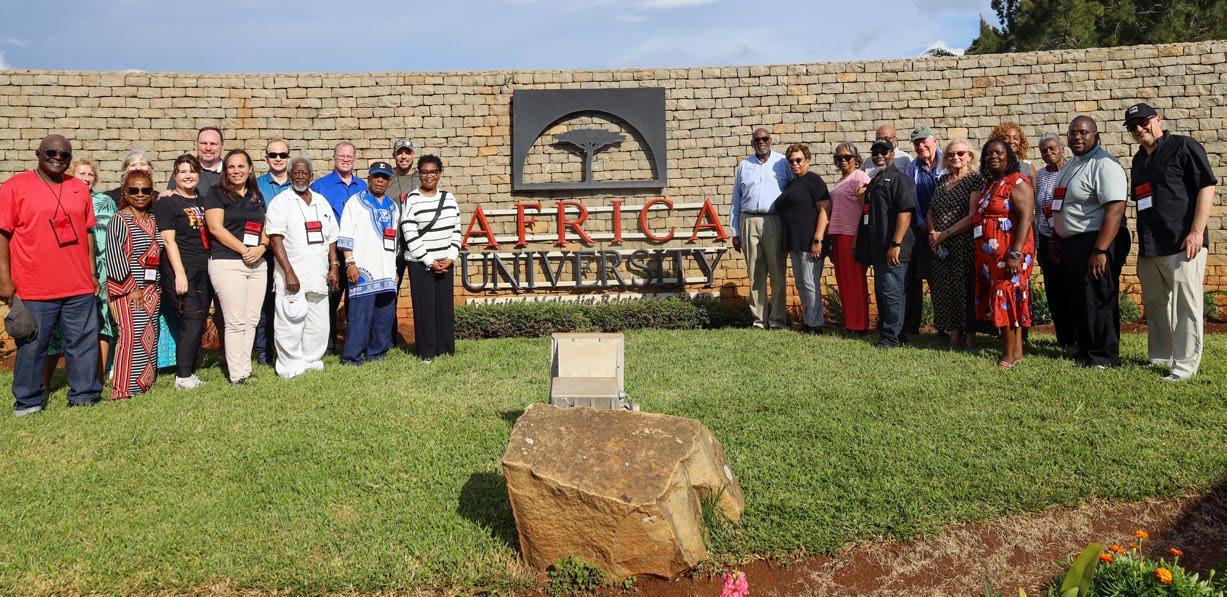
The year 2026 began on a high note of celebration, fellowship, and meaningful connection as Africa University welcomed a 29-person delegation to its main campus at Old Mutare, Zimbabwe, from January 4–7. The familiarization visit was led by Bishop L. Jonathan and Mrs. Felecia Holston of the Alabama Panhandle Episcopal Area of The United Methodist Church.
Participants included clergy and lay leaders from the Alabama-West Florida and North Alabama Conferences, along with supporters of Africa University from the Baltimore-Washington, Great Plains, North Georgia, South Carolina, and Upper New York conferences. For Bishop Holston—who has led six such visits since 2014—the purpose is clear: deepening connection.
others into the story.”
The immersive visit offered firsthand exposure to Africa University’s mission and impact. Delegates engaged in wide-ranging conversations with
West Florida Conference. Tippit also highlighted meeting Marcia Delta Maria of Angola, the student supported by an endowed scholarship from the conference’s foundation, as a powerful moment.
“There is nothing more potent and inspiring than experiencing, personally and intimately, the mission that you are part of as a United Methodist,” said Bishop Holston. “The reality of Africa University... seeing how your faithful generosity brings hope and change in ways that you could not have imagined... compels you to share what you’ve seen and invite
Clergy and lay AU supporters made up the 29-person delegation.
students, faculty, and senior leaders, gaining insight into the institution’s strategic direction and its role in shaping the future of sub-Saharan Africa.
“As the choir sang in chapel about blessings from generation to generation to generation, I felt the Spirit move...tears of love and hope streamed from my face,” said Rev. Jean Tippit of the Alabama-
United Methodists demonstrated strong commitment to global mission in 2025 through their support of the Africa University Fund (AUF). Twenty-two annual conferences gave 100 percent of the amount they were asked to contribute, while four others came within a fraction of the goal at 99.1 to 99.9 percent.
The AUF finished 2025 ranked first among the church’s seven general funds, with 88.6 percent of the asking invested by local congregations. Participation and giving increased across all five U.S. jurisdictions. In the Northeastern Jurisdiction, seven of 10 conferences reached 99 percent or higher, with the New York Conference giving 137 percent
and helping the jurisdiction end the year at 100.2 percent overall.
“This level of support in a year when the General Council on Finance and Administration asked us to prepare for a collection rate of around 50 percent speaks volumes,” said James Salley, president and chief executive officer of Africa University (Tennessee) Inc. “It’s proof that relevance, impact, and commitment to Wesleyan values matter to the people in the pews.”
The number of conferences reaching full participation rose from 17 in 2024 to 26 in 2025, signaling strong connectional support for the university’s mission.
Beyond campus, the group visited United Methodist ministries in Zimbabwe, including Old Mutare Mission Hospital, Fairfield Children’s Home, and Hilltop United Methodist Church. The itinerary also included briefings in Harare, regional travel to Victoria Falls and Chobe National Park, and visits to historic sites in South Africa.
“Connecting with local communities...was deeply humbling and inspiring,” said Valarie Pryor-Williams of South Carolina. “The trip strengthened my global awareness...and left me with a renewed sense of purpose.”
Together, these experiences affirm the enduring impact of investing in education, health, and youth—and the lasting difference made through The United Methodist Church’s sustained commitment to a transformative, global mission through Africa University.
- Article includes information from a FB post by AU’s Office of Advancement and Public Affairs.

“This reflects a shared understanding that Africa University is a vital expression of the church’s mission,” said Bishop L. Jonathan Holston, AU Tennessee board chair and leader of the Alabama Panhandle Episcopal Area.
The South Carolina Conference of The United Methodist Church continues to set a high bar in support of Africa University. With intention and sacrificial giving, the conference leads in consistent annual apportionment investment at 100 percent. In 2025, as the year end approached, the conference was close to reaching its goal but still needed $8,000. At that point, the Orangeburg District chose to go the extra mile. Clergy and laity across the district, led by District Superintendent Kenneth Nelson, gave the remaining amount so the conference could reach 100 percent. The gift also honored Orangeburg native James H. Salley, a founder and executive of Africa University.
“That’s faith in action,” said Salley, the president and chief executive officer of AU (Tennessee) Inc. “The churches stepped forward to meet the need, and it’s an honor to see South Carolina lead the way.” Nelson noted that Salley has been a strong voice for the Africa University partnership within the
conference. A member of Edisto Fork United Methodist Church, Salley helped start an Africa University Sunday two years ago to strengthen local support for the global mission.
The conference also hosts the annual Wespath–Bishop Leonard Fairley Golf Invitational each September. The event was started to help close any AUF funding gaps and now supports scholarships.
In 2025, the tournament reached its highest level of participation and support.
Through leadership from Bishop Leonard Fairley, his wife Dawn, and the conference’s churches, South Carolina continues to model what full support for Africa University can look like.
Encouraging other conferences, Fairley explains, “We always want to make sure that we’re giving 100 percent of not just our finances, but our hearts to this ministry that affects so many lives—not only on that continent, but here.”

A
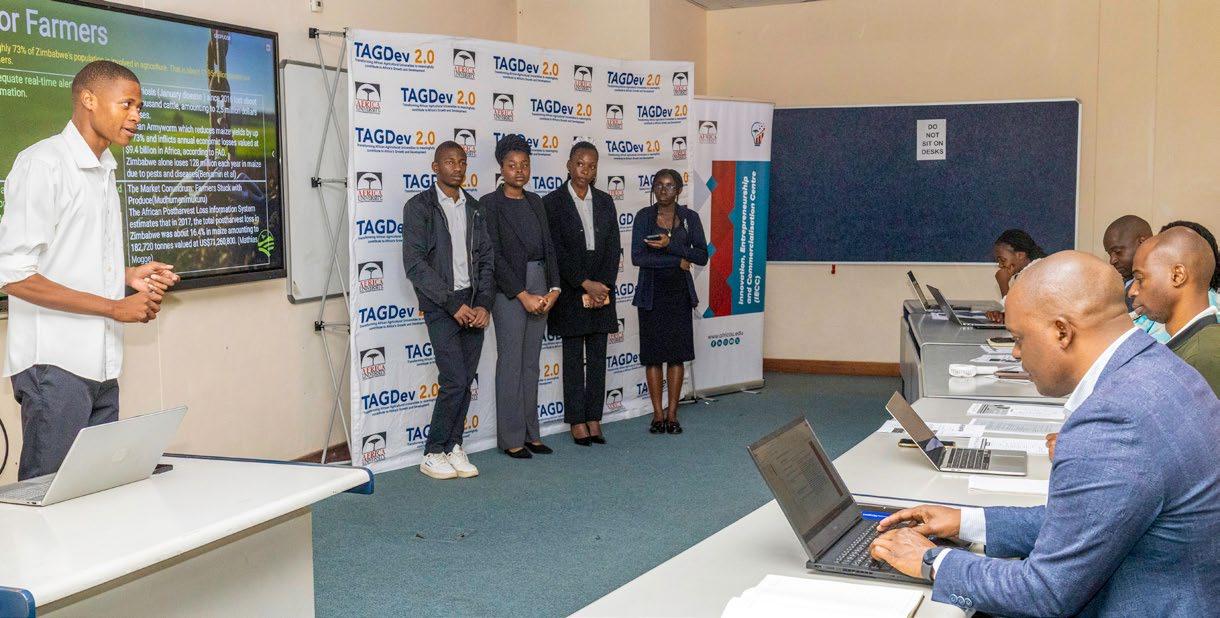
Young innovators and student entrepreneurs showed strong results at the Agri-Innovation Challenge held at Africa University last November, highlighting practical solutions for climate-smart agriculture.
Overall investment in the Africa University Fund apportionment in 2025 was 88.65% — the highest percentage invested across all seven shared giving funds of The United Methodist Church. The Annual Conferences of The United Methodist Church with a 100 percent or more remittance to the AUF over the past two years are:
FROM
It began with a single seed. Fifteen years ago, Pam Carter and her husband, then Rev. Kenneth H. Carter, Jr., invited the Africa University Choir to sing at Providence UMC in Charlotte, NC. The choir showed up in eyecatching regalia, impressing and lifting the congregation with spirited songs and hymns. Invigorating words from James H. Salley, president and chief executive officer of Africa University (TN) Inc., followed.

The music and the university’s story deeply moved the congregation. That day, family members of the late Catherine Ussery—remembered for her quiet generosity—honored her life and legacy with a $25,000 gift to Africa University.
As AU grew, the need for faculty and staff housing became even more urgent.
But AU’s long-standing practice is simple and wise: construction begins only when funds are available not just to build, but to maintain what’s built. So the Ussery gift was invested, patiently and carefully, for the future.
Over the years, support from Providence UMC and the Western North Carolina Conference continued. Kenneth Carter was elected bishop and later, during a visit to AU, helped break ground for future staff housing—still waiting for the right moment to begin.
Now, 15 years later, that original $25,000 has grown enough to fully fund the first of eight additional staff houses, with AU providing resources for the remaining homes. What began as a memorial gift is now becoming a place called home for those who serve the university.
This story reflects AU’s careful stewardship and long view of impact. A single act of generosity—rooted in faith, memory, and trust—has grown into lasting support for the people who make Africa University thrive.
Students came from Africa University and institutions in surrounding communities, including Mutare Polytechnic, Magamba Vocational Training Centre, Manicaland State University of Applied Sciences, and the Tongogara Refugee Settlement. The event brought together participants from different backgrounds to work on real agricultural problems.
Before the final pitches, students attended training sessions to strengthen their business planning, communication, and problem-solving skills. They learned how to turn ideas into workable business models, including financial planning and presenting to investors.
Nine teams presented their projects at the final event. Four innovations were selected as winners:
Juliet Sithole’s journey began at the Fairfield Children’s Home in Mutare, Zimbabwe, where she was raised alongside eleven other children. Growing up as an orphan did not hold her back. Instead, it strengthened her determination to succeed and to become a role model for others. From an early age, she learned that circumstances do not define a person’s future.
That determination led Juliet to Africa University, where she earned a Bachelor of Science Honours in International Relations with distinction, graduating with a 3.91 GPA. Her connection to the university deepened when she joined the Office of Advancement and Public Affairs, where she served for three years. During that time, Africa University made it possible for her to pursue a master’s degree in international relations and diplomacy while working, providing the support and stability she needed to succeed.
Reflecting on her experience, Juliet shares, “Africa University did not only give me an education—it became a family that believed in my future.”
Agrilease, Agrisentinel, Fodder Pod, and AgriBlend. Each winning team received a $5,000 seed grant from the TAGDev 2.0 program and incubation support from Africa University’s Innovation, Entrepreneurship and Commercialization Centre. The funding will help the teams build prototypes and test their ideas in the market.
Dr. Walter Manyangarirwa, TAGDev 2.0 program coordinator at Africa University, thanked program participants and partners and noted that prototypes from the winning ideas were expected soon.
The Agri-Innovation Challenge was organized through the Transforming African Agriculture Development, TAGDev 2.0 program. It’s an initiative of the Regional Universities Forum for Capacity Building in Agriculture and the Mastercard Foundation. The program prepares young Africans to create practical solutions and new businesses in the agriculture sector.

succeed.
Today, Juliet continues to build on that foundation. She is in her first year of a master’s degree in public ministry through the online program at Garrett Evangelical Theological Seminary. As she pursues this degree and explores new career opportunities, she carries forward the love and support she received at Africa University. Her story is a powerful testimony to the impact of the many faithful friends of Africa University who nurture hope and turn potential into purpose.
Located in Old Mutare, Zimbabwe, Africa University is an accredited, United Methodist–related institution established by action of the General Conference. It offers degree programs across four colleges—Health, Agriculture and Natural Sciences; Business and Management Sciences; Engineering and Applied Sciences; and Social Sciences, Theology, Humanities and Education—along with a School of Law. Professional leadership and capacity-building programs are housed in the Murapa Institute of Peace, Leadership and Governance and the Institute of Theology and Religious Studies.
Thank you for investing in transformed lives and communities through Africa University. We encourage your church to remit 100% of its annual Africa University Fund apportionment, with monthly giving helping to ensure full support for essential costs such as utilities, equipment, and faculty salaries.
You may also support AU in these meaningful ways:
• Planned Gifts: Consider including Africa University in your estate plans and joining the Richard E. “Dick” Reeves Legacy Society.
• Usahwira (“Beautiful Friendship”): Become a keystone congregation by supporting one student for four years. Undergraduate support averages $7,000 per year; full or partial scholarships are welcome.
• Endowment Fund: Gifts to the Africa University Endowment Fund (World Service Special Gift #03-01-88) generate lasting scholarship support through investment income.
For more information about giving opportunities or to make a gift, visit us at https://support.africau.org
To learn about Africa University and its impact, visit africau.edu. For resources to help tell the story of the Africa University, visit:
P.O. Box 340007
Nashville, TN 37203-0007
The 1988 approval of Africa University by The United Methodist Church was more than a proposal for Ann Rader Pfisterer. It was a calling that she describes as “the missional opportunity of our generation.” At 99, Pfisterer recalls being asked by her supervisor at the General Board of Global Ministries to lead the campaign to establish a permanent endowment fund for the new university. As a veteran fundraiser and pioneer within the denomination, she drew on her experience of guiding multimilliondollar campaigns to give life to the bold vision.
Charged with raising $10 million, Pfisterer wrote the university’s case statement, assembled a national committee, and cultivated donors from those who supported the dream of the university. With Bishop Roy Nichols leading the committee, Pfisterer organized the campaign’s 1991 launch at St. Luke’s United Methodist Church in Houston, where more than $155,000 in pledges signaled strong early support.
By 1992, the foundation had been laid. When classes began, Pfisterer’s joy was boundless as 40 students were enrolled in the first class. Today, Africa University has 2,800 students, sustains a $140 million

endowment, and carries no debt. Ann Rader Pfisterer’s deep understanding of the local and global church helped her give shape to the powerful vision for a university that has become a globally recognized pan-African institution that empowers Africa’s future leaders. She looks back with gratitude and wonder at helping transform Africa University from a dream into a life-changing reality.
- Adapted from article by Tim Tanton. Read the full story at https://bit.ly/annpfisterer-story.

The AU Today is published by the Africa University Development Office. For more information, contact the Africa University Development Office P.O. Box 340007 Nashville, TN 37203-0007
Tel: (615) 340-7438
Fax: (615) 340-7290
Email: audevoffice@africau.org https://support.africau.org