SPRING 2021
Faithful Giving Keeps AU Relevant and Impactful United Methodists are faithful, generous, and passionate about missional engagement. The depth of the denomination’s support for the ministry of Africa University was evident in 2020. The Africa University Fund ended the year with overall giving at 88.37 percent—the highest percentage invested across all seven of the general church funds. Twenty-nine annual conferences achieved 100 percent of their budget commitment to Africa University.
institution, remained strong across the five U.S. jurisdictions. The Western and Northeastern jurisdictions delivered overall support of 99.93 percent and 96.11 percent, respectively.
“The dollars invested are vital, but those who give to Africa University are also modeling Christian love and discipleship in action,” said Peter Mageto, the acting vice chancellor of Africa University.
Remarkably, seven annual conferences invested more in 2020 than they did in 2019. In the Virginia Conference, where Bishop Sharma Lewis shared her desire to grow engagement with Africa University, congregations led with an investment of 102.91 percent.
“The leaders who are being nurtured by The United Methodist Church through Africa University share a personal experience of God’s grace that inspires them to be agents of change and vessels of grace wherever they find themselves,” Mageto said.
“It is our experience that when we articulate the needs of the university and are able to show people where their investments are being used and the human good those dollars are doing, they respond,” said James Salley, Africa University’s chief advancement officer.
Local churches’ investment in the Africa University Fund, which helps to sustain day-today operations at the United Methodist-related
“The foundation for Africa University is the local church and that’s where we have our faith and trust,” said Salley. “We are thankful for
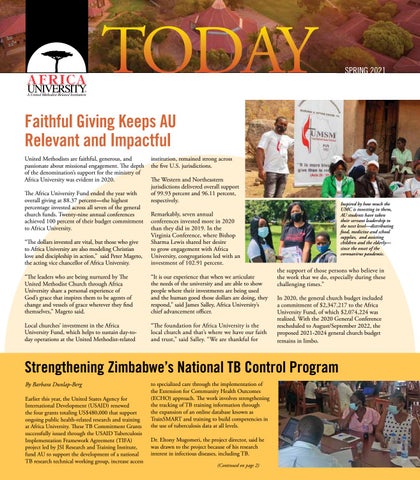
Inspired by how much the UMC is investing in them, AU students have taken their servant leadership to the next level—distributing food, medicine and school supplies, and assisting children and the elderly— since the onset of the coronavirus pandemic.
the support of those persons who believe in the work that we do, especially during these challenging times.” In 2020, the general church budget included a commitment of $2,347,217 to the Africa University Fund, of which $2,074,224 was realized. With the 2020 General Conference rescheduled to August/September 2022, the proposed 2021-2024 general church budget remains in limbo.
Strengthening Zimbabwe’s National TB Control Program By Barbara Dunlap-Berg Earlier this year, the United States Agency for International Development (USAID) renewed the four grants totaling US$480,000 that support ongoing public health-related research and training at Africa University. These TB Commitment Grants successfully issued through the USAID Tuberculosis Implementation Framework Agreement (TIFA) project led by JSI Research and Training Institute, fund AU to support the development of a national TB research technical working group, increase access
to specialized care through the implementation of the Extension for Community Health Outcomes (ECHO) approach. The work involves strengthening the tracking of TB training information through the expansion of an online database known as TrainSMART and training to build competencies in the use of tuberculosis data at all levels. Dr. Eltony Mugomeri, the project director, said he was drawn to the project because of his research interest in infectious diseases, including TB. (Continued on page 2)
AFRICA UNIVERSITY TODAY
|
SPRING 2021
Strengthening Zimbabwe’s National TB Control Program (Continued from page 1)
100% SUPPORT The Annual Conferences of The United Methodist Church with a 100 percent or more remittance to the AUF apportionment over the past two years are: North Central Jurisdiction 2020 2019 Dakotas 100% 100% East Ohio 100% 100% Illinois Great Rivers 100% 100% Indiana 100% 100% Iowa 100% West Ohio 100% 100% Jurisdiction Total Support 90.5% 91.33% Northeastern Jurisdiction 2020 2019 Baltimore-Washington 100% 100% Greater New Jersey 100% New England 100% 100% New York 100.34% 100% Peninsula-Delaware 100% 100% Susquehanna 100% 100% Upper New York 100% 100% West Virginia 100% 100% Western Pennsylvania 100% 100% Jurisdiction Total Support 96.11% 98.82% South Central Jurisdiction Oklahoma Indian Missionary Jurisdiction Total Support
2020 100% 74.18%
Southeastern Jurisdiction Florida North Alabama North Carolina Red Bird Missionary South Carolina Tennessee Virginia Jurisdiction Total Support
2020 2019 100% 100% 100% 100% 100% 100% 100% 100% 100% 100% 100% 100% 102.91% 100% 90.97% 93.26%
Western Jurisdiction 2020 Alaska United Methodist 100% California Nevada 100% California Pacific 100% Desert Southwest 100% Mountain Sky Oregon Idaho 100% Pacific Northwest 100% Jurisdiction Total Support 99.93%
2019 100% 78.24%
2019 100% 100%
100% 100% 100% 93.82%
“My past research experience on TB,” he said, “includes diagnostic techniques for TB in the high HIV/TB burden settings, tuberculosis infection prevention and control, and evaluation of the effectiveness of isoniazid preventive therapy.” The project is a joint endeavor of AU and Zimbabwe’s National Tuberculosis Program (NTB). It aims to provide evidence for TB program performance, decision making, and planning. The project seeks to address barriers to TB care and make TB services more patient-centered. With Mugomeri at the helm, four co-investigators oversee specific aspects of the project: Dr. Fadzai Mutseyekwa, TB Research Technical Working Group; Joseph Chinzvende, ECHO; Richard Fotsin, TrainSMART; and Elliot Chikaka, Making Sense of TB Data. The ECHO platform encourages sharing knowledge with health care workers in rural and underserved areas. It addresses health disparities, especially access,
quality, coverage, and safety. The platform will enable TB case-based learning and promote best practices and monitoring of outcomes. According to the World Health Organization, Zimbabwe is a high-burden country for TB, MDR-TB as well as TB/HIV co-infection. The country ranks 17th among the world’s high TB burden countries, and fourth according to incidence per capita. The Zimbabwe government is committed to ending TB by 2030. By 2025, the National TB Program aims to reduce TB incidence and mortality by 80 percent.
AU ALUMNI PROFILE
Bringing Hope to Visually Impaired Neighbors Naomy Nkoy, from the Democratic Republic of Congo, graduated from Africa University in 2020 with a Bachelor of Health Services Management degree. Emboldened to chase her dreams and give back, Naomy recently founded “Touch of Change”—an organization focusing on the welfare of people who are visually impaired and their children. An estimated one percent of Africans are blind, with cataracts, glaucoma, and trachoma being the main causes. Often, the conditions leading to blindness are preventable and curable. Timely medical interventions to prevent permanent eye damage are simply beyond the reach of many, leading to irreversible blindness. Through “Touch of Change,” based in Mutare, Zimbabwe, Naomy is reaching out to destitute visually impaired parents and their children. The organization aims to support education, enhance community awareness, and expand interaction to alleviate feelings of isolation and build social skills.
“This desire to help others is driven by the generosity that was shown to me at Africa University,” Naomy said. “Like so many other African students, I had the passion to advance my studies but was short on funds. Africa University took me in and exposed to me possibilities I had never imagined before.” Tuition scholarships, gifted to Africa University by the United Methodist Women of Los Altos United Methodist Church, helped Naomy to complete her degree. “Touch of Change” operates in the Manicaland Province. Adapted from an article by Jeanette Dadzie.
HOW YOU CAN HELP
Africa University Remembers Two Giants Who Nurtured its Success By Barbara Dunlap-Berg Two United Methodist “giants” – diaconal minister Dr. Rosalie J. Bentzinger, 96, and bridge builder the Rev. Hae-Jong Kim, 85 – died late last year. Both played key roles in the creation of Africa University. As associate general secretary of diaconal ministry at the General Board of Higher Education and Ministry from 1979 to 1994, Bentzinger traveled to Africa five times to advise and saw that the university would be a powerful force in empowering people across Africa. James Salley, associate vice chancellor for institutional advancement at Africa University, said Dr. Bentzinger “embraced Africa when a lot of people were in doubt about a ministry at this level on the continent of Africa. She helped to write the curriculum for the faculty of theology and to put together a Christian education program,” he said. “She gave a perpetual and fully endowed scholarship to AU.” Like Bentzinger, the Rev. Hae-Jong Kim was a modest but influential leader. Born in Kwang-Ju, South Korea, in 1935, Kim spent his ministry building bridges, Salley said. “He believed in and lived the diversity of the church and served without fanfare.” Taught by U.S. missionaries at Methodist schools in Korea, Kim became a Christian during the Korean War. While working for the United States Marine Corps chaplain as an interpreter, he decided to pursue the ordained ministry.
1961. He graduated from Methodist Theological School in Ohio in 1964. Elected to the episcopacy in 1992, Kim served the New York West and Western Pennsylvania conferences before retiring in 2004 and resigning from the episcopacy. In 2008, Kim resumed his ministry as a pastor in New Jersey. He planted 16 Korean Dr. Rosalie J. Bentzinger immigrant churches in the United States and provided direct and indirect support to those congregations. Bishop Ernest S. Lyght recalled meeting Kim 50 years ago. “Bishop Kim played a key role in introducing Africa University to the Kwang Lim Methodist Church in Seoul Korea,” Lyght said. Rev. Hae-Jong Kim The congregation funded the construction of the university chapel. “For Bishop Kim, education and mission were about helping people to develop their talents and providing an opportunity for a better life,” Lyght said.
Located at Old Mutare, Zimbabwe, Africa University is an accredited United Methodist-related educational institution in Africa, established by action of the General Conference. The university offers degree programs in three colleges: Health, Agriculture and Natural Sciences (CHANS); Business, Peace, Leadership and Governance (CBPLG); and Social Sciences, Theology, Humanities and Education (CSSTH&E). New academic programs include master’s and doctoral degree programs in military chaplaincy, migration, citizenship and refugee protection; and entrepreneurship, innovation and creativity. Africa University continues to be the evidence of faith, hope and belief in the visions of dreamers. Thank you for investing in changed lives and communities! Encourage your church to set a 100 percent apportionment remittance goal. Sending a portion of your goal each month makes it easier to reach full remittance by year’s end. Your church’s generosity ensures 100 percent support of Africa University’s operational budget for costs such as utilities, equipment, and faculty salaries. Consider these additional ways of helping the university educate new leaders for the nations of Africa:
PLANNED GIFTS are the foundation for the long-term
survival of Africa University. As you make your estate plans, consider leaving a gift or bequest to Africa University in your will. If you have already included the university in your estate plans, please let us know so we may welcome you to the Richard E. “Dick” Reeves Legacy Society.
USAHWIRA—This word in the Shona language means “a
beautiful friendship.” Encourage your local church can become a partner with Africa University by supporting one student for four years. The annual cost of supporting one undergraduate student is just under $6,000. Local churches and individuals may provide full or partial scholarships.
ENDOWMENT FUND—Give to the Africa University
Endowment Fund (World Service Special Gift #03-01-88). The interest income from the endowment provides scholarships for our students. For more information about giving opportunities or to make a gift, visit us at support-africauniversity.org. To learn about Africa University and its impact, visit africau.edu.
After completing studies at the Methodist Theological Seminary in Seoul, Kim came to the United States in
Let’s work together to continue the transformation of lives and of Africa. To download resources to help tell the story of the Africa University Fund apportionment, visit: umcgiving.org/ auf and/or the resources page at support-africauniversity.org. Current resources include: • Africa University at 29 - Talking Points • Africa University: The School of Hope (video) • Usahwira (brochure) • AU in a Nutshell (presentation)
AFRICA UNIVERSITY DEVELOPS HAND SANITIZER
Africa University Development Office P O Box 340007, Nashville, TN 37203-0007 (615) 340-7438; Fax: (615) 340-7290 audevoffice@gbhem.org www.support-africauniversity.org
“Smooth seas do not make skillful sailors” is an African saying akin to “when life gives you lemons, make lemonade.” Both are reminders that opportunities often reside in challenges. A shortage of personal protective equipment (PPE) in Zimbabwe at the start of the coronavirus pandemic led Africa University to develop a mask prototype and hand sanitizer liquid with partial funding from Old Mutual Zimbabwe. Africa University’s U-Safe hand sanitizer is now certified product, available on store shelves across Zimbabwe. Two other products are in the pipeline at the university—an insecticidal canopy that offers protection from malaria carrying mosquitos; and cough drops made from Zumbani, (Lippia javanica), a plant showing potential as an ethnomedicinal treatment for fever and chest related ailments.
Nurturing Leaders. Changing Lives.
General Board of Higher Education and Ministry Africa University Development Office The United Methodist Church P.O. Box 340007 Nashville, TN 37203-0007
Nonprofit Org. U.S. Postage
PAID
Nashville, Tenn. Permit No. 11
Latest News from Africa University AFRICA UNIVERSITY TODAY
|
SPRING 2021
A Passion for Africa and Education Sally Morris recalls being a child listening to a guest speaker at Grace UMC in Pekin, Illinois. For her, the speaker, Dick Reeves, “passionately painted a picture with words describing his dream of Africa University. It would be a place where students from every African country could come together and receive the gift of a lifetime . . . an education! They would come together, share ideas, obtain knowledge and learn the skill of compromise surrounded by love. His dream had the possibility of changing the whole Africa continent forever!” It was some years later that Ms. Morris’ passion for mission ignited. She participated in work team trips to St. Croix, VI, and Costa Rica. On a mission trip to Kenya, she helped build the boys’ nursing dormitory at the Maua Methodist Hospital (MMH). Eventually, she left her job to become a full-time mission volunteer with the General Board of Global Ministries. Morris served at the Dream Dental Clinic at MMH and then in Freetown, Sierra Leone, where she founded and continues to support the
The AU Today is published by the Africa University Development Office, in partnership with the Office of Communications, General Board of Higher Education and Ministry (GBHEM). For more information, contact the:
Sally Morris
Sababu (God-Given Opportunity) Seed Project, which helps educate women and children. Having included Africa University in her estate plans, this year Morris becomes one of the newest members of the Richard E. “Dick” Reeves Legacy Society. She is now a part of the picture that was vividly described in her childhood. “It is only a natural step for me to donate my inheritance so after my time on earth, I will know my passion for Africa and Education will continue. Thanks be to God!”
Africa University Development Office P.O. Box 340007 Nashville, TN 37203-0007 Tel: (615) 340-7438 Fax: (615) 340-7290 Email: audevoffice@gbhem.org support-africauniversity.org.