ISSUE 100 / 2022
N2,000 / $10 / 7
...Providing a friendly pla orm towards achieving peace in Africa
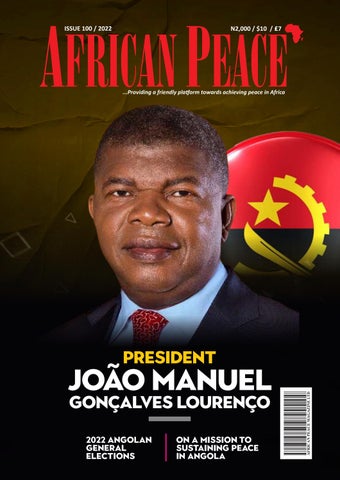
João Manuel Gonçalves Lourenço 2022 Angolan General Elections
On a Mission to Sustaining Peace in Angola
AFRICAN PEACE MAGAZINE LTD
President
Invites you to attend the
International African Energy, Oil and Gas Summit.
THEME: HARNESSING THE POTENTIAL FOR INCLUSIVE ENERGY TRANSITION AND A SUSTAINABLE FUTURE
ANGOLA
www.africanpeace.org africanpeacemag africanpeacemag@gmail.com africanpeacemagazine african peace magazine ltd
22ND OCT, 2022 +447448921266 +447466234902
With over 18 years experience in conducting safari tours in Africa, you will be dealing with an experienced company that employs well-qualified and trained individuals. African Sky offers both luxury travel as well as more reasonably priced alternatives. Our expert travel services are focused on the countries of South Africa, Botswana, Namibia, Zambia, Zimbabwe and Mozambique. You have a great variety of choices as far as lodgings are concerned, ranging from comfortable and affordable to luxurious and exclusive. As with the accommodations, the range of experiences and the locations in which these can be enjoyed are as diverse as the vibrant city of Cape Town and the endless sun-scorched expanse of the Etosha Pan in Namibia, as leisurely as relaxing on a tropical beach in Mozambique and as exhilarating as encountering lion's on a bush walk in the Sabi Sand.
NEED TRAVEL ADVICE? Our consultants are ready to assist you with your dream African safari tour.
Editorial Team Editor In Chief/Publisher Noah Ajare
Hauwa Gadzama (Nigeria) Ayiroth Sandra (Uganda) Shreya Yadav (India) Sekao Phenyo Ntsosa (Botswana) Charity Lily (South Africa)
Editor Barakat Yakubu
Joseph Onele (Nigeria) Eric Emmanuel Sossah (Togo) Salama Kasoga (Uganda) Hadiza Abdulrahman (Nigera) Sylvia Nachilinda (Zambia) Tonye Suzanne (Cameroon) Sunday Honorine (Rwanda) Lillian Wamuyu (Kenya) Ntombi Magagula (South Africa)
Deputy Editor Folarin Kehinde Managing Editor Arinola Suleiman Associate Editor Comfort Yahaya Shukurat Abiola Sharafa. International Standard Control Manager Temitayo Atinuke Ajibade Social Media Manager
Marketing and Business Development Bizchart NG Investment Holdings (PTY) Ltd (South) Editorial Board Prof. Lloyds Williams (USA) Prof. Muhamed Tawq Ladan (Nigeria) Prof. Paul O. Idornigie (Nigeria) Dr. Abiodun Odusote (Nigeria)
Gabriel Ayite Baglo International Chief Consultant Nympha Chinenye Nzeribe. International Correspondent African Peace Team Angela Mandara (Kenya) Chief Alfred Solomon (United Kingdom) Joy Umekwe (United Kingdom) Olajide Ajayi (Ireland) Somie Kay (Kenya) Segun Victor (France) Johnny Mashigo (South Africa) Jemiriye Adeniji (USA) Laolu Omisade (Canada) Charles Acculley (Ghana) Tony Stony (Zambia) Mary Anyango Oluoch (Kenya) Noble W. Kel Ngozisonye (UAE) Deji Gbotosho (Nigeria)
Graphics/Photograph Abdulrau Raimi John Okwo Mattory Digital Print CreativeReality Contributors Elvis Lyorngurm Adam Alkali Zoe Seeker Zina Harvey Ejodame Emmanuel Uju Nnaji
HEAD OFFICE: 3, New Bussa Close Off Orlu Street, Opp. Water Board Area 3, Garki Abuja, Nigeria. Tel.: 234705 923 9969 UNITED KINGDOM: 6, Houghton Parade, Houghton Rd., Dunstable, Bedfordshire Lu6 1DA, United Kingdom. Tel.: +44744 8921 266 ...Providing a friendly pla orm towards achieving peace in Africa
AFRICANPEACE 4
Email: info@africanpeacemag.org Website: www.africanpeacemag.org www.africanpeacemag.org
Table of
Content
AFRICANPEACE 5
Editor’s Note It is to be noted that by 2050, Africa is projected to house more than 2.2 billion people, making up over half of the global population growth. How can we achieve prosperity and peace on the continent? By all standards, elections are the focal point of efforts to rebuild economies damaged by civil conflict and to aid in the comfort of the increasing populace. Traditionally, elections were alien to Africans, but with the advent of colonialism and globalization Africa has embraced democracy. Many key African states would be having elections this year. And our team at African Peace Magazine would hopefully be a participatory media outfit, covering all the elections. It is our belief that democracy is key to ensuring the peace and prosperity of the continent. While people have the opportunity to vote on significant matters impacting their country or can elect representatives to make these decisions, it is crucial that their democratic interests be protected and respected. In a typical democratic environment, those in positions of power are typically chosen by the people who cast the votes. Therefore, it is their duty to carry
out the wishes of the people who elected them. They won't be re-elected if they abuse their power. This is the benchmark, the justification for why every citizen's right to vote matters. To face this reality, and to create a future it can be proud of, Africa must begin addressing its challenges now, and today. African governments must wake up to the reality of the need to ensure rapid development through credible and transparent elections. By continually enacting changes that are in the best interests of everyone, African Democratic governments must maintain the rules and laws that promote stability and safeguard human rights. We need to ensure that we have credible elections in Africa, an election that reflects the true wishes of the people. Elections are only transparent if every phase is available for review and participants can independently confirm that the procedure is carried out credibly and accurately. The fundamental rights of citizens to seek, receive, and disseminate information regarding their voting rights, as well as their freedom to participate in politics and public affairs, are all connected by the
AFRICANPEACE 6
principle of openness. Elections are a crucial tool for voters to keep their governments accountable, but the election procedures must also be transparent and fair. Effective redress must be available in the event that a citizen's rights regarding elections are violated. Administrative accountability is also required for individuals in charge of election planning and election-related government work. Additionally, effective legal processes must exist to hold people accountable who violate laws protecting the rights of voters. By making sure of the aforementioned, electionrelated violence in Africa can be reduced, while real leaders are chosen and, consequently, the problems of hunger and poverty can gradually start to alter. In this edition, we hinge our focus on Angola and its President, João Manuel Gonçalves Lourenço. Along with other exclusive features and interviews. Please enjoy this unique edition of the African Peace Magazine.
The purpose of this app will basically be for selling and buying food. It will stage as follows: There will be an interface where food vendors advertise their businesses and the type of edibles they sell. The price for their edible and the price for delivery to a particular location The app will also have interface where consumers can register and put in their address, select what they want to eat and let it be delivered to them The food vendors will be arranged by location. Which food vendor is closer to the consumers location and if they deliver to the location as well as the price of delivery There will also be an interface for review on the delivery and the vendor There will be an interface where consumers will track their delivery There should be an interface where the consumers can give instructions with regards to their order There should be an interface for different modes of payment and if the vendor accepts that mode of payment
DOWNLOAD NOW THEAPP + + +
AFRICANPEACE 7
Oneon One
1, My name is Sotonye George, I hail from Asari- Toru LG in Rivers State, Buguma City and I am the third child in a family of four. 2, I had my first degree from the University of Calabar where I studied Political Science and had my Master from Nassarawa State University, Keffi, where I studied Human Resource Management.
with
3, Well I started with the skit thing that we all know, I got featured in some skits. Then one day a close friend called from Lagos to ask me if I would love to act, as per to be an Actor, I excitedly said yes, so here I am. 4, Peace is having no fear of what others think of you and the way you behave. Peace is respect and peace is harmony.
AFRICANPEACE 8
Oneon One
5, What makes me happy, lol. Money makes me happy. Peace of mind makes me happy, been busy most times makes me Doing small acts of kindness increases life satisfaction. Surrounding yourself with positive people. Spending more time with family. Spending money on Experiences instead of Things. Finally, sleep makes me happy. 6, Seriously this is a very important question. My opinion, Register to vote (and actually vote), very important. Treat all people with kindness, re g a rd l e s s of ra ce , g e n d e r orientation, sexual orientation, religion, etc. Attend a peace rally, create a peaceful affirmation/mantra. Don’t engage in violence of any kind. Embrace diversity and get to know other cultures by traveling the world and doing research. If you have a platform, use it to educate.
Promoting Peace in Nigeria and Africa can also include conflict prevention; conflict management; conflict resolution and transformation, and postconflict reconciliation. Promoting Peace becomes strategic when it works over the long run and at all levels of society to establish and sustain relationships among people locally and globally. 7, Of course yes, first of, get your PVC, not just that vote. I have been doing this for years.. Approaches to conflict management and resolution, as a p p l i e d to t h e s e d i s p u te s , include bilateral and multilateral negotiation, mediation and arbitration. CollaborationIt is the most effective but most difficult way of managing differences. It requires trust and commitment on all sides to reach a resolution by getting to the heart of the problem. All parties need to be willing to empathize and try to understand each other's situation. 8, My advice to women would be: Believe in yourself and your potential. I believe that being
AFRICANPEACE 9
with
confident in my abilities and what I have to offer is the single most important reason I am focused and determined. Keep the vision of why you want to lead and not least what you want to lead towards. 9,The African Peace Magazine initiative seeks to honour persons, institutions, organisations, governments and others whose notions, and efforts have in one way or other improved or contributed to peace keeping and conflict management in Africa as well as improving the lives of Africans. 10,Providing farmers with modern farm machines and simple farm equipments is another powerful solution to the problems of food and agriculture in Africa. This is highly very important because the local farmers there are still, helplessly making use of only cutlass and hoe. Another Great Step toward mechanization of agriculture is to provide stable water and electricity supplies in the Farming Areas. The average local farmers are facing the problem hardships,
challenges of poverty and lack of fund. They, particularly have very little or no funds to expand their farm potentials. Agricultural funds really need to be made available for these farmers as this is still part of the most effective solutions to the nation's food and agricultural development. Another plus to funding is to provide these farmers with hybrid seeds and simple agricultural machines at subsidized rates. Both gender and age should be encouraged to participate in agricultural sector to enhance more production for commercial purpose in the state. This can be done via sensitization campaigns to encourage both rural and urban women to pursue a g r i c u l t u ra l ve nt u re s . A l s o , special grants and financial incentives should be directed to female agricultural enterprises in order to ensure that benefits from the skill and intelligence that women can contribute to the economy. Agriculture is not only for male.
11, No NGO at the moment. 12, I will be making more interesting movies, i am working on having my own talk show. I have so many things i need to do, don’t worry, you guys will hear 13, My Dad inspires me, he is God fearing, he is strong, focused, determined and principled. 1 4 , To e n s u re t h a t c o n fl i c t prevention and peace building are prominent within the policies and structures in Africa external affairs. To secure increased resources for conflict prevention and peace building. To integrate peace building into Africa development policy, programmes and approaches. To s t r e n g t h e n t h e implementation of a gendersensitive approach in Africa policy and practice which enables the Africa to be more inclusive and effective in promoting peace. To promote peace building in
Africa response to specific conflicts. 15, I will say my movies, yeah movies. I have produced two already in a short time, though it’s just one that has been released. It’s a dream come through for me sincerely. 16, Creation of job opportunities with adequate remuneration. Quality educational opportunities should be provided, Provision of local incentives. Provision of conducive environment for workers. Funding of tertiary institutions. Accountability in govern. 17, Youth can bring a positive change in a society. They are the ones who can make a difference in a society by forming a sustainable foundation of peace and harmony in a society. Youth must play an active role in creating and promoting peace, tolerance, co-existence, and non-extremist environment. 18, My newest movie “WHAT HAPPENED TO KENDRA” It’s an interesting movie that has to do with patient, tolerant, anger issues, love etc. It’s a family story that is very educating. Infact so many reviews about the movie has been coming in and I really thank God for that. The movie “WHAT HAPPENED TO KENDRA” was shot in Lagos in February 2022 with great Actors. For now, the Movie is on YouTube and i encourage everyone to see it, the storyline inspires me because i was a victim of anger issues. The linkS h ow i n g o n No l ly p l ay Tv YouTube, please Subscribe, C o m m e n t , L i ke a n d S h a re . https://youtu.be/C12beOkgl xY
AFRICANPEACE 10
REJUVENATOR EALTH
HT
HERAPY
LTD
M e Spa
Regenerative massage is an integrated process to recover the organ function lost due to age, disease, damage, or congenital defects whether there is a tissue or stress buster, a massage from Rejuvenators is the perfect way to treat your body to some TLC in the privacy of your own room. Varieties include massage and sauna, Japanese massage, Philippine massage, Korean massage, full body massage etc. For detailed list of massage and pamper treatment or to make bookings, Contact the following numbers:
+2347025003543 +2347025003544 +2347025003537
AFRICANPEACE 11
in Africa The launch of 5G in Africa has brought about the exposure to fast Internet use and most importantly exposure to more artificial intelligence and internet of things. 5G is the fifth generation of mobile network that gives access to the internet of things. The intercept of 5G makes it possible for connection of man to machines and gadgets. The network comes after 1G, 2G, 3G, 4G networks. It provides multi gigabit per second peak data speed, huge network capacity, increased availability with h i g h p e r fo r m a n c e a n d efficiency. It has given and allowed more space for user experience and larger range of industry
connection. The previous generations of mobile networks are 1G, 2G, 3G, and 4G. First generation - 1G, 1980s: 1G delivered analog voice., Second generation - 2G, Early 1990s: 2G introduced digital voice (e.g. CDMACode Division Multiple Access). Third generation - 3G, Early 2000s: 3G brought mobile data (e.g. CDMA2000). Fourth generation - 4G LTE, 2010s: 4G LTE ushered in the era of mobile broadband. 1G, 2G, 3G, and 4G all led to 5G, which is designed to provide more connectivity than was ever available before. 5G is a unified, more AFRICANPEACE 12
capable air interface. It has been designed with an extended capacity to enable next-generation user experiences, empower new deployment models and deliver new services. With high speeds, superior reliability and negligible latency, 5G will expand the mobile ecosystem into new realms. 5G will impact every i n d u s t r y, m a k i n g s a fe r t ra n s p o r t at i o n , re m ote healthcare, precision agriculture, digitized logistics — and more — a reality. With more people demanding faster internet and possessing more than one gadget that needs internet connectivity, the mobile industry has realised that 4G or LTE
might just not cut it. So, it has developed a new g e n e rat i o n of w i re l e s s n e t w o r k i n g technology—the fifth one—that can support this need, and more. 5G promises to bring speeds of around 10 gigabits per second to your phone, which is over 600 times faster than the typical 4G speeds on today’s mobile phones. Emerging technologies like virtual reality (VR), augmented reality (AR), and now the metaverse have made fast connectivity more important than ever in the world. 5G promises to ensure that when you talk to someone in the metaverse, your voice does not lag by seconds. 5G will power artificial intelligence (AI), driverless cars, and smarter cities,
which will drive future economies. So, even though we are still in the early stages, countries around the world are racing to adopt the network. When Ethiopia announced on May 9 that it was launching trials for its first 5G mobile network in its capital, it joined more than a dozen African countries that are either testing or have rolled out the next-gen network. But just as for its 5G peers, the journey isn’t going to be smooth. Governments in Africa are optimistic that they will one day use 5G to do largescale farming using drones, introduce autonomous cars into roads, plug into the metaverse, activate smart homes and improve cyber security. Some analysts predict that 5G will add an additional $2.2 trillion to Africa’s economy by 2034.
AFRICANPEACE 13
Africa is also running its own race with 5G, even though it is slow. But Africa’s 5G first movers are facing teething problems that stand to delay their 5G goals. The challenges have revolved around spectrum regulation clarity, c o m m e rc i a l v i a b i l i t y, deployment deadlines, and low citizen purchasing power of 5G enabled smartphones, and expensive internet. 5G pioneers in Africa Ethiopia is joining Botswana, Egypt, Gabon, Kenya, Lesotho, Madagascar, Mauritius, Nigeria, Senegal, Seychelles, South Africa, Uganda, and Zimbabwe, when it comes to testing or deploying 5G. But many of these countries are facing delays.
Botswana: On Feb. 25, Botswana’s Mascom unveiled 5G to residents of the capital Gaborone. It started with four sites in the city, with a plan to lay more than 100 base stations by the end of 2022. E g y p t : L a s t Fe b r u a r y, Orange received spectrum from the Egyptian government that now allows it to test 5G networks just like Vodafone Egypt, Egypt Telecom and Etisalat Egypt. Though promising, Egyptians will have to wait for 5G services. Gabon: Since it started testing the technology in November 2019, Gabon’s Gabon Telecom is yet to go commercial. Its CEO is targeting 2023. Kenya: Ethiopia’s southern neighbor, has been testing the technology for a year now, when the country’s telecoms regulator is expected to have issued mobile operators with 5G licenses. The country is expected to account for m o re t h a n h a l f o f t h e continent’s tiny number of 5G mobile subscriptions in 2026. Lesotho: Since Vodacom was given a temporary spectrum by the Lesotho government in 2018 to experiment with 5G technology, it has been a journey of pain. Wrangles between Vodacom, Econet and the regulator have hindered any meaningful 5G roll-out.
Madagascar: In July 2020, M a d a g a s c a r ’ s Te l m a followed South Africa to launch a commercial 5G but t h re e we e k s l a te r, t h e country’s regulator told the company to halt its plans. Mauritius: On July 30 last year, the government of Mauritius announced the country’s first 5G network deployment to cover four zones but didn’t share plans for a fully commercial rollout. Nigeria: The continent’s largest economy, issued spectrum licenses in March, and is hoping to possess the widest 5G network in the continent this year. It is looking at August for commercial deployment. Senegal: Since their first 5G tests in November 2020, S e n e g a l’s S o n ate l a n d Orange continue to do a number of trials in Dakar but the network still remains largely unoperational. Seychelles: Citizens greeted the country’s 5G launch in 2020 with mistrust, expressing concern over health h a z a r d s . A y e a r l a t e r, citizens in six regions are getting faster speeds of 1.2Gbps from Cable and Wireless Seychelles, for up to 100GB of use. South Africa: The continent’s earliest adopter of 5G rolled out the technology on a temporary spectrum, but amid heavy
AFRICANPEACE 14
strain on networks during the pandemic, Vodacom, Rain, and MTN were ordered to suspend that use from November 2021. In March, the country earned nearly $1 billion from its long-awaited 5G spectrum auction. Uganda: In January 2020, Uganda became the first east African nation to test the possibility of launching a 5G network with ZTE and MTN. But a commercial launch is yet to happen. Zimbabwe: On Feb. 24, Zimbabwe’s Econet announced that it had launched the country’s first 5G network and would activate two dozen sites by this month. Reasons for the delay in adoption. Expensive 5G smartphones slow adoption Safaricom, the operator leading 5G adoption in Kenya, said that the high cost of 5G-enabled smartphones is slowing down the company’s ambition to offer mobile 5G services. The cheapest smartphone with a 5G smartphone in the continent goes for about $300, which is very expensive for the average African. One study in Kenya revealed that 94% of the population owns devices costing less than $200. “That’s one of the reasons why we are focusing more on the 4G side and leaving
5G to serve the homes, said Safaricom CEO Peter Ndegwa Africa needs to work hard on 4G first The desire to catch up with the rest of the world has seen improvements in the existing 4G networks on which most countries plan to switch on 5G. As of 2019, 4G internet signals covered about half the continent, according to the industry body GSMA. Yet only 10% of Africa’s population presently uses 4G, a recent report from telecom firm Vodacom said. Even more detrimental to the 5G dream is the fact that 4G network services in Africa are only available in urban and peri-urban areas as many providers try to deploy internet in areas with high usage to remain profitable, leaving villages years away from experiencing higher speed internet. For now, 3G is still adding users. And the reality is that 42 African states are yet to start thinking about 5G. Sebastian Vasquez, a MTB downhill world trichampion, demonstrates h ow h e l o o k s t h ro u g h goggles that are connected to a 5G network that is livestreaming video back to him of what he aims is site at, before riding his bike wearing the goggles during the inauguration event of the 5G network in Santiago,
Chile, Tuesday, Jan. 19, 2021. (AP Photo/Esteban Felix) With 43% of its population living below the poverty line and an underdeveloped fi xe d b ro a d b a n d infrastructure, will Nigeria be able to implement the 5G network?
creates a ripple effect a c ro s s t h e e c o n o m y, contributing to low levels of financial inclusion, and persistent geographic and gender gaps in access to and use of digital technologies,” the World Bank says.
The adoption of the 5G network in Nigeria is pegged on its huge population, half of whom are poor. As of March 2021, there were at least 78.61 m i l l i o n 3 G /4 G m o b i l e broadband subscriptions in Nigeria, according to Statista. This is a decrease when compared to figures from the previous month, but an increase from the 76 million subscribers during the same period in 2020, the data agency states on its website.
5G to roll out in 2022 Following a successful auction of the 3.5GHz spectrum auction, which will herald the launch of 5G network that earned the Nigerian government more than $500m in revenue, Nigeria will more than likely r o l l o u t t h e commercialisation of the 5G spectrum by the fourth q u a r te r o f n ex t ye a r, according to a government policy document seen by The Africa Report.
The World Bank’s digital economy diagnostic on Nigeria shows that while the “country has made several positive developments in the digital space, including high-speed Internet via five underwater international links”, it “continues to face significant challenges” that have hindered its ability to “reap the full benefits of the digital economy.” “One leading barrier is Nigeria’s underdeveloped fi xe d b ro a d b a n d infrastructure, which is attributable to high federal and state taxes and an insufficient wholesale regulatory regime. This weak infrastructure base
AFRICANPEACE 15
Nigeria will therefore join Kenya and South Africa as the only three countries to have deployed commercial 5G services on the continent. Nigeria is depending on this superfast mobile technology to drive growth in an economy that’s struggling to rebound from the impact of the coronavirus pandemic, which pushed it into its worst recession in 25 years. The government plans to conclude the 5G spectrum assignment by the first quarter of 2022, according to its policy document, which states that Africa’s biggest economy is following a “phased approach” as its
d e p l oy m e n t p l a n . T h e three-thronged strategy includes a Non-Stand Alone (NSA) approach for the early stage, a hybrid approach for the mid-term, and a Stand-Alone approach for the long term. An NSA approach “will involve the deployment of 5G equipment on some existing sites, supported by densified networks of small cells”, according to the document, while “the midterm stage (2021 – 2025) will involve a hybrid approach with new-build 5G sites added to the small cell networks”. Depending on demand and ROI, this hybrid scenario may be seen by some as a longterm solution. “The longterm stage (post-2025) should see Stand Alone networks deployed and will require the largest
infrastructure investment,” the document says. Recent approval of 5G In October, the West African country announced that it had approved deployment of the 5G network. The rollout of the network is to be carried out in phases, beginning with major cities in the country where there is a need for high-quality broadband, and Nigeria expects to have 5G coverage of major urban areas by 2025, according to Isa Pantami, Nigeria’s communications minister. The 5G is a significant improvement from 4G in terms of capabilities and applications, according to Sunday Folayan, cofounder at SKANNET and former president of the Nigeria Internet Registration Association. AFRICANPEACE 16
“ 4 G h a s d e m o n s t ra te d significant improvements over 3G in terms of clearer video and audio that has made remote teaching and learning possible, especially with the advent of the pandemic. 5G promises even better applications such as telemedicine, more accurate navigation, and artificial intelligence-driven applications,” he tells The Africa Report. To ensure that the country is digitally enabled by 2030, investing in infrastructure to bridge the digital divide and creating an enabling regulatory environment for the digital economy to thrive is of paramount importance.
ACHIEVING Through ARTIFICIAL INTELLIGENCE By Augusta N. Iwuji, Esq.
Africa and the world at large have seen wars, conflicts, terrorism and other kinds of violence. One of the core reasons for crisis within Af r i c a’s wa r- a ffe c te d regions is the desire of some people to acquire power and secure resources for a certain group or ethnic group at the expense of others. The issue of identity mixed with c u l t u re , h e r i t a g e , a n d control of economic resources has created a vial for political tension and violence. A lot of African n a t i o n s h a ve c o n fl i c t s ranging from governments facing armed resistance, to et h n i c m i l i t i a s fi g ht i n g against each other. These conflicts are causing a huge influx of refugees into neighbouring countries
and Internally Displaced Persons (IDPs) are daily on the rise. It is estimated that there are close to three million refugees in central Africa alone. Violence leads to the breakdown of societies and it has not spared the African societies affected by it. Human lives have been lost, properties and infrastructures destroyed, education and health services have suffered, and the e nv i ro n m e nt h a s b e e n damaged. Ties between people have been broken, social solidarity has collapsed, political tension is daily on the increase, and socio-economic development has been severely retarded as a result of the carnage and destruction caused by conflicts.
AFRICANPEACE 17
If Africa will enjoy stability and development, peace is imperative and every effort should be put in place to achieve same. The continent continues to be faced with the challenge of establishing peace and development. A lot of peace initiatives have been launched in Africa and large amounts of resources have been invested to make peace agreements which collapsed for one reason or the other. In this article, we would look at the possibility of achieving peace and how we can achieve peace through Artificial Intelligence. Merriam-Webster defines peace in this context as a state of tranquillity or quiet: such as freedom from civil disturbance; a state of
security or order within a community provided for by law or custom; harmony in personal relations; a state or period of mutual concord between governments; a pact or agreement to end hostilities between those who have been at war or in a state of enmity. According to vocabulary.com, peace is a stress-free state of security and calmness that comes when there is no fighting or war, everything coexisting in perfect harmony and freedom. On the other hand, Artificial Intelligence is the field of developing computers and robots that are capable of behaving in ways that both m i m i c a n d g o b eyo n d human capabilities. AIenabled programs can analyse and contextualise data to provide information or automatically trigger actions without human interference. Today, artificial intelligence is at the heart of many technologies we use, including smart devices and voice assistants such as S i r i o n A p p l e d ev i c e s . C o m p a n i e s a r e incorporating techniques such as natural language processing and computer vision – the ability for computers to use human language and interpret images – to automate tasks, accelerate decision making, and enable customer conversations with chatbox. One may wonder what the relationship is between peace and Artificial
Intelligence. We are in the age and time when technology is taking over the world and whether we know it or not; acknowledge it or not; Artificial Intelligence is influencing every area of our lives and society. The internet and social media which are branches of artificial intelligence have become a force for reckoning. According to Global Social Media Statistics from datareportal.com, ‘analysis from Kepios shows that there are 4.65 billion social media users around the world in April 2022, equating to 58.7% of the total global population’ and according to statista.com, there are five billion people using the internet as at April 2022, which is 63% of the global population. The statistics show just how much people’s lives are influenced by social media and online engagements. Social media and digital tools have become a powerful force in conflict prevention, both on national and international levels. It affects private enterprises, governments, and policy decision makers alike. It has created a stir that has an impact on the global political arena. There has been an outstanding boom in the growth, use and popularity of new c o m m u n i c a t i o n technologies in the developing world. Taking these factors into
AFRICANPEACE 18
consideration, it is imperative that we realise the power of social media and how it can be used to transform our societies, individuals, and even governments. Social media can either be used as a positive tool or a negative tool. Recently, especially in A f r i c a , w e h a v e experienced sad situations where fake news, news that can incite chaos, violence and unrest has been spread. Like wild fire, such news spread within no time and end up filling people with hatred for others, fear for their safety, and even makes them more aware of their religious and ethnic differences. These kinds of information end up causing more harm than good. Fortunately, we can use the same social media and digital tools to promote peace. Information that encourages unity, oneness and peaceful co-existence of people can be spread, instead of the negative ones. Through social media, dialogue among people from different ethnic backgrounds and nationalities can be encouraged. It can also affect perception on e t h n i c i t y, c h a n g e o f attitudes, and it can promote tolerance and mutual understanding. When put into proper use, social media can bridge the d i v i d e b et we e n et h n i c groups that would not otherwise communicate with one another. Peace
programs and intercultural activities can be organised for people, and through social media, peace and tolerance can be promoted, hate speeches can also be discouraged. Social media can also curb political violence. This can be achieved through technology that encourages civic participation, transparency, and accountability. Everyone, government and citizens, become participants in their electoral processes. Where there is transparency and accountability, there will be
no need for political violence or unrest. Social media has also played a m a j o r ro l e i n b r i n g i n g domestic violence to light and proffering solutions to the victims. It is also an avenue of sensitising the youth to be politically active and to be included in their various governments. Artificial intelligence through the social media and internet may have its negative influence but we cannot ignore the power it has to transform nations and its capacity to have a positive impact in conflict areas. When artificial
AFRICANPEACE 19
intelligence is put into proper use, it will go a long way to help achieve peace in the world. If the large number of people who use the internet can be influenced to propagate peace, definitely, peace can be achieved. Finally, to achieve peace through artificial intelligence, all hands must be on deck. The billions of users of the internet, c o m p u te r s , a n d s o c i a l media must do their bits and promote peacee n d o r s i n g i n fo r m a t i o n instead of information that can stir up conflicts.
W W W . A F R I C A N P E A C E . O R G
Sub ribe now for our next edition
...Providing a friendly pla orm towards achieving peace in Africa
AFRICANPEACE 20
AFRICA, EXPERIENCING STUNTED
GROWTH By Augusta N. Iwuji, Esq.
It is believed that Africa is the oldest inhabited continent on Earth and as such, it is nicknamed “Mother Continent.” Some fo n d ly c a l l h e r “ M a m a Africa.” Africa is the second largest continent with a land mass of about 30.3 million km2 (11.7 million square miles) including adjacent islands, it covers 6% of earth’s total surface area and 20% of its land area, and a population of over 3.1 billion people. The continent is richly blessed with a large quantity of n a t u r a l re s o u rc e s l i ke diamonds, sugar, salt, gold,
iron, cobalt, uranium, copper, bauxite, silver, crude oil, petroleum, cocoa-beans, agricultural products, tropical timbers and tropical fruits. A f r i c a ’ s A g r i c u l t u re i s considered the continent’s single most important economic activity and it is greatly influenced by climatic factors. The tropical wet regions produce important crops like plantain, pineapple, coffee, cocoa, and oil palm. Savannah crops include the cassava, peanuts, peppers, okra, eggplant, cucumber,
AFRICANPEACE 21
and watermelon. Millet and sorghum are also produced here. The Mediterranean climate produces crops such as figs, olives, oranges, tomatoes, onions, and large vegetables, such as cabbage and cauliflower. Forestry and fishing are no exceptions to the resources Africa has been blessed with. Africa’s gold and diamonds contributes largely to the world market. With all the natural resources and blessings endowed on Africa as a continent, it is a wonder that Africa is still classified as a developing continent with
economic development of Africa; this in effect, has also hampered human development. In a stable economy, investors will come in and establish their businesses; citizens will be employed to work; monies will come in and leave the business. In so doing, the economy grows and human capital is developed. No one wants to take a risk of investing in a place where they could lose their investment in just a blink of the eye. As a result of the insecurities ravaging the continent presently, a lot of foreign businesses have been pulled out of the continent and that has a ffe c t e d t h e e c o n o m y negatively.
so much backwardness in its economy and human development. With the wealth Africa has at its disposal, the continent ought to have grown more quickly than it is growing right now. The growth of Africa has been stunted by so many challenges that seem insurmountable and until African nations start taking responsibility for their shortcomings and start doing what is expected of them, Africa will keep going b a c k w a rd s , i n s t e a d o f forward. There can be no solution to a problem until that problem is identified. We all
know that our beloved Africa is sick but we can only find a cure if we can diagnose what the sickness is. Identifying the problems will help us find lasting solutions to them. One of the major problems ravaging Africa today and keeping it from growing is POLITICAL INSTABILITY AND LACK OF LAW AND ORDER. Africa has experienced so much political unrest and civil wars. Today, terrorism and kidnappings have joined the long list of ills stunting the growth of Africa. The instability caused by these insecurities has affected the
AFRICANPEACE 22
The second reason why A f r i c a i s ex p e r i e n c i n g stunted growth is LACK OF E D U C AT I O N . A l a r g e number of Africans have education but a larger number either have no education at all, a low level of education, or a low standard education. Either way, the three categories make it difficult for Africa to grow. Imagine a medical doctor with a low standard education; the lives of his patients are on the line. Students are forced to stay away from school for months and even years because the government has refused to do what it ought to do. Some drop out and others who continue may have lost interest in education. Lack of quality education is a result of bad
governance. Many children are deprived of education because of poverty and poor infrastructure. There is a high rate of illiteracy among adults in Africa and if Africa will grow at the rate it is expected to, things have to be put in order. POOR INFRASTRUCTURE DEVELOPMENT is one of Africa’s worst nightmares. The roads are bad, electricity is still a big challenge for some African nations, and there aren’t enough water supplies. The internet has also become one of the basic infrastructures in the world. Unfortunately, most African nations have very poor internet access. There is also no access to fast and cheap internet which has become a basic necessity in the region. These poor infrastructures affect economic development negatively. The poor roads make it very difficult to transport goods and services from one part of the continent to the other; it becomes difficult for people to access medical care and educational opportunities effectively. The worst is that these ro a d s a re h i j a c ke d b y kidnappers, bandits, and robbers doubling the dangers of travelling on these bad roads. The lack of access to internet also affects the growth of the economy, because a lot of b u s i n e s s e s h ave g o n e digital. Worst is that many Africans are not even aware
that they can make money from the internet. Infrastructural structures in Africa are very poor and until the infrastructures are developed, the proper growth of Africa will always be hampered. Another reason why Africa’s growth has been stunted is CORRUPTION AND BAD GOVERNANCE. Corruption occurs when government officials misappropriate public funds, converting them for uses other than what the funds were m a p p e d o u t fo r. Ev e n strangers in Africa are awa re of t h e fa c t t h at corruption has eaten deep into the fabrics of African nations. Corruption has been one of the major ills that have kept Africa from growing as it should. When a few select convert funds meant for the welfare of the public to their pockets, the end result is a failed system. It has plunged Africa deeper into poverty and underdevelopment because funds meant for economic and human development were stolen by a few, leaving the rest of the continent to suffer from their greed. Corruption is actually the bedrock of bad or poor governance. Some African governments have put up policies to fight corruption, but it will take several years of commitment to fight against corruption so as to deliver Africa from the grips of these greedy leaders and to rid its systems of corruption. AFRICANPEACE 23
NATURAL DISASTER AND CLIMATE CHANGE is not f o r e i g n t o A f r i c a . We experience both at one time or the other. Flood and drought, among others, have led to poverty, food i n s e c u r i t y, a n d eve n displacement of people from their homes. Climate change mostly affects the amount of rainfall and causes either reduced quantity of rain, no rain at all, or even too much rain. Africa is mostly an agricultural continent and adequate rain is required to have a bountiful yield. Where the climate change affects the rain, it also affects the harvest, exposing the continent to food insecurity. This in effect, affects the growth of the economy. Africa like other continents is a part of the international market and certain policies guide the trade of nations in the international market. Sometimes, some African nations are affected negatively by some TRADE POLICIES OR TRADE BLOCKADES, preventing them from accessing international markets or resources. These can be as a result of political tensions or some other reasons. Tr a d e b l o c k a d e s l i m i t nations to certain trade practices and this affects t h e e c o n o m y, t h e re by halting the growth of the African continent. Africa’s statistics of victims of the HIV epidemic is quite high. This DISEASE
BURDEN has affected the growth of Africa adversely. The number of people suffering from this disease would have made a huge impact on the economy as there would have been an increased labour force. It does not only affect human development, it also hinders economic growth. Grandparents and neighbours are found taking care of children instead of their parents because of AIDS. This reduces household earning and affects the economy. Other diseases like SARS, Ebola, Covid-19, Lassa fever, Monkey-pox, etc., have also affected the African economy negatively. Africa is blessed with raw materials like I pointed out from the beginning. This should make Africa richer but the high DEPENDENCY ON EXPORTATION OF RAW MATERIALS has become a bane to the continent. Many African nations do not think beyond the export of their natural resources. This has made a lot of African leaders lazy to explore other sources of income. Besides, they have little control over the prices of these resources in the international market. This affects the growth of the A f r i c a n e c o n o m y. T h e constant mining of these resources also exposes Africa to different kinds of environmental pollutions. The governments are more concerned about mining
and exporting these resources than preserving the environment. Finally, FOREIGN AID and DIASPORA REMITTANCES are some of the reasons why Africa is not growing properly. But, isn’t foreign aid a good thing? You may ask. It is. Are you saying that people in the diaspora should not send money to their relatives? Not at all! Foreign aid when given helps countries finance significant infrastructure projects, thereby creating employment opportunities and improving the standard of living of the recipients. Unfortunately, many African countries now depend solely on foreign aid to finance their budgets and now take less responsibility for managing their economies. On the other hand, diaspora remittance helps to alleviate poverty and can even be used to set up petty businesses but it is still the duty of the governments to take care of unemployment and a l l e v i a t i o n o f p ove r t y. Diaspora remittance is a temporary fix. You will agree with me that Africa is indeed experiencing a stunted growth and if we want that remedied, Africans and their leaders would have to wake up and take re s p o n s i b i l i t y. Mo s t of Africa’s problems are hinged on lack of good governance. To get it right, we must get the
AFRICANPEACE 24
government right. Many African governments are democratic in nature. The people have to take back their government from those elected into offices who have abused their offices and power. African governments should make it a duty to p r o v i d e g o o d infrastructures, good schools and quality education, quality healthcare services and a secure environment to their regions. Creativity should be encouraged, other economical avenues should be explored and there should be less dependency on exportation of natural resources. The government should take back its responsibility of creating employment for its citizens and making life conducive for the average African. If other continents can achieve development without as much as the resources we have in Africa, how much more can we grow if we put our resources into proper use and get rid of all the negativities that has held us back. Africa can have a rapid growth!
By Augusta N. Iwuji, Esq.
GENDER E UALITY Growing
IN AFRICA
Women have been major players in the growth and development of the human race but unfortunately, irrespective of the role they have played, they have b e e n re l e g ate d to t h e background. In times past, the woman and the girl child were treated as lesser beings when placed in parity with the opposite gender. There was a time when the girl child was regarded as useless and
only the male children mattered. This is still the case in some parts of Africa. Africa is guilty of gender inequality. Gender inequality is not just an African problem, it is a global issue and the fight for equality has raged on for over a century. Women make lots of sacrifices for their families and society but unfortunately, they are hardly acknowledged as
AFRICANPEACE 26
society values the opposite gender more than it does the women. Better and greater opportunities for growth and development are given to the men. The human race is made up of two genders that play their different roles to contribute to the growth of mankind. It is only fair that both genders should be treated equally and given equal opportunities. The world has awakened to the reality
that women have been treated unfairly and certain policies have been put in place to ensure that both genders are placed on the same pedestal. Some progress has been made over the years; today, we c a n s e e wo m e n i n various sectors and d i ffe re n t l e v e l s i n t h e society ranging from businesses to the government. Women now have greater representation in institutions but, unfortunately, even with all the progress made, there is still a huge gap to be filled in gender equality and there are still significant barriers that prevent true equality from becoming a reality. If the female gender is given the same opportunities and treatments as her male counterpart, there would be very high productivity and the development in the society will increase immensely. Today in Africa, laws and legislations are being put in place to ensure that there is gender equality. As a result, African women are already highly active as producers and entrepreneurs. They own and operate the majority of businesses in the informal sector, and generally, they have high rates of participation in the labour force. Though they are more concentrated in subsistence-level agriculture, menial jobs and marginal activities in what is called the shadow
economy, they are still m a k i n g wave s . Af r i c a n women have also become inclusive in politics, as we see a certain percentage of them represented in cabinets, parliaments and other ministerial positions. Africa has also recorded at least, three female Presidents of countries. There is no gain-saying that considering how it used to be, gender equality has grown tremendously in Africa. However, the growth is yet to be seen and felt in a lot of African nations. What this means is that there are still lots of lapses and gaps that need to be covered so as to achieve gender equality in Africa. It is no news that across Africa, women and men often experience different opportunities, conditions and privileges. It is also not surprising to know that in most African nations, the two genders are not always e q u a l b e fo re t h e l a w ; neither do they have the same access to education. The male gender is always favoured above the female gender. According to the African Gender Equality Index 2015, published by African Development Bank, the differences between the two genders can be measured across three dimensions: economic opportunities, human development, and law and institutions. I agree that these dimensions cover
AFRICANPEACE 27
basically everything about a person. They raised six questions hinged on these three dimensions: (1) Do wo m e n a n d m e n h ave equal opportunities in business and employment? (2) Do girls and boys have e q u a l o p p o r t u n i t i e s at school? (3) Do women have access to reproductive health services? (4) Are women and men equally well represented in institutions? (5) Do women and men have the same legal rights? (6) Do women and men have the same household rights? To gauge the equality of women’s and men’s business and employment opportunities, the rates of their participation in the labour force, their wages and incomes, business ownership and access to financial services must be put into consideration. In the Agricultural sector which is the backbone of Africa’s economy, women make up two-thirds of the 70% labour force, thereby, producing the majority of A f r i c a ’ s fo o d . O u t s i d e Agriculture, female labour force participation rates are high throughout Africa, except North Africa. In some c o u n t r i e s l i ke N i g e r i a , participation roles for men and women are equal or nearly so. Regardless of the huge labour force by women, their wages and incomes are much lower than that of their male counterparts.
This is because women wo r k p r i m a r i ly i n l owpaying occupations because of the heavily gender-segregated African Labour Markets. In the Agricultural sector, they have less access to essential inputs including land, credit, fertilisers, new technologies and extension services. African women are entrepreneurial and even though they own a third of all the businesses across Africa, most of them run microenterprises in the informal sector and these yield marginal returns. Only a meagre percentage of formal-sector firms have a woman as the managing director, or some degree of female ownership. Presently, women’s prospects of generating larger earnings are limited by a range of factors: a lack of basic skills, lack of access to financial services, and the challenges of balancing business and domestic obligations. They are forced to make difficult choices, especially when it comes to choosing over business or domestic obligations. With this in mind, it is clear that the two genders do not have equal opportunities in business and employment. Records have it that many African countries have now effectively eliminated the gender gap in primary education, although more progress needs to be made in having the same records for the secondary and vocational education. The ratio of girls to boys in
primary and secondary schools has visibly increased. However, there are still factors keeping the girls away from getting basic education. One of such reasons is lack of basic sanitation. When there are no good infrastructures in the schools and the toilets are not well managed, girls will most likely stay out of school, especially during menstruation. Some even go as far as dropping out from school for good just because there is no proper sanitation in the school. O t h e r f a c to r s i n c l u d e , pressure for early marriage and vulnerability to sexual assault in schools by teachers and fellow
AFRICANPEACE 28
students. Lack of infrastructures and personal safety has widened the bridge between the male and female gender in education. There was a time in Africa when maternal mortality rate was very high but with the expansion of health services and improvement in healthcare for African women, the mortality rate has decreased and more women are now supported by a skilled birth attendant. But, even with the progress made so far, Africa is still behind other developing regions when it comes to maternal mortality. Women are at greater risks of dying during childbirth in Sub-
Saharan Africa than in any other region of the world. When it comes to their fertility, women have the right to control their fertility but unfortunately, a minute percentage of the women h a v e a c c e s s t o contraception and birth controls. This has led some women into finding illegal ways of terminating pregnancies, including having abortions by quacks which have led to either damage to their reproductive systems or even death. In truth, women have benefitted from greater access to health services but they still face many health risks. There are other health challenges faced by African women, ranging from HIV contracted from their sexual partners, to burns from cooking accidents and pulmonary diseases from indoor air pollution; these amongst other health challenges. African governments need to do more to ensure that proper healthcare is made available to all, but e s p e c i a l l y, t o A f r i c a n women. The African woman is a born leader! African women have always played leadership ro l e s i n t h e i r fa m i l i e s , communities and even civil societies, even though they a r e o f t e n n o t acknowledged. In this time and age, more recognition is being given to women and they are becoming
more prominent, not only in their families, communities or civil societies, but also as politicians and senior civil servants. Women are taking on more leadership roles. It is interesting to note that most African countries are ahead of Europe in the number of women ministers in their cabinets. Every single African country has women represented in their cabinets as of today. More women own and manage the African firms in different proportions across the continent. New generations of African women business leaders are beginning to make their presence felt in Africa. It is safe to say that even though the representation of men in institutions is far higher than that of women; a lot of progress has been made to bridge the huge gap between the genders. Do men and women have the same legal rights and household rights? In my opinion, I will say they don’t. The principle of nondiscrimination is contained in the constitution of all African countries; but at the same time, exceptions to the principles are w i d e s p re a d i n A f r i c a n constitutions and legislations. In areas such as marital property, inheritance, land ownership, and labour, women are treated as less than full citizens. Most laws governing the African economic life are supposedly gender neutral
AFRICANPEACE 29
but in practice, it is not always true. Law and custom has bestowed the heads of households to males and they are the only ones who can enter into contracts for families. Men may also exercise sole control over household finances, something their female counterparts are not allowed to do as long as they are present. The discrimination in property rights has made women very vulnerable, especially those in poor communities. It is not news that in many African societies, women in unregistered customary marriages can be divorced at will by their husbands and left with nothing. The situation is not better when African women are widowed. In both situations, the women and their children may find themselves dispossessed of the family property and forced into acute poverty. It is trite to state that legislative reforms promoting gender equality c a n h ave a s i g n i fi c a n t impact, both on women’s status within society and on their productivity. This will immensely grow development in Africa. Looking back through the years, it is evident that gender equality in Africa is indeed growing, though it has met certain hitches and b a r r i e r s . T h e C ov i d -1 9 Pandemic which affected the world systems did not
spare the growth of gender equality in Africa. It halted certain policies that had been put in place to grow gender equality. Thankfully, things are going back to normal. Ev e n t h o u g h w e h a v e experienced some progress from where we were, Africa still lags behind in achieving gender equality. Some things that can be put in place to realize these goals will include: • African countries should make laws that give women equal rights to land as men a n d e n s u r e t h e implementation of such laws. This is because women are two-thirds of African farmers and because they do not have access to land, they remain at the subsistence level. Owning land will also expose the African woman to other opportunities of investments. • The terrain should be made conducive for women to access loans and credits from financial institutions, without being restricted to microfinances. • African governments ought to make it a top priority to fix the infrastructures in Africa, especially, light and water. The lack of these infrastructures affect women the most, especially those in the rural
a r e a s . Wo m e n s p e n d billions of hours in a year looking for firewood and water; time that would have been put into productive labour. Their health is also put at risk because of the exposure to indoor air pollutions from firewood and other local cooking fuels. Good and working infrastructures would make life easier for the women and give them more time to participate in the growth of the economy and social life. • E d u c a t i o n a l environment should be made conducive for the girl child, physically, emotionally and psychologically, to encourage them to be more involved. Women should also be exposed to skills and acquisitions trainings, especially those in the rural areas, to equip them better. • The health sector in Africa needs to be revamped and better healthcare should be provided for all, especially, women. Legislations should be enacted, giving women the right to decide on their reproduction and there should be reduction o f t h e c o s t s o f contraceptives, to prevent the transmission of diseases and unwanted pregnancies. • Insecurity and threat to personal safety, including sexual abuse and assaults have been a huge challenge to the African
AFRICANPEACE 30
woman. Governments in Africa must make security a priority and make laws that protect the African woman who is vulnerable to every kind of attack. • As much as there are legislations in place, p r e a c h i n g n o n discrimination between the two genders, in practice, it is not so. African governments need to ensure the enforcement of these laws and in so doing, place the two genders on a level playground. • Quotas should be given to women and these should be incorporated as enforceable legislations that will give the African women a louder voice and more representation. If Africa as a continent keeps pushing and working harder, someday soon, it will achieve gender equality. To do that, we must not ignore the barriers and hurdles that stand in the way of that goal. Gender equality will keep growing in Africa as long as we face our reality and keep surmounting all the hurdles in the way to achieving our goal.
African Rights Watch Television (ARWT), is a member of the African Rights Watch brand which includes the Af rican Rights Watch Magazine and African Rights Watch Radio station, it has made its debut in Nigeria as Af rica’s first 24-hour human rights watch dedicated television channel and will be available on pay-TV platforms, StarTimes, GoTV / Dstv and DaarSat soon. ARWTV features audio and video content with cutting edge commentaries and in-depth analysis on political, human rights violations, abuses and current affairs, development, refugees, gender issues, culture and debate from social medial platform across the continent, proffering solution and rehabilitation for victims.
+2347025003543 +2347025003544 +2347025003537
AFRICANPEACE 31
AFRICA'S PROJECTS
Focus is on Angola as the country prepares to open her $5 billion Airport in 2023: it is a MEGA infrastructure project constructed by China National Aero Technology International Engineering Corporation and, financed by China. The New Luanda International Airport is named after the late
Angola's Poet, Physician, National Hero and her first President Dr. Antonio Agostinho Neto. The Airport will offer several services, hotels, rail transport, a car park with a capacity for 1,000 vehicles, and it will be able to handle 15 million passengers a year.
The transport Minister Ricardo Viegad d'Abreu told reporters, that it's first flight at the Airport is scheduled for June 2022 ,aimed to check whether the standard of infrastructure meets the recommendation of the International Civil Aviation Organization (ICAO)
Arinola Suleiman
AFRICANPEACE 32
Arinola Suleiman
LOGGERHEADS W ith CORRUPTION: Malawi is one of Africa's poorest nation's, tales and Corruption activities are some of the major reasons it remains underdeveloped. The Country's Anti Corruption Bureau(ACB) alleges that Vice President Soulos received kickbacks in return for State contracts.
President Lazarus Chakwera in his address to the nation on Tuesday said the Vice president and some other public officials are linked to a British-Malawian Business man Zuneth Sattar who is alleged to have paid bribes to win State contracts worth more than $150 million.;Thus withholding all delegated duties from
AFRICANPEACE 33
the VP ,fired the Police service Inspector and suspended others. Some analysts in the meantime are clamouring for immediate resignation of all named persons in the ACB probe to further pave way for unhindered investigations.
AFRICA IS NOT A
COUNTRY
I do wonder how much relevance this fact holds in the entire globe. I do. "Africa is not a country" now quietly translates to a "call to action" mantra, when it is, [its total essence] NOT supposed to be so.
As Chimamamanda Adichie rightly defined in her TED Global address some years ago, the story being spread about Africa is "a single story - the formation of a truth borne out of perpetuated stereotypes".
For ages undeterminable, Africa has been regarded with so many stereotypes attached to its existence as a continent. In fact, these m i s co n ce pt i o n s g l a d ly point to Africa as a mere thing rather than the whole entity that it is.
Africa Is Not A Country: Enough of The Stereotype The narratives about Africa from outside its circuits strongly bother on primitiveness, false representations, and pessimistic perceptions.
AFRICANPEACE 34
NYMPHA C NZERIBE
For emphasis sake, Africa is a continent just like Europe, North America, South America, Asia, Australia and Antarctica. There is not one single language peculiar to Africans. The continent is an embodiment of evident c u l t u r a l d i ve r s i t y, o f languages and speech style; of traditions; of cuisines; of systems; of leadership; of democratic implications, etc. Do you also know that people live independent of
the Wildlife in Africa? In fact, the disposition that "Africans as people of one country share same room space and bed with wild animals" is one I consider really ignorant. I mean, there is media research and physical evidence to back this up. Africa is home to several nations and a source of pride to people of its roots. Being African entails being a c i t i ze n of o n e of i t s member states. This truth runs deeper than the exclusiveness of the lies that have been circulated about it. The Stereotyped Africa is made up of 54 Independent Countries
A shocker right? It obviously is, for those who would think Africa is just an abstract piece to describe as whatever they deem fit. The countries that make up Africa as a continent are p o l i t i c a l l y a n d constitutionally independent; they run their affairs under the leadership of either a monarch, a prime minister or a president. Imagine 54 countries referred to as one random phenomenon with little credit to its existence? Oh, you did? Yeah, that's how the westerners see Africa; as void, without form and with darkness over the face of the deep. Africa Is Not A Country: More than Just A statement
In recent times, Africa, as a continent has risen to the positive limelight with its advancement in science a n d Te c h n o l o g y, Agricultural investments, and all-round sustainability. There's so much just one country can do — another proof that Africa is more than what is said about it. It is the collective progression of each country in Africa that makes this pride a reality. Ultimately, the progression matters and that is why the rest of the world should see us beyond the narratives that have made popular rounds over the years. The myth - "Shithole Africa", which we must debunk regardless of how long it takes, is a scandal that has eaten deep into the perception of generations after generations of nonAfricans Out of 10 fastest growing economies in the world, "Af r i c a n co u nt r i e s" n ot "Africa" make most of the list. The peculiarity of one region from it's other African counterparts is visible. Another confirmation that Africa is not a country but an e n c o m p a s s i n g phenomenon. It is true that the African continent has got a strong historic and ancient relevance in it's origin and it's Healing From The
AFRICANPEACE 35
multiple breeds. This should never be mistaken. A continent with its level of diversity should not be relegated into one single thing of nothingness. There are Indians, The Chinese, Americans, There are Africans no doubt [people who originate from any country in Africa] but in Africa, there are Kenyans, Nigerians, Tunisians, South Africans, etc.
Stereotypes: Why Africa is Poor It's public knowledge that there are huge bits of underdevelopment in most countries that make up Africa. This doesn't make Africa outright poor. Africa is rich in culture (a phenomenon people in diaspora can't help but keep talking about), Africa is rich in resources. In fact, the continent holds a huge proportion of the world’s natural resources both renewables and nonrenewables. Africa is rich in natural resources ranging from arable land, water, oil, natural gas, minerals, forests and wildlife. The
continent holds a huge proportion of the world’s natural resources, both renewables and nonrenewables. - UN Environmental Programme African Stereotypes evolved from the colonial era and the subsequent media interactions that continuously digress people's perceptions from the wholeness of its culture to just a particularly marginalised "state of affair" As much as there is a most common language in Africa - Swahili, [spoken by Afrikaans in Southern Africa] there are more 2,000 other African languages w i t h d i s t i n c t h i s to r i c a l attachments to them. A f r i c a i s a c o n fl a te o f
AFRICANPEACE 36
Will Africa Ever Develop? Changing the narrative is a duty for every single one who is African. With access to all kinds of media, it is easy for individuals to take up this responsibility without shifting blames to public media platforms or to those at the core of power. In the confines of your comfort, you can tell stories that portray Africa in a commendable light [as it should be anyway]. Educating the world about the limitless nature of our continent is our job to commit to. This commitment is one that we should engage, to s h owc a s e a n d a m p l i f y African systems as a continent and not as a single nation. The exciting future for Africa is overwhelming; this is with reference to its global impact in cultural diversity, business innovations and t e c h n o l o g i c a l advancement.
HEAL YOUR WORLD FOR THE
CHILDREN Childhood is a phase that every adult in this dispensation has once experienced. A lot of innocence and emulation has also been associated with that stage and that is the reason you see people today with diverse attributes which mirror the features of their various backgrounds and upbringing. Features range from cultural heritages, ideologies, esteem, and general conduct. However, for those who are still
malleable in heart, the learning and mastering process is still onboard and that's a beautiful thing... To have the heart of a child! C h i l d re n a re a s p e c i a l breed, formed and continually being shaped by the actions within the confines of whatever immediate environment they find themselves. That is why, a child can be seen exuding different characters at different times because of the currently
AFRICANPEACE 37
existing influence in their lives. Repeated patterns are seen to be common especially when it is traced to generations before and these patterns, sometimes negative but fortunately prone to possible reformations, are left unreformed leading to an advancement in mediocrity and societally challenging traumas. Truthfully, many adults are expected to heal themselves first from the adverse effects of their upbringings but how do
they even do it when they barely recognize the twists in the traditions that they were raised with? Technology, although with its dual personality, which demands a filtered indulgence, is here and even advancing, to enforce learning which may help in reforming these adults because the next generation's mindset is at stake! Parents need to scrutinize the pattern of their own raising and discard the extremes while upholding the good morals that may have been instilled in the process. The benefits of some of these technological tools are set in place as a pointer towards making the right parenting decisions. For instance, connecting via the internet to programs which fe a t u re s e a s o n e d a n d professional child psychologists and therapists, networking with fellow parents to also know their ideals in parenting. This is not to disregard the essence of your own worth but to give you an insight, especially, in knowing what happens around your environment.
The rights of a child are grossly important and must be treated as top priority. Children are individuals too and they deserve the best of all they can have. They deserve the best of healthcare, of education, of caregivers and even of family. Having a child is a lot of work for the child's immediate society. The father, mother and closer relations are obviously not left out in this duty. That is why building positively reformed adults is expedient because that is the only assurance existent for the emergence of an allround, salubrious child and society. Fostering a healthy relationship with a child is one the simplest things to achieve with the right steps, yet, difficult for some individuals and this is because of the adamancy of so many ideologies especially those engineered by religion and tradition which naturally creates a big gulf between a child and his/her parent. It therefore takes awareness to raise a wholesome individual. It takes a ton of learning and unlearning to
NYMPHA C NZERIBE
AFRICANPEACE 38
put certain steps towards a c h i e v i n g a p o s i t i ve l y standard parenting in place. It takes a lot of realization to h e a l f ro m t h e v a r i o u s traumas of one's upbringing so as to pave a pathway in raising a responsible individual. Healing is a lot of work and to attain it, there must be a p a ra d i g m s h i f t i n yo u r mindset and a deliberate consciousness towards NOT making excuses for all the obvious personality tortures you must have undergone in just being someone's child. Corrections are standard but abuse is real. So, when you discover and make distinct the thin line between correcting an individual and abusing him/her, it would become clearer. May we heal from all the unspoken pains and f ro m a l l t h e i r r a t i o n a l excuses we give for being raised the way we were raised and may we not because of the underlying wounds, which we may not even realize, abuse our kids in the guise of protection. Amen.
...Providing a friendly pla orm towards achieving peace in Africa
African Peace Magazine are magazines aimed at uplifting the values of peace and unity throughout the continent. It condemns violence and acknowledges those who strive to make the strife disappear. It features pieces, articles and writeups which go a long way in promoting this noble cause of peace. We at African Peace Magazine believe that every sector of a nation contributes in the collective propaganda of a peace country. We have the Magazine, Television and Radio sections. With over 250 million target readers/ views across its portfolio in more than 100 countries, our publications/platforms would be the region’s undisputed market leaders. Our readers and clients represent the elite from business, political and academic circles and are people who have influence over the direction of their countries and companies. There is no doubt, that Africa is the new frontier! With over a billion people, 12 million square miles and seven out of ten of the World’s fastest growing economics, Af rica is poised for paradigm-shifting growth. Af rican Peace magazine is therefore putting together several events all over the world in conjunction with our strategic partners. Cutting Edge advertising/ Image making strategies, has assumed a new dimension of wrapping corporate brands around key programs for perfect leveraging. African Peace Magazine brands , are the first magazine directly targeted at the comprehensive market that cut across all ages, class or status.it has come to bridge the gap – with a magazine that is elevated, mature and intelligent. And is focus on Peace, which invariably covers all other sectors from Fashion to Economics, Politics to Leadership issues, every subject you can ever imagine. “It is thus the prime advertising platform to reach the African market” Available free online and on mobile Apps.
Website: www.africanpeace.org Twitter: www.twitter.com/africanpeacemag Email: africanpeacemag@gmail.com Facebook: https://web.facebook.com/africanpeacemag/ I.G: www.instagram.com/africanpeacemagazine Linkedin: www.linkedin.com/company/african-peace-magazine-ltd
AFRICANPEACE 39
THE
C HAMELEO N TACT AND BEAUTY
Of all the species existent in the world, the chameleon strikes me as very unique, multifaceted and deeply crafty. Chameleons are a distinctive and highly specialized clade of Old World lizards of diverse species and these species come in a range of colors, and many species have the ability to change color. The colors? Its beauty and uniqueness is embedded in just one word of its being. Colors! The frequency of the existence of a
chameleon is tied to its adaptation and constant difference. At every point, the chameleon seeks a change, seeks a new dimension of purpose and this is because it's calling is to be diverse. To t a l l y, t h o ro u g h l y d i v e r s e . Yo u ' r e concerned about the Chameleon's cliché h y p o c r i s y , inconsistencies and diversity? I laugh because there has not been anywhere recorded that a Chameleon fulfills purpose for other creatures. All the
AFRICANPEACE 40
Chameleon does is to mind his business, trying to find a balance in its constant becoming. Quit the hate buddy, learn a thing or two. Learning is of several dimensions and could be completely experienced when you carefully align your thoughts with the positive purpose of these two core traits of the Chameleon's genuine difference— •Adaptation •Non-challance
Life is a process and as a c o n s t a n t wo r k i n progress, modification is needed to help the construction going on in the circular world. Adaptation is the sole but unannounced willingness to adjust to an environment you know no jack about. Becoming a part of what had never been in your life's record for like fo reve r n ow, a n d basking in the euphoria of that particular presence like you've been a partaker in it all these while and exuding your colours such that there can't be any distinct treatment when referring to you and that environment. Nonchalance may not sound so good looking at it from the lens of purpose and business but if you can see it this way— becoming nonchallant in things of great concern such as anxiousness relating to issues that pertain to adaptation is a good feeling and raises your excitement to blend in without fear. Detaching yourself from the uncertainties that the future holds is for your present sanity, the best
thing to do. Becoming indifferent is no sin for the Chameleon because it has a purpose which is to fo rg e t i t 's fe a r a n d worries at the seat of t h e f o r m e r circumstance and enjoy the moment in all its shades and beauty. See the Chameleon? It is able to weather all its challenges by simply adjusting to it's constant, ever changing situations. Sustainability may be an issue for him. But what situation is permanent? Looking at it from a human point of v i ew. I s s u e s c o m e , issues go. What is needed is the uniqueness which is dependent on your will to survive and overcome.. Also, the chameleon is not one to stay at one place, stagnancy is no w o r d i n i t s encyclopedia. As varse as the world is, a chameleon is able to blend in. Colors are a thing for this creature as its beauty is evident on its ability to thrive in an i n d e p e n d e n t e n v i ro n m e n t a s a n AFRICANPEACE 41
active participant— oh! How I love the c h a m e l e o n fo r t h i s beautiful attribute. Tactism? Yes. In order to express its fullness, the Chameleon devices a medium of absolute interaction and survival by putting on all its attachments to a thing by simply looking like it, thinking like it, acting and modeling like it. This is to say that to be fully integrated into a thing of great passion for you, you must initiate the attribute of acceptance and resemblance. Breathe out what you inhale, say what you truly think, act what your purpose is, practice what you preach... Simply, be present— adapted to the change, unbiased in y o u r c u r r e n t e n v i r o n m e n t , unconcerned with the fe a r s o f y e s t e rd a y, constant connected with the blee of the moment. Living, absolutely living!
NYMPHA C NZERIBE
INVESTMENT OPPORTUNITIES IN ANGOLA Angola is located in Southern Africa. It shares borders with Zambia on the East, the Democratic Republic of the Congo on the North, Namibia on the south and bordered by the South Atlantic Ocean on the West. On November 11, 1975, it declared its independence from Portugal. With 18 Provinces, Luanda is its capital city. A
President serves as the h e a d of s t a te a n d t h e administration in this multiparty republic. The government's legislative branch is administered by a unicameral National Assembly. Portuguese is the official and prevalent language in Angola, a country with three major ethnic groupings, each of which speaks a Bantu
AFRICANPEACE 42
language. The predominant religion is Christianity. Its civil legal framework is derived from Portuguese civil law. Angola is a country with a growing population of more than 31 million, divided into 18 provinces, with its capital, Luanda, home to 2.5 million people. Well known for being the second-largest
oil producer of the African continent. Investing in Angola means investing in a growing African country with several business opportunities in fields such as agricultural, Fishing, farming, Agriculture, Beverages, Electricity, Real Estate, Manufacturing Industry, M i n i n g , To u r i s m , Renewable Energy, Transport, Insurance etc. The most active investment sectors in Angola are the oil and gas sectors which the g ov e r n m e n t exe rc i s e s control over certain sectors, such as oil and gas, and mining, the government has a share of at least 51% . The country is also open to investing in the short and long term in virtually all sectors of national life. For someone looking to invest in any sector of the
economy in Angola, here are few ideas that will help you with the opportunities that are open in the country. Agriculture, Forestry & Fisheries. For ages now Angola has proved to be in power regarding the area of Agricultural produce and at one point the fourth in coffee producers of the world, though this is no longer the case anymore. The country is Rich and blessed with enormous lands used for cultivation and the government of Angola has made the rehabilitation of the coffee plantation a priority so that they will once again become one of the world b e s t p ro d u c i n g c o ffe e countries. In the area of forestry, many of the natural forests are yet to be exploited. Several of the valuable tree species
including rosewood, ebony, African sandalwood m a h o g a ny, to l a a n d mulberry, are found in the northern forests which have remained untapped since independence. For fisheries, the coastline in Angola is rich in shellfish and a variety of other fish species. The government with assistance from the World Bank, has set up the Angolan Support Fund for Fisheries Development in the year 2022. Electricity The hydroelectricity in A n g o l a i s s t i l l underdeveloped and the government of the nation is working towards a reconstruction programme to rebuild the electricity industry and anyone looking for where to invest should join forces with the government to rebuild it and in turn get its profits b e c a u s e t h e underdeveloped sectors is putting the government into pressure. Minerals Angola happens to be the fifth biggest producer of diamonds of the world in the year of 2006 and the main geologists of the world estimate that the alluvial backups of Angola can total up the 130 millions of carats. The country has at least six gold-mines of kimberlitos virgin and these gold-mines are among the ten biggest of the world, an estimate of 180 million of
AFRICANPEACE 43
carats in the value of several billions of dollars. With substantial golden deposits, iron, phosphates, manganese, copper, leads, quartz, plaster, marble, black granite, beryl, zinc and numerous strategic minerals. Angola was described as one of the greatest world treasures among the countries in development and investing into the gold or diamond business which happens to be very lucrative these days is really an opportunity to come by.
Oil Angola is Rich in oil and exports it's resources to China and to the U.S as well, making it the sixth largest supplier of crude oil to the United States after Nigeria. For most of 2007, Angola was the second-largest exporter of crude oil to China after Saudi Arabia. Other export destinations include Europe and Latin America, mainly Brazil. Most countries are now forming ties with Angola because they are rich in natural and mineral resources which help to aid the life and development of
AFRICANPEACE 44
the nation. So anyone considering investing in Angola should not think that opportunities begins and ends with the oil and gas sectors. There are other sectors that one should consider and look into as well. • Agri-business sector. • Construction and Real Estate. • Financial services.
João Manuel Gonçalves Lourenço PRESIDENT OF ANGOLA
J o ã o M a n u e l Gonçalves Lourenço, was born on March 5th 1954. Lourenço grew up in a politically engaged family of ten children. His father, Sequeira
João Lourenço (1923–1999), a native of Malanje, was a nurse and nationalist. His mother, Josefa G o n ç a lve s C i p r i a n o Lourenço (1928–1998), AFRICANPEACE 45
a seamstress, was a native of Namibe. He received both a primary and secondary Portuguese-language education in Bié Province and Luanda.
Lourenço's early politics were mainly co nfi n e d w i t h i n t h e MPLA as an officer responsible for keeping guerrilla soldiers' morale high. Following his appointment as Governor of Moxico Province in 1984, he continued to rise through the ranks of the ruling party. He also served as the provincial commissioner of Moxico Province for the MPLA, president of the Regional Military Council of the 3rd Military Political Region, First Secretary of MPLA and Provincial Commissioner of Benguela Province. He wa s t h e M P L A's S e c re t a r y fo r Information from 1992 to 1997 and President of
t h e M P L A Parliamentary Group in the National Assembly from 1993 to 1998. At a party congress, he was elected as Secretary-General of the MPLA on 12 December 1998. His election was said to be linked to the favour of President José Eduardo dos Santos and it was thought that Lourenço could potentially succeed the longruling dos Santos at some point. However, after dos Santos said in 2001 that he would not seek re-election as president, Lourenço openly expressed an interest in becoming the MPLA's presidential candidate and thereby damaged his standing
AFRICANPEACE 46
with dos Santos, who apparently had no real intention of leaving office, but had sought to expose political rivals. Juilão Mateus Paulo succeeded him as the party's SecretaryGeneral from 1998 to the 2003 party congress. João Manuel Gonçalves Lourenço, is an Angolan politician who has served as the president of Angola since 26 S e p t e m b e r 2 0 1 7. Lo u re n ç o wa s F i r s t Vice-President of the National Assembly from 2003 to 2014. He was appointed as Minister of Defense in April 2014 and he was designated as Vice-President of the MPLA in August 2016. In September 2018 he
became the Chairman of the People’s Movement for the Liberation of Angola, the ruling party MPLA, replacing José Eduardo dos Santos. João Lourenço was designated in December 2016 to occupy the party's number one position in the August 2017 legislative election. In terms of the 2010 constitution, "the individual heading the national list of the political party or coalition of political parties which receives the most votes in general elections shall be elected President of the Republic and Head of the Executive".
2017 legislative election. He was elected President of Angola on 23 August 2017 and took office on 26 September becoming the third President in the country's history. On 8 September 2018, he was elected President of the MPLA, Angola's ruling party since 1975, becoming its 5th party leader. In 2020 he approved and signed a bill that overwhelmingly passed in parliament that legalized same sex activity between adults and criminalized discrimination based on
As the MPLA won a majority of 150 seats, Lourenço automatically became President of Angola, succeeding José Eduardo dos Santos, who had been in power for 38 years. Lourenço was officially sworn into office on 26 September 2017. In December 2016 the MPLA designated Lourenço as the party's top candidate in the AFRICANPEACE 47
employment and hate speech replacing the Old Portuguese laws. He is married to Ana Afonso Dias Lourenço, a Member of Parliament of the MPLA and former Minister of Planning, who held a position at t h e Wo r l d B a n k i n Washington D.C. until October 2016. They have six children, all of whom are currently active in the MPLA. Apart from his indigenous Umbundu l a n g u a g e a n d Portuguese, he speaks Russian, Spanish, and English. He is popularly nicknamed "Ti Mimoso" and "JLo".
Oriental Gas and Oil strives to deliver exceptional value for every investor. Access an extensive range of resources from financial information to operations reports. Plus stay up to date with the latest news, events and more. Our successes have been built on exceptional workforce, strategic alliances, world-class technology, operational efficiency, best practices and sustainable initiatives in the host communities and area of operation.
Check our facebook page:
Oriental Oil And Gas Services Ltd
AFRICANPEACE 48
DISPLACEMENT CRISES IN AFRICAN AND THE LITTLE ATTENTION PLACED ON THEM Af r i c a co nt i n u e s to experience expanding and record levels of f o r c e d displacement—a result o f p r e d a t o r y governments, political fragmentation, and violent extremist groups. Africa is experiencing another record year of forced displacement. This continues a steady u pwa rd t re n d s e e n since 2011. More than 32 million Africans are either internally displaced, refugees, or asylum seekers---up from 29 million a year ago. The sources of Africa's
p o p u l a t i o n displacement are highly concentrated. Ten African countries account for 88 percent (28 million) of all forcibly displaced people on the continent. Each of these top 10 countries of origin are in conflict. The countries with the most neglected crises according to the NRC are, in order: the Democratic Republic of Congo (DRC), Burkina Faso, Cameroon, South Sudan, Chad, Mali, Sudan, Nigeria, Burundi and Ethiopia. These conflicts r e p r e s e n t a combination of government repression
AFRICANPEACE 49
against citizens, extremist group violence, and the militarization of politics. Seven of the ten have governments that are autocratically leaning. According to the U.N., 25 million Africans have been forcibly displaced, including 6.3 million refugees and 14.5 million IDPs. In last two years alone, there have been five million displaced, leading the African Union to designate 2019 the year of the refugee, IDP, and returnee. Not only is the number of displaced persons increasing, so is the
amount of time they’re spending displaced. “Entire generations of youth have become adults having only known life in a refugee c a m p ,” s a i d Congresswoman Karen Bass. At its core, the displacement crisis has been driven by ongoing violent conflicts, weak economies, and bad governance. Without addressing these longt e r m i s s u e s , displacement will continue to challenge African countries. “Humanitarian aid is just a band aid on a very, very large wound … The solution is more than humanitarian aid, it’s segueing into d eve l o p m e n t ,” s a i d UNHCR regional representative Matthew Reynolds. The numbers are indeed staggering: Of the total 18 million displaced persons in Africa, more than 12.5 million are internally displaced persons (IDPs) living in their own countries. The IDPs and refugees share something in common: the agony and costs of being forced to flee their homes. A majority
of them are children and youth under the age of 18, suffering loss and dislocation which will affect the rest of their lives. Some camps in Africa have been around for 40 years. Children born in these camps have nowhere to call home; in the course of living in these camps, these children have since become parents. Successive generations have grown up away from the reach of m a i n s t r e a m development efforts. And let’s not forget the host communities who have been very generous in allowing the refugees to live in their towns and villages. This causes us to stop and reflect. The Democratic Republic of the Congo (DRC) is once again the world’s most neglected displacement crisis according to the Norwegian Refugee Council’s (NRC) annual analysis. For the first time, the top 10 list is comprised entirely of African countries. The annual list of n e g l e c t e d displacement crises is
AFRICANPEACE 50
based on three criteria: lack of funding, lack of media attention, and lack of international political and diplomatic initiatives. The DRC is followed by Burkina Faso, Cameroon and South Sudan on top of the bleak ranking. “That the world’s most neglected crises are all in Africa points to the chronic failure of decision makers, donors and the media to address conflict and human suffering on this continent,” said Jan Eg e l a n d , S e c re t a r y General of the Norwegian Refugee Council, launching the report today. “With the all-absorbing war in Europe’s Ukraine, I fear African suffering will be pushed further into the shadows.” “DRC has become a textbook example of neglect. It is one of the wo r s t h u m a n i t a r i a n crises of this century, yet those inside and outside of Africa with power to create change are closing their eyes to the waves of brutal and targeted attacks on civilians that shatter communities.”
The north-east of the DRC has been plagued by intercommunal tensions and conflict, with a dramatic increase in attacks on displacement camps since November 2021. 5.5 million people are now displaced within the country and food insecurity has reached the highest level ever recorded, with a third of the population going hungry. “I can’t plan for my children’s future, there is nothing beyond finding food each day. The world doesn’t know how we suffer here,” s a i d a 3 7- y e a r- o l d mother in Ituri province, DRC. Five of her family members were killed in a massacre and her house was burned to the ground. The aid provided to DRC last year equalled less than one US dollar a week per person in need, and the humanitarian appeal was less than half funded, leaving aid w o r k e r s w i t h impossible decisions as to what and whom to prioritise. In comparison, the
Ukraine humanitarian appeal launched 1 March was almost fully funded the very same day. Despite a large spike in people fleeing their homes in Burkina Faso i n 2 0 2 1 , t h e displacement crisis received substantially less media coverage during the whole year than the average amount the war in Ukraine received each day during the first three months of the conflict. We are moved by the barrage of images of millions of people parked in camps or other makeshift settlements. But given the prolonged duration of most displacements, it is time to recognize that we —governments, donors, civil society and the private sector— must evolve from strictly humanitarian responses and develop collectively long-term development solutions to promote selfreliance, integration of refugees, reduce aid d e p e n d e n cy, a n d empower and support host countries and
AFRICANPEACE 51
communities. “It is not only unjust – this bias also comes with a tremendous cost. Lives that could have been saved are lost. C o n fl i c t s a re b e i n g allowed to become protracted crises and devastate the hopes of generations of people for a better future.” Hunger levels are on the rise in most of the countries on the neglected crises list. The already severe food security situation has been compounded by rising wheat and fuel prices caused by the war in Ukraine. In addition, several donor countries are now deciding or considering to cut back on aid to Africa, and to redirect funding towards the Ukraine response and reception of refugees at home instead. Violent conflict is c u r re n t l y t h e m a i n driver of displacement, responsible for 80 percent of all displaced persons worldwide. Calling out Uganda specifically, a South Sudanese human rights activist argued that intervention from
regional actors can d e s t a b i l i ze c o n fl i c t zones and force people to flee. Ugandan Ambassador Katende refuted the claim, saying, “Nowhere do you find that one of the causes of your [South S u d a n’s ] c o n fl i c t i s Uganda.” Regardless of the actors responsible, quelling violent conflict in Africa remains one of the fundamental hurdles to a durable s o l u t i o n . To d o s o requires an effective mediation process. The world is paying too little attention to a slew of mass displacements of people across Africa, risking starvation deaths and prolonging c o n fl i c t s , t h e Norwegian Refugee Council (NRC) has warned. While the world has its eyes fixed on the heartbreaking refugee crisis resulting from conflict in the Middle East, a number of African countries struggle to cope with the challenges of hosting long-term refugees—Kenya is one of them. The plight of these refugees and
Internally Displaced Persons (IDPs) in Africa—displaced within their own country—can no longer be ignored. The reality is that the great majority of African refugee movements happen within Africa, w i t h t h e b u rd e n o f caring for these m i g ra n t s fa l l i n g o n neighboring countries. The price tag for Kenya to look after the refugees in 2016? Around $230 million, according to estimates by UNHCR, the United Nations refugee agency. But time and again such appeals for h u m a n i t a r i a n assistance for displaced persons in Africa go underfunded. It is time to think of how to finance such work differently. Administering basic aid such as food, water, and medical care—while necessary—will not be enough to meet this g row i n g c h a l l e n g e . When possible, host communities should work to provide displaced persons the opportunity for meaningful integration
AFRICANPEACE 52
into society and the opportunity to rebuild if they return home. “The war in Ukraine has demonstrated the immense gap between what is possible when the international community rallies behind a crisis, and the daily reality for millions of people suffering in silence within these crises on the African continent that the world has chosen to ignore,” said Egeland. “The speed at which the UN, the EU and other international partners acted in response to the war in Ukraine should inspire the same urgency for solutions and support to the most neglected crises of our time.”
Temitbaaydoe Aji
Are you an Investor, Top Executive, Portfolio Manager, banker, Journalist, Media Representative or an Intending Investor. The International Investment Forum to be held on the 27th of August 2022 at Kigali, Rwanda is definitely for you. Don't miss this for anything because it promises to be enlightening and educating. You get to meet with other top investors around the world. You don't have to bother if you can not attend physically, you can join us online as well. Registration is still ongoing on www.africanpeace.org For further enquiries, send a mail at africanpeacemagazine@gmail.com.
AFRICANPEACE 53
Registration is now open for African Peace Ambassador Leadership Training. Register today for this event of the season as peace ambassadors and leaders are to be trained in creating an environment that is free from conflict. The training is happening live at Coconut Groove Hotel, Accra Ghana on 30th July, 2022. Visit www.africanpeace.org for more enquiries. Come one!! Come All!!
AFRICANPEACE 54
The African Peace Magazine, UK will report live at Royal Prince Regent Hotel, United Kingdom on November 12, 2022, for its annual peace awards Theme: Evolving sustainable architecture in a changing world The Peace Awards 2022 is bringing together the biggest heroes of 2022 and honouring extraordinary personalities who have worked to ensure peace in their world Join us as we celebrate our heroes Nominations and Registration is ongoing for this event Register to reserve your seat and Nominate for this event at www.africanpeace.org For sponsorship and further enquiries call or text +44 7466234902 or +2347025003543 Or email us at africanpeacemagazine@gmail.com
AFRICANPEACE 55
African Peace Magazine, UK presents the African Peace Roadshow in UAE, Dubai From 2nd - 14th of September, 2022 Theme: Evolving sustaining peace and economic development in a changing world The roadshow starts from Abu Dhabi to Dubai, Sharjah, Ajman, Umm Al Quain, RAK and Fujairah Don't miss this exciting event A move for peace is a move for the future. For registration visit africanpeace.org For sponsorship and further inquiries email us africanpeacemagazine@gmail.com
AFRICANPEACE 56
THE FIFTH ANNUAL
SECONDARY SCHOOLS’ HUMAN RIGHTS SUMMIT, 2022
Sterling Centre for Law & Development is a nong o v e r n m e n t a l organization with primary focus on promoting respect for and protection of human rights through advocacy, education and provision of free legal services to victims of abuse or persons at risk. In 2015, the Centre organized the first ever Secondary Schools’
Human Rights Summit and promised to make it an annual event and the orgamisation has kept true to this promise until 2020 when the program was suspended due to the outbreak of COVID-19 and the attendant restrictions put in place to c u r b i t s s p re a d . T h e Summits were organized in partnership with the National Human Rights Commission and the
AFRICANPEACE 57
Institute for Peace & Conflict Resolution. The aims of the project are: 1. To create a forum for children to speak out to stakeholders on matters affecting them and their rights. 2. To rev up the campaign for the adoption and full implementation of the United Nations
Convention on the Rights of the Child (now d o m e s t i c ate d a s t h e Child Rights Act) by all the states of the federation. 3. To further the cause of Human Rights Education (HRE) in line with the UN General Assembly declaration on Human Rights Education and Training of December 2011. The 5th edition Summit took place on Friday 3rd June, 2022 and was attended by about 150 students from about 25 public and private schools within the FCT along with their teachers. The theme of this year’s summit is “Better Life for Every Child”. This edition was organized with support f ro m S u nTr u s t B a n k , Peachville Platinum Ltd, Goldmark Concepts Ltd and Metooh Investment Ltd.
prizes in the nature of construction projects worth N1,000,000, N750,000.00 and N 5 0 0 , 0 0 0 . 0 0 respectively. There were also prizes for the best three speakers: Judges at the debates were Mrs. Ugonna Ezekwem, Dr. Fatima Alkali and Mr. Noah Ajare. The event was attended by the Executive S e c re t a r y, N a t i o n a l H u m a n R i g h t s Commission, Mr. Anthony Ojukwu SAN, who delivered the keynote speech. The Hon. Minister of State FCT, Dr. Ramatu Tij jani Aliyu (Represented), the Director-General, Institute for Peace and Conflict Resolution and a host of others. The Executive Director of the Centre, Mr. Deji Ajare in his speech called for:
The event featured events such as songs rendition, short movies quizzes and a debate competition. Government Secondary School, Tudun Wada came first, Government Secondary School, Kubwa came Second, while Fou’ad Lababidi Islamic Academy came third. The schools received gift AFRICANPEACE 58
a. The establishment of the Child Rights Implementation Committee (CRIC); b. T h e d r a f t i n g o f a National Child Protection Policy (NCPP) for adoption in schools, c h u r c h e s , l a w enforcement agencies and other persons who work with children; c. T h e d r a f t i n g a n d adoption of Operational Procedures for law enforcement agencies for handling cases involving children and the creation or strengthening of the Gender Units of the agencies; d. The galvanization of the Family Courts and establishment of juvenile correctional centres for children within the FCT to serve as models for other States of the Federation; and e. To seek support for better funding in agencies and matters relating to protection of children.
What we do: a. Delivery of time sensitive documents and parcels within Nigeria. This product is fast and time bound. it enables your documents and parcels reach the target destinations within major and commercial cities in Nigeria in less than 24hours b. Fast and efficient mails and parcels deliveries within Cities. It is characterized with speed, security, safety and proof of delivery. c. It is cost efficient with 24 to 48 hours transit time to major cities in Nigeria. This is a great option for delivery of sensitive products such as Pharmaceuticals and other merchandise. d. This service has capacity for large and voluminous transportation of products and materials. It is covered by Goods-in-Transit insurance up to N400m/annum. e. The service deliveries of high volume mails or reports such as Company annual reports, Statements of accounts, Dividends warrants and share certificates. f. It covers projects such as Relocations, Packing and Removal of household and office equipments, Mobile Advert Campaign, etc g. Professional and economic handling of your mail room and courier service requirements. We provide dedicated resources, with various flexibilities in pick-up and delivery of intra office documents and parcels h. Both indoor and outdoor service, safe keeping and holding of your valuable goods or products in a secured environment including stock management and distribution
+2347025003543, +2347025003544, +2347025003537
AFRICANPEACE 59
TAAG
Has Launched Luanda’s Direct Connection Flight to Madrid Up until recently, Angola's national airline has mostly concentrated on lengthy trips to Portuguesespeaking countries. But w i t h t h e r e c e n t announcement of Luanda to Madrid forthcoming, according to TAAG Angola, nonstop flights can now connect the capital cities of Spain and Angola. This development is a move to strengthen the two counties. Iberia has earlier discontinued service on the route in favor of the national carrier of Angola in 2016. But currently, there are now launched, two weekly flights connecting Luanda with Madrid. Because TAAG typically concentrates on Portuguese-speaking longhaul destinations, this
development is rare. This is first new route through Europe since 2011. On June 27, TAAG's first flight to Madrid departed. The TAAG airline in Angola, which runs the service, has two weekly frequencies scheduled for Mondays and Fridays. The schedule is as follows: On Sundays and Thursdays, it travels to Spain, and on Mondays and Fridays, it travels from Europe. All flights utilize B 7 7 7-3 0 0 E R s w i t h 2 9 3 seats. There are 225 seats in e c o n o my, 5 6 f u l l y fl a t business seats, and 12 fully flat first seats (arranged in a 1-2-1 configuration) (3-3-3). The new route connecting Madrid with the African city of Luanda, in Angola, was inaugurated at Terminal T4S of the Adolfo Suárez AFRICANPEACE 60
Madrid-Barajas Airport. This company is operating in Madrid Barajas for the first time, and the airport is operating to this destination for the first time as well. An opening ceremony was held to commemorate the occasion in time for the arrival of the first flight to Madrid. At the landing of the flight, TAAG representatives from all around the country, led by its CEO Eduardo Fairen Soria, participated in the customary ribbonc u t t i n g c e re m o n y a n d family portrait. Luis Caón, the deputy director of AS Madrid-Barajas Airport, also attended the occasion and made a few opening remarks.
EVENT
Highlights
AFRICANPEACE 61
We are a real estate company with primary engagement in property development and investment. Our interests cut across residential and commercial properties. Our vision is to be a global real estate development company, distinctive for superior value delivery to our customers, investors and employees. We provide specialized real estate and property development services including Verification, Negotiation, Property Purchase, Documentation, Survey, Valuation, Architectural Design, Building Construction, Property Management, Real Estate Investment Management as well as sales of its Estate properties throughout Nigeria.
Contact us:
+2348033975746
AFRICANPEACE 62 61
This is a company that deals with detection of fake news, ensuring accurate background checks on humans and business, conducting due diligence to safe lives and investments. They ensure that fake news do not make its way to the public and where it does, they are automatically spotted by artificial intelligence and automatically deleted off the web. They provide evidence-based-fact checks in all areas of life. Now, the internet has become a faster means through which information and news can be gotten. However, with this advantage comes the disadvantage of being faced with fake news as anyone can post anything online. This is why the Africa Fact Checkers have come together with the sole purpose of acting as investigators of all kinds of news on the web and detecting fake news. Africa Fact Checkers came together to solve the problem of detecting and preventing the existence of fake news on the web Because of the growing increase in the existence and spread of news, majority of internet users usually repost for different reasons without checking the veracity of the information they are reposting and this has an adverse effect on individuals and the society at large because of misinformation. It is therefore necessary for the internet space to be watched and control the spread of fake news.
+2347025003543 +2347025003544 +2347025003537
AFRICANPEACE 65
AFRICANPEACE 66
AFRICANPEACE 67
Rethink Africa Foundation seeks to change the African narrative and create a better future for the generations yet unborn. +2347025003543 +2347025003544 +2347025003537
AFRICANPEACE 68
W W W . A F R I C A N P E A C E . O R G
FULL VIEW ...Providing a friendly pla orm towards achieving peace in Africa
All material is copyright and all rights are reserved. No part of this publication may be reproduced without written permission of the copyright holder. While every effort is made to ensure all prices and data are correct at the time of publication African Peace Magazine is not responsible for editorial errors. Opinions expressed in African Peace Magazine does not accept responsibility for advertising content. Any images or transparencies supplied are at the owner’s risk.