September 4, 2026
GREATER HOUSTON EDITION
Vol.31, Issue 31
FREE
“Addressing Current & Historical Realities Affecting Our Community”
DUANE “KEFFE D” DAVIS
TUPAC’S KILLER CONVICTED
By: Aisha Robinson
THE DEBATE OVER BLACK POLITICAL ALIGNMENT By: Roy Douglas Malonson
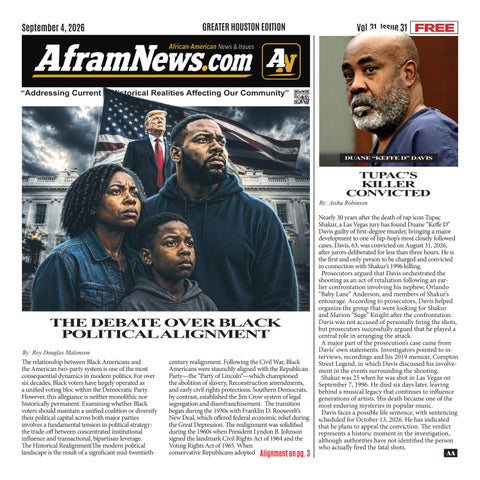
The relationship between Black Americans and the American two-party system is one of the most consequential dynamics in modern politics. For over six decades, Black voters have largely operated as a unified voting bloc within the Democratic Party. However, this allegiance is neither monolithic nor historically permanent. Examining whether Black voters should maintain a unified coalition or diversify their political capital across both major parties involves a fundamental tension in political strategy: the trade-off between concentrated institutional influence and transactional, bipartisan leverage. The Historical RealignmentThe modern political landscape is the result of a significant mid-twentieth-
century realignment. Following the Civil War, Black Americans were staunchly aligned with the Republican Party—the “Party of Lincoln”—which championed the abolition of slavery, Reconstruction amendments, and early civil rights protections. Southern Democrats, by contrast, established the Jim Crow system of legal segregation and disenfranchisement. The transition began during the 1930s with Franklin D. Roosevelt’s New Deal, which offered federal economic relief during the Great Depression. The realignment was solidified during the 1960s when President Lyndon B. Johnson signed the landmark Civil Rights Act of 1964 and the Voting Rights Act of 1965. When conservative Republicans adopted Alignment on pg. 3
Nearly 30 years after the death of rap icon Tupac Shakur, a Las Vegas jury has found Duane “Keffe D” Davis guilty of first-degree murder, bringing a major development to one of hip-hop’s most closely followed cases. Davis, 63, was convicted on August 31, 2026, after jurors deliberated for less than three hours. He is the first and only person to be charged and convicted in connection with Shakur’s 1996 killing. Prosecutors argued that Davis orchestrated the shooting as an act of retaliation following an earlier confrontation involving his nephew, Orlando “Baby Lane” Anderson, and members of Shakur’s entourage. According to prosecutors, Davis helped organize the group that went looking for Shakur and Marion “Suge” Knight after the confrontation. Davis was not accused of personally firing the shots, but prosecutors successfully argued that he played a central role in arranging the attack. A major part of the prosecution’s case came from Davis’ own statements. Investigators pointed to interviews, recordings and his 2019 memoir, Compton Street Legend, in which Davis discussed his involvement in the events surrounding the shooting. Shakur was 25 when he was shot in Las Vegas on September 7, 1996. He died six days later, leaving behind a musical legacy that continues to influence generations of artists. His death became one of the most enduring mysteries in popular music. Davis faces a possible life sentence, with sentencing scheduled for October 13, 2026. He has indicated that he plans to appeal the conviction. The verdict represents a historic moment in the investigation, although authorities have not identified the person who actually fired the fatal shots. AA