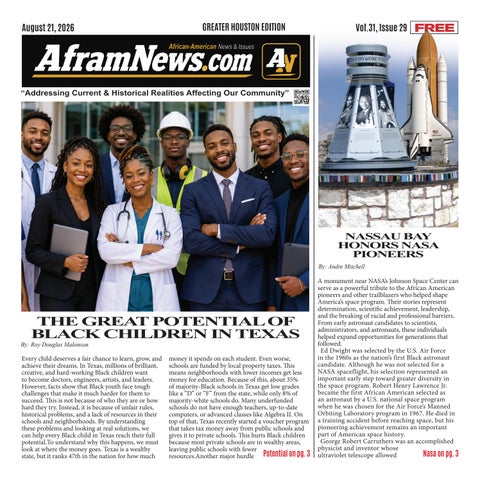
August 21, 2026
GREATER HOUSTON EDITION
Vol.31, Issue 29
FREE
“Addressing Current & Historical Realities Affecting Our Community”
NASSAU BAY HONORS NASA PIONEERS By: Andre Mitchell
THE GREAT POTENTIAL OF BLACK CHILDREN IN TEXAS
By: Roy Douglas Malonson
Every child deserves a fair chance to learn, grow, and achieve their dreams. In Texas, millions of brilliant, creative, and hard-working Black children want to become doctors, engineers, artists, and leaders. However, facts show that Black youth face tough challenges that make it much harder for them to succeed. This is not because of who they are or how hard they try. Instead, it is because of unfair rules, historical problems, and a lack of resources in their schools and neighborhoods. By understanding these problems and looking at real solutions, we can help every Black child in Texas reach their full potential.To understand why this happens, we must look at where the money goes. Texas is a wealthy state, but it ranks 47th in the nation for how much
money it spends on each student. Even worse, schools are funded by local property taxes. This means neighborhoods with lower incomes get less money for education. Because of this, about 35% of majority-Black schools in Texas get low grades like a “D” or “F” from the state, while only 8% of majority-white schools do. Many underfunded schools do not have enough teachers, up-to-date computers, or advanced classes like Algebra II. On top of that, Texas recently started a voucher program that takes tax money away from public schools and gives it to private schools. This hurts Black children because most private schools are in wealthy areas, leaving public schools with fewer resources.Another major hurdle Potential on pg. 3
A monument near NASA’s Johnson Space Center can serve as a powerful tribute to the African American pioneers and other trailblazers who helped shape America’s space program. Their stories represent determination, scientific achievement, leadership, and the breaking of racial and professional barriers. From early astronaut candidates to scientists, administrators, and astronauts, these individuals helped expand opportunities for generations that followed. Ed Dwight was selected by the U.S. Air Force in the 1960s as the nation’s first Black astronaut candidate. Although he was not selected for a NASA spaceflight, his selection represented an important early step toward greater diversity in the space program. Robert Henry Lawrence Jr. became the first African American selected as an astronaut by a U.S. national space program when he was chosen for the Air Force’s Manned Orbiting Laboratory program in 1967. He died in a training accident before reaching space, but his pioneering achievement remains an important part of American space history. George Robert Carruthers was an accomplished physicist and inventor whose Nasa on pg. 3 ultraviolet telescope allowed
2
August 21, 2026
AFRAMNEWS.COM
EDITORIAL
President/Chief Editor
Contributing Writers Dr. Bobby Mills, Travis McGee, Rachel Thompson, Fred Smith, Nicole Washington, Aisha Robinson, Marcus Williams Meeko Graphics Social Media Houston Minority business marketing website JG Design Layout Design Blue Star Web Printing Printer
STORIES, PICTURES, LETTERS TO THE EDITOR, EMAIL TO
aframnews1982@gmail.com
713-682-1892
PO BOX 206 Prairie View, TX 77446
We are looking for historical writers That can produce stories that address current and historical realities affecting our community. PLEASE SEND YOUR INQUIRIES TO
AFRAMNEWS1982@GMAIL.COM
GREATER HOUSTON EDITION
A Revival of God Consciousness Bobby Mills, Ph.D.
FREE ENTERPRISE CAPITALISM/ CORPORATE CAPITALISM America must recognize the important distinction between free enterprise capitalism and vulgar capitalism. Free enterprise is grounded in private property, competition among private businesses, profit, and the forces of supply and demand rather than government control. Vulgar capitalism, by contrast, enables corporations to exploit working-class labor and gouge the middle class through inflated prices. This distinction also helps explain the fierce resistance to President Lincoln’s proposal of forty acres and a mule as reparations for formerly enslaved Black Americans. Economic freedom for Black Americans through land ownership and access to productive resources was rejected, and Black Codes, Jim Crow laws, and “Whites Only” signs soon followed. Rather than calling on White Americans to labor independently “by the sweat of their brow” (Genesis 3:19), the nation embraced a system built on the exploitation of Black labor. In the end, selfsacrifice remains essential to a successful life. It is shameful that some White Americans wrongly believe Black Americans want something for nothing, when institutional racism itself reflects the desire to gain
something without justly earning it. Human history is full of tragedies rooted in humanity’s fallen nature, and slavery and institutional racism in America rank among the worst examples. The Trump Administration is not conservative but racist. In fact, most Blacks are overwhelming conservative. Nothing is sacred or safe under Trumpism, which is why Trumpism seeks to rewrite the racist tragedy of the American story. Under the Trump GOP Administration, racism drives public policy, aided by a “Not So” Supreme Court that has granted President Trump broad immunity from prosecution for official actions. Without question, America is facing a crisis of competent governance and a deadly virus called malnutrition of the brain. Seeking to alter American history as a means of remaining in power is bad politics and poor political strategizing. Since his reelection on November 3, 2024, President Trump has practiced vulgar corporate capitalism to enrich his family. Someone should remind GOP politicians in both the House of Representatives and the Senate that moral character matters more than party loyalty. Sadly, Donald J. Trump is selling the U.S. presidency to the highest bidder, foreign or domestic. Vulgar, ungodly capitalism defines the Trump Administration, and racebased corporate capitalism— not free enterprise capitalism—drives its agenda. After all, a rising tide should Capitalism lift all boats. on pg. 7
We Must Understand Roy Douglas Malonson, Publisher
TEXAS EXPANDS PRISON CAPACITY WITH 5,600 NEW BEDS Texas is planning to add 5,600 new prison beds as state officials anticipate an increase in the overall inmate population. The expansion is intended to provide additional housing capacity and help the Texas Department of Criminal Justice manage future growth without overcrowding existing facilities. More than $300 million is expected to be invested in the construction of 14 new expansion dormitories at correctional facilities across the state. The projects will be located in communities including Lubbock, Bryan, Edinburg, Venus, Bonham, Richmond, Austin, Cleveland, El Paso, Dayton and Navasota. Many of the new dormitories are expected to include air conditioning
and other improvements. The planned expansion comes as Texas continues to operate one of the nation’s largest prison systems. Officials say adding capacity now will help the state prepare for projected increases in the inmate population and maintain adequate housing and staffing at correctional facilities. The decision also renews discussion about Texas’ approach to incarceration. While additional prison space may help address future capacity needs, the investment raises questions about the long-term costs of maintaining more beds and facilities. Overall, the 5,600bed expansion represents a significant investment in Texas’ correctional system. State officials are positioning the projects as a way to prepare for future population increases while ensuring that prisons have sufficient space to house inmates safely and effectively. AA
GREATER HOUSTON EDITION Potential inside the school building is unfair punishment. Cont. Studies show that Texas
school districts are two and a half times more likely to suspend Black students in early grades, like Pre-K through second grade, than white students for the exact same behaviors. When kids are constantly kicked out of class, they miss important lessons and start to feel rejected by their school. This problem is called the “school-to-prison pipeline.” When children are pushed out of classrooms, they are much more likely to fall behind, drop out of high school, or get into trouble with the law later in life. Additionally, many schools in low-income neighborhoods do not have enough counselors to help kids deal with stress, but they do have school police officers who treat normal mistakes like crimes. Outside of school, life can also be very stressful for many Black families in Texas. About 29% of Black children in Texas live in poverty, which means their families struggle to pay for basic necessities. It is very hard for a student to focus on a math test if they did not eat breakfast, or if their family is worried about losing their apartment. Texas also has a very high number of people without health insurance. When a child cannot see a doctor or get glasses when they need them, their grades suffer. Furthermore, the child welfare system treats Black families differently. Black children make up only 11% of the Texas population, but they make up 21% of the kids taken away by Child Protective Services. This creates deep sadness and instability.Even though
August 21, 2026 these problems are big, there are clear solutions that can fix them. First, Texas needs to change how it funds education. Instead of taking money away for private school vouchers, the state should use its billions of dollars in extra cash to fund public schools equally. Schools should also stop punishing kids by sending them away. Instead, they should use “restorative justice,” which teaches students how to fix their mistakes and stay in class. Schools also need more Black teachers. Research shows that when Black students have teachers who look like them, they do better in school and feel more confident about their futures.Right now, there are also great groups helping Black children succeed. Organizations like the 100 Black Men and the African American Youth Harvest Foundation offer free tutoring, fun summer camps, and mentors who help kids plan for college. At home, families can help by teaching children to be proud of their history and who they are. When kids know they are strong and intelligent, they can face tough challenges without giving up.In conclusion, Black children in Texas have all the talent in the world, but the system around them needs to be fixed. By giving schools equal money, stopping unfair punishments, and supporting families with healthcare and food, Texas can become a place where every child can thrive. It takes everyone working together to make sure that a child’s future is determined by their big dreams, not by the hurdles in their way. AA
Nasa Cont. scientists to study
objects in space that could not be observed using ordinary visible-light telescopes. Ruth Bates Harris became an important NASA administrator and advocate for greater diversity and fairness within the agency. Her work demonstrated that African American contributions to NASA extended beyond astronauts and included leadership, management, and policy. NASA’s Astronaut Group 8, selected in 1978, marked a historic turning point because it was NASA’s first astronaut class to include African Americans and women. Among the African American astronauts who followed was Dr. Bernard Harris Jr., who became the first African American to conduct a spacewalk in 1995. Charles Bolden Jr. became a four-time space shuttle astronaut and later served as NASA administrator. Sunita Williams, although not African American, also represents NASA’s continuing history of diversity. A member of the 1998 astronaut class, she became a veteran of multiple space missions and spacewalks. Together, these trailblazers reflect the many backgrounds and talents that have contributed to America’s journey beyond Earth. The history of NASA is also a history of African American achievement, perseverance, and determination. From scientists and engineers to astronauts and administrators, African Americans have played important roles in advancing America’s space program. Their accomplishments helped break racial barriers while contributing to some of the nation’s most significant achievements in space exploration. One of the earliest pioneers was Ed Dwight, who was selected by the U.S. Air Force in 1961 as the nation’s first Black astronaut candidate. Although he was never selected for a NASA spaceflight, his achievement opened an important chapter in the effort to diversify America’s astronaut corps. Robert Henry Lawrence Jr. followed in 1967
AFRAMNEWS.COM
3
when he became the first African American selected as an astronaut by a U.S. national space program. Lawrence was selected for the Air Force’s Manned Orbiting Laboratory program but died in a training accident before he could fly into space. African American contributions also extended beyond astronauts. George Robert Carruthers, a physicist and inventor, developed an ultraviolet telescope that helped scientists study the universe in ways that were not possible with ordinary telescopes. His work demonstrated the importance of Black scientists in advancing space research. Ruth Bates Harris, a NASA administrator and advocate for equal opportunity, also played an important role in addressing diversity and workplace issues within the agency. A major breakthrough came in 1978 with NASA Astronaut Group 8, the first astronaut class to include African Americans and women. This historic group helped transform NASA’s astronaut corps and demonstrated that space exploration could become an opportunity for people from a wider range of backgrounds. Among the astronauts who followed was Dr. Bernard Harris Jr., who became the first African American to conduct a spacewalk in 1995. Charles Bolden Jr. became a four-time space shuttle astronaut and later served as NASA administrator. His leadership represented another historic milestone for African Americans at NASA. These pioneers helped create a legacy that continues today. Their stories show that NASA’s achievements were built not only by rockets and technology, but also by people who challenged barriers and expanded the possibilities of what future generations could accomplish. African American trailblazers remain an important part of NASA’s history and America’s continuing journey toward the stars. AA
4
August 21, 2026
AFRAMNEWS.COM
GREATER HOUSTON EDITION
THROUGH THE LENS OF TIME: BLACK HISTORY IS 24/7/365 1863
1865
1885
1896
1916
1918
1920
1863 . Lincoln’s Emancipation Proclamation goes into effect, changing the legal status of 3 million slaves in designated areas of the Confederacy from “slave” to “free.”
1865. On June 19, Union soldiers arrive in Galveston, Texas to spread the news of the Civil War end and subsequent freedom of slavery.
1885. A majority of Southern states pass individual state laws requiring separate schools for black and white students.
1896. Plessy v. Ferguson legitimizes state laws reestablishing racial segregation in Southern states.
1916. The Great Migration begins, where more than six million African Americans move from the rural South to various urban metropolitan areas.
1918. The Dyer Antilynching Bill is first introduced, intending to establish lynching as a federal crime.
1920. The Harlem Renaissance marks the first time that mainstream publishers and critics turned their attention seriously to African American literature, music, art, and politics.
TEXAS
TAKEAWAY
HOUSTON
DALLAS
Houston renters will soon have stronger protections requiring landlords to provide and maintain working air conditioning under new city rules. The changes aim to address the extreme heat Houston experiences during the summer, giving tenants a clearer right to a functioning cooling system and additional protections when landlords fail to make necessary repairs. The rules are expected to provide renters with greater recourse when air conditioning problems leave homes dangerously hot.
Fletcher’s Original Corny Dogs recently earned top honors at the Big Tex Choice Awards, adding another accolade to its long history at the State Fair of Texas. The iconic fair-food brand won recognition for its $7 chocolate corny dog, showcasing Fletcher’s creative approach to the classic Texas State Fair staple. The award highlights the continued popularity of Fletcher’s while celebrating the fair’s tradition of inventive and over-the-top food creations.
________________________________
________________________________
SAN ANTONIO
AUSTIN
Bexar County officials say a tax increase is not currently being considered, even as county staff warns that major budget challenges could emerge in the years ahead. Rising costs and growing demands for county services could put additional pressure on future budgets, prompting officials to closely monitor spending.
More than 126,000 home permits have expired in Austin, raising questions for homeowners who may have unfinished or unresolved projects. City officials are encouraging residents to check their permit status and determine whether any expired permits could affect renovations, property sales, or future construction.
BOBBY SEALE An African American political activist and author who co-founded the revolutionary Black Panther Party (BPP) alongside Huey P. Newton in 1966. Serving as the party’s Chairman, Seale became one of the most prominent figures of the Black Power movement, advocating for armed self-defense against police brutality and organizing extensive community survival programs.
READ MORE AT AFRAMNEWS.COM
GREATER HOUSTON EDITION
August 21, 2026
AFRAMNEWS.COM
HISTORY
EDUCATION
MARCH ON WASHINGTON
By: Aisha Robinson
The March on Washington for Jobs and Freedom, held on August 28, 1963, was one of the most important events of the American Civil Rights Movement. More than 200,000 people gathered in Washington, D.C., to demand racial equality, economic opportunity, and an end to segregation and discrimination. The peaceful demonstration brought together civil rights leaders, religious groups, labor organizations, students, and ordinary citizens from across the country. The march was organized by several major civil rights leaders, including A. Philip Randolph, Bayard Rustin, Martin Luther King Jr., John Lewis, Whitney Young, James Farmer, and Roy Wilkins. Their goal was to pressure the federal government to take stronger action to protect the rights of Black Americans. Participants called for better employment opportunities, fair wages, voting rights, integrated schools, and equal treatment under the law. The event became especially famous because of Martin Luther King Jr.’s “I Have a Dream” speech, delivered from the steps of the Lincoln Memorial. His message called for a future in which people would be judged by their character rather than the color of their skin. The speech captured the hopes of millions and became one of the defining moments of the civil rights era. The March on Washington helped build national support for civil rights legislation. Less than a year later, Congress passed the Civil Rights Act of 1964, which outlawed segregation in many public places and prohibited discrimination based on race, color, religion, sex, or national origin. The Voting Rights Act of 1965 followed, strengthening federal protections for voting rights. The legacy of the March on Washington continues today. It demonstrated the power of peaceful protest and collective action and showed how ordinary
5
people could come together to demand meaningful change. The march remains a symbol of courage, hope, equality, and the continuing struggle for justice. The history of the March on Washington grew out of decades of organizing against racial discrimination, segregation, and economic inequality. One of its most important roots was the work of A. Philip Randolph, a labor leader who had called for a major demonstration in Washington as early as 1941. Randolph wanted to pressure President Franklin D. Roosevelt to address discrimination against Black workers in the defense industry. Although that planned march was canceled after Roosevelt issued an executive order banning discrimination in defense employment, the idea of mass action in Washington remained influential. By the early 1960s, the civil rights movement had gained national attention through events such as the Montgomery Bus Boycott, student sit-ins, Freedom Rides, and voter-registration campaigns. Civil rights organizations increasingly demanded stronger federal action. In 1963, Randolph and Bayard Rustin helped organize the March on Washington for Jobs and Freedom, bringing together major civil rights, labor, religious, and community organizations. On August 28, 1963, hundreds of thousands of people traveled to Washington, D.C. Participants gathered near the Lincoln Memorial and peacefully called for jobs, freedom, voting rights, fair wages, and an end to segregation. The march demonstrated the enormous national support for civil rights and placed pressure on Congress and President John F. Kennedy to act. AA
HALL OF FAME ADMINISTRATOR ASHLEY ROBINSON AS ATHLETIC DIRECTOR By: TSU
Texas Southern University announced Wednesday the hiring of two-time National Athletics Director of the Year Ashley Robinson as the new Vice President and Athletic Director. Robinson is one of the most accomplished and decorated athletics administrators in the country. He comes to Texas Southern after six transformative years at Jackson State University, where his leadership guided the University into a national HBCU powerhouse both on the field and in the classroom. “When we began this search, my goal was simple: to identify an exceptional leader who has the leadership and acumen to take the University athletics to the next level of sustained excellence,” said President J.W. Crawford III. “I am confident Mr. Ashley Robinson has the capability to do so. I look forward to working with him to not only elevate our program on the national stage, but to also achieve measurable outcomes for our studentathletes and memorable experiences for our fans.” Robinson is a two-time National Athletics Director of the Year, earning the honor from the Black Student-Athlete Summit in 2023 and from the National Association of Collegiate Directors of Athletics (NACDA), sponsored by Cushman & Wakefield, in 2022. During his time at Jackson State, the athletics department captured 19 championships and won the C.D. Henry Award for the SWAC’s best all-around men’s sports program in 2022-23. Robinson’s tenure was marked by national exposure for the program, including a 60 Minutes feature, a live Good Morning America broadcast from campus, and a landmark appearance of ESPN’s College GameDay from Jackson State’s home stadium — only the fourth time the show has originated from an HBCU football game. Under Robinson’s leadership, Jackson State student-athletes posted a 3.101 GPA in the fall of 2022, and the department graduated nearly 70 studentathletes that year. Robinson previously led JSU to the SWAC’s Academic Success Award in 2019-20. Robinson’s path to Texas Southern includes a successful run as Director of Athletics at Prairie View A&M University (2013-2019), where he was later promoted to Vice President and Director of Read more at Athletics. aframnews.com
6
August 21, 2026
AFRAMNEWS.COM
CARRIAGE RIDE
CHEMICAL
PUBLIC NOTICE
GREATER HOUSTON EDITION GIFT SHOP
NOTICE TO PROPOSERS When Bugs are Near Have no Fear Call Premier
281.802.8654 www.prempest.com
$89.99
Dwain Stewart
SPECIAL FOR PEST CONTROL
CHURCH
VINTAGE CARRIAGE COMPANY, LLC
TERENCE J. REED, OWNER
FACEBOOK: GO VINTAGE, LLC INSTAGRAM: GOVINTAGELLC
713.489.8905 281.901.4966
Request for Proposal will be received by Lone Star College for: RFP #26-08-08 – Internet Services System-Wide. Electronic submittals due by 12:00PM, Monday, September 14, 2026. Contact: clave@lonestar.edu or (832)813-6723. Must Register to Bid: https:// lonestar.ionwave.net/Login. aspx. If registered, please ensure your registration is up to date. For assistance with the on-line registration process, contact MC-vendors@lonestar.edu.
SHOE REPAIR
CLOSEOUT SALE
20-50% OFF EVERY SATURDAY 11-4PM
Rev. Curley Randle, Sr. Pastor
Rev. Dr. Edwin A. Davis, Pastor
Sunday School 8:15am Sunday Services 9:00am
BAPTIST CHURCH “We are a church on the move.” -Isaiah 40:30
Rev. Dayle Perry, Pastor
INCOME TAX • Unfiled Tax Returns • Liens • Levies (Wage, Bank, Other) • Audits • Appeals • Offer in Compromise • Employment Taxes • Installment Agreements • Payment Plans • Other IRS Problems
• 401 (k) • 403 (b) • Pension • Profit Sharing • Deferred Comp. • IRA • ESOP • DROP • Teacher Retirement System (TRS) • Other Employer Retirement Plans
Everything must go
GREATER HOUSTON EDITION
August 21, 2026
AFRAMNEWS.COM
7
EDUCATION
THE LEGACY OF KLEIN ISD’S LAST ALL-BLACK SCHOOL By: Nicole Washington The Kohrville Schoolhouse holds an important place in the history of Klein Independent School District and the Black community in northwest Harris County. Once the last all-Black school in Klein ISD, the small school represents both the hardships created by segregation and the determination of Black families to provide their children with an education. Today, the preserved schoolhouse helps tell the story of a community whose history remains an important part of Klein’s past. The Kohrville community developed shortly after the Civil War when formerly enslaved people from Alabama and Mississippi settled in the area. Families established homes, churches, farms, and eventually a school. Education became a
priority because families understood that learning could provide their children with greater opportunities. The school served Black students from first through eighth grade, with one teacher often responsible for teaching several grade levels. Life at the school was very different from education today. Students used wooden desks, studied practical mathematics and reading, and followed strict classroom rules. The school year was also shorter because many children were expected to help their families with farming. Despite limited resources and segregation, the school served as an important center of the Kohrville community. Segregation continued in Klein ISD until 1966, when the district began
desegregating its schools. By 1967, Black students could be seen attending previously segregated campuses. The change marked an important turning point, ending an era in which Black children had been separated from white students because of race. The Kohrville Schoolhouse is now part of the Klein Historical Foundation and Wunderlich Farm Museum. Preserved as a historic site, it allows students and visitors to learn about education, segregation, and the strength of the families who built the Kohrville community. Its story reminds us that Black history is also local history—and that the pursuit of education helped shape the Klein community we know today. AA
AFRICAN AMERICAN MUSEUM SET TO BECOME ONE OF THE NATION’S LARGEST
By: Marcus Williams
San Antonio is preparing to make a major contribution to the preservation of African American history with the expansion of the San Antonio African American Community Archive and Museum, known as SAAACAM. The organization plans to transform the historic Kress-Grant buildings downtown into a 103,000-square-foot cultural center. Once completed, the project is expected to become the largest African American history museum in Texas and the third largest in the country. The new center will provide substantially more space than
SAAACAM’s current location. Plans include approximately 30,000 square feet of immersive exhibition space, classrooms, a research library, a 400-seat auditorium, event areas and a 12-room boutique hotel. The center is also expected to welcome more than 100,000 visitors each year. The location carries special historical significance. The Kress building was once associated with segregation, including a lunch counter that became part of San Antonio’s peaceful desegregation movement in 1960. Transforming the site into a museum
celebrating African American history gives the building a new purpose while connecting visitors to an important chapter in the city’s civil rights history. SAAACAM’s expansion represents more than the construction of a larger museum. It is an effort to preserve stories, achievements and experiences that have shaped San Antonio, Texas and the nation. The center is designed to educate future generations while creating a lasting cultural destination for residents and visitors alike.
Capitalism Cont. The Grand Old Party is not grand when it fails to support
AA
equal rights, equal opportunity, and multicultural inclusion. Likewise, the Democratic Party can sometimes move too far from the center in its public policy initiatives. We know that God is found at the center of life, not in extremes, and God is not fooled: individuals reap what they sow. Those who sow corruption will reap corruption, which is why greed is such a dangerous mindset. Those who sow to the wind will reap the whirlwind. That is what goes around; comes around. America’s socioeconomic system is not purely capitalist because it includes social safety nets, such as welfare subsidies, for disadvantaged citizens. No society on earth is purely socialist or purely capitalist; every society has a mixed socioeconomic system. Anyone seeking a pure or perfect system should make heaven their destination, because no pure or perfect AA socioeconomic system exists on earth.
8
AFRAMNEWS.COM
August 21, 2026
GREATER HOUSTON EDITION
SCORE TIME BACK Get delivery in as little as an hour.*
*Subject to availability. Restrictions and fees apply. Delivery time not guaranteed. See app or heb.com.
©2026 HEB, 26-485644