August 7, 2026
GREATER HOUSTON EDITION
AframNews.com
Vol.31, Issue 27
FREE
African-American News&Issues
“Addressing Current & Historical Realities Affecting Our Community”
THE RECLAMATION OF EVERGREEN CEMETERY By: Andre Mitchell
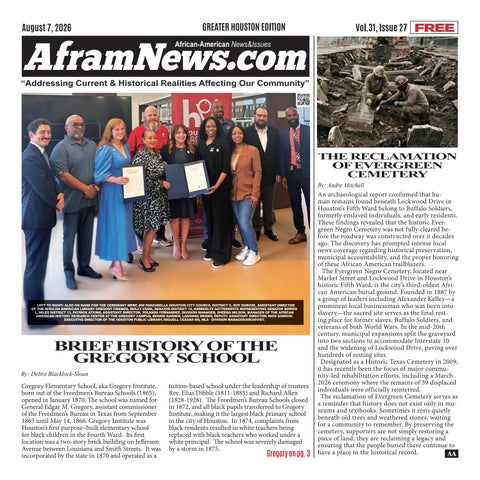
LEFT TO RIGHT: ALSO ON HAND FOR THE CEREMONY WERE JOE PANZARELLA HOUSTON CITY COUNCIL DISTRICT C, ROY DUBOSE, ASSISTANT DIRECTOR OF THE AFRICAN AMERICAN LIBRARY GREGORY FRIENDS, MOLLY COOK, SENATOR DISTRICT 15, KIMBERLYE SATTERWHITE REPRESENTING SENATOR BORRIS L. MILES DISTRICT 13, PATRICK ATKINS, ASSISTANT DIRECTOR, YOLANDA FERNANDEZ, DIVISION MANAGER, SHEENA WILSON, MANAGER OF THE AFRICAN AMERICAN HISTORY RESEARCH CENTER AT THE GREGORY CAMPUS, BENNIE BARNES, LADONNA WEEMS, DEPUTY ASSISTANT DIRECTOR, NICK SAWICKI EXECUTIVE DIRECTOR OF THE HOUSTON PUBLIC LIBRARY, MIGUELL CEASAR MS, MLS - DIVISION MANAGER/ARCHIVIST.
BRIEF HISTORY OF THE GREGORY SCHOOL By: Debra Blacklock-Sloan
Gregory Elementary School, aka Gregory Institute, born out of the Freedmen’s Bureau Schools (1865), opened in January 1870. The school was named for General Edgar M. Gregory, assistant commissioner of the Freedmen’s Bureau in Texas from September 1865 until May 14, 1866. Gregory Institute was Houston’s first purpose–built elementary school for black children in the Fourth Ward. Its first location was a two-story brick building on Jefferson Avenue between Louisiana and Smith Streets. It was incorporated by the state in 1870 and operated as a
tuition-based school under the leadership of trustees Rev. Elias Dibble (1811-1885) and Richard Allen (1828-1928). The Freedmen’s Bureau Schools closed in 1872, and all black pupils transferred to Gregory Institute, making it the largest black primary school in the city of Houston. In 1874, complaints from black residents resulted in white teachers being replaced with black teachers who worked under a white principal. The school was severely damaged by a storm in 1875.
Gregory on pg. 3
An archaeological report confirmed that human remains found beneath Lockwood Drive in Houston’s Fifth Ward belong to Buffalo Soldiers, formerly enslaved individuals, and early residents. These findings revealed that the historic Evergreen Negro Cemetery was not fully cleared before the roadway was constructed over it decades ago. The discovery has prompted intense local news coverage regarding historical preservation, municipal accountability, and the proper honoring of these African American trailblazers. The Evergreen Negro Cemetery, located near Market Street and Lockwood Drive in Houston’s historic Fifth Ward, is the city’s third-oldest African American burial ground. Founded in 1887 by a group of leaders including Alexander Kelley—a prominent local businessman who was born into slavery—the sacred site serves as the final resting place for former slaves, Buffalo Soldiers, and veterans of both World Wars. In the mid-20th century, municipal expansions split the graveyard into two sections to accommodate Interstate 10 and the widening of Lockwood Drive, paving over hundreds of resting sites. Designated as a Historic Texas Cemetery in 2009, it has recently been the focus of major community-led rehabilitation efforts, including a March 2026 ceremony where the remains of 39 displaced individuals were officially reinterred. The reclamation of Evergreen Cemetery serves as a reminder that history does not exist only in museums and textbooks. Sometimes it rests quietly beneath old trees and weathered stones, waiting for a community to remember. By preserving the cemetery, supporters are not simply restoring a piece of land; they are reclaiming a legacy and ensuring that the people buried there continue to have a place in the historical record. AA
2
August 7, 2026
AFRAMNEWS.COM
EDITORIAL
President/Chief Editor
Contributing Writers Dr. Bobby Mills, Travis McGee, Rachel Thompson, Fred Smith, Nicole Washington, Aisha Robinson, Marcus Williams Meeko Graphics Social Media Houston Minority business marketing website JG Design Layout Design Blue Star Web Printing Printer
A Revival of God Consciousness Bobby Mills, Ph.D.
LAW AND DISORDER
STORIES, PICTURES, LETTERS TO THE EDITOR, EMAIL TO
aframnews1982@gmail.com
713-682-1892
PO BOX 206 Prairie View, TX 77446
We are looking for historical writers That can produce stories that address current and historical realities affecting our community. PLEASE SEND YOUR INQUIRIES TO
AFRAMNEWS1982@GMAIL.COM
GREATER HOUSTON EDITION
The Bible teaches that those who follow God’s law are blessed: “The law of the Spirit of life in Christ Jesus hath made me free from the law of sin and death. For what the law could not do, in that it was weak through the flesh, God sent His own Son in the likeness of sinful flesh, and for sin, condemned sin in the flesh: that the righteousness of the law might be fulfilled in us, who walk not after the flesh, but after the Spirit” (Romans 8:2–4). President Trump and his MAGA followers should remember that those who break the law do not find true happiness. Material possessions cannot provide lasting peace, because genuine joy comes from spiritual fulfillment, not outward things. People ruled by a carnal, sinful mind are never fully satisfied. Can President Trump and his cabinet truly be content when more than sixty percent of Americans oppose their policy actions? The more they gain, the more they want. A destructive spirit is shaping America and the world, and lawbreakers are driven by a devilish, hellish, and carnal mindset. This helps explain why the Trump administration is creating turmoil in America and throughout the global community. The war with Iran is one clear example. As Proverbs 27:20 states, “Hell and destruction are never full; so the eyes of man are never satisfied.” America, peace of mind comes from inner spiritual fulfillment, not material possessions. The
more people acquire, the more they desire. This is why America is facing a profound spiritual crisis in presidential leadership. When someone serves as President, people expect that person to fix problems, not create more of them. Yet, those who are spiritually broken cannot repair what is materially broken until they themselves are healed. This is why King David, a man after God’s own heart, prayed after his sins: “Create in me a clean heart, O God; and renew a right spirit within me” (Psalm 51:10). Will someone please tell President Trump and his MAGA– White Privilege cult that confession is good for the soul? Human beings are born into sin and shaped by iniquity. Sin is lawlessness. As a result, our natural tendency is toward selfishness and self-centeredness— seeking to please ourselves rather than God. King David, a man after God’s own heart, followed this sinful impulse when he desired Bathsheba, another man’s wife, and arranged for her husband to be killed to conceal his sin. Only the Truth (Holy Spirit) can free us from sin. This is why the Bible emphatically admonishes us that: “Whosoever committeth sin transgresseth also the law: for sin is the transgression of the law.” (1 John 3: 4). In fact, there are at least 100 Bible verses concerning law-breaking. Hence, individuals who make a habit of sinning also practice lawlessness. Of course, sin is an internal mindset. Therefore, will someone please inform President Trump, and his MAGA-GOP Cult that the entire human race is on death row, because of sin and repeatedly breaking the laws of the Divine Lawgiver. Sadly, the Trump Administration is a pro at law breaking and creating societal disorder. AA
Culture Commission Coalition By Robert Slater,
Community Activist, Chairman of The Culture Commission Coalition
WHEN YOUR KID IS THE ONLY BLACK KID IN THE ROOM On July 4, eighteen year old Nolan Wells boarded a boat with friends to celebrate Independence Day on Horn Island, a remote barrier island off the Mississippi Gulf Coast. Photos from that afternoon show a tall, smiling young man with his arm around his friends. He was, by all accounts, well loved. He was also, in that photograph, the only Black face in the group. By nightfall, Nolan was gone. His mother, Christine Wells Wonsley, reported him missing near midnight. His body was recovered days later, face down in the water near the island’s shoreline. What should have been a routine holiday outing has become a national story, not simply because a young man died, but because of how many versions of that day do not line up. Consider the contradictions already surfacing. Attorney Ben Crump, representing the Wells family, has pointed out that a young woman No-
lan spoke with that afternoon says he told her he planned to rejoin his friends on the boat. Those same friends say Nolan told them he intended to stay behind and talk with her. Two groups. Two stories. Both cannot be true. There is also the matter of Nolan’s cellphone, which his parents located before investigators did, a detail Crump has called unusual for a teenager who was never far from his device. The mother of one friend has said the boat experienced a mechanical issue with its bilge pump around the time the group left the island, and that Nolan chose to stay behind and find another ride home. Investigators, for their part, have said they are examining claims of an altercation on the island and have asked the public for unedited photos and video, particularly anything showing conflict or showing Nolan himself. The sheriff ’s department has said it does not currently suspect foul play, yet has not explained the basis for that conclusion. An autopsy has been performed, but toxicology results remain pending, and no official cause of death has been released. Into that vacuum of hard fact has poured grief, speculation, protest, and a reckoning with the weight of Mississippi’s own
Read more at aframnews.com
GREATER HOUSTON EDITION Gregory Gregory Institute Cont.
became part of the new Houston public school system in 1876, and Henry C. Hardy (1847-1909) was its first black principal. Charles Atherton (18631928) became principal in 1890. Pupils were transferred to Colored High School in 1893 because of the building’s deterioration due to years of overcrowding. In 1903, the campus relocated to a new wood-frame building at 1400 Wilson Street near Cleveland Street. W. E. Miller (1871-1947) was chosen as principal. The wood-frame building was destroyed by fire in 1925. Architects Gottlieb and Hedrick designed a two-story brick building valued at $114,523 in 1926. Construction was completed in 1927. W. L. Davis
(1876-1960) became principal, followed by W. S. Francis (18521937), E. A. Chester (1886-1950), Libbie Boutte (1883-1962), Lois Brantley (19072003), and Johnnie H. Brooks (living). HISD closed the school in 1980 and leased the building to the city. The building, which sat vacant for many years, was included in the Freedmen’s Town Historic District 1985 NRHP designation. The school also received a State Archeological Landmark designation in 1995. In 2000, HISD donated the building to the city, which later approved plans to renovate it as a
August 7, 2026 facility for the history and cultural heritage of African-American Houstonians. Smith and Company Architects designed the structure’s adaptive reuse and Prime Contractors built it. In 2009, the former elementary school opened its doors as the African American Library at the Gregory School, the first library branch devoted exclusively to black history and culture of African-American Houstonians. The Gregory School has a unique place in Houston and Texas history.
LEFT TO RIGHT: INGRID GRANT, COLLECTION DEVELOPMENT MANAGER FOR THE AFRICAN AMERICAN RESEARCH CENTER, DEBRA BLACKLOCK-SLOAN FREEDMEN’S TOWN MUSEUMS EDUCATION LIAISON AND MARTHA WHITING-GODDARD GREAT GRANDDAUGHTER OF REV. JOHN HENRY “JACK” YATES. FAR RIGHT: BYRON COBBIN BOARD CHAIRMAN OF THE FREEDMEN’S TOWN MUSEUMS A PART OF THE RUTHERFORD B.H. YATES MUSEUM
AA
AFRAMNEWS.COM
HOUSTON’S HEALTHCARE SAFETY NET
AA
AA
FOR 60 YEARS.
3
4
August 7, 2026
AFRAMNEWS.COM
GREATER HOUSTON EDITION
THROUGH THE LENS OF TIME: BLACK HISTORY IS 24/7/365 1807
1820
Thomas Jefferson signs the Act Prohibiting Importation of Slaves.
The Missouri Compromise is passed. It was a legislative package designed to address the issue of slavery in the new territories acquired from the Louisiana Purchase.
TEXAS
1835 The first recorded lynching of an African American occurs in St. Louis.
1845 Frederick Douglass publishes his first autobiography and bestknown work, Narrative of the Life of Frederick Douglass, an American Slave.
DALLAS
Rice University has expanded its signature financial aid program, known as The Rice Investment, to make a high-quality college education more affordable for students and families. The expansion increases financial support for eligible students by providing generous need-based aid and reducing the financial burden associated with attending the university. Rice’s approach is designed to help qualified students pursue their education regardless of their family’s financial circumstances while limiting reliance on student loans.
Dallas City Council members are divided over a proposed $960 million bond package aimed at strengthening public safety and supporting the city’s pension obligations. Supporters say the funding could help address long-term financial needs and maintain essential services, while opponents have raised concerns about the size of the debt and its potential impact on taxpayers. _______________________________
WACO Waco Square shopping center has been sold through an exclusive off-market transaction, marking a notable commercial real estate deal in the Waco area. The sale reflects continued interest in established retail properties as the region experiences ongoing population and economic growth.
1857
Uncle Tom’s Cabin is published, helping fuel the abolitionist movement.
In Dred Scott v. Sandford, the Supreme Court case finds that the U.S. Constitution does not protect or recognize free or enslaved African Americans as citizens.
1859 John Brown’s Raid on Harper’s Ferry. Brown and his 18 men seized the US Armory and Arsenal at Harpers Ferry on the night of October 16, 1859.
TAKEAWAY
HOUSTON
________________________________
1852
SAN ANTONIO TxDOT is preparing to enter the final phase of the Loop 1604 North Expansion Project in San Antonio as several other segments move closer to completion. The massive highway project is designed to improve traffic flow and enhance safety along one of the region’s busiest corridors. Once completed, the improvements are expected to provide drivers with a more efficient commute while supporting continued growth across the San Antonio area.
HENRY E. BAKER Henry Edwin Baker Jr. (1857–1928) was a pioneering African American patent examiner, lawyer, and historian who dedicated his life to documenting the contributions of Black inventors in the United States. He is often referred to as the “Father of Black Inventor Research” for creating the first comprehensive records of African American innovation during an era of intense racial prejudice.
READ MORE AT AFRAMNEWS.COM
GREATER HOUSTON EDITION
August 7, 2026
AFRAMNEWS.COM
5
HISTORY
THE REBELLION THAT SHOOK VIRGINIA By: Nicole Washington Nat Turner’s Revolt, also known as the Southampton Insurrection, was one of the most significant uprisings against slavery in American history. It took place in Southampton County, Virginia, in August 1831, at a time when slavery shaped much of the economy and social structure of the American South. Nat Turner was an enslaved Black preacher who became deeply opposed to the system that denied freedom and basic rights to millions of African Americans. His revolt became a powerful and controversial chapter in the long struggle against slavery.
Turner was born into slavery in Southampton County in 1800. From an early age, he became known for his intelligence and strong religious beliefs. He learned to read and developed a reputation among other enslaved people as a preacher and spiritual leader. Turner believed that his religious experiences were directing him toward a mission against slavery. Over time, he became convinced that he was called to challenge the system through an organized uprising. On August 21, 1831, Turner and a small group of followers T:4.75" began their revolt. As
the uprising spread through the countryside, additional enslaved men joined the group. Over roughly two days, the rebels moved through Southampton County, attacking slaveholding households and killing about 55 to 60 white people. Local militia forces eventually suppressed the revolt, and many participants were captured or killed. Turner escaped capture for more than two months by hiding in the surrounding area. Authorities finally discovered him in late October 1831. He was arrested, tried, convicted, and executed in November. In the aftermath of the revolt,
LEGAL NOTICE These Texas Lottery scratch ticket games will be closing soon: Game Name / Odds
$
Official Close of Game
End Validations Date
2723
Lucky 7s Tripler - Overall Odds are 1 in 4.26
$5
8/7/26
2/3/27
2637
$50, $100 OR $500! - Overall Odds are 1 in 9.43
$10
9/2/26
3/1/27
2609
$100, $200, $500 OR $1,000! - Overall Odds are 1 in 9.49
$20
9/2/26
3/1/27
2622
Lucky No. 7 - Overall Odds are 1 in 4.33
$2
9/16/26
3/15/27
2656
Crazy 8s - Overall Odds are 1 in 3.99
$2
9/16/26
3/15/27
2683
Emerald 7s - Overall Odds are 1 in 4.23
$5
9/16/26
3/15/27
2720
Chameleon Cash - Overall Odds are 1 in 4.18
$5
9/16/26
3/15/27
2705
Lucky Match - Overall Odds are 1 in 3.62
$10
9/16/26
3/15/27
2685
Diamond 7s - Overall Odds are 1 in 3.51
$20
9/16/26
3/15/27
2589
500X - Overall Odds are 1 in 3.36
$50
9/16/26
3/15/27
Texaslottery.com is the official source for all pertinent game information. Game closing procedures may be initiated for documented business reasons. These games may have prizes unclaimed, including top prizes. In addition, game closing procedures will be initiated when all top prizes have been claimed. During closing, games may be sold even after all top prizes have been claimed. Must be 18 or older to purchase a ticket. PLAY RESPONSIBLY. For help with a gambling problem, and access to care. ncpgambling.org. © 2026 Texas Department of Licensing and Regulation.
literacy, independent churches, and organized meetings could contribute to future resistance. Rather than addressing the brutality that helped produce resistance, many Southern governments responded by tightening the institution of slavery. Nat Turner’s Revolt remains historically
important because it demonstrated that enslaved people did not simply accept their oppression. Turner’s actions also sparked intense debates about slavery, resistance, freedom, and the lengths people might take to escape bondage. AA
IT’S
HURRICANE SEASON.
T:4"
Game #
white militias and armed groups retaliated against Black communities, and many Black people who had no involvement in the uprising were killed or punished. The revolt created widespread fear among Southern slaveholders and led Virginia and other Southern states to strengthen laws controlling enslaved and free Black people. Restrictions were placed on education, religious gatherings, movement, and assembly because lawmakers feared that
Don’t Wait for a Storm. Prepare Today.
A hurricane or Tropical Storm can impact more than homes. It can affect health, safety, and access to care.
Protect yourself and your family: • • • • • •
Know where you will go if you need medical help Stock up on a 7-day supply of medications and store in a waterproof container Charge phones and medical devices before severe weather Store safe drinking water Avoid driving through flooded roadways Keep emergency contacts easily available
For more Hurricane Preparedness information, visit these City of Houston Resources:
HOUSTONHEALTH.ORG HOUSTONOEM.ORG non-emergency Contact 311 (for assistance).
6
August 7, 2026
AFRAMNEWS.COM
CARRIAGE RIDE
CHEMICAL
GREATER HOUSTON EDITION GIFT SHOP
When Bugs are Near Have no Fear Call Premier
281.802.8654 www.prempest.com
$89.99
Dwain Stewart
SPECIAL FOR PEST CONTROL
CHURCH
VINTAGE CARRIAGE
CLOSEOUT SALE
COMPANY, LLC
TERENCE J. REED, OWNER
FACEBOOK: GO VINTAGE, LLC INSTAGRAM: GOVINTAGELLC
713.489.8905 281.901.4966 SHOE REPAIR
20-50% OFF EVERY SATURDAY 11-4PM
Rev. Curley Randle, Sr. Pastor
Rev. Dr. Edwin A. Davis, Pastor
Sunday School 8:15am Sunday Services 9:00am
BAPTIST CHURCH “We are a church on the move.” -Isaiah 40:30
Rev. Dayle Perry, Pastor
INCOME TAX • Unfiled Tax Returns • Liens • Levies (Wage, Bank, Other) • Audits • Appeals • Offer in Compromise • Employment Taxes • Installment Agreements • Payment Plans • Other IRS Problems
• 401 (k) • 403 (b) • Pension • Profit Sharing • Deferred Comp. • IRA • ESOP • DROP • Teacher Retirement System (TRS) • Other Employer Retirement Plans
Everything must go
GREATER HOUSTON EDITION
August 7, 2026
AFRAMNEWS.COM
EDUCATION
7
TEXAS ENTERS A NEW ERA WITH EDUCATION SAVINGS ACCOUNTS By: Andre Mitchell Texas is entering a new chapter in education with the launch of its first statewide Education Savings Account program, commonly described as a school voucher initiative. Approved by state lawmakers in 2025, the program provides eligible families with public funds that can be used toward approved educational expenses outside the traditional public school system. The change follows years of debate at
the Texas Capitol over school choice, parental control and the use of taxpayer dollars for private education. Education Savings Accounts, or ESAs, are designed to give participating families greater flexibility in deciding how some education funds are spent. Depending on program rules and eligibility, money may be used for expenses such as private-school tuition, educational
materials, tutoring and certain other approved services. Supporters argue that the program expands educational options, particularly for families who believe their neighborhood public school does not meet their child’s needs. The program has also generated significant opposition. Critics have raised concerns about directing public money toward private education while many Texas public schools face financial
pressures, teacher shortages and rising operating costs. Others have questioned how participating private schools will be held accountable and whether families in rural or lower-income communities will have the same access to private-school choices as families living in larger metropolitan areas. As Texas families begin navigating
the ESA system, the program’s long-term impact will be closely watched. Enrollment levels, access to participating schools, student outcomes and the financial effects on public school districts could shape future debates over the program. Texas’ move into state-funded
education savings accounts represents a major shift in education policy and could influence how families, educators and lawmakers think about the relationship between public funding and school choice for years to come. AA
DO THE
200+ Degree and Certificate Programs Flexible Options Affordable Tuition Built for Your Future
REGIS TER NOW FOR FALL 2026
LO N E S TA R . E D U / D O T H E T H I N G
02.20.26.02
TH NG
8
AFRAMNEWS.COM
August 7, 2026
GREATER HOUSTON EDITION
TEACHERS
SAVE 20off %
CLASSROOM SUPPLIES In-store and online 7/1 - 8/31. Visit heb.com/teachers for details.
©2026 HEB, 26-372610