AframNews.com

“Addressing Current & Historical Realities Affecting Our Community”

UNVEILING OF LYNCHING MARKERS
By: Roy Douglas Malonson
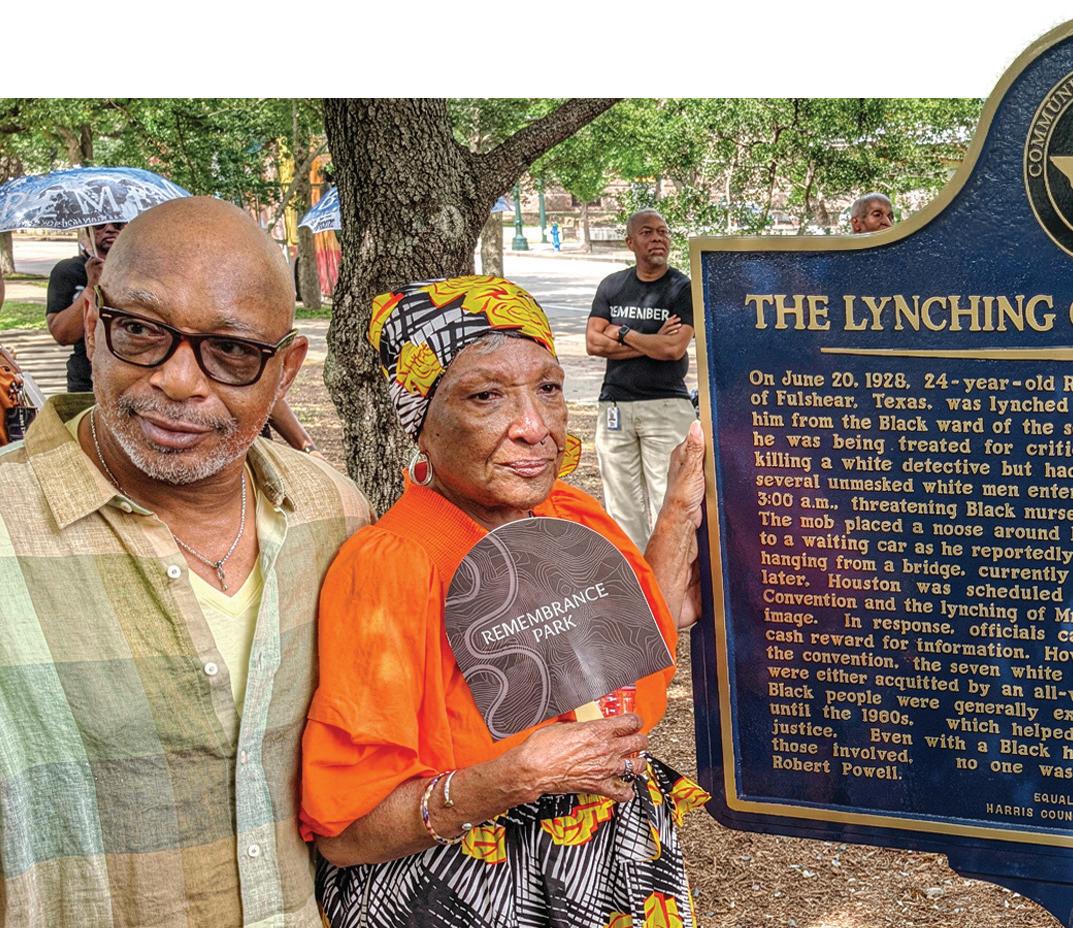
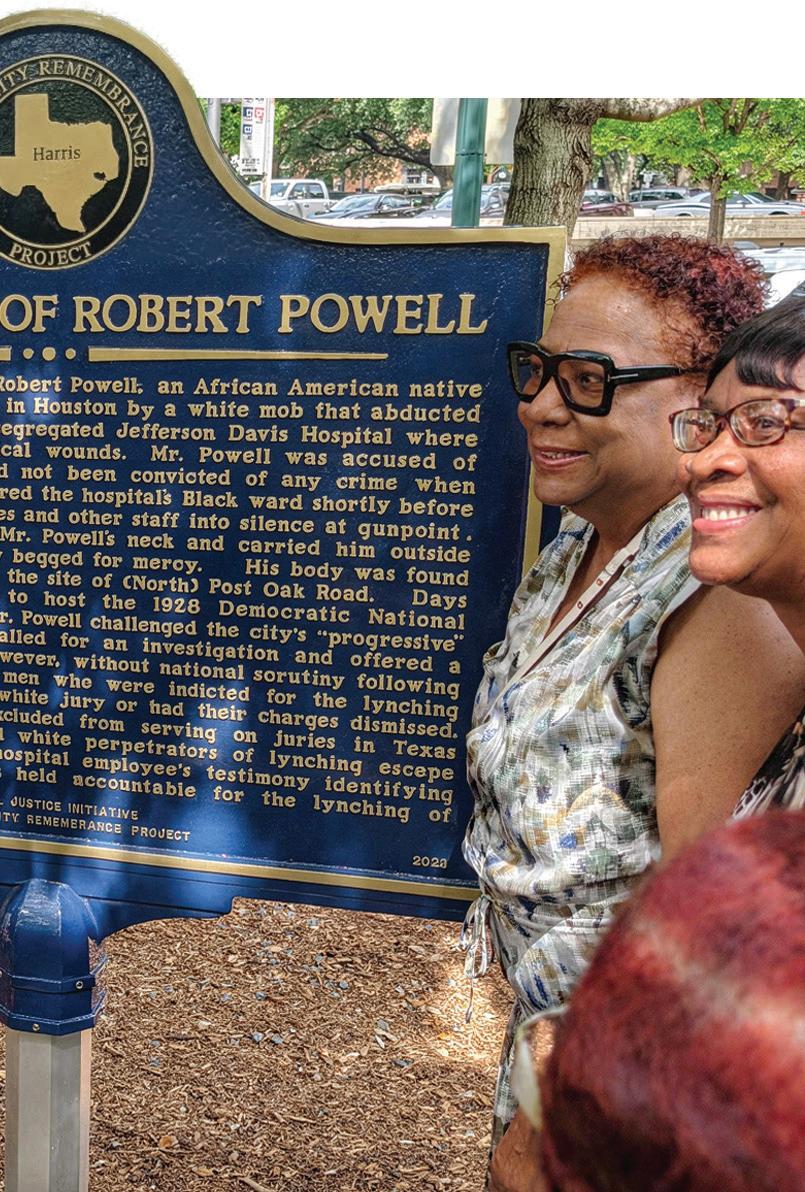
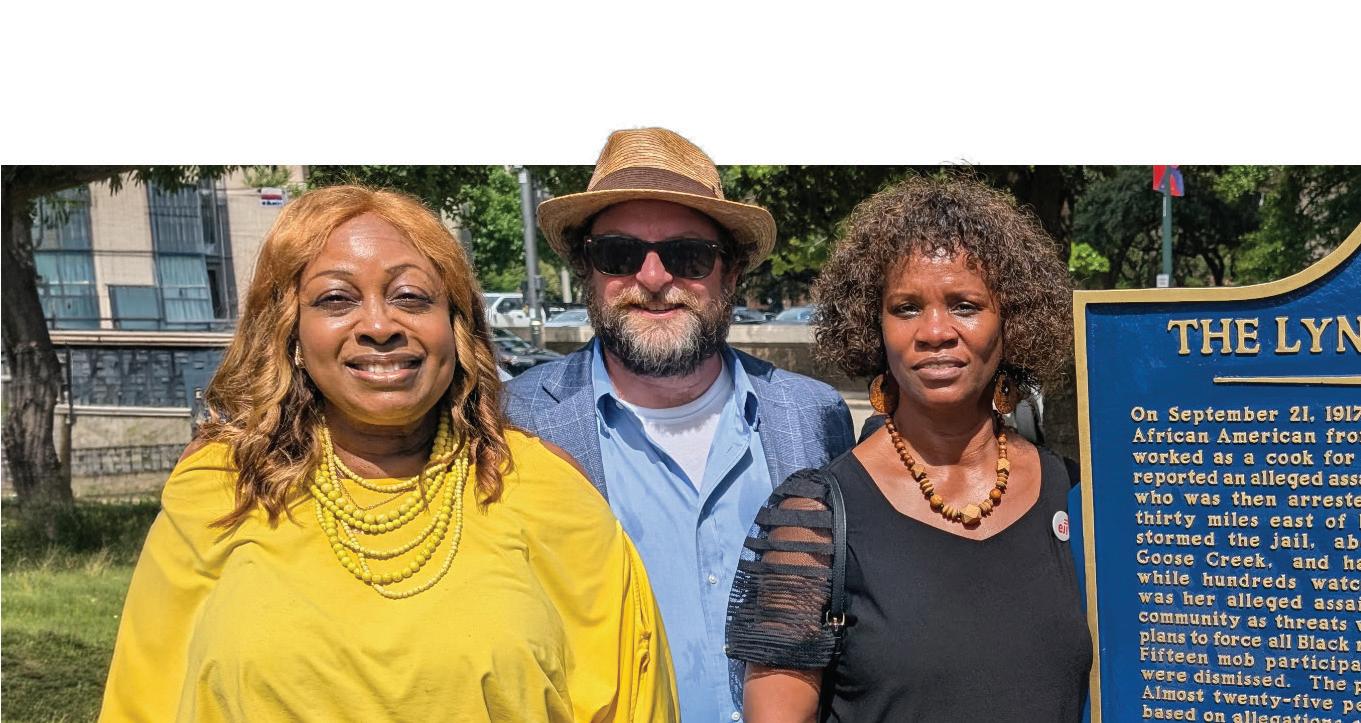
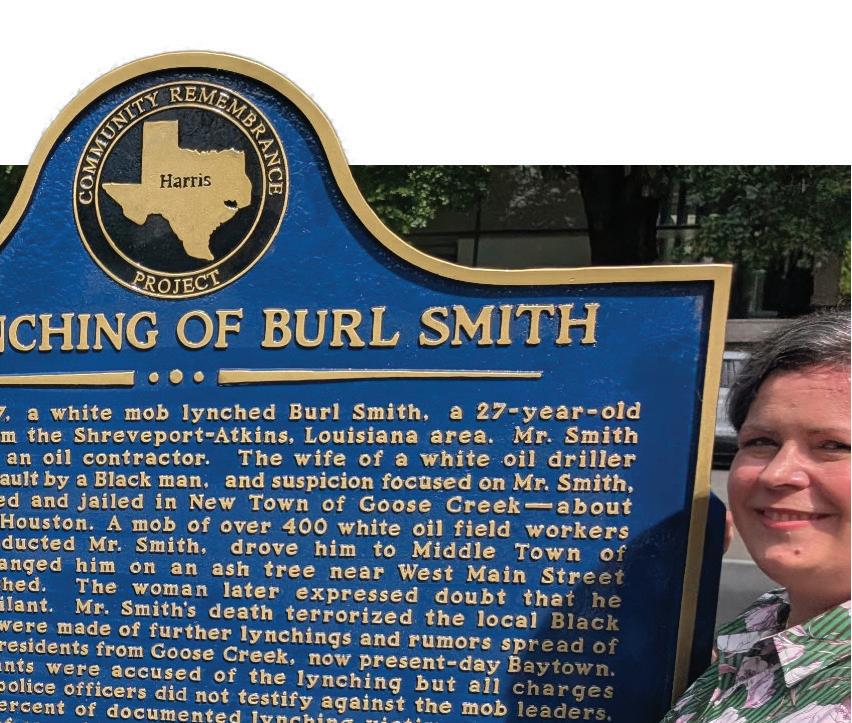
On Saturday June 20, Harris County Precinct 1 Commissioner Rodney Ellis revealed future plans for Remembrance Park which will span three downtown city blocks. The site will be dedicated to chronicling the legacy of enslavement, racial injustice, and freedom movements. Following the program, the audience gathered outside to witness the unveiling ceremony of lynching markers for four Black men lynched in Harris County: John Walton, (1890) Burl Smith, (1917) John
White (1919) and Robert Powell (1928). A marker titled “Racial Violence in Harris County was also unveiled. The markers were erected in the Harris County Jury Assembly Plaza at the intersection of San Jacinto Street and Congress Street. Their placement was intentional- near the courthouse where these four lynching victims never received their day in court. The unveiling was a component of the EJI Community Remembrance Project, a grass Markers on pg. 3


By: Byron Parker
Out of the ashes of last year’s devastating tragedy, a pillar of the ird Ward is rising, rebuilding, and being restored.
e Association of Black Social Workers of Texas, Inc. (ABSW) Houston Chapter President Byron Parker has o cially announced a massive $25,000.00 in-kind donation to the SHAPE Community Center. e contribution comes at a critical time for the historic institution, which lost its community computer lab in a catastrophic re last year. e donation is a huge upgrade that signi cantly revitalizes SHAPE’s technological infrastructure. It includes ten (10) state-of-the-art desktop computers equipped with wireless dual-screen monitors, webcams, and toptier processing power.
More an Just Hardware
ABSW Houston notes that this is not just a collection of equipment, but essentially a fully functioning, modern computer lab. “When the re claimed our lab last year, it didn’t just destroy property, it severed a vital lifeline for our neighborhood,” said SHAPE Center’s CoFounder & Executive Director, Deloyd Parker. “ is blessing from ABSW doesn’t just replace what we lost; it elevates us into the digital future.”
For over ve decades, the SHAPE Community Center has served as a sanctuary for education, cultural empowerment, and community organizing. e loss of the original computer lab le a gaping void for local students, job seekers, and seniors who relied on the center for internet access, digital literacy, and resources.


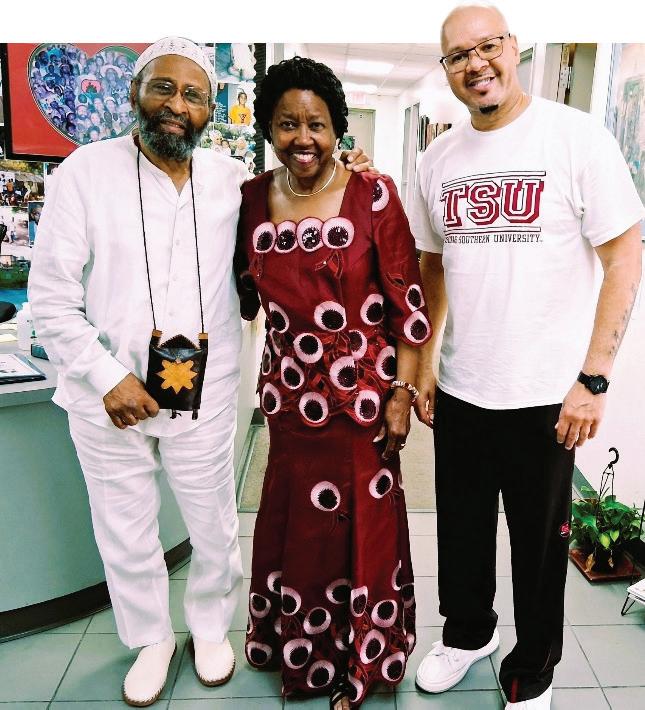
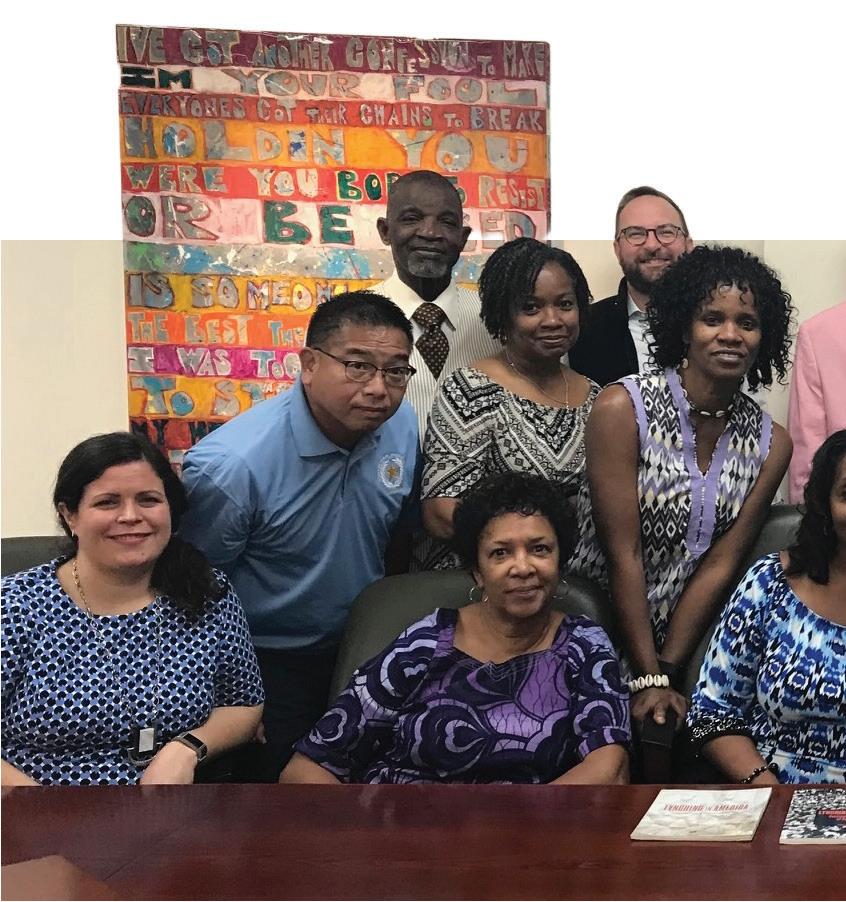
LEFT: JOHN AND NORMA BRADLEY, SANDRA RHEA AND DALE RASMUS ON THE RIGHT
EDITORIAL
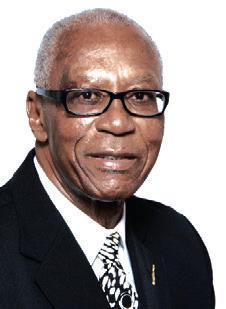
A Revival of God Consciousness
Bobby Mills, Ph.D.




AMERICAAT A CROSSROADS
aframnews1982@gmail.com




America’s strength rests on the moral conscience of its citizens and the spiritual and ethical values expressed in the Preamble and the U.S. Constitution. Yet, President Donald J. Trump has repeatedly attempted to whitewash and distort American history, suggesting that Black Americans have made no meaningful contributions to the nation’s pursuit of a just socioeconomic order. In fact, President Trump and his MAGA-aligned billionaire supporters appear to favor government assistance for the wealthy while denying comparable support to working-class Americans, regardless of color or creed. ese harmful efforts ignore the historic role Black Americans have played in the social and economic development of the United States. Glory Hallelujah to God! For example, in Mississippi’s capital city of Jackson, the cornerstone of City Hall reads: “Built in 1852 by slave labor. Material costs: $7,500.” What an ungodly shame. America now faces a serious spiritual crossroads in its development: Will it choose multicultural democracy or White-privilege autocracy? Sadly, President Trump and his GOP MAGA-cult supporters seek to whitewash American history by pretending the United States is an “Alice in Wonderland” White nation rather than a multicultural,
multiracial society. Before European colonization, America was inhabited by non-White Native tribes, many of whom were annihilated by White settlers armed with guns and alcohol. Yet, even amid the demands of White privilege, President Abraham Lincoln spoke an enduring truth: “A nation divided against itself cannot stand.” In 2026, under the leadership of the Trump administration, America is more divided than ever. President Trump’s leadership has carried the nation spiritually and socioeconomically into deeper confusion and darkness. As Katt Williams has bluntly said, “Trump has messed up everything.” Consequently, responsibility for this failure rests with the 77 million-plus Americans who voted for empty promises instead of hard work and selfsacri ce. What an ungodly shame. When people want something for nothing, they o en end up with nothing— and nothing from nothing leaves nothing.
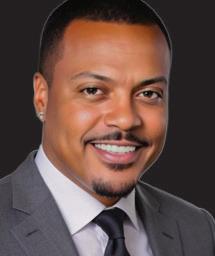
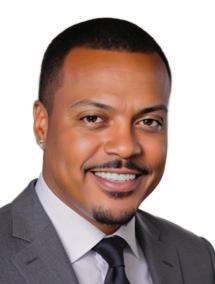
BLACK TEXAS AT CROSSROADS
e central spiritual question facing American society is this: chaos or community? America must spiritually understand that those who fear God rather than men, and who speak and act righteously, are blessed because they live by King David’s spiritual words: “ e Lord is on my side; I will not fear: what can man do unto me?” (Psalm 118:6). America, everyday individuals place their faith, trust and con dence in something or someone. erefore, if we trust and have faith in cars, planes, and ships, and we did not see the engineer designers or construction workers, why aren’t
ere are elections, and then there are hinges. Moments where a state does not simply choose a senator, it chooses whether an entire people gets to keep a seat at the table for the next decade or gets locked out of the room entirely. November is one of those hinges for Black Texas. And I will not pretend otherwise to make anyone comfortable. Start with what the numbers already told us. In the March primary, Congresswoman Jasmine Crockett swept the ten counties with the largest Black populations in this state by roughly 24 points. In Je erson County, nearly 60 points. at was not noise. at was a verdict. Black voters looked at the choices in front of them and rendered judgment with the only tool no one can take from us at the ballot box, our own hand on our own vote. James Talarico became the nominee anyway. What he does with the community that did not choose him rst is now the whole test of his candidacy. To his credit, he has tried. Black churches, HBCUs, a commencement address at Paul Quinn College, a maternal mortality plan aimed at a crisis that has quietly devastated Black families for generations, endorsements from Commissioner Rodney Ellis and Divine Nine organizations, Barack Obama at his side. None of that is nothing. But state
Representative Barbara Gervin Hawkins, who chairs the Texas Legislative Black Caucus, said the quiet part out loud: Black Texans are angry, they feel disenfranchised, and they feel used. Two thirds of Black voters currently support him. Compare that to the nearly 90 percent Beto O’Rourke and Colin Allred each pulled from us in their own Senate runs, and the gap stops looking like a rounding error. It looks like a warning shot. State Senator Royce West put it in terms I have heard from organizers across this state for years. He sees good faith. He has also seen good faith before that evaporated the moment the votes were counted. at is not bitterness. at is a community that has been asked to trust rst and be rewarded later, again and again, and has learned what usually comes a er the asking. Talarico did not invent that pattern. But he is the one standing in front of it now, and earning our vote, not assuming it, is the only path through. Here is where I have to stop being diplomatic, because diplomacy will not save us from what is actually on the other side of this ballot. If Ken Paxton wins this seat, it will not be a normal loss. It will be the closing of a door that may not open again for a generation. Texas Republicans have already redrawn the congressional map to strip power from Black and Latino communities for the next decade. A federal Voting Rights Act gutted by the courts no longer stands between us and
Culture Commission Coalition
By Robert Slater, Community Activist, Chairman of The Culture Commission Coalition
Markers
roots initiative of Civil Rights Attorney Bryan Stevenson. The organization located in Montgomery, Alabama, “supports efforts to locally memorialize documented victims of racial violence and to educate communities about the history of racial injustice.” The term “lynched” (or a racial terror lynching) refers to the unlawful and extrajudicial killing of individuals by White mobs, intended to enforce racial subordination and segregation. https://eji.org/projects/ community-remembranceproject/
In the fall of 2017, professional genealogist and historical researcher Debra Blacklock-Sloan heard about the EJI County Community Remembrance Project (EJI CRP) and organized a grass roots CRP here in Harris County with five friends. She attended the unveil-
ing ceremony along with Dale Rasmus, Sandra Rhea, Norma, and John Bradley descendants of lynching victim Robert Powell. Rhea’s first cousin Rosalyn Shaw, who lives in Los Angeles, California, initiated an ancestry research project to learn more about their family’s history. During her research, she uncovered the story of Robert Powell’s 1928 lynching and shared this discovery with her cousins in Houston, Texas. Rhea, Reverend William Clayton Powell, and Blacklock-Sloan shared many conversations in the last eight years about Robert Powell and the Harris County Remembrance Project. Sadly, William died in 2023, but Blacklock-Sloan recalled he was proud that his relative hadn’t been forgotten. Rhea also told BlacklockSloan that Alice Powell was her great-grandmother. Robert Powell was her grandmother’s nephew, and
a member of their close family lineage. She stated “Learning the truth about what happened to Robert has been both heartbreaking and deeply meaningful. Thanks to Rosalyn’s dedication to preserving our family’s history, we were able to honor Robert’s memory and ensure that his story is remembered for future generations.”
Norma Bradley another Powell descendant said that “When Debra BlacklockSloan contacted me and my cousin Clayton Powell about Robert Powell, I learned that Clayton was Robert Powell’s nephew.
Clayton was the son of Albert Powell, who was Robert Powell’s brother.
Before Debra’s call, I did not know this. Discovering that close family connection was deeply exciting. I had never imagined we were so closely connected to Robert Powell. He was my grandmother’s nephew, and she shared with me the history of his lynching when I was 12 years old. Seventytwo years later, Debra’s call helped me connect the dots in my family tree.”
During the recognition ceremony honoring those who were lynched in Har-
ris County, I learned more about lynching. Thanks to Commissioner Rodney Ellis who said, “As a civil rights advocate, there were times when I saw “strange fruit” hanging from trees and wondered not what kind of tree it was, but what happened to the person who had been hanged there? Learning Robert Powell’s story brought me a measure of peace because I nally understood the painful truth behind his death- he was a Black man in the wrong place at the wrong time. Just because. Ain’t you shame America”?



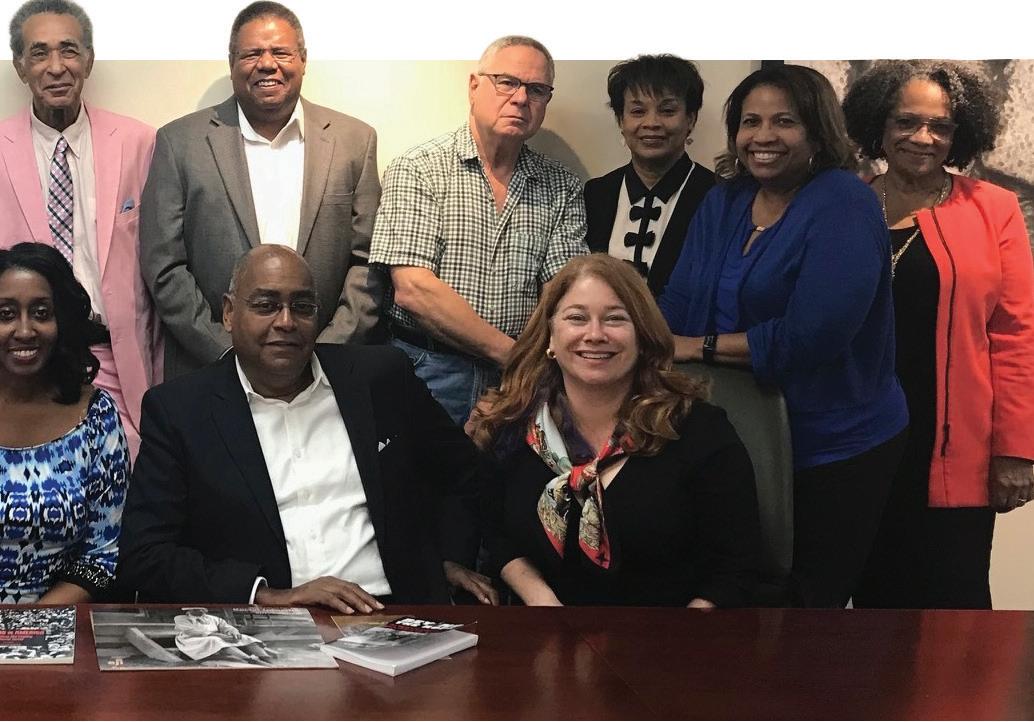
(YELLOW BLOUSE) DR. KAREN KOSSE CHERYNSHEV, TSU PROFESSOR OF HISTORY, DR. JEFFREY LITTLEJOHN, DEBRA BLACKLOCK-SLOAN AND LAURA ABRAMS SEGURA.
1799 1816 1820 1829 1817 1822 1800
1799. Richard Allen
1800. An enslaved man named Gabriel plans the rst major slave rebellion in U.S. history. He gathers about 1,000 armed enslaved people near Richmond, Virginia.
1816. e African Methodist Episcopal Church is formally organized. Richard Allen becomes its rst bishop.
1817. e American Colonization Society is established to transport freeborn Black people and Black people freed from slavery to Africa.

1820. e Missouri Compromise provides for Missouri to be admitted to the Union as a slave state.
1822. Denmark Vesey, who was freed from slavery, plans the largest slave revolt in U.S. history, in Charleston, South Carolina. e rebellion is betrayed before the plan can be carried out.
1829. African American abolitionist David Walker publishes the pamphlet Appeal…to the Colored Citizens of the World…, calling for a slave revolt.
HOUSTON
AUSTIN

TEXAS TAKEAWAY


Houston ISD will implement new rules for athletic events aimed at enhancing safety, improving crowd management, and creating a more enjoyable experience for students, families, and spectators. The updated guidelines include revised entry procedures, spectator expectations, and security measures that will be in effect at district athletic venues throughout the upcoming school year.
DALLAS
The Fort Worth Zoning Commission voted against the city’s proposed zoning regulations for artificial intelligence data centers, raising questions about how future facilities will be reviewed and where they may be located. The recommendation now moves to city leaders for further consideration as officials continue balancing economic development with community concerns over infrastructure, noise, and energy demand.
CORPUS CHRISTI
Texas offensive lineman Kelvin Banks Jr. and fellow Longhorn standout Cameron Goosby hosted a youth football camp that brought young athletes together while raising awareness and support for heart research. The event combined football instruction with community outreach, helping promote heart health initiatives and encouraging participants to make a positive impact both on and off the field.
Major water infrastructure projects planned by the City of Corpus Christi could result in higher water bills for ratepayers beginning in 2027 as officials work to fund system upgrades and improve long-term reliability. City leaders say the investments are intended to strengthen the region’s water supply and infrastructure while addressing future growth and aging facilities.
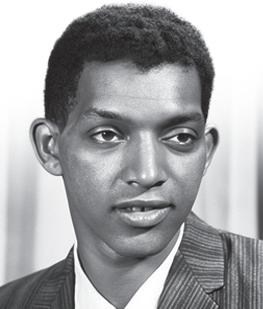
George Carruthers was an African American astrophysicist, inventor, and aerospace engineer best known for developing the far-ultraviolet camera and spectrograph used during the Apollo 16 Moon mission. Although Carruthers was born in Ohio and built much of his career in Washington, D.C., his work had strong ties to Texas through NASA’s Johnson Space Center, where Apollo mission planning and astronaut operations were based. His achievements helped advance the nation’s space program and continue to inspire future generations of scientists and engineers.
GEORGE CARRUTHERS
becomes the rst ordained Black minister of the Methodist Episcopal Church.
T:10"
















































THE BENJAMIN PROJECT
By: Carlos R. Phillips II, Ed.D.
e Benjamin Project is a global humanitarian initiative dedicated to creating a safe, clean, and empowering learning environment where students can achieve success that is powered by renewable energy. At its core, the project is rooted in the belief that access to essential daily resources is fundamental to educational achievement and overall well-being. rough our global learning exchange initiative at Booker T. Washington High School, the project partners with Booker Washington Institute in Kakata, Liberia and energy companies in Liberia have designed a sustainable infrastructure that meets students’ basic needs. ese e orts include providing reliable access to clean temperature controlled running water, functional bathroom facilities, designated laundry areas, and safe communal spaces for student use. Inspired by Benjamin Kolleh, a Booker Washington Institute student, the project aims to transform the vision into a lasting impact for the student body and community.
and access to care.
the project not only supports immediate needs but also promotes long term resilience. E orts to beautify the campus and foster a strong sense of community further enhance the environment, making it a place where students feel valued, supported, and motivated.
Sustainability is a key pillar of the initiative. By incorporating solar energy and environmentally responsible practices,
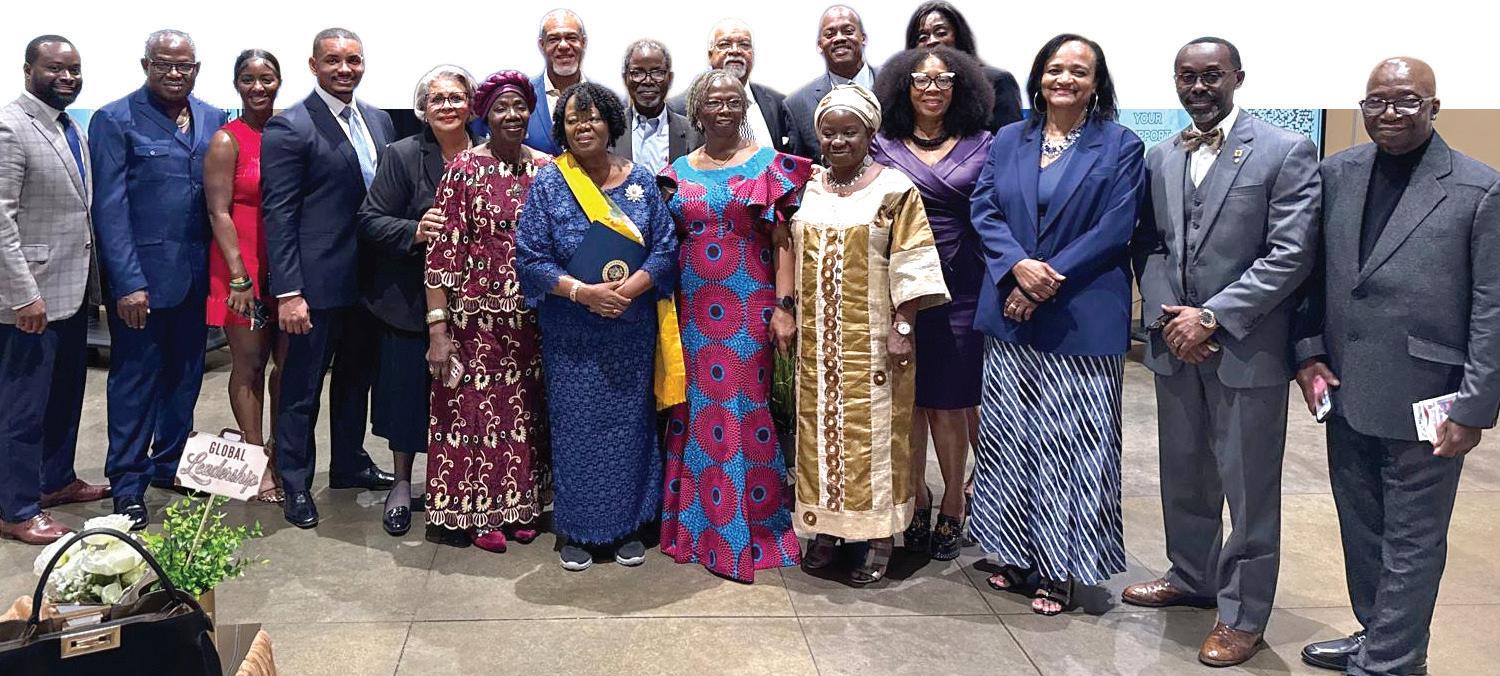
e Benjamin Project has engaged with key stakeholders, including council members of the Mayor of Houston’s o ce, City Council member Willie Davis, energy companies, and delegates from the Ivory Coast, to raise awareness and build partnerships. Booker T. Washington High School also hosted the Measure of Success banquet in May 2026, welcoming over 100 delegates representing companies, associations,
governments, and organizations from across the globe. Additionally, the project was showcased at the Booker Washington Institute Global Alumni Association Launch Event in Maryland, recognized as a sister state to Liberia through a partnership established by Governor Wes Moore to expand awareness, deepen engagement, and generate support for its ongoing growth.





ese collaborations highlight the importance of collective commitment in addressing global humanitarian challenges in education. With continued support, the Benjamin Project aims to