June 26, 2026
Vol.31, Issue 21
AframNews.com
FREE
African-American News&Issues
“Addressing Current & Historical Realities Affecting Our Community”
TSU ENDOWMENT HONORS DR. SIMMONS’ SISTER By: TSU
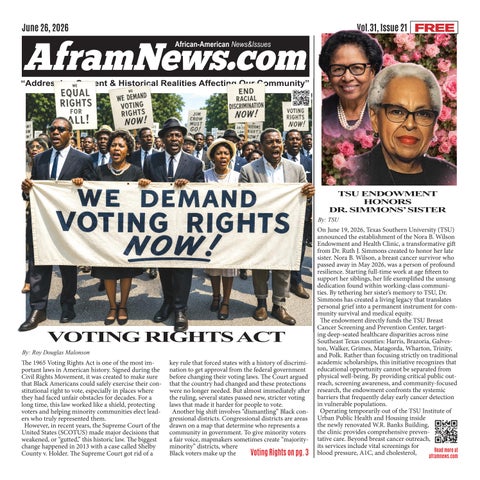
VOTING RIGHTS ACT By: Roy Douglas Malonson
The 1965 Voting Rights Act is one of the most important laws in American history. Signed during the Civil Rights Movement, it was created to make sure that Black Americans could safely exercise their constitutional right to vote, especially in places where they had faced unfair obstacles for decades. For a long time, this law worked like a shield, protecting voters and helping minority communities elect leaders who truly represented them. However, in recent years, the Supreme Court of the United States (SCOTUS) made major decisions that weakened, or “gutted,” this historic law. The biggest change happened in 2013 with a case called Shelby County v. Holder. The Supreme Court got rid of a
key rule that forced states with a history of discrimination to get approval from the federal government before changing their voting laws. The Court argued that the country had changed and these protections were no longer needed. But almost immediately after the ruling, several states passed new, stricter voting laws that made it harder for people to vote. Another big shift involves “dismantling” Black congressional districts. Congressional districts are areas drawn on a map that determine who represents a community in government. To give minority voters a fair voice, mapmakers sometimes create “majorityminority” districts, where Black voters make up the Voting Rights on pg. 3
On June 19, 2026, Texas Southern University (TSU) announced the establishment of the Nora B. Wilson Endowment and Health Clinic, a transformative gift from Dr. Ruth J. Simmons created to honor her late sister. Nora B. Wilson, a breast cancer survivor who passed away in May 2026, was a person of profound resilience. Starting full-time work at age fifteen to support her siblings, her life exemplified the unsung dedication found within working-class communities. By tethering her sister’s memory to TSU, Dr. Simmons has created a living legacy that translates personal grief into a permanent instrument for community survival and medical equity. The endowment directly funds the TSU Breast Cancer Screening and Prevention Center, targeting deep-seated healthcare disparities across nine Southeast Texas counties: Harris, Brazoria, Galveston, Walker, Grimes, Matagorda, Wharton, Trinity, and Polk. Rather than focusing strictly on traditional academic scholarships, this initiative recognizes that educational opportunity cannot be separated from physical well-being. By providing critical public outreach, screening awareness, and community-focused research, the endowment confronts the systemic barriers that frequently delay early cancer detection in vulnerable populations. Operating temporarily out of the TSU Institute of Urban Public Health and Housing inside the newly renovated W.R. Banks Building, the clinic provides comprehensive preventative care. Beyond breast cancer outreach, its services include vital screenings for Read more at blood pressure, A1C, and cholesterol, aframnews.com
2
June 26, 2026
AFRAMNEWS.COM
EDITORIAL
President/Chief Editor Contributing Writers Dr. Bobby Mills Travis McGee Rachel Thompson Meeko Graphics Social Media Houston Minority business marketing website JG Design Layout Design Blue Star Web Printing Printer
A Revival of God Consciousness Bobby Mills, Ph.D.
WHAT’S IN A NAME
STORIES, PICTURES, LETTERS TO THE EDITOR, EMAIL TO
aframnews1982@gmail.com
713-682-1892
PO BOX 206 Prairie View, TX 77446
We are looking for historical writers That can produce stories that address current and historical realities affecting our community. PLEASE SEND YOUR INQUIRIES TO
AFRAMNEWS1982@GMAIL.COM
The Bible says, “A good name is more desirable than great riches, and favor is better than silver and gold” (Proverbs 22:1). Those who chase power, money, and sex should remember that God is not mocked; people reap what they sow. Solomon teaches that life, as God intended it, applies to everyone, regardless of social or economic standing, because life is brief and uncertain. A person may be here today and face eternal judgment the same day. Sadly, President Trump and his MAGA supporters seem to embrace the idea that “might makes right,” seeking self-glorification rather than the glory of God, who is Eternal Truth. So, what is in a name? The spiritually profound answer is character and reputation. Sadly, for President Trump and his MAGA movement, the focus appears to be on him—dividing “us” from “them.” As individuals and as a nation, we cannot live without faith: faith in God, faith in ourselves, and faith in others. Faith is not merely an abstract belief in God; it touches every part of life. That is why, without faith, it is impossible to please God. By contrast, the faith of President Trump and his MAGA supporters appears one-sided and zero-sum, centered on division and societal confusion. As a result, the American Dream has become, in the author’s view, a Trump MAGA-
Cult Nightmare, with many people unlikely to be better off socioeconomically than their parents. Hence, many young adults today may struggle to buy a home and can barely afford a car, not to mention gas. The Trump GOP-MAGA Cult know absolutely nothing about Faith, Love, Charity, and Honesty. However, they do know an awful lot about gangsterism, racism, classism, and sexism masquerading as GOP conservatism. President Trump is, in the author’s view, reshaping America from a thriving multicultural democracy into what he describes as a “Shit-Hole White Privilege South African Style Third-World Country.” Shame on us. Hatred, racism, and self-centeredness are not patriotism or nationalism; they are a path to self-destruction. In the past, America was seen as great because it was good and benevolent toward the global community. Now, under the leadership of Donald J. Trump and Elon Musk’s DOGE unit, the author argues that America is increasingly viewed as self-centered, selfserving, and arrogant. Withholding essential foreign aid from developing countries is neither wise nor humane. Ultimately, the issue is not only President Trump, but also the (77) million Americans who voted for him. Some voters, the author contends, claim to support Trump because he is a successful businessman, using that false argument to justify or conceal racist beliefs. Of course, few would argue that they voted for Donald J. Trump because they believed him to be a moral man. In the author’s view, the global comRead more at munity does not aframnews.com
We Must Understand Roy Douglas Malonson, Publisher
SYSTEMIC RACISM AND BIAS To understand systemic racism and bias, it helps to look at them not just as individual prejudices, but as a network of historical rules, institutional practices, and cultural habits that combine to create unequal outcomes. While individual bias is about personal attitudes, systemic (or structural) racism is about how institutions—like housing, banking, employment, education, and the justice system— multiply those biases across generations, even without any single person acting out of malice. Here is a breakdown of how these forces operate and reinforce one another. 1. The Wealth Gap & Housing (The Foundation) The massive wealth gap between Black and white families today isn’t an accident; it is heavily rooted in 20th-century housing policies. Redlining: Starting in the 1930s, the federal government drew red lines on maps around Black neighborhoods, labeling them “hazardous” for investment. Banks refused to give mortgages in these areas. The Wealth Cascade: Because homeownership is the primary way Americans build wealth and pass it to their children, blocking Black families from buying homes in appreciating areas permanently stunted generational wealth building. Today, the median net worth of a white family is significantly higher than that of a Black
family. 2. Institutional Feedback Loops Because our societal systems are interconnected, a disadvantage in one area automatically triggers a disadvantage in another. This creates a self-perpetuating loop: Education Funding: Because public schools are largely funded by local property taxes, neighborhoods with lower home values (due to historical redlining) have underfunded schools. Employment & Biased Hiring: Studies consistently show that resumes with Blacksounding names receive significantly fewer callbacks than identical resumes with white-sounding names. When hired, Black workers often face a “promotion gap,” staying at entry-level positions longer. 3. The Justice System & Implicit Bias Systemic bias in the legal system often stems from a mix of historical policy and implicit bias—the unconscious stereotypes that affect everyone’s actions. Implicit Bias in Action: Psychological studies show that people across all backgrounds routinely perceive Black faces as more “threatening” or older than they actually are. In split-second situations, this unconscious association changes how police officers, teachers, and employers react. Disproportionate Sentencing: Black Americans are often arrested and convicted at higher rates for the exact same behaviors as white Americans (such as drug possession). Furthermore, federal Read more at data shows that aframnews.com
June 26, 2026 Voting Rights Cont. largest
group. This ensures they can elect a leader who understands their specific needs. Recently, some state lawmakers have redrawn these maps to break up these districts. By splitting Black communities across several different areas, their voting power is watered down. This makes it much harder for Black voters to elect their preferred candidates. When the Supreme Court allows these redrawn maps to stand, it essentially reduces Black representation in Congress. These decisions have sparked a massive debate across the nation. Critics argue that rolling back the Voting Rights Act and taking apart these voting districts undoes the hardfought progress of the Civil Rights Movement, making it harder for government to look like the diverse country it represents. Defenders of the rulings believe states should have more freedom to run their own elections without Washington, D.C., stepping in. Ultimately, how we draw districts and protect voting rights shapes who gets a seat at the table to make rules for everyone. The Civil Rights Act of 1964 is a landmark law that completely transformed American society. Signed into law by President Lyn-
AFRAMNEWS.COM don B. Johnson, it was designed to end segregation and strike down discrimination based on race, color, religion, sex, or national origin. While the 1965 Voting Rights Act focused specifically on the ballot box, the 1964 Civil Rights Act tackled discrimination in daily public life, employment, and education. What the 1964 Act Accomplished Banned Segregation in Public Places: It made it illegal for businesses like restaurants, hotels, theaters, and pools to refuse service to people or separate them based on race. Targeted Workplace Discrimination: The law created the Equal Employment Opportunity Commission (EEOC), which protects workers from being fired, passed over for promotions, or denied jobs because of who they are. Desegregated Schools: It gave the federal government the power to force public schools to integrate, speeding up the process started by the Brown v. Board of Education ruling a decade earlier. Cut Federal Funding for Discrimination: If a state or local program discriminated against Black Americans, the federal government could pull its funding. Together, the 1964 Civil Rights Act and the 1965 Voting Rights Act formed the one-two punch that legally dismantled the Jim Crow system in the American South. AA
3
LOCAL
FREEDOM WALK By: Fred Smith
The Dallas MLK Freedom Walk 2026 brought together thousands of North Texans to celebrate Juneteenth through unity, wellness, and community engagement. Hosted by the Martin Luther King Jr. Community Center in South Dallas, the annual event featured a 4K walk that honored the legacy of freedom, civil rights, and the ongoing pursuit of equality. Following the walk, participants enjoyed a community festival with live entertainment, food vendors, educational exhibits, and family-friendly activities. Organizers said the event served as both a celebration of African American heritage and a reminder of the importance of preserving history while inspiring future generations to remain active in their communities. The Freedom Walk is rooted in the spirit of Juneteenth,
which commemorates June 19, 1865, when enslaved African Americans in Texas learned of their freedom more than two years after the Emancipation Proclamation was issued. The event provides an opportunity for participants to reflect on the sacrifices and achievements of those who fought for freedom, justice, and civil rights throughout American history. Throughout the day, attendees had the opportunity to connect with local organizations, businesses, and community leaders dedicated to improving education, health, economic opportunity, and civic engagement. Many organizations used the event to share resources and information designed to strengthen neighborhoods and empower families across the Dallas area. For many families, the Freedom Walk has become an annual tradition that brings
multiple generations together. Children, parents, and grandparents walked side by side, sharing stories about the significance of Juneteenth and the importance of preserving African American history. The event created a space for learning, reflection, and celebration in a welcoming community atmosphere. As Juneteenth continues to gain national recognition, events like the Dallas MLK Freedom Walk help ensure that the history behind the holiday remains at the forefront. By combining education, culture, and community service, the walk reinforces the values of freedom, equality, and collective progress while honoring the enduring legacy of those who paved the way for future generations. AA
EVERY EFFORT HAS BEEN MADE TO ENSURE COMPLETE AND ACCURATE INFORMATION; BUT ERRORS MAY OCCUR. PLEASE CHECK THIS FILE CAREFULLY. NOT TO BE USED FOR COLOR APPROVAL.
4
AFRAMNEWS.COM
T:9.75"
June 26, 2026
T:10"