May 15, 2026
Vol.31, Issue 15
AframNews.com
FREE
African-American News&Issues
“Addressing Current & Historical Realities Affecting Our Community”
THEY FOUGHT, BLED, AND MARCHED By: Fred Smith
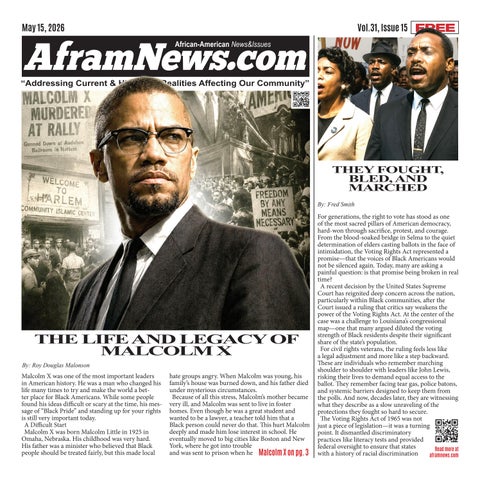
THE LIFE AND LEGACY OF MALCOLM X By: Roy Douglas Malonson
Malcolm X was one of the most important leaders in American history. He was a man who changed his life many times to try and make the world a better place for Black Americans. While some people found his ideas difficult or scary at the time, his message of “Black Pride” and standing up for your rights is still very important today. A Difficult Start Malcolm X was born Malcolm Little in 1925 in Omaha, Nebraska. His childhood was very hard. His father was a minister who believed that Black people should be treated fairly, but this made local
hate groups angry. When Malcolm was young, his family’s house was burned down, and his father died under mysterious circumstances. Because of all this stress, Malcolm’s mother became very ill, and Malcolm was sent to live in foster homes. Even though he was a great student and wanted to be a lawyer, a teacher told him that a Black person could never do that. This hurt Malcolm deeply and made him lose interest in school. He eventually moved to big cities like Boston and New York, where he got into trouble and was sent to prison when he Malcolm X on pg. 3
For generations, the right to vote has stood as one of the most sacred pillars of American democracy, hard-won through sacrifice, protest, and courage. From the blood-soaked bridge in Selma to the quiet determination of elders casting ballots in the face of intimidation, the Voting Rights Act represented a promise—that the voices of Black Americans would not be silenced again. Today, many are asking a painful question: is that promise being broken in real time? A recent decision by the United States Supreme Court has reignited deep concern across the nation, particularly within Black communities, after the Court issued a ruling that critics say weakens the power of the Voting Rights Act. At the center of the case was a challenge to Louisiana’s congressional map—one that many argued diluted the voting strength of Black residents despite their significant share of the state’s population. For civil rights veterans, the ruling feels less like a legal adjustment and more like a step backward. These are individuals who remember marching shoulder to shoulder with leaders like John Lewis, risking their lives to demand equal access to the ballot. They remember facing tear gas, police batons, and systemic barriers designed to keep them from the polls. And now, decades later, they are witnessing what they describe as a slow unraveling of the protections they fought so hard to secure. The Voting Rights Act of 1965 was not just a piece of legislation—it was a turning point. It dismantled discriminatory practices like literacy tests and provided federal oversight to ensure that states Read more at with a history of racial discrimination aframnews.com