November 14, 2025
GREATER HOUSTON EDITION
AframNews.com
Vol.30, Issue 43
FREE
African-American News&Issues
“Addressing Current & Historical Realities Affecting Our Community”
TARIFF REVENUE PAYBACK?
AMANDA
EDWARDS
By: Fred Smith
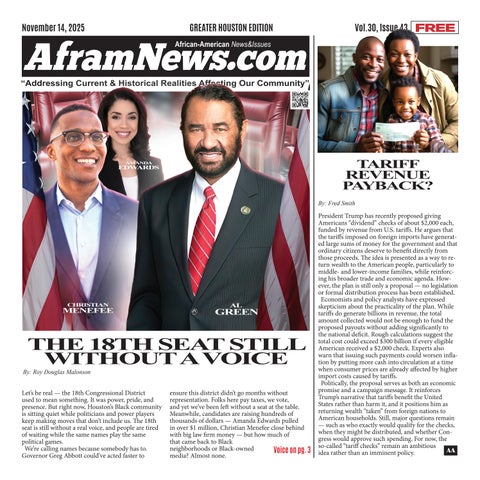
CHRISTIAN
MENEFEE
AL
GREEN
THE 18TH SEAT STILL WITHOUT A VOICE
By: Roy Douglas Malonson
Let’s be real — the 18th Congressional District used to mean something. It was power, pride, and presence. But right now, Houston’s Black community is sitting quiet while politicians and power players keep making moves that don’t include us. The 18th seat is still without a real voice, and people are tired of waiting while the same names play the same political games. We’re calling names because somebody has to. Governor Greg Abbott could’ve acted faster to
ensure this district didn’t go months without representation. Folks here pay taxes, we vote, and yet we’ve been left without a seat at the table. Meanwhile, candidates are raising hundreds of thousands of dollars — Amanda Edwards pulled in over $1 million, Christian Menefee close behind with big law firm money — but how much of that came back to Black neighborhoods or Black-owned Voice on pg. 3 media? Almost none.
President Trump has recently proposed giving Americans “dividend” checks of about $2,000 each, funded by revenue from U.S. tariffs. He argues that the tariffs imposed on foreign imports have generated large sums of money for the government and that ordinary citizens deserve to benefit directly from those proceeds. The idea is presented as a way to return wealth to the American people, particularly to middle- and lower-income families, while reinforcing his broader trade and economic agenda. However, the plan is still only a proposal — no legislation or formal distribution process has been established. Economists and policy analysts have expressed skepticism about the practicality of the plan. While tariffs do generate billions in revenue, the total amount collected would not be enough to fund the proposed payouts without adding significantly to the national deficit. Rough calculations suggest the total cost could exceed $300 billion if every eligible American received a $2,000 check. Experts also warn that issuing such payments could worsen inflation by putting more cash into circulation at a time when consumer prices are already affected by higher import costs caused by tariffs. Politically, the proposal serves as both an economic promise and a campaign message. It reinforces Trump’s narrative that tariffs benefit the United States rather than harm it, and it positions him as returning wealth “taken” from foreign nations to American households. Still, major questions remain — such as who exactly would qualify for the checks, when they might be distributed, and whether Congress would approve such spending. For now, the so-called “tariff checks” remain an ambitious AA idea rather than an imminent policy.