October 16, 2026
SAN ANTONIO/AUSTIN EDITION
Vol.31, Issue 37
FREE
We the People
“Addressing Current & Historical Realities Affecting Our Community”
Your vote and your money are the two most powerful things you have. Be careful who you give them to. - Roy Douglas Malonson
DORIS MILLER AUDITORIUM DESIGNATED HISTORIC LANDMARK By: City of Austin Communications
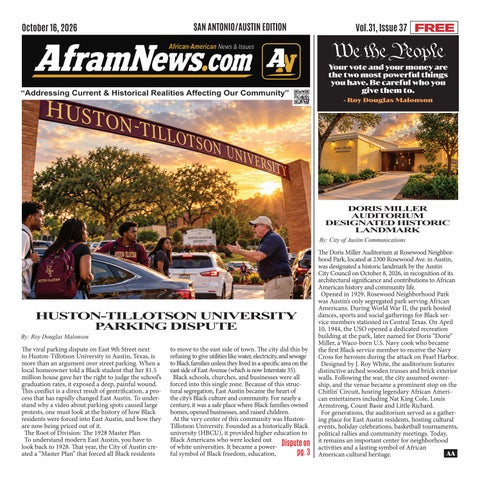
HUSTON-TILLOTSON UNIVERSITY PARKING DISPUTE
By: Roy Douglas Malonson
The viral parking dispute on East 9th Street next to Huston-Tillotson University in Austin, Texas, is more than an argument over street parking. When a local homeowner told a Black student that her $1.5 million house gave her the right to judge the school’s graduation rates, it exposed a deep, painful wound. This conflict is a direct result of gentrification, a process that has rapidly changed East Austin. To understand why a video about parking spots caused large protests, one must look at the history of how Black residents were forced into East Austin, and how they are now being priced out of it. The Root of Division: The 1928 Master Plan To understand modern East Austin, you have to look back to 1928. That year, the City of Austin created a “Master Plan” that forced all Black residents
to move to the east side of town. The city did this by refusing to give utilities like water, electricity, and sewage to Black families unless they lived in a specific area on the east side of East Avenue (which is now Interstate 35). Black schools, churches, and businesses were all forced into this single zone. Because of this structural segregation, East Austin became the heart of the city’s Black culture and community. For nearly a century, it was a safe place where Black families owned homes, opened businesses, and raised children. At the very center of this community was HustonTillotson University. Founded as a historically Black university (HBCU), it provided higher education to Black Americans who were locked out of white universities. It became a power- Dispute on pg. 3 ful symbol of Black freedom, education,
The Doris Miller Auditorium at Rosewood Neighborhood Park, located at 2300 Rosewood Ave. in Austin, was designated a historic landmark by the Austin City Council on October 8, 2026, in recognition of its architectural significance and contributions to African American history and community life. Opened in 1929, Rosewood Neighborhood Park was Austin’s only segregated park serving African Americans. During World War II, the park hosted dances, sports and social gatherings for Black service members stationed in Central Texas. On April 10, 1944, the USO opened a dedicated recreation building at the park, later named for Doris “Dorie” Miller, a Waco-born U.S. Navy cook who became the first Black service member to receive the Navy Cross for heroism during the attack on Pearl Harbor. Designed by J. Roy White, the auditorium features distinctive arched wooden trusses and brick exterior walls. Following the war, the city assumed ownership, and the venue became a prominent stop on the Chitlin’ Circuit, hosting legendary African American entertainers including Nat King Cole, Louis Armstrong, Count Basie and Little Richard. For generations, the auditorium served as a gathering place for East Austin residents, hosting cultural events, holiday celebrations, basketball tournaments, political rallies and community meetings. Today, it remains an important center for neighborhood activities and a lasting symbol of African AA American cultural heritage.
2
October 16, 2026
AFRAMNEWS.COM
EDITORIAL
President/Chief Editor
Contributing Writers Dr. Bobby Mills, Travis McGee, Rachel Thompson, Fred Smith, Nicole Washington, Aisha Robinson, Marcus Williams, TJ Baker Meeko Graphics Social Media Houston Minority business marketing website JG Design Layout Design Blue Star Web Printing Printer
A Revival of God Consciousness Bobby Mills, Ph.D.
DAWN BUCKINGHAM: TEXAS LAND COMMISSIONER
STORIES, PICTURES, LETTERS TO THE EDITOR, EMAIL TO aframnews1982@gmail.com
713-682-1892
PO BOX 206 Prairie View, TX 77446
We are looking for historical writers That can produce stories that address current and historical realities affecting our community. PLEASE SEND YOUR INQUIRIES TO
AFRAMNEWS1982@GMAIL.COM
SAN ANTONIO/AUSTIN EDITION
I met Commissioner Buckingham nearly four years ago through Perry L. Wooten, a former constable and political consultant to the Baptist Ministers’ Association under Dr. Max A. Miller’s leadership. She attended the event with her son, a Texas State University business student who was preparing to attend medical school at UT. Robert Mohammed was one of the speakers. Her son was not troubled by the message; instead, he listened with an open mind. Afterward, I spoke with him and shared several of my books. The point I want readers to remember is this: mothers are our first teachers, and they help shape our value systems. In that moment, I saw Dawn Buckingham as a decent,
God-fearing, honorable, and open-minded person because her son reflected those values. Recently, my wife and I also met the Commissioner’s husband during church services at Covenant Glen Methodist Church. Just as men choose women, women also choose men. Dawn’s husband is a first-class, God-fearing professional. Therefore, I can honestly say Texas is blessed to have a Godly professional serving as Land Commissioner—one who serves all Texans without fear or favor. For example, Perry and I attended an open-forum testimonial event for Harris County residents whose homes were destroyed by Hurricane Harvey. Most of the homeowners in attendance were Black and Brown. I witnessed first-hand individuals testifying how Commissioner Buckingham came to their homes went through the “valley” with them, refurbished their homes and in many cases rebuilt their homes. Most of these individuals were elderly Black and Brown homeowners who could not afford Federal Flood
Dawn on pg. 4
We Must Understand Roy Douglas Malonson, Publisher
ATTACK ADS IN POLITICS Political campaigns in Texas often use attack ads to weaponize the state’s most pressing challenges, focusing on emotional messaging rather than detailed policy solutions. Here is how the major issues facing Texas are integrated into this political strategy: Political campaigns often use attack ads instead of just talking about their own plans because political strategists believe negative messaging is highly effective at winning elections. While voters often say they dislike these commercials, campaigns continue to use them because they are proven to grab attention and shape how people view the candidates. One major reason the GOP runs these ads is to define their opponents early. In any election, the primary goal of a campaign is to convince voters that the other candidate is not qualified for office. By focusing on a rival’s past votes, statements, or policy positions, attack ads try to create a negative image that is hard to shake. Strategists argue that it is much easier to give voters a reason to vote against someone than it is to persuade them to vote for a complex legislative plan. Another reason is shifting the political focus to major Texas issues. When a party faces a challenging political landscape, they use sharp ads to frame
Texas-specific crises in a way that benefits their platform. For example, campaigns focus heavily on border security and illegal immigration along the Texas-Mexico border, using aggressive ads to spark immediate public anxiety rather than debating long-term federal reforms. Similarly, issues like the reliability of the Texas power grid (ERCOT) and skyrocketing property taxes are frequently turned into political weapons. Instead of engaging in long debates over complicated infrastructure investments or complex economic policies, campaigns use these everyday hardships to quickly blame their rivals for failed leadership. Finally, attack ads work because of human psychology. Research shows that people naturally pay more attention to negative news and threats than they do to positive updates. Fear and anger are powerful motivators. A scary or urgent ad about what might happen if the other side wins—whether it warns about a collapse of the energy grid or an increase in crime—is often much better at getting people to show up and vote on Election Day than a standard ad listing a candidate’s achievements. In the end, political parties run attack ads because they are a proven tool to win races. For campaigns looking to protect or flip seats in the Texas Legislature or Congress, these ads are seen as a direct and efficient way to use their campaign money. While it can make political debates feel more divided, negative advertising remains a central strategy because, in the world of politics, it works.
AA
SAN ANTONIO/AUSTIN EDITION Dispute Cont.
and pride in Texas. The Shift: Gentrification and Rising Prices Over the last twenty years, Austin has grown into a major technology and business hub. As the city became more expensive, developers looked across Interstate 35 to East Austin. Because the land there had been kept artificially cheap due to years of segregation and lack of city investment, developers saw it as a goldmine. Rich buyers started moving into the neighborhood. They built large, expensive houses right next to older, modest family homes. This process is called gentrification. As a result, property taxes skyrocketed. Many Black families who had owned their homes
WIFE
October 16, 2026
for generations could no longer afford the taxes and were forced to sell and leave. Between 2000 and 2010, East Austin lost a huge percentage of its Black population. Today, multimillion-dollar modern homes sit right across the street from historic Black institutions. The Parking Dispute: A Clash of Two Worlds The parking dispute between a student named Bri and the local homeowners shows what happens when these two worlds collide. The street parking spaces on East 9th Street are public, meaning anyone can legally park there. However, the homeowners felt entitled to the space because of the high price they paid for their
house. When the homeowner brought up the school’s graduation rates and her $1.5 million home value, she used her wealth as a weapon. Her comments suggested that because she had more money, her voice mattered more than the history of the school and the community. For the students and longtime residents, this was a clear statement that the new, wealthy neighbors looked down on the Black institution that had been there first. The Community Response and Its Meaning The reaction from the community was swift and powerful. Students and allies gathered outside the home to protest peacefully. They brought music and signs
AFRAMNEWS.COM reading, “You bought a house, not our history.” This protest was not just about a parking spot. It was a stand against the erasure of Black history in Austin. It was a way for the community to say that money cannot buy ownership over a neighborhood’s culture. Longtime residents and students felt they were being treated as outsiders in their own home. Conclusion: What This Teaches Us The Huston-Tillotson parking dispute shows that gentrification is about more than just changing buildings and rising prices. It changes how people treat each other. When wealthy newcomers move into historically marginalized neighborhoods without respecting the people
and history already there, conflict is inevitable. Huston-Tillotson University stands as a monument to Black resilience against segregation. The public street belongs to everyone, but the history of East Austin belongs to the community that built it. True neighborhood growth requires newcomers to respect the history, culture, and institutions that were there long before them. Would you like to expand this essay to include specific statistics on East Austin’s population shifts, details on HBCU funding disparities, or a section on how the university officially responded to the incident?
★ MOM ★ DOCTOR ★ FIRST FEMALE LAND COMMISSIONER
www.DawnBuckingham.com
POL. ADV. PAID FOR BY DR. DAWN BUCKINGHAM CAMPAIGN
PROUDLY ENDORSED BY: Baptist Ministers’ Association of Houston & Vicinity Rev. Dr. Max A. Miller Jr. Dr. Robert E. Childress Dr. Bobby Mills
3
AA
4
October 16, 2026
AFRAMNEWS.COM Insurance. We should
Dawn Cont. never forget that leader-
ship is about setting positive examples. Above all, leadership is not about Party Labels. Leadership is about personal responsibility. My wife and I are voting for Commissioner Buckingham, and if you cast your vote for her “all” Texans will be blessed. After all, is said and done, Dawn Buckingham is a Godly leader that all Texans can wholeheartedly embrace and be proud of. Listed below are some of the accomplishments of Commissioner Dawn Buckingham: Veterans: Delivered more than $1.5 billion dollars in Veterans home Loans. Helping thousands of Veterans and their families achieve homeownership. Public Schools: Generated more than 6 billion dollars for Public Schools without raising taxes through responsible stewardship of state lands and the Permanent School Fund.
Disaster Recovery: completed the Hurricane Harvey homeowner recovery mission, rebuilding 8,750 homes and helping more than 13,000 families, while delivering 3.7 billion for disaster recovery and flood mitigation. Protecting the Coast Line: Leading the Texas Coastal Project, the largest coastal protection project in U. S. history, including a world-leading storm surge barrier system protecting critical communities, ports and industry. Preserving our Shoreline. Completed the largest beach nourishment project in Texas history, restoring 14.5 miles of beaches and dunes at McFaddin Beach, while investing millions more to combat erosion, restore marshlands, and protect Texas’ 3,400 miles of shoreline. A Godly Reminder: if you are a member of The Jesus Party, I do not have to remind you that it’s not about the political party, but the PERSON. AA
SAN ANTONIO/AUSTIN EDITION
BUSINESS
HOUSTON SELECTED TO ADVANCE COMMUNITY WEALTH BUILDING By: Cindy Wallach
Urban Strategies, Inc. (USI) announced they received a $1.5 million grant from Truist Foundation. The grant will support the expansion of the USI Community Development Financial Institution (CDFI), creating stronger bridges to capital, business growth, and wealth creation for emerging entrepreneurs in Houston, TX; Fort Worth, TX; Memphis, TN; Jacksonville, FL; and Philadelphia, PA. USI is a national institution advancing people-centered, place-based strategies that strengthen families, build community wealth, and transform neighborhoods nationwide. The new grant builds on a $1.5 mil-
lion grant Truist Foundation awarded to USI in 2023 to advance similar work in Norfolk, VA; Baltimore, MD; and Fort Myers, FL. Together, USI and Truist Foundation are working to change more than who has access to capital; they are helping change the systems that determine who have the opportunity to build, own, grow, and create wealth. The grant funding will allow the USI CDFI to expand its loan fund, business support infrastructure, and application system to reach entrepreneurs who have faced barriRead more at ers to traditional sources aframnews.com
JAMES TALARICO HAS HAS A PROVEN RECORD OF
FIGHTING CORRUPTION C TO LOWER YOUR COSTS
VOTE JAMES TALARICO FOR U.S. SENATE!
ELECTION DA D DAY AY - NOV AY NOVEMBER O EMBER 3 OV EARL LY V VO TING - OCTOBER 19 - 30 VOTING ENDORSED BY:
Rep. Christian Menefee
Texas’ T Te xas’ 18th Congressional Dist.
PAID P PA ID FOR BY TALARICO FOR TEXAS