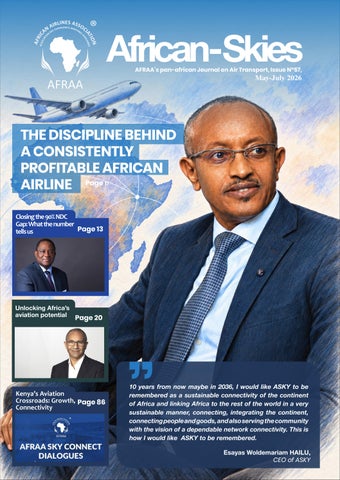
African-Skies AFRAA’s pan-african Journal on Air Transport, Issue N°57,
May-July 2026
THE DISCIPLINE BEHIND A CONSISTENTLY PROFITABLE AFRICAN AIRLINE Page 17
Closing the 90% NDC Gap: What the number Page 13 tells us
Unlocking Africa’s aviation potential Page 20
Kenya’s Aviation Crossroads: Growth, Page 86 Connectivity
10 years from now maybe in 2036, I would like ASKY to be remembered as a sustainable connectivity of the continent of Africa and linking Africa to the rest of the world in a very sustainable manner, connecting, integrating the continent, connecting people and goods, and also serving the community with the vision of a dependable network connectivity. This is how I would like ASKY to be remembered. Esayas Woldemariam HAILU, CEO of ASKY
For more information on marketing opportunities through sponsorship & exhibition, Please contact: Ms. Maureen Kahonge | Director, Commercial & Communications | Email: mkahonge@afraa.org For more information on Registration and delegate information, please contact: Ms. Dicie Okaya | Business Development and Training Coordinator | Email: dokaya@afraa.org
EDITORIAL
is possible when airlines move from fragmented purchasing to collective commercial power. Fifteen participating carriers are already combining approximately 2.1 billion litres of demand, creating negotiating leverage that individual airlines cannot achieve as effectively alone. But this is about more than securing a better price. It is about scale, transparency, quality assurance and collaboration across the supply chain. The same principle applies to distribution and technology. AFRAA and TPConnects’ work highlights a significant gap: many African airlines have yet to develop NDC capability, even though reducing distribution costs is a strategic priority across the industry. At the same time, a growing number are planning or implementing NDC. The message is clear:
From Fragmentation to Scale: Building the African Aviation We Need Africa’s aviation story is entering a decisive phase. Demand is growing. Markets are opening. Airlines are investing, partnerships are expanding, and technology is transforming how passengers buy and airlines operate. Yet growth alone is not enough. The real question is whether African aviation can convert this growing demand into sustainable, competitive and resilient airlines. Across this issue of African-Skies, one message emerges clearly: Africa’s aviation challenge cannot be solved by individual airlines acting alone. We must build scale, strengthen cooperation and change the way we approach the economics of air transport. Fuel provides a powerful example. Fuel remains one of the largest cost items for African airlines, while fragmented supply chains and external market exposure continue to put pressure on margins. AFRAA’s Joint Fuel Programme demonstrates what
the constraint is not vision, it is capacity. Modern airline distribution must therefore be viewed not simply as a technology project, but as a commercial competitiveness agenda. African airlines need greater control over their products, fares, customer relationships and distribution economics. We need solutions that make African itineraries easier to discover and book, strengthen interline and codeshare opportunities, support local payment realities and enable airlines to capture more of the value they create. Technology must serve connectivity. This brings us to one of the strongest messages from the airline leaders featured in this issue: we must stop operating in silos. Kenya Airways’ outgoing Ag. CEO George Kamal makes the case for stronger commercial, operational and technical cooperation. ASKY’s experience similarly demonstrates the importance of cost discipline, governance and cooperation in building sustainable airline businesses. The principle is simple: cooperate and compete. African airlines will continue to compete, but competition does not require us to duplicate infrastructure, fragment networks or allow valuable African traffic to be captured elsewhere. AFRICAN-SKIES N°58
3
We can compete while cooperating to build stronger networks. We can compete commercially while sharing capabilities, coordinating where appropriate and developing deeper interline, codeshare and strategic partnerships.
The opportunity is immense. But opportunity does not automatically become growth, and growth does not automatically become profitability.
Governments and regulators also have a critical role to play. Aviation should not be treated primarily as a source of taxation and charges. It is an economic multiplier — enabling trade, tourism, investment, employment and continental integration. When taxes, charges and restrictive market policies make air travel unaffordable or prevent airlines from scaling, Africa loses far more than airline revenue. It loses connectivity and economic opportunity.
scale over fragmentation, cooperation over isolation, implementation over declarations, efficiency over unnecessary cost, and long-term sustainability over short-term expediency.
At AFRAA, our responsibility is to help translate collective ambition into practical results. Through advocacy, market intelligence, partnerships and programmes such as joint fuel procurement and distribution transformation, we are working to strengthen the commercial foundations of African aviation.
4
AFRICAN-SKIES N°58
We must make deliberate choices:
Africa’s aviation future will not be built by one airline, one government or one institution. It will be built collectively. Let us therefore focus on ensuring that African aviation captures, sustains and owns that growth. The future of African aviation must be more connected, more competitive and more collaborative.
And the time to build it is now.
Abdérahmane Berthé Secretary General, AFRAA
CONTENTS
9
32
Empower Your Airline Through Modern Retailing, by TP Connects
36
FLEET MONITOR
42
RwandAir on the Power of Collective Bargaining Case for African Unity
44
Strategic Partnerships – Codeshares, joint ventures, alliances
The Missing Links in Africa’s Skies: The Routes We Need to Build
23
28
Major Announcements
“If Not Today, When?”: Kenya Airways Makes the Case for African Unity
49
RwandAir on the Power of Collective Bargaining Case for African Unity
AFRICAN-SKIES N°58
5
53
STARTUP WATCH
55
Strength in Numbers: How 15 African Airlines Turned 2.1 Billion Litres of Fuel into Leverage.
61
Routes Alerts
72
In the Field
78
Making African Air Travel More Affordable, Connected and Competitive
82
Leadership Moves
PUBLISHERS:
NAWA Comms — A NEWSAERO Brand (Communication & Creative Division of NEWSAERO) Managing Editor: Maureen Kahonge
Editorial Director: Romuald Ngueyap Senior Designer: Kouam Cabrel Proofreader: Nkengaka Junior
6
AFRICAN-SKIES N°58
85
Kenya’s Fiona Omondi Wins IATA High Flyer Award
90
AFRAA AIR TRANSPORT REPORT Quarter 1 - 2026
102
AFRICAN SKIES is published
Advertising :
NAWA Comms.
+237 656 260 282
quarterly for AFRAA by
Business Development Manager contact@nawaafrica.com
advertisement@nawaafrica.com Douala, Cameroon
Follow AFRAA on X, formerly known as Twitter @AFRAA
and join our LinkedIn Page
CONNECTING PEOPLE WITH SAFETY, EFFICIENCY AND INNOVATION
Conectando Pessoas com Segurança, Eficiência e Inovação
Our airports are not just gateways; they are spaces where safety is a priority, fficiency is our promise and innovation is the path to a more connected future. Os nossos aeroportos não são apenas portas de entrada. São espaços onde a segurança é prioridade, a eficiência é nossa promessa e a inovação o caminho para um futuro mais conectado.
SOCIEDADE GESTORA DE AEROPORTOS, S.A. Rua 21 de Janeiro, Aeroporto Internacional 4 de Fevereiro, C.P. 841 | Luanda - Angola (+244) 923 166 870
institucional@sga.co.ao
www.sga.co.ao
@sga_exploreangola
r o u t e i n s i g h t a n a ly s i s
The Missing Links in Africa’s Skies: The Routes We Need to Build
AFRAA’s latest Routes and Connectivity Report reveals a continent with strong aviation corridors, emerging regional hubs and significant untapped potential between African markets.
Route Map by Origin: Africa Active Routes in 2025
Africa’s aviation network is evolving. Airlines are expanding connectivity, restoring suspended services and exploring new markets. But beneath the headline of growth lies a more complex picture: Africa is moving more people by air, yet intra-African connectivity remains significantly less developed than domestic and international traffic. That is one of the central messages emerging from AFRAA’s Routes and Connectivity Report, H2 2025, which analyses route-level passenger traffic across domestic, intra-African and international markets using OAG Traffic Analyser data. The findings point to both progress and opportunity — and raise an important strategic question for African aviation: how do we move from a collection of strong aviation corridors to a truly integrated continental network?
Source: AFRAA, OAG Africa’s aviation network is anchored around a number of major gateways, while significant connectivity gaps remain across several markets. AFRICAN-SKIES N°58
9
r o u t e i n s i g h t a n a ly s i s
Domestic markets remain the strongest foundation
traffic foundation from which broader airline networks can develop. For Africa, the challenge is to replicate this connectivity effect across borders.
Domestic aviation continues to provide the largest volumes among the three markets analysed. The top 100 domestic routes carried approximately 13.4 million passengers during the second half of 2025, compared with 9.3 million international passengers and just 4.1 million on intra-African routes.
Total Passenger Volume by Scope
South Africa and Nigeria remain the strongest domestic aviation markets, supported by their large populations, multiple economic centres and established air transport networks. The Cape Town–Johannesburg corridor emerged as the busiest route overall, carrying approximately 1.99 million passengers during the review period. Durban–Johannesburg followed with 1.39 million, while Abuja–Lagos ranked third among the leading domestic corridors. These trunk routes demonstrate the power of concentrated demand. They connect major economic centres at high frequency and provide the
The intra-African opportunity The report identifies several important intra-African corridors, including Tripoli–Tunis, Harare–Johannesburg, Mogadishu–Nairobi, Algiers–Tunis and Entebbe–Nairobi. These routes connect important commercial, political and tourism centres. They also demonstrate the strategic importance of hubs such as Johannesburg, Nairobi, Tunis and Cairo in facilitating movement between African markets. Yet the overall numbers tell a compelling story. With only 4.1 million passengers across the top 100 intra-African routes, intra-African traffic remains considerably smaller than both domestic and international traffic. Moreover, much of the continent’s regional connectivity flows through a relatively small group of gateways rather than through a broad network of direct links between secondary markets. This is precisely where the Single African Air Transport Market (SAATM) becomes strategically important. SAATM seeks to reduce market fragmentation, expand direct air services and create more seamless connectivity across the continent. The report’s findings rein10
AFRICAN-SKIES N°58
Source: AFRAA, OAG Domestic routes carried 13.4 million passengers across the top 100 routes in H2 2025, compared with 9.3 million international and 4.1 million intra-African passengers.
force the need to move from policy commitment to practical implementation — particularly where liberalisation and fifth-freedom rights can unlock new city-pair opportunities.
Top 5 Intra-African Routes
Source: AFRAA,OAG Five corridors illustrate where regional demand is already strong — and where stronger network integration could create wider connectivity effects.
r o u t e i n s i g h t a n a ly s i s
A continent connected outward — but not always across
Route Map by Origin: Africa to Western Europe Active Routes H2 2025
Africa’s international connectivity tells another story. The strongest international corridors in the H2 2025 dataset were concentrated between North Africa and France, with Algiers–Paris Charles de Gaulle, Algiers–Paris Orly, Paris–Réunion, Paris–Tunis and Paris–Marrakech among the leading routes. The strength of this corridor reflects established economic, tourism, diaspora and historical links. But its dominance also highlights a potential vulnerability: Africa’s international connectivity remains concentrated around a relatively narrow set of corridors and markets. The report therefore points to the need for greater diversification — including stronger direct longhaul connectivity from additional African cities to a broader range of international destinations. This matters not only for passengers. Connectivity determines where tourism flows, where businesses invest, how easily goods and services move and how effectively African cities participate in global value chains.
The geography of the gap Perhaps the most striking finding comes from the regional connectivity analysis. Northern Africa recorded the highest connectivity rate at 74%. Yet connectivity between African subregions remains considerably weaker. The strongest inter-regional connectivity identified in the report — between Northern and Western Africa — stood at only 34%. Dense networks are visible around selected North, East, Southern and West African corridors. By contrast, several Central African markets remain comparatively thin. The report specifically identifies Chad, Niger and the Central African Republic as showing minimal to no route lines on the network maps. This is more than an aviation statistic. A connectivity gap can become an economic gap. Where direct air links are absent, passengers may have to travel through distant hubs, increasing journey times and costs. Businesses face less ef-
Source: AFRAA, OAG North Africa–Western Europe remains one of Africa’s densest international aviation corridors, illustrating both market depth and the concentration of international connectivity.
ficient access to markets. Tourism opportunities become harder to capture. And African airlines lose potential traffic to connections outside the continent.
From hubs to networks The report does not suggest that Africa is dependent on one dominant mega-hub. Instead, the data reveal a relatively distributed hub structure. Cairo is particularly significant, appearing among the leading hubs across domestic, intra-African and international markets. Johannesburg leads the intra-African hub rankings, while Nairobi, Tunis and Cairo also play important regional roles. This presents an opportunity. Rather than viewing African hubs purely as competitors, airlines and policymakers can increasingly consider them as complementary nodes in a continental network. That means developing stronger interline and codeshare arrangements, coordinating schedules where commercially viable, improving passenger transfer processes and using AFRICAN-SKIES N°58
11
r o u t e i n s i g h t a n a ly s i s
liberalisation tools such as fifth-freedom rights to connect markets that currently lack viable direct services. The objective should be connectivity that works for the passenger and for the African airline.
Turning demand into connectivity The report also offers an encouraging signal: traffic across most major route pairs is broadly balanced in both directions. Average directional imbalances were below 3% across all three market segments. This suggests that, on the continent’s strongest routes, demand is not fundamentally one-directional. The opportunity therefore lies in identifying where sufficient demand exists but connectivity remains constrained. That requires more sophisticated network planning. Airlines need to match aircraft size and frequency to market realities, particularly on lower-volume or highly seasonal routes. Regulators need to facilitate market access. Airports need to support efficient connections. And policymakers need reliable data to distinguish genuine market gaps from temporary or seasonal effects. AFRAA’s report recommends, among other measures, right-sized aircraft deployment, closer monitoring of SAATM implementation, greater use of fifth-freedom opportunities and deeper analysis of seasonal demand patterns.
12
AFRICAN-SKIES N°58
The bigger picture Africa’s aviation challenge is no longer simply about opening more routes. It is about building a smarter network. The continent already has strong domestic markets, powerful regional hubs and established international gateways. What remains unfinished is the connective tissue between them. The opportunity presented by SAATM is therefore not merely to liberalise markets, but to reshape the geography of African mobility — making it easier for a passenger in Nairobi to reach West Africa, for a business in Lagos to access Southern Africa, or for a tourist arriving through Cairo to continue seamlessly to another African destination. Africa has the demand. It has the airports. It has airlines capable of building regional networks. What it needs now is greater connectivity between the pieces. The next phase of African aviation should therefore be measured not only by how many passengers fly, but by how efficiently Africa connects its own people, cities and economies. That is where the real promise of a single African air transport market lies. Better connectivity is not simply an aviation objective. It is a continental economic imperative. The full report can be accessed via the AFRAA website: https://www.afraa.org/wp-content/uploads/2026/07/ Routes-and-Connectivity-Report_20_07_26_FJR.pdf
AFRAA DIARY
In Their Words
Closing the 90% NDC Gap: What the number tells us Abderahmane Berthe, Secretary General, AFRAA featured in TRAVEL DISTRIBUTION NEWS Q1. The AFRAA–TPConnects whitepaper published earlier this year put a striking number on the table: more than 90% of AFRAA member airlines currently have no NDC capability. From your position as Secretary General, what does that figure actually tell us about the structural realities facing African carriers, and what does it not tell us?
T
hat figure is significant, but it requires careful interpretation. What it tells us unambiguously is that the overwhelming majority of African carriers are still transacting through legacy GDS infrastructure that was not designed with their operating context in mind. It tells us that the shift to modern retailing has not yet reached our membership in any meaningful way, and that for most African airlines, NDC remains a distant ambition rather than an operational reality. But what the figure does not tell us is how alive African carriers are to modernization. This fact is corroborated by the same survey which found that over 40% of airlines are either planning or actively implementing NDC. There is an appetite. The constraint is not vision — it is capacity. Most AFRAA member airlines are small to mid-sized operators: 81% carry fewer than two million passengers annually, and 80% operate fleets of 15 aircraft or fewer. These are not organizations with
« Ce n’est pas la vision qui manque, c’est la capacité » Abderahmane Berthe, Secrétaire général de l’AFRAA, revient sur le chiffre marquant du livre blanc AFRAA– TPConnects : plus de 90 % des compagnies membres n’ont aujourd’hui aucune capacité NDC. Un constat qu’il invite à interpréter avec nuance. Un retard qui n’est pas un manque de volonté. Pour Abderahmane Berthe, ce chiffre traduit surtout la réalité d’écosystèmes aéronautiques sous-dotés en ressources, et non une absence d’ambition. La même enquête montre que plus de 40 % des compagnies planifient ou déploient
large IT departments or transformation budgets. The 90% figure reflects the consequences of under-resourced aviation ecosystems, not a lack of strategic will. What the number also does not capture is the diversity within it. Some of our members are well along the path; others are operating with on-premises infrastructure and no near-term cloud migration timeline. A single headline statistic flattens that complexity. Our work at AFRAA is to address the spectrum, not just the average. Q2. African airlines oper ate in a fundamentally different commercial environment to the carriers that have led NDC adop-
AFRICAN-SKIES N°58
13
AFRAA DIARY
tion globally. Legacy GDS dependency, thin margins, limited IT budgets, and fragmented market structures all play a role. In your view, which of these barriers is the most consequential, and which is the most misunderstood by the vendors and organizations pushing NDC adoption on the continent? The most consequential barrier, in my view, is the absence of inhouse technical capacity. You can address cost through financing mechanisms, you can address market fragmentation through interline and codeshare arrangements, but the deficit of skilled digital talent within African airlines is a structural problem that takes years to resolve. The whitepaper confirmed this: 60% of respondents reported difficulties integrating NDC with existing systems, and many airlines openly acknowledged they lack the in-house expertise to manage large-scale IT transformation. Without that internal capability, even well-designed solutions will not be implemented well. The most misunderstood barrier, in my experience, is agency and market readiness. Vendors arrive on the continent with technically sound products and assume that once the airline is equipped, distribution will follow. What they consistently underestimate is that the travel agent community in many African markets remains deeply embedded in GDS workflows. The incentive structures, the booking tools, the settlement mechanisms, all of it is built around existing intermediary channels. Any NDC adoption strategy that does not invest in agent training and transition support is building on an incomplete foundation. I would also add that the framing
14
AFRICAN-SKIES N°58
déjà le NDC. « La contrainte n’est pas la vision — c’est la capacité. » La plupart des membres de l’AFRAA sont de petits opérateurs : 81 % transportent moins de deux millions de passagers par an et 80 % exploitent 15 avions ou moins, sans grands départements informatiques ni budgets de transformation. Les vrais obstacles. Le plus déterminant, selon lui, est le déficit de compétences techniques internes : 60 % des compagnies interrogées peinent à intégrer le NDC à leurs systèmes existants. Le plus mal compris est la maturité des agences : les fournisseurs supposent qu’une fois la compagnie équipée, la distribution suivra, en sous-estimant à quel point les agents africains restent ancrés dans les flux GDS. Toute stratégie qui néglige leur formation « repose sur une fondation incomplète ». Une norme à adapter. Conçue pour de grands transporteurs à service complet dotés d’infrastructures PSS sophistiquées, la norme NDC ne sert pas, en l’état, la majorité des compagnies africaines. Abderahmane Berthe ne plaide pas pour son abandon mais pour son adaptation véritable : parcours modulaires et progressifs, solutions cloud-native sans intégration lourde sur site, et modèles commerciaux calibrés sur la base de revenus des petits opérateurs. Une distribution qui freine la connectivité intra-africaine. Le Secrétaire général dénonce des schémas tarifaires inadaptés : les frais GDS d’une réservation Nairobi-Mombasa sont comparables à ceux d’un Nairobi-Londres, alors que le tarif est bien moin-
of ‘barriers’ can obscure a more important point: African airlines are not simply behind on a universal adoption curve. They are navigating a distinct commercial environment that demands adapted solutions, adapted timelines, and adapted support models. The industry’s credibility with African carriers depends on acknowledging that. Q3. AFRAA has consistently advocated for African carriers on issues of infrastructure, regulation, and market access. What specific role should AFRAA be playing in the NDC transition, and what would meaningful industry-level support for African airlines actually look like in practice? AFRAA’s role in the NDC transition is threefold: policy, knowledge-sharing, and partnership facilitation. Let me take each in turn. On policy, AFRAA position is that the policy and standards environment evolve in ways that do not inadvertently disadvantage smaller carriers. Our recommendation on how NDC standards are developed and maintained is that the African operating context is represented in those conversations. Standards should not be designed exclusively around the realities of large full-service carriers in mature markets and then handed down to the rest of the world. On knowledge-sharing, AFRAA is well-positioned to act as a convener, bringing together member airlines to share experiences, surface common challenges, and identify what has
AFRAA DIARY
and has not worked. The collaboration with TPConnects that produced our joint whitepaper is one model of this. We intend to do more. Our platforms, including AFRAA workshops and masterclasses with our partners and events such as the AFRAA Aviation Stakeholders Convention, provide opportunities for exactly this kind of structured exchange. In partnership facilitation, we can help airlines access solutions they could not pursue individually. This means negotiating frameworks, identifying credible technology partners, and ensuring that vendors serving our membership deliver genuine value rather than simply extracting from airlines that lack the negotiating leverage of larger global carriers. What meaningful support does not look like is generic capacity-building programmes that are not calibrated to specific airline contexts. African airlines do not need more seminars. They need technical assistance that is embedded, practical, and measurable. Q4. There is a growing argument that the NDC standard, as currently designed and implemented, was built around the operational realities of large full-service carriers in mature markets. Do you believe the standard as it stands serves African airlines, or does it need to evolve to reflect the distribution realities of smaller, regional, and LCC operators across the continent? This is one of the most important questions in our industry right now. The NDC standard, as currently designed, does not adequately serve the majority of African airlines. It was conceived in an environment where airlines have sophisticated PSS infrastructure, mature IT de-
dre. Trop souvent, les trajets entre deux villes africaines sont tarifés via des hubs européens ou moyen-orientaux, et les accords d’interligne entre transporteurs africains restent difficiles à faire apparaître. Une infrastructure véritablement pensée pour l’Afrique devrait rendre ces partenariats visibles et réservables, refléter les réalités de paiement locales (dont le mobile money) et rester accessible aux petites agences. C’est l’ambition de l’initiative AFRAA Xchange. Le rôle de l’AFRAA. Il se décline en trois axes — politique, partage de connaissances et facilitation de partenariats — pour que le contexte africain soit représenté dans l’élaboration des normes et que les compagnies accèdent à des solutions négociées collectivement. « Les compagnies africaines n’ont pas besoin de davantage de séminaires. Elles ont besoin d’une assistance technique intégrée, concrète et mesurable. » Des perspectives prudemment optimistes. 18 % des compagnies prévoient d’achever leur transition NDC en un an, 28 % de plus d’ici deux à trois ans. Pour que le chiffre de 90 % évolue, trois conditions : une technologie plus accessible, un canal agences activé et des financements adaptés. « La fenêtre d’action est ouverte. Les transporteurs qui agissent maintenant seront mieux placés pour capter la croissance selon leurs propres termes. »
partments, and established relationships with technology integrators. Most of our member airlines have none of those in the same form or at the same scale. The standard is technically sound in its aims, including direct distribution, richer content, dynamic pricing, and offer and order management. The ambition is right. But the implementation pathway assumes a level of technical maturity and financial headroom that simply does not exist across much of the African airline sector. For a carrier operating six to fifteen aircraft with on-premises systems, which describes a significant portion of our membership, the path to NDC compliance is not a straightforward technology project. It is a wholesale transformation of commercial infrastructure. What I would advocate for is not the abandonment of the standard, but its genuine adaptation. That means modular, phased implementation pathways for smaller carriers. It means cloud-native solutions that do not require expensive on-premises integration. It means commercial models from technology partners calibrated to the revenue base of smaller operators, not priced on the assumption of large-carrier volumes. Q5. Intra-African connectivity remains one of the most persistent structural problems in African aviation. How does the current state of airline distribution technology either help or hinder progress on that challenge, and what would a distribu-
AFRICAN-SKIES N°58
15
AFRAA DIARY
tion infrastructure genuinely built for intra-African travel look like? Growth in Intra-African connectivity demands patience and disciplined route development. This effort is not cheap and requires cost discipline. Current distribution charging schemes completely disregard this fact. The GDS charges for a Nairobi-Mombasa booking are similar to a Nairobi-London booking even if the fare on the shorter trip is a small fraction of the longer flight. This makes the task of growing intra-African connectivity difficult. Therefore, while I cannot say the current state of airline distribution is the only cause for this structural problem, I can assert that it is not positively contributing. The current state of airline distribution technology actively hinders intra-African connectivity, and this is not discussed nearly enough. When an African traveler tries to book a journey between two African cities, particularly across regions, they often encounter fares that are priced through European or Middle Eastern hubs, because that is how the GDS infrastructure has historically routed and priced African itineraries. The technology is not neutral; it encodes a particular model of how African air travel is organised, and that model does not serve African travelers or African airlines. Fragmented distribution also means that interline and codeshare arrangements between African carriers, which are essential to building genuine intra-African networks, are difficult to surface through existing booking channels. An agent or traveller searching for an itinerary across two African carriers may simply not find it, or find it priced un-competitively, because the distribution infrastructure is not built to present those options clearly. A distribution infrastructure genuinely built for intra-African travel would require several key features. First, it would need to support the commercial relationships between African carriers: interlining, code-sharing, and eventually more sophisticated partnership models and make those relationships visible and bookable in a straightforward way. Second, it would need to reflect the payment realities of African markets, including the prevalence of mobile payments, the limited penetration of cards, and the role of local payment systems. Third, it would need to be accessible to the travel trade across the continent, including smaller agencies in markets with thin GDS coverage. This is the ambition of the AFRAA Xchange initiative, which seeks to close all these gaps. Q6. Looking at the next three to five years, what is your realistic outlook for NDC adoption among AFRAA member airlines? What conditions would need to be in place
16
AFRICAN-SKIES N°58
for that 90% figure to shift meaningfully, and which stakeholders bear the most responsibility for creating those conditions? My realistic outlook is cautiously optimistic, but with clear eyes about the pace of change. The survey data tells us that 18% of carriers plan to complete their NDC transition within a year, and a further 28% within two to three years. If those intentions translate into action, we would see a material shift in the landscape within the timeframe you describe. But airline transformation programmes are complex, and intentions do not always survive the rigors of budget cycles and operational pressures. The conditions that would need to be in place for the 90% figure to shift meaningfully are, in my view, the following. First, technology must become more accessible, both technically and commercially. Cloud-based, modular NDC solutions that can be deployed without extensive PSS integration work, priced at a point accessible to smaller carriers, would change the calculation for a significant number of our members. Second, the travel agency channel must be activated. As long as the majority of airline revenue in many African markets flows through agents who are not yet NDC-capable, airlines face a transition risk that deters investment. Agent training, incentive realignment, and B2B portal solutions that make NDC content accessible to agents are essential. Third, financing and technical assistance must be available on terms that reflect the realities of African airlines. The development finance institutions and multilateral bodies that invest in African aviation infrastructure can consider extending their attention to digital commercial infrastructure, not only to physical infrastructure. As for responsibility, it is distributed, but not equally. Technology vendors bear responsibility for designing and pricing solutions that serve smaller carriers, not just the global tier-one accounts. Governments and regulators bear responsibility for creating environments in which airlines can invest. And AFRAA bears responsibility for convening, advocating, and facilitating. This is precisely what we intend to continue to do. The window for action is open. African aviation is growing, and the carriers that move now to modernize their distribution will be better positioned to capture that growth on their own terms. That is the message we are carrying to our membership, and we are assisting this process through the AFRAA Xchange project.
Interview With...
The Discipline Behind a Consistently Profitable African Airline Esayas Woldemariam HAILU, CEO of ASKY
A
FRAA runs several Projects. We have the Joint Fuel Program. We have the Roots Network Coordination and Cargo. We have safety, technical and operations, training, distribution, aeropolitical and advocacy. sustainability market intelligence and various industry forums and events which of these initiatives has delivered the most tangible value to your airline and why that specifically Well, AFRAA is very active. It is running a lot of programs like joint oil procurement, free route airspace. and also SAF and many other things but the one which is very much practical for ASKY is that of line maintenance and part pool cooperation because in many stations we exchange like routes for changing of the aircraft wheels and we exchange some equipment and other things so this part pooling and line maintenance is the most effective for ASKY. If AFRAA didn’t exist, what’s the one thing your airline would struggle to do on its own?
Well, Africa is a big continent with 54 or 55 countries with so many civil aviation, so many airlines and there is AFCAC, there are governments and ministries. It would have been very much fragmented to coordinate with all of them single-handedly by each airline, even among the airlines. So AFRAAA being there, coordination is made seamless and it’s very much important for the industry’s advocacy within the continent. Where do you think AFRAA needs to be bolder for its members? Well, AFRAA needs to be more assertive, like when it comes to taking the level of advocacy from civil aviation to the ministries of transport and to the heads of state and being able to advocate in the interest of the airlines when it comes to the blocked funds. For example, there are so many central banks within the continent of Africa each government a central bank and there are also regional central banks. It is formidable type of process that we are in so AFRAA needs to be
more assertive on blocked funds and also many governments are leaving some additional charges for advanced passenger information system and all this. AFRAA needs to be more assertive to advocate in the interest of the airlines. Which new initiatives do you think AFRAA should undertake? Why? Well, AFRAA is taking a lot of initiatives, but now, AFRAA should be raising the level of advocacy from civil aviation and AFCAC to ministries of transport and to the government so that it can be able to preserve the interest of the airlines so on behalf of us especially you know the charges and taxes and other things are very high in the continent so AFRAA should be more active on that. Free Route Airspace has moved from a concept, to a WACAF trial, to full deployment and now Eastern and Southern Africa is next. In plain terms, what does flying a User Preferred Route actually change for your pilots and your bottom line? AFRICAN-SKIES N°58
17
Interview With...
Free Route Airspace is a very good project that AFRAA is running. You know, this shortens the flight time, saves fuel, saves cost, and it ensures better connectivity of some of the markets which, because of time shortage, would not have connected. It reduces crew duty time so it is highly advantageous both economically and also for operational excellence and most of all it is very good for the environment because it reduces the carbon emissions. AFRAA’s own figures point to real fuel and emissions savings from FRA in West and Central Africa. Has your airline seen those numbers show up yet, or is it still early? Definitely ASKY is starting to benefit from the cost advantage of the free route airspace. The only cost spoiler is some of the navigational routes which are out of ASECNA like Liberia, Sierra Leone and Guinea Conakry, their overflight charges even higher so when you use the free route airspace it is shorter but flying over them is more expensive so the saving that we get for fuel is offset by paying more for the navigational and overflight so apart from that in totality we are exhibiting some kind of cost saving from the free route airspace. ECOWAS recently took the landmark decision to abolish certain taxes and charges on air transport within the region. From ASKY’s perspective, what impact do you expect this decision to have on regional connectivity, passenger demand and the growth of aviation in West Africa? This reducing of taxes and charges and fees by ECOWAS is a very noble initiative. In fact, all other regional groups also need to follow suit and ECOWAS is spearheading this and we are highly thankful for the initiative of ECOWAS. This will have 18
AFRICAN-SKIES N°58
a positive impact. Number one, it democratizes air travel. It will make the price of the tickets cheaper and it will increase the traffic. But in the western part of Africa, it is not only taxes and charges which are inflating the flight ticket, but fuel cost is higher. Aviation infrastructure like airport navigational infrastructures, these are very expensive, access to finances and for maintenance and for leads, engine and aircraft all the finances which are highly forex denominated are also inflating the cost so in the future governments also need to invest more on their airlines to enable them to have better access to finances and reduce the cost of fuel in addition to reducing taxes and charges. However, this initiative is really benefiting and it will help the traffic increase. You’re preparing to add your first wide body aircraft and are eyeing Paris as ASKY’s first route to Europe. Why Paris, and why now? Well, why Paris means Western Central Africa is highly connected with Paris historically and because of language and because of relationship. So there is a lot of traffic from Western Central Africa bound to Paris and there is also diaspora in France. So there is a high demand from government, diplomatic businesses, visit family relatives and the diaspora. So that’s an obvious choice to fly to Paris. And why now, we couldn’t do it earlier? Because first we have to strengthen the regional traffic, feed connectivity and profitability needs to be strengthened. And now after we have discharged our responsibility of connecting the region, the next step is connecting the region with Paris. ASKY has been profitable for years. What’s the discipline behind that consistency, in a continent where carriers face high operating costs?
Well, for an airline, corporate governance and cost discipline is very important and ASKY is following that. So we try to have a very good network architecture. That’s number one. Number two, cost discipline and corporate governance in terms of procurement and other things. Number three, Africa-Africa cooperation, strategic cooperation with Ethiopian Airlines because it has a big network. So when we are procuring materials together with Ethiopian Airlines, we have volume discount and also we have very good traffic feed, which is also one of the key success factors for our success. So number one is cost discipline. Number two is corporate governance. Number three is cooperation within Africa with other airlines. This is a success factor that ASKY has been exhibiting. ASKY Airlines has built a reputation for connecting markets that were once difficult to access within West and Central Africa. What has been the key to successfully building a regional network in markets where connectivity has traditionally been fragmented, and what lessons can other African airlines learn from ASKY’s experience? ASKY wanted to succeed right from the beginning, 16 years ago, when we were established, we were determined for success. So what we did is we didn’t launch large number of routes with large number of aircrafts. So we had to start small and sustainably we have to upscale. We tag so many stations together. When the traffic builds, we detag them and we serve so many freedom traffic. So incremental, sustainable. Something which is closer to the reality so it is a sustainable growth that we have been conducting so other airlines would do well if they scale it up in a sustainable manner that will lead to success well
Interview With...
Ten years from now, what do you want people to say your airline did for African aviation? 10 years from now maybe in 2036, I would like ASKY to be remembered as a sustainable connectivity of the continent of Africa and linking Africa to the rest of the world in a very sustainable manner, connecting, integrating the continent, connecting people and goods, and also serving the community with the vision of a dependable network connectivity. This is how I would like ASKY to be remembered. What’s one thing you wish the flying public understood about what it takes to keep an African airline in the air?
Well, the flying public thinks that airlines are collecting big amount of money and pocketing it, but for airlines, because the margin is so small, If we sell a $100 ticket, $97 goes to the cost, only $3 comes to the bottom line. The public needs to understand that an airline is a low margin industry and cost of regulation, safety, preservation are all a costly endeavor. So the public needs to understand what kind of industry it is and it is giving essential connectivity to them. So they should be able to stand by our side as important stakeholders and understand how the industry functions.
line CEO today, what would it be? Well, AFRAA member airlines on the continent of Africa are industry colleagues. What I would like to leave them with one single thought is cooperate and compete. Cooperation and competition is co-competition. So we need to synergize our route network. We need to stagger our days of operation. We need to synchronize our schedule so that we can build a scale and defend Africa’s traffic for Africa’s airlines. Thank you.
If you could send one message to every other AFRAA member air-
ASKY : une croissance maîtrisée au service de la connectivité africaine
P
our Esayas Woldemariam Hailu, Directeur général d’ASKY Airlines, la coopération portée par l’AFRAA est irremplaçable : sans elle, coordonner l’action de plus de 54 États, autant d’autorités de l’aviation civile et des dizaines de compagnies serait « très fragmenté ». Il appelle l’association à plus de fermeté sur deux fronts prioritaires : les fonds bloqués dans les banques centrales du continent et la multiplication des taxes et redevances, en portant le plaidoyer au-delà de l’aviation civile, jusqu’aux ministères des Transports et aux chefs d’État. Le dirigeant salue le Free Route Airspace, qui raccourcit les temps
de vol, réduit la consommation de carburant, les temps de service des équipages et les émissions de carbone — même si les redevances de survol élevées de certains pays hors ASECNA (Liberia, Sierra Leone, Guinée) viennent en atténuer les gains. Il félicite également la CEDEAO pour l’abolition de certaines taxes, une décision qui « démocratise le voyage aérien » et que les autres regroupements régionaux devraient imiter. Rentable depuis des années, ASKY doit sa constance à trois piliers : discipline des coûts, bonne gouvernance et coopération intra-africaine, notamment avec Ethiopian Airlines
(achats groupés, alimentation du trafic). Fidèle à une stratégie de croissance progressive et durable — « commencer petit et monter en puissance » —, la compagnie s’apprête aujourd’hui à recevoir son premier gros-porteur pour ouvrir sa première liaison européenne vers Paris, choix dicté par les liens historiques, linguistiques et la diaspora. Son message à ses homologues africains tient en une formule : « coopérer et rivaliser ». « Nous devons synchroniser nos réseaux et nos horaires pour bâtir une échelle et défendre le trafic africain pour les compagnies africaines. »
AFRICAN-SKIES N°58
19
Partners
Unlocking Africa’s aviation potential By Raphael Haddad, President, Jetcraft Commercial
T
he African aviation market is often described as having high-growth potential.
That growth is underway, but it is constrained by a structural gap. Demand for air travel is rising across the continent, yet connectivity remains limited in many regions. With 54 countries and widely dispersed population centres, as well as limited transport alternatives, aviation is essential to economic activity and mobility across the continent. African airlines recorded the strongest international traffic growth of any global region in January 2026, with demand increasing 11.7% year-on-year (IATA), and yet, African operators still account for a small share of the global commercial fleet. The market is still catching up rather than reaching maturity, with demand building quickly whenever routes are introduced and capacity is added. The opportunity lies in enabling airlines to respond to this demand in a scalable way. 20
AFRICAN-SKIES N°58
Libérer le potentiel aérien de l’Afrique Le marché aérien africain progresse vite, mais reste freiné
par un déficit de connectivité. Avec 54 pays, des populations dispersées et peu d’alternatives de transport, l’aviation est essentielle à la mobilité du continent. En janvier 2026, les compagnies africaines ont affiché la plus forte croissance du trafic international au monde (+11,7 % sur un an, IATA) — tout en ne représentant qu’une faible part de la flotte mondiale. Les freins persistent : mise en œuvre inégale du SAATM, accès limité au financement et coûts élevés (redevances, carburant) qui pèsent sur la rentabilité. La stratégie de flotte devient un levier clé. Sur les lignes à faible densité, les avions
Constraints that continue to slow progress The barriers for Africa are well known and continue to shape how the market develops. Regulation remains one of the main challenges. There have been efforts to open up air travel between African states through the Single African Air Transport Market (SAATM), but implementation is uneven. Airlines are still restricted in how freely they can operate across borders, which limits network development and slows down connectivity between key markets. Financing is another important constraint. Access to capital has historically been limited, influenced by perceptions of risk and higher borrowing costs, which can restrict airlines’ ability to secure aircraft and invest in growth. Cost pressures also play a major role. Airlines across the continent face high airport charges, air navigation fees and fuel costs which have risen further in recent months, with some markets also experiencing supply constraints.
Partners
These factors directly impact profitability and limit operators’ ability to reinvest in fleet expansion. At the same time, infrastructure development varies widely. Some countries are investing in modern facilities and improving efficiency, while others continue to face operational constraints. Opportunity exists across the continent, but accessing it requires careful planning and a clear understanding of local conditions.
Fleet strategy as a growth lever Fleet decisions in Africa are closely linked to how airlines grow. African networks are built around thinner routes and developing demand.
régionaux et turbopropulseurs (ATR 72, Dash 8-400, Embraer E-Jet) développent la connectivité sans risque excessif. Face à la pénurie mondiale d’appareils, l’accès aux avions — via la location et l’occasion — devient déterminant. Chez Jetcraft Commercial, notre partenariat avec Absa Group illustre cette évolution. L’Afrique ne manque pas de demande : l’enjeu est de réunir les conditions pour y répondre.
This supports the use of regional aircraft and turboprops, such as the ATR 72, Dash 8-400 and Embraer E-Jet family, which allow airlines to build connectivity without taking on unnecessary risk. These aircraft are well suited to shorter runways and secondary airports, which remain common across the continent. Narrowbodies play an important role on higher-density routes, but overall, aircraft requirements are driven by flexibility rather than scale. Airlines need to match capacity to demand and build networks gradually. Airline capacity is now being shaped by a global shortage of aircraft. New deliveries are limited and the secondary market is tight. Airlines are increasingly turning to leasing and pre-owned aircraft to secure capacity, focusing on what is available in the near term rather than waiting for future delivery slots. Access to aircraft has therefore become a key factor in determining how quickly airlines can expand. In a constrained market, it is increasingly important for airlines to work with trusted advisors that understand both local market conditions and the global aircraft landscape. Inventory is not always available through traditional channels, particularly for operators working within tight timelines or specific fleet requirements. Access to global networks, market insight and transaction expertise can play a key role in helping carriers secure the aircraft they need to support growth.
Financing and growing confidence African carriers are building stronger track records and improving operational performance. As a result, confidence among financiers is increasing. There is capital available, including from within Africa, but it requires clear planning and disciplined execution.
More transactions are now being completed, which is helping to build momentum and demonstrate that the market can support investment. As this continues, access to financing should become more straightforward for airlines with credible business models. At Jetcraft Commercial, we are actively supporting this shift. Our partnership with Absa Group is one example of how access to financing is evolving, helping to unlock new pathways for airlines to secure aircraft and structure transactions more effectively. By combining regional banking expertise with global aircraft trading experience, we are enabling carriers to move forward with greater confidence.
Turning potential into reality Africa’s aviation sector remains underdeveloped relative to its population and economic potential, but the direction of travel is clear. Demand is growing, airlines are gaining experience, and the wider ecosystem is evolving. Africa does not lack demand. The focus now is on ensuring the right conditions are in place to meet it. Unlocking the next phase of growth will depend on consistency. Governments need to create the right conditions through policy and cost structures. Airlines must continue to take a disciplined approach to fleet and network planning. Industry partners play a role in providing access to aircraft and supporting complex transactions. At Jetcraft Commercial, we see this progress taking shape across the continent. By combining regional understanding with global reach, we support airlines in securing the aircraft they need to grow. To find out more, visit https://www.jetcraft.com/ inventory/commercial/
AFRICAN-SKIES N°58
21
Airlines in Action
Major Announcements
United Nigeria Airlines Joins AFRAA as Full Member
A
FRAA Targets Free Route Airspace Rollout in Eastern, Southern Africa by End-2026 AFRAA plans to extend its Free Route Airspace project to Eastern and Southern Africa by end-2026, following its West and Central Africa launch. Secretary General Abdérahmane Berthé said AFRAA will meet ICAO and regional authorities to plan test flights. Backed by Afreximbank, the system cuts fuel use, flight times, and emissions.
AFRAA has admitted United Nigeria Airlines as a Full Member, expanding its presence in Nigeria’s dynamic aviation market. The Enugu-based carrier, IOSA-certified and serving 14 domestic routes plus regional destinations, gains access to AFRAA’s advocacy, commercial intelligence, and capacity-building resources—reinforcing both parties’ commitment to advancing the Single African Air Transport Market.
L’AFRAA a admis United Nigeria Airlines en tant que Membre à part entière, renforçant sa présence sur le marché aéronautique dynamique du Nigeria. Basée à Enugu et certifiée IOSA, la compagnie dessert 14 routes domestiques et des destinations régionales, bénéficiant désormais du plaidoyer, de l’intelligence commerciale et du renforcement des capacités de l’AFRAA, au service du Marché unique du transport aérien africain.
L’AFRAA prévoit d’étendre son projet d’Espace Aérien à Routes Libres à l’Afrique de l’Est et australe d’ici fin 2026, après son lancement en Afrique de l’Ouest et du Centre. Le Secrétaire général Abdérahmane Berthé annonce des rencontres avec l’OACI et les autorités régionales pour planifier des vols d’essai. Soutenu par Afreximbank, le système réduit carburant, temps de vol et émissions.
AFRICAN-SKIES N°58
23
Airlines in Action
Egyptair Joins IATA Alliance to Boost CORSIA Carbon Credit Supply
E
gyptair has joined IATA’s newly launched Supporting Alliance for CORSIA Eligible Emissions Units (EEU) Supply, becoming one of over 32 founding members committed to accelerating the availability of 225–250 million eligible carbon credits by spring 2027. The Alliance pools resources to clear market bottlenecks and provides implementation assistance to governments ahead of CORSIA’s first compliance deadline in December 2027, reinforcing Egyptair’s commitment to sustainable aviation and the Paris Agreement. Egyptair a rejoint la nouvelle Alliance de soutien à l’offre d’Unités d’Émission Éligibles (EEU) du CORSIA, lancée par l’IATA, devenant l’un des plus de 32 membres fondateurs engagés à accélérer la disponibilité de 225 à 250 millions de crédits carbone éligibles d’ici le printemps 2027. L’Alliance mutualise les ressources pour lever les blocages du marché et accompagne les États avant la première échéance de conformité de décembre 2027, réaffirmant l’engagement d’Egyptair en faveur d’une aviation durable et de l’Accord de Paris.
LAM Mozambique : 56 % du capital transférés à trois entreprises publiques, appuyés par 4 millions de dollars de subventions
M
ozambique transferred 56% of LAM to stateowned firms HCB, EMOSE and CFM in 2025, part of a $130 million rescue plan, while maintaining $4 million in public subsidies, per the government’s 2025 State Account. The IMF warned of fiscal risk, and the restructuring has been accompanied by criminal proceedings against former executives and workforce reductions as LAM continues its turnaround under Emirati advisory firm Knighthood Global.
24
AFRICAN-SKIES N°58
Le Mozambique a transféré 56 % du capital de LAM aux entreprises publiques HCB, EMOSE et CFM en 2025, dans le cadre d’un plan de sauvetage de 130 millions de dollars, tout en maintenant 4 millions de dollars de subventions publiques, selon le Compte général de l’État 2025. Le FMI a alerté sur le risque budgétaire, tandis que la restructuration s’accompagne de poursuites pénales contre d’anciens dirigeants et de réductions d’effectifs.
Airlines in Action
TAAG Receives EASA Authorization to Operate the Boeing 787 and Strengthens Its Presence in the European Market
T
AAG Angola Airlines announced on June 19, 2026 that the European Union Aviation Safety Agency (EASA) has authorized the operation of its Boeing 787-9 Dreamliner within European airspace, confirming compliance with EASA’s technical and operational standards. The aircraft will be introduced on the Luanda–Lisbon route, one of TAAG’s most strategic international connections, offering passengers a more modern travel experience while strengthening the airline’s competitiveness in Europe. Chairman Clóvis Rosa said the authorization represents important recognition of TAAG’s technical, operational and regulatory compliance work, reinforcing the airline’s credibility among international authorities, partners and customers. The integration of the 787 fleet forms part of TAAG’s broader fleet modernization strategy, aimed at enhancing safety standards, operational efficiency, passenger experience and long-term competitiveness as the airline continues advancing the regulatory processes needed to expand the aircraft’s role across its international network.
TAAG Angola Airlines a annoncé le 19 juin 2026 que l’Agence de l’Union européenne pour la sécurité aérienne (EASA) a autorisé l’exploitation de son Boeing 787-9 Dreamliner dans l’espace aérien européen, confirmant sa conformité aux normes techniques et opérationnelles de l’EASA. L’appareil sera déployé sur la liaison Luanda–Lisbonne, l’une des connexions internationales les plus stratégiques de TAAG, offrant aux passagers une expérience de voyage plus moderne tout en renforçant la compétitivité de la compagnie en Europe. Le président du conseil d’administration, Clóvis Rosa, a déclaré que cette autorisation représente une reconnaissance importante du travail technique, opérationnel et réglementaire mené par TAAG, renforçant sa crédibilité auprès des autorités internationales, partenaires et clients. L’intégration de la flotte de 787 s’inscrit dans la stratégie plus large de modernisation de flotte de TAAG.
LAM Mozambique Swings to Profit in 2025 Mozambique transferred 56% of LAM to state-owned firms HCB, EMOSE and CFM in 2025, part of a $130 million rescue plan, while maintaining $4 million in public subsidies, per the government’s 2025 State Account. The IMF warned of fiscal risk, and the restructuring has been accompanied by criminal proceedings against former executives and workforce reductions as LAM continues its turnaround under Emirati advisory firm Knighthood Global.
La compagnie publique mozambicaine LAM est revenue à la profitabilité en 2025 avec un bénéfice net de 72,6 millions d’euros, effaçant une perte de 54,1 millions d’euros, selon des états financiers obtenus par Lusa le 13 juillet 2026. Ce redressement s’explique par un effacement de dette soutenu par l’État dépassant 81 millions d’euros. Les revenus ont reculé à 108 millions d’euros, tandis que LAM reste sous surveillance pour des irrégularités d’achat d’appareils.
AFRICAN-SKIES N°58
25
Airlines in Action
Ethiopian Airlines Posts Record $9 Billion Revenue for 2025/2026 Fiscal Year
E
thiopian Airlines Group reported record revenue of $9.1 billion for FY2025/2026, up 19.74% year-on-year, despite disruptions from Middle East instability, CEO Mesfin Tasew said in Addis Ababa. The airline carried 20.4 million passengers and 897,975 tonnes of cargo, adding nine aircraft and four international routes. Ethiopian targets 60 million annual passengers and a 350-aircraft fleet by 2040, anchored by the new Bishoftu mega-hub.
Ethiopian Airlines Group a annoncé un revenu record de 9,1 milliards de dollars pour l’exercice 2025/2026, en hausse de 19,74 %, malgré des perturbations liées à l’instabilité au Moyen-Orient, selon le PDG Mesfin Tasew. La compagnie a transporté 20,4 millions de passagers et 897 975 tonnes de fret. Ethiopian vise 60 millions de passagers annuels et une flotte de 350 appareils d’ici 2040, avec le futur mega-hub de Bishoftu.
Kenya Airways Adopts AI-Powered Pricing Platform Jupiter 5.0
K
enya Airways has adopted Jupiter 5.0, an AI-powered pricing platform from FlyNava Technologies, to deliver more competitive fares, faster updates, and consistent pricing. The platform integrates market intelligence, scenario simulation, and decision execution into one governed workflow. “Jupiter 5.0 will help us manage pricing complexity with both speed and discipline,” said Chief Strategy Officer Hellen Mathuka, strengthening Kenya Airways’ competitive position and customer value.
26
AFRICAN-SKIES N°58
Kenya Airways a adopté Jupiter 5.0, une plateforme tarifaire basée sur l’IA développée par FlyNava Technologies, pour proposer des tarifs plus compétitifs, des mises à jour plus rapides et une tarification cohérente. La plateforme intègre veille marché, simulation de scénarios et exécution des décisions en un flux unique. Cette adoption renforce la position concurrentielle de Kenya Airways et la valeur offerte à ses clients
Airlines in Action
Air Algérie to Launch Dedicated Aircraft Maintenance Company
A
ir Algérie has announced the creation of a dedicated aircraft maintenance company, expected to become operational before the end of 2026 to support fleet modernization. CEO Hamza Benhamouda unveiled the plan on July 11 during a ceremony marking the delivery of two new aircraft, presided over by Transport Minister Saïd Sayoud, as the carrier expands its industrial capabilities beyond fleet renewal toward greater operational autonomy.
Air Algérie a annoncé la création d’une société dédiée à la maintenance aéronautique, dont la mise en service est prévue avant fin 2026 pour accompagner la modernisation de la flotte. Le PDG Hamza Benhamouda a dévoilé ce projet le 11 juillet, lors d’une cérémonie marquant la réception de deux nouveaux appareils, présidée par le ministre des Transports Saïd Sayoud, alors que la compagnie renforce son autonomie industrielle.
AFRICAN-SKIES N°58
27
Interview With...
“If Not Today, When?”: Kenya Airways Makes the Case for African Unity George Kamal, Acting Group Managing Director & CEO, Kenya Airways, and Chairman, AFRAA Executive Committee
A
FRAA runs several Projects. We have the Joint Fuel Program. We have the Roots Network Coordination and Cargo. We have safety, technical and operations, training, distribution, aero political and advocacy. sustainability market intelligence and various industry forums and events which of these initiatives has delivered the most tangible value to your airline and why that specifically Okay, let me start with the joint fuel program. The joint fuel program has delivered the greatest value fuel represents between 30 to 40 percent of the African airline operating cost. Any improvement even one percent in fuel costs has a direct impact on profitability combined with AFRAA’s market intelligence and procurement initiative, members gain stronger negotiating power and better visibility of fuel market trend because the
28
AFRICAN-SKIES N°58
economy of scale. So, this is more or less the biggest impact but definitely we cannot deny the training part which is which is working pretty well with AFRAA and also the MRO and we’ve seen that with the first MRO conference which took place in Addis Ababa recently and we’re looking for the second one to come next year. I do believe you have to belong somewhere to have this economy of scale and a support from all those airlines. So imagine you have about 49 or 50 members they are all standing together that’s an economy of scale when we procure something altogether and it’s not limited to those elements only it’s actually much bigger and now we’re looking at even looking at the blocked funds looking at some more some more avenues to support the airlines and I do like to take this opportunity to thank the AFRAA Secretariat and management that they worked very hard to achieve those achieve-
ments we have with the fuel and other areas as well. Free Route Airspace has moved from a concept, to a WACAF trial, to full deployment and now Eastern and Southern Africa is next. In plain terms, what does flying a User Preferred Route actually change for your pilots and your bottom line? For pilots, it means flying the most efficient route rather than following a fixed air corridor. For the airlines, every minute saved reduces fuel burn, emissions and operating costs. Saving just five minutes on a flight across hundreds of flights and hundreds of sectors, each month creates a significant annual saving. So it’s not only for the pilot, it’s also for the environment. So when you look at the environment, it really has a huge impact. And did Kenya Airways also see a benefit beyond the pilots and beyond all this? Ken-
Interview With...
ya Airways have seen a huge benefit out of that. Kenya Airways participated in the pilot program and we have already seen measurable improvements in route efficiency and fuel consumption. Even, as I said, a 1% reduction in fuel Burn delivers substantial financial savings while supporting our sustainability commitment. What can African airlines do collectively to improve the intra-African connectivity? Currently, African Airlines are working in silos. Everyone works on his own. We need to cooperate more than compete. And Africa has over 1.4 billion people. Yet, intra-African connectivity remains among the lowest globally through codesharing, schedule coordination, interline agreement. And we try to push for a full-time implementation. We can connect many more African cities directly. That’s why we’re looking now in Africa to expand our wings, to go beyond the association to the Pan-African Alliance where we collectively stand together commercially from a network and from a commercial perspective and from operational perspective and technical as well. We don’t have a consolidated MRO team like a pool. We don’t have a pool for maintenance. We don’t have a network which looked at together. So we need to do all this. and we need to be a unity in Africa to make sure that we gain the momentum and gain the revenues required. You came into this role from operations flight ops, safety, network execution. How has that background shaped the first few months of decisions you’ve had to make as acting CEO?
I came from operations, I can see what is happening in the kitchen, behind the scene. So when you come and take a decision, you take a decision based on data and informed data, you’re not taking a decision haphazard, you’re not moving into a direction which is you don’t know where you’re going so my operation background taught me that safety and execution comes first. Since taking over, we have focused on operational discipline improving on-time performance it went from an old 2023 of 46% up to 89% at some stage while strengthening reliability, financial performance and customer experience. Good strategy only creates value when it is consistently executed. Across Africa we continue to face high operating costs, infrastructure challenges and fragmented markets. Which issue do you believe requires the greatest collective action from airlines and governments and why? First of all, let’s look at the governments. Governments needs to look at airline instead of tax milking. We need to look at it as aviation infrastructure. Airlines contributes directly into the GDP. We know some airlines contribute up to 23 to 26% of the GDP. However, other airlines contribute, we contribute about 3.2 to 3.5% of the Kenyan GDP. So that is a big impact on the country. That’s why you need to look at it as aviation infrastructure. From an airline perspective, airlines need to work together, even if the countries are not tied together airlines needs to put hand in hand because that’s the only way. Let’s think about it this way, an airline with 30 aircrafts you need to go to 150 destinations, how can you do that you’re not go-
ing to buy aircrafts every day but you can do an interline you can do a code-share you can do an agreement with other airlines that means you expand the scope. We’ve done this with a lot of airlines we have it with KLM and Air France we have it with Emirates, we have it with Qatar, and all those inputs gives my passenger, my customer, the possibility to fly to more destinations, to fly more routes, and I don’t have to have 150 routes, but other airlines have. If we add it together, we will do a very good network together. The JKIA’s modernization project valued at 154.2 billion Kenya Shillings has recently been signed. As the airport’s home carrier, what are the stakes for Kenya Airways and the future plans of the airline? Okay, definitely, this is a transformation investment into JKIA. The future plan for the airline is to grow and the growth we’re looking at 60 aircrafts within the next within 2030 and within the next 10 years, we’re looking to go into 100 aircrafts in total these 100 aircrafts or 60 aircrafts coming up they need a place, they need a parking spot and that is what JKIA is providing to us in the medium and long-term investment they are putting in the airport. And this will put this airport in somewhere very important in the map because it will increase the number of passengers up to 22 to 23 million passengers. Instead of you are today looking at 9 million, then you will go even more than double. It means for Kenya Airways, it’s strengthened the position of Kenya Airways and Kenya Airways is an enabler to support that growth so it is it is both ways it grows Kenya Airways and it ensures that Kenya Airways when it’s growing as well it it’s tied together as well grows the number of passengers comes into AFRICAN-SKIES N°58
29
Interview With...
the country we actually contribute about 60 percent 60 to 65 percent of the total number of passengers arriving into JKIA. Kenya Airways is, since recently, holding the chair of AFRAA’s Executive Committee. What does continuity mean for how AFRAA’s broader agenda gets carried forward? Okay, continuity means maintaining momentum. We have built strong progress on connectivity, sustainability, advocacy, collaboration. As a chairman, my priority is to convert strategy into measurable outcomes that benefits every member of the AFRAA and every airline. If AFRAA didn’t exist, what’s the one thing your airline would struggle to do on its own? I will tell you, I’ll take the first thing I told you about that it made a lot of savings to us, is the fuel. You know, the fuel constitutes about 40% of my cost. And today, with AFRAA procuring this fuel as an economy of scale, it actually reduces my cost. I will be struggling to work on that angle on my own. Every airline will be fragmented to run. We are more than, I think, 15 or 16 airlines. All of us are benefiting out of it and we want more to come and benefit out of this. It’s a pool and we want more to come and benefit out of this procurement. Where do you think AFRAA needs to be bolder for its members? AFRAA needs to stand up. And when we see some of the current situations like taxes, like imposing new restrictions, we need to be bolder and we need to stand up 30
AFRICAN-SKIES N°58
and try our best to support our members, to open up the borders, to support SAATM, and to support the members in achieving their goals, reducing the overflying within Africa, at least within the African continent, for African Airlines. And that’s one of the things which we need to work on, and we are actually working on through the alliance we are trying to put in place. Which new initiatives do you think AFRAA should undertake? Why? The one I just mentioned is the biggest one because it has an umbrella under AFRAA, which has underneath a lot of initiatives, which is number one, is an alliance. Number one, we need to be together. Once we are together, then we start moving into the right direction, which is we get the alliance in place and we start moving. We do the committees and then we start moving with that into the right direction. which is the collaboration commercially, and it will benefit everybody. It will benefit even the other global alliance. And this is not a global, It’s actually an alliance within Africa only. Ten years from now, what do you want people to say your airline did for African aviation? What my airline have did for African aviation? Number one, I want the people to say that Kenya Airways have connected people, have ensured to connect markets between at least East Africa and the Sub-Sahara and South Africa. And now we expand also to the North that we connect those markets together, not only as my airline, but I’m speaking about all the airlines in Africa when they are putting hand to hand. Because this moment and
today, if we don’t do it, who will do it? Nobody else, And if it’s not today, when is it going to be? In 10 years? Let’s do it today. Let’s work together today to achieve that in 10 years people will speak about us and say, 10 years ago we were fragmented. Now we are one unit. Europe is able to be a unity. Why can’t we? What’s one thing you wish the flying public understood about what it takes to keep an African airline in the air? The one thing I want them to understand is if they look at IATA today and look at the revenue per seat in Africa. And please take a look there, you will see the revenue per seat in 2026 is $1.3. Not the revenue, the net profit is $1.3. If it is $1.3, that means there is a huge cost behind us. And this cost comes into the cross-border cost, over-flying cost, taxes, all of those are costs. Fuel, labor, manpower, all of those are costs. All what I want the public to understand that, yes, we have the tickets are expensive in Africa, more expensive than anywhere else. But this is because our costs are very high. But if you look at the IATA data, the net profit per seat is $1.3. That’s what I get per seat. And where do we get our money? We get it from ancillaries, we get it from cargo, we get it from diversifying the business. And this is what I want the people to understand. That airline is not made only to make money. It’s to make money, yes, not to lose money. And at the same time, in parallel, the airline is there as a gateway. And we’ve seen that in the Gulf War. When the Gulf War happened and all the airlines in the Gulf have ceased the oper-
Interview With...
ations, if you don’t have a national carrier to support your people, your people will be stranded. Kenya Airways have listened to the voices of the Kenyans and we went with the first two flights to evacuate everybody immediately from Dubai. And we’ve done that. And we’ve done it before, during COVID and during a lot of other times. And that’s the
reason for the presence of National Carrier. It’s your gateway. If you could send one message to every other AFRAA member airline CEO today, what would it be? I would say thank you for supporting AFRAA. Thank you for believing in the African Aviation and in
AFRAA. And I would say let’s keep working together. Let’s put hands together. Let’s work on a commercial plan, an operational plan, and a technical plan. Let’s work together, not in silos, but work together as one unit. And if we do that, we will all win. We will all be winning at the end. Thank you.
Kenya Airways : « Cessons de travailler en silos »
P
our George Kamal, Directeur général par intérim de Kenya Airways et Président du Comité exécutif de l’AFRAA, le programme conjoint d’achat de carburant est l’initiative la plus décisive : le carburant pèse 30 à 40 % des coûts d’exploitation, et l’effet d’échelle de près de 50 compagnies membres renforce leur pouvoir de négociation. À cela s’ajoutent la formation et la maintenance (MRO), qu’il souhaite mutualiser dans un véritable pool africain.
Son diagnostic est clair : avec plus de 1,4 milliard d’habitants, l’Afrique affiche l’une des plus faibles connectivités intra-continentales
au monde. La réponse passe par le partage de codes, la coordination des horaires, les accords interlignes et, surtout, la mise en place d’une Alliance panafricaine — commerciale, opérationnelle et technique. « L’Europe a su faire son unité. Pourquoi pas nous ? » Issu des opérations, il revendique une gestion fondée sur la donnée : la ponctualité de Kenya Airways est passée de 46 % (2023) à 89 %. Il attend des gouvernements qu’ils cessent de voir les compagnies comme une source de taxes pour les considérer comme une infrastructure aérienne — Kenya Airways contribuant à hauteur de
3,2 à 3,5 % du PIB kényan. La modernisation de JKIA (154,2 milliards de shillings) doit accompagner sa croissance vers 60 avions d’ici 2030 et 100 à terme. Enfin, il rappelle la fragilité économique du secteur — un bénéfice net de seulement 1,3 dollar par siège — et le rôle vital du transporteur national, « votre porte d’entrée », qui a évacué ses ressortissants lors de la guerre du Golfe comme pendant la COVID. Son message aux dirigeants africains : « Travaillons ensemble, pas en silos. Si nous le faisons, nous gagnerons tous. »
AFRICAN-SKIES N°58
31
Partners
Empower Your Airline Through Modern Retailing, by TP Connects
I
ntroduction: NDC Distribution Powers Modern Retailing
In today’s competitive airline industry, agility, flexibility, and personalization are no longer optional, they are imperative. As traveler expectations evolve and airlines race to stay competitive, traditional distribution methods through legacy GDS systems are becoming increasingly outdated, limiting airlines’ ability to showcase their full value proposition. NDC has emerged as the cornerstone of modern airline retailing, enabling airlines to distribute rich, differentiated content branded fares, ancillaries, and bundles - directly to travel sellers while maintaining control over pricing, customer experience, and margins. However, successful NDC adoption isn’t just about implementing the standard; it’s about solving the distribution challenge: how to efficiently reach diverse partners globally, from sophisticated TMCs requiring API integration to regional agencies needing user-friendly portals, all while maintain-
32
AFRICAN-SKIES N°58
Le retailing moderne, nouveau moteur des compagnies aériennes Dans un secteur aérien toujours plus concurrentiel, agilité, flexibilité et personnalisation ne sont plus des options. Face à des systèmes GDS traditionnels devenus obsolètes, la norme NDC s’impose comme la pierre angulaire du retailing aérien moderne : elle permet aux compagnies de distribuer un contenu riche et différencié — tarifs de marque, services annexes, offres groupées — directement aux vendeurs de voyages, tout en gardant la maîtrise des prix, de l’expérience client et des marges. Le vrai défi n’est pas d’adopter la norme, mais de distribuer efficacement à des partenaires très divers, des grandes TMC exigeant une intégration API aux agences régionales privilégiant un portail simple. C’est la réponse qu’apporte TPConnects avec sa plateforme Astra, qui combine passerelle API NDC et portail B2B pour couvrir tous les types de partenaires, réduire la complexité technique et accélérer l’expansion vers de nouveaux marchés. AirCairo en est l’illustration : la compagnie a récemment étendu son partenariat avec TPConnects pour enrichir son offre, fluidifier son service après-vente et élargir sa
ing operational efficiency and commercial control. The complexity of NDC distribution includes: • Multi-channel management: Supporting partners with varying technical capabilities • Content differentiation: Delivering personalized offers across channels while maintaining brand consistency • Servicing automation: Enabling seamless post-booking changes, cancellations, and refunds • Commercial flexibility: Managing pricing, commissions, and content access by partner type • Scalability: Expanding distribution reach with limited additional costs and operational overhead • Time to market: Connecting new APIs to an airline’s distribution channel in weeks rather than months At TPConnects, we’re at the forefront of this transformation, helping airlines embrace modern NDC distribution and modular retailing through our Astra platform. How Astra Enables Compre-
Partners
hensive NDC Distribution TPConnects’ Astra NDC solves the NDC distribution challenge through a comprehensive approach that combines technical sophistication with operational simplicity. Astra NDC API Gateway: Scale Technical Partner Integration Astra’s NDC API Gateway enables airlines to distribute rich content to travel sellers and distribution partners efficiently. The platform delivers real-time inventory, pricing, branded fares, ancillaries, seat maps, and bundles to your distribu-
distribution. « Cela renforce l’engagement d’AirCairo en faveur d’une distribution moderne », souligne Ahmed Aziz, VP Commercial. Au-delà du NDC, Astra ouvre la voie au retailing modulaire promu par l’IATA (cadre RP1786a) et à la bascule vers le « 100 % Offers & Orders ». Les compagnies peuvent ainsi choisir les meilleures briques technologiques, gagner en efficacité et proposer des offres personnalisées. Contact : TPConnects.
tion network - maintaining full NDC standards compliance with flexibility to support partners at different technical maturity levels. The platform enables content distribution tailored to channel and customer context, while providing end-to-end booking flow management from shopping to post-booking modifications. Automated disruption handling, proactive notifications, and real-time order synchronization streamline servicing operations. Airlines maintain commercial control through channel-specific content and pricing strategies, and performance analytics. Astra B2B Agency Portal: Distribution Without Technical Barriers Astra provides a full-featured B2B portal for agency partners with an intuitive booking interface, real-time search and ticketing, and advanced servicing for modifications, cancellations, and refunds. By combining API Gateway and B2B Portal, Astra enables airlines to serve all partner types. This approach eliminates distribution gaps, reduces technical complexity, and accelerates expansion into new markets. AirCairo’s NDC Distribution Success AirCairo exemplifies how airlines can leverage Astra’s comprehensive NDC distribution capabilities to transform their go-tomarket strategy. Already utilizing Astra’s NDC API Gateway and B2B Agency Portal, the airline recently expanded its partnership with TPConnects to further leverage the Astra platform and deliver rich, differentiated content with seamless interoperability, advanced end-to-end servicing, and superior retailing functionality. This transformation enables AirCairo to: • Broaden access to ancillary products and bundled services
• Offer greater flexibility to travel partners • Optimize operational workflows • Expand distribution reach • Accelerate integration deployment AirCairo’s VP of Commercial, Ahmed Aziz, stated: “Extending our partnership with TPConnects underscores AirCairo’s commitment to modern air distribution. By utilizing Astra’s advanced NDC and B2B Portal capabilities, we provide our partners with seamless access to our fares and services, driving convenience and value for travelers worldwide.” AirCairo’s approach shows how airlines are not just adopting new technologies but actively transforming their operations to meet the future needs of travel. Modularity: The Foundation of Modern Airline Retailing With NDC as the foundation, airlines like Air Cairo can begin their journey towards modular airline retailing. Modular airline retailing is a strategic approach championed by IATA that empowers airlines to adopt best-of-breed solutions without being locked into monolithic platforms. This approach is based on IATA’s RP1786a framework, which divides airline retailing into five business domains: 1. Product Management 2. Offer Management 3. Order Management 4. Finance Management 5. Delivery Management
Rather than being locked into a single provider for all domains, airlines now have the flexibility to choose best-of-breed solutions AFRICAN-SKIES N°58
33
Partners
that integrate seamlessly with each other. This shift is crucial as it helps airlines create more dynamic, personalized offers, improve operational efficiency, and deliver a superior customer experience. IATA’s Vision: The Shift Towards 100% Offers & Orders As IATA’s whitepaper (OCT, 2025) highlights, modularity is essential for airlines to fully embrace Offers & Orders. Airlines are moving away from traditional systems that rely on multiple repositories like e-tickets and electronic miscellaneous documents (EMDs). Instead, they are adopting a single order repository based on IATA’s ONE Order standard, which simplifies the customer experience and enhances post-booking servicing. This shift is critical because: • Offer management is the most mature business domain, providing airlines with the greatest value in terms of dynamic pricing and personaization. • Order management, while equally important, is still transitioning from legacy systems to a more streamlined, unified approach. By embracing this transformation, airlines can
deliver a seamless, unified experience for travelers while reducing operational complexity. The Strategic Benefits of Modular Retailing The shift to modular retailing offers airlines several distinct advantages: 1. Personalized retailing: Airlines can tailor offers based on real-time data and traveler preferences, driving higher conversion rates and ancillary revenue. 2. Flexible distribution: Airlines can easily expand their distribution network through NDC and other channels, reaching new markets and customer segments. 3. Improved operational efficiency: By integrating best-of-breed solutions and automating work flows, airlines can reduce manual processes and enhance operational agility.
34
AFRICAN-SKIES N°58
4. Future-proof infrastructure: With modular plat forms, airlines can easily adopt new capabilities as technology evolves, ensuring they remain competitive in the long term. How TPConnects is Helping Airlines Embrace Modularity At TPConnects, we are driving this modular shift through our Astra platform. Astra Nova leverages NDC and ONE Order to provide airlines with flexibility and control over their retailing strategies. TPConnects Astra Nova’s modular capabilities allow airlines to: • Select only the capabilities they need, integrating them seamlessly with existing systems (Product Catalogue, Stock Keeper, Offer Management, Order Management and others) • Deploy customized solutions that cater to their unique business and operational needs. • Scale operations quickly while maintaining flexibility and adaptability. Conclusion: Your Path to Modern Retailing The airline industry is undergoing a massive transformation, and modular airline retailing is at the heart of this change. With TPConnects’ Astra platform, airlines like AirCairo are already experiencing the benefits of NDC-powered distribution - from richer offers to greater distribution control. As airlines embrace the IATA RP1786a framework, they can move towards 100% Offers & Orders, unlocking new levels of operational efficiency and customer satisfaction. The question is no longer whether to modernize, but how quickly you can transform. Whether you’re beginning your NDC journey or looking to optimize existing capabilities, modular retailing provides the flexibility, scalability, and competitive advantage needed to thrive in today’s market. Ready to transform your airline’s retailing? Want to explore how Astra can help your airline unlock the potential of modern Retailing ? Contact TP Connects today to discover how we can help you drive efficiency, flexibility, and growth in the airline industry.
Partners
We’ll never stop innovating. So our world moves forward. Airbus. Made to matter
Airlines in Action
FLEET MONITOR EgyptAir Expands Fleet with Boeing 737 MAX 8
L
ast May, EgyptAir took delivery of its first three Boeing 737 MAX 8 aircraft — the first of 18 leased from SMBC Aviation Capital. The delivery marks a key milestone in the carrier’s fleet modernisation strategy, delivering a 20% reduction in fuel consumption and emissions compared with the aircraft they replace. The jets will serve short- and medium-haul routes, including Paris, Brussels, Istanbul and Vienna, further strengthening the 60-year partnership between EgyptAir and Boeing.
En mai dernier, EgyptAir a réceptionné ses trois premiers Boeing 737 MAX 8, les premiers des 18 appareils loués auprès de SMBC Aviation Capital. Cette livraison marque une étape clé dans la stratégie de modernisation de flotte du transporteur, avec une réduction de 20 % de la consommation de carburant et des émissions par rapport aux appareils remplacés. L’avion desservira des routes court et moyen-courrier, notamment Paris, Bruxelles, Istanbul et Vienne, renforçant ainsi le partenariat de 60 ans entre EgyptAir et Boeing.
Astral Aviation Targets Five Boeing 777-300ER Freighters by 2031
K
enyan cargo carrier Astral Aviation expects to begin operating converted Boeing 777-300ER freighters in 2027, CEO Sanjeev Gadhia announced on April 29, 2026 at the Cargo Facts EMEA conference in Brussels. The airline aims to introduce up to five of the “Big Twin” freighters, converted by Israel Aerospace Industries, over the next five years — a major capacity upgrade to its current 767 and 737 fleet. Le transporteur cargo kényan Astral Aviation prévoit d’exploiter ses premiers Boeing 777-300ER convertis en 2027, a annoncé son PDG Sanjeev Gadhia le 29 avril 2026 lors de la conférence Cargo Facts EMEA à Bruxelles. La compagnie ambitionne d’intégrer jusqu’à cinq de ces “Big Twin”, convertis par Israel Aerospace Industries, en cinq ans — une montée en capacité majeure pour sa flotte actuelle de 767 et 737.
Ethiopian Airlines Receives First Twin Otter Classic 300-G
I
n June , De Havilland Canada delivered the first of two Twin Otter Classic 300-G aircraft to Ethiopian Airlines, Africa’s largest carrier. The rugged STOL aircraft — featuring a Garmin G1000 flight deck, lightweight cabin seats and upgraded systems — will expand regional connectivity to remote communities, tourism destinations and lake regions across Ethiopia and East Africa. A second aircraft is due later in 2026, marking the start of Ethiopian’s Twin Otter fleet expansion.
36
AFRICAN-SKIES N°58
Airlines in Action
En juin 2026, De Havilland Canada a livré le premier de deux Twin Otter Classic 300-G à Ethiopian Airlines, la plus grande compagnie d’Afrique. Cet appareil STOL robuste — doté d’un cockpit Garmin G1000, de sièges cabine allégés et de systèmes améliorés — renforcera la connectivité régionale vers les communautés isolées, les destinations touristiques et les régions lacustres d’Éthiopie et d’Afrique de l’Est. Un second appareil est attendu fin 2026, marquant le début de l’expansion de la flotte Twin Otter d’Ethiopian.
Ethiopian Airlines in Talks With Airbus Over A350 Top-Up and A220 Entry
Air Mauritius Eyes Narrowbody Order to Boost Regional Frequencies
E
A
Ethiopian Airlines discute avec Airbus d’une éventuelle commande d’environ six A350 et 20 A220, a rapporté Bloomberg le 12 mai 2026. Cet accord renforcerait la stratégie bi-fournisseur de la compagnie et son plan de croissance à horizon 2040 visant 350 appareils et 60 millions de passagers. Aucun engagement ferme n’a été pris ; les discussions restent à un stade préliminaire.
Air Mauritius étudie une commande d’Airbus A321LR ou de Boeing 737 MAX 8/10 pour renforcer ses fréquences vers Johannesburg, Le Cap, Kuala Lumpur et Mumbai, a déclaré le PDG Andre Viljoen. Cette démarche s’inscrit dans une revue de réseau sur dix ans définissant la stratégie de flotte du transporteur, aux côtés de ses A350 et A330. Aucune taille ni calendrier de commande n’a été précisé.
thiopian Airlines is in early talks with Airbus over a potential order for around six A350s and 20 A220s, Bloomberg reported on May 12, 2026. The deal would extend Ethiopian’s dual-supplier strategy and support its 2040 growth plan to reach 350 aircraft and 60 million passengers. No firm commitments have been made; discussions remain at a preliminary stage.
ir Mauritius is weighing an order of Airbus A321LRs or Boeing 737 MAX 8/10s to strengthen frequency on routes like Johannesburg, Cape Town, Kuala Lumpur and Mumbai, CEO Andre Viljoen said. The move is part of a 10-year network review shaping the carrier’s fleet strategy alongside its existing A350 and A330 widebodies. No order size or timeline has been confirmed.
Air Peace Accelerates Fleet Renewal with New Boeing and Embraer Jets
A
ir Peace, West and Central Africa’s largest carrier, is intensifying its narrow-body renewal. It took delivery of a Boeing 737800NG (5N-CGD) in Lagos on May 24, 2026, on dry lease from AviaAM Leasing, ahead of three more 737-800s bought from Jeju Air for $97.5 million, arriving by end-August. On June 30, Embraer handed over the first of two E175s, with a second to
AFRICAN-SKIES N°58
37
Airlines in Action
follow. The additions boost connectivity as Air Peace retires its ageing 737 Classics.
A
ir Peace, plus grande compagnie d’Afrique de l’Ouest et centrale, intensifie le renouvellement de sa flotte moyen-courrier. Elle a réceptionné un Boeing 737800NG (5N-CGD) à Lagos le 24 mai 2026, en dry lease auprès d’AviaAM Leasing, avant l’arrivée de trois autres 737-800 achetés à Jeju Air pour 97,5 millions de dollars, attendus d’ici fin août. Le 30 juin, Embraer a livré le premier de deux E175, un second devant suivre. Ces ajouts renforcent la connectivité tandis qu’Air Peace retire ses vieillissants 737 Classic.
LAM Mozambique Targets 13-Aircraft Fleet by End2026
M
ozambique’s state-owned carrier LAM plans to grow its operational fleet to 13 aircraft by the end of 2026, chairman Dane Kondic told broadcaster STV, aiming to improve punctuality, add frequencies and cut reliance on leased capacity. As part of the drive, LAM has repatriated its two Embraer E190s (C9-AMA and C9-AMB) from South Africa to Maputo, clearing the way for their imminent commercial launch. The airline returned to profitability in 2025 with a €72.6 million net profit. La compagnie publique mozambicaine LAM prévoit de porter sa flotte opérationnelle à 13 appareils d’ici fin 2026, a déclaré son président Dane Kondic à la chaîne STV, afin d’améliorer la ponctualité, d’augmenter les fréquences et de réduire sa dépendance aux capacités louées. Dans cette dynamique, LAM a rapatrié ses deux Embraer E190 (C9-AMA et C9-AMB) d’Afrique du Sud vers Maputo, ouvrant la voie à leur mise en service commercial imminente. La compagnie a renoué avec les bénéfices en 2025, avec un résultat net de 72,6 millions
38
AFRICAN-SKIES N°58
Kenya Airways Aims for a 50-Aircraft Fleet by 2035
K
enya Airways plans to grow its fleet from 34 to over 50 aircraft by 2035, interim CEO George Kamal said on May 29, 2026 at the KQ Aviation Media Lab in Mombasa. The expansion, spanning long-, medium- and short-haul aircraft through purchases, leasing and leaseto-own deals, hinges on securing a new investor capable of injecting up to $2 billion to restructure the heavily indebted carrier’s balance sheet.
Airlines in Action
Kenya Airways prévoit de faire passer sa flotte de 34 à plus de 50 appareils d’ici 2035, a annoncé le PDG par intérim George Kamal le 29 mai 2026 lors du KQ Aviation Media Lab à Mombasa. Cette expansion, couvrant des appareils long, moyen et court-courriers via achats, locations et contrats de location-achat, dépend de l’arrivée d’un nouvel investisseur capable d’injecter jusqu’à 2 milliards de dollars pour restructurer le bilan du transporteur, lourdement endetté.
ASKY Expands Fleet with Two New Boeing 737 MAX 8 Aircraft
A
SKY has taken delivery of two new Boeing 737 MAX 8s, registered ET-BCJ and ETBCK, which arrived in Lomé on July 5 and 16, 2026 respectively. The 16-business/144-economy jets bring ASKY’s fleet to 17 aircraft, including 8 MAX 8s. The new capacity will support a direct Lomé–Kano service launching August 5, reinforcing Togo’s ambition to become West Africa’s leading aviation hub.
ASKY a réceptionné deux nouveaux Boeing 737 MAX 8, immatriculés ET-BCJ et ET-BCK, arrivés à Lomé les 5 et 16 juillet 2026 respectivement. Configurés en 16 sièges Business et 144 Economy, ces appareils portent la flotte d’ASKY à 17 avions, dont 8 MAX 8. Cette nouvelle capacité soutiendra le lancement d’une liaison directe Lomé–Kano le 5 août, confirmant l’ambition du Togo de devenir le principal hub aérien d’Afrique de l’Ouest.
Air Algérie Advances Fleet Modernisation with Boeing 737 MAX 8 and ATR 72-600
A
ir Algérie has now taken delivery of three Boeing 737 MAX 8s, the first named “El Houria” (Freedom), out of a 10-aircraft order under its fleet modernisation programme. The group also welcomed its first ATR 72-600, “Tassili,” for its subsidiary Domestic Airlines, launching a 16-aircraft domestic fleet renewal. Alongside the deliveries, Air Algérie inaugurated a new catering facility, the Air Taste Factory, capable of producing 40,000 meals per day, strengthening both operational capacity and onboard service standards.
Air Algérie a désormais réceptionné trois Boeing 737 MAX 8, dont le premier baptisé « El Houria » (Liberté), sur une commande de 10 appareils dans le cadre de son programme de modernisation de flotte. Le groupe a également accueilli son premier ATR 72-600, « Tassili », destiné à sa filiale Domestic Airlines, lançant un renouvellement de flotte domestique de 16 appareils. En parallèle, Air Algérie a inauguré une nouvelle unité de restauration, l’Air Taste Factory, capable de produire 40 000 repas par jour, renforçant à la fois sa capacité opérationnelle et ses standards de service à bord. AFRICAN-SKIES N°58
39
Airlines in Action
United Nigeria Airlines Adds Two Boeing 737-800NGs
U
nited Nigeria Airlines has taken delivery of two Boeing 737-800NGs, registered 5N-CFC and 5N-CFB, named after the Obi of Onitsha and literary icon Chinua Achebe. The aircraft arrived at Lagos’s MM2 terminal on June 13, 2026, ahead of a formal unveiling on June 18. The addition strengthens the carrier’s capacity and reliability as it pursues further regional and long-haul network expansion.
Air Sénégal Advances Boeing Fleet Acquisition
A
ir Sénégal has moved closer to acquiring Boeing 737 MAX, NG and BCF aircraft, CEO Tidiane Ndiaye said after a June 19, 2026 meeting between President Bassirou Diomaye Faye and Boeing in Dakar. The carrier has secured financing, maintenance and logistics support, with pilot training underway. The move aims to reduce reliance on ACMI wet-leased aircraft and strengthen operational autonomy under Air Sénégal’s fleet strategy through 2035. Air Sénégal se rapproche de l’acquisition d’appareils Boeing 737 MAX, NG et BCF, a déclaré le PDG Tidiane Ndiaye après une rencontre le 19 juin 2026 entre le président Bassirou Diomaye Faye et Boeing à Dakar. Le transporteur a sécurisé un appui en financement, maintenance et logistique, tandis que la formation des pilotes est en cours. Cette démarche vise à réduire la dépendance aux wet-leases ACMI et à renforcer l’autonomie opérationnelle d’ici 2035.
United Nigeria Airlines a réceptionné deux Boeing 737-800NG, immatriculés 5N-CFC et 5N-CFB, nommés en hommage à l’Obi d’Onitsha et à l’icône littéraire Chinua Achebe. Les appareils sont arrivés au terminal MM2 de Lagos le 13 juin 2026, avant un dévoilement officiel prévu le 18 juin. Cette acquisition renforce la capacité et la fiabilité du transporteur, qui poursuit son expansion sur les réseaux régionaux et long-courriers.
Kenya’s Safarilink Welcomes 12th Cessna Grand Caravan EX
I
n July, Kenya’s Safarilink Aviation took delivery of a new factory-fresh Cessna Grand Caravan EX (MSN 208B5946), which landed at Nairobi’s Wilson Airport after an 8,000-mile ferry from Wichita, Kansas. It is the airline’s 12th Cessna Caravan, the backbone of East African safari aviation. Having introduced the EX variant in 2025, Safarilink is pursuing a plan to add ten aircraft over five years, CEO Alex Avedi said, boosting frequencies to destinations like the Maasai Mara and Amboseli. En juillet, la compagnie kényane Safarilink Aviation a pris livraison d’un nouveau Cessna Grand Caravan EX sorti d’usine (MSN 208B5946), qui s’est posé à l’aéroport Wilson de Nairobi après un convoyage de 8 000 miles depuis Wichita, au Kansas. Il s’agit du 12e Cessna Caravan de la compagnie, colonne
40
AFRICAN-SKIES N°58
Airlines in Action
vertébrale de l’aviation de safari en Afrique de l’Est. Ayant introduit la variante EX en 2025, Safarilink poursuit un plan visant à ajouter dix appareils sur cinq ans, a indiqué son PDG Alex Avedi, renforçant les fréquences vers des destinations comme le Maasai Mara et Amboseli.
Uganda Airlines Finalizes Firm Order for Four Boeing 737 MAX 8s and Four 787-9s
U
ganda Airlines has firmed up its first direct Boeing order — four 737 MAX 8s and four 787-9 Dreamliners — announced July 21, 2026 at Farnborough. The MAX 8s will serve regional and Middle East/India routes, while the 787-9s support long-haul flights from Entebbe to Europe and Asia. The deal comes as the carrier tackles groundings within its existing A330neo and CRJ900 fleet. Uganda Airlines a formalisé sa première commande directe auprès de Boeing — quatre 737 MAX 8 et quatre 787-9 Dreamliner — annoncée le 21 juillet 2026 au salon de Farnborough. Les MAX 8 desserviront les lignes régionales et vers le Moyen-Orient/l’Inde, tandis que les 787-9 assureront des vols long-courriers depuis Entebbe vers l’Europe et l’Asie. Cette commande intervient alors que le transporteur gère des immobilisations au sein de sa flotte d’A330neo et de CRJ900.
AFRICAN-SKIES N°58
41
Interview With...
“Let’s Speak With One Voice” RwandAir on the Power of Collective Bargaining Case for African Unity Reuben Mbonye, Ag. Chief Commercial Officer, RwandAir
A
FRAA runs several Projects. We have the Joint Fuel Program. We have the Roots Network Coordination and Cargo. We have safety, technical and operations, training, distribution, aero political and advocacy. sustainability market intelligence and various industry forums and events which of these initiatives has delivered the most tangible value to your airline and why that specifically I’ll list a couple of them and one of them being of course the joint fuel program the other one being safety of course like any African carrier or any carrier, safety is a very important aspect of our daily operations and distribution as well. So I’ll mainly list out three of those and especially when it comes to distribution, we’re looking at ways of expanding our accessibility in terms of our product. So that’s very important for us as well.
42
AFRICAN-SKIES N°58
Free Route Airspace has moved from a concept, to a WACAF trial, to full deployment and now Eastern and Southern Africa is next. In plain terms, what does flying a User Preferred Route actually change for your pilots and your bottom line? I think the simplest way of putting that is mainly on cost. You cut heavily on costs. What can African airlines do collectively to improve the intra-African connectivity? If we can go ahead and really implement the Yamoussoukro declaration, that’s very important for us because, again, we still have all these expenses in terms of navigation, taxes, all those. So if as African airlines, we can sit down and agree that we need to adopt this, including countries, because we need governments
supporting this initiative. So if all African carriers can sit together and raise this voice together, I think we’ll see a better opportunity for open sky policy in place. Ten years from now, what do you want people to say your airline did for African aviation? The biggest thing and I’ll speak on behalf of the passengers, one is the ease of travel connectivity within Africa right now. I think even in the previous meeting that we just had right now one of the challenges is how we make Africa accessible so Rwandair wants to play its part in terms of easing connection not only in Africa but even at the global stage. What’s one thing you wish the flying public understood about what it takes to keep an African airline in the air?
Interview With...
Oh, that’s quite big and quite interesting. Behind the scenes, there’s a law that goes on, really, right from ground handling, right from the flight operations, be it the check-in agents that you meet here. There’s a lot that goes behind setting up an aircraft to fly. Most times people will always ask a simple question like, why is it I have to go to the airport and sit for two hours for it to take off? But behind all that, there are people who are making sure the aircraft is clean, there’s fuel on the aircraft, there’s catering and everyone making sure that even the crew that will operate, because we having many destinations, you require a lot of coordination when it comes to crew. So there’s really a lot, and it’s quite
interesting. If we really ever have a chance to sit down in detail, I can really share that journey Where do you think AFRAA needs to be bolder for its members? In advocacy we really need to see much advocacy especially pushing different governments. Some of the challenges we face as African carriers relate to the fact that, for instance, we have many barriers. We just discussed open skies we still have a lot of challenges on that so we need to see AFRAA step up on that.
We are on the right track as AFRAA. There’s a lot of effort and initiatives that AFRAA is coming up with, of which I would really encourage member airlines to really, not even member airlines, even other airlines, please join this. Because at the end of the day, we’ll have one voice. We’ll be able to collectively bargain on certain activities, which is going to be actually when you’re looking at cutting costs. It’s very important. If we have one voice that speaks for us all, that would be very good. Thank you so much.
If you could send one message to every other AFRAA member airline today, what would it be?
AFRICAN-SKIES N°58
43
Airlines in Action
Strategic Partnerships – Codeshares, joint ventures, alliances Egypt and Green Sky Capital Close Financing for Suez Canal SAF Plant
G
reen Sky Capital has finalized financing for a sustainable aviation fuel plant in Ain Sokhna, Egypt, targeting up to 200,000 tonnes annually of SAF, HVO, biopropane and bionaphtha by late 2027. Backed by the Arab Energy Fund, Emerging Africa & Asia Infrastructure Fund (EAAIF), and Qatar National Bank ( QNB), with a long-term offtake deal with Shell, the project reinforces Egypt’s growing SAF ambitions alongside a separate 120,000-tonne facility planned in Alexandria for 2029.
Green Sky Capital a finalisé le financement d’une usine de carburant d’aviation durable à Ain Sokhna, en Égypte, visant jusqu’à 200 000 tonnes par an de SAF, HVO, biopropane et bionaphta d’ici fin 2027. Soutenu par l’Arab Energy Fund, l’EAAIF (Arab Energy Fund, Emerging Africa & Asia Infrastructure Fund) et QNB(Qatar National Bank), avec un contrat d’achat à long terme avec Shell, le projet renforce les ambitions égyptiennes en SAF, aux côtés d’une usine de 120 000 tonnes prévue à Alexandrie pour 2029.
Kenya Airways and Rubis Energy Kenya Sign MOU for Africa’s First SAF Refinery
K
enya Airways and Rubis Energy Kenya signed an MOU on May 10, 2026 to build Africa’s first dedicated SAF refinery near JKIA Nairobi, witnessed by Presidents Ruto and Macron at the Africa Forward Summit. Using Dragonfly’s modular technology, the 32,000-tonne facility will convert local waste feedstocks into low-carbon fuel, supporting Kenya Airways’ decarbonization goals within an estimated 24-month timeline.
Kenya Airways et Rubis Energy Kenya ont signé le 10 mai 2026 un protocole d’accord pour construire la première raffinerie SAF dédiée d’Afrique près de JKIA à Nairobi, en présence des présidents Ruto et Macron lors du Africa Forward Summit. Utilisant la technologie modulaire de Dragonfly, l’installation de 32 000 tonnes transformera des déchets locaux en carburant bas carbone, sur un calendrier estimé à 24 mois.
44
AFRICAN-SKIES N°58
Airlines in Action
Kenya Airways Proposes “Pan-African Alliance” to Unite Continent’s Airlines
K
enya Airways CEO George Kamal called for a stronger pan-African airline alliance at the African Aviation Stakeholders Convention in Johannesburg, citing Africa’s fragmented market despite AfCFTA-driven demand. With just 28% of intra-African routes served directly, Kamal proposed coordinated hubs, schedules, cargo and loyalty partnerships. South Africa’s Transport Minister called the idea “interesting,” reviving ambitions after the 2021 Kenya Airways–SAA alliance framework collapsed. Le PDG de Kenya Airways, George Kamal, a appelé à une alliance panafricaine renforcée lors de la Convention africaine des acteurs de l’aviation à Johannesburg, pointant la fragmentation du marché malgré la dynamique de la ZLECAf. Avec seulement 28 % des routes intra-africaines desservies en direct, Kamal a proposé une coordination des hubs, horaires, cargo et fidélité, une idée jugée « intéressante » par la ministre sud-africaine des Transports.
Nigeria Partners With RwandAir to Expand AfCFTA Air Cargo Corridor to East and Southern Africa
N
igeria has partnered with RwandAir to expand its dedicated air cargo corridor, adding direct services to Kigali, Lusaka and Harare, and a second carrier option for Nairobi and Johannesburg, the trade ministry announced on Africa Day. Rates are set below $2/kg, cutting costs by up to 75% for exporters. The inaugural RwandAir shipment is scheduled for mid-June 2026, building on last year’s Uganda Airlines corridor.
Le Nigeria s’est associé à RwandAir pour étendre son corridor cargo aérien dédié, ajoutant des liaisons directes vers Kigali, Lusaka et Harare, ainsi qu’un second transporteur pour Nairobi et Johannesburg, a annoncé le ministère du Commerce à l’occasion de la Journée de l’Afrique. Les tarifs sont fixés sous 2 $/kg, réduisant les coûts jusqu’à 75 %. Le premier envoi RwandAir est prévu mi-juin 2026.
AFRICAN-SKIES N°58
45
Airlines in Action
TAAG Strengthens Sustainability Agenda Through Participation in IATA CO2 Connect
T
AAG Angola Airlines has joined IATA CO2 Connect, a global initiative enabling airlines to calculate and report carbon emissions using real operational data. The move, announced June 19, 2026 in Luanda, advances TAAG’s sustainability strategy and strengthens its appeal to corporate clients and institutions increasingly weighing ESG performance in procurement decisions, positioning environmental transparency as a competitive advantage in international markets.
Air Sénégal Strengthens Interline Agreement with Air France
A
ir Sénégal and Air France have upgraded their interline partnership following a June 22, 2026 Paris meeting between CEOs Tidiane Ndiaye, Benjamin Smith and Anne Rigail, giving Air Sénégal passengers single-ticket access to Air France’s European and North American network. The deal follows Air France-KLM’s broader African interline push and coincides with Air Sénégal’s ongoing Boeing fleet talks aimed at reducing reliance on wet-leased capacity.
TAAG Angola Airlines a rejoint IATA CO2 Connect, une initiative mondiale permettant aux compagnies aériennes de calculer et de déclarer leurs émissions de carbone à partir de données opérationnelles réelles. Annoncée le 19 juin 2026 à Luanda, cette démarche renforce la stratégie de durabilité de TAAG et son attractivité auprès des clients institutionnels et corporate, pour qui la performance ESG pèse de plus en plus dans les décisions d’achat.
Air Sénégal et Air France ont renforcé leur partenariat d’interligne à l’issue d’une rencontre à Paris le 22 juin 2026 entre les dirigeants Tidiane Ndiaye, Benjamin Smith et Anne Rigail, offrant aux passagers d’Air Sénégal un billet unique vers le réseau européen et nord-américain d’Air France. Cet accord s’inscrit dans la stratégie d’interligne africaine d’Air France-KLM, alors qu’Air Sénégal poursuit ses discussions avec Boeing pour réduire sa dépendance aux capacités louées.
ASKY and Mauritania Airlines Advance Partnership Talks
A
SKY and Mauritania Airlines are moving closer to a codeshare and interline partnership after a July 18, 2026 meeting in Nouakchott with regulator ANAC. The talks aim to expand West African connectivity, building on ASKY’s August 2025 Lomé– Nouakchott launch. ASKY, backed by a fleet now at seventeen single-aisle aircraft including two new 737 MAX 8s, will also launch Lomé–Kano service on August 5.
46
AFRICAN-SKIES N°58
ASKY et Mauritania Airlines se rapprochent d’un accord de codeshare et d’interligne à l’issue d’une rencontre le 18 juillet 2026 à Nouakchott avec le régulateur ANAC. Les discussions visent à renforcer la connectivité en Afrique de l’Ouest, dans la continuité du lancement Lomé–Nouakchott d’août 2025. ASKY, dont la flotte monocouloir atteint désormais dix-sept appareils dont deux nouveaux 737 MAX 8, lancera aussi une liaison Lomé–Kano le 5 août.
Airlines in Action
Etihad Partners with Air Peace to Expand Reach Across 20 African Destinations
E
tihad Airways and Air Peace signed an interline agreement on July 22, 2026, giving Etihad passengers single-ticket access to 20 Air Peace destinations across Nigeria and West Africa, while Air Peace travelers gain connections to Abu Dhabi. The deal follows Etihad’s July 7 MoU with Fastjet Zimbabwe and April’s six new African routes, expanding its African network to 11 destinations by 2027.
Etihad Airways et Air Peace ont signé un accord d’interligne le 22 juillet 2026, offrant aux passagers d’Etihad un accès en billet unique à 20 destinations d’Air Peace au Nigeria et en Afrique de l’Ouest, tandis qu’Air Peace bénéficiera de connexions vers Abou Dhabi. Cet accord fait suite au protocole du 7 juillet avec Fastjet Zimbabwe et aux six nouvelles routes africaines annoncées en avril.
Kenya Airways Cargo Signs Ground Handling Partnership With FedEx
K
enya Airways Cargo has signed a first-time partnership with FedEx to handle the carrier’s ground operations at JKIA Nairobi, CEO George Kamal announced. The deal validates KQ Cargo’s operational standards and reinforces Nairobi’s role as a logistics gateway linking Africa to global markets amid rising e-commerce, pharmaceutical and perishables demand, further positioning JKIA as East Africa’s leading cargo consolidation hub under AfCFTA.
Kenya Airways Cargo a signé un premier partenariat avec FedEx pour assurer ses opérations d’assistance au sol à JKIA Nairobi, a annoncé le PDG George Kamal. L’accord valide les standards opérationnels de KQ Cargo et renforce le rôle de Nairobi comme plateforme logistique reliant l’Afrique aux marchés mondiaux, positionnant davantage JKIA comme centre de consolidation cargo d’Afrique de l’Est dans le cadre de la ZLECAf.
AFRICAN-SKIES N°58
47
Airlines in Action
Nile Air Launches Digital Upgrade in Partnership with Amadeus
N
ile Air has rolled out a major digital upgrade in partnership with Amadeus, adopting the advanced NDCX platform to enhance the travel experience across Saudi Arabia, the Gulf and Europe. The upgrade gives travel agents real-time fares and tailored offers while streamlining the booking process. The move coincides with Nile Air’s fleet expansion and new route openings, positioning the airline among Egypt’s digital innovation leaders.
Nile Air a déployé une mise à niveau digitale majeure en partenariat avec Amadeus, adoptant la plateforme avancée NDCX pour améliorer l’expérience voyageur en Arabie saoudite, dans le Golfe et en Europe. Cette évolution offre aux agences de voyage des tarifs en temps réel et des offres personnalisées, tout en simplifiant la réservation. Elle s’accompagne d’une expansion de flotte et de nouvelles routes pour la compagnie égyptienne.
Emirates and South African Airways Expand Codeshare Partnership
E
mirates and South African Airways announced an expanded reciprocal codeshare on August 5, 2026, adding nine cities across central and southern Africa. For the first time, Emirates will place its code on SAA-operated flights, including Johannesburg links to Cape Town, Durban, Kinshasa, Gaborone, Windhoek, Lusaka, Harare and Victoria Falls, deepening a partnership dating back to 1997.
Emirates et South African Airways ont annoncé le 5 août 2026 l’extension de leur accord de partage de codes réciproque, ajoutant neuf villes en Afrique centrale et australe. Pour la première fois, Emirates apposera son code sur des vols opérés par SAA, notamment vers Le Cap, Durban, Kinshasa, Gaborone, Windhoek, Lusaka, Harare et Victoria Falls, approfondissant un partenariat qui remonte à 1997. 48
AFRICAN-SKIES N°58
Synopsis
AFRAA – Distribution Committee Date: May 17, 2026
T
he Two-Stage Flight Plan: How African Airlines Can Modernize Retailing Without Ripping and Replacing One hundred percent of African airlines surveyed last year by AFRAA and TPConnects identified reducing distribution costs as a strategic priority. Yet 48% still had no NDC capabilities, and over 90% remained heavily dependent on traditional GDS channels. But there’s a pragmatic path forward that doesn’t require ripping and replacing your entire technology stack or breaching
Le plan de vol en deux temps : moderniser le retailing sans tout remplacer L’an dernier, 100 % des compagnies africaines interrogées par l’AFRAA et TPConnects plaçaient la réduction des coûts de distribution parmi leurs priorités stratégiques. Pourtant, 48 % n’avaient encore aucune capacité NDC et plus de 90 % restaient très dépendantes des canaux GDS traditionnels.
existing contracts. It’s called NDCfirst, OOSD-ready - a two-stage approach that lets African airlines build distribution independence today while future-proofing for the full retailing transformation tomorrow. The African Airline Distribution Reality: Small, Agile, Ready to Move The TPC-AFRAA Airline Distribution Survey 2025 reveals a clear profile: 81% of respondents carry fewer than 2 million passengers annually, and 40% operate fleets between 6 AFRICAN-SKIES N°58
49
Partners
The Two-Stage Flight Plan: How African Airlines Can Modernize Retailing Without Ripping and Replacing One hundred percent of African airlines surveyed last year by AFRAA and TPConnects identified reducing distribution costs as a strategic priority. Yet 48% still had no NDC capabilities, and over 90% remained heavily dependent on traditional GDS channels. But there’s a pragmatic path forward that doesn’t require ripping and replacing your entire technology stack or breaching existing contracts. It’s called NDC-first, OOSDready - a two-stage approach that lets African airlines build distribution independence today while future-proofing for the full retailing transformation tomorrow. The African Airline Distribution Reality: Small, Agile, Ready to Move The TPC-AFRAA Airline Distribution Survey 2025 reveals a clear profile: 81% of respondents carry fewer than 2 million passengers annually, and 40% operate fleets between 6 and 15 aircraft. These aren’t weaknesses - they’re indicators of organizational agility that mega-carriers can’t match. The challenge is equally clear. Airlines are contractually bound to legacy agreements they can’t simply walk away from. Yet momentum is building. Over 40% of surveyed airlines are already planning or implementing NDC. The appetite for change is there. The question isn’t whether to modernize - it’s how to do it without opera50
AFRICAN-SKIES N°58
tional disruption.
Le plan de vol en deux temps : moderniser le retailing sans tout remplacer L’an dernier, 100 % des compagnies africaines interrogées par l’AFRAA et TPConnects plaçaient la réduction des coûts de distribution parmi leurs priorités stratégiques. Pourtant, 48 % n’avaient encore aucune capacité NDC et plus de 90 % restaient très dépendantes des canaux GDS traditionnels. TPConnects propose une voie pragmatique : l’approche « NDC-first, OOSD-ready », en deux étapes, qui permet de gagner en indépendance dès aujourd’hui tout en préparant la transformation complète du retailing. Une réalité africaine favorable. L’enquête TPC-AFRAA 2025 dresse un profil clair : 81 % des compagnies transportent moins de 2 millions de passagers par an et 40 % exploitent 6 à 15 avions. Loin d’être une faiblesse, cette taille est un atout d’agilité que les méga-transporteurs n’ont pas. Plus de 40 % des compagnies interrogées planifient déjà le NDC. Étape 1 — NDC-first. La passerelle Astra NDC se superpose au PSS existant, créant un canal de distribution propre à la compagnie sans rompre les contrats en cours. À la clé : baisse des coûts par réservation, revenus annexes débloqués (bagages, sièges, repas), maîtrise de la marque, relation directe avec les agences via des portails B2B et propriété des données clients. Astra propose la version NDC 24.4, l’une des plus récentes au monde — déjà adoptée par Egypt Air — permettant aux compagnies africaines de sauter les contraintes des anciennes versions (17.2, 18.2). Étape 2 — OOSD-ready. Avec Astra Nova et ses cinq modules (catalogue produits, gestion des stocks,
Why NDC-First Makes Strategic Sense: Building Parallel Channels NDC is about creating a parallel, airline-owned distribution channel that works alongside existing infrastructure while giving you back control. At the AFRAA Stakeholder Convention, we elaborated on Air Cairo as a success story in the African market. Modern NDC gateways - like TPConnects’ Astra NDC - sit on top of the existing PSS. The gateway can even layer on top of a basic NDC capability your vendor already provides, effectively decoupling distribution innovation from your core contract. Lower distribution costs per booking: Reduce or eliminate GDS segment fees on direct and agent portal transactions •Ancillary revenue unlocked: Sell baggage, seat selection, meals, lounge access with rich media presentation - capabilities often limited in traditional channels •Brand control: Present your full product range the way you want it seen, not filtered through existing display limitations •Direct agency relationships: B2B portals give agents NDC access without complex integrations, smoothing the transition •Customer data ownership: Build profiles, understand behavior, enable personalization •Future-proof retailing foundation: solution built for modern airline retailing with flexible APIs and MCP layer that fast-tracks trade partner onboarding, adapts to emerging distribution channels, and continuously unlocks new
Partners
revenue opportunities. The African Market Context: For intra-African routes where you compete with road and rail transport, the ability to dynamically bundle offers (flight + baggage + flexibility) and present them seamlessly on mobile devices becomes a competitive weapon. For corporate contracts, showing negotiated pricing and ancillary options in real-time builds trust and reduces manual quotation cycles.
des offres, des commandes et pont vers le PSS existant), les compagnies migrent à leur rythme, sans rupture. Les plateformes sont agnostiques au PSS. Le moment est venu : les premières compagnies à agir capteront les économies et les revenus, tandis que les autres verront leurs marges s’éroder. Contact : sales@tpconnects.com | tpconnects.com
Why “NDC-First” Now: Many pioneer airlines deployed NDC on versions 17.2 or 18.2 - both now showing their age with limitations in servicing workflows, penalty calculations, and payment handling. TPConnects’ Astra NDC now offers NDC version 24.4, one of the most current enterprise-stable versions available globally. Egypt Air, one of Africa’s leading carriers, now offers NDC version 24.4 to Travel Sellers, demonstrating that African airlines can leapfrog legacy version constraints and implement current-generation retailing capabilities from day one. You leapfrog legacy version constraints. While established carriers grapple with upgrading from 17.2 or 18.2 - a complex, expensive process touching multiple integrated systems - new NDC adopters can deploy modern capabilities from day one. You avoid the 18-month upgrade cycle trap. Airlines on older NDC versions face pressure from aggregators and partners to upgrade as capabilities and standards evolve. Starting with 24.4 means you won’t need a disruptive upgrade in 18 months. You can move directly to OOSD when you’re strategically ready. You get enterprise-grade capabilities now. NDC 24.4 delivers corrected penalty calculation workflows, improved payment instructions, refined order item structures, and better servicing flows - the nuts and bolts that determine whether NDC works reliably at scale.
•ConvertEngine for conversion optimization: Look-to-book ratios improve through intelligent caching solutions that predict high-intent probability and reduce computational costs by 60%, while maintaining 97% accuracy. NDC-first means immediate ROI, controlled risk, and a foundation that grows with you. OOSD-Ready with Astra Nova: The Bridge to Full Retailing Transformation OOSD - Offer, Order, Settlement, and Delivery - represents the ultimate vision of modern airline retailing. It’s the shift from ticket-and-EMD-based accounting to order-based commerce, enabling true retail flexibility: dynamic pricing, post-purchase upsells, transparent multi-party settlements, and seamless service delivery tracking. This is why “OOSD-ready” matters as much as “NDC-first.” The Astra Nova Modularity Approach: TPConnects’ Astra Nova is built on a principle that respects the reality African airlines face: you can’t afford big-bang transformation, and you shouldn’t have to.
Astra NDC also includes capabilities purpose-built for modern airline retailing:
Astra Nova delivers five core modules that work together or independently:
•Automated group booking workflow: Astra integrates group booking natively, with the entire group booking process - inventory allocation, pricing, ancillaries, name adding, servicing, tracking - running automatically through the B2B portal. For African airlines serving corporate, government, and pilgrimage traffic, this removes a major friction point for both agents and airline staff.
1.Product Catalog: Define products once - flights, brands, ancillaries, bundles - and distribute them across all channels from a single source of truth.
•Model Context Protocol (MCP) for AI integration: As AI agents become part of travel shopping and servicing, Astra is ready for seamless integration.
2.Stock Keeper: Real-time stock management that synchronizes across your legacy PSS and mod-
AFRICAN-SKIES N°58
51
Partners
ern OOSD infrastructure simultaneously. 3.Offer Management: Assemble dynamic, personalized offers in real-time, pulling from product catalog and inventory, applying business rules and dynamic pricing. 4.Order Management: A single source of truth for all bookings regardless of channel, supporting the full order lifecycle from creation through fulfillment. 5.The Bridge to Legacy: This is the game-changer. Astra Nova enables bi-directional synchronization between your existing PSS and the OOSD platform. Orders created in the OOSD system update in the PSS. Changes in the PSS reflect in order management. You run both systems in parallel during transition. The Phased Migration Strategy: This architecture enables modernization at your own pace: start with B2B portals (low-risk, controlled volume), progress to corporate direct channels (test servicing workflows), then consumer channels (unlock upsells), and finally indirect channels. Throughout, your legacy PSS continues operating - no disruption, no forced cutover. Astra and Astra Nova are PSS-agnostic. For African airlines under long-term PSS contracts, this is the path to regaining distribution control without contractual conflict. Your Practical Roadmap The survey showed 60% of respondents face integration difficulties and lack internal expertise. Here’s how to bridge that gap: Start with high-impact routes. Pilot NDC on routes with strong ancillary potential or corporate demand. Learn. Measure. Iterate. Empower agents. Deploy branded B2B portals making NDC access simple. Invest in training - many agents are waiting for clarity, not resisting change. Build capability gradually. Each NDC booking processed builds team expertise. By the time you’re ready for OOSD, you’ll have staff who understand modern retailing through daily practice. Measure what matters. Track distribution cost per booking, ancillary attachment rates, look-to-book conversion. These metrics prove ROI and guide next-phase investment. Partner strategically. African airlines need technology partners who deliver swift time-to-market and hands-on
52
AFRICAN-SKIES N°58
support. TPConnects has supported African carriers - including Egypt Air and Air Cairo - through NDC deployment and B2B portal launches, understanding regional market dynamics and operational realities. The Window Is Open The convergence of several factors makes this the right moment for African airlines to act: •Industry momentum: 40%+ of your peers are moving on NDC. Early movers will capture distribution cost savings and revenue opportunities while others wait. •Technology maturity: NDC 24.4 and OOSD platforms like Astra Nova are proven, enterprise-ready solutions - not experimental pilots. •Market dynamics: Mobile adoption, intra-African travel growth, and corporate demand create the commercial environment where owned distribution channels deliver competitive advantage. •Agility advantage: Your size, which might seem like a constraint, is actually your strength. You can transform faster than legacy mega-carriers burdened by complexity. The two-stage flight plan is clear: NDC-first to take control of distribution, reduce costs, and unlock ancillary revenue today. OOSD-ready to future-proof your investment and transition to full retailing transformation when your organization is strategically prepared. You need the right architecture, the right partnership, and the commitment to start. African airlines that move now will own their distribution channels, control their brand presentation, capture customer relationships, and build retailing capabilities that drive sustainable growth. Those who wait will continue watching margins erode under distribution costs they don’t control. Contact our team to discuss how Astra NDC and Astra Nova can accelerate your retailing modernization: sales@tpconnects.com | tpconnects.com
Airlines in Action
Startup Watch
Nigeria’s NCAA Issues Air Operator Certificate to Pioneer Airlines
N
igeria’s NCAA issued an AOC to Bayelsa Statebacked Pioneer Airlines on May 13, 2026, ending its reliance on 7Star Global, DG Chris Najomo said. The carrier, operating two leased ATR 72s, aims to launch non-scheduled domestic services in southern Nigeria and grow its fleet to ten aircraft by 2030, joining a growing list of state-backed carriers alongside Enugu Air and Ibom Air.
L’autorité nigériane de l’aviation civile (NCAA) a délivré un certificat d’exploitant (AOC) à Pioneer Airlines, soutenue par l’État de Bayelsa, le 13 mai 2026, mettant fin à sa dépendance envers 7Star Global, a déclaré le DG Chris Najomo. Le transporteur, exploitant deux ATR 72 loués, ambitionne de lancer des vols domestiques non réguliers dans le sud du Nigeria et de porter sa flotte à dix appareils d’ici 2030.
Uganda Receives Nine New Airline Licence Bids, Three Eyeing International Routes
U
ganda’s UCAA has received applications from nine new airlines, including three targeting international routes — Ubuntu Air, Premier Airlines and Misk Air — that would challenge Uganda Airlines’ dominance. Six other applicants target domestic and regional niches, alongside five licence renewals. The applications will be reviewed at a public hearing on June 12 in Kampala, with objections open to written submission.
AFRICAN-SKIES N°58
53
Airlines in Action
L’autorité ougandaise de l’aviation civile (UCAA) a reçu des demandes de neuf nouvelles compagnies, dont trois visant l’international — Ubuntu Air, Premier Airlines et Misk Air — qui viendraient concurrencer Uganda Airlines. Six autres candidats ciblent des créneaux domestiques et régionaux, aux côtés de cinq renouvellements de licence. Les demandes seront examinées lors d’une audience publique le 12 juin à Kampala.
Nigeria CAA Grants AOC to Rocket Aviation and Pyatic Airline
N
igeria’s NCAA issued Air Operator Certificates for non-scheduled operations to Rocket Aviation Services on June 23 and Pyatic Airline on June 24, 2026, DG Chris Najomo said. Rocket’s certification followed a nearly two-year process, while Pyatic, part of the diversified Pyatic Group, plans to offer executive mobility solutions. No fleet or route details have been disclosed, adding to a recent wave of Nigerian AOC activations.
54
AFRICAN-SKIES N°58
La NCAA du Nigeria a délivré des certificats d’exploitant pour opérations non régulières à Rocket Aviation Services le 23 juin et à Pyatic Airline le 24 juin 2026, a annoncé le DG Chris Najomo. La certification de Rocket a duré près de deux ans, tandis que Pyatic, filiale du groupe diversifié Pyatic Group, prévoit d’offrir des solutions de mobilité exécutive. Aucun détail de flotte n’a été communiqué.
AFRAA DIARY
Strength in Numbers: How 15 African Airlines Turned 2.1 Billion Litres of Fuel into Leverage. Gaoussou Konate, AFRAA’s Consulting Director, Technical and Operations, Exchange on AFRAA Fuel Project, in African Pilot “2.1 Billion Litres of Leverage: Inside AFRAA’s Fuel Project to Bring Down African Airline Fuel Costs” Fifteen African airlines are now combining approximately 2.1 billion litres of annual fuel demand across around 190 locations through the African Airlines Association (AFRAA) Fuel Project, using collective purchasing power to strengthen negotiations with suppliers and reduce one of the heaviest costs on airline balance sheets. For African carriers, the economics are particularly significant. Fuel can account for more than 40% of an airline’s operating costs in some markets, making access to competitive pricing, reliable supply and consistent fuel quality central to profitability. Speaking to African senior graduate engineer, Gaoussou Konate (AFRAA’s Consulting Director, Technical and Operations) explained how the project has grown from a modest joint procurement initiative involving four airlines and four locations into a continent-wide collaboration built around scale, transparency, and collective bargaining. The origins of the programme date back to 1996, when AFRAA’s Executive Committee reviewed the results of an earlier joint procurement project for Boeing 737-200 tyres. The savings achieved prompted a wider question: if airlines could combine purchasing power for aircraft tyres, why not apply the same model to one of the industry’s highest-cost items? The first fuel procurement initiative brought together EgyptAir, Kenya
2,1 milliards de litres : la force de frappe du Projet Carburant de l’AFRAA Quinze compagnies africaines regroupent aujourd’hui environ 2,1 milliards de litres de carburant par an sur près de 190 escales à travers le Projet Carburant de l’AFRAA. En mutualisant leur pouvoir d’achat, elles négocient l’un des postes les plus lourds de leurs bilans : le carburant peut représenter plus de 40 % des coûts d’exploitation sur certains marchés. Gaoussou Konate, Directeur consultant Technique et Opérations de l’AFRAA, retrace le parcours du programme. Né en 1996 d’un achat groupé de pneus de Boeing 737-200, il a d’abord réuni EgyptAir, Kenya Airways, Ethiopian Airlines et Sudan Air-
Airways, Ethiopian Airlines and Sudan Airways. Initial supply locations included London Heathrow, Rome Fiumicino, King Abdulaziz International Airport in Jeddah and Dar es Salaam. Konate said the early savings were relatively modest, but the results demonstrated the potential of the approach. One participating airline saved approximately US$25,000 in a year at Dar es Salaam despite relatively low uplift volumes. The programme later shared experience with the Arab Air Carriers Organization. After an interruption, AFRAA revived the initiative in 2011, and it has continued to grow in both airline participation
AFRICAN-SKIES N°58
55
AFRAA DIARY
and procurement volume.
Moving From Supplier-Controlled Pricing to Negotiated Margins One of the most important changes introduced by collective procurement was a shift in how fuel contracts were structured. Konate said airlines had historically entered agreements based on an into-plane price that could later be revised by suppliers as market conditions changed. The problem was that the supplier retained significant control over how and when those revisions were applied. The market price of fuel can still fluctuate, but the airline group negotiates the differential, which includes the supplier’s margin. An independent pricing basis and agreed formula are then used to calculate the final into-plane price. This approach gives participating airlines greater visibility into what they are paying and limits the supplier’s ability to change the commercial structure unilaterally. As volumes have increased, so has the negotiating leverage. Konate said the response from suppliers is visible each time AFRAA launches a fuel tender, with companies actively competing to submit proposals to the group. The attraction is straightforward. A single smaller carrier may represent limited volume at one airport. Fifteen airlines collectively procuring billions of litres across a large network create a very different commercial proposition.
How the Contracting Model Works The AFRAA Fuel Project combines volumes for negotiation, but AFRAA itself does not become the contracting fuel buyer. Demand is consolidated at each station to create negotiating leverage. Once a supplier has been selected, individual contracts are signed between the supplier and each participating airline using the negotiated commercial terms. “The volumes are combined at a
56
AFRICAN-SKIES N°58
ways sur quatre escales. Relancé en 2011, il n’a cessé de croître. Un modèle plus transparent. L’avancée majeure a été de changer la structure des contrats. Le prix du marché fluctue toujours, mais le groupe négocie désormais le différentiel — marge du fournisseur incluse — selon une formule indépendante et convenue. Les compagnies gagnent en visibilité et le fournisseur perd la capacité de modifier unilatéralement les termes. L’AFRAA ne devient pas l’acheteur : les volumes sont consolidés par escale pour créer un effet de levier, puis chaque compagnie signe son propre contrat (généralement 12 mois), les marchés étant attribués escale par escale. Grands et petits y gagnent. Konate compare les petites compagnies à des ruisseaux alimentant une rivière : elles accèdent à une échelle inatteignable seules, tandis que les grands transporteurs élargissent encore le pool d’achat. « Tout le monde y gagne. » Qualité et intermédiaires. Le programme limite les intermédiaires superflus et lie la tarification aux prix sortie-raffinerie, avec visibilité sur les coûts de transport et de stockage. La qualité du carburant — enjeu de sécurité sur 190 escales — est contrôlée par des auditeurs certifiés, y compris via des inspections inopinées, en s’appuyant sur le cadre IATA Fuel Quality Pool. Le cap du SAF. Le projet commence à intégrer le carburant durable pour les destinations européennes concernées, malgré un coût de 2,5 à 4 fois supérieur au kérosène classique et une disponibilité limitée en Afrique. « Nous ne pouvons pas nous permettre de ne pas y aller », affirme Konate, appelant à l’innovation pour transformer le potentiel africain en SAF abordable. Objectif 2030. Sous réserve des conditions de marché et d’une participation accrue, Konate estime que le programme pourrait réduire de 5 à 10 points le poids du carburant dans les
station to give us negotiation leverage,” Konate explained. Contracts generally run for 12 months, with common contract periods allowing the participating airlines to return to the market together for the next negotiation cycle. This structure allows the group to benefit from scale while preserving the direct commercial relationship between airline and supplier. Awards are made by station, meaning different suppliers may be selected at different airports depending on pricing, infrastructure, quality and other requirements.
Managing Fuel Volatility and Geopolitical Risk The recent volatility in global fuel markets has again highlighted the vulnerability of airlines to events beyond their control. Konate said the project’s pricing formula provides a degree of structural protection because the differential, including the supplier margin, has already been negotiated. The underlying commodity price may rise or fall, but the commercial differential remains governed by the contract. Supply security requires a broader response. Participating airlines and the project committee monitor availability and consider operational options such as carrying additional fuel from locations where supply is more secure. Over the medium and longer term, Konate believes Africa also needs to address its own refining
AFRAA DIARY
capacity. Several African countries produce oil, but the continent remains heavily exposed to external refining and supply chains. Increasing African refinery capacity and making more aviation fuel available within the continent could strengthen resilience.
coûts des compagnies participantes. L’AFRAA étudie aussi d’étendre le modèle à d’autres achats communs (fluide hydraulique, Skydrol, graisse). « Le maître-mot, c’est vraiment la collaboration. »
Why Small Airlines Benefit from the Same System The project is not designed only for Africa’s largest carriers. Konate described smaller airlines as streams flowing into a larger river. Major carriers contribute substantial volumes, but smaller airlines increase the overall scale of the tender and benefit from negotiating power they could not create independently. The model must also continue to work for the largest airlines. A major carrier with significant purchasing power may already be able to negotiate favourable terms on its own. For the collective model to remain viable, that airline must still gain more by staying in the group. Konate said this principle was established during AFRAA’s earlier joint procurement work. In one tyre procurement exercise, two participating airlines were buying the same manufacturer’s product at dramatically different prices. One was paying approximately double the other. The challenge was not simply to reduce the higher price. The collective proposal also had to improve the position of the airline already receiving the better rate, giving both an incentive to remain within the group. The same principle applies to fuel. The smaller carrier gains access to scale. The larger carrier gains access to an even bigger combined purchasing pool. “Everybody wins,” Konate said.
Consolidating Demand Across 15 Airlines
Managing fuel requirements across airlines of different sizes creates a significant administrative challenge. A regional carrier operating turboprops has a very different fuel profile from a large network airline operating widebody aircraft. Demand also differs from station to station and changes as schedules evolve. Konate said the system depends on collaboration and centralised consolidation of data. Each participating airline submits its requirements. The AFRAA Secretariat and fuel committee combine the information and make the integrated data available within the participating group. Individual memoranda of understanding and non-disclosure agreements support the process and allow airlines to share commercially sensitive information with greater confidence. The consolidated data is regularly updated so suppliers receive accurate information on required uplift volumes at each station. Transparency is a critical part of the model, particularly for smaller carriers that may otherwise have limited visibility into the broader market.
Reducing the Impact of Middlemen Competitive fuel pricing can quickly be eroded by the complexity of African fuel supply chains. Fuel may move through refineries, traders, transport operators, storage facilities and airport infrastructure before reaching an aircraft. Each additional layer can introduce further cost. Konate said AFRAA addresses this in two ways. The first is supplier selection, AFRAA’s fuel supplier selection criteria are designed
to avoid or limit unnecessary middlemen, including resellers that simply purchase fuel and add another margin before selling it onwards. The second is price transparency, where pricing is linked to a local refinery, the project examines the ex-refinery price and the costs associated with moving the fuel through the supply chain to the airport. This may include ground transport, pipelines, storage and other applicable charges. The differential is then negotiated with visibility into the wider cost structure. The approach does not eliminate every intermediary, but it limits the ability of multiple parties to add opaque margins as fuel moves through the system.
Fuel Quality Remains a Safety Issue Price is only one part of the procurement process. Fuel contamination can have serious safety consequences, making quality assurance essential across a network of approximately 190 locations. Konate said the fuel committee uses certified fuel quality auditors who conduct regular inspections. Audits may also be unannounced. Supplier selection incorporates fuel quality requirements, and the project uses the IATA Fuel Quality Pool audit framework as a reference. The intention is to ensure that storage and handling infrastructure meets the required standards and that airlines receive con-
AFRICAN-SKIES N°58
57
AFRAA DIARY
sistent fuel quality across the participating network. Collective buying power again becomes important, the size of the group gives participating airlines greater influence over supplier behaviour, quality requirements and compliance.
potential into SAF at a price airlines can afford. Innovation will be critical. “What we need to see is innovation in the process to transform that potential in Africa into affordable SAF price impacting positively operational costs,” he said.
Why More Airlines Have Not Yet Joined
Targeting a Lower Fuel Cost Burden by 2030
With 15 participating carriers and clear potential benefits, one question is why every AFRAA member has not joined the project. Konate said participation remains an individual airline decision. AFRAA promotes the programme through its internal committees, annual meetings and external communication, but some carriers remain hesitant. State-owned airlines may face an additional challenge. National procurement rules can prevent or delay participation in a joint purchasing structure, even where there is a clear commercial case. Konate said some state-owned carriers have successfully presented the benefits of the programme to their governments and obtained permission to participate.
The long-term ambition is to expand airline participation and increase the volume placed through the tender. Subject to macroeconomic conditions, geopolitical stability and continued growth in participating volumes, Konate believes the programme could reduce the weight of fuel costs for participating airlines by between five and 10 percentage points by 2030. The result would depend heavily on scale. The more airlines that participate and the greater the combined tender volume, the stronger the negotiating leverage. Konate said the ideal objective is to bring every African airline into the programme, although a large proportion of the continent’s carriers could still create a significant impact even without universal participation. For airlines operating in markets where fuel can absorb more than 40% of operating costs, a reduction of several percentage points could have substantial consequences for profitability and financial resilience.
Once an airline decides to join, the process can move quickly. The carrier provides its fuel demand data, which is then incorporated into the combined volumes. Suppliers can be approached to extend the existing conditions to the additional airline. Depending on the timing of the procurement cycle, Konate said a new participant could begin seeing a pricing benefit within approximately three months. The main contracts generally run from the middle of one year to the middle of the next, so an airline joining near the end of a cycle can also be incorporated into the following full tender.
Sustainable Aviation Fuel is Already Entering the Equation The Fuel Project is also beginning to accommodate sustainable aviation fuel. For European destinations where SAF requirements already apply, Konate said the relevant volumes are being included in procurement negotiations. The strategic direction is clear, but the economics remain difficult. According to Konate, SAF can currently cost approximately 2.5 to four times as much as conventional aviation fuel, while availability at African airports remains limited. That creates a direct conflict with the project’s wider objective of reducing airline operating costs. AFRAA nevertheless sees SAF as part of the future procurement landscape, particularly given Africa’s potential feedstock resources. “We cannot afford not to go towards it,” Konate said. The challenge is to develop production processes, technology and scale capable of turning African feedstock
58
AFRICAN-SKIES N°58
Joint Procurement Could Move Beyond Fuel AFRAA is also examining whether the principles developed through the Fuel Project could be applied to other airline inputs. Aircraft components are more complex because fleets differ, regulatory requirements vary and technical specifications are often highly specific. The first opportunities are more likely to involve products that almost every airline uses. Konate identified hydraulic fluid, Skydrol, and grease as examples of potential “low-hanging fruit” for future collaborative procurement. The administrative, legal and commercial infrastructure developed through the Fuel Project could provide a foundation for these initiatives. Airlines have already expressed interest in wider joint procurement, and AFRAA is examining how to address the regulatory and administrative barriers involved. The significance of the Fuel Project extends beyond the litres purchased or the margins negotiated. It provides a working example of what African airlines can achieve when demand is consolidated rather than fragmented. A single carrier enters a global fuel market with the purchasing power created by its own fleet and net-
AFRAA DIARY
work. Fifteen carriers enter with 2.1 billion litres of combined demand. For Konate, the central lesson is collaboration.“The name of the game is really collaboration, cooperation, joint approach,” he said.
In a sector where African airlines continue to face high operating costs, difficult supply chains and fragmented markets, the AFRAA Fuel Project shows how collective scale can become a commercial tool rather than simply an industry aspiration.
AFRAA Fuel Project
Participating airlines
AFRICAN-SKIES N°58
59
Airlines in Action
60
AFRICAN-SKIES N°58
Airlines in Action
Routes Alerts TAAG Cargo Launches First Service to Lusaka, Zambia TAAG’s cargo division operated its first Lusaka service on July 24, using a Boeing 737-800 Freighter carrying 12.8 tonnes from Amsterdam. The weekly route, supported by ground handler NAC2000, extends TAAG’s African cargo network to eight destinations and joins its North-South logistics corridor, supporting the Airlift Zambia initiative for beef, poultry and produce exports. A Libreville route is planned for Q4 2026.
TAAG Cargo lance son premier service vers Lusaka, en Zambie La division cargo de TAAG a assuré son premier vol vers Lusaka le 24 juillet, avec un Boeing 737-800 Freighter transportant 12,8 tonnes en provenance d’Amsterdam. Cette liaison hebdomadaire, appuyée par l’assistant NAC2000, porte à huit le nombre de destinations cargo de TAAG en Afrique, s’inscrivant dans son corridor logistique Nord-Sud et l’initiative Airlift Zambia. Une route vers Libreville est prévue pour le T4 2026.
TAAG Launches Guanghzou TAAG Angola Airlines has on the 25th June 2026, launched scheduled services to Guangzhou, establishing a direct air bridge between Angola and one of Asia’s leading economic hubs. Operated via Boeing 787 Dreamliner, the weekly route strengthens Africa-China connectivity, supporting trade, investment, tourism, and cargo flows. It reinforces TAAG’s international expansion strategy and positions Angola as a strategic aviation and logistics gateway linking Africa and Asia. Le 25 juin 2026, TAAG Angola Airlines a lancé des vols réguliers vers Guangzhou, établissant un pont aérien direct entre l’Angola et l’un des principaux pôles économiques d’Asie. Opérée en Boeing 787 Dreamliner, cette liaison hebdomadaire renforce la connectivité Afrique-Chine, soutenant le commerce, l’investissement, le tourisme et le fret. Elle consolide la stratégie d’expansion internationale de TAAG et positionne l’Angola comme une plateforme aéroportuaire et logistique stratégique reliant l’Afrique à l’Asie.
AFRICAN-SKIES N°58
61
Airlines in Action
EgyptAir Cargo Launches New Routes to Bangkok, Juba, and Ouagadougou EgyptAir Cargo is launching new freighter services from Cairo to Bangkok (May 11), Juba (May 18) and Ouagadougou (May 19), using A330-200F and 737-800F aircraft. The expansion extends connectivity between African and Asian markets, part of a broader growth strategy that also includes a new logistics-corridor agreement signed with China’s Xinjiang Airport Group.
EgyptAir Cargo lance de nouvelles routes vers Bangkok, Juba et Ouagadougou
EgyptAir Cargo lance de nouveaux services cargo depuis Le Caire vers Bangkok (11 mai), Juba (18 mai) et Ouagadougou (19 mai), avec des A330-200F et 737-800F. Cette expansion renforce la connectivité entre l’Afrique et l’Asie, dans le cadre d’une stratégie de croissance incluant aussi un accord de corridor logistique signé avec le groupe chinois Xinjiang Airport Group.
Astral Aviation Launches Nairobi–Asmara Freighter Service Astral Aviation launched a weekly Nairobi–Asmara freighter route on May 6, 2026, using a Boeing 737-400SF, expanding its intra-African cargo network ahead of planned 777-300ER freighter additions from 2027.
Astral Aviation lance un service cargo Nairobi–Asmara
Astral Aviation a lancé une liaison cargo hebdomadaire Nairobi– Asmara le 6 mai 2026, avec un Boeing 737-400SF, élargissant son réseau cargo intra-africain avant l’arrivée prévue de 777-300ER dès 2027.
62
AFRICAN-SKIES N°58
Airlines in Action
Badr Airlines Launches New Routes From Asmara Badr Airlines has launched flights linking Asmara with Istanbul, Juba, Entebbe, Addis Ababa, Jeddah and Riyadh via Port Sudan on May 23rd 2026. The launch, marked by a ceremony attended by Eritrean and Sudanese aviation officials, strengthens ties between the two nations and expands regional travel options.
Badr Airlines lance de nouvelles liaisons depuis Asmara Badr Airlines a lancé des vols reliant Asmara à Istanbul, Juba, Entebbe, Addis-Abeba, Djeddah et Riyad via Port-Soudan en Mai 23 2026. Le lancement, marqué par une cérémonie réunissant des responsables aériens érythréens et soudanais, renforce les liens entre les deux nations et élargit les options de voyage régionales.
EgyptAir Opens Direct Cairo-Los Angeles Route, Forging Africa’s First Air Link To The U.S. West Coast
haul services and strengthened US ties; Haroutunian welcomed the growth, including the upcoming Chicago route. Passengers received commemorative gifts.
Le président d’EgyptAir Holding, Ahmed Adel, et la Chargée d’affaires de l’ambassade américaine au Caire, Robin Haroutunian, ont inauguré le premier vol direct Le Caire-Los Angeles, illustrant l’expansion internationale de la compagnie. Adel a souligné le renforcement des liens avec les États-Unis ; des cadeaux commémoratifs ont été offerts aux passagers.
AFRICAN-SKIES N°58
63
Airlines in Action
Royal Air Maroc Expands 2026 Network Across Africa, Americas and Europe Royal Air Maroc will launch over 10 new routes in 2026 from Casablanca, including Pointe-Noire, Tripoli, Beirut and Los Angeles, supporting growth toward a 200-aircraft fleet by 2037.
Royal Air Maroc étend son réseau 2026 en Afrique, aux Amériques et en Europe Royal Air Maroc lancera plus de 10 nouvelles routes en 2026 depuis Casablanca, dont Pointe-Noire, Tripoli, Beyrouth et Los Angeles, soutenant sa croissance vers une flotte de 200 appareils d’ici 2037.
Safarilink Launches Entebbe Service via Nairobi and Kisumu Safarilink begins flights to Entebbe on May 1, 2026, offering direct service from Nairobi (JKIA) and twice-daily connections via Kisumu, expanding travel options across East Africa.
Safarilink lance une liaison vers Entebbe via Nairobi et Kisumu
Safarilink débute ses vols vers Entebbe le 1er mai 2026, avec un service direct depuis Nairobi (JKIA) et des liaisons biquotidiennes via Kisumu, élargissant les options de voyage en Afrique de l’Est.
64
AFRICAN-SKIES N°58
Airlines in Action
Khartoum Airport Reopens as Badr Airlines, Sudan Airways Resume Flights Badr Airlines resumed Doha–Khartoum service on May 13, 2026, after a three-year hiatus, while Sudan Airways restarts Cairo–Khartoum flights, as Khartoum airport reopens to international traffic following a recent drone attack.
L’aéroport de Khartoum rouvre avec la reprise des vols de Badr Airlines et Sudan Airways Badr Airlines a repris la liaison Doha–Khartoum le 13 mai 2026, après trois ans d’interruption, tandis que Sudan Airways relance ses vols Le Caire–Khartoum, l’aéroport rouvrant au trafic international après une récente attaque de drone.
Cabo Verde Airlines Resumes U.S. Service With Providence Route Cabo Verde Airlines resumes direct US flights May 4, connecting Praia to Providence, Rhode Island, home to the largest Cape Verdean diaspora. Weekly service doubles June 5, adding Sal. The route supports the airline’s mid-Atlantic hub strategy, following its new Praia-Recife, Brazil connection.
Cabo Verde Airlines relance ses vols directs vers les États-Unis le 4 mai, reliant Praia à Providence, où réside la principale diaspora capverdienne. La fréquence double le 5 juin, avec l’ajout de Sal. Cette route renforce la stratégie de hub atlantique, après la nouvelle liaison Praia-Recife au Brésil.
AFRICAN-SKIES N°58
65
Airlines in Action
Air Zimbabwe Returns to UK With Harare–London Gatwick Route Air Zimbabwe has resumed nonstop Harare–London Gatwick flights after 14 years, using an Airbus A330-300 operated by Plus Ultra under a 13-month ACMI agreement, brokered with Chapman Freeborn. The three-weekly service launched July 22, 2026.
Air Zimbabwe revient au RoyaumeUni avec une liaison Harare–Londres Gatwick
Air Zimbabwe a repris ses vols directs Harare–Londres Gatwick après 14 ans d’interruption, avec un Airbus A330-300 opéré par Plus Ultra dans le cadre d’un contrat ACMI de 13 mois, avec l’appui de Chapman Freeborn. La desserte, trois fois par semaine, a débuté le 22 juillet 2026.
Ethiopian Airlines Adds Nacala to Expand Footprint in Mozambique Ethiopian Airlines launches thrice-weekly Addis Ababa–Nacala service via Blantyre on July 16, 2026, its third Mozambican destination, following a diplomatic push by President Chapo.
Ethiopian Airlines ajoute Nacala à son réseau au Mozambique
Ethiopian Airlines lancera une liaison Addis-Abeba–Nacala via Blantyre, trois fois par semaine, le 16 juillet 2026, sa troisième destination mozambicaine, suite à une démarche diplomatique du président Chapo.
66
AFRICAN-SKIES N°58
Airlines in Action
ASKY to Launch Kano Service, Expanding Nigerian Network to Three Destinations ASKY launches thrice-weekly Lomé–Niamey–Kano service on August 5, 2026, its third Nigerian destination after Lagos and Abuja, as it expands its 17-aircraft 737 fleet.
ASKY lance une liaison vers Kano, portant son réseau nigérian à trois destinations ASKY lancera une liaison Lomé–Niamey–Kano trois fois par semaine le 5 août 2026, sa troisième destination nigériane après Lagos et Abuja, alors qu’elle étoffe sa flotte de 17 appareils 737.
Maldives Grants Ethiopian Airlines Fifth Freedom Rights Ethiopia and the Maldives signed an air services agreement on July 21, 2026, granting Ethiopian Airlines fifth freedom rights to Colombo, Perth, Sydney, Singapore and other Asian and Oceanian cities.
Les Maldives accordent des droits de cinquième liberté à Ethiopian Airlines
L’Éthiopie et les Maldives ont signé un accord aérien le 21 juillet 2026, accordant à Ethiopian Airlines des droits de cinquième liberté vers Colombo, Perth, Sydney, Singapour et d’autres villes d’Asie et d’Océanie.
AFRICAN-SKIES N°58
67
Airlines in Action
Air Peace Secures Brazilian Approval for Scheduled Flights Brazil’s ANAC has approved Air Peace to operate scheduled Lagos–São Paulo services, advancing Nigeria-Brazil direct air links first agreed during President Tinubu’s 2025 Brasília visit.
Air Peace obtient l’approbation brésilienne pour ses vols réguliers L’ANAC brésilienne a approuvé Air Peace pour exploiter des vols Lagos–São Paulo, faisant avancer les liaisons aériennes directes Nigeria-Brésil convenues lors de la visite du président Tinubu à Brasília en 2025.
Fastjet Group Eyes West Africa Expansion via Solenta AOCs Fastjet Group is weighing a West African push using sister company Solenta’s Gabon and Côte d’Ivoire AOCs as franchise springboards, director Julian Edmunds said, though no concrete plans are finalized.
Fastjet Group envisage une expansion en Afrique de l’Ouest via les AOC de Solenta Fastjet Group envisage une expansion en Afrique de l’Ouest via les AOC gabonais et ivoirien de Solenta, a déclaré le directeur Julian Edmunds, précisant qu’aucun plan concret n’est encore finalisé.
EgyptAir to Launch Flights to Zanzibar, Birmingham EgyptAir will launch twice-weekly Cairo–Zanzibar flights from Sept. 4 and four-weekly Cairo–Birmingham service from Oct. 27, expanding its East African and UK networks amid a broader fleet growth plan to 97 aircraft by 2030/31. 68
AFRICAN-SKIES N°58
Airlines in Action
EgyptAir va lancer des vols vers Zanzibar et Birmingham EgyptAir lancera des vols bihebdomadaires Le Caire–Zanzibar dès le 4 septembre et quatre vols hebdomadaires entre le Caire– Birmingham dès le 27 octobre, renforçant ses réseaux est-africain et britannique, dans le cadre d’un plan visant 97 appareils d’ici 2030/2031.
Air Algérie expands its international network with Manchester and Libreville services
Air Algérie expanded its international network in June 2026 with the launch of new Algiers–Manchester and Algiers–Libreville services. The Manchester route, inaugurated on June 14, operates twice weekly with Boeing 737 aircraft, while the Libreville service, launched on June 16 via Douala, operates twice weekly with Boeing 737-800 aircraft. The new routes strengthen the airline’s presence in the UK and Central Africa.
Air Algérie renforce son réseau international avec Manchester et Libreville
Air Algérie a renforcé son réseau international en juin 2026 avec le lancement de nouvelles liaisons Alger–Manchester et Alger–Libreville. Inaugurée le 14 juin, la liaison vers Manchester est opérée deux fois par semaine en Boeing 737, tandis que la desserte de Libreville, lancée le 16 juin via Douala, est assurée deux fois par semaine en Boeing 737-800. Ces nouvelles lignes renforcent la présence de la compagnie au Royaume-Uni et en Afrique centrale.
Air Tanzania Launches Dar es Salaam– Moscow–Zanzibar Service Air Tanzania has launched its first flight to Moscow’s Vnukovo Airport, operating Dar es Salaam–Moscow–Zanzibar with Boeing 787 Dreamliners up to three times weekly, following Rosaviatsia’s approval after intergovernmental consultations.
AFRICAN-SKIES N°58
69
Airlines in Action
Air Tanzania lance une liaison Dar es Salaam–Moscou–Zanzibar Air Tanzania a lancé son premier vol vers l’aéroport moscovite de Vnoukovo, exploitant la ligne Dar es Salaam–Moscou–Zanzibar en Boeing 787 Dreamliner jusqu’à trois fois par semaine, après l’autorisation de Rosaviatsia.
Ethiopian Airlines Launches New Service to Lyon, France
Ethiopian Airlines has launched thrice-weekly Addis Ababa– Lyon flights from July 2, 2026, becoming its third French destination after Paris and Marseille. CEO Mesfin Tasew said the route strengthens decades-long ties with France, offering passengers greater connectivity between Europe and Ethiopian’s extensive African network.
Ethiopian Airlines lance une nouvelle liaison vers Lyon, en France Ethiopian Airlines a lancé des vols Addis-Abeba–Lyon trois fois par semaine dès le 2 juillet 2026, sa troisième destination française après Paris et Marseille. Le PDG Mesfin Tasew a souligné le renforcement des liens historiques avec la France, offrant davantage de connectivité entre l’Europe et le vaste réseau africain d’Ethiopian.
Ethiopian Airlines Launches New Service to Mauritius Ethiopian Airlines inaugurated thrice-weekly service to Mauritius on July 12, 2026, connecting the island via its Addis Ababa hub to destinations across Africa, Europe, Asia and the Americas. CEO Mesfin Tasew said the route strengthens trade and tourism ties while expanding Ethiopian’s pan-African connectivity.
70
AFRICAN-SKIES N°58
Airlines in Action
Ethiopian Airlines lance une nouvelle liaison vers Maurice Ethiopian Airlines a inauguré une liaison trois fois par semaine vers Maurice le 12 juillet 2026, connectant l’île via son hub d’Addis-Abeba à l’Afrique, l’Europe, l’Asie et les Amériques. Le PDG Mesfin Tasew a souligné le renforcement des échanges commerciaux et touristiques.
Air Sénégal to Resume Bamako, Ouagadougou Service Air Sénégal will resume its Dakar–Bamako–Ouagadougou route with a Boeing 737-800 from July 4, 2026, ending a twomonth suspension in place since May 3.
Air Sénégal reprend ses vols vers Bamako et Ouagadougou Air Sénégal reprendra sa liaison Dakar–Bamako–Ouagadougou en Boeing 737-800 dès le 4 juillet 2026, mettant fin à une suspension de deux mois en vigueur depuis le 3 mai.
Airlink Adds Mauritius and Zanzibar to Its E195-E2 Network Airlink is growing its Embraer E195-E2 network with two new routes. It has launched twice-weekly Johannesburg–Zanzibar flights, the aircraft’s first international destination, and will add twice-weekly Cape Town–Mauritius service from October 2, 2026, its first Indian Ocean link. A third weekly Zanzibar frequency and a Cape Town–Zanzibar route are planned for peak season, CEO de Villiers Engelbrecht said.
Airlink ajoute Maurice et Zanzibar à son réseau E195-E2 Airlink développe le réseau de son Embraer E195-E2 avec deux nouvelles liaisons. La compagnie a lancé des vols bihebdomadaires Johannesburg–Zanzibar, première destination internationale de l’appareil, et ouvrira une liaison bihebdomadaire Le Cap–Maurice dès le 2 octobre 2026, sa première vers l’océan Indien. Un troisième vol hebdomadaire vers Zanzibar et une liaison Le Cap–Zanzibar sont prévus pour la haute saison, a annoncé le PDG de Villiers Engelbrecht. AFRICAN-SKIES N°58
71
AFRAA DIARY
... In the Field
29–31 March 2026 AFRAA and the 4 Founding African MROs Launch Landmark African MRO Conference in Addis Ababa
T
he African Airlines Association (AFRAA), in partnership with the founding African Maintenance, Repair and Overhaul (MRO) providers – Ethiopian MRO, EgyptAir Maintenance & Engineering, Kenya Airways MRO, and South African Airways Technical, supported by many other aviation stakeholders officially opened the 1st African MRO Conference in Addis Ababa – Ethiopia. Hosted by Ethiopian Airlines from 29 to 31 March 2026 at the Ethiopian Skylight Hotel, and held under the patronage of the Government of Ethiopia, the conference marks a major milestone in Africa’s journey towards building a resilient, competitive, and sustainable aviation mainte-
72
AFRICAN-SKIES N°58
nance ecosystem.
Addis-Abeba : lancement de la 1ere Conférence africaine sur la MRO Du 29 au 31 mars 2026, l’AFRAA et quatre MRO fondateurs (Ethiopian MRO, EgyptAir M&E, Kenya Airways MRO, SAA Technical) ont lancé cette conférence historique, réunissant plus de 450 délégués de 50 pays. Objectif : réduire les sorties de capitaux liées à la maintenance effectuée hors d’Afrique, via une marketplace B2B favorisant des contrats concrets entre compagnies, MRO et OEM.
Held under the theme “Building Africa’s Sustainable MRO Ecosystem,” the event gathered over 450 registered high-level delegates from more than 50 countries, including airline executives, MRO leaders, OEMs, regulators, and technology providers. A central feature of the conference was the AFRAA MRO Marketplace, a structured B2B platform designed to translate discussions into concrete business results through pre-arranged oneon-one meetings between African airlines, MROs, OEMs and technology companies.
AFRAA DIARY
16 April 2026 Fireside Talk at the 17th Leiden IIASL International Air Law Conference, Windhoek
M
r Daniel Moss, Manager – Government, Legal & Industry Affairs, participated in a Fireside Talk at the 17th Leiden IIASL International Air Law Conference held at Windhoek Country Club Resort, Namibia, on 16 April 2026. The session was moderated by Mia Wouters (GDS Advocaten). The discussion explored key challenges facing Africa’s airline industry, including the role of the Cape Town Convention in fleet modernisation, the use of technology as a pathway towards decarbonisation
Conférence Leiden IIASL de droit aérien : l’AFRAA à Windhoek M. Daniel Moss a participé à une table ronde lors de la 17ᵉ conférence Leiden IIASL de droit aérien international, en Namibie, autour de la Convention du Cap et de la décarbonation. Il a également été juge du concours de plaidoirie Leiden–Sarin, avec une forte présence d’universités africaines (Namibie, Kenya, Ouganda).
and net-zero emissions, and the use of AI. Mr Moss also served as a judge at the 17th Leiden–Sarin International Air Law Moot Court Competition – Windhoek 2026, hosted in Africa for the first time by the University of Namibia, with strong representation from the University of Namibia, Strathmore University (Kenya), and Makerere University (Uganda).
AFRICAN-SKIES N°58
73
AFRAA DIARY
28 April 2026 AFRAA–TPConnects Workshop on Navigating Modern Airline Distribution: From NDC to Offers & Orders
T
he African Airlines Association (AFRAA), in partnership with TPConnects Technologies held a virtual workshop themed: “Navigating Modern Airline Distribution: From NDC to Offers & Orders – Understanding the Evolution and What It Means for African Airlines” on 28th April, bringing together industry experts to provide practical insights into the rapidly evolving airline distribution landscape.
AFRAA–TPConnects : la distribution aérienne, de NDC à Offers & Orders Le 28 avril 2026, cet atelier virtuel a exploré la transformation en cours de la distribution aérienne, de l’EDIFACT vers le NDC puis vers le cadre Offers & Orders — avec un éclairage particulier sur les implications pour les compagnies africaines.
The airline industry continues to undergo a significant transformation, driven by the shift from traditional EDIFACT-based systems to New Distribution Capability (NDC), and further towards the Offers & Orders (OOSD) framework – redefining how airlines create, distribute, and manage their products, particularly within the African market.
29–30 April 2026 Africa’s Aviation at a Defining Moment: Progress Made, but the Road Ahead Remains Demanding
74
AFRICAN-SKIES N°58
AFRAA DIARY
A
frica’s aviation sector stands at a defining moment, with encouraging progress recorded even as significant challenges persist, the Secretary General of the African Airlines Association has said. Delivering opening remarks at the IATA Focus Africa Conference 2026, Mr Abdérahmane Berthé, AFRAA Secretary General, underscored the importance of collective action to address the continent’s aviation priorities under the theme “Elevating Aviation Safety, Connectivity, and Operational Efficiency in Africa.” Recent data trends point to tangible progress. Revenue Passenger Kilometres and passenger revenues for African carriers
IATA Focus Africa 2026 : un moment charnière pour l’aviation africaine Dans son discours d’ouverture, M. Berthé a salué une dynamique positive — trafic passagers en hausse de 21,5 % attendue en 2026 — tout en rappelant les défis persistants : taxes et redevances supérieures de 15 % à la moyenne mondiale, et seulement 35 % du trafic intercontinental assuré par des transporteurs africains. L’approche en cinq axes de l’AFRAA (SAF, compensation carbone, technologie, opérations/infrastructure, capital humain) reste la feuille de route.
increased significantly in 2025, with traffic expected to grow by 21.5% in 2026. However, taxes, charges, and fees across the continent remain on average 15% higher than the global norm, and African carriers currently account for only 35% of intercontinental traffic to and from the continent. AFRAA’s five-pathway approach – covering sustainable aviation fuel, carbon offsetting, technology, operations and infrastructure, and human capital – aims to support inclusive and coordinated progress.
25 May 2026 Joint Submission to the National Parliament Finance Committee on the Proposed Finance Bill 2026
A
FRAA, alongside the International Air Transport Association (IATA) and Kenya Association of Air Operators (KAAO), made a joint submission to the National Parliament Finance Committee on the proposed Finance Bill 2026 — firmly advocating for the reinstatement of VAT exemptions on aircraft, aircraft spare parts, and aviation equipment. The submission highlighted that Kenya risks becoming less competitive as a regional aviation and MRO hub if the proposed taxes and levies are implement-
Kenya : plaidoyer conjoint contre le Finance Bill 2026 L’AFRAA, l’IATA et la KAAO ont soumis une note conjointe au Parlement kényan pour demander le rétablissement des exonérations de TVA sur les aéronefs et pièces détachées. En jeu : la compétitivité du Kenya comme hub aéronautique régional, les coûts de maintenance, et les services d’évacuation médicale et humanitaire.capital humain) reste la feuille de route.
ed, warning that they could increase aircraft acquisition and maintenance costs, affect fleet modernization plans, undermine medical evacuation and humanitarian services, and impact tourism and employment. AFRAA reiterated that enabling aviation-friendly fiscal policies will strengthen Kenya’s position as Africa’s leading aviation hub, stimulate investment, and unlock greater economic value for the country and the region. AFRICAN-SKIES N°58
75
AFRAA DIARY
10–12 June 2026 How Can African Aviation Unlock the Capital Needed to Support its Growth Ambitions? — Aviadev Africa
A
t Aviadev Africa, AFRAA Secretary General Mr Abderahmane Berthé joined fellow industry leaders for a thought-provoking discussion on “Financing African Aviation to 2030: Who’s providing the capital and on what terms?” The session explored the financing landscape shaping African aviation’s future, from infrastructure development to
AFRAA–TPConnects : la distribution aérienne, de NDC à Offers & Orders Le 28 avril 2026, cet atelier virtuel a exploré la transformation en cours de la distribution aérienne, de l’EDIFACT vers le NDC puis vers le cadre Offers & Orders — avec un éclairage particulier sur les implications pour les compagnies africaines.
investment partnerships and sustainable growth. As the continent’s aviation sector continues to expand, access to affordable and innovative financing solutions remains critical to unlocking connectivity, competitiveness and long-term profitability.
10–12 June 2026 How Can African Aviation Unlock the Capital Needed to Support its Growth Ambitions? — Aviadev Africa
A
t Aviadev Africa, AFRAA Secretary General Mr Abderahmane Berthé joined fellow industry leaders for a thought-provoking discussion on “Financing African Aviation to 2030: Who’s providing the capital and on what terms?” The session explored the financing landscape shaping African aviation’s future, from infrastructure development to investment partnerships and sustainable
76
AFRICAN-SKIES N°58
Aviadev Africa : financer l’aviation africaine à l’horizon 2030 Le Secrétaire Général de l’AFRAA, M. Abderahmane Berthé, a pris part à un débat sur le financement du secteur aérien africain : qui apporte les capitaux, et à quelles conditions ? Un enjeu clé pour soutenir la connectivité, la compétitivité et la rentabilité à long terme du continent.
growth. As the continent’s aviation sector continues to expand, access to affordable and innovative financing solutions remains critical to unlocking connectivity, competitiveness and longterm profitability.
AFRAA DIARY
11–12 June 2026 3rd International Network on Africa Energy (INEAT 2026), Abidjan, Côte d’Ivoire
R
epresenting AFRAA at the 3rd International Network on Africa Energy (INEAT 2026) in Abidjan, Côte d’Ivoire, convened by Eni, Luiss Guido Carli University, The World Bank Group and IFC, Mr Daniel Moss, Manager, Government, Legal and Industry Affairs at AFRAA, joined thought leaders from across Africa and beyond to examine Africa’s energy transition and share insights on decarbonising the African air transport sector. During the panel discussion “Powering Possibility: Accelerating Africa’s Energy Access,” AFRAA underscored the need to address the “African pre-
INEAT 2026 : l’AFRAA à Abidjan sur la transition énergétique À la 3ᵉ édition du International Network on Africa Energy à Abidjan, M. Daniel Moss (AFRAA) a participé aux débats sur la décarbonation du transport aérien africain. Le secteur fait face à une « prime africaine » sur le carburant (environ 17 % au-dessus de la moyenne mondiale). Solutions évoquées : mutualisation des risques, fonds de liquidité, cadres de financement innovants. L’AFRAA a aussi souligné les avancées de l’espace aérien à routes libres (FRA), déployé en Afrique de l’Ouest et Centrale depuis octobre 2025, avec une extension prévue à l’Est et au Sud d’ici décembre 2026.
mium” — with aviation fuel costs estimated at approximately 17% above the global average — and highlighted risk pooling, liquidity enhancement funds, and structured risk mitigation frameworks as proposed solutions. AFRAA also reaffirmed that aviation decarbonisation requires a comprehensive basket-of-measures approach, highlighting the successful implementation of Free Route Airspace (FRA) across Western and Central Africa on 31 October 2025, with scaling across East and Southern Africa targeted by December 2026.
AFRICAN-SKIES N°58
77
AFRAA DIARY
Sky-Connect dialogues
Making African Air Travel More Affordable, Connected and Competitive
Moderator: Raphael Kuuchi — Director, Government, Legal and Industry Affairs, AFRAA Guests: Chris Appiah — Director of Transport, ECOWAS Commission Esayas W. Hailu — Chief Executive Officer, ASKY Airlines
From Policy Commitments to Implementation In a recent edition of AFRAA’s Sky Dialogue, Raphael Kuuchi brought together ECOWAS transport policymaker Chris Appiah and ASKY Airlines CEO Esayas W. Hailu to examine one of the region’s most pressing aviation challenges: how to make air transport more affordable while strengthening connectivity, safety and regional integration. The discussion comes as ECOWAS implements measures targeting aviation taxes and charges, aimed at reducing the cost of air travel and enabling aviation to play a stronger role in moving people, goods and services across West Africa. For both the regulator and the air-
78
AFRICAN-SKIES N°58
Lors d’une récente édition de Sky Dialogue, AFRAA a réuni Chris Appiah, Directeur des Transports de la Commission de la CEDEAO, et Esayas W. Hailu, Directeur Général d’ASKY Airlines, pour examiner comment rendre le transport aérien ouest- africain plus abordable, mieux connecté et plus compétitif. La CEDEAO a engagé la suppression de deux taxes et la réduction de 25% de quatre redevances aériennes, après avoir constaté que les taxes pouvaient représenter jusqu’à 60–65% du prix d’un billet régional. Les 12 États membres ont amorcé le processus de mise en œuvre ; la Côte d’Ivoire a déjà supprimé les taxes visées, et la Sierra Leone a levé sa redevance de sécurité aéroportuaire de 50 dollars. Pour Esayas Hailu, la baisse
line industry, however, reducing taxes is only one part of a much larger transformation.
25%
Targeted reduction in four aviation charges under ECOWAS decision Aviation as a Catalyst for Regional Integration According to Chris Appiah, ECOWAS views transport not simply as an economic sector, but as a catalyst for regional integration. Air transport must become more affordable and accessible if it is to support trade, tourism and the move-
AFRAA DIARY
ment of people across the region. The intervention followed assessments undertaken with partners including IATA, AFRAA and AFCAC, which found that taxes could account for around 60–65% of the cost of an average ticket on some regional routes. The resulting burden, Appiah said, had suppressed demand and limited the competitiveness of West African airlines and airports. The decision to act was therefore taken at the level of ECOWAS Heads of State, who directed their ministers to work with the Commission on solutions. The initial package targets two taxes for removal and four charges for a 25% reduction. “We had gone to a stage where the sector has been overtaxed. It’s overburdened with taxes and charges - and traffic was very suppressed.” Christ Appiah, ECOWAS Commission
Implementation Is Underway All 12 ECOWAS member states have started the national-level process required to implement the measures, Appiah confirmed. Côte d’Ivoire has already fully removed the targeted taxes, while Sierra Leone has removed its $50 airport security charge on passengers travelling through Freetown. Other states are progressing through legislative and administrative procedures — some must amend national tax laws, others consult across ministries or renegotiate airport concession agreements tied to existing charges. The implementation deadline remains 1 January 2026. Appiah
des taxes ne suffira pas : le coût du carburant, l’accès aux devises et la fragmentation du marché pèsent tout autant. ASKY mise sur la connectivité, les partenariats et un futur centre MRO conjoint avec Ethiopian Airlines (100 millions de dollars). La CEDEAO, de son côté, avance vers un mécanisme régional unique de supervision de la sécurité et un cadre harmonisé des taxes aériennes. stressed the date has not moved, but that follow-up with individual countries will continue quarter by quarter. Longer term, ECOWAS is working toward a harmonised regional framework for aviation taxes and charges — common definitions and limits across member states — to avoid a fragmented system of differently named charges.
60-65% of an average regional tiket can taxes, per the ECOWAS assessment
12
member states that had stated implementation
1 Jan 2026 implementation deadline, unchanged
ASKY: Connectivity, Scale and Expansion For ASKY CEO Esayas W. Hailu, the opportunity created by greater regional integration is directly linked to the airline’s growth strategy. At the time of the discussion, ASKY was operating 16 aircraft, with two more expected, serving around 30 destinations across Africa and carrying approximately 1.5 million passengers annually. Hailu disclosed that ASKY is also looking beyond its current network, with plans to eventually move into intercontinental operations and widebody aircraft. For Hailu, aviation is particularly important given the continent’s size — a rapid alternative to large-scale surface transport infrastructure. His message: Africa needs to make flying more accessible to unlock the movement of tourism, trade, labour, goods and services. “Aviation is not a luxury, it is very important — a silver-bullet solution to facilitate the continent’s integration.” — Esayas W. Hailu, ASKY Airlines
The Cost Problem Goes Beyond Taxes Hailu cautioned that tax reductions alone will not resolve the structural cost challenges
AFRICAN-SKIES N°58
79
AFRAA DIARY
facing African airlines. He pointed to fuel prices, airport and navigation charges, maintenance costs, access to foreign currency, infrastructure limitations, ground handling costs, and the fragmentation of the African aviation market — noting that operators earn revenue largely in local currencies while major expenses are denominated in foreign currency. For Hailu, the answer is therefore not simply lower taxes, but greater economies of scale — more connectivity, more cooperation between airlines and, potentially, more alliances, joint ventures and mergers, rather than every country maintaining a separate national carrier that adds to fragmentation.
30 ASKY destination across Africa
16-18
aircraft in ASKY’s fleet at the time of the conversation
1.5m
More significantly, ASKY and Ethiopian Airlines are developing a joint MRO centre, with an initial investment of $100 million, expected to include two hangars, component shops and aircraft parking. The initiative forms part of a wider regional strategy: Appiah said ECOWAS has completed a feasibility study for a regional MRO facility, including demand, financing and investment assessments, and is now open to discussions with potential investors interested in a regionalised model that consolidates demand, reduces costs and strengthens safety.
Toward Regional Safety Oversight Economic integration cannot be separated from safety. Appiah revealed that ECOWAS is working towards a single regional air transport safety oversight mechanism — not to replace national civil aviation authorities, but to coordinate their work within a stronger regional framework, comparable to the European model. ECOWAS is also working with ICAO on a regional aviation security pool, already inaugurated, with auditors expected to support airports in preparing for ICAO assessments.
Looking Ahead The conversation points to a shared conclusion: Africa’s aviation challenge cannot be solved by airlines, governments or regulators acting independently. For ECOWAS, the priority is implementation — translating regional decisions into measurable change at national level. For airlines, it is building scale through connectivity and partnerships. For regulators, it is strengthening coordination without displacing national authorities. Appiah said ECOWAS remains committed to affordable, accessible and safe regional transport, working with AFCAC, the African Union, IATA, AFRAA and ICAO. Hailu’s closing message was equally direct: aviation should be treated as a strategic instrument for Africa’s economic integration, not a luxury — and every stakeholder, from governments to operators, needs to make it a shared priority.
ASKY passengers carried annually
A Regional Approach to MRO ASKY currently relies on Ethiopian Airlines MRO for significant maintenance activity, while having developed local engineering capability and trained 25 flight technicians.
80
AFRICAN-SKIES N°58
$100M Initial investment in the planned ASKY–Ethiopian Airlines MRO joint venture
UNLOCKING
WINNING PARTNERSHIPS FOR OVER 30 YEARS
ATNS prides itself on a dedicated and passionate team of over 1 000 employees - continiously striving to provide safe, orderly, expeditious and efficient management of air traffic for over 30 years
OUR SERVICES
CONTACT US: ATNS is an entity of the National Department of Transport
▪
Training (Engineering, ATS, IATA, ICAO GSI)
▪
Air Traffic Services
▪
Billing and Collection Services
▪
WGS-84 Surveys
▪
Obstacles Evaluation (Annex 14)
▪
Airspace Design
▪
Flight Procedure Design
WEBSITE:
▪
Charting
www.atns.com
▪
Consulting (Advisory Services) in ATM and CNS
▪
Central Aeronautical Database (CAD)
▪
AIS to AIM
PHONE: +27 11 607 1000
EMAIL: marketing@atns.co.za
Leadership & Talent
Leadership Moves Rado Mamisoa Rabarilala Takes Helm of Madagascar Airlines
M
adagascar Airlines’ Board of Directors has announced the appointment of Rado Mamisoa Rabarilala, an experienced airline captain, as the company’s new Director General. The decision was confirmed on Monday, May 11, 2026, following joint board meetings held in Ivato involving Air Madagascar and its subsidiary Tsaradia. Rabarilala’s appointment reflects the leadership’s commitment to steering the national carrier through its ongoing transformation, drawing on his operational aviation background to guide strategic decision-making. The move forms part of a broader turnaround strategy for Madagascar’s national airline sector, aimed at strengthening governance, improving operational performance, and positioning the group for sustainable growth in the region’s competitive aviation market.
Rado Mamisoa Rabarilala prend les commandes de Madagascar Airlines Le conseil d’administration de Madagascar Airlines a annoncé la nomination de Rado Mamisoa Rabarilala, commandant de bord expérimenté, au poste de Directeur Général de la compagnie. Cette décision a été confirmée le lundi 11 mai 2026, à l’issue de réunions conjointes tenues à Ivato avec Air Madagascar et sa filiale Tsaradia. Cette nomination reflète la volonté de la
direction de piloter la transformation du transporteur national en s’appuyant sur son expérience opérationnelle du secteur aérien. Elle s’inscrit dans une stratégie plus large de redressement du secteur aérien malgache, visant à renforcer la gouvernance, améliorer les performances opérationnelles et positionner le groupe pour une croissance durable sur un marché aéronautique régional de plus en plus concurrentiel.
Angola’s TAAG appoints Jaime Carneiro CEO in governance overhaul
T
AAG Angola Airlines has appointed Jaime Miguel Ferreira Carneiro, 40, as Chief Executive Officer, succeeding Nelson Rodrigues de Oliveira, as the national carrier advances its PALANCA transformation programme. The leadership coincides with an ambitious $411 million investment plan aimed at repositioning the airline for long-term growth. Under the new strategy, TAAG intends to expand its fleet from 33 to 50 aircraft by 2027, strengthening both regional and international connectivity. The appointment reflects the board’s broader governance overhaul, signaling a renewed commitment to operational efficiency, financial recovery, and sustainable expansion across Angola’s aviation sector.
82
AFRICAN-SKIES N°58
Leadership & Talent
TAAG Angola Airlines a nommé Jaime Miguel Ferreira Carneiro, 40 ans, au poste de Directeur Général, succédant à Nelson Rodrigues de Oliveira, alors que la compagnie nationale poursuit son programme de transformation PALANCA. Ce changement de direction s’accompagne d’un ambitieux plan d’investissement de 411 millions de dollars destiné à repositionner la compagnie pour une croissance
durable. Dans le cadre de cette stratégie, TAAG prévoit de porter sa flotte de 33 à 50 appareils d’ici 2027, renforçant ainsi sa connectivité régionale et internationale. Cette nomination illustre la volonté du conseil d’administration de refonder la gouvernance et d’assurer un redressement opérationnel et financier durable.
Air Botswana appoints a new CEO
A
ir Botswana has appointed Dr. Bao Mosinyi as General Manager, effective February 1, 2026, marking a significant step in the national carrier’s leadership evolution. An accomplished aerospace engineer with over two decades of experience spanning aviation regulation, operations, and manufacturing, Mosinyi brings a wealth of technical and strategic expertise to the role. His appointment comes at a pivotal time for the airline, as it prioritizes operational stability, enhanced service delivery, and long-term sustainability. These efforts align closely with Botswana’s broader national development priorities, reinforcing the airline’s role as a key enabler of connectivity, economic growth, and regional integration across southern Africa’s evolving aviation landscape.
Un nouveau directeur général aux commandes de Air Botswana
Air Botswana a nommé le Dr Bao Mosinyi Directeur Général, à compter du 1er février 2026, marquant une étape importante dans l’évolution de la direction de la compagnie nationale. Ingénieur aérospatial chevronné, fort de plus de vingt ans
d’expérience dans la réglementation, l’exploitation et la fabrication aéronautiques, il apporte une expertise technique et stratégique solide à ce poste. Sa nomination intervient à un moment charnière pour la compagnie, qui donne priorité à la stabilité opérationnelle, à l’amélioration du service et à une durabilité à long terme. Ces efforts s’inscrivent pleinement dans les priorités de développement national du Botswana, renforçant le rôle de la compagnie comme vecteur clé de connectivité et de croissance économique régionale.
AFRICAN-SKIES N°58
83
Leadership & Talent
Air Burkina Appoints Wendkuni Serge Frédéric Zombré as New CEO
T
he Government of Burkina Faso has announced the appointment of Wendkuni Serge Frédéric Zombré as Chief Executive Officer of national carrier Air Burkina, marking the airline’s third CEO appointment in recent years. The decision reflects the government’s ongoing efforts to strengthen leadership continuity and drive strategic direction at the national carrier as it navigates an evolving aviation landscape. Zombré’s appointment comes at a critical juncture for Air Burkina, with expectations centered on stabilizing operations, enhancing service delivery, and positioning the airline for sustainable growth. The leadership transition underscores the government’s broader commitment to reinforcing the country’s air transport sector as a driver of connectivity, trade, and economic development across the region.
Air Burkina nomme Wendkuni Serge Frédéric Zombré au poste de Directeur Général Le Gouvernement du Burkina Faso a annoncé la nomination de Wendkuni Serge Frédéric Zombré au poste de Directeur Général de la compagnie nationale Air Burkina, marquant la troisième nomination à ce poste ces dernières années. Cette décision traduit la volonté du
84
AFRICAN-SKIES N°58
gouvernement de renforcer la continuité de la direction et d’orienter la stratégie du transporteur national dans un contexte aéronautique en constante évolution. Cette nomination intervient à un moment charnière pour Air Burkina, avec pour priorités la stabilisation des opérations, l’amélioration du service et la mise en place d’une croissance durable. Cette transition illustre l’engagement du gouvernement à renforcer le secteur aérien national comme moteur de connectivité, d’échanges commerciaux et de développement économique régional.
Leadership & Talent
On the Rise
Kenya’s Fiona Omondi Wins IATA High Flyer Award
K
enya’s Fiona Omondi, Chief Strategy Officer at Tradewinds Aviation Services, has been awarded the International Air Transport Association’s (IATA) 2026 High Flyer Award, presented at the World Air Transport Summit (WATS) in Rio de Janeiro. The accolade recognizes her sustained contribution to advancing diversity and inclusion within Africa’s aviation sector. Omondi co-founded Women in Aviation International Kenya, a platform championing greater representation of women in the industry, and played a key role in establishing the Tradewinds Training Academy to build local aviation talent. With this honor, she becomes only the third African woman to receive the IATA High Flyer Award since its inception in 2019, underscoring her growing influence on the continent’s aviation landscape.
La Kényane Fiona Omondi, directrice de la stratégie chez Tradewinds Aviation Services, s’est vu décerner le prix IATA High Flyer 2026, remis lors du World Air Transport Summit (WATS) à Rio de Janeiro. Cette distinction récompense son engagement constant en faveur de la diversité et de l’inclusion dans le secteur aéronautique africain. Cofondatrice de Women in Aviation International Kenya, une plateforme dédiée à une meilleure représentation des femmes dans l’industrie, elle a également contribué à la création de la Tradewinds Training Academy pour former les talents locaux. Avec cette récompense, elle devient seulement la troisième Africaine à recevoir ce prix depuis sa création en 2019, confirmant son influence croissante sur le secteur aéronautique du continent.
AFRICAN-SKIES N°58
85
AFRAA DIARY
Sky-Connect dialogues
Kenya’s Aviation Crossroads: Growth, Connectivity Finance Act 2026 A conversation on the state of Kenyan aviation with the Kenya Association of Air Operators
Moderator: Maureen Kahonge — Director, Commercial & Communications, AFRAA Guest: Eng. Liz Aluvanze — Chief Executive Officer, Kenya Association of Air Operators (KAAO)
A Market in Motion, Under Fiscal Pressure
I
n this another edition of AFRAA’s Sky Connect Leadership Dialogues, host Maureen Kahonge sat down with Eng. Liz Aluvanze, CEO of the Kenya Association of Air Operators, for a wide-ranging look at Kenya’s aviation landscape — its growth, its connectivity, and the newly signed Finance Act 2026, which introduces a significant new tax burden on aviation inputs. The conversation traced a market that is expanding steadily on traffic and connectivity, yet increasingly exposed to a fiscal environment that KAAO warns could push aircraft registration, maintenance activity and investment to friendlier neighbouring jurisdictions.
86
AFRICAN-SKIES N°58
Dans cette autre édition de Sky Connect, Maureen Kahonge (AFRAA) s’est entretenue avec l’ingénieure Liz Aluvanze, Directrice Générale de la Kenya Association of Air Operators (KAAO), sur l’état de l’aviation kenyane : croissance du trafic, connectivité régionale, sécurité, et surtout la Loi de Finances 2026 récemment promulguée. Le projet de loi initial prévoyait jusqu’à 20,5% de coûts additionnels sur les importations aéronautiques (TVA, frais de déclaration d’importation, redevance de développement ferroviaire). Grâce à un plaidoyer conjoint de KAAO, IATA et AFRAA, les aéronefs de plus de 2 000 kg ont été exemptés de TVA — mais les petits aéronefs et certains équipements de navigation restent taxés, ce qui menace en particulier les opérateurs basés à l’aéroport de Wilson.
20.5% Additional cost the original Finance Bill proposed on aviation imports, before advocacy softened its impact
Kenya’s Aviation Landscape, By the Numbers Aluvanze opened with a snapshot of post-COVID recovery. At Jomo Kenyatta International Airport (JKIA), aircraft movements rose from around 98,000 in 2023 to just over 108,000 in the current year, with passenger traffic climbing from 6.8 million to a projected 7.6 million. Wilson Airport — Nairobi’s smaller, gen-
AFRAA DIARY
eral-aviation-focused hub — has kept pace, growing from 93,000 to around 99,000 movements and approaching the 1-million-passenger mark for the first time. Overall, Kenya is seeing average annual growth of about 10% in movements. Beyond the two main hubs, Kenya’s aviation footprint is unusually dense: KAAO cites over 300 registered airports and airstrips nationwide, of which 23 major commercial airports fall under the Kenya Airports Authority. The remainder — many privately owned or managed by the Kenya Wildlife Service — support a vibrant ecosystem of safari and charter operators.
Connectivity and Safety: A Strong ‘A’, Room for an ‘A*’ On connectivity, Aluvanze rated Kenya a strong performer — domestically through operators such as Jambojet, Skyward and Safari Link, and internationally through national carrier Kenya Airways. She flagged a growing industry push to treat the East African Community as a single domestic market, extending regional connectivity further. On safety, KAAO reported ICAO audit scores above 90%, supported by monthly safety forums held jointly with the Aero Club of East Africa and a quarterly, decade-old Industry Affairs Forum — bringing together KAAO, the Kenya Airports Authority, the Kenya Civil Aviation Authority and, more recently, the State Department of Aviation’s Accident Investigation Department — to resolve operational issues and push for faster release of accident investigation reports.
Mme Aluvanze alerte sur un risque réel de délocalisation : immatriculation des appareils et maintenance transférées vers des juridictions voisines plus favorables, avec à la clé une perte d’emplois et de recettes pour le Kenya. Elle appelle à un moratoire fiscal pluriannuel, à la mise en oeuvre effective de la politique nationale de l’aviation adoptée en 2024, et surtout à davantage de collaboration entre États africains plutôt qu’à une concurrence fiscale destructrice.
~108,000
300+
aircraft movements at JKIA, current year
registered airports and airstrips in Kenya
>90% KAAO members’ ICAO safety audit score
The Finance Act 2026: What Changed The core of the conversation centred on Kenya’s Finance Act 2026. As originally tabled, the bill proposed VAT at 16% on the importation of all aircraft categories, parts and navigation equipment, alongside a new 2.5% Import Declaration Fee and a 2% Railway Development Levy — a combined potential 20.5% additional cost on aviation inputs.
tified targeting this category as a revenue measure ahead of Kenya’s 2027 election cycle, on the assumption that owners of smaller aircraft, including helicopters, can absorb the cost. “The minute you put a 20.5% tax on the smaller operators, you affect the whole industry — these are the founding blocks, the training organisations.” — Eng. Liz Aluvanze, KAAO
Following joint advocacy by KAAO, IATA and AFRAA, the enacted law retained VAT exemption for aircraft above 2,000 kg, and spare parts under Chapter 88 remain exempt from VAT, the IDF and the RDL. However, aircraft under 2,000 kg — and navigation equipment such as direction-finding compasses — remain subject to VAT, IDF and RDL. Government officials reportedly jus-
AFRICAN-SKIES N°58
87
AFRAA DIARY
The Risk: Flags of Convenience, Lost Jobs Aluvanze warned the pattern is familiar from 2022–2023, when similar taxes drove operators to deregister aircraft in Kenya and re-register in friendlier jurisdictions, continuing to fly into Kenya while paying no local tax. She cited early signs of the same response to the Finance Act 2026 — including a member already scouting a maintenance base in Uganda — warning that Kenya risks losing not only tax revenue but engineering jobs and MRO activity to its neighbours.
16% standard VAT rate now applied to aircraft under 2,000 kg
2.5% + 2% combined IDF and Railway Development Levy on the same category
3.5% aviation’s current contribution to Kenya’s GDP, per IATA
88
AFRICAN-SKIES N°58
Toward a Different Approach
Closing Message Asked for a single message to the industry, Aluvanze returned to a consistent theme throughout the conversation: collaboration over competition, both between Kenyan stakeholders and across African states. She argued that predictable, harmonised tax treatment — rather than an annual cycle of advocacy against new levies — is what will make East Africa a credible aviation hub.
KAAO’s near-term strategy is to engage Kenya’s National Treasury directly, seeking administrative relief rather than waiting for the next legislative cycle. Aluvanze also pointed to Tanzania’s three-year tax moratorium on aviation as a benchmark worth pursuing regionally — arguing that, as with ECOWAS’s coordinated approach to taxes and charges, East African Community states could gain more by negotiating as a bloc than individually, year after “We need to move away from usversus-them competition. As Afriyear. can states, as Africans, we really A parallel priority is implementing need to start working together as Kenya’s National Aviation Policy, ap- brothers and sisters.” proved by Cabinet in 2024 after an eight-year drafting process, which — Eng. Liz Aluvanze, KAAO explicitly calls for no VAT or levies on aviation. Its implementation has been slow, though an implementation team — including AFRAA, IATA and other stakeholders — is now being constituted under the MinisTax moratorium secured by Tantry of Transport. zania — the benchmark KAAO is now pushing Kenya to match
3-YEAR
OEMs, MRO and the Cost of Doing Business
Responding to audience questions, Aluvanze noted that attracting Original Equipment Manufacturers and MRO investment to Kenya is held back less by regulation than by the broader cost of doing business — citing energy costs reported to run roughly four times higher than in competing jurisdictions, alongside lengthy licensing processes. She called for targeted government incentives, particularly as new terminal investment at JKIA creates fresh opportunity to attract anchor investors.
l’ASECNA et le sigle développé de l’ASECNA
fond de l’ASECNA
AGENCE POUR LA SÉCURITÉ DE LA NAVIGATION AÉRIENNE EN AFRIQUE ET A MADAGASCAR
L’EXCELLENCE AU CŒUR DU CIEL AFRICAIN NOTRE MISSION
EXCELLENCE AT THE HEART OF AFRICAN SKIES OUR MISSION
Créée en 1959, l’ASECNA assure la sécurité de la navigation aérienne sur 16,1 millions de km². Elle regroupe 19 Etats membres dans un modèle unique de gestion coopérative.
DOMAINES D’EXPERTISE
Created in 1959, ASECNA ensures air navigation safety across 16.1 million sq.km. It brings 19 Member States in a unique cooperative management model.
AREAS OF EXPERTISE
• ATM & Maintenance : Gestion du trafic aérien et maintenance des équipements qui concourent à l’exercice de sa mission.
• ATM & Maintenance : Traffic management and the maintenance of the equipment contributing to the fulfillment of its mission.
• Calibration en vol : Assurer la fiabilité des moyens de radionavigation qui contribuent à la régularité et la sécurité de la navigation aérienne, grâce à un avion de calibration de type CESNA C280 SOVEREIGN + de même que les moyens VHF et les procédures GNSS.
• Flight Calibration : Ensure the reliability of radionavigation aids, which contribute to the regularity and safety of air navigation, through the use of a Cessna C680 Sovereign+ flight inspection aircraft, as well as VHF communications and GNSS procedures. • Meteorology : Weather assistance for flight safety.
• Météorologie : Assistance météo pour la sécurité des vols.
FORMATION D’EXCELLENCE L’Agence s’appuie sur trois écoles de référence : l’EAMAC (Niamey, NIGER), l’ERSI (Douala, CAMEROUN) et l’ERNAM (Dakar, SENEGAL).
WORLD-CLASS TRAINING The Agency relies on the three leading schools : EAMAC (Niamey, NIGER), ERSI (Douala, CAMEROUN) and ERNAM (Dakar, SENEGAL).
INNOVATION & VISION Promoteur du programme ANGA (navigation par satellite), l’ASECNA vise l’objectif d’un ciel africain sûr, durable et souverain.
As the promoter of the satellite navigation program (ANGA), ASECNA aims for a safe, sustainable and sovereign African sky.
Les routes du Ciel, notre métier / Sky routes, our profession
32-38, Avenue Thierno Seydou Nourou TALL, Dakar - SENEGAL
www.asecna.aero
+221 33 849 66 00
A N A LY S I S & I N S I G H T S
A N A LY S I S & I N S I G H T S
AFRAA AIR TRANSPORT REPORT Quarter 1 - 2026 Global Airline industry performance
T
he Middle East conflict presented a multi-dimensional shock to the global airline industry, combining airspace disruption, fuel price escalation, operational inefficiencies, and structural supply constraints. Unlike the demand-driven collapse seen during the COVID pandemic, this crisis is fundamentally a cost and network shock within a more complex and globally interconnected aviation system. According to IATA, 2026 Global airline net profits for 2026 were revised down to $23 billion half of the previous $41 billion fore-
cast and down from $45 billion in 2025. The industry’s net profit margin is forecast to compress to 2.0% (down from 4.2% in 2025). Net profit per passenger dropped to just $4.50. Jet fuel is forecast to average $152 per barrel in 2026 (a 69% surge compared to $90/barrel in 2025) directly due to the middle east war and related disruptions . Accordiing to the data from OAG, Global RPKs increased by 4.0% in Q1 2026 compared to Q1 2025 while Available Seat Kilometers (ASKs/ Capacity) increased by 0.8 % in Q1 2026 compared to Q1 2025. Figure 1 below provides a detailed view of the Month-on-Month (MoM) and Year-on-Year (YoY) trends in ASK and RPK for te global airlines from January 2025 to March 2026.
Figure 1: Global Industry ASK and RPK growth,
African airlines performance Passenger Revenue Passenger revenue in Q1 2026 decreased by 1% compared to Q1 2025.Figure 2 provides a graphical comparison of passenger revenue between Year 2026 verses Year 2025.
Figure 2: Quarterly Passenger Revenue
90
AFRICAN-SKIES N°58
A N A LY S I S & I N S I G H T S
Passenger traffic Evolution In Q1 2026, African airlines continued to demonstrate resilient performance despite elevated fuel prices stemming from the conflict in the Middle East, with both Available Seat Kilometers (ASKs) and Revenue Passenger Kilometers (RPKs) sustaining the positive growth trends compared to Q1 2025.
The increase in both metrics are by 6.8% and 4.1%, respectively, compared to Q1 2025. Figure 3 below provides a detailed view of the Month-on-Month (MoM) and Year-on-Year (YoY) trends in ASK and RPK for African airlines from January 2025 to March 2026.
Figure 3: African airlines ASK and RPK growth
Passenger traffic distribution In the first quarter of 2026, Domestic traffic accounted for 37%,of the total traffic, Intra-African flights accounted 31% of the traffic, while intercontinental flights represented 32%. This is illustrated in Figure 4 below;
Figure 4: African Airlines passenger distribution Q1 - 2026
The Top Ten countries contributing to the 37% of domestic are as in Figure 5 below;
Figure 5: Top 10 Ranking by Country on Domestic Traffic Q1 - 2026
AFRICAN-SKIES N°58
91
A N A LY S I S & I N S I G H T S
A N A LY S I S & I N S I G H T S
In Q1 2026, international traffic is primarily driven by flights to Europe and intra-African routes each accounting for 47% and 24% respectively. Europe remains the top destination region for African airlines Egypt is the leading country of origin, while France is the primary destination. Traffic to the Middle East is also notable, comprising around 19%, while routes to Asia and the Americas each account 6% and 4% respectively.
Figure 6: African Airlines international passengers destinations Q1– 2026
Regional Insights In the first quarter 2026, Northern Africa led the continent in passenger traffic, accounting for 42.4% of the total. Domestic traffic in this region was relatively low, representing only 15% of the total traffic. Intercontinental travel dominated, comprising 92% of the traffic, while intra-African travel made up just 8%. Egypt and Morocco are the top two primary source of traffic from Northern Africa to Europe, with France, ,German, United Kingdom and Italy being the top destinations. The Middle East is the second most popular destination region, with Egypt as the leading contributor.
Figure 7: Traffic repartition - Northern Africa Q1 2026
92
AFRICAN-SKIES N°58
A N A LY S I S & I N S I G H T S
In the first quarter of 2026, the Southern African region accounted for 19.4% of the continent’s traffic. The domestic market was the largest contributor, making up 63% of the region’s traffic. Intra-African travel was above international traffic, with a 51% share. Regarding destinations outside Africa, Europe and Asia were the leading regions, with 27% and 9% of traffic respectively. America and the Middle East accounted for 7% and 6% respectively during this period.
Figure 8: Traffic repartition - Southern Africa Q1 2026
Eastern Africa represented 19.6 % of the continental traffic during the first quarter of 2026. Domestic traffic constituted to 42% in the first quarter 2026 The Top destinations outside Africa are Europe and Middle East with 27% and 16%.
Figure 9: Traffic repartition - Eastern Africa Q1 2026
Central and Western Africa regions together represented 18.6% of the African traffic during the first quarter 2026. The intra-African traffic accounted for 41% of the non-domestic.
Figure 10: Traffic repartition - Central and Western Africa Q1 2026
Outside the continent, Europe is the principal destination, representing 40%. The share of America and Middle East are and Asia is 6%each. The domestic market accounted for 47% of the regional traffic.
AFRICAN-SKIES N°58
93
A N A LY S I S & I N S I G H T S
A N A LY S I S & I N S I G H T S
African Airlines Ranking by Traffic (OAG estimations) Figure 11 below presents a ranking of African airlines, with Ethiopian Airlines leading, followed closely by EgyptAir. Ethiopian Airlines dominance is attributed to its extensive network, reliable service, and strategic hub in Addis Ababa, which facilitates broad international connectivity.
EgyptAir’s strong perfomance underscores its historical significance and extensive operational reach across the continent and beyond. These rankings emphasize the growing importance of these airlines in enhancing regional connectivity and fostering economic development within Africa.
Figure 11: African Airlines ranking by traffic Q1 2026
Routes Ranking by Traffic (OAG estimations) Top 10 domestic routes by passengers carried Q1 2026(OAG estimations)
Figure 12: Domestic routes ranking 94
AFRICAN-SKIES N°58
A N A LY S I S & I N S I G H T S
Figure 12 above shows the top ten domestic routes in Africa. South Africa dominates the African market in domestic traffic, with 5 of its routes ranked among the top ten in the first quarter of 2026.
This is followed by Egypt with 2 routes. Additionally Nigeria and Kenya each have a domestic route represented in the top ten busiest routes.
Top 10 Intra - African routes by passengers carried Q1 2026 (OAG estimations)
Figure 13: Intra-African routes ranking Figure 13 above shows the top ten intra-African routes by passengers carried in the first quarter of 2026. The busiest intra-African routes are primarily within Northern, Southern and Eastern Africa. However, routes from Western Africa (Accra–Lagos) also ranked among the top ten in the first quarter 2026 Top 10 Intercontinental routes by passengers carried Q1 2026 (OAG estimations).
Figure 14: Intercontinental routes ranking
AFRICAN-SKIES N°58
95
A N A LY S I S & I N S I G H T S
Figure 14 show the intercontinental routes ranking and EgyptAir is the leading carrier on these routes, achieving the highest passenger volume during the first quarter 2026.
Airport Ranking by Passengers
Figure 15: African airports ranking by passengers Q1 2026 (OAG estimations) Northern African airports featured prominently among the top 10 hubs in the first quarter 2026. The Top four leading Airports were Addis Ababa , Cairo, Johannesburg and CapeTown
Air Cargo Market Trends in Africa
Figure 16: Cargo Traffic Q1 2026 (World ACD estimations) 96
AFRICAN-SKIES N°58
A N A LY S I S & I N S I G H T S
A N A LY S I S & I N S I G H T S
Airport charges Methodology:
Aircraft Type
B737
MTOW
70.08 Metric Ton
Flight Type
International
Origin & Destination Pax
100
The aircraft type chosen is the B737, the most popular aircraft type in the region.
Total Departing Pax
100
Following the applied criteria:
Parking Time
2 Hour
Boarding bridge time
1 Hour
Arrival Time
12:00
Cargo
0 Kilograms
A comparative study based on a single aircraft type applies to all airports with more than 300 thousand passengers in Q1 2026.
Luanda has the highest charges among the selected airports, while Algiers has the lowest. Johannesburg, Addis Ababa and Cairo, Africa’s busiest airports, have charges that fall below the average. This indicates that reducing airport charges could potentially boost traffic levels.
Figure 17: African airports ranking by charge index Q1 2026
AFRICAN-SKIES N°58
97
A N A LY S I S & I N S I G H T S
A N A LY S I S & I N S I G H T S
Intra-African Connectivity Methodology:
The rules selected for the computation are as follows:
We calculate the total number of possible Intra-African connections between inbound and outbound flights on 20 important African hubs in Q1 2026.
• Single connections only to/from the chosen airports, • Minimum Connection Time from OAG table, • Maximum Connection Window of 6 hours The intra-African connectivity reached new heights in Q1 2026 showcasing a significant expansion in air travel links within the Africa continent.
Figure 18: Intra-African connectivity index per Regional hubs in Q1 2026
98
AFRICAN-SKIES N°58
A N A LY S I S & I N S I G H T S
Direct flights between African countries
During the first quarter of 2026, 7 out of the 54 countries in the African continent offered direct flights to more than 20 other African nations. Ethiopia leads with the most extensive network of direct flights within Africa. Figure 19: Number of direct flights between African countries
AFRICAN-SKIES N°58
99
A N A LY S I S & I N S I G H T S
In Q1 2026, the overall connectivity index is relatively high, particularly in Northern Africa, which reported a connectivity rate of 90%. However, inter-regional connectivity remains constrained, with the highest connectivity rate observed between Northern and Western Africa, at only 34%.
A N A LY S I S & I N S I G H T S
The low levels of connectivity between subregions indicate significant opportunities for improvement. Enhancing these transport links could potentially improve economic integration and regional cooperation. Addressing these connectivity deficits may stimulate trade, tourism, and overall economic growth across the continent.This is represented as per Table 1 below.
Table 1: Connectivity between African regions
Visa Openness within Africa According to the Visa Openess Index, the Gambia and Rwanda offer visa-free access to all Africans.11 countries improved their score since last year: one is in the top 10, another is in the top 20.In 28% of country-to-country travel scenarios within Africa, African citizens do not need a visa to cross the border, a marked improvement over 20% in 2016. In 2025, 31 African countries representing 57% of the continent offered an e-Visa for Africans, up
100 AFRICAN-SKIES N°58
from nine African countries representin 17% of the continent in 2016.39 countries have improved their score since 2016. Of the 10 that have most progressed, five are in West Africa, three are in East Africa, and two are in Southern Africa. Nine top-20 ranked performers are lower-income countries; four of them are landlocked. Another ten top-20 ranked performers are lower-middle-income countries. Lower-income countries continue to make progress.
A N A LY S I S & I N S I G H T S
Figure 20: Visa openness in African countries
Source: AfDB,AU,visaopenness.com (2025) AFRICAN-SKIES N°58
101
I N S I D E A F R A A
A N A LY S I S & I N S I G H T S
AIRLINES The African Airlines Association officially admitted the following airlines to its membership:
United Nigeria Airlines Headquartered in Enugu, Nigeria, United Nigeria Airlines commenced its commercial operations in February 2021 with a mission to enhance domestic connectivity across Nigeria and advance regional integration within West Africa. United Nigeria Airlines currently serves 14 domestic routes with a diverse fleet of Boeing 737-800NG, Embraer 145, A320, Embraer 190 and CRJ900 jets
Enugu Air Enugu Air has its headquarters in Enugu and operates from the Akanu Ibiam International Airport. The airline commenced commercial operations on 7 July 2025 with a fleet of Embraer E170/E190/E195 aircraft. Enugu Air currently serves six domestic destinations including Abuja, Lagos, Port Harcourt, and Benin City. As part of the airline’s growth strategy, Enugu Air plans to expand further across Nigeria and, in subsequent phases, to launch regional and international routes across Africa, Europe, and beyond.
PARTNERS The African Airlines Association officially admitted the following service providers as partners under its partnership programme: The African Airlines Association officially admitted the following service providers as partners under its partnership programme:
Global Airtech Global Airtech is an aviation asset specialist that has delivered component support solutions since 1989, spanning new-generation equipment supply, critical material support, exchange and loan programs, repair management, surplus inventory, consignment and base kit solutions, asset trading and strategic partnerships. The company operates a 24/7 Aircraft-on-Grouns (AOG) desk and holds ASA-100/FAA 00-56B and ISO9001/AS9120D quality accreditations underscoring a rigorous approach to traceability, vendor qualification and counterfeit parts prevention.
Sonangol Sonangol — Sociedade Nacional de Combustíveis de Angola, EP — is the Angolan state-owned oil company dedicated to the exploration of liquid and gaseous hydrocarbons in the subsoil and continental shelf of Angola, and responsible for the exploration, production, manufacturing, transportation and marketing of hydrocarbons in Angola. Sonangol operates efficiently, safely, transparently, and with a commitment to environmental protection, aiming to promote the harmonious development of the country and reinforcing the sustainable use of national hydrocarbon resources. 102 AFRICAN-SKIES N°58
Joburg To Nairobi Just Got 777 Times Better. Settle into fully-lie flat seats in Business Class, enjoy your own in-flight entertainment screen on the Boeing 777 to Nairobi.
Book today on www.kenya-airways.com, the KQ App, or through your preferred travel agent. *T&Cs apply. @KenyaAirways
KQ mobile
AFRICAN-SKIES N°58
103