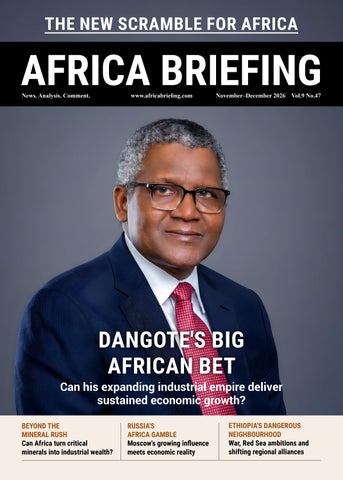
THE NEW SCRAMBLE FOR AFRICA
AFRICA BRIEFING News. Analysis. Comment.
www.africabriefing.com
November–December 2026 Vol.9 No.47
DANGOTE'S BIG AFRICAN BET
Can his expanding industrial empire deliver sustained economic growth? BEYOND THE MINERAL RUSH Can Africa turn critical minerals into industrial wealth?
RUSSIA'S AFRICA GAMBLE Moscow's growing influence meets economic reality
ETHIOPIA'S DANGEROUS NEIGHBOURHOOD War, Red Sea ambitions and shifting regional alliances
Yours to Discover!
0303409180 • 0244958822 www.theroyalsenchi.com | info@theroyalsenchi.com
PUBLISHER’S NOTE
www.africabriefing.com
Building Africa's future on its terms
Publisher Jon Offei-Ansah
A
FRICA HAS never been short of ambition, natural resources or people prepared to take risks. What it has struggled with is turning those advantages into industries that create decent jobs, support local businesses and improve people's lives. That question runs through this edition of Africa Briefing Magazine, beginning with our cover story on Aliko Dangote. Few African businessmen have pursued industrial development on his scale. His $20bn refinery outside Lagos is changing Nigeria's petroleum industry, and he now plans to build another $16bn refinery in Kenya. Together with his investments in cement, fertiliser and other industries, these projects reflect his belief that Africa should produce more of what it consumes. It is a belief I share. For decades, we have exported crude oil and imported refined fuel, shipped minerals overseas for processing and bought manufactured products that, given the right conditions, could have been made closer to home. Dangote has demonstrated what African capital, determination and industrial vision can achieve. Building a refinery of that magnitude in Nigeria, despite the financial and practical difficulties, is an extraordinary undertaking. His success, however, raises questions that deserve attention. In Kenya, the proposed Lamu refinery has encountered disputes over land and compensation. In Nigeria, the refinery's commercial achievements have not delivered the lower fuel prices many consumers expected. His growing influence also raises legitimate concerns about competition and theNOTE opportunities available to smaller businesses. PUBLISHER’S Our cover story examines these issues because I believe we owe our readers morePublisher than an account of impressive investments and ambitious plans. Jon Offei-Ansah Africa bucks global I am particularly interested in what happens beyond the refinery gates. Will local suppliers economic trend secure contracts? Will young people acquire skills that lead to lasting employment?Editor Will Desmond Davies communities benefit from the developments taking place around them? n 2018, six of the 10 fastest-growing Those questions connect Deputy Editor economies in the world were inwith two other major features in this edition. Africa,new according to the World Bank, Angela Cobbinah In The scramble for influence and investment, we examine why the world's major powers Ghana leading the pack. With arewith competing more intensely for Africa's minerals, energy resources, markets and strategic GDP growth for the continent projected to Contributing Editor partnerships. accelerate to four per cent in 2019 and 4.1 Stephen Williams per cent in 2020, Africa’s economic growth Washington wants secure supplies of critical minerals. China continues to deepen its story continues apace. Meanwhile, the World Bank’s 2019 Doing Business Index commercial Europe is seeking dependable partners, while Gulf investors Director, Special Projects reveals that five ofrelationships. the 10 most-improved countries are in Africa, and one-third energy of arereforms expanding into infrastructure, agriculture and logistics. all recorded globally were in sub-Saharan Africa. Michael Orji What makesgovernments the story more impressive and heartening is that the growth African have opportunities to attract capital and negotiate better agreements. Contributors –But projected to be broad-based – is being achieved a challenging globalinterest before, often without we have experienced periods ofinintense foreign the environment, bucking the trend. Justice Lee Adoboe industrial development we hoped would follow. Chuks Iloegbunam In the Cover Story of this edition, Dr. Hippolyte Fofack, Chief Economist at the That history makes Director-General Ngozi Okonjo-Iweala's argument inJoseph Beyond the African Export-Import BankWTO (Afreximbank), analyses the factors underpinning this Kayira mineral rush relevant. performance. Two especially factors, in my opinion, stand out in Dr. Hippolyte’s analysis: Zachary Ochieng trade between Africa and China and the intra-African cross-border investment and She believes Africa must move beyond exporting raw materials and develop theOlu capacity to Ojewale infrastructure development. process its resources, manufacture goods and compete internationally. Oladipo Okubanjo Much has been said and written about China’s ever-deepening economic foray into Corinne Soar The proposed industry linking thewho Democratic Republic of Congo and Zambia Africa, especially bybattery Western analysts and commentators have been sounding alarm bells about re-colonisation Africa, this timecould by the Chinese. ButBy empirical illustrates what regionalofcooperation achieve. combining resources, expertise and Designer evidence paints a different picture. infrastructure, neighbouring countries could develop industries that would be difficult to Gloria Ansah Despite the decelerating global growth environment, trade between Africa and establish independently. China increased by 14.5 per cent in the first three quarters of 2018, surpassing The ambition is promising, making willeconomic require sustained effort. Country Representatives the growth rate of world trade (11.6 perbut cent), reflectingitthework deepening dependency between the two major trading partners. Factories need reliable electricity. Businesses need affordable finance, efficient transport and South Africa Empirical evidence shows that China’s domestic investment become highly Edward predictable regulations. Young people need has practical skills and opportunities to useWalter them.Byerley linked with economic expansion in Africa. A one percentage point increase Top Dog Media, 5these Ascot Knights Anyone trying to establish or expand a business in Africa understands how important in China’s domestic investment growth is associated with an average of 0.6 47 Grand National Boulevard Royal Ascot, conditions percentage pointare. increase in overall African exports. And, the expected economic Milnerton 7441, South Africa development andwe tradeexamine impact of expanding investment on resource-rich Elsewhere, Russia'sChinese growing engagement with African governments the555 0096 Tel: +27and (0) 21 African countries, especially oil-exporting countries, is even more important. changing security situation in the Horn of Africa. These stories remind us Cell: that our +27 economic (0) 81 331 4887 The resilience of African economies also be attributed to growing intra-African ambitions are unfolding incan a world where international rivalries and political instability can Email: ed@topdog-media.net cross-border investment and infrastructure development. A combination of the complicate even the most carefully considered plans. two factors is accelerating the process of structural transformation in a continent Ghana where industrial output and serviceswe account a growing share of GDP.genuine African achievements without Throughout this edition, havefortried to recognise Nana Asiama Bekoe corporations and industrialists which are expanding their industrial footprint across overlooking the difficult questions that accompany them. Kingdom Concept Co. Africa and globally are leading the diversification from agriculture into higher Tel:ambition +233 243and 393 943 / +233 303 967 470 value goods like in manufacturing and service These industrial champions I would to see many moresectors. African entrepreneurs with Dangote's kingsconceptsltd@gmail.com are carrying out transcontinental operations, around the determination. But I would also with likeinvestment to see aholdings business environment in which a young globe, with a strong presence in Europe and Pacific Asia, together account for more Nigeria in manufacturer in Ghana, technology entrepreneur in Kenya or a small industrial company than 75 per cent of their combinedaactivities outside Africa. Taiwo Adedoyin Zambia has a fair chance to succeed. A survey of 30 leading emerging African corporations with global footprints and MV Noble, Press House, 3rd Floor Our economic cannot depend onthata they handful of large companies, however successful combined revenue offuture more than $118 billion shows are active in several 27 Acme Road, Ogba, Ikeja, Lagos industries, including manufacturing (e.g., Dangote Industries), basic materials, they become. Tel: +234 806 291 7100 telecommunications (e.g., Econet, Safaricom), finance (e.g., Ecobank) and oil taiadedoyin52@gmail.com Forgas. me, progress is measured by what happens aftereconomies, the investment announcements: whether and In addition to mitigating risks highly correlated with African these emerging corporations are accelerating the diversification of receive fair treatment people findAfrican decentglobal work, local businesses grow, communities and Kenya sources of growth and reducing the exposure of countries to adverse commodity families begin to feel that economic growth has improved their lives. Naima Farah terms of trade. Room 22, 2ndand Floor West Wing These are the issues we explore in this edition. I hope you find the stories engaging that This makes me very bullish about Africa! Royal Square, they encourage you to think more deeply about the choices shaping Africa's future.Ngong Road, Nairobi
I
Tel: +254 729 381 561 naimafarah_m@yahoo.com
Africa Briefing Ltd 2 Redruth Close, London N22 8RN United Kingdom Tel: +44 (0) 208 888 6693 publisher@africabriefing.org
Editor Desmond Davies Contributing Editors Prof. Toyin Falola Tikum Mbah Azonga Prof. Ojo Emmanuel Ademola (Technology) Valerie Msoka (Special Projects) Amanda Wilson (Caribbean) Contributors Justice Lee Adoboe Chief Chuks Iloegbunam Madalisto Kateta Zachary Ochieng Olu Ojewale Oladipo Okubanjo Corinne Soar Kennedy Olilo Gorata Chepete Designer Simon Blemadzie Country Representatives South Africa Edward Walter Byerley Top Dog Media, 5 Ascot Knights 47 Grand National Boulevard Royal Ascot, Milnerton 7441, South Africa Tel: +27 (0) 21 555 0096 Cell: +27 (0) 81 331 4887 Email: ed@topdog-media.net Ghana Nana Asiama Bekoe Kingdom Concept Co. Tel: +233 243 393 943 / +233 303 967 470 kingsconceptsltd@gmail.com Nigeria David Chukwuji 68, Femi Killa Street Ago Palace Way, Okota, Isolo, Lagos, Nigeria Tel: + 234 8039281669 Kenya Patrick Mwangi Aquarius Media Ltd, PO Box 10668-11000 Nairobi, Kenya Tel: 0720 391 546/0773 35 41 Email: mwangi@aquariusmedia.co.ke ©Africa Briefing Ltd 2 Redruth Close, London N22 8RN United Kingdom Tel: +44 (0) 208 888 6693 publisher@africabriefing.org Cover pic: The African Union headquarters complex in Addis Ababa
Contents
Vol.9 No.47 November–December 2026
LEADER
6
It’s time to forget the hype
COMMENT
07
Dangote’s welcome revolution
COVER STORY
08
Dangote's bet on Africa
08
From Nigeria's $20bn oil refinery to the $16bn development launched in Kenya, Aliko Dangote is wagering billions on a new African industrial future. But can his expanding empire help create prosperity that reaches far beyond his own businesses? By Jon Offei-Ansah
ANALYSIS
18
Russia's Africa gamble
34
Women demand a place at peace talks
18
Vladimir Putin's latest summit with African leaders has reinforced Moscow's growing diplomatic influence on the continent. Yet Russia remains a relatively modest trading partner, while its expanding security role has produced mixed results. Whether the relationship can deliver lasting economic benefits will depend as much on African governments as on the Kremlin, writes Jon Offei-Ansah
Twenty-six years after UN Resolution 1325 promised women a voice in peacebuilding, Africa's struggle to turn commitments into political power remains unfinished, writes Valerie N. Msoka
BUSINESS & ECONOMY
48
The new scramble for influence and investment
Global powers are competing for Africa’s resources, markets and influence. But can African governments turn this renewed interest into lasting prosperity and greater economic independence, asks Jon Offei-Ansah?
MINING
56
Nigeria tests its mineral leverage
Washington's growing interest in Nigeria's critical minerals offers Abuja a chance to attract investment beyond the mining industry. But with China already deeply involved in the sector, Nigeria must decide how to turn international competition into lasting economic gains, writes Dorothy George.
48 BOOK REVIEW
62
The microphone as a moral mandate
In My Mic, My Mandate, Cameroonian broadcaster and social advocate Amy Banda reflects on the pressures of public life, the demands of journalism and the responsibility that comes with being heard. Jon Offei-Ansah examines a personal account of broadcasting that raises important questions about truth, influence and public trust.
LEADER
It’s time to forget the hype A FRICA is once again at the centre of international attention. This time, however, the competition is not simply about political influence or access to traditional commodities such as oil, gold and diamonds. It is about the strategic resources that will determine the future of the global economy, from electric vehicles and renewable energy to artificial intelligence, advanced technology and modern defence industries. For Africa, this should be a historic opportunity. But there is an uncomfortable question that its political leaders must confront: are they sufficiently prepared to turn this renewed international interest into lasting economic prosperity for their people, or will the continent once again become a supplier of raw materials while others reap the greatest rewards? The rhetoric about an Africa rising has been heard for years. Conferences have been organised, declarations signed and ambitious development strategies announced. The African Union's Agenda 2063 promises a transformed continent, while the African Continental Free Trade Area offers the prospect of a much larger integrated African market.
or every strategic initiative before they have secured the necessary political, financial and commercial arrangements. Consider a government seeking to develop a domestic lithiumprocessing industry, establish a regional battery manufacturing partnership or negotiate better conditions for the export of copper and cobalt. Publicly announcing its intentions before establishing the necessary technical, financial and diplomatic foundations could weaken its bargaining position. Competitors may respond by offering alternative arrangements, lobbying against the proposed initiative or using their financial and diplomatic influence to protect existing commercial advantages.
There is a convincing argument for greater strategic discretion when Africa is negotiating with China and the West
The growing competition between China and Western governments for African resources should not automatically be interpreted as a victory for the continent. International competition creates opportunities, but it also creates risks. Do African governments understand that these countries are pursuing their own national interests rather than necessarily prioritising Africa's industrial development? There is nothing inherently wrong with welcoming foreign investment. Africa needs capital, technology, infrastructure and international markets. But investment must be judged by what it contributes to African economies, not simply by the size of the financial commitments announced at diplomatic meetings. Indeed, are African leaders giving away too much information as they become overwhelmed by the hype about the continent’s potential?
This is not an argument for treating every foreign government as an enemy. Nor is it a suggestion that Africa should isolate itself from the international community. Rather, African governments must learn to distinguish between what should be publicly accountable and what should remain confidential during negotiations. Secrecy must not become a cover for corruption. There is, however, a particularly important distinction. Strategic confidentiality is legitimate. Secret deals that enrich political elites at the expense of citizens are not.
The challenge is to develop a system in which governments protect sensitive negotiating positions while ensuring that final contracts, fiscal obligations, beneficial ownership arrangements and the distribution of public revenues are subject to proper scrutiny. African leaders must also recognise that their bargaining power will remain limited if they continue negotiating separately. A country with substantial cobalt reserves may appear powerful, but its negotiating position is weakened when neighbouring countries compete against one another to attract the same foreign investors by offering more favourable conditions. The greatest obstacle is not the international competition for Africa's resources but the continent's own governance shortcomings.
They tend to publicly announce every major economic intention, strategic ambition or negotiating position.
Political instability, corruption, weak institutions, inadequate electricity supplies, poor transport infrastructure and inconsistent economic policies continue to undermine the continent's ability to attract investment on favourable terms.
Transparency is essential in democratic governance. Citizens have every right to know how their natural resources are being managed, what agreements their governments are signing and how much public revenue is being generated.
There is also the problem of political leadership that places shortterm interests above long-term national development. Africa cannot afford leaders who regard natural resources primarily as opportunities to consolidate political power or reward supporters.
However, transparency should not be confused with exposing every element of a country's negotiating strategy. International diplomacy and commercial negotiations require a degree of discretion.
Nor can it continue with governments that announce ambitious industrialisation programmes without investing sufficiently in education, scientific research, technical skills and the development of local businesses.
Major economic powers do not routinely disclose their entire negotiating positions, commercial calculations or strategic priorities before entering sensitive discussions. They protect their interests, assess their competitors and carefully time their decisions. There is a convincing argument for greater strategic discretion when negotiating with China, the US, European governments and other international partners. African leaders should not feel obliged to reveal every intended policy measure, every negotiating position
6
African leaders must demonstrate that they can negotiate intelligently, cooperate regionally, protect national interests and build institutions capable of managing the continent's wealth responsibly. The continent has heard enough speeches about an Africa rising. Its people deserve to see an Africa transforming. The message is clear: Don’t believe the hype. Stay focused on Africa’s dominant needs.
AFRICA BRIEFING NOVEMBER – DECEMBER 2026
AB
COMMENT
Dangote’s welcome revolution
A
LIKO Dangote, Africa’s richest person, was once again in the news recently when the Nigerian launched his $1.6 billion oil refinery IPO, the continent’s largest, to attract millions of retail investors in Africa and beyond. When it closed at the end of October it had attracted remarkable interest. This is potentially significant beyond Dangote's business empire. It demonstrates that Africans can be mobilised to invest in large-scale industrial enterprises rather than simply watching foreign investors acquire stakes in their economies. Dangote's initiative could help change perceptions about African capital markets. If successful, it might encourage other major African entrepreneurs to open their companies to public ownership, allowing ordinary citizens to participate in the profits and growth of businesses operating on the continent. But one successful IPO will not transform Africa's investment landscape overnight. Stock exchanges also need greater regional integration so that someone in Ghana, Kenya or South Africa can invest more easily in companies listed elsewhere in Africa – as Dangote has just done.
Desmond Davies
The resulting investment could create jobs, stimulate local production and reduce the continent's dependence on imported goods. African governments also need to recognise that they cannot continue relying on relatives abroad to perform the social responsibilities of the state. Citizens should not have to depend on their sons, daughters and siblings overseas to pay for basic healthcare, education and other essential services. Remittances are private money, not a substitute for responsible government. There is, however, an important distinction between encouraging investment and compelling people to invest. Families must retain the freedom to decide how their money is spent. The challenge is to create attractive, trustworthy investment opportunities that make putting money into businesses as appealing as sending money for immediate household needs. This is where African stock markets enter the picture. For too long, many African stock exchanges have struggled to attract sufficient domestic and international participation. Governments should make it easier for diaspora communities to invest in listed companies, infrastructure bonds and professionally managed investment funds. Financial regulators must also strengthen transparency, corporate governance and investor protection. The continent needs to develop a culture in which ordinary Africans, including those living abroad, can own shares in companies creating wealth on their own continent.
Remittances are well and good, but do they make an impact on growth?
One does not need to be an economist to appreciate that growth needs financing. Remittances are well and good, but do they make an impact on growth? Africa must move beyond celebrating the billions sent home by its diaspora and begin asking how that money can help build sustainable economies. The objective should not be to discourage family support, which remains essential to millions of people. It should be to create an additional investment culture in which remittances become a source of capital, enterprise and employment. Africa cannot build its economic future on remittances alone. But it would be a missed opportunity if a continent receiving more than $124 billion annually from its people abroad failed to turn even a fraction of that financial goodwill into productive investment. Thus, an important question deserves greater attention: could Africa be doing more to turn this enormous financial resource into an engine of economic growth? Remittances are often treated primarily as a private social security system, compensating for governments' failure to provide adequate healthcare, education, pensions and social protection. While there is nothing wrong with helping relatives, it is worth asking whether a greater proportion of this money could be channelled into productive investment, businesses and African stock markets. The argument is not that Africans abroad should abandon their families. Rather, it is that remittances should have a second life beyond household consumption. Imagine what could happen if even a modest proportion of Africa's remittance income were channelled into small and medium-sized enterprises, manufacturing, agriculture, technology and infrastructure.
African countries should forget about the UN’s Sustainable Development Goals. They are not going anywhere, as the financing gap in developing countries is not improving. Instead, it has risen to $4 trillion per year – or 60 per cent to 70 per cent higher than estimated in 2014. This means more than $30 trillion of new investment is needed to achieve the SDGs by 2030. Institutional investors hold over $130 trillion in assets globally. Thus, these assets must be unlocked to provide new profitable opportunities in emerging and developing markets to direct capital where it is needed most and help fill the SDG financing gap. Dangote’s revolution has focused the spotlight on investment opportunities in Africa. For instance, the UK government’s investment arm, Mobilising Institutional Capital Through Listed Product Structures (MOBILIST), recently invested $15 million for a 13 per cent stake in Kenyan retail chain Quick Mart's IPO. The investment is part of the company’s plan to broaden ownership and drive growth in Kenya's retail market. Quick Mart's IPO offered two billion ordinary shares – half its issued capital – at KES 7.50 per share on the Nairobi Securities Exchange. There you are. It makes sense for Africa to focus now on strong investments that will create jobs, taxation for governments to develop their countries and dividends for those investing in the continent’s future. Dangote has demonstrated one route. The question now is whether other African business leaders, governments and financial institutions AB are prepared to follow it.
AFRICA BRIEFING NOVEMBER – DECEMBER 2026
7
COVER STORY
Dangote's bet on Africa From Nigeria's $20bn oil refinery to the $16bn development launched in Kenya, Aliko Dangote is wagering billions on a new African industrial future. But can his expanding empire help create prosperity that reaches far beyond his own businesses? By Jon Offei-Ansah
O
N KENYA'S northern coast, Aliko Dangote stood alongside President William Ruto and other African leaders on September 30 as they broke ground for a refinery that, for now, exists more vividly in plans than in steel and concrete. The site at Lamu is intended to become a $16bn industrial complex processing 700,000 barrels of crude oil a day. If it works, the effects could reach petrol stations and factories across East Africa.
Dangote has made this kind of wager before. Outside Lagos, he spent roughly $20bn building a refinery many doubted would ever run. Now he wants to repeat that feat in a different country, with different politics, a different supply chain and communities already questioning what the development means for their land. The ceremonial shovels have done their work. The harder part begins now.
Aliko Dangote and Kenyan President William Ruto at the September 30, 2026 groundbreaking ceremony for the $16bn Dangote East Africa Petroleum Refinery in Lamu. The project marks a major expansion of Dangote's industrial ambitions beyond Nigeria
8
AFRICA BRIEFING NOVEMBER – DECEMBER 2026
COVER STORY
An aerial view of Dangote Petroleum Refinery at Lekki, Lagos, in June 2025. The $20bn complex has expanded Nigeria's domestic refining capacity and become the centrepiece of Dangote's industrial transformation strategy
Behind the ambition is a grievance that Dangote has voiced with increasing impatience. Africa ships out crude oil, minerals and crops, then pays other countries to turn them into products it needs. The continent earns money from extraction but misses much of the manufacturing, technical expertise and employment that follow. “We are exporting jobs,” he told journalists in Nairobi. The line sounds simple because the problem is so familiar. Dangote, however, is not content to make the argument. He has spent much of his working life trying to prove that factories can be built where imports once dominated. His immense fortune gives him the freedom to attempt projects that most African entrepreneurs could scarcely finance. It also gives his decisions an influence that deserves scrutiny.
Industries of this scale depend on tariffs, licences, infrastructure and decisions made in government offices. Dangote has worked with successive administrations, and his companies have benefited from policies designed to encourage domestic production. Supporters see evidence that African industrialists can compete with global groups. Critics see the risks of concentrated market power and advantages that smaller rivals cannot easily obtain. Both questions matter if Africa wants more industry rather than merely bigger conglomerates.
We are exporting jobs
He began as a trader, moving commodities into markets where demand was growing. Manufacturing came later, particularly cement, as expanding African cities needed the materials to build houses, roads and offices. He developed production and distribution networks across several countries, then moved further into sugar, fertiliser, petroleum and chemicals. For Dangote, the appeal of these businesses is not mysterious: people need the products, and Africa imports too many of them. Yet there is a less comfortable side to the success story.
Nigeria's petroleum industry provided the biggest opening of his career. For years, a major crude producer imported much of its petrol and diesel because state-owned refineries failed to supply the market. Foreign exchange went towards buying back products made from the country's own oil. Fuel shortages, subsidies and arguments over prices became part of everyday political life. Dangote decided to build a refinery big enough to change that equation. The project near Lagos absorbed enormous sums, encountered delays and tested the patience of lenders and contractors. It began operating in 2024. Originally designed for 650,000 barrels a day, the facility has since reported capacity of 700,000 barrels and sells fuel in Nigeria and abroad.
AFRICA BRIEFING NOVEMBER – DECEMBER 2026
9
COVER STORY
Petroleum storage tanks at a Kenya Pipeline Company depot in Nairobi. Dangote's acquisition of a nearly 25 percent stake in the company extends his East African interests beyond refining into the infrastructure used to transport and distribute fuel
The financial figures are striking. In unaudited results for the first nine months of 2026, the refinery reported a net profit of $4.73bn, against a loss of $117.2m a year earlier, while revenue climbed to $22.48bn, according to Reuters. Higher throughput, stronger refining margins and disruption in global supplies helped. It was an extraordinary turnaround, although the oil market has a habit of humbling even its most confident participants.
Families judge an industrial landmark differently from investors reading its accounts. This gap between achievement and everyday benefit is one of the tests now following him to Kenya. Lamu's deep-water port offers access to regional markets, but Kenya does not yet produce crude oil commercially. The refinery will initially need to buy its feedstock elsewhere. It must secure supplies, attract customers and compete in a market in which global prices can shift suddenly. The intended start of operations in 2030 remains a target, not a certainty.
Building a refinery is one achievement, making everyday life more affordable is another
Commercial success is not the same thing as relief for consumers. Nigerians who expected a home-grown refinery to bring cheap fuel have been disappointed by what they still pay at the pump. In an interview with the BBC, Dangote argued that prices were competitive with those across the border and pointed to savings in distribution. But crude prices, taxes, exchange rates and transport costs still shape the final bill. 10
Dangote chose Lamu in part for its natural advantages, telling reporters that its deeper waters and firm ground offered benefits over an earlier location considered in Tanzania. He is thinking beyond fuel tanks, too. The development is planned to include roughly 1,000 megawatts of electricity
AFRICA BRIEFING NOVEMBER – DECEMBER 2026
COVER STORY pipeline expansion plans, according to the Financial Times. A refinery that cannot get its products to customers is an expensive monument. Pipelines provide a practical answer. By investing in distribution as well as production, Dangote is trying to build a business that can move fuel through East Africa rather than simply make it. Yet the strategy invites another question: what happens to competition when a major refiner also owns a substantial stake in infrastructure used by other suppliers? Regulators will have to ensure the network remains accessible on fair terms. In Lamu, the debate about who benefits has already become more personal. A group of 133 residents from Chandavai went to court, saying land associated with the refinery is ancestral property and raising concerns about compensation and the effect on homes and farms. As Africa Briefing reported, the Malindi Environment and Land Court ordered the existing position on disputed land maintained ahead of a hearing. The groundbreaking went ahead, but work on the disputed site faced restrictions. On October 14, the court lifted the interim order. Justice Jane Onyango identified procedural problems, including an incorrect land reference and failures to serve respondents properly. The petitioners were allowed to amend their case, which is due back in court on November 24. Dangote had cleared an immediate hurdle. The judge had not resolved the deeper arguments over ownership, compensation or environmental safeguards. It would be easy to treat that dispute as an inconvenience beside the billions being promised. For a family that farms the land or depends on fishing along the coast, the calculations look different. A new refinery could bring jobs and improved roads. It could also disturb livelihoods and leave lasting environmental risks. Dangote has suggested that commercial interests sometimes encourage opposition to his projects; that claim needs evidence and does not make residents' concerns disappear. generation, potentially giving other manufacturers a reason to establish themselves nearby. “It's just the start,” he said in remarks reported by Nigeria’s Channels Television. There is a persuasive industrial logic here. A refinery needs storage, roads, electricity, maintenance and skilled workers. Those needs could generate opportunities for firms that have nothing to do with producing petrol. But the promised ecosystem will not spring up automatically. Small suppliers need contracts they can win, young people need training, and dependable electricity must arrive before factories can use it.
The stakes reach beyond Lamu. Africa needs large investments, but they will not command lasting public support if communities feel decisions are made over their heads. Fair compensation, credible environmental oversight and realistic promises about local employment are not obstacles to industrialisation. They are part of doing it well.
Securing the legal opportunity to develop a project is not the same as earning public trust
Dangote's latest Kenyan investment makes his approach clearer. On October 21, he said his group had acquired a 25 percent stake in Kenya Pipeline Company. Kenyan financial reporting put the exact holding at 24.76 percent, with a purchase price of about $335m. The company runs a network of roughly 1,300 kilometres that moves petroleum from Mombasa towards inland Kenya and regional markets. Dangote has also outlined a further $1.5bn in
Oil is only one strand of Dangote's ambitions. His group wants to make more fertiliser, generate electricity and process minerals nearer the places where they are extracted. The disruption to grain and fertiliser markets after Russia invaded Ukraine in 2022 exposed how vulnerable African countries were to decisions and events elsewhere. Dangote has spoken of helping Africa achieve much greater fertiliser self-sufficiency by 2028, alongside plans for at least 10,000 megawatts of new power capacity by 2030.
Both are ambitions rather than completed projects. They also reveal the connection between the industries he is pursuing. A mineral processor needs affordable electricity; a farmer needs
AFRICA BRIEFING NOVEMBER – DECEMBER 2026
11
COVER STORY
Dangote Cement's Obajana manufacturing complex in Kogi State, Nigeria. Cement production provided the industrial foundation for Aliko Dangote's business empire before his expansion into petroleum refining, fertiliser and petrochemicals
fertiliser that can be delivered at a workable price. Zambia and the Democratic Republic of Congo may have the minerals that the world wants, but processing them competitively also calls for equipment, transport, technical expertise and customers. Ownership of resources alone will not create the jobs Dangote says Africa is losing. The Dangote Group plans around $50bn in capital expenditure between 2026 and 2030. That is proposed investment, not a cheque already written. It is nonetheless a measure of how aggressively he wants to expand. Most African manufacturers operate in a very different financial world, where bank loans are costly, repayment periods short and a bad currency movement can sink a promising business.
There is a longer-term risk, too. Oil refining is a bet measured in decades, while electric vehicles, renewable energy and climate policies are changing how the world uses petroleum. Africa will continue to need fuel for years, but no refinery can assume demand will grow forever. Dangote's push into fertiliser, chemicals, minerals and electricity may prove as important as his newest oil project, provided those businesses stand up commercially. For a continent whose population is expected to approach a quarter of humanity by 2050, the pressure to produce more and employ more people is real. Africa will need cement, food, fuel and countless manufactured goods. Dangote sees a vast market. The harder task is ensuring that its growth creates businesses beyond his own, work beyond the construction site and prices people can live with.
Africa's industrial future cannot rest on a handful of powerful conglomerates
His Nigerian refinery's $1.6bn share offering exposes another weakness. It is meant to open ownership to more investors, but people in several African countries have encountered regulatory barriers to participating. Reuters reported that differences between national securities rules complicated a transaction intended to attract continental capital. The application period was extended to October 27. For all the talk of a single African market, even investing in a company across a border can remain difficult.
This is where Dangote's story becomes larger than Dangote. One industrialist can build a refinery and buy into a pipeline. He cannot, alone, make finance affordable for a small manufacturer in Kumasi, supply dependable power to a workshop in Lusaka or ensure a Kenyan family receives fair treatment when development comes to its doorstep. Governments, banks, regulators and training institutions must do their part. 12
The image of Dangote and Ruto breaking ground at Lamu tells part of the story: African leaders and an African industrialist announcing that a different economic future can be built. The other part will be written more slowly, in construction delays overcome, goods produced, suppliers paid, land disputes settled and people finding work. That is where the size of the investment must finally meet the lives it is supposed to improve. Dangote has already shown that African capital can build at a scale once thought implausible. His next test is more demanding. From Lagos to Lamu, and now along Kenya's pipelines, he is betting that Africa can keep more of the wealth it creates. Whether that becomes a shared prosperity, rather than merely a larger empire, will decide what his gamble was worth. AB
AFRICA BRIEFING NOVEMBER – DECEMBER 2026
Shanghai Grand International Logistics Co., Ltd.
Established in 2002, Shanghai Grand International Co., Ltd. offers a variety of shipping and transportation options via air, sea and ground. Our company is based in Shanghai, China, with branches across the nation. Ranging from customs declaration, warehouse storage, containers and consolidated cargo shipping we have a large array of options to meet your needs. In addition to being approved and designated by the Ministry of Transportation of China as a First Class cargo service provider, we have also established excellent business relations with major
C.E.O President. Mr, Felix Ji
shipping companies including Maersk, CMA, ONE, SM line, and EMC over the past 15 years. In addition we have also built long term business relations with major airline cargo departments. In order to expand our global operation, we are looking for international partnerships to work together in this industry. Should you ever import any goods from Peoples Republic of China please ask your exporter and shipper to contact us. We will provide our best service to you.
Room 814, 578 Tian Bao Lu, Shanghai, Peoples Republic of China E-Mail: felix@grand-log.net phone: 86-13501786280
COVER STORY
Can Africa manufacture its own future? Africa supplies the world with minerals, oil and agricultural commodities, yet remains a marginal player in global manufacturing. As its population expands, the continent faces a defining challenge: turning natural wealth into productive industries, decent jobs and lasting prosperity, writes Jon Offei-Ansah
A
FRICA has spent generations supplying the world with resources that have helped build industries and fortunes far beyond its shores. Its minerals power modern technologies, its agricultural commodities feed global markets and its crude oil supports economies thousands of miles away. Yet much of the continent still depends on imported manufactured goods. Zambia produces copper, but much of the manufacturing associated with it takes place elsewhere. The Democratic
Republic of Congo supplies cobalt used in batteries, while companies beyond Africa capture substantial value from processing minerals into finished products. West African cocoa follows a similar path, leaving as a commodity and returning to international markets as chocolate worth considerably more. The contradiction is familiar. Africa has abundant resources, expanding markets and a young population, but too little of the industrial capacity needed to turn these advantages into productive employment.
Workers at a cement factory in Dire Dawa, Ethiopia, where industrial production illustrates the potential for African manufacturing to create jobs, develop skills and reduce dependence on imported goods
14
AFRICA BRIEFING NOVEMBER – DECEMBER 2026
COVER STORY
A container vessel at the Port of Durban, South Africa. Efficient ports, modern logistics and stronger regional trade links are essential to expanding African manufacturing and helping local producers compete internationally
African governments have pursued industrialisation for decades. Some initiatives have succeeded; others have faltered amid unreliable electricity, poor transport, expensive finance and policies that change with successive administrations. The scale of the unfinished work remains striking. According to the United Nations Industrial Development Organisation's 2025 industrial statistics, Africa accounted for just 2 percent of global manufacturing value added in 2024, despite representing approximately 18.5 percent of the world's population. Manufacturing is not absent from Africa. South Africa, Egypt, Morocco, Tunisia, Nigeria and Kenya have important industrial sectors, and investment is growing elsewhere. But much production remains concentrated in food processing, beverages, construction materials and other relatively basic goods. These activities matter; they create jobs and supply essential products. What remains scarce is the depth of higher-productivity manufacturing that develops advanced skills and stronger export earnings. Asia's experience shows what sustained industrial investment can achieve. South Korea moved into automobiles and electronics, while China built vast manufacturing capacity through infrastructure, skills development and access to international markets. Their circumstances cannot simply be transplanted to Africa. They do, however, demonstrate that industrial competitiveness must be built deliberately over many years. There are useful African examples, too. Automotive industries in Morocco and South Africa show that countries can connect domestic production to international markets when suppliers, skills and logistics develop together. Yet assembling vehicles is not the same as building a complete industrial ecosystem. The harder task is to increase the proportion of locally manufactured components, deepen technical expertise and ensure that smaller firms can win contracts. Industrial success depends as much on these connections as on the size of the flagship factory.
Africa's starting point is complicated by history. Colonial economies were organised largely around extracting minerals and agricultural commodities. Railways and ports often served exports rather than connecting local producers and consumers. Independence changed political authority but could not immediately remake those economic structures. Later debt crises, inconsistent industrial policies and periods of economic instability further disrupted efforts to diversify. Today, electricity remains one of the most immediate obstacles. When power fails, machinery stops, orders are delayed and manufacturers must pay for generators and fuel. Large companies can sometimes provide their own electricity. Smaller firms rarely have that option, leaving them at a lasting disadvantage. Transport imposes another penalty. Poor roads, inefficient rail links and slow border crossings raise the cost of moving goods. In parts of the continent, businesses find it easier to trade overseas than with neighbouring countries. That makes it harder to reach the larger markets needed to justify investment in modern machinery. The African Continental Free Trade Area could help change this. Its value lies not just in lower tariffs but in the possibility of regional supply chains, with businesses producing for customers across borders. Yet an agreement on paper cannot clear a congested crossing, harmonise incompatible standards or settle an invoice. Governments must make trade easier in practice and give investors confidence that rules will remain predictable. Even where the physical infrastructure exists, manufacturers face costs that are less visible. Imported machinery and components often have to be paid for in foreign currency. Customs delays can leave factories waiting for a vital spare part, while inconsistent product standards complicate sales in neighbouring markets. These obstacles may seem minor beside the announcement of a new industrial park, but to an entrepreneur fulfilling orders every week they can determine whether local production is viable.
AFRICA BRIEFING NOVEMBER – DECEMBER 2026
15
COVER STORY Finance is just as important. Manufacturing requires money for land, buildings, equipment, materials and workers long before sales generate returns. Many African banks are reluctant to offer affordable credit over such long periods. High interest rates and foreign currency borrowing add risks, especially for smaller companies. Development finance institutions, including the African Development Bank and Africa Finance Corporation, have helped fund major projects. But Africa also needs stronger domestic capital markets that allow savings to flow into productive businesses. The difficulties surrounding Dangote Petroleum Refinery's $1.6bn share offering are revealing. As Reuters reported in October 2026, regulatory differences made it difficult for some investors outside Nigeria to participate. A continent calling for integrated businesses still struggles to offer integrated investment opportunities. Access to money must be accompanied by opportunities to use it. A smaller factory that supplies packaging, replacement parts or maintenance to a large manufacturer can gradually acquire new skills and expand. But this requires procurement systems that give capable local firms a fair chance, rather than reserving contracts for a few established partners. Strong industrial clusters are built through thousands of such relationships, not through the output of a single plant. Governments also face difficult choices about protecting new industries. Tariffs and incentives may give manufacturers time to develop, but protection can become a permanent privilege for powerful companies. Consumers may pay more, competitors may be shut out and businesses may lose the incentive to innovate. Africa needs major industrial investors, but it also needs smaller manufacturers, suppliers, engineers and technology firms able to compete alongside them. Aliko Dangote's industrial empire captures both sides of that challenge. His Nigerian petroleum refinery has shown that African private capital can undertake projects of global scale. His proposed $16bn refinery in Lamu, Kenya, could extend that ambition into East Africa. But the Kenyan development has also raised a question that deserves as much attention as its projected output: whose interests are protected when industrial investment arrives?
On September 25, Kenya's Malindi Environment and Land Court ordered the existing position on disputed land to be maintained following a petition by 133 residents of Chandavai in Lamu County. They asserted ancestral land rights and raised concerns about compensation and environmental protection. The restriction complicated the project's launch, although Dangote maintained that the September 30 groundbreaking ceremony could proceed. It did, with President William Ruto attending. On October 14, the court lifted the interim restriction. Justice Jane Onyango identified procedural shortcomings in the petition, including an incorrect land parcel reference and problems serving respondents. The residents were permitted to amend their case, with further proceedings scheduled for November 24. That ruling removed an immediate legal obstacle; it did not settle ownership, compensation or environmental issues. The distinction matters. For families dependent on farmland, fishing grounds or local resources, a new industrial complex may offer opportunities while threatening established livelihoods. Investment must be accompanied by meaningful consultation, lawful land arrangements and credible environmental oversight. Public trust is as important to lasting development as a ceremonial groundbreaking. The Lamu case also challenges the comforting assumption that a project described as nationally important must necessarily benefit everyone nearby. Jobs promised during construction may be temporary; specialist posts may require skills not yet available locally. Governments and investors should be clear about likely employment, training and compensation rather than presenting optimistic projections as settled outcomes. Transparent monitoring after construction matters as much as the promises made before work begins. Africa's mineral wealth offers a different test. Demand for copper, cobalt, lithium and other resources used in electricity networks and new technologies has renewed interest in the continent. The opportunity is not simply to extract more. It is to retain greater value by processing minerals and developing associated industries closer to their source. Several governments have promoted local processing or restrictions on raw mineral exports. But a processing plant needs reliable electricity, skilled workers, transport and customers.
The Nchanga copper mine near Chingola, Zambia. Africa holds substantial mineral resources, but processing more of those materials locally remains central to capturing greater industrial value and creating skilled employment
16
AFRICA BRIEFING NOVEMBER – DECEMBER 2026
COVER STORY
The Noor I and II solar power installations near Ouarzazate, Morocco. Reliable electricity and investment in modern energy infrastructure are vital to Africa's ambition to develop competitive and more sustainable manufacturing industries
Without those foundations, forcing domestic processing can create expensive operations that struggle to compete. Regional partnerships may work better, allowing countries to combine mineral deposits, power capacity, expertise and routes to market. The economic case for adding value is strongest when supported by realistic market analysis. Smelting, refining or battery manufacturing may make sense in one location but not another, even where minerals are abundant. An industrial strategy should recognise comparative advantages and allow different countries to specialise. That may produce better regional results than requiring every resource producer to build an identical processing chain within its borders. Agriculture presents similar possibilities. Russia's invasion of Ukraine in 2022 exposed the risks of dependence on imported grain and fertiliser as supply disruptions pushed prices higher. African fertiliser plants and food processors could reduce vulnerability and create employment. Yet farmers also need irrigation, storage, affordable credit and reliable roads. A factory cannot transform agriculture if the wider system fails to deliver crops and inputs efficiently. Agricultural processing offers opportunities beyond food security. Coffee roasting, cocoa processing, textiles and packaged food can connect farmers to higher-value markets. Yet competitiveness requires consistent quality, branding, certification and distribution. The aim should not be to process every crop at any cost, but to identify products that African businesses can manufacture and sell successfully while paying producers fairly. The environmental challenge cannot be treated as an afterthought. Africa needs more industrial production at a time when global markets are moving towards cleaner energy and technologies. Renewable electricity and efficient machinery could help manufacturers control costs and emissions. But newer equipment requires investment and expertise. International partnerships will remain essential, provided they strengthen local skills and production rather than simply sell finished products. Economic sovereignty should not mean isolation. Africa must trade, attract investment and acquire technology. The objective is to enter those relationships with stronger productive capacity,
exporting more finished goods and capturing more value at home. Domestic ownership matters, but it is not a substitute for efficiency, competition or responsible management. The urgency is demographic. By 2050, Africa is expected to account for roughly one-quarter of the world's population. Its expanding workforce and consumer markets could sustain a new era of manufacturing. They could also deepen unemployment if industries fail to create productive jobs. Services, technology and agriculture will remain important, but a broader manufacturing base can provide opportunities for technicians, engineers, workers and local suppliers. Achieving that will demand more than announcing projects. Schools and training institutions must develop practical industrial skills. Governments must invest in power, transport and predictable regulation. Financial institutions must support businesses beyond a small circle of established conglomerates. Communities must share in the benefits and have a voice when projects affect their land and livelihoods. Above all, industrial policy must survive elections and changes of government. Factories can be erected in a few years; the suppliers, technical knowledge and institutions that make them competitive take far longer. Progress should therefore be judged by productivity, jobs, exports and growing local capabilities, not investment pledges or groundbreaking ceremonies. Dangote's investments have reopened an important debate about what African enterprise can achieve. But one billionaire cannot industrialise a continent. The more consequential question is whether thousands of businesses can find the conditions to grow, compete and create decent livelihoods. For generations, Africa's resources have helped build prosperity elsewhere. Its next breakthrough will come not simply from extracting more of them, but from turning more of that wealth into industries and opportunities at home. The resources and markets are there. What remains is the sustained investment, credible institutions and political determination to make AB the transformation last.
AFRICA BRIEFING NOVEMBER – DECEMBER 2026
17
ANALYSIS
Russia's Africa gamble
Vladimir Putin's latest summit with African leaders has reinforced Moscow's growing diplomatic influence on the continent. Yet Russia remains a relatively modest trading partner, while its expanding security role has produced mixed results. Whether the relationship can deliver lasting economic benefits will depend as much on African governments as on the Kremlin, writes Jon Offei-Ansah
Russian President Vladimir Putin joins African leaders and senior officials for a group photograph at the third Russia–Africa Summit in Moscow on October 29, 2026, as the Kremlin seeks to deepen its diplomatic, economic and security relationships across the continent
M
OSCOW spared little effort in welcoming African leaders to the Kremlin in late October. There were ceremonial handshakes, carefully arranged photographs and repeated assurances that Russia regarded Africa as an important partner in shaping a changing international order. For President Vladimir Putin, the gathering offered something particularly valuable: an opportunity to demonstrate that Russia remains an influential diplomatic actor despite Western sanctions and the continuing war in Ukraine. For the African delegations, the interests were more varied. Some wanted investment and industrial partnerships. Others sought dependable supplies of grain, fertiliser and energy. Several military-led governments came looking for security cooperation, while others saw an opportunity to strengthen their bargaining position in an increasingly competitive international environment. 18
These different expectations lay behind the third Russia– Africa Summit, held in Moscow on October 28–29, with representatives from 48 African countries, including 22 heads of state or government. Co-chaired by Putin and Burundian President Evariste Ndayishimiye, the African Union's rotating chairperson, the meeting demonstrated Moscow's ability to convene a substantial African gathering at a time when its relationships with Western capitals remain deeply strained. The attendance was politically useful for Putin. The inaugural summit in Sochi in 2019 attracted 43 African heads of state, but that number fell to 17 at the second meeting in St Petersburg in 2023. Moscow had attributed the decline partly to Western pressure on African governments. This year's gathering offered the Kremlin an opportunity to recover some of that diplomatic momentum.
AFRICA BRIEFING NOVEMBER – DECEMBER 2026
ANALYSIS
Russian President Vladimir Putin meets Central African Republic President Faustin-Archange Touadéra during the inaugural Russia–Africa Summit in Sochi in October 2019. Moscow's security and diplomatic relationships with African governments have deepened considerably since the first gathering
Russia's appeal in parts of Africa has deep historical roots. During the Cold War, the Soviet Union supported liberation movements, supplied military equipment and provided scholarships to students from newly independent African countries. Many returned home as doctors, engineers, academics and public officials. Those relationships created goodwill that has survived the Soviet Union itself, particularly in countries where memories of colonial rule continue to influence political debate. Putin has sought to build on that legacy, presenting Russia as a defender of national sovereignty and a partner willing to challenge Western dominance of international institutions. Addressing the summit, he described Russia and African countries as “natural allies in building a genuinely democratic multipolar world order”. The language found common ground with longstanding African demands for greater representation in global decisionmaking. Kenyan President William Ruto, for example, argued that the international system should better reflect contemporary realities rather than the balance of power established after the Second World War. Such arguments have considerable support across Africa, where frustration with the structure of the UN Security Council and international financial institutions extends far beyond governments sympathetic to Moscow. But agreement on institutional reform does not necessarily imply support for Russia's wider foreign policy. African governments have become increasingly adept at cultivating several international relationships simultaneously. China is a major commercial partner, Europe remains deeply embedded in trade and finance, and the United States retains substantial economic and security interests. India, Turkey and Gulf states are also competing for influence.
Russia is part of that crowded diplomatic environment, although its economic position is considerably weaker than its political visibility might suggest. Tighisti Amare, director of the Africa Programme at Chatham House, made the distinction in an assessment published ahead of the summit. African governments, she argued, generally regard Moscow as one partner among several rather than an exclusive geopolitical ally. That approach reflects an important change in how many African states conduct foreign relations. Governments increasingly want room to negotiate with competing powers without being drawn permanently into their rivalries. The practical question is whether Moscow can offer enough economic value to make those relationships worthwhile. Russia's trade with Africa reached an estimated $27bn in 2025, according to Chatham House. Although commerce has grown, the figure remains well below the $40bn target Putin announced at the first summit in 2019. By comparison, China's trade with Africa reached approximately $348bn in 2025, while the European Union's stood at about $395bn. The difference is substantial. Russia has important commercial relationships in particular sectors. Its wheat supplies are significant to countries including Egypt, while fertiliser exports support African agriculture. Russian companies also maintain interests in mining, defence equipment and nuclear technology. Yet these activities have not produced the broad commercial presence established by China or the longstanding economic relationships maintained by European countries. Energy cooperation illustrates both Russia's ambitions and the difficulties of delivering them. In Egypt, the state nuclear corporation Rosatom is constructing the El Dabaa nuclear power station, one of Moscow's most substantial industrial commitments on the continent.
AFRICA BRIEFING NOVEMBER – DECEMBER 2026
19
ANALYSIS Elsewhere, Russia has signed nuclear cooperation agreements with numerous African governments, but many proposals remain at an early stage. For countries struggling with unreliable electricity, the attraction of nuclear power is understandable. Industries cannot operate competitively without dependable energy, and many African governments regard major power projects as essential to economic transformation. However, nuclear facilities demand substantial financing, regulatory capacity, specialised technical expertise and years of construction. An intergovernmental agreement represents only the beginning of that process. The gap between ambition and implementation is therefore central to assessing Russia's economic role. One agreement announced during the Moscow summit offers a useful example. Russian aluminium producer Rusal and Ghana's state-owned Ghana Integrated Aluminium Development Corporation agreed to pursue two joint ventures covering bauxite mining and alumina refining. The proposed development centres on the Nyinahin deposit in Ghana's Ashanti Region, with plans for annual production of up to five million tonnes of bauxite and refining capacity of 1.2 million tonnes of alumina. For Ghana, the agreement fits a longstanding ambition to develop an integrated aluminium industry rather than continue exporting bauxite with limited domestic processing. The proposed refinery could create employment, support local contractors and encourage investment in transport and energy infrastructure. Much will depend on financing, implementation and the extent to which Ghanaian businesses participate in the projects. Rusal is expected to hold majority stakes in the joint ventures, while the Ghanaian side would retain minority interests, including a protected 10 percent stake. That structure makes the commercial terms particularly important. Ghana's ultimate benefit will depend not merely on mineral production but on how earnings, employment, procurement and industrial opportunities are distributed. The project could become a meaningful example of Russian investment supporting African industrial development. For now, it remains a commitment whose success will be determined by what is built.
Russia has made more immediate gains in security cooperation, particularly across the Sahel. Mali, Burkina Faso and Niger have deepened their relationships with Moscow after military takeovers and the deterioration of security partnerships with France and other Western countries. Russian military equipment, advisers and personnel have become important to governments that believe previous arrangements failed to contain jihadist insurgencies. The Kremlin-backed Africa Corps has taken over much of the role previously associated with the Wagner Group, expanding Moscow's military presence and strengthening its relationships with authorities in several conflict-affected countries. For the military governments involved, Russian assistance provides an alternative source of security support and reduces dependence on former Western partners. The results on the ground remain deeply troubling. Armed attacks continue to displace communities, disrupt agriculture and make roads dangerous across large areas of the Sahel. Schools have closed, livelihoods have disappeared and governments have struggled to restore effective control over territory threatened by insurgent groups. Chatham House reported that average annual deaths linked to violent extremism in the Sahel increased from 927 during 2016–2019 to 10,470 during 2022–2025. The figures cannot establish that Russian involvement caused the deterioration. The insurgencies were already entrenched before Moscow expanded its military presence, and the region's conflicts involve longstanding political, economic and governance problems. Nevertheless, the continuing violence raises serious questions about the effectiveness of the security arrangements pursued by military-led governments. Allegations of abuses involving Russian-linked personnel and local security forces have added to concerns about civilian protection and accountability. For communities living through the violence, the measure of a security partnership is whether it makes daily life safer. Changing foreign military partners offers little comfort if attacks continue and families remain displaced.
Construction work at Egypt's El Dabaa nuclear power station, where Russia's state nuclear corporation Rosatom is building a major energy project. The development illustrates Moscow's ambitions to expand its economic footprint in Africa beyond agriculture and defence
20
AFRICA BRIEFING NOVEMBER – DECEMBER 2026
ANALYSIS
British peacekeepers patrol Mali in March 2021 during the former UN peacekeeping mission, before the country's subsequent shift towards closer security cooperation with Russia. The Sahel's continuing insurgencies have raised questions about the effectiveness of successive foreign military partnerships
Russia's war in Ukraine has introduced further complications into its African relationships. Governments across the continent have taken different positions on the conflict. Some have condemned Moscow's invasion, while others have abstained from UN votes or emphasised negotiation and diplomatic neutrality. Concerns have also emerged about African nationals allegedly recruited for Russian military operations after being promised civilian employment. Investigations cited by Chatham House have raised questions about recruitment practices affecting citizens from countries including Kenya and South Africa. Russian officials have denied involvement in deceptive recruitment. The allegations place African governments in an uncomfortable position, particularly where they are seeking closer relations with Moscow while facing public demands to protect citizens who travel abroad for employment. Despite these difficulties, the Moscow summit produced an extensive agenda for future cooperation. A 101-point declaration adopted on October 29 called for reforms to the UN Security Council and international financial institutions, stronger economic ties, cooperation against terrorism and greater opposition to unilateral sanctions imposed outside the UN framework. It also addressed the legacy of colonialism, supporting efforts to develop legal mechanisms for assessing historical damage and seeking compensation. The return of African cultural artefacts removed during colonial rule featured among the commitments. On economic development, the declaration emphasised industrialisation, mineral processing, local manufacturing and the expansion of African exports with greater added value. Participants also adopted a declaration on civilian applications of artificial intelligence and a Russia–Africa Partnership Forum Action Plan covering 2027–2029. The African Union and Russia established an additional cooperation framework spanning areas including trade, agriculture, education, energy and security. These documents reflect issues that matter to African governments. They also give Moscow an opportunity to demonstrate that its engagement can extend beyond defence cooperation and political declarations.
But the breadth of the agenda raises questions about implementation. Russia's war in Ukraine continues to absorb substantial financial, military and diplomatic resources. Its ability to support major infrastructure projects, provide competitive financing and sustain long-term industrial partnerships cannot be assumed. African governments, meanwhile, have their own constraints. Weak infrastructure, limited financing and inconsistent regulation can delay even commercially attractive projects. The challenge is to identify investments capable of surviving beyond summit commitments and changes in political leadership. That means paying closer attention to financing arrangements, local ownership, technology transfer and the commercial sustainability of proposed industries. The African Continental Free Trade Area offers opportunities to connect such investments with wider regional markets, allowing individual projects to support manufacturing and trade beyond the countries in which they are located. African governments have good reasons to cultivate stronger relationships with Russia. Competition among international powers can create opportunities to negotiate improved investment terms, diversify sources of finance and reduce excessive dependence on any single partner. There is little advantage, however, in replacing one form of external dependence with another. The Moscow summit confirmed that Putin retains considerable diplomatic reach across Africa. It also highlighted the continuing limits of Russia's economic influence and the uncertain record of its expanding security partnerships. For African leaders, those realities call for careful negotiation rather than unquestioning enthusiasm or automatic rejection. When the delegations return to their capitals, the commitments made in Moscow will have to contend with familiar domestic pressures: electricity shortages, unemployment, limited public finances and communities struggling with insecurity. The value of Russia's renewed engagement will eventually become visible in functioning industries, dependable energy supplies, stronger institutions and safer communities. Moscow wants a larger role in Africa's future. African governments must decide how that ambition can serve their own development priorities — and insist on evidence that the AB promised benefits are being delivered.
AFRICA BRIEFING NOVEMBER – DECEMBER 2026
21
ANALYSIS
BRICS and the struggle for global choice
The rise of BRICS is not about the imminent death of the dollar or the collapse of Western power. Its greater significance lies in creating alternatives — and giving Africa more room to define its place in a changing global order, writes Dorothy George
W
hen BRICS leaders gathered in New Delhi in September, the most important question hanging over the summit was not whether the grouping could replace the West. It was whether a growing collection of emerging powers could make Western-dominated systems less indispensable. That distinction matters. For years, discussion of BRICS has been trapped between two extremes. One treats the grouping as little more than a talking shop whose members share too few strategic interests to exercise serious global influence. The other portrays it as the emerging
engine of a new world order, ready to dethrone the US dollar and overturn decades of Western economic dominance. Neither interpretation quite captures what is happening. BRICS remains too divided to function as a coherent geopolitical alliance, and the economic architecture underpinning Western power remains formidable. But something more subtle is taking shape: countries that once had relatively few alternatives in international finance, trade and diplomacy are gradually acquiring more of them.
BRICS leaders gather for a group photograph at the 18th BRICS Summit in New Delhi on September 12, 2026. The expanded grouping is seeking greater influence for emerging economies in global trade, finance and governance. Photo: Prime Minister’s Office, Government of India/Wikimedia Commons
22
AFRICA BRIEFING NOVEMBER – DECEMBER 2026
ANALYSIS The September 12–13 summit in New Delhi made that ambition explicit. Indian Prime Minister Narendra Modi argued that countries of the Global South should move from being rule-takers to rule-shapers, while stressing that BRICS was not designed to be “against anyone”. The grouping also adopted the New Delhi Declaration despite tensions among members over conflicts in the Middle East and wider disagreements about the direction BRICS should take. India's formulation is important because it points towards a version of multipolarity that is less about replacing one dominant bloc with another than expanding the ability of states to manoeuvre between centres of power. That may ultimately prove more consequential than some of the grander claims surrounding BRICS. The fascination with de-dollarisation is a good example. Predictions of an imminent collapse in the dollar's global position are difficult to reconcile with the evidence. The currency accounted for 57.13 percent of allocated global foreign-exchange reserves in the first quarter of 2026. Whatever challenges lie ahead, the dollar remains deeply embedded in global finance. Nor has BRICS produced the common currency that periodically generates excited headlines. The more important changes are less dramatic. Members are discussing greater use of national currencies, improving interoperability between payment systems and developing cheaper ways of conducting cross-border transactions. Finance ministers meeting ahead of the September summit again called for
payment arrangements that are faster, safer and less costly while pressing for reforms of institutions such as the IMF and World Bank. That is where the real transformation may begin. Countries do not need to abolish the dollar to reduce their dependence on it. Businesses do not need a new BRICS banknote before they can settle more transactions directly in national currencies. And financial institutions do not need to overthrow the existing system before they can build parallel infrastructure around it. The difference is between replacing the dollar and making it less necessary in certain circumstances. Africa is already familiar with that logic. The Pan-African Payment and Settlement System seeks to reduce the need for African businesses trading with each other to route payments through foreign currencies. Its significance lies not in an ideological rejection of the dollar, but in the practical proposition that African trade should not always require expensive conversions through currencies from outside the continent. BRICS is approaching the same question on a much larger scale. Its economic weight gives the experiment significance. Intra-BRICS merchandise exports reached $1.17tn in 2024, more than 13 times their level in 2003, according to UN Trade and Development. These flows do not constitute anything resembling the European Union's integrated market, and China remains overwhelmingly influential within BRICS trade. But they demonstrate that emerging economies are increasingly capable of finding substantial markets among themselves. This changes how economic pressure works. Russia's experience after its invasion of Ukraine illustrated the point. Western sanctions imposed significant costs, but Moscow was able to redirect large volumes of energy and other trade towards China, India and other markets. The lesson was not that sanctions had become ineffective. It was that isolation becomes harder when targeted economies have alternative commercial routes. That observation reaches far beyond Russia. The more markets, lenders, payment mechanisms and investment partners available to a country, the less absolute any single source of external leverage becomes. For many governments in the Global South, that is what makes BRICS interesting. But the grouping carries contradictions that cannot be wished away. China and India remain strategic competitors whose relationship is burdened by border disputes and deep mutual suspicion, notwithstanding the diplomatic thaw that accompanied President Xi Jinping's first visit to India in seven years for the September summit. Russia and China appear more comfortable with presenting BRICS as a geopolitical counterweight to Western power, while India and Brazil have generally preferred a looser platform based on reform, economic cooperation and strategic autonomy. Iran and the UAE bring very different Middle Eastern interests to the same table. Gulf states retain important security relationships with the United States. India continues to cultivate Washington and European capitals even as it maintains close ties with Moscow. Expansion gives BRICS greater global reach while simultaneously making agreement more difficult. Yet this apparent weakness may contain part of the grouping's appeal.
AFRICA BRIEFING NOVEMBER – DECEMBER 2026
23
ANALYSIS BRICS is becoming a platform for countries that do not necessarily want another bloc. Much of twentieth-century international politics required states to declare where they stood: East or West, Washington or Moscow. The emerging system is more fluid. India can work with the United States while belonging to BRICS. Gulf states can maintain American security partnerships while deepening economic relationships with China. African governments can seek Chinese infrastructure investment, European trade, American technology and Gulf capital without regarding those relationships as mutually exclusive. For countries that have repeatedly experienced great-power competition on terms set elsewhere, the attraction is obvious. Africa, however, should approach this moment without romanticism. Multipolarity is not automatically liberation. Replacing dependence on Western capital with dependence on Chinese capital would not amount to economic sovereignty. Neither would shifting commodity exports from Europe and North America towards Asia while leaving the underlying structure of African economies unchanged. The central problem would remain. If African countries continue to export copper, cobalt, lithium, crude oil, cocoa and other primary products while importing machinery, technology and manufactured goods, the identity of their trading partners matters less than the position they occupy within the value chain. A continent supplying raw materials to several competing powers can still be dependent. That is why the most important African response to the rise of BRICS lies not in choosing sides but in strengthening African capacity. The African Continental Free Trade Area, regional infrastructure, domestic capital markets, industrialisation and mineral processing are not separate from the geopolitical debate. They are the foundations upon which meaningful strategic autonomy must rest. Without them, Africa enters a multipolar world with greater diplomatic choice but much of the same economic vulnerability. With them, competition among global powers could become an asset. More development lenders can improve bargaining power. More markets can reduce exposure to individual economies. Competition for African minerals can create opportunities to demand processing, technology transfer and local industrial investment rather than accepting another generation of extraction agreements. The question, therefore, is not whether BRICS is good for Africa.
There is no reason to assume Chinese power will inherently serve African interests any more than Western power has always done. African agency must therefore begin with refusing false choices. The continent does not need to decide whether Washington or Beijing should dominate the twenty-first century. It needs to decide what Africa wants from both — and from New Delhi, Brussels, Moscow, the Gulf states and every other centre of economic power. That requires a fundamental change in posture: from reacting to the strategies of others to defining African priorities first and judging partnerships against them. BRICS matters because it is part of a larger fragmentation of global power. It provides more evidence that the period in which international economic influence could be concentrated within a relatively small number of Western institutions is giving way to something more contested and complex. That does not mean a new order has arrived. It means the old one is no longer the only game in town. For Africa, that could create an historic opening. But the prize is not another external patron promising a different path to development. It is the power to negotiate on African terms, choose among competing partners and make multipolarity serve the continent's ambitions rather than simply reshuffle the foreign powers competing to shape its future.
The question is whether Africa is prepared to use the changes BRICS represents. Washington remains extraordinarily powerful. The dollar retains its central role, American financial markets possess unmatched depth, and US technology and consumer demand continue to shape the global economy. Predictions of American irrelevance are as premature as earlier assumptions that Western predominance would continue indefinitely. China, meanwhile, brings its own asymmetries. Its economy is much larger than those of many fellow BRICS members, and its commercial strength gives Beijing considerable influence inside any emerging non-Western architecture. 24
South African President Cyril Ramaphosa meets Indian Prime Minister Narendra Modi on the sidelines of the 18th BRICS Summit in New Delhi on September 13, 2026. For Africa, the significance of an expanding BRICS lies less in choosing a new geopolitical camp than in gaining greater leverage among competing centres of global power. Photo: Prime Minister’s Office, Government of India/Wikimedia Commons
AFRICA BRIEFING NOVEMBER – DECEMBER 2026
AB
For in-depth analysis on developments in a fast-changing continent
Testimonials from some of our online subscribers: We wish to compliment the Africa Briefing Magazine for its insight and value added stories from the Last Frontier. From a Scandanavian view the quality of material presented on time gives us the edge for investment and business purposes. Keep up the good work. Jon Marius Hoensi MD Marex Group, Norway. I write in conjunction with JIC Holdings and its CEO, Mark Anthony Johnson, to commend Africa Briefing on its coverage of the important political, economic and social news and events in Africa. Its coverage of a wide range of topics is very impressive. I look forward to future editions. David W Gouldman, Consultant, JIC Holdings, United Kingdom. Africa Briefing is an interesting new project. The publication helps fill the gap in business and economyNews, analysis and forecast focused African journalism. Africa Briefing combines a good news sense with crisp copy to the reader rapid immersion into what is important in economies across the continent. James Schneider, Editorial Director, New African Magazine, London, UK.
2 Redruth Close, London N22 8RN, United Kingdom
Phone: +44 (0) 208 888 6693
ANALYSIS
Ethiopia at the centre of a shifting Horn Renewed fighting in northern Ethiopia, the collapse of diplomatic relations with Eritrea and Egypt's growing regional influence are drawing the Horn of Africa into a period of deep uncertainty. As old rivalries acquire new dimensions, Addis Ababa must contend with threats at home and an increasingly difficult neighbourhood, writes Dorothy George
Ethiopian Prime Minister Abiy Ahmed faces mounting pressure as renewed fighting in Tigray converges with tensions over Eritrea, the Red Sea and the Nile. Credit: Wikimedia Commons
26
AFRICA BRIEFING NOVEMBER – DECEMBER 2026
ANALYSIS
E
THIOPIA'S relations with its neighbours have deteriorated sharply, leaving Prime Minister Abiy Ahmed confronting a combination of domestic conflict and regional hostility that threatens to unravel years of diplomatic progress. Fighting has returned to Tigray, relations with Eritrea have collapsed, and Egypt is strengthening ties with governments that share concerns about Ethiopia's regional ambitions. The disputes are rooted in different histories, but they are now influencing one another in ways that make the Horn of Africa increasingly unpredictable. The most dramatic development came on October 1, when Ethiopia ordered the closure of its embassy in Eritrea and expelled 10 Eritrean diplomats. Asmara responded by severing diplomatic relations, bringing an abrupt end to a relationship that had once offered considerable hope for regional reconciliation. The reversal is remarkable. In 2018, Abiy and Eritrean President Isaias Afwerki restored diplomatic relations after nearly two decades of hostility following the 1998–2000 border war. Their reconciliation transformed the political atmosphere between two countries whose rivalry had long shaped security calculations across the Horn. Abiy received the Nobel Peace Prize the following year, in recognition of his efforts to resolve the conflict. The relationship subsequently developed into military cooperation during Ethiopia's devastating civil war. Eritrean forces fought alongside the Ethiopian federal army against the Tigray People's Liberation Front (TPLF), helping Addis Ababa prosecute a conflict that left enormous destruction and human suffering.
That partnership has now given way to mutual suspicion. Ethiopia accuses Eritrea of supporting armed groups seeking to destabilise Abiy's government. It has also alleged that Egypt and Sudan are assisting a TPLF-led opposition alliance. All three countries have denied involvement, and the accusations have not been independently substantiated. Even without definitive evidence, the allegations reveal how Ethiopia's leaders increasingly interpret domestic insecurity through the wider politics of the region. The renewed violence in northern Ethiopia has made those fears more immediate. Fighting intensified in late September, with federal troops clashing with Tigrayan forces and their allies in some of the most serious confrontations since the Pretoria peace agreement ended large-scale warfare in November 2022. Government forces reported gains, including the recapture of strategic positions, but military operations and displacement continued across parts of northern Ethiopia. Reports of drone strikes and civilian casualties have added to concerns about a return to prolonged warfare. On October 30, Reuters reported that at least 15 people, including children, had been killed in strikes on a camp for displaced people in Amhara. Responsibility for the attack had not been independently established. For communities that endured the previous conflict, the renewed violence carries particularly painful implications. The Pretoria agreement stopped the fighting, but it left major political and territorial questions unresolved. Disputes over contested areas, regional authority and security arrangements continued to strain relations between Addis Ababa and political actors in Tigray.
Massawa harbour on Eritrea’s Red Sea coast. Ethiopia’s search for dependable maritime access has become increasingly intertwined with regional security and shifting relations with Asmara and Cairo. Credit: Reinhard Dietrich/Wikimedia Commons, CC0.
AFRICA BRIEFING NOVEMBER – DECEMBER 2026
27
ANALYSIS Although Abiy has repeatedly insisted that maritime access should be pursued peacefully, Eritrean authorities fear that Ethiopia's economic arguments could become a justification for territorial demands. Those anxieties have deepened as diplomatic relations have broken down. Ethiopia's pursuit of maritime alternatives has also strained relations with Somalia. In January 2024, Addis Ababa signed a controversial memorandum with Somaliland, the self-declared republic that Somalia regards as part of its sovereign territory. Mogadishu viewed the arrangement as a direct challenge to its territorial integrity. Turkish mediation eventually produced the Ankara Declaration in December 2024, with Ethiopia and Somalia reaffirming respect for sovereignty and agreeing to pursue maritime arrangements through further negotiations. The agreement reduced immediate tensions, although it did little to settle the underlying disagreement over Ethiopia's access to international shipping routes. For governments around the Red Sea, the issue extends beyond trade. Ports, coastlines and shipping corridors are increasingly bound up with national security and regional influence. Egypt's growing engagement with Eritrea and other Horn of Africa states must be understood against this background. On October 4, Egyptian President Abdel Fattah al-Sisi hosted Eritrean and Somali leaders alongside Sudan's military leader, Abdel Fattah al-Burhan, at a summit in El Alamein. The reservoir behind the Grand Ethiopian Renaissance Dam on the Blue Nile. The project remains at the heart of the unresolved strategic dispute between Ethiopia and downstream Egypt. Credit: NASA/METI/ AIST/Japan Space Systems and the US/Japan ASTER Science Team/ Wikimedia Commons. The image is listed as public domain in the United States
The deterioration in relations with Eritrea has now complicated that unfinished peace process. During the earlier war, Asmara was an ally of Ethiopia's federal government. Today, Ethiopian officials increasingly regard Eritrea as a potential source of danger. A conflict that once drew the two countries together has become part of their renewed estrangement. Yet Ethiopia's difficulties extend well beyond Tigray. For several years, Abiy has argued that his country's economic future requires dependable access to the sea. Ethiopia lost its coastline when Eritrea became independent in 1993 and now relies heavily on Djibouti for international trade. For a country with a population exceeding 130 million and ambitions to become a major manufacturing economy, dependence on neighbouring states for maritime access carries substantial commercial and strategic costs. Addis Ababa wants greater flexibility. Its neighbours worry about what that ambition might eventually mean for their sovereignty. Eritrea is particularly sensitive to suggestions that Ethiopia could seek access to Assab, a port whose strategic importance extends well beyond its immediate commercial value. 28
The meeting brought together governments with different political priorities but overlapping concerns about developments in the region. Their discussions emphasised sovereignty, territorial integrity and Red Sea security, including the position that responsibility for governing the strategically important waterway should remain with coastal states. Ethiopia, being landlocked, falls outside that definition. The declaration followed September discussions between Egyptian and Eritrean foreign ministers on maritime transport, infrastructure, investment and regional security. Reuters subsequently reported that Egyptian officials had discussed the possibility of military and intelligence coordination with regional partners if Ethiopia's conflict spread across borders. There is insufficient evidence to conclude that these contacts constitute a formal alliance directed against Addis Ababa. Egypt, Eritrea, Somalia and Sudan have substantial interests of their own, many of which are shaped by disputes unrelated to Ethiopia. Still, their closer cooperation is difficult to separate from the changing balance of influence around the Horn. For Cairo, Ethiopia is already a longstanding source of strategic concern because of the Grand Ethiopian Renaissance Dam. The hydroelectric project has become central to Ethiopia's development ambitions. Addis Ababa sees it as an essential source of electricity and a symbol of its right to use the Nile's waters for economic transformation.
AFRICA BRIEFING NOVEMBER – DECEMBER 2026
ANALYSIS Egypt approaches the dam from a different perspective. The Nile supplies almost all its freshwater needs, and Cairo has consistently argued that upstream developments must not threaten its water security. Years of negotiations involving Ethiopia, Egypt and Sudan have failed to produce a lasting agreement on the dam's operation. The disagreement is therefore about more than engineering or water management. It touches questions of national sovereignty, economic development and political legitimacy. Washington's recent language has made the diplomatic environment more uncomfortable for Addis Ababa. Speaking alongside Sisi on June 17, President Donald Trump expressed sympathy for Egypt's position and suggested that Cairo had been treated unfairly in the dam dispute. His remarks echoed Egyptian concerns, although they did not establish that the dam had caused the water shortages he implied. For Ethiopia, the significance lay in the apparent willingness of the American president to adopt a position closer to Cairo's longstanding arguments. US policy elsewhere in the region has, however, become less restrictive.
Military deployments intended as deterrence may appear threatening across a border. Diplomatic meetings can be interpreted as preparations for hostile action. Support for political allies becomes particularly contentious when armed groups operate near contested frontiers. The breakdown between Ethiopia and Eritrea demonstrates how quickly those suspicions can destroy relationships that once appeared capable of transforming regional politics. It would nevertheless be misleading to portray the Horn as divided into two clearly defined opposing camps. The interests of Egypt, Eritrea, Somalia and Sudan overlap in some areas but diverge in others. Their cooperation does not necessarily imply agreement on how to manage Ethiopia, much less a shared intention to confront it militarily. Nor is another regional war inevitable.
The Nile, Tigray and the Red Sea can no longer be understood in isolation; decisions in one arena increasingly reshape the others
On September 18, the US Treasury confirmed that the national emergency established under Executive Order 14046 during Ethiopia's earlier civil war had expired. Eritrean military, political and commercial entities designated under that authority were subsequently removed from the relevant sanctions lists.
The decision followed the expiry of the sanctions framework rather than an announced diplomatic rapprochement between Washington and Asmara. Nevertheless, it has altered the sanctions environment at a time when Eritrea's geographical position is attracting renewed strategic attention. The country's coastline overlooks one of the world's most important maritime corridors, connecting the Red Sea with the Indian Ocean through the Bab el-Mandeb strait. Attacks on commercial shipping and continuing instability around the Red Sea have reinforced the importance of that route to global trade. For the United States and other external powers, maintaining maritime security while avoiding another major conflict in the Horn presents a difficult diplomatic challenge. The region's governments are pursuing priorities that do not always sit comfortably together. Egypt wants to protect its Nile interests and maritime security. Eritrea is determined to safeguard its coastline and sovereignty. Somalia remains concerned about territorial integrity, while Sudan's military leadership is consumed by a devastating civil war. Ethiopia must manage all these relationships while dealing with serious internal divisions. The danger lies partly in the assumptions each government makes about the intentions of the others.
overwhelmed by its own war.
Ethiopia has strong reasons to avoid an external confrontation while armed conflicts continue within its borders. Eritrea would face formidable risks in fighting its much larger neighbour. Egypt has extensive diplomatic and economic commitments beyond the Horn, while Sudan remains
Those constraints may encourage restraint, but they cannot entirely eliminate the risk of escalation. The most serious concern is that several disputes which once followed relatively separate diplomatic paths have become increasingly connected. Tigray's unresolved political future now affects relations between Addis Ababa and Asmara. Ethiopia's maritime ambitions influence its dealings with Eritrea and Somalia. Egypt's Nile concerns shape its diplomatic engagement across the region, while instability in the Red Sea draws the attention of outside powers. For Abiy, these developments have narrowed the room for manoeuvre. He must maintain Ethiopia's economic ambitions, manage domestic opposition and avoid further confrontation with neighbours increasingly wary of Addis Ababa's intentions. The country's size and economic importance give it substantial influence, but they do not insulate it from the consequences of internal instability or diplomatic isolation. Ethiopia's predicament is particularly difficult because its ambitions for economic development and regional influence are unfolding alongside conflicts it has yet to resolve at home. Abiy must now manage those pressures while relations with Eritrea deteriorate and Egypt strengthens its diplomatic position. The choices made in Addis Ababa will matter enormously, but Ethiopia's neighbours will also help determine whether the Horn moves towards accommodation or another damaging confrontation. AB
AFRICA BRIEFING NOVEMBER – DECEMBER 2026
29
ANALYSIS
UN Secretary General selection below the mark The world body routinely urges member states to uphold international elections standards, but when it comes to selecting its own leader, it has never maintained such benchmarks, writes Tim Murithi
T
HE world’s most powerful governments gather every four years, in New York, to decide who will become the next Secretary General of the UN. The process is wrapped in ceremony, diplomatic language and the familiar choreography of multilateralism. Yet beneath the surface lies a contradiction so glaring that it should trouble anyone committed to democratic governance, human rights, or the legitimacy of global institutions.
participation, independent oversight and genuine competition. These principles are enshrined in the Universal Declaration of Human Rights (UDHR) and the International Covenant on Civil and Political Rights (ICCPR). They stipulate the foundational principles of democratic election observation missions, governance reforms and transitions across Africa, Asia, Europe and the Americas. However, when it comes to selecting its own leader, the UN has never upheld these standards.
The UN was not meant to be frozen in time
The UN routinely urges member states to uphold international election standards: universal suffrage, transparency, equal
The UN Security Council Chamber in New York, where the selection of the Secretary-General is effectively determined. The five permanent members wield veto powers over candidates, raising longstanding concerns about transparency and accountability in the appointment process. Photo: Jdforrester/Wikimedia Commons
30
AFRICA BRIEFING NOVEMBER – DECEMBER 2026
ANALYSIS The Secretary General is not elected by the world’s people, nor even by all UN member states in the General Assembly. Instead, the decisive power rests with the 15 members of the Security Council and in reality, with the five permanent members; the so-called P5 (the US, China, Russia, France and the UK) who hold veto authority over the final selection of candidates. A single objection from any of these states can end a candidacy before it gathers momentum. Macky Sall, former President of Senegal and Michelle Bachelet, former President of Chile have withdrawn from the UN SG race after reading the tea leaves and determining that the geopolitical winds were not blowing in their direction. The US administration recently indicated that it did not approve of any of the existing candidates and demanded a new cohort of individuals, in effect threatening to upset the apple cart and even undermine the selection process.
democratic participation. It is an archaic and arcane process of geopolitical gatekeeping enmeshed in macabre machinations and brinksmanship of the so-called P5 members of the UNSC. It is an exercise that has more resonance with an opaque conclave to anoint a Pope, rather than the nomination and election of the Chief Administrative Officer of the universally representative institution that humanity created and designed to oversee for its safety, security and well-being.
The UN SG selection process does not have any resemblance to democratic participation
According to International IDEA’s International Electoral Standards Guidelines, there are minimum requirements to ensure that democratic principles of elections are upheld include ensuring genuine, periodic, inclusive, transparent and accountable processes grounded in human rights and equality. The UN SG selection process does not permit universal or equal suffrage, nor does it have any resemblance to
The General Assembly, representing all 193 member states, merely “appoints” the candidate chosen by the Security Council. The appointment is typically done by acclamation, a symbolic gesture that masks the reality that the decision has already been made elsewhere. This is akin to a choir chanting a rendition of “hallelujah” at the prompt of a conclave of cardinals.
In recent years, modest reforms have introduced public hearings and candidate vision statements, overseen by the President of the General Assembly. These are welcome steps, but they do not touch the core of the problem: the decisive stage of the process remains entirely opaque and fundamentally disconnected from the people of the world. Security Council “straw polls” – the informal votes that determine which candidate survives – are secretly conducted behind closed doors. The public does not know who voted for whom, why a candidate was vetoed, or what criteria were applied. Civil society has no access, and independent observers are not permitted. There is no audit, no appeals mechanism and no accountability. In effect, the selective coronation of an incoming UN SG is structurally insulated from the participation of more than six billion people and their national representatives. Most members of the UN General Assembly follow the straw polls and wait with baited breath for the outcome of the latest “top-secretive” straw poll, which is invariably leaked by well-intentioned in-house operatives to the global public seconds after the UNSC conclave. This is more akin to a silent audience casting their gaze at the Theatre of the Absurd. The fact that the leakage of the straw poll results is so immediate and consistent, suggests that even within the UN Security Council there is a lingering belief that the people have a right to know. This self-evidently arcane and abstruse 81-year-old system urgently needs to be dismantled and upgraded to reflect the realities of the second decade of the 21st century. The paradox is that if any national government attempted to run an election this way, the UN itself would declare it neither free nor fair. International election standards emphasise fairness: equal access to media, regulated campaign finance and protection from undue influence. None of these exist in the Secretary General selective coronation process. Candidates lobby through diplomatic channels, relying on regional blocs, personal networks and the sanctimonious blessing of all the P5 states. There are no rules governing political finance, endorsements, or influence operations.
AFRICA BRIEFING NOVEMBER – DECEMBER 2026
31
ANALYSIS
The United Nations General Assembly at its headquarters in New York. Although the Assembly represents all 193 UN member states and formally appoints the Secretary-General, the Security Council controls which candidate is recommended for the post. Photo: Wikimedia Commons
In an AI-driven world there is no protection against misinformation or deep fakes. The result is a process shaped not by merit or public legitimacy, but by the strategic interests of the P5 who can veto all candidates. This contradiction matters, because the Secretary General is expected to defend democratic norms, promote human rights and support credible elections worldwide. The fact is that the UN’s own leadership coronation process contradicts, the very standards it asks its constituent member states to uphold. For countries emerging from conflict, undergoing transitions, or striving to strengthen democratic institutions, this inconsistency undermines the UN’s moral authority. It feeds perceptions that the most powerful institution mandated to oversee “the maintenance of international peace and security” and ensure stable global governance is more akin to a club of elite states, with the P5 lounging in the VIP section, rather than a system grounded in fairness and equality. In Africa, where citizens increasingly question the legitimacy of international institutions, this contradiction is particularly damaging. How can the UN credibly advocate for transparent, inclusive elections while practising selective coronation by edict? Reforming the Secretary General selection process will not be easy. It requires confronting entrenched geopolitical interests and reimagining how global leadership is chosen. The UN cannot afford to ignore this issue, because restoring its already deeply eroded legitimacy depends on aligning its internal practices with the democratic values it champions. A more transparent, participatory and accountable process is possible. It could include people-driven competitive nominations with multiple candidates; a formal and pivotal role for the General Assembly (which includes all member states) to oversee the election of the UN SG; clear campaign rules and ethical guidelines; continuous civil society engagement and an independent oversight mechanism.
These reforms would not eliminate geopolitics, but they would bring the UN, kicking and screaming into the 21st century, closer to the standards it expects from its constituent member states and societies. The pathway to trigger such a reform process is already in-built into the UN Charter, in Article 109, which calls for a General Conference to Review the Charter. A UN Charter Review process would not be a typical over-night affair and could last up to two or three years. The General Conference could be constituted as a time-bound institution and structure that would last for two to three years to ensure the broad consultation of people across all continents.
The planet is confronted by geopolitical conflicts it cannot manage due to the collapse of the international system of collective security
The outcome of such a Review Conference would be a new Treaty that would have to be ratified by UN member states that are aligned with its provisions. Some argue for the status-quo and have vested interests in maintaining a broken and dysfunctional system. The UN was not meant to be frozen in time (1945 to be exact); its founders knew that it would need to evolve to stay in tune with a world in flux. The planet is confronted by geopolitical conflicts it cannot manage due to the collapse of the international system of collective security; climate catastrophes have wreaked havoc on the lives of millions and unregulated artificial intelligence is on track to destroy human civilisation within the next decade, according to one whistleblower. If the UN wants to remain relevant, credible and legitimate it must begin by practising the democracy it preaches, and to achieve that it must be willing to review its founding AB Charter.
Professor Tim Murithi is Senior Advisor at the Institute for Justice and Reconciliation and author of a Foreign Affairs article: Order of Oppression: Africa’s Quest for a New International System. 32
AFRICA BRIEFING NOVEMBER – DECEMBER 2026
ANALYSIS
SIERRA LEONE’S BIO PITCHES FOR BUSINESS
July-August 2019 Vol. 2 No.4
News, Analysis & Comment
SOUTH AFRICA’S BITTER IRONY GHANA: CONSTITUTIONALISM UNDER THREAT RESOURCE CURSE: ZAMBIA SHOWS THE WAY
CORRUPTION: WHERE ARE AFRICA’S BILLIONS? Eurozone 5 euros UK £3.00 North America $6.50 CFA Zone CFA2,600 Ethiopia R90 Ghana GHC12.00 Kenya KSh350 Rwanda RWF3,000 Sierra Leone LE20,000 South Africa R40.00 (inc. tax) Other Southern African Countries R35.10 (excl. tax) Tanzania TSh6,500 Uganda USh10,700 Zambia ZMK45
News, analysis and forecast 2 Redruth Close, London N22 8RN, United Kingdom Phone: +44 (0) 208 888 6693 Email: publisher@africabriefing.org
ANALYSIS
Women demand a place at peace talks Twenty-six years after UN Resolution 1325 promised women a voice in peacebuilding, Africa's struggle to turn commitments into political power remains unfinished, writes Valerie N. Msoka
I
N Sudan, eastern Democratic Republic of Congo (DRC) and across the Sahel, women are struggling to protect their families, sustain communities and rebuild lives shattered by conflict. Yet when negotiations begin over the wars determining their futures, their voices remain largely absent. Twenty-six years after the United Nations Security Council adopted Resolution 1325 on October 31, 2000, the exclusion of women from peace and security decisions remains one of the most troubling contradictions in international diplomacy. The resolution was intended to change that reality. It recognised women not merely as victims of war but as participants in conflict prevention, mediation, peacebuilding and reconstruction. Across Africa, governments and regional institutions have since developed an impressive framework of commitments. Yet the promise of meaningful political participation remains largely unfulfilled. The anniversary arrives at a sobering moment. According to the UN Secretary-General's 2026 report on Women, Peace and Security, released on October 26, women accounted for just five
percent of negotiators across 57 peace processes worldwide in 2025, down from seven percent the previous year. Meanwhile, approximately 750 million women and girls live within 50 kilometres of active conflict, an increase of 40 million in a single year. More than 37,000 civilians were killed in armed conflicts during 2025, with women and girls accounting for one in four deaths. These global figures illuminate a crisis painfully familiar across Africa: women continue to bear devastating consequences of wars over which they exercise remarkably little political influence. For a continent confronting prolonged conflicts and recurring humanitarian emergencies, the anniversary demands more than another declaration of solidarity. It raises fundamental questions about who makes decisions, whose security matters and whether peacebuilding institutions are prepared to share power. Resolution 1325 transformed international understanding of peace and security by establishing four interconnected
Women's rights advocate Nelly Mbangu at the opening of the 'Women Marching for Peace' exhibition in Kinshasa, DRC, in September 2025, highlighting women's contributions to peacebuilding. Credit: MONUSCO / Wikimedia Commons · CC BY-SA 4.0
34
AFRICA BRIEFING NOVEMBER – DECEMBER 2026
ANALYSIS
Liberian peace activist and Nobel Peace Prize laureate Leymah Gbowee, whose leadership helped mobilise women against Liberia's civil war and demonstrated the importance of women's participation in peacebuilding. Credit: Fronteiras do Pensamento / Wikimedia Commons · CC BY-SA 2.0
priorities: women's participation in decision-making, protection from conflict-related violence, conflict prevention, and genderresponsive relief and recovery. Its significance extended beyond institutional reform. It challenged the assumption that women should be recognised principally as victims requiring protection rather than political actors capable of negotiating agreements and shaping societies emerging from conflict. Subsequent Security Council resolutions strengthened this framework, particularly regarding sexual violence, accountability and women's leadership. Progress has undoubtedly occurred. Women increasingly participate in peacekeeping operations, mediation networks and international institutions. National Action Plans have helped translate global commitments into domestic policy, while women's organisations have become indispensable actors in community reconciliation. Yet institutional recognition has not consistently produced political influence. The deterioration recorded in the 2026 UN report is particularly disturbing. Nearly four out of five active peace negotiations examined took place without a single woman negotiator. The distinction between consultation and meaningful participation is crucial. Consultation allows women to express opinions. Meaningful participation gives them authority to influence agreements, implementation and accountability. Without that authority, inclusion risks becoming ceremonial. Women may be invited to conferences, consulted on humanitarian priorities or praised for community peacebuilding. Yet when ceasefires, political appointments, security guarantees and reconstruction budgets are negotiated, authority frequently remains concentrated among predominantly male political and military elites.
This exclusion affects more than representation. It influences whether violence against civilians is addressed, survivors receive justice and displaced communities obtain the assistance needed to rebuild their lives. Africa has not lacked institutional ambition in advancing the Women, Peace and Security agenda. The African Union has developed an extensive framework of commitments, including the Maputo Protocol, the Solemn Declaration on Gender Equality in Africa, its Gender Equality and Women's Empowerment Strategy, and the Women, Peace and Security Continental Results Framework. The Continental Results Framework, covering 2018–2028, contains 41 indicators designed to monitor implementation and improve accountability. Of these, 28 assess progress by member states, while 13 measure the African Union Commission's performance. Initiatives such as FemWise-Africa, the AU's network of African women in conflict prevention and mediation, have also created opportunities for women to contribute to peace processes. These achievements matter. They recognise that sustainable peace requires more than ending armed confrontation. It also demands justice, education, healthcare, economic opportunities and freedom from violence. African women's experiences demonstrate what meaningful participation can achieve. Liberia's women's peace movement helped mobilise public pressure against civil war and strengthened demands for negotiations. Across the continent, women's organisations continue to mediate community disputes, assist survivors, support displaced families and rebuild relationships damaged by conflict. Their contributions draw on local knowledge, community relationships and an understanding of how insecurity affects everyday life. Nevertheless, progress remains uneven.
AFRICA BRIEFING NOVEMBER – DECEMBER 2026
35
ANALYSIS
A humanitarian worker attends to a Sudanese refugee infant at Gaga camp in Chad in May 2023, illustrating the burden of displacement and humanitarian emergencies on women and children. Credit: Chloé Leconte / International Rescue Committee / Wikimedia Commons · CC BY-SA 4.0
A national action plan without adequate funding cannot deliver meaningful protection. A representation target routinely disregarded by political leaders becomes little more than an aspiration. A mediation network excluded from decisive negotiations cannot exercise the influence it was created to secure. The fundamental challenge is therefore not establishing more institutions but ensuring that existing commitments transform political authority and resource allocation. Nowhere is this contradiction more apparent than in countries experiencing prolonged conflict. In Sudan, women have faced displacement, sexual violence, economic hardship and the destruction of essential services since war erupted in April 2023. Yet their exclusion from formal peace diplomacy contrasts sharply with their contributions to humanitarian assistance and local peacebuilding. A 2026 UN Women assessment reported that none of the formal peace negotiations examined over the preceding three years had included a Sudanese woman negotiator. Meanwhile, 85 women-led organisations surveyed by UN Women reported supporting more than 17.5 million people in need during 2025. Nearly half identified community mediation and peacebuilding as central activities. The contradiction is striking. Women are helping communities survive the war while remaining excluded from negotiations intended to end it. In eastern DRC, repeated displacement, sexual violence and insecurity have placed enormous pressure on women and girls. Community organisations continue supporting survivors and local peace initiatives, often with limited resources and little influence over diplomatic decisions. During discussions on the Great Lakes region in September 2026, African Union, UN and European Union representatives called for women's meaningful participation in efforts to resolve the conflict. 36
Such recognition is welcome, but the critical question remains whether women will participate as decision-makers or simply be consulted around negotiations dominated by armed actors and political leaders. South Sudan presents an equally revealing example. Its revitalised peace agreement provides for a minimum of 35 percent women's representation in specified transitional governance arrangements. Yet a UN Secretary-General's report dated November 4, 2025, found women's representation in leadership remained at approximately 20 percent. The report also noted that appointments and dismissals of senior officials had neglected the agreement's gender provisions. This reflects a familiar political contradiction: governments endorse women's participation while failing to deliver the representation they have promised. Across these conflicts, women's contributions are valued during advocacy and humanitarian mobilisation but frequently marginalised when political offices, negotiating authority and reconstruction resources are distributed. For women experiencing conflict, the consequences are neither abstract nor institutional. They are reflected in a displaced mother's struggle to feed her children, a survivor's inability to obtain justice, a girl whose education ends when violence reaches her community, and a peacebuilder whose work receives recognition but little financial support. Protection must therefore extend beyond condemning sexual violence. It requires functioning justice systems, accessible healthcare, psychosocial services, safe education and economic opportunities. A ceasefire may reduce battlefield violence without making displaced women's return safe. A political agreement may end formal hostilities while leaving survivors without justice. Reconstruction programmes may restore infrastructure while overlooking women's livelihoods.
AFRICA BRIEFING NOVEMBER – DECEMBER 2026
ANALYSIS Sustainable recovery requires women's security and economic independence to become central considerations rather than secondary concerns. Financing remains a serious obstacle. The 2026 UN report warned that 40 percent of women's organisations operating in crisis-affected settings expected to close temporarily or permanently within the following year because of severe funding shortages. Grassroots organisations are frequently the first to respond when violence erupts and the last to withdraw when international attention fades. Their understanding of local grievances and community relationships is invaluable, yet predictable financial support remains scarce. The result is a troubling imbalance: international actors repeatedly celebrate women's leadership while the organisations making that leadership possible struggle to survive. The African Union's launch of the Office of the Special Envoy's 2026–2028 Strategic Plan on September 15 offers an opportunity to address these failures. Led by Ambassador Liberata Mulamula, the initiative seeks to strengthen women's leadership, conflict prevention, protection, recovery, accountability and predictable financing. Its effectiveness will depend on whether AU institutions, regional economic communities and member states translate these priorities into measurable outcomes. For too long, progress has been assessed through meetings convened, workshops organised, declarations issued and national plans adopted. Such activities matter, but they reveal little about women's actual influence. A more credible approach would examine whether women serve as principal negotiators, whether their proposals shape agreements, whether they hold senior governance positions and whether survivors obtain justice.
National Action Plans need dedicated budgets, clear responsibilities and public reporting. Governments must make women's participation standard practice rather than an exceptional concession. Political, military, traditional and religious leaders also have responsibilities to challenge exclusionary practices. Civil society organisations and the media must scrutinise unfulfilled commitments, while international partners provide predictable financing to women-led organisations. Above all, representation must be accompanied by genuine authority. A woman occupying a seat without the opportunity to influence decisions does not represent the transformation envisaged by Resolution 1325. Twenty-six years after its adoption, the world possesses ample evidence that excluding women undermines inclusive peacebuilding. What remains insufficient is the political determination to act consistently upon that knowledge. Africa's institutional frameworks demonstrate that women's participation has gained widespread recognition. Yet Sudan, South Sudan and eastern DRC reveal how far that recognition remains from meaningful political power. Success should ultimately be judged not by declarations adopted or conferences convened, but by whether women influence negotiations, survivors obtain justice, displaced families rebuild their lives and girls inherit societies less vulnerable to violence. Resolution 1325 promised women a place in shaping peace. Twenty-six years later, that place must no longer depend on invitation. Africa must move from recognising women's contributions to sharing the power that determines peace itself. AB
South Sudanese women use traditional dance to promote peace and discourage communal conflict, reflecting the important role grassroots women's initiatives play in reconciliation. Credit: Joirene7 / Wikimedia Commons · CC BY-SA 4.0
AFRICA BRIEFING NOVEMBER – DECEMBER 2026
37
ANALYSIS
When The Lion King strikes, why aren't we gasping? A cultural touchstone that has shaped the imaginations of generations of children should not continue to reproduce the very behaviour that women’s organisations across Africa are struggling to eradicate, writes Sharon Bylenga
T
HERE is a moment in the celebrated musical, The Lion King, which should make every audience member gasp – it depicts a male character striking a female family member for standing up for herself. Yet, when I recently attended a performance in London, I was astonished by how this act of maleon-female violence was absorbed into the spectacle.
What does it say about our society when such an assault can pass as just another dramatic moment in a musical designed for all ages? Near the end of Act II, Scar, the tyrannical lion who has seized control of the Pride Lands, strikes Sarabi, Simba’s mother, on the head, knocking her to the ground. He responds to her
The elaborate masks and theatrical artistry of The Lion King have captivated audiences worldwide, but Sharon Bylenga questions whether its portrayal of violence against Sarabi undermines the values the musical seeks to celebrate. Photo: Steve Evans / Wikimedia Commons / CC BY 2.0
38
AFRICA BRIEFING NOVEMBER – DECEMBER 2026
ANALYSIS
Violence against women is sustained by attitudes about male authority, female submission
defiance by physically assaulting her. To my horror, this scene was presented to an audience filled with young children as just another dramatic moment in this greatly admired dramatic production. Why? At a time when gender-based violence has reached epidemic proportions across Africa, why would one of the world’s most influential theatrical productions choose to depict a man striking a woman in the head? Why would a cultural touchstone that has shaped the imaginations of generations of children reproduce the very behaviour that women’s organisations across the continent are struggling to eradicate? And what would it take to create a world in which the sight of a man striking a woman provoked an instinctive gasp of horror rather than passing as one scene equal to all the others? Consider the reality of violence against women in South Africa, whose musical traditions have contributed so powerfully to The Lion King’s international success. South Africa’s first national study of gender-based violence found that 36 per cent of adult women – some 7.85 million – had experienced physical or sexual violence in their lifetime.
Across Africa, genderbased violence remains a profound human rights and public health crisis. Women and girls confront physical and sexual violence in their homes, communities, schools and workplaces. Women are beaten, sexually assaulted or murdered; children witness their mothers being attacked; and families and communities are devastated by violence. In Sierra Leone, where I founded Media Matters for Women, we work to challenge the social norms that perpetuate violence against women and girls. Through trusted information, locally produced media and community engagement, we address issues too often silenced, especially domestic violence. Our work has taught me that violence against women does not exist in isolation. It is sustained by attitudes about male authority, female submission and the supposed legitimacy of using force to silence women who challenge men. Those attitudes are learned. They are reinforced through families, communities, institutions and popular culture. Sarabi is attacked because she challenges Scar’s authority. She is a figure of dignity and moral courage who refuses to accept his account of the kingdom’s decline. She speaks out against his leadership, and he responds by striking her. It is a painfully familiar pattern. A woman challenges a man. The man asserts his power through physical violence. The woman falls to the ground. How many women across Africa have precisely experienced this sequence of events? How many girls have watched their mothers being struck for questioning a husband’s authority, refusing a demand or simply speaking their minds? And how many boys have grown up witnessing such violence and absorbing the message that physical force is an available response when a woman refuses to submit? I am not suggesting that a child who watches Scar strike Sarabi will inevitably become violent, or that a little girl who witnesses the scene will necessarily come to accept abuse. But children learn from the stories we tell them. They learn who holds power, who may challenge it and what happens when that power is threatened. When one of the world’s most celebrated family musicals depicts a male character knocking a female character to the ground, we must ask what children are being invited to understand about male authority and violence against women. Are they being encouraged to recognize the assault as an intolerable violation? Or is the violence simply another dramatic device, absorbed into the excitement of the performance? The obvious defence is that Scar is evil. His assault on Sarabi is intended to demonstrate his brutality, not celebrate it. Of course. But why must his brutality be demonstrated through the physical assault of a female character? Scar has already murdered his brother, usurped the throne, manipulated his followers and brought the Pride Lands to ruin. Does the audience really need to see him strike Sarabi to understand that he is a tyrant? The Lion King’s creative team has demonstrated extraordinary ingenuity in bringing animals to life through puppetry, choreography, music and theatrical illusion. Surely that same imagination could find another way to convey Scar’s cruelty. Indeed, portraying Sarabi’s resistance without having her knocked to the ground might make her moral courage even
AFRICA BRIEFING NOVEMBER – DECEMBER 2026
39
ANALYSIS
Protesters gather outside South Africa’s Parliament in Cape Town in September 2019, demanding action against femicide following the killing of university student Uyinene Mrwetyana. The demonstration reflects the wider struggle to challenge violence against women and the attitudes that sustain it. Photo: Discott / Wikimedia Commons / CC BY-SA 4.0
more powerful. Instead, the audience is presented with an image familiar to millions of women: a man silencing a woman through violence. It is precisely that familiarity that should trouble us. What disturbed me most was the apparent ease with which the assault passed as part of the entertainment. I wanted the audience to gasp as I did. I wanted the children watching to recognise that something profoundly unacceptable had occurred. I wanted every little boy to understand that striking a woman is not an expression of strength or authority. I wanted every little girl to know that no man, however powerful, has the right to respond to her defiance with physical violence. But imagine something more ambitious. Imagine a society in which violence against women has become so culturally alien, so universally recognised as an intolerable violation of human dignity that witnessing a man strike a female family member would leave an audience genuinely astounded. A society in which children would turn to their parents in disbelief, asking for an explanation. A society in which respect for women’s bodily autonomy and equal humanity had become as instinctive as our condemnation of other forms of cruelty. That is the world we should be working to create: a world in which violence against women is culturally unthinkable. Getting there requires more than legislation, policing and public awareness campaigns, essential though these are. It requires a fundamental transformation in how societies understand gender, power and human dignity. It requires raising boys who regard women as equals, not subordinates; teaching girls that their voices and bodies belong to them; and challenging the notion that masculinity is demonstrated through domination. Achieving this requires changing the stories we tell. Popular
culture should help cultivate a moral imagination in which violence against women is not normalised but recognised as an extraordinary violation of the values we share. What if The Lion King’s producers reconsidered this scene, not simply to remove an act of violence, but to make a powerful statement about the world we want? Imagine an updated script – one relevant to today's realities – in which Scar’s threatened assault on Sarabi becomes a moment of profound moral reckoning. What if, instead of allowing his violence to pass as another demonstration of villainy, the production made the audience confront its implications? What if Sarabi’s dignity and resistance, rather than her physical humiliation, became the dramatic centre of the scene? Such a reimagining would not diminish The Lion King’s dramatic power. It could deepen it. Theatre has the power not only to reflect the world as it is, but to challenge audiences to imagine the world as it might become. The Lion King has inspired generations of children to believe in courage, justice and the triumph of good over evil. Surely its extraordinary creative team can find a way to demonstrate tyranny while also challenging the cultural acceptance of male violence against women. The Lion King has an opportunity to contribute to cultural transformation. Imagine a new generation of children growing up in a world where the sight of a man striking a woman is not familiar, expected or silently absorbed, but genuinely shocking. A world where the audience gasps. That is the world we should be creating. And that is the story The Lion King should be telling. AB
Theatre has the power to challenge audiences to imagine the world as it might become
Sharon Bylenga is the Founder of Media Matters for Women, an international non-profit working to expand rural African women’s and girls' access to trusted information, challenge harmful social norms and strengthen women’s voices in their communities. She is an agricultural economist and retired US diplomat based in London. 40
AFRICA BRIEFING NOVEMBER – DECEMBER 2026
ANALYSIS
Building girls power in Kenya Nyawira Wahito reviews a feminist organisation that has been working over the past 18 years with adolescent girls and young women across 36 counties in Kenya to ensure that they have the knowledge, power and opportunity to shape their own futures
E
VERY year, on October 11, the posters go live, the hashtags run wild online, the content comes alive: Happy International Day of the Girl (IDG). In the words of Beyonce, Who Run the world? GIRLS!! Do they, though? There is no contesting that girls are powerful, the evidence lies within them; in how they see themselves moving through the world with truly little but making such lasting impacts in communities. Founded 18 years ago, Resource Center for Women and Girls (RCWG) is based on this premise: Girls Power! But the possibilities of what they can do remain limited.
Facing obstacles through culture, fundamentalist religion, policies and laws, girls have had to deal with a lot of silence, fear and shame particularly around issues they should be vocal about. This year, IDG’s theme is End Child Marriage and Invest in Girls Rights. The UN Children’s Fund (UNICEF) 2026 estimates put the figure at one in five girls married before age 18 worldwide, representing 650 million women and girls alive today who were married in childhood. For most people, these are merely numbers. But at RCWG, we know the faces of girls who make up this statistic. They are girls with dreams, girls with hopes, girls with voices that have long been silenced and girls with immense untapped power and potential. Child marriage is one of many issues shaping girls’ lives, alongside sexual violence, restrictions on their bodily autonomy, unequal access to opportunities and systems that continue to make decisions about their futures without their participation. These are among the realities that have shaped RCWG’s work over the past 18 years, working with adolescent girls and young women across 36 counties in Kenya to ensure that girls have the knowledge, power and opportunity to shape their own futures. RCWG is a feminist grassroots organisation working with adolescent girls and young women (AGYW) in rural and peri-urban Kenya. We confront the structural barriers and daily injustices that girls face, while nurturing their confidence, leadership and collective power to claim their rights and shape their futures. October 2026 was quite significant for RCWG. It marked 18 years of building power with girls, on a month dedicated to celebrating girls worldwide. RCWG began with one conviction: that adolescent girls in Kenya deserved more than interventions designed for them. They deserved a political home, one where they could govern, lead, question and eventually shape the institutions that governed them. That conviction has not changed. What has changed is what we now know is possible.
A sisterhood of women who give back to the next generation
RCWG is at a turning point. Over nearly two decades, it has built something rare in the landscape of girls’ programming in Kenya: a constituent-led organisation where girls who came through its doors as teenagers now serve and lead as staff, influence the organisation’s direction on the board and advisory committees and move as builders of something larger. RCWG has done this with discipline, and without losing sight of placing girls and young women at the centre.
AFRICA BRIEFING NOVEMBER – DECEMBER 2026
41
ANALYSIS This allowed time to prepare the incoming director, transfer institutional knowledge and ground her in the responsibilities of leadership. The process was intentional, but it also created room to make the transition meaningful rather than simply procedural. Eighteen years of experience have taught RCWG that succession should not begin when a founder is ready to leave. It begins when an organisation invests in the people who will carry its work forward, gives them room to grow into leadership and builds the structures to support them. The goal is not to preserve an institution exactly as it was, but to ensure that its vision can live on through new leadership. Growth is not always expansion. Sometimes, it is consolidation. Over 18 years, RCWG’s growth has come in waves rather than in a steady upward trajectory. Periods of consolidation have been followed by significant expansion, shaped by new funding, recruitment in new areas, crises and new generations of leadership. This has taught us that organisational growth does not always mean reaching more girls or expanding into more counties. Sometimes, it means strengthening what already exists, learning from experience, building institutional capacity and preparing for the next phase. The lesson is that meaningful growth cannot be measured by numbers alone. Grassroots organisations need the time and resources to consolidate, reflect and rebuild without being made to feel that standing still is the same as moving backwards. There is no single story of girlhood, and no one-size-fits-all solution. Girls’ realities differ across age, location, social and economic circumstances and lived experience. Their needs also change as they grow.
RCWG retreat: capacity-building event to strengthen networks, gain fresh perspectives and sharpen strategies
Eighteen years of working with and for girls has taught RCWG many lessons. Those that stand as particularly important focus on shaping who we are, how we work and what we continue to learn alongside girls. Girls’ leadership must come with real responsibility and decision-making power. This is the most important lesson RCWG can offer. Programmes consult girls, invite them to speak, or create leadership opportunities for them. Feminist leadership is not simply having women in leadership positions. It is about how power is exercised, shared and transferred. Succession is not a crisis to manage. It is a future to prepare for.
The lesson is simple: working with girls means recognising their differences, listening to what they say they need and resisting the temptation to treat them as one uniform group.
Decisions about girls’ bodies and futures are girls’ still made in rooms they powerBuilding needs sustained investment and in its 18 are not allowed into years of working with
Leadership transitions are often treated as moments of uncertainty, particularly in organisations built around a founder’s vision. At RCWG, the transition from founder to beneficiary-led leadership began early and was guided by a roadmap. 42
At RCWG, we have learnt the importance of listening to girls, taking their experiences seriously and allowing their priorities to shape our work, rather than deciding for them what they need. Our work with young mothers has also reminded us that girls’ experiences and support needs do not end with pregnancy or motherhood.
girls, RCWG has learnt that meaningful change requires more than funding individual activities. It takes sustained investment in the people, relationships, institutional capacity, research and collective organising that allow girls’ power to grow over time. Yet grassroots feminist organisations are often expected to
AFRICA BRIEFING NOVEMBER – DECEMBER 2026
ANALYSIS fundamentalism and economic inequalities influence girls’ choices, rights and opportunities, often without their participation. At RCWG, we have learnt that supporting girls means creating space for them to question these systems, understand how power operates and recognise their ability to challenge the decisions and structures that limit them. Girls must be equipped not only to navigate the world as it is, but also to imagine, dream and organise for the world as it could be. This requires political education, collective organising and solidarity, alongside the personal growth and leadership development that are often the focus of girls’ programmes. Working with 5,000 girls over the past 18 years has never been the work of RCWG alone. It has been made possible by a wider sisterhood of women who fund its work, provide mentors, share their knowledge, open doors and give back to the next generation. Within RCWG, this same value is nurtured among girls, building relationships that extend beyond the safe spaces and continue to create opportunities for connection, growth and leadership. Many have returned as staff, mentors and supporters of the work that once supported them. We have learnt that sisterhood is more than a feeling of belonging. It is a network of relationships through which resources are shared, opportunities are created and responsibility is carried collectively. It is both how we do our work and what we hope girls carry with them long after they leave our programmes. The power of sisterhood lies not only in standing together, but in what we make possible for one another. So, who runs the world? Not girls, not yet. Not while one in five is married before she turns 18, and not while decisions about girls’ bodies and futures are still made in rooms they are not allowed into. A nurturing space for girls aged 7-12 to explore art and creativity
deliver ambitious, far-reaching change with resources that do not match the scale of the work or the expectations placed on them. Funding must reflect the actual cost of building and sustaining girls’ power. This means moving beyond short-term project support to invest in the organisations, people and movements doing the work, giving them the flexibility and resources to respond to girls’ changing realities and sustain change over time.
But 18 years of this work have shown us what it takes to get there. It takes leadership that hands over real power, money that stays long enough for change to take root, political education alongside confidence, and a sisterhood that carries the load together. Ending child marriage and investing in girls’ rights are not two separate asks. A girl who knows her rights, has sisters beside her and an organisation that will not let her go is far harder to marry off, silence or overlook. As RCWG celebrates 18 years of impact, we are not asking the world to celebrate girls for one day in October. We are asking the world to stand with them, and fund them, for the long haul.
Ending child marriage and investing in girls’ rights are not two separate asks
Empowerment without political consciousness is not enough. Girls’ confidence and leadership matter, but they cannot be separated from the systems that shape their lives. Laws, cultural expectations, religious
The girls are ready. They always have been.
AB
Nyawira Wahito is Director of the Resource Center for Women and Girls in Machakos, Kenya. AFRICA BRIEFING NOVEMBER – DECEMBER 2026
43
ANALYSIS
How black innovators shaped the world Michael Williams tells the story of black scientific achievement from the first stone tools to the algorithms reshaping tomorrow
T
HE oldest known stone tools on Earth were made at Lomekwi, on the western shore of Lake Turkana in present-day Kenya, 3.3 million years ago – predating the genus Homo itself. From there, the Oldowan stone tool industry spread across East Africa from around 2.6 million years ago, followed by the more sophisticated Acheulean handaxe tradition, evidence of which has been found at Kokiselei in Kenya from around 1.76 million years ago. The sophistication went beyond shaping stone. At Pinnacle Point on South Africa's southern coast, Middle Stone Age communities were heat-treating silcrete 164,000 years ago – using fire as a controlled materials-engineering process to make stone easier to flake, long before comparable techniques appear anywhere else in the archaeological record. And at Blombos Cave, also in South Africa, archaeologists have uncovered a toolkit for mixing and storing ochre-based pigment dated to around 100,000 years ago: the earliest known chemistry workshop on the planet. Long before pyramids or written language, African communities were already practising materials science. Around 2670 BCE, the polymath Imhotep designed the Step Pyramid at Saqqara for the pharaoh Djoser – the earliest known large-scale cut-stone building on Earth, requiring solutions to quarrying, transport, load-bearing geometry and precision levelling with no precedent to draw on. Further south and west, the Nok culture of central Nigeria was smelting bloomery iron by the middle of the first millennium BCE, sustaining furnace temperatures above 1,100°C using charcoal and forced air to reduce ore into workable metal. Later, the artisans of Igbo-Ukwu in south-eastern Nigeria produced extraordinarily intricate leaded-bronze castings using the lost-wax technique – evidence of a metallurgical tradition that developed independently of outside influence, and to a level of technical precision that still impresses metallurgists today. The transatlantic slave trade was a human catastrophe that sought, among everything else it stole, to erase intellectual contribution. It could not succeed. The pattern begins earlier than is often told, and closer to Jamaica than to Massachusetts. In 1769, Dugald Clarke, a free person of colour working as an engineer in the parish of St Thomas in Jamaica, produced a patent design for a steam-driven mill, decades before sugar estates across the Caribbean began adopting steam power in earnest (most continued to rely on 44
Where it all began: stone tools fashioned in Lomekwi – in present-day Kenya – 3.3 million years ago
animal, water or wind power to crush cane well into the 19th century). Clarke's surviving patent drawings, reproduced in the historian B.W. Higman's scholarship on Jamaican technology, document a free black engineer working directly at the frontier of the same steam technology that would soon transform industry across the British Atlantic. In 1772, the Jamaican Assembly
AFRICA BRIEFING NOVEMBER – DECEMBER 2026
ANALYSIS
Step Pyramid at Saqqara for the pharaoh Djoser – the earliest known large-scale cut-stone building on Earth
passed a private act granting Clarke legal rights and privileges equivalent to those of an English subject. This was a rare, if narrow, official recognition of his expertise within a colonial legal system built around racial hierarchy. It did not protect him from what came after: Clarke later fell into debt and died in a Kingston debtor's prison, at an unrecorded date. His story belongs here not despite that ending but because of it, a reminder that recognised technical brilliance offered no lasting security to a free black engineer in 18th century Jamaica. As the First Industrial Revolution mechanised the world with steam and iron a generation later, black inventors kept solving its most difficult problems. In 1872, Elijah McCoy patented an automatic lubricator that allowed steam engines to be oiled continuously while running, sparing workers from stopping locomotives to lubricate them by hand. Railway safety was transformed again by Andrew Jackson Beard, born into slavery, who lost a leg while trying to manually couple two moving railroad cars. Beard's response was to invent the Jenny Coupler in 1897, an automatic coupling device so effective, and so clearly life-saving, that it became mandatory under the US Safety Appliance Act. The shoe industry underwent its own revolution at the hands of Jan Ernst Matzeliger. Born in Paramaribo, Suriname, in 1852 to a Dutch engineer father and a formerly enslaved mother, Matzeliger emigrated to the US and settled in Lynn, Massachusetts, then the centre of American shoemaking. Lasting, joining the leather upper of a shoe to its sole, was the one step in shoemaking that stubbornly resisted mechanisation; skilled handlasters could shape 50 pairs a day.
Working in secret over years of trial and error, Matzeliger patented a lasting machine in 1883 capable of producing several hundred pairs a day, matched to a far more consistent standard than any hand-laster could manage. It collapsed the cost of shoes across the US and, in doing so, reshaped an entire industry, a contribution contemporaries would later compare to Edison's impact on lighting. As the Second Industrial Revolution brought electricity, mass production and modern chemistry, Dr George Washington Carver, born into slavery in Missouri, saw that decades of continuous cotton farming were exhausting Southern soil. He promoted crop rotation using peanuts and sweet potatoes to restore nutrients, then developed hundreds of practical uses for those crops to give farmers a market for them, testifying before the US Congress on the subject in 1921.
Long before pyramids or written language, African communities were already practising materials science with rheumatoid arthritis.
In medicine, Dr Percy Lavon Julian achieved the first total synthesis of physostigmine in 1935, producing an effective glaucoma treatment, and later devised an economical method of synthesising cortisone from soy plant sterols - dramatically cutting the cost of a drug that brought relief to millions living
The digital age was drafted, in no small part, by black engineers. Dr Mark Dean, the first African American to be named an IBM Fellow, led the team that developed the Industry Standard Architecture (ISA) bus in 1980, the technology that let personal computers connect to printers, scanners and other peripherals, and holds three of the original nine patents underpinning the IBM PC.
AFRICA BRIEFING NOVEMBER – DECEMBER 2026
45
ANALYSIS Sampson's invention is sometimes wrongly credited online with making the modern cell phone possible; he addressed the myth directly during his lifetime, noting plainly that he did not invent the cell phone. His real achievement, pioneering work in nuclear-radiation power generation as a black scientist in 1960s America, needs no embellishment. In Scotland, Sir Godfrey ‘Geoff’ Palmer arrived from Jamaica as a teenager in 1955 and went on to discover the barley abrasion process while researching at the Brewing Research Foundation, patenting the technique in 1969. Adopted by major UK brewers, it remains one of the defining breakthroughs in modern malting science. In 1989 Palmer became the first black professor in Scottish history, at Heriot-Watt University, and was knighted in 2014 for services to human rights, science and charity, later serving as the university's Chancellor. He died in June 2025, having spent his later career as one of Britain's most prominent voices on race, education and colonial memory, a scientist whose legacy runs well beyond the laboratory. A parallel thread of British innovation runs through Tim C.P. Tavares, born in Jamaica in the 1950s and educated in England, who completed a first-class chemistry degree at the University of London before earning a PhD in materials science and electronics at Imperial College London. In the 1980s, Tavares founded Basis Volume, a materials research company that built an estimated six-year lead over rivals working on high-temperature superconductivity – materials capable of carrying electric current with zero resistance once cooled below a critical temperature – alongside work on fuel cells and solid-state chemical sensors that found their way into more affordable hospital scanning equipment.
Jan Ernst Matzeliger: patented a lasting machine in 1883 capable of producing several hundred pairs of shoes a day
As computing turned to graphics, Dr Marc Regis Hannah co-founded Silicon Graphics Inc. (SGI) in 1982 and led the development of affordable 3D graphics workstations, reducing the price of serious 3D rendering from the hundreds of thousands of dollars to a fraction of that. The technology became the backbone of the visual-effects industry, powering films from Jurassic Park to Terminator 2.
His team developed what was described as the world's first high-temperature superconducting tube, put on public display at London's Science Museum in the late 1980s; the wider technology has since found application in medical imaging, highpower motors and maglev train systems. Tavares carried the same instinct – that powerful technology should be made as widely available as possible – into computing, founding B-Lux, South London's first Linux users' group, at a time when open-source software was still a niche technical movement rather than the industry standard it has since become.
The telecommunications sector was transformed by Dr Marian Croak, who joined AT&T Bell Laboratories in 1982 and went on to invent core elements of Voice over Internet Protocol (VoIP), the technology that converts voice into digital data and underpins internet calling worldwide. She holds more than 200 patents and developed the text-to-donate system used to raise tens of millions of dollars for disaster relief efforts, including after the 2010 Haiti earthquake. Nuclear engineering owes a debt to Dr Henry Thomas Sampson Jr, the first African American to earn a PhD in nuclear engineering in the US, awarded in 1967. In 1971, Sampson coinvented, with George H. Miley, the gamma-electric cell, a device that converts gamma radiation into high-voltage electrical output, with applications in powering equipment shielded from nuclear reactors and in radiation detection. 46
Dr George Njoroge: led the Merck research team that discovered Victrelis (boceprevir), the first protease-inhibitor drug for hepatitis C, approved by the US FDA
AFRICA BRIEFING NOVEMBER – DECEMBER 2026
ANALYSIS We are living through the current Fourth Industrial Revolution – defined by artificial intelligence, robotics and the merging of physical and digital systems – and stepping into a Fifth, centred on humanmachine collaboration, bioinnovation and sustainability. In robotics, Dr Ayanna Howard spent 12 years at NASA's Jet Propulsion Laboratory helping design the next generation of Mars rovers before founding Zyrobotics, applying child psychology and neuroscience to build therapeutic robotics for children with special needs.
Telling the story of black scientific achievement is a reminder of exactly how much has already been contributed against the odds
In AI ethics, Dr Joy Buolamwini's 2018 ‘Gender Shades’ study at the MIT Media Lab found that leading commercial facialrecognition systems misidentified darkerskinned women at error rates as high as 34.7 per cent, against just 0.8 per cent for lighter-skinned men. The research, which prompted IBM and Microsoft to revise their systems, put the term ‘algorithmic bias’, and Buolamwini's own coinage, the ‘coded gaze’, into public consciousness; she went on to found the Algorithmic Justice League.
Elsewhere in AI, organisations such as Black Women in Artificial Intelligence, founded by Angie Bush, are working to ensure diverse voices help shape the technology's direction. In medicine, Dr Hadiyah-Nicole Green, who lost an aunt and uncle to cancer, developed a method using laser-activated gold nanoparticles to destroy cancer cells while sparing healthy tissue, publishing a 2014 study demonstrating complete tumour regression in mice after a single treatment lasting just 10 minutes. In pharmaceuticals, the Kenyan chemist, Dr George Njoroge, led the Merck research team that discovered Victrelis (boceprevir), the first protease-inhibitor drug for hepatitis C, approved by the US FDA in 2011; he holds more than 100 US patents and was inducted into the American Chemical Society's Hall of Fame as a Hero of Chemistry in 2012. And innovation continues to arrive from unexpected angles. Tessema ‘Dosho’ Shifferaw, an Ethiopian engineering student in California, patented the resistance-rod home gym in the mid1980s that became the Bowflex, one of the best-selling pieces of fitness equipment in American history. In 2011, in response to the Gulf of Mexico oil spill, Shifferaw turned his attention to marine engineering, developing a patent-pending containment concept designed to funnel oil away from a ruptured deep-sea well using the buoyancy of oil itself. Telling the story of black scientific achievement, from Lomekwi to the laboratory, is not an act of nostalgia. It is a reminder of exactly how much has already been AB contributed against the odds.
Marketing black excellence
Let the story continue THE history of innovation, spanning 3.3 million years, now has a new home on the Black Scientists & Inventors (BSI) platform, drawing on records assembled through the Global Black Inventor Research Project.
The platform's newly launched Innovation Vault is an interactive experience allowing learners to explore key moments in this story, from the first stone tools of East Africa to the frontiers of artificial intelligence today. The mission is simple: to make
sure the next generation of black scientists and inventors understands that they are not interlopers in the story of human progress. They are its inheritors – heirs to a tradition millions of years old, and one that has never stopped.
Michael Williams is an engineer, writer and publisher. He is the author of the international best-selling Black Scientists and Inventors book series and the founder of the Black Scientists and Inventors Platform. https://www.blackscientistsandinventors.com/music/from-flint-to-algorithm/ AFRICA BRIEFING NOVEMBER – DECEMBER 2026
47
BUSINESS & ECONOMY
The new scramble for influence and investment Global powers are competing for Africa’s resources, markets and influence. But can African governments turn this renewed interest into lasting prosperity and greater economic independence, asks Jon Offei-Ansah
T
HE world’s renewed interest in Africa owes much to an increasingly unsettled global economy. Governments are anxious about energy security, manufacturers need dependable supplies of critical minerals, and geopolitical rivalries are forcing companies to reconsider where they invest and produce. Africa possesses many of the resources they are seeking. Washington wants strategic minerals and alternatives to supply chains dominated by China. Beijing is strengthening commercial relationships built over decades, while Europe is looking for reliable energy partners and industrial materials. Gulf investors are expanding into ports, agriculture, logistics and infrastructure. For African governments, this competition offers opportunities to attract capital, acquire technology and negotiate partnerships on potentially better terms. It also revives a familiar concern: how much of the wealth generated from African resources will remain in African economies? Previous commodity booms provide reasons for caution. Foreign interest has repeatedly produced investment and export earnings without delivering the industrial transformation many countries anticipated.
Today's investors are paying closer attention to individual markets. A copper mine in Zambia, a technology investment in Kenya and a renewable-energy project in Morocco involve different calculations, shaped by infrastructure, regulation, currency stability and political risk. Bloomberg Businessweek, in its 2026 Investor's Guide to Africa, highlighted how conflict in the Middle East had increased concerns about supply security and strengthened the appeal of certain African industries. The investment figures suggest that international capital continues to find opportunities across the continent, although the picture remains uneven. According to UN Trade and Development, Africa attracted approximately $70bn in foreign direct investment in 2025, compared with an exceptional $94bn the previous year. Despite the decline, the 2025 total was the continent's third-highest since 1990 and stood roughly one-third above its long-term average. Much of the interest is concentrated in energy, infrastructure and critical minerals. Investors from the Gulf and Asia have become more prominent, while Western governments and businesses are seeking alternatives to established suppliers. Energy illustrates how these changing priorities can create opportunities while exposing longstanding weaknesses.
A copper freight train travels along Angola's Lobito Corridor, connecting the mineral-rich Democratic Republic of Congo to Atlantic export routes. The railway illustrates how international competition for African resources is driving investment in strategic transport infrastructure. Photo: Lobito Atlantic Railway
48
AFRICA BRIEFING NOVEMBER – DECEMBER 2026
BUSINESS & ECONOMY
A worker at the Gécamines copper concentrator in Kambove, Democratic Republic of Congo. The country's vast mineral resources remain central to global industrial supply chains, while the question of how much processing and manufacturing value stays within Africa continues to shape investment policy. Photo: Jonny Hogg/Reuters
African economies dependent on imported petroleum products remain vulnerable to international price shocks. Disruptions thousands of kilometres away can quickly raise transport fares, electricity costs and food prices. Yet the same uncertainty that hurts consumers can make Africa's oil and gas resources more attractive to investors. International petroleum companies continue to pursue exploration opportunities, while expensive imported fuel strengthens the commercial case for renewable electricity. For governments, the challenge is connecting energy investment with domestic economic needs. An oil-producing country may earn substantial export revenue while its factories struggle with unreliable electricity. A renewable-energy project may attract financing without necessarily improving power supplies for surrounding businesses. Industrial development requires affordable, dependable energy. Manufacturers cannot compete internationally when they must regularly finance alternative electricity supplies, and small businesses struggle to expand when energy costs consume their earnings. Investment in energy production can address these weaknesses, provided domestic infrastructure receives adequate attention. The competition for critical minerals presents an equally important opportunity. Copper, cobalt, lithium, graphite, manganese and rare earths have become essential to industries associated with electric vehicles, renewable energy, advanced electronics and defence manufacturing. The Democratic Republic of Congo (DRC) is central to global cobalt production, while neighbouring Zambia is a major copper producer. Both possess resources that governments and manufacturers increasingly regard as strategically important. Growing demand gives African producers opportunities to negotiate investments extending beyond extraction. For generations, however, African countries have exported minerals that acquire much of their commercial value elsewhere. Refining, manufacturing and associated engineering activities have frequently remained concentrated outside the continent. Mining generates taxes, employment and foreign exchange, but its contribution to broader industrial development has often
fallen short of expectations. Several governments are encouraging domestic processing and greater participation by local businesses. The ambition is understandable, although its success depends on commercial realities. Processing facilities need dependable electricity, specialised equipment, skilled workers, transport connections and access to competitive markets. Requiring every mineral to be refined domestically may be politically attractive but economically wasteful where those conditions do not exist. Regional cooperation offers an alternative. A Zambian engineering company supplying mines in the DRC needs affordable finance, reliable transport and efficient customs procedures. A processing facility serving several countries may achieve economies of scale unavailable within individual national markets. The African Continental Free Trade Area was intended partly to support such relationships by expanding access to regional markets. Yet businesses still encounter costly border delays, inadequate transport and unreliable electricity. Removing these obstacles may contribute more to industrialisation than another high-profile declaration about regional integration. Nigeria demonstrates how difficult the investment challenge becomes when economic reforms carry substantial social costs. For years, investors recognised the country's commercial potential but struggled with foreign-exchange restrictions, multiple exchange rates, fuel subsidies and difficulties repatriating capital. Reforms introduced since 2023 have sought to address those weaknesses. The government removed the longstanding petrol subsidy, liberalised the exchange-rate system and pursued monetary tightening to restore economic stability. The IMF has credited the changes with improving foreignexchange market conditions, strengthening external buffers and reducing distortions that discouraged investment. International investors have responded, although Nigerian households have endured considerable hardship. The IMF estimates that poverty reached 63 percent under Nigeria's national measure, while approximately 27 million people experienced food insecurity in late 2025.
AFRICA BRIEFING NOVEMBER – DECEMBER 2026
49
BUSINESS & ECONOMY
Solar panels installed at Gold Fields' South Deep mine near Johannesburg, South Africa. Mining companies are investing in renewable electricity to reduce operating costs and dependence on conventional power supplies, demonstrating the growing importance of reliable energy to African industrial development. Photo: Siphiwe Sibeko/Reuters
These figures illustrate why market confidence cannot be the sole measure of economic progress. Currency liberalisation may encourage investment while raising import costs. Removing subsidies can improve public finances but immediately increase transport and household expenses. For families struggling to afford basic necessities, promises of stronger economic performance several years ahead offer little immediate relief. Nigeria's experience is relevant across a continent where governments are seeking private capital while responding to demands for employment, affordable services and better living conditions. Investment matters because it can expand productive capacity. Its wider value depends on the businesses it supports, the employment it creates and the improvements it brings to people's lives. Africa's economic outlook remains relatively resilient. The African Development Bank expects the continent's economy to expand by 4.2 percent in 2026, following estimated growth of 4.4 percent in 2025. These forecasts compare favourably with those of many mature economies but conceal considerable differences between countries. Debt burdens remain heavy, borrowing costs are high and reductions in foreign assistance are placing additional pressure on public finances. Armed conflicts continue to damage economies that urgently need investment in infrastructure and employment. War in Sudan, violence in eastern DRC and insecurity across parts of the Sahel have displaced communities, disrupted trade and destroyed livelihoods. Foreign governments may provide military assistance or diplomatic support, but their strategic priorities do not always coincide with those of communities affected by violence. Security partnerships must therefore be judged by their consequences, particularly whether they improve civilian protection and allow ordinary economic life to resume. Africa's growing international importance extends beyond investment and security. In September 2023, the African Union became a permanent member of the G20, securing a place in discussions influencing international economic governance. 50
The decision recognised the continent's interests in debt, trade, climate finance and financial regulation. But diplomatic representation does not automatically translate into influence. African governments have different economic circumstances, political priorities and international relationships. A heavily indebted country may accept financing terms that another can reject. Mineral exporters and energy importers may approach negotiations from competing positions. The continent cannot reasonably be expected to speak with one voice on every issue. More useful is the ability to identify common interests and defend them effectively. Tighisti Amare, director of Chatham House's Africa Programme, warned in September 2025 that without greater unity and strategic alignment, Africa risked becoming “a stage for great power competition rather than a shaper of global rules”. The concern also featured in an October 2026 discussion on Chatham House's Independent Thinking podcast, where Amare and Africa Aware presenter Lisa Musumba examined the continent's changing international position. Reform of the UN Security Council remains part of that debate. Africa holds elected seats but no permanent representation, despite the Council's extensive involvement in conflicts affecting the continent. The African Union has long demanded at least two permanent seats with full privileges, including veto rights for as long as those rights exist, alongside five non-permanent seats in an expanded Council. Such reform would address a longstanding imbalance in international decision-making. It would not remove the need for stronger domestic institutions. Corruption, weak procurement systems and political arrangements that concentrate opportunities among privileged groups can undermine substantial foreign investment. A mining agreement may generate impressive export figures, but its development benefits will remain limited if contracts are opaque, public funds are mismanaged or local communities receive little in return. The same scrutiny should apply whether investors come from China, the United States, Europe, Russia or the Gulf.
AFRICA BRIEFING NOVEMBER – DECEMBER 2026
BUSINESS & ECONOMY Competition among external powers can strengthen negotiating positions. It cannot replace accountable leadership. Ghana's President John Dramani Mahama has sought to address aspects of this problem through the Accra Reset, an initiative launched internationally in 2025. The programme seeks to reconsider development arrangements that leave countries dependent on external financing and priorities determined beyond their borders. At the UN General Assembly in September 2026, Mahama presented A Sovereign Future for Health, proposing country-led health financing, stronger regional institutions and greater local manufacturing capacity. “We have come full circle; let us not go around in circles,” he told the gathering, according to the Ghana News Agency. The remark captured a familiar frustration. African governments have announced ambitious development strategies, but implementation frequently falters when financing becomes uncertain or institutions cannot sustain reforms. Healthcare illustrates the consequences. A country able to manufacture essential medicines, retain trained professionals and provide reliable public services has greater control over its development priorities than one heavily dependent on external funding. Achieving that independence requires financing, administrative capacity and sustained political commitment. Africa's influence is also developing beyond conventional diplomacy. Music, film, fashion, literature and digital entertainment are bringing African creative businesses to international audiences. Their success is changing perceptions and creating new commercial opportunities. But international popularity does not automatically produce strong domestic industries. Artists and entrepreneurs need financing, intellectual-property protection and commercial arrangements that allow them to retain a fair share of the income their work generates. The continent's youthful population offers another opportunity, although demographic growth alone cannot guarantee prosperity. Young people need education that prepares them for employment, businesses capable of expansion and institutions that reward enterprise rather than political connections.
Without those foundations, a growing working-age population risks experiencing frustration rather than the economic opportunities associated with Africa's demographic future. The latest wave of international interest ultimately raises a practical question about what foreign partnerships leave behind. A mine may generate revenue and employment, but does it develop local suppliers? Can a railway serve businesses beyond the original project? Does an energy investment improve electricity access for manufacturers? These considerations matter because international demand changes. Commodity prices fluctuate, technologies evolve and companies develop alternative suppliers. Resources attracting geopolitical attention today may not command the same value indefinitely. African governments therefore have an interest in using current demand to build industries and capabilities capable of surviving beyond individual commodity cycles. As 2027 approaches, competition for the continent's energy resources, minerals, markets and diplomatic support is likely to remain intense. China remains deeply involved in African infrastructure and supply chains. The United States and Europe are pursuing alternatives, while Gulf investors are expanding into logistics, energy and industrial development. Having several potential partners gives African governments more room to negotiate, although their circumstances and bargaining power differ considerably. Africa has occupied an important place in the global economy before. Its minerals, agricultural commodities, energy resources and geographical position have attracted foreign powers for generations, often without delivering the broad economic transformation citizens expected. The current competition presents another opportunity. What follows will depend on decisions made in African capitals as much as those taken in Washington, Beijing, Brussels or the Gulf. Foreign investment can provide capital and technology, while greater diplomatic representation can help governments influence international decisions. But neither will achieve much without the institutions, infrastructure and productive businesses needed to turn those opportunities into lasting gains. Africa's relationship with the world is changing. The more important question is how much African economies AB themselves will change as a result.
South African President Cyril Ramaphosa and African Union Chairperson João Lourenço join international leaders at the G20 Summit in Johannesburg in November 2025. The African Union's permanent membership of the G20 has expanded the continent's representation in global economic decision-making. Photo: Gianluigi Guercia/Pool via Reuters
AFRICA BRIEFING NOVEMBER – DECEMBER 2026
51
BUSINESS & ECONOMY
Beyond the mineral rush As global powers compete for Africa’s critical minerals, WTO chief Ngozi Okonjo-Iweala believes the continent has a rare opportunity to turn its natural wealth into lasting industrial strength. But capturing more value from the minerals beneath its soil will demand difficult choices about investment, manufacturing and regional cooperation, writes Brendan Odoi
A
FRICA has been here before. A surge in global demand sends investors towards its mineral deposits, governments announce ambitious projects, and expectations rise that another commodity boom might finally transform economies long dependent on exporting raw materials. Years later, the mines may be larger and export earnings considerably higher, but the industries that turn those resources into finished products are still largely based elsewhere. The current scramble for critical minerals has revived that familiar dilemma, although the circumstances are different. Copper, cobalt, lithium and other strategic resources are increasingly important to electric vehicles, renewable energy systems and advanced manufacturing. Access to them has become a question of economic security for the world's major powers. For African producers, this has created an unusual degree of leverage. The challenge is whether governments can use it to secure investments that extend beyond extraction.
That was the central argument advanced by World Trade Organisation Director-General Dr Ngozi Okonjo-Iweala at the Unstoppable Africa event in New York during the 81st United Nations General Assembly. “We will never get a greater share of world trade unless we add value to our products,” she told the gathering. It is an argument African economists and industrialists have made for decades. What makes it particularly relevant today is the disruption of international supply chains and the possibility that companies may reconsider where they locate production. By the end of 2024, the WTO had identified more than 180 targeted trade arrangements covering areas including critical minerals and digital commerce. Governments were increasingly pursuing agreements intended to secure supplies, reduce dependence on rival powers and protect strategically important industries.
WTO Director-General Dr Ngozi Okonjo-Iweala at Unstoppable Africa 2026 in New York, where she urged African economies to use shifting global supply chains and demand for critical minerals to build more value at home
52
AFRICA BRIEFING NOVEMBER – DECEMBER 2026
BUSINESS & ECONOMY
The DRC and Zambia agreed to build a joint battery and electric-vehicle value chain around their cobalt and copper resources — the kind of regional industrial cooperation Okonjo-Iweala says can keep more mineral value on the continent. Photo: UNECA
Trade decisions are no longer governed principally by price and efficiency. Political relationships, national security and the reliability of supply have become powerful considerations. Okonjo-Iweala noted that geopolitical pressures were encouraging international value chains to “diversify and decentralise”. Companies that once concentrated manufacturing in established industrial centres are looking more closely at alternative suppliers and production locations. Africa's mineral wealth gives it a place in those calculations. Whether that translates into greater economic power remains uncertain. For generations, the continent has exported materials that acquire much of their commercial value after leaving its shores. Cocoa becomes chocolate, bauxite becomes aluminium, and copper and cobalt enter industrial systems in which sophisticated manufacturing and engineering are concentrated elsewhere. The critical-minerals boom could reproduce that arrangement under the more attractive language of green industrialisation and strategic partnerships. A country might supply cobalt for electric-vehicle batteries and receive substantial export revenue. But if refining, component production and final assembly take place overseas, much of the associated industrial value remains beyond its economy. This is the imbalance Okonjo-Iweala wants African governments to confront. Her appeal to “seize the opportunity now” reflects an understanding that the present uncertainty surrounding global supply chains will not last indefinitely. Once companies establish processing facilities, develop supplier networks, train workers and build supporting infrastructure, moving production becomes expensive. Industries grow around existing industries, and established centres attract further investment. African governments therefore have an interest in influencing where new facilities are built before those decisions become difficult to reverse. That requires a different approach to mineral negotiations. Royalties, taxes and export earnings remain important. But governments must also consider whether mining investments can support processing plants, electricity generation, technical training, local suppliers and manufacturing industries.
Such ambitions must be commercially realistic. Investors will not necessarily construct expensive facilities simply because governments demand them. Processing requires reliable electricity, access to capital, skilled labour and customers willing to purchase the finished products. This is where Okonjo-Iweala's emphasis on regional production becomes particularly important. She pointed to the Democratic Republic of Congo and Zambia as examples of neighbouring countries capable of combining their mineral resources and industrial ambitions. The DRC is central to global cobalt production, while Zambia is an established copper producer. Both minerals are important to industries associated with electrification. In 2022, the countries signed a cooperation agreement intended to develop a regional battery and electric-vehicle value chain. A framework agreement followed in March 2023, envisaging special economic zones and investments in activities ranging from battery precursors to battery manufacturing. The United Nations Economic Commission for Africa (UNECA) and Afreximbank have supported the initiative, while efforts during 2025 included preparing smaller businesses and financial institutions to participate in the proposed industrial chain. There is considerable distance between signing agreements and establishing internationally competitive factories. Nevertheless, the project's economic logic deserves attention. The DRC and Zambia do not need identical industries on either side of their border. They could concentrate investments where particular activities make commercial sense while creating opportunities for businesses in both economies. A processing facility might serve mines across a wider region. Manufacturers could obtain intermediate materials from neighbouring countries. Shared infrastructure could reduce costs, while a larger industrial base might attract investors reluctant to commit capital to isolated national markets. There is little economic justification for every mineralproducing country attempting to manufacture an entire electric vehicle independently. What matters is whether African economies can collectively secure a greater share of the activities connecting raw minerals to finished products.
AFRICA BRIEFING NOVEMBER – DECEMBER 2026
53
BUSINESS & ECONOMY
Mutanda copper and cobalt mine near Kolwezi in the DRC. Congo’s dominance of global cobalt supply gives it considerable leverage, but the larger challenge is converting mineral power into processing and industrial capacity. Photo: INPE/Oton Barros via Wikimedia Commons, CC BY-SA 2.0
That would give practical meaning to regional integration, an ambition African governments have pursued for decades with uneven results. The African Continental Free Trade Area (AfCFTA) offers a framework for expanding cross-border commerce, but industrial integration demands more than tariff reductions. Goods must move efficiently across borders, customs systems must function, and businesses need confidence that government policies will remain reasonably predictable. There are also political complications. Leaders understandably want factories, employment and tax revenue within their own countries. Persuading them to support industrial facilities across a border, even where the economics are compelling, requires credible arrangements for sharing benefits. Without such arrangements, regional industrialisation could remain another appealing concept that struggles against national political interests. The DRC's experience with cobalt illustrates both the influence mineral-producing countries can exercise and the limits of that influence. Restrictions on Congolese cobalt exports sharply affected international supplies. By June 2026, cobalt prices had risen approximately 160 percent from their February 2025 levels. Congolese authorities subsequently moved to reallocate unused export quotas towards a strategic pool that could support projects including domestic processing. 54
The measures demonstrated that decisions taken in Kinshasa could influence a globally important commodity market. But restricting supply is not the same as developing manufacturing capacity. Higher prices can increase earnings and strengthen a government's negotiating position. They cannot independently provide the electricity, finance, technical expertise or infrastructure needed to establish competitive processing operations. Zimbabwe's lithium industry offers a related lesson. The government has sought to encourage domestic processing and plans to prohibit exports of lithium concentrate from January 2027. The policy has encouraged investment in downstream facilities. Yet by July 2026, the country's only operating lithium sulphate plant could not process material supplied by third-party miners. Other facilities remained under development, leaving producers confronting an approaching export deadline without sufficient processing options. Zimbabwe's experience highlights a problem facing governments pursuing resource beneficiation. Export restrictions can create incentives for industrial investment, but factories do not necessarily emerge according to political timetables.
Companies must obtain finance and equipment, recruit qualified workers and secure dependable electricity. Processing plants also require sufficient raw materials and markets capable of absorbing their output. AFRICA BRIEFING NOVEMBER – DECEMBER 2026
BUSINESS & ECONOMY Regional cooperation could help address some of those difficulties by allowing countries to share infrastructure, specialise in particular activities and develop industries at a more competitive scale. Okonjo-Iweala's discussion of international trade preferences raised another important consideration: access to foreign markets does not automatically create export industries. She questioned whether the African Growth and Opportunity Act had materially increased African trade with the United States, describing the overall volumes as “very small”. Her observation was revealing. Preferential access can make exports more competitive, but businesses must first possess the capacity to manufacture goods at the required quality, quantity and price. The same principle applies to China's moves to expand zerotariff access for African products. Trade agreements may remove barriers. They cannot substitute for factories, skilled workers, reliable infrastructure or businesses capable of competing internationally. Africa could therefore possess minerals sought by major powers and enjoy improved access to important markets without substantially changing the structure of its exports. That possibility should concern governments celebrating new mineral partnerships. The more meaningful measure of success will be what those investments leave behind. A mine that pays taxes and employs local workers contributes to the economy. One that also creates demand for African manufacturers, develops engineering skills, supports local businesses and provides infrastructure serving surrounding communities can generate much wider benefits. This matters because today's critical-minerals advantage is not guaranteed to last.
High prices encourage exploration elsewhere. Recycling technologies continue to develop, while manufacturers have incentives to reduce dependence on expensive materials. Changes in battery chemistry could also alter demand for particular minerals. African governments must therefore consider how current demand can support economic activities capable of surviving future market and technological changes. Engineering businesses, chemical industries, logistics networks, energy infrastructure and specialised manufacturing skills can remain valuable long after a particular mineral has lost some of its strategic importance. There is no single industrial model suitable for every African economy. Some countries may be well positioned to establish refining facilities, while others could benefit more from supplying industrial inputs, engineering services or transport infrastructure. The important distinction is between possessing a resource and building an economy capable of extracting lasting value from it. Previous commodity booms brought investment, foreign exchange and considerable wealth without fundamentally changing the dependence of many African countries on rawmaterial exports. The present cycle offers another opportunity, but natural resources alone cannot deliver the transformation governments seek. Okonjo-Iweala's intervention in New York was ultimately a reminder that mineral wealth becomes enduring economic strength through productive capacity. Africa already possesses resources that the world needs. Its larger challenge is to build the industries, skills and businesses that allow more of the wealth generated by those resources to remain on the continent. AB
An electric-vehicle battery pack illustrates the much larger value chain beyond mineral extraction. The DRC–Zambia initiative aims eventually to move from supplying cobalt and copper towards battery precursors, batteries and electric vehicles. Photo: Tennen-Gas via Wikimedia Commons, CC BY-SA 3.0.
AFRICA BRIEFING NOVEMBER – DECEMBER 2026
55
MINING
Nigeria tests its mineral leverage Washington's growing interest in Nigeria's critical minerals offers Abuja a chance to attract investment beyond the mining industry. But with China already deeply involved in the sector, Nigeria must decide how to turn international competition into lasting economic gains, writes Dorothy George
N
IGERIA'S latest minerals agreement with the United States comes at an unusually favourable moment for a country that has spent decades trying to develop its mining industry. Critical minerals have become strategic assets in the contest between Washington and Beijing, and African governments are discovering that their natural resources command attention well beyond traditional mining circles. For Abuja, the attraction is obvious. Nigeria needs investment, modern technology and new sources of export earnings as it seeks to reduce its longstanding dependence on oil. Washington, meanwhile, wants access to minerals that underpin electric vehicles, advanced manufacturing and technologies increasingly regarded as essential to national security.
The two countries have reasons to cooperate, although their ambitions are not necessarily identical. That distinction matters because Nigeria has experienced successive waves of enthusiasm for its natural resources without developing the industrial capacity needed to capture their full economic value. The framework agreement signed in New York in September 2026 by Solid Minerals Development Minister Dele Alake and US Deputy Secretary of State Christopher Landau covers geological information, exploration, mineral development, processing, infrastructure and technical cooperation.
Nigeria's Minister of Solid Minerals Development, Dele Alake, and US Deputy Secretary of State Christopher Landau following the signing of a minerals investment framework in New York in September 2026
56
AFRICA BRIEFING NOVEMBER – DECEMBER 2026
MINING
Industrial equipment at a newly opened lithium-processing plant in Nasarawa State. The facility reflects Nigeria's efforts to retain more value from its mineral resources through domestic processing
The Nigerian government hopes the arrangement will encourage American companies to move beyond expressions of interest and commit capital to commercially viable projects. Yet the agreement arrived without a publicly identified financing package, a named mining project or a timetable for production. Neither Abuja's announcement nor Reuters' reporting established that substantial investment commitments had already been secured. Alake recognised the distinction when he remarked: “A signature is a promise, results are the proof.” For Nigeria, those results will depend on whether the partnership can overcome problems that have frustrated attempts to build a competitive mining industry for years. Successive governments have promoted the country's mineral endowment as a foundation for economic diversification. Official estimates have placed its potential mineral wealth at approximately $700bn, covering resources such as lithium, gold, tin, iron ore, gemstones and phosphate. The figure attracts attention, but it requires considerable caution. The estimated value of minerals in the ground is not equivalent to proven reserves, commercially recoverable deposits or income available to the government. A mineral deposit may be geologically promising without being economically viable to mine. Its commercial value depends on the quality of the resource, extraction costs, market demand, infrastructure and the ability to secure financing. Nigeria's mining industry remains small relative to the country's broader economy. According to the Nigeria Extractive Industries Transparency Initiative, solid minerals accounted for just 0.75 percent of GDP in 2023. For a country with such a wide range of mineral
resources, that modest contribution reflects the distance between geological potential and productive investment. The obstacles are familiar to mining companies operating across much of Africa. Investors require dependable geological surveys, detailed exploration data, stable electricity supplies, transport infrastructure and security around mining sites. They also need confidence that regulations will be applied consistently and that investments made today will remain protected through future political changes. Nigeria has made progress in mapping its mineral resources, including nationwide airborne geophysical surveys undertaken by the Nigerian Geological Survey Agency. But broad geological information can only identify areas of potential interest. Before companies commit substantial capital, they must establish the size, quality and economic viability of individual deposits through extensive exploration, drilling and feasibility studies. These are expensive undertakings, often requiring years before commercial production becomes possible. The inclusion of geological cooperation in the agreement with Washington is therefore more important than it might initially appear. Better information could help reduce uncertainty for investors and allow Nigeria to negotiate from a stronger position. The American interest, however, reaches far beyond Nigeria. Critical minerals have become central to US industrial and security policy as Washington seeks to reduce dependence on supply chains dominated by a limited number of countries. China occupies an especially influential position in the mining, processing and manufacturing networks that support the global energy transition. Its companies have invested heavily in mineral production and refining, establishing relationships that competing powers cannot easily replicate.
AFRICA BRIEFING NOVEMBER – DECEMBER 2026
57
MINING
A worker at a monazite ore-processing facility in Jos, Plateau State, in March 2026. Expanding domestic processing capacity remains central to Nigeria's ambition to develop a more competitive mining industry
Nigeria's emerging lithium industry illustrates that advantage. Chinese businesses are already among the most visible foreign participants, giving Beijing an established commercial presence in a sector Washington now considers strategically important. American companies are consequently entering a market where Chinese investors have a considerable head start. For Abuja, this competition need not present a choice between the world's two largest economies. Nigeria has more to gain from maintaining relationships with several investment partners, provided it can establish clear conditions governing how its resources are developed. The danger would be allowing geopolitical rivalry to determine investment policy rather than using that rivalry to advance Nigeria's own industrial priorities. Across Africa, governments are becoming more assertive about what they expect from foreign mining companies. For much of the continent's modern economic history, minerals have been exported as raw materials or concentrates, while more sophisticated processing and manufacturing have taken place elsewhere. Mining has generated government revenue, employment and foreign exchange. It has also left many producing economies heavily dependent on international commodity prices, with relatively limited participation in the industries that transform their minerals into finished products. The current competition for critical minerals offers an opportunity to negotiate different arrangements, although natural resources alone do not guarantee a stronger bargaining position. The Democratic Republic of Congo and Zambia provide an important example of how Washington's strategic interests are beginning to influence infrastructure investment. The US-backed Lobito Corridor aims to improve transport connections between the mineral-rich regions of Central Africa and Angola's Atlantic coast. 58
The US International Development Finance Corporation has committed $553m towards railway and port rehabilitation associated with the corridor, part of a broader effort to develop alternative mineral supply routes. The investment demonstrates that American interest can extend beyond diplomatic agreements into substantial infrastructure financing. Yet the corridor also raises an old question. Will better transport connections support industrial development in African economies, or simply allow raw minerals to reach overseas markets more efficiently? Much depends on whether governments can encourage processing, manufacturing and local business participation alongside improvements in transport. Kenya has advanced similar ambitions. President William Ruto indicated in June that his government was approaching a critical-minerals agreement with Washington that would place greater emphasis on domestic processing. Nigeria has already begun introducing policies intended to move its mining industry in that direction. In 2024, Abuja announced that new mining licences would be linked to commitments to process minerals locally. Authorities have also revoked dormant and non-compliant licences in an effort to reduce speculative holdings and make mineral concessions available to investors capable of developing them. The government says these measures are encouraging investment. In May 2025, the presidency reported that more than $800m had flowed into mineral-processing projects, including lithium facilities around Abuja, Nasarawa and the Kaduna-Niger industrial corridor. It also said revenue from solid minerals had increased from approximately ₦6bn in 2023 to more than ₦38bn in 2024.
AFRICA BRIEFING NOVEMBER – DECEMBER 2026
MINING The figures suggest progress, although announced investment and facilities approaching commissioning should not be confused with a fully functioning industrial sector. A processing plant can represent an important achievement without necessarily creating a wider network of local suppliers, engineering companies and manufacturers. That is the harder task facing Nigeria. A competitive mining industry needs reliable electricity, effective transport connections, testing laboratories, skilled technicians and financial institutions familiar with the risks of mineral development. It also requires policies that allow Nigerian businesses to participate meaningfully in procurement, logistics, engineering and other services associated with mining. Local processing should be pursued with similar commercial discipline. Not every mineral can be refined economically in the country where it is extracted. Some activities require enormous amounts of electricity, sophisticated technology or production volumes that are difficult to achieve in smaller markets. Insisting on domestic processing without considering these conditions could create expensive facilities that struggle to compete internationally. Nigeria's objective should be to capture a greater share of mineral-related economic activity, concentrating on industries where it possesses or can reasonably develop competitive advantages. The United States could help address some of the industry's weaknesses. American companies bring expertise in exploration, engineering and processing technology. US development-finance institutions may also help reduce investment risks and attract private capital to projects that would otherwise struggle to secure funding. But Washington's involvement will be guided by American interests, particularly the desire to diversify supply chains and reduce strategic dependence. Nigeria must therefore negotiate terms that serve its own development ambitions. That means attaching measurable expectations to investment incentives, including infrastructure development, skills transfer, local procurement and processing commitments where commercially viable.
The same standards should apply to Chinese, European, Gulf and other investors. Nigeria's negotiating strength will depend partly on its ability to attract competing sources of capital without becoming excessively dependent on any single partner. There is also reason for urgency. Global mineral markets are changing rapidly. Major industrial powers are investing in alternative supplies, recycling technologies and new forms of manufacturing that could eventually alter demand for particular resources. The advantages available to mineral-producing countries today may not remain equally valuable indefinitely. Nigeria must therefore move quickly enough to attract investment while avoiding agreements negotiated before deposits have been adequately assessed or projects properly evaluated. That balance will not be easy. Investors can move towards countries offering more reliable infrastructure and clearer regulations, but governments that rush into poorly structured deals risk surrendering long-term economic benefits. For Abuja, the immediate priority should be to turn its geological potential into credible, bankable projects governed by predictable rules. The September agreement with Washington could support that effort. Its value will become clearer when exploration leads to commercially proven deposits, financing commitments translate into operating facilities, and Nigerian businesses begin securing a larger place in mineral supply chains. If those developments follow, the partnership could contribute to an economic diversification programme that successive governments have struggled to deliver. Nigeria's mineral wealth has been discussed for so long as untapped potential that the expression has almost lost its meaning. The country has no shortage of mineral resources or international interest in them. What remains uncertain is whether it can build the institutions, infrastructure and industries needed to make that interest economically consequential. The agreement with Washington gives Abuja another opportunity to answer that question. The eventual measure of success will not be how much American investment Nigeria attracts, but how much lasting productive capacity the AB country builds from it.
Artisanal miners work in tin-mining pits in Jos, Plateau State, Nigeria. The sector provides livelihoods for local communities, but informal mining highlights the challenges of safety, regulation and building a more productive minerals industry
AFRICA BRIEFING NOVEMBER – DECEMBER 2026
59
AFRICA ABROAD
Africa’s new voices in Washington The 2026 US midterms have brought a new generation of African-heritage politicians into American power. Their victories reflect changing political loyalties and growing demands for economic reform. But their success raises a larger question about diaspora influence in Washington and political opportunity across Africa, writes Jon Offei-Ansah
A
BDUL EL-SAYED had a message for JD Vance on election night. The US vice-president had campaigned against him in Michigan. Now Vance would be expected to swear him into the Senate in January. El-Sayed, the American-born son of Egyptian immigrants, greeted the prospect with a mischievous “habibi”, the Arabic term of affection.
Their African ancestry connects their personal histories. It does not necessarily define their politics.
The joke carried a pointed message. El-Sayed, 42, had just become the first Muslim elected to the US Senate, defeating Republican Mike Rogers in a state Donald Trump won in 2024. His opponents had questioned his patriotism, attacked his religion and sought to associate him with the Muslim Brotherhood. The allegations lacked evidence, and El-Sayed rejected them.
El-Sayed illustrates the point. A physician and former public health administrator, he campaigned on reducing living costs, limiting corporate influence and introducing Medicare for All. His opposition to American military assistance to Israel attracted national attention and considerable hostility from political opponents.
At his victory rally, he introduced himself by his full name: Abdul Rahman Mohammed El-Sayed. The crowd erupted. What his opponents had portrayed as a political liability had become a declaration of belonging. Elsewhere, politicians with African roots were celebrating victories of their own. Ethiopian-born Melat Kiros, 29, won a Colorado congressional seat after defeating a veteran Democrat in the primary. GhanaianAmerican Adrian Boafo, 32, succeeded one of Washington's longestserving lawmakers in Maryland. Nigerian-heritage candidates advanced in state and local government, while Somali-born Ilhan Omar secured another term in Congress. Their success reflects the growing presence of African diaspora communities in American political life. It also reveals something less obvious. These politicians reached office through different routes, championed sometimes competing ideas and persuaded voters concerned mainly with healthcare, housing, jobs and the country's political direction.
That distinction matters in Washington, where lawmakers with African family connections could bring greater attention to the continent's concerns, and in Africa itself, where younger generations continue to struggle for access to political power.
His Egyptian heritage was central to his identity and to the attacks he endured. But Michigan voters elected him on an American political programme at a time when economic insecurity and dissatisfaction with Trump's presidency were reshaping electoral loyalties. Kiros took a different route. Born in Addis Ababa, she arrived in the United States as a baby and grew up in Denver. A lawyer who had never held elected office, she challenged Diana DeGette, who had represented Colorado's first congressional district for nearly three decades. DeGette was an experienced legislator with formidable political connections. Kiros nevertheless defeated her in June's Democratic primary, persuading voters that another term for a familiar incumbent was less attractive than the possibility of something new. Her campaign promised universal healthcare, affordable childcare and action against economic inequality. She also advocated abolishing Immigration and Customs Enforcement and ending American military support for Israel. Those positions appealed to younger progressives but troubled some moderate Democrats. Her remarks concerning Israel and antisemitism attracted particular controversy, with Jewish community leaders and political opponents challenging aspects of her response to antisemitic violence. Kiros maintained that her criticism of Israel concerned government policy rather than Jewish people. Her victory made her the first Generation Z woman elected to Congress. More importantly for the Democratic Party, it showed that a political newcomer could overcome an entrenched incumbent by campaigning on issues that younger voters considered urgent. Boafo's journey could hardly have been more different. The son of Ghanaian immigrants, born in Virginia and raised in Maryland's Prince George's County, he built his career within established political institutions. He served on the Bowie City Council, entered Maryland's House of Delegates and worked in Steny Hoyer's political organisation before emerging as the veteran congressman's preferred successor. Hoyer's endorsement reflected a relationship developed over several years.
Abdul El-Sayed, the Egyptian-American Democrat elected as the first Muslim US senator in November 2026, engages voters during a campaign visit to Michigan Technological University in October 2025. Photo credit: Conlan Houston / Wikimedia Commons / CC BY-SA 4.0
60
“I've seen his conviction, I've seen his consistency,” the retiring congressman told WUSA9 television on election night, praising Boafo's judgement and commitment to public service. Boafo was grateful for the support, but his ambitions extended beyond continuing the politics of an earlier generation.
AFRICA BRIEFING NOVEMBER – DECEMBER 2026
AFRICA ABROAD intimidation and had not been charged with a crime as the election results emerged. Her experience is a reminder that political advancement does not necessarily end the suspicion directed at immigrant communities. Identity can open doors, but it can also become a weapon in the hands of opponents. For Africa, the implications of these elections extend well beyond the symbolism of familiar names entering American political institutions. Congress influences decisions on trade preferences, development assistance, immigration, security partnerships and diplomatic relations. Lawmakers with African family connections could bring greater understanding to debates that often receive little attention in Washington despite their consequences for millions of people across the continent. That influence should not be exaggerated. An Ethiopian-born legislator may criticise Addis Ababa. A senator of Egyptian heritage may challenge Cairo's human rights record. Nigerian-American politicians may devote most of their careers to American domestic affairs. Their first responsibility is to the voters who elected them, not the governments of their ancestral countries. Ghanaian-American politician Adrian Boafo during legislative proceedings in Maryland in February 2025. Boafo, 32, won the state's fifth congressional district in November 2026, succeeding veteran Democrat Steny Hoyer. Photo credit: Corey Jennings / Maryland Comptroller / Wikimedia Commons / CC BY 2.0. “The Democratic Party unfortunately for the last 10 years has been an anti-Trump party, and in this moment we have a moment to define ourselves on issues and big ideas,” he told WUSA9. It was a striking observation from a young Democrat celebrating victory in an election that delivered a considerable setback to Trump's presidency. Boafo's priorities were practical: protecting federal workers, improving healthcare and making housing affordable. “I'm 32 years old, my generation cannot afford a home,” he said, arguing that ownership remained an essential source of economic security. His concerns resonated in a district where federal employment supports thousands of households and uncertainty about government jobs has become a pressing political issue. Kiros defeated an established Democratic incumbent. Boafo advanced with the support of one. Their contrasting experiences demonstrate why the victories should not be mistaken for the emergence of a single African diaspora political movement. The Nigerian-American successes offer another perspective. Junior Ezeonu, born in Onitsha before moving to Texas at the age of two, won election to the Texas House of Representatives after securing the Democratic nomination and facing no Republican opponent in November. He had already established himself through service on Grand Prairie's city council. Carol Kazeem retained her Pennsylvania legislative seat, while Will Jawando won the Montgomery County executive election in Maryland. Oye Owolewa also secured a Washington DC council seat. These offices attract less international attention than Congress, but local government remains an important route into American political life. Decisions about schools, housing, public services and neighbourhood investment are made close to the communities affected. For immigrant families, these institutions also provide opportunities to build networks and establish political credibility. Somali-born Ilhan Omar represents an earlier generation of African diaspora politicians. First elected to Congress in 2018, she secured a fifth term despite continuing confrontation with Trump and a federal investigation involving allegations about her immigration history. Federal agents searched her Washington residence in October as part of an investigation whose full scope had not been publicly disclosed. Omar denied wrongdoing, accused the administration of political
African governments should therefore resist treating diaspora representation as an automatic diplomatic advantage. Building constructive relationships will require serious engagement on trade, investment, migration and security, rather than appeals to shared heritage. The possibilities remain considerable. African diaspora communities already connect the continent to international markets through remittances, business investment, professional networks and advocacy. A stronger presence in American political institutions could give those relationships another channel of influence, particularly where African interests overlap with those of American constituencies. There is also a more uncomfortable lesson for African politics. With major elections approaching in Nigeria and Kenya in 2027, the emergence of younger African-heritage politicians in America invites scrutiny of the barriers confronting aspiring leaders at home. Political nominations can remain difficult to secure without wealthy sponsors, established family networks or the approval of powerful party figures. Experienced incumbents often enjoy advantages that newcomers struggle to overcome. American politics is hardly free from those problems. Campaigns are expensive, financial influence is pervasive and political institutions frequently reward established interests. Yet the victories of Kiros, Boafo and others demonstrate that younger candidates can build support through organisation, clear policy commitments and sustained engagement with their communities. Their success was not simply a celebration of youth or ancestry. Voters responded to promises about healthcare, employment, housing and economic security. The candidates' backgrounds helped shape their identities, but their political appeal rested on whether they appeared capable of addressing the concerns of those they hoped to represent. That lesson deserves attention in African countries where calls for generational change are becoming louder. Replacing older politicians with younger ones will achieve little if the structures of patronage, exclusion and weak accountability remain intact. Political renewal must ultimately be judged by the quality of leadership and the opportunities available to citizens. The victories in Michigan, Colorado and Maryland offer genuine grounds for pride across the African diaspora. They also carry responsibilities that will become clearer when campaign celebrations give way to the difficult business of governing. For Africa, their lasting importance may lie in two developments: whether these lawmakers can help bring greater understanding of the continent into American policymaking, and whether their success encourages a more serious debate about political opportunity at home. The first will be decided partly in Washington. The second depends on African political parties, institutions and voters — and their willingness to make room for a generation that has grown tired of waiting for AB permission to lead.
AFRICA BRIEFING NOVEMBER – DECEMBER 2026
61
BOOK REVIEW
The microphone as a moral mandate In My Mic, My Mandate, Cameroonian broadcaster and social advocate Amy Banda reflects on the pressures of public life, the demands of journalism and the responsibility that comes with being heard. Jon Offei-Ansah examines a personal account of broadcasting that raises important questions about truth, influence and public trust.
T
HE moments before a broadcaster goes on air can be deceptively quiet. The microphone is ready, the questions have been prepared and an audience is waiting. What listeners rarely see is the work behind that moment: the research, difficult editorial decisions and doubts about whether a question should be pressed harder or an answer given more time. Amy Banda knows that world well. After nearly two decades in broadcasting, the Cameroonian journalist and social advocate has come to regard the microphone as more than an instrument of communication. To her, it represents a responsibility to those who listen, particularly people whose experiences rarely receive public attention.
She draws a persuasive distinction between visibility and credibility. Popularity may bring influence, but it offers no assurance that the person speaking has earned public confidence. Preparation therefore occupies an important place in her account. For Banda, a serious interview begins long before the guest arrives. Research provides the foundation, but preparation also means understanding the circumstances surrounding an issue and recognising when an answer is incomplete.
That conviction runs through My Mic, My Mandate, a book concerned less with the rewards of broadcasting than with the obligations that accompany them. Banda could have written a conventional memoir tracing her journey through broadcasting and revisiting the defining moments of her career. Instead, she examines the principles that have guided her work and the personal demands of remaining faithful to them. Across 16 chapters, she reflects on interviewing, political pressure, social advocacy and the sometimes uncomfortable relationship between journalism and those who wield power. She also considers the private costs of a profession in which confidence is expected, criticism is unavoidable and mistakes can unfold before an audience. The result is part memoir, part professional reflection and part appeal to younger broadcasters to take their responsibilities seriously. Banda believes journalism must remain accountable to the public rather than to the personalities who dominate its headlines or occupy its studios. It sounds elementary, but the principle has become increasingly difficult to defend in a media environment where attention is often mistaken for achievement. Digital platforms have transformed the relationship between journalists and audiences. Almost anyone with a smartphone can conduct interviews, broadcast opinions or attract thousands of followers. Traditional broadcasters no longer exercise the same control over public conversation. Banda does not reject that widening of access. What concerns her is the growing tendency to confuse the ability to reach an audience with the authority to inform it. 62
AFRICA BRIEFING NOVEMBER – DECEMBER 2026
BOOK REVIEW She emphasises careful listening, allowing people to explain themselves while remaining alert to contradiction, evasion and rehearsed responses. It is a useful corrective to the increasingly theatrical style of broadcasting in which confrontation sometimes becomes an end in itself. Banda believes questioning authority is essential to journalism, but she resists the assumption that the loudest interviewer is necessarily the most effective. A carefully placed follow-up question may reveal more than an aggressive exchange, while a guest's hesitation can sometimes be as revealing as the eventual answer. This understanding of interviewing is among the book's more convincing contributions. It reflects the experience of someone who has learned that professional judgement matters as much as confidence before a microphone. Banda extends the argument to a question often neglected in discussions of media influence: whose experiences deserve attention? In a chapter titled “Giving Voice to the Voiceless”, she challenges an expression that has become routine in journalism and development circles.
People described as voiceless, she suggests, often have plenty to say. Their difficulty is finding institutions willing to listen. Political leaders, senior officials and prominent commentators rarely struggle to gain access to broadcasters. Ordinary citizens often do, particularly when their communities are marginalised or their experiences challenge accounts offered by those in authority. Banda argues that journalism should make room for these perspectives, not as occasional gestures of sympathy but as an essential part of serving the public. Here, her work as a broadcaster and her commitment to social advocacy come together naturally. Women, young people and communities excluded from decision-making feature prominently in her reflections. She sees journalism as one means through which their experiences can reach institutions that might otherwise ignore them. The argument has particular relevance in African media environments where political influence can shape news priorities and journalists frequently work under difficult institutional conditions. Banda does not present herself as immune to those pressures. Some of the book's most engaging passages concern the emotional demands of broadcasting and the distance between a presenter's public composure and private experience. She writes about exhaustion, self-doubt, criticism and personal sacrifice, reminding readers that the confidence expected of broadcasters can conceal considerable uncertainty. The pressures facing women in public life receive particular attention. Female broadcasters can find themselves judged on their appearance, temperament and manner as closely as on their professional ability. Qualities celebrated in male colleagues may be interpreted differently when displayed by women. Banda approaches these experiences through the difficulty of maintaining professional credibility while navigating expectations that have little to do with journalism. These reflections provide some of the book's most personal moments. They also prevent its emphasis on courage and integrity from becoming entirely abstract. A broadcaster who speaks confidently about public responsibility may still struggle privately with fatigue or the fear of getting something wrong. Banda's willingness to acknowledge that vulnerability makes her account more convincing. The book is less successful when its language becomes too elevated. Truth, courage, responsibility, integrity and service recur throughout the chapters, sometimes more frequently than necessary. Banda occasionally returns to arguments she has already established rather than developing them through new experiences. There are also passages where the writing resembles a motivational address. The sincerity is evident, but the language can become so emphatic that it leaves little room for complexity. Its strongest moments come when Banda moves away from general declarations and describes the practical consequences of broadcasting. She recalls interviews and programmes that, in her account, prompted public discussion and brought pressure to bear on institutions.
AFRICA BRIEFING NOVEMBER – DECEMBER 2026
63
BOOK REVIEW Banda's commitment to marginalised communities gives her work a clear moral purpose. Yet journalism also requires independence, including the willingness to question people and causes with which a reporter may sympathise. Maintaining that distinction can be difficult, particularly when a broadcaster believes strongly in the justice of a campaign. Banda discusses fairness and integrity, but a fuller exploration of occasions when her convictions challenged her professional obligations would have added depth. Such tensions are part of what makes journalism demanding. Truth may require confronting an influential guest. Fairness may demand serious consideration of an unpopular position. Public service can involve scrutinising institutions that have previously supported a journalist's work. The judgement required in these situations is rarely straightforward. Banda understands its importance, even when her writing makes the principles sound easier to uphold than they are in practice. As the book approaches its final chapters, her attention turns from professional achievement towards legacy. After years behind a microphone, she begins to consider what remains when programmes end and public recognition moves elsewhere. Her answer lies principally in the people who follow. She writes about encouraging younger journalists, sharing professional knowledge and building a media culture in which preparation, ethical judgement and independence are valued. Amy Banda in the studio during a live broadcast, reviewing material on her phone as she prepares to go on air — a glimpse of the discipline and focus behind her work as a broadcaster
This gives the book a purpose beyond personal recollection. Banda is attempting to pass on professional expectations shaped by experience, particularly to young African women entering a demanding and often unforgiving profession.
In one episode, she describes reporting on the management of social resources that contributed to a policy change, a public apology and a commitment to greater transparency.
The book does not offer a detailed manual for navigating every challenge of contemporary journalism. Nor does it provide the richly chronological account of a broadcasting career that some readers might expect from a memoir.
Elsewhere, she recounts encounters with people who said that hearing others speak openly about their rights had encouraged them to organise initiatives of their own. These examples help explain what Banda means by a mandate. They also leave the reader wanting considerably more detail. Which institutions were involved? How did particular broadcasts influence official decisions? What resistance did she encounter, and what happened after public attention faded? Names, dates and fuller accounts of significant interviews would have strengthened these passages and helped establish their place within the wider history of Cameroonian broadcasting.
Its contribution lies in the seriousness with which Banda regards the work. My Mic, My Mandate would have benefited from tighter editing, more detailed treatment of its defining episodes and a greater willingness to examine difficult ethical questions. Nevertheless, it is a thoughtful and personal account of a profession whose influence is often easier to measure than its responsibility. In an age when audiences have more voices competing for their attention than ever before, Banda's insistence on public trust feels particularly relevant.
This matters because a book about journalism's responsibility invites readers to examine evidence as carefully as intention.
She has spent much of her professional life speaking to others. In this book, she considers what makes that privilege worth having.
Banda's belief that media can contribute to social change is persuasive. More detailed accounts of how that change occurred would have given her argument greater weight.
Her answer rests not on recognition or the size of an audience, but on the care with which a broadcaster uses the confidence placed in them.
Another tension deserves closer examination: the relationship between journalism and advocacy.
It is a demanding standard, and one that journalists, however experienced, would do well to revisit.
64
AFRICA BRIEFING NOVEMBER – DECEMBER 2026
AB
Subscribe to the digital edition on
magzter.com