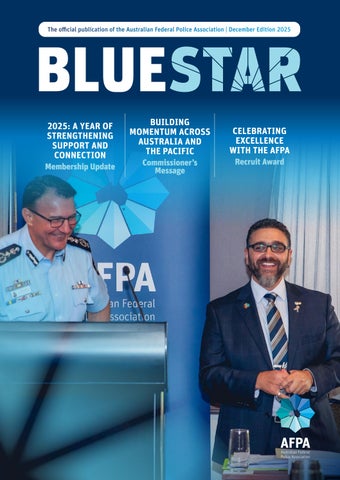
The official publication of the Australian Federal Police Association | December Edition 2025
2025: A YEAR OF STRENGTHENING SUPPORT AND CONNECTION
Membership Update
BUILDING MOMENTUM ACROSS AUSTRALIA AND THE PACIFIC Commissioner’s Message
CELEBRATING EXCELLENCE WITH THE AFPA Recruit Award
A credit card just for you
BankVic Qantas Visa credit card*.
Exclusively for members of the Australian Federal Police Association (AFPA).
Enquire today Earn Qantas Points on eligible everyday purchases
Complimentary international travel insurance1
$0 annual fee
bankvic.com.au | 13 63 73 | BankVic App | In branch *BankVic Qantas Visa credit card terms and conditions, fees and charges are available at bankvic.com.au/qantasvisa, by calling 13 63 73 or visiting a branch. The BankVic Qantas Visa Credit Card is provided by BankVic. Applicants must be current members of the Australian Federal Police Association (AFPA) and are subject to BankVic’s credit assessment criteria. Qantas Points accrue in accordance with and subject to the BankVic Qantas Rewards Program terms and conditions. Qantas membership and points are subject to the terms and conditions of the Qantas Frequent Flyer program. 1. Complimentary insurance covers: AWP Australia Pty Ltd ABN 52 097 227 177 AFSL 24563 (trading as Allianz Global Assistance) under a binder from the insurer, Allianz Australia Insurance Limited ABN 15 000 122 850 AFSL 234708 has issued a group policy to Police Financial Services Limited ABN 33 087 651 661 trading as BankVic AFSL and Australian Credit Licence 240293 which allows eligible BankVic accountholders and cardholders to claim under the group policy as a third party beneficiary by reason of the statutory operation of Section 48 of the Insurance Contracts Act 1984 (Cth). The eligibility criteria, terms, conditions, exclusions, limits and applicable sub-limits of the group policy are set out in the Policy Information Booklet which may be amended from time to time. An excess may be deducted from any benefit paid. BankVic does not guarantee this insurance. Any advice on insurance is general advice only and has been prepared without taking into account your objectives, financial situation or needs. You must check whether or not it is appropriate, in light of your own circumstances, to act on this advice. A Target Market Determination (TMD) for every product is available to help members decide if a product is suitable for them, the TMD can be found on our website bankvic.com.au. Police Financial Services Limited ABN 33 087 651 661 AFSL and Australian Credit Licence 240293 trading as BankVic. bankvic.com.au 12.2024 TB-0047
2
The Australian Federal Police Association acknowledges the traditional owners and custodians of country throughout Australia and acknowledges their continuing connection to land, waters and community. We pay our respects to the people, the cultures and the elders past, present and emerging. Executive Editor Alex Caruana | Phone (02) 6285 1677 www.afpa.org.au
AFPA Executive Members
Alex Caruana President
Disclaimer The contents of this publication is for general information only. The publication has been formulated in good faith; however, the contents do not amount to a recommendation (either expressly or by implication) and should not be relied upon in lieu of specific professional and/ or legal advice. The Australian Federal Police Association make no representation, nor give any warranty or guarantee concerning the information provided.
Clare Fitzpatrick
Adrian Smith
Eric Davies
Heath Langlands
Vice President (Sydney)
Secretary/Treasurer (Brisbane)
National Executive Member (Canberra))
National Executive Member (Jervis Bay)
David Power
John Hawkins
Vacant
Jane Thompson
Copyright All advertisements appearing in this publication are subject to copyright and may not be reproduced except with the consent of the owner of the copyright. Advertising Advertisements in this journal are solicited from organisations and businesses on the understanding that no special considerations other than those normally accepted in respect of commercial dealings, will be given to any advertiser.
National Executive Member (Canberra)
Giles Snedker
Troy Roberts
Courtney Posantzis
Chris Chillcot
General Manager
Legal and Industrial Manager
Media and Government Relations Manager
Membership Services Manager
Advisor to the President
Wendy Black
Katherine Abberfield
Rachel Ferguson
John Paul Romano Industrial Officer
Erin Fry
Industrial Officer
Emma Ramsey
Sairam Poosaria
Gerry O’Connor
Jason Taylor
Annie Swaker
Industrial Officer
Industrial & Research Officer
December Edition 2025
National Executive Member (Solomon Islands)
AFPA Staff Members
Paul McCue
Magazine cover
National Executive Member (Canberra))
Lucy Flanagan
Reception & Administration Officer
Industrial Officer
IT Projects Officer
Industrial Officer
Member Support Officer
Member Support Officer
Member Support Officer
Table of Contents President Report
1
Building Momentum Across Australia and the Pacific
4
Deborah Morris MLA End of Year Message
6
Marisa Paterson MLA End of Year Message
6
Flexible Work Arrangements under the Fair Work Act 2009
8
2025: A Year of Strengthening Support and Connection
10
Celebrating Excellence with the AFPA Recruit Award
12
The Year That Was 2025
14
Find Out if Police’s Health Needs Have Changed in 2025
18
Navigating Property Division: Your Essential Guide to Separation
21
Scribbly Farm Premium Geo Domes
24
December Edition 2025
Alex Caruana, President, Australian Federal Police Association
President Report As 2025 draws to a close, the AFPA reflects on a year of relentless advocacy, hard-fought industrial victories, and unwavering support for our members across the AFP. This report highlights key achievements, ongoing campaigns, and recent activities, particularly over the past four months since our last BlueStar. Representing over 4,300 AFP appointees from frontline officers in ACT Policing to protective services, unsworn personnel and national investigators, the AFPA remains committed to securing fair conditions, enhancing workplace safety, and amplifying members’ voices in a rapidly evolving national security landscape. Our work underscores the indispensable role of strong union representation in protecting those who protect Australia. In a well-deserved boost for members, the 4% Enterprise Agreement pay rise takes effect from 9 December 2025, with the increase reflected in payslips on 18 December 2025. This adjustment stems directly from the AFP Enterprise Agreement 2024–2027, which the AFPA meticulously negotiated to boost your pay packet and workplace conditions. It not only rewards the dedication of our workforce but also helps address the cost-of-living pressures that have persisted throughout the year.
Equally vital is the $500 uplift to the annual Use of Force Allowance, raising it from $3,000 to $3,500 for all qualified and authorised members. This was a key initiative by the AFPA in negotiations, and this enhancement acknowledges the extraordinary demands placed on Use of Force appointees, the rigorous training, heightened risks, and daily responsibilities in high-stakes operations. Over the years, the AFPA has championed such allowances as essential tools for retention and recognition, ensuring these officers are valued for their expertise in de-escalation, restraint, and protection. The additional payment will be processed alongside the pay rise and should appear in the same cycle. We urge all members to review their payslips on or shortly after 18 December 2025 to verify both the 4% base salary adjustment and the enhanced allowance, where applicable. If discrepancies arise, reach out to the AFPA promptly at afpa@afpa.org.au for assistance. Early detection allows us to resolve issues swiftly and maintain the momentum of these gains.
1
Member feedback has always been the cornerstone of AFPA action, and this year was no exception. Widespread concerns about the inconsistent application of Cultural Leave, including reports of arbitrary denials such as St Patrick’s Day being labelled “not allowed”, prompted the AFPA to intervene decisively. We wrote directly to the National Manager People Command, demanding clear, equitable guidelines to uphold the provision’s inclusive intent. The AFP’s response, delivered in late November 2025, marks a significant step forward, offering the most precise and member-centric direction to date. This guidance reaffirms that Cultural Leave is a vital mechanism for fostering diversity, respect, and psychological safety within the AFP. Core principles include: • Individual assessment: every request must be evaluated case-by-case, considering personal circumstances and operational needs. No blanket refusals are permissible. • No pre-emptive exclusions: days of genuine cultural or religious importance cannot be disqualified in advance, whether for individuals or groups. The recent factsheet serves as illustrative advice, not rigid policy. • Delegate discretion with accountability: under the Enterprise Agreement 2024–2027 and Australian Public Service Commission (APSC) standards, approvers must weigh the applicant’s identity, family obligations, and sense of inclusion. Refusals that undermine these factors are unjustifiable absent compelling operational imperatives. • Inclusive examples: observances like St Patrick’s Day Mass, Diwali Puja, Eid prayers, Yom Kippur services, NAIDOC Week events, or Lunar New Year family gatherings qualify. Social activities (e.g., pub drinks) do not, but genuine rituals do. Family-linked requests, such as a spouse’s cultural ceremony, remain eligible for tailored review, and we’ll be taking that matter up directly with the APSC. • Ongoing oversight: the AFP pledges continuous monitoring to ensure fair implementation, aligning with goals of equity and cultural respect. In practice, this empowers members to apply confidently for leave on days central to their heritage and beliefs, be it a Sikh Vaisakhi parade, a Buddhist Vesak meditation, or an Indigenous Sorry Day commemoration. When submitting, include a brief
2
note on the event’s personal significance and potential impact on your well-being if denied. Managers are encouraged to proactively discuss team members’ key dates to promote a supportive culture. Should a valid request be rejected or a day deemed offlimits, contact the AFPA at afpa@afpa.org.au without delay. We offer confidential guidance and, if needed, escalate to People Command. The AFPA will persist in collaborating with the AFP to embed this policy in everyday practice, ensuring it truly advances inclusion. The final quarter of 2025 was marked by dynamic, highimpact representation, blending operational support, policy influence, and member welfare initiatives. From courtroom solidarity to facility tours and media campaigns, the AFPA stood firm in support of members’ rights and safety. In November, the AFPA travelled to Perth to attend the sentencing of the offender responsible for stabbing two AFP officers at Perth Airport in January 2025. This harrowing incident highlighted the perils aviation personnel face, and our presence in court was a powerful affirmation of solidarity. It signalled to the judiciary, government, and public that assaults on federal officers demand stringent accountability. During the press conference after sentencing, I emphasised: “Our members risk everything to safeguard travellers; justice must reflect that valour.” This event also amplified our broader push for enhanced protections for all operational AFP appointees. Earlier, in October, the AFPA accepted an invitation to Pinkenba for a member muster and guided tour of the state-of-the-art facility. The location is impressive with cutting-edge infrastructure, from advanced training simulators to integrated command centres. The visit illuminated the pivotal contributions of these assets to training our people, while underscoring resourcing gaps.
Member feedback has always been the cornerstone of AFPA action, and this year was no exception.
December Edition 2025
Throughout August to December, the AFPA sustained pressure on the AFP Executive across critical fronts: alleviating staffing shortages exacerbated by attrition; bolstering mental health resources amid rising operational demands; expediting equipment procurement delays; and reforming regional allowances to retain talent in remote postings. These efforts align with our strategic priorities, ensuring that members are equipped to address tomorrow’s threats. The AFPA has maintained a strong public voice in recent months, particularly on the challenges facing ACT Policing and the wider AFP. Key media interventions include: • October 2025: Supporting the Canberra Liberals’ motion to repeal ACT drug decriminalisation laws, citing a surge in overdoses and open drug markets that have stretched ACT Policing resources to breaking point. • Ongoing criticism of bail and sentencing laws in the ACT, highlighting repeat youth offenders and lenient penalties for assaults on police. The AFPA has repeatedly called for urgent legislative reform to give officers the tools they need to protect the community.
• Advocacy for increased federal funding for the AFP, especially in protective service, aviation, and forensic capabilities, amid rising threats and workload. These public statements have kept pressure on both the ACT and federal governments, ensuring member concerns remain front and centre in policy debates. The AFPA National Office will close at midday on Wednesday, 24 December 2025, and reopen on Monday, 5 January 2026. Members requiring urgent assistance during this period should phone (02) 6285 1677; calls will automatically divert to the on-call AFPA representative 24/7. On behalf of the entire AFPA team, thank you for your extraordinary service throughout 2025. The work you do keeps Australia safe around the clock, often at high personal cost. Please look after yourselves and each other over the festive season. In solidarity, Alex Caruana President, Australian Federal Police Association
• Warnings about chronic understaffing in ACT Policing, with vacancy rates exceeding 10% in some areas and officers regularly working excessive overtime.
3
COMMISSIONER’S END OF YEAR MESSAGE
Building Momentum Across Australia and the Pacific By Krissy Barrett AFP Commissioner
Colleagues, it has been about two months since I was sworn in as AFP Commissioner. Since then, we’ve had two Budget Estimates hearings, I travelled to PNG to sign a policing cooperation agreement, and I attended the INTERPOL General Assembly in Marrakech.
In mid-December, I will travel to Fiji and Vanuatu to strengthen our strong partnerships within the Pacific. And I have visited three of our five regional commands. We have also been working together to co-design and consult on a new AFP structure to support our mission to defend and protect Australia and Australia’s future from domestic and global security threats. On top of all that is our business-as-usual work. There is a lot on! But many hands make the work we do a success, and our success is owned by every member. And while thinking about how we live up to success, I’ve been reflecting on themes in our previous staff surveys. Since becoming Commissioner, I’ve had so much goodwill from you all but I will not be taking any of it for granted. That’s why I will continue to clearly articulate what our mission and priorities are, as well as continue to hold regular musters and meet teams individually across the commands.
4
I will ensure our structure is clear and unambiguous so we can deliver our mission and priorities, and this is why it is important to me that a co-design process was undertaken with the workforce. And I will empower members to make decisions that are good for the agency but also beneficial for the workforce as well, which is why we are working to improve some processes now and will tackle others in the new year. All this work is connected to my five priorities. I am determined to reform the AFP, but I can’t do this by myself. We are all, particularly our leadership team, responsible for implementing cultural and organisational reform. It is easier said than done. And there’s few things worse than lip service or good intentions that dissipate because of work tempo or a feeling that it is all too hard. Next year, I will bring in a workplace psychologist to help create an environment that supports leadership teams accept, embrace and implement change, and
December Edition 2025
importantly to challenge how some can fall into the trap that, “the old way is the only way”. This is not just about operational work but also about ensuring we manage workload expectations. It is inspirational to watch the solutions the workforce is already creating and delivering for members and the agency. This is underscored by how we are introducing technology to help and protect the workforce. This year, we embarked on a major upgrade in Forensics, replacing instrumentation across the entire DNA workflow - including the laboratory’s two genetic analysers, which process every DNA sample. Once fully operational, these new tools promise to streamline laboratory processes, reduce manual handling, and dramatically cut turnaround times for sample processing. AI capability has been implemented in the Australian Centre to Counter Child Exploitation and other areas within the AFP. This will reduce member exposure to harmful images and reduce the time spent on investigations. And SHIELD is working with commands to develop psychosocial risk assessments to help identify and manage hazards, such as job demands relevant to work environments. This will continue into next year in consultation with commands, and importantly, with members. I will also use my voice to set expectations. At a recent graduation I asked all recruits to be mindful about their work life balance and to set good habits early on. And I said we need to change the perception that to get ahead, members need to be always at work and always on. This goes to every member – no matter how long you have been in the job. You will always be a better member if you find a balance in life. It is a great privilege to work for the AFP but we must acknowledge it also comes with some sacrifices, especially for members posted offshore who are away from support networks. Not all of our posts are in countries that are easy to live in, and in some cases education and health care standards can make it more challenging. The work our overseas members undertake goes to the heart of one of my priorities: supercharging global operations – which in essence means being more deliberate and strategic in how we leverage our partnerships and disrupt crime at its source. For our members offshore, it has never been more important or valued for you to showcase your commitment to the AFP and our country.
And I want to particularly shout out members in the Pacific who help ringfence our region and keep Australia safe and protect our way of life. The work performed in the Pacific is the epitome of national security. I encourage members to put your handup to deploy to the Pacific because it is extremely valued and critical work, now and into the future. I also acknowledge the teams at home who support our members offshore and contribute to their success. And I want to recognise our members in PRS and WICR, who are dealing with more demands and more complex issues. Our processes are never set and forget. The external review of the AFP’s complaint management system was completed in November, and the implementation of the review will start early next year. The new system will balance the need to uphold the AFP’s integrity culture while delivering system efficiencies, which should have the added benefit of reducing investigative timeframes. I am cognisant we are having weighty conversations and that I am testing thinking across the organisation. But as we draw to the end of 2025, and for those with time off over the festive season, I encourage you to switch off from work and re-charge and re-connect with family. And for those of you who are working over the holiday period, a huge and sincere thank you. I hope you get some downtime soon after. Stay safe, and Merry Christmas.
It is inspirational to watch the solutions the workforce is already creating and delivering for members and the agency. This is underscored by how we are introducing technology to help and protect the workforce. 5
Marisa Paterson MLA End of Year Message Dear Members, As the year comes to an end, I want to extend my deepest thanks to every officer and to the many people who support them. The work you do each day to protect our community is extraordinary. You put yourselves in harm’s way so others can feel safe, and that service, courage and professionalism is something our entire community relies on and deeply values. I also want to acknowledge your families, friends and loved ones, whose quiet strength, sacrifice and support make your service possible. To those officers and support staff working through the holiday period, thank you. While many are spending this time with family, you will be on duty keeping our community safe. Your commitment is what allows others to enjoy a safe and happy festive season, and we are profoundly grateful for that service.
I hope the weeks ahead give you the opportunity to pause, take a breath, and spend time with the people who matter most to you. Please know that your community stands with you and supports you, and that you are never alone. I also want to thank the AFPA for its strong advocacy throughout the year, which has delivered meaningful outcomes for ACT Policing members. Looking ahead to the new year, I am committed to continuing to work closely with the AFPA to support our officers, strengthen safety, and invest in the infrastructure and resources you need to do your jobs safely. Wishing you and your families a safe, restful and happy holiday season. Marisa Paterson MLA
Deborah Morris MLA End of Year Message The year has come to an agonising end and with a sobering reminder to both the law makers and the law enforcers: our way of life should never be taken for granted.
6
Australia is reeling from the worst terrorist attack ever experienced in our country. The murderous attack against members of the Jewish community peacefully celebrating Hanukkah at Bondi has sent shock waves across the nation. This evil act reminds us that we must be ever vigilante to those who seek to cause harm. When trouble strikes, you are always among the first to respond to the call for help. As law enforcers, you are asked to confront danger every day to keep the community safe. You are asked to protect the vulnerable, defend lives and livelihoods, preserve peace and maintain the rule of law.
December Edition 2025
And too often, you are required to do so with your hands tied behind your back, in squalid working conditions, with little support on the frontline, and with very little thanks or praise in return. And when mistakes are made, politicians and certain sections of the media are all too quick to point the finger in condemnation. It shouldn’t be this way. Everyone in our community deserves to go about their business peacefully and without the fear of theft or violence. Whether that daily business means practising your faith, taking the kids to school, running a small business, or simply just going to bed at the end of a busy day, everyone should feel safe. Overwhelmingly, Australians know and expect this. The reality is, unless you have the backing of the government of the day it is difficult for you to do your job. That’s why, since I was elected to the ACT Legislative Assembly, I have been working hard for a better deal for ACT Policing. Where the ACT Government can make your job easier, they are morally obliged to do so because the most vulnerable in our community depend on your service. As a start, that means ensuring safe and fit-for-purpose police accommodation. It means getting the legislative settings right. It means giving you the tools you need to help get the job done in a safe and dignified way.
laws to disrupt outlaw bikie activity and prevent the significant bleed of police resources to monitor them. We’ve fought to re-criminalise hard drugs like heroin and ice. We’ve warned against raising the age of criminal responsibility to 14 and have pushed for the introduction of Jack’s law to give you the tools you need to get knives off our streets in a safe and dignified way. But there is so much more to do. We need to speed up the ACT’s implementation of the National Firearms Register. The federal government is providing funding to the ACT Government, but it seems little progress is being made. We need to crack down on the manufacturing of weapons in suburban basements by downloading blueprints of 3D guns. We need to accelerate the roll out of electric monitoring and more. All of this matters because it equips and prepares us in to respond to trouble when it strikes and keep the community safe. To our sworn and unsworn officers, to our volunteers and support staff, thank you for all you do and all the sacrifices you have made to keep our community safe and protect our way of life. As law enforcers and law makers we must work together to protect the vulnerable, defend lives and livelihoods, and preserve peace. Deborah Morris MLA
You deserve safe police accommodation that isn’t in a perpetual state of contamination and disrepair from water damage, sewage leaks, lead dust and toxic contaminants. You have enough to worry about when you’re encountering danger and preserving peace in the community without worrying about your safety in the workplace. That’s why I sought to uncover hidden government documents on the woeful state of ACT Policing facilities so that we can pressure the government to accelerate the construction of new facilities. Rather than being a ‘safe haven’ for criminals, Canberra should be a hard target. That’s why you deserve a legislative environment that deters crime, enables you to respond to criminal activity and that is clearly defined so that there is no confusion when you are required to enforce the law. This year, the Canberra Liberals have fought for bail reform to end the revolving door of repeat offenders in the community on bail. We’ve fought for anti-consorting
7
LEGAL UPDATE
Giles Snedker
Legal and Industrial Manager
Flexible Work Arrangements under the Fair Work Act 2009
In today’s dynamic work environment, flexible work arrangements have become a cornerstone of modern employment.
What are Flexible Work Arrangements?
Recognising the changing needs of employees and businesses, the Fair Work Act 2009 (Cth) (the Act) provides specific rights and responsibilities concerning flexible working conditions. These provisions aim to balance work-life demands while supporting employee wellbeing and workplace productivity.
These arrangements can accommodate various personal needs, including caregiving responsibilities, health conditions, study commitments, or transition to retirement.
This legislated entitlement is also contained in clause 89 of the Australian Federal Police Enterprise Agreement 2024-2027 (the EA). Under this clause, the AFP recognises the importance of a work-life balance, that flexibility can support strategies to improve diversity in the workplace, and flexible work arrangements can assist in attracting and retaining Employees. The ability to request flexible working arrangements is also supported by the Better Practice Guide on flexible working arrangements (MPS059) which outlines the AFP’s policy and procedure for managing flexible work.
Flexible work arrangements refer to modifications in the traditional working structure, such as: • Changes in hours of work (e.g., part-time, job-sharing) • Alterations to work patterns (e.g., split shifts) • Changes in location of work (e.g., working from home or an alternative location)
Who Can Request Flexible Work Arrangements? Under section 65 of the Act, certain employees have the legal right to request flexible working arrangements if they have completed at least 12 months of continuous service with their employer. While any Employee can request flexibility, Employees who have a legal entitlement to request FWAs under the Act include: • Parents or those with responsibility for the care of a child who is school-aged or younger • Carers (as defined under the Carer Recognition Act 2010) • Individuals with a disability • Employees aged 55 or older • Those experiencing family or domestic violence, or providing care/support to someone affected
8
December Edition 2025
Making a Request Flexible work arrangement can be either informal or formal. Informal arrangements can include ad hoc flexible working hours within a bandwidth or working from home. Informal arrangements still require discussion, negotiation and agreement between the Employee and supervisor but they can be approved simply via email. Formal arrangements are those which vary the terms of the EA that relate to hours of duty, or longerterm changes to a working arrangement, including where work is undertaken. These require discussion, negotiation and agreement between the Employee and Supervisor, and relevant Delegate approval. These arrangements must also adhere to the requirements outlined in the BPG. An eligible Employee must make their request in writing through the AFP Service Portal, outlining: • The changes being sought, and • The reasons for the request Employees are encouraged to submit requests as early as possible. The AFP must first discuss the request with the employee and genuinely try to reach agreement. Requests are to be considered on a caseby-case basis, with a bias towards approving requests and only declining requests for flexibility on reasonable business grounds. The AFP are also required to respond in writing within 21 days, stating whether the request is approved or refused. Where a request is refused, the Delegate must provide written details of the reasons for refusal and an explanation as to how and why the reasonable business grounds apply, any alternative arrangements that may accommodate the employees circumstances, and where there are no such changes that can be made to support the Employee’s request provide information to the Employee on the relevant dispute resolution provisions of the EA. Reasonable business grounds may include: • Significant cost implications • A detrimental impact on productivity or customer service
If an Employee is not satisfied with the reasons for refusal provided by the Delegate or the Delegate has not provided a written response to their FWA request within 21 days, they should initially discuss the matter with their supervisor and/or management to attempt to seek a resolution at the workplace level. Where agreement cannot be reached within the business area, Employees should utilise the dispute resolution provisions of the EA.
Role of the Fair Work Commission If the AFP: • Fails to respond within 21 days, • Refuses the request without reasonable business grounds, or • Fails to genuinely engage in discussions, An Employee can apply to the Fair Work Commission for assistance. The FWC may deal with the matter through conciliation, mediation, or arbitration, ensuring a fair resolution process. The Commission may deal with a dispute in certain circumstances if an employer has refused a request or failed to respond in writing within 21 days, however Employees must first attempt to resolve a dispute at the workplace level. If it cannot be resolved, the Employee may refer it to the Commission.
Conclusion Flexible work arrangements under the Act represent a significant step towards creating inclusive, adaptive, and sustainable workplaces. As the nature of work continues to evolve, these provisions empower Employees to balance professional and personal responsibilities while giving the AFP the opportunity to retain talent and improve workforce morale. With proper implementation, flexible work is not just a legal right — it is a business advantage. This article is a brief overview of flexible work arrangements, however all Employees are encouraged to review the EA and the BPG, and to reach out to the AFPA for further advice or assistance if required on afpa@afpa.org.au
• The impracticality of accommodating the request due to the nature of the job
9
MEMBERSHIP UPDATE
Courtney Posantzis
Membership Services Manager
2025: A Year of Strengthening Support and Connection
As 2025 draws to a close, the AFPA remains steadfast in its mission to support every serving member of the AFP and your families. Whether you are on shift, on leave, or facing the demands of the job, our Member Services team has been working tirelessly to ensure you have access to the practical benefits, welfare support, and peace of mind you deserve.
This has been a busy and rewarding year for the Membership Services team.
Our focus has stayed clear: supporting members when they need it most, building stronger connections, and delivering services that make a real difference. Welfare Services – Always There When It Matters In 2025 our welfare team assisted members through personal and professional challenges, providing urgent crisis payments, financial hardship grants, emergency relief, emotional support, and access to critical services. Working closely with AFPA Delegates, AFP Welfare Officers, family members, and colleagues, we ensured no member felt alone during difficult times.
Stronger Engagement We strengthened relationships with delegates and AFP Welfare teams, trialled workplace foyer stands to meet you where you work, and partnered with BankVic and Police Health to showcase membership benefits. We proudly supported key events, including the Wall to Wall Ride for Remembrance, National Police Remembrance Day, the Police Basketball Championship, and the Affiliated Police Rugby League Team. These are moments that honour service and bring our community together. None of these achievements would have been possible without the dedication of the entire Membership Services team and the ongoing support of our valued partners, BankVic and Police Health.
10
December Edition 2025
Your Membership – More Valuable Than Ever
Looking After Those Who Look After Australia
Everyday savings through Members Advantage remain incredibly popular, and your AFPA membership delivers far more:
Your career is built on service, sacrifice, and dedication. The AFPA’s role is to ensure that service never comes at the expense of your family’s financial security or well-being.
• Exclusive Police Health private health insurance with no policing-related exclusions, rolled-gold extras, and Australia-wide ambulance cover • Competitive banking, home loans, credit cards, and personal loans with BankVic • Discounted income protection, journey injury, life, car, home and contents insurance • Members Advantage: up to 15% off gift cards, extra catalogue discounts, cashback, and special offers on Apple, Dyson, Samsung, and more • 24/7 confidential counselling, peer support, critical incident response, legal assistance, and industrial advocacy • Financial hardship grants and emergency relief
We Are Here Over Christmas and New Year The festive season can be joyful but also challenging, especially for those working shifts or facing unexpected difficulties. If you need assistance (whether it’s a benefit enquiry, welfare support, or legal advice) help is only a phone call away.
As we head into the festive season, take a moment to: • Log in to Members Advantage (www.membersadvantage.com.au) and start your Christmas shopping • Download the Members Advantage app • Update your details in the AFPA Member Portal so we can always reach you • Check your Police Health cover includes the kids’ summer activities • Or simply give us a call From everyone at the AFPA, thank you for your continued service to the community. We wish you and your families a safe, relaxing, and joyful Christmas and holiday period. Whatever comes up, AFPA Member Services has your back, today, tomorrow, and always.
Call the AFPA national office on (02) 6285 1677. Our professional staff answer 365 days a year, and a Member Services representative will contact you promptly, usually the same or next business day. No issue is too big or too small.
11
Celebrating Excellence with the AFPA Recruit Award
12
This year, the AFPA formally introduced the AFPA Recruit Excellence Award, a new honour that will be presented at AFP recruit graduation ceremonies. Endorsed by the AFPA National Executive in late 2023 and inspired by long-held traditions in other policing jurisdictions, the award recognises one outstanding recruit from each Constable and Protective Service Officer squad.
The AFPA Recruit Excellence Award, sponsored and presented by the AFPA President, symbolises the Association’s continued commitment to advocacy, recognition, and support, from graduation day and throughout career. The first recipients celebrated this year mark the beginning of a meaningful and long-lasting tradition that further strengthens the partnership between the AFP and AFPA.
The award acknowledges recruits who demonstrate exceptional dedication, leadership, and a strong alignment with the AFP values of Integrity, Commitment, Excellence, Accountability, Fairness, Trust, and Respect, qualities that shape the culture and professionalism of the AFP.
As we wrap up the year, this new award stands as a positive reflection of the AFPA’s ongoing mission - to uplift, acknowledge, and stand alongside every member who dedicates themselves to serving our community. We look forward to recognising the next generation of AFP appointees in 2026 and continuing to build a safer, fairer, and more supported future for all.
December Edition 2025
AFPA CEO and President Alex Caruana reflected on the milestone, saying:
“It was an honour to present the inaugural AFPA Recruit Excellence Award winners with their awards since its introduction in 2025. Their dedication and professionalism represent the very best of the AFP’s future leaders, and we look forward to continuing this tradition into 2026 and beyond.” 13
The Year That Was
14
2025
15
Come home to a $5,000 first home buyer cashback*
Exclusive home loan rates for AFPA members D Variable and fixed rate loan options available D Minimum $350k loan amount and loan-to-value ratio (LVR) of up to 95%
D Home Loan Mentors to help coach you through your home loan journey
Talk to one of our Home Loan Mentors today bankvic.com.au | 13 63 73 * Eligibility criteria: (a) This offer is limited to current police employees who are First Home Buyers and submit a loan application from 2 September 2025. (b) To qualify for the $5,000 cashback offer, your new loan must be fully funded for an amount of at least $350,000. (c) The loan purpose needs to be for the purchase of your first property in Australia and one of the borrower/s is a first home buyer. (d) The loan must be settled and fully funded within 180 days of unconditional approval issued whilst this offer is available. (e) The loan can have a loan-to-value ratio (LVR) of up to 95%. (f) This offer is available for both owner-occupier and investor loans and is limited to a maximum of one cashback per loan, regardless of the number of mortgaged properties involved in the transaction. (g) If you have received cashback in the past from BankVic, you may potentially be ineligible for this offer, please discuss with your lender for further information. (h) Split loans against one security will be eligible for one cashback only. (i) Construction loans need to be fully settled and all progressive drawdowns should be completed before any cashback payments are made. (j) The cashback proceeds will be paid into a BankVic transaction or savings account within 8 weeks of full loan drawdown or settlement. This account must be in the same name/s as the home loan account. If no instructions are received from the borrower/s, the cashback proceeds will alternatively be credited to the loan account. (k) This offer is available until further notice and BankVic may vary terms and conditions or cease this offer at any time. (l) For the purposes of this offer, police employees include any police, protective service officers, police custody officers, employees of any state or territory police force, Australian Federal Police (AFP) employees, and any member of The Police Association of Victoria (TPAV) or the Australian Federal Police Association (AFPA). Police Financial Services Limited ABN 33 087 651 661 trading as BankVic AFSL and Australian Credit Licence 240293. 08.2025 TB1507
End of year wrap-up: reflect, reset, and refresh for the new year As the calendar winds down, the end of the year presents a valuable opportunity to pause, reflect, and reset your financial wellbeing. Whether you’ve had a year of growth or faced unexpected challenges, closing out the year with intention can set the tone for a more empowered and financially confident start to the new one.
Set fresh goals for the new year Think about what financial wellbeing means to you in the year ahead: / Is it saving for a home, reducing debt, building an investment portfolio, or simply feeling more in control? / Set SMART goals (Specific, Measurable, Achievable, Relevant, and Time-bound) and break them into manageable steps.
Reflect on the year that was
Seek support and stay informed
Financial goal
Yes /No Helpful resources
Did I stick to my budget?
Yes /No
moneysmart.gov.au To plan and set your budget.
You don’t have to do it alone. Tap into financial wellbeing resources available through your workplace or community. Whether it’s workshops, coaching, ASIC’s moneysmart.gov.au site or other digital tools, support can make a big difference in staying on track.
Make progress on savings?
Yes /No
bankvic.com.au/savings To explore savings options to help boost your balance.
Can I reduce my debt further?
Yes /No
Document all your debt in a spreadsheet and speak to your bank and/ or financial institution to find out if consolidating will help.
Begin by reviewing your financial goals from the past year.
Have I celebrated my successes and/or reassessed the challenges I face?
Yes /No
Chart your wins to give yourself an incentive e.g. little gift for yourself, lunch, special treat. Review challenges and reset.
This reflection isn’t about judging yourself - it’s about finding out where you can learn and make even more progress.
A fresh start begins with a clear mind and a solid plan Ending the year with clarity and intention allows you to enter the new one with confidence. Financial wellbeing isn’t about perfection - it’s about progress, awareness, and making choices that align with your values. So take a breath, reflect, and step into the new year ready to thrive.
We’re here to help If you have any questions about how BankVic can help support you achieve your long-term financial goals, visit bankvic.com.au or call 13 63 73 to make an appointment with a BankVic staff member.
Angela Martin Financial Wellbeing Program Manager
Organise and update Take time to tidy up your financial life: / Review and update your budget to reflect any changes in income or expenses / Check your subscriptions and cancel those you no longer use / Organise important documents - tax records, insurance policies, and superannuation statements / Ensure your emergency fund is topped up or set a goal to build one.
Plan for the holidays mindfully The festive season can be a financial pressure point. Set a realistic holiday budget that includes gifts, travel, and entertainment. Consider low-cost ways to celebrate, and that focus on connection rather than consumption.
bankvic.com.au | 13 63 73 | BankVic App | In branch The information in this article was current as at the time of publication only. This information is general only, does not consider your personal circumstances and you should consider its appropriateness & refer to the T&C’s or PDS before acquiring any product. These documents are available on request. Fees & charges may apply & interest rates are subject to change. The tax and superannuation information is general in nature, does not constitute advice and you should seek independent tax or financial advice where appropriate. Police Financial Services Limited ABN 33 087 651 661 - trading as BankVic | AFSL and Australian Credit License 240293. 10.25 TB1564
POLICE HEALTH
Find Out if Police’s Health Needs Have Changed in 2025
Throughout the 2024-2025 financial year, Police Health Limited continued to meet the growing health needs of its members and paid just over $245 million in health benefits to its members. The three most expensive hospital episodes were; • Digestive System episode and treatment, $235,777 benefit • Brain and Nervous System episode and treatment, $124,228 benefit • Chemotherapy, radiotherapy and immunotherapy for cancer, $115,620 benefit
It’s a strong reminder of the benefits of private health cover—peace of mind, faster access to treatment compared to the public system, and the reassurance that when you do need to claim, your cover helps reduce the financial burden. This is especially relevant for police and emergency service workers, whose demanding roles and added workplace pressures can increase the risk of chronic mental and physical health challenges.
Hospital cover continues to support Within Police Health Limited, the most common hospital procedures and treatments in the 2024-2025 financial year were:
18
Procedure or treatment
Average benefit paid
Heart and Vascular System (e.g. heart surgery)
$7,509
Joint replacements (e.g. hip replacement)
$17,393
Digestive System
$4,763
Gastrointestinal Endoscopy
$1,474
Hospital Psychiatric Services
$3,283
December Edition 2025
Changes from 2023-2024 Despite growing to 100,000 members across Police Health and Emergency Services Health, there were only minor changes to the most common hospital procedures and treatments; • Heart and vascular system and joint replacements swapped places • Digestive System and Gastrointestinal Endoscopy also swapped places It’s not a surprise that Hospital Psychiatric Services remained the 5th most common hospital procedure or treatment.
It found that, of emergency services personnel overall; • 30% had low wellbeing • 21% had high and 9% had very high psychological distress • 10% had probable PTSD If you or someone you know needs support, these mental health services can help;
• Lifeline | 13 11 14
Recent research by The University of Western Australia, which surveyed 14,868 Australian ambulance, fire and rescue, police, and state emergency service employees, found these groups face extra risks.
• Beyond Blue | 1300 22 4636 • Kid Helpline | 1800 55 1800
Extras health insurance delivers The most common extras benefits used across Police Health Limited appear to resemble the most commonly known extras. Extras category (eg dental, optical etc)
Average benefit paid
Total benefits paid
Dental
$328
$45,331,088
Optical
$336
$14,188,362
Physiotherapy
$77
$11,582,430
Chiropractic
$59
$5,594,741
Podiatry
$112
$4,179,578
This order is a repeat of the 2023-2024 financial year, and reiterates the extra stresses that police and emergency services face. That includes National Library of Medicine (US) that found shift work, a commonplace in police and emergency services, can lead to changes in saliva pH. This then creates an acidic environment in the mouth that promotes harmful bacteria, and may cause dental cavities.
In addition, there’s growing evidence that police and emergency services workers face extra strain on their eyes. One example is Natural Hazards Research Australia’s survey of 337 firefighters across NSW, Victoria and South Australia. They found that 90% experienced eye irritation during work and 70% continued to experience symptoms afterwards.
For more information or to join Police Health, call 1800 603 603 19
extras that *
With Police Health, unused annual limits on most Extras rollover into the next year, so you can claim more when it matters most.* That’s real value and flexibility.
Learn more
20
Visit policehealth.com.au Call 1800 603 603
*Rollover applies once you’ve completed your first 12 months membership on Rolling Extras (2 years for Major Dental). Rollover benefits do not apply to Health Appliances, School Accident cover and Orthodontics. Other conditions may also apply, see website for more details. Police Health Limited ABN 86 135 221 519. A registered, not-for-profit, restricted access private health insurer. © 2025
December Edition 2025
LEGAL UPDATE
Rebecca Zanol Senior Associate
Christiana Michaels Associate
Navigating Property Division: Your Essential Guide to Separation
The breakdown of a relationship is an emotionally and financially challenging transition. In the early stages of separation, questions often arise about the immediate steps to be taken, each party’s legal entitlements, and how a formal property settlement is finalised. Taking informed steps during this initial period can protect your financial interests and reduce conflict long-term. Here are some things to consider in the initial weeks after separation:
1. The Date of Separation Separation occurs when at least one person in the relationship decides that the relationship has ended beyond a reasonable likelihood of reconciliation and has communicated that decision to the other person. It is possible to continue living together and be separated under one roof. The date of separation can affect several important legal and financial issues that arise out of separation, including Centrelink benefits, taxation status, child support and the timeline of making an Application for Divorce. It is therefore useful to record the date of separation in writing, such as by sending an email or text message confirming that the relationship has ended.
2. I mmediate Issues Following Separation In the immediate aftermath of separation, three questions commonly arise: 1. Can the locks be changed to the family home? 2. Can joint funds be used when personal income has ceased? 3. Is spousal maintenance available?
These issues are usually urgent because they touch directly on safety and day-to-day living. If you are remaining in the home, it is understandable to feel apprehensive about a former partner returning without notice. Where both parties are on the title to the property, one person may change the locks but the other can generally arrange to change them again. In practice, many parties agree that the person who has left will not return without permission or prior notice. Where agreement cannot be reached, either party can seek orders from the Court for sole use and occupation of the home while the broader financial matters are resolved. If there are any concerns about safety, timely advice should be obtained regarding the suitability of a police or private intervention order. Access to basic living expenses is often the next concern, particularly where a home-maker’s access to wages has been cut off. Using joint funds is allowed when applied to genuine necessities such as housing, food and children’s needs. Sensible restraint and careful record-keeping is essential, as this spending may be reviewed during the property settlement. Where joint funds are unavailable, spousal maintenance may be a mechanism for immediate relief from financial distress. Spousal maintenance is distinct from child support. It is financial assistance paid by one partner to the other where the applicant cannot adequately support themselves and the other partner has capacity to contribute after meeting their own reasonable expenses. Both married and eligible de facto partners may apply. Urgent or interim maintenance can be
21
sought where circumstances warrant it, but time limits do apply, so early advice is prudent.
statements, loan agreements, taxation returns and notices of assessment.
To determine whether maintenance should be ordered, the Court considers the overall circumstances, including income and resources, age and health, care of children, the effect of family violence, and what constitutes a reasonable standard of living. Addressing maintenance promptly often reduces conflict and avoids unnecessary debt while the broader financial settlement is progressed.
If disclosure is incomplete or withheld, it may be necessary to obtain the information from third parties by issuing subpoenas to banks, employers, superannuation funds, accountants and real estate agents. A subpoena is essentially a court ordering a third party to attend to give evidence and/or produce documents or things.
3. U nderstanding Your Financial Position
Begin Negotiations
One of the most important steps post-separation is to gain a clear understanding of your overall financial circumstances. In any family law property settlement, identifying and valuing the asset pool for division is an essential early step. The assets, liabilities and superannuation entitlements within the asset pool represents everything of financial value owned by either of the parties, regardless of whose name it is in. The asset pool for division typically includes: • Residential and/or commercial real estate; • Motor vehicles; • Savings, shares, cryptocurrency and other investments; • Company entities and/or trusts; • Assets held through companies, trusts or self-managed super funds; • Superannuation; and • Liabilities, including mortgages, loans and credit cards. Assets are valued as at the date of settlement of a property settlement matter, not the date of separation. As such, these values can fluctuate over time. Independent valuations may be required for any assets in dispute. Both parties are also legally required to provide full and frank disclosure throughout the family law process. Disclosure ensures transparency and fairness by allowing both parties (and their legal representatives) to properly review the other party’s financial position. This is an ongoing duty and applies whether negotiations occur privately, through mediation, or before the Court. Documents commonly disclosed include bank statements, credit card statements, superannuation statements, payslips, profit and loss
22
With a reliable financial picture, mediation is often the most efficient next step. In lawyer-assisted mediation, an independent mediator facilitates negotiation while lawyers provide legal advice, test proposals against legal principles and practicality, and record any agreement. Mediation may occur before or after court proceedings commence. It is typically faster and less costly than litigating, preserves party control over outcomes, and allows for tailored arrangements (such as staged payments, timing of sales and superannuation splits) while generally reducing conflict. Where agreement is reached, it can be formalised by filing an Application for Consent Orders with the Federal Circuit and Family Court. Once made, Consent Orders are binding and enforceable in the same way as any court order. Formalising the agreement in this manner provides certainty, prevents future claims, and sets clear mechanisms for implementation, including timeframes, transfers and consequences for noncompliance.
Need help? If you have questions about your family law matter, our experienced team is here to help.
Contact us today to arrange a confidential discussion and get advice tailored to your situation.
Scribbly Farm Premium Geo Domes
in the heart of the Southern Highlands There’s something about Scribbly Farm that stays with you long after you leave.
There’s something about Scribbly Farm that stays with you long after you leave. One night at Scribbly Farm offers so much more than a night in a 5 star hotel, it’s a world class experience in nature and connection. This is an immersive encounter with the Australian bush, without compromise. It’s glamping redefined — where comfort meets authenticity.
24
Guests are invited to embrace the essence of our digital detox challenge: to disconnect in order to truly reconnect. From the moment you arrive, life’s pace softens as the sounds, sights, and scents of the Australian bush surround you, as you slow down you will breathe deeper, laugh easier, and enjoy moving without a schedule.
December Edition 2025
Without constant connection to the outside world, we reconnected with ourselves — and each other. It was pure, simple bliss — the kind you can only find in a place like this. — The Savvy Traveller, July 2025
Each dome offers true privacy and seclusion, nestled deep within the bush, an intimate escape for two where dreams intertwine with the serene landscape. Sustainability runs through every detail, the domes are solar-powered, so leave your hairdryer at home! Cladding for the decks is milled from fallen trees on the farm, Toiletries are eco-friendly, locally freshly ground coffee, local produce and wines are available for guests to pre order and food scraps are recycled for the chickens. Oversized windows and a generous skylight open your world to breathtaking views by day and a canopy of stars by night. Inside, an ensuite with a rainfall shower offers a moment of quiet luxury, with a view, of course.
At the heart of your dome is a warm living space, with a log-burning fire, lounge chairs and dining area. Your adjoining covered heated deck features a Weber BBQ and gas hob to dine outdoors in comfort, or enjoy your meal fireside within the dome. Native flora and fauna abound across the farm’s 100 acres. Guests can join a guided walk into the paddocks, where echidnas, wombats, and kangaroos emerge at dusk to graze. As night falls, use a thermal monocular to reveal the secret life of the bush, before gathering around the open fire for wine and local snacks under starlit skies. Bring your own supplies, or indulge in fresh local produce, from steaks and seafood to grazing plates, perfectly paired with regional wines.
AFPA Special Members offer
Sunday to Thursday stays 20% off and includes a cheese plate and local wine Friday and Saturday Stays 10% off and includes a cheese plate and local wine 10% off guided night walks and wanders [subject to availability ] Valid all 2026 stays booked by June 30th 2026 Bookings Call The Savvy Traveller on 0452 209 964 with your preferred stay dates.
25
EXCLUSIVE OFFER
50% OFF ALL ITEMS*
Valid at any Peter Jackson store Australia wide, offer not available online. *Applies to retail base prices.
Level 3/53 Blackall Street, Barton, ACT 2600 P 02 6285 1677 E afpa@afpa.org.au
www.afpa.org.au