RESEARCH FLORIDA INTERNATIONAL UNIVERSITY
FORWARD-THINKING.
INNOVATIVE.
UNSTOPPABLE.
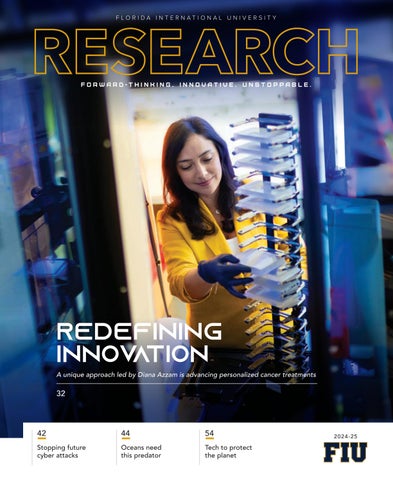
Redefining Innovation A unique approach led by Diana Azzam is advancing personalized cancer treatments
32
42
44
54
Stopping future cyber attacks
Oceans need this predator
Tech to protect the planet
2024-25
Fie ldwork
Game-changing treatment Eleven-year-old Hayden Thomas enjoys playing tennis with his sister Madilynn. He can even serve the ball, thanks in part to a novel exercise program incorporating use of a bodypowered 3D-printed prosthetic hand. Designed to help patients better manage everyday tasks, the program offers hope for more convenient, cost effective therapy options for children with congenital upper limb deficiencies. Hayden’s mom, physical therapist Amanda Thomas in the Nicole Wertheim College of Nursing & Health Sciences, and her Doctor of Physical Therapy students created the at-home program in which Hayden’s strength, range of motion and coordination improved markedly. His 3D-printed hand was created at FIU’s Miami Beach Urban Studios, and the pattern for the adult-sized hand was modified with assistance from university biomedical engineers. Thomas’s study has received global interest since its publication in the Journal of Hand Therapy.
FLORIDA INTERNATIONAL UNIVERSITY
Fieldwork
FIU RESEARCH MAGAZINE | 2024- 25
1
Samuel Fabian / Imperial College London
Why do insects behave so bizarrely around light at night? As part of FIU’s global research collaborations, an international team provided a new explanation for a millennia-old mystery.
A combination of motion capture tech and high-speed cameras revealed an important clue: In flight, insects keep their back turned toward the light source. According to the data, published in Nature Communications, this is because they evolved to rely on the brightest thing they see (the sky) to know which way is “up” and maintain control in the air. Artificial light at night throws these instincts for a loop and insects get trapped in an exhausting cycle trying to stay orientated — a futile effort that causes clumsy maneuvers and occasional crashes directly into the light. This study received national and international coverage, appearing in The New York Times, CNN, Scientific American, The Guardian and more.
2
FLORIDA INTERNATIONAL UNIVERSITY
E X PE RIE N C E IM PAC T LAST FALL, FIU COMPLETED ITS LATEST STRATEGIC PLAN: EXPERIENCE IMPACT 2030. The process necessitated that we evaluate honestly our current state and our desired destination. It required a cleareyed assessment of strengths, weaknesses, opportunities and challenges, not only internally but in our community, region and beyond. Much like the last strategic plan, we knew this one must be relevant and position FIU and our students for long-term success. We knew that our next strategic plan must provide direction for the university community to move forward with clarity. As this stunning photo illustrates, moths lose their bearings around artificial light at night. Confusion reigns. We needed to make sure there was no confusion among our FIU community about where we were headed and how we were going to get there. Experience Impact 2030 is focused on expanding our accomplishments in student success, research excellence, national and international recognition, continued recognition as a leading Hispanic-Serving Institution, leadership in arts and culture, and dozens of leading initiatives addressing great challenges facing our global community. It presents an opportunity to continue our momentum and strategically redefine the role and impact of the public research university. As part of this 18-month collaboration that involved university leaders, faculty and staff, students, alumni and community leaders, FIU identified three strategic areas of research focus: Environment & Environmental Resilience, Health, and Technology & Innovation. This issue is filled with the important work of our researchers and students tackling critical issues in these focus areas and beyond. We highlight the work of a marine ecologist whose decades of research around predator-prey interactions and the ecological importance of sharks has yielded greater understanding of the role of these creatures in the ocean’s ecosystem. We offer a behind-the-scenes glimpse into a cancer researcher’s lab, in the process gaining a sense of what drives her and the members of her team. And we introduce our readers to some of the climate tech innovations being developed by our faculty and students. We hope you enjoy these articles and this publication. Please be sure to visit researchmag.fiu.edu for videos and additional information that accompanies many of these stories.
Elizabeth M. Béjar
Provost Executive Vice President Chief Operating Officer Email: bejare@fiu.edu
Andrés G. Gil
Senior Vice President, Research and Economic Development Dean, University Graduate School Professor, Robert Stempel College of Public Health & Social Work Email: gila@fiu.edu
FIU RESEARCH MAGAZINE | 2024- 25
3
CON TENTS FLORIDA INTERNATIONAL UNIVERSITY AND OFFICE OF RESEARCH & ECONOMIC DEVELOPMENT Kenneth A. Jessell President Elizabeth M. Béjar Provost, Executive Vice President and Chief Operating Officer Andrés G. Gil Senior Vice President for Research and Economic Development Dean of the University Graduate School William T. Anderson Associate Vice President for Research Tonja Moore Associate Vice President for Research Strategic Planning and Operations Luis Salas Associate Vice President for Research
IN FOCUS
32 44 54
REDEFINING CANCER TREATMENT
Hundreds of FDA-approved drugs tested directly on a patient’s tumor sample. Could this be a gamechanger for cancer management?
SHARKS MATTER
Decades of research reveals the many roles of sharks in keeping oceans healthy. What scientists learned may surprise you.
TECH TO PROTECT
Human ingenuity and creativity are helping ensure a more resilient future.
Robert Gutierrez Associate Vice President for Research David Driesbach Assistant Vice President for Research Emily Gresham Assistant Vice President for Research
IMPACT AT A GLANCE Fieldwork: Game-changing treatment | 1 Deadly naïveté | 6 Take out the trash | 18 Splat! | 68 Research Round Up | 8 Patents | 24 In the Lab | 38 Next-Gen Researchers | 62
4
FLORIDA INTERNATIONAL UNIVERSITY
Inspired by the intricate pattern and texture of coral, Ecoblox are transforming seawalls into something both beautiful and beneficial to the environment. Read more on pg. 56.
IN THIS ISSUE
20 26 30 42 58
INVESTING IN GROWTH
Baptist Health and FIU join forces to elevate care, address the doctor shortage and boost medical research.
IN MY VIEW: Hortensia Amaro
The U.S. spends trillions annually on health care yet performs poorly in key health indicators. What’s driving America’s health disadvantage?
POPULATION HEALTH
A new initiative addresses the myriad factors that influence health outcomes.
Q&A: Selcuk Uluagac
Stopping the next cyberattack.
TECH HUB INFOGRAPHIC
Resilient infrastructure.
64
THE CONVERSATION
66
FACULTY NEWS
FIU RESEARCH MAGAZINE | 2024- 25
5
6
FLORIDA INTERNATIONAL UNIVERSITY
Photos: Brandon A. Güell
Fie ldwork
Fieldwork
Deadly naïveté Behold the slough crayfish (Procambarus fallax). Petite enough to fit in the palm of a hand, these freshwater crustaceans were once abundant in the Everglades and a plentiful food source for wading birds. But populations have plummeted 99% in the last decade. Invasive Asian swamp eels are the prime culprit behind the disappearances. Institute of Environment postdoctoral researcher and wildlife photographer Brandon A. Güell wants to understand why slough crayfish — who expertly evolved to fight, freeze or flee for survival — have become such easy prey. With video and timelapse photography, he documents neverbefore-seen predator-prey interactions in the lab. Most concerning: Crayfish act unusually nonchalant around the eels. They don’t use anti-predator tactics, like freezing or hiding, as they would to escape native predators. Güell says this is a sign of prey naïveté, the idea native species fail to “recognize” invasive predators as a threat because they didn’t coevolve and this could explain why the eels have the upper hand not just against the crayfish but potentially other species.
FIU RESEARCH MAGAZINE | 2024- 25
7
Re se a rc h Rou n d Up
RESEARCH R O U N D UP
WAT E R P O L L U T I O N
Flower power
Nutrient pollution can cause algal blooms that lower oxygen levels in the water and create “dead zones” where aquatic life cannot survive.
R
AIN WASHES phosphorus, nitrogen and other chemicals from farms, lawns and even septic tanks into lakes, rivers, bays and other marine ecosystems. Flowers may help remove some of these harmful pollutants from the water.
Inspired by traditional floating farm practices such as the Miccosukee Tribe of Indians of Florida’s tree island settlements, Institute of Environment researchers Jazmin Locke-Rodriguez and Krishnaswamy Jayachandran grew flowers on inexpensive mats designed to float on the water’s surface (as shown above). Large marigolds were most successful at filtering pollutants, removing 52% more phosphorus and 33% more nitrogen than would naturally be removed from the water. Locke-Rodriguez is exploring ways to bring this research to market and scale up floating farms in South Florida. The U.S. Department of Agriculture and National Science Foundation funded this research.
8
FLORIDA INTERNATIONAL UNIVERSITY
Re s earch Round Up N AT I O N A L S E C U R I T Y
Data making a difference
A
U.S. SOUTHERN Command (SOUTHCOM) official was on a mission to locate illegal fishing vessels
in Latin America. So, he used FIU’s Illegal, Unregulated and Unreported Fishing (IUUF) dashboard, successfully honing in on specific vessels that “went dark” or turned off systems that transmit a ship’s position — an indicator of illegal activity. This is an example of the real-world impact resulting from a series of Department of Defense-funded dashboards created by the Security Research Hub — part of the Jack D. Gordon Institute for Public Policy. Drawing from over 400 data sets, each dashboard highlights different Latin American and Caribbean security issues. Current dashboards track China’s activities in Latin America and the Caribbean;
Leland Lazarus (left), associate director of national security policy, and Bruce Vitor (right), director of research and operations, run the Security Research Hub.
To date, the dashboards have been used as a valuable resource for students, researchers, policymakers, journalists and more.
arms seizures and thefts across Latin America; kidnappings in Haiti and more.
Scent is composed of volatile organic compounds present in gases emitted from our skin. FORENSICS
How your body odor reveals who you are
P
ICTURE IT: A law enforcement
samples from 60 volunteers. Volatile organic
officer at a crime scene collecting
compounds, VOCs — chemicals responsible for
a scent sample in the hope it will
an individual’s scent — were examined using a
match back to a suspect. This could be
combination of instruments commonly found in
the future of forensics. For the first time, a
forensic toxicology and chemistry labs, such as
person’s biological sex was confirmed by
gas chromatography/mass spectrometry, and a
their hand odor in the lab with 96% accuracy.
machine learning model. This novel approach
Kenneth G. Furton, executive director of the
demonstrates odor may hold important clues to
Global Forensic and Justice Center, and
help investigators build stronger cases and bring
a team of researchers studied hand odor
justice to victims.
FIU RESEARCH MAGAZINE | 2024- 25
9
Re se a rc h Rou n d Up
S U S TA I N A B I L I T Y
Advertising
Production and consumption are major contributors of greenhouse gas emissions that fuel global warming, according to the Intergovernmental Panel on Climate Change.
D
Consumerism
Climate change
ON’T BUY THIS JACKET. That was the message of clothing brand Patagonia’s Black Friday ad. Unconventional, especially on a day when the goal is to
encourage shopping. This kind of unconventionality might be what our planet’s future needs, though, according to communication scholar David Park’s research. Park, a professor in the College of Communication, Architecture + The Arts, has studied the connection between mass communication and climate change. Through close examinations, he’s uncovered how advertising, including digital and social media ads, as well as the news media benefit from overconsumption and perpetuate the ongoing climate crisis. In his book Media Reform and the Climate Emergency: Rethinking Communication in the Struggle for a Sustainable Future, Park lays out a new path rooted in sustainability for these industries that helps address and mitigate climate change rather than perpetuate the problem.
Antiretroviral medicines that keep the virus from replicating cannot effectively cross the blood-brain barrier, and so the brain becomes a repository for HIV. — Adriana Yndart Arias HIV
CBD may help HIV-infected brain cells
A
FTER HIV hijacks immune cells in the bloodstream, it breaks through the heavily guarded blood-brain barrier and targets
the brain’s immune cells. These cells then enter a hibernation period. Neuroinflammation can reactivate them, perpetuating a vicious cycle where HIV spreads out of the brain and into the body’s bloodstream. CBD’s anti-inflammatory effects may stop this process. Adriana Yndart Arias, a doctoral student in the Robert Stempel College of Public Health & Social Work, made this discovery in the lab of recently retired Herbert Wertheim College of Medicine distinguished professor Madhavan Nair. She tested CBD on HIV-infected
10
FLORIDA INTERNATIONAL UNIVERSITY
FIU Herbert Wertheim College of Medicine recently retired researcher Nair (left) and doctoral student Yndart Arias (right) in the lab.
microglia cells, searching for specific markers that exposed whether the cells would activate. CBD-treated cells not only reduced the numbers of inflammatory molecules but also kept infected cells dormant. This research was supported by the National Institutes of Health.
Re s earch Round Up ARTIFICIAL INTELLIGENCE
Matchmaking for proteins
S
UCCESSFUL
Their AI-based method, published in
MATCHMAKING with
Nature Machine Intelligence, uses
protein molecules is like
biological and structural information to
other kinds of matchmaking: The two
score the strength of the bond.
must click for it to work. Except for proteins — the estimated 200 million
The team included Knight Foundation
molecular building blocks of life —
School of Computing and Information
it’s complicated. But knowing which
Sciences Professor Giri Narasimhan
two or more proteins best bond is
and his doctoral student Vitalii
critically important to designing new
Stebliankin, along with Associate
medications and vaccines. That’s
Director of the Biomolecular Sciences
why researchers created a machine
Institute Prem Chapagain and
learning model that outperforms similar
molecular biologist Kalai Mathee.
state-of-the-art software to predict how protein molecules will join.
Circle below: Two proteins bonding–the coronavirus spike protein head (top) and a human protein hACE2 (bottom). Credit: Prem Chapagain
CRIMINOLOGY
Where there’s gold, there’s violence
I
LLEGAL GOLD mining has ravaged the Amazon, wreaking havoc on the environment and contaminating waterways. Conservation crime scientist Stephen Pires and criminology
professor Rob Guerette from the Steven J. Green School of International & Public Affairs are connecting the dots to find out if it has also led to a rise in murders in the region. With prices skyrocketing, gold has become a lucrative business — even surpassing the price of cocaine. Criminal organizations and illegally armed groups want to control production. Although it’s well known illegally armed groups are willing to fight and kill for access to precious resources, there’s been few studies to make a clear connection. Pires’s data is the first to show that areas with greater amounts of gold mining and coca production are directly associated with homicide hot spots in Colombia.
FIU RESEARCH MAGAZINE | 2024- 25
11
Re se a rc h Rou n d Up
I N N O VAT I O N
Aging tech
D
URING THE pandemic, older adults relied a lot on technology to stay connected to friends and family. Does this necessarily mean they might be more
receptive to agetech (short for aging techbology) intended to improve quality of life for older adults worldwide? College of Business researchers wanted to find out. Pouyan Esmaeil Zadeh, an associate professor in information systems and business analytics, led two separate studies focused on older adults’ perceptions on two types of agetech: companion robots and smart toilets. Most participants held positive views. However, they also expressed significant concerns regarding privacy, cost and ease of use. These insights are important because they reveal what might be standing in the way of older adults embracing and using these new tools.
BIODIVERSITY
The most imperiled vertebrates on Earth
N
EARLY 41% of amphibians are threatened with extinction, according to a recent global
65
assessment of the world’s amphibian population published in Nature. Institute of Environment biologist Alessandro Catenazzi
Number of previously unknown species Catenazzi has helped identify and name throughout his career like A. moropukaqumir (shown above).
— an expert in frog ecology and conservation — was one of the primary researchers on this collaborative project evaluating the status of 8,011 species of amphibians. In greatest decline: salamanders. Frogs, toads and newts throughout the Neotropics, extending from South Florida and Caribbean islands to Central and South America, are also of particular concern. Since 1980, at least 37 species have gone extinct, with the primary culprits disease and habitat loss. Climate change is also quickly emerging as a major threat, attributing to 39% of population declines since 2004. Alessandro Catenazzi in the field.
12
FLORIDA INTERNATIONAL UNIVERSITY
Re s earch Round Up AU D I O L O G Y
L AW
Decreased sound tolerance screening tool
Passing the bar
P
ASS THE BAR examination, become a licensed attorney. Sounds simple enough. However, since 2011 bar passage rates at U.S. law schools have plummeted, leaving schools
scrambling to roll out preparation programs. However, there’s not much guidance on what actually helps get students ready for the test. Raul Ruiz, director of FIU’s Bar Preparation Program, examined the theory, design, implementation and evaluation of what makes successful prep programs. He found LSAT and GPA aren’t reliable crystal balls. Instead, programs must focus on active learning that fosters the skillset it takes to be a lawyer — cognitive skills (thinking, reasoning, reading, learning, attention span and memory) and especially noncognitive or “soft skills” (behavior and mindset, like being open to experiences and putting in the effort).
87%
of FIU law graduates have passed the bar exam on their first attempt — the highest passage rate of any Florida law school — since 2015.
Tana Carson (left) and Angela Medina (right).
Awareness is the first step in getting interventions to help quality of life.
C
— Tana Carson HEWING OR silverware
non-autistic children. Published in the
scraping against a plate can
International Journal of Audiology,
really annoy some people.
the questionnaire has already been
But for children with decreased sound
translated into several languages and
tolerance (DST), especially children
is currently being used by audiologists,
with autism, certain sounds can be too
psychologists and therapists in the U.S.,
loud, scary or even viscerally painful —
U.K., Australia, Turkey and Sri Lanka.
triggers to be avoided. Today, few valid screening tools exist for children that
Tana Carson and Angela Medina from
can identify different DST conditions,
the Nicole Wertheim College of Nursing
like hyperacusis and misophonia. So
& Health Sciences collaborated with
FIU occupational and speech therapists
statistician Yuxi Qiu from the College
with expertise in autism spectrum
of Arts, Sciences & Education, on
disorders created one that provides
this project.
early identification for autistic and
FIU RESEARCH MAGAZINE | 2024- 25
13
Re se a rc h Rou n d Up
ALZHEIMER’S
Break on through
T
HE HERBERT Wertheim College of Medicine and Baptist Health Miami Neuroscience Institute are using non-invasive, low intensity-
focused ultrasound that could revolutionize care for Alzheimer’s patients. Magnetic resonance imaging (MRI) precisely guides ultrasound waves to disrupt the blood-brain barrier and disturb clumps of beta-amyloid protein plaques that block communication between brain cells, leading to cognitive decline. High-intensity ultrasound technology has offered promise for Parkinson’s patients. The hope is similar results will be seen with low-intensity ultrasound in Alzheimer’s patients. Dr. Patricia Junquera, chair of psychiatry and behavioral health, and Dr. Michael McDermott, chief of the neuroscience division and chief medical executive of Baptist’s Miami Neuroscience Institute, are co-PIs of this FDA-approved clinical trial, part of the Florida Brain State Program in collaboration with Insightec.
car brands share drivers’ personal data, 84% ofaccording to a report by the Mozilla Foundation. CYBERSECURITY
Your car is watching you
M
ODERN CARS present a potential privacy nightmare. Many are equipped with advanced sensors and cameras that track where you go and capture your face, voice and fingerprint. This personal
information can then be stored on cloud servers to help AI algorithms “teach” cars how to keep drivers safe. Hadi Amini, a cybersecurity researcher in the Knight Foundation School of Computing and Information Sciences, investigates new tools to protect drivers’ privacy. He’s searching for ways cars can analyze data but only send suggestions — not the actual data — to the server. Amini also leads investigations into AI as part of the U.S. Department of Transportation-funded National Center for Transportation Cybersecurity and Resiliency that aims to safeguard transportation systems from cyberattacks.
14
FLORIDA INTERNATIONAL UNIVERSITY
Re s earch Round Up AWA R D
Physician honored for service to NAM and NASEM
D
R. MARTÍN-JOSÉ SEPÚLVEDA, distinguished university professor at the Office of Research and Economic Development, received the Walsh McDermott Medal from
the National Academy of Medicine (NAM). The award recognizes a member for distinguished service to the NAM and the National Academies of Sciences, Engineering, and Medicine over an extended period. He was elected to NAM in 2014. Sepúlveda is chair of the NAM’s Section 12 on Health Services Administration, Research, Education and Policy and the Section 12 Membership Committee. He is also a member of the Culture of Health Program Advisory Committee. Sepúlveda’s expertise lies in creating innovative approaches to individual and population health, health benefits, and workforce and health systems performance. During his more than threedecade career at IBM, he led health and health care process innovations that delivered cost avoidance of more than $1.7 billion. Melissa Baralt, one of the study’s authors, and her daughter.
Children born prematurely are often at increased risk for poor executive functioning CHILD DEVELOPMENT
Benefits of bilingualism
C Dr. Martín-José Sepúlveda
ENTER FOR Children and
The study, led by doctoral student
Families research shows
Caroline Gillenson, followed a small
speaking more than one
group of children, ages 6 to 7, who
language can be beneficial for
were born preterm (before 35 weeks)
children born prematurely, as an
and were either monolingual or spoke
early intervention strategy to help
English and Spanish. The bilingual
strengthen preterm-born children’s
group performed better on a cognitive
executive functioning (cognitive
test to measure executive function.
processes that include paying
Compared to monolingual children,
attention, planning, memory, decision-
they showed better organization,
making and carrying out a task,
accuracy and response time — all
among others).
important skills for academic success.
FIU RESEARCH MAGAZINE | 2024- 25
15
Re se a rc h Rou n d Up
IN MEMORIAM
WILLIAM E. PELHAM JR 1948 – 2023
16
FLORIDA INTERNATIONAL UNIVERSITY
Re s earch Round Up
He transformed how we think about ADHD treatment and improved lives worldwide
W
ILLIAM E. PELHAM JR. spent his life transforming the lives of countless children and their families across the world. He passed away in October 2023.
For over four decades, the world-renowned child psychologist never stopped challenging popular assumptions or conducting evidence-based research. Pelham entered the field in the ’70s, when the mysteries of ADHD were still being unraveled and by the ’90s medications like Ritalin were being widely used. But could other interventions like behavioral therapy help them before they were given medication? That’s what Pelham devoted his life to finding out. Study after study, he began forming a new ADHD treatment approach where behavior therapy, including training for parents, was the first line of treatment. This led to new clinical guidelines issued by the Society for Developmental and Behavioral Pediatrics that recommends Pelham’s findings and is the foundation of today’s standard ADHD treatment. Over his career, Pelham authored nearly 500 peer-reviewed publications, received more than $100 million in grants and collaborated on many more grants as a co-investigator. Among his many awards, Pelham was recognized by the American Psychological Association and the Society for the Science of
He was a role model in how to serve the public with science. The impact of his work and the legacy of knowledge he leaves behind will serve the field for many, many years to come. The field of clinical child psychology is a better place because he was a part of it.
Clinical Psychology. Pelham also founded the Summer Treatment Program, a nationally acclaimed comprehensive summer camp program for children with ADHD and related
— Yo Jackson
behavioral, emotional and learning challenges. The program has helped
Board-certified clinical child psychologist
thousands of children and their families and has been implemented across the
President, Society of Clinical Child and Adolescent Psychology, Division 53 of the American Psychological Association
U.S. and Japan. After joining FIU in 2010, Pelham established the Center for Children and
Associate Director of the Child Maltreatment Solutions Network, Penn State
Families. Under his leadership, the center evolved into what is now a world class clinical research center considered one of the largest in the U.S. conducting research on child mental health. Today, the team of 400 researchers, staff and volunteers carry on Pelham’s vision and the center’s mission of advancing the well-being of children and families through research, clinical programs and community engagement.
FIU RESEARCH MAGAZINE | 2024- 25
17
Fie ldwork
Cell photos credit: Parkinson’s Disease Research Lab in the FIU Robert Stempel College of Public Health & Social Work
18
FLORIDA INTERNATIONAL UNIVERSITY
Fieldwork
Take out the trash The dopamine neuron in the cell model pictured here was full of trash. Autophagy, the built-in cellular house cleaning system, wasn’t working as it should to dispose of damaged, misfolded proteins. Too much alpha-synuclein had accumulated. This is the problem protein involved in Parkinson’s disease that clumps together, disrupts cell-to-cell communication and triggers neuronal death. Kim Tieu and researchers in his lab had doused cells with different concentrations of manganese (exposure to high levels is a risk factor for developing Parkinson’slike neurological symptoms). Even small amounts impaired autophagy, according to the study’s results published in Molecular Neurodegeneration — suggesting chronic exposure could contribute to neurodegeneration. Then they made a discovery with clinical implications: A partial block of dynamin- related protein-1 (Drp1) coaxed the cell’s clean-up process to take out the trash again, regardless of manganese exposure. With funding from a $6.6 million National Institute of Environmental Health Sciences’ Revolutionizing Innovative, Visionary Environmental Health Research (RIVER) grant, Tieu’s lab is collaborating with Scripps Research to identify FDAapproved compounds that target Drp1 for new Parkinson’s therapies. They’re currently testing these drugs.
FIU RESEARCH MAGAZINE | 2024- 25
19
IN VESTING IN
G R OW T H
20
FLORIDA INTERNATIONAL UNIVERSITY
A planned 100,000-square-foot medical center reflects the promise and purpose of a transformative alliance between the Herbert Wertheim College of Medicine and Baptist Health. The collaboration is already reshaping health care in South Florida, the Sunshine State’s most populous region.
FIU RESEARCH MAGAZINE | 2024- 25
21
Re se a rc h Rou n d Up
AN ALLIANCE OF
EPIC PROPORTIONS In a move addressing Florida’s projected physician shortfall of nearly 18,000 by 2035 – the fifth largest projected shortage in the United States – the Herbert Wertheim College of Medicine and Baptist Health joined forces in 2023 to establish an Academic Medical Center Enterprise. The alliance is expanding physician training, research and patient care in South Florida.
IDEAL PARTNERS Baptist is the largest not-for-profit health care organization in
and residency in the same city settle there, according to the
the region with 12 hospitals, more than 28,000 employees and
Association of American Medical Colleges.
more than 200 outpatient and urgent care facilities across four counties. For years it has led clinical rotations for FIU medical students in 40 specialties and subspecialties. Now it will become a statutory teaching hospital with the goal of attracting highly specialized physicians to lead groundbreaking research and clinical innovation. FIU students, including those in other health programs, will benefit from the increased research as well as from a
“This collaboration is a testament to our shared commitment to pioneering healthcare solutions,” says Dr. Jack Ziffer, Baptist Health executive vice president and chief clinical officer, “creating a culture of continuous learning and innovation, and providing compassionate, highest-quality care for our community.”
collaboration with the Miami Cancer Institute at Baptist Health. The alliance will also streamline residency training and reduce
FIU’s status as a top-tier (Carnegie R1) research university
redundancies. Programs beginning in 2025 include internal
promises continuous, high-level investigations between the
medicine and neurology – specialty areas where Florida is
two institutions. Teaching hospitals by their nature encourage
experiencing a current supply/demand deficit – as well as
physicians to find innovative solutions to medical problems, and
diagnostic radiology.
studies show that patients treated at academic medical centers have better outcomes.
Teaching hospitals carry a host of positives for the region in which they are located, among them greater retention of the physician
Priority research areas include pulmonary vascular disease,
residents they train. And when physicians attend medical school
environmental sciences and toxicology, drug discovery and
and complete a residency in the same city, the numbers jump
nanotherapeutics, immunology and neurological disorders, and
even higher. Nearly 80% of those who complete medical school
translational glycobiology.
It will be a transformative partnership for the college of medicine, for FIU, for Baptist and really, for the community and we will measure our impact in the number of lives we touch. — Dr. Juan Cendan Dean, Herbert Wertheim College of Medicine
22
FLORIDA INTERNATIONAL UNIVERSITY
I nv esti ng in Growt h
A CAMPUS CLINICAL BUILDING Just as the Florida Legislature nearly two decades ago supported establishing the Herbert Wertheim College of Medicine, it applauded the alliance with Baptist by appropriating $100 million in initial funding for the campus building that will serve as a foundation for much of what’s ahead. Completion is
TOP SPECIALIST IN ROBOTIC CARDIAC SURGERY JOINS FIU-BAPTIST TEAM As part of their strategic alliance, FIU and Baptist Health have committed to recruiting top-tier talent in a variety of fields. Recently, internationally renowned Dr. Makoto Hashimoto was appointed director of robotic cardiac surgery
expected in 2028.
at the Herbert Wertheim College of Medicine. Previously,
The new medical center will cater to those in nearby
Cardiac Surgery and Robotic Cardiac Surgery at Sapporo
neighborhoods seeking primary and specialty clinical health
he served as director of the Center of Minimally Invasive Heart Center in Japan.
services and provide opportunities for interdisciplinary health science education for the university’s academic programs in not just medicine but nursing, social work, public health and the allied health sciences. FIU President Kenneth A. Jessell emphasizes the significance of the partnership in raising health care standards. “There is a great deal of excitement around this collaboration
Dr. Makoto Hashimoto Director of robotic cardiac surgery at the FIU Herbert Wertheim College of Medicine
because it elevates the work both FIU and Baptist are doing. We are creating a rich ecosystem that will result in some of the best health care in the nation.” Hashimoto specializes in robotic and minimally invasive cardiac procedures, which he will perform at Baptist Health Miami Cardiac & Vascular Institute. Such alternatives to traditional open-heart surgery expose patients to significantly lower risk of infection and other side effects to allow for a faster, easier recovery. Conditions he treats include coronary artery disease, valvular heart disease, cardiac arrhythmia and adult congenital cardiac disease. A recognized innovator, Hashimoto is further distinguished for having taught robotic surgery to physicians at hospitals throughout his homeland, promoting safety and efficiency in the use of the powerful, next-generation medicine. He will bring his wide experience of guiding others to both his new clinical practice and educational responsibilities. Colleagues and students will also benefit from his experience as the former head of one of Japan’s largest heart programs. Born in Finland and raised in Japan, Hashimoto welcomes Historic signing, from left: Herbert Wertheim College of Medicine Dean and Senior Vice President for Health Affairs Dr. Juan C. Cendan, FIU President Kenneth A. Jessell, and Baptist Health President and CEO Bo Boulenger make it official.
his relocation halfway around the world. “I really love the international atmosphere of Florida,” he says, “and it is an honor to be able to contribute to patients here.”
FIU RESEARCH MAGAZINE | 2024- 25
23
Pa t e n t s
P U S H I NG T HE BOU N DAR IES O F W H AT ’ S POSSIB LE
Joshua Hutcheson and Valentina Dargam
Sounds of a sick heart
C
ARDIOVASCULAR DISEASE moves in stealth. Years pass with no visible signs. Once chest pain, fatigue or other physical symptoms set in, the heart has already been overworked and damaged.
Warning signs of an unhealthy heart, though, can lurk — not so quietly — in its many complex sounds. This invention “listens” for changes, providing a way to pinpoint markers of heart failure based on the frequency and durations of sounds in a cardiac cycle. Paired with an algorithm, it could open the door to more accessible, low-cost diagnostics for routine doctor’s visits or at-home style tests for earlier detection, diagnosis and better treatment outcomes. The inventors of this patent are working with Dr. Tom Nguyen from Baptist Health’s Miami Cardiac & Vascular Institute to begin clinical studies related to this work.
24
FLORIDA INTERNATIONAL UNIVERSITY
US Patent No. 11,771,378 Systems and Methods Quantifying Duration of Heart Sounds Inventors include Joshua Hutcheson, associate professor of biomedical engineering, and Valentina Dargam, a recent doctoral graduate from the Hutcheson Cardiovascular Matrix Remodeling Lab. Made with support from the National Science Foundation. Hutcheson’s lab is also supported by funding from the Florida Heart Research Foundation and the National Institutes of Health.
Pat ent s
Blocking the malaria parasite
C
URRENT ANTIMALARIALS have a dilemma. They help kill the later stage malaria parasite but don’t completely prevent human-to-mosquito transmission, meaning a mosquito can bite a person still recovering, pick up the parasite, then infect
other people days later. Arsinothricin (AST) can be a promising lead compound for new multi-stage antimalarial drugs to address this problem. In the lab, researchers showed AST targeted Plasmodium falciparum, the parasite responsible for most malaria deaths worldwide in human cells, blocking transmission and ending the malaria lifecycle — key to one day
Arsinothricin targeted Plasmodium falciparum, the parasite responsible for most malaria deaths worldwide in human cells.
eradicating the deadly disease.
US Patent No. 11,877,996 Arsinothricin as a multi-stage antimalarial Inventors include a team from the Herbert Wertheim College of Medicine and College of Arts, Sciences & Education: Barry Rosen, distinguished university professor; Jun Li, associate professor of biological sciences; Guodong Niu, research assistant professor; Masafumi Yoshinaga, associate professor, Kennesaw State University. Made with government support from the National Institutes of Health.
New directions for treating prostate cancer
P Compounds from the antifungal natamycin were shown in the lab to stop cancer from repairing damage to its DNA.
ROSTATE CANCER remains the
Compounds from already FDA-approved
second most frequently diagnosed
drugs, such as antifungal natamycin, were
cancer among men. No efficient
shown in the lab to stop cancer from
therapy is available for the treatment of
repairing damage to its DNA — a process,
resistant prostate cancer. Using a novel drug
in cancer, that helps bad cells thrive and
screening procedure, researchers found
multiply — without affecting normal cells.
new methods for treating and reducing the
As a result, the rapid spread of cancer
recurrence of prostate cancer.
cells slowed.
US Patent No. 11,839,621 Treatments of prostate cancer Inventors include a team from the Biomolecular Sciences Institute and Herbert Wertheim College of Medicine: Yuk-Ching Tse-Dinh, distinguished university professor and founding director of the Biomolecular Sciences Institute, and Yuan Liu, associate professor.
FIU RESEARCH MAGAZINE | 2024- 25
25
I n My Vie w 26
FLORIDA INTERNATIONAL UNIVERSITY
In My View
The United States spends trillions annually on health care yet performs poorly in key health indicators. Hortensia Amaro, distinguished university professor and senior scholar for community health at the Herbert Wertheim College of Medicine and Robert Stempel College of Public Health & Social Work, explores factors driving the American health disadvantage in this issue’s “In My View” editorial. She is a member of FIU’s Population Health Initiative executive council. A member of the National Academy of Medicine, Amaro’s scholarship has advanced the understanding of gender and ethno-racial inequities in substance use disorders and co-occuring disorders treatment, HIV prevention and other urgent public health challenges. Prior to FIU, Amaro was an assistant vice provost and the first top-ranking Latina administrator at the University of Southern California, where she was also Dean’s Professor of public health and social work.
IN MY VIEW BY HORTENSIA AMARO
A
MERICA, WE HAVE A PROBLEM.
and strengthening the public health system
Despite spending more on health
through prevention and population-level
care than other wealthy nations, the
policies and programs is key to improving
United States ranks near the bottom of health
the health of Americans. Simultaneously,
indicators. One factor driving U.S. health care
investments in research and strategic
costs is high demand for expensive medical
solutions are needed to advance knowledge
services that could have been mitigated
about the dynamics of the American health
with basic preventive efforts. Remarkably,
disadvantage. We can’t afford to wait to
these well-documented phenomena have
implement decisive policy action and
primarily yielded astounding silence, and
research initiatives.
inaction at the policy level, from political leaders and government agencies responsible
Numerous studies consistently show
for improving the health of Americans.
Americans live shorter lives and experience
Authoritative reports by leading experts have
more injuries and illnesses than people in
provided ample evidence on the factors
other high-income countries. This finding
known to contribute to the American health
holds across age and income groups. The
disadvantage and high health care costs –
U.S. health disadvantage is not new; it has
enough to design and implement a national
been growing for decades. It extends to a
action plan to improve Americans’ health.
broad range of conditions including adverse
While many factors are at play, improving
birth outcomes, maternal mortality, injuries
FIU RESEARCH MAGAZINE | 2024- 25
27
I n My Vie w The Role of Institutions of Higher Education Universities in the U.S. have an important role to play in addressing American health disadvantage. Here are a few strategies for academic leaders to consider:
1
ADOPT THE WHO HEALTH IN ALL POLICIES
disadvantage is likely related to
sexually transmitted infections, HIV
multiple factors (e.g., problems with
and AIDS, drug-related mortality,
the health care system; a fragmented,
obesity, diabetes, heart disease,
under-funded and under-appreciated
chronic lung disease, and disability.
public health sector; economic
The COVID-19 pandemic further
conditions; individual behaviors;
widened the gap between America
physical and social environment).
and comparable nations.
The report called for research on the effects of policies, their variations over
Yet, we spend much more. In 2022,
time across high-income countries, and
the U.S. spent an average of $12,555
the extent to which policy differences
per capita on health care compared
explain the U.S. health disadvantage.
to an average of $6,651 in other
Regarding the cost of medical care,
wealthy countries. Additionally, in
several studies have suggested
Adopt the WHO Health in All Policies (HiAP) approach by considering how internal policies may affect the health and wellbeing of students, staff, faculty and local communities.
2022, U.S. health care spending grew
that major contributors include
4.1%, reaching $4.5 trillion or $13,493
administrative burdens and waste, drug
per person. As a share of the nation’s
costs, and wages for physicians and
Gross Domestic Product, spending on
nurses. The cost of prescription drugs,
health care accounted for 17.3%, yet
which are significantly higher in the
2
the U.S. public health system continues
U.S. than other high-income countries,
to be grossly underfunded, accounting
is a major factor and the focus of
for about 3% of the total government
the Inflation Reduction Act of 2022,
expenditures on health.
which enables Medicare to negotiate
FOSTER INTERDISCIPLINARY TRAINING
Foster interdisciplinary training and collaboration of faculty and students to understand and investigate interdisciplinary solutions to the American health disadvantage and its upstream contributors, and to evaluate the intended and unintended effects of policies on health.
3
some drug prices
Given evidence demonstrating that more investments in public health have led to decreased use of medical services and sound return on investment for major chronic diseases, a clear path forward is to strengthen the U.S. public health system.
with pharmaceutical companies. A 2023 report by the Council on Health Care Spending and Value provided a road map for action with recommendations in
UPSCALE AND MODERNIZE TRAINING
Upscale and modernize training for the current and future public health workforce, and energize research on population health and health policy and the economic, educational and social factors that contribute to health inequities.
28
and homicides, adolescent pregnancy,
FLORIDA INTERNATIONAL UNIVERSITY
A growing body of literature is
four areas: administrative streamlining,
available to inform design and
price regulation and supports for
implementation of a robust national
competition, spending growth
action plan to improve America’s health
targets, and value-based programs.
and health system. The 2013 landmark
These recommendations should be
report by the National Academies,
implemented with corresponding
The U.S. Health in International
adjustments for differing contributory
Perspective: Shorter Lives, Poorer
factors found across U.S. regions
Health, concluded that the U.S. health
and states.
In My View
Perhaps more fundamental to addressing
inadequate national response to these
support benefits) is known to improve
the American health disadvantage is
problems despite numerous authoritative
health and student performance in
aligning policies with the consensus
reports, spanning more than two decades,
childhood and earnings and some health
that the health of populations is largely
calling for action and specifying paths for
indicators throughout the lifespan. The
influenced by factors other than
such action.
2021 expanded U.S. child tax credit is an example of a policy that helped reduce
health care.
There is overwhelming evidence that social determinants of health (e.g., education, income, food security, housing, neighborhood and environmental factors) shape living conditions and consequently health. Greater investment in addressing these factors is arguably a critical distinction between the U.S. and comparable countries. The World Health Organization proposed
Where to Start? START EARLY. One wellagreed upon international goal is to improve child health, which has implications for children’s outcomes on numerous life domains, but also for their adult health, well-being and productivity. A key factor affecting health throughout the
lifespan is education, and early education is particularly critical. Compared to other
child poverty from 9.7% to 5.2%, the lowest rate ever. However, once the child tax credit expired, improvement in the child poverty rate was lost. Experts agree that a combination of strategies are needed. The 2019 National Academies report, A Roadmap to Reducing Child Poverty, set forth 10 recommendations for modifications in existing programs in the U.S. In 2021, the Center for American Progress reiterated and supplemented many of the Academies’ recommendations.
the Health in All Policies (HiAP) approach
wealthy nations, the U.S. spends much
for cross-sector collaboration to consider
less of its gross domestic product on
the health impact of all policies. Steven
early childhood education and day care.
Woolf, an internationally renowned expert
However, there is some good news:
on population health, asserts that new
Access, affordability and quality of early
policies that target the social determinants
childhood education and day care have
of health are needed. He and other experts
recently risen in visibility in the U.S. policy
agree that lack of action to correct the
agenda. However, policy initiatives have
trajectory of American health disadvantage
yet to be realized sufficiently to meet the
will threaten our workforce, economy,
needs of American families. Lack of access
businesses, and defense capabilities.
to day care and early education also has
Data corroborate these consequences of
negative implications for the workforce
American health disadvantage: (1) CDC
The path forward for America is clear;
and for business. Improving access to day
estimates that productivity losses linked to
a roadmap exists. But until political
care and early education is an effective
leaders and government agencies
health-related absenteeism cost employers
approach for addressing two recognized
responsible for improving the health of
$225.8 billion annually, and (2) a 2022
drivers of health: education and income.
Americans acknowledge that health is
Department of Defense report to Congress
Last fall, The Commonwealth Fund released a report, Mirror, Mirror 2024: A Portrait of the Failing U.S. Health System. In it, this independent research group compared the health system performance of 10 countries, including the United States, to “glean insights for U.S. improvement.” Its conclusion? “The U.S. continues to be in a class by itself in the underperformance of its health care sector.”
most importantly created by life/living
noted that 71% of Americans between the
START UPSTREAM. A second agreed-
conditions rather than health care services,
ages of 17-24 are ineligible for military
upon international goal is to reduce
our country’s performance in key health
service due to obesity, mental and other
poverty, especially among children and
indicators will continue to lag behind that of
health conditions, or substance abuse. I am
their families. Improving the safety net
other high-income countries.
astounded and perplexed by our country’s
(e.g., via social welfare and income-
FIU RESEARCH MAGAZINE | 2024- 25
29
Po pu la t ion He a lt h
TACKLING GLOBAL HEALTH CHALLENGES
A
COMPLEX INTERCONNECTEDNESS EXISTS
Partnerships with other institutions, like the University
between everything on Earth. Ripple effects
of Washington (UW), helped build this new model at FIU
reverberate back and forth between people
and will continue to be an active part of the process.
and the places they call home. But there’s still so much
FIU continues to work with the UW Population Health
that remains unknown about how countless forces — like
Initiative to explore opportunities for partnership in
deadly record-breaking heat, sea level rise, hurricanes,
population health-related research and training.
diseases and epidemics, economic insecurity and more — come together to have a hand in what happens to us.
“With this new initiative, FIU is stepping up as a critical
Not only how long we live, but how well we live. FIU’s
leader in this space, not only through scholarly expertise
recently launched Population Health Initiative wants to
but through [their] capacity as a top public research
start answering some of these complicated questions.
university to convene and analyze collective effort,” said UW President Ana Mari Cauce at the launch of the
Rooted in team science, researchers from across
Population Health Initiative at FIU in Washington, D.C.
different disciplines will collaborate on projects to
“The power of our partnership is truly amazing, and I’m
address health at the societal level in South Florida.
so excited about what we’re going to do together.”
Location is certainly one of the advantages of FIU’s initiative, since what happens here could foreshadow
That’s a sentiment echoed by the Population Health
what unfolds in other parts of the world. In fact, the
Initiative team at FIU. In a world in flux, facing rapid
goal is to develop upstream solutions, like community-
changes and countless challenges, there’s too much at
and system-level interventions, that can then be
stake. They are ready to get to work and help people
implemented by local, regional, global and private
across South Florida and beyond lead better,
stakeholders to improve outcomes for all.
healthier lives.
We are enthusiastic about supporting and fostering high quality cross-disciplinary research among faculty that addresses the most persistent and emerging population health challenges in areas such as climate variability and environmental/community resilience, infectious and chronic diseases, health economics and more. — Mariana Sanchez Director, Population Health Initiative
30
FLORIDA INTERNATIONAL UNIVERSITY
FIU IN DC: RES EAR C H P ROJ E C TS
AT A G LAN CE
A PLATFORM FOR RESEARCH LEADERSHIP FIU’s center in Washington, D.C., located on Capitol Hill, promotes the university’s research through the convening of panels with national speakers, teaching sessions that gather decisionmakers,
DISPARITY IN DISASTER VULNERABILITY, DYNAMIC
researchers and students in one place, and personalized, one-on-
INEQUALITY, POPULATION HEALTH AND CLIMATE RESILIENCE
one exchanges.
Investigators: Pallab Mozumder (principal investigator), professor, Institute of Environment; Indranil Sengupta, professor, Institute of Environment; Shahnawaz Rafi, research assistant professor, Institute of Environment; and Nafisa Halim, research assistant professor, Boston University. Hurricanes have a disproportionate impact on socially and economically vulnerable communities. Analyzing household survey data from recent major hurricanes, this project will use machine learning along with other models to develop a disparity in disaster vulnerability index to help inform policy decisions and strategies to reduce impacts on underprivileged groups after major climate events.
Researcher Tiffany Troxler with partners from the U.S. Army Corps of Engineers and the Everglades Foundation during a national coastal restoration conference hosted at FIU in DC.
National research conferences: The center provides a platform for faculty to convene national thought leaders from across all sectors
AI-ENABLED SIMULATION MODELING FOR ADDRESSING POPULATION HEALTH CONSEQUENCES OF SEA LEVEL RISE IN MIAMI
to share the latest findings, discuss potential solutions to urgent problems and find opportunities for collaboration. In the last year alone, more than 65 programs took place covering issues such as infrastructure, population health, climate technology and more.
Investigators: Byomkesh Talukder (principal investigator), assistant professor, Robert Stempel College of Public Health & Social Work; Ananda Mondal, assistant professor, Knight Foundation School of Computing and Information Sciences; Rajiv Chowdhury, chair and professor, Robert Stempel College of Public Health & Social Work; Levente Juhász, research assistant professor and assistant director, Geographic Information Systems Center; Jayantha Obeysekera, director of the Sea Level Solutions Center, Institute of Environment; and Shimon Wdowinski, professor, Institute of Environment.
The Talent Lab: Focused on providing real-world experience to aspiring leaders, the center offers a full complement of opportunities, among them multi-day fly-in seminars around specific themes and policy-related issues that involve over 600 students a year. Selected students working in campus laboratories receive training as “research advocates” who meet with lawmakers and their representatives, both in D.C. and in South Florida, to introduce some of the university’s most promising projects. Journalism students run their D.C. news bureau out of the center, and a comprehensive internship/career network serves both students and young alumni.
Growing evidence suggests sea level rise is linked to health
Research showcase: Product prototypes on exhibit and
risks like water and vector-borne diseases, respiratory issues
patent literature represent work that offers the potential for
and more. This study aims to create an AI-based simulation that
commercialization. An interactive digital display provides a “big
integrates demographic, socioeconomic and environmental data
picture” view of work in arenas such as the environment. Proprietary
to identify the health impacts of sea level rise in Miami and offer policymakers and community leaders data to develop adaptation strategies. This project offers a scalable model for improving
environmental monitoring systems and other devices used by researchers working in South Florida and around the globe are available for viewing.
health outcomes in other coastal regions. Learn more about FIU in DC
FIU RESEARCH MAGAZINE | 2024- 25
31
Redefining
personalized cancer treatment BY ANGELA NICOLETTI
“ALRIGHT, IT’S GOING TO BE A LATE NIGHT,” Diana Azzam tells her research group. The call has just come in from the clinical trial coordinator at nearby Nicklaus Children’s Hospital with an update: A four-year-old girl with metastatic osteosarcoma was soon scheduled to undergo a lung biopsy. Azzam’s lab can expect to receive the sample within hours.
32
FLORIDA INTERNATIONAL UNIVERSITY
HEALTH
Go time. All hands on deck. Palpable energy sweeps across the room — excitement intermingled with a deep sense of responsibility. Everyone knows what they need to do. And they do it. Workstations are painstakingly prepped, organized. Dinner orders, placed; hunger an unnecessary distraction to the work ahead. Anxiously, Azzam’s team waits. “Receiving a sample brings so many emotions,” Azzam admits. “We always remember there’s a person behind it, someone we may be able to help, so we’re filled with excitement and hope.”
DAY 1
5:34 PM Received sample
DAY 1
7:25 PM Preparing sample
DAY 2 10:48 AM Testing drugs
FIU RESEARCH MAGAZINE | 2024- 25
33
HEALTH
GOLDEN EVENING LIGHT fills the lab’s
evolutionary nature by sifting through a
Generally speaking, a tumor exists as
floor-to-ceiling windows as the courier
tumor’s DNA sequence to find mutations
part of a larger ecosystem. Various other
arrives with a small white box weighing
and target those abnormal changes
cells — like immune cells and fibroblasts
no more than a few pounds, unassuming
with certain medications. But what if no
(connective tissue cells) — nestle around
if not for the fluorescent reddish orange
actionable mutations are found? Recent
it. This surrounding environment directly
biohazard warning label adhered to the
data suggests only around 10% of adults
influences and supports tumor progression.
side. The outside world shrinks, pales in
have benefited from therapies guided
Considering this critical interplay and
comparison to what’s nestled inside: one
by genomics alone. The percentage is
its impact on treatment, Azzam’s team
test tube containing the freshly collected
suspected to be less in children.
struck upon a way to grow better representations: a model that’s a mixture
tissue sample, one vial of blood. That’s why Azzam uses a unique functional
of cell populations, including those found
Thanks to a combination of advanced
precision medicine approach. It combines
in the tumor environment.
technology, this is all Azzam’s team needs
genetic testing with the power of highly
from a patient to pinpoint which drugs
sophisticated ex-vivo drug screening (the
Results, so far, have been nothing short of
will work against their cancer and provide
“functional” part). A library of hundreds
astonishing. Nature Medicine published
those recommendations to the patient’s
of FDA-approved cancer and non-cancer
findings from the team’s first-of-its-kind
physician. From start to finish, the process
drugs are tested in the lab on living cells
clinical trial that examined the impact
takes a little under a week. When it comes
derived from a patient’s tumor. The goal:
of functional precision medicine guided
to controlling diseases that masterfully
make a killer match. Or in Azzam’s words,
treatments for a small group of 25 pediatric
shapeshift and spread to stay alive, every
find the “right drug for the right person at
patients with hard-to-treat, relapsed blood
second counts.
the right time.”
and solid tumor cancers. Genomic profiling
CANCER IS ANCIENT. It predates us, making
Take, for example, the four-year-old girl
children. Drug sensitivity tests turned up
an appearance in the prehistoric fossil record
with metastatic osteosarcoma. Azzam’s
recommendations for all of them. Of those
(one victim: a plant-eating Centrosaurus
team originally processed a sample
who received guided treatments, 83%
dinosaur that walked Earth about 76 million
from the bone cancer tissue in her
years ago). In humans, the earliest mention
right arm after it was amputated to
of cancer — a tumor of the breast — was
stop the cancer from spreading further.
recorded in Egypt around 3000 B.C.E. by the
Recommendations for treatment options
writer of the Edwin Smith Papyrus.
were returned. Three weeks later, they
identified actionable mutations in 5% of the
www.nature.com/nm / April 2024 Vol. 30 No. 4
received the subsequent lung biopsy. Scientists now understand more about
Totally different recommendations
cancer today than ever before in history.
came back.
Every discovery, however, contains a multitude of mysteries about its true nature.
THE ENTIRE PROCESS may sound simple
For starters, cancer is not one single disease.
and straightforward enough. Minus one
There’s hundreds of types and subtypes. And
major, important detail. The success of
because every person is different, so too, is
the entire endeavor is riding on a culture
every person’s cancer. How to keep up?
model that mimics the complex tumor environment in the body. Without an
Hope has come from precision medicine.
accurate point of comparison, assays will
Commonly used techniques, like genomics,
produce futile results. What works in the
unlock insights into cancer’s biology and
lab will not work on the patient.
Functional precision medicine Results from the team’s groundbreaking study were featured on the cover of Nature Medicine.
34
FLORIDA INTERNATIONAL UNIVERSITY
showed improved outcomes in response
except they aren’t widely sharing their
difference in children’s lives,” says Arlet M.
and survival over the course of the study.
discoveries in academic or medical journals.
Acanda de la Rocha, a research assistant professor in Azzam’s lab who handled and
“The take home message is we can use this approach to direct the next line of cancer therapy for children and adults,” says
“Please publish,” Azzam advises. “We
processed the initial samples from the first
can’t do this on our own. We need others
clinical trial. “And saving them.”
to publish and together we will move the field forward.”
Acanda de la Rocha is referring to Patient 13, a case involving a boy with acute
WHAT HAPPENED AFTER the study
myeloid leukemia. His doctors enrolled him
landed on Nature Medicine’s April cover
in Azzam’s clinical trial and implemented
can best be described as a whirlwind.
the recommendations. First, to remove
News media across the globe picked it
an unnecessary toxic medication from his
up. Invitations to conferences followed.
chemotherapy regime. And also remove
Doctors reached out, encouraged by the
steroids that weren’t working as intended
data. Even Neil, the FedEx driver who
in his system, instead making his cancer
makes frequent deliveries to the lab, knows
cells grow exponentially. Within 33 days,
what’s at stake — on one occasion, going
Patient 13 reached remission. Two years
Today, Azzam’s group is among a handful
out of his way to ensure a sample could be
later, he’s still cancer-free.
scattered across the globe demonstrating
delivered to the team on time.
Azzam, who oversees the Center for Advancing Personalized Cancer Treatments at the FIU Robert Stempel College of Public Health & Social Work. “This is feasible. It works.”
that functional precision medicine can work
No wonder the work stays close to Acanda
in the real world. Recently, she’s been
The overwhelming response has certainly
de la Rocha’s heart. Although her current
hearing from other scientists doing similar
come as a surprise. More than anything, it
focus is searching for new therapeutic
work with equally amazing outcomes,
“reinforced that we’re genuinely making a
targets for glioblastoma, the deadliest
PATIENT 13
Learn more about Patient 13
YEARS LATER
Dr. Azzam with patient 13
CANCER-FREE
FIU RESEARCH MAGAZINE | 2024- 25
35
HEALTH
form of brain cancer, she drops what she’s
other medical issues, never smoked or
cells. Chemotherapy, radiation, you name
doing to help with the growing number
anything, and here they are with metastatic
it — frustratingly, they survive it. As a
of patient samples from Azzam’s ongoing
sarcoma.” Some of these patients are
postdoctoral researcher, she joined a well-
clinical trials for both adults and children. It’s
currently enrolled in the clinical trial for
established drug discovery team with the
another chance at helping another person.
adults with all types of relapsed cancers.
goal of developing new drugs to take out these therapy-resistant cells. Surrounded by
And another chance to show the exciting possibilities functional precision medicine
Immediately after Azzam approached
state-of-the-art high-throughput screening
holds for the future of oncology, especially
Manrique-Succar about partnering on this
technology, a question popped into Azzam’s
to physicians who may still be on the fence
study, he wanted to be a part of it.
head: Is this available to people with cancer or in a clinical setting? “The answer was
about it. Each day, on average, he sees around
no. It shocked me,” she remembers. “I told
DR. JORGE MANRIQUE-SUCCAR, a
30 patients in the clinic and may operate
myself, ‘Okay, I need to learn everything
surgeon specializing in orthopedic oncology
on only 6 or so. Research widens the
I can and try to bring these technologies
at Cleveland Clinic Florida, provides
impact he can have on people, especially
closer to cancer patients.’”
perspective on the hesitancy: “As doctors
“this kind of practice-changing research
and surgeons, we’re used to doing things by
that can truly impact patient care,” he says.
That happened in 2016 when Azzam
the book” — following standard of care, the
“I think this approach to individualized
started her lab at FIU. Funding from the
well-studied, statistically proven regime that
treatment is a gamechanger for
Florida Department of Health - Live Like
benefits many people — because “you can
cancer management. It makes sense,
Bella Pediatric Cancer Research Initiative
be blamed for doing the wrong thing even if
there’s logic to it and we’re using
got the first groundbreaking clinical trial,
your intention is always doing the right thing
proven medications.”
in collaboration with Nicklaus Children’s Hospital, off the ground. A $2 million
for your patients.”
appropriation from the State of Florida helped acquire the robotic drug testing
I think this approach to individualized treatment is a game changer for cancer management. It makes sense, there’s logic to it and we’re using proven medications. — Dr. Jorge Manrique-Succar
manager, nicknamed it “Optimus” after the beloved, brave and wise Transformers hero. Appropriately fitting, considering all it does to help. “It’s basically a member of our team,” she smiles.
Manrique-Succar faces the brutal realities
Manrique-Succar, like Azzam, imagines
Coats wears many hats. Her main job is
of cancer every day. He treats sarcomas,
the potentially greater benefits for newly
ensuring everything with the samples runs
rare types of cancers that develop in bone,
diagnosed patients — a treatment of first
smoothly. She explains the process as if she
cartilage, tendons and more. Sometimes
choice not last resort. “Obviously, what I’d
could do it in her sleep: Before cells ever
he’ll successfully remove a tumor, a
like is that we can do this testing at the very
meet a single drug inside of the workstation,
procedure that can require amputation of
beginning, as soon as the tumor is found,”
the tissue sample is bathed in special
an arm or leg. It’ll look like the patient is
he says.
enzymes. Large chunks of a tumor are not necessary. Amazingly, stringy and delicate
in the clear. Months later, cancer returns
36
equipment. Ebony Coats, Azzam’s lab
elsewhere in the body and there’s fewer
AZZAM NEVER SET OUT TO TREAT
tissue from a non-surgical fine needle
treatment options available. “It’s just unfair.
cancer in this manner. Initially, she was
biopsy will do, which makes testing widely
You have a patient who doesn’t have any
studying therapy-resistant cancer stem
accessible to more patients.
FLORIDA INTERNATIONAL UNIVERSITY
FUNCTIONAL PRECISION MEDICINE TO REDUCE HEALTH DISPARITIES IN CANCER Pharmaceutical drugs work at the molecular level, targeting specific cells. The problem is people’s genetic variations all come down to the level of proteins: DNA differences control protein functions, and as a result, dictate drug efficacy. As Azzam’s research illustrates, this is why some drugs work well for some people but can be ineffective for others.
Ebony Coats, Azzam’s lab manager.
Prepared cell culture models are stored
week. Soon, there will be more. The lab
in the incubator at a familiar-to-them
is set to become the first dedicated to
98.6° F. Coats continuously checks to
functional cancer drug testing in Florida.
make sure the cells are “happy, healthy
Most important, testing will be open
and unstressed,” growing like they would in the body, before giving them the greenlight for testing. Then, they get added to a plate with more than 380 separate wells; drugs to another. Optimus sandwiches them together: cells on top, facing the drugs down below. The transducer shoots out a small burst of sound, causing an imperceivable 2.5 nanoliter drug droplet to leap up into the cell plate. Within three to four hours,
to people outside of Azzam’s current clinical trials. It can’t happen soon enough. Pleas for help from cancer patients and their families fill Azzam’s inbox daily, seeking enrollment in her trials. There’s been hundreds. Every story is different, but each one breaks her heart because all Azzam and her team want is to be there
a full drug library can be tested.
for people who need them. No matter
AZZAM’S LAB ONCE RECEIVED
or distance. “We owe this to them.
about two to three samples a month.
They’re counting on us to keep pushing
They are up to that same number each
this forward.”
the hour or day. No matter the obstacle
Azzam’s lab tests hundreds of different medications on a patient’s own cancer cells before administering treatment — tailoring therapies that are most likely to selectively kill tumors while minimizing toxic effects.
To further investigate this gene-drug link, Azzam also heads a National Institute on Minority Health and Health Disparities funded project — as part of FIU’s Research Center in Minority Institutions (RCMI) — to use functional precision medicine to not only expand treatment options for minority pediatric cancer patients but also identify unique biomarkers common across different groups that can be targeted with specific FDA-approved drugs. “I’m particularly pleased that we will be providing our functional precision medicine approach to children with cancers that come from minority populations,” says Azzam. “These patients often don’t have access to these clinical trials.” FIU-RCMI is focused on world-class, community-partnered health disparities research and training. Since its inception, the center has supported, trained and mentored dozens of post-doctoral fellows, junior faculty and other earlystage investigators.
FIU RESEARCH MAGAZINE | 2024- 25
37
I n T h e La b
Promising new drug candidate for Alzheimer’s AMYLOID PLAQUES ARE A MAJOR focus of Alzheimer’s research and drug development efforts worldwide. But there’s another less understood hallmark of the disease, suspected to play an underlying role in its progression: chronic neuroinflammation. Could blocking these inflammatory waves ward off cognitive impairment? Through a promising new Alzheimer’s treatment discovery, Kyung Bo Kim has found an answer: Yes. Kim targeted the proteasome, the cellular process responsible for round-the-clock removal of specific proteins compromising cell survival. He previously helped create drugs that interfere with this process in cancer cells to destroy them, including FDA-approved anti-cancer medication carfilzomib. This time, Kim turned his attention to immunoproteasome, a special proteasome found in immune cells, and tied to inflammatory responses. Unusually high levels have been detected in the brains of people with Alzheimer’s disease. With funding from the National Institute on Aging, Kim identified immunoproteasome
Kyung Bo Kim Professor, Center for Translational Science; Herbert Wertheim College of Medicine
inhibitor compounds that controlled inflammation. When tested on Alzheimer’s mouse models, cognitive function improved regardless of amyloid plaque buildup — an encouraging sign this treatment could
I feel like I’m in a new frontier of Alzheimer’s research — investigating immunoproteasome’s role in Alzheimer’s progression. Now we’re even closer to a drug that could be used in combination with other drugs to help patients and that’s so exciting.” — Kyung Bo Kim
38
FLORIDA INTERNATIONAL UNIVERSITY
benefit those at any stage of Alzheimer’s. Next up: the investigational new drug enabling study, a crucial step before applying for clinical trials. Kim’s exploring how these same compounds could stop other diseases. So far, they’ve proven highly effective at stopping age-related macular degeneration, a cause of blindness.
In The Lab
Optimizing sleep health to improve mental health A ROTTEN NIGHT’S REST makes anyone moody. For kids, sleep problems can be a more serious precursor to anxiety and depression. As a researcher and clinician who helps adolescents struggling with these disorders, Dana McMakin wants to know if worrying at bedtime interferes with the brain’s routine ability to process and permanently store emotional memories during sleep. And if this, in turn, causes difficulty regulating emotions. To find out, she’s taking an up-close look inside anxious kids’ sleeping brains. At Nicklaus Children’s Hospital, McMakin’s leading a National Institute of Mental Health-funded project with FIU neuroscientist Aaron Mattfeld that’s following 200 kids with anxiety from 9-13 to 18 years of age. A combination of questionnaires, MRI scans and polysomnography — gold-standard technology that measures brain waves, eye movements and breathing — is providing a detailed picture into how exactly stress alters sleep physiology (i.e. REM sleep neurophysiology). Physiological differences are already emerging in the data. This data is critical to pinpointing the right interventions. McMakin’s also getting a new collaboration off the ground with Harvard and University of Pittsburgh researchers. The NIMH-supported Pediatric Precision Sleep Network aims to identify sleep “fingerprints” that could predict mental health risks during this pivotal developmental period and develop screening tools for primary care providers.
Dana McMakin Professor, College of Arts, Sciences & Education, Center for Children and Families; Licensed clinical psychologist, Nicklaus Children’s Hospital
Of all the things that put you at risk for mental health problems — trauma, genetics, family environment — there’s a lot that’s hard to change. But sleep? It’s easy to modify. If we can find out what’s going on physiologically that impacts sleep, then we can pinpoint how and when to intervene. — Dana McMakin
FIU RESEARCH MAGAZINE | 2024- 25
39
I n T h e La b
3D-printed bone reconstruction for pediatric cancer patients DOCTORS SHARED THE CHALLENGES of helping their young patients with osteosarcoma, a type of bone cancer, with Anamika Prasad. In the majority of cases, treatment requires a highly complicated surgery to remove sections of tumor-riddled bone. Implants made of metal or other sturdy manmade materials can be a good replacement option for adults. But not kids with still-growing bones. Securing a limb could stunt its growth, resulting in one arm or leg becoming shorter than the other. Leveraging her background in materials science and civil engineering, Prasad is on a mission to find innovative solutions. She’s developing a unique ‘scaffold’ implant design adapted to children’s unique needs. Similar to temporary scaffolding that supports construction workers, these 3D-printed structures made of FDA-approved material will provide places for bone cells to cling and climb on, so they can build bone over time. Prasad works closely with Dr. Juan Prettel, chief of musculoskeletal oncology surgery at Baptist Health, on this research. With support from the Casey DeSantis Florida
Anamika Prasad Associate Professor, College of Engineering & Computing
Cancer Innovation Fund through the Florida Department of Health, they received a big boost to develop a cost-effective, streamlined framework. To get started, Prasad will use patient image data to generate the individualized, made-to-fit 3D
My dream is to revolutionize pediatric osteosarcoma treatment and have more engineers sitting with doctors in a hospital, working together to design efficient, affordable solutions for patients. — Anamika Prasad
40
FLORIDA INTERNATIONAL UNIVERSITY
designs on a computer.
In The Lab
Memories + history in music MUSIC HOLDS AS MUCH HISTORY as any written record or document in an archive. That’s especially true of fújì — a popular genre hailing from Saheed Aderinto’s native Nigeria. More than the danceable drumbeats distinguishing its unique sound, fújì carries the memories of millions of Yoruba people. It is the way they see the world, a way of life. As a leading social and cultural historian of modern Nigeria, Aderinto brings this important musical tradition to those who may have never even heard the word “fújì.” He’s traveled to Lagos, Ibadan and other cities, visiting libraries, museums and universities to interview different fújì artists. Everything he learned, Aderinto shared in realtime with his deeply engaged audience on social media — part of his commitment to make research accessible to all people. It also went into his forthcoming book Fúji: An African Popular Culture. But he’s not stopping there. The 2023 Dan David Prize winner, recognized for his outstanding contributions to history, continues to bridge the knowledge gap by venturing into what he calls a totally “different world” of visual storytelling. Aderinto directed and produced a multi-part documentary. It documents fújì’s emergence in the 1970s during Nigeria’s cultural and artistic revolution, the artists who defined its sound and performances that influenced other genres from hip-hip to gospel.
Saheed Aderinto Professor, Steven J. Green School of International & Public Affairs 2023 Dan David Prize Winner
I am doing this research for a community of artists whose stories have been historically neglected and want their experiences to be communicated in a sophisticated and respectful form. — Saheed Aderinto
FIU RESEARCH MAGAZINE | 2024- 25
41
Q & A
Selcuk Uluagac Cybersecurity researcher Selcuk Uluagac is an eminent scholar chaired professor in the Knight School of Computing and Information Sciences. He’s an expert in cybersecurity and privacy, focusing on malware, ransomware, Internet of Things, smart systems and more. As director of the Cyber-Physical Systems Security Lab, Uluagac collaborates with Google, Microsoft and other industry leaders to advance research and prepare the next generation of cyberwarriors to take on the rising threat of increasingly sophisticated, profit-driven cybercriminals.
42
FLORIDA INTERNATIONAL UNIVERSITY
Q & A
Q & A
What has your recent research uncovered about potential new types of ransomware? MODERN WEB browsers are almost operating systems themselves, capable of running software programs and
What’s one of the most concerning cyber threats today?
encrypting files. Our study showed these capabilities, combined with the browser’s access to host a computer’s files — including ones in the cloud, shared folders and external drives via the File
RANSOMWARE IS the No. 1 arms race between hackers and
System Access API — make it possible for hackers to create
cybersecurity experts today. This type of malicious software
new types of browser-based ransomware. We also outlined
holds sensitive personal data hostage in exchange for
defense approaches at different levels (browser, file system and
payment. Nearly every U.S. organization has been targeted:
user) to mitigate this ransomware and communicated with the
Fortune 500 companies, banks, governments, hospitals,
developers who’ve expressed support for our work and interest
insurance companies, schools. One recent breach led to a
in our approaches.
backlog in filling people’s prescriptions. It’s totally paralyzing. That’s why companies end up paying. In 2023, the payouts hit $1.1 billion.
Can smartphones also make us vulnerable to hackers?
Can ransomware attacks be combatted?
YES, INDEED, in a new study supported by Google’s
BAD GUYS will always find a way to get into your system.
phones. Data was collected from around the world to
Hackers have everything in their arsenal to attack any system.
understand how security updates are pushed onto these
Imagine you can lock all the doors and windows in your
phones. In some countries, phones are getting updates
house. Does that really guarantee someone can’t break in?
30 days later than other places, putting them even at an
No, but being in this field for 15 years as an active researcher
increased risk against hackers. Google has been extremely
in cybersecurity topics, I’ve seen firsthand that the best way
interested in our results and they shared our findings
to prevent attacks is education and knowledge. If you learn
internally with their vendor partners. That’s always our goal:
to think like a hacker, you stay one step ahead. When you
Demonstrate how a system is vulnerable to attacks to help
understand how things fall apart and break, you become a
build better systems with security and privacy in mind.
ASPIRE Program, we looked at the security of older Android
better defender.
What’s next? How do you help students ‘think like a hacker ’ in your lab?
I WAS RECENTLY named a program director of
MY LAB has every operating system and smart device
Trustworthy Cyberspace (SaTC) program. I’ll be using
imaginable. Working hands-on with this tech, students
my expertise to help manage a diverse portfolio of
learn how different companies approach security.
projects and guide decisions on new directions for
Undergrad student Paulina Acosta Cevallos had never
cybersecurity and privacy research projects. I’m so
touched an Apple computer before she joined my lab.
honored to represent FIU in this role.
the National Science Foundation’s Secure and
Today she works at Apple as a software engineer. Other students have been hired by Amazon, Google, Sandia National Labs, the Department of Homeland Security and more.
FIU RESEARCH MAGAZINE | 2024- 25
43
If people want HEALTHY OCEANS, we need HEALTHY SHARK POPULATIONS
44
FLORIDA INTERNATIONAL UNIVERSITY
ENVIRONMENT
A DOLPHIN WAS NESTLED IN A DEEPWATER HOLE HIDDEN WITHIN THE SHALLOW WATERS OF SHARK BAY, AUSTRALIA. RICHARD CONNOR, ONE OF THE WORLD’S TOP DOLPHIN RESEARCHERS, SPIED IT FROM HIS BOAT AS HE HEADED FOR SHORE AFTER A DAY OF GATHERING DATA FOR HIS VOCALIZATION RESEARCH. ASSISTING HIM
National Geographic/Tristan Goodley
WAS A 20-YEAR-OLD MIKE HEITHAUS, THEN AN UNDERGRADUATE STUDENT AT OBERLIN COLLEGE AND WELL BEFORE HIS DAYS AS EXECUTIVE DEAN OF FIU’S COLLEGE OF ARTS, SCIENCES & EDUCATION. IT WAS 1994. BY JOANN ADKINS
H
EITHAUS AND CONNOR had met
were conversations about sharks with Connor
the year before at the biannual
and Larry Dill, another marine scientist who
Marine Mammal Conference, where
spent time in Shark Bay.
Connor was presenting his latest research. Heithaus recognized him from a dolphin
BY 1997, HEITHAUS WAS
but when it came time to plan for the next
THINKING ABOUT SHARKS.
season, I reached out. He was on my boat
Thirty years since that first Shark Bay summer,
that summer.”
Heithaus has amassed a portfolio of work
documentary he had watched during a college class and approached. Connor recalls his enthusiasm. “He came up and talked to me, asked if I needed any help out there,” Connor said. “He was positive and energetic. I thought sure, why not. We only talked a few minutes,
that has changed the world’s understanding In Shark Bay, the dolphin in the deepwater
of sharks and their roles in keeping oceans
was not doing anything unusual, but Connor
healthy. This includes 20+ years working in
recalls Heithaus’s observation: “I think it feels
Shark Bay, producing the most detailed study
safer there than in the shallows.”
on the ecological role of sharks in the world, and Global FinPrint, an ambitious worldwide
Heithaus returned the following year, taking
effort to survey the world’s shark and
the helm of one of Connor’s research boats.
ray populations.
Perhaps it was the large shark bite scar on the dolphin they named Wow. Maybe it was that
Now, Heithaus and 29 other scientists from
dolphin the year before, hiding from sharks in
around the world have published a review
the safety of the deepwater. For certain, there
of the ecological importance of sharks in
Mike Heithaus, Shark Bay 1994 FIU RESEARCH MAGAZINE | 2024- 25
45
ENVIRONMENT
Science. Heithaus Lab post-doctoral researchers Simon Dedman
The largest sharks of many of the biggest species, such as
and Jerry Moxley — both co-lead authors of the study — helped
tiger sharks and great whites, play an oversized role in healthy
assemble findings from more than 100 studies to produce the
oceans, but they are often the most affected by fishing.
comprehensive assessment that reveals sharks can be supreme
The big sharks help maintain balance by what they eat and who
architects of ocean health — from top-down and bottom-up.
they scare. Sometimes their sheer size is enough to scare away
Many of the studies included were led by Heithaus and his
prey. Think of the dolphin avoiding the shallows of Shark Bay. For
close collaborators. Some of the others built upon his work.
other prey, like turtles and dugongs (sea cows), this fear factor
The research offers a wide range of insight into shark roles and
could scare them away and keep them from over-consuming
conservation opportunities. The main takeaway is pretty simple:
seagrass and other plant life needed for healthy oceans.
If people want healthy oceans, we need healthy shark populations in many of our marine ecosystems. — Michael Heithaus According to the research, this means shark conservation must go beyond simply protecting shark populations —
IT MUST PRIORITIZE PROTECTING THE ECOLOGICAL ROLES OF SHARKS.
Other roles of sharks (of a variety of sizes) include: moving nutrients that fertilize the base of the food web; serving as scratching posts for fish to remove parasites; and even small sharks serving as food for other species of sharks and killer whales. That means a variety of sharks are needed in ecosystems, yet their many and diverse contributions to ocean health are under threat from overfishing, climate change, habitat loss, energy mining, shipping activities and more. “When we look around the world, we see that sharks can play lots of different roles in ecosystems – and some of them are really important,” Heithaus said. “That means we need to maintain a diversity of sharks in our oceans as well as a wide range of sizes of sharks. It also means we need to be rebuilding heavily depleted populations and managing for how sharks will function in oceans that are changing due to human uses and climate change.”
SHARKS ARE IN TROUBLE As global temperatures increase, some sharks are
71%
<2%
of shark abundance has
of protected areas adequately
plummeted for oceanic species
protect shark species.
in the past 50 years.
temperatures they thrive in. In addition, with the
63%
expansion of blue economy industries like aquaculture
of the five most common reef shark
Globally, only 1 catch limit
species have been depleted and
exists for sharks in regional
sharks are no longer performing
fisheries management
viable ecological roles on at least
organizations.
heading into new areas where they can find the
and tourism, people’s encounters with sharks will likely increase. Finding a balance that protects the sharks most needed for healthy oceans is hitting a critical point.
20% of reefs worldwide.
Mike Heithaus in the field tagging a shark.
46
FLORIDA INTERNATIONAL UNIVERSITY
“This study verifies what we’ve long suspected – sharks are critical to ocean health,” said Lee Crockett, executive director of the Shark Conservation Fund, which funded the study. “This landmark study serves as confirmation that marine conservationists, philanthropists, policymakers, and the public alike need to recognize that sharks are keystone species that have a now-proven significant effect on marine environments.” As the research puts a spotlight on the critical importance of sharks, the researchers also offer suggestions that could aid in protecting and restoring sharks’ functional roles. These include national and international policies to increase spatial measures like Marine Protected Areas. They also recommend fisheries management measures like catch/size limits and limitations on gear that is particularly harmful to sharks like gillnets and longlines. The publication of this research is a full-circle moment for Heithaus and what started with a chance introduction to the pristine waters of Shark Bay. “In those early days, we talked about the sharks a lot,” Connor said. “Our group had always been saying, the ecology of Shark Bay is incredible. More people should be here studying the other animals.” Today, Heithaus continues to expand his shark research, including collaborative efforts to fill data gaps. When he joined FIU as a faculty member in 2003, he was the lone shark researcher.
FIU RESEARCH MAGAZINE | 2024- 25
47
NOW, FIU HAS ASSEMBLED ONE OF THE LARGEST UNIVERSITY SHARK TEAMS IN THE COUNTRY.
and Mark Bond who are working on policy and conservation; Kevin
It includes several researchers who co-authored the review in
Foundation, Pew Charitable Trust, Batchelor Foundation, National
Science — Yannis Papastamatiou, Simon Dedman and Jerry Moxley.
Geographic and others. FIU has been recognized as one of the top
Along with marine ecology, they’re also studying shark behavior.
universities in the world for impact on life below water for these
Other members of the FIU shark team include: Diego Cardeñosa
combined efforts along with other initiatives in marine science.
Boswell, a fisheries and acoustics technology expert; and Yuying Zhang, a fisheries expert who is currently working on methods of sampling for shark populations. The team’s work has been supported by the National Science Foundation, Paul G. Allen Family
HEITHAUS LAB Mike Heithaus, researchers in his lab and collaborators across the world leverage cutting-edge technologies, like drones and animal-borne cameras, to unravel the mysterious lives of hard-to-study predators and their prey. Their work past and present has taken them around the world.
British Columbia Washington State
Bahamas
French Frigate Shoals
Gulf of Mexico
French Polynesia
Florida
(Keys, Florida Bay, West Palm, Rookery Bay, Shark River)
Caribbean, including Dominican Republic Colombia French West Indies
Fernando de Noronha
Recife
Brazil
48
FLORIDA INTERNATIONAL UNIVERSITY
ENVIRONMENT
Ever a favorite meal for sharks, the dolphins have not been forgotten. Heithaus and
Mike ended up doing what we always hoped would be done. He did community ecology. That was so essential and desperately needed.
Connor have reunited, this time at FIU. After 24 years at the University of Massachusetts, Connor has joined the faculty at FIU as he continues to study the dolphins of Shark Bay. He and Heithaus are planning to further their work in the World Heritage Site. “When I was ready to start my Ph.D., I had three options — study stream fish and fish genetics, primates in Uganda or return to Shark Bay,” Heithaus said. “The one thing everyone seemed to agree on was that Shark Bay was risky. It would be starting from
— Richard Connor
scratch, doing something that hadn’t been done before. I decided to go the risky route. With all that we’ve learned about sharks since, I think I made the right decision.”
A lot of what we’ve learned and the strides we’ve made are all because of our collaborations across the globe. There are tons of exciting projects on the horizon and more important work to do. — Michael Heithaus Tanzania
Madagascar
French Scattered Islands
Shark Bay Australia
FIU RESEARCH MAGAZINE | 2024- 25
49
I n T h e La b
A scientist for the marginalized MARIANNA K. BAUM HAS FUNNELED three decades of continuous funding from the National Institutes of Health toward building the scientific community’s understanding of the health challenges and consequences faced by those on society’s edge. For the past eight years, she has followed more than 1,500 individuals who experience food and housing insecurity and often suffer with substance use disorder, HIV or both. She has followed an additional 4,000 members of underserved minority communities to track their uptake of COVID testing and vaccination. Inside Baum’s research clinic just north of downtown Miami, graduate students and staff interview study participants about their access to care and the social risk factors each faces. Her research has included studying the mechanism of liver disease and the effects of depression on inflammation, insomnia and diabetes. She has shown that poor quality of life increases cognitive impairment and that nutrient supplementation benefits those living with HIV. Baum’s work has been shared in hundreds
Marianna K. Baum Distinguished University Professor, Robert Stempel College of Public Health & Social Work
of publications and at international forums. She insists that society must care for every segment of its population and tirelessly pursues data to educate leaders in a position to improve the lot of those most often ignored and forgotten.
Research helps inform the people who make the decisions. Public health policy depends on it. — Marianna K. Baum
50
FLORIDA INTERNATIONAL UNIVERSITY
In The Lab
Genetic engineering + wildlife law THE RETURN OF THE LONG-EXTINCT wooly mammoth or dodo bird may sound like a storyline straight out of science fiction. It’s not. Several deextinction projects all share an ambitious aim to resurrect disappeared species. Impossible to create an exact clone of these long-gone creatures, scientists instead modify the DNA of living animals to resemble extinct ones. This same technique is also used in last-ditch conservation interventions for imperiled animals, like modifying the genes of coral to withstand warmer oceans. The new science marches forward. The law can’t keep up. Wildlife conservationist turned legal scholar Alex Erwin constructs the legal framework to begin to establish guidance and parameters around when genetic engineering would actually prove beneficial — not wasting time, resources, money and effort. For example, genetic tinkering might help an animal facing a deadly virus or plague, not necessarily one facing habitat destruction. At the intersection of law and science, Erwin’s nationally recognized scholarship focuses on the intersection between science and wildlife law. His recent work determined genetic engineering would be covered by the Endangered Species Act and that the existing law would provide regulatory oversight and authority to federal agencies. His article on the topic was selected for presentation at the prestigious Harvard/Stanford/Yale Junior Faculty Forum.
Alex Erwin Assistant Professor, College of Law Megan A. Fairlie Professor of the Year
Genetic engineering is the next step and future of conservation to recover biodiversity when traditional methods won’t work. That’s why it’s the perfect time to think about law and policy. — Alex Erwin
FIU RESEARCH MAGAZINE | 2024- 25
51
I n T h e La b
Quest for lifesaving perfume MOSQUITOES ARE THE DEADLIEST animals on the planet, killing hundreds of thousands of people every year through the spread of disease. Neurogeneticist Matthew DeGennaro is on the hunt for a lifesaving perfume. He’s the first scientist to make a mutant mosquito — a game-changing tool in researching mosquito behavior. Secured in his Tropical Genetics Lab, DeGennaro relies on his mutants to help answer globally critical questions like how mosquitoes find people. Because he can’t ask a mosquito, he removes a single gene to create a mutant and then observes its behavior. In 2019, DeGennaro unleashed a new era in mosquito prevention research when he, with the help of his students, identified the olfactory receptor mosquitoes rely on to detect people. His focus has now shifted to finding a scent to disrupt that receptor. DeGennaro’s research has provided other key insights including what goes into a mosquito’s decision of where to lay eggs and natural odors that could keep mosquitoes at bay. The research has been supported
Matthew DeGennaro Director, Biomolecular Sciences Institute College of Arts, Sciences & Education
by the Centers for Disease Control and Prevention, National Institutes of Health, and U.S. Department of Defense. DeGennaro has been an investigator of the CDC-sponsored Southeastern Center of Excellence in Vector-borne Disease since its inception. His
Understanding how mosquitoes find humans can allow us to build a nextgeneration repellant. We can make an impact, not only in our community, but across the world. — Matthew DeGennaro
52
FLORIDA INTERNATIONAL UNIVERSITY
growing understanding of mosquito behavior could someday help end the global scourge of mosquito-borne diseases.
In The Lab
Speech pathology CHELSEA SOMMER WANTS EVERY CHILD born with cleft palate to receive the care they deserve. The bilingual speech-language pathologist knows it can be challenging to obtain treatment for this complex congenital difference that is associated with speech development problems, even after surgery. Roughly 70% of children with cleft palate require speech therapy, however, there are some regions in the world with a shortage of speech therapists. A professor and craniofacial speech therapist at Nicklaus Children’s Hospital in Miami, Sommer knows a child who cannot be understood might be less likely to speak and be spoken to. Addressing the gap in care, she has been part of the development of a structured virtual cleft speech mentorship program with Smile Train for speech practitioners of all skill levels. Additionally, Sommer has traveled to Peru for the past three years to volunteer with the FACES Foundation, providing speech assessment and treatment to children with cleft palate. In other research, Sommer and colleagues at Johns Hopkins All Children’s Hospital are examining the validity of artificial intelligence in assessing hypernasality in patients with velopharyngeal dysfunction (VPD) – which occurs in about 20-30% of children with cleft palate after their palate repair. Sommer and her colleagues are investigating whether artificial intelligence could aid health care practitioners in making a diagnosis.
Chelsea L. Sommer Assistant Professor, Nicole Wertheim College of Nursing & Health Sciences
The ability to communicate and to be understood is a basic human right. My life’s mission is to ensure comprehensive cleft palate care for every child who needs it. — Chelsea L. Sommer
FIU RESEARCH MAGAZINE | 2024- 25
53
BY ANGELA NICOLETTI
EXTREME WEATHER EVENTS, like hurricanes, flooding and heatwaves, devastated cities and towns across the country in 2024. Add in the threat of sea level rise along with the global demands for energy that shows no signs of abating, and the gravity of the current situation raises many questions: Are we ready for what’s next? And how can we prepare? FIU — named Florida’s University of Distinction for Environmental Resilience — is helping lead the charge to safeguard our communities, livelihoods and future of our planet. Researchers don’t only live in America’s ‘ground zero’ for climate-related risks. They’re also at the center of finding innovative, realistic solutions to address those challenges. Collective action and collaboration between ecologists, engineers, architects and other scientists has resulted in scalable, resiliencepromoting technologies that monitor and clean up imperiled ecosystems, strengthen critical infrastructure, boost the viability of sustainable power sources and ensure a more resilient world for centuries to come.
Release the Robots
F
IVE DECADES of nuclear energy research and weapons
FIU scientists are sending in their robotic systems to help DOE with
development — spanning from WWII to the end of the Cold
this massive undertaking. No two are alike. All are built to trek into
War — left behind a toxic environmental legacy. Clean up
radioactive environments so humans stay out of harm’s way.
became its own “priority mission,” explains Inés Triay, interim dean of the College of Engineering & Computing and executive director
Leonel Lagos, principal investigator of the DOE-FIU Cooperative
of the Applied Research Center (ARC).
Agreement who oversees the Applied Robotics and Remote Systems Lab, explains each system is designed to be “plug and
To date, the U.S. Department of Energy’s (DOE) Office
play,” or meticulously programmed to meet DOE needs. For
of Environmental Management (EM) has deactivated,
instance, Boston Dynamics’s “Spot” — the bright yellow, agile,
decommissioned, decontaminated and deconstructed over 90
four-legged robot — can already open doors and bypass obstacles.
sites — many under Triay’s leadership as assistant secretary for
To take those skills to the next level, ARC researchers retrofitted
DOE-EM. Only 15 remain. According to some estimates, it could
Spot for inspections and data collection tasks by strapping on
take another 90 years to dispose of the rest of the millions of
sophisticated sensors to measure radiation, as well as high quality
gallons of radioactive bomb-making waste, demolish contaminated
LiDAR that uses lasers to 3D map and model large areas.
buildings and finish remediating soil and groundwater.
54
FLORIDA INTERNATIONAL UNIVERSITY
CLIMATE TECH
Coming soon: The Robotics and Autonomous Systems Laboratory for Coastal Conservation and Restoration. This hub for marine robotics research will be the only facility of its kind at a university. It was made possible through a $9 million congressional appropriation from the National Institute of Standards and Technologies (NIST). Leonel Lagos with students Maria Sotolongo and Carlos Rios in FIU’s Applied Robotics and Remote Systems Lab.
The ARC team also builds many robots from
The data soon painted the full picture of what
Data scientists like Gregory Murad Reis give them
the ground up. Like one with heavy-duty
was happening: Too-hot water temperatures
directions to their destinations. An expert in marine
wheels meant to cart around tools, including
coupled with significant nutrient pollution had
robotics, he writes the complex code, or roadmap,
drills and cutters, to collect samples and
caused oxygen levels to plummet.
that tells the vessels where to go and, importantly,
make repairs. Or the “wall crawler” that, as its
how to return with their priceless treasure troves
name suggests, can climb vertically to apply
Fast-forward four years. The bay’s health
of data. Reis and his computer science students
spray coatings to radiologically contaminated
remains in flux. Fish kills have become a
create software technology and visualization tools,
surfaces. Other crawlers — downright
common occurrence. And FIU’s robotics
like dashboards and color-coded maps, to make
miniscule in comparison to their counterparts
continue to patrol the waters. Any tell-tale
this important water quality data accessible and
— squeeze into the tightest of spaces and
signs of trouble and the autonomous vessels
easily understandable for policymakers and
have already gone underground to check for
are rounded up.
the public.
leaks at the DOE’s Hanford site where buried tanks contain 56 million gallons of radioactive waste. Robots roam the land and even help manage and monitor coastal ecosystems like Miami’s Biscayne Bay. When a fish kill happened in August 2020, Todd Crowl — director of the Institute of Environment — quickly assembled a team of marine biologists, ecologists, chemists and computer scientists who deployed buoys and autonomous vessels equipped with special sensors that measure temperature, salinity, dissolved oxygen, chlorophyll and more. Computer science students Monica Burbano and Valerie Benedit operate an autonomous surface robot in Biscayne Bay. FIU RESEARCH MAGAZINE | 2024- 25
55
CLIMATE TECH
Lessons from Nature modeled after the flexibility of trees, allowing buildings to bend and sway in hurricane-force winds without breaking.
“Nature is a great teacher,” agrees Sara Pezeshk. “As architects, we’re usually only designing for people, but if we look at and learn from nature, we can better design for the planet and that’s important for our survival.”
Pezeshk is the principal investigator of an NSF-funded project that, with a new concept she calls Ecoblox, is transforming existing seawalls into something both beautiful and beneficial to the environment. Far from ordinary rectangular concrete blocks, Pezeshk’s artful modular system is inspired by coral’s
Sara Pezeshk with one of her Ecoblox in FIU’s Robotics and Digital Fabrication Lab.
A
intricate patterns and textures — designed to nurture
RCHITECTS THINK a lot about the fate of coastal cities. With rising seas, will they become the next Atlantis?
Thomas Spiegelhalter asks a different question. What could be the new standard for climate-resilient architecture? An expert in carbon-neutral energy building and resilient city planning, Spiegelhalter heads up a research group that leverages artificial intelligence and machine learning tools to design climate-resilient cities. His team’s innovative concepts include floating buildings, structures elevated on stilts, as well as adaptable hybrids that can be above, on or below the water. “We’re designing to withstand not only the immediate impacts of hurricanes but also long-term challenges like coastal erosion and rising seas,” says Spiegelhalter. At first glance, the designs may seem familiar. Deeply rooted in biomimicry, they draw inspiration from the natural world. For example, some of the generative designs use tension and compression structures
56
FLORIDA INTERNATIONAL UNIVERSITY
biodiversity and enhance marine ecosystems. Each delicate fold and crevice is algorithmically shaped using computational codes, integrated with data from scientific journals — for example, the exact crevice sizes oysters prefer for habitat — to script and generate the ideal, most inviting homes for these essential filter-feeder species. Designs are then fabricated using cutting-edge robotic 3D printing to be attached seamlessly to existing seawalls. Pezeshk points out that future possibilities for Ecoblox are seemingly endless. She’s working on variations that are currently in development, including a SMARTE tile (Sensing and Monitoring for Aquatic Restoration, Tracking, and Evaluation) equipped with sensors that can monitor vital water quality parameters such as salinity, oxygen and pH levels, temperature, as well as other vital data. Sara Pezeshk and Shahin Vassigh — director of FIU’s Robotics and Digital Fabrication Lab — recently received new support from the EPA to further this work, and soon Ecoblox will be installed at several sites in Biscayne Bay for field testing.
Bolstering Infrastructure
C
ONVENTIONAL CONCRETE may be strong. But ultra-high
Introducing South Florida’s ClimateReady Tech Hub
performance concrete (UHPC) is five times stronger. “Just applying a shell of UHPC around a structure, like a bridge
column, adds to its total strength and makes it almost maintenance free for life,” explains Atorod Azizinamini, director of infrastructure, research and innovation at FIU and a leading bridge engineering expert who holds a patent for this UHPC shell framework concept. Made with a mix of durable materials like steel fibers and very fine sand (rather than standard aggregate like rocks or gravel) it’s become an ideal candidate for the 40,000+ U.S. bridges and other aging infrastructure in need of repair or maintenance. Another benefit: UHPC is saltwater resistant, making it perfectly suited for coastal structures prone to damaging corrosion. Azizinamini — along with the team he leads at the USDOT-funded Innovative Bridge Technologies/Accelerated Bridge Construction University Transportation Center (IBT/ABC-UTC) — currently explores new ways to maximize the advantages of UHPC through additive construction. One technique involves robotic equipment to create site-specific, 3D-printed structural pieces for retrofitting or reinforcement. Another is the use of UHPC in conjunction with pneumatic or “shotcrete” spraying. With funding from the U.S. Army Corps and IBT/ABC-UTC, Azizinamini developed an open source, cost-effective sprayable UHPC. It has a lower carbon footprint and life cycle cost while reducing application time and labor. In collaboration with the Northern Virginia District of the Virginia Department of Transportation, FIU’s UHPC was recently used for the first time to repair a bridge in the U.S.
Above: UHPC is made of a mix of durable materials, including steel fibers. Right: Azizinamini applying UHPC.
Then-U.S. Assistant Secretary of Commerce for Economic Development Alejandra Y. Castillo visited FIU to make the nationwide announcement about funding for the South Florida ClimateReady Tech Hub.
SOUTH FLORIDA was selected to be the home of the nation’s climate-ready tech hub. It aims to advance sustainable and resilient infrastructure while scaling up the production and delivery of critical technologies that will strengthen America’s clean energy transition and national security. Of the $19 million in federal funding from the U.S. Department of Commerce’s Economic Development Administration, $10 million will go to FIU to support: • TECHNOLOGY DEVELOPMENT AND MATURATION Accelerate the readiness and expand deployment of cement technologies like FIU’s Ultra High Performance Concrete. • CLIMATE READY INFRASTRUCTURE INNOVATION CENTER Over the next five years, services and mentorship will be provided to at least 60 infrastructure innovation startups and small businesses. • INDUSTRY CODES AND STANDARDS FIU’s Wall of Wind (WoW), the only life-size test facility at a U.S. university capable of generating Category 5 winds, has led to improved codes and safer buildings. Now, NSF-funding will support the design of a new facility to test construction against 200 mph winds, combined with a water basin to simulate storm surge and wave action. All of this will help researchers continue to provide expertise and input for the improvement of building codes and standards, work on policies to incorporate new materials and technologies, as well as give regulators guidance on which standards to enforce and recommendations to streamline the approval process.
Take a closer look at how FIU is leading this effort in the infographic on pg. 58. FIU RESEARCH MAGAZINE | 2024- 25
57
RESILIENT INFRASTRUCTU R E THE SOUTH FLORIDA CLIMATEREADY TECH HUB is led by Miami-Dade County and includes Broward, Monroe and Palm Beach counties and over 40 research and small business partners throughout the region. Funded by the U.S. Department of Commerce’s Economic Development Administration, this program will develop, commercialize and scale tech focused on sustainable and climate resilient infrastructure. FIU is leveraging its deep expertise and world-class research facilities to lead the infrastructure component of this effort in safeguarding our coastal cities and beyond.
COMMERCIALIZATION HUB The Climate Ready Infrastructure Innovation Center will provide services and mentorship to startups and small businesses focused on climate-ready infrastructure.
SUSTAINABLE CONCRETE With Titan America and Carbon Limit, FIU is advancing low-carbon cement technologies, like ultra-high performance concrete, to enhance durability, reduce concrete emissions and in some cases, turn concrete into a carbon-absorbing sponge.
SMARTER SEAWALLS Designed to attach to existing seawalls, Ecoblox was invented to enhance marine biodiversity and mitigate water pollution in coastal areas.
58
FLORIDA INTERNATIONAL UNIVERSITY
CLIMATE TECH
WALL OF WIND Capable of generating Category 5 winds, this facility has contributed to Florida’s leading position in building codes for hurricanes. It will be used by Tech Hub partners to test new materials and innovative products in development.
ADDITIVE MANUFACTURING With over $25 million in funding from the U.S. Army Research Laboratory, FIU’s Cold Spray and Rapid Deposition Lab advances techniques in the repair, design and durability of high-performance materials with applications for commercial aviation, automobiles and more.
SOLAR INNOVATION Supported by FPL/NextEra, the AI-based microgrid advances research into a resilient energy future in the face of natural disasters.
SALTWATER INTRUSION TESTING Federal support from Congress and NOAA is launching a network of monitoring wells to study the impact of saltwater intrusion on the foundations of coastal buildings.
ENVIRONMENTAL ROBOTICS Researchers design and deploy buoys and autonomous vessels to identify and trace emerging contaminants in coastal environments.
*For representational purposes only. Rendering not to scale. FIU RESEARCH MAGAZINE | 2024- 25
59
El-Zahab and postdoctoral scientist Aqsa Nazir check on the hundreds of batteries that are being tested in the FIU Battery Research Laboratory.
Charging Up
L
APTOPS, SMART PHONES and watches,
charge capacity, giving batteries a boost in
electric vehicles have all evolved
performance and a longer lifespan.
dramatically in the last few decades.
The batteries that power them? Not so much.
One resulting innovation is a patented lithium
At this point, lithium-ion is decades old
sulfur battery that packs more energy into the
technology. Batteries have essentially become
same amount of space and weight. “Instead of
“the bottleneck in technology,” explains Bilal
using a 1,000-pound EV battery, you could have
El-Zahab who leads FIU’s Battery Research
one that’s 500 pounds and get the same driving
Laboratory. Cheaper, more powerful, smaller
range,” El-Zahab says. “Or you could keep the
alternatives are needed.
battery the same size, replace it with our cells and get double the range. For example, a Tesla
Introduced to ionic materials as a postdoctoral
Model 3 gets 320 miles on a full charge, so that
researcher at MIT, El-Zahab has spent over a
could become 640 miles, at least.”
decade working on beyond lithium-ion battery technologies, such as solid-state, lithium-
Currently, it’s rigorously being pushed to its
sulfur and lithium-air batteries. Part of this
limits in a third-party lab — an important step
research involves how palladium and platinum
before commercialization.
can be used as catalysts to improve cycling
60
FLORIDA INTERNATIONAL UNIVERSITY
Lion Battery Technologies has provided over $4 million in research and development support for El-Zahab’s battery work.
CLIMATE TECH
New energy generation and storage solutions
Grid revolution
B
ATTERY ENERGY storage systems and renewable energy must “work together hand in hand,” says Daniela Radu, who researches nanomaterials for the next generation of solar cells
at FIU. “That’s how you get to energy zero.” This seamless integration is the goal of the Center of Excellence for Integrated Renewable Energy and Energy Storage. Established with a $10 million investment from the Department of Defense (DoD), FIU leads this multi-year project — that includes collaborators from Pennsylvania State University — to find new energy solutions that support DoD’s strategic commitment to making climate resilience a national security priority. “If you look at traditional solar panels, the first thing that comes to mind is they’re very heavy,” says Radu, the project’s principal investigator. “Soldiers carry a lot in the field, so imagine having to carry heavy solar panels and batteries on top of it. We’re aiming to create lightweight, foldable, portable alternatives.” Additionally, the researchers want to incorporate Earth crust elements that are more readily available in the U.S., like copper, while maximizing power conversion efficiency by capitalizing not just on photons in sunlight but any light source, including indoor light bulbs. All of this will connect to a microgrid. Unlike the traditional power grid that’s interconnected and delivers electricity to many homes or businesses, a microgrid acts independently or in “island” mode — especially important for soldiers often stationed in remote areas.
M
ICROGRID TECHNOLOGY is uniquely capable of protecting the reliability of our energy supply in the wake of extreme weather events such as wildfires
and hurricanes. As part of a decades-long effort to advance renewable energy technologies, FIU — in partnership with Florida Power & Light Company (FPL) — conducts ground-breaking research on the AI-based renewable microgrid installed at the university’s engineering center. The microgrid, installed by FPL in 2020, pairs reliability with clean energy production and leverages an on-site 1.1MW AC solar panel array to generate renewable power, as well as a 9MW/3MWh lithium-ion battery energy storage system with the equivalent energy capacity to power over 440 homes for up to three hours. “This research can help pave the road for providing local and global communities with increased resiliency for riding through extreme weather and power grid events,” says Arif Sarwat, principal investigator of the FIU-FPL microgrid and director of FIU’s Energy, Power and Sustainability-Intelligence research group. In addition to the solar and battery storage-based microgrid, researchers at FIU leverage the Proactive Analytics and Data Oriented Research on Availability and Security (PANDORAS) Lab, which serves as a virtual distribution system control room and is interconnected to a real-time simulation lab. There, faculty and students in Sarwat’s research group use high-end computer systems to conduct research and simulations using
Daniela Radu leads the DoD-funded Center of Excellence for Integrated Renewable Energy and Energy Storage.
smart grid, weather and telecommunications data.
FIU RESEARCH MAGAZINE | 2024- 25
61
Nex t - G e n Re se a rc h e rs
The EPA can’t make decisive decisions without data like we’re collecting. It’s exciting I can use chemistry to solve environment problems like PFAS pollution. — Olutobi “Daniel” Ogunbiyi
Tracking “Forever Chemicals” Olutobi “Daniel” Ogunbiyi D EG R EE: Ph.D. candidate, chemistry and biochemistry C O L L EG E: College of Arts, Sciences & Education UNDER G RA DUATE E X P ER IENC E: University of Ibadan, Ibadan, Nigeria FU N FACT: Graphic design, digital illustration and painting are his top ways to de-stress
PFAS HAVE INFILTRATED the environment. This group
also traced back how canals carry PFAS, including
of thousands of different toxic manmade “forever
unregulated ones with unknown toxicity, into the bay.
chemicals” get into the water, soil, air, and stick around
They’re even lurking in recreational fisheries —
for long time, posing health risks to both humans and
important to the state’s economy, since more than
wildlife. The EPA warned even low levels of exposure
4 million anglers spent $8 billion while fishing in
can be dangerous, later setting strict near-zero limits
Florida in 2023 contributing nearly $14 billion to the
for PFAS in drinking water.
state’s economic output, according to the American Sportfishing Association. Ogunbiyi found black fin tuna
There’s been few studies on the distribution and
and lobsters had low but still detectable PFAS levels, an
occurrence of PFAS in South Florida. Olutobi “Daniel”
indication the contaminants are accumulating through
Ogunbiyi is changing that. Working alongside FIU
the food chain with unknown consequences.
chemist Natalia Quinete, Ogunbiyi’s multifold research project uses the power of high-resolution mass
This data will help policy makers and regulatory
spectrometry to expose the pervasiveness of PFAS
agencies like the EPA develop guidelines for
pollution. He’s detected these contaminants in drinking
controlling and reducing PFAS.
water and Miami’s Biscayne Bay, where Ogunbiyi
62
FLORIDA INTERNATIONAL UNIVERSITY
Next- G e n Researchers
Glycans and Cancer MORE THAN 2 MILLION PEOPLE will be diagnosed
and how it affects current Chimeric Antigen Receptor
with cancer in 2025. Some of those patients will
(CAR)-T cell therapy. This therapy uses a patient’s
experience refractory cancer – cancer that does not
immune cells, genetically engineering them in the
respond to initial treatment or becomes resistant
lab to express a CAR molecule. Infused back into the
during treatment. For some, the uncertainty of it all is as
patient’s body, the CAR molecules target cancer cells,
traumatic as the initial diagnosis.
recognizing and destroying cancerous cells within
Lee Seng Lau DE G RE E : Ph.D. candidate, biomedical science
the body.
C O LLE GE : Herbert Wertheim College of Medicine
and her colleagues in the Dimitroff Lab are working
But CAR-T cell therapy isn’t without its issues. Lau
to lessen that burden. Under the direction of Charles
is using her understanding of sugars to modify and
U N D ERGRA DUAT E E X PE R IE NC E : Florida International University
J. Dimitroff, a leader in glycobiology, work in the lab
improve the effectiveness of this therapy by extending
focuses on understanding how complex sugars or
the cells’ persistence and reducing severe side effects.
“glycans” regulate immune and cancer cell functions.
Promising results have been experienced thus far in
Cancer cells learn to evade the body’s immune system
a collaboration with Baptist Hospital’s Dr. Manmeet
attack through adaptive immune resistance. Lau studies
Ahluwalia and Dr. Guenther Koehne.
Research assistant and McKnight Fellow Lee Seng Lau
F U N FAC T: Lau is “pretty crafty” when it comes to arts and DIY projects
how glycans aid cancer cells in bypassing this response
The idea that we can actually make a positive change in someone’s life is really important to me. It’s one of the reasons I wanted to conduct research that is translational. — Lee Seng Lau
FIU RESEARCH MAGAZINE | 2024- 25
63
O
100+
NE OF the many ways FIU scholars and scientists share their knowledge with the public is by writing for the nonprofit, independent news organization The Conversation. Their evidence-based news
academics, researchers,
articles are shared with major media outlets and translated into other languages
doctoral and postdoctoral
— bridging the knowledge gap to bring research and fact-based analysis about
students have written articles
world events to audiences far and wide.
5M+ views
150+
on FIU scholars’ articles that have been republished by CNN, PBS, Scientific American,
articles contributed
The Washington Post and other top national
by FIU authors
and international news outlets.
Linguists have identified a new English dialect
India and Vietnam are partnering with the
that’s emerging in South Florida
US to counter China
PHILLIP CARTER
LELAND LAZARUS
College of Arts, Sciences & Education
Jack D. Gordon Institute for Public Policy
Associate Professor and Sociolinguist
Associate Director of National Security Steven J. Green School of International
With more than 1.5 million reads, Carter’s viral article that ended
& Public Affairs
up everywhere from TikTok to the New York Times explores his research documenting Miami’s unique dialect — the result
An expert on China-Latin America relations, Lazarus
of a common phenomenon that’s happened across the world
breaks down how the U.S.’s collaborative agreements
whenever two languages come into close contact.
with India and Vietnam may be a strategic move to counterbalance China’s growing global influence.
Most people know that Old English is radically different from Modern English, or that English in London sounds different from English in New Delhi, New York City, Sydney and Cape Town, South Africa. But rarely do we pause to think about how these changes take place, or to ponder where dialects and words come from.
64
FLORIDA INTERNATIONAL UNIVERSITY
These actions are aimed at restraining China’s political, economic and military might, even if U.S. leaders don’t explicitly say that is their intention. Regardless of rhetoric, actions speak louder than words.
What exactly caused the explosion at a hospital in Gaza? Without an independent, credible investigation, it will be hard for everyone to agree
STEFAN SCHMITT Forensic Scientist
Global Forensic Justice Center Schmitt has investigated war crimes and mass grave sites in global conflicts throughout his career and describes what’s normally involved with investigating explosion sites like that at Gaza City’s al-Ahli Arab Hospital on October 17, 2023.
Just like blood spatter can be analyzed, so too can shrapnel or an explosive pattern. Patterns such as injuries on victims, or things like shrapnel, crater damage and burn pattern still tell us much about the type of weaponry used. Injury and blast patterns over a group of people or a damaged site aren’t easily manufactured or faked.
Since this article was published, Trucco has been called on several times for her expertise on this topic, most recently for the spicy chips challenge.
AI and the future of work
MARK FINLAYSON
Associate Professor of Computer Science College of Engineering & Computing Knight Foundation School of Computing and
Teenage brains are drawn to popular social
Information Sciences
media challenges – here’s how parents can get their kids to think twice
Will artificial intelligence steal your job? Finlayson —
ELISA TRUCCO
who specializes in an area of AI called natural language
College of Arts, Sciences & Education
undoubtedly impact creative and knowledge workers,
Associate Professor of Psychology Center for Children and Families
processing — says while tools like ChatGPT will they will also present new opportunities for people willing to use them.
Trucco tackles an escalating online problem with offline consequences: How social pressure on social media makes teens more likely to participate in popular challenges that can be dangerous and sometimes deadly.
Teens today may find it more difficult to resist social pressure. They not only have unlimited access to their peers and other influencers, but online social networks are also much larger, with teens following hundreds – sometimes thousands – of online users.
To conceive of what might happen, it is useful to recall the impact of the introduction of word processing programs in the early 1980s. Certain jobs like typist almost completely disappeared. But, on the upside, anyone with a personal computer was able to generate well-typeset documents with ease, broadly increasing productivity.
This article was selected for inclusion in the 2024 anthology The Conversation on Work
FIU RESEARCH MAGAZINE | 2024- 25
65
FACULTY NEWS FIU researchers are innovators moving our R1 public research university ever-forward. These pages contain a sampling of their recent accolades:
RAJIV CHOWDHURY, chair and
American Philosophical Association’s
professor of global health, received
Best Op-Ed award in 2024.
the Faculty Leader in Global Health
JUDITH MANSILLA, associate
Innovation Award by the Velji Family Foundation and the Consortium of Universities for Global Health.
SUNDARARAJ IYENGAR, Ryder professor of computer science, was awarded a Lifetime Achievement Award from the Interpol Digital Forensics Expert Group Meeting in 2023. He also received an honorary doctorate of science from Poznan University of Technology in Poland.
MELISSA BARALT, associate
KRISH JAYACHANDRAN,
professor of linguistics and Spanish,
distinguished university professor in
received the International Association
earth and environment, and ASSEFA
of Task-Based Language Teaching
MELESSE, professor in the
Best Practitioner Award.
Institute of Environment, were named
STEPHEN BLACK, director of the Center for Translational Science, has been appointed by Florida Governor Ron DeSantis to the state’s Biomedical Research Advisory Council.
ASA BLUCK, assistant professor of physics, was inducted as a member of Sigma Xi, the scientific research honor society of science and engineering.
CHARLIE BUSCEMI, clinical professor of graduate nursing, was a member of the inaugural class of fellows of the Wound, Ostomy and Continence Nurses Society.
ALESSANDRO CATENAZZI, associate professor and conservation biologist, was named Half-Earth chair by the E.O. Wilson Biodiversity Foundation.
KEVIN CHANDLER, assistant professor of translational medicine, was named a 2024 Rising Star in Proteomics and Metabolomics by the Journal of Proteome Research.
66
FLORIDA INTERNATIONAL UNIVERSITY
Jefferson Science Fellows, joining
teaching professor of history, became a fellow of the American Council for Learned Societies in 2024.
ANGELA MEDINA, associate professor in the department of communication sciences & disorders, was named Clinician of the Year by the Florida Association of Speech-Language Pathologists and Audiologists.
NADINE MIKATI, clinical assistant professor of dietetics and nutrition, was selected as the Early Career Nutrition representative on the American Society for Nutrition Board of Directors.
a select group of scientists building
MARILYS NEPOMECHIE,
capacity for science, technology and
distinguished university professor
engineering expertise within the U.S.
of architecture, was elected
Department of State and U.S. AID.
national chancellor of the College
JEREMY KISZKA, associate professor of biological sciences, was elected president of the Society for
of Distinguished Professors of the Association of Collegiate Schools of Architecture.
Marine Mammalogy.
EBRU OZER, professor of
JACEK KOLASINSKI, associate
landscape architecture, was elevated
professor of visual arts, and
ROBERTO ROVIRA, professor of landscape architecture, earned Place
to the national Council of Fellows of the American Society of Landscape Architecture in recognition of her
Art honorable mention awards from
service to the profession.
the Environmental Design Research
JENNIFER PRINTZ and TOM
Association and presented their
SCICLUNA, associate and assistant
research at the association’s
professor, respectively, in art + art
2023 conference.
history, won Oolite Arts Ellies Creator
ANGELA LAIRD, professor of
Awards in 2023.
physics, became a 2024 fellow of the
JORGE RIERA DIAZ, associate
American Institute for Medical and Biological Engineering.
CELINE LEBOEUF, associate professor of philosophy, received the
professor in biomedical engineering, was inducted into the 2024 Class of the American Institute for Medical and Biological Engineering College of Fellows.
EUGENIO M. ROTHE, professor in
LEADING INNOVATION
psychiatry and behavioral health, became president of the American Academy of Psychodynamic Psychiatry and Psychoanalysis.
SABRINA SALES MARTINEZ, assistant professor of dietetics and nutrition, was appointed to the American Society of Nutrition Foundation Board of Trustees for 2023-2025.
SIGAL SEGEV, associate professor of advertising and public relations, was elected president of the American Academy of Advertising.
ELISA SILVA, associate professor of architecture, received a 2023 Afield Fellowship.
National Science Foundation Faculty Early Career Development (CAREER) Award Congratulations to these FIU researchers who were honored with prestigious CAREER awards in 2023 and 2024: • JANKI BHIMANI, assistant professor in the Knight Foundation School of Computing and Information Sciences • WIM COSYN, assistant professor in the Department of Physics • ALEXANDRA COSO STRONG, assistant professor in the School of
MARIA STEVENS, assistant dean
Universal Computing, Construction
for academic community programs and
& Engineering Education
partnerships in the medical school, was
• STEPHEN SECULES, assistant
inducted into the Gold Humanism Honor
professor in the School of Universal
Society in recognition of her commitment
Computing, Construction &
to compassionate care.
Engineering Education
BERRIN TANSEL, professor of civil and environmental engineering, was awarded
National Academy of Inventors Class of 2023 In 2024, three assistant teaching professors in mechanical and materials engineering were named senior members of the National Academy of Inventors: • AMBREEN NISAR, research assistant professor in the Cold Spray and Rapid Deposition Lab, focuses on manufacturing advanced structural ceramics and composites, particularly ultra-high temperature ceramics, known for superior thermo-mechanical performance. She explores unconventional processing techniques like high-entropy UHTCs, coatings, foams, fillerless joining, decorated carbon nanofibers and 3D printing. • TANAJI PAUL, research assistant professor in the Cold Spray and Rapid Deposition Lab, focuses on
the 2024 Frederick George Pohland
the advanced manufacturing of
Medal from the American Academy of
metal matrix composites reinforced
Environmental Engineers & Scientists.
with 1D, 2D and 3D ceramic
JORGE VALDES, dean of the Nicole Wertheim College of Nursing & Health Sciences, became a fellow of the American Academy of Nursing. Additionally, Valdes and ANN MILLER, clinical associate professor in the department of nurse anesthesiology, were inducted as fellows of the American Association of Nurse Anesthesiology.
TRACEY WEILER, associate professor of human and molecular genetics, received the inaugural “Bright Light
particles such as silicon carbide, tungsten disulfide and boron nitride nanotubes by casting, cold spray and directed energy deposition. • TONY THOMAS, assistant teaching professor with a focus on manufacturing, design and finite element analysis. His research consists of additive manufacturing, computational mechanics and corrosion science, particularly pertaining to additively manufactured metal parts.
Award” from the Council of Faculty and Academic Societies.
FIU RESEARCH MAGAZINE | 2024- 25
67
Fie ldwork
Splat! You’re cruising down the highway. Splat! A bug hits the windshield. The goopy remains smear across the glass. Even a few swipes of the wipers are no match for the stuck-on mess. In simple terms, this is exactly how cold spraying works, though the process is far more elegant. Sophisticated systems (like this VRC Raptor in the Cold Spray and Rapid Deposition Laboratory) blast microscopic powder particles onto surfaces at supersonic speeds. As the spray nozzle at the end of the robotic arm moves around, it builds layer-upon-layer of material. Unlike other types of manufacturing, there’s no melting involved in the process nor volatile fumes — making it a more environmentally friendly option for applying protective coatings or making repairs. Supported by $22.9 million from the U.S. Army Research Laboratory, FIU’s state-of-the-art lab gives researchers a place to push the boundaries of cold spray. To date, they’ve developed and patented dozens of new advanced materials, such as high-strength aluminum composites, that can be fabricated using this technology for applications in the aerospace, automotive and defense industries.
68
FLORIDA INTERNATIONAL UNIVERSITY
Fieldwork FIU BOARD OF TRUSTEES Rogelio Tovar, Chair Carlos A. Duart, Vice Chair Noël C. Barengo Dean C. Colson Alan Gonzalez Francis A. Hondal Natasha Lowell Yaffa Popack T. Gene Prescott Chanel T. Rowe Marc D. Sarnoff Alberto R. Taño Francesca Casanova
THE FIU RESEARCH MAGAZINE covers groundbreaking, innovative research at Florida International University and is conceived and produced annually by the Division of Strategic Communications, Government and External Affairs. Portions of this magazine may be reprinted with permission. Opinions expressed in this publication do not necessarily reflect those of FIU faculty or administration. Send correspondence to researchmag@fiu.edu and visit us at researchmag.fiu.edu. © Copyright 2024 Florida International University.
STRATEGIC COMMUNICATIONS, GOVERNMENT AND EXTERNAL AFFAIRS Michelle L. Palacio Senior Vice President Anthony Rionda Associate Vice President Karen Cochrane Assistant Vice President and Editor-in-Chief Angela Nicoletti MS ’19 Research Communicator and Associate Editor Art Direction and Design Oscar Negret Art Director Ashley Fornaris MBA ’18 Senior Graphic Designer Illustrator David B. Roberts MS ’18 Michelle Gonzalez Contributors Alexandra Pecharich Gisela Valencia ’15, MA ’19 JoAnn Adkins Principal Photographer Margarita Rentis ’17 Senior Multimedia Producer Photography and Videography Vince Rives ’17 Christopher Necuze ’11, MS ’20 Genesis Ibarra Isabella Gonzalez
FIU RESEARCH MAGAZINE | 2024- 25
NONPROFIT ORG US POSTAGE PAID Miami FL PERMIT NO 4040
11200 SW 8th Street Miami, FL 33199 fiu.edu
TOP 50
Public University FIU soared into the TOP 50 best public universities and TOP 100 best national universities, which include both private and public institutions, according to the latest rankings published by U.S. News & World Report.
RESEARCH AND INNOVATION
1B
TOP 10
TOP 20
Research Expenditures in the Last Five Years
Research Expenditure Growth 2012-2022 Carnegie RI Public Universities (Chronicle of Higher Education analysis of NSF data)
U.S. Utility Patents U.S. Public Universities (National Academy of Inventors and Intellectual Property Owners Association)
$
GLOBAL IMPACT
Times Higher Education Impact Rankings 2024
13
6928784150_01/25
#
3
#
#8
In the World
In the World
In the World
Most Impactful University
Life Below Water
Sustainable Cities and Communities