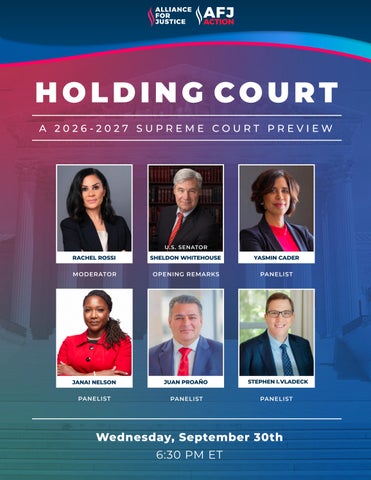
HOLDING COURT A 2026-2027 SUPREME COURT PREVIEW
U.S. SENATOR
RACHEL ROSSI
SHELDON WHITEHOUSE
YASMIN CADER
MODERATOR
OPENING REMARKS
PANELIST
JANAI NELSON
JUAN PROAÑO
STEPHEN I. VLADECK
PANELIST
PANELIST
PANELIST
Wednesday, September 30th 6:30 PM ET
INTRODUCTION
TO HOLDING COURT Welcome to our fifth annual event, ‘Holding Court: Supreme Court Term Preview.’ As the Supreme Court begins its 2026-2027 term, the justices will once again consider cases with far-reaching consequences for our rights, freedoms, and democracy. This year's docket raises critical questions about voting rights, immigrants' rights, religious freedom and the separation of church and state, gun safety, civil rights, and the power of federal agencies to protect workers and hold institutions accountable. Our panel of leading legal experts and advocates will help us understand what is at stake — both inside the courtroom and in the lives of people and communities across the country. Together, we'll examine several of the major cases before the Court, the legal questions at their center, and how the Court's decisions could shape our laws and rights for years to come. Holding Court is also an opportunity to look beyond individual cases and consider the broader direction of the Supreme Court: where the law is headed, who stands to be affected, and how advocates and communities can continue building power to protect our multiracial constitutional democracy.
M O D E R ATO R :
Rachel Rossi
President of Alliance for Justice, and Alliance for Justice Action Campaign Rachel Rossi serves as President of Alliance for Justice (AFJ) and Alliance for Justice Action Campaign (AFJ Action), where she leads the organization in its bold and unwavering commitment to justice, equity, and defending democracy. Appointed following a nationwide search, Rossi brings a career defined by fearless advocacy, principled leadership, and a deep dedication to civil rights. A trailblazer in the legal and advocacy communities, Rossi most recently served in the Biden administration’s Justice Department as Director of the Office for Access to Justice, where she led national efforts to expand access to legal representation for underserved communities. Prior to that, she was Deputy Associate Attorney General, where she also served as the Department’s first Anti-Hate Coordinator under Associate Attorney General Vanita Gupta. Rossi’s legal career began in the courtroom, where she spent nearly a decade as a public defender in Los Angeles County and in federal court, defending thousands of low-income clients and standing on the front lines of the fight for justice. Her passion for systemic reform led her to Capitol Hill, where she served as Counsel to Senate Judiciary Committee Chair Richard J. Durbin and played a key role in advancing the historic First Step Act. In 2020, Rossi made history as the first former public defender to run for Los Angeles County District Attorney, earning nearly half a million votes and widespread grassroots support for her progressive vision of justice. Raised in Los Angeles by immigrant parents from the Dominican Republic and Greece, Rossi’s personal story fuels her deep commitment to the communities she serves. She holds a J.D. from Pepperdine University School of Law and a bachelor’s degree from Bethany University, also having attended Azusa Pacific University and Vanguard University.
OPENING REMARKS:
Sen. Sheldon Whitehouse (D – RI)
Sheldon Whitehouse has earned a reputation in the Senate as a fierce advocate for progressive values and a thoughtful legislator capable of reaching across the aisle to achieve bipartisan solutions. Senator Whitehouse has been at the center of bipartisan efforts to pass laws overhauling federal education policy, rebuilding our nation’s infrastructure, reforming the criminal and juvenile justice systems, protecting Americans from toxic chemicals in everyday products, and addressing ocean plastic waste. Recognizing the devastating toll of addiction in Rhode Island and across the nation, Whitehouse authored the first significant bipartisan law to address the opioid crisis, the Comprehensive Addiction and Recovery Act. Representing the Ocean State, Whitehouse plays a key role in crafting policies addressing climate change, environmental protection, and a price on carbon. He passed into law a dedicated fund to support ocean and coastal research and restoration and bipartisan legislation to confront the crisis of marine plastic and other waste polluting our oceans. He has worked to enact bipartisan measures to reduce carbon pollution and boost America’s clean energy economy. Whitehouse has stood as a staunch defender of Social Security and Medicare, and has made improving care and reducing costs in our health care system a hallmark of his career. To counteract the corrosive effects of special interests in our democracy, Whitehouse has championed efforts to protect our elections and make Congress and the courts accountable to the American people. “While fighting in Washington against corporate interests and their influence on the political process,” wrote the Providence Journal, “Senator Whitehouse has not forgotten the people back home.” A graduate of Yale University and the University of Virginia School of Law, Sheldon served as Rhode Island’s U.S. Attorney and state attorney general before being elected to the Senate. He is the Ranking Member of the Senate Environment and Public Works (EPW) Committee and Co-Chair of the Caucus on International Narcotics Control, and also serves as a senior member of the Judiciary Committee, the Budget Committee, and the Finance Committee. Whitehouse serves as Ranking Member of the Helsinki Commission, formally known as the Commission on Security and Cooperation in Europe. He and his wife Sandra, a marine biologist and environmental advocate, live in Newport. They have two grown children.
PA N E L I S T :
Yasmin Cader
Deputy Executive Director for Program, Strategy, and Culture, American Civil Liberties Union (ACLU) Yasmin Cader is the ACLU’s Deputy Executive Director for Program, Strategy, and Culture. She works closely with the Executive Director and senior leadership team to help lead the organization’s strategic direction, strengthen organizational culture, and align its nationwide work to defend and advance civil rights and civil liberties. Before assuming this role, she served as the ACLU’s Deputy Legal Director and Director of the Trone Center for Justice and Equality, where she led the organization’s work across criminal justice and racial justice. For nearly three decades, Yasmin has been on the front lines of the national struggle for racial justice. As a civil rights attorney, state and federal public defender, and institutional leader committed to building strong, collaborative, and mission-driven organizations, she brings a unique perspective and creative vision to addressing the most important issues facing our country. Before joining the ACLU, Yasmin spent two decades as a public defender in state and federal courts across the country, representing children and adults facing the most serious criminal charges, including capital cases and cases involving allegations of domestic and international terrorism. She later served as the Chief of Training at the Federal Public Defender (FPD) Office in Los Angeles, where she developed substantive legal and trial skills training programs for attorneys in Los Angeles and across the country. A proud graduate of Howard University and Yale Law School, Yasmin began her career as a law clerk to the Honorable Damon J. Keith of the U.S. Court of Appeals for the Sixth Circuit. She then joined the U.S. Department of Justice’s Civil Rights Division, through the Honors Program, where she litigated individual and class-action claims of sexual and racial harassment and discrimination. Throughout her career, Yasmin has been guided by a simple conviction: The Constitution's promises belong to everyone, and protecting the rights of any one of us ultimately protects the freedom of us all.
PA N E L I S T :
Janai Nelson
President and Director-Counsel of the Legal Defense Fund (LDF) Janai Nelson is President and Director-Counsel of the LDF, the nation’s premier civil rights law organization fighting for racial justice and equality. As the institutional thought-leader, she directs the organization’s programmatic strategy and operations. Throughout her career, she has played a pivotal role in numerous landmark legal cases, shaping the fight for civil rights. In October 2025, Nelson argued Louisiana v. Callais before the United States Supreme Court, defending equitable congressional representation for Black voters in Louisiana and the constitutionality of the Voting Rights Act of 1965. Nelson was also one of the lead counsels in Veasey v. Abbott (2018), a successful federal challenge to Texas’s voter ID law, and the lead architect of NUL v. Trump (2020), which sought to declare the Trump administration’s executive order banning diversity, equity, and inclusion training in the workplace unconstitutional before it was rescinded. Nelson formerly served as Associate Director-Counsel and as a member of LDF’s Litigation and Policy teams. She has also served as Interim Director of LDF’s Thurgood Marshall Institute and in other leadership capacities at LDF. Prior to joining LDF in June 2014, Nelson was Associate Dean for Faculty Scholarship and Associate Director of the Ronald H. Brown Center for Civil Rights and Economic Development at St. John’s University School of Law, where she was also a full professor of law. A renowned scholar of voting rights and election law, Nelson has produced cutting-edge research on election law, race, and democratic theory. Her article “Parsing Partisanship: An Approach to Partisan Gerrymandering and Race”— which appeared in NYU Law Review — explores how the Supreme Court could address hybrid racial and partisan gerrymandering claims. In “Counting Change: Ensuring an Inclusive Census for Communities of Color,” published in the Columbia Law Review, she advocates for representational equality in the census to ensure all U.S. residents are counted and served. Nelson has taught courses on election law, voting rights, constitutional law, and racial equity strategies while also guest lecturing at law schools nationwide. Prior to entering academia, Nelson was a Fulbright Scholar at the Legal Resources Center in Accra, Ghana, where she researched the political disenfranchisement of persons with criminal convictions and the advancement of democracy in Ghana. Before receiving the Fulbright award, Nelson was the Director of LDF’s Political Participation Group, where she oversaw all voting-related litigation and matters, litigated voting rights and redistricting cases, and worked on criminal justice issues on behalf of African Americans and other underserved communities. A graduate of NYU and UCLA School of Law, Nelson clerked for U.S. Court of Appeals Judge Theodore McMillian and U.S. District Judge David H. Coar. Nelson regularly speaks as a civil rights, constitutional law, and election law expert in the media, and at conferences and symposia nationwide. She is a member of the Board of Directors of the Leadership Conference for Civil and Human Rights and a Trustee of the Rockefeller Brothers Fund. Nelson’s leadership has been recognized nationally, and she is the recipient of numerous awards, including The Root 100, the New York University Distinguished Alumni Award, the M. Ashley Dickerson Diversity Award from the National Association of Women Lawyers, the Metropolitan Black Bar Association’s Public Servant of the Year Award, and an honorary Doctor of Laws degree from Suffolk University Law School.
PA N E L I S T :
Juan Proaño
CEO, League of United Latin American Citizens (LULAC) Juan is an entrepreneur, technologist, and business leader who is active in civic affairs, social impact, and politics He has served as the League of United Latin American Citizens (LULAC) Chief Executive Officer (CEO) since November 2023. As LULAC’s CEO, Juan oversees the day-to-day operations at LULAC, identifies strategic growth areas, and works to amplify the organization’s advocacy initiatives and action-oriented programs. Juan is the co-founder of Plus Three, a Technology company serving nonprofit, advocacy, membership, and political organizations. Founded in 2002, Plus Three has raised more than $500 million online and delivered over one billion emails for its nonprofit clients. In his two decades of entrepreneurship, Juan has founded and managed three companies in the technology sector and generated more than $400 million in revenue for his businesses, which have operated throughout the U.S. and Latin America. In 2015, Juan was invited to be part of the first class of Latino-owned business leaders to participate in the Stanford Latino Entrepreneurship Initiative (SLEI), a program designed to help Latino-owned businesses scale to $1 billion in revenue. Juan also started a program at Plus Three to develop the capacity of Latino nonprofits across the country by providing $250,000 one of in-kind services. Juan has been recognized for his pioneering work in technology and online fundraising fields. He has been featured in Time Magazine for his work with the DNC and has been recognized by the United States Hispanic Chamber of Commerce (USHCC) as one of the top 100 Latino CEOs. Active in civic and community affairs, Juan has been a bridge builder between various underrepresented communities. An example of this has been his work at the NAACP, where he worked alongside its prominent leadership as the first Latino on the CEO Advisory Committee; led the Hurricane Katrina campaign which raised $2.6 million in less than 30 days; worked on the Voting Rights Reauthorization Act; and the capital punishment campaign to save Stanley Tookie Williams's life which garnered over 100,000 petition signatures, two monumental records for the NAACP at the time. Juan is a graduate of Borough of Manhattan Community College (BMCC) and attended City College (CUNY), a proud husband and father of three children, Lola, Penelope, and Oliver who resides between Miami, Florida and Washington, D.C.
PA N E L I S T :
Stephen I. Vladeck
Agnes Williams Sesquicentennial Professor of Federal Courts, Georgetown University Law Center Stephen I. Vladeck, the Agnes Williams Sesquicentennial Professor of Federal Courts at the Georgetown University Law Center, is a nationally recognized expert on the Supreme Court, the federal courts, national security law, and military justice. He is the author of the New York Times-bestselling book The Shadow Docket: How the Supreme Court Uses Stealth Rulings to Amass Power and Undermine the Republic, which won the 2024 Order of the Coif Book Award and the 2023 Writers’ League of Texas Book Award for Non-Fiction and was a finalist for the 2024 ABA Silver Gavel Award for Media and the Arts. A highly regarded appellate advocate, Vladeck has argued three cases before the U.S. Supreme Court and more than 20 before various lower federal civilian and military courts. He is also a frequent witness before Congress, having testified before committees including the House and Senate Judiciary Committees, the House Permanent Select Committee on Intelligence, and the Senate Committee on Homeland Security and Governmental Affairs, among others, and has served as an expert witness in both U.S. and foreign tribunals. He has also earned a wide range of honors for his scholarship, popular writing, teaching, and service to the profession, including the 2024 University of Texas President’s Research Impact Award and his selection by the Order of the Coif as its Distinguished Visiting Professor for 2025. He is an elected member of the American Law Institute. Beyond the classroom and the courtroom, Vladeck is a leading public voice on the work of the Supreme Court. He serves as CNN’s Supreme Court analyst and writes One First, a popular weekly newsletter about the Court. His scholarship has appeared in leading journals, including the Harvard Law Review, the Yale Law Journal, and the Supreme Court Review, and his popular writing has been published in outlets ranging from The New York Times and The Atlantic to Slate and TIME. He is also a co-author of Aspen Publishers’ leading national security law and counterterrorism law casebooks. Vladeck graduated from Yale Law School in 2004, where he was an executive editor of the Yale Law Journal, won the Harlan Fiske Stone Prize for outstanding moot court oralist, and shared the Potter Stewart Prize for best moot court team performance. He earned his B.A. summa cum laude with Highest Distinction in History and Mathematics from Amherst College in 2001. After law school, he clerked for the Honorable Marsha S. Berzon on the U.S. Court of Appeals for the Ninth Circuit and the Honorable Rosemary Barkett on the U.S. Court of Appeals for the Eleventh Circuit. Before joining Georgetown, he taught for nine years at the University of Texas School of Law and, earlier, for eleven years at the University of Miami School of Law and American University Washington College of Law. Vladeck serves on the Board of Trustees of Amherst College and of Earthjustice, the nation’s premier nonprofit public interest environmental law organization. A native New Yorker and hopeless Mets fan, he lives in the District with his wife, Karen (Founder and Managing Partner of Risepoint Search Partners); and their daughters, Madeleine and Sydney.
CLICK HERE TO
SUPREME COURT PREVIEW
Learn More
IMMIGRANTS’ RIGHTS — INDEFINITE DETENTION Genalo v. Black (No. 25-886) Argument: Oct. 13, 2026 Though Keisy G.M. is a lawful permanent resident from the Dominican Republic, immigration officers took him into custody in October 2020 and held him for 21 months while the government tried to deport him. He was held for nearly two years without a bond hearing or individualized finding that he was a flight risk. The Second Circuit held that G.M.’s prolonged detention triggered due process, one requiring the government to justify why they had to lock him up with clear and convincing evidence. The Trump administration challenged this finding and asked the Court to assert that no such right exists. Since G.M. was released in 2022, the Court added a “mootness” question to consider as well, possibly giving themselves an off ramp to dismiss this case. On September 11, both parties in Genalo v. G.M. filed a joint stipulation asking the Supreme Court to dismiss the case as moot. SCOTUS dismissed the case that very day as New York Governor Hochul had granted a pardon to Mr. G.M., eliminating the original basis for G.M.'s deportation and detention. For now, the Second Circuit ruling that still requires due process protections for those in prolonged detention still stands. Unfortunately, on September 21, Solicitor General D. John Sauer filed a petition in Genalo v. D.C. that simply swaps in a different individual ("D.C.") facing the same prolonged detention injustices. Sauer has asked the Court to consider the same constitutional questions and the administration explicitly seeks review during the October 2026 term. As of September 29, the Court has not granted a review.
IMMIGRANTS’ RIGHTS/ADMINISTRATIVE AGENCY ENFORCEMENT Department of Labor v. Sun Valley Orchards, LLC (No. 25-966) Argument: Nov. 10, 2026 The Department of Labor ordered Sun Valley Orchards to pay back wages they had cheated out of the farm’s H-2A guestworkers and domestic workers. Sun Valley challenged the administrative enforcement system, arguing that monetary remedies may only be imposed by an Article III court with a jury. The case therefore raises a broader question about federal agencies' authority to enforce statutory protections through administrative proceedings. Any attempt to further strip administrative agencies of their power to enforce protections could leave some of the most underpaid, exploited, and marginalized workers in America with no enforcement mechanism for workplace abuses and misconduct.
VOTING ACCESS Republican National Committee v. Mi Familia Vota (No. 25-1017) Argument: Not yet scheduled In 2022, Arizona passed two additional hurdles to voting as outlined in the National Voter Registration Act (NVRA), requiring new voter registrants to provide documentary proof of citizenship and allowing county recorders to conduct citizenship audits of voter-registration rolls using state and federal databases. Mi Familia Vota and other plaintiffs challenged the requirements. A divided Ninth Circuit concluded that Arizona's proof-of-citizenship requirement conflicted with an existing consent decree and that the federal National Voter Registration Act form takes precedence over state law. The appeals court also held that voter audits must conclude at least 90 days before a federal election to comply with the NVRA. The RNC appealed, putting questions about documentary proof of citizenship, voter-roll maintenance, and federal versus state voter-registration requirements before the Supreme Court. Siding with the RNC to greenlight these additional hurdles would render another blow to voting access and our democracy. Such demands would screen out lower-income voters, people who have changed their names, naturalized citizens, and anyone who doesn’t happen to have easy ways to obtain a passport or their birth certificate. Furthermore, systemic voter purges are known to be incredibly inaccurate. The current 90-day window barring these purges allows necessary time to fix impactful errors.
GUN SAFETY — STATE ASSAULT-WEAPONS BAN Viramontes v. Cook County (No. 25-238), consolidated with Grant v. Higgins (No. 25-566) Argument: Not yet scheduled When Cutberto Viramontes and Christopher Khaya were barred from owning AR-15 style weapons after they were banned in Cook County, Illinois, they joined two gun-rights organizations and filed a suit arguing that the law banning the sale, transfer, and possession of semiautomatic rifles violates the Second and Fourteenth Amendments of the Constitution. Both an Illinois district court and the Seventh Circuit sided with Cook County and upheld the assault weapons ban. The Court has now granted certiorari and consolidated this case with another related case for oral argument. A decision overturning this ban could void other assault weapons bans in Connecticut, California, New York, and a dozen other states — bans that have drastically reduced mass shootings, including school shootings, compared to states without such bans.
LGBTQ+ RIGHTS/CIVIL RIGHTS St. Mary Catholic Parish v. Roy (No. 25-581) Argument: Nov. 3, 2026 The Court will consider whether religious schools participating in Colorado’s taxpayer-funded universal preschool program must comply with the program’s nondiscrimination requirements. Two Catholic schools and the Archdiocese of Denver were denied program funding after refusing to accept children with LGBTQ+ parents and argued that Colorado’s prohibition on discrimination based on religion, sexual orientation, or gender identity interferes with their religious exercise. The case could have implications for decades of precedent, including Employment Division v. Smith, which held that generally applicable laws may be enforced even when they incidentally burden religious exercise. The dispute also follows the Court’s 2021 decision in Fulton v. City of Philadelphia, involving a Catholic foster-care agency that would not place children with same-sex couples. Creating a broader religious exemption here could have implications for other nondiscrimination protections, including Title VII, Title IX, the Americans with Disabilities Act, and the Fair Housing Act.
CIVIL RIGHTS/GENDER JUSTICE Crowther v. Board of Regents of the University System of Georgia (No. 25-183) Argument: Not yet scheduled Title IX prohibits sex discrimination at schools receiving federal funding, and the Supreme Court has previously held that its protections extend to employment. What the Court has never resolved is whether school employees have an implied private right of action allowing them to sue directly for sex discrimination under Title IX. The case combines two Georgia university disputes. Former Georgia Tech women’s basketball coach MaChelle Joseph sued after she was terminated shortly after filing an internal complaint alleging sex discrimination, including inferior resources and lower staff salaries for the women’s basketball program compared with the men’s program. Augusta University professor Thomas Crowther separately sued after a sexual-harassment investigation found that he violated university policy and his contract was not renewed; Crowther argues the investigation was biased against him because he is male. After the lower courts treated their claims differently, the Supreme Court will decide whether Title IX permits employees to bring these sex-discrimination claims directly. The National Women’s Law Center, Lambda Legal, National Education Association, and Constitutional Accountability Center have filed amicus briefs supporting Joseph and Crowther.
CIVIL RIGHTS Nielsen v. Watanabe (No. 25-417) Argument: Nov. 9, 2026 In 2021, federal detainee Kekai Watanabe suffered a fractured tailbone during an assault at the Federal Detention Center in Honolulu. According to his complaint, despite repeatedly reporting extreme pain and requesting hospital treatment, prison medical staff dismissed his injuries, provided only pain medication, and left him in solitary confinement for two months. Months later, an X-ray revealed a fractured coccyx and bone fragments embedded in surrounding tissue. Watanabe sued under Bivens v. Six Unknown Named Agents, the landmark 1971 decision recognizing a damages remedy against federal officials who violate constitutional rights. The Supreme Court agreed to hear Nielsen v. Watanabe to decide whether his claim may proceed. Although Bivens has already been dramatically narrowed, the government argues that it should be confined to the Court's prior Bivens cases and not applied beyond those specific circumstances. A ruling adopting that approach could further restrict one of the few remaining avenues for individuals to seek damages for constitutional violations by federal officials, with significant implications for people in federal custody, immigrants held in detention, and others who interact with federal law enforcement and detention systems.
Thank you to our sponsors:
Support Our Work: AFJ and AFJ Action are proud to bring you events like Holding Court: Supreme Court Term Preview, where we break down the critical issues shaping our courts and our democracy. As the Supreme Court prepares to hear cases with sweeping implications — from voting rights to trans rights and campaign finance — our mission to build power, transform courts, and secure justice for all has never been more urgent.
If you believe in the importance of justice, equity, and accountability, please consider donating today.
Donate Now
OR
Your support powers this work. With your help, we can continue to fight for a fair, just, and independent judiciary.