Education Foundation
September - December 2026
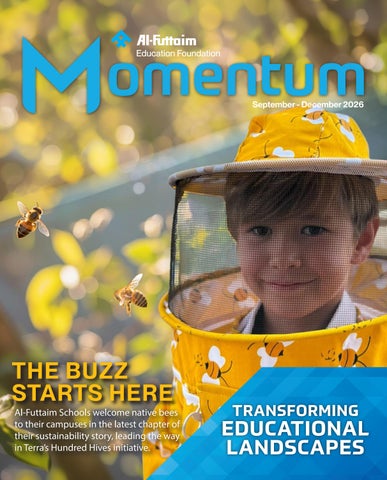
THE BUZZ STARTS HERE
Al-Futtaim Schools welcome native bees to their campuses in the latest chapter of their sustainability story, leading the way in Terra’s Hundred Hives initiative.
TRANSFORMING
EDUCATIONAL LANDSCAPES
THE BEE CURRICULUM A single hive can take students right across the curriculum. This term, students at Deira International School are training as junior beekeepers, exploring the question ‘How can small things make a big difference?’ They take part in live hive inspections on campus, led by the school’s trained beekeepers. In Science, students investigate the life cycle of flowering plants, exploring pollination, seed formation and seed dispersal, then create comic strips explaining why bees matter. In English, they write their own bee narratives, developing characters, settings and plots into illustrated double-page spreads. In Computing, they bring those characters to life in stop-motion animations that show the challenges bees face, from finding water to avoiding litter and finding places to rest. Their learning comes together at Terra, Expo City Dubai, where students will showcase how small actions can help protect bees and support biodiversity. This issue of Momentum takes a deep dive into bees, biodiversity, environmental education and sustainability, as Deira International School and Universal American School lead the way in Terra’s Hundred Hives initiative.
@Copyright 2026 AFEF All rights reserved While the publishers have made every effort to ensure the accuracy of all the information in this magazine, they will not be held responsible for any errors therein.
Talk to us: momentum@alfuttaimeducation.com @alfuttaimeducationfoundation @alfuttaimeducationfoundation @alfuttaimeducationfoundation www.alfuttaimeducation.com
4
MOMENTUM
CHILDREN ARE THE
BEST AMBASSADORS OF CHANGE
Terra’s Hundred Hives initiative aims to place beehives in a hundred UAE schools. Marjan Faraidooni of Expo City Dubai explains how the programme started, and why Deira International School led the way…
M
y ambition is for the Hundred Hives initiative to reach more than a hundred schools. The programme was launched in January 2025 by Terra, Expo City Dubai’s sustainability and nature destination. It places beehives in schools across the UAE and teaches students how to look after them. When most people think about bees, they think about being stung, or about allergies. So safety comes first. Before any hive is placed, our team visits the school and looks for the safest spot. We study the options, share them with the school and agree on what is needed. Only then does the hive go in.
Saying yes to a hive is therefore a big decision, and that is why we are so thankful to Deira International School, which was brave enough to be the first school to join. Wherever we go next, we will take the DIS success model with us.
Marjan Faraidooni, Chief of Education and Culture at Expo City Dubai, addresses students and staff at Deira International School during the installation of the beehives, earlier this year in June.
5
HUNDRED HIVES A first for the UAE: Marjan Faraidooni, Chief of Education and Culture at Expo City Dubai, and Mira Al Futtaim, Chief Future Education Officer at Al-Futtaim Education Foundation, after signing the agreement that makes Al-Futtaim Schools, Deira International School and Universal American School, the pioneers of the Hundred Hives initiative.
The Sustainable City
Focus on life skills
The idea behind the programme came from our own experience. In 2019, while Terra was still under construction, our team found a beehive on the building site. Instead of getting rid of it, we moved the bees to a bee garden at The Sustainable City and cared for them there. Years later, their descendants returned to us, to an area where the plants were struggling. It was an emotional moment for all of us, and it showed us that when we make space for nature, it can come back.
Once the hive is in place, students put on bee suits and learn, up close, what a colony needs to survive. This teaches them responsibility and care. When I was a child, we would squash ants without thinking. Today’s students learn that ants and bees both have an important job to do. Schools in Dubai are placing more focus on life skills, and caring for bees is one of the best ways to build them.
We wanted students to experience the same thing. Bees carry pollen from one flower to the next, and this is how many of our fruits and vegetables grow. Without them, there would be far less food on our tables. Students learn about pollination in science lessons, but with a hive at school, they can see it happen for themselves. For us, therefore, schools were the natural place to start. Terra was built for Expo 2020 Dubai to help people understand why the environment matters, and during the Expo we welcomed more than a million student visits. The initiative takes that learning beyond a day trip and onto school grounds.
The hive also brings more nature onto the school grounds. At DIS, the space around the hive has been planted with greenery that supports the bees. Over time, we want to measure how this has improved the air quality and wildlife on campus. The bees at Terra are native to this region. Many of those kept in the UAE are imported from Egypt, and a large number do not survive our summer heat. Ours are suited to the climate, and we monitor them closely. We also run beekeeping workshops for schools, and weekend sessions where families can learn to keep bees.
6
MOMENTUM
Beyond the textbook In the first year, Al-Futtaim Education Foundation has brought two schools on board, Deira International School and Universal American School. After twelve months, we will talk to the students to find out how their view of bees has changed and what they have learned beyond the textbook. Their answers will help us grow the programme. Finally, children talk about what they learn at the dinner table, and parents listen. If a family finds a beehive in their garden, I hope the child will say, “Let me ask my teacher how we can protect it.” That is how a lesson at school reaches the home. Children are the best ambassadors of change.
Where it all began: During the construction of Expo 2020 Dubai in 2019, a swarm of native bees settled among steel bars on the Terra construction site. The bees were rescued, and later relocated with help from the Beekeepers Foundation. Their descendants live at Terra today.
Up close: Young students get hands-on experience of hive care, learning what a bee colony needs to survive.
“Bees carry pollen from one flower to the next, and this is how many of our fruits and vegetables grow. Without them, there would be far less food on our tables. Students learn about pollination in science lessons, but with a hive at school, they can see it happen for themselves.”
8
MOMENTUM
Main Features
26
24
A NEW SCHOOL FOR EGYPT:
10
HELLO HONEYBEES:
The Al-Futtaim Education Foundation and the Dwight-Franklin School Group open Dwight School Cairo, the network’s first school in Africa.
Deira International School and Universal American School are pioneer schools in Terra’s Hundred Hives initiative, and our students now learn from living beehives at school.
06
9
CONTENTS
Tech Talk
32 ALUMNI CONNECT:
DIS graduate Khushi Nagpal on how a degree from the London School of Economics led her back to Al-Futtaim, where she now works in the Group’s artificial intelligence office.
42 QUALIFICATIONS STILL COUNT: Eco Watch
DIS Careers & University Counsellor Craig Van Galder makes the case for the high school diploma as tech billionaires question its value.
04
LEADING THE HUNDRED HIVES:
Marjan Faraidooni of Expo City Dubai explains why Terra chose schools to drive the initiative.
38 Campus Life
39
AWARD-WINNING PRIMARY:
DIS Primary Head Teacher Gaynor Dale tells us what it took to win Primary Team of the Year at the 2026 Education Achievement Awards.
44 LEARN, LEAD, TEACH: Parent Engagement
40
STUDYING ABROAD GETS HARDER:
DIS and UAS parents share how new student visa rules overseas are changing their children’s university choices.
Health Matters
54
SPOT CHECK:
HealthHub dermatologist Dr Aneesh Kunnath Parambath explains what causes teenage acne and how families can treat it.
Sports Spotlight
66
GAME ON:
Read how Year 11 DIS student Adam Naem turned a casual game in the park into a basketball team now playing in the Jazzville Basketball League.
UAS Deputy Director Philip Berry explains how the school is putting Dubai’s new Skills for Life framework to work with its students.
57 EXPERIENTIAL LEARNING:
DIS and UAS students share what they learned during summer internships at Al-Futtaim businesses, including IKEA, Marks & Spencer and HealthHub.
Literacy Corner
50 OFF THE SCREEN:
UAS Librarian Justine Elamatha on why reading physical books and writing by hand still help students learn in a school full of devices.
Humour & Entertainment
30 COFFEE BREAK:
Test your bee knowledge with our Buzz Words crossword, then see how fast you can find Beeyoncé in our word search.
THE BEE TALK THAT STARTED IN A QUEUE
Dr Farah Sarraj, Chief Corporate Officer at Al-Futtaim Education Foundation, explains how a chance conversation at a British garden party brought beehives to Deira International School and Universal American School…
F
or Dr Farah Sarraj, a school curriculum should never stand still. As Chief Corporate Officer at Al-Futtaim Education Foundation, she believes learning must keep evolving to match the challenges and opportunities students face today and will face in future, whether in Arabic, technology, AI or any other subject. The aim is well-rounded students who are ready for the workplace and for life.
Innovation is key, she says, but the word is often misunderstood. “People hear innovation and think it means technology,” she says. “It doesn’t. It means doing something in a new way, from a new perspective.” The beehives at DIS and UAS are one example. They take learning beyond the classroom and give students a living subject to study, from pollination and food security to how a colony organises itself and shares its work.
A chance conversation The story began in February 2024, at a garden party hosted by His Majesty’s Consul General in Dubai and the Northern Emirates to celebrate the birthday of King Charles III. While queuing to go in, Dr Farah found herself next to a man who looked familiar. She rarely starts conversations with strangers, but that day she did. She asked if he worked in education. He told her he worked at Expo City Dubai. Dr Farah Sarraj, Chief Corporate Officer at Al-Futtaim Education Foundation.
Dr Farah is a big fan of Expo. She visited Expo 2020 Dubai 36 times. “You’re going to love what we’re working on,” he told her. It was bees. “My brain was processing it in real time,” she says. “All I could think was, what a great opportunity for our students. Learning that is not contained in a classroom.” She was already picturing the Forest School that DIS was developing at the time. She made a commitment on the spot. “I told him, you’re going to hear from me. We’re going to meet, and we will be the first school to do it.”
From LinkedIn to launch The two connected on LinkedIn soon after, and Dr Farah asked how AFEF could get involved. In November 2024, the formal steps began, and the contract went back and forth until it was agreed. “We didn’t give up, because we knew this was what we wanted,” she says. Terra officially announced the Hundred Hives initiative in January 2025, at an event with the late Dr Jane Goodall. By then, the conversations with AFEF were already well under way. For Dr Farah, the programme also teaches students about the country they live in. “People say the UAE is just desert and sand,” she says. “Think again. The UAE has hundreds of native plants, and native creatures that have adapted and thrived here over centuries.” She believes it was meant to be. “Starting that conversation was not in my character,” she says. “But it happened, and everything fell into place.” The late conservationist Dr Jane Goodall and Marjan Faraidooni, Chief of Education and Culture at Expo City Dubai, at the opening of the Dr Jane Goodall Pollinator Garden at Terra in January 2025. The garden is part of Terra’s ongoing efforts to inspire visitors to engage with nature and understand the critical role of pollinators in maintaining biodiversity.
“Innovation doesn’t mean technology. It means doing something in a new way, from a new perspective.”
12
MOMENTUM
MEET THE FAIRY LADY Dr Meriem Hammal trained as a vet, but found her calling in a beekeeper’s apiary in Algeria. The Terra’s Pollinator Programme Manager talks about native bees, safety at school and the swarm she rescued from the DIS playground…
“Many people think all bees sting. Some species are stingless. They can bite, like ants, but they have no sting. And in our workshops, most children think the male bees, the drones, protect the colony. In fact, the females, the worker bees, do all the work.” Not a flinch: Dr Meriem Hammal, Pollinator Programme Manager at Terra, explains how a colony works as she rests her bare hand on a frame of honeybees, during the hive installation at Deira International School.
13
HUNDRED HIVES ost of us nervously shoo a bee away the moment it comes near. Not Dr Meriem Hammal. Terra’s Pollinator Programme Manager is so at ease with bees that she often works her hives without a suit, a veil or gloves, and the children who visit Terra call her the Bee Fairy Lady. Momentum visited her at Terra, Expo City Dubai, to see the beekeeping programme in action and to find out more about the roll-out of the Hundred Hives initiative in schools across the UAE…
M
Momentum: You trained as a vet. How did you end up working with bees? Meriem: It was never the plan. I’m from Algeria, and my parents wanted me to be a doctor, so I studied to become a vet. In my third year, we had to choose a three-month practical training. I picked beekeeping because it was only once a week. I thought I was being smart. I went to a beekeeper in my area who had never been to school. On my first day, I was terrified. I wore a full bee suit, gloves and boots. My mentor wore only a veil. When he opened the hive, the bees buzzed calmly around us, and I felt completely relaxed. He explained that he was breeding his bees to bring back the native species. I was the one at university, yet here was a farmer teaching me genetics. The three months turned into three years. After vet school, I specialised in queen breeding and went on to lead a beekeeping association in Algeria. At a symposium, I met people from the UAE who faced the same challenges we did. They asked me to join them, and that is how I came here. Momentum: Terra breeds native bees rather than imported ones. Why does that matter for school hives? Meriem: Native bees are stronger. They are adapted to our climate, so they can survive the summer heat and manage their own food supply.
Through the Hundred Hives initiative, Terra is placing beehives in schools across the UAE to help protect the country’s biodiversity.
Some honey producers import bees and use them only while the flowers are blooming. Once the season ends, many of those bees cannot survive the UAE summer. We cannot rely on them to pollinate our crops, so bringing native bees back is important for our food security. Momentum: DIS is a community of about 2,500 students and staff. What would you say to parents who worry about bees on campus? Meriem: Safety comes first. Every school selected for the programme has to complete a detailed risk assessment before the bees arrive. We work with the KHDA to make sure the programme meets its requirements, and with the school’s doctors and medical staff, so the school’s health and safety plans are ready in advance. Once the hives are installed, we run regular awareness sessions for parents and staff, so everyone understands what is in the apiary and how to behave around it.
Momentum:You were called to DIS when a swarm settled in a tree beside the playground.What happened that day? Meriem: It was a small, beautiful swarm. The bees had been there for about a week and had built only a small comb. Michael Taylor, who leads the beehive project at the school, prepared some sugar water for me. We wanted to move all the bees together, safely, so none were left flying around. We sprayed them with the sugar water. They became sticky, stopped flying and got busy cleaning each other. It doesn’t harm them. We cut the comb, placed it in a box with the bees and brought them to Terra, where you can still see their small comb through the glass.
Michael Taylor, who leads the beehive project at Deira International School, lifts the lid as Dr Meriem Hammal of Terra prepares the smoker during the installation of the beehives at Deira International School.
Bee on a stick: A member of the Terra team leads students with his model bee as they excitedly make their way to their first live hive inspection at Deira International School, marking a major milestone in bringing live pollinator education to Dubai schools.
15
HUNDRED HIVES Momentum: The colony found during the construction of Terra in 2019 started with about 2,000 bees. What made the site work? Meriem: The plants. Before the bees arrived, our landscape team planted melliferous plants, which give bees nectar and pollen, and all of them are native species. The colony grew naturally. There are now two colonies from that original group, and I have split them to create three more. We did the same at DIS, and planted for the bees before the hives went in.
Momentum: What do people get most wrong about bees? Meriem: Many people think all bees sting. Some species are stingless. They can bite, like ants, but they have no sting. And in our workshops, most children think the male bees, the drones, protect the colony. In fact, the females, the worker bees, do all the work. They clean, feed the young, guard the hive and collect water. The males mate with the queen, and then they die. Children are naturally curious about insects. Fear is something they learn from adults.
Momentum: If the breeding programme succeeds, would Terra supply bees to honey producers? Meriem: The programme is not about honey. It is about pollination, and about teaching the next generation that we are only one part of the ecosystem. Bees also connect to many school subjects. In maths and art, students can study the hexagonal honeycomb. In chemistry, they can analyse honey and pollen. We are also working with the Rochester Institute of Technology to develop smart hives, so students can collect and analyse data.
Up close: An expert handler, Dr Meriem Hammal, Pollinator Programme Manager at Terra, checks a frame of native honeybees without gloves, as students look on.
16
MOMENTUM
FULL ENGAGEMENT IN POLLINATOR EDUCATION Terra’s Stuart Hardy explains how the Hundred Hives initiative chooses the right spot for each school hive, why schools lead the teaching, and why the programme is built to last…
W
hen Terra places a beehive in a school, the hive is there to stay. That is the idea behind the Hundred Hives initiative, says Stuart Hardy, Assistant Manager, Education and Visitor Experiences at Terra.
“We are not an adopt-a-hive programme,” he says. “There are schools in Dubai where one teacher looks after a hive and nobody else engages with it. The whole point of Hundred Hives is to bring full engagement into pollinator education.” Stuart, a former teacher, joined Terra creating school resources for COP28. Today he supports the roll-out of the programme and works closely with the schools taking part, including Deira International School.
Finding the right spot Every hive starts with an inspection. The Terra team completes a checklist, visits the school and suggests three or four possible sites. “It’s usually not where the school expects,” Stuart says. At DIS, the team chose an unused space behind the Forest School. It already had trees and plants, it was irrigated and it was free of pesticides. The school then fenced off the area and made it safe. Safety is agreed early. Terra prepares a risk assessment for the school to follow, and only works with
Behind the programme: Stuart Hardy, Assistant Manager, Education and Visitor Experiences at Terra, works closely with the schools taking part in the Hundred Hives initiative.
schools that have a nurse on site and can keep the apiary closed unless the team is present. Native plants work best, because they cope with heat and drought and need less water. Stuart recommends native trees such as sidr, samar and ghaf, as well as a water source for the bees. Because bees can fly up to five kilometres to find food, the plants around the hive help but are not essential. Students can also learn which flowers give bees the most pollen, and which give them none.
Schools lead the teaching Teachers are trained by Dr Meriem Hammal, Terra’s Pollinator Programme Manager, over four to five weeks. Each session starts with theory in the classroom, followed by practical work at the hive in full bee suits. Stuart and the education team support the sessions. “As a former teacher, I’ve always found that backing up theory with practice is the best way to learn,” he says.
How that learning reaches students is up to each school. “We’re not curriculum builders,” Stuart says. “The schools are the experts. We give them the passion and the spark, and then it’s up to them how they teach it.” Dubai’s schools follow many different curricula, from British and American to Indian and Pakistani, so each school can shape the programme to fit its own. Bees can be linked to science, sustainability, wellbeing, art and maths. At Universal American School, the team has also discussed linking the programme to business studies, looking at how pollination supports food security and the economy.
A living example Stuart hopes students will grow up to take responsibility for biodiversity. “It’s difficult to teach biodiversity in a classroom,” he says. “With bees on campus, students have a living example. It might be a maths lesson about bees, but they are still learning about biodiversity.” He also sees the school’s gardeners, landscapers and facilities staff as key partners, since they look after the area around the apiary every day. As more schools join, Stuart says the lesson from DIS is simple. Every school is different, so the team will listen to teachers and school leaders while standing firm on what matters. “This is a worthwhile programme,” he says. “And bees are not scary.”
This way to the bees: Every hive starts with an inspection. The Terra team visits each school and suggests three or four possible sites. At Deira International School, they chose an unused space behind the Forest School.
The next generation of beekeepers: Hundred Hives is Terra’s school-focused pollinator programme, designed to help students develop a deeper connection with nature through hands-on learning and environmental stewardship.
A quiet corner for UAS bees Nestled between the Multi-Purpose Hall (MPH) and Secondary Gate 3, the quiet corner at the furthest end of the Universal American School campus is now home ground for our bees. You may have noticed the natural reed fencing around it and the new CCTV cameras, which let staff check on the area every day. Inside, young frangipani trees and flowering shrubs line the fence, giving the bees nectar and pollen close to home.
Flora and fauna Fresh grass covers the ground, a stepping-stone path runs through the middle and wooden benches give students a place to sit and watch. Terra’s team has already inspected and approved the site, and the school has signed off the safety plan for students and staff. The location also helps. The Al Badia neighbourhood around the school is green and planted, with plenty of flora and fauna, and bees can forage up to five kilometres from their hive. This gives the colony a strong start and a good place to thrive.
Made for Moments That Bring Us Together. For every gathering, every shared table, and every moment worth remembering, Abela & Co. brings people together through thoughtfully prepared food and trusted hospitality.
Yule Log Cake
Festive Macarons
Sweet Mince Pies
Bring the season to your table. Discover and order our festive favourites at
abelaonline.com
DISCOVER MORE
20
MOMENTUM
COME AND MEET BEEYONCÉ Deira International School has opened its biodiversity garden to families. Michael Taylor, who leads the school’s beehive project, invites you to see sustainability learning in action…
W
elcome to our biodiversity garden. Whether you are already part of the Deira International School (DIS) community or considering DIS for your child, we invite you to come and see it for yourself. Watch our students at work with our bees, learn how a colony works and see sustainability in action. We run regular guided tours of the garden for parents and families.
Deira International School is the pioneer school in Terra’s Hundred Hives initiative, the world’s first structured urban beekeeping network for schools. We go the extra mile to give our students and families experiences they cannot find in a textbook. Our beehives are the newest addition to our sustainability work at DIS. They join the Forest School, the Tolerance Garden, the Hydroponic Garden and many other projects across our campus. Our resident queen bee is aptly called Beeyoncé, a name chosen by our students.
The beehive project supports the ‘We the UAE 2031’ vision, which aims to place the UAE among the top 10 countries in the Global Food Security Index, as well as Dubai’s 2040 Urban Master Plan.
Launch day: Michael Taylor, who leads the beehive project at Deira International School, addresses guests from Terra and the KHDA at the Hundred Hives launch at DIS, which marked the start of the programme’s roll-out in schools.
21
GRADUATION - POWER TO READ HUNDRED HIVES
How it began Our journey with Terra began in May 2025, when I was invited to the launch of a new project at Terra, Expo City Dubai, called Hundred Hives. We were immediately drawn to its purpose and ambition, and to its commitment to experiential, real-world learning. Our first job was to find an under-used corner of our school site and turn it into a biodiversity hub. Working with our landscaping team, we created a home for the bees and a living lab for our students, just behind the Forest School. Our bees are native to this region. They are Apis mellifera jemenitica, the honeybee best suited to the UAE’s climate, and they were provided by Terra.
We learned how to use smoke to calm the colony before an inspection, and how to inspect a hive safely: removing the frames, finding the queen and checking the health of each colony. Every visit to the apiary is supervised by our trained beekeepers, and everyone who enters wears a full protective suit.
Learning at the hive This term, our Year 3 students began the school’s first unit of learning dedicated to bees. Working alongside our beekeepers and the experts at Terra, they take part in hive inspections, learn about our native honeybees and will present what they have learned at Terra, Expo City Dubai.
Teachers turned beekeepers As the project grew, so did the excitement around school. Four teachers from Al-Futtaim Schools trained as beekeepers with Terra: my DIS colleagues Aimee Thomas and Saira Ali, Gary Johnston from Universal American School, and me. The training took place at the Dr Jane Goodall Pollinator Garden at Terra, over four Saturday sessions of four hours each. None of us had worked with bees before, and learning about them was a career highlight. Each bee has its own job within the colony, and we found them calm to work with. They only defend the hive when they feel threatened.
Learning the ropes: Gary Johnston (left) of Universal American School and Michael Taylor (centre) of Deira International School, with their DIS colleagues Aimee Thomas and Saira Ali, during their beekeeping training at the Dr Jane Goodall Pollinator Garden at Terra. The teachers now lead the beehive programme at UAS and DIS, as Al-Futtaim Education Foundation continues to build biodiversity, environmental education and sustainability into the curriculum.
22
MOMENTUM In 2027, we will add a Year 6 unit and extend the programme into our Secondary school. The bees have been on campus since June, and we are already seeing early signs of increased biodiversity. The project also supports the ‘We the UAE 2031’ vision, which aims to place the UAE among the top 10 countries in the Global Food Security Index, as well as Dubai’s 2040 Urban Master Plan.
Come and see for yourself The best way to understand what our students gain from the hive is to see it. Book a tour of our biodiversity garden, watch our students at work and say hello to Beeyoncé. Look out, too, for our upcoming community events, including the first look at our very own DIS honey.
Suited up: Mira Al Futtaim, Chief Future Education Officer at Al-Futtaim Education Foundation, holds up a frame of honeybees with Marjan Faraidooni, Chief of Education and Culture at Expo City Dubai, during the launch of the Hundred Hives initiative at Deira International School.
To book a tour, contact our Parent Engagement Officer at: Tel: +971 4 232 5552 Email: nsherlock@disdubai.ae
Deira International School Director Ian Thurston (left), Michael Taylor and a young student at the school’s beehives. Bees now feature in lessons across the curriculum, from science to art and sustainability.
24
MOMENTUM
IGNITING THE SPARK IN CAIRO
Al-Futtaim Education Foundation and the Dwight-Franklin School Group have opened Dwight School Cairo together at Cairo Festival City in New Cairo, with founding students from PreK to Grade 5…
Dwight School Cairo is the first Dwight school in Africa, and the second in the Middle East after Dubai. The Dwight-Franklin School Group manages and operates the school, in partnership with Al-Futtaim Education Foundation, which also manages Deira International School and Universal American School in Dubai.
25
GRADUATION - POWER TO REACH READ EXPANDING OUR
21 September 2026 was a historic day. A curtain was drawn back to reveal a brass plaque, marking the official inauguration of Dwight School Cairo. Mr Omar Al Futtaim, Vice Chairman and CEO of Al-Futtaim and Chairman of Al-Futtaim Education Foundation, stood on one side. Dr Blake Spahn, Vice Chancellor of the Dwight-Franklin School Group, stood on the other. The two names on the plaque mark the partnership between Al-Futtaim Education Foundation (AFEF) and the Dwight-Franklin School Group, two institutions built on family heritage. “It was a very proud moment for us to celebrate the official opening,” says Mira Al Futtaim, Chief Future Education Officer at Al-Futtaim Education Foundation. “Giving young people the best possible start in life is one of the most important things we can do.”
Business beyond borders Dwight School Cairo is managed and operated by the DwightFranklin School Group, in partnership with Al-Futtaim Education Foundation. AFEF manages two schools in Dubai, Deira International School and Universal American School. Dwight School Cairo is the group’s first school in Africa, and its second in the Middle East after Dubai.
AFEF and the Dwight-Franklin School Group signed their agreement in November 2025. Ten months later, the gates were open. The school is the latest landmark at Cairo Festival City in New Cairo, as the Al-Futtaim family continues to expand the business beyond borders. “What makes this milestone even more special is that our teams brought the school to life in just 10 months,” Mira says. “A fantastic achievement. A big thank you to everyone involved for your hard work, commitment and teamwork. You should all be incredibly proud of what you have achieved.”
A familiar address In Dubai, DIS and UAS sit in Dubai Festival City. The new school has a similar home in Cairo. Cairo Festival City is a mixed-use development by the Al-Futtaim family, and it includes residential homes, commercial offices and Cairo Festival City Mall. Families living and working there now have an international school in their own neighbourhood. “Our partnership with the Dwight-Franklin School Group brings together more than 150 years of educational experience with Al-Futtaim Education Foundation’s deep understanding of our region and its communities,” Mira says.
Officially open: Mira Al Futtaim, Chief Future Education Officer, Al-Futtaim Education Foundation, and Dr Blake Spahn, Vice Chancellor, Dwight-Franklin School Group (left), cut the ribbon with founding students at Dwight School Cairo. With them are Mr Omar Al Futtaim, Vice Chairman and CEO, Al-Futtaim, and Chairman, Al-Futtaim Education Foundation (centre), and Henning Fries, Chief Operating Officer, Dwight-Franklin School Group (right).
26
MOMENTUM
The Founding Families Families were part of the school long before the first lesson. In the months before opening, the school ran weekly information sessions for parents exploring PreK to Grade 5. Parents heard how the school approaches teaching and learning, and visited the Admissions Suite to see a model of the campus and hear the school’s vision. Day one: Founding students arrive for their first day at Dwight School Cairo, ready to start a new chapter with their families, teachers and classmates.
Built around the child Founded in New York in 1872, Dwight is guided by three enduring pillars: Personalised Learning, Global Vision and Community. For Dr Spahn, Dwight School Cairo brings these to life by nurturing every child’s spark of genius in a school that is unmistakably Dwight, yet distinctly Cairo. “They will recognize a school built around the individual child,” he says. “At Dwight, we want teachers to know each student’s strengths, interests and challenges, and to use that understanding to help them grow. But Cairo should have its own identity. Our founding families and educators are helping to shape this new community.” Arabic is one clear example. The school draws on AFEF’s Centre for Excellence in Arabic, which already supports Arabic teaching at DIS and UAS. “Our partnership with Al-Futtaim Education Foundation brings valuable local understanding,” Dr Spahn says. “We want students to feel connected to Cairo and confident in sharing their perspectives with peers around the world.”
Those who enrolled became the school’s Founding Families. Their children are now its first students, in classes from PreK to Grade 5, and more grades will be added in the years ahead. The Early Years and Primary Years spaces give these children several ways to learn, and learning starts with the teacher.
“It starts with a teacher getting to know the child beyond their grades: what captures their interest, how they approach a challenge and where they may need more encouragement,” Dr Spahn says. “A question might lead to research in the library, an experiment in the Makerspace or a project with classmates. The aim is to notice what excites a student and help them develop it, while giving them the guidance and academic challenge they need. Personalized Learning is about taking each child seriously as a learner.” The group’s aim is a school where every child is known, challenged and inspired. Mira shares that goal. “Education is about much more than what happens in the classroom,” she says. “It is about helping children discover their strengths, build confidence, stay curious and prepare for the future.”
Friends in other cities Cairo students now belong to a network of Dwight schools in New York, London, Seoul, Shanghai, Dubai, Hanoi, and Dwight Global Online.
27
EXPANDING OUR REACH “Our network creates opportunities for students to learn with one another, not simply to know that other Dwight schools exist,” Dr Spahn says. “Across the network, students have collaborated on creative and academic projects. Sparkathon, for example, brings students from different campuses together to develop and pitch solutions to real-world challenges. Music creates another connection through our Global Concert and ChoirFest in London, where students rehearse and perform alongside peers from other schools.”
Come on in: The spacious foyer and reception at Dwight School Cairo welcome families under the Dwight mission, “Igniting the spark of genius in every child.”
“As Cairo grows, we will look for age-appropriate ways for its students to take part in these shared experiences,” he adds. “The wider network also offers possibilities for educational travel, exchanges and campus transfers, subject to the relevant arrangements and criteria. What excites me most is that Cairo students will bring their own ideas and perspectives to these encounters. That makes the learning richer for the entire Dwight community.”
Just the beginning As the school grows, Dr Spahn says, so will the opportunities for its students, with “new grades, new connections and unique moments of learning and discovery ahead.” For Mira, the school is part of Al-Futtaim’s The Heart of Tomorrow. “For us, this is what The Heart of Tomorrow is all about,” she says. “Investing in our people, creating opportunities and giving the next generation the confidence to shape their own future. We are incredibly proud of what we have achieved together and look forward to seeing our students and the school grow. And this is just the beginning. There is so much more to come,” she adds. From the heart: Dr Blake Spahn, Vice Chancellor, Dwight-Franklin School Group, speaks to guests during the official inauguration of Dwight School Cairo.
SMART PRINTING SOLUTIONS
FOR A BRIGHTER
LEARNING TOMORROW Reliable | Secure | Efficient Toshiba printing solutions designed to support modern education.
e-STUDIO6526AC
e-STUDIO409P
Up to 65 PPM | 10.1” LCD | 600 x 600 DPI
Up to 40 PPM | 1200 x 1200 DPI
Mono Multifunction Printer
Colour Multifunction Printer
Advanced Print Management
Cloud Print & Device Management
Control print usage Secure sensitive data Reduce costs Eco-friendly printing
Brand-New Toshiba Printers
Original & Genuine Toner & Supplies
www.techservebusiness.com TS.Beta@alfuttaim.com
Print, Scan, Copy and Manage with Ease and Security
Smart Workflow & Secure Printing
Easy mobile printing
Fast mobile & cloud
Device monitoring
Secure print release
Remote management
Easy scan & capture
Higher productivity
Smooth Toshiba device integration
Authorised Technical Support
Al Futtaim Electronics Company LLC - Techserve
Smart Document Workflows
Managed Print Services (MPS)
Secure & Controlled Printing
Authorised Exclusive Distributor For UAE
Flexible Solutions for Education
Print Smarter Work Better
30
MOMENTUM WORD SEARCH
THE GREAT HIVE HUNT BRAIN BREW
It’s December and winter has arrived, which means you can finally drink your coffee hot resident queen, Beeyoncé, is hiding somewhere in this outside. Our Sweeten it with a dollop of honey instead of sugar, pull up ahive, chair and get stuck into thewith puzzles... along eleven of her busiest words. Up, down, across, diagonal, backwards. Find them all before your coffee goes cold.
U
R
I
C
O
T
S
E
O
D
R
E
J
E
N
T
J
H
I
H
C
S
J
O
U
T
H
C
P
T
B W O M H
G
S
L
O
S
J
N
O
U
E
P
E
N
P
J
I
A
H
K
H
O
L
G
Z
R
R
S
E
M
T
M
V
A
L
Y
L
F
Z
H
R
K
S
Y
K
K
P
I
E
E
E
J
U
G
J
A
B
A
C
F
E
S
C
E
N
U
B
L
O
Y
B
R M O O
L
E
B
D
R
A
T
C
E
N
R
H
Y
M N
E
N
P
K
Y
S W A
R M
L
E
Y
B
E
G
U
U
E
I
R
E
D
P
I
W
W E
N
E
D
A
N
S
R
T
D
N
P
M
T
E
N
I
U
U
U
D M O O
J
L
O
J
L
M R
S
Q
P
O
L
L
I
N
A
T
O
R
U
M W K
A
P
M O
J
F
S
J
E
N
T
D
M
C
K
K
H
K
G
N
A
A
B
I
T
H
U
FIND THESE 12 WORDS BEEYONCÉ
HONEYCOMB
POLLINATOR
BEEKEEPER
NECTAR
POLLEN
QUEEN
DRONE
SWARM
HIVE
TERRA
BUZZ
COFFEE BREAK · MOMENTUM
31
EXPERIENTIAL LEARNING WORD SEARCH
THE GREAT HIVE HUNT Our resident queen, Beeyoncé, is hiding somewhere in this hive, along with eleven of her busiest words. Up, down, across, diagonal, backwards. Find them all before your coffee goes cold.
U
R
I
C
O
T
S
E
O
D
R
E
J
E
N
T
J
H
I
H
C
S
J
O
U
T
H
C
P
T
B W O M H
G
S
L
O
S
J
N
O
U
E
P
E
N
P
J
I
A
H
K
H
O
L
G
Z
R
R
S
E
M
T
M
V
A
L
Y
L
F
Z
H
R
K
S
Y
K
K
P
I
E
E
E
J
U
G
J
A
B
A
C
F
E
S
C
E
N
U
B
L
O
Y
B
R M O O
L
E
B
D
R
A
T
C
E
N
R
H
Y
M N
E
N
P
K
Y
S W A
R M
L
E
Y
B
E
G
U
U
E
I
R
E
D
P
I
W
W E
N
E
D
A
N
S
R
T
D
N
P
M
T
E
N
I
U
U
U
D M O O
J
L
O
J
L
M R
S
Q
P
O
L
L
I
N
A
T
O
R
U
M W K
A
P
M O
J
F
S
J
E
N
T
D
M
C
K
K
H
K
G
N
A
A
B
I
T
H
U
FIND THESE 12 WORDS BEEYONCÉ
HONEYCOMB
POLLINATOR
BEEKEEPER
NECTAR
POLLEN
QUEEN
DRONE
SWARM
HIVE
TERRA
BUZZ
COFFEE BREAK · MOMENTUM
32
MOMENTUM
After graduating from Deira International School in 2021, Khushi Nagpal read History at the London School of Economics. Today she is back with Al-Futtaim as a Business Analyst in the group’s AI Office…
K
hushi Nagpal is the best proof of what a Deira International School (DIS) education can lead to, and of how often our students come full circle.
She graduated from DIS in 2021 with History, English and Economics at Higher Level in the International Baccalaureate (IB), then went on to the prestigious London School of Economics (LSE) to read History, graduating with First Class Honours. Today she is back with Al‑Futtaim as a Business Analyst in Group Technology and Digital Platforms, part of the group’s AI Office. She tells Momentum how her school subjects led her into artificial intelligence (AI), and what the job actually involves.
Khushi Nagpal graduated from DIS in 2021 and read History at the London School of Economics. “London School of Economics was where I learned how to think rather than what to think.”
33
ALUMNI CONNECT Momentum: You were a DIS student and you are now back with the Group as a Business Analyst in the AI Office. How did the subjects you took at DIS prepare you for the work you do today? Khushi: History, English and Economics at Higher Level gave me the instincts I rely on most as a business analyst. History taught me to weigh sources that rarely agree and still reach an honest conclusion. When we sit with corporate and frontline teams to work out where AI could help, everyone sees their own work from a different angle, and much of the job is making sense of those views. English sharpened the skill I lean on most, making something complex clear for people in very different roles. Economics gave me a habit I still use daily: ask what an idea is actually worth, and what it costs us to chase it. The most valuable thing DIS gave me was not in any one subject. It was the habit of thinking across them instead of specialising too early. My work now sits between technology and business, between data and people. A lot of it happened outside lessons. Winning the Extended Study Project twice showed me how much I love following a question because it fascinates me, and the Prefect Council taught me that leadership is made of small everyday moments. Model United Nations taught me to argue a case and, harder, to listen for the common ground everyone else had missed, and
I designed my own parliamentary debate series before I left. The World Scholar’s Cup took me to Cape Town and then the Global Round at Yale University, and I came back to DIS as a coach. I also won the Outstanding Cambridge Learner Award for the top mark in the United Arab Emirates for International General Certificate of Secondary Education (IGCSE) History, and received the Al‑Futtaim Education Foundation academic scholarship for IB. Momentum: Where did you go after DIS, and what did you study? Khushi: I read History at LSE and graduated with First Class Honours. People pause at the idea of moving from History into AI, but LSE was where I learned how to think rather than what to think. I learned to filter and synthesise large volumes of information, interrogate data and archival material to build original arguments, and reach an evidence‑based conclusion that holds up when tested. Those are the same muscles I use now, pointed at a different challenge. Outside my degree, I took on the things that shaped how I work. As Vice President and Editor‑in‑Chief of the London Globalist, I led regional editors and more than a hundred correspondents, holding one standard across many voices. As President of AIESEC at LSE, I ran recruitment campaigns that grew our intake by half year on year and managed a budget, which taught me what it means to own an outcome rather than contribute to one.
“At Al-Futtaim, there is a dedicated AI Office providing Group-wide oversight and direction for AI, helping shape how it is adopted and scaled across businesses spanning automotive, healthcare, education, retail, real estate and insurance, across several markets. I’m proud to be part of this team,” says Khushi Nagpal.
34
MOMENTUM I led consulting teams at 180 Degrees Consulting, on projects including expanding digital access in Sub‑Saharan Africa and a knowledge‑sharing platform. With INSEAD’s Balance in Business initiative, I supported a gender‑balancing roundtable at the London Stock Exchange, attended by leaders from some of the largest firms in the Financial Times Stock Exchange (FTSE) 100 and 250. A public relations intership at Edelman, across major health accounts, taught me to manage stakeholders and write with precision. None of it felt as though it was about AI at the time, but it left me comfortable translating between very different worlds. Momentum: What made you want to come back and work for Al‑Futtaim? Khushi: There is a pleasing symmetry to it. My first experience of working life was a Corporate Communications internship at Al‑Futtaim in 2019, when I was still a student. Coming back felt less like starting somewhere new and more like returning somewhere familiar, with more to contribute. As a scholarship recipient, I already knew Al‑Futtaim believes in nurturing talent. The other part was the seriousness of the ambition. Al‑Futtaim’s white paper on Artificial Intelligence in GCC Retail was something of a spark before I joined. It made clear this was not a company treating AI as a passing trend. There is a dedicated AI Office rethinking how a group of this scale serves its customers across divisions such as automotive, retail, real estate and insurance, in several markets. The chance to shape that from the inside was too compelling to turn down, and there was something meaningful about doing it here, at home, in a region moving faster on AI than almost anywhere else.
Momentum: What does a typical day look like in the AI Office? Khushi: Honestly, there is no typical day, and that is what I enjoy most. The work moves between the creative and the strategic, designing how we bring AI to life across the group, preparing engagement sessions, and listening to colleagues across the business. Much of what I do comes down to one idea, that AI should feel like it belongs to everyone. I lead our AI & I campaign, a year-long series built on real employee stories, showing how our own people, whether on the shop floor, in the corporate office or within leadership, are adopting and questioning AI in their everyday work. I helped design and run Al-Futtaim’s AI Week, shaping sessions that show how our divisions are already innovating with AI. As part of this, I also hosted a Mindset Disruption Lab that was less about tools and more about where we assume technology has little to offer. Through the Coffee Mornings and site visits I also help design, we spend time with frontline colleagues to hear what is working and what is not. I also manage our AI Club community on Viva Engage, which I have grown to nearly 7,000 members. It is home to our Promptline newsletter, our competitions and polls, and posts from colleagues sharing what they are trying. It is my favourite part of the role, watching people who have never met swap ideas.
Momentum: What are your plans for your career, and what advice would you give a DIS student who wants to work in AI? Khushi: I am less focused on reaching a particular title and more on staying close to how AI is reshaping the way people and organisations work, and on being someone who bridges the technology and the people using it. I recently completed a Change Management certification, and in time I would like to do a Master of Business Administration (MBA) to deepen the commercial grounding behind the work I do. To any DIS student curious about AI, technical background or not: clear thinking, strong communication and a real interest in people as well as the technology will take you a long way. Some of the hardest parts of this work are not technical at all. They are about helping people feel confident enough to use AI well. Study what genuinely interests you, build solid foundations, and experiment with these tools alongside your studies. Stay a continuous learner. The field is still taking shape and changing quickly, so the willingness to keep learning matters far more than arriving with all the answers.
“My first experience of working life was a Corporate Communications internship at Al‑Futtaim in 2019, when I was still a student. Coming back felt less like starting somewhere new and more like returning somewhere familiar, with more to contribute. As a scholarship recipient, I already knew Al‑Futtaim believes in nurturing talent.”
“Much of what I do comes down to one idea, that AI should feel like it belongs to everyone.” - Khushi Nagpal, DIS Class of 2021.
“Each year, I help shape and deliver some of Al-Futtaim’s key AI initiatives, including our AI Week and AI Summit. I also manage our AI Club community on Viva Engage, which I have grown to nearly 7,000 members,” says Khushi.
36
MOMENTUM
“OUR SUCCESS ISN’T A TROPHY ON A SHELF. IT’S CHILDREN WHO FLOURISH EVERY DAY” Gaynor Dale, Primary Head Teacher at Deira International School, on what it took for her team to be named Primary Team of the Year at the 2026 Education Achievement Awards…
‘‘Our coaching approach is unique. Instead of relying mainly on traditional lesson observations, we encourage teachers to reflect on their teaching, choose their own development priorities and support one another through coaching, shared planning and professional conversations.’’
37
FACULTY FOCUS
W
hat does it take to be named the best primary team in Dubai? Turns out, a lot!
Deira International School (DIS) Primary has been named Primary Team of the Year at the 2026 Education Achievement Awards, which recognise the work of teachers and educators across the city each year. It is the second team award for DIS in three years, after the school won School Team of the Year in 2023. Gaynor Dale, Primary Head Teacher at DIS, tells Momentum about the team behind the award, how they prepare children for Secondary, and what she wants every parent to look for when choosing a school. Momentum: What do you do differently at DIS Primary that the judges saw? Gaynor: What makes DIS Primary special is that we combine very high academic expectations with a real commitment to making every child feel happy, valued and inspired. We want children to achieve exceptional results, and we also want them to love coming to school. When I walk around the school, I see engaged students in lessons that give them skills for life. I see children learning in our Forest School, working on real-world challenges in our Artificial Intelligence (AI) Sandbox classrooms, learning to care for the environment through our links to the United Nations Sustainable Development Goals, and confidently sharing their ideas. These experiences make learning exciting, purposeful and memorable. I’m particularly proud that we never stand still. Even during the challenges of remote learning last year, our team kept innovating, working together and holding excellent standards. I think the judges recognised a shared determination across the whole team to make every child’s experience exceptional. For us, excellence means more than results. It means the whole experience of being a child at DIS Primary. Momentum: Tell us about the people behind the award. How do your teachers work together, and how do you support them?
“The real measure of our success is the children who arrive at school each morning feeling happy, safe and excited about what they might discover.” Mrs Gaynor welcomes a pupil as he arrives by bike.
worked hard to build a culture of trust, collaboration and professional freedom, where teachers feel confident to try new ideas, take risks and learn from each other. Our coaching approach is a good example. Instead of relying mainly on traditional lesson observations, we encourage teachers to reflect on their teaching, choose their own development priorities and support one another through coaching, shared planning and professional conversations.
Gaynor: This award means so much because it recognises the people who make DIS Primary what it is. We have a remarkable team of teachers, learning support assistants, specialists and leaders who care about one another and about the children.
What makes me proudest is how generous the team is. People share ideas freely, celebrate one another’s successes and take shared responsibility for every child.
I’ve always believed that good leadership is about creating the conditions for talented people to do their best work. We’ve
When you trust, support and invest in your staff, children benefit. I think this award proves that.
38
MOMENTUM
A win for the whole team: Gaynor Dale, Primary Head Teacher (left), and Katie Edwards, Primary Deputy Head Teacher, are all smiles as they hold Deira International School’s Primary Team of the Year award at the 2026 Education Achievement Awards.
One school, one team: Ian Thurston, Director of Deira International School (centre), joins Emma Hannon, Secondary Head Teacher; Gaynor Dale, Primary Head Teacher; Katie Edwards, Primary Deputy Head Teacher; and fellow teachers on the red carpet to celebrate Primary Team of the Year at the 2026 Education Achievement Awards.
Momentum: How do you prepare pupils for Secondary, and work with the Secondary team to maintain high standards?
Momentum: DIS won School Team of the Year in 2023 and now Primary Team of the Year in 2026. What comes next, and what would you say to parents choosing a school?
Gaynor: One of the biggest advantages of being an all-through school is that we see education as one continuous path, from Foundation Stage through to Year 13.
Gaynor: These awards are wonderful recognition of the work we’ve done, and one thing I love about DIS is that we never see success as a reason to stand still.
We work closely with our Secondary colleagues so that children build the knowledge, skills and understanding they need for the next stage. Our work on curriculum ‘Golden Threads’ is an important part of this, building clear progression and consistency across the whole school. Transition also goes well beyond academic readiness. We want our Year 6 pupils to move into Secondary as confident, independent and resilient young people who are excited about what lies ahead. Through leadership opportunities, collaborative learning, enrichment activities and our focus on wellbeing and belonging, we help children develop these personal qualities. Our Primary and Secondary teams also work together to understand each child’s strengths and needs, so that support and expectations carry on smoothly into Year 7. In the end, I want our children to leave Primary ready for Year 7 and ready for everything that comes after it.
We’re continuing to develop an ambitious, forward-looking curriculum, particularly in AI, real-world learning, sustainability and outdoor education. At the same time, we’re committed to protecting what matters most in childhood: relationships, creativity, curiosity, wellbeing and a love of learning. For parents choosing a school, my advice is to look beyond the facilities, results and awards. Those things matter, but look at the children. Are they happy? Are they engaged? Do their teachers really know them? Is there a real sense of warmth and belonging? At DIS Primary, we’re very proud of our achievements, and what matters most to us is the everyday experience of our children. The real measure of our success is the children who arrive at school each morning feeling happy, safe and excited about what they might discover, and the people who make that possible. That’s what makes DIS Primary special, and that’s what I’m most proud of.
The rewards platform that pays you back on school fees takes home a top regional award, for the second year running… arents, your favourite benefits card, the one that saves you up to AED 4,000 when you pay school fees at Deira International School and Universal American School, just gave you another reason to keep it in your wallet. At this year’s Card & Payments Awards Middle East, Blue won Best App User Experience (Customer Experience Initiative).
P
This is the second year in a row that Blue has taken the award. The Card & Payments Awards have run since 2006 and recognise banks, card issuers, payment companies and retailers across the region for their products and service to customers.
The app keeps your cashback, points and offers in one place. Its latest update added a new design and Walk & Earn challenges, which reward you for your daily steps. “We’re proud to see that work recognised, and grateful to everyone who continues to use Blue and help shape what comes next,” said Carey. Already paying fees with Blue? Open the app and see what your wallet has saved you this term. Not yet a cardholder? You can apply through the FAB Mobile app or the Blue Rewards app. For fee questions, contact accounts@disdubai.ae or accounts@uasdubai.ae.
“People don’t compare your app to your competitors, they compare it to the best app on their phone,” said Paul Carey, Executive Vice President – Product & Payments, at Blue Rewards. “So being recognised for our user experience across the wallet, the embedded credit card and the shopping agent is a strong endorsement.” He added that the award reflects daily work. “The award celebrates something we work on every day: making Blue simpler, smarter and more rewarding to use. Behind every tap is a team constantly looking for ways to make the experience quicker, clearer and more useful.”
No annual fee For DIS and UAS families, that work shows up at fee time. When you pay tuition with the Blue FAB Credit Card, issued with First Abu Dhabi Bank (FAB), you can save up to AED 4,000. The same card earns you 1% cashback on everyday spending, plus an extra 1% in your Blue Wallet at participating Al-Futtaim brands, so the back-to-school shop at Marks & Spencer or IKEA earns you something too. You also get 2% cashback when you top up your Blue Wallet, 0% interest payment plans at Al-Futtaim stores and showrooms, and no annual fee.
Paul Carey, Executive Vice President – Product & Payments, at Blue Rewards (centre), receives the Best App User Experience award at The Card & Payments Awards Middle East 2026.
40
MOMENTUM
TIGHTER VISA RULES PUT OUR FINALISTS’ PLANS TO THE TEST As several of the world’s most popular study destinations make it harder for international students to get in, some of our families tell us how they are choosing between staying close to home and sending their children abroad…
W
ith student visa rules tightened in a number of popular study destinations, families have had to rethink plans they may have been making for years.
Beginning this year, governments across the United Kingdom, Canada, the United States, Australia, New Zealand and the Netherlands tightened their student visa rules, with stricter financial verification, longer processing times, less flexibility to work after graduation and caps on enrolment numbers. What does that mean for our finalists as they sit down to apply to their chosen colleges and universities? For many parents at Deira International School and Universal American School, it has meant a difficult conversation at home, the kind that works as a reality check.
Best of both worlds Noor, a finalist at Universal American School, comes from a Lebanese family and holds an American passport, so none of the new rules apply to him. He could go almost anywhere, however, he has chosen to stay in Dubai and study Cybersecurity at Rochester Institute of Technology (RIT) Dubai. “Having grown up in Dubai, this is home to him, and at this stage he feels strongly about staying here,” says his mother, Rania Eldanaf. UAS finalist Noor with his mother, Rania Eldanaf. He holds an American passport and could study almost anywhere, but he has chosen to stay here in the UAE and study Cybersecurity at Rochester Institute of Technology (RIT) Dubai.
41
PARENT ENGAGMENT What sold the family on RIT is that staying does not mean missing out. Noor can take a semester at the New York campus, which gives him what mum Rania calls the best of both worlds, a strong education and international exposure while he begins this chapter in the place he knows. With the visa question off the table, she has been free to think only about fit. “We want him to choose a university and a path that feels right for him, rather than feeling that he needs to go abroad simply for the sake of going abroad.” Staying in the region brings its own advantages, and she lists them readily: the safety, the career fairs, the networking, and the number of doors open to young people here as they start building a career. That said, Rania is not closing any doors for him. “The world is full of opportunities, and for us, the most important thing is that he feels confident enough to explore them, while always knowing he has a home and family supporting him.”
Full college experience Over at Deira International School, Fatemah Khan has arrived at a similar place by a different route. Her daughter Maryam is applying to the American University of Sharjah, along with other international colleges in the UAE, for a bachelor’s degree. The appeal is that Maryam can earn a well accredited degree, live in on-campus housing and have the full college experience, while her family stays close enough for her to come home whenever she needs to. The tighter visa rules were part of the thinking, and Fatemah is candid that they were not the biggest part. “Stricter vetting for visa acceptances could indeed have made decisions difficult, but in all honesty, the overall global diplomatic instability has played a great role in us as a family choosing to keep our daughter close and within the country of our own residence for our peace of mind.” What she wants for Maryam is a clear run at her studies. “We hope that this can help Maryam focus more productively on her studies without having to deal with the concerns of frequent travel and potential obstacles to continuing her studies.”
The UAE is now home to campuses of leading international universities and colleges, among them New York University Abu Dhabi, the American University of Sharjah, Rochester Institute of Technology Dubai, Heriot-Watt University and the University of Wollongong in Dubai. For our families, that means an internationally recognised degree is available without a student visa application.
42
MOMENTUM
Open to the best options
Finding the right university
Not every family has reached that point. Rasha Zoubi, also a DIS parent, is still weighing things up with her daughter Bana, who is looking at universities here and overseas. The course will settle it. “Our decision will ultimately depend on the course that best matches her interests, future career aspirations, and the overall university environment.”
There is more to it than the classroom. Studying in the UK would put Aazmee among people from very different backgrounds, and Dr Zarin counts that as part of the training. “These experiences, we feel, are just as valuable in shaping a future lawyer as the academic knowledge itself.” What the family is really looking for is simply stated. “Ultimately, we are looking for a university where she feels challenged academically, supported personally and able to grow into the person she wants to become.”
The new rules have made Rasha read the fine print more carefully, without pushing the family in any particular direction. “The recent visa changes have certainly made us pay closer attention to application requirements and timelines. However, they have not changed our plans, and we remain open to considering the best opportunities available.” The UAE sits firmly among the options she and Bana are discussing, especially now that so many internationally recognised universities have campuses here. “We are keeping all options open and will make a decision based on the quality of the programme and what best suits our child’s goals.” For Dr Zarin Pilakkadavath, whose daughter Aazmee is at UAS, the destination is clearer and further away. Aazmee wants to read Law in the UK, with Qatar, Saudi Arabia and the UAE kept open should the right programme come along. The UK draws her because of its long tradition of legal education and the way a UK law degree travels, subject to each country’s own professional requirements. Her mother values how that education is taught, with its emphasis on critical thinking, analytical reasoning, research, advocacy and independent learning.
For Rasha Zoubi, whose daughter Bana is in her final year at DIS, the decision is still open. They are looking at universities in the UAE and overseas.
That leaves the paperwork, and she knows exactly what it now involves: more financial documentation, background checks, and proof of genuine study intentions. Her approach is to meet all of it early rather than change course. Living in the UAE helps, she points out, because residency here already teaches a family to keep its financial documents in order. “Rather than allowing the visa process to determine her choice of country, we are focusing first on finding the right university and course for her. Once that decision is made, we will plan carefully around the visa requirements and timelines.” The UAE came up seriously in their conversations too, for the same reasons the other families give, with one practical complication. Undergraduate Law programmes here are fewer than in business, engineering, medicine or computer science, so the choice is narrower, and the UAE has its own legal system and professional requirements to think through. India came up as well, with its many excellent law schools, but the admissions route there runs through entrance examinations that feel unfamiliar to a daughter who has spent her schooling in an international system. “Ultimately, we want her to choose a pathway that reflects her own interests and aspirations.”
University fair at UAS & DIS Checking curricula, recognition and what happens after graduation is exactly the work that the university fairs at both schools are designed to make easier.
A representative from IE University in Madrid, Spain (right), talks a parent through courses and entry requirements at this year’s UAS university fair.
Every year DIS invites representatives from universities and institutions around the world to campus for its Global University Fair. This year 60 universities took part, and students and parents used the time to put their own questions directly to the people who read the applications, covering courses, entry requirements, student life and the pathways that follow. UAS holds its own fair in the same spirit, for students in Grades 10 to 12 who attend with their parents. This year the programme went well beyond the stands. There was a question and answer panel with undergraduate business students from RIT Dubai and Emirates Aviation University, a session called “Think Like a Marketer: The Brand Challenge” with Dr Pakinam Nazmy, Assistant Professor of Marketing at the American University in Dubai, and “Future-Ready Skills for Tomorrow’s Leaders” with Dr Manuel Fernandez, Professor of Finance at EM Normandie Business School. The institutions themselves came from across the UAE, Europe and North America, among them the American University of Sharjah, Heriot-Watt University, IE University, University College Dublin, the University of Toronto, McMaster University, the University of Arizona, Bentley University, the University of Wollongong in Dubai and the Swiss hospitality schools EHL and Les Roches.
Students and parents pack the MultiPurpose Hall at this year’s DIS Global University Fair, with representatives from 60 universities on hand to answer their questions.
44
MOMENTUM
‘SKILLS FOR LIFE’ IS PART OF EVERY DAY AT UAS
Deputy Director Philip Berry explains how the school prepares its students for the world beyond the classroom…
A
t the beginning of this academic year, the Knowledge and Human Development Authority (KHDA) introduced ‘Skills for Life’ framework. It is Dubai’s first charter for teaching practical, personal and social skills to every learner, covering healthy living, nutrition, independence, money, relationships, resilience and the safe use of technology.
At Universal American School (UAS), most of this is already part of daily school life. So we asked Deputy Director Philip Berry what he would show a KHDA inspector who walked in six months from now and asked for the evidence. “I wouldn’t start with a folder,” he says. “I’d ask them to walk the building with me. The evidence is in the culture, and you can feel that pretty quickly.”
At UAS, Skills for Life is built into everyday lessons, with no new subject added to the timetable. Students are asked to explain their thinking, act on feedback and try again, and they take on more responsibility for their own learning as they move up through the school.
45
SKILLS FOR LIFE
Learn, Lead, Teach
No score out of ten
Philip’s walk would start with the UAS Learner Profile, which is built around three ideas: Learn, Lead, Teach. “Walking around the school, you should see all three,” he says.
Attendance and grades are easy to count, and resilience and empathy are much harder. Philip rejects the idea that this makes them extras. “They are some of the most important things we teach,” he says. Knowledge, technology and the workplace will keep changing, and the ability to think, work with others, adapt and keep going when something doesn’t work the first time will still matter.
That means students learning at every age, and older students working with younger ones. It means students running assemblies, clubs, sport and service rather than simply attending them. In classrooms, students are asked to explain their thinking, work with people they didn’t choose and have a go before an adult steps in. “You’d also see the small disagreements that naturally come with all of that being worked through by the students themselves.” Behind this sits the school’s structure: advisory, counselling, student leadership, academic and career pathways, and lessons on using technology and artificial intelligence (AI) responsibly. Two of this year’s Secondary priorities are students owning their learning and every student being known and supported. Philip says Skills for Life sits naturally alongside both. He is clear that most of this was in place before the framework arrived. “Learn, Lead, Teach isn’t something we have created in response to ‘Skills for Life’ campaign; it is already part of who we are and what we believe education should be about. Who our students become matters just as much as what they know.” What the framework adds, he says, is a reason to join those pieces up more deliberately and to ask a better question. “Are our students simply good at school, or are they ready for what comes after it?”
For that reason, he has no interest in giving resilience a score out of ten. Instead, the skill has to be built into the learning itself. “The question for a teacher isn’t necessarily, ‘How do I assess resilience?’ It is, ‘Does what I’m asking students to do actually require it?’” In practice, that might mean working with classmates you didn’t choose, acting on feedback rather than simply reading it, tackling a problem with no obvious route to the answer, or trying again because a second attempt is expected. The evidence then shows in what students do. A student who used to give up tries another approach.
46
MOMENTUM Two students sort out a disagreement without an adult stepping in. Someone notices a classmate is struggling and helps. A student takes difficult feedback, reflects on it and comes back with better work. Teachers, advisors and coaches see these moments every day, and Philip wants them noticed, talked about and pointed out to the students themselves.
Philip Berry, Deputy Director at UAS (right), with Elementary Principal Lauren Malin (centre) and Middle School Assistant Principal Michael Morgan. Together, they lead the work of building Skills for Life into every grade level.
“I’d much rather an advisor could tell a parent, with real examples, how their child has changed since September than hand them a dashboard that says ‘Resilience: 7.’”
More responsibility, step by step Parents will not find a new subject called Skills for Life on the timetable. “We’re not going to add one and call the job done,” Philip says. What they should notice instead is their child being asked to do more for themselves. At Back to School Night in September, the school spoke to parents about ‘handing over the wheel’. As students get older, responsibility moves gradually from the adults around them to the students. That means students knowing where they are in their learning, what good work looks like and what they need to do next, and being able to explain it themselves. It also means learning that is harder to finish on autopilot, with more explaining, problem-solving, group work, feedback and second attempts. In Secondary, the school is also taking a careful look at personal and social development. This covers relationships, money, digital life and AI, wellbeing, decision-making and the responsibilities that come with getting older. Philip says this is where the framework has been most useful. “Not because it suddenly told us these things matter, but because it has made us look properly at what was already there, how well it connects and where the gaps are.”
A question to ask at home Philip has a simple test for parents. Ask your child: “What are you working on this week, and how will you know when you’ve got it?” Their answer should get better as the year goes on. For him, it all comes back to Learn, Lead, Teach. “It is the Learner Profile in practice rather than on a poster, and that is what parents should expect to see more of this year.”
Phil speaks to UAS Secondary students at an assembly. As they move up through the school, students take on more responsibility, including leading clubs, sport and service themselves.
48
MOMENTUM
TRY THE NEW COMMUNITY GYM AT UAS Fancy a cardio session or some strength training? Universal American School’s fitness space, pool and running track are now open to staff, parents and extended families…
A
ttention, community: there’s a brand new, spacious gym at Universal American School.
Feel like a run? Step onto one of the treadmills. Looking for a good cardio session? There are exercise bikes, rowing machines and cross trainers. Want to build up your strength? Pick up the dumbbells, kettlebells and barbells, load up the weight plates, and make use of the adjustable benches, squat racks and cable machines. Resistance bands, battle ropes and mats are there for circuits, stretching and floor work. The pool is also open for lane swimming and Aqua Aerobics, and the running track is yours to use too. “These facilities are first and foremost for our students, but we have flung the doors open to our staff, parents and extended families,” says Lee Garrett, Athletic Director at UAS.
Over the summer, UAS turned part of its EGYM into a full Fitness Gym so students, staff and parents have a place to work out on campus. Together with the pool and running track, it now hosts weekly sessions such as Run Club, HIIT 2 FIT, volleyball, Brazilian Jiu-Jitsu and Aqua Aerobics.
Connect and feel good The gym was created over the summer, when part of the EGYM was converted into a full Fitness Gym, also known as the Performance Lab. Whether you want a hard session or a gentle one, there is equipment for it.
On Fridays from 11:30am to 12:30pm, the pool opens again for lane swimming. “Whether you want a workout, a swim, a game, or you just fancy trying something new, there’s something for everyone,” says Lee. “No pressure. No experience needed. Just come along, get involved and enjoy it.”
“The aim is simple. We want to create opportunities for our community to move, connect and feel good,” Lee says, adding “a strong school community extends far beyond the classroom. These sessions are about bringing people together, supporting wellbeing and making the most of the fantastic facilities and expertise we have here at UAS.”
Staff were among the first to use the new facilities when Community Fridays returned in September. Staff who complete a gym induction and sign a waiver can use the Fitness Gym on their own during staff hours. Showers and changing rooms are close by, so staff can train, shower and be ready for class.
What’s on each week
UAS wants parents to help build the programme. “We don’t want this programme to simply be something UAS provides for our parents,” says Lee. “We would love it to become something we build with our parent community.”
The new gym is part of the UAS Community Sport & Wellbeing programme, which runs on Thursday and Friday mornings before the school day begins. On Thursdays from 6:30am to 7:30am, the UAS Run Club meets on the floodlit 400-metre running track that circles the school’s natural-grass athletic field. Run, jog or walk at your own pace, on your own or alongside other parents and staff. The lights are on, so you can start before the sun comes up. All abilities are welcome. On Fridays from 6:30am to 7:30am, you can choose from:
• • • • • •
High-Intensity Interval Training (HIIT) 2 FIT circuit training in the EGYM, led by Lee Volleyball in the Gym A workout in the Fitness Gym in the Performance Lab Brazilian Jiu-Jitsu in the EGYM, with no experience needed Lane swimming in the pool Aqua Aerobics in the pool, led by Coach Sarah
50
MOMENTUM
WHY BOOKS AND HANDWRITING STILL MATTER? Screens now handle much of children’s reading and writing. Universal American School Librarian Justine Elamatha explains why paper books and pen still count, and how one change in her library doubled borrowing…
D
oes your child’s handwriting worry you? Or does it bother you that they would rather read on a tablet than pick up a book?
Many parents feel the same. Children now write assignments on tablets, read on screens and take notes by tracing letters with a finger. Research backs up some of the worry. A 2019 study of Grade 5 and Grade 9 students found that those who took notes on paper remembered more of a story a week later than those who used touchscreen tablets or laptops. Justine Elamatha, the whole-school librarian at Universal American School, sees what screens do to young readers every day. “AI in particular has made query results so fast that young people’s attention spans have dwindled to all-time lows,” she says. “Very few have the patience to tackle traditionally-organised libraries anymore.”
Justine Elamatha, Librarian at Universal American School, says the library team changed how the books are arranged to attract more students to the shelves, and borrowing doubled.
Justine and her team thought hard about whether to compete with technology, and decided to go a different way. “There is something fundamentally comforting and reassuring about a physical book,” she says, and she is fond of “that specific book-ish smell.” The library kept the simple experience of walking along the shelves, looking at covers, reading blurbs and choosing something special to take home. What changed was how the books are arranged. The team looked at what makes bookshops such as Kinokuniya so inviting, and asked students for feedback. Then, with help from student volunteers, they went through every fiction book and gave it a genre based on its main themes. Each book was also marked Middle School or High School, so students could find topics they liked at the right maturity level. Finally, the genres were rearranged so that a student who enjoys one author or type of story can easily find similar books. “It has been a gargantuan amount of work but it doubled student borrowing without any other input,” Justine says. Students told the library team they were grateful it was now so much easier to find books they wanted to read.
Literacy Week
Train children to focus
Every October, UAS sets aside a week to celebrate books during Literacy Week. We asked Justine why paper and pen still matter, and what her library has done to keep students reading.
The next step is Accelerated Reader, an independent reading programme that shows students their reading level and gives them a clear path to improve. “In this library, Practice Makes Progress!” she says.
Justine says the effect of technology is hard to measure because our relationship with it keeps changing. Still, she sees three patterns. The first is attention. Short videos and posts train children to focus in short bursts, and a book needs long, steady attention. “As with anything, if you don’t use it; you lose it. And so it is with reading attention spans.” The second is interruption. Even when students are enjoying a book, notifications break their concentration and get them used to multitasking. Adults may cope with this, she says, but “developing brains should engage with shorter and longer tasks to build concentration, critical thinking skills, attention to detail, and task resilience.” The third is the algorithm. Online feeds keep showing us more of what we already like, so children meet fewer subjects and opinions that stretch them. Justine links this to Risk Taking, one of the learner profile attributes in the International Baccalaureate (IB) Primary Years Programme (PYP). “Whilst there is much value in efficiency of all sorts, we’re losing our Time Well Wasted; time for creativity to percolate and grow.”
Finding the right balance Even so, she doesn’t blame technology for everything. “Technology is not always the bad guy!” she says. More books are available online, and faster. E-readers let keen readers carry a whole library with them. Many students pick up books to keep up with BookTok, or to understand social media jokes that come from novels. Film studios keep turning new novels into blockbusters, which sends more readers to the printed book.
A Universal American School dad reads a picture book with his son. Every October, UAS holds Literacy Week, a week of activities that bring students and families together to celebrate books and reading.
“As with anything in life, finding the right balance is a rewarding journey.” Justine adapted the Cornell Notes method for UAS. The method divides a page into sections for key words, main ideas and a summary. She rolled out lessons from Grade 4 to Grade 11, and students filled in surveys before their first lesson and again in the last quarter of the year. She documented the project with the Al-Futtaim Education Foundation’s (AFEF) Centre for Education Action Research (CEAR), and presented her findings at a conference at the University of Birmingham Dubai. Across all grades, students became more skilled and more confident at taking notes, and fewer were unsure how to do it. They also felt surer about what to write down, and asked more questions about the lesson content. Justine noticed that students did best when several subject teachers reinforced the method. On paper versus screen, she gives both sides. “Whilst the literature indicates that students metabolize more lesson content when writing by hand, typing allows them to capture more information, especially if they use a keyboard well,” she says. Digital note-taking can also help students whose handwriting can’t keep up with what they need to record.
52
MOMENTUM
Engaging meaningfully with lessons What matters most, she says, is that students do the thinking themselves. Note-taking pays off later in university lectures and when working through textbooks. “Relying on AI summaries may be useful for adults in professional contexts, but students need to meaningfully engage with the lesson or research content and synthesise information themselves.” In a world where artificial intelligence (AI) produces summaries in seconds, she believes the skills that will set students apart are critical thinking, independent analysis and the ability to connect learning to their own lives. Justine admits to a bias. She keeps a personal library at home and re-reads it regularly. “I’m just as attached to my devices
A young child uses a tablet at home. UAS Librarian Justine Elamatha says students take in more of a lesson when they write by hand.
as anyone, but my books document my personal intellectual development over 25 years,” she says. Going back to a book and reading her old notes shows her how her thinking has changed. Her mother recently gave her some of her childhood favourites, which she calls “more precious to me than gold.” She compares books to old school photo albums. Both have useful digital replacements, yet she says nothing replaces a parent or carer sharing a story with a child: “turning the pages, lifting the flaps, stopping to explain words or consider character choices, or passing down family favourites.” “Yes, it can be done digitally, but books bring joy, build connection,” she says.
53
Progressive Luxury: Polestar 5 redefines the modern Grand Tourer When innovation, forward-thinking leadership, and discerning taste intersect, the choice of vehicle is rarely just about transportation. It is a reflection of design philosophy and values. With Al-Futtaim’s introduction of the Polestar 5 in the UAE, the Swedish electric performance pioneer delivers a definitive statement on the future of highperformance luxury. Born directly from the acclaimed Precept concept, this four-door electric Grand Tourer bypasses traditional ostentation in favour of refined, architectural minimalism. The aerodynamic silhouette, boasting a drag coefficient of just 0.24, features a low nose, flush frameless glass, and a bespoke bonded aluminium chassis that delivers supercar-level torsional rigidity.
Inside, the cabin functions as an uncompromising Scandinavian sanctuary, finished with bio-based natural fibre composites and circular textiles beneath a panoramic glass roof exceeding two metres in length.
The engineering beneath the surface is equally formidable. Built on an advanced 800V architecture, the flagship Performance variant pairs dual motors to unleash 884 hp (650 kW) and 1,015 Nm of torque, surging from 0 to 100 km/h in an effortless 3.2 seconds. Long-distance grand touring between Dubai and Abu Dhabi is executed with supreme ease, courtesy of a 112 kWh battery providing up to 678 km of range and rapid DC charging from 10 to 80 percent in only 22 minutes. Every journey is elevated by intuitive technology, from the seamless Google built-in infotainment to a 21speaker Bowers & Wilkins audio system engineered with active road noise cancellation for studio-quality fidelity. Standing as an effortless synergy of performance, avant-garde design, and conscious luxury, Polestar 5 is available through Polestar Spaces in Dubai Festival City and Mina Zayed, Abu Dhabi.
TEENAGE ACNE: WHAT EVERY PARENT SHOULD KNOW Acne is rarely dangerous, but it can change how a teenager feels about themselves. Dr Aneesh Kunnath Parambath, Specialist Dermatologist at Al-Futtaim HealthHub, explains what causes it, what helps, and when you should seek advice…
E
very parent with a child entering the teenage years knows it can be a trying phase. Bodies change, emotions run high, and appearance suddenly matters a great deal.
One problem that affects teenage boys and girls alike is acne. It is one of the most common skin conditions during adolescence, and it often appears just as young people become most aware of how they look. Girls may experiment with make-up to hide their spots. Boys usually have little choice but to live with them. Make-up does not treat acne, and heavy cosmetics can make acneprone skin worse if the root cause is not properly managed. For families at Deira International School (DIS) and Universal American School (UAS), the good news is that acne does not have to be a source of stress. It is rarely dangerous, and with early treatment, a simple routine, realistic expectations and supportive parents, most cases can be managed effectively.
Hormonal changes It does deserve more attention than the familiar reassurance, “It’s just teenage acne. It will go away.” Its effects can go well beyond the skin. For teenagers already coping with school, friendships and a changing appearance, persistent acne can affect their confidence and wellbeing. Why is acne so common in the teenage years? Puberty brings hormonal changes that stimulate the sebaceous glands to produce more oil. At the same time, dead skin cells can build up inside hair follicles, leading to whiteheads and blackheads. Skin bacteria, particularly Cutibacterium acnes, can then contribute to inflammation and the red, tender pimples teenagers know all too well. Dr Aneesh Kunnath Parambath, Specialist Dermatologist at Al-Futtaim HealthHub.
Not all acne is the same. Mild acne may consist mainly of blackheads and whiteheads. Inflammatory acne causes red bumps and pus-filled spots. More severe acne can result in deep, painful nodules or cysts, and these deeper lesions carry a greater risk of permanent scarring. Acne can also leave dark marks after a pimple has healed. These marks are known as post-inflammatory pigmentation. They are not true scars, but they can stay visible for months. This is one reason your teenager should avoid picking or squeezing spots. Doing so can increase inflammation and pigmentation, and it raises the risk of scarring.
Keep skincare simple Girls may reach for make-up to hide their spots, but make-up does not treat acne. Heavy cosmetics can make acne-prone skin worse if the root cause is not properly managed.
Teenagers hear skincare advice from friends, influencers and social media. A complicated routine is not necessarily a better one. Acne-prone skin usually does best with a simple routine:
Genetics also plays a role. If you had significant acne as a teenager, your child may be more likely to develop it too.
• • • •
Acne is not a sign of poor hygiene. Scrubbing or washing the face again and again to “clean away” acne can irritate the skin and make things worse.
Skincare routine Living in a warm climate such as Dubai brings its own challenges. Heat, sweating, tight sports equipment and heavy cosmetics can all aggravate acne-prone skin. Teenagers do not need to give up sport or outdoor activities, whether that is a Co-Curricular Activity (CCA) at DIS or an After School Activity (ASA) at UAS. A sensible skincare routine simply becomes more important. How teenage acne develops: from blocked pores to inflammation, dark marks and scarring.
A gentle cleanser, usually twice a day A lightweight, non-comedogenic moisturiser A non-comedogenic sunscreen Appropriate acne treatment when needed
Ingredients such as benzoyl peroxide, salicylic acid and topical retinoids are commonly used. The right treatment depends on the type and severity of the acne. Patience matters too. Effective treatments can take several weeks to show a meaningful improvement. Constantly switching products, using harsh scrubs or trying home remedies such as lemon juice or toothpaste can cause unnecessary irritation.
Types of acne: comedonal (blackheads and whiteheads), papulopustular (red bumps and pus-filled spots) and nodular (deep, painful lesions).
What about diet?
When should you seek help?
The link between diet and acne is more complicated than the old idea that “chocolate causes pimples.”
Consider seeing a dermatologist if your teenager’s acne is painful or widespread, is leaving dark marks or scars, keeps getting worse despite appropriate over-the-counter care, or is affecting their confidence.
Diets high in rapidly absorbed sugars and refined carbohydrates may worsen acne in some people. Research into the link between dairy and acne is still ongoing. Restrictive diets are rarely the answer. A balanced diet and sensible eating habits will do more good than blaming an occasional chocolate bar for a breakout. Perhaps the most important treatment comes from parents. You naturally want to help. However, frequent comments about your teenager’s skin, or repeated reminders to wash their face, can make them more self-conscious without meaning to. Quiet support works better than constant checking. Treat acne as a medical condition, not a failure of personal care. Encourage a simple routine, help your teenager stay consistent with their treatment, and try not to make their skin the first topic of conversation every day. Watch for changes beyond the skin as well. If your teenager avoids photographs, refuses social events, keeps covering their face or withdraws from friends, acne may be affecting them more deeply than they are saying. In that case, talk to a healthcare professional about their skin and their emotional wellbeing.
Acne that appears suddenly and severely, or that occurs alongside irregular periods in girls, may also need a medical assessment. Treatment is different for every teenager. Depending on how severe the acne is, it may include prescription creams, oral medication or, in more severe cases, oral isotretinoin under close specialist supervision. Treatment aims to control the acne, prevent new lesions and reduce the risk of pigmentation and scarring, as well as clearing today’s pimples. Teenage acne is common, and it should not be dismissed as something a child simply has to “grow out of”. Dr Aneesh’s advice to teenagers is simple: “Do not fight your skin. Understand it, treat it gently, and ask for help when you need it.”
SIDE BOX Book an appointment If your teenager’s acne is painful, persistent, leaving marks or scars, or affecting their confidence, a dermatologist can help find the right treatment. Dr Aneesh Kunnath Parambath Specialist Dermatology HealthHub Clinic - Barsha Heights & Discovery Gardens Download the HealthHub App or call 800 2344
Diets high in rapidly absorbed sugars and refined carbohydrates may worsen acne in some people.
57
EXPERIENTIAL LEARNING
LEARNING ON THE JOB Real workplace experience gives students skills they will use for life: talking to customers, working as a team, solving problems on the spot and turning up on time every day. We place great value on these skills. That’s why, at Al-Futtaim Education Foundation, our students from Deira International School and Universal American School work in Al-Futtaim businesses during the long summer and winter holidays. Last summer, they joined teams at IKEA, HealthHub, Marks & Spencer and BYD, as well as Al-Futtaim’s AI Office, Corporate Communications, Enterprise Risk Management and HR teams. They served customers, shadowed doctors, restocked shelves, designed displays, researched AI in healthcare and presented their own work to the people they worked with. In these pages, students who interned last summer talk about what they did, what they learned and how the experience has shaped their plans for the future. They will carry these lessons with them long after the holidays are over…
THE GREAT ESCAPE
A
n escape room at the office? That was my idea for ‘Bring Your Kid to Work Day’ at Marks & Spencer, and the team let me organise it.
I spent my internship in the HR department at the M&S office in Festival Tower. My IGCSE Business course had taught me the basics of HR. Seeing it up close showed me how much HR shapes a company’s culture and brings its departments together. Everyone in the team had a different role, and their skills fitted together well. I sat in on some of their meetings. In one, the team discussed how to make the induction for new employees feel less overwhelming by spreading it out over time. It showed me how highly HR values employees’ wellbeing. I also got stuck in myself. I worked on Excel spreadsheets and helped with Bring Your Kid to Work Day, where I came up with the escape room and made it happen. I even received a certificate of appreciation. I learned that sharing my own ideas makes a bigger difference than waiting to be told what to do. I’m interested in law, so I asked how HR connects to it. My mentor arranged for me to meet a corporate lawyer, who talked to me about strong grades and making my voice heard in law school applications. I also met a colleague who had once been involved with Harvard University. Neither meeting was part of the plan. My advice? Ask the question. The worst answer is no, and mine kept being yes.”
Spreadsheets first, escape rooms later. Haya, a Year 11 student at DIS, at work with the M&S HR team.
TAILOR-MADE FOR BUSINESS
E
very future business owner should spend time restocking shelves. I did mine at Marks & Spencer.
My internship took me through two very different parts of the store: clothing, and the M&S Café and food hall. In both, I helped customers find what they needed, gave them product information and kept the shelves in order. I also received new deliveries, arranged the sales floor and made sure everything was restocked.
People skills The most valuable thing I learned was how to communicate with customers. I spoke to people all day, every day. I learned how to handle tricky moments calmly and find a solution that worked each time.
What’s in stock? Scanner in hand, Kareem, a Grade 11 student at UAS, checks the menswear tables at Marks & Spencer.
I also saw how much effort goes into keeping quality high, and how many different skills it takes to run a business well. By the end, I was more confident, more efficient and more responsible. I learned to manage my time and to be thorough in everything I did. I want to go into business, and this internship showed me how much a company depends on good communication and organisation. When I run my own business one day, I’ll know what my shop-floor team needs, because I’ve done the job myself.”
THE ART OF FOLDING A SHIRT
F
olding a button-up shirt looks easy. Try doing it with your mentor watching.
As a sales assistant at Marks & Spencer, I restocked the menswear section and the food hall, helped customers, folded clothes and made sure everything was arranged neatly. The shirts were my biggest challenge. I would fold one, show my mentor, and find out I had got it completely wrong. Then I’d try again. The other intern got it right the first time, which was humbling. It also pushed me to keep going until I got it right. My coworkers and mentor were always ready to help when something was tricky. Folding and restocking looked like small jobs, but they taught me patience and attention to detail. Practice makes perfect. Nahom, a Grade 11 student at UAS, takes on another button-up shirt at Marks & Spencer.
Stories from the shop floor
Some of my best lessons came from simply talking to colleagues. One of them had worked as a marketing manager and taught me a lot about business and marketing strategy. I also became more responsible. I had to get myself up at 8 o’clock sharp every day and be at work on time. Talking to customers and staff made me much more comfortable chatting with people I don’t know. If you get the chance to do an internship, take it. Just practise your shirt folding first.”
KEEP CALM AND CARRY ON
W
hen something goes wrong with an IKEA order, it may end up with the Customer Resolution Team. This summer, I got to be part of that team.
It was one of six areas I worked in as an intern in the Customer Relations department. The others were the Information Desk, Småland, the cashier tills, Exchanges and Returns, and Home Delivery. In each one, I met customers from all kinds of backgrounds. I helped families at Småland, took payments at the tills, handled exchanges and returns and answered questions about home deliveries. Every role called for patience, clear communication and a professional manner.
Calm under pressure The Customer Resolution Team taught me the most. I learned to stay calm under pressure, listen carefully to each customer’s concern and find a solution that worked for them and followed IKEA’s policies.
Eleni, Year 11 student, DIS
Moving between departments also showed me how much they rely on each other. I got better at managing my time, adapting quickly and working as part of a team. I’m now more confident and independent, and I understand how far empathy and a positive attitude can go, even on a tough day. Thank you to my mentors for their guidance. And if something ever goes wrong with your order, stay calm. The team on the other side of the desk is doing the same.”
FIRST IN, FIRST OUT
P
arents, here’s a little secret. At IKEA, children’s food items sit on the bottom shelves, right at your little one’s eye level and within easy reach. It’s no accident. My mentor in the Food and Beverage department taught me that.
I was nervous at the start because I had never worked in food and beverage before. My first job was to study the area and take notes on the layout so I could guide customers who needed help. Then I planned a customer flow chart, which showed how people move through the IKEA Restaurant, Café and Bistro.
Checking the deliveries My favourite part was seeing what happens when deliveries arrive. Every product is cross-checked, and the kitchen follows FIFO, which stands for First In, First Out. The oldest stock is used first, and IKEA is strict about it. I enjoyed meeting people from so many cultures along the way. Thank you to the IKEA team for taking the time to show me how it all works.”
I also ran customer surveys and noted the questions customers asked most often. That showed me what people wonder about before they buy, and how IKEA uses their feedback to improve. Shadowing the cashiers taught me how cash and card payments work, and how the team stays calm through the lunchtime rush.
Rashida, DIS student
IT’S BUSINESS ON THE MENU
T
here’s a good reason IKEA has a restaurant. A good meal makes you stay in the store a little longer, and that helps the whole business. I learned this during my internship in IKEA’s Food and Beverage department.
I got stuck in from the start. I helped with food preparation, served customers, kept the area clean and followed the health and safety procedures. It showed me how one department can shape the way customers feel about the whole store. When the restaurant got busy, the team never stopped talking to each other. They passed on information, supported one another and kept the customer at the centre of everything. They also had to decide what came first, move quickly and still keep the quality high. Working alongside them improved my own communication, and I learned to work well with people from many different backgrounds.
Safe food, every time Hygiene was taken very seriously. Careful food handling, strict cleaning standards and regular checks made sure every customer got safe, goodquality food. I’m now more confident and professional at work, and my interest in business has grown. I want to understand how customer service and efficiency help a company succeed. So enjoy your next meal at IKEA. It’s good business for everyone.”
Krishiv, Year 12 student, DIS
HOME AWAY FROM HOME
Y
ou may have heard people say IKEA feels like a second home. I didn’t believe it until I spent my internship there. Now I can say it’s my second home too.
I worked in sales in the bedroom department, helping customers choose the right bed frame and mattress. I had to understand what each person was looking for and find something that suited their needs and their budget. Speaking to so many different customers made me a much better communicator. I also learned to use the computers that handle every order. It felt tricky at first, but once I was placing orders regularly, it became simple. I saw how important the small details are, because even a tiny mistake in an order can affect a customer’s experience. When lots of customers needed help at once, I learned to stay calm and patient.
Meatballs and teammates The staff café serves great food, including IKEA’s famous Swedish meatballs. My colleagues were friendly and always ready to help when I asked, so I quickly felt part of the team. Behind the scenes, I saw how everyone works together to give customers a good experience throughout their visit. Every person on the team plays a part. I’m more confident and responsible now, and much more at ease talking to people. IKEA really does feel like a second home. The meatballs certainly help.”
Adding the finishing touch, Year 12 DIS student Mohammed straightens a wall decoration in an IKEA showroom.
THE VIOLINIST WHO TEACHES PIANO This Deira International School student runs her own music club for younger children in her community, and she also plays with the UAE’s largest youth orchestra… Last year, Milu was named DIS Key Stage 4 (KS4) Musician of the Year. She played the key violin solo in the school’s production of Oliver!, the musical based on Charles Dickens’s Oliver Twist, and she also performs with the National Youth Orchestra Dubai at Dubai Opera.
Milu, a Year 11 student, plays the violin at the Deira International School ‘House Festival of Music’ in October. Milu also runs the ‘Little Pianists Club’, where she teaches the piano to younger children in her community.
65
CREATIVITY AT ITS BEST
M
eet Milu. This accomplished young musician plays the violin with the National Youth Orchestra Dubai and teaches the piano to younger children.
The Deira International School student started her own piano club, the Little Pianists Club, to pass on what she has learnt to children in her community.
“Milu is a model Music student and a wonderful role model for our younger musicians,” says Ethne Bourn, Milu’s Music teacher at DIS. “She has worked hard to reach a high standard on the violin, and she wants to share what she has learnt. Setting up the Little Pianists Club shows how talent, dedication and a wish to help others can make a real difference.”
At the club, Milu teaches younger children the piano and the basics of music. This summer, the club ran a Summer Camp that ended with a mini concert for families at the Residents’ Pavilion in Al Badia Living, Dubai Festival City. The children performed piano pieces, two players gave a violin duet, and the afternoon finished with music games and the presentation of certificates.
Standout performances Milu’s own record shows why younger children look up to her. Last year she was named DIS Key Stage 4 (KS4) Musician of the Year. She played the key violin solo in the school’s production of Oliver!, the musical based on Charles Dickens’s Oliver Twist, and she has performed with the National Youth Orchestra Dubai at Dubai Opera. The orchestra is the largest youth classical music organisation in the UAE, with more than 270 young musicians from over 35 nationalities. In 2025, it became the first UAE orchestra to perform at Carnegie Hall in New York.
The National Youth Orchestra Dubai is the largest youth classical music organisation in the UAE. The ensemble brings together more than 270 young musicians from over 35 nationalities and performs regularly at Dubai Opera.
Milu (left), plays the violin with fellow Deira International School (DIS) students during the long-service awards ceremony, part of the school’s 20th anniversary celebrations. The student band, with vocals, electric guitar, drums and keyboard, performed for staff being honoured for their years of service to the school.
A Year 11 student at Deira International School built a competitive basketball side during online learning and now runs it like a small business…
Adam, a Year 11 student at DIS, set up his own basketball team, UTN Elite, with a group of friends at a local park, and the team now plays in various leagues across the country.
A
dam’s basketball team began with a few friends and a park court.
Planning and budgeting
Earlier this year, when schools across the UAE moved to online learning because of the regional situation, the Year 11 Deira International School student and his friends met there regularly to play. Adam saw that they were good enough to compete, so he set out to turn the group into a real team.
These are the same skills that students practise in the classroom: marketing, branding, communication and project management. For Adam, they now have a real purpose. “Nobody tells you how much of running a team happens off the court,” he says. “I’ve learned more about planning and budgeting than I expected, and I enjoy that side of it almost as much as playing.”
That team is UTN Elite. It now plays in the Jazzville Basketball League, a community league that has been running in the UAE for more than a decade. Presently, UTN Elite sits third on the ladder.
On the court, Adam wears number 19. In one recent game he was named ‘Man of the Match’ after scoring 21 points, with 12 rebounds and five assists. The team has also beaten ‘Beyond Basketball’ 75–64. Is there a club, a team or a project you have been thinking about starting? Adam’s advice is to begin with what you already have. “We started with a ball, a park and a group of friends who kept turning up,” he says. “Everything else came later.” Adam plans to keep growing UTN Elite and to give more young players in Dubai the chance to compete.
“When school went online, the park was the one place we could all meet,” Adam says. “After a few weeks I told the boys we were good enough to play real games. I said if they wanted to do it, I would sort out the rest.”
The UTN Elite players huddle with their coach during the team’s 75–64 win over ‘Beyond Basketball’.
ON AIR WITH DUBAI POLICE Deira International School IB1 student Tayma spent a month on the Safety Ambassadors programme, learning to film, edit and present in the Security Media Department…
I
f you follow Dubai Police on social media, you have probably seen the videos and podcasts it uses to share safety messages. This summer, Tayma, an International Baccalaureate (IB) Year 1 student at Deira International School, learned how they are made. She was selected for the Safety Ambassadors programme, run by Dubai Police with the Knowledge and Human Development Authority (KHDA), and placed on the Young Journalist Course in the Security Media Department.
For a month, Tayma learned to film, edit video, produce podcasts and present, using Dubai Police’s own platforms and professional equipment. She even watched officers record a podcast live. We asked her what the month was like.
Momentum: How did you end up in the SafetyAmbassadors programme, and how did you feel when you found out you’d be working in security media? Tayma: I was selected to take part in the programme, and I was really excited when I found out I would be joining the Young Journalist Course in the Security Media Department. I’ve always enjoyed media, presenting and making videos, so it felt like a great chance to build skills I’m genuinely interested in. Momentum: What did a normal day at Dubai Police look like? Tayma: Every day was different. We did practical work in journalism and security media, including filming, video editing, podcast production and presenting. We also learned how media messages are created and shared with the public. One day we watched real officers record a podcast and listened to it live, which showed us what media production looks like in a real workplace. Momentum: What’s one thing you made during the month that you’re proud of? Tayma: I really enjoyed working on a voice recording. I recorded myself reading a story, and then we were taught how to edit and filter the audio. I liked seeing how small changes could make the final recording sound much more professional. Momentum: What was harder than you expected? Tayma: Working in a professional environment was very different from doing projects at school. At first, I felt a little nervous when I had to present and work with new people. I soon realised it was okay to ask questions and learn from the people around me, and that helped me feel more confident outside my usual environment. Momentum: Has the experience changed what you want to do after school? Tayma: It has made me more interested in journalism, media and communication. It also showed me that young people can play an important part in their community by using media responsibly and sharing positive messages. I’d like to bring these skills back to DIS and get involved in more projects where I can use my voice and creativity.
Ready For Every Season Of Life
Ap eve
Mobility play people stay Hertz offers many journe
Why fa s
pe Weekend esca School mornings
F a
C sp
C th
E
R cu
M sa
Mobility
For every moment worth capturing
Warm welcomes
From busy school mornings and family gatherings to road trips and long weekends, Hertz fits naturally into life in the UAE. Find the right vehicle for your journey, with flexible options for everyday plans and special occasions.
No down payment
Maintenance included
Roadside assistance
Flexible rental options
About H Scan the QR-Code to Book your next journey
Hertz UAE pa mobility with f tailored to mo heritage with journeys supp nationwide ro
A partner in every journey Mobility plays an important role in modern family life, helping people stay connected to work, education, leisure and each other. Hertz offers reliable vehicles and flexible rental options for the many journeys life brings across the UAE.
Why families choose Hertz Flexible daily, weekly, monthly and long-term options. Compact cars through to spacious family SUVs. Convenient locations across the UAE. Easy online booking. Roadside assistance and customer support.
Supporting everyday life
Modern vehicles with safety features.
the right vehicle makes everyday plans easier. Choose a vehicle that fits your needs, with flexibility
From the school commute to a family staycation,
for whatever comes next.
Mobility for every occasion Family adventures
mes
Space for weekend escapes, passengers and luggage.
ends,
ntal options
Visiting friends & relatives Make arrivals, airport pickups and sightseeing easier.
Business & leisure
Sustainable choices
Comfort for workdays, special occasions and everything in between.
Explore hybrid and electric vehicle options.
About Hertz UAE Hertz UAE part of the Al-Futtaim Group is redefining mobility with flexible rental, monthly, and leasing solution tailored to modern lifestyles. Combining a trusted global heritage with local expertise, Hertz delivers seamless journeys supported by dedicated customer care and nationwide roadside assistance.
Ready for wherever life takes you.
Shop online and get it next day. Celebrate in style with festive pieces made for every occasion.
Scan to shop online