Education Foundation
January - April 2026
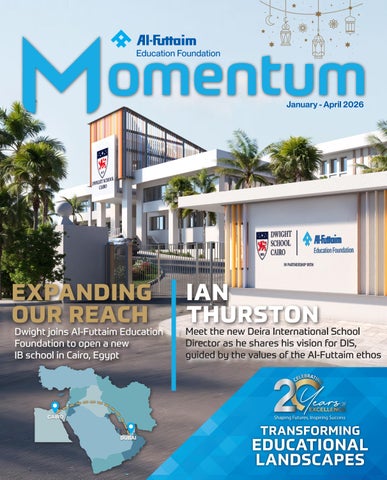
EXPANDING OUR REACH
Dwight joins Al-Futtaim Education Foundation to open a new IB school in Cairo, Egypt
IAN THURSTON
Meet the new Deira International School Director as he shares his vision for DIS, guided by the values of the Al-Futtaim ethos
CAIRO
DUBAI
TRANSFORMING
EDUCATIONAL LANDSCAPES
2
MOMENTUM
Shaping Futures, Inspiring Success What do you get when you bring together the Dwight Network of IB Schools and the Al-Futtaim Education Foundation? Building schools anchored in a family philosophy. For us, ‘going further’ means expanding our reach while staying true to daily classroom practice. It means growing pathways, strengthening teacher development, and graduating students ready for higher study, work, and a changing world.
As we continue to mark our Platinum milestones, we toast to twenty years of
PURPOSE, PEOPLE, AND PRIDE.
@Copyright 2026 AFEF All rights reserved While the publishers have made every effort to ensure the accuracy of all the information in this magazine, they will not be held responsible for any errors therein.
Talk to us: momentum@alfuttaimeducation.com @alfuttaimeducationfoundation @alfuttaimeducationfoundation @alfuttaimeducationfoundation www.alfuttaimeducation.com
4
MOMENTUM
A PARTNERSHIP ANCHORED IN HERITAGE Introducing Dwight, the global IB school network now partnering with Al-Futtaim Education Foundation, to establish Dwight School Cairo...
A
154-year school network built on heritage does not expand lightly. A family-business such as Al-Futtaim, whose story started decades ago, rooted in ambition and progress, does not choose partners casually. So when the Al-Futtaim Education Foundation and the global Dwight Network of Schools agreed to launch a school in Cairo, the decision carried history on both sides.
“The Cairo campus represents a For Al-Futtaim Education Foundation, major milestone in our Middle it builds on twenty years of developing East and North Africa footprint… schools shaped by long-term thinking our second in the region after and careful stewardship. Dubai,” says Dr Blake Spahn, Vice Chancellor of The Dwight Schools “This expansion strengthens our global and a third-generation member network,” Dr Spahn says. of the Spahn family guiding the network worldwide. “It creates more opportunities for cultural exchange, The agreement, signed recently, collaboration and global formally brings Dwight School Cairo citizenship from New to life. York to Cairo.” For Dwight, it extends a global network that already connects New York, London, Seoul, Shanghai, Dubai, Hanoi and its online campus.
Addressing guests in Cairo, Dr Blake Spahn, Vice Chancellor of The Dwight Schools, describes the new campus as a key step in Dwight’s MENA presence, joining a global network that spans New York, London, Seoul, Shanghai, Dubai, Hanoi and online.
5
EXPANDING OUR REACH AT AFEF Patience plays a role too. “Opening a Dwight school is a marathon,” he says. “It requires integrity and a shared belief in building something enduring.” Talent cannot be overlooked. Strong leadership and strong teachers determine whether a school thrives. A region must either already have, or be able to attract, educators who want to work within a collaborative global network. “The ability to cultivate mission-aligned leadership locally is essential,” he says.
Following the signing of the partnership to establish Dwight School Cairo, Omar Al Futtaim, Vice Chairman and CEO of Al-Futtaim and Chairman of the Al-Futtaim Education Foundation (right), and Mira Al Futtaim, Chief Future Education Officer at Al-Futtaim Education Foundation and Chairwoman of Emiratisation at Al-Futtaim, are pictured with Stephen Spahn, Chancellor, and Dr Blake Spahn, Vice Chancellor of The Dwight Schools. The partnership marks a significant step in expanding high-quality education to Cairo, Egypt.
He also considers whether the broader educational climate allows room for innovation inside a rigorous framework. This approach thrives where inquiry and international mindedness are respected. When aligned families, trusted partners and capable educators come together, the foundations are steady.
Local ecosystems
Each side brings something defined. Al-Futtaim Education Foundation brings its own priorities to the partnership. Across its schools, the Foundation has placed strong emphasis on Arabic language and cultural learning, alongside growing work in artificial intelligence and meaningful education research. Initiatives such as Project Aghsan, which produces high-quality Arabic books for students, reflect its commitment to strengthening Arabic literacy and thoughtful innovation in learning. The intention is practical. International standards, shaped carefully around Egyptian context. “Partnering with Dwight allows the new school to benefit from decades of experience delivering internationally recognised, inquiry-based education across our network,” Dr Spahn explains, “while using Al-Futtaim’s regional insights to tailor learning to local needs and expectations.” Where Dwight grows next is never treated as routine. Before a location is considered seriously, alignment is tested from several angles. “The first and most important signal is philosophical alignment,” Dr Spahn says.
Collaborative global network
He listens closely for what families are asking for. Academic credentials alone are not enough. He wants to know whether they are seeking character development, global perspective and purpose alongside achievement.
Assessing the campus masterplan: Dr Blake Spahn (2nd right), Vice Chancellor of The Dwight Schools, reviews the Cairo model with Henning Fries (left), Chief Operating Officer of Dwight, alongside Dr Farah Sarraj, Corporate Chief Officer of the Al-Futtaim Education Foundation, and Kerry Ross, Chief Operations Officer, during their recent visit.
Each side brings something defined. Dwight has a long-standing history of operating internationally focused schools and working with globally respected educational frameworks such as the IB. Al-Futtaim contributes regional experience and a clear understanding of how schools operate within local educational ecosystems.
6
MOMENTUM
Shared expectations
As the network expands, maintaining culture and quality requires discipline. Dwight’s guiding principle - igniting the spark of genius in every child - shapes every decision. “It is not a slogan,” he says. “It is the lens through which we make decisions.” A Dwight campus must be deeply student-centred and learning must be genuinely personalised. Heads of School and senior leaders are chosen with care and immersed in Dwight’s history and pedagogy. Development does not happen in isolation. Leaders collaborate across campuses, reinforcing shared expectations and a clear understanding of excellence. Teachers are connected across the network as well. Professional development is shared. Curriculum standards are aligned. Assessment expectations are clear. Students benefit from exchanges and global learning initiatives that create meaningful links across borders. “We protect what defines a Dwight school,” Dr Spahn says, “not by replicating a model mechanically, but by nurturing a shared mission.”
A campus built for tomorrow: Dwight School Cairo brings modern design and forward-focused learning spaces to life.
The Spark Lab: A purpose-built robotics and technology hub supporting inquiry, real-world problem solving, and the responsible integration of emerging technologies.
7
EXPANDING OUR REACH AT AFEF For Dr Spahn, the decision to open in Cairo is grounded in stewardship rather than speed. “It is about thinking in decades,” he says. “A long-standing heritage now extends into a new setting, supported by a partner that understands its region and shares a longterm view."
AI and digital literacy
Artificial intelligence and digital tools are entering classrooms quickly, and Dwight’s response is measured rather than reactive. “We do not adopt technology because it is new,” he says. “We adopt it when it demonstrably strengthens learning.” Every tool is examined carefully. Does it deepen inquiry? Does it enhance the teacher’s role rather than replace it? Does it strengthen critical thinking, creativity, collaboration and ethical reasoning? New approaches are piloted before wider implementation. Evidence is gathered. Alignment with standards is checked. Students are also taught AI literacy so they learn to question tools responsibly.
Thinking in decades
Across Dwight’s global network, international outlook and local belonging are treated as reinforcing one another. Students collaborate across continents while each campus reflects its own culture, language and traditions. Shared values provide cohesion. Local context provides character. The Cairo partnership reflects that same balance. Dwight’s educational heritage combines with Al-Futtaim’s regional insight and operational depth. The result is not a copy of another campus. It is a school shaped for its community, connected to a wider network.
The intention is steady: to invest in leadership, to support teachers, to connect students across borders, and to prepare them not only for university, but for meaningful participation in a connected world.
8
MOMENTUM
Main Features
04
24
EMIRATI LEGACY:
As international schools in the UAE, DIS and UAS have a responsibility to honour the local culture, which has shaped both school communities over the decades.
14
BILINGUAL DIPLOMA AT UAS:
Take a closer look at how Arabic and English are taught as academic subjects within the IB Diploma programme.
34
9
CONTENTS
Parent Engagement
22
NEW AGE CUT-OFF RULE, EXPLAINED:
64
ADULTING AT 18:
Unsure how recent admission changes could affect your child’s start at school? Noha Abdelfattah, School Registrar at Universal American School, breaks it down for parents.
Tech Talk
A new decree in the UAE recognises 18-year-olds as legal adults for civil and commercial matters. Are our students ready or not? Flip the pages and find out.
30
PARENTING IN THE DIGITAL AGE:
A look at the practical steps families and schools are taking to support safe and balanced technology use.
18 Exploring Excellence
44
DIS IN TOP TIER 1%:
This year’s strong GCSE performance recognised through the ALPS Diamond Award for Outstanding Progress.
Literary Corner
48
A CHAMPION’S MINDSET:
65 Sports Spotlight
48
A CHAT WITH BRUNO ALVES:
Portuguese football legend speaks about his journey, his discipline, and what it takes to succeed in the beautiful game, as he leads a coaching clinic for our U16–U19 boys at Universal American School.
Alumni Connect
52
SPOTLIGHTING OUR TRAILBLAZERS:
Twenty years on, our UAS and DIS founding students are doctors, designers, pilots, creatives, educators, leaders, parents, and everything in between. We continue to honour them.
Campus Life
Wonder what goes on inside the head of a worldclass athlete? Tommy Ramdhan’s new children’s book brings it to life, drawing from years of competition, training, and real lessons learned along the way.
33
EXPERIENTIAL LEARNING:
36
FOCUS ON DOFE AWARD:
Students from Deira International School and Universal American School explore how electric, hybrid, and hydrogen vehicles are changing the rules, during their winter internships.
Inside the Duke of Edinburgh’s Award at Deira International School, and its role in preparing students for the IB years.
Humour & Entertainment
40
COFFEE BREAK:
Iftar tastes better with Arabic coffee, dates, and a few good puzzles, because during Ramadan even brain teasers arrive with hospitality. Take a moment to relax, enjoy the fun, and let the smiles come naturally.
10
MOMENTUM
LEADING
THE NEXT CHAPTER Meet our new Director as he shares his vision for Deira International School and how he plans to build on its 'Outstanding' foundations... “Dubai and the UAE have given my family so much, and being part of the Al-Futtaim organisation, that is deeply invested in the country’s future, means a great deal. I hope I can contribute positively in return.”
Ian Thurston, Director, Deira International School
11
DIS DIRECTOR'S DIALOGUE
T
wenty years is a moment worth pausing for.
As Deira International School continues to mark its 20th anniversary this academic year, attention turns to what lies ahead and the next phase of growth, shaped by strong leadership and the values at the heart of the Al-Futtaim ethos. We are pleased to welcome Ian Thurston as Director, as he leads the school into its next chapter. In this interview with Momentum, he shares his early impressions of DIS and how he hopes to build on its Outstanding foundations in the years ahead… Momentum: You’ve led international schools at different stages of growth here in Dubai. When you first step into a new school, what are you quietly observing before you say or change anything? Ian: When I join a new school, my priority is to understand the context as deeply as possible. I spend time meeting people, listening carefully, and learning about the school’s story. I want to know why parents choose the school, what students hope to achieve by being here, and how staff work together on a day-to-day basis. I pay close attention to what is already working well and needs to be protected, as well as where there may be opportunities to grow over time. That thinking stretches across the short term, the medium term, and the longer journey of the school. I also believe you need to 'feel' a school, not just observe it. Education is about people, and great schools are built on strong relationships. Understanding those relationships, and how trust is built across the school, is always my starting point.
me, and it shapes how I think about school every day. Whenever I have spare time, I like to be active and outdoors. As a family, we cycle, head to the beach, spend time in the desert or the mountains, and camp during the winter months. I enjoy the simplicity of it. Stepping away from the city reminds you how fortunate we are to live in Dubai, while also helping you connect more deeply with the UAE and its heritage. That perspective matters to me as a leader. I often think as a parent first. What would I want for my own children? What values do I want them to learn? Those questions guide many of the decisions I make. Sport has also played a big role in shaping who I am. It’s where I learned about teamwork, discipline, and resilience, and it gave me opportunities to travel and build lasting memories. I still set personal challenges for myself, from marathons to triathlons and open-water swims. When I first arrived in Dubai, I could barely swim 25 metres. I’ve since completed 1.5km ocean swims in races. It’s a reminder that progress comes from effort and commitment. That mindset carries into my leadership. I believe in setting high expectations, pushing for improvement, and knowing that effort matters more than outcomes. You can always get better, and that applies just as much to schools as it does to individuals.
Momentum: Before we talk about leadership, tell us a little about life beyond school. Who are you when you’re not on campus, and how does family life influence the way you lead? Ian: I’m married, and I’m a father of two. My son Will is in Year 13, and daughter Charlotte is in Year 11. Family is everything for
VISION & VOICE
Ready to hit the track at Dubai Kartdrome with family.
Momentum: Deira International School is already an ‘Outstanding’ rated school. What does ‘going further’ look like to you in a school that is already performing at a very high level? Ian: DIS is a fantastic school, and the Outstanding rating is a real achievement. At the same time, it’s only one part of providing a truly world-class education. What excites me is the ambition here. There is a genuine desire to keep improving. Going further means honouring the school’s heritage and achievements while continuing to move forward.
12
MOMENTUM It means playing a leading role in Arabic language learning, and using technology thoughtfully to personalise learning so every child gets what they need, when they need it. It also means finding better ways to communicate with parents. Going further is about creating more pathways and wider opportunities beyond the classroom. It’s about giving students space to explore their interests, develop confidence, and build skills in areas they care about. It also means thinking carefully about how we use our time, our facilities, and our learning habits. Education today is about more than content. It’s about problem-solving, character, and preparing young people for a changing world. Momentum: DIS is known for its strong sense of community and culture. Before officially joining, what have you already heard or sensed about the school? Ian: I’ve asked one question many times: what do we need to protect? The answer has always been the same. Culture. There is a strong sense of trust and integrity at DIS. These aren’t abstract ideas. You feel them when you speak to people. They shape how the school works every day.
of opportunities, from sport to performance to leadership. Teaching that encourages curiosity and exploration. Community events that bring people together. Most importantly, I’ve heard about a happy school, where parents and teachers work closely to provide the best possible learning experience for students. Momentum: Students often remember how leaders make them feel more than what they say. How do you like to connect with young people, and what do you hope students at DIS will quickly learn about you? Ian: I connect best by being present and involved in what students are doing. That might be chatting at the gate in the morning, sitting in on a lesson, joining an MUN debate (Model United Nations), or playing football at lunchtime. I genuinely enjoy being around students and sharing their world. Visibility matters. I want my DIS students to know I’m a real person who cares about who they are and what they’re working towards, whether that’s a university ambition or a school production. I’m here for them, so listening is key. Respect has always been important to me, and I believe students deserve to be treated as individuals, with a voice and a sense of ownership over their school experience. Young people are often more creative than we give them credit for. Sometimes all they need is encouragement. I hope my students quickly see that I genuinely care about their interests and goals. Working with children is a privilege, and it’s one I take very seriously. Momentum: You’re joining Deira International School as part of the wider Al-Futtaim family. What does becoming part of this Group mean to you? Ian: Joining the Al-Futtaim organisation is exciting, but what has stood out most to me is its strong ethical foundation. There is a clear focus on people and on improving lives, and that values-led approach really matters to me. Dubai and the UAE have given my family so much, and being part of an organisation that is deeply invested in the country’s future means a great deal. I hope I can contribute positively in return.
I’ve heard a b o u t a n i n c l u s i ve environment where every child is noticed, and all cultures are welcomed. Strong academic foundations that allow students to progress in their own way. A wide range
Being part of Al-Futtaim brings stability, expertise, and longterm thinking, which are all essential in education. Children are part of a school for many years, so decisions need to be thoughtful and sustainable. I’m also looking forward to learning from colleagues across different sectors within the Group and bringing those perspectives back into education. I hope that exchange of ideas works both ways.
13
Hiking in the mountains with his dogs, enjoying the outdoors beyond the pace of city life.
Out on a jet ski off the Dubai coast with his children, making the most of time outdoors beyond school.
Taking part in an earlier Dubai Marathon, one of several endurance challenges Ian has taken on over the years.
14
MOMENTUM
THE BILINGUAL ADVANTAGE AT UAS Take a closer look at how Arabic and English are taught as academic subjects within the IB Diploma programme… icture a graduate equally confident in English and Arabic, not conversationally, but academically. That is the standard Universal American School is setting through its bilingual IB Diploma. Arabic and English are treated with equal academic seriousness, preparing students to read deeply, write clearly, and think critically in both languages.
P
One of the driving forces behind this shift is the Al-Futtaim Education Foundation’s Centre for Excellence in Arabic. Here, Nema Katranji, Leader of Arabic Pedagogy and Academic Quality Assurance, explains how Arabic at UAS has been reshaped into a subject of depth and rigour, and why that matters for the bilingual IB Diploma. Momentum: What changes has the Centre for Excellence in Arabic introduced to ensure Arabic is taught as an academic subject, not just a language course? Nema: Over the past seven years, Arabic at UAS has gone through a deliberate shift. A literature-based curriculum now runs across middle and high school. The focus is on analysis and interpretation, not surface learning. Our students examine how texts are constructed. They look closely at language choices, structure, and author intent. They evaluate how meaning is shaped and how audiences are influenced. This work happens through carefully sequenced fiction and non-fiction units. Students study novels, poetry, theatre, and non-literary texts. Language instruction sits within the content. Grammar is taught through meaning and context, not in isolation. This approach supports clear writing, structured arguments, and confident responses, all of which are essential for success in the IB Diploma. Momentum: What distinguishes UAS’s approach to Arabic A within the bilingual IB Diploma from more traditional Arabic programmes? Nema: Arabic A at UAS is built around relevance and depth.
Nema Katranji, Leader of Arabic Pedagogy and Academic Quality Assurance at the Al-Futtaim Education Foundation’s Centre for Excellence in Arabic.
15
BILINGUAL DIPLOMA AT UAS Professional development continues throughout the IB Diploma Programme. Teaching and learning are regularly quality assured to maintain consistency and academic challenge. This culture supports strong student outcomes and confidence.
Diploma Programme students create Arabic comics as part of their creative language and literature work.
The programme moves away from narrow, text-bound teaching and towards literature that speaks to real themes and real contexts. Our students study texts that explore identity, fairness, social justice, and cultural conflict. These themes help them connect literature to the world around them and to their own experiences. Poetry and narrative texts allow them to explore voice, perspective, and interpretation. Alongside this, we integrate non-traditional texts such as film, song, animation, and advertising. These texts support comparison across genres and help students analyse meaning in different forms. Literature is not treated as abstract or distant. It is explored as part of society and culture. This approach has led many of our students to choose Arabic for deeper academic inquiry. Over seven years, more than 30 Extended Essays have been completed in Arabic. Learning is also extended through CAS (Creativity, Activity, Service) projects, including writing children’s stories, theatre work, and Arabic-focused digital platforms, allowing language and literature to be shared beyond the classroom. Momentum: How has teacher development and quality assurance influenced readiness for the bilingual IB Diploma? Nema: Teacher development plays a central role. Through the partnership with the Centre for Excellence in Arabic, our teachers receive ongoing coaching and support focused on inquiry-led, student-centred teaching. Teachers are encouraged to take informed risks and lead curriculum development.
This includes refining the literature-based Arabic programme and introducing our initiatives such as the Aghsan project in the elementary phase. Aghsan strengthens early engagement with authentic texts and supports teachers through structured coaching cycles. Moreover, collaboration with CfEA empowers our students to take initiative beyond the classroom, resulting in recognised achievements such as UAS being awarded Most Creative School in Arabic Writing for two consecutive years on the Kamkaima platform among over 100 schools, a second-place poetry award at Burjeel inspired by the arts for a DP student, and multiple recognitions at the Emirates Literature Festival, positioning UAS as distinctive in the quality, impact, and reach of its Arabic programme.
16
MOMENTUM
WHERE READING LEADS Christine Santosdiaz, who oversees literacy across Universal American School, on how English study supports the bilingual IB Diploma… t is a dress-up parade like no other. For one morning, classrooms spill into corridors as staff and students arrive dressed as favourite book characters. A buzzing bee appears alongside Jack from ‘Jack and the Beanstalk’. ‘Little Red Riding Hood’ weaves past ‘Matilda’. A ‘Where’s Wally’ look-alike pops up unexpectedly, while a few ‘Harry Potters’ wander by, wands in hand. Storybook world comes to life as Universal American School gathers to usher in Literacy Kick-Off week.
I
Held each year at UAS, the Literacy Kick-Off has become a familiar and much-anticipated part of the school calendar. It brings reading, writing, and discussion into daily school life across year groups and subjects. This steady focus supports students as they progress towards the bilingual IB Diploma, where English and Arabic are studied with equal academic depth. “Literacy Kick-Off week gives the whole school a shared focus,” says Christine Santosdiaz, Whole School Literacy Lead at UAS. “Students see reading and writing happening everywhere, not just in one lesson or one subject.”
Literacy-based activities
Held each year during the First Term, the week-long event engages students from Pre-K to Grade 12 through a structured programme of activities. Across multiple days, the school pauses for ‘Drop Everything and Read’ sessions, encouraging independent reading and shared quiet time. Alongside this, teachers embed literacybased activities across content areas, reinforcing the role of reading and writing in every subject. Students across all year groups take part in the ‘IXL Language Arts Challenge’, a week-long initiative focused on strengthening reading and writing skills. Libraries play a central role throughout the week. Elementary students attend story time sessions with the school librarian, while Middle and High School students take part in research-focused library visits, including genre exploration, book selection, and research skills development. Arabic features strongly through ‘Arabic Connections’ lessons, where students explore language and culture through writing and story sharing. These lessons help students make connections between languages and literary expression, reflecting the school’s broader bilingual approach.
17
BILINGUAL DIPLOMA AT UAS
Shared reading goals
The Literacy Kick-Off also introduces students to national platforms and competitions. Participation in the Chevron Readers’ Cup and the Oxford University Press Story Writing Competition, both hosted by the Emirates Literature Foundation, is announced during the week. Winning teams progress to advanced rounds of the competitions.
As Whole School Literacy Lead, Christine works with teachers to ensure reading and writing strategies are applied consistently across subjects and year groups. This alignment supports students as they move into the IB Diploma Programme, where strong reading comprehension, structured writing, and confident discussion underpin success in English A and across the curriculum.
Reading continues beyond the week itself through the ‘Quarter Book Competition’, embedded within homerooms. Students contribute to shared reading goals over time, building consistency and accountability.
Held each year during the First Term, the Literacy Kick-Off engages students from Pre-K to Grade 12 through a structured programme of activities. Teachers embed literacy-based activities across content areas, reinforcing the role of reading and writing in every subject.
“We want reading to feel familiar,” Christine explains. “By the time students reach the Diploma Programme, working with complex texts is something they are used to.”
Christine Santosdiaz, Whole School Literacy Lead at Universal American School, sharing literacy practice with teachers and parents of our students, across grade levels.
Each year, book character dress-up day marks the start of Literacy Kick-Off week at Universal American School.
18
MOMENTUM
THE WORK BEHIND THE GREEN FLAG How embedding the culture of sustainability at DIS through strategic planning, student leadership and whole-school initiatives has positioned the school for global environmental accreditation…
O
ver the past 18 months, sustainability at Deira International School has become more coordinated across the campus.
Projects that were once driven by individual teams are now aligned under a clearer direction, with students playing an active role in shaping priorities. The school has recently joined the Alliance for Sustainable Schools (TASS), while continuing work on Forest School, biodiversity, reducing single-use plastics and progressing through the Green Flag process.
Michael Taylor: Joining The Alliance for Sustainable Schools (TASS) has provided DIS with a structured framework to better align our existing sustainability efforts. At this early stage of our membership, it serves as a 'North Star,' helping us move toward a more consistent approach across the whole school.
Michael Taylor Primary Assistant Headteacher
We spoke with Michael Taylor, Primary Assistant Headteacher; Scarlett Keyworth, Whole School Assistant Headteacher for the Student Experience; and Dan Kilsby, Associate Primary Assistant Headteacher for Science, Sustainability and Outdoor Learning, about how this work is being led and what it looks like day to day at DIS…
By connecting with a wider community of educators and students around the world, we are beginning to share best practices and look at how we can make more deliberate, long-term changes to our communities here in the UAE. For DIS, this partnership is about ensuring our commitment to the environment is collaborative and focused on steady, meaningful progress within our local community.
Momentum: DIS joined the Alliance for Sustainable Schools as part of its sustainability journey. Why was joining TASS an important step for the school, and what has it changed in how sustainability is approached across DIS?
Momentum: Student leadership sits at the centre of sustainability here, from Eco Warriors and the Sustainability Council to student representation through TASS. Why is student voice so important in this work, and what have you seen students take real ownership of over the past 18 months?
ECO IMPACT AT DIS
Scarlett Keyworth Whole School Assistant Headteacher for the Student Experience
Scarlett Keyworth: Student Leadership sits at the heart of life at DIS, empowering our young people to take direction in all areas of school life and in the issues that matter most to them as individuals, global citizens, and future leaders. Sustainability is one area that particularly resonates with our Gen Z community. Our students care deeply about the world they live in and the legacy they will leave behind. They demonstrate a strong sense of responsibility for protecting the environment and educating others on how to care for the planet we share.
Michael Taylor, Scarlett Keyworth and Dan Kilsby display the TASS charter alongside members of the DIS student Sustainability Council, marking the school’s formal commitment to The Alliance for Sustainable Schools and its student-led environmental work.
19
20
MOMENTUM One of our most notable achievements was a large-scale collaborative initiative with our sister school, UAS, for the ‘Liter of Light’ project. Together, the Sustainability Council broke a World Record, constructing 3,000 solar lights to be donated to rural villages and underprivileged communities across the Philippines and Asia. This remains our greatest achievement to date. However, we also recognise that small actions can create meaningful change. Within our own community, students have led beach clean-ups, promoted the reduction of single-use plastics, and actively engaged in the ‘Green Flag Award’ process. Through this initiative, students have designed and implemented projects focused on biodiversity, waste management, school grounds, and water conservation. Watch this space as we work towards raising the Green Flag, in collaboration with Eco-Schools UK, celebrating our collective commitment to sustainability, student leadership and environmental stewardship. Momentum: Looking at what DIS has already put in place, such as the Forest School, journey towards the Green Flag accreditation, biodiversity spaces, and reducing single-use plastics, what does ‘doing sustainability properly’ look like in a school setting, beyond policies or awards?
Dan Kilsby Associate Primary Assistant Headteacher for Science, Sustainability and Outdoor Learning
Dan Kilsby: ‘Doing sustainability properly’ in a school setting goes far beyond policies, checklists, or awards. At DIS, what we’re really aiming for is an embedded culture of sustainability. That means being sustainable isn’t treated as a bolt-on topic, a single unit in a curriculum, or the responsibility of one team. Instead, it’s something that all staff academic, operational, and leadership and all students, from 4 to 18, naturally think about in the decisions they make every day. This is already visible in practical ways across the school. Reducing single-use plastics isn’t just about rules; it’s about shifting habits and mindsets, so people pause and ask, ‘Is there a better option here?’ The same applies to increasing biodiversity: our outdoor and green spaces aren’t just decorative, they’re living systems that students notice, care for, and learn from. Over time, this builds a shared understanding that human choices have real, visible impacts on the world around us.
The Alliance for Sustainable Schools (TASS) is a non-profit network that supports schools in strengthening sustainability across education. It connects institutions and partners to work together on environmental, social and economic challenges.
21
ECO IMPACT AT DIS
The Eco-Schools Green Flag is an international accreditation awarded to schools that demonstrate a sustained commitment to environmental education and responsible practice. Solve real problems Forest School plays a key role in this culture. Through regular, meaningful time outdoors, students develop a stronger connection to nature, alongside curiosity, collaboration, resilience, and practical life skills. When children learn to observe carefully, work together, and solve real problems in a natural environment, sustainability stops being abstract, it becomes personal and motivating.
Crucially, at DIS we also recognise that simply being ‘sustainable’ is not the end goal. Sustainability is a foundation, not a finish line.
Cooking eggs over an open fire, young Primary learners at DIS take part in Forest School, an outdoor learning programme embedded within the school’s sustainability work, where time in nature helps pupils understand their relationship with the environment and the impact of everyday choices.
We want students and staff to feel empowered and passionate about pushing beyond ‘doing less harm’, towards ideas of regeneration, abundance, and shared prosperity a society where both people and the planet can thrive. In that sense, doing sustainability properly means nurturing informed, hopeful changemakers who believe they can build something better, not just maintain what already exists.
22
MOMENTUM
UNDERSTANDING THE UAE’S NEW AGE RULES Unsure how recent admission changes could affect your child’s start at school? Noha Abdelfattah, School Registrar at Universal American School, breaks it down for parents...
A
major update to school admission rules across the UAE is reshaping how families plan their child’s first steps into school. While the revised age cut-off offers greater flexibility, it has also left many parents weighing whether earlier eligibility is the right move for their child.
From the 2026–2027 academic year, the official age cut-off date for school admissions will move from 31 August to 31 December. The change applies to new student admissions only at public and private schools, as well as Early Childhood Centres, that begin the academic year in August or September.
Parents should work closely with teachers to address any gaps early, as children born later in the year may be in class with peers nearly a year older, making it important to monitor how well they are coping academically and emotionally. The amendment follows updated guidelines issued by the Ministry of Education and adopted by regulators, including Knowledge and Human Development Authority (KHDA).
What exactly has changed?
Under the new rule, children can start school if they reach the required age by 31 December of the admission year, rather than needing to have already turned that age by the end of August.
Noha Abdelfattah, School Registrar at Universal American School, addresses common questions parents are asking about school entry ages.
23
PARENT ENGAGEMENT She adds that schools will continue to set clear entry conditions. “At Universal American School, children must be fully toilet trained and independent,” she says. “We do not offer nurserystyle care, so independence is essential.”
Does this make moving between countries easier? Not necessarily.
“In fact, no,” Noha says. “Most countries in the Middle East, Canada, the United States, and the UK still follow a 31 August or early September cut-off.”
Under the new rule, children can start school if they reach the required age by 31 December of the admission year, rather than needing to have already turned that age by the end of August.
This means some children will be able to join Pre-K or FS1 at the age of two, provided they turn three on or before 31 December of that academic year. “Previously, a child needed to turn three on or before 31 August to join Pre-K or FS1,” explains Noha Abdelfattah, School Registrar at Universal American School. “Now, children can join at the start of the academic year and turn three anytime up to 31 December.” The updated cut-off applies across curricula offered in the UAE, including American, British, IB, Indian, French, and other international systems. What does this mean for families who were told to wait? For some parents, the change brings relief.
She explains that children who start earlier under the UAE system may face challenges if families relocate. “Countries such as Canada, the US, and the UK are very strict about age cut-offs,” she says. “They do not rely on transfer certificates.” Noha urges parents to look beyond dates on a calendar. “Parents need to be very aware of their child’s abilities,” she says. “Grade demotion is no longer permitted under KHDA rules, except in very specific cases.”
She advises close collaboration with school.
“Work closely with teachers to address any gaps early,” she says. “Children born later in the year may be in class with peers nearly a year older, so parents should monitor how well their child is coping both academically and emotionally.” Her final message is measured. “If the academic team recommends repeating a year at the end of the cycle, parents should consider it carefully,” she says. “The focus should always be on the child’s wellbeing, not pressure or comparison.”
“Many families felt it was unfair for a child to stay home for a full year simply because they missed the cut-off by a few days,” says Noha. However, she is clear that the new rule does not override existing enrolments. “If a student is already registered at a school in the UAE and listed on the KHDA portal, they must remain where they are,” she explains. “No promotion or grade change will be proposed under the new rule.”
What are parents asking most?
Readiness is the most common concern. “For some parents, this is good news,” says Noha. “Others are more cautious, especially when it comes to emotional readiness and motor skills, particularly for children born in November or December.”
KHDA age requirements outlining school and Early Childhood Centre (ECC) entry for institutions starting in August or September.
24
MOMENTUM
A SHARED LEGACY ROOTED IN EMIRATI
CULTURE
For two decades, students have shaped everyday school life through leadership, service, academic success, and national traditions that continue to guide the community at Deira International School…
25
EMIRATI LEGACY
E
mirati culture has been part of everyday life at Deira International School since its earliest years. “As an international school in the UAE, we have a duty to honour local Emirati culture. It has to feel real, every day.”
That is the view of Sheikh Iqbal, Assistant Head Teacher, Academic, and Emirati Lead at Deira International School. His work sits close to students and close to school life, supporting academic progress while also ensuring that identity, values, and national traditions are reflected in the way the community learns, gathers, and leads.
The Heritage Heroes As DIS marks 20 years, the Emirati presence in the school is best understood through the rhythm of the year. It is visible in national occasions that return each term, in student-led initiatives that have become familiar across year groups, and in service work that feels purposeful. One of the strongest examples of student ownership is the ‘Heritage Heroes’. Over time, the group has become a steady force in school life. Their work centres on values that students already recognise from home and community, then brings those values into school in a way that is natural and student-led. The ‘Gratitude Programme’ is a good example. Rather than being a one-off campaign, it invites staff and students to pause, reflect, and notice the everyday blessings of living in the UAE. It is led by students, shaped by students, and received as such. As DIS marks 20 years, the Emirati presence in the school is best understood through the rhythm of the year. It is visible in national occasions that return each term, in student-led initiatives that have become familiar across year groups, and in service work that feels purposeful.
Sheikh Iqbal, Assistant Head Teacher, Academic, and Emirati Lead at Deira International School.
School’s national calendar In the same spirit, ‘Heritage Heroes’ have helped introduce Emirati Co-Curricular Activities (CCAs) that are taught by students themselves. Secondary students guide younger pupils in practices such as Yowlah and the hair dance for girls. It is a simple idea with a powerful effect. When older students take responsibility for teaching, culture becomes something shared, not explained. Younger students learn through familiarity and example, and older students grow into leadership without needing a spotlight. “Student-to-student teaching changes everything,” Sheikh notes. “It builds confidence and responsibility at the same time.” The school’s national calendar matters here too, because it provides recurring moments when culture is honoured with purpose. Emirati Women’s Day is observed through recognition and reflection, with students encouraged to connect the day to the women who have shaped their lives. The most meaningful contributions often begin close to home, then widen to include educators, leaders, and community figures.
26
MOMENTUM
Shared memory of cohorts UAE Flag Day is another moment that the community returns to each year. Students gather, reflect, and discuss what the flag represents. Commemoration Day carries a different tone, one that asks for reflection and maturity. Students are guided to think about sacrifice, service, and national identity. National Day then arrives with its sense of pride and celebration, but again, the strongest moments are the ones that feel genuine, when students connect national story to personal belonging. Over two decades, these occasions have become familiar markers in the life of the school, forming part of the shared memory of cohorts who have moved through DIS.
Service is another thread that returns each year and strengthens that sense of shared responsibility. During Ramadan, Emirati students participate in food box distribution, working alongside partners such as Emirates Red Crescent. Students understand why they are doing it and who it is for. The work carries the values of generosity and care that Ramadan calls for, and it provides a practical way for students to contribute beyond the school gates. “This is service our students recognise,” Sheikh adds. “It is part of how they are raised.”
Students leading students Alongside leadership and service, Emirati students at DIS continue to achieve strong academic outcomes. Recent achievements include a student securing straight A grades at GCSE, a result that reflects sustained effort, focus, and quiet determination. Beyond exam results, the wider picture is clear in where students go next. Emirati graduates continue to progress to leading universities overseas, carrying their identity with confidence. This year, two students also completed the NYU Summer Academy, a milestone that speaks to academic readiness and ambition (see next page). Over 20 years, this is what the legacy looks like in practice. Culture carried through daily routines. National days treated with respect. Students leading students. Service linked to values. Achievement built through discipline. It is the accumulation of years, cohorts, and habits that have shaped the school. And for Sheikh Iqbal, that is the point. “When culture is real, you don’t need to dress it up,” he says. “You see it in how students live it.”
27
EMIRATI LEGACY
BREAKING NEW GROUND For the first time, two of our Emirati students graduate from the NYUAD Summer Academy, and set a new standard for what’s possible… etting into the New York University Abu Dhabi Summer Academy is no small thing. The selection process is long, competitive, and demanding. For two of our Emirati students, it meant writing essays, sitting interviews, and standing out among applicants from across the country. Saif and Dana are now the first from Deira International School to graduate from the prestigious NYUAD Summer Academy. Their achievement sets a strong example for others to follow.
G
Build academic confidence
The Summer Academy is a two-year enrichment programme for high-achieving Emirati students. Organised by New York University Abu Dhabi, the programme offers university-style teaching across two summer sessions. Students complete courses in academic writing, public speaking, global affairs, and college preparation. Every part of the programme is designed to challenge their thinking, develop their communication skills, and get them ready for universitylevel study. Our students worked alongside peers from all over the UAE. They completed individual and group assignments, gave presentations, and participated in classroom discussions.
Emirati students Saif and Dana are the first from Deira International School to graduate from the prestigious NYUAD Summer Academy. Pictured with Sheikh Iqbal, Secondary Assistant Head Teacher, Academic.
Every part of the NYUAD Summer programme is designed to challenge students’ thinking, develop their communication skills, and get them ready for university-level study. These activities helped them build academic confidence and introduced them to a wider community of motivated students. Sheikh Iqbal, Secondary Assistant Head Teacher, Academic, said: “This is a remarkable milestone for both students and for Deira International School. Selection alone is difficult. Graduating from the programme speaks to their commitment, resilience, and academic strength.”
A new benchmark
What makes this achievement even more impressive is that Saif and Dana completed the programme while continuing with their regular school responsibilities. Managing both required strong time management and self-discipline. They handled the academic pressure and stayed focused from start to finish. The Academy also encourages students to think beyond the classroom. Through guest speakers, workshops, and group projects, Saif and Dana explored global issues and considered their role in the future of the UAE. They also built strong friendships and learned how to collaborate with others who bring different views and experiences. Sheikh added: “This accomplishment sets a new benchmark for our students and will serve as inspiration to many. We are incredibly proud of Saif and Dana and look forward to what they will achieve next.”
28
MOMENTUM
INSIDE THE MINDS OF YOUNG EMIRATIS New white paper reveals what drives the next generation, what holds them back, and why listening now matters more than ever…
Y
outh are the hope of the present and the future... they are the energy and strength of nations.” Those words from His Highness Sheikh Mohammed bin Rashid Al Maktoum reflect a clear priority in the UAE. National development depends on how the country listens to and prepares its young people.
A new white paper by Al-Futtaim, based on a nationwide survey of 519 young Emiratis aged 18 to 25, gives a detailed picture of what matters to this generation and what’s getting in their way.
Sense of purpose
When asked about the most important factors in choosing a job, 53 percent said work-life balance. A close 51 percent said they wanted a positive and supportive work environment. Competitive salary came third at 49 percent. That doesn’t mean money isn’t important. It means it isn’t everything. Young people today are looking for workplaces that respect their time, support their growth, and give them a sense of purpose.
Mira Al Futtaim, Chief Future Education Officer at Al-Futtaim Education Foundation and Chairwoman of Emiratisation at Al-Futtaim.
Members of the Al-Futtaim Youth Council, part of a growing movement giving young voices a say in shaping the UAE’s workplaces and policies.
29
FOCUS ON EMIRATISATION “I believe that building a launchpad for young Emirati talent takes real collaboration,” said Mira Al Futtaim, Chief Future Education Officer at Al-Futtaim Education Foundation. “This white paper builds upon rigorous research and, importantly, open and candid dialogue.” Family continues to have a strong influence. Forty-six percent of respondents said parents and family have the biggest impact on their career decisions. That was higher than online platforms, social media influencers or even career mentors.
AI and future trends
At the same time, young people are aware of the bigger picture. Forty-two percent said they are thinking about how artificial intelligence and other future trends will affect their careers. But many don’t feel ready. Thirty-three percent cited intense competition for entry-level jobs as a barrier.
Twenty-eight percent said they lacked practical experience. These gaps between ambition and access are where change is needed most. Education is trying to keep up. At the American University in Dubai (AUD), for example, students get industry exposure, attend networking events, and take part in internship programmes. “We’re preparing Emirati students to think critically, embrace digital transformation and connect their studies to tomorrow,” said Dr Kyle Long, President of AUD. “Educators today are mentors, role models and guides.” Meanwhile, private companies like Al-Futtaim are creating long-term development programmes. The Sinyar Graduate Programme offers internships, mentorship and business projects. It starts as early as school summer camps and supports students all the way through to employment.
Dr Kyle Long, President of the American University in Dubai, says educators must be “mentors, role models and guides” as they prepare youth for the challenges ahead
A new white paper authored by the Al-Futtaim, in partnership with American University in Dubai, KPMG and G42, shows that empowering young Emiratis requires stronger collaboration between education, industry and government to give students practical experience, mentorship and early career exposure Career exploration
Still, many students are being asked to make major decisions about university and careers with little real exposure to the working world. One participant at the industry roundtable said that as many as 90 percent of Grade 11 and 12 students don’t have a clear idea of what they want to do. Another said 80 percent are choosing their courses based on family pressure, not personal interest or job market demand. To fix this, the paper recommends starting career exploration in schools by Grade 9. It also suggests involving parents, providing more internships, and creating visible role models from the private sector. A shift is also needed in how success is measured.
It’s not just about hiring more Emiratis. It’s about building clear paths for learning, leadership and long-term growth. Mira, who is also the Chairwoman of Emiratisation at Al-Futtaim, adds, “we’re committed to building a future where young Emiratis lead, innovate and drive the nation’s sustainable growth.” That future depends on more than plans. It depends on listening. And acting.
30
MOMENTUM
PARENTING IN THE DIGITAL AGE A look at the practical steps families and schools are taking to support safe and balanced technology use…
Keeping an eye on screen time is not always simple, especially as children become more confident online.
M
y attention was drawn to an internal staff email titled; ‘Urgent Safeguarding Notice – Risks of Anonymous Chat Platforms, VPNs, and SIM Use’.
The email highlighted how monitoring online behaviour has become more complex as students grow increasingly confident with digital tools. The message was practical rather than alarming. It reflected a reality many schools and families are dealing with at the same time. Children are comfortable moving between apps, adjusting settings, and finding ways around restrictions. In many cases, they pick this up faster than the adults trying to guide them.
That raised a wider question. How are parents dealing with this at home, and how is the school responding in a way that supports students without overreaching? To understand this better, I spoke with parents at Deira International School and with Kieran Birrell, Associate Assistant Headteacher and Whole-School Educational Technology Lead, to hear both perspectives.
Limiting screen time
For many families, digital parenting begins with clear routines. Screen limits. Encouraging time away from devices. These decisions are usually less about technology itself and more about habits. Samir Ahmed Shahid, a parent at the school and an active member of the Deira International School Parents Association (DISPA), describes his approach as practical and consistent.
31
TECH TALK AT DIS
“At home, we try to keep controlled time for using tech gadgets and encourage more physical activities,” he explains. “The focus is on balance rather than constant monitoring. While there is awareness of online risks, the more immediate challenge is often how much time children want to spend on devices,” he adds. When asked whether his family has experienced issues such as anonymous chat apps, VPNs, or extra SIM cards, Samir’s answer is direct. “No.” He is equally clear about where the difficulty lies. “It’s difficult because they want to use the iPad all the time,” he says. “We restrict it as much as possible.”
Deeba Faraz, a mum of two daughters at DIS, manages screen time at home through clear rules and routine.
Social media apps
Another parent, Deeba Faraz, who has two daughters at DIS, shared how digital boundaries are managed at home, particularly with children at different ages. “As parents, we understand that social media is now part of how children communicate,” she says. “The rules we’ve set are about balance, between studying, spending time outside, and playing games.” For her eldest daughter, that balance led to a personal choice. She deleted her social media apps during exam time after recognising how easily notifications disrupted her focus, with plans to return to them later. With her younger daughter, boundaries are more structured. Screen time is limited to short daily periods, and devices are handed over once that time ends. Deeba notes that awareness of technology varies between her children. While her younger daughter is not yet familiar with VPNs or workarounds, her older daughter understands how easily restrictions can be bypassed.
DIS parent Samir Ahmed Shahid: “At home, we try to keep controlled time for using tech gadgets and encourage more physical activities.”
“We’ve been very clear about the risks, especially around data breaches,” she explains. “We also focus a lot on self-control and habits that aren’t helpful in the long term.” For Deeba, another challenge is helping her daughters develop judgement online. “Just because something is popular doesn’t mean it’s a good decision,” she says. “And not everything online reflects real life.” As a mother of two daughters, she also finds herself addressing appearance and self-worth, reminding them that confidence and value are not tied to trends or products.
32
MOMENTUM
“We want students to understand why these things matter,” Kieran explains. “Not just follow rules without context.”
Digital safeguarding
This is a common experience for families. The challenge is not always hidden apps or advanced workarounds, but the ongoing pressure around access, screen time, and boundaries. Parents are often managing what they can see, while knowing there may be more happening beyond the screen. From the school’s perspective, the approach is structured and ongoing. Kieran Birrell explains that digital safeguarding cannot be treated as a one-off exercise. “From a school perspective, the key is staying proactive rather than reactive,” he says. “The digital landscape changes quickly, so safeguarding has to be continuous and part of everyday practice.” To stay current, Kieran keeps up to date through professional reading, research, podcasts, and regular discussions with educational technology and safeguarding professionals. This helps the school remain aware of new platforms and potential risks before they begin to affect students.
He also works closely with the IT team to review filtering, monitoring, and device practices on a regular basis. “We review systems constantly to make sure they evolve alongside the technology students are using,” he explains.
Use technology responsibly
Alongside technical measures, education plays a central role. This year, the school partnered with Digital Bridge, working alongside EdRuption and Meta’s Digital Wellbeing initiatives, to deliver digital wellbeing sessions for both Primary and Secondary students. “These sessions focus on safe habits, healthy screen use, online behaviour, and understanding risk,” Kieran says. The sessions are designed to be age appropriate and practical, helping students understand how to use technology responsibly rather than relying on warnings alone. Digital safety is also embedded within the curriculum. Students are taught digital literacy, critical thinking, and how to recognise online risks. They are guided on what to do if something does not feel right and where to seek support.
33
TECH TALK AT DIS
Whole-school digital audit
From a systems point of view, the school uses monitoring and filtering tools to support safeguarding. This includes monitoring Microsoft Teams chat through Senso, alongside network filtering designed to reduce exposure to inappropriate content and flag concerns early.
Kieran Birrell, Associate Assistant Headteacher and WholeSchool Educational Technology Lead, at Deira International School.
Each year, the school carries out a whole-school digital audit. Every platform and software tool is reviewed to ensure it remains purposeful, safe, and suitable for students’ ages. Support for families extends beyond the school day. The school works with JTRS, its licensed technology partner, to offer guidance on device choices and filtering options for home use. The aim is to reduce gaps between what is monitored in school and what happens outside school hours.
VPN use monitored closely
Social media use among young people remains a concern internationally. The school follows platform age requirements and blocks non-compliant or high-risk tools on its network. VPN use is monitored closely, as it can be used to bypass safeguards both in school and at home.
“This is a challenge schools are facing internationally,” Kieran notes. Looking ahead, the school is exploring strengthened device management solutions to improve oversight and protection across devices. Despite these measures, Kieran is clear that technology alone is not enough.
“Safeguarding works best when strong systems are combined with informed staff and educated students,” he says.
A familiar scene for many families, as parents try to keep track of what their children are viewing online.
34
MOMENTUM
GCSE CHOICES, EXPLAINED Rachel McCann outlines what parents and students should consider when planning for IB, A Levels, or vocational study…
W
hat do you want to be? A pilot? A doctor? Perhaps a firefighter? For many children, the answers come easily at first, but the question starts to feel more serious in Year 9, when GCSE choices appear on the horizon.
GCSEs are a powerful foundation for the pathways we offer at DIS after Year 11: IBDP, IBCP, Courses, and BTEC. To align even more closely with these routes, DIS has introduced BTEC Level 2 options at GCSE, giving students valuable practical, skills-based learning that mirrors post-16 pathways.
These subjects shape what students will study over the next two years and influence the senior pathways available after Year 11. At Deira International School, GCSE choices are guided with care and long-term thinking. The focus is on helping students understand themselves as learners while keeping future options open. We spoke to Rachel McCann, Careers and University Guidance Counsellor at DIS, about how parents and students can approach GCSE choices with clarity, balance, and confidence. Momentum: Before even opening the GCSE options booklet, what do you want Year 9 students and parents to understand? Rachel: At Deira International School, we encourage families to see GCSE choices as the beginning of a journey. This stage allows students to explore how they learn, what they enjoy, and where their strengths lie. GCSEs form the foundation for the pathways available at DIS after Year 11. These include the IB Diploma Programme, IB Career-related Programme, Courses, and BTEC. To support this progression, DIS has
35
CAREERS & UNIVERSITY GUIDANCE introduced BTEC Level 2 options at GCSE. These provide practical, skills-based learning that links closely to post-16 pathways. This stage also helps students develop transferable skills such as communication, teamwork, problemsolving, creativity, and analytical thinking. Choosing subjects students enjoy matters, as enjoyment supports motivation, resilience, and strong academic outcomes. Momentum: What are the most common mistakes students make when choosing GCSEs, and how can parents help avoid them? Rachel: One common mistake is choosing subjects because friends are taking them. Another is choosing based on reputation or assumptions about what universities prefer. Students may also choose subjects without fully understanding what they involve. This includes the content, assessment style, workload, and how the subject links to future study or careers. Parents can support by encouraging research and conversation. Students should speak to teachers and Heads of Department. Attending options evenings and reviewing course outlines is important. Open discussions at home about workload and assessment styles can make a real difference. Momentum: How does the DIS GCSE structure keep pathways open for IB and A Levels, especially for undecided students? Rachel: DIS is structured to keep options flexible. A strong core curriculum, combined with carefully selected options, allows students to progress into IB or A Levels with confidence. For students who are unsure about future plans, a balanced GCSE profile helps preserve choice. This might include academic subjects alongside creative or practical ones. This approach avoids narrowing options too early while building the knowledge and skills needed for senior programmes. The range of GCSE and BTEC Level 2 options at DIS supports progression into IBDP, IBCP, Courses, and BTEC routes. Momentum: How do you guide students who say, “I don’t know what I want to be yet”? Rachel: This is a very common and completely normal conversation. The focus shifts away from job titles and towards skills, interests, and learning styles. We explore whether students enjoy creative or analytical work, practical application or theoretical study, and which
An earlier IBCP cohort at DIS, part of the range of senior pathways students may enter after completing their GCSEs.
subjects they engage with naturally. We also look at job markets, employability trends, salary expectations, and future skills. Tools such as Unifrog help students see how subjects connect to careers and further study. I also encourage taster sessions, careers events, work placements, and job shadowing, as these experiences give students valuable insight before making later decisions. Momentum: What advice do you give parents when a child is strong in creative or practical subjects but feels pressure to choose traditional academic options? Rachel: Creative and practical subjects are not lesser choices. They develop skills that employers value, including adaptability, communication, creativity, and problem-solving. Career paths today are varied. Many students study one subject at university and work in another field. Others combine creative strengths with business, technology, science, or digital studies. GCSE choices do not lock students into a single future. Balance remains important. Research matters. Guidance matters. A student who enjoys their subjects and feels motivated is more likely to succeed than one who feels pressured into unsuitable choices.
36
MOMENTUM
LEARNING CAS… THE OLD-SCHOOL WAY Inside the Duke of Edinburgh’s Award at Deira International School, and its role in preparing students for the IB years…
Students begin their DofE journey by signing up for Bronze at the end of Year 9, completing it during Year 10. The timing is deliberate. It fits alongside GCSE commitments and prepares students for the independence and self-management required once IB begins.
Which way? This way: A DIS student plots his route with a compass during one of the Bronze DofE qualifying trips in the deserts of Fujairah, with North Star.
37
DUKE OF EDINBURGH’S AWARD AT DIS
W
hen you meet our seniors in the rugged mountains of Ras Al Khaimah or the wide, dusty desert of Fujairah, they are usually carrying maps and slightly old-fashioned compasses.
There are no phones in sight, no GPS, and no Google Maps telling them where to turn next. They are learning how to navigate properly, the old-school way, relying on judgment, teamwork, and preparation rather than shortcuts. This is what the Duke of Edinburgh’s International Award looks like at Deira International School.
Ethne Bourn, Music Teacher and DofE Coordinator at Deira International School.
At DIS, the Duke of Edinburgh’s International Award (DofE) is intentionally built into how students experience Creativity, Activity, and Service (CAS) within the IB Diploma. For Ethne Bourn, Music Teacher and DofE Coordinator at DIS, this integration matters deeply.
Expectations are set clearly from the outset, with a strong focus on preparation, responsibility, and shared accountability. The structure of DofE mirrors CAS naturally. Physical and Skills focus on developing the individual through routine and perseverance, while Service encourages students to give time and energy to others. The Adventurous Journey brings everything together, requiring students to plan, train, pack, cook, navigate, and problem-solve as a team during overnight expeditions in the mountains and the desert.
When motivation dips
Each section asks students to set a SMART goal and work towards it over a six to twelve-month period. Progress takes time, and consistency matters. Students learn what commitment looks like when motivation dips and routines become challenging. The Adventurous Journey is often where the biggest shift happens. Students work closely together, relying on one another throughout the journey. They manage their energy, their equipment, their mindset, and their responses when conditions become demanding. “What we see every time is growth,” says Ethne. “Students come back more confident, more reflective, and more connected.”
“We want CAS to feel real,” she explains.
Adventurous Journey
Students begin their DofE journey by signing up for Bronze at the end of Year 9 and completing it during Year 10. The timing is deliberate, fitting alongside GCSE commitments while preparing students for the independence and self-management required once IB begins. Long before academic pressure increases, students are already learning how to commit, plan, and follow through. Before the Award formally starts, DIS runs a CAS Day session where students are introduced to what the Adventurous Journey will involve. They work in teams, plan menus, set up tents, and learn basic orienteering skills.
Marching under load: DIS senior students navigate challenging terrain during a DofE qualifying trip, packs, tents, and sleeping bags in tow.
38
MOMENTUM
Investment in wellbeing
That wider recognition extends beyond the school. During a recent visit to Dubai, His Royal Highness Prince Edward, The Duke of Edinburgh, signed a cooperation agreement between the Knowledge and Human Development Authority and the Duke of Edinburgh’s International Award Foundation, alongside Her Excellency DofE also gives depth to a student’s CAS profile. Aisha Miran, Director General of KHDA. Perseverance, leadership, teamwork, and service are developed through experience. The partnership underscores the When speaking with families, Ethne is clear about the purpose of the Award. DofE is designed to build character. The values behind it align closely with both the IB learner profile and the ethos of DIS, including managing challenge, working as part of a team, acting with integrity, and showing empathy.
importance of structured, non-formal Parents quickly recognise this as an investment in learning pathways and reinforces the wellbeing and long-term resilience that supports relevance of programmes such as the DofE academic success. award within schools like DIS.
Those lessons carry directly into the classroom. Students learn how to cope when things become difficult, how to support others, and how persistence strengthens outcomes over time. These experiences shape how they approach the IB years, particularly when deadlines stack up and expectations rise.
Working as a team
One of the strongest indicators of the Award’s impact is student voice. Over the past three years, applications have continued to grow, even as students become increasingly aware of how demanding Silver can be. Students understand the value of doing something challenging and shared. They hear the stories, see the impact on their peers, and want to be part of it. Ethne is also clear that standards remain consistently high across every section of the programme. DIS is proud of its reputation with North Star, the school’s service provider, and is recognised as a centre of high repute with consistently positive feedback on student preparation and conduct. This external validation reflects the care, rigour, and high expectations families experience throughout the programme.
Bonfires and marshmallows: DofE participants wind down at camp after a long day on a qualifying trip in the desert, sharing stories under the night sky.
Ethne’s belief in DofE is deeply personal. She has seen its impact for over 20 years, both professionally and at home, and all four of her children have completed the Award.
39
DUKE OF EDINBURGH’S AWARD AT DIS
At its heart, DofE is about committing to do hard things well,” she says. “Learning to think of others, working as part of a team, and discovering what you are capable of.”
During a recent visit to Dubai, His Royal Highness Prince Edward, The Duke of Edinburgh, signed a cooperation agreement between the Knowledge and Human Development Authority and the Duke of Edinburgh’s International Award Foundation, alongside Her Excellency Aisha Miran, Director General of KHDA.
Ethne Bourn posing with students as they proudly show their certificates after successfully completing their recent Bronze and Silver Duke of Edinburgh’s International Award programmes.
40
MOMENTUM
BRAIN BREW Welcome to Coffee Break, best enjoyed with Arabic coffee and a bowl of dates, because during Ramadan even your puzzles deserve proper hospitality. As usual, this page brings a little fun, gentle humour, and just enough thinking to keep things light until iftar…
Responsibility
Responsibility
Across
1
2. A set of instructions to be followed. (5)
2
5. Being prepared. (9)
3
4
7. When you’re honest, people will you. (5) 8. Being truthful. (6)
5
6
7
Down 1. The way we act towards others. (9) 2. We can show
for ourselves and others. (7)
3. To make a decision between two options. (6)
8
4. Something you feel when protected from danger. (4) 6. We should take responsibility for our
. (7)
visit twinkl.com
Fasting teaches us to be patient, self-disciplined and to be grateful for Allah’s blessings.
Can you think of an example of giving up a bad habit or a bad deed?
41
COFFEE BREAK
IT’S TIME FOR A COFFEE BREAK! SIP, SOLVE AND SMILE! hare re you s u The mo y more o me, the I? m a t ha have. W s Kindnes r: e w s n A
I go up but never come down. What am I? Answer: Your age
keys s many What ha ’t open a but can oor? single d A piano Answer:
“Ramada n teaches us that the str people are ongest often the most pati ent.”
42
VIVA VIVAAN! How consistency, family support, and focus shaped one of DIS’s strongest GCSE performances…
Top of the cohort: Vivaan celebrates after receiving his GCSE results, which included a full set of 11 A*s, placing him among the school’s top performers.
T
his year’s GCSE results at Deira International School delivered strong outcomes across the cohort, but one result stood apart. Vivaan achieved a clean sweep of 11 A*s, placing him among the school’s top performers in this year’s examinations.
Weeks later, that achievement was formally recognised by the OxfordAQA Go Further Awards, which celebrate students who achieve the highest marks across International GCSE, AS and A-level examinations worldwide. The recognition came during a year of strong academic performance for the school as it marks 20 years since its founding. Across the Class of 2025, results reflected consistency alongside high attainment.
Family support
This year, 35 percent of all exam entries were awarded the top grade of A star or 9 to 8. More than half of all entries, 56 percent, were graded at A star to A or 9 to 7, while 78 percent reached at least A star to B or 9 to 6. Vivaan’s results sat firmly at the top of that picture. “My strong performance didn’t come as a surprise to me,” he says. “I prepared well before the GCSE exams. My family were extremely supportive throughout, helping me build a consistent revision routine and creating a calm, stress-free environment that
allowed me to manage my workload and stay focused without overextending myself.”
35% – percentage of DIS GCSE entries awarded the top grades A/9–8*, with 95% of students achieving five or more passes including English and Mathematics across a cohort of 126 students Now continuing his studies in Year 12, Vivaan’s focus has shifted fully to the present and the work ahead. The habits developed during his GCSE years have carried forward and now shape how he manages school life on a daily basis. “On a typical school day, I prioritise completing any homework and dedicate about 30 minutes to an hour to focused study,” he explains. “I balance that with time to relax, whether that’s watching TV shows, going for runs, or spending time with friends.”
43
EXPLORING EXCELLENCE AT DIS
Academic pathway
For Vivaan, this balance is part of how he maintains momentum throughout the school year, allowing him to stay focused while avoiding burnout. “My family helped me build a routine that was sustainable,” he says. “That structure is something I still rely on.” Looking ahead, Vivaan’s GCSE results have given him confidence to take on a demanding academic pathway in Sixth Form. His subject choices reflect both interest and intent. “My results helped provide a strong foundation on which I can build as I continue my academic journey,” he says. “They’ve given me the confidence to pick demanding subjects such as Physics and Maths AA at Higher Level, as I look to pursue a career in STEM.” Vivaan is currently interested in pathways that could lead towards finance or software engineering, areas that require analytical thinking, problem-solving skills, and sustained focus. His approach to subject selection is measured, keeping options open while allowing depth in areas he enjoys.
International recognition: Vivaan is presented with his OxfordAQA Go Further Award, which honours top-scoring students across International GCSE, AS and A-level examinations worldwide.
Exam excellence
The international recognition that followed his GCSE results placed Vivaan’s achievement in a wider context. The OxfordAQA Go Further Awards honour students who achieve the highest mark in their subject at International GCSE, AS and A-level. In 2025, the awards recognised students from 139 schools
Members of Al-Futtaim Education Foundation listen closely as Vivaan’s parent shares the journey behind his academic success during the OxfordAQA Go Further Award ceremony.
By the numbers: DIS cohort of 2025 delivered consistent GCSE results across 126 students, with 56% of entries graded A*–A / 9–7.
across 27 countries, spanning 40 different qualifications. Winners are identified through exam results data, with grade thresholds set at 9, 8 or 7 at International GCSE, and A, A or B at AS or A-level*.
For Vivaan, the recognition was affirming, but it has not shifted his focus away from the work ahead.
The awards acknowledge exam excellence alongside the quality of teaching and learning within schools using the OxfordAQA and Oxford International Curricula. They highlight the development of skills that support further study and future careers.
“As I continue my studies, I aim to keep achieving strong academic results,” he says, “while also developing leadership, collaboration and organisational skills through opportunities at school and beyond. This will prepare me for higher education and professional challenges.”
44
MOMENTUM
DIS IN TOP TIER 1% School receives the ALPS Diamond Award for exceptional GCSE progress measured against UK national benchmarks…
T
his year’s strong GCSE performance at Deira International School has been recognised through the ALPS Diamond Award for Outstanding Progress, placing the school in the top 1% nationally for valueadded GCSE outcomes.
The award, presented by ALPS (A Level Performance Systems), focuses on student progress rather than headline grades alone. Using data drawn from the UK Department
for Education’s national dataset, ALPS measures how far students progress from their academic starting points and compares this with outcomes from schools with similar profiles. Although based in Dubai, Deira International School is benchmarked against UK national data, positioning its GCSE progress alongside leading UK curriculum schools internationally.
Value-added progress Achieving the Diamond Award confirms that students at DIS are making significantly stronger progress than the majority of peers in comparable schools. The ALPS Diamond Award is the highest distinction within the ALPS framework and is reserved for schools whose valueadded progress places them in the top 1% nationally. It provides independent recognition of effective teaching, curriculum delivery, and sustained academic support across the school. Rather than rewarding raw attainment alone, the award highlights consistency over time and reflects how well students are supported to exceed expectations, regardless of their starting point.
Measured by progress: Deira International School has earned the ALPS Diamond Award, placing the school in the top 1% nationally for GCSE value-added outcomes.
45
Where Heritage Meets Modern Living For decades, Abela & Co has been a trusted name in the UAE’s food and hospitality landscape. Built on a legacy of quality, reliability, and expertise, the brand delivers comprehensive food solutions tailored to diverse needs across corporate, institutional, and hospitality sectors. From large-scale catering to specialised food services such as events and banqueting, Abela & Co approaches every engagement with precision and care. Thoughtful planning, consistent quality, and experienced execution come together to support both everyday operations and landmark occasions. The result is confidence in every detail and partnerships built to last.
www.abelaandco.com
Culinary Excellence at Your Fingertips Extending the same trusted standards into the digital space, Abela Online offers a modern, convenient way to access premium food products. The platform features a carefully curated range of fresh, frozen, and ready-to-enjoy items, designed for both homes and businesses across the UAE. With an intuitive online experience and reliable logistics, Abela Online makes sourcing quality food effortless. From click to doorstep, faster delivery without compromising quality.
www.abelaonline.com
Scan here to explore Abela Online.
46
MOMENTUM
A CHAMPION’S MINDSET
Wonder what goes on inside the head of a world-class athlete? Tommy Ramdhan’s new children’s book brings it to life, drawing from years of competition, training, and real lessons learned along the way…
T
homas “Tommy” Ramdhan has always pushed limits. He ran for Team GB in top global competitions. He won European titles and raced in relays that lit up stadiums. Now he’s leading a new challenge at Universal American School as Head of Track & Field and Strength & Conditioning. Recently, he added one more win, a book launch that he hopes will reach students everywhere.
He co-wrote the book with Bethany Johnson, a class teacher and Primary Leader for Mathematics at Deira International School. “I couldn’t be prouder,” Bethany said. “Working with Tommy on this book was such a good match. He brought the athlete’s mindset, and I brought the classroom experience. We both see how young people are navigating pressure every day, and we wanted this book to speak directly to them.”
A wider purpose
‘A Champion’s Mindset’ is a children’s book written for students, teachers, and families. Launched at a special session during the Emirates Airline Festival of Literature, the book blends short stories from sport and school life to help children stay focused, manage pressure, and keep going.
The book also supports United Nations Sustainable Development Goal 3: Good Health and Wellbeing, which focuses on physical and mental health at all ages. By encouraging emotional awareness and positive self-talk, ‘A Champion’s Mindset’ supports the daily work already happening in schools.'
“It’s almost surreal,” Tommy said. “I’ve always wanted to put my experiences into something meaningful. Competing as an international athlete for Team GB taught me lessons I carry with me to this day, discipline, belief, consistency, and this book was a way to pass that on to kids in a way they can actually use.”
“We kept it honest,” Tommy said. “The goal is to help children build confidence, stay steady, and reflect on how they react in everyday situations, whether it’s a sports trial, a maths test, or a bad day with friends. This is what training your mind really looks like. It’s not perfect. It’s daily work.”
European Championships
Tommy is a two-time European Champion, winning gold in the 200m at the European Junior Championships in Sweden in 2015, and later shining as part of the 4x100m relay team at the European Championships in Munich in 2022. Sprinting isn’t his only game, he also played rugby at a high level with Saracens RFC in the UK before shifting focus to coaching.
Tommy and Bethany hope the book will be used in wellbeing lessons across schools. It is proudly sponsored by the Al-Futtaim Education Foundation, which also served as a Lead Education Sponsor of this year’s Emirates Airline Festival of Literature. During the book launch, students from Universal American School and Deira International School attended the session and joined the discussion.
47
LITERARY CORNER AT AFEF
A Champion’s Mindset’ aligns with United Nations Sustainable Development Goal 3: Good Health and Wellbeing, which emphasises physical and mental health at all ages. By encouraging emotional awareness and positive self-talk, the book reinforces wellbeing efforts already underway in schools.
Backed by AFEF: Pictured are the authors, Tommy Ramdhan and Bethany Johnson, with Dr Farah Sarraj, Chief Corporate Officer (left), and Kerry Ross, Chief Operations Officer, at the Al-Futtaim Education Foundation. AFEF supported the launch of the book as part of its ongoing commitment to student wellbeing and literacy across its schools.
Words with purpose: Tommy Ramdhan and Bethany Johnson pictured during the book-signing of ‘A Champion’s Mindset’ at this year’s Emirates Airline Festival of Literature.
“Sport teaches you about effort, yes, but it also teaches you how to carry yourself when no one’s watching,” said Tommy. “That’s the mindset we’re talking about in the book.”
What comes next?
Following the literature festival, ‘A Champion’s Mindset’ is being shared across Al-Futtaim schools. Families can also request copies to continue the conversations at home. The authors are already planning future visits and workshops across Dubai to keep the momentum going.
‘A Champion’s Mindset’ takes the reader into real moments where young people face pressure, make choices, and learn what it really means to keep going.
“This book was written for young people, but I think adults will connect with it too,” Bethany said. “It reminds us that mindset is something we build, and it starts early.”
WHERE TO BUY THE BOOK
Tommy added, “Every child should believe they’re capable of great things. Sometimes they just need a nudge, a story, or a voice that sounds familiar. That’s what this book is here to give.”
‘A Champion’s Mindset’ is now available for AED 69 across multiple retail outlets. Readers can find it online through Amazon.ae, Noon, and eBay, or in-store at well-known UAE bookshops including Kinokuniya, Magrudy’s, and Borders.
48
MOMENTUM
LEGACY TALK WITH LEGEND BRUNO ALVES The legacy of the beautiful game lives in the stories and the influence of those who have played at the highest level. Few embody that better than Portuguese football legend Bruno Alves.
At UAS, Bruno led a coaching clinic for our U16–U19 boys, followed by a student-athlete assembly where he spoke about his journey, his discipline, and what it takes to succeed in football today.
Recently, Universal American School was honoured to host the international player, who has represented Portugal in multiple European Championships and FIFA World Cups, and shared the pitch with some of the game’s greatest…including Cristiano Ronaldo.
Momentum caught up with him for an exclusive conversation, covering his early years, his current work in football management and youth development, and his message to the next generation…
Football legend Bruno Alves (centre) is welcomed to Universal American School by School Director Kevin Loft (second left) and members of the Sports Leadership Team, ahead of his coaching clinic and student-athlete assembly.
49
SPORTS SPOTLIGHT AT UAS Momentum: What were your impressions of UAS and its student-athlete environment? Bruno: The energy on campus was outstanding. You can tell the staff, coaches, and students are genuinely committed to growth. The sports facilities are modern and top-level, and there’s a clear structure in place… but also room for students to express themselves and develop. That balance is key. I really enjoyed my time here. Momentum: What mindset do young players need if they want to reach the top levels? Bruno: Consistency. It’s not about having one good session. It’s about showing up every day with focus. Train your weaknesses. Watch football. Take care of your body. Don’t wait for someone to push you… push yourself.
Bruno Alves with countryman and fellow football great Cristiano Ronaldo, during one of their many battles for Portugal on the international stage.
Momentum: What does your life in football look like now? Bruno: I retired four years ago and then spent three years as Sporting Director at AEK Athens. Right now, I’m taking part in football management courses through the Union of European Football Associations (UEFA) to keep learning and stay sharp. I still work with young players, take part in Legends matches, and do TV commentary. Football is part of my everyday life. I also train myself… because if you’re not at your best, you can’t give your best.
Momentum: When did the dream of playing in a World Cup start to feel real for you? Bruno: It wasn’t one moment. It was step by step. Growing up in Portugal, the World Cup felt far away. But when I joined FC Porto’s academy and then got called up to the U21 national team, I started to believe. That’s when it shifted from a dream to something possible. Later, representing Portugal in two World Cups was an honour I’ll never forget. Momentum: You played alongside some incredible teammates. What was it like sharing the pitch with Cristiano Ronaldo? Bruno: Cristiano sets the highest standard. Every day, in training or games, he gives everything. He prepares like a true professional and expects the same from everyone around him. Playing with him pushed all of us to be better. He leads by example.
Footwork, focus, and finesse. Bruno Alves demonstrates what top-level training looks like during his clinic at UAS.
50
MOMENTUM
UNBEATEN RUN CARRIES DIS U15 BOYS INTO BSME FINAL League champions secure a runners-up finish after a demanding tournament, competing strongly against established schools from across the Middle East…
T
he U15 boys’ football team at Deira International School has remained unbeaten throughout the season and finished as league winners, a form they carried into the recent British Schools in the Middle East (BSME) Games.
football, and volleyball, DIS finished fourth overall, just one point behind third place, a narrow margin in a tightly contested competition. “The U15 Games were a really positive reflection of the work being
Competing against some of the strongest school programmes in the region, the team went on to finish runners-up, reinforcing the depth and consistency of football at DIS.
Mark West, Head of PE at Deira International School
“That group understands how to compete,” says Mark West, Head of PE at DIS. “They’re organised, disciplined, and comfortable playing under pressure. The BSME Games showed that their domestic form translates well at regional level.”
Placed fourth overall The U15 boys’ football performance was part of a wider, highly competitive showing from DIS across both the U15 and U19 BSME Games. Entering teams at both age levels provided students with exposure to high-quality opposition and an opportunity to measure themselves against established programmes from across the Middle East. The U15 teams delivered one of the school’s strongest collective performances in recent years. Across athletics,
done across the programme,” West says. “To finish one point off the podium against that level of opposition shows the standard our students are now operating at.” Athletics proved to be a standout area. The boys’ athletics team finished first overall, supported by a series of strong individual and relay performances. Youte secured silver in the long jump and bronze in the 200m, while Yaman claimed gold in the 400m. The boys’ relay team added a silver medal, contributing to the team’s overall success. “What impressed me about athletics was the depth,” West explains. “It wasn’t just one or two performances. Across events, students stepped up and delivered.”
51
SPORTS SPOTLIGHT AT DIS
Beyond the results, the U19 Games provided valuable learning experiences for students, including adapting to the pace of play, managing pressure, and representing the school on a regional stage.
Attitude was excellent Alongside football and athletics, the U15 boys’ volleyball team finished fourth overall, competing strongly against physically dominant sides, while the girls’ football team also placed fourth, remaining competitive throughout the tournament. “Across all sports, the attitude was excellent,” West adds. “They backed themselves and played with confidence.” The U19 BSME Games marked an important milestone for DIS, with the school entering teams at this level for the first time. For many students, it was their first experience competing in a regional school tournament of this scale. “The U19 Games were new territory for us,” says West. “For some of the students, this was the highest level they’ve competed at, and that brings its own challenges.” The highlight of the U19 competition came from the girls’ football team, who finished third overall. Competing against schools with longestablished senior programmes, the podium finish was a significant achievement. “That third-place finish was a really strong result,” West says. “The girls stayed composed, worked hard for each other, and handled the competition well.”
Shaping future leaders Beyond the results, the U19 Games provided valuable learning experiences for students, including adapting to the pace of play, managing pressure, and representing the school on a regional stage. “These experiences are important for senior athletes,” West explains. “They help students develop confidence and resilience, and they play a role in shaping future leaders within school sport.”
52
MOMENTUM
JOURNEYS THAT BEGAN IN OUR CLASSROOMS
T
wenty years on, our founding students are doctors, designers, pilots, creatives, educators, leaders, parents, and everything in between.
Some stayed close, others travelled far, and life carried them in different directions at different speeds. As part of our 20-year legacy celebrations at Deira International School and Universal American School, we continue to honour and tell the stories that started right here with us and now span the globe…
53
OUR TRAILBLAZERS
‘LIFE, PLAYED FORWARD’
Rugby, work, and a career built far from home, DIS alumnus Faiyaz Lokhandwala found his rhythm in Toronto…
Early tackles: Back at Deira International School, Faiyaz was already giving everything to rugby (left). That same drive carried him to the University of Toronto, where he competed at varsity level for four years and led the team as captain for two (pictured with ball).
I
am now a Canadian citizen, having lived in Toronto for the past ten years since leaving DIS. What began as a move for university slowly became home, and today, it’s where my life and career are firmly rooted.
After graduating from DIS, I studied for a Bachelor of Commerce at the University of Toronto from 2016 to 2020. University life was busy and rewarding. Alongside my studies, I played on the varsity rugby team for all four years and captained the side for two of them. That experience taught me discipline, resilience, and how to lead with calm when things get tough. I joined TEKsystems straight after university and have now been there for six years. I work as an Account Manager, specialising in healthcare across Canada, and I’ve been fortunate to grow within the company, earning four President’s Club awards along the way. Toronto is also where I met my wife. After seven years together, we got married recently, in October 2025. These days, our household includes two orange cats, Goose and Reggie, who keep things lively. One teacher who left a lasting mark on me is Shane Rogers, my Sports Science and PE teacher at DIS. His belief in us stayed with me long after school, and it still does today.”
To love and to hold: DIS alumnus Faiyaz Lokhandwala with his wife on their wedding day. They met at university and are now both settled in Toronto, Canada.
54
MOMENTUM
WHEN KINDNESS CHANGES THE STORY
After tragedy forced her to leave, Talia Normand returned to Deira International School years later, now working in the Inclusion team supporting students who need extra understanding and care…
T
alia’s story is not an easy one to tell, but it matters. She was a young student at Deira International School in its early years and remembers it as a place where she felt safe and cared for. Then tragedy struck.
Talia lost a parent, and with that loss came financial strain that made it impossible for her to continue her studies. She had to leave DIS and return home, and her life changed almost overnight.
There for her: Margarita Martinez, (left) who stepped in during one of the hardest moments of Talia’s life and gave her the support she needed to keep going.
“It was a very dark time,” she says. “I felt completely alone.” What Talia did not know then was that someone had noticed. Margarita Martinez, who was working at DIS at the time and still does today, understood the weight of what Talia was going through.
She stepped in and, together with her family, offered Talia a place to stay and the support she needed during a time of deep uncertainty. “They showed me what family really means,” Talia says. “They gave me space to sort things out.”
55
Full circle: This image captures Talia Normand smiling in class before life took an unexpected turn and she had to step away. Today, she is back at DIS as a Learning Support Assistant, completing a journey that began right here.
Lived understanding
With that support, Talia was able to complete her studies and slowly regain her footing. Years later, she returned to Deira International School, this time as a Learning Support Assistant in the Inclusion team.
“I never planned to come back,” she says. “But I realised how much I missed it here.” Diagnosed with ADHD and autism at 18, Talia brings lived understanding to her work. She now understands what it is like to grow up without those needs being recognised early. That perspective shapes how she works today in the Inclusion department at DIS.
“These children need to be noticed early,” she says. In her role, she pays close attention to the small things. The child who withdraws. The one who needs extra time. The one who learns differently but is often missed. Talia knows that early support can change how a child sees themselves, not just how they learn.
“I don’t want them to feel invisible. I know what that feels like,” Talia says.
Before everything changed: A younger Talia Normand during her early years at Deira International School, captured in the days when school felt simple and full of promise.
56
MOMENTUM
HOW FARAH MAKES IT WORK As a senior executive at top consulting firm PwC, founder of a fashion label, and new mum, our DIS legacy student proves some people really can do it all…
F
our months into motherhood, life feels full in the best possible way. I’m back in Dubai, settling into a new rhythm with my husband and our baby boy, and learning to balance sleep schedules with ambition.
After graduating from DIS in 2014, I packed my bags for Washington DC. University came first, then a career at PwC, where I grew from graduate to Senior Manager in Tax. It was fast, intense, and rewarding, but home kept calling. In 2019, I listened. I returned to Dubai, stayed with PwC, and found my footing again where it all feels familiar. Somewhere along the way, I carved out space for creativity too. What started as a side idea became a small fashion label, a passion project I now run alongside my corporate role and life as a new mum. Busy, yes. But deeply satisfying. When I think back to DIS, it’s the IB years that stand out. The teachers who made me want to show up, stay curious, and enjoy learning every single day. Those classrooms shaped my pace, my discipline, and my confidence. I still carry that with me, wherever life takes me next.”
At the office: DIS alumna Farah Hussaini at PwC, the global professional services firm, where she works as a Senior Manager in Tax.
Class of 2014: Farah Hussaini on her DIS graduation day, proud, smiling, and ready for whatever came next.
57
OUR TRAILBLAZERS
LEARNING THE LONG WAY
Jobs, studies, and small detours shaped Justin Paetzelt’s life in the Netherlands after UAS…
I
have worked every job I could find. I’ve cleaned hotel rooms, washed dishes, made bubble tea as a barista, and learned how real life actually works along the way.
I didn’t have a master plan when I left Universal American School. I just knew I was curious, and I was ready to see where that would take me. That curiosity led me to Groningen in the Netherlands, where I moved straight after high school. Earlier, when the University of Groningen visited UAS for a fair, something clicked. I got to know the programmes at that institution were taught in English, it was close to home in Germany, and it felt right. I enrolled in a BA in European Languages and Cultures, focusing on linguistics, then continued with a master’s in Applied Linguistics, studying how people learn and use language. Wanting to branch out further, I taught myself new skills online and later completed a master’s in Information Science, exploring artificial intelligence and language models.
On air: Justin Paetzelt in the studio with his radio co-host and guests, mid-show, doing what he loves most.
Alongside my studies, I kept working. After graduating, I joined DE REE, a company that makes niche software for archives across the country, where I continue to work today. Life here has grown full. I met my girlfriend during my studies, played in a band, hosted a local radio show, ran Dungeons & Dragons, a tabletop role-playing game, and built a close circle of friends. At UAS, being given the chance to try things mattered. Playing guitar in the school band, Room One, taught me confidence. That stayed with me.”
Way back: A young Justin at UAS, pictured in the early years of his journey.
Justin Paetzelt taking a break from city life on a hike in Bulgaria, surrounded by family and close friends.
58
MOMENTUM
MEET THE NINJA MAKER Working across music, visuals, and effects, DIS alumnus Ricardo Gutierrez found his place in the gaming industry…
O
n a normal day, you will find me with oversized headphones on, completely absorbed, probably making movements that look strange to anyone watching. That is just part of the job. I work in games. Not playing them. Making them.
I am based in Dubai, working with Ninja Gaming, where I create music, 2D art, 3D art, and sound effects for game projects. My days move between visuals and audio, depending on what the game needs at that moment. It is creative, technical, and never predictable, which is exactly why I enjoy it. After leaving Deira International School, I moved to the UK to study Game Design and Art at the University of Southampton. That was where I learned how games are actually built, how teams collaborate, and how ideas evolve from rough concepts into finished experiences. During my studies, I developed and showcased my own games under the name Drawn Out Dev Games, which helped me understand the full process from start to finish. When it came time to work, I searched in both the UK and Dubai. An opportunity opened up at Ninja Gaming, and I returned to Dubai to take it. Looking back, many of the ideas and habits I still rely on began at DIS. Early projects, creative freedom, and practical advice from teachers continue to shape how I work today.”
Built in-house: Ricardo with one of the game machines created at Ninja Gaming, where he works across art and sound.
In the zone: DIS alumnus Ricardo Gutierrez at work with Ninja Gaming, headphones on, fully absorbed in shaping the sound and visuals behind the games he helps create.
Winter break: Ricardo Gutierrez (left) with his family during a holiday, making time together away from work and routines.
59
TRUE TO STYLE
Cheeeese
!
Music, fashion, and visual storytelling continue to shape Tala Samman’s journey long after UAS…
F
ashion has always been my starting point. The way I dress, the way I move through spaces, the way I notice detail.
After UAS, I took that instinct to London, where I studied Fashion Media and Communication. What began as a student project, MyFashDiary, quickly grew into real work, real opportunities, and a career that took me across cities, shoots, and collaborations. I later returned to Dubai to work as a Fashion Editor at Style.com Arabia, sharpening my eye and learning how to shape ideas with confidence. Music came naturally after that. DJing gave me a different kind of creative freedom. Behind the decks, it’s about timing, energy, and connection. Reading the room, setting the mood, letting the night unfold track by track. Different medium, same instinct. Dubai is home again. My family is here, along with my three dogs, Bambi, Snoopy, and Toffee, who keep life lively. At UAS, Photojournalism taught me to trust perspective. That lesson still guides everything I do.”
In her zone: Tala Samman at one of her DJ sets, moving with the music and the people it pulls together.
na alum ve S A lo s. rd: U ing her curate a w e r g k sh brin n fo hio man, ery loo s a m F Sa o ev Tala tyle int s for
60
MOMENTUM
BUILT OVER TIME, BY DESIGN A full school journey at Deira International School shaped Megha Bedi’s creative path, from Dubai to New York and now Milan…
F
rom Year 2 to IB2, yes, the whole ride. Start to finish. I’m lucky I can say that, because staying at Deira International School for all those years gave me something rare: stability, familiar faces, and the comfort to grow without feeling like I had to start over every few years. It also gave me friendships that truly lasted. One of the first friends I made in Year 2 is still my best friend today, which still makes me smile.
Design first grabbed my attention in Year 9, when Design and Technology became the class I actually looked forward to. It was creative, hands-on, and fun. During my IB years, that interest became a real direction, thanks to teachers who encouraged me and helped me take my ideas seriously. After graduating, I moved to New York City to study Product Design at Parsons. It was fast, intense, and completely new, and it pushed me to grow up quickly. I later returned to Dubai, worked at an interior design studio, showcased my thesis at Alserkal Advisory events, and brought one of my designs to life by manufacturing a multi-use lounge chair. Now I’m in Milan, completing my master’s in Design, Innovation and Strategy while interning at a biotech start-up in Turin. DIS will always be part of how I got here.”
All together: A happy moment with Megha Bedi and her parents, marking a milestone worth celebrating.
First prototype: DIS alumna Megha Bedi pictured on her multi-use lounge chair, the piece that marked her move from student work to building her own design identity.
Big moment: Megha Bedi celebrating her graduation from Parsons School of Design in New York, after completing her studies in Product Design.
Dreams do come true ..
61
OUR TRAILBLAZERS
‘AVIATION HAS ALWAYS BEEN
MY PASSION’ After studying aeronautical engineering in Dubai, Rennan Cordeiro is back in Brazil, teaching, training as an aircraft mechanic, and planning his return to the city he loves…
I
didn’t expect to end up back in Rio de Janeiro. Life had other plans, and I learned quickly that sometimes you go where the runway sends you.
DIS alumnus Rennan Cordeiro gained flight experience on a Cessna plane, stepping into the cockpit to understand aircraft handling beyond the engineering side.
I returned to Brazil after finishing university studies in Dubai, when visa timelines caught up with me. These days, I work in the administration of an English school and teach English myself. It keeps me busy, grounded, and connected to people. At the same time, I am studying to become an aircraft mechanic. Aviation has always been my thing, and I am working toward the day I can bring that passion back to Dubai and into the industry I love. After leaving Deira International School, I jumped straight into Aeronautical Engineering at Emirates Aviation University. It was intense, exhausting, and sometimes felt impossible. But I pushed through with persistence and more coffee than I care to admit, and I graduated. That alone taught me what I am capable of. Family keeps me steady. No kids yet, but I am getting married soon. I also have a dachshund who very much runs the house. My family is spread out across the world, which makes reunions even sweeter. Looking back at DIS, it is hard to pick just one class or teacher. Spanish with Ms Stuckey and Film Studies with Mr Williams stand out for very different reasons. Late night filming on campus, patient teachers, and plenty of laughs. Those years shaped who I am, and I still miss them. One day, I hope to reunite with my school friends back in Dubai, with DIS as the meeting point.
New year, together: Rennan (left), ringing in the New Year with his family and their beloved dachshund.
62
MOMENTUM
HERE FOR THE ENCORE
Working with Live Nation Middle East, DIS alumna Vivien Veljovic helps bring global artists to Dubai and knows this is where she belongs…
C
urating shows for international artists such as Pitbull, Rod Stewart, and Wu-Tang Clan is a big part of why I am here to stay in Dubai.
I now work with Live Nation Middle East, bringing international tours and live shows to the region alongside some of the city’s biggest venues.
Conferred with honours: Legacy student Vivien receiving her diploma on stage at Deira International School.
After finishing my studies in the Netherlands, I came back to Dubai knowing I was not leaving again. Four years on, that feeling has only grown stronger. I started my career exploring different paths, from event management to social media, learning as I went.
Life outside work is simple and steady. I live here with my partner, and our cat Mietzi, who many of my school friends still remember from my DIS days, is very much part of the family.
That experience led me to Live Nation Middle East, where event planning and marketing come together in a fast-paced environment that feels right for me.
Backstage moment: DIS alumna Vivien Veljovic with her Live Nation Middle East team and Pitbull, the global charttopping artist known for his high-energy hits and worldwide tours, pictured during his Dubai show.
When I think back to Deira International School, it is always with warmth. The teachers showed up for us, stayed late, and made sure we felt supported. I still see many of my school friends regularly, which says everything. One day, I hope my own children will walk the same halls I did.”
63
OUR TRAILBLAZERS
FOR ME, IT’S ALWAYS BEEN PAEDIATRICS
Scrubs on: UAS alumna Yasmeen Makarem during her clinical rotations in Miami, preparing for a future in medicine.
Studying medicine in the US, Yasmeen Makarem reflects on the classes and conversations that shaped how she thinks and listens…
M
iami is my classroom these days.
Hospital corridors, patient charts, long days on my feet, all part of my third year of medical school. I’m completing my clinical rotations now, moving through each specialty, but my heart has always leaned toward Paediatrics. That hasn’t changed. After graduating from Universal American School in 2019, I moved to the US and enrolled at the University of Cincinnati. I double-majored in Cell and Molecular Biology and Arabic Language and Culture, earning both a Bachelor of Science and a Bachelor of Arts in 2023. A few months later, I began medical school at LMU DeBusk College of Osteopathic Medicine in Tennessee, where I spent two years building my foundation and passing my first board exam before heading to Miami. When I think back to UAS, one class stands out. History with Ms Featherstone. There were only eight of us, including my best friend Rebeca. Those lessons were less about dates and more about debate.
We challenged each other’s views, learned to listen, and learned to think deeper. Those conversations still stay with me. They remind me that medicine, like history, is about understanding people, not just facts.” Family time: Yasmeen on a Dubai outing with the people who keep her grounded.
64
MOMENTUM
ADULTING AT 18: READY OR NOT?
S
tudents, listen up. The moment you graduate and walk out of the school gates, you are officially an adult.
From this year, the UAE has lowered the legal age of adulthood from 21 to 18. School leavers can now make their own legal and financial decisions, and some can already begin the process of getting a driving licence at 17. Independence is no longer something that comes later, it starts now. To see how that shift really feels, Momentum caught up with some of our students in their final year of school to talk about growing up faster than expected, taking on real responsibility, and what “adulting” at 18 actually looks like…
A new decree in the UAE recognises 18-year-olds as legal adults for civil and commercial matters, opening the door to earlier independence, while still keeping important protections in place.
STUDENT VOICES
KAMAL, GRADE 12, UAS
A
ge has never been the thing holding me back. Opportunity has always mattered more. So when I heard that 18 now means legal adult in the UAE, I was excited. To me, it felt like a green light. I’ve been involved in gold, silver, crypto, and stock trading for years, and becoming a legal adult means I can finally build my portfolio without age getting in the way.
Independence matters to me, and driving plays into that. I’m working towards my licence, and I fully plan on driving myself. As someone who loves cars and the automotive world, that freedom is something I’ve been waiting for. No more drop-offs. No more Ubers. Just getting where I need to go, responsibly. I feel ready to take care of myself and work towards financial independence after university. Challenges don’t scare me, they motivate me. What I don’t feel ready for is having people depend on me. I can handle my own decisions, but being responsible for others feels like a step too far, for now. Money doesn’t worry me. I’ve learned a lot from my parents, especially working alongside my father on investments and side hustles. I don’t think about what I can buy, I think about what I can grow. This stage feels unfamiliar, exciting, and a little intimidating. But being in control of where I’m headed makes it worth it.”
BASHAYER, YEAR 13, DIS
D
riving my sister and myself to school definitely makes me feel more independent. It removes the pressure on my family to organise drop-offs and gives me control over how my day starts. Being able to plan my own time without relying on someone else has made everyday routines feel more organised and more grown up.
That independence connects directly to turning 18. When I realised that 18 now means legal adult in the UAE, it felt exciting, but also surprising how quickly that shift happens. Suddenly, you’re trusted with responsibilities that actually matter, and that takes a moment to process. I feel ready to manage my time properly, set goals, and take responsibility for myself. Those parts of adulthood feel natural. What still feels daunting are official tasks, things like applications and government forms. That side of independence feels very real, very serious, and slightly overwhelming. Money falls into a similar category. It’s not the spending that worries me, it’s understanding how everything works. Learning to manage finances feels easier with guidance from family, and I know it’s something that comes with time. Right now, this stage feels like having more freedom, while still learning as you go.”
65
66
MOMENTUM
ZUHAIR,
YEAR 13, DIS
W
hen I first heard that 18 now means legal adult in the UAE, my reaction was a mix of excitement and stress. It felt empowering to be trusted with adult responsibility, but at the same time, it felt like everything suddenly needed to be figured out. That pressure eased quickly though. With support from my family and friends, I realised this isn’t a race, it’s just the start of a new phase. One part of growing up that actually excites me is the idea of independence. I don’t have a driving licence yet, but driving myself to school sounds like freedom I never imagined having so soon, along with the responsibility that comes with it. I feel ready to handle daily life on my own. Cooking, organising my space, and managing a home are things my parents have prepared me well for. Finances, however, feel like a different level. What worries me most is not fully understanding how money works, from budgeting to banking. I want to learn it properly, not guess my way through it. Being an adult at 18 feels like a big responsibility, and one I hope to handle well.”
MARTHA,
YEAR 13, DIS
T
he weirdest part about turning 18 is realising you can’t use “I’ll ask my mum” as a solution anymore. Suddenly, people expect answers from you. Going from 17 to 18 feels like a bigger jump than any other age, even though you wake up exactly the same person the next morning.
Driving adds to that feeling. Having a licence means I don’t have to rely on anyone to get around, which is freeing. But I’d still miss the company and the random conversations in the car. And on mornings when I’m running late, being dropped off is honestly easier. Driving yourself is another responsibility to juggle. I do feel ready to be independent in my day-to-day life, especially with university coming up. What I’m not ready for yet are big financial responsibilities. That’s still something I’m comfortable relying on my parents for. Money itself isn’t the problem. It’s the fear of getting it wrong. I’ve learned to manage my spending better over time, which would shock my seven-year-old self, but mistakes still feel very possible. Growing up was something I couldn’t wait for. Now that it’s here, part of me wishes I hadn’t rushed it.”
STUDENT VOICES
SUMAYA ,
GRADE 12, UAS
A
t first, the whole idea of turning 18 and suddenly being an adult didn’t feel real. I’d spent my whole life thinking adulthood started at 21. For that timeline to jump from “a couple of years away” to “basically now” hasn’t fully sunk in yet.
The driving rule made me pause too. On paper, driving at 17 sounds independent, and I understand the logic behind learning earlier. But when it was announced, my first reaction was honestly, why are there kids on the road? Then I realised the difference between 17 and 18 isn’t huge. It just feels huge when you’re the one expected to do it. I do feel ready to live on my own at university. I like my own company and I’m comfortable being independent. Where I hesitate is money. Managing expenses, balancing what I want with what I actually need, and handling a household feels like a lot all at once. If I’m being honest, this shift feels rushed. We already grow up fast, especially with everything being online. Childhood already feels shorter than it should be. I don’t see why we’re in such a hurry to close that chapter.”
MOHSIN,
W
YEAR 13, DIS
hen I first heard that 18 now means legal adult in the UAE, it sounded exciting at first, then slightly overwhelming. The word “adult” carries a lot with it, and suddenly it felt like there was more accountability than before, whether you feel ready for it or not.
That said, I do feel prepared to take ownership of my decisions and manage my time properly. That part of growing up feels reasonable. Where I hesitate is with long-term financial commitments. I haven’t had enough real exposure to finance or business yet to feel confident making decisions that could follow me for years. I don’t have a driving licence yet, but if I did, I think I’d enjoy the independence of driving myself to school. At the same time, I wouldn’t want to give up being dropped off completely. Those morning conversations with my parents are something I genuinely value. When it comes to money, my main concern is saving and budgeting responsibly. I’m less worried about spending and more focused on avoiding mistakes early on. Right now, this stage feels like learning how to stand on your own, while still appreciating the support that’s around you.”
67
68
MOMENTUM
HERE FOR THE LONG RUN
While our schools grew, changed, and reached new milestones, these colleagues stayed the course. Their commitment over the years has helped define Deira International School and Universal American School. These are our long-serving staff, and this is why they chose to stay…
JOSEPH DE GUZMAN
SOCIAL MEDIA MANAGER, DIS & UAS AND VIVA ENGAGE COMMUNITY MANAGER, AL-FUTTAIM
Momentum: You’ve been part of Universal American School and Deira International School for many years. When you think back to your early years at the schools, what was the atmosphere like then compared to now? Joe: Since joining UAS in 2006, I’ve seen the school grow from a small community into a thriving family. While staff and student numbers have increased, the core spirit has remained unchanged. At UAS and DIS, students are always at the centre of everything we do. Teachers, staff, and students support and celebrate one another, creating a welcoming community that truly feels like home. Momentum: What role did you join DIS and UAS in, and how has your work evolved over the years? Joe: I joined UAS in 2006 as an Administrative Assistant, supporting various teams and building strong connections within the school community. As social media became a powerful marketing tool, former UAS Director Andrew Torris created the Social Media Coordinator role in 2018 to leverage my skills in photography, event coverage, and community engagement.
In 2019, I became the Social Media Manager for UAS, and my role later expanded to include DIS. I was the first to work across both schools as a shared service. Since then, I’ve grown alongside the schools’ digital presence, developing and managing strategic social media marketing, video content, and campaigns for UAS, DIS, and Al-Futtaim’s Viva Engage. This journey reflects both my professional growth and the increasing role of social media in strengthening community connections and visibility. Momentum: After all these years, what still makes UAS and DIS feel special to you? Joe: What truly makes UAS and DIS special to me is the sense of community. Over my 20 years working here, I’ve seen firsthand that these schools are not just places to learn, but families that grow stronger with every generation. From the youngest Early Years students to our accomplished alumni, I’ve watched children develop into confident, successful adults. It’s also inspiring to see former teachers, who once shaped these students, now leading and influencing education around the world. That deep connection between students, staff, families, and alumni creates a supportive environment where everyone feels valued and part of something bigger. It’s that shared bond and commitment that makes UAS and DIS so special to me, and why I’m proud to be part of this community.
356
91
20
55
69
WISSAL ADHAM
The trust and partnership we share with our parents and families make Deira International School a truly special place to be. It is built through daily work, shared responsibility, and a genuine belief in doing what is right for children.
I have watched the school grow over the years. Not just in buildings or facilities, but in how we teach and how children learn. The curriculum has strengthened, expectations have risen, and the care given to every child has become more thoughtful and intentional.
FS YEAR GROUP LEADER, DEIRA INTERNATIONAL SCHOOL
What has stayed the same is the feeling that this is a place where people matter. My journey here did not start in the classroom. I joined the school as an Administrator, working closely with teachers who were deeply committed to their craft. Seeing that passion up close pushed me to complete my PGCE and take on a teaching role myself. I have taught across several year groups, but FS1 has always felt right. This is where curiosity begins and where learning is shaped through play, talk, and exploration. Today, as FS1 Year Group Leader, I work alongside teachers to create classrooms that feel safe, joyful, and purposeful.
CECILIA FAUSTO BUS ASSISTANT, UNIVERSAL AMERICAN SCHOOL
Pick-ups and drop-offs may look ordinary to most people, but this has been my routine for seventeen years. Every morning and every afternoon, the responsibility has been the same. Making sure our students get to school safely, and back home again. I joined Universal American School seventeen years ago as a bus assistant. My role was to look after students on their journeys, help the younger ones settle in, and make sure everyone felt safe and cared for. Over time, my work grew beyond the bus.
I now also support the Admissions team, helping families with enrolment and providing administrative support whenever needed. What has kept me here is the students. I have seen children grow up year by year. I have watched them graduate and move on. Some still recognise me long after they leave school. I’m proud to still be part of this place, doing work that may seem simple, but means a great deal to the families we serve.”
70
MOMENTUM
AYMAN FAYEZ HEAD OF ISLAMIC STUDIES UNIVERSAL AMERICAN SCHOOL Qur’an competitions, the annual Umrah trip, meaningful Islamic events, and now even AI supported lessons in the classroom. These are just some of the milestones that mark my journey at Universal American School. I joined UAS in 2010 as an Islamic Studies teacher, and from the start, the school felt purposeful in how it grew. As student numbers increased, leadership became clearer, systems stronger, and facilities expanded in ways that truly supported learning. Nothing felt rushed. Every step was taken with care.
Curriculum planning
After two years, I was appointed Head of Islamic Studies for K to 12, a role I continue to hold today. While my responsibility has always centred on teaching Islamic knowledge and values, the role has grown alongside the school. I now contribute more widely to curriculum planning, student development, and whole school initiatives. What I value most is seeing students mature over time, not only academically, but in confidence, behaviour, and discipline. Many remain deeply connected to the school, and that sense of belonging is something special. The continued support of the Al-Futtaim Education Foundation, along with strong leadership and engaged parents, has created a school that always looks ahead. That shared sense of purpose is what has kept me here all these years.”
EBTESAM AL-MA’AITEH ISLAMIC TEACHER UNIVERSAL AMERICAN SCHOOL It’s been 16 years of teaching, learning, and growing at Universal American School, and I still don’t take that lightly. Over the years, I have taught children in their earliest school days, watched them mature into young adults, and later welcomed some back after university, returning not out of obligation, but because this school still felt like theirs. I joined UAS in 2010 as an Islamic Studies teacher, guided by a strong belief in education and the values it helps shape. My journey here has never stood still. I grew with my students, learned alongside them, and saw how lessons taught in class often stayed with them long after school life ended.
Connection deeply personal
The school itself has grown with the same care. Under the guidance of the Al-Futtaim Education Foundation, steady investment in leadership, facilities, and learning spaces has strengthened both teaching and student wellbeing. These changes were never rushed. They were thoughtful, deliberate, and always centred on students. UAS is also where my two daughters learn, which makes my connection deeply personal. I see the school as both an educator and a parent. That trust, consistency, and sense of belonging are why, after 16 years, this is still where I want to be.”
71
72
MOMENTUM