Education Foundation
May - August 2026
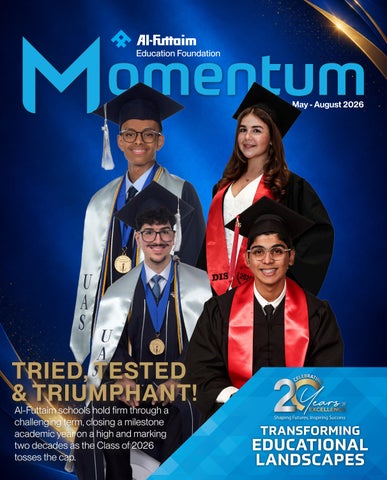
TRIED, TESTED & TRIUMPHANT! Al-Futtaim schools hold firm through a challenging term, closing a milestone academic year on a high and marking two decades as the Class of 2026 tosses the cap.
TRANSFORMING
EDUCATIONAL LANDSCAPES
2
MOMENTUM
3
ShapingFutures, Inspiring Success What a year it has been. As we close out the Platinum anniversary celebrations of
Deira International School and Universal American School, thank you for being part of every milestone along the way.
Now we turn to what comes next. The next twenty years will be shaped by AI in the classroom, wider learning pathways, and an education that meets a world changing faster than ever before. We close this issue honouring our 2026 graduating cohorts, who have navigated a final term disrupted by events beyond anyone’s control and came through with grace, courage and remarkable resilience. We raise a glass to them.
PURPOSE, PEOPLE, AND PRIDE. @Copyright 2026 AFEF All rights reserved While the publishers have made every effort to ensure the accuracy of all the information in this magazine, they will not be held responsible for any errors therein.
Talk to us: momentum@alfuttaimeducation.com @alfuttaimeducationfoundation @alfuttaimeducationfoundation @alfuttaimeducationfoundation www.alfuttaimeducation.com
4
MOMENTUM
WE ARE BUILT FOR THIS! As DIS and UAS close out a milestone academic year marking two decades since opening their gates in 2005, Mira Al Futtaim reflects on a term that tested everything, hails a graduating cohort that rose to meet a season of cancelled exams, and revisits the ‘One Family’ idea that held…
I
n the spirit of the UAE’s ‘Year of the Family’, our country has been asking us to look closely at the bonds that hold us together. At Al-Futtaim, this is something we have long believed in.
Through ‘One Family’ - our corporate-wide initiative in support of this national vision - we have found a clearer way to express it. Because what we have built over twenty years at Deira International School and Universal American School is not simply two schools. It is a community that stays connected, keeps showing up for one another, and never quite says a final goodbye.
Mira Al Futtaim | Chief Future Education Officer at Al-Futtaim Education Foundation | Chairwoman of Emiratisation at Al-Futtaim
5
Our community held
That belief was tested earlier this year. Barely two months into 2026, regional events disrupted the rhythm of school life. Our students spent seven weeks learning from home. Examination boards made difficult decisions, and plans carefully built over months changed almost overnight. And in that moment, ‘One Family’ moved from idea to reality. Teachers brought a sense of normality to each day, adapting lessons to reach students through a screen. Parents turned kitchen tables into classrooms, working hand in hand with our educators. And our students, resilient and determined, kept showing up. Through all of it, our community held. This is what ‘One Family’ looks like in practice not only in moments of celebration, but in moments of uncertainty, when people lean in for one another.
Maturity and resilience
I’ve particularly been thinking about our graduates. Our DIS and UAS graduating cohort have had to navigate a final term unlike any other, with their iGCSE and International Baccalaureate Diploma Programme exams replaced by portfolio and evidencebased assessment. Our schools are built around continuous learning, where students are assessed throughout the year across projects, assignments, and practical work. Over their senior years, many have also taken part in internship programmes across Al-Futtaim’s businesses, from engineering and healthcare to retail, automotive, education, and hospitality. They have worked on real projects, alongside professionals, gaining experience that goes beyond the classroom. This is the advantage of being part of a wider community, where learning connects to real life and opportunities are shared. It is why we are confident in our Class of 2026 as they move on to higher education, with the skills, confidence, and perspective that no single exam can fully capture.
Sense of stewardship
This reflects something deeper about who we are. Our Education Foundation sits within a UAE family business that is more than ninety years old, long enough to understand what holds a family together, and what tests it. At its core, a family business is about people. It is about taking care of one another in good times and difficult ones, and building something that is meant to endure. That sense of stewardship runs through everything we do, and through every part of our schools. To our parents, thank you. You opened your homes to our schools, and you made those kitchen-table classrooms work. You held the line on bedtimes and reminded your children, gently and repeatedly, that this too was a chapter they would one day tell their own children about. To our teachers, leadership teams, and support colleagues, thank you. You did the patient, unglamorous work that holds a community together when everything else feels uncertain. To the Class of 2026, congratulations. And to all of you, near or far, who have ever been part of our schools, we will always be here for you. ‘One Family’, after twenty years, says everything about who we are.
At its core, a family business is about people. It is about taking care of one another in good times and difficult ones, and building something that is meant to endure. That sense of stewardship runs through everything we do.
6
MOMENTUM
Main Features
04
14 GRADUATION:
As we close out this milestone anniversary year, we toss the cap one more time. Both our schools mark two decades, while UAS sends off a record 125 graduates
42
GOING THE FULL LENGTH:
On these pages you'll meet many of our Class of 2026, and alumni who grew up at DIS and UAS, arriving as little ones and leaving as graduates. That continuity is what makes our schools feel like home
16 34
7
CONTENTS
Parent Engagement
32 HOLDING THE DAY TOGETHER:
Our UAS and DIS parents share what worked at home during this term’s stretches of distance learning, and what they have banked for next time
36 NOBODY LEFT BEHIND: WHOSE WORK IS IT, 38 ANYWAY?: Tech Talk
Discover how the DIS Inclusion team stayed close to students who needed a little more while classes ran online
66
How AI Leaders at Deira International School and Universal American School are teaching students to use AI without losing the learning
Focus on Arts
60
ALL THE WORLD’S A STAGE:
Go behind the scenes with Performing Arts Leader Chelsie Hemmings, the West End residencies, and the students who just won a global drama title
64 PAINT OVER PIXELS : Hear why UAS Visual Arts Leader Alina Nistor believes the value of making art by hand is something no machine can replicate
68 HOOKED ON CLAY : 35 Alumni Connect
46
SPOTLIGHTING OUR TRAILBLAZERS:
Twenty years on, our UAS and DIS founding students are doctors, designers, pilots, creatives, educators, leaders, parents, and everything in between. We continue to honour them
Exploring Excellence
30 SMALL BUT MIGHTY:
Meet the UAS Grade 3 student who helped her cheerleading squad take the top title in Paris
Campus Life
Step inside UAS Arts teacher Elizabeth Wasserman's ceramics class, where students can't seem to put the clay down
26
EXPERIENTIAL LEARNING:
Students from Deira International School and Universal American School explore how electric, hybrid, and hydrogen vehicles are changing the rules, during their winter internships
Humour & Entertainment
24 COFFEE BREAK:
Brains are officially fried. Term is done and summer is finally here, so this is your Coffee Break invitation to stop being productive and let the rest wait until September. A few easy puzzles, a few bad jokes, and a whole lot of doing nothing
8
MOMENTUM
VETERAN EDUCATOR JOINS AS HEAD OF EDUCATION FUTURES AND INNOVATION Blanca Hindle to help champion the Foundation’s vision for teaching and learning at Deira International School and Universal American School, with a focus on bringing out the best in the brightest students…
A
l-Futtaim Education Foundation has appointed Blanca Hindle as Head of Education Futures and Innovation. She joins in August, at the start of the 20262027 academic year.
Her appointment comes as the Foundation’s two schools, Deira International School and Universal American School, turn from a milestone to what lies beyond it. Both completed their 20th year since opening in 2005, and the focus now sits firmly on the years ahead. “We are pleased to welcome Blanca to the Foundation,” said Dr Farah Sarraj, Chief Corporate Officer at Al-Futtaim Education Foundation. “Her appointment is guided by the vision for the future, as articulated and championed by Mira Al Futtaim, Chief Future Education Officer at Al-Futtaim Education Foundation, who is also the Chairwoman of Emiratisation at Al-Futtaim. Blanca’s job is to help our schools stay ready for a world that is changing quickly, and she is well placed to lead it.”
Human-centred approach
Blanca reports to Mira Al Futtaim and supports the Education Futures vision she leads. An international educator and speaker, she brings more than twenty years of experience leading innovation and school improvement in the United States and the United Arab Emirates, and is known for a human-centred approach that keeps people at the heart of every decision. Gifted education is her specialism, an area Blanca has worked in for much of her career. That expertise will feed into how DIS and UAS identify and teach students with exceptional ability, at a time when technology is changing how students learn and what they need to be ready for the future.
Blanca Hindle joins Al-Futtaim Education Foundation as Head of Education Futures and Innovation, bringing more than twenty years of experience across schools in the United States and the UAE.
9
SCHOLAR'S SPECTRUM
“The next chapter for our schools will be written by people who care deeply about how children learn. We are glad Blanca is now one of them,” says Dr Farah Sarraj, Chief Corporate Officer at Al-Futtaim Education Foundation.
The role sits within a Foundation built for exactly this kind of forward thinking. Established by the Al Futtaim family in support of the UAE’s Centennial Vision, it provides academic and operational oversight to both schools and runs a body of work that reaches well beyond them. Its Centre for Excellence in Arabic strengthens Arabic teaching and nurtures a love of the language across every year group, including through Project Aghsan, a graded reading programme publishing thousands of Arabic titles for young readers. Senior students gain workplace experience across Al-Futtaim’s businesses, and a generous scholarship programme that supports students across a range of categories. “Both our schools have built something solid over twenty years, and that is exactly what lets us look forward with confidence,” Dr Sarraj said.
A proud milestone
Deira International School teaches students from ages 3 to 18, taking them through the English National Curriculum and Cambridge IGCSEs into the IB Diploma or Career-related Programme. More than 80 nationalities share its classrooms, and the school pairs strong academic results with a wide programme of sport, music, drama and service. Universal American School offers the American curriculum alongside the IB Diploma and AP courses, giving students flexible routes into universities around the world. Its graduates leave with strong academic grounding, and many now finish school confident in two languages, supported by the Foundation’s investment in Arabic.
Al-Futtaim Education Foundation has long held that the best way to prepare students for the future is to give them a real taste of it now. Long before they sit a final exam or send off a university application, students step inside working businesses, take on real tasks, and discover what a career actually feels like rather than how it sounds in a prospectus.
“Twenty years is a proud milestone, but it is not a finish line,” Dr Sarraj said. “The next chapter for our schools will be written by people who care deeply about how children learn. We are glad Blanca is now one of them.”
10
MOMENTUM
STEADY AT THE HELM, EYES ON WHAT’S NEXT As she takes on the Acting Secondary Headteacher role at Deira International School, Emma Hannon shares her vision for the secondary phase, the strength of the team around her, and what continuity of leadership means at an Outstanding school in its 20th year…
11 mma Hannon has spent 25 years in classrooms across London, Abu Dhabi and Dubai. With a long career in education and more than 15 years in senior leadership behind her, she takes on the Acting Secondary Headteacher role at Deira International School, a school she has known from the inside for the past five years. Emma sat down with Momentum to talk about stepping into the role, the strength of the community around her, and the direction she is taking DIS Secondary next…
E
Momentum: Congratulations on stepping into the Acting Secondary Headteacher role. How are you feeling as you take on this responsibility, and what does this moment mean to you personally after 25 years in teaching and over 15 years in senior leadership? Emma: Thank you! I feel incredibly honoured, energised, and excited to take on this responsibility. After a long career in education, this moment is very special personally and professionally. What makes it even more meaningful is that it is happening here at Deira International School, a school with such amazing colleagues, students, and families. We have developed a strong culture built on collaboration, positivity, and a shared commitment to what we are working towards together.
The secondary leadership team and I know this school inside out, and we have a clear vision for the future. What I would want parents to take from this moment is that DIS has a deep and experienced team of senior leaders who all share one thing: a genuine passion for delivering the very best for every student and every family, in line with the values that define this school. Continuity matters. Strong leadership teams and careful succession planning are how a school protects its standards during any transition. I firmly believe that children should never feel uncertainty because of a change in personnel, and that is exactly what we have worked hard to ensure.
“What drew me to Deira International School, and what continues to inspire me, is that people are genuinely at the heart of everything we do. Ours is a truly international community, with more than 80 nationalities represented, but what makes DIS special is the way that diversity becomes a strength.” Personally, I also sit on both sides of the school gate, as my own son is now in his third year at DIS. So, when I think about what is best for children and their futures, I mean it not only as a teacher and school leader, but also as a parent. Momentum: You've taken the headship at a genuinely difficult time. The third term is always the busiest of the school year, and this one arrived with iGCSE and IB exams cancelled and students on distance learning because of the regional situation. How have you steadied the ship in your first weeks? Emma: It’s been eventful! I’ve leant on the team and the structures around me. No headteacher steadies a ship alone, it is done through strong collaboration with staff, parents, students, and the oversight and the incredible support we receive from the Al-Futtaim Education Foundation. One of the greatest strengths of Deira International School is the culture of teamwork and positivity that exists across the whole community, and that has been more evident than ever in recent weeks.
A headteacher who listens first. Emma Hannon with DIS students on campus.
The cancellation of examinations and the move to distance learning created a rapidly changing situation, with new guidance and requirements emerging regularly. Our focus throughout has been on responding calmly, staying flexible, and making sure students remained at the centre of every decision. Teachers and leaders worked quickly to adapt plans, prepare the required evidence for students’ final grades, and ensure that learning continued with as little disruption as possible.
12
MOMENTUM We have communicated clearly, adapted where needed, and remained responsive as circumstances evolved. What this period has reinforced is the importance of having strong systems, experienced people, and a culture of collaboration already in place before challenges arise. At DIS, that foundation has allowed us to respond confidently and continue delivering for our students despite an exceptionally demanding term. Momentum: Year 11 and Year 13 have had to navigate a final term unlike any other, with their iGCSE and IB exams replaced by portfolio and evidence-based assessment. How have you and your team been supporting these students — and what message do you want them to take into the next chapter of their lives? Emma: My message to them, first and foremost, is that none of this effort has been wasted. The exam itself was never the point; the preparation was. The hours of revision, the coursework, the way they've pushed themselves over two years, that is the real measure of who they are, and it travels with them into everything that comes next. Our Year 11s and IB2 students are part of a much bigger cohort across the region facing the same situation, and what has struck me is the way they have adapted. They've kept showing up, kept producing work, kept supporting one another. That isn't an accident; it's the school culture they have grown up in; respect, excellence, collaboration and integrity, lived out in practice not just printed on a wall. They are closing this chapter with their heads held high because they have earned that and we are enormously proud of them.
What I would want parents to take from this moment is that DIS has a deep and experienced team of senior leaders who all share one thing: a genuine passion for delivering the very best for every student and every family, in line with the values that define this school Momentum: DIS is an Outstanding school, celebrating its 20th anniversary this academic year. What drew you to the school, and what is it about DIS specifically that makes you proud to be leading the secondary phase right now? Emma: What drew me to DIS, and what continues to inspire me, is that people are genuinely at the heart of everything we do. Ours is a truly international community, with more than 80 nationalities represented, but what makes DIS special is the way that diversity becomes a strength. Students, parents and staff work in genuine partnership, creating a culture that is inclusive, ambitious and deeply connected to the values of the UAE. Being Outstanding is something we are proud of, but we are equally focused on what comes next. Education is evolving rapidly and DIS has never stood still. There is a real commitment here to innovation, adaptability and preparing young people for a future that will demand creativity, resilience and global understanding. That forward-thinking mindset reflects the wider vision of the UAE itself, a nation that continues to lead through ambition, inclusivity and a willingness to embrace change. Emma Hannon catching up with a DIS student during lessons. Conversations like these shape how she leads.
13
The Al-Futtaim Education Foundation’s commitment to legacy, community and the future gives us a stability that few schools enjoy, and that in turn frees our teachers to do what they do best: focus on delivering exceptional learning experiences and building strong relationships with young people. What makes me proud to lead the secondary phase right now is the opportunity to help shape students who are not only academically successful, but confident, compassionate and ready to contribute positively to the world around them. Momentum: Looking past this term, what is your hope for DIS Secondary as students return in September, and what would you like the community to know about the direction you're taking the school in? Emma: My hope is that every student walking through the doors in September feels happy, secure and excited to learn. Academic success will always matter deeply to us, but we know that young people thrive when they feel valued, supported and connected, so wellbeing and happiness must remain at the heart of everything we do. The challenges of this term have reinforced what matters most: strong relationships between teachers and students, genuine partnership with parents, and a school culture where every child is known as an individual. Those foundations are what allow students to grow in confidence, take risks in their learning and achieve their potential. Looking ahead, our direction is very much about building on what already makes DIS special. We will continue to pursue academic excellence while also investing in wellbeing, student voice and a strong sense of belonging for every young person in our community. We want our students to leave DIS not only with outstanding results, but with the character, resilience and compassion to succeed in a rapidly changing world. As a parent of a child in this school as well as a leader within it, I want what every parent reading this wants - an outstanding education delivered with warmth, by people who genuinely care. That is the direction I care about and everyone on our team is committed to delivering.
Emma Hannon, Acting Secondary Headteacher, DIS: “What makes me proud to lead the secondary phase right now is the opportunity to help shape students who are not only academically successful, but confident, compassionate and ready to contribute positively to the world around them.”
‘D’ IS FOR ‘DREAM BIG’ New DIS Director Ian Thurston had just one month with the Class of 2026. It was enough to leave a mark on both sides…
I
t may have been his first graduating cohort as Director, but Ian Thurston spoke about the Class of 2026 as though he had known them for years.
Then came the line that made it personal. “You will always be special to me,” Thurston said, “because you will always be my first ever DIS Year 13 graduates.”
In the short time the new Director of Deira International School had spent with these students, they had won him over completely. “You have impressed me,” he told them. Not, he was quick to say, because of their grades or their university offers, exceptional as both were.
Before any of his advice, he asked the graduates to look around them. “It takes a village to raise a child,” he reminded the hall, pointing to the teachers who had inspired them, the friends who had carried them, and the families whose support never wavered.
What stayed with him was the kind of people they had been to those around them. “I’ve seen this in the way the other students look up to you,” he said. The respect they showed in every interaction. The care for others. The passion they brought to everything. And the resilience they leaned on to get through a year that refused to go to plan.
DIS Director Ian Thurston: “You will always be special to me, because you will always be my first ever DIS Year 13 graduates.”
My Kilimanjaro
Thurston then offered three pieces of advice, and one came wrapped in a confession. Years ago, he had the chance to climb Mount Kilimanjaro. He decided to do it later. Twentyfive years on, he still hasn’t, and it remains one of his biggest regrets. He calls it “My Kilimanjaro,” and he used it to make a simple point. “Life waits for no man,” he said. We tend to regret the things we didn’t do far more than the things we did. Grab the opportunity when it comes, he urged them, and live with no regrets.
Be global citizens
Another piece of advice spoke to the moment the world finds itself in. Be human, and let your values lead you. As Artificial Intelligence becomes part of everyday life, Thurston believes it is our ability to understand one another that will matter most. The IB programmes and the school’s mix of cultures had prepared them well for this. He asked them to carry the values DIS gave them into whatever came next. Respect. Integrity. Collaboration. Excellence. “Be global citizens,” he said. “Stand up for what is right, and use your voice to benefit others.” He left them with a play on the school’s own name. Let DIS remind you, he said, to ‘D’ dream big, to ‘I’ innovate, and you will undoubtedly ‘S’ succeed at the highest levels. Thurston closed with a thank you to the students who had made his first month one to remember. “Thank you, Year 13, for letting me share this moment with you.”
15
GRADUATION
‘‘WHAT MATTERS IS HOW WE RESPOND’’
UAS Director Kevin Loft sent the Class of 2026 off with three lessons for the road, in a year that asked more of them than most…
R
ecent events have reminded all of us that life does not always move in a straight line,” Kevin Loft said, as the Director of Universal American School bid his Class of 2026 adios.
It was a fitting thing to say to a cohort whose final term arrived unlike any other. With IB exams cancelled across the UAE this season, many of these graduates closed their school careers on portfolios and evidence-based assessment rather than the Diploma papers they had long prepared for. “Plans change. Circumstances shift,” he reminded them, before landing on the line that anchored his whole speech. “What matters is how we respond.”
Cap and Gown Parade
He had opened the evening, though, by looking the other way down the hall. Before a single word reached the graduates, Loft turned to the parents and teachers behind them. “Thank you for believing in these young people,” he said, and meant it as the heart of the night rather than a courtesy. The image he kept returning to was the Cap and Gown Parade, held a few weeks earlier, one of the most special traditions a US curriculum school can hold. Walking the corridors that morning, he saw what report cards never show. “We see young people,” he said of the staff watching their students file past. “We see your growth, your struggles, your hopes.” The parents, he added, had been investing in this moment long before UAS ever knew these children existed. Then he handed the evening over. “Tonight, we pass the baton,” Loft said. “It is now your turn to take the lead.” What followed was less a victory lap than a set of instructions for the road. Loft asked the Class of 2026 to hold onto four things:
1. 2. 3. 4.
Be resilient, even when the path is not easy. Be grateful for the people who walk alongside you. Keep moving forward with purpose. Celebrate your victories, always.
He unpacked each in turn. Resilience, he insisted, is not about pretending things are easy or never feeling doubt. It is the
ability to keep going when things are hard and to take the next step without knowing what comes after it, something the Class of 2026 had already proved through a disrupted season. Gratitude comes down to people. “We remember milestones, but most of all we remember who stood beside us.” He urged them to be brave enough to build new friendships once the cities changed. “Say hello. Put yourself out there. Be kind first.” And purpose, he promised, does not require having it all figured out. “You do not need to have everything worked out today. Most of us still do not.” Keep moving anyway, and take opportunities the moment they appear. Loft closed by speaking once more to the parents, acknowledging the quieter houses many were about to return to His message echoed the one he had given their children. “Have faith in who these young people have become, and take a moment to celebrate your own victory too. They will grow, make mistakes, find their way, and come back wiser than before,” Loft said.
16
MOMENTUM
CLASS OF 2026: THEY MADE IT COUNT We close out on a high. As we wrap the academic year, both Universal American School and Deira International School have been marking their 20th anniversaries, and the UAS Class of 2026 has registered the largest graduating cohort since the school’s founding in 2005, with 125 students. At DIS, 114 proud students crossed the stage to receive their diplomas. It has not been an easy end to their high school years. They sat their finals through a really challenging period, but handled it with grace and got the job done. Meet some of them here…
239
Number of UAS and DIS graduating students in the 2026 cohort
Adios, DIS and UAS Class of 2026. From here, our students head out to great universities around the world, including the London School of Economics, New York University Abu Dhabi, the University of Toronto, Carnegie Mellon University, Bocconi University in Milan, the National University of Singapore and many more…
17
GRADUATION - POWER TO READ
COURT TO COURT Basketball came first, and for most of my life it was the dream. The first time I walked onto campus as a Grade 7 student, I had no real idea what I was doing. No uniform yet, no lanyard, and a hundred questions a day about where things were and Abdulaziz, Senior Sport Star - UAS how anything worked. None of that seemed to matter. The school treated me as one of their own from the first week, and the way my classmates and teachers stepped in, both the ones I knew and the ones I didn’t, set the tone for the rest of my years at UAS. I left knowing they had my back, whatever came next.
How systems work This autumn, I’m heading to the University of Birmingham to study Commercial Law. It wasn’t a path I had expected to take, but when I thought seriously about the career I wanted to build, Birmingham was the place that would prepare me best for it. I still intend to keep playing basketball alongside my studies. The pull towards law grew gradually, from family conversations and from understanding how the systems behind business actually work. I want to be the person who helps turn creative ideas into real, working businesses by making sure they get a fair shot in legal terms.
‘MY LOVE FOR SPORT RUNS DEEP’
SEE YOU IN 2028
Whether I’m playing it, watching the elite level, or following charity matches with celebrities on the pitch, sport has had a hold on me for as long as I can remember. That love is what's shaping where I go next.
In 2028, I’m coming back to DIS to dig something up. Back in 2018, when I was in Grade 5, my year group buried a time capsule next to the primary cafeteria.
The course I’m hoping to start at the University of Chichester is Anya – DIS Sports Media, and it wasn’t even on my radar at the beginning of IB. Back then, I had no clear sense of where I was heading, and my plan was to travel or work for a while before figuring it out. Finding this course changed everything. It pulls together what I already love with the kind of active, varied career I want, and I cannot wait to begin. What I’m aiming for is a career in the sporting industry, ideally working at large events and being part of the atmosphere that makes them so unforgettable. Being inside that environment, at the heart of the action, is exactly where I want to be. Before any of that, the memory I’ll carry from DIS is the British Schools in the Middle East tournament. The U19 girls’ football team came third, and every training session and every early morning suddenly made sense. Representing the school let me play the sport I love at a serious level.
Bashayer - DIS
I helped collect what went inside, little pieces of who each of us was at that moment, along with the speeches we gave before sealing it. Three years from now, we’ll stand there together at a completely different stage of our lives, opening something our younger selves left for us. It’s the closest thing to a proper full-circle moment I can imagine, and I’m already looking forward to it. The road I’m taking between now and then begins with the American University of Sharjah, where I’m hoping to read International Relations. The path here wasn’t a straight one. I went through plenty of phases growing up. There was a time I wanted to be an astronaut. Another when firefighter felt like the obvious answer. Things began shifting in secondary school, when leadership roles, volunteering, serving as Deputy Head Girl and speaking at TEDx events showed me what genuinely moved me. Global issues, diplomacy, and the chance to make a meaningful difference. The career I’m aiming for is in diplomacy, with the dream of one day serving as a UAE ambassador.
18
MOMENTUM
PLEASE TOUCH THE ART Most galleries want you keeping your distance. Don’t touch, don’t lean in, don’t get too close. The art I want to make does the opposite. I’m drawn to murals and interactive pieces, the kind of work people can step inside and become part of, rather than simply stand in front of. What sparked it was a quiet realisation that art lands differently when you can be inside it, when it asks something of you. The pieces I remember most are the ones that needed me there. That’s the career I’m aiming for, and the route towards it starts at New York University Abu Dhabi, where I’ll be majoring in Interactive Media. I wouldn’t be surprised if that shifts after my first year, but the direction feels right. For a long time, I (and most people around
me) assumed I’d end up in engineering, so landing here is a bit of a swerve. I’d been pulled between science and the arts for years, and finding a path that genuinely held both wasn’t easy. Interactive Media reflects my two favourite Higher-Level Dana – DIS subjects, Design Technology and Digital Society, and conversations with professors and current students made it clear how well it would fit. Before any of that, there’s one DIS moment I keep coming back to. The Year 4 camp on campus. We learned how to build our own tents, toasted marshmallows for the first time, and went through a haunted house in the secondary building, small groups huddled around a teacher holding a torch through the dark. It pulled the whole year group closer in a way I still feel.
NASA ROVER, AND WHAT CAME NEXT T h e ex p e r i e n c e o f building the NASA Human Exploration Rover Challenge entry with my team will always be a standout moment for me. Going to the U.S. Space & Rocket Centre in Huntsville, Alabama for the main competition and winning the Rookie of the Year Award will always be one of the proudest things Diya - DIS I've been part of at DIS. I was responsible for safety, drove the rover on the day, and worked on the finance side as well. Competing in the US against students from around the world, then walking away with that recognition, showed me what a team that actually pulls in the same direction can do. In September, I’m heading to Bocconi University in Milan to
read for a BSc in International Economics and Finance. When I started the IB, I didn’t have a clear plan for what came next. Studying Economics, Maths and Business at Higher Level changed that. I noticed how much I enjoyed applying logic and numbers to real situations, and the direction sharpened from there. The career I’m aiming towards sits in economics or finance, particularly in roles that work with the quantitative analysis of global markets. The pull is a straightforward love of maths, and while I don't have the whole picture yet, I’m looking forward to seeing where it leads.
19
GRADUATION - POWER TO READ
NOT A 9-TO-5 KIND OF GUY The idea of a typical nine-to-five has never really appealed to me. What I want from a career is independence, the freedom to manage my own time, and the room to build something of my own that grows into something meaningful. That ambition is what’s pulling me forward.
Hadi – DIS
The route I’m taking towards it begins at Bayes Business School at City, St George’s, where I’m reading Business Management, Digital Innovation and Entrepreneurship. It wasn’t always the plan. Over the past few years, I developed a real interest in how technology is reshaping the way businesses operate, and I’m convinced those skills will be the ones that count in the years ahead. My brother played a big part in nudging me in this direction, and his guidance shaped a lot of what I’m choosing now. What I want to do with the degree is build strong foundations in technology, digital tools and AI, so I can either launch something of my own or help other businesses sharpen what they already offer. The combination of flexibility and creativity is the part that excites me most.
HEAD BOY RUNS IN THE FAMILY The day I was elected Head Boy was the most nerve-wracking few hours of my life. My head was in spirals, my heart was racing, and I had no idea what to expect. The result mattered to me because of the sheer amount of work I’d put into getting there, but what made it unforgettable was who announced it. My cousin, the previous Head Boy, was the one who read out the name. That kind of moment doesn’t come twice, and stepping into the role gave me a chance to give something back to a community.
SALUTE TO THE SALUTATORIAN Finishing second in the year was never the headline for me. What mattered more was how I got there. Every second of my time at DIS built towards graduation, the good moments and the difficult ones both. I remember the people who kept me moving through my lowest stretches, the ones who made sure I climbed on Hussain, 2026 Salutatorian - DIS solid foundations. None of it broke me, because DIS gave me the space to be shaped by it. What I’ll carry forward is the confidence that wherever I start, however unclear the road, I’ll keep going. Mechanical engineering is the path I’m taking next, and it’s one I’ve stayed committed to for some time. It came together gradually, the more I explored and built. Where I’ll study is still being figured out, and the uncertainty doesn’t worry me. DIS has prepared me to make the most of whatever environment I step into. What draws me to engineering is the kind of impact it creates. The systems, the structures, the quiet work behind everything else. I’ve watched that same work hold competitions, events and everyday moments together all over DIS, and I want to contribute the same way. Through careful, thoughtful work that supports something larger than me.
This autumn, I’m heading to the University of Toronto to study Business at Rotman Commerce. Canada had always been the destination for me, but narrowing it down to a specific university took real reflection. Toronto won me over in the end. What I want to build a career around is marketing and sales. Some of Zuhair - DIS that came from watching my father at work over the years, and a lot of it comes from a personal pull towards creativity.
20
MOMENTUM
THE NAME IS BOURN. MARTHA BOURN. I may not be auditioning for the next Bond film anytime soon, but the high school musical at DIS gave me my own kind of stage, and I wouldn’t trade those years for anything. Every after-school rehearsal, every lunchtime run-through brought something new, and doing it all with friends meant I genuinely looked forward to walking in. Out of three years’ worth of moments, that’s the one I’ll keep.
That’s how Natural Sciences landed on my list. Its breadth was the appeal, the chance to keep exploring rather than Martha, Head commit too early. Human Biology has girl - DIS always held my attention, and pairing it with Psychology felt like a meaningful way to understand how people work, physically and mentally.
University was harder to figure out. For a long time, I had no clear idea what I wanted to study, and the uncertainty was difficult to sit with. What pulled me through was a quieter realisation. I didn’t need to have everything figured out. I just needed to choose something I genuinely enjoyed.
Biology wasn’t always the favourite. During GCSE Triple Science, Chemistry held that spot. The depth and detail of Biology pulled me back over time, especially around human systems and processes. It could be overwhelming alongside everything else in IB, but revising it often felt like a relief from the rest.
THE PRESIDENT HEADS NORTH
LESSONS FROM A FIREBALL
The moment they announced I’d won the election for Student Government President, every memory of UAS came rushing back. The big Grade 5 exhibition, the school trip to Fujairah a year later, the Grade 7 science project, all of it returned at once. Standing there, I realised how far I'd come and how much there was still left to do.
In 2020, Formula 1 driver Roman Grosjean walked out of a fireball on his own feet. As a lifelong Formula 1 fan, I knew his survival was no accident. Comparing his crash to the one that killed legendary Brazilian driver Ayrton Senna in 1994 made the difference clear. Decades of medical advances Mhd – UAS had stood between Grosjean and the same fate. That moment linked one of the things I love most to a field I’d been quietly considering for years, and it widened my sense of what medicine actually is. Treating patients matters. So does the research that gave Grosjean a car he could walk away from.
Issa, Student Government President - UAS
This fall, I’m heading to the University of Waterloo in Canada to study Honours Chemical Engineering on the Co-op programme. Engineering was always the plan, though the specific field took longer to settle. I’d had my sights on Canadian universities for a while, particularly Toronto, McGill and the University of British Columbia. After doing the research, Waterloo came out on top for the programme and for engineering more broadly, and UAS played a big part in helping me get there. The pull towards chemical engineering came at the start of my IB years. Maths and chemistry have always been my subjects, and by Grade 11 it was clear that chemical engineering would let me take both further.
I come from a family of doctors, so curiosity about the human body has been there for as long as I can remember. IB Biology at Higher Level deepened it further, and by the end of those two years, my decision felt settled. Where I’ll study is still being worked out. I’m hoping for the Royal College of Surgeons in Ireland’s Bahrain campus, Mohammed Bin Rashid University of Medicine and Health Sciences in Dubai, or Semmelweis University in Hungary.
21
GRADUATION - POWER TO READ
DREAMING OF THE UN If I’m lucky enough to end up working at the United Nations one day, I’ll consider myself fortunate. That’s the career I’m aiming for, and the more I’ve thought about it, the clearer it has become. Global affairs, in their historical and political layers, are what genuinely pull me in, and the idea of being part of an organisation built around international cooperation and solving real problems would be hugely rewarding. The route there starts with the University of Bristol, where I’ll be reading Politics and International Relations this autumn. My direction has shifted a few times, though it has always lived somewhere in the social sciences. In Year 9 and 10 I was set on Law. By GCSE my growing love for History had pulled me towards studying that at university.
Then the IB years arrived and politics and diplomacy took hold, particularly after a few online university summer courses where the interest deepened into something I could feel was permanent. DIS, through all of these turns, was a place I kept feeling held by. The Mira - DIS sense of community is the thing I’ll carry with me. Even when the workload became intense and the stress was real, we showed up for each other, and the teachers cared in a way that always came through.
THE CAFÉ WAS JUST THE START As a child, I was the kid forever building DIY scale models, lining them up around the house. Years later, that same instinct pulled me into leading the renovation of the IB café at DIS. Somewhere between those two Mohsin - DIS points, an idea took proper shape. I want to become an entrepreneur in real estate, designing and developing my own residential properties. The path I’m taking towards it begins with architecture, most likely at the National University of Singapore. Building and design have held my
attention since I was small, and exploring related fields like industrial design along the way only confirmed where I wanted to land. Architecture lets me sit at the meeting point of creativity and analytical thinking, in a discipline that has stayed with me since childhood. There’s a part of DIS I’ll miss more than any single event, and it’s the simple act of walking through its hallways. That might sound ordinary, but it never felt that way. Every day brought smiles, waves, small conversations in passing, the kind of warmth that turns a school into something closer to a family.
BONJOUR, MONTRÉAL The original plan was Virginia. That’s where I spent my childhood, and going back felt like the obvious choice for university. Then I started looking at McGill, and something shifted. Living in the UAE had already taught me to lean towards difference rather than familiarity, and McGill made sense in that light. So this autumn, that’s where I’m heading. My focus there is computer science, and that started with an elective at UAS almost by accident.
AP Computer Science took it further. Watching scattered commands resolve into something you could actually navigate had its own kind of pull, and the classroom around it gave room for honest conversation, the way a small design choice could ripple outwards if you let yourself sit with it. What I want to do with all of this, eventually, is build computational tools that support learning and decision-making.
Rinad – UAS
“HOW CAN I HELP PROTECT OUR WORLD?” That question first landed when I was a kid watching National Geographic documentaries with my family. Seeing the beauty of the planet, and seeing how easily we could lose it, planted something I've been carrying ever since. Geography became my strongest subject Parsa – UAS in school for exactly this reason. The questions it asks about how the world works, and what it takes to look after it, were already the questions I was asking on my own. This autumn, I'm heading to King's College London to study Honours Geography and Environmental Science. Studying at King's has been my dream for years, and UAS helped me get there. From King's, my plan is to earn a PhD and become a professor, researching climate change while teaching the next generation.
HER MOTHER’S DAUGHTER The fashion designer I want to become one day owes everything to my mother. She was the one who first opened that world to me, and being around her work from a young age shaped my interest in design as something that says who you are and where you come from. Over time, what began as fascination became a proper career goal, and my long-term plan is to build my own fashion house.
Rama - DIS
The route I’m taking towards it might look indirect at first. I’m starting at the American University of Sharjah this autumn to study Business. Like many students, my goals have shifted plenty over the years, but I’m certain about this one. Business will give me the foundation I need to eventually run a fashion label of my own, and pairing the two feels like the strongest way in.
BLAME IT ON NETFLIX ‘SUITS’ My grandmother was a police officer in Dubai court. My aunt trained to be a lawyer. My mother holds a master’s degree in law and works as Head of Compliance. Growing up around all of that gave me a natural pull towards the field long before I knew what to do with it, and by Year 7 I’d settled on law as my goal. What sealed it, oddly enough, was a TV show. The Netflix series ‘Suits’ arrived during COVID lockdown, and what started as a way to fill the hours quickly became something more. It brought the law to life with humour, pace and characters worth following, and the spark it lit hasn’t dimmed since. This autumn, I’m heading to the University of Canterbury in New
Zealand to study Law. There was a brief moment in IB1 when I considered investment management instead, Nooran – DIS influenced by my dad’s career, but law was always going to win in the end. It’s the path that has felt right for longer than any other. Looking back, what I’ll carry from DIS is everything between Year 7 and the end of IB2. The friendships built over those years, the laughter in class, the games, the small moments that made the place feel like more than a school. That’s the memory that stays.
23
GRADUATION - POWER TO READ
HOW AL-FUTTAIM LIT THE SPARK An internship opportunity with Al-Futtaim opened my eyes to the world of finance and genuinely drew me in. Seeing how it all works at that level, within one of the region’s most respected organisations, made it feel less like a career choice and more like a calling. Now I’m heading to the London School of Economics, all being well, to read Accounting and Finance. I still have conditions to meet, so fingers crossed.
Rohan - DIS
The honest truth is that none of this was the plan when I started at DIS. I came in set on engineering, and somewhere along the way that changed. The path led somewhere I genuinely didn’t expect, and I’m more excited about it than I would have been about the route I first set out on. What I’ll take away from DIS isn’t an event. It’s a feeling. The teachers here had a rare instinct for spotting potential in students before the students could see it themselves, and they made sure you knew it was there. Their belief, alongside the community we built together, is what I'll never forget.
THE LAWYER WHO WASN’T Senior birthdays were the highlight of my year. We carried on the tradition of celebrating students in the lounge, then extended it to teachers, including half-birthdays for those born over the summer. Singing to friends and staff became one of the deepest joys of my time at UAS. There were moments I had to stop mid-song to keep from crying with happiness.
Sumaya, Student Government President - UAS
For six years, I told everyone I wanted to be a lawyer. A two-week internship undid that. I felt disconnected from the work, watching another intern light up at the very same tasks that bored me. My mentor said something that stayed with me. Nothing is too much or too boring when you love what you do. When I looked at it honestly, the answer had been in front of me the whole time. My final-year essays, my classroom projects, even my everyday conversations all pulled towards psychology. I’m heading to the UK to study it this autumn. What draws me in particular is Cognitive Behavioural Therapy. I want to be there for someone the way my teachers were there for me when I burned out in my first IB year.
DIS VALEDICTORIAN PICKS DOHA Picking a university wasn’t something I’d settled on early. I went into the process without a fixed plan, which turned out to be the right way in. As I worked through the options, Carnegie Mellon University in Doha, Qatar, kept rising to the top of the list, and the more I looked, the clearer it became that the Computer Science programme fit both where my interests sat now and where I wanted to take them. So that’s where I’m heading this autumn. Computer Science has had a hold on me for a while, and Machine Learning in particular. I’ve always been pulled towards subjects that ask you to think across disciplines, and this is a field where creativity and logic actually need each other. What excites me about it is how directly it
connects to problems out in the world, across industries, often where people most need solutions. Building things that genuinely help is what matters most to me in all of this. If I had to choose one memory from DIS, it would be the IB1 school trip to Lisbon. A new country, close friends, the kind of spontaneous days you can’t engineer. The IB had pulled together students from completely different worlds, and for that one week, you could see exactly what the programme was doing.
Tiziri, 2026 Valedictorian - DIS
24 24
Find the 12 words hidden across, down, diagonal, forwards and backwards.
MOMENTUM Word Search U D A X C E L E B R A T E I H Graduation & 20 Years of Legacy
H E 12XwordsDhidden V across, N down, A M O forwards L Pand backwards. I D X Find the diagonal,
R
C
A
R
S XI RJ D
Z
IT’S TIME FOR A COFFEE BREAK! A
H
G ER XW DU VW N I A RM NO HL O H P
LI
U
Y
D
S
N
A
X
C
B
E
O
A
L
E
C
B
G
R
A
Q
T
T
E
I
H
Word Search
A YA SY NE B Z O T A FC WG NA K I TU AO RE Y C H Q Term's done, bags are packed, and brains are officially fried. Welcome to the Coffee Break — 20 your official permission slip to stop being productive for a minute. Solve a little, sipC a little, G S WY rest COGraduation M Loflaugh UKwait WRuntil I ASeptember. R EN DHYou've L D S it! U I & JM Z 20 Years Legacy at the dad jokes,GandRlet the earned A I R Uacross, O EA Ydiagonal, 12 words hidden H AR YL ET Z I T U FFind ZWtheNN BK X O down, N R forwards and backwards. YEARS
Word Search
G D U O SE YD KM R C A D EU TDD RCA OMX N JE M GL CUE LTB IR CLegacy Graduation & 20 Years of H LL TS I G U A Z WN UB EX T R O NB RV H N RV Find EN A Cand the 12 words hiddenH across, E down, X diagonal, D Vforwards A backwards. M O L O E D M C D T R O N J G U T I O I U YD JA C R CEH YL Y E S F BN LRB S X C AO D T A EMC I IGH OA N V L S G A W U E T E C B V H U N H UE LX F G GNL R U PLW VP I E D V AL W M GO I R DI N XWHR VO O I Y J C R H Y F L S D M I O N B AR C HT Q Y RGE XAZ H R N C UY CS T U AOF A FF TLWAONR MK U N U L F G L L G P V E I W V W U W GI S Y KHK YOR YLA S I A G UR W R H V RO N BE IHD J ICZ BM R N U C T U F R R X H F L O M A A Y E Z T F W N K I U O E Y Z K M I C G HU R S L W T K I GU H UZ IPN BMB MX I A GU SW Y R K H R VA OE KD YC YM B D U M C L OA E C D H M I C ED VT ER HO XN U O E I E D Z K HM R I L C T G I UU SZ WN KB GX U M R R P O M A N N V L S G A W U E T U O OE E I D E M D C AD CT HR IO EN VJ E H TX I G U FIND THESE 12 WORDS O I Y J C R H Y F L N
V
L
S
G
ACHIEVE O
I
Y
J
C DIPLOMA R H Y
ALUMNI ACHIEVE U
N
FIND THESE 12 WORDS
A W U
E
C
B
V
H
E
I
H
P
I
D
X
R
H
Q
T
A
R
L
S
I
J
Z
I
U
O
E
Y
D
U
M
C
L
R
O
A
N
R
J
G
U
T
I
E
C
B
V
H
S
D
M
I
O
V
E
I
W
V
U
H
F
L
O
M
ALUMNI R N U ANNIVERSARY
MILESTONE IU A U R W XR HLEGACY H FV C FUTURE T GRADUATION F R L OO KM Y
MILESTONE PROUD YC YG B U H S I WB K
Y
B
H
I
B
G
U
P
M M
C UG O U
S E WI KE GD U A P CM HM I
E
V
E
H
E
C
CELEBRATE
N
T
T
U FL LF SG D L L G P JOURNEY M I O RG N C PT VJOURNEY U EF LEGACY L DIPLOMA F FUTURE L U L G I RW RV X
ANNIVERSARY CELEBRATE I A
U
E
A
GRADUATION
U W R HONOUR V M O KI ZH K
Z
K
M
I
U
O
E
I
HONOUR
D
A
H
ALUMNI ANNIVERSARY CELEBRATE
I
E
FIND THESE 12 WORDS
FIND THESE 12 WORDS ACHIEVE
PROUD
V
E
H
X
X
ACHIEVE
DIPLOMA
JOURNEY
ALUMNI
FUTURE
LEGACY
ANNIVERSARY
GRADUATION
MILESTONE
CELEBRATE
HONOUR
PROUD
DIPLOMA FUTURE
GRADUATION HONOUR
JOURNEY LEGACY
MILESTONE PROUD
25
STUDENT MOST LIKELY TO...
Become a Yo ut
ube Star
Create World P e
Win Olympic Meda
l
ace
Go to Space
nger
Be a Famous Si
Moustafa
Dhaara
Cyril
Asma Izhaan
Across
Across
1.
Open-toed footwear of choice in July. (7)
6.
Square hat tossed sky-high at the graduation ceremony. (11)
8.
The dangly cord that hangs from a graduation cap. (6)
9.
UAS9.follows country's school system. (8)(8) UAS this follows this country's school system.
1.
Open-toed footwear of choice in July. (7)
6.
Square hat tossed sky-high at the graduation ceremony. (11)
8.
The dangly cord that hangs from a graduation cap. (6)
20
10. Number of yearsofDIS have been part story.(6)(6) 10. Number yearsand DISUAS and UAS have been partofofDubai's Dubai's story.
YEARS
11. at 'Grade' UAS, '____' at DIS. 11. 'Grade' UAS,at'____' at DIS. (4) (4) 1
Down 2.
Down
The rolled-up scroll graduated, handed toyou each graduate. (7) (6) 3. Once you've become one of these.
3.
Our schools sit rightyou nextbecome to Dubai _____ Mall. (6) (8) Once4.you've graduated, one ofCity these.
5.
7.
3
1
4
2
2
4
5
The rolled-up scroll handed to each graduate. (7)
2. 4.
3
5 6
6
5. Dubai's record-breaking tower whose structure began rising in 2005, Our schools sit right next to Dubai _____ City Mall. (8) the same year DIS and UAS opened. (One word, two parts: BURJ +
Dubai's record-breaking tower whose structure began rising in 2005, ____) (11) the same year DISmark andour UAS (One word, parts: 7. The lasting twoopened. schools have built sincetwo 2005. (6) BURJ + ____) (11)
7 8
7
Ages 7 and mark up — clue show the have answerbuilt length. The lasting ourendings two schools since 2005. (6)
Ages 7 and up — clue endings show the answer length.
8
9
10
11
10
9
11
26
MOMENTUM
THE QUIET SHIFT Cars used to rumble. Now they run almost silently, recharge, and sometimes drive themselves. Here, students from Deira International School and Universal American School explore how electric, hybrid, and hydrogen vehicles are changing the rules…
POWERING TOMORROW’S COMMUTE From electric vehicles to smart systems, Abigail gets a close look at how cleaner mobility is taking shape…
G
et in the back seat, sit back and relax. By the time you look up, you’re already where you need to be.
That idea stopped feeling far-fetched once I spent time around electric and self-driving vehicles during my internship at the Al-Futtaim Automotive Talent Centre. Over five days, I stepped into a world much bigger than I expected. I explored car design, manufacturing, sales, customer service, and repair, all while seeing how a global automotive business stays connected across teams and locations. Electric vehicles were a major focus. Hybrid, plug-in hybrid, and fully electric models came up constantly, especially during hands-on sessions and an EV awareness course that made the technology feel practical, not theoretical.
New career paths Touring the EV facilities and meeting the people behind the systems showed me how sustainability and technology are built into daily operations. I also learned how much care goes into customer experience, from first conversations to final handovers, and how trust plays a central role. Seeing service and repair up close helped me understand how safety, quality, and teamwork come together behind the scenes. This experience opened my eyes to new career paths and how technology quietly shapes everyday life.”
Abigail, Grade 9, Universal American School
27
EXPERIENTIAL LEARNING
HOW CARS EARN THEIR KEEP Ever wondered what really sits behind a car’s price tag, performance, and upkeep? Afshin, a Year 9 student at DIS, takes you behind the scenes at Toyota and BYD showrooms…
B
efore undertaking my winter internship recently, cars were just cars to me. After a few days inside Al-Futtaim Toyota and BYD showrooms, service centres, and workshops, that idea disappeared fast. I started to see how much structure sits behind every sale. At the showroom, nothing was rushed. Staff took time to understand what customers needed, walked them through models, test drives, finance options, and tracked sales data to spot trends. It felt more like problem-solving than selling.
Electric and hybrid vehicles came up constantly. I learned how battery-powered cars reduce emissions and why they are becoming more common, even though charging access still slows things down. It was interesting to see how companies are adjusting by expanding their electric and hybrid ranges.
Level of planning
The service centres were where things really clicked. At Al Badia showroom, I watched teams clean and service cars in an express lane designed to get vehicles back on the road within an hour. Elsewhere at repair bays in Umm Ramool, repairs were mapped digitally using colour-coded designs before work even started. Costs, insurance decisions, and quality checks all followed a clear system. What stood out was how organised everything was. Every detail had a purpose. That level of planning changed how I see the automotive industry completely.
Afshin, Year 10, Deira International School
28
MOMENTUM
UNDER THE HOOD Universal American School student Miyu explores electric vehicles, smart systems, and how sustainable mobility is taking shape…
C
ars are changing the way we travel. During my internship at Al-Futtaim Automotive, I saw how electric vehicles are becoming part of everyday work. Hybrid, plug-in hybrid, and fully electric models were discussed across teams and factored into how the business plans ahead.
I rotated through sales, parts distribution, and after-sales, which helped me understand how many people and processes sit behind one vehicle. A lot of the thinking focused on how travel habits are shifting, including shared mobility and new ways people might move around in the future.
Miyu, Grade 9, Universal American School
Self-driving features Technology was present in almost every area. Staff receive specialised training to work safely with electric vehicles. Cars now connect to mobile devices, update through software, and adjust performance digitally. We also explored self-driving features and where they may fit in years to come. What stayed with me most was the work culture. Respect, teamwork, and integrity showed up in simple, everyday ways. It made me realise that strong values matter just as much as technical knowledge. This internship changed how I see the automotive industry and the kind of work environment I want to grow in.
29
THE LEGACY BEHIND ADVANCED DRIVING DIS senior student Noekin examines how long-standing competition within the automotive world has driven advances in electric systems, repair processes, and the way people use cars today…
S
tanding on the workshop floor, watching rows of vehicles move through inspection, repair, and testing, it finally clicked how big the automotive world really is. Cars are only the visible part. Behind them sit logistics, technology, customer care, and a lot of quiet coordination. During my internship, electric and hybrid vehicles were everywhere. We explored how they work, how batteries replace fuel tanks, and how energy flows through a car like a closed circuit. Regenerative braking, charging systems, and safety procedures were all part of daily operations, not theory. We also discussed hydrogen fuel cell cars and why many see them as the next step in reducing emissions.
Usage of digital models One of the most impressive parts was the service and repair process. Vehicles were sorted by urgency and damage level. Electric and petrol cars worked in separate zones. Paint was mixed precisely using manufacturer codes. Technicians used digital models to locate damage before touching the car. Everything had a system. What surprised me most was how much attention was given to people. Customers, technicians, and service staff all mattered. Watching that level of organisation made the industry feel less abstract and far more precise
Noekin, Year 10, Deira International School
30
MOMENTUM
THE SMALLEST VOICE, THE LOUDEST CHEER How eight-year-old Emma, a Grade 3 student at UAS, helped her cheerleading squad secure Grand Champion at The Spirit Championship in Paris…
I
n Paris, on a competition mat under stage lights, an eight-year-old from Universal American School stood among her teammates and waited for the music to start.
Alex Mead. "Emma and Dubai Athletics Cheer made history, bringing home the Grand Prize. It was a moment that highlights Dubai's growing presence in the global cheerleading community."
The ‘Rubies’ had flown in from Dubai with something no UAE team had ever carried into The Spirit Championship before, and Emma was right there in the lineup, ready for her cue.
The Rubies came home with first place in their division and the Grand Champion title for Dubai Athletics Cheer, and the UAE finally had a major international cheerleading win to celebrate, with one of its youngest athletes right at the centre of the photograph.
"We are incredibly proud of UAS cheerleader Emma, who recently travelled to Paris to compete on the international cheerleading stage representing the UAE for the first time in this sport," says Coach
Leading with energy
Emma's love for the sport started long before Dubai, because in Japan she trained with a team called ‘Marine’ and competed at national level three times, so cheerleading found her early and stuck. When
Emma with her Dubai Athletics Cheer coaches in Paris, moments after the Rubies were named Grand Champion at The Spirit Championship. It was the first time a UAE squad had competed at this level of international cheerleading.
31
EXPLORING EXCELLENCE her family moved to the UAE, she joined UAS in the middle of Grade 1, and by Grade 2 she was already on the school’s Scorpion squad, learning routines alongside girls older and taller than she was. "Emma leads with her energy long before she leads with words," says Coach Alex. "Her teammates respond to that." That energy is something her squad sees every week in training. Emma will step into a base position when a routine calls for it, picking up new choreography quickly and arriving at practice ready to work. When the UAS squad voted for Cheerleader of the Year for the 2024 to 2025 season, they chose her.
Dubai Athletics Cheer Beyond school, Emma trains with Dubai Athletics Cheer, the first cheerleading gym in the UAE, and the gym behind the Rubies' historic trip to France. The win matters beyond the trophy cabinet, because the UAE is still building its place in competitive cheerleading and a Grand Champion title from Paris gives the sport a marker it did not have before. Dubai Athletics Cheer is still the country's first and only cheerleading gym, and the Rubies are now the first UAE squad to win on an international stage, with an eight-year-old from UAS in the line-up. Coach Alex puts it simply, and the words sound less like a coach's praise than a quiet promise about what is still to come. "Your dedication, talent, and spirit make the UAS community proud as you continue to shine on the world stage."
UAS Cheerleading Coach Alex Mead (pictured right) with her Scorpions squad: "Cheerleading is one of the few sports where every single athlete on the team has to do their job perfectly for the routine to land. I love seeing young girls grow into that responsibility, carry each other through the toughest sequences, and discover just how strong they actually are."
The UAE is still building its place in competitive cheerleading and a Grand Champion title from Paris gives the sport a marker it did not have before.
Grade 3 UAS student Emma and her coach (below), take a moment out of competition week to show off their best cheer moves near the Eiffel Tower, in Paris.
32
MOMENTUM
HOLDING THE DAY TOGETHER Six UAS and DIS parents share what worked at home during this term's stretches of distance learning, and what they have banked for next time…
T
his final term of the academic year has felt like a rollercoaster for many of our families. Schools moved to distance learning for several weeks, reopened their gates, and then closed them again before the year settled, finally, into its on-campus run to the end.
For children, it meant logging on and walking in and logging on again, sometimes within the space of a fortnight. For parents, it meant rebuilding a home learning routine from memory, only to take it down a few weeks later, only to put it back up.
Online learning was hard est on the youngest children, pa rticularly when it came to switchin g between Teams meetings and us ing platforms independently. For familie s with KG2 and FS2 pupils, distance learning often meant a parent sit ting beside their child for most of the school day.
For most families this was not their first time running the school day from their own kitchen. Six years ago, during the COVID years, parents across the UAE spent months teaching, refereeing online lessons and troubleshooting Wi-Fi, often while doing their own jobs from the next room over. The children who were in Year 1 then are now in secondary, and the parents who were learning from scratch in 2020 have, by this round, become quietly expert. Momentum spoke to six parents at Universal American School and Deira International School about what actually worked in their homes during this term's distance learning weeks. Their answers are honest and practical, the kind of advice worth banking, because if history is any guide, there will be a next time.
For Jessica El Hayek, the reward emails and small acknowledgements from UAS teachers were the quiet engine of her children's motivation through this term's weeks of online learning.
33
PARENT ENGAGEMENT
Spine of the day Almost every parent we spoke to began with the same word: routine. The bells were gone for those weeks, but the rhythm could not be. Mehrosh Aslam, a UAS parent, started each day the night before, for her son. "It definitely started the night prior with an early bedtime so he was up on time and ready for the school day," she said. With extended screen time built into every learning day, the structure around the screen mattered more than ever. "We prioritised breaks in between lessons and tried to get outdoor play time every day after school. To finish tasks on time, using a timer helped him stay on track and not get distracted by the many trappings of an 8-year-old's iPad. There were many."
At DIS, Dr Dania Albukhari was running an entire household through distance learning, with four children at home, two in primary and two in secondary. She knew the territory. "As a mother of four, it was very difficult, but it's manageable when you arrange your time," she said. "The biggest lesson I learned was to focus only on the essentials. I kept my attention on core subjects like Math, English, and Science so they wouldn't fall behind on the basics they'll need in future years. With limited time and attention spans, other subjects had to take a back seat."
Making a good routine Dr Dania called the early hours of the day "golden focus time" and protected them for the subjects that mattered most. "Kids can't focus all day, so when they were fresh, we did Math, English, and Science. Other subjects like History or Geography I turned into fun story time. I'd read them a story that covered the information they needed, so they processed it without feeling like a lesson."
Razane Naccache at UAS kept her routine simpler. "Staying organised and on schedule, and making a good routine for class, lunch break and homework," she said. "Keeping a good environment at home, and a space for them to do whatever they wanted to do after finishing their duties." Aisha Mehmood at DIS described the same approach in similar terms. "For the most part, sticking to routine helped us navigate distance learning, with scheduled snack and lunch breaks. After-school play kept my son moving, and time for some homework which was not essential created an environment of routine, with bedtimes close to normal school days." The single most repeated piece of advice was this: children cannot sit in front of a screen all day. The body needs to move, and the brain works better when it does. Mehrosh at UAS noticed it quickly. "Moving around the house and changing the area also helped," she said. "Sometimes giving him a fidget toy helped when I saw the yawns rolling in mid-lesson."
Most effective rule Dr Dania at DIS built her entire household around this principle. "Twenty minutes on, twenty minutes off was the most effective rule for us. Twenty minutes of iPad or screen learning, then twenty minutes of movement, running, playing, or hands-on activities. It kept them from getting bored and helped them reset." She went further and built a small home gym for her children. "I made a schedule that mixed screen time with physical activity. We used play dough, magic sand, and other materials to work on fine motor skills. I even set up a mini gym at home so they stayed active. That kept their brains alert and helped with focus."
UAS parent Mehrosh Aslam with her family at home in Dubai. She says early bedtimes, timer-tracked tasks and a magnetic iPad holder for her son, kept the school day on track during this term's distance learning weeks.
34
MOMENTUM Nour Al Sabbah at UAS came to accept that her children simply would not stay at one desk all day. "I noticed the kids didn't do well sitting on their desks all day, so they moved around the house when it came to the online classes. But I preferred mostly for them to be on their desk." She was honest about the trade-off. The desk was the ideal. The reality was movement.
Space that signalled work Most parents agreed that a dedicated learning area mattered, even when children drifted away from it during the day. Jessica El Hayek at UAS set up individual workstations. "Having a dedicated learning space for each child, like their own desk, also helped them stay focused and feel more independent," she said. Aisha at DIS had done the same. "Having a dedicated learning space set up was important, with a desk and school supplies within reach. This helped to create an environment of learning separate from other activities." Some parents invested in equipment that supported posture and reduced fatigue. "I invested in a PC-style keyboard and magnetic iPad holder to help him position himself better, as they were sitting for most of the day," said Mehrosh at UAS.
Nour Al Sabbah, UAS parent, pictured with her family. Nour found her children moving around the house during online lessons more than she would have liked, and reminded them often that work at home still deserves the same seriousness as work at school. .
What kept them going If routine was the spine of the day, motivation was its heartbeat, and as our parents made clear, motivation did not come from the parent alone. Jessica at UAS said; "What helped with motivation was a combination of encouragement and small rewards, both from teachers and from us as parents," she said. "The reward emails and acknowledgements we received from teachers really kept my kids excited and eager to continue studying. They felt proud and motivated to show they were doing their best and working hard." Razane Naccache at UAS noticed something different. Her children were simply happier in a softer setting. "They did so well. Maybe it was the fact that they could study from bed and stay relaxed. They were motivated and doing their work just as they would if they were physically in school. Just more relaxed."
Little ones needed more One of Dr Dania Albukhari's younger sons takes a break in the home gym the family set up during this term's distance learning weeks. "I even set up a mini gym at home so they stay active," the DIS parent said.
Online learning was hardest on the youngest children, and two parents made that point particularly strongly. Jessica's KG2 son struggled with the platform side of distance learning. "Switching between Teams meetings for each class, and
35
PARENT ENGAGEMENT expecting them to use platforms independently, was quite difficult at this age," she said. "They often needed constant guidance and support to complete their work, which made it hard for them to manage on their own and kept parents closely involved throughout the day." At DIS, Dr Dania has two children in primary, one of them in FS2, and her focus for them went back to physical skills. "Fine motor skills is huge for FS2 and Year 2," she said. "Cutting, moulding, drawing, anything that exercises their hand muscles helps with writing and concentration later." She was also strict about screen time outside lessons. "I'm strict about total iPad and video time beyond schoolwork. Too much screen time makes their brains sluggish, so I made sure we stayed under a daily limit."
Dr Dania Albukhari on a day out with her four children, Jana, Alen, Zain and Ryan. The DIS family ran on twenty minutes on, twenty minutes off strategy, with Math, English and Science protected as "golden focus time.
Missing sense of community Nour Al Sabbah at UAS tried something different this time. With each round of distance learning, she expected more of her children. "I tried to keep a schedule like with school," she said. "And I also, this time around, tried to make my kids more independent when it came to joining classrooms and finishing their work." She was also clear-eyed about the risk of children treating online days as light days. "I always encouraged the kids to take the work seriously, because online might seem like they didn't want to take the work as seriously when they were in the comfort of the house. They might not give it importance." Distance learning may be behind us for now, but if it returns again, and history suggests it might, parents at both UAS and DIS have already done the difficult thinking. The home is not a school, and it does not need to become one. It does, however, need to hold the day together until the bells start ringing again.
A quiet moment of focus at home in the Karkoukli household, where Dr Dania Albukhari's daughter, a DIS secondary student, gets on with her online lesson. By this round of distance learning, the older children in the family had learned to manage themselves, freeing their mother to give the two younger ones the closer attention they needed.
36
MOMENTUM
“PROGRESS LOOKS DIFFERENT, AND THAT IS OKAY” Cherelle Pointon, Science teacher and Secondary Inclusion Cordinator at Deira International School, shares how the Inclusion team supported students who needed extra help through this term's distance learning weeks…
I
n my work with the children who need extra support to thrive in school, the same truth comes up again and again: learning rests on more than the lesson itself. It rests on a child's daily routine, on their emotional security, and on the trust that builds when the adults around them know them well.
When distance learning returned this term, every one of those foundations was tested at once. For families who had been through this once during the COVID years, the second time round felt familiar but no easier, particularly for those whose children rely on extra help to access the school day. My priority through those weeks was simple. I wanted every one of our Students of Determination to feel supported, and to know they were still part of the DIS community even when the building itself was closed.
Progress for a Student of Determination does not always look like a finished worksheet or a polished test result. Sometimes it looks like a child keeping to a routine when everything around her feels uncertain.
37
PARENT ENGAGEMENT
A small set of practical things made the real difference for our students. None of them are complicated. Together, they kept our students moving forward.
9 A familiar LSA presence in live lessons wherever possible, so the support a child was used to in class still reached them through the screen.
9 Regular check-ins between teachers and Cherelle Pointon, Science teacher and Secondary Inclusion Cordinator at Deira International School.
9
Wellbeing first, always Our approach was built around wellbeing, and everything else flowed from that. Rather than asking families to recreate the school day at home, we adapted provision to meet each child's individual needs, and worked with parents to find solutions that were realistic and manageable.
9
9
Some families needed a gentler timetable. Others needed reassurance that anything missed would be revisited once school resumed.
9
The honesty parents brought to those conversations was something I will not forget. They told us when something was not working, and they trusted us to help them adjust.
9
For some of our youngest learners, particularly those who lean on extra support, distance learning meant a parent right beside them throughout the day guiding them gently from one lesson to the next.
LSAs, so plans were adapted before they ever reached the student. Multiple ways for students to respond during lessons, including verbal answers, polls, quizzes, visuals, short recordings and supported written work. Carefully planned breakout rooms for small group work, with LSAs leading and peers included where conversation was going to help. Targeted 1:1 sessions outside live lessons, so students could recap and consolidate at their own pace. Wider staff stepping in to share the load, with our Librarian, Victoria Green, and our Cover Supervisor, Patricia Swinbank, helping students manage focus and the demands of a screen-heavy day. An open line with parents at all times, and a clear promise that anything missed would be revisited face to face once school resumed.
When the time came to return to school, we did not rush it. Social stories went home to families whose children would benefit from them, and routines were reintroduced gradually. Families afterwards told us LSA support had helped, and they raised honest questions about screen time, particularly for younger children. That feedback is shaping how we prepare for any future closures.
WHOSE WORK IS IT, ANYWAY?
How AI Leaders at Deira International School and Universal American School are teaching students to use AI without losing the learning…
39
TECH TALK
T
wo years on from the arrival of generative AI in classrooms, the question facing teachers has shifted.
It is no longer whether students are using AI in their schoolwork, because they are. The question now is what good use of it looks like, and how to teach the difference between leaning on a tool and handing the work over to it. At Deira International School, that question sits at the centre of how the school thinks about assessment. Nicholas Bloom, Head of AI Development and Whole School Assessment Lead at DIS, says the school's definition of integrity has not actually changed. "At DIS, academic integrity still means honesty, authenticity and taking ownership of your work," he says. "What has changed is the context. AI is now part of students' everyday lives, so the conversation is no longer just about whether technology is used, but how it is used."
Boundaries of integrity Across the road at Universal American School, Daniela Yela, Design Technology teacher and Grade 7 Leader for Tech Integration, describes the same shift in different words. "Academic integrity used to be a simpler conversation: did you do the work yourself or not?" she says. "Today, with AI available to every student, it's more nuanced than that. For me, integrity is no longer about avoiding technology; it's about being honest about how you use it and making sure the learning still belongs to you." Both educators are pointing at the same line. AI as a study partner sits inside the boundaries of integrity. AI as a stand-in for the student's own thinking does not.
Nicholas Bloom, Head of AI Development and Whole School Assessment Lead at DIS.
"We talk to students about the difference between using AI as a tool and using AI as a substitute," Nicholas says. "If AI helps a student revise, generate practice questions, clarify an idea or improve the structure of their thinking, that can support learning. If it is doing the thinking for them and they submit that work as their own, that is not academic integrity." Daniela puts it in similar terms. "If a student uses AI to brainstorm ideas, clarify a concept, or get feedback on a draft, that can be incredibly valuable. But if they use it to replace their own thinking, then we have a problem."
40
MOMENTUM Daniela Yela, Design Technology teacher and Grade 7 Leader for Tech Integration at UAS.
Biggest misconception The new conversation has exposed a misconception that both teachers have had to address head-on. Students often assume that if the work looks good, the job is done. "The biggest misconception is that using AI is fine as long as the final piece looks good and no one notices," Nicholas says. "We challenge that directly. The real issue is not whether something looks impressive, but whether the student actually understands it and can stand behind it. A polished answer is not meaningful if the student cannot explain it, apply it independently or reproduce that thinking in class." Daniela describes the same gap. "The biggest misconception is that if AI gives you a finished answer quickly, then you've solved the problem. In reality, you may have completed the task, but not the learning. Students sometimes mistake polished output for real understanding. An essay might sound impressive, or a solution might look correct, but if they can't explain it, apply it, or question it, then the learning hasn't happened."
Shifting the focus The response at both schools has been to lean into the work that happens before the final submission. Process, reasoning, ownership: these have replaced the polished product as the thing teachers most want to see. "We are focusing on the learning process, not just the final outcome," Nicholas says. "We want students to be able to explain their ideas, show their reasoning and demonstrate that the work genuinely reflects their understanding."
At UAS, Daniela's classrooms have moved in the same direction. "We address that by shifting the focus from product to process. We ask students to reflect on how they worked, explain their reasoning, and sometimes defend their ideas verbally." That last point matters. Verbal defence is hard to outsource. A student who has used AI to write something they cannot now explain will be obvious within thirty seconds of a follow-up question. Daniela adds an important caution about the tool itself. "I also remind them that AI is not an authority, so it can be inaccurate, biased, or confidently wrong. The real skill is learning how to challenge AI, not just accept what it gives you."
The struggle is the point For both teachers, the conversation with students goes beyond technical rules. The questions sit closer to character. "This is not simply about rules or sanctions," Nicholas says. "It is about trust, fairness and personal growth. If AI replaces the struggle that leads to learning, students may complete the task, but they lose the opportunity to build confidence, resilience and genuine understanding." His point is a sharp one, because the struggle is itself the point of learning, and AI happens to be exceptionally good at removing it. At UAS, the conversation is rooted in the school's stated
41
TECH TALK values, and Daniela returns to them often. "At UAS, our values give students a clear guide for responsible AI use," she says. "Respect means using AI thoughtfully and recognising the impact our words and actions have on others. Integrity means being honest about when and how AI has supported your work, while ensuring the learning remains your own. Collaboration means seeing AI as one tool within a wider learning community, working alongside teachers, classmates, and families rather than replacing human connection. And Excellence means using AI to challenge yourself, improve your thinking, and reach your personal best, not to take shortcuts." It is a useful anchor. When a Grade 7 student asks whether AI is allowed for a particular task, the answer comes back as another question: does this use of AI line up with what UAS stands for?
The golden rule Asked for a single guiding line for students, both teachers offered something direct and quotable. Nicholas's version is built for the noticeboard. "Use AI to support your learning, not to do your learning for you. That is the simplest and clearest rule. AI can be a powerful study partner when it helps students question, practise, reflect and improve. But it should never replace the thinking, judgement and effort that belong to the student." Daniela's golden rule is shaped by her school's identity. "Use AI in a way that reflects who we are as a school," she says. "AI should strengthen your character and learning, not weaken it. When used through the lens of our UAS values, AI becomes a powerful tool for growth." What both AI Leads share is a refusal to treat AI as the enemy. Neither teacher wants the technology banned from their classroom. Both want students to leave school knowing how to use the tool well, with judgement, with honesty, and with their own thinking intact.
At DIS and UAS, AI is welcomed into the classroom as a study partner, on the condition that the thinking, the reasoning and the final ownership of the work remain with the student.
"We want young people to be ready for a future where AI is everywhere," Nicholas says. "That means teaching them not just how to use it, but how to use it with integrity."
The schools are not solving the academic integrity question once and for all. No one is. Universities, exam boards and ministries of education around the world are wrestling with the same questions DIS and UAS are now putting to their own students every day. What both schools are doing is Use AI to support your learning, not to do teaching their pupils to ask those your learning for you. That is the simplest questions for themselves, in their and clearest rule. AI can be a powerful own work, with honesty as the starting point. study partner when it helps students
question, practise, reflect and improve. But it should never replace the thinking, judgement and effort that belong
If AI is going to be everywhere in students' learning lives, integrity has to be there with it.
42
MOMENTUM
FIRST DAY, LAST DAY Fifteen years on the same campus, in two photographs. Around 30 graduates at Deira International School and 21 at Universal American School crossed the graduation stage to collect their diplomas, having been there since Foundation Stage and Kindergarten. Legacy students, in the truest sense. Here are a few of them…
Yasmina – UAS Class of 2026 Over 14 years at UAS and somehow it’s done. Same drive, same gates, same faces every morning since I was four, and now I’m off to IE University in Spain to study Communication and Digital Media. The memory I’m taking with me is Sports Day in elementary school. The whole grade actually got along for once, everyone cheering, everyone competing, nobody too cool to care. I looked forward to it every year, and it’s the thing that made UAS feel like a second home. For uni, Communication and Digital Media wasn’t the plan. I switched majors a few times, even mid-application. What kept pulling me back was an internship I did three years ago at a media agency. I almost didn’t take it, and it turned out to be one of the best decisions I’ve made. Making mood boards, writing about fashion week, that’s when I figured out I want to work in beauty and fashion marketing. Then I flew out to visit the campus in Spain. Sold.”
Leigh - UAS Class of 2026 “It’s a pinch-me moment, honestly. After all these years at UAS, I’m off to Saint Louis University Madrid Campus to study psychology, with a minor in art. The thing I’ll miss most is the people. Sounds obvious, but it’s true. Whether it was a rough test or a rough week, you were never going through it alone, and that’s not something every school has. The smiles, the friendships, the feeling of actually belonging somewhere, that’s what I’m taking with me. For most of my school life I was convinced I’d end up doing fine arts full stop. Then junior year happened and I got completely pulled into psychology. What hooked me was how immediately useful it is. You learn something in class and suddenly you’re noticing it in your own friendships, your own reactions, the way people act around you. Art is still a huge part of who I am, which is why I’m keeping it in the mix as a minor. Hoping to build a career that helps people actually understand themselves a bit better.”
43
Electric Scooter & Cycle Safety Rules
ﺗﺘﺒﻨﻰ ﻛﻞ ﻣﻦ اﻟﻤﺪرﺳﺘﻴﻦ ﺳﻴﺎﺳﺔ ﺻﺎرﻣﺔ ﺗﺤﻈﺮ اﺳﺘﺨﺪام اﻟﺴﻜﻮﺗﺮ واﻟﺪراﺟﺎت اﻟﻬﻮاﺋﻴﺔ ﻟﺠﻤﻴﻊ اﻟﻄﻼب
ﻳﺠﺐ أن ﻳﻜﻮن اﻟﻄﻼب اﻟﺬﻳﻦ ﻳﺼﻠﻮن ﺑﻮاﺳﻄﺔ اﻟﺴﻜﻮﺗﺮ أو دراﺟﺔ ﻳﻘﻮم ﺑﻘﻴﺎدة اﻟﺪراﺟﺔ إﻰﻟ اﻟﻤﻨﺰل،ﻛﻬﺮﺑﺎﺋﻴﺔ ﺑﺮﻓﻘﺔ ﺷﺨﺺ ﺑﺎﻟﻎ
DIS and UAS have a strict policy banning electric scooters and e-bikes for all students
Students arriving by scooter or e-bike must be with an adult, who rides it back home
20 km/h
اﻟﺴﺮﻋﺔ اﻟﻘﺼﻮى ﻋﻠﻰ اﻟﻤﺴﺎر ﺳﺎﻋﺔ/ ﻛﻢ٢٠ ﻫﻲ
اﺳﺘﺨﺪم اﻟﻤﺴﺎرات اﻟﻤﺨﺼﺼﺔ واﺗﺒﻊ اﺗﺠﺎه اﻷﺳﻬﻢ
Maximum speed on the track is 20 Km/h
Ride only on marked lanes and follow the direction arrows
ﺗﺠﻨﺐ اﺳﺘﺨﺪام اﻟﺴﻤﺎﻋﺎت اﻟﻤﺰدوﺟﺔ أﺛﻨﺎء اﻟﻘﻴﺎدة
داﺋﻤﺎ ﺧﻮذة واﻗﻴﺔ ارﺗﺪ ً ﻋﺎﻛﺴﺎ ﻟﻠﻀﻮء وﻣﻌﻄ ًﻔﺎ ً
Avoid using both earphones or headsets while riding
Always wear a protective helmet and a reflective vest
اﻧﺰل ﻣﻦ ﻋﻠﻰ ﻗﺪﻣﻴﻚ ﻋﻨﺪ ﻋﺒﻮر ﻣﻤﺮات اﻟﻤﺸﺎة
اﺣﺘﺮم أﻓﺮاد اﻷﻣﻦ اﻟﻤﺪرﺳﻲ ﻲﻓ ﺟﻤﻴﻊ اﻷوﻗﺎت
Dismount when crossing at pedestrian walkways
Respect our school security personnel at all times
44
MOMENTUM
CAPS STILL FLY March with us down memory lane as we look at twenty years of graduation at Deira International School and Universal American School, tracing every changing gown colour and every new sash, alongside the rituals that have refused to shift since the very first cohort crossed the stage…
G
raduations over the years tell a story, as you can see on these pages. No sashes, then green sashes, then red ones. Navy blue gowns gave way to black gowns and shiny silver stoles.
The graduation rituals and outfits at Deira International School and Universal American School have grown alongside the schools themselves. Some rituals have stayed exactly the same. At UAS, the day begins with the Cap and Gown parade to the tune of ‘Pomp and Circumstance’ booming through the corridors as the procession moves in slow, careful steps. Students line the route, clapping, cheering and high-fiving the graduates, while phones come out for selfies, hugs and the first round of tears. The whole school turns out to say goodbye before the goodbye. At DIS, it starts with breakfast in good company, followed by the Graduation Walk-Through. Students fill the corridors on either side, clapping as the Year 13s pass, and there are tears and smiles in equal measure. Some stop to hug a teacher who taught them in Year 7.
Community has grown Then comes the day itself. The music swells as families take their seats, the procession moves in slow, careful steps, and each name is read aloud before each student walks across the stage to take the certificate, shake a hand, and turn to face the crowd. At the end, caps fly into the air, as they have done every year since the very first graduation. Look at the photos on these pages. The earliest cohorts stood in two short rows; the Class of 2026 needed five. The student community has grown that much in our twenty-year history. As they walk out of our gates for the last time, our graduates head to prestigious universities including Stanford, Columbia, Pratt, McGill, King's College London, NYU Abu Dhabi, the University of Melbourne and Waseda in Tokyo, among others. The world map grows wider every year.
45
LEGACY-OUR TRAILBLAZERS
FRAMED AT THE START As the original school photographer, Farzad Refahi documented the early years of Al-Futtaim schools and their journey over time…
I
t was during a graduation ceremony. A young man stepped forward and asked, “Do you remember me?” Farzad Refahi smiled. “Please remind me.” “You’ve been taking my picture since I was in kindergarten,” the graduate said. Then he asked, “Can I take a selfie with you?” That moment has stayed with Farzad. “It touched me deeply,” he says. “It showed me how photography becomes part of a student’s journey.” The photograph they took together remains one of his most personal memories.
Value of images Farzad began working with Deira International School and Universal American School in 2005, capturing their earliest years through his lens. One of his first sessions was a class photograph. “What struck me immediately was the energy,” he recalls. “The excitement. Everyone wanted to look their best.” From the start, he understood the value of those images. “These were memories families would keep.” This interview was conducted during Farzad’s recent visit to Deira International School. Walking through the campus brought a sense of familiarity. “Whenever I visit, I feel proud,” he says. “Some of my photographs are still on the walls.” His work continues to adorn corridors and shared spaces at both schools, quietly reflecting moments from the past. Looking around today, the changes are clear. “The buildings have evolved a lot,” he says. “New facilities, modern classrooms, larger sports areas, and more vibrant auditoriums.” He pauses, thinking back. “It’s very different from when the schools started off. You can really see how far they’ve come.”
Remarkable transformation What has always stood out to him most is the students.
“I would photograph children in class photos and then see them again years later at graduation,” Farzad says. “The transformation is remarkable.” Young children grow into confident young adults. “It shows the impact education can have over time.” When asked about a photograph that still stands out, Farzad recalls a group shot taken outdoors. “It was the entire graduating class under a beautiful morning sky,” he says. “The light, the expressions, the energy, everything came together naturally.” Even years later, the image still feels alive. If he were to capture the full 20-year journey in one frame, the image is clear. “I see students from every stage walking across the campus together,” he says. “From kindergarten to graduation, with teachers among them and the buildings behind.” He smiles. “It would show growth and continuity.” Today, Farzad continues his photography journey through Alfahad Photography Studios, where his passion for capturing people and moments remains at the heart of his work.
46
LEGACY
MOMENTUM
GOING THE FULL LENGTH Ismail El Bolock joined our Foundation Stage (FS) class on the day Deira International School opened its gates in 2005, and walked out an IB graduate in 2019. That's what a legacy student looks like, and there are many more like him.
L
ook closely at the main photo, below. That's Ismail in 2005, sitting with his FS classmates on opening day. Call them our original founding students. The inset image is the same Ismail fourteen years on, IB diploma in hand, graduating in 2019. He spent every school year of his life with us.
He is not the only one. On these pages, meet more of our alumni who chose to grow up at DIS, watching the school grow up alongside them. That continuity is what makes this place feel like home…
DO YOU SPEAK DUBAIAN? That was the question a classmate asked DIS alumna Emma Paulus on her first weeks in Philadelphia. Eight years later, she's settled, driving, and weighing medicine against pre-law for college…
S
ixteen years old, behind the wheel, somewhere in Philadelphia. Pennsylvania lets you drive at this age, and I am making the absolute most of it.
Two DIS alumni, one family: Emma Paulus (second right) and brother Ethan (right) with their parents, the family now firmly at home in the States.
I'm a DIS primary school alumna, now living in the States. When my family moved over after I left DIS, I started Middle School at Germantown Academy. The transition was rough. American curriculum was new, American kids were a whole new species, and I will never forget the day a classmate asked me, completely seriously, whether I 'speak Dubaian.' Insane, terrifying, exciting, and a few more emotions on top. A local church changed everything. I joined the youth group, found my voice, and started to shine. My brother Ethan, also a DIS alumnus, graduated in 2019 and
is finishing his master's in Virginia Beach. At home in Philadelphia, the family has grown by two Bernese Mountain Dogs. Zeke arrived in 2019, Bowie last year. They run the house. Right now I'm waiting. College applications are in, and I'm hoping to land somewhere strong for either medicine or pre-law.
Throwback: a young Emma Paulus heading out the door with her dad, ready for another day at DIS.
Thinking back to DIS, primary school comes flooding in. Arabic with Mr Sabry, whose jokes and phrases still pop into my head. The times-tables games in maths, racing to remember one through twelve. The teachers, the lessons, the big projects. All of it still sits with me.”
48
MOMENTUM
WHAT HE LEFT BEHIND DIS alumnus Aadi Bendre, who helped design the IB Hub during his fourteen years on campus, is now in Bath, training as a mechanical and automotive engineer…
T
here's a building on the DIS campus I helped design. The IB Hub. I was part of the student team that worked on the plans, and walking past it as a Year 13 felt like a kind of full stop on fourteen years at the school.
I'm a class of 2023 graduate, now in Bath, starting my third year of an MEng in Mechanical with Automotive Engineering at the University of Bath. It's been challenging, exciting, and the right call. I've found a field I genuinely care about, along with friendships that will outlast graduation. The biggest lesson so far is simple. Take the risk, even when it feels daunting. Family life is the standard international undergrad chapter. No kids or pets of my own yet, parents back home, and I get back to see them whenever I can. When I think back to DIS, two things stay with me. The first is IGCSE Geography with Mr Maskill. That classroom is where I fell in love with the subject, and the reason I still follow world geography closely today. It's also where my interest in vexillology, the study of flags, properly began. The second is the IB Hub itself. Being part of the team that helped shape something physical on campus sparked a quiet motivation in me. Wherever I go next, I want to leave something behind. The school I gave fourteen years to was the right place to start.”
Back for a bit: Aadi Bendre during a recent trip home to Dubai, between semesters at the University of Bath.
Full stop on fourteen years: Aadi with his parents at his DIS graduation, Class of 2023.
49
LEGACY-OUR TRAILBLAZERS
LONDON, AN EXCITING CHANGE OF PACE’ Now reading Biomedical Science at King's College, Ahlam Erfani is finding her stride in a city a long way from her DIS days in Dubai…
W
orking with younger children ignited something in me that I didn't know was there, and DIS is where it started.
The unofficial mascot: Ahlam Erfani on the King's College London campus, in good company with the university's resident cat.
My friends and I ran an after-school arts and crafts club for Year 4 and 5 students as part of our Creativity, Activity, Service (CAS) project. Glitter on every surface, a hundred questions flying at us at once, and a room full of kids I still think about today.
I went straight to King's after DIS. The transition was difficult at first, but I was lucky. One of my closest friends from DIS made the same move, and having a piece of home in the city with me made all the difference.
Today, I'm at King's College London, studying Biomedical Science, and hoping to build a career that keeps me close to children one way or another. It's an amazing place to be. Challenging, inspiring, full of opportunities. London has been an exciting change of pace after my school days in Dubai.
At home, it's a tight three. Me and my parents, no siblings in the picture. That's my little world. What I miss most about DIS is the community. The friendships that held me up. The teachers who genuinely cared, and the environment that pushed us to grow together.
Rewind to EY2: a young Ahlam Erfani (second in line) marching along with her classmates in her first year at DIS.
50
MOMENTUM
‘I WANT TO DESIGN ROCKETS FOR MY COUNTRY’ From UAS to military service and now aerospace engineering at Queen Mary University of London, our Emirati alumnus Ahmed Baqer is on his way to joining the teams behind the UAE's space ambitions…
W
hen the UAE launched the Hope Probe and made history at Mars, something clicked into place for me. I knew I wanted to be part of the teams behind missions like that, representing my nation in a field that moves faster every year.
After graduating from Universal American School in 2022, I served my country in the military before heading to London. I am now studying aerospace engineering at Queen Mary University of London, working steadily toward the goal I set myself years ago. The course is demanding, but it lines up with my passion, and that makes the long nights easier. UAS gave me a strong foundation, though I will not pretend it was always smooth. Balancing studies with personal life was a challenge then, and it still is now. I have learned to prioritise and manage my time through plenty of trial and error.
Family is everything. They pushed me through every tough patch and have always encouraged me to chase ambitious dreams, no matter how big. They have also instilled a deep pride in my heritage. As an Emirati, I value tradition above all, and the love I carry for the UAE shapes everything I do. From the time of the ‘taybeen’ to today, our country has been built by people who refused to think small. I want to give back to that legacy. My advice to UAS students still in the building: success comes when your heart feels satisfied. It may sound cliché, but the best feeling in the world is finishing something, looking back, and saying, 'I did that.'
MEET THE FOUNDER BEHIND
‘CULTISHH’ ultishh began with a love for linen and the idea that style works best when it feels effortless. I founded the label in 2023, designing minimalist womenswear in small runs, all made here in the UAE. Comfort, tailoring, and modest styling sit at the heart of every piece, held together by three quiet pillars: simplicity, softness, and structure.
C
Three years on, the response has been quietly extraordinary. Women across Dubai have made Cultishh part of how they dress, how they show up, how they feel in their own clothes. That kind of trust is the most rewarding part of building a label from scratch. Alongside Cultishh, I lead marketing and e-commerce at Al Muqarram Hygienics, a homegrown UAE FMCG company, where I drive brand, marketplace, and retail growth across the region and beyond. Running both worlds keeps me sharp. One day I'm reviewing fabric for the next Cultishh drop, the next I'm signing off on a marketing campaign for a completely different industry. Dubai makes all of it possible. The city's energy matches the pace I work at, and it is no accident that I have stayed rooted here. Life outside work is full and uncomplicated, just my husband and me for now, with a wonderfully supportive family in close orbit. When I look back at DIS, Art is the class that shaped me. It gave me space to express the creative side of myself, the one now living inside everything Cultishh stands for. Mr Powell also left a lasting mark. His candid honesty and steady encouragement taught me to face challenges with confidence, exactly the energy you need to run a label and a marketing team at the same time.
If you are a woman in Dubai, chances are there's something from this fast-rising linen label hanging in your wardrobe right now. The creation of our DIS alumna, Ridah Badami…
52
MOMENTUM
DIS alumnus Rohail Badami at Ross University School of Medicine in Barbados, where his medical training is underway.
M
A LIFE IN LIFE SCIENCE The IB Biology lessons he learned at DIS are still showing up in his medical textbooks. Rohail Badami is in Barbados now, training to become a doctor…
rs Masters is in my head every single day. She taught me IB Biology at DIS, and the concepts she covered in those classrooms still show up in my medical school textbooks now, half a world away. Of all the memories I carry from school, that one stands out the most.
She made biology fun. Light-hearted, even. The kind of teacher who could walk you through a complicated cell process and make it feel like a story rather than a chapter. Those lessons stuck, and they are quietly helping me right now. Today, I am in Barbados, in my first semester at Ross University School of Medicine. The plan is to complete my medical training and continue my education and clinical work in the US. It feels like a long road, and a very clear one. Before Ross, I studied Life Science at McMaster University in Canada. After graduating, I spent my gap year in Toronto, working in stem cell biology research, and the rest of it back in Dubai, resting and reconnecting with home. It was a year I needed before stepping into the demands of medical school. Family-wise, no children and no partner yet. I am lucky to have a supportive family around me, and that has made every move feel a little less far away.
All smiles: a young Rohail Badami in his early years at DIS.
“UAS GAVE ME THE WORLD” Twelve years at Universal American School, with schoolmates from over 80 nationalities. Ahmed Msuya says that exposure helped shape him into a global citizen, taking him from Tanzania to the UAE, to Toronto, and now the Netherlands…
U
niversal American School pulls students from over eighty nationalities into the same classrooms, and you cannot grow up in that kind of environment without it leaving a mark.
For twelve years, from my early years right through to graduation, I shared corridors, projects, lunches, and friendships with classmates from every continent. That exposure quietly taught me how to adapt anywhere, how to find a community, and how to walk into a new room and start a conversation. I have leaned on every bit of it since I left.
The world keeps expanding: Ahmed Msuya at his University of Toronto graduation in Genetics and Biology, now in the Netherlands for his Master's in Systems Biology and Bioinformatics.
One memory captures it perfectly. UAS hosted an annual International Day, a celebration of every nationality inside the building, and in Grade 3, my family and I set up the Tanzania stand. I was beside myself with pride. I had a country to introduce, a culture to share, and I dragged the then-Director Brandt halfway across campus by the hand to come and listen to me talk about it. That was the first time I felt how powerful representing where you come from could be. That same instinct has shaped where I have gone since. I started my Bachelor's in Genetics and Biology at the University of Toronto entirely online from Dubai during the pandemic, then finally moved to Canada when restrictions eased. Toronto became home faster than I expected.
A young Ahmed Msuya holding the Tanzania flag, with his sister Mya, at UAS International Day celebrations, during their early years at the school.
54
MYA’S
MOMENTUM
FULL-CIRCLE MOMENT From KG1 to Class of 2021, then a thirteen-hour flight to Montreal. Our UAS alumna is now pursuing her Master's in Biotechnology at McGill University… am one of those students who can say it cleanly: UAS was my school from KG1 all the way to Class of 2021. Fourteen unbroken years inside the same hallways. Elementary, middle, and high school under one roof. That kind of continuity does something quiet to you. It makes a school feel like a second home, and it makes the friends you make there feel like the closest people you have.
I
Day one is still vivid. Walking into Ms Kelly's KG1 classroom and spotting my name tag waiting on a desk by the window. It felt as though the seat had been made just for me. Every
step I took in those hallways afterwards carried the same feeling. After graduating in 2021, I boarded a thirteen-hour flight to Montreal and started my undergraduate degree in Microbiology at McGill University. Four years passed faster than I could have imagined, full of lessons inside the lecture halls and out. I am now pursuing my Master's in Biotechnology, learning from experts in the field and hoping to contribute to innovations in experimental medicine and therapeutic development. Montreal has been life-changing. Dubai will always be home, full of memories I keep close to my heart. One favourite memory: my KG2 field trip to Bastakiya. Each week, Ms. Hana let one student take her two stuffed animals from Canada, Moosey and Beary, on a Dubai outing. When my turn came, I introduced them to the part of the city I loved most. Almost twenty years later, I live in the country they came from. A full-circle moment I never saw coming.
Long before McGill: a young Mya Msuya in KG2 at UAS with her teacher's stuffed animals from Canada, Moosey and Beary.
One degree down, one to go: Mya Msuya at her McGill University graduation in Microbiology, now back on campus for her Master's in Biotechnology
55
BONJOUR, FROM FRANCE An ESSEC business student now apprenticing at Bosch, Zakeena Haris took the long way from DIS to Paris, with stops in Bangalore and Buenos Aires along the way…
A
school trip I never took shaped where I am today. In 2015, I was meant to travel to France and Belgium with DIS. The trip was cancelled at the last minute after some attacks in Paris.
Early d a in her D ys: a young Z a journ IS primary ye akeena Har is ey that ars, the three c w ontine ould take h start of er acro nts. ss
Years later, France stayed with me anyway. I'm now in my fourth year at ESSEC Business School, working as a Sales Account Manager at Bosch in their automobile sector through a workstudy apprenticeship. Earlier this year, I spent an exchange semester in Buenos Aires. I had been learning French at DIS for years before that cancelled trip, always wondering what it might be like to speak it for real. Now I do, every day, and it keeps improving the longer I live and work here. I started at DIS in FS1 and left after Year 8. Leaving Dubai was hard, but boarding school in Bangalore softened the move. Stonehill International School gave me adventures, friendships, and the same international feel I had grown up with at DIS.
er ith h wn in w t To ) ou ay. (left t China ubai d s i r sa Ha aD ena sibling ing up e k Za and , soak mum ai Mall Dub
Family life is light for now. No partner, no children, just a passport that keeps filling up and parents I see between flights. The DIS teachers, though, stayed with me long after I left. Mr Norman left the biggest mark. He was at DIS only briefly in Years 7 and 8, but he brought the musical side of me to life, with a role in ‘Annie’, African drums and school choir. The DIS camps, the Wild Wadi days, the names of every teacher I had. Still all there.”
56
LET THEM EAT CAKE Fresh out of business school and dreaming of her own bakery. Ruhi Bedi spent fifteen years at DIS before heading to the University of Wollongong in Dubai, and she's now ready for what's next…
F
S1 Sports Day, 2006. Third place in the egg and spoon race, a small certificate clutched in my hands, my parents cheering louder than anyone. I had never won anything before. That feeling stayed with me.
I joined DIS that same year and stayed for fifteen. This summer, I graduated again, this time with an undergraduate degree in Business Administration from the University of Wollongong in Dubai. After my IB at DIS, I went straight into university. Four years later, here I am. Home is full. During IB2, in the middle of Covid, we adopted a puppy and named him Nobu . Five years on, we are a family of three dogs. Nobu, Fluffy, and our baby girl Barfi. They are the cutest, and I am completely outnumbered. The classes that stuck with me are the BTEC Business ones. The coursework gave me a real head start at university. It taught me how to manage my time, plan projects, and write essays with confidence. A special shoutout to Mrs McCullum, my BTEC Business teacher, who walked me through every project. Now I have a bigger ambition. I want to open my own bakery and cafe, and I will keep DIS in the loop as the plans take shape.
DIS alumna Ruhi Bedi, business degree done and bakery dreams next on the menu.
Where it started: Ruhi Bedi smiles on her first DIS Sports Day back in 2006.
57
LEGACY-OUR TRAILBLAZERS
THE ART OF THE NEXT MOVE Cisco, IE Madrid, Penn, and now Oxford. Tamara Samman has built a global career since leaving UAS, and her family businesses in Dubai keep her anchored at home… lassrooms and boardrooms have been my two constants since UAS. I'm currently completing my Executive MBA at Saïd Business School, University of Oxford, my fourth degree after stops in London, Madrid, and Pennsylvania.
C
Life since the start of 2025 has been wonderfully unpredictable, a steady mix of travel, work, graduate studies, and pro bono commitments. After graduating from UAS in 2011, I moved to London for International Business and Spanish. I then joined Cisco for eight years, building a global career across Smart Cities, the Public Sector, and IoT, while completing my first master's at IE University in Big Data and Business Analytics. A second master's followed at the University of Pennsylvania in Behavioural and Decision
Class of 2011: Tamara Samman receiving her diploma at her UAS graduation.
Sciences, a field that blends my fascination with human behaviour and strategic decision-making. Back in Dubai, I now support both family businesses. Strategy, operations, and growth for a professional services firm in construction software, and a second-generation board seat at a global FMCG company. I also serve on the Advisory Board at PennPAC, my Penn alumni nonprofit, guiding its global expansion. Family is still based in Dubai, and three dogs share the household with us. Bambi the thirteen-year-old American Eskimo, Snoopy the ten-year-old Yorkie, and Toffee the one-year-old Cavapoo on permanent mischief duty.
On the world stage: UAS alumna Tamara Samman at the World Economic Forum in Davos, Switzerland, 2025.
UAS gave me more than a foundation. The Grade 10 cupcake business for Make-A-Wish UAE. Basketball and MUN. The 2009 leadership camp in Vietnam. And the 2010 World Challenge expedition to Kenya, two weeks of hiking and community work that quietly set the tone for everything that followed. People still ask me about that trip.”
58
MOMENTUM
THE NOA EFFECT Pilates and yoga pop-ups in Dubai's most iconic spaces. That's the day job for DIS alumna Manaal Irfan, who founded her homegrown wellness brand on returning home…
M
y office changes every week. One pop-up might unfold against the skyline at a rooftop venue, another inside an architectural landmark, another at a beachside hotel that has hosted the city's best for decades.
NOA grew out of a love for movement and a feeling that the city needed something more intentional in the wellness space. Building a brand from scratch has been both demanding and the most rewarding work I have ever done.
I founded NOA Wellness when I came back to Dubai, and through it I host Pilates and yoga pop-ups in some of the most iconic spaces this city has to offer. Each event is built around a real wellness experience, and the locations make every session feel like an occasion.
Family-wise, I have no kids or pets of my own yet. I am a proud live-at-home daughter, and very happy about it. We will see where the next few years take me.
Dubai pulled me back. After graduating from DIS in 2020, I went to the University of Bristol for my undergrad, then completed my master's at King's College London. The moment I finished, I came straight home. No other city ever felt like this one.
When I look back at DIS, the friendships are what stay with me. Our IB cohort was just thirty of us, and that smallness made everything closer. A big shout out to Mr Bloom, who taught all of my siblings as well as me, and was one of the kindest and most relaxed teachers we had. Choosing this school was one of the best calls I ever made.
The whole team: Manaal Irfan flanked by the family who shaped her, on her DIS graduation day in 2020.
A hand to her mortarboard: Manaal Irfan at her DIS graduation in 2020.
60
MOMENTUM
THE WHOLE SCHOOL’S A STAGE Head of Performing Arts Chelsie Hemmings on building a theatre culture at Deira International School, from West End residencies to a pair of students who just won a global drama title… All the world’s a stage, wrote Shakespeare, and at Deira International School they’ve taken him at his word. Under Chelsie Hemmings, the school’s Performing Arts and Performing Events Leader, there’s nearly always a rehearsal running, a song being learned, or a scene taking shape somewhere on campus, with West End professionals brought in to work alongside students on their own stage. She sat down with Momentum to talk about a department where everyone gets a part…
Momentum: Drama, music and dance all share your stage every year. Which one is quietly the hardest to get right? Chelsie: Drama and Music sit right at the heart of our department, and we’re passionate about both. We don’t run Dance as a GCSE, but we’re lucky to have some seriously talented dancers in the school. With Ms Scarlett Keyworth’s expertise as a dance specialist, and the work she does building students’ skills and confidence, dance has become a valued part of our wider Performing Arts provision. We also lean on colleagues outside the department, like Miss Maddyson Lynn, whose support enriches what we can offer. Part of what I love about this job is watching our teachers and students collaborate across all three disciplines to make magic happen.
Momentum: A child catches the performing bug in a Year 3 or 4 production. What does it take to keep them on a DIS stage all the way to their IB years? Chelsie: Once a student shows an interest, we work hard to nurture and sustain it throughout their time at DIS. We get to know each one, their strengths, interests and aspirations, and we offer a wide range of opportunities, both in lessons and through our extensive CCA programme. Inclusivity is central to how we work. We always try to find a way for every student who wants to be involved to take part and feel valued, whether through performance, technical theatre, music, dance or leadership.
61
Momentum: Lighting, sound, stage management, writing, directing. When a student loves theatre but hates being in front of an audience, where do you send them? Chelsie: In recent years we’ve built dedicated backstage teams for all our productions, many of them led by IB students. Through IB Theatre, students develop technical skills in set design, costume, lighting, sound and stage management. Technical theatre is woven into our Drama curriculum too, so students get hands-on experience early, and they can also study Music Technology to broaden their creative toolkit. We’re adding a new Technical Theatre CCA next year, giving students even more chances to get involved behind the scenes. At DIS, everyone is welcome in the Performing Arts department. Momentum: Your partnership with West End Stage keeps getting bigger. How did it come together, and how has it grown? Chelsie: Five years ago I heard about the incredible work West End Stage were doing with schools in the UAE, and we were offered the chance to trial a residency. Since 2022 we’ve worked closely with them to give students workshops led by experienced West End professionals. They’ve loved learning from industry experts across every area of theatre. It’s helped them build connections, sharpen their performance skills and understand the industry beyond the classroom. Our students have taken part in musical theatre workshops, “Show in a Week” residentials, and even a promotional video that showed off their talent and creativity. We’re always thrilled when West End Stage come to work with us, and we hope to keep it going for years.
In recent years we’ve built dedicated backstage teams for all our productions, many of them led by IB students. Through IB Theatre, students develop technical skills in set design, costume, lighting, sound and stage management.
A class act from the workhouse up: DIS talented students deliver the magic of ‘Oliver!’ in fine style.
Into the jungle: The DIS Primary Performing Arts team bring ‘The Jungle Book’ to life, with Mowgli and his friends delivering a sparkle of West End and Broadway magic.
62
MOMENTUM
Momentum: Two of your IB Theatre students, Omar and Maya, just won the senior duologue title at the COBIS Drama Competition, beating 144 entries from 51 schools. Tell me about the piece, what they were like to coach, and the moment you knew they had a shot. Chelsie: The COBIS Drama competition was new this year, and the moment I saw the duologue category I knew it had to be Omar and Maya for our senior entry. The piece they submitted, “Two”, was originally rehearsed for their GCSE coursework. It’s a favourite of mine, and they’re such gifted naturalistic actors that I knew they could bring the raw emotion and subtlety the scene needs. They were a dream to coach. Honestly, they’re so talented that I mostly enjoyed watching them work it out for themselves while I offered small notes to sharpen the detail. I always thought they had a real chance, and when the news came that they’d won, I was thrilled their talent, hard work and star quality had been recognised. Celebrating our students on a global stage lets the world see how lucky we are to work with such incredible young people, day in, day out.
A whole new world: A DIS student brings all the magic of Aladdin to the stage.
Best in the world: Maya and Omar, the DIS duo whose scene from ‘Two’ beat 144 entries from 51 schools to win the COBIS senior duologue title.
63
SHARING MADE SIMPLE
From office meetings to family gatherings, Abela Online brings sharing platters straight to your table. Enjoy a curated selection of crowd favorites including Assorted Colored Sliders, Assorted Finger Sandwiches, Assorted Ciabatta Sandwiches, Signature Canapés, and more. Perfect for team lunches, celebrations, meetings, and effortless hosting at home. You can also explore our full online range of chilled meals, frozen meals, desserts, and ready-to-enjoy favorites. Beautifully presented and delivered with convenience you can count on.
www.abelaonline.com
64
MOMENTUM
PAINT OVER PIXELS, ANY DAY We can now create striking visuals with AI in moments, but UAS Visual Arts teacher and Creatives Curriculum Leader Alina Nistor argues strongly that what students gain from making art by hand cannot be generated at all…
S
hoppers at Dubai Festival City Mall got a little more than they came for recently. Among the usual storefronts, one corner had quietly become a gallery, its walls hung with paintings and drawings by students from Universal American School, and plenty of passers-by found themselves lingering far longer than they had planned.
The person behind it is Alina Nistor, Arts teacher and Creatives Curriculum Lead at UAS, who has spent years turning student work into shows the public genuinely wants to see. She sat down with Momentum to talk about why pencils and paint still hold their own, and what it really takes to fill those walls. Momentum: Drawing and painting are old disciplines. What’s your case for why they still matter in a UAS classroom in 2026, when a student can produce almost any image on a screen? Alina: Drawing and painting still matter deeply, because art class was never only about producing an image. It is about thinking, feeling, problem-solving, and expressing something personal in a way that is tangible and human. A screen can generate endless visuals, but it cannot replace the emotional connection a student builds when they make something with their own hands.
Down among the masterpieces: UAS Visual Arts teacher and Creatives Curriculum Lead Alina Nistor with a spread of student work at a past school exhibition.
In the classroom, art-making gives students a safe space to slow down, reflect, experiment, and say things that are sometimes hard to put into words. There is a developmental side too. Working with the hands strengthens observation, patience, fine motor control, decision-making, and the connection between mind and body. Those things still matter for young people, even in a digital world.
We have also learned to use technology to our advantage. Students use digital tools, including AI, for research, idea generation and visual experimentation, without ever replacing the value of making. Traditional and digital are not enemies. They work best together. Momentum: The annual UAS art exhibitions have become a real fixture, sometimes at school, sometimes at the mall. How does a year’s worth of student paintings and drawings end up on those walls? Alina: It really takes a whole village. What people see on the walls is the result of months of work, commitment and collaboration. It starts with the students, who put time, effort and a lot of courage into pushing their skills and ideas until the work is ready to exhibit. From there, many hands help. Teachers across the Arts department guide students through the process, curate the final selection, prepare the displays, and think carefully about how the show will tell a story. Behind the scenes, school staff and the venue and site teams handle logistics, installation, lighting and transport, all the practical details that make it possible.
The team behind the talent. UAS Visual Arts teacher and Creatives Curriculum Leader Alina Nistor (right) with Art and Graphic Design teacher Fatima Alshurafa, at the recent exhibition.
Momentum: Tell me about a piece from a recent exhibition that stayed with you. What was the student trying to say, and did you see it coming?
Alina: It is genuinely difficult to choose only one. This year, the IB art students impressed me with the maturity of their ideas and how much they grew technically. What I loved most was the variety. Their work ran Students use digital tools, across painting, oil pastel and drawing, including AI, for research, then into digital work, ceramics, wire, resin and textured relief built up with idea generation and visual paste and acrylic paint.
experimentation, without ever replacing the value of making. Traditional and digital are not enemies. They work best together.
An exhibition is never only about hanging artworks. It is about presentation, care, selection, and creating an experience for the audience and the students alike. That is one of the reasons these shows feel so special.
Oh, I like this one! Visitors browsing the student pieces on show at a recent UAS arts exhibition.
What stayed with me was not one single piece, but the feeling of watching students reach the point where the work becomes truly strong and personal. Sometimes you spot the potential early, and they still surprise you with how far they take it. That is one of the nicest parts of teaching art. A student makes something beyond what you first expected, and the final piece feels honest, resolved and fully theirs.
66
MOMENTUM
A BRUSH WITH GREATNESS How UAS talented arts student Nikita, in Grade 10, caught the eye of celebrated portrait artist Robert Shetterly with two pieces sent to a global contest…
“I was amazed to see the portraits you submitted to the My Hero contest,” Shetterly wrote to her. “Your surprising control over the various media you use and the strength of character you convey are very impressive. And your eye and skill for detail are matched by your sense of when to let go of detail. Powerful work!”
AFEF scholarship
For a young artist, praise like that from someone whose work you study is hard to put into words. Nikita managed it anyway. “Thank you so much for your incredibly kind and encouraging email, especially since it’s coming from an artist whose work I respect so much,” she wrote back. “It means the world to me that you took the time to look at my art!” Nikita’s talent has been clear for years, enough to earn her a Talent Scholarship from the Al-Futtaim Education Foundation. Originally from New Zealand and now living and studying in Dubai, she was drawn to portraiture early, fascinated by how much a human face can hold, and by the emotion that lives in the eyes.
Discovering oil painting
Her own Mona Lisa: Nikita stands beside her hand-painted take on Leonardo’s masterpiece at the recent UAS arts exhibition.
N
ikita was not expecting a reply from Robert Shetterly. The celebrated American portrait artist is known across the world for his painted series of people who tell the truth and stand up for what they believe in. Nikita is fifteen, in Grade 10 at Universal American School, and had simply submitted two portraits to the MY HERO Project’s art contest, a global effort to spotlight young artists who capture the spirit of heroism on canvas. Then the message arrived.
The COVID-19 lockdowns gave that curiosity room to grow into something serious. She worked through one medium after another, with watercolour and soft pastel among her first loves, before discovering oil painting, which she now throws herself into with real enthusiasm. She is quietly clear about why she paints the people she paints. “I’ve always been drawn to portraiture because I believe every face tells a story of quiet strength and history,” she says. “For me, painting is a way to truly see and honour the resilience of the people who shape our world. She has not done it alone. Nikita has been learning under Alina Nistor, UAS Visual Arts teacher and Creatives Curriculum Lead, since her elementary years. It is a partnership built on trust, with Miss Alina working closely alongside Nikita and her parents to grow her talent and map out where it could one day take her, from visual arts courses to college.
67
Mother's Gaze
(Mixed Media)
“The Lasting Legacy.” Nikita’s tribute to Sheikh Zayed bin Sultan Al Nahyan honours the Founding Father who united seven tribes into one nation built on tolerance and education. The falcon, horse and mosque framing his portrait stand for the heritage he protected while building a modern future, a nod to his belief that a nation’s truest wealth is its people.
Blissful Blossom
(Mixed Media)
The Last Spark
Spirit of the Sands (Pastel)
68
MOMENTUM
CLAY HAS ITS OWN WAY OF THINKING
UAS Arts teacher Elizabeth Wasserman brought ceramics into the classroom, and her students can’t get enough of it…
C
eramics has stuck. Since it joined the Senior Arts curriculum at Universal American School, students have spent their lessons elbow-deep in wet clay, and loving every messy minute of it.
Ask Elizabeth Wasserman, Arts teacher at UAS, what she hoped they would find in that lump of clay, and the answer comes back fast. Humility. She says it with a smile, because she means it as a gift. She explains why painting and drawing can only take a student so far. With a pencil or a brush, there is always a way to recover. A line gets erased, a page started fresh, and the work stays flat and safe under the artist's control. But clay refuses to play along.
The material takes over The change she sees in her older students is just as striking as the work they produce. When a Grade 11 or 12 student settles in front of wet clay for the first time, the phone slips out of the picture almost on its own.
There is a real hunger right now for tactile, honest objects, a reaction to how digital daily life has become. Ceramic artists are selling out of studios, building businesses on Instagram, and working with restaurants, hotels and interior brands.
“It cracks if you rush it, collapses if you’re arrogant with it, warps in the kiln if you are not patient with it,” Wasserman says. “That relationship with a material that genuinely pushes back, I don’t think students were getting that anywhere else in the arts curriculum.” She also wanted her students to make something that takes up real space in the world, rather than a picture of a thing on a page. “A drawing lives on a wall, however, a bowl can hold your grandmother’s soup,” she says. That small shift changes how a student sees everything around them. A flower vase, a coffee cup, the plate under their lunch. Each one was shaped by someone who made a decision, and once a student has wrestled with clay themselves, they start to notice. It is a different kind of creative thinking, Wasserman says, one that connects a maker to every object they have ever picked up and used.
Hands on, heads down. A senior student busy at work in the UAS ceramics studio.
FOCUS ON ARTS “You cannot pinch a wall thin with one hand and scroll with the other,” she says. The clay is too demanding, and far too messy, to share attention with a screen. Both hands have to be in the game. What moves her more is what happens to their guard. These are young people used to presenting a polished version of themselves, where every photo and caption is carefully chosen. Clay gives them nowhere to hide. “Clay makes them look ridiculous almost immediately,” she says. Coils crack, walls go lopsided, pinch pots come out wonky, and it ends up under their fingernails and sometimes in their hair. Sitting around a table being equally clumsy at something new, she has found, quietly strips that performance away. She calls it a kind of focus no wellness lesson could ever manufacture, and her students feel it too. Her hour-long classes seem to vanish in minutes. “I can’t believe time is going so fast here,” they keep telling her.
Where it can lead
Some of her Grade 12 students are now asking the bigger question: could this become a career? Wasserman does not sugar-coat her answer. Ceramics is rarely a straight road to financial comfort, she admits, but she tells them the timing has rarely been better for anyone who makes things by hand. There is a real hunger right now for tactile, honest objects, a reaction to how digital daily life has become. Ceramic artists are selling out of studios, building businesses on Instagram, and working with restaurants, hotels and interior brands.
Getting their hands dirty: Elizabeth Wasserman, Arts teacher at UAS, with her senior students mid-session in the ceramics studio.
69
70
MOMENTUM When a student is weighing up a creative future, she walks them through three routes that often tempt them, and she is honest about how different each one feels. Ceramics is the most personal and the least predictable. It is built on portfolios, markets and commissions, and on developing a voice that is unmistakably your own, though it rarely follows a tidy corporate ladder. Product design is the more structured choice, where creativity meets industry. It rewards strong digital skills like CAD and prototyping, offers a clearer career path, and asks students to design for scale in a far more competitive field. Interior design sits between the two. It is creative but driven by clients, with steady demand in a city like Dubai, and a working life shaped by briefs, budgets and deadlines. Her real question for them is never which one sounds nicest. It is how they want to spend their days. Independence or structure. Making things by hand or developing them on a screen. Following their own ideas or answering a client’s brief. At UAS, Wasserman is already building bridges between ceramics and product design, encouraging students to think like entrepreneurs and to find their footing in Dubai’s growing creative economy. Clay on its own, she knows, cannot pay the bills, and she would rather her students understood that early. The line she leaves all of them with is the same. “The skill is real, the thinking is transferable, and the world is genuinely hungry for people who know how to make things,” she says. “That’s not a consolation. That’s an advantage.”
Pots, pans and plenty of talent. The UAS Senior Leadership Team inspecting the finished pieces from the ceramics studio.
Cookies and coffee, anyone? Students put their ceramics to work, serving refreshments in their own handmade creations.
72
MOMENTUM
AMIR REHMAN:
UNSUNG HERO OF THE YEAR Recognised at the Education Achievement Awards, this long-serving member of the DIS security team is a steady presence that keeps daily routines running smoothly…
Y
ou cannot miss Amir Rehman. In his bright yellow safety jacket, and with his familiar long beard, he is a reassuring sight around the school. He moves between the gates, parking areas, and across the campus, calmly guiding cars, supporting staff and parents, and helping students arrive and leave safely.
He keeps traffic flowing, and, when time allows, shares a few friendly words with families, often greeting students by name or checking in briefly with parents. “I smile so people feel relaxed,” Amir says.
A lasting impact
That simple approach has shaped Amir’s work at Deira International School for the past 15 years. Over time, he has become a trusted presence across the school grounds, known for his calm manner, patience, and quiet reliability. It is this steady dedication that led to Amir, a long-serving member of the school’s security team, being named Unsung Hero of the Year at the recent Education Achievement Awards. The Education Achievement Awards celebrate excellence across the UAE’s education sector, recognising teachers, leadership teams, and support staff who contribute to school life in meaningful ways. With more than 150 nominations across multiple categories, the awards highlight the people whose work often happens quietly, but has a lasting impact. Amir’s recognition was a proud moment for Deira International School, which was shortlisted across several prestigious department, team, and individual categories.
Amir Rehman has worked at Deira International School for the past 15 years. Over time, he has become a trusted presence across the school grounds.
73
CAMPUS LIFE
ALONGSIDE AMIR REHMAN’S UNSUNG HERO AWARD, DIS WAS PROUDLY SHORTLISTED IN SEVERAL PRESTIGIOUS CATEGORIES AT THE EDUCATION ACHIEVEMENT AWARDS. DEPARTMENT AWARDS Music, Arts and Drama Department of the Year
Inclusion Programme of the Year
INDIVIDUAL AWARDS
TEAM AWARDS Secondary School Team of the Year
Maths Teacher of the Year
Arabic / Islamic Teacher of the Year
Strong family support
Amir remembers his early years of joining the school and settling in quickly. “I joined Deira International School in its early years, and I have seen it grow a lot,” he says. “There are more students now, more buildings, and the school is much busier than before. But even with all these changes, the feeling of the school is still the same.” “My first days were very positive,” he says. “Everyone was welcoming.” Helping others remains the part of the job he values most. “I enjoy helping students and staff every day,” Amir says. “When I see smiles, it keeps me going.” Like any busy school environment, the role comes with daily challenges, but Amir approaches them calmly and with focus. “There are challenges,” he says. “I stay patient and respectful.”
Receiving the Unsung Hero Award was a moment Amir describes with pride. “I felt very happy,” he says. “It means a lot to know my hard work is recognised.” Behind his commitment is strong family support, which continues to motivate him. “My family always supports me,” Amir shares. “Their encouragement gives me strength to work honestly.”
A proud moment for Amir Rehman as he holds his Unsung Hero of the Year Award at the Education Achievement Awards.
74
MOMENTUM
75
Shop online and get it next day. Breathable, lightweight pieces designed for all-day comfort. Scan to shop online