TRAVELERS WHO CARE
AFAR.COM
FALL 2026
HIKE
Across Kazakhstan
PADDLE Through California
High-Adrenaline, Handcrafted, Heart-to-Heart
WHAT EPIC TRAVEL MEANS NOW
SURF
in England
& MORE
Coastal Luxury Morning arrives softly on the coast, setting the tone for a day defined by understated luxury. Pamper yourself at a MICHELIN Key hotel, including Fairmont Miramar Hotel & Bungalows, Hotel Casa del Mar, Regent Santa Monica Beach, Santa Monica Proper Hotel, Shutters on the Beach and The Georgian Hotel. Hotel Casa del Mar
ART LEISURE Some days are meant to linger THE
OF
Regent Santa Monica Beach
A CERTAIN
INDULGENCE At MICHELIN-starred SELINE, 2026 James Beard Award winner for Best Chef: California, Chef Dave Beran, brings a distinct point of view to the table.
Worth the wait
SANTAMONICA.COM
LEISURE CONTINUED Explore the Santa Monica Visitor Guide.
SELINE
Let it last As the light fades, Santa Monica shifts into another mood. Intimate, atmospheric and made for lingering.
LAST LIGHT Oceana Santa Monica, LXR Hotels & Resorts
Table of Contents
Features EVERYTHING, EVERYWHERE, ALL AT ONCE On a Kazakhstan trip with Wild Frontiers, contributing writer Peggy Orenstein tours modern metropolises, Silk Road cities, and diverse national parks.
2
86
SPIRITED AWAY In Benin, photographer Brad Ogbonna captures the propulsive, colorful rites and rituals at Vodun Days—a West African religious festival that celebrates heritage, tradition, faith, and wonder.
94
SWELL COUNTRY Contributing writer Bonnie Tsui travels to Cornwall, England, to meet the close-knit community of surfers and conservationists showing how local stewardship can inspire global change.
BRAD OGBONNA
74
The Mediterranean
NOBODY DOES IT BETTER™ Elegantly Spacious All-Suite, All-Balcony Ships — No More Than 411 Suites — Nearly One Dedicated Crew Member Per Guest — Exquisite Fine Dining, Wines and Spirits — Sailing the World with Over 3,400 Included Excursions — One All-Inclusive Fare
CRUISE IN ALL-INCLUSIVE, UNRIVALED LUXURY
TM
VISIT RSSC.COM | CALL 1.855.216.6932 | CONTACT YOUR TRAVEL ADVISOR
Table of Contents
WA N D E R
19
ONE GREAT BLOCK HONG KONG Amid the Tetris-stacked buildings of Sheung Wan, old-school lunch spots and antique markets share space with new cocktail bars and design shops.
36
STAY REMOTE ACCESS A private property in British Columbia, a pioneering safari destination in southern Kenya, and eight more hotels, resorts, lodges, and camps to book next.
24
GOOD TRIPS UP CLOSE AND PERSONAL Windstar’s compact Star Seeker brings passengers deep into the majestic waterways of Alaska. Plus, six other small ships sailing the Great Land in 2027. 28
46
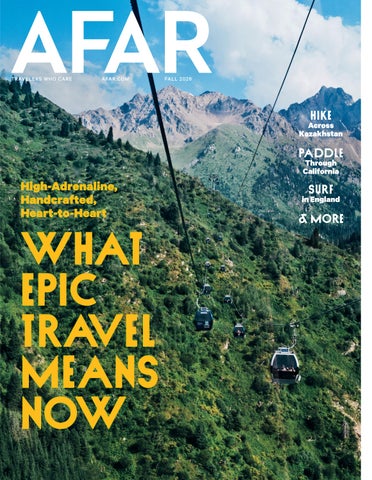
WORKSHOP WOVEN INTO PLACE For more than 300 years, South Carolina’s Lowcountry has nurtured a sweetgrass basketmaking tradition stewarded by families who learned the craft from their ancestors. ON THE COVER A chairlift ride at Shymbulak resort, near Almaty, Kazakhstan, is just as epic without the snow as it is during ski season.
KO OYO OE PA’A PAN UNA DU ( PY RA MI D L AK E ), NEVA DA
Photograph by Nathalie Mohadjer
14
VOICE FROM AFAR
104
JUST BACK FROM CHILE In southern Patagonia, Afar Senior Editor Danielle Hallock explores waterfalls, glacial lakes, and temperate rainforest from a home base at Eleven Rio Palena Lodge.
4
55
TRAVELING TURTLE ISLAND Trek to an ancient Maya city in the rainforest, spot narwhals on an Arctic safari, or see California by redwood canoe with these Indigenous-run tours in Mexico, Canada, and the United States.
ILLUSTRATION: JOAN WONG. PHOTOS, CLOCKWISE FROM TOP RIGHT: DONAVEN DOUGHTY; DANIEL L. LOCKE/SHUTTERSTOCK; THOMAS EKSTRÖM
FEAST APPLES TO APPLES In one fjord-filled corner of Norway, cider is both business and pleasure.
HAS NO OFFSEASON CAMP NORTH END
In Charlotte, expression is always on display. From bold street murals in energy-packed neighborhoods to must-see museums and live performances that light up the night, culture is everywhere
you turn. Spend the day immersed in art walks, studio tours and storytelling that bring the city’s past to life—then keep the night going with music, theater and something new around every corner. You don’t need a reason. You just need to go. Because culture has no offseason in Charlotte.
See what else you can do at charlottesgotalot.com.
MINT MUSEUM
NODA*
*Mural credit: ÒChanson de la PapillionÓ by Osiris Rain
CHARLOTTE SHOUT
MIDDLE C JAZZ
Table of Contents
SWELL COUNTRY p.94
MAX SEARL
Features
I couldn’t get enough of that water-level view of the coast: craggy cliffs overhead that shifted mood depending on the light and shadow.
8
SEASONS IN MOTION
Different skies and different shores. Same Six Senses warmth, wherever the season takes you.
sixsenses.com
“For two to three weeks every year, synchronous fireflies—a rare breed— congregate in the Great Smoky Mountains of Tennessee and flash their lights in a perfectly synchronized pattern. I was lucky enough to witness thousands of them glittering through that part of the national park this summer.” —D.B.
AFAR.COM @AFARMEDIA FOUNDERS Greg Sullivan & Joe Diaz
EDITORIAL
SALES
VP, EDITOR IN CHIEF Julia Cosgrove EDITORIAL DIRECTOR
VP, PUBLISHER Bryan Kinkade
Billie Cohen @billietravels CREATIVE DIRECTOR Maili Holiman
EXECUTIVE DIRECTOR, BRAND PARTNERSHIPS
DIRECTOR OF PHOTOGRAPHY
EXECUTIVE DIRECTOR, BRAND PARTNERSHIPS
Michelle Heimerman @maheimerman DIRECTOR, PODCASTS Aislyn Greene @aislynj DIRECTOR, SOCIAL PLATFORMS Delia Barth @dbarthvader EXECUTIVE EDITOR Katherine LaGrave @kjlagrave
Laney Boland lboland@afar.com, 646-525-4035 SALES DIRECTOR Carly Sebouhian csebouhian@afar.com, 516-633-5647 GLOBAL DIRECTOR, BRAND PARTNERSHIPS David Read
SENIOR DEPUTY EDITORS
SALES, SOUTHEAST
Michelle Baran @michellehallbaran Jennifer Flowers @jenniferleeflowers ASSOCIATE ART DIRECTOR Elizabeth See EDITORIAL PRODUCTION MANAGER Kathie Gartrell EMAIL MARKETING MANAGER Tarren Jessop SENIOR EDITORS Jennifer Hope Choi, Danielle Hallock, Hannah Walhout
Colleen Schoch Morell colleen@afar.com, 561-350-5540
SENIOR PRODUCER, PODCASTS
Nikki Galteland @nicollegalteland PHOTO EDITOR Charis Morgan ASSOCIATE SOCIAL EDITOR Kayla Brock PRODUCTION EDITOR Karen Carmichael @karencarmic PRODUCTION DESIGNER Myrna Chiu EDITOR AT LARGE Laura Redman @laura_redman CONTRIBUTING WRITERS
“I loved my trip to Southern Utah for slot canyons, Lake Powell, and unforgettable overnights at Amangiri resort and the Under Canvas glamping site at Grand Staircase.” —J.F.
Lisa Abend @lisaabend, Chris Colin @chriscolin3000, Latria Graham @mslatriagraham, Emma John @em_john, Ryan Knighton, Peggy Orenstein @pjorenstein, Bonnie Tsui @bonnietsui8, Anya von Bremzen @vonbremzen COPY EDITOR Elizabeth Bell PROOFREADERS Alison Altergott, Jaime Brockway, Pat Tompkins FACT CHECKERS Caitlin Fisher, Sophie Friedman, Michelle Lau, Jill Malter, Ellen McCurtin SPECIAL CORRESPONDENTS
Nicola Chilton @nicolachilton, Fran Golden @fran_golden_cruise, Sally Kohn @sallykohn, Barbara Peterson, Paul Rubio, Victoria M. Walker
What’s the most epic trip you’ve taken in the U.S. this year?
bryan@afar.com, 646-873-6136 Onnalee MacDonald onnalee@afar.com, 310-779-5648
SALES, SOUTHWEST
Lewis Stafford Company lewisstafford@afar.com, 972-960-2889 REVENUE OPERATIONS MANAGER
Chrissy Schneider cschneider@afar.com ACCOUNT EXECUTIVE Olivia Wilkey owilkey@afar.com CARIBBEAN AMBASSADOR Barry Brown
“Spending time at Big Cedar Lodge near Branson, Missouri, during the winter was incredible. Visiting in colder weather allowed us to slow down and enjoy the history, natural landscape, and views of the Ozarks.” —L.B.
AFAR MEDIA LLC CHIEF EXECUTIVE OFFICER Greg Sullivan @gregsul VP, COFOUNDER Joe Diaz @joediazafar VP, CHIEF OPERATING OFFICER Laura Simkins DIRECTOR OF FINANCE Julia Rosenbaum @juliarosenbaum21 HUMAN RESOURCES DIRECTOR
Breanna Rhoades @breannarhoades DIRECTOR OF AD OPERATIONS
Donna Delmas @donnadinnyc ASSOCIATE DIRECTOR, SEO & PRODUCT
Jessie Beck @wheresjessieb ACCOUNT MANAGER, AD OPERATIONS Vince De Re STAFF ACCOUNTANT Kai Chen EXECUTIVE DIRECTOR, CONSUMER MARKETING Sally Murphy ASSOCIATE CONSUMER MARKETING DIRECTOR Tom Pesik SENIOR PREMEDIA MANAGER Isabelle Rios PRODUCTION MANAGER Mandy Wynne
SUBSCRIPTION INQUIRIES MARKETING & CREATIVE SERVICES VP, MARKETING Maggie Gould Markey
@maggiemarkey, maggie@afar.com EXECUTIVE DIRECTOR, MARKETING AND SPECIAL PROJECTS Katie Galeotti @heavenk BRANDED & SPONSORED CONTENT DIRECTOR
Ami Kealoha @amikealoha EVENTS DIRECTOR Michelle Cast DIRECTOR, MARKETING ACTIVATIONS
Irene Wang @irenew0201
“Visiting Asheville, North Carolina, with my mom—to see my cousin and meet his wife and kids for the first time— was epic in its own way! I hadn’t seen my cousin in more than a decade, and simply getting pizza on an Asheville rooftop was a highlight of my year.”
ASSOCIATE DESIGN DIRECTOR Christopher Udemezue SENIOR PAID MEDIA MANAGER
afar.com/service 888-403-9001 (toll free) From outside the United States, call 515-248-7680
MAILING ADDRESS P.O. Box 458 San Francisco, CA 94104
“I skipped the classic Pacific Coast Highway to drive California’s other epic road: Highway 395, passing through the high desert and eastern Sierra Nevada mountains to June Lake, Bishop, and the granite rock arches and towers of the Alabama Hills National Scenic Area.” —J.B.
Courtney Rabel @court_rabel INTEGRATED MARKETING MANAGER Dheandra Jack SENIOR MARKETING ACTIVATIONS MANAGER
Maggie Smith @smithxmaggie MARKETING ACTIVATIONS MANAGER
Mary Cate McMillon @marycatemcmillon BRAND MARKETING MANAGER Alice Phillips @alicephillipz
—A.K.
12
Afar ID Statement Afar® (ISSN 1947-4377), Volume 18, Number 4, is published four times a year by Afar, P.O. Box 458, San Francisco, CA 94104, U.S.A. In the U.S., Afar® is a registered trademark of Afar LLC. Publisher assumes no responsibility for return of unsolicited manuscripts, art, or any other unsolicited materials. Subscription price for U.S. residents: $24.00 for one year. Canadian subscription rate: $30.00 (GST included) for one year. All other countries: $40.00 for one year. To order a subscription to Afar or to inquire about an existing subscription, please write to Afar Magazine Customer Service, P.O. Box 6265, Harlan, IA 51591-1765, or call 888-403-9001. Periodicals postage paid at San Francisco, CA, and at additional mailing offices. POSTMASTER: Please send address changes to Afar, P.O. Box 6265, Harlan, IA 51591-1765.
Secrets of Egypt & the Nile Cruise along the waters that have moved through Egypt for millennia. Whether you join us aboard the new AmaNubia or the reimagined AmaDahlia, AmaWaterways’ fleet on the Nile is custom-designed for life on the river. Watch the landscapes float by from your balcony stateroom, cool off in the pool on the Sun Deck and enjoy the sunset from The Khepri Lounge.
AmaNubia artist rendering
Contact your travel advisor, call 1.888.928.0237 or visit amawaterways.com today.
SCAN TO LEARN MORE
Voice From Afar
I L A S T S AW M Y G R A N D PA E D just before the new year. Every time I visited him, we talked about my recent trips and his travels decades earlier. In December, he told me he’d made it to 48 U.S. states but regretted missing Alaska and Hawai‘i. Our conversation reminded me to stop putting off the epic trips I assumed I’d take someday. So in June, my husband, two daughters, and I flew to Juneau for a weeklong voyage through southeastern Alaska aboard the 22-passenger Safari Quest with UnCruise Adventures. On our first afternoon at sea, we boarded a skiff headed for Glacier Bay National Park and Preserve. We peered into tide pools filled with sea stars and chitons, then walked deep into spruce forests teeming with spiny devil’s club and salmonberries. Our expedition leader, McKenzie, told us that of the 740,000 people who visited the park in the last two years, only about 4 percent set foot ashore. I felt grateful to be touching, feeling, and breathing in the pristine wilderness. I knew my grandfather would have been happy we made it to such a special place.
14
Travel well, J UL IA CO SG ROVE
Editor in Chief
Glacier Bay National Park and Preserve is an early stop on UnCruise Adventures’ “Alaska’s Glacier Wilderness with Glacier Bay” itinerary. Travelers on the 7-night journey visit the world’s largest intact temperate rainforest and drift through glacial fjords, spotting humpback whales, coastal brown bears, and bald eagles. We spotlight smallship Alaska cruises on page 24.
ALISHA BUBE/SHUTTERSTOCK
The Call of the Wild
Later in the week, an orca swam under our ship, we kayaked among humpbacks in Takatz Bay, and we polar plunged into 37-degree water near Dawes Glacier. By the time our family boarded our flight home, we all felt it was one of our most unforgettable trips. In that spirit, we’ve dedicated this issue to memorable adventures: Contributing writer Bonnie Tsui surfs in Cornwall, England (page 94), meeting people who care deeply for its waters; on a trip with Wild Frontiers, contributing writer Peggy Orenstein visits Kazakhstan’s canyons, cliffsides, and markets (page 74); and photographer Brad Ogbonna captures the vivid culture and religious traditions of Vodun in Benin (page 86). Shortly after we returned from Alaska, my grandpa died at 105. Despite his long life, I wish I’d had more time to tell him about my older daughter’s encounter with a mink on a beach scattered with butter clam shells, or about our twilight s’mores on the Keku Islands, where the tide snuffed out our campfire. Maybe that’s what makes a trip feel even more epic: going home to share memories with those we love.
STEP INTO RHYTHM WITH THE U.S. VIRGIN ISLANDS From the moment you arrive, you will feel connected to the rhythm of our islands. St. Croix, St. John, and St. Thomas are home to rich culture, friendly people, pristine beaches, and diverse natural beauty. We can’t wait to warmly welcome you to America’s Caribbean Paradise.
VISITUSVI.COM
UNFORGETTABLE
Accommodations Discover exceptional hospitality found only in Charleston, South Carolina. THE CHARLESTON PLACE charlestonplace.com THE COOPER thecooper.com THE DEWBERRY thedewberrycharleston.com HOTEL BENNETT hotelbennett.com THE SANCTUARY AT KIAWAH ISLAND GOLF RESORT kiawahresort.com THE SPECTATOR HOTEL thespectatorhotel.com WENTWORTH MANSION wentworthmansion.com
You are always welcome here. History loves company. The best journeys leave room for surprise. In the Charleston area, that might mean spotting dolphins from a kayak, discovering a gallery down a quiet side street, lingering over dinner as the harbor glows at sunset, or finding your favorite beach almost to yourself. Come for the coast. Find your story. The perfect stay awaits.
@EXPLORECHARLESTON
EXPLORECHARLESTON.COM
From artisan bread and local markets to vineyard landscapes and Michelin-starred restaurants, discover a culinary journey through Germany that is rooted in tradition and reimagined for today. Plan your journey at: www.germany.travel/en/culinary © GNTB/Jens Wegener
ONE GREAT BLOCK
|
G O O D T R I P S P.24
|
FEAST
P.28
|
STAY
P.36
|
W O R K S H O P P.46
WAN D ER CURIOUS TRAV ELERS O NLY
O N E G R E AT B L O C K
FUNG SIU YAN
Hong Kong
The East Asian metropolis has long been known for its world-class cocktail bars and thriving arts scene. Now, new nonstop flights from Dallas and Seattle make a trip even easier. Here’s a stretch not to miss along historic Hollywood Road in the vibrant Sheung Wan neighborhood. ➜ by Lucy Kehoe
19
WA N D E R / O N E G R E AT B L O C K
Sheung Wan Hong Kong
DES
VO E
UX R
D. CE
NTR
AL
2
4
QU
EE
N’S
RD
.C
E NTR AL
1 H O L LY W
OOD RD.
5
7
6
CAIN E RD.
1. Yuk Kin Fast Food Pull up a metal stool outside this cha chaan teng—literally, “tea restaurant,” the equivalent of a greasy-spoon diner—for breakfast or lunch with a side of neighborhood life. The signature dish is a smoky, aromatic curry fried rice topped with a sunny-side up egg. 6 Tai Ping Shan St.
2. Cat Street The nickname says it all: In Cantonese slang, resellers of stolen goods are called “cats.” But the old thieves’ market dispersed decades ago, and this alley off Hollywood Road is now home to vintage shops and stalls selling teapots, jade carvings, and sepia-toned posters from the 1930s. Visit on a weekday for a relaxed rummage. Upper Lascar Row
3. Liang Yi Museum Hong Kong businessman Peter Fung began collecting Chinese furniture in the 1980s, often
20
sourcing from Hollywood Road’s antique shops. His museum houses one of the largest private collections of Ming and Qing dynasty pieces, some crafted from rare materials like huanghuali rosewood. By appointment only; book at liangyimuseum.com. 181–199 Hollywood Rd.
4. Halfway Coffee Between Cat Street’s vintage stores, wooden tables spill onto the pavement amid a tangle of potted plants; inside, Halfway’s design is inspired by the city’s iconic housing blocks. Baristas serve coffee in traditional porcelain and iced drinks in flower-painted glassware—the kind that sat on Hong Kong kitchen tables a generation ago. 26 Upper Lascar Row
5. Montana In 2025, Rome-born Lorenzo Antinori’s Bar Leone was named the top cocktail bar globally in the World’s 50 Best guide. His follow-up, Montana, which opened nearby last summer,
channels Cuba’s golden age. Order the fruity house daiquiri, made from a recipe in a 1930s Cuban bartending manual. 108 Hollywood Rd.
6. PMQ After falling into disuse, a 1950s-era police dormitory has been converted by Hong Kong’s Antiquities and Monuments Office into a creative hub featuring the work of more than 100 independent design studios, shops, and galleries. Don’t miss RBRK for plant-leather handbags (pictured) and Glocal Mahjong for customized game-tile sets. 35 Aberdeen St.
7. Snack Baby This vegan-friendly gelateria and bar is known for inventive flavors: mango with Sichuan peppercorn, peach oolong with peach gumdrops, and a rich, nostalgic milk-and-mascarpone scoop with a house-made buttercrunch. Drop by in the evening for a spiked affogato. 93–95 Hollywood Rd.
FROM 1 TO 7: ERIC LAUDONIEN/SHUTTERSTOCK; HONG KONG TOURISM BOARD; MARK FRENCH; COURTESY OF HALFWAY COFFEE; VICTORIA CHAN; RBRKHK; VICTORIA CHAN
3
GO W HER E B IG S HI P S C AN ’ T UnCruise Adventures gets you off the beaten path and into the wild on small ships built for exploration. With just 22–86 guests onboard, small-group adventures get you up close to the action by kayak, skiff, or on foot. Every voyage is all-inclusive, with expert guides leading excursions, adventure gear, farm-to-table meals, and craft beverages. This is travel for people who want to do more, see more, and get closer. Ready to do what big ships can’t? Don’t cruise. UnCruise.
Alaska • Mexico • Hawaii • Galápagos • Costa Rica • Panama
Scan, go to UnCruise.com, or call 888-862-8881 for more details.
THE GREAT JAMAICA COMEBACK Jamaica’s ready to welcome you home. The next era of island living has arrived across three newly reimagined Jamaican resorts. Come back to new suites, fresh flavors, redesigned pools, and the island warmth that makes Jamaica impossible to forget.
Sandals.com 1-800-Sandals Contact Your Travel Advisor
go nte Mo
Ba yn ew ly reimagined b each bar
Montego Bay
Caribbean Cay
South Coast
THREE ICONIC RESORTS REIMAGINED
ast oc ean fron t po ol an ds wi m -u p ba r
Sandals® is a registered trademark. Unique Vacations, Inc. is an affiliate of Unique Travel Corp., the worldwide representative of Sandals Resorts. Renderings are for illustration purposes only and may be subject to change. 1400/0826
Sou th C o
C bean ay infin it y p Carib
o o l an d
sw i m -u p b ar bar
WA N D E R / G O O D T R I P S
Up Close and Personal Small-ship cruising brings travelers deeper into Alaska, offering fewer crowds and a quieter, more immersive journey.
CHRIS STANLEY
by Katherine LaGrave
24
Sailings that weave through southeastern Alaska’s wildlife-rich waterways primarily operate from May to August, when temperatures are mild and daylight shines for more than 15 hours.
Your home on Hawai‘i awaits.
Generations have walked this shoreline. Some return every year. Others are just discovering it for the first time. At Mauna Kea Beach Hotel, every moment is rooted in aloha, shaped by heritage, and carried forward by those who come home time and again. maunakeabeachhotel.com
WA N D E R / G O O D T R I P S
I
a black Zodiac, grabbing hold of a rope braiding the boat’s edge. Rain fell in sheets, dimpling the water, soaking me and my five fellow passengers. There was no cover from it, and cover would not soon be coming: We were just at the beginning of our journey into Misty Fjords National Monument, following a narrow passageway through southeastern Alaska. Our waterproof clothing was being tested to its limits, but the group was all smiles. Within minutes, we rounded a bend and the 431-foot, pearlwhite Star Seeker disappeared. On both sides of the fjord, rock walls rose nearly a mile above the water—skyscrapers carved when the massive glacier that covered the area broke apart 17,000 years ago. Waterfalls crashed, trickled, and flowed over the granite faces, and expedition leader Simon Hook navigated the Zodiac to the base of one so we could safely get close to the rush. As he slowed, the boat’s bow bumped the cliff as gently as my dog nudging me for a treat. On a sandbar in the distance, harbor seals sat five on a log, watching us warily. Though mountain goats, coastal brown bears, black bears, moose, martens, wolves, wolverines, river otters, sea lions, orcas, and Dall’s porpoises also call the area home, humans are a rarer sight, owing to the fact that Misty Fjords is largely inaccessible to our species, save for those who visit by a float plane or small vessel.
Despite cruise tourism to Alaska increasing by 83 percent in the last decade, Misty Fjords sits near the bottom of the state’s visitation ladder, with an estimated 100,000 annual visitors. “Alaska is a bit of a logistical nightmare,” Hook later said cheerfully, steering the Zodiac back to the ship. “But that, in a way, has helped protect it [from overtourism].” Those challenges are also part of the appeal. Windstar launched an inaugural Alaska season in 2026 with Star Seeker, the company’s newest all-suite yacht, positioning the state’s remoteness and complexity as part of the experience. The nimbler yachts can move with more ease than their 1,000-foot, 20-deck big-ship counterparts, venturing deeper into fjords, launching Zodiac and kayak excursions directly from the ship, and lingering for wildlife sightings in ways that would be difficult, if not impossible, for larger vessels. We were able to glimpse a quieter side on land, too. In Wrangell, we viewed ancient stone carvings at Petroglyph Beach State Historic Site, and near Sitka, we hiked the From left: Each suite temperate rainforest through towon the Star Seeker ering totem poles and spruce trees. features ocean views and a queen bed, As a fledgling cruiser, I’d wonwhile nearly all have dered before I embarked whether a private veranda; the ship would feel too small, too Windstar’s expert naturalists lead expe- large, or just right for a nine-day ditions and host trip—and whether cruising would onboard lectures in feel like me at all, especially as a the ship lounge.
WINDSTAR CRUISES (2)
IN LATE SPRING, I stepped off the Windstar Star Seeker and into
Setting Sail Windstar isn’t the only company thinking small. Here are six other operators offering Alaska itineraries for fewer than 1,000 passengers next season.
solo traveler. Given the maximum of 224 guests, a crew of 130, and the ship’s compact size, I found myself repeatedly crossing paths with the same people. On day three, I ran into my cabin attendant, Lutfi, at port in Ketchikan, and we debated which magnets made the best souvenirs. By day five, I’d been “adopted” by Rip and Ellie, retirees with whom I’d shared nearly every excursion. During one dinner, I traded whale talk with a couple as we spotted humpbacks offshore; the next night, I ordered pizza to my 225-squarefoot suite and ate with the balcony door open, a rainbow arcing into the clouds. On one of my final excursions, I was paired in a tandem kayak with Steve, a geology buff from Colorado. As we paddled for miles toward the Tracy Arm glacier, he pointed out striations on the rock and the lessons we could learn about Earth’s history from looking closely. After nearly two hours weaving around chunks of ice (it was, as our guide Rachel Sullivan-Lord put it, akin to “paddling through a margarita”), our group of six kayaks reached the closest advisable distance to the glacier, about half a mile, and floated there in silence. I took a photo of Steve; he took a photo of me. A seal’s slick head popped up five feet away, startling us both. And when we turned around to row back to the ship, there was nothing but forest and fjords in sight. Windstar’s Zodiac and kayak excursions are available on select 2027 Alaska sailings. windstarcruises.com
THE BOAT COMPANY
SILVERSEA
The Boat Company, founded in 1979, is the only nonprofit cruise line in the world. On the 12-cabin Mist Cove and 10-cabin Liseron, passengers enjoy anchorings in secluded bays between Sitka and Juneau, away from bustling ports. Rooms and shared spaces are cozy and rustic, and guests head out on skiffs, rather than Zodiacs, for wildlife viewing and fishing. After operational costs, profits from the 16 to 18 sailings a year are reinvested in organizations such as Fortress of the Bear animal rescue and Sitka Trail Works, a wilderness restoration group. theboatcompany.org
The 7-night northbound route from Vancouver to Seward on the 392-passenger Silver Whisper prioritizes wildlife and scenic cruising, with at least one glacier viewing stop and no full days at sea. The ship calls at nine ports, including Ketchikan and Skagway, along with less-visited sites like Icy Bay—a more than 30-milelong bay surrounded by the St. Elias Mountains. Pair the journey with a land extension in Denali to explore what lies beyond the coast. silversea.com
UNCRUISE ADVENTURES
Luminara, from the Ritz-Carlton Yacht Collection, is committed to a full Alaska season in 2027, with select round-trip sailings from May to September for up to 452 guests. Shore excursions include utility terrain vehicle rides in the Valdez backcountry and visits to glaciers via helicopter. Private terraces for every suite, plus a marina platform, multiple dining venues, two swimming pools, and a spa give the all-suite superyacht a resort-on-water, polished feel. Consider it Alaska through a very comfortable lens. ritzcarltonyachtcollection.com
Seattle and Juneau-based UnCruise runs expedition sailings with a fleet of nine vessels, each hosting just 22 to 86 passengers. Departing from Juneau, Seward, and Sitka, guests explore Glacier Bay National Park’s fjords and rainforest by kayak and on foot during 7- to 13-night itineraries. The all-inclusive, activity-focused experience highlights up-close, safe encounters with humpback whales, glaciers, coastal brown bears, and the intertidal coastline. uncruise.com
NATIONAL GEOGRAPHIC– LINDBLAD EXPEDITIONS National Geographic–Lindblad’s three Alaska-bound ships split the difference between full-scale comfort and rugged excursions. With observation lounges or decks and open bridge access, each vessel is designed to heighten engagement with the surrounding landscape. Itineraries skip port-call checklists in favor of daily activities. Zodiac wildlife-watching, fjord and bay kayaking, and guided hikes through remote corners of the Inside Passage coastal route are deepened by onboard naturalists and a photography instructor. expeditions.com
RITZ-CARLTON
EXPLORA In 2027, Explora Journeys brings its ultra-luxurious style to the region with the new Explora III. The 7- to 12-night Inside Passage routes sail mainly from Vancouver and feature glacier cruising and stops at select ports including Wrangell, Skagway, and Sitka. The focus of the 926-passenger ship is on amenities, wellness, and design rather than excursions. Onboard, guests can enjoy a Finnish sauna, a detoxification salt cave, and five swimming pools. New culinary options include Chef’s Table (a multicourse dining experience with live storytelling) and the Cellar, a wine-focused venue with guided tastings. explorajourneys.com 27
WA N D E R / F E A S T
Apples to Apples
In remote orchards and Bergen bars, Norway’s centuries-old cider tradition—rooted in the southwestern region of Hardanger—makes for a one-of-a-kind tasting tour. by Liza Weisstuch | Photographs by Thomas Ekström
28
Cider maker Eirik Nå Aga tends to apple trees on his fjord-side estate near the village of Nå, in Norway’s Hardanger region.
Five Oceans
Twenty-One Rivers
CST# 2052644-40
#1 for Rivers #1 for Oceans Five years in a row
Visit viking.com, call 1-800-2-VIKING or see your Travel Advisor
Seven Continents
WA N D E R / F E A S T
E
EIRIK NÅ AGA NEVER planned to make cider for a living. Though he’d learned to ride a tractor on his family farm when he was 11 years old, the city called to him; he eventually left home to study chemistry at the University of Bergen. He didn’t stay away for long. Farming ultimately drew Nå Aga back to Hardanger, a fjord region of Norway about a six-hour drive west of Oslo, where today he oversees an orchard and cidery, Store Naa Siderkompani, on his family’s estate. He learned cider-making from his father, who’d learned from his father, and on back seven more generations. Though Nå Aga was the first in his family to produce cider commercially—Store Naa was founded in 2018—the cider is fermented using a strain of Norwegian kveik yeast they’ve traced to 1864. On a sunlit Tuesday in April, Nå Aga, 35, had four bottles set up on a picnic table when I arrived at the farm for an early-season tasting tour, the first of a three-day trip around Norway’s premier cider region. (Store Naa runs tours for the public May through September.) Nå Aga’s mother, Ingrid, who was taking care of the grandkids, walked over with a question about nap time as he poured the flagship cider from 57.2—his cidery’s brand, named for the designated number of the family farm. “This is blended with three different varieties of apples,” Nå Aga explained. My glass of straw-hued fizz caught a glint of sun. I took a sip. Its bright apple and honeysuckle sweetness, tempered by a slight dryness, evoked fruit-glazed sunshine. HARDANGER IS ORIENTED around the Hardangerfjord, the 113mile-long sea inlet (one of the world’s longest) that dramatically cleaves much of the district from the coastal city of Bergen, just 50 miles east as the crow flies. Along the fjord’s edges, the steep slopes, long summer days, and particular microclimate make conditions that are ideal for growing apples, brought here from England by Cistercian monks in the 13th century. There are four primary varieties in the region—Discovery, Aroma, Gravenstein, and Summerred—with varying levels of acid, sugar, and tannins.
30
Most cider makers here will use multiple, honing the proportions over years of practice to create a drink that’s both delicate and aromatic. Historically, families in the area made cider on their farms for personal use—it was a strong, recreational tonic, not an epicurean or commercial effort. But in 2003, the cider makers formed a guild that worked to establish a Protected Geographical Indication for Sider frå Hardanger. The government-regulated designation, which was instituted in 2009, can only be used for cider produced entirely in Hardanger, and made solely with apples grown in the region. Today, its 2,470 acres of orchards are responsible for 80 percent of cider sales in Norway, and
Clockwise from far left: Eirik Nå Aga pours a rosé-style cider made with a touch of currant; “Mother Utne,” who ran Hardanger’s Utne Hotel for 70 years, now watches over the restaurant; Olav Bleie grows apples for Alde Sider on his orchard in the village of Vikebygd.
NORWEGIAN SEA
H A R DA N G E R
N O R WAY BERGEN
O S LO
SWEDEN
NORTH SEA
DENMARK
Hardanger has become a popular day trip for travelers spending time in Bergen. And now that there’s a standard, a new generation of Hardanger producers is starting to riff on it. Women are more represented in the industry, too: Recent local winners of Norway Cider of the Year include Kvestad Sideri, a family operation launched in 2018 by partners Ellen and Haakon, and Hardangerbonden, founded in 2021 by fruit farmer Ingrid Sekse and her husband, Bård Vedvik. The following day at Aga Sideri—whose own products have claimed the coveted Cider of the Year title multiple times—I met Joar Aga, Eirik’s cousin, a lively cider maker with an energetic smile who founded his own operation
a five-minutes’ drive north of Store Naa in 2018. Like many of the roughly 30 producers in the area, he welcomes guests for tours and tastings; when you visit, you can also stop by his compact farm store to get fresh eggs and just-picked produce. As we sat at the long wooden table in his rustic tasting room, Aga explained how playing with tradition led him to create his most popular product, a distinctive hopped cider. He popped open a bottle. The hops, which steep in the cider the last few days of fermentation, lent heft and a lightly bittered edge to the drink. Where a traditional Hardanger cider is a sweet, soothing string quartet, the hops make it a booming symphony. “If my grandfather saw me putting hops into a cider, he would be kind of mad,” Aga, 38, said with a grin as he topped off my glass.
WA N D E R / F E A S T
Best Bets for a Bergen Stopover With a younger generation of cider makers marketing and distributing their products more widely, ciders from Hardanger are easier than ever to find elsewhere in Norway, especially in Bergen, which most visitors will need to pass through on their way to the orchards. Here’s what to do in town. 32
W H E R E T O S TAY
W H E R E T O E AT
WHERE TO DRINK
In Bergen’s central harbor district, the 41-room Hôtel Charmante has a whimsical design reminiscent of finde-siècle Paris. At reception, guests receive a flute of hopped cider from Aga Sideri—a rosé style made with red-flesh apples—as they check in. hotelcharmante.no
A playful sibling of two-Michelinstarred Gaptrast upstairs, Bark offers many ciders—including one that the restaurants developed in collaboration with Kvestad Sideri. When paired with a dish of langoustine, its freshness and acidity shine. barkrestaurant.no
Bergen native Tanja Borge spent years working in Hardanger hotels before opening Siderbar, Norway’s first dedicated cider bar, in March 2026. A classy grandma’s-drawingroom-type affair, its shelves hold about 100 different bottles from throughout the country. siderbar.no
A 15-MINUTE DRIVE south along the fjord that afternoon—dramatic
mountains visible across the water—brought me to Alde Sider, set in a fjord-side red barn above the valley. Owner Olav Bleie was outside on his 17-acre orchard, pruning apple trees one skinny branch at a time. He pulled off a blueberry-size bud and explained how, once pollinated, it would swell up and become a tiny apple by mid-May. After harvest in October, it would be pressed and fermented in stainless steel tanks for his award-winning cider, a process that takes about two weeks. The finished cider is left to mature for about a month, then bottled.
Bleie isn’t sure when exactly his family started making cider. The date they settled on the land, he deadpanned, is “probably closer to Jesus than [to] us.”
This page, from top: The Utne Hotel restaurant serves trout in cider sauce with an optional cider pairing; after initial fermentation, Hardanger ciders are sometimes matured in wood barrels. Opposite page: The 17-room Utne, open since 1722 and now owned by Margaret Hystad, is one of Norway’s oldest continuously operating inns.
Bleie, 44, isn’t sure when exactly his family started making cider. Use of the farm goes back at least 20 generations, to the Viking Age, as evidenced by the stone tools found on the property. (The date his family settled on the land, he deadpanned, is “probably closer to Jesus than [to] us.”) But he is the first in his family to sell the drink commercially. In the early 2000s, while pursuing a master’s degree in chemistry at the University of Washington, Bleie watched the Pacific Northwest craft beer scene evolve and saw an opportunity. He returned home and began commercial production in 2015; today, Alde Sider is one of the largest cider makers in Norway and offers daily tastings Tuesday through Saturday. A merry group of Belgian tourists was saying their thanks and heading out from the airy, barn-like cidery, where Bleie showed me to the bar and presented a plate of aged Fanaost, a Norwegian Goudastyle cheese. Its nuttiness made each cider’s fruitiness seem brighter as I made my way through the tasting. Bleie explained how his chemistry background still inspires him to tinker, noting that he experiments with combinations of apple varieties and dozens of yeast strains, which yield vastly different results. “[Maybe] you won’t figure it out, but you have fun for your whole career,” he told me. “You’re like a detective.” That evening, I headed to the nearby Utne Hotel for a final night before returning to Bergen. The 304-year-old inn is adorned with antiques, portraits of austere women—all former owners—and cozy furniture arranged around a fireplace. The manager, Bjørn Hettervik, is a longtime chef who has worked in kitchens around Norway and sometimes commutes to work by motorboat from his home on an island just to the west. He also helms Utne’s restaurant, where he pairs local cider with every course. At dinner, my entrée of fermented, lightly smoked trout with cider sauce and caviar was served with an especially dry pour, which Hettervik explained would accentuate the briny flavors of the dish. With each newly popped bottle Hettervik brought over, as I listened to his lyrical description, I held the glass to my nose for a moment and appreciated how these young, unpretentious cider makers had managed to concentrate their home—the land where they were raised, as were generations before them—into a single sip. My mind flashed back to standing with Bleie in his orchard earlier that day, both of us looking out over field and fjord. “We’re working with nature here,” he’d told me. “You taste the rain and the sun.”
Feel winter’s warm embrace in Alberta, Canada. Immerse yourself in iconic destinations, connect with new cultures on a deeper level and soak in the stunning natural beauty of Canada’s Wild Side.
Dive in at travelalberta.com
WA N D E R / S TAY
Remote Access These new and notable properties—an Australian eco-lodge, three Scottish Highlands hotels, a wave of crowd-free safari camps, and more—are worth booking for your next great getaway.
Villa Fayoum, in the Egyptian oasis village of Tunis, features an outdoor swimming pool and views of nearby Lake Qarun.
36
MARK ANTHONY FOX
Edited by Jennifer Flowers
Find it all in one place.
VISITANCHORAGE.NET
WA N D E R / S TAY
1. If These Walls Could Talk Zeina Aboukheir designed the hotel’s salon around an existing relief wall, the creation of the villa’s previous owner, Alia El Bialy. Its trees and botanical forms were sculpted directly into the mud plaster by El Bialy and local craftspeople, drawing inspiration from native Egyptian flora.
1
2. Seats of Honor The carved wooden chairs are vintage Egyptian finds, chosen in part for the patina they’ve acquired over time. They are among numerous antiques scattered around the villa, where pieces from different periods and styles are deliberately mixed.
2
3. Down to Earth
3
4
5
The design team sourced some ceramics from the Fayoum Pottery School and elsewhere in the Fayoum Oasis, long known for its pottery workshops. The glazed earthenware pieces are painted by hand with scenes reflecting rural Fayoum life, including palm trees, local birds, and landscapes in blues, browns, and greens.
4. Dream Weaving
Villa Fayoum, a rural hideaway in the sands outside Cairo, is a showcase of Egyptian craft.
T H E R E ’S S O M E T H I N G A B O U T the Sahara that makes the imagination run wild. Villa Fayoum, a new
12-room property in Egypt’s Fayoum Oasis, taps into a long creative legacy in this expansive landscape. The region has inspired artists at least since Roman rule, when Fayoum’s funerary portraits became so celebrated that today they fill a room in the Egyptian Museum in Cairo. In 2022, Florian Amereller—cofounder of the travel company Egypt Beyond and owner of Al Moudira, a boutique hotel and craft center outside Luxor—acquired the villa and enlisted Lebanese designer Zeina Aboukheir, a regular collaborator, to restore it. Opened in March, the hotel is set within an elaborate garden and features artisan traditions from around the country. From $350 —Gisela Williams 38
5. Beauty Underfoot The polished floor may look like sandstone, but it’s actually Golden Sinai marble, quarried in Egypt’s Sinai Peninsula. The team chose the stone both for its durability and for its warm color, which echoes the palette of the desert outside.
MARK ANTHONY FOX
Diamond in the Desert
The custom-designed sofas were upholstered in Egyptian cotton made by weavers from the city of Akhmim, which has a 4,000-year textile tradition. Their low-slung form is inspired by the dakkah, a raised seating platform common in Egyptian homes and outdoor gathering spaces. Handmade kilims (flatwoven rugs) from Siwa Oasis, near Egypt’s western border, drape across them.
B O U T I Q U E H O S P I TA L I T Y. B O U N D L E S S A DV E N T U R E .
TH I S I S W H E RE INTI MATE LUXU RY MEETS I MM E R S I VE EXP EDITI ON—Y EAR- R OU ND. Begin Exploring at atlasoceanvoyages.com
Call your Travel Advisor or Atlas at 844.573.2530
LEARN MORE
A collection of experiences handpicked by Afar to empower travelers to discover destinations through inspiring immersive outings and pursuing their passions.
Africa
Antarctica
©2 02 6 AT LA S OC EAN VOY AGE S
Arctic
Asia
Caribbean
Mediterranean
Northern Europe
South America
S H IP S ’ RE G I ST R Y : P O R TU G AL 50 82 6 .2 2. 26
100 WORDS ON . . .
An Australian Eco-Lodge Debut Longtime Australia guide Drew Kluska shares the experiences and philosophy behind his first lodge, Ever Bloomfield. The group of 14 bungalows opens this December in coastal Queensland, between the Daintree Rainforest and the Great Barrier Reef.
40
Setting the Safari Standard A new era of high-end hospitality arrives in one of East Africa’s great wildernesses.
T H E A M B O S E L I E C O S Y S T E M that spans the Kenya-
Tanzania border is an iconic African safari destination, where long-tusked bull elephants roam beneath the snowcapped peak of Mount Kilimanjaro. While Kenya’s Amboseli National Park is the centerpiece, some of the region’s most exciting safari experiences are taking shape just beyond its boundaries. Kitirua Plains Lodge, an A&K Sanctuary—part of a portfolio of lodges, camps, and ships from the Abercrombie & Kent Travel Group— opened this summer in a private conservancy bordering the park, joining camps such as Angama Amboseli,
COURTESY OF A&K
“After nearly 30 years guiding travelers through Australia, I kept noticing the same thing. The best trips weren’t about the room but the people who helped connect guests to where they are—who let them feel it. To me, the real luxury here is intimacy, knowledge, and time: a guide who’s spent a lifetime on this river, a meal built around what the ocean gave that morning, a room that lets the rainforest in rather than shutting it out. I hope every guest has a moment when the itinerary falls away and it’s just them, a guide, and the place.”
WA N D E R / S TAY
Kitirua Plains Lodge incorporates elements of Maasai architecture such as timber screens, which provide privacy and ventilation.
Off the Beaten Track I F YO U ’ V E B E E N TO
The Okavango Delta, Botswana
The Serengeti Plain, Tanzania and Kenya
The Luangwa Valley, Zambia
T H E N T RY
NKASA RUPARA NATIONAL PARK, NAMIBIA
RUAHA KAFUE NATIONAL PARK, NATIONAL PARK, TANZANIA ZAMBIA
W H E R E TO S TAY
Nkasa Linyanti, a sixtent camp from the safari outfitter Natural Selection, opened in May on a private island in Namibia’s largest protected wetland area, often compared to the famous Botswana delta just across the border.
Ubuyu, a Banyan Tree Escape, debuted in August in this lesservisited park in central Tanzania. Its six villas, which overlook the Great Ruaha River, nod to Maasai architectural forms and are built from local timber, clay, and thatch.
Anantara Tented Camp Kafue River opened in July in Zambia’s oldest and largest reserve, which sees far fewer visitors than South Luangwa National Park. The 13 villas include stilted suites set above the riverbank.
FROM LEFT: MARTIN LINDSAY/ALAMY; ULANGATZ/SHUTTERSTOCK; CHOUPS/ALAMY
W H AT TO S E E
which opened in 2023, alongside more established favorites Ol Donyo Lodge and Elewana Tortilis Camp. The 13-suite A&K property runs on solar power and was designed to blend into the landscape, with curvy architecture influenced by Maasai homes, a palette of greens and browns, and indoor-outdoor showers. Game drives explore wildlife-rich areas with fewer vehicles than the national park, while visits to nearby Maasai communities provide a better understanding of the people who have lived here for generations. From $790 per person per night —Jennifer Flowers
Guests stay busy with game drives and safaris by mokoro (traditional canoe) or motorboat to spot elephants, buffalo, lions, and antelope— as well as more than 400 bird species.
The first safari camp from the Banyan Tree brand is a stylish base for walking safaris, night drives, and encounters with elephants, lions, and endangered African wild dogs.
With game drives and walking and river excursions, you’ll have plenty of opportunity to see elephants, big cats, hippos, antelope, and the abundant birdlife in the surrounding floodplains.
T H E P R I C E TAG
From $640 per person per night
From $2,900 per villa per night
From $4,700 per villa per night
WA N D E R / S TAY
T H E W O N D E R B E G I N S before you reach Fawn Bluff. Arriving by seaplane, helicopter, or
The Wild Within At Fawn Bluff, British Columbia’s mountains, forests, and waterways are front and center—and every stay makes a meaningful impact.
boat, you’ll skim over glacial waters and past forested inlets on your way to the exclusive-use lodge, available by buyout only, which opened this summer on 340 private acres at the edge of Canada’s Great Bear Rainforest. The main five-bedroom log house has a large common space and patios with Bute Inlet views. There’s also a two-bedroom cottage at the edge of a private lake (plus a driver to get you there and back). Guests can head out with the on-site boat captain for fishing or whalewatching—this region is an important orca corridor—or arrange a helicopter flight to hike one of the nearby glaciers. Days end back at the lodge with family-style dinners or tasting menus (paired with Canadian wines) from in-house chefs Kwin Marion and Ryan Bissell, who often forage for edible plants around the estate. What sets Fawn Bluff apart from other similar luxury properties is its partnership with the Xwémalhkwu (Homalco) First Nation, on whose lands it is located. The lodge operates as a nonprofit, directing proceeds toward social and environmental initiatives led by the Homalco community. Many staff are local hires, some of whom have worked here since the previous owners—actress Michelle Pfeiffer and producer David E. Kelley—were part-time residents. 2027 rates from $23,000 per night, four-night minimum —Mary Holland
BRICE PORTOLANO
The timbered interiors at Fawn Bluff were designed by architect Lucie Olivier, of the Corsica-based firm Bosco Busselli Studio.
42
NOTHING HITS LIKE ADOZEN BAGS OF “JUST LOOKING.”
Why do we treat shopping like a quest, a relentless mission to leave no rack unexplored, from high-end couture to oh-so-trendy boutiques? ‘Cause we can.
Ready, set, shop.
WA N D E R / S TAY
A New Highlands Road Trip Follow this route to visit three conservation-minded retreats in northern Scotland.
I N R E C E N T D E CA D E S , Scotland’s rewilding movement has begun to restore habitats altered by centu-
ries of deforestation and intensive sheep and cattle grazing. Now, hotels are joining the action—giving travelers access to revitalized estates and recovering ecosystems with some of Britain’s most striking scenery. Drive north from Glasgow and meander some 350 miles, stopping for stays on the wooded shores of Loch Lomond, the remote Knoydart Peninsula, and the undulating peatlands of Sutherland. Hope Lodge
Loch Lomond Arms
LOCH LOMOND ARMS This 17th-century former coaching inn sits on the 45,000-acre Luss Estates, stewarded by the Colquhoun clan for more than 800 years. In July, the 14-room hotel reopened after an extensive renovation from Russell Sage Studio, the firm that designed Scotland’s eclectic Fife Arms. Guests can explore the loch by boat, then retire for a fireside whisky. From $475
KILCHOAN ESTATE BY DUNTON Opened in June amid 13,500 rewilded acres on the Knoydart Peninsula, Kilchoan is the first European property from the team behind Colorado’s Dunton Hot Springs. Its five stone-and-timber cottages are accessible only by passenger ferry or foot—you can park your car in nearby Mallaig during your stay—and days are filled with wild swimming, salmon fishing, and ranger-led hikes. From $1,500
Kilchoan Estate by Dunton
Foraging at Hope Lodge
Hope debuted in May as the newest lodge from WildLand, an ambitious, long-term rewilding initiative spanning more than 220,000 acres across the Highlands. Set on an expansive estate on Scotland’s far-north coast, the lodge overlooks a picturesque loch and is filled with tweed, oak accents, and other locally inspired materials. On offer are guided hikes and wildlife excursions led by the staff responsible for restoring the surrounding habitat. From $2,060 —J.F. H O P E LO D G E
K I LC H OA N E S TAT E MALLAIG SCOTLAND
LO C H LO M O N D ARMS GLASGOW
44
CLOCKWISE FROM TOP LEFT: NICK LAW; SIM CANETTY-CLARKE; NICK LAW; REBECCA REID/WALDO WORKS
HOPE LODGE
Explore the world the Princess way Some journeys stay with you forever. Princess® is where they begin. Here, life moves in harmony with you — unhurried when you need to recharge and vibrant when you’re ready to play. Between a world of incredible destinations and our fleet boasting world-class dining, entertainment and more, we set the stage so you can find your own story.
Visit Princess.com or call your travel advisor to book your next cruise
©2026, Princess Cruise Lines, Ltd. Princess® and the Princess logo are trademarks of Princess Cruise Lines, Ltd and its affiliates. All rights reserved. Ships registered to Bermuda.
WA N D E R / W O R K S H O P
Woven Into Place In the South Carolina Lowcountry, generations of sweetgrass artisans sustain a centuries-old connection to the land around them. by Latria Graham | Photographs by Donaven Doughty
46
Chelsea Cayetano clips extra sweetgrass from a basket. The weaving process can take anywhere from a few hours to several months.
JOIN THE MOST EXTRAORDINARY TOURS WITH THE WORLD’S MOST FAMOUS ARCHAEOLOGISTS
EXCLUSIVE ACCESS TO
DR. MOHAMED ISMAIL
DR. MOSTAFA WAZIRI
Egypt’s Head of Antiquities (2024-2026)
Egypt’s Head of Antiquities (2017-2024)
DR. ZAHI HAWASS
World’s Most Famous Archaeologist & Egypt’s Head of Antiquities (2002-2011)
HIGHLIGHTS OF YOUR EXCLUSIVE ACCESS TO EGYPT’S WONDERS • VIP access to the Great Sphinx enclosure, an area off-limits to tourists • Private entry to the Great Pyramid, including chambers closed to the public • Insider access to the Grand Egyptian Museum • After-hours access to the Luxor Temple • Private visit to the Valley of the Kings & King Tut’s tomb • Exclusive access to the Lost Golden City, Egypt’s “Discovery of the Century” • Behind-the-scenes tours of recent discoveries and active excavation sites • And many more special-access experiences reserved exclusively for you!
B O OK Y O UR TO UR TOD AY
WA N D E R / W O R K S H O P
I
IT IS VERY EARLY MORNING —“dey clean,” as the local Gullah Geechee people call it—when artist Andrea Cayetano-Jefferson sets off on foot into the coastal forest near Mount Pleasant, just outside Charleston, South Carolina. As she walks, the navy sky gives way to the cool cobalt of daybreak. Cayetano-Jefferson is here to gather sweetgrass, a type of marsh grass native to the Lowcountry, which she uses to shape the intricate baskets her family has created for hundreds of years. The collecting process is delicate and deliberate: She removes the stalks strand by strand, aerating the roots so that the sweetgrass can regrow. “I’ve been pulling grass since I was six years old,” she says.
48
This page, from left: The Conservancy of the Sea Islands gives sweetgrass away for free to makers; relatives Chelsea Cayetano, Martha Cayetano, and Andrea Cayetano-Jefferson are three generations of weavers. Opposite page: More than 50 Gullah Geechee artisans sell their pieces at Charleston City Market.
After harvesting, Cayetano-Jefferson dries, cleans, and cures the grass before coiling it into the baskets the region is known for. Most sweetgrass baskets begin with a knot of longleaf pine needles or palmetto leaves. From there, artists use it as an anchor for binding bundles of sweetgrass, which coil to form a circular base. They create patterns through a kind of stitchwork, using traditional nailbones (a tool made from bone or a flattened spoon handle) to thread palm fronds through the sweetgrass, “sewing” the baskets together. (This is why many artisans say they are “sewing baskets.”) Now 40 years into the craft, Cayetano-Jefferson has had her work documented in the international Homo Faber database for master crafters. Cayetano-Jefferson is Gullah Geechee, a name used by the community of roughly 200,000 living descendants of formerly enslaved West and Central Africans brought to South Carolina for their specialized knowledge of rice cultivation and processing; their engineering skill and agricultural expertise helped make South Carolina one of the wealthiest colonies in the Americas. Often housed on coastal plantations, the ancestors of the Gullah Geechee were able to sustain many Indigenous African traditions—storytelling and weaving among them—while adapting to the swampy wetlands of the Lowcountry. Shallow, wide fanner baskets were commonly made from bulrush, another type of marsh grass, and played an essential role in winnowing rice. Laborers used the vessels to toss rice into the air so the wind
49
WA N D E R / W O R K S H O P
could carry away the chaff, leaving the grain behind. Around emancipation, as rice production declined, many basket makers switched over to sweetgrass, and the more pliable material became a source for further creative expression. But sweetgrass baskets aren’t just about style and beauty, Cayetano-Jefferson says. In 1929, a bridge from Charleston to Mount Pleasant was constructed, and visitors began to frequent the area. This was the era of Cayetano-Jefferson’s grandmother, who had a third-grade education, and the family, like many others in the community, began to sell their goods for income. Sweetgrass baskets have become so beloved—and so central to South Carolina’s story—that they were officially named the state craft in 2006. Even today, creating sweetgrass baskets is often a multigenerational practice. Harvesting materials, then transforming them into tactile art, takes many hands.
Sometimes, family members will perfect a specialty. “Aunt Tina made baskets with lids. Martha made tall vases. Aunt Vermell made tall ones with those lids,” CayetanoJefferson says. She herself prefers making breadbaskets. “I’m practical,” she says. “If you’re going to spend that much money, use my basket. Pass me around your table every single day. Tell my story.” NEAR THE MOUNT PLEASANT Visitor Center, Lynette Youson sits in the shade, wrapping sweetgrass around a frame as she chats with passersby. “My great-grandmother, Maggie Jefferson Williams, taught me this art when I was four,” she says. “When Mama and them used to sit under the tree to weave their baskets, I used to wait until they dropped little scraps on the ground and imitate what they were doing.” Like Cayetano-Jefferson, Youson learned the craft as a
family tradition, with elders passing down designs, techniques, and styles to younger generations. “One day, Mama took time to teach me how to create a full basket from scratch,” Youson says. “And I’ve been doing it ever since.” Youson is a fifth-generation weaver whose artwork has been acquired by the Smithsonian, and she now teaches the tradition to her grandchildren, the seventh generation. She also visits local schools to share the skills and stories behind the baskets with young people. For many artists, sharing the history and techniques behind Gullah Geechee basketmaking and sweetgrass sewing through hands-on experiences is an important step in ensuring the art form persists. Youson, for her part, leads adult workshops through specialized art programs outside of South Carolina, including the Arrowmont School of Arts and Crafts in Gatlinburg, Tennessee, and the Textile Center in Minneapolis. And in the Lowcountry, instructors such as Gail Wright can be found leading short workshops around South Carolina, for anyone wanting to learn.
This page: Mount Pleasant Memorial Waterfront Park is home to the Sweetgrass Pavilion, which is open to craftspeople to sell their wares on a first-come, first-served basis. Opposite page: Andrea CayetanoJefferson began going to the Charleston City Market with her family in 1987. She has been teaching the craft since 2015.
“If you’re going to spend that much money, use my basket. Pass me around your table every single day. Tell my story.” ON A MAY MORNING in Hilton Head, 90 minutes north of
Charleston, I sit for a class with Wright, who explains to participants the evolution of sweetgrass baskets. In strands on the table in front of me, the grass smells of vanilla and sun-warmed hay. I pick it up, and it feels light in my hands. I realize how many thousands of bundles of grass it must take to make the heavy, sturdy baskets I’m familiar with as a South Carolinian. Even as an expert artist skilled at teaching others, Wright says she is still learning. Her work has taken her across the Atlantic to participate in collaborative projects such as Hands to Heritage, in which sweetgrass basket weavers from South Carolina and Rwanda exchanged stories and techniques. Some of the baskets created through the collaboration are now permanently on view at Charleston International Airport. While Wright tells our group about her time in Rwanda, the fronds slip through my fingers. I try to maneuver the nailbone between the coils in a feeble attempt to complete a stitch, but within minutes, more grass has landed on the floor than has been attached to my sweetgrass spiral. After almost two hours, I have produced a coaster-size creation. My hands are sore, but I’m glad for this time and for a deeper understanding of all that goes into the finished product. As I leave the studio, I think of what Cayetano-Jefferson told me days earlier: “I am my ancestors’ wildest dreams. We are not history. We are living and thriving.”
Where to Find Handmade Sweetgrass Baskets in Charleston, South Carolina Some Charleston shops sell machine-made baskets for half the price of handmade ones. Authentic baskets are woven from sweetgrass (not raffia), have no hole in the center of the base, feel sturdy, and are often signed by the artist. Buy directly from weavers at the historic Charleston City Market, the Sweetgrass Festival in July, or the family-run roadside stands along U.S. 17, known as the Sweetgrass Basket Makers Highway. Visit the Gullah Geechee Gallery inside Charleston’s International African American Museum, where some of the earliest known basket fragments, dating to the 1780s, are on display. The Gibbes Museum of Art, in the city’s French Quarter, also features sweetgrass sculptures in its Mary Jackson Gallery—named for the celebrated Lowcountry fiber artist.
51
Y O U R G E TAWAY Y O U R H O M E C O M I N G South Walton’s 26 miles of sugar-white sand beaches in Nor thwest Florida offer the ultimate paradise of serenity and sophistication, relaxation and recreation. Here, treasured moments become tradition. South Walton effor tlessly blends modern amenities , world class cuisine, small town charm and stunning natural vistas that draw generations of families together year after year.
Find your perfect beach at VisitSouthWalton.com.
D O IN G N OTHIN G IS E VERY THIN G
D R AF T
South Walton has a way of encouraging downtime and inspiring connection all at once. With 16 unique beach neighborhoods, sugar-white sand, and turquoise water, even relaxing brings you closer together.
MIRAMAR BEACH • SEASCAPE • SANDESTIN • DUNE ALLEN • GULF PLACE • SANTA ROSA BEACH • BLUE MOUNTAIN BEACH GRAYTON BEACH • WATERCOLOR • SEASIDE • SEAGROVE • WATERSOUND • SEACREST • ALYS BEACH • ROSEMARY BEACH • INLET BEACH
PROMOTION
Travel Tales
Our podcast that covers a story told by someone who took a trip—and came home transformed
T Y P O G R A P H Y A N D I L L U S T R AT I O N S B Y M O N I Q U E O R T M A N ( C H E R O K E E N AT I O N )
14 INDIGENOUS-LED EXPERIENCES ACROSS NORTH AMERICA B Y K AT E N E L S O N ( T L I N G I T ) with additional reporting by Debbie Olsen (Métis)
To many Native people, home is Turtle Island: what is now known as Canada, Mexico, and the United States. Here, we explore it through day trips and a multinight adventure led by Indigenousowned companies and communities whose knowledge of these lands spans generations.
55
M O N TA N A
The only way into Badger–Two Medicine’s roadless 130,000 acres is by foot or horseback. Blackfeet Outfitters owner Alger Swingley leads travelers on his own horses through the northwestern Montana forest on half-day cultural trail rides. Considered Blackfeet homelands, the area is just south of Glacier National Park and far less crowded. The small groups—merely four guests, with Swingley as their guide—make for an intimate outing. “The flowers and trees are beautiful, and we have some great views of the Continental Divide,” Swingley says. Midway through the journey, riders dismount to stretch their legs and take in everything from wolf tracks to limestone peaks in the distance. Badger–Two Medicine
56
T I M E : 2.5 hours, May to September • B O O K I T: blackfeetoutfitters.com
JOHN LAMBING/ALAMY
R I D E H O R S E S I N T H E M O U N TA I N S
PROMOTION
Unpacked Minis
The travel world is complicated. We’re here to help you unpack it.
Sponsored by
Our podcast Unpacked by Afar answers all your tricky travel questions. It’s like chatting with a trusted friend—only much more helpful.
I DA H O
CRUISE THROUGH A CA N YO N Since 2019, Nez Perce Tourism has been leading excursions through Nimiipuu Country. The “Hear the Echoes of Our Ancestors” jet boat tour begins at the confluence of the Snake and Clearwater rivers and winds through Idaho’s Hells Canyon, the deepest river gorge in North America, known as Saqánpa to the Nimiipuu (Nez Perce). Each journey pairs storytelling from the region’s original inhabitants with visits to sites such as ˀilaˀqatp’áatpa (Where Light Touches Earth), also called Buffalo Eddy, home to hundreds of ancient petroglyphs. “Basalt columns, canyon walls, and river corridors come alive through the sharing of oral histories and traditional teachings,” says Stacia Morfin, founder of Nez Perce Tourism. “The canyon reminds us that we are part of something much larger than ourselves—and that we all have a responsibility to care for the places we call home.” T I M E : 5 hours, May to September
Stacia Morfin
58
NICK COTE
B O O K I T: nezpercetourism.com
ESCAPE IN A MOMENT Getaway to a rare place where you can truly slow down. Where 220 acres surround our iconic Inn, offering space to unplug, cool off, and explore to your heart’s content. Dine al fresco under starlit skies, soak in the views from a dreamy poolside cabana, or pedal the trails with an artisan picnic in tow. Reset, recharge, and return to what matters. Your idyllic Ojai escape awaits.
(866) 931-3183 OjaiValleyInn.com
N E VA DA
H O O K A H E R I TA G E TROUT
H AWA I ‘ I
W AT C H M I G R AT I N G H U M P B A C K W H A L E S Native Hawaiians consider humpback whales, or koholā, to be relatives and ancestors. They’re also a marvelous sight to behold, even for people like Kala Alexander, cofounder of Haleiwa Shark Tours, O‘ahu’s only Indigenous-owned whale-watching (and shark diving) outfitter. “To see a 60-foot animal jump 40 feet out of the water or come up next to the boat and look at you eye to eye is a pretty emotional experience,” Alexander says. Guides provide insight about whale behavior and migration patterns, and the day concludes with sunset at Pua‘ena Point, north of Hale‘iwa Town. Peak season is between January and March. T I M E : 2–3 hours, December to April • B O O K I T: haleiwasharktours.com
Autumn Harry is an Indigenous woman angler and the first Numu (Northern Paiute) woman licensed fly-fishing guide to offer trips on Pyramid Lake, about 45 minutes north of Reno. The 125,000-acre body of water is the largest remnant of Lake Lahontan, which covered much of western Nevada, and holds 9,000 years of history for area tribes. Harry’s business, Kooyooe Pa’a Guides, attracts participants of all skill levels, who practice catching and releasing Lahontan cutthroat trout, a species no longer endangered thanks to conservationists like Harry. “My guiding style centers Indigenous peoples, how we connect to the land, water, and fish, and how that’s still part of sustaining ourselves with our ancestral foods,” she says. T I M E : 4 or 8 hours, November to April B O O K I T: kooyooepaaguides.com
60
NORMAN HARRY
Autumn Harry
Lose yourself in the views. Find yourself on the water. Just east of Atlanta, and one flight from just about anywhere, Reynolds Lake Oconee has welcomed Members from around the country for nearly four decades. Whether a weekend cottage or a home for the generations, Reynolds has a special magic all its own. For those interested in Real Estate and Membership, preferred ® rates in our cottages or The Ritz-Carlton are available. reynoldslakeoconee.com/afar | 855.487.0938
8 GOLF COURSES 5 MARINAS
374 MIL E S OF SHOR EL INE SPORTING GROUNDS
T H E R I T Z- C A R LTO N®
TENNIS & PICKLEBALL
11 RES TAUR A NT S
WELLNESS PURSUITS
Rates and availability are subject to change and excludes holidays. Club credit for promotional purposes only. Real estate and other amenities are owned by Oconee Land Development Company LLC and/or other subsidiaries and affiliates of MetLife, Inc. (collectively, "OLDC") and by unrelated third parties. OLDC is not involved in the marketing or sale of properties owned by third-parties. This is not intended to be an offer to sell nor a solicitation of offers to buy OLDC-owned real estate in Reynolds Lake Oconee by residents of HI, ID, NY, OR, or any other jurisdiction where prohibited by law. Access and rights to recreational amenities may be subject to fees, membership dues, or other limitations. For OLDC properties, obtain the Property Report required by Federal law and read it before signing anything. No Federal agency has judged the merits or value, if any, of this property. Void where prohibited by law. WARNING: THE CALIFORNIA DEPARTMENT OF REAL ESTATE HAS NOT INSPECTED, EXAMINED, OR DISQUALIFIED THIS OFFERING. An offering statement has been filed with the Iowa Real Estate Commission and a copy of such statement is available from OLDC upon request. OLDC properties have been registered with the Massachusetts Board of Registration of Real Estate Brokers and Salesmen in Boston, MA.
ALASKA
M A R V E L AT ANCIENT TOTEM POLES IN A RAINFOREST “As Haida, we are the original totem pole people,” says Organized Village of Kasaan tribal president and historian Mike Jones. A tour with Jones or one of his fellow guides in Kasaan—a community on Prince of Wales Island—stops at the monumental, 100-year-old, hand-carved sculptures. Visitors also view the last traditional Haida longhouse in the world. Built in 1880 by Chief Son-I-Hat, it served as a hub for the community and a home for his family. Both the totem poles and the longhouse are located within the 17-million-acre Tongass National Forest, the largest temperate rainforest on earth. T I M E : 2 hours, year-round
Organized Village of Kasaan
62
MIKE JONES
B O O K I T: kasaan.org
SOME PLACES CHANGE HOW YOU SEE THE WORLD. WO
nowhere better
MAIN PHOTO: MAKOSHIKA STATE PARK
FIND THE REAL MONTANA OUT HERE.
Plan your next adventure at SoutheastMontana.com
LOUISIANA
S H U C K OYS T E R S WITH A HOUMA OYS T E R M A N
OA X AC A , M E X I C O
G E T A TA S T E O F Z A P O T E C L I F E The city of Oaxaca, the gastronomic capital of the eponymous Mexican state, is known for its cooking traditions and bustling mercados. Betsaida López Díaz of Familia Lu’la’ hosts walking tours, sharing her hometown’s culinary culture through the lens of the Zapotec people, who have resided in the region for more than 2,500 years. Travelers visit 20 de Noviembre, Sánchez Pascuas, and Benito Juárez markets, sampling corn-based dishes such as nicuatole (a maize dessert), tejate (a toasted cacao drink), and huitlacoche (a smoky, earthy fungus). “These pre-Hispanic foods and beverages continue to shape Oaxacan cuisine today,” López Díaz says. “They are living traditions that Indigenous communities have preserved for thousands of years and remain an important part of everyday life in Oaxaca.” T I M E : 6 hours, year-round • B O O K I T: familialula.com
T I M E : 2–3 hours, year-round B O O K I T: bayourosaoysters.com
64
PAUL GANDY
Jason Pitre
“Oysters aren’t just a piece of meat on a shell; they are food, medicine, culture, economy, and memory,” says Jason Pitre, founder of Bayou Rosa Oysters. Long before New Orleans became known for Mardi Gras festivities and Creole culture, the Houma people stewarded the bayou and harvested its abundant wild oysters. Pitre carries on his oysterman grandfather’s legacy, growing mollusks near his native Lafourche Parish and selling them to restaurants around the city. During the “Bayou-to-You Experience,” visitors learn how to shuck briny varieties, savoring them with Louisiana pairings (think Cajun mignonette and rémoulade), while Pitre explains the food’s meaning to Indigenous peoples, who once built sacred shell mounds along the Gulf Coast.
COLORADO
EXPLORE ANCESTRAL CLIFF DWELLINGS In the Four Corners area, the Ute Mountain Tribal Park’s 125,000 acres contain petroglyph and pictograph rock art carved by Ancestral Puebloans. The tribally owned and operated park first opened to the public in 1972 and today caps tourists at 30 per day. Visitors can experience its preserved sites on a walking tour alongside a Ute guide. The full-day itinerary highlights a stop at the Eagle’s Nest cliff dwelling—reachable by a 28-foot ladder—which features 15 rooms, a kiva (ceremonial space), and unmatched views of the surrounding canyon. T I M E : 7 hours, April to October B O O K I T: utemountaintribalpark.info,
970-993-0069
O N TA R I O, C A N A DA
The Wiikwemkoong Unceded Territory is home to the Three Fires Confederacy—the Ojibwe, Odawa, and Potawatomi nations. Located on Odawa Mnis (Manitoulin Island), it is Canada’s only officially recognized Unceded Indian Reserve. On Wiikwemkoong Tourism’s “Anishinaabe Culinary Experience,” visitors hike 1.3 miles on the Warriors Trail along Lake Huron, harvesting edible plants that become part of a meal. Prepared outdoors by chef Vince Manitowabi, dishes include precolonial ingredients such as clay-baked trout or stone-cooked venison, wild hawberries, mushrooms, and mint. —Debbie Olsen T I M E : 3.5 hours, June to November, depending on ingredient seasonality • B O O K I T: wikytours.com
Manitoulin Island
66
ALEX DUMITRESCU/SHUTTERSTOCK
FORAGE ON A GUIDED HIKE
A L B E R TA , C A N A DA
CHOPPER ACROSS ALPINE LANDSCAPES A tour with Fallen Mountain offers an aerial view of Jasper National Park’s prodigious peaks, glaciers, and lakes with owner Lauren Moberly, a member of the Aseniwuche Winewak Nation, and partner company Jasper Hinton Air. As travelers fly over attractions such as Solomon Peak, Moberly shares the story of her ancestors, who were forcibly removed from their home when Jasper was designated a park in 1907. “We are known as the Rocky Mountain People,” Moberly says. “We have many legends related to these lands, and I love sharing them.” The trip ends with a landing near Grande Cache, an area overlooking the Smoky River at the edge of the Alberta Rockies, where snacks such as candied smoked salmon and fry bread are served. —D.O. T I M E : 4 hours, year-round B O O K I T: fallenmountain.com/
Lauren Moberly
68
FALLEN MOUNTAIN
helitours
WHAT SINGS BEAUTIFULLY WITHOUT SAYING A SINGLE WORD?
Here in Knoxville, sometimes our gorgeously preserved historic buildings are just as interesting as what’s going on inside them. With breathtaking theaters, richly detailed architecture, and inspiring public art, it’s easy to get a little distracted. Plan your trip at VisitKnoxville.com.
N U N AV U T, C A N A DA
A R I ZO N A
TA K E A N A R C T I C S A F A R I
TOUR A PETRIFIED SAND DUNE
T I M E : 4–10 days, May and June • B O O K I T: arcticbayadventures.com
Antelope Canyon
Antelope Canyon, a popular destination in the American Southwest, has long been a site of significance to the Navajo people. Near Page, Arizona, Antelope Canyon Navajo Tours owner Dalvin Etsitty shares the history of the slot canyon, which is part of the Navajo Tribal Parks system and accessible only with a guide. Travelers move through the geological wonder, known as Tsé bighánílíní (Place Where Water Runs Through Rocks), while Etsitty tells stories passed down by his grandparents about the air, water, and fire that formed the petrified sand dune 5 million years ago. “In Navajo, kéyah means ‘what is underneath my foot,’” he says. “To us, kéyah is the earth. This place slows you down, brings you back to earth, and sets your two beautiful feet on the ground again.” T I M E : 1.5 hours, year-round B O O K I T: navajotours.com
HENRI BUENEN/UNSPLASH
The floe edge, where coastline ice meets open water during the spring melt, has long been important to Inuit communities. Arctic Bay Adventures in Nunavut, Canada’s largest and northernmost territory, brings visitors to the dynamic liminal zone to engage in local culture and life. The fully equipped expedition includes transportation via snow machine and qamutiik (a traditional Inuit sled), generator-powered base camp accommodations, and possible side trips such as mountain climbing and arctic char ice fishing. “You see animals that can’t be seen anywhere else in the world,” says the company’s general manager, Chris Mitchell. “We camp out on the ice and make daily safaris to the floe edge to see Arctic birds, seals, polar bears, narwhal and beluga whales, and other wildlife.” —D.O.
C H I A PA S , M E X I C O
BELIKOVA OKSANA/SHUTTERSTOCK
TREK TO A M AYA C I T Y The Ch’ol or Wiñik people, who mainly reside in the southern Mexican state of Chiapas, are among the 6 million Maya descendants still alive today. Sharing that living history is Silvano López Gómez, who founded Siyaj Chan Bio-Archaeological Tourism in 2007. On the “Culture and Nature” tour, travelers take a boat ride along the Usumacinta River and walk on a trail in Mexico’s largest remaining tropical rainforest. Here, wildlife includes howler and spider monkeys, toucans, and numerous species of butterflies. The roughly 1.2-mile hike culminates in the ancient city of Yaxchilán, which once served as a Mesoamerican religious and political center before the Maya Empire’s 9thcentury decline. Of Yaxchilán’s 130 surviving monuments and preserved architectural features, López Gómez says, “the detailed art carved in stone on the stelae, altars, and lintels is considered among the finest in the Maya world.”
Yaxchilán
CALIFORNIA
RIDE IN A REDWOOD CANOE After the completion of the world’s largest dam removal project in 2023, the Klamath River is flowing freely again through the Yurok Tribe’s ancestral territory in northern California. The guided paddle starts at the Yurok Country Visitor Center, about 50 minutes south of the Oregon border. Travelers float down the vital waterway in a rare handcrafted redwood dugout canoe and across a variety of tributaries, depending on daily conditions. “I really enjoy canoeing the Terwer Valley, which is our main route,” says tour captain Kobe Mitchell. “It tends to be warmer, and we always seem to see more animals, such as bears, otters, seals, bald eagles, great blue herons, and osprey.” T I M E : 2 hours, June to October • B O O K I T: visityurokcountry.com
T I M E : 7 hours, year-round B O O K I T: yashlum@yahoo.com.mx; Facebook.com/EcoturismoSelva Lacandona
71
FEATURES
A r t by K A I T L I N B R I T O 73
EVERY THIN G ,
In Kazakhstan, the largest country in Central Asia, contributing writer Peggy Orenstein finds dramatic nature, Silk Road grandeur, and a resilient, cosmopolitan culture—plus a connection that’s harder to put into words. 74
EVERY WHERE ,
ALL
AT
Photographs by Nathalie Mohadjer
O N CE
MY HUSBAND AND I ONCE
contemplated adopting a child from Kazakhstan. International all: the ancient and the modern, the dark and the light, adoption from this Central Asian nation spiked during the chaotic the cities and the wild nature, the scope of the nation’s first decades after the collapse of the Soviet Union, and we were history and the depth of its resilience. intrigued by the possibility of a child who would bridge our Asian and European heritages. Before delving any further into the logistics or * * * * * * * * ethics, though, I became unexpectedly pregnant. I didn’t think about the country again for years, not until an acquain- I landed in Almaty, Kazakhstan’s largest city and former tance posted photos of cobalt-tiled mosques from a trip to the region. capital, at 3:30 on an early May morning, disoriented after They seemed like the color of awe: the precise shade of night sky that a 20-hour trip from California. London-based tour outevokes cosmic insignificance. Scrolling through the images, I suddenly fitter Wild Frontiers, a specialist in Central Asian travel, recalled the place that had briefly offered me hope. I still knew next had helped me craft a 12-night itinerary focusing on the to nothing about Kazakhstan—I was even a little vague as to where southeast—an area about the size of my home state that it was—but that only further piqued my curiosity. offered the most breadth with the least time spent in My ignorance was understandable. Until its 1991 independence, transit, though I would still log plenty of miles on the road. Kazakhstan had been isolated for more than 150 years from the West, After a few hours of sleep and a ton of caffeine, I headed first by Tsarist Russia, then, ultimately, Soviet rule, its people enduring to the hotel lobby to meet my guide, Marat Malikov (ethnic staggering levels of brutality: mass starvation, environmental devas- Kazakhs typically have Russified last names, imposed durtation, and the erasure of their traditional nomadic way of life. But a ing earlier eras). I don’t know what I expected as we stepped little digging made it clear that the country was so much more than out into Almaty’s historic center, but what I found were its tragedies. Tourism, especially in recent years, has exploded; thanks leafy streets and well-manicured parks, the snowy peaks in part to increased air access, eased entry requirements, and better of the Tian Shan mountains gleaming in the distance. infrastructure, international visitor numbers have risen from 4.7 mil- The vibe was cosmopolitan—a new contemporary art lion in 2022 to 15.7 million in 2025. The majority of them, though, are museum, charming cafés, restaurants filled with stylish still from the surrounding regions—fewer than 50,000 diners—punctuated with the architectural Opposite page, Americans made the trip in 2024. legacy of Tsarist and Soviet Russia. The onionI suspect, like me, most are clueless about Kazakhstan, clockwise from top left: domed, brightly painted Ascension Cathedral, Almaty is home to only knowing what they learned—falsely—from the the tallest wooden Russian Orthodox church 2.3 million people; at the acclaimed res2006 mockumentary Borat. For the record, the place in the world, anchors the district, standing in taurant Auyl, diners is enormous, the size of Western Europe (though with the heart of the central Panfilov Park. Strollcan opt for traditional a tenth of the population). Russia is to its north, China ing a few minutes toward the mountains, floor seating; one-third of Kazakhstan’s poputo the east, the Caspian Sea to the west, and the rest we passed the lavish 1930s-era opera house lation lives in rural of the “Stans” to the south. Now the strongest econand, on the same street, the space-age Hotel villages like Basshi. omy in Central Asia, it was once a hub on the ancient Almaty, its facade sporting a 1965 mosaicPages 74–75: Silk Road, attracting a confluence of cultures (Turkic, tile mural that applies Soviet techniques to Kazakhstan’s natural Chinese, and Persian among them) and the ideas, hisEnlik-Kebek, a Romeo and Juliet-esque folk landscapes range tories, and fabulous food options they brought. It also from forested canyons tale. Another 10 minutes took us to the Arasan in Aksu-Zhabagly lays claim to being the birthplace of both apples and Baths, a looming concrete structure built in Nature Reserve to the tulips—take that, Netherlands!—and is astoundingly the 1980s with hammam-inspired details. Out strikingly striated ecologically diverse, with more than a dozen national badlands of Altyn-Emel front, elderly women sold veniki—bundles National Park. parks that are a hiker’s dream. I wanted to experience it of leafy branches, which promise all manner 76
K A Z A K H S TA N BASSHI A LT Y N - E M E L N AT I O N A L P A R K A L M AT Y
SAURAN T U R K I S TA N SHYMKENT
SHYMBULAK A K S U - Z H A B A G LY N AT U R E R E S E R V E
C H A RY N CA N YO N N AT I O N A L P A R K
RUSSIA
K A Z A K H S TA N
CHINA
CASPIAN SEA
UZBEKISTAN TURKMENISTAN
KYRGYZSTAN TAJIKISTAN
of health benefits, that you smack your naked self with in the sauna-like banya. I’d return later for a shvitz and a massage, the perfect remedy for jet lag. We continued on to the Green Bazaar, a covered public market built in 1975 on the site of a former caravan stop and currently undergoing an upgrade. Along one wall, Koryo-saram (ethnic Korean) women sold glistening premade salads. These vendors are among the descendants of the ethnic group forcibly deported from the Russian Far East, in 1937, by Soviet leader Joseph Stalin, a collective punishment under the pretext of feared disloyalty—part of a political purge now known as the Great Terror. Down another aisle, I nibbled qurt, hardened balls of salty, sour fermented cheese once carried by nomads on the country’s vast steppe; they puckered my mouth yet were as addictive as potato chips. Then, a Tajik vendor dropped a few freshly shelled walnuts into This page: Typical foods of Kazakhstan my palm. They tasted ambrosial, as if they’d include a variety of ferbeen dipped in chocolate. mented dairy products, Kazakhs joke that they are the world’s on display at Almaty’s Green Bazaar (top), second-largest consumers of meat. The first— and meat dishes such rim shot!—are wolves. Over the past few years, as shashlik (bottom), which Auyl chef Ruslan though, Almaty has also become a gastroZakirov interprets with nomic destination. Malikov and I stopped in a contemporary eye. for lunch at Auyl, a pioneer of a burgeoning “neo-nomad” trend, which the Prix Versailles Opposite page: Completed in 1907, architecture awards named one of the world’s Almaty’s Ascension most beautiful restaurants in 2024. Once a Cathedral was built site for entertaining Soviet dignitaries, its from Tian Shan spruce.
I NIBBLED QURT, HARDENED BALLS OF SALTY, SOUR FERMENTED CHEESE ONCE CARRIED BY NOMADS ON THE COUNTRY’S VAST STEPPE; THEY PUCKERED MY MOUTH YET WERE AS ADDICTIVE AS POTATO CHIPS. redesigned, yurt-inspired interior immerses diners in a nomadic past: rough-hewn earthen walls, lush textiles, hammered copper, handcarved wood, a grouping of traditional musical instruments. Over the speakers, a custom-designed soundscape thrummed, blending hypnotic techno beats with Turkic throat singing. Across from the live fire and cauldrons of the open kitchen, a wall of windows offered a panoramic view of the mountains. I started with horse tartare: mild, bright, and a little sweet. Horses were integral to nomadic life, incorporated into rituals and folklore. Kazakhs may well have been the first to ride them. Horses were also a sustainable source of milk and meat on the steppe. I had more trouble with the concentrated mare’s broth—a squeamishness that felt hypocritical, since I happily snarfed a plate of beef bone marrow. The broth came alongside Auyl’s take on beshbarmak, Kazakhstan’s national dish: a mix of smoky kazy (horse sausage) and a variety of other meats served over house-made noodles, all topped with a rich, oniony sauce. 79
HOW (AND WHY) TO TAKE A B CORP TRIP
Writer Peggy Orenstein traveled this past spring on a custom tour with Wild Frontiers, which operates in all five nations of Central Asia (Kazakhstan, Kyrgyzstan, Tajikistan, Turkmenistan, Uzbekistan) as well as 60-plus other countries. The company is also a Certified B Corp—here’s what that label means and how it can help shape your travel plans.
WHAT’S A B CORP? The Certified B Corporation designation was created in 2006 by a nonprofit called B Lab. To gain certification, a for-profit company must meet criteria across several areas including human rights, equity, governance, and climate action, with documentation reviewed by a third party. Businesses must also pay an annual fee and show ongoing progress to maintain certification.
80
HOW TO FIND ONE Many certified tour operators have joined the Travel by B Corp collective, which publishes a member directory at travelbybcorp.com. For a full list of B Corp companies—including gear brands, accommodations, restaurants, and more—visit the “Find a B Corp” tab on the B Lab website, bcorporation.net. And watch for the trademarked B Corp logo, as featured on the cover of this issue. (Afar achieved B Corp Certification in late 2025.)
B CORP TOUR OPERATORS There are dozens of B Corp Certified travel outfitters, and the companies tend to be small and specialized. Some, including Up Norway and InsideJapan, offer expertise in a specific destination; others stick to a single travel style, such as Aurora Expeditions, known for its lower-impact small-ship cruises. Or they might be guided by a particular philosophy: Wild Frontiers focuses on bridging cultural gaps and organizing guided trips in places others might avoid, a central tenet since the company’s 1998 founding. It now operates in destinations that include Algeria, Suriname, Kosovo, Pakistan, and Papua New Guinea. wildfrontierstravel.com
Here are some other standout B Corps that can help you plan a one-of-a-kind trip: INNTRAVEL This U.K.-based company was a pioneer in selfguided walking holidays, which it has been organizing for more than 40 years—both on timeworn routes such as Spain’s Camino de Santiago and in European destinations rarely explored by foot. You can choose an inn-to-inn walk (luggage transfers included) or an itinerary with a single home base, so you only have to unpack once. inntravel.co.uk GRAND TOURS PROJECT Cyclists across skill levels can take to the road with Grand Tours Project, which for the past decade has led group and private tours around Europe, Asia, and the Americas. The company also hosts coached training programs and builds itineraries that let travelers tackle the routes of famous races (the Tour de France, the Giro d’Italia) ahead of the professionals. grandtoursproject.com WILD TERRAINS Since 2018, these small-group tours have stood out for catering to women travelers and supporting women-owned businesses. Wild Terrains visits
This page, from top: Long used for hunting, the golden eagle appears on the national flag of Kazakhstan; Shymbulak, just outside Almaty, is Central Asia’s largest ski resort and has some of the best views of the city year-round. Opposite page, clockwise from top left: The angular Almaty Museum of Arts opened in fall 2025; though arid, Charyn Canyon National Park sustains a grove of Sogdian ash trees, a species that survived the Ice Age; conventional agriculture, rare in pre-20th century Kazakhstan, surged under Soviet premier Nikita Khrushchev, who converted vast amounts of steppe into farmland.
big-ticket destinations like Japan and Argentina but also hosts shorter U.S. getaways featuring, for example, women chefs in New Orleans or women artists in New Mexico. wildterrains.com MEJDI TOURS Launched in 2009 with tours in Palestine and Israel, this tour company has been recognized by the United Nations World Tourism Organization for its guiding principle of social change through travel. On one of the small-group departures slated for 2027, travelers might learn from the Sephardic Jewish and Sufi Muslim communities of Bosnia or meet with South Vietnamese veterans in Ho Chi Minh City and Viet Cong veterans in Hanoi. mejditours.com SWIMTREK On guided group trips with SwimTrek, travelers can visit iconic open-water swimming locales with daily dips built in. Destinations include Indonesia’s Raja Ampat archipelago, the Galápagos Islands, and the Greek Cyclades (where the company ran its first trip in 2003). Also on offer: skills training camps and trips pegged to famous events, including the Cross-Channel Swim between Nevis and St. Kitts. swimtrek.com —Hannah Walhout
The next day, I sipped kumis—sour-salty, mildly alcoholic fermented mare’s milk—at the dedicated tasting bar Yurta, another sumptuously designed neo-nomad spot. (Yurta even sells kumis ice cream, definitely an acquired taste.) The restaurant made the best plov of my trip, too: a Central Asian staple, similar to pilaf, of rice, beef, carrots, and other tidbits—though saying so is a bit like claiming I’ve had the best pizza in New York. Regardless, Almaty was quickly ticking all the boxes of a new favorite destination. *
*
*
*
*
*
*
*
*
*
*
*
*
*
*
Sometimes you have to do the hard thing. In the midafternoon, on the way back to Almaty, we stopped at the Singing Dune, an arcing mountain of fine sand that is another popular site. When the wind is right, as it was for a moment that day, the dune emits a hum likened to that of an airplane engine. Today’s scientists attribute the sound to a singular combination of wind vibrations and rubbing grains of sand. Blah blah blah. Give me the older, more romantic interpretations. Genghis Khan and his invading Mongol army might be buried here, and the sound is their spirits bragging about their exploits. Or maybe it’s the groaning of an evil demon who, exhausted, lay down here to sleep. The 500-foot ascent sounded easy enough, but by then it was an unseasonable 90 degrees. No shade. Every fiber of my being said no, except one: that tiny filament reminding me I would likely pass this way but once. I crested sweaty and grinning, taking in the miles of sand and white chalk mountains against an achingly blue sky.
Kazakhstan summers can hit triple digits; winters plunge below zero. In spring or fall, though, one can explore its more pleasant extremes. From balmy Almaty, Malikov and I drove about 40 minutes up slopes dotted with blossoming wild apple trees and sleek, grazing horses to the base of Shymbulak Mountain Resort. Three gondola rides later, we reached the thin, scenic air of 10,500 feet. I wandered onto the snowpack to watch a raptor glide silently across the sky. The next afternoon, we drove three hours east to hike in the desert heat of Charyn Canyon, one of the country’s top tourist draws. Roughly 96 miles long and nearly 1,000 feet deep at points, it’s been nicknamed “the Grand Canyon’s little brother” by locals. Its soaring sandstone towers, striated crimson, orange, pink, and tan, are majestic, carved over 12 million years by the Charyn River. We walked about two miles through the spires of the “Valley of Castles” trail out to the river, which didn’t look so powerful now, wading in to cool off before heading back. I made a “next time” vow to visit during sunset, when the dazzling colors of the canyon deepen and glow. Just before dinner, we pulled into a modest guesthouse in Basshi, an agricultural village of tin-roofed homes, the occasional yurt, and a mosque. Basshi is also the gateway to Altyn-Emel National Park, a reserve about the size of Delaware. We rose early to drive into its Mars-red landscape, occasionally spotting a camel or gazelle. At a parched canyon trail, we set out on a much more solitary hike through rust- and ochre-hued sandstone, scooching sideways past narrow passages and scrambling over fallen boulders that blocked our way. Malikov pointed to fist-size pieces of quartz scattered across the cracked clay ground, and traced the white veins of it threading through the young canyon’s walls. I ran my hand over muddy-red bits of raw carnelian also embedded in the rocks. I thought back to Almaty, where I’d stumbled across Aimaq, a private museum and jewelry store. A consultant named Leyla, who happened to have a degree in journalism, led me The next morning, after an overnight train ride south through displays of 19th- and early 20th-century baubles. There from Almaty to the city of Taraz, the weather had swung were rings to indicate a girl had started menstruating, to promote again—cool and wet, the clouds low. I was supposed to fertility, to announce a fresh start after divorce. A pendant designed go from there by 4x4 into Aksu-Zhabagly, Central Asia’s to hang in reverse protected its wearer against those who talked oldest nature reserve, for a hike through a forested canbehind her back. There were ornate shashbau—ornaments for yon, but rain had made the trail treacherous. Instead, Wild braids—and the medallion-trimmed chains that adorn wedding Frontiers organized a last-minute horseback tour, for a headdresses. A small case in the front held a few antique items for taste of how people once traveled these dramatic landsale as well as contemporary reinterpretations by the store’s owner. scapes. I loped into the park with my new guides, Yerzhan Each piece telegraphed part of a woman’s identity: her Orynbassarov and Daniyar Rashitov: the first age, her lineage, her social status, her spirituality. “This Opposite page: Despite an encyclopedia of Kazakh culture and history, the decline of nomadjewelry is not just about jewelry,” Leyla explained. “It’s the second a nature expert. We rode through ism, horses are still about history. It’s about culture.” For thousands of years tendrils of fog, the horses’ hooves sliding a important to Kazakh culture and lifestyle. Kazakh women had bedecked themselves in such intribit in the mud, past the last of the tulips that The country’s horse cate silver and semiprecious stones, some gathered in blanket this region each spring. At the lip of population is among riverbeds like the one I now stood in. the canyon, Rashitov described what I would the world’s highest.
EVERY FIBER OF MY BEING SAID NO, EXCEPT ONE: THAT TINY FILAMENT REMINDING ME I WOULD LIKELY PASS THIS WAY BUT ONCE.
82
have been able to see without the cloud cover—the rushing river, thick too important, and too sacred to destroy; the U.S.S.R. classified it as an anti-religious architectural museum trees, the mountains beyond. Sounded lovely. I turned my horse to go just as Orynbassarov joined us. He dis- instead. The shimmering turquoise of its domes, the mounted and strode to the cliff’s edge. When I glanced over my multihued spectrum of the glazed tiles were all my blue shoulder, the view, as if he’d cued it, had suddenly and spectacularly dreams incarnate. Even the unfinished pishtaq—the great cleared, and a pair of golden eagles, a symbol of Kazakhstan, were entrance, whose construction was abandoned when the banking overhead. Ten minutes later, the curtain dropped and it ruler who’d commissioned the complex died—fascinated, its protruding beams a glimpse into ancient began to pour. Still, if this was the consolation prize for construction methods. my rained-out hike, call me blissfully consoled. This page: Where caravans once stopped for I was even more taken, unexpectedly so, by supplies in Silk Road the earth-toned ruins of Sauran, a Silk Road * * * * * * * cities such as Sauran city about 45 minutes northwest of Turkistan (left), souvenir stands (right) now flourish. that dates back to at least the 10th century. I’d hoped to see the mystical blues of the mosques that Sauran was a major trading center and prohad inspired my trip—Kazakhs are majority Muslim, Opposite page, from ducer of ceramics; piles of broken clay vessels though typically not devout—but nomads weren’t big left: Kazakhstan, the world’s largest landstill littered the ground, along with shards of on religious monuments, and the Soviets, who enforced locked country by area, colorfully glazed pottery (some of it cobalt!) atheism, knocked down most that did exist. One of the is notably biodiverse; and animal bones. Little steppe tortoises burfew religious sites they spared was the 14th-century the Mausoleum of Khoja Ahmed Yasawi, rowed everywhere. Rashitov scooped up a Mausoleum of Khoja Ahmed Yasawi, a Sufi mystic and in Turkistan, was the sheep’s knuckle—from when? I wondered— poet, in the city of Turkistan, about three hours from Aksunation’s first UNESCO to demonstrate a game that seemed similar to Zhabagly. Orynbassarov said the site was too enormous, World Heritage site.
marbles. I liked knowing that, across the centuries, kids have always loved to play. I spent my last morning at the small but devastating Museum of Victims of Political Repression in Shymkent, Kazakhstan’s third largest city. Starting in 1929, Stalin’s regime forced ethnic Kazakhs into ill-fated, ill-equipped agricultural collectives, confiscating their livestock and sparking the Asharshylyk, a famine that would kill at least 1 in 3 of them in just three years. Hundreds of thousands more died during World War II or were murdered during the Great Terror. The museum’s walls held rows of photographs of some of the latter: political prisoners, artists, intellectuals, community leaders, children. Today, there are over 14.6 million ethnic Kazakhs in the country—by 1999 they were once again the majority— but Orynbassarov said there should be closer to 40 million. For a final, more uplifting reminder of how vital, how resilient Kazakh culture was and is, we headed to Shymkent’s central bazaar, where a woman selling tea and spices chatted with Orynbassarov in Kazakh, affirmed by
the 1993 constitution as the nation’s official language, while I snagged another handful of qurt. After a quick flight back to Almaty to begin my journey home, I had time for one last wander through the city’s center. The cathedral in Panfilov Park was lit up for evening like a fairy tale; teenagers hung out, laughing and flirting; parents bought their children ice cream or treated them to rides on blinking, battery-powered toy cars. I sat on a bench watching it all, feeling grateful for the quirks of fate that had brought me here. I may have arrived in Kazakhstan with no expectations (and a few misperceptions), but what I’d found was a wondrous reminder: There is always somewhere new and unexpected to explore and learn from, something richer to experience, to connect with—a place for which you have no image, and that no picture or post will ever truly capture. Contributing writer Peggy Orenstein wrote about the port city of Busan, South Korea, for Afar’s Winter 2025 issue. Her latest book, Wanting More, will be published by HarperCollins in March 2027. Photographer Nathalie Mohadjer is based in Paris; she shot Egypt’s remote Siwa Oasis for the Winter 2026 edition of the magazine. 85
Every January in the West African nation of Benin, worshipers converge to celebrate the Vodun religion. Photographer Brad Ogbonna documents the communities at the center of the festivities.
SPIRITED AWAY by Carey Baraka 87
NIGER BURKINA FASO
Benin
For three days in January, scenes unfurl across Benin’s port city of Ouidah: A goat is slaughtered to honor deities, and guardian spirits called zangbeto (people of the night) patrol in masquerade, their long garments of vibrantly dyed raffia kicking up clouds of dust with each spin. A procession commences, led by a high priest dressed in white, followed by a singing crowd. The group passes temples and a sacred forest before reaching the ocean, where offerings are made to the sea. These are glimpses of Vodun Days, the world’s largest public celebration of Vodun—an ancient religion of spirit worship that originated in Benin thousands of years ago. An estimated 741,000 participants gathered this year to attend music and dance performances, sports competitions, and ceremonies in Ouidah, the festival’s epicenter, as well as in villages across the country. Led by both his professional and personal curiosity, photographer Brad Ogbonna has traveled to Benin twice since 2025 to capture Vodun traditions. Ogbonna first came across Vodun in New York City 15 years ago, when he befriended a Nigerian shopkeeper who introduced him to the practice. Ogbonna was intrigued. “I’m Nigerian American and grew up Christian, so I wasn’t exposed to Indigenous religions,” he says. “I saw a new side of my culture. I wanted to learn more.” The word vodun means “spirit” or “deity” in Fon, one of the primary languages spoken in Benin. To the Aja, Ewe, and Fon peoples of Benin, Togo, Ghana, and Nigeria, Vodun is more than a religion—it’s a way of life. Also known as Vodu, the West African traditional belief system is a parent to many other syncretic faiths that
TOGO NIGERIA GHANA
Porto-Novo Cotonou Ouidah Grand Popo GULF OF GUINEA
• This page: Vodun traditions are particularly electric in Grand Popo, where locals fill the streets to dance and honor deities. Situated between the Atlantic Ocean and the Mono River that forms much of the Togolese border, the fishing community stretches along nine miles of beaches. • Opposite page: Zangbeto are “people of the night,” considered Vodun’s faceless spiritual vessels or manifestations who protect communities from crime and uphold moral order. Members’ identities are known only to the initiated. • Pages 86–87: During rituals and demonstrations, zangbeto whirl continuously, accompanied by drumbeats and chanting. The voluminous garments are built on conical bamboo or wooden frames.
89
90
GUTTER CREDIT
merge religious doctrines, such as Louisiana Voodoo, Afro-Brazilian Candomblé, and Haitian Vodou. Ogbonna has explored these connections within the African diaspora for more than a decade, throughout his frequent travels to Senegal, Nigeria, Côte d’Ivoire, and eventually Benin, which he visited for the first time in 2015. It wasn’t until 2024 that he began documenting Vodun festivities. “I found myself in villages outside of Ouidah, and that’s where I got to see what felt more authentic,” he says. In the fishing town of Grand Popo, in the capital Porto-Novo, or in the city of Cotonou, people let him take photographs, answered his questions, and invited him to celebrate with them. On each visit, Ogbonna finds himself among other Black travelers from all over the world. “I think it’s interesting to see the way religion—the way culture—is practiced and still held on to, and what gets passed down,” he says. “People from the diaspora who come to the festival want to dig deeper . . . to know their history. It is a surreal experience, to be around so many other Black people, all in Benin for the same reason.” Carey Baraka is a Kenyan writer currently based in Nairobi. Brad Ogbonna photographed Tanoreen in Bay Ridge, Brooklyn, for Afar’s Summer 2023 issue.
• This page, from left: At Ouidah’s Temple of Pythons, believers revere the namesake snakes, which embody Dangbé—a venerated serpent deity representing protection and wisdom. • Porto-Novo’s tropical lagoon provides a vital ecosystem for the capital city’s communities. The municipality recently completed an 11-year redevelopment program to support the local economy and infrastructure along its shores. • Opposite page, clockwise from top left: The procession in Grand Popo typically makes its way to the Atlantic seafront, where Vodun priests host important ceremonies. • In 1996, the government of Benin enshrined Vodun as a state religion, designating the second Friday in January as a national holiday, which also marks the culmination of the annual festival. Celebrations include communing with egungun (pictured), ancestor spirits who impart advice.
GUTTER CREDIT
• Zangbeto garments are made of raffia, dried palm fronds, and hay, usually dyed in vibrant colors. • Festival vendors, such as the papaya seller Ogbonna met in Cotonou, offer items to worshipers and spectators gathered along the procession route.
THE THE AFAR AFAR GUIDE GUIDE TO TO BENIN BENIN At 43,483 square miles—about the size of Ohio—Benin is the birthplace of Vodun and home to multiple sites that illuminate the country’s spiritual and cultural legacies.
When to Go Travelers should aim for a trip in January during the dry season (November to February), when weather is cooler and one of the country’s most anticipated events takes place: Vodun Days, a spiritworship celebration centered in the port city of Ouidah. In 2027, programming will be extended to eight days, from January 2 to 9. English is spoken in touristed areas, but French is Benin’s official language. Book a trip with a local travel company such as Wademba Travel. Guests enjoy chef-prepared meals, oceanfront lodging, and the knowledge of expert guides who interpret oral history and cultural context during the eight-day itinerary. “All of this translates into a richer, deeper, and more meaningful experience for the visitor,” says Wademba founder Neil Olympio.
What to See and Do Benin was one of the most significant sites of the transatlantic slave trade. Several experiences in Ouidah explore this past from the Beninese perspective. In the city center, the Slave Route is a 2.4-mile commemorative path that begins at Place Chacha, a former auction square. The trail is marked with 23 sculptures and concludes on the beach, at the Door of No Return—an arch memorializing the departure point for more than 1 million enslaved people forcibly sent to the Americas. The International Museum of Memory and Slavery is scheduled to open in 2027 within the Portuguese Fort São João
92
Baptista de Ajudá. The space is expected to include a reconstructed slave ship and will delve into Benin’s history with exhibits on the Kingdom of Dahomey (a former regional power), the global influence of Vodun, and the African diaspora communities shaped by the Middle Passage.
Where to Stay Native Hotels Ouidah comprises three villas in the historic heart of the city. The buildings retain their original Afro-Brazilian colonial architectural style, with details such as terra-cotta tiled roofs and louvered shutters. Meanwhile, the 37 rooms and suites are sleek, modern, and spacious. A spa, two swimming pools, the O’Manguier restaurant, and complimentary tuk-tuk service are among the amenities. La Maison de Canelya is in Cotonou’s seaside neighborhood of Fidjrossè. The six-room, women-owned boutique hotel highlights decorative works made across the continent, including Baoulé and batik textiles as well as furniture locally crafted from recycled materials. The five-star Sofitel Cotonou Marina Hotel & Spa, designed by the renowned architecture firm Sundukovy Sisters, blends the brand’s French aesthetic with Beninese contemporary works of art. Each of the 198 rooms and suites features a private balcony and city or sea views. Among the four dining options is bistro L’Ami, overseen by Benin-born chef Georgiana Viou, whose restaurant Rouge, in the French city of Nîmes, earned a Michelin star. —Jennifer Hope Choi
• Opposite page: Egungun spirits don bright cloaks made of textiles such as cotton, velvet, brocade, and damask. An onlooker can determine a family’s wealth based on the richness of the material and the exquisiteness of the embroidery.
In Cornwall, contributing writer Bonnie Tsui discovers how wild beauty and an ocean-minded community make this corner of England unlike anywhere else.
Photographs by Max Searl
95
the sleeper train from London’s Paddington Station: a blur of green hedges and farmland blushing pink with the burgeoning day. I’d slept for most of the roughly seven-hour journey, opening my eyes to the view with just enough time remaining to gulp down coffee left by the night porter. As we pulled into the station at Truro, Cornwall’s capital and its only city, the spires of the Gothic revival cathedral glowed with the late September light. In the early morning, Truro’s tidy, brick-walled train platform was quiet, my breath a series of cloudy puffs in the 45-degree air. A sparsely populated peninsula more than 200 miles west of London, the county of Cornwall is famous for its seaside beauty—and for gifting the world Cornish pasties, the novels of 20th-century writer Daphne du Maurier, and the smoldering BBC television romance Poldark. With a long coastline exposed to the Atlantic’s favorable swells, Cornwall is also known for scenic walking trails and steep cliffs that tumble to every flavor of beach: white sands, golden dunes, rocky coves with caves and tidepools. I’d long wanted to come here for the epic cold-water surf that arrives in the fall, when summer crowds have left and the locals remain. A chilly immersion is something I’m fond of, familiar to me as a surfer at home in Northern California. At the station, I met Hugo Tagholm, executive director of Oceana UK, the British arm of the global conservation group. Tagholm lives in Truro, but we were swapping places,
as he was on his way to California for an event with marine biologist Sylvia Earle and other environmental luminaries. Before Tagholm boarded his own train, though, he bought me a coffee, handed me a surfboard, and dropped me at Enterprise Rent-A-Car. “You can just give the surfboard to anyone; it’ll find its way back to me,” Tagholm said. I assumed this was an exaggeration. But then he told me about the time he left a surfboard on a train platform in Taunton, Somerset, because the conductor wouldn’t
A F T E R I B A D E Tagholm goodbye, I loaded
his surfboard into the black Peugeot I’d rented and pointed the car northwest to the village
SCOTLAND
N
M Y F I R S T G L I M P S E of Cornwall came on
let him bring it along. He posted a photo on Instagram; within a day someone picked it up and brought it home for safekeeping. “That’s Cornwall,” Tagholm said with a laugh. The county’s charm and emphasis on community are inseparable from its role in England’s modern environmental movement. In 1990, local surfers founded Surfers Against Sewage (SAS) to protest the pollution of coastal waters caused by failing infrastructure. Their grassroots campaign captured national attention and drove concrete policy change, which continues to this day; in 2025 alone, the organization removed 160,000 pounds of waste from Britain’s waterways. Over the past three decades, Cornwall’s blend of surf culture and conservation has continued to shape thinking far beyond the county. The region of South West England, which includes Cornwall, has the highest concentration of B Corp Certified businesses in the country outside London and has become a hub for ocean-focused organizations and advocates—including Tagholm, who pushed for Oceana to open a Cornwall office so he could be reminded daily of what he was fighting for. I came here because I wanted to see how the place itself shaped this water culture and advocacy.
O
C
E
IC SE N IC A L LT AT ( C E
A
A
)
T
ENGLAND
WA L E S
St. Agnes
Cornwall
CO
Porthtowan
London
Bristol
Newquay
Truro
Falmouth
Penzance Land’s End
2.5
5
10
Miles
ENGLI
SH CHANNEL
R
N
W
A
L
L
Cornwall’s Atlantic cliffs trace the most extensive coastline of any English county. Beyond the scenery, the peninsula— with a population density less than half of England’s national average—is characterized by villages including Porthtowan (page 94) and purpose-driven businesses like Otter Surfboards (page 95).
97
This page, from top: Chris Hines, who helped turn Cornwall’s surf culture into a conservation movement, caught his first “proper” wave in Sennen, Cornwall; Finisterre was the first outdoor apparel brand in Europe to earn B Corp Certification when it did so in 2018.
98
Opposite page: In St. Agnes, the Driftwood Spars pub takes its name from beams that were salvaged from shipwrecks along Cornwall’s coast. They were woven into the building’s structure centuries ago.
of St. Agnes. At Wheal Kitty, a commercial development in an old tin mine, I found the headquarters and retail shop of Finisterre, the U.K.’s answer to Patagonia. Founder Tom Kay, a lean, energetic man, bounded into the room, shook my hand, and informed me that Tagholm was godfather to one of his children. For the past 23 years, Finisterre has been on the forefront of designing outdoor gear for cold-water surfers around the world. When Kay started the company in 2003, he said, the board shorts and flip-flops he saw from most other surf companies were very clearly “not appropriate” for what he was doing in the Atlantic in the middle of February. When Kay first moved to St. Agnes, he also became a member of a lifeboat crew for the venerable Royal National Lifeboat Institution (RNLI). Founded in 1824, the RNLI is a volunteer marine rescue corps that has saved nearly 147,000 lives in the U.K. and Ireland and is a formidable presence in Cornwall. This history of place quite literally weaves itself into the clothing. “In the 18th century each coastal village in Cornwall had its own knit pattern,” Kay said. “It’s so that if you were ever lost at sea, the people who found you could identify where you were from.” Finisterre makes a collection that benefits the RNLI, with a knit from Polperro, about an hour across the peninsula from St. Agnes. That sweater is a beautiful, tight-knit navy wool with patterns that represent waves, ropes, and ladders. “I’ve been in Cornwall more than 20 years, and it’s still the same: boards, wetsuits, dogs,” Kay told me, a grin crossing his face. “That’s why I love it.” Later that afternoon in St. Agnes, as the sun sank low in the sky and the shadows grew long, I walked down from my B&B room above the Driftwood Spars pub to watch youngsters play in the whitewater at Trevaunance Cove. (Boards, wetsuits, dogs.) I spotted Kay picking up his young daughter from the surf lifesaving club in front of the RNLI office and waved. I’d been here less than 12 hours, but already I had a pretty good taste of the small-town life where everyone knows your name.
T H E N E X T M O R N I N G , I drove four miles from St. Agnes to paddle out at Porthtowan Beach with Tagholm’s surfboard, a wetsuit borrowed from Finisterre, and excitement for the scene before me. The first thing I noticed was the remarkable clarity and color of the
sea: crisp gradations of aquamarine I associate most with Caribbean climes, not the North Atlantic. But the cliffs that bracketed the seaside village were indisputably Cornwall, all of it bathed in glorious autumn light. On a morning like this, after weeks of rain, it seemed as though the whole town had turned up to enjoy the day at the beach. Here came the waves, clean and shoulderhigh. I tend to be extra cautious when surfing a new spot, but there was friendly energy and plenty of smiles in the lineup. About an hour and a half later, I emerged from the water to meet local surfing legend and environmental advocate Chris Hines, who greeted me enthusiastically on the sand. Hines is the cofounder of Surfers Against Sewage and a Member of the Order of the British Empire—an honor bestowed upon him for his work campaigning for clean coastal waters. These days, despite the accolades and hair that’s gone white, Hines still possesses the unassuming charm and springy energy of
the young surfer he was when he moved here from Devon, England, in the 1970s. The day we met, he sported purple corduroy shorts and a charcoal gray hoodie from the surf shop up the road. If it’s always sea p.m. in Cornwall, it’s because people like Hines agitated to make it so. When Hines cofounded SAS in 1990, the coast’s pollution had become so severe that “it was like surfing in the toilet.” After he and his friends called a town meeting at the church in St. Agnes, residents leaned in through the windows to say their piece. Within months, their outrage—and environmental message— was reverberating across England, Wales, and beyond. SAS became known for its protests outside Parliament and European Commission meetings. “We wore wetsuits and gas masks, carried spray-painted surfboards, and hauled around a giant inflatable poop,” Hines said, laughing. “But it wasn’t just a gimmick.” The group also bought shares in water companies, worked with scientists to gather evidence,
The first thing I noticed was the remarkable clarity and color of the sea: crisp gradations of aquamarine I associate most with Caribbean climes, not the North Atlantic.
and learned the engineering behind water treatment. Under pressure, water companies invested in methods such as ultraviolet disinfection. Today, SAS continues its work through data investigations, crowd-sourced citizen science, and an app that lets beachgoers check water quality before entering the ocean.
O V E R T H E N E X T few days, I enjoyed the fruits of that continuing work. At the end of 2025, 98 percent of Cornwall’s bathing waters met the minimum standards set by the government’s Environment Agency. I spent time surfing and swimming with people such as Bella Bunce, who, at age 30, was the first woman to edit the U.K.’s longest-running surf magazine,
Wavelength, in its 45-year history; the publication is based in the surf town of Newquay, about 30 minutes up the coast from St. Agnes. “Waveriding in our cold little corner of the globe is special,” Bunce told me one brisk morning as we suited up in the parking lot at Porthtowan. In between waves, we bobbed and chatted in the glassy Atlantic. I couldn’t get enough of that water-level view of the coast: craggy cliffs overhead that shifted mood depending on the light and shadow. A bit of offshore wind groomed the sets, with peaky waves that peeled right and left. Once the sun emerged, with ocean temps inching toward the mid-60s, it felt practically balmy compared to the chilly Pacific back home. Bunce pointed south to where she lives in an RV in nature. “What I love about this place is the way we share everything:
boards, wetsuits, a place to stay,” she said. That everything-is-connected ethos shaped her stewardship of Wavelength, which has published pieces about surfing through war zones, the lack of women board shapers in the U.K. and Europe, and surfing as a political act. “You can’t travel the world for stories and ignore the hardships in those places,” Bunce said. “Unless you’re surfing your local break with a wooden board and a recycled-rubber wetsuit, surfing has an impact.” Later that night in Falmouth, a historic seafaring town on the south coast about a 40-minute drive across the peninsula from St. Agnes, I attended a surf film night held by Roma, a beloved independent surf shop. The event took place in a beautiful old arts cinema attached to the Royal Cornwall Polytechnic Society, more commonly known as “the Poly,” which also has a bar and gift shop. The lineup included Lucuma, a meditative feature about a surf friendship, and Of Waves and Worth, a short film about Bunce’s water photography and the changing representation of women surfers in Cornwall. At the preshow happy hour, I chatted with people who made art, clothing, magazines, and surfboards. All brought a commitment to environmental responsibility to their work. This sensibility permeates shops, cafés, and galleries around Cornwall. Such a way of life doesn’t just happen, of course. Today, given
This page: Bella Bunce documents Cornwall’s waves—and works to protect them—as an ambassador for Surfers Against Sewage, which was formed in St. Agnes in 1990.
The Afar Guide to Cornwall Sandy beaches, dramatic cliffs, fishing villages, coastal hikes, and some of Britain’s best surf: this pocket of England delivers in every direction. Here’s what to know.
WHEN TO GO
To avoid high season, visit Cornwall in September, as writer Bonnie Tsui did. You’ll get much of the late-summer weather without the summer crowds. HOW T O G ET T H E R E
Take the scenic route via train from London Paddington to Truro, the Cornish capital, which is about a
five-hour journey. If you’d rather get some shut-eye, the Night Riviera train departs London close to midnight and arrives at Truro early in the morning. There are also several flights a week to Cornwall Airport Newquay from London Stansted. Once you’ve arrived, rent a car via a short walk from the terminal—and go small. Roads here are narrow.
Opposite page: Cornwall is home to ancient ruins including the early Christian chapel of St. Helen’s Oratory (pictured), Bronze Age stone circles, and Tintagel Castle, the legendary birthplace of King Arthur.
W H E R E T O S TAY
The 80-room Watergate Bay Hotel near Newquay sits so close to the beach that guests can watch surfers from their balconies. A full redesign, unveiled in 2021, added seven loft accommodations with surf-in, surfout access and brought fresh energy to a property that has been welcoming holidaymakers since 1900.
For something with even more character, the inn at Driftwood Spars offers rooms both above one of St. Agnes’s most beloved pubs and in a building across the street, just three minutes from Trevaunance Cove Beach. Before its life as a hotel, the building also served as a chandlery, tin-mining warehouse, sail loft, and fish cellar.
W H AT T O D O
With some of the top beaches in the U.K., Cornwall is best experienced from the water. Companies including Escape Surf School (Newquay) offer two-hour lessons for beginners. At Land’s End, nine miles southwest of the town of Penzance, you can stand at mainland England’s most westerly point, where the
Atlantic opens in nearly every direction. Land’s End is also connected to the South West Coast Path, the country’s second-longest National Trail, tracing roughly 300 miles of Cornwall’s coastline (out of 630 path miles total). Follow it on a multiday walk, stopping in the art colony of St. Ives and the county’s surfing capital, Newquay, or stroll short sections
near where you’re staying. Also within reach of the Coast Path: two of Cornwall’s best-known companies—Otter Surfboards (Porthtowan) and Finisterre (St. Agnes)—where you can shop or take a workshop tour to see how sustainability is incorporated into the surf culture and community. —Katherine LaGrave
10 1
Clockwise from top left: The Cornish town of Newquay is highly walkable and unfolds around Bank Street; Pedn Vounder Beach is popular at low tide, when its sandbars emerge; built as a place for people to gather, St. Agnes’s Miners & Mechanics’ Institute reflects Cornwall’s industrial past, when tin and copper mining shaped the village. Today, its 1893 building houses an all-day café that serves a rotating selection of sandwiches made with local produce.
10 2
the global political landscape, perhaps it’s harder than ever to make the deliberate choice to do things differently. But here folks are doing just that.
D U R I N G H I S F I NA L Y E A R studying furniture design at the University of Plymouth, James Otter made his first wooden surfboard out of 42 pieces of cedar sourced from Cornwall. “It changed me,” the surfboard shaper told me at his workshop in Porthtowan, a day after we’d surfed together. “I’d been surfing here since I was a teenager, going through boards every two years. Wood can last a lifetime.” Though Otter Surfboards is known for custom handmade surf craft, what Otter the man loves most is teaching other people how to make their own. The studio holds regularly scheduled one- to five-day workshops in building hand planes, surfboards, and bellyboards. Bellyboards, which can be made in a single day, are constructed from thin wooden sheets laminated together, based on traditional Hawaiian paipo boards, which were first introduced to the U.K. in the early 1900s; they remain extremely popular among all ages in Cornwall. In 2020, to celebrate the 30th anniversary of Surfers Against Sewage, Otter made a surfboard to present to then-Prince Charles when he became the charity’s patron. A lifelong environmentalist, Charles donated oak and a round of wood from his favorite tree, a 200-year-old cedar of Lebanon that had been taken down from his garden years earlier due to fungal disease; Otter inlaid the wood onto the board, which Charles came to Cornwall to sign. It’s now displayed at the SAS headquarters. Not many people can say they made a surfboard for a king. That afternoon, back in town, I had one of the best sandwiches of my life at Institute, the café just beyond the glorious stainedglass panels on the front of the 130-yearold St. Agnes Miners & Mechanics’ Institute (MMI). The “Institute Sabich” was a tower of crispy eggplant with tamarind mango chutney, cucumber salad, pickled cabbage, and soft-boiled egg piled high on ciabatta. I ate my sandwich in a postsurf stupor outside on the patio, the sun warming my head and tahini dressing running down my arm. Institute’s chef, Adam Vasey, returned home to St. Agnes after stints in London and as head chef at Chalet Eden Rock in Austria’s Alps. His work at MMI shows the
vibrancy and versatility of the food scene on the Cornish peninsula writ large—you’ll find everything from a microbrew-focused seafood bar (Verdant, in Falmouth) to a hyperlocal tasting menu at a Michelin-starred restaurant (Ugly Butterfly, in Newquay). The next morning, I went back to MMI for a coffee during the community open house, which, despite a steady rain, thrummed with music and the chatter of families catching up with each other. It was the energy of a place that anchors village life.
I S P E N T T H E L A S T two days of my trip in the surf town of Newquay, where I booked a room at Watergate Bay overlooking the beach. There, I met filmmaker Demi Taylor for a surf session and lunch at the hotel’s Living Space lounge bar as the shoreline filled with surfers, bodyboarders, and bellyboarders of all ages. Everyone seemed ready to play. Taylor is the cofounder of the London Surf / Film Festival and one of the filmmakers behind The Big Sea, an award-winning documentary about the toxic effects of neoprene production and its ties to the surf industry. Raised in Cornwall, she returned in 2003 to settle in St. Agnes as an adult. When Taylor drives to the far west of Cornwall, the first view of St. Michael’s Mount, a castle on a rock out at sea, stirs something in her. “The connection to the ocean never leaves you,” Taylor told me. “There’s something magical about that landscape. It has quite a physical effect.” The surf that day was bigger than it had been down in Porthtowan, and the current was strong; after we’d caught a few waves together, Taylor and I got separated. I found myself surfing with one of the beach lifeguards. “My break’s almost over!” he exclaimed, checking his watch. We scanned the horizon, looking for a set wave to take us in. To swim with a sense of purpose, with all sorts of people who are thinking about how to make the world better, was energizing. I admired the vast wildness of the sea, and the potential it held.
Contributing writer Bonnie Tsui visited her father in Guangzhou, China, for Afar’s Spring 2025 issue. Photographer Max Searl is based in Cornwall, England.
Just Back From Chile
Origin Story
E AC H V I S I T TO C H I L E is a kind of homecoming. On previous trips
to Santiago, Valparaíso, Puerto Montt, and small towns and villages, I connected with my family’s heritage through community, art, contemporary and traditional dance, and visits to boisterous fish markets. Last spring, I took a different approach: a five-day exploration of Chilean Patagonia’s wilderness. My home base was Eleven Rio Palena Lodge, a seven-room luxury retreat set deep in the Andes Mountains. Eleven Rio’s guides tailor experiences based on each guest’s interests. For me, that meant white-water rafting down the Futaleufú River, hiking to the Salto El Tronador waterfall, learning to fly-fish with an experienced angler, and cliff-jumping into glacial pools. In the evenings, I relaxed at the lodge, soaking in outdoor wooden hot tubs and drinking maté-infused cocktails in front of the fireplace. Still, it was the quiet enormity that moved me most. With turquoise lakes, ancient Valdivian rainforest, and granite peaks, the continent’s southernmost landscapes are largely roadless; thousands of miles of unmapped wonders remain. The untamed vastness reminded me of my 10 4
Chilean mother’s stories. When I was a child, she told me that during the world’s creation, Chile was cobbled together with the leftover scraps stuck onto the side of what’s now South America. As a result, the country has a piece of everything: desert, glaciers, forest, mountains, and beaches. The environment formed natural barriers too difficult for humans to easily cross—the world’s driest desert to the north, the perilous Drake Passage to the south, towering mountains to the east, the Pacific Ocean to the west—so fewer people came to inhabit Patagonia. On my last day, that legend came to mind as we descended by helicopter to what the guides had nicknamed Cathedral Lake. As I sipped wine and snacked on vanilla-scented chaura berries along the shore, I thought about the Mapuche people—the country’s largest Indigenous group, who call central and southern Chile “Wallmapu.” I wondered what they might have named these waters, if they were even able to reach here at all. I wondered, too, who might come next and how long this remoteness might last. Maybe I’ll never know, and perhaps that’s what keeps a place like this feeling wild. A r t by J O A N W O N G
DANIELLE HALLOCK; ELEVEN RIO PALENA LODGE
by Danielle Hallock, Afar Senior Editor
“I turned into a child again when I saw my first iceberg.” Anne, Hampshire
Change the way you see the world *Cruise Industry News: 2025 Expedition Market Report
888-968-5583 | travelhx.com | Contact your travel agent ABTA: Y6835 | ATOL: 12642