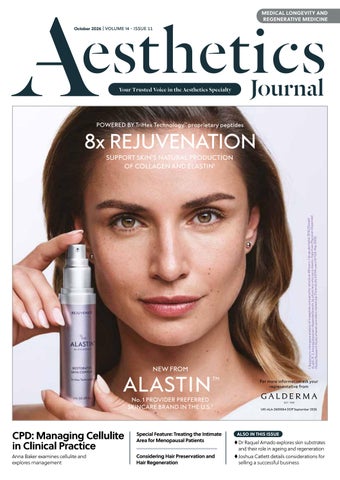
MEDICAL LONGEVITY AND REGENERATIVE MEDICINE October 2026 | VOLUME 14 - ISSUE 11
Your Trusted Voice in the Aesthetics Specialty
POWERED BY TriHex Technology™ proprietary peptides
8x REJUVENATION
1. Based on in-vitro gene analysis of tripeptide compared to vehicle at 48 hours; J drugs dermatol.2016;15(suppl 4):s63-71. 2. Among physician-dispensed brands, by physicians who carry Alastin. Data from Physician Dispensed Market Research Study wherein providers ranked top 3 brands (ALASTIN users N=120; May 2025).
SUPPORT SKIN’S NATURAL PRODUCTION OF COLLAGEN AND ELASTIN1
NEW FROM
For more information ask your representative from
No. 1 PROVIDER PREFERRED SKINCARE BRAND IN THE U.S.2
CPD: Managing Cellulite in Clinical Practice Anna Baker examines cellulite and explores management
Special Feature: Treating the Intimate Area for Menopausal Patients Considering Hair Preservation and Hair Regeneration
UKI-ALA-2600064 DOP September 2026
ALSO IN THIS ISSUE
Dr Raquel Amado explores skin substrates and their role in ageing and regeneration Joshua Catlett details considerations for selling a successful business
REASONS TO CHOOSE BOCOUTURE • Results seen as early as 7 days, lasting
up to 4 months in upper facial lines1 • A well characterised safety profile1 • Convenient – no refrigeration needed
prior to reconstitution1
Scan the QR code to access BOCOUTURE UK and Ireland Prescribing Information
1.BOCOUTURE Summary of Product Characteristics. Merz Pharmaceuticals GmbH: https://www.medicines.org.uk/emc/product/600/smpc (Last accessed January 2026). M-BOC-UK-0591 Date of Preparation: January 2026
Access complimentary training resources
Merz Aesthetics Exchange (MAX) is a promotional website developed and funded by Merz Aesthetics UK & Ireland.
Adverse events should be reported. Reporting forms and information for United Kingdom can be found at https://yellowcard.mhra.gov.uk/. Reporting forms and information for Republic of Ireland can be found at https://www.hpra.ie/homepage/about-us/reportan-issue. Adverse events should also be reported to Merz Aesthetics UK Ltd by emailing UKdrugsafety@merz.com or calling +44 (0) 333 200 4143.
Contents • October 2026 08 News The latest product and specialty news
19 News Special: Concerns Raised Over AI Images Aesthetics explores AI-imagery within aesthetic consultations
CLINICAL PRACTICE 22 Event Preview: Transforming Aesthetic Businesses Save the date for ACE 2027
27 Special Feature: Treating the Intimate Area Practitioners discuss improving the intimate area for menopausal patients
34 CPD: Managing Cellulite in Clinical Practice Anna Baker examines cellulite and explores approaches to its management
40 Exploring Skin Substrates and Dermal Biorestoration
News Special: Concerns Raised Over AI Images in Aesthetic Consultations Page 19
Dr Raquel Amado discusses skin substrates and their role in ageing
43 Identifying Your Protocol for Pigment Dr Tego Kirnon-Jackman on technology for pigment in higher Fitzpatrick phototypes
45 Investigating the Role of Skin Prejuvenation Dr Ariel Haus and Dr Samantha Hills discuss collagen banking through laser
49 Managing Pigmentary Concerns In Post-menopausal Patients Leah Cooke explores regenerative therapies for pigmentation
53 Beyond the Machine What makes CACI Rejuva Med a smart clinic investment
55 Considering Hair Preservation and Hair Regeneration Miriam Martinez Callejas explores the changing approach to hair loss
59 Results In-Clinic. Results After Hours. Elementré is now exclusively available to UK practitioners through Cosmedi
Special Feature: Treating the Intimate Area Page 27
60 Spotlighting This Year’s Standout Innovations Explore the most innovative products launched over the past year
62 Technologies that Build Success Zemits explores connected treatment ecosystems
63 Abstracts The latest research highlights from Professor Sebastian Cotofana
IN PRACTICE 65 Outlining Exit Strategy Considerations Joshua Catlett details considerations for selling a successful business
68 Fostering Sustainable Clinic Growth Cindy Tan outlines profitability and fund management effectively
70 Building a Clinic That Can Thrive Without You Sarah Louise Donaldson explores the owner-operator trap
73 In The Life Of: Dr Tatjana Pavicic Dr Tatjana Pavicic shares a day in her life in her clinic in Munich
74 The Last Word: Is Aspiration Safe or False Reassurance? Sharon Ashley debates whether aspiration remains a valuable safety measure or an unreliable reassurance
NEXT MONTH: MALE AESTHETICS • Polynucleotides • Hair restoration • Profile balancing
Clinical Contributors Anna Baker is an aesthetic nurse, trainer and qualified educator. Baker is on the board of directors for The British Association of Medical Aesthetic Nurses (BAMAN) and is chair of the BAMAN Education & Training Committee. She holds a position on the Joint Cosmetic Council for Practitioners Education & Training Committee. Dr Raquel Amado is an aesthetic doctor and educator, founder and medical director of Dr Raquel Skin & Medical Cosmetics in Kent. Dr Amado has a background in dentistry and Level 7 injectables. Dr Amado is a clinical trainer, faculty member for DermaFocus UK and Evolus and an international speaker. Dr Ariel Haus qualified as a medical doctor in Rio de Janeiro. He established his private dermatology clinic on Harley Street, London, in 2010, was the first in the UK to offer the RedTouch Pro and has been named ‘Top Dermatologist’ five times in the annual Tatler Beauty & Cosmetic Surgery Guide. Dr Sam Hills is clinical director at Lynton Lasers, leading its clinical and training program. An honorary lecturer at the University of Manchester, she is also an RPA 2000 certified Laser Protection Advisor and is on the teaching faculty of the British Medical Laser Association. Leah Cooke is the director of Glowing by Leah in Stroud Gloucestershire, combining clinical nursing expertise with advanced aesthetic practice to deliver safe, personalised treatments. Cooke is a registered nurse and independent prescriber, with eight years’ experience in aesthetics. Miriam Martinez Callejas is chief clinical pharmacist and co-founder of Roseway Labs, with over 20 years’ experience in pharmacy and compounding. She holds a master’s degrees in pharmacy from the University of Alcalá, Spain, and Individualised Medicines from TECH Global University.
Join the Aesthetics Community as an Elite Member to receive the monthly Aesthetics
Become a Member of Aesthetics! Journal, among many other exclusive benefits. Visit aestheticsjournal.com to sign up!
.co.uk
cosmelan®
cosmelan
Discover a range of CE-marked intradermal solutions for facial, body and hair treatments.
Beyond collagen stimulation, their action supports dermal regeneration, extracellular matrix reorganisation, and deep, long-lasting hydration. Formulated to act through a noninflammatory pathway and address the skin’s structural and functional needs. Meet cosmelan®, the professional depigmentation treatment
beyond visible pigmentation
that targets pigmentation at its source. Working at every level, With specific formulas containing vitamins, polynucleotides, it visibly reduces existing pigmentation while helping to regulabiomimetic peptides and biorevitalising ingredients, the line te its reappearance, revealing a more even, radiant complexion. enables a personalised, complementary and synergistic approach designed to enhance the skin’s repair, and vitality. scan tofirmness contact us
Beyond helping pigmentation concerns, cosmelan® helps restoreWorking a with the skin’s biology, because skin quality mesoestetic® have overisn’t 40 years brighter, more youthful-looking complexion addressing two of the one-dimensional, so your treatments shouldn’t be either. expertise in depigmentation. most visible signs of skin ageing: uneven pigmentation and loss of radiance.
the element for skincare experts
Trust the expert method and bring cosmelan® to your clinic.
Editor’s letter Welcome to our latest issue, which lands on Day 1 of the Clinical Cosmetic Regenerative Congress. We hope everyone attending enjoys a productive and inspiring event, and takes away fresh ideas, valuable connections and practical insight to help shape the future of aesthetics. As the conversation around Holly Carver longevity continues to grow, so does the Editor & Content Manager opportunity for clinicians to take a more holistic, evidence-led approach to patient care. This issue explores the treatments, technologies and clinical considerations shaping this rapidly developing area, with a focus on supporting patients through changing needs at every stage of life. Our Special Feature looks at treating the intimate area in menopausal patients, an area that has historically been under-discussed despite its significant impact on comfort, confidence and quality of life. We consider how sensitive, informed consultations and appropriate treatment pathways can help clinicians better support this patient group.
Elsewhere, our clinical content covers substrates, skin prejuvenation and hair regeneration, alongside a focused look at pigmentation in menopause. In our News Special, we examine a growing question within the consultation room; is AI changing the patient journey? With more patients arriving to consultations armed with AI-generated imagery and highly curated visual references, clinicians are navigating fresh conversations around expectations, feasibility, ethics and realistic outcomes. Looking ahead, save the date for the Aesthetics Conference & Exhibition (ACE), an essential opportunity to connect with peers, discover the latest thinking and be part of the conversations shaping our specialty. If you are considering entering The Aesthetics Awards, remember that entries close this month. Do not miss the chance to celebrate your team, your innovation and the work that makes a difference to patients. We hope this issue offers useful clinical perspective, thoughtful discussion and inspiration for the months ahead.
Clinical Advisory Board
Leading figures from the medical aesthetic community have joined the Aesthetics Advisory Board to help steer the direction of our educational, clinical and business content
Sharon Bennett is the former chair of the British Association of Medical Aesthetic Nurses (BAMAN), UK lead of the BSI committee for aesthetic non-surgical standards and member of the Clinical Advisory Group for the JCCP. She is a trainer and a registered university mentor in cosmetic medical practice, and is finishing her MSc at Northumbria University. Bennett has won the Aesthetics Award for Nurse Practitioner of the Year and the Award for Outstanding Achievement.
If you are interested in contributing to the journal, get in touch... Email: editorial@aestheticsjournal.com
Sharon Bennett, Clinical Lead Mr Naveen Cavale has been a consultant plastic, reconstructive and aesthetic surgeon since 2009. He has his own private clinic and hospital, REAL, in London’s Battersea. Mr Cavale is the national secretary for the ISAPS, president of the Royal Society of Medicine, and vice-chair for the British Foundation for International Reconstructive Surgery.
Dr Mayoni Gooneratne (MBBS, BSc, MRCS, MBCAM, AFMCP) was an NHS surgeon before establishing The Clinic by Dr Mayoni and founding Human Health – an initiative combining lifestyle with traditional and functional medicine to provide a ‘cell-up’ regenerative approach to aesthetics. She is also the co-founder of The British College of Functional Medicine.
Dr Sophie Shotter is the founder & medical director of Illuminate Skin Clinic in Kent and Harley Street, London. Her passion is for natural treatments delivered with utmost attention to safety. She works closely with Allergan as part of their UK and International Faculty.
Miss Elizabeth Hawkes is a consultant ophthalmologist and oculoplastic surgeon. She is the lead oculoplastic surgeon at the Cadogan Clinic, specialising in blepharoplasty and advanced facial aesthetics. Miss Hawkes is a full member of the BOPSS and the ESOPRS, and is an examiner and fellow of the Royal College of Ophthalmologists.
Jackie Partridge is an independent nurse prescriber. She is the clinical director and owner of Dermal Clinic in Edinburgh and a KOL for Galderma. She holds an MSc in Non-surgical Aesthetic Practice and a BSc in Dermatology. Partridge is a stakeholder group member with Scottish Government/HIS, Honorary BACN member and JCCP Fitness to Practice Nurse.
Dr Anjali Mahto is one of the UK’s leading consultant dermatologists. She is a Fellow of the Royal College of Physicians, member of the Royal Society of Medicine and a spokesperson for The British Skin Foundation. In 2023 Dr Mahto opened Self London, a dermatology and lifestyle clinic aimed at managing skin conditions holistically.
Mr Adrian Richards is a plastic and cosmetic surgeon with over 30 years’ experience. He is the clinical director of the aesthetic training provider Cosmetic Courses and surgeon at The Private Clinic. He is also a member of the British Association of Plastic and Reconstructive and Aesthetic Surgeons and the British Association of Aesthetic Plastic Surgeons.
Dr Souphi Samizadeh is a dental surgeon with a Master’s degree in Aesthetic Medicine and a PGCert in Clinical Education. She is the founder of the Great British Academy of Medicine and Revivify London Clinic. Dr Samizadeh is a Visiting Teaching Fellow at University College London and King’s College London.
Dr Stefanie Williams is a dermatologist with a special interest in adult acne, rosacea and aesthetic medicine. She is the founder and medical director of multi-award winning EUDELO Dermatology & Skin Wellbeing in London, and creator of Delo Rx skincare. She is the author of three books and has published more than 100 scientific articles, book chapters and abstracts.
ARTICLE PDFs AND REPRO
PUBLISHED BY PORTFOLIO MANAGEMENT Shannon Kilgariff • Publisher & Event Director T: 0203 196 4351 | M: 07557 359 257 shannon.kilgariff@easyfairs.com EDITORIAL Holly Carver • Editor and Content Manager T: 0203 196 4427 holly.carver@easyfairs.com Amer Saleh • Journalist T: 020 3196 4270 amer.saleh@easyfairs.com Mia Sawyer • Journalist T: 020 3196 4242 mia.sawyer@easyfairs.com Sophia-Fai Roche • Journalist T: 0203 196 4391 sophia-fai.roche@easyfairs.com
DESIGN Callum Benyon • Graphic Designer Kitty Butler • Junior Graphic Designer ADVERTISING & SPONSORSHIP Judith Nowell • Head of Sales T: 0203 196 4352 M: 07765 407629 judith.nowell@easyfairs.com Charlotte Norville • Senior Sales Executive T: 020 3196 4418 | charlotte.norville@easyfairs.com MARKETING Susana Burguera • Head of Marketing T: 020 3196 4281 | susana.burguera@easyfairs.com Jodie King • Marketing Executive T: 020 3196 4404 | jodie.king@easyfairs.com
@aestheticsjournaluk
Aesthetics
Aesthetics
Material may not be reproduced in any form without the publisher’s written permission. For PDF file support please email, contact@aestheticsjournal.com
© Copyright 2026 Aesthetics. All rights reserved. Aesthetics is published by Aesthetics Media Ltd, which is registered as a limited company in England; No 9887184
DISCLAIMER: The editor and the publishers do not necessarily agree with the views expressed by contributors and advertisers nor do they accept responsibility for any errors in the transmission of the subject matter in this publication. In all matters the editor’s decision is final.
Insider News
@aestheticsjournaluk
Aesthetics
Aesthetics
aestheticsjournal.com
Regulation
In the Spotlight... A monthly snapshot of the people, products and ideas generating real time buzz in aesthetics
Complications Injectors discuss complications and critical thinking Aesthetic practitioner Dr Alison Colville hosted aesthetic practitioner Dr Lee Walker on her The Applied Aesthetics Podcast. The discussion reframes complications not as something to fear, but as something practitioners should be equipped to anticipate and manage through sound clincial mindset, thorough assessment and a detailed understanding of anatomy. Dr Walker explains, “I use the patient as a barometer to see if something is going wrong. The patient is under constant vigilance of what they’re feeling, and that feedback is given back to me. So, if they’re feeling something which is untoward, then it allows me to stop, reposition, reassess and go again.” Complications discussed on The Applied Aesthetics Podcast
Womens Health Dolly Parton’s legacy within endometriosis awareness In the aftermath of singer and philanthropist Dolly Parton’s passing, aesthetic practitioner Dr Mayoni Gooneratne took to LinkedIn to highlight the impact Parton had on women’s health. Dr Gooneratne explains that, in the 1980s, Parton spoke publicly about her experience with endometriosis, a partial hysterectomy and her depression that followed. Dr Gooneratne notes, “She did this when severe pelvic pain in women was commonly framed as normal. This kind of disclosure from someone at the peak of public visibility does something that clinical guidance cannot; it gives patients the vocabulary to describe what they are experiencing before they reach us.” She notes that new data shows that the average time to diagnosis is now nine years and four months, highlighting just how persistent the diagnostic delay remains. Women’s health discussed in mainstream media
Treatment Trends Dr Jordan Faulkner defends dermal fillers amid ‘holistic’ aesthetics shift Aesthetic practitioner Dr Faulkner has taken to social media to challenge what he sees as a growing shift away from dermal fillers within holistic aesthetics. He says, “I don’t think you can call an approach ‘holistic’ if you’re only treating skin. Holistic means looking at the face in 360 degrees, and sometimes that means treating skin quality, sometimes laxity and sometimes volume loss.” Dr Faulkner argues that positioning treatments as ‘holistic’ to avoid facial revolumisation can be misleading, maintaining that effective facial rejuvenation should address all layers of the face, including the skin, deeper tissue, bone and fat. Dr Jordan Faulkner outlines importance of dermal filler
8
MPs hear warnings on cosmetic procedures MPs on the Women and Equalities Committee (WEC) heard evidence on the risks associated with non-surgical cosmetic procedures and cosmetic surgery at the Palace of Westminster. Ashton Collins, director of Save Face, and Ms Nora Nugent, plastic surgeon and president of the British Association of Aesthetic Plastic Surgeons (BAAPS), told the committee that government action to address unsafe cosmetic procedures had been too slow. Collins and Ms Nugent said the consultation had raised awareness of the risks but had not resulted in enough practical action, while further consultations could delay regulation. They also warned that high-risk procedures continue to be carried out by unqualified or unregulated practitioners in settings such as homes and beauty salons. The committee also heard concerns about the regulatory framework for cosmetic practitioners. Qualified surgeons are subject to requirements including professional registration, indemnity insurance, appraisal and revalidation, while non-medics without equivalent qualifications can use titles such as cosmetic surgeon. Ms Nugent told Aesthetics, “We urgently need meaningful regulatory action that puts patient safety first, establishes clear standards for those providing aesthetic procedures, and ensures there are meaningful consequences for individuals who operate outside the regulatory framework.” Pharmacist Guidelines
RCPharm tightens aesthetic guidance The Royal College of Pharmacy (RCPharm) has published expectations for the clinical experience and competence required of pharmacists working in aesthetics. According to the college, the review was undertaken in response to the act regulating non-surgical cosmetic procedures in Scotland, the UK Government consultation response to the licensing of non-surgical cosmetic procedures in England and an increasing number of enquiries regarding aesthetic practice. RCPharm says that practitioners are expected to maintain verified competencies in recognising and managing complications, including clinical emergencies such as vascular occlusion, with appropriate escalation pathways in place. Additionally, it states pharmacists should not provide non-surgical cosmetic procedures to individuals under-18s and should ensure treatments are delivered in appropriate clinical-standard premises, supported by robust record-keeping, verified product sourcing and indemnity cover. Ongoing learning and aesthetic competency assessments should also be documented within pharmacists’ annual General Pharmaceutical Council revalidation portfolios to demonstrate continued competence, shares RCPharm. Tase Oputu, RCPharm president, commented, “This updated statement reinforces the importance of putting safety at the heart of aesthetic practice. Pharmacists need to have the experience and professional judgement to put the individual first, recognise when a treatment may not be appropriate and make sure the individual is properly supported if things don’t go as planned.”
Aesthetics | October 2026
@aestheticsjournaluk
Aesthetics
Insider News
aestheticsjournal.com
Aesthetics
Awards Deadline
Vital Statistics
Call for entries to The Aesthetics Awards
46% of 1,000 UK adults believe practitioners offering non-surgical cosmetic treatments are legally regulated
The early-bird deadline for The Aesthetics Awards 2027 has passed, but there is still time for practitioners, clinics, brands and suppliers to enter. Entries are open until October 21. This is the last opportunity to be considered for recognition at the event which celebrates excellence across clinical practice, product innovation and initiatives advancing standards, safety and regulation within the specialty. Last year’s Awards received more than 450 entries and welcomed 850 guests to the ceremony, reflecting the scale, innovation and dedication found across medical aesthetics. For Finalists and Winners, the Awards offer an opportunity to raise their profile among peers, patients and specialty partners while recognising the teams and work behind their success.
(Professional Standards Authority, 2026)
Collagen is one of the UK’s most searched-for supplements, generating around 1.3 million UK searches in August (Google Trends, 2026)
Shannon Kilgariff, publisher and event director at Aesthetics, said, “The Aesthetics Awards is an opportunity to celebrate the work that makes a genuine difference to patients, colleagues and the wider specialty. Entering gives clinics, practitioners and brands the chance to showcase their achievements, recognise their teams and gain valuable visibility among the field’s leading professionals. With the final entry deadline approaching, we encourage everyone with a story of excellence, innovation or progress to put it forward.”
Out of 2,100 UK adults, 8% say they first turn to AI tools such as ChatGPT, Gemini and Claude for health information, advice or guidance (YouGov, 2026)
Advertising
JCCP issues guidance to maintain compliant advertising The Joint Council for Cosmetic Practitioners (JCCP) has released guidance intended to help registrants achieve and maintain compliance when advertising non-surgical cosmetic procedures. The guidance follows observations by the Professional Standards Authority (PSA) and the JCCP that some practitioner websites and social-media content may not meet current requirements. Concern has been raised around advertising prescription-only medicines (POMs) to members of the public in relation to non-surgical cosmetic interventions. Under the Human Medicines Regulations 2012, the promotion of POMs to the public is restricted.
A study of 2,000 UK adults revealed only 12% would ask about a practitioner’s training before having a cosmetic treatment (Laser Clinics UK, 2026)
NHS adult weightmanagement waiting lists have reached 5,930 open referrals, with 33.4% of patients waiting more than a year, up from 6.5% three years ago
The JCCP said it would take a proportionate and risk-based approach to enforcement but warned that continued non-compliance could affect a practitioner’s registration. It also reserves the right to refer promotional activity to relevant regulators, including the ASA and Medicines and Healthcare products Regulatory Agency (MHRA). Part A registrants – including regulated healthcare professionals such as doctors, dentists, nurses, prescribing pharmacists – remain accountable for their advertising decisions and are advised to seek guidance from CAP or the MHRA where there is uncertainty. The JCCP does not currently accredit Part B registrants, professionally unregulated practitioners, to perform injectable procedures involving POMs. However, it said practitioners undertaking such treatments outside their accreditation should still comply with relevant regulation and seek advice from the responsible prescriber.
(Rare, 2026)
C-section births have risen steadily in England, with 45% of births last year delivered by caesarean section (NHS, 2026)
Visit the JCCP at Stand D82 during CCR on October 1-2. Aesthetics | October 2026
9
Insider News
@aestheticsjournaluk
Events diary 7th November 2026 RAMCE 14th November 2026 IAAFA Aesthetics Conference 21st November 2026 Interface Expo 21st-22nd November 2026 The Anatomy & Injection Experience, BAMAN 12th-13th March 2027 Aesthetics Conference & Exhibition (ACE) 13th March 2027 The Aesthetics Awards
Aesthetics
Aesthetics
aestheticsjournal.com
Immunology Research
Medical research centre targets cures for inflammatory diseases A new £50 million Medical Research Council (MRC) Centre for Research Excellence in Restorative Immunology, has launched to advance research towards cures for immune-mediated diseases. The centre, led by the University of Birmingham, will investigate conditions including inflammatory arthritis, inflammatory bowel disease, autoimmune liver disease and Sjögren’s disease, which are estimated to affect more than four million people in the UK. The initiative brings together experts from eight universities, alongside charities, public engagement organisations and sector partners. Researchers will focus on understanding how healthy tissues are maintained, why inflammation persists in some patients and how new therapies could restore immune and tissue health. Dr Ceri Williams, executive director of Challenge Led Portfolio at MRC, said, “By bringing together expertise from across disciplines, sectors and countries to tackle these fundamental questions, this centre has the potential to transform our understanding of inflammatory disease and accelerate the development of treatments that deliver lasting benefits for patients.”
Personal Imports
Prescription-only Medicines
Australian Government updates packaging rules
ASA upholds ruling against weight-loss advert
The Australian Government has introduced changes to its Personal Importation Scheme to improve the identification of imported therapeutic goods and reduce the risk of unidentified, mislabelled or counterfeit products entering the country.
The Advertising Standards Authority (ASA) has upheld complaints about a paid-for Reddit advertisement for SheMed, a medical weight-loss service aimed at women.
According to the Therapeutic Goods Administration (TGA), the scheme permits individuals to import certain therapeutic goods that are not included in the Australian Register of Therapeutic Goods (ARTG), subject to specified conditions. Under the updated requirements, medicines imported through the scheme should, where possible, remain in their original packaging. The changes also clarify the scope of therapeutic goods covered by the scheme, including products imported for therapeutic purposes such as contraceptives and testing kits, shares the TGA. Aesthetics reached out to the TGA, and a spokesperson commented, “The Personal Importation Scheme allows consumers to import certain therapeutic goods for personal use, subject to legislative requirements, but not for sale or supply to others.”
The advert referred to feeling “skinny fat” and promoted SheMed’s doctor-led programme through links directing users to a landing page featuring branded Wegovy and Mounjaro injection pens. The ASA ruled that the advert breached advertising rules by promoting prescription-only medicines (POMs) to the public. It said social media landing pages should be treated in a similar way to website homepages, which must not refer to named POMs. The regulator also found the advert socially irresponsible. It states that the messaging could appeal to consumers of a healthy weight who were dissatisfied with their body shape, despite the licensed indications for the medicines being restricted to adults with obesity, or those who are overweight with a related health condition. SheMed removed the advert and said it would not run it again. SheMed was contacted for comment, but no response was received before publication.
Structural Update
JCCP announces new chair and registrar The Joint Council for Cosmetic Practitioners (JCCP) has appointed Lloyd Bracey as its new chair, and Andrew Rankin as registrar. According to the JCCP, Bracey (pictured) is a former television news journalist and senior advisor to several global pharmaceutical companies. The JCCP shares that, as chair, Bracey will provide strategic leadership, independent oversight and strong governance, leading engagement with regulators, practitioners, stakeholders and the public. Alongside Bracey’s appointment, Rankin has been appointed registrar, will provide specialist oversight of the organisation’s professional and regulatory functions, shares the JCCP. The organisation adds that Rankin will continue to oversee the Practitioner Register Committee and Clinical Advisory Group and engage with regulators and other stakeholders. Bracey commented, “From journalism, I bring the habit of unpicking complex information to make it accessible; from pharma comms, the non-negotiable principle that patient safety must come first. With the vast experience of the JCCP’s existing members behind me, my aim in combining these approaches is to strengthen our voice and advance public protection in the years ahead.” Visit the JCCP at Stand D82 during CCR on October 1-2. 10
Aesthetics | October 2026
@aestheticsjournaluk
Aesthetics
aestheticsjournal.com
Aesthetics
Insider News
Aesthetics Community
CCR 2026 opens its doors The Clinical Cosmetic Regenerative Congress (CCR) on October 1-2, Headline Sponsored by Galderma, has given the aesthetics community plenty of reasons to come together. Aesthetic manufacturer Teoxane joins the Innovation Forum for the Injectable Experience with Dr Tahera Bhojani-Lynch using Teoxane RHA. Dr Raul Cetto will join the Aesthetics Challenge as an injector, administering Teosyal. Laser device company Seriderm supports the programme as Innovation Theatre Sponsor. On the Aesthetics Spotlight Stage, sponsored by Hawksley and Sons, dental professionals working in aesthetics will be able to hear from specialists and share practical perspectives with peers. The Medical Longevity Summit also welcomes The Power In Your Hands and Inside Out Biotech, as Sponsors within the theatre. CCR has also created space for the connections that matter beyond the conference sessions. MS Pharma Group sponsors Networking Drinks at the Galderma Networking Lounge taking place on Day 1 at 5-7pm. The Meet the Distributor Programme brings attendees face-to-face with biotechnology company BNV Biolab, wellbeing network GC Wellbeing, injectable companies Libera and Pavist and specialist regenerative company Renaissance SRL. For invited guests, the Dermapenworld-sponsored VIP Lounge offers a luxurious place to take a break, catch up with colleagues and make new connections.
BAMAN UPDATES A round-up of the latest news and events from the British Association of Medical Aesthetic Nurses
BAMAN AUTUMN AESTHETIC CONFERENCE 2026 On September 24-25, the BAMAN Autumn Aesthetic Conference returned to The Eastside Rooms in Birmingham, with more than 260 delegates joining us for our biggest conference to date. And this year, it really was a BAMAN takeover. For the first time, we had the entire venue and hotel reserved, filling it with medical aesthetic nurses from across the UK for two jam-packed days. The programme featured 33 speakers covering everything from clinical practice and patient safety to business, education and regulation. An impressive 19 of our speakers were nurses, keeping nursing knowledge and experience right at the heart of the conference. Plenty was happening away from the stage too, with built-in wellness sessions, our annual general meeting, a branded scrubs shop, DJ and more than 40 exhibiting brands and suppliers.
Updated Formula
ALASTIN releases peptide complex Skincare company ALASTIN from pharmaceutical company Galderma has reintroduced its Restorative Skin Complex with an updated formula. The company shares that the new formulation includes TriHex+ Technology, which is enhanced with Octapeptide-45 and aims to increase tropelastin, hyaluronic acid (HA) and laminin protein production. Furthermore, the formula features magnolia bark extract, alongside L-Ornithine and Hexapeptide-38, according to ALASTIN. Paddy Murphy, head of ALASTIN UK&I, commented, “Many patients are looking for solutions to skin changes driven by rapid weight loss, menopause and general skin quality concerns. We’ve added Octapeptide-45 to stimulate elastin and HA production, and magnolol to support the skin’s natural plumping, alongside ALASTIN’s existing regenerative properties.” Visit Galderma at Stand F70 during CCR on October 1-2. Certification
Nordberg Medical receives two regulatory approvals Biotechnology company Nordberg Medical has achieved certification under the European Union’s Medical Device Regulation (MDR) and the Medical Device Single Audit Program (MDSAP). The MDR certification confirms that skin booster JULÄINE complies with the EU’s regulatory requirements for medical devices. MDSAP certification, meanwhile, confirms that Nordberg Medical’s quality management system meets regulatory requirements across participating markets, including the US, Canada, Australia, Brazil and Japan.
The evening of September 24 saw our second annual BAMAN Awards and Gala Dinner, held alongside the conference for the first time. It was a fantastic evening, celebrating the nurses and other individuals doing brilliant things across our profession and community. A huge congratulations to all our Winners and Finalists.
COMING UP NEXT It’s now all eyes on The Anatomy & Injection Experience by Cotofana Anatomy, arriving in Edinburgh on November 21-22. This is a first for the UK, brought here by BAMAN, and a rare opportunity to learn directly from Professor Sebastian Cotofana. Day 1 combines live injectable treatments with Professor Cotofana’s live cadaveric dissection, allowing delegates to see the anatomy behind treatment in real time. Those attending both days will then move into the anatomy laboratory for hands-on dissection in small groups with a 5:1 delegate ratio. You can hear Professor Cotofana explain the experience himself and discover all the details in our latest webinar. Watch on the official event page via the QR code below.
This column is written and supported by BAMAN
Sílvia Alexandra Fernandes, chief regulatory affairs officer at Nordberg Medical, says, “These certifications provide an important foundation for the continued international development of JULÄINE. As we expand into new markets, maintaining these standards will remain central to how we grow.” Aesthetics | October 2026
11
Insider News
@aestheticsjournaluk
Aesthetics
Aesthetics
aestheticsjournal.com
Artificial Intelligence
Research considers AI skin cancer detection
13 March 2027, Grosvenor House, London
Event Spotlight: Last Chance to Enter The Aesthetics Awards Dr Alison Colville, last year’s Winner of The DermaFocus Award For Best Injectable Result, provides her advice for writing a winning Awards entry
A recent study shows artificial intelligence (AI) skin cancer detection tools are valued more highly when supported by a teledermatologist. Researchers conducted a survey-based mixed-methods study embedded within a randomised controlled trial in the Netherlands. Between August 2022 and February 2023, 11,621 individuals were invited, with 1,953 completing the questionnaire. Participants had a mean age of 58.4 years; 57.6% were female and 95.4% reported a light skin type. Almost half had a high educational level, and 79.4% had previously used an AI-based app. The study assessed willingness to pay for three hypothetical approaches to skin cancer risk detection; an AI-based app alone, an AI app with teledermatologist involvement and an in-person dermatologist consultation. Median willingness to pay was €5 for AI alone, €20 for AI combined with teledermatology and €50 for an in-person dermatologist consultation. Age was the only characteristic positively associated with willingness to pay across all three scenarios. Physical dermatologist consultations remained the most highly valued option.
How can you make your entry stand out? The first thing I would say is give the judges something to remember you for. Be specific rather than relying on broad statements such as ‘we provide excellent patient care’ or ‘we go above and beyond’ as most entrants will be able to say the same thing. Instead, demonstrate what that actually looks like in practice. I also think the strongest entries tell a story which makes it easy for the judges to understand where you started, what you set out to achieve, what challenges you encountered and what the outcome was.
Qualitative findings suggested lower willingness to pay stemmed from limited trust in AI, perceived lack of value or expectations of free healthcare. Patient Recovery
Alma supports burn survivors Aesthetic device company Alma UK has collaborated with the Katie Piper Foundation to support burn survivors through advanced scar treatment.
What is your advice to people who don’t think they have a chance at winning?
The partnership involves The Katie Piper Foundation, aesthetic practitioner Dr Tino Solomon at Dr Medispa and Alma UK in providing burn survivors with access to scar treatments, including for patients living with the long-term effects of burns and other life-changing injuries.
Enter anyway! You can look at the other names in a category, compare yourself to people who have been in the field longer or have a much bigger profile, and convince yourself that you don’t stand a chance. But you have absolutely no idea what the judges are going to connect with or what they will see in your entry.
Visit Alma at Stand E30 during CCR on October 1-2.
I also think we sometimes forget that being shortlisted is a huge achievement in itself. To have an independent panel of judges look at your work and decide that it deserves to sit amongst some of the best in the field is something worth celebrating. Why should people attend the Awards, even if they don’t enter? There is a reason The Aesthetics Awards are known as the ‘Oscars of Aesthetics’! Ultimately, we spend so much of our working lives focused on patients, clinics, businesses, targets and what we need to achieve next. The Awards are one of those rare opportunities to stop, celebrate what we’ve achieved and enjoy being part of this specialty.
Scan the QR code to enter.
Adam Bashier, general manager of Alma UK, commented, “At Alma, we’ve always believed our technology has the power to change lives. Our partnership with The Katie Piper Foundation allows us to do exactly that. We hope this is just the beginning of helping more survivors regain not only healthier skin, but greater confidence and quality of life.”
Portfolio Expansion
FDA approves HA filler range Pharmaceutical company Merz Aesthetics has announced US Food and Drug Administration (FDA) approval for Belotero Volume and Belotero Intense. Merz Aesthetics says Belotero Volume incorporates its proprietary dual cross-linking technology, enabling treatment to be tailored to variations in patients’ skin tissue. The company reports that, out of 152 patients treated with Belotero Volume, 95% were satisfied with their results at 12 weeks. Belotero Intense was developed for subtle lip enhancement while maintaining natural movement and expression, according to Merz Aesthetics. The company reports 100% patient satisfaction out of 165 participants, with volume maintained for up to 12 months following treatment. Dr Samantha Kerr, chief scientific officer at Merz Aesthetics, commented, “With these two products now available alongside Belotero Balance, providers have a unified portfolio they can confidently use across the full spectrum of aesthetic goals.” Visit Merz Aesthetics, part of the Injectable Experience during CCR on October 1-2.
12
Aesthetics | October 2026
@aestheticsjournaluk
Aesthetics
aestheticsjournal.com
Aesthetics
Injectable Insights
Galderma releases data on temple hollowing treatment Pharmaceutical company Galderma has highlighted top-line results from a randomised study evaluating its hyaluronic acid filler, Restylane Volyme, for moderate-to-severe temple hollowing.
Insider News
60
AlwaysSmile Medical Healthcare
The study, involving 162 Chinese patients, found that at six months, 94.4% of treated patients achieved at least a one-grade improvement in both temples, compared with 2% in the untreated group. Treating investigators reported that 91.3% of participants continued to show improvement in both temples at 12 months. More than 84% of patients remained satisfied with the natural look and feel of their temples through month 12. The treatment was generally well tolerated, with no treatment-related serious adverse events or granulomas reported, notes the company. Galderma shares that the findings add to the clinical evidence for Restylane Volyme in temple hollowing and may inform future development of its injectable portfolio in China. Bill Andriopoulos, head of global medical affairs at Galderma, said, “These findings underscore Galderma’s focus on generating evidence that addresses growing patient concerns, including temple hollowing associated in part with the rise in medication-driven weight loss. By demonstrating Restylane Volyme’s effectiveness in this indication in Chinese patients, these data also support the expansion of Restylane in a rapidly growing aesthetics market.” Visit Galderma at Stand F70 during CCR on October 1-2. Treatment
SkinHealth Systems unveils microneedling system
Medical aesthetics company SkinHealth Systems, developer of treatment Hydrafacial, has launched microneedling and nano-needling system SkinStylus. According to SkinHealth Systems, the device combines a high-speed motor with adjustable depth settings, and three dedicated, single-use cartridge options. This format aims to support both microneedling and nano-needling, providing practitioners with the ability to tailor treatments across different concerns. According to the company, SkinStylus is available with three cartridge options to accommodate different treatment areas and applications. The 12-pin cartridge is intended for focused treatment of smaller or targeted areas, while the 36-pin cartridge is designed for broader treatment areas requiring greater coverage. The 57-pin nano cartridge provides a needle-free nano-needling option for treatment of the epidermis. The company adds that SkinStylus will be integrating into existing Hydrafacial provider practices, supported by Hydrafacial CONNECT training and consistent education. Tanja Wirz, senior vice president of international sales at SkinHealth Systems, commented, “At Hydrafacial, we always have the modern aesthetic practice in mind, which informed the design of SkinStylus. Ultimately, SkinStylus gives practices the flexibility to do more, while making their investment work harder for their business.”
What makes AlwaysSmile Medical’s approach to hyperbaric oxygen therapy different? AlwaysSmile Medical goes beyond simply supplying a hyperbaric chamber. We bring together clinical, technical and design expertise – from system selection and installation to staff training and safety protocols – to create complete hyperbaric environments tailored to clinical, longevity and wellness settings. Can AlwaysSmile Medical support clinics that already have a hyperbaric chamber? Yes. Our consultancy isn’t limited to new installations. We assess existing hyperbaric facilities – chamber and system configuration, site infrastructure, safety arrangements, operational procedures, staff readiness and maintenance – then provide practical recommendations to close any gaps. How do you see HBOT developing within longevity and wellness? HBOT already has established medical applications, and growing research is exploring its relevance to regenerative medicine and healthy ageing – tissue regeneration, microvascular function, cellular ageing, cognition and physical recovery. As interest grows, it’s important to distinguish established clinical evidence from emerging research, and to ensure HBOT is implemented with the right clinical, technical and safety oversight. Meet AlwaysSmile Medical at CCR 2026. Join us at Stand J46, ExceL London, October 1–2 to discover our hyperbaric chamber solutions and meet our team. We’ll be available throughout the event to discuss our systems, technical specifications and how we support organisations from chamber selection and installation through to training and ongoing technical support. We look forward to welcoming you at Stand J46. This advertorial was written and supplied by AlwaysSmile Medical Healthcare
Visit Hydrafacial at Stand H60 during CCR on October 1-2. Aesthetics | October 2026
13
Insider News
@aestheticsjournaluk
Retinol Formulations
Aesthetics
aestheticsjournal.com
Clinic Data
Aesthetics attends ZO Skin Health retinol unveiling Skincare company ZO Skin Health held its Innovation Tour at W London on September 14, and showcased its new retinol portfolio. Training manager at ZO Skin Health Melissa Lee introduced the new portfolio, sharing that the collection comprises three 0.3% retinol formulations: Wrinkle + Texture for antiageing, Retinol Skin Brightener for brightening and Clear Renewal for blemish-prone skin. All three feature ZO-RDS, an advanced liposomal delivery system designed to release retinol with targeted, controlled precision, aiming to minimise redness, burning and stinging while delivering visible results. General manager UK&I Brett Vye announced the establishment of its new EMEA headquarters in Barcelona, Spain, alongside the launch of a warehouse model in the Netherlands. Other speakers included aesthetic practitioners Dr Sabika Karim and Dr Anna Hemming alongside Nicola Bell, national sales director at ZO Skin Health. Vye commented, “Bringing the ZO Skin Health Innovation Tour to Dublin, London and Manchester has been a brilliant opportunity to engage with our community of aesthetic practitioners, nurse prescribers and aestheticians – who are at the heart of all that we do. These events are about more than showcasing what’s next, they’re about showcasing the science behind innovation, sharing clinical expertise and empowering our community with the knowledge and tools to continue delivering exceptional skin health outcomes.”
Aesthetic Nurse Software debuts new analytic tool Clinic management software company Aesthetic Nurse Software (ANS) has launched a new analytics tool called Reports. The company shares that the launch addresses the challenge of turning clinic data into meaningful business insights. According to ANS, Reports addresses this by automatically bringing key business data together in one dashboard. ANS adds that through Reports, users can explore performance over time, understand what is driving revenue, assess treatment and practitioner performance, as well as identify trends and opportunities across their clinic. Max Hayward, co-founder of ANS, commented, “The goal with Reports was never to create another complicated analytics tool. There is already enough complexity involved in running a clinic. We wanted to create something that gives practitioners the information they need without making them feel like they need to become data analysts. Good business decisions start with understanding what’s happening in your clinic. Reports give practitioners that visibility from within the system they already use to manage their day-to-day business.” Overseas Event
Merz Aesthetics hosts EMEA conference Pharmaceutical company Merz Aesthetics invited practitioners to Palma de Mallorca, Spain, for a three-day inter-company conference on September 8-11.
Visit ZO Skin Health at Stand E40 during CCR on October 1-2. Pigmentation Management
Revision Skincare releases two products Skincare company Revision Skincare has launched its Advanced Pigment Corrector and Tone+ Correcting Pads. Available through aesthetic distributor AestheticSource, the two products are designed to work as complementary solutions within pigmentation management. Advanced Pigment Corrector+ is described by Revision Skincare as a comprehensive approach to discolouration, powered by its patent-pending Exosomal Signaling Technology and a formula containing more than 30 active ingredients. Tone+ Correcting Pads combine brightening and exfoliating actives, including Tranexamoyl Dipeptide-23 and Kojic Acid, with soothing and microbiome-supporting ingredients, according to the company. AestheticSource CEO Lorna Bowes commented, “Together, these two products provide our professional partners with two highly complementary solutions that can be incorporated into a comprehensive approach to pigment management, supporting visible results while helping patients maintain healthier, clearer and more even-looking skin over time.” 14
Aesthetics
Merz Aesthetics shares that the conference brought together more than 500 colleagues from across Europe, the Middle East and Africa (EMEA). Marking the first time in several years that representatives from every EMEA market had gathered in one location, the event provided an opportunity to strengthen collaboration, share best practices and align on the company’s vision for the future, explains Merz Aesthetics. Centred around the theme ‘One EMEA, One Ambition,’ the programme focused on translating global and EMEA strategic priorities into operational success. Key themes included research, development and innovation, meeting evolving customer needs and strengthening long-term partnerships, supporting Merz Aesthetics’ ambition to be the ‘most preferred partner’ in the aesthetics field, according to the company. Key speakers included Bob Rhatigan, global chief executive officer of Merz Aesthetics, alongside members of the Merz Aesthetics EMEA leadership team. Sophie Charretour, country manager UK&I, commented, “The EMEA Conference highlighted the strength of our people and the power of collaboration across borders. As we continue to grow our UK&I business, these connections and shared learnings will help us create greater value for our customers, while continuing to advance medical aesthetics.” Visit Merz Aesthetics, part of the Injectable Experience during CCR on October 1-2.
Aesthetics | October 2026
@aestheticsjournaluk
Aesthetics
aestheticsjournal.com
Aesthetics
Skincare
Insider News
Blemish-prone Skin
The Skin Diary releases vitamin C complex
Obagi Medical introduces multi-acid pads Skincare company Obagi Medical has launched its CLENZIDERM M.D. Resurfacing Multi-Acid Peel Pads, available through aesthetic distributor Healthxchange.
Skincare company The Skin Diary has launched vitamin C formulation Pro-Helix C. The company shares that the patent-pending vitamin C complex combines a stabilised 15% THDA vitamin C system, 1% acetyl zingerone and 5% collagen peptide complex. The ingredients aim to target multiple pathways associated with visible skin ageing – including oxidative stress, collagen decline, extracellular matrix deterioration and chronic inflammatory signalling, according to The Skin Diary. Additionally, the company notes that the formulation significantly increased fibrillin deposition in human skin, aiming to create an optimised environment for healthy collagen synthesis. Dr Clare Kiely, consultant dermatologist and co-founder of The Skin Diary, commented, “We started with the biology of ageing skin; mapping the pathways that drive structural decline, then selecting a highly stable, well-researched form of vitamin C and pairing it with complementary actives designed to work across those same pathways. Pro-Helix C is the result – a next-generation, biology-led approach to vitamin C, designed around the complexity of ageing skin itself.” Scientific Education
RSM Aesthetics XIV Annual Congress returns The Royal Society of Medicine (RSM) welcomed practitioners to the RSM Aesthetics XIV Annual Congress on September 4. This year’s congress placed health, wellbeing and accurate diagnosis at the centre of medical aesthetics, emphasising their importance before any aesthetic treatment is considered. Several sessions focused on conditions that must be recognised and appropriately diagnosed before aesthetic procedures, including rosacea, facial palsy, periorbital disease, endocrine and metabolic disorders and the biology of ageing. The programme also explored complications, adverse events, informed consent and communication. Among the speakers was aesthetic practitioner Dr Souphi Samizadeh, Dr Farhad Naini, who delivered the keynote lecture, and Mr Christopher Rowland-Payne – to name a few. Dr Samizadeh, congress president of the Section of Aesthetic Medicine and Surgery at the RSM, commented, “We brought surgical and non-surgical experts from the UK and abroad into the same room for a whole day, chairing together and answering questions together, so that delegates could immerse themselves in every perspective rather than only their own. I also wanted to say clearly that health, wellbeing and correct diagnosis are integral to medical aesthetics, not something separate from it.”
Designed for normal-to-oily and combination skin, the pads target blemishes, discoloration, uneven tone and texture. The formula combines glycolic (4%), phytic (3%), salicylic (2%) and mandelic (1%) acids to resurface the skin, refine pores and improve the appearance of fine lines and discoloration. According to the company. Obagi Medical share that the dual-sided lyocell textured pads offer customisable exfoliation, while niacinamide aims to reduce visible redness and support the skin barrier. The product is recommended for evening use two to three times weekly, or as tolerated, following cleansing. Simone Shoffman, clinical and educational director at Healthxchange, commented, “The combination of four complementary acids provides a targeted approach to exfoliation, addressing multiple pathways associated with blemish-prone skin, while the clinical data demonstrates measurable improvements in texture, breakouts, brightness and pore appearance. It’s an exciting development for practitioners looking to support more comprehensive at-home skin management.” Visit Healthxchange at Stand F30 during CCR on October 1-2. Clinical Discussions
Seriderm UK hosts practitioner educational event Laser device company Seriderm UK held its Seriderm360 event at the Manchester Hall Rooftop Terrace. Bringing together clinics and practitioners from across the Midlands, North and Scotland, the programme focused on education and discussion around aesthetic laser technology. Speakers shared clinical perspectives, including aesthetic practitioners Dr Cormac Convery on DermaV, Dr Yusra Ahmed on treating skin of colour using LaseMD Ultra, Professor Jonny Herron on eCO2 and surgical scarring and Dr Magdalena Bejma on skin-tightening treatment XERF. In addition, TV presenter Jenny Powell hosted the event and led audience conversations throughout the day. Jo Harlick, senior business manager north for Seriderm UK, commented, “Hosted by Powell, the event featured specialty-leading speakers, showcased the full Seriderm portfolio and introduced XERF, our latest radiofrequency technology, with phenomenal research, insights and results. We’re already looking forward to bringing Seriderm 360 back next year!” Visit Seriderm at Stand D30 during CCR on October 1-2.
Aesthetics | October 2026
15
Insider News
@aestheticsjournaluk
Aesthetics
Aesthetics
aestheticsjournal.com
Aesthetic Devices
Latest Appointments Aesthetics rounds up the latest company appointments announced within the aesthetics community Pharmaceutical company Galderma has announced the appointment of Juan Rodrigo Betancur as general manager for UK and Ireland. Betancur commented, “I’m delighted to be joining Galderma UK and Ireland at such an exciting time for aesthetics. Patient expectations are evolving towards more natural, personalised and holistic approaches to ageing and skin quality. Galderma is uniquely positioned to shape this evolution through a comprehensive portfolio grounded in science and innovation. My ambition is to grow the category and strengthen Galderma’s role as a trusted partner to healthcare professionals and patients, with science, education and innovation at the heart of what we do.” Laser manufacturer Candela Medical has appointed Victoria Worship as assistant vice president for UK, Ireland and Iberia. The company shares that in her new role, Worship will oversee sales operations and lead the regional sales team. She will be responsible for supporting the continued growth of the business, strengthening customer relationships and ensuring the company continues to deliver high levels of service and support across its markets, according to the company. Skincare company ALASTIN, part of pharmaceutical company Galderma, has appointed Paddy Murphy as the head of ALASTIN for Great Britain and Ireland. Murphy joins from pharmaceutical company Allergan Aesthetics, an AbbVie company, where he spent eight years. In his new role, he will lead the ALASTIN team in expanding access to the brand’s skincare products for healthcare practitioners and consumers across Great Britain and Ireland. Laboratories VIVACY has announced the promotion of Katie Hughes-Dawkins to general manager of UK and Ireland. Hughes-Dawkins joined VIVACY UK and Ireland as national sales director in March and, according to VIVACY, has since played a central role in shaping the company’s commercial strategy, strengthening its team and developing the positioning of its growing portfolio across both traditional and regenerative aesthetics. As general manager, she will take responsibility for the overall UK and Ireland business, leading its commercial, marketing, education and operational strategy. Aesthetic digital marketing agency Bolts by Zeus has welcomed Jo Neal, formerly of Sinclair, Galderma and Revance, as commercial director. In her new role, Neal will lead commercial growth across the UK and Ireland, building on Bolts by Zeus’s strong momentum in the US, EU and UAE during 2026. In addition, Avi Nair, also formerly part of Sinclair’s global digital marketing team, has been promoted to chief digital officer. Laser and energy-based device company Fotona has announced the creation of a new chief product officer role, naming Alasdair Owen to the position. The company shares that Owen will shape its portfolio strategy, strengthen research and development capabilities, and advance solutions across aesthetics, dermatology, dentistry, women’s health and surgery. Working across the organisation and in close collaboration with practitioners, Owen will identify emerging clinical needs and guide the advancement of future product platforms that support practitioners, enhance performance, and improve patient outcomes globally, Fotona shares.
16
BTL Aesthetics debuts new laser division Aesthetic device company BTL Aesthetics has established a dedicated division focused specifically on laser technologies. According to the company, the new division marks a new strategic category for the business, with advanced dual-wavelength laser platform EXOLASE ONE as the flagship system within the division, initially focused on medical aesthetics and dermatology. BTL Aesthetics shares that the EXOLASE ONE will officially launch in the UK in early 2027. Tomas Schwarz, chief operating officer of BTL Group of Companies, added, “This is a historic moment for BTL Aesthetics. From the beginning, we knew that only a genuinely disruptive technology would allow us to build a true laser powerhouse. Based on feedback from pioneering clinical centres worldwide, EXOLASE ONE represents exactly this kind of breakthrough.” Visit BTL Aesthetics at Stand H50 during CCR on October 1-2. Product Launch
Cellcosmet launches Ultra Sensitive Swiss skincare range Cellcosmet has released a barrier protecting cream designed to repair dry skin. Its formula contains CytoPep extracts – hydrolysed collagen, fibronectin, actin and keratin – alongside ceramides, cholesterol and phytosphingosine, which the company says help reinforce the skin barrier. Dr Jérémie Soeur, chief of science at Cellcosmet, commented, “When skin undergoes a non-invasive aesthetic procedure, its priority is not antiageing performance but the restoration of its biological integrity. Based on our instrumental and dermatological studies, as well as real-life use in medical practices, Ultra Sensitive has demonstrated particularly significant results; rapid reduction of redness, measurable hydration increase and a lasting decrease in transepidermal water loss – a key indicator of barrier cohesion.” Radiofrequency Treatment
CACI debuts temperature control technology Skincare solution company CACI has introduced ThermaSense for Rejuva Med’s multipolar radiofrequency (RF) treatment. The company shares that the integrated temperature-control technology enables controlled delivery of thermal energy to support collagen stimulation and promote firmer, smoother and more resilient-looking skin. This is done through advanced multipolar RF energy with an integrated skin temperature sensor. Dean Nathanson, managing director of CACI, commented, “ThermaSense technology is a heat sensor built into our radio frequency handset that monitors the temperature of the skin and advises the user (via an audio beep and green light) when the set temperature (42-45°C) of the RF handset has been reached on the skin surface. It then maintains the set temperature by switching the RF energy on and off to ensure that the set temperature is not exceeded.” Visit CACI at Stand D40 during CCR on October 1-2.
Aesthetics | October 2026
@aestheticsjournaluk
Aesthetics
Aesthetics
aestheticsjournal.com
Insider News
Exclusive Partnership
SGM announces partnership with Wigmore Medical UK distributor Smart Group Medical (SGM) has named aesthetic distributor Wigmore Medical as its exclusive pharmacy partner for skincare company AQ Skin Solutions. According to SGM, the partnership brings together SGM’s expertise in introducing innovative, science-led technologies to the UK aesthetics market with Wigmore Medical’s established pharmacy network, making it easier for practitioners to access the AQ Skin Solutions portfolio. Josh Yardley, CEO of SGM, said, “We’re delighted to be partnering with Wigmore Medical. They are a highly trusted and experienced name within the UK aesthetics specialty, and this partnership gives us an exciting opportunity to make AQ Skin Solutions more accessible to practitioners while bringing fresh energy and dynamism to the brand’s continued growth in the UK.” On The Scene
SkinCeuticals hosts Master Physician 2026 Skincare company SkinCeuticals invited practitioners and press to its conference at the Fairmont Windsor Park on September 14-15. The event explored how clinicians can provide more personalised, long-term patient care by combining in-clinic treatments with tailored skincare and effective homecare recommendations. Key speakers included aesthetic practitioners Dr Ben Taylor-Davies and Dr Ifeoma Ejikeme, nurse practitioner Eleanor Hartley and business consultant Vanessa Bird, who contributed their expertise across clinical, patient and practice-focused sessions. Sessions explored integrating homecare into consultations, the science and importance of antioxidants, patient archetypes and the economics of long-term patient loyalty. The afternoon focused on clinical and emerging specialty topics, including rosacea management, the needs of glucagon-like peptide-1 patients and the responsible integration of AI. The day concluded with a panel discussion on building a lasting professional legacy, featuring general practitioner Dr Raj Arora, nurse prescriber Nina Prisk and Sanjay Arora, chief executive officer of Arora Hotel Group. Day two consisted of specialty-led sessions addressing the clinical and operational challenges. This format encouraged peer-to-peer learning, practical problem-solving and the exchange of experience among delegates. Oliver Pearce, medical events and communications manager at SkinCeuticals, commented, “Master Physician 2026 was about giving our clinical partners more than just scientific education, it was about equipping them with the confidence and tools to build long term, trusted relationships with their patients. Seeing the room engage so openly with the challenges we know clinics are facing, and leave with real, practical next steps, is exactly the outcome we hoped for.” Aesthetics | October 2026
Aesthetics’ festive gift guide Discover the latest gift set collections for this year’s festive season ZO Skin Health unveils three festive sets Skincare company ZO Skin Health has launched Age Renewal, Signature Glow and Complexion Clarity. Age Renewal – designed as an antiageing protocol – features the Gentle Cleanser, Exfoliating Polish, Complexion Renewal Pads, Daily Power Defense, Growth Factor Serum, Firming Serum and the Skin Brightening Sheet Masque. Signature Glow – aimed at brightening the skin – includes the Hydrating Cleanser, Exfoliating Polish, Calming Toner, Illuminating AOX Serum, Brightalive Skin Brightener, Exfoliation Accelerator, Hydrating Crème and the Skin Brightening Sheet Masque. Complexion Clarity – designed for blemish-prone skin – features the Exfoliating Cleanser, Dual Action Scrub, Oil Control Pads, Complexion Clarifying Serum, Daily Power Defense and its Complexion Clearing Masque. ACRE reveals its 2026 Advent Calendar Aesthetic distributor ACRE has unveiled its 2026 Advent Calendar. The limited-edition calendar features 12 drawers, each revealing a curated product, brand experience or exclusive reward across skincare, injectables and wellness. The line-up showcases products including Alastin Restorative Skin Complex, Restylane Skinbooster Vital, ZO Skin Health Dual Action Scrub, Clinisept+ Skin and NADDICT NAD Smart Strip+. The initiative also has a charitable focus, with profits donated to Children with Cancer UK, according to the company. AlumierMD launches personalised gift sets Skincare brand AlumierMD has released its annual Holiday Gifting Sets, introducing personalisation for the first time. Available exclusively through clinics, the company shares that the limited-edition sets allow skincare professionals to curate bespoke product selections tailored to individual patients. Each edit is presented in a premium vegan leather cosmetic bag, creating a considered gifting experience. Clinics can also add additional products and set their own retail price, offering greater flexibility when creating personalised packages, shares AlumierMD.
17
Insider News
@aestheticsjournaluk
Aesthetics
Aesthetics
aestheticsjournal.com
Collaboration
News in Brief The Clinic List becomes affiliated with BCAM UK directory of medically qualified aesthetic clinics The Clinic List has announced an affiliation with the British College of Aesthetic Medicine (BCAM). According to The Clinic List, the affiliation will focus on patient safety, transparency, practitioner standards and education across the medical aesthetics sector. The Clinic List was co-founded by aesthetic practitioner and emergency medicine physician Dr Steph Ketley and Ben Barter. The directory aims to help patients make more informed decisions when choosing an aesthetics provider and identify practitioners who meet appropriate professional and safety standards. DIBI Milano debuts new skincare Skincare company DIBI Milano has introduced a new limited-edition skincare collection. The collection features five facial skincare coffrets, including a moisturising cream, Sublime Eye and Lip Contour Filler. The collection also includes the Eye and Lip Contour Cream with Biofermented Collagen, Lift Creator 3 in 1 Eye Lift’ Eye Contour Gel, and Deluxe 2 in 1 Balm – Neck-Decolletage-Eyes and Lips. DermaFocus unveils global expansion Aesthetic distributor DermaFocus has announced its expansion into the United Arab Emirates and Australia as part of its international growth strategy. The company says the move follows continued growth in the UK and Ireland and reflects what it describes as increasing international demand for regenerative aesthetic treatments and practitioner education. According to DermaFocus, the launches will provide healthcare professionals in both markets with access to products from its portfolio, supported by clinical education and training programmes. Esse Skincare launches Barrier Rescue Skincare company Esse Skincare has released a new cream formulated with propionic acid and ceramides to support skin-barrier health. Designed around a biomimetic approach, Esse Skincare shares that Barrier Rescue combines skin-identical Ceramide NP with castor seed oil and what Esse describes as the world’s first COSMOS-certified, bio-based propionic acid. Kyle Groenewald, head of research and development at Esse Skincare, said, “Long-term barrier repair requires supporting the microbiome, reducing inflammation and replenishing skin-identical lipids, rather than simply relying on temporary occlusion.”
18
Healthxchange announces collaboration Aesthetic distributor Healthxchange has announced a partnership with Growth Partner, a strategic operator founded by entrepreneur Sir Richard Harpin. According to Healthxchange, Growth Partner works with successful, founder-led businesses, providing support intended to help them develop their operations and continue serving their customers and partners. Healthxchange further shares that the partnership will support further investment in its brand portfolio, education and customer service. The company also said the partnership will strengthen its role as a route to market for brand partners and suppliers, with the aim of expanding access to their products among clinics across the UK and Ireland. Jack Curran, chief executive officer of Healthxchange, commented, “For me, the best part is what it means for the people we serve. With Growth Partner behind us, we can invest even more in the brands, education and services our customers and brand partners value, still clinician-founded, still family-led and still driven by the same purpose. I couldn’t be more excited for what’s ahead. Here’s to the next chapter, together.” Visit Healthxchange at Stand F30 during CCR on October 1-2. Hypochlorous Acid
prept debuts hypochlorous solution system Clinic-first skin-preparation brand prept has launched professional hypochlorous (HOCI) solution system prept GO and prept PRO in the UK. Developed to modernise clinical skin preparation, prept shares it is a high-purity, pH-balanced system designed for use by medical aesthetics professionals, with prept PRO used in clinic and prept GO for at home post-procedure use. According to the company, the formula contains purified water and medical-grade sodium chloride, and with a near-neutral pH of 6.25-7.4, it has been created with biological compatibility in mind. Aesthetic practitioner and co-founder of prept Dr Kam Lally, commented, “Before and after any aesthetic procedure, I want the purest, most biologically compatible option available. When I couldn’t find it, I decided to formulate my own. prept exists to challenge the assumption that all HOCl is equal, and to raise category standards to the level clinics and patients should expect and deserve.” Professional Network
Dermalogica PRO appoints Medfx as UK supplier Aesthetic provider Medfx has been named the official supplier for professional-grade clinical system Dermalogica PRO in the UK. Medfx shares that the partnership gives healthcare professionals access to Dermalogica PRO’s professional treatment packages, homecare and continuing professional development-accredited education through a single medical aesthetics supplier. Cirsten Hannken, general manager at Dermalogica UK&I, said, “We’re excited to extend our professional network through this partnership with Medfx. It’s an important step in bringing our advanced PRO treatments, including our microneedling and chemical peel protocols, to more healthcare professionals, backed by the same education-led approach that has underpinned Dermalogica’s professional heritage for 40 years.” Aesthetics | October 2026
@aestheticsjournaluk
Aesthetics
aestheticsjournal.com
Aesthetics
News Special AI-Generated Images
Consent, governance and when to pause treatment
Concerns Raised Over AI Images In Consultations Aesthetics explores how AI-generated imagery is reshaping patient expectations According to a survey by the British Association of Aesthetic Plastic Surgeons (BAAPS), 15% of responding members said they had experienced patients bringing artificial intelligence (AI)-generated images of themselves to consultations.1 BAAPS shares the survey, which features responses from 59 of its members, points towards a growing trend of patients using generative AI to visualise idealised versions of their faces.1 BAAPS explains these images are contributing to what has been termed the ‘AI face’.1 However, the association warns that patients may mistake these digitally altered images for achievable surgical outcomes.1 To explore how the specialty can manage the growing influence of AI-generated imagery on patient expectations, Aesthetics spoke to ambassador for the Body Dysmorphic Disorder Foundation and independent nurse prescriber Julie Scott as well as Ms Nora Nugent, plastic surgeon and president of BAAPS.
Why AI images blur the line between aspiration and reality Scott explains that AI-generated images may carry more weight than traditional celebrity references. “The difference is that a celebrity image is clearly someone else, whereas an AI-generated image shows the patient a different version of themselves. Because it still looks like them, the result can feel much more achievable, even when it may not be realistic,” she explains. Ms Nugent adds that the biggest challenge is that once a patient has seen an AI-generated image of themselves, it becomes a powerful reference point. She notes, “It can be very difficult to explain that surgery cannot simply reproduce every change that an algorithm has made to a photograph. We can improve and enhance features, but we cannot rewrite anatomy or guarantee a digitally perfect outcome.”
Managing AI images in consultations Ms Nugent explains that AI imagery cannot account for the clinical factors that must inform every treatment decision. “AI can create an image without having to consider the individual behind it, their anatomy, their medical history, how they will heal or how they will age. A practitioner must consider those things. The aim should never be to turn a real person into an AI-generated image; it should be to understand what that individual wants and establish what can safely and realistically be achieved,” she concludes.
Scott notes that AI-generated imagery enters consultations in different ways, whether patients bring in images they have created themselves or practitioners use visualisation tools as part of the discussion. In either case, she says it is important to consider how these images may shape a patient’s understanding of what treatment can achieve. Scott notes, “Good consent is not just discussing risks. It is making sure the patient genuinely understands the limitations of treatment and has realistic expectations.” She adds that while there are positive applications for AI-powered visualisation, it must be considered within clinical governance. “Practitioners need to understand the technology they are introducing into their consultations, including how images and patient data are being processed and stored. I also think there needs to be a clear record of what was shown to the patient and the context in which it was discussed, particularly where that visualisation may have influenced their decision to proceed,” she explains. Where a shared, realistic understanding cannot be reached, Scott says treatment should not proceed. “If, after that discussion, I still felt their expectations were unrealistic, I would pause the treatment journey, explain my rationale fully and not proceed with treatment. That gives the patient space to reflect and ensures that any future decision is based on realistic expectations rather than the image itself.” Scott highlights BDD as a particular concern, as AI imagery may reinforce an already distorted perception of appearance. She advises psychological screening throughout the treatment journey. “If BDD is known or suspected, the priority has to be the patient’s psychological wellbeing, with appropriate assessment and referral where necessary, rather than trying to recreate the image,” she says.
Is AI creating a new beauty ideal? BAAPS is concerned that AI could increasingly influence perceptions of what constitutes a normal or desirable face, potentially contributing to a homogenised aesthetic in which highly symmetrical, digitally perfected features become the benchmark against which real faces are judged.¹ Scott says she is not necessarily seeing patients request identical AI-generated features, but she has noticed a move towards a more perfected, generalised look. “My concern is that repeated exposure to these highly idealised faces starts to make that look feel normal, and we lose some appreciation for the features that make people individual.” She adds, “There is also a risk that ethnic characteristics become softened or diluted as everything moves towards a similar aesthetic. For me, beauty should still be about the individual, rather than patients moving towards the same version of perfection.” Scott says she would use an AI image to understand what a patient likes about it and why, while making clear that it is only a starting point for discussion rather than a realistic treatment outcome. “Treatment should always respect the individual and the features that make them who they are,” she adds.
The bottom line BAAPS is urging practitioners to ask patients for both the unedited original image as well as the AI-altered version during a consultation. The association recommends that practitioners use these images in addition to their clinical photography and expertise to discuss what is possible. BAAPS adds that the prevalence of AI-generated images being bought into during consultations underlines the importance of a thorough consultation with a properly qualified practitioner before deciding to undergo aesthetic treatments.1 VIEW THE REFERENCES AT AESTHETICSJOURNAL.COM
Aesthetics | October 2026
19
FIVE ADVANCED TECHNOLOGIES ONE COMPLETE AESTHETIC SOLUTION
SKIN CLEANSING OXYGENATING POD
SKIN TIGHTENING RADIO FREQUENCY
MUSCLE TONING MICROCURRENT
SKIN REJUVENATION FOCUSED PULSED LIGHT
SERUM DELIVERY INFUSION ATOMISATION
VISIT US ON STAND D40
020 8731 5678 cacimed.com
Event Preview ACE 2027
@aestheticsjournaluk
Aesthetics
Aesthetics
aestheticsjournal.com
Transforming Aesthetic Businesses Save the date for ACE 2027 to turn your clinic into a high performing business
For years, discussion within medical aesthetics has rightly focused on clinical education, patient safety, treatment outcomes and innovation. Increasingly, however, another area is demanding equal attention – the business of running a clinic.
The Aesthetics Business Show
In 2027, the Aesthetics Conference & Exhibition (ACE) will introduce a new dedicated space for that conversation. The Aesthetics Business Show (ABS), sponsored by software solution company Phorest, will run alongside ACE at the Business Design Centre on March 12-13, bringing focused education, peer discussion and specialist suppliers together around the practical realities of building and sustaining an aesthetics practice.
The programme will cover the areas that sit behind a well-run practice: strategy, operations, finance, marketing, leadership, compliance, services and solutions. Not only is it aimed at clinic owners, but the programme is intended to be relevant to the wider team – including partners, clinic managers, team leaders, front-of-house and operations colleagues, as well as marketing, business development and practice-support professionals.
From financial management and compliance to team leadership, marketing and operational processes, these are considerations that influence both the resilience of a clinic and the experience it provides for patients. Set against the broader ACE programme, the new ABS is an opportunity to step back from the immediate demands of practice, hear how others are approaching similar challenges, with the aim of transforming clinics into high‑performing businesses. 22
The ABS will have its own exhibition space and two dedicated business theatres. Its purpose is to give business excellence the focused attention it can sometimes lack.
Delegates can expect practical perspectives on the decisions that affect patient acquisition and retention, financial performance, staff development, efficiency, compliance and the overall patient experience. The programme will draw on a range of voices. The Aesthetics Awards Finalists and Winners will contribute to panels and case studies, offering examples of how established clinics have approached growth and performance. Business specialists from outside medical aesthetics will bring different ways of thinking,
Aesthetics | October 2026
@aestheticsjournaluk
Aesthetics
aestheticsjournal.com
Aesthetics
while speakers with experience in the sector can provide relevant context for the challenges facing clinics today. The value lies in being able to work on the business as well as in it. The ABS will focus on usable knowledge – ideas, tools and frameworks that can be taken back, discussed with colleagues and adapted to the realities of an individual clinic. More information will be revealed soon!
More than a business event ABS forms part of the wider ACE experience. The event continues to bring together clinical education, the latest sector developments, supplier conversations and the relationships that underpin the medical aesthetics community. Clinical education ACE will continue to offer a broad programme of continuing professional development (CPD)-certified education for professionals working across medical aesthetics. Doctors, dentists, nurses, pharmacists, aesthetic practitioners, clinic managers and educators will have the opportunity to hear from experienced speakers, review evolving practice and explore topics relevant to their role. With five theatres planned, the programme is intended to support both established practitioners and those at earlier stages of their careers. For some delegates, the most valuable outcome may be a new clinical perspective or a clearer understanding of an emerging development. For others, it may be the chance to discuss challenges with peers, revisit established principles or identify learning priorities for their team.
Event Preview ACE 2027
The Oscars of Aesthetics Following Day 2 of ACE, the medical aesthetics community will come together for an evening of celebration at The Aesthetics Awards 2027, taking place on Saturday March 13 at The Great Room, Grosvenor House, Park Lane. As the UK medical aesthetics specialty’s longest-standing awards ceremony, The Aesthetics Awards shines a spotlight on the clinics, companies and individuals raising the bar across the field. It is a chance to recognise the commitment, creativity and achievements that often happen behind the scenes, and to celebrate the people helping move the specialty forward. For Finalists, entrants and their teams, the evening is an opportunity to enjoy a well-earned moment in the spotlight. For ACE attendees, it is the perfect way to round off two days of learning, fresh ideas and connection, with dinner, drinks and dancing alongside colleagues and peers. Entry for the Aesthetics Awards 2027 is open until October 21. Put yourself or your team in the spotlight and be recognised amongst the best in medical aesthetics. Scan the QR code to explore our 26 categories.
The benefit of bringing clinical and business education together is that neither exists in isolation. High-quality patient care relies on clinical knowledge, but it is also supported by effective systems, confident teams and thoughtful communication. ACE 2027 will create space to consider the full picture. Networking opportunities Some of the most useful event conversations happen outside the formal programme. A question asked between sessions, a shared experience over coffee or an introduction to someone at the official Networking Drinks can provide practical reassurance or a new perspective.
Save the date for ACE 2027
The networking opportunities across the two days create time for delegates to reconnect with colleagues, meet practitioners from different backgrounds and establish new professional relationships. For people who often work in small teams or independently, being part of a larger community can be particularly valuable.
With the launch of the ABS, a broad clinical education programme, opportunities to connect with peers and suppliers and The Aesthetics Awards following Day 2, ACE 2027 will offer a valuable moment for the medical aesthetics community to come together.
Exploring the show floor
Whether the priority is developing clinical knowledge, considering the next stage of a clinic’s growth, meeting others in the field or recognising achievements with colleagues, the two-day event will provide space to focus on what matters most for the year ahead.
The ACE exhibition floor will bring together more than 90 pharmaceutical, device and skincare brands from the UK and beyond. For visitors, the show floor is a chance to investigate developments in person and to have more meaningful conversations with the people behind them. It can offer an efficient way to compare options, ask detailed questions and understand how a product, technology or service may work in an existing practice.
Further details of the programme, speakers, exhibitors and partnerships will be announced in the coming months. Register your interest to receive the latest ACE 2027 updates and be among the first to hear when registration opens.
Register your Interest
Aesthetics | October 2026
23
EVERY TREATMENT DESERVES RECOVERY The post-procedure skincare recovery protocol from Epicutis. As clinicans you’re already aware that every injectable treatment triggers an anti-inflammatory response as skin repairs. Epicutis combines clean, conscious, clinically proven formulations with patented biotechnology, designed specifically for post-procedure skin.
Protect your patients investment by adding in one simple, yet effective solution: THE RECOVERY CARE SET.
E XC LUSI VE LY D I ST R I B U T E D BY
PROTECT YOUR PATIENTS INVESTMENT EPICUTIS RECOVERY CARE SET, A 4-STEP PROTOCOL IN ONE KIT. 1
Cleansing Oil 15ml: Gentle oil cleanser, removes impurities without disturbing the barrier.
2
Lipid Serum 10ml: TSC-powered serum, calms inflammation and replenishes lipids.
3
Hyvia Crème 5ml: Nourishing crème, locks in moisture to support healing skin.
4
One Lipid Recovery Mask: A bio-cellulose mask infused with concentrated TSC to instantly soothe and replenish post-treatment skin.
NO ADDITIONAL CHAIR TIME, JUST INCREMENTAL REVENUE
Discover more or visit shop.healthxchange.com
*Illustrative figures only. Adapt the patient-volume input to each clinic.
TRUE BIORESTORATION
NEW Amino Acid Injectable
PROD UCT & TRAI NI NG INFORM ATI ON
@dermafocusuki
@aestheticsjournaluk
Aesthetics
aestheticsjournal.com
Aesthetics
Treating the Intimate Area for Menopausal Patients Three practitioners share their strategies for identifying and improving the intimate area for menopausal patients The external genitalia are among the most oestrogen dependent tissues in the body.1 With the onset of menopause, declining ovarian hormones drive a spectrum of structural and functional changes collectively described as genitourinary syndrome of menopause (GSM); vulvovaginal atrophy, altered pH and microbiome, dyspareunia, lower urinary tract symptoms and recurrent infections.1,2 Although these manifestations have a clear pathophysiological basis, they remain under reported by patients and are often managed suboptimally in routine practice.1,3 Parallel to this, there is growing demand for interventions that address not only function but also aesthetic changes in the vulval region – including labial volume loss, skin laxity, pigmentation changes and perceived alterations in genital appearance.4
Special Feature Intimate Treatments
No side effects were reported; however, these outcomes are drawn from a small uncontrolled case series and should be interpreted cautiously.6 Further evidence, published in Obstetrics and Gynecology Reports, suggests that biorevitalisation approaches may have a role in managing vulvovaginal symptoms associated with the GSM. In a prospective cohort study of 19 post-menopausal women experiencing vulvovaginal symptoms for at least one year, participants underwent three priming sessions with polynucleotides (PNs), followed by two consolidation sessions with sodium hyaluronate.7 All participants reported rapid symptom improvement after the first two PN treatments, with overall symptom scores decreasing by 42.2% to 52.6% compared with baseline. Improvements were particularly notable for itching, soreness, tenderness and tingling. By the end of the 90-day follow-up period, dyspareunia and vaginal dryness scores had decreased by 59.4% and 59.1%, respectively.7 While these findings are encouraging, the small, uncontrolled nature of the study means that well-designed controlled trials are required to confirm efficacy and establish the role of this approach in clinical practice. Before
After
Aesthetics spoke to menopause specialist Dr Sarah Jenkins; consultant gynaecologist and vulval specialist Miss Smita Sinha; and dermatologist and gynaecologist Dr Farzana Khan on how to assess and treat indications within a medically governed framework.
Emerging evidence for vaginal aesthetic treatments A prospective, open-label, uncontrolled multicentre study published in the International Urogynecology Journal has evaluated the efficacy and safety of hyaluronic acid (HA) filler for restoring volume in women with labia majora hypotrophy or atrophy.5 The ESOLANE study enrolled 73 women, with 72 receiving treatment, and followed participants for 52 weeks. At 12 weeks after injection, 97% of patients reported an aesthetic improvement on the Global Aesthetic Improvement Scale. Patient-reported improvement remained above 92% over the full follow-up period, while investigator-assessed improvement remained above 86%.5 Participants also reported improvements in sexual function and physical symptoms, alongside high satisfaction. The treatment was well tolerated. Smaller case-based research published in the Journal of Applied Cosmetology has explored combination treatment in women with vulvovaginal symptoms following cancer therapy. In a three-patient series involving women aged 48-60, polyethylene glycol diglycidyl ether (PEGDE)-crosslinked HA filler was combined with bipolar radiofrequency (RF). Presenting concerns included vaginal dryness, dyspareunia, reduced sexual sensation, urge incontinence and labia majora volume loss.6 The protocol included one session of labia majora filler and RF, followed by three RF-only sessions at three- to four-day intervals. Between 1-2ml of HA filler was placed in each labium majus using an 18G cannula, in the subcutaneous plane. RF was applied to the vulva and vaginal canal, with settings adjusted to patient comfort. Sexual function was assessed using the validated Female Sexual Function Index (FSFI).6 Following the four-session protocol, FSFI scores improved in all three cases, rising from 27 to 31.5, 13.7 to 30.1 and 19.2 to 30, respectively. The mean score increased from 19.9 to 30.5, and one patient also reported an improvement in urge incontinence.
Figure 1: 49-year-old patient before and three months after one session of Neauvia Intense Rose in combination with four sessions of Sectum Radiofrequency, with ongoing use of Intense Rose Topical Gel. Images courtesy of Dr Farzana Khan.
Menopausal intimate concerns For many menopausal patients, intimate concerns are primarily functional rather than aesthetic, explains Dr Jenkins. “Most menopausal women do not come to me because they dislike how the vulva looks. They come because of functional problems – dryness, pain, urinary leakage – and the cosmetic concerns sit on top of that,” she says.8 Miss Sinha notes there are natural changes in the appearance of both the external and internal genitalia – the vulva and vagina, respectively. “The labia majora and minora can become smaller in volume, while the vagina itself may become shorter and narrower. The skin within the vagina can also become less elastic,” she adds.9 Dr Khan explains that these changes are largely caused by declining oestrogen levels. “This can lead to dryness of the mucous membranes, similar to changes seen in facial skin. There is also a reduction in collagen, which contributes to ageing of the vulval skin and vaginal canal,” she says.9 Aesthetically, Dr Khan says this can result in a loss of volume which is not a purely cosmetic concern. “When there is greater gaping, the thinner, more fragile lining associated with menopause can make patients more susceptible to infections during sexual intercourse,” she adds.9
Aesthetics | October 2026
27
Special Feature Intimate Treatments
@aestheticsjournaluk
Assessment and referral When assessing a patient for vaginal concerns, Dr Jenkins stresses firm clinical boundaries. “If I’m concerned about any lump or bump, that’s an immediate gynaecology referral,” she says. Suspicious lesions, unexpected ulceration, architectural distortion of the vulva, unexplained post-coital bleeding, abnormal discharge and possible sexually transmitted infections (STIs) should prompt onward referral rather than aesthetic treatment, according to Dr Jenkins. Dr Jenkins’ assessment combines patient reported symptoms with a targeted vulval and vaginal examination. She notes, “We know there are oestrogen receptors on the vulval skin and within the vaginal canal. When they’re not being stimulated, you see skin thinning, loss of elasticity and pH changes.”10
Aesthetics
aestheticsjournal.com
Aesthetics
Beyond the physical examination, Dr Khan places strong emphasis on psychological and contextual factors, noting, “Low self esteem, untreated mental health conditions or body dysmorphic concerns can all complicate expectations.” Miss Sinha stresses that treatment intervals, maintenance requirements and realistic expectations should be addressed during the consultation. “That conversation needs to happen as part of the consultation and consent process,” a signed consent form should always form part of the procedure.” Before
After
Miss Sinha explains that an examination does not necessarily involve an internal speculum examination, but instead involves examining the external genitalia, or vulva, to assess whether there are any underlying skin conditions that could be coexisting. “This might include lichen sclerosus or dermatitis of the skin,” she notes. Dr Khan starts with a medical and gynaecological history, covering current or past systemic or topical hormone-related treatment (HRT), over-the-counter creams and previous intimate procedures. “It is important to know whether they are already using vaginal oestrogen, steroid or other medication as that can influence both their symptoms and how we plan treatment,” she explains.11 Medical history is followed by a gynaecological examination to assess skin quality, laxity and volume loss, including vulval wrinkling, pallor and asymmetry of the labia majora.12 “I will look at how hydrated or fragile the tissue appears, and whether the outer lips are flat and deflated or still have reasonable padding,” she says. According to Dr Khan, a simple ‘pull test’ can help assess laxity; the labia majora are gently held and their stretch towards the inner thigh observed. “If the skin stretches a long way and feels very loose, filler alone may not be enough – they may need additional tightening with RF or laser, or consideration for fat transfer or surgery,” she notes.12
“Most menopausal women do not come to me because they dislike how the vulva looks. They come because of functional problems – dryness, pain, urinary leakage – and the cosmetic concerns sit on top of that” Dr Sarah Jenkins
28
Figure 2: 50-year-old female before and three months after three M8V radiofrequency microneedling sessions, spaced four weeks apart, with two RegenLab BCT PRP treatments (two bottles; total 10ml PRP) and Neauvia Rose Intense vulval filler (2ml per labium majus) administered via a 22G cannula at the final session. Images Courtesy of Dr Sarah Jenkins.
Treatment options Different vaginal treatments require different interventions. Practitioners stress that treatment selection is driven by anatomy, pathology and symptomatology rather than products alone. Management should begin with appropriate medical assessment and established treatment options. Where regenerative or energy-based procedures are used, they should be framed as adjunctive and selected on an individual basis. Volume loss In cases of labia majora volume loss, Dr Khan favours cross-linked HA fillers. She says, “The labia majora is essentially a fat pad. When that deflates during menopause you lose padding and end up with sagging, gaping outer lips.”12 However, she stresses that filler is suitable only when volume loss is the primary concern and the skin has sufficient support. “If the skin is very lax and crepey, you may need to improve the skin first with platelet-rich plasma (PRP) or PNs and, in some cases, combine with RF or laser for tightening,” she clarifies. Her product of choice is Neauvia Intense Rose and choice for combination is the Neauvia NRose protocol. For labia majora augmentation, Dr Khan uses 3-4ml of cross-linked HA, placed within the subcutaneous fat pad. Using a 22G, 2-inch cannula, she injects with a fanning technique and linear threading, following the natural contour of the outer labial lip. “In my experience, this is typically enough to restore padding and improve symmetry. If I need to put in more than 4ml, that’s my cut-off to consider whether this is a fat-grafting or surgical case instead,” she explains. Skin-level changes, dryness and loss of elasticity For skin-level changes such as thinning, dryness and loss of elasticity, Dr Jenkins takes a hormonal and regenerative approach where appropriate. “If oestrogen is suitable, topical oestrogen and systemic HRT are key to improving skin quality and pH.” Alongside that, we may use PRP to stimulate regeneration.” Dr Jenkins uses this approach around the clitoral complex, vaginal opening and
Aesthetics | October 2026
@aestheticsjournaluk
Aesthetics
aestheticsjournal.com
Aesthetics
Special Feature Intimate Treatments
vulval skin to support sensitivity, comfort and healing.8,13,14 A key product she uses is RegenLab PRP Cellular Matrix particularly for GSM and vulval rejuvenation. She notes, “You are using the patient’s own growth factors to promote tissue repair and improve texture and sensation.”13
Internally, the Er:YAG-based laser and Sectum RF are delivered through a disposable vaginal handpiece. “The energy-based devices creates controlled thermal injury in the vaginal wall, which stimulates collagen and improves lubrication. Women get better vaginal tone,” she highlights. Her preferred Erbium platform is Juliet Er:YAG Laser.6
Rather than working to a fixed number of sessions, Dr Jenkins takes a staged, individualised approach. Her treatment begins with RegenLab BCT PRP, using the O-Shot technique as the core protocol. Following clinical assessment, she may also place very superficial intradermal microaliquots of PRP directly into visibly irritated, dry, sore or fissured areas of tissue.
Dr Khan explains that device treatments are typically delivered as a course of three sessions, spaced four to six weeks apart, but that the sequence is tailored to the individual. “If a woman has good laxity and volume in the outer lips but significant dryness, laxity and mild stress incontinence, I won’t rush to filler. For that group, laser or RF first makes more sense – they can achieve tightening, improved hydration and reduced leakage,” she says.6
“In practice, we are rarely using a single modality in isolation. PRP provides the reference point, but treatment is adapted according to tissue quality, symptoms and the woman’s own priorities.” Dr Jenkins uses a 30G needle to support precision and minimise discomfort, with the number, spacing and location of injections tailored to the individual presentation. Depending on response and clinical need, she clarifies that PRP may be complemented by other regenerative or restorative modalities, such as polynucleotides, exosomes or fillers. Miss Sinha takes a structured, course-based approach when using PNs for patients presenting with vulvovaginal symptoms, including itching, dryness, discomfort and dyspareunia. She typically delivers NewGyn as a series of five treatments, spaced three weeks apart. “Following the application of topical local anaesthetic, I typically inject 2ml of product subdermally in small boluses across the vulval area using a 30G needle. Each treatment takes approximately 10 minutes,” she describes. Rather than assessing outcomes only at the end of the course, Miss Sinha monitors changes in the patients symptoms that most affect quality of life, including itching, sleep disruption and comfort during intercourse. Before
After
Where labia majora deflation occurs alongside GSM-type symptoms, Dr Khan favours a staged, longer-term plan. “Often, we’re looking at a 12-month plan. We might begin with RF or laser for internal symptoms, add PRP to support the skin, then introduce filler once the tissue is healthier to restore padding and confidence,” she explains.6,13 Tightening and tissue contraction Where more intensive tightening is needed, Dr Jenkins uses RF microneedling. She explains that the treatment combines fine needles with RF energy delivered at a controlled depth, allowing targeted heating of the tissue while minimising surface impact.15 Her product of choice is Morpheus8. “The mechanism is similar to RF microneedling used on the face, but adapted for the vulval area and, in carefully selected cases, for internal treatment,” she explains, adding, “It can produce noticeable tissue contraction, but menopausal skin can be particularly fragile. Careful patient selection, energy settings and treatment depth are therefore essential.”15 Dr Jenkins similarly tailors the use of RF microneedling based on tissue status. For older patients with severe atrophy, longstanding GSM or no previous oestrogen support, she does not proceed directly to RF microneedling. “If the skin is very thin and tears easily, I’ll start with topical oestrogen, systemic HRT where appropriate, gentle RF, PRP and sometimes exosomes,” she says.13,15 Only once tissue quality has improved, typically after six to 12 months, might she consider RF microneedling for patients seeking further contraction or support with concerns such as mild bladder prolapse. Post-procedural care Where maintenance is required, Miss Sinha usually recommends an emollient formulated for vulval use. She advises keeping post-procedural skincare simple to minimise irritation and allow
Figure 3: 53-year-old woman receiving HRT presented with vulvovaginal symptoms before and after five NewGyn treatments, administered at three-week intervals. Images courtesy of Miss Smita Sinha.
Tissue restoration Dr Khan uses RF and Er:YAG-based vaginal laser for women whose primary concerns are dryness and laxity. She uses laser for both external vulval resurfacing and internal vaginal treatment. Externally, she performs vulval resurfacing with an Er:YAG platform, often alongside non-cross-linked HA. “I describe it as vulval skin resurfacing. You are stimulating collagen, improving texture and making the skin more hydrated and resilient,” says Dr Khan.6 Additionally, she employs bipolar RF to promote collagen remodelling and tightening. Her products of choice are Neauvia Sectum RF and Asclepion Juliet Er-YAG laser.
“The labia majora is essentially a fat pad. When that deflates during menopause you lose padding and end up with sagging, gaping outer lips” Dr Farzana Khan
Aesthetics | October 2026
29
@aestheticsjournaluk
Aesthetics
aestheticsjournal.com
Aesthetics
treated tissue to recover without introducing potentially sensitising ingredients. “Fragranced products should generally be avoided on recently treated vulval skin,” she adds.In patients experiencing ongoing GSM, Miss Sinha emphasises that topical treatment should be selected according to the underlying diagnosis and symptoms, rather than considered part of the injectable treatment itself. “Where appropriate, vaginal moisturisers or local oestrogen cream may be considered for GSM, following individual assessment,” cautions Miss Sinha. For Dr Khan, topical care forms an integral part of post-procedure care and longer-term maintenance, rather than an alternative to in-clinic treatment. She routinely recommends HA-based vulval gels following laser or RF procedures and between treatment sessions, with the aim of supporting comfort and hydration. “Following laser or RF, it’s comforting to have something soothing and hydrating on the skin,” she says. Dr Khan uses Neauvia’s Intense Rose gel as part of this approach. Product selection should take account of vaginal ecology, she explains. “You have to be careful you’re not applying products that will disturb the pH or the vaginal flora,” Dr Khan notes, highlighting the potential role of probiotic-containing formulations. She favours an HA-based vulval gel applied externally to the vulval skin rather than intravaginally.16 Dr Khan incorporates topical care into a structured post-procedure regimen rather than recommending it on an ad hoc basis. Following RF or laser treatment, she advises the immediate application to support comfort and the vulval skin barrier. She then advises to apply the product once or twice daily for one to two weeks, before reducing use to several times a week for maintenance, particularly where dryness or friction persists.
“The labia majora and minora can become smaller in volume, while the vagina itself may become shorter and narrower. The skin within the vagina can also become less elastic” Miss Smita Sinha
Dr Jenkins selects topical formulations based to the patient’s diagnosis, symptom severity and tissue quality. For earlier GSM, she may recommend products that support hydration and comfort. “Where patients present with pain, irritation or vulvodynia, medicated creams may be appropriate. More intensive barrier-supporting formulations may be considered for advanced GSM, vulval atrophy or lichen sclerosus,” she notes.17 Dr Jenkins emphasises the value of targeted topical care for patients with vulval atrophy and inflammatory vulval conditions, including
Special Feature Intimate Treatments
lichen sclerosus. She uses vulva-specific formulations, such as the Aliyal range, as an adjunct to standard medical therapy. She adds, “In my practice they’ve reduced the frequency of flares in lichen sclerosus patients compared with steroid-only regimens.”17 She stresses this is particularly relevant in menopausal women, where standard steroid regimens risk further thinning already fragile, oestrogen depleted skin. “Within this framework, topical care supports and prolongs the benefits of in clinic interventions but does not replace them,” says Dr Jenkins.
Anatomy and safety Dr Khan says intimate injectables require more anatomical precision than facial treatments. “The outer labia is highly vascular, so you must understand the anatomy. I do not inject near the clitoris. If you are new to this area, respect the tissue planes, surrounding vessels and the limits of your expertise,” she says.18 She identifies the pudendal nerve and adjacent vessels as critical danger structures, stressing that regenerative treatments also require caution.18 “You need to be mindful of the pudendal nerve and accompanying vessels. Even PRP around the clitoris demands great care because of the blood supply; I have had patients report overstimulation after injections,” she says. Her position is unequivocal; “Practitioners who do not routinely administer injectables in this anatomical area, or who lack appropriate gynaecological training, should not undertake treatment in this region.” Contraindications are approached conservatively. For patients with a history of herpes simplex virus type 2 (HSV-2), Dr Jenkins recommends prophylactic antivirals before treatment to reduce the risk of a flare-up. “If they’ve experienced HSV-2 in the past, they would need a course of antivirals before any treatment goes ahead,” she says.19 Continuing, Dr Jenkins notes that active malignancy and significant immunocompromise are clear exclusions for elective procedures. “If they have active cancer or are immunocompromised, we generally do not treat,” she emphasises.20 Miss Sinha adds that safe practice begins with a thorough assessment of the vulva and vagina, supported by robust clinical governance. “You need to know how to carry out a proper assessment of the vulva and vagina,” she says. “There also needs to be appropriate regulations and safeguards in place, particularly from a Care Quality Commission perspective.”21 Miss Sinha notes that as with any injectable procedure, infection, bleeding and inflammatory reactions remain potential risks. However, she highlights, “Appropriate patient selection, aseptic technique and good clinical governance are important in minimising these risks.” Miss Sinha adds, clinicians should make clear which symptoms require further assessment. She says, “Persistent, worsening or unusual pain, marked swelling, significant bleeding, discharge, ulceration, fever or other signs suggestive of infection should prompt clinical review rather than being assumed to be a normal post-treatment response.”²¹
A clinically-led approach to intimate aesthetics For all practitioners, this remains a high-risk clinical area requiring robust assessment, sound clinical judgement and clear referral pathways. The practitioners interviewed agree that treatment should remain integrated with menopause medicine and dermatogynaecology, rather than being treated as a purely cosmetic concern. VIEW THE REFERENCES AT AESTHETICSJOURNAL.COM
Aesthetics | October 2026
31
STEP INTO THE
FUTURE OF NEUROMODULATION WITH
RAPID ONSET
HIGH LEVEL OF SATISFACTION
Relfydess can deliver fast results starting from Day 1 for up to 39% of patients.*1–3
71% preferred Relfydess™ compared to previous neuromodulators they had been treated with†4
TM
(Not based on head-to-head data)
LIQUID SIMPLICITY
NEW LEVEL OF PURITY
Designed for aesthetic use, RelfydessTM is a ready-to-use liquid neuromodulator optimised for simple volumetric dosing.3
RelfydessTM is free of complexing protein and human- or animal-derived components.5,6
The majority of adverse reactions reported after one treatment with Relfydess in subjects receiving ≥ 50 units in all placebo-controlled studies in the development program were of mild to moderate intensity. The most frequently reported adverse reactions were injection site reactions and headache occurring in approximately 7% and 5% of subjects, respectively.3 Relfydess™ is indicated for the temporary improvement in the appearance of moderate-tosevere glabellar lines (GLs) at maximum frown and moderate-to-severe lateral canthal lines (LCLs) at maximum smile alone or in combination, in adult patients under 65 years, when the severity of these lines has an important psychological impact on the patient.3 *39% of patients treated for GLs (n=223) and 34% of patients treated for LCLs (n=230) saw an onset of effect by Day 1, as estimated from a Kaplan-Meier analysis of patient diary card response for the first seven days following treatment. Median time to onset was two days.1,2
90% (GLs) and 88% (LCLs) at Month 6 agreed or strongly agreed with the statement ‘I would recommend this treatment to others’.2,3 GL, glabellar line; ITT, intention-to-treat; LCL, lateral canthal line.
Based on the Subject Treatment Questionnaire completed by all ITT patients treated with Relfydess™ in the RELAX study (n=99). Patients agreed or strongly agreed with the statement ‘I prefer to be treated with this study product than with other neuromodulators I received in previous treatments’.4 FLTSQ, Facial Lines Treatment Satisfaction Questionnaire; GL, glabellar line; ITT, intention-to-treat; LCL, lateral canthal line.
References: 1. Shridharani SM, et al. Aesthet Surg J.2024 June. Epub ahead of print. doi:10.1093/ asj/sjae131; 2. Galderma. Data on file. REF-24764; 3. Galderma. Relfydess™ Summary of Product Characteristics. January 2026; 4. 4. Galderma. Data on file. REF-24747. 5. Do M, et al. Poster presented at: TOXINS 2022 Conference; New Orleans, US; July 27–30, 2022. 6. Sundberg AL, Stahl U. Poster presented at: TOXINS 2021 Virtual Conference; January 16–17, 2021. 7. Galderma Laboratories. MA-47073. Clinical Study Report for Protocol 43QM1901: READY-2. Tables 14.2.12.4. 8. Galderma Laboratories. MA-47072. Clinical Study Report for Protocol 43QM1602: READY-1. Tables 14.02.11.04 and 14.02.12.02. Fort Worth, TX: 2021.
Based on the Facial Lines Treatment Satisfaction Questionnaire from the READY-1 and -2 studies. 98% (GLs, n=218) and 93% (LCLs, n=226) of patients treated with Relfydess™ at Month 1 and 90% (GLs, n=210) and 86% (LCLs, n=223) at Month 6 agreed or strongly agreed with the statement ‘I would have this treatment done again’. 98% (GLs) and 93% (LCLs) at Month 1 and
This medicinal product is subject to additional monitoring. This will allow quick identification of new safety information. Healthcare professionals are asked to report any suspected adverse reactions.
†
‡
A NATURAL, REVITALISED LOOK PATIENTS WOULD RECOMMEND1,6,8 90%
83%
MONTH 6
MONTH 6
Up to
98% MONTH 1
would return for treatment and would recommend RelfydessTM after 1 month, with up to 90% agreeing through to 6 months‡1,7
94% MONTH 1
“I look natural when I make expressions”†8 94% at Month 1 and 83% at Month 6
Step into the future of neuromodulation with a natural look
QR code to prescribing information and adverse event reporting.
Galderma portfolio available at our distribution partners
medfx © 2026 Galderma S.A. All rights reserved.GB-REL-2600071 | April 2026
CPD Cellulite
@aestheticsjournaluk
Aesthetics
Aesthetics
aestheticsjournal.com
Managing Cellulite in Clinical Practice Nurse practitioner Anna Baker examines the underlying mechanisms of cellulite and explores evidence-based approaches to its management and treatment Cellulite is currently understood to be a pathological alteration of the hypodermis and extracellular matrix (ECM).1 Cellulite affects specific areas, predominantly occurring in women and considered to be an aesthetic condition requiring treatment. Cellulite is also known as gynoid lipodystrophy as it usually affects areas of fat distribution in females.2 It is historically a challenging and common condition, yet little has been known about the prevalence and incidence, as well as the predisposing factors for development due to a paucity of robust epidemiological data.3 By contrast, literature suggests that it is thought to affect between 80-90% of females.3 Although often incorrectly associated, or directly attributed with obesity, excess adipose tissue can worsen the condition, but it is not specific to the development or pathogenesis of cellulite. The evidence continues to evolve in exploring the complex and multifactorial pathophysiology of the condition.4 Understanding the current theories underlying the biological processes, as well as expanding treatment options are key to be able to effectively assess and plan individualised care accordingly.
Methodological limitations in cellulite research One of the challenges in reviewing the literature is a lack of standardisation and consistency across a number of parameters and study designs, as well as limited randomised controlled trials.5 There is noted inconsistency between the types and rationale of assessment scales used, as well as small cohort numbers, and a lack of standardised methods in objectively capturing treatment outcomes. Many studies outlining the assessment and approaches to cellulite treatment and intervention are qualitative. This is useful in determining richness and depth of context, but this methodology is not designed to capture strict numerical or statistical measures, which would offer detailed insight into evaluating treatment outcomes in different grades of cellulite.5-8
Pathophysiology It is important to distinguish key characteristic differences between fat and cellulite, as the two are distinctly different, but may occur concomitantly.5 Fat is physiological tissue and equal in both men and women. It usually accumulates when there is an imbalance of caloric intake vs. output and is measured in kilograms, or as a percentage of body fat.9 Importantly, fat is a metabolic organ.9 Whilst magnetic resonance imaging (MRI) and histopathology studies have not shown any correlation between cellulite severity and adipose layer thickness, obesity and weight gain seem to worsen the appearance of existing cellulite.10,11 Assessment methods may include visual, as well as clinical (scales).3 There is tension and debate in the literature surrounding the pathomechanism of cellulite and a number of proposed theories are put forth. Cellulite is accepted to be a condition affected by a number of factors, which include systemic low-grade inflammation, periods of high oestrogen load, increased capillary permeability and subsequent reduced clearance of metabolites with resulting tissue hypoxia, and dimorphic variances in the architecture of the dermis with different biomechanical forces at the subdermal junction.3,7,12 34
Cellulite vs. lipoedema Lipoedema is a chronic medical condition, often associated with pain that can be misdiagnosed, or mistaken for a number of other conditions, including obesity, lymphedema and cellulite.13 The clinical appearance of dimpled and uneven skin is common in both cellulite and lipoedema, however, lipoedema is not an aesthetic condition and is accompanied by a wide range of symptoms, which include; pain and discomfort, a tendency to bruise easily, nodular and fibrotic areas observed in fat, as well as oedema and joint hypermobility.14 The feet and hands are usually spared, which can lead to the appearance of an ankle, or wrist ‘cuff’.15 In addition, there are key differences in the distribution of the fat with lipedema.14 Lipoedema often presents with symmetrical fat deposits in the lower extremities, and in some cases, the arms and lower trunk, including the hips, buttocks and abdomen, but typically spares the feet and hands.16 By contrast, cellulite usually manifests on the thighs, buttocks and hips and is often asymmetric.16 Lipoedema and cellulite may co-exist, as lipoedema involves abnormal fat accumulation, which can protrude into the dermis, causing a dimpled appearance, resembling cellulite.17 If an individual has cellulite, it will not automatically predispose them to have lipoedema, as the conditions are distinct from one another, with different consequences and impacts for patients.17 These are important diagnostic symptoms for clinicians to differentiate in determining the most appropriate plan of treatment. If the diagnosis is uncertain, referral to an appropriately qualified specialist is recommended in light of the requisite management for lipoedema. Extracellular matrix ECM is the structural and functional scaffold of the tissue. The ECM has many important regulatory functions, which include, fluid exchange, mechanical support, as well as facilitating cellular communication of the biomechanical signalling between fibroblasts, adipocytes, immune cells and surrounding matrix.18 It also plays important roles in the physical integrity of skin and subcutaneous layer.19 ECM dysfunction is identified as a key factor in the context of cellulite, involving changes to its architecture and turnover. These changes include fibrous septae remodelling, as well as collagen and elastic fibre changes.3 In addition, reduced levels of the extracellular glycoprotein, fibulin-3, are significantly reduced in areas of cellulite and fibrous septae, suggesting an impairment of connective tissue, and subsequent compromised skin integrity.18 Furthermore, poor microcirculation leads to an accumulation of fluid (oedema) in the interstitial matrix, which further comprises and compounds dysfunction of surrounding tissue.20 Collectively these detrimental changes within the ECM support that cellulite is in part considered to be a condition linked to ECM imbalance and perturbation at the fat-dermis interface.19
Fibrous septae Literature suggests that cellulite may also be considered to be an architectural disorder of the dermis and closely associated subcutaneous tissue.3 Cadaveric findings reported by Rudolph et al. have demonstrated insights into the soft tissue in the gluteal region (Figure 1).
Aesthetics | October 2026
@aestheticsjournaluk
Aesthetics
aestheticsjournal.com
Aesthetics
CPD Cellulite
increasing at the subdermal junction through an atrophied dermis.3 Enlarged and hypertrophic fat lobules may further compromise the balance of biomechanical forces within the subcutaneous layer, however, age is unlikely to be a sole primary factor as dermal, and indeed, skin ageing occurs in both genders.3 The dimorphic influence on the architectural and structural predisposition for females to develop cellulite is further compounded by oestrogen. Periods of high oestrogen load, such as pregnancy, breast feeding, oral contraceptive use, as well as hormone replacement therapy may also exacerbate the progression of cellulite.23
Vascular dysfunction Figure 1: The five distinct layers of subcutaneous tissue.
There are five distinct layers of subcutaneous tissue within this region, which consist of:2 1. Dermis 2. Superficial fat 3. Superficial fascia 4. Deep fat/deep fascia 5. Two types of fibrous collagenase septa (short, thin septa and tall thick septa) The short, thin septa connect the superficial fascia to the dermis, whilst the long, thick septa are more numerous than the long septa but less stable. By comparison, the short septa are less numerous, but have greater stability.3 The fat lobules in both adipose layers are arranged in a segmented appearance and enveloped in by fibrous connective tissue, with the fibrous septa woven between the lobules.3 The superficial fat globules are described to be significantly higher in number, but smaller in height and width in comparison to the fat lobules in the deep fatty layer.3 Typically, an increase in BMI is associated with an increase in the thickness of both fatty layers.3 The architectural disorder hypothesis rests on imbalances on mechanical forces within the septa, adipose layers and the dermis.7 Both septa are thought to impart a shearing force whilst the adipose layers drive an outward force, with the dermis eliciting an inward containment force. The short septal fibres have reduced stability and cannot contain the superficial fat lobules, which causes an imbalance and a subsequent dimpling at the fixed thick septal subdermal junction.8 The clinical presentation may vary in females with low-normal BMI, as opposed to high. In individuals with low-normal BMI, the dimple may be subtle, whereas in those with a high BMI, the height of superficial fat lobules and the thickness of both fatty layers increase, which exaggerates the imbalance at the subdermal junction, as fat may herniate through the long septa.3 It is important to note that fat herniation is a consequence, and not a primary cause of cellulite.21 There is a noted dimorphic variation in the incidence of cellulite as males rarely develop this condition.21 This is thought to be due to the gender variances in the septal network and adipose layers.22 Fibrous septa are oriented vertically to the dermis in females, but in males these are oriented at approximately 45 degrees to the dermis with a criss-cross arrangement.5 In addition, the septa in males are stronger, greater in number and shorter and thinner in dimensions, whereas females have fewer fat lobules but are greater in height and width.3 Consequently, the greater stability and inward force from the higher number of septal connections in males means they are less susceptible to developing cellulite.3 A number of factors are also recognised to contribute to the overall onset of cellulite and potentially worsen its severity. Ageing not only has detrimental effects on the dermis and fat lobules, but collagen and elastin are negatively impacted with fat herniation often
The vascular pathway and component of cellulite is thought to be due to an alteration of the precapillary arteriolar sphincter.24 This leads to increased capillary permeability and poor clearance of metabolic waste products from the tissue. As a direct consequence, this triggers a cascade of hyperpolymerised glycosaminoglycans in the capillary walls.2 These sticky, heavy molecules further increase permeability and stimulate neovascularisation, resulting in new but dysfunctional blood vessel growth. Subsequently, fluid leakage progresses into the interstitial space.2 This creates oedema, as well tissue hypoxia due to compromised oxygen delivery, and importantly, extravasation of red blood cells. When red blood cells break down outside of the blood vessels, they release heme, which is subsequently degraded, leading to local deposits of iron, Fe2+. This process, together with neoangiogenesis, may lead to thickening and sclerosis of the fibrous septa.2 The presence of iron is detrimental to the ECM as it triggers The Fenton rection.25 The presence of iron in tissue, specifically Fe2+, reacts with hydrogen peroxide to generate hydroxyl radicals, which are among the most potent reactive oxygen species (ROS).18 These ROS trigger a chain of tissue damage:18
· Oxidise collagen and elastin, which leads to fibrosclerosis of the
septa and loss of tissue elasticity. · Increased expression of matrix metalloproteinases (MMPs) which are enzymes that further degrade core ECM components. · ROS drive lipid peroxidation of cell membranes. They oxidatively degrade the polyunsaturated fatty acids in cell membranes, forming lipid radicals that spread damage across multiple cell membranes. The result is a continuum of iron-driven oxidative damage that progressively worsens cellulite7,26 identified that the presence of toxic heavy metals, specifically iron, deposited in the ECM as a significant influence linked to increased microvascular permeability, which further exacerbates ROS damage.27
Systemic low-grade inflammation Chronic low-grade inflammation in areas of cellulite compounds and initiates a number of detrimental pathways. Inflammation contributes to fibrotic development of the connective septa which causes thickening and brittleness, as well as dermal atrophy thinning which facilitates fat herniation.28 In addition, low-grade inflammation causes endothelial damage, which further compromises circulation with release of inflammatory markers, including macrophages, mast and TH1 lymphocytes and cytokines IL-6 and TNF-alpha.29 Adiponectin levels within the ECM are reduced as a further consequence of chronic inflammation, which is significant as the depletion of this hormone produced by adipocytes provides anti-inflammatory, anti-fibrotic and vasodilatory effects.28
Clinical evaluation and assessment Baseline clinical evaluation is imperative to assess the severity and grade of cellulite at areas of concern, as well as objectively guiding response to treatment(s), and monitoring the degree of improvement
Aesthetics | October 2026
35
CPD Cellulite
@aestheticsjournaluk
throughout the treatment journey.30 A number of assessment scales are described within the literature, each with benefits and limitations. The oldest cellulite classification was proposed by Nürnberger and Müller (1978).31 This categorises skin appearance into four grades (0-III). In grades I and II, the skin is smooth at rest but shows a mattress-like appearance on pinching or standing, respectively; in grade III, the skin has a mattress-like appearance in both the lying and standing positions. Grades II and III can be subclassified into mild, moderate or severe Nürnberger & Müller.31 This classification is based on a simple pinch test (pinching skin between thumb and index finger), but it is purely qualitative and has not been validated.31 In contrast to the Nürnberger and Müller classification, the Cellulite Severity Scale (CSS) was developed to include specific clinical and morphological aspects of cellulite that may affect overall severity.11 The CSS is a widely utilised photonumeric scale developed from a photographic study of 55 women participating in clinical trials of cellulite therapies.32 It consists of five items, including the Nürnberger-Müller classification, each of which is rated on a scale from 0-3; scores of 1-5 indicate mild cellulite, 6-10 indicate moderate cellulite, and 11-15 indicate severe cellulite. Although this scale provides both qualitative and quantitative measures of cellulite severity, it applies only to cellulite located on the buttocks and thighs; it has not been validated for areas less commonly affected by cellulite, such as the arms or abdomen.32 A number of other scales are reported within the literature which include, the Curri Scale and DiBernado Scoring System.8,33 The Curri Scale and DiBernardo Scoring System vary significantly in their approaches to assessing the severity of cellulite. The Curri Scale places emphasis on microcirculatory and tissue changes, whilst the DiBernado system is a visual and photonumeric tool which assesses and grades superficial skin changes following treatments for cellulite. The CSS is considered to offer the most objective and reproducible tool, as it is regarded as one of the most robust scales, and also facilitates observation and monitoring of results over time. Patients should be assessed in the standing position with legs hip width apart to allow a careful and detailed assessment of the areas of concern, carefully noting for areas of skin laxity, dermal atrophy, volume loss, as well as fat deposition.3 Standing places greater tension on the fibrous septa allowing any areas of dimpling to be visualised more easily.
Quality of life assessment tools Cellulite may potentially affect psychological wellbeing and confidence, and assessing the potential impact on an individual’s quality of life should an intrinsic part of assessment. A number of cellulite quality of life scales are described within the literature. Celluqol is a validated questionnaire developed by Hexsel et al. specifically for patients with cellulite.11 It measures how much cellulite affects daily life, such as your clothing choices, physical activity, feelings, intimate relations and social habits. It is available in a full 22-question version for research and a shortened eight-question version, depending upon practitioner preference. The BODY-Q Cellulite Scale is an 11-item patient-reported outcome (PRO) tool used in aesthetic research and practice.34 It measures appearance-related psychological impact and how significantly a patient is impacted by the appearance of their cellulite and body contour.34
Aesthetics
Aesthetics
aestheticsjournal.com
treatments such as subcision have focused on treating the structural and architectural changes in cellulite.3 Topical agents Topical agents are heritage approaches to treating cellulite.13 A number of ingredients are described within the literature, which include, methylxanthines (aminophylline, theophylline), caffeine, retinol, as well as botanical extracts.13 A small body of evidence supports the benefits of caffeine in topical skincare preparations to improve the appearance of cellulite. The underlying mechanisms are thought to support and strengthen blood vessels and smooth skin surface.35,36 In addition, escin, L-Carnitine and retinol all have collective benefits to thicken the skin, support circulation and blood vessels and reduces fluid retention.37-39 Lymphatic massage Massage can be effective in stimulating lymphatic drainage, and may be performed manually, or mechanically.3 Kutlubay et al. describe positive findings in cellulite improvements with combined positive and negative pressure, vacuum-assisted mechanical massage, which stimulates nonlethal damage to adipocytes, which are redistributed for enhanced skin contour.40 Energy-based treatments Non-invasive, energy-based devices comprising RF, light, laser and acoustic waves have been widely studied for the treatment of localised adiposity, and/or skin quality, which are factors that are implicated in the presentation of cellulite.5 RF devices deliver thermal energy via electrode(s) to the target area. Thermal energy is produced from the resistance to the flow of an electrical current through the dermis and subcutaneous tissue; this resistance is referred to as bioimpedance.23 The heat generated elevates the tissue temperature at the target area, stimulating collagen denaturation, remodelling, and neocollagenesis, which cumulatively lead to skin tightening.23 Similar to RF devices, light and laser devices work by emitting thermal energy into the target area.5 The extent to which the emitted energy penetrates the target tissue (dermis or subcutaneous tissue) is dependent on the wavelength. The heat generated stimulates collagen remodeling and increases microcirculation, potentially improving cellulite appearance. Low-level laser light therapy (LLLT) employing green 532 nm diodes as a stand-alone procedure without massage or mechanical manipulation was found to improve the appearance of cellulite after six 30 minute treatments over a two-week period.41 Cellulite treatment should be individualised and address the underlying structural alteration of the fibrous septa and/or the exacerbating factors that worsen cellulite appearance – volume loss, excess fat and skin laxity.5 Subcision
Treatment modalities
Subcision, in this context, refers to the use of a blunt cannula – typically 22G or 25G – to treat areas of cellulite depression visible at rest.5 It broadly involves weakening the fibrous bands that tether the reticular dermis to the subcutaneous fat. This improves skin-surface depressions, redistributes subcutaneous tension forces and may facilitate redistribution of fat lobules into the spaces created by the procedure.5,23
A number of modalities which target various pathways associated with the causes of cellulite are reported within the literature.13 Whilst not exhaustive, some of these include topical agents, oral treatments, massage, radiofrequency (RF), laser and light therapy, acoustic wave therapy, subcision, as well as injectable treatments.3 Topical agents and massage have historically focused on addressing the underlying impaired microcirculation and drainage, whilst evidence evolved around the understanding of the pathophysiology of cellulite,
Manual subcision is usually performed using a 22G cannula inserted to a depth of approximately 10-20 mm into the subcutaneous adipose layer, parallel to the skin surface.42 Although efficacious, the main drawback of manual subcision are the adverse effects, which include prolonged and painful bruising as it is highly operator and technique dependent in terms of effective outcomes.42 Vacuum-assisted, acoustic, as well as laser-assisted subcision are also described within the literature.
36
Aesthetics | October 2026
@aestheticsjournaluk
Aesthetics
CPD Cellulite
aestheticsjournal.com
Aesthetics
Targeting the fibrous septa with subcision methods demonstrates compelling outcomes and efficacy in clinical trials, providing more conclusive evidence that this is an important mechanism for the development of cellulite.23 As an advanced procedure, subcision should be performed only by medical practitioners who have completed appropriate training and can demonstrate competence in the technique.
Test your knowledge! Complete the multiple-choice questions and email memberships@aestheticsjournal.com to receive your CPD certificate!
Questions
a. High BMI, low grade systemic inflammation and dimorphic variances in fibrous septae
Injectable treatments One treatment option is a CE-marked injectable medical device developed specifically for the treatment of cellulite. It is designed to be administered as a course of treatment (three to seven sessions) and is intended to target a number of underlying causes of cellulite, including vascular damage, chronic inflammation, oxidative stress/ presence of toxic heavy metals, ECM imbalance, as well as fibrosis.43 It may be administered using a 30G needle and/or cannula.
1. Describe three of the underlying causes of cellulite
In addition, poly-L-lactic acid skin collagen activaton (PLLA-SCA) has demonstrated promising outcomes in reducing cellulite, most notably in the posterior thigh region.44,45 Reported improvements around the thigh and gluteal region were observed with reductions in skin laxity, as well as self-reported improved outcomes in dermal thickness and firmness, with results lasting for up to 12 months.45
2. Describe two differences between lipoedema and cellulite
Diluted calcium hydroxylapatite (1:2 ratio) is described for off-label use for treating cellulite as it stimulates neocollagenesis and elastogenesis which enhances dermal thickness, skin elasticity and pliability.46 In addition, PLLA stimulates neocollagenesis. PLLA is also a biostimulator that stimulates neocollagenesis, leading to skin tightening. PLLA treatments (three treatments every four weeks), in combination with subcision, have been shown to improve cellulite severity.47
3. What is the difference between the fibrous septa structure and arrangement in males and females?
Cellulite involves vascular damage, chronic inflammation, iron-driven oxidative stress, ECM disorganisation and fibrosis.2 Treating cellulite can be complex owing to the various pathways which simultaneously contribute to its pathophysiology.23 Successful outcomes therefore rest on effectively targeting as many of the physiological causes as possible, which ideally include combined approaches, potential lifestyle adjustments, as well as long-term bespoke maintenance.7 The severity of cellulite may have a significant psychological impact on individuals which should be factored into a holistic consultation and treatment journey. The body of evidence outlining the causes of cellulite is evolving and medical aesthetic practitioners should maintain contemporaneous knowledge of the condition as well as advancing approaches to treatment. Treatment choices should be guided by best available evidence, practitioner scope of competence, with referral where necessary and patient choice.
a. Cellulite is associated with discomfort and pain, whereas lipeodema is not b. Cellulite is a chronic medical condition c. Lipoedema usually presents with symmetrical fat deposits in the lower extremities a. There is no difference between the fibrous septa structure between males and females b. Septa in males are stronger, greater in number, and shorter and thinner in dimensions than females c. Fibrous septa are often arranged horizontally to the dermis in females and vertically to the skin in males a. Lifestyle measures have not been robustly demonstrated to negatively or positively impact the onset or severity of cellulite
4. Which lifestyle measures can positively impact on the outcomes and maintenance from cellulite treatments?
b. High carbohydrate diets, alcohol consumption and sedentary lifestyle are recognised risk factors for the development of cellulite c. Low sodium diets have been linked to the onset and severity of cellulite d. Lipogenesis has not been proven to increase body fat content, not increase the risk of developing cellulite a. Fat and cellulite occur simultaneously and cannot be distinguished apart
5. What is the difference between fat and cellulite?
b. Fat is physiological tissue and equal in both men and women, but cumulates when there is an imbalance of caloric intake vs output c. Fat is not a metabolic organ d. Obesity and weight gain do not worsen the appearance of cellulite Answers: C,C,B,B,B
Understanding the multifactorial nature of cellulite
b. Low BMI, low grade systemic inflammation and female predominance through skin structure c. Low grade systemic inflammation, vascular/microcirculatory weakness and dimorphic variance in skin structure
Lifestyle measures Poor diet and lifestyle factors significantly contribute to the development of cellulite and can increase its severity.3 High-carbohydrate diets, alcohol consumption and a sedentary lifestyle can lead to hyperinsulinemia and stimulate lipogenesis.3 Lipogenesis may result in an overall increase in body fat content and increase the risk of developing cellulite.23 Patients should be counselled around the importance of integrating an anti-inflammatory, low fat and low sodium diet, which may include oily fish, vegetables and fruit, with regular exercise.5 The importance of lifestyle contributing factors cannot be underestimated in treating cellulite successfully.
Possible answers
Anna Baker is an aesthetic nurse, and is on the board of directors for The British Association of Medical Aesthetic Nurses (BAMAN) and chair of the BAMAN Education & Training Committee. She holds a position on the Joint Cosmetic Council for Practitioners Education & Training Committee, and holds a Level 7 Diploma in Clinical Aesthetics from MAP-IQ. She is currently undertaking a Master of Science in Clinical Dermatology. Qual: RN, INP, PGCert, PGDip, PGDip, Level 7 Diploma in Clinical Aesthetic Injectable Treatments
VIEW THE REFERENCES AT AESTHETICSJOURNAL.COM
Aesthetics | October 2026
37
Conferences | Print | Digital | Awards
The ultimate platform for aesthetics professionals to unite, share knowledge, collaborate & learn
TOPICALS AND SKINCARE September 2026 | VOLUME 14 - ISSUE 10
Your Trusted Voice in the Aesthetics Specialty
SOPHIE—RIO DE JANEIRO
WAKE UP READY Hyaluronic acid treatments for natural always-on beauty. 1-14 WAKE UP TO
6—45 AM
3 decades of unmatched safety*†15,16
For information on reporting adverse events, scan the QR code
*Unmatched safety based on the 27 years of safety experience of Restylane®, the first non-animal-based HA injectable. Safety data has been published on nearly 407,000 patients treated with Restylane® products.15,16 †Always consult a healthcare professional for individualised treatment recommendations and to discuss important safety information and risks associated with the use of the products. References: 1. Philipp-Dormston WG, et al. Dermatol Surg. 2018;44(6):826-32. 2. Solish N, et al. J Cosmet Dermatol. 2019;18(3):738-46. 3. Lee BM, et al. Arch Plast Surg. 2015;42(3):282-7. 4. Gregorio C, et al. Clin Cosmet Investig Dermatol. 2022;15:681-90. 5. Nikolis A et al. Poster presented at: AMWC, Monte Carlo, Monaco. 2022. 6. Restylane® LYFT™. IFU. 7. Restylane®. IFU. 8. Restylane® EYELIGHT™. IFU. 9. Restylane® DEFYNE™. IFU. 10. Restylane® VOLYME™. IFU. 11. Restylane® KYSSE™. IFU. 12. Restylane® REFYNE™. IFU. 13. Restylane® SKINBOOSTERS VITAL LIDOCAINE™. IFU. 14. Restylane® SKINBOOSTERS VITAL LIGHT LIDOCAINE™. IFU. Restylane and Galderma are registered trademarks. GL-RES-2500113 11/25. 15. Galderma Data on file. MA-39680. Global 55 million Restylane® treatments, update 2022. 16. Galderma. Data on file. MA-55607. Restylane® 27 years data publication analysis, 202. UKI-RES-260014 DOP August 2026
CPD: Understanding Peptides 6104 Restylane front cover AJ_v1.1.indd 1
Dr Mayoni Gooneratne examines the use of systemic peptides within longevity
Contact us +44(0)2030961228 @aestheticsjournaluk
@aestheticsjournal.com Aesthetics
Aesthetics
Special Feature: Showcasing the Use of Topical Peptides Understanding Rosacea in Skin of Colour
ALSO IN THIS ISSUE
10/08/2026 16:58
Nina Prisk discusses microneedling with topical therapy Órla Phelan reviews patient and staff journeys
Empowering the medical aesthetics community
Aesthetics Business Show
Transforming clinics into high-performing businesses
13 March 2027, Grosvenor House, London
Celebrating excellence in medical aesthetics
Gold Sponsor:
Your trusted voice in the aesthetics speciality
14 & 15 October 2027
Shaping the future of medical aesthetics
Excel, London
Where science meets wellness 14 & 15 October 2027
Biorestoration Substrates
@aestheticsjournaluk
Exploring Skin Substrates and Dermal Biorestoration Dr Raquel Amado explores skin substrates as the biological building blocks of healthy skin and their role in ageing and regeneration Skin ageing is increasingly recognised as a biologically driven process involving progressive changes within the dermal microenvironment, rather than simply the development of visible surface changes.¹ These changes include chronic low-grade inflammation, oxidative stress, reduced fibroblast metabolic activity and progressive degradation of the extracellular matrix.1-4 Clinically, this may contribute to reduced hydration, elasticity, luminosity and overall skin resilience.1-4 Regenerative medical aesthetics is therefore moving beyond isolated correction of lines or volume loss and towards strategies that support the biological processes involved in skin maintenance and repair.⁵ Within this context, skin substrates are important because they provide the building blocks required for cellular function, extracellular matrix renewal and tissue regeneration.6-12
What are skin substrates? Skin substrates are the raw materials required by skin cells to maintain structure, hydration and repair capacity. These include amino acids, hyaluronic acid (HA) and other molecules involved in cellular metabolism, collagen synthesis, elastin support and epidermal function.9-12 Amino acids are particularly relevant because they act as essential substrates for collagen, elastin and keratin synthesis.10-12 Reduced amino-acid availability with ageing may further limit substrate supply for dermal protein synthesis.13,14 Indeed, collagen is a major structural component of the dermal extracellular matrix. Its synthesis and structural integrity depend on the availability of key amino acids, including the branched chain amino acids isoleucine, leucine and valine as well as glycine, proline and lysine.10,15-17 Substrates are present throughout the epidermis and dermis. In the epidermis, amino acids contribute to the natural moisturising factor, which supports hydration and barrier function.18,19 They also contribute to keratin synthesis and epidermal renewal.¹² Within the dermis, fibroblasts use amino acids to produce structural proteins including collagen and elastin.10-12 The dermal extracellular matrix contains collagen, elastin, glycosaminoglycans and proteoglycans, creating a dynamic environment that supports strength, elasticity, hydration and cellular communication1,20-22 HA is also a key component of the skin’s extracellular matrix and plays an important role in hydration and tissue homeostasis.²⁰ Low-molecular-weight HA fragments may also influence biological signalling within the dermal environment, including interactions with fibroblast surface receptors such as CD44.21,22
How substrates are connected to long-term skin health Although skin substrates encompass a range of molecules including HA, glycosaminoglycans and proteoglycans, amino acids are given particular focus in this section because they represent the primary rate-limiting substrates for structural protein synthesis in the dermis. Unlike HA, which can be upregulated through growth factor signalling, amino acids must be directly available in sufficient quantities for incorporation into collagen and elastin; they cannot be generated when dietary or systemic supply is inadequate. This makes amino acid availability a particularly clinically relevant substrate consideration in dermal biorestoration.9,13 40
Aesthetics
Aesthetics
aestheticsjournal.com
With ageing, the skin’s ability to maintain and renew the extracellular matrix becomes progressively impaired.1,4 Fibroblast activity decreases, collagen production – predominantly types I and III, is reduced and the dermal matrix becomes more fragmented.1,4,14 At the same time, oxidative stress and inflammation can accelerate matrix degradation and impair regenerative signalling.2,3 Amino-acid availability may become a limiting factor for effective extracellular matrix renewal, particularly in ageing, photoaged or chronically inflamed skin.4,9,13,14 This is clinically relevant because fibroblasts may remain viable but function less efficiently if the surrounding environment lacks the substrates required for repair and protein synthesis.4,9,13 Substrates are important because they support the key biological processes responsible for healthy skin quality.6 For structural integrity, amino acids such as glycine and proline contribute to collagen triple-helix formation and stability.¹⁰ Lysine is involved in collagen cross-linking and matrix maturation, which contributes to tensile strength and dermal resilience.15,16 For hydration, amino acids contribute to natural moisturising factor within the epidermis, while hyaluronic acid supports water retention within the extracellular matrix.18-20 Together, these mechanisms help maintain skin suppleness, barrier performance and luminosity.18-20 For barrier function, epidermal amino acids and keratin-related processes support stratum corneum hydration and barrier integrity.12,18,19 When barrier function is compromised, patients may present with dryness, sensitivity, dullness or increased reactivity.18,19 For regeneration, amino acids support protein synthesis, fibroblast metabolism and tissue repair.9,12,13 Branched-chain amino acids such as leucine, isoleucine and valine are associated with cellular protein synthesis and metabolic activity.¹⁷ Cysteine contributes to redox balance and keratin synthesis, which may be relevant in environmentally stressed or inflamed skin.3,12
Patient suitability A substrate-focused approach may be most appropriate for patients whose concerns reflect biological decline in skin quality rather than isolated volume loss or dynamic muscle activity.1,18,23 Suitable patients may include those with dull or fatigued skin, dehydration, fine lines linked to dermal thinning, early-to-moderate photoageing, uneven texture or reduced luminosity.14,18,23 This may include perimenopausal or menopausal women, as well as patients with low or inadequate dietary protein intake, such as vegans and, in some cases, vegetarians; those who have experienced rapid weight loss; and individuals with increased substrate requirements related to lifestyle factors such as excessive sun exposure, smoking, alcohol consumption, poor diet or inadequate sleep.24-26 Rapid weight loss, whether through dietary restriction or pharmacological intervention, has been associated with reduced collagen synthesis and skin laxity, independent of volume change.²⁶ Where a nutritional deficiency or inadequate dietary intake is suspected, practitioners should avoid making assumptions or attempting to diagnose this within the aesthetic consultation, and should refer the patient to an appropriately qualified healthcare professional, such as their GP, dietitian or registered nutrition professional, for further assessment and management. Suitability should be determined through a full consultation, medical history and skin assessment. Patients with active skin infection, active herpes simplex, inflammatory dermatoses such as eczema or dermatitis flares in the treatment area, active cancer, autoimmune disease, pregnancy, breastfeeding or unrealistic expectations should be deferred or managed appropriately before treatment is considered. The elements of consultation described here are consistent with established standards of practice in UK medical aesthetics, as outlined in guidance from the Joint Council for Cosmetic Practitioners (JCCP) and the Cosmetic Practice Standards Authority (CPSA).²⁷
Aesthetics | October 2026
@aestheticsjournaluk
Aesthetics
aestheticsjournal.com
Aesthetics
Nutritional optimisation and topical skincare should be regarded as supportive and maintenance strategies, particularly for patients who are not suitable candidates for injectable procedures. These measures may also be used adjunctively in the peri-treatment setting to help optimise overall skin health before and after injectable intervention. Escalation to injectable biorestorative treatment should be considered when oral and topical approaches have been appropriately optimised, yet clinical signs of declining skin quality persist, such as dermal thinning, reduced elasticity, dullness and early tissue laxity. In this context, injectable therapies offer the advantage of delivering active substrates directly into the dermis, thereby bypassing the limitations of systemic bioavailability and cutaneous barrier penetration associated with oral and topical modalities.12,18-20
Case study Before
Biorestoration Substrates
After
Injectables Figure 1: 45-year-old female patient before and four weeks after three sessions of Celora Vita, spaced three to four weeks apart. Images courtesy of Dr Raquel Amado at Skin and Medical Cosmetics.
A 45-year-old female, peri-menopausal, with no relevant medical history. The patient presented with a decline in skin quality associated with perimenopausal skin changes, including reduced luminosity, redness, texture change and loss of firmness/resilience. A substrate-focused biorestorative approach was selected to support skin quality in the context of hormonal ageing and reduced dermal resilience. Three sessions of Celora Vita were administered three to four weeks apart. Following the treatment course, the patient demonstrated visible improvement in overall skin quality, with a fresher, more luminous and healthier-looking appearance.
Injectable biorestorative treatments aim to support dermal function by providing substrates directly into the skin environment.5,9,20 These approaches are not primarily intended for volumisation, but rather to support fibroblast activity, extracellular matrix renewal, hydration regulation and overall skin quality.5,9,20 Other types of injectable treatment options include polynucleotide therapies, which utilise purified DNA fragments to support fibroblast viability, reduce oxidative stress and stimulate regenerative signalling pathways; and biostimulators such as calcium hydroxylapatite or poly-L-lactic acid products, which act as a scaffold and stimulate collagen and elastin production over time. HA skin boosters may also be used to support hydration and superficial dermal quality. These treatments differ in their primary mechanisms of action and are not interchangeable; clinical selection should be based on individual patient presentation, skin quality goals, treatment history and risk profile.31,32
Assessment
EBDs
In practices without dedicated imaging equipment, clinical photography with standardised lighting, alongside validated patient-reported outcome measures such as the FACE-Q, provides a structured and reproducible approach to assessment and follow-up.²⁷ Clinical assessment should consider hydration, skin thickness, elasticity, texture, erythema, photodamage and lifestyle factors that may affect skin quality, including nutrition and environmental exposure.2,14,18
Energy-based treatments may also stimulate wound-healing pathways and collagen remodelling.¹⁴ Combining controlled stimulation with substrate support may be useful where the aim is to optimise the biological response of the skin.¹⁴ Commonly used energy-based devices in this setting include radiofrequency (RF), microfocused ultrasound with visualisation (MFU-V) and fractional laser resurfacing. RF devices generate controlled thermal energy, which promotes collagen and elastin remodelling. MFU-V delivers focused energy to the superficial musculoaponeurotic system (SMAS) and deep dermis, thereby stimulating neocollagenesis. Fractional laser resurfacing supports epidermal renewal while also inducing dermal collagen remodelling.³³
In clinical practice, assessment of skin substrates and dermal quality may be supported by validated imaging systems such as VISIA, which captures standardised multi-spectral images to quantify texture, pigmentation, UV damage and vascularity, or the Antera 3D, which provides multidirectional illumination analysis of wrinkle depth, melanin and haemoglobin distribution.28,29 High-frequency ultrasound may also be used to assess dermal thickness objectively, providing a baseline measurement relevant to substrate-related dermal thinning.³⁰
Treatment options Treatment approaches may include nutritional optimisation, topical skincare, injectable regenerative and biorestorative treatments and energy-based technologies. Topical interventions Although adequate protein intake supports systemic amino-acid availability, the body will prioritise essential function first, and therefore it cannot be guaranteed that these will get to the dermis. Topical products containing amino acids, antioxidants and HA may help support epidermal hydration and barrier function.12,18-20
Regenerative approaches As skin ages, substrate availability and utilisation may become increasingly compromised. The fibroblast function, collagen production and matrix organisation decline, while oxidative stress and inflammation may further impair tissue repair.1-4,14 Supporting substrate availability may therefore help clinicians address skin ageing as a biological process rather than only a visible structural concern.5,9 Dr Raquel Amado is a practitioner and educator, alongside founder and medical director of Dr Raquel Skin & Medical Cosmetics in Kent. Dr Amado has a background in dentistry and Level 7 injectables. Dr Amado is a clinical trainer, faculty member for DermaFocus UK and Evolus and is an international speaker. Qual: LMD
VIEW THE REFERENCES AT AESTHETICSJOURNAL.COM
Aesthetics | October 2026
41
Introducing the 2D Stack LASER GENESIS + LIMELIGHT IPL Laser Genesis is already a clinic favourite. Combined with LimeLight IPL, it goes further, treating two layers of skin in a single protocol. One signature facial you can build into your clinic.
TWO LAYERS. ONE TREATMENT.
LimeLight IPL, At The Surface
Laser Genesis, Working Deeper
Targets pigmentation, freckles, sunspots and diffuse redness, refining tone and clarity across the upper layer of skin.
Cutera’s signature micro-pulse treatment, gently activating collagen below the surface to smooth texture, soften fine lines and calm persistent redness.
Before
After Limelight
Photos Courtesy of MediZen. Patient results may vary.
Before
After Limelight +Laser Genesis
Photos Courtesy of MediZen. Patient results may vary.
"We bought a second xeo®+ because one could not cover the demand. Laser Genesis™ is now competing with injectables as the most popular treatment in the clinic. Every patient can have it, and the results are what bring them back. Once they see what their skin can look like, they carry on investing." Dr Ben Taylor-Davies The Stockbridge Clinic
See the xeo+’s 2D stack in action Book a personalised demo or get in touch with your Cutera representative today.
@aestheticsjournaluk
Aesthetics
aestheticsjournal.com
Aesthetics
Identifying Your Protocol for Pigment Treating pigment in higher Fitzpatrick phototypes has long been a concern clinics decline. Dr Tego Kirnon-Jackman explains what changed, and why technology should be chosen by target rather than by novelty Every technology decision in a clinic comes down to the same question: what is the target, and what will reach it without affecting everything around it. Anderson and Parrish set that out in 1983.1 For vascular work; the answer is a wavelength oxyhaemoglobin absorbs at depth.2 For acne, it is energy that reaches the sebaceous gland. Pigment is the concern where the answer has taken the longest to settle, and where getting it wrong is most visible.
Why pigment is the difficult one Pigment is not one condition. Solar lentigines, post inflammatory hyperpigmentation and melasma behave differently and respond differently, and the first clinical decision is which of them is in front of you. The second is what the patient’s skin will tolerate. Epidermal melanin absorbs energy across the visible and near infrared spectrum.4 In higher phototypes, greater epidermal melanin creates increased competition for optical energy, which can increase the risk of unwanted epidermal injury and pigmentary complications.5 That is why pigment in Fitzpatrick V and VI has more often been managed with skincare and chemical peels than with energy, and why a proportion of those patients have been told they are not candidates at all.
Advertorial Cutera
“Before introducing enlighten® SR into my practice, I was treating hyperpigmentation in Fitzpatrick V and VI patients with skincare and chemical peels, often successfully. The limitation was what I could achieve with more resistant or deeper pigment, particularly without significant downtime. Having a 1064 nm picosecond device has expanded the range of pigmentation I can treat and, importantly, allows me to tailor parameters and treatment endpoints to the individual patient rather than approaching darker skin as a single category.” Dr Tego Kirnon-Jackman, MBBS MS BSc, SKINMENU, London
Who is asking At the 2021 census, 18.3% of people in England and Wales identified with an Asian, Black, mixed or other ethnic group, and the aesthetic patient population has widened with it.8 Pigment is also among the most common reasons a patient books a consultation, though few arrive naming the condition. They arrive with dark marks and a picture of how they want their skin to look, and the consultation must separate the two. A clinic that cannot treat pigment across the full Fitzpatrick range is turning away a growing share of its own enquiries, and those patients do not stop looking.
Parameters, and the people setting them The platform only takes a clinic so far. The tailoring Dr Kirnon-Jackman describes is a matter of parameter selection, patch testing and endpoint judgement, and that is learned rather than specified. Clinics that get a device working tend to grow, and a growing team means new practitioners reaching the standard set on day one. Cutera® UK and Ireland run the Cutera® Training Academy from its London Training Centre, with Centres of Excellence in Manchester, Edinburgh and Dublin, structured around how long a clinic has had the device, with onsite support from a Practice Development Manager and refresher places year-round. The gold-standard for pigment is not the newest platform on the market. It is the one that lets a clinician tailor parameters and endpoints to the patient in front of them, rather than treating darker skin as a single category. This advertorial was written and supplied by
The caution is reasonable. Post-inflammatory hyperpigmentation in a patient who came in for pigment is the worst available outcome, and it is slow to resolve. The question was never whether practitioners were willing, but whether the technology gave them enough control to be confident.
What picosecond changes Picosecond pulse durations deliver energy over an extremely short timescale, limiting the time available for thermal diffusion into surrounding tissue.6 Less heat spreading means less collateral effect on the epidermis, which is what brings higher phototypes back into scope. Wavelength does the same work from the other direction: 1064 nm is absorbed less avidly by epidermal melanin than shorter wavelengths, so more of the delivered energy reaches the intended target. Pico Genesis, delivered on enlighten®, applies both.7 Dr Tego Kirnon-Jackman uses enlighten® SR as part of her approach to pigment management, including selected cases of solar lentigines and post-inflammatory hyperpigmentation. Treatment is delivered as a series, with parameters and endpoints reviewed at each visit rather than fixed at the outset.
LEARN MORE ABOUT ENLIGHTEN SR Cutera UK, 73 Watling Street, London EC4M 9BJ. Tel: 01183 272 640
VIEW THE REFERENCES AT AESTHETICSJOURNAL.COM
Aesthetics | October 2026
43
Different Technologies. Powerful Results.
RedTouch Pro
SmartXide Tetra Pro
Repeat revenue.
The gold standard in advanced resurfacing.
Featuring a unique 675nm wavelength to directly target collagen.
Powered by evidence-backed CO₂ technology.
RedTouch Pro is truly different, easy to sell and profitable.
SmartXide Tetra Pro is powerful, versatile and proven.
Trusted by
Dr. Marwa Ali Wellness Clinic, Harrods
Curious? Get in touch.
Dr. Ariel Haus Harley Street
info@lynton.co.uk 01477 536 977 www. lynton.co.uk
Dr. Rob Laycock Pinewoods Clinic
@aestheticsjournaluk
Aesthetics
Aesthetics
aestheticsjournal.com
Collagen Preventative Ageing
Exploring the Role of Skin Prejuvenation Dr Ariel Haus and Dr Samantha Hills highlight the role of collagen banking for prejuvenation through laser and light technology Medical aesthetics is increasingly shifting from corrective antiageing treatments towards preventive strategies known as prejuvenation.1 First coined by dermatologist Dr Ken Arndt in 2013, the term describes early intervention to preserve youthful skin before visible signs of ageing develop – such as fine lines, pigmentation, uneven tone and loss of firmness.1-3 Laser technology is becoming central to this approach, supporting collagen banking through early, controlled dermal remodelling while the skin’s regenerative capacity remains high. By stimulating and preserving collagen production before significant decline occurs, clinicians may help maintain skin integrity and delay visible ageing over time.4 Recent data highlights growing demand for prejuvenation, particularly among millennials and Generation Z. In a survey of 9,000 patients across China, Germany, the UK and the US, 53% of Generation Z patients report increased spending on cosmetic procedures, with many seeking preventative antiageing treatments earlier than previous generations.5,6 Skin health is also now a leading priority among younger patients, with social media continuing to accelerate awareness and uptake of preventative aesthetic treatments.7–9
Prejuvenation typically begins in the late 20s to early 30s, using preventative strategies such as sunscreen, topical antioxidants, lasers, microneedling and early biostimulatory treatments to maintain long-term skin health and delay visible signs of ageing.10,11 This article explores the role of laser in preventative ageing and collagen banking, alongside complementary treatments including microneedling, topical therapies and exosomes.
The role of collagen banking in prejuvenation Collagen is the primary structural protein of the dermis, accounting for approximately 75% of its dry weight.12,13 Ageing, ultraviolet (UV) exposure, oxidative stress and hormonal changes contribute to decreased fibroblast activity and collagen fragmentation.12,13 Collagen degradation begins in the mid-20s, with an estimated 1% loss per year, leading to reduced elasticity, firmness and dermal density. Intervening early – from mid-20s up to menopausal ages– to maintain collagen levels may help delay structural deterioration and visible ageing signs.12 Non-surgical techniques, such as laser and light therapy, used individually Aesthetics | October 2026
or in adjunction with neuromodulators and microneedling, have been used as collagen-building strategies.13,14 The principle of collagen banking is to induce controlled, periodic neocollagenesis while the skin’s regenerative capacity remains high. By ‘depositing’ collagen through early interventions, clinicians effectively create a reservoir of dermal integrity that can delay or soften age-related decline. This concept parallels preventive models in general medicine – acting before disease (or in this case, visible ageing) develops, rather than attempting repair after structural damage has occurred.15
Laser and light technology Energy-based devices (EBDs) have become central to prejuvenation strategies by enabling controlled dermal remodelling with minimal disruption to the skin surface. Technologies such as lasers, intense pulsed light (IPL), radiofrequency (RF) and ultrasound are used to stimulate fibroblast activity and promote collagen and elastin production, helping maintain skin quality before significant photoageing or structural decline develops.16 In clinical practice, these treatments are typically used at lower intensities and at maintenance-based intervals, to support long-term collagen preservation rather than correcting advanced ageing changes. 45
Collagen Preventative Ageing
@aestheticsjournaluk
Aesthetics
Aesthetics
aestheticsjournal.com
Limitations and contraindications Example case study protocol A 36-year-old patient presented with concerns about the early signs of ageing and was looking for collagen stimulation treatments to improve some mild atrophic acne scarring. Various options were discussed with her, such as radiofrequency microneedling (RFM) and fractional CO2 laser, but she was reluctant to undergo RFM due to concerns about discomfort, and she wanted a no downtime procedure due to her due to her customer-facing role, which ruled out CO2. The patient therefore decided on a series of four treatments using a 675 nm laser device – the RedTouch Pro – with treatment sessions performed at four-week intervals. The 675 nm wavelength selectively targets collagen and melanin, promoting dermal remodelling while improving the appearance of dyschromia, early photoageing and mild acne scarring. It may be considered for patients seeking treatment with minimal downtime and discomfort.21 Each session comprised an initial full-face pass in Moveo mode at 10-12 W, followed by a second, targeted pass over clinically evident areas of acne scarring in Standard mode at 10-13 W, with a dwell time of 75ms and spacing of 1500-2000µm. Following treatment, Exolight C exosomes were applied topically to the face. Exosomes are useful after collagen-stimulating laser treatments to help support the skin’s natural healing and regeneration process, enhancing recovery, reducing inflammation and supporting collagen production.22 Treatment was well tolerated, with no significant adverse events observed. Throughout the treatment course, the patient was instructed to apply a broad-spectrum sunscreen (Lynton Light Protect), daily following each treatment to support skin healing and photoprotection. Before
After
Although laser treatment is suitable for a broad range of patients seeking non-invasive skin rejuvenation, careful patient selection remains essential to achieve optimal outcomes and maintain safety.23 As with all EBDs, treatment should be avoided in areas with active skin infections, open wounds or uncontrolled inflammatory dermatoses.23 Active tanning or darker skin phototypes may also preclude certain laser treatments, as increased epidermal melanin absorbs laser energy and reduces the safety margin between therapeutic effect and thermal injury. This increases the risk of adverse effects, including post-inflammatory hyperpigmentation, hypopigmentation and, with more aggressive treatments, burns and scarring, depending on the wavelength and treatment parameters.23 While laser has demonstrated a favourable safety profile with minimal downtime, treatment outcomes may vary depending on factors such as the degree of intrinsic and photoageing, lifestyle factors (particularly UV exposure and smoking) and adherence to recommended skincare and sun protection.24 Patients with more advanced skin laxity or deeper structural changes will benefit from a combination treatment approach and may need adjunctive injectables or ablative laser treatments to achieve their desired results. A multimodal approach allows each component of the treatment plan to address a different aspect of ageing, helping to optimise overall skin quality, contour and structural support while achieving a more comprehensive result.
Adjunctive approaches Figure 1: 36-year-old patient before and two months after four sessions of RedTouch Pro.
Treatment selection depends on factors such as patient age, skin quality, phototype, lifestyle, tolerance for downtime and specific concerns including pigmentation, early textural change or loss of elasticity. Preventive treatment plans are generally combined with topical skincare and photoprotection to optimise and maintain outcomes.17 Magni et al. investigated the effects of 675 nm laser irradiation on cultured adult human dermal fibroblasts in vitro. Four fluences (260-650 J/cm2) were assessed for effects on cell viability, proliferation and collagen synthesis. No significant effects on viability or proliferation were observed. Irradiation at 390 J/cm2 46
significantly increased type III collagen expression, suggesting potential effects on neocollagenesis and skin rejuvenation. The study used cultured fibroblast samples rather than human participants.18 IPL remains one of the best-studied light-based modalities in this setting.19 A systematic review of 16 studies involving 637 participants reported improvements in pigmentation, telangiectasia, erythema, skin texture and overall photoageing scores, supporting its role in skin maintenance as well as correction.20 Similarly, newer wavelength-specific laser technologies are being developed to target collagen more selectively while minimising epidermal disruption and downtime.21 Aesthetics | October 2026
Injectables, microneedling and topical skincare can complement an EBD-led prejuvenation strategy by addressing distinct aspects of ageing. Injectables may be selected when early dynamic lines, subtle volume loss or tissue support require correction; microneedling when texture, scarring or early dermal laxity are the predominant concerns; and topical agents to maintain barrier function and target pigmentation, photodamage and skin quality between procedures. Evidence and expert consensus support multimodal treatment because these approaches act through different mechanisms, with combination treatment potentially providing broader aesthetic improvement than a single modality alone, although protocols will generally require individualisation.25
@aestheticsjournaluk
Aesthetics
aestheticsjournal.com
Aesthetics
Collagen banking aligns with preventive health principles, emphasising early action and maintenance rather than repair Injectables Neuromodulators, hyaluronic acid (HA) skin boosters and collagen-stimulating injectables are increasingly used in younger patients to address the earliest structural and functional changes associated with intrinsic ageing and cumulative photodamage.26 Rather than creating significant volumisation, skin boosters deliver low-viscosity HA into the superficial dermis to improve hydration, elasticity and dermal quality, while stimulating fibroblast activity and extracellular matrix remodelling. Similarly, biostimulatory injectables, including poly-L-lactic acid and calcium hydroxylapatite, promote neocollagenesis and elastin production, offering gradual improvements in skin firmness and resilience.26 Where injectable treatments are incorporated alongside EBDs, treatment sequencing should be guided by the device and injectable used. As a general principle, laser or other energy-based treatment should be performed before dermal filler injections where treatments are undertaken in the same session. Separating procedures by approximately one to two weeks can allow treatment-related inflammation to resolve and the response to be assessed before the next intervention. When used appropriately alongside evidence-based skincare, photoprotection and EBDs, these minimally invasive treatments form part of a preventative strategy that aims to maintain healthy skin architecture and delay the onset of visible ageing.27 Microneedling Microneedling induces controlled dermal injury, triggering a wound-healing cascade that stimulates collagen, elastin and growth factor production while largely preserving the epidermis.28 It has relatively low downtime, and its favourable tolerability profile makes it appealing for younger patients – for patients aged 25 and over, or younger patients where the primary concern is acne scarring – seeking preventive intervention.28-30 When combined with fractional laser
Collagen Preventative Ageing erythema, supporting tissue recovery and creating an environment conducive to dermal remodelling.33 In a split-face study of 30 participants, Galimberti et al. found that patients treated with a post-laser exosome solution following CO2 Q-switched and 675 nm laser procedures demonstrated significantly less erythema than areas treated with a conventional repair ointment, allowing a faster return to normal activities while maintaining excellent safety.34
treatments, particularly fractional CO2 laser, microneedling may provide complementary dermal remodelling and further improve scar severity and skin texture. Evidence from a systematic review and retrospective case series suggests that combining RFM with fractional CO2 laser can be safe and effective for acne scarring, although further controlled studies are needed to establish optimal treatment protocols and sequencing.31
Although further randomised controlled studies are required to establish their long-term role in preventing cutaneous ageing, these findings suggest that exosomes may complement collagen-stimulating procedures by optimising wound healing and enhancing the regenerative processes that underpin successful prejuvenation strategies.
Topical products
The emergence of prejuvenation reflects a larger shift toward proactive, holistic skin management. Collagen banking aligns with preventive health principles, emphasising early action and maintenance rather than repair. In practice, the existing literature suggests that when IPL, laser, microneedling and preventive skincare are used thoughtfully and conservatively, they can contribute meaningfully to ‘prejuvenation’ – preserving skin quality, improving texture, tone and signs of early photoageing, and reducing the rate of visible skin ageing.35
Preventive skincare also remains a foundational component of prejuvenation strategies and should be used in conjunction with any EBD or injectable treatment plan. Daily broad-spectrum SPF is considered essential for limiting cumulative UV damage, while emerging evidence supports the role of adjunctive topical therapies such as exosomes.32 Additionally, a 2023 randomised, controlled trial evaluating a daily antiageing serum on 30 subjects aged between 31-83 years across Fitzpatrick skin types II-IV, demonstrated both tolerability and efficacy in supporting facial skin ‘prejuvenation,’ reinforcing the role of non-invasive skincare within long-term maintenance protocols.32 Exosomes Exosome-based therapies represent one of the most promising developments in regenerative aesthetics and may have an important role within the concept of prejuvenation. Rather than simply correcting visible signs of ageing, prejuvenation aims to preserve skin health by supporting normal cellular function before significant structural deterioration occurs.33 Exosomes are extracellular vesicles that carry a variety of bioactive molecules, including growth factors, cytokines, messenger ribonucleic acid (RNA) and microRNA, which facilitate intercellular communication and influence tissue repair, collagen synthesis and modulation of inflammation.33 Recent clinical evidence suggests that when applied immediately following laser procedures, exosome-based booster solutions may enhance the regenerative response by reducing post-treatment Aesthetics | October 2026
Supporting holistic ageing
Dr Ariel Haus qualified as a medical doctor in Rio de Janeiro following training at the Santa Casa Misercordia Hospital, and trained as a dermatologist in his home city of Rio de Janeiro, Brazil. He established his private dermatology clinic on Harley Street, London in 2010, was the first in the UK to offer the RedTouch Pro and has been named ‘Top Dermatologist’ five times in the annual Tatler Beauty & Cosmetic Surgery Guide. Qual: MD, Dermatologist Dr Sam Hills is clinical director at Lynton Lasers, leading its clinical and training program. An honorary lecturer at the University of Manchester, she is also an RPA 2000 certified laser protection advisor and is on the teaching faculty of the British Medical Laser Association. With a PhD in Physics and Pharmaceutical Sciences, she has authored and published more than 30 scientific papers. Qual: BSc, PhD
VIEW THE REFERENCES AT AESTHETICSJOURNAL.COM 47
PERSONALIZED TREATMENT, POWERED BY TWO TECHNOLOGIES When ULTRAFORMER MPT + VOLNEWMER work together, they enable a personalized treatment strategy designed around each patient’s needs.
LIFTING
TIGHTENING
AN EXCLUSIVE COMBINATION A COMPLETE PROTOCOL
VOLFORMER VO L N E W M E R | U LT R A F O R M E R
UK Office. 5th Floor 167-169, Great Portland Street, London, United Kingdom, W1W 5PF contact-uk@sooviacare.com | Clinical & Technical Service. cs@sooviacare.com
@aestheticsjournaluk
Aesthetics
aestheticsjournal.com
Aesthetics
Managing Pigmentary Concerns In Post-menopausal Patients Independent nurse prescriber Leah Cooke explores how regenerative combination therapies can improve pigmentary concerns for menopausal patients Hyperpigmentation is a common dermatological concern characterised by increased melanin production or abnormal melanin deposition within the epidermis and/ or dermis, resulting in localised or diffuse skin darkening.¹ It encompasses a range of conditions including post-inflammatory hyperpigmentation (PIH), melasma and solar lentigines, all of which can significantly impact perceived skin quality and contribute to visible facial ageing.² The post-menopausal patient presents unique treatment considerations because pigmentary concerns frequently coexist with age-related structural changes, including reduced collagen production, dermal thinning, loss of elasticity and declining skin quality associated with oestrogen depletion.³,⁴
Pathogenesis of hyperpigmentation The pathogenesis of hyperpigmentation is multifactorial and often involves a complex interplay between ultraviolet (UV) radiation, inflammation, hormonal influences, intrinsic ageing and environmental factors.³ Chronic UV exposure remains one of the primary drivers of pigmentation disorders through stimulation of melanocyte activity and oxidative stress pathways, resulting in increased melanogenesis and uneven pigment distribution.⁴ In post-menopausal women, these processes are further influenced by the physiological effects of oestrogen deficiency. Declining oestrogen levels are associated with accelerated collagen degradation, dermal thinning, reduced skin elasticity and impaired barrier function, all of which contribute to increased skin fragility and reduced resilience.⁵,⁶ Skin may also become drier and more sensitive, with delayed repair processes following inflammation or injury, increasing susceptibility to persistent pigmentary change.⁶ Consequently, post-menopausal patients often present with hyperpigmentation alongside structural concerns such as skin laxity, volume loss and reduced skin quality, rather than as an isolated pigmentary disorder.⁵,⁶
Menopause and pigmentation Menopause brings significant hormonal and physiological changes to the skin, with declining oestrogen affecting skin thickness, elasticity, hydration and barrier function. Pigmentary concerns may also become more complex during this stage of life, with patients presenting with a combination of photoageing, solar lentigines, PIH and melasma.7,8 The relationship between menopause and melasma is not straightforward. Although hormonal influences are recognised in melasma, evidence on whether menopause improves or worsens the condition is mixed; recent evidence suggests that melasma may show greater extra-facial involvement following menopause.⁷ UV exposure remains an important co-factor, while previous inflammation, procedures and cumulative photodamage can contribute to persistent pigmentation.⁷,⁸
Pigmentation Menopause
For practitioners, this means that pigmentation in the post-menopausal patient should not automatically be viewed as a single, hormonally driven condition. Careful assessment of pigment pattern, history, UV exposure, previous inflammation and menopausal or hormone-therapy status can help distinguish melasma from photoageing and PIH, and inform a more individualised treatment approach. Management of hyperpigmentation therefore remains clinically challenging, particularly in post-menopausal patients, where pigmentation frequently overlaps with oestrogen-related changes including collagen loss, dermal thinning, reduced elasticity and dryness.
Patient selection and assessment Effective management of hyperpigmentation requires careful patient selection and a structured clinical assessment that extends beyond pigment alone. Hyperpigmentation is frequently present within a broader phenotype of photoageing, often coexisting with dermal matrix degradation, volume loss and skin laxity, all of which contribute to the overall perception of facial ageing.9 A detailed clinical history should identify intrinsic and extrinsic contributing factors, including cumulative UV exposure, hormonal status, inflammatory dermatoses, previous aesthetic interventions and current skincare practices. Particular attention should also be paid to previous episodes of melasma or PIH, as these may influence treatment selection and the risk of recurrence.4,9 In post-menopausal patients, assessment should extend beyond pigment evaluation to include changes in skin physiology associated with declining oestrogen levels. Reduced collagen density, dermal thinning, xerosis, impaired barrier function and diminished skin elasticity may all influence treatment tolerance, healing capacity and clinical outcomes.8 Medication history, including hormone replacement therapy where relevant, should also be considered, alongside any factors that may impair wound healing or increase photosensitivity.6 Clinical examination should assess pigment depth and distribution, overall skin quality, degree of laxity, volume loss and the presence of dynamic and static rhytides. Evaluation of Fitzpatrick skin type remains essential to estimate the risk of PIH following aesthetic intervention and to guide treatment selection.4,9 As post-menopausal skin may be more susceptible to irritation, clinicians should also evaluate barrier integrity and the patient’s likely tolerance of active topical ingredients, allowing skincare to be introduced gradually where appropriate. Equally important is establishing realistic expectations, as improvement in pigmentation and skin quality often requires a staged treatment plan and long-term adherence to both in-clinic procedures and home care.6 Psychological assessment should form part of every consultation. Patients presenting with pigmentary concerns frequently report disproportionate psychosocial distress relative to clinical severity, with measurable impacts on confidence, self-esteem and quality of life.10
Topical treatment mechanisms Topical therapies remain the foundation of hyperpigmentation management and should be considered first-line in all patients. Their mechanisms of action are multifactorial, targeting melanogenesis inhibition, keratinocyte turnover, inflammation modulation and oxidative stress reduction.11
Aesthetics | October 2026
49
Pigmentation Menopause
@aestheticsjournaluk
In post-menopausal patients, topical selection and introduction should consider age-related changes including xerosis, reduced barrier function, dermal thinning and increased sensitivity.4 As irritation can worsen pigmentary concerns, a staged approach is recommended, beginning with barrier support and photoprotection before gradually introducing pigment-modulating actives. Commonly used topical approaches for hyperpigmentation include hydroquinone, retinoids, niacinamide, vitamin C, azelaic acid, tranexamic acid and other pigment-modulating agents. Hydroquinone remains an established topical treatment for hyperpigmentation, while retinoids can enhance epidermal turnover and improve the penetration and effectiveness of other topical agents.12 Antioxidants such as vitamin C may help reduce oxidative stress and melanogenesis, while niacinamide can reduce melanosome transfer and support epidermal barrier function.13,14 Cysteamine is another topical option with evidence for reducing facial hyperpigmentation and may be considered where alternative depigmenting strategies are required.12 Tranexamic acid represents a further treatment option, with topical formulations investigated for melasma and oral administration also studied as a systemic approach; these routes should therefore be considered separately when discussing treatment selection.15 Retinoids remain an important component due to their ability to increase epidermal turnover, disperse melanin and support dermal remodelling.16 However, in post-menopausal skin they should be introduced gradually to minimise irritation and maintain barrier integrity.17 Whilst topical therapies are effective, patients should be counselled that improvement requires consistency and time. Photoprotection remains essential throughout treatment to reduce recurrence and limit further UV-induced pigmentation and collagen degradation.18 Contraindications and precautions should be considered before introducing pigment-modulating therapies. Active dermatitis, eczema, sunburn or significant irritation may warrant delaying treatment, particularly with retinoids, as irritation can exacerbate hyperpigmentation.19 Clinicians should also consider hypersensitivity, formulation-specific contraindications and, where relevant, route, duration and patient risk profile.20,21
Injectable treatment mechanisms
Aesthetics
aestheticsjournal.com
Aesthetics
Neuromodulators Botulinum toxin type A does not directly influence melanogenesis and therefore is not a treatment for hyperpigmentation. However, in post-menopausal patients where pigmentation frequently coexists with dynamic rhytides and broader signs of facial ageing, neuromodulators may form part of a holistic rejuvenation approach by reducing repetitive muscle contraction and softening expression-related lines.22 When combined with regenerative treatments such as PLLA, neuromodulators may complement improvements in skin quality and structural ageing by addressing separate components of facial ageing.22,23 Contraindications include neuromuscular disorders, pregnancy, lactation and infection at the injection site.24 In menopausal patients, additional consideration should be given to concurrent hormone therapy, a history of breast or hormone-sensitive cancers, and autoimmune or connective-tissue disorders, which may require individual assessment before treatment.
Combining protocols and treatment sequencing A multimodal approach is increasingly supported in the management of hyperpigmentation and photoageing, particularly in post-menopausal patients where pigmentary changes frequently coexist with collagen depletion, dermal thinning, laxity and dynamic ageing.22 In mild cases, consistent photoprotection and medical-grade skincare may provide meaningful improvement; however, more complex presentations may benefit from combining topical therapies with regenerative injectables and neuromodulators to target different aspects of ageing.9 In post-menopausal patients, treatment sequencing should prioritise restoration of barrier function and tolerance to active skincare before introducing procedures. A gradual approach may be preferable due to increased sensitivity, reduced dermal resilience and a potentially higher risk of inflammation-related pigment alteration.4 Once skin health is optimised, biostimulatory treatments such as PLLA can be used to address collagen loss and reduced elasticity, while neuromodulators may be incorporated to soften dynamic rhytids and complement overall rejuvenation.18,22 Before
After
Injectable therapies do not directly target melanogenesis but may play an important role in combination treatment protocols by addressing the structural changes that commonly accompany hyperpigmentation and photoageing. In post-menopausal patients, reduced oestrogen levels contribute to collagen depletion, dermal thinning, loss of elasticity and reduced tissue quality, meaning pigmentation often presents alongside broader features of facial ageing.4 Biostimulatory injectables Biostimulators including poly-L-lactic acid (PLLA), calcium hydroxylapatite (CaHA) and polynucleotides stimulate fibroblast activity and extracellular matrix remodelling rather than directly reducing pigmentation.17 Their role in post-menopausal skin is therefore focused on improving dermal thickness, laxity and overall skin quality, which may enhance the appearance of uneven tone when combined with pigment-targeting therapies.20,21 Contraindications include active infection, pregnancy, breastfeeding and conditions affecting healing, with potential adverse effects including bruising, oedema and nodule formation.19 50
Figure 1: 61-year-old post-menopausal female before (September 2025) and after her fourth Sculptra session. Patients final session took place in June 2026. Skincare was used consistently from September 2025.
Case study A 61-year-old post-menopausal female Fitzpatrick type I presented to clinic with concerns regarding diffuse facial hyperpigmentation, uneven skin tone, skin laxity and visible signs of photoageing (Figure 1).
Aesthetics | October 2026
@aestheticsjournaluk
Aesthetics
aestheticsjournal.com
Aesthetics
Pigmentation Menopause
She was not on HRT at the time of treatment. Psychosocial impact of pigmentary disorders is well documented, with disproportionate effects on self-esteem and perceived quality of life relative to clinical severity.12
in a staged protocol with sessions scheduled approximately six weeks apart over a planned course of six sessions, allowing progressive tissue remodelling and collagen induction over time.25
This presentation is representative of the post-menopausal cohort, where pigmentary concerns rarely occur in isolation but frequently overlap with age-related changes including collagen depletion, dermal thinning, reduced elasticity, volume loss and declining skin quality.3,4
This regenerative approach aligned with the patient’s preference for subtle, progressive improvement rather than immediate volumisation.17 Azzalure botulinum toxin type A was administered to three anatomical areas; the forehead, glabella and crow’s feet. Botulinum toxin acts via inhibition of acetylcholine release at the neuromuscular junction, reducing dynamic rhytide formation.26 Azzalure was reconstituted with 0.63ml of sodium chloride in accordance with Galderma’s prescribing guidance. A total dose of 150 Speywood units was administered. The glabella was treated with 10 injection points of 5 Speywood units each, giving a total dose of 50 Speywood units. The forehead was treated with four injection points of 10 Speywood units each, giving a total of 40 Speywood units. The lateral canthal lines were treated with three injection points of 10 Speywood units on each side, giving 30 Speywood units per side and a total of 60 Speywood units.
She described a long history of significant ultraviolet exposure due to frequent holidays and outdoor activity. Chronic UV exposure remains a primary driver of pigmentary change and photoageing through stimulation of melanogenesis and dermal matrix degradation.4 Importantly, the patient declined energy-based device or laser-based interventions, expressing a clear preference for a regenerative, gradual and non-ablative treatment approach that would improve skin quality over time rather than deliver rapid structural change. Clinical assessment On clinical examination, which included a Meicet skin analysis machine, there was evidence of diffuse facial hyperpigmentation with uneven distribution across the malar regions, forehead and perioral area. Pigmentation appeared mixed in character, with both epidermal and dermal components suspected, likely secondary to cumulative photoageing.8 Additional findings included generalised reduction in dermal thickness, loss of skin elasticity and marked skin laxity, particularly through the mid-face and jawline, contributing to early jowl formation. Mid-face volume depletion was evident, with associated loss of structural support and downward tissue descent, consistent with age-related collagen decline.5 Dynamic and static rhytides were present across the upper face, including the forehead, glabella and lateral canthal line regions. These were consistent with repetitive muscular activity compounded by dermal weakening and intrinsic ageing processes.25 Overall, the clinical picture was consistent with intrinsic and extrinsic ageing, likely exacerbated by chronic UV exposure and post-menopausal oestrogen decline.6
On each side, 1.5ml of product was administered to the temple and to the pre-jowl hollow. The pre-jowl treatment specifically addressed the depression anterior to the jowl, rather than injecting directly into the jowl itself. The remaining product was distributed throughout the cheek hollow and mid-face, according to the patient’s individual anatomy and treatment requirements. The nasolabial folds and perioral area were deliberately excluded from treatment. Sculptra was placed according to the Galderma-recommended facial injection planes, i.e. deep dermal/subcutaneous or supraperiosteal depending on the anatomical area being treated. Injection technique was modified to account for the patient’s mild upper-eyelid hooding, with higher placement strategies used to minimise the risk of exacerbating brow heaviness. The combination of neuromodulation and biostimulation addressed separate features of facial ageing, including dynamic muscular activity and age-related changes in dermal quality.28 The patient commenced Celora Vita amino acid injectables to support dermal regeneration and skin quality enhancement.
Outcomes and follow-up
Medical-grade skincare intervention Given the complete absence of a prior skincare regimen, establishment of a structured topical protocol was considered essential both prior to and during injectable intervention. A medical-grade skincare programme was selected to target pigmentation, barrier dysfunction, photoageing and overall skin quality.
The patient tolerated all treatments well with no adverse effects reported throughout the treatment course. There were no complications following botulinum toxin administration, including no evidence of brow or eyelid ptosis. Gradual introduction and titration of retinol was incorporated into the skincare plan, which was well tolerated without irritation or barrier disruption.
The AlumierMD products included Intellibright Complex, Alumineye, Neck and Décolletage Firming Cream, Retinol 1.0, Clear Shield, Purifying Gel Cleanser, EverActive C&E Peptide, HydraLight Moisturiser and Alumience A.G.E.
Subjectively, the patient reported improved confidence and a perception of looking “fresher and more like herself,” aligning with the initial treatment goals. The mMASI score decreased from approximately 10 at baseline to 4, representing a 60% reduction.
Given the patient’s frequent sun exposure, emphasis was placed on photoprotection and prevention of further melanogenic stimulation, which remains a key driver of recurrence in pigmentary disorders.18
Individualising treatment for post-menopausal patients
Injectables Sculptra was selected due to the presence of significant collagen depletion, dermal thinning and facial laxity. PLLA is a well-established biostimulatory injectable that induces fibroblast activation and neocollagenesis, leading to gradual improvements in dermal structure and skin quality.25 Sculptra was administered using a 22G 50mm cannula-based technique to optimise distribution and minimise trauma. The patient received one vial per treatment session, each vial was reconstituted with 8ml sterile water for injection and 2ml of 2% lidocaine in accordance with the Galderma protocol. A total of 5ml was administered per side, giving a total of 10ml. Treatment was delivered
A multimodal approach incorporating medical-grade skincare, photoprotection, biostimulatory injectables and neuromodulators may offer a rational strategy for addressing different aspects of skin ageing, including melanogenesis, dermal collagen loss and dynamic wrinkle formation. Leah Cooke is the director of Glowing by Leah in Stroud Gloucestershire. Cooke is a registered nurse and independent prescriber, with eight years’ experience in aesthetics. She is a regional lead for the Southwest for BAMAN and GAIN faculty for Galderma. Qual: BSc (Hons), RN, V300
VIEW THE REFERENCES AT AESTHETICSJOURNAL.COM
Aesthetics | October 2026
51
Boost your patients’ collagen production to work against skin ageing from within RADIESSE is an injectable dermal filler used to enhance the facial area and back of the hands. RADIESSE is available for smoothing moderate and severe wrinkles of the décolleté.
Scan the QR code to speak to an Account Manager for more information
Actual RADIESSE® patient.
Adverse events should be reported. Reporting forms and information for United Kingdom can be found at https://yellowcard.mhra.gov.uk. Reporting forms and information for Republic of Ireland can be found at https://www.hpra.ie/homepage/about-us/report-an-issue. Adverse events should also be reported to Merz Aesthetics UK Ltd by emailing UKdrugsafety@merz.com or calling +44 (0) 333 200 4143.
©2026 Merz Aesthetics UK Ltd – All rights reserved. MERZ AESTHETICS and RADIESSE logos are trademarks and/or registered trademarks of Merz Aesthetics UK Ltd in the United Kingdom. Registered in England No. 14506945. Merz Aesthetics UK Ltd. Ground Floor Suite B, Breakspear Park, Breakspear Way, Hemel Hempstead, Hertfordshire, HP2 4TZ. www.merz-aesthetics.co.uk.
M-RAD-UKI-0570 Date of Preparation: February 2026
@aestheticsjournaluk
Aesthetics
Aesthetics
Beyond the Machine What Makes CACI Rejuva Med a Smart Clinic Investment Skin quality, hydration, firmness, texture, tone and facial definition are influenced by multiple factors and different levels of the skin and underlying facial structure.1 CACI Rejuva Med takes a layered approach, bringing five complementary technologies together within one advanced platform to support skin rejuvenation, skin health and facial definition. Rather than asking one technology to do everything, Rejuva Med combines different treatment modalities, each designed to perform a specific role within a carefully structured protocol. The result is a more comprehensive approach that allows practitioners to address multiple skin and facial concerns within one treatment journey, while tailoring the combination of technologies to individual patient needs.2
·
·
·
·
Five Technologies. One Layered Treatment Approach. Rejuva Med combines Oxygenating Skin Prep, ThermaSense™ Radio Frequency (RF), GripTec™ Microcurrent, Focused Pulsed Light and needle-free Serum Infusion.3
· Oxygenating Skin Prep: The treatment begins with Oxygenating Skin Prep, combining orbital rotation with light emitting mode (LED) Light Therapy and CACI’s Oxygenating Pods to deeply cleanse, refresh and prepare the skin. The CO2 Activator Gel triggers the Bohr effect, helping to increase the
aestheticsjournal.com
release of oxygen within the skin and supporting oxygenation, circulation and skin metabolism. Red LED supports collagen production and skin recovery, while Blue LED helps calm sensitive or blemish-prone skin. At the same time, nutrient-rich actives from the pods are infused into the skin, leaving the complexion purified, hydrated and revitalised.4,5 ThermaSense™ RF: Targets the dermal layer using multipolar RF and a 20-pole lattice array to deliver controlled, uniform heating. An integrated temperature sensor supports consistent treatment conditions, while RF supports collagen production and helps improve the appearance of firmness, elasticity and overall skin quality.6,7 GripTec™ Microcurrent: Works with the facial musculature using textured rollers that gently grip facial contours while delivering low-frequency microcurrent. Designed to support visible toning, lifting and improved facial definition, with visible improvements from the first treatment and results building through a regular treatment programme.8 Focused Pulsed Light (FPL): Adds targeted photo-rejuvenation using precision-filtered Xenon light to address specific visible skin concerns, including uneven skin tone, the appearance of sun damage and blemish-prone skin. Energy levels can be tailored according to the patient’s individual skin presentation and treatment objectives.9,10 Infusion Atomiser: Delivers advanced, needle-free serum infusion, designed to enhance the absorption and performance of plant polydeoxyribonucleotide-infused serums. Combining three technologies, Electro Infusion uses short, high-voltage pulses to temporarily disrupt the skin’s lipid barrier, creating microscopic channels that allow the Infusion Serum to penetrate deeper; Ultrasonic Atomisation uses ultrasonic frequencies to transform the serum into a fine mist, supporting even application and absorption; while LED Therapy uses red, blue or dual LED light to target a range of visible skin concerns.
Why a Layered Approach Matters The strength of Rejuva Med lies not simply in having five technologies within one platform, but in how they can work together as part of a considered treatment sequence. Rejuva Med allows practitioners to approach these concerns collectively, combining technologies with different treatment objectives rather than relying on a single modality. Aesthetics | October 2026
Advertorial CACI Dr Paris Acharya, aesthetic surgeon and founder of Clinic Dr Paris, sees this as part of a wider move towards layered, biologically aligned approaches to medical aesthetics: “The face does not age in one layer, and it cannot be treated in isolation. True, natural-looking results come from understanding and addressing the skin, muscle and underlying structural integrity together.”
From First Treatment to Progressive Improvement Rejuva Med is designed around a course-based treatment model of six to eight weekly treatments, followed by maintenance approximately every three months, depending on individual treatment goals. Importantly, visible improvements can be seen from the first treatment, while a structured course allows practitioners to progressively build on those initial results. This creates a treatment journey that can be tailored as the patient’s skin changes, with different technologies emphasised according to evolving skin needs and aesthetic objectives. For patients, this provides a structured pathway towards ongoing skin rejuvenation and maintenance. For clinics, it creates an opportunity to build longer-term relationships around skin health rather than one-off corrective treatments.
Beyond the Machine The future of non-surgical skin rejuvenation is not necessarily about finding one technology that does everything. It is about understanding what each technology does best and combining those capabilities intelligently. CACI Rejuva Med brings this philosophy together in one advanced platform, enabling practitioners to take a layered, personalised approach to skin health, skin rejuvenation and facial definition.
For more information on CACI Rejuva Med, contact cacimed.com This advertorial was written and supplied by
VIEW THE REFERENCES AT AESTHETICSJOURNAL.COM 53
NEW!
New Innovation for Complex Discolouration A Breakthrough in Multi-Level Pigment Correction + Control • Addresses discolouration at multiple levels, from surface unevenness to deeper, persistent pigment. • Creates a complementary, layered approach that enhances visible tone clarity while supporting long term outcomes. • The Advanced Pigment Corrector + ™ is a scientifically advanced pigmentcorrecting serum designed to target persistent, multi-dimensional discolouration at every stage of its formation, while supporting skin longevity. • The Tone+ Correcting Pads ™ provide a convenient, one-step boost towards a more eventoned, luminous complexion.
Advanced Pigment Corrector+ ™
Tone+ Correcting Pads™
Scan here to discover the latest innovation for complex discolouration and the brand redefining skin longevity info@aestheticsource.com @aestheticsourceofficial @revisionskincareuk
Before
After 16 weeks
Before
After 4 weeks
@aestheticsjournaluk
Aesthetics
aestheticsjournal.com
Aesthetics
Hair Loss Emerging Approaches
This distinction is important because a regenerative approach cannot be applied in the same way to every type of hair loss. The possibility of restoring a miniaturised but viable follicle is fundamentally different from attempting to replace a follicle that has been permanently destroyed.
Follicular resistance and health Preventative hair medicine aims to preserve follicular health before irreversible miniaturisation, fibrosis or stem-cell dysfunction occurs.23-25,31,33 Lifestyle interventions do not replace medical therapy but can improve the biological environment in which treatment works.23,24,26,35
Considering Hair Preservation and Hair Regeneration Pharmacist Miriam Martinez Callejas explores the changing approach to hair loss, from maintaining existing follicles to targeting follicular ageing, regeneration and longevity As longevity medicine shifts from lifespan to health span, hair loss is increasingly viewed through a regenerative lens; not only preserving viable follicles, but exploring how future therapies may protect, reactivate or generate follicular units.1–3 This marks a move beyond slowing miniaturisation and stimulating regrowth where follicles persist, towards restoring or creating follicular architecture by targeting developmental signals.4-22 ‘Hair longevity’ frames miniaturisation, oxidative stress, cellular senescence, fibrosis and altered cycling as part of wider ageing biology.23–27 It asks why follicles lose the ability to sustain normal growth, rather than seeing hair loss only as insufficient hair growth. Lifetime prevalence may reach up to 80% of men and around 50% of women, depending on population and diagnostic threshold.28,29 Its significance extends beyond appearance; androgenetic alopecia (AGA) and other hair-loss disorders can substantially affect quality of life and psychological wellbeing, particularly with increasing severity.30,31 Together, these shifts position hair loss as a component of healthy ageing, quality of life and preventative longevity medicine.30, 31 The next frontier is regenerative, moving from maintenance and rescue towards strategies that restore follicle identity, improve dermal papilla function and may eventually support follicle neogenesis.1-3
Considering hair loss Hair loss is not one diagnosis, and prevention must begin with understanding the biological process involved. AGA is characterised by progressive follicular miniaturisation and is strongly influenced by androgen signalling, while telogen effluvium is typically associated with a disruption of the hair cycle following systemic, nutritional, hormonal or psychological stressors.27,32-34 Alopecia areata involves an autoimmune attack on the follicle, traction alopecia results from repeated mechanical stress and scarring alopecia’s can cause permanent follicular destruction.29,32-34
Nutrition is fundamental because rapidly dividing hair-matrix cells require adequate protein, essential amino acids, iron, zinc, copper, selenium, vitamin D, B12, folate and essential fatty acids.35 Iron deficiency is a recognised contributor to diffuse shedding, particularly in women, while vitamin D deficiency has been associated with several alopecia phenotypes, including female pattern hair loss and telogen effluvium.27,34,35 Although biotin is widely used, true deficiency is uncommon; routine high-dose supplementation without deficiency is controversial and may interfere with laboratory assays.36 Supplementation should therefore be targeted and clinically guided.35,36 Good-quality sleep, regular exercise and optimal metabolic health support insulin sensitivity, mitochondrial function and stress regulation while reducing chronic inflammation.23-26,35 Persistent sleep disruption may increase cortisol, oxidative stress and inflammatory signalling, potentially impairing hair growth.23-26 Resistance and aerobic exercise support vascular function, muscle mass and metabolic resilience.35 Scalp massage may provide additional local blood flow and mechanical stimulation, but evidence remains limited and it should be considered a low-risk adjunct rather than a substitute for established therapy. Environmental exposures also contribute to oxidative stress and hair-fibre damage.23,24 Ultraviolet radiation, air pollution, smoking, occupational chemicals, excessive heat styling and repeated chemical processing should therefore be minimised.23,24 Preventative care should combine medical treatment with scalp health, gentle hair care, environmental protection and patient education.35,23,24
From follicle rescue to follicle regeneration A key evolution in hair loss medicine is the distinction between rescuing a compromised follicle and regenerating follicular capacity.1–3 Current therapies such as minoxidil and anti-androgens primarily work where follicles remain present but miniaturised, aiming to prolong anagen, improve follicular signalling or reduce androgen driven regression.4-22 Regenerative medicine introduces a broader objective: to restore the biological architecture and cellular communication required for durable follicle function.1-3 This concept is centred on the dermal papilla, epithelial stem-cell niche, extracellular matrix, vascular support and signalling pathways such as Wnt/β-catenin, which are involved in follicle induction, cycling and regeneration.1-3,37 Research into follicle neogenesis, organoid culture, cell-derived signalling, exosomes, growth factors and tissue-engineered follicle units suggests a possible future in which treatment is not limited to protecting what remains, but may help rebuild the follicular environment or generate new follicle-like structures.1-3,38,39 The important distinction is that regeneration and maintenance are not currently interchangeable concepts. Regenerative therapies aim to improve or rebuild the follicular environment; conventional therapies continue to address the biological drivers that cause miniaturisation and cycling abnormalities. This means that even if regenerative strategies become clinically effective, patients with chronic AGA may still require ongoing pharmacological treatment
Aesthetics | October 2026
55
Hair Loss Emerging Approaches
@aestheticsjournaluk
to maintain follicular activity and prolong the growth phase of the hair cycle.4,11,14-22
Identifying the follicle’s biological state Assessment should begin with the diagnosis rather than the appearance of hair loss alone. A structured assessment may include medical and medication history, family history, scalp examination, trichoscopy, photographic monitoring, nutritional evaluation, hormonal assessment where indicated, metabolic risk factors, sleep, stress, lifestyle and hair-care practices.32,33,13,14,40 Useful assessment tools include the Sinclair and Ludwig scales for female pattern hair loss, the Savin scale for female thinning, the Norwood-Hamilton scale for male AGA, BASP classification for pattern hair loss in men and women, Severity of Alopecia Tool for alopecia areata and the hair-pull test for active shedding.34,40,41 As regenerative medicine develops, assessment may need to consider not only how much hair has been lost but the biological state of the remaining follicle; whether it is miniaturised but viable, whether the dermal papilla remains functionally active, and whether inflammation, fibrosis or age-related cellular dysfunction is present. A practical framework is to establish the diagnosis, identify biological contributors, assess lifestyle and psychological factors, select evidence-based personalised treatment, optimise formulation and monitor progress using standardised photography or trichoscopy. Treatment should adapt as biology changes with age, menopause, pregnancy, illness, medication, stress or lifestyle.13,14,32,33,40 Psychotrichology Psychotrichology considers the interaction between psychological wellbeing and hair disorders. Hair loss can affect confidence, identity and quality of life, while chronic psychological stress may also influence follicular biology.26,30,31 Stress activates the hypothalamic-pituitary-adrenal axis and can influence follicles through cortisol, glucocorticoid, neuropeptide and adrenergic pathways.26,31 This may contribute to telogen effluvium, where increased shedding commonly develops two to three months after illness, surgery, rapid weight loss, nutritional deficiency, hormonal change or significant emotional stress.27,34 Assessment should therefore include recent stressors, sleep, nutrition, weight change, medication, hormonal status and emotional wellbeing.27,31,32-34,40 Where appropriate, management should combine treatment of the biological cause with psychological support.
The regenerative frontier The future may be less about replacing existing treatments and more about combining them; regenerative strategies could potentially improve the quality or capacity of the follicle, while established topical and oral therapies maintain the newly improved follicular environment and suppress the processes that continue to drive hair loss.
Aesthetics
Aesthetics
aestheticsjournal.com
For now, exosomes should be viewed as an emerging regenerative platform, not a replacement for licensed or evidence-supported pharmacological treatments. Exosome-based approaches have typically been delivered as a course of local scalp treatments, following assessment of the underlying cause and suitability for treatment. Preparations may be applied topically, often alongside microneedling, or delivered by intradermal injection, with treatment intervals and number of sessions varying between products and published studies. Follow-up is generally based on clinical assessment and serial photographs, with response assessed over several months. As there is currently no standardised evidence-based dosing or treatment schedule, protocols should follow the manufacturer’s instructions, available clinical evidence and appropriate clinical governance. In the UK, clinicians should verify the regulatory status of the specific exosome product before use, as exosome-based products may be regulated as medicines or biological products depending on their composition and intended use.44 Stem cells and cellular reprogramming Hair follicles contain specialised stem-cell populations that support repeated regeneration.37 The challenge is not simply adding more cells, but recreating the functional niche formed by stem cells, dermal papilla cells, epithelial cells, extracellular matrix and signalling molecules. Stem-cell approaches are exploring whether progenitor or stem-cell populations can be expanded, reprogrammed or delivered to restore follicular activity. iPSCs are particularly promising because they may be differentiated into hair-follicle precursor cells and used in three-dimensional systems that model follicular development.45 Ultimately, the goal is to regenerate the cellular components needed to build a functional follicle, not just stimulate a miniaturised one. Key barriers remain; controlled differentiation, epithelial-mesenchymal interaction, vascularisation, pigmentation, hair orientation and long-term safety.38,45 In clinical practice, stem-cell and cellular reprogramming approaches represent an emerging area of research in hair regeneration. Potential protocols may involve the collection, expansion or differentiation of relevant cell populations, followed by targeted delivery to the scalp to support follicular regeneration. Ongoing research will help define the most effective cell types, delivery methods and treatment protocols for generating functional hair follicles. Targeting cellular senescence One of the most interesting developments in the concept of hair longevity is the recognition that ageing may directly affect the follicular microenvironment.
Exosomes are nanoscale extracellular vesicles involved in cell-to-cell communication, carrying proteins, lipids, growth factors and micro ribonucleic acid that may influence multiple regenerative pathways relevant to hair growth.42,43
Cellular senescence refers to a state in which cells permanently stop proliferating while remaining metabolically active. Senescent cells can release a collection of inflammatory and signalling molecules known as the senescence-associated secretory phenotype (SASP), potentially altering the behaviour of neighbouring cells. Increasing evidence suggests that ageing and senescence may contribute to the progressive biology of AGA, including changes affecting dermal papilla cells and hair-follicle stem cells.25
Preclinical studies suggest exosome-derived signalling may affect follicular activation, angiogenesis, inflammation, fibrosis, Wnt/β-catenin activity and senescent dermal papilla cell behaviour.42,43 Early clinical evidence, including systematic reviews from 2025 and 2026, reports promising improvements in hair density and thickness, but studies remain small, heterogeneous and insufficiently standardised for exosome therapy to be considered established.42,43
Senescence-targeting strategies are still an emerging area of interest in AGA. Protocols may focus on reducing senescent cell
Exosomes and extracellular vesicles
56
Potential strategies include preventing or reducing senescence, modifying SASP signalling, improving resistance to oxidative stress and, theoretically, selectively removing senescent cells.25 At present, these approaches remain predominantly investigational in hair loss, but they represent an important conceptual shift because they connect AGA with wider ageing biology.
Aesthetics | October 2026
@aestheticsjournaluk
Aesthetics
aestheticsjournal.com
Aesthetics
burden, modulating SASP signalling and improving the follicular environment to support healthier hair cycling. Further clinical research will help establish the most effective targets, treatment approaches and long-term safety of these strategies. Hair follicle organoids Hair follicle organoids are three-dimensional systems designed to reproduce some of the architecture and cellular interactions of native follicles. They can incorporate epithelial and mesenchymal components and provide a model for studying follicular development, disease mechanisms and potential regenerative treatments.39 Recent work has progressed towards organoids derived from primary cells and iPSC-based systems. These models could eventually allow researchers to study follicle development in a more physiologically relevant environment, screen candidate treatments and investigate how different cell populations communicate during follicle formation.39,45 The goal is functional follicle regeneration. However, creating a structure that resembles a follicle is not the same as creating a mature, vascularised human follicle capable of repeated cycling. Current challenges include limited maturity, difficulties with long-term culture, standardisation, vascularisation and maintaining the complex signalling environment required for continuous hair cycling.38,39 This is why organoids are currently more important as a research and translational platform than as a routine clinical treatment. They may, however, provide the technology needed to bridge the gap between understanding follicular biology and eventually engineering new follicular units. Targeting follicular ageing An emerging approach is to target the ageing and cellular resilience of the hair follicle, rather than focusing solely on androgen suppression. NAD+ metabolism, sirtuins, DNA repair and mitochondrial function are being investigated because they influence energy production, oxidative stress, stem-cell maintenance and cellular ageing. Experimental studies suggest that DNA damage and mitochondrial dysfunction may contribute to follicular miniaturisation and dermal papilla cell senescence.46,47 Recent 2026 research is particularly significant; MitoQ improved mitochondrial function and reduced dihydrotestosterone (DHT)-associated damage in experimental AGA models, while manipulation of the ACOD1/itaconate pathway reduced dermal papilla cell senescence and follicular miniaturisation in mice.47,48 These findings remain preclinical, but they point towards a future in which hair restoration may involve not only stimulating follicles or suppressing DHT, but also preserving cellular longevity and restoring the biological environment required for follicular regeneration.
Why conventional treatment still matters The emergence of regenerative medicine does not make established treatment redundant. AGA remains a chronic biological process involving androgen signalling, follicular miniaturisation, ageing, oxidative stress and changes within the follicular microenvironment.14-22,25,32 Regenerating or rejuvenating a follicle would not necessarily remove the underlying drivers of deterioration. Minoxidil remains important because it stimulates and maintains growth in viable follicles and supports the anagen phase.4-12 Anti-androgens such as finasteride, dutasteride and spironolactone address androgen-mediated miniaturisation in appropriately selected patients.14-22 A future treatment model is therefore likely to combine regeneration with maintenance; regenerative treatments
Hair Loss Emerging Approaches
may improve follicular quality or cellular signalling, while established therapies help maintain activity and reduce ongoing miniaturisation. Referral and scope of practice Aesthetics practitioners have an important role in recognising the physical and psychological impact of hair loss, listening to concerns, assessing its effect on wellbeing and identifying when further investigation is required. Practitioners should not diagnose medical or psychological conditions outside their qualifications. Referral to a GP, dermatologist or mental health professional is appropriate when hair loss is sudden, severe, associated with scalp changes or causing significant psychological distress.32,33,40
Maintenance as the bridge to regeneration For hair loss disorders, such as AGA, are chronic and progressive, maintenance should be a central treatment goal. Once shedding stabilises or density improves, the aim is to preserve gains with the simplest tolerated regimen. Regenerative treatment may improve follicular architecture, stimulate dormant follicles or potentially contribute to new follicular units, but unless the underlying drivers of AGA are controlled, improved follicles may remain exposed to androgenic, inflammatory, oxidative and ageing processes.14-22,25
The future pathway can therefore be viewed as layered: 1. Diagnose the biological problem. 2. Preserve viable follicles and prolong anagen using established therapy. 3. Use regenerative strategies where evidence supports them. 4. Continue appropriate maintenance to protect treatment gains. 5. Monitor longitudinally and adapt treatment as biology changes. The goal is therefore shifting from simply growing more hair towards preserving, rejuvenating and ultimately regenerating the follicle.
Incorporating hair health into daily practice The regenerative era may transform hair medicine. Exosomes could provide targeted intercellular signalling; stem-cell and iPSC approaches may offer new cellular sources; senescence-targeting strategies could address the ageing follicular environment; and organoid and tissue-engineering technologies may eventually enable functional follicular units to be constructed rather than transplanted.37-39,42,45,49 However, regeneration is unlikely to replace pharmacological treatment. The future is more likely to combine follicular rejuvenation with long-term maintenance, linking hair linking hair restoration with healthy ageing. Miriam Martinez Callejas is chief clinical pharmacist and co-founder of Roseway Labs, with over 20 years’ experience in pharmacy and compounding. She holds a master’s degrees in pharmacy from the University of Alcalá, Spain, and Individualised Medicines from TECH Global University. She specialises in innovative formulations, complex patient needs and practitioner education and oversees clinical pharmacy, compounding quality and conference education. Qual: MPharm, MSc
VIEW THE REFERENCES AT AESTHETICSJOURNAL.COM
Aesthetics | October 2026
57
Aesthetics Business Show
at ACE 12 & 13 March 2027
Transforming clinics into high-performing businesses
Driving smarter business decisionmaking across marketing, operations, finance and patient experience.
Supporting sustainable clinic success through leadership, innovation, team development and commercial insight.
Championing business education within aesthetics, helping professionals build profitable, resilient and patient-centred practices.
Scan the QR code to learn more
@aestheticsjournaluk
Aesthetics
Advertorial Cosmedi
aestheticsjournal.com
Aesthetics
In a practitioner evaluation of ten practitioners and sixteen patients, over 90% of patients reported an improvement in overall skin condition and over 80% reported softer, smoother and more radiant skin.5
The Pro-Glow System: point-of-use vitamin C
Results In-Clinic. Results After Hours. Dermo-cosmetic system Elementrē is now exclusively available to UK practitioners through Cosmedi Clinical skincare works when three conditions are met: the active is present at an effective concentration, it is delivered in a formulation the skin tolerates, and the treatment is followed by a home regimen that consolidates the response. Elementrē was developed around these principles and is now available in the UK exclusively through Cosmedi.
Formulation with a clinical rationale Elementré is formulated in Switzerland with a consistent brief: evidence-based actives at therapeutic concentrations, stabilised in vehicles that respect the epidermal barrier, and assessed in clinical evaluation rather than assumed to work. Every label states the concentration and the intended action, allowing the practitioner to select by indication and explain the mechanism to the patient. The range is deliberately compact. Each product occupies a defined position in a four-stage sequence: prepare, treat, repair and protect. Written protocols accompany every treatment, so outcomes remain consistent across the team and a newly trained practitioner can deliver the same procedure as an experienced one.
In-clinic: superficial resurfacing with the Pro-Glow 3X Peel The core professional treatment is the Pro-Glow 3X Peel, a 30% combination of glycolic, lactic and salicylic acids at pH 2.0. The blend is designed for complementary mechanisms. Glycolic acid, the smallest alpha-hydroxy acid, penetrates rapidly to reduce corneocyte cohesion and accelerate epidermal turnover. Lactic acid exfoliates more gently while supporting hydration of the stratum corneum. Salicylic acid at 2%, being lipophilic, acts within the pilosebaceous unit to reduce comedones and sebum.1–3 The result is a controlled superficial peel with immediate improvement in luminosity and minimal downtime.4 Indications include dull or uneven skin, post-inflammatory hyperpigmentation and post-acne marks, congested pores and early photoageing. The protocol has four steps: prepare with the Expert AHA Foamer, apply the peel by brush, massage for three to five minutes, then rinse, neutralise the skin with cream and apply SPF 50+. It may be repeated every one to four weeks, or used as a pre-peel to enhance penetration of the medium-depth MD Peel range. A 60 ml bottle provides approximately 25 treatments.
L-ascorbic acid is among the best-documented topical antioxidants, but it oxidises readily in aqueous formulation.6 The Glow Activating Powder addresses this by keeping vitamin C as a 100% pure powder until the moment of use. Two spoons are combined with 3 ml of the peel to produce a freshly activated preparation at a pH of approximately 3.5, close to the optimum for ascorbic acid penetration.6 One 25 g pouch yields 42 to 84 facial applications, making it an economical adjunct for radiance and pigmentation indications.
After hours: consolidating the response at home Post-procedure care determines how much of the clinical result is retained. Two Dermo Cosmetics serums are indicated after peeling. The Hydra-Restore Serum is a 25% hydrating and soothing complex combining low- and medium-molecular-weight hyaluronic acids with niacinamide, panthenol, allantoin and a biomimetic natural moisturising factor complex. In a four-week clinical study it increased hydration by 35%, improved barrier repair by 39% and reduced erythema by 23%.7 The Illuminate-3X Serum targets dyschromia and oxidative stress with a 30% vitamin C complex: 15% L-ascorbic acid, a vitamin C ester for progressive release and a silanol-bound form, supported by ferulic acid and vitamin E.8 Over four weeks it reduced erythema by 31% and melanin content in dark spots by 17%, and improved surface smoothness by 14%.9 For the practitioner, these serums provide a defined, evidence-supported answer to the question of home care, extend the interval between treatments without loss of effect, and add retail value to each procedure.
Practice support through Cosmedi Cosmedi supports every Elementrē account with practitioner starter kits, printed protocol cards for each treatment, product training for the clinical team and marketing materials for the clinic’s own channels. Elementrē makes modest demands on a busy clinic and returns a great deal: peels that are quick to deliver and simple to explain, a stable point-of-use vitamin C system, and home-care serums with quantified outcomes. Results in the clinic, and results after hours. +90%
+35%
-31%
patients reported improved skin condition5
hydration after 4 weeks, Hydra-Restore7
redness after 4 weeks, Illuminate-3X9
This advertorial was written and supplied by
To request a practitioner starter kit or a demonstration, visit www.cosmedi. co.uk, email kamila@cosmedi.co.uk or call +44 7377 392183.
VIEW THE REFERENCES AT AESTHETICSJOURNAL.COM
Aesthetics | October 2026
59
Innovation Trail Report Launch
@aestheticsjournaluk
Aesthetics
Aesthetics
aestheticsjournal.com
Promoitalia UK: EXO-NAD (chemical peel) EXO-NAD is a skin longevity peeling system consisting of an exfoliating peel, pH normaliser and longevity serum. It employs synthetic exosomes, NAD+ infusion, Epitalon, GHK Cu peptide and biomimetic growth factors to stimulate collagen, support DNA repair, enhance cellular energy and improve skin texture and firmness. Roseway Labs: Tretinoin 5% Gold Peel Mask (tretinoin)
Spotlighting This Year’s Standout Innovations
Unlike conventional leave-on tretinoin creams, the Tretinoin 5% Gold Peel Mask creates a temporary occlusive environment that keeps the active ingredient in close contact with the skin for 20-30 minutes before being gently peeled away, providing both targeted delivery and light physical exfoliation. The treatment targets acne, ageing, hyperpigmentation, melasma and uneven skin texture.
Explore the most innovative products launched over the past year Working in such a fast-moving and rapidly evolving field, whether as a practitioner, clinic owner or specialty professional, it can be challenging to keep up. No matter how much reading – or doomscrolling – it can feel impossible to stay on top of everything happening within the space. Here at Aesthetics, we like to make this easier for our community. At the Clinical Cosmetic Regenerative Congress (CCR) 2026, 10 products were showcased for their unique and innovative nature. Ranging from skincare and supplements to injectables and devices, these products highlight the latest innovations that clinicians and clinic owners should be considering implementing into practice.
ALASTIN: Restorative Skin Complex (peptide formula)
Explore 10 carefully curated innovations selected for their originality, impact and potential to shape the future of aesthetics.
The Restorative Skin Complex is a daily peptide-powered formula featuring next-generation TriHex+ Technology to support the skin’s natural regenerative processes. It helps replenish healthy-looking volume, support collagen, elastin and high-molecular-weight hyaluronic acid production and improve skin resilience. The advanced formula visibly plumps thinning skin, smooths fine lines and wrinkles, evens skin tone and strengthens the skin barrier for a healthier, more youthful appearance.
IBSA Derma: Hyaluxelle (hyaluronic acid injectable)
Medik8: Exo-PDRN Prismatic+ Pro Concentrate (in-clinic formula)
Introducing our 2026 products
Hyaluxelle is a non-hormonal hyaluronic acid (HA) treatment for adult women experiencing vulvar vestibule atrophy symptoms, including vaginal dryness, burning, itching and pain during intercourse. Designed for women whose symptoms persist despite first-line therapies, or who cannot or choose not to use hormonal treatments, it offers clinicians an additional option for managing genitourinary syndrome of menopause. Aerolase: Neo Elite (laser) Neo Elite by Aerolase is an advanced 1064 nm Nd:YAG laser designed to treat all skin types safely and effectively. Its patented 650-microsecond technology targets pigmentation, redness, acne, rosacea, scarring, hair reduction and signs of ageing. Treatments are generally comfortable, require minimal preparation and involve little to no downtime, making it suitable for busy lifestyles and year-round treatments. BTL Aesthetics: EMFUSION (needle-free topical delivery) EMFUSION is a non-invasive skin health treatment designed to support barrier function, hydration and overall skin quality through advanced transdermal serum delivery. Using a needle-free approach, it delivers medical-grade serums deeper than conventional topical products to address concerns such as pigmentation, ageing and dullness. By supporting skin resilience and barrier repair, EMFUSION offers a targeted approach to improving long-term skin health with minimal downtime. 60
The Exo-PDRN Prismatic+ Pro Concentrate is designed to enhance in-clinic results after treatments such as microneedling, chemical peels, laser treatment and as general aftercare. Key ingredients include Prismatic Polydeoxyribonucleotide, Triple Exosome Complex, Dual MiniProtein, adenosine triphosphate precursor and amino acids. BIOguided: BIOguided (DNA and genetics) The company says its genomics-led platform uses an individual’s DNA and genetic test results to analyse 45 genetic markers across 10 biological pathways. These cover areas such as skin barrier function and sensitivity, oxidative stress, inflammation and inflammaging, collagen and extracellular matrix, pigmentation, glycation and metabolic ageing and injectable readiness. Ninaveli: Ninaveli NAD+ NMN (two-part delivery format) The NAD+ NMN system uses a two-part delivery format to preserve the stability and potency of its active ingredients until application. Combining freeze-dried nicotinamide mononucleotide (NMN) and nicotinamide riboside chloride (NR) with a liquid serum containing HA and amino acids, the system is designed to support skin vitality, hydration and overall appearance. The dual-vial approach helps maintain ingredient integrity for optimal performance. Renaissance: X Blast (biogenetic meso-cocktail) X Blast ReGen+ by Renaissance is an advanced skin regeneration treatment combining biomimetic vegan collagen, designed to
Aesthetics | October 2026
@aestheticsjournaluk
Aesthetics
aestheticsjournal.com
Aesthetics
replicate human collagen types V and VII, with plant-derived exosomes, RNA-DNA complexes, 1.5% pharma-grade HA and peptides. This innovative formula supports skin renewal, hydration and collagen stimulation, helping improve firmness, elasticity, texture and overall skin quality for a rejuvenated, youthful appearance.
Innovation Trail Report Launch
biostimulators, noting, “Everyone seems to be talking about them. Sculptra has also become, if not quite a household name, then certainly the buzzword most bandied about at coffee mornings and dinner parties.” She considers the wealth of information now available to patients, while highlighting the confusion it can create, adding, “Many are massively confused about precisely which treatments do what, and they’re desperate for clear advice on where to start or what to try next.” Hart-Davis also examines the rise of prejuvenation, noting, “Younger patients are buying into preventative treatments, and those with the money are ‘collagen banking’ in whatever way they can. They don’t want to end up with a sagging, wrinkled face like their mum, however much they love her.”
The Aesthetics Trends and Product Launches Report Originally launched back in 2021 and edited by Francesca White, health and beauty editor-at-large at Tatler, the annual Trends and Product Launches Report serves as an annual guide to the specialty, to confirm changes in direction, data and trends. Since its original launch – which focused solely on trends – the report now features all product launches across the field within the 12 months between issues being published. This years report, authored by Aesthetics Journal journalist Mia Sawyer and edited by Holly Carver, rounds up the exciting products, treatments and innovations launched in the UK aesthetics market in 2026. The trends The first section of the report highlights specialty data from Rare., a consulting company aiming to provide commercial intelligence for the healthcare sector. The report draws on Rare.’s analysis of up to 35,767 clinics, manufacturers and practitioners across the UK, together with survey responses and data gathered from the wider sector. Weight-loss medication is one of the defining themes of this year’s report. Demand continues to reshape the aesthetics landscape, with thousands of UK clinics now offering pharmacological weight-management treatments. But as patient demand evolves, questions remain around the support and services surrounding these treatments – and what this means for aesthetic practices. Regenerative medicine is another major focus. Once considered an emerging area, regenerative treatments are becoming increasingly established within the wider aesthetics landscape. The report explores the rapid growth of treatments such as skin boosters, PNs, biostimulators and exosomes, as well as the factors influencing their adoption. We also examine the rise of the value-conscious patient. With economic pressures continuing to influence consumer behaviour, clinics are seeing changes in spending patterns and treatment frequency. What does this mean for the future of aesthetic demand? The patient perspective New for our 2026 edition is ‘In Conversation with Alice Hart-Davis,’ featuring the journalist and founder of The Tweakments Guide sharing her perspective on the aesthetics market from a consumer point of view. Hart-Davis explores the growing popularity of HA skin boosters, amino acid boosters, PNs, exosomes and
The interview also delves into the influence of word of mouth, traditional media and, increasingly, social media. Hart-Davis explains, “What creates the real buzz around a treatment and takes demand to another level is social media. ‘Kim Kardashian has had XERF! What’s XERF? Quick – where can we get it too?’ And, of course, AI sees all that social-media buzz and amplifies it.” Combining Hart-Davis’ extensive specialty experience and witty perspective with practical insights, the feature offers an engaging look at how patients are navigating an increasingly complex aesthetics landscape.
Could your product be the next big innovation in medical aesthetics? The Aesthetics Awards 2027 are looking for the Best New Innovative Product – recognising products that are making a meaningful impact across the UK and Ireland medical aesthetics market. If your product combines innovation, strong science, safety and positive patient outcomes, this could be your opportunity to put it in the spotlight. To be eligible, your product must have launched in the UK or Ireland after January 1, 2025, and hold all necessary regulatory approvals. Think your product has what it takes? Enter the Best New Innovative Product category today and put your innovation in front of the field’s leading judges.
Take a closer look As medical aesthetics continues to evolve, 2026 is proving to be a year of significant change. From the growing influence of weight-loss medication and regenerative treatments to increasingly informed, value-conscious patients, clinics and companies are navigating a market shaped by innovation and shifting expectations. Meanwhile, emerging technologies, evolving treatments and the influence of social media continue to redefine patient demand. The 2026 Trends and Product Launches Report brings together the data, insights and expert perspectives behind these developments, offering a snapshot of where the field stands today – and the trends likely to shape its future. Explore the full report to discover more. Aesthetics Journal subscribers can access the report digitally. If you have any questions, please reach out to contact@aestheticsjournal.com. Be part of the conversation and stay up to date with the latest in medical aesthetics.
Aesthetics | October 2026
61
Advertorial Zemits
@aestheticsjournaluk
Aesthetics
Technologies that Build Success Zemits explores why the future of aesthetic technology lies in connected treatment ecosystems.
Aesthetics
aestheticsjournal.com
Your vision. Our technologies. Real results. A philosophy built around choice. Not every practice needs the same technology, follows the same treatment methodology or has the same commercial objectives. The strongest technology strategy reflects how the practitioner wants their business to develop.
As aesthetic practices evolve, technology must do more than deliver a treatment. Zemits is building a connected ecosystem that supports practitioners across the client journey while laying the foundation for sustainable practice growth. The modern aesthetics landscape has become increasingly sophisticated. Clients arrive better informed, expectations are higher, and treatment planning is moving beyond isolated procedures towards considered programmes that respond to changing skin, body and wellbeing priorities. For practitioners, this creates a different challenge. Investing in technology is no longer simply a question of adding another treatment to the menu. Each platform needs to have a clear role within the practice, complement existing services and offer the flexibility to evolve alongside the business. It is this thinking that sits behind the Zemits approach.
More than a device portfolio According to company data, Zemits has spent more than 16 years developing a portfolio spanning consultation, resurfacing, skin regeneration, lifting and definition, laser aesthetics and body wellness.1 Rather than viewing these as separate treatment categories, Zemits considers how technologies can work together as part of a wider treatment strategy. AI-powered skin analysis can support more informed consultation and treatment planning. Resurfacing technologies can prepare and condition the skin. Advanced energy-based platforms can then address specific concerns, while complementary technologies allow practitioners to develop longer-term programmes around skin health, rejuvenation and body wellness.1 The result is an ecosystem that lets practices select technology according to their philosophy, clientele and ambitions, rather than adapting their business around a single platform. 62
Innovation with a purpose For Zemits, innovation is not measured by how many functions a device can incorporate. For Zemits, innovation is not measured by the number of functions incorporated into a device. The focus is on how thoughtfully each technology can be integrated into professional practice.2 HydroDiamond™ illustrates this philosophy. Developed as a new approach to hydrodermabrasion, the technology combines controlled diamond resurfacing with topical serum application, allowing practitioners to use reduced vacuum intensity and less product. The objective is not simply to introduce another facial modality, but to reconsider how an established treatment concept can work more intelligently in everyday practice.2 This same principle informs the wider portfolio: technology should serve a purpose in the treatment room and in the business behind it.
Building practices, not simply treatment menus A successful technology investment should keep creating opportunities long after its introduction. For an emerging practitioner, that may mean establishing a strong core treatment offering with the flexibility to expand. For an established practice, it may mean introducing advanced protocols, developing signature treatments or creating structured programmes that encourage clients to approach their skin and body concerns more comprehensively. This is why Zemits increasingly looks beyond individual device specifications towards the role each technology can play within the broader practice. Aesthetics | October 2026
Beyond installation That relationship should not end when a device arrives. Education, treatment protocols, ongoing technical support and professional development form an important part of the Zemits ecosystem. Today, the brand operates across eight countries, and its technologies are used by a growing international community of aesthetic professionals.2 For Zemits, this scale brings responsibility as much as opportunity: to continue developing technology around the realities of professional practice and to provide the infrastructure that helps practitioners use it with confidence. Because the future of aesthetics will not be defined by having more devices. It will be defined by choosing technologies that work together, have a clear purpose and create room for a practice to grow. One partner. Every stage of growth. This advertorial was written and supplied by
Discover the Zemits technology ecosystem at zemits.co.uk
VIEW THE REFERENCES AT AESTHETICSJOURNAL.COM
@aestheticsjournaluk
Aesthetics
aestheticsjournal.com
Aesthetics
Clinical Papers Abstracts
A Summary of the Latest Clinical Studies The latest research highlights from Professor Sebastian Cotofana Key Takeaways
· The extent of the facial ageing process requires a different treatment algorithm
· If the structural and tissue integrity of the facial soft tissues are altered by the facial ageing process, different products and different treatment strategies need to be applied · In general, all facial structures shrink during facial ageing, except the parotid and the submandibular glands, which increase in volume
Title: Understanding Facial Ageing Through Facial Biomechanics: A Clinically Applicable Guide for Improved Outcomes
Authors: Lysander Freytag et al. Published: Facial Plastic Surgery Clinics of North America, September 2026
Keywords: Facial ageing, Facial biomechanics, Fascial anatomy, Soft tissue descent
Most aesthetic patients requiring minimally invasive facial treatments are under the age of 30 and have not been immensely affected by the facial ageing process. These types of patients are classified as young, and their aesthetic goals are small corrections of perceived imperfections like facial asymmetry, reduced lip volume, lower facial weaknesses, or a touch-up of their infraorbital region to change a tired facial appearance. These changes require a gentle treatment approach because every injectable or topical treatment can benefit from the (still) structural integrity of the facial soft and hard tissues, and a good tissue response can be expected. A good tissue response means that a high surface-volume coefficient can be assumed and that biostimulators or topicals will result in a fast and visible improvement.
On the contrary, patients over the age of 45 can be classified as mature patients, and they likewise require a different type of treatment approach, especially when minimally invasive soft tissue fillers are deployed. However, this treatment approach needs to factor in that the facial soft tissues do not respond as they would in a young patient: biostimulators would take longer to show their effect; soft tissue fillers would not have the same lifting capacity; repositioning procedures would fight more with the pre-existing tissue laxity than true elevation (compared to previous levels). This means that a certain amount of the treatment will go unnoticed, which in the past has led various authors to believe that some treatment strategies are less effective than others. To better understand which treatment approach will be effective, and which treatment approach should be better avoided or used instead, a review of the facial ageing process should be conducted. Because entire books can be written about the facial ageing process, a short and concise summary should be provided. Bones: They shrink, lose volume, lose substance, and especially the maxilla undergoes great resorptive changes. Muscles: They lose muscle mass, lose tone, and are being replaced by fibrofatty tissue (= sarcopenic changes). Fat: Overall fat volume loss (superficial and deep) with consecutive soft tissue descent. Ligaments: Increase in rigidity and stiffness. Skin: Loss in thickness, loss in elasticity, increase in rigidity. Glands: Increase in volume of parotid and submandibular glands Despite the above, each individual structure is described in isolation; all facial tissues change at the same time but with a different pace and onset. For aesthetic practitioners, it is therefore paramount to understand the facial ageing process with its detailed and individual intricacies. At the same time, however, they need to be able to decipher which change is determining the aesthetic appearance of the patient in front of them and what treatment strategy is needed to address exactly this specific aesthetic need. Understanding the causality is key to achieving good and confident clinical outcomes. This abstract was supplied in partnership with Cotofana Academy.
Aesthetics top picks · Title: Fractional Co2 Vaginal Laser Therapy For Genitourinary Syndrome Of Menopause In Breast Cancer Survivors: A Scoping Review. Authors: Sine Jacobsen, et al. Published: Lasers in Medical Science, September 2026. · Title: Botulinum Toxin Type A for the Management of Lower Face and Neck Lifting: A Systematic Review. Authors: Bei Zhang, et al. Published: The Journal of Craniofacial Surgery, September 2026.
Find out more
Aesthetics | October 2026
63
B E AU T Y, I N S P I R E D BY N AT U R E . BELOTERO, THE HYALURONIC ACID FILLERS COLLECTION THAT WORKS IN HARMONY WITH YOUR SKIN, SUPPORTING NATUR AL-LOOKING RESULTS. 1 -3
Scan the QR Code to speak to an account manager and find out more about the BELOTERO Collection.
1 Casabona G, et al. Dermatol Surg. 2026 Ahead of Print. 2 Kühne et al., Clin Cosm Invest Dermatol 2016:9 373–381. 3 Kerscher M, Prager W, Fischer TC, et al. Plast Reconstr Surg Glob Open 2021;9:e3973. Adverse events should be reported. Reporting forms and information for United Kingdom can be found at https://yellowcard.mhra.gov.uk. Reporting forms and information for Republic of Ireland can be found at: https://www.hpra.ie/homepage/about-us/report-an-issue. Adverse events should also be reported to Merz Aesthetics UK Ltd by emailing UKdrugsafety@merz.com or calling +44 (0) 333 200 4143. ©2026 Merz Aesthetics UK Ltd – All rights reserved. MERZ AESTHETICS and BELOTERO logos are trademarks and/or registered trademarks of Merz Aesthetics UK Ltd in the United Kingdom. Registered in England No. 14506945. Merz Aesthetics Ltd, Ground Floor Suite, Breakspear Park, Breakspear Way, Hemel Hempstead, Hertfordshire, HP2 4TZ M-BEL-UKI-2108 Date of Preparation September 2026
@aestheticsjournaluk
Aesthetics
aestheticsjournal.com
Aesthetics
Exit Strategies Business Planning
Clinic team The first factor is the team and the culture around you. A clinic that runs without its owner is the product of years of hiring, delegating and earning the trust of both staff and patients. Reducing how much the business depends on you is the single most valuable thing you can do, and it is also the slowest, because the realistic route is to grow everybody else’s contribution rather than cut your own. The measure a buyer uses is your share of clinical revenue, and it falls at the rate you can recruit and train, not at the rate you decide to step back. What works in practice is a defined progression from associate to senior to clinical lead with named responsibilities at each step, and handing over one whole area at a time rather than individual tasks.
Outlining Exit Strategy Considerations Healthcare broker Joshua Catlett details considerations for selling a successful business There is an old proverb that the best time to plant a tree was twenty years ago; the second-best time is today. The same principle applies to planning your business exit. Ideally, groundwork begins years in advance, shaping the business to become an attractive acquisition. If that planning has not started, however, there is no better time to begin. Transactional experience shows that buyers focus heavily on recent performance as an indicator of future potential. Yet strong performance is built over time through strategic decisions, operational improvements and solid foundations. While contracts can be reviewed and a business prepared for sale in the months before market, materially increasing its underlying value in such a short period is rarely possible. This article explores effective exit planning, buyer assessment and compatibility.
Why planning your exit early matters A relatively small number of factors – such as clinic team, financial records, clinic premises and other considerations – account for the majority of a clinic’s value, and few of them can be developed quickly. This is precisely why early planning is so important. The elements that have the greatest influence on valuation – such as sustainable profitability, operational resilience, a strong team and robust systems – take time to establish. When the time comes, and if the business is genuinely saleable, a fully brokered, open-market process usually more than covers its cost.1 A good broker creates competitive tension; bringing several credible buyers to the table at once, benchmarking what the business is really worth, and steering you around the pitfalls that cost sellers’ money. Data supports this, as a study published in the Quarterly Journal of Finance found that represented sellers achieve six to 25% higher prices than those who go to market alone, while unrepresented sales are 60-70% less likely to complete at all.1 Most owners only think about any of this in the weeks or months before they want out. In reality, a clinic owner who still has a hand in the business should be starting at least two years ahead, and three to five years where the business needs structural change such as building a management layer or moving premises.
Delegating tasks while keeping every decision does not reduce dependency, and a buyer will see through it quickly. Start by delegating jobs such as rota planning, patient triage and allocation, so enquiries stop routing to you by default. Then induction and supervision of new associates, which is the point at which the business can grow without you. Complaints handling and clinical governance come next, followed by budget or supplier responsibility. Financial records The second is the financial track record. A buyer judges risk from the story your accounts tell over several years, and they want that story to make sense. Numbers that bounce around, or a margin that suddenly improves the year before a sale, invite questions rather than confidence, and anything a buyer cannot explain gets discounted. A clean set of accounts that moves in a logical, predictable direction is built year on year, not assembled in the months before you go to market. What a buyer examines is specific; three years of filed accounts alongside monthly management accounts that reconcile to them, revenue split by practitioner and by treatment type, a clear separation of personal and business spending and an add-back schedule prepared in advance rather than under pressure during due diligence. If your management accounts and your filed accounts tell different stories, that is the first thing to fix. In practice that means cloud accounting with live bank feeds, reconciled monthly rather than at year end and a fixed chart of accounts. Clinic premises The third is your premises, which needs thought long before completion. Security of tenure comes first – go to market with at least five years left on the lease rather than running it down and trying to renegotiate with a landlord in the lead up to completion. Beyond the lease, the space itself either helps or hinders. A clinic with room to grow, a sensible layout and a capacity that matches its likely demand stands out against one that simply occupies a space to get the job done. Room utilisation, meaning booked clinical hours as a percentage of available room hours, is the measure that exposes both problems. Buyers avoid a site so large it will never fill, and one so small that no number of new staff or new services could ever meet demand. This is about a considered approach to location and fit-out, and that takes planning. Location carries weight in two ways. Catchment, parking, accessibility and competitor density matter to every buyer, while a trade buyer running a group will also weigh how the site fits their existing footprint. If the fit-out is dated, refurbish two to three years out rather than immediately before a sale, so the revenue benefit shows in the accounts and the spend has washed through. Work done in the year a buyer is scrutinising simply depresses the profit the multiple is applied to. Other considerations The fourth category encompasses the wider factors that, while unlikely to determine a sale on their own, collectively influence
Aesthetics | October 2026
65
Exit Strategies Business Planning
@aestheticsjournaluk
the overall value and attractiveness of the practice. Small strategic decisions made over time can have a significant impact, such as investing in a practice management system that supports not only current operations but future growth. Other examples include building a brand around the clinic rather than the individual owner, ensuring it can transition smoothly after a sale; another is maintaining robust patient records and marketing consents from the outset, creating a valuable and compliant database rather than one that cannot be effectively utilised. Marketing consent is the item that most often causes a problem in due diligence. A patient database without documented consent for electronic marketing carries regulatory exposure under UK General Data Protection Regulation and the Privacy and Electronic Communications Regulations 2003, so buyers either discount it or leave it out of the valuation altogether.2
Considering both the clinic owner perspective and buyer perspective aids individuals to consider their exit strategies extensively. A successful exit rarely happens by chance
Who is going to buy your clinic? Many clinic owners assume their most likely buyer will be an associate, a colleague or another practitioner in the local area. In reality, this is one of the less common outcomes. It is not impossible, but practitioner buyers are often first-time acquirers, may not have access to the capital required or may not yet have the commercial experience needed to complete a transaction. The pool of genuine practitioner buyers at any given time is relatively small, and many are less likely to proceed than other types of acquirers. From industry and professional experience, less than 5% sold to an individual practitioner, with the remainder going to trade or financial buyers.
Aesthetics
Aesthetics
aestheticsjournal.com
neighbouring clinic. In some cases, an orderly closure and patient transfer may be the most realistic outcome. This requires careful planning around patient notification, record retention and consent for transfer, clinical negligence run-off cover and lease exit costs. Run-off is particularly important because claims-made cover generally ends when the policy lapses. These practices often have limited transferable value, meaning the cost of a formal sale involving lawyers, accountants and brokers may outweigh the benefit. The established practice Most established clinics sit in the middle. They have a genuine team, often including several associates, with the owner still contributing clinically but no longer responsible for generating all revenue. A sale is usually achievable where the financial and operational foundations are sound. These practices can benefit from a structured process that reaches a wider market, with regional or national trade operators often more likely buyers than individual practitioners. The scalable clinic group At the upper end are larger businesses with limited owner dependence, supported by second-tier management, established systems, strong financial performance and infrastructure for further growth. These clinics attract the widest buyer pool, including national operators and financial investors. Their reduced reliance on the departing owner and lower operational risk make them particularly suited to a competitive, open-market sale process. Why the market matters For clinics in the middle and upper tiers, value is often created by exposing the business to the widest possible pool of suitable buyers. Approaching only one local practitioner limits competition; bringing the opportunity to the wider market can result in multiple credible buyers competing for the same business. Buyers typically value clinics by applying a multiple to maintainable adjusted profit, often referred to as EBITDA (earnings before interest, tax, depreciation and amortisation).3 The profit figure is adjusted to remove one-off, personal and owner-specific costs, and to reflect the costs a buyer would incur to replace the owner’s clinical and management role. In simple terms, buyers are asking – how much profit could this business reliably generate for a new owner once the owner’s personal costs and the cost of replacing their role have been taken into account? The resulting adjusted profit is then multiplied by an appropriate valuation multiple. Larger, more established and less owner-dependent businesses generally achieve higher multiples because they are considered lower risk and are likely to appeal to a broader range of buyers.
The options available to you depend largely on the size of your clinic and the extent to which the business relies on you personally. Most practices sit somewhere along a spectrum and understanding where your clinic falls is an important first step in planning a successful exit.
What buyers assess
The owner-led clinic
This section takes the same four areas from the buyer’s side: what is actually tested, what a weakness costs, and the order in which these considerations are weighted during due diligence.
At one end of the spectrum is the owner-led clinic, often closer to self-employment than a standalone enterprise. The owner undertakes most clinical work, the team may consist of one associate or fewer, and much of the goodwill is tied to their personal reputation. As a result, significant value can leave when they do. Exit options are therefore limited, potentially including a sale to another practitioner, associate or manager, or a merger with a 66
The foundational considerations developed over time – recurring revenue and dependency, financial performance and key metrics, premises and property considerations, and regulatory and compliance requirements – have already been addressed.
Dependency Reducing owner involvement is usually the first test for a buyer. But owner dependency is part of a broader issue; concentration risk. Buyers look for reliance on any single person, employee, patient
Aesthetics | October 2026
@aestheticsjournaluk
Aesthetics
aestheticsjournal.com
Aesthetics
source, referrer, patient or contract. A key staff member leaving with patients, or the loss of a major relationship, can materially affect value. As a rule of thumb, no single dependency should account for more than 10% of revenue. The numbers Revenue indicates scale and risk and can influence valuation. Larger businesses generally command higher multiples because greater scale is often viewed as lower risk. Across the transactions we have completed, multiples have commonly ranged from three to five times profit. Smaller practices tend to sit closer to three, while larger ones tend to be closer to five, with many falling around four to four and a half. The multiple is applied to adjusted profit, not simply the figure shown in the accounts. Profit is first normalised by replacing owner costs with a market-rate equivalent, charging market rent where a freehold is involved and removing one-off or personal expenses. In simple terms; start with the profit shown in the accounts, add back genuine owner-related costs that would not continue under a new owner then deduct the cost of replacing the owner’s clinical and management work, deduct market rent if the owner owns the building, and remove any other costs that will not carry over to the new owner. The resulting adjusted profit is the figure to which the multiple is applied. It’s important to note that the three-to-five-times range is based on our own completed transactions. Published ranges for aesthetic clinics are sometimes higher, at around three to seven times, but these often include much larger businesses or transactions outside the UK. There is limited reliable, published data for UK SME aesthetic practice transfers. Premises Most buyers look for a stable lease on fair market terms, with at least five years remaining at completion. A lease protected by Part II of the Landlord and Tenant Act 1954 is preferable, although it is often excluded. Protection gives the tenant a statutory right to remain in occupation and to a new lease at market rent on broadly similar terms, unless the landlord establishes one of the limited statutory grounds, with compensation payable where renewal is opposed on a no-fault ground such as redevelopment. For a buyer that makes the location, and the goodwill attached to it, considerably more secure. A contracted-out lease gives the landlord an unqualified right to refuse renewal and pay nothing.4,5 It is also worth separating three positions that are routinely conflated. An occupational lease makes you a tenant paying rent, with no capital asset. A long leasehold, typically 99 to 999 years, is bought for a premium and is itself a capital asset you can sell or mortgage; any lease over seven years must be registered at Land Registry.4,5 A freehold means you own the land and the building outright. Where an owner holds the freehold or a long leasehold, the property is usually kept out of the sale and let to the buyer at market rent, which is why market rent is charged when the profit is normalised.4,5 Review your lease before going to market. Pay particular attention to assignment restrictions, change-of-control clauses or forfeiture provisions that may need resolving early. If you have personal guarantees, try to remove them before a sale. Buyers are often unwilling to replace you as guarantor, and landlords may be reluctant to release you until a new owner has been proven. Registrations and compliance The first three areas carry the greatest weight, but buyers will still examine the wider business. Weaknesses here can delay a transaction, reduce buyer confidence and affect value. Your company should hold its own malpractice insurance, not just rely on individual practitioners’ cover. Registrations and licences
Exit Strategies Business Planning
Where to start 12-24 months before a sale: · Reduce owner dependency, ideally by growing everyone else’s clinical revenue rather than cutting your own. · Formalise management responsibilities and assign clear ownership. · Review the lease term and assignment provisions; renew early if fewer than five years remain. · Maintain clean monthly management accounts that reconcile to your filed accounts. · Identify concentration across revenue, referrers, practitioners and suppliers, and start reducing it. · Address compliance gaps, including registrations, indemnity cover and marketing consents. Six to 12 months before a sale: · Normalise the financials and agree the add-back schedule with your accountant. · Prepare an information pack with your broker. · Remove personal guarantees where possible. · Take initial broker and legal advice earlier than feels necessary, so you understand the market you are selling into. must be up to date. Care Quality Commission registration is triggered by carrying on a regulated activity, such as treatment of disease, disorder or injury or surgical procedures, rather than by the sector you work in, so standard botulinum toxin, dermal filler and laser treatments generally sit outside it.6,7 Carrying on a regulated activity without registration is a criminal offence, so it is worth checking rather than assuming.5,6 Buyers will also assess how you attract patients, whether marketing is repeatable and scalable rather than dependent on personal reputation and whether patient data is accurate, consented and usable. A buyer is paying for the patient flow that continues after you leave. Where enquiries arrive through your personal profile rather than the clinic’s channels, that flow is at risk on day one, and a database without documented marketing consent cannot lawfully be used, so it is treated as carrying no value. Compliance is also an area subject to change. The licensing scheme for non-surgical cosmetic procedures in England, introduced through section 180 of the Health and Care Act 2022, is not yet in force.8,9 The Government’s August 2025 consultation response proposed a risk-based framework, with the precise regulatory position for clinics remaining subject to further implementation.9,10
A successful exit Considering both the clinic owner perspective and buyer perspective aids individuals to consider their exit strategies extensively. A successful exit rarely happens by chance. Businesses that command the best outcomes are prepared years ahead. If that preparation has not yet begun, there is no better time to start. Joshua Catlett trained as a physiotherapist before founding a clinic group in his early 20s, scaling it from one site to 36 locations through acquisition and selling to private equity. He is managing director of Verilo, a specialist healthcare business brokerage, and hosts The Leap, a podcast for practice owners.
VIEW THE REFERENCES AT AESTHETICSJOURNAL.COM
Aesthetics | October 2026
67
Clinic Performance Financial Metrics
@aestheticsjournaluk
Aesthetics
Fostering Sustainable Clinic Growth Through Financial Visibility Accountant Cindy Tan outlines the indicators that enable clinic owners to assess profitability, manage funds effectively and make informed decisions Clinic owners are often exceptionally confident discussing treatment outcomes, patient journeys and clinical excellence, yet noticeably less comfortable when the conversation turns to financial performance. To run a successful clinic, it is important to understand the numbers behind the business. Having this financial clarity can help clinic owners make more informed decisions, identify potential challenges earlier and plan for the future with greater confidence. Some practitioners assume that understanding the financial health of their business requires advanced accounting knowledge or a deep understanding of financial statements. However, the reality is often quite the opposite. This article outlines the key indicators that enable clinic owners to assess profitability, manage cash more effectively and make informed decisions on investment, recruitment and long-term growth.
Why financial visibility matters Financial visibility is about knowing what is happening monetarily within your clinic and using that information to make better decisions. Without this visibility, decisions can easily be made based on activity rather than financial impact. A clinic may decide to hire another practitioner, buy a new machine, increase marketing expenses or expand the premises because it feels like the next step, but that does not mean it is the right step. Without understanding their profitability, cash position and existing costs, they cannot easily tell whether the business can 68
afford it, what return they need from the investment or what pressure it could put on cash flow. By consistently tracking financial performance, clinic owners can distinguish between a business that feels busy and one that is genuinely becoming stronger and more profitable. Ideally, clinics should review key financial indicators monthly, compare results with the previous month and the same period last year and, where possible, view them as part of a rolling 12-month trend. A good starting point is to carry out a financial diagnostic of the clinic. You can track many of these measures using reports in your accounting software. Reporting and forecasting software can also bring the key numbers together in a simple dashboard. Your clinic management system can show how individual treatments and practitioners are performing and how effectively clinical time is being used. Reviewing this information regularly makes it easier to spot trends and identify areas that may need attention.
The metrics that matter most One of the reasons financial information can feel overwhelming is because there is often too much of it. The challenge is knowing which numbers really matter when deciding whether to recruit or invest in new equipment. In practice, there are only a handful of metrics that most clinic owners need to understand to gain meaningful insight into their business. Aesthetics | October 2026
Aesthetics
aestheticsjournal.com
1. Revenue: Is it up or down, and why? If it has changed, consider what may be driving it, such as appointment numbers, pricing or treatment mix. 2. Gross margin: How much of your revenue is left after the direct costs of providing treatment? Is this changing over time? 3. Operating profit: Is increased activity translating into increased profit? Look at whether profit is increasing alongside revenue. 4. Cash: What is in the bank, and what significant payments are due over the next 30-60 days? 5. Treatments: Which treatments are generating the strongest contribution per clinical hour? 6. Practitioner utilisation: Are clinical hours available being used effectively? 7. Trend: How do these numbers compare with last month, the same month last year and the rolling 12-month trend? Most accounting and reporting software can help you track these changes over time. If something has changed significantly, can you explain why? Revenue Revenue is the income generated through the clinic’s normal activities, including treatments, consultations, product sales and other services.1 It is often the first number owners look at, and it is important because it indicates demand; however, it should never be viewed in isolation, as on its own, it does not provide the full picture.1 Financial visibility comes from understanding where that revenue is coming from, how it is changing and what is driving those changes. The main drivers are typically the number of appointments, the prices being charged, the types of treatments being sold and how frequently patients return. Each tells the owner something different about the business. These insights help an owner assess whether revenue growth is sustainable. A clinic may report increasing revenue, but if most of that growth is being generated by one practitioner who is already 90% booked, there is limited capacity to generate significantly more revenue in the same way. Further growth may require a review of pricing, changes to the treatment mix, additional clinical sessions or recruiting another practitioner. This is why total revenue alone does not tell the whole story. Understanding what is driving it helps clinic owners assess whether growth is profitable, repeatable and sustainable.
@aestheticsjournaluk
Aesthetics
Aesthetics
aestheticsjournal.com
Profit
Practitioner performance
If revenue measures activity, profit measures performance. Profit is ultimately what allows a clinic to invest in growth, such as purchasing new equipment, adding another treatment room or recruiting an additional practitioner to increase capacity.
Understanding practitioner performance is not simply about how much revenue each practitioner generates, as it provides visibility across three areas:
Profit is what remains after the costs of running the clinic have been deducted.2 A clinic may be busy and generating strong revenue, but if treatment costs, rent, marketing and other overheads are too high, there may be very little left to reinvest in the business.3 This is one of the most important indicators of business health because it demonstrates whether the business model is sustainable.4 Treatment economics A treatment with a high selling price is not necessarily a highly profitable treatment. To understand what a treatment is really contributing to the clinic, owners need to look beyond the price charged and consider the costs and resources required to deliver it. Understanding treatment economics can therefore help clinic owners make better decisions about pricing, which treatments to promote, how to use clinical capacity and where to focus future growth. Cash Unlike revenue and profit, cash tells a clinic owner whether the business has sufficient funds to meet its financial commitments when they fall due. A growing clinic can still experience cash flow pressure. Growth often requires spending money before seeing the financial return. This is why it is important to look ahead at what cash is expected to come in and what needs to be paid out, rather than relying on the bank balance alone. A clinic may be profitable, but has recently paid £50,000 for a new piece of equipment and have a large VAT or corporation tax payment due. These costs may need to be paid before the additional treatments generate enough cash to cover them, meaning a clinic can be growing and profitable while still experiencing short-term pressure on cash flow. Clinic owners can improve their financial visibility by carrying out a simple monthly cash review; look at what is in the bank, what cash they expect to receive and what they need to pay over the coming months. This might include payroll, rent, product orders, value-added tax (VAT), corporation tax, finance repayments and planned equipment purchases. This straightforward view can highlight potential pressure on cash early, giving the owner time to plan.
Capacity – Practitioner utilisation shows how much of a practitioner’s available clinical time is being used. If a practitioner has 120 clinical hours available in a month and 90 hours are booked, their utilisation is 75%. Consistently high utilisation may indicate strong demand, but if practitioners are regularly working additional hours or patients are struggling to secure appointments, it may also suggest that the clinic is approaching capacity. Productivity – Looking at measures such as revenue or contribution per clinical hour and average treatment value can help owners understand how clinical time is being used. Two practitioners may work the same number of clinical hours but generate very different levels of revenue depending on their treatment mix, pricing and how their appointment time is used. This information can help identify opportunities to review pricing, treatment mix or diary management. Quality and continuity of care – Looking at whether patients return to the clinic can provide useful insight into patient retention and continuity of care. This should always be considered alongside clinical outcomes and the individual needs of the patient, rather than as a financial measure alone. Understanding these areas can help clinics decide whether future growth should come from increasing utilisation, reviewing pricing or treatment mix, adding clinical sessions or recruiting another practitioner. This allows the clinic to plan its growth rather than simply becoming busier, while continuing to maintain a focus on patient care and quality.
Pricing and treatment profitability Pricing is an important part of a clinic’s financial health. The price of a treatment needs to cover more than the product used; it also needs to take account of practitioner time, the costs involved in delivering the treatment and provide a sufficient contribution towards the clinic’s overheads and profit. As a practical starting point, clinic owners can take their five most popular treatments and review the price charged, direct product costs, practitioner time and contribution generated by each one. They may find that a treatment generating significant revenue is less profitable than expected because it requires expensive products or a longer appointment. This can look very different across treatments. With dermal fillers, the cost of the product may be relatively high, but patients are also paying for the practitioner’s expertise, judgement and the outcome they Aesthetics | October 2026
Clinic Performance Financial Metrics are seeking. With energy-based device (EBD) treatments, the consumable cost may be relatively low, but the clinic has invested in the technology, training and expertise required to deliver the treatment safely and effectively. With skincare, the product has a clear purchase cost, but the value may also include professional assessment, advice and a personalised treatment plan. These metrics can also highlight where product costs have increased without a corresponding review of pricing, where regular discounting is reducing margins or where certain treatments make better use of valuable clinical time.
Focus on one number at a time Financial information can quickly become overwhelming, which is why I encourage clinic owners to focus on one number at a time. Start by looking at how it is changing, then ask what might be driving that change. The next step is to look at that number alongside another. Numbers rarely tell the whole story in isolation, and sometimes it is the relationship between them that provides the most useful insight. If revenue is increasing but profit is falling, the clinic may be generating more income while rising costs, pricing or treatment margins are reducing profitability. That should prompt the owner to look more closely at what is driving the change. The aim is not to analyse every number at once. It is to notice when something changes, understand why it may be happening and decide whether any action is needed. Over time, this simple habit can make financial information feel less overwhelming and help clinic owners use their numbers as a practical tool for making better business decisions.
Finding what works for your clinic Financial visibility does not give clinic owners all the answers. It gives them a clearer starting point from which to make a decision, measure the outcome and adjust where necessary. Cindy Tan is a fellow of the Association of Chartered Certified Accountants (FCCA) and founder of Core Connect Accountants. With almost 30 years’ post-qualification experience, she works closely with aesthetic and clinic owners. Tan has also recently published an E-book called VALUE: 5 Steps to More Profitable Aesthetic Clinic Pricing.
VIEW THE REFERENCES AT AESTHETICSJOURNAL.COM 69
Clinic Owners Operational Skills
@aestheticsjournaluk
Aesthetics
Aesthetics
aestheticsjournal.com
Building a Clinic That Can Thrive Without You
· Marketing is focused heavily on finding new patients rather
Clinic owner and independent nurse prescriber Sarah-Louise Donaldson explores the challenges of the owner-operator model and how founders can build clinics that operate successfully without them
These symptoms are key indicators that determine the fragility of the company rather than simply operational inconvenience. Each one represents a point at which the business is dependent on the owner’s physical presence, personal knowledge or individual relationships to function. Any business built entirely on those foundations has a ceiling that is defined by one person’s capacity, which is a significant commercial risk and a personal one.
For many clinic owners, being at the heart of the business is what makes it successful. But as the clinic grows, being the centre can become the clinics biggest vulnerability. When everything depends on the owner being physically present, the business can struggle to operate, grow or hold its value without them. The implications go beyond simply being unable to step away. Owner dependency can limit the clinic’s resilience, saleability and ultimately the freedom that prompted many practitioners to become self-employed in the first place. The real challenge is therefore not just building a successful clinic, but building one that can thrive without its founder at the centre of everything.
The owner-operator trap I have worked within medical aesthetics for more than 15 years. I built and successfully exited a multi-room clinic after eight years, which still operates to this day, and in the early years of that journey, growth felt like success in every sense. My diary was full, my team was expanding, monthly revenue was climbing steadily and every external signal confirmed that things were going well, but over time I noticed something that the revenue figures alone could not show me. Despite the growth, the full clinic days, the strong reputation and the year-on-year increases, I was still the central engine of the entire operation. I was the primary injector, the lead decision-maker, the person who handled every problem and still I held every process in my head. It is important to identify the distinction between an operator and owner. The operator treats, decides, fixes and delivers. The owner builds the structure that means tasks happen reliably without them. One is doing the work. The other is ensuring the work is done to the right standard, by the right people, within the right systems, consistently and without their presence in every decision. The shift is not about doing less. It is about doing something fundamentally different, and for most clinic owners it is the hardest and most important move they will ever make in business. Signs you may be in the owner-operator trap The owner-operator trap can be difficult to recognise when you are living it day to day. Here are some of the clearest signs to look out for: Your team constantly asks you what to do. Patients insist on seeing you specifically. You are the only person who understands certain processes. Your revenue drops significantly when you take time off. You spend your clinical days treating and your evenings running the business. · You know your turnover but you are unsure about the true margin on your key treatments.
· · · · ·
70
than retaining existing ones.
· Rebooking and follow-up depend on individual staff members remembering to do them.
· You cannot take leave without monitoring the clinic.
Building a business over expanding a practice Before addressing the structural shifts required to build a genuinely owner-independent clinic, it is worth establishing whether a practitioner is at the stage where those shifts are relevant and achievable. Not every clinic is ready to delegate, systemise and scale, and attempting to do so before the foundations are in place typically makes the problem worse rather than better. A practitioner is ready to transition from operator to owner when they have consistent monthly revenue with enough margin to invest in infrastructure. They should also have at least one other qualified team member or are actively building toward that, and a defined treatment offering rather than an ad hoc service list. Another clear sign is they are genuinely motivated to step back from full-time clinical delivery. If those foundations are not yet in place, the priority is building them before attempting to delegate or scale.
The three pillars of an owner-independent clinic Recognising the owner-operator trap in your business means not measuring success purely on revenue and patient numbers, and beginning to understand what is happening underneath those figures. Owner-independence comes down to three things; knowing what makes your clinic profitable, being able to deliver the same quality of care whether you are there or not and building patient relationships with the clinic/brand rather than with you personally. When those three things are in place, the business stops needing you to hold it together every single day. Financial clarity The first and most fundamental shift is gaining genuine financial clarity, and it goes considerably deeper than knowing your monthly turnover. Many practitioners are exceptional clinicians but very few are trained in financial analysis, and if that is left unaddressed, profitability is heavily impacted. Revenue is the headline number most clinic owners track, but revenue is a biproduct of key performance indicators in a business. The numbers every clinic owner should understand and monitor regularly are revenue by treatment, gross and net profit margins per treatment, practitioner utilisation rate and average patient spend. Other factors include staff costs as a percentage of revenue, patient retention rate, rebooking rate and customer acquisition cost where marketing spend is involved. Without understanding these figures, pricing decisions, treatment menu decisions, staffing decisions and marketing decisions are all being made in the dark. Unfortunately, this means the owner remains the key player and can never truly step back. When you know which treatments actually make you money, you can build your team around delivering those treatments, and the business generates real revenue whether you are in the room or not.
Aesthetics | October 2026
@aestheticsjournaluk
Aesthetics
aestheticsjournal.com
Aesthetics
Practical exercise Take four of your most popular treatments and calculate the approximate cost of delivering each one. Include product cost, the time required to deliver it at your hourly rate and an allocation of the overhead that treatment consumes. Then compare that figure with the price you charge. The gap between those two numbers is your true margin, and for many clinic owners, seeing it clearly for the first time is genuinely revelatory. Treatments that feel like strong performers are often among the least profitable when the full cost-to-serve is understood. When you understand where your margin lives, you can build a treatment menu, pricing structure and team model around what is genuinely profitable rather than simply popular. That means a team member can deliver those treatments without the owner needing to be in the room. Operational systems The second shift is installing operational systems, because systems are what allow a clinic to deliver a safe, consistent standard of care without the owner personally overseeing every appointment. Systems are what a growing clinic should formalise early on, in order of priority; the consultation process, treatment planning pathway, patient follow-up protocol and the rebooking framework. A documented consultation process means every patient receives the same standard of assessment regardless of which practitioner they see, protecting patient safety and ensuring the owner is no longer the only person capable of delivering a consultation that converts. A structured treatment planning pathway guides patients through a phased, outcome-focused plan rather than one-off appointments. This is clinically better for the patient and financially better for the business, because a patient with a treatment plan has a defined relationship with the clinic that extends beyond a single appointment. Follow-up protocols and rebooking frameworks ensure that what happens after the appointment is as consistent as what happens during it; systematised rather than left to individual staff memory. Practical exercise Pick one process in your clinic that currently lives in your head or depends on one person remembering to do it. Write every step down as if the person reading it has never done it before, then hand it to a team member and ask them to follow it. Where they hesitate or get it wrong is exactly where your system has a gap and where your clinic currently depends on you to function. Start with the consultation process; it is the most directly linked to both patient safety and revenue conversion, and in most clinics it is the least documented. Documented systems only create owner-independence when the team are trained, trusted and accountable to use them. A process sitting in a folder does not reduce dependency on the owner unless roles are clear, team members understand the standard expected of them, and there is quality control in place to make sure the system is being followed consistently. Delegation is not simply handing tasks over; it is building the structure around those tasks so the owner is no longer the only person responsible for remembering, checking or correcting them. Patient retention Retention directly enables owner-independence; a business dependent on a constant flow of new patients will constantly require owner involvement to some degree. However, a business with strong retention generates predictable, recurring revenue that is significantly easier to delegate, forecast and build a team model around.
Clinic Owners Operational Skills
patients who never return because there was no structure in place to bring them back. Strong rebooking protocols include scripts which lead with authority rather than asking if they would like to return. In addition, there is genuine long-term treatment planning through consultation frameworks which feature step by step questionnaires that emotionally connect the patient to their concern. As well as this, a patient with a planned treatment journey will not need to be re-acquired and the cost of retaining them is a fraction of the cost of replacing them. Practical exercise Pull your patient data from the last six months and answer three questions. How many patients visited once and never returned? What percentage rebooked at their appointment rather than calling back weeks later? And how much of your monthly revenue came from existing patients versus new ones? The benchmark to aim for in rebooking is above 75% measured at the point of checkout.1 If yours is below that, you do not have a marketing problem, you most likely have a retention system that has not yet been built or functioning correctly. Stepping back from the day-to-day running of a clinic does not mean disengaging from the business entirely. The majority of the time I observe the operator delivering every outcome personally, they build, measure. The shift, from doing the work to ensuring the work is done to the right standard without their direct involvement,, is the real transition. It is a different kind of leadership, and for many clinic owners it is a more demanding one than treating ever was.
The indicators of a self-sustaining clinic The modern aesthetic practitioner needs to develop the capabilities of a business leader alongside their clinical expertise, and the three pillars in this article are where that starts. Financial clarity, operational systems, and genuine retention are not optional extras for ambitious clinics. They are the difference between a business that is resilient and one that is fragile. Below are the following indicators you have built a successful clinic that is sustainable without you:
· Your team resolves day-to-day issues without escalating them to you.
· Patient satisfaction remains consistent whether you are present or not.
· Revenue holds steady or continues to grow during periods when you step back.
· New team members are onboarded and reach a competent
standard without requiring your constant personal involvement.
· Your rebooking and retention rates are driven by the system
rather than by individual relationships with you. You can review the performance of the clinic through data rather than needing to be physically present to know how it is performing. · When you do take time away, you return to a clinic that has continued to function rather than a backlog that only you can resolve.
Why this matters beyond profit When these things are true, the owner can step back without the business stepping backwards with them. They can take time away, build a team, plan ahead, and eventually create something that exists beyond their daily involvement. Remember this is not something reserved only for large corporate clinics, it is what every clinic owner requires to build towards, regardless of where they are starting from.
When retention systems are absent, clinics fall into the one-and-done cycle; a constant, exhausting need to replace Aesthetics | October 2026
Sarah-Louise Donaldson is an independent nurse prescriber, clinic owner of SLA Medical and founder of the Business Injection, a business education and mentorship platform for aesthetic clinic owners across the UK and internationally.
71
13 March 2027, Grosvenor House, London
Entries Closing This Month
Submit by the 21st Oct before late entry fees apply!
aestheticsawards.com @aestheticsjournaluk
aesthetics
Gold Sponsor:
Enter Now! Entries close 21st Oct
@aestheticsjournaluk
Aesthetics
aestheticsjournal.com
Aesthetics
In The Life Of: Dr Tatjana Pavicic
In The Life Of Dr Tatjana Pavicic
catch between patients. Otherwise, I have a whey protein shake. I also like to try and step outside for a short walk and some fresh air if there’s a gap between patients, which resets me far better than a heavy meal in the middle of a clinic day.
CCR’s International Keynote Speaker Dr Tatjana Pavicic shares a day in her life from her clinic in Munich A typical working day… Before stepping into clinic, my mornings are intentional, with me usually waking up between 6:45-7am. I practise intermittent fasting – not necessarily by choice, but simply because I am not a breakfast person. So, I start my day with warm water, lemon and ginger, followed by an English breakfast tea with a bit of milk and honey. The most important part of my morning routine is sitting with my son while he has breakfast before leaving for school. I then usually have a quick chat with my husband while getting ready, before heading out at around 8:30am. I am lucky to have a short commute to work. When the weather is nice, I cycle through Munich, passing the beautiful Königsplatz, Karolinenplatz and Odeonsplatz squares. The journey gives me a quiet moment to shift from home mode into clinic mode. I tend to arrive at my clinic, Private Practice for Dermatology & Aesthetics Dr Tatjana Pavicic, by 8:45am. This gives me time to settle in and have a short chat with my team and prepare before my first patients arrive, which is usually around 9am. No two days look the same, and my work goes well beyond the treatment room. My days encompass clinical practice, but also research, partnerships and training, all running alongside each other. However, my purely clinical days consist of consultations and procedures, with a focus on evidence-based, non-surgical treatments. My procedures are highly tailored to the individual’s anatomy and concerns. I typically combine energy-based devices, lasers and injectables, targeting different anatomical layers and tissue structures to achieve balanced, natural-looking results. All treatments are accompanied by a multi-layered skin routine. Some of the areas I commonly treat include cheekbones, temples, jawline and preauricular area, forehead, lips and neck – to name a few. As a dermatologist, I also treat a range of medical skin conditions in both teenagers and adults, including acne, rosacea, eczema and other dermatological concerns. In terms of popular treatments within my clinic, botulinum toxin is as prominent as ever. These days, it is often paired with biostimulation, skin boosters or polyribonucleotides to improve skin quality. Lasers are evergreen, while energy-based skin tightening, such as Ultherapy PRIME, is really having a moment. Due to my intermittent fasting, I tend to work straight through lunch and do not stop to eat. Even if I had time for a proper lunch, I think I’d only want a siesta afterwards! As we have a large kitchen at the clinic, my team usually cook together, often a salad or some vegetables, and they kindly keep a small portion aside that I can
The clinic side of my day usually ends around 5pm-6pm, but my day often carries on into research, writing and preparing for conferences in the evening – sometimes until midnight. I’ve stopped trying to draw a hard line between the two, because the academic side is genuinely part of the work I love. I’m typically home between 6pm-7pm, and once I’m in, the priority is family. I really value cooking and sharing a good meal with them, and we tend to have dinner by 7:30pm. There’s a sense of calm and happiness in that which nothing else quite matches. After dinner, I like to wind down slowly, often with a walk with Nelly, my dog, who is a Bolonka Zwetna – or a football game, as I am a Bayern Munich fan.
Other work commitments… I am a frequent speaker at aesthetic conferences, including the Clinical Cosmetic Regenerative Congress, and serve as International Scientific Director for events such as Aesthetic Medicine World Congress Asia and The Aesthetics Medicine Conference. In these roles, I help shape the scientific programme and chair sessions, bringing together current research, clinical insight and practical learning. My work as a key opinion leader (KOL) and trainer for pharmaceutical company Merz Aesthetics includes clinical trials, research and physician education relating to Ultherapy PRIME, Radiesse and Belotero. I also work with aesthetic manufacturer Advanced Aesthetic Technologies as a KOL and trainer for its Algeness dermal filler. Being a KOL is ultimately about contributing something to the field. I always encourage young physicians to develop a clear area of expertise, stay curious and never stop learning. My clinical research experience extends to trials undertaken for pharmaceutical companies Allergan Aesthetics, an AbbVie company, and Galderma. Alongside this, I contribute to the wider medical aesthetics community through lectures, masterclasses, live demonstrations, scientific advisory boards and research collaborations. Through educational platform Beauty Masters Academy, I deliver advanced non-surgical aesthetics masterclasses, with particular emphasis on cadaver-based training.
What is the most memorable day in your career? There have been several firsts. My first big stage appearance was at International Master Course on Aging Science in Paris in 2010, sharing the platform with botulinum toxin discoverer Dr Jean Carruthers, stands out. Another major milestone was presenting my Multi-Layer, Multi-Modal Individualised Treatment Protocol on a international stage at AMWC Monaco. What is the best advice you’ve received? Treat the person, not just the face, and listen more than you speak. What is your favourite movie? The King’s Speech is one I always come back to. What is your dream holiday destination? North Island in the Seychelles.
Aesthetics | October 2026
73
The Last Word Aspiration
@aestheticsjournaluk
Aesthetics
Is Aspiration A Safety Tool or False Reassurance? Aesthetic nurse practitioner Sharon Ashley debates whether aspiration remains a valuable safety measure or an unreliable reassurance Medical aesthetic practitioners have been taught to aspirate as a routine safety measure intended to identify whether a needle may be positioned within a blood vessel before filler is injected.1 The principle involves applying negative pressure to the syringe and observing whether blood enters the hub. If blood is present, the injector may be within a vessel and can reposition before treatment proceeds.
detailed anatomical knowledge, appropriate injection-plane selection, appropriate needle or cannula choice, low injection pressure, small aliquots, slow controlled delivery and continuous observation of tissue response.3
However, advances in anatomical understanding, injection techniques and complication management have led many practitioners to question its reliability. Whilst some practitioners continue to regard aspiration as an important part of their safety protocols, others argue that its limitations may create a false sense of security. My position is that, while aspiration should not be relied upon as a definitive indictor of whether a needle is intravascular, it can be considered an additional element within a broader, multifaceted approach to safety.2
A study highlighted the limitations of aspiration, including inconsistent reliability and limited ability to predict intravascular needle placement.2 Contemporary expert guidance increasingly emphasises that a negative aspiration should not be interpreted as proof of safety.1 Current recommendations recognise that aspiration may provide useful information when positive, but that a negative result cannot reliably exclude intravascular needle placement and should therefore never be considered a definitive safety check.4
Why many practitioners still aspirate Aspiration became established because its rationale appears logical. If intravascular needle placement can be identified before filler is injected, the risk of vascular complications may potentially be reduced. A positive aspiration may provide the practitioner with an immediate indication that the needle tip may be within a blood vessel, allowing the injection to be stopped and the needle repositioned before filler is delivered. In this respect, aspiration can be viewed as an additional precaution within a broader approach to safety. For many practitioners, aspiration remains a sensible additional precaution. A positive aspiration can prompt the practitioner to reposition the needle before filler is deposited, potentially avoiding direct intravascular injection. However, aspiration should not be regarded as a definitive safety test, as a negative aspiration does not reliably exclude intravascular needle placement. Its reliability can be influenced by factors including needle gauge, injection site, filler viscosity, syringe characteristics and the duration and technique of aspiration. Consequently, aspiration is best considered an adjunctive precaution within a broader vascular-risk reduction strategy, alongside 74
Understanding the limitations A negative aspiration result does not necessarily confirm that a needle is outside a blood vessel.
The challenge is that vascular occlusion remains a relatively rare complication, making large-scale clinical research difficult.5 Recent reviews continue to highlight the heterogeneity and limited quality of the available evidence. Whilst a positive aspiration may provide useful information, a negative result should not be interpreted as confirmation that an injection is safe.3
Safety beyond aspiration No single injection technique can eliminate the risk of vascular complications. Patient safety begins with a thorough understanding of facial vascular anatomy, including the distribution and depth of vessels, anatomical variation and recognised higher-risk areas such as the glabella, nose and nasolabial folds.6 Risk should nevertheless be assessed on an individual basis, as the anatomy and vascular pathways of the face can vary between patients. Equally important is the ability to recognise vascular complications promptly and initiate appropriate management, as early recognition and intervention may help to minimise tissue injury and other serious complication.5 Injection technique also plays a significant role in reducing vascular risk. Slow injection speeds, low injection pressure, careful product placement and the use of small aliquots can help limit the extent Aesthetics | October 2026
Aesthetics
aestheticsjournal.com
of any inadvertent intravascular injection. Ongoing assessment of tissue response and appropriate consideration of the treatment area, injection plane and product are also important components of safe practice. Practitioners should recognise when individual anatomical or clinical circumstances warrant modifying a treatment plan or adopting a conservative approach.7 In my opinion, ongoing education remains essential too. Practitioners must be willing to reassess established techniques as new evidence emerges. This can be supported through regular attendance of accredited training and complication management courses such as the Aesthetics Complication Expert (ACE) Group World Advanced Vascular Occlusion Management, alongside engagement with current clinical guidance and peer review with experienced practitioners. Current guidance on vascular occlusion management emphasises preparation, early recognition and prompt intervention.4 Whilst preventing complications remains the goal, practitioners must also be equipped to manage them effectively should they arise.
Building on patient safety The next step is to critically review current complication-management protocols, ensure that appropriate emergency plans are in place, and maintain access to recognised clinical guidance and specialist support. In the UK, ACE Group World provides evidence-based, peer-reviewed guidance and emergency algorithms for complications including vascular occlusion and visual loss. The Complications in Medical Aesthetics Collaborative guideline provides detailed recommendations for the prevention, recognition and management of hyaluronic acid filler-induced vascular occlusion.7 As our understanding of filler safety continues to evolve, perhaps the focus should be less on finding a single safety check and more on developing practitioners who think critically, continue learning and never become complacent. Because at the end of the day, the most important question is not, “Do you aspirate?” It is, “How seriously do you take patient safety?” Sharon Ashley qualified as a nurse in 2001 and spent 18 years in general practice, becoming an advanced clinical practitioner. She transitioned into medical aesthetics in 2022 and now co-owns S and V Nurse Led Aesthetics in Baldock, Hertfordshire. Qual: MSc, BSc, DipHE
VIEW THE REFERENCES AT AESTHETICSJOURNAL.COM
Brand Directory Your guide to the unmissable companies at the Clinical Cosmetic Regenerative Congress (CCR) Key Key Sponsors
Medical Longevity Summit
IBITA Korea Zone
In Practice Zone
Explore the products at CCR 2026:
Injectable Experience
# A
B
C
D
E
3D Aesthetics Acclaro Corporation ACE Group World Acmedi Korea Co.,Ltd Acquisition Aesthetics ACRE Aerolase Aesthetic Technology Ltd Aesthetic Nurse Mentors Aesthetic Web Alfa Medical Alma Lasers UK Ltd. Altheome AlwaysSmile Medical Ameela Amory London Ltd Asclepion Laser Technologies GmbH Association of Dentists in Aesthetic Practice (ADAP) Aura Reality Beautology Laser Systems BEAUTYEUROPE.EU CO UK Ltd Beautyform Medical Belle Health Ltd BIOguided Biolitec by Promed Ltd BNV Biolab British Association of Medical Aesthetic Nurses (BAMAN) British College of Aesthetic Medicine (BCAM) BTL Aesthetics CACI International Candela (U.K.) Ltd Caromed Italia srl Cellicon Lab CellPRP Cliona Tech Ltd Core Connect Accountants Corua Cosmedi Cosmetic Courses Cosmetic Insure CTN CURENEX Cutera Deleo Derma Institute DERMALINE CO., LTD Dermapenworld Dotolo Europe Ltd Dr Bob Khanna Training Institute Dr Fareeha Health and Wellness Centre e-clinic EMA Aesthetics Ltd Emla Numbing Cream Energist Ltd EQUILABO LONDON LTD
F G
H
I
J K L
M
N
ESTHÉCOR (for JJ MEDITEC) EVIE KOREA Co., Ltd. Exocobio Fermented Green Papaya Enzyme Fotona UK Galderma (UK) Ltd GC Wellbeing GLANZEN Halo Health Technologies Ltd - T/A Halo IV Hanun Medical Harley Academy Hawksley & Sons HE Interiors Healistic Group Ltd Healthxchange Human Health Professionals Hydrafacial HYPO21 HYUNDAE MEDITECH CO., LTD. Ibita (Korea-International Beauty Industry Trade Association) IBSA UK iiaa Initial Medical InMode INTENTIQ Interface Aesthetics Integrated Medical Distribution Group Ltd IVANMED Joint Council Cosmetic Practitioners (JCCP) JY Medicine Co,. Ltd Klira K-Laser UK Lavderma Limited Libera LINKUS GLOBAL LOOKUPMEDICAL CO., LTD Lynton Lasers Ltd MAP Health Ltd Map My Mole Maypharm Co., Ltd. Med&Skin SRL Medicines & Healthcare products Regulatory Agency (MHRA) MedivaPharma MediPay Menopause in Practice Merz Aesthetics MIDEQ Million Dollar Facial Moore Scarrott Medical & Dental My Compliance Clinic My Vital Metrics NEEDLE CONCEPT Nicoya Ninaveli London Novaderm Medical Ltd
Directory is correct as of time of print. Updates may be made before the event.
O
P
Q R
S
T
U
V W
X Z
Novasonix Medical Novus Medical UK Nuchido One Planet & Biolitec Opatra O2HT Ltd Pabau Pavist. Co., Ltd Phorest Primoris International Co.,Ltd PromoItalia UK PPR & HAIR RESTORATION EXPERT Pure Tone Aesthetics QUAD UK Quartier Latin Rebecca Mackay Aesthetics Academy REGEN LAB SA Rein PRP / Nuemed RELIFE Renaissance Revance Roseway Labs Sciton, Inc. Seriderm UK Share Fermented UK LTD Shire Leasing PLC Skin on You Ltd Skymedic Society of Integrative Aesthetics (SIA) Sofwave Medical Sons SOOVIA CARE LTD STEG Laboratories Teoxane The British College of Functional Medicine (BCFM) The British Association for Nutrition and Lifestyle Medicine (BANT) The Clinic Build Team Totally Derma Twiqk® Uberlube UK Society of Medical Longevity (UKSML) UNTIL Upnovia Visionmed Ltd Vivacy UK WEDERM Co., Ltd. WeRX Health Wild Nutrition Women’s Integrative Health Collective (WIHC) XYON Health Zemits UK Ltd Zenoti ZO Skin Health
Targets Deep-Set Wrinkles and Pores Minimise Pore Appearance from One Week*
Aesthetic Skincare Brand
Recommended by UKI Dermatologists in Private Practice*** *Average results, clinical study 77 subjects, visual grading. **If you are considering an aesthetic treatment, always consult a Medical Professional. P-Tiox Cream is a cosmetic skincare product for topical use. Do not inject. Only apply on healed skin. ***Based on a survey with 162 private dermatologists from the UKI, using a pre-defined list of aesthetic skincare brands.