Aesthetica
THE ART & CULTURE MAGAZINE
www.aestheticamagazine.com
Issue 116 December / January 2024
CRAFTING A MEMORY
MESSAGE IN THE SKY
LAYERED CREATIVITY
Australia’s major triennial shows the importance of climate action
Uncovering the magic that lies behind stage sets by Es Devlin
Reuben Wu uses light-carrying drones to offer new viewpoints
Found photographs meet craft in Julie Cockburn’s handmade work
UK £6.95 Europe €12.95 USA $16.49
VISION OF THE FUTURE
Aesthetica 1
2 Aesthetica
Aesthetica 3
4 Aesthetica
Aesthetica 5
6 Aesthetica
Aesthetica 7
8 Aesthetica
Aesthetica 9
10 Aesthetica
Aesthetica 11
12 Aesthetica
Aesthetica 13
14 Aesthetica
Welcome Editor’s Note
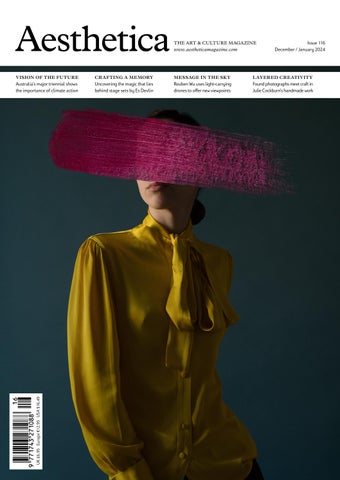
On the Cover Andrea Torres Balaguer’s photographic portraits could easily be mistaken for oil paintings. Garnet red and emerald green provide backdrops for gold silk blouses and deep velvet gowns. A single, confident brush stroke cuts straight across each face, cloaking the subject in anonymity. (p. 60)
Cover Image: Andrea Torres Balaguer, Marmalade (2018).
I like those serendipitous moments in life. It’s the recognition of cause and effect – what you set out to do can be very different to where you end up. It’s that idea of the journey being more important than the destination. It has been a big year for Aesthetica, as the magazine celebrated 20 years of independent publishing. We founded it with three pillars: equality, creativity and diversity, and they're still true today. I was 22 when I set up this organisation and so, in many ways, I grew up with it. I find it rather emotional because I look back and see all the time, hard work and determination that it took to make this happen. We've made a contribution to visual culture and curation with events like the Aesthetica Film Festival. I am honoured to spend each and every day with innovators, makers and creators. It keeps me invigorated. Inside this issue we are spotlighting artists who demonstrate the power of creative thinking. John Gerrard is known for works that are taking an active stand to bring the climate crisis to our attention. He is one of 100 artists who are exhibiting at this year’s NGV Triennial in Melbourne. Then we speak with Es Devlin who is renowned for large-scale installations and sculptures across theatre, architecture and activism. An Atlas of Es Devlin is the first major monographic museum show, surveying how she shapes stories and alternative points of view. We are also pleased to catch up with Reuben Wu on his process of making mesmerising work using drones and new technologies. Moreover, Julie Cockburn discusses the importance of memory and her instantly recognisable technique of embroidering found vintage prints. In photography, Jonas Daley, Tom Leighton, Jooeun Bae, Polina Washington and Morgan Otagburuagu present new ways of seeing through experimental works. Our cover photographer Andrea Torres Balaguer uses surrealism, rich colour palettes and magical realism to explore the subconscious. Finally, the last words go to curator James Wylie and the exhibition Tartan, which is on now at V&A Dundee. Cherie Federico
Aesthetica 15
38
72
88
60
78
106
120
48
16 Aesthetica
32
94
contents
Art 18 News Agroforestry, the rückenfigur and seminal American photography are given detailed attention by institutions around the world.
28 10 to See New shows pose questions about systems of power, from Alberta Whittle’s solo Scotland exhibit to the major photo festival in Nigeria.
32 Crafting a Memory Es Devlin explodes the status-quo, pushing artistic boundaries between literature, stage and set design in a major New York exhibit.
38 Beyond Portraiture Morgan Otagburuagu is standing up against colourism. He amplifies the beauty of darker skin with portraits of Black women pioneers.
48 Radiant Geography Rock formations, volcanic geology and verdant foliage are key to Tom Leighton’s photographs, which traverse holographic and gleaming pools.
60 Richness of Colour Andrea Torres Balaguer’s bold photographic portraits could be mistaken for oil paintings, rendered in garnet reds and emerald greens.
72 Visions of the Future NGV Triennial calls for collective activity in the face of climate crisis, with John Gerrard’s ominous flags reflecting on the oil industry.
78 Evocative Storytelling Polina Washington has a background in film cinematography. Light and colour are key to her work, where a lone sunbeam tells a story.
88 Message in the Sky Drones are being harnessed by artists and photographers to light up the sky with new perspectives. Reuben Wu is one such name.
94 Meaning in Collage Pictures of coffee cups, mirrors, water jugs and headphones are each folded up and distorted into Jooeun Bae’s deeply personal montages.
106 Striking Landforms The Gobi Desert is listed amongst the top 10 largest in the world. Jonas Daley's landscapes capture its imposing rocky mountain ranges.
120 Layered Creativity Collage has a long history, spanning more than 100 years and seeing big change. Julie Cockburn is part of its contemporary story.
126 Exhibitions The Hepworth, MoMA and the Royal Academy are amongst this issue's must-attend galleries, with An-My Lê, Kim Lim and Marina Abramović.
131 Film Sadness and joy mix in Tótem. The Lost Boys is a candid depiction of young passion. In Girl, we see a poetic mother-daughter narrative unfold.
133 Music We survey the new reissue of Fela Kuti’s back catalogue, alongside a no-skips project from PACKS. Plus, Shirley Hurt makes her debut.
Books
Artists’ Directory
Last Words
135 The Latest Publications We take a look inside a new release curated by designer Grace Wales Bonner, as well as Maria Sturm’s impactful You Don’t Look Native to Me.
140 Featured Practitioners What are contemporary artists making now? The Directory spans photography, painting, sculpture and more, showing major trends.
146 James Wylie The Co-Curator of V&A Dundee's Tartan speaks to us about a display which celebrates the fabric's long, rich heritage and contemporary resonances.
Aesthetica Magazine is trade marked worldwide. © Aesthetica Magazine Ltd 2023.
The Aesthetica Team: Editor: Cherie Federico Creative Producer: Eleanor Sutherland Content Creator: Chloe Elliott Editorial Assistant: Fruzsina Vida Junior Content Creator: Diana Bestwish Tetteh
Advertisement Enquiries: Megan Hobson (0044) (0)844 568 2001 advertising@aestheticamagazine.com
Reviews
ISSN 1743-2715. All work is copyrighted to the author or artist. All rights reserved. No part of this magazine may be used or reproduced without permission from the publisher.
Media Sales & Partnerships Manager: Megan Hobson Artists’ Directory Manager: Katherine Smira
Published by Cherie Federico and Dale Donley. Aesthetica Magazine 21 New Street York, YO1 8RA, UK Newstrade Distribution: Warners Group Publications plc. Gallery & Specialist Distribution: Central Books. Printed by Warners Midlands plc.
Production Director: Dale Donley Operations Manager: Helen Osbond Designer: Matt Glasby Contributors: Diana Bestwish Tetteh Eleanor Sutherland Iman Sultan Vamika Sinha Reviewers: Chloe Elliott, Diana Bestwish Tetteh, Eitan Orenstein, James Mottram, Jennifer Sauer, Kyle Bryony, Matt Swain, Megan Hobson, Michael Piantini, Shirley Stevenson, Shyama Laxman
Artists’ Directory Enquiries: Katherine Smira directory@aestheticamagazine.com Subscriptions: subscriptions@aestheticamagazine.com General Enquiries: info@aestheticamagazine.com Press Releases: pr@aestheticamagazine.com
Follow us: aestheticamagazine.com facebook.com/aestheticamagazine twitter.com/AestheticaMag pinterest.com/AestheticaMag instagram.com/AestheticaMag
Aesthetica 17
Elina Brotherus, Artist as Lamp from Meaningless Work series, 2019. Digital print, Museo Silver Rag paper, Dibond 90x120 cm. Edition: 6 Courtesy of the artist and Camara Oscura Galeria de Arte, Madrid.
news
18 Aesthetica
Enigmatic Composition ARTIST AS CLOWN Camara Oscura, Madrid | Until 23 December camaraoscura.net
Elina Brotherus' (b. 1972) self-portraits exude a sense of mystery. Often, her face is obscured or turned away from the camera. Positioned within idyllic landscapes, she holds a mirror in front of her head or looks away towards the moonlit sea. The rückenfigur – a compositional technique showing a figure from behind – recurs across her work. Its use can be traced throughout art history, from German Romantic painter Caspar David Friedrich’s Wanderer Above the Sea of Fog (1818) to contemporary pieces, like Cig Harvey's dreamlike self-portraits. Studies in the arts inform Brotherus’ creative practice. The image opposite is from the series Meaningless Work (2016-present). It is inspired by a seminal book by American academic M. H. Abrams (1912-2015). In The Mirror and the Lamp (1953), he argued 18th century art was primarily concerned with reflecting reality. Later in the Romantic era (1800-1850), there was a “change from imitation to expression.” Instead of copying their surroundings, artists helped us see the world in a different light. Artist as Lamp (2019) visualises this concept. Here, a person stands planted amongst the trees. Her head, covered by a lampshade, emanates a radiant glow. She shines as a human beacon. Here, and in other works selected for Camara Oscura Galeria de Arte’s retrospective, Brotherus casts herself in the dual role of creator and subject. Concealment enables her to tap into a rich artistic history whilst inviting the spectator to imagine themselves within these surreal scenes. She explains: “when you don’t show the face, the character could be anybody. It could be you.”
Aesthetica 19
news
Caring for Ecosystems NOORDERLICHT PHOTO Groningen, Friesland| Until 10 December noorderlicht.com
Agroforestry is a farming approach whereby trees and shrubs are grown alongside crops and livestock. A silvoarable system is one method. It involves placing saplings in rows between alleys of horticultural plants. According to the Woodland Trust, this strategy can “enhance farm productivity, increase wildlife and contribute to climate change mitigation.” Despite these benefits, it has only been applied to 3% of cultivated farmland in the UK. Eddo Hartmann’s (b. 1973) exhibition highlights these sustainable practices. His work is part of Renewed Energy, a collaboration between BPD Cultuurfonds and Noorderlicht. It imagines future landscapes thriving through regenerative agriculture. The fruit tree opposite is another example. It’s part of a food forest. Here, farmers grow a variety of edible plants to mimic natural ecosystems, much like a garden. This promotes biodiversity, improves the soil and attracts new wildlife, such as birds and insects. The show is part of the Noorderlicht International Photo Festival. This year’s theme, Regenerate, brings together imagemakers who are looking at how we can improve society, both for people and the planet at large. Regenerate Life at Museum Belvédère delves into our relationship with nature. On display is Rebecca Najdowski’s documentation of wildfire recovery and Misha Vallejo Prut’s depiction of Kawsak Sacha (The Living Forest), a philosophy upheld by the Indigenous Kichwa community in Ecuador. They view Earth as a conscious entity whose life is interconnected with its inhabitants. These photographers call for real change, with powerful pieces and new ways of thinking.
20 Aesthetica
Aesthetica 21
© Eddo Hartmann, Fruit Tree in a Field Near Usquert, Groningen (2023). Image Courtesy of the artist.
Joel Sternfeld, Domestic Workers Waiting for the Bus, Atlanta, Georgia, April 1983. Series: American Prospects Pigment Print 107 x 133 cm The ALBERTINA Museum, Vienna – Donation Joel Sternfeld © Joel Sternfeld.
news
22 Aesthetica
Beneath the Surface AMERICAN PROSPECTS The Albertina Museum, Vienna | Until 21 April albertina.at
Three women stand in an empty road. One gazes ahead, watching the winding concrete disappear over the horizon. Along the way, it splits into smaller paths leading to lavish houses. Lawns look pristine, even the smallest shrub is flawlessly shaped. The image seems perfect, like an advert or postcard, but the title of Joel Sternfeld’s (b. 1944) photograph reveals another story. Domestic Workers Waiting for the Bus, Atlanta, Georgia (1983) tells us that the people in the scene are detached from this world of luxury. The picture comes from Sternfeld’s seminal series, American Prospects (1978-1986). It is the result of eight years spent documenting people and places across the USA. Panoramic shots show suburban streets, overcrowded theme parks and expanses of wild desert. Today, these images offer glimpses into the recent past whilst subtly highlighting pervasive social inequalities. He told the Guardian: “the great underlying theme of my work is the utopian vision of America contrasted with the dystopian one.” Here, the use of vibrant hues contrasts with the reality for many in late 20th century Georgia. Sternfeld is a key figure of the 1970s New Colour Photography movement, which brought creative merit to a style previously only associated with advertising and fashion. There’s a cheery and whimsical quality to his landscapes, achieved by deviating from the norm of black and white fine-art photography. Sternfeld’s attentive eye continues to inspire image-makers, including Gregory Crewdson and Julie Blackmon. His compositions remind us to dig deeper and ask ourselves: can a single snapshots conceal as much as it reveals?
Aesthetica 23
news
Sublime Encounters FRAGILE WONDERS Kunstmuseum Wolfsburg | Until 7 April kunstmuseum.de
The Earth's landscapes are scarred. That's the message of Paolo Pellegrin's (b. 1964) striking pictures. Subjects include Welzow Süd, a German mine where 20 million tonnes of lignite is drilled annually. Elsewhere, we are transported to Disko Bay, Greenland. Here, an iceberg blends into the white sky. It looks as if it’s disappearing – fading into nothingness. These shots highlight the destructive impact humans are having on the environment. Pellegrin has recorded the effects of the climate crisis around the world, from Iceland to Namibia. The photojournalist is internationally renowned and has won numerous awards, including 10 World Press Photos as well as a Leica Medal of Excellence. Whilst he is best known for recording the devastating consequences of war, the turn to nature came out of a research trip with NASA, where he documented the effects of global warming in Antarctica. His latest collection draws attention to the true fragility of seemingly invulnerable animals, habitats and structures. “It’s about landscapes and nature, but I have to transform them. I’m searching for the sublime,” he explains in an interview with The New Yorker. Kunstmuseum Wolfsburg underlines the severity of the climate emergency by bringing us up close to awe-inspiring wonders. Such a focus aligns him with the likes of Andreas Gursky, Helene Schmitz and Per Bak Jensen. It’s timely as our surroundings are changing at an alarming rate. For instance, a 2023 study published in Science estimated that 68% of glaciers are likely to melt by 2100 if the current rate of temperature increase continues. Pellegrin’s images are an urgent call to action.
24 Aesthetica
Aesthetica 25
Paolo Pellegrin, Disko Bay, Ilulissat, Greenland, 2021. © Paolo Pellegrin / Magnum Photos.
Froukje by David van Dartel / © David van Dartel / Elliott Gallery.
news
26 Aesthetica
Reflecting New Talent FROUKJE Elliott Gallery, Amsterdam | Until 3 February elliott.gallery
“Happy new year / The world is burning / And I’d like to put it out / But the fire is greater than me.” This is the chorus of Dutch singer-songwriter Froukje’s breakthrough song, Groter Dan Ik (2020). It's a protest against climate crisis, directed towards the irresponsible leaders and profiteers she feels are robbing younger generations of a future. They have turned a blind eye to warning signs: extreme weather, global heating, melting glaciers and wildfires. When the song dropped, Froukje’s raw lyrics and engagement with social issues captured fans. Three years later, she is one of the Netherlands’ most loved upcoming musicians. We meet her stern gaze in this shot. Her expression is calm yet assertive, looking down at us through a small square frame. The photograph was taken by self-taught lens-based artist David van Dartel (b. 1995). It’s part of a series of visuals for Froukje’s highly anticipated debut album, Noodzakelijk Verdriet (Necessary Sadness), as well as a new exhibition at Elliott Gallery, Amsterdam. The pair travelled by boat to Froukje’s birthplace, Nieuwkoop, for the shoot, which is filled with details from the lush Dutch landscape: crystal-clear waters, blustering reeds and endless fields. Another piece shows the musician semi-submerged in a deep lake. She looks distant and lost in thought, looking down towards her warped reflection and pulling us into the depths of the composition. There’s a closeness between subject and artist reminiscent of Snezhana von Büdingen-Dyba’s Meeting Sofie or Yao Yuan’s 12321. Dartel captures many facets to Froukje, revealing glimpses of quiet confidence and fearless vulnerability.
Aesthetica 27
art
10 to See RECOMMENDED EXHIBITIONS THIS SEASON
New shows in December and January pose questions about systems that make up our world. How can we reconnect with each other and our environments? What are the necessary steps towards deconstructing power imbalances? Where do the boundaries of contemporary art lie?
1
Shifting Landscapes
Oxo Tower Wharf, London | 1-10 December
emergencemagazine.org When glaciers perish, lakes dry up and our forests are on fire, it feels as if the world we know is coming undone and new configurations are taking shape. Shifting Landscapes is an immersive exhibition that features nine contemporary artists, such as filmmaker Adam Loften, photographer Gheorge Popa and creative studio Marshmallow Laser Feast. The multi-sensory projects draw attention to our close entanglement with the biosphere, from the smallest stirrings of life within our bodies to the substantial imprints we have left on the Earth’s face.
2
A lberta Whittle: Create Dangerously National Galleries Scotland, Edinburgh | Until 7 January
nationalgalleries.org Create Dangerously is the largest exploration of Barbadian-Scottish artist Alberta Whittle’s practice to date. The exhibition confronts the violence of colonialism, the legacies of the Transatlantic Slave Trade and the impact of climate crisis through an extensive selection of drawings, interactive digital collages, paintings, sculptures and installations. Whittle’s works offer a message of hope, weaving personal family stories into difficult narratives. The show asks us to imagine a reality outside of rigid social structures, hierarchies and ways of thinking.
3
LagosPhoto Festival
Various Locations, Lagos | Until 31 December
1
lagosphotofestival.com LagosPhoto's 14th edition centres on the theme Ground State – Fellowship Within the Uncanny. The festival brings together internationally renowned artists whose images are rooted in the present moment. They envision ways we might repair societal imbalances and, by extension, restore faith in humanity. This year's exhibitions will extend beyond the Nigerian capital to cities in Benin. This provides visitors with more opportunities to engage with powerful work from artists such as Arko Datto, Carlos Idun-Tawiah, Gloria Oyarzabal and Omar Victor Diop.
4
Hybrid Skin, Mythical Presence Seattle Asian Art Museum | Until 7 July
seattleartmuseum.org Anida Yoeu Ali is known for exploring performance as an art form, taking on the personae of fantastic mythical heroines as assertions of feminist, queer and alternative visibilities. These characters are hybrids, combining different religious aesthetics to disrupt ideas around otherness. Simultaneously, Ali often uses textiles to make pieces rooted in her experiences as a Cham-Muslim refugee. Hybrid Skin, Mythical Presence stages installations, photography and moving-image alongside iconic projects such as The Buddhist Bug and The Red Chador.
5
Life in a Different Resolution Nxt Museum, Amsterdam | Until 30 June
nxtmuseum.com Random International is a London-based collaborative studio operating at the crossroads of art, artificial intelligence, cognitive and behavioural science and technology. Life in a Different Resolution traces a line through the initiative’s creative process and presents several renowned projects, including Living Room, where visitors can enter a fluctuating architectural space flooded with light and fog. The multi-sensory work positions the built landscape as a living being, asking: how we can connect to different ways of living and, crucially, to one another?
28 Aesthetica
2
3
4
5
Aesthetica 29
8
6
9
7
30 Aesthetica
10
6
Sonya Clark: We A re Each Other High Museum of Art, Atlanta | Until 18 February
high.org Sonya Clark is an American artist of Afro-Caribbean heritage. She is acclaimed for using everyday fibre materials, such as flags, found fabric and hair, to examine the politics and histories of representation, racial injustice, cultural legacies and reconciliation. High Museum’s We Are Each Other examines how Clark’s community-centred projects facilitate new collective encounters across, gender, ethnic and socioeconomic divisions. Besides her large-scale installations, the show features a range of Clark’s photographic works, prints and sculptures.
7
Human.Kind. International Museum of the Red Cross, Geneva | Until 14 April
redcrossmuseum.ch Human.Kind. introduces 30 Prix Pictet-nominated photographers who document the lives of those experiencing different forms of crisis. The shortlist represents 24 countries and includes international practitioners like Andrew Esiebo, Charles Fréger, Gideon Mendel and Myriam Boulos. Their portraits and photomontages present an alternative approach to the established visual language of documentary and address major issues of humanitarian action, from conflicts and privileges to psychosocial support and respect for human dignity.
8
The Swarm Plug In ICA, Winnipeg | Until 17 December
plugin.org Farah Al Qasimi is an Abu-Dhabi-born artist who uses a variety of lens-based media to engage with postcolonial realities. The Swarm includes images of domestic interiors and mundane items to depict the emerging post-industrial society of the Gulf region. Although the projects are rooted in a documentary practice, the results appear cinematic, teeming with colours and details. Al Qasimi’s recent show Abort, Retry, Fail, at London’s Delfina Foundation, similarly looked at everyday subjects and addressed our alienated relationship with the natural world.
9
Our Ecology: Toward a Planetary Living Mori Art Museum, Tokyo | Until 31 March
mori.art.museum What contribution can contemporary art make to environmental activism? Mori Art Museum’s 20th anniversary exhibition lines up nearly 100 works – by artists such as Ana Mendieta, Emilija Škarnulytė and Hans Haacke – to respond to this question. The museum is making a conscious effort towards acting sustainably, like recycling wall panels and resources from previous shows. Besides this, more than half of the objects on show in Our Ecology were commissioned and created in Japan – keeping the transport of materials to a bare minimum.
10
Paradise, Performance, Replica Fotografie Forum Frankfurt | Until 7 January
fffrankfurt.com Paradise, Performance, Replica focuses on three contemporary photographers from Slovenia. Bojan Radovič’s prints explore the principles of repetition and imitation, whilst Jošt Dolinšek’s playful, unusual pieces investigate visual perceptions of nature with a special focus on uncertainty and doubt. The exhibition further introduces Vanja Bućan’s surreal and staged compositions that question socio-political themes via photomontage and collage techniques. These multimedia projects expand the limits of materials in experimental and refreshing ways.
1. Marshmallow Laser Feast, Breathing Space. Image courtesy of the artists . 2. Alberta Whittle (b. 1980), Lagareh – The Last Born, (2022). Photo by Jaryd Niles-Morris. Lagareh is co-commissioned and produced by Scotland + Venice and Forma for the 59th International Art Exhibition – La Biennale di Venezia. Image courtesy of the artist and The Modern Institute / Toby Webster Ltd., Glasgow. 3. Arko Datto (b. 1969), Sagar Island, India, from the series Where Do We Go When the Final Wave Hits (2019-present), ongoing series. Image courtesy of the artist and Lagos Photo Festival. 4. Anida Yoeu Ali (b. 1974), Water Birth, The Red Chador: Genesis I, (2019), Kaiona Beach, Oahu, USA. Image courtesy of the artist. © Studio Revolt. Photo by Masahiro Sugano. 5. Random International, Fifteen Points. Photo by Esteban Schunemann. Image courtesy of the artists. 6. Sonya Clark (b. 1967), The Hair Craft Project (Hairstylists with Sonya Clark) Sonya Clark with Jamilah Williams, (2013), inkjet photograph, 28 × 28 inches. Photo by Naoko Wowsugi. Image courtesy the artist and High Museum of Art, Atlanta. 7. Andrew Esiebo (b. 1978), Untitled from the series Who We Are, (2010). Image courtesy of the artist and the International Museum of the Red Cross, Geneva. 8. Farah Al Qasimi (b. 1991), Medeyyah Through The Gate, (2023). Image courtesy of the artist. 9. Emilija Škarnulytė, Sunken Cities, 2021. Film still. Image courtesy of the artist and Mori Art Museum, Tokyo. 10. Vanja Bućan (b. 1973), Invisible Housewives, (2022). From the series Birds of Paradise, (2021-2023). Image courtesy of the artist and Fotografie Forum Frankfurt.
Aesthetica 31
art
Crafting a Memory Es Devlin THE BOUNDARIES OF ART, LITERATURE, STAGE AND SET DESIGN EXPLODE IN A RETROSPECTIVE THAT REDEFINES WHAT IT MEANS TO EXPERIENCE PERFORMANCE.
Behind any magician’s seemingly perfect sleight of hand is shifting lights reflected by surrounding mirrors and pools. a series of calculated machinations – levers, pulleys, props They make the viewer feel as if they have entered a box of and careful planning. Such is the role of a stage and set de- glitter, and are amongst the world’s most Instagrammed artsigner, who does the labour of developing and building tem- works. Thousands of people snap mirror selfies amidst her porary, imagined worlds that make us believe, wholeheart- seas of twinkling sequins. It’s ethereal, fairytale-like, highly edly, in a meticulously organised illusion – at least, for a few picturesque. The work of international art collective teamLab hours. Theatre has been around for centuries, and so have its is similar, welcoming us into rooms of cascading colourful makers. However, a rather new phenomenon is the transition LEDs that cause us to forget where our bodies start and end. of its designers into veritable artists, toeing their way back Fifty-two-year-old British artist and stage designer Es and forth across the creative spectrum between stage design Devlin (b. 1971) takes the medium of installation art and and fine art, towards a distinct medium of its own: installation. blows it up, bending it into myriad shapes of spectacle, perThe medium has a younger, relatively under-theorised his- formance and storytelling: theatre productions, music, opera, tory, emerging approximately in the mid-20th century. The dance, fashion shows and more. She has been a longtime first documented use of the term “installation” with regards collaborator of Kanye West’s concerts, and has worked with to art, as noted by the Oxford English Dictionary, was as ABBA, Adele, Beyoncé, Lady Gaga, Miley Cyrus, U2 and The recent as 1969. It's described as being either temporary or Weeknd, amongst others. In 2012, she designed the closing permanent, but always three-dimensional. Installation art is ceremony for the London Olympics, and then the opening usually site-specific and caters towards transforming viewers’ in Rio four years later. Her list of projects and collaborations perceptions of a particular space in service of a story. In short, unfurls like an endless scroll, with each new piece of work it is physical narrative-making. Combining the logistical flair, seemingly grander and more ambitious than the last. In a vision and precise execution of a set designer with a fine art- 2016 New Yorker article, Andrew O’Hagan writes: "Each of her ist’s sculptural and / or intellectually oddball, out-of-the-box designs is an attack on the notion that a set is merely scenery approach, the installation artist does not just create a work, … [Devlin] is in demand because she can enter the psychic but also the experience of it. Ideally, all the senses are ac- ether of each production and make it glow with significance." counted for, breaking the seam between reality and artifice A striking example: for Cyrus’ 2014 Bangerz arena tour, at a and transporting the audience to a different world altogether. time when the pop star’s image was fast swivelling away from One might quickly imagine the work of famed Japanese purported Disney childhood innocence, Devlin designed the artist Yayoi Kusama (b. 1929). Her Infinity Mirror Rooms, on concert entrance as a huge tongue – by now synonymous view at the Tate Modern in London, are filled with masses of with the star’s new persona – protruding out of a giant model
32 Aesthetica
Aesthetica 33
34 Aesthetica
Photography by Nicolas Chavance.
“Importantly, her works move beyond being visually interesting narrative supports. Instead, they are actively engaged in inciting something worthwhile, triggering human changeability.”
Previous page: Pavilion design by Es Devlin. Image by Alin Constantin Photography. Left: Saint Laurent by Anthony Vaccarello Men’s Spring/Summer 2023 Show. Image courtesy of Saint Laurent.
of Cyrus’ head. Devlin describes it as “a sculptural portrait of a young woman rewriting her character and her script.” Devlin entered this field of work, she proclaims, upon the realisation that “a group of tightly packed people could be greatly moved sitting together in the dark.” Having studied English Literature for her undergraduate studies at Bristol University, she went on to take a Foundation Course in Fine Art at Central Saint Martins, coming to specialise in theatre. She took on several work experiences, and wound up transforming the sets of the Bush Theatre in West London before going on to the National Theatre in 1998 to work on a revival of Harold Pinter’s Betrayal. These projects helped build her a reputation as sturdy and innovative as her sets. The artist recalls a pivotal childhood moment, where she's standing in a long, sunlit corridor, at music school, whilst hearing snatches of various rehearsals overlay each other. "I see my practice in light, sculpture, theatre, music and text as a 28-year extension of that corridor.” The memory and its consequences are dream-like, nearly fantastical, given the grand scale of what Devlin has come to conjure and achieve since then. “A theatre maker’s daily practice involves imagining worlds that don’t yet exist,” she remarks. Her creative influence is infectious, with collaborator and friend Pharrell Williams describing her as embodying a “turning point.” “When you meet with her, she literally turns things around with her perspective. She’s a walking turning point for anyone she interacts with.” This comes from a 2020 conversation between Williams, Devlin and Yana Peel, included in a brand-new publication from Thames & Hudson entitled An Atlas of Es Devlin. It spans over 900 pages and delves into Devlin’s archives and projects, with
essays and commentaries by both the artist and her collaborators, such as Benedict Cumberbatch, Bono, Brian Eno and Hans Ulrich Obrist, to name a few. The artist describes the volume as “an attempt … to seek the connections, recurring interests and forms that have resurfaced throughout [her] practice.” The book, as an object, is a careful and illustrious construction, much like a set. It’s art, with elaborate folds, cut-outs, mirrors and various paper types; the publication’s sculptural design is credited to Daniel Devlin. Edited and introduced by Andrea Lipps, Curator at Cooper Hewitt, Smithsonian Museum of Design in New York, An Atlas of Es Devlin accompanies the launch of a major monographic exhibition of the same name. It involves Devlin installing her entire archive – spanning three decades– across the third floor of the museum, exhibiting more than 300 sketches, paintings, illuminated paper cuts and projection-mapped miniature sculptures, including previously unseen small-scale works that form the basis for larger projects. Visitors will also be able to enter a replica of Devlin’s London studio containing her materials, tools and works-in-progress where, as the room darkens, projections will bring the space to life – a meta moment of an installation about an installation artist. The show also incorporates and acknowledges the essential role of Devlin’s myriad collaborators, from lighting designers to production managers and musicians. It demonstrates the networked expansiveness, as well as personable intimacy, of her approach. Lipps calls Devlin an “experiential storyteller … a composer of space, a sculptor of time and engagement.” Importantly, her works move beyond being visually interesting narrative supports. Instead, they are actively engaged with
Aesthetica 35
Pavilion design by Es Devlin. Image by Alin Constantin Photography.
inciting something worthwhile, triggering human malle- telling in a way that allows us to be actually in communion ability and changeability. After all, Devlin sees an audi- with our environment, as opposed to a dominating, colonience as “a temporary society, a community that arrives in alist separation from it.” Consequently, Devlin’s work Forest one state, sits closely together, in thought, in the dark, for of Us, for Pace Gallery's Superblue Miami, conceptually the next few hours, and departs in an altered state. The ar- connects trees with lungs through a “maze” of “bronchial chitecture of their minds is redrawn by new thoughts and branches.” The work asks us to return to our breath and to feelings.” Therein lies the purpose of Devlin’s wide-ranging, confront our mortality – not just as bodies, but as a world. multidisciplinary practice: to spur people towards critical The work led to a series of temporary forests: Five Echoes in engagement. Her designs are far from mere aesthetic ex- Miami, Forest for Change at Somerset House and Conferperiences, but instead form palimpsestic narratives akin to ence of the Trees at the Climate Change Conference in Glasnovels with multiple chapters. The stories inside are multi- gow for COP26. “Like Shakespearean forests of transformalayered, like cakes, offering a vital mental “turning point.” tion, you enter in one state and you emerge transformed." This sense of community and collaboration is perhaps The pattern that appears from Devlin’s enormous archive, best exemplified by Devlin’s UK Pavilion, designed for the whether it’s her production design for an Adele concert, the Dubai World Expo in 2021. Every visitor was invited to add stage set for Cumberbatch’s Hamlet or a climate-motivated a word as they entered the “giant wooden musical instru- art installation, is not to recreate an existing narrative, but to ment.” The text then emerged, via AI, as part of a 20-metre reshape that story so visitors may leave renewed. Her ideas collective poem on the building’s surface. Devlin’s interest are so valued because she can make that sense of awe and in both literature and technology is evident, with quotes inspiration stick. How many of us remember concerts we go from novels and snippets of poetry cited as inspiration for to for the music alone? Songs are available on apps like several projects. The design for Saint Laurent by Anthony Spotify and YouTube. Shakespeare’s plays can be borrowed Vaccarello’s Mens Spring/Summer 2023 show, for exam- from the library, or read online. Great set design helps keep ple, was inspired by Paul Bowles’ The Sheltering Sky (1949), the joy of in-person performance alive. She enables us to placing a giant ring of light in the Agafay Desert. Time and become architects of our own memories, whereby a stage again, Devlin takes art and turns it into something different. set becomes part of an unforgettable, all-encompassing Another key strand is Devlin’s engagement with the cli- experience. How we feel in that moment will stay with us mate. In the new book, she tells Hans Ulrich Obrist about and, hopefully, change us. Devlin has a unique and underher work on the extinction crisis. She is inspired by a quote reported job, one of a maverick who turns abstract ideas from poet Alexis Pauline Gumbs, which reads: “We have the into concrete realities. Crucially, her role reminds us that opportunity now, as a species fully in touch with each other, visual art bleeds into everything we see and do. It's a sleight to unlearn and relearn our patterns of thinking and story- of hand that deftly conjures tangible worlds into existence.
36 Aesthetica
Right: Pavilion design by Es Devlin. Image by Alin Constantin Photography.
Words Vamika Sinha
An Atlas of Es Devlin Cooper Hewitt, New York Until 11 August cooperhewitt.org
Aesthetica 37
art
Beyond Portraiture Morgan Otagburuagu
“There has always been a narrow definition of beauty in the fashion industry,” says Lagos-based photographer Morgan Otagburuagu (b. 1997). “This inspired me to explore unconventional, in-your-face portraiture; the kind you wouldn't see in a traditional beauty story.” Otagburuagu is passionate about standing up against colourism, amplifying the beauty of dark skin and honouring stories of trailblazing Black women. His pictures are also deeply personal. After losing both parents in 2021, Otagburuagu began to incorporate flowers as symbols of grief, mourning, rebirth and celebration. Shown here is Being Black and Colourful II, in which orange petals cascade down a subject’s face and neck. “This is one of my first personal works. At the time, I was renting cameras for the day to shoot projects that were close to my heart. It was included in my first exhibition, and, with the proceeds, I bought my own camera.” morganotagburuagu.com | doylewham.com
Morgan Otagburuagu, Being Black and Colourful II (2020). Courtesy of the artist and Doyle Wham.
38 Aesthetica
Aesthetica 39
Morgan Otagburuagu. Black Warrior I (2022). Courtesy of the artist and Doyle Wham.
40 Aesthetica
Morgan Otagburuagu, Corolla I (2020). Courtesy of the artist and Doyle Wham.
Aesthetica 41
Morgan Otagburuagu, Black Bola (2023). Courtesy of the artist and Doyle Wham.
42 Aesthetica
Morgan Otagburuagu, Blush (2023). Courtesy of the artist and Doyle Wham.
Aesthetica 43
art
Morgan Otagburuagu. Black Warrior II (2022). Courtesy of the artist and Doyle Wham.
44 Aesthetica
Morgan Otagburuagu, Corolla II (2020). Courtesy of the artist and Doyle Wham.
Aesthetica 45
Morgan Otagburuagu, Beauty Story (2020). Courtesy of the artist and Doyle Wham.
46 Aesthetica
Morgan Otagburuagu, In Bloom (2023). Courtesy of the artist and Doyle Wham.
Aesthetica 47
art
Radiant Geography Tom Leighton
Rock formations, volcanic geology and lush foliage are key to Tom Leighton’s (b. 1981) alluring photographs. Here, we traverse holographic pools gleaming with luminous pinks, bold purples and oranges. Whilst these shots might seem otherworldly, they offer lessons about how life on this planet came to be. Leighton confronts us with “rare evidence of the colossal pressures which created the surface of the Earth … a manifestation of the planet’s physical history: times of stability veined with turbulent change, fault lines which can be a metaphor for our current human landscape.” Elsewhere, the photographer takes viewers into the forest under cover of darkness, showing a glimpse of what we might see if human night vision were to evolve. The camera zooms in on intricate leaves at sunset – the moment when photosynthesis stops and respiration begins. At once futuristic and reflective, these pictures occupy the borderlines between fine art, geography and botany. tleighton.com
Tom Leighton, Phosphor, (2023). Image courtesy the artist.
48 Aesthetica
Aesthetica 49
Tom Leighton, Noctura, (2021). Image courtesy the artist.
50 Aesthetica
Tom Leighton, Canyon, (2020). Image courtesy the artist.
Aesthetica 51
Tom Leighton, Flux, (2023). Image courtesy the artist.
52 Aesthetica
Tom Leighton, Resurgence, (2023). Image courtesy the artist.
Aesthetica 53
Tom Leighton, Serriform, (2022). Image courtesy the artist.
54 Aesthetica
Tom Leighton, Threshold, (2023). Image courtesy the artist.
Aesthetica 55
Tom Leighton, Traverse, (2023). Image courtesy the artist.
56 Aesthetica
Tom Leighton, Shrouded, (2023). Image courtesy the artist.
Aesthetica 57
Tom Leighton, Fission, (2022). Image courtesy the artist.
58 Aesthetica
Tom Leighton, Liminal, (2023). Image courtesy the artist.
Aesthetica 59
art
Richness of Colour Andrea Torres Balaguer
The history of paint is filled with intriguing stories. In The Anatomy of Colour (Thames & Hudson), Patrick Baty recounts several such anecdotes, each tied together by desire, risk and a quest for perfection. During the 18th century, Prussian Blue was considered an “extraordinary colour” that cost twice as much as other hues. In Germany, Vermilion Red, of which “there was nothing quite like”, was produced by combining sulphur and mercury, and was also used as a sedative. It wasn’t until 1880 that William Morris stopped using poisonous Arsenic Green in his iconic wallpapers. Today, similarly intoxicating jewel tones are the hallmark of Andrea Torres Balaguer’s (b. 1990) photographic portraits. The pictures could easily be mistaken for classical oil paintings. Garnet red and emerald green are backdrops for gold silk blouses and deep velvet gowns. A single, confident brush stroke cuts straight across each face, cloaking the subject in anonymity. andreatorresbalaguer.com
Andrea Torres Balaguer Marmalade (2018).
60 Aesthetica
Aesthetica 61
Andrea Torres Balaguer Vermilion (2022).
62 Aesthetica
Andrea Torres Balaguer Satin (2023).
Aesthetica 63
Andrea Torres Balaguer Umbra (2019).
64 Aesthetica
Andrea Torres Balaguer, Velvet (2017).
Aesthetica 65
art
Andrea Torres Balaguer Bloom (2019).
66 Aesthetica
Andrea Torres Balaguer Candle (2020).
Aesthetica 67
Andrea Torres Balaguer Azure (2018).
68 Aesthetica
Andrea Torres Balaguer Tango (2023).
Aesthetica 69
Andrea Torres Balaguer Allure (2019).
70 Aesthetica
Andrea Torres Balaguer Satsuma (2021).
Aesthetica 71
art
Vision of the Future NGV Triennial ART CALLS FOR COLLECTIVE ACTION IN THE FACE OF THE CLIMATE CRISIS, WITH OMINOUS FLAGS THAT REVEAL THE OIL INDUSTRY'S HISTORY AND IMPACT.
When John Gerrard (b. 1974) was a child, he noticed earth- from the International Energy Agency. China is behind most worms floating in puddles of water across a field, near his of this growth, with a record high of 17.1 millions of barrels home, in the idyllic countryside of County Tipperary, Ireland. per day in September. By 2050, nearly 10 billion people “I remember being perplexed and saddened by it,” Gerrard, will exist on Earth, raising humanity’s carbon footprint and who is now 49 years old, says. “It was obviously strange that asking the pivotal question of how finite resources, like fossil these worms were all dead.” They had died because of ex- fuels, will be distributed and consumed. Meanwhile, the oil cessive pesticide and toxic farming practices, which posed a industry raked in $144.58 billion in the third quarter of 2023 threat to the insects, animals, flowers and plants in the sur- (NRDC), despite consumers being burdened with the criprounding ecosystem, a place Gerrard and his family called pling weight of oil prices, which have spiked as countries conhome. “There’d been an over-usage of toxins within the land- tinue to experience the worst inflation rates in recent memory. scape,” Gerrard recalls. Earthworms don’t technically qualify Gerrard’s fixation on the environment stems from his upas pests, but were victim to chemicals in the soil. “That rela- bringing in Tipperary and seeing how his verdant, peaceful tionship – between what’s called progress and development, hometown changed over time. This developed a consciousand is actually death – was definitely part of my childhood.” ness that shapes most of his politically oriented artworks Today, he works as a multidisciplinary artist using game en- today. “My mother was an environmentalist and ecologist, gine-based technology to build highly-aesthetic, attention- so we had a lot of discussions about agriculture and the sysgrabbing simulations, which mesmerise viewers. They offer tems we were surrounded with in the countryside,” Gerrard virtual, yet hauntingly realistic, worlds that remind us of the says. “If farmers sprayed on the wrong day, we would see the impending dread of climate change, and how toxic emissions effects in our garden. She was very interested in humans and pose permanent damage to the future viability of habitats their usage of the landscape, which informed my practice.” on planet Earth, and the numerous species who live upon it. The result is Gerrard’s iconic triptych of emissions-based According to the National Oceanic and Atmospheric Ad- flags, which function as an alarm for global warming. Now, ministration, 91 percent of excess heat energy from green- one of them, Flare, is on display at the National Gallery of house gases is trapped in the ocean, putting coastal popula- Victoria Triennial in Melbourne, Australia. It’s a major event tions at risk of natural disasters like cyclones and tsunamis. that exhibits artworks from 100 artists across four levels of It’s also caused the bleaching of coral reefs, compromised the spacious, Jazz-era building. This year’s theme is Magic, marine breeding grounds and altered migration patterns Matter, and Memory, and those exhibiting include trailblazer of fish like salmon and sharks. Global oil demand has risen Tracey Emin; performance artist Yoko Ono; Iranian painter to 102 million barrels per day, according to recent figures Farrokh Mahdavi; the Parisian fashion house Schiaparelli;
72 Aesthetica
Aesthetica 73
74 Aesthetica
John Gerrard, Flare at Galway International Arts Festival (2022). Photographer: Ros Kavanagh.
“Gerrard’s flags remain a promise of what is to come, a warning that can only be heeded if everyday people decide to rise against the threat of climate change, and demonstrate that enough is enough.”
Previous page: John Gerrard, Western Flag (Spindletop, Texas) (2017-2019). Desert X / Coachella Valley, CA, USA. © Lance Gerber
Left: John Gerrard, Western Flag (Spindletop, Texas) (2017-2019). Desert X / Coachella Valley, CA, USA. © Lance Gerber
multidisciplinary Indigenous artist Betty Muffler; Dutch designer Iris van Herpen and the Italian sculptor Diego Cibelli. Whilst Gerrard’s artwork is confined inside NGV’s walls, the artist’s virtual worlds tend to appear on massive LED panels in public spaces. Here, they catch the attention of regular passersby, and potentially inspire them to political action. “As an artist, I’m working in the public domain, so I often choose worlds that are placed on the street. In that setting, you will reach members of the public who would feel less comfortable entering a museum. I’m motivated to work out on the street in order to collide with unexpecting publics.” The Irish artist’s breathtaking simulations have appeared in spaces and events that range from the mundane to the disruptive, the aesthetically-centered to the politically-charged, using eye-catching LED walls to provoke questions about the climate crisis. Gerrard’s immersive Surrender (2023) glimmered in the background of a U2 concert as the activist-friendly band staged their first live performance in four years in a stadium teeming with thousands. The haunting Flare (Oceania) (2021) appeared at the COP26 UN Climate Change Conference in Glasgow, in which a pact was drawn to reduce coal usage worldwide. In September 2020, Mirror Pavilion, Corn Work, a cube-shaped LED simulation depicting Irish folk figures known as the straw boys, and with three reflective sides mirroring local citizens, perched on the edge of a pier in front of a river in Galway, Ireland. The waterway once offered clean renewable energy before the rise of fossil fuels. Similarly, Gerrard’s ominous Western Flag flashed on the front of Somerset House, London, on Earth Day in 2017. “Art can trouble people, it can pose unexpected questions about nationhood, energy and power. Western Flag tried
to recall things like Trump pulling out of the Paris Accords shortly after he was elected; it became a symbol for a failure of politics to deal with climate change. Part of the question of the artwork is if there’s any other forum where people can create change – other than a national forum with all these geopolitical tensions. Because, at present, we are not really addressing climate change in any meaningful way,” he says. Gerrard exposes this in his series of flags looming over the ethereal waters of the South Pacific ocean, a barren Texan landscape, and a moonlit Mojave desert. And yet, the flags aren’t made of cloth, nor do they contain telltale symbols, billowing for the pride of any nation. In Western Flag (Spindletop, Texas) (2017), smoky black carbon dioxide emissions linger around a thin pole shooting into the air, echoing the Lucas Gusher Oil Strike in Spindletop, Texas, in 1901. A huge underground geyser exploded, gushing nearly 100,000 barrels per day and leading to the founding of oil companies like Exxon and Texaco. Gerrard says “a lot of the carbon dioxide released from burning fossil fuels since 1901 in Texas is still in the atmosphere.” Western Flag, originally commissioned by Channel 4, also for Earth Day, has reached cult-like notoriety as a widely-shared meme on the internet. In Flare (Oceania), on view at NGV, a vivid orange gas flare flickers almost threateningly over the ocean, a harbinger of the danger rapidly-heating water poses to low-lying seaside areas, incurring natural disaster and the gradual extinction of island and coastal communities. In 2016, five Pacific islands disappeared underwater, and some scientists predict that the Polynesian nation of Tuvalu will possibly submerge by the end of the century. Uili Lousi, an artist and activist born in the Polynesian archipelago of Tonga, photographed the softly-
Aesthetica 75
John Gerrard, Flare at Galway International Arts Festival (2022). Photographer: Emilija Jefremova.
lapping, majestic ocean waters featured in the artwork. “Flare was always an alarm for the hot present, the heating ocean. It was always [meant] to be a disturbing portrait of the now.” The aptly-titled Surrender (2023), however, signals hope. It depicts a white flag set within a real-time simulation of a site near the Mojave Desert in Nevada, USA. Its heavenly-white plumes diverge from the toxicity of Flare and Western Flag, but it’s difficult not to wonder if their peace, purity and transience aren’t too late in a world incontrovertibly damaged by the global use and expediency of fossil fuels, and the multibillion-dollar oil industry, which is driving their consumption. NGV Triennial's other artists confront key ecological and socio-political questions. In Yoko Ono’s conceptual piece, the black letters I Love You Earth blaze on a white canvas hanging on the exterior of the NGV International Building, facing traffic and the street. The installation highlights Ono’s famous flippant disregard for power since the 1960s, when she was a performer and activist against the Vietnam War. This work brings to mind Jenny Holzer’s engagement with large-scale, provocative statements set in busy public places. Similarly, Tracey Emin pens a love poem in bright pink neon lights in her scrawling, cursive handwriting in Love poem for CF (2007), the letters glowing: Each Part/For Ever/ Belonging to You. It’s difficult to tell if the desire and annihilation in the words suggests the overwhelming passion of love or its capacity to destroy – maybe both. And, the harrowing bronze sculpture, This is exactly how I feel right now (2016), shows a mangled figure of a woman on the ground, one leg sticking out as if in pain, the other missing, rendered voiceless, as her head is cut off. Emin’s sculpture is grotesque and beautiful, violent and haunting at the same time, showing the
76 Aesthetica
aestheticised pain women endure as sex objects cannibalised by the hunger of men. By contrast, Schiaparelli’s gilded designs – transposed onto feminised mannequins – exhibit femininity in a more illusory way, with a profusion of pink roses teeming on a black minidress, or a gold composition of dreamlike flowers presented as a bralette. There’s also a denim jacket embroidered with a swirling breastplate, resembling armour, that blurs boundaries between fashion and art. The unforgettable takeaway of the Triennial remains a large-scale photography exhibition on the third floor featuring 10 photographers, including Farhana Satu, Gustavo Minas, Hana Gamal, Saumya Khandelwal, Yagazie Emezi, and more, representing different megacities in the global south. Here, the apocalyptic urgency of Gerrard’s flag triptych comes to life in the streets of Cairo, Jakarta, Lagos, São Paulo. There are visions of urban sprawl, slums floating in polluted water, trash littered on the edge of a shallow pond, a small child selling balloons, dozens of Indonesian motorists riding cheap motorbikes in congested traffic, a barbed fence silhouetting the shadow of a pyramid, shabby buildings rising into a gold-lit sky, a rickshaw parked underneath loping flyovers, and more. This is happening now, but it's impossible to save the planet until the contradictions of urban planning, wealth distribution and political corruption are addressed in the most densely-populated cities in the world. Until then, Gerrard’s flags – alongside work by contemporary environmental artists like Alexandra Daisy Ginsberg and Edward Burtynsky – are a promise of what is to come, a warning that can only be heeded when everyday people decide to rise up against the threat of climate change and, through collective action, demonstrate that enough really is enough.
Right: John Gerrard, Western Flag (Spindletop, Texas) (2017-2019). Desert X / Coachella Valley, CA, USA. © Lance Gerber
Words Iman Sultan
NGV Triennial Melbourne 3 December - 7 April ngv.vic.gov.au
Aesthetica 77
art
Evocative Storytelling Polina Washington
It will come as no surprise to readers that Polina Washington's (b. 1991) background is in cinematography. Light and colour are crucial to her body of work. In the following pages, complete stories are communicated through a singular sunbeam, or door left ajar. Viewers may be reminded of Roger Deakins (Blade Runner 2049, Sicario), known for his command of blues and oranges, or the room-sized light and space installations of James Turrell. These pictures are delicate and carefully crafted, delivered with precision and attention to detail. Some characters shade their eyes from the glare of an artificial sun or open window, whilst others lie back, bathing in warm shafts of red, white and yellow. Washington was born in the small city of Veliky Novgorod, Russia, and later studied to be a Director of Photography (DoP) in St. Petersburg. Now, she shares her skills with others, teaching workshops and pushing students to work with, rather than against, their fears. polinawashington.com
Polina Washington, from Till The Light Separates Us (2023).
78 Aesthetica
Aesthetica 79
Polina Washington, from It’s Not About Win or Lose (2022).
80 Aesthetica
Polina Washington, from Till The Light Separates Us (2023).
Aesthetica 81
Polina Washington, from Tainted Love (2023).
82 Aesthetica
Polina Washington, from The Past Is Something You Could See (2020).
Aesthetica 83
Polina Washington, from Silent Mode (2023).
84 Aesthetica
Polina Washington, from Till The Light Separates Us (2023).
Aesthetica 85
Polina Washington, from Don’t Think About Me (2021).
86 Aesthetica
Polina Washington, from Till The Light Separates Us (2023).
Aesthetica 87
art
Message in the Sky Reuben Wu BEYOND FILM, TV, MAPPING AND CLIMATE MONITORING, NON-MILITARY DRONES ARE BEING USED BY INNOVATIVE PHOTOGRAPHERS TO LIGHT UP THE SKY AT NIGHT.
The earliest pilotless vehicles were developed in Britain and dytron, but for crafting mesmeric landscape shots featuring the USA during WWI. Imperial War Museum, London, traces glowing geometric shapes. Halos – created by light-carrying the first test flight back to March 1917, and the use of the drones and long exposures – encircle high peaks, emerge word “drone” is attributed to the inter-war period, around from canyons and hover over open water. Now, as a National 1935. Since then, unmanned aerial technologies have been Geographic Photographer with clients including Apple, Audi, developed for array of non-military purposes: from photog- Samsung and Volkswagen, he’s interested in how we can harraphy and filming to delivering goods, monitoring weather ness abstract concepts of time and space to help tell compelconditions, surveillance, search and rescue missions and ling stories about our world. He has visited various remote lomore. They are becoming increasingly popular as an alter- cations across the globe, including glaciers, deserts, salt flats native entertainment choice, replacing fireworks to create im- and mountain ranges, where he sets up each shot with precipressive and hypnotising light displays considered cleaner, sion. At a time in which it can be hard to decipher “real” from quieter and safer than the traditional pyrotechnic explosive. “artificial”, Wu shows us what it is possible to create in real life The influence between art and science, as always, runs both and on location, using post-production skills rather than AIways. Designers are now harnessing the creative potential of generation prompts or 3D rendering. We speak to the artist drones to push research and innovation forward. In October about his practice, touching upon the relationship between 2023, Dutch studio DRIFT staged a large-scale, 1,000-drone documentary and fine art, and tracing his influences back performance over New York’s Central Park, simulating an to Harold “Doc” Edgerton (1903-1990) – the first person to illuminated flock of starlings. Titled Franchise Freedom, it’s “stop time” by inventing the strobe light in the early 1930s. based on a biological algorithm from over 10 years’ research into flight behaviour. The studio is dedicated to stretching A: Where did your journey behind the camera begin? the boundaries between nature and technology, and re- When did you first use a drone, and where are you now? establishing connections between people and the natural RW: My path into photography was indirect. I only found my world. Franchise Freedom is a testament to the power of inter- passion for it after I started touring the world with my elecdisciplinarity, and what can be achieved when the seemingly tronic band, Ladytron, which formed in Liverpool in 1999. disparate worlds of engineering, art and ornithology collide. Image-making was an alternative creative outlet that came The reach of this burgeoning technology goes beyond per- from exploring new countries. It snowballed, and I went from formance and public art. Reuben Wu (b. 1975) is applying documenting my surroundings to immersing myself into althe same ethos to photography. He is a notable name, rec- ternative processes such as film, Polaroid and infrared phoognised not only for his contribution to electronic band La- tography. I’ve held on to the notion of experimentation with
88 Aesthetica
Aesthetica 89
90 Aesthetica
Reuben Wu, from Lux Noctis (Ongoing project). Image courtesy of the artist.
“I capture long exposures using artificial lighting. Sometimes I will send a drone, other times the source is handheld, or I’ll use light painting tools. I see the process as akin to traditional brushstrokes.”
Previous page: Reuben Wu, from Field of Infinity (2019). Image courtesy of the artist. Left: Reuben Wu, from Field of Infinity (2019). Image courtesy of the artist.
technology and began to attach lights to drones in 2015. Now, my work is in the permanent collections of Guggenheim Museum, The Metropolitan Museum of Art and MoMA. A: Where did the ideas for Aeroglyphs and Lux Noctis come from? They seem to be quite ahead of their time. RW: Lux Noctis draws on classic landscape imagery and is inspired by 19th century romantic painters like Caspar David Friedrich, John Constable and J. M. W. Turner, but it uses aerial light to create a completely new look and feel. It’s also influenced by planetary exploration, chiaroscuro painting and science fiction. The idea was to depict landscapes unbound by time and space. I initially used this lighting technique for a project I was working on with a car. It was through this experimentation that I realised how well the approach could work for documenting landscape. I saw how interesting the light trails left by the drone under long exposure were – like a form of environmental land art. I leaned into that and put the focus on the shape of the light forms and how they illuminated the surrounding environment. I called these temporary geometries – over land, water and sky – Aeroglyphs. A: Tell us about some of the places you have visited along the way. Is there anywhere that really stands out? RW: I’ve photographed in several remote and extreme locations. A place I keep coming back to is Utah. It’s somewhere I used to dream about as a kid growing up in the UK. I was finally able to experience its deserts – the Mojave, Great Basin and Great Salt Lake – fully once I moved to the USA 10 years ago. Bolivia is another location that stands out. I first visited in 2019, and it’s where I made the Field of Infinity
series during a week-long road trip. The Salar de Uyuni in the southwest is one of the most sublime – and coldest – places I’ve ever experienced. It’s the world’s largest salt flat, stretching more than 4,050 square miles, and was formed out of huge prehistoric lakes that evaporated a very long time ago. A: Your pictures are so magical – one might be forgiven for thinking they are made with digital tools like Photoshop or 3D rendering. Can you walk us through the process of making one of your images, from start to finish? RW: Each piece takes a few hours, at least. I start the day by scouting the location and deciding on my composition, camera position and angle, and lock the tripod in position. I wait until the light starts getting good, usually just before sunset, and begin shooting select frames as it gets darker until nightfall. Once it is completely dark, I capture long exposures using artificial light. Sometimes I’ll send up a drone, other times the source is handheld, or I’ll use various other light painting tools. I see this process as akin to traditional brushstrokes, where I’m drawing lines of light that are at very specific angles to the surrounding environment. Texture and contrast are also elements I like to explore whilst on location. A: What is the role of post-production and editing? How do you make these compositions look so perfect and crisp? RW: The post-production phase is all about creating the final work. It involves layering and painting multiple exposures on top of one another to create the vision I had in mind. It’s a very important stage. The shoot is pretty unrestrained and playful, whereas post-production is a more disciplined task where I’m sharply focused on creating the story I want to tell.
Aesthetica 91
Reuben Wu, from Field of Infinity (2019). Image courtesy of the artist.
A: You’re a collaborator of National Geographic, a leading publication that is best known for its science and environment stories, but you've also been published by Artsy, Colossal and Designboom. Are art and reportage separate genres, or do you think they should converge? RW: National Geographic is not just a champion of factual science and journalism, it also stands for photography and using technology to tell visual stories better. As someone who is both a National Geographic photographer and a visual artist, I’m very careful in being transparent about how I make images for the publication and its audience. I know that my work can seem otherworldly, and even digitally rendered to some eyes, but there is a realness in my images that simply can’t be created in Photoshop or 3D modelling. My aim has always been to show the familiar under an unfamiliar light, and I feel that is part of National Geographic’s core tenet, too.
year-old Stonehenge in Wiltshire, England. The formation is one of the most photographed landmarks in the world, and I wanted to bring new meaning to this old and storied subject. A: Technology is influencing art in new and interesting ways all the time, from immersive installations to controversial AI generated content. How do you see that relationship developing going forward? Is it exciting, or do you have any concern for the future of human creativity? RW: The inexorable development of technology is something that certainly inspires me. It’s also pushing the boundaries of art. I use digital tools to inspire new ideas that, without the technology, I simply would not have had. However, that said, I think these kinds of tools should always be in service to the story, otherwise it is just a demo. Art and technology merge together best when the human factor is so entwined in the process that you cannot deny the value of either element.
A: Is there value in these worlds colliding? What can an “artistic” point of view bring to traditional documentary? A: Are there any visual artists, filmmakers or photograIs there a project you have worked on that embodies this? phers whom you particularly admire – past or present? RW: I would argue that all the pictures in National Geograph- What do you find inspiring about them or their artwork? ic are made from an artistic perspective. All I am doing is RW: Doc Edgerton was a pioneer of the strobe flash in the using old tools – light, shadow, colour, contrast, texture – in 1930s, an innovator who allowed us to “stop time” and capa new way. We are overwhelmed every day by beautiful, yet ture what the unaided eye could not see. The cinematografamiliar, images. I imagine these scenes transformed into un- phy of Andrei Tarkovsky is also a big inspiration, as are the discovered landscapes, which renew our perceptions of the surreal worlds of David Lynch. In photography, Evgenia Arworld. The goal is to open people’s eyes to a subject and bugaeva combines documentary and fine art to record life maybe change the way they feel about it. It all comes down in the Russian Arctic, whilst Gregory Crewdson’s filmic works to what I feel is the focus of the picture, what it is drawing at- are endlessly compelling. Helena Sarin, James Turrell, Jeff tention to and how it helps to tell a part of a bigger story. In Frost, Michael Wolf, Neil Krug and Taryn Simon, to name just 2021, for example, I was commissioned to photograph 5,000 a few, are also up there on my long list of creative influences.
92 Aesthetica
Right: Reuben Wu, from Field of Infinity (2019). Image courtesy of the artist.
Words Eleanor Sutherland
Further details of Reuben Wu's forthcoming projects can be found online. reubenwu.com
Aesthetica 93
art
Meaning in Collage Jooeun Bae
“This is more than just a display of objects,” writes Jooeun Bae (b. 1994), an artist based in Seoul who specialises in collage and photography. The Mono– series, which is shown here, is inspired by 30 of the artist’s immediate family, friends and work colleagues. Each object is matched up to a person, and, after photographing the item, a handmade collage is crafted from the prints. Coffee cups, mirrors, water jugs and headphones are folded and distorted into geometric shapes against bright backgrounds. “It's testament to the singular beauty and essence of each individual in our lives,” the artist says. Bae is passionate about cutting, pasting and combining disparate elements together, which she believes comes in part from her experiences living between the USA and South Korea. “I have had many different but significant events that have shaped who I am now, like how different parts are put together to create one collage.” jooeunbae.com
Jooeun Bae, Mono Coffee Cup, from Mono- (2021).
94 Aesthetica
Aesthetica 95
Jooeun Bae, Mono Massage Ball, from Mono- (2022).
96 Aesthetica
Jooeun Bae, Mono Tape, from Mono- (2022).
Aesthetica 97
Jooeun Bae, Mono Phone Charger, from Mono- (2021).
98 Aesthetica
Jooeun Bae, Mono Mirror, from Mono- (2021).
Aesthetica 99
Jooeun Bae, Mono Scissors, from Mono- (2021).
100 Aesthetica
Jooeun Bae, Mono Water Bottle, from Mono- (2022).
Aesthetica 101
Jooeun Bae, Different Lives but Same Thoughts, from Colorful Scissors (2021).
102 Aesthetica
Jooeun Bae, Mono Hanger, from Mono- (2021).
Aesthetica 103
Jooeun Bae, Handmade, from Colorful Scissors (2021).
104 Aesthetica
Jooeun Bae, Mono Container, from Mono- (2022).
Aesthetica 105
art
Striking Landforms Jonas Daley
The Gobi Desert, which stretches across northern China and southern Mongolia, is listed amongst the top 10 largest deserts in the world. Its name means “waterless place”, and temperatures vary from an average of -40ºC in winter, to 45ºC during the summer months. There are strong winds all year round, becoming icy at dusk. Here, Shenzhen-based Jonas Daley (b. 1996) documents the region where Haixi and Dunhuang meet – a landform that took shape more than 75 million years ago. The deep black mountain range – imposing, barren, rocky – stands out against pale orange and pastel pink skies, rising and falling like something from another planet. Daley had to explore the region on foot; the Gobi consists of soft soil, which makes vehicular travel challenging. The artist was born in China and has long been captivated by the country’s diverse landscapes. His signature style merges warm and romantic colour palettes with sublime natural forms. phodaley.com
Jonas Daley, from Black Gobi, (2020). Image courtesy the artist.
106 Aesthetica
Aesthetica 107
108 Aesthetica
Jonas Daley, from Black Gobi, (2020). Image courtesy the artist.
Aesthetica 109
Jonas Daley, from Black Gobi, (2020). Image courtesy the artist.
110 Aesthetica
Aesthetica 111
112 Aesthetica
Jonas Daley, from Black Gobi, (2020). Image courtesy the artist.
Aesthetica 113
Jonas Daley, from Black Gobi, (2020). Image courtesy the artist.
114 Aesthetica
Aesthetica 115
116 Aesthetica
Jonas Daley, from Black Gobi, (2020). Image courtesy the artist.
Aesthetica 117
Jonas Daley, from Black Gobi, (2020). Image courtesy the artist.
118 Aesthetica
Aesthetica 119
art
Layered Creativity Julie Cockburn THE HISTORY OF COLLAGE SPANS OVER 100 YEARS AND HAS SEEN MAJOR SHIFTS IN SOCIETY, TECHNOLOGY AND CULTURE. ARTISTS ARE STILL WRITING THE RULE BOOK.
“Expanded Photography” can be traced back to the turn of the 20th century when Cubist artists Pablo Picasso and Georges Braque first began experimenting with papier collé, adding newsprint and wallpaper to canvas. Simultaneously, in postWWI Germany, Dadaist Hannah Höch (1889-1978) was making political collages and pioneering the form of photomontage, appropriating and recombining images and text from mass media. The idea: to critique popular culture, the failings of the Weimar Republic and the socially constructed roles of women at the time. The technique was adopted by the surrealists and, later in the 20th century, by pop artists. Richard Hamilton’s Just what is it that makes today’s homes so different? (1956), sourced from a stash of American magazines, is a classic example. In the 1970s, Barbara Kruger emerged alongside the Pictures Generation. She gained traction for overlaying black-and-white pictures with bold captions in Futura Bold Oblique or Helvetica Ultra Condensed fonts. Elsewhere, John Stezaker (b. 1949) was layering landscape postcards and over vintage portraits – a technique which Lorna Simpson (b. 1960) also honed to great effect. Notably, she was the first African-American woman to exhibit at the Venice Biennale; her compositions depict Black women whose collaged hair spills onto the page like deep galaxies. The shift of focus from painting to photography and, now, beyond is perhaps best described by painter Gerhard Richter, who, in the mid-1960s, ushered in a world of “not having to invent anything anymore, forgetting everything you meant by painting – colour, composition, space – and all the things you previously knew and thought. Suddenly none
120 Aesthetica
of this was a prior necessity for art.” Today, the definition of picture-making has broadened beyond point-and-click to incorporate new technologies, concepts and ideas that push the still image even further. There's also been a return to traditional crafts. Julie Cockburn (b. 1966) is a key name in this space, alongside others like Alma Haser, Diane Meyer and Karen Navarro, who are selecting, cutting, pasting, sewing and repurposing pictures to create something new. Cockburn meticulously embroiders bullseyes, geometric shapes, spheres and starbursts onto faces, breathing second life into discarded portraits from times gone by. As her latest exhibition, titled Same But Different, opens at Brussels’ Hopstreet Gallery, Cockburn speaks to Aesthetica about her practice, and the emotional response her work can evoke in its viewers. A: Tell us about how you first became interested in archival images – where did this big passion come from? JC: I began working with found objects and images whilst studying sculpture at Central Saint Martins, London, in the 1990s. We were encouraged to use anything and everything as our materials. The process is akin to entering a pre-existing conversation, where I am bound by a certain language – offered by the photo, painting or postcard – but am never faced with the blank canvas. It’s about establishing a relationship with the object and seeing where that takes me. It’s an exciting way to work. I have been immersed in the world of photography since my childhood – mum worked at Scaioni Studios, a fashion and portrait studio in London. I remember it so well: the large rolls of coloured
Aesthetica 121
122 Aesthetica
Flare 3 (Red) (2023). Hand embroidery on found photograph. © Julie Cockburn. Courtesy of Hopstreet Gallery, Brussels.
“My colourful, abstract interventions add a physical depth to the picture plane, and they inject a form of personal narrative to the found image. I see them as a frame from a movie that I’m playing in my mind”
Previous page: The Author (2021). ©Julie Cockburn. Hand embroidery on found photograph. Courtesy of Flowers Gallery, London.
Left: The Lapidarist (2019). © Julie Cockburn. Hand embroidery on found photograph Courtesy of Hopstreet Gallery, Brussels.
paper backdrops, the smell of developer and the large format cameras, and I think this is where I first fell in love with mid-century aesthetics. My grandfather was a brilliant amateur photographer all his life, and my cousin, Sally Anne Thompson, is celebrated for her animal photos. I generally use found pictures in my work, rather than take them myself. A: Who – or what – are your inspirations? Are there any key figures from the history of art whom you particularly admire, or whose techniques you find yourself adapting? JC: I keep revisiting the work of Pablo Picasso, and recently I have been looking at the graphic compositions of Sophie Taeuber-Arp. You can see how she influences me directly in works like Composition à Cercles et Demicercles (1938) and her geometric textile Vertical-Horizontal Composition (c. 1916). I love mid-century furniture design, too – the juxtaposition of experimental materials combined with organic simplicity resonates with the way I go about choosing an image or a motif. I often get inspiration whilst I’m walking my dog on the heath near to where I live. The natural world has begun to play a bigger part in my work since I moved out of London five years ago, and getting outside has given me time to think about ideas without the distraction of my studio. A: Your artworks are instantly recognisable: rainbow thread, vintage portraiture and geometric shapes. Can you explain some more about this “signature” technique? JC: I’m probably best known for my embroidered photographs. I was taught to sew by my grandmother who made beautiful, hand-stitched still lifes and landscapes in thread, so I have always had needlework as part of my skillset.
People are intrigued to find out that I stitch everything by hand, but it’s the only way I can get the precision and finish that I want. I trawl the internet for a perfectly posed sitter with the right amount of unfettered background, or an archetypal landscape that we can all picture in our mind’s eye. Having selected an image, I start to embroider in a painterly way, adding blocks of colour and combining the threads to get the perfect hue – as one would mix paint in a palette. It’s really all about the composition. I sketch in Photoshop onto a scan of a found photograph, before finalising a design, which is then transferred back onto the original. I use the idiosyncrasies of each photo as my inspiration – the colour, posture, patina, format and composition – and I grab the "feeling" they instil in me as a guide to which pattern to choose. My colourful, abstract interventions add a physical depth to the picture plane, and they inject a form of personal narrative to the found images. I see them as a frame from a movie that I’m playing in my mind. My interventions are about manifesting emotional responses, just like a film scene. A: Is there a specific idea or message you want to convey? JC: I’m not particularly didactic about how my work is interpreted, nor am I driven by any political agenda. My most recent show, titled Same but Different at Hopstreet Gallery in Brussels, focuses on the process of looking at a picture and how we all tend to interpret the same image in different ways, depending on our own personal histories. My work loosely hints at Jacques Derrida’s philosophical concept of La Différance (1963). The idea is central to his field of deconstruction, and it’s all about the relationship between text and meaning. Moreover, I’m trying to encourage
Aesthetica 123
Flare 2 (Blue) (2023). Hand embroidery on found photograph. © Julie Cockburn. Courtesy of Hopstreet Gallery, Brussels.
everyone to have an individual reaction to the work by making my own response and feelings visible on the surface, using a very personal and carefully honed visual language.
Whenever I have time, I also like to enter a competition and I have been lucky to get work accepted into the John Moores Painting Prize twice. Those were good “yes” letters to receive.
A: Do you have a favourite piece – or series of works – that you’re particularly proud of? Or does that change? JC: I’m one of those artists who is never completely happy with anything I’ve made, which spurs me on to make the next one better. But when I look back at work from, say, last year or 10 years ago, I’m always quite pleased and often think “Did I make that? Wow!” My pictures are like my offspring so it’s difficult to choose a favourite, but I don’t want to keep them for myself. I like that they go out into the world. I’m pleased at how my recent large works, Tree (Red) and Tree (Yellow), turned out. I generally work on a small, intimate scale, so it’s a refreshing change to work on bigger pieces. This has been an adjustment both physically, as my body can sometimes freeze from RSI when working with intricate stitching on small photographs, and in terms of how my works are viewed. Rather than the close scrutiny my smaller embroideries receive, it’s nice to have the viewer step back from these larger works and see them from a greater distance.
A: Do you have any favourite contemporary creatives? JC: I love the work of so many artists but am unable to visit as many exhibitions as I used to. Instead, I spend a lot of time scrolling through Instagram to find new and exciting practices. My go-tos of the moment are Francis Alÿs, Jane Morter, Jonathan Callan, Kerry James Marshall, Patricia Treib, Rob Wyn Yates, Yayoi Kusama and more. The list is endless. I’m also looking at the work of the ceramicist Florian Gadsby, garden designer Jelle Grintjes and jeweller Ben Day, plus videos of Japanese ikebana flower arrangements and contemporary cake decorating. My body of work combines fine art with craft, so I am equally drawn to both disciplines.
A: What’s been the big highlight of your career to date? JC: Every day I appreciate being fortunate enough to work as an artist full-time. I have my galleries – Flowers Gallery and The Photographers’ Gallery in London; Hopstreet Gallery in Brussels; and Galerie Ramakers in The Hague – to thank for that. Their long-term trust and support has been invaluable; working as an artist is a solitary process for me, but their guidance and input has made sure it is never a lonely one.
124 Aesthetica
Right: Confidence (2021). ©Julie Cockburn. Hand embroidery on found photograph. Courtesy of Hopstreet Gallery, Brussels.
A: What are you working on? Any shows or new projects? JC: I am making a new body of stitched works for Art Rotterdam in early 2024, where I’ll be showing with Galerie Ramakers. I’m in the process of planning a series of largescale photo collages based on tiny found family snapshots Words and tinted postcards. As I mentioned previously, there's also Eleanor Sutherland my show at Hopstreet Gallery, which runs until 22 December. Recently, I have become passionate about pottery and attend a workshop once a week where I am learning to throw Same But Different pots on the wheel. It’s a skill that I’m determined to master Hopstreet, Brussels and somehow aim to incorporate the beauty and resilience Until 22 December of glazed ceramics into my working practice. Varying techniques and working at different scales keeps the creative process interesting for me and, hopefully, for the viewers too. hopstreet.be
Aesthetica 125
reviews
Exhibition Reviews
1
A Curve is a Broken Line PHOTOMEDIA AS ACTIVISM
Iranian-born, Melbourne-based Hoda Afshar’s (b. 1983) retrospective at the Art Gallery of New South Wales is a call to action. It surveys the politics of image-making and includes works from the past decade as well as a newly commissioned series. Afshar evokes empathy whilst wrestling with major injustices through radical moving image and photography. To create pieces such as Remain, Afshar travelled to Manus Island, Papua New Guinea, with a camera concealed under a false base in her suitcase. She was there to create a body of work with a group of stateless asylum seekers. She is giving a voice and visibility to those who have been denied it, not only looking at how Australian border patrols push asylum seekers out of view but how refugees are mistreated globally. In Agonistes, Afshar is shining a light on whistle blowers. It was created and is based on the experiences of former
employees of the military, secret service, youth detention centres, disability services and other government agencies. Through this series, she retells the stories of people who spoke out against injustice. She photographed subjects in 360 degrees with 110 cameras, then printed them with a 3D printer and re-photographed creating a 2D image. Her works are delicate yet robust. She compels viewers to pay attention to the dire situations of so many individuals. Here, art becomes a mode of activism, asking us to question government policies which conflict with basic human rights. Afshar is one of Australia’s most prolific photomedia artists working today. This retrospective is an invitation to audiences to stand up for the rights of others and make silenced voices heard. On the global stage, Afshar's first major solo exhibition is certainly one of the most significant of the year.
Words Shirley Stevenson
Art Gallery of NSW Until 21 January artgallery.nsw.gov.au
2
Marina Abramović THE ROLE OF THE ARTIST
"The spirit in any condition does not burn." This is how we are introduced to Serbian performance artist Marina Abramović’s (b.1946) landmark exhibition at the Royal Academy. This is the first solo show by a woman to be held in the institution’s main galleries. It's an eponymous retrospective that offers an insight into a 50-year-long career, which has consistently tested the renowned artist's physical and mental endurance. The presentation opens with clips from The Artist is Present (2010), in which Abramović sat for three months at a table in MoMA’s atrium, inviting audience members to sit opposite her for a duration of their choosing. Elsewhere, the mood of Rhythm 0 (1974), another one of her iconic participatory works, is recreated with a table holding 72 objects. Ranging from a feather to a pickaxe, the organisation of items belie the gamut of responses it evoked from visitors when first per-
formed. The display also features experimental exercises that were created in collaboration with visual artist Ulay (19432020). Besides archival material, installations, photography, sculptures and moving images, four of Abramović’s live performances are recreated by a group of cast and assistants. The RA’s exhibition hosts the oeuvre of one of the most celebrated conceptual artists to date. However, the experience might feel lacking for some; Abramović is not performing because of her ill-health. We watch albeit on video, as she dances, howls and gets slapped. Abramović wants her art to outlive her, which explains why her emblematic projects are staged by others here. But the transfer of energy between the artist and the public is a crucial component. Can we feel as connected to the individuals filling in for her? This essential show asks questions of authorship, legacy and interaction.
Words Shyama Laxman
RA, London Until 1 January royalacademy.org.uk
3
Forecast Form ART IN THE CARIBBEAN DIASPORA
"The concept of diaspora allows for artwork to be framed through ideas of movement and transformation, exceeding the limitations of geographic boundaries." So says Jeffrey De Blois, curator of ICA Boston’s Forecast Form. The show brings together the works of international artists with connections to the Caribbean, including María Magdalena Campos-Pons, Ana Mendieta and Lorraine O’Grady. These powerful perspectives highlight the global network of communities and histories that have shaped the people linked to the region. The display features Suchitra Mattai (b. 1973), a GuyaneseAmerican artist of South Asian descent. Her textile piece, An Ocean Cradle (2022), is made of ghungroo bells and vintage saris. They are woven together to create a large-scale – yet painstakingly intricate – embroidered wall hanging. Shades of blues and pinks stick out; the longer you look, the more
126 Aesthetica
details come into focus. The effect is intentionally disorientating as Mattai gives the "experience of being an immigrant" a physical form. Her ancestors, amongst others, emigrated from India between 1830 and 1900. It's poignant to see that individual family histories are imbued into each bit of fabric. Elsewhere, Danish-Trinidadian Jeannette Ehlers’ (b. 1973) video work, Black Bullets (2012), shows a horizontally divided screen as the sky is mirrored on a reflective surface. Along this line, a procession of Black people walk from left to right and they appear to sink into the horizon, as they leave the scene. It serves as Ehlers’ tribute to the Haitian Revolution in 1791, which paved the way for the country’s independence from French rule in 1804. By bringing together voices from across the Caribbean diaspora, Forecast Form brings ongoing experiences of colonialism and migration to the foreground.
Words Diana Bestwish Tetteh
ICA, Boston Until 25 February icaboston.org
1a. Hoda Afshar, Untitled #10, from the series In turn 2023, pigment photographic print, 169 x 128 cm © Hoda Afshar, image courtesy the artist 1b. Hoda Afshar, Untitled #11, from the series Speak the wind 2015–22, pigment photographic print, 80 x 100 cm © Hoda Afshar, image courtesy the artist 2. Marina Abramović, The Current, 2017. Video; 1 hour 35 mins. Courtesy of the Marina Abramović Archives. © Marina Abramović 3. Christopher Cozier,Gas Men (still), 2014. Two-channel HD video (colour, sound; 2:07 minutes). Display dimensions variable. Courtesy the artist.© Christopher Cozier
3
1a 1b
2
Aesthetica 127
4
5a
128 Aesthetica
6
4. Kim Lim working on Twice, 1966. © Estate of Kim Lim. Photograph courtesy The Estate of Kim Lim. Photo: Jorge Lewinski. © The Lewinski Archive at Chatsworth. All Rights Reserved 2023 / Bridgeman Images 5a. Ziyi Le, A young man looking out the window, Hangzhou, China, April 17, 2021 from the series New Comer © Ziyi Le/LOBA 2023. 5b. © Jonas Kakó, The Dying River. 6. An-My Lê, Untitled, Ho Chi Minh City, from the series Viêt Nam, 1995. © 2022 An-My Lê, courtesy of the artist and Marian Goodman Gallery.
5b
4
Kim Lim SPACE, RHYTHM AND LIGHT
In 1977, Singaporean-British sculptor Kim Lim (19361997) was the only female exhibitor at the Hayward Gallery Annual Exhibition. She was also the only artist from the global majority. Despite her trailblazing practice and exceptional talent, Lim's work has been overlooked in the postwar art movement, particularly in comparison to male counterparts such as Henry Moore. Space, Rhythm & Light rectifies this in a retrospective that brings together four decades of the artist's practice, displaying over 100 works alongside rarely seen photographs and prints. The exhibition showcases Lim’s astute and intuitive use of form. Standout pieces include Pegasus (1962), a rounded bronze sculpture, and Candy (1965), a wooden form that rests on its side, positioned as if to resemble a helicopter seed. Meanwhile, Waterpiece (1979) is a series of five curved water basins stacked on top of each other. The series
mimics the movement of water, evoking the shape liquid takes when spilt. In the context of The Hepworth, a geometric building that sits next to the River Calder, it works well. Elsewhere, we are given the artist’s experiments with paper, lithographs and etchings. Intervals (Blue) (1972) is a screenprint that combines absence with colour. It pays attention to the rhythms of the natural world. White streaks spread across the page, creating a rippled pattern that feels both playful and serene. Here, white space is affecting, rather than empty. In one of the displayed photographs, Lim reaches up toward her sculpture, Twice (1968), cloth in one hand, a lit cigarette in another. We're reminded of her total command over the work; Lim never used a studio assistant, instead preferring individual craftsmanship. This display is long overdue. It delivers a timeless oeuvre, emphasising Lim's unique observations of the world and an artist who had complete control of space.
Words Chloe Elliott
Hepworth, Wakefield Until 2 June hepworthwakefield.org
5
Leica Oskar Barnack Award A WINDOW TO HUMANITY
Our trust in images has started to erode. It’s a paradoxical state of play: we live in an era dominated by visuals, where society is more reliant on photographs and video clips than words alone, yet every picture must also be received with a critical eye. Scepticism can come at a price. What impact does it have upon our ability to empathise with those depicted? This year’s Leica Oskar Barnack Award (LOBA) provides a much-needed avenue to empathy, connection and insight. Now in its 43rd year, it places documentary photography and photojournalism at the forefront of contemporary imagemaking. It offers an honest window into the breadth of lived experience through the eyes of 12 shortlisted photographers, including main prize-winner Ismail Ferdous (b. 1989). The 2023 edition combines compassionate and powerful portraiture with awe-inspiring landscape and architecture, curated under the theme of “humanity in relation to its environment.” War, disaster and instances of struggle of course
come under this umbrella. But, as this exhibition illustrates, it is often in the face of challenging circumstances that we witness truly moving expressions of hope, resilience and power. Ziyi Le (b. 1993), winner of the Newcomer Award, makes images that are intimate, emotional and tinged with a palpable sense of loneliness. Drawing upon his experience moving to, and living in, the big city of Hangzhou, Le reached out to young people through Chinese social media platform, Weibo. It was an endeavour to document the shared, although isolating, task of navigating life in the metropolis. Another featured artist is Jonas Kakó. The Dying River conveys the ecological complexities of the 2,300 kilometre Colorado River, which flows from the Rocky Mountains to the Gulf of California. Its water levels are dropping, critically. LOBA shines a light on specific geopolitical and cultural circumstances, but it also highlights core elements of our shared existence, breaking barriers of "viewer" and "viewed."
Words Megan Hobson
Leica Gallery, Wetzlar Until 30 September leica-oskar-barnack-award.com
6
An-My Lê BETWEEN TWO RIVERS
Photographer An-My Lê (b. 1960) revels in layers of detail. Her viewpoints often focus on subtle scenes where cultural and individual histories intertwine together. Between Two Rivers explores a 30-year-long practice. It's the artist’s first museum survey in New York. Aptly titled, the show opens with snapshots created between the Mekong and Mississippi river deltas, reflecting personal experiences as a Vietnamese political refugee. Lê’s return to her native country is shown in Viêt Nam, whilst New Delta unfolds in the southern USA. Elsewhere, Untitled, Ho Chi Minh City (1995) shows a sense of displacement and allows disparate worlds 20 years apart to stand beside each other. Broader topics of global history and conflict emerge in Small Wars and 29 Psalms where battle re-enactments are staged into pictures. Although war is a recurring theme in Lê’s projects, she sees herself as a landscape photographer, weaving together multiple views with purposeful ambiguity. The result is a series of
compelling images that lends itself to contemplation more than answers. Besides camera works, the display incorporates other mediums, such as embroidered textiles in Somebody Else’s War and the installation đô-mi-nô with oversized Zippo lighter replicas, bearing forceful slogans with poignant effect. Lê’s oeuvre provides a great range both topically and stylistically. Events Ashore offers colour compositions of non-combat maritime missions across seven continents, meanwhile, Fourteen Views is an immersive cyclorama of landscapes and water over three decades of land policies, Words law, and migration between France, the USA and Vietnam. In Jennifer Sauer the closing section, Trap Rock collects glimpses of industrial scenes to mediate the relationship between humanity and nature, whilst pieces from the series Silent General are testa- MoMA, New York ment to American bureaucratic divisions and conflicts. Lê’s Until 9 March representations suggest an organic and spiritual continuity, eschewing what is linear from what is truly representational. moma.org
Aesthetica 129
130 Aesthetica
film reviews
1
The Lost Boys ZENO GRATON
Zeno Graton’s The Lost Boys is a candid and honest depiction of young passion. The film follows a teenage fling whilst the lives of those involved are occupied by the extrinsic forces of a juvenile detention centre. Joe (Khalil Ben Gharbia) is about to be dismissed from his sentence when he feels drawn to William (Julien De Saint Jean), a new detainee. Whilst Joe questions his desire for freedom, they fall in love and begin to imagine a life together beyond the everyday realities of incarceration. The exact nature of the reasons for their time at the institution is only alluded to, but the film takes time to make it clear that these boys have suppressed emotions to let out. In a writing workshop guided by their social worker Sophie (Eye Haïdara), poignant and heartfelt prose fills the small circle. This symbolises that they are fighting against a world in which they don’t feel welcome.
The theme of “finding one’s home” is persistent throughout the brisk runtime. The romance is the headline aspect of the plot, and the boys are making the best of the situation. Joe dreams about being self-sufficient through a welding trade; he simply wants to have a life to call his own. William, clever as he is passionate, similarly imagines a modest way of living where Joe is present Ultimately, their desire for togetherness motivates the viewers to believe in love, no matter how it may manifest. Graton’s film examines angry and juvenile teenagers and focuses on what they are feeling. Just as the sporadic dance scenes invoke pleasure, the breathable, yet intentional, camera work frames the cast with wonderful empathy. The director said that he “wanted to celebrate the potential of youth: the potential for life, for resistance or for revolution.” The Lost Boys succeeds in doing just that.
Words Michael Piantini
Peccadillo Pictures peccapics.com
2
Tótem LILA AVILÉS
Sadness and joy mix, sometimes uncomfortably, at the heart of Tótem, the new film from Mexican director Lila Avilés (The Chambermaid). Set over 24 hours, we see a family gather for a birthday party for Tona (Mateo Garcia), a young artist who is dying of cancer. Whilst death stalks the story, those around Tona try to celebrate his life and keep the demons at bay. But even his sevenyear-old daughter Sol (Naíma Sentíes) is aware of what is going on. In the back of a car, filled with balloons, she makes a wish on the encouragement of her mother Lucia (Iazua Larios). What was it? "I wished for Daddy not to die." Everyone comes together at the house of Tona’s father Roberto (Alberto Amador), a throat cancer survivor who now must use a voice box to communicate. He works as a psychotherapist; his clients sobbing uncontrollably in full earshot of Sol and others. Meanwhile, Tona’s sister
3
Nuria (Montserrat Marañon) fusses over making a cake. And then there’s his other sibling Alejandra (Marisol Gasé), who has hired a woman to ward off evil spirits. This possible charlatan is wandering the home in a blindfold, then later declares “I also sell Tupperware.” Roberto dismisses them all as "crazy", a look of disgust on his face. For Tona, it takes immense effort to get dressed and look presentable for his guests. "Rocky Tona," he’s called, as he makes his way down the corridor. Sol is told she can’t see him, as he needs to rest. "Sometimes I feel like my dad doesn’t love me when he says he doesn’t want to see me," she admits – one heartbreaking moment in a film full of them. The party is a beacon of love, but Avilés foreshadows events to come when a paper lantern filled with hot air catches fire. The penultimate shot, of Sol intently staring at the candles on the cake, speaks volumes.
Words James Mottram
New Wave Films newwavefilms.co.uk
Girl ADURA ONASHILE
There’s a modesty, almost to the point of bashfulness, to Girl that is to its credit. A tender mother-daughter story, poetic and heartfelt, this Glasgow-set microdrama marks the first film by British-Nigerian playwright Adura Onashile. The story takes place in a tiny flat shared by Grace (Déborah Lukumuena) and her quietly introspective 11-year-old child, Ama (Le’Shantey Bonsu). Grace cleans a nearby shopping centre on gruelling night shifts whilst Ama stays at home, hidden away. Her mother is too anxious about this foreign land to let her out. Gradually we learn that Grace and Ama have fled West Africa, and there are hints of patriarchal violence in their past. However, their entry into Britain, and the difficulties faced in a country with a growing hostility towards immigrants, isn't touched upon. It doesn’t have to be; it’s etched on the battle-worn face of Grace, in her mid-20s.
Lukuemena, the French actress known for giving Gérard Depardieu a run for his money in Robust, is splendid here as Grace. She’s matched by newcomer Bonsu, who holds the right amount of inquisitiveness in her eyes for this strange new world around her. In its own gentle way, the film is about a mother’s emotional, heart-tugging war with herself, as her daughter seeks to find independence. Events happen – like a fire that Ama spots in a nearby dwelling, setting off a chain of events – but they never feel like the driving factors of Girl, a film that has a lot more going on underneath than the title might suggest. Evocatively shot by cinematographer Tasha Back, what we see of Glasgow isn’t through the social-realist lens, but something more expressionistic. Whilst some viewers might prefer a stronger narrative, Girl is an elegant character study that suggests Onashile has huge potential.
Words James Mottram
Studio Soho studiosohodistribution.com
Aesthetica 131
132 Aesthetica
music reviews
1
Enchanting Rhythms SHIRLEY HURT
Shirley Hurt’s debut is a testament to her skills as a storyteller. It seamlessly translates personal experiences into enchanting melodies that express anxiety, grief and heartbreak. In a heady blend of folk and pop balladry, the artist creates an impressive work strengthened by arresting vocals, nuanced lyrics and super slick production. Hurt's journey is a compelling one, marked by a nomadic lifestyle that saw her live in over 20 different houses before the age of 18, never truly finding a place to call "home." It was in New York that she began to immerse herself in various musical scenes. Here, for the first time, she felt a sense of belonging. Travelling back and forth between Toronto and the Empire State until she was 26, she aligned herself with a tradition of Canadian musicians such as Harrison Forman (Hieronymus Harry, Zones) and Patrick Lefler (Roy, Possum). Under their influence,
an organic approach to her music emerged, resulting in a style that alchemises indie folk with pop and country. This self-titled work may have been born on the open road, but came to life in Toronto's West End. Expertly engineered by Nathan Vanderwielen and Chris Shannon, it's an introspective piece that articulates emotional confusion, all the while exploring anxiety and melancholy. With delicate vocals and softly brushed drums, All Looks The Same To Me speaks of loss: “I am tired I am weeping / (All looks the same to me) / I am smiling I am screaming.” Elsewhere, Empty Hands weaves a tale of guilt and regret. These songs are understated but heartfelt, maintaining a pace that mirrors a resting heart rate. Whilst some tracks feel a little too cryptic, this album shines brightest when it combines emotion with whimsy. If nothing else, it reminds us just how difficult it can be to be vulnerable.
Words Eitan Orenstein
Melodic melodic.co.uk
2
Box Set 6 FELA KUTI
Following on from previous editions curated by the likes of Chris Martin, Erykah Badu and Questlove, Box Set 6 is the latest instalment in an ongoing series of box reissues of the back catalogue of Afrobeat pioneer Fela Kuti (1938-1997). Curated by actor, producer and musician, Idris Elba, aka DJ Big Driis, this edition features Open & Close, Music of Many Colors, Stalemate, I Go Shout Plenty!!!, Live In Amsterdam, and Opposite People. The artwork for each album has been recreated from the original vinyl pressings, alongside a 24-page booklet featuring commentaries by Afrobeat historian Chris May. Also included is a poster designed by Lemi Ghariokwu, the creative force behind many of Kuti’s album covers. Accompanying the set is the digital release Stalemate (Edit), drawn from the A-side of the 1977 record of the same name. On the track, Kuti muses on the face-off
between Nigeria’s military regime and the social groups who made up the majority of his audience: students, intellectuals and “sufferheads” – the name he attributed to the working class. Characterised by lengthy, ambitious compositions, there is a hypnotic quality to almost everything in Box Set 6. On Open and Close, brass and keys intermingle to create a joyous euphony, an exuberant 15 minutes of rhythmic groove and complexity that constantly changes. Melodic and rhythmic gestures sweep and wane throughout, demanding a special level of attention. Listeners are emphatically told: this is music which denies all convention of traditional song structure. It's hard to think of anyone who has so seamlessly merged jazz, pop, funk, hip-hop and rock. Kuti is a true originator. This collection is a reminder of what a dazzling sociopolitical and musical force he was, and still is.
Words Matt Swaine
Partisan Records partisanrecords.com
3
Melt the Honey PACKS
Madeline Link, known by her stage name PACKS, returns for a third full-length project. Melt The Honey is a pleasant rarity. It’s a no-skips project – a comforting rocking chair after a long day. In a way, it feels too formal to label this album as “work,” especially when one of its most redeeming qualities is its playful, garage-like sound. As listeners, we're invited to immerse ourselves in a familial way of life and bask in the album's warm, hazy track list. This feeling comes from the way in which the album was produced. Link gathered her band of fellow Canadian talents (Dexter Nash on guitar, Noah O’Neil on bass and Shane Hooper on drums), journeying to Mexico City to create 11 songs over the course of 11 days. The group travelled to Xalapa, before settling down to compose in Casa Pulpo, a striking 20th century lilac house described as having “no straight lines.” The building's colourful and
spacious setting is reflected in an album that is a testament to the wonderfully strange details of our daily lives. Each sound has been laboured over – whether it be the opening strum of 89 Days or the raspy vocals of Trippin'. Singles like Missy evoke the charismatic scores of Serge Gainsbourg, whilst Take Care is reminiscent of the artpop-punk of Mark Mothersbaugh. The former track takes the ground level perspective of the cat who hung around in the group's practice space in Xalapa. It presents a wistful longing for the love of another creature. Despite its niche subject matter, it delivers an affecting listen through ear-worm hooks and a soft, heady drum groove. Melt The Honey demonstrates what it means to create together. This is an unadorned album that doesn't shy away from emotion. Its warm, grounded acoustics do well to remind us that we're never too far away from a friend.
Words Kyle Bryony
Fire Talk Records firetalkrecs.com
Aesthetica 133
134 Aesthetica
book reviews
1
Dream in the Rhythm GRACE WALES BONNER
“Beyond the single, immaculate individual expression, I hear an enthralling symphony,” says London-based fashion designer Grace Wales Bonner (b. 1992). The artist has curated Dream in the Rhythm, a collection of more than 80 works from The Museum of Modern Art. It explores sound and movement in the African diaspora and beyond, and the accompanying photobook looks at the connections between pictures, poetry and performance – reflecting on how art can activate other senses. In one spread, the carefree joy of children in the rain emanates from a print by Robert H. McNeill. On the opposite page, an empty playground, shot by Louis H. Draper, sits still, appearing eerily silent. Continue and the reader is met with two young men setting up a record player. The picture, taken by Sanlé Sory, captures the moment right before the music starts. It has a quiet
energy, holding a kinetic force that later bursts forward in an image showing the vibrant nightlife of Burkina Faso. If there is one piece that sums up the spirit of this book, it's Kiane Zawadi, Euphonium Player, Brooklyn, NY (1990). Documentary photographer Beuford Smith records the jazz soloist’s face, rendering it completely hidden by his euphonium. Zawadi’s mouth and instrument combine, as music flows into the microphone and off the page. The photograph morphs into text, transforming into Bonner's prose: “I think of the solo instrumentalist as a guide whose roaming sound opens space for collective experience.” Words and images are positioned as anchors for intangible moments. You wonder what it feels like to exist in the instance of a shot, to hear laughter or melodies firsthand. Remarkably, Bonner shows us how a willingness to imagine these sounds is all it takes to be transported.
Words Diana Bestwish Tetteh
MoMA moma.org
2
American Prospects JOEL STERNFELD
“All of my work has been about ideas of utopia and dystopia. I think that's what gives America interest. It's many things all at once. It's such a complicated society,” said Joel Sternfeld (b. 1944), known for documenting American life and identity in the second half of the 20th century. In the 1980s, Sternfeld's depiction of civil landscapes continued the tradition of roadside photography that Walker Evans started, in black and white, four decades earlier. His colourful pictures encompassed the absurd, profound and melancholic in a non-judgemental style. American Prospects was originally published in 1987. It was a landmark story born out of a desire to follow the seasons up and down the country. The series examined lands once stewarded by Indigenous people, contrasting them with their contemporary condition. These are now places occupied by blue collar communities – towns
that pray for salvation within the fraught paths of late capitalism. In this revised edition, classic photos appear alongside never-before-seen shots. A firefighter queues to buy a pumpkin in front of a burning house. Audiences observe a Florida bikini contest. Domestic workers wait for a bus on a road that curves toward suburban yards. Elsewhere, scenes depict obliteration or extinction. A man stands in front of a crumbling Kickapoo village in Eagle Pass, Texas. The remains of a service station are scattered over a patch of grass after a tornado in Nebraska. Seventeen beached whales cover the sands of the Oregan coast. This compendium has beauty and sadness all at once. The pictures carry even more weight than when they were first seen, recounting the story of a nation reliant on misplaced idealism. They emphasise a society in crisis, pointing to futures that remain uncertain.
Words Fruzsina Vida
Steidl steidl.de
3
You Don't Look Native to Me MARIA STURM
The Lumbee tribe is a Native American population based in North Carolina. In 1952, the Lumbee name was selected to unite all peoples living in and around Robeson county. Whilst the community was granted its name, the Lumbee were denied government benefits and federal recognition. They were told they existed only after 1953, when the ballot was passed. The state declared their existence before this could not be proved. In 2011, Maria Sturm began to photograph the lives of people from the Lumbee tribe. You Don’t Look Native to Me combines realist pictures with interviews. The book’s title borrows from a quote that is familiar to many residents of the county, encapsulating the discrepancy between perceived and actual identity. This is testimony to those who are ignored by the outside world, often criticised for not wearing “otherness on their physique.”
What does it mean to fit into a space that has denied your survival? Sturm answers with a depicted way of life that is fluid and evolving. Indigenous patterns and symbols come to the fore. A metal pole rises from the ground, reading “Lumbee Street.” A man wears a baseball cap with a feather, the closure of it stitched with “Native Pride.” A girl from the Tuscarora Nation dresses up as a vampire in a rainbow costume, her hair shimmering in the light. This is more than just a photobook. It's an archive that celebrates all identities. It redresses the visibility of Indigenous communities, recalling the work of Wendy Red Star and Martine Gutierrez. Kaya Littleturtle, member of the Lumbee and Tuscarora tribes explains: “The Lumbees have so much [culture], it's been clustered for so long." Here, Sturm shows a generation educated through memory. In the face of erasure, they choose to exist.
Words Chloe Elliott
VOID void.photo
Aesthetica 135
136 Aesthetica
Aesthetica 137
138 Aesthetica
Aesthetica 139
artists’ directory
CHRISSY LUSH American visual artist Chrissy Lush’s photography revolves around capturing ephemeral moments that provide glimpses into the profound realms of the subconscious. She notes: “I desire to craft beautifully aesthetic images with rich colours and expressive gestures. From composition to lighting, I strive to create compelling visuals that are not only pleasing to look at but also imply a narrative and evoke emotion. When I look at my work, I want to get lost in the possibilities of the image.” Nashville-based Lush has achieved numerous accolades including honourable mention at the 18th Pollux Awards, the shortlist for the Royal Photographic Society’s International Photography Exhibit 164 as well as a finalist at Critical Mass 2022.
chrissylush.com I Instagram: @chrissy_lush
EDUARDO VALDETARO Eduardo Valdetaro creates works with an intention to inspire others to reflect upon contemporary challenges such as mental health, pollution, global warming and the destruction of nature. His artworks stem from journeys made into memories, and the translation of traumas, dreams and experiences into messages and designs. Valdetaro finds beauty in asymmetry, and is fascinated by shadows and how light interacts with each three-dimensional piece.
eduardovaldetaro.com I Instagram: @studiovaldetaro
IYAD RAHWAN Aleppo-born artist Iyad Rahwan is based in Berlin. Drawing upon his work as a computer scientist and director of the Max Planck Center for Humans & Machines, his art explores the evolution of AI and its relationship to the human condition. A former professor of Media Arts & Sciences at MIT, Rahwan incorporates the machine’s own evolving representations of the world and its emerging sense of self. His paintings of humanoid robots chronicle his conversations with increasingly-sophisticated AI chatbots, and capture the complex emotions that these intelligent machines evoke in humanity.
rahwan.me/art I Instagram: @iyad.rahwan
140 Aesthetica
JANNY JI Janny Ji is an award-winning designer with a background in graphic design, illustration and fine art. Her wide-ranging practice includes brand identity, exhibition design and editorial design. Her work has been recognised by the Art Directors Club, the Type Directors Club, Graphis, Adobe, STA 100, Graphic Design USA, Applied Arts, 3×3 and the Society of Illustrators, amongst others.
jannyji.com I LinkedIn: janny-ji-10096056
adrian cann
ALEKSEY OVSYANNIKOV
Landscape photographer Adrian Cann is based in North Wales, where he explores natural light's effect on the local areas such as beaches and mountains. His images are imbued with minimalism and bold design elements, and he often makes use of negative space. Cann's work has been exhibited widely and published in magazines and websites. adriancann.co.uk I Instagram: @adriancann.photography
Oil painter Alexey Ovsyannikov is based in Minsk, where he explores selfidentity. Bold brushstrokes show a depth of personal emotions and memories. He notes: “I, like a transformer, pass the outside world through my internal perceptions and express the picture that I depict. It’s key to express your feelings and sensations, as these belong only to you." Instagram: @al.eksey972 I aleksey.86.00@mail.ru
claudia pombo
db waterman
Claudia Pombo is based in Amsterdam, where she creates a variety of detailed illustrations of Amazonian mythology, metaphysical art, as well as colour-rich landscapes. A strong focus on the struggles of the human experience underpin much of her work – reflected in pieces such as the one shown here, entitled The Ground: Humans Cannot Go Lower Than That. clpombo.wordpress.com
Visual artist db Waterman lives in Eindhoven, where she is influenced by the forward-thinking nature of the city and its people. She employs mixed media techniques, a variety of natural hues as well as contemporary art concepts to explore "the current state of the world, and how our children grow up in an often unfair as well as deteriorating environment." dbwatermanart.com I Instagram: @dbwatermanart
eric wiles
hazel Yizhuo Jiao
California-based Eric Wiles' fine art and landscape photography reveals dynamic images of natural beauty. His goal is to bring awareness to the variety of wondrous places in the world, in the hope that we will be inspired to contribute to global conservation efforts. He emphasises: "In showing the magnificence of our home, we can recognise that every day is Earth day." ew-photo.com I eric-wiles.pixels.com I IG: @eric.wiles.photo
Hazel Yizhuo Jiao is an interdisciplinary artist, filmmaker and researcher based in London. Caught between her existence within the "natural" and the "virtual" she explores the digital gaze. Jiao's practice confronts the prevailing patterns of image consumption in an age of visual abundance, and is inspired by posthumanist and intersectional ecofeminist thoughts. hazeljiao.com I Instagram: @yz.hazel
For submission enquiries regarding the Artists’ Directory, contact Katherine Smira on directory@aestheticamagazine.com
Aesthetica 141
artists’ directory
jack balas
neil McClure
Painter Jack Balas uses oil on canvas or ink and watercolour on paper to tell stories and deploy images of men in emotional, political and stylistic scenarios – contexts in which they function as everyman, but are more vulnerable than their surface perfection may suggest. His work is held in collections at the Brooklyn Museum, the Denver Art Museum and the San Francisco Museum of Modern Art, amongst others. JackBalas.com
Australia-based artist Neil McClure uses art to explore the motivations behind travel: aeroplanes and caravans are depicted as symbols of hopes and dreams, capitalism and consumerism – inspiring emotions ranging from dread to aspiration. He notes: "My paintings are an examination and a critique of a bourgeois Australian existence in the 21st century." neilmcclurepainting.wordpress.com I Instagram: @neil_mcclure_painting
Petra Štefanková
piotr Pszulkowski
Petra Štefanková studied graphic design as well as film and TV graphics in Bratislava, Prague and London. Her varied career includes work on global advertising, editorial, animation, publishing and fine art projects. Štefanková's numerous accolades include Channel 4's 4Talent Award and the Ministry of Culture of the Slovak Republic Award. She is a Life Fellow of the Royal Society of Arts in London. petrastefankova.com
Polish artist Piotr Szulkowski a graduate of the Academy of Fine Arts in Warsaw. Inspired by aquatic flora and fauna prints, he creates imaginary landscapes filled with delicate shapes which frequently share space in an almost laser-like yet flowing symmetry, with strong geometric formations and lines. A laureate of numerous prizes, Szulkowski was awarded the Cyprian Kamil Norwid Award 2022. piotrszulkowski.com
Sinéad Rice
Yehor Lemzyakoff
The minimal, geometric paintings of Sinéad Rice are nonrepresentational and concerned with reductive colour. The surfaces are built up through layering and sanding back of oil paint over time to achieve depth. These layers relate to the way in which they are built up and worn down through the natural processes of time in nature. The process helps to create a sense of yūgen – invisible beauty or inexpressible depth. sineadrice.com
Krakow-based artist Yehor Lemzyakoff views his experimental practice as an unrestricted journey of self-discovery and exploration. He searches for elusive answers to universal questions about art and truth which are often more difficult to understand than to answer. Lemzyakoff notes: "Art is an expression in itself. Just as much as reality is just merely our perception." lemzyakoff.photo I lemzyakoff.co.uk
142 Aesthetica
akari Yamaguchi
betsy podlach
Japanese artist Akari Yamaguchi uses the complex process of laquer art to ask questions. Unique pieces of wood are painstakingly coated with numerous alternating layers of lacquer and powder, and then polished with diamond powder – only then does a picture appear, and only then will a makie be completed. Yamaguchi notes that his master Kohei Wakatsuki's favourite saying is always "?". tricera.net/ja/artist/others/8102369
Betsy Podlach is a figurative artist who explores the privacy and intimacy of interior spaces, which she believes provide a source of love during global conflict. She is represented by numerous galleries in the USA and her work is lauded by public and private collectors as well as publications including The New York Times. Upcoming events include a solo exhibition at Chase Young Gallery, Boston in April 2024. betsypodlach.com
gunilla daga
Hanne Margaretha Biedilæ
Gunilla Daga is a Stockholm-based painter whose work is drawn out of private emotions of universal experiences. Rich, earthy tones in both oils and acrylics are often mixed with dry, raw pigments before application to canvas. The resulting works show unique and striking textures within geometric forms. Daga has exhibited paintings throughout Europe and the USA. gunilladaga.se Instagram: @gunilladaga
Hanne Margaretha Biedilæ is a Norwegian ceramic and visual artist. Her practice includes a wide range of figurative and abstract sculptures, objects, installations and paintings. The complex relationship between humans and the world around us drives the artist's inner voice as she uses art to examine femininity: its varied definitions, expectations and implications within societies. studiohmb.no Instagram: @studiohmb
ivan kanchev
jill crowther
The works of Bulgarian artist Ivan Kanchev can be viewed as objects, sculptures, vessels, mosaics and paintings, although they are created as three-dimensional installations. Kanchev seeks universality through the use of unique details, materials and techniques such as charring. He notes: "I use the suggestiveness of natural materials – it's amazing how fire can be used to paint." ivankanchev.icloud Facebook: ivav.kanchev
British artist Jill Crowther is based in Herefordshire. Inspired by local nature, she uses mixed media, watercolours, acrylics, pastels and oil to explore new possibilities in abstract art. The artistic process is primarily intuitive and provides a sense of pure, creative joy – Crowther aims to convey and share this thrilling feeling with the viewer. jillcrowtherart.com Instagram: @jill_crowtherart
JOSS CLAPSON
Margaretha Gubernale
UK-based visual artist Joss Clapson harnesses a combination of early childhood influences and 1960s youth culture to create an eccentric style. Exploration includes the use of a variety of materials such as ink, pastels, charcoal and oils. They enhance atmosphere and movement whilst colour and texture help to captivate the subject and create a careless, disordered feel to each unique piece. Instagram: @j.clapson_art
Painter Margaretha Gubernale finds rich inspiration from philosophy, anthroposophy and nature. A selfdescribed artistic tightrope walker, Gubernale's work represents abstract thoughts whilst using the forms of nature to make symbolic allegory as clear as possible to the viewer. This is seen in pieces such as Now, shown here. margarethagubernale.org gubernale.com
For submission enquiries regarding the Artists’ Directory, contact Katherine Smira on directory@aestheticamagazine.com
Aesthetica 143
artists’ directory
matt black
mirko sevic
Oxford-based Matt Black seeks to create ambiguous territories that reside beyond temporal realities – where psychological states and physical spaces become intertwined and where matter and time are in a state of reconfiguration. The artist pursues the belief that insight into process and allowing chance is vital, as it is here that connections are made, often beyond consciousness. thecoloursofblack.com Instagram: @thecoloursofblack
Artist Mirko Sevic explores "the darkest corners of spiritual destructiveness of a human being in a hope to describe it, to stay for a while. I am a painter of the darkness for a drop of good. Humbleness of those who suffer capture my sensibility. I resist not; I seek for the way out. My images tried to be a message and no one replied. Now, they are just a scream and I am not sure anyone can hear it." saatchiart.com/mirko.s
Monica Maja Richardson
richard Herring
London-based Italian artist Monica Maja Richardson creates large-scale, abstract paintings characterised by splashes in bright hues; each canvas pulses with rhythm and energy. Richardson uses art to communicate passions and emotions: “Painting is like a secret garden – a wonderful world where things that you imagine in your head can become real on your canvas." monicamajarichardsonart.com IG: @monicamajarichardsonart
California-based artist Richard Herring uses bright colours and simple shapes to create lively and sometimes humorous works. A traditional painting background has given him space to evolve a style that enables this playful commentary on life. The pieces are often vivid vignettes of existence viewed through a parallel world, utilising a private iconography. aproblemwithcolor.com Instagram: @ramonaslament
Tianyou Huang
Tushita Singh
Tianyou Huang is an artist and PhD candidate based in the UK, where he gained an MA in Sculpture from the RCA. Huang was awarded the Yorkshire Sculpture Park Graduate Award in 2018 for Cubes, in which the components change their appearance every day depending upon weather and temperature; their perpetual changes are reminiscent of a bond or conversation between nature and humans. htyjames.wixsite.com/tianyouhuang
Tushita Singh celebrates the art of hand embroidery in her New Delhi studio, where she works with an artisan to ensure that the skills of this craft are upheld in a changing world. She is inspired by a bird's eye view of Earth – one in which humans and nature are observed as colourful and ephemeral patterns. Singh has also worked as a designer for brands such as Massimo Dutti, Zara and Anthropologie. Instagram: @bluerabbithole
yann
Yuiko Amano
Hong Kong-based artist and art teacher YANN creates primarily figurative works with oil on canvas, using the medium to explore fluidity as well as reflections of light. Digital and installation art also form part of their personal practice, underpinning a strong foundation of style. YANN's pieces have been exhibited throughout Hong Kong and Europe. The work shown here is Untitled 10, 2023 1 of 1. Facebook: yann.emo.art
Kyoto-born artist Yuiko Amano lives in London. An engineering and architectural background drives her current interest in using art to explore questions surrounding technology, climate change and space exploration. Events and anecdotal myths from childhood memories are used to sculpt a hierarchy of human society, along with a landscape of dystopia from a scientific perspective. yuikoamano.co.uk
144 Aesthetica
The Destination for Art and Culture
Subscribe & Save 40% 12 months from £24.95 + p&p. Available in both print and digital formats.
www.aestheticamagazine.com/subscribe Aesthetica 145
adidas Originals by Wales Bonner, Spring Summer 2021. Photo by Jeano Edwards. From Tartan at V&A Dundee.
last words
James Wylie Co-Curator, V&A Dundee
146 Aesthetica
“Tartan is a cloth crammed with contradiction. This extends to its fundamental construction, where the more colours added subdue the pattern’s overall effect. It is simultaneously traditional and transgressive – capable of elevating or suppressing its wearer. Our current understanding of tartan is heavily obfuscated by myth, which is integral to its allure. V&A Dundee traces our enduring fascination with this Highland craft turned mass-produced superbrand, now ever-present on the soundstages of Hollywood and the streets of Harajuku. It can be reinvented with a near infinite number of possible pattern combinations, and has links to family, politics and royalty. We present a space that explodes tartan’s grids, offering opportunities to be inspired by this now global textile.” Tartan is at V&A Dundee until 14 January. vam.ac.uk
Aesthetica 147
148 Aesthetica