Aesthetica
www.aestheticamagazine.com
Issue 108 August / September 2022
THE ART & CULTURE MAGAZINE
ILLUSORY TECHNOLOGIES
LAYERS OF COMPLEXITY
BOLD SOCIAL COMMENTARY
Photographs that conceal identities and play with a sense of perception
The world’s leading NFT artists push the boundaries of digital animation
Alec Soth offers tender depictions of a shifting American landscape
A series of radical self-portraits subverts tradition and global commercialisation
UK £6.95 Europe €12.95 USA $16.49
AMBIGUOUS COMPOSITION
Aesthetica 3
4 Aesthetica
Aesthetica 5
6 Aesthetica
Aesthetica 7
8 Aesthetica
Aesthetica 9
10 Aesthetica
Aesthetica 11
12 Aesthetica
Aesthetica 13
14 Aesthetica
Welcome Editor’s Note
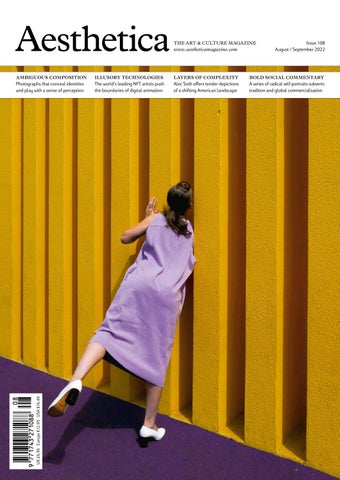
On the Cover Tekla Evelina Severin is a Stockholmbased colourist and photographer. She is known for seeking, and finding, lines, shapes and colours within her surroundings. Figures stand in carefully curated mises-en-scène where every element is tightly coordinated: clothing, backdrops, accessories, objects (p. 90).
Cover Image: Photographer: Tekla Evelina Severin. Model: Sarah Baker for Bright volumes, (2016).
Aesthetica is approaching 20 years old. It’s hard to believe that so much time has passed. I was recently asked how I’ve continued for so long. It’s easy. I love the fact that we can innovate, pivot and push ourselves in new directions all the time. This is a place where ideas are born. The magazine is a way for readers to convene, imagine and make sense of the present moment, at this critical juncture in history. Art has the power to unite. It is transformative. It takes us to new places, and introduces us to new cultures, but most importantly, it reminds us of our humanity. Much of this issue is about ever-changing landscapes: in both physical and virtual realms. It’s surprising that when this publication started the internet was dial-up. I remember making my very first Amazon purchase, racked with trepidation. Now we are in a world where NFTs are commonplace and the metaverse is real. The dichotomy of both the real and the imagined is intense, but it's exciting at the same time. Somewhere Ethereal opens in Stockholm and showcases six of the world’s top NFT artists in a gallery exhibition. It’s so intriguing that, as humans, we always want to return to physical spaces – and the notion of “analogue” is never too far away. Next, we foreground Alec Soth, a photographer that has become synonymous with the American landscape. His images unite people and places, focusing on commonalities rather than difference. In photography, we experiment with form, function and intervention, from curious still lifes to gripping environmental imagery. We feature Gjert Rognli, Erik Johansson, Alexander Grombach, Maciek Jasik and Borja Alegre. Our cover photographer, Tekla Severin, demonstrates a palpable understanding of colour. Finally, we speak with Emeric Lhuisset about a powerful series of portraits he shot in Ukraine in March 2022, depicting citizens turned resistance soldiers. For this project, on at Musée des beaux-arts du Locle, he conceals the sitters' faces, waiting to reveal their identities when the country regains sovereignty. Cherie Federico
Aesthetica 15
90
62
48
78
42
30
102
118
16 Aesthetica
108
72
contents
Art 16 News This season we cover a major retrospective of Joel Meyerowitz at Huxley-Parlour, London, alongside key exhibitions in Nottingham, Berlin and LA.
26 10 to See These exhibitions ask questions about the fabric of our world, from the role of the portrait to the interactive design of smartphone applications.
30 Looking to Nature Gjert Rognli's What Nature Knows is a journey into dense forests and across misty waterways, where surreal phenomena guide the viewer forwards.
42 Bold Social Commentary Cape Town-based artist Tony Gum pushes the boundaries of selfie culture, exploring tradition and heritage as well as mass-commercialisation.
48 Stepping into Dreams In Erik Johansson's surreal compositions, figures jump off from ledges with only a single balloon in hand; escalators emerge from forest floors.
62 Formal Symmetry Alexander Grombach's images document patterns in urban and cultivated landscapes, concentrating on symmetry and the tenets of visual harmony.
72 Ambiguous Composition Elina Brotherus' self-portraits are playful, poised and open to interpretation, surveying the image of the Rückenfigur – a figure seen from the back.
78 Digital Playgrounds The idea of interplanetary travel continues to make headlines. Borja Alegre’s three-dimensional renders encourage us to imagine other worlds.
90 Dynamic Arrangement Tekla Severin is known for seeking, and finding, complementary colours within her surroundings, offering carefully curated mises-en-scène.
102 Illusory Technologies Six of the world's most revered NFT artists come together in a physical exhibition, showcasing the best in digital renders and built environments.
108 Dramatic Alterations Maciek Jasik’s series, The World With Us, overlays hyper-real colour palettes onto rock formations, splicing, blurring and modifying the geography.
118 Layers of Complexity Alec Soth has become synonymous with the American landscape, traversing and capturing its diverse geography for over two decades.
124 Exhibitions We review Tracey Emin at Jupiter Artland, as well as Radical Landscapes at Tate Liverpool, and a digital showcase at Nxt Museum, Amsterdam.
129 Film Larry Achiampong's Wayfinder comes to cinemas throughout the UK. Martin Bourboulon's romantic biopic Eiffel stars Sex Education's Emma Mackey.
131 Music O-SHiN's debut album II / ∞ (Second of Infinity) is a captivating experimental electro-pop record. Hot Chip and Pisco Crane offer new releases.
Books
Artists’ Directory
Last Words
133 The Latest Publications D'Angelo Lovell Williams’ monograph expands narratives of Black and queer intimacy. Phaidon publishes a landmark survey of Ugo Rondinone.
138 This Issue's Practitioners Our featured artists consider the world through new perspectives: from the personal to the global, the traditional to the hyper-technological.
146 Emeric Lhuisset The artist shares insight into 100 portraits taken in Ukraine back in March 2022, a series now on display at Musée des beaux-arts du Locle.
Aesthetica Magazine is trade marked worldwide. © Aesthetica Magazine Ltd 2022.
The Aesthetica Team: Editor: Cherie Federico Content Creator: Eleanor Sutherland Content Writer: Saffron Ward Digital Assistant: Laura Kirkwood
Advertisement Enquiries: Megan Hobson (0044) (0)844 568 2001 advertising@aestheticamagazine.com
Reviews
ISSN 1743-2715. All work is copyrighted to the author or artist. All rights reserved. No part of this magazine may be used or reproduced without permission from the publisher. Published by Cherie Federico and Dale Donley. Aesthetica Magazine 21 New Street York, YO1 8RA, UK Newstrade Distribution: Warners Group Publications plc. Gallery & Specialist Distribution: Central Books. Printed by Warners Midlands plc.
Advertising Coordinator: Megan Hobson Artists’ Directory Manager: Katherine Smira
Artists’ Directory Enquiries: Katherine Smira directory@aestheticamagazine.com
Production Director: Dale Donley Operations Manager: Helen Osbond Designer: Matt Glasby Technical Coordinator: Matthew Millard Administration: Danae Wellington
Subscriptions: subscriptions@aestheticamagazine.com
Contributors: Rachel Segal Hamilton Duncan Ballantyne-Way Kate Simpson
Press Releases: pr@aestheticamagazine.com
Reviewers: Kyle Bryony, Marthe Lisson, Matt Swain, James Mottram, Monica de Vidi, Greg Thomas, Leyla Sanai, Eleanor Sutherland, Chris Webb, Alexander Stubbs, Julia Johnson, Alice Godwin, Saffron Ward
General Enquiries: info@aestheticamagazine.com
Follow us: aestheticamagazine.com facebook.com/aestheticamagazine twitter.com/AestheticaMag pinterest.com/AestheticaMag instagram.com/AestheticaMag
Aesthetica 17
18 Aesthetica
Ellen Kooi, Apeldoorn – Leemkuil, 2022, Hahnemüller archival print on dibond, from the Berg en Bos series, commissioned by CODA and made possible by the Mondriaan Fund.
Engaging with Nature INSIDE THE OUTSIDE CODA Museum, Apeldoorn | Until 25 September coda-apeldoorn.nl
In the first half of the 19th century, much of western culture was witnessing the birth of photography. This was shaped by the currents of Romanticism. Painters, writers and musicians were reacting to the accelerating effects of the Industrial Revolution, seeking inspiration through a profound engagement with nature. Through art, they sought the experience of authentic emotion. It’s easy to see parallels with today’s generation of creative practitioners, coming of age amidst the climate emergency. Many emerging artists focus on our relationship with other living creatures, as well as our role within ecosystems and notions of “care.” Inside the Outside unpacks these connections. The early Dutch photographer Richard Tepe (1864-1952) acts as a starting point. Black and white vintage prints – taken from the museum’s collection – are displayed in conjunction with 15 other contemporary artists, who each demonstrate an interest in the organic world and its synergy with humanity. In Jacquie Maria Wessels’ (b. 1959) Memory Master Tree Installation (2021), six large-scale images of trees, shot on 35mm film, are printed on silk material and animated with breeze from fans. The artwork reflects on how memories can be held within trunks and roots, whilst also acknowledging the fragility and transience of remembering. An image by Ellen Kooi (b. 1962) depicts a young woman surrounded by autumn trees. Illuminated copper leaves echo the strands of her auburn hair, in the process pointing to the affinities we hold with the world around us. Inside the Outside proposes a new kind of Romanticism, built for the 21st century.
Aesthetica 19
news
Exploring the Metropolis L.A. CROSSING Galerie Springer Berlin | Until 27 August galeriespringer.de
Street photography isn’t really about streets – they are just the stage. Looking through images from the genre’s godfather, Henri Cartier-Bresson (1908-2004) to contemporary practitioners such as Martin Parr (b. 1952) and Clarissa Bonet (b. 1986), the images are about people. Jens Liebchen (b. 1970), however, doesn’t make street photography; he makes road photography – the difference being that the people become entirely incidental. These pictures, now on show at Galerie Springer, Berlin, reveal America as it is experienced by many of its citizens – through the windows of a car. Indeed, there are roads in Los Angeles that don’t have pavements at all. Berlin-based Liebchen has been documenting this since 2010 in the series L.A. Crossing, which is displayed in a double bill with Peter Klare’s (b. 1969) Collages. Liebchen describes the process as “drive-by photography” – capturing the city’s vast highways and boulevards as he moves through them at pace. The scenes are at once mundane and evocative, reflecting on the car as a mobile but private space, tapping into the fantasy of freedom offered by individual vehicles, whilst simultaneously conveying a sense of alienation that low density living and subrbanisation creates within societies. Looking at Stephen Shore’s (b. 1947) image Beverly Boulevard and La Brea Avenue (1975), an undeniable source of inspiration for Liebchen's series, it’s surprising how little has changed – and yet with the climate crisis looming, in years to come, the transport infrastructure that shapes the American way of life may be completely reimagined, along with images like this.
20 Aesthetica
Aesthetica 21
Jens Liebchen, Untitled from: L.A. Crossing, 2010-2022 Central Avenue / 4th Street. Archival Pigment Print, framed. Courtesy the artist and Galerie Springer Berlin© Jens Liebchen.
Julius Shulman, Stahl Residence (Case Study House #22), Los Angeles, 1960, ® The Estate of Julius Shulman, courtesy TASCHEN.
news
22 Aesthetica
Staging our Reality HOLLYWOOD Helmut Newton Foundation, Berlin | Until 20 November helmut-newton-foundation.org
As Sylvia – the heroine of Federico Fellini’s 1960 film La Dolce Vita steps off the plane in Rome – she is met by a horde of press photographers, eager to get a shot. That scene is indicative of the way cinema and photography have always been linked in a mutually inspiring, if at times ambivalent, relationship. They share similar technologies, a common visual language of closeup portraits and wide-open landscapes. However, whilst lights and cameras are intrinsic to both, action is what differentiates them. Photography freezes time, whilst film sets it in motion. A group show at the Helmut Newton Photography Foundation in Berlin explores the way that photographers have portrayed Hollywood. The exhibition takes its cue from Helmut Newton’s (1920-2004) images from the 1960s and 1970s, influenced by the French Nouvelle Vague and of the films of Alfred Hitchcock, as well as portraits of stars attending Cannes Film Festival. Hollywood features pictures by 13 further imagemakers, providing a multifaceted view of the movies at large. There are on-set shots by Eve Arnold (1912-2012), street scenes in Melrose Avenue by June Newton aka Alice Springs (1923-1921), Annie Leibovitz's (b. 1949) sleek Vanity Fair-commissioned portraits and Julius Schulman’s (1910-2009) shots of glittering Beverly Hills mansions. The show, as a whole, considers a shift in cultural perspective: The Foundation's Director, Dr. Matthias Harder, notes: “On the one hand, the exhibition looks back upon 100 years of Hollywood. At the same time, its perspective is utterly contemporary, paying homage to the slowly fading splendour of an entire era.”
Aesthetica 23
Colour Photography BETWEEN THE DOG AND THE WOLF Huxley-Parlour, London | Until 12 August huxleyparlour.com
“Twilight” could be the name of an Instagram filter. You can just picture it – shades of dusty pink giving any shot the ethereal magic of a pre-dusk evening, no matter where you are in the world. Decades before Instagram was a twinkle in the idea of a smartphone, Joel Meyerowitz (b. 1938) developed a penchant for this mesmerising, otherworldly palette. It was the 1970s and colour photography was in its infancy, seen by many as somehow less serious than monochrome. However, this didn't apply to Meyerowitz who, along with William Eggleston (b. 1939) and Stephen Shore (b. 1947), was one of colour’s early pioneers. This solo show takes its title from the French idiom “entre chien et loup”, (literally “between the dog and the wolf”) which refers to the time of day between sunset and nightfall. The artist notes: “It seemed to me that the French liken the twilight to the notion of the tame and the savage, the known and the unknown, where that special moment of the fading of the light offers us an entrance into the place where our senses might fail us slightly, making us vulnerable to the vagaries of our imagination.” Some of the images on display have been taken from a monograph of the same name; others shot during the same period are markedly different in tone to Meyerowitz’s dynamic 35mm New York street photography. Made in Florida and using long exposures on a cumbersome large-format camera, these scenes – of swimming pools, houses and cars, and few people – have a sense of life slowed down. They reveal a true mastery of hue that phone apps, no matter how well designed, can only ever imitate.
24 Aesthetica
Aesthetica 25
Joel Meyerowitz, Fort Lauderdale, Florida, 1977. Courtesy: Image courtesy Huxley-Parlour, and Howard Greenberg. Copyright: Joel Meyerowitz.
Experian Data Centre – Sheppard Robson (2003) Photo ©Martine Hamilton Knight.
news
26 Aesthetica
Looking at Structures PEVSNER ON CAMERA Lakeside Arts Centre, Nottingham | Until 28 August lakesidearts.org.uk
Today, we can simply log onto Google Earth and, with a few clicks, look at any edifice anywhere in the world. Whilst this is completely commonplace in 2022 – it is, still, a radically new technological development. Luckily, in the 20th century, Sir Nikolaus Pevsner (1902-1983) – a professor of art history, who arrived in Britain as a refugee in the 1930s – was on hand. Between 1951 and 1974, Penguin published Buildings of England, Pevsner’s exhaustively researched 46-volume survey of the architecture, documenting virtually every county in the nation. The Nottingham guidebook has since been updated, most recently in 2020, when it was republished by Yale University Press. This version commissioned photographer Martine Hamilton Knight, who lives locally and lectures at Nottingham Trent University, to follow in Pevsner’s footsteps, shooting new images. Now more than 90 of these are on display at Lakeside Arts, featuring some of the city’s most familiar landmarks such as Nottingham Castle, Papplewick Pumping Station, the CZWGdesigned Maggie’s Centre at Nottingham City Hospital and the two universities, in addition to civic structures. Hamilton Knight says she found herself absorbing “the Pevsner way of seeing.” Whilst her pictures normally show buildings in use, this time Hamilton Knight deliberately eschewed scenes with humans, signage or cars in the frame, which might fix the shots within a particular historical period. The result is a visual chronicle that retains a certain purity of form, allowing remarkable buildings the visual space to “speak” for themselves through the images.
Aesthetica 27
art
10 to See RECOMMENDED EXHIBITIONS THIS SEASON
This list of stellar shows for August and September ask questions about the very fabric of our world. Who created the emojis and symbols that define modes of communication today? What is the difference between looking and seeing? How far do we idealise our surroundings?
1
The Portrait The Ravestijn Gallery, Amsterdam | Until 27 August
theravestijngallery.com In 1839, photography was born. It offered a kind of technology that could perfectly replicate a person’s likeness – faster and with greater accuracy than with paint or stone. A camera was, in essence, a kind of portrait machine. However, in the years since its inception, photographic portraiture has moved in imaginative, unanticipated directions – becoming as subjective as other art forms. This timely exhibition delves into the development of portraiture, with pictures by Blommers & Schumm (b. 1969), Michael Bailey-Gates (b. 1993) amongst others.
2
Vivian Maier: Anthology MK Gallery, Milton Keynes | Until 25 September
mkgallery.org When the work of Vivian Maier (1926-2009) was discovered, it fired up the public imagination. A career nanny, uninterested in fame, she spent 40 years chronicling the street scenes in New York and Chicago in hundreds of thousands of photographs, which only saw the light of day when auctioned in 2007. One hundred and forty of them are on show here – shots of children at play, commuters, lovers embracing – capturing the whole kaleidoscope of urban life. A must-see show that demonstrates photography as a tool for empathy, curiosity and wonder.
3
Sebastião Salgado Robert Klein Gallery, Boston | Until 28 August
1
robertkleingallery.com The world’s largest rainforest, the Amazon, stretches across northern Brazil into Colombia. Its canopy is a vital organ for the Earth, taking in CO2 and breathing out oxygen. Though common knowledge, the area is still under huge threats from intense deforestation efforts, with more than 150 acres cut down every minute of every day. This is one of the places Sebastião Salgado (b. 1944) has documented in his epic, almost Biblical monochrome aesthetic. This exhibition presents his most powerful photographs, which date back to 1973.
4
Never Alone: Video Games and Other Interactive Design
MoMA, New York | Opens 10 September
moma.org Today, we are so immersed in the digital sphere that we barely notice the transition between “real” and “virtual” realms. And yet, apps which shape how we work and live, like Zoom, WhatsApp and FaceTime, are interfaces that have been imagined into existence by teams of coders. This exhibition celebrates examples of interactive design that we use everyday, but barely pause to think, about such as the "@" symbol or games like Tetris or Pac-Man. MoMA reminds us that the digital age didn't just miraculously emerge: it was created intentionally.
5
Personal Structures Palazzo Mora, Bembo & Marinaressa Gardens, Venice | Until 27 November
personalstructures.com Art reveals, and comments on, the intricacies of our world, holding a mirror up to society and its communities. “Reflections” – the theme of this multidisciplinary group exhibition – “embodies the dual meaning of, on the one hand, a visible episode perceived by the eyes; and, on the other, a mental deed stemming from the action of thinking and pondering with the mind”, explains the curatorial team. Now in its sixth edition, the show runs during the 2022 Venice Biennale and features 200 international artists displayed across three central venues.
28 Aesthetica
2
3
4
5
Aesthetica 29
8
6
9
7
30 Aesthetica
10
6
Nina Röder
Cité de l'image, Clervaux | Until 23 September
clervauximage.lu/en A Surrealist trope, which continues to reverberate within contemporary photography, is the obscured face. René Magritte (1898-1967) most famously used an apple in The Son of Man (1964), as well as textiles and birds' wings – both items which crop up in the portraiture of Nina Röder (b. 1983). The Berlin-based artist’s work subverts the viewer’s expectations of looking and seeing. As A. Meyer writes in a text accompanying the exhibition: “The difference between the object and the subject, between a ‘thing’ and a living organism, seems abolished.”
7
Reclaim the Earth Palais de Tokyo, Paris | Until 4 September
palaisdetokyo.com To survive the climate emergency, we must make radical changes, not only in how we live, but how we think and speak to one another. This show takes its cue from the words of Australian sociologist Ariel Salleh: “Bringing ecology, feminism, socialism and Indigenous politics together means giving up the Eurocentric lens for a genuinely global one.” Works by 14 artists explore the destructive relationship between people and landscapes, reimagining our place in a decolonised landscape, moving from extraction and empire to harmonious balance.
8
Christoph Sillem: Daguerre
9
Image and Space
Galerie Peter Sillem, Frankfurt | Until 20 August
galerie-peter-sillem.com Christoph Sillem (b. 1965) focuses on the tarps that shroud Parisian heritage buildings whilst they are undergoing restoration work. The title references photographic pioneer LouisJacques-Mandé Daguerre, who invented the diorama, a proto-cinematic technique in which moving images are produced using paintings and light. Sillem’s pictures are copies of copies but they are illusions that reveal their workings – showing glimpses of the structure behind. They evoke the reality of urban planning as well as the romanticisation of the French capital.
Museum für Fotografie, Berlin | Until 28 August
smb.museum Since the 1980s, German photographer Candida Höfer (b. 1944) has specialised in technically impeccable large-format interiors – museums, restaurants, universities, zoos or theatres. The interesting perspectives and absence of human activity allows us to see the pure architectural language of these locations. Here, her images are juxtaposed with those drawn from the collection of the Kunstbibliothek, Berlin – such as Helga Paris' (b. 1938) street scenes by Willy Römer (1887-1979) – shining a light on alternative approaches to space.
10
Black Venus Fotografiska New York | Until 21 August
fotografiska.com/nyc This ambitious exhibition explores representations of Black women in visual culture. By displaying works made between 1942 and 1997, from 17 international artists including Deana Lawson (b. 1979) and Zanele Muholi (b. 1972) alongside archival depictions dating back to 1793, curator Aindrea Emelife provides visitors with a vital historical context. Audiences are invited to be educated on the foundations of fetishised and racist portrayals of Black female bodies. The practitioners critique these depictions, creating a legacy of the show.
1. Faiza (2020) © Robin de Puy / courtesy The Ravestijn Gallery. 2. Vivian Maier, New York, July 27, 1954 © Estate of Vivian Maier, Courtesy of Maloof Collection and Howard Greenberg Gallery, NY. 3. ©Sebastião Salgado, courtesy Robert Klein Gallery. 4. Jenova Chen (Xinghan) Chen. Flower. 2012. Video game software. Published by thatgamecompany. The Museum of Modern Art, New York. Gift of Sony Interactive Entertainment LLC. © 2008 Sony Interactive Entertainment LLC. “Flower” is a registered trademark of Sony Interactive Entertainment LLC. Developed by thatgamecompany. 5. Soap, installation by Corine van Voorbergen, 2021. Diameter. 110 cm. Photo by Prisma Compositional. 6. Nina Röder, Omas Falten in Blau. from the series, Champagner im Keller (2020). 7. Hala Wardé, A Roof for Silence, Lebanese Pavilion at the 17th International Architecture Exhibition - La Biennale di Venezia, 2021 Photo credit: Alain Fleischer and HW architecture © Adagp, 2022. Nina Röder, Omas Falten in Blau, from the series, Champagner im Keller (2020). 8. Christoph Sillem: Place Vendôme 3, 2020. Archival Pigment Print, mounted, framed, 120 x 150 cm, edition of 3 + 2 AP. 9. Fotograf unbekannt (Ernst Wasmuth Verlag), Rue de Turin 12, Brüssel 1899, © Staatliche Museen zu Berlin, Kunstbibliothek. 10. Jenn Nkiru, Music video for Kamasi, Washington's Hub Tones (2018), display dimensions variable. 9min. 7sec.
Aesthetica 31
art
Looking to Nature Gjert Rognli
The Sámi population is one of the largest indigenous groups in the world, and the oldest culture to exist in northern Norway. Today, the population expands across four countries – Norway, Sweden, Finland and Russia – and includes over 200,000 individuals. These communities maintain an extensive knowledge of weather patterns and seasons, navigating some of the world’s most challenging terrains. Gjert Rognli, who identifies with the Sámi culture, works across film, photography, sculpture and performance, drawing on a passionate connection with the organic world. What Nature Knows is a photographic journey into deep forests and across misty waterways – where surreal phenomena guide the viewer through the unknown. Glowing red lines draw the eye to rocky cliffsides, whilst scattered orbs create paths through the twilight. These near-mythological compositions draw on the opposing light and darkness of remote landscapes. gjert-rognli.com.
Gjert Rognli, What Nature Knows VI, (2020). Courtesy of the artist.
32 Aesthetica
Aesthetica 33
34 Aesthetica
Gjert Rognli, What Nature Knows III, (2020). Courtesy of the artist.
Aesthetica 35
Gjert Rognli, What Nature Knows VI, (2020). Courtesy of the artist.
36 Aesthetica
Aesthetica 37
38 Aesthetica
Gjert Rognli, What Nature Knows II, (2020). Courtesy of the artist.
Aesthetica 39
Gjert Rognli, What Nature Knows IV, (2020). Courtesy of the artist.
40 Aesthetica
Aesthetica 41
42 Aesthetica
Gjert Rognli, What Nature Knows V, (2020). Courtesy of the artist.
Aesthetica 43
art
Bold Social Commentary Tony Gum THE CAPE TOWN BASED TRAILBLAZER PUSHES THE BOUNDARIES OF SELFIE CULTURE, EXPLORING TRADITION, COMMERCIALISATION AND THE VALUE SYSTEMS OF THE SECTOR.
In 2010, at the age of 15, Tony (aka Zipho) Gum (b. 1995) emerged onto the scene with an art blog posting pictures of herself, using photography as a way to connect with the world and take up space. Through these creative, yet defiant, images, she critiqued the commercialisation of contemporary media, and crafted a new visual narrative entirely. Twelve years later, Gum is the subject of a major solo show, Milked in Africa.
from a background of artists, such as my uncle / cousin who is a fantastic fine artist. His name is Mongezi Gum. With the knowledge of people who have been in the field and practised for many years, I believe it is insincere of me to thrust myself into being called an artist when I believe it is a journey which you have to earn, not just walk into prematurely.
A: Do all artists need to consider their own value systems, questioning the sector and their wider place within it? TG: Artists are constantly having to renegotiate their values. We are creating work for ourselves, primarily, and for our immediate audience, but this ripples out to broader viewers, which we may not directly or indirectly want to communicate with. That is, I guess, the risk you take in being a creator. You are at the disposal of the opinions of others. I believe that believing in yourself, 100 per cent, is crucial for our survival. If you do not have a certain grounding, it is very easy to lose sight of yourself, and, in turn, that also affects the quality of A: Despite being called the “coolest girl in Cape Town” your work. Even as we are living, and evolving, in a modernby Vogue, is it true that you’ve often been wary of calling day world, there is a part of yourself that needs to hold true yourself an artist. How important are these definitions? to tradition: in culture, in the self and history. It is imperative TG: It’s not necessarily that I am wary of being called an artist, to solidify your self-worth as this helps you to navigate the but I don’t want to be prematurely confined to a certain walk industry whilst allowing room for your own kind of evolution. of life. I’m not a person who necessarily likes to conform. It’s not even a matter of liking, it’s not in my nature. So, I call A: Your interrogation of beauty standards is linked to the myself an “artist in learning” because that lends me the room idea of self-worth. Why do you create self-portraits? for learning and adapting to whatever I may feel inclined to TG: I am hesitant to describe my work as self-portraits, at the time. I shy away from definitive terms so that I don’t because there is a distinct difference in pictures that I would have to feel stuck. However, I also respect artistry. I come take of myself – me being me, just Zipho, the girl from A: Who, or what, do you continue to be inspired by? TG: I am inspired by God first and foremost. Family, too, is very important. In my culture we have “tribes” and sub-groups, and AmaXhosa are amongst these. When we identify where we come from, we say “ungumamni?” and that essentially means “what are your clan names?” So ooMpinga, ooBhele, ooJola, ooMokoena are the people that I come from. We start at the beginning. I am also inspired, of course, by my people: Africans, South Africans, Black and Xhosa women.
44 Aesthetica
Aesthetica 45
46 Aesthetica
Tony Gum, Xhosa Lady, (2015). Courtesy of the Artist.
“These images are quite determined as a deliberate removal of the self – whether that is by painting my skin a certain pigment, or including a certain adornment or attire that is quite distinct and pertains to a certain subgroup or subculture.”
Previous Page: Tony Gum. Stylist : Kristi Vlok. Photographer : Hayden Phipps. Art Direction : Stefan Naude. Magazine : The Lake Magazine (2015). Left: Tony Gum, Mother (2015). Courtesy of the artist.
Cape Town. There is a distinct difference between that and the portrait: the representational person or narrative that I get into “character” for. These images are quite determined as a deliberate removal of the self – whether that is by painting my skin a certain pigment, or including a certain adornment or attire that is quite distinct and pertains to a certain subgroup or subculture. These pictures are not a portrayal of myself. However, I am very inspired by the art of self-portraiture; my practice has stemmed from that genre. A: How do these images relate to your sense of self? TG: When I was younger, I was interested in placing myself in front of the camera. My relationship with myself, at the time, was quite volatile. I didn’t enjoy who I was, or how I looked: the skin I was in, my features, my hair texture. I was consuming a lot of media – watching TV, being on the internet or browsing through magazines, but these outlets didn’t represent a likeness, and that, of course, indirectly affected my relationship with myself. This devalued my understanding of beauty standards. Taking pictures was an act of defiance, in a way. Some people have likened me to Cindy Sherman, but I don’t see the relevance. Whereas, with the likes of Zanele Muholi and John Yuyi – these incredible artists of colour are pioneering placing themselves in front of camera to express a bigger narrative. I also enjoy the kitsch aesthetics of Nadia Lee Cohen, and, of course, the quintessential Frida Kahlo. A: Beyond the accessibility of selfie culture – what does the self-portrait mean to you as a genre and a medium? TG: I believe that, it, perhaps, ignites a sense of empowerment, even though it does pivot into weird dynamics on social media,
which depletes and warps the sense of self. We, as Black female photographers, have infiltrated that sphere, so, on balance, it lends itself to more equal sense of representation. You, as the person taking the selfie, are empowering yourself within this cultural reset. Anything that is man-made has an expiry date, yes, but selfies give us access. A: How did the Black Coca-Cola series begin – and how has this fed into your wider success as an artist? TG: Honestly, I was bored. I was playing, essentially. I decided to put a crate of empty coke bottles on my head, which I had seen in the backyard. I was quite inquisitive about the drink, because I grew up in the Seventh-day Adventist Church, and we were big on the health message. One of the regulations pertained to not drinking caffeine. In the township, coke is a cult classic – and a drink of the culture. If you see a brown, fizzy substance, you immediately associate that with coke. It’s a drink that is part of every experience – whether we are mourning, or celebrating birthdays and weddings. It’s in every corner store. I never consumed it, but it was very much in my world. I knew it was the Black people’s drink, essentially. But I was always puzzled by the fact that CocaCola has not, yet, done a campaign to celebrate their biggest consumers. I figured Black Coca-Cola needed a Black woman, and that became the tagline for my piece. The work, through my lecturer, Dr Ashraf Jamal, introduced me to my gallerist Christopher Moller, which is how my career started. A: In your images, you often “rework” other classic western brands. Where does your interest in brands originate? TG: The culture of modernity is really big – especially in
Aesthetica 47
Tony Gum, Pin-up Lady ( 2015). Courtesy of the artist.
this third world country. We have a really big class divide. It’s not like luxury brands are foreign to us – they are not out of reach – but brand culture is huge, even in the middle to lower class communities, because in a sense, it adds to the perceived value of the person, especially when the apartheid system was ruling out sub-divisions – moving people out of their homes. The value system of a Black person in South Africa has diminished to a level that I don't even know how to describe. Post-apartheid, 28 years into democracy, we are still living within infrastructures that were meant to dehumanise. Black people are predominantly still the lower class, and the divide is still as rife as it was, even worse, perhaps, with the levels of unemployment and displacement. People are still living in these temporary structures, which essentially are permanent homes now for a lot of our people. We are dealing with a society that is very traumatised, and we have a warped relationship with our sense of self, finding material value with big western brands. People can be living in a certain infrastructure, but will definitely have Louis Vuitton shoes, or a top. A: In what ways are you creating a new conversation? TG: We were stripped of our identity, and sometimes, the only way to hold onto yourself is to dress yourself up. Brands are about presenting yourself with “Isidima”, which, means a sense of dignity and pride. It's become superficial, but it started as an act of defiance. The apartheid government put us in unliveable circumstances – but we still dressed up to the nines, making sure we were respectable and reputable, because they couldn’t take that away from us. I'm not creating a dialogue, rather, I’m echoing a message of self-worth. We don’t have to prove ourselves through clothing anymore.
48 Aesthetica
A: In the Milked in Africa series (2016-2021) you focus on an entirely different liquid: one that has more ancient symbolism, and acts, here, as a metaphor for the “pervasiveness of post-colonial agenda.” Where did the inspiration for this series begin, and how did it develop? TG: The inspiration came from Vladimir Tretchikoff’s works – his depictions of the female body. Of course, he was a white man painting women of colour, but there was a beautiful richness in these paintings, something very womanly. The pigment he chose to colour them with doesn't speak to a specific identity or people or class of people. It was almost ambiguous, and I enjoyed that. Being a modern-day woman, I have this push and pull – wanting to develop in society, but also feeling as though my traditions and cultures are not being respected. If they are highlighted, they are then commodified, and that transcends to the resources of this continent. We are literally the richest continent in terms of resources and minerals, however, we are one of the poorest, and it doesn’t add up. There's a deep desire for Africans to realise that they are the "milk" which everyone is thirsty for.
Right: Tony Gum. Stylist : Kristi Vlok. Photographer : Hayden Phipps. Art Direction : Stefan Naude. Magazine : The Lake Magazine (2015).
A: How important is it that your works are relatable? Is there a particular audience that you're speaking to? Words TG: My primary audience is my people: Black women, Xhosa Kate Simpson women, South Africans. But I'm sparking a lot of conversations with people across the globe, and it’s beautiful to hear that individuals connect with the work, even though they Tony Gum: Milked in Africa may not be of the same culture or tribe. We all are humans at Fotografiska New York the end of the day, so there is always a link, especially when Until 21 August covering relatable topics. When we are discussing displacement, or feeling exploited, it’s relevant to all Black people. fotografiska.com
Aesthetica 49
art
Stepping into Dreams Erik Johansson
In the age of digital construction – where roughly three quarters of all social media posts are edited, and the lines between fiction and truth are continuously blurred – we are living amongst artifice. Still, we are mesmerised by this sense of craft. What is it that makes us want to follow into these worlds and believe in their story? For Erik Johansson (b. 1985), the answer lies in physically creating all props and sets, meticulously building each vision, and using digital technology only as a tool to finalise the images, blending the edges and easing the viewer's transition from real to surreal. In these compositions, escalators emerge from the green, mossy ground, sending anonymous shoppers straight into strange, nocturnal forests. Figures walk between doorways, teetering between the land of dreams and reality. Workers step off from ledges into an imaginary commute, with a single helium-filled balloon in hand, ready to float on into the abyss. erikjo.com.
Erik Johansson, Leap of Faith, (2018). Courtesy of the artist.
50 Aesthetica
Aesthetica 51
Erik Johansson, Just Visiting, (2019). Courtesy of the artist.
52 Aesthetica
Aesthetica 53
54 Aesthetica
Erik Johansson, Above All, (2019). Courtesy of the artist.
Aesthetica 55
Erik Johansson, Dreamwalker, (2014). Courtesy of the artist.
56 Aesthetica
Aesthetica 57
58 Aesthetica
Erik Johansson, Long Before We Met, (2021). Courtesy of the artist.
Aesthetica 59
Erik Johansson, Cut and Fold, (2012). Courtesy of the artist.
60 Aesthetica
Aesthetica 61
art
62 Aesthetica
Erik Johansson, The Cover Up, (2013). Courtesy of the artist.
Aesthetica 63
art
Formal Symmetry Alexander Grombach
The word “symmetry” comes from the Greek “symmetria”, meaning “agreement in dimensions, due proportion, arrangement.” The concept has been fundamental to art and culture for millennia, and remains associated with visual harmony. Munichbased artist Alexander Grombach uses the same sense of order when constructing minimalist photographs. He describes symmetry as a way “of dealing with life’s chaos.” Lampposts form satisfying rows, receding – uniformly – into the distance. A lime green wall is sliced down the middle by a drainpipe, windows positioned either side of the divide. These images document patterns in urban and cultivated landscapes, from flattened crops to glistening plastic chairs in tiers. “The majority of my pictures are taken from everyday life, some would even call them trivial,” Grombach says. “However, I always try to infuse them with a sense of magic.” herrmoser.com | @herr_moser.
Alexander Grombach, Where is My Mind, (2022). Courtesy of the artist.
64 Aesthetica
Aesthetica 65
Alexander Grombach, Listen to the Wind, (2021). Courtesy of the artist.
66 Aesthetica
Alexander Grombach, Thinking About Thinking, (2020). Courtesy of the artist.
Aesthetica 67
Alexander Grombach, Hayday, (2021). Courtesy of the artist.
68 Aesthetica
Alexander Grombach, Ghostkeeper, (2020). Courtesy of the artist.
Aesthetica 69
Alexander Grombach, Moonlight Shadow, (2022). Courtesy of the artist.
70 Aesthetica
Alexander Grombach, Lush , (2019). Courtesy of the artist.
Aesthetica 71
Alexander Grombach, What Are Words Worth, (2019). Courtesy of the artist.
72 Aesthetica
Alexander Grombach, Something Fast, (2018). Courtesy of the artist.
Aesthetica 73
art
Ambiguous Composition Elina Brotherus THE ACCLAIMED FINNISH PHOTOGRAPHER EVOKES A SENSE OF PLAY WITH EACH OF HER SELF-PORTRAITS, OBSCURING AND COMPLICATING THE NOTION OF IDENTITY.
“An artist makes art, but they are also a spectator of art,” says been so interesting in this time span of 25 years. I hope to Finnish photographer Elina Brotherus (b. 1972). She is per- live long enough to show a much larger evolution of the self. haps best known for self-portraits, which are steeped in visual history – capturing herself standing, serenely, in the open A: Let’s talk about the tension that runs through your expanses of lakes or atop the ragged summits of mountains. works: the figures could be seen as lost, or indeed exHer style has become instantly recognisable – lauded for actly where they intend to be; lonely or safe within their its minimalism, as well as its enigmatic sense of storytelling. own refuge; experiencing melancholy or serenity. How Here, figures are permitted a subjectivity of emotions, where important is it that you maintain this sense of ambiguity the psyche is open to creative and critical interpretation. – of complicating narratives, and expanding on the power of the image to communicate a spectrum of emotions? A: Your practice has, for over two decades, focused on EB: The emotions are much less structured, less defined in creating contrasts and connections: between bodies and my current work, as opposed to the more autobiographical landscapes, interior and exterior worlds. What is it that series that I have created in the past. The overall feeling is has continued to inspire you: to go out into the world and in the eye of the beholder. I believe that you see what you to create photographs? How has this journey changed see because of what you are going through in your life. along the way, such as, your principles or goals? Images communicate on so many different levels. Even a EB: I’ve had different reasons for photographing at different seemingly neutral face can suggest a multitude of readings, times. When I was young, I wanted to see what I looked like. depending on the context, the light, the surroundings, the I was divorced, so I had nobody else to take pictures of me. framing – and the other images in the sequence. I like the Another reason was that I was talking about emotions – what idea that photographs can pull us in different directions. I it is to be a young person growing up and feeling somewhat love ambiguity, having a chameleon-like presence. lost. It felt fair to use myself, to be genuine, and not to work with actors or other people. Gradually, my body and my A: Whilst your works contain expansive psychogeography, face became tools. Many things have changed in my pho- the face is often hidden from view, especially in your tography – I very seldom do narrative work nowadays, my later works. What is the significance of this concealment, practice is much more informed by historical avant-gardes, or erasure, or in turning away from the camera as you 1960s and 1970s conceptual and performative art. Yet, there have progressed throughout your career? is always this recognisable but evolving figure of the artist. I EB: Showing the face results in us fixing the identity to someenjoy observing the changes in myself as the model. It has thing specific. When the face is hidden, it’s easier to identify
74 Aesthetica
Aesthetica 75
76 Aesthetica
Elina Brotherus, Is There More to Life Than This (2018). 90cm x 120cm, from the series Seabound. Image courtesy of the artist, gb agency, Paris, and Martin AsbaekGallery, Copenhagen.
“Showing the face results in us fixing the identity to something specific. When the face is hidden, it’s easier to identify with the person. As a viewer, you are able to step into their body and see with their eyes.”
Previous Page: Elina Brotherus, Imaginary Burial Place 3 (2019, detail). 80cm x 120cm, from the series Sebaldiana. Memento mori. Image courtesy of the artist, gb agency, Paris, and Martin Asbaek Gallery, Copenhagen. Left: Elina Brotherus, Seabound Two Nights in a Row (2018). 120cm x 90cm, from the series Seabound. Image courtesy of the artist, gb agency, Paris, and Martin Asbaek Gallery, Copenhagen.
with the person. As a viewer, you are able to step into their body and see with their eyes. In recent years, I have been working on a portrait series inspired by John Baldessari. He once stated that the face steals all the attention, so to make people look at other elements on the picture plane, we need to conceal the face. This is a lesson I have adopted. A: How can still images contain these kinds of multitudes – in ways that, perhaps, other art forms cannot? EB: Images are more open than, say, films. We are not given one single story line to follow, and I'm keen that I expand upon this prism of emotions and ideas: ambiguity. The feeling that the viewer interprets? Well, that's entirely up to them. A: Many of the compositions reference the Romantic landscapes of Caspar David Friedrich, particularly the seminal painting Wanderer Above the Sea of Fog (1818). In what ways are you placing these works in dialogue with your own, challenging the narratives of humanity in which we glorify, and then conquer, nature? EB: With my first Wanderer allusion (Personnage dans un paysage (montagne) – from 2000 – the protagonist still faces the camera, showing the slope she has climbed to conquer the mountain. When I returned to the subject matter three years later, the picture was already called Der Wanderer, and I chose to turn the model away from the camera. My initial idea was to place a young woman in a landscape that, through the Romantic ideal, was typically reserved for men. She, too, deserves to be on top and have her gaze free to roam the world from this critical observation point. I became so attached to this motif of the “Rückenfigur” – the figure
seen from the back – that I have continued to use it in various series. My recent body of work, Sebaldiana. Memento mori, deals with remembering our dead – it has several figures in mourning at imaginary burial places, or sites I pulled from W. G. Sebald’s posthumously published writings about Corsica. A: What power structures, if any, are you moving against, in your work? Are you questioning a certain gaze – either from the viewer, or through the lens of art history? EB: I want to create space and agency for women as do-ers, makers and self-confident actors within their own industry. I’ve been around for a while, so it's great to hear that I’ve served as an example, and been an encouragement for younger artists. When I studied, we had Cindy Sherman and Nan Goldin, but all the rest of the curriculum were men. As students and artists, we all need art made by a range of perspectives – to avoid getting a biased view of the world. A: How do you choose the landscapes you work in, and what is their significance? What is the role of the figure as a whole within these geographies? Is it romanticised? EB: I don’t feel I’m romanticising. I use the geography as a stage where performative actions can take place. The landscape can be anything – anywhere – I just need alonetime there for the ideas to surface. Lately, I’ve been receiving invitations to work in fantastic places. In 2019, Centre Méditerranéen de la Photographie invited me to Corsica where I made the Sebaldiana series. AKO Kunststiftelse had me working in southern Norway for two years, which resulted in another recent series, Seabound (featured here). In every region, I visit different landmarks: this takes me to
Aesthetica 77
Elina Brotherus, Aften I Ny-Hellesund (båt) (2018). 90cm x 120cm, from Seabound. Courtesty of the artist, gb agency, Paris, and Martin Asbaek Gallery, Copenhagen.
outer archipelagos and mountains, from NYC skyline views to forests or to lighthouses. My eyes are hungry for new landscapes, and through discovery, the work becomes easy. A: Has your relationship with ecology changed over the last few years, and, if so, does it feed into your work? EB: I have started to personally invest in ancient forests through a Finnish foundation called Luonnonperintösäätiö. Their sole goal is to recognise valuable woodlands – to buy them and, ultimately, protect them. I donate both money and works for their charity auctions. By protecting forests, we also protect animals and biodiversity and create long-term carbon storage. This has become very important to me. A: Tell us about your upcoming show at FFFrankfurt. What does the title In Reference to a Sunny Place mean to you, and what does the exhibition bring together in terms of your wider practice? There’s almost a sense of play that comes into this title – how important is this? EB: Celina Lunsford, my curator and the director of Fotografie Forum Frankfurt, came up with the title. I liked it and approved it. I much prefer long and obscure titles to something like Elina Brotherus – Works 1997-2019. In Reference to a Sunny Place is a small retrospective that presents key images from over 20 years, but it has a strong focus on recent work. The older I get the more carefree I become. I don’t need to prove anything anymore. I can do fun things as and when I please. I have taken as my reference various sources like Baldessari’s Art Assignment Sheets (1970), where he encourages artists to “make up an art game”, “disguise one object as another”, or “document change, decay and metamorphosis.”
78 Aesthetica
I also draw upon the Event Scores of the Fluxus artist collective from the 1960s – an interdisciplinary community of artists, composers, designers and poets who engaged in experimental art performances, emphasising the artistic process over the finished product. Their proposal pieces or "recipes" for actions, include directions such as "place a dog or a cat (or both) inside a piano and play Chopin", "run a 220-yard race with inflated balloons tied to the body" or "regard two or three oranges for a long time." These physical gestures are creative tasks that open the mind – like blueprints. They are tools through which I create something completely new. A: What was the starting point for the curatorial focus of the exhibition? How do you want the title to inform and influence the viewers' overarching experience? EB: Celina Lunsford took my 2019 Playground exhibition at PHotoESPAÑA as a starting point for this show. She took the idea of colourful walls, a selection of video works and playful performative pieces. Crucially, however, she added a “before” and an “after.” We have early autobiographical pieces and some works from Wanderers plus other model studies, to show where I come from. We conclude with a selection of new works from Sebaldiana. Memento mori. That series has quite a different tone: it deals with death, mourning and tribute. I follow in the footsteps of W. G. Sebald whose book on Corsica remained unfinished at his untimely death. I went to many locations Sebald mentions and was thinking of my own dead. I was looking for places so beautiful, that, if I were Corsican, I would bury loved ones there. In Reference to a Sunny Place is well-curated, well-installed and well-paced. It allows, as I intend, for multiple readings and experiences.
Right: Elina Brotherus, Shore (Shadow of a Cloud) (2018, detail). 80cm x 106cm, from the series Seabound. Image courtesy of the artist, gb agency, Paris, and Martin Asbaek Gallery, Copenhagen.
Words Kate Simpson
Elina Brotherus: In Reference to a Sunny Place Fotografie Forum Frankfurt Until 18 September fffrankfurt.org
Aesthetica 79
art
Digital Playgrounds Borja Alegre
In 2020, a series of unexplained pillars began to appear across the globe. The first monolith was discovered in Utah, followed by similar sightings in California, Romania and the Isle of Wight. Their appearance captivated the world, with questions being asked: who was behind the mysterious structures? Could they be a sign of extra-terrestrial life? Such forms are part of Borja Alegre’s (b. 1987) visual world. The 3D motion designer specialises in the surreal: “I enjoy defying what can or can’t exist.” Cuboids balance in mid-air – seeming to resist gravity. Figures sit on top of them and wear them like accessories. Elsewhere, rocky outcrops become playgrounds for experimentation, with bodies bending over backwards or holding up apparently impossible weights. Hands and legs emerge from desert landscapes, reflective blocks poised on tiptoes. As the idea of interplanetary travel continues to make headlines, Alegre’s images encourage us to imagine other worlds. borjaalegre.com.
Borja Alegre, Monolith 1 (2020). Courtesy of the artist.
80 Aesthetica
Aesthetica 81
82 Aesthetica
Borja Alegre, Covid (2020). Courtesy of the artist.
Aesthetica 83
Borja Alegre, Monolith 2 (2020). Courtesy of the artist.
84 Aesthetica
Aesthetica 85
86 Aesthetica
Borja Alegre, Ankle (2020). Courtesy of the artist.
Aesthetica 87
Borja Alegre, Josh (2020). Courtesy of the artist.
88 Aesthetica
Aesthetica 89
90 Aesthetica
Borja Alegre, Monolith 3 (2020). Courtesy of the artist.
Aesthetica 91
art
Dynamic Arrangement Tekla Evelina Severin
The Memphis Design Collective existed for only six years: from 1981 to 1987. Yet, the group broke new ground, becoming synonymous with clashing colours, geometric shapes and bold patterns. Iconic objects from the period include Ettore Sottsass’ Carlton bookcase – since collected by the likes of David Bowie, Karl Lagerfeld and Cara Delevingne. Tekla Evelina Severin is a Stockholm-based colourist, designer and photographer. She is a collaborator with Vogue Brazil, IKEA and Levi’s, and is known for seeking – and finding – lines, shapes and palettes within her surroundings. In the kitchen, for example, black and white stripes pop against terracotta surfaces. Outdoors, pastel pinks collide with mustard yellows, casting shadows in the blazing sun. Elsewhere, red and purple archways lead to abstract destinations. Cubes and spheres draw the eye, whilst figures stand within carefully curated mises-en-scène. teklaevelinaseverin.com.
The very simple teklan edition. Design, Set Design & Styling: Tekla Evelina Severin. Photo: Fredrik Bengtsson, (2021).
92 Aesthetica
Aesthetica 93
Tarkett Concept Design. Styling: Tekla Evelina Severin, (2020). Image Credit: Tekla Evelina Severin and Gabriel Söderbladh.
94 Aesthetica
Montana: The Teklan Free Edition. Set design & Styling: Tekla Evelina Severin, (2020). Photo: Yellow studios / Mikkel Mortensen.
Aesthetica 95
Teklan Mix x Heymat. Direction & Styling: Tekla Evelina Severin, (2020). Photography in collaboration with Gabriel Söderbladh.
96 Aesthetica
Teklan Mix x Heymat. Direction & Styling: Tekla Evelina Severin, (2020). Photography in collaboration with Gabriel Söderbladh.
Aesthetica 97
Tarkett Concept Design. Styling: Tekla Evelina Severin, (2020). Image Credit: Tekla Evelina Severin and Gabriel Söderbladh.
98 Aesthetica
Montana: The Teklan Free Edition. Set design & Styling: Tekla Evelina Severin, (2020). Photo: Yellow studios / Mikkel Mortensen.
Aesthetica 99
The very simple teklan edition. Design, Set Design & Styling: Tekla Evelina Severin. Photo: Fredrik Bengtsson, (2021).
100 Aesthetica
Tarkett Concept Design. Styling: Tekla Evelina Severin, (2020). Image Credit: Tekla Evelina Severin and Gabriel Söderbladh.
Aesthetica 101
Tarkett Concept Design. Styling: Tekla Evelina Severin, (2020). Image Credit: Tekla Evelina Severin and Gabriel Söderbladh.
102 Aesthetica
Montana: The Teklan Free Edition. Set design & Styling: Tekla Evelina Severin, (2020). Photo: Yellow studios / Mikkel Mortensen.
Aesthetica 103
art
Illusory Technologies Somewhere Ethereal SIX OF THE WORLD'S MOST REVERED NFT ARTISTS COME TOGETHER IN A PHYSICAL EXHIBITION SHOWCASING THE BEST IN DIGITAL RENDERS AND BUILT ENVIRONMENTS.
In 2014, the digital artist Kevin McCoy and tech entrepreneur Anil Dash were working late at an art “hack-a-thon” in New York, looking at ways to transfer authorship of digital art works they’d had been unable to sell. They needed to find a way to make a few copies “authentic” so as to distinguish them from the other versions. That night, they worked out that, by putting them on the blockchain, they could permanently affix a digital ownership certificate to an artwork, that could then be infinitely passed on and traded. Without realising it, they had invented the world’s first Non-Fungible Token (NFT). Back then, digital artists had mainly been sidelined by museums and institutions, in the most part because of the difficulty of physically exhibiting works that belong in the virtual space. There was also a lingering resistance from the traditional art world. Digital art did not fit into its structure of endorsement. Curators, collectors, critics and gallerists – the established gatekeepers of art – weren’t paying the genre much attention, and it remained a small, niche movement. That began to change in 2017, when two “creative technologists” – John Watkinson and Matt Hall were alerted to the growing popularity of online avatars and decided to create their own NFT project. Using a generative computer programme, they created 10,000 unique characters on the Ethereum blockchain. They called their project Cryptopunks and they opted to let anyone with an Ethereum wallet claim one for free. They had no idea how it would be received, but saw it as an investigation into scarcity and demand. It did not take long for every Cryptopunk (1,000 they kept for themselves) to be claimed, and soon a thriving secondary
104 Aesthetica
trading market sprang up. Interest in NFTs continued to grow steadily until early 2021, when the market suddenly exploded. The catalyst was the Christie’s sale of Beeple’s (Mike Winkelmann) NFT, First 5000 Days, at auction for $69.3 million. Drawing from pop culture and set mainly in post-apocalyptic futuristic landscapes, Beeple had made a drawing every day between 2007 to 2021 and tessellated them into one enormous digital image. The sale kickstarted a digital art gold rush. Beeple became the third most expensive living artist at auction, and suddenly the art world – quick to react once money’s involved – began to take notice. Unlike technologies such as Bitcoin or Ethereum – which are interchangeable – Non-fungible tokens are so-called because each is, in some way, completely unique. These specific identification codes and metadata have enormous utility that could be applied to turn anything from music, games, even tweets, into digital assets. Like sculpture and painting, NFTs were a new medium to work in and interpret. Their widespread adoption not only redefined the creation process but allowed digital artists, for the first time, to sell their artworks as conveniently as a painter would sell a canvas. Figurative painting remains the dominant medium at this year’s edition of Art Basel – the world’s most prestigious art fair. Although NFTs did appear in the booths of a few forwardthinking galleries, uptake for digital art has been surprisingly slow. But where the traditional art world lags behind, galleries and new exhibition spaces are opening up and are beginning to cater to this growing market. In March of this year, the dedicated NFT space, Quantus Gallery, opened in London
Aesthetica 105
106 Aesthetica
Andreas Wannerstedt, Sliding Zeus XL. (detail).
“Before, emerging names required a respected institution to back them if they were to have any chance of gaining credibility and commercial success, but the blockchain now allows digital artists to get direct access to their collectors.”
Previous Page: THINGS I LOVED AS A CHILD (2020). Andrés Reisinger in collaboration with Alba de la Fuente. Left: RAC Album Cover (Boy, 2020). Concept and creative direction: Reisinger Studio. Art Direction: Andrés Reisinger, Carlose Neda. 3D artists: Andrés Reisinger, Carlos Neda.
and this summer, Fotografiska in Stockholm, are putting on their first “physical” NFT exhibition, Somewhere Ethereal. Fotografiska doesn’t sell works, instead, with its unique hybrid museum model, it charges entry to mainly touring photographic exhibitions that then travel on to one of the franchises in New York, Tallinn, and a soon-to-be-open space in Berlin. The museum has shown digital art before, but this is the first time artworks will be exhibited as actual NFTs on the blockchain. “We may be dedicated to photography,” says Jessica Jarl, Director of Global Exhibitions, “but for us it is important to show and reflect what is happening in the world right now with so many artists starting to work in this media.” Somewhere Ethereal features the work of six of the most priominent NFT artists at work today: Itzel Yard (IX Shells), Andrés Reisinger, Andreas Wannerstedt, Krista Kim, Erick Calderon (Snowfro) and Six N. Five. For those who have only seen digital art through their smartphones, seeing these sizeable projections provides a far more impactful and immersive viewing experience. In the six individual rooms, the curators have used mirrors and an atmospheric soundtrack to unite the digital and physical realm and simulate a richly meditative experience. The viewer is taken on a flowing, contemplative journey that manages to combine the speed and innovation of advanced technologies with the often contradictory human need for relaxation and wellbeing, from ASMR-inspired brain massages with Andres Wannerstedt’s Sliding Zeus IX, to techier, more conceptual works like Erick Calderon’s Chromie Squiggle – where gradients of saturated colour flow along a three-dimensional shape. “Calderon’s NFT is generative,” says Mathieu Wothke, Somewhere Ethereal’s curator, “so when people want to buy the
artwork and mint it, they get their own randomised version of the piece.” There is a QR code beside each artwork and visitors can use their phone to see it on the blockchain and find out how much it would cost. “In most cases the artwork has already sold, and I don’t think the owners want to sell.” Wothke continues. “But you can potentially put in an offer.” This new sales model has far-reaching implications for the traditional commerical gallery, with the potential to make the art market a far more accessible and inclusive industry. Before, emerging names required a respected institution to back them if they were to have any chance of gaining credibility and commercial success around the world, but blockchain now allows digital artists to bypass intermediaries and get direct access to their collectors. Practitioners can put their work directly on platforms like OpenSea and Nifty Gateway, which act as showrooms and marketplaces with minimal overheads. “If you sell work through a gallery, an artist might never even know who is buying from them and have no contact with them at all”, says Wothke, whereas the process of buying an NFT is “really transparent and individuals can build a tight relationship with their collectors.” Now based in Barcelona, the Argentinian born Andrés Reisinger is one of the most sought-after and recognised digital artists. Formerly a three-dimensional designer working for big-name brands, it was a natural progression for him to move into making NFTs where his technical abilties and curiosity for new technologies were ideally suited for the crypto art space. His lavish, pink-hued worlds, set in otherworldly, dream-like landscapes, are a perfect balance of welcomeness and unfamiliarity. Often the animations are so meticulously rendered, you don’t question their sense of
Aesthetica 107
Six N. Five. The Red Spot.
“authenticity” at first. It’s only after a while, that you become aware of an underlying disquiet, a subtle but persistent feeling that something – somehow – is not quite right. His featured work, Pollen, is an intriguing play on the tradition of the still-life genre. A loose bundle of blurred and ever-shifting, blossoming vegetation, the work trembles and quivers, and, like nature itself, alters and transforms through the changing seasons. The piece is exclusive in the fact it is only available to those who had bought one of his earlier NFTs: “I wanted to thank my earlier collectors,” says Reisinger, “with something more than just another artwork, rather an experience that integrates them as contributors to the creation of art.” If the collector decides, they can exchange their owned NFT for Pollen, allowing the code to interact (pollinate) with the new work and trigger a “transformation process that results in what is defined as recombinant art”, says Reisinger. Making the collector a co-creator of the piece, Pollen radically shakes up of the process of both making and collecting art. The work facilitates a collaborative relationship between artist and collector – entering into a new dialogue that’s only possible within these digital parameters. Borrowing from the shapes and forms of nature, Reisinger’s work, with its flourishing flowers and stems, achieves a sense of abundance and rapid alteration that is impossible to find in the natural world. This is also the case with Six N. Five’s The Red Spot, an animation that digitally reimagines nature as a looping, serene seascape that plunges the viewer into a deep state of calm. Both works combine realism and fictitious landscapes to play on our sensory connections, using the digital to explore our experience of the natural world. For Reisinger, we are only just beginning to explore the
108 Aesthetica
capabilities of the NFT medium: “the beauty of such tech- Right: Andrés Reisinger, nologies is that you never know how it will change, and what More Understanding (2019). newness it will bring. NFTs are in constant mutation and de- Courtesy of Reisinger Studio. velopment, and I think in the future we’ll be able to use NFTs to bring us closer to our physical world, helping us discover more about the potentials we already own.” As our physical and digital worlds becoming increasingly integrated, blurred and interwoven, this play between the real and the virtual transcends the limitations of our physical world. “My reality is composed of so many elements.” Reisinger says, “I experience the physical and I experience the digital. They are both realities – simultaneously tangible and intangible.” Despite the volatility in the market and accusations that many NFTs have been pursued for financial goals, their rapid growth has revealed the huge appetite for digital art objects. Even if the speed has come at a cost, many NFTs, according to Wothke, “are lacking critical engagement and meaning and that’s down to everything moving at such a speed.” That’s usually the way new cultures emerge, with artists producing outside the mainstream and critical viewpoints forced to play catch up. The difference in this case is that, in the space of just a few years, NFTs have grown from a marginal niche market Words to a highly sought-after commodity. Global recognition has Duncan Ballantyne-Way come quickly alongside an enthusiastic collector base. NFTs have already had a significant impact on the present moment. As the number and quality of exhibitions improve, Somewhere Ethereal its importance to culture and society looks only set to increase. “When you work with digital artworks, there is such Fotografiska Stockholm variety, the expression can look so different.” Says Jarl, “Even Until 21 August if you don’t understand the technology, these landscapes reveal the strange new possibilities now widely available.” fotografiska.com
Aesthetica 109
art
Dramatic Alterations Maciek Jasik
“Manifest Destiny” was a phrase, and a concept, coined in the USA in 1845, during the presidency of James K. Polk (1845-1849). It encompassed the notion that Americans were divinely ordained: part of a political and religious doctrine to expand towards the west, profiting from the so-called “plentiful emptiness” of the land. This territorial belief justified the forced removal of native communities, intensified racial tensions, and, ultimately, became kindling for the Civil War. Maciek Jasik’s (b. 1978) series, The World With Us, explores humanity’s yearning, once again, some 200 years later, for empty spaces – a form of escape from the urbanised, homogenised, lands of our own creation. These images, which overlay hyper-real colour palettes onto spliced rock formations from Oregon, Arizona and Utah, draw attention to the irony of this desire, and the ways in which we have altered landscapes beyond our own recognition. maciekjasik.com.
Maciek Jasik, The Dalles, Oregon (2017). Courtesy of the artist.
110 Aesthetica
Aesthetica 111
Maciek Jasik, White Pocket, Arizona (2019) from the series The World with Us. Courtesy of the artist.
112 Aesthetica
Maciek Jasik, White Pocket, Arizona (2019) from the series The World with Us. Courtesy of the artist.
Aesthetica 113
Maciek Jasik, White Pocket, Arizona (2019) from the series The World with Us. Courtesy of the artist.
114 Aesthetica
Maciek Jasik, Toadstool Hoodoos, Utah (2019) from the series The World with Us. Courtesy of the artist.
Aesthetica 115
Maciek Jasik, White Pocket, Arizona (2019) from the series The World with Us. Courtesy of the artist.
116 Aesthetica
Maciek Jasik, Snow Canyon, Utah (2019) from the series The World with Us. Courtesy of the artist.
Aesthetica 117
Maciek Jasik, White House Spring, Utah (2019) from the series The World with Us. Courtesy of the artist.
118 Aesthetica
Maciek Jasik, White Pocket, Arizona (2019) from the series The World with Us. Courtesy of the artist.
Aesthetica 119
art
Layers of Complexity Alec Soth THE MINNEAPOLIS-BORN PHOTOGRAPHER HAS BECOME SYNONYMOUS WITH THE AMERICAN LANDSCAPE, TRAVERSING ITS DIVERSE GEOGRAPHY FOR OVER TWO DECADES.
On 20 January 2017, Donald Trump was inaugurated as cult-to-articulate, but nonetheless unmistakable, sensibility. the 45th president of the USA. On 21 January 2020, the first Soth has covered thousands of miles on his travels. Road case of Covid-19 was reported in Washington state. By this trips have sent him zig-zagging back and forth around the time, Alec Soth (b. 1969) couldn’t bring himself to make work American landscape for more than two decades. But the jourabout America. Unable to move freely, consuming news bul- ney began in Minneapolis in 1999 when the photographer letins on the TV or stories on the internet, he was appalled. was fresh from studying at Sarah Lawrence College, New Things are, in many ways, even worse now than they were York. “I’d decided there was no way I was going to make a back then. According to the Gun Violence Archive, this year living as an artist – it just wasn’t feasible. I also thought it there have been four mass shootings every week. In each would kill my passion for photography to be taking pictures case, at least four people have been injured or killed exclud- of socks or whatever for money, so my photography was ing the shooter. The deadliest of these so far was on 24 May, something pure that I did on the weekends,” Soth recalls. “I when a man in Uvalde, Texas, opened fire at a school, kill- didn’t care what anyone thought of it. I felt really free.” ing 19 children and two teachers. Exactly a month later, the After being awarded a funding grant, he jumped in his car Republican-dominated Supreme Court overturned the land- and set off, following the Mississippi River, which takes in 10 mark 1973 Roe v. Wade ruling, causing global uproar. states: Arkansas, Illinois, Iowa, Kentucky, Louisiana, MinneHowever, Soth is known for making beautiful, tender and sota, Mississippi, Missouri, Tennessee and Wisconsin. These lyrical images about America, from Sleeping by the Missis- travels resulted in a seminal photobook, Sleeping by the sippi (2004) to Niagara (2006) and up to his most recent Mississippi, first published in 2004, which is now considered series, A Pound of Pictures (2022). Soth has, to widespread a classic. It presented America at a distinct time in history – acclaim, managed to connect disparate images of people after 9/11 but before the economic crash of 2007 – but it and places into large-scale visual symphonies that speak to also had a haunting, timeless quality. Ostensibly, Soth was one another. Featured subjects include Julie in Austin, Texas, making documentary photography. Yet, infused with prowith tousled golden hair; Charles in Vasa, Minnesota, who, found empathy, the large-format pictures of landscapes and dressed in overalls, clutching a model plane in each hand; loners felt more poetic than the strictly observational. Melissa, the bride who sits in quiet contemplation outside the Sleeping by the Mississippi made such an impact that, postFlamingo Inn in Niagara Falls; and Bil, an elderly gentleman publication, Soth was invited to join the prestigious Magnum from Sandusky, who smiles as he dances alone across the Photos. Beyond critical praise, however, the publication had floor of a community hall in Ohio. These subjects share more helped to define Soth’s methodology as an artist: driving to, than geography, these individuals are connected by a diffi- or through, a place, and photographing strangers and scenes
120 Aesthetica
Aesthetica 121
122 Aesthetica
Alec Soth, Water Valley, Mississippi, from A Pound of Pictures (MACK, 2022). Courtesy of the artist and MACK.
“I think of my photography as being as much about the distance between myself and a person as it is about the connection. People often say my pictures are sad. There's something so bittersweet about the medium.”
Previous Page: Alec Soth, Temple Adida. Davenport, Iowa, f rom A Pound of Pictures (MACK, 2022). Courtesy of the artist and MACK. Left: Alec Soth. Birdwatching. Linfield, Pennsylvania, from A Pound of Pictures (MACK, 2022). Courtesy of the artist and MACK.
along the way. Soth, of course, is not the first American to lonely or sad. I think that quality is often seen in photogbe inspired by the open road. He follows a well-trodden raphy. There's something so bittersweet about the medium.” cultural path, from Jack Kerouac’s seminal postwar novel Soth’s primary form is the photobook. “It’s intimate, tactile, On the Road (1957) to Bonnie & Clyde (1967) and Dennis and I can control the parameters – the size, the beginning, Hopper’s Easy Rider (1969). There’s no shortage of pho- the end – more than with an exhibition.” He has 25 publicatographers either, from Robert Frank (1924-2019) and his tions to his name and an imprint, Little Brown Mushroom. watershed photobook The Americans (1958) to Stephen After Sleeping by the Mississippi came Niagara (2006). Shore’s Uncommon Places (1982) – an encyclopedic rep- The book intersperses exteriors of motels with portraits of resentation of boulevards, street signs and motel rooms. couples, some nude, and single people with dramatic shots However, the idea of “road trip photography” is something of the waterfalls, accompanied by ephemera in the form of that makes Soth “a bit embarrassed”, he admits. “In my 20s scanned handwritten love letters – a practice that is now far I was kind of fighting against it. It seems so obvious, such a more commonplace in documentary photobooks. At times cliché. But it works for me so what can I say?” Paradoxically, the material is disturbing, declarations of love sliding into it is precisely by working within an existing language that threats, desire into hatred. “I didn’t know how dark it would he has been able to do something entirely new. “It’s like get,” he says. “At a certain point with the editing, I had to music – you're working within a certain idiom but, you're work out how to get away from that intensity.” More than bringing your own mix of influences, your own history, and the nude portraits, the love letters were the most difficult maybe you can nudge it in a slightly different direction.” aspect of the project to realise. “There was no precedent Soth's method requires being nimble – always on the for walking up to people and asking for their love letters. go. However, working with a large-format camera gives the People would look at me like I was crazy. But I made seven images a certain weightiness, even when they feature eve- trips to w, so I developed trusting relationships there.” ryday views. However, it’s not simply about the 8 x10-inch Many more monographs followed. Paris Minnesota aesthetic, but the social effect this has on his relationship (2007) was a fashion-inspired project that pitted Soth’s with those he photographs. “It’s like the automobile – the home state as the cultural equal to France’s romanticised process creates this kind of interior space where I move “city of lights.” Dog Days, Bogotá (2007) comprised a diarythrough the world. There's something about putting the like series of images made over the two months Soth and his dark cloth over my head [to take a picture] that has the wife spent in the Colombian capital whilst they were waiting same feeling. I'm out there but I'm inside a little, protective to adopt their daughter, Carmen Laura. The book became shell. I think of my photography as being as much about a love letter of sorts, spurred on by the words of Carmen’s the distance between myself and a person, as it is about birth mother, who wrote: “I hope that the hardness of the the connection,” he says. “People often say my pictures are world will not hurt your sensitivity. When I think about you
Aesthetica 123
Alec Soth. Springfield, Illinois, from A Pound of Pictures (MACK, 2022). Courtesy of the artist and MACK.
I hope that your life is full of beautiful things.” The Last wow, America is so different from how it’s portrayed. For all Days of W (2008) captured the USA at the end of George W. the problems, there’s more warmth, more connection than Bush’s presidency, defined broadly as “a panoramic look at meets the eye.” Then came Trump. “For a time, I thought, a country exhausted by its catastrophic leadership." ‘this place is evil, I just don’t want to deal with it. It was a By this point, Soth found himself creatively frustrated, struggle to remember why I loved photography. But evenlonging to rediscover a sense of freedom that permeated tually I got back there.” Soon he was on the road again, his early work, when there were no expectations of sty- making photographs that would appear in his most recent listic consistency or continued success. In fact, he nearly book, A Pound of Pictures (2022), which is collected in the published his next book, Broken Manual (2010), under the compilation Gathered Leaves, republished as an annotated pseudonym of Lester B. Morrison – a character he invented version by MACK. A Pound of Pictures is Soth’s most freewhen developing the project, which was about men who flowing publication since I Know How Furiously Your Heart flee society as monks, survivalists or modern-day hermits. is Beating, published in 2019 after he’d had a break from The publication – which includes fictional texts that take photography following Songbook. Soth describes Furithe form of guidebooks on becoming a recluse that Soth ously as “an outlier” – an edit of pictures made around the discovered online – is, about “the failure of running away.” world, from Bucharest to Toulouse, that meditates on the Ironically, most of the men in the book were quite easy to process of image sequencing entirely through the visual. find. “It’s a fantasy – the idea of disappearing from society. Soth’s photographs are elegiac – almost sonorous. Their We can’t.” To underline this point, Soth’s next project, Song- edit creates a rise and fall that quickens and slows, as if book (2014), took him right into the heart of community life, it were a moving object. Poetry – especially the verses of reporting for The LBM Dispatches, a newspaper Soth and his Walt Whitman – is a big influence on his work. The title friend the journalist Brad Zellar (b. 1961) concocted and for Gathered Leaves refers to a line from Whitman’s Song printed, as well as assignments for The New York Times. “I of Myself (1855). In Soth's latest work, this comes across was done with photographing lonely men. Brad and I came more than ever. It shows us contemporary America, whilst up with the idea of being reporters for a fictional newspaper, simultaneously transcending that to say something about which became a structure like the Mississippi,” he recalls. individuals and their humanity beyond national borders. Soth’s books reflect upon, and in turn become part of his- “Once I was out again, encountering people, I found that tory, so it’s hard not to wonder how differently they might society was often much richer than what it’s portrayed to have turned out had they have been made at a different be, which is not to say there's not incredible divisiveness time. If Sleeping by the Mississippi had come later, for ex- – I mean, unbelievable. You see political signs in people's ample, would it have been a different kind of book? “That’s yards, but people are more complicated than that. If you a fascinating question. When we made Songbook, I thought, take the time to meet them, you will see that complexity.”
124 Aesthetica
Right: Alec Soth,Julie. Austin, Texas, from A Pound of Pictures (MACK, 2022). Courtesy of the artist and MACK.
Words Rachel Segal Hamilton
Alec Soth: Gathered Leaves is published by MACK Books mackbooks.co.uk
Aesthetica 125
reviews
Exhibition Reviews
1
UFO - Unidentified Fluid Other A SERIES OF MULTISENSORY INSTALLATIONS
Amsterdam Noord – a short ferry from the capital’s main railway station – is establishing itself as one of the Netherlands’ most up-and-coming creative districts, home, as of 2020, to Nxt Museum, a destination for cutting-edge digital art. The museum's latest show uses new media to address timehonoured ideas: from mythology and surrealism to human identity and progress. Audiences enter an awe-inspiring Gothic cathedral with no edges, created by fractal artist Julius Horsthuis. Elsewhere, Audrey Large presents a large-scale 3D-printed sculpture reminiscent of a classical fountain. Apocalyptic or dystopian narratives are often associated with the rise of tech – from Ex Machina to Blade Runner. Whilst criticism is present throughout UFO, Nxt Museum demonstrates how artists are using modern tools in remarkably positive ways: articulating complex human emotions, for
example, or building inclusive community spaces. Fantasy, dreams, trauma and mortality are central to many works, like Jacolby Satterwhite’s impressive CGI film Birds in Paradise. The show is multisensory. There are playable video games by Lu Yang. Audiences can try on digital fashion from The Fabricant, or experience Osean World’s tongue-in-cheek response to TikTok culture. Colourful, bright and dopaminefilled, it replicates the instant gratification of scrolling. Ksaw- Words ery Kirklewski deconstructs visitors’ faces, turning them into a Eleanor Sutherland series of lights, with a nod to 1980s video games. It’s a way to visualise how little we know about what’s inside our devices. Nxt Museum’s architecture is ideal for these ever-changing Nxt Museum, Amsterdam experiences. Founder and Director Merel van Helsdingen 11 June - 11 June 2023 notes: “In the world of web3, a week is like a year in the normal world. So much is developed at such a high speed.” nxtmuseum.com
2
Body Vessel Clay BLACK WOMEN, CERAMICS & CONTEMPORARY ART
Clay preserves our varied experiences. Made from fine par- (1925-1984), who was the first woman to enrol at Britticles of minerals, flora and fauna, and dug from the layers ish potter Michael Cardew’s (1901-1983) Pottery Training of the land, its basic composition is inherently linked to the Centre in Abuja. Her works expand on indigenous pottery evolution of the Earth, and humanity’s connection to it. Yet, traditions to test the boundaries of technique, form and despite this unthinkably long and interconnected global his- aesthetics, pushing the way forward for her contemporaries. tory, ceramic collections are often under-profiled, and the pi- Close, grid-like mark making, graphic patterns and etches of oneers who pushed the medium forward remain overlooked. insects and animals rise from the surfaces of glazed pots. Two Temple Place’s touring exhibition Body Vessel Clay Jumping forward 50 years, Phoebe Collings-James’ (b. makes a stop at York Art Gallery this summer, and illumi- 1987) How many times can I surrender to you? (your living nates the creative lineage of Black women ceramicists and has taught me how not to die) (2021) mirrors Kwali’s use of artists from the last 70 years, celebrating their remarkable expressive indentation and incising. The five-piece painting contributions. Objects, sculptures, performances, paintings depicts the “expression of a desire for wholeness in the midst and films highlight the social importance of the medium, of grief,” with black, cracking slabs providing a background whilst drawing on race, gender, colonialism and nature. for a stretched figure. The exhibition is a true testament to Featured is groundbreaking Nigerian artist Ladi Kwali the ties between potters’ practices and fired earth milestones.
Words Saffron Ward
York Art Gallery Until 18 September yorkartgallery.org.uk
3
Vertigo A GROUP EXHIBITION
The Danish word “svimmelhed,” or “vertigo,” means something a little different to its English counterpart. The former conjures a physical sensation of tumbling over, whilst the latter suggests a more cerebral notion of unsteadiness. An exhibition at ARoS places both interpretations centre stage. Canadian artist Jeremy Shaw dominates with a cacophony of music, light and movement. The staggering installation Phase Shifting Index (2020) reaches a crescendo as the filmed footage of dancers, lost in choreography, shatters into digital atoms. This is a future where ritualistic movements allow the body to transcend reality and Shaw is the ecstatic DJ. Cao Fei evokes another physical surrender in the film Nova (2019): a scientist seeks to transform humans into digital code, only to lose his own son in the process. In Ann Lislegaard’s monochrome animations, the rug is similarly pulled
126 Aesthetica
from beneath our feet as a crystalline form consumes everything in its path, reimagining images and tropes from JG Ballard's classic science fiction novel, The Crystal World (1966). Trisha Baga’s installation, Mollusca & The Pelvic Floor (2018), recounts a dizzying tale of the Philippines, Hollywood science fiction, and starry skies. Snippets of film are interrupted by objects illuminated by torchlight and the shadow of someone who appears to crawl in front of the projector. “Mollusca” herself is a cousin of Amazon’s fictitious Alexa, dutifully responding to her name when called. A final work speaks to a different moment of uncertainty. Vilhelm Lundstrøm’s cubist still life, Vindueskarm Med montage (1917), reflects the fractured landscape of Europe through WWI and reveals how the affliction of vertigo has a habit of reappearing through history in a myriad of ways.
Words Alice Godwin
ARoS, Aarhus 9 April - 11 September aros.dk
1a. Foreign Nature, by Julius Horsthuis, part of UFO - Unidentified Fluid Other (2022). Photography by Gert Jan van Rooij. 1b. Great Adventure of Material World by Lu Yangvideo. Game part of part of UFO - Unidentified Fluid Other (2022). Photography by Gert Jan van Rooij . 2. Ladi Kwali. Photography: W. A. Ismay. Courtesy of York Museums Trust. 3. Cao Fei, Nova, 2019 (still). HD Video, color, with sound. 97:34 min.© Cao Fei, 2021. Courtesy Sprüth Magers and Vitamin Creative Space.
1b
1a 2
3
Aesthetica 127
5a
6
128 Aesthetica
5b
4. Lindokuhle Sobekwa, My mother at work (2018). From the series I carry Her photo with Me. 5a. Ingrid Pollard, Oceans Apart 1989. Tate © Ingrid Pollard. All Rights Reserved, DACS, 2022. 5b. Claude Cahun, Je Tends les Bras 1931 © Courtesy of Jersey Heritage Collections. 6. Tracey Emin, I Lay Here For You (2022). Image: Alan Pollok Morris. Courtesy Jupiter Artland.
4
4
Umkhondo. Tracing Memory LINDOKUHLE SOBEKWA
Born and based in Johannesburg, Lindokuhle Sobekwa (b. 1995) is swiftly making a name for himself. He examines, with poignancy and maturity, themes of poverty, drug abuse and unemployment, as well as race, class and segregation – transposing these issues with a unique visual language. Whilst interpreting the environment, Sobekwa’s work begins from a personal and intimate path, founded on the search for origins and identity. In Umkhondo. Tracing Memory, Huis Marseille gathers photographs from the series Daleside, Ezilalini (The Country), Nyaope and The Lockdown Series, with pieces that refer to a trace, a footprint, on the route. Different events and experiences intertwine within this autobiographical project. Mthimkhulu III, a site-specific installation, comprises a tree, several metres high, constructed from torn paper, written texts, photocopies and family portraits. Alongside it, Sobekwa introduces figures through objects –
as in Ziyanda's Clothing (2014) – landscapes – as in Gogo Lucy Zwane in Her Garden (2021) – and rituals, as in Symbol of Graves (2020). He also shares his conflicting relationship with Daleside, a post-industrial town where his mother was a domestic worker. He returns there and shows the residents, predominantly white, with palpable distance, as a metaphor for the racial divide that persists deep within the country. Finally, the video installation I Carry Her Photo with Me originates in the mysterious disappearance of the artist’s sister, Ziyanda. The piece expresses the desire to reconstruct her existence, and consequently, his own. The artist intends to relate to viewers, because grief, and trauma, are universal. This is carried through into Death of George Floyd (2020), which depicts, in intimate detail, a group of what we assume to be friends of family members, each sitting separately – their faces aglow with news emanating from phone screens.
Words Monica de Vidi
Huis Marseille, Amsterdam 21 May - 4 September huismarseille.nl
5
Radical Landscapes ACTIVISM, TRESPASS, AND THE CLIMATE EMERGENCY
Tate Liverpool’s latest show explores the recent history of how society and the British landscape have mutually affected each other. The only problem? There are too many ways in which such transactions have been artistically observed. Nature is often better felt than intellectualised. The works that demonstrate this idea, are perhaps, the most successful. From Gustav Metzger’s ever-changing projections to Davinia-Ann Robinson’s translation of identity through groundedness, there are many truthful and bold reflections about what we seek from the land. Even rave culture, captured here as the communing of joyous masses in secret fields – deserves its acknowledgement throughout the gallery's curation. However, the ambition of Radical Landscapes is undermined by its enormous size. Its concerns – climate change, nuclear war, our rights to explore – are all valid. But they're given so much space that they can sometimes feel like filler, only tangentially related to the show’s stated aims and focus.
Innovative ideas surrounding our relationship with the organic world are, at times, diluted by the plethora of content. There are some brilliant pieces, however, such as Ingrid Pollard’s series Oceans Apart, which evokes a sense of the individual, the nostalgic and the precious at Lea Valley National Park. Meanwhile certain styles, compositions, and even ideas, recur throughout the exhibition in intriguing ways. Monochrome photographs of bodies blending into landscapes are particularly abundant, such as with Claude Cahun's surreal composition Je Tends Les Bras (I Extend My Arms) (1931/2). Words Ruth Ewan’s Back to the Fields brings every organic refer- Julia Johnson ence from the French Republican Calendar into one garden. Though plentiful, there’s a paradox in its organisation: it appreciates nature, whilst foregrounding the role of the human Tate Liverpool hand. It seeks a fresh context for the symbiosis of humans 5 May - 4 September and landscape, but, like the show as a whole, it offers abuntate.org.uk dance with little space for new relationships to take root.
6
I Lay Here For You TRACEY EMIN
Tracey Emin is perhaps still known more for her public perso- Jupiter Artland. The body lies in wait for visitors yet turns inna than her art. For several years she was the subject of sever- wards on itself, assuming an arched, masturbatory posture, al tabloid journalists, whilst the conceptually driven aspects epitomising Emin’s unapologetic celebration of feminine of her work attracted an accompanying derision. Dispensing sexuality. The work is a defiance of the male gaze and is with tools and approaches familiar to a mainstream audience, striking in a traditional medium such as figurative sculpture. Emin’s work was seen to lack integrity and hard-won skill. Meanwhile, sets of prints and paintings in the main gallery Undoubtedly, the artist’s approach has always involved building, and in a grand side-room of Bonnington House multimedia spectacles breaking the fourth wall between offer repeated, expressionistic strokes and motifs, some pickart and life: as in iconic works such as My Bed (1998). But ing out a bed and nude female form with occasional partner, visitors to her Twenty Years retrospective in Edinburgh (2008) alongside emotive textual tags: “You just kept wanting me”, Words would have encountered painting, sculpture, film and neons “You left me in the desert / Alone – crying – afraid but not Greg Thomas alongside the headline-grabbing assemblages. Returning to yet dead.” These play on associations between romantic atthe city – or rather, to the countryside south-west of Edin- tachment and the battle with cancer that Emin has recently burgh –14 years later, Emin offers a set of prints, paintings overcome – one print prominently displays a catheter bag. Jupiter Artland, Edinburgh and bronzes that disprove the "style over substance" tag. Emin offers her life as art, but as this show proves, her pres- 28 May - 2 October The large bronze title-piece I Lay Here For You has been entation of struggles against heartbreak, depression, addicinstalled in a woodland clearing in the “wilderness” area of tion and disease have always been brave and worthwhile. jupiterartland.org
Aesthetica 129
130 Aesthetica
film reviews
1
After Yang KOGONADA
The notion of the synthetic becoming sentient is a theme that has long fascinated creatives, from Steven Spielberg’s A.I. Artificial Intelligence to the TV series Humans. After Yang, which marks the second film by writer-director Kogonada, following his well-received 2017 debut Columbus, embraces the idea fully. Set in an unnamed metropolis in the future, the focus is a married couple, Jake (Colin Farrell) and Kyra (Jodie Turner-Smith) and their adopted daughter Mika (Malea Emma Tjandrawidjaja). Early on, following some gentle domestic scene-setting and a bizarre dance sequence over the opening credits, entirely at odds with what’s to come, the family discovers that Yang (Justin H. Min), the android they bought as a so-called brother to Mika, to help her relate to her cultural origins, is malfunctioning. Mika is heartbroken, and Jake, who runs a shop selling tea, must pull out all the
stops to repair this “cultural techno.” A trip to a blackmarket engineer brings nothing but sorrow, and so Jake decides to open Yang up, discovering memory recordings. Clips of a mysterious girl named Ada (Haley Lu Richardson) hint towards the robot's capacity for feelings. As delicately flavoured as the tea that Jake sells in his store, After Yang deals with philosophical questions. What makes human beings human? What makes memories or experiences real? “I wish I felt something deeper about tea,” says Yang, who comes armed with facts about the drink but nothing more. It recalls Spike Jonze’s Her, which investigated AI developing what we might call a soul, whilst touching on the pernicious influence of Big Tech companies. Most of all – whether it’s through music by Ryuichi Sakamoto or production design by Alexandra Schaller – this is a film filled with bold artistic choices.
Words James Mottram
Sky Originals skygroup.sky
2
Wayfinder LARRY ACHIAMPONG
Commissioned by Turner Contemporary, MK Gallery and BALTIC Centre for Contemporary Art, Wayfinder is multi-disciplinary artist Larry Achiampong’s most ambitious work to date. The film revisits many of the themes and ideas from his recent exhibition When the Sky Falls (Hayward Gallery, 2020) and can be understood as a continuation of Achiampong’s infatuation with folklore, and how narrative modes are able to shape identity and knowledge of the self in contemporary Britain today. Set during a pandemic, the film follows the figure known as the "Wanderer" – a young girl played by Perside Rodrigues – as she makes her journey across England. Travelling from north to south, she passes through different towns, regions and landscapes, encountering different people, stories and situations on her way. Across six chapters, including The North, The Big Smoke
and The Kingdom of the East, the film attempts to build a dialogue about class and economic exclusion, belonging and displacement, as well as the depth of cultural heritage: what it really means to call somewhere home. The Wanderer, in her red anorak, looks at times like a modern Red Riding Hood; she witnesses and hears several accounts and conversations about lost places and histories sung by unexpected figures who still walk the empty land. As she sets out from the ancient paths of Hadrian’s Wall, she explores and traces the links between several environments, from a housing estate in Wolverhampton to E. Pellicci Café in Bethnal Green, and a deserted National Gallery at night, before finally reaching one of the most potent and recognisably English symbols, the white cliffs of the south coast, where, in one haunting final shot, abandoned ships stalk the horizon.
Words Chris Webb
Verve Pictures vivaverve.com
3
Eiffel MARTIN BOURBOULON
“I am merely a man with an idea greater than himself,” alised) melodrama that pervades Eiffel’s personal life. announces civil engineer Gustave Eiffel. That idea, of Played here by Romain Duris, the handsome French course, was to build a 300-metre wrought iron lattice star from The Beat That My Heart Skipped, Eiffel is emtower in the middle of Paris, which opened on 31 March, broiled in a doomed affair with Adrienne Bourgès (the lu1889, and stood tall to become a symbol of the country. minous Sex Education star Emma Mackey), whose family Martin Bourboulon’s historical tale recounts the period is set against their union. Ironically, he must also deal in Eiffel’s life as he oversees the project, beginning just with his own daughter Claire (Armande Boulanger), who at the point that he’s celebrated for creating the internal wishes to marry – a request he brushes off at the outset. armature for New York’s similarly iconic Statue of Liberty. Eiffel’s own personal trifles are arguably the film’s least As some will know, he began work on what became interesting element. Better is the secondary plot, the anknown as the Eiffel Tower, or “scandalous metal folly”, ti-Eiffel sentiment stirred up in the press and elsewhere. as one objector calls it, as a monument for the 1889 “All Paris is against us,” he cries. Even the Pope expresses World’s Fair. Early scenes depict the remarkable innova- concerns that it will overshadow Notre Dame. The idea tions designed to stop the tower from sinking. Yet, Bour- that visionary designers are often ahead of their time is boulon’s film becomes less enamoured in the project’s a fascinating one – but Bourboulon seems duty-bound torturous structural issues faced than the (partly fiction- to offer a more fanciful, commercially driven, narrative.
Words James Mottram
Vertigo Releasing vertigoreleasing.com
Aesthetica 131
132 Aesthetica
music reviews
1
N'Djila Wa Mudjimu LADY AICHA & PISCO CRANE
Since 1999, Pisco Crane has worked tirelessly to develop a musical genre that is built upon the sound of found items and discarded trash. Founding Fulu Miziki, a multidisciplinary collective of artists from Kinshasa, DRC, he conceptualised an orchestra made from salvaged objects found in garbage cans, making ever-evolving instruments to energise its unique blend of Afro-Futurist-punk: parts of old computers and oil cans were fashioned into bass guitars and drums, and keyboards were created using springs, metal pipes and off-cuts of tubing. Influenced by Kinshasa's street performance scene, the band also created vivid masks and costumes that were as innovative and bold as the instruments they played. In 2020, footage of Fulu Miziki went viral with a video of the band performing the track Tikanga. In the subsequent year, the band assembled this album, a daring fusion of
jazz, punk and industrial sonics. Characterised by pounding rhythms, Mesami is exuberant and uplifting, a joyful and immediately impactful opening track that is vocally and rhythmically dramatic with unyielding vocal harmonies and chants. At times complex, at times restless, Fulu Miziki can be hard to define but therein lies much of its charm. Though brief in length, Bende possesses mesmeric circuitous beats whilst the disparate and chaotic Congo meshes rhythms with electronic post-punk overtones. Halula is blessed with a similar past-present-future vision of electronica whilst Tuyende brings up the tempo again, a relentless journey with tight percussion. This album is a portrait of Fulu Miziki at its most vital and complete; it won't be repeated and can never be recreated. From beginning to end, the listener is bombarded, in the best possible way, with a memorable experience.
Words Matt Swain
Nyege Nyege Tapes nyegenyegetapes.bandcamp.com
2
II / ∞ O-SHIN
O-SHiN's debut album II / ∞ (Second of Infinity) is a fascinating and captivating experimental electro-pop record. The sound is infused with the artist's own field recordings and musical influences taken from around the globe. Trying to decode all the influences – all the varied elements of sound and their origins – keeps you happily engaged for a long time, beyond the 10-track duration. The album is a great evolution from the Berlin-based artist's EP I / ∞ (2018). Back then, O-SHiN sounded poppier, the arrangements were reduced; at least compared to the expansive music she now delivers. Skilfully crafted, with intricate drums and beats, Second of Infinity is bursting with life and energy, and comes forward mercilessly. Pleasure is an uplifting ode to life. Distorted field recordings of joyous chanting and clapping open the song, the chorus is backed by a groovy-skipping bass line
above which O-SHiN sings about the things that make us human and that, all too often, we take for granted. Here, we focus in as a listener, and block out the chaos of our everyday routines: "Air in my lungs is a pleasure / is a treasure / blood in my veins is a pleasure / is a treasure." The two following tracks are, also, absolutely spectacular. Beat That My Heart is a slowed-down song that swells as it approaches the end. Piano chords and an echo-y clacking provide the rhythm; O-SHiN's voice is sweet, but assertive. Meanwhile, Holy Night is the centre piece of the album. It takes us on a trip to, well, where exactly? India? The Himalayans? Japan? The instrumentation is a wide landscape, dancing rhythms cannot keep you still. Second of Infinity, with its 36 minutes, a comparatively short-lived album. However, it does not need a single minute more. No beat – nor a single note – is superfluous.
Words Marthe Lisson
Galaxy Cat Records o-shin.bandcamp.com
3
Freakout/Release HOT CHIP
Now a mighty eight albums deep, the five-piece indie electronic popsters Hot Chip have appeared in smoke on the 2022 musical landscape, delivering a very middling, play-by-numbers effort that will no doubt be welcomed with their wide and dedicated fan base. Essentially, you know what you’re getting with a Hot Chip album: entirely consistent, clean, expected and gently pleasant. There is nothing wrong with knowing your lane and sticking to it, but with the original and classic material in their back catalogue behind them, such as the eternally playable Over And Over, it would have been a delight to press play and hear the five talented brains bring some more heart and diversity to the table. It may sound harsh, but, throughout, the lyrics evoke noticeable levels of ear-twitching cringe in terms of their on-the-nose nature. Where that might have worked and been lovingly
overlooked in the 2000s, it feels quite out of touch today. On Hard To Be Funky (featuring Lou Hayter), the songwriting confidently stands, unknowingly appearing as a comical pastiche of Depeche Mode, and much akin to a musical skit that would appear on Flight of The Concords. In the first verse, the lyrics explain that "funky is a funny word, and I’m just not sure what it means." Uncomplicated penmanship and pitchy vocals have always been a trademark of Hot Chip, and it has worked for them again and again, but, overall, on their newest venture, it feels too forced to be heartfelt, and too clean to sit alongside cutting-edge club music. On the well-meaning Broken, for example, the band don't stray far from what sounds like a Pet Shop Boys tribute act. Freakout / Release is, ultimately, like other albums, very accessible music, filled with expected, heady swaths.
Words Kyle Bryony
Domino Records dominomusic.com
Aesthetica 133
134 Aesthetica
book reviews
1
Art Escapes GRACE BANKS
There is a sense of awe that comes with discovering great art outside the confines of a gallery. This intake of breath is what Gestalten sought to reproduce in their book Art Escapes, in which passionate arts writer Grace Banks explores 62 different artworks out of conventional settings. Although these works are often in stark contrast with their environment, many interact with it in a symbiotic way, or allow the viewer to marvel at the natural beauty – stars, forests, oceans, deserts – of their surroundings. Some, like the mystical sand dunes set in a helix in the stark desert in El Gouna, Egypt by D.A.S.T. Arteam (Danae Stratou, Alexandra Stratou, Stella Konstantinidis); or Andy Goldsworthy’s serene stoneworks at Edinburgh’s Jupiter Artland, are created of the matter of that environment. Others, like the sculpture garden on the seabed of Las Coloradas in Lanzarote, Spain, by Jason deCaires
Taylor, enable the flora and fauna to live amongst it, whilst making a statement about our impact on the terrain – in this case, the devastating effects of global warming, and the inhumane sequelae of people-trafficking. Some of these stunning worlds have come about because of the dogged devotion of artists working for decades – both unrecognised and unrewarded. Nek Chand, for example, was a road inspector in post-Partition India who was deeply influenced by the minimalism of Le Corbusier. Starting work secretly by night during the 1960s in the forest, he created an ideal village full of courtyards, mosaics, waterfalls, and figures of people and animals. Luckily, when his work was discovered by the authorities in 1975, he was allowed to continue. It’s thanks to the dedication of such individuals with vision that we have these incredible escapes, where art meets landscape.
Words Leyla Sanai
Gestalten gestalten.com
2
Contact High D'ANGELO LOVELL WILLIAMS
In 1987, James Baldwin wrote about America’s need to “exorcise” itself from sin: human sexuality became the prime target for the violent insecurity of the “mob”, which killed members of the LGBTQ+ community just as it persecuted African Americans. In D’Angelo Lovell Williams’ Contact High, the transgression, eroticism and weight of skin and flesh are shown, providing a canvas for desire, the beauty and violence of familial relationships, and the everyday corporeal existence of Black queer people. These stunning images offer a sense of catharsis for Williams' lived experiences as a queer Black HIV-positive artist from the south. Often appearing as the subject within the images, Williams bears witness to the arid, sweltering world of their artwork, where lovers touch openly, nudity is a condition for existence, and the pain and pressure exerted on the physical body reveal what
it means to be alive. Human touch, and all its ensuing wonder, pervade Williams’ photographs, showing the inherent, complicated beauty of intimate relationships: whether it is a figure lying face-down on their lover, or resting their head in the lap of their mother – a red line connecting parent and child, an extended umbilical cord. Williams does not shy away from the danger and hope of human connection, and the possibilities of self-annihilation are, ultimately, embodied within love. The body is a site of pain, passion and the tear-filled vulnerability of caring for someone beyond yourself. By looking at themselves and the people in their lives so directly, Williams shows the viewer the simultaneous risk and beauty of being alive. Love, after all, has never been an easy thing to master, much less in a culture driven by profit, but Williams tries: and their work resonates because of it.
Words Iman Sultan
MACK Books mackbooks.co.uk
3
Ugo Rondinone HOPTMAN, VERHAGEN, BAUME & SCHMIDT
Many UK readers may recognise Ugo Rondinone’s innovative and eye-catching Liverpool Mountain at Albert Dock – a totemic stack of vibrantly coloured stones staking their claim amidst the cobbled dockyard, stood like a bold and spiritual intervention in an otherwise industrious landscape. Phaidon’s richly illustrated monograph paints the picture of an artist similarly unafraid to push the boundaries of public art – influenced by the landscape, and constantly seeking balance between the rhythms of poetry and the scale of everyday objects. The title begins with an interview between Rondinone and Laura Hoptman, Executive Director of The Drawing Center in New York, reflecting on a career of grand proportions. From growing up in the ancient Italian town of Matera to emerging on the art scene in Zurich at Eva Presenhuber’s Galerie Walcheturm, the interview ends on the
artist's 2015 exhibition I (Love) John Giorno at Palais de Tokyo, a sentimental look at the career and life of Rondinone’s husband, the illustrious Beat poet John Giorno. Surveying a 30-year career, Erik Verhagen’s essay The Domino Effect explores the use of time, systems and cosmic cycles which are fundamental to Rondinone’s work. Engaging with a foray into public art, Nicholas Baume’s essay Natural Projections interrogates the meaning of public art, intervening in the landscape. Showcasing images from Rondinone’s exhibition installations alongside reproductions of his work provides relief from what is, at times, a rather heavy academic discourse. Jason Schmidt presents a series of in-studio photographs, whilst a collection of Rondinone’s writings are subtly revealing. Readers will enjoy the deeper explorations into motifs: windows, suns, clowns and trees.
Words Alex Stubbs
Phaidon Phaidon.com
Aesthetica 135
136 Aesthetica
Aesthetica 137
138 Aesthetica
Aesthetica 139
140 Aesthetica
The Destination for Art and Culture
Subscribe & Save 40% 12 months from £24.95 + p&p. Available in both print and digital formats.
www.aestheticamagazine.com/subscribe Aesthetica 141
artists’ directory
WEI TING CHEN Multidisciplinary artist Wei Ting Chen was born in Taiwan and is based in Tokyo. His award-winning, varied practice includes video art, performance and sculpture, along with paintings using acrylic and oil pastel, which are often accompanied by poems that correspond to the visual parts of a piece. Chen notes: “If personal experience can reflect itself, I think drawing and writing are a kind of slice of self. Instinct drives me to paint and write about fragments of my childhood – like words and poems in my images – figurative but present.”
PATRICIO ALARCÓN MOLINA
www.chenwts.com
IG: @patricio_alarcon_molina I evelyndelcarmen.com
TONY WANG
VINITTE CHEN
Tony Wang is a photographer and filmmaker currently studying for a Photography BFA at NYU Tisch School of the Arts. His latest film projects involve a collaboration between camera and dance to explore their intricacies. For The Dance of Figural Vestiges series, each work showcases an authentic documentation of the body in a single photograph – a composition comprises multiple poses of the same subject and is completed in less than 30 seconds. Wang aims to challenge the viewer: “I intend to abstract the human body form to challenge the internalisation of the male gaze and the subjectivity involved in reading a photographic representation of the body.”
Vinitte Chen is a Shanghai-based artist whose multidisciplinary practice is influenced by an upbringing in two countries: China and Canada. Various natural landscapes, cultural norms and artistic edification shape her interactive, experimental pieces, many of which explore the complex dualities found in nature and human relationships. The Land of Symbiosis series delves into issues of identity through the use of interactive light – warm colours represent vitality whilst cold colours represent silence. Chen’s aim is for the work to “give people inspiration to break away from a colour barrier and tear off labels that have been applied to them through systemic oppression.”
www.tonywang.space I Instagram: @tonyntwang
Instagram: @imvnchen
142 Aesthetica
Stockholm-based designer Patricio Alarcón Molina creates unique, oneoff couture pieces without the intention of creating complete collections. The La Tirana project is a collaboration with photographer Evelyn Del Carmen and features unique pieces inspired by Latin American art and renaissance regalia. Each garment has been crafted from flea market finds and dead stock.
Alejandra Gomez Sarmiento
Arian Nowbahari
Spanish artist Alejandra Gomez Sarmiento is based near Barcelona; her work is focused on code, digital photography and image compositing. She is interested in shifts in perception: how we view ourselves and form our identities in relation to others. In the Subtle Breath of Life series, photo compositing and animation in GLSL code allows interplay between organic shapes and programmed movement. agsarmiento.com
Norway-based Arian Nowbahari is an Italian-Iranian artist and engineer. As such, his creative process based upon the conversion of a scientific energy into an artistic one. He notes: "A painting is nothing but a glimpse of the painter's abyss – a photograph of the deepest feeling." Nowbahari's works have been featured in several solo exhibitions throughout Italy. ariannowbahari.com I Instagram: @arian_nowbahari
Bavand Karim
caitlin cafferky
Los Angeles-based Bavand Karim is an Iranian-American filmmaker whose varied career spans print journalism, scripted and unscripted television, narrative and documentary film as well as brand campaigns. Karim's partners include Fox, Showtime, Starz, Coca-Cola and Procter & Gamble. His work has screened at the Festival de Cannes and Sundance Film Festival and has also qualified for the Academy Awards. cineic.com
Caitlin Cafferky uses photography as a means to explore and process loss and subsequent grief. Inspired by 18th century memento mori, the images draw upon raw, personal experience. The UK-based photographer notes: "These images were taken in my safe space. My hope for this work is that it brings comfort to people in knowing that they are not alone." caitlincafferkyphotography.com I IG: @caitlincafferkyphotography
cathy veale
emily latimer
UK-based artist Cathy Veale specialises in large watercolour seascapes with a style rich in luminosity and colour; her fascination with the sea is fuelled by its changing patterns formed by the sky’s reflection and tidal states. Veale's paintings are held in collections throughout the world and have been exhibited alongside works by fellow leading watercolour artists. cathyveale.co.uk
Emily Latimer is a San Antonio-based artist and photographer who completed studies at the Pratt Institute and the Academy of Art University. She uses a personal perspective to explore physical and metaphorical journeys through time and space. Latimer notes: "These great leaps through the air are time travel, and my work is my attempt at capturing and sharing this phenomenon." eraartistry.com I Instagram: @eraartistry
For submission enquiries regarding the Artists’ Directory, contact Katherine Smira on directory@aestheticamagazine.com
Aesthetica 143
artists’ directory
eric wiles
Ettore Albert
California-based Eric Wiles' fine art and landscape photography reveals dynamic images of natural beauty. His goal is to bring awareness to the variety of wondrous places in the world, in the hope that we will be inspired to contribute to global conservation efforts. He emphasises: "In showing the magnificence of our home, we can recognise that every day is Earth day." ew-photo.com I eric-wiles.pixels.com I IG: @eric.wiles.photo
Art that does not hang quietly on a wall – Ettore Albert's works are loud, powerful and expressive. These are paintings that do not tolerate another next to them; in their dominance and volume, the works of this Austriabased artist are reminiscent of those by Hamilton, Rauschenberg and Warhol. For admirers of pop art, the bold works of Ettore Albert are, as one collector notes, "a real insider tip." ettorealbert.com
Filip Blommaert
Grażyna Wikierska
Belgium-based Filip Blommaert is a photographer, videographer and licensed drone pilot. His background as a special forces combat diver allows him to explore a variety of terrains – both underwater and on land – to create rich stories through images and films. As such, Blommaert's work unleashes technical and artistic possibilities in unusual locations. lemurvision.com I Instagram: @lemurvision_models
Polish multidisciplinary artist Grażyna Wikierska is based in the UK. She uses art to explore deep aspects and questions about the human condition, such as who we are and why we exist. Spirituality, self-discovery, our vulnerability as well as the fragility of everyday life are expressed in diverse mediums such as photography, painting and performance. grazynawikierska.com I Instagram:@grazyna.wikierska
Ivan Kanchev
Leili Khabiri
The works of Ivan Kanchev can be perceived as objects, sculptures, vessels, mosaics and paintings, although they are created as three-dimensional installations. Kanchev seeks universality through the use of unique details, materials and techniques such as charring. He notes: "I use the natural suggestiveness of materials – it's amazing how fire can paint." ivankanchev.cloud
Leili Khabiri is a British-Iranian artist specialising in handwoven textiles. Of primary interest is the symbolism of process – how a work possesses energy through the making rather than from the use of visuals. Khabiri avoids exerting conceptual or emotional ideas upon the viewer; her aim is to create pieces that are quiet in nature. leilikhabiri.com
144 Aesthetica
Luca Suriano
Pauline McKinley
Zürich-based Luca Suriano is an Italian architect who became an artist in order to free himself from his obsessions, with an aim of reworking the codes of street art. In Suriano's paintings, the representation of everyday life is disrupted by characters that inhabit his mind – bizarre creatures in which irony and colour don't make them threatening but rather complicit. Instagram: @luc.sur.art
Pauline McKinley is Fife-based artist specialising in conceptual abstraction oil painting. For her Covid-19 series, she expands upon the possibilities of the medium and uses a variety of materials such as pencil shavings, oil paint, gold leaf, highlighters and Tipp-Ex to express personal and collective feelings, and the search for answers in a changing world. Instagram: @paulinemckinley72
rob miller
Sixue Yang
Rob Miller is a lens and object-based artist with interests that include romanticism, pictorialism, walking and contemporary issues surrounding the Anthropocene. The Forests of the Mind series is about wonderings and wanderings – a post-studio practice that confuses seeing with experience and the visual uncertainty that derives from this process of making. robmiller.org I Instagram & Twitter: @researchobjects
Sixue Yang is an experimental ink painter based in China and the USA. Her art practice explores personal and collective issues surrounding the pace of urban and technological progress, and its impact on nature and human behaviour. Yang's work also considers societal shifts and how they affect our connections with the natural world and those around us. Instagram: @sixue.y_art
WATARU IWATA
what the frog is that
Wataru Iwata is a multidisciplinary artist based in Japan, where he plays and composes music in addition to creating digital and other forms of visual art. Since 2020, he has furthered his creativity into performance as an artistic director – exploring a composite of contemporary dance, live piano playing and visual programming, thus allowing an idea or concept to reach its potential. miroirs.objet-a.art I Instagram: @wtr000
UK-based art studio What the Frog is That examines the line separating the beautiful and the unsettling, using anthropomorphic forms as a focal point. The artist's peculiar creations are often created using pencil and ink, and provide a glimpse into a world inspired by mythological imagery, fairy tales and pop culture. Conceptual and fine art merge in each piece, which fits into a greater fictional landscape. Instagram: @whatthefrogisthat
For submission enquiries regarding the Artists’ Directory, contact Katherine Smira on directory@aestheticamagazine.com
Aesthetica 145
artists’ directory
AGNIESZKA STOPYRA
carlos abraham
Agnieszka Stopyra is an illustrator and graphic designer based in Warsaw. Her fashion illustrations demonstrate an expressive use of lines and subtle patches of colour; her graphic designs feature collage combined with surrealism and pop art. Stopyra has participated in exhibitions and fashion shows, and collaborated with international brands including Samsung, Nobu, Pandora and MAC Cosmetics. Instagram: @agnieszka.stopyra
Lebanese-Mexican photographer Carlos Abraham is based in Puebla. He studied architecture and then photography; his current focus is to highlight and celebrate the beauty of the human body. Abraham's work has been showcased in numerous magazines and exhibitions, and three of his images are held in the permanent collection at the Mediateca INAH in Mexico City. fotocarlos.com.mx mediateca.inah.gob.mx
Francesco Capasso
guy geva
Naples-based Francesco Capasso is currently studying photography at the Accademia Delle Belle Arti di Napoli. His focus on essential geometries, empty spaces, precision, clean lines and soft colours allow for the exploration of the essence of a place – one in which we do not appear, but our presence is felt. Capasso's work reflects the peace and silence that accompanies him on every photo shoot. Instagram: @francescocapassoff
Guy Geva is an Israel-based artist who specialises in landscape and studio photography. His In To Nowhere series explores a Covid-19 lockdown from a personal view, in which roads represent stillness and a lack of progression. Journeys into nature did not provide a desired outcome and Geva notes: "Even there I felt that I was standing still and from there came this project." guygevaart.com Instagram: @guy_geva_art
Hannah Isabel Lewis
Imogen Marsteller
Hannah Isabel Lewis is a visual artist based in London, where she creates botanical, folklore and mental health-inspired work. Traditional and digital techniques are harnessed in projects such as set decoration, book illustration and paper prop creation. Whatever the medium, a strong understanding of storytelling underpins the majority of the artist's insightful work. hannahisabellewis.com Instagram: @hannahilewis
British-American artist Imogen Marsteller focuses on the lives of women – the social and the secret, the theatrical and the intimate. Bordering on the humorous and the serious, Marsteller's bold and colour-rich works intersect both commercial and artistic realms. She uses portrait painting for selfexamination and to capture female play; the aim is to ennoble the lives of everyday women. imogenmarsteller.com
Jorge Luis Alvarez Pupo
kacey ko
Jorge Luis Alvarez Pupo is a Cuban fine art photographer and artist based in Belgium; he is inspired by cultural heritage and identity. Images rich in metaphors reference rituals of faith used to access the spiritual world within some cultures of Western Africa – places that were once home his ancestors. Pupo has participated in exhibitions and art fairs such as Paris Photo and PHotoESPAÑA. pupophoto.com Instagram: @artpupo
Kacey Ko is a Hong Kong-based artist dedicated to exploring ways that art can help us reconnect with our innermost selves. Her painting practice includes abstracts, portraiture and landscapes. Ko’s works are displayed internationally and featured across numerous media outlets; recent compositions were admitted to the finals at the Salon des Beaux Arts 2022. Kaceyko.com Instagram: @kaceykoart
146 Aesthetica
Kukka
Kyle Hackett
Dutch design studio Kukka aspires to change our perceptions, taking social, ecological or cultural issues as a starting point. The tapestry series Chromarama examines perception in people with colour vision deficiency; as such the designs are always visible regardless of the viewer's form of colour blindness. Chromarama was shortlisted for Best Homeware design in the Dezeen Awards 2021. kukka.nl I Instagram: @kukkadesign
Kyle Hackett is a visual artist based in the USA. His bold, confident paintings explore local issues of race, class and social standing through approaches to selfrepresentation and the constructed image. Emphasising conflicts between inner versus outer, Hackett relates image-making, inflection and fixedness to the concept of double consciousness. kylehackettstudio.com Instagram: @kylehackettstudio
Ophelia wang
Ray Besserdin
Taiwan-based Ophelia Wang utilises alcohol ink to express the poetry of Chinese brush painting. Inspired by the richness and depth of colours found in the natural world, she works with the flow of the ink as it moves across and through paper. The resulting effect is similar to the ethereal artistic conception of rendering – the highly-intentional application of ink onto a blank space to create a Chinese painting. Instagram: @ophelia_w.m.y
Australia-based Ray Besserdin was born to artist parents and has enjoyed a career that spans 33 years and counting. He pioneered the signature style “impressionistic sculptured paper” which aims to capture emotion over realism. Besserdin creates three-dimensional works using sheet formed papers found in Asia and Europe; his highly acclaimed and diverse pieces range from abstract to ultrarealistic. papersculptureartist.com
Roberto Pestarino
simone Del Sere
Italy-based photographer Roberto Pestarino began his artistic journey in 2011 when he became deeply inspired by local nature. Numerous awards followed whilst he explored additional genres such as urban photography and still lifes; one of Pestarino's works is part of the collection at the Bibliothèque nationale de France. The current focus of his practice is to highlight social and environmental issues. fotorobit.it
Italy-based multidisciplinary artist Simone Del Sere has a background in publishing and graphic design, which he uses as a foundation for the creation of abstract, figurative and sacred Christian art whilst embracing new materials and the possibilities of digital technology. Del Sere's colourful and textural compositions speak to wider societal as well as Christian themes. delsere.net Instagram: @delsere
Ursula Macfarlane
xiao wang
Ursula Macfarlane's background in science and computing provides her with a base from which to explore the rich and varied dimensions of art. She enjoys creating illusions within her work, which includes folded canvas paintings and photography. The long-running project On the Rocks features underwater images of painted landmarks from New Zealand, where she is based. spacedart.nz I FB: ursulaspacedart
The work of Toronto-based artist Xiao Wang explores the beauty of ancient Chinese culture and traditional art via personal thoughts and feelings towards heroic Chinese people throughout history. Wang's art practice, known as Chinaissance, also serves as a projection of his own spiritual world. Key influences include Vincent van Gogh and Andy Warhol, adding a western-meetseastern presence to the artist's style. chinaissance.onfabrik.com
For submission enquiries regarding the Artists’ Directory, contact Katherine Smira on directory@aestheticamagazine.com
Aesthetica 147
Anastasia, Ukraine, March 2022. Part of A Hundred Hidden Faces. Courtesy of Emeric Lhuisset.
last words
Emeric Lhuisset Artist
148 Aesthetica
“Some of these people have taken up arms, others manufacture camouflage nets or Molotov cocktails, others help out with logistics, or care for the wounded. These are the Ukrainian civil resistance, people who have left their ordinary lives behind in order to fight. Their faces remain invisible, for the moment at least – to protect them. I have photographed their faces for the future, and they will appear on the day Ukraine regains its sovereignty. Whilst photographing these individuals, I asked two questions: What would you like to see happening now? What do you think will happen?” Emeric Lhuisset: A Hundred Hidden Faces is at Musée des beaux-arts, Le Locle, until 25 September. A monograph is published by Paradox and André Frère éditions. mbal.ch.
Aesthetica 149
150 Aesthetica