Aesthetica
THE ART & CULTURE MAGAZINE
www.aestheticamagazine.com
Issue 107 June / July 2022
WORLDS UNDER THREAT
TIMELESS STRUCTURES
BEYOND THE METAPHYSICAL
Hannah Starkey speaks about the future of photographic revolution
Exploring the complex geopolitics and climate of subtropical Florida
Tracing the history of Modernism along the Rocky Mountain range
A new exhibition cultivates speculative futures based upon creative liberation
UK £6.95 Europe €12.95 USA $16.49
BREAKING CONVENTION
Aesthetica 1
2 Aesthetica
Aesthetica 3
4 Aesthetica
Aesthetica 5
6 Aesthetica
Aesthetica 7
8 Aesthetica
Aesthetica 9
10 Aesthetica
Aesthetica 11
12 Aesthetica
Welcome Editor’s Note
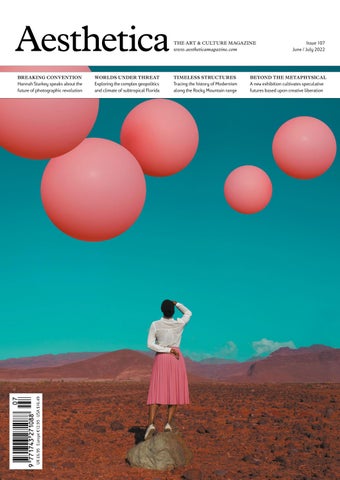
On the Cover Self-portraits by Spanish photographer Fares Micue – often looking skyward – are covered by bright blue balloons and flocks of paper birds, referencing the Surrealist icon Sheila Legge. A range of vibrant backdrops include flower fields, lemon yellow buildings and expansive natural landscapes. (p. 92)
Cover Image: Fares Micue, Wherever You Take Me (2021). Courtesy of the artist.
I cycle to work everyday. Along the way, I go through a tunnel which has a small graffitied phrase on the side. In tiny letters, it says: “make eye contact.” I think about this often. Part of what it means to be human is to create connections and appreciate the interactions that we have with those around us. A smile can go a long way – it makes a huge difference. I remind myself that random acts of kindness are important. We need to realise the value of every person. Moments are transient, and time passes so quickly. This issue captures the current zeitgeist, and is a reminder of how much the past forms part of the present. There are so many things that connect us as human beings, right now, here on planet Earth, as we shape the future amidst our rapidly changing surroundings. In the Black Fantastic, which opens this June at Hayward Gallery, London, includes 11 contemporary artists from the African diaspora. The show questions our understanding of the world through science fiction, mythology and Afrofuturism. We speak with Hannah Starkey about her attentive gaze, as well as the changing representation of women both in front of, and behind, the lens. We discuss the wider vocabulary of photography and how it relates to contemporary power structures. Next, we look at the enduring presence of Modernism in architecture and design, and try to understand why a school of thought – that dates back over a century – still resonates today as much as it did back then. We also interview Anastasia Samoylova about the subtropical fever dream of Florida: a delicate ecosystem that's constantly threatened by its own extinction. As always, we are thrilled to bring you photographers who play with form, subject and genre in new ways. This issue features Florian W. Mueller, KangHee Kim, Anne Mason-Hoerter, Andrea Alkalay and Adriana Mora, as well as our cover photographer Fares Micue. Finally, the last words goes to November Paynter, Chief Curator of Shirin Neshat's Land of Dreams at Museum of Contemporary Art Toronto. Cherie Federico
Aesthetica 13
50
100
110
40
30
74
116
56
14 Aesthetica
86
68
contents
Art 16 Regulars This season offers bold solo shows, from Alex Da Corte and Jasmina Cibic to Dominique GonzalezFoerster, Deana Lawson and Richard Mosse.
30 Abstract Wonderland Florian W. Mueller abstracts perceptions of the city, inspired by the intersecting lines and colours used by Expressionist painter Lyonel Feininger.
40 Journey Elsewhere In the ethereal works of KangHee Kim, windows become invitations to the imagination, portals to sun-drenched locations just beyond our reach.
50 Worlds Under Threat Florida is a complex place with many contrasting ideologies. Anastasia Samoylova investigates the inner-workings of this subtropical fever-dream.
56 Studies in Botany Anne Mason-Hoerter celebrates the vivid colour and unique details of plant specimens, from valerian roots and blue thistles to wild garlic.
68 Beyond the Metaphysical Hayward Gallery presents speculative futures where fantasy is at the forefront, and both creative and cultural liberation are brought into effect.
74 Distort and Reveal Andrea Alkalay's Landscape on Landscape series examines the radical act of observation through the poetic and political potential of photographs.
86 Breaking Convention For over two decades, Hannah Starkey has honed and developed an attentive gaze, representing women with both candour and compassion.
92 Nod to Surrealism Self-portraits by Spanish photographer Fares Micue – often looking skyward – are covered by bright blue balloons and flocks of paper birds.
100 Into the Imaginary Digital illustrator Adriana Mora constructs threedimensional buildings within idyllic waterscapes. Brutalism is juxtaposed with seamless horizons.
110 Timeless Structures The Rockies boast an expansive geography of dramatic alpine wilderness and diverse wildlife. Modernism has thrived there for over 100 years.
116 Aesthetica Art Prize 2022 Our 20 finalists explore the ways art can make sense of a rapidly changing world, from the rise of digital echo chambers to the climate crisis.
124 Exhibitions This issue we provide coverage of Poulomi Basu's Fireflies at Autograph, London, as well as a Sheila Hicks retrospective at The Hepworth, Wakefield.
129 Film Bastian Günther’s One of These Days is a shining portrayal of human greed. Swan Song gives a late-career role to the irrepressible Udo Kier.
131 Music Harkin’s Honeymoon Suite was written in, and about, a single room. Django Django celebrates 10 years since its self-titled psych-rock epic.
Books
Artists’ Directory
Last Words
133 The Latest Publications Photo-historian William A. Ewing presents flowers in a completely new light. Meanwhile, Phaidon releases an exciting compendium of rising stars.
140 This Edition's Practitioners These artists demonstrate how art can transform the viewer experience, sharing and supporting different perspectives in a changing climate.
146 November Paynter The Associate Director and Chief Curator of MOCA Toronto discusses the narrative in Shirin Neshat's seminal installation Land of Dreams.
Aesthetica Magazine is trade marked worldwide. © Aesthetica Magazine Ltd 2022.
The Aesthetica Team: Editor: Cherie Federico Associate Editor: Kate Simpson Digital Content Creator: Eleanor Sutherland Digital Content Writer: Saffron Ward
Advertisement Enquiries: Megan Hobson (0044) (0)844 568 2001 advertising@aestheticamagazine.com
Reviews
ISSN 1743-2715. All work is copyrighted to the author or artist. All rights reserved. No part of this magazine may be used or reproduced without permission from the publisher. Published by Cherie Federico and Dale Donley. Aesthetica Magazine 21 New Street York, YO1 8RA, UK Newstrade Distribution: Warners Group Publications plc. Gallery & Specialist Distribution: Central Books. Printed by Warners Midlands plc.
Advertising Coordinator: Megan Hobson Artists’ Directory Coordinator: Katherine Smira Production Director: Dale Donley Office Manager: Helen Osbond Designer: Matt Glasby Interns: Laura Kirkwood, Matthew Millard Contributors: Osman Can Yerebakan Rachel Segal Hamilton Iman Sultan Reviewers: Eleanor Sutherland, Kyle Bryony, Shyama Laxman Matt Swain, James Mottram, Jack Solloway, Leyla Sanai, Saffron Ward, Marthe Lisson, Chris Webb, Fanny Wendt Höjer.
Artists’ Directory Enquiries: Katherine Smira directory@aestheticamagazine.com Subscriptions: subscriptions@aestheticamagazine.com General Enquiries: info@aestheticamagazine.com Press Releases: pr@aestheticamagazine.com
Follow us: aestheticamagazine.com facebook.com/aestheticamagazine twitter.com/AestheticaMag pinterest.com/AestheticaMag instagram.com/AestheticaMag
Aesthetica 15
16 Aesthetica
Richard Mosse, Tower of Song, 2012 from the series Infra. Digital C-Print, 183cm x 229 cm. Courtesy of the artist, Jack Shainman Gallery, New York and carlier | gebauer, Berlin/Madrid.
Aesthetics of Empathy RICHARD MOSSE Kunsthalle Bremen | Until 31 July kunsthalle-bremen.de
Technology is blamed for all manner of societal ills, but in itself, it is neutral. It's what we do with this tool that matters. Richard Mosse (b. 1980) came to prominence with the series Infra (20102014). Shot in the Democratic Republic of Congo, it was made using a now defunct Kodak Aerochrome film that shows chlorophyll as lurid pink. The effect was mesmeric – beautiful yet jarring and quite unlike any visualisation of conflict we had ever seen. Audiences were forced to meditate on their relationship to war photography as a whole, and to see the Congo anew. This approach – adopting unusual methods to produce intense aesthetics that reconceptualise global issues, whilst critiquing the medium of photography – has become a modus operandi for Mosse. Heat Maps (2016-2018) used a military grade camera to produce portraits of refugees from North Africa and the Middle East travelling to Europe. Similar to Infra, the pictures were an unexpected contrast to the photojournalism we're used to. Cityscapes are otherworldly; individuals silvery, like ghosts. Mosse's most recent series are about the ecological crisis. Ultra (2019-2020) looks at deforestation and species loss in the Amazon through a scientific photographic technique that employs ultraviolet fluorescence. Tristes Tropiques (2020-onwards) further explores this issue, enlisting drones to produce multi-spectral images portraying the extent of depletion. Works from each of these projects, including a recent video installation Rtitled ondônia (2021), will be on display at Kunsthalle Bremen, as the first full Mosse retrospective to take place in Germany.
Aesthetica 17
news
Exploring Relationships CHOSEN FAMILY Fotomuseum Winterthur | Opens 11 June fotomuseum.ch
For many, family snapshots provide a first introduction to photography – whether that’s leafing through the faded pages of a printed album or browsing a digital folder on a smartphone. Lens-based artists, from Julia Margaret Cameron (1815-1879) to Sally Mann (b. 1951) and Joanna Piotrowska (b. 1985) have always used their close relatives as subjects. The reason for this may be pragmatic – children, parents or partners are around. But there’s something compelling, too, in how this now ubiquitous medium shapes our experiences of family life and vice versa. Chosen Family – Less Alone Together, a group show drawn from Fotomuseum Winterthur's collection and international loans, hones in on “contemporary photographers who delve into their own family history, examining and exploring their past.” Amongst them is Alba Zari (b. 1987), who was raised in a Christian sect, and Lindokuhle Sobekwa (b. 1995) whose sister mysteriously disappeared when he was seven, returning unexpectedly 10 years later. There's also Diana Markosian (b. 1989), who only learned as an adult that her mother had migrated to the USA (with her kids in tow) via a Russian matchmaking agency. For some artists, life blurs into art. Others treat photography as an investigative tool. Charlie Engman's (b. 1987) staged portraiture examines what it means to be a “mom”, whilst Mark Morrisroe (1959-1989) focused on a family of his own making – friends and lovers tied by bonds, not blood. No matter where life takes us, everybody comes into the world in relation to others. The family, a primary social unit, exerts a powerful fascination.
18 Aesthetica
Aesthetica 19
Diana Markosian, The Arrival, 2019, from the series Santa Barbara, 2019–2020 © Diana Markosian and Galerie Les filles du Calvaire.
Nada – Act II, 2017, single-channel HD video, stereo, 13:02 min., film still.© Jasmina Cibic 2017.
news
20 Aesthetica
Power Structures JASMINA CIBIC.MOST FAVOURED NATION Museum der Moderne Salzburg | Until 12 June museumdermoderne.at
In 2009, the Slovenian state gave the Libyan president Muammar al-Gaddafi a Lipizzan racehorse. The breed dates back to the 16th century and is famous thanks to its links to the prestigious Spanish Riding School of Vienna, Austria. During the reign of the Habsburg monarchy, the animals were bred at a stud farm in what is now Slovenia, but their denomination was a source of dispute between Slovenia and Austria until UNESCO officially registered the breed as arising from “intangible” cultural heritage. A photograph of Gaddafi’s horse – from The Foundation of Endeavour (2020) – appears in this solo exhibition of Jasmina Cibic (b. 1979), originally shown in Museum of Contemporary Art Ljubljana. Cibic, who, herself, was born in Ljubljana, Slovenia, creates artworks that probe how nations have wielded “soft power” through cultural diplomacy. The artist’s practice spans many media but is crucially grounded in research, uncovering historical examples which feed into theatrical artistic experiences. Also on display is Cibic’s 2021 Film London Jarman Awardwinning film The Gift (2019-2021), derived from a wider body of work which untangles the threads of reciprocity and obligation woven into the exchange of presents between governments. Meanwhile, a new installation, Most Favoured Nation, incorporates words from past speeches made by global leaders. Power takes many shapes. It can barge its way into view violently like an invading army or it can use charm to slip through unnoticed. Cibic recently commented in Studio International: “I’m drawn towards the political psychology and unconsciousness of states.”
Aesthetica 21
Intimate Narratives TYLER MITCHELL: CULTURAL TURNS Contact Gallery, Toronto | Until 30 June scotiabankcontactphoto.com
When Tyler Mitchell’s (b. 1995) debut monograph, I Can Make You Feel Good, came out in 2020, it cemented his place as one of the most innovative young image-makers working today. The New York-based artist, who trained as a filmmaker, made history in 2018 as the first Black photographer to shoot the cover of Vogue with an image of Beyoncé when he was just 23 years old. Since then, Mitchell’s practice has moved from magazine pages to museum walls as the artist has developed a vision for what he describes as a “Black utopia.” This is a projected future, a world in which Black people aren’t persecuted or objectified, but exhibit moments of joy – relaxing with friends, eating sweets, hula-hooping, embracing – almost always bathed in sunshine. It is remarkable that this type of photography, presenting carefree happiness, could be seen as revolutionary – yet it is, and the works ripple with poetry and possibility. Mitchell’s latest show, Cultural Turns, part of Scotiabank CONTACT Photography Festival, brings images into the gallery and outdoors throughout Toronto, giving passersby the chance to witness what curator Mark Sealy OBE calls: “The jazz of Mitchell’s work.” This, he adds, “keeps alive in the eye the beauty and vastness of all those voices that have contributed to the polychromatic nature of Black experiences.” Emblazoned large-scale on billboard sites usually reserved for the profit-driven, idealised “capitalist realism” of advertising (to quote Michael Hudson), Mitchell’s images feel like portals. This might be the first time that these public spaces encounter the work of this outstanding talent – but it won’t be the last.
22 Aesthetica
Aesthetica 23
Tyler Mitchell, Time for a new sky, 2020. © Tyler Mitchell. Courtesy of the artist and Jack Shainman Gallery, New York.
Maiden Voyage - JeeYoung Lee.
news
24 Aesthetica
Playful Encounters MAIDEN VOYAGE NOW Gallery, Greenwich Peninsula | Opens 23 June nowgallery.co.uk
In Maurice Sendak's children’s book Where the Wild Things Are (1963) the protagonist Max is sent to bed as punishment after an evening of high jinks dressed in a wolf suit. In the silence of his room a remarkable process occurs – a forest grows. The border between the wild and domestic melts away as the space is transformed: “the ceiling hung with vines and the walls became the world all around.” When an ocean appears with a vessel just for him, he hops aboard, and embarks on an odyssey of sorts. This story comes to mind when considering Maiden Voyage, a special commission by South Korean artist and designer JeeYoung Lee (b. 1983), which opens at London’s Greenwich Peninsula on 23 June. Similarly to Sendak, Lee, a rising star in Korean art, also brings the outside in, filling the gallery with a forest of 400 hand-crafted Ginkgo leaves and suspending a paper boat from the ceiling. Childhood is clearly a key focus for the artist, a fascination which extends to viewers, who are each invited to note down their earliest memories on origami swans. The results will be used in a one-off performance taking place 12 July. Through playful encounters with the gallery, Lee's bright and all-encompassing installations allude to the power of the imagination and of stories to propel us forward into new possibilities as yet unknown. “Our lives are filled with various adventures both big and small,” the artist observes. “I wanted to express these adventures in the form of a boat sailing through everyday life, as if travelling through the mundane towards that something, somewhere, gradually getting to that goal little by little.”
Aesthetica 25
art
10 to See RECOMMENDED EXHIBITIONS THIS SEASON
Our top shows for June and July include a range of major retrospectives, solo presentations and group exhibitions, each asking crucial questions about subjectivity and objectivity, whilst exploring history, mythology, technology and the rapid acceleration of the information age.
1
Jeff Wall
White Cube, Mason's Yard, London | Until 25 June
whitecube.com Expansive in scale and cinematographic in mood, the images of Jeff Wall (b. 1946) purposefully thwart the viewer’s expectations of clarity and resolve, instead proposing enigmatic scenes with no “before and after” – compositions that are left to complete subjective interpretation. However, the Canadian photographer also shoots looser, “near-documentary”-style pictures which reflect on everyday life in the artist’s home city of Vancouver. This show brings together older and more recent works that result from both modes of production, shot across 20 years.
2
Alex Da Corte Louisiana Museum of Modern Art, Humlebæk | 14 July - 8 January
louisiana.dk American artist Alex Da Corte (b. 1980) is a master of disguise, having appeared in video artworks dressed as the likes of Eminem or Popeye. This is the first chance to see a comprehensive survey of his work in Europe. Louisiana features key pieces such as the near three-hour spectacle Rubber Pencil Devil (2018) and sculpture As Long as the Sun Lasts (2021) as well as various installations that are infused with light and colour. Here, visitors are offered a playful, if self-consciously overwhelming experience, all undercut by a wider sense of the uncanny.
3
Speak the Wind
Monash Gallery of Art, Wheelers Hill | Until 26 June
1
mga.org.au Hoda Afshar (b.1983) is known for her semi-staged photographs, rooted in collaboration, that occupy the boundary between documentary and fiction. For Speak the Wind, also a photobook published by MACK, she travelled back to her birth country of Iran, specifically the outstandingly beautiful collection of islands dotted throughout the Strait of Hormuz. The resulting series, which comprises portraiture, landscapes and moving image, pays tribute to the mysterious allure of place, whilst touching on themes of myth, ritual and colonial history.
4
Creative Uprising: UCA Graduate Show UCA, Farnham, Epsom, Rochester, Canterbury | 9 June - 7 July
uca.ac.uk The last couple of years have been tumultuous in many ways, not least for the next generation. Graduates from University for the Creative Arts have proven that art is an antidote: a means to make sense of the world around us, and a way to connect. Billed as a “creative uprising,” UCA's graduate shows fill galleries and open spaces across Farnham, Epsom, Rochester and Canterbury. These innovative presentations showcase emerging talent across a range of disciplines, from gaming, animation and short film, to fashion, architecture and design.
5
Thomas Hoepker Ernst Leitz Museum, Wetzlar | Until 17 July
leica-camera.com It's been nearly 100 years since the first run of Leicas was produced in Wetzlar, Germany. The 35mm camera went on to become the tool of choice for a generation of post-war photojournalists, amongst them Thomas Hoepker (b. 1936). This retrospective includes some of Hoepker’s most iconic portraits, including 1960s shots of Muhammad Ali, as well as unnerving images of people relaxing whilst the World Trade Centre collapses in the background. Also on show are lesser-known pieces, including intimate moments in the romantic afternoon sun.
26 Aesthetica
2
3
4
5
Aesthetica 27
8
6
9
7
28 Aesthetica
10
6
Deana Lawson
MoMA PS1, New York | Until 5 September
moma.org/ps1 “Outside a Lawson portrait you might be working three jobs, just keeping your head above water, struggling,” wrote Zadie Smith in The New Yorker. “But inside her frame you are beautiful, imperious, unbroken, unfallen.” The meticulous portraits of Deana Lawson (b. 1979, the 2022 Deutsche Börse Photography Foundation Prize-winner) include people the artist knows, or has only just met, across Africa and its diaspora, from New Orleans to the Democratic Republic of Congo. These works add up to a brand new visual representation of Black life.
7
LOOK Climate Photo Biennial 2022
Open Eye Gallery, Liverpool | 14 July - 14 September
openeye.org.uk There is a 50 per cent chance that, five years from now, Earth will have warmed by 1.5 degrees above pre-industrial levels – the limit agreed upon in Paris in 2015 – according to the Met Office. This would represent a terrifying turning point. Earlier this year Liverpool’s Open Eye Gallery ran a series of “labs” in which they invited academics, artists and visionaries to share their ideas around tackling the climate crisis with the public. The conversation continues with the innovative LOOK Photo Biennial, which takes place across the North West of England.
8
Power! Light!
9
Airports and Cars
Kunstmuseum Wolfsburg | Until 10 July
kunstmuseum.de Imagine a city with no artificial light: no street lamps, no domestic illumination, nothing except for the sun in the day and the moon at night – all apart from the flickering of candles. Artificial light has allowed modern life to thrive, but it can be harsh, with its own politics of safety and surveillance. This exhibition explores the multiple facets of electrified light – its utopian and dystopian qualities – with 80 sculptures and installations by the likes of Monica Bonvicini, Gregor Schneider and Lori Hersberger, who sit amidst a list of 50 other artists.
Galerie Eva Presenhuber, Zurich | 11 June - 30 July
presenhuber.com Since air travel became popular since the 1950s, it’s become easy to forget (despite its carbon footprint) how remarkable it is to board a plane and soar into the sky, flying over land and sea before reaching a destination thousands of miles away. The Swiss duo Peter Fischli (b. 1952) and David Weiss (1946-2012) excel at showing the extraordinary in the everyday. This show presents their known photographs of airports, alongside sculptures of cars – highlighting the wonder of modern mobility and the oddness of the liminal spaces to which it gives rise.
10
Alienarium 5 Serpentine Gallery, London | Until 4 September
serpentinegalleries.org In the cultural imagination, extra-terrestrial beings tend to be seen as frightening creatures – green figures with an intelligence that outpaces our own, matched by high-tech weapons and malevolent intentions. Dominique Gonzalez-Foerster (b. 1965), the experimental French artist known, takes a different stance entirely. Building on 20 years of research, this solo show – the first by Gonzalez-Foerster since Tate in 2008 – asks visitors to consider much broader questions: “What if aliens were in love with us? What would change, when, why and how?”
1. Jeff Wall, Man at a mirror (2019).Inkjet print 53 9/16 x 61 5/8 x 2 1/2 in. (136.1 x 156.6 x 6.4 cm) (framed)© Jeff Wall. Courtesy White Cube 2. Alex Da Corte, Still from Rubber Pencil Devil (2019). Installation: Mixed Media. Louisiana Museum of Modern Art, Erhvervet med midler fra Augustinus Fonden © Alex Da Corte 3. Hoda Afshar, Untitled (2015–20) from the series Speak the Wind. Pigment inkjet print (washi paper). 35.5cm x 45.5cm. Courtesy of the artist and Milani Gallery (Brisbane). 4. Find the Light, from A Woman Should ©Olivia Cooper, University for the Creative Arts (UCA) 5. Thomas Hoepker, Italy. Love-birds in Rome (1956). © Thomas Hoepker / Magnum Photos. 6. Deana Lawson, Roxie and Raquel New Orleans, Louisiana. 2010. Pigment print. 35 × 43 inches (88.9 × 109.2 cm). Collection of the artist. Courtesy the artist; Sikkema Jenkins & Co., New York; and David Kordansky, Los Angeles. © Deana Lawson. 7. Frederick Dharshie, Untitled from the series On The Ground: The Story of Trans-Nzoia Through The Trees. 8. Installation view, Power! Light!, Kunstmuseum Wolfsburg. Lori Hersberger, Sunset 164, (2006). Neon systems, black float glass, 164cm x 300cm x 1.8 cm (neon), 164cm x 300cm x ca. 400 cm (installation dimensions), © Lori Hersberger Studio, courtesy Lori Hersberger Studio, Zurich, Photo: Marek Kruszewski. 9. Peter Fischli David Weiss, Untitled (Tokyo I), 1990. C-Print, 124 x 185 cm. © Peter Fischli David Weiss. Courtesy the artists and Galerie Eva Presenhuber. 10. Dominique Gonzalez-Foerster, Martian Dreams Ensemble (2018). Photograph: GFZK Leipzig.
Aesthetica 29
art
Abstract Wonderland Florian W. Mueller
Lyonel Charles Feininger (1871-1956) was a German-American painter, and a leader of Expressionism. His canvasses often featured sharp, dividing lines where light and shadow built towards a new kind of utopia, led by a “continuity of interlacing relationships.” As the artist noted: “Each individual work serves as an expression of our most personal state of mind at that particular moment, and of the inescapable, imperative need for release by means of an appropriate act of creation: in the rhythm, form, colour, and mood of a picture.” Florian W. Mueller’s multi-exposure photographs are inspired by this methodology, where compositions are led by a specific time and place; the shutter pulled open and shut without the film being transported away in-between. Here, Mueller creates a kind of mirrored wonderland – an abstracted and layered view of the urban landscape – all produced in hypnotic technicolour. florianwmueller.com.
Florian W. Mueller, Lyonel 2000, No. 3. Courtesy of the artist.
30 Aesthetica
Aesthetica 31
32 Aesthetica
Florian W. Mueller, Lyonel 2000, No. 2. Courtesy of the artist.
Aesthetica 33
Florian W. Mueller, Lyonel 2000, No. 5. Courtesy of the artist.
34 Aesthetica
Aesthetica 35
36 Aesthetica
Florian W Mueller, Lyonel 2000, No. 1. Courtesy of the artist.
Aesthetica 37
Florian W. Mueller, Lyonel 2000, No. 6. Courtesy of the artist.
38 Aesthetica
Aesthetica 39
art
Journey Elsewhere KangHee Kim
“I cannot travel abroad due to the restriction of my visa status. I am protected under DACA (Deferred Action for Childhood Arrivals) but I am unable to leave the USA if I want to return, and I haven’t been able to go back to South Korea for over 10 years. By manipulating images, I construct my own form of surreal escapism that helps to liberate me.” KangHee Kim’s collaged photographs begin with the documentation of seemingly “mundane” moments: the sun setting in an office, for example, or a bedside lamp illuminating a dusky hotel room. The artist creates portals to other worlds, where clouds billow on the surface of concrete, and suns glow beside traffic lights. In Kim’s ethereal compositions, window frames become invitations to the imagination; photography is a medium filled with freedom that moves beyond borders. Dreamer is published by Setanta Books. setantabooks.com | kanghee.kim.
From Dreamer. Courtesy of KangHee Kim and Setanta Books.
40 Aesthetica
Aesthetica 41
42 Aesthetica
From Dreamer. Courtesy of KangHee Kim and Setanta Books.
Aesthetica 43
From Dreamer. Courtesy of KangHee Kim and Setanta Books.
44 Aesthetica
From Dreamer. Courtesy of KangHee Kim and Setanta Books.
Aesthetica 45
From Dreamer. Courtesy of KangHee Kim and Setanta Books.
46 Aesthetica
From Dreamer. Courtesy of KangHee Kim and Setanta Books.
Aesthetica 47
From Dreamer. Courtesy of KangHee Kim and Setanta Books.
48 Aesthetica
From Dreamer. Courtesy of KangHee Kim and Setanta Books.
Aesthetica 49
From Dreamer. Courtesy of KangHee Kim and Setanta Books.
art
Worlds Under Threat Anastasia Samoylova PHOTOGRAPHY IS A MEDIUM WHICH HELPS US TO SEE, AND REMEMBER, THE WORLD AROUND US. THESE IMAGES EXPLORE THE FANTASY OF A SUB-TROPICAL FEVER DREAM.
Florida is a complex place: geographically, socially, politi- ment the models with a camera and present the images for cally and economically. It is the flattest state in the USA and review. The requirements were basic, and the primary focus has the country’s longest coastline, with 825 miles of beach- was on light and composition, as opposed to narrative for es (meaning no individual is ever more than 60 miles from a obvious reasons. In the process of trying to convincingly body of water.) It is the only place on Earth where both croco- photograph my paper models I discovered that I, in fact, had diles and alligators co-exist, and the weather teeters between begun to prefer the images to the constructions themselves. the tropical and sub-tropical. It is also a theme park epicentre, The method made me reflect on how photography alters our with Disney, Universal, SeaWorld and Legoland nestled into sense of scale and how it is always presents a singular perspective. Both concepts still inform my image-making. the fabric of its society, attracting millions each year. A political battleground, Florida is the eighth most competitive state, which, following Trump’s election in 2016, has A: Many of your series focus on the “climatic knife-edge” remained Republican, a trajectory that looks to continue into of the southern USA. You were born in Moscow, and 2024. Following this wider sense of instability, there are over moved to Miami; how did your understanding of landtwo million properties that are likely to be severely affected scape change in the process, and what were the main difby flooding in the next 30 years, representing a quarter of ferences that struck – and perhaps moved – you? all homes. Despite these heightened threats to security and AS: Growing up in a large landlocked city with a well-develservices, the state is continuing to attract more visitors every oped public transportation system I looked at environmentalism mainly from the standpoint of sustainability. My thesis day, growing and developing as a popular destination. Anastasia Samoylova (b. 1984) has been compelled to project back in Moscow was a proposal for the transformaphotograph this mercurial state since first moving to Miami tion of a defunct streetcar depot into a youth cultural comfrom her birth city of Moscow. Floridas, which brings togeth- plex, reusing the abundant materials found on the original er some of her most recent series, is currently on show at site. The city is positioned in a continental climate, and in the Galerie Peter Sillem, Frankfurt. The artist discusses her influ- early 2000s, when I enrolled in the Environmental Design ences, and the ways in which images help us to make sense programme, the term “global warming” was a relatively new concept, but it wasn’t at the centre of our concerns. When I of, and complicate, these juxtapositional topographies. moved to the USA for graduate school it was to the midwest, A: When did you know you wanted to be a photographer? where I spent my first seven years in the country. The humid AS: At university I studied Environmental Design. We had continental climate wasn’t drastically different from Moscow, to build all the proposed spaces by hand, and then docu- albeit a bit warmer. At university, I worked on a documentary
50 Aesthetica
Aesthetica 51
52 Aesthetica
Anastasia Samoylova, Hurricane Destruction, Mexico Beach (2021). Courtesy of the artist.
“There are endless idealistic renderings of new buildings and businesses that proliferate on the sidewalks, windows and facades of Miami. It is a layered surface collage of the real and imagined.”
Previous Page: Anastasia Samoylova, Park Avenue Miami Beach (2018). Courtesy of the artist. Left: Anastasia Samoylova, Window, Key Largo (2020). Courtesy of the artist.
film and a series of constructed photographs addressing the loss of family farms and the environmental consequences of industrial agriculture in the region. Moving to Miami in 2016 was a complete revelation for me, with all the hurricanes, flooding and heat. To process my experience, I embarked on a multi-year conceptual documentary project, FloodZone. The aim was to avoid images of catastrophe and look, instead, for the more subtle signs of crisis. A: You’ve described photography’s ability to “flatten space” and offer an “illusion of scale”, whilst referring to Miami as a city that takes the form of a “large collage.” What is it about this sense of layering that interests you and how do you apply this to your practice? AS: There are endless idealistic renderings of new buildings and businesses that proliferate on the sidewalks, windows and façades of Miami. It is a layered surface collage of the real and imagined. This clustered assembly creates a fascinating effect of a meta-city, whose past, present and future can be observed all at the same time. By seeing these layers through a flattened perspective, I can explore this strange and often uncanny construct, where, at times, it feels like you are inhabiting an architectural blueprint as opposed to a real city, and the risks of it all falling apart are concealed under the surface. Florida is the ultimate fantasy land. It has been willed into existence by the carefully constructed image of itself: complete with accompanying vernacular pictures, from tourist postcards to buildings designed to be photogenic first and comfortable second. This has become an endless source of fascination for me, and I’m keen to dig into a wider sense of fantasy, not the reality.
A: The state is constantly in the media, whether through its entertainment culture, politics or weather. What does your work offer in terms of a new visual vocabulary? AS: There are all kinds of stereotypes and stigmas surrounding Florida, which I was aware of even as a foreigner living elsewhere in the states. Once I moved to Miami, I discovered a thriving community of internationally acclaimed artists and institutions that were preoccupied with the real problem of mis/representation. It became clear that the clichés assigned to the state are damaging to the progress that the rest of the nation is so eager to dismiss. I wanted to complicate the notion of Florida whilst also referencing that its photographic record is quite limited. A: Are you trying to make sense of, or complicate, the reading of the landscape, navigating its harsh binaries? AS: Places inspire me the most: layers of time as seen in architecture. I often focus attention on the minutiae of everyday life – its joys and, at times, its bitterness. My compositions are highly structured as there is very little reportagetype drama happening, and for the most part there is an absence of people. I prefer to observe human existence through buildings and other signs of life. The space within the frame is typically flattened; there is hardly ever a horizon line, and the majority of my pieces are vertical rather than horizontal, which is typical of the landscape genre. A: Water is present in all of your pieces – it is as compelling aesthetically as it is dangerous. How would you define your relationship with this as metaphor? AS: In both the FloodZone and Floridas series – where the
Aesthetica 53
Anastasia Samoylova, Pink Arcade, Sarasota (2020). Courtesy of the artist.
presence of water is the most prevalent – I see the element as a mirror, often black, with all its mythological implications. Even in my earliest work, the Landscape Sublime tableaux, I used mirrors as a direct reference to the Claude glass, a pre-camera device used for both compressing and expanding the landscape in order to find the most picturesque view to be rendered as a drawing. The reflections in dark floodwaters or natural reservoirs serve as visual portals into a slightly dystopian alternative reality, perhaps in the not-too-distant future, considering how reckless we are with the Earth and its precious, and finite, natural resources.
tention to the larger geological narrative where we, as a species, simply “exist” with environmental anxiety? AS: When I moved to Miami in 2016, I initially planned to continue my studio practice, where I had added painting and collage. However, it was climate anxiety that made me go out in the streets, trying to come to terms with it through the lens. As much as I have grown to love Miami and my community of friends that live there, I mostly agree that staying there long term will be an act of defiance if not survival. My work is from the perspective of an everyday person living amongst many tough questions, which I don’t have the answers for. Perhaps what's most important here is that we continue to ask questions of this very nature.
A: Why do you believe Florida is continuing to develop and to expand despite its precarious geological reality? AS: There are certainly practical reasons why it continues A: Florida has provided you with rich ground to create to boom – from the weather and warm waters to the prox- work that brings the climate emergency to the fore. imity to New York and Latin America. Unfortunately, the What are your biggest takeaways from this project? same population that can afford to close their eyes to the AS: Representation matters, and it doesn’t only apply to climatic risks also contributes to the gentrification, with the human identity. Places require attention too, being the income of locals lagging far behind the steep cost of living. signifiers of the communal, the shared, from affinities Meanwhile, public transportation is still inferior and the to objections – it can all be found in places we inhabit if dependence on fossil fuels is high. It is also worth noting you pause and look closer. One of my favourite writers, that Florida (as it is) would not exist without air conditioning. Rebecca Solnit, notes: “We often talk about love of place Despite all this, it continues to attract young tourists (the … but seldom of how the places love us back. They give us era of retirees in south Florida is long gone), snowbirds with continuity, something to return to, and offer a familiarity disposable income, freelancers and developers. The state that allows some portion of our lives to remain connected is a fascinating contradiction, and that has held my interest. and coherent ... And distant places give us refuge in territories where our own histories aren't so deeply entrenched A: In what ways are its inhabitants “living” with change, and we can imagine other stories, other selves, or just drink and accepting its sense of danger as a kind of “paradise” up quiet and respite.” I’m interested in the layers of history that's fleeting? To what degree is your work drawing at- rather than any sensational drama that's of the moment.
54 Aesthetica
Right: Anastasia Samoylova, Porch, Key Largo, (2020). Courtesy of the artist.
Words Kate Simpson
Floridas is at Galerie Peter Sillem, Frankfurt Until 11 June galerie-peter-sillem.com
Aesthetica 55
art
Studies in Botany Anne Mason-Hoerter
In 1843, Anna Atkins (1799-1871) self-published a series of cyanotypes: facsimiles of British algae. These were thought to be part of the world’s first photo-book, produced in a run of just 20 copies. The work was completely revolutionary, laying bare the unfurling tendrils of these photosynthetic organisms. Atkins placed the wet blooms on light-sensitised paper, and with an innovative chemical process, created delicate blueprints for the first time in history. Nearly 200 years later, Anne Mason-Hoerter treads similar ground, fixating on – and celebrating – the microcosmic world of botany. Each of these images, which appear like glass platelets, expose the vivid colour and unique details of plant specimens, from valerian roots and blue thistles to wild garlic. Cast against velvety black, and devoid of extraneous details, common food items and back-garden regulars are elevated: the inner seeds of a balloon plant stand out like crown jewels; ginger skin shines like gold. aine-photography.com.
Anne Mason-Hoerter, Thistle. Courtesy of the artist.
56 Aesthetica
Aesthetica 57
58 Aesthetica
Anne Mason-Hoerter, Heuschera. Courtesy of the artist.
Aesthetica 59
Anne Mason-Hoerter, Purple Sage. Courtesy of the artist.
60 Aesthetica
Anne Mason-Hoerter, Blutampfer. Courtesy of the artist.
Aesthetica 61
Anne Mason-Hoerter, Blue Thistle. Courtesy of the artist.
62 Aesthetica
Anne Mason-Hoerter,Fresh Garlic. Courtesy of the artist.
Aesthetica 63
Anne Mason-Hoerter, Bishop Balls. Courtesy of the artist.
64 Aesthetica
Anne Mason-Hoerter, Sliced Garlic. Courtesy of the artist.
Aesthetica 65
Anne Mason-Hoerter, Fresh Ginger. Courtesy of the artist.
66 Aesthetica
Anne Mason-Hoerter, Valerian. Courtesy of the artist.
Aesthetica 67
Anne Mason-Hoerter, Tulips. Courtesy of the artist.
art
Beyond the Metaphysical In the Black Fantastic HAYWARD GALLERY PRESENTS A GROUNDBREAKING EXHIBITION WHERE FANTASY IS AT THE FOREFRONT: BRAND NEW WORLDS OF CREATIVE AND CULTURAL LIBERATION.
“Sankofa”, in the Akan Twi language, means “to retrieve.” The term is, however, part of a much larger philosophical tradition which originated in Ghana, and continues to stretch across the wider African diaspora today. As a proverb, and transnational cultural phenomenon, the term can be translated as “it is not taboo to go back and fetch what you forgot”, or, in other words, “return to your past.” It is often represented by a bird turning its head to eat an egg from its own back. “Sankofa” was crucial for British-Ghanaian writer and curator Ekow Eshun (b. 1968) when planning In the Black Fantastic at Hayward Gallery, London. “To move into the future, you don’t have to leave the past behind; the past and the future form a circle of some kind,” Eshun states. “One of the pernicious faces that our history of colonialism has left the developing world is the sense that the cultural heritages we have are less valuable than the beliefs and the cultures of the west.” In the Black Fantastic is replete with sculptures, video art, collages, film stills, photographs, mixed-media artworks, paintings, installations and performances that draw from otherworldly themes: magic, mythical realms and creatures that transcend reality and conceptualise new forms of existence. Eleven practitioners – including Nick Cave, Sedrick Chisom, Ellen Gallagher, Hew Locke, Wangechi Mutu, Rashaad Newsome, Chris Ofili, Tabita Rezaire, Cauleen Smith, Lina Iris Viktor and Kara Walker – excavate the past to imagine new, metaphysical worlds of Black existence. In these visions, individuals can live beyond the structures of colonialism, white supremacy and the legacy of the transatlantic slave trade. Sometimes, these worlds are located deep underwater,
68 Aesthetica
swimming in an alternate narrative, as in Ellen Gallagher’s series Ecstatic Draught of Fishes (2019-ongoing), which captures, in dreamy, ethereal watercolour paintings, a “Black Atlantis” wherein enslaved people that have been thrown overboard in the Middle Passage survive beyond the depths and build an oceanographic kingdom. In other artworks, we skyrocket into the future and a vast abyss of stars, leaving earth behind for more fortuitous galaxies and possibilities, as in Yinka Shonibare’s life-size sculpture Refugee Astronaut II (2016). This haunting figure hauls pots, pans and furniture in a fishnet parcel on his back, permanently held in stasis, on a journey to another world. Elsewhere, Nick Cave’s embellished soundsuits provide a shield – costumes that temporarily disguise the skin colour of whoever wears them, whilst not erasing their identity. “Cave constructs the soundsuits initially as a way to reckon with the ways the Black figure has been typecast and stereotyped in crude, animal ways in American culture,” Eshun continues. “The garments become a way to live and reclaim agency. The suit is a mode of armour.” And yet, many of the artworks exist in a future that is closer to the present: where humans are rapidly changing alongside accelerating technologies. Dazed’s Editor-in-Chief Ibrahim Kamara (b. 1990) collaborated with South African photographer Kristin-Lee Moolman for i-D ' s 2018 Autumn Earthwise issue. Here, an androgynous Black model wears an elaborate technological mask which is split across the face, signalling the transformation of humans into cyborgs as the world hurtles into a virtual, robotic future. Similarly, the cover of Janelle Monaé’s 2018 album Dirty Computer
Aesthetica 69
70 Aesthetica
Lina Iris Viktor, No. XXV We Once Sought Refuge There (2019). Pure 24 karat gold, acrylic, ink, print on cotton rag paper. 10 3/16 x 8 1/2 inches (21.6 x 25.9 cm) © 2019. Courtesy the artist.
“The invisible and the intangible are key concepts: decentering the modes of western rationalism that stop spirituality and pre-Enlightenment belief systems from possessing any serious weight.”
Previous Page: Lina Iris Viktor, Eleventh (2018). Pure 24 karat gold, acrylic, ink, copolymer resin, print on matte canvas 65 x 50 inches (165.1 x 127 cm) © 2018. Courtesy the artist.
Left: Lina Iris Viktor, Sixth (2018). Pure 24 karat gold, acrylic, ink, gouache, copolymer resin, print on cotton rag paper, 52 x 40 inches (132.1 x 101.6 cm) © 2018. Courtesy the artist.
invokes goddess-like symbolism as the singer stands in front of a flaming planet, wearing a beaded crystalline headdress, eyes downcast in devotion. The juxtaposition between the present moment and a fantastical world that transcends material reality is fundamental. “It’s a way of saying we, as Black people, can conjure ourselves – can think beyond the narrow ways that the white mainstream tends to see us,” Eshun notes. The “Black Fantastic” is, truly, a category of its own making, borrowing from Afrofuturism and magical realism, whilst encompassing concepts from sci-fi, fantasy, speculative fiction, spirituality, myth, religion and metaphysics. The invisible and the intangible are key concepts: decentering the modes of western rationalism that stop spirituality and pre-Enlightenment belief systems from possessing any serious weight. The works on show at Hayward reject the rational, clinical and “detached” objectivity of the white gaze. Just like the bird turning backwards to eat the egg – no matter how difficult, inconvenient or disruptive it is to break away from the continuity of the capitalist-modern present – In the Black Fantastic embraces the opulence and chromatic abundance of African traditions, which have evolved alongside the realities of enslavement, displacement, migration, rebellion and freedom. “The search for political, personal and artistic liberation is one of the key components of the Black being and experience: the search within societies that are fairly intent in denying Black people their personhood in the west. That’s what I’ve lived with my entire life, and thinking about that in artistic terms, these are elements that recur time and again in the works of many different practitioners,” Eshun explains. Liberation, after all, is not just a concept tied to wider topical themes in the show, or even the exploration or expression
of Black identity: it’s also fundamentally an aesthetic. In Eshun’s essay, The Art of the Black Fantastic, which appears in the exhibition’s accompanying book, he writes: “Zora Neale Hurston defined ‘the will to adorn’ as a primary characteristic of African American expression. She could just as easily have been describing any number of forms of Black vernacular creativity, such as fashion, interior décor, quilting, dance or body adornment.” Aesthetic embellishment, a multiplicity of colours, profusion and excess – and the idea that more is more – permeate the show. The senses of exhibition-goers are provoked, scintillating a sensitivity to psychedelic colours, and intimating a creative pleasure that can best be inspired by listening to an unfurling orally-transmitted mythic story, reading a brick-heavy sci-fi tome, or partaking in a Sunday church service with one’s entire voice and body. In the Black Fantastic centres spirituality and escapism, not as a reaction against the cyclical violence of institutional racism and the consequent psychological disassociation and alienation it causes, but rather as a new way of seeing the world and space in which Black people can reside free from the psychological brutality and power differential of racism, and of transcendence as a conduit for ontological liberation. In the 1973 album cover of Sun Ra’s Astro Black, (also on show) a blue-purple light acts as a halo for the smiling jazz musician, the dusty glimmer of stars both on his figure and in the background. Ra claimed that he had a vision from aliens in outer space, and was teleported to Saturn. Whilst there, he was told to quit college and pursue music as a way of communicating with the world. He later founded the Sun Ra Arkestra, which continues to perform even after his death in 1993. Ra’s epiphany was not unlike visions that had visited
Aesthetica 71
Lina Iris Viktor, No. XIII Pause… Pause for A Paradise Lost Then Found (2017). Pure 24 karat gold, acrylic, ink, print on cotton rag paper. 10 3/16 x 8 1/2 inches (21.6 x 25.9 cm) © 2017. Courtesy the artist.
other religious leaders, such as Elijah Muhammad (18971975) of the Nation of Islam, John Africa (1931-1985) of the Philadelphia-based MOVE back-to-nature group, or Rebecca Cox Jackson’s (1795-1871) spiritual awakening, which led her to leave her husband and six children, and found an egalitarian community of Black women belonging to the Shaker sect, an offshoot of the Quakers, who practised gender equality, forbidding marriage and procreation. Lina Iris Viktor’s (b. 1987) A Haven. A Hell. A Dream Deferred series references the figure of The Libyan Sybil: a prophet from Greek mythology who could foresee the future. In continuity with the tradition of Black American women who have become seers, spiritual leaders and charismatic abolitionist activists, Viktor paints hauntingly beautiful portraits where breasts and faces are glazed over with saturated paint, whilst 24-karat gold inflects the background. The women in these layered, meticulous paintings are still, thoughtful and stoic, gazing past the viewer or outside the frame, as if witnessing a strange and horrible event, weighed down by the silent knowledge of a hushed, unspeakable happenstance. Has the event they’ve seen already occurred in the past, or is it a secret vision for the days to come? The answer isn’t clear, but the history that Viktor conveys is certainly of the past, even if it has repercussions in her parents’ native Liberia today. “I wanted to have a conversation about the forgotten history that links Liberia to America,” Viktor notes. “Liberia is a nation founded by the American Colonization Society. It’s a reality that goes over many people’s head that [Liberia] is a sisternation, and obviously, how this came about was not through altruism, but because of these uprisings in Haiti, and slavery being abolished in the North. All of these mixed-race former
72 Aesthetica
Right:
slaves, or children of former slaves, were considered to be Lina Iris Viktor, First (2017-18). Pure 24 karat gold, acrylic, ink, gouache, too powerful and having too many rights, so it was a way to copolymer resin, print on cotton rag paper. 52 x 40 inches (132.1 x 101.6 cm) kill a fire before it started, repatriating people back to Africa.” © 2017-18. Courtesy the artist. This repatriation led to an apartheid-like situation in which the indigenous population of Liberia was displaced to make way for the Black American settlers, and consequent uprisings by the indigenous Africans were suppressed by the Americo-Liberians with the support of the US government. Cartographies span the backgrounds of Viktor’s paintings, tracing the geography of the land, and the gilded pain and violence shown in her series is ultimately intra-communal – a documentation of the tragic bloodshed that occurs when white supremacy and colonisation pit Black peoples against each other. “You always want to have this idea that there’s someone who's a good guy, and someone who's a bad guy in a scenario, and this shows the humanity [of people],” Viktor notes. “People that were once marginalised or once enslaved Words can become the oppressors as well. It’s a cautionary tale.” Iman Sultan Even so, uncomfortable conversations are at the heart of art and culture, as well as exhibition programming at the Hayward and beyond, pushing boundaries and provoking audiences to think in new and critical ways when we need to In the Black Fantastic is at most. “Artists are meant to be these kind of conduits, these Hayward Gallery, London seers who move seamlessly through liminal spaces, bring- 29 June - 18 September ing to the fore concepts that society is grappling with, or the underbelly of issues that are not being so widely discussed,” A season of film runs Viktor continues. “This is a way to traverse the bridges be- concurrently in July tween our everyday lives – and imagine or believe what at BFI Southbank we could be. And to continue the mythology of imagining worlds and identities, of conjuring stories that take you out southbankcentre.co.uk of the mundane and catapult you into metaphysical worlds.” linaviktor.com
Aesthetica 73
art
Distort and Reveal Andrea Alkalay
Our relationship with the planet is becoming increasingly estranged. According to the World Meteorological Association, the chance of us temporarily reaching the 1.5 degree threshold over the next five years has risen to 50:50, and yet this warning is failing to hit home. Andrea Alkalay’s Landscape on Landscape series (2020-2021) is extremely potent given this context. Here, the artist explores the “regimes of representation” – considering the visual information we are presented, and the manifold ways it is interpreted, as our relationship to the “real” world continues to become distorted. The compositions are part of what the artist calls “chromatic decomposition.” Beneath the folds of dramatic vistas, layers of digitised colour are stretched across the frame like barcodes. This intuitive process examines both the poetic and political potential that arises from the act of observation – as images become a complication of objective truth. andrealkalay.com.
Andrea Alkalay, Landscape on Landscape: Cod # 52EA30 (2020). Courtesy of the artist.
74 Aesthetica
Aesthetica 75
76 Aesthetica
Aesthetica 77
Andrea Alkalay, Landscape on Landscape: Cod # D5BE75(2021). Courtesy of the artist.
78 Aesthetica
Aesthetica 79
Andrea Alkalay, Landscape on Landscape: Cod # 59392C(2021). Courtesy of the artist.
80 Aesthetica
Aesthetica 81
Andrea Alkalay, Landscape on Landscape: Cod # 807917(2020). Courtesy of the artist.
82 Aesthetica
Aesthetica 83
Andrea Alkalay, Landscape on Landscape: Cod # F7C29F (2020). Courtesy of the artist.
84 Aesthetica
Aesthetica 85
Andrea Alkalay, Landscape on Landscape: Cod # EAF5F6 (2020). Courtesy of the artist.
art
Breaking Convention Hannah Starkey FOR OVER TWO DECADES THE BELFAST-BORN PHOTOGRAPHER HAS EXHIBITED AN ATTENTIVE GAZE, REPRESENTING WOMEN WITH CANDOUR AND ENDURING COMPASSION.
Since the late-1990s, Hannah Starkey (b. 1971) has been dedicated to photographing women, exploring the ways they are, and have, been depicted, whilst taking cues from visual culture. She is known for her cinematic mise-en-scènes, which appear as “fleeting” moments. Starkey constructs portraits of women across a range of generations, often situated in everyday urban contexts. She has had numerous solo exhibitions across the world, and her work is included in Tate Modern, London; Tanya Bonakdar Gallery, New York; Turner Contemporary, Margate; Huis Marseille, Amsterdam; Schirn Kunsthalle, Frankfurt; the V&A, London; and Castello di Rivoli, Turin, amongst others. This autumn, The Hepworth, Wakefield, presents a major survey spanning over 20 years. A: Where did your journey with photography begin? HS: In hindsight, it was a lifesaver which put me on a path, and has given me a good and happy life. It all started when I had a haemorrhage at the age of 13 / 14 whilst at school. After a head injury a few months earlier, something exploded in my brain resulting in a loss of speech and temporary paralysis in the right side of my body. My brain was damaged, but through photography and the plasticity of being a teenager, it knitted itself back together. I am forever grateful to the nuns at my school (a convent school in the most economically deprived area of western Europe) who had the presence of mind to put a camera in my hand. Photography, as a GCSE, was just being trialled in Northern Ireland: a testing ground for the introduction of a new education system. This was one year before it was rolled out in Britain, with all the creases
86 Aesthetica
ironed out. I was very lucky. Being in the right place at the right time has always been my strong point in photography. A: Why do you continue to work with images, and particularly stills, as opposed to moving content and film? HS: We are surrounded by images – mostly stills – in every waking moment of our lives. We are sophisticated visual creatures, and are highly influenced by images, in an almost subminimal way. The photograph – a mute, still, two-dimensional representation – can tell us so much about ourselves, and seems to lodge itself in the brain to be used as a memory cue for all sorts of emotions. Basically, it has the power to connect with you immediately, and never let go. For me, the true test of a good picture is whether it can stand the test of time with all the human activity and shifts in society. I also think a good image can tell us a lot about ourselves, from revealing unconscious bias to eliciting strong feelings of empathy. In other words: it can make us feel directly. When you stand in front of a photograph in a dedicated viewing space, it is the viewer that moves internally, contemplating on different aspects of the aesthetic, the narrative and the ambiguity of the medium. For me, it is this ambiguity – found in a familiar scene – that activates our inner self. We are offered a time and space to mediate on life. And we more often take and send photos to each other, even though video is just as easy. A: What is it about this specific medium that endures? HS: Now that’s the question that fascinates me. Photography is actually really difficult and a challenging language to
Aesthetica 87
88 Aesthetica
Hannah Starkey, Untitled, 5th November 2008. Framed c-print mounted to aluminium. 122 x 163 cm. © Hannah Starkey, courtesy Maureen Paley, London.
“Why is it that throughout its near 200-year history photography has become our main tool or language of communication? And when did it turn against us? When does it exploit our weaknesses?”
Previous Page: Hannah Starkey, Untitled, October 1998 (detail). Framed c-type print mounted on aluminium, 122 x 152 cm. © Hannah Starkey, courtesy Maureen Paley, London. Left: Hannah Starkey, Untitled, April 2006 (detail). Framed c-type print mounted on aluminium, 122 x 152 cm © Hannah Starkey, courtesy Maureen Paley, London.
work with. How does a single composition, in a world satu- democratic art form – anyone and everyone does it. This has rated with images, rise in your consciousness and change empowered people by just seeing themselves represented. how you think? How is it that a picture can alter global public opinion on issues such as war, poverty and racism, etc? Why A: In the age of post-truth, reality is being questioned is it that throughout its near 200-year history it has become on a daily basis, whilst images are distorted, edited and our main tool or language of communication? And, when filtered, even when presented as “documentary.” What does it turn against us? When does it exploit our weaknesses? “truth” do you depict within your photographs? My job is to search for those enduring moments: the ones HS: That is the beauty with photography, although it can that stick. These images are incredibly elusive, and if I can never be totally objective, as with photographers’ choices of framing, etc. It is incredible when used in its most straightformake just 20 of them in my whole career, I will be happy. ward and direct way – just the eye and the camera to find how A: How do you choose your settings? What is it about the world really looks. In an age of filters and Photoshop, urban landscapes that interests you in relation to the straight photography becomes a bit of relief from the projected perfected image that doesn’t actually exist or is unsushuman condition, and how they affect one another? HS: There is no one formula; it depends on the message that tainable. It’s a challenge to make a photograph that gets you I want the photograph to carry. Sometimes I'm attracted to to really look at something beyond the surface. I love it when the intimate and warm, and sometimes it's wider, controlled you see a photograph of a woman or girl, (female identifyspaces. The common denominator is the city. The street is a ing) who looks like a real person who is affected by the real theatre for human performance. It is where people share with world without being beautiful or different or perfect. What each other what it means to be human. To see and be seen makes us beautiful and unique? The aesthetics that women by other humans is almost verification for our social species. are sold through images are simply not the truth. A: How have images become implicitly connected, and directly related to, women’s experiences: through the assimilation of the personal, political and psychological? HS: Well, that’s a huge question with many strands to consider, but for me, the image is power, particularly at this time in history. When I first came into photography it seemed that the dominant gaze was male, and who gets to tell the story controls the narrative. So that was how we, as women, experienced our gender. However, the medium I work in is now a
A: How would you define your gaze as a photographer? HS: Female. Consciously and wholeheartedly female. I think women make very good photographers for all sorts of reasons. I want to be a role model for young female photographers because I think that the world needs them in a critical, let’s not fuck about here, kind of way. The power is in the hands of the consumer and women make up 80% of global consumers. In the early days of my career, photos became toxic to women. “Sex sells” seemed too easy to me
Aesthetica 89
Hannah Starkey, Untitled, October 1998. Framed c-type print mounted on aluminium.122 x 152 cm © Hannah Starkey, courtesy Maureen Paley, London.
and not really exploring what photography can do in shaping who we are and how we are treated in the world. Women working in photography have ultimately changed this. How do we apply the various rules of our written language to understand the rules of a wider visual photographic language? A: How can women reclaim the lens, and their own gaze? HS: I think they already have. They are very aware that image = power and they have come in their tens of thousands to study photography. When I give a talk, I look out at the audience and it is a very different view from when I started. For me this is one of the most significant times in the medium’s history, as well as in the timeline of fighting for equal rights. All of this goes back to who gets to tell the story, and what stories get to be told. Narrative is a driving force in the evolution of civilisations; the stories we tell are important. We are subverting and changing the history of the male, or rather, the patriarchal gaze that set the standards for all of us. A: Is there a main “goal” that you adhere to? And is this connected to an overarching sense of responsibility? HS: To be honest, I don’t know what will happen or where my photography is going. It’s always been like this. The photographs cut a path and I just follow. I’m amazed how I have carved out a career with the most succinct agenda but yet no plan. I know this sounds a bit weird, but I have never strategised. I ask nothing of it in terms of wealth or fame. I always have to be on my very best behaviour when we are working together. I stay in tune, alert to the possible slippages in life that photography can capture. It’s about setting up a scene, and then the experience of controlling the elements. Hope-
90 Aesthetica
fully the ones that you can’t control will work in your favour. I always trust in the magic and true purpose of the image. I used to question and challenge it, but after 25 years I surrender to it and trust in it, just as I did at the start of my adult life. You have to have the purest intentions, as a photograph will somehow always show you the truth. This truth can then be read by the viewer in the energy that it transmits – a certain knowingness that we all have when it comes down to pictures.
Right: Hannah Starkey, The Dentist (2003, detail). Framed c-type print mounted on aluminium. 122 x 163 cm © Hannah Starkey, courtesy Maureen Paley, London.
A: Do you believe that aspiration and inspiration can ever be separate from a wider moral imperative as an artist? HS: No. How you get to inspiration is through true authenticity in your intent: how you want an image to be read. Even though photography is a visual experience, I believe that it also emits an energy from the sitter: through me to the viewer. This fleeting experience is hard to put into words. I guess it depends on what you want from your art. I want a lifelong sustained relationship with the medium, and I don’t care about how to be a successful artist. It goes beyond that. A: How do you see the future of photography? HS: Really good, for all the reasons above. I think, as a society, we are just beginning to understand how photography works on us and how it can be used: rewiring our brains and bending our minds. This pictorial language is just going to get more and more sophisticated. We will begin to use images to make us feel good about ourselves outside the kingdom of conventional beauty, and work for the benefit of the planet and humanity. I think it's the younger generations who are most affected by photography. They are expanding the power of the lens – and long may this revolution last.
Words Kate Simpson
Hannah Starkey The Hepworth, Wakfield Opens 20 October hepworthwakefield.org
Aesthetica 91
art
Nod to Surrealism Fares Micue
On a hot June day in 1936, a mysterious figure appeared in London’s Trafalgar Square. Wearing a white satin dress, their face was completely obscured by red roses. Pigeons were perched on each arm. The anonymous individual was artist Sheila Legge (1911-1949), who, later that day, made newspaper headlines. The resulting photographs became icons of Surrealism. Echoes of this performance can be felt today. Shown here are self-portraits by Spanish photographer Fares Micue (b. 1987). Instead of Legge’s bouquets, the artist – often looking skyward – is covered by bright blue balloons and flocks of paper birds. Backdrops include flower fields, beaches and rugged mountainscapes. “Every element in my compositions has a purpose,” Micue says of the series, which stands out for its uplifting and dreamlike feel. “I want my images to give a sense of hope.” instagram.com/faresmicuephotography.
Fares Micue, Hold Me While I Touch the Sky (2020). Courtesy of the artist.
92 Aesthetica
Aesthetica 93
94 Aesthetica
Fares Micue, Follow Your Essence (2021). Courtesy of the artist.
Aesthetica 95
Fares Micue, The Art of Moviing On (2021). Courtesy of the artist.
96 Aesthetica
Fares Micue, Conscious Choices (2021). Courtesy of the artist.
Aesthetica 97
Fares Micue,Wherever You Take Me (2021). Courtesy of the artist.
98 Aesthetica
Fares Micue, Endless Horizon (2019). Courtesy of the artist.
Aesthetica 99
Fares Micue, Your Own Polaris (2019). Courtesy of the artist.
art
Into the Imaginary Adriana Mora
The term “Brutalism” was first used by architect Alison Smithson in 1953. She was describing an unexecuted project for a house in London’s Soho – dubbing its warehouse aesthetic of bare concrete, brick and wood as “the first exponent of the ‘new brutalism’” in England. The movement was recognised the world over, and contemporary designers still draw influence from its monolithic, block-like forms. Adriana Mora is one such artist. The Mexican digital illustrator – who has worked for the likes of Apple, Adidas, Uber and Microsoft – constructs three-dimensional buildings within idyllic waterscapes. In these images, the visual language of Brutalism is juxtaposed with dreamlike scenarios. Isolated structures appear from rippling pools, whilst curtains remain closed to the outside. The resulting dwellings are calming and otherworldly, existing just out of reach. Unimaginable houses are embedded within uninhabitable landscapes. byelectra.com.
Adriana Mora, Vitra Design Haus. Courtesy of the artist.
100 Aesthetica
Aesthetica 101
102 Aesthetica
Adriana Mora, Muralla Roja. Courtesy of the artist.
Aesthetica 103
Adriana Mora, Zollverein School. Courtesy of the artist.
104 Aesthetica
Aesthetica 105
106 Aesthetica
Adriana Mora, Orange County. Courtesy of the artist.
Aesthetica 107
Adriana Mora, Anarchitecture - House. Courtesy of the artist.
108 Aesthetica
Aesthetica 109
art
Timeless Structures Rocky Mountain Modern THE ROCKIES BOAST AN EXPANSIVE GEOGRAPHY OF DRAMATIC WILDERNESS, DIVERSE WILDLIFE AND ALPINE LAKES. MODERNISM HAS FLOURISHED HERE FOR OVER A CENTURY.
Today, the majority of urban design takes “modern” as the metric-shaped wood-heavy structure in Telluride, Colorado, default. Clean lines, simple forms and neutral finishes have and was “taken with the property’s engagement with the claimed the everyday aesthetic, from the showrooms of Ikea mountainous topography,” he says. Built by Maya Lin (b. and Made.com to the slick, filtered corners of Instagram. The 1959) – the architect behind the Vietnam Veterans Memorial physical demands of the pandemic locked down millions in Washington DC – the structure extended the principles of and prompted a mass-evaluation of interior space. This has early Modernist architects such as Eliot Noyes (1910-1977), only accentuated an already growing interest in simplifica- Walter Gropius (1883-1969), Ludwig Mies van der Rohe tion, and the “less is more” appeal. A generous proportion of (1886-1969) and Marcel Breuer (1902-1981). Lin’s design this trend is owed to the early 20th century, when Modernists was carved into the Rocky Mountains as an antithesis to the began shedding the excess of Art Nouveau and Beaux Arts movement’s so-called “urbanism.” Gendall’s initial strategy – for a more utilitarian approach. And, whilst many emblems to focus solely on the municipality of Aspen – then evolved of Modernist architecture – cultural venues, government to include the whole of the Rockies, some 3,000 miles from buildings, educational complexes and houses – are associ- British Columbia all the way down to New Mexico, after realisated with the metropolitan spaces, the rugged hills of the ing that “Modern architecture in the region in fact follows the general trend of architectural discourse around the world.” countryside have been hiding a number of structural gems. Rocky Mountain Modern stems from Gendall’s interest in This is where John Gendall comes in: a New York-based architectural writer (The New York Times, Monocle, Artforum) a type of design that has often been overshadowed by the and lecturer who has taught at the Harvard Graduate School presence of the American metropolis. In the USA, historical of Design and Parsons, amongst others. Born in Canada Modernists primarily designed buildings for the likes of New and raised in Colorado, Gendall grew up with vistas of sharp Canaan, Connecticut; New York and Chicago, Illinois; but in mountains rising into the soaring sky, the dense green of the Rocky Mountains they built with an “alternative awareendless trees colouring a rough landscape – whilst dots of ness to the landscape,” Gendall explains, which is arguably neat residences seemed to blend into nature. During lock- much more radical, especially given the changing nature of down, he unconsciously amassed an “alternative collection” the world’s ecosystems, and a demand for sustainable living. Throughout the mid-20th century, Richard Neutra (1892of Modernist architecture, his desktop brimming with files about mesmerising Rocky Mountain estates. The result is 1970), I.M. Pei (1917-2019) and Herbert Bayer (1900-1985) Rocky Mountain Modern (Monacelli Press), a new publication – alongside Frank Lloyd Wright, Walter Gropius and Marcel which brings together 18 projects, from 2006 to 2021. Breuer – had been invited to various locations along the Gendall’s fascination started when he first noticed a geo- Rockies to design both public and residential buildings: pro-
110 Aesthetica
Aesthetica 111
112 Aesthetica
Big Cabin | Little Cabin, Renée del Gaudio Architecture, Fairplay, Colorado. Photo credit: David Lauer Photography.
“Amongst the 18 houses in Rocky Mountain Modern, all of them embrace nature with an attentiveness towards the landscape due to the designs being produced on lands that don't technically need to be built on.”
Previous Page: Art Barn, Rowland+Broughton, Aspen, Colorado. Photo credit: Joshua McHugh. Left: Rock House, Cutler Anderson Architects, Canmore, Alberta. Photo credit: Bent René Synnevåg.
jects that have largely gone unnoticed in the public eye. Van of the design is related to the climate conditions, such as inder Rohe’s first trip to the USA in 1937, for example, was in tense winds and heavy snowfall,” Gendall explains, noting fact to Jackson Hole, Wyoming, where he was commissioned that, behind clean aesthetics, lies robust physical endurance. This is perhaps best exemplified in Jackson Hole House to produce a vacation house in the Grand Teton Mountains. The project never came into fruition, but photo-collages and (2015), designed by the London-based firm McLean Quindraft living room sketches still sit in MoMA’s collection today. lan. The structure is sunken into a lush green hill, manifestIn the late 1940s, Neutra visited Montana to lecture at ing a celebratory solitude amidst a grand alpine terrain, a Montana State University. Whilst he was there, however, he “quintessential experience” of rugged immensity. Snow is also left a distinct architectural imprint with houses compris- similarly the feature backdrop for Idaho-based Sun Valley ing sod roofs in the Sourdough Creek in Bozeman and the Residence (2003), designed by Oregon practice Allied Works. Missoula Valley. Gropius then, infamously, visited Aspen a Here, the design challenge was to “emphasise the environdecade later. In the late summer of 1945, just weeks after mental context” whilst working with “big fluctuations in temthe end of WWII, the residents of Aspen had gathered at the perature” – turning to concrete for its “timeless” stability. A large number of projects are based in remote locations, courthouse for a public meeting to discuss what was then a dilapidated mining town, right before its rapid transforma- so there are equal amounts of logistical challenges and option into a skiing mecca. Gropius, the then head of Harvard portunities. “In many cases, we see adaptation alongside Graduate School of Design, was also in attendance. Here, he the environment; architects working with local builders who launched the idea of building “modern” in place of the debris. are experts in regional materials and techniques,” Gendall “Gropius’ philosophy about Aspen, which was about keeping notes. The galvanised box rib metal roof of the Lone Mounthe best of the old whilst thinking fresh about the future, is, tain Ranch House in New Mexico (2012), for example, radiin many ways, origin of my research, both philosophically ates under the piercing sun. Horizon, Utah’s new 30-cabin and theoretically,” Gendall says. The author has curated a skiing commune on the Powder Mountain, meanwhile, defies text that draws on the industry of Modernist design and its typical chalet architecture – and the challenge of living in a impact on present-day architects, where form meets function. high-altitude community – with Modernist touches. MacKayStretching vertically nearly 3,000 miles, the Rocky Moun- Lyons Sweetapple Architects was inspired by the weatheredtain range thrives with a flora that coats peaks as high as board barns of the nearby Eden Valley, accentuating the 15,000 feet with lush characteristics of all four seasons – ad- already generous windows to absorb the snow-washed peaks. Amongst the 18 houses in Rocky Mountain Modern, all venturous at times, and at others, idyllic. Besides providing endless inspiration, the dramatic seasonal shifts offer mo- of them embrace nature with an “attentiveness towards the mentous challenges, not least in the choice of materials, but landscape” due to the designs being produced on ground the position of the buildings themselves. “The performance that doesn't technically need to be built on.” Scale, in this
Aesthetica 113
Steel House, Vincent James Associates Architects, Aspen, Colorado. Photo credit: © Paul Crosby.
case, is a fundamental consideration for the architects, both in respect to the surroundings and the clients’ needs. Most houses are positioned in angles that help them resist the strong summer heat and lower the need for air conditioning. And, despite many starchitects’ longstanding interests in the region’s otherworldly vistas and rich fauna, an “authentically local” approach was crucial in Gendall’s selection. Walden House (2009, designed by Annabelle Selldorf), for example – which sits by a pond on the plateau of Vail, Colorado – nods to the region’s history of stacked-wooden houses, whilst considering a sustainable repurposing of materials. As the Colorado climate warms, beetles have become an “environmental scourge,” killing off millions of trees, pines and spruce. Taking this into account, Selldorf combined the dead wood with the area’s fieldstone and zinc in a stacking technique common in the neighbouring towns. Seattle-based Cutler Anderson Architects also demonstrate a certain “stewardship” towards nature with the glassclad Rock House (2015), in Alberta, Canada. The structure sits on the threshold of imminent geological and ecological change, with an aspen grove directly to the east and a high ridge directly to the west. One edge of the house welcomes the foothills of the Canadian Rockies, whilst the opposite side relies on groves of trees and rock outcroppings to orchestrate privacy – letting natural light and views of the sky penetrate inside through all corners. The sculptural presence of weathered steel – synonymous with Postmodernism’s pioneering sculptor Richard Serra – and the subtle command of glass, to both contain and reveal, are also inherited traits for these types of projects. Wood and stone, on the other hand, are innate materials of the terrain and, as a result, they have
114 Aesthetica
been the common textures in local architecture. “Most of these houses incorporate glass and steel in a modern idiom whilst stone and wood are nostalgic threads,” Gendall says. Gendall’s selection criteria also includes an interpretation of the region’s agricultural past. “Barns, ranches, sheds and cabins have been built here for over a century,” he explains. Ranching and farming have historically informed the region’s vernacular, mainly with wood or stone hut forms. Over the generations, populations have aligned themselves with the climate, with steep roofs and thick walls, “which are still lessons to be learnt by many contemporary architects.” Crucially, Rocky Mountain Modern also links the region’s growing popularity with those in search of culture outside the city. Colorado’s population, for example, has grown 15 percent between 2010 and 2020, moving from five million to nearly 5.78 million. The figure makes the state fourth in growth in the USA in 2021. The dialogue with Modernism, has, as a consequence, expanded from the residential to the civic. After the Gio Ponti-designed Denver Art Museum (1893) and I.M. Pei’s National Center for Atmospheric Research (1961), newcomers joined with Clyfford Still Museum (2011) in Denver and The National Music Centre (2016) in Alberta. Ultimately, Modernism’s principles of minimalism, volume, clean lines and asymmetry leads the way, from the mountains to the city, to the gallery and into our homes. Undoubtedly, we will continue to see buildings both civic and domestic draw inspiration from this school of thought. Future structures will need to embrace further ecological challenges, similar to those found in unforgiving terrains and high altitudes, and this is where Gendall’s project will become a source of idea generation and innovation for years to come.
Right: Dragonfly, Olson Kundig, Whitefish, Montana. Photo credit: © Nic Lehoux.
Words Osman Can Yerebakan
Rocky Mountain Modern is published by Monacelli monacellipress.com
Aesthetica 115
art
3
1
4
2
116 Aesthetica
5
Aesthetica Art Prize 20 FINALISTS FROM THE 2022 AWARD
This year's finalists push the boundaries of contemporary art, exploring how far it can stretch in the imagination and reconnect audiences to a rapidly changing world. Each of these insightful pieces reflects upon key issues: from the omnipresence of digital echo chambers and feedback algorithms to the role of humanity in the sixth mass extinction.
1
Steve Messam
The Architect of Ruins | Installation
stevemessam.co.uk Steve Messam is an environmental artist based in the North East of England. His temporary, eye-catching installations, typically built “bigger than a house”, exploit colour, scale and material, creating a moment of interruption in the familiar. These large-scale installations uncover layers of narrative within the landscape, drawing on existing uses of the land, whilst reflecting on a wider understanding of the geological, cultural and agricultural practices used to shape it. Messam's site-specific artworks provoke a wider appreciation of place.
2
Jason Bruges Studio
Variegation Index | Installation
jasonbruges.com Variegation Index is a site-specific media artwork which comprises digital cells that cascade across the wall and expand the idea of plants giving feedback to their environment through photosynthesis. An array of plants, placed below the artwork, are discreetly being “observed” via bespoke cameras that measure chlorophyll levels within the leaves then translate this into a real-time data visualisation. Established in 2002, Jason Bruges Studio is internationally renowned as a pioneer of the hybrid space between art, architecture and technology.
3
Gjert Rognli
What Nature Knows | Photography
gjertrog.wixsite.com/gjert-rognli Gjert Rognli’s artistic practice is centred on the powerful force of nature. He works across film, photography, sculpture and performance, often referencing his affiliation with Arctic Northern Norway: light, darkness and the seasons. Rognli is part of the Sami people; this community and culture has hugely influenced his interpretation of reality. What Nature Knows floats between Surrealism and mythology, inspired by humanity’s urge to create a kind of mythology. He has received numerous international awards for his work in photography and film.
4
Rebecca Lejić-Tiernan
Wildfire | Artists' Film
rebeccalejictiernan.com Rebecca Lejić-Tiernan explores how the camera can expand upon the psychological and phenomenological tensions between staged and natural realities. Wildfire is a four-channel video installation that blurs the boundaries between what we see and hear – featuring four silent videos of women screaming at intervals. Lejić-Tiernan calls upon the spectator to meditate on the distressing visuals, as they are held in conflict with the absence of sound, whilst accentuating the feeling of ambivalence to reflect upon our current social behaviours.
5
Ingrid Weyland
Topographies of Fragility | Photography
instagram.com/ingridwey In Topographies of Fragility, Ingrid Weyland manipulates, alters and enacts “violent gestures” on the land, contorting images until the landscapes become something altogether different. Weyland’s photography taps into the age of Anthropocentrism – the role of the human hand dramatically shaping ecosystems from the inside out. The collages, building on the parameters of “expanded photography”, include original images from Argentina, Greenland and Iceland. The final compositions explore various layers of potential and possibility – the remnants of untouched landscapes are still visible underneath the central crumple zones.
Aesthetica 117
6
Marcus Lyon iDetroit – a Human Atlas of an American City | Mixed-Media
marcuslyon.com I ahumanatlas.com The Human Atlas project is a research-based, interdisciplinary exploration of people from specified geographies – built from an extensive nomination process. To begin, a group of experts nominate individuals who are driving social impact in all its many forms: from public servants and entrepreneurs, to non-profit leaders, artists and scientists. Lyon then maps these remarkable people through portraits, app-based oral histories, info-graphic mapping and ancestral DNA. Human Atlas always starts as a limited edition book and an interactive exhibition.
7
Ulf König
Constructive Art vs. Functional Arch II | Mixed-Media
art-koenig.de Art meets architecture, constructivism contrasts functionalism, chaos substitutes order, deconstructivism vitalises constructivism: all these aphorisms characterise Ulf König’s expansive project Architecture Criticism. Traditional uniform styles are critically questioned, with an unorthodox, provocative view onto cityscapes and buildings. These architectural photographs have been over-sculpted by criss-crossing wooden strips or blocks, using a minimalist colour scheme. The final deconstructive reliefs offer new symmetries and boldly applied aesthetics.
8
Ellen Carey
Crush & Pull | Photography
ellencareyphotography.com Light’s immateriality continues to challenge practitioners today. What is a 21st century photograph? The answer unfolds somewhere between the 19th century photogram (invented by Henry Fox Talbot) and the Polaroid instant technology made prevalent in the 20th century. Crush & Pull combines the worlds of Polaroid and photogram, made in a "light-tight" darkroom, the "black box" becoming much like the void in Plato’s cave. Crush & Pull links photographic experiments with process, minimalism and abstraction – made with “zero” exposure.
9
Sarah Maple Nazi Sexy Shark Show | Artists' Film
sarahmaple.com Sarah Maple is known for her bold, witty and occasionally controversial practice, challenging notions of identity, religion, feminism and freedom of expression. Humour is a key element to her work, which she employs alongside guerrilla-style performances. Maple’s Nazi Sexy Shark Show is a semi-autobiographical “art-com” piece, which focuses on artists’ complex relationship with the sector. The film offers a heightened sense of reality, drawing influence from the sitcom Curb Your Enthusiasm as well as seminal practitioners such as Cindy Sherman.
10
6
Akihiro Boujoh Lemon I, II, III, IV | Mixed-Media
akihiroboujoh.com Akihiro Boujoh's multi-dimensional work includes sculpture, installation and photography to explore the emerging chasm between nature, environment and human activities in everyday life. Lemon I, II, III, IV is a performance sculpture work, consisting of a fresh lemon, a crafted lemon, a photo of lemon, and a video of lemon. We seem to ignore – or perhaps we do not recognise – that nature, the environment and humankind are intricately intertwined. Boujoh questions how we perceive the organic world, both in, and through, manmade structures.
1. Steve Messam, Spiked (2021). Textile. 600cm x 1000cm x 900cm. 2. Jason Bruges Studio, Variegation Index (2019). Mixed-media, custom-control software and custom electronics, 460 cm x 970 cm. 3. Gjert Rognli, What Nature Knows (2020). Digital Photography. 4. Rebecca Lejić-Tiernan, Still from Wildfire (2021). Four-channel video installation. Dimensions variable. 5. Ingrid Weyland, Topographies of Fragility VI, (2019, detail). Collage, Digital Photography Archival Pigment Print. 66cm x 100cm. 6. Marcus Lyon, i.Detroit - a Human Atlas of an American City. Digital C-Type Print on Dibond. 7. Ulf König, Constructive Art vs. Functional Arch II (2021). Mixed-media wall sculpture: wooden strips, acrylic, array of photos on wooden panel. 90cm x 90cm x 13.5 cm. 8. Ellen Carey, Crush & Pull (2019). Suite of 6 Polaroid Colour Positive Panels, RGBYMC, Installation View. 200 cm x 56 cm (each) or 200 cm x 336 cm (all). 9. Sarah Maple, Sarah Maple's Nazi Sexy Shark Show (2020). Single Channel Video, 64 min, 50 sec. 10. Lemon I, II, III, IV (2021). Lemons 6cm x 10cm x 5 cm. Photograph 41cm x 58 cm, Digital screen 36cm x 61 cm, film duration 15min loop. Photo: Atsushi Yukutake.
7
118 Aesthetica
8
9
10
Aesthetica 119
13
11
14
12
120 Aesthetica
15
Aesthetica Art Prize (FINALISTS CONTINUED)
11
K Young Paper Collage Rephotography | Photography
kyoungcollage.com K Young's methodology is based around social constructs and gender identity: examining spatial representation, form, and the notion of time and place. Using appropriated and found photographic imagery – taken from second-hand books and magazines – Paper Collage Rephotography is physical intervention, using a knife to alter visual codes and conventions. Unplanned, chance arrangements are juxtaposed and spliced together before being “re-photographed.” These images are then presented as a semblance of their original form, challenging viewers to determine what is “real” and what has been constructed.
12
Guen Murroni Nice to Meet You All | Artists' Film
guenmurroni.com Guen Murroni was a member of a direct action group that fights cuts to domestic violence services. Murroni is passionate about creating a space for stories of abuse and injustice, from the intimate and systemic. She takes an overall holistic approach to activism and healing, which has informed Nice To Meet You All, a film where the personal is made political. Ultimately, Murroni wants to show things as they are – at times filled with joy and humour, rather than with complete self-deprecation or detachment. Murroni shows us that survivors – or anyone struggling – are simply people who try to get on with life, just like anyone else.
13
Bart Price
Good Vibes Only | Artists' Film
therealbartprice.com Good Vibes Only is an exploration of artificial intelligence, post-humanism and self-help digital cultures through the lens of American suburbia. The video was filmed in upstate New York, with a performance by Vanessa Iorizzo and a script generated by the GPT-2 neural network language model. This was edited alongside videos taken from the royalty free video database Artgrid, music from Artlist and speech created using Amazon Polly. Influences include well-being Instagram accounts, inspirational quotes, TikTok lip-syncing, the AI “Inspirobot”, pharmaceutical television ads, Twin Peaks and the sci-fi of Philip K. Dick.
14
Yukako Tanaka Recalling the Future | Installation
yukako-tanaka.com Yukako Tanaka’s work focuses on the notion of "existing" and "absence." Recalling the Future offers a multifaceted view of memory and time, moving between macroscopic (universal) and microscopic (private) perspectives. The piece considers what it means to exist, as seen from the viewpoint of Tanaka’s grandmother, who suffers from dementia. This interactive work provides audiences with a tactile sensory experience of her grandmother’s brain, using recorded data scans, whilst envisioning speculative ideas around brain storage and the colonisation of memory. Tanaka reflects on the acceleration of the human mind in a new era.
15
Omar Torres Ensayos del Colapso | Photography
omartorreswork.com Omar Torres’ practice is built around complex emotions, and the tireless search to find balance in our everyday lives. Ensayos del Colapso aptly depicts the notions of risk, anticipation, decision and consequence, exemplified through carefully constructed scenes on the brink of collapse. Here, objects are about to fall, ropes are on the verge of snapping, glasses are ready to spill over, pins are about to break, and shards of glass are about to shatter under the weight of rock formations. Ultimately, Torres expresses the vulnerability of the human condition: reflected through a series of minimal, yet universal, objects.
Aesthetica 121
art
16
Sophie Dixon
Grace | Artists' Film
sophie-dixon.com In 1838, Grace Darling became one of the greatest female celebrities of the Victorian era. After rescuing survivors from the wreck of the SS Forfarshire, her life as a lighthouse keeper’s daughter was changed forever. Inspired by various, and often conflicting accounts, Grace is a poetic exploration of Darling’s life and the impact of her fame. Sophie Dixon looks at history, memory and the boundaries between the real and virtual. The piece was originally commissioned by The RNLI Grace Darling Museum, Arts & Heritage and Arts Council England.
17
Sara Choudhrey Siraat | Installation
sarachoudhrey.com Sara Choudhrey conducts studies in pattern, colour, light and texture. Siraat is a multi-layered, re-imagined astrolabe: an ancient instrument used to map the cosmos, often taken on journeys across the sea. Choudhrey presents the astrolabe through a new lens, evoking themes of place, identity, heritage and belonging. Connecting past and present, the work references 17th century Mughal craftsmanship – a point of literal and conceptual departure relating to the artist’s Pakistani heritage – as well as post-colonial migrations: of objects and peoples.
18
Elise Guillaume Hybrid Terrains | Artists' Film
eliseguillaumeart.com Elise Guillaume is a Belgian artist and filmmaker exploring our complex relationship with nature, which has become increasingly imbalanced and separated. Hybrid Terrains is set in a botanical greenhouse, bringing organic matter and human forms together in dialogue. The body is a key element in Guillaume's work; it is a vessel for interpreting living beings that form the natural world, on both a micro and macro level. The body becomes a meeting point between viewer and subject matter to encourage discourse regarding multi-species kinship.
19
Terrence Musekiwa Generations of Unrest | Sculpture
@musekiwa.terrence Generations of Unrest addresses notions of European imperialism and its systematic reframing of history. Terrence Musekiwa comes from a long line of sculptors. As an act of defiance, Musekiwa recontextualises Zimbabwean Shona stone sculpture by fusing it with repurposed objects, letting the works demonstrate their own narrative as he dispels such colonialist definitions as “tribal” or “primitive.” Musekiwa gives power back to the subject by letting the object be detached from its colonial context, creating a brand new experience for each viewer.
20
16
Baff Akoto Leave the Edges | Artists' Film
@baff_akoto Leave The Edges is an immersive dreamscape that considers Africa's diverse diasporic identities through dance, poetry and music. This work took the artist through Europe and the Caribbean to look at the historical legacies felt by Black people around the world and current societal debates writ large by the BLM movement. The film turns to the language of movement as Baff Akoto embraces the fluidity of visual grammar, notions of plurality, (self) perceptions and societal implications of human movement (disability, ritual and dance, for example).
11. K Young, Red Sofa (2019) 70cm x 53.6cm. 12. Guen Murroni, Still from Nice To Meet You All (2021). Single channel moving image, 11 min, 47 sec. 13. Bart Price, still from Good Vibes Only (2021). Single channel moving image, 2 min, 37 sec. 14. Yukako Tanaka, Recalling the Future (2021). Interactive installation. 170cm x 70cm x 70cm. 15. Omar Torres, Reflection on Weight (2019). Photography inkjet print, 112cm x150cm x 5cm. 16. Sophie Dixon, Still from Grace (2021). Single channel moving image, 10 min, 0 sec. 17. Sara Choudhrey, Siraat, (2021). Laser engraved and cutwork perspex. Installation view at Southampton City Art Gallery, commissioned for Manifesting the Unseen 2021: Southampton. Photo: Joe Low Photography. 180cm x 100cm x 230 cm. 18. Elise Guillaume, Still from Hybrid Terrains (2021). Single channel moving image, 6min, 6 sec. 19. Terrence Musekiwa, Generations of Unrest (Zvizvarwa Zvekusagadzikana) (2020). Purbeck marble, artillery shell and copper. 68cm × 18cm × 10 cm. Image courtesy of Catinca Tabacaru Gallery. 20. Baff Akoto, Still from Leave the Edges (2020). Single channel moving image, 39 min, 0 sec.
17
122 Aesthetica
18
19
20
Aesthetica 123
reviews
Exhibition Reviews
1
Fireflies POULOMI BASU
Artist and activist Poulomi Basu (b. 1983) is best known for telling the stories of marginalised women, as seen in the series To Conquer Her Land (2009-2012), Blood Speaks: A Ritual of Exile (2013-2016) and Centralia (2010-2021). Now, she turns the lens on herself. Fireflies is a multi-disciplinary and autobiographical body of work that examines the trauma caused by patriarchal violence. The exhibition, as a whole, discusses the need to speak up to create a world where women have true freedom and equal choice. Combining photography, video, sound and installation, Fireflies foregrounds Basu’s relationship with her mother but the theme is universal – the women in the show could be anyone. That shared experience is where women find their solidarity, irrespective of their relationships, or social context. Upon entering the gallery, audiences are met with an array
of images of Basu and her mother in the nude. Displaying the body in this way is a powerful act of defiance. The message? We must acknowledge the violent acts that have been perpetrated against women, and the truth of these actions can only be revealed when the body isn’t hidden away under the trappings of accoutrements or makeup. The individuals in Fireflies move from the confines of rooms to natural surroundings, to a seeming otherworld, as can be gleaned from Words the video montage playing in a corner of the gallery. These Shyama Laxman women are taking up space, and aren’t ashamed to do so. Despite the hard-hitting subject matter, Fireflies is not unsettling, rather, mesmerising. Whilst bruises and blood are Autograph, London subtly weaved into the show, these pockets of brutality are 4 March - 4 June offset by a pervading sense of hope that women will break the cycle of abuse and forge a better world for themselves. autograph.org.uk
2
Fashioning Masculinities THE ART OF MENSWEAR
A stone fig-leaf larger than a human head hangs on a wall at the V&A’s new, centuries-spanning exhibition Fashioning Masculinities. The ginormous, hand-carved modesty sock was commissioned to fit the museum’s plaster cast of Michelangelo’s David. The original sculpture stands 17 feet tall and is a playful exercise in ideal male proportion (Goliath was only 11 feet, if we interpret the scripture generously). Queen Victoria was supposedly so shocked by the measure of the man that she had the Edenic jockstrap custom-made. Fashion, like the fig-leaf, is not only a novel solution to unwelcome nudity but an expression of who we are, our desires and the world we inhabit. It matters less what the dress covers than the dress itself, and the V&A revels in the seriousness of this thought, as well as the joy and freedom it inspires in designers. The show is worth a visit for its iconic garments of
contemporary culture alone: Billy Porter’s Christian Siriano tuxedo gown, or the Haider Ackermann sequin ensemble worn by Timothée Chalamet at the Dune premiere. However, it’s the trans masc drinkers celebrated in Del LaGrace Volcano’s Ode to Brassaï that delight most – figures that have expanded the vocabulary of masculine fashion as a whole. Of all the Greco-Roman archetypes explored in the first of four major rooms (Undressed, Overdressed, Redressed and Words Dressed), the most significant is not Adonis or Hercules but Jack Solloway the gender-shifting Tiresias. Woolf’s binary-defying Orlando is cited as a source of inspiration by many designers, such as Rei Kawakubo for Comme des Garçons. The exhibition bril- V&A, London liantly repositions masculinity as a plurality worth celebrat- 19 March - 6 November ing, not something oppressive carved in stone. Tiresias, like fashion, transforms – an apt figure for this visionary show. vam.ac.uk
3
Off Grid SHEILA HICKS
Textiles are one of the oldest forms of art in history, with "stones", references the processes of Incan mummification. Beyond visual motifs, the artist’s cross-disciplinary apstrong ties to the very fabric of human life – from keeping warm to aiding recovery, furnishing spaces and practising proach also honours traditional methods from Latin America, religion. The Hepworth Wakefield presents the first UK retro- India and Japan. Taxco-Iguala (1954), a small impressionistic spective of Sheila Hicks (b. 1934), showcasing groundbreak- painting, documents a highland landscape in Mexico – the ing work that considers the "universal language" of textile art. first location Hicks visited after studying pre-Hispanic textiles Off Grid follows the Nebraskan artist’s 70-year career, high- at Yale University. Meanwhile, vivid dabs of navy, teal and lighting connections between collaboration and innovation. grey reappear in Nowhere To Go (2022), a bulging stack of Words Large-scale installations are found alongside miniature fibrous blobs that creep up the tilting gallery wall. Saffron Ward Moving outside, a newly commissioned sculpture, Gabriexperimentations, suspended cord sculptures and unseen photographs from Hicks' travels. No matter the scale or disci- el Reaching for Heaven (2022), stretches into the sky. Red, pline, each piece is imbued with different cultural influences. orange and purple strands echo patches of tulips and lilies in The Hepworth, Wakefield Moroccan Prayer Rug / Nejjai (1972), a monumental hand- the garden. Here, layers of aesthetic and geographical refer- 7 April - 25 September knotted beige mat, draws on the architectural structures of ences emphasis Hick’s ability to elevate materials, reimaginMorocco. Elsewhere, Grand Boules (2009), a series of fibre ing the limits of form, function, tradition and technique. hepworthwakefield.org
124 Aesthetica
1a. Poulomi Basu,from Fireflies [detail], 2019 - ongoing. 1b. Poulomi Basu, Sisters of the Moon. Costume by Iris Van Herpen. WaterAid/Poulomi Basu. 2. Orange Culture, Autumn Winter 2020 Flower Boy two-piece set, photographed by Mikey Oshai, image courtesy of Adebayo Oke-Lawal, © Orange Culture. 3. Installation of Sheila Hicks: Off Grid at The Hepworth Wakefield, 2022. Art works L-R: Peace Barrier, 2018; Ripe Rip, 2019; Nowhere To Go, 2022. Photo: Tom Bird / Courtesy: The Hepworth Wakefield
1a
2 3
1b
Aesthetica 125
5a
6
126 Aesthetica
5b
4. Sandra Cattaneo Adorno, Águas de Ouro I (2016). 45 inches x 30 inches. 5a. Wolfgang Tillmans, Smokin Jo, window, 1995, unframed inkjet print, 208 x 138 cm © Wolfgang Tillmans, courtesy Maureen Paley, London. 5b. Tom Hunter, Woman Reading Possession Order, 1997, from the series ‘Persons Unknown’, cibachrome print mounted on board, 29.7 x 21.0 cm, courtesy the artist Tom Hunter. 6. Larry Silver, Man and Walker, Compo Beach, Westport, CT, 2020, archival inkjet print, courtesy of the artist and Bruce Silverstein Gallery.
4
4
Personal Structures SANDRA CATTANEO ADORNO
At the age of 60, Sandra Cattaneo Adorno picked up a camera for the first time after her daughter gifted her a photography class for her birthday. In 2016, she returned to her native Río de Janeiro to capture the glorious expanse of Ipanema beach. Here, she fixed her lens on bright contrasts, the play of shadows and light, whilst city locals ran across the sands, splashing in the water and bathing in the sea. The compositions are all bathed in a kind of liquid gold: a heady sunlight bouncing off the waves and skyscraper windows. In Adorno’s images, the viewer finds a sensuous beauty and a surreal eroticism in the pervasion of light, the fluid movement of bodies, and the moist wetness of gold, a colour that suffuses every photograph, whether it is in the glare of the sun winking on the skin, ethereal droplets of water buoyed around the lone silhouette of a bikini-clad girl, or the sands of the beach itself where water meets earth. The interplay be-
tween the city and its shores comes alive in these still frames. Selections from Adorno’s 2020 photography book, Águas de Ouro (Waters of Gold), are showcased in Personal Structures, an exhibition that runs concurrent to the Venice Biennale, as are newer works from the project Scarti di Tempo (Scraps of Time), released by Radius Books in July. In newer works, Adorno uses metal plates to transform compositions through monochromes of different shades, and then collaged contrasting exposures to show the nonlinearity of time. Nostalgia – an enduring longing for what has been lost, and equally, for what could have been – infuses the work, which employs a similar surrealism as earlier works, but are more reticent, wistful and haunting. Upon viewing Adorno's mesmerising compositions, one word comes to mind: déjàvu. It's as if we're looking at a lover whose face we have seen before but never met – a narrowly missed connection.
Words Iman Sultan
Venice Biennale: Palazzo Bembo, Palazzo Mora, Marinaressa Gardens 23 April - 27 November europeanculturalcentre.eu
5
Reframed THE WOMAN IN THE WINDOW
When we consider images of women standing or sitting by in eight themes – amongst them Models and Muses, The Rea window, many of us might think of 17th century paintings naissance Woman in the Window, Windows and Screens, Fragof Dutch interiors. Jan Vermeer's Girl Reading a Letter at an mented Bodies, A Window onto the Domestic Interior – topics Open Window (1657-9) has certainly inspired Tom Hunter. In that allow the works to engage with each other beautifully. Despite an impressive selection of names like Degas, Pithe photograph Woman Reading Possession Order (1997), he might have exchanged rich interiors for a stark residence, the casso, Botticelli and Rossetti, it is the contemporary artists' letter in the woman's hand an eviction notice, but the com- works (such as Bourgeois, Whiteread and Hwami) that are position, light and hues are those of Vermeer – the rich reds, especially exciting due to how they communicate with their Words “predecessors.” Take Ajarb Bernard Ategwa's Posing with my Marthe Lisson blues and greens complemented by drenched sunlight. Reframed demonstates that neither Vermeer, nor Hunter, Parrot (2021), for example. In 17th century Dutch paintings, have been the only ones drawn to these scenes. Over 50 birds alluded to the sitter's demeanour, as well as colonial works span close to 3,000 years of history. The oldest object trade. In Ategwa's painting, the parrot may symbolise com- Dulwich Picture Gallery, is a tiny, carved ivory panel from Phoenician times. The munication – the trade of the influencer in the 21st century. London newest work is Kudzanai-Violet Hwami's brightly coloured Reframed: The Woman in the Window is a fascinating over- 4 May - 4 September portrait Tsitsi (2022). However, the exhibition is not organ- view of a century-old trope that continues to inspire and proised chronologically. Sculpture, painting, print, photography, voke – not least during global lockdown, when the window dulwichpicture film and installation sit next to each other, grouped together was both a border and a way for loved ones to see each other. gallery.org.uk
6
13 Ways of Looking at Landscape LARRY SILVER'S CONNECTICUT PHOTOGRAPHS
Visiting Connecticut through the attentive gaze of Larry Silver (b. 1947) feels similar to the sensation of reading pastoral poetry. These intimate observations of the New England state – which Silver has called home since 1973 – blend bodies and nature in mise-en-scènes that seem orchestrated yet completely serendipitous: as if taken in the right place at the right time. Jogger, Westport, CT (1979) and Sitting at Water’s Edge, Sherwood Island State Park, Westport, CT (2014/2022) – both on view – are enveloped by a sense of wonder, whether through towering autumn trees or rippling summer waves that offer an immediate sense of calm. Indeed, the show’s curator Leslie K. Brown had this feeling whilst going through an archive of nearly 6,000 photographs upon visiting the 88-year-old artist’s home. “I started to wonder if I could bring together the ideas of photography and poetry with a local writer who shares a similar synergy with Larry’s work,” she notes. Wallace Stevens’ Thirteen Ways
of Looking at a Blackbird (1954) was the answer, a poem which inspired the exhibition design – taking influence from the stanzas and splitting the rooms into 13 sections. Each of these components includes a harmonious juxtaposition of text and images made from the 1970s up to the present-day. “I was of three minds / Like a tree / In which there are three blackbirds,” says the poem’s second stanza, and the 12th reads: “The river is moving / The blackbird must be flying.” In a welcome combination, the large-scale Water #9 (2004) depicts a textured image of the sea, paired with other smaller pictures of abstracted natural phenomena. Another grouping includes shots from a pavilion by the beach, using the window as a frame to encapsulate subjects as they pass by the sun-filled shore, the shadows softening their outlines against the horizon line. Silver masterfully captures a sharp contrast between the bright summer light outside and a dark nook of introspection – yielding a hazy, painterly finish.
Words Osman Can Yerebakan
Fairfield University Art Museum, Connecticut 25 March - 18 June fairfield.edu
Aesthetica 127
128 Aesthetica
film reviews
1
One of These Days BASTIAN GÜNTHER
Bastian Günther’s One of These Days is a story that twists around the American Dream like barbed wire. It is inspired by the 1997 Texas documentary Hands on a Hard Body, set during an endurance contest, where participants must keep at least one hand on the surface of a new pick-up truck – their prize – at all times. Permitted bathroom breaks aside, if they break contact, they lose. Sounds simple, but after a few hours, insanity sets in. In Günther’s fictionalised take on the story, Joe Cole plays Kyle, a burger chef in dire financial straits. With his vehicle in desperate need of repair, he’s also got a wife (Callie Hernandez) and child to support. The “Hard Body” contest might seem like the ideal solution, but nothing is ever as easy as it seems. Running it all is Joan (Carrie Preston), employed by the auto dealership that annually stages this motor-madness amidst fervent media interest.
One of 20 contestants, Kyle is surrounded by other hopefuls who all equally smell of desperation. As the contestants gradually drop off, tensions simmer (with foul play at work), but Günther’s script is less interested in the winner, than what got them there. There’s a risky flashback that nearly derails the film, but it feels necessary as the director sidesteps to explore Kyle’s backstory. An actor of extremes, whether it’s kickboxing in a sweltering Thai jail in A Prayer Before Dawn or trudging through Arctic conditions in Against the Ice, Cole is the ideal choice to play Kyle, the downtrodden everyman. By the final reel, as hallucinations set in and all sense of mental resilience crumbles, Günther builds towards a tragic, blood-stained conclusion. Arguably, it’s too heavy-handed and too jagged to offer any profound insights, but as a portrayal of human greed, it truly shines.
2
Everything Went Fine
Words James Mottram
studiosohodistribution.com
MANDARIN PRODUCTION ET FOZ PRÉSENTENT
FRANÇOIS OZON
Based closely on his friend Emmanuèle Bernheim’s 2013 novel Tout s'est bien passé, François Ozon’s latest film manages to capture the devastating moment a father tells his daughter he no longer wishes to live. Early one September morning, Emmanuèle (Sophie Marceau) is suddenly interrupted by a phone call from the hospital: her father André (André Dussollier) has suffered a serious, life-altering stroke. When he wakes up diminished and dependent, we see this once energetic and sociable man struggling to cope with his new condition. Over time, though, Emmanuèle becomes more hopeful as she witnesses her father recover. But then comes the crushing blow: despite the improvements, he informs her of his wish to travel to Switzerland as soon as possible. “I want you to help me end it … It’s not me anymore”, he begs. At this early point, the film has an obvious narrative
choice to make, yet thankfully Ozon steers away from focusing too heavily on euthanasia as a moral subject. Instead, we concentrate on the confusing tumult of emotions Emmanuèle experiences as she watches her father regain his joy the closer he edges towards death. The pacing fluctuates dramatically as the feature draws to a close – is this turning into a crime thriller, we might validly wonder, and sometimes to comic effect – but the overriding achievement reflects the peculiar and heartbreaking situation in which Emmanuèle finds herself. We see glimpses of numbing bureaucracy, the endless waiting in hospital wards, and the unexpected comedy of these scenarios, amidst the dreams and fantasies of characters drawn together. Perhaps most movingly, we see the odd ways in which people try to preserve the traces of loved ones, however complicated that act might be.
Words Chris Webb
curzon.com
3
Swan Song TODD STEPHENS
Poignant and tender, Swan Song gives a wonderful latecareer role to the irrepressible Udo Kier. The German has worked with some of the great auteurs (Fassbinder, von Trier, Herzog), often crafting outrageous characters, but he’s never played a role like Pat Pitsenbarger. A retired hairdresser, now living out his final days in a nursing home in small-town Ohio, Pat may no longer be the outré figure he once was, but time has yet to wither him. Inspired by a real-life character in writer-director Todd Stephens’ hometown of Sandusky, Pat used to perform a drag act at local gay bar The Universal Fruit and Nut Company. Buried in the DNA of the film is a lament for the disappearing culture of gay-friendly bars, where people were once allowed to express themselves and their sexuality without fear of wider recriminations. The redemptive plot sees Pat encounter the lawyer of a
wealthy former client, now deceased. Long ago, he and Rita Parker Sloan (Linda Evans, of Dynasty) fell out, but her dying wish was for her old hairdresser to style her for the open casket. She’s even left $25,000 in her will for the task. And so begins a cross-town journey that takes Pat to old haunts, and he realises how much has changed. Whilst Swan Song is filled with big personalities (Jennifer Coolidge pops up as a beautician from Pat’s past), nobody can outshine Kier. He carefully modulates the performance, dialing back on theatricality and letting his fabulous outfit – a pale green pantsuit and purple fedora – do the work for him. By the time he takes to an electric wheelchair, holding up traffic in the process, it feels utterly joyous – a quietly hewn film about how everyone has a history, a life and something to offer, and how these truths never fade, even as time washes over us.
Words James Mottram
magnoliapictures.com
Aesthetica 129
130 Aesthetica
music reviews
1
Honeymoon Suite HARKIN
Through the days of lockdown monotony, musicians the world over had nothing but their creativity to forage meaning in the silence. Out of the other side of the tunnel came swathes of musical notions influenced by that darkness, each from a unique perspective. Slowly drip feeding these creative nuggets as we drift away from the virus riddled before-times, we have albums such as Honeymoon Suite, the second release from multi-instrumentalist and songwriter Harkin. This record was inspired by a single room shared during the pandemic, an interior space in which meals were eaten, days passed by, and virtual weddings and funerals were held and attended. The album, albeit arriving from an honest place, begins shakily with Body Clock, with fairly on-the-nose songwriting, which feels a little unconvincing in delivery. The solo production is layered, earnest and pop-oriented, but ul-
timately, in places, it lacks warmth and passion, where a might have lifted vocals from buried synth lines. There are moments, however, of beauty. Matchless Lighting is a true wonder, and genuinely feels like it speaks directly from Harkin’s vulnerability. It feels real. Portishead-style glitches matched with descending, absorbing bass notes. The closer Driving Down A Flight of Stairs is as poetic and nihilistic as its title infers, with long luxurious, slow synthesiser lines, representing the heavy weight of loss and transition that Harkin experienced through her personal perspective on world trauma. When slow and considered, Harkin’s fantastic imagery is allowed to shine, emanating from deep sound design. Overall, the vision for Honeymoon Suite is clear, to speak back to a specific time and place, but the execution is a little removed, as we attempt to see into a room that will stay closed to us.
Words Kyle Bryony
handmirror.online
2
Love is Yours FLASHER
Love Is Yours is the second Flasher album, arriving four years after the band’s 2018 debut Constant Image which combined new-wave lushness with post-punk frenzy. Originally a three-piece, bassist Daniel Saperstein has since departed, leaving singer/guitarist Taylor Mulitz and drummer / singer Emma Baker to work as a duo. The impact on their songwriting process is notable; the songs come from a more intuitive place and possess a greater sense of expansiveness. Love is Yours was recorded in Washington DC with long-time friend Owen Wuerker, who also contributed additional bass, percussion, synths and guitar. Baker and Mulitz shared vocal duties, tweaked tempos, structures, and dynamics, focusing on genre, melody, and texture to craft new shapes and sounds. As a whole, Love Is Yours shines with mood, melody and consistently innovative hooks, demonstrating finesse
with pop sounds whilst managing to retain slivers of DIY attitude. Lead single Sideways uses metaphors about driving as a means of escape and reflection, somehow managing to evoke the spirit and stillness-in-motion feeling of a long-distance drive. All Day Long offers some wilfully strange darkness with a rich melodic core whilst I’m Better conjures a real sense of frivolity and vocal dexterity. Damage is a New Order-inspired track, and is a real highlight. There are also some teasing sonic fragments that serve as interludes, most notably on the edgy Pink which points to a potential future direction. Though the lyrics tackle disillusionment and loss, the music evokes warmth and optimism. The four-year hiatus has clearly energised Mulitz and Baker and driven them into new territory with renewed confidence. Less taut and more carefree, this is a record that invites you to dance.
Words Matt Swain
dominomusic.com
3
Django Django DJANGO DJANGO
To celebrate 10 years since the release of their self-titled psychedelic rock epic, the innovative Mercury-nominated outfit Django Django are dishing out a timely re-issue with a deluxe special edition. The Northern Irish band have now made it to four critically acclaimed long players, but it was their debut 2012 release that firmly paved their way to notoriety. For the new inductees, heavily video-game-placed bangers Hail Bop and Waveforms are perfect places to start – with the unique and fervent energy you would expect from a FIFA selection, but there are many more gems past these more obvious hits. Placed deep at the tail-end of a golden era of indie music, Django Django represented a departure from the expected tropes of a genre much addled with predictable university friendly sing-a-longs or one-dimensional acoustics. Each track smashes into the next in style of a
lovingly put together mixtape, clanging guitars sitting exactly where they should, and vocals jaggedly sounding effortless. Upon a 2022 listening, the album cuts pop out for sounding remarkably fresh in a new light. Love’s Dart could easily have been made in our current epoch and the muttering Tarantino guitars of Wor are timeless. Re-issues can often be a shameless money grab, but this is a welcome reminder of a record that continues to evolve even in a decade after its creation. The release comes handily packaged with a special remix edition of the entire album, sprinkled with the dub genius of producer Mad Professor, which creates a hazy underwater version of this indie masterpiece. It gives an entirely different breath of life to something already boundary pushing, and whilst some songs are unrecognisable, others are transcendent in wavey, echoey gooeyness.
Words Kyle Bryony
because.tv
Aesthetica 131
132 Aesthetica
book reviews
1
Flora Photographica WILLIAM EWING
The global market for cut flowers is projected to reach matter – capturing petals, patterns and fronds up close. $43.8 billion by 2027. Our fascination with blooms has For others, flowers appear as part of the wider mise-enendured for millennia. Bunches of flowers are intertwined scene: in Larry Sultan’s tongue-in-cheek compositions, with human emotion and experience, acting as symbols for example, or segmented in mirrors by Paul Mpagi of love, joy, grief, loss, conflict and celebration. It is no Sepuya. Ori Gersht is known for blowing arrangements surprise, then, to see them pop up frequently throughout apart, whilst Mandy Barker brings them back together – art history. Roman mosaics, 17th century Dutch painting arranging artificial flowers found washed up on beaches. We live in an increasingly digital world, marked in part and the first ever photography book (published by botanist Anna Atkins in 1843) all have flowers in common. by urban expansion and biodiversity loss. Connected to Here again, they are ciphers of human endeavour: wealth, the global flower trade is the fact that, by 2050, scientists mortality, scientific progress. In 2022, they can be found estimate there will be no habitat left for wild tulips, with all future cultivation relying on human intervention. In circulating in the metaverse, bought and sold as NFTs. Flora Photographica is an essential compendium of this way, Flora Photographica becomes elegiac. Henrik flowers in contemporary image-making. The volume Spohler transports us to such a future, with images of charts a wealth of approaches to the subject. Some of the laboratories, plant auctions and greenhouses showing artists, such as Helene Schmitz, zero in on their subject “what the future holds when humans become creators.”
Words Eleanor Sutherland
thamesandhudson.com
2
Ethics of Contemporary Art THEO REEVES-EVISON
The image of Carolee Schneemann in an ecstatic knot cieties have shifted from disciplinary countries to those of bodies and raw meat illustrates, exactly, what Theo ruled by control. However, the sense of “symbolic order” Reeves-Evison calls “transgressive” art history. In Ethics is in decline, and “language, prohibition and morality of Contemporary Art, the author carefully demonstrates have become increasingly malleable.” Without a hard how transgression is not an aesthetic as much as a logic, structure to transgress, this type of art – Reeves-Evison but this is dependent on situation-bound morals and argues – is increasingly, becoming irrelevant. The second half of the publication reflects on how art laws: the rules by which our socities are governed. Although it is argued that the thrill of controversy still and culture can engage in ethics and speculate new ways dominates contemporary, western art, the provocative of being, rather than working with fixed frameworks of question of “how far is too far?” is less interesting than “right” and “wrong.” One approach considers a layered the ethical question of “how might one live?” This is not ethics of “repair” with the help of a Kader Attia installaa truism as much as an argument anchored in context, as tion. Another provokes questions about the act of lying: “what has ceased to exist are the preconditions that make how art can use fiction to experiment with social truths. Ultimately, Reeves-Evison demonstrates that the questransgression possible.” In other words, power structures have changed, the cultural needle pointing in new direc- tion of “ethical art” can't be solved by a committee ticking tions. To cite the book's central arguments, western so- boxes; it must be considered individually and holistically.
Words Fanny Wendt Höjer
bloomsbury.com
3
Prime: Art's Next Generation PHAIDON EDITORS
What happens when leading institutions, curators and is drenched in pathos. It is a reproduction of a shop editors come together to spotlight 100 artists born be- named, immediately after the 1978 Islamic Revolution, tween 1980 and 1995? This is the question Phaidon pro- to commemorate the first democratically elected Prime posed, seeking boundary-pushing work from those “who Minister of Iran in the 1950s, who was deposed by the CIA. The authorities demanded the shopkeeper change came of age in the nascent years of social media.” The result is Prime: a spectacular showcase of multi- it, so he switched off the first light, leaving “Sadegh”, media art, from painting, drawing and collage, to film, which means “truth.” Eventually, the next light burnt out, sculpture and textiles. The introductions – provided by leaving “degh”, the Farsi word for “death by heartbreak.” Elsewhere, Daniel Boyd’s (b. 1982) powerful, pointilnumerous engaged writers – are almost all excellent, too. Charlotte Jansen (former Editor-at-Large, Elephant Mag- listic oils are rooted in Aboriginal history. Jesse Darling’s azine), Omar Kholeif (Sharjah Art Foundation) and Skye installations allude to the exploitation of industrial workArundhati Thomas (The White Review) stand out for their ers. Joy Labinjo’s stylistic canvases shifts power dynamics, lucid commentary and ability to assimilate historical, po- “making whiteness the subject, vulnerable and exposed.” As a whole, this sumptuous tome succeeds as being a litical and cultural references, of which there are many. Shadi Harouni (b. 1985), for example, highlights human self-professed “primer”, presenting “the art world as it rights abuses in Iran. Her plexiglass sign, Mosadegh, exists today, guided by those who are leading its future.”
Words Leyla Sanai
phaidon.com
Aesthetica 133
134 Aesthetica
Aesthetica 135
136 Aesthetica
Aesthetica 137
138 Aesthetica
The Destination for Art and Culture
Subscribe & Save 40% 12 months from £24.95 + p&p. Available in both print and digital formats.
www.aestheticamagazine.com/subscribe Aesthetica 139
Bliss, 2022. UV acrylic on canvas, 80cm x 60cm.
CECILE LOBERT Brussels-based neurodiverse abstract expressionist Cecile Lobert addresses consciousness in its raw form. Nonverbal and an outsider to conventional development, her impromptu style is best known for its emancipation from normative methods – challenging viewers to empathise with their true selves, untouched by their histories and upbringings. Highlighting who we may truly be without the conditioning we continuously undergo, she offers a fresh and modern take on abstract expressionism via UV light in her latest series Neon Episode, evolving a historic genre and verging into the contemporary realm of abstract pop art. www.cecilelobert.com I Instagram: @iamcecilelobert 140 Aesthetica
TONY WANG
Ilina Mustafina is a New York-based artist, photographer, and architectural and fashion designer whose works have an organic, authentic and spontaneous focus. Her pieces are softly compelling, offering an innate understanding of light, colour, shadow and structure, as well as the composition of human form. Mustafina has participated in numerous solo and group exhibitions, and her designs have been featured in various publications around the world.
Tony Wang is a photographer and filmmaker currently studying for a Photography BFA at NYU Tisch School of the Arts. His latest film projects involve a collaboration between camera and dance to explore their intricacies. For The Dance of Figural Vestiges series, each work showcases an authentic documentation of the body in a single photograph – a composition comprises multiple poses of the same subject and is completed in less than 30 seconds. Wang aims to challenge the viewer: “I intend to abstract the human body form to challenge the internalisation of the male gaze and the subjectivity involved in reading a photographic representation of the body.”
www.mustafinagallery.com I Instagram: @mustafinagallery
www.tonywang.space I Instagram: @tonyntwang
ILINA MUSTAFINA
INGO RASP Ingo Rasp is an award-winning aerial landscape photographer based in Switzerland. He focuses on processes of growth and decay, using his work to highlight aspects of climate change. Structures of landscapes are interpreted as shapes, lines and textures in such a way that, at first glance, images resemble abstract paintings or pencil drawings. Rasp’s work was exhibited at La Biennale di Venezia 2018. He is a receipt of numerous awards, including a Red Dot Brands & Communication Design Award and an International Photography Award.
www.ingorasp.com I Instagram: @ingo_rasp
Aesthetica 141
VANESSA WENWIESER The work of Vanessa Wenwieser subverts the male gaze – in her multilayered digital art pieces, women are seen as complex and intuitively powerful. The use of the female figure and allusive storytelling elements help the artist to explore the gap between appearance and being. Wenwieser’s aim is to pull the viewer inside her pictures in order for them to inhabit otherworldly depictions. She notes: “These artworks show what particular transformative emotions and feelings could look like. Be it love, metamorphosis, imagination, healing, regaining lost strength and the afterlife.” Instagram: @kunstfabrikstudio
142 Aesthetica
Alejandra Gomez Sarmiento
Angela Yanjun Chen
Spanish artist Alejandra Gomez Sarmiento is based near Barcelona; her work is focused on code, digital photography and image compositing. She is interested in shifts in perception: how we view ourselves and form our identities in relation to others. In the Subtle Breath of Life series, photo compositing and animation in GLSL code allows interplay between organic shapes and programmed movement. agsarmiento.com
Angela Yanjun Chen is a London-based award-winning artist. She creates 3D works using resin, in which she explores transience and permanence; a Zen approach to a minimalist aesthetic drives an innovative resin casting process. Chen works with flowers – she punctuates the blooms and decay with the idea of a wet crystal "water" which tells a continued story of suspended time. angelayanjunchen.com I IG: @angelachen_art
Ben Arogundade
Cecilia Anastos
London-based writer and designer Ben Arogundade’s work focuses on nature’s hidden creative realms. His photographs depict the shells of dead oysters that have been eroded by the ocean's relentless ebb and flow, transforming them into pieces of abstract aquatic art, which then wash up on England’s south coast. Is the creativity random, or is a spirit present within the sea? arogundade.com
Cecilia Anastos is an award-winning Italian-American fine artist based in California. She uses figurative, landscape and abstract painting to express complex personal feelings and generate a conversation with the viewer. Bold, confident brushstrokes highlight a variety of colorful and uplifting works. Anastos donates 10% of profits to the SynGAP Research Fund. ceciliaanastos.com I Instagram: @ceciliaanastosart
David Rego
Elena Dobrovolskaya
David Rego is a Spanish photographer who is inspired by his current experiences of living in Berlin. In a search for beauty, he leans towards abstraction, playing with combinations of reflections and potent colours. Diverse objects are used to create a direct dialogue with the viewer and their emotions. Rego's well-rounded practice also includes still life and editorial photography. d-rego.com I Instagram: @regoimages
Elena Dobrovolskaya is a New York-based award-winning artist working in a contemporary realism style. Her work has been exhibited in numerous art fairs such as the Florence Biennale and Artexpo New York, as well as art books including Trends in Art: Insights for Collectors. Dobrovolskaya's first solo show, Look into my Eyes, was held in 2021 at Artifact gallery, NY. elenadobrovolskaya.com
For submission enquiries regarding the Artists’ Directory, contact Katherine Smira on directory@aestheticamagazine.com
Aesthetica 143
artists’ directory
eric wiles
Hans Andre
California-based Eric Wiles' fine art and landscape photography reveals dynamic images of natural beauty. His goal is to bring awareness to the variety of wondrous places in the world, in the hope that we will be inspired to contribute to global conservation efforts. He emphasises: "In showing the magnificence of our home, we can recognise that every day is Earth day." ew-photo.com I eric-wiles.pixels.com I IG: @eric.wiles.photo
Stockholm-based Hans Andre received a grant from the Royal Swedish Academy of Fine Arts to create graphic art and photography; he has since expanded his practice to include painting and has shown work throughout Europe. Andre notes: “Art should give new thoughts, associations and aspects. What I see may not be what you see. Art is in the eye of the beholder. It's just a matter of taking the time." hansandre.com
Ignacio Crespo
Leana Farrugia
Ignacio Crespo is a Spanish artist based in the UK, where he paints with a vivid, expressionistic style. The works primarily centre around portraits: moments of everyday intimacy, filled with colour, emotion and ambiguity. Bold lines mix with irregular shapes that intuitively represent the human condition in a form that is both anonymous and instantly recognisable. artsy.net/artist/ignacio-crespo I Instagram: @ignaina
Leana Farrugia is a digital collage artist based in Melbourne. Inspired by surrealism, nature, the cosmos and science, she creates dreamlike compositions that invite the viewer to revel in the magical uncertainties of the world around them. Farrugia has participated in numerous exhibitions and recently completed her first collection of NFT art. Instagram: @k10thdimensionart I k10thdimension.bigcartel.com
Ursula McCormack
Yeonseo Hong
UK-based Ursula McCormack specialises in unique handcrafted art pieces and bespoke commissions in her studio business Acrylic Fluid Creations. Inspired by the landscapes of the Ribble Valley, she uses acrylic, resin and oil to express abstract ideas using bold colours and textures. McCormack's work has been exhibited at numerous art fairs as well as in Vogue and London Life magazines. acrylicfluidcreations.co.uk
For Seoul-based artist Yeonseo Hong, home stands at the intersection of light, water, place and time, where there is no need for the notions of "inside" and "outside." As such, she believes that we instinctively look for a primal feeling of home. Hong paints simple, universal shapes inspired by her grandmother’s patchwork quilts to explore and express personal emotions of home. yourjuliana.com
144 Aesthetica
AGNIESZKA STOPYRA
Anastasia Yanchuk (NATI)
Agnieszka Stopyra is an illustrator and graphic designer based in Warsaw. Her fashion illustrations demonstrate an expressive use of lines and subtle patches of colour; her graphic designs feature collage combined with surrealism and pop art. Stopyra has participated in exhibitions and fashion shows, and collaborated with international brands including Samsung, Nobu, Pandora and MAC Cosmetics. Instagram: @agnieszka.stopyra
Anastasia Yanchuk aka Nati is a fine artist and painter based in Italy. Her art practice focuses on colourful depictions of women from around the world. Varied materials including gold and silver leaf as well as Swarovski® crystals are combined with paint in a pop art style. The artist's aim is to express the individuality, elegance and aesthetics unique to each person. https://www.anastasiayanchuk.com Instagram: @anastasia_nati
Carlos Abraham
Jorge Luis Alvarez Pupo
Carlos Abraham is LebaneseMexican artist based in Puebla. He studied photography in Mexico and the USA, specialising in analogue techniques. His images focus on concepts within and surrounding masculinity; each portrait shows the body from a perspective that captures the essence of the person. At the end of the process, Abraham decides to whether to show a colour or black and white image. fotocarlos.com.mx
Jorge Luis Alvarez Pupo is a Cuban fine art photographer and artist based in Belgium; he is inspired by cultural heritage and identity. Images rich in metaphors reference rituals of faith used to access the spiritual world within some cultures of Western Africa – places that were once home his ancestors. Pupo has participated in exhibitions and art fairs such as Paris Photo and PHotoESPAÑA. pupophoto.com Instagram: @artpupo
Maria Linares Freire
Martine Faudot (Zébrette)
Spanish artist Maria Linares Freire uses fine art, murals and digital designs to explore nature's hidden geometry – from the circular shapes made by ocean waves to the striking lines of frequencies. Freire notes: "That’s how I see with my imagination: shapes and lines that connect all." The Geometric Universe series reflects this vision through the bold use of colour and patterns. marialinaresfreire.net Twitter: @LinaresFreire
Martine Faudot alias Zébrette is a fine artist based in Switzerland. Her layered works invite the viewer to reflect the various ways in which they can enter a dreamlike state. She observes: "Simply without words, some paintings can act as a medium that knocks on the door of your imagination; you may even experience special moments of wellbeing in your daily life." phoenix-galery.ch/expositions/ lesracontepeints
Richard Herring
xiao wang
California-based Richard Herring uses bright colours and simple shapes to create images evocative of counterculture and punk comics of the past. A traditional painting background has given him space to evolve a style that enables playful commentary on life and temporal existence. Herring notes: "We paint out our dreams and wishes, casting colours around with abandon." saatchiart.com/ramonasshop Instagram.com: @ramonaslament
The work of Toronto-based artist Xiao Wang explores the beauty of ancient Chinese culture and traditional art via personal thoughts and feelings towards heroic Chinese people throughout history. Wang's art practice, known as Chinaissance, also serves as a projection of his own spiritual world. Key influences include Vincent van Gogh and Andy Warhol, adding a western-meetseastern presence to the artist's style. chinaissance.onfabrik.com
For submission enquiries regarding the Artists’ Directory, contact Katherine Smira on directory@aestheticamagazine.com
Aesthetica 145
Shirin Neshat, Simin, from Land of Dreams (2019, detail). Digital c-print with ink and acrylic paint. Copyright Shirin Neshat. Courtesy the artist, Gladstone Gallery, New York and Brussels, and Courtesy Goodman Gallery, Johannesburg, Cape Town and London.
last words
November Paynter Chief Curator Museum of Contemporary Art Toronto
146 Aesthetica
“In 2019, Shirin Neshat travelled across the state of New Mexico, visiting towns to photograph subjects and ask them to each share a recent dream. The result is Land of Dreams, an installation of over 100 portraits and an accompanying two-channel video installation. The work marks a significant visual and conceptual shift for Neshat, because, for the first time, she turns her lens on the USA, presenting her perspective as an Iranian immigrant. The central diptych narrative follows an Iranian woman, Simin (Neshat’s alter ego) as she visits a small community to document the residents and record their dreams. The interviewees’ desires and fears are, in many ways, universal. Ultimately we find things in common; cultural and political divisions start to crumble.” Shirin Neshat: Land of Dreams is on at MOCA Toronto until 31 July. moca.ca.
Aesthetica 147
148 Aesthetica