Aesthetica
THE ART & CULTURE MAGAZINE
www.aestheticamagazine.com
Issue 106 April / May 2022
PERSONAL AND POLITICAL
RISE OF THE MEGACITY
CREATIVE REGENERATION
Exploring the renaissance of light and space in a new digital reality
A major documentary project speaks to the power of protest and solidarity
Highlighting the speed of urban expansion in the Anthropocene
Barbican addresses climate anxiety with transformational technologies
UK £6.95 Europe €12.95 USA $16.49
THE AGE OF IMMERSION
Aesthetica 1
2 Aesthetica
Aesthetica 3
4 Aesthetica
Aesthetica 5
6 Aesthetica
Aesthetica 7
8 Aesthetica
Aesthetica 9
10 Aesthetica
Aesthetica 11
12 Aesthetica
Welcome Editor’s Note
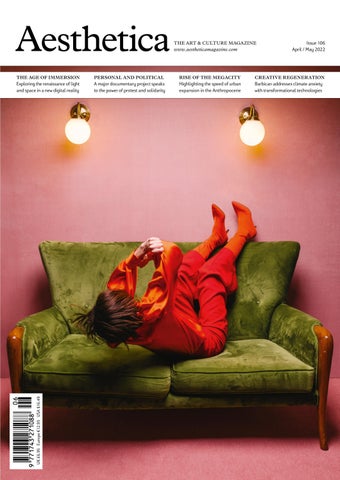
On the Cover Ulaş Kesebir and Merve Türkan work as a duo to redefine the parameters of fashion imagery. These compositions, which are both visually appealing and curiously jarring, offer unexpected moments of introversion and masquerade, as models sink into their clothing and environments. (p. 40)
Cover Image: Ulas & Merve, Untitled, Izmir/Turkey (2019). Courtesy of the artists.
Collectively, we have witnessed more atrocities in the past two years than I would have ever thought possible. There were many dark days during the pandemic fuelled by fear, loss and the unknown. However, the power of human innovation has changed the face of this crisis, and we will be able to adapt and live alongside this virus. I recently recovered from Covid, and I’m certain it was mild due to having three vaccinations. I remember watching images of mass graves around the world, and I feel very lucky, but at the same time, this feeling is matched with a heavy heart for all the loss of life, globally. This brings me to the situation in Ukraine. It seems unthinkable. Citizens were not allowed to leave via humanitarian corridors, and everything is being destroyed. I tap that Guardian news app too much. I have offered my house to a family, and I want to help. I feel committed, now more than ever, to assisting those in need, worldwide. This war in Ukraine has shown us how fragile global and political ecosystems are, and that the shape of the world is being rewritten before our very eyes. Covid changed the world once, and now it will be altered irrevocably again. It does recall the end of WWI and the flu pandemic of 1918. It’s been a time of great uncertainty, so we turn to art and culture as a universal mechanism to make sense of the world; to put the wrongs right and remember that our humanity binds us together. This issue is all about human stories, and how we must never give up in the face the adversity. Our collective narrative is one of resilience and this issue embodies that notion entirely. We interview the venerable Gillian Laub about Southern Rites, which navigates social division in the 21st century. Meanwhile, Our Time on Earth at Barbican unpicks the Anthropocene. We also bring you the best in new photography, from practitioners who are innovating and stepping beyond the status quo. Take a moment and step inside this issue. Reflect on the words and images; they consolidate the here and now. Cherie Federico
Aesthetica 13
58
106
88
70
94
52
40
76
14 Aesthetica
30
112
contents
Art 16 News MoMA considers how feminism and photography have become entwined. Institut suédois presents surreal visuals with the works of Erik Johansson.
26 10 to See How can we repair the Earth's ecosystems? Where does the line between subject and object begin? These topics are central to this season's shows.
30 Somewhat Otherworldly Jan Prengel’s Plants from Space series showcases flowers as if they were priceless exhibits: curious oddities or relics from an alternate universe.
40 Beyond Aesthetics Ulaş Kesebir and Merve Türkan work as a duo to redefine the parameters of fashion imagery, with bold colour schemes and alluring environments.
52 The Age of Immersion The Light and Space movement emerged in the mid-20th century during technological optimism. How has it evolved with the rise of the digital age?
58 Satirising the Everyday Olivia Locher highlights humanity's unrealistic expectations, depicting daily regimes to comedic effect, where candles literally burn at both ends.
70 Personal and Political Over 12 years, Gillian Laub produced a seminal documentary project within Montgomery County, Georgia. The series began with one written letter.
76 Journey into Night Jasper Goodall creates an ode to the evening in Twilight's Path. Quietude is embraced, as themes of solitude and isolation come to the foreground.
88 Creative Regeneration Barbican revolutionises the climate conversation, showcasing art as a speculative tool which can help us to bring about sustainable urban futures.
94 Mirrored Geography Murray Fredericks captures ethereal horizons on Kati Thanda-Lake Eyre, a 9,500km² endorheic salt lake 700km north of Adelaide, Australia.
106 Rise of the Megacity Michel Lamoller's photographic reliefs highlight the alarming rate at which humanity is expanding, depicting high-rises as markers of infrastructure.
112 Moments of Serendipity Andrea Lohmann's compositions are inspired by the built environment: structures from the postwar period complemented by passing clouds.
124 Exhibitions This edition we cover Dayanita Singh at Gropius Bau, Berlin; John Edmonds at Foam Amsterdam; and Erwin Olaf at Hamiltons Gallery, London.
129 Film Terence Davies offers a sensitive biopic of the poet Siegfried Sassoon in Benediction. Stacey Gregg directs a gripping thriller, Here Before.
131 Music New releases from Tempers, Moon Panda and Melody's Echo Chamber feature 1980s-inspired aesthetics and improvisational writing processes.
Books
Artists’ Directory
Last Words
133 The Latest Publications Alexander Monea explores the “Digital Closet” whilst Phaidon publishes a new title on the role of design amidst contemporary emergencies.
138 Featured Practitioners This edition showcases artists using innovative ideas, materials and techniques to reflect upon the notion of the self in an accelerating world.
146 Michael Famighetti The editor of Aperture expands on Orlando, a special edition and exhibition curated by Tilda Swinton, on show at Fotomuseum Winterthur.
Aesthetica Magazine is trade marked worldwide. © Aesthetica Magazine Ltd 2022.
The Aesthetica Team: Editor: Cherie Federico Associate Editor: Kate Simpson Digital Content Creator: Eleanor Sutherland Digital Content Writer: Saffron Ward
Advertisement Enquiries: Megan Hobson (0044) (0)844 568 2001 advertising@aestheticamagazine.com
Reviews
ISSN 1743-2715. All work is copyrighted to the author or artist. All rights reserved. No part of this magazine may be used or reproduced without permission from the publisher. Published by Cherie Federico and Dale Donley. Aesthetica Magazine 21 New Street York, YO1 8RA, UK Newstrade Distribution: Warners Group Publications plc. Gallery & Specialist Distribution: Central Books. Printed by Warners Midlands plc.
Advertising Coordinator: Megan Hobson Artists’ Directory Coordinator: Katherine Smira Production Director: Dale Donley Office Manager: Helen Osbond Designer: Matt Glasby Interns: Laura Kirkwood, Jay Villacci
Artists’ Directory Enquiries: Katherine Smira directory@aestheticamagazine.com Subscriptions: subscriptions@aestheticamagazine.com General Enquiries: info@aestheticamagazine.com
Contributors: Greg Thomas Rachel Segal Hamilton
Press Releases: pr@aestheticamagazine.com
Reviewers: Fanny Wendt Höjer, James Mottram, Osman Can Yerebakan, Matt Swain, Monica de Vidi, Leyla Sanai, Kyle Bryony, Marthe Lisson, Stephanie Watts, Jack Solloway, Duncan Ballantyne-Way.
Follow us: aestheticamagazine.com facebook.com/aestheticamagazine twitter.com/AestheticaMag pinterest.com/AestheticaMag instagram.com/AestheticaMag
Aesthetica 15
NamsaLeuba, Untitled II Cocktail (2011). 42.84 cm x 60cm. Courtesy of the artist.
news
16 Aesthetica
Resisting the Canon CROSSED LOOKS: NAMSA LEUBA Musée des Beaux-Arts du Locle | Until 24 April mbal.ch
Over the last 10 years, Namsa Leuba (b. 1982) has used photography to question the western gaze and imagination: particularly the ways in which specific traditions, communities and landscapes have been exoticised. In Tonköma, a series produced for Edun – a fashion brand founded by Bono and Ali Hewson – Leuba placed models on a Johannesburg rooftop, recalling the Guinean figure of “Nyamou” (“the devil in the sacred forest”) who communicates with ancestors in the sky and down on Earth. In the Illusions series, Leuba explores the visual myths surrounding the “vahine” – the image of the Polynesian woman. The project adopts colour palettes from Paul Gauguin, whose infamous Tahitian portraits utilised ripe fruits, flower garlands and bright colours to eroticise individuals in direct opposition with Occidental white femininity, which was seen to be “pure” and “precious.” In response, Leuba subverts Gaugin's Eurocentric gaze, painting the bodies of non-binary individuals to further question the roles in which Polynesian women have been cast. As a collection, Crossed Looks speaks directly to Leuba’s mixed Swiss-Guinean heritage, considering the complex ways cultural identity is formed and recognised. “Africa is a part of me, but because I grew up in Switzerland, I needed to explore this element of my roots, and connect it with the other. I have always been characterised as the ‘Other’, whether I am too ‘African’ to be European, or too ‘European’ to be African. Crossed Looks, as a title and concept, signifies how we can join these two worlds through the positive ways we look at, and perceive, one another.”
Aesthetica 17
news
Breaking New Ground OUR SELVES MoMA, New York | Opens 16 April
moma.org
This spring, MoMA considers the ways photography and feminism have long between entwined. From a wall of self-portraits to jarring depictions of segregated communities, these images span history and geography, from the avant-garde to the journalistic, offering ground-breaking perspectives on our world. Roxana Marcoci, Senior Curator, notes: “Rather than presenting a chronological history of women photographers, Our Selves: Photographs by Women Artists from Helen Kornblum, prompts new appraisals and compelling dialogues from a contemporary, intersectional feminist perspective. African-diasporic, queer, postcolonial and Indigenous artists have brought new questions to the canonical narratives of art history.” Embodying these themes is Candida Höfer’s (b. 1944) Deutsche Bücherei Leipzig IX (1997) – taken from a wider series documenting library interiors weighted by forms of social inequality and colonial supremacy – as well as Lorna Simpson’s (b. 1960) Details (1996), a portfolio of 21 photogravures that combines archival documents and short written texts to explore the ways that language can, and does, inscribe the body and reinforce social stereotypes. Meanwhile, Sharon Lockhart (b. 1964) offers contemplative observation on everyday scenarios, investigating western visual culture, from the northern European paintings of Johannes Vermeer and Caspar David Friedrich to the ethnographic cinema of Michael Snow and Jean Rouch. In Untitled, a young woman sits with a 1000-piece puzzle atop a polished walnut table. The miseen-scène is both atmospheric and psychologically charged.
18 Aesthetica
Aesthetica 19
Sharon Lockhart, Untitled, 2010. Chromogenic print, 37 × 49 in. (94 × 124.5 cm). The Museum of Modern Art, New York. Gift of Helen Kornblum in honor of Roxana Marcoci. © 2021 Sharon Lockhart.
ScanLAB Projects, Post-lenticular Landscapes: Equirectangular 01 Vernal Falls (after Muybridge and Watkins).
news
20 Aesthetica
Setting the Record IPE 162 The Museum of Gloucester | Until 5 June museumofgloucester.co.uk
Since 1854, the Royal Photographic Society has invited generations of artists to “express themselves without restrictions on age, subject matter, country or context.” The International Photography Exhibition is one of the world’s longest-running shows of its kind, encouraging visual debate around critical ideas and perspectives, whilst openly inviting artists to submit stories both personal and global: on a planet that’s constantly changing. The 162nd edition, now on tour with the Museum of Gloucester, includes 41 international practitioners, each pushing the boundaries of contemporary imagemaking. Cody Cobb’s Strange Land series comprises stark landscapes, taken during extended periods of complete solitude and isolation in the American West. In expansive shots, documenting desert undulations, mountains cast in dramatic moonlight and russet-red rock formations, where iron sulphide oxidises against planes of clean white earth. Other series include the genre-defying Post-Lenticular Landscapes, which re-enacts early expeditions into image-making. In 1870, Eadweard Muybridge (1830-1904) travelled to Yosemite National Park to test pioneering photographic techniques, a journey which was replicated by many infamous photographers, including Ansel Adams (1902-1984). In 2016, ScanLAB Projects visited the site to – once again – test out new ideas, using terrestrial laser scanning. In the age of the iPhone, the expedition was “comparatively heavily laden.” The logistics of moving this heavy equipment into a comparatively inaccessible environment “mirrored the epic nature of these early pioneer photographers.”
Aesthetica 21
Forms of Celebration NUDE Fotografiska New York | Until 1 May
fotografiska.com
In 2022, body image has never been more idealised: polished, perfected and posted. However, new laws are coming in to combat a widespread feeling of “filter dysmorphia.” In July 2021, for example, Norway introduced the Retouched Photo Law, requiring sponsored influencers to disclose any modification on their photos using a ministry-approved label. In January 2022, a similar bill was proposed to the UK government by Dr Luke Evans, calling for “advertisers, broadcasters and publishers to display a logo in a case where an image of a human body or body part has been digitally altered in its proportions for connected purposes.” These disclaimers, if passed, would be similar to new advertising standards, which govern images or video clips containing product placement and brand sponsorship. Framed as a “celebration of the human form through the lens of female-identifying photographers,” Fotografiska’s last show, Nude, centres on the naked body and how it is represented through, and by, the camera lens. These images not only subvert the dominant male gaze, but portray the body as a complex site of beauty, disruption and experimentation: of joy, elation and celebration, as well as innate complexity and introversion. Featured photographers include Evelyn Bencicova, Dana Scruggs, Brooke DiDonato and Marie Hald, practitioners who move in the realms of fine art portraiture, to fashion, performance and documentary as masters of craft and concept. As a whole, these collected images consider what the body means on a universal level: how it is used, portrayed and seen by the world.
22 Aesthetica
Aesthetica 23
Dana Scruggs, Rōze En La Playa (2016).
Erik Johansson, Above All. Courtesy of the artist.
news
24 Aesthetica
Behind the Curtain IDEAS COME AT NIGHT Institut suédois, Paris | Until 24 April paris.si.se
All human beings are, undoubtedly and consistently, drawn to dreamlike landscapes: worlds that are somewhat similar to our own, but that, crucially, carry their own laws of gravity. As Emily Dickinson famously wrote: “Tell all the truth but tell it slant.” Erik Johansson’s images fall, seamlessly, into this category of phantasm: bending and stretching reality through the folds of visual metaphor. In these mesmerising landscapes, night-time workers haul moons from the backs of vans and install them in the sky. Lone figures, out with telescopes, look upwards to the galaxy, only to find the stars already at their feet, glowing in the darkness. Escalators emerge from the green, mossy ground, sending anonymous shoppers straight into strange, nocturnal forests where phone signal is lost and the imagination set free. But in the age of digital construction, what is it that keeps us engaged – convinced, even, of the work? To what degree do we need to believe in the editing that has taken place? What makes us want to follow into these worlds and believe in their story? For Johansson, the answer lies in physically creating all props and sets, meticulously building each vision, and using digital technology only as a tool to finalise the images, blending the edges and easing the viewer's transition from real to surreal. Institut sédois, Paris, presents sketchbooks and documentation videos alongside the final works in Ideas Come At Night. Here, audiences are invited to explore modes of both wakefulness and unconsciousness – night and day – peering behind the curtain and suspending their disbelief in favour of something magical.
Aesthetica 25
art
10 to See RECOMMENDED EXHIBITIONS THIS SEASON
How can we replenish ecosystems? What if we could preserve someone's last breath? What constitutes a thriving community? Where does the line between artist and subject begin and end? These are just some of the complex conversations taking place in this season's shows.
1
Radio Ballads Serpentine, London | Until 29 May
serpentinegalleries.org Over the last three years, Serpentine has launched a critical investigation into civic life, community politics and modes of expression, asking key questions such as: how can artistic processes support systemic change? What keeps us connected? In response to this, Turner Prize-winning Helen Cammock, Prix de Rome-winning Rory Pilgrim, Stanley Picker fellow Ilona Sagar and Sonia Boyce OBE have worked with social workers, carers and organisers to produce four new film projects with Barking and Dagenham’s New Town Culture programme.
2
Cornelia Parker
3
Rana Begum: Dappled Light
Tate Britain, London | Opens 19 May
tate.org.uk Cornelia Parker (b. 1956) is a professional agitator. She has become world-renowned for dredging ideas to the surface that many people would rather stay buried, revealing uncomfortable truths about the climate crisis, violence and freedom. Tate Britain displays some of the artist’s most iconic suspensions, such as Cold Dark Matter: An Exploded View (1991), the restored contents of a garden shed which was exploded by the British Army at Parker’s request, and Thirty Pieces of Silver (1988-1989), featuring thousands of steamrollered objects.
Pitzhanger Manor & Gallery, London | Until 11 September
1
pitzhanger.org.uk Born in Bangladesh, London-based artist Rana Begum (b. 1977) distills visual and spatial experiences into ordered form. She blurs the boundaries between sculpture, painting and architecture, drawing from the urban landscape, as well as geometric patterns from traditional Islamic art, in order to produce a refined language of minimalist abstraction. Dappled Light directly responds to Pitzhanger Manor, with a large-scale mesh installation that reveals soft veils and layers of colour, encouraging meditation on the changing nature of perception.
4
1-54 Contemporary African Art Fair Christie's, Paris | 7-10 April
1-54.com 1-54 Contemporary African Art Fair, the international art fair dedicated to contemporary art from Africa and the African diaspora, is returning to Paris this spring, with an event spanning four days. This edition includes 22 international exhibitors, and more than 50 artists from across the globe. The themes for 2022 include: Collective Memory and Identity; Human Behaviour and the Psyche; Femininity and Powers of Domination; Cultural Heritage and Traditions. These shows consider past and present geographies, power structures and world-building.
5
Nature x Humanity: Oxman Architects SFMOMA, San Francisco | Until 15 May
sfmoma.org American-Israeli architect Neri Oxman (b. 1976) questions the materials, tools and methods of 21st century design – from the ways we utilise organic decay to the ways that we honour the dead. Her diverse and innovative projects include Wanderers – a collection of wearables which can respond to 200-degree temperature fluctuations and high meteor activity – as well as Aguahoja, a pavilion composed of the planet’s most abundant biopolymers – including cellulose, chitin and pectin – the same materials found in trees, crustaceans and apple skins.
26 Aesthetica
2
3
4
5
Aesthetica 27
8
6
9
7
28 Aesthetica
10
6
Diane Arbus: Photographs, 1956-1971 Louisana Museum of Modern Art, Humlebaek | Until 31 July
louisiana.dk “A picture is a secret about a secret, the more it tells you the less you know.” Diane Arbus (1923-1971) revolutionised portraiture over the course of 15 years, producing distinctive and direct images with a penetrating sense of humanity. The American photographer captured a range of subjects, including couples, children, suburban families, performers and celebrities. Louisiana Museum of Modern Art presents Scandinavia's first large-scale retrospective, with images that have instilled empathy, conflict and necessary unease since the mid-20th century.
7
The Truth is in the Soil: Ioanna Sakellaraki Belfast Exposed | Until 21 May
belfastexposed.org In 2020, Ioanna Sakellaraki was announced as Sony World Photography Awards’ Student Photographer of the Year. The Aeiforia series depicted Tilos – a tiny island in the Dodecanese archipelago close to Turkey – the first island in the Mediterranean to run almost entirely by renewable energy. Belfast Exposed presents new works exploring grief rituals in Greek communities. Sakellaraki notes: “In the wake of witnessing global losses within our cultures and civilisations, I want the viewer to rethink mortality through this imagined path of departure.”
8
Our Blue Planet: Global Visions of Water Seattle Art Museum | Until 30 May
seattleartmuseum.org About 71 per cent of the world’s surface is covered in water. Over half of our bodies are made up of liquid, with the brain measuring roughly 80 per cent water. Our bones are even watery, requiring one quarter liquidity. Seattle Art Museum pulls together over 80 works from 16 countries, including seven indigenous Native American communities, exploring the unique essence and cultural value of the substance. The show ranges broadly from post-apocalyptic video projections to twisting lamps and high-flex wires that bend to mimic the shapes of rivers.
9
Bieke Depoorter: A Chance Encounter
C/O Berlin | Opens 30 April
co-berlin.org How close can a photographer get to the people they portray? Bieke Depoorter’s (b. 1986) practice is centred around authenticity, ownership and collaboration – the complex interactions between subject and photographer – as well as a constant questioning of the medium: the wider tensions between fiction and reality. C/O Berlin displays works from the collaborative portraiture series, Agata, as well as images from Michael, an innovative project which investigates the disappearance of a man Depoorter met on the streets of Portland in 2015.
10
Revolusi! Indonesia Independent Rijksmuseum, Amsterdam | Until 5 June
rijksmuseum.nl/en In the 1600s, the Dutch East India Company began colonising parts of Indonesia. After more than three centuries of diplomatic struggle, in 1945, Indonesia proclaimed itself an independent country, signalling a paradigmatic shift in 20th century history. This exhibition focuses on the “people who experienced the revolution at close quarters: fighters, artists, diplomats, politicians and journalists.” It reflects, as a whole, on the many faces, voices and hands involved, whilst exploring the legacies of nationalism, youth, art, war, propaganda and renewal.
1. Rory Pilgrim, RAFTS, Production Still (2021). Photo: Matthew Ritson. 2. Cornelia Parker, Cold Dark Matter: An Exploded View (1991). Tate © Cornelia Parker. 3. Detail No. 1081 Mesh by Rana Begum © Begum Studio. Photography: Angus Mill 4. Seydou Keïta, Untitled (01096MA.KE.158), 1956-1959, Posthumous gelatin black and white silver print on cartoline paper 280g back-mounted on aluminium 1mm (large format), 179 x 139 x 4.7 cm, Edition of 5 + 2 AP. Courtesy of Galerie Nathalie Obadia. 5. Neri Oxman, Aguahoja Pavilion (render on San Francisco Museum of Modern Art terrace), 2018; OXMAN, 2021; image: OXMAN. 6. Diane Arbus, Three female impersonators, N.Y.C., 1962. Gelatin silver print, sheet: 35.6 x 27.9 cm. Art Gallery of Ontario. Anonymous gift, 2016. Copyright © Estate of Diane Arbus. 7. Ioanna Sakellaraki, Thia Metamorfosis (holy transfiguration), The Truth is in the Soil, (2019). 8. Nooksack (2005). Claude Zervas, CCF (cold cathode fluorescent) lamps, wire, electronics, steel, 36 x 96 x 216 in. Gift of John and Shari Behnke, Rena Bransten, Carlos Garcia and James Harris, David Lewis, Kim Richter, Josef Vascovitz, Robin Wright, Dawn Zervas, and the Contemporary Arts Council, Seattle Art Museum in honor of Lisa Corrins. 9. Agata. Beirut, Lebanon, August 3, 2018 © Bieke Depoorter and Magnum Photos. 10. Three young Indonesians on the street in Yogyakarta, December 1947. The armed young men belong to the militia group Kebaktian Rakjat Indonesia Sulawesi. Hugo Wilmar. The Hague, National Archives of the Netherlands / Collectie Spaarnestad.
Aesthetica 29
art
Somewhat Otherworldly Jan Prengel
In Ways of Being Alive (Polity, 2022), French philosopher Baptiste Morizot notes: “By no longer paying attention to the living world, to other species, to environments, to the ecological dynamics that weave everyone together, we are creating from scratch a mute and absurd cosmos.” In other words, we have become alienated from the planet, and all that exists upon it, seeing “nature” as something altogether separate from ourselves. Jan Prengel’s Plants from Space series leans into this school of thought, presenting minimalist portraits of flora as if they were priceless museum exhibits: oddities or found relics from a by-gone era. Shooting each stem against regal tones of ruby, emerald and navy, Prengel simultaneously draws attention to the opulent “alien” beauty of protruding stalks, trumpet-shaped petals and sharp thistles, whilst provoking the reader to question how, why and when organic matter became somewhat foreign to us. janprengel.com.
Jan Prengel, Plants from Space 1 (2020). Courtesy of the artist and Tappan, Los Angeles.
30 Aesthetica
Aesthetica 31
32 Aesthetica
Jan Prengel, Plants from Space 2 (2020). Courtesy of the artist and Tappan, Los Angeles.
Aesthetica 33
Jan Prengel, Plants from Space 8 (2020). Courtesy of the artist and Tappan, Los Angeles.
34 Aesthetica
Jan Prengel, Plants from Space 9 (2020). Courtesy of the artist and Tappan, Los Angeles.
Aesthetica 35
Jan Prengel, Plants from Space 11 (2020). Courtesy of the artist and Tappan, Los Angeles.
36 Aesthetica
Jan Prengel, Plants from Space 12 (2020). Courtesy of the artist and Tappan, Los Angeles.
Aesthetica 37
Jan Prengel, Plants from Space 7 (2020).Courtesy of the artist and Tappan, Los Angeles.
38 Aesthetica
Jan Prengel, Plants from Space 3 (2020). Courtesy of the artist and Tappan, Los Angeles.
Aesthetica 39
Jan Prengel, Plants from Space 4 (2020).Courtesy of the artist and Tappan, Los Angeles.
art
Beyond Aesthetics Ulas & Merve
Fashion photography is constantly being reinvented, whilst fashion, itself, is an integral part of culture. The way we present ourselves to the world speaks to wider geopolitical shifts and technological developments. Clothes signal wider connotations well beyond tailoring, trends and alluring colour palettes. Ulaş Kesebir (b. 1980) and Merve Türkan (b. 1985) are based between Istanbul and London, working as a duo to redefine the parameters of fashion imagery. These compositions, which are both visually appealing and curiously jarring, offer unexpected moments of introversion and masquerade, as models sink into their clothing and environments. Pillar box reds stand out against powder blues, whilst alarming yellows contrast aquamarine walls. In these seemingly empty worlds, materials take to the foreground, and we are asked to consider our modes of dress, as well as the personal and collective readings of fashion. ulasmerve.co.uk.
Ulas & Merve, Untitled, Izmir/Turkey (2018). Courtesy of the artists.
40 Aesthetica
Aesthetica 41
42 Aesthetica
Ulas & Merve, Untitled, Izmir/Turkey (2016). Courtesy of the artists.
Aesthetica 43
44 Aesthetica
Aesthetica 45
Ulas & Merve, Untitled, Izmir/Turkey (2016). Courtesy of the artists.
46 Aesthetica
Ulas & Merve, Untitled, Izmir/Turkey (2016). Courtesy of the artists.
Aesthetica 47
48 Aesthetica
Aesthetica 49
Ulas & Merve, Untitled, Izmir/Turkey (2019). Courtesy of the artists.
50 Aesthetica
Ulas & Merve, Untitled, Izmir/Turkey (2017). Courtesy of the artists.
Aesthetica 51
art
The Age of Immersion Larry Bell THE LIGHT AND SPACE MOVEMENT EMERGED IN THE MID-20TH CENTURY DURING WIDESPREAD TECHNOLOGICAL OPTIMISM. HOW HAS IT EVOLVED IN THE DIGITAL AGE?
Larry Bell (b. 1939) doesn’t know exactly what his new show Bell was amongst a group of likeminded artists, which at Hauser and Wirth, London, will look like yet. “It really included John McCracken (1934-2011), Fred Eversley (b. has to do with the architecture of the space, and the colour 1941), Helen Pashgian (b. 1934), James Turrell (b. 1943) and relationships suggested by the structures,” he states, over Doug Wheeler (b. 1939). They became famous for creating a crackling phone-line from his home in the New Mexico walkthrough artworks with meditative or even spiritual qualimountains. In other words, the works will emerge in relation ties, saturating whole environments with the glow of natural to the gallery when he sets foot on-site. Bell has been widely or artificial light. The constant sunlight of California’s valleys celebrated since the 1960s for his signature tinted glass and deserts undoubtedly fed the group’s imagination. Howcubes and standing walls. Notably, he uses a unique metal- ever, the Light and Space school was also responding to an lic film-coating process that imbues translucent surfaces with era of scientific and technological advancement. Outer space a delicate tonal spectrum, simulating the effects of shadow was being explored for the first time, whilst ocean beds were and light, playfully provoking the senses. Many of Bell’s probed and studied, early computers being programmed, recent sculptures comprise square enclosures set around and cybernetic theories advanced. A consumer boom was smaller, four-sided constructions, generating complex opti- occurring, fuelled by post-war economic revival and a decal effects. However, the object of fascination (in all cases) mand for higher living standards. This was coupled with the extends beyond materials: it encompasses the atmosphere global spread of capitalism and the ever-increasing availcreated through light absorption, transmission and reflection. ability of plastic, a magic material that could seemingly be Now in his 80s, Bell remains open to new developments used to make everything from clothes and furniture to toys. – or, as he puts it, “I have no plans to change anything, and All of this change was associated with a broad spirit of I have no reason to believe that I won’t change.” The state- social optimism, for all the malaise of the Cold War (1947ment is suitably open-ended for an artist whose career has 1989). Certainly, a sense of technological enquiry informed been informed by serendipity. Bell began studying at the the work of the Light and Space milieu, albeit in a somewhat Los Angeles Chouinard Art Institute – later incorporated scattergun approach, according to Bell. State-of-the-art mainto CalArts – during the late 1950s, hoping to become a terials such as epoxy and acrylic resins – some of them used film animator. However, under the tutelage of Robert Irwin by the military and aerospace industries and only recently (b. 1928), Bell explored various styles of abstract painting declassified because of their role during WWII – were seized before fixating on glass. “I was doing very simple hard-edged on by artists for their reflective, translucent and futuristic paintings that represented a volume – a cube or something properties. Fred Eversley even worked as a NASA engineer at else,” he recalls, “and I decided to make the actual volumes.” the Wyle Laboratories in El Segundo before becoming a full-
52 Aesthetica
Aesthetica 53
54 Aesthetica
Installation view, Larry Bell. From the '60s, Hauser & Wirth, New York, 2016. © Larry Bell. Courtesy the artist and Hauser & Wirth. Photo: Genevieve Hanson.
“How is the optimistic, future-oriented spirit of the Light and Space movement thriving in this new paradigm? And why are we still be fascinated by light when we can’t get away from it?”
Previous Page: Installation view, Whitney Biennial, Whitney Museum of American Art, New York, 2017. © Larry Bell. Courtesy the artist and Hauser & Wirth. Photo: Timothy Schenk. Left: Larry Bell, Standing Walls, 1969/2016, Clear and grey glass, 10 panels, each panel: 243.8 x 182.8 x 1.3 cm / 96 x 72 x 1/2 inches. © Larry Bell. Courtesy the artist and Hauser & Wirth. Photo: JR Doty.
time sculptor, bringing tools and techniques with him. The automotive, surfing and commercial signage businesses supplied other substances that could also be appropriated to creative ends, such as spray lacquers used to cover cars. The film-coating processes that gave Bell’s work creative lift-off, meanwhile, relied on another stalwart of California culture: the film industry. The coated glass cubes he began to create during the 1960s were initially made with a cinema lighting specialist, who was producing colour filters for Walt Disney. Later, Bell’s technique was refined based on discussions with a New York company that covered Christmas tree baubles and toy pistols in reflective silver. The business owner subsequently sold Bell his first coating “tank”, a large unit in which sheets of plastic could be suspended and drenched in a very fine metallic spray. Many of the technologies discovered by Bell and his contemporaries are now ubiquitous. “Certainly, the kind of process that I was using was extremely influential in the development of modern technology. Everything from phones to computers uses thin film technology to produce electrical contacts.” But for Bell, “the connection to technology is not why this stuff brings joy. I am just interested in how things look. When you’re young and confident, you just go for it.” In 2022, Light and Space is enjoying a renaissance. A major group show at Copenhagen Contemporary brings together early works of the movement with new inventions from its most feted practitioners, including pieces from James Turrell’s Ganzfeld series: depthless light chambers designed to instil sensory deprivation. Subsequent generations of artists are also represented in Copenhagen, making for the first major collective retrospective of Light
and Space in Europe. Meanwhile, new works by Turrell and Robert Irwin have recently been unveiled at major institutions such as Kraftwerk Berlin and Pace Gallery, New York. At the same time, many practitioners have developed far more critical relationships to the industrial materials and processes that inspired Bell. Throwaway consumer culture has precipitated a tidal wave of non-recyclable waste, whilst the late-20th century explosion in international air travel has contributed substantially to a climate crisis that was still a conceptual dot on the horizon during the 1960s. In this context, when billionaires such as Jeff Bezos and Elon Musk wax on the promises of space travel, Light and Space seems to provide an escape from a damaged planet. Today, it’s hard to imagine that any movement would respond to the technologies wrapped up with these social, environmental and economic trends in the same wide-eyed spirit as Bell and his compatriots adopted in 1960s California. On top of this, a large proportion of the population now spends much of its time assailed by light-waves as we scroll through media on laptops, phones and tablets, endlessly refocusing our attention. The optical and cognitive effects of all this extended screen time have been exacerbated over the last two years with so many of us driven online for work and social activities during the pandemic. Science blogs and journals are awash with articles cataloguing the negative impacts on our attention spans, mental health and visual aptitude, with a term, “Computer Vision Syndrome”, coined to describe the negative effects. A 2018 study, published in the British Medical Journal, suggests that its prevalence may be up 50% or more in computer users. (Amy Sheppard and James Wolffsohn, Digital Eye Strain)
Aesthetica 55
Installation view, Whitney Biennial, Whitney Museum of American Art, New York, 2017. © Larry Bell. Courtesy the artist and Hauser & Wirth. Photo: Timothy Schenk.
How is the optimistic, future-oriented spirit of Light and Space thriving in this new paradigm? And why are we still fascinated by light when we can’t get away from it? There is an argument that Light and Space is amenable to the very social media platforms that have shifted the parameters of our perception, with its bold colours and simple dynamic forms requiring little intellectual mediation. However, much light art asks viewers to bring a sustained ruminative attention that is hard to muster when surfing Instagram. It’s perhaps more relevant to note that human beings’ relationship with light stretches back to the beginning of history. Think of the solar deities of ancient civilisations or myths surrounding the constellations – the lights of the sky were amongst our first points of emotional and intellectual anchorage in the universe, objects of primordial fascination and worship. Light art has often been associated with the idea of the Sublime, that awe-inspiring sense of an encounter with a timeless force or truth far greater than oneself. Perhaps this is the core “feeling” which Bell wants people to draw from his work, and which he insists we are still capable of accessing, even in the hyper-digital age. That said, artists building on Bell's legacy are more likely to perceive light and space as forces impacted by human activity. Luminosity, reflection, refraction: these ambient effects are no longer the preserve of private creative encounters. When Olafur Eliasson (b. 1967) bathed the Tate Modern’s Turbine Hall in the stark black-and-yellow beams of a waning sun for Weather Project (2003) he was remaking Light and Space for the age of climate anxiety. Since then, figures such as Andrea Polli (b. 1968), who works with vast outdoor displays to visualise air pollution and other envi-
56 Aesthetica
ronmental data, have extended the legacy of the style Bell helped to define in a spirit of ecological activism. So much for Light and Space in the age of global warming – but what about digital technology? Can the steady, fine-tuned awareness that artists such as Bell require of viewers be expected of contemporary audiences, with all their digital distractions? “There is an argument that pervasive technology now affects us in such a way that we’re less capable of the kind of attention that my work requires,” Bell states. For all its beauty and immediate pull on the senses, his pieces also ask us to concentrate and linger: to spot incremental differences in qualities of light based on the placement of panes of glass at certain angles or distances, or to second-guess the impression of natural shadow on a plane of glass created by a gradient of metallic skin. Then again, perhaps the art that Bell and his peers create is needed now more than ever, for that very reason. Can it replicate some of the basic sensory qualities of our encounters with the computer or phone screen and use them in the service of a creative experience that is slow, focused, meditative, restoring? Bell is unsure of this explanation. For him, Light and Space’s renewed popularity partly reflects the arbitrary cycles of the art market, which is forever seizing on the “new thing” before digesting it in retrospect half a century later. However, it’s also because that longing for connection to something beyond our own thoughts and concerns, a yearning for the Sublime, even, survives all. “I suspect that everyone who makes the decision to go and look at a piece of art, or go to a museum, or stop in front of a sculpture still has the same thirst or hunger. There’s a need for the improbable experiences that art provides.”
Right: Larry Bell, Something Green, Venet Foundation Sculpture Garden, Le Muy, France, Photo credit: Xinyi Hu, Courtesy Venet Foundation.
Words Greg Thomas
Larry Bell Hauser & Wirth, London 12 May - 30 July hauserwirth.com
Aesthetica 57
art
Satirising the Everyday Olivia Locher
In 2017, Olivia Locher (b. 1990) rose to fame with the groundbreaking photography series I Fought the Law, depicting and breaking eccentric laws from each of America’s 50 states. The images, shot against block colour backgrounds, include playful – and sometimes bizarre – acts of disobedience. In Alabama, for example, it is still illegal to have an ice cream cone in your back pocket, due to robbers historically luring horses away from their owners and feigning ignorance. In California, bikes are banned from swimming pools, and in Texas, there is a prohibition against “unusual” haircuts on children. Locher’s most recent projects include a satirical “how-to” series for the 21st century: how to measure up, how to be taller, how to walk on water. In these creative studio shots, Locher considers humanity's unrealistic desires and aspirations, and presents them to comedic effect. Candles are lit from both ends, cream is poured over ice, jean shorts are stained with melting sprinkles. olivialocher.com.
Olivia Locher, How To Slam Dunk (2018). Courtesy of the artist.
58 Aesthetica
Aesthetica 59
Olivia Locher, How To Walk on Water (2019). Courtesy of the artist.
60 Aesthetica
Olivia Locher, Studio Trash (2018). Courtesy of the artist.
Aesthetica 61
Olivia Locher, How To Get Elevated (2019). Courtesy of the artist.
62 Aesthetica
Olivia Locher, How To Celebrate the Equinox (2019). Courtesy of the artist.
Aesthetica 63
Olivia Locher, How To Be Taller (2014). Courtesy of the artist.
64 Aesthetica
Olivia Locher, Commission for Ghostly International (2016). Courtesy of the artist.
Aesthetica 65
Olivia Locher, How To Make Ice-cream (2015). Courtesy of the artist.
66 Aesthetica
Olivia Locher, How To Feel Burnt Out (2019). Courtesy of the artist.
Aesthetica 67
Olivia Locher, I Fought the Law – Alabama (2013). Courtesy of the artist.
68 Aesthetica
Olivia Locher, How To Measure Up (2019). Courtesy of the artist.
Aesthetica 69
art
Personal and Political Southern Rites OVER THE COURSE OF 12 YEARS, GILLIAN LAUB PRODUCED A MAJOR DOCUMENTARY SERIES IN GEORGIA, USA, HIGHLIGHTING THE PAINFUL REALITIES OF SOCIAL DIVISION.
In 2002, Gillian Laub (b. 1975) received a call from Spin magazine. The editor had been sent a letter from a high school student in Montgomery County, Georgia, stating she wasn’t able to take her boyfriend to the prom, purely because he was Black. By the time the letter had been read, the prom had already passed, but there was another segregated event planned: homecoming. Laub was commissioned to cover the event, documenting students in their separate groups. By 2008, Anna Rich Chafen – the girl who had written the original letter – had moved out of town, but the experience still haunted Laub, and she knew she had to go back. New York Times Magazine agreed to publish a piece on the divided proms, exploring how, and why, the “tradition” of the “blackfolks prom” and the “white-folks prom” had been maintained and protected since Montgomery County schools were first integrated in 1971. During her second visit, Laub was chased out of town, her car tyres slashed. She was told by police that she wouldn’t be protected from locals who would take the law into their own hands, recognising Laub from 2002. She returned, however, and the article was published 29 May 2009, four months after Barack Obama was inaugurated. In 2010, the school had its first integrated prom. This time, Laub brought a video camera, and continued to return for the next three years. The final film, which should have been focused on a community coming together, quickly turned into something different, as a young Black man, Justin Patterson, was shot by an older white man after being invited over to his home to visit his daughter. Southern Rites, the resulting project, spanning 12 years, is currently touring the USA.
70 Aesthetica
A: In the past, you’ve documented a range of complex human stories, from the Second Intifada in Israel (Testimony, 2007), to wealth, ancestry and fractured politics in Family Matters (2021). What conversations are you looking to engage in as a photographer, as a whole? What overall responsibility do you feel to exposing contemporary conflicts, and the communities they affect? GL: I am fascinated by how society’s most complex questions manifest in our most intimate moments, and I strongly believe in the power to make real and tangible change through art. Art has the power to inspire, educate and move the cultural needle forward. The “concerned photographer” was a phrase coined by Cornell Capa (founder of the International Center of Photography) to describe practitioners who demonstrated a humanitarian impulse to use pictures to educate and change the world, not just record it. This has resonated with me and my goals, as an artist, since I first discovered photography. I believe it’s our responsibility as artists to reflect upon the political landscape on a global level. A: Can you describe the phone call you had with Spin magazine initially, and your first visits to Montgomery County? Did the project differ to previous commissions? GL: Anna Rich Chafen had written to Spin to say that she boycotted her prom because her Black boyfriend wasn’t allowed to attend. It was clearly a cry for help, and so both myself and the editor of Spin felt very compelled and moved. It was shocking to hear this was happening in our country, and we felt the urgency to tell this story. That first trip to
Aesthetica 71
72 Aesthetica
Gillian Laub,Jacoiya and Chelsea outside the Black prom, Vidalia, Georgia (2011). From the series Southern Rites. Courtesy of the artist.
“'Tradition' became the euphemism used to make excuses for racist acts. I asked why proms had continued to stay segregated by race, and this was always the go to answer, as if this helped make it acceptable.”
Previous Page: Gillian Laub, Keyontae, Lyons, Georgia, (2011). From the series Southern Rites. Courtesy of the artist. Left: Gillian Laub, Julie and Bubba, Mount Vernon, Georgia (2002, detail). From the series Southern Rites. Courtesy of the artist.
Montgomery County is singed in my brain, witnessing how commonplace it was to have two homecoming queens – one white, one Black – smiling and waving at the camera. I was haunted by that image, which is why I kept on returning. A: What dangerous role does “tradition” play in the community’s perception of segregation and division? GL: “Tradition” became a very loaded word. I found it was the euphemism used to make excuses for racist acts. I interviewed so many people throughout the years, asking why proms had continued to stay segregated by race, and this was always the go-to answer, as if this helped make it acceptable. Whilst photographing this community, I was dismayed by what I witnessed, and I knew I had to continue my work there even in the face of growing, and eventually violent, resistance. The threats I faced came from members of the white community who didn’t want these practices exposed. Over more than a decade, I delved into the life of Montgomery County, attempting to make sense of what appeared to be a toxic anachronism. Many families and students in the Black community were terrified to come forward, but also desperately wanted change, even after years of failed attempts. My work documented the balance between these tensions. A: Can you describe the relationships you built with the community – both positive and negative? How, as a documentary photographer, artist and an individual, do you balance the modes of subjectivity and objectivity? GL: At first, the community I encountered was warm, polite and protective of their neighbours – proud of their history. On the surface, the town – in its own way – symbolised the
archetype of pastoral, small-town America. As a photographer, I have a self-imposed rule: listen, observe, connect, but don’t judge. Embrace everyone with empathetic interest. Although it is impossible to walk in anyone else’s shoes, I try to understand what lies in another person’s heart: their pain, their struggle, their path. Even when my subjects and I have fundamentally opposing views, a sense of goodness and optimism can always be found. The closer you look at people, the more miraculous – and complicated – they become. A: You visited Montgomery County multiple times, going back to see individuals who’d since graduated, addressing the legacy they had left. How do you protect each individual's story and their consent to be documented? GL: I get incredibly invested in my subjects and often become a confidante to those I photograph. I do not work in a traditional studio. Instead, homes, bedrooms and personal spaces become my studio. I photograph where my subjects feel comfortable and safe. When I’m privileged to be part of someone else’s world, the photographs become a collaboration. This relationship is something I honour above all else. There were times during the years of Southern Rites when I didn’t publish certain photographs or interviews. These tough decisions are always made with careful consideration. In 2009, the seniors attending the Black prom asked me not to publish the photos and interviews until they graduated. They were terrified the school would prevent them from matriculating if they spoke out against it. I remember it like it was yesterday – on graduation night a bunch of us were sitting anxiously by the computer because the New York Times promised the piece wouldn't publish until late that evening.
Aesthetica 73
Gillian Laub, Anna with her husband and children, Atlanta, Georgia (2011). From the series Southern Rites. Courtesy of the artist.
A: When you went back in 2010, the narrative changed because of the personal and individual resistance of Anna. again as a young man was shot dead, after being un- Young people, through their continued acts of protest, have armed but assumed to be dangerous. How did the series the power to create collective change for their generation become something much larger, and more harrowing, and future generations, which I find deeply inspiring. considering the continued political tensions in America? GL: In 2011, Justin Patterson, a 22-year-old unarmed African A: How can we harness our current age of hyper-visibility American man – whose segregated high school homecom- to bring about an egalitarian future, addressing shared ing I had photographed – was shot and killed by a 62-year- histories of oppression, segregation, and injustice? old white man. This project, which began as an exploration of GL: It’s a much more democratic world today, because of segregated high school rituals, evolved into an urgent man- smart phones and social media. We have become the most date to confront the painful realities of discrimination and informed generation; everything is at our fingertips, and evestructural racism. I continued to document the town, focusing ryone has the ability to share their story publicly without deon the Justin Patterson murder trial. The country had just re- pending on the hierarchy of print publications. I have always elected its first African American president, Barack Obama, firmly believed in the power images have to provoke social and the ubiquity of camera phones gave rise to the notion change. The immediacy of visuals helps people to empathise of citizen journalism exposing racially motivated violence. in ways that text cannot – the reality of oppression becomes As the Black Lives Matter Movement and national protests more difficult to ignore. We are witnessing this presently as proliferated, I was simultaneously trying to tell a complex we see a tragic war unfolding in real time through harrowing story about adolescence, race, the legacy of slavery, and the images disseminated through social media. Hopefully in this deeply rooted practice of segregation in the American South. case, the awareness of the atrocities, helps mobilise aid. A: The project, of course, began with one letter, from a single student. In many ways, the series considers the ways in which younger generations, can, and are, liberating themselves from past traumas. To what extent is the series a story about the power of individual resistance? GL: This story was able to be told because of the bravery of a solo individual, who wanted to push back against problematic societal norms; without that initial act of resistance, who knows how long it would have taken to fully de-segregate proms? Southern Rites became a story of collective resistance
74 Aesthetica
Right: Gillian Laub, Qu’an and Brooke, Mount Vernon, Georgia, (2012). From the series Southern Rites. Courtesy of the artist.
Words A: Do you plan to visit Montgomery County again? How, Kate Simpson and when, can we be satisfied that a project is “finished”? GL: The last time I was in Montgomery County was 2018, when Stacey Abrams was campaigning to be Governor. Even when a project is technically finished, I never feel finished. Southern Rites My plan was to photograph the prom in 2020, but the pan- Asheville Art demic affected those plans. I am hoping to go back this year. Museum, North Carolina It will be a wonderful homecoming when the Southern Rites 1 April - 20 June exhibition opens at the Atlanta Contemporary in the autumn. I can’t wait for everyone to see their portraits in a museum. ashevilleart.org
Aesthetica 75
art
Journey into Night Jasper Goodall
In 2014, Jasper Goodall (b. 1973) left a career in illustration to study Psychosynthesis: a field of existential psychology focused on exploring deeper centres of identity, with the goal of reaching true “self-realisation.” In this period of “creative dormancy” Goodall became interested in journeys – specifically those which focus on the world after dark. He notes: “I’m interested in ideas around being lost – themes of solitude, loneliness and retreat. In our frenetic world, the night forest seems to be the very opposite of our busy, media-filled days. It is a place in which, for a few short hours, no human voice can be heard. The environment is temporarily returned to the wild.” In these velvety images, taken from the Twilight's Path series, Goodall creates an ode to the evening. Quietude is embraced, whilst twisting branches and fallen leaves become new forms of currency: gold, silver and bronze shine against the depths of black. jaspergoodall.com.
Jasper Goodall, Twilight’s Path 14: Sentinel (2019). Courtesy of the artist.
76 Aesthetica
Aesthetica 77
78 Aesthetica
Jasper Goodall, Twilight’s Path 31: Beechgrove (2020). Courtesy of the artist.
Aesthetica 79
80 Aesthetica
Aesthetica 81
Jasper Goodall, Twilight’s Path 20: Birchwood (2020). Courtesy of the artist.
82 Aesthetica
Jasper Goodall, Twilight's Path 40: Tulgey Wood (2021). Courtesy of the artist.
Aesthetica 83
84 Aesthetica
Aesthetica 85
Jasper Goodall, Twilight’s Path 06: Lonely Birch (2019). Courtesy of the artist.
86 Aesthetica
Jasper Goodall, Burnt Place 02: Pines (2019). Courtesy of the artist.
Aesthetica 87
art
Creative Regeneration Our Time on Earth A LANDMARK EXHIBITION ADVANCES THE CLIMATE CONVERSATION, HIGHLIGHTING ART AS A POWERFUL SPECULATIVE TOOL THAT HELPS US TO UNDERSTAND OUR FUTURE.
“Climate grief” is a phrase that we hear more and more these days. It describes a psychological state: the dizzying combination of loss, anxiety, anger and sadness felt in the face of the climate emergency as it worsens. In 2021, a worldwide survey of 16 to 24-year-olds found that four in 10 were so afraid of the future, they were reluctant to have children. (Young People’s Voices on Climate Anxiety, Government Betrayal and Moral Injury: A Global Phenomenon, Lancet Planetary Health) This is surely a thoroughly rational response when you look at the facts. The 10 years leading up to 2019 were, on average, the hottest ever on record. Floods, wildfires, storms and many other extreme, life-threatening weather events are becoming increasingly commonplace, up 85% in the last 20 years. We have lost 70% of animal species in just under 50 years. There are plenty of reasons to grieve. However, these despondent images aren't necessarily the most helpful, or even the most accurate, when it comes to discussing the climate. “It’s known as the ‘apocalyptic recap’” says Caroline Till, co-founder of future research agency FranklinTill. “It’s a technique that Extinction Rebellion use in their activism, where you start by presenting the situation as it is – this is the damage we’ve done, isn’t it terrible.” Cumulatively, however, this can have the effect of making people feel powerless, so overwhelmed that they ignore what’s happening – similar to the notion of compassion fatigue in photojournalism – that we reach a point where we become inured to images of suffering and look away in a state of apathy. When Caroline Till and Kate Franklin came on board as guest curators to work alongside Barbican International
88 Aesthetica
Enterprises' Co-Head Luke Kemp on Our Time on Earth, the team were intent on adopting a different strategy. “It’s important to have awareness of the scale of the issue, but it can be paralysing. We wanted to carve out a space to build a constructive way forward, spotlighting the ingenuity of art, design and culture to do that,” she says. They took inspiration from the American environmental activist Joanna Rogers Macy (b. 1929) who talks about this unique moment in history – the “Great Turning.” Instead of envisioning apocalypse, she speaks of “adventure.” She writes: “Of all the dangers we face, from climate chaos to nuclear war, none is so great as the deadening of our response.” A radical optimist for whom hope is a productive act, Macy argues nothing less than a complete transformation in consciousness will save us. “We are completely interconnected to nature, we are nature,” says Till. “It's not something that we own or control, a resource to extract from. In this exhibition, we want to stimulate a wider shift from the point of view which places humans at the top of a hierarchical model of nature. Instead, we propose a biocentric approach, in which we consider humans as one of many species in this diverse ecosphere.” The curatorial journey is therefore divided into three stages or “chapters” entitled Belong, Imagine and Engage. On entering the Curve – where the main exhibition is staged – visitors find themselves descending into a dark, cocoon-like space. The walls are covered in natural wool and forest green felt, “giving a sense of weight and warmth,” whilst an audio piece poses questions alternately and tunes them into the rhythm of their breath in a deliberately meditative process. At the bottom of the stairs
Aesthetica 89
90 Aesthetica
Noise Aquarium, Laznia Gallery, Gdansk, Poland 2020 Credit: Victoria Vesna / Adam Bogdan.
“We really had to ask ourselves, why bother? It was about doing it in our way, speaking to audiences who might not otherwise find it, offering multiple access points. And we wanted to give a sense of hope, of possibility, achieved through creativity.”
Previous Page: Previous work by Marshmallow Laser Feast; Observations On Being, Coventry City of Culture 2021. Installation image of We Live in an Ocean of Air Video Edition. Photo by David Levene. Left: Liam Young's Planet City on display at Our Time on Earth, Barbican, London. Credit: Liam Young.
is Sanctuary of the Unseen Forest, by Marshmallow Laser Feast and Bio-Leadership Project co-founder Andres Roberts, a 5.5m x 3m video installation taking viewers inside a tree. Imagine presents 10 possible scenarios – all positive propositions for a future where we have managed to successfully avert climate catastrophe and, therefore, are able to live harmoniously within the natural world, having achieved true sustainability. Some of these pieces may seem speculative, such as Liam Young’s film Planet City – set in a time when lands stolen in imperial conquests have been returned and rewilded and the entire global population lives together in one giant, hyper-dense multicultural megacity – or Superflux's Refuge for Resurgence – which depicts a vast dining table where humans, animals and plants feast together (not on each other) – but these projects are all grounded in real research. “These 10 pieces are, indeed, very different in their approaches, but they all explore living system thinking – acknowledging what we can learn from nature,” says Till. The ultimate chapter, Engage, marks a return to the presentday. In a collaboration between Kerala-based architecture company Wallmakers and the eco-focused creative agency The Earth Issue, this section offers 10 stories of change, showcasing activists around the world, many from the Global South, who are working to build a post-climate crisis world. Barbican's Luke Kemp notes: “It's a global issue so it's crucial to show a multitude of global perspectives.” A powerful example of this is a commission made by individuals from the Khasi community of Meghalaya in North-eastern India, the Subak community of farmers in Bali and the Ma’dan community in Iraq, who worked with designer Julia Watson and engineer Smith Mordak to showcase technologies that are
thousands of years old, and which offer solutions for a sustainable urban future. Finally, the visitor approaches a sonic waterfall by Silent Studio, inspired by the studio's work with Damon Albarn on the album The Nearer The Fountain, More Pure The Stream Flows. The feature uses red noise frequencies which have been proven to help with anxiety. “We wanted to give audiences a moment to reset at the end, to prepare for change before stepping back out into the world,” adds Kemp. It might seem surprising that digital technology is the means by which the exhibition seeks to realign humanity with the organic world. We have never been more alienated from nature, and in many ways, it seems that digital technology is to blame. Three quarters of English children spend less time outdoors than prison inmates (according to a 2016 governmental survey), whilst a 2019 report found that outdoor play in green spaces had been replaced by screen time, which was up 50% in a decade (A Movement for Movement, Association of Play Industries). However, in Our Time on Earth, technology allows us to experience nature in a way that is more profound than what we could do in “real” life. Noise Aquarium, an immersive installation by US artist Victoria Vesna in collaboration with Austrian scientific visualisation specialists, for example, places visitors in the sea, surrounded by plankton blown up to the size of whales, to feel what it’s like to experience noise pollution as they do. This is an encounter that isn't a replication of what we find in nature: the experience allows us to go beyond what's possible. As a result, audiences are able to identify and appreciate the significance of these miniscule organisms: creatures that, ultimately, play a vital role in oxygen production (with half of our oxygen coming from phytoplankton photosynthesis).
Aesthetica 91
Thijs Biersteker, Wither (2020). Courtesy of the artist.
Like trees, these beings help us to respire – and to live. Barbican International Enterprises (BIE), the department responsible for the exhibition, was founded with precisely this remit – to programme digital-first, festival-style experiential exhibitions that showcase cutting-edge technologies and cultural phenomena. Previous shows have focused on virtual reality, gaming and AI. As the Barbican’s touring arm, BIE works with partner organisations to take shows around the world over three to five years. Our Time on Earth’s first stop will be the Musée de la Civilisation in Quebec City, Canada in 2023. “We look at big, meaty, zeitgeist topics that can feel unwieldy,” Kemp explains. The climate emergency was an obvious choice, but it also posed a challenge. Unlike AI technology, this subject has been covered extensively already, so it required a fresh angle. “We really had to ask ourselves, why bother? It was about doing it in our way, speaking to audiences who might not otherwise find it, offering multiple access points. We work on anything from music and architecture, to contemporary art, design and philosophy. And we wanted to give a sense of hope, achieved through creativity.” Europe’s largest and most iconic arts centre, with its seamless Brutalist architecture, was conceived on utopian lines. This year, four decades since it opened, the Barbican has appointed a design team for Barbican Renewal, a project that will reconsider the buildings in light of the venue’s commitment to reach net zero by 2027. This sustainable ethos isn’t just about production, but also about curatorial choices. The 2009 blockbuster show, Radical Nature: Art and Architecture for a Changing Planet, is a clear example. “Cultural institutions and museums can bring imagination,” says Kemp. “We’re don't have all the answers, but we’ve got ambition.”
92 Aesthetica
A crucial part of that is about commissioning. Of the 18 Right: Previous work by Marshmallow Laser pieces on show at Our Time on Earth, 12 are new, many down Feast; Observations On Being, Coventry to collaborations arranged by the show’s curators. Initially, City of Culture 2021. Installation image of We Live in an Ocean of Air Video for example, Kemp and the team had approached Guardian Edition. Photo by David Levene. columnist and environmental activist George Monbiot on the subject of rewilding, but when the journalist pointed out that soil was one of the most undervalued natural wonders and should garner the same admiration as the Great Barrier Reef, they matched him up with innovation studio Holition to produce an installation that sends visitors underground. Similarly, the ideas of Colombian biologist Brigitte Baptiste – who argues that “there is nothing as queer as nature” – were given artistic form by the Institute of Digital Fashion, London. The project comprises an interactive experience whereby the visitor’s body is visualised and projected as plant-like formations, expressing the notion that fluidity, hybridity and adaptability are inherent to how we will evolve and thrive. Interdisciplinarity is understood here as a grounding philosophy, and it is well-suited to the subject matter. Barbican demonstrates that, if we’re going to flourish in a post-climate emergency future, it will be through collaboration, collective solidarity and wholescale change – by mapping out new systems of eating, moving and existing, not simply by indi- Words viduals remembering to bring their tote bags when they nip Rachel Segal Hamilton to the shop. “The shift in consciousness that we desperately need is already happening in some parts of the world. Indigenous thinking has largely been discarded [by the west] but Our Time on Earth it’s backed by science and buoyed by a growing awareness Barbican, London of stewardship. It’s the way forward,” says Till. There is hope, 5 May - 29 August but there is also a sense of urgency. As she reminds us: “This is our window of time to be able to change course.” barbican.org.uk
Aesthetica 93
art
Mirrored Geography Murray Fredericks
“Standing in the silken water, surrounded only by a boundless horizon, I sense a release, a surrendering as the self dissolves.” In the Vanity series, Murray Fredericks (b. 1970) captures ethereal horizons and seemingly immeasurable distances. Wading out into Kati ThandaLake Eyre, a 9,500 km² endorheic salt lake 700 km north of Adelaide, Australia, Fredericks sets up multiple mirrors to picture the glass-like surfaces, offering a “dual experience” as the sky is reflected in the water and all sense of time and place washes away, immersed in “pure space.” The images are mesmeric, a counterpoint to today's information age, as all sense of human presence disappears, giving way to the phenomena of light, colour and space on a deeply visceral level. Here, the landscape returns to its natural state: all-consuming and completely enveloping. Fredericks is represented by Hamiltons Gallery, London; ARC ONE Gallery, Melbourne; and Annandale Galleries, Sydney. murrayfredericks.com.
Murray Fredericks, Mirror 19 (2017). Digital pigment print on cotton rag, edition of 7, A/P. 120cm x 155cm.
94 Aesthetica
Aesthetica 95
96 Aesthetica
Aesthetica 97
Murray Fredericks, Mirror 16 (2017). Digital pigment print on cotton rag, edition of 7, 7/7, 120cm x 155cm.
98 Aesthetica
Murray Fredericks, Array #9 (2018). Digital pigment print on cotton rag, edition of 7 + 1A/P, 5/7, 120cm x 175cm.
Aesthetica 99
100 Aesthetica
Aesthetica 101
Murray Fredericks, Mirror 8 (2017). Digital pigment print on cotton rag, edition of 7, 7/7, 120cm x 155cm.
102 Aesthetica
Murray Fredericks, Array #16 (2019). Digital pigment print on cotton rag, edition of 7 + 1A/P, 3/7, 120 x 160cm.
Aesthetica 103
104 Aesthetica
Aesthetica 105
Murray Fredericks, Mirror 11 (2017). Digital pigment print on cotton rag, edition of 7, A/P, 120 x 155cm.
art
Rise of the Megacity Michel Lamoller RELIEF WORKS THAT SIT BETWEEN SCULPTURE AND PHOTOGRAPHY FOCUS ON HUMAN EXPANSION – QUESTIONING WHAT IT MEANS TO LIVE IN A DEVELOPING WORLD.
Today, the world is home to 28 megacities: metropolitan black-and-white prints. After a photo trip to Paris at the age areas with a total population of more than 10 million people. of 18, I was completely hooked. I will never forget the magic According to the World Economic Forum, it is estimated that, of seeing the print appear in the developer. Then, after high as of 2020, 56.2% of the world population lives in urban school, I had the opportunity to do an internship at Magnum settings, a statistic that’s likely to increase to 70% by 2050. Photos in New York, where I met the likes of Alec Soth and Furthermore, 60% of the land that will become urban by Bruce Gilden. Whilst I was there, I was advised to build a port2030 has yet to be built. Humanity is altering the Earth’s folio, which helped me to get into the Academy of Fine Arts geography at an astounding rate – concrete, glass and high- Hamburg. After studying, I began to feel limited by the clasrises punctuating the planet’s skylines as anthropogenic sical approach to photography, and I was tired of spending markers of infrastructural development. We’re beginning so much time with Photoshop. I wanted new forms of expresto move on top of one another as a species en masse. The sion, so I started to play a lot – starting with vintage postworld’s largest buildings now stretch to 160 floors and 3,000 cards, then quickly moving onto my own images. Since then, feet. Jeddah Tower, planned as the next tallest structure to my working process has continuously developed, and I now date, will stand 180m higher than the Burj Khalifa in Dubai, have a range of stratified postcards several metres in size. (828m), climbing over one kilometre into the atmosphere. In Michel Lamoller’s (b. 1984) photographic reliefs, various A: What does the term “anthropogenic” mean to you? prints are layered on top of one another in ways that mimic our ML: For me, the term is key when it comes to describing the increasingly stacked and urbanised behaviour – each com- condition of the planet in this geological epoch. It helps position representing a new, hyperreal existence in both form me to sharpen my perception and to rethink what we mean and structure. Through the acts of cutting and pasting – and when we discuss the concepts of “nature”, “landscape” or further exaggerating the labyrinthine qualities of megacities “environment.” We are in midst of a learning process. We – he explores what it means to exist in radically mechanised have to transform rational, abstract knowledge about the landscapes, whilst questioning the ultimate reality presented climate crisis into an inner condition of real feelings that by images today. Lamoller speaks to us in light of a new show will, ideally, lead us to action. Images help us to do this. at The Ravestijn Gallery, Amsterdam, Anthropogenic Mass. Some outstanding photographers have dedicated themselves to a similar task, such as the Canadian Edward BurtynA: What's your earliest experience with photography? sky, whose works are an example of how pictures can create ML: My father was a trained repro-photographer. He had awareness. Paradoxically, though, photographers jet around a darkroom in the house and taught me how to develop the world for the “good cause” – leaving behind an above-
106 Aesthetica
Aesthetica 107
108 Aesthetica
Michel Lamoller, Layerscape (Subway 4) (2021). 10 layers of c-prints: 20cm x 30cm x10cm. Courtesy of the artist.
“The Weizmann Institute of Science, Israel, found that all man-made things have now gained the same weight as all biomass on the planet. This is a huge turning point in human history, and a profoundly striking metaphor.”
Previous Page: Michel Lamoller, Anthropogenic Mass 2 (2021). 7 layers of Archival Inkjet Print: 60cm x 40 cm x 10 cm. Courtesy of the artist. Left: Michel Lamoller, Layerscape (passive ingression) (2020). C-Prints: 20cm x 30cm x 8cm. Courtesy of the artist.
average CO2 footprint. We are still part of the problem. Anthropogenic Mass is part of my reflection or contribution to this conversation – visualising a literal manmade concretion. A: What version of the Anthropocene are you documenting? Is this a representation of the present as it exists today, or perhaps a vision of a future yet to be built? ML: I use photos that represent the “Great Acceleration”: an era of economic growth and global burning of resources, an exponential curve from the mid-20th century up to today. I produce documentary photos in the sense that the places are real – and haven’t been manipulated by digital image editing. However, the final works have a fictional nature to them: they show an altered reality, with just a touch of decadence. Being artworks, they are open to interpretation, of course: they can be read as utopias or dystopias – or perhaps they are simply deconstructions of a universal urbanity. A: How does each composition begin and end? ML: Initially, I take a photo and do basic digital image processing on the result. I then print that particular image several times and attach each of these to a paperboard. Afterwards, I start cutting away parts of each layer with a scalpel and add space holders between the gaps. This process can take months, depending on the size and complexity of the work. Eventually, the stratified images get accurately framed. A: Generation Y (1981-1996) was the last group to have grown up in an analogue world, before experiencing digital adulthood. From Generation Z (1997-2012) onwards, newborns are being introduced to the planet as digital
natives, where technology is ubiquitous and intuitive. Why do you choose to work with both media, and what does this mean in our current age of image proliferation? ML: Through my father, I grew up with analogue photography, which, for me, contained magical qualities: something warm and emotional. The moment I first held a digital camera in my hand, all of those feelings disappeared, and the significance was lost. Later, social media came along and accelerated the devaluation of images even further. By subjecting photos to sculpture, spending whole weeks with a single motif, I try to give the image back its magic, or to quote Walter Benjamin: “the aura to make it unique again.” A: In what ways are you exaggerating the process of architectural infrastructure to mimic its rapid speed? Can the creation of an artwork be relative to its subject? ML: Through a depth of the layers and resulting density, I create an almost philosophical discourse on human development, achieved through the concept of urban space. The architectonic infrastructure, as depicted in my works, may seem exaggerated in a surreal way, but in fact, I have merely constructed an approximation of the actual scale of human encroachment on nature: in its speed but also in its mass. A: Today, reality is constantly being questioned. How far are you considering the possibilities of photography to further obscure or reveal? Can we “enter” into an image? ML: Interestingly, photography is, more often than not, accepted as a “proper” representation of reality. I don't see it that way at all. To me, photos are constructions of one aspect of reality. In that sense, they reveal and obscure at the same
Aesthetica 109
Michel Lamoller, Anthropogenic Mass 3/ Acity 6 (2021). 9 layers of Archival Pigment Prints: 40cm x 60cm x 15cm. Courtesy of the artist.
time. Taken out of context and seen for what it is, a picture leaves more questions than it does answers. Can we enter an image? The question implies we are standing “outside” of an image in the first place. Being visual creatures, we innately create an inner model of the world in our imagination. Hence, we've never left the initial image in which we already live. A: Are there certain locations that you return to? ML: I took most of the images in Chinese megacities, such as Shanghai and Hangzhou. Shanghai, especially, had a really big impact on me because I could clearly sense the speed of its urbanisation. Arriving there from wintry Berlin it felt like I was landing in the future. To me, the megacities are not only visual adventures but symbols of our world and new modes of living, in which the human being is the absolute: the central point of reference. Metropolitan spaces are a blueprint for our self-contemplation and anthropocentric behaviour. One of my favourite pieces is a large-scale Osaka cityscape. I love it because it challenges the viewer's perception. The original, unedited photo was shot from an elevated position and shows the incredible density of visual information. On the other hand, the overkill of the photo relief makes you feel this exact density in a spatial context. A: Should artists be representing the world as it is, or offering something altogether new for it to be considered “art”? ML: Art is never a representation but always a construction. When a person makes a statement or an image, it first of all represents the point of view of that particular individual, and not a fact about reality or a certain state of being. Art, therefore, is a system of symbols and should be treated as such.
110 Aesthetica
A: Do you see your works as images or objects? Can the two be divisible, or is there no essential difference? ML: They are bas-reliefs; their three-dimensional character is very important, but the cut-out shapes don't resemble anything. If the photo faded away, there would be no recognisable shape left in its place. In that sense, every work is an indivisible symbiosis of object and image. Being (almost) three-dimensional, my pieces can't be photographed satisfyingly and have to be seen in person, in real life. Given that a big part of life has moved into the digital sphere, I like the idea that some things still can't be consumed or understood whilst sitting at home on the couch. We need physical experiences; we have to get up and go to the gallery or museum.
Right: Michel Lamoller, Anthropogenic Mass 1 (2021). 9 layers of Archival Pigment Prints: 65cm x 100cm x 15cm. Courtesy of the artist.
A: These images seem to exist in the same realm as Michael Wolf’s Architecture of Density, or Andreas Gursky’s montage typologies. Who, or what, are you inspired by? ML: For me, the worst reason to make an artwork is responding to another artwork. I am familiar, of course, with my respected colleagues, and their images are certainly part of my picture library. If I were to pin down an external influence, however, it would be the 1975 show New Topographics: Pho- Words tographs of a Man-Altered Landscape (the International Mu- Kate Simpson seum of Photography, George Eastman Museum, Rochester.) However, critical texts about the Anthropocene, increasing ecological issues and dwindling biodiversity have been far Anthropogenic Mass more influential to my latest body of work. In 2021, for ex- The Ravestijn Gallery, ample, the Weizmann Institute of Science, Israel, found that Amsterdam all manmade things have now gained the same weight as the 30 April - 11 June Earth's biomass. This was a huge turning point, and it has become a striking metaphor for our interrelation with the planet. theravestijngallery.com
Aesthetica 111
art
Moments of Serendipity Andrea Lohmann
“I have a passion for geometry, simplicity and contrasts. I like to play with light and shadow, to point out the finer details. I love coincidences and contradictions: a bird leaving a dead tree or an evanescent cloud behind a concrete wall. The angles of light and shade differ depending on the season, so it's a challenge and a motivation to identify when to shoot.” Andrea Lohmann's (b. 1978) compositions might recall the surrealist paintings of René Magritte – with familiar motifs of birds, clouds, buildings and glowing lights set against dazzling blue skies – however, the Berlin-based photographer's inspiration comes, primarily, from the built environment: structures from the post-war era rising amongst streetlamps and pylons. A sense of spontaneity, of Henri CartierBresson's “The Decisive Moment”, is also pivotal here, as Lohmann waits for moments of serendipity: where the organic and manmade seem to cohere. annigrafie.com.
Andrea Lohmann, Burgas, Bulgaria (2018). Courtesy of the artist.
112 Aesthetica
Aesthetica 113
Andrea Lohmann, Burgas, Bulgaria (2018). Courtesy of the artist.
114 Aesthetica
Andrea Lohmann, Near Hamburg, Germany (2019). Courtesy of the artist.
Aesthetica 115
Andrea Lohmann, Burgas, Bulgaria (2018). Courtesy of the artist.
116 Aesthetica
Andrea Lohmann, Burgas, Bulgaria (2018). Courtesy of the artist.
Aesthetica 117
Andrea Lohmann, Berlin, Germany (2020). Courtesy of the artist.
118 Aesthetica
Andrea Lohmann, Berlin, Germany (2018). Courtesy of the artist.
Aesthetica 119
Andrea Lohmann, Berlin, Germany (2020). Courtesy of the artist.
120 Aesthetica
Andrea Lohmann, Kyiv, Ukraine (2019). Courtesy of the artist.
Aesthetica 121
Andrea Lohmann, Berlin, Germany (2019). Courtesy of the artist.
122 Aesthetica
Andrea Lohmann, Berlin, Germany (2018). Courtesy of the artist.
Aesthetica 123
reviews
Exhibition Reviews
1
Northern Diary ROBBIE LAWRENCE
The UK voted to leave the EU on 23 June 2016, from a total of 33,551,983 votes. For several years, the news was filled with statistics: dates, percentages and political language. But what about the people, and places, behind the headlines? Edinburgh’s Stills Centre for Photography brings these stories into sharp yet nuanced focus. Northern Diary presents a snapshot of post-Brexit life across Scotland, as seen through the lens of photographer Robbie Lawrence. The exhibition aims to convey “a humanist affirmation of life north of the border” – spanning rural locations and coastal towns. Lawrence seems the perfect choice for such a project. He is best known for sensitive approaches to image-making: placing the human experience front and centre across editorial and documentary. Northern Diary was produced over seven years, set against the UK's shifting socio-political climate.
2
There’s a painterly quality to the images, with mist hanging over lush green woodland and sunlight bouncing off burnt orange grasses. Elsewhere, huge waves crash against the Dunbar coastline, salt spray and seabirds circling above. A sense of magic and storytelling runs throughout the collection, encouraging viewers to ask questions and contemplate what lies behind the image. Northern Diary also includes a number of portraits, subjects bathed in setting sunlight. Words Even simple kitchen scenes are imbued with a wider Eleanor Sutherland narrative. Dishes, mugs and pans sit on a draining board, warm and nostlagic in soft yellow light. The attention to detail is striking – reminiscent of classical still life painting. Stills, Edinburgh In his first solo show in a UK public gallery, Lawrence offers a 1 April - 25 June fresh take on the documentary tradition, moving away from upfront photojournalism in favour of nuance and suggestion. stills.org
A Sidelong Glance JOHN EDMONDS
A Sidelong Glance, John Edmonds’ (b. 1989) solo exhibition as the winner of the Foam Paul Huf Award 2021, brings together intimate studio photographs and meticulous still lifes that question the notions of authenticity and identity, whilst reflecting upon modes of representation. As the show title suggests, the works are deceptively complex, with minimal compositions lending to in-depth cultural readings. In the black-and-white photograph A Guard for the Gods (2020), for example, a shirtless male figure, wearing a policeman's hat, stands alongside an array of African totems, as if guarding them. The image is suggestive of both possession and desire, whilst considering the legacies of violence – state-sanctioned, colonial or otherwise. The relationship between the “collector” and the “collected” is highlighted to the viewer, who is urged to consider the importance of objects in
throughout their life: spiritual and sentimental, or monetary. Throughout the show, Edmonds also responds to the iconography of western art history at large. In Face As Mask II (2018), he draws inspiration from Man Ray’s Kiki with African Mask (1926), the subject’s hands cupping their face in a vulnerable and reflective moment, celebrating the quotidian. In the perspective of cataloguing and exhibiting, Still Life II (2018), in comparison, shows a frontal sculpture against Words a shimmering golden cloth, unhinging the object from the Monica De Vidi original environment and rethinking it within a new context. The piece functions as symbol of traditional African cultural heritage or memory – a means to explore the complex Foam, Amsterdam acts of cultural appropriation in contemporary society. Ul- 18 February - 19 June timately, with Holding a sculpture (from the Ashanti) (2019), Edmonds anchors the past to present through human hands. foam.org
3
Industrial Subline MAURICE BROOMFIELD
The name “Broomfield” is nowadays associated with documentary filmmaker Nick Broomfield, but from the end of WWII to the 1980s, his father Maurice was better known for pioneering photographs of manufacture and infrastructure. Usually commissioned by the titans of industry, Broomfield's shots instilled pride at workers’ nobility whilst simultaneously presenting ostensible industrial “achievements.” Maurice Broomfield (1916-2010) left school at 15 and worked briefly in a factory, but he taught himself photography. After the war, in which he was a conscientious objector and ambulance crewman, he travelled to European capitals to take photographs of the devastated cities. It was on his return to the UK that he started capturing working people. He took pains to get the lighting and setting right; the chiaroscuro and unusual – even aerial – angles adding to a sense
124 Aesthetica
of power and expanse. In the colour compositions, flashes of vivid hues catch the eye: a red hair scarf, electric blue light, a glowing orange furnace. The might of machinery and the danger from immutable natural elements – fiery flames from furnaces, the deep, dark unknown of the shimmering water around North Sea oil rigs – contrasts with dignified human figures controlling and harnessing this natural power. Today, given what we know about exploitative work practices – the risks to which workers were subjected, low pay, lack of sickness benefits – as well as environmental damage, the images also conjure disquiet. In G.A. Harvey Factory (1948), for example, an avalanche of sparks falls onto bare-armed men. The images are potent on numerous levels; as audiences, we are drawn to them as shocking historical documents as well as perfectly choreographed and captured artworks.
Words Leyla Sanai
V&A, London 6 November - 6 November 2022 vam.ac.uk
1a. Northern Diary © Robbie Lawrence / WEBBER and courtesy Stills Edinburgh. . 1b. Northern Diary © Robbie Lawrence / WEBBER and courtesy Stills Edinburgh. 2. Face As Mask II (2018) © John Edmonds. 3. Maurice Broomfield, Tapping a Furnace, Ford, Dagenham, Essex (1954). Digital C-type print, printed 2006. Estate of Maurice Broomfield.
1a
2 3
1b
Aesthetica 125
4
5b
126 Aesthetica
6
4. Dayanita Singh, Museum of Chance, 2013 © Dayanita Singh. 5a. Im Wald, Unter dem Baum, 2020 © Erwin Olaf, Courtesy of Hamiltons Gallery. . 5b. Im Wald, Am Wasserfall, 2020 © Erwin Olaf, Courtesy of Hamiltons Gallery. 6. Indian Institute of Technology (IIT), Kanpur, India. 1959–66. Kanvinde & Rai (est. 1955). Architect: Achyut Kanvinde (1916–2002). Engineer: Shaukat Rai (1922–2003). Walkways linking major buildings. Kanvinde Archives.
5a
4
Dancing with my Camera DAYANITA SINGH
Never fully satisfied with simply hanging images on a gallery wall, Dayanita Singh (b. 1961) has spent the later half of her career experimenting with dynamic exhibition layouts. In Dancing with my Camera, her largest ever retrospective at Gropius Bau, these explorations appear to have reached their apex. Book-objects and wooden display structures dominate the space, taking precedence over two-dimensional prints. In Museum of Chance (2013), for example, the viewer is forced to physically interact with room dividers, each featuring black and white prints of hanging white coats and famous Bollywood actresses. One of the most significant aspects of these “mobile museums” is their overall sense of fluidity; the artist has reactivated the works by re-sequencing the image order, whilst selecting a number of pieces from the archives. Like the porousness of memory, repeated figures, icons and motifs reappear throughout the show, perhaps none
more so than Mona Ahmed, a member of the Hijra community, and great friend of Singh’s until her death in 2017. At times, Ahmed is an elated, high-spirited presence; at others fragile, almost mournful, but always aware of the camera and her position to it. Further on, in an enormous looping film projection – Mona and Myself (2013) – she murmurs along gently to an old song, unaware she’s being filmed. For an artist so connected to loved ones, depicting them through intimate and vulnerable moments, the industrial Words rooftops and hulking machinery in Blue Book (2008) bring a Duncan Ballantyne-Way more elegiac tone to the energetic scenes that come before. Beside this, spaced out conventionally on the wall, is Architectural Montages (2019-2021). Here, varied geometric Gropius Bau, Berlin images resist any fixed connection to a place or time. Like 18 March - 7 August everything else in this elegant exhibition, the careful deliberation hints at something expressive and near-unattainable. berlinerfestspiele.de
5
Im Wald ERWIN OLAF
Erwin Olaf’s photography is exacting. His latest show, Im dividual portraits in the adjacent room. The sitters emerge Wald, takes viewers “into the forest” of Bavaria and the Aus- from the undergrowth, eyes peering from behind the foliage trian Alps, spiriting us away from the controlled interiors of in the foreground. The metaphor is apt: Olaf tells us where his earlier pieces such as Chessmen (1988) or Hope (2005). our focus lies; on the human figure rather than the prospect. However, atop mountains and beside gnarled trees, the just- In Im Wald, Auf Dem See (also a famous lieder by Goethe), so-ness of his directorial style persists. And whether correc- the poet’s “gentle mists [that] drink in” the landscape instead tive or perfecting, Olaf gives German Romanticism the studio swallow the scenery. Like the ferried passengers, we look on treatment in this mix of unglazed monochrome pictures. – alienated or lost – as we move across the uneven surface. In Im Wald, Im Nebel (2020), a boy stands on a peak shroudIm Wald, Am Wasserfall and Im Wald, Unter Dem Baum also ed by mist. Like Caspar David Friedrich's Wanderer Above the recall 19th century paintings, if not for the odd anachronism: Sea of Fog (1818), the figure is an avatar for our wanderlust a plastic bag, a small tartan shopping trolley. It’s in this detail inspired by the natural Sublime. Incidentally, Kehinde Wiley, that a strangeness emerges – one which miniaturises the most known for his portrait of Barack Obama, reworks this colossal scenery – a kind of pressurising, like agoraphobia, painting in Prelude (Babacar Mané) (2021), currently on that resonates with the pandemic era. “A perfect world with a show at The National Gallery, London. Unlike Friedrich’s or crack,” says Olaf, “that’s what I like.” A brilliant but particular Wiley’s protagonists, Olaf’s wanderer faces towards us. exhibition, Im Wald reflects this paradoxical vision, extending Each of the figures in Olaf’s landscapes are granted in- its fairytale touch to urgent themes of climate and migration.
6
Words Jack Solloway
Hamiltons, London 8 March - 23 April hamiltonsgallery.com
The Project of Independence ARCHITECTURES OF DECOLONIZATION IN SOUTH ASIA
In Alain Tanner’s six-minute film Une ville à Chandigarh (1966), determined arms lift blocks of concrete, harmonically passing each slab and piling them into structures of hope. The footage chronicles the collective optimism and rigorous labour in post-independence India, in this case Le Corbusier’s design of Chandigarh’s official buildings and master plan. The gentle synchronicity of the workers – including women and children – is the opening image for this compelling show. As the curators – Martino Stierli, Anoma Pieris, Sean Anderson and Evangelos Kotsioris – make clear: modern architecture became a pillar in the formation of freed national and cultural identities in India, Bangladesh and Sri Lanka, acting as a case study for other nations to come out of colonisation throughout the 20th century. The exhibition highlights emancipation projects in the hands of influential architects, such as Minnette de Silva, who was the first woman to become a licensed architect in Sri Lanka, and Balkrishna V. Doshi,
the only South Asian winner of the Pritzker Prize. Crucially, though, there is a space for unsung stories – hands that hauled bags of sand and shoulders that carried hefty rods. Pieris’ experience is perhaps the most pertinent. She witnessed Sri Lanka hosting the fifth Non-Aligned Summit in 1976. “I was amongst the crowds of onlookers witnessing international ‘Third World’ leaders pass by, in what I believe was the most significant moment of internationalisation for our country to date. The buildings featured in the exhibition were integral to our everyday lives; we occupied and used them without too much reflection on their inspirations.” The show demonstrates the potential in architecture to paint pictures of national and social identity in an era of postcolonialism. In these pictures are many colours: optimism, collectivity, patriotism, ideals, rebirth and independence. From universities to stadia, fortresses of higher education, ideology and unity speak loudly: about how to move forward.
Words Osman Can Yerebakan
MoMA, New York 20 February - 2 July moma.org
Aesthetica 127
128 Aesthetica
film reviews
1
Rurangi MAX CURRIE
Rūrangi comes burning with emotion: a low-key but affecting New Zealand drama. The story, scripted by Cole Meyers and Oliver Page, begins as trans-activist Caz (Elz Carrad) returns to his eponymous hometown. A conservative area, dominated by dairy farming, it’s not exactly the easiest place to re-appear after a 10-year absence – especially when you have transitioned. Caz’s first port of call is childhood friend Anahera (Awhina-Rose Ashby). It’s swiftly established that Caz left without a word, and nobody – not even his family – know that he’s transgender. His mother died of cancer a couple of years back, and his father Gerald (Kirk Torrance) is not only shocked by Caz’s transition, but resentful he never came home. Gerald is also caught up in an environmental fight with others in the community – and there’s further angst when Caz meets Jem (Arlo Green), an old flame,
who is taken immediately taken aback when seeing Caz again. There’s deep emotional confusion, but director Max Currie handles it with consummate skill. Purely from the point of representation, Rūrangi scores highly, with transgender actors playing trans roles (we briefly meet Caz’s fellow activist friends from his life back in Auckland). This is something Hollywood has struggled with for years, casting cisgender actors in films like The Danish Girl and Dallas Buyers Club as trans characters. Yet the important point here is not just the positive nature of the casting, but the excellence of the performances. Carrad – in his screen debut – is fantastic as Caz, brooding and bruised. Whilst the subplot involving Gerald’s fight for the community dovetails a little too neatly in the final act with Caz’s search for acceptance, Rūrangi, ultimately, feels like a warm embrace by the time it ends.
Words James Mottram
peccapics.com
2
Here Before STACEY GREGG
Still quietly mourning their young daughter Josie many years after her death, Laura (Andrea Riseborough) and her family are confronted with painful memories when a strange family moves in next door. Amongst them is Megan (Niamh Dornan), a young girl who seems to know intimate details of Josie’s life, including places the family had visited together, down to specific details. All of this leads Laura to believe Megan is her reincarnation child. Though the family is grieving in their own ways, Laura, in particular, yearns for the special bond between mother and daughter, manifesting it with Megan in actions that increasingly cross both social and emotional boundaries. Laura occasionally slips back into an uneasy maternal role, and Megan’s eerie knowledge – of things she cannot logically know – lends her a frightening sense of power. Laura eventually becomes fearful of the child
who seems to have already lived another life and cannot be taught about the world due to previous knowledge. Writer and director Stacey Gregg has meticulously utilised all that the cinematic medium has to offer to create an atmosphere of dread throughout. Riseborough and Dornan’s on-screen chemistry maintains a level of taut imbalance. Meanwhile, the camera moves over its subjects in long, slow motions, underscored by discordant drones that heighten the unease that comes with an unwanted visit from the paranormal. The film is strongest when using the rhythms of the horror genre to portray Laura’s nightmares; images that are ordinary in isolation take on a freshly disturbing look when edited together. A gripping story reinforced by its superb cast, Gregg’s feature debut, Here Before, is a well-crafted, unsettling tale of haunting and loss: and that which stays with us.
Words Stephanie Watts
sabanfilms.com
3
Benediction TERENCE DAVIES
Following 2016’s sensitive Emily Dickinson biopic A Quiet Passion, British director Terence Davies focuses his consecutive project with another poet protagonist, but Benediction couldn’t be more different. The subject is Siegfried Sassoon, whose work such as Suicide In The Trenches famously, evocatively, chronicled first-hand the horrors he witnessed on the Western Front during WWI. Brilliantly incorporating Sassoon’s writing through consistent voiceovers, Davies is unsparing in this moving portrait of a tormented artist, who struggled to come to terms with his sexuality – and, if the film is to be believed, never really found peace. At its core are two equally astounding performances by Jack Lowden and Peter Capaldi – playing Sassoon at different stages of his life. Lowden, who previously featured in Dunkirk as the Spitfire pilot facing wartime horrors of his own, steers Sas-
soon through early post-war years. Here he embarks on a series of affairs, with fellow wartime poet Wilfred Owen (Matthew Tennyson) and musical composer Ivor Novello (Jeremy Irvine), depicted as a monstrous egomaniac. To his credit, Davies has no interest in pursuing a linear narrative, and frequently journeys to the final years of Sassoon’s life, when he’s retreated to a conventional marriage with wife Hester (Gemma Jones) and converted to Catholicism. The contrast is shocking, with Capaldi embodying an embittered husk of a man. Even the production design and cinematography feels bleached out compared to the earlier champagne-soaked years. The rhythms created by Davies and editor Alex Mackie build to a conclusion that has all the power of a Mozart symphony. Benediction is, undoubtedly, Davies' most assured and accomplished work: that of a true master.
Words James Mottram
vertigofilms.com
Aesthetica 129
130 Aesthetica
music reviews
1
What on Earth MOON PANDA
Moon Panda brings together Californian vocalist / bassist Maddy Myers and Danish guitarist Gustav Moltke. Both attended the Berklee College of Music in Boston, and met whilst studying abroad in Spain. Myers and Moltke began collaborating almost immediately, forming the band soon after. Following the release of debut EP Pastel Pool in 2019, the duo signed to British label Fierce Panda for its second EP Make Well in 2020, which gained significant critical acclaim. The duo makes subtly delicate music, fashioned from an improvisational writing process: the melodies are formed before adding lyrics. The album's defining theme is about soothing the collective anxiousness felt globally over the past two years. Lyrically, the record possesses a meditative quality. The contemplative yet magisterial Falling intones “I can be exactly who I want … I forget that” – propelled by languid
guitar singularly and simply articulating the mood of the entire album, that of a more refined consciousness. In a similar vein, Slow Drive maps out a hazy and undemanding melodic pathway with a little more swagger and swing in the instrumentation whilst Moonrise and Anemone rely more heavily on bass to drive the soundscape. There is nothing high octane on the album; Rabbit comes closest with a made-for-radio sheen and multilayered sounds. Furthermore, the enchanting Animated Forest contains some detailed sonic inflections playing with feelings and emotions set against an enticingly mellow vocal delivery. The overall impact is to provide the listener with escapism: a calming environment in which to consider life and all of its intricacies. Moon Panda ensures the album is reflective of a subtle, neutral aesthetic, the duo now clearly comfortable with their well-defined and ethereal sound.
Words Matt Swain
fiercepanda.co.uk
2
Emotional Eternal MELODY'S ECHO CHAMBER
Melody's Echo Chamber is the music project by French indie artist Melody Prochet. After the self-titled debut in 2012 and Bon Voyage in 2018, Prochet is back with Emotional Eternal, continuing her journey into psychedelic pop with a signature falsetto voice mixing English and French lyrics. This time, however, the compositions are reduced in instrumentation and rhythmic experimentation. A good move, undoubtedly: the sound is lighter, freed from too much synth-related encumbrance. This new-found lightness is weaved through all eight tracks and the first single Looking Backward is no exception with its playfully marching beat. Prochet also continues to incorporate harmonies and instruments reminiscent of Middle Eastern music, as heard on Pyramids in the Clouds and Personal Message, as well as Alma_The Voyage, by far the best track on the album. This homage
to motherhood is stripped almost entirely of synths and Prochet's voice moves into the foreground with unusual clarity. There is still a wealth of different instruments on offer here, but, crucially, the music has room to evolve and linger in the mind. Close to seven minutes long – almost two thirds of the song is instrumental – an extended passage without drums gives way to beautifully arranged strings that bring us back down to earth. As much as each track offers slight variations in instrumentation, the songs on Emotional Eternal ultimately slip away into one melting pot of sound. With a similar steady tempo throughout the record, we appear to be in one long psychedelic session, for better or for worse. A few more moments of rest – or, indeed, large-scale sonic disruptions – would have perhaps been welcome on what is, otherwise, an incredibly enjoyable album.
Words Marthe Lisson
dominomusic.com
3
New Meaning TEMPERS
The revival of 1980s-inspired aesthetics is glorious to behold. New Yorkers Jasmine Golestaneh and Eddie Cooper (the two members comprising the angsty sounding Tempers) are amidst this growing movement, offering a new, self-produced project that's essentially a guided meditation through a world teetering on a knife-edge. Urgency and passion cut through smoothly and consistently in every detailed production. Cinematic and absorbing, the arpeggiated keyboard melodies draw you in, with the droning vocals sitting perfectly somewhere lazily in their midst. In and Out of Hand requires repeat listening before you’ve actually even listened to the lyrics, mostly due to the straight-up hypnosis induced state it causes. The downbeat Secrets and Lies somehow feels hopeful despite being slow and morose, matching the thematic celebratory message pervading each song,
predominantly of Golestaneh sleepwalking through rebirth in an insecure era. Every track is warm with nostalgia, and equally rich with melancholy. The sweeping Carried Away, for example, wonderfully forfeits any sense of traditional, recognisable song structure, favouring a rambling march that's reminiscent of a late-night drive. Big fuzzy guitars and very, very reverby keys are a common strand throughout New Meaning, such as on the racing Unfamiliar, which feels like it could be on a moody, shrugging, black and white alternate-version of Flashdance. The closer Sightseeing gets altogether more housey, sticking out like a sore thumb sonically from the calmer, lusher soundscapes presented by its neighbours. Overall, this is an almost choral and euphoric project, filled with nuanced twists and turns, that would sit comfortably as the soundtrack to HBO sensation Euphoria.
Words Kyle Bryony
roughtrade.com
Aesthetica 131
132 Aesthetica
book reviews
1
The Digital Closet ALEXANDER MONEA
In this timely book, Alexander Monea explores the notion algorithms, reveals a set of hugely heteronormative data. of the “Digital Closet”: a “new regime of automated conMost of the cases explored are set in the USA. However, tent moderation” which targets sexual speech online. It because this is where many of the world’s tech giants are argues that censoring of sex-related topics and images based, national internet legislations have major global is defended through traditional “family values”, but that impact. The book also provides several examples of mainly “alt-porn” and non-pornographic nude content world-ranging corporate powers, such as how the antiare suppressed. Mainstream, straight porn still flourishes. sex morals of Apple impact all major platforms by gateThe publication amasses an impressive range of exam- keeping 20-25 per cent of the world’s phones. In this way, ples of how heteronormativity seeps through the digital platform capitalism and global digital imperialism hover world, from US anti-sex work laws and the manosphere’s around the Digital Closet, although neither a Marxist nor mobilisation of them, to sexist work environments in Sili- anti-imperialist critique are employed at a deeper level. con Valley and the very codes of digital infrastructures. Some crucial issues, such as the relationship between YouTube’s Restricted Mode, for example, let a bisexual “porn” and “overblocked content”, and modes of resistspeak about her boyfriends whilst censoring videos ance to the Digital Closet, are yet to be analysed. Still, about girlfriends. A sophisticated analysis of the free Monea offers an extensive investigation of how heterdataset ImageNet, used globally to train machine vision onormativity prevails, and shapes what we see online.
Words Fanny Wendt Höjer
mitpress.mit.edu
2
Another Country GERRY BADGER
“Documentary photography is dead! Long live documen- tal about it. The selection of works, from the unflinching tary photography!” In this lavishly illustrated history, cu- black-and-white observations of Chris Killip (1946rator and critic Gerry Badger guides the reader through 2020) through to the brashly acerbic political photothe genre's continuous reinvention in Britain, from the collage of Cold War Steve (b.1975), show that docupost-war era up to the pandemic. Through the medium's mentarists attempt to reflect the world as they see it, but many incarnations – blending with fashion, photojour- not without visually commenting on their surroundings nalism and portraiture – there have always been voices through concepts, staging or layered narratives. Chapin the UK who see documentary as the poor relation to ters move forward in time, taking in the work of more pictorialism, and just as many others who view it as a than 165 lens-based practitioners including Lee Miller, genre rich in creative potential, yet to be fully realised. Vanley Burke, Tom Hunter and Chloe Dewe Matthews. Early on, the author sets himself the slippery task of The title recalls a line from L.P. Hartley’s 1953 novel defining the genre in its entirety, touching on the uneasy The Go-Between: “The past is a foreign country, they do relationship that Britain, compared to other European things differently there” and certainly Badger shows docnations or to the USA, has traditionally had with photog- umentary as a tool through which to connect with a Britraphy, and in particular the idea of recording the world, ain of the past. However, this tool can also propose new whilst simultaneously expressing something fundamen- ways of thinking – revealing “another country” entirely.
Words Rachel Segal Hamilton
thamesandhudson.com
3
Design Emergency ALICE RAWSTHORN & PAOLA ANTONELLI
The authors of Design Emergency set their scene at Black Mountain College, North Carolina, in 1948. It was there that a group of design students spent a fruitless summer working with their tutor, maverick architect Buckminster Fuller, on a self-supporting emergency shelter-dome. One early prototype was so flimsy they called it “the supine dome.” But by the following year, the design was cracked, and the “geodesic dome” went on to become an icon of 20th century aesthetics and disaster relief efforts. Just as Fuller’s generation was prompted by the need to build back after WWII, Rawsthorn and Antonelli suggest that we are now in the throes of yet another design emergency. Covid-19 has wrought havoc on our social infrastructure whilst casting into relief a number of ongoing, slow-burn catastrophes, from the climate emergency to the refugee crisis. This text comprises interviews with
dozens of contemporary designers, in fields ranging from space travel to health care, from “architectural acupuncture” to “building with waste.” Preambles on “design in the time of Covid-19” and a transnational “history of design emergencies” frame the debate. Design is not essentially to do with style or ornament, but with the very processes, systems and structures that shape our lives with each other, and with millions of other species. Amongst the projects surveyed over the proceeding four sections – covering technology, society, communication and ecology – are the plans for the Great Green Wall of Africa, 8,000 kilometres of vegetation stretching a from Senegal to Djibouti. Elsewhere, Vinu Daniel, founder of Indian architecture firm Wallmakers, discusses the convergence of post-colonial and ecological thinking in his building practice using waste materials.
Words Greg Thomas
phaidon.com
Aesthetica 133
134 Aesthetica
Aesthetica 135
136 Aesthetica
Aesthetica 137
138 Aesthetica
The Destination for Art and Culture
Subscribe & Save 40% 12 months from £24.95 + p&p. Available in both print and digital formats.
www.aestheticamagazine.com/subscribe Aesthetica 139
artists’ directory
ADRIANA POTERASH
FLOR TROCONIS
Adriana Poterash is an internationally award-winning multidisciplinary artist based in Chicago. She harnesses a variety of media – painting, photography, digital art and collage – to offer an innovative approach to visual art. Traditional and contemporary techniques merge with abstract and figurative subjects, immersing the viewer in unknown worlds devoid of time and space. Poterash notes: “The closer you look, the more you find; as if being drawn into another reality.”
Flor Troconis is a Venezuela-born artist based between Miami, Los Angeles, London and Istanbul. Her extensive travels fuel a curiosity and appetite for abstract experimentation with contrasting geometric colour and form. Troconis notes: “Since I was a little girl, I felt a great joy with the vibrant colours in my tropical country – the homes, mountains, beaches and people, as well as the way you live in the Caribbean – the weather, the heat and the rain. This vast spectrum has a big influence on my art practice.”
www.adrianapoterash.com
www.flortroconisart.com I Instagram: @flortro
MARIE MARCHANDISE Mae Jeon is a South Korean fine artist based in New York. A background in graphic design, combined with a love for the natural world – flowers are a particular inspiration – informs her digital media art. Intuition guides Jeon’s compositional treatment of themes, vibrant colours and a sense of movement.
A Celestial Bloom is a collage editorial series conceived by Toulouse-based artist and photographer Marie Marchandise. Collaboration is at the heart of this unique project: the artist worked with fashion designer Meg J. Gardner (@meg.j.gardner.design), model Hannah Doyle (@hannahdoyle_x), makeup artist Georgia Hodds (@hoddsygmua) and second photographer Ringaile Narkeviciute (@mellow.focus).
www.maejeon.com I Instagram: @maejeonart
www.chezvouschezmoi.co I Instagram: @chezvouschezmoi
MAE JEON
140 Aesthetica
PIETRO BARBAROSSA Ori Gerard Frances is a digital artist and photographer who specialises in landscapes and nature. He believes the language of poetry and art is the only way to express certain aspects of our experience of reality in subtle and complex ways. Frances’ work has been widely exhibited; awards and honourable mentions include the Tokyo International Foto Awards, the IPA’s International Photography Awards and MonoVisions Photography Awards.
Spectral Memories is the first part of a tryptic series which questions housing in the post modern era. The work is a memorial to the Floreal trailer park in Belgium. Closed by judicial decision several years ago, it has remained empty ever since; the park currently being destroyed will be converted into tailormade social housing. Pietro Barbarossa’s works have been lauded in numerous international film festivals including Miami FFF, FFF Istanbul, Cinémoi, Berlin FFF and AMVF amongst others, and have also been featured in platforms and publications such as Promonews and Vogue Italia.
www.origerard.myportfolio.com
www.pietrobarbarossa.com I IG: @pietro__barbarossa
ORI GERARD FRANCES
SHEREE MURPHY
ULF KÖNIG
Sheree Murphy is a Welsh artist and researcher based in Majorca. Her interdisciplinary practice includes photography, video and painting, and focuses on fame, celebrity, legacy and hidden history. Each evocative work is embedded with threads of ethereal presence that linger, posing questions that challenge and conjure curiosity. Murphy has participated in numerous exhibitions nationally and internationally.
Ulf König is a German interdisciplinary artist who explores contemporary architecture from various perspectives – from critical analysis to appreciation of beauty. Works in the Vertical Constructivist Urbanism series are created using asymmetrically intersecting, constructivist coloured three-dimensional shapes; the aim is to inspire dynamic, multiperspective concepts for artful skyscrapers. König’s diverse practice also includes sculptural work, which has been shortlisted for the Aesthetica Art Prize 2022.
www.thedryingroom.org I contact@thedryingroom.org
www.art-koenig.de I www.3D-multimedia.com
For submission enquiries regarding the Artists’ Directory, contact Katherine Smira on directory@aestheticamagazine.com
Aesthetica 141
artists’ directory
Atelier Alexander Sutulov
Annemarie Ambrosoli
Alexander Sutulov is a visual artist based in the USA. For the past two years, his extensive research has informed a project addressing animistic cultures in the Four Corners region of Arizona, Colorado, New Mexico and Utah. Works such as large LED projections in public spaces offer a new visual language, in an effort to better understand more than 65,000 years of human culture. sutulov.online I Instagram: @sutulovonline
Annemarie Ambrosoli's successful practice has evolved from landscape and portrait paintings to stylised figures. In this new form of expression, subjects are reduced to their simplest geometric components whilst conveying dialogue and positivity through colour and adornment. Italybased Ambrosoli has won awards and exhibits work throughout the world. ambrosoliartist.com I Instagram: @annemarie.ambrosoli
brett dyer
claudia pombo
Brett Dyer is an award-winning artist and professor based near Dallas. His long-running series combines abstract figures with evocative colours, patterns and textures, revealing the complexity of the human spirit; recent explorations include small paintings and printmaking on paper. Dyer’s work has been shown in numerous exhibitions throughout the USA. brettdyerart.com I Instagram: @brettleedyer
Brazilian-Dutch painter Claudia Pombo is based in Amsterdam. She offers an adapted view of nature and human situations; her practice includes illustrations of Amazonian mythology and metaphysical art, as well as landscapes and urban scenes. Shown here is A Walk to Be Completed – it has been created to look purposely unfinished, as it depicts people on an unknown path, united in a struggle for survival. clpombo.wordpress.com
Davina Dugnas
Frits van de Reep
Scotland-based artist Davina Dugnas experiments with a world of colours, combining hues with lines, textures and patterns inspired by objects, places and nature. She visualises ideas and feels emotions – expressing them onto the canvas through contemporary abstract art. The resulting compositions lean into soft abstraction, where forms merge and shapes are created intuitively. rockwatergallery.com I IG: @rockwatergallery
Frits van de Reep is an award-winning Dutch photographer who counts architecture and urbanism as key influences. A cornerstone of his work is the minimalistic ordering of the world around him – the effects of light, tranquillity and disorientation are elements that often feature in his latest series. Van de Reep refers to his approach as Architectural Abstractions or Monochrome Minimalism. fritsvandereep.com I Instagram: @fritsstagram
142 Aesthetica
Giorgio Gerardi
Irina Howard
Giorgio Gerardi is an Italian artist based in Venice. For the Fridge series, he uses photography to highlight seemingly mundane items and extract them from their context – to make them almost take on a life of their own. The series is part of the Daily project, in which Gerardi narrates domestic objects and situations, exploring new meanings behind everyday life. giorgiogerardi.com I Instagram @giorgio.gerardi_
Irina Howard is an international award-winning visual artist based in New York. Her Patterns of Life collection explores various challenges in life and their influence on the development of the soul. Inspired by forms and textures found in nature, Howard expresses her interpretation of their beauty and unique purpose in connection with human experiences. irinahoward.com I info@irinahoward.com
John Clark
Malika Sqalli
John Clark makes work that sits at the boundary between the digital and analogue. After an award-winning career as an art director in games production, his work now explores some of the unexploited potential of the technologies that underpin that industry. Meticulously crafted from folded paper, his sculptures assert the persistence of the physical in a world reframed by the virtual. leadwhite.co.uk I Instagram: @leadwhite1
Moroccan-Austrian artist Malika Sqalli, aka Lady Yellow, is a visual artist and photographer. Extensive travels and living in various countries have inspired the creative work of this global citizen; of particular interest is our physical and spiritual relationship with Earth and the cosmos. Sqalli is exploring the possibilities of integrating 35mm film, drawing, painting or embroidery on her images. www.malikasqalli.com I IG: @malika_sqalli
Marta Promińska
Patrick Joosten
Marta Promińska is an award-winning painter and architect based in Warsaw. She specialises in hypnagogic art, exploring personal dreams and visions which are then expressed on canvas. Her latest project Oneness combines a collection of paintings in a limited-edition art book with an aural experience created by collaborator Zbigniew "Inferno" Promiński. martaprominska.com I Instagram: @marta_prominska
French artist Patrick Joosten embraces the pleasure of the creative process and hopes to share moments of emotion with those who value modern art. His paintings, drawings and digital works are inspired by nature, and are known for their sense of imagination through colour and movement. An award-winning artist, Joosten has exhibited work throughout the world. patrick-joosten.com I Instagram: @joosten.patrick
For submission enquiries regarding the Artists’ Directory, contact Katherine Smira on directory@aestheticamagazine.com
Aesthetica 143
Left: Heard That the Neighbours in 4B are Celebrating 50 Years Each. Right: The Tallest Building in Robertsfors City.
artists’ directory
Per Nylén
rebecca jonas
Per Nylén is a painter, photographer and digital artist based in Sweden. He is best known for painting fantastical, mysterious houses on clouds; this is expanded to experimentation with abstract works and portrait photography, with a focus on the use of new digital tools. Nylén has participated in numerous shows and his work is held in the permanent collection at Galleri Stockholm. pernylen.se I Instagram: @artbypernylen
Rebecca Jonas is an award-winning fine art photographer based in New York. She specialises in black and white photography, using powerful subject matter that is carefully selected for its symbolism. Jonas harnesses raw emotion to build thought-provoking narratives within her images. The work shown here is entitled Things We Tell No One. rebeccajonasphotography.com I Instagram: @rebeccajonasphotography
Sofia Monzerratt
Stanislav Bojankov
Sofia Monzerratt is a New York-based filmmaker, cinematographer and photographer. Her upbringing in Venezuela combined with extensive travels informs her practice. Of particular interest are projects which feature hidden meanings, such as the Fitting In and Generations series, which combine photography and painting. Monzerratt notes: "I have a lot to express from my own existentialism." sofiamonzerratt.com
Stanislav Bojankov is a Bulgarian fine artist whose painting, drawing and graphic art has been featured in over 400 international exhibitions and won numerous awards. He notes that through his art practice, he is "trying to collaborate in the framework of cultural traditions and to make new anticipations into the system of global presentiments of the modern individual." saatchiart.com/account/profile/90025 I IG: @sbojankov
Vincent Keele
yuyan li
Vincent Keele is an American multidisciplinary artist based in Washington. He employs colour and texture to create a sense of movement across a range of abstract expressionist and symbolic figurative works. A variety of narratives – personal and collective – of the African American experience inform each composition. Keele's bold paintings have been exhibited throughout the world. vincentkeele.com I Instagram: @vincentkeele
Yuyan Li is currently studying for a BA in Fine Art at UAL Chelsea College of Arts, where she explores sculpture, digital painting and poetry. She uses the superposition of world events to examine the relationship between the material plane and willpower. Li believes that migration and expressions of destruction are trajectories and channels through which people gain or resort to power. dzhian.me I Instagram: @dzhianaihzd
144 Aesthetica
Anita Lortije
arati Reddy-Devlin
Harmony between shape, size, colour and pattern is paramount for Anita Lortije. The Maastricht-based artist specialises in decorative furniture and wooden sculptures; transparent paints allow the woodgrain to remain visible. Various parts such as spade handles and cupboard feet are given a new meaning in each one-of-a kind object, as expressed here in the Captain Peacock jewellery box. unicorncreation.nl
Arati Reddy-Devlin is a graphic designer, fine art printmaker and an art and design teacher. Her detailed pen and ink landscapes were inspired by time spent living in Croatia – experience of island life ignited an interest for a micro world of natural forms. Reddy-Devlin's latest series combines her passions for sci-fi, robotics, mechanical parts and medieval art, expressions of which are interwoven with intricate natural shapes. arati.art
Carlos Abraham
Christian Alexander Bailey
Mexican-Lebanese artist Carlos Abraham is based in Puebla, where he specialises in portrait, landscape and architectural photography. He has participated in over 30 solo and group exhibitions, and his work is held in permanent collections in Mexico. Abraham's latest portrait series explores notions of men's sensuality, using his background in architecture and Michelangelo's David as forms of inspiration. fotocarlos.com.mx
Christian Alexander Bailey is an award-winning ink artist based in the UK. Nature and architecture are key sources of inspiration for his realist works; he often highlights animal species which are under threat whilst confronting some of our misconceptions of nature. Bailey's aim is to contrast the harsh effects of disposal lifestyles with the refined beauty of the natural world. cabailey-art.com Instagram: @christianalexanderbailey
gunilla daga
kasia Sifantus
Gunilla Daga is a painter based in Stockholm who produces artworks which, in John Austin's words, "are connected to each other, each image being born from the previous and forming a series of works where the artist investigates not only the nature of the materials at hand but seems to push each shape to take different forms." Daga has exhibited work throughout the world. gunilladaga.se Instagram: @gunilladaga
Kasia Sifantus is a fine artist based in London. Her paintings are an evocative response to landscape, expressing the transient qualities of nature, and the ethereal expanses of sea, land and sky. Sifantus has created her own unique medium by blending raw earth pigments with gold – resulting in compositions that are both veiled and glowing in their expression. kasiasifantusstudio.co.uk Instagram: @kasia_sifantus_studio
Lesley Hilling
melody lane
Lesley Hilling’s work explores collective and personal memory – how the passage of time impacts our lives. Tiny artefacts, such as photographs, shells or a forgotten treasure are secreted within a wooden framework. Magnifying glasses placed in front of objects serve as a metaphor to memories, disorienting and reorienting the viewer as they examine the work. lesleyhilling.co.uk Instagram: @lesley_hilling
Melody Lane's work features mandalas; her aim is to "bring the motifs of ancient cultures into a contemporary form." The resulting pieces revel in the present moment as sunlight passes through the glass and casts changing colours and shadows onto surfaces. Lane's work has been shown in the Art in Embassies programme in Washington DC and at the Smilow Cancer Center at Yale University. melodylanestudio.com
For submission enquiries regarding the Artists’ Directory, contact Katherine Smira on directory@aestheticamagazine.com
Aesthetica 145
Collier Schorr, Untitled (Casil), 2015-2018. Pigment print. Print size: 53 x 36 in. Unframed. Courtesy the artist and 303 Gallery, New York.
last words
Michael Famighetti Editor, Aperture Magazine
146 Aesthetica
“Virginia Woolf’s novel Orlando (1928) begins as a tale of a young nobleman in the time of Elizabeth I, who mysteriously shifts gender, and improbably, lives for centuries. In 1993, director Sally Potter adapted the story for the screen, casting Tilda Swinton. In 2019, Swinton picked up the Orlando tale once again and guest edited an issue of Aperture based on the narrative, which was then adapted into a touring exhibition. For both the magazine and show, Swinton calls upon the novel's central themes – gender fluidity, limitlessness, nonbinary ways of being, and the deep perspective that is earned from a long life – connecting these notions to the present day through the visions of these vital contemporary photographers.” Orlando is at Fotomuseum Winterthur until 29 May, and will travel to C/O Berlin. fotomuseum.ch.
Aesthetica 147
148 Aesthetica