Aesthetica
THE ART & CULTURE MAGAZINE
www.aestheticamagazine.com
Issue 105 February / March 2022
HISTORY AND ALLEGORY
FACING UP TO POLLUTION
A GLOBAL COMMUNITY
Compositions that blur boundaries between documentary and fiction
Elaborate studio portraits recall complex identities and ecologies
Disquieting images draw attention to the effects of throwaway culture
Presenting Black photography from across the Atlantic Ocean
UK £6.95 Europe €12.95 USA $16.49
THE RISE OF POST-TRUTH
Aesthetica 1
2 Aesthetica
Aesthetica 3
4 Aesthetica
Aesthetica 5
6 Aesthetica
Aesthetica 7
8 Aesthetica
Aesthetica 9
10 Aesthetica
Aesthetica 11
12 Aesthetica
Welcome Editor’s Note
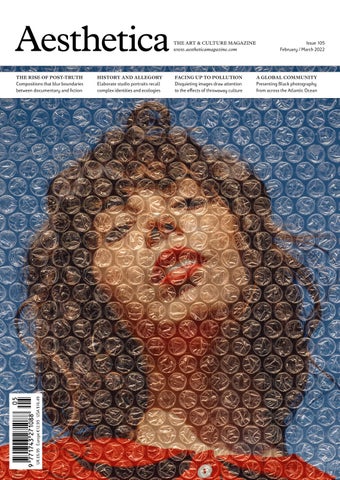
On the Cover Laura Perrucci and Matteo De Santis offer a fresh take on the collage tradition. Bubble wrap, printed words and paper aeroplanes are layered over crisp portraits. Crumpled paper, brushstrokes and glass mirrors collide with blades of grass, open skies and red accents. (p. 78)
Cover Image: Laura Perrucci & Matteo De Santis, Bubble Game (2018).
Perspective changes everything. Seeing and looking are two completely different acts. How we understand the world around us depends on our experiences and willingness to be open to new ideas. This creates a free flow of concepts, and in turn, this leads to innovation. I’ve been doing a lot of reading about early humans, and there is something so completely wonderful about the first time homo habilis used a stone, turning it into an axe. It’s this continuous quest for knowledge and an insatiable appetite that asks, “I wonder what’s beyond that hill?” which keeps us creating. I find the human story aweinspiring, but with a developing sense of curiosity we’ve let our guard down with respect to our social and environmental duties. It’s such a ubiquitous conversation, but I wonder if we will ever adapt and change? This issue is about idea generation and a developing a greater sense of perspective. In As We Rise, a new collection of Black photography, we take a look at images that celebrate the lives and stories of Black people through the careful curation of Kenneth Montague. He recounts a transformative trip to the Detroit Institute of Arts at the age of 10, seeing James Van Der Zee's The Couple in Raccoon Coats, Harlem (1932): “They were in front of their home, a Harlem brownstone in the 1930s, and they were just impossibly sophisticated. I just had never seen African Americans depicted like that. It changed my life.” Next, we speak with Mandy Barker about her photography of plastics. The works are extraordinarily beautiful until you realise the atrocity behind them. Barker communicates the extent of the waste age. In photography, we bring you inspiring images across fine art, photomontage, portraiture and digital rendering, with practitioners such as Ellen Jantzen, Thomas Jordan and Zhang Ahuei. Our cover photographers, Laura Perrucci and Matteo De Santis, play with intervention in image-making. Finally, the last words go to the new Yorkshire Sculpture Park Director Clare Lilley about a Robert Indiana exhibition. Cherie Federico
Aesthetica 13
66
30
48
36
20
60
112
88
14 Aesthetica
106
94
contents
Art 16 News This issue we explore the rise of cryptocurrencies and NFT exhibitions, as well as coverage of major shows at Vitra Design Museum and MAAT, Lisbon.
26 10 to See Our recommendations include solo shows and key collaborations, from Alex Prager and Graciela Iturbide, to Robert Mapplethorpe and Patti Smith.
30 A Global Community A new collection of Black photography spans the Atlantic Ocean, highlighting neither protest nor celebration, but intimate documentation.
36 Visual Manipulation Ellen Jantzen stretches, cuts and pastes an array of organic samples, drawing attention to the vast editing processes that define 21st century media.
48 Shades of Twilight Thomas Jordan's Instant Honey series offers a glimpse of the Midwest at sunset. Lilacs blend seamlessly into burnt oranges and inky blues.
60 History and Allegory Diasporic legacies, historical figures, baroque designs and contemporary fashion unite in a series of studio portraits by Omar Victor Diop.
66 Vivid Metropolis Glenn Homann explores the developments of iPhone cameras, producing abstract snapshots that turn Brisbane into a saturated wonderland.
78 Images to Decode Laura Perrucci and Matteo De Santis demonstrate a fresh take on collage. Bubble wrap and printed words are layered over cloudless blue skylines.
88 The Rise of Post-Truth Sprengel Museum, Hannover, probes 40 years of image-making in North America and Canada, alongside the concepts of veracity and narrative.
94 Building New Worlds Tobias Schnorpfeil is a German engineer and tech founder whose compelling digital renders utilise data sets to build up colour, texture and material.
106 Facing up to Pollution Plastic is one of the world's most ubiquitous and damaging substances. Mandy Barker's disquieting images demonstrate the extent of the emergency.
112 Style Redefined Zhang Ahuei's compositions include unexpected elements that are both unsettling and alluring, blending the real and surreal; fashion and fine art.
124 Exhibitions We review Tate's Life Between Islands CaribbeanBritish Art 1950s – Now as well as Alex Soth's A Pound of Pictures at Sean Kelly Gallery, New York.
129 Film La Mif is a deceptively powerful drama brimming with authenticity. Salomé Jashi gives microcosmic depictions of Georgian life in Taming the Garden.
131 Music Elusive Swedish Italo disco / synthpop duo Sally Shapiro return with Sad Cities, whilst Kansas City indie mainstays Hembree release It's a Dream!
Books
Artists’ Directory
Last Words
133 The Latest Publications MIT Press publishes a major survey on modern sculpture, and Gestalten considers the role that art plays amongst activism, politics and protest.
138 Featured Practitioners This edition showcases artists using innovative ideas, materials and techniques to expand their creative practices in a rapidly changing climate.
146 Yorkshire Sculpture Park Clare Lilley, the new Director of YSP, Wakefield, sheds light on Robert Indiana's sculptures from 1958 to 2018 in relation to shifting sociopolitics.
Aesthetica Magazine is trade marked worldwide. © Aesthetica Magazine Ltd 2022.
The Aesthetica Team: Editor: Cherie Federico Associate Editor: Kate Simpson Digital Content Creator: Eleanor Sutherland Digital Content Writer: Saffron Ward
Advertisement Enquiries: Megan Hobson (0044) (0)844 568 2001 advertising@aestheticamagazine.com
Reviews
ISSN 1743-2715. All work is copyrighted to the author or artist. All rights reserved. No part of this magazine may be used or reproduced without permission from the publisher. Published by Cherie Federico and Dale Donley. Aesthetica Magazine 21 New Street York, YO1 8RA, UK Newstrade Distribution: Warners Group Publications plc. Gallery & Specialist Distribution: Central Books. Printed by Warners Midlands plc.
Advertising Coordinator: Megan Hobson Artists’ Directory Coordinator: Katherine Smira Production Director: Dale Donley Office Manager: Helen Osbond Designer: Matt Glasby Video Producer: Chris Maudsley
Artists’ Directory Enquiries: Katherine Smira directory@aestheticamagazine.com Subscriptions: subscriptions@aestheticamagazine.com General Enquiries: info@aestheticamagazine.com
Contributors: Diane Smyth Iman Sultan
Press Releases: pr@aestheticamagazine.com
Reviewers: Kyle Bryony, Marthe Lisson, Matt Swain, James Mottram, Stephanie Watts, Jack Solloway, Monica de Vidi, Greg Thomas, Leyla Sanai, Alexis Romano, Osman Can Yerebakan
Follow us: aestheticamagazine.com facebook.com/aestheticamagazine twitter.com/AestheticaMag pinterest.com/AestheticaMag instagram.com/AestheticaMag
Aesthetica 15
16 Aesthetica
Brooke DiDonato, Over and Out, from the As Usual series (2017). Courtesy of the artist.
Uncanny Compositions AS USUAL: BROOKE DIDONATO Cité de L'image, Clervaux | Until 14 October clervauximage.lu
The term “uncanny” – or “unheimlich” (unhomely) – was first used by German psychiatrist Ernst Jentsch in the essay On the Psychology of the Uncanny, published in 1906. Today, it’s most often associated with Sigmund Freud, who, in 1919, defined it as a descriptor for something familiar, yet alien, at the same time. Doppelgängers, mirror images and inanimate figures coming to life are all examples of this phenomenon. For over 100 years, these images have sparked a sense of morbid fascination in audiences: popping up across the fields of surrealist art, experimental cinema and, today, in contemporary photography. One such artist is Brooke DiDonato (b. 1990), whose outdoor exhibition in Clervaux is titled As Usual. Here, all is not as it seems. The New York-based photographer is recognised for crafting everyday scenes distorted by "visual anomalies" – glitches in the norm. From vast deserts to suburbia, DiDonato creates a universe which is slightly off kilter. Bodies intertwine, trees bend backwards and iron fences become malleable. In every shot, the meanings of familiar objects are twisted, the laws of physics disrupted. Cosy homes and well-tended gardens are imbued with danger, humour and intrigue, encouraging us to look again. DiDonato lulls the viewer into a false sense of security through pleasing colour palettes, enticing 1950s-style décor and calming landscapes, However, instead of being brought into a world of trust and safety, in which everything is as it should be, we encounter an unexpected realm – a place where domestic living is questioned and deconstructed: a distinctly unstable universe.
Aesthetica 17
news
Art in Blockchain EDITION365 British Journal of Photography, Online | Ongoing
1854.photography
The idea of the “metaverse” has dominated recent technology headlines, from NFTs and cryptocurrencies to Facebook’s recent rebrand to Meta. In January, Microsoft announced plans to acquire Activision Blizzard – one of the world’s largest video game companies. It’s a complex and slippery term, but largely speaking, the metaverse imagines a network of virtual three-dimensional spaces in which people can work, game and communicate. In October 2021, 1854 and British Journal of Photography announced ART3.io, a platform for curated NFT collections from both emerging and established artists. Their latest digital show highlights work created during the first 12 months of the pandemic, between 10 March 2020 and 11 March 2021: the year in which everything changed. Traversing tales of love, loss, hope and solidarity – humankind’s collective will to resist, persist and rebuild – Edition365 was conceived “to stand as a historical reference for decades to come.” The entire show is available to own as an NFT collection – a one-of-a-kind digital asset. Shown here is an image from Mark Forbes’ (b. 1980) Beautiful Solitude series. The award-winning photographer captures scenes which “can be found just around the corner in all of our daily lives” – asking viewers to pause and appreciate overlooked details. It’s an appropriate topic for a show hosted in the online sphere, where we are bombarded with minute-by-minute information. Forbes, by contrast, selects spaces which are devoid of human presence: photo booths, launderettes, phone boxes, and, in this case, a room filled with multi-coloured paper planes.
18 Aesthetica
Aesthetica 19
Mark Forbes, Edition 365 - 07 - Boy.
Rune Guneriussen, Reminiscence of us (2021).120cm x 191cm. Digital c-print/aluminium/laquer © Courtesy of the artist.
news
20 Aesthetica
Modes of Solitude LIGHTS GO OUT: RUNE GUNERIUSSEN Museum Kunst der Westküste | Until 12 June mkdw.de
In 2018, Museum Kunst der Westküste set out to explore the vastness of the Scandinavian landscape through the innovative exhibition Norway Contemporary! The show, based on the North Frisian Island of Föhr, included the work of seven artists, each of whom showcased the somewhat melancholy motifs of darkness, cold and solitude. Rune Guneriussen (b. 1977) was one of the seven artists on display, offering playful interventions in seemingly uninhabitable landscapes: desk lamps suspended in a forest glade in One can rely on the prudence of his decisions. After the exhibition, Guneriussen returned to Föhr as an artistin-residence, creating new work at the intersection of installation and photography. In these site-specific pieces, luminous objects – for the most part, lamps – have been inserted into forest aisles, rocky slopes and creeks, stretches of coastlines and trees. The structures are then photographed from a slightly elevated standpoint, only for them subsequently to be taken down again, in an evocative move between transience and permanence. The works are created according to the guiding principle that “balance is key.” He notes: “The relationship between the modern world and nature is rapidly waning. We are moving further and further away from nature and soon will no longer be part of it.” In Reminiscence of us, glowing sticks protrude from a grassy bank, lines of thread connecting the light in a web somewhere between nature and artifice. Guneriussen effortlessly unites objects and places that don't belong together and makes the process seem authentic: blending into the dark blue hours of the passing day.
Aesthetica 21
Spheres of Convenience PLASTIC: REMAKING OUR WORLD Vitra Design Museum, Weil am Rhein | Opens 26 March
design-museum.de/en
According to the not-for-profit organisation Plastic Oceans, 50% of all plastic produced (380 million tons per year) is for singleuse purposes, used for minutes before being thrown away. 10 million tons of plastic are dumped into oceans annually, more than a truck load every minute. Furthermore, it’s thought that humans eat over 40 pounds of plastic in their lifetime. The cheap and adaptable qualities of plastic have made it an ideal material over the last few decades, but through its creation, we have constructed the illusion of “disposable” lifestyles, in which items can have a total “working life” of just 15 short minutes. Vitra Design Museum, Weil am Rhein, brings these topics into focus, considering the “limitless malleability, astounding versatility and utopian appeal” of plastics and what this has meant for the 21st century – culturally, politically, sociologically and artistically. This meteoric show, organised alongside the V&A, Dundee, and MAAT, Lisbon, includes rarities from the dawn of the plastic age and the rise of the contemporary pop era, as well as numerous projects that focus on material alternatives and renewable resources, from algae-based bioplastics to mycelium. Also included are examples of iconic advertising campaigns that have contributed to the issue across the globe. In Peter Stackpole’s haunting image for LIFE magazine in 1955, for example, a family demonstrates the possibilities of throwaway culture, illustrating the future of household living devoid of chores. Empty wrappers, foil pie crusts, cups and spoons fly through the air, circling the figures like a swarm that's just about to descend.
22 Aesthetica
Aesthetica 23
Photo by Peter Stackpole, staged to illustrate an article on Throwaway Living cutting down on household chores, LIFE magazine, August 1, 1955. © Getty / Photo: Peter Stackpole.
Installation view of Light Wall (Outdoor Version) by Carsten Höller, maat – Museum of Art, Architecture and Technology, 2021/2022. Courtesy of EDP. Foundation/maat. Photo: Attilio Maranzano
news
24 Aesthetica
Altering Our Perception DAY: CARSTEN HÖLLER MAAT, Lisbon| Until 28 February maat.pt/en
Phytopathology is the study of diseases in plants, caused by pathogens and environmental damage, including fungi spores, oomycota, bacteria, viruses, viroids, phytoplasmas, protozoa and nematodes. This field of science involves the identification of disease aetiology and epidemiology, and its economic impact. This is the world in which Carsten Höller (b. 1961) lived, up until the early 1990s, trained to see and diagnose parasitic microecologies, and manage their growth. Since then, he has risen to international acclaim in the fields of installation and relational aesthetics, exploring the nature of human experience and how we perceive reality through the depths of our surroundings. Day, a new show at MAAT, Lisbon, brings together a major survey of pieces from 1987 – when Höller was working as a scientist – up until the present day. Almost 20 works are arranged in a situational “parcours”: a journey between organic curvatures, narrowed thresholds, inbuilt lighting systems and multi-sensory installations. Light Wall, close to the museum’s entrance, greets visitors with an array of light bulbs that flicker at a frequency of 7.8Hz, the same rhythm as the Earth’s vibrations. In collaboration with Acute Art, the exhibition also expands into the digital dimension, with a virtual reality app that further alters and magnifies the viewer’s perception as they move through the gallery. Höller once stated, in an interview with Tate in 2006: “I see one function of the museum as being a space for experimentation – for testing ideas and concepts that could eventually be realised on a larger scale outside the museum.”
Aesthetica 25
art
10 to See RECOMMENDED EXHIBITIONS THIS SEASON
This season's shows reflect on the human condition – the worlds we inhabit and the ways we interact with one another. Emerging and established practitioners come together in these varied surveys – moving from solo presentations to collaborations across time and space.
1
Flowers, Poetry and Light
Marie Selby Botanical Gardens, Sarasota | Opens 13 February
selby.org “If we be blind, if we turn from Nature, the garden of the soul, she will turn on us.” So wrote Patti Smith in January 2021, in a poem dedicated to climate activist Greta Thunberg on her 18th birthday. This immersive exhibition, held at Marie Selby Botanical Gardens, features excerpts of Smith’s poems and lyrics on the subject of nature and our relationship with horticulture, presented alongside pivotal images by Robert Mapplethorpe. Photographed irises, hyacinths and orchids come alive, combining contemporary activism with 1970s counterculture.
2
Family: Visions of a Shared Humanity
Art Gallery of New South Wales, Sydney | Until 13 February
artgallery.nsw.gov.au This must-see show, subtitled Unmissable Video Works for Unsettled Times, presents nine moving-image pieces that explore “family” as it pertains to our sense of humanity. John Akomfrah’s Tropikos (2016) offers a fictional narrative about Britain’s first encounters with Africa, whilst Arthur Jafa’s Love is the Message, the Message is Death (2016) is a powerful meditation on Black pain, creativity and resilience. Isaac Julien's Western Union: Small Boats (2007), featured here, relates to the waves of migration that have shaped societies in the 21st century.
3
FORECAST SFCamerawork, Online | Until 1 May
1
sfcamerawork.org FORECAST is an annual juried exhibition that celebrates six emerging image-makers from the USA and takes the temperature of photography today. This year’s selection is characterised by themes of self-discovery, family, identity, memory and representation. Nykelle DeVivo incorporates Afro-spiritualism and expressions of Black queer joy in sensual monochrome portraits; Katina Alexopulos processes grief through a series of intimate diptychs; Christian K. Lee presents a visual counter-argument to the stereotypes of Black gun ownership.
4
What is Left Unspoken, Love High Museum, Atlanta | Opens 25 March
high.org How do we define love in 2022? A feeling of deep affection, pleasure, or infatuation? Is love something that can be quantified, maintained, or lost? How does it exist across digital platforms, and how has it been affected by political rhetoric? High Museum of Art, Atlanta, explores these questions and more, through a series of thought-provoking artworks that seek to recognise the division and separation prevalent in today's society, whilst reminding audiences of the common threads that bring us together as families, friends and communities.
5
Rooted Beings
Wellcome Collection, London | Opens 24 March
wellcomecollection.org It is estimated that there are more than five million species of fungi on the planet, which, in turn, make up 90% of the total biomass in forest soils and 25% of the total biomass on Earth. Wellcome Collection, London, explores and celebrates these ingenious organisms, amongst other forms of plantlife and interdependent ecosystems. Rooted Beings encourages viewers to rethink the way they see and embrace the wilderness through innovative seaweed sculptures, hand-sewn textiles, ancient illustrations, futuristic totems and outdoor installations.
26 Aesthetica
2
3
4
5
Aesthetica 27
8
6
9
7
28 Aesthetica
10
6
Werner Bischof Bildhalle, Zurich | Until 28 February
bildhalle.ch/en Werner Bischof (1916-1954) was one of the most recognised reportage photographers of the 20th century, recording life in post-war Europe and Asia. Despite being given strict documentary assignments, Bischof immerself himself in the culture and the lines between objectivity and subjectivity became blurred. He noted: “I always go too far, too deep. I realise that I am not a newspaper reporter. In my innermost soul I am still – and always will be – an artist.” Here, audiences can see iconic works shot in Japan between the years of 1951 and 1952.
7
Part One: The Mountain Lehmann Maupin, London | Until 5 March
lehmannmaupin.com Alex Prager's (b. 1979) images are loaded with tension, theatricality and anticipation. Her career has become synonymous with major cinematic works using up to 350 models, scattered across city streets, cinemas, beaches and airports. Part One: The Mountain, a new series, is produced on a much smaller, and more intimate scale, capturing the inner turmoil of singular characters. These psychological portraits are set against rugged mountain terrains; peaks and summits become wider symbols for personal obstacles, pilgrimages and revelations.
8
Heliotropo 37
9
Beauty and Life
Fondation Cartier, Paris | Opens 12 February
fondationcartier.com/en “Ultimately, I think photography is a ritual for me. To go off with my camera, observe, capture the most mythical part of man, then go into darkness, develop, choose the symbolism.” Graciela Iturbide (b. 1942) is considered one of the greatest contemporary photographers in Latin America. For 50 years, she has captured daily life in Mexico, with portraits of Juchitán women and quasi-spiritual depictions of desert landscapes. Heliotropo 37 brings together over 200 images, including major new colour series commissioned for Fondation Cartier.
Amon Carter Museum, Fort Worth | Opens 20 February
cartermuseum.org Beauty and Life tells the story of early American Modernism and its development into the 21st century, from the likes of Alfred Stieglitz, Walker Evans and William Eggleston, to Dorothea Lange and Richard Misrach. Featured pieces include Wall, East of Nogales, Arizona from Misrach's Border Cantos series (2016) – a project depicting the two-thousand-mile border between the USA and Mexico – as well as two rare vintage works by Paul Outerbridge and a set from Aaron Siskind’s heralded suspension series Pleasures and Terrors of Levitation (1961).
10
Roy DeCarava David Zwirner, London | Until 19 February
davidzwirner.com “I don’t really think that the technique determines the veracity of the image. It’s what the image does to the viewer that determines whether it’s right or wrong.” Roy DeCarava (1919-2009) was a master of photographic craft, achieving rich tonal variations and a full spectrum of light, whilst revealing the human condition. David Zwirner presents DeCarava's first solo exhibition in London in over 30 years, and the first presentation of the artist's photographs since his participation in Tate Modern’s group show Soul of a Nation: Art in the Age of Black Power (2017).
1. Mapplethorpe and Smith Horticultural Vignette, Conceptual Mock-Up of Horticultural Installations (2021). Courtesy Marie Selby Botanical Gardens. 2. Isaac Julien, Western Union: small boats (The Leopard) 2007 (Video Still). 16mm film transferred to digital video, colour, 5.1 surround sound. Art gallery of New South Wales, Lawrence Hinchcliff Bequest Fund 2018. Courtesy of the artist and Roslyn Oxley 9 Gallery. 3. Jamie Robertson, Big Mama's House in Egypt Community, Centerville, TX (2017, printed 2020). Inkjet print, 24 x 36 inches, courtesy of the artist. 4. Rashid Johnson (American, born 1977), still from The Hikers (2019). 16mm film transferred to digital video with sound, duration 7 min, 14 sec. Courtesy of the artist and Hauser & Wirth. © Rashid Johnson. 5. Ingela Ihrman, A Great Seaweed Day: Gut Weed (Ulva Intestinalis) (2019). Mixed media sculpture. 6. ©Magnum Photos, Werner Bischof Estate, Shimbashi disctrict, View of Tokyo, Japan, 1951. 7. Alex Prager, Twilight (2021). Archival pigment print. 48 x 41.5 inches. 121.9 x 105.4 cm Courtesy the artist and Lehmann Maupin, New York, Hong Kong, Seoul, and London. 8. Graciela Iturbide, MUJER ÁNGEL (ANGEL WOMAN). Sonora Desert, Mexico (1979). Gelatin silver print. Courtesy of the artist. 9. Richard Misrach, Wall, East of Nogales, Arizona © Richard Misrach, courtesy Fraenkel Gallery, San Francisco, Pace/MacGill Gallery, New York and Marc Selwyn Fine Art, LA. 10. Roy DeCarava, Two women, (1952). © The Estate of Roy DeCarava. Courtesy David Zwirner.
Aesthetica 29
art
A Global Community As We Rise A NEW COLLECTION OF BLACK PHOTOGRAPHY FOCUSES ON EVERYDAY EXPERIENCES, SHOWCASING NEITHER PROTEST NOR CELEBRATION, BUT AUTHENTIC REPRESENTATION.
When Kenneth Montague (b. 1963) was 10 years old, he collection and is named after an old adage. “The title, ‘As We saw a black-and-white photograph of a couple at the Detroit Rise’, is a phrase my late father would always say – the idea Institute of Arts, a 10-minute drive from his hometown of of lifting as we rise,” Montague continues. “As we do well, we Windsor, Canada. In James Van Der Zee’s (1886-1983) The have to pull up other people in our own community. And Couple in Raccoon Coats, Harlem (1932), a woman, dressed that stayed as a mantra for me in what I do. It’s a metaphor sumptuously in furs, stands in front of a Cadillac V-16 sport- for what I’ve been doing as a collector with these artists.” The photographs in As We Rise vary from monochrome ing whitewall tires and sleek, glinting chrome. Her husband sits in the passenger seat, with hands modestly folded in his shots taken in the early 1900s, to later works shot with digilap. “They were in front of their home, a Harlem brownstone tal cameras. The thread that connects all these images, from in the 1930s, and they were just impossibly sophisticated,” Gordon Parks to James Barnor, from past to present, is the Montague notes. “I just had never seen African Americans shared experiences of Blackness across the Atlantic, spandepicted like that. It was totally aspirational and it changed ning from the western hemisphere to countries in Africa touching the Atlantic Ocean. Though the collection reflects my life. I wanted to spend more time with the image.” Montague, a dentist by profession, and the son of Jamai- a kind of global consciousness and overlapping dynamics, can immigrants, started collecting photographs when he it highlights regional disparities and distinct subcultures was 20 years old. In 1997, he purchased a wedge-shaped across diasporas, demonstrating heterogeneous Blackness. “The community in Canada is largely a reflection of people loft in downtown Toronto, where he curated and displayed an extraordinary collection of contemporary photography who got here through an era of multiculturalism. Pierre depicting Black life from Canada, the Caribbean, the USA, Trudeau, the father of our current Prime Minister, opened the South America, Britain and West Africa. Initially a commercial door to bringing in people from Commonwealth countries gallery, Montague’s passion project developed into Wedge in the 1960s and 1970s,” Montague says of the Canadian Curatorial Projects, a non-profit organisation that showcases immigrant experience, in particular. Migrants from Nigeria, artworks about Black identity – particularly through photog- India, Ghana, Jamaica, and other states that had once been raphy – providing Black artists with a platform through which colonised by the British empire, started new lives in Canada, mirroring the movement of people from these same counthey can find exposure in the mainstream industry. The Couple in Raccoon Coats, the image that had first in- tries to the UK. Even with shared origins, the endeavour to trigued Montague as a child, is featured in As We Rise: Photog- articulate an identity and interpret multiculturalism diverged. raphy from the Black Atlantic, a major new publication from Parallels existed, but so did discrepancies, which was why Aperture. The title comprises 400 images from Montague’s representing geographic specificity in this project was so vital.
30 Aesthetica
Aesthetica 31
32 Aesthetica
Texas Isaiah, My Name Is My Name I ( 2016). From As We Rise: Photography from the Black Atlantic (Aperture, 2021). © Texas Isaiah.
“There's this aspect of the Black imaginary, a magical realism, which is a bit of a cultural secret. There’s a knowing wink, a knowing nod I get from Black people when they peruse these images.”
Previous Page: Kennedi Carter, Untitled (Self-Portrait), (2020). From As We Rise: Photography from the Black Atlantic (Aperture, 2021). Courtesy Kennedi Carter. Left: Mohamed Camara, Matins, (2006, from the series Certains). From As We Rise: Photography from the Black Atlantic (Aperture, 2021). Courtesy Mohamed Camara and Galleri Flach.
As We Rise is divided into three sections: community, identity and power. Montague has always been attracted to photographs exhibiting an affirmation of Black life, finding beauty in the mundane. Today, most mainstream media depictions of Black people either celebrate joy to indict the white gaze, or feature the more degrading and stereotypical images of Black suffering. As We Rise is concerned with something else entirely: the relationships Black people have with themselves, and each other. Just like James Van Der Zee’s portrayal of an upper-middle-class Harlem couple, this collection is replete with images of people who are building families, homes, countries and communities. Afro-Brazilian photographer Afonso Pimenta’s (b. 1955) Cláudia and Children (1989) depicts a young mother in a black shimmering cocktail dress, posing with her two children in front of a wall-length wooden shelf filled with books, wine glasses and a decanter. It is a domestic scene of wealth, ambition and overall fulfilment. Jamel Shabazz’s (b. 1960) eclectic shots of Brooklyn include a child somersaulting in the air above a destroyed mattress, staged portraits of boys in leather jackets and girls in cardigans on the front steps of a brownstone building. Malian photographer Seydou Keïta’s (1921-2001) grayscale vignettes, shot in the 1950s before Mali gained independence from France, reveal the change and modernisation faced by African society in the wake of WWII. However, rather than convey the violent schisms and instability so common in western-centric depictions, Keïta shows people with swag: two women in stylish patterned dresses and head-wraps sit on a blinding white Vespa scooter; three men pose in a studio in pressed shirts and loafers; and a serene young man, watch gleaming on his wrist, sits and stares directly into the lens, his
posture suggesting ease and a tentative sense of curiosity. “The images that I collect are not around oppression and violence, but [focus on] showing the beauty of ordinary Black life,” Montague continues. “This is like a secret knowledge, and there’s this aspect of the Black imaginary – a magical realism – which is a bit of a cultural secret. There’s a knowing wink, a knowing nod I get from Black people when they peruse these images. Many of these pictures remind you of your own family: ‘That looks just like my aunties getting together for a family event’, or ‘That looks like something my cousins in the UK did when they were visiting us on vacation.’” The idea of the family album permeates the collection, which Nigerian-American writer, photographer and art historian Teju Cole notes in a letter to Montague: “These are pictures that say: I am not alone, I have another with me. Almost everyone here is in implied community. It is not that people are always in an attitude of celebration, rather that they are present as human beings, credible, fully engaged in their world.” And part of the reason why this theme succeeds is that all of the featured photographers are Black; they possess a direct relationship to the subject matters at hand. “The interplay or interaction is what really matters in the picturemaking for me,” Montague says. “There’s a big difference in a photojournalist that The New York Times sends in, who’s not in the Black community. Something may be missing, which is the connection between photographer and the subject.” Sometimes that sense of association is with oneself – a raw existentialism not usually centred in photographic works of Black identity or the discussion surrounding racism and white supremacy. The works of acclaimed photographers Kennedi Carter (b. 1998) and Texas Isaiah (b. 1986) express
Aesthetica 33
Dawit L. Petros, The Porch (2003). From As We Rise: Photography from the Black Atlantic (Aperture, 2021). Courtesy the artist/Bradley Ertaskiran.
identity through the seclusion and revelation of self-portraiture, turning the gaze inward and existing in a stillness rarely witnessed by the outside world. In an untitled portrait, Carter is having her head shaved by her father. The artist stares intently, the body language trusting and protected towards a paternal figure. Light and shadow deepen the intimacy of the moment, the movement from one body to another. Texas Isaiah’s self-portrait also offers a glimpse into a private space, but in a different fashion: the artist is stripped naked, sitting on hardwood floors beneath a verdant plant in a sterile room. Isaiah's face is buried, his hands hanging towards the ground with purpose and intention. It is a moment of surrender and intimacy – a quiet repose – an instance of vulnerability that asserts the right to rest and exist simply as a human being. Beyond the visual narratives, the collection, as a whole, also brings attention to the shifting value of photography, especially as one of the few accessible art forms. Montague mentions that when he first began collecting, he was drawn to purchasing photographs because they were in his budget, and therefore included ease-of-access. Photography offers pathways, in more ways than one. Dawit L. Petros (b. 1972), an Eritrean-Canadian photographer, fled his country of birth as a child because of political unrest. Sharing and looking at photos became a means to communicate with family, a visual stand-in for loved ones who were not tangibly present. “I grew up in a community in which individuals and families were dispersed from very early on. Photographs became an important catalyst which bound parts of this disparate community. The images that were on our walls, and in our photo albums, stood in the place of physical absence,” Petros expands. “In many ways, this is my foundation. I remember that
34 Aesthetica
our father was not physically present due to the war between Right: Xaviera Simmons, Denver (2008). Eritrea and Ethiopia. A small ID photograph of my father was From As We Rise: Photography from very meaningful to myself and my brothers, and it was my the Black Atlantic (Aperture, 2021). Courtesy the artist and David Castillo. mother’s understanding that we needed to communicate with that visual representation, that image of our father.” Petros’ contributions to As We Rise reconfigure a community from the fragments of displacement. Hadenbes (2005) shows an Eritrean family on a jade green lawn in front of a white picket fence, all equidistant from each other except for the mother, whose arm is lightly placed on the back of her older son. Even in this vision of a nuclear family, who appear to have it all, there is a sense of ambiguity and subtle apprehension on the faces of Petros’ subjects, an indication that something irretrievable has been lost, an uncertainty about the future of the multicultural Canada, which awaits them. Identity, after all, is never a fixed concept, but a kind of phenomenological subjectivity that is perpetually in a state of motion, dependent on the whims of social-political forces beyond the control of everyday individuals. It is also shaped by how a community ultimately chooses to represent itself. The overall message projected in As We Rise is not of survival, of enduring violence and systemic oppression, or even the inverse of joy – celebration and resilience – but a simple, Words faithful rendering of love, strength in hope and honest vul- Iman Sultan nerability. Moreover, it shows all the possibilities of imagining a new way of being. “The cultural theorist Stuart Hall stated: it’s being and becoming. Looking at the lives in these As We Rise: Photography photographs, it’s part of a Black imaginary. The position of from the Black Atlantic power in these pictures is something to aspire to. It’s this feel- is published by Aperture ing that I’m not a second-class citizen, I’m running things here in my neighbourhood. I got this,” Montague concludes. aperture.org
Aesthetica 35
art
Visual Manipulation Ellen Jantzen
The invention of the analogue camera enabled humans to capture light, creating fixed moments in time. In the same ways our eyes process visual information and our brains interpret meaning, however, photographs have never provided an undisputed record of events. As Clément Chéroux, Chief Curator of Photography at MoMA, New York, notes: “Photography is not the objective recording apparatus that the proponents of historicism dreamed of. The photographer’s operation on reality is similar to that of the historian on the past in order to transform it into history.” (Since 1839: Eleven Essays on Photography, MIT Press, 2021). The rise of digital cameras has, in turn, meant that we no longer store photographs as pockets of light and darkness, but as strings of numbers, able to be edited instantly. Ellen Jantzen (b. 1946) draws attention to the editing processes that define much of today’s media – stretching, cutting and pasting samples from the organic world. ellenjantzen.com.
Ellen Jantzen, Whisper (2014). Courtesy of the artist.
36 Aesthetica
Aesthetica 37
38 Aesthetica
Aesthetica 39
Ellen Jantzen, Amplitude (2014). Courtesy of the artist.
40 Aesthetica
Ellen Jantzen, Conquering the Pull of Gravity (2014). Courtesy of the artist.
Aesthetica 41
42 Aesthetica
Aesthetica 43
Ellen Jantzen, Road to Autumn (2018). Courtesy of the artist.
44 Aesthetica
Ellen Jantzen,Abundance (2014). Courtesy of the artist.
Aesthetica 45
46 Aesthetica
Aesthetica 47
Ellen Jantzen,Inscap (2019). Courtesy of the artist.
art
Shades of Twilight Thomas Jordan
Over the years, numerous photographers have focused on the banal beauty of the American suburbs, from the likes of Todd Hido and Angela Strassheim to Gregory Crewdson and Greg Girard, each producing visions of white-picket fences, winding roads and drawn curtains. Thomas Jordan (b. 1992), a self-taught photographer based in Chicago, Illinois, is rejuvenating the genre. These analogue works conjure, as the series title suggests, an immediate impression of summer. Instant Honey provides a glimpse of the Midwest at twilight – warm, rural and isolated. Lilacs blend into burnt oranges and inky blues, the days closing into one another endlessly. Windows glow from the distance whilst pylons tangle with broken branches, basketball hoops and roof tiles. Each composition is brief and evocative, building dramatic landscapes that teeter, always, between light and shadow. thomasjordanphoto.com.
Thomas Jordan, Up and Away. Courtesy of the artist.
48 Aesthetica
Aesthetica 49
Thomas Jordan, Leave the Light On. Courtesy of the artist.
50 Aesthetica
Thomas Jordan, Float. Courtesy of the artist.
Aesthetica 51
Thomas Jordan, Blackwell. Courtesy of the artist.
52 Aesthetica
Thomas Jordan, Country Home Sunset. Courtesy of the artist.
Aesthetica 53
art
Thomas Jordan, Last Light. Courtesy of the artist.
54 Aesthetica
Thomas Jordan, Utility Line. Courtesy of the artist.
Aesthetica 55
Thomas Jordan, Bright Side. Courtesy of the artist.
56 Aesthetica
Thomas Jordan, Reach. Courtesy of the artist.
Aesthetica 57
Thomas Jordan, Slant. Courtesy of the artist.
58 Aesthetica
Thomas Jordan, Sundown Hale. Courtesy of the artist.
Aesthetica 59
art
History and Allegory Omar Victor Diop DIASPORIC LEGACIES, HISTORICAL FIGURES, BAROQUE DESIGNS AND MODERN FASHION UNITE IN THIS SERIES OF CONCEPTUALLY RICH AND EMBLEMATIC PORTRAITS.
Omar Victor Diop (b. 1980) is a Senegalese photographer was a frustrated creative. I would spend most of my weekwho explores overlooked figures from the African diaspora. ends roaming around the city, shooting landscapes or exHe connects past and present, both visually and conceptu- perimenting with natural light portraits in my backyard with ally, whilst exploring the complicated notions of identity, an old friend posing for me. That’s how I ended up with my legacy and discovery. His previous series have offered jour- first project, Le Futur du Beau (2014), a series of imaginary neys through time, celebrating individuals who have been editorial pictures for a fashion magazine, set in a future world instrumental to the emancipation of Black communities where repurposed materials would be more valued than new clothes. That series opened doors to the African Biennale of through elaborate self-portraits and acts of embodiment. These portraits include the likes of Malick Ambar (1549- Photography, Bamako, which was the beginning of my career. 1626), a child, who, due to poverty, was sold by his parents, before growing up to become Prime Minister of the Ahmad- A: In 2014, you began a series of costumed self-portraits, nagar Sultanate; Dom Nicolau (c. 1830-1860), thought to titled Diaspora, in which you inhabited the role of hisbe the earliest African leader who wrote publicly to protest torical figures from central Europe from the 15th to 19th colonial rule; and Frederick Douglass (1818-1895), a social centuries, particularly the Baroque period, from around reform activist, writer and statesman who escaped from slav- 1600 to 1750. Why did this time-period interest you? ery and joined the abolitionist movement, becoming the OVD: This period is fascinating; first, these are the times first African American nominated to be Vice President of the of transatlantic slave trade and colonialism, provoking USA. Here, Diop discusses his most recent project, Allegoria profound social, political and demographic changes in (2021), which follows on as a series from these vital portraits. the western world, but, most importantly, in Africa. This era In these images, the cultural politics of self-fashioning – the simultaneously witnessed a creative explosion in the field recasting of histories and the aesthetic styling of Black di- of portraiture through painting, sculpture and engravings. asporic identities – couples with wider reflections on ecology. My attention was drawn to portraits of Africans depicted in postures of grandeur and dignity, by renowned artists like A: When did your journey into photography begin? Diego Velázquez or Anne-Louis Girodet de Roussy-Trioson, OVD: It all began back in 2010. At that time, I still had my which would normally be commissioned by popes, kings and full-time job, working in corporate communications and rich merchants. Those discoveries made me want to know finance for a multinational company that would have me more about who these sumptuous African sitters were, and traverse the African continent frequently. I didn’t hate the job, that’s how the historical research began. I found a trove of and the career was promising, but I was unfulfilled by it. I fascinating personal stories: resilient, creative and influential
60 Aesthetica
Aesthetica 61
62 Aesthetica
Omar Victor Diop, Allegoria 3 (2021). Pigment inkjet print on Canson Infinity Arches 88 paper. 50 x 75.6 cm. Edition of 7 + 2 artist's proofs 80 x 121 cm.Edition of 5 + 1 artist's proof. © Omar Victor Diop. Courtesy MAGNIN-A Gallery, Paris.
“These images are the result of a kind of ceremony, during which I invoke and channel ancestors that I could have been, if I was only born a few centuries ago. My subjectivity and emotions are valuable ingredients in the creative process.”
Previous Page: Omar Victor Diop, Allegoria 13 (2021). Pigment inkjet print on Canson Infinity Arches 88 paper. 60 x 60 cm. Edition de 7 + 2 artist's proofs. 100 x 100 cm. Edition de 5 + 1 artist's proof © Omar Victor Diop Courtesy MAGNIN-A Gallery, Paris. Left: Omar Victor Diop, Allegoria 8 (2021). Pigment inkjet print on Canson Infinity Arches 88 paper. 60 x 60 cm. Edition de 7 + 2 artist's proofs. 100 x 100 cm. Edition de 5 + 1 artist's proof © Omar Victor Diop Courtesy MAGNIN-A Gallery, Paris.
human beings who thrived in all parts of the world, despite the horrific contexts in which they lived. I describe these men, those I pay homage to, as forgotten African heroes. A: Diaspora was the first time that you acted as both narrator and character, using your body as an object to pose as other individuals. What made you turn to the self as a conduit? How did this feeling of estrangement, embodiment, or indeed personal detachment, speak to you? OVD: It didn’t! There hasn’t been a single moment in the research, production or presentation of the work where it was about me. Frankly, I don’t see myself when I look at the pictures. My body becomes a vehicle for these ancestors, and in the process of creating the compositions, I allow them to participate in a never-ending conversation about Africa, and her sons and daughters disseminated around the world. That being said, it is true that “investing” my body in the project made it feel more personal, a kind of ritual which I honoured. A: You’ve represented many characters, from Omar Ibn Saïd, a Fula Islamic scholar who was enslaved and transported to the USA in 1807, to Albert Badin, foster son and servant to Louisa Ulrika, queen of Sweden. Could you elaborate on the figures you’ve performed as, who they were, and your selection process for these figures? OVD: Jean-Baptiste Belley (1746-1805) is most definitely my favourite. Born in Senegal, he was enslaved in SaintDomingue in the French West-Indies. He then became the first Black member of the French parliament right after the French Revolution. He was a founding father of modern France, but is still completely under-celebrated. I had never heard of
him, and very few French or Senegalese citizens have either. These are the types of stories in this project – told for the sake of justice, and to unearth parts of history that we all share, and that we must all acknowledge with respect. A: Isaac Julien (b. 1960) also works with modes of recreation. The film Lessons of the Hour (2019) meditates on the life and times of Frederick Douglass, a figure you've previously celebrated. Julien states that: “The most truthful representation is a combination of the subjective, political, emotional and cultural realms in mutual connection, and not some utopian idea of objectivity.” How do you see your work in relation to subjectivity? OVD: I don't see my work as being objective, though it does refer to historical evidence and facts. I create because I am touched and moved. These images are the result of a kind of ceremony that I practise, during which I invoke and channel ancestors that I could have been, if only I was born a few centuries ago. I think my own subjectivity and concurrent emotions are valuable ingredients in the creative process. A: You’ve said that the “early relationships between African societies and western powers were characterised by deprivations of fundamental freedoms”, and that this altered the African diaspora forever. The 2016 series, Liberty, explores this, depicting events that have been pivotal in the fight for emancipation, from the Freeman Field Mutiny (1945) to the Soweto Uprising (1976). How did this series continue the conversation from your previous works, moving away from the personal to the collective? OVD: When you look at the history of Black societies across
Aesthetica 63
Omar Victor Diop, Allegoria 4 (2021). Pigment inkjet print on Canson Infinity Arches 88 paper. 50 x 75.6 cm. Edition of 7 + 2 artist's proofs 80 x 121 cm.Edition of 5 + 1 artist's proof. © Omar Victor Diop. Courtesy MAGNIN-A Gallery, Paris.
the world, you cannot ignore the fact that collective action has been the ubiquitous mechanism of affirmation, and of survival. History is, therefore, a fantastic angle through which you can tell a story that, is, after all, universal: we all need our dignity to be intact; that’s a great part of being human. Black people have had to go to great lengths just to preserve their sense of dignity, and, unfortunately, we still have to. A: Your latest series, Allegoria, puts us in the present-day, in the Anthropocene, in which both social and environmental injustices are pulled into focus. The collection calls upon the conventions of West African studio photography, religious iconographies and Japanese ukiyo-e woodblocking, as well as contemporary fashion. How do these diverse visual references work together, pointing towards the evocation of a more viable, “liveable” future, in which we work together as a global community? OVF: I use these aesthetics like they are languages. I sometimes joke that with every project it feels like I'm manifesting a new kind of creole – one that is visual, a mixture of cues from many civilisations and cultures. I am blessed to be an artist in an age when knowledge and references travel freely from, and to, all parts of the world. In the digital age, we are exposed to all cultures, with the ability to access them at all times, and I vow to be a creative sponge. The aim, also, is to visually impact a wider audience, a bit like a large-spectrum medicine that works by associating several molecules. A: How did your relationship with allegory begin? OVD: I’m West African; speaking in paraboles and expressing ideas through allegory is almost innate. I like the freedom
64 Aesthetica
that embedded meanings give to the artist, and also to the audience. You know what it’s about, as a viewer, but you have the liberty to go further and add layers of interpretation and draw more conclusions of your own. An allegory takes a life of its own; it is fed by the pairs of eyes that stare into it.
Right: Omar Victor Diop,Allegoria 9 (2021). Pigment inkjet print on Canson Infinity Arches 88 paper. 75.6 x 50 cm. Edition of 7 + 2 artist's proofs. 121 x 80 cm Edition of 5 + 1 artist's proof. © Omar Victor Diop. Courtesy MAGNIN-A Gallery, Paris
A: Beyond this, how does Allegoria (2021) connect to Liberty (2016) and Diaspora (2014)? Do you see your practice as part of a larger timeline, a trajectory in motion, or can any work be viewed on its own, independently? OVD: These projects are personal diaries. I see myself as part of something greater: our collective human experience. Through these self-portraits, I navigate time, lending my body to the essence of human beings who have become reduced to ideas. These ideas, are, nonetheless, worth sharing. I’m an actor; I fall in love with characters and concepts. Yes, the series, or even the works themselves, can be viewed independently. After all, each composition tells the story of someone's personal journey or a moment from the lives of a group of individuals; these narratives are so rich that they could have inspired an entire collection on their own. A: Although you work solo, how far is your practice ulti- Words mately a collaborative one – sitting somewhere between Kate Simpson past, present and future; personal and universal? OVD: It’s a conversation: a great banquet of emotions, ideas, projections and introspections. Everything that I do is in re- Omar Victor Diop is at Turku sponse to something else. I think that's, ultimately, how you Art Museum until 22 May honour your craft; by joining the dialogue and adding your own perspective. I don’t believe that an artwork can be en- turuntaidemuseo.fi/en tirely unique, since it’s moulded by multiple inspirations. omarvictor.com
Aesthetica 65
art
Vivid Metropolis Glenn Homann
The democratisation of photography is perhaps one of the most interesting developments in recent art history. The capability to create is constantly with us; smartphones have become like another pair of eyes ready to document, edit, curate and publish at any moment. As Om Malik noted in The New Yorker in September 2016: “We are splintering what was the ‘camera’ and its functionality – lens, sensors, and processing – into distinct parts, but, instead of lenses and shutters, software and algorithms are becoming the driving force.” (With the iPhone 7, Apple Changed the Camera Industry Forever) Six years later, in 2022, Apple’s iPhone sales are thought to exceed 300 million, so the question of fine art versus data becomes ever more prevalent. Glenn Homann, a winner of the 2021 iPhone Photography Awards, explores this new technology, producing bold, abstract snapshots that turn Brisbane into a saturated wonderland. instagram.com/blueboy70.
Glenn Homann, Untitled (2021). Courtesy of the artist.
66 Aesthetica
Aesthetica 67
Glenn Homann, Untitled (2020). Courtesy of the artist.
68 Aesthetica
Glenn Homann, Untitled (2020). Courtesy of the artist.
Aesthetica 69
Glenn Homann, Untitled (2021). Courtesy of the artist.
70 Aesthetica
Glenn Homann, Untitled (2020). Courtesy of the artist.
Aesthetica 71
Glenn Homann, Untitled (2020). Courtesy of the artist.
72 Aesthetica
Glenn Homann, Untitled (2020). Courtesy of the artist.
Aesthetica 73
Glenn Homann, Untitled (2021). Courtesy of the artist.
74 Aesthetica
Glenn Homann, Untitled (2021). Courtesy of the artist.
Aesthetica 75
Glenn Homann, Untitled (2019). Courtesy of the artist.
76 Aesthetica
Glenn Homann, Untitled (2020). Courtesy of the artist.
Aesthetica 77
art
Images to Decode Laura Perrucci & Matteo De Santis
“I would like to show the world today as an ant sees it, and tomorrow as the moon sees it,” said artist Hannah Höch (1889-1978), a pioneer of collage and, notably, one of the few female members of the Berlin Dada movement. The subversive group emerged amidst the harsh landscape of WWI, disillusioned with social structures, politics and artistic conventions. Höch is recognised for making some of the earliest photomontages – spliced together from magazines, fashion images and illustrations. Italian duo Laura Perrucci and Matteo De Santis offer a fresh take on the collage tradition. Bubble wrap, printed words and paper aeroplanes are layered over crisp, colourful portraits, obscuring and playing with physical identities. Crumpled paper, sweeping brushstrokes and glass mirrors permeate the compositions, whilst written messages are left for the viewer: underlined passages for us to decode. instagram.com/ellegramm.
Laura Perrucci & Matteo De Santis, Bubble Game (2018).
78 Aesthetica
Aesthetica 79
Laura Perrucci & Matteo De Santis, Your Best Side (2018).
80 Aesthetica
Laura Perrucci & Matteo De Santis, Reminder (2019).
Aesthetica 81
Laura Perrucci & Matteo De Santis, Your Soul (2019).
82 Aesthetica
Laura Perrucci & Matteo De Santis, I Am Waiting for You Here (2018).
Aesthetica 83
Laura Perrucci & Matteo De Santis, Falling (2019).
84 Aesthetica
Laura Perrucci & Matteo De Santis, Reminder, Pt. 2 (2019).
Aesthetica 85
Laura Perrucci & Matteo De Santis, You Are (2019).
86 Aesthetica
Laura Perrucci & Matteo De Santis, Like Paper Airplanes (2021).
Aesthetica 87
art
The Rise of Post-Truth True Pictures? SPRENGEL MUSEUM PROBES 40 YEARS OF IMAGE-MAKING IN NORTH AMERICA AND CANADA, ALONGSIDE THE WIDER CONCEPTS OF VERACITY, FICTION AND NARRATIVE.
“‘To photograph is to confer importance’, Susan Sontag pro- tionary’s Word of the Year, 2016) and especially those that claimed in 1973. Not only is Sontag’s observation decisive, relate to images, aren’t necessarily new, Gronert argues that that meaning is conferred through photography, but at least photography in North America underwent a significant shift equally relevant are also questions concerning what is to around 1980, moving away from the classic black-and-white made visible, to whom meaning is conferred, and who con- documentary typified by photographers such as Diane Arbus fers meaning. These questions are an issue about power and (1923-1971) and Lee Friedlander (b. 1934) to something representation.” So states Benedikt Fahrnschon on True Pic- more conceptual in scope – more critical of the medium and tures? Contemporary Photography from Canada and the USA, its supposed evidentiary nature. Photographers in the region the show he’s co-curated with Stefan Gronert, Curator of Pho- began to embark on new approaches that dared to suggest that images were, ultimately, just pictures, not windows to the tography and New Media at Sprengel Museum, Hannover. Enquiries into truth, veracity and authenticity are central to world, and certainly not conveyors of some cast-iron “truth.” this exhibition, just as the question mark in the title suggests. Towards the end of the 20th century, photographers were beThese questions feel particularly pertinent at this moment in ginning to probe the ways in which images could be faked or time – an era which has allowed figures like Donald Trump to staged, and were perhaps being used to manipulate viewers. become US president. Reinhard Spieler, Director of Sprengel True Pictures? suggests there’s something specifically North Museum, and Thorsten Sadowsky, Director of the Museum American about this initial wariness towards images – a der Moderne Salzburg (which will host True Pictures? this “postmodern” interpretation of the glossy media landscape summer), note that discourse concerning factual truths took that permeated the continent. In fact, it’s tempting to argue on a whole new dimension under Trump’s tenure. that these radical new processes first surfaced in Canada and More than 55% of Republicans believe the 2020 election the northern USA because these regions had the richest vein loss resulted from illegal voting or rigging. Further afield, of vernacular photography and film, and the most evolved 8 out of 10 US adults believe at least one false statement consumer societies with advertising and movie cultures to about Covid-19 (according to a study from Kaiser Family match. Sprengel's exhibition period, spanning 40 years from Foundation, August 2021). Over 70% of selfies are now 1980 to 2021, represents a time in which politics became thought to be edited before posting, meaning that close to further fractured and polarised, so this show could be underthree quarters of the faces we scroll past have been altered. stood in terms of a brand new cultural and economic system. We are living in a world of visual and political ambiguity, and True Pictures? features some of the most established and the effects are artistically intriguing and socially damaging. innovative names in photography, from Jeff Wall (b. 1946) However, major developments in post-truth (Oxford Dic- and Gregory Crewdson (b. 1962) to LaToya Ruby Frazier (b.
88 Aesthetica
Aesthetica 89
90 Aesthetica
Jeff Wall, Pair of Interiors (2018). Inkjet print, 152 x 207 cm. Courtesy of the artist.
“Over 70% of selfies are now thought to be edited before posting, meaning that close to three quarters of the faces we scroll past have been altered. We are living in a world of ambiguity, and the effects are artistically intriguing.”
Previous Page: Gregory Crewdson, Untitled, 2006 (detail). Digital pigment print. 57 x 88 inches. 144.78 x 223.52 cm. Edition of 6, plus 2 APs. © Gregory Crewdson. Courtesy Gagosian. Left: Taryn Simon, Jeffrey Pierce. Lake Huron, Port Huron, Michigan. Served 15 years of a 65-year sentence for rape and robbery (detail). From the series The Innocents (2002). Inkjet print, 121.9 x 157.5 cm. © Taryn Simon. Courtesy Gagosian.
1982), Meryl McMaster (b. 1988) and Martine Gutierrez (b. 1989). The exhibition divides these diverse practitioners into three rough “generations”, and considers what they do – and don’t – have in common. As a whole, the museum signals evolving attitudes towards photographs in relation to a rapidly developing culture that critiques who, and what, we see. The “first generation” of artists have been identified with the “Pictures Generation” – a loose grouping whose name suggests rather formalist concerns. Practitioners associated with this collective deliberately blurred the boundaries between fact and fiction. Some staged their work, whilst others adopted images from popular film and commercials. Richard Prince’s (b. 1949) appropriated “Marlboro Man”, for example, included “stealing” images from cigarette adverts, cropping out logos and text, and re-appropriating the picture as an anonymous cowboy riding through midwestern terrain. By reframing the “Marlboro Man” as a lone figure against a cloudless blue sky, devoid of branding, Prince tapped into the “wishful thinking” of advertising culture, whilst also alluding to some of the macho and colonial attitudes underpinning the west at the time. Cindy Sherman (b. 1954) by contrast, took on roles from popular cinema, producing brand new images which were uncannily familiar: portraits suggestive of the femme fatale, the lonely victim, or the American housewife hiding dark secrets behind white picket fences. Jeff Wall is another giant of this first generation, a Canadian artist now based between Vancouver and Los Angeles, tapping into roots of Hollywood. To produce a single image, Wall invests the same kind of effort that goes into a major film production; he is inspired by scenes from real life, but never shoots them in the moment. Instead, he sets up images
after the event as a kind of rechoreographing, infusing the compositions with allusions to art history. Until around 2000, the works were presented in lightboxes, structurally inspired by illuminated ads and billboards. Pair of Interiors (2018) includes a couple seemingly in the throes of an argument. In reality: this is not a couple, and the cosy interior is not their home. “This psychogram stands for Wall’s extremely precise and sensitive way of grasping situations, staging them in greater detail,” True Pictures? co-curator Fahrnschon states. The so-called “second generation” is perhaps harder to pin down; styled “After Appropriation”, it includes names such as Liz Deschenes (b. 1966), known for photograms and installations, for example, or Collier Schorr (b. 1963), who explores the interplay between commercial and personal work. Even so, similar questions resurface. Deschenes maintains the interest in images as images, which offer an “economy of means: [making] the most out of the least materials.” Gregory Crewdson, meanwhile, explores similar themes to Wall through painstakingly staged shots that cite David Lynch’s neo-noir mystery thriller Blue Velvet (1986). Crewdson's images suggest a sense of unease beneath familiar tropes of small-town American life. He creates a kind of hyperrealism that rubs up against our sense of reality, creating palpable tension. He’s showing three works in True Pictures?, which curator Fahrnschon describes as part of a constructed world: “a mysterious and uncanny America, oscillating between familiarity and the unknown: between everyday life and Hollywood; between security and exclusion.” The “third generation” is styled simply as the “Youngest Photographers.” Fahrnschon concedes that these felt harder to curate than the earlier artists. He’s happy to have given
Aesthetica 91
Jeff Wall, Pair of Interiors (2018). Inkjet print, 152 x 207 cm. Courtesy of the artist. Right:
Meryl McMaster a first European museum show, though, fluenced by photojournalist and Civil Rights activist Gordon Gregory Crewdson, Untitled, 2006 Digital pigment print. 57 x 88 showing important work which depicts culture and heritage Parks, telling Huck Magazine back in 2017 that she learned (detail). inches. 144.78 x 223.52 cm. Edition of 6, plus 2 APs © Gregory Crewdson. from the Nêhiyawak community (Plains Cree). The 2019 self- through his work how “you could show what inequality does Courtesy Gagosian. portrait, From a Still Unquiet Place, combines references to in- to humanity while also capturing the strength shown in the digenous and Canadian cultures: tartan and a feather head- face of it.” She’s motivated by highlighting issues, that’s to dress. Taryn Simon (b. 1975) has a more assured place in art say, not the ontology of images. Frazier’s work can also be history, however, having had solo shows at Tate Modern and read as an alternative to mainstream narratives, representing the Museum of Modern Art, New York. Akin to earlier North places in which the access to basic amenities is compromised. American image-makers from this period, Simon is explicitly Frazier shows something unsettling not by staging uncanny scenes, but by illustrating the underbelly of the world’s larginterested in the notion of pictures as “truthful documents.” Simon's 2002 series The Innocents documents stories of est economy – an image far removed from the so-called false convictions, especially those based upon misidentifica- “land of opportunity”, but one that's becoming more familiar tion through imagery. Jeffrey Pierce, for example, was sen- via protests for the global Black Lives Matter movement. There are other artists in this major exhibition whose work tenced to 65 years for rape and robbery, after being identified from a photo array. 15 years later, Pierce was exonerated doesn’t fit neatly into a narrative about formalism or veracity. for all crimes, after forensic analysis successfully identified Nan Goldin (b. 1953), for example, is an essential practitioner the DNA of another individual. Simon photographed him, in any survey of recent and contemporary photography in looking back at the camera, from a boat surrounded by North America, and is included in the “first generation” here. open water, the dark lake becoming a metaphor for the truth However, her snapshot aesthetic offers a “shoot-from-thethat lies beneath the surface. She expands: “The scene of the hip” authenticity, not an exploration of photography, stagcrime is at once arbitrary and crucial – a place that changed ing, or appropriation. Perhaps there is a wider sense in which Words their lives forever, but to which they had never been. These Goldin's work pushes the boundaries of mainstream imagery. Diane Smyth photographs blur the lines of truth and fiction – an ambigu- The Ballad of Sexual Dependency, an iconic series, was shot over 15 years from the mid-1970s onwards, showing friends ity that can have severe, even lethal, consequences.” Other artists in this “third generation” take a more direct and lovers with frankness and a sense of sexual freedom. True Pictures? is a highlight of the photographic season, True Pictures? approach, however, most notably LaToya Ruby Frazier. She makes black-and-white social documentary work, focusing covering a wide range of perspectives, genres and timelines. Sprengel Museum, on the water crisis in Flint, Michigan, where, owing to gov- When more than 3.2 billion images are created and upload- Hannover ernmental mismanagement, the water supply was poisoned ed per day, it’s never been more important to ask questions Until 13 February with lead. It took years of campaigning to have the problem about the pictures washing over us. As Sontag famously acknowledged, and then put right. Frazier has said she is in- stated: “The painter constructs, the photographer discloses.” sprengel-museum.de
92 Aesthetica
Aesthetica 93
art
Building New Worlds Tobias Schnorpfeil
Over the last few years, digital art has developed monumentally, from the rise of Fractal and Algorithmic Art (abstract compositions derived from mathematics), to Data-Moshing (the process of damaging clips to create glitch effects) and Dynamic Painting (in which brush strokes are created through an autonomous system). Tobias Schnorpfeil is a German engineer, filmmaker and tech founder who started making three-dimensional renders in early 2020, projects in which data sets dictate colours, textures and materials. Schnorpfeil’s landscapes are filled with nods to Surrealism. Beds float, inexplicably, amongst deep water. Rock formations create reflected loops. Trees emerge from rippling seascapes. Anonymous figures synchronise, dipping and bowing their bodies together. These worlds are ripe with possibility, mirroring the imaginative freedom of digital composition and construction. tschnorpfeil.super.site.
Tobias Schnorpfeil, Waiting 2. Courtesy of the artist.
94 Aesthetica
Aesthetica 95
96 Aesthetica
Tobias Schnorpfeil, Equals 3. Courtesy of the artist.
Aesthetica 97
Tobias Schnorpfeil, Unreal Arctis 2. Courtesy of the artist.
98 Aesthetica
Tobias Schnorpfeil, Monolith 1. Courtesy of the artist.
Aesthetica 99
Tobias Schnorpfeil, Unreal Arctis 3n. Courtesy of the artist.
100 Aesthetica
Tobias Schnorpfeil, Unreal Arctis 2n. Courtesy of the artist.
Aesthetica 101
Tobias Schnorpfeil, Floating 1. Courtesy of the artist.
102 Aesthetica
Tobias Schnorpfeil, Waiting. Courtesy of the artist.
Aesthetica 103
Tobias Schnorpfeil, Unreal Arctis 3. Courtesy of the artist.
104 Aesthetica
Tobias Schnorpfeil, Equals 2. Courtesy of the artist.
Aesthetica 105
Tobias Schnorpfeil, White Peak. Courtesy of the artist.
art
Facing up to Pollution Mandy Barker PLASTIC IS ONE OF THE WORLD'S MOST UBIQUITOUS AND DAMAGING SUBSTANCES. MANDY BARKER'S DISQUIETING IMAGES DEMONSTRATE THE EXTENT OF THE PROBLEM.
The world’s first plastic, Bakelite, was invented in 1907 by and rare birds inhabit. At this same time, I was studying for Leo Baekeland. The material was designed to be both light a Master’s Degree in photography and I realised that I could and durable, formed from a condensation reaction of phenol use images to inform and educate others about the issue. I with formaldehyde. Since then, the substance has become presented this idea to the class of 30 students asking if they ingrained within societies across the globe, with nearly half of had heard of marine plastic pollution, and at this time only the world’s plastic having been made since 2000. Scientists three people had. I decided then and there that this was an now predict that the ratio of plastic to fish will be at 1:3 by the issue people needed to know about, perhaps people who didn’t live near to the sea and couldn't see what was going on. year 2025, with the scales tipping the other way soon after. Mandy Barker (b. 1964) is a prolific British photographer whose work has been published in over 50 countries with the A: You’ve been photographing plastics for over 12 years likes of Time, The New Scientist, The Guardian, UNESCO and – how has the landscape evolved in the last decade, and, the World Wildlife Fund, amongst others. Her images, which in turn, how have your responses changed since then? communicate the severity of the waste age in startling and MB: In terms of research, more problems concerning plastic haunting specificity, have been praised by numerous figures, pollution have been identified since I first began; plankton including the imitable David Attenborough. Her work is now are now eating microplastic particles in the marine environon show at David Brower Center, Berkeley, California, as part ment. The world’s addiction to fast fashion and plastic clothing is a massive problem for many reasons. Particles from car of the National Geographic exhibition, Planet or Plastic? tyre wear is causing toxic runoff. Now, the most detrimental A: When did you start working with plastics? Was there a plastic floating through our seas is not simply the floating bottle or food container, but what these objects become certain moment that opened your eyes to the issue? MB: I was a graphic designer, so I've always been involved when they ultimately break down: microplastic particles are with visual communication, but it was my own experience of infiltrating organisms at the base of the food chain, and the finding plastic washed up on my local beach about 15 years toxins that they carry affect us all when they're released. ago that really disturbed me. I grew up in Hull, a port on the east coast of the England. Growing up there, I spent a lot A: Before moving onto some of your more widely recof time walking the beaches and collecting natural objects ognised images of “shoals” or “soups”, you primarily such as stones and driftwood. Over time, I began to notice worked with images of singular discarded items – PVC more and more manmade waste washing up on this particu- gloves, fishing lines, carrier bags and cartons – labelled lar shoreline, which is also a nature reserve that deer, seals with the number of years it would take for the item to de-
106 Aesthetica
Aesthetica 107
108 Aesthetica
Mandy Barker, EVERY… Snowflake Is Different (2011, detail) White marine plastic collected in two single visits to the shoreline at Spurn Point Nature Reserve, England. Courtesty of the artist.
“Science is not subjective; it has no room for aesthetics or emotion, so in that sense, the work of an artist and a scientist are opposed, but we are, in this capacity, seeking the same outcome.”
compose, anywhere between one year and an indefinite amount of time for polystyrene. How did these works serve as a test-bed for some of your newer pieces? MB: INDEFINITE was my first project. It came about from research on different types of plastic and the lengths of time they take to degrade. It horrified me that a fishing line could take 600 years to dissipate in the ocean. I created this series to make people think about the products they consume on a daily basis, and ultimately to try and lead them to choose alternatives. Since this series was created in 2010, research by polymer scientists states that all of the conventional plastic ever produced, unless burnt, is still with us.
Previous Page: Mandy Barker, Lost At Sea (2016). Marine plastic debris was recovered from six different continents and six different oceans to represent the hidden world of plastic under the sea. Commissioned by Ikea.
A: Where do you start your research, and how do you select which sites to visit? Can you talk us through the creative process that gets you from point A to B? MB: My work usually begins with research that I have read about online from ScienceDirect, Marine Pollution Bulletin, and the OceanPlastic List. If there is something I've read that I didn’t know about previously, or that I find particularly appalling, then it's probably fair to say that other people don’t know about it either. This is how I began: with no one having heard about the problem. I have been invited by organisations including Greenpeace and the UK Foreign and Commonwealth Office to join expeditions around the world, accompanying scientists to document what’s been recovered from some of the most remote locations.
Left: Mandy Barker, INDEFINITE - 600 Years . Monofilament & Macro filament Fishing. Line (2016).
A: How do you shoot each selection of plastic? MB: Initially, I experimented with a large format camera and film, hanging plastic from recovered fishing lines and float-
ing on water, but it just wasn’t possible to achieve the depth or scale necessary to duplicate the random way that vast amounts of debris come together in the sea, or to clearly identify each item. To achieve this, I now take varying sizes of plastic, scattering them on a black background. This, combined with a slow shutter speed and a single directional light source, creates the overall feeling of suspension. A: Your series often include exact numbers, from the particles found within the bodies of animals, to the latitude and longitudes of where debris has been recovered. Today, in the climate crisis, it’s hard to conceive of the vast damage being placed on the planet. The degrees of warming are near indiscernible. How important is it that we remind viewers of explicit numbers and locations, when, for many of us in the global north, the effects are being seen, for the most part, elsewhere? MB: My images have to be accurate to be believed. It is essential to the integrity of my work that I don't distort information for the sake of making an interesting image, and that I return the trust shown to me by the scientists who have supported my practice. It is essential that I pass on accurate data and research to the viewer, the public, NGOs, the government etc, otherwise there would be no point in doing it. Science is not subjective; it has no room for aesthetics or emotion, so in that sense, the work of an artist and a scientist are opposed, but we are, in this capacity, seeking the same outcome. It is critical for me to pass on this message: that the global north has primarily created this problem, with the effects mainly being seen in developing countries, most of whom do not have a waste infrastructure.
Aesthetica 109
Mandy Barker, 276 INSIDE-OUT (2012). 276 Pieces of plastic recovered from the stomach of ONE 90-day old Albatross chick from the Island of Midway, Courtesy of the artist..
A: In your journeys across the world, is there a certain kind of plastic, or brand, that recurs time and again? MB: I recover more or less the same type of plastics all over the world; they’re just adorned with different logos. It is difficult to know where an item has entered the ocean or its journey, but in 2019, I took part in an expedition to Henderson Island, which is an uninhabited location in the middle of the South Pacific Ocean. I had seen photographs of the island before I arrived, but nothing prepared me for its effect. Turtles had weaved their way around tons of debris in order to get out to sea; birds were removing plastic from their nests on a daily basis; at the back of the beach, endemic flora was covered by littered bottles and singleuse items. It was truly shocking to identify plastic from over 25 different countries, with 45 major brands and logos rising to the surface again and again. All of it had travelled more than 5,000 kilometres to reach these shorelines. A: A stark, black background is a recurring aspect, not only providing contrast against the debris, but mimicking the depths of the ocean. Within the frames, the objects are akin to shoals of fish or jellies. What function is there in using photography as an act of imitation? MB: I mimic shoals of jellyfish or plankton to make people initially think that they are looking at a natural creature, perhaps floating in the water column, or under a microscope. It is on closer inspection, the “arrest of interpretation” that then pulls the viewer in and holds their attention for longer. In combination with the caption describing the content, audiences are given the shock or “stab in the back” which will hopefully stir something in their conscience.
110 Aesthetica
A: Whilst your works draw attention to the sheer mass of waste pervading the oceans, they are, still, mesmerising. How do you think this kind of “aesthetic attraction” serves to share the damaging ecological message? MB: If art has the power to encourage people to act, to move them emotionally, or at the very least make them take notice, then this must be vital to stimulating debate, and, ultimately, change. If I didn’t believe my work did any of these things then I wouldn’t be motivated to continue. A: In SOUP: 500+, the opening image, the presentation is meticulous, offering a kind of circle, or indeed a cycle of destruction laid out in full. In what way are you calling upon visual semantics, or subliminal information, to express the severity of the waste age? MB: This piece is a representation of more than 500 pieces of plastic that were found in the stomach of an Albatross chick. People see different things in this image – an iris, a stained-glass window, for example – but really, I created it as a “full stop”, to end the first SOUP series and to the issue itself. I hope this piece will become stored in viewers’ memories, for them to recall through cognitive processes. I hope it will influence their wider conceptual reasoning. A: What do you have planned for 2022 and beyond? MB: I have some major solo exhibitions planned in 2022, and I will be artist in residence at The Society of the Four Arts, Palm Beach, Florida in 2023. I am currently working on a long-term project and new approach which I hope will lead to action and international legislation concerning the over consumption and overall manufacture of plastic.
Right: Mandy Barker, SOUP: 500+ (2011). Representing more than 500 pieces of plastic debris found in the digestive tract of a dead Albatross chick in the North Pacific Gyre.
Words Kate Simpson
Planet or Plastic? David Brower Center, Berkeley Until 4 March browercenter.org
Aesthetica 111
art
Style Redefined Zhang Ahuei
“Surrealism is destructive, but it destroys only what it considers to be shackles limiting our vision.” Taiwanese photographer Zhang Ahuei (b. 1987) brings Salvador Dalí’s words to life, redefining the parameters of contemporary portraiture with unexpected elements that are both quietly unsettling and deeply alluring. The results are utterly transfixing: blending real and surreal; fashion and fine art. In one portrait, lengths of hair snake across a table-top like roads leading nowhere. In another, icicles grow upwards, seemingly resisting gravity. Elsewhere, pearls take the place of tears, and flower blossoms protrude from mouths. Meanwhile, a restricted colour palette – focusing on deep blacks, milky whites, alarming reds and cobalt blues – creates bold simplicity. Unique and minimalistic styling, often incorporating organic subject matter, is paired with clean lines and slick execution. instagram.com/zhang_ahuei.
Zhang Ahuei, Untitled. Courtesy of the artist.
112 Aesthetica
Aesthetica 113
Zhang Ahuei, Untitled. Courtesy of the artist.
114 Aesthetica
Zhang Ahuei, Untitled. Courtesy of the artist.
Aesthetica 115
Zhang Ahuei, Untitled. Courtesy of the artist.
116 Aesthetica
Zhang Ahuei, Untitled. Courtesy of the artist.
Aesthetica 117
Zhang Ahuei, Untitled. Courtesy of the artist.
118 Aesthetica
Zhang Ahuei, Untitled. Courtesy of the artist.
Aesthetica 119
Zhang Ahuei, Untitled. Courtesy of the artist.
120 Aesthetica
Zhang Ahuei, Untitled. Courtesy of the artist.
Aesthetica 121
Zhang Ahuei, Untitled. Courtesy of the artist.
122 Aesthetica
Zhang Ahuei, Untitled. Courtesy of the artist.
Aesthetica 123
reviews
Exhibition Reviews
1
A Pound of Pictures ALEC SOTH
In the early 20th century, physicist Duncan MacDougall tried to prove that the human soul weighed 21 grams. Whilst gloriously flawed, the premise still echoes with poetic enigma. Alec Soth’s new exhibition, A Pound of Pictures, at Sean Kelly, New York, asks how much the soul of pictures might weigh. The show’s title refers to Soth’s encounter with a saleswoman on a trip to Los Angeles. Intrigued by a “photography by the pound” business, the artist bought 60 pounds (lb) of pictures on a $2 per-pound-deal. Soth later sorted out the mountainous pile of mementos – strangers, places and objects – with his daughter. The process followed him throughout the rest of the cross-country journey. The resulting show, offering 23 works, depicts different corners of the American landscape, each with a reference to the purchased images. “The real weight is psychological, not physical,” Soth notes.
He had formerly collected pictures of “various types of the vernacular,” such as seesaws or Ping-Pong games. In Tim and Vanessa’s. Gilbertsville, Pennsylvania (2019), an ample spread of photography over a table offers a snippet from the titular couple’s 500,000-picture collection. Abandoned House. Coahoma Mississippi (2021) shows another heap of pictures blended with flowers and video tapes over a red shroud. The images are survivors of a deserted house in Words which humanity has vanished in flesh but remained in stills. Osman Can Yerebakan These are images of a quest: of disillusionment, mundanity, but also, potential. The key for Soth’s perfectly crafted distance is, perhaps, his choice of company. “Throughout the Sean Kelly, New York 10 or so trips I took for the project, I was always accompanied 14 January - 26 February by young people. It's exciting to experience the world with someone processing surroundings with fresh curiosity.” skny.com
2
Ao CHARLOTTE DUMAS
Humans and animals are intertwined. The relationship and interaction between the two has long fascinated Dutch photographer and filmmaker Charlotte Dumas (b. 1977), whose work is currently on show at Huis Marseille, Amsterdam. Animals feature often in Dumas’ intimate portraits – relieved of the roles or symbolic functions imposed by humans. These creatures claim a pivotal and equally important role in the balance of nature, stimulating empathy in the viewer. Ao, the artist’s first large solo exhibition at the gallery, gathers photographs and three short films dedicated to the Japanese remote island of Yonaguni and the critically endangered breed of native horses which live there. In Shio (2018), small indigenous horses wander free along the coast. A 10-year-old girl enters the scene, creating a gentle game in which she tries, without succeeding, to lead the animals
into the sea. Yorishiro (2020) includes another figure, Dumas’ daughter Ivy, five years old at the time. She walks through an urban landscape, apparently extraneous to the surroundings, until she finds kinship with the island horses, a new family. Ao (2021) has its first outing here. In the piece, Dumas’ eldest daughter Avis dances across the island in ballet shoes or on bare feet, traversing the rugged landscape amongst the horses. In front of a canyon, in which 18th century preg- Words nant women were cruelly forced to jump to avoid overcrowd- Monica de Vidi ing, the girl liberates the island from its horrific history. Earth, water, air and fire provide vital energies in the movements in space. Ultimately, the trilogy of films is tied together by the Huis Marseille, Amsterdam colour indigo, a natural pigment which stands for protection 11 December - 13 March and disinfection. Blue appears across all three films, including textile creations by Yuko Kitta: threads of co-existence. huismarseille.nl
3
Findings TORBEN ESKEROD
Fotografie Forum Frankfurt (FFF) showcases the work of Danish photographer Torben Eskerod (b. 1960), an artist who explores memory and transience. In portraits, especially, he seeks to capture the intangible: the energies that people exude, the experiences emedded in people's faces and eyes. FFF’s curator, Alison Nordström, frames the works as an investigation into the “surfaces of the world” to find out what lurks beneath and “to emphasise the power of what cannot be seen, known or shown in its entirety.” This is particularly true for the series Life and Death Masks (2001). Highly detailed masks stand in stark contrast to the undefinable blackness of the background. In combination with the larger-thanlife format of the photographs (120cmx150cm), the subjects, come, strangely, to life. However, no matter how portrait-like and “three-dimensional” the depictions, the personalities of
124 Aesthetica
the deceased remain sealed within the masks, behind their closed eyes. The power of the gaze (or its absence) is central to most of Eskerod's portraits. Shots of hypnotists, healers, nuns or male friends in their 40s and 50s – half-way through life – seem to transport much more than a CV ever could. The exhibition presents an unprecedented overview of Eskerod’s work to date in Germany, with 140 pictures from 22 series over the last 30 years. The show highlights, are undoubtedly, the many portraits that explore the human condition. However, some architectural and landscape images are equally compelling. For the series Marselis (2003), Eskerod photographed trees with outdated film, which resulted in surreal colours and a hazy-romantic atmosphere. Ultimately, we are offered a different kind of understanding on transience: less through the subject matter, but the material in use.
Words Marthe Lisson
Fotografie Forum, Frankfurt 29 January - 9 May fffrankfurt.com
1a. Alec Soth, Cooper. Green Island, Illinois (2021). Archival pigment print image/paper: 24 x 30 inches (61 x 76.2 cm) edition of 9 with 4 APs. 1b. Alec Soth, White Bear Lake, Minnesota. (2019). Archival pigment print image/paper: 40 x 32 inches (101.6 x 81.3 cm) edition of 9 with 4 APs. © Alec Soth Courtesy: Sean Kelly, New York.. 2. Charlotte Dumas, Ao #2 (2021). 3. From the series Marselis, 2003 © Torben Eskerod, 2020.
1a
2 3
1b
Aesthetica 125
5
6
126 Aesthetica
4b
4a. Life Between Islands: Caribbean-British Art 1950s-Now. Tate Britain. 1 December 2021 – 3 April 2022. Installation View. 4b. Horace Ové Stokely, Carmichael giving a Black Power speech at The Dialectics of Liberation Congress, Round House, London,, 1967 (1967). Courtesy Horace Ové Archives © Horace Ové . 5. Wing Ka Ho Jimmi. From So Close and Yet So Far Away. (2021).© Wing Ka Ho Jimmi. Courtesy of the artist. 6. Jyll Bradley, GreenLight, day, 3, Thierry Bal.
4a
4
Life Between Islands CARIBBEAN-BRITISH ART: 1950S TO NOW
This exhibition is far-reaching in scope, exploring work made in multiple media and delving into diverse political, social and cultural histories, including Black activism, traditions of Carnival, music and spiritual heritage. Many pieces speak to the legacies of slavery, colonialism and racism, resulting in powerful, haunting and harrowing creations. However, that’s not to say positivity isn’t present: there are many moments of celebration, dance, music, community and survival. Highlights include El Dorado (1960), by Aubrey Williams, which depicts colonial gold-hunts. Ronald Moody's The Onlooker (1958-1962), offers a crouched teak figure observing a cold new world. Neil Kenlock’s photo Desmond (1974), meanwhile, demonstrates racist vandalism. Donald Locke’s Dageraad From The Air (1978-1979), is a rigid, rigorously aligned geometric structure in unrelenting metal featuring screws and a cage, symbolising slavery’s inhumanity. Finally,
Denzil Forrester gut punches audiences with the painting Death Walk (1983). In the composition, Winston Rose, killed under police restraint, is stretched prone and lifeless, the helmets of the policemen peaked like Ku Klux Klan hoods. Lubaina Himid, the subject of a current retrospective at Tate Modern, provides a collage and watercolours of Toussaint L’Ouverture, a Haitian general and the most prominent leader of the Haitian Revolution (1791-1804). Meanwhile, Paradise Omeros (2002), a split-screen film by Isaac Julien, Words Leyla Sanai viscerally expresses the complexity of identity conflict. Remain, Thriving (2018), by Njideka Akunyili Crosby, is a stunning acrylic of a group in a sitting room. On the walls are memorabilia from Black British society. The figures pre- Tate Britain, London sented here are cheerful; relaxed. But on a television screen, 1 December - 3 April footage of the Windrush scandal plays. Crosby highlights how we still have a long way to go to reach true equality. tate.org.uk/britain
5
TPG New Talent SIX EMERGING ARTISTS
TPG's New Talent programme returns for its second edition with six artists and collectives. Selected by Brazilian artist Rosângela Rennó, alongside the gallery’s Senior Curator Karen McQuaid, this year’s work “search[es] for a sense of justice and tolerance of differences while crossing the most diverse borders: political, geographical, ideological.” Police State, by RAKE Collective, interposes black-andwhite shots of the not-so-thin blue line advancing through colourised streets of London, riot shield in hand. Set up like a then-and-now documentary-style comparison, the collage, instead of opening a window into historical British life, foregrounds disproportionate and violent state responses to protests from last year, such as the conduct of the Metropolitan Police at the Sarah Everard vigil in Clapham. CCTV-inspired footage and AI surveillance technology are expertly hijacked by RAKE to target “sweeping new powers to restrict protest” proposed in the Police, Crime, Sentencing and Courts Bill.
Injustice of a different kind is challenged in Ollie Gapper’s Ever Forward, Back. Photographs of Gapper's father appear and disappear as prose fragments narrate a degeneration of health, vocabulary and mind, creating a disorientating experience as the viewer scrolls forward and back on the webpage. What follows is, in every sense, a moving picture of grief: “He begins conversations [and will] confuse the syntax of the situation. He is trying so hard to keep his head in this and Words yet I can do nothing to support him – I’m drowning myself.” Jack Solloway Another standout is Heather Agyepong’s Wish You Were Here, which parodies Edwardian postcards, inspired by African American vaudeville performer Aida Overton Walker. The Photographers' Agyepong flaunts the Crown Jewels in Rob This England and Gallery, London secures the (swag) bag like Rihanna in B***h Better, after her 30 September - 13 February hit song. Walker was known as “Queen of the Cake Walk” (a dance craze mocking white high society in the 1900s). Here, thephotographers Agyepong revives her complex legacy with a side of panache. gallery.org.uk
6
Pardes JYLL BRADLEY
Reiach and Hall’s new warehouse space at Edinburgh’s Fruitmarket Gallery strikes a gloomy and imposing note. A cavern of exposed girders and brickwork two storeys high foregoes the whitewashed neutrality of the typical 21st century gallery. The site, therefore, requires creative intervention on a grand and bold scale, which has been found in Jyll Bradley’s Pardes, a set of diagonal shafts of neon plastic suspended from the floor to the upper walls across the length of the room, with machine-cut “live edges” designed to trap and concentrate light, giving the whole form a sharp fluorescent outline. The word “pardes” comes from an ancient word for orchard or garden, at the root of the word “paradise.” Suitably enough, the sculpture is a space for rest, recuperation and inspiration. Over the next few months, the structure will play host to a number of performances and film screenings. The heritage of the work is minimalist, but Bradley’s investment in metaphor and memory brings an unusual degree of
human warmth and narrative complexity to that style. The wooden beams, which support the counterpointed panels of grey and green Perspex, are reminiscent of DIY horticulture, just as previous outdoor works by the artist have mimicked the appearance of hop gardens or “espalier” trellising. In many cases, Bradley's pieces speak to memories of a childhood spent in Kent, the so-called “Garden of England.” However, this installation takes inspiration from structures developed by Scottish farmers and cottage gardeners: projects built to withstand extreme, northerly weather, from vertical rain to thick mists. In particular, the “lean-to” design responds to Scottish fruit farmers’ use of angled forms to train their crops up heat-retaining brick walls. Fruitmarket’s former use as a grocer’s market makes this new piece a fitting tribute. It's possible to imagine yourself in some distant, sundrenched grove as you walk around this compelling piece, a particularly welcome effect in the dark Scottish winter.
Words Greg Thomas
Fruitmarket, Edinburgh 27 November - 18 April fruitmarket.co.uk
Aesthetica 127
128 Aesthetica
film reviews
1
La Mif FRED BAILLIF
La Mif is a deceptively powerful drama brimming with authenticity, set in the confines of a Genevan residential care home for at-risk teenage girls. Writer-director Fred Baillif is a former social worker, who draws from all his experience to create a naturalistic look at the care system. Even with this previous knowledge, it's still utterly impressive how Baillif works with a non-professional cast, both residents and staff coming from a real children’s home. La Mif, shot like a docu-drama, with hand-held camerawork lending fluid urgency, is divided into chapters, each dedicated to one of the main protagonists. Most of them are the troubled young girls in the home, although the penultimate segment centres on Lora (Claudia Grob), the home’s caring manager who gets caught up in the fallout following a pivotal incident of sexual abuse. The title translates as “the fam” – slang for “the family”
and it's a bold theme. The girls fight, argue and swear, but also depend on each other in a world where their own parents have either abused them or been taken from them. “I can’t see my life without you all,” says Justine (Charlie Areddy), in a moment of vulnerability and tenderness; secretly you suspect the others feel the same. Whilst La Mif will undoubtedly draw comparisons to Céline Sciamma’s teenage odyssey Girlhood, which so potently dramatised female adolescence, Baillif’s style better recalls the work of the Dardenne brothers, directors equally sensitive to the difficulties and disappointments of working-class life. Despite a non-linear structure that doesn’t always benefit the film’s overall shape, the result is a raw look at surrogacy and the need that everyone has for emotional crutches. Frank as it may be, La Mif tells the truth – in brutal and beautiful fashion.
Words James Mottram bfi.org
2
Rebel Dread WILLIAM E. BADGLEY
Letts went on to direct nearly 400 music videos – fre“Most people come and go on this planet and no one even knows they fucking existed. I guess I don’t want quently filming with his video camera – which accounts to be one of those people,” says Don Letts, in typically for so much fantastic grainy footage from the era, from uncompromising fashion in Rebel Dread, a documentary The Clash’s London Calling to Musical Youth’s Pass the about his life and work. Letts, who, amusingly, is inter- Dutchie. Yet there was much more to Letts' career, from viewed whilst sitting in a chair with “The Don” printed on managing the punk band The Slits to co-forming Big the back of it, is what you might call a polymath: a “film- Audio Dynamite. A series of photos – Letts pictured with Elton John, Paul McCartney, Amy Winehouse and more maker”, “DJ” and “Dread” as the opening captions attest. Much like Rubika Shah’s White Riot (2019), which dealt – succinctly captures the poignant life he's lead thus far. Above all, Rebel Dread elegantly shows how punk and with the Rock Against Racism movement, Rebel Dread takes viewers back to Britain in the 1970s. Letts was a reggae were sympatico – two musical forms that both handsome, confident youngster, who went from running rebelled against the wider establishment. Fellow interstores in fashionable parts of London to DJing at The viewees, from Massive Attack’s Daddy G to Soul II Soul’s Roxy, just as punk was taking off. Despite Rastafari roots, Jazzie B, add to the film’s texture, though it’s Letts' candid Letts found common ground with punk, befriending The nature that leaves the greatest impression on viewers. This is truly, a captivating study of British musical culture. Sex Pistols’ John Lydon and The Clash’s Mick Jones.
Words James Mottram
bohemiamedia.co.uk
3
Taming the Garden SALOMÉ JASHI
Salomé Jashi’s microcosmic depictions of Georgian rural life have not always been met with celebration. In the final moments of 2016’s The Dazzling Light of Sunset, the subjects express regret that Jashi has focused on negative events, ignoring the rich culture and organic beauty that the region has to offer. In the film, Jashi follows local reporters to community events, her fly-on-the-wall approach presenting the small town in a more bleak context than that of the local news network, presenting an alternative narrative and perspective. In Taming The Garden, she turns the lens on Georgia’s incredible nature. The only caveat: ancient trees are being displaced to the privately owned garden of the former Prime Minister. Jashi simultaneously showcases Georgia’s stunning beauty and its vulnerability at the hands of the country’s richest figures. The camera is still, as with her previous
work, letting the scenes play out in long, slow takes. This helps to portray the sheer the scale of the operation; the camera often placed at such a distance in order to capture the entire tree as it is moved. Any people surrounding the tree are minuscule in comparison to its scale. The events may be filmed at a distance, but the voice of the Georgian people is close to the heart of Taming the Garden. Sensitive editing shapes what begins as seemingly abstract documentation of a changing landscape into a deeply personal story. These villagers have genuinely strong connections to the trees that are now being taken away from them. Particularly heartbreaking are the scenes of tearful goodbyes preceding quiet, sterile images of the centuries-old giants in their new home. A moving and unsettling documentary that acts as a metaphor for wider ecological destruction across the globe.
Words Stephanie Watts
dogwoof.com
Aesthetica 129
130 Aesthetica
music reviews
1
Ghosts on Tape BLOOD RED SHOES
Blood Red Shoes – the self-proclaimed “most overlooked and underrated band of all time in the whole world ever” – have released a new album. Ghosts On Tape is the duo's sixth album and an invitation, says Steven Ansell: “It's us saying, this is our world, these are our darkest thoughts and feelings – our ghosts – caught on tape.” Ansell and Laura-Mary Carter have been making music together for 17 years, but were never able to fit in to a genre: too heavy to be indie, too punk to be pop, too melodic to be punk and too electronic to be hard rock. However, with this record, Blood Red Shoes has settled in a stylistically confusing existence, and it seems the duo now know exactly who they are. Ghosts On Tape presents a confident and matured sound that's utterly addictive. It is, of course, a dark record. Ansell and Carter are obsessed with true crime podcasts, and a fascination with
people's psyches provides the foundation for many of the tracks. A handful of songs are narrated by characters – from the perspectives of serial killers. The album starts with Comply, and a discordant creepy piano melody, before Ansell's highly distorted vocals set in. The message is clear: “I will not comply.” Morbid Fascination follows with galloping bass and drums, Carter's rather sweet voice melding with a screaming synth-pop chorus. Sucker is reminiscent of Garbage: dark and melodramatic Despite the heavy bass, hard rock and punk drums, we're never short of catchy pop melodies and cool factor. Ghosts On Tape is heavier than its predecessor Get Tragic, the production still polished and smooth, but, ultimately, edgier. New to the band's sound are gothic influences. Through this development, we're offered depth and narrative, which make the songs feel more human.
Words Marthe Lisson
bloodredshoes.co.uk
2
Sad Cities SALLY SHAPIRO
Elusive Swedish Italo disco / synthpop duo Sally Shapiro, made up of Shapiro and producer Johan Agebjörn, returns with a new album. Over the past 15 years, the duo has garnered attention and noteworthy critical acclaim, developing a sound inspired by romantic club music of the mid-1980s. Marrying ethereal dream-like vocals with sublime electronica, collaborations abound including Tensnake; Junior Boys; and Hercules and Love Affair. In 2016, the duo went underground and released what was thought to be their final single, however, after a lengthy writing period, the duo has resurfaced with Sad Cities. The rhythmic pull of Forget About You is pleasingly refined, delivering charming feather-light vocals that blend seamlessly with the warm and melodiously reflective electronic orchestration. This album is also about subtle details, as exemplified in the Abba-like vocal intro and
birdsong outro, which emerges gently from the fading instrumentation – an intimate and welcome surprise. Down This Road, clocking in at almost six minutes, is a dazzlingly emotive voyage characterised by ritually descending chord changes which shift the mood to a more exploratory musical strata, deploying fragility and a sense of elegant melancholy. When a saxophone appears from nowhere, it is less surprising than it might seem, purely because it all seems so effortless. Every sound is absolutely in the right place. The engaging almost-title track Sad City is a glacially sensual encounter with deferential beats and joyous vocal abandon. There is an underlying presence of the 1980s throughout much of the album. Million Ways sounds remarkably like Pet Shop Boys, but generally there is an overarching modernity that offers an ultimately bewitching sound.
Words Matt Swain
johanagebjorn.info/sally
3
It's a Dream! HEMBREE
The sophomore release from Kansas City indie mainstays Hembree is a stew of wavy rock: songs that bathe in an eerie familiarity whilst still sounding new. The obvious comparison is to Metronomy, with oodles of bouncy sunset beach rock riffs, whilst the heavily layered and lush vocals feel closer to the trademark style of Jungle. It all somehow seems hazier, though, with the vintage washed-out soul of I’ll Be on Time and the 1990s drumbreak of Daylight adding new depths all of their own. Isaac Flynn’s lyrics are delivered so casually, and monotonally that even when he tries to hit the empowering high-pitched heights of It’s Real! – it still feels like he is reclined deeply on a chaise longue. This is an entirely attractive attribute, and every song feels consistent and absorbing. Luna may be more like a children’s lullaby than a dream, but the hard drums of House on a Hill are
meant for headline set sing-a-longs, offering indie at its finest. The jarring I Don’t Believe You is awkwardly placed in the middle of this otherwise extremely purposeful record, however, it shows the band's playful energy and openness to push the boat out further than the rich rock that is expected from them. It feels like an anxious crash that follows with the immediate after-effects of whiplash. The album has been conceived from a deep period of uncertainty and angst, so slotting a feverish, breathless melee in the track listing feels oddly astute, especially as it is punctuated with a series of jangling alarms. There are moments which are so close to early James Blake (see: interlude Present), that you have to keep checking whether the British electronic maestro has taken the reigns mid-listen. True to the exclamation pointed title, Hembree has created a record full of positive affirmation.
Words Kyle Bryony
hembree.bandcamp.com
Aesthetica 131
132 Aesthetica
book reviews
1
Negative Space PETER WIEBEL
“What sculptures could be created only in the 20th century and would have been unthinkable, unimaginable, in earlier centuries?” This question has troubled artist and theorist Peter Weibel (b. 1945) since a visit to the 1986 Centre Pompidou show What Is Modern Sculpture, which he felt offered insufficient answers. In a sometimes densely worded preface, this text lays out Weibel’s position: rather than being concerned with the presentation of objects in space, the vital plastic arts of the modern era have created the conditions of that space itself. This publication follows an exhibition of the same name held at Karlsruhe’s Centre for Art and Media in 2019, and takes as its starting point the idea that 19th century developments in high-speed travel and communication technology separated our perception of reality from interaction with other bodies. It wasn’t until the early
20th century, however, that the effects of this were felt in three-dimensional art, with the advances of Futurism and Constructivism. Artists such as Naum Gabo (1890-1977) were amongst the first to present “negative space” as an integral aspect of their work. Since then, countless others, from Bruce Naumann (b. 1941) to Rachel Whiteread (b. 1963), have taken that emphasis in new directions. This text is perhaps less groundbreaking in its underlying precepts – which draw on well-worn interpretations of modern art in relation to mechanisation and space-time theory – than in its sheer scale and intricacy of sub-theories. Weibel moves from mathematical models of space to planar and linear sculpture, spatial constructions and suspended installations, drawing on “signature works” that embody each idea. An indispensable supplement for any student or enthusiast of three-dimensional art.
Words Greg Thomas
MIT Press mitpress.mit.edu
2
The Art of Protest ALAIN BIEBER & FRANCESCA GAVIN
Celeste Dupuy-Spencer’s 2018 oil painting, In the White House (perfectly demonic dynamism), captures Donald Trump and his followers in jarring colours, a wooden cross eerily tilting in the background. The piece signifies the confusion and subdued horror of the right-wing populism that engulfed the USA with Trump’s rise to office, and appears in The Art of Protest: Political Art and Activism. The book spotlights practitioners who interrogate urgent questions and exhibit tensions of power, addressing the connection between aesthetics and politics. Art is not often conceived of as propaganda, however, it has, historically, been employed to achieve partisan aims and communicate state-mandated messages. The style of Soviet propaganda, with its defined text and arresting visuals, stems from the iconography of the Russian Orthodox church, and ironically pervades the realm
of advertising today in the west. Even as art serves the gods of totalitarianism and capitalism, many practitioners use their craft to subvert injustice. The line between art and activism remains blurred, but art tests the capacity of our imagination, which is vital for social change. Brandalism, a Switzerland-based art collective, confronts consumerism by vandalising corporate ads in public streets. In an animated film by Michael Rakowtiz, the action-figure of a US soldier faces Mesopotamian statuettes, a commentary on the colonial plundering of Iraq’s heritage. Meanwhile, Julian Charrière’s photographs of a lone silhouette on an iceberg pose a reminder of climate change. Ultimately, this book does not deign to answer its main thesis – can art also be activism, or is propaganda truly art? Rather, it presents projects that occupy that gray area, and provokes a conversation.
Words Iman Sultan
Gestalten uk.gestalten.com
3
Africa: The Fashion Continent EMMANUELLE COURRÈGES
Journalist Emmanuelle Courrèges has undertaken the mammoth task of contextualising contemporary fashion on the African continent in this beautifully illustrated volume. Leading with designers, this is nevertheless a collaborative narrative shaped by visual artists, photographers, stylists, models, textile designers, artisans, entrepreneurs and influencers. For the author, the current “renaissance” of African creativity owes itself to these pioneering individuals who are challenging stereotypes and reclaiming ownership of cultural identities. African fashion is, concurrently, gaining global coverage and influencing culture as its ready-to-wear industries develop in burgeoning youth and middle class markets, campaigns to #buyAfrican, and branding and publicity efforts. The text’s first section focuses on designers who position themselves as socially and environmentally con-
scious innovators, preserving artisanal heritage, in the process, such as Mali’s Chris Seydou, who cut a pencil skirt from traditional Bogolan fabric. A second part explores style, and how citizens express themselves. The final portion examines photography. We are asked to question how garments, identities and fashion spaces are constructed in imagery, bolstered by publications such as Faculty Press and Nikkou. How have photographers like Louis Philippe de Gagoue challenged visual tropes inscribed by the white western gaze, rethinking the Black body, gender, colonialism and human rights? These and other socio-cultural and political frameworks are offered to the reader but not critically explored. Rather, this book is a celebration of rich cultures, design and creativity across the continent, underscored by the notion that there is no “one” definition of African fashion.
Words Alexis Romano
Flammarion editions.flammarion.com
Aesthetica 133
134 Aesthetica
Aesthetica 135
136 Aesthetica
The Destination for Art and Culture
Subscribe & Save 40% 12 months from £24.95 + p&p. Available in both print and digital formats.
www.aestheticamagazine.com/subscribe Aesthetica 137
HYERA LEE Hyera Lee is an artist and enlightened spiritual guru based in South Korea. For the past 16 years she has helped to heal the pain of many of her students and has been leading them towards enlightenment. She uses painting to assist the students who struggle to accept their egos without judgement. Lee hopes that those who interact with her work can feel the healing power of Youngche – the energy which purifies the subconscious and can help them live freer and happier lives. She notes: “My art is an art of pain and love beyond the frame of right and wrong. The Youngche energy contained in my paintings can help you to see everything in the world with warm, loving eyes and embrace the pain of life.” www.youngcheart.com | Instagram: @youngche_art
138 Aesthetica
GAO HONG Gao Hong is an established artist based in China. He started painting using oil and in recent years his focus is the use of ink, in which traditional Chinese materials are combined with modern techniques. City and rural life, development and tradition, and survival and death are key themes. A strong style – underpinned by bold brushstrokes and considered use of colour – allows the artist to express a myriad of emotions. Hong has exhibited pieces in numerous exhibitions, and his work is held in the National Art Museum of China and the Today Art Museum. www.artgaohong.com Aesthetica 139
ROBERT NAISH Robert Naish is an urban artist based in Canada. His paintings are overlays of patterns, geometric shapes and quasi-pictographs derived from found objects that are used as stencils or templates. The objects may have originally been components, toys or vacuum-formed grids – any interesting shape that can be temporarily attached to a canvas surface whilst colour is applied with a spray gun. Naish notes that he is not particularly interested in the original pictographic meaning of these shapes, but rather in the compositional effects that convey ideas or moods that enable him to express themes and ideas inspired by the experience of living in the city. The use of colour mimics the graphic surfaces and vivid hues of signs, graffiti, neon, light-emitting diodes and electronic monitor scans – perhaps an artist’s vision of cyberspace. The Dynamics Of Urbanization series expresses technological, architectural, synthetic and human impacts on the contemporary urban environment. The work displayed here is entitled City of Cities (2001), acrylic on canvas, 183cm x 264cm. www.robnaish-art.ca | Facebook: Robnaish-art 140 Aesthetica
artists’ directory
DERRICK BREIDENTHAL
DINA FURRER
Derrick Breidenthal is an award-winning American artist based in Kansas City. He uses painting to communicate themes of peace, power, struggle and renewal. His work is held in several permanent collections, and in 2021 the Albrecht-Kemper Museum of Art in Saint Joseph, Missouri debuted the solo exhibition Nocturnes: By Derrick Breidenthal.
Dina Furrer is a Dutch photographer and visual artist based in Tilburg. Her varied portfolio largely comprises still lifes and landscapes; richly-detailed works show bold experimentation with colour. Inspiration comes from within the artist herself as well as nature and everyday life. She recently participated in the exhibition H2O / Water at Galerie TON, Rucphen; upcoming fairs include EuropArtFair in Amsterdam, 30 September - 2 October.
www.breidenthalart.com I Instagram: @dbreidenthal
www.dinafurrer.nl I Instagram: @artphoto_dina
JANKI MEERA DODIYA Janki Meera Dodiya is an award-winning Indian artist and professor based in Germany. Her multidisciplinary work spans tangible or intangible subjects or manifestations, their behaviour or the surrounding phenomena; this is well expressed in the Strange Place, The Night! series. Dodiya notes: “Parallel to process of scientific inquiry, it is an attempt to elicit an observation or a theory, and work that can create an impact and enables a dialogue within and outside.”
M.G.AUGUST
www.jankimeera.com I Instagram: @janki.meera.art
Instagram: @m.g.august
London-based M.G.August seeks to connect people, and promote hope and positivity through art – this has been a particular focus for the past two years. Bright colours and textures are used to express emotions through a variety of illustrations, drawings and abstract compositions.
For submission enquiries regarding the Artists’ Directory, contact Katherine Smira on directory@aestheticamagazine.com
Aesthetica 141
artists’ directory
NATALIE TRUCHSESS German artist Natalie Truchsess has an extensive background in analogue documentary, landscape and portrait photography. In her current work she uses abstract photographs to explore the depiction of the subliminal, the unspeakable and the ephemeral. New approaches to documentary photography drive her practice – through the movement of a camera, contours of the subjects dissolve in the images and merge with the situational moods. Truchsess succeeds in creating a visual language to communicate the complexity of reality in lyrical abstraction.
SVEN PFROMMER
www.natalietruchsess.de
www.svenpfrommer.com I Instagram: @sven_pfrommer
Sven Pfrommer is a German fine art photographer and visual artist based between Berlin and Singapore. His multidisciplinary practice crosses the boundaries of photography, painting and printmaking; the works are created using acrylic, metal, wood panel or canvas. For Tokyo Crossing, Pfrommer explored movement in the city by applying a multiple exposure technique. The series won a Gold in the Architecture/Cityscape category at PX3 2021.
REBECCA JONES Rebecca Jones is an award-winning artist based in Melbourne. Her varied practice bridges the boundaries between abstraction and figuration, resulting in bold and surprising compositions. Contemporary editorial photographs – taken from magazines – emerge from classical torsos, united by bright, dynamic brushwork. Jones is inspired by the physical process of creating art in her studio and often participates in art marathons with The New York Studio School. Alongside commercial commissions, Jones is an Educator of New Technologies and Drawing, and she has participated in numerous residencies as well as solo and group exhibitions across Australia.
www.rebeccajones.com.au I Instagram: @rebeccajonesart
142 Aesthetica
BRENDON MARCZAN
Bridget Swann
Brendon Marczan is a painter and illustrator based in London. Many of his artworks feature a tipi symbol – a nod to the traditional dwellings of some Indigenous Canadians and Native Americans. These triangular shapes represent shelter, safety and home. The tight patterns throughout Marczan's work further reinforce a sense of community in fractured times. brendonmarczan.com I Instagram: @brendonmarczan
Bridget Swann is a London-based artist working with painting, sculpture, installation and performance. For the Relational Conversations series, she draws upon cubism’s incorporation of different perspectives to push portraiture into a reflective exploration of the self, others and the world around us. Swann paints on voile curtains, creating a bridge between the visible and invisible. bridgetswann.com I IG: @bridgetswannfineart
Caitlin Cafferky
Eunbyeol Choi
Caitlin Cafferky visualises grief through photography. Inspired by 18th century memento mori, the images draw on personal experiences of loss. She notes: “These images were taken in my safe space, where I isolated myself from the world during a dark period. My hope for this work is that it brings some comfort to people in knowing that they are not alone.” caitlincafferkyphotography.com I Instagram: @caitlincafferkyphotography
Eunbyeol Choi is a multidisciplinary artist based in Seoul. At the heart of her practice is the examination of situations and myriads of emotions we experience from birth onwards, and universal questions about death. Choi notes: "I hope to communicate that whilst life presents new opportunities for everyone, death is ever-present and we must still march on through the environment that life presents to us." IG: @lofi_collective
Hanne Margaretha Biedilæ
Janis Cornelius
Hanne Margaretha Biedilæ is a Norwegian artist based in Fredrikstad. Her varied practice includes ceramic sculptures, installations and paintings. Biedilæ notes: "My artworks are influenced by the complex relationship between humans and the surrounding world. I am fascinated by emotions and use my inner voice to uphold a social and universal consciousness." studiohmb.no I Instagram: @studiohmb
Painter Janis Cornelius is a graduate of Chelsea College of Art and Design. During the Covid-19 pandemic she has adapted her art practice, such as exploring self-portraiture and taking preparatory photographs in Antigua; in London, she found an inspirational image of her father. She reflected upon the work ethic and resilience of her parents and – determined to overcome inertia – completed two portraits. janiscornelius.com
For submission enquiries regarding the Artists’ Directory, contact Katherine Smira on directory@aestheticamagazine.com
Aesthetica 143
artists’ directory
jenni eden
li ning
British artist Jenni Eden uses watercolour to depict the body as a place where the soul resides. As such, she explores the journey of the body, the theory behind kintsugi, gold and the power of emotions. Eden notes: "It's about aligning deep within and connecting to your inner being, which guides you to a greater version of yourself – even if you've been broken." jennieden.com I Instagram: @jennieden84
Li Ning’s practice focuses primarily on figurative forms. He believes that painting is the sincerest form of art, both materially and spiritually. The old masters – Titian and Caravaggio in particular – are a source of deep inspiration. A sensitive observation of the physical world combined with spiritual imagination gives the work a sense of idiosyncratic temperament. li.ning@network.rca.ac.uk
Mira Hnatyshyn Mira Hnatyshyn is a multidisciplinary artist based in Texas. She uses her art to reflect upon issues of culture, gender roles and identity. The active process of painting, collage, assemblage, digital and installation art allows Hnatyshyn to explore patterns in sociocultural development that define the female condition in both contemporary and historical contexts. mirahnatyshyn.com I Instagram: @mirahnatyshyn
Director: Hien Hoang I hien-hoang.com I IG: @hiennhoangg.
Lise Johansson Copenhagen-based Lise Johansson is a multi-award-winning visual artist and photographer. She is best known for depicting a distorted version of reality and occupying “the borderland between conscious and unconscious.” Playing with scale and perspective, her uncanny works encourage the viewer to question what they see and to consider themes of identity and belonging. lisejohansson.com
Raine Storey
Svea Katharina Beckedorf
Canada-born Raine Storey is an emerging artist based in London who specialises in large-scale works. Her latest oil painting When it Rains demonstrates a distinctive style – combining realism with abstraction, emanating a vibrant atmosphere and spirit of humanity, whilst expressing a calmness in palette. Storey notes: "I want to blur boundaries between classical and contemporary styles." rainestorey.com I IG: @artbyrainestorey
German artist and designer Svea Katharina Beckedorf recently completed studies at Central Saint Martins. Vivid experimentation with colour, texture and movement informs her socially-conscious practice. This is brought to life in The Secret Society of Imaginary Companions, in which sculptural beings represent the diversity and interconnectivity of humans. sveabeckedorf.com I Instagram: @sveabeckedorf
144 Aesthetica
angela luby
anna demel
Angela Luby is a British fine artist based in Surrey. She enjoys the quickness and simplicity of line drawings, as it enables her to express thoughts and feelings on paper before the moment passes. Luby's current work aims to show all sides to family life, and will be presented in a group exhibition entitled Family. At The Lightbox in Woking, 29 March - 10 April. Instagram: @craft_at_art Instagram: @family_exhibition2022
Anna Demel is a fine artist based in Vienna. After 22 years of painting abstract art on cardboard, she developed a particular technique to make the artwork three-dimensional. The sculptural painting series is entitled Cnouchis. Each new piece seems to be alive, embodying movement and wisdom: "They are like creatures, silently sitting on the wall watching us." annademel.com Instagram: @annademel_com
Gal Shahar
Irene O’Neill
Digital and analogue photographer Gal Shahar is based in Tel Aviv. She uses the camera lens as an outlet of the subconscious; as such, her images are the product of the questioning of personal experiences throughout life. She notes: “We can find our inner selves, in every step, every move and every act in our daily lives.” Although the work is personal, Shahar aims to create an engaging story for the viewer. galshahar.com I IG: @galishahar
Dublin-based Irene O’Neill holds an honours degree in Fine Art Painting from NCAD. Her work responds to the effects of global warming and ranges from abstracted to figurative through vibrant paintings in oils and acrylics. She also creates largescale drawings in charcoal and ink. Key sources of inspiration for O’Neill include found and own photographs, which are then used to construct painted collages. Instagram: @ireneoneillartist
Jair Nino
Rosie Phillips
Colombian abstract artist and designer Jair Nino connects art with nature – a dichotomy that explores the bond between perception and reality. His creations depict the concept of time, whilst an element from the artist's local environment represents life as reality in a constant state of change. It is an invitation to reflect upon our relationship with life and nature. jairnino.com Instagram: @jairninoart
Rosie Phillips is an emerging oil painter based in the UK. At the heart of her practice is a love of realism and the exploration of new ideas in a seemingly saturated genre of art. She uses texture and colour to communicate the everyday – inward states, bonds and tensions. Phillips will exhibit portraits at The Gallery Holt, 26 February - 5 April. rosiephillipsart.com Instagram: @rosiephillipsart Twitter: @rosphillipsart
saint sophie
Valerii Latyshev
UK-based photographer Sophie Robson is professionally known as Saint Sophie. She is interested in the human form and the effects of contemporary issues on the body and mind. Sophie aims to draw out the extraordinary in what is often perceived as the commonplace. Recent group exhibitions include Exploring Humanity at the Los Angeles Center of Photography. saintsophie.com Instagram: @saintsophie_
Valerii Latyshev is a visual artist based in Russia. He is interested in the relationship between painting techniques and ways of seeing: our emotional connection with images and fantasies. The resulting works, with their movement of energy, become an experiment that allows for deep exploration – Latyshev learns more about himself and the world around him. tricera.net/artist/painters/8102615 Instagram: @vistoso.art
For submission enquiries regarding the Artists’ Directory, contact Katherine Smira on directory@aestheticamagazine.com
Aesthetica 145
Robert Indiana, LOVE (Red Blue Green), 1966-1993, conceived: 1966; executed: 1993, Polychrome aluminium, 144 x 144 x 72 in. (365.8 x 365.8 x 182.9 cm). Shinjuku-I-Land Public Art Project, Tokyo. Photo: Courtesy of Shinjuku-I-Land Public Art Project, Tokyo, Japan; Artwork: © 2022 Morgan Art Foundation Ltd./Artists Rights Society (ARS), NY/DACS, London.
last words
Clare Lilley Director, Yorkshire Sculpture Park
146 Aesthetica
“Robert Indiana: Sculpture 1958-2018 is the artist’s first sculpture exhibition in the UK. This is remarkable, considering the ubiquity of LOVE in its sculptural and two-dimensional forms, making Indiana’s work instantly recognised by art lovers and casual observers alike. This show certainly includes iconic LOVE structures in painted steel, light bulbs, print, and paint on canvas, but it also reveals the full and glorious extent of Indiana’s practice, including collage, painted and stencilled wooden columns, pulsing electric light and painted assemblages. Much of Indiana’s work critiques the USA, particularly in relation to gay and Black Civil Rights, which makes it as relevant today as it was 50 years ago.” Robert Indiana: Sculpture 1958-2018 is at Yorkshire Sculpture Park, Wakefield, from 12 March, and runs until 2023. ysp.org.uk.
Aesthetica 147
148 Aesthetica