VOLUME ELE VEN
FALL 2025 EDITION
Ténéré 700. Chase the Next Horizon. YamahaMotorsports.com European model shown. Professional rider depicted on a closed course. Dress properly for your ride with a helmet, eye protection, riding jacket or long-sleeve shirt, long pants, gloves and boots. Yamaha and the Motorcycle Safety Foundation encourage you to ride safely and respect the environment. For further information regarding the MSF course, call 1-800-446-9227. Do not drink and ride. It is illegal and dangerous. Model shown with optional accessories. ©2025 Yamaha Motor Corporation, U.S.A. All rights reserved.
ABOVE: IN THE ENDLESS DIRT ROADS OF SOUTH AMERICA, THE MIDDLEWEIGHT MOTORCYCLE IS KING. FAST ENOUGH TO COVER BIG MILES, SMALL ENOUGH TO STILL EXPLORE SMALL CORNERS. PHOTO: MICHNUS OLIVIER OPPOSITE PAGE: THIS GOVERNMENT-REGULATED RESERVE OFFERED A RARE CHANCE TO TAKE THE EASY ROAD. PHOTO: MICHNUS OLIVIER
VO LU M E E L E V E N |
FA LL 2 0 2 5 E D I T I O N
TABLE OF CONTENTS
07
Friends Found, Friends Indeed —Zac Kurylyk
11 Painted Canyons, Pulque, and Exorcism Rooms —Egle Gerulaityte
19
Beneath the Rajasthan Sun —Artem Nazarov and Fletcher Moore
33 Remembering Charlie 35 45
49
In Search of the Motherlode —Steve Shannon
61
2025 dEATh vALLey nOObs rALLy Report —Sarah Schilke (Sarahmoto)
69
Sand Tracks and Unexpected Truths —Michnus Olivier
81 Paul’s Revenge —Chris Cope
—Katie Hunter
85
Central America Border Crossing Guide — rtwPaul
Along the Edges —Mark Powell
93
On the Trail of Butch and Sundance —Michelle Lamphere
The Sheer Luck of it All —Neil Graham
103 Metamorphosis in Nepal — Olivier de Vaulx
VOLUME ELE VEN
ADVRIDER FOUNDER Chris MacAskill (Baldy) PUBLISHER Marty Estes MANAGING EDITOR Zac Kurylyk
FALL 2025 EDITION
SPECIAL THANKS TO Cannonshot, Chairman Moderator David Rudolf The ADVrider Inmates Jared Oldham The Supporting Advertisers
OUR MOD TEAM: Cannonshot (Chief Mod), atomicalex, Bultaco206, DantesDame, EvilClown, FinlandThumper, GB,
COPY EDITOR
GingerBeard, GrainBelt, Ian408, Kiwirich, Ladybug,
Steve Thornton
Misery Goat, SocalRob, Tricepilot ON THE COVER
PHOTO ESSAY
CONTACT:
Steve Shannon
editor@advrider.com
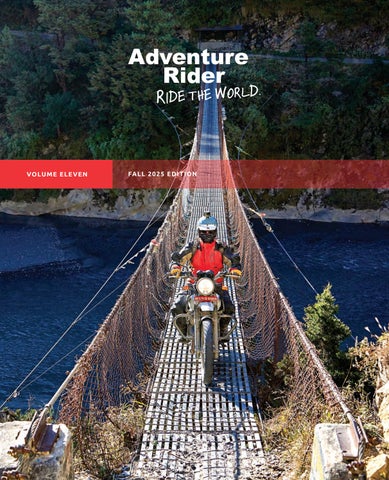
WHEN OLIVIER DE VAULX MANAGED A GETAWAY FROM HIS HOME BASE IN THE SOUTHWEST, TAKING A ROYAL ENFIELD THROUGH THE MOUNTAINS OF NEPAL, OF COURSE HE BROUGHT HIS CAMERA ... AND NERVES OF STEEL, FOR BRIDGE CROSSINGS LIKE THIS. SEE MORE OF DE VAULX’S WORK STARTING ON PAGE 103.
zac.k@advrider.com
PHOTOGRAPHER: OLIVIER DE VAULX
ADVRIDER.COM Creative Direction
HANDSOMERABBIT.COM
ADVENTURE RIDER
FROM THE EDITOR
FRIENDS FOUND, FRIENDS INDEED
SOMETIMES, THE HIGHLIGHT OF YOUR RIDE IS THE PERSON WHO HELPS YOU GET OUT OF TROUBLE WORDS: Zac Kurylyk PHOTOS: Matthew Peachman
through a windshield like a TV screen or some other line like that. You rarely hear people say they like to travel on a motorcycle because of the added difficulty. But I believe that’s a very good reason to travel by motorcycle – not because of the difficulty itself, but because the difficulty results in situations where you meet people who will show kindness – people you would not have met otherwise. There was no cell service at “the store,” a small building on a wharf that combined a convenience store, gas station, restaurant and bar and probably some other roles I wasn’t aware of. But they had a landline that connected me to CAA, who assured me a tow truck would come rescue me in the next 90 minutes, as I got back and waited by my bike. “Oh,” said the lady behind the store’s counter. “I’m headed that way; I’ll take you back.”
Matt and I sat alongside the 1.5-lane road to the Cape St. Mary’s bird sanctuary. The last few weeks had seen plenty of banging and bumping along dirt roads and rough, potholed highways through the east coast as we made the most of the spring riding season, laying down as many miles as possible before responsibilities tied us down for the summer. My triple tree had decided it’d had enough and partially disassembled itself in the Middle Of Nowhere, Newfoundland. I was in a jam; I’d packed tools before the trip, but had nothing to tackle a job like this. We had no cell service; we were in the middle of the barrens. No houses. No phone-a-friend service, no tow trucks. And then a local drove by, and when she heard our plight she said, “Hop in; I’ll take you to the store, and you can call a truck from there.” There are a lot of reasons to travel by motorcycle, but the usual spiel you hear is something about how you’re part of the world you ride in when you’re on a bike, instead of simply viewing it
I have not had the chance to travel the whole world like many of our readers have. My motorcycle travels have almost entirely been confined to North America’s northeast and southwest corners. In Canada and the United States, you cannot get into the same kind of trouble that you can get into in Zaire or Pakistan. And yet, I’ve managed my share of scrapes, because being on a motorcycle means you’re up against the weather, against wear-and-tear from dirt roads, against mechanical issues that wouldn’t ever happen to a car. When you travel by motorcycle, you immediately make yourself more vulnerable. You open yourself up to problems and trouble that no four-wheeled vehicle would ever deal with. As Matt and I waited by the bikes, a stream of locals drove up and down the road, likely headed to party down at the bird sanctuary’s parking lot; there really isn’t much to do in this corner of Newfoundland. Cars regularly pulled over to ask if we were OK; one driver stopped three times, repeatedly offering us every tool we’d need to get back on the road, angrily decrying the tow truck that was long overdue, getting progressively more drunk every time he stopped. We decided it was best to wait for the truck we’d called, but had it never shown up – and after two hours, we doubted we’d see it – we would have been taken care of, if we’d dared the drive home with our intoxicated acquaintance.
ADVENTURE RIDER -7-
VO LU M E E L E V E N |
FA LL 2 0 2 5 E D I T I O N
This is something that I don’t think inexperienced motorcycle travelers expect when they head out for their first trips. They expect their bikes will be trustworthy and reliable. Motorcycle marketeering is filled with images of attractive, carefree, hip riders blasting through the Kalahari without a care in the world, rounding Angeles Crest and heading into L.A. with a picture-perfect sunset in the background, parked alongside a roadside food stand in Morocco as a multicolored mosaic of local architecture shimmers in the background. They don’t show you the broken-down bike that will go no further without a part special-ordered from Austria. They don’t show the early stages of hypothermia setting in as your leaky rain gear seeps around all the edges. They don’t show the frustration of endless tire changes as your patched-up tube catches another cactus thorn. BJ, our tow truck driver, showed up, but it wasn’t his fault he was late. We were outside his service area; he’d been sent down when the local driver didn’t pick up his phone. The three of us strapped the bike down and headed north, through moose country. We spotted four in one five-kilometer stretch, with a couple of them initially refusing to cede the roadway to us. BJ suggested I take the bike to the security of his boss’s garage, instead of the local Yamaha dealership’s parking lot. After we rolled the bike off the ramp, he took the time to drive me most of the way back to our accommodations, so we didn’t have to double-up on Matt’s cramped bike. I finally crashed in the sack around 1:30, and I know BJ got home a lot later than that. But it has been those breakdowns and those slogs through bad weather that have created some of my favorite memories from my many years of moto-travel, and I know it’s not just me. After their round-the-world travels on the Mondo Enduro and Terra Circa tours, Austin Vince and his friends told me of the way locals had treated them with respect and care through their trips, and helped them as much as possible. From Siberia to South America, when they got into jams, impoverished locals helped them with food, medical care, mechanical repairs – whatever it took to keep the bikers going. Such interactions were the highlight of the films they made of their trips, and every time I’ve talked with the team members, they always recall those incidents with a nearwistful happiness.
Nick had cleared out a bay in his shop; we rolled the Super Tenere in and got to work. It took only a few minutes to re-align the front end, bolt everything back together to correct torque spec. It wasn’t a complicated job, but I certainly hadn’t had the correct tools with me, and Nick saved our trip. “What do I owe you for your time?” I asked as I rolled the bike out the door. “Nothing,” he said. “That’s just Newfoundland hospitality.” Vince’s wife Lois Pryce had the same experience on her trips, whether it was her Alaska-to-Argentina trip, her London-to-CapeTown run on an XT or her rides through Iran, all done solo. In 2015, she put together a TED Talk titled “In praise of vulnerable travel.” It’s on YouTube and I suggest you watch it, if you haven’t understood what I’ve been talking about so far. In her talk, she points out there is a huge industry based around selling us gadgets to help stave off our fears; sat-nav units that help us avoid getting hopelessly lost, GPS trackers that let our families follow our travels. But the equipment that makes us less vulnerable also lessens our need to interact with locals, to meet people who are willing to help us. To meet people at their very best. I count myself lucky to have had the breakdowns and troubles I’ve had over the years, because they’ve allowed me to meet kind people. The elderly couple in the Cape Breton Highlands who helped me get my enduro bike running again when I popped out of the woods into their backyard, my gearbox filled with milky oil. The lobster fisherman on Nova Scotia’s Eastern Shore who helped me and my riding buddy fix a broken BMW shock when we were miles from any sort of store. The kind man who let me sleep in his under-construction hunting lodge in Old Horse Springs, New Mexico, so I wouldn’t have to dodge elk on the nighttime roads. The Red Cross volunteers who gave me food and a warm bed in Matagami, Quebec, when I had to flee the James Bay wildfires on my motorcycle. I could go on, but you can see what I’m saying. All those trips had their highlights in other ways; gorgeous scenery, fun riding. But the human element was a highlight too, and the interaction never would have happened if I hadn’t needed that help in the first place.
Matt and I went to Young Mechanical, the car repair shop in Bay Roberts, where we’d stowed the bike the night before. I didn’t know what to expect but by the time we got there, owner
AFTER A LONG WAIT FOR HELP IN THE WILDERNESS, OUR TOW TRUCK ARRIVED, PROVIDING NOT JUST A RIDE FOR THE BROKEN-DOWN BIKE BUT ALSO PROTECTION FROM MOOSE. THE NEXT DAY, OUR NEW FRIENDS QUICKLY SORTED THE REPAIRS AT NO CHARGE.
ADVENTURE RIDER -8-
INSTANT ESCAPE
The All-new Tiger Sport 800 is designed to deliver a perfect balance between thrilling sports performance and long-distance touring capability. Whether escaping from the daily grind or setting off on extended adventures, the Tiger Sport 800 is crafted for riders who seek the freedom of the open road at any moment and the pure thrill of the ride. From $12,495 MSRP. Discover more at triumphmotorcycles.com
Mexico: San Joaquin,
Painted Canyons, Pulque, and Exorcism Rooms
already got a Starbucks, an airport depositing travelers flying in from North America, and travel agencies selling tours to the nearby hot springs. I don’t linger here. My destination this time is San Joaquin, a small town tucked away in the Sierra Gorda mountains. As we leave Queretaro behind and turn off into a small mountain backroad, iced lattes and English-speaking hotel receptionists fade away. This is the only route to San Joaquin – the road ends there – and the Sierra Gorda begins to unveil its rugged peaks, rainbow canyons, and slopes blanketed in cactuses.
ADVENTURE RIDER - 11 -
S A N
Wandering the bustling cobblestone streets of Queretaro, a city famous for its huge aqueduct arches drowning in purple jacaranda blossoms, I’m battling jetlag as I try to admire the statue of the dancing Chichimeca warrior atop a fountain. The heat is oppressive, and most tourists huddle around expensive restaurants under the colonial Spanish galleries; this place is as Mexican as it gets – the market is alive with locals selling vegetables, live chickens, cheap jeans, pinatas, and just about everything in between; traffic is as enthusiastic as anywhere else in the country, and you can still buy a $5 dinner from a street vendor. On the other hand, it’s
J O A Q U I N
Words & Photos: Egle Gerulaityte
VO LU ME E L E V E N |
FA LL 2 0 2 5 E D I T I O N
ADVENTURE RIDER - 12 -
“THE ROADS HERE AREN’T DESIGNED FOR TOUR BUSES OR RENTAL CARS. THEY’RE GOAT PATHS THAT HAPPEN TO ACCOMMODATE MOTORCYCLES.”
VO LU ME E L E V E N |
FA LL 2 0 2 5 E D I T I O N
INTO THE SIERRA GORDA The transformation is immediate – and dramatic. One moment you’re dodging city buses and breathing exhaust fumes, the next you’re climbing through switchbacks where the only traffic is the occasional burro loaded with firewood, its owner walking alongside with the patient gait of someone who measures time in seasons, not minutes. The Sierra Gorda Biosphere Reserve stretches across nearly 400,000 hectares of Queretaro state, a landscape so diverse it feels like Mother Nature is showing off. Desert gives way to cloud forest, limestone peaks rise toward the sky like ancient cathedrals, and hidden in the folds of these mountains are canyons that would make Arizona jealous – if anyone there knew they existed. S A N J O A Q U I N
But that’s the thing about the Sierra Gorda: it’s Mexico’s best-kept secret, a place where tourism hasn’t yet arrived. The roads here aren’t designed for tour buses or rental cars. They’re goat paths that happen to accommodate motorcycles, if you’re adventurous enough and your suspension is forgiving enough. As we climb higher, the air grows thinner and cleaner. Barrel cacti dot the hillsides like green sentinels, and every turn reveals another vista that makes you want to stop and stare. The silence up here is profound – not the absence of sound, but the presence of something deeper. Wind through limestone. The distant call of a hawk. The soft thud of your own heartbeat. SAN JOAQUIN: WHERE TIME FORGOT TO TURN THE PAGE San Joaquin appears suddenly, as mountain towns do – one moment you’re riding through rugged wilderness, the next you’re rolling down a main street that looks like it was designed by someone who’d heard about the concept of urban planning but decided to improvise instead. This is a sleepy town of maybe 3,000 souls, perched 1,200 meters above sea level. Pastel-colored houses resemble the colorful Old Town of Guanajuato – a little – but there’s only one main street, steep stairs leading into the maize above town, and a handful of side streets that peter out into dirt paths. While technically bearing the name of Pueblo Magico – Mexico’s attempt to attract travelers to more remote villages and towns – San Joaquin rarely sees visitors; no shops
selling “authentic” Mexican crafts made in China here. San Joaquin exists for its residents, not for visitors, and that makes all the difference. During my week here, I spot exactly zero other tourists. Not one gringo with a camera around their neck, not one European backpacker consulting a guidebook, not one tour group following a flag-waving guide. Just our group of riders, the bikes, and a town going about its daily business with the unhurried rhythm of a place that’s never heard of rush hour. THE GENEROSITY OF STRANGERS The locals’ reaction to our presence – a group of riders from the States, Australia, Canada, and Europe – ranges from curious to delighted. Here, we’re an event: by day two, the entire town knows there’s a crew of lady motorcyclists around; Alaska seems to be the most exotic destination of origin, so Allie immediately earns eager calls “Alaska, Alaska, hola!” wherever she goes. Local shopkeepers smile at our daily grocery hauls – energy bars, fresh fruit, chocolate, tequila – and the local restaurant owners come out to chat with us at dinner, showing their special brand of chili peppers and sharing their grandma’s recipes for enchiladas. We soon garner fame at the local pharmacy, too, since those rocky riverbeds and canyon trails we’re riding leave a bruise or two requiring ibuprofen. I mention it’s Alaska’s birthday. The clerk – a mild-mannered man wearing glasses – disappears into the back room and emerges with a massive mariachi sombrero, complete with gold trim. “For the party,” he says, pressing it into my hands. “Bring it back when you can.” No deposit required. No questions asked. TRAILS TO NOWHERE AND EVERYWHERE The real magic of San Joaquin, besides the town itself, lies beyond its borders. Dirt trails spider out from the main road like capillaries, leading to places that don’t appear on any map and probably never will. These aren’t maintained trails in any conventional sense. They’re paths carved by necessity – routes to remote ranches, shortcuts between villages, tracks that follow ancient indigenous routes through the mountains. Some are wide enough for a pickup truck; others barely accommodate a motorcycle. All of them lead to something worth seeing.
FROM BUSY CITYSCAPES TO THE MOUNTAINS IN MERE MINUTES, THE ESCAPE TO THE SIERRA GORDA IS THIS REGION’S GLORIOUS SECRET.
ADVENTURE RIDER - 14 -
Following our guide Francois along some nameless dusty trail, we descend into a dry riverbed that winds between towering canyon walls. The rock here is limestone, carved by millennia of flash floods into swirling patterns that rival anything you’d find in Utah’s slot canyons. The walls rise into dizzying heights on either side, creating a natural cathedral where every sound echoes and the sky is as a narrow ribbon of blue overhead.
But it’s the exorcism room that stops me cold.
We’re not the first to discover this place – ancient petroglyphs mark the walls, faded but still visible, testament to the indigenous peoples who called these canyons home long before the Spanish arrived. But we might be the first to reach it on motorcycles, threading our way through boulder fields and sand washes.
“They brought the possessed here,” our guide explains matter-of-factly.
Our guide is an indigenous woman in her forties who’s appointed herself the mission’s unofficial caretaker. She’s a little shy, but she’s eager to show us around, her weathered hands gesturing toward crumbling walls and empty doorways. “The Franciscans lived here for two hundred years,” she tells us, leading us through the galleries and rooms where wooden floors have long since rotted away, leaving only stone foundations and memories. She shows us the remains of the monastery’s kitchen, where massive stone ovens once baked bread for the entire community. The dining hall, where long wooden tables seated dozens of monks for their simple meals. The library, where hand-copied manuscripts moldered away decades ago, victims of humidity and neglect.
VILLAGES AT THE END OF THE WORLD The trails around San Joaquin don’t just lead to scenic overlooks, sites of crumbling ancient pyramids, waterfalls, and hidden canyons – they connect a network of tiny villages that exist in a state of dreamlike isolation. These are not tourist destinations or even marked on most maps. They’re simply places where people live, work, and raise families in much the same way their grandparents did. Reaching these villages requires commitment. The trails are rough, sometimes washed out, littered with rocks. GPS is useless here – you navigate by landmarks, by the advice of locals who give directions in terms of “follow the trail until you see the big rock that looks like a sleeping dog, then turn left.” In one village – I never learn its name, and I’m not sure it has one – we’re invited to share pulque with a family who’ve just finished the day’s work in their agave fields. Pulque is the ancient drink of Mexico, fermented agave sap that predates tequila by centuries. It’s mildly alcoholic, slightly sour, and definitely an acquired taste. But the hospitality is universal. This family has likely never seen foreign motorcyclists before, probably never will again, yet they treat us like honored guests. They want to know where we’ve come from, where we’re going, what we think of their pulque. The men tell us about how the drink is made, while the teenage girls giggle at my dreadlocks and wonder how a group of women riders ended up in their backyard.
ON TRAILS THAT HEAD OUT FROM THE MAIN ROAD, FRIENDLY VILLAGERS AND SPRAWLING VISTAS AWAIT DARING TRAVELERS.
ADVENTURE RIDER - 15 -
J O A Q U I N
GHOSTS OF THE FRANCISCANS In a canyon below San Joaquin stands the Misión de Santiago de Jalpan, a 17th-century Franciscan mission that’s slowly surrendering to time and weather. The bell tower still stands, its bells intact but silent now, and the main chapel retains enough of its original grandeur to hint at what it once was.
Standing in that room, with the desert sun beating down on the mission’s crumbling walls and the wind whistling through empty corridors, I feel the presence of all those who came before – the Spanish missionaries with their unshakeable faith, the indigenous people caught between worlds, the souls who may or may not have found peace within these walls.
S A N
The beauty here is raw and uncompromising. No visitor centers, no safety railings, no signs warning you about flash floods or unstable rock. Just you, your bike, and a landscape that demands respect. It’s the kind of place that reminds you why you started riding in the first place – not for the convenience or the practicality, but for moments like this, when the world opens up in front of you like a secret only you are allowed to see.
Tucked away in a corner of the complex, this small chamber still radiates an unsettling energy that has nothing to do with my imagination and everything to do with the weight of history. The walls are thick stone, the single ceiling window barely large enough to admit light. Nobody wants to linger here for more than a moment.
VO LU ME E L E V E N |
FA LL 2 0 2 5 E D I T I O N
“THE TRAILS AROUND SAN JOAQUIN CONNECT A NETWORK OF TINY VILLAGES THAT EXIST IN A STATE OF DREAMLIKE ISOLATION.”
ADVENTURE RIDER - 16 -
THE DANCE OF COMMUNITY Our last night in San Joaquin treats us with an unexpected gift – a Huapango dance, a tradition that brings the entire community together in the town’s small plaza. Huapango is more than just folk dance here: it’s the cultural heartbeat of the Sierra Gorda, a musical tradition that dates back to the colonial period when Spanish, indigenous, and African influences merged into something uniquely Mexican.
S A N
The dance itself is a celebration of courtship and community, with intricate footwork that mimics the rhythm of horses’ hooves – fitting for a region where horses and burros are still legitimate modes of transport. The music features the distinctive sound of the jarana huasteca, a small guitar-like instrument, accompanied by violin and the deeper tones of the quinta huapanguera. But it’s the zapateado – the percussive footwork – that really defines Huapango, turning dancers into musicians as their boots become instruments against the wooden stage. Think of it as Mexican flamenco with indigenous motives.
As we gather around a wooden stage, costumes emerge from closets and storage rooms – elaborate dresses with layers of ruffles, embroidered vests, wide-brimmed hats adorned with ribbons and flowers. The costumes have clearly seen better days. Sequins are missing, hems are frayed, colors have faded from years of use. But when the dancers take the stage, none of that matters. They perform with the passion and precision of artists, every step choreographed, every movement telling a story that’s been passed down through generations. What nearly breaks my heart is that this show is just for us. Our guide Francois had spoken to a neighbor who spoke to someone else who happened to run the town’s House of Culture, and San Joaquin decided to show off its spirit. As the final dance ends and the applause fades, I realize I’m witnessing something that’s becoming increasingly rare in our connected world – a community that still knows how to come together, how to celebrate itself, how to preserve what matters most. THE ROAD HOME Leaving San Joaquin feels like abandoning a secret. As I ride
J O A Q U I N
San Joaquin takes particular pride in its Huapango tradition because this remote mountain town has managed to preserve the authentic form while many other places have commercialized or simplified it for tourist consumption. Here, the dances are performed as they’ve been for generations, passed down from grandparents to grandchildren in an unbroken chain of cultural memory.
back down the mountain road toward Queretaro, the Sierra Gorda shrinking in the mirrors, I am already planning my return. Places like this change you in ways you don’t fully understand until you’re gone. The Sierra Gorda and its hidden villages represent something precious and fragile – a Mexico that exists outside the tourist brochures and travel blogs, where life moves at the pace of seasons rather than 24-hour clocks, where strangers are still welcomed with genuine warmth, where tradition isn’t a marketing tool but a living, breathing part of daily life. In a world that seems to grow smaller by the day, San Joaquin feels like a reminder that there are still places where time moves differently, where community matters more than good wi-fi, and where the most valuable experiences can’t be bought or sold – only shared. Taking off from Queretaro, I carry with me the memory of canyon walls painted by ancient floods, of mission bells silent in the desert wind, of dancers in faded costumes performing with hearts full of joy. And I can’t wait to be back.
ADVENTURE RIDER - 17 -
Photo: T. Dobler
VO LU ME E L E V E N |
FA LL 2 0 2 5 E D I T I O N
DON’T SUPPRESS THE URGE Straight from home, take control of the ride, wherever the trail leads. No limits. No excuses. Just you, the trail, and the KTM 690 ENDURO R. FIND OUT MORE AT KTM.COM
Always wear protective safety gear and ride in a responsible manner. Production model specifications and options may vary from the displayed vehicles.
WE FIND A PERAMBULATING BROTHERHOOD
Beneath
the Rajasthan Sun
“India is the one land that all men desire to see, and having seen once, by even a glimpse, would not give that glimpse for all the shows of all the rest of the globe combined.” – Mark Twain, Following the Equator A wan sun rises over the convoluted knot of streets and shambolic, rambling structures that comprise Paharganj, in the heart of New Delhi, itself a district – a relic of the British Raj – of the vast city of Delhi. The air is cool, and wisps of fog have begun to give way to the smoke and haze of the megacity’s atmosphere. This is widely known as the backpacker district of Delhi – a favored launching point for tourist adventures across the Indian subcontinent
since the creation of what would eventually be the New Delhi Railway Station almost a century ago. It was from this station that I emerged on this, the first day of an adventure of my own; a seven-day motorcycle trek deep into the imposing Thar Desert – a roughly rectangular-shaped expanse of arid land about half again the size of my home state of Georgia and a whole lot hotter than the Alaskan town where I bought my first bike – lying along the Indian-Pakistani border to the south and west of India’s ancient capital. The labyrinthine streets are alive with activity. Street vendors throng the sidewalks, hawking their wares,
ADVENTURE RIDER - 19 -
I N D I A
Words: Artem Nazarov and Fletcher Moore Photos: Artem Nazarov
VO LU M E F I V E |
W I NT E R 2 0 2 4 E D I T I O N
ADVENTURE RIDER - 26 -
VO LU ME E L E V E N |
FA LL 2 0 2 5 E D I T I O N
mostly food staples, as well as a wide array of richly aromatic prepared items – fried, baked, boiled, stewed, and roasted. But also clothing, footwear, textiles, electronic gadgets and accessories, books and stationery, Chinese-manufactured toys, incense of course, flowers, hand-made crafts, dubious jewelry. Some beg. A cacophony of voices punctuated by the blaring of motorcycle and tuk-tuk horns fills the air, as a swarm of tiny two- and three-wheeled vehicles speed about in a chaotic dance like giant bees. All of this activity is drenched in sumptuous colors and bubbles with vitality.
I N D I A
I spot my partner in this madcap quest, wading like a colossus through the welter of humanity. Jesse is a substantially-built Midwesterner, garbed this day in army boots, dark jeans, a t-shirt, and leather jacket, with a neatly trimmed full beard beneath a baseball cap emblazoned with a bolt of lightning. Even in this sea of flesh and blood he stands out – with apologies to Don Henley – like a Black Flag sticker on a Cadillac. We celebrate finding one another across an ocean and a continent with several bottles of Kingfisher in the narrow, prismatic confines of The Gem Bar and the intoxicating aerie of the Exotic Rooftop Cafe. JAIPUR: A CITY CLOTHED IN PINK “In a car you’re always in a compartment, and because you’re used to it you don’t realize that through that car window everything you see is just more TV. You’re a passive observer and it is all moving by you boringly in a frame. On a cycle the frame is gone. You’re completely in contact with it all. You’re in the scene, not just watching it anymore, and the sense of presence is overwhelming.” – Robert M. Pirsig, Zen and the Art of Motorcycle Maintenance.
City: Jaipur – so-called for the pink color of many of its buildings. As an Atlantan I am familiar with the worst of American traffic, but those among us who take a perverse pride in the congestion of their cities are amateurs. Delhi offers a master class in inexplicable, hyperkinetic, lawless traffic, at speed. You’re liable at any instant to be cut off, overtaken from any direction, even bumped. The complex, seemingly random chaos of Thai traffic has an underlying logic. Delhi has none. It is Brownian motion, with a deluge of ramshackle cars and battered trucks providing the chief danger while swirling flocks of the ever-present tuk-tuks and motorcycles furnish a ceaseless buzzing accompaniment. Right of way is a product of sheer will. Like beasts at a water hole, we’re constantly on edge, and the pressure quickly begins to tell. Even the otherwise soft-spoken Jesse starts to get spicy over the comms. Thankfully, the urban confusion slowly gives way and we find ourselves on a wide highway cutting across a table-flat, semi-arid landscape studded with low, scrubby vegetation and frequent pockets of economic activity not dissimilar to those clusters of gas stations and fast food restaurants that tend to accumulate like plaque around American freeway exits, providing everything a traveler needs – fuel, splendid food (generally far superior to the obligatory McDonalds and Wendy’s outlets that provide the bulk of our road food choices), and plentiful inexpensive lodging options. Sometimes, looking out across the countryside, I find myself reminded faintly of rural Arkansas or parts of Mississippi or northern Louisiana.
The next morning, nursing twin hangovers, we pile into a taxi and head for the rental shop to pick up our bikes – a pair of Royal Enfield 450s. Royal Enfield’s long history is deeply entwined with the latter half of the Raj and the subsequent modern Indian state, for which the company has long supplied border patrol bikes. In a sense we would be astride a little piece of Indian history.
The traffic gives the game away, however. There don’t seem to be any restrictions on what is allowed on the roads, or if there are, they are ignored. Trucks and cars and motorcycles make up the bulk of the traffic, ambling along without the mildest awareness of lanes or traffic signage, augmented by a sprinkling of strange hybrids, improvised vehicles and even the occasional ambitious cow.
The bikes which the congenial and efficient shop staff deliver into our care are decidedly not historic. Quite the contrary; they appear spotless and brand new, brimming with power and purpose. An hour after we walk through the door, our gear is secured and we’re weaving through the frenetic Delhi traffic, bound for the Pink
The 450s are a valuable asset in this environment. We are faster and more maneuverable than almost everything else, and over time, as we begin to grow accustomed to our significant mechanical leverage, we grow skilled at the Indian art of threading nimbly through the relatively plodding traffic.
IN INDIA’S TRAFFIC, YOU MUST DODGE CARS, TRUCKS, PEDESTRIANS, EVEN COWS. IT TAKES TIME TO LEARN THE TACTICS NECESSARY FOR SURVIVAL.
ADVENTURE RIDER - 22 -
After five hours of this, we arrive at our humble hostel in a small village on the outskirts of Jaipur. It’s a cozy family-run guesthouse – Cocoon Auberge – tucked into a quiet side street a mere 10 yards from a 17th-century temple, atop which we clamber to get an eyeful of the famed Amber Fort, its mammoth sandstone walls stained red by the setting sun. PUSHKAR: THE BLUE LOTUS FLOWER “India is a place where colour is doubly bright. Pinks that scald your eyes, blues you could drown in.” – Kiran Millwood Hargrave, The Girl of Ink and Stars In the time it takes to finish our morning chai, we have earned the eternal friendship of Manoj, the guesthouse’s owner and local tour guide operating as The Rustic Paths (therusticpaths.com). He insists on giving us a tour of the village on the back of his puny 125cc Honda. We stack up on the bench seat with Manoj at the handlebars in a bright red turban and flip-flops, myself clinging gamely to both my camera and to Jesse, who in turn is sandwiched between the two of us. In this improbable configuration we wobble gracelessly around the dusty, bumpy roads, cheating death, or at least a few bad scrapes and the mortal wounding of our egos, to the amusement of the grinning locals.
Arriving in Pushkar, we inadvertently crash a wedding. The raucous music and swirling colors of a throng of euphoric celebrants draws us in, despite our road-weariness, and once they become aware of us, to our great surprise, we are welcomed as though we’d been expected, as honored guests. The father of the bride personally brings dish after dish from the buffet, unwilling to let us leave without trying everything on offer. We are awash in a kaleidoscope of fragrances and flavors, as varied as the clothing; and the driving, inscrutable rhythms of mridangam and dholak drums. Later we’re invited to attend the actual wedding ceremony. It is beautiful, a rare glimpse into an altogether different world afforded by a singular example of the region’s well-earned reputation for hospitality. I spend the cool evening wandering the narrow streets under a starry sky. Reaching the edge of Pushkar’s holy lake I watch pilgrims engaged in a quiet ceremony around one of the city’s many ghats – sets of stone steps used to bathe in the sacred waters, as pilgrims have done here for over a thousand years. I slip off my shoes and move silently among them, seeking a passing communion; a revelation perhaps; a sliver of mystery. to carry away with me back into the cold, relentless grind of so-called modern life.
I N I D A
We take our leave with some sadness, not yet aware that we would see Manoj again. In the meantime we choose to salve our heartbreak with a strong dose of mileage. Weary of the previous day’s video-game frenzy we take to the back roads, navigating a meandering path to the great holy city of Pushkar. The path takes us through rural country, heavily agricultural, dotted with small villages. Some are no more than a
line of one- and two-story cinder-block or stucco buildings on either side of the narrow road, often painted in bright colors. Everywhere there are people, and our mode of travel binds us tightly to them, seeing their world at eye level without the interposition of a windshield, without the artificial atmosphere of air conditioning. We are outsiders, but we aren’t tourists. We carry a whiff of adventure, and everyone is eager to greet us.
ADVENTURE RIDER - 23 -
VO LU ME E L E V E N |
FA LL 2 0 2 5 E D I T I O N
“EVERYWHERE THERE ARE PEOPLE, AND OUR MODE OF TRAVEL BINDS US TIGHTLY TO THEM.”
ADVENTURE RIDER - 24 -
I N I D A ADVENTURE RIDER - 25 -
VO LU ME E L E V E N |
FA LL 2 0 2 5 E D I T I O N
JODHPUR: A STUDY IN BLUE “In India, you don’t drive on the left of the road, you drive on what is left on the road.” – Unknown The jolly savagery of the roadway surges back like the tide the following day as we hurtle across a broad, level plain, the brown earth increasingly parched with every mile we put to our east. The traffic is light but puckish. Truck horns trumpet alarmingly behind us. Other trucks overtake us on blind curves, and more than once we’re forced to veer into the sandy shoulder to avoid being flattened by a lurching bus. Jodhpur, which like Jaipur is characterized by a predominating color scheme, is a maze of blue houses gathered like worshippers at the foot of the massive, soaring edifice of the ancient fort of Mehrangarh, which appears to have been carved from the high hill upon which it was built. Towering 400 feet above the city, the fort is an almost unimaginably imposing sight. “A palace that might have been built by Titans and colored by the morning sun,” in the words of Rudyard Kipling. Some would argue he understated its grandeur. Would it be a disservice, however, to suggest that wonders like Mehrangarh are commonplace? Not at all. India is a swirl of historic forces, leaving architectural marvels of every scale and style in their wake. The blend of cultural influences leaves its mark everywhere; not just in those aspects that appeal to the eye, but one also finds the nose and the tongue dizzied by the wild profusion of scent and taste. I N I D A JUST AS THE TRAVELLERS ARE IN AWE OF WHAT THEY ENCOUNTER, SO ARE THE LOCALS CURIOUS ABOUT THE TRAVELLERS.
ADVENTURE RIDER - 26 -
It is the latter sense we now seek to assuage. In the dizzying network of narrow lanes and alleys we saunter through a now-familiar flurry of vehicles, street vendors, and children playing cricket in the midst of all the hubbub. The air is positively thick with the scent of spices, incense, and sizzling street food. A stall selling mirchi vadas – deep fried green chilis stuffed with spices and mashed potatoes, a vegetarian staple of Jodhpurian cuisine – calls out to us, the scent wafting under our noses with cartoonish effect, drawing us in as though lassoed. They are crisp, delicious, and at an average price of 12 cents U.S. apiece, comically cheap. We stuff ourselves silly. OSIAN: THE LAST SHALL BE FIRST “We all owe death a life.” ― Salman Midnight’s Children
Rushdie,
The following day we turn north, and over the course of a relatively short ride the true desert begins to assert itself. We’re bound for Osian, a small town of around 12,000 some 40 miles distant, known for the collection of Hindu and Jain temples dating as far back as the 8th century. We aren’t looking for temples today though; we are seeking an authentic taste of desert life.
We spend the afternoon visiting a local school where an American volunteer in Texas teaches English to a small gaggle of children via video call. Our host, Sumer, tells us the story of his own patchy education, which entailed a daily hike of almost three hours. Despite his determination, his formal education ended after the 10th grade. Some people, however, cannot be denied. Cut off from official channels, he sought to augment his knowledge with whatever scraps he could glean from other locals with specialized expertise. In this way he gradually accumulated enough prowess with computers to list his homestay on Airbnb. It’s a bracing bootstrap story, but the coda is better: since 2023, some 20-odd children visit Sumer every day to learn English and basic computer skills.
I N I D A
Reaching the outskirts of the town we immediately get turned around trying to find our lodging. The dusty tracks loop back and dead-end and crisscross wildly, leaving us to wander aimlessly for some time before a young man named Sumer appears on one of India’s ubiquitous motorcycles and offers to show us the way. A short while later our bikes are parked in a quaint little compound consisting of the host’s modest family home and a quartet of round huts each about the size of a large garden shed, with thatched roofs. Inside they consist of a single room with a large bed and a door to a small attached bathroom – a sparse dwelling, but providing all we need.
The struggle of people to survive in Osian and places like it has been a long one – likely denizens of Osian a thousand years ago fought against the same forces, but generation after generation they cling to the meagre resources the desert provides, and in an interesting
ADVENTURE RIDER - 27 -
VO LU ME E L E V E N |
FA LL 2 0 2 5 E D I T I O N
twist, Sumer explained to us that climate change has meant a greening of the territory around the town, and that villagers are growing vegetables for the first time in generations, if not centuries – a truth which, while perhaps not a panacea, reflects the slow, relent-
less turnover of the great wheel of fortune to which we are all subject. THE FELLOWSHIP OF THE WHEEL “It’s a dangerous business, Frodo, going out your door. You step
ADVENTURE RIDER - 28 -
ADVENTURE RIDER - 29 -
VO LU ME E L E V E N |
FA LL 2 0 2 5 E D I T I O N
I N D I A
onto the road, and if you don’t keep your feet, there’s no knowing where you might be swept off to.” ― J.R.R. Tolkien, The Lord of the Rings We are awakened by a booming musical din. Outside our huts, a battered pickup idles, music spilling from its open doors to fill the compound with sound. Sumer explains to us that it’s a daily ritual intended to lift the spirits of the laborers gathering for a long, arduous day in the nearby farm fields. After a light breakfast, we pile into Sumer’s dilapidated jeep so that he can take us out to meet members of his extended family. We bounce along rough, nameless tracks, past fields separated from one another by wire fences with rough-hewn red stone posts, startling the cows that wander unrestricted around the area. We meet Sumer’s uncle near one of these fields, a grizzled old man with a mischievous grin and a sly twinkle in his deep-set dark eyes. We sit with him and his friends for a while as they pass around hashish pipes, telling stories and borderline inappropriate jokes. There is an easy camaraderie among them and an uncomplicated appreciation of the simple pleasures of life.
As warmly as they welcome us, we are by definition outsiders. Such brotherhood has to be earned over time and through a body of shared experience. Exactly the sort of experience our adventure has given us, which Jesse and I will certainly carry forward, but on our return to Jodhpur an opportunity arises to expand the compass of our tiny fraternity. Stopping at the Royal Enfield shop in Ajmer for maintenance, we strike up a conversation with a pair of Indian bikers, Praveen and Tanuj of the Bullet Guru Ajmer motorcycle club. Over coffee, we swap stories about our journeys, past and proposed. Like almost all the Indians we meet, the two are generous and welcoming. One could conceivably cross the subcontinent with neither food nor money, depending solely on the pervasive Indian hospitality. The conversation ends with a pact to forge a new adventure: a future trip across the storied mountains of Ladakh, northeast of Delhi. The following day, we head back to Jaipur via Pushkar. We are reunited with Manoj and his family, who greet us as prodigal sons. He gives us another tour through the neighboring villages, though this time we take our own bikes. We dally, exploring lonely, dusty tracks and sun-drenched villages which seem to amplify the stillness of the surrounding countryside. We sip chai with a canescent farmer in the shade of a spreading desert teak. As the end of our journey approaches, moments like these grow ever sweeter. We spend our final evening on a rooftop in Jaipur, serenaded by Nathaniel, a bearded Pacific Northwesterner traveling with only the companionship of his cherished mandolin. He plays “Country Roads,” and we sing as the sun sinks behind the great ruddy fort. It’s an ending, but it’s also a beginning: we talk deep into the night and leave with an agreement that Nathaniel will make our Ladakh quartet a quintet. Therein lies the magic of motorcycling – it is a calling card; a membership in a global family, filled with people from different backgrounds, different callings, from different countries. Yet despite these distinctions, we share a lingua franca – the language of roads, horsepower, and the emancipatory power of two wheels and an engine. We are those farmers in Osian, except that rather than being bound to a particular piece of land and its various joys and sorrows, we are welded together by a philosophy, unattached to any particular piece of earth other than those suggestive lines on the map; the sinews of civilization, along which we race, a perambulatory brotherhood, a union of souls for whom home is found in the heart.
ADVENTURE RIDER - 30 -
Discover Urban Adventure
Since Italian Crafted 1905 ADVENTURE RIDER LEARN MORE AT
- 31 -
VO LU ME E L E V E N |
FA LL 2 0 2 5 E D I T I O N
Street Legal
The Alp X exhibits a completely different appeal, becoming the perfect bike for city trips and long-range journeys, while remaining always ready to take on dirt roads ADVENTURE RIDER 32 - Alp 4.0 – allows for convenient passenger riding, along the way. Alp X –- like thanks to the accommodating saddle and comfortable passenger handles.
Remembering
Charlie
When our friends are gone Words: Katie Hunter Photo: Tom Martin
Image: BMW Motorrad ADVENTURE RIDER - 33 -
VO LU M E E F ILVEEV E| N W| I NT FAELL R 22002245 EED DIITTIIO ON N
Blue jeans and ball caps assemble, leaning against their dusted rides at the unofficial hangout of any small town, the parking lot. Its neutral ground sets the stage for showing off, settling scores, leaving things behind, or collecting nerves before heading inside. We linger long enough to run out of people to talk to and then walk toward the club. Inside, people press in small packs against the walls. In a flash we’ve caught the eye of someone who wants to know why we’re here, who we are. We perform casual introductions and plunge into a series of Q & A around connections. We all have one person in common; that’s all the qualifications we need today. It’s a Saturday afternoon on Caledonia Mountain at the clubhouse. Under the roof is a warm-up shelter, meet-up point, or place to grab a bite at Kick Ass Foods. To get here you can take the main road over the mountain, a path the Department of Transportation has paved with negligence over the years. Layered occasionally with chipseal and patches, you swerve past deep potholes and praise the lack of oncoming traffic, save for the occasional wildlife. In contrast, ride here through the woods by four wheeler, snowmobile, or side-byside and you’ll cruise over well-groomed trails maintained by volunteers of the club; groomers kept in service for years because of Charlie. A handful of motorbikes have made the trek here today, but we’re not part of their pack. My bike lies picked apart in our garage waiting for us to discover her latest complaint, which left me stranded on the side of the road two days ago. “As a testament to Charlie’s mechanical skills, your bike remains unfixed,” says Tom and we toast, taking part in the memorial by holding down a corner of the room. We’d love to talk with Charlie now, but to reach him would be a long-distance call. Very, very long-distance. Charlie was our “phone a friend” at the end of a troubleshooting line. A certified BMW mechanic, who always answered if we were in a rut or just needed to talk shop. On weekends we would find Charlie in his truck, parked at the gas station. We’d catch up and fire questions out the window while our kids squirmed in the backseat, chafing at the hold-up. During his time off he let us pick his brain, and in return we rolled into the drive-thru ordering an extra drink. Sometimes we just wanted to see him without being noticed; not bothering him with our problems. Playing a game like Where’s Waldo we would scan the porches of the countryside for a sighting; the winner proudly shouting, “Found him!” while the rest of us turned our heads to prove it before he disappeared. When his health declined and he ended up in a hospital bed, he could rattle off solutions to our problems without knowing the half of it. Free of reference materials to back him up, he offered no hesitation in his diagnosis. After a lengthy illness, Charlie went from the hospital bed to one in his home, and never returned to his shop.
Surveying the crowd of all-sorts at his memorial, we confirm what we thought all along, that Charlie belonged to more than just us. If you owned a vintage BMW from Atlantic Canada it likely passed through Adriaan’s Cycle in Moncton, New Brunswick, by way of purchase or repair. The family business began as a Honda and BMW dealership, eventually becoming a mechanic’s shop servicing all makes, German, American, British, Japanese, and anything in between. Not known for small talk, Charlie and his dad Adriaan kept their heads and hands engaged on the long line-up of bikes in their care while his mother Lorraine worked from a small corner office. From here you could trace the history of their lives as your eye moved across layers of nostalgia clinging to the walls, decades of photos and memorabilia from former biking days held together in a workshop collage. Someone must have had permission to borrow a few pictures from the 1970s layer for today’s temporary display. Scattered on the table beside the guestbook are photos reflecting an era marked by sepia tones, bell-bottoms and long hair. Still shots of bike rallies captured once-private stories of road trips and workdays, and if you were able to strike up a conversation with one of Charlie’s long-time friends you could pin down exact dates and details. Word spreads through the crowd of a group photo request and people usher themselves and others up against the wall. Arranged in no particular order, friends from the photos of days-gone-by mingle with Charlie’s modern-day friends. It’s mostly men up front while a chorus of women stands in a huddle behind the one with a camera, their purses piled on the table in a heap of trust. We stand back and play a Who’s Who to identify the line up, connecting those we can with a story related to Charlie or not. Some are members of a vintage motorcycle club, others, family, and a few we recognize as customers of the shop. A few arrive by chance; by the time they realize they’re here for a memorial they decide to stay and catch up. A tray of rum shots balances in the hand of a lady working her way around the room. She heads toward us and we decide now might be a good time to separate ourselves from the crowd. We sign the guestbook, adding our names to another page of history in Charlie’s life. On the table his cremated remains lie sealed in a motorcycle tank at the front of the room. Here the rider is back on his bike, a fitting finish for a man whose life revolved around them.
ADVENTURE RIDER - 34 -
Central America Border Crossing
Guide
W E S T
Words & Photos: rtw Paul
A F R I C A
Country-by-country here’s how to get through
ADVENTURE RIDER - 35 -
VO LU ME E L E V E N |
FA LL 2 0 2 5 E D I T I O N
Editor’s note: We apologize that some of these images are low-resolution; some had to be video screen captures, since photos aren’t allowed in some restricted areas of border crossings, but rtwPaul’s intention was to provide useful information, however possible. When riders talk about Central American border crossings generally those who have done it cringe and those that haven’t state inaccuracies. Central American borders have a very bad stigma and rightly so; they are somewhat difficult and confusing, but what if they weren’t, what if there was a guide to help you navigate the maze of confusion? Read on. Over the last decade and a half, I personally have completed over 40 crossings of Central American borders, more than some, less than many, I even wrote a book about it over a decade ago.
For the TL/DR crowd, these are the basics: when entering a country the order is immigration, customs, import. Exiting is generally in reverse, possibly with a few minor adjustments or added steps dependent on bureaucracy. Be well-rested, well-fed and watered, take extra water, snacks (in sealed wrappers) and a calm demeanor. Prepare for the worst, hope for the best! For everyone else – again, read on... Exiting the U.S. will be the last time you’ll leave a country without being checked out by immigration. Entering Mexico is generally easy and done at a lot of borders now in English, similarly with Belize. Mexico’s exit isn’t covered here, but if you are concerned, I have covered it previously on my YouTube channel. Belize is an English-speaking country. Do this by yourself, ask questions, get confused, muddle your way through, but the whole time you will understand what is being said and it will give you valuable experience. Don’t forget to buy insurance. A lot of riders skip Belize, so the guide covers exiting Mexico and the remaining crossings to Guatemala, El Salvador, Honduras, Nicaragua, Costa Rica, Panama and exiting Panama if you’re headed to South America. Before you leave the U.S., read a few ride reports of people who are in the country and ask riders who are currently in Mexico or Central America to invite you to any number of WhatsApp groups that are currently running. These can be your lifeline to up-to-date information, about opening hours, current costs, fees, insurance requirements, visa requirements, closures, strikes, riots, road blocks, etc. iOverlander.com will be your alternate back up, not always as current, but still a very good source of information.
S O U T H A M E R I C A
This time around, crossing them in early 2025, I decided to document the process to find out if I could simplify them for most everyone to do without headaches before, during or after and just enjoy the ride! The basics – a little Spanish helps, for sure, if you know you are headed to Latin America it will be the best tool in you whole kit.
Try to avoid asking questions on Facebook groups, for the simple reason there are a lot of inaccuracies stated by riders who crossed these borders over the last few decades; things change very rapidly. Current feet on the ground info is always your best source of information. The border crossings I chose specifically for a few various reasons that are one or more of the following, remote, quiet, easier, cheaper or less fixers, who you don’t need anyway, as they open you up to possible scams and corruption. ALL BORDER CROSSINGS ARE DESCRIBED IN A SOUTHBOUND DIRECTION
ADVENTURE ADVENTURE RIDER RIDER - 36- -36 -
MEXICO – GUATEMALA, El Ceibo crossing Exiting Mexico, the immigration (migration) is at the farthest point from the entrance, close to the Guatemala border.
The next building, double the size of the previous ones, is where you’ll do your import. They require passport, license, registration and title to start the process.
You might be directed to park near the main building and walk back to get your exit stamp.
At the main building outside, Customs (aduana) should be right there, and at their discretion they might search your luggage. If not, enter the building, turn to the left and walk to the Banjercito office; this is where you’ll turn in your TVIP (temporary vehicle import permit). They will come out, take a photo of your VIN number and your plate, cancel the TVIP and process the paperwork for your refund. Credit card refunds generally take two to five days. Head to Guatemala... There are white small buildings to your right; the first is migration, where you’ll get your passport stamped. The next building is fumigation. Here you pay a fee; you’ll be asked to connect to their wi-fi (Starlink) to confirm and receive your fumigation document and receipt. Then go outside to have your bike fumigated.
You will then have to leave your motorcycle there, exit by foot, and get copies of all of the above, plus the entry stamp. You can do this at the first building outside of the border area. Once you have this, continue up the road to the hardware shop on the right, about 100 meters. This is where you’ll pay your entry/visa fee, and they have a surcharge on top of the fee. Now return back to the import office to complete your paperwork, and that’s it, ride Guatemala. As of February 2025, no insurance was required. GUATEMALA – EL SALVADOR, Hachadura crossing Enter the border area, ride to the building ahead, keep right and migration is at the end, stamp out.
S O U T H A M E R I C A
ADVENTURE RIDER - 37 -
VO LU ME E L E V E N |
FA LL 2 0 2 5 E D I T I O N
Once you have your stamp, find somewhere secure to park, and head to the opposite side of the same building at the other end. This is where your TIP is canceled; they will come and inspect the bike to confirm VIN and plate number. That’s it, head to El Salvador. When you see this sign go to the right and park, and the migration building is the first small white building on the left.
Now head to the glass door ahead of you. This is where the TIP is done. You’ll need passport, license, registration or title and copies of them. If you don’t have copies, they will make them for you.
If you have a U.S. passport (and others) you are required to pay a $12 entry fee in cash. Try to have correct change; you’ll be given a proof of receipt for your payment.
Triple check every single letter and number entered about you AND your bike. Mistakes are prevalent and need to be corrected. Once everything is correct they will come
ADVENTURE RIDER - 38 -
and check the VIN and plate, or this process could be reversed depending on the officer. Go ride El Salvador.
EL SALVADOR – HONDURAS, El Amatillo crossing *If you are a UK citizen as of 2025 you are now required to get a visa. They do not issue visas at the border; the Honduran Embassy is in Guatemala City, Guatemala. At the El Salvador exit, you may feel you are being directed to the wrong place as you’ll be sent to a huge warehouse where there are only large trucks and semis. This is where you’ll cancel your TIP. It will happen in one of two ways.
Stamp out of El Salvador and ride across the bridge. There is a high probability that someone with a badge will stop you and ask for your papers. These are the official helpers and they work for tips. They will be very persistant. Simply say you don’t need help and ride to the blue building ahead.
Either an officer will tell you to take a seat, and he’ll go in the office to process your documents, or you enter the office and wait while he does it.
S O U T H
Enter the building and go to the right to get your entry stamp from migration. When you come out look to your left for the building with red gates; this is where you’ll do your TIP, and there is a fee.
ADVENTURE RIDER - 39 -
A M E R I C A
Once you are complete, get on your bike, ride out of the parking lot, and look for the Honduras sign, follow the direction, it will lead you to El Salvador migration.
VO LU ME E L E V E N |
FA LL 2 0 2 5 E D I T I O N
Next up is Nicaragua entry. Take a deep breath, this is going to be annoying, confusing and unnecessarily complicated, but you can do it.
Drones are not allowed in Nicaragua. If you have a drone, don’t try to smuggle it inside your airbox or other hidey-hole. Officers are aware motorcyclists do this; fines are around $500 and possible confiscation. Head to DHL at these coordinates (13.3052243, -87.1930820) and they will send it to a DHL office in Costa Rica for you. They are open M–F 8–5, Sat 8–12, Sun closed.
As you exit Honduras by the bridge, it could be blocked by trucks, as this is the main truck crossing. This will actually work in your favor because they clear customs in a different area to you, and with them blocking the bridge they reduce traffic, but to get past, you can drive by them on the pavement; just beware of two-way traffic.
At the end of the bridge you’ll meet your first Nicaraguan officer. They’ll want to see your passport and title/registration, and they will grill you about cameras, drones, intercoms, etc. They’ll ask you multiple times while circling your bike as they check your plate, make, model, color, etc.
Honduras – Nicaragua, Guasaule crossing The Honduran exit is probably one of the easiest and quickest. Enter the border area, ignore everyone and ride to the very end of the buildings and park outside (hopefully) and enter with all your paperwork.
The migration windows are usually in the middle; get stamped out. Now go to the first window nearest the door. This is where you’ll cancel your TIP. They may or may not come and check your VIN. if they’re not concerned then you shouldn’t be. That’s it, you’re done.
This is a preliminary check. They’ll want to know where you’re staying, what town, what other towns you’re headed to and if you’re carrying on to Costa Rica or just in and out of Nicaragua. Be patient, be polite, answer what you’re asked and then you can start the actual process. You’ll be forwarded to fumigation, quick and simple. You’ll pay for this inside later.
ADVENTURE RIDER - 40 -
Head to the main building about 200 meters ahead on your left. Park outside; the remainder of the Nicaragua entry will happen here.
Once everything is complete, go left to the next window marked IPSA to pay for fumigation. You will be handed a form to exit the border. The next window, DGA, isfor medical checks. As of February 2025, they were not checking for proof of vaccinations but in the past, they have sometimes required MMR, Yellow Fever and more recently COVID. Confirm this before arrival.
Nicaragua has an online entry form. As of February 2025 it was on the official website but it was not functioning correctly. If this is the case for you, head to the border with a screenshot on your phone to prove you tried and failed. If it did work you have one less step to do. First, outside, they take the details that are on that form and send you inside to migration. Second, inside, migration will confirm everything you’ve already told the last officers; they will stamp your passport and take you to the far left for entry payment. Third, people entering by foot will go behind migration and head to the far right through a corridor. Do not follow them. You need to head outside. Fourth, enter the next office, pay a small fee for “road tax,” get a slip of paper, enter the next glass door. Fifth, the entry-by-foot people will be there by the big scanners. Walk behind the scanners and get your small items scanned: helmet, hydration pack, etc. This is where your Spanish will save you a lot of time and annoyance. Ask very politely if they could inspect your luggage on the bike. If they refuse you will have to bring everything inside to be scanned.
Head outside and ride to the exit and hand the slip in to exit the border area. Not finished yet! Nicaragua requires insurance; a lot of travelers skip this, but if you are stopped by the police, they will ask for it. And a final word of warning. Nicaraguan police are known to be extremely corrupt. Fifty meters ahead on your left there are insurance agents selling policies ($12, 2 for $25). This is one less thing to be potentially harassed about, so buy it or maybe you’ll have a cool story to tell otherwise. That’s it, you’re finally into Nicaragua, go have fun! NICARAGUA – COSTA RICA, Penas Blancas crossing Over the years this crossing was the primary reason Central American border crossings got a bad name. It was full of helpers, scammers, pickpockets and thieves that the officials did nothing about. It has now been cleaned up, a new building was put up and an almost-logical system set in place. As you enter the border area, all the above and the money changers are now kept outside the gates. Head to the big white building “Terminal de Pasajeros” Door 1.
Once you’re inspected or scanned you should be handed a form which needs to be stamped by a different officer.
There is an unofficial man selling forms outside. These are free inside, so walk on by (scam #1). Head inside door 1 get stamped out and pay the exit fee. It has been $3 for over a decade, but this is where (scam #2) they will claim they have no change, so best to bring the right money.
ADVENTURE RIDER - 41 -
A M E R I C A
*It is advisable to get here before 8 a.m. so you beat the rush of buses and volumes of people that fill the migration and aduana lines.
S O U T H
Sixth, head to the “Tramite Vehicular” window for vehicle import. They need that stamped form, license, registration/title. Again, once finished, thoroughly check everything is documented correctly. My paperwork along with that of all others in line had mistakes.
VO LU ME E L E V E N |
FA LL 2 0 2 5 E D I T I O N
I tested the depths of the scam; I had $3 in my pocket, but I handed over a $100 bill, the officer brazenly put it in his pocket and said, “No change,” waved me off and shouted “Next.” I got extremely loud, he panicked and miraculously he had a drawer full of change . . . the corruption is rife in Nicaragua; be very cautious, stand your ground!
Outside opposite is a small hut 2, this is where you fill out your own TIP, then head out towards the main gate 3, but before you get there look for a big white building about 200 meters from migration on the right.
Outside go to the adjacent building and door 2, and as you did on entry to Nicaragua have your personal items put through the scanner.
COSTA RICA – PANAMA, Rio Sereno crossing
Ask the officer to come outside to check your bike luggage. This is where getting there before the buses comes in handy. If they are not busy, they will; if it’s packed, tell you to bring everything inside. But they’ll still come out and check that you did. Once your luggage is checked/scanned you get that form filled in and then look for two small white buildings and an officer to stamp the form again.
After you receive the stamp go back through door 2, turn immediately right, have all of your documentation and that form, take them to the center booth, there they will cancel out your TIP. Exhaustive, yes, but believe it or not, you’re done. Head to Costa Rica. This border crossing is the polar opposite of what you just went through, very quick and simple and professional. To your left, find migration in door 1, exit via aduana. They may or may not want to scan anything; they will let you know.
This is for insurance; it’s mandatory, you get it here, pay here then exit into Costa Rica.
This border is in the mountains, generally empty and very relaxed. *Only use this crossing Monday to Friday as the Panama insurance office is NOT open on weekends. As you approach, you’ll see the Panama border directly ahead. Make the left at the T-junction; the road turns from paved to dirt. About 100 meters on your left is the Costa Rican border
Looking back . . . 1 is Costa Rica, 2 is Panama. Enter the gates; you’ll find a QR code on a post next to the migration window. You can pay the exit tax using that. You can also pay earlier online to speed up the process or go around the back of the building where there is a payment machine.
ADVENTURE RIDER - 42 -
Fourth, 50 meters down the hill, take the first left turn. Third door on your left is blue. This is the insurance office for the mandatory Panamanian insurance and currently it is $10–20 cheaper than the main border crossing. You will get a copy; the TIP office needs a copy. Go back to 3. You will fill out some papers, they will fill out some papers. I cannot stress this enough, TRIPLE CHECK EVERY SINGLE THING, IF THERE ARE ERRORS YOU MAY NOT BE ABLE TO EXPORT YOUR BIKE TO COLOMBIA! Once everything is good, they will drop the chain that’s across the road and you ride into Panama. PANAMA – COLOMBIA or …? Tocumen International Airport
This is exit tax; it is mandatory and can only be paid with a credit card.They do not accept any forms of payment over the counter. You will get a confirmation email; they will get it too, and when they do, they will stamp your passport. The next window to the right will cancel your TIP. They don’t give you a copy, so ask to take a photo for your records. Head to the Panama border on your bike. Panama is on EST, and they close for a one-hour lunch.
Third: directly opposite is the office for TIP. Here they may or may not want to start your paperwork while you go for insurance.
I have a very detailed video on YouTube covering exactly what is covered here: search rtwPaul Central America border crossing guide or use this link – https://youtu.be/5fH9YAoOTn8?si=92jKjjanQB7eD2hv
ADVENTURE RIDER - 43 -
A M E R I C A
Second, exit migration; don’t come out of the same gate, exit towards the side street. This is aduana.
Your migration exit stamp from Panama will happen at the airport and your AWB airway bill is proof of onwards travel.
S O U T H
First, go through the glass door at the front of the building. This is migration.
Here you will do very little if you are headed to South America or somewhere else. Pick your shipper of choice, drop the bike off with around 1/8 tank of fuel, sign a couple of papers authorizing them to clear/export the bike. Remember to take enough clothes until it’s returned.
EcuadorFreedom.com
The Sheer
Luck
of it All
Fear. Letting go of it is the first step to a longer life Words & Photos: Neil Graham
It was dusk heading straight into nighttime. I parked the BMW beside the rest station somewhere north of Syracuse, New York. I pulled on the washroom door. Locked. I walked out back into a grove of trees bordering a field. Ah, relief. Then I looked up. And began counting. At 20 deer I gave up and returned to the bike, more than a little rattled. I’d hit a deer on a motorcycle less than two weeks before. My right leg remained black from my inner thigh to below my knee. When I walked I had a stagger and swagger that suggested that if I’d walked into a saloon in Deadwood, South Dakota, circa 1870, God-fearing patrons would have sought shelter beneath their tables because bad news would certainly trail a man who walked like that. Was bad news about to strike again? Until I’d hit that deer, I’d had, without realizing it, a dismissive view of riders who’d clubbed animals and pranged cars and hurled themselves overtop guardrails. A deer, after all, is the size of, well, a deer. Couldn’t you just brake and swerve? But hitting the deer, unsurprisingly, had changed my viewpoint. I’d been riding along in the company of four others. It was a perfect June afternoon. Sunny. Warm. If you dream about riding a motorcycle, this was the kind of day you want to ride it on. We’d been going at a good clip, but we weren’t reckless. We’d slowed, as we were nearing our turn. And then I saw something out of the corner of my eye and instantaneously the deer was in my lap. There was no braking, no thinking. Instinct propelled me to lean into the force, and I buried my shoulder into the deer’s neck just as it swung its head away from the impact. I ended up careening into the ditch on the opposite side of the road. I was still on my wheels, but very sore and with a very broken motorcycle. Needless to say, if a vehicle had been coming in the opposite direction, you would not be reading this story.
IT’S NOT THE SCAR THAT CONCERNS, IT’S THE TITANIUM THAT LIES BENEATH. IF YOU RIDE ENOUGH, EVENTUALLY YOU’LL GO DOWN. THERE IS NO ALTERNATIVE. In the immediate aftermath of the collision, it wasn’t the soreness that bothered me. I’d been in pain before. If you’ve lived long enough, you’ve been there too. What shook me up was that I’d had a clear-as-day demonstration of the vulnerability that I, as a motorcyclist, confront every time I ride. I thought back, with a different view, to the friends and colleagues I’d lost to accidents. Most weren’t doing anything wrong. Some, it’s true, had a taste for speed, for risk. But by-andlarge, what cut most of them down was pure bad luck.
ADVENTURE RIDER - 45 -
One colleague was riding his old bike at a suitable oldbike pace. Pottering along. When a car, without stopping, exited a driveway straight into his path. In an instant he was up and overtop and into the ditch. He lived, but knew, even before he was pulled from the ditch, he told me, that life was going to be different. He lost the use of his legs. The eeriest aspect of his retelling of the crash was that he relives, as a recurring dream, the last time he walked. He’d just refueled and walked around the gas station, stretching his legs and getting blood flow back into his hind end. He had a drink, fetched the washroom key – which was tied to a miniature canoe paddle – then checked his oil, started the bike and headed out. He didn’t make it a mile down the road. We live in a world indifferent to our desires. Evidence is thin that an individual’s journey on this planet is directed by anything other than happenstance. The idea that predestination or some sort of grand plan has it all plotted out is a tough sell for me. We look for logic or reason where there is none. Certainly, this desire to decipher and understand is in response to the perpetual risk that is humanity’s constant. I’m fairly sure the deer I clubbed – who, like me, lived to see another day – doesn’t burden its existence with existential thoughts of the meaning behind his run-in that time when he tangled with a creature (man) who was straddling a loud and brightly-colored mule (a red Ducati 749) on that day now long past. But that doesn’t mean we don’t look for significance in our broken bones and shattered confidence. What if my colleague at the gas station looked at his watch and decided he didn’t have time for a drink? Or what if he wasn’t thirsty at all? Had either of those instances happened, he’d still be walking today. Or would he? Maybe circumstance would have cut him down a week ago, a year ago or 30 years ago when the car he was riding in as an infant just snuck by the truck that ran a stop sign at a Montana intersection. Thinking like this is a sure sign you’re losing your mind. We’d be constantly slowing down or speeding up to either slip behind or get the jump on whatever catastrophe awaits us. After I hit the deer I felt nothing aside from physical pain. I rode home and told my partner about what had happened and she said, rightly, “At least you’ll have something to write about now.” She wasn’t wrong. Every writer is perpetually on the hunt for inspiration. I rode the next day. And the day after that. My leg didn’t sustain any fractures, but it ached. I rode through the pain, but my malaise was merely physical. Until that evening in the field on the way home from Syracuse when I realized my accident wasn’t an anomaly.
For many years I was a nervous flyer. An absolutely absurd situation given what I did for a living: riding motorcycles on racetracks and roadways at a quick, often foolhardy pace. Logic, thankfully, helped cure me of my flying nerves. But in this context logic is merely a mental exercise to quantify risk. Dragging a knee at 100 mph is certainly more dangerous than flying in a commercial airliner. It has to be. Or so I told myself. We humans play a statistical game. I just did it with the concept of risk while flying. We play the averages – what’s safer, what’s not – but we’re not averages, we’re individuals. Just ask the man in New Mexico who’s been hit five times by lightning. Or that woman in New York who was hit by a car then weeks later was killed when a small plane crashed into her apartment building. Raw luck. It can happen to any one of us. And on the topic of luck, am I unlucky to have hit a deer or lucky to have survived it? Statistically, am I safer in the aftermath of having hit a deer? What are the odds of hitting deer twice in a single month? These were my thoughts as I walked back to the BMW in the rest station just north of Syracuse. With five hours of riding still to go that evening, I yawned deeply and felt tiredness descending like an English fog. I walked quickly in large circles for five minutes. It didn’t do a thing. Why is riding a motorcycle so exhausting? It’s usually attributed to exposure to the elements. Drive 500 miles with the window down in your car and you’ll see what I mean. But it’s more than that. To ride well, to give ourselves the best chance for survival, means existing in opposite states. To understand what the motorcycle is tell-
IF YOU END UP IN A PREDICAMENT LIKE THIS, TELL THE ATTENDING PHYSICIANS YOU WERE HIT BY ANOTHER BICYCLIST IN THE PELETON. NEVER MENTION THE WORD “MOTORCYCLE.”
ADVENTURE RIDER - 46 -
ing us, we need to be supple, relaxed, aware. You can’t play the banjo with your hands coiled into fists. But unlike playing the banjo, where the chance of death is minimal, but not zero – banjo plucking in a stuck elevator can put the player at risk of strangulation – what complicates the motorcyclist’s dilemma is remaining calm in the midst of perceived danger. Our bodies have essential though primitive responses to threatening external stimuli. The breakneck speed of technology since the industrial revolution has far outpaced our ability to adapt to it. And I’m not referring to kids and smartphones. Or anyone and smartphones. When confronted by risk, our bodies revert to the fightor-flight instinct, which is extremely useful when, during your daily hunting-and-collecting foraging session, you bump into a cheetah or a hippo. But risks today are different. Riding a motorcycle is risky, but not hippo-risky. Rare is the rider who beats his motorcycle with a stick to fend off its unwelcome advances. (At this juncture it’s worth noting a distinction. Beating a motorcycle with a pipe wrench because of its predisposition to strand you at the side of the road is a normal, healthy – if only for you – and proportionate response). We, in our achingly slow human development, have never entirely caught up to ripping down a road at 95 mph. But hang on, you say, what about the fastest racers, haven’t they normalized outrageous speed? Yes, they have. But they’re aberrations from the norm. The rest of us struggle with remaining supple while facing risk. You see it all the time at the racetrack. Riders capable of smooth, supple inputs while turning into the café parking lot or their driveway turn wooden while at speed. Sure, yes, you argue, but isn’t the problem that at speed these maneuvers become more difficult to perform? The misconception comes in our use of the word “difficult.” As speed increases so does our perception of risk. Speed is superfood for anxiety. It’s true cornering at high speed is different than cornering at low speed. But different how? MotoGP rider Maverick Viñales said he doesn’t have a perception of speed. Slow or fast feels the same to him. He can turn into a 120-mph corner with the same ease you and I turn into our driveways. The sophistication of his spatial awareness far exceeds ours. As do his reflexes. Why? Because he’s relaxed. His body isn’t triggered by the fight-or-flight response. I was a decent athlete as a kid, but my progress was thwarted by inconsistency. This has extended to my riding. Just as I’m trying to foster instinct, to trust my body to preserve my body, my intellect rears up on its hind legs and wrestles control away. I’ve had a half-dozen races – as a road
THE SCARS RUN DEEP. WHAT WASN’T APPARENT WAS THAT THE ENTIRE ENGINE CASE HAD CRACKED. MORE PAIN.
racer and a flat tracker – where instinct took over to such a degree that I have a difficult time remembering the race at all. And – no surprise – they were my best-ever results. My mind, in all its scheming and nervousness and fear of reduced income if I busted a leg – or lost the use of my legs entirely – would have extended a large hand and gripped the brake lever if I’d given it the chance. If we transcend our intellect – the instincts that want us to slow down – and rely solely on intuition, we’re faster and much, much safer. Most motorcyclists die by their own hands. We’re generally inept. We cross over center lines and hammer into guardrails and sit in the blind spots of motorists until – surprise! – they veer into us and kill us. Whose fault is that? The driver’s, of course. We don’t want to blame the dead for ineptitude. The dark secret of motorcycle accidents is that, just like my run-in with the deer, there’s nothing that can be done to lower the risk. Oil on the road, vehicles blocking our path, gravel dumped in a corner by a porous construction trailer are out there, waiting for us. I’m headed out for a ride as soon as I’ve finished this piece. Do I hustle through these last few sentences to get ahead of my potential murderer? Or do I drag my heels, give the piece an extra going through because right now there’s a Dodge Ram driven by a landscaper who’s smoked weed and won’t be able to make out my thin motorcycle on the twisty road that drops down into the valley? Will my lollygagging save me or doom me? In a life of randomness, it’s anyone’s guess.
ADVENTURE RIDER - 47 -
W E S T A F R I C A
The founder of Arai Helmet was the man who created the first motorcycle helmet in Japan to protect his own head, and as a result, launched the Japanese motorcycle helmet industry. Arai continues to pursue gains in higher levels of protection, using the harsh reality that the helmets are made for as a source of inspiration.
ADVENTURE RIDER - 48 -
In Search of the
Motherlode EXPLORING BRITISH COLUMBIA’S SELKIRK MOUNTAINS Words & Photos: Steve Shannon
Steve Shannon shares a tale of a single day’s ride through high mining country, with photos of years’ worth of adventures in the region. Acrid fumes infiltrate my nostrils as the radiator boils over, again. Clouds blow in, shrouding the peaks and obscuring the trail ahead. The trail is nothing more than a faint ribbon of dirt cut precariously into the side of the mountain, traversing steep avalanche slopes and weaving through scree toward the ridge crest. What hardy souls created this long-forgotten masterpiece? The question lingers just long enough for my bike to cool down before continuing towards the summit.
ADVENTURE RIDER - 49 -
VO LU ME E L E V E N |
FA LL 2 0 2 5 E D I T I O N
ADVENTURE RIDER - 50 -
ADVENTURE RIDER - 51 -
VO LU ME E L E V E N |
FA LL 2 0 2 5 E D I T I O N
Crazed by thoughts of striking it rich on the motherlode, hardy men left the comforts of home to scour the mountains of British Columbia for gold, silver and other precious metals. Rugged terrain, dense bush and wild animals including grizzly bears, mountain lions and wolverines greeted the miners as they pushed farther into the interior. Without the aid of motorized vehicles, they endured extraordinary hardships accessing the mountains. From valley bottom, the peaks are a mere speck in the distance. With dense vegetation below the treeline obscuring the ground, mineral deposits are more easily found in the alpine high above. Mining in the alpine brought many challenges, including hauling heavy loads up the steep mountainsides, dealing with inclement weather, and the short two-to-three-month window in which the alpine is snow-free in northern climes.
ADVENTURE RIDER - 52 -
“THIS REMOTE AREA FEELS LIKE SHANGRI-LA AND I AM PRIVILEGED TO BE GRANTED ACCESS.”
ADVENTURE RIDER - 53 -
VO LU ME E L E V E N |
FA LL 2 0 2 5 E D I T I O N
S E L K I R K M O U N T A I N S
Hiking for days on end, miners would scour the slopes looking for any sign of precious metals. If they were lucky enough to find something, they would stake a claim, take a sample and head back to the small townsites to have the sample assayed. If it proved to be of high enough grade, they would head back to the mountains, hauling heavy loads of equipment to mine the ore. Without the aid of machinery it was back-breaking work. Using little more than a hammer and a length of steel drill rod, they would drill one to two meters into the rock in order to place explosives. Once the charges were detonated, the ore was removed and sorted by hand and the whole process repeated. Slowly the miners would tunnel into the mountainside meter-by-meter following veins of gold and silver. If the deposit proved large and profitable, trails would be built to haul equipment and ore with horses and mules. These trails are steep and rugged yet extremely well built to handle the test of time. Over a century later they still provide access into the mountains.
The trail I’m on weaves through old growth cedar which gradually thins to sub-alpine fir. The relentless climb gradually lessens as the trail reaches the ridge top. As I upshift into second gear, I find my rhythm and start to flow through the terrain. Concentrating on the trail is difficult as the clouds lift to reveal row upon row of jagged peaks in every direction. This remote area feels like Shangri-La and I am privileged to be granted access, with the trees diminishing into alpine meadows and rocky ridge lines as I climb higher. The riding is fun and challenging, making me want to push it, yet knowing I’m in such a remote setting I back off slightly. One slip-up out here could mean at the very least an unpleasant night out. I push these thoughts out of my mind and focus on the task at hand. The trail is littered with rocks waiting to knock me down or damage the bike. Beyond the next corner the trail climbs up a steep side hill to a higher point along the ridge. Working the throttle and
If you want to ride the old mining trails, you need a steady hand and nerves. The reward is the view of an other-worldly landscape revealed all around you.
ADVENTURE RIDER - 54 -
With recent rain the dirt is tacky, making for perfect riding conditions although the lichen-covered rocks are still quite slick. The odd snowdrift remains as winter reluctantly releases its icy grip. Blasting through the snow is great fun and adds another element to the ride. Rounding a bend, I’m greeted by the second of three cruxes along the trail. A rockslide has buried the pack trail beneath tons of rubble. With no way around the debris, the ride takes on an Erzberg-esque feeling as I struggle through the boulder field. Progress slows to a halt as my wheels slip into holes between the rocks. It takes well over an hour to traverse the 200-meter slope and my energy burns off. Finally cresting a hill on the other side of the rubble, I’m faced with a tough decision. My heart
ADVENTURE RIDER - 55 -
B O L I V I A
Back on the ridgetop I continue my ride. From here the trail extends farther to the south, passing alongside two prominent peaks better suited to mountaineering than enduro riding.
M O U N T A I N S
Today I’m out for a fun day of recreation in the mountains. It’s my choice, and one based solely on personal enjoyment. Imagining a time when men chose to come to this land more out of desperation than enjoyment is hard to do. Long, hard days of work in the cold were the norm. Death was a very real possibility and success was unlikely. Very few of the miners struck it rich and most left the area with little more than they carried in. It would have been a grand adventure in those days though. British Columbia was still being discovered and while the conditions were harsh, any adventurer would relish the freedom of exploring a new land.
S E L K I R K
clutch in unison, I finesse the climb, taking care to tread lightly on the delicate soil while not getting stuck. I reach a natural resting place on a high point along the ridge. As my heart rate settles my thoughts return to those intrepid souls who explored this place over a century ago.
VO LU ME E L E V E N |
FA LL 2 0 2 5 E D I T I O N
ADVENTURE RIDER - 56 -
“IT’S NOT EVERY DAY YOU STRIKE THE MOTHERLODE AND SOMETIMES IT’S BETTER TO LET THE MOUNTAIN WIN.”
ADVENTURE RIDER - 57 -
VO LU ME E L E V E N |
FA LL 2 0 2 5 E D I T I O N
S E L K I R K M O U N T A I N S
wants to continue south completing the ridge ride, yet I’m running low on time, fuel and energy. I decide to push on to a nearby mine site high on a mountainside. Staring into the dark abyss of a mine shaft I decide I’m happy with my progress for the day. It is still early summer so there will be plenty of days to come back and complete the ride. Like the miners before me, it’s not every day you strike the motherlode and sometimes it’s better to let the mountain win. And just as the miners hauled difficult loads both up and down these rugged trails, I’m faced with my own set of challenges retracing my path back to civilization. In the twilight I arrive back at my truck, tired yet happy after an adventurous day in the mountains. There won’t be any rowdy parties in a mining town saloon to celebrate my return; instead, a quiet drive back home and a short rest before it’s back to work and a world far different than that of a century ago.
ADVENTURE RIDER - 58 -
ADVENTURE RIDER - 59 -
VO LU ME E L E V E N |
FA LL 2 0 2 5 E D I T I O N
dEATh vALLey nOObs rALLy R E P O R T
A CELEBRATION OF COMMUNITY, CAMARADERIE, AND CONFIDENCE ON TWO WHEELS Words: Sarah Schilke (Sarahmoto)
Photos: Sarahmoto, Gliderx64, and Folgore213
ADVrider is best-known for its online forum, but there is a real-world community to our site as well in the official ADVrider rallies. This year, Sarah Schilke reports in from one of the best-loved events in the ADVrider world. See more about this meet-up, and others, at advrider.com/f/forums/rallies.24/. — Ed.
D E A T H V A L L E Y
Every spring, a dusty corner of the Mojave Desert transforms into a vibrant hub of adventure, learning, and community. The 2025 dEATh vALLey nOObs rALLy, held March 19–23 at Panamint Springs Resort in 2025, once again brought together over 200 riders from across the country for a long weekend of dual-sport and ADV riding in one of the most ruggedly beautiful landscapes in North America. But this isn’t just another rally – it’s a rite of passage, a proving ground, and most importantly, a welcoming space where new off-roaders gain skills and confidence, and build lifelong friendships.
This was my second year attending the nOObs rALLy. It is a wonderful time to ride with my friends in a new environment and an opportunity for our little group to expand each year as we invite more of our riding friends from other states to meet up in this special place. Once we gather and catch up for a bit, we enjoy meeting new people and re-meeting familiar faces. Every day provides a new adventure and the fun of running into fellow Noobsians out riding and taking in the epic landscape.
ADVENTURE RIDER - 60 -
PANAMINT SPRINGS RESORT BECOMES NOOB CENTRAL For the duration of the rally, Panamint Springs Resort (PSR) is transformed into a bustling ADV village. The entire resort is reserved exclusively for nOObs rALLy participants, including the campground, cabins, motel rooms, and RV spots. Registration includes four nights of
The vibe at PSR is laid-back and communal. Campfires flicker at dusk, laughter echoes through the canyon, and the smells of dust and two-stroke oil hang in the air. Whether you’re in a tent, an RV, or a room at the motel, you’re part of the tribe. THE BIKES: FROM 250s TO 1290s The rally welcomes all types of dual-sport and adventure bikes. You’ll see everything from nimble Yamaha WR250Rs and Honda CRF300Ls to big-bore beasts like the KTM 1290 Super Adventure and BMW R1200GS. Riders are encouraged to know their limits and match their ride choices to their skill level. Riders looking to bump up their skills can find seminars and on-bike skills training available at the rally. RIDES: CHOOSE YOUR OWN ADVENTURE One of the rally’s greatest strengths is its flexible ride structure. There are no mandatory group rides or rigid
Top left: “This rally isn’t about ego or showing off – there’s enough of that out there,” says rally founder Joel Paez. “This year, I even put ‘No BS’ in the logo, because that’s what we’re about. I started the nOObs rALLy to give people a real chance to get into off-road and ADV riding – with support, mentorship, and a community that wants to help. It’s a place to ask questions, make mistakes, and keep showing up.” Center: As the sun sets over Panamint Springs, our crew of Noobs Rally riders – including YouTube regular @DorkintheRoad – gathers from scattered campsites for a communal dinner. New riders are always welcome, but this first night we like to enjoy a reunion of familiar faces and shared trail stories. Right: A recurring piece of advice: “Leave the aluminum panniers at camp.” Hard luggage may be great for touring, but off-road, it can be heavy, a hazard, or at least prone to getting damaged. Most riders leave the hard luggage at camp and opt for soft bags or minimalist setups. Lighten your load by carrying only essentials (tools, tubes, water, and snacks) in tail bags or backpacks for the day. Besides, hard cases make for great ice coolers back at camp.
ADVENTURE RIDER - 61 -
V A L L E Y
Now in its 18th year, the rally has become a cornerstone of the ADVrider community, with seasoned veterans returning annually to give back by leading rides, offering tech talks, and simply being good camp neighbors.
camping, morning coffee, two dinners, a rally T-shirt, and a coveted raffle ticket.
D E A T H
THE VISION: JOEL’S DREAM FOR THE COMMUNITY Rally founder and chief organizer Joel Paez (@NSFW) has spent nearly two decades nurturing this event into what it is today. His vision is simple but powerful: create a safe, supportive environment where new riders – affectionately dubbed newbies, or “noobs” – can learn the ropes of off-road riding without the pressure or pretension often found in more advanced gatherings.
VO LU ME E L E V E N |
FA LL 2 0 2 5 E D I T I O N
“NOW IN ITS 18TH YEAR, THE RALLY HAS BECOME A CORNERSTONE OF THE ADVRIDER COMMUNITY.”
03 ADVENTURE RIDER - 62 -
ADVENTURE RIDER - 63 -
VO LU ME E L E V E N |
FA LL 2 0 2 5 E D I T I O N
schedules. Instead, attendees can form their own groups, follow suggested GPS tracks, or join volunteer-led rides posted on the ride signup board. The ADVrider community provides a wealth of pre-scouted routes, complete with GPS files and difficulty ratings: Noob-Friendly (NF), Intermediate (INT), and Advanced (ADV). Whether you’re looking for a scenic cruise to Rhyolite and Titus Canyon or a technical challenge like the Pleasant Canyon–South Park loop, there’s a ride for every skill level. RIDING HIGHLIGHTS: FROM GHOST TOWNS TO HOT SPRINGS Death Valley is a rider’s playground, and the rally makes the most of it. Popular routes include: • • • • •
Titus Canyon: A one-way scenic ride through towering canyon walls and past the ghost town of Leadfield. NF. Saline Valley Hot Springs: A remote desert oasis with natural soaking tubs. NF/INT. Pleasant Canyon to South Park Loop: A challenging ADV route with steep climbs, rocky descents, and epic views. Geologist Cabin and Striped Butte: A classic DV destination with surreal geology and historic cabins. INT. Charcoal Kilns and Aguereberry Point: Bigbike friendly and rich in history and views. NF.
D E A T H
LEARNING AND SUPPORT: MORE THAN JUST RIDING True to its mission, the rally offers multiple learning opportunities. The training lineup varies by year, but some years see renowned desert riding pros such as Jimmy Lewis hosting riding demos or offering paid training sessions. Aftermarket companies also provide seminars on ADV topics such as suspension set up, trailside tire changes, or using navigation tools – all essential skills in the rocky terrain of Death Valley.
V A L L E Y
Facing page: Riders look out over the valley on the way back to Ballarat ghost town, enjoy the Saline Valley hot springs, and take in local monu-
ments—official, and unofficial. This is a desert, but there is still much to see, remember and enjoy. You can even refill your canteen with natural spring water before heading back to camp.
Top: After a dip in the springs and a relaxing lunch under the palm trees, I feel re-energized for the grueling ride back. In this section, the sandy twotrack has opened up to a wide-open silt-on-hardpack road where visibility is limited given the number of riders heading out there today.
ADVENTURE RIDER - 64 -
Adventure Sports, Doubletake Mirrors, MotoCorsa, Trailtech, Rocky Mountain and many more. From throttle locks to dash cams to CBD lotion and riding gear, there’s something exciting for everyone. This year I was thrilled to win a new pair of REV’IT! riding pants! Proceeds support land-use advocacy groups like CORVA and help cover event costs. It’s a win-win: riders walk away with awesome gear, and the ADV community gets stronger.
THE RAFFLE: GEAR, GOODIES, AND GIVING BACK Saturday night’s raffle is the heart of the rally’s fundraising efforts, thanks to generous sponsors such as Cyclops
The dEATh vALLey nOObs rALLy isn’t just about riding – it’s about growing. It’s about community. And it’s about proving to yourself that you can do hard things, with a little help from your friends.
D E A T H
Friday night often features a presentation by adventure motorcycle travelers, while Saturday is the big one: the legendary raffle.
THE SPIRIT OF THE RALLY: NOOBS NO MORE As the sun rises high over the mountains Sunday morning, the campground is already almost empty. Dusty bikes are loaded onto trailers, tents are packed, and hugs are exchanged. Riders who arrived as noobs leave with new skills, new friends, and a new sense of confidence.
V A L L E Y
POST RIDE SOCIAL HOUR After a day of riding, the rally vibe shifts into social gear. The event serves hungry riders dinner on Friday and Saturday nights as part of admission. An optional Thursday BBQ can be purchased separately as a fundraiser to help feed the volunteers and first responders. Riders often bring their camp chairs and gather around the central area to eat together. Others stick to their smaller groups to bench-race the day’s trials and accomplishments. Wandering around the grounds in the evenings offers a glimpse of other rider groups as they relax in camp chairs, or at picnic tables, swapping stories, sharing laughs, and planning the next day’s adventures. And you’re always welcome to pop in and ask for advice or to just say hello.
Top: There’s also a strong emphasis on safety and preparedness, especially given the remoteness of the location. Riders are encouraged to carry plenty of water, tools, spare tubes, and satellite communication devices like InReach or SPOT. A dedicated radio repeater is set up for the event, and emergency contact info is shared widely. But it’s worth it, to be able to explore places you’d otherwise never see. Facing page: The rally gives you a chance to explore the desert on and off the bike, but also enjoy fun sun-down events, like the raffle; everyone gets a ticket with admission. You can buy more tickets, with proceeds going to good causes.
ADVENTURE RIDER - 65 -
VO LU ME E L E V E N |
FA LL 2 0 2 5 E D I T I O N
ADVENTURE RIDER - 66 -
D E A T H
“The dEATh vALLey nOObs rALLy ISN’T JUST ABOUT RIDING – IT’S ABOUT GROWING.”
V A L L E Y
FINAL THOUGHTS If you’re new to dual-sport or ADV riding, or just looking for a welcoming event with a strong sense of community, the dEATh vALLey nOObs rALLy should be on your calendar. You’ll enjoy this mystical, supportive environment full of fun, friends, and adventure.
ADVENTURE RIDER - 67 -
DOWNLOAD
GPS FILES
VO LU ME E L E V E N | FIND
NEW TRAILS
FA LL 2 0 2 5 EBUY DITION
NEW GEAR
BUILD
YOUR RIDE
EXPLORE. RIDE. REPEAT. SET YOUR COURSE FOR ADVENTURE WITH UNFORGETTABLE RIDE VIDEOS AND ROUTES FROM RM RIDES
WATCH US TAKE ON TRAILS IN THE WESTERN UNITED STATES, AND GET READY FOR YOUR OWN ADVENTURE!
visit us at WWW.ROCKYMOUNTAINATVMC.COM for all your GEAR,
PARTS, and aCCEssoriEs for all your ridEs- hElping ridErs for 40 yEars
sCan thE Qr CodE to sEE our rM ridEs with gps filEs so you Can CrEatE your
ADVENTURE RIDER - 68 -
own advEnturEs - froM adv to utv, wE havE trails and ridEs for EvEryonE
Sand Tracks and Unexpected
Riding Brazil’s Wild Frontier
B R A Z I L
Words & Photos: Michnus Olivier
Truths
It was just after 8 a.m. and we were already dogtired, sweating, and struggling to drag the bikes out of a swamp next to a sand dune. It was a simple plan: ride the 500 kilometers on the Brazilian coast from the border of Uruguay. We strapped our duffel bags to the Suzukis around 6 a.m. at our bed-and-break-
fast in the tiny village of Barra do Chuí. The town is smack-bang on the border of the two countries on the South Atlantic Ocean. There is not much information available about this route. But a few locals in Uruguay suggest we get
ADVENTURE RIDER - 69 -
VO LU M E F I V E |
W I NT E R 2 0 2 4 E D I T I O N
ADVENTURE RIDER - 70 -
ADVENTURE RIDER - 71 -
VO LU M E E L E V E N |
FA LL 2 0 2 5 E D I T I O N
B R A Z I L B R A Z I L
on the beach at Barra do Chuí and ride north; caveats are offered about tides, and advice is given to check the rivers flowing into the sea. It sounded simple enough, but it turned out otherwise. The GPS was not helpful, even though we use OpenSourceMaps. There was no track mapped for the area. We followed a single dirt track north just inland from the beach to the next village. There was no road onto the beach that we could see, so we decided to keep going. The singletrack eventually turned into a beach-sand singletrack weaving between thorny brush. It seemed we were only a dune or two away from beach access. We worked our way down the sandy roads, which were filled with muddy, swampy sections; we eventually made our way up a dune. We had been here before; the more you dig yourself into a route, the more you realise if eventually you have to stop, you must fight your way back the same bloody route. This was one of those
days. Looking down from the top of the dune, we were met with a massive impenetrable bush. Sitting under a shrub, trying to catch our breath after the first swamp, a second swamp was waiting, but the bikes got sucked down into the soft, muddy sand. Sometimes whatever you plan just goes wrong. It took us a good two hours to get out, and the stretch on the beach was still waiting. Much, much later, on our way back into the first village, a local old man figured we were lost when he saw us again. With much explaining, he showed us the correct track onto the beach, which was no more than 100 meters from where we stood. It was not an obvious entry to the beach. This beach was wide, and the sand close to the surf was nice and hard. It was low tide, and it looked like we could make good time. At least we had camping gear, food, and water on the bike. We were not new to beach riding, and knew we should always expect a curveball.
MICHNUS AND ELSEBIE’S ROUTE STARTED AT SEA LEVEL, BUT WORKED ITS WAY UP INTO THE MOUNTAINS.
ADVENTURE RIDER - 72 -
Every now and then we saw some dead marine animals. Some sea turtles, then a few seals, dolphins, and some penguins. Something was weird; it is not uncommon to see dead marine animals on a beach, but the amount was too high. We started counting the bodies as we made our way north. By lunchtime, we counted over 30 dead, different-sized turtles and some 20 differently sized or aged seals. Not to mention the birds and penguins we did not even count. It was baffling; this was just not normal. Our fun and happiness slowly turned somber as we kept going, kept passing dead animals.
noon, but the nightmare continued as we saw a big school of dead stingrays on the beach. This was even more bizarre; how did so many wash out at the same spot? A few kilometers further, we saw what was causing the carnage. Big trucks and fishermen’s boats. This was a massive operation. They anchored steel cables high on the beach and then ran fishing nets straight into the ocean for up to 2 or 3 kilometers. Every living creature swimming parallel to the beach gets caught in these nets. What the fishermen did
And then, something in the distance – a big black thing right in our line of sight. A massive dead leatherback turtle. It was huge but looked like a juvenile. The stench of decomposing flesh suffocated us, as we saw steel cables had cut into the flippers and wrapped around the body and through the mouth. It looked like the animal tried to bite through the cable. This was an incredibly disheartening and sad sight. We had done just over 250 kilometers, and it was late after-
IT WAS A TRIP FILLED WITH HIGHS OF BEAUTIFUL SCENERY, BUT ALSO DISAPPOINTING LOWS AS THEY DISCOVERED THE COST OF LOCALS’ OVERFISHING.
ADVENTURE RIDER - 73 -
B R A Z I L
The bikes floated nicely; we were on a roll enjoying the cool temperature and an ocean breeze. It was fun to navigate soft sand, skirting the surf. Not a soul around, just sand-surfing through wide-open space and ocean. It was exactly the fun we hoped for. That morning’s misery was quickly forgotten.
VO LU M E E L E V E N |
FA LL 2 0 2 5 E D I T I O N
not want got left on the beach, and the collateral damage was beside the point. The amount of fish and animals being killed in a year must be staggering! In other places on earth, rescuers offer their lives to save sea turtles, and here they are killed by their hundreds or thousands. This is the not-so-nice part of travelling. The hard reality of life not on the tourist route can be a sobering reality.
In Gramado and Canela, we found two artsy-crafty towns straight from an Alpine or Bavarian fairytale. Wandering
B R A Z I L
We’d had enough; we cut down our planned route of 500 kilometers on the beach, and our new route took us inland towards the mountains. There is something about southern Brazil that feels tailor-made for motorcycling adventures. There are enough engaging dirt and asphalt roads and passes for a lifetime. The main reason is the Serra Geral Mountain range. It is a natural won-
der, with lush forests, spectacular plateaus, and canyons that seem to reach for the sky. Riding throughout this countryside feels less like a road trip and more like living a Jurassic Period postcard, with your choice of camping next to rivers and waterfalls or staying in quaint little towns. The landscape is dominated by beautiful Araucaria forests, which are distinguished by the distinctive Paraná pine (Araucaria angustifolia). These ancient evergreen trees with their hallmark umbrella-like canopies, tower skyward among a diverse range of plants, including vivid bromeliads and orchids that lend a burst of color to the area’s lush undergrowth.
ADVENTURE RIDER - 74 -
around Gramado’s cobblestone streets and handmade chocolate craft shops, we were surrounded by alpine chalets clad with wooden shingles and manicured gardens, highlighting the town’s fascinating German and Italian beginnings. It is a place to sit at restaurants or a bar in the late afternoon and enjoy Brazil’s national drink. It is a mix of cachaça (sugarcane spirit), zesty lime, a sprinkle of sugar, and a chill over ice. An acquired taste. Just up the road, Canela is home to the spectacular Cachoeira do Caracol, a thundering waterfall that cascades into a picturesque rainforest. The Catedral de Pedra, officially the Igreja Matriz de Nossa Senhora de Lourdes, is an architectural masterpiece. The English Gothic church has a 65-meter tower and a carillon of 12 bronze bells from the Italian Giacomo Crespi foundry, built between 1953 and 1987. This pleasant town with its European-inspired architecture and natural beauty throws parties all year round with a lively community vibe, music festivals, and traditional fairs. There are endless amounts of dirt roads connecting the towns and areas, all of them a blast to ride, and landscapes with stunning views. Especially the part of the Serra Geral Mountain range plateaus. We crisscrossed
ADVENTURE RIDER - 75 -
FA LL 2 0 2 5 E D I T I O N
B R A Z I L
VO LU M E E L E V E N |
THE SERRA GERALS WERE A PERFECT MOTO PLAYGROUND, BUT ALSO OFFERED GORGEOUS PHOTO OPPS AT ALL TIMES OF DAY, WHETHER IN SETTLEMENTS OR IN THE WILDERNESS.
the area, camping and visiting the national parks. There are numerous waterfalls in the area; one of them, Cachoeira dos Venâncios, is a secret treasure tucked away in the countryside. Instead of a thundering fall, these series of waterfalls murmur. It is a calming place that kept us there for the better part of the day.
It is a small world in one. Just to add more fun and beauty to the area, there were canyons to visit as well, part of the Serra Geral National Park – Canyon Itaimbezinho and Canyon Índios Coroados. The massive cliffs of Itaimbezinho, carved over millennia, drop over 700 meters, creating Empire State-tall cascading cliffs and
ADVENTURE RIDER - 76 -
falls. Not too far away, Canyon Índios Coroados offers a serene escape with dramatic rock formations and pristine woodlands full of birds. Both canyons are living geological and cultural archives, with old volcanic activity and rich local stories. The ride through the pint-sized town of Cambará do Sul and across the Serra da Rocinha mountain pass is the stuff of every motorcyclist’s wildest dreams. Curvy roads, breathtaking views, and a dash of surprise turn every mile into an adventure. And then there’s the legendary Serra do Rio do Rastro – a twisty, turny ribbon of asphalt that runs through the misty mountains like it’s showing off its curves. It’s the kind of road that makes you grateful for every riding skill you’ve ever learnt and every moment of courage you’ve ever mustered. The landscapes here change faster than a plot twist. Rolling green hills morph into jagged cliffs, and thick forests suddenly reveal vast plateaus. Over weekends it is a very busy place for bikers to get together and chill at the hilltop restaurants. Brazil is a mind-blowingly big country and impossible to see in a short time, so we knew we’d have to limit our travels. From the start we planned to only explore the south and exit at Iguazu Falls back into Argentina.
ADVENTURE RIDER - 77 -
FA LL 2 0 2 5 E D I T I O N
B R A Z I L
VO LU M E E L E V E N |
YOU WOULD HAVE A HARD TIME DECIDING WHICH IS MORE BEAUTIFUL: THE ANIMALS OF THE REGION, OR THE GEOGRAPHY.
Nestled smack-bang at the borders of Brazil, Argentina, and Paraguay, this world wonder is not just a waterfall – it is a magnificent display of power, charm, and grandeur. Iguazu Falls is the backdrop to the 1986 film “The Mission.” Since childhood I was fascinated by the falls. Walking into the Brazilian side of the falls, it felt like we
were entering Mother Nature’s grand cathedral, with walls wrapped in vibrant greenery and the ground buzzing with jungle vibes. The Argentine side offers more walkways on different levels. On both sides, the main event and most
ADVENTURE RIDER - 78 -
famous part, The Devil’s Throat, is visible. From the Argentina side, we strolled along a series of walkways that took us right over the Iguazú River, ending at a platform that sits right at the edge of this impressive horseshoe-shaped spectacle. The loud rush of water crashing down 80 meters (262 feet) fills the air, creating a swirling mist below. It’s such a wild and almost dreamlike experience; you can really feel the raw power of nature in every part of you. The visit to the falls
took us two full days. Our last day in Brazil, we ended the evening at the Three Borders Landmark; this is where Brazil, Argentina, and Paraguay throw a little party, located where the Iguazú and Paraná Rivers meet. A fascinating little corner where three cultures collide, each flaunting an eye-catching monument in their national hues. For a traveller, it is a reminder that borders are just lines on a map, but the experiences we gather have no boundaries.
B R A Z I L B R A Z I L
ADVENTURE RIDER - 79 -
CLEAN. CARE. LUBE.
MAINTENANCE MADE EASY WITH MOTOREX
#RACEPROVEN
motorexusa.com
Paul’s
Revenge Freedom on the road to Prague
E U R O
T O U R
Words & Photos: Chris Cope
My best friend Paul’s grandparents fled what was then known as Czechoslovakia in World War II, settling in Minneapolis. They never went back, and were the sort of immigrants who took the view that they were Americans now, and Americans only speak English. In the late 1990s, Paul’s grandmother suffered a stroke and reverted to speaking Czech. The family struggled to communicate. No one knew what she was saying. After she died, Paul decided to visit the country of her birth. I was living in England at the time, so he flew out to see me before renting a car and driving to what was at that point known as the Czech Republic. For some boneheaded reason, he chose to travel not on his
passport but his military ID. US military identification was just as good or valid as a passport, he claimed. “It’s accepted all around the world,” he said. This was the era before widespread adoption of the Schengen agreement, which eliminated border controls between EU countries. You can probably guess how things went for him. The story he later told of the German-Czech border was pure Eastern European dystopia: cold, wet, sunless. Everything mud and concrete. Spotting his Czech surname, the border guards initially refused to speak English – seemingly chastising him for not knowing his ancestral tongue. ADVENTURE RIDER - 81 -
Eventually they told him a military ID wasn’t good enough. Paul actually had a passport, but in a fit of pride and annoyance he turned around and drove the 900 miles back to England. “My grandparents left for a reason,” he told me. To my knowledge, he’s never attempted to return. Which is a shame. Czechia, as it now prefers to be known, is a beautiful place. *** In the cool of an early morning in July, some two decades after Paul’s misadventure, I am in my driveway in Cardiff, Wales, meticulously strap-
VO LU M E E L E V E N |
ping Kriega bags to a Harley-Davidson Street Bob. It’s a bike with a 3.1-gallon fuel tank, about 3.1 inches of rear suspension travel, and a riding position that moto-journalist Rich Taylor once described as “angry monkey.” Possibly not the best choice for a more than 2,000-mile round trip to Prague. But its aesthetic and rumble speak to a little-kid version of myself. Ten-year-old me would think this thing is soooo cool. And 42-year-old me has decided to embrace his enthusiasm. Usually, for a trip like this, I’d be behaving like an even older version of me, bedecked in a Roadcrafter and studiously adhering to traffic laws astride an overpowered, overspecced, overpriced,
FA LL 2 0 2 5 E D I T I O N
and under-utilized adventure bike. The benefit of writing for motorcycle magazines is that, every once in a while, I get a break from myself. Harley has loaned me a Street Bob, so, you know, why not be that guy in hipster videos? Why not be cool? Why not be Lorenzo Lamas in “Renegade”? OK, don’t answer that. But the Street Bob makes sense. The oldest continuously operating Harley-Davidson owners club in the world – Harley-Davidson Club Praha – is based in Prague, and I’m on my way to celebrate its 90th birthday. The club got its start off the back of what sounds like a hell of a wedding: some 60 ADVENTURE RIDER - 82 -
Harley riders showed up to escort a buddy to the altar. That sort of thing would liven up a get-together even today. But this was in 1927 in literal Bohemia. These guys wouldn’t have been that far removed from an era when cavalry charges seemed like a clever idea. And how many paved roads could there have been at the time? You can just imagine the scene: five dozen oil-smelling, smoking, bone-rattling Model Js roaring up to a church amid clouds of dirt. The guys had such a good time that they came away thinking, “We should do this more often.” The next year, they officially became a club. Whereas most riders’ clubs find it
challenging enough to deal with the ebb and flow that comes from members aging and tastes changing, Harley-Davidson Club Praha dealt with Nazi occupation and Soviet-era Communist oppression. Keeping the club going required bravery and subterfuge. In the height of the Communist years, someone got the idea to “hide” the club within a motorcycling arm of Svarzarm, a kind of state-sanctioned Boy Scouts for adults. The only quirk was that they were regularly required to practice throwing grenades. The club hosts a shindig every summer. Usually it’s a relatively local affair. Not so much this year. Harley-Davidson is joining in with an anniversary of its own: 115 years in business. It’s extended an invitation to riders around the world and is coming to the party armed with its checkbook and corporate partnerships. I’m riding there with a crew of Harley marketing guys and British moto-journalists. Thanks to my tiny bladder and Kriega bag fastidiousness earlier that morning (things that will become themes for this trip), I am the last to arrive at the rendezvous spot in Folkestone, on England’s southeastern coast. Rolling toward the group, I see they are laughing and pointing. Exactly the reaction I had hoped for. Using a garden stake as a pole, I have zip-tied a US flag to the Street Bob’s sissy bar. In some part of my heart, this is Paul’s revenge; I will ride into Czechia waving the Stars and Stripes. We board the Eurotunnel – A TRAIN THAT GOES UNDER THE SEA! – and are in France half an hour later. The first leg of our journey is about as thrilling and notable as you would expect from modern motorcycles on a modern, well-maintained motorway. We keep a steady pace of about 100 mph. It’s hot. It rains. By the time we reach our hotel, we are dry. *** The next day is the 4th of July. The bonhomie that once existed between French and Americans seems to have eroded
in the 200 or so years since the Revolutionary War. Overnight, someone has put a cigarette to my flag, burning a little hole in Old Glory. “If anyone asks, tell them it’s a bullet hole,” suggests Tony, one of the journos. It’s muggy with a light rain falling. For the next half hour the rest of the group sits, sweating in rain gear, engines running, while I meticulously get the straps of my Kriega bags juuuuust right. Uncle Trev, a salty former journo turned begrudging Harley PR man, is lead rider. He’s decided he hates motorways and has plotted a different route. His phone is outdated, though, so we’ll spend the rest of the day kind of but not always lost. France becomes Belgium, then Luxembourg, then Germany. We’re passing rows of traffic when a police van comes screaming up from behind. We try to let it pass, but it doesn’t go any further than Uncle Trev. On the back of the van, there is an LED sign reading, “FOLGEN BITTE,” with a happy face and arrows pointing to the right. I know that “Folgen Bitte” means “Please Follow” but I don’t clock that these instructions are directed at us. No one else does, either, until a hand shoots out of the van’s window and points with assertiveness and authority that cannot be misinterpreted. Three officers jump out and ask to see our licenses. All of us go into the Dumb And Friendly mode of foreigners in trouble, expressing stunned surprise when we are informed that in Germany it is against the law to cross the solid lines in the middle of the road. Golly, who would have thought that a traffic rule that exists in every other country would also apply here? An officer named Marx has us circle ʼround and informs us that normally this sort of thing would earn each of us an onthe-spot €10 fine. Still in Dumb And Friendly mode, I blurt out: “Wow, that’s surprisingly affordable!” Marx ignores it.
ADVENTURE RIDER - 83 -
VO LU M E E L E V E N |
FA LL 2 0 2 5 E D I T I O N
E U R O
“I think we let you go with the wagging finger this time,” he says, illustratively shaking his index finger. “Next time we catch you doing this you will have to pay. But I think I will never see any of you again.”
T O U R
Marx’s intervention inspires a more relaxed riding pace going forward, and for the first time in the trip I’m able to look around and take in scenery, rather than pinning the throttle and seeing how quickly I can empty the Street Bob’s tank. Central Germany looks a lot like central Wisconisn, which is appropriate and amusing. You’ll find a lot of the Dairy State’s citizens have German heritage. Isn’t it interesting that a people would travel thousands and thousands of miles across land and sea and land just to end up in a place that looks like the one they left? Uncle Trev’s change of route has resulted in the marketing team having to think on the fly in terms of overnight accommodation. We end up at a clean but very budget hotel in the industrial outskirts of Schweinfurt. There is a fridge of beer in the lobby, and there are chairs and tables outside. Dinner comes from the Burger King across the road. It is the way of motojournalists to never look a gift horse in the mouth, but we enjoy seeing Jeremy’s reaction to all this. He usually covers car launches, which are much more upmarket. “I was at a launch in the Alps recently,” he deadpans. “We were staying in a chalet with stunning views across snow-peaked mountains. But the Chardonnay was very dry. It hit you right in the back of the throat.” *** I’m up early the next morning to avoid delaying everyone with my 45-minute Kriega ritual. I am still checking things when they fire up their bikes.
Back on the road, the Street Bob’s world-engine powerplant thrums with a steady, endless confidence and I feel a deep sense of happiness. I find myself thinking of that 10-year-old version of me, growing up in Houston with a “here be monsters” perception of the world beyond Texas. Oh, the places you’ll go, Chris Cope. And what a lucky motherhugger you are, spending a Thursday speeding across Europe with a pack of moto goofs. More than 100,000 motorcyclists are expected to show up in Prague this week. As we near the Czech border we find ourselves joining huge packs of riders with Harley Owners Group (HOG) patches from France, Germany, Estonia, Italy, Austria, Switzerland, England, Scotland, and on and on. It’s cacophonous and ridiculous and wonderful. And suddenly I get it. I mean, I really get it. I have always looked at this side of motorcycling – the riders’ groups that mimic one-percenter aesthetic – with a judgmentally raised eyebrow. But surrounded by it, a part of it, I am ecstatic. I’m howling at the top of my lungs and shaking with excitement. There is nothing to stop us at the border. Czechia joined the Schengen Area in 2007. No concrete buildings. No guards to dismiss our IDs and accuse us of being spies. No one to challenge my flying of the Star-Spangled Banner. Just a tiny blue sign featuring the 12-star circle of the EU. From this point it’s a little over 100 miles to Prague. That feels like nothing. The sun is shining. The horizon stretches wide. The road before us is open. A woman wearing a HOG patch from Milan looks over and flashes the rock ’n’ roll devil horns. Instinctively, we speed up.
LOCHS AND LANES OF THE NORTH COAST
Along
Edges Words & Images: Mark Powell
the
In 2015, the Scottish tourist authorities came up with a clever idea. They knew that the Highlands of northern Scotland are filled with spectacular beauty and served by a road network that is simple but tolerably functional, and which allows a long route parallel with the coast. It would make for a challenging, yet rewarding, road trip.
ADVENTURE RIDER - 85 -
VO LU M E F I V E |
W I NT E R 2 0 2 4 E D I T I O N
MANY ROADS IN REMOTE AREAS OF SCOTLAND ARE TOO NARROW FOR TWO CARS TO PASS EACH OTHER. HERE THERE ARE “PASSING PLACES” EVERY SO OFTEN, WHERE A POLITE DRIVER WILL PULL IN TO LET ANOTHER PASS.
At the same time, the local economy was in need of a boost. And so they invented the name NC500 (North Coast 500), a circuit of 516 miles in a loop linking many of the best visits and routes around the wild Scottish coast. In the 20 years since, bikers from the UK and all over Europe have been lured to spend a holiday riding the route. In summer a steady stream of mostly large touring bikes and enduros fill the narrow roads, overtaking and slipping past the slower procession of camper vans and cars. YouTube is full of their videos, now including professional-looking drone shots from above.
Back in the 1980s, as a young motorcyclist on my first big bike, a BMW R65 flat twin, I took a girlfriend on much of the future NC500, having no idea how popular it was to become. The BMW was a compact machine, but we squeezed onto the saddle, baggage in the panniers and strapped to the rear rack. We had two weeks of almost uninterrupted sunshine, following nearly empty roads through mountains, alongside lochs and beaches, staying in B&Bs and also with friends in unusual circumstances.
ADVENTURE RIDER - 86 -
I knew a professor in Dundee who had been a client on one of the tours I led in Europe. He put us up generously and fed us with trout he had caught himself. In contrast, we spent one night in a spare caravan with a scientific expedition in a forest including a friend from Oxford University. The downside of that was that they were studying caterpillars, which crawled all over the camp, and us. I learned later that the good weather was fairly unusual for Scotland, which can be much colder and wetter than the rest of the UK, and some of the spectacular views can be totally obscured by thick fog. Scotland is the complete opposite of California, where masses of sun and mild temperatures are normal for much of the year. Worst of all are the clouds of midges, tiny, biting insects so small that it’s difficult to spot them. They aren’t there all the time, but it’s worth taking anti-midge spray and fine-net head coverings for when they appear. At least, they can’t get you while you’re moving at speed.
Along
Edges
the
A SKETCHBOOK SERVED AS A WAY TO RECALL BUILDINGS’ INTERIORS WHERE CAMERAS WERE NOT ALLOWED.
THE VILLAGE HALL IN SALEN, NO MORE THAN A TIN HUT. COMMANDOS AND SOE AGENTS TRAINED AROUND HERE IN WORLD WAR II; PERHAPS THESE OLD STRUCTURES WERE PART OF THEIR BASE. WANDER THE HILLS, AND YOU CAN STILL FIND CARTRIDGE CASES THEY FIRED DURING TRAINING.
ADVENTURE RIDER - 89 -
VO LU M E E L E V E N |
FA LL 2 0 2 5 E D I T I O N
EDINBURGH IS FILLED WITH POLICE BOXES BUILT ALONG THE LINES OF A CLASSICAL MASTERPIECE LIKE A TINY GREEK TEMPLE WITH TRIANGULAR PEDIMENTS, PILASTERS
One August a few years later, I took a classic BMW R90S up to Edinburgh during the Summer Festival and picked up another friend for an adventure on the west coast, visiting an artist friend who lived and painted near the Corran ferry; my pillion also had old friends to visit on Loch Sunart. At the artist’s house we had a splendid garden barbecue, and were given a fantastic opportunity to stay on an old estate near Loch Sunart. My friend was caretaking at a big 18th century country house, Laudale, while it was being refurbished. We were given a small cottage, a “bothy,”
Along
Edges
the
AND A NOTIONAL WREATH ON THE FRONT. THEY WERE DESIGNED IN 1937 BY CITY ENGINEER EBENEEZER MACRAE AND MADE OF SHEETS OF CAST IRON. THE POLICE NO LONGER USE THEM. SOME ARE CLOSED AND GATHERING DUST; SOME HAVE BEEN CONVERTED INTO TINY TOURIST SHOPS OR SERVE COFFEE.
to use as a base while we rode out daily in the area. Cosily ensconced in our bothy, we explored the estate grounds which were unbelievably wet. I remember plunging an arm into green moss up to my elbow. On a fine day we rode around the loch and on to the Ardnamurchan Peninsula. Its tip is the westernmost point of the British mainland. There I parked the 90S on a patch of gravel next to the beach, which looked tropical, and we rushed to strip off and dive into the water for a naked swim, only to jump out again – it was so cold.
ADVENTURE RIDER - 90 -
On another trip to the area, I was invited to visit the son of my artist friend, who lived in a penthouse flat in Fort William. He had a prestigious remote working job as translator from German of all material about BMW cars. He knew I had a degree in German and offered me a job doing the same for BMW bikes. Many have said I was an idiot to turn it down, but I was not interested in the money and preferred to continue as a guide and lecturer. My most recent rides were to visit a friend in Edinburgh, mostly on an R1100RT. My motorcycling then was generally over the cobbles of the city, and along elegant Georgian streets. In those days, Edinburgh was one of the best places to park a bike, as there were motorcycle bays all over the city. My favorite was opposite Waterstones on Princes Street, but that has now gone. I used to ride up from the south via the Borders, with stops at castles and abbeys. There wasn’t a lot of traffic, but I still was once pulled for ignoring the 30 mph limit in a tiny, empty hamlet. A patrol car was sneakily lurking up a side turning and followed me as I passed. Luckily he let me off with a warning. I think he was just bored and found that chasing a bike was more exciting than his daydreams.
THE MOST INTERESTING PUB IN EDINBURGH IS THE CANNY MAN IN MORNINGSIDE. RICK STEIN CALLED IT “THE BEST PUB IN THE WORLD,” PACKED WITH THE MOST DISPARATE DECORATION INCLUDING STUFFED ANIMALS, CLOCKS AND SHIPS IN BOTTLES.
ADVENTURE RIDER - 91 -
Butch Sundance On the Trail of
and
The Wild West reached as far as Argentina
The men of my grandpa’s generation, including great uncles and in-laws, took my cousins and me on Grandpa-Grandkid horseback riding and camping weekends
in the Black Hills each summer. It was the highlight of our year. As the grandpas cracked open cold beers, the teenagers put up tents, built a fire ring and ran a picket line for the horses. We rode horseback in the pine forest all day, stopping to cool off in a creek, explore a cliffside cave or enjoy a saddlebag lunch of beef jerky, peanuts and a canteen of Kool-Aid. Each night the older generation would regale us with stories of Wild Bill Hickok, Calamity Jane, Dr. McGillicuddy, Poker Alice and other pioneers or gunslingers from 19th century South Dakota. One such person from our part of the world was the Sundance Kid, named for a small Wyoming town just 50 miles from our summer camping spots, where Harry Longabaugh spent time in jail for stealing a horse, a saddle and a gun in 1887. Nearly a decade later, Sundance met
ADVENTURE RIDER - 93 -
W I L D
My father grew up on a ranch in western South Dakota and is a cowboy through-and-through. Dad taught me how to ride horses, rope, fix barbed wire fences and work cattle. When I view the world, I often do so through the lens he gave me. As I ride past rural farmland, I look to see what crop is planted or how much water a dam holds for livestock. I grew up hearing stories about the Old West and watching John Wayne movies. While riding the Continental Divide Trail in western Montana I visited Virginia City and the ghost town of Bannack and stopped to read road signs about the 1880s stagecoaches that ran through the area so I could tell my dad about it later.
W E S T
Words & Photos: Michelle Lamphere
VO LU M E E L E V E N |
FA LL 2 0 2 5 E D I T I O N
ADVENTURE RIDER - 94 -
“WE CARRY ON OVER ROLLING HILLS AND THROUGH SMALL STREAMS IN PATAGONIA NATIONAL PARK. ROCK CASTLES CROWN HILLS AND CONDORS COAST ON UPDRIFTS.”
ADVENTURE RIDER - 95 -
VO LU M E E L E V E N |
FA LL 2 0 2 5 E D I T I O N
W I L D W E S T
Robert LeRoy Parker, aka Butch Cassidy. As members of the Wild Bunch, they began the longest string of successful train and bank robberies in American history.
food and settle into our small cabin, where we play cards and drink local wine while drying out our gear over the woodstove.
In November 2014 I traveled through Bolivia on my KLR650, heading south toward Ushuaia, Argentina. I had been on the road for a year and a half, having ridden from South Dakota to Newfoundland and Labrador before turning south to ride across the U.S., Mexico, Central America, and the west side of South America. While camping near La Paz, Bolivia, and researching blogs about the Death Road, I stumbled across a story about the town of San Vicente, Boliva, purported to be the place that Butch Cassidy and the Sundance Kid were killed by lawmen. A few months later, while riding north from Ushuaia toward Buenos Aires, I stopped to warm up in a small roadside café at La Leona on Ruta 40. The walls inside were adorned with wanted posters offering rewards for the capture of Butch Cassidy and the Sundance Kid, and stories about them having used the place as a hideout for several months in 1905. It wasn’t until I was back in the States that I discovered I had ridden within a hundred miles of a ranch that Butch and Sundance had owned. I’d missed my chance to see it, but I didn’t forget it.
After two days of drying out, we decide to make tracks to Paso Roballos to cross into Argentina instead.
Fast forward a decade; I find myself preparing for a trip with three friends, Rachel, Linda, and Lili, to ride through Patagonia in southern Chile and Argentina. Our plan is to fly to Santiago and catch a domestic flight to Puerto Varas where my friend Roberto will meet us with rented Royal Enfield Himalayans. We’ll ride south on the Carretera Austral to its terminus at Villa O’Higgins, then double back to cross into Argentina via Paso Roballos. From there we’ll turn north to Los Antiguos and make our way to Bariloche and the Lakes District before crossing back into Chile to return the bikes.
We ride past a village and see a highway marker pointing the way, but following it delivers us to a locked wooden gate. A sign directs us to the La Legal Bar/Museum, which we had passed a quarter-mile back, for tickets. Since it’s lunch time anyway, we decide to add a stop at the bar and tour the small museum while we wait. The owner lets us tour the Butch Cassidy ranch for free. She hands us the key to the padlock and turns us loose, asking only that we lock up and return the key when we are finished.
We have a lot on our itinerary, but when Lili asks if we could stop to visit Butch Cassidy’s former ranch in Cholila, Argentina, I am disproportionately excited. I missed the chance to see the ranch a decade before and this is my opportunity being recovered. Our ride south through Chile on the Carretera Austral is a gorgeous 700+-mile tarmac-and-gravel road trip that weaves through coastal fjordlands and valleys in heavy rain. At Rio Tranquilo the town water supply has been flooded and contaminated and is out of service. Worse, the road to Villa O’Higgins had been washed out, and the road behind us has been cut off. We’re stranded. My quick-thinking companions put our cabin’s pots, pans and wastebaskets outside to catch rainwater to flush our toilets. We walk to a local market to buy drinking water and
We carry on over rolling hills and through small streams in Patagonia National Park. Rock castles crown hills and condors coast on updrifts. We cross out from under the mountains into the leeward side of the Andes, and the weather has changed. Clouds clear, the wind picks up. At the Chilean frontier office a soft breeze ripples through the trees, but a few miles later at the Argentine office the breeze has gained strength. From Paso Roballos we turn north toward Rio Mayo, and from there we ride to Esquel while dozens of nandus or rheas (small ostriches) keep pace with us in the road ditch. At Esquel we turned west and bounce along a lakeside road through Los Alerces National Park. Enormous conifer trees line both sides of the road, blocking out the sun for miles. Eventually we ride out of the forest and into the midday sun just before reaching in the small town of Cholila.
From the wooden gate we follow wheel ruts across a pasture to a stand of trees along a creek. The small cluster of simple buildings, the four-room cabin, a small barn and a small shed, look better than expected, considering their age. Songbirds chirp as a gentle breeze rustles the tall grass. Bleached cattle skulls on a nearby tree give an eerie feeling to the place, and a sign warns us not to damage the cabin. Butch Cassidy began his criminal career at the age of 14, by breaking into a clothing store to steal a pair of jeans and some pie. Although he had left an IOU, the store owner pressed charges. As an adult he worked on ranches in Utah, Wyoming, Montana, and Colorado, where he partnered with a friend on a racehorse and later in a bank robbery. He eventually formed an outlaw gang he called the Wild Bunch. They used the Hole in the Wall, a geological formation in central Wyoming, as a hideout.
ADVENTURE RIDER - 96 -
W I L D
The two, along with a number of other outlaws, partnered on several train and bank robberies, which provoked lawmen and the railroad to hire the Pinkerton Agency to track them down. The Pinkertons offered enormous rewards for the members of the gang, and between 1900 and 1901, many of them were captured or killed. Cassidy and Longabaugh felt the net circling and decided to run while they still could. Longabaugh had a female companion, Etta Place, who accompanied them to New York and from there by steamer to Buenos Aires in early 1901. Within a few months they purchased a 15,000-acre ranch on the banks of the Rio Blanco near Cholila and settled into the fourroom cabin, building a herd of 300 cattle, 1,500 sheep and some horses.
W E S T
Even though locals were wary of outsiders, especially English-speaking foreigners, they were reportedly good neighbors and citizens, at least for a few years. But in early 1905 a string of robberies began in Argentina, and because the robbers spoke English, suspicion quickly fell on the two gringos living near Cholila. The two men arranged a quick sale of the ranch and Longabaugh took Etta back to the United States before returning to meet Cassidy in Bolivia. Although many stories exist that give widely different versions of the last days of Butch Cassidy and the Sundance Kid, the version most widely believed is that the two were killed in a standoff with lawmen in San Vicente after they robbed a mine. My friends and I wander in and out of the buildings in silence. I try to imagine what life was like in the cabin 120 years ago. Hot summers under a blazing sun, cold winters at the foot of the Andes, and all the while the Patagonian wind howling. Cassidy and Longabaugh had escaped their crimes and bought themselves a fresh start in a new land. At least for a little while. Even before they started their South American crime spree, the Pinkertons were searching for them in Argentina. It was only a matter of time. I step outside, momentarily blinded by the afternoon sun, and lean against the barn to take it all in. The smell of wildflowers and golden late-summer grasses, the warmth of autumn air, the hum of grasshoppers. The darkened logs of the cabin and the handmade locking mechanism at its front door. The skulls, and sign, and split-rail fence. The pasture and the rutted road . . . all the things I look forward to telling my dad about.
“EVEN BEFORE THEY STARTED THEIR SOUTH AMERICAN CRIME SPREE, THE PINKERTONS WERE SEARCHING FOR THEM IN ARGENTINA. IT WAS ONLY A MATTER OF TIME.”
RIGHT: The interior of Butch Cassidy’s cabin shows the harsh conditions of the past.
ADVENTURE RIDER - 97 -
VO LU M E E L E V E N |
FA LL 2 0 2 5 E D I T I O N
ADVENTURE RIDER - 98 -
Ne pal
Metamorphosis In A photographer evolves in this mountainous land
Words and Photos: Olivier de Vaulx
Olivier de Vaulx is best-known for his gorgeous photos of adventure riding in the American West – he literally wrote the book about it. Or, uh, shot the book, as it’s a photo collection. But de Vaulx’s travels extend overseas, too; in this issue, he shares visions from his trip to Nepal. Land in Kathmandu, walk through dense motorcycle traffic, visit magnificent temples, discover divinities, forget their names, be blessed by a living goddess, witness public cremations, get too close to wild monkeys, buy some cashmere. Next, take a small plane to Pokhara, start your Royal Enfield Himalayan, drive on the left side of the road, avoid potholes. Get to the first dirt roads, bounce on rocks next to vertiginous cliffs. Camp in polar temperatures and discover you’re not Sherpa material. Keep riding on rough dusty roads, realize that slow is actually enjoyable, enjoy welcoming interactions with Nepalis, avoid goats and yaks, eat spicy Dal Bhat in a tea house. Ride on narrow suspended bridges surrounded by the Himalayas, get altitude sickness, nap under prayer flags. Enter the long-forbidden Upper Mustang Valley, buy blankets for the colder nights, reach the royal city of Lo Manthang. Talk to welcoming young monks and buy beanies from women with parchment-like skin. Discover miniature cows, visit caves near the Chinese border. Go back via the same road, enjoy different perspectives of the Anapurnas, plan to buy a Himalayan. Say goodbye to Kathmandu, fly home a changed man. If you want to see more of de Vaulx’s work, fire up Google and look for “Adventure Riding In The American West.” It’s 200 gorgeous pages of photos that show the ADV lifestyle at its best.
ADVENTURE RIDER - 99 -
VO LU M E E L E V E N |
FA LL 2 0 2 5 E D I T I O N
VO LU M E E L E V E N |
FA LL 2 0 2 5 E D I T I O N
VO LU M E E L E V E N |
FA LL 2 0 2 5 E D I T I O N
ADVENTURE RIDER - 115 -
ADVENTURE RIDER - 117 -
ADVENTURE RIDER - 119 -
SUZUKI INTELLIGENT RIDE SYSTEM (S.I.R.S.) Advanced rider aids, including multiple power modes and adjustable Traction Control with Gravel Mode and TC OFF.
FULLY-ADJUSTABLE SUSPENSION
New KYB components improve handling for strong performance on all types of terrain.
SWITCHABLE ABS
The first Suzuki production model that lets you turn front and rear ABS OFF for varying riding surfaces.
UNRIVALED ON- AND OFF-ROAD PERFORMANCE. NO LIMITS. What happens when a legend is updated for the modern world? It changes what you’ll expect from a DualSport motorcycle. With all-around advancements and a relaxed, natural riding feel, the all-new 2025 DR-Z4S is READY 4 ANYTHING.
ALL-NEW CHASSIS
New twin-spar frame and detachable aluminum subframe improve chassis rigidity.
THOROUGHLY UPDATED ENGINE 398cc single-cylinder engine with electronic fuel injection for enhanced real-world power.
EXPERIENCE THE ALL-NEW DR-Z4S
SUZUKICYCLES.COM
Along with concerned conservationists everywhere, Suzuki urges you to Tread Lightly!® on public and private land. The Suzuki Intelligent Ride System (S.I.R.S.) includes traction control and ABS-related functions. The Traction Control System is not a substitute for the rider’s throttle control. It cannot prevent loss of traction due to excessive speed when the rider enters a turn and/or applies the brakes. Traction control cannot prevent the front wheel from losing grip. Depending on road surface conditions, such as wet, loose, or uneven roads, braking distance for an ABS-equipped vehicle may be longer than for a vehicle not equipped with ABS. ABS cannot prevent wheel skidding caused by braking while cornering. Please ride carefully and do not overly rely on ABS. Suzuki, the “S” logo, and Suzuki model and product names are Suzuki Trademarks or ®, © 2025 Suzuki Motor USA, LLC.