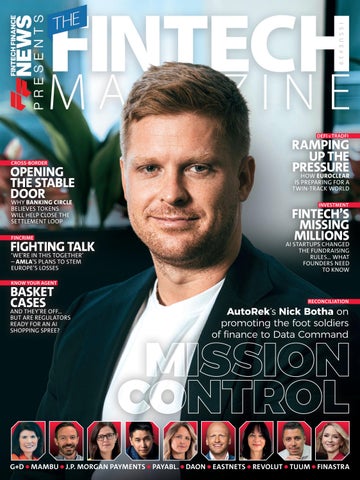
I S S U E #39 DEFI v TRADFI
CROSS-BORDER
OPENING THE STABLE DOOR WHY BANKING CIRCLE BELIEVES TOKENS WILL HELP CLOSE THE SETTLEMENT LOOP
FINCRIME
FIGHTING TALK ‘WE’RE IN THIS TOGETHER’ – AMLA’S PLANS TO STEM EUROPE’S LOSSES
RAMPING UP THE PRESSURE HOW EUROCLEAR IS PREPARING FOR A TWIN-TRACK WORLD INVESTMENT
FINTECH’S MISSING MILLIONS AI STARTUPS CHANGED
THE FUNDRAISING RULES… WHAT FOUNDERS NEED TO KNOW
KNOW YOUR AGENT
BASKET CASES AND THEY’RE OFF…
BUT ARE REGULATORS READY FOR AN AI SHOPPING SPREE?
RECONCILIATION
AutoRek’s Nick Botha on promoting the foot soldiers of finance to Data Command
G+D ● MAMBU ● J.P. MORGAN PAYMENTS ● PAYABL. ● DAON ● EASTNETS ● REVOLUT ● TUUM ● FINASTRA
THE FINTECH MAGAZINE ISSUE#39
6
RECONCILIATION
No more yesterday’s numbers
Slapping AI on a process that’s fundamentally flawed by poor data just speeds up bad results. AutoRek’s vision for intelligent financial control tackles the problem at source
10
NEOBANKING
Access All Areas
Five years after first applying, Revolut is finally a fully fledged UK bank. Its UK CEO discusses why the next chapter is about becoming indispensable to customers, including a new target – the entrepreneurial nouveau riche
12
PARTNERSHIPS
Lending a hand
Finastra’s leading platform for managing, servicing, and automating commercial and corporate loans already facilitates much of the world’s institutional credit arrangements. But it’s about to take on an even bigger role
15
SECURITY
Fraud rings don’t work in siloes, so why do banks?
19
FINCRIME
No place to hide
Can the EU’s new Anti-Money Laundering Authority bring harmony to the fragmented fight against fincrime?
22
EUROPE
Is Wero the euro’s hero?
payabl. was among the first PSPs to join the Eurozone’s new wallet and A2A rail as a direct acquirer. In unifying payment experience across the bloc, it’s helping to rewrite history
24
CROSS-BORDER
Now is the time
While stablecoins still only represent a fraction of the world’s B2B payments, Banking Circle is getting ahead of the curve by integrating them into its BC-NOW instant settlement service
26
PAYMENTS ARCHITECTURE
A new rail journey
There’s fresh momentum behind rebuilding the UK payments architecture. And Lloyds Banking Group is fully on board, especially with the collaborative approach being taken
Criminals thrive when data is in the dark. Eastnets offers one solution to help shed light on billions of dollars leaking out of the banking system every year
19
6 FFNEWS.COM
THEEDITOR’SVIEW It’s difficult to know how to introduce this issue, given the panoply of providers featured in it. Wait. That IS how I introduce it! Because, if there is one message that echoes through the 76 pages of interviews with PSPs, digital identity experts, accountants, Tier 1 banks and challengers, core architecture and network providers, it’s ‘you do you and partner with the best for the rest’. Collaboration to drive out complexity is a theme we’ve explored before, of course. But in the 10 years of The Fintech Magazine, the challenges don’t seem to get any easier. If anything, most of the industry has accepted that change is now the new normal as the future and the present find a way to co-exist. It often makes sense from an operational and a financial perspective to share the burden, allowing you to double down on the things that define your business. Of course, that does involve a lot more effort in arranging complex pre-nups and due diligence. Maybe that’s something we should devote more time to in the next issue. Meanwhile, can I draw your attention to two very relatable and super-topical pieces of content on completely different themes: how AI has changed the funding landscape for fintech founders (p65), and a thoughtful and eloquent commentary on online safety from egaming entrepreneur Karolina Pelc (p68). Sue Scott, Editor This issue’s spinetingler is a quote from former Bank of England Governor, now Prime Minister of Canada, Mark Carney’s speech to the European Parliament about closer alignment in September 2026. ISSUE 39 THEFINTECHMAGAZINE 3
FINTECH
MAG A Z I N E
28
60
RETAILING
A healthy dose of realism
Banking isn’t the only essential service struggling to maintain a physical presence on the high street. Could it learn anything from pharmacy?
30
ECOSYSTEMS
The architects of trust
Freedom Bank believes the future of banking belongs to those building customer-centric digital ecosystems – which is exactly what it’s done
34
SECURITIES
Converging on co-existence
When it comes to tokenised securities and other digital assets, a common view is emerging: they need to work inside the system we’ve got, not run in a parallel universe. We spoke to Euroclear’s Isabelle Delorme about cohesion, co-existence, and collaboration
36
KNOW YOUR AGENT
When the agents go shopping
G+D and Daon partnered to raise the bar on KYC. The next challenge is KYA. But while technology companies are driving forward, are regulators keeping pace?
40
FOCUS ON RBI
Banking (all of) Europe
A whole host of technical, cultural and political challenges can make life difficult for a bank that straddles this vast land mass. But, as Matthias Dekan from RBI explains, wherever customers are, they want remarkably similar things
44
LENDING
Mortgages minus the monolith
Technology that does the ordinary while freeing people to do the extraordinary was what Mambu, nCino and Publicis Sapient came together to provide for specialist UK lender OSB Group and its hundreds of intermediaries
48
EUROPEAN DI WALLET
Knowing me, knowing you
Daon and G+D are working together to help banks prepare for the introduction of the EU DI Wallet next year. Here, they tell us why it’s such a big moment for European payments
34 50
PAYMENTS
Navigating change safely
The world can feel like a very small and unpredictable place if you’re a business engaged in global trade. So how helpful is technology in steering them through troubled waters?
52
CORE BANKING
A team effort
Choosing the right core banking provider is about more than the tech. In Tuum, new UK challenger LHV Bank found the right fit
57
CROSS-BORDER
The new correspondent banking system Tokenisation and DLT are not incompatible with using the established network of intermediary banks in wholesale cross-border settlement. And Deutsche Bank very much has a foot in both camps
60
INTELLIGENT CORE
Raising a bank’s IQ
Where and how a bank’s data is stored has a big impact on how smart its AI can ultimately become. Mambu Insights and its underlying Mambu Data Lake work together to create intelligence at the core
68 65
INVESTMENT
Fintech’s fundraising fallout… and why there’s reason to be cheerful As the investment landscape rapidly shifts in the age of AI, Thomas Easterby reflects on the stage of UK fintech innovation and whether challengers are getting all the support they need to start, scale and stay here
68
POINT OF VIEW
The future of online safety isn’t age verification. It’s trust Founder, investor, mentor and author Karolina Pelc argues from experience in the online gaming industry that gatekeeping digital services can’t ever be a one-and-done
72
ACCOUNTING
The subledger solution
Has the GL had its day? No, but if you want to future-proof your finance team and give them access to granular, real-time information, a new accounting architecture is the way to go, say SAP Fioneer and EY
THEFINTECHMAGAZINE2026 EXECUTIVE EDITOR Ali Paterson
EDITOR Sue Scott
GENERAL MANAGERS Tom Dickinson Chloe Butler
ART DIRECTOR Chris Swales
CHIEF REVENUE OFFICER Shaun Routledge
SUB EDITOR Frank Tennyson PHOTOGRAPHER Jordan Drew
PARTNERSHIP MANAGER Georgia Stubbs PRODUCTION TEAM Tom Dickinson Matthew Burls Dylan Young
ISSUE#39 ONLINE EDITOR Lauren Towner VIDEO TEAM Louis Jean La Grange David Hill Ethan Peck
FEATURE WRITERS Hannah Duncan David Firth l Tracy Fletcher James Grant Martin Heminway Natalie Marchant Martin Morris Charlotte Scott Sue Scott l James Tall Frank Tennyson
The Fintech Magazine is published by FF NEWS LTD. Pantiles Chambers 85 High Street Tunbridge Wells, TN1 1XP
CONTACT US ffnews.com DESIGN & PRODUCTION www.yorkshire creativemedia.co.uk
IMAGES BY www.istock.com PRINTED BY Everything Creative "PROUDLY NOT ABC AUDITED"
All rights reserved. No part of this publication may be reproduced, stored in a retrieval system or transmitted in any form or by any means, electronic, photocopying or otherwise, without prior permission of the publisher and copyright owner. While every effort has been made to ensure the accuracy of the information in this publication, the publisher accepts no responsibility for errors or omissions. The products and services advertised are those of individual authors and are not necessarily endorsed by or connected with the publisher. The opinions expressed in the articles within this publication are those of individual authors and not necessarily those of the publisher.
4 THEFINTECHMAGAZINE ISSUE 39
FFNEWS.COM
Digital finance for AI-driven economies
28 September – 1 October Register now on Sibos.com
No more yesterday’s numbers RECONCILIATION
Slapping AI on a process that’s fundamentally flawed by poor data just speeds up bad results. AutoRek’s vision for intelligent financial control tackles the problem at source
Reconciliation has long been an unglamorous but essential part of financial services – a back-office function associated with spreadsheets, manual checks and retrospective validation. For decades, innovation happened elsewhere.
But with financial institutions now operating across a complex web of real-time payment networks, Cloud platforms, embedded finance ecosystems and emerging digital asset markets, that model is no longer viable. Transactions pass through multiple organisations, jurisdictions and technologies before settlement. Data volumes are exploding, settlement windows are shrinking, and regulators increasingly expect firms to demonstrate not only the accuracy of their records but the governance behind them. In this environment, reconciliation is shifting from a hidden operational necessity to a strategic enterprise capability. “Traditionally, reconciliation has had
A higher purpose: AI can accelerate control, but only when the data underneath it is fit for purpose 6 THEFINTECHMAGAZINE ISSUE 39
FFNEWS.COM
very manual processes built around it,” says Nick Botha, VP of Payments and Retail Banking at AutoRek. “That is why it has been considered almost a cost centre. What’s changing is the power of automation and technology brought into these functions.” Automation reverses the traditional operating sequence. Instead of skilled employees spending hours collecting data, reformatting files and preparing information for analysis, modern systems ingest, condition and reconcile data continuously, so teams can properly investigate the exceptions that matter. “This means they are now seen as strategic teams driving true value for executives and senior management,” explains Botha. The operational gains can be dramatic. Botha recalls a recent implementation where AutoRek replaced a legacy reconciliation product, which meant a process that previously required 48 hours could be accomplished in just 12 minutes. “Imagine what you could do with the additional 47 hours and 48 minutes,” he says. “That’s time being returned to key resources and subject matter experts.”
Reconciliation grows up UK-based AutoRek has spent more than 30 years in financial controls, serving institutions across banking, payments, insurance, asset management and capital markets. Today, it is repositioning itself as far more than a reconciliation provider. “We do reconciliation very well,” Botha says. “But we identify ourselves more as an end-to-end financial data control platform.” This broader definition encompasses data management, transformation, reconciliation, exception handling, management information and the processes that follow the identification of a discrepancy. “We don’t want to add value only as a matching engine,” he explains, “but as a full end-to-end financial controls partner.” This shift reflects the changing demands facing financial institutions. Real-time payments, stronger FFNEWS.COM
safeguarding rules, operational resilience requirements and regulatory concern over data quality are all increasing the importance of traceable, well-governed financial information. Trusted data is becoming both a regulatory requirement and a strategic asset. Despite the industry’s focus on AI and modern infrastructure, Botha argues that the biggest obstacle is more fundamental. “Data quality and fragmented data are, for me, the biggest challenges in financial services today,” he says. “Financial services have been built up over time around poor data quality, and the processes that follow have been tailored to deal with that poor quality to deliver a result.” Legacy systems contribute to the problem, but replacing technology does not automatically resolve years of inconsistent definitions, duplicated records, incomplete fields and operational workarounds. AI deployed on such foundations may simply reproduce those shortcomings at greater speed.
Data quality and fragmented data are, for me, the biggest challenges in financial services today Nick Botha, AutoRek
AutoRek’s answer is a data-agnostic approach, designed to ingest information in its source format, regardless of volume, frequency or complexity. Its transformation capabilities condition that information before matching and analysis begin. “We can work with the data coming from these sources in its raw format,” Botha says. “Clients can transform it into the most comprehensive version of itself before the analysis and reconciliation process starts.” The intended outcome is not just a higher automated match rate. More highly detailed and consistent information makes exceptions easier to investigate, improves reporting accuracy and helps teams identify why
an issue occurred rather than merely confirm that one exists. “Being able to do so much more with data translates into time efficiency gains, a more granular view and more accurate reporting.” Artificial intelligence is accelerating this transformation. AutoRek’s ARIA capability supports reconciliation development, exception analysis, data interpretation and management reporting. “In the last 12 months we have seen a dramatic shift,” Botha says. “AI has moved from a nice-to-have to an expectation.” Yet financial institutions want AI’s benefits without surrendering security, traceability or control. “They expect us to have considered the sensitivity of their data, their security requirements and their regulatory obligations,” he says. “We have not just slapped AI onto the platform because it is something everyone is asking for.” This caution is particularly important when it comes to agentic AI. In regulated financial processes, giving AI the unrestricted agency to act on its findings could create governance, accountability and auditability concerns; a sensitive area where Botha believes expert human oversight remains essential. “Would you want a piece of AI to make decisions on your behalf or would you like AI to put you in a position to make a very effective decision very quickly?” Botha asks. AutoRek’s emphasis is firmly on the second model. “The objective is not to let ARIA become completely autonomous,” he says. “It is about giving people powerful information to make effective decisions quickly.” Existing permission structures and controls apply to the AI functionality, allowing firms to configure its use according to their operating model and risk appetite. Botha is sceptical of confident long-term forecasts for AI. “If somebody is giving you a five-year prediction, I think they will be wrong,” he says. “The rate of change makes that unrealistic.”
Nick Botha, Vice President of Payments and Retail Banking at AutoRek
ISSUE 39 THEFINTECHMAGAZINE 7
FINTECH
MAG A Z I N E
But he identifies several areas where it is already creating value: analysing data, generating matching logic, supporting exception management, producing management information and accelerating the construction of new reconciliations. “What is particularly exciting is building new reconciliation processes extremely quickly,” he says. “You can go from a blank slate to a fully automated, very complex, high-volume reconciliation in days rather than months.”
Keeping control in real time The requirement for continuous control is becoming particularly clear in payments and digital finance. “The software you use has to match the frequency and volume of the services and products you are offering,” Botha says. A firm providing real-time payments can’t rely on a control process that reveals discrepancies days later. AutoRek is embedding reconciliation into straight-through processing environments, receiving and exporting data through APIs and other integration mechanisms. “Embedding the application into the process provides real-time insight and allows investigation activity to happen in real time,” Botha says. “Otherwise, you are offering real-time payments to a client but establishing that there are gaps or issues on a T+1 basis, T+2, or sometimes even a week later.” The same principle could help firms explore tokenised assets, digital currencies and new payment models, enabling them to launch products they previously considered too difficult or risky to support. “We want to support all of the activity our clients are looking to undertake, not just what they are doing today,” Botha says.
Building for scale AutoRek’s ability to process high transaction volumes depends partly on its relationship with Microsoft and the Azure Cloud platform. “Our clients are processing billions of transactions,” Botha says. “The relationship we have with Microsoft Azure provides the infrastructure that supports and enhances what our application can do.” AutoRek teams have also worked alongside Microsoft specialists during the development of ARIA. “There is a reputational advantage,” Botha adds. “It provides clients with comfort that they are receiving the best technology, security and performance.” The partnership forms part of a wider expansion strategy. AutoRek has increased its international presence, including in the United States, and sees payments regulation and safeguarding as major areas of opportunity. Botha also points to the convergence of traditional finance and newer payment businesses, with established institutions seeking partnerships, acquisitions and renewed access to markets once ceded to challengers. AutoRek has grown by approximately 30 per cent year-on-year for the past four years and
We’re not just a piece of software; we’re a partner, asking clients to let us walk with them on their journey Nick Botha, AutoRek
intends to maintain that trajectory. “To achieve it, we need the right framework, partners, resources and support,” Botha says.
The human element “We’re not just a piece of software,” he adds. “We’re a partner, asking clients to let us walk with them on their journey.” That begins with reconciliation, but its destination is broader: an operating model in which data is continuously controlled, exceptions are identified while they still matter, and finance teams help shape strategy rather than simply explain yesterday’s numbers – because automation does not remove the need for people, rather it changes the work they perform, insists Botha. Financial control teams will become less dependent on large numbers of employees carrying out spreadsheet-based preparation. “The skills will shift from hiring people who are effective at building expressions in Excel, towards skilled subject matter experts who understand the business processes, can analyse the results and make recommendations,” he says. “The human still has a key role. The shape of that role changes because the machines are doing the heavy lifting.” And he believes this transformation will happen far sooner than many institutions anticipate. “The world of financial operations is going to look and feel completely different,” he says. “In two years, or perhaps even one, I do not think these processes will be run in the same way as they are today.” AutoRek intends to be close to the centre of that change, combining three decades of financial control knowledge with AI, Cloud infrastructure and an increasingly global presence.
Making it count: Machines may handle the numbers, but people still need to understand what they mean 8 THEFINTECHMAGAZINE ISSUE 39
FFNEWS.COM
Taking off: Revolut’s UK banking licence marks the end of one journey and the beginning of a much bigger ambition
ACCESS ALL AREAS NEOBANKING
Five years after first applying, Revolut is finally a fully fledged UK bank. Its UK CEO discusses why the next chapter is about becoming indispensable to customers, including a new target – the entrepreneurial nouveau riche When the Prudential Regulation Authority lifted the last restrictions on Revolut’s UK banking licence in March 2026, it ended one of the longestrunning sagas in British fintech. The company applied in January 2021, received a restricted licence in July 2024, then spent a further 20 months in ‘mobilisation’, a phase most new banks clear in 12. The protracted timeline reflected Revolut’s scale. Now valued at 10 THEFINTECHMAGAZINE ISSUE 39
Francesca Carlesi, Chief Executive Officer at Revolut UK
$75billion, with 14 million UK customers and more than 80 million worldwide. It wasn’t a case of just building a bank, but represented the transition of a globally significant institution into a new regulatory framework. For Revolut UK CEO Francesca Carlesi, the milestone was pivotal, both personally and professionally. Appointed in November 2023 after senior roles at Deutsche Bank, Barclays and McKinsey, and having co-founded and run Molo, the UK’s first fully digital mortgage lender, she arrived declaring Revolut ‘the future of digital banking’. “Receiving the banking licence was a watershed moment for all of us, and my personal highlight,” she says. “I’ve been in banking all my life, one way or another, and it doesn’t happen often that you go through the journey of building a bank from scratch. It’s a really big milestone for the whole company; not only for the UK, but for Revolut globally.” Founder Nik Storonsky had become increasingly frustrated with UK regulators, publicly branding them ‘extremely bureaucratic’ and musing about listing the most valuable European fintech
startup on Nasdaq rather than the London Stock Exchange – which reportedly prompted the UK Business Secretary to seek an urgent meeting. Carlesi’s arrival marked a change of register – less megaphone, more methodical engagement. She is diplomatically silent on the frustrations of those years, preferring to talk about what the outcome signals. “The UK is our home country. It’s where Revolut was born, and it’s still our single largest market globally,” she says. “Until we had the banking licence, we couldn’t launch a lot of the products you can only offer if you’re a bank. “The UK regulators represent the global standard for regulation. The fact that we are a bank in our home country, and our home regulators are supporting this development, unlocks global growth.” Days before the UK approval, Revolut filed for a US banking charter, and received conditional authorisation in September 2026.
From travel card to ‘top of wallet’ The prize is in plain sight. Revolut has spent a decade as ‘the app people love for holidays and foreign exchange’. Revolut now wants to mature into ‘the FFNEWS.COM
only bank you’ll ever need’. FSCS-protected current accounts are rolling out, with lending to follow. The question underneath, though, is one every neobank faces: how many customers actually use it as their main account? Revolut has 14 million UK customers (80 million globally) and for most of those users it likely remains a travel tool rather than the account their salary lands in. Fintech commentator Chris Skinner, in a broadly admiring essay on the company last month, put it succinctly: many users view Revolut as a secondary account, and the challenge is to convert them into customers who trust it with their salaries, pensions and long-term financial lives. Carlesi’s response to that is to focus on making Revolut top of wallet. “We look a lot at this concept of ‘top of wallet’: how many transactions, how many activities, how many products people engage with at Revolut. We have a lot of metrics at Revolut, because we are very data-driven, but you have to distinguish the forest from the trees,” she says. “What I’m really looking at is customer engagement throughout the life cycle of any financial transaction. “This is not the banking of the ’80s. What matters is being top of mind whenever people do any financial activity. When you buy something, you pay with a Revolut card. When you travel, it’s a Revolut card. If you need a loan, you come to Revolut. Being top of wallet means being front and centre, embedded in customers’ financial lives.”
Wealth first, mortgages later If engagement is the metric, the wealthy are now the target. In May, Revolut’s trading arm secured a Variation of Permission from the UK’s Financial Conduct Authority (FCA), allowing it to offer advisory and managed portfolio services alongside execution-only investing. Victoria Laffey, Head of Operations at Revolut Trading, called the permissions ‘the missing piece’, uniting investment, advisory and portfolio management under one roof. Today, high net worth status in the app is essentially a self-certification tick-box (£100,000 of annual income or £250,000 in net assets) unlocking products such as crypto Exchange-Traded Notes. The ambition, as The Banker and others have reported, is far grander: a full private banking service, expected later this year, for clients with upwards of £500,000, at a moment when incumbents such as Coutts are raising their thresholds into the millions. Carlesi frames the move as classic Revolut FFNEWS.COM
opportunism: finding the underserved segment and going after it. “We spotted some time ago that there is a very big potential market of wealthy individuals who are completely underserved by the current banking system,” she says. “Legacy banks have been gradually raising the bar on what they classify as private clients. So today there’s a big segment of customers who are really wealthy, maybe from entrepreneurial wealth, and they don’t find the right services because they are below the thresholds of the big banks. “That’s where we want to go: professional wealth management for high net worth individuals, but done in the Revolut way.” Notably absent from the short-term roadmap is the product Carlesi knows best. Before Revolut, she co-founded and ran the digital mortgage lender Molo. But Revolut’s immediate future isn’t in the mortgage market. “I have a little bit of a bias for mortgages, but this is not coming soon in the UK – it’s not on our roadmap,” she says. “It’s a basic, very important financial need, but we have a lot of other things to do, so we need to prioritise.
We spotted some time ago that there is a very big potential market of wealthy individuals who are completely underserved by the current banking system Francesca Carlesi, Revolut CEO
We will definitely launch into simple lending, credit cards and personal loans, but mortgages will be further away.”
Trust and technology On the topic of AI, Revolut’s focus is not on chatbots but on controls. That is no accident. Revolut’s growth has been shadowed by regulatory friction on the continent, including fines from the Bank of Lithuania, its EU home supervisor, and in April penalties totalling more than €11.5million from Italy’s competition authority, in part over how it communicated with customers whose accounts had been suspended or restricted. Revolut was appealing the decision this summer, and a spokesperson at the time said the company remained ‘confident that our communications are clear and transparent’
and that account reviews existed to protect customers. Despite these bumps in the road, the direction of travel is clear: as Revolut becomes a bank everywhere, it will be supervised like one everywhere. “Being a bank is all about getting customers to trust you, and trust is about controls, capital and governance,” says Carlesi. “The line between being a bank and being a technology company is blurred. The successful banks of the future will maintain the discipline of banking controls while being powered by leading-edge technology. “We’re moving from a world where the question was ‘is technology lowering your controls?’ to one where technology is a key enabler, a necessity. There is no way any more you can give customers the safety they deserve using manual controls and periodic reviews. Think of AI-driven fraud detection, sanctions screening and onboarding.” Fraud, the UK’s most prevalent crime against individuals, is the proving ground, and Carlesi offers a striking statistic: “Out of our 10,000-person workforce, roughly a third is working in financial crime, compliance and controls. That’s quite a big chunk for a company that was born as a technology company.” The approach, she says, is precision rather than blanket caution. “Instead of blocking everybody, no matter what, we detect very accurately, based on behavioural data, when a fraud is happening. We give specific alerts and create specific friction there. Where there is no reason to believe there is fraud, we give the best experience we can.”
The decade ahead Skinner’s essay ends with a prediction that Revolut will be ‘Android for finance’ by 2036: 300 million customers, a trillion-dollar valuation, invisible and everywhere. It’s a claim that even admirers might think a little over-zealous. But his diagnosis of how the company might get there rings true – it innovates less like a bank and more like a venture capital firm, funding dozens of internal startup bets, scaling the winners and quietly killing the rest. A company that began as a cheap travel card is now a licensed bank in its home market, with a regulator-approved runway into lending and a credible claim on the wealthy clients that incumbents are quietly abandoning. The intent is unmistakable: to prove that the fastest-moving company in European finance can also be one of the most controlled. “Innovation and trust are not opposites any more,” Carlesi says. “They are massively complementary.” ISSUE 39 THEFINTECHMAGAZINE 11
The right fit: Finastra is actively seeking fintech partners as it expands its Loan IQ platform
PARTNERSHIPS
Finastra’s leading platform for managing, servicing, and automating commercial and corporate loans already facilitates much of the world’s institutional credit arrangements. But it’s about to take on a even bigger role Lending systems can be slow, rigid, and costly to run. Customers – whether consumers or cash-starved small businesses – expect instant, mobile-first loan approvals and are increasingly turned off by manual data entry and multi-day decisioning. Upgrading their capabilities allows lenders to meet those customers’ expectations, cut costs, harness the plethora of data in the maturing open banking environment to enhance risk assessments and, ultimately, keep pace with agile new entrants. Recent data 12 THEFINTECHMAGAZINE ISSUE 39
Rob Downs, Head of Product, Corporate & Syndicated Lending at Finastra
from the British Business Bank revealed that challenger and specialist banks now account for 60 per cent of gross lending, outperforming the UK’s big five banks for the fourth year in a row. More and more institutions are turning to modern Cloud infrastructure for lending to compete on cost, launch loan products more quickly and drive faster decisioning, says Rob Downs, Head of Product, Corporate and Syndicated Lending at global financial software giant Finastra, which provides mission-critical technology to thousands of financial institutions. But it’s a considered transition because security is also a core concern. “It’s no longer about ‘Cloud’s cool, let’s save some TCO (total cost of ownership) on physical hardware. It’s far from that these days,” says Downs. “A famous hack of a tech company in 2011 compromised data for millions of users. That incident woke a lot of people
up to the fact that just because you have a boundary and a firewall, that doesn’t mean you’re safe.” Cloud providers like Microsoft Azure and Amazon Web Services have responded to growing cyber threats by increasing their emphasis on security measures. “The more data you put on the Cloud, then the more that data has to be secure. As the hyperscalers have grown, they’ve concentrated on threats and vulnerabilities and their front door is as tight as anyone can get it,” says Downs. “Security is as important to Finastra as to the hyperscalers. It is considered table stakes today, and something we keep at the forefront of our product development.” Finastra operates a Cloud-first strategy and hosts many of its solutions on Microsoft Azure. This includes Loan IQ, a software platform relied upon by the world’s banks and financial institutions to manage commercial and corporate lending operations. Loan IQ increases FFNEWS.COM
the speed of decisioning and onboarding by automating workflows, using open APIs for seamless data flow and integrating tools like optical character recognition (OCR) to eliminate manual data entry.
a term,” says Downs. “What we’re really doing is just enhancing the Loan IQ product to better handle the emerging capabilities that are becoming more common across a range of syndicated and private credit transactions.”
Covering all corners of the market
Bringing fintechs into the fold
“Loan IQ has been in the market since the mid-1990s and has grown to become a market-leading loan servicing platform,” says Downs. “Its origins lie in servicing highly complex syndicated loans, featuring diverse lender groups and huge amounts on the notional side.” According to Finastra’s data, Loan IQ is now used by 21 of the top 25 syndicated lenders globally and processes roughly 70 per cent of the world’s syndicated loan volume – but over the years it has evolved to take up a larger role in bilateral lending, where a single lender provides a loan directly to a single borrower under one agreement. To facilitate this shift, Finastra introduced Simplified Servicing, a targeted extension built on top of the core Loan IQ platform. It uses Loan IQ’s robust calculation engine while providing dedicated workflows for high-volume SME loans. “Complex lending is typically very high value, but relatively low volumes, whereas bilateral lending is relatively low value but very high volumes,” says Downs. “Because Loan IQ was born in complex lending, it’s a very rich system. But if you’re processing high volumes of low value, simple loans, you just want to focus resources on the exceptions, not every single loan. “Simplified Servicing provides users with a much simpler journey through the application; a different path where they only see the data they need to see. It’s about maintaining the brainpower and engine of Loan IQ but presenting it differently to the subset of our user base who specialise in bilateral loans.” At the same time, there have been developments at the opposite end of the corporate lending spectrum, where complex private credit structures are diversifying and fragmenting into a wider array of distinct options. Finastra’s Loan IQ specialised credit capability is an advanced module designed to manage these non-standard, bespoke, and complicated debt structures – such as payment-in-kind (PIK) processing, club deals, and unitranche debt facilities. “We were initially going to call it Private Credit when we were moving forward with the programme, but we realised that’s too narrow
With Loan IQ widening its footprint, Finastra is keen to engage with fintech partners to strengthen its offering. “There’s a plethora of fintechs out there, providing niche solutions – whether that’s OCR tooling or a calculation engine,” explains Downs. “You only need to walk around the exhibition floor at Sibos to see how many fintech booths there are now. Our strategy is to move Loan IQ from a product to an expanding ecosystem, so we’re engaging with fintechs to bring in their specialisms.” If Loan IQ is the beating heart of the ecosystem, then Finastra’s Loan IQ Nexus integration layer is the connective tissue that helps the company to seamlessly link up with its fintech partners via open APIs. It’s fundamentally different from older APIs because it acts as an orchestrated workflow automation and onboarding layer, rather than just a traditional data-fetching tool. “Previously, we were putting an inordinate amount of resources into training a fintech in how our product worked in order for them to integrate with it,” says Downs. “It felt like you needed a PhD in the product, and there were broader challenges and risks associated.
FFNEWS.COM
Our strategy is to move Loan IQ from a product to an expanding ecosystem, so we’re engaging with fintechs to bring in their specialisms “Nexus is a layer that allows fintechs to engage without requiring Finastra specialists to train them. It means that our choice of resource allocation is never a bottleneck and fintechs benefit from an easier, self-service integration as the ecosystem grows.” Nammu21’s document intelligence technology is one of the latest fintech propositions to integrate directly with Loan IQ via Nexus, automating the processing of complex credit documents. Bringing the two technologies together has helped transform credit agreements in the US, populating Loan
IQ with structured data that eliminates the manual interpretation and data entry that has historically slowed deal onboarding and introduced operational risks. In April, Finastra announced a partnership with Marketnode. The collaboration meshes Marketnode’s AI-powered intelligent document automation with Loan IQ to enable financial institutions across Asia-Pacific to digitise the credit agreement onboarding process.
An eye on emerging technologies Finastra is actively exploring how AI can be further harnessed in lending. The company launched its centralised AI Centre of Excellence in March to coordinate AI initiatives, share best practices across the business, and accelerate product innovation. “Where we’re seeing success is by starting with a targeted, small idea and then layering on solutions that are in line with evolving governance and regulatory considerations,” says Downs. “We’ve seen how AI can be applied to digest complex credit documents, and another example that comes to mind from another area of our business is OperatorAssist, our proprietary Gen AI tool that helps financial institutions triage payment failures. “AI is changing,” observes Downs, “both in terms of the technology but also knowledge. When AI first appeared, nobody had the right skills but now we’ve got people leaving university with the skills required to adopt it ethically and effectively.” Finastra is also looking towards tokenisation, which Downs describes as a ‘re-emerging frontier’. “Ten years ago, there was a lot of talk about blockchain and DLT,” he says. “However, loans are very hierarchical and structured instruments, and in the early days the tech didn’t scale well to such a complex area.” It’s fair to say it has now caught up. Global banking giants, including JPMorgan, are backing the potential of private blockchains and permissioned DLT to speed up loan processing with atomic settlements while reducing the administrative costs and improving transparency. “Organisations like the Loan Market Association are making great strides when it comes to re-engaging with the banking sector in this space,” adds Downs. “There are still legal and regulatory hurdles to overcome of course, but the industry will get there.” By keeping a finger firmly on the pulse of the latest developments and adopting a collaborative approach with the fintech community, Finastra is keeping the financial institutions it serves at the forefront of lending innovation. ISSUE 39 THEFINTECHMAGAZINE 13
Fraud rings don’t SECURITY
work in silloes, so why do banks?
Criminals thrive when data is in the dark. Eastnets offers one solution to help shed light on billions of dollars leaking out of the banking system every year 2025 saw the dramatic USA arrest of 13 so-called call centre employees. Together, they scammed more than $5million from 400 unsuspecting grandparents, aged 84 on average. Complete with motivational ‘make every call count’ mantras, target boards and scripts, the teams rang unsuspecting victims posing as their grandchildren in need of bail. The amount of money coerced ranged from $3,200 to $25,000 per call, according to a whiteboard police found on the wall. Clearly, this is fraud. Impersonation fraud to be exact. In this case, the stolen funds were collected as cash (often with scammers taking their elderly victims to the cashpoint). Runners or money mules then deposited the funds into various accounts, known as layering, before moving them through the banking system and, ultimately, into the hands of an alleged fraud ringleader in the Dominican Republic. More commonly, money is coerced from victims electronically. Once a bank customer realises they’ve been tricked and reports it to their bank, a fraud team leaps into action. But while staff are busy inputting the details, it’s often already FFNEWS.COM
too late. The money is being quietly dispersed across potentially hundreds of crypto and fiat accounts in small amounts (smurfing), making it hard to track and almost impossible to recover. At this point, though, the bank’s anti-money laundering team don’t even know the crime has happened because, in the siloed data environment in which many banks still operate, departments don’t share information. While criminal money is zipping across the world in seconds, the bank hasn’t even started to join the dots. Banks are aware of this,
With instant payments moving in seconds, it’s vital to have one risk view that allows banks to make decisions equally fast Baiba Miezere, Group Product Development Director, Eastnets and there is a growing trend to unify segregated fraud, AML and sanctions screening teams into AFC (anti-financial crime) teams or FRAML (fraud and AML) teams in an attempt to stop fraudulent transactions being authorised.
Hacène Kaci, Pre-Sales Consultant at Eastnets
Baiba Miezere, Eastnets’ Group Product Development Director
Unifying staff is one thing; when it comes to unifying the data, though, there are no easy choices. It often requires surgery to the core or a major data migration exercise, both of which are costly and carry their own risks. Eastnets, a payment and compliance solutions provider, offers another alternative – an orchestration layer that screens transactions to reduce what is currently a cripplingly high number of false flags, makes intelligent predictions, and surfaces information from vaults of disparate data to identify potential fraud-busting connections in real time. It could help stop a crime in its tracks, or at the very least, give banks and law enforcement a sporting chance of hunting down those behind it. “With instant payments moving in seconds, it’s vital to have one risk view that allows banks to make decisions equally fast,” says Baiba Miezere, Group Product Development Director at Eastnets. The company’s new FinCrime Intelligence Platform connects a range of tools that work across KYC/KYB, AML transaction monitoring, fraud prevention, name and transaction screening, giving everyone eyes on a potential crime. ISSUE 39 THEFINTECHMAGAZINE 15
FINTECH
MAG A Z I N E
Data convergence is key, says Hacène Kaci, Pre-Sales Consultant at Eastnets: “We see a lot of data silos in banks where they have onboarding, ongoing due diligence, fraud, screening and transaction monitoring teams working separately.” But beyond that, the industry needs to ‘get smarter at working collectively on sharing that data’, he adds.
Frictionless protection Research from Avaloq found that some financial professionals have as many as 15 different applications open at the same time as they try to conduct compliance checks across multiple data stacks in one organisation. “They spend 90 to 95 per cent of their time switching between systems to collect data and build evidence logs instead of making a decision,” says Miezere. “Our FinCrime Intelligence Platform brings data from different systems – our own or any other vendor’s – into one view. “Let’s assume that in AML we’ve detected a fraud ring working globally. And now let’s assume that in our bank, we have identified authorised push payments frauds among, typically, our vulnerable older customers. We link that information together and give that intelligence to fraud prevention.”
more, they need to find ways to share that data across regions, without breaching any national or supranational regulations, like local politically exposed persons lists, data privacy laws or the constantly updating sanctions lists, driven by rapidly changing geopolitics, triggering massive money movement, not all of which is legitimate. “Sanctions change overnight,” says Miezere. “Our World-Check On Demand engine updates sanctions lists every few hours and not only rescreens that data but also provides automated fuzzy logic matching, irrespective of which country that person is sanctioned in. “It’s very important that banks have that flexibility, speed and accuracy. We help banks to navigate flexibly by combining different data sets behind different lists. You want a local list? Here you go. You want an international list? You can combine them flexibly.” Professional fraud rings, she highlights, have global footprints bigger than most banks.
Hacène Kaci, Pre-Sales Consultant, Eastnets
The legacy conundrum Worldwide, 80 per cent of financial institutions have pinpointed legacy infrastructure and fragmented data as a major constraint to identifying and preventing fincrime. What’s 16 THEFINTECHMAGAZINE ISSUE 39
Criminals don’t work in siloes and they adapt to and around new technologies with ever-changing tactics. The democratisation of AI, for example, has seen a dramatic rise in the number of synthetic identities created. Research by LexisNexis found that 11 per cent of fraud now involves a fake identity. That figure rises to 48.3 per cent in Latin America. Other criminals have blended societal changes with AI to adapt their scams to modern times. For example, in the UK, five men were jailed in April for creating fake identities on dating websites to hoodwink singles into £2.37million-worth of romance fraud. Predictably, they then laundered the money back to themselves. Reported $579billion global losses from AI-driven financial fraud and scams last year are just the tip of a very grubby iceberg. The true cost to the global economy has been
Fighting fraud: A siloed approach no longer works
The rule here is not to have a huge amount of false positives, but neither miss designated entities Crucially, it aims to do this without creating additional unwanted friction for the customer – payments prevented unnecessarily, onerous additional identity checks. “Our fraud prevention tool combines transaction monitoring with a very efficient fraud layer using behavioural biometrics,” explains Miezere. “It’s very challenging because a bank can’t add friction, neither operationally nor from a customer experience point of view.” Kaci agrees: “The rule here is not to have a huge amount of false positives, but neither should you miss designated entities. We help financial institutions get that balance right by providing the tools to screen and also to reduce the false positives, by using either a rule-based approach, whitelisting, or AI.”
Rise of the machines
One professional fraud ring, for example, targeted more than a million victims across 121 countries with demands for E-ZPass toll payments. It amassed more than $1billion globally, using government impersonation scams and sending 330,000 phishing texts a day. Finding a common denominator can be extremely helpful in unravelling such seemingly overwhelming cases. Unleashed from the false positive mountain by a system that scans using biometric and behavioural markers, bank staff using Eastnets’ FinCrime Intelligence Platform can focus on contextualising the data insights, says Miezere. “Our artificial intelligence solution helps to identify gaps. Then it tries to identify patterns sitting among different layers,” she adds. “It makes intelligent links between different systems and also across different countries. “With instant payments moving in seconds, it’s very important that we have that one risk view that allows banks to make decisions equally fast, using auditable, compliant, AI solutions.”
estimated at closer to $3trillion, and banks and their customers are not the only victims. In South East Asia alone, it’s believed that 300,000 people have been trafficked into scam compounds where they are imprisoned and exploited. Scam rings have even been identified operating from within prisons and pre-trial detention centres. This is especially prevalent in Colombia, Ukraine, South Africa and Russia. Shutting down these criminal networks matters on a global financial and humanitarian scale. Banks have the skills and capacity to adapt just as fast as criminals – if they can break through the data silos, reduce false positives and screen continuously for constantly updating regulations. Their ultimate weapon, though, is collaboration. As each institution seeks to improve its own data management systems and compliance processes, they can achieve more than the sum of their parts by working together, suggests Kaci. As more criminal patterns are detected – through open data, collaboration and with AI tools – blocking fraud will become pre-emptive rather than reactive. The world of siloed data – and siloed thinking – is coming to an end. FFNEWS.COM
OUTSOURCED DEVELOPMENT
Mission-critical systems aren’t too important to outsource They’re too important to outsource badly. BBD South Africa brings deep engineering capability. The right delivery model turns that capability into trusted, governed delivery for complex financial systems. Mission-critical work needs more than access to skills. Through rightshoring, BBD combines specialist engineering capability with the governance, accountability and delivery rhythm financial services firms need to modernise, scale and support critical platforms without losing control.
BUILD DELIVERY CONFIDENCE
No place FINCRIME
to hide Can the EU’s new Anti-Money Laundering Authority bring harmony to the fragmented fight against fincrime? According to Napier AI’s 2025/26 AML Index, money laundering is thought to have drained a whopping $5.5trillion from the legitimate world economy, representing five per cent of global GDP. That’s an increase over the previous year of an amount roughly equivalent to the whole economic output of Greece. A vanishingly small proportion of these illicit profits from serious crime, trafficking and terrorism is ever seen again. The United Nations Office on Drugs and Crime (UNODC) estimates that agencies globally seize, freeze or recover as little as 0.2 per cent of it. That said, in the UK, there’s a glimmer of hope. The Home Office’s asset recovery statistics show £284.5million was subject to confiscation, forfeiture and civil recovery orders in the financial year ending March 2025, which is a 15 per cent improvement on the previous 12 months. Imagine the misery that could be prevented if that effort was scaled up across Europe. FFNEWS.COM
Simonas Krėpšta, Executive Board Member at AMLA
That is the challenge the European single system for money laundering Union’s Anti-Money Laundering prevention, able to fight financial crime Authority (AMLA) has been created to effectively but also set the scene for address. Established under the EU’s competitiveness and business growth 2024 anti-money laundering package across Europe.” and due to come fully online in 2028, Krėpšta identifies two forces AMLA has three mandates: to build driving financial crime, and neither is a single rulebook through Level 2 and decelerating. The first is technology. Level 3 technical standards for all 27 “Criminals are using it at scale,” he countries in the bloc; to supervise the says. “Fincrime is an industrial business; 40 highest-risk ‘obliged entities’ – those it’s fully digitalised, it’s cross-border, and organisations legally required to apply we see the trends are growing.” anti-money laundering (AML) and Financial fraud, he notes, is now counter-terrorist financing (CFT) among the largest predicate offences in rules, including complex cross-border Europe by value stolen. credit and financial institutions, and The second factor fanning the AML crypto-asset service providers; and flames is geopolitics. Sanctions regimes to coordinate national financial covering Russia, North Korea, Iran intelligence units. Fincrime is and others create a AMLA isn’t a toothless powerful commercial an industrial tiger. It can impose fines motivation to evade business; it’s fully them, and stablecoins of up to €10million or 10 per cent of turnover digitalised, it’s and other instruments and/or periodic cross-border, and are being used to do penalty payments, that. we see the trends exactly demand evidence, and Krėpšta accepts the are growing order unannounced estimate that financial inspections. But its first task will be to crime could account for between introduce a degree of harmony. two and five per cent of European “There are still some [policy] areas in GDP annually, with somewhere Europe where we have 27 different sets between €350billion and €850billion of rules, and money laundering is one of attempting to pass through the them,” says Simonas Krėpšta, Executive European system each year. Board Member at AMLA. “In the The problem is that technology long term, we really want to moves faster than the regulations create a comprehensive adapt to prevent it from happening. ISSUE 39 THEFINTECHMAGAZINE 19
FINTECH
MAG A Z I N E
Decentralised finance (DeFi) has become a vector for sanctions evasion and money laundering, precisely because regulators have struggled to keep pace. The Financial Action Task Force’s (FATF) latest targeted report, published in July, found that of 142 reporting jurisdictions, just 10 have actually identified qualifying criteria needed by DeFi networks for operating in their territory. Even where travel rules and compliance frameworks have been legislated for, FATF is adamant that the distance between passing a law and enforcing it remains wide enough for organised crime groups to move billions.
The lessons of history Krėpšta is keen to frame the harmonisation required as an economic advantage rather than a compliance burden. “If we create a truly harmonised single system where companies could get access to 400 million-plus clients across Europe, using the same rulebook, and the supervisory practices and guidance are much more convergent, that unlocks a lot of opportunities,” he says. The aviation industry provides the model for how this could work. Several decades ago, European air travel was fragmented along national lines. What followed is usually described as deregulation, but Krėpšta looks at it in this way: fragmentation was out-regulated, replaced with a single set of rules, and the result was a genuinely European market – one in which operator Ryanair, for instance, prospered. That’s precisely the pro-business environment Krėpšta believes AMLA can build for financial services. Research by EY and Frankfurt Main Finance, drawing on interviews with around 50 senior AML professionals across some 40 institutions, found goodwill towards AMLA. Eighty per cent believed the new package would make national financial intelligence units (FIUs) more effective, although 60 per cent also thought it strongly likely they would need to invest in new technology to meet AMLA’s requirements. Sixty-six per cent anticipated amending customer due diligence and transaction monitoring processes, and 80 per cent expected penalties to increase. That is an expensive and operationally awkward transition for firms in many cases still wrestling with systems built decades ago, so Krėpšta’s positioning of it as a route to market access rather than another supervisory stick is perhaps wise. The same study surfaces a sharper worry, though, and it is about AMLA itself rather than the firms it will supervise. 20 THEFINTECHMAGAZINE ISSUE 39
“AMLA needs to be able to upscale and hire the right people quite quickly,” the head of fincrime at one major insurer told EY. “If it does not, the whole exercise is a bit at risk.” Meanwhile, a chief compliance officer at a wealth manager wanted ‘less bureaucracy, more agility and greater communication with obliged entities, with basic criteria established from the beginning’.
Conflicting interests Underneath the rulebook, the supervision and the technical standards lies a single unresolved question, and Krėpšta names it himself. One of AMLA’s stated goals is a public-private partnership in which both sectors exchange information in real time. It is a goal, though, rather than a mechanism, and it is the same goal FATF has pursued without resolution since
institutions have identified legacy infrastructure and fragmented data as a major constraint on preventing financial crime. The operational consequence is visible in alert volumes. Napier’s index found the highest volumes of suspicious activity alerts correlated closely with those countries experiencing the biggest GDP losses. Overstretched systems let things through. “Financial criminals are like water. They look for cracks,” says Krėpšta. The cracks are not only between member states. They are inside individual institutions, where fraud, sanctions screening and money laundering teams have traditionally operated as separate functions.” Krėpšta’s answer, and the industry’s, is AI. “You can only fight against technology in the bad hands with the better technology in the good hands,” he says, citing examples of where
Perfect harmony: AMLA aims to introduce a single anti-money laundering rulebook
its Recommendations were first issued in 2012.The obstacle is a genuine collision of legitimate interests. Effective anti-money laundering requires data to move quickly across institutional and national borders. Data protection law, and the commercial instincts of banks for whom customer data as an asset, require that it does not. EY’s respondents flagged this challenge and the study’s recommendations include advocating for legal frameworks that facilitate cross-border data aggregation, including revising data protection laws. That is an enormous task, to put it mildly, but AMLA and the European Data Protection Board are now working together on Joint Guidelines on information sharing under Article 75 of Europe’s AML Regulation. From July next year, it will allow companies and professionals covered by anti-money laundering rules to share information with each other and with public authorities, within clear limits. Worldwide, 80 per cent of financial
AI has improved transaction monitoring tenfold. Indeed, Napier estimates that $3.3trillion could be returned to global economies through AI-powered AML strategies, with up to $183billion a year in compliance cost savings. Krėpšta puts the societal cost plainly. Laundering on this scale ‘distorts the fabric of social cohesion’ and reinforces further criminal investment and growth. “It’s a big problem and a growing phenomenon, so we all need to stay together.” The launch of AMLA is a significant move. Harmonising 27 rulebooks into one is real work that will make life meaningfully easier for cross-border institutions. The intractable problem, however, is sharing data across borders and between competitors fast enough to matter. It’s one that FATF has not cracked in more than a decade of trying, and AMLA inherits it intact. Will the criminals be quaking in their boots? Perhaps not yet. AMLA has until 2028 to prove the carrot of harmonisation is compelling enough to make a change. FFNEWS.COM
OPEN TO WORK? Become part of the future of payments We’re always looking for people ready to challenge the status quo. Explore our open roles. Explore our open roles.
Your career starts here:
aevi.com/work-with-us
@Aevi @aevi_payments
IS WERO THE EUROˊS HERO? EUROPE
payabl. was among the first PSPs to join the Eurozone’s new wallet and A2A rail as a direct acquirer. In unifying payment experience across the bloc, it’s helping to rewrite history Europe’s fragmented payment infrastructure comes with a price tag. It is not small. Juniper Research estimates that reconciling disconnected payment systems costs a mid-sized European merchant roughly €244,000 a year, rising to as much as €732,000 for a large corporation. Multiply that across the hundreds of payment institutions authorised under the Revised Payment Services Directive (PSD2), each helping merchants navigate a different patchwork of
national rules and payment habits, and fragmentation stops looking like an inconvenience and starts looking like a quiet tax on doing business in Europe. It is the hidden cost of trading within a bloc that, for payments, still behaves like a collection of national markets rather than one unified economy. For a single market that has spent more than three decades removing barriers to the free movement of goods, services, capital and people, payments are the final frontier.
One currency, many ways to pay As of January 2026, 21 countries share the euro, but a patchwork of domestic wallets, card schemes and banking apps that do not always work
Breno Oliveira, Chief Product Officer at payabl.
seamlessly across borders creates enormous operational overhead for merchants and confusion for consumers on the ground. Imagine a family on a road trip from Munich to Austria and Slovenia. They won’t have to exchange any currency, but they will have to get their heads around different ways to use the one currency they have. Back home in Germany, they’re used to making everyday payments through Girocard and banking apps. But when they cross into Austria, merchants will probably ask them to pay via Bluecode. And in Slovenia, they’ll be expected to use Flik. Same euro, different payment systems. This is the problem that spawned the European Payments Initiative, and it’s what it has now built Wero to solve. Backed by Europe’s largest banks and already used by more than 53 million people, Wero is not a wallet wrapper layered on top of existing cards in the model of Apple Pay or Google Wallet. It is a new A2A payment rail in its own right, moving money over the SEPA Instant Credit Transfer scheme, with payments (including cross-border transactions) typically completed in a snappy 10 seconds.
All together now: Europe wants to unite its payments landscape
22 THEFINTECHMAGAZINE ISSUE 39
FFNEWS.COM
Wero launched in 2024 in Germany, where it replaced the bank-operated Giropay online payment system, followed by France, where it took over from Paylib. In Belgium and Luxembourg, it acquired and then absorbed Payconiq (although in Luxembourg Wero can only currently be used for peer-to-peer transfers), and it’s currently migrating iDEAL in the Netherlands to the Wero platform. That’s just the first stage. Merchant payments platform payabl. joined Wero as one of its first licensed direct acquirers in October 2025, when the wallet had just passed 43.5 million users, giving its customers a route to accept instant account-to-account payments across Europe through a single setup. Wero, says Breno Oliveira, Chief Product Officer at payabl., is an answer to some fervent prayers. “Fragmentation in Europe has been the standard for years,” he says. “And why is there fragmentation in Europe? Because every single country has its own ways to pay.” That has a huge impact on merchants. “Unification is a real issue,” says Oliveira. “Merchants want to move to different jurisdictions and expand their businesses, and they are completely overwhelmed by the changes required. Wero will bring synergy and help merchants integrate and penetrate different markets that otherwise would be much more difficult.” It’s designed to solve more than fragmented payments, though. Wero also fits into a wider political agenda: it reflects a growing push for European payments sovereignty. That’s because today much of Europe’s everyday digital commerce – from contactless card payments to online checkouts and point-of-sale transactions, using wallets wrapped around plastic – runs over payment rails owned by two American companies: Visa and Mastercard. Wero offers Europe its first credible home-grown alternative and, if it succeeds in prising cards out of consumers’ hands in favour of A2A transfers, the prize will be significant. Card payments were the EU’s most widely used non-cash payment method in 2023, accounting for 70 billion transactions, or 54 per cent of the total. While many nations operate their own domestic card schemes – as Germany does with Girocard – 13 Euro area countries don’t, leaving them entirely reliant on international providers. And, because domestic schemes don’t operate cross-border, most of the local cards are, in any case, also dual-branded as Visa or Mastercard. FFNEWS.COM
Embracing payments sovereignty
alongside a consent-based model designed According to the European Central Bank, for faster repeat checkout. The broader international card schemes accounted for vision is to support the full range of everyday around 61 per cent of card payments in the commerce use cases that cards handle today. euro area. It is a remarkable position for a bloc payabl.’s strategy has always been to of this size and economic strength to be in. simplify payments complexity through As Wero rolls out across member a single platform, allowing businesses to states and moves methodically to include first expand across Europe without rebuilding peer-to-peer payments, then ecommerce and, their payments infrastructure each time they ultimately, point-of-sale transactions, it aims enter a new market. And that role remains, to not just make payments more convenient, because, while the vision might have been but to give Europe greater control over the for Wero to replace every domestic scheme infrastructure those payments rely on. in Europe – even those not owned by banks That all depends on consumer acceptance, – the plan now is more pragmatic. of course, but judging by payabl.’s own research, there’s likely to be a bounce in The endgame is interoperability adoption, despite the disruption. In fact, In February 2026, the European Payments payabl.’s latest State of European Checkouts Initiative signed a memorandum of report suggests consumers are more open understanding with four of the continent’s to change than merchants might think: largest domestic schemes, Italy’s Bancomat, 53 per cent would switch payment methods, Spain’s Bizum, Portugal’s SIBS-MB WAY and while nearly 30 per cent would do so for a the Nordic region’s Vipps MobilePay, aiming faster checkout alone. for interoperable cross-border payments For Wero, that willingness to embrace using those systems by around 2027. Rather convenience presents a significant than every country’s wallet being absorbed opportunity. Oliveira describes payabl.’s role by Wero, the more likely outcome now is as bringing Europe’s fragmented payment a stitched-together network of interoperable methods into a single ecosystem. national schemes, with Wero acting Through a single integration, as the connective tissue. merchants can add Wero Wero isn’t a finished product, alongside cards and other more a work in progress, local payment methods, but there is a clear with unified reporting direction of travel and reconciliation. And, – which may not stop because Wero bypasses at the Eurozone. card interchange, it can Earlier this year, also help reduce their The Banker reported payment costs. that European Payments Breno Oliveira, Wero mirrors a wider Initiative executives had payabl. shift in how money moves discussed extending the globally. Juniper estimates model to the UK. Any account-to-account payments will expansion would face technical grow from 60 billion transactions in 2024 and regulatory hurdles, not least because to 186 billion by 2029, following a pattern Wero is built on the SEPA Instant network, already set by Brazil’s Pix and India’s UPI. which doesn’t extend to the UK. payabl. Group Chief Executive, Ugne Even so, the discussions underline the Buraciene, frames the commercial case in project’s long-term ambitions and hint at similarly direct terms, describing Wero as a broader shift as countries, including the giving merchants ‘a new way to offer instant, United Kingdom, attempt to reduce reliance secure, account-to-account payments that on the major card schemes. customers can trust’, adding that it is ‘about Twenty-one countries share the euro, more than speed, it’s about creating choice, but until last year, there was no unified way reducing costs, and building loyalty’. to spend it digitally. payabl. will play a key Through its integration with Wero, payabl. role in correcting that anomaly as Europe plans to support recurring payments for builds its own account-to-account payments subscriptions, deposits for hotel bookings and infrastructure. In so doing, it will help car rentals, instalment options, and variable restore payments sovereignty to one of payments for use cases such as EV charging, the largest markets in the world.
Every single country in Europe has its own ways to pay. Wero will bring synergy
ISSUE 39 THEFINTECHMAGAZINE 23
NOW is the time! CROSS-BORDER
While stablecoins still only represent a tiny fraction of the world’s B2B payments, Banking Circle is getting ahead of the curve by integrating them into its BC-NOW instant settlement service Replacing the inefficient and costly correspondent banking system so eligible businesses can make cross-border payments as easily as domestic ones, has always been Banking Circle’s holy grail. Banking Circle has made huge progress over the last 13 years. Directly integrated into the local clearing systems of 10 countries, €1.5trillion now flows through the pipes that it has laid for more than 850 financial institutions, marketplaces, and payment companies. Its BC-NOW 24/7 service, launched in 2025, went a step further. It facilitates instant cross-border settlement between those Banking Circle clients without transactions leaving the system. That has the potential to impact hundreds of thousands of additional merchants, because their payment service providers or challenger banks are part of the Banking Circle ecosystem. 24 THEFINTECHMAGAZINE ISSUE 39
But while the majority of these transactions are in USD, GBP and EUR, the fundamental currency of trade is changing. And Banking Circle is getting ahead of that curve. “Our clients are global, they have global needs, and we have expansion plans to introduce more fiat currencies across Asia and Canada to our stack,” says Kirit Bhatia, Chief Digital Assets Officer at Banking Circle. “But those clients increasingly want stablecoin support, too, and access to on-chain rails that are supported by applicable compliance risk management and operational control frameworks. “They want us to deliver that as part of Banking Circle’s seamless, single API, single-interface experience, so they can use one provider to settle both their stablecoins and fiat currencies.” Stablecoins might not be the first-choice method of payment today for most businesses. Analysis by McKinsey and Artemis Analytics reveals that, though trillion-dollar claims are
Kirit Bhatia, Chief Digital Assets Officer at Banking Circle
made for total stablecoin transactions, payments only amounted to $390billion in 2025 (representing just 0.02 per cent of total global payments), with B2B accounting for $226billion of that. Although their real-world impact might be small today, that B2B total had soared 733 per cent in value over the previous year. Digital currencies are fast becoming a solution for many people across the globe for a number of reasons. USD or EUR-pegged tokens are a protection against wealth erosion in countries afflicted by high inflation. They provide an efficient way to pay in emerging economies where traditional banking and payment systems are weak. Plus, in western economies, companies are beginning to wake up to the potential utility of stablecoins. Stablecoins held and traded via distributed ledgers solve the same problem as Banking Circle’s cross-border fiat currency payment infrastructure by providing an efficient alternative to correspondent banking. It was only a matter of time before the two converged. FFNEWS.COM
addresses longstanding inefficiencies in traditional global settlement rails.” In terms of user experience for clients transacting in both fiat currencies and stablecoins, Bhatia says: “When our customers seamlessly navigate the two worlds of fiat currency and stablecoin through our tech stack, it’s like driving a hybrid car, “Sometimes you’re in petrol mode, sometimes you’re in electric mode, but the experience is exactly the same – you’re experiencing the same car. In terms of the complexity of the wiring that underpins wallets and chains, we’ve put it all away under the hood to give our clients a seamless experience.”
No small change: Stablecoins are reshaping the way money moves across borders
“In an age of the internet, amazing technology, AI and blockchain, it’s ridiculous that we still live in a world where settling money across borders can take two or three days,” says Bhatia. “With the current cross-border payments system, you have multiple intermediaries, which increases fees, plus there’s a lot of pre-funding of accounts, which introduces capital costs. “Then there’s the complexity – you’re trying to access local rails and often that’s done through intermediaries, which brings nested and layered transactions that include a lot of compliance complexity. “So, wherever possible, we try to go as close to the rails as we can; we’re directly integrated into 10 countries, and we continue to expand that. Where we’re not integrated, the BC-NOW internal platform can settle 24 currencies, 24 hours a day.” As of this year, BC-NOW includes stablecoin settlement. That came after Banking Circle was granted a crypto-asset service provider licence by Luxembourg’s financial regulator, Commission de Surveillance du Secteur Financier (the CSSF). Banking Circle said at the time: “Direct integration with our core platform allows clients to seamlessly interoperate between supported fiat currencies and selected stablecoins, including USDC, USDG and EURI (Banking Circle's own regulated euro-pegged stablecoin), with instant settlement and appropriate regulatory traceability. The solution FFNEWS.COM
Bhatia adds: “For very practical reasons, many countries and many currencies are not going to show up on-chain. India and China are examples of that. But for the rest of the world, like Europe, the US and elsewhere, stablecoins and on-chain rails are becoming a growing part of the financial ecosystem.”
A NEW REALITY
In March 2026, Galaxy, the US-based digital assets platform and data-centre infrastructure provider, started to use its platform and the BC-NOW technology for foreign exchange execution and settlement. Galaxy’s Managing Director, Jason Urban, said the collaboration would allow Galaxy to ‘deliver EARLY ADOPTION multi-currency infrastructure and yield solutions The McKinsey/Artemis Analytics report says with instant settlement and confidence’. stablecoins grow where they offer advantages Then in June, Bridge, a stablecoin in particular use cases. It noted that payments infrastructure platform owned by payments sent from Asia were the biggest by volume at giant Stripe, announced it would use Banking $245billion, or 60 per cent of the 2025 world Circle’s payment rails to enable its clients to total, followed by North America at $95billion move stablecoins in and out of currencies and Europe at $50billion. including the EUR, USD and GBP. They concluded: “Activity is uneven across Bridge’s Head of Product, Mai Leduc Blount, regions and cross-border payment corridors, said: “Banking Circle’s API-led infrastructure and suggesting that scale will depend on local multi-currency capabilities support our global market structure and constraints.” expansion. By making it seamless for businesses Meanwhile, in the UK, a report by the to convert between fiat and stablecoins, we government-appointed Wholesale Digital ensure eligible businesses are able to use Markets Champion, Christopher Woolard, in July supported stablecoins for selected payment urged the government to grasp opportunities use cases, wherever local regulations permit.” presented by digital tokenisation. Arguing that Bhatia says rapid regulatory progress the country must move fast around digital tokenisation made so it can shape global rules this possible. “Regulations have and infrastructure to avoid evolved dramatically over We plan to becoming a ‘standards the last 18 months,” he acquire more licences, taker’, it called for close explains. “The technology support more stablecoins collaboration between and tools that allow our and other digital assets ministers, regulators customers to transact on our core banking and industry to on-chain and meet the infrastructures. It’s not a future rapidly implement standards regulators state for us. It’s literally a policy roadmap. would expect from us, Bhatia has publicly to comply with money happening right now welcomed the report, laundering, KYC, security Kirit Bhatia, describing it as a ‘step – all of that – is already in Banking Circle towards making tokenised place, and a top priority for us markets a practical reality’. to keep strengthening. “The opportunity isn’t just tokenising “We’ve leaned into this space assets,” he said at the time of the report’s over the last 12 to 18 months as the message release, “it’s building the infrastructure that from our clients is clear. Whether it’s solving the allows money to move alongside them. T+2 problem, or merchant acquirers’ weekend “Without interoperable payment rails, settlement issue, they need us to help them tokenised markets will struggle to scale. support stablecoins and the on-chain world. That’s why Banking Circle is focussed on “So, we plan to acquire more licences, building the infrastructure that connects support more stablecoins and other digital regulated money, real-time payments and assets on our core banking infrastructures. digital assets on a single platform designed It’s not a future state for us. It’s literally for institutional adoption.” happening right now.” ISSUE 39 THEFINTECHMAGAZINE 25
A
NEW RAIL JOURNEY PAYMENTS ARCHITECTURE
There’s fresh momentum behind rebuilding the UK payments architecture. And Lloyds Banking Group is fully onboard, especially with the collaborative approach being taken
The UK’s open banking system and its Faster Payments rails were both pioneering developments, admired and copied across the world. But in 2023, The Future Of Payments Review – popularly known as The Garner Review – warned that longer-term progress couldn’t be assured. There was no shortage of payments innovation, but there was a shortage of strategic vision – a roadmap to give those ideas direction, a structure to make sure they were realised, and, crucially, a modern architecture to build them on. It was the shock needed to put the much-criticised New Payments Architecture programme, which had limped along since 2017, out of its misery and for government and industry to begin again from a clean slate. A Payments Vision Delivery Committee (PVDC) duly arrived in 2024, followed a few months later by a Retail Payments Infrastructure Board (RPIB), tasked with designing a technical blueprint for a new architecture. Things have sped up considerably since. With renewed impetus at the top, a coalition of 31 major high-street banks and fintechs responded by 26 THEFINTECHMAGAZINE ISSUE 39
Stuart Bailey, Head of Payments Industry and Regulation at Lloyds Banking Group
forming the UK Payments Initiative (UKPI) Ltd, which immediately took the open banking bull by the horns. UKPI is now rapidly realising pay-by-bank’s potential to become a scalable, everyday alternative to traditional debit cards and Direct Debits – as it was intended to be. In June, UKPI made commercial variable recurring payments (cVRPs) using open banking a reality – initially for low-risk payees, such as utility companies, with merchant subscriptions and one-off, one-click ‘bank on file’ ecommerce payments due to follow later this year. While making A2A payments as easy for consumers to use online as card payments, pay-by-bank also brings down transaction costs for merchants. Open banking payments platform GoCardless estimates that British merchants currently pay an estimated £1.5billion in annual transaction fees, driven almost entirely by the near-duopoly of Visa and Mastercard. The growth of these services could have ramifications beyond the UK, too, as merchants downgrade their reliance on US card schemes. And, in that, the UK is in lockstep with the EU, which is rolling out its universal A2A wallet,
Wero, also in an attempt to reduce its dependence on US-based payments service providers and improve the payment experience for the 400 million people in Europe with a bank account. Stuart Bailey, Head of Payments Industry and Regulation at Lloyds Banking Group, which has a seat on the new RPIB and is a member of the UKPI, hopes the rapid removal of open banking roadblocks is a sign that the system in the UK is indeed entering a new phase. “The industry – that’s both banks and non-banks – has come together with a series of regulators to get the foundations right for the [pay-by-bank] scheme to succeed,” he says. “Sometimes these participants have different incentives, but we’ve been able to identify how value is recognised across the chain and created a rule book so everyone knows how to participate. We’re working on customer protections so that customers can really trust in using the payment. That’s a standout example of collaboration.” More broadly, Bailey believes that ‘we’re moving on from the future of payments to the future of money; we’re going to have a multi-money world and a multi-rail world behind that’. FFNEWS.COM
Laying the tracks: Creating the infrastructure for tomorrow’s payments
Building the multi-money world The Bank of England-chaired RPIB, which includes big banks as well as challengers, building societies, Amazon and the Post Office, launched a consultation earlier this year on how the core clearing and messaging infrastructure that sits beneath retail payments should support next-generation transaction methods – from tokenised deposits swapping the moment a house sale completes, to a single merchant using stablecoins to pay an international supplier. The expectation is that the new rails will route and settle not only traditional fiat bank deposits, but also tokenised deposits, regulated stablecoins, and potentially a digital pound. Phase 2 of the Bank of England’s experimental Digital Pound Lab, involving a wide cross-section of public bodies, researchers, identity verification providers and fintechs, took place this summer. Lloyds, meanwhile, is one of a number of banks supporting the Great British Tokenised Deposits (GBTD) project, a collaborative industry pilot coordinated by UK Finance to execute the UK’s first live transactions using tokenised commercial bank deposits. A real-world tokenised marketplace payment, house purchase and wholesale asset settlement are all due to take place this autumn. While the UK architecture takes shape to support this new world of instant transactions, the existing Faster Payments System (FPS) will continue to be upgraded. FFNEWS.COM
The successful reinvention of the UK’s instant payments landscape will be overseen and delivered by a new industry-led delivery company – following a similar model used to deliver open banking, which was widely acknowledged as a UK success story. Pay by Bank, after a slow start, has rapidly picked up pace in the past couple of years, with the number of open banking payments seeing a 57 per cent surge to hit 351 million. The system’s technical robustness is also impressive: API calls rose to 24 billion in 2025, with a weighted uptime exceeding 99.50 per cent. The RPIB will be looking to replicate open banking’s stability and security as the new payments architecture moves the UK closer to Bailey’s ‘multi-money world’.
We’re moving on from the future of payments to the future of money; we’re going to have a multi-money and a multi-rail world
Stuart Bailey, Lloyds Banking Group “In the UK, we’re seeing a real focus on resilience, how we can keep critical business services going and looking end-to-end across those processes, not only within the organisation but also outside to the critical suppliers,” he says. “And you can see that in the EU as well with a focus on trust,
focus on DORA [the Digital Operational Resilience Act], for example, and making sure that resilience and security behind the scenes are really front of mind. “We combine that need for resilience with innovation, new forms of money, and look at the regulation around that to make sure that they’re fit for purpose. That means some new rules, but it also means applying existing rules to new processes and new forms of money.“ As to how all this impacts banks, Bailey says: “Instant payments are a default method for us. I think where we see change is around more 24-7 settlement, so that the central bank will have longer operating hours for the settlement behind the scenes of all these schemes. “So, in two years’ time, our settlement scheme will open earlier in the morning, a couple of years after that it’ll move to Sundays and bank holidays, and thereafter it’ll be seven days a week, nearly 24 hours.” Bailey is confident that providers will keep pace with that: “At Lloyds, we’re very proud to be taking some leadership in the market and looking at new forms of money, particularly the GBTD project and commercialising tokenised bank deposits. “There’s a lot of complexity and systems to keep safe and secure and working properly for customers. I see a role for Lloyds in leading that, in providing the access points and the orchestration for customers so that they don’t have to think about what rails to use. “It becomes a matter of choice and convenience for them.” ISSUE 39 THEFINTECHMAGAZINE 27
FINTECH
MAG A Z I N E
A healthy RETAILING
dose of realism
Banking isn’t the only essential service to struggle to maintain a physical presence on the high street. Could it learn anything from pharmacy? On the face of it, the banking industry and prescription pharmacies don’t have a lot in common. Under the surface, though, they share strikingly similar DNA. Where one deals in cash, capital and credit to help customers stay financially healthy, the other dispenses prescriptions, patient care and screening services to keep them physically fit. They’re essential public services, and, as such, heavily regulated. Both handle huge volumes of sensitive, high-value assets, be they cash or life-changing medication. Both come under enormous government scrutiny as systemically important, privately owned industries – one tightly bound to the Department of Health, the other to the Treasury and the Bank of England. Seen in this light, it is easy to see how they might both face similar operational challenges – be that changes in public policy, disruption from new technologies, workforce redeployment, rising costs, or shifting customer demographics and behaviours. And there are, of course, potentially devastating consequences should either fail in their duty of care to any individual. “Getting something wrong in pharmacy is significant,” says Andrew 28 THEFINTECHMAGAZINE ISSUE 39
Caplan, Chief Retail Officer at Well Pharmacy. “So standard operating procedures are part of our life.” Well Pharmacy is the second largest retail pharmacy chain in the UK (behind Boots) and the largest independent chain, with more than 650 branches. It’s been owned by Bestway Healthchain Group since 2014 and also runs a wholesale division. There’s another similarity between businesses like this and banks – they both need to address the drift to online services and the cost pressure it puts on their bricks and mortar estates. A 2025 survey by the National Pharmacy Association (NPA) and Community Pharmacy England (CPE) found that 63 per cent of pharmacies in England thought they were at risk of closing within 12 months. In March this year, the total number of community pharmacies in England fell below the critical 10,000 threshold, reaching just 9,944 and continue to close at the rate of two a week in England, according to the NPA. That compares to an average of eight bank branch closures a week across the UK. While there have been concerns
Andrew Caplan, Chief Retail Officer at Well Pharmacy
for some time that this leaves vulnerable groups like the elderly unbanked, the alarming rate at which high street pharmacies are closing is also at risk of creating health deserts. Where pharmacists were once available for advice and to dispense prescriptions on every high street, now you’re lucky to find one within walking distance. “Anybody that’s watched the NHS struggle in recent years will understand community pharmacy has also been under extreme financial pressure,” says Caplan. “So getting that measure right between operational efficiency and customer service is really, really important to us.” Well is a pure-play pharmacy, in that it is committed to delivering prescription services and health care FFNEWS.COM
products to everyone who needs them. It has not diversified into other retail categories in the same ways that its rivals have. In March, it announced a pre-tax loss of £20.75million for 2024-25, up £6.85milion on the year before, while its operating loss grew from £10.3million to £18.4million. Directors described it as a ‘challenging year’. Although the company did see revenue climb from £728million to £736million over the same period, it illustrates how tough it is out there. So is there anything that community pharmacies like this can learn from banks? Or, indeed, anything banks can learn from pharmacies when it comes to navigating the in-real-life (IRL)/digital divide?
Changing times The demise of the high street bank as a consequence of changing customer behaviour saw innovative fintech players step in and leverage technology to provide tailored financial services, something which, in turn, prompted many incumbents to revolutionise their legacy systems with digital banking apps, instant transfers and budgeting tools. Well Pharmacy has faced similar challenges from digital-only players. Just as technology replaced the bank teller, patients can now order their own prescriptions at the touch of a button. So Well is undergoing a similar evolution to many established banks. “We have a significant technology debt with legacy systems but, to some extent, it gives us an advantage,” says Caplan, “because you can then update almost everything in one go. We are in the process of moving to become Cloud-based. The vast majority of businesses, I think, already are today.” Well Pharmacy has looked to automation to remove routine administrative tasks, mainly those linked to dispensing prescriptions, and bringing in greater accuracy and smoother processing to support the pharmacy teams, who can then focus on ‘doing what only they can do’, says Caplan, which is interacting with customers and patients. “We have an expensive base cost with a pharmacist in every pharmacy working alongside support teams,” he says. “So a focus on delivering pharmacy services, whether that be NHS services or private services, and interacting with our customers and patients is really important.” Key to this evolution is data. Fintechs used it intelligently to get to know their customers FFNEWS.COM
better in order to offer them bespoke services, and banks have responded in kind. Pharmacies are in a position to do the same, leveraging data and technology to offer patients and customers better services. “We obviously have a lot of data within pharmacy. Every prescription we receive gives us information about patients, and we use that to support our customers to get the best use out of their medication,” explains Caplan. He believes his industry is ‘still in the foothills of AI for community pharmacy’ but adds that Well Pharmacy is already beginning to use the technology in relation to two specific opportunities: giving pharmacists access to better advice, which they can then deliver to patients, and supporting those same clinicians’ personal and professional development, which in turn adds value to Well’s most important asset: its staff. “We offer a wide range of NHS services but also private services – things like travel vaccinations,” explains Caplan. “An individual pharmacist might only deliver something like a Japanese encephalitis vaccination once in a while, so we’re looking at how we can use AI from trusted sources to support our teams and give them the confidence to answer questions that our patients might have.”
The importance to customers of being able to see someone they’ve regularly seen, continue to get support and advice, definitely demonstrates the value of bricks and mortar It’s not dissimilar to how AI assists a human advisor in a bank, able to pull up a detailed customer profile and access helpful information far more rapidly than any individual can, delivering better customer experience as a result. Well is also leveraging AI to support staff in their own wellbeing as well as to provide tailored training through its internal Complete Care programme. There is one key constraint that separates Well and other prescription pharmacies from banks, however, and that’s the prescription price cap. In England, an NHS prescription fee is fixed at £9.90, while patients in Scotland, Wales and Northern Ireland pay nothing. People with long-term medical conditions and those who are pregnant, on benefits or over 60 are among
others who qualify for free prescriptions, regardless of where they live. “So you don’t compete on price, and you don’t compete on product, because it is what it is on the prescription,” says Caplan. “That means you have to compete on the service and experience that you give your patients, which is why getting people working at the top level of their qualification is really important.” This logic drives Well’s doubling down on the physical experience. “Our customers like the face-to-face interaction with a trusted professional,” says Caplan. “Now we offer that online as well with a face-to-face consultation with pharmacists. But the importance to customers of being able to go into their local community pharmacy, see someone they’ve regularly seen, continue to get support and advice, is significant and shouldn’t be underestimated. “It definitely demonstrates the value of bricks and mortar. The convenience is still really important.”
Legacy banks’ learning curve Financial services over the last decade or so have moved from being bank-centric to customer-centric, with fintechs offering their clients bespoke services for everything from instant transfers to intuitive, mobile interfaces and tailored financial advice. But the one thing neobanks generally don’t have is a physical presence. It’s a point of difference over which they can’t compete. And legacy banks, having spent the past few years fleeing the high street and investing in online experiences, now appear to be acknowledging that. Barclays, which has axed more than 80 per cent of its branches over the past 10 years, is now expanding its branch network, noting the value of that ‘physical presence’. Metro Bank, which in 2010 became the first new high street bank in the UK in 150 years, is also expanding its footprint after returning to profit last year, reaffirming that ‘our relationship banking service is at the heart of everything we do’. Moving forward, Well’s strategy is not dissimilar to Barclays and Metro Bank’s direction of travel – one that is both online and in-person, maximising the relative and unique strengths of technology and humans. Caplan concludes: “That ability to create proper and true omni-channel journeys, where we can make life easier for our patients but [they can] still access bricks and mortar and their traditional community pharmacy, is our direction of travel.” ISSUE 39 THEFINTECHMAGAZINE 29
FINTECH
MAG A Z I N E
ECOSYSTEMS
Freedom Bank believes the future of banking belongs to those building customer-centric digital ecosystems – which is exactly what it’s done
THE ARCHITECTS OF TRUST A decade ago, the prevailing belief was that technology companies would disrupt banks, fintechs would unbundle financial services, and consumers would abandon traditional institutions in favour of digital-first alternatives built around convenience and user experience.
Those first two predictions proved correct. The third? Not so much. So, as artificial intelligence (AI) reshapes digital experiences, telecom operators expand into financial services and technology platforms continue to move into payments, lending and commerce, a new question is emerging. Why, after all this time, is it still so hard to prise customers away from legacy banks? Could it be they hold on to one thing none of these challengers has yet been able to replicate? Trust. That’s what one of the most closely watched financial institutions to emerge from Central Asia's rapidly evolving fintech landscape believes, and it’s focussed on leveraging it. 30 THEFINTECHMAGAZINE ISSUE 39
Part of Freedom Holding Corp’s ecosystem of banking, brokerage, insurance, telecommunications and lifestyle services, Freedom Bank Kazakhstan has spent the past several years building a superapp with a fully regulated bank at its core. In March this year, it received its first Moody's rating. Freedom Bank’s story is inseparable from that of its billionaire founder Timur Turlov. His original vision centred not on banking, but on giving investors across Kazakhstan and Central Asia access to global capital markets. Unlike many banks, which begin with current accounts, deposits, then lending before expanding into investment products, Freedom's journey ran in reverse. Then it leapt across verticals as Freedom Group built its own telecommunications company and data storage centres. As a result, Freedom increasingly thinks less like a bank and more like a platform company built around financial participation. Speaking to executives leading that platform now, it
becomes clear they are no longer talking about building a better banking app; they are redefining the purpose of a bank. “A modern bank is no longer just a place to store money or obtain loans. It is becoming a space of digital trust,” says Aidos Zhumagulov, CEO of Freedom Bank Kazakhstan. That challenges many of the assumptions that have shaped fintech thinking over the last decade. For years, technology platforms have been viewed as the natural successors to traditional financial institutions. They have the scale, the data, the engagement and the infrastructure to move into financial services. Freedom sees the future differently. Its leadership believes that it’s the banks that occupy a uniquely powerful position. And that’s because they already sit at the intersection of identity, compliance, payments, security and trust. In other words, banks may not simply survive the platform era – they may be uniquely positioned to define it.
FFNEWS.COM
The unlikely fintech laboratory
for a mortgage and order groceries Banking disappears Freedom’s origins lie in a market within the same ecosystem,” explains In this scenario, says Vyacheslav Kim, that many international observers Zhumagulov. “We never wanted to be CEO of Freedom SuperApp and still underestimate. When people think just a financial intermediary. Executive Director of Freedom Bank, of fintech innovation, they usually “Traditionally, banks positioned ‘the financial functionality itself will skip to Silicon Valley, London or themselves as institutions that collect remain. What will change is the way Singapore. Kazakhstan rarely makes deposits and issue loans,” he continues. people interact with the bank’. the list. Yet, according to Zhumagulov, “But in that model, customer interaction Consumers no longer separate the country’s digital transformation points happen relatively rarely.” financial activity from everyday activity. has created unusually fertile conditions With this model, the more frequently Travel, shopping, healthcare, and for innovation. customers engage, the stronger the entertainment all eventually involve Government services have become banking relationship becomes. The payments, identity verification or increasingly digitised. Remote company does not see itself as a financial transactions. identification, Cloud-based digital participant within an ecosystem. It sees “This is why banking is gradually signatures and unified identification itself as the organisation designing becoming not a separate destination, systems have made it possible for it. “It’s regulated as a bank, but but an infrastructure layer inside citizens to access both public and conceptually, it is the core of an everyday digital behaviour,” Kim adds. private services remotely. ecosystem,” says Zhumagulov. Freedom SuperApp’s goal is not to At the same time, “And more than that, create a catalogue of products, but to Kazakhstan has we are its architects create a seamless environment where A modern bank is no developed one of and builders.” customers move effortlessly between longer just a place to the region's most different life scenarios without feeling competitive Banking as they are switching applications or store money or obtain banking sectors, a trust platform providers. The customer is not loans. It is becoming a pushing institutions Freedom believes consciously visiting a banking service space of digital trust to innovate the next generation – they are buying a ticket, ordering Aidos Zhumagulov, CEO aggressively around of digital ecosystems groceries, paying for parking or of Freedom Bank Kazakhstan digital experiences and will be built booking a journey – but ecosystem development. around trusted the bank at the centre But market conditions alone do identities rather always facilitates not explain Freedom Bank’s growth. than individual the final step. Banking is gradually “For Freedom specifically, our products. In a sense, The resulting becoming not a separate approach is that we are not building just it’s answered the ‘platform’ destination, but an a standalone bank, broker, or insurance question that has increasingly infrastructure layer inside business,” says Zhumagulov. “We are bugged the industry resembles everyday digital behaviour bank-driven building an ecosystem that becomes ever since fintech Vyacheslav Kim, CEO of part of our customers’ everyday life.” began focussing on infrastructure. Freedom SuperApp While many financial institutions have driving friction from attempted to bolt additional services every customer interaction: From consumer onto core banking products, Freedom’s once those problems were to participant strategy has instead been to build solved and financial services Perhaps the most unusual aspect of banking around daily life, whether that’s disappeared into the background, how Freedom’s strategy, though, has nothing buying an air ticket or groceries, investing did institutions remain relevant? to do with technology, but with who for retirement or insuring your car. Banks have the advantage, says owns this future. As that platform has evolved, the Freedom, because, unlike social media Most digital platforms are built boundaries between verticals began platforms, retailers and many fintech around consumption. The more to disappear. Banking overlapped with challengers, they already know who customers buy, click and transact, the lifestyle services, telecommunications their customers are. They perform KYC more valuable the platform becomes, intersected with payments, and checks, hold verified identities, operate and the more the provider values them financial services increasingly converged under strict regulation and possess and rewards them with more incentives with commerce, mobility and media. decades of experience in managing risk to spend or save. Freedom believes that Freedom didn’t try to defend those and sensitive information. model is incomplete. boundaries, but to erase them, to give That, it says, makes banks uniquely “In my view, one of the key problems customers one entry point to a wide positioned to become digital of the modern financial world is range of facilities. But still, crucially, infrastructure providers. Not because that most companies build their all enabled by the bank. customers want more banking, but strategies around consumption,” says “We arrived at the idea of a unified because they want fewer barriers Zhumagulov. “We decided to rethink interface where a user could both apply between different parts of their lives. that philosophy entirely.” FFNEWS.COM
Aidos Zhumagulov, CEO of Freedom Bank Kazakhstan
Vyacheslav Kim, CEO of Freedom SuperApp
ISSUE 39 THEFINTECHMAGAZINE 31
FINTECH
MAG A Z I N E
What it came up with is an ETN (exchangetraded note)-based cashback programme, which represents one of the most ambitious attempts to redesign customer incentives in financial services. Rather than rewarding spending with points or discounts, the programme gives clients shares in Freedom Holding Corp., which is listed on NASDAQ. In one year, more than three million customers benefited, while Freedom Holding’s shares rose more than 200 per cent. The programme is designed to encourage saving and investing, redefining the relationship between customer and institution and encouraging personal financial resilience and wealth-building. The bank doesn’t just give consumers confidence, it gives them a stake in the business’s success. “Our goal is to build an ecosystem around customer participation in the growth of the
Invested in customers: Freedom Bank rewards loyalty with shares
platform itself,” says Zhumagulov. “In this structure, the customer is no longer simply a user of services, but, to some extent, becomes a participant in the ecosystem’s growth.” It’s a very different relationship that’s rooted in ownership and long-term reward. And, for a generation of banks struggling with commoditisation, it raises a fascinating question: can ownership become the ultimate loyalty mechanism, a modern version of mutuality, which has stood the test of centuries?
Competing with everyone If Freedom’s vision of banking’s future proves correct, the competition may look very different from that of the past. Banks will not only compete with other banks, but also with telecom operators, AI companies, technology platforms and anyone capable of becoming the trusted interface through which customers manage their lives. Already, Paytm in India, Grab and Gojek in South East Asia, Alibaba in China and 32 THEFINTECHMAGAZINE ISSUE 39
KakaoTalk in South Korea are demonstrating how the line between banking and lifestyle is becoming blurred. In Europe, UK-born neobank Revolut has spent years pursuing its own superapp ambitions and recently expanded into mobile services, allowing customers to purchase calls, data and SIM packages directly through its banking app. Monzo is moving in the same direction. Its new Monzo Mobile proposition extends the customer relationship beyond banking and into connectivity, rewarding customers with lower tariffs the longer they have the service. Telecom operators are approaching the opportunity from the opposite direction. Saudi Telecom Company has evolved from wallet-based services into full banking, while across Africa, telecom groups have spent years showing how communications infrastructure can become a gateway to financial services.
advantage? And can a market often viewed as peripheral become a proving ground for ideas that eventually spread globally? Freedom has already begun exporting its banking infrastructure, technology capabilities and ecosystem approach into new markets. Its European arm, Freedom24, which serves around 600,000 clients in Europe, applied for a banking licence in France in June, with a promise to invest €500million over the next five years in developing a digital bank and building digital infrastructure. Earlier this year, the Group announced it had taken a 99.32 per cent stake in Turkish Bank A.S., having already gained a full licence in Tajikistan in 2024. It’s testing its theory that if banking becomes infrastructure, AI becomes an interface and ecosystems become the dominant way consumers interact with digital services, the winners may not be those with the best individual products, most, if not all, of which will inevitably be powered by AI. Like every major financial institution, Freedom is investing heavily in AI-powered experience, but its executives take a notably measured view of the technology. “AI will become a very important interface for banking and financial services, but I do not think it will fully and quickly replace the classic interface,” says Kim. One of the key Freedom sees AI as an problems of the modern enhancement rather financial world is that most than a replacement. “The companies build their future is not about the strategies around In the Freedom screen disappearing and consumption ecosystem, too, the only AI remaining,” he Aidos Zhumagulov, CEO convergence of finance and continues. “The future of Freedom Bank connectivity is already visible. is a combination of a smart Kazakhstan Through Freedom Telecom, the AI interface, a strong classic group is investing in telecoms interface, and a human being who infrastructure designed to support digital remains in control of key actions.” services and financial ecosystems. “I think future competition can come from The next generation of banking any direction,” says Kim. “The real question is Securing Moody’s recognition was an who will have enough courage to change the important milestone for Freedom, but the traditional model, launch new products quickly, future of banking extends far beyond ratings, and build the customer experience differently.” customer numbers or product launches. Many banks possess the trust, licences and As digital ecosystems increasingly converge infrastructure needed to build powerful around payments, identity, commerce, ecosystems – what they often lack is the communications and AI, an even more willingness to rethink their role. This is why important measure will be who is trusted to Freedom’s story has attracted attention far own the customer relationship. beyond Kazakhstan. The company is testing Freedom firmly believes that, even as a hypothesis about the future shape of financial financial services become invisible to the services. Can a bank become a platform? consumer, that is still the bank. At least, the Can a platform create investors instead of bank that’s bold enough to be the architect consumers? Can trust become a competitive of its own future. FFNEWS.COM
The Hyper-Personalised Banking Platform We turn complex, unstructured bank data into deep user insights and customer-centric experiences
30+ Leading Banks & Financial Institutions across the globe
Contact us for a free consultation www.meniga.com contact@meniga.com
CONVERGING CO-EXIST TENCE SECURITIES
When it comes to tokenised securities and other digital assets, a common view is emerging: they need to work inside the system we’ve got, not run in a parallel universe. We spoke to Euroclear’s Isabelle Delorme about cohesion, co-existence, and collaboration
It’s an interesting time for the world’s central securities depositories (CSDs). They are seeking to manage a shift towards co-existence and convergence, where traditional and digital assets can come together under unified operational and legal frameworks. Rather than plotting how to replace legacy finance, CSDs are acting as a fundamental bridge between traditional finance (or TradFi, as the hipsters call it) and the new wave of digital and programmable money, whether that’s stablecoins, tokenised deposits, or real-world assets (RWAs). Financial market infrastructure group and CSD Euroclear stands at the forefront of this convergence, processing and finalising trades and providing custody for trillions of euros. Isabelle Delorme is the Global Head of Product Strategy & Innovation at Euroclear, tasked with bringing cohesion across liquidity products, fixed income and equity, and funds and ETFs in three geographies – the Americas, Asia, and Europe. “There’s a lot on my desk – or on my screen,” she says. “Strategy papers, regulatory reports, client feedback, employee feedback, and everything around how we can service our 34 THEFINTECHMAGAZINE ISSUE 39
clients while modernising the markets. It’s hectic, fascinating, and exciting – but the driver for me is the diversity, and the possibility to have a broad perspective on what the market wants and where we all go together.”
Creating new connections
have dedicated people working on the transition to DLT, and enabling it to interact with other technologies,” says Delorme. “It’s important we equip ourselves with the right resources to make sure that we can deliver for our clients at scale in the short term – not in 10 years.”
Euroclear has long held the view that solving liquidity for digital securities rests on A maturing view on new possibilities connecting digital and traditional markets, It’s fair to say Euroclear is something of rather than attempting to build entirely a pioneer in the digital assets world. For new liquidity pools. example, it facilitated the first live issuance True adoption requires interoperability, of a digital bond in October 2023, supported continuity, and access to the deep trust by R3’s enterprise DLT platform Corda. networks that already support global capital The company is now building up its own markets, which have been built up over internal capabilities, and its approach decades. There have always been specific reflects the wider, maturing view of DLT and settlememt assets for specific use cases.. tokenisation illustrated by new initiatives “Different monies solve different problems,” that are investing heavily in the space. explains Delorme. “Central bank money is This includes Project Agorá, an expansive important for trust and sovereignty, but public-private collaboration comprising of commercial money is everywhere – it’s what many of the world’s major central banks and we use for cross-border settlement and for financial institutions, which is focussed on many applications. converging the underlying infrastructure of “If we translate that to digital money, it’s wholesale cross-border payments using going to be the same, so we will need a variety tokenisation and the correspondent banking of settlement assets. What really matters is system. There is a growing realisation that ‘old’ interoperability, because nobody wants and ‘new’ money will need to coexist for to create fragmented liquidity a long time – maybe forever. What’s pools. We need to make sure As far as the use of DLT in missing is a clear that everything can co-exist securities settlements goes, the idea of how we’re all across one global system.” Eurosystem took a major step going to get returns on Euroclear’s International forward in March 2026 by the considerable Central Securities Depository allowing DLT-based assets to investments we’re making (ICSD) – Euroclear Bank – now be accepted as collateral, so to leverage these interacts with digital assets long as they are issued via technologies at scale. through its proprietary Digital DLT-based CSDs, settled in Financial Market Infrastructure systems connected to TARGET2(D-FMI), blending distributed ledger Securities (the Eurosystem’s single technology (DLT) with traditional core technical platform for central bank money settlement systems. This helps to bring securities settlement), and meet standard together the best of both domains – combining Eurosystem risk and management criteria. DLT-enabled efficiencies with the resilience, This decision highlights the Eurosystem’s governance, and liquidity frameworks of continued commitment to encouraging traditional market infrastructure. innovation and technological progress, “We’re building an organisation where we enhancing market efficiency, and contributing FFNEWS.COM
to the future integration of European capital markets. In a statement issued following this announcement, Euroclear said the development places digitally issued securities on the same footing as traditional ones, and is a meaningful milestone for the entire market, a clear signal that digital assets are being integrated into the core of Europe’s financial infrastructure. For Euroclear, the Eurosystem announcement is much more than a policy update; it’s validation of years of purposeful investment, innovation strategy and industry collaboration. “What’s changed is that we now have clarity on common expectations,” explains Delorme. “After years of experiments, and years of speeches, the collective aim is becoming much clearer.” While Euroclear and other companies have cracked the technical viability of DLT, the question now turns to how they can unlock commercial viability. “We’re implementing these new technologies, but which financial goals do we have in mind?” says Delorme. “Because that’s probably what’s missing – a clear idea of how we’re all going to get returns on the considerable investments we’re making to leverage these technologies at scale. I think Sibos provides an excellent opportunity to discuss this aspect.” This question perhaps helps to explain why it’s taken so long for the industry to get to grips with DLT. After all, it’s been on the blocks for around 20 years with a long line of ‘test FFNEWS.COM
transactions’, ‘proof of theory’, and commercial partnerships – like those with R3 Corda, which is rumoured to still not be profitable itself.
Client-centric developments While discussions around commercial viability, regulation, and integration rumble on in the background, the only thing that Euroclear’s clients are concerned about is the speed and accessibility of the trade. “We know that nobody wants more fragmentation,” says Delorme. “But what do they want? Firstly, I would say the typical capital markets user wants to ensure their ability to move assets and collateral across markets, across networks, and now across ledgers. “They also want less operational friction, and this is what technology can bring. And then thirdly, they want true interoperability between technologies, use cases, and platforms. “We shouldn’t be techno-evangelists. We’re driving infrastructures, and we are there to ensure that behind these three elements we still keep in mind that what matters the most is trust, resilience, and liquidity efficiency.” Delorme is pragmatic when it comes to how Euroclear is adopting other emerging technologies. This includes AI for which the starting point has to be good data hygiene, she says. “In capital markets, we’re sitting on massive volumes of data. So a big focus
for our investment at present is around data quality and data governance – and then we can apply the AI to extract additional benefits. “The most exciting initiatives aren’t always glamorous. They’re about operational efficiency and using AI for better controls. It’s about making sure that we are able to automate a lot of the processes that were previously manual and fragmented.” Looking ahead, Delorme puts an emphasis on collaboration and partnerships in designing future. “I don’t think our clients come with a clear expectation of what CSDs should become or what they should provide around digital assets,” she says. “That’s what makes it very interesting. We have to co-create it together.” This point is well illustrated by how the conversation around tokenising fixed-income securities has changed. “Tokenising fixed income felt like bread and butter and not that fancy a use case,” explains Delorme. “We were considering whether we should change focus on asset classes. But, after a series of conversations at Sibos in Frankfurt last year, it became to me that we have enough volume to drive the market to something that justifies a collective ownership and a collective acceleration. Something that can drive the transition.” It will be interesting to see what shifts the dial in Miami.
Isabelle Delorme, Global Head of Product Strategy & Innovation at Euroclear
ISSUE 39 THEFINTECHMAGAZINE 35
FINTECH
MAG A Z I N E
The run-up to Christmas 1983 saw one of the strangest near-riots in Pennsylvania’s history. Parents were so desperate to get their hands on the must-have Cabbage Patch Kids toy that shopkeepers had to arm themselves with baseball bats. One woman broke her leg in a crush, and another desperate father flew to London just to get a doll. Imagine if these frantic parents could have simply asked a platform like ChatGPT or Amazon’s Alexa for Shopping to scan marketplaces and buy one for them. That would have saved a lot of fuss, flight tickets and medical bills.
AI driving retail traffic That future is almost here. The run-up to last Christmas saw generative AI tools drive a 693 per cent increase in traffic to retail sites, according to Adobe Analytics, compared to 2024. Parents are taking Santa lists to ChatGPT and getting on with their day. The next logical step is for the AI platforms to make the purchase unsupervised. In 2025, Amazon launched Rufus, an AI assistant with a Buy For Me service, which doesn’t just shop in Amazon Marketplace, but claims to scan other stores, too. “These agents will start playing an increasingly active role in terms of representing somebody, doing the transaction for somebody,” say
Daon’s Vice President of South East Asia Sales, Trilochan Sehgal. Indeed, Rufus has already been used by more than 300 million customers, helping to deliver $12billion in sales. Following the success, Amazon has blended its capabilities with Alexa+ to create Alexa for Shopping. This means that with a simple voice instruction – “Alexa, buy 24 toilet rolls with same-day delivery” – customers don’t even need to be in front of a screen.
Olivier Séry, Global Head of Digital, PayTech at G+D
A bacon topping on a McFlurry It’s not without risks, however. We’ve all asked Alexa or Siri to play one song, only for it to blast out something completely different. What if, later that afternoon, we find 24 foil bowls on our doorstep? Or toys that roll? Or any other homophone of ‘toilet rolls’? Being oblivious to pranks and lacking basic common sense, USA fast food drive-thrus have faced similar struggles with voice-activated orders. One man broke the Taco Bell system by ordering 18,000 cups of water, while a McDonald’s customer was furious to find bacon toppings on his McFlurry. Sometimes AI assistants have cost their humans more than just curious-tasting ice cream. In 2021, real estate company Zillow lost $300million and was forced to cut 25 per cent of its workforce when it emerged that its iBuyer assistant had been dramatically
G+D and Daon partnered to raise the bar on KYC. The next challenge is KYA. But while technology companies are driving forward, are regulators keeping pace?
When the KNOW YOUR AGENT
Trilochan Sehgal, Vice President of South East Asia Sales at Daon
Ivan Vukelikj, Senior Product Manager at G+D Netcetera
overpaying for properties. This clearly dented confidence in the ‘buy-for-me’ movement. One in two people (48 per cent) currently would not be comfortable letting an AI agent spend their money for them, found research by Ipsos. “People will not trust an AI agent with a blank cheque,” Anne Boden, Founder of Starling Bank, told The Banker magazine this year. “They may trust one with clear limits, audit trails, revocation rights and accountability.” The issue of accountability is an important one. After all, who is responsible when an AI agent accidentally spends $500million? And how do banks authenticate that a bot belongs to a verified customer who has authorised the trade? Air Canada was found by a tribunal to be liable for promises its agent had made, even though it didn’t accord with the company’s published policies and was ordered to pay. One unsuspecting consumer was forced to pay 24,000CHF – around $30,000 – because his AI agent signed deals on his behalf while he slept. The threat is real. Trust is at risk. By 2030, McKinsey estimates that AI agents will spend $5billion of humans’ money on their behalf. With usage mounting, the identification and accountability question needs to be solved quickly.
The FCA weighs in on KYA The issue of trust runs deep in payments, whether they’re initiated by a human or a machine. And the partnership between South East Asia-based global digital ID specialist Daon and global securitech company Giesecke+Devrient (G+D) addresses the fundamental pillars that support it. Olivier Se´ry, Global Head of Digital at G+D,
agents go sh hopping 36 THEFINTECHMAGAZINE ISSUE 39
FFNEWS.COM
articulates those pillars as identity, consent/ intent, security and frictionless UX, all of which are influenced by regulatory frameworks. With regulators running fast to adapt regimes to combat identity fraud – particularly the exponential rise of synthetic identity fraud – the G+D/Daon partnership is particularly focussed on identity continuity. It provides ‘continuous trust behind every transaction at every interaction with customers’, says Se´ry. Under the partnership signed in May 2025, G+D and Daon promised to build solutions to conquer AI-driven fraud and fragmented identity systems. Daon’s Sehgal describes the partnership as a ‘match made in heaven’. “G+D is a market leader in secure payments infrastructure. Daon is a leader in identity assurance. These two things cannot operate in parallel. They are embedded together,” he says. Since their deal was signed, further regulatory pressure and the emergence of agentic shopping has only raised the bar across multiple markets. One of the ways that G+D and Daon plan to protect personal information and reduce fraud, including within agentic e-commerce, is to create more moments for seamless identity verification. “Identity has to be embedded in real time to ensure that it is frictionless,” Sehgal says. “You cannot do identity verification/authentication after the fact. It has to happen in real time for the transaction to occur in real time, too.” In a recent white paper, Daon stressed the urgent importance of continuous biometric identity checks. While the user probably wouldn’t even notice it’s happening, it
FFNEWS.COM
makes a huge difference to security. With the wallet-owner becoming more distant – even now acting via proxy – every opportunity for a check counts.
An evolving KYA For now, the rules of know your agent (KYA) are voluntary and a work-in-progress. But at first glance, the frameworks seem to be just as vigorous, if not more so, than human-based know your customer (KYC). An agent will most likely need to be onboarded into financial services with strict spending limits, counterparty whitelists, velocity caps (transaction frequency limits), and settlement conditions set and audited – all predefined in the contract. Every transaction it undertakes will probably need to be timestamped and recorded on an immutable ledger, in line with the blockchain principles it is built on. The UK Financial Conduct Authority’s (FCA’s) Head of Innovation, Colin Payne, recently co-authored a landmark paper, Commerce At Machine Speed, Part II, with then-Policy Director of CFIT and Chief Ecosystem Officer of
Identity will have multiple shapes. Sometimes delegated identities, proxies, agents, machines doing payments in your name with wallets Trilochan Sehgal, SEA Vice President at Daon
tokenised money network Ubyx Inc, Nicole Sandler. The paper explores the ‘governance, accountability, and regulatory framework agentic commerce requires’. It finds that the process of granting permission – usually done by the customer at the point of sale – has moved upstream, to a more distant permission-based model. And this requires a whole new onboarding procedure that is KYA. This is something G+D is staying close to. “We are working on agentic commerce concepts and also applying AI technology into our operational processes,” says Ivan Vukelikj, Senior Product Manager at G+D Netcetera. The wider group currently provides agentic e-commerce features and services, ‘based on the tokenisation, digital delegated authentication [and] secure remote commerce (SRC) technology’, adds Vukelikj. Data privacy and protection against fraud remain paramount. As the Payne/Sandler paper explains, the agent should be able to ‘confirm sufficient funds without disclosing the account balance, verify identity without exposing personal details, and complete a transaction without revealing its terms to parties not required to know them’.
Redefining identity in agentic e-commerce Thinking about the world of agentic AI and incoming KYA frameworks, Sehgal says: “Identity will have multiple shapes. Sometimes delegated identities, proxies, agents, machines doing payments in your name with wallets…” The permutations are evolving all the time, with the FCA in the UK also raising the possibility of agentic digital twins.
ISSUE 39 THEFINTECHMAGAZINE 37
FINTECH
MAG A Z I N E
“Over time, richer consumer data – potentially supported by open finance – could support far more detailed virtual models (‘digital twins’) of individuals, or even organisations”, it comments. This is yet another ‘shape’ that our future identities could take. As new technologies unfold, Se´ry reflects that the underlying ethics remain the same. “It’s about intent and consent, and it’s about security,” he says. Even in regulatory murkiness, steadfast governance must prevent harm to consumers, Se´ry adds.
whether these are mainstream consumer platforms or use of independent AI agents – [they] may stop challenging decisions made on their behalf or over-rely on AI applications. This combination will amplify financial crime and cyber risks.” The FCA has hinted that it’s not planning to push for a new regulatory regime but rather apply an outcomes-based approach to how firms protect customers using autonomous AI. Notably, no regulator has put a mandatory agentic e-commerce framework in place.
Identity continuity is something that really resonates and we are seeing a lot of success in the market with that together Olivier Séry, Head of Digital at G+D EU regulators are considering how to govern agentic e-commerce in the broader context of the EU’s AI Act, latest Payment Services Directive (PSD3) and EU AI Liability Directive. Meanwhile, the UK Competition and Markets Authority released its guidance on agentic AI and consumer law in March 2026. While this went some way to clarify a business’ obligations around AI, it did not provide a solid framework. In July, the Mills Review commissioned by the UK’s FCA to look at ‘how AI will reshape retail financial services’, observed: “As people shift from consultant to approvers of AI agents – 38 THEFINTECHMAGAZINE ISSUE 39
Collaboration as a requirement While tech giants speed ahead with frameworks, regulatory oversight is still essential. As Sehgal points out, this is how the focus can stay on matters like ‘bringing financial inclusion into the picture’. “They are thinking from the end-customers’, the citizens’ point of view,” Sehgal continues. He speaks of the potential to make people’s lives easier, especially in rural areas of South East Asia where ‘banking facilities have not been great’. He believes that this can ‘only happen when regulators take a leading role’.
Regulation remains patchy Both Sehgal and Se´ry welcome regulatory direction as they help clients build solutions for current rapid scaling of agentic e-commerce. But speed is of the essence. “Without blessings from regulators, without having guidelines,” says Sehgal, “it is very difficult to operate these large digital ecosystems and frameworks.” In South East Asia, the regulatory landscape around agentic e-commerce is diverse. Some countries, such as Singapore, Hong Kong, Australia, and Japan, have always been more proactive in terms of managing and providing guidelines. While others like Thailand, the Philippines and Malaysia tend to follow later. In January, Singapore launched the world’s first Model AI Governance Framework (MGF) for Agentic AI at Davos, taking a global lead. Although the framework remains voluntary, it offers a glimpse for paytech firms into the potential regulatory future.
Mastercard Agent Pay programme, since 2025, also chose South East Asia (Singapore and Malaysia) for its launch this summer. The system uses AI agents and blockchain principles to ensure that transactions move as fast as the internet. In March of this year, Mastercard also launched its Verifiable Intent Initiative to strengthen customers’ consent and authorisation, using cryptographic records.
We want to contribute and collaborate in shaping this new digital commerce Ivan Vukelikj, Senior Product Manager at G+D Netcetera
In the driving seat: AI is an increasingly powerful influence in retail
Filling framework gaps Filling the vacuum, several notable technology and fintech giants are putting forward their own standards, reminiscent of the internet era, where open-source collaboration ruled. One of the most prominent frameworks for e-commerce agents is Google’s Agent Payment Protocol (AP2), which launched in September 2025. In line with open-source thinking, the framework is payment-agnostic, meaning merchants, shoppers and payment providers can use all types of payment methods. Google chose Singapore to develop the technology further, showing how much of a first-mover advantage regulators can create for their fintech ecosystems. It’s little surprise that those with the most developed frameworks attract more business as firms seek reliability and stability. Mastercard, which has been building the infrastructure for agentic e-commerce with its
Another crucial role that regulatory bodies can play is around ensuring fair competitive practices across the industry. If only the most powerful firms gain the first mover advantage, there is a risk that smaller, innovative companies become excluded. All three interviewees in this piece are keen to move forward as an ecosystem. “We want to contribute and collaborate in shaping this new digital commerce concept,” says G+D Netcetera’s Vukelikj. For Se´ry, collaboration is not just better for commercial purposes, but also the best defence for protecting customers, too. “We have a lot to learn about sharing between the different parties”, he says. “We know fraudsters share, so why shouldn’t we?” As the months rumble on and the next dreaded Christmas-creep begins, hundreds of millions of parents will likely ask their AI platform to pick up the latest trending toy. Will the frameworks be in place? Nobody wants to risk breaking a leg over a Cabbage Patch Kid, but not many would enjoy an AI-spending frenzy over a Stanley Cup, either. FFNEWS.COM
whitelabelexpo.com
THE WORLD’S LARGEST
WHITE & PRIVATE LABEL SOURCING EVENT
150+ EXHIBITORS CONNECT WITH TOP SUPPLIERS, BRANDS AND INNOVATORS ALL IN ONE PLACE
MEET MORE PEOPLE & BUILD BIGGER OPPORTUNITIES
30+ SECTORS
FIND OUT MORE ABOUT THE EVENT
FROM FOOD & BEAUTY TO HOME & PET - ALL UNDER ONE ROOF
50+ SPEAKERS HEAR FROM THE INDUSTRY’S LEADING EXPERTS
RUNNING ALONGSIDE
FEATURING KEYNOTE SPEAKERS FROM:
Sharing the love: Inside or outside the Eurozone, RBI meets customer needs
BANKING (ALL OF) EUROPE
FOCUS ON RBI
A whole host of technical, cultural and political challenges can make life difficult for a bank that straddles this vast land mass. But, as Matthias Dekan from RBI explains, wherever customers are, they want remarkably similar things
Operating across borders has always been a complex affair. And it’s particularly challenging at present in Europe. Amid ongoing conflicts, sanctions and Trump’s trade battles, financial institutions are having to be fleet of foot, adapting to remain commercially successful while meeting customer needs in an increasingly digital world. Austria-headquartered Raiffeisen Bank International (RBI), the key entity of the decentralised Raiffeisen Banking Group, faces this reality daily, with subsidiaries operating in 23 countries, including 11 core markets in Central and Eastern Europe. Each has its own distinct customer cohort, compliance realities, cultural expectations of its banking providers, and political sensitivities. Most recently, the Group has found itself at the heart of the sanctions fallout from Russia’s invasion of Ukraine, which has embroiled its businesses in Austria and Russia – where AO Raiffeisenbank is the largest foreign lender – in the European justice system. And yet, while it straddles a vast continent, still largely defined by East and West, Raiffeisen’s 40 THEFINTECHMAGAZINE ISSUE 39
main mission is remarkably uniform: to bring digitalisation with a human touch to customers. Whether they are in Pristina or Prague, Budapest or Belgrade, they all desire a better relationship with their bank, says Matthias Dekan, Head of Payments and Daily Banking at RBI. “I see banking becoming super-personalised,” he says. “We’ve seen a lot of very successful fintechs that have redefined the way customers interact with their bank and with their financial life. This has been a good accelerator for legacy banks to really think and do better in terms of the customer experience. What matters for customers is that their banking services are seamless, intuitive, and value-adding.” Despite the current conflicts consuming Europe and its close neighbours, RBI is benefitting from a generally positive outlook in the region. The European Investment Bank’s most recent report highlights a healthy appetite for consumer and housing loans in these markets and says three-quarters of the cross-border banking groups it surveyed intend to expand their operations in Central and Eastern Europe – that includes RBI itself. In April, it launched a voluntary takeover
offer for all issued and outstanding shares in regional rival Addiko Bank, aimed at strengthening RBI’s market position in Croatia and Slovenia specifically – two countries where it sees huge growth potential. The Addiko bid follows RBI’s recent agreement to buy Garanti BBVA’s Romanian unit for €591million. The market might be diverse, but behind the scenes RBI is striving to build a back office that unifies its subsidiaries through great customer service and seamless workflows. It has made big investments in payments infrastructure, including its Romanian-based shared service centre – Centralised Raiffeisen International Services and Payments (CRISP) – which processes data, supports back-office operations, and reconciles and matches transactions for local RBI banks across Europe. Operating as it does in eight European countries that are outside the eurozone – the Czech Republic, Hungary, Poland, Romania, Serbia, Kosovo, Bosnia & Herzegovina and Albania, plus Russia – Dekan is personally delighted to see the expansion of the Single European Payments Area (SEPA). “The Balkan countries, for instance, which are FFNEWS.COM
minutes. Available to both retail and very important to RBI, are now getting SME customers, these two offerings or have in place SEPA connectivity,” have driven impressive market share for he says. And with Europe mandating the bank locally, and iKeš (iCash) proved real-time banking through SEPA Instant so popular that the platform is now also that could be a real boost. available to other RBI country banks. “I think it’s the right thing for Meanwhile, Serbia’s one-click payment customers and for the economy overall feature for investment funds, available because there are tangible benefits of inside the banking app, accounted for having instant payments,” says Dekan. 70 per cent of customers’ total “RBI is ready for it – we are fully investments in the first six months integrated into all the instant payment after going live. rails. And we proactively work with our “I think humans are inherently respective regulators and work across wired to automate certain things,” the ecosystem to leverage what we can says Dekan. “We don’t want to make to build over and above them.” decisions. Customers have a good sense RBI puts a lot of emphasis on of what they need to do, but often collaborative partnerships, including its don't do it – there's a procrastination recent tie-up with Wise to enable faster gap. With the better use of data and and lower-cost international payments new technologies, such as agentic AI, for both retail and business customers. this gap is shrinking.” “We have a pragmatic view,” says RBI is a vocal local advocate for crypto Dekan. “For us to rebuild what someone and digital currencies, which it says can like Wise builds is very difficult and very bring new opportunities for financial expensive. So, obviously, a partnership market participants and the customers makes sense – and for the customer, they serve. RBI is part of the it’s seamless because we European Central Bank’s integrate it into our Customers digital euro pilot, a ecosystem, so they have a good sense 12-month live are not being sent of what they need to testing phase somewhere else do, but often don’t do it scheduled to begin to execute the – there’s a procrastination in the second half payment. The fact gap. With better use of of 2027, which the payment is data and technologies, will evaluate routed through such as agentic AI, this infrastructure, our partner Wise is gap is shrinking security, and real-life a secondary concern Matthias Dekan, RBI user experiences. for them.” It’s an enthusiastic participant in the Shifting the digital dial development of digital currencies and Digitalisation – both from a product the infrastructure to support them, standpoint and to bolster security but it is also keenly aware of the risks, in an age of increasing cyber threats particularly around money laundering. – is key to the way RBI approaches Digital ID plays a key role in controlling every market. While each retains unique that, and, across the group, local banks characteristics and RBI subsidiary are involved in national electronic identity banks develop their own products to (eID) and bank-led digital identity match them, some concepts are so schemes, giving the Group a unique successful that they are of interest to perspective on the interoperability – or the wider group. not – of digital identity infrastructure Take Serbia, where digital innovation across the continent of Europe. In the across retail and SME products and user Czech Republic, for example, experience has driven considerable Raiffeisenbank a.s. participates in the success for Raiffeisen banka a.d. citizen identity system Bank iD, which Beograd. It introduced two signature allows consumers to use their existing offerings: iKeš (iCash), a fully online online banking credentials to securely personal loan that has made the verify their identity, log in to government approval process 10 times faster, and and private portals, and sign documents iRačun (iAccount), a fully online digital online without creating new passwords. current account that can be set up in 15 FFNEWS.COM
“A lot of the incumbent authentication methods we have today are becoming more and more challenged in the age of more sophisticated, AI-led attacks,” says Dekan. “So we’re very bullish on digital identity.” RBI has welcomed the European Digital Identity (EUDI) Regulation, which mandates EU member states must make at least one EUDI wallet available to everyone by late 2026, with all regulated entities then required to be able to accept the wallet credentials for SCA and KYC processes by December 2027 – although RBI has also highlighted that some important aspects remain unclear, such as the liabilities of individual parties. Dekan underlines the need for collaboration to keep consumers secure. “No single player will be able to do that alone,” he says. “It’s about the ecosystem working well together, and I really hope that we’ll see more information sharing and engagement from the regulatory side. We need that.”
Plotting out the path ahead RBI’s challenge has not been whether to digitise, but how to enhance customer experience with the human strengths that differentiate the brand across so many cultures and regulatory borders. So, at group level, a great deal of effort has been put into improving customer communication through a global cloud platform that lets businesses send messages and talk to customers on apps like WhatsApp. This comprehensive engagement layer spans outbound notifications, two-way messaging and conversational touchpoints embedded directly into RBI’s mobile apps and websites. Chatbots now support customers around the clock, enabling faster responses and consistent self-service across markets with distinct preferences for the communication platforms they use. “We need to be ready to interact with customers through different interfaces, especially as we deal with different demographics and provide our services through different channels,” says Dekan, “and maybe these channels are not owned by us. And that’s OK.”
Matthias Dekan, Head of Payments and Daily Banking at Raiffeisen Bank International
ISSUE 39 THEFINTECHMAGAZINE 41
The Intelligence Engine for Financial Control Regulatory‑grade intelligence that reduces drag, improves accuracy, and strengthens oversight across your entire financial control environment.
Book a demo
When accuracy counts. Be sure.
99%+ match rates with learning reconciliation intelligence
Real‑time prioritization of exceptions
Accelerate time‑to‑value from months to minutes
Reduce manual work by up to 60%
Integrate SWIFT messages seamlessly
Built for Intelligence. Trusted for Control.
FINTECH
MAG A Z I N E
The UK mortgage market is characterised by complexity. From its uniquely short refinancing lifecycle to having one of the most diverse borrower profiles of any major economy. Landlords run portfolios of houses in multiple occupation (HMOs) and multi-unit blocks through limited companies. Self-employed borrowers juggle patchwork incomes and less-than-perfect credit history. Older borrowers want terms that stretch well past retirement. Large loans, second charge loans, bridging loans, shared ownership, Right to Buy... and nearly all of the applications for these arrive through a broker whose entire job is finding the one lender with an appetite for their client’s unique set of circumstances. “In a mortgage ecosystem like the UK’s, there are literally millions of home borrowers out there who don’t fit into a nice neat little box,” says Ben Ussher-Stanley, Principal Solutions Specialist at lending software provider nCino. Which is why lenders who might once have been thought ‘specialist’ are now considered mainstream. One industry prediction is that this type of bespoke lending will have increased by 70 per cent between 2023 and 2029. Research from Landmark Information Group found that 85 per cent of lenders now regard
differentiation as essential to success, up from 59 per cent in 2024, with more of them tailoring propositions to specific customer segments. And that requires a sophisticated blend of the digital and the human. “A borrower needs a person who knows what they’re doing, who can sit and look at their case and analyse and understand it,” adds Ussher-Stanley. The same research found that the length of transactions has overtaken regulation as lenders’ biggest frustration, an issue cited by 40 per cent of those surveyed. This points to a genuinely thorny problem. The more bespoke the loan, the more complex the risk assessment and underwriting becomes. Yet brokers – who place the overwhelming majority of UK mortgage business – want speed and certainty for every client, however unusual their circumstances. Meanwhile, the market metrics against which lending happens never stay still. UK Finance expects around 1.8 million fixed-rate deals to mature this year against a backdrop of stretched affordability, and forecasts that new buy-to-let lending will stay flat as landlords absorb heavier taxes and regulation.
A lender built for complexity
Ben Ussher-Stanley, Principal Solutions Specialist at nCino
Sumitpal Ghuman, UK Mortgages Product Lead at Publicis Sapient
Adam Archibald, Regional Director for the UK and Ireland at Mambu
Few lenders are more aware of these tensions than OSB Group. A FTSE 250
specialist lender, with a net loan book of £25.9billion at the end of 2025, it works exclusively through intermediaries while dealing directly with savers through subsidiary brands including Kent Reliance and Charter Savings Bank. It was the UK’s largest independent buy-to-let lender by gross new lending in 2024, and the lending territory OSB inhabits is precisely the kind that makes high street banks break out in a cold sweat. In 2022 it embarked on a five-year programme to rebuild its technology, appointing Publicis Sapient as its exclusive end-to-end transformation partner. Publicis Sapient, in turn, helped OSB assemble the specialists around it: Mambu, whose Cloud-native, API-first core handles products and servicing and makes the underlying data available to everything layered on top, and nCino, whose platform runs origination, workflow and the broker-facing experience. The first milestone, a digital savings platform built on Mambu’s microservices core, went live in October 2024. The lending platform followed in 2025, and OSB used the moment to tidy up a brand structure that had grown tangled through acquisitions. Buy-to-let lending, previously split between Kent Reliance for Intermediaries and Precise,
Technology that does the ordinary while freeing people to do the extraordinary was what Mambu, nCino and Publicis Sapient came together to provide for specialist UK lender OSB Group and its hundreds of intermediaries
Mortgages mınus the monolith LENDING
44 THEFINTECHMAGAZINE ISSUE 39
FFNEWS.COM
was consolidated into a new brand, Rely, which launched officially in November last year after a pilot involving more than 50 broker firms. Precise now concentrates on residential and bridging loans; InterBay focusses on commercial lending; Rely targets everyone from first-time landlords to large portfolio investors, explicitly courting limited companies, HMOs and multi-unit blocks. Presenting full-year results in March, OSB Chief Executive Andy Golding said the programme’s milestones had been hit on schedule and within budget. At Rely’s launch, Group Intermediary Director Adrian Moloney
The broker is not trying to understand the platform or the architecture. They’re looking at speed of application, confidence, clarity, and the outcomes that they need for their customers Sumitpal Ghuman, Publicis Sapient
summed up the thinking behind the platform as using technology ‘to do the ordinary, whilst freeing our people to do the extraordinary’. That thinking starts with recognising who the customer is – which is not, as you might assume, the person actually buying the house. “Realistically, in this market the customer outcome is determined by the brokers,” says Ussher-Stanley. The nCino experience is therefore built around the
FFNEWS.COM
broker, albeit working with the borrower, to complete the application and submit documents, without having to phone the lender for guidance. Where data already exists elsewhere, it is absorbed and used to pre-populate forms. The aim is to reach a decision as quickly as possible, because certainty – be it a fast ‘yes’ or a fast ‘no’ – is what the borrower really needs. Sumitpal Ghuman, UK Mortgages Product Lead at Publicis Sapient, says the programme started not with technology but with business strategy, which in practice meant mapping what the broker was trying to achieve. “The broker is not trying to understand what the platform is, nor what the architecture is behind it. The broker is looking at speed of application, confidence, clarity, and the outcomes that they need from the products they’re looking for, for their customers. “Transformation should be measured not in good architecture diagrams, but in the impact it is having on the broker.” On OSB’s platform, he says, brokers can now register in under four minutes and get an agreement in principle (AIP) ‘with certainty in under 10 minutes’, while the journey from AIP to offer takes ‘meaningfully less time’ than before.
Plumbing before paint Ussher-Stanley started his career in banking and saw how money was poured into front ends after the neobanks came to market with their fancy apps. “The customer said ‘this is amazing – it’s modern, sleek, elegant’. But in the background there was an absolute mess of spaghetti [systems].” nCino reverses that logic, he says: “The plumbing is the most important part of this.” In mortgages, that means everything the underwriter relies on arrives as clean data, which means they can concentrate on the nuance in deciding whether to green-light a loan and under what terms. That’s distinct from a computer-says-no scenario, and it plays to the human ability to bring real-world experience to a case. “With many underwriters, their talent is the instinct they have about a case,” says Ghuman. “But in a world where they spend three hours keying data in rather than three hours analysing it, they are not able to use that wisdom all that often.” For Adam Archibald, Regional Director for the UK and Ireland at Mambu, the plumbing problem is partly due to how
banks used to buy technology: one monolithic system from one vendor, crammed with as much functionality as possible, which reduced risk and meant they didn’t have to ‘worry about things like integration’. Cloud, APIs and AI broke that model. “We’re now seeing organisations wanting to decouple services. They want to know more about microservices architecture and how to use middleware components,” he says. “But while that all makes sense on paper, if your software partners don’t have modern APIs, then you’re going to struggle. The beauty of this partnership with nCino and Publicis Sapient is that our solutions are designed on modern APIs.” What lenders like OSB get by abandoning the monolith is agility and lower running costs, Archibald says. Where a simple rate change on a legacy stack could take weeks or months, with SaaS and no-code configuration, some Mambu clients now make product changes in days. And where product and pricing rules are duplicated across front-end and back-end systems, a single source of truth removes the manual
There are literally millions of home borrowers out there who don’t fit into a nice neat little box... in this market, the customer outcome is determined by the brokers Ben Ussher-Stanley, nCino
reconciliation that adds risk and cost. Just as important in a world where technology is constantly updating, those lenders still on legacy solutions ‘will find they miss the opportunities that others with more modern technologies are able to capture’, says Archibald. As a back-office solution, Mambu isn’t really involved in the customer experience. “Organisations who use our technology are interested in it being resilient and reliable, with the ability to access data at speed,” adds Archibald. “The reason the partnership works so well with nCino and Publicis Sapient is that Mambu provides access to quality data at pace, so they can deliver great customer experience.” OSB’s upgrade spanned buy-to-let, residential and commercial mortgages, and involved Cloud migration and new middleware, but it was purposefully delivered incrementally. First, the partners shaped the architecture, then proved it worked before scaling. In a UK market, where so much depends on a lender’s credibility with brokers, that mattered. ISSUE 39 THEFINTECHMAGAZINE 45
FINTECH
MAG A Z I N E
They had to be comfortable using it before Ussher-Stanley, who describes a scenario where a borrower is contacted six months ahead of it was universally adopted. That foundation the renewal date with a set of options. “Within is also what makes the next technology phase three clicks of a button they can probably have in lending possible. their mortgage,” he says. Landmark’s research also found that UK Finance estimates that internal product three-quarters of lenders expect AI to enhance transfers, where borrowers switch to a new customer engagement and 68 per cent expect deal with their existing lender rather than it to improve data analysis and decisioning. remortgage elsewhere, will have grown two But, as Archibald says, that optimism is per cent (to £261billion) in 2026, with the vast ‘predicated on having quality data and having majority of borrowers staying put. But it also good access to that data’. forecast a 10 per cent increase in external With agentic workflows gaining ground in remortgaging activity, driven by intensifying credit underwriting, Mambu has implemented competition among lenders and recent rule support for the Model Context Protocol (MCP) changes that simplify switching. – the open standard, originated by Anthropic in late 2024, that lets AI agents connect The human touch automatically to software rather than needing None of the technology solutions that Mambu, a bespoke integration for every pairing. nCino and Publicis Sapient promote are But the ultimate aim, Archibald says, is to about hollowing out the workforce, insists pair AI processing with human processing Ussher-Stanley. In fact, it’s precisely the so – as OSB’s chief said – people are free to do opposite in an industry where specialism is all what they do best. Over time, Mambu hopes to automate more journeys with partners such as nCino and Publicis Sapient. Ussher-Stanley sees nCino’s role shifting accordingly. Three years ago, he says, automation meant API call-outs and ‘if-this-then-that’ workflows. Now nCino is becoming an orchestration layer, the ‘layer through which your agent might be able to talk to my agent’. Crucially for a regulated lender like OSB, it is also the governance layer, where how it came to a decision is clearly identifiable. Fill that layer with internal and external data, By delivering overlay AI, says Ussher-Stanley, and architecture in ‘suddenly you have a completely a decoupled to do with human judgement. different ecosystem in terms way, you start to Too often, he says, skilled staff of how you’re doing lending’. unlock the true spend their time cutting and value of APIs, pasting data ‘from point A to Making the switch Cloud and AI point B, and then point B to point The benefits to the lender and the Adam Archibald, C’. What distinguishes one lender borrower don’t end at completion. Mambu from another, in his view, is not A mortgage in the UK runs for 25 only the processes it chooses to orchestrate, or 30 years, and keeping good payers on its policy and risk appetite, but ‘most critically, the book at every renewal cycle is firmly in who are your people?’. the lender’s interest, especially as interest rates lower, optimism rises and the market Nobody builds it all becomes more bullish. The fact that three technology partners were With servicing data from Mambu feeding involved in the OSB project illustrates how an into nCino, a lender can not only spot early ecosystem approach secures best-of-breed signs that a borrower might be heading components for the lender. No single vendor into financial stress, but also that they might can excel at everything. have capacity for a further advance. nCino believes it has the leading mortgage “When your rate comes up for renewal, why do we put so much stress onto people? Because origination solution in the UK, but readily acknowledges that it requires partner actually, from the technology standpoint, technology around it, which ‘we have no that should be pretty straightforward,” says 46 THEFINTECHMAGAZINE ISSUE 39
aspiration or intention to build, because it’s not within our wheelhouse’. The pace of change in both mortgage lending and lending technology demands this more specialised approach in both sectors. Asked on a FinTechTalk panel what lending will look like in five years, Ussher-Stanley’s honest answer was that nobody can say. “But whatever that future is, nCino is architected in such a way that if something new comes up and you say, ‘I want a piece of that’, we’re going to be able to say, ‘you can absolutely have it’.” Ghuman defines future-ready lending in similar terms. A lender should not need to ‘reinvent the entire architecture if there is a change in market, a change in regulation, or if the distribution changes’. That means adopting Cloud, API-first and composable architecture, and a strong data layer. Publicis Sapient’s job then is to convert whatever Mambu and nCino release next into value for the lender before the competition gets there. Open house: New tech is providing fresh opportunities for specialist lenders
“What we’ve found with our partnership with nCino and Publicis Sapient is that by delivering technology in a decoupled way you start to unlock the true value of APIs, Cloud and AI,” says Mambu’s Archibald. “Here in the UK, but also in other regions, mortgage providers and lenders are seeing the value of having best-of-breed solutions in specific areas. So, if your secret sauce is credit underwriting, how can you find a solution that makes sense for that? If you’re looking to have better data access for things like AI, how do you find a solution that fits that model? The only way is to have a more decoupled approach.” For the borrower who doesn’t fit a neat box, the result should be a broker who gets a straight answer quickly, an underwriter with time to think, and a lender that makes contact well in advance of the fixed rate ending with an offer that’s built around you. FFNEWS.COM
FINTECH
MAG A Z I N E
KNOWING ME, KNOWING YOU EUROPEAN DI WALLET
Daon and G+D are working together to help banks prepare for the introduction of the EU DI Wallet next year. Here, they tell us why it’s such a big moment for European payments For years, banks have treated payments and identity as separate disciplines. One team focussed on moving money securely, another on verifying who customers are. But that division is rapidly disappearing.
Driven by sophisticated fraud, changing customer expectations and a wave of new regulation, financial institutions are discovering that every payment has become an identity event. Every account opening, authentication request and digital interaction now depends on proving not just that a transaction is legitimate, but that the person initiating it is exactly who they claim to be at that moment in time. Nowhere is that convergence more evident than in Europe. By December 2027, all regulated organisations in the EU will be required to accept credentials from the EU Digital Identity Wallet for know your customer (KYC) and strong customer authentication (SCA). It represents one of the most significant changes to digital identity since online banking became mainstream. The initiative will allow every EU citizen to carry a government-issued digital identity on their smartphone, enabling them to prove who they are across borders. For consumers, it 48 THEFINTECHMAGAZINE ISSUE 39
promises greater convenience and control. For banks and fintechs, preparing for that future requires more than regulatory compliance. Institutions need technology capable of supporting customers wherever and however they choose to engage. Those challenges explain why security technology specialist G+D and identity assurance leader Daon announced a strategic partnership last year. By combining G+D’s expertise in secure payments, tokenisation and government-grade identity technologies with Daon’s platform for digital identity, authentication and customer onboarding, the two companies aim to help financial institutions navigate an increasingly complex landscape. We sat down with Philippe Serres, Chief Sales Officer of G+D’s ePayments division, and Clive Bourke, President of EMEA and APAC at Daon, to discuss why identity and payments are converging, what the EU Digital Identity Wallet will mean for financial services, and how banks can turn regulatory change into a competitive advantage. THE FINTECH MAGAZINE: Why are identity and payments becoming so closely connected? PHILIPPE SERRES: What we’ve witnessed over recent months is what I’d describe as a double convergence. The first is the convergence of payments and identity. Historically, these have been treated as separate disciplines, but they’re becoming one. That happens at two critical stages. The first is during customer onboarding, where KYC processes establish who someone is. The second is during authentication, where every payment
Philippe Serres, Chief Sales Officer of G+D’s ePayments division
Clive Bourke, President of EMEA and APAC at Daon
relies on confirming a customer’s ID. The second convergence is between the physical and digital worlds. Banks today need to support customers who walk into a branch just as effectively as those opening accounts entirely through a mobile device. Whether someone presents a passport across a desk or scans its biometric chip using NFC on a smartphone, institutions need confidence that they’re dealing with the genuine individual. It isn’t simply about security – it’s also about conversion. Banks want to onboard as many legitimate customers as possible without introducing unnecessary friction. If somebody starts opening an account digitally before visiting a branch, or begins in a branch before completing the process online, the transition needs to be effortless. TFM: The EU Digital Identity Wallet has attracted enormous attention. Why does it matter so much? CLIVE BOURKE: The scale of what’s happening shouldn’t be underestimated. There’s enormous international interest because Europe is creating something genuinely transformative. Every EU member state will issue citizens with a government-backed digital wallet that contains trusted credentials. Initially, that means every citizen will have a secure digital identity they can use instead of repeatedly presenting a passport or national identity card. For banks and fintechs, that changes the KYC process significantly because customers will increasingly use their digital wallet to prove their identity. By the end of 2027, banks and regulated financial institutions need to
FFNEWS.COM
And the partnership works both ways. While G+D’s customers benefit from Daon’s identity orchestration capabilities, we also gain access to technologies that strengthen our own offering. G+D brings deep expertise in areas such as tokenisation, payment confirmations, 3-D Secure and digital payment security, all of which complement what we already provide. They’re also recognised experts in document authentication, passport verification and border control technologies. Those capabilities translate naturally into financial services, particularly for branch-based onboarding and identity verification. It’s genuinely a two-way partnership where each organisation strengthens the other’s proposition.
be ready to accept those wallets. That’s a substantial operational change, but it’s also a huge opportunity to simplify onboarding while improving trust. How the wallet will change customer authentication is perhaps the less talked-about aspect, but it’s equally significant. Today, banks typically issue the credentials customers use to access their banking applications. Going forward, citizens will be able to use their EU Digital Identity Wallet to authenticate. So, we’re moving from a model where banks manage every authentication credential towards one where trusted government-issued digital identities play a central role. That’s a major evolution in digital banking. TFM: What opportunities does this create for cross-border banking? CB: This is one of the most elegant aspects of the entire initiative. Every member state will issue compatible digital wallets using common European standards. In theory, that means somebody in Ireland should be able to open an account with a bank in Germany just as easily as someone living there. Of course, there will still be work around interoperability and ensuring every institution trusts credentials issued by different member states, but the common framework makes genuine cross-border digital banking much more achievable than it has ever been. TFM: Where does the partnership between G+D and Daon fit into this changing landscape? PS: G+D has always operated at the intersection of security, payments and FFNEWS.COM
identity. We’re a global technology company working with governments, central banks and commercial banks across multiple industries. That puts us in a unique position because we’re already helping organisations secure payments, digital identities and government credentials. Over recent years, we’ve invested heavily in technologies such as tokenisation, secure remote commerce (SRC), passkeys and digital payment security. Increasingly, however, our customers were asking us whether we could also support the identity side of the journey – particularly around KYC and onboarding. That’s where Daon became such a natural partner. Rather than trying to build every capability ourselves, we recognised that combining our respective strengths would deliver greater value to customers. TFM: What does Daon bring to the partnership? CB: G+D has an exceptional pedigree in security. They understand what it takes to protect governments, financial institutions and payment ecosystems at enormous scale. What Daon contributes is orchestration. As Philippe described, identity, payments, physical and digital channels are all converging. Our orchestration platform allows organisations to manage identity verification, customer onboarding and continuous authentication consistently across every interaction. That includes identity verification, ongoing trust decisions, device intelligence and authentication throughout the customer’s lifecycle. Instead of managing separate technologies for different channels, banks can orchestrate everything through a unified platform.
TFM: AI is changing fraud at an unprecedented pace. How does that influence your thinking? PS: Fraudsters no longer operate within neat boundaries. They move effortlessly between physical and digital channels, exploit new technologies quickly and increasingly use AI themselves. That’s another reason why identity has become so important. Banks need a consistent understanding of who they’re dealing with, regardless of how that person interacts with them. Disconnected systems simply can’t keep pace with modern fraud. TFM: Finally, what should banks be doing to prepare for this now? CB: Preparation shouldn’t wait until 2027. Institutions need to ensure they can accept the EU Digital Identity Wallet, but compliance should only be viewed as the starting point. The bigger opportunity is redesigning customer journeys so that onboarding becomes simpler, authentication becomes stronger, and customers can move effortlessly between channels. Banks that embrace orchestration and trusted digital identities won’t simply satisfy regulation – they’ll improve customer experience, reduce fraud and increase conversion at the same time. PS: Our partnership with Daon is about helping financial institutions navigate that transformation with confidence. We’re already seeing teams from both organisations working together across multiple regions, supporting customers as they prepare for what’s coming. The direction of travel is clear. Identity and payments are becoming inseparable, and institutions that recognise that today will be in the strongest position tomorrow. ISSUE 39 THEFINTECHMAGAZINE 49
Navigating PAYMENTS
The world can feel like a very small and unpredictable place if you’re a business engaged in global trade. So how helpful is technology in steering them through troubled waters? While news around disruption in the Strait of Hormuz focusses on fuel prices, choking off 20 per cent of the world’s oil is also a trade and banking story. Industries such as transport, agriculture and manufacturing felt 50 THEFINTECHMAGAZINE ISSUE 39
a squeeze on margins within weeks of restrictions being placed on shipping earlier this year, and resulting liquidity pressures increased fast. Add in tariff warfare, sanctions regimes and private credit strain, and it’s clear that 2026 has been a torrid year for trade finance. So, what does this mean for those tasked with keeping businesses and trade afloat? “When I talk to treasurers, they’re facing geopolitical risk, liquidity risk and foreign exchange risk,” says Heather Crowley of J.P. Morgan Payments. “In the global environment, people are currently working to protect themselves. Whereas treasurers used to be focussed on cash from a working capital perspective, now they are also consumed by risk and resilience. They’re managing a lot at the same time.”
Heather Crowley, Head of Supply Chain Finance, Core Trade Product and Product Delivery at J.P. Morgan Payments
Embedded finance Crowley’s job as Head of Supply Chain Finance, Core Trade Product and Product Delivery is to support the bank’s clients through these real-time events, while defining J.P. Morgan Payments’ product roadmap, so businesses can achieve and maintain the liquidity that’s crucial to navigate change. The key theme right now is frictionless trade finance products, she says, which embed and integrate banking services into a client’s own enterprise resource planning system. J.P. Morgan Payments is a big player in this space. In April it launched the Working Capital Accelerator platform that centralises the bank’s working capital products, and in August won the Working Capital Innovation Award from The Working Capital Forum for its Supply Chain FFNEWS.COM
Finance solution, hosted within the Oracle Fusion Cloud ERP. Crowley says: “The tools clients are asking me for are still, for example, supply chain finance or receivables, but how I deliver them is changing. “You see a lot of native solutions built into ERPs, whether that be SAP or Oracle, where the client can just turn on these solutions without having to invest in [extra] tech to bring it about – it’s frictionless at their end. The onus is on us as providers to take on this work. “Clients also want the process to be frictionless for their suppliers, all the way down to their small and medium-sized suppliers. Tools have to be flexible as well. What the last five years has shown us is that the supply chain can change overnight. So the tools we deploy must be highly flexible, global, yet meet local needs.”
Pragmatism in practice The increased pressures on treasurers brought about by geopolitical instability and change mean the pursuit of speed and efficiency is vital. Crowley explains that at the beginning of the 2020s, platforms were launched that offered every trade finance instrument in one place, but banks failed to identify the incentive for using them. Six years on, Crowley is hopeful AI will now improve digital integration on a more practical level. “We saw a lot of these utopian solutions, all the trade instruments on one platform, and [the idea was that] the buyer, seller, the buyer’s bank, the seller’s bank, the freight forwarder and insurer would all go to the site to use them,” she says. “It didn’t happen. It was too large to take on, so it never took off. “As a trade organisation, what we’ve seen are more pragmatic solutions, where, for example, the eBoE [electronic bill of exchange] has a meaningful impact for the client. “I do think, with AI being added, we’re going to see interoperability, and [such platforms] will take off. We were too euphoric about the whole thing before. We have a lot of fintechs in the fintech graveyard, but the ideas were sound. “I always tell my clients: pick an instrument you already do today. Pick a provider, a bank that you’re comfortable with today. Digitise that piece that’s meaningful to you and to your industry. If we all do those pieces externally, that interoperability is going to come together.” Crowley says that in the race to create AI-powered solutions, banks and fintechs must focus on what matters to the client. FFNEWS.COM
“They need frictionless, seamless, integrated,” she explains. “How we get there is less important to them. I don’t think what I’m being asked for from my clients necessarily changes. Even if we start thinking about a future state with a client’s AI speaking to my agents etc, what they’re really going after is the experience. “They want it faster, they want it specific to their needs. It’s all about how we deliver the experience, and I think AI is going to allow us to provide that in a better way.” Crowley adds that she has seen AI deliver the ‘biggest bang’ where it can be put to work in a particularly complex area. “So, for example, within my back office, this is where I can control four million pieces of paper coming into my shop. If I can take pieces of that and I can utilise the AI tools, then I can really make a difference from a trade perspective. “And if you think about trade finance, it’s not just the paper that slows us down. It’s all the regulations that we have to work on. Remember the Dear CEO letter out of the EMEA and so on – that’s what slows us down. And that’s a high-cost element.
What the last five years has shown us is that the supply chain can change overnight. So the tools we deploy must be highly flexible, global, yet meet local needs Heather Crowley, J.P. Morgan Payments “If we can take those elements and apply tools such as AI to them, I can make a meaningful difference within J.P. Morgan Payments’ back office and deliver bottom-line impact to trade finance. “When you’re doing an individual instrument for clients, that’s a slower take-up. But if the banks start digitising amongst themselves, the clients start digitising with the instruments, we will truly drive change. There’ll just be less noise because we’re going to be driving that holistically.”
Taking a step back Once armed with an effective suite of trade finance tools, Crowley says executives faced with a working capital challenge must step back and think holistically. That’s the advice she
shares when she sits down with chief financial officers and treasurers. “We should all remember that these challenges sometimes come as the result of an event. Never react defensively to an event, a single data point or a single indicator because it might cause damage at another element of your cash conversion cycle. “Working capital is just one aspect where you can build resilience against some of the events out there, such as supply chain vulnerabilities or interest rate increases. “So, don’t jump right into a working capital conversation. Look at it holistically. Look at your liquidity – that will help you identify your working capital gap, and help you understand what else you need to focus on. “Also, look at your peers in your industry and identify where there might be outliers. And with all these artefacts – your objectives, your holistic liquidity position as well as your working capital, and what else is important to you in this calendar year or time period – we [the bank] can look at what is the optimal working capital solution for you.”
Eye on the future Advising a client effectively means knowing their business, and Crowley continually encourages her staff at J.P. Morgan Payments to meet and work alongside clients so they can foresee problems that will need solving before they cause any chaos. “You have to be futuristic, constantly thinking about what’s coming,” she says. “Things change from day to day and clients’ needs change. And if you want to be a trusted adviser, if you really want to put something on the product roadmap, it takes a while to develop it. “When associates and analysts come into J.P. Morgan Payments, I tell them they need to know their clients, be valuable and constantly be prepared to learn from them. “And I always encourage them to learn the business from the bottom up. Really get to know how you implement a programme, and ask what are the key pieces from a technology perspective? “I tell the entry-level staff: get right in there. I want you to make those phone calls. I want you to onboard a supplier. I want you to implement a programme. “Because 15 years from now, you’re not going to have time to do it. So, take the time when you come in and learn the details. That way you become very valuable to a client.” ISSUE 39 THEFINTECHMAGAZINE 51
FINTECH
MAG A Z I N E
A team effort! CORE BANKING
“There was no us and them; we worked collaboratively to focus on the end customer...” That’s a very comforting message for anyone looking to project manage a complicated transformation and it’s how Chris Wordsworth, Director of Product at LHV Bank in the UK, describes its partnership with Tuum.
A banking-as-a-service (BaaS) provider to more than 200 customer-facing fintechs, including big-name companies such as Wise, Currencycloud and Coinbase, LHV Bank is a subsidiary of Estonian LHV Group, and it had relied on the same in-house-built architecture as its European parent bank for its first four years of operation in the UK. But by 2022, Brexit transition arrangements were ending, and LHV was in need of a core banking system that met the criteria for a UK bank licence while being optimised to cope with new products and services coming down the track. It was a case of ‘pick out the things you really want to go after and do those really well’, says Wordsworth. The modular nature of the Tuum core banking system suited that selective approach, and the developers’ instinctively collegial way of working was the magic ingredient. The collaboration was so successful, customers didn’t even know it was happening until a substantially upgraded LHV Bank service and product range were up and running in 2023. 52 THEFINTECHMAGAZINE ISSUE 39
The partnership saw the relatively Choosing unknown ‘bank behind banks’ shifting the right thousands of customers for whom it provided BaaS services, and millions core of those customers’ account holders, banking onto the Tuum Cloud-native platform. It happened in less than two months provider with no disruption to services. is about LHV Bank went on to process more than 47.7 million payments that year, the tech. and the upgrade subsequently allowed it to launch new retail deposits, In Tuum, retail current accounts and SME lending products. new UK this year, it revealed 99 per challenger centEarlier growth in deposits and a 136 LHV Bank per cent increase in loans, declaring found the £5million profit after tax in its annual financial results for 2025 – its second right fit full year as a licensed bank. The new platform has more than delivered.
Flexible friend Tallinn-based Tuum (‘tuum’ means ‘core’ in Estonian) helps banks build and launch new products without having to rip out their legacy infrastructure, meaning they can modernise their core without impacting their daily business. “We provide a feature-rich, API-first, modular core banking system, meaning our customers don’t need an army of engineers to help with the build,” explains James Bushby, Chief Revenue Officer at Tuum “That said, we don’t stop their engineers from helping customisation, so if they’re looking to embed their
All hands on deck: Tuum and LHV Bank take a collaborative approach to core banking
existing partners or build new products in our core, we give them the flexibility to be able to do that.” It is a way of working that was very much welcomed by LHV Bank, as it enabled it to keep its focus on the end user, rather than on the supplier throughout the build process. Speaking at this year’s Money20/20 Europe, Wordsworth said: “The partnership felt really integrated. There was no us and them. We worked collaboratively to focus on the end customer. Tuum felt part of the team. There’s a mutual interest in why we want to accelerate and grow together.” Both second-wave fintechs, Tuum and LHV Bank were not unknown to each other when the project began. In October 2021 they’d come together to develop an API-powered payments platform using the LHV Connect API so FFNEWS.COM
Tuum could offer its customers 24/7 access to instant payments in both sterling and euro, via the UK Faster Payments and SEPA Instant schemes. Nevertheless, moving from the autonomy of running one’s own core to a SaaS model was a big step for LHV.
“There tend to be two extremes that banks face when they’re offered cores,” says Bushby. “One is something we call the legacy black box, so very fixed features set within the core banking system gives them very little control of what they’re doing. The other extreme is something we call an empty neo core, which means they need a team of engineers just to build that basic product. Tuum sits right in the middle of that, offering the best of both worlds.” LHV Bank weighed up the options and came to the decision that the lower cost associated with SaaS compensated for any loss of autonomy over roadmap prioritisation – as it turned out, it didn’t need to make any compromises. The second deciding factor was opportunity cost: it decided the bank’s resources would be better deployed building more differentiated capabilities FFNEWS.COM
– both in terms of orchestration and in areas such as user experience – rather than on spending time developing the underlying architecture. And then there was the seamless plug-and-play access to a wider ecosystem offered by a Cloud-based banking
We’re very customerand client-orientated. Ultimately, Tuum makes sure we’ve got the right tech to deliver those things Chris Wordsworth, LHV Bank system, which enables easy integration into ancillary services, such as knowyour-customer and fraud monitoring. LHV Bank went on to plug in transaction monitoring from Salv, and customer management tools from Salesforce. As Bushby describes Tuum’s platform: “You’re looking at a Cloud-native core banking system that’s modular, resilient, API first and built on real-time ledger microservices architecture. “From the point of deployment, it’s very flexible; each of our customers
might have different regulatory needs, so a SaaS-managed service isn’t always best for them. Therefore, they get to choose private Cloud, on-premise and hybrid options, which are all on the table. “So we can support a really wide range of customers – from traditional banks, neobanks, digital-first financial institutions, right through to EMIs [electronic money institutions], fintech, and PSPs [payment service providers].” From a compliance standpoint, Tuum also supports multi-jurisdiction regulatory compliance across European, Gulf Cooperation Council, and Middle East and Africa markets, and it offers Sharia compliance for Islamic banking. “We can basically provide a platform to our customers that removes all of the hassle and the worry for them,” says Bushby. “It’s our responsibility to do the upgrades, the maintenance; we make it’s free of technical debt. So we effectively give them the foundation for a platform that meets their growing business needs and products when they need them.” This means that LHV can now support more than 200 fintech customers and 100 million end clients in the UK and Europe, with just a team of around 130 staff covering compliance, sales, risk, general administration and engineering. It’s also allowed the bank’s fintech customers to define key aspects of their business, such as pricing and account structure and hierarchies, without having to make change requests via Tuum. Both LHV Bank and its customers can build their own business on top of a single platform, making their services highly scalable while retaining autonomy. Offloading time-consuming IT work to Tuum meant they could focus on what they do best. “We really are very customer- and client-oriented,” says Wordsworth. “Product and engineering is a very tight partnership – from the experience to really having a great view on target customers, which you can build that experience to suit. That obviously plays through to the capabilities and services you deliver. Ultimately, Tumm makes sure we’ve got the right tech to deliver those things.”
James Bushby, Chief Revenue Officer at Tuum
Chris Wordsworth, UK Director of Product at LHV Bank
Rivo Uibo, Co-Founder and Chief Business Officer at Tuum
ISSUE 39 THEFINTECHMAGAZINE 53
Thanks to the partnership with Tuum, 75 per cent of LHV Bank’s IT budget goes towards delivering customer value – compared to the average bank, which spends 80 per cent on maintenance, 50 per cent of it on core banking.
Transformation at pace A crucial part of the LHV Bank decisioning process was influenced by Tuum’s ‘smart migration’ service, which yields faster and lower-risk handovers, thanks to a configuration-first approach to deployment with migration APIs and other migration tools. Migration concerns are always top of mind for leadership teams looking at modernising their core, and it’s one of Tuum’s strengths, says Bushby. “We make sure that they don’t have to change any of their legacy systems until their core is proven. And once they’re ready, we provide the blueprint so they can migrate at their own pace,” he explains. “We’ve never failed in implementation. It’s really unique to be able to say that in this marketplace. Typically, it takes us just a few months to deploy. That’s not proof of concept, not a sandbox. That’s production-ready, live with customers on the system.
We’ve never failed in implementation. It’s really unique to be able to say that in this marketplace James Bushby, Tuum “That’s in a world where banks can take more than five years to complete a core modernisation, and often end up with something that looks very similar to what they originally started with. Our approach
around migration and deployment means we change the conversations we can have with customers,” he adds. In the end, LHV successfully migrated millions of UK accounts onto the Tuum platform within two months – an achievement that was honoured for its speed and smooth implementation by an IBSi Global Finance Innovation Award for Best Core Banking Implementation in 2024.
Moving at pace: LHV Bank’s core banking transformation delivers new possibilities
Providing such a speedy, friction-free and customer-centric service was extremely important for LHV Bank, competing as it was against long-established rivals such as Monzo, Revolut and Starling. “[They’ve set] the minimum expectations and hygiene now for customers,” says LHV’s Wordsworth. “Obviously, they have 10 years of being a neobank – if you can still call them a neobank 10 years in – so chasing them is a tough one. It becomes more about ‘OK,
The birth of a bank
FEBRUARY 2022 Tuum closes a €15million Series A funding round to support its product development and global expansion.
OCTOBER 2021 LHV UK (which would become LHV Bank), signs a strategic partnership with Tuum, formerly Modularbank, for API-based payments, giving its fintech customers around-the-clock access to instant payments in GBP and EUR, via the UK Faster Payments and SEPA Instant schemes.
MARCH 2022 LHV UK selects Tuum to replace and power its core banking infrastructure to increase its flexibility in serving customers and build its product offering.
54 THEFINTECHMAGAZINE ISSUE 39
meet the standard, then pick out those key aspects that you really want to go after’. “I think if you know who your customers are, if you know what you’re about, you know what you want to do, and do it well, you can have a very successful business.” Despite the crowded marketplace, there’s still a lot to play for, agrees Tuum’s Co-Founder and Chief Business Officer, Rivo Uibo. As he puts it: “The right value prop at the right time,
APRIL 2022 LHV UK parent company, LHV Group, invests €1million in Tuum.
to the right individuals, and the demand will still be there.” Looking at the year ahead, Wordsworth says the LHV team will continue to meet customer need for savings products with innovation, while building out its new current account. “It’s important that we’re focussed on quality and doing something that’s helpful to people’s lives,” he says. “We might not be the bank for everyone, but the ones we are for, we will serve very well.”
EARLY 2023 LHV UK executes a phased ‘smart migration’ onto Tuum, running the new Cloud-native platform in parallel to migrate millions of accounts in under two months.
SEPTEMBER 2023 LHV Bank upgrades and launches its SME lending system on Tuum, offering UK small businesses property and trading loans of up to £5million.
MAY 2023 LHV UK receives its UK banking licence after being authorised by the Prudential Regulation Authority.
DECEMBER 2024 Tuum and LHV Bank win the IBSi Global Finance Innovation Award for Best Core Banking Implementation for revamping the latter’s core banking system – a pivotal move that supported LHV’s successful application for a UK banking licence.
AUGUST 2023 It completes the transfer of its UK branch operations to its newly licensed banking entity now known as LHV Bank.
FFNEWS.COM
THE LEADING EVENT FOR THE
CUTTING-EDGE OF RETAIL TECHNOLOGY AND INNOVATION Smart Retail Tech Expo is the leading event for retail innovation in the UK. From the latest advancements in AI, automation, retail infrastructure solutions to omnichannel retail technologies, CRM, and unified commerce services, Smart Retail Tech Expo is aimed at creating seamless and scalable omnichannel experiences, allowing you to have confidence in your retail systems..
BOOK YOUR
FREE TICKETS FIND US ON SOCIAL MEDIA smartretailexpo
Smart Retail Tech Expo
The ˊnewˋ
CROSS-BORDER
correspondent banking system Tokenisation and DLT are not incompatible with using the established network of intermediary banks in wholesale cross-border settlement. And Deutsche Bank very much has a foot in both camps
When Deutsche Bank completed a treasury payment as part of Project Agorá this summer, the media coverage focussed on the tokenisation of cross-border wholesale payments and how the project had achieved all-or-nothing atomic settlement. Deutsche Bank was the intermediary agent for a €10,000 transaction executed on chain between Lloyds Banking Group and CaixaBank, one of 17 payments that tested the ability of a multi-layered distributed ledger technology (DLT) to turn sequential cross-border processes into simultaneous ones. FFNEWS.COM
The average transaction time was an impressive 80 seconds from start to finish. But what was perhaps less talked about was that Project Agorá is a hybrid solution to the well-known problems associated with the traditional correspondent banking system – cost, time and opacity. It’s a blueprint for a stepping stone approach to next-gen settlement, designed to capture the structural benefits of DLT without shutting out the existing two-tier global banking framework. What it proved was that it is possible to substantially accelerate settlement on a shared ledger while still preserving jurisdictional autonomy for the banks – and, no, it doesn’t require new regulatory frameworks to do it. In other words, the old and new worlds can co-exist but with dynamic advantages. Such a pragmatic response could ultimately advance the broader case for tokenisation, specifically in wholesale trade where multiple actors (businesses, lawyers, agents and banks) must be convinced, corralled and co-ordinated. Deutsche Bank itself doesn’t pin its future global trading strategy on
Tsvetanka Nankova, Global Head of Sales for Institutional Cash and Trade Finance at Deutsche Bank
a single system, either, but, given the almost 20 years of global experimentation around tokenisation and DLT, Tsvetanka Nankova, Deutsche Bank’s Global Head of Sales for Institutional Cash and Trade Finance, believes banks have now got to get to grips with it. “As institutions, we’ve been experimenting across multiple areas,” she says. “The question now is how do we take that and bring scale to some of these initiatives?” She describes correspondent banking as ‘becoming a truly intelligent, always-on digital business across multiple rails’, and she’ll be keen to advance that view among peers at this autumn’s Sibos conference in Miami. Deutsche Bank began investigating the potential for DLT as an international payment solution way back in 2014. The bank remains an active member of the R3 Corda Network (which is a likely contender to become the permanent platform for Agorá) and last year it completed its first euro-denominated cross-border payment on the Singapore-based fintech infrastructure provider Partior’s blockchain. ISSUE 39 THEFINTECHMAGAZINE 57
FINTECH
MAG A Z I N E
At the same time it continues to improve the traditional rails of correspondent banking. For example, this year it has developed the AutoConvert feature of its FX4Cash platform, which reduces settlement times by automating foreign exchange handling. “Transactional FX is one of the areas that’s going to deliver additional revenue streams for financial institutions such as Deutsche Bank, so it’s a key focus for us,” says Nankova.
The role of AI While FX4Cash relies on a highly automated rules-based system, Nankova believes AI is going to be central to banking’s shift from being a ‘volume and balance sheet-based industry to a data and digital solutions industry’. But banks, even banks as big as Deutsche Bank, need to be highly focussed on where it can deliver them a competitive advantage. She says: “What is important is that AI and data are not simply driving the development of very fancy dashboards. They should really be driving opportunities across cashflow optimisation, payments routing, liquidity management and so on. There are lots of ways it can drive improvement for our clients and also generate new revenue flows.” Specific areas where Nankova believes AI can make a crucial difference are operations, transaction monitoring and cash flows.
Balance sheet and risk intermediation is an area where new entrants in our space will struggle to scale. Having that regulated balance sheet is extremely important, especially in times of turmoil
Tsvetanka Nankova, Deutsche Bank
“Operations teams handle a lot of inquiries and investigations, and at Deutsche Bank we already use AI to ensure inquiries we receive are routed to the right partners or colleagues, so they are resolved professionally and swiftly,” she says. “Thanks to ISO 20022 and the improvements it has brought to data, we’re seeing a significant reduction in the number of alerts generated by our transaction monitoring systems. By using AI, we can swiftly clear the false positives and focus on the alerts that matter. “Specifically in the revenue-generating space, AI can be used to forecast cashflows, 58 THEFINTECHMAGAZINE ISSUE 39
which allows us to schedule payments on behalf of clients more efficiently. Treasurers at corporates and financial institutions are absolutely looking for the optimisation of liquidity management as the world becomes more complex and fragmented. “They are also looking for swifter decision-making and AI can enable us to take better and faster decisions in the credit risk management space. But it is crucial to ensure that our models are extremely well tested. “Banking is built on trust and our management, regulators, and clients have zero tolerance for errors. One mistake can absolutely take you out of business or have significant repercussions on everything you do.
going to be critical, and ensuring that we are really concentrating on the areas where we have a competitive advantage rather than doing everything. “In the past, I think the mindset across financial institutions was like, ‘oh, this is new, right? Sounds a bit sexy. Let’s look at that!’ And, you know, they maybe added a little bit of tactical value short term, but they were not necessarily strategic to your institution.” In terms of where a major bank’s advantages lie, Nankova argues that boardrooms need to remember that size can matter. “Balance sheet and risk intermediation is an area where new entrants in our space will
Data advantage: AI is helping banks turn information into faster, smarter decisions
So, the way we implement artificial intelligence matters. It must be done with responsible velocity and by making sure that we still have a human in the loop.” Despite AI’s capability, she believes a blanket approach to implementing the technology is the last thing banks should adopt.
Be more fintech Nankova has spoken in the past about the fintech advantage and the agility of monoline service providers, and says being ‘more like a tech company’ is key for financial industry incumbents if they are to respond as quickly to customers’ and regulators’ demands as the sector’s newest entrants do. “But we need to understand, and it’s a shift in mindset, that we cannot own every single touch point with our clients. We need to be extremely smart about what we do because there are only a few strategic bets that we can invest in,” she says. “They’re costly, but you also need the time to focus on these. Ultimately, ruthlessly prioritising what we’re focussing on is
struggle to scale,” she says. “Having that regulated balance sheet is extremely important, especially in times of turmoil. That’s when clients are less worried about whether a [technology] ecosystem looks fancy or not. They’re more worried about who’s going to provide the liquidity that they need, who’s going to provide the backing to meet their financial obligations. “Another area where I think we as financial institutions have been strong, is that execution at scale through a lot of rich operational data that we sit on – and certainly new technologies such as artificial intelligence can employ that going forward.” Being focussed on the task at hand – namely improving the trade finance machine and specifically cross-border payments – while not being committed to one technology, is how Nankova believes Deutsche Bank will succeed in serving its customers. “Ensuring that we’re investing in strategic areas – areas where we can absolutely have a competitive advantage – is going to be extremely important.” FFNEWS.COM
The largest insurance innovation event in the world! September 29 - October 1, 2026 Mandalay Bay, Las Vegas vegas.insuretechconnect.com
9,000+
industry participants from across the globe
71%
of attendees influence purchasing decisions
48
of the Top 50 Property & Casualty Carriers
FINTECH
MAG A Z I N E
Brain teaser: Mambu says the best way to harness AI is to build intelligent data platforms to support it
Raısıng a bank’s IQ INTELLIGENT CORE
Where and how a bank’s data is stored has a big impact on how smart its AI can ultimately become. Mambu Insights and its underlying Mambu Data Lake work together to create intelligence at the core
In recent years, the banking industry’s artificial intelligence (AI) conversation has focussed on large language models, copilots and, more recently, agentic AI. Yet, beneath the excitement lies a more fundamental challenge. Before banks can rely on AI to transform customer experience or automate decision-making, they must first solve a problem that predates generative AI by decades: making sense of their own data. Financial institutions generate vast quantities of customer, transaction and operational information every day, but much of it remains trapped inside systems designed to process transactions rather than generate insight. AI may promise personalised financial advice, faster lending decisions and autonomous back-office operations, but none of those ambitions can be realised if the underlying data is fragmented, inconsistent or difficult to access. That is why the discussion is beginning to shift. Instead of asking 60 THEFINTECHMAGAZINE ISSUE 39
what AI models are capable of, banks are increasingly asking whether their core banking platforms are capable of supporting them. The result is the emergence of what vendors are calling the intelligent core – a new generation of Cloud-native banking platforms designed not simply to process transactions but to surface trusted operational data that can power analytics, automation and AI at scale. Among the companies championing that vision is Mambu. Earlier this year, it launched Mambu Insights, which draws information from the Mambu Data Lake to create a unified reporting, analytics and an AI foundation for its Cloud-native core banking platform. “Our vision is that banks move from static, backwards-looking core banking systems to something that’s much more predictive, more personalised and able to react in real time to events happening on a customer’s account,” says Adrian Congiu, VP, Head of Product Management at Mambu.
Adrian Congiu, Vice President, Head of Product Management at Mambu
“Banks should be able to leverage the data they already have about their customers to deliver more personalised services in the moments that matter.” It is a subtle but significant distinction. AI may be grabbing the headlines, but data is becoming the competitive battleground, because intelligent agents are expected to complete tasks, orchestrate workflows and make recommendations, based on live banking data. Whether helping a customer complete a mortgage application, monitoring a loan portfolio for emerging risk or supporting product teams designing new financial products, AI agents are only as effective as the information they can access. This is where data architecture suddenly becomes strategic. For a long time, enterprise data warehouses formed the backbone of banking analytics, storing cleansed and structured information optimised for reporting. They remain invaluable for regulatory FFNEWS.COM
reporting and business intelligence, but AI has changed the equation. Machine learning models increasingly need access to real-time operational data alongside unstructured documents, communications and behavioural information that traditional warehouse architectures were never designed to accommodate. Data lakes emerged to address those limitations by storing information in its native format, using scalable object storage rather than forcing it into predefined schema. That flexibility makes them ideally suited to AI workloads, although poorly governed implementations have often earned the less flattering label of ‘data swamps’. More recently, hybrid ‘lakehouse’ architectures have sought to combine the openness and scalability of data lakes with the governance, performance and query capabilities traditionally associated with enterprise data warehouses. “The lakehouse model combines the best of both worlds,” says Congiu. “It delivers the storage economics of a data lake with the structure and queryability of a warehouse.” Importantly, Mambu does not position its lake offering as a replacement for a bank’s existing enterprise warehouse or business intelligence environment. Instead, it becomes a curated operational layer that feeds downstream analytics platforms, AI models and reporting tools, allowing institutions to preserve existing investments while improving the quality and timeliness of the data flowing into them. The Mambu Data Lake sits at the heart of Mambu Insights. It captures information from the core banking platform using change data capture (CDC), with minimal impact on the core database’s performance. Instead of exposing raw operational tables, the platform organises information into three semantic layers. A bronze layer captures raw banking events in near-real time. A silver layer cleanses, enriches and standardises that information. Finally, a gold layer presents curated, analytics-ready business objects aligned with Mambu’s APIs, allowing reporting tools, AI models and enterprise data platforms to consume trusted banking concepts rather than complex database structures. That architectural approach reduces one of the largest hidden costs of AI adoption. “Access to clean, normalised data is one of the biggest prerequisites for delivering an AI strategy,” says Congiu. “That layer of normalised banking data – transaction data, balances and customer information – is super-powerful for the agentic era. It means there’s a lot less data FFNEWS.COM
pipeline work that banks need to build language) queries or navigating increasingly because many of the data products are already complex reporting interfaces, users will available and ready to consume.” interrogate operational banking data The platform also reflects a broader shift conversationally, asking questions about in enterprise architecture. Rather than customers, products or portfolio performance tightly coupling storage, analytics and user in everyday language. access, Congiu argues that banks should Congiu describes the shift as ‘less UI, more treat them as separate layers that are capable AI-led interactions’. Product teams will be of evolving independently. able to configure banking products through Open data formats and API-aligned data natural-language instructions rather than products allow institutions to change analytics navigating complex administration screens. platforms, adopt new AI models or introduce Tasks that once required specialist platform new retrieval technologies without continually expertise become accessible to product rebuilding the underlying infrastructure. As managers or business analysts just by describing AI evolves, he argues, the organisations that what they want the platform to build. avoid proprietary lock-in today will be best Voice interfaces could be a natural next positioned to adapt tomorrow. step. Congiu says the underlying technology The practical implications extend well already exists, but cautions that regulated beyond reporting. The Mambu Insights gold environments require robust confirmation, audit layer brings together transactional, behavioural and approval mechanisms before voice-driven and product data into a unified view of each configuration can become mainstream. customer’s relationship with the bank. The organisational implications may Consider a retail customer with a current ultimately prove as significant as the account receiving a monthly salary, a savings technological ones. As AI becomes the primary account and a personal loan. The platform can interface to increasingly complex banking surface repayment history, savings behaviour, platforms, routine configuration work shifts spending patterns, from specialist IT teams income regularity and towards business users. product tenure as a single Rather than executing business view. An AI every change copilot could use that themselves, technology context to recommend teams become architects that a customer service and governors – setting advisor discusses a guardrails, validating repayment holiday or AI-generated outputs, temporary overdraft maintaining data quality before financial stress and ensuring compliance becomes visible. while product teams A more autonomous work more directly with AI agent might trigger intelligent systems. Adrian Congiu, Mambu an early pre-arrears Governance, however, intervention automatically, while specialist remains non-negotiable. While Mambu sees third-party analytics platforms apply their own intelligent agents taking on an increasing share credit risk or customer lifetime value models of operational activity, Congiu emphasises directly to the same dataset. that every automated action must remain That flexibility reflects Mambu’s composable observable, traceable and auditable, with philosophy. Rather than prescribing a single a human in the loop for decisions that carry analytics stack, the platform integrates regulatory or customer impact. with various tools such as Databricks and That may define banking’s next AI chapter. Snowflake, while supporting other popular The winners are unlikely to be those deploying data stacks, allowing banks to combine trusted the most AI, but those building the most operational data with their preferred business trustworthy foundations beneath it. The first intelligence and AI tools. wave of banking AI demonstrated what large The longer-term ambition, however, extends language models could do. The next will beyond insight dashboards. be defined by something altogether more “We’re seeing less of a query-based fundamental: whether institutions have interaction with data and much more built the intelligent data platforms capable natural-language interaction,” says Congiu. of turning AI’s promise into practical, Instead of writing SQL (structured query transparent and trusted outcomes.
The lakehouse model combines the best of both worlds. It delivers the storage economics of a data lake with the structure and queryability of a warehouse
ISSUE 39 THEFINTECHMAGAZINE 61
Digital finance for AI-driven economies
28 September – 1 October Register now on Sibos.com
Connect with Irish innovation Enterprise Ireland supports and funds the most ambitious Irish companies, helping them bring groundbreaking Irish innovation to a global audience. With 42 offices across the globe, our industry advisors are here to connect you with the power of Irish innovation. Discover how we can help your business at enterprise-ireland.com
Helping Irish business go global
The UK may boast a pro-innovation regulatory environment and a government that promises it’s ‘backing investment and innovation to power good growth’, but could the faucet of funding into UK fintech be dripping dry? In 2025, total investment into fintech dropped 21 per cent, from £9.8billion in 2024, ending the year at £8billion – its lowest since 2020, according to the KPMG Pulse Of Fintech 2025 report, while HSBC Innovation Banking’s Q1 2026 report, compiled in partnership with Dealroom, showed the sector darling falling further from favour. “In Q1 of this year, we saw fintech decrease from being the most-funded sector to the sixth most-funded sector. We’ve not seen it come out of the top two or top three since 2021,” says Thomas Easterby, Head of FinTech at HSBC Innovation Banking UK. The news sounds particularly alarming when you consider UK venture investment across the board has reached near-record highs. The HSBC Innovation Banking/Dealroom 2026 half-year update showed $17billion has flowed into businesses – 102 per cent up on 2025 and almost as much capital raised as in 2023 and 2024 combined. There have been notable fintech outliers, of course. Of the five scaling
UK fintechs that top the growth and revenue rankings for the past three years – Allica Bank, Monument Bank, ClearBank, Volt, and Abound – three have closed multi-million-pound rounds in the past 18 months, the most recent being Monument’s £18million seed round in June. Revolut’s undisclosed secondary mega raises in 25/26 are estimated to have been in the billions. And, according to KPMG’s Pulse Of Fintech report, the UK is still doing well on the world stage, too. It attracted the largest share of fintech investment in Europe in 2025 and reclaimed its position as No. 2 in the world behind the US, according to Innovate Finance. It’s a confusing picture. Is it as gloomy as those earlier figures suggest? Has something fundamentally shifted that’s making it harder for UK fintechs to get the cash they need?
A changing landscape A lot has undoubtedly changed since the fire sale of Silicon Valley Bank (SVB) to HSBC in 2023 and the creation of HSBC Innovation Banking to take on SVB’s original 3,300 clients (including a sizeable number of regulated fintechs) after its US parent collapsed. HSBC Innovation Banking has continued to match SVB’s specialist banking for companies through their
Thomas Easterby, Head of Fintech at HSBC Innovation Banking UK
high-growth life stages that a standard banking team wouldn’t have the knowledge and expertise to provide. It’s built a much-needed access-to-finance pathway in the life sciences and tech sectors, too, providing startups with revenue facilities, corporate finance and structured growth capital, as well as direct introductions to the parent bank’s investment arm, HSBC Ventures, to explore venture debt and equity options. In that time, HSBC Innovation Banking has, among other UK fintech-specific deals, made a £50million revolving credit facility available to Clearscore; put a £350million syndicated subscription line in place for ECI Partners; and given Kurtosys a $5million recurring revenue line to support global expansion. So, for Easterby, the UK is still a compelling place to start and fund a fintech, not least because the nation’s fintech innovation ecosystem has some uniquely appealing features.
Fintech’s INVESTMENT
fundraising fallout – and why there’s reason to be cheerful
As the investment landscape rapidly shifts in the age of AI, Thomas Easterby reflects on the stage of UK fintech innovation and whether challengers are getting all the support they need to start, scale and stay here FFNEWS.COM
ISSUE 39 THEFINTECHMAGAZINE 65
FINTECH
MAG A Z I N E
Among them is a strong rule of law and creditor process that together empower entrepreneurs to start businesses and access initial capital relatively easily. The sector also benefits from having a global financial hub in the City of London with the talent, resources and relationships to supply it with human capital. Having worked within large banks, would-be founders often draw on lived experience to develop fintech solutions their former employers can adopt. HSBC Innovation Banking itself works in partnership with HSBC Ventures to ‘spot strategic investments that we want to be part of’ says Easterby, with the aim of plugging that technology into the bank. He also sees the UK regulatory environment as an accelerator of growth, not a ball and chain on innovation. “Everybody loves to complain about the regulator in all jurisdictions and the Financial Conduct Authority (FCA) is no different. But we do genuinely have a progressive regulator who wants to work with the market,” says Easterby. He points out that, over the past 10 years, the FCA has actively engaged with innovators to be part of the journey – most notably via its world-first regulatory sandbox, launched in 2016, which has supported startups by accelerating their time to market, driven consumer and investor trust, and enabled the regulator to test and assess policies and products in real-time. A decade on, more than 90 per cent of firms that use FCA innovation services become fully authorised, and, critically, sandbox graduates are 50 per cent more likely to raise funding.
“To raise from the shrinking pool of capital as a non-AI company, you have to be exceptional.” Until recently, he explained, a fundraise would be a ‘slam-dunk’ if a company could achieve the ‘triple, triple, double, double, double’ or ‘T2D3’ growth rate. It’s a metric favoured by VCs looking for founders to map a convincing pathway to scale – by tripling their revenue for two years after reaching $1million ARR, and doubling it for another three consecutive years to reach $100million ARR. But AI companies have redefined the rules by condensing five years of growth into months. “The likes of Lovable, Cursor, Anthropic, OpenAI… are ruining it for everyone else as they grow so fast,” said Fifield. “Lovable took eight months to reach $100million.”
The big AI squeeze
Easterby speculates that the drop-off in fintech investment is a reflection of fintechs themselves reading the market and shifting their fundraising approach. Companies are ditching the ‘liquidity takes all mentality’, he says, to strategically raise funds for a clear purpose as capital consolidates. Meanwhile, some startups are deciding to forego the seed round entirely to focus instead on capital efficiency and generating self-sustaining revenue immediately. More mature fintechs who have already banked investment, are also opting to self-fund the next stage of growth – as ClearBank has. “Business models are beginning to get to that level of profitability, get to a mature corporate status – which is a good thing and we should be celebrating that,“ says Easterby.
With so many positives, then, and an overall buoyant investment market, what’s depressing the fintech figures? Ironically, it’s AI. Investors are increasingly concentrating capital into high-conviction, AI-driven companies with larger cheques across fewer deals. The HSBC Innovation Banking/Dealroom report shows that of the 837 UK rounds completed in H1 2026, 19 were AI megarounds. Four of these exceeded $1billion: Isomorphic Labs ($2.1billion), Nscale ($2billion), Wayve ($1.2billion) and Ineffable Intelligence, the frontier AI start-up founded by former Google DeepMind insider David Silver, which raised a startling $1.1billion at seed stage. These four alone sucked up 38 per cent of all capital deployed – an unheard of concentration of funds. AI is changing the rules of raising. Paul Fifield, Operating Partner at Bessemer Venture Partners and four-time founder, told an HSBC Second Thoughts podcast in June: 66 THEFINTECHMAGAZINE ISSUE 39
Business models are beginning to get to profitability… to a mature corporate status. We should be celebrating that Thomas Easterby, Head of Fintech at HSBC Innovation Banking UK
The rock stars of tomorrow With deals of more than $100million accounting for 68 per cent of total venture capital funding in the UK during H1 2026 and the remaining
32 per cent split between hundreds of smaller deals, there are, nevertheless, concerns about where this will all lead. A report by Innovate Finance and Boston Consulting Group with the Unicorn Council for UK FinTech, Accelerating The Unicorn Landscape In UK Fintech, has already identified a domestic investment gap at growth stage as one of the structural issues preventing UK fintechs from making the leap to global success. That’s not helped by VCs funnelling more and more capital into AI-first companies. The compliance hurdles that fintechs continue to encounter when entering the EU, limiting the rapid growth and market expansion that investors expect, is another problem. The report indicates that founders aren’t satisfied with the UK’s regulatory pace, either, which they say limits its ability to lead in areas such as stablecoins and digitalised capital markets. Many, it says, are being forced to look overseas for growth capital, including from US private equity houses and pension funds, which threatens to ‘shift the centre of gravity of these businesses away from the UK’.
A place to start, scale and stay The government’s five-year industrial strategy outlines its desire to ‘make the UK the most technologically advanced global financial centre’ by slashing red tape and driving more private capital into the sector. The British Business Bank (BBB), the UK’s economic development bank for innovative companies to ‘start-up, scale and stay’ in the UK, doubled its direct equity activity over nine months to June 2026, investing £600million into more than 50 scale-ups in AI, fintech, deeptech and life sciences, including £15million follow-in into regtech unicorn Quantexa via its commercial subsidiary British Patient Capital. The BBB is also administering the new £200million British Growth Partnership Fund 1, to channel institutional pension capital into high-growth UK scale-ups. Easterby is keeping a watchful eye on where those potential unicorns might be – specifically any supporting embedded finance and digital assets as around £300billion in intergenerational wealth passes from baby boomers to their digitally native offspring over the next 10 years. “You’ll see wealth tech evolving,” predicts Easterby. “Digital assets are starting to become use cases that we can monetise. New fintechs that put those technologies front and centre will probably be the next breed of rock stars.” How they fund their journey, however, remains to be seen. FFNEWS.COM
FINTECH
MAG A Z I N E POINT OF VIEW
The future of online safety isn’t age verifi fication. It’s trust. Founder, investor, mentor and author Karolina Pelc argues from experience in the online gaming industry that gatekeeping digital services can’t ever be a one-and-done
When the UK government recently revived its controversial proposal to ban social media for under-16s, proponents and detractors split into familiar camps. Tech executives warned of privacy intrusions, parents expressed relief, and politicians promised robust digital enforcement. But the question everyone asked was ‘how exactly do we verify a user’s age, anyway?’. It is an obvious question. It also happens to be the wrong one. As both a parent and someone who has spent almost 20 years building technology in the digital gambling sector – one of the world’s most heavily regulated, adversarial online environments – I welcome any serious attempt to protect young people from online harm. The status quo is untenable. Yet, I deeply worry that policymakers are approaching tomorrow’s existential digital challenge with yesterday’s analogue thinking. The real issue confronting us isn’t social media, nor is it the mechanics of age verification. It is the systemic collapse of digital trust. Across the gaming and fintech sectors, a single lesson repeats itself: technology evolves, but fraud evolves faster. Every new safeguard creates a new 68 THEFINTECHMAGAZINE ISSUE 39
Karolina Pelc, Author of Her Play, Founder of BeyondPlay, investor and mentor
workaround, rendering static regulatory solutions obsolete before the ink on the legislation is even dry. Today, generative artificial intelligence has supercharged the velocity of this arms race.
An identity crisis One of the biggest misconceptions in public policy is that identity verification begins and ends with a static document upload. To a lawmaker, requiring a teenager to upload a passport or use a facial-scanning app seems likea robust barrier. In reality, it is just a speed bump. Long before AI entered the mainstream, the digital gambling industry was forced to grapple with synthetic identities, deepfaked documentation and automated bot networks designed to mimic human players. The lesson we learned was fundamental: identity isn’t something you establish once, it’s something you continuously assess throughout the entire user lifecycle. Today, digital trust is built from hundreds of dynamic, ambient signals rather than a single passport scan. When a user interacts with a platform, a modern risk engine looks at a constellation of data: behavioural biometrics (how fast they type, how they move a mouse), device fingerprints, network consistency, and transaction
A new age: Governments need to educate and build trust rather than rely on static ID verification
velocity. If behavioural patterns abruptly alter, the system flags it. None of these signals proves fraud or underage access in isolation, but together they tell a coherent story. Over a decade, the core regulatory question in fintech shifted from a binary, static query, such as ‘Is this customer over 18?’, to a continuous, dynamic one of ‘Should I still believe you are who you say you are?’. It is this shift toward behavioural risk assessment that policymakers must apply to online safety. A static age gate is bypassed once and forgotten; continuous trust frameworks are ambient and inescapable.
The self-made dilemma The depth of this challenge was driven FFNEWS.COM
home to me recently while sitting on an industry panel alongside senior representatives from HSBC and Revolut. We were there to discuss deepfakes, but as the conversation unfolded, it exposed a bizarre corporate contradiction occurring right now. Walk into any corporate boardroom today, and the mandate is to aggressively deploy autonomous AI agents, conversational
assistants and digital twins designed to flawlessly mimic human interaction. We celebrate these breakthroughs because they lower costs. Yet, at the exact same time, financial institutions are frantically telling consumers the exact opposite: do not trust unfamiliar voices, doubt video calls, and treat every incoming digital interaction with profound suspicion. This creates a dangerous psychological paradox. By aggressively pushing automated agents disguised as convenient customer service, businesses are actively desensitising consumers to the exact synthetic traits that define malicious deepfakes. We are conditioning society to accept the synthetic as authentic, dismantling our natural internal warning signs. This shift is no longer theoretical. Recently, I received a WhatsApp message ostensibly from a CEO I work closely with, urgently demanding highly confidential, commercially FFNEWS.COM
sensitive information. Having been targeted by digital fraud in the past, my suspicions were raised by subtle anomalies in the text style. Yet, moments later, my mobile rang. The voice on the other end of the line was unmistakably, perfectly, the voice of the CEO. In that moment, the psychological friction vanished and my guard almost dropped entirely. It was only by forcing myself to maintain scepticism – asking a series of highly specific, context-heavy questions that a generic AI script couldn’t anticipate – that the scammers finally hung up. It was an incredibly close call, and it illustrated a terrifying reality: when technology can flawlessly clone a trusted voice in real-time, our natural psychological defences are rendered useless. If an executive equipped with decades of tech experience can nearly be compromised, how can we expect a teenager to navigate this landscape? The policy discussion around young people focusses heavily on preventing access, but it completely ignores how adolescents themselves interact with this technology. Teenagers are not passive consumers; they are highly adaptable digital natives who already utilise synthetic media and manipulate digital environments faster than adults. Yet, this fluency creates a dangerous paradox. Because the next generation is so adept at using AI, they are uniquely desensitised to its deceptive potential. They can create a deepfake, but they are entirely unequipped to spot when an AI agent is subtly manipulating them through emotional engineering or manufactured urgency. Their technical literacy has outpaced their emotional discernment.
toward a three-pillared strategy built on real-world pragmatism. First, we must replace static age gates with continuous trust architecture. Governments need to mandate that platforms move away from ‘one-and-done’ ID uploads and instead deploy ambient, behavioural risk engines. By constantly analysing non-invasive signals – like typing cadences, engagement velocity, and network consistency – platforms can dynamically flag profiles exhibiting age-inconsistent behaviour, forcing automated re-verification long after the initial sign-up. Second, digital literacy must mature into ‘trust literacy’, shifting the educational focus from teaching children how to use technology to teaching them when to suspect it. Education must evolve to expose the mechanics of psychological manipulation, voice cloning, and synthetic urgency, teaching the next generation to maintain artificial scepticism in a world of flawless digital deception. Finally, we must establish a stringent product design code of conduct. There is an undeniable irony in an alumnus of the digital gambling sector calling for behavioural regulation. But it is precisely because of that background that I know how razor-thin the line is between fostering loyalty, optimising an anticipation loop and engineering an unhealthy, compulsive attachment. Product executives must be tasked with genuine safety accountability, rather than letting them weaponise advanced neuroscience under the sanitised corporate banner of ‘engagement optimisation’. Stripping platforms of toxic, addictive design loops is an
A blunt social media ban creates a comforting, politically convenient illusion of safety while leaving the underlying architecture of the internet fundamentally broken This is why blunt legislative prohibitions are destined to fail. History across the gambling, alcohol and tobacco sectors proves conclusively that outright bans do not eliminate demand; they simply drive it underground into unregulated black markets. Social media will be no different. Australia enacted the world’s first outright under-16 social media ban, yet subsequent data reveals that teenagers continue to access restricted platforms via routine workarounds, forcing Canberra to desperately threaten tech platforms with multi-million dollar fines to patch the leaks. Instead of hiding behind the illusion of an unenforceable ban, we must shift
engineering and architectural responsibility, not a parenting failure. A blunt social media ban creates a comforting, politically convenient illusion of safety while leaving the underlying architecture of the internet fundamentally broken. It treats a symptom while ignoring the systemic disease. If Westminster truly wants to protect the next generation in an era of synthetic abundance, it must look to the battle-tested innovations on the frontlines of fintech and digital gaming. That framework, rather than the logistics of age verification, should define the next decade of public policy, corporate strategy and human safety. ISSUE 39 THEFINTECHMAGAZINE 69
The Compl REGULATION
A change to regulations governing payment providers in the UK is more than a technology shift. It’s a fundamentally different way of working, says Kani
When new safeguarding rules to better protect UK consumers using payment firms came into effect in May this year, it was reasonable to assume the industry would be ready for them. It had been given nine months to adjust its processes, after all. And it wasn’t as if the writing hadn’t been on the wall long before that. Payment firms that went bust between Q1 2018 and Q2 2023 couldn’t repay 65 per cent of their customers’ funds, according to data from the UK’s Financial Conduct Authority (FCA). It was just a question of whether consumer trust ran out before the regulator’s did. And yet, in the days leading up to the FCA’s stricter CASS (Client Assets Sourcebook) 15 rules going live, 90 per cent of businesses still weren’t compliant with at least one key aspect of the new requirements, according to a study commissioned by the 70 THEFINTECHMAGAZINE ISSUE 39
reconciliation and reporting platform Kani. It was a statistic even it found shocking. The new rules are not dissimilar to those that apply to other, traditionally more heavily regulated areas of financial services, and are designed to ensure that consumer cash is ringfenced and protected should the worst happen. The principal way to keep on top of that is through daily reconciliations – a key requirement of CASS 15. “We expected to see a higher level of operational readiness,” says Roger Binks, Managing Director at Kani. “A number of firms believed they were aligned with the new CASS 15 requirements, but when we looked more closely at their ability to explain, evidence and test specific parts of the reconciliation process, the confidence levels dropped. “The biggest surprise was the gap around daily reconciliations. Given how central they are to the new regime, we expected more firms to have that process firmly embedded.”
Roger Binks, Managing Director at Kani
The FCA’s zero tolerance for breaches doesn’t bode well for any organisation found lacking. Failure to comply with CASS 15 risks hefty fines and personal liability for managers overseeing the processes. And you can see why the FCA is taking such a hard line. In 2017, as little as one per cent of consumers used Payment Services Providers (PSPs) and Electronic Money Institutions (EMIs) to complete transactions. By 2024, that had risen to 12 per cent, and today they are responsible for more than £2trillion of payments. Moreover, one in 10 people now holds an e-money account and uses it as their main day-to-day transaction account. Failing to bring these providers more in line with the rest of the banking industry would eventually present a systemic risk to the UK’s financial system. Tellingly, 32 per cent of respondents to the Kani survey believed they were FFNEWS.COM
liance Gap already compliant with updated CASS 15 requirements, and yet just 13 per cent were performing the daily reconciliations those rules demand. What Kani revealed was how big a gap existed between what companies should have been doing and how well they thought they were doing it. Which is, arguably, a bigger problem to solve than a technology gap. Binks explains: “We were hearing a lot of conversations across the industry that suggested some firms still viewed safeguarding readiness as a one-off compliance project. That is not how the new regime works. CASS 15 requires an embedded operating model, with the right controls, reconciliations and evidence in place every day.” In other words, if companies continue to see safeguarding as a tick-box reporting obligation that comes up at the time of an annual audit, they’ve not only missed the point, but are leaving themselves wide open to sanctions. Kani describes the introduction of CASS 15 as a major operational shift for firms – one that it has been encouraging payment providers to address for some time by reducing their reliance on manual processes in favour of automated or semi-automated ones. And not just because it will keep them on the right side of the regulator, but because Kani believes it’s far more cost-effective in the long run. While spreadsheets still remain a cornerstone of compliance operations, semi-automation FFNEWS.COM
or full automation can take the burden off teams. Kani’s study showed that 66 per cent of users who relied on spreadsheets needed at least six hours to produce an evidence pack for the FCA under CASS 15 rules. In comparison, almost half of firms using a fully automated model have real-time access to one. These packs are required to help insolvency practitioners quickly identify, transfer, and return client
Compliance needs to be an embedded process, something that happens daily Roger Binks, Kani money and safe-custody assets if a firm fails. The FCA’s CASS resolution pack requirement has a 48-hour retrieval expectation, so firms that build their records on an as-and-when basis are unlikely to meet this requirement. Kani believes evidence readiness should be a structured aspect of the reporting workflows, not an afterthought that is only created when it is requested, and safeguarding should now be rooted in the day-to-day financial operations. That’s clearly not happening if many businesses are still conducting reconciliation processes monthly or weekly. Those companies, according to the Kani survey, were much more likely to be dependent on traditional spreadsheet-driven processes
and 22 per cent of them weren’t confident that their teams could explain the calculations in their firm’s report to an auditor or pass an audit. That compared with 59 per cent of fully automated users who believed every member of the team would be able to explain the audit. While there was general unease about audits among the 75 finance chiefs who took part in the survey, users who relied on spreadsheets certainly felt more pressure than those who had implemented automated or semi-automated systems. While it clearly made a big difference, the point of the survey, though, wasn’t to grandstand the technology. Rather, it was a genuine desire to see how the biggest operational shift in UK payment service providers’ history was impacting the sector that Kani serves.
Mind the gap So, for those still worried about stressful audits, Binks offers this advice: “The most practical first step is to map the process as it works today, then identify where the weak points sit. That could be system limitations, gaps between data sources, manual workarounds, or areas where too much knowledge sits with one person or one team. “Those single points of failure are where firms should focus their attention. The aim should be to reduce operational risk before it becomes a compliance issue. “Automation has an important role to play, but the mindset matters just as much. Firms need confidence in the process, in the controls and in the evidence they can produce. That is the real shift CASS 15 requires.” As firms get used to the new processes and expectations of the CASS 15 regime, there will likely be a boost in confidence. But, in the meantime, the big takeaway from Kani’s survey is that firms that have implemented automated processes are benefiting from a more streamlined workflow and less pressure. For those feeling under-confident about compliance and audits, automation could be the lifeline they are searching for. ISSUE 39 THEFINTECHMAGAZINE 71
Subledger solutıon The
ACCOUNTING
Has the GL had its day? No, but if you want to future-proof your finance team and give them access to granular, real-time information, a new accounting architecture is the way to go, say SAP Fioneer and EY
For decades, the general ledger has been the place where the numbers come together. It has provided order, control and a trusted record of what has happened. But it’s becoming harder for organisations to fit every detail they need access to into that familiar structure, especially financial organisations. More products, more systems, more jurisdictions and more demanding reporting requirements have created a need to understand transactions at a granular level 72 THEFINTECHMAGAZINE ISSUE 39
that the traditional general ledger was never designed to provide – and becomes bloated and unmanageable if organisations try. Boards want to know what sits behind the numbers. Regulators want microscopic auditing. Finance teams need to be able to trace a figure back to the individual transaction that created it with as much context around it as possible. The answer is not to abandon the general ledger; but it is to stop asking it to do everything. Instead, the concept of a digital subledger is back on the agenda. The idea is straightforward: retain the discipline and controls of the general ledger, but move detailed accounting logic and transaction information into subordinate ledgers before the complex numbers reach it. The result is a multi-tiered accounting architecture in which the general ledger provides the wider view, while subledgers support it with the detail underneath. And there is another reason this approach is now attracting attention. The same characteristics that make subledgers useful to finance – structured, granular and traceable data – are those also required to make sure artificially intelligent systems deliver on their promises. For banks and insurers in particular,
the challenge is becoming less about producing numbers and more about knowing precisely what those numbers contain, structured in such a way that they are easily accessible to humans – and their AI assistants. Mike Dolan, Partner at accounting giant EY (formerly Ernst & Young) helps organisations evaluate and implement product accounting subledgers and sees the daily pressures finance teams are under. “Every year, the CFO function is being asked to do more and more and more with less and less and less,” he says. “Their budgets are going down, but their expected output is going up.” That might mean they’re being asked to add another basis of accounting, deal with a merger or acquisition, introduce a new product or respond to an accounting standard. “The only way they’re going to really be able to stay ahead of all this is through investments in technology,” Dolan says. In his view, a general-ledger-centric approach is no longer enough. The GL is fine for providing the summary view of the accounting book of record and the controlled financial statements on which organisations depend. “But what if I need 20 chart fields?” says Dolan. “If I try to jam all that into the general ledger, I get this fat GL syndrome where there FFNEWS.COM
are too many accounts, too many things to reconcile.” Subledgers offer another way of handling that complexity: preserve the accounting principles and controls that finance teams trust, but apply them at a more detailed level, he says. “Let’s take everything we like about the general ledger, but push it down to subordinate ledgers underneath the GL and help to take some of that burden away.” Adrian Mustafa, Product Director for User Innovation at SAP Fioneer – a global software and technology company that has worked with EY since April 2024 to develop Cloud accounting solutions – agrees with Dolan. “General ledgers still fulfil the core mission, but they were designed for a different era,” he says. “An era with fewer source systems, less complexity, much lower demand for granularity. “The subledger was built to capture, classify and control at every level of detail. This is less a question of scale, and more of the right architecture.” As such, the subledger acts as a bridge between the operational activity of a financial organisation and its reporting. It can draw together events from core banking systems, trading platforms and other sources, apply accounting rules and create the journals that ultimately flow into the general ledger. “It creates a structured finance layer between all of your source systems and the GL,” Mustafa explains. That layer also gives other parts of the organisation, such as risk and audit teams, access to a consistent, shared, real-time version of the truth. “If you ask three different colleagues, especially from different teams, for the book value of the same financial instrument, you may get five different answers [if you are solely relying on a general ledger],” adds Mustafa. That does not necessarily mean anyone has made a mistake. Definitions, calculations and processes can simply become dispersed across systems and departments. The subledger’s role is to bring those elements together and make the resulting figure traceable. “What is the KPI, for instance? What does it consist of? And which postings led to that number in the report or financial statement?” adds Mustafa. FFNEWS.COM
That ability to trace a number back through the accounting chain becomes particularly important during month-end and year-end close because a modern subledger should go beyond showing where a problem has occurred and help finance teams resolve it, too. It can reduce the reliance on spreadsheets and manual investigation, and gives accountants a structured route from identifying an error to correcting it. “One clear dashboard should show you the open issues, the likely causes and the next correct steps,” says Mustafa. When they can drill down through financial statements to reach successive layers of detail – not just one or two, but a dozen clicks deep, from the statement itself, through the accounting entries and processes, back to the transaction – finance teams gain a much clearer view of how a reported number has been constructed. That creates a different relationship with the numbers. The financial statement is the end point of a long chain of calculations and reconciliations; with subledgers, organisations can make the chain itself visible.
Every year, the CFO function is being asked to do more and more with less and less… Their budgets are going down, but their expected output is going up Mike Dolan, EY
It can also make the accounting function more flexible. New products, accounting standards or bases of accounting can be accommodated through changes to rules and transaction types rather than by redesigning an entire collection of systems. And when transparency and flexibility improve, efficiency tends to follow. Less manual reconciliation means less time spent producing and validating information, while a clearer audit trail gives finance teams greater confidence in the figures they are reporting. While every CFO will be cheering the efficiencies, the fact that they can trust the numbers is priceless.
Context and control So why isn’t the subledger being universally adopted, then? According to Mike Dolan, there’s a temptation, particularly as financial institutions build increasingly sophisticated data platforms, to question the need for subledgers if they have already put all the information in one data warehouse to which they can apply AI. But, if anything, says Dolan, that doesn’t diminish the need for subledgers, it reinforces it because for AI to deliver the expected results the data needs context – accounting rules, processes and controls. “It’s tempting to think that we’ll just use big giant data dumps, put AI on top of them and everything will be solved. But you still need your system of record, and the orchestrated process to work the right way in order to generate that results output,” he says. Dolan sees data platforms as systems of analysis rather than replacements for systems of record. “They’re great for the results, and they’re great for being able to analyse and run analytics off, but they don’t eliminate the need for control over the business logic,” he says. And that business logic can, after all, be highly specific to an industry. For financial services organisations, for instance, accounting is tied to valuations, calculations and changing regulatory requirements. Storing the underlying data in a warehouse does not mean an organisation has captured the rules governing how that data should become accounting information. The subledger can sit at the point where accounting data and accounting processes meet. Rather than simply recording the outcome, it can retain the calculations, rules and transaction context that explain how that outcome was reached, providing not just finance, but also audit and control functions with a more complete picture of what sits behind the numbers. The benefits are not limited to reporting, either. They can have a marked impact on business culture. A more structured approach can reduce the dependence on a handful of people who understand an organisation’s historical accounting workarounds.
Adrian Mustafa, Product Director for User Innovation at SAP Fioneer
Mike Dolan, Partner at EY (formerly Ernst & Young)
ISSUE 39 THEFINTECHMAGAZINE 73
FINTECH
MAG A Z I N E
Mustafa describes the familiar situation of the long-serving specialist who knows how the data warehouses, spreadsheets and legacy processes fit together. “They hold the complete picture of all the complex data warehouses and Excel workbooks and accounting workarounds,” he says. “But they are essentially alone in that knowledge. By standardising the content and making everything fully traceable, it opens the door for our younger colleagues – and increasingly for AI as well. “It bridges the gap between the long-serving experts and the new generation who want to contribute but cannot because the complexity is simply too high. That is one of the most important, and I think most underrated, effects a subledger has.” The implementation itself can help transfer knowledge, because teams have to translate historical spreadsheet and data warehouse logic into a more structured model. “What I always see during those projects is that teams that never really communicated with colleagues before, suddenly start collaborating,” says Mustafa. With this in mind, Mustafa also points to the inherent difficulties in building a subledger internally over time. While accepting that a strong IT team with accounting expertise could build the basic functionality – turning
We’ve had to retire entire modules that were working basically fine for the last few years, simply because they were not AI-ready Adrian Mustafa, SAP Fioneer
a data platform into a subledger is a ‘hard task, but not an impossible one’, he says – the more challenging part is keeping it resilient as the organisation changes. New accounting standards arrive. Products change. Business models evolve. People who understand the original architecture leave. “What tends to happen over five to 10 years is it deteriorates,” says Mustafa. “It becomes a black box that only a few select people in your organisation understand and can maintain.” A dedicated software platform can instead spread that expertise across a product and the organisation supporting it. That brings the discussion back to one of the strongest arguments for revisiting subledger architecture 74 THEFINTECHMAGAZINE ISSUE 39
now: AI. The technology may be new, but the prerequisite is familiar – clean data. CFOs are increasingly keen to introduce AI into finance systems, but Mustafa’s experience developing software has reinforced how difficult that can be when the underlying architecture was not designed for it. “We’ve had to retire entire modules that were working basically fine for the last few years, simply because they were not AI-ready,” he says. AI readiness, he argues, comes down to two things. “First, you need a structured data model that the AI agent can work with and understand. And secondly, and this is underrated, you have to have a clean process model.” The distinction matters. A warehouse can hold the data, but may not expose the accounting logic and process context in a form that an AI system can safely work with. That makes the subledger potentially more than a solution to today’s finance problems.
“Yes, you can put AI on top of a messy environment,” Dolan says, “but it’s a garbage in, garbage out problem.” So how do organisations make the transition without another weighty transformation project that ends up consuming years and resources? Dolan’s answer is to start small. Rather than attempting to redesign the entire balance sheet, organisations can begin with a single asset class and build from there. Investment securities might be the starting point, followed by loans, hedges or other areas where the limitations of the existing architecture are particularly apparent. That also gives finance and technology teams time to understand the new model and work out which requirements are common across the organisation and which are specific to individual products. “Approaching it in a piecemeal fashion gives people in the finance organisation and finance
The bigger picture: Subledgers can connect detailed transaction data with the general ledger
It can become part of the foundation for tomorrow’s technology. Dolan has already seen the difference between organisations that have begun the subledger journey and those still considering it. Some clients started with investment securities, then moved into debt and derivatives, loans, insurance policies and claims. Each project expanded the use of the architecture and reinforced the benefits. Those further along are now experimenting with AI. “Because the data is there, it’s clean,” says Dolan, “it automatically ties to the general ledger. They’ve got the drillable financials. When they put AI on top of it, those teams are really cooking with gas.”
Preparing for an AI future For organisations that have not addressed the underlying data architecture, however, simply bolting on AI will not provide a shortcut.
technology team the ability to learn the basic principles,” says Dolan. It is a pragmatic answer to a problem that can otherwise become overwhelming. The aim is not to replace everything that already works, but to introduce a more appropriate layer where the existing architecture is struggling with complexity. The general ledger still has a central role. But as the volume and complexity of financial information continues to grow, the case for putting more of the detail, control and accounting logic beneath it is becoming harder to ignore. The important thing is not to try to solve everything at once. “We hardly ever see that as being successful,” says Dolan. “You can’t boil the ocean. But get started somewhere, get your organisation comfortable with it, realise the benefits and then let the people loose.” FFNEWS.COM
Payment Infrastructure for Innov ators
Helping fintechs and payment businesses launch faster with issuing, digital banking, and compliance solutions.
Issuing Services
Digital Banking
Digital Banking Direct
Payments Compliance
Scalable card issuing and BIN sponsorship
Virtual business accounts and payouts
GBP & EUR accounts with real-time payments
AML and regulatory support
Ready to Scale?
Moorwand helps fintechs move faster with confidence. Contact Us > sales@moorwand.com Moorwand helps fintechs move faster with confidence.