












Ten years on. All grown up James Grant hangs on to the fintech Ferris wheel and takes a spin through a decade of Money20/20 Europe with the show’s Bryony Naylor as she prepares for Amsterdam 2026
Buy, build or boost
AI is fundamentally reshaping the buy vs build decision in financial services. With genAI tools and open source models flooding the market, we caught up with BBD Software’s Matthew Barnard and thought leader and author Theodora Lau to discuss governance and differentiation in an agentic world
How to REALLY profit from every transaction
Transactional profitability is a simple concept – which units of sale to which customers are making you the most money? But it gets a whole lot more complicated the bigger you get



16
Freedom fighter
The gap between what a bank wants to offer its customers and what its system will allow not only hobbles them, but carries a hidden cost. Plumery’s Cornel Dixon is determined to set banks free
The power of foresight
Pleo is moving beyond spend management to provide enterprise-level cash intelligence to SMEs
Blooming good returns
Paragon Banking Group leveraged Mambu’s composable core banking architecture to launch its successful savings app Spring, using open banking to effortlessly grow deposits
24 DIGITAL CURRENCY
Tokens of our esteem
How do banks maintain their reputation for reliability and trust in the fast-moving world of fully digital currencies, where confidence could so easily die on the altar of speed? It’s something HSBC’s Lewis Lei Sun has thought a lot about
We were all blissfully unaware of how seismic a year 2016 would turn out to be when the first M20/20 Europe opened its doors in Copenhagen.
The Brits would vote by four percentage points in favour of leaving the EU a few weeks later and trigger years of business turmoil and national angst. Donald Trump would win the Presidential election in America and move into the Oval Office for the first time in November. Fast forward 10 years and it feels like Groundhog Day. Trump’s back in charge. And the UK’s talking about rejoining the bloc. Fintech has most definitely moved on, though. James Grant’s entertaining romp through M20/20 Europe’s history with Bryony Naylor on page six, highlights the spectacular growth spurt we’ve all witnessed by a clutch of baby-faced startups who turned up at that first event, dreaming what many thought was an impossible dream.
Serendipitously, last month The Fintech Magazine was back where it all began, at the Bella Center in Copenhagen, for the Temenos Community Forum. And there no one was dismissing anything as ‘blue sky’.
Quite the opposite. Tier 1 and Tier 2 banks are now just as eager to embed the latest technology into their new product design, business workflows and CX as the best fintech.
Elsewhere in this issue, two giants of the banking industry, Swift and HSBC, tell us how they are looking to work with not just new software, but an entirely new infrastructure.
Who'd have thought, eh?
Sue Scott, Editor
The author of this issue's spinetingler is the American industrialist, Henry Ford.
26 BUILDING THE STACK Payments re-engineered Payments were traditionally something businesses consumed, not something they shaped. Now Aevi and Silverflow are empowering clients to create their own future
28 POINT FOF SALE
In a good POS-ition
Point-of-sale systems are evolving to serve the fluid payment needs of ‘phygital’ shoppers. Aevi and Newland Payment Technology are stepping up to support merchants and ISVs as the retail landscape shifts
31 CYBERSECURITY
Meeting the challenge of Mythos
Any tool that prompts the IMF to schedule a security debate has to be a serious threat. So how can organisations ensure they know their weak spots? Red Hat says it’s time for a new plan
34 THE BACK OFFICE



Carving out its own Spayce

A new reality for reconciliation
Reconciliation is a backoffice necessity, but hardly strategic, right? Microsoft and its marketplace partner AutoRek would beg to disagree. Here, we discover how their partnership is helping to drive AI-led innovation and unlock value from the Cinderella of the payments process
38 FINCRIME IN APAC
Speed and risk: Fixing a hard equation
Eddie Low, APAC Channels Manager for compliance solutions provider Eastnets, reflects on the challenges and learnings from tackling financial crime in a region where instant payments are the norm
40 PAYMENTS
Keeping the rubber on the track
Swift will screech around two significant technology corners this year – one based on existing rails, the other on what could replace them
43 EUROPEAN PAYMENTS
Vive la différence!
Finby’s rebrand from TrustPay last year represented more than a name change. It marked its evolution into a European payments partner that can leverage the market’s default fragmentation to create merchant success
46 TEMENOS
Setting the imagination free
A year on from a landmark Temenos conference, where the core banking giant rewrote its strategy, delegates were in Denmark to discover how the next chaper is unfolding.
50
EMBEDDED SERVICES
Simplifying complexity in global money
Nathan Best is Chief Revenue Officer for money movement platform Equals. Here he explains how it’s addressing the gap between expectation and reality when it comes to embedding global payments
Long-established payment infrastructure provider Payment Spayce is heading to M20/20 in Amsterdam for the first time, with its sights set on servicing a very particular niche
54 SECURITY
Fincrime – giving it our best shot
No one knows what cybercriminals will unleash next, but with agentic AI in their arsenal, at least the good guys can dodge the bullets, argues ThetaRay’s Brad Levy
56
The mortgage makeover
The UK lies at the bottom of an unimpressive league table when it comes to mortgage processing times. Hannah Duncan looks at how fintechs could help promote it to the first division with a digitally mature approach
Barb Morgan joined Temenos in late 2024 during a period of rapid change for the company. She hasn't stopped since..
James Grant hangs on to the fintech Ferris wheel and takes a spin through a decade of Money20/20 Europe with the show’s Bryony Naylor as she prepares for Amsterdam 2026
In April 2016, 3,000 bankers, founders and tech bros descended on Copenhagen’s Bella Center to attend the first ever Money20/20 Europe.
Gracing the stage were representatives of a then little-known Dutch outfit called Adyen, Klarna’s Sebastian Siemiatkowski and Transferwise’s Kristo Käärmann, blinking in disbelief from just securing a $33million round, backed by Richard Branson and Peter Thiel.
At the time, Adyen was two years away from a $16billion-size Euronext IPO, Transferwise hadn’t yet become ‘Wise’, and Klarna was a long way from becoming a household name.
“We were looking at some of the top 30 unicorns for each region,” says Bryony Naylor, VP Europe at Money20/20, summing up the whole decade in one research finding. “For Europe especially, we’d had all the top 30 speaking on stage from 2016-17, all having just done a series A or series B. The growth is just phenomenal. The names we have on stage in 2026, versus 2016 – they’re now these huge, huge companies.”
This June, the show comes to Amsterdam for its 10th European edition, and the lineup feels a little like a homecoming celebration. Adyen’s
Pieter van der Does is back. Klarna’s Siemiatkowski is on the keynote stage. A long-running Money20/20 wish list ticked off.
BBVA, formerly a regular attendee, also returns with a bang. “I’m really excited about them being back to speak on the keynote stage,” Naylor says. “Especially as it’s our 10th show, it feels like a fitting kind of moment.”
Around them sits the current generation, including Revolut Bank UK’s Francesca Carlesi, fresh from having its long awaited licence fully authorised, and Taktile’s Maik Taro Wehmeyer.
The faces and the scale may have changed, but the keen-eyed observers can expect some things to remain set in stone: a busy agenda of pitching, networking and working the room, all undercut with the hungry vibes of founders who haven’t slept soundly since the last raise.
For Naylor, the tone of Money20/20 has always been what sets it apart from its near-peer competitors – a willingness to embrace the outrageous, including The Fintech Magazine’s first Payments Race – a literal dash for cash (and card, phone, gold and crypto).
“It ended with whoever got there first running onto the stage. I was like, oh my god, this is like no other event – we’re in fintech but we are making it fun, making it about the clients. This isn’t a traditional trade show. From that moment on, I was hooked.”
That doesn’t mean M20/20 doesn’t apply itself to some really serious issues. Fintech itself has grown up, after all, and growing up has meant losing some youthful swagger.
The 2020 hype cycle around BNPL has cooled to room temperature. Crypto has been declared dead and reborn at least twice, your view

Bryony Naylor, Vice President Europe at Money20/20

dependant on how crammed-full of meme coins your Nano Ledger is. Open banking turned out to be a slower revolution than the slide decks promised. The challengers, including Monzo, N26 and Revolut, are no longer insurgents but in the process of becoming the adults in the room.
This has changed the profile of the overall audience. “We’ve seen a brilliant lift in the number of banks coming to the show,” Naylor says.
“That’s been a big push for us.”
Infact, one session this year on the Orbital stage goes by the gloriously immodest title ‘How big banks are rewiring the future of finance,’ featuring Barclays and Dandelion, while another session on commercial payments puts Visa’s Lucy Demery on the same stage as Revolut Business’s James Gibson, which, once upon a time, may all have triggered a small fire in HR.
“Five years ago, we wouldn’t even be talking about banks writing fintech history,” Naylor says. “Now, we’ve seen a convergence happen.”
Some of that is technology catching up with promise. A decade ago, ‘digital transformation’ for a tier-one bank meant ripping out a core banking system in a multi-year, multi-hundredmillion-dollar programme that frequently ended in litigation.
Modularisation, overlay platforms and API-first architecture have made the same job cheaper, faster and, crucially, less terrifying. The rest is just cultural.
Banks that once viewed challengers as existential threats now treat them either as partners or, increasingly, spin out their own and quietly hope nobody notices the family resemblance.
The result is a fintech ecosystem where the most interesting conversations happen between people

who used to spend networking drinks pointedly avoiding each other.
That convergence is the connective tissue across the show’s four 2026 content pillars.
‘AI and the Agentic Age’ looks at autonomous systems making real financial decisions – not the chatbot-with-a-CV variety, but production-grade AI that approves loans, prices risk and rebalances portfolios while you sleep.
‘The Great Rebundling’ is the long-overdue response to a decade of fragmentation: after years of every fintech doing one thing brilliantly, the centre of gravity has shifted back toward integrated, full-stack platforms, much to the satisfaction of users who would prefer not to manage 17 apps just to get paid.
‘Money Stack Rewired’ covers stablecoins and the new infrastructure now graduating from pilot to production, while ‘Regulation in the Fast Lane’ promises to add a bit of healthy zip to an area that might once have had the biggest yawn factor.
Five years ago, we wouldn’t even be talking about banks writing [fintech] history. We’ve seen a convergence happen
Bryony Naylor, M20/20 Europe
All four pillars converge on the new Intersection Stage, the show’s third-iteration home for the tradFi-meets-DeFi conversations the industry can no longer pretend aren’t happening. The backstory to one session, ‘Are stablecoins revolutionary or rhetoric?’ is interesting. One of the panellists, Naylor notes, was called out at the Asia show last year for dismissing stablecoins as a ‘stable con, and then had to kind of eat his words’. The European edition will presumably be his rematch.
Regulators, meanwhile, are no longer just polite extras. Policy20, the show’s closed-door programme
of roundtables involving policymakers, regulators and a handful of senior private-sector voices, has seen a significant uptick in Middle East participation this year, the knock-on effect of Money20/20 absorbing the Fintech24 event in Saudi Arabia and rebranding it as Money20/20 Middle East.
“We’ve seen quite a big take-up of Middle East regulators in our Policy20 programme. It’ll be interesting to see how they take that back into the Middle East,” says Naylor.
“Time and again,” she adds, “the ones that have the best experience at our event are the ones that engage with the Connections platform early and get their meeting schedules full.”
Which is a polite way of saying: the AI may now be agentic, the money stack may be rewired, the regulators may be in the fast lane, but the deals still get done over coffee and the occasional Heineken.
The Adyens, Klarnas and Wises now occupy the keynote rooms they once queued to get into, and the future of today’s up-and-comers are in the breakout rooms, hoping to catch some of that updraft.
Ten years from now, one of them will probably be the headline act at the 20th show, talking about innovations even the most plucky editorial couldn’t envisage now.
Until then, grab a beer and start chatting – tomorrow’s headliner might be standing right beside you.
Spoke at the very first Money20/20 Europe in Copenhagen in 2016, then valued at a charming $2.3billion. Went public on Euronext Amsterdam in June 2018 at a market cap of $16billion on day one. Now processes payments for Uber, Netflix, Spotify and Booking.com, it’s returning to the keynote stage this June.
Sebastian Siemiatkowski announced a partnership with Modo on the Copenhagen stage in 2016, back when buy-now-pay-later still felt like a marketing decision rather than a regulatory question. The Swedish BNPL behemoth has since grown to more than 100 million users globally, with Siemiatkowski returning to the keynote in Amsterdam this year.
Then known as TransferWise. Co-founder Kristo Käärmann was at Copenhagen, having just raised $33million from Branson, Thiel and most of the PayPal mafia. The company rebranded in 2021, listed on the LSE the same year, and now moves around £9billion across borders every month for 16 million customers.
Launched in London in late 2020 and hit double-unicorn status in 14 months, the fastest in European history. CEO Philip Belamant has been one of Money20/20 Europe’s most prolific repeat speakers across the decade.
Barely 12 months old when Money20/20 Europe launched in 2016. Now Europe’s most valuable fintech. Revolut Bank UK’s CEO Francesca Carlesi headlines this year’s show with what comes next.
AI is fundamentally reshaping the buy vs build decision in financial services.
With genAI tools and open source models flooding the market, we caught up with BBD Software’s Matthew Barnard and finfluencer and author Theodora Lau to discuss governance and differentiation in an agentic world
To buy, or not to buy? That is the question facing the world’s most ambitious enterprises as they consider how best to implement the innovations that will enhance their business model.
With artificial intelligence (AI) rewiring software development, should organisations be building their own systems or buying in existing solutions?
There’s an expansive spectrum of options now available as the technology matures. If a company chooses a reputable off-the-shelf offer, they benefit from a proven tool they can deploy at speed and at scale. If they build a bespoke solution – provided they have the right talent – then they might produce a fully customised, controlled, and future-proofed answer to their needs.
But, increasingly, enterprises are adopting a hybrid approach, working





with specialist providers to develop flexible, scalable, and expert-driven solutions. One such is BBD Software (BBD), which partners with clients from multiple sectors, including financial services and insurance, to help them design, build, and deploy AI-led systems, guiding them from experimental proofs of concept to launching solutions in production environments.
With 40 years of experience in software engineering and digital transformation, BBD provides nearshore and offshore development teams that help enterprises navigate the AI arena.
“What we’re seeing with our clients is that everybody’s experimenting, everybody’s learning, and everybody’s growing,” says Matthew Barnard, Executive Director at BBD. “The difficulty is that what you learned two weeks ago has already been replaced, and will be replaced again in two weeks’ time. But you can’t be a bystander on this journey; you need to get involved with it.”
There is no right or wrong answer: the decision to buy or build depends on context and the regulatory environment in which a business operates. For many, a successful future will depend on finding the right balance.
“There is a lot we can do with modern AI tools,” says Theodora Lau of Unconventional Ventures, a thought leader in this space and the author of Banking On (Artificial) Intelligence: Navigating The Realities Of AI In Financial Services. “We can write code, we can prototype much faster and easier. But, at the end of the day, when you’re shipping something out, there’s complexity behind it. It’s that we still need to think about.”
Counting the comparative costs
AI is starting to have a profound impact on how financial services are delivered to consumers, and the technology has undoubtedly helped lower barriers to entry when it comes to building software solutions. Indeed, it’s often no longer a case of creating from scratch; it’s a question of customising one of the plethora of open-source models in the market.
It’s changing the dynamic. What was once perhaps considered too expensive or time-consuming to build is now seen as more achievable. Projects previously earmarked for software-as-a-service (SaaS) providers are being pulled back in-house and reassessed as realistic builds.

Vibe coding – where instead of writing code line-by-line, developers (novices and the more experienced alike) use natural language to prompt AI assistants like ChatGPT to generate, debug, and refine applications – has become a buzzword in 2026. It enables rapid prototyping and iteration, helping companies test ideas cheaply and quickly without accruing high initial development costs.

Many banks and financial institutions still rely on the legacy programming COBOL (Common Business Oriented Language), first designed back in 1959, specifically for business data processing. Barnard explains how vibe coding is making COBOL upgrades and modernisation much more accessible for in-house teams.
“Those projects would have typically taken years to write new code to replace them,” he explains. “And while they still take a reasonable amount of time, they’ve become much more viable. Some of the estimates we’re putting in to clients are half the price of what they would have been three years ago, so business cases are certainly shifting at the enterprise level.”
Lau believes this shift will necessitate changes in how providers think about costing their services. “There will need to be more flexibility when it comes to pricing,” she says. “The old way won’t work well anymore; there will need to be a rethink focussed on outcomes.”
Barnard agrees about the need for flexibility, recognising that buying solutions comes with compromises. Organisations often only use a fraction of the functionality while paying for the full product.
“I think there’s a place for both buying and building, and always will be,” he adds.
“People often buy in SaaS software for the 40 or 50 per cent of the functionality they want but they’re paying for everything.
While cost and convenience are important, speed alone isn’t a silver bullet. Enterprise environments – particularly in the multi-layered financial services arena – require much more than rapid development and deployment.
This is where the distinction between building and buying becomes more nuanced. The more robust off-the-shelf solutions offer maturity, embedded expertise, and proven functionality, representing years of intellectual property (IP) and refinement that help enterprises overcome challenges.
“For small, simple applications, vibe coding and that sort of thing is fine,” says Barnard.
“But financial markets are deep. There’s a lot of knowledge embedded within SaaS companies; a lot of IP behind them, and complexity that’s built into that software.
“It’s not the speed of coding that makes a difference – it’s that IP and knowledge that gets it working well, covering elements like accuracy and security. That can’t just be pulled out of thin air. So there’s a level of maturity that’s needed to allow enterprises to start taking advantage of the AI models out there.”
Accuracy is a point that Lau also picks up on. In financial services, systems must be reliable and precise under pressure.
The difficulty is that what you learned two weeks ago has already been replaced, and will be replaced again in two weeks’ time. But you can’t be a bystander on this journey
Matthew Barnard, BBD
“Now the business case for building is becoming more cost-effective, providers need to find new ways to enable people to pay an appropriate fraction of the licence fee to get just what they need.”
The true value of a consultative partner Custom builds may provide the ability to tailor solutions precisely to specific business needs, but they also introduce challenges encompassing the complexity of bringing software into production, long-term maintenance, and governance.
“You’re dealing with people’s money, and you’re dealing with regulators,” she says. “You can’t be 90 per cent right, you have to be 100 per cent. Also, bad actors will always go where the money goes. If you just vibe code and ship everything to production without understanding how everything ties together, particularly from a cybersecurity perspective, then you’re going to get into trouble.”
The conversation also underlines an important division in terms of where differentiation occurs, and how customisation can help drive loyalty, whether implemented in-house or in tandem with a partner.
Barnard and Lau both believe that core systems, especially in heavily regulated areas like payments and accounting, tend to remain standardised, with differentiation increasingly seen in the customer-facing front end.
AI is helping to reimagine interface design and how services are delivered, allowing enterprises to personalise and adapt experiences more quickly.

“Enterprises should think about where they see the technology as an advantage,” says Barnard. “They’re looking to do something unique that their competitors haven’t done, and that’s more often in the front-end interaction with customers rather than in the back-end accounting systems, which are based on international standards.”
“A good place to start is the cultural perspective,” adds Lau. “Financial institutions operating across different regions can trial how to draw on different languages and linguistic features to create an experience that feels personable to those they’re serving.
“Call centres and bots are a good area to explore. I came across one example where AI is used to detect where the caller originates from and changes the accent of the agent to foster familiarisation. That’s a little bit of a slippery slope, but it’s interesting what’s out there.”
Such innovation starts from automating simple tasks that aren’t business critical, and iterating from there so that the organisation can build knowledge and momentum.
“If you look at people who are successfully putting things together quickly, they get the first 90 per cent done, and then the last 10 per cent takes the bulk of the time because the devil is in the details,” says Barnard. “How does it run in production? How does it run at scale? And how are you able to support and maintain it? Those parts are key in finance.”
In BankingOn(Artificial)Intelligence: Navigating The Realities Of AI In Financial
Looking ahead, one of the most significant trends to consider, whether you’re building or buying, is the acceleration towards agent-based systems and more structured enterprise AI adoption.
According to Gartner, by 2028, AI agents will be responsible for delivering 50 per cent of enterprise architecture outcomes, improving the quality and consistency of strategic architectural decision-making. This shift – which Gartner refers to as ‘augmented enterprise architecture’ – will move human enterprise architects away from manual execution and toward strategic advisory and critical AI oversight.
Cutting through the jargon, what this means in practice is that rather than relying on ad hoc vibe coding, organisations will need to formalise how AI is integrated into their development processes, focussing on accuracy, governance,
The US, meanwhile, lacks a single, comprehensive AI law, relying instead on sector-specific regulators, like the Securities and Exchange Commission (SEC), using existing consumer protection laws. And the UK is currently leaning into a context-based approach rather than strict upfront restrictions, focussing on empowering existing regulators to apply these principles.
“I wouldn’t be surprised to see more demands from regulators,” says Lau. “They’ll want to know what companies are doing, and they’ll want to see audit trails. They’ll expect firms to be able to explain outcomes and how they’re mitigating any risks that are introduced.
“As we move towards building agentic commerce, there are things in the back end that we need to start thinking carefully about. Do we know the agent that’s initiating the

As we move towards building agentic commerce, there are things in the back end that we need to start thinking carefully about. Do we know the agent that’s initiating the purchase? What kind of scope and abilities is the agent allowed to adhere to? And how do you validate it?
Theodora Lau, Author, Fintech Thought Leader
Services, Lau argues that while AI is becoming essential for innovation and efficiency in customer service, its adoption must always prioritise responsible, human-centric design.
She explains how AI can be harnessed to improve lending processes through iteration. “Start small,” she says. “Get all the documents you need together so the AI can do all the back-end tasks that previously required stacks of paperwork.
“Make sure you have a human in the loop, checking the outputs. Make sure you can trace it back to why a decision was made.”

and repeatability. This is prompting greater regulatory scrutiny, with ongoing debate around risk, control, and transparency.
Firms need to be aware of different approaches in different jurisdictions. The European Union’s AI Act, for example, supervises the use of AI in financial services by classifying systems like credit scoring and risk assessment as ‘high-risk’, imposing strict obligations that include mandatory risk management, human oversight, and post-market monitoring. Compliance is required of both providers and users.
purchase? Is it a valid agent? What kind of scope and abilities is the agent allowed to adhere to? And how do you validate it?”
With so much noise and hype surrounding AI, Barnard concludes that it’s difficult to know exactly what the future holds.
“It’s hard to look 12 or 18 months ahead because things are changing every month,” he says. “I think it’s best to take it quarter by quarter, and you need to be on that journey of actually learning and growing.
“At BBD, we’re investing our learning with our enterprise clients, exploring the possibilities of agentic AI. We’re creating agents with very specific skills and context, and testing how they can replicate the work being done by a human – whether a developer, a business analyst, or a project manager.
“And then we’re orchestrating those agents to do various tasks, and doing so carefully because, at the enterprise level, you can’t be nearly right – you have to be very right.”





Transactional profitability is a simple concept –which units of sale to which customers are making you the most money? But it gets a whole lot more complicated the bigger you get
We all want our businesses to make money. And for most of us, that means ensuring that every single transaction costs less than someone pays for it. The simple formula is profit = revenue –costs. But how does this work in practice? And is it really that simple over the client lifecycle? Could you find yourself saving a penny now, but losing potential pounds? And at what point do you hit false economies? We brought together three experts who are passionate about the long-term value of transaction profitability to talk about the changing priorities in that calculation and what firms must do to survive.
Breno Oliveira from payabl., which connects payments and business accounts in one platform, Kirill Lisitsyn from Torus, a payments
profitability intelligence platform, and Maria Komissarova from Raiffeisen Bank talked about the business-critical nature of data analysis, how to create value from hidden costs and the power of identifying your niche.
Transactions today come with a multitude of hidden costs. A big one is data.
In the past, a licensed corner shop probably didn’t need a large language model to help the merchant figure out if the young professionals buying up their big-ticket wines were making them more than the 50 school kids who came in every day for a packet of crisps.
But when you’ve thousands of product lines and millions of customers, it’s a challenge. And that goes for every part of the transaction chain – whether you’re a big bank, like Raiffeisen, which is both a card issuer and a card acquirer and so needs to know how to price fees in the context of the bigger value a merchant brings, or one of payabl.’s client businesses, making sales every day.
As businesses strive to build loyalty, collecting data becomes critical… and that comes with a price tag.
“It’s costly,” admits Head of Data & AI Delivery in Retail at Raiffeisen Bank International AG, Maria Komissarova. Globally, the data storage market is already valued at
$298.54billion, and expected to more than triple by 2034. Average costs per business are murky to calculate. But with a terabyte (tb) of data costing around $400, and with mid-size firms storing between 10 and 50 tbs, storage is $4,000 to $20,000 annually.
What businesses do with that data determines whether the money for storage was well spent. It’s not ‘the profitability of each transaction, but how we utilise this information afterwards and build some value on top of that’, explains Komissarova
“But if you do not make use of it, you start losing in this pricing game because you already start by having a huge cost that you don’t have a profit value for. If you don’t know those stats, then you can’t provide a better price and be competitive.”
Salesforce research in 2025 found 63 per cent of companies struggle to align business priorities with data. Firms are feeling pressure to buy expensive data capabilities, without using it to drive revenue. It’s a double loss.
Data storage isn’t the only drain on profitability lurking within transactions, the round table pointed out, highlighting fees and customer experience. The process of uncovering costs takes some serious investigating, and first impressions can often be deceiving.
“When we start talking to our prospective customers, in many cases portfolio-wise,


business looks good,” says CEO at Torus, Kirill Lisitsyn. “But when you drill down at the merchant level, there is usually some margin erosion.”
To uncover these pitfalls, Lisitsyn will examine many factors, including specific transaction types by geography and card, among others.
The transaction cost only looks at the transaction. It doesn’t consider the cost of making the goods or service, which comes up as ‘costs of goods sold’ on the balance sheet, nor any of the salaries, nor business operational expenses.
So, at first glance, it may feel like the transaction cost starts and ends with the transaction processing fee. But it’s actually much deeper.
CPO at payabl., Breno Oliveira, urges firms to look towards the ‘total cost of ownership, settlement time, what type of user experience you provide, if a transaction can be within 48 hours, and authorisation rates’.
It can be difficult to quantify user experience, for example, but with shopping cart abandonment hitting 72 per cent, it could be a huge loss-maker. If fewer than three in 10 customers follow through, the costs of supporting 10 customers to the point of transaction actually falls on the three who paid. And that can be an eye-watering issue.
As well as tracking its own transaction costs, Raiffeisen Bank International is on a mission to give business customers the same clarity.
“We have a more holistic picture, we have more information on the market, and we can produce insights that might be very useful for the merchants for their own business”, says Komissarova
As well as giving ‘clear and clean’ calculations, the bank also offers ‘insights on the ways to improve the businesses’. After all, healthy cashflows are in everyone’s best interest.
Collecting data to give a true picture of transaction profitability has been challenging because the various departments are siloed and information is fragmented and hidden from each party.
Siloed legacy systems with fragmented data quality not only affect one firm, but all the underlying clients, too.
“Many times, merchants are plugged into financial institutions with static routing. This can result in stagnant insights and even data leakage. To stay competitive, banks must conduct regular health checks not just for themselves, but their clients, too,” says Oliveira. “If a merchant is in hyper-growth, it needs to be revisited on a quarterly basis.”
So banks’ fragmented data systems could be impacting competitiveness as well as profitability. The longer it’s left unresolved, the worse the problem becomes as data stagnates.
Today, banks face the triple challenge of needing to upgrade their systems, understanding how to use the data correctly and then bringing the various data types and sets together coherently. But first, they must overcome the inertia of embracing new data processes and ways of working together.
“We have a lot of good technology in place. The problem is not whether you have the right or wrong technology, it’s about how you treat your data,” explains Komissarova. “Data should not be treated by IT people in a silo, but
When you drill down at merchant level, there is usually some margin erosion

Kirill Lisitsyn, Torus
by the product team. Each team needs to provide their data in a format that is readable and then the other parts of the organisation can generate the profit on this data”.
All three agreed this is why removing data siloes is so fundamental, not only for profitability but also collaboration.
“The biggest problem [with a bank] is ownership”, pinpoints Oliveira “There’s a risk team, a finance team, operations, product… and a single team does not own anything”.
Changing this could create vast new efficiencies and opportunities for value creation. “Whenever we give the ownership to a specific organisation inside of the company, then things turn around because we have more skin in the game,” Oliveira adds. “We can make more optimisations and hold more people accountable.”
Once banks embrace data optimisation and accountability, one of the first – far from clear-cut – decisions is figuring out the new data architecture.
Should firms opt for a data mesh, data fabric, data lake or data warehouse or even a data lakehouse? And more concepts are developing all the time.
“That’s what fintechs do very well”, says Oliveira. “They access many datasets and try to transform them into formats that are easier to digest. Because when we think about some of the legacy systems across the board, they all speak a different language. They all have different formats.”
Using AI, fintech has been able to rapidly create meaningful insights from the tangles of inconsistent and unusable data from legacy systems. Yet, this process comes with some potential pitfalls, as Komissarova warns. AI analysis tools, she says ‘are very powerful, but they are non-deterministic. And that leads us to the problem of the hallucination.’
Hallucinations – where AI models deliver nonsensical or false outcomes – can create potential losses for businesses. For example, an Air Canada chatbot promised a customer a fake bereavement discount, resulting in financial and reputational damage.
“Data utilisation is becoming something that used to be nice-to-have, into a must-have,” says Torus’ Lisitsyn
It’s estimated one in every five AI queries results in hallucinations. But these mostly come from fragmented data input, rather than flaws in the model.
“If you do not have accurate data under the hood, you increase the likelihood that you will have incorrect results afterwards,” says Komissarova “Which might cost you a lot of money.”
The experts advocate for a hybrid system. Lisitsyn points out how the balance between a deterministic core AI model can run alongside a professional with the expertise to oversee and interpret the data.
Within this hybrid system, the way firms treat data can make a great difference to their overall success. “How you process data is as important as getting the data itself,” says Oliveira



Lisitsyn agrees: “It’s not always about getting more data. In most cases, it’s about extracting value from the data you already have.”
Seven in 10 data and analytics leaders report that the most valuable insights are trapped in unstructured data, such as text, images, social media content, website content, audio files, PDFs or PowerPoints.
Making sense of all of this requires a combined AI and human effort. Even then, the road ahead could be bumpy.
“It’s still not an easy feat to make sense out of this humongous amount of data,” says Oliveira. To get started, the experts encourage firms to understand the bigger picture of what the data is telling them. What are the transactions all pointing towards? And how can businesses use this information to boost profitability?
Data analysis shows the true transaction picture

continues Oliveira. “You want to find the 20 per cent change that [brings] 80 per cent impact.”
For Raiffeisen Bank International, constantly enhancing data analysis benefits its clients, too. By providing more insights to merchants, the merchants conduct more transactions through the bank.
Raiffeisen goes one further by also offering competitor analysis to help clients make even more informed decisions, which means they use transaction profitability to drive strategy.
“We provided some statistics to the merchant about how the customers behave in their category, and with their competitors on the aggregated level,” explains Komissarova This helps to make merchants better at business, which in turn helps both their clients and the bank. It’s a ‘win-win’ she says.

When it comes to the value of the transaction itself, it’s much more important to understand the direction of that value Breno Oliveira, payabl.
“When it comes to the value of the transaction, it’s much more important to understand the direction of that value, rather than the transaction per se,” says Oliveira He uses the example of working with an automotive client.
“We’ll be looking at the rates by car type, we’ll be looking at the issuers, we’ll be looking at geography, so we can make the smaller changes that have the biggest impact,” he says.
Once businesses grasp this, they can use these insights to pick the low-hanging opportunities. “It’s going to be like the Pareto rule, right?”
Identifying your customers and your niche, then competing
Establishing the cost of each transaction is everything. But it’s not as simple as it looks. We’ve all been in situations where we felt we overpaid and never returned again. While the business may have enjoyed a small amount of profit on one transaction, it lost a customer and potentially decades of future business.
So that single transaction, which may have seemed profitable, never cashed in to the extent it might have. To find the true cost of each transaction, firms must first identify who their customers are, and consider how they spend across their whole lifecycle.
“Stop thinking about the profitability as the profitability of the product but as the profitability of the client, and you start moving in the right direction,” Komissarova explains.
“It’s no longer a case of talking about some basis points on a transaction level. We’re talking about the whole journey,” Oliveira agrees.
Customers who are satisfied with the transactions will come back again and again. And, as Harvard’s famous 2014 breakthrough study found, just a five per cent increase in retention leads to a 25 per cent to 95 per cent boost in profitability. This means that what could seem at first glance to be a slightly less profitable transaction, actually becomes a reliable goldmine over time.
“You need to be competitive, yet profitable at the same time,” explains Lisitsyn. “It’s about finding your right place, your right segment
Stop thinking about profitability as the profitability of the product but as the profitability of the client, and you really start moving in the right direction
Mariia Komissarova, Raiffeisen Bank
and being able to calculate all the bits and pieces, extract additional data value that’s on top of what you calculate, and then feed this back to your customers in a way that they can absorb it.”

As a business, identifying your lifetime client and unique niche is the sweet spot for transactional profitability.
Lisitsyn explains one case study where his clients maximised profits by offering slightly more competitive prices.
“When they started with us, they could see that this specific segment of transactions was the most profitable for them, so they could easily go 50 basis points lower, and still be very profitable, but much more competitive, which would bring in more profitable revenue, more profitable volumes,” he says.
Excellent data analysis is the key to better business outcomes. “Find your segment and build,” recommends Komissarova. She encourages engineering ‘a good value proposition, which would differentiate you from the others by relying on data technology’. With great data analysis comes great transactional profit potential.
Once you have that granular data, you can use it to drive much bigger-picture business decisions. It’s no longer a matter of pricing; it’s a matter of using the existing technology to provide you with the means to make better decisions in real time, instead of waiting for those alerts to come up.













Doing it your way: Plumery’s change platform promises to put banks back in control

The gap between what a bank wants to offer its customers and what its system will allow not only hobbles them, but carries a hidden cost.
Plumery’s Cornel Dixon is determined to set banks free
The core (centralised online real-time environment) is the crown jewels of any bank, protected with a phalanx of protocols, an arsenal of encryption, and a mindset that will defend it to the death.
That’s understandable. It needs to be strong, stable and resilient: it’s the beating heart of every operation, the repository for every customer’s personal identifiable information, and exposing it to anything that might compromise its performance is done under extreme caution.

Cornel Dixon, Head of Growth at Plumery
“Oftentimes, when you look at making a core replacement or changing the core, that’s a major risk. The core is not a fast-moving piece of technology and, to be fair, it probably shouldn’t be,” says Cornel Dixon.
“But the layer you want speed on and the layer that you want stability and reduced operational risk on, are often blended together or even the same. And in that instance, it’s a real challenge. Making one change can potentially break the entire chain.”
As Head of Growth at Plumery, Dixon IS in the business of change, just not the kind that keeps bank executives awake at night. Instead, he advocates for a fully core-insulated approach to modernisation that also releases banks from an under-appreciated cost – vendor lock-in.
“I’ve seen this firsthand several times, unfortunately,” says Dixon.
“A bank wants to release a new product, a new feature. We’ve all been there. Customers are asking for it. The market is asking for it.
“Fantastic! How do we get it done? Well [your partners tell you], we can’t do it because the core doesn’t allow it. We can’t do it because we don’t have that capability somewhere in the back end, outside of the core. We can’t do it because our digital platform has some constraints on how we build the app, the UI, the UX, the data layer, whatever it might be.
“That dependency on a vendor turns into meetings, which turn into escalations, workarounds and potentially even concessions. That time cost – something that could have been shipped potentially in two weeks or a month – might turn into two months, three months, maybe even longer.”

If Cloud and APIs were supposed to solve the dependency problem, they haven’t for a lot of banks, says Dixon. So, Plumery came up with an alternative. It offers a platform layer on which banks can build digital experiences while the core remains untouched. It also allows them the freedom to buy or build, depending on budget, skills and strategy, meaning they are not totally dependent on a technology partner and the delivery time remains under their control.
“Dependency is something we really rail against here. Being free of those constraints is important (and) I think key and critical nowadays. That’s because waiting on your backend is a recipe for disaster. Customers aren’t waiting. The market’s not waiting,” says Dixon.
The challenge is as much an issue for the first generation of neobanks who now find themselves sitting on ageing foundational architecture, as it ever was for older legacy institutions, says Dixon. Although the mindset is different.
“On the one hand, more traditional banks underestimate the value of speed. And it’s not their fault, right? If you own a house and you’ve lived in that house for a very long time, and especially if it’s an older building, renovations can be time-consuming and difficult.
“Digital challengers move very quickly. They see a problem, they want to capture the market as quickly as they can because they know that not to move, not to fix a problem, not to find a solution for the customers, means they lose a competitive advantage. That said, they maybe don’t appreciate the regulatory and compliance aspects of financial services in the same way that a traditional bank does, and underestimate a lot of the heavy lifting that’s required.
“But the thing that both neo and legacy banks have in common is that often they have almost false choice. They will choose between ‘we have to build everything ourselves’, and that’s potentially great for the strategy, but it also means that you end up as a bank having to own your legacy in one way or another.
“Or they lean into software companies and vendors that can provide them with the acceleration, but often they get locked into the constraints of the technology, the solution, or the platform that they’re buying.
“That means that, after a few years or even months, they come up against the constraints of technology, whether that is via ownership or by delegated control. And the banks that are able to navigate that and find partners that can actually offer them independence where it matters, they’ll be able to deliver quickly.
“The key thing when looking at the architectural and more process-orientated
aspects of delivery is to examine how a bank can take the fast layer, typically digital, that needs to move quickly and innovate, and make sure it’s decoupled from that more resilient, risky layer, in order to change its speed.”
For the entire time he has been involved in fintech, Dixon says this particular space –transformation – has been likened to open heart surgery because core replacement is such a massive undertaking.
“The decision-making around how it’s implemented – how it works, all the risks involved – takes time. They go through all the processes and committees. And then, it’s one, two, three, sometimes more than five years before it’s finished.
“If it takes you a year to roll something out, but it takes your competitor six months, three months or a month, that is a huge competitive disadvantage and a huge risk that’s being absorbed.”
For every organisation doing it right, there are plenty of others getting it wrong, often in ways that are entirely predictable, says Dixon, and could have been avoided by implementing an architecture and strategy that decouples those two key technology layers. ‘Getting it right’ is entirely possible, he says, even if your operational footprint is large and complex. As Dixon puts it: “If you’re operating in one country,
If we want people to take one word away about who we are, what we do, what we give our customers, it’s independence
Cornel Dixon, Plumery
you might have multiple challenges on the back. But scale that out for a multi-jurisdictional bank or entity, and that problem then can potentially be two three, 10 times more complex.”
The platform architecture gives them the freedom and agility to’ ‘pick the right battles, place the right bets’ by country, by use case, by line of business, adds Dixon.
“That’s super important. And then being able to essentially not have to build up that same work over and over again, per channel, whether that’s mobile, web, genAI, etc.
“We’ve been working with an organisation that has been doing that exact work, cascading about nine apps across about three countries essentially down into three apps or a single app if you actually look at the code base, and
pointing on the backend to different cores. It’s something most banks don’t think about architecturally from the beginning.
“We break up the dependency between the channels, the orchestration and the back end. We split that up, and we give that foundation, that agility, that speed to customers.”
Plumery, he adds, wants to leave a positive legacy in an organisation, not a load of outdated coding, so old that no-one knows how to change it.
“We want to make sure that, a bit like Shopify or any of those really great Cloud-first kind of companies, everything is documented,” says Dixon. “Training materials are there. Enablement is there. So, it doesn’t really matter who joins or leaves the organisation, it holds the knowledge, not one individual,” he says.
In January 2026, Plumery released AI Fabric, which aims to create an AI-ready foundation for AI-assisted digital banking. Based on an event-driven data approach, the new solution gives financial institutions a standardised way to connect AI and genAI models/agents to banking data, thereby eliminating the need for bespoke system integrations.
It moves institutions away from so-called brittle point-to-point architectures towards an event-driven API-first architecture that scales with innovation. In short, a software design model built around the publication, capture, processing and storage of changes in the system when they occur, and in real or near- real time, thereby removing the need for delayed, batch-based snapshots and enabling AI to assist where it matters most: in-journey, in-context, and in-the-moment.
By reducing those point-to-point integrations and one-off data pipelines, an institution can lessen operational complexity and technical debt, making change cheaper, safer and more predictable, adds Dixon. It also enables them to swap AI capabilities as the ecosystem evolves – exposing high-quality, domain-oriented banking events and data streams in a consistent, governed, reusable way, across products, channels and customer journeys.
“If we want people to take one word away about who we are, what we do, what we give our customers, it’s independence,” says Dixon.
“That includes being independent of us. We’re perfectly happy if somebody has a use case that we’ve never heard of and they want to release to the market. Please do! Provide value to your customers and lean on us as an accelerator and as a strong foundation to make that the case.”

For much of its life, the Pleo platform has been synonymous with smart spend management. It was designed to bring clarity, control and autonomy to company expenses, and it’s carved out a strong position in Europe’s fintech ecosystem by addressing a familiar frustration: the disconnect between employees spending company money and finance teams trying to track it after the fact.
But, as the needs of small and medium-sized businesses (SMEs) have evolved, so too has Pleo’s ambition. Its newly-launched cash management suite marks one significant pivot. It moves the company beyond expense tracking and into a broader, more strategic role at the heart of business finance.
This is not simply a product expansion. It is a reframing of what Pleo is: from a tool that monitors spending to a platform that orchestrates it. One that connects spend, cash, payments and decision-making into a single, continuous flow.
The fragmentation problem
A useful way to understand the switch is to revisit the challenge Pleo’s Chief Finance Officer Søren Westh-Lønning called out in previous interviews for this magazine. He has described SMEs as operating in a ‘decision-making crisis’, where data is growing exponentially

but the ability to turn it into meaningful insight is lagging behind.
Jérémie Bouguéon, Product Marketing Lead, Cash Flow Domain at Pleo, sharpens that diagnosis further.
The issue, he argues, is not a lack of data – but a lack of trusted, connected data.
“Finance teams are getting stuck doing data plumbing instead of decision-making,” he says. “They’re often using three or more tools just to manage cash. It can take up to five hours a week just to consolidate a view.”
That time cost is more than an inconvenience, it is symptomatic of a deeper structural issue. Fragmentation forces finance teams into a reactive stance, where they are constantly reconciling, validating and stitching together information rather than interpreting it; a limitation which comes with a significant opportunity cost in a highly competitive marketplace.
Disconnected systems, manual processes and disparate data streams don’t just slow teams down, they actively undermine confidence. Pleo’s own research found that two in five business leaders do not feel confident in the financial agility of their company. It’s a drag that SMEs, which thrive best when nimble, can ill afford.
That lack of alignment is something echoed at executive level. As Marija Nakevska, Chief Product and

Kunal Galav, Vice President at Pleo

Marija Nakevska, Chief Product and Technology Officer at
Pleo

Jérémie Bouguéon Product
Marketing Lead, Cash Flow Domain at Pleo
Technology Officer at Pleo, puts it: “You can have the sales lead, marketing and finance all showing up with different data, and the conversation becomes about which data is correct, rather than what actually matters for the business.”
The result is not just inefficiency and missed opportunity but, in some cases, risk as well.
“Too often, this means that leaders get surprised,” she adds. “They haven’t had clear visibility of their cash position, and they’re simply reacting too late.”
This confusion hasn’t happened by accident. It is the by-product of a decade of fintech innovation that has delivered best-in-class point solutions for almost every financial task – payments, expenses, payroll, forecasting – without necessarily connecting them into a coherent whole.
It’s solution soup: a toolkit that looks sophisticated on paper but breaks down under pressure.
From rear view to open vista Pleo’s cash management suite is all about moving finance from hindsight to foresight.
“The big change we’re seeing is teams moving from reactive cash management to proactive control, so cash becomes a lever for growth,” says Bouguéon. “Behind decision paralysis is a combination of
uncertainty and high stakes,” he continues.
“In a volatile environment, the cost of being wrong goes up, but the cost of waiting goes up, too. By the time you update a manual spreadsheet, the window to act has closed.”
That tension is particularly acute for SMEs, where margins are tighter, and the consequences of misjudging cash flow are more immediate. Decisions around hiring, inventory, expansion or pricing all hinge on accurate, timely financial information.
“Finance leaders have the responsibility to make decisions, but they don’t have the tools to support them,” says Nakevska. “They’re often getting information only at the end of the month, after a lot of manual work.”
That delay creates a dangerous lag between reality and perception – one that can lead to poor decisions or missed opportunities.
The demand for more timely, consolidated information is clear. According to Pleo’s research, 70 per cent of businesses say tools that enable real-time decision-making are vital for success, which might explain why Pleo is taking such a significant punt on investing in better, more joined-up systems.
“What finance leaders are asking for is decision speed with confidence,” Bouguéon
says. “To unlock that, you need to turn raw transactions into actionable intelligence.”
What Pleo has developed is something closer to a full-service financial assistant: a system that consolidates accounts, entities and currencies into a single, unified interface for finance teams.
At a functional level, that means answering the questions that matter most to SMEs: Do we have enough liquidity to cover payroll? Which account should fund which payment? Where are we exposed to foreign exchange costs? How can we deploy surplus cash more effectively?
At a strategic level, it means elevating finance from a reporting function to a decision-making engine, one that actively shapes business outcomes and helps identify risks before they materialise, highlights opportunities to optimise cash, and enables teams to act in real time.
It also fundamentally changes how finance interacts with the rest of the

For years, we’ve helped businesses simplify how they spend. Cash ma nagement is the next step — helping them simplify their entire financial view
Marija Nakevska
business. Instead of being a checkpoint at the end of a process, it becomes embedded in decision-making from the outset – informing strategy, guiding trade-offs and enabling faster execution.
That insight sits at the heart of Pleo’s evolution. And, for Nakevska, its cash management suite, bringing spend and cash management under one roof with real-time visibility, automation and multi-currency control, was a logical fork in Pleo’s journey.
“For years, we’ve helped businesses simplify how they spend,” she says. “Cash management is the next step – helping them simplify their entire financial view.”
And it doesn’t take a genius to realise how attractive that sounds to other finance providers. Kunal Galav is Vice President of Pleo Embedded and responsible for delivering its scalable business-to-business embedded finance solutions.
“SMEs have all these wonderful tools,” he says, “but they still have to sit at the end of the week or month trying to bring everything together. That’s the biggest pain point.
“They’re saying: ‘I have the tools across my business requirements, but it doesn’t solve my problem because I don’t know what’s happening when I actually need to know it’.
“Pleo Embedded is solving that same problem, but through the platforms that they already use.”
Banks, software-as-a-service (SaaS) platforms and payment providers can integrate Pleo’s capabilities directly into their own products – bringing spend and cash management into the processes on which SMEs’ existing workflows are built rather than forcing them to adopt another standalone tool.
The commercial logic is compelling. Partners gain deeper engagement, higher retention and greater relevance among their SME customers, while businesses gain access to financial tools in environments they already trust.


This approach also reflects a broader change in fintech distribution. Increasingly, value is created not just through product innovation, but through how and where that product is delivered. By embedding its capabilities into partner ecosystems, Pleo positions itself as infrastructure rather than destination – a subtle but significant shift.
“Rather than building everything, we want to enable our partners to offer spend management, powered by Pleo, to be successful together in the market,” says Galav. “We have already started the pilots and in 2026, we will be bringing them to life.”
That partner-led model in itself isn’t new, but its centrality to Pleo’s strategy, is. Pleo already serves 45,000 SME customers across Europe, and the same infrastructure is now being extended through its partner ecosystem.
This isn’t about adding more features. It’s about solving a bigger problem
Jérémie
Bouguéon
Its relationship with Mastercard is particularly significant, and it’s helped shape Pleo’s approach to distribution, integration and scaling across European markets.
Mastercard is pursuing a parallel vision. Its recently launched Virtual C-Suite –including a ‘virtual CFO’ – is designed to bring executive-level financial intelligence to SMEs.
The scale of that ambition is considerable. Mastercard’s network processed around 175
billion transactions in 2025, while SMEs account for nearly 90 per cent of businesses globally and more than half of employment.
Both approaches point in the same direction: the democratisation of financial intelligence – delivering insights, automation and control to a segment that has historically lacked access to enterprise-grade tooling.
A crucial piece of this puzzle is Pleo’s multi-currency capability. For SMEs operating across borders, foreign exchange costs remain a hidden drain on performance, quietly eroding margins and complicating cash flow management. Pleo aims to simplify that by enabling businesses to hold and spend in multiple currencies from a single platform.
This is all part of a broader shift in how finance operates, says Bouguéon. “Modern cash management comes down to three things,” he says. “Visibility, automation and optimisation.”
Visibility means consolidating all accounts and currencies into one place. Automation involves moving money with rules and guardrails. Optimisation is about reducing avoidable costs and making better use of available cash.
And the impact is tangible. According to Galav, Pleo can reduce manual expense work by up to 80 per cent and save finance teams around 70 per cent of their time, while giving them access to real-time data.
Pleo’s embedded services, cash management tools, and multi-currency accounts are not separate initiatives. They are components of a single vision.
“This isn’t about adding more features,” Bouguéon emphasises. “It’s about solving a bigger problem.”
And increasingly, he believes, AI will contribute to closing that gap between operational finance and strategic finance
– between managing money and using it to drive growth.
“I think we’ll see a model of autopilot with human oversight,” Bouguéon says. “Manual reconciliation and cash movements will dramatically shrink. Finance teams will be answering not ‘what did we spend?’, but ‘what will we spend?’,” he says.
Rather than building everything, we want to enable our partners to offer spend management to be successful together in the market
Kunal Galav
For Nakevska, it means there’s less risk of finance officers being surprised by what’s in the figures, while finance teams spend less time gathering and validating data, and more time interpreting it, stress-testing scenarios and guiding the business.
They become, in Bouguéon’s words, ‘a true risk mitigation hub for their company’.
The future is connected
Ultimately, Pleo’s transformation reflects a deeper shift in financial services. It's no longer enough to provide tools that solve isolated problems. The real value lies in connecting them, and turning disjointed data into actionable intelligence. And if Pleo succeeds, it won’t just be redefining its own role – it will be reshaping the financial infrastructure that SMEs rely on every day.

Simplify fuel payments with a more flexible, connected approach.
We help you bring together pumps, POS, and payment flows into one streamlined setup. Support modern forecourts with smarter routing, better visibility, and systems that actually work together.

Explore the future of fuel payments. Scan to download the whitepaper. go.aevi.com/future-of-fuel-payments


Paragon Banking Group leveraged Mambu’s composable core banking architecture to launch its successful savings app Spring, using open banking to effortlessly grow deposits
Savers have been letting hundreds of billions of pounds sit in UK high street current accounts and easy-access savings accounts, where they earn little or no interest, for years.
Recent analysis by the Spring savings app from Paragon Bank showed that of the 86.3 million UK current accounts in credit in November 2025, 87 per cent of them did not pay a single penny in interest – and the average deposit was reported to be £4,300. Customers have – until now, perhaps – been
too lazy or too scared to move their cash to somewhere that gives them a better return. But the UK’s cost-of-living crisis and the trend for consumers to embrace digital banking (a 2025 YouGov poll showing that 73 per cent of British adults used a bank’s digital app over the past year) has created both risk and opportunity around savings accounts for high street and challenger banks alike.
If they can successfully combine inflation-beating rates with an enticing digital experience, legacy banks can lock in
customers to prevent liquidity drift. Fully regulated challengers like Spring, meanwhile, will find it easier to entice customers away from those that don’t. So believes Karishma Jaycee, Customer Success Manager at the software-as-a-service (SaaS) core banking platform Mambu.
“It’s for [the banks] to bring these two things together and create a compelling savings proposition with the right user interface and digital experience that makes the customer feel that they’re in safe hands and that their

money is growing – and that they also have visibility of it,” says Jaycee.
Paragon Banking Group has proved it. The West Midlands-based lender and savings bank has been supporting individuals and small businesses, who are traditionally underserved by large high street banks, since 1985.
Starting life as a specialist residential mortgage lender that helped pioneer buy-to-let lending, Paragon went on to launch its first mortgage products for private landlords in 1995, achieving a 10 per cent share in the buy-to-let market by 2006. In 2020, it partnered with Mambu over its development finance and savings proposition.
“That’s where the trust and capability were really established, because, over time, Paragon has grown significantly,” says Jaycee. “You can see that by their savings portfolio, how strong their proposition is right now. All of that was made possible with a reliable, robust core banking engine, which is Mambu.”
It points to the fact that banks need to get the proposition right from the outset to lure savers, with a technology foundation that is both flexible and resilient, she says.
Mambu offers a fully Cloud-hosted SaaS composable banking solution, optimised for APIs. Its modular and future-ready model enables banks like Paragon to easily ‘plug in’ other services and third-party solutions, as and when required, and scale services quickly.
Institutions in more than 65 countries rely on Mambu, including Western Union, Commonwealth Bank of Australia and Raiffeisen Bank, alongside fintechs, retailers, credit unions and other organisations, collectively serving more than 230 million end users worldwide.
Last year, Paragon used Mambu’s core banking platform to power its new savings app Spring, launched in partnership with open banking platform Moneyhub. The app enables a user to seamlessly connect their current account, no matter which bank it’s held at, and effortlessly automate regular and one-off deposits to grow their savings using open banking rails.
Allowing customers to make automatic savings through a simple sign-up removes any friction for the user, who may not feel confident enough or have the time to make decisions on how
to make their money go further. The app also enables them to arrange their money into individual savings pots, while allowing the user to withdraw money at any time, with no fees, no fuss.
Jaycee signed up to Spring herself.
“I’ve been able to maintain my relationship with an existing bank, but also to make the most out of my money,” she says.
Mambu was the foundation for Paragon’s wider greenfield transformation, says Jaycee. “And now they are really paving the way with their traditional savings and lending proposition, by adapting and evolving to market needs.
“Customer demands are changing v ery rapidly now, so banks need to be able to turn these ideas into a market offering quickly. That was made possible at Paragon by using a reliable core banking engine that’s composable, API-first and allows a bank to easily and quickly launch new products to market.
To launch something like Spring, requires being able to connect to multiple providers and suppliers… And as Mambu is API-first, Paragon could rely on it to seamlessly connect all these Karishma Jaycee
“Something like Spring relies on being able to connect to multiple providers and suppliers, so they have a full market offering,” Jaycee continues. “And as Mambu is API-first, [Paragon] had full confidence it could rely on Mambu to enable it to seamlessly connect all these components.”
Results-driven transformation Spring is part of a wider digital strategy at Paragon, which is delivering results.
In December, the London-listed company generated pre-tax profits of £256.5million in the year to 30 September 2025, up by 1.1 per cent from £253.8 million in 2024. Its net loan book grew by four per cent from £15.7billion to £16.3billion.
Speaking when the results were announced, CEO Nigel Terrington said: “Operationally, we’ve made significant
strides in digitalisation this year. The successful launch of Spring, our new app-based savings brand, and the rollout of our digital buy-to-let origination platform represent major milestones in our technology transformation.
"These developments are delivering tangible benefits for customers and driving efficiency across the group.”
According to Jaycee, it’s all about getting the foundation right; using enterprise composable architecture will allow Spring to scale thoughtfully, because, in her view ‘real success isn’t necessarily a huge spike in deposits, it’s about sustainable growth’.
Paragon tested its new app first with staff, family and friends to ensure that what it was launching was reliable, scalable and ready to be delivered to the end customer. And all that diligent research appears to have paid off, judging by Spring’s Trustpilot scores. Its ‘excellent’ reputation is based on customer praise for the app's user-friendliness, fast account setup, and competitive interest rates. Its easy integration with current accounts for fund transfers is often highlighted.
So, the differentiator is clearly not just competitive interest – several providers offer similar returns, after all. Rather, it’s favourable rates combined with the digital experience and ease of use being offered by a trusted, FCA-registered bank, says Jaycee.
Paragon serves as a prime example of how a bank can build a new digital product for customers, differentiating its offering enough to lead in the market.
User experience is everything, Jaycee stresses. “The banks that are winning, or going to win, aren’t the ones just with the best rates. It’s the ones that make you feel like doing the right thing with your money is effortless.”
While Paragon’s digitalisation journey is impressive, it’s success story is not unique among Mambu’s client portfolio.
“We have a lot of Mambu customers who are using us for their savings and lending proposition to keep up with the market and changing customer expectations,” observes Jaycee.
“It’s no longer just about bringing a new savings product to market. It’s also about making the product that you’re offering accessible to the end customer.”



How do banks maintain their reputation for reliability and trust in the fast-moving world of fully digital currencies where confidence could so easily die on the alter of speed? It’s something HSBC ’s Lewis Lei Sun has thought a lot about
Banks and governments across the world are adapting to an ever-advancing tide of financial technology, including the increasing adoption of digital currencies. Global behemoth HSBC is no exception. It was the first foreign bank in China to offer services around the country’s central bank digital currency, the e-CNY, making it available to all its retail and corporate customers in China. Hong Kong clients can now top up their personal e-CNY wallets directly through the HSBC HK mobile banking app, although currently they can only spend the tokens on transactions in China. But that’s just one example of how the bank is embracing tokenisation.
Here, Lewis Lei Sun, HSBC’s Global Head of Digital Currencies, Corporate and Institutional Banking, outlines the bank’s strategy for ensuring that it not only delivers experiences for, but also retains the trust of, its 42 million customers as it takes tokenisation, in all its many forms, mainstream.
THE FINTECH MAGAZINE: How fast is HSBC developing services around tokenisation?
LEWIS SEI SUN: We participate in many of the central bank digital currency (CBDC) initiatives in our home markets. But in terms of adoption, it depends on how quickly central banks want to drive this forward. It’s not completely within our control how we apply this concept to real-world use cases.
We also have tokenised deposit services – essentially the tokenised form of commercial bank money. That is completely in our gift. If you’re able to adopt tokenisation technologies and overlay additional benefits to existing bank deposits, adding additional value and benefits to our clients, why wouldn’t you want to do that?
So we have! We went live with our tokenised deposit services in Hong Kong, Singapore, Luxembourg, the UK, and the US, last year, and in the later part of 2026 we’ll also go live in the United Arab Emirates.
The benefit of tokenised deposit services is essentially to help customers move money
instantly within the HSBC network on a 24/7 basis. It also allows them to put conditions on payments. We call it programmable money. We have already implemented live use cases for treasury funding movements using digital money to settle digital assets.
We’re also looking at regulated stablecoins. In quite a few jurisdictions, the new stablecoin ordinance has been published, so we can look at potentially supporting some of the additional use cases there.
We don’t consider any of this digital money as being superior to another. We believe all of them will co-exist and that they will actually serve different purposes. But we cannot force all the clients to use only one bank, so supporting cross-bank interoperability of digital currencies is very important.


In Hong Kong, we’re working with the Hong Kong Monetary Authority to see how we can bring all the digital currency and digital asset players together on the same interoperable infrastructure to support cross-bank, cross-institutional use cases.
In the UK, we participate in the initiative called GBTD (Great British Tokenised Deposits), which is working on a number of tangible use cases, supporting cross-bank clearing and settlements. And, at a global level, we are looking with Swift at a ledger initiative to upgrade its current infrastructure to support the settlement and clearing of digital money.
We really want to support multichain strategies connecting our tokenised deposit services and digital money to a more public infrastructure.
TFM: Instant speed is one of the attractions of tokenisation. It must be frustrating for you when that hits a wall of national interest where independent digital ledgers don’t necessarily interact. What advice do you have for clients?
LSS: It’s highly unlikely the whole globe can align to a single global network or global ledger, for various reasons, including national interest. Driven by governments and by regulators, different networks or ledgers might be established to sustain the fundamental infrastructure. That’s normal. Even when we look at a traditional banking world there are many different clearance systems that co-exist.
I think clients first need to have their design principles driven by the regulatory standards, the technical capabilities, and also the commercial interest –the business case behind the development of digital payments.
The second thing I’d tell them is to get ready. It may not be a one-sizefits-all solution. They’ll be dealing with certain levels of fragmentation, and so they must get interoperability ready, support multi-networks, support multi-chain, and the multi-ledger that will probably be inevitable down the road.

move, so errors, fraud, or control failures can scale faster.
That said, instant rails don’t have to increase systemic risk if firms replace time-based buffers with controls-by-design: real-time risk scoring, dynamic limits, circuit breakers, and strong operational resilience.
The core shift is from relying on elapsed time to relying on engineered, automated controls and on fast incident response.
TFM: How does HSBC bridge the gap between high-speed digital ledgers and the last mile of the global economy that remains reliant on slower legacy payments?
LSS: If you look at cross-border payments and certain correspondent banking situations, there are delays today in redeeming money. Speed is certainly one aspect we want to offer to our clients, but security, safety, and maybe programmability are the others.
We don’t consider any of this digital money as being superior to another. We believe all of them will co-exist and that they will actually serve different purposes
Lewis Lei Sun
TFM: Banking safety has traditionally relied on slowness to catch errors. Do instant payments increase the velocity of systemic risk?
LSS: Instant payments can increase the velocity at which risk crystallises, mainly because traditional ‘slowness’ often came from compliance and operational requirements (screening, investigations, exception handling and cut-offs), not just technical constraints. When those processes are compressed into real time, there’s less opportunity to pause and intervene before funds
There are already certain payment alternatives available on the market, like stablecoins, which are being used day in and day out by consumers and some smaller enterprises. But if we want to overlay the same service for institutional clients, just giving them a wallet is often not enough. What about payment transparency, compliance standards, audit trail? That’s why we’re conducting the innovation in such a manner that it ensures traceability, certainty, and transparency, which are so critical for institutional use cases.
TFM: What can be done to maintain trust and security in the system when using these new types of money?
LSS: Trust is extremely important for a bank. It’s the core value we offer to clients who entrust their deposits to us.
In the digital currency space, two things are needed to maintain this.
One is ensuring there are infrastructure controls in place to accommodate the potential demand from a risk governance perspective for
digital currencies. As a bank, we also need to be extremely vigilant in governing the risk aspect of the new solutions.
A bank takes on blockchain risk, governance risk, also immediate settlement. As transaction speeds increase, be they stablecoins, tokenised money market funds, tokenised deposits, or similar instruments, issues can emerge and escalate quicker than in traditional payment flows.
So, how do you build confidence in the safety of this system? If the design is not end-to-end, not holistic, any potential hiccup might lead to an amplified risk for the whole workflow.
Controls and governance need to evolve to accommodate this new type of settlement mode.
A thorough review of the controls for every single checkpoint, the handshaking between different systems, those design principles need to be embedded into the risk and governance philosophy.
TFM: Five years from now, what would give you confidence that public faith in banks and financial institutions had been maintained?
LSS: Client experience will be the best indicator. It’s not so easy to define good client experience, but there are a few aspects that we want to really look into before we can claim this as a success.
The first is the volume we process. Is that sizable enough to add value to the customer base we’re servicing?
The second is our end-to-end risk and compliance controls. Are we still able to provide a service completely compliant with the prevailing regulatory requirements? That, in my view, especially for institutional use cases, is something we don’t want to compromise.
Thirdly, have we truly embedded technologies into our day-to-day workflow and is the design robust? Do the resilience, security, and safety continue to be guaranteed when we offer anything to our clients?
Combine all of this, and you probably have a good client experience. Then we can claim this as a mainstream instrument that will sustain for a long time.

For decades, payments sat in the background of commerce like plumbing: essential, expensive, occasionally troublesome, but rarely something merchants imagined fixing or refurbishing themselves.
If merchants accepted card payments in-store, they accepted the infrastructure that came with them. Terminals came bundled with processors, processors came with fixed scheme relationships, data visibility was limited, costs were often both excessive and opaque, and innovation happened at the pace dictated by incumbent providers, not retailers. Not any more.
Because, from retail and hospitality to platforms and financial services, payments are moving from the back office into the strategic conversation. That means businesses increasingly see payment acceptance not merely as a functional must-have, but as a lever for margin control, customer experience, loyalty and long-term competitiveness.
And they are demanding more of a say. They don’t see why the final act of commerce should remain rooted in a previous era, and that disconnect is becoming harder to ignore.

“The knowledge that businesses have internally about payments and how they operate has increased massively in the last five to 10 years,” says Nigel Thacker, Chief Commercial Officer at Silverflow. “Historically, they got what they were given because that was all that was available. Now they know what they want.”
A retailer may want to optimise for customer experience. A platform business may prioritise recurring billing. A multinational merchant may want routing flexibility across markets. A payment services provider may need faster scheme access without rebuilding its infrastructure.
One size no longer fits all – and more importantly, businesses are increasingly unwilling to accept it. The acceleration of innovation has only intensified that shift.
Customers no longer distinguish neatly between digital and physical commerce. They browse online and buy in-store. They expect instalment payments whether they’re on a mobile app or stood at the checkout. They want loyalty rewards to follow them between channels. They expect receipts, offers, and payment options to feel connected and immediate.

Nigel Thacker, Chief Commercial Officer at Silverflow

Padee, Chief Revenue Officer at Aevi
The idea that payments should behave differently, depending on where the customer happens to be, is increasingly out of step with consumer expectations. But delivering seamless payment experiences has historically been difficult because the underlying payments stack has been fragmented, rigid and often beyond merchant control.
A new philosophy is now taking hold. Instead of accepting monolithic end-to-end solutions from a single provider, businesses are embracing modularity – assembling the very best payments capabilities around their own needs.
For some, that means bringing more control in-house. For others, it means orchestrating specialist providers into a bespoke stack. Either way, the principle is the same: payments should adapt to the business, not the business to payments capabilities.
That shift sits at the heart of Silverflow’s partnership with Aevi – two companies operating in different parts
Payments were traditionally something businesses consumed, not something they shaped. Now Aevi and Silverflow are empowering clients to create their own future

of the transaction ecosystem, but responding to the same structural change.
The old world of payments was defined by vertical integration. The new one is increasingly about interoperability. And that changes the commercial conversation entirely.
“In the last five years, I’ve seen more change than in the 15 before that,” says Victor Padee, Chief Revenue Officer at Aevi.
The reasons are obvious. E-commerce transformed expectations; new payment methods proliferated; buy now, pay later reshaped checkout economics; digital wallets normalised tokenised credentials; open banking introduced alternatives to traditional card rails, and embedded finance blurred the boundaries between commerce and financial services.
Consumers expect payments to be invisible, seamless and immediate. However, systems intricacy has exploded to achieve that. That complexity demands simplification – not through consolidation, but through better architecture.
“People want to build the best-of-breed stack that suits their clients,” says Padee. “Not something they’re forced into.”
financing or have all their credentials to follow them seamlessly between environments.
While modularity offers a solution to this problem, Padee warns that with it comes the risk of building a ‘Franken-stack’. His point is that modular architecture promises freedom, but freedom without strategic design creates chaos. Stitching together multiple providers without a coherent layer risks recreating the fragmentation businesses are trying to escape.
The orchestration layer becomes strategic infrastructure, and future-proofing also matters because payments remain in relentless motion. Take AI-driven agentic commerce, the latest industry obsession. Both executives are measured about its immediate impact.
“There’s a lot of discussion,” says Thacker. “Where that will lead, I don’t think we know yet.”
What he does know is that businesses need payments infrastructure that can evolve quickly, which is why infrastructure modernisation has become such a pressing issue.
improves authorisation performance, reduces downgrade risk, helps avoid scheme penalties and lowers acceptance costs.
“The more data you have access to now, the more likely you are to be successful,” says Thacker. That observation reaches beyond acquiring because payments are becoming a data story as much as an infrastructure story. For Aevi, that is where much of the strategic opportunity lies.
“The future of payments is becoming more and more about software,” says Padee. “Having data that both customers and businesses can use enhances the customer journey.”
The payment itself becomes just one event in a wider customer interaction. The terminal is merely the collection point. The real value lies in what happens around the transaction: loyalty activation, customer recognition, contextual offers, connected receipts, cross-channel continuity and personalisation. Payments stop being purely transactional and become part of customer engagement strategy.
The knowledge that businesses have internally about payments and how they operate has increased massively in the last five to 10 years
“What we’re really changing is the card acquiring processing platform, which is predominantly legacy boxes, based on mainframes running COBOL and FORTRAN,” says Thacker, adding that some of those systems have likely been operating for half a century. For an industry that’s processing billions of transactions daily, that dependence on ageing infrastructure is extraordinary.
But building payments infrastructure internally is expensive, slow and resourceintensive. Padee sees orchestration as the practical answer to that.
“We are the only in-person payment orchestrator,” he says. “We connect devices at the front end to card acquirers and financial institutions at the back end, with all the value-added services in between.”
That allows merchants, PSPs and banks to design in-person payment experiences around their own requirements rather than inheriting fixed configurations.
Physical commerce is no longer operationally isolated, but traditional point-of-sale infrastructure wasn’t designed to allow a customer to start a journey online, complete it in-store, switch payment methods midway, redeem loyalty rewards, request alternative
Cards remain the dominant global payment mechanism, with roughly 2.5 billion transactions every day. Yet the infrastructure supporting them is often expensive and inflexible. That is the problem Silverflow was built to solve. Its Cloud-native acquiring processing platform consolidates direct scheme access through a single API architecture, replacing fragmented legacy infrastructure with a scalable modern model.
It recently announced a $40million Series B funding round, with expansion plans targeting North America and Southeast Asia. The company is approaching one billion annual transactions and a $100billion processing run rate, having grown from roughly 180 daily transactions to nearly 1.75 million in just two-and-a-half years. Its client roster includes Deutsche Bank, Bolt, payabl. and Buckaroo. This is no longer infrastructure experimentation. It is active market adoption.
But perhaps the most compelling aspect of Silverflow’s proposition is neither speed nor scale. It is transparency. Legacy systems often expose perhaps a hundred usable data points. Silverflow surfaces more than 750. Richer data
People want to build the best-of-breed stack that suits their clients.Notsomething they’re forced into Victor Padee, Aevi
That changes the economics, and a payment moves beyond being simply a cost centre; it becomes a source of intelligence, optimisation and differentiation.
That reflects a bigger shift in fintech. For years, the assumption was that the more capabilities one provider owned, the stronger its proposition. Increasingly, that view is being challenged. Neither Aevi nor Silverflow believes in being all things to all clients. Silverflow avoids adjacent areas such as fraud management and onboarding, focussing instead on acquiring infrastructure. Aevi is equally disciplined around in-person orchestration. In a market obsessed with platform land-grabs, there is something refreshing about companies choosing their swim lane and partnering for the rest.

The winners among payment providers, Thacker suggests, may not be those offering the broadest suite of services, but those enabling the smartest combinations, giving retailers the ability to adjust your payment stack quickly and easily.
“That is the way forward,” he says.
The strategic question is no longer whether payments matter. It is who gets to control them.

Point-of-sale systems are evolving to serve the fluid payment needs of ‘phygital’ shoppers. Aevi and Newland Payment Technology are stepping up to support merchants and ISVs as the retail landscape shifts
For years, the narrative around physical shopping in the UK has been a one-way street – one that led to obsolescence.
But retail has evolved. Today, flagship shopping malls and top city-centre locations are thriving while the so-called ‘secondary’ high streets in towns continue to pull down their shutters.
Property investors have focussed on quality, and one, FTSE 100-listed Landsec which owns Liverpool ONE and the Bluewater mall in Essex, reported a 5.5 per cent like-for-like increase in net rental income in the 12 months to March 31 as its rents for re-lettings and renewals soared 15 per cent.
So, while the total number of physical shops is falling, the UK’s flagship locations are in huge demand, with the top one per cent of retail destinations accounting for 31 per cent of in-store retail spend, says Landsec. The business, which has 85 per cent of its retail portfolio in this top one per cent, reported that total sales for its retail tenants were up 6.3 per cent year-on-year, while footfall increased 2.7 per cent.
And driving that success has been a shift to a hybrid shopping model, where e-commerce for many retailers is often a dominant channel, but stores have been repurposed as destinations for building brand, physically interacting
with products, dropping off returns, click-and-collect and impulse buying.
To that end, the point-of-sale terminal is evolving, too, to serve the fluid payment needs of consumers who have an ever-growing range of ways to shop and transact.
To the web and back
For POS hardware provider Newland Payment Technology (NPT), that means building terminals with functionality to navigate a retailer’s multiple sales channels and offering the flexibility to run apps for functions such as stock management, upselling or customer surveys.
“We’re providing the technology now that provides a very smooth journey from online to in-store and back the other way, because sometimes a store doesn’t have what the customer wants in stock,” says Newland’s Western Europe Managing Director, Alan Moss. “The merchant may have to go online while still interacting with the customer.
“We’ve gone from a past when a POS device was locked down, payment-only, single-purpose technology, to feature-rich multi-purpose solutions.”
Founded in 1994, China-based Newland is one of the world’s payment terminal giants and supplies around 10 million devices annually across 120 countries.

Alan Moss, Western Europe Managing Director at Newland Payment Technology

Harry Sahota, Head of Partnerships at Aevi
It produces a wide range of POS devices to retail, banks, travel and hospitality, and self-service sites such as vending machines and petrol stations. Whereas once the focus was on transaction acceptance and offering multiple payment methods, the emergence of smart POS terminals means the hardware can be optimised to meet a business’s needs.
To provide this customisation for merchants and independent software vendors (ISVs), Newland works in partnership with payment orchestration provider Aevi, whose vendor-agnostic, Cloud-based platform connects clients to payment facilitators and a wide range of apps that can be deployed on a retailer’s POS terminal.
The model means any ISV or merchant – even the smallest – can provide the payment features offered by the world’s retail giants by customising their POS terminals.
Moss says: “From the device side, there’s quite a lot of complexity, everything from EMV kernels [software within a POS that manages the secure interaction between a card/wallet and the terminal], to Android libraries, which all needs to be managed.
“But we do that together with the team at Aevi, so the solution the ISV is tapping into is seamless, pre-integrated

and ready to get them into a number of different business use-cases, taking them through that omni-channel experience that they really want to give to a retailer or hospitality service provider.”
Harry Sahota, Aevi head of partnerships, adds: “What Aevi does is pull everything together. We connect the different form factors and use cases in-store so the retailer or ISV can set up their

an Android-powered smart POS terminal, such as the devices built by Newland, handles in-person payments.
Second, the Aevi Payment Gateway handles money flows, facilitating all major payment types such as contactless, chip & pin and mobile wallets, and providing real-time data insights.
And third, the point-of-sale app is customisable so it can carry a customer’s
biometric authentication and speech-to-text.
“It enables us to operate in a far more flexible way in-store and to provide an experience which covers off a wide range of use cases.”
The face fits
Moss explains POS terminal security is a constant area of focus and predicts biometrics will become increasingly important.

We’ve gone from a past when a POS device was locked down, payment-only, single-purpose technology, to feature-rich, multi-purpose solutions Alan Moss, Newland Payment Technology
payments process just how they want it.
“What an ISV wants to do is focus on their software, they don’t want to get involved in the complexities that are involved in bringing their software in-store. The idea is they build something once, and when they integrate into Aevi, it’s built for the future. They don’t need further integrations when they move into different markets, which involve different acquirers.
“The ISV has the benefit of everything we’ve integrated with at the back end, and our partners such as Newland cover the front-end hardware. We do all the heavy lifting and the ISV can forget about everything that happens underneath.”
All-in-one package
Aevi, which was spun out of ATM manufacturer Diebold Nixdorf in 2015, provides an offer for ISVs with three strands. Firstly, at the front end,
unique branding and be configured to meet the needs of various merchant types. Once a POS is brought to market, Aevi provides the orchestration layer that connects partner apps and hardware, enabling seamless deployment and ensuring services can scale across markets and use cases.
Sahota says: “The in-store experience is changing at a fast pace, and retailers are expecting new use cases and form factors that Newland is able to provide. They’re also looking to work with multiple acquirers, and they may want to become a payment facilitator themselves, which adds a lot of complexity.
“They may want a different solution in every market they enter. We cover that. There is no need for them to change suppliers all the time and constantly build solutions.”
The need to facilitate a business’s specific needs across markets is echoed by Moss, who adds: “With Aevi, we have a very powerful platform for taking payments, from on-the-go trading all the way through to classic retail or hospitality. It addresses all those use-cases whilst providing full payment functionality.
“On the device side, with Android, we’ve migrated into feature-rich, multi-purpose soft POS solutions, which can run your payment, either contactless, by card rails, alternative payments, account-to-account, combined with
Can’t stop phygitting: The same customer will flip-flop between in-store and online shopping

“We’ve obviously done a lot of work in the past with things like fingerprint, but now we’re looking at palm vein and facial recognition to make the customer authentication process much smoother,” he says.
“Then there’s AI. In the future, you’ll be able to ask your payment device, ‘hey terminal, how many transactions did I process today? How many were Mastercard? How many were Visa? How many were account-to-account?’
The ISV has the benefit of everything we’ve integrated with at the back end, and our partners such as Newland cover the front-end hardware. We do all the heavy lifting Harry Sahota, Aevi
“So everything online, everything fully secure, everything supporting multiple payment rails, it’s really future-enabled.
“Both Newland and Aevi are coming from a very international perspective, with a solution that can be introduced and certified in the UK, in the main European markets, outside of Europe, in North America, and in Asia,” adds Moss. “So the platform we’ve put together really is powerfully, globally scalable.”
The world’s most ambitious financial institutions trust Mambu, the only composable, AI-ready platform with an intelligent core that drives continuous innovation.
Real speed. Proven impact.
See Mambu in action
Scan to book a live platform demo with our product experts.

Any tool that prompts the IMF to schedule a security debate has to be a serious threat, right? So how can organisations ensure they know their weak spots? Red Hat says it’s time for a new plan
When claims about the capability of Anthropic’s new tool, Claude Mythos, and particularly its hacking prowess, were revealed in early April, it just served to underline the cybersecurity challenge presented by AI.
By ripping through legacy code, the latest model appeared to have found unseen weaknesses – including a decades-old vulnerability in the open-source Linux kernel.
The risks posed to systems if hackers got mainstream access to Claude Mythos – which they inevitably will – were clearly significant. So, Project Glasswing was launched, whereby a preview version of the model was released to major tech firms for further investigation. Among them were Amazon Web Services, Apple, Microsoft and Google, and chip-makers Nvidia and Broadcom. The developer also offered to work with the US government.
The world’s finance ministers are so concerned that an International Monetary Fund (IMF) meeting in Washington DC in April set aside time to discuss it.
Whether we’re on the brink of a cybersecurity apocalypse remains unknown, and we’ve heard about AI ‘inflection


Monica Sasso, Digital Transformation Lead at Red Hat
points’ before. But Claude Mythos has at the very least lowered barriers to entry on both sides – for hackers and legitimate bug research – says software firm Red Hat. It argues that the only sensible course of action for businesses now is to plan for an IT security failure, whatever and whoever prompts it. Monica Sasso, Digital Transformation Lead for Red Hat’s global financial services team, believes the industry is now so interconnected that it cannot prevent failures. “So plan for them and practise for when the proverbial hits the fan. Practise with your third parties, your fourth parties, your fifth parties.”
Red Hat, an IBM subsidiary, develops open-source software for enterprises and offers subscriptions for support, training and integration services.
Known for its operating system, Red Hat Enterprise Linux, the firm was quick to assess the five vulnerabilities unearthed by Claud Mythos. The findings are spelled out in a Red Hat blog, NavigatingTheMythos-haunted WorldOfPlatformSecurity, which concludes the dangers posed range from benign to manageable. While that’s reassuring, the business does expect AI to ‘exponentially accelerate’ the discovery of flaws in the foundations of the software supply chain. “When paired with the malicious use of AI models, especially powerful frontier models like Mythos, bad actors can now find previously unknown flaws and exploit them. All this seems disastrous, but only if we, as an industry, try to hide from it or minimise these capabilities,” it said.
“Red Hat defends against cyber attacks with constant code curation – the team itself using AI – to identify weaknesses, and uses a triage system so that potentially exploitable vulnerabilities can be prioritised when a long list of bugs is unearthed.”
At a policy level, Sasso’s advice to businesses is that they must be holistic, with responsibility resting on all shoulders.
“The threats of cybersecurity are everywhere, and they’re getting way more sophisticated now that geopolitics is involved more than ever,” she says. “It can’t just be down to the chief information and security officer, that’s not realistic. Everybody in a bank, everybody in a [financial services] firm needs more training. There’s an opportunity to change the
Effective
from everyone in an organisation

structured, it’s silos, silos, silos. So, it requires a different way of thinking. It needs the various aspects of the business to be organised together.
“The second point is, rather than saying ‘here are the regulations, we’re going to do these 100 things and then we’ll be compliant’, you need to think of the outcome you are trying to drive for your firm, its shareholders, your clients and the regulator.
“Join up the different initiatives into one new business model change. If you want to run your business properly, and you want to

relationship with staff and make them feel like they own part of the solution.”
Buy-in from staff at all levels is also important because, while recent headlines have focussed on the risk of machine attacks, the vast majority of digital breaches remain the result of a human being duped, says Sasso.
And due to the interconnectedness of digital services, an attack or your organisation may originate anywhere in a supply chain.
“So, it’s not just the staff,” says Sasso, “it’s also your clients, your consumers. I think everybody should be trained in social engineering.”
She points to a need to shift the culture around digital security and resilience
“These are holistic problems to solve,” she says. “The way banks and all big companies are
Understand your supply chain. Sasso says: “It’s not just your software supply chain, it’s your technology supply chain and the service providers. Who are your fourth and fifth parties? We’ve seen this with some of the big outages that have taken down airlines, grocery stores, you’ve not been able to pay at Greggs with your credit card, for example.”
be a 365, 24/7 operation and delight your clients, all these things need to be fed into one operating model, not checkboxes.
“People think of compliance and regulation as constraints. But they’re an opportunity to build a digital-first, client-led operating model. And that’s truly how I think about it.”
When considering resilience, Sasso stresses that implementing this holistic approach to resilience should be the job of senior management. And management must be mindful of context, since resilience for a major bank where a breach could threaten the wider economy is different to resilience needed for a regional building society.
Manage third parties like they are part of your organisation. “In the past we would outsource certain functions because we were a bank, not a tech company,” says Sasso. “Well, now you need to manage your tech providers exactly how you would manage them if they were in-house.”
Plan for failure. Sasso reveals: “A client was doing a disaster recovery test over a weekend, and although they had outsourced some of their technology services to us, they didn’t include us. They then couldn’t get things up and running.”
Be crystal clear about the problem being solved, she says, since it’s easy to be distracted by ‘new, sexy, fun, cool tech’.
And consider what tech is already available within an organisation. Can it be used better? Or differently? Or used across silos?
For reasons of efficiency and its ability to remove a potential point of failure, Sasso is keen on distributed ledger technology (DLT), which is too often seen simply as the system behind cryptocurrency. Rather, she sees DLT as a potentially transformational feature in financial services.
“It comes back to education, understanding what’s behind these technologies, and again, the problem they’re trying to solve,” Sasso says.
“DLT solves the middleman problem. We have a person in the middle of a transaction to make sure the money I give you is real. But DLT creates a technological marketplace, instead of a person managing that transaction.”
Now you need to manage your tech providers exactly how you would manage them if they were in-house
Monica Sasso, Red Hat
The ability of Claude Mythos to easily unearth potentially critical vulnerabilities in what had previously been regarded as robust systems brought it to the attention of the International Monetary Fund. Perhaps the educated people at the IMF recognised ‘mythos’ as the Greek word used by Aristotle to indicate the plot device for a tragedy. But it was more commonly used to mean simply a narrative. And any story can be rewritten from a different perspective.
If we are to be protected from future threats, organisations need a new storyline.
Have flexible and fungible technology. A business should avoid locking into a contract or subscription that ties them to a particular technology that may become uncompetitive or unwanted. “It’s very easy to be transactional and sign a subscription for two years. But what about year three? What about year five?” says Sasso. Enhance security and penetration testing. Sasso says a business should discover its own weak points, likening it to sport where a competitor ‘breaks their muscles down so that they can become strong’.

Reconciliation is a backoffice necessity, but hardly strategic, right? Microsoft and its marketplace partner AutoRek would beg to disagree. Here we discover how their partnership is helping to drive AI-led innovation and unlock value from the Cinderella of the payments process
Finance chiefs across the world’s markets still feel out of control, despite having a host of shiny new technological tools at their disposal. Fragmentation in back office processes continue to create irksome inefficiencies – not to mention lost opportunities.
According to a recent survey by AutoRek, more than two-thirds (69 per cent) of firms say manual processes remain a persistent barrier to growth. Another study by Mangopay in March 2026 found that a remarkable 85 per cent of firms are still relying ‘fully or mostly’ on manual reconciliation processes.
The true costs of inefficiency are becoming harder to ignore, though. Far too much time is still being spent on preparing, cleaning, and moving data as opposed to actually analysing it. A lot of value remains locked away within operational workflows, particularly in data-heavy ecosystems like payments.
Not only that, but with financial services organisations facing growing regulatory scrutiny and constant pressure on operating margins, reconciliation, in particular, is now being viewed as part of the wider risk and control infrastructure rather than simply background plumbing.
Against this backdrop, AutoRek has worked tirelessly to develop a long-standing and successful relationship with Microsoft, which is focussed on engineering new solutions that can bust open silos and provide valuable real-time insights across finance functions.
Built on Azure and available in the Microsoft Marketplace, AutoRek enables firms to eliminate manual reconciliation bottlenecks, reduce the cost of control, and increase confidence in regulatory reporting requirements that are now ramping up.
Through its Cloud-native platform, the company delivers real-time processing of millions of transactions daily to accelerate time-to-close, as well as intelligent automation that can adapt to changing data patterns to reduce operational overheads.
Rather than positioning itself as a standalone application, AutoRek prioritises interoperability, ensuring that reconciliation sits within a connected ecosystem of upstream and downstream systems. This end-to-end connectivity is critical because when systems don’t speak the same language, reconciliation becomes more complex, oversight is reduced, and errors are more

likely to occur. An interoperable environment, on the other hand, creates a more unified control framework, improving visibility and strengthening governance.
This relationship is therefore much more than just another partnership; it’s an industry-wide strategic alignment. The collaboration carefully combines two complementary capabilities. AutoRek brings domain expertise in reconciliation and control frameworks, enabling automation across complex financial processes, while Microsoft provides the scalable, elastic infrastructure that is now required to support those processes at enterprise level.
The shared goal is not simply to automate reconciliation but to unlock the wealth of unrealised value within it by replacing fragmented, manual reconciliation processes with a unified framework built for growth.
In September 2025, AutoRek announced it had achieved the lauded Microsoft Solutions Partner Certified Software Designation for Financial Services AI. This recognition underscores AutoRek’s ability to deliver enterprise-level reconciliation software
within the Microsoft ecosystem. For financial institutions, particularly those operating at the forefront of heavily regulated markets, it brings an important layer of credibility, confirming that the company meets the rigorous technical and interoperability requirements across Microsoft solution areas.
It also validates the fact that AutoRek is primed to deliver industry-specific AI capabilities, including integration with Microsoft 365 Copilot and applications built on Azure OpenAI models.
Looking ahead, this tees up firms perfectly to take advantage of genAI and tools like Copilot, releasing finance teams from low-value work to focus on how financial forecasting can influence strategy and long-term growth.
We sat down with Nick Botha, VP of Payments and Retail Banking at AutoRek, and Marcus Martinez, Financial Services Industry Advocate – EMEA at Microsoft, to discuss the synergies between the two companies and the forces shaping their evolving relationship, including partnering on agentic solutions in the reconciliations process.
The Fintech Magazine: What makes the AutoRek and Microsoft collaboration
more than just another technology integration? How do you think it strengthens AutoRek’s ability to support its roster of clients?

Nick Botha, AutoRek: Partnering with Microsoft is a strategic vision for us, adding a huge amount of value to our clients. They are the absolute leaders in security, reliability, and scalability, so it gives us a lot of credibility in how we go to market in a regulatory-driven buying cycle.
Traditionally, there’s been a lot of unrealised value locked into the reconciliation process. We work [with Microsoft] to unlock this potential
Nick Botha, AutoRek
Providing future-ready infrastructure is key; we need to future-proof ourselves with the introduction of AI and other emerging technologies, and, again, Microsoft is a leader in that field, so we can make sure that our clients are benefiting from the relationship as it evolves.

Marcus Martinez, Microsoft: We’ve been working with AutoRek for many years now, and their reconciliation and control frameworks are deeply embedded into Azure. It’s a win-win partnership. There’s true alignment in terms of strategy and our core values. Since the beginning,
A clearer picture: Unlocking workflows is the key to reducing payments inefficiencies

AutoRek has been aligned with our product roadmap. We have spent many weeks in Munich together with our respective engineering teams to map out and build new features, so it’s an expansive relationship that covers commercial, product, and engineering. That shows that there’s a real appetite on both sides to engage and continue to exchange value.
TFM: AutoRek’s recent payments survey said that 69 per cent of firms see manual processes as a blocker to growth. How does your collaboration address those bottlenecks?
NB: Traditionally, there’s been a lot of unrealised value locked into the reconciliation process. We work with Microsoft to unlock this potential and enable firms to gather insights and use their resources more effectively in terms of analysing that data rather than preparing processes to access it.
Data can be very difficult to use effectively, especially in the payments landscape, where there’s disparate systems and data sources. Our partnership allows us to take a very manual world of data management and transform that into a more automated, integrated environment where clients can tap into this unrealised value.
MM: That 69 per cent is a really stark number. I think it’s linked to the sheer complexity of processes that result from the organic growth of organisations.


Mostly, reconciliation is spreadsheet-based – and that worked for some time. But given the new standards in payments, there’s a lot more data now in each payment instruction than there was 10 years ago. And it’s not just structured data; sometimes a transaction can carry pictures and other documents. This creates a completely different dynamic in terms of how you monitor transactions and how you do reconciliations. And that requires a new type of infrastructure where you need to use automation tools, but also AI to be able to make sense of this unstructured data. Our partnership shines because we can bring these capabilities together.
TFM: How does the partnership enable AutoRek to deliver the enterprise-grade resilience, security, and regulatory assurance that today’s finance leaders demand?
those new rules and then looking at your systems and processes to make sure you’re embedding a culture of regulatory compliance within your business that is mirrored by the Cloud providers you work with.
MM: The expectations from regulators will not decrease. The industry is becoming more complex, and there are more attack vectors to consider.
Both AutoRek and Microsoft have engaged in long-term conversations with the world’s regulators to understand where the regulatory agenda is heading. We both stay close to regulators to make sure that the solutions we create consider regulatory requirements by design, not as a bolt-on.
TFM: Can you pinpoint any interesting success stories that have arisen from your ongoing collaborative efforts?

Information overload: Reconciliation is much more data-heavy than a decade ago
NB: I believe we’re one of the first organisations in the UK to be granted the Microsoft Solutions Partner Certified Software Designation for Financial Services AI. That speaks absolute volumes about our credibility to provide enterprise-grade reconciliation software to financial services businesses around the globe.
What’s also important is that we don’t see ourselves as a standalone application for our clients. AutoRek interacts with other applications, and this interoperability creates a seamless end-to-end process where systems can speak to each other. By operating within the Microsoft Marketplace, we enable data to flow freely across an organisation to help fuel its growth.
The more an organisation scales, the more that regulators will be looking at them. We’ve seen regulation tightening in the payments world, so it’s about monitoring
TFM: Final question – and it’s the big one. What are your predictions for what now lies ahead?
NB: Reconciliation is going to be increasingly looked at as part of the risk infrastructure of firms as opposed to an accounting process. This means it’s going to be integrated, and that it will have to scale effectively. Infrastructure providers will be selected for their AI resilience as well as their AI application suite. AI resilience is going to be key both in terms of regulation and operationally.”
There will be a lot of change, a lot of consolidation, and more new technologies introduced into the market. We will see continued innovation, and I think we’re going to see yet more regulation, of course. So it’s an uncertain time, but definitely a very exciting time. And I think it unlocks a lot of potential for the industry to collaborate to conceive new solutions.
MM: Real-time visibility will have a big role to play. When you think about the way that our industry operates, by the time you can achieve an outcome through analysis, it may well be too late because the market is very volatile. There’s a lot of uncertainty at present, and we simply cannot afford to have full visibility only every week or every month. It needs to be available instantly – but in order to be real-time, you need the right infrastructure and you need the right platform. Looking further ahead, agentic AI will play an increasingly important part on the reconciliation stage. We’ll need to consider
There’s a lot more data now in each payment instruction [which] creates a completely different dynamic in terms of how you monitor transactions and how you do reconciliations. That requires a new type of infrastructure Martin Martinez, Microsoft
MM: One is ClearBank, one of the largest clearing banks in the UK, which selected AutoRek as its reconciliation platform for cash reconciliations. And that has brought them a lot of benefits in terms of providing a consolidated view of how transactions are being reconciled. The other is Howden in the insurance sector, which has subsequently reported a 50 per cent increase in reconciliation performance. These efficiencies and improvements have been enabled by the fact that AutoRek is built on Azure and available in the Microsoft Marketplace, which gives the customer more flexibility in terms of procurement.

which parts of the reconciliation process will be delegated to agents. They provide a new paradigm; autonomous agents can handle work 24/7, they can ingest and make sense of large quantities of unstructured data, and so they will one day be a central part of the reconciliation workflow.
This is actually something that AutoRek and Microsoft are now actively working together on – the creation of a responsible agentic offering for reconciliations. It’s a particularly exciting area of emerging technology and something that I think will be transformative towards the end of 2026 and into 2027.









Eddie Low, APAC Channels Manager for compliance solutions provider Eastnets reflects on the challenges and learnings from tackling financial crime in a region where instant payments are the norm
Asia Pacific is the world’s largest and fastest-growing real-time payments region. Markets including India, Singapore, Thailand, Malaysia, Indonesia and Hong Kong have rapidly expanded instant-payment infrastructure, while cross-border links between domestic schemes are increasing. That growth creates opportunity, but it also reshapes financial crime. Fraud, mule-account activity, authorised push payment scams, sanctions evasion and cross-border laundering now move at machine speed. Criminals exploit fragmentation across channels, jurisdictions and regulatory regimes, often moving funds through multiple rails and countries within seconds. For banks, the issue is no longer post-event monitoring. They need to assess risk, screen payments, detect anomalous behaviour and make compliance decisions in real time, without adding friction that damages customer experience. Across APAC, our clients consistently point to rising operational complexity, including:
n Multiple payment ecosystems running in parallel
n Rising volumes across domestic and cross-border rails
n Tighter AML and sanctions scrutiny
n Scam typologies evolving faster than legacy systems
n Pressure to cut false positives and manual investigations
n A growing need for unified visibility across payments, fraud and compliance

Eastnets addresses these concerns with integrated financial crime, compliance and payments solutions that operate in real time across the transaction lifecycle.
Its model embeds compliance and fraud intelligence directly into payment operations rather than treating them as separate functions. That enables banks to screen, monitor, detect and respond within the payment flow itself across SWIFT, instant payments, domestic rails and emerging digital-asset ecosystems.
Demand is also growing for unified operating models that connect transaction monitoring, sanctions screening, payment workflows and fraud detection in one environment.
One example is Eastnets’ partnership with NewGens, supporting banks across APAC with transaction monitoring, fraud prevention, screening, duplicate detection and payment-workflow automation designed for increasingly stringent AML requirements.
Ultimately, institutions must do more than detect crime faster; they must preserve trust, resilience and regulatory confidence while scaling real-time services across interconnected payment ecosystems.
The biggest efficiency gains to emerge from this approach typically appear in three areas.
First, is a significant reduction in false positives. Many institutions still rely on fragmented monitoring environments that generate very high

alert volumes. Eastnets reduces unnecessary escalations through more contextual screening, behavioural analysis and intelligent risk scoring, allowing teams to focus on genuinely high-risk activity. Sohar International, for example, reduced its false positives by 67 per cent using Eastnets SafeWatch Screening, cutting investigation workloads and improving compliance efficiency.

Facing the challenge: Eastnets is tackling fraud and financial crime head-on
Then there are the efficiencies to be realised from

faster investigations and workflow automation. Banks like Arab International Bank also want to reduce the burden of manual investigations and fragmented compliance processes. It used Eastnets’ SafeWatch Screening to automate blacklist updates and strengthen compliance controls with much less manual effort, improving efficiency while maintaining stronger coverage.
And last but certainly not least, is the real-time decision-making that the technology allows for instant payments. In this environment, banks cannot rely on overnight batch controls or delayed reviews. Eastnets embeds sanctions screening, AML controls and fraud monitoring directly into payment workflows so transactions can be assessed in line and in real time without slowing processing.
As volumes rise and customer expectations increase, that convergence between payments and compliance is becoming critical.
So, efficiency is not just automation. More importantly, it is operational clarity across compliance, fraud and payments teams that have traditionally worked in silos.
Unified framework for crime detection
In APAC, banks are particularly exposed when it comes to cross-border payments, given the region’s complex and high-volume payment corridors across regulatory diverse regions. Correspondent banking is vital to regional and global trade, but it expands exposure to sanctions risk, mule-account activity, layered laundering and trade-based financial crime. Eastnets helps institutions manage this by connecting payments intelligence, compliance controls, trade monitoring and AI-driven analytics in a more unified framework.
A key example is Eastnets’ SafeTrade, designed to detect trade-based financial crime. Trade-based financial crime is often hidden inside apparently legitimate trade documents and invoices, with criminals manipulating pricing, quantities or shipment descriptions to disguise value transfers. To counter this, SafeTrade embeds AI-driven price intelligence into the compliance workflow so institutions can compare declared goods values against country-specific market benchmarks and identify suspicious anomalies such as overor under-invoicing.
SafeTrade also combines optical character recognition and natural language processing, vessel tracking, transaction monitoring and AI-driven analytics to identify patterns linked to micro-structuring to evade reporting thresholds, coordinated mule-account
networks, synthetic or stolen identities, transaction-velocity anomalies, suspicious trade-corridor activity, and phantom shipments and carousel transactions.
Rather than assessing transactions in isolation, these analytics help institutions detect relationships, behavioural indicators and network-level risks.
This matters even more as digital assets, tokenised payments and CBDC initiatives evolve across the region. We believe payments, compliance and digital assets must evolve together: compliance needs to be embedded directly into transaction environments from the outset..
In all of this, AI and automation are essential because the scale and speed of financial activity now exceed what manual investigation models can support. Eastnets uses AI and advanced analytics to help institutions prioritise risk, reduce alert fatigue and improve AML and fraud decisions.
The goal is not to replace investigators, but to equip them with better tools for behavioural analytics, abnormal transaction detection, entity and network analysis, intelligent alert prioritisation, automated case orchestration, real-time monitoring across payment channels, and continuous sanctions and compliance screening.
The industry needs integrated, real-time risk frameworks that allow institutions, regulators, payment networks and technology partners to work from a more connected understanding of risk
A notable capability is AIDa, the AI Detection Advisory module within SafeWatch Screening. It helps determine whether screening hits are true matches or false positives through post-fact risk scoring and AI-based contextual matching that evaluates name similarity and related entity details.
AIDa is deliberately phased: compliance analysts retain full control to accept or reject AI recommendations, and explainable results show the reasoning behind each score, which is essential for regulatory defensibility.
While operationally, Sohar International reduced false positives by 67 per cent with Eastnets SafeWatch Screening, Arab International Bank automated sanctions and blacklist updates, reducing manual effort and improving consistency and speed.
Future development includes automated closure of confirmed false positives to reduce manual workload further.
Eastnets is also investing in SafeWatch AML capabilities such as suspicious activity, customer segmentation, behaviour drift and anomaly models, along with AI-powered threshold calibration and strong model explainability to reduce false positives while keeping outputs actionable and audit-ready.
One of the biggest global shifts is the convergence of payments, compliance, fraud prevention, identity and digital infrastructure into a single operational ecosystem. It shapes Eastnets’ innovation strategy in APAC and beyond.
A strong example of that is Eastnets’ partnership with AIDa, which combines compliance and transaction intelligence with advanced biometric ID verification, helping clients meet the growing focus in APAC on identity assurance in instant payments.
Another of Eastnets’ major innovations is the Universal Case Manager (UCM), a cross-product, case management solution designed to unify investigations across screening, AML, KYC and payments.
It correlates alerts across domains, supports service level agreement tracking, enables structured escalation workflows and improves regulatory reporting from a single case environment. This is especially relevant for APAC institutions dealing with complex, multi-channel financial crime typologies, where siloed investigations create blind spots.
Looking ahead, there are several themes shaping financial crime prevention in APAC: embedded real-time compliance within payment rails and having an AI-driven network and behavioural risk intelligence are key. We also need to see a greater convergence of fraud, AML and identity controls and unified case management through platforms such as unified commerce management.
Clearly, technology providers cannot solve every issue on their own. More interoperability is needed across cross-border ecosystems and, as digital assets and programmable finance go mainstream, we need regional, integrated, real-time risk frameworks that allow institutions, regulators, payment networks and technology partners to work from a more connected understanding of risk.
As payments become faster, interconnected and digital, financial crime prevention must be equally intelligent, coordinated and real time, not only in APAC but globally.

Swift will screech around two significant technology corners this year – one based on existing rails, the other on what could
replace them
When asked which companies sit front-of-the-pack in global FX innovation, Swift may not immediately spring to mind.
While crypto and AI muscle in on the headlines, the 53-year-old financial telecommunication cooperative continues to motor along, moving the equivalent of global GDP across a network of 11,500 institutions every two or three days, all achieved with a 99.99 per cent availability rate.
As cutting-edge new breakthroughs beckon in Swift’s future, though, the engine of cross-border payments is about to show off who really sets the pace in global payments.
More than 50 banks from around the world are supporting Swift’s retail payments scheme, and more than 25 banks have committed to processing payments under the framework by June 2026. Early beneficiaries include consumers and small businesses in five of the world's largest remittance markets – Bangladesh, China, Germany, India and Pakistan – as well as Australia, Canada, Spain, Thailand, the UK and the US, and more payment routes are expected to be active by the end of the year. Among the banks to have signed up are JPMorgan, HSBC,
Deutsche Bank, BBVA, Citi, NatWest and Bank of China. It’s reflective of how major this innovation will be.
The framework delivers something cross-border retail customers have been asking for since the dial-up era: full-value delivery, upfront transparency on fees and FX, end-to-end traceability, and instant settlement wherever domestic rails allow.
As Nasir Ahmed, Swift’s Head of Payments Scheme, put it in March: “The financial community has made strong collective progress to improve the speed and transparency of cross-border payments, but there is room to go further. Everyone should be able to transact internationally at pace, safe in the knowledge that the full value will arrive with the recipient and that the fees will be affordable and fixed from the start.”
The retail payments framework also answers the G20’s long-running challenge to the global payments community to make cross-border transactions faster, cheaper and more transparent. Five of the 11 Swift launch corridors sit inside the world’s top 10 remittance markets, the routes where ordinary people sending money home feel the cost of friction most acutely.
“In this new world, it’s vital that we continue to upgrade the existing systems and the existing experience, because those systems are going to be with us for many years to come” says Nick Kerigan, Managing Director and Head of Innovation at Swift.
“In parallel, we’re also looking to the future and thinking about how we can bring the capabilities of new technology and the acceleration of trends like
tokenisation to continue to uplift that payments experience.”
That is evident in Swift’s twin-track strategy in 2026. The retail payments scheme is in one lane; in the other is a blockchain-based shared ledger, developed with more than 40 financial institutions in partnership with Consensys and built on Hyperledger Besu, an open-source, Ethereum Virtual Machine-compatible foundation.
“We recently announced a blockchainbased ledger will be implemented on top of the Swift network,” Kerigan explains. “We’re now moving into the MVP phase of that initiative. That ledger is built with interoperability at its core.”
The MVP is scheduled to go live with real-world transactions this year, focussed initially on 24/7 cross-border payments using tokenised commercial bank deposits. Running both lanes simultaneously is no small feat.
“If you watch Formula One, the drivers are trying to go around the corner as fast as possible, but still stay on the track,” says Kerigan. “There’s a similarity to what happens in payments, because we want the payment to happen as fast as possible to give the best possible experience to the customer. Equally, that needs to include those payments always being delivered, being done securely and being done in compliance.”
Migration to the ISO 20022 messaging standard, the common language of modern payments, is now functionally complete, with 97 per cent of instructions over the Swift network carrying the kind of rich, structured data that previously lurked in spreadsheets buried deep in




email threads. It is on that foundation that Kerigan builds his case for digital trust in an increasingly tokenised world.
“Trust has to be earned, and that trust is built up over time,” he says. “At Swift, we’ve been earning that trust for more than 50 years.”
It resides, he says, in resilience, in the institutions running the infrastructure, in the standards underpinning it, and, increasingly, in the verifiable properties of new technology layered on top. The strategic prize is connectivity rather than speed alone.
“Secure connectivity as the world’s largest financial messaging provider is what we’re about,” says Kerigan. “As new technologies emerge and all of this really exciting innovation, we want to ensure that the world is more connected, and it doesn’t become fragmented, because there are real costs of fragmentation.”
Lee McNabb, Head of Group Payment and Digital Asset Strategy at NatWest, one of the banks participating in the MVP, has said Swift’s ledger ‘provides the infrastructure needed for trusted, real-time, cross-border payments alongside existing ways of moving money’.
Meanwhile, Martin Tricaud, Group Head of Wholesale Banking at First Abu Dhabi Bank, called it ‘a defining moment for the future of global payments’.
The shape of the broader landscape explains the urgency. According to the Atlantic Council’s Central Bank Digital Currency (CBDC) Tracker, 146 countries and currency unions, representing more than 98 per cent of global GDP, are now exploring a CBDC. Three – the Bahamas, Jamaica and Nigeria – have fully launched a retail digital currency, and 77 are in the advanced phase of exploration: development, pilot or launch.
Stablecoins, meanwhile, have reached a transaction volume of $34trillion in 2025, according to Visa Onchain Analytics, though World Economic Forum analysis notes that the majority of that volume reflects digitalasset trading rather than realeconomy payments. Without an interoperability layer, that manyfaceted tokenised landscape risks producing ‘digital islands’ that don’t
speak to each other, stretching the pack out so thin that they can no longer interact.
“We’ve long been advocating that you need to build in interoperability at the start of a design,” says Kerigan. “What we’ve really learned together with the community is that you need trusted parties to ensure that interoperability happens, because you don’t want something to fall between the cracks.”
That is the role Swift is positioning itself to play in a tokenised world: the trusted layer to which every other rail connects. It also reframes the most stubborn problem in cross-border payments: the last mile.
“Seventy-five per cent of cross-border payments reach the beneficiary bank within 10 minutes,” Kerigan says, “but 80 per cent of the transaction time is in that last mile. That’s often determined by local market practices, like operating hours, or need for FX conversion, or local market expectations around, for example, whether the beneficiary needs to know that a payment is arriving.”
These are not problems a faster messaging layer can solve in isolation. They have to be unpicked, corridor by corridor, with local financial communities, which is exactly what the retail payments scheme is designed to do. Ultimately, says Kerigan: “It means full value transfer. If I send you $100, you get $100.”
Seventy-five per cent of cross-border payments reach the beneficiary bank within 10 minutes, but 80 per cent of the transaction time is in that last mile
While currently real-world settlement and B2B payments in stablecoins account for just around 0.4-0.5 per cent of global GDP, or $300-$550billion annually, according to Boston Consulting Group and Allium Labs, Kerigan says: “I tend to subscribe to the Bill Gates quote, which is that things will take usually longer than you expect and have a bigger impact than you expect.”
He has seen that pattern up close. “I was involved in the transition towards contactless payments in the UK. That took 10 years to come to fruition. But when people adopted it, there was a really sudden shift. Suddenly, contactless became the way you paid in store.”
Apply that thinking to 2026. The headline figures may not move as dramatically as the press releases suggest, but the infrastructure being put in place will define what the next decade of cross-border finance looks like. The metrics, Kerigan reckons, won’t change much: “Speed, transparency and cost will still be really important. We’re laser-focussed on those for cross-border payments. So is the financial community. And it’s also really important to policy makers.” But what will change is the substrate underneath them.
“There are many really great things about the existing payment system,” he says. “And there are also many exciting new technologies. We’ll be taking those two together to work with the community to create the financial infrastructure of the future.”





Finby’s rebrand from TrustPay last year represented more than a name change. It marked its evolution into a European payments partner that can leverage the market’s fragmentation to create merchant success
In Europe’s payments market, scale and simplicity have proved irritable partners.
For years, the dominant narrative suggested that as ecommerce expanded across borders, payments would follow in a standardised, streamlined and uniform manner.
Instead, Europe has moved in the opposite direction – away from homogeneity and towards a complex, deeply localised ecosystem.
That doesn’t surprise Slovakian payment services provider Finby, formerly known as TrustPay. Consumer preferences, banking infrastructure and regulation vary widely between countries, creating real complexity for merchants trying to grow.
CEO David Rintel sums it up: “While ecommerce is global, payments in Europe remain deeply local.”
But that defining reality – of a market characterised by a patchwork of different and disparate nations that are bound together by a desire for market and geopolitical cooperation – is forming the basis of Finby’s future strategy. Because, at its core, Finby is built to address this fragmentation-by-default.
As Rintel put it, ‘the market is evolving in the opposite direction of
standardisation’, driven by the rise of strong domestic payment ecosystems. Solutions such as iDEAL in the Netherlands and BLIK in Poland are deeply embedded in native behaviour.
“These methods are increasingly preferred over international card schemes,” he says. “For merchants, this means that offering cards alone is no longer sufficient.”
The impact is measurable. When customers are offered familiar payment methods, conversion improves, approval rates rise and friction drops. When they are not, even well-designed checkout experiences can fail.
Without localisation, businesses face ‘lower conversion rates, higher decline rates, and ultimately missed revenue opportunities’, Rintel has observed.
But localisation comes at a cost. With each market bringing its own payment methods, technical standards, regulations and expectations, there’s a mishmash of conflicting requirements which means increasing in size becomes difficult to manage for businesses expanding across Europe.
It is at this tense intersection – between local relevance and cross-border scalability – that Finby is positioning itself. Its platform

David Rintel, Chief Executive Officer at Finby
combines acquiring, local payment methods and market expertise into a single solution, enabling merchants to operate globally while paying – and taking – payments locally.
It’s a response to a broader shift in how scale itself is defined. As domestic payment methods have become embedded in consumer behaviour, the traditional standardisation model has lost relevance.
“For a long time, scalability was associated with standardisation – one solution across all markets But Europe has been moving in a different direction,” says Rintel.
At the same time, a new layer of pan-European innovation is emerging. The European Payments Initiative, for example, aims to bring greater cohesion to the market.
Its flagship solution, Wero, represents a new generation of account-toaccount, bank-backed cross-EU-border payments, pointing to a dual-track future where domestic schemes continue to strengthen.
“We’re seeing initiatives like Wero, which aim to bring a more unified layer back into the ecosystem,” Rintel says. “That’s important, but it won’t replace local preferences overnight.

“It’s not about choosing between standardisation and localisation, it’s about enabling both. Wero will coexist with local payment systems for quite some time. This is the new reality of European payments.”
The market is likely to remain layered for some time, despite the European Central Bank outlining a strategy for a more cohesive and competitive payments ecosystem in 2026, alongside efforts such as the digital euro to strengthen European monetary sovereignty. For Finby, that complexity – hyper local, regional and international payment systems
Rintel adds. “Instead of managing multiple providers and integrations, merchants can rely on a single partner.”
This reduces overhead, simplifies reporting and accelerates expansion into new markets. And the model is not purely technological.
“We don’t just provide infrastructure,” says Rintel. “Merchants have access to account managers and support teams who help optimise performance and guide decision-making (because) choosing the right local payment methods is not always straightforward. That’s where our expertise comes in.”
As businesses scale across Europe –particularly in high-volume sectors such as
expect payment options that are trusted in their own countries. Local methods are a core driver of conversion.”
And that’s because they often offer faster, simpler and more secure experiences than cards. At the same time, merchants need flexibility.
“Subscriptions require recurring billing, cross-border sales require multi-currency support, and different verticals have different needs,” says Rintel.
When


existing in parallel – means ‘the future of scaling is not about choosing between standardisation and localisation, it’s about enabling both’.
Managing that fragmentation effectively, though, remains the challenge. Differences in infrastructure, regulation and payment behaviour create a complex environment where interoperability is limited, and consistency is difficult.
This is where Finby extends beyond infrastructure, bringing the complexity of local markets into one coherent system, so merchants don’t have to choose between local relevance and operational efficiency.
“Scaling across Europe requires a balance between local relevance, operational simplicity and performance,” Rintel says. “That’s exactly what we deliver in a single platform. The most immediate impact is improved conversion and approval rates.”
By aligning payment methods with local preferences and optimising acquiring setups, Finby reduces checkout friction and improves performance.
“We offer a true one-stop payment solution,”
Looking ahead, the company’s strategy is closely aligned with the continued evolution of the market. Following its rebrand in 2025, Finby – first established in 2009 as a cross-border payments provider for Europe – is sharpening its position as the practical and strategic solution to today’s European payments reality.
“Our rebrand represents much more than a name change,” Rintel says. “It marks our evolution into a focussed European payments partner.”
The company is doubling down on localisation, expanding its portfolio of payment methods and investing in optimisation tools to improve approval rates, reduce fraud and lower costs. At the same time, it is strengthening its acquiring capabilities to provide greater flexibility and resilience. But perhaps the most important element of its
We bring the complexity of local markets into one coherent system, so merchants don’t have to choose between local relevance and operational efficiency
digital goods, subscriptions, retail and emerging areas like AI – the need for resilience becomes more pronounced.
Payments must perform reliably across markets, currencies and transaction types, while remaining flexible enough to support different business models.
Finby enables direct acquiring and continuous optimisation, so companies can maintain speed, stability and scalability as volumes grow. Performance is monitored in real time, with issues identified early.
“We ensure payments never become a bottleneck,” says Rintel. “Instead, they become a foundation – and a competitive advantage – for merchants.”
Central to this is choice, allowing European consumers to pay in the familiar ways they expect, as Rintel explains.
“They do not behave as a single market. They
David Rintel, Finby
approach is philosophical. Rather than viewing fragmentation as a problem to eliminate, Finby treats it as a structural fact of life.
“In that sense, fragmentation isn’t something to fight,” Rintel says. “It’s something to work with.”
Europe may not run on a single payment system – yet. But for those able to navigate its intricacies, it remains one of the most dynamic markets in global commerce.
For merchants, success in Europe lies not in simplifying the market into a single model, but in understanding and embracing its diversity. Those that can balance local relevance with scalable operations, delivering trusted payment experiences in each market while maintaining a unified backend, will be best positioned to succeed.
And Finby believes it has the means to make that happen as smoothly as possible.

A year on from a landmark Temenos conference, where the core banking giant rewrote its strategy, delegates were in Denmark to discover how the next chapter is unfolding
Wonderful, wonderful Copenhagen –the city where alternative realities come to life. Where more people cycle than drive. Where anarchists and capitalists co-exist. Where the world’s cleanest waste-to-energy plant has a ski slope on its roof.
Here, the Danish prove what can happen when you dare to dream the seemingly implausible and make change intentional. And that’s exactly what delegates at the annual Temenos Community Forum, held at the city’s Bella Center in May, were encouraged to do over two days in the context of AI-embedded banking.
A peripatetic event that tours the countries that the technology company serves, this year’s TCF was both a moment of reflection and a call to arms. Or, as Barb Morgan, Chief
Product and Technology Officer, put it: “Do you as a community settle for incremental progress, or do you make a step change?”
Twelve months previously, in Madrid, as one of a newly appointed C-suite, Morgan had pledged to ‘build less but smarter’ by focussing on those things that ‘made the dial creep’ for customers.
Three hundred plus go-lives, 23 major awards, 10 customer/partner cobuilds, and 22 new products later, it was time for the community to hold Temenos to account.
The company had distilled its somewhat intangible mission of ‘Leading Banking Forward’ into a very specific playbook, ‘Trust. Modernise. Transcend’ and it lifted the lid on the underlying technology to explain exactly how it was delivering the kind of progressive modernisation that moved the industry on from big-bang core transformation – with less drama, cost and risk.
Agentic AI is now being built into every tool its clients use as standard. Not as another layer to integrate and manage, but embedded across Temenos Core and Digital Banking products. A production belt of AI co-pilots that allow users to engage directly with the system using natural language, will also soon be carrying conversational assistants for financial crime management, payments and wealth into the community.
The ultimate goal? Conversational interfaces for both staff who are building and operating systems and for customers interacting with them at the front end.
“We believe the future is conversational, and it’s now time to move from concept to execution,” said Morgan.
Driven by the technology that has reached mass adoption faster than the personal computer, the internet, or indeed anyone had predicted, Temenos now has a plan to ‘move the dial’ with AI for every size business, whatever the architecture – be it on-prem, Cloud, SaaS, or hybrid. And it’s based on a single premise: what happens if the layers of your banking stack can think?
The concept of Temenos’ intelligent core is built on three component parts: Knowledge Graph, the ‘brain’ that holds the memory of every Temenos core banking implementation, allowing AI to search, analyse and query information across hundreds of use cases; Model Context Protocol, the open standard that acts like a universal USB-C for AI, running across the platform and whatever architecture a client is using, acting as the nervous system that connects into external systems and products; Conversational Interface, which enables the fundamental shift from traditional navigation to a more intuitive, faster interaction. And all of this is underpinned by an AI Framework that promises auditable, explainable decisions.
Outside the main conference hall, three huge Temenos-branded cubes were waiting to reveal what this all looked like in the flesh, from the back office where staff could spin up new products in minutes using natural language processing, to the home where customers talked to their bank, and the TemenBank Café, a reimagined branch with barista vibes, demonstrating how staff and customers could be interacting with the technology before the end of the decade.
TEMENOS

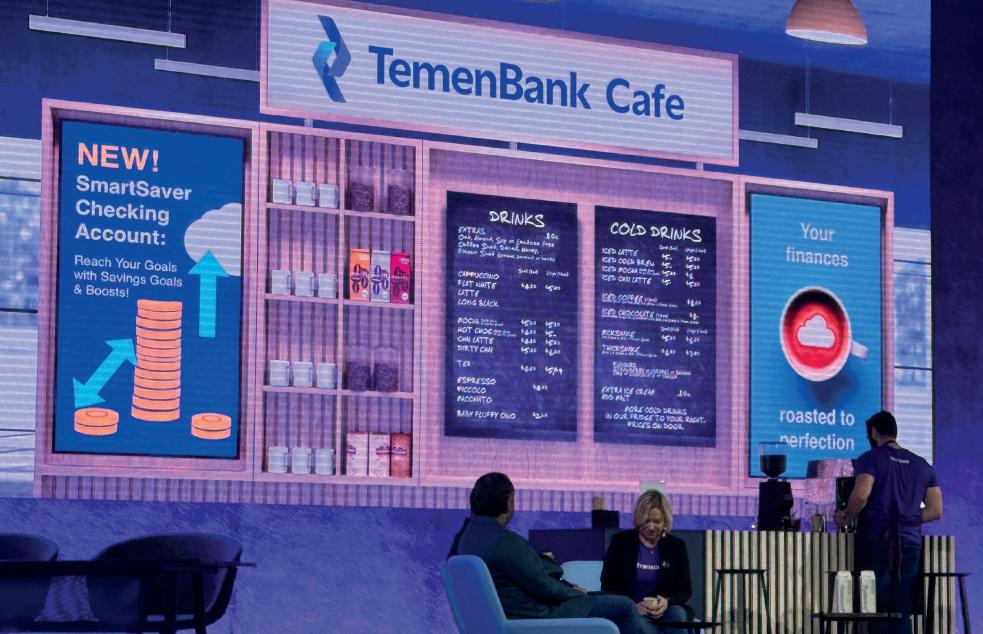

Global corporate investment in AI more than doubled in 2025. Organisational adoption rose to 88 per cent. But, as Stanford University’s 2026 Artificial Intelligence Index Report pointed out, the issue now is whether the systems built around it can keep up.
That’s what Temenos and its co-development partners have been addressing over the past

year, ensuring that modernisation doesn’t compromise trust or sacrifice stability, so banks have confidence to move forward in an era where the future is being constantly reinvented by artificial intelligence. The challenge is how to reconcile that with the immutable character of their core.
“Clients want every single business function to be exposed as APIs, easy to configure with low/no code extensions and secure by design,” observed Nanda Badrappan, Deputy Chief Technology Officer at Temenos.
“They want them to be inherently upgradeable and scalable with a strong innovation road map and strong ecosystem, but without losing control of their architecture.”
Composable solutions, such as those launched at the event for retail deposits and retail lending, answer the demand for flexibility, giving banks the option to upgrade one capability at a time without disruption.

Barb Morgan, Chief Product and Technology Officer, Temenos It
Barb Morgan said conversational interfaces are the future
We believe the future is conversational, and it’s now time to move from concept to execution

It doesn’t matter if you change the rear tyres or the front tyres first. What matters is that you do not sit in the garage
Rohit Chauhan, Chief Technology Officer at Temenos


“Composability is now the standard,” said Pablo Padin, Partner – Core Banking & Payment Center of Competence IBM Consulting, adding, “In fact, composability makes agentic banking happen.”
And it’s persuading large-scale enterprises to answer the call for progressive modernisation, said Will Moroney, Temenos Chief Growth Officer, because many had ‘fallen into the trap of legacy systems and don’t want to end up

Get it right and my granddaughter will be using your services in 10 years time. Get it wrong and you will not have any services in 10 years’ time
Brian Hayes, FSI GTM Leader for EMEA at AWS

there again’. “It’s not just legacy debt that they have to overcome; it’s legacy process. These sorts of discussions need an awful lot of trust.
He was now seeing ‘a shift in momentum’.
“Our core market of Tier 3, 4 and 5 banks are on digital platforms already. In the last 18 months, we’ve seen Tiers 1 and 2 start to join them,” said Moroney.
“The last real push for banks to modernise was digital, and they relied on a lot of shadow balances and middleware to get them through. They will not be ready for conversational consumer AI, and it’s driving a lot more discussion with T1 and T2 banks in the US, Europe and Asia.
“Banks that are on older legacy tech are spending 60-70 per cent of their budget just keeping the lights on. So, some are very specific about what they want AI to improve. Others are more inquisitive – ‘what are our peers doing, what are you seeing?’.”
There had been another significant change, he said: the technology choices being made today were increasingly driven by business teams wanting specific outcomes, rather than the CIO’s office looking across the tech estate. From that was emerging the concept of banking technology as a utility, which was certainly changing the conversation between providers and clients.
Decision-making speed is critical. If you wait for the perfect time for implementation, you have missed the moment – and banks are not comfortable with that
David Furlong, Chief Operating Officer at
Questbank


“The sales cycle will become a little more complex,” acknowledged Moroney.
Temenos is trying to get ahead of that curve by leveraging the trust it’s built with the industry over decades and bringing customers on board as co-developers. Among banks on the programme so far, Banque Internationale à Luxembourg worked on the co-pilot for core banking, while a leading wealth bank partnered over the financial crime management agent, for which Temenos will be client zero this year.
“Real usable innovation happens when we build together – banks, partners and Temenos,” said Morgan.
Composability is now the standard
Pablo Padin, Partner –Core Banking & Payment Center of Competence at IBM Consulting

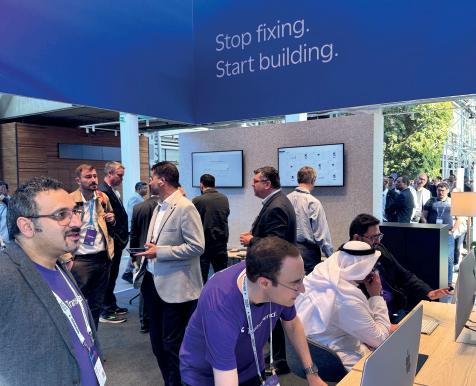
Opening the conference, Takis Spiliopoulos, who stepped up as CEO after the sudden departure of Jean-Pierre Brulard in September after only 16 months in the job, had told delegates: “We are at a defining moment in the industry. There’s a shift in momentum by AI, and the questions we ask have changed.”
The number of attendees in Copenhagen –100 more than last year, at 1,300 in the hall and a further 500 online – suggested that, whatever had happened in the boardroom, hadn’t shaken confidence on the ground. And the conference had clearly enthused many of them. By the second day, 72 companies had signed up to the Design Partner Programme.
At the TCF dinner at the Øksnehallen in the historic Meatpacking District, those same delegates found themselves in another world. Canapes delicately suspended from ghostly trees. Dancers and acrobats bringing fairytales to life. Exquisitely decorated tables inviting guests to take part in a Nightingale’s Feast.
Dr. Jochen Papenbrock, EMEA Head of Financial Technology at Nvidia

Inspired by the extraordinary mind of the city’s famous fabulist, Hans Christian Andersen, it seemed at first to have very little to do with banking. Then the penny dropped. We have only ever been constrained by our imagination. And what Temenos was offering were the tools to think a long, long way outside the box.
Several large-scale deployments of core banking modernisation and AI adoption were recognised among the Temenos Forward Awards, showing just how quickly transformation projects are moving from strategy decks into production.
Vietnam’s VPBank completed a major core banking modernisation involving 18 million customer accounts and 77 tb of data in a single cutover window of under 24 hours, without disrupting customer service.
Digital Transformation Award – APC Bank
APC Bank has launched
Curaçao’s first fully digital bank using a SaaS banking model designed around mobile-first onboarding and real-time account access.
Banking Innovation Award – National Bank of Kuwait (NBK) NBK Egypt reduced loan turnaround times by more than 90 per cent through automated lending workflows.

The
last real push for banks to modernise was digital, and
they
relied
on
a lot of shadow balances and middleware to get them through. They will not be ready for conversational consumer AI
Will Moroney, Chief Revenue Officer, Temenos


Moving from batch processes to a real-time, Cloud-native core, delivered as SaaS, is enabling personalised CX, while boosting security and resilience.

Simple, fair and fast: Equals’ solution aims to simplify money movement overseas

Nathan Best is Chief Revenue Officer for money movement platform Equals. Here he explains how it’s addressing the gap between expectation and reality when it comes to embedding global payments
THE FINTECH MAGAZINE: For readers discovering Equals for the first time, how do you describe the company’s mission and the operational finance challenges it was built to solve for global businesses?
NATHAN BEST: We are a next-generation global money movement platform. Our mission is simple: solve operational complexity for exceptional businesses operating across multiple markets, currencies, and regulatory environments.

Nathan Best, Chief Revenue Officer at Equals
We build and own the technology infrastructure that businesses use to power their payments, accounts, cards and FX, and to build and operate embedded payment services for their customers.
What differentiates us is that we combine our 18-plus years of trusted technology innovation with real operational expertise.
Our customers are looking for more than the off-the-rack service model of the high-volume fintech players, but they are often too complex or small to be supported by banks, as discovered in our recently commissioned research with Visa Consulting & Analytics.
Equals solves payment challenges and reduces regulatory complexity for those clients. That’s especially important for businesses operating in sectors or geographies that require more flexibility, oversight or specialist servicing.
TFM: Businesses are increasingly looking to embed financial capabilities directly into their own platforms
and operations. How is demand for embedded payments evolving?
NB: Many organisations still manage fragmented provider relationships that hinder the full potential of embedded payments. Revenue and profit can be compromised through inconsistent payment experiences, slow settlements, reconciliation challenges, and growing currency exposure.
We built Equals to solve these challenges through a single connection, combining international payments, accounts, cards and FX infrastructure. Our products are used by businesses in their own operations, as well as to deliver embedded payments services to their customers.
We design from the customer’s perspective. Many clients begin with white-label services before evolving towards embedded APIs and fully integrated financial services as their business grows.
TFM: Are businesses facing any barriers to embedded finance adoption?
NB: Businesses are struggling to find the operational and compliance support they need from traditional banks, larger providers or smaller fintechs. The industry has focussed heavily on technology alone and neglected the operational capability needed to manage complexity and deliver embedded payments successfully. Clients want a strategic partnership from their technology providers.
Our flexible technology and service model enable us to deliver tailored onboarding, compliance, and payment solutions.
Because we own and build the infrastructure ourselves, we can adapt services around each client’s operational requirements rather than forcing businesses into rigid provider frameworks.
TFM: Your customers are fast-growing digital businesses and large corporates with complex treasury and payments needs. Clients also deploy your technology to power embedded payments services to their own customers. What patterns do you see across different segments?
NB: Fast-growing businesses typically focus on automation, flexibility, and speed to market, while larger corporates prioritise governance, treasury visibility, and operational resilience. Security and compliance remain mission-critical at every stage.
reducing the operational complexity that comes with international growth.
TFM: Regulatory expectations across Europe are tightening. How does Equals design compliance into its platform while still enabling businesses to move quickly?
NB: Compliance must be embedded directly into the infrastructure, not treated as a separate process. That includes proactive onboarding, AML controls, transaction monitoring, safeguarding and sanctions screening.
Because we own and build our platform, we can integrate those controls directly into payment workflows while adapting quickly as regulations evolve. At the same time, we work closely with customers to understand the realities of their business model rather than applying rigid one-size-fits-all processes. The goal for us is to reduce organisational friction while also maintaining strong governance and resilience.
TFM: Equals has invested heavily in secure infrastructure. How is technology evolving your approach to AML and fraud prevention?
NB: The market is moving toward integrated, programmable financial infrastructure. We’ve rebuilt our platform over the last four years from the ground up to create a foundation for future innovation.
We can support more intelligent payment routing, tokenised treasury models designed to improve speed, cost efficiency, capital optimisation and greater operational flexibility for international businesses.
In regulated industries like ours, security and compliance remain fundamental to innovation. As business complexity increases, service quality and partnership will be seen as just as important as the technology itself.
TFM: Can you tell us about the report you published at Money 20/20 Europe this year?
NB: The report was compiled with Visa Consulting & Analytics and advances the conversation beyond sizing the market opportunity to uncover the hidden realities for organisations delivering embedded finance and payments projects to market.

White-label services work well for our earlier stage fintech and banking clients, in particular, who can quickly launch fully branded financial products to their SME and consumer customers without building or operating the underlying infrastructure.
At the other end of the spectrum, our APIs give businesses full control to build and scale customised products, all within a regulated infrastructure that removes the complexity of licensing, operations and scale.
Across all clients, there is growing demand for unified infrastructure. Businesses want embedded payments services to work together. They want stronger visibility, fewer manual processes, and better control across international operations.
TFM: Equals is a unified platform for accounts, payments, cards and FX. What does that consolidation unlock for businesses?
NB: The goal is to simplify complex payment operations while maintaining strong governance and resilience.

A single platform improves visibility, efficiency, security and governance across our clients’ financial operations. It helps businesses manage liquidity and currency exposure while
NB: Technology is making compliance and fraud prevention far more proactive and intelligence-led. We use AI-enabled monitoring and automation to identify anomalies earlier across payment flows, freeing up our human compliance team to investigate any issues that require greater oversight.
The industry has focussed heavily on technology alone and neglected the operational capability needed to manage complexity and deliver embedded payments successfully
Nathan Best, Equals
We see technology as an enhancement to human expertise, rather than a replacement for it. Financial crime risk is increasingly sophisticated and international, so businesses need adaptive monitoring capabilities and experienced specialists who can apply operational judgement when complexity arises.
TFM: What does ‘next-generation corporate payments and treasury infrastructure’ look like over the next five years?
We’ve identified a gap between the expectations of businesses adopting embedded finance, and the ability of suppliers to deliver the onboarding, operational and compliance support that they need to maximise its value. There is growing recognition that infrastructure alone is not enough. Aligned to this, we’re watching how the market balances AI-driven efficiency with demand for genuine human expertise and accountability.
We chose to launch it at M20/20 Europe because it’s a good forum to talk to our partners – Tier 1 banks, neobanks and fintechs, digital asset exchanges – about how the current economic environment is shaping their approach to embedded payments.
TFM: Finally, what’s next for Equals?
NB: We are focussed on helping more clients to access our breadth of embedded payments services, and we continue to invest in AI-enabled infrastructure, payment orchestration, compliance and security capabilities that help exceptional businesses to scale globally with greater control and operational clarity.
Ultimately, our focus is on being the trusted partner for businesses and their customers as global payments become more complex.
n To download the report and learn more about Equals embedded finance and payments solutions, visit: www.equalsmoney.com/ whitepaper-premium-service-research
When you think of those fintech furnaces, forging cutting-edge payments infrastructure, your mind probably goes to San Francisco Bay, London, Mumbai and Singapore. But not Barbados.
payment providers and merchants that needed practical, bank-connected payment capability.
Today, under parent company Spayce Technologies, the business operates from Barbados, Canada, the US and Costa Rica. And, LePage reveals, in the last few months it’s partnered with companies in the UK and Europe.

And yet that’s where one of the longest established providers has been quietly carving out its niche place in the payments landscape – Payment Spayce. Its proprietary tech has been built out over 25 years by people who understand the unglamorous but essential machinery of banking, compliance and settlement.
Now, as global payments enter a more exacting era, and the volume of instant transactions explodes, that foundation is its central pitch as it brings its proposition to Europe.
“We always worked off word of mouth,” says Partner and Co-founder Debra LePage. “We realised very early on that there was no infrastructure really built out from an ACH (automated clearing house) payments platform. With credit cards, everybody had a gateway. But when it came to ACH payments and alternative payment methods, there was nothing. This was before orchestration platforms.”
Payment Spayce was not built as a sleek front-end fintech app looking for rails to sit on. It began behind the scenes, developing infrastructure for

“We’ve connected them to our orchestration platform within the last couple of months,” she says. “And we are looking to open up a base in Europe, hopefully, by the beginning of Q4.”
A UK office is also being considered. “We have a few key C-suite employees from London, so we’ve got a really good foundation there,” she adds.
The timing is significant. Six months ago, Payment Spayce looked like a compelling Caribbean fintech story as the island strengthened its regulatory reputation, invested in instant payments infrastructure and positioned itself as a credible fintech hub, bridging the Caribbean and North America.
That remains true. But recent moves suggest a far broader ambition for Payment Spayce. It is no longer simply selling payments capability. Last November, it acquired an unnamed regulated Canadian company established in 1963, giving it regulated trust infrastructure. For LePage, whose background is in banking and

Debra LePage, Partner and Co-founder at Payment Spayce
compliance, that is an important shift in strategy and a competitive advantage.
“With our financial trust entity, we now do all the safeguarding of client funds and end-user funds,” LePage explains. “That takes a lot of the pressure off the PSP or MSP holding client funds. Their customers know their money is safeguarded, even in the event of insolvency.”
Compliance by design Trust is key to Payment Spayce. Compliance is not bolted onto the product. It is embedded by design.
“This is probably the biggest architecture we’ve built,” says LePage. “Compliance by default means every transaction, account and workflow is subject to the appropriate controls the moment it enters our system.”

Long-established payment infrastructure provider Payment Spayce is heading to M20/20 in Amsterdam for the first time with its sights set on servicing a very particular niche
GIGECONOMY


Vetting of new clients is done upfront so that, once screened, they are ready to go.
Payment Spayce can rapidly adapt its chosen services to fresh business opportunities – subject to necessary jurisdictional requirements, such as additional licences. That includes KYC, KYB, AML) screening, sanctions monitoring, transaction monitoring and safeguarding, all built directly into the payment flow. In that way, says LePage, it’s made compliance ‘an enabler for scalability’.
The company’s partnership with ThetaRay, announced last year, strengthens that proposition. LePage describes the AI-powered compliance provider as ‘hands down, one of the best choices we’ve ever made’.
The reason, she explains, is because payments at scale cannot rely on human review alone. Traditional rules-based monitoring creates false positives, delays and unnecessary intervention.
ThetaRay’s behavioural approach analyses patterns across accounts, counterparties, geographies and transaction velocity in real time.
“Rather than identifying issues after
Spayce operates in one of payments’ toughest segments: cross-border payouts. The company says it reaches more than 170 countries through local payment rails, many in real time. Where instant local rails are unavailable, it can use push-to-card via Visa and Mastercard for near-instant payouts.
For clients, the proposition is simplicity: one API (application programming interface) integration, multiple payout routes, FX (foreign exchange) visibility and local payment options. For recipients of those payments, only one thing matters.
“Speed is absolutely key,” says LePage. “The recipient doesn’t care about the technology side. They just want to see that they’re getting their funds instantly.”
That expectation has heightened, especially in the gig economy where many Payment Spayce clients go for skilled workers.
When it began building cross-border payout capability in 2019, some gig workers were still waiting more than 30 days to be paid.
As LePage says: “Now, if one platform is paying out faster than another, word certainly gets around fast in the gig economy.”
Gig workers, marketplace sellers, affiliate commissions and creator-led commerce –behind every affiliate link sits the same questions. Who gets paid, how quickly, and through which rail?
That is where Payment Spayce wants to sit – servicing the companies paying the rapidly-increasing number of self-employed workers globally as quickly as possible, to retain their own competitive edge.
diligence, new jurisdictions or payment methods can be provisioned rapidly.
“If a pre-verified client says they want to expand and pay gig economy workers in Europe, I can create that account within 30 seconds,” says LePage.
She believes Payment Spayce is expanding at a crucial moment. “I think the payments provider winners are going to have their own national bank licence,” she says. “They’re going to have the best technology infrastructure and work directly with regulators.”
LePage remembers the early days of ecommerce payments as ‘the wild, wild west’, when banks, merchants and networks were adapting in real time with limited infrastructure. Today, things are very different – the tools are better, but the stakes are higher.
“With real time comes real issues,” she says.
Stablecoins are one area she is watching closely, and will be homing in on conversations about at Money20/20 Europe. The appeal is obvious for cross-border payments: instant, borderless, potentially cheaper transactions. But LePage is equally alert to the risks.
“How do you recover funds if something was fraudulent?” she asks. “Ecommerce started out buyer beware, then seller beware. With crypto, we’re back to buyer beware.”
That tension – innovation without adequate recourse – is precisely where Payment Spayce wants to play while partnerships are helping it scale. LePage points to BridgerPay as a major orchestration partner and highlights relationships with BMO (formerly BMO Harris Bank) and Cross River Bank.
Barbados still provides stability, talent and a regulatory backdrop that fits Payment Spayce’s compliance-first DNA. But the paytech’s centre of gravity is widening: Canada for trust infrastructure, the US for scale, Costa Rica for development, and Europe as the next frontier.
the fact, we can detect suspicious activity as it’s happening,” says LePage. “We can trigger enhanced due diligence, hold funds, escalate to compliance and file the appropriate regulatory reports.”
That matters because Payment
But global payments are far from standardised. Europe offers relative consistency through SEPA and SEPA Instant. Elsewhere, payment preferences vary dramatically. In Canada, consumers can be paid by email through Interac E-Transfer. In some markets, phone-number-based payments dominate. Push-to-card is more universal. Local payment methods require local understanding.
That is why Payment Spayce’s infrastructure is modular. Once a client has passed due
Competition will be fierce. Infrastructure ownership brings obligations as well as credibility. Stablecoins, instant payments and AI-led compliance all add complexity. Yet Payment Spayce’s story is compelling because it is coherent. It solved payment problems before orchestration became a thing. Built around compliance before compliance became fintech’s defining challenge. Acquired trust infrastructure before safeguarding became a strategic differentiator.
In the old fintech era, speed was the headline. In the new one, speed still matters. But trust may matter more.


Financial crime has always been an arms race. For every control, there is a workaround. For every regulatory framework, a loophole. For every institution convinced it has built a sufficiently robust perimeter, a bad actor somewhere, quietly testing the fence.
But something fundamental has changed. The speed, sophistication and scale of financial crime are accelerating at a pace that makes even seasoned compliance professionals uneasy.
Criminal networks are no longer simply exploiting gaps between jurisdictions or moving suspicious funds through predictable laundering routes. They are operating in a digitally fragmented, hyperconnected global economy where money, value and identity slip across borders in increasingly fluid and opaque ways.
And now those criminals have access to the same artificially intelligent technologies as the rest of us.
Enterprise tools, like generative AI, agentic systems and autonomous workflows, are all rapidly becoming part of the offensive arsenal for organised crime groups and maverick threat actors, who have leveraged the

tech to create synthetic identities, deepfakes, and worse. This is the environment that ThetaRay is helping financial institutions confront.
An AI-led anti-money laundering and financial crime detection specialist, ThetaRay built its reputation helping banks, fintechs, correspondent banking networks and cross-border payment providers identify suspicious activity that rules-based systems often miss. Its core proposition has centred on anomaly detection, using unsupervised machine learning in transaction flows rather than relying solely on static thresholds and pre-programmed typologies.
Now, however, ThetaRay is attempting something more ambitious, under the leadership of its new CEO, Brad Levy, a veteran of financial markets and enterprise technology, who was involved in the early adoption of algorithms on Wall Street. He has become known as one of the industry’s more outspoken commentators on AI, autonomy and the philosophical implications of emerging technologies.
He sees machine learning, digital infrastructure and agentic AI not simply as product opportunities, but as structural shifts in how industries – and eventually societies – will function.

Brad Levy, Chief Executive Officer at ThetaRay
And when it comes to making sure those technologies aren’t used against us, he says bluntly: “I have to think like the criminal. They have the same tools, same rules, different outcomes.”
Financial institutions, regulators and technology providers are at a frontier where old weapons are starting to look inadequate. The volume of suspicious activity is exploding, geopolitical shocks can reshape risk overnight, and the time available to respond is collapsing.
That sense of Intensification is not simply vendor rhetoric. IBM’s most recent X-Force Threat Intelligence Index paints a strikingly similar picture of an adversarial environment becoming faster, stealthier and increasingly identity-driven.
The report found that nearly one-in-three cyber incidents involved compromised credentials, while phishing campaigns, delivering malware to steal credentials, surged dramatically.
More importantly, IBM warned that AI adoption will inevitably create entirely new attack surfaces as bad actors deploy increasingly specialised automated toolkits.
No
one knows what cybercriminals will unleash next, but with agentic AI in their arsenal at least the good guys can dodge the bullets, argues ThetaRay’s Brad Levy
For financial institutions, the implications

are profound. If cybercriminals are no longer ‘breaking in’ but simply logging on, and if AI lowers the technology barrier for attackers just as much as defenders, then the assumptions underpinning legacy fraud and AML infrastructure begin to look dangerously outdated. As Levy puts it: “At this point, with the potential of new tech to aid and abet crime, and the overwhelming amount of investigations to be done, it’s a tipping point.”
That sentiment is powering ThetaRay’s latest strategy. At the heart of this evolution is RAY, a new agentic AI investigations platform.
It sits above ThetaRay’s established detection and investigation software layers, acting as an AI-powered orchestration and investigation engine that can triage alerts, reprioritise cases in real time, gather supporting evidence, surface contextual intelligence, assist analysts through natural-language interaction, and automate parts of the investigation workflow, including audit documentation and suspicious activity reporting support.
In practical terms, ThetaRay is moving from being a detection vendor to building an AI compliance co-worker – one that works alongside human investigators rather than simply feeding them more alerts.
ThetaRay no longer merely helps compliance teams detect risk. It empowers them to accelerate investigations and flash actionable intelligence to law enforcement at machine speed to disrupt financial crime networks.
The anti-financial crime sector has been forced to focus, rightly, on explainability as the central question around AI adoption. Can firms demonstrate why an alert was raised? Can a suspicious activity decision be justified to a regulator? Can machine-generated conclusions be audited? And these remain critical concerns.
But ThetaRay’s thesis appears to be that explainability is now only the starting point. The bigger question is whether financial institutions are preparing for what comes next. Levy describes the progression in stages. “Predictability first, then explainability. Now, controllability is becoming much more of a conversation because of the autonomous discussion around agents,” he says.
That’s a notable shift in thinking. The industry’s first AI debate was about whether machine learning models could produce better outcomes than static rules. The second was whether those outcomes could be sufficiently explained to regulators. Now, it’s whether financial institutions can build
adaptive, secure, controllable AI systems that are capable not just of explaining today’s threats, but responding to tomorrow’s. That is a much bigger challenge.
Financial institutions are spending vast sums in attempting to identify and investigate suspicious behaviour, yet the economics remain deeply inefficient. False positives swamp compliance teams. Analysts spend hours manually reviewing alerts that lead nowhere. Investigations that require urgency are often buried beneath operational backlog.
Levy’s summary is stark: “We spend $200billion as an industry on a two-to-six trillion dollar laundering problem, and there’s 98 per cent false positive rate.”
ThetaRay believes it can at least begin to help ‘clear the queue’. That doesn’t mean entire fraud monitoring departments are laid off. Regulated financial institutions are not, in any case, ready to hand full autonomy to AI systems to make risk decisions on their behalf, and nor should they. But it does mean jobs will evolve.
As Levy says: “If you’re taking a risk judgement, that is never, in my opinion, going to be deterministic, which is why humans always have a role.”
The thing I know with absolute certainty is that I don’t know what’s coming next
He draws a comparison with the courtroom, imagining a future in which low-complexity legal disputes – small claims cases, routine formula-driven judgements, even some divorce settlements – built around predictable outcomes could be substantially automated.
But murder trials? Never. While there are cases where speed, precedent and pattern recognition can accelerate outcomes, there are others where nuance, ethics, contextual judgement and human accountability remain fundamentally non-transferable.
In the case of financial cyber crime, routine triage, evidence gathering, documentation, reprioritisation and repetitive investigative work are ripe for automation. Final accountability and consequential judgement are not.
The autonomous systems that look set to play a more meaningful role in financial crime prevention, have their own vulnerabilities, of course. Bad actors will inevitably attempt to manipulate, probe or exploit AI-driven
infrastructure, particularly as agent-to-agent ecosystems emerge, says Levy.
ThetaRay’s response to that is security by design. That means strict entitlements, tightly governed permissions, secure interoperability between systems, strong access controls and rigorous protection around both transaction data and behavioural metadata.
Levy references emerging agent-to-agent architectures and model context protocols as examples of why the industry must embed security at the foundational layer rather than patch vulnerabilities later.
In his view, defending AI systems means adopting the same adversarial mindset as the attackers. The same agility and acceleration. That leads to a much broader reimagining of financial crime infrastructure to reduce systemic complexity that gets in the way of defence and detection. Synthetic fraud swarms. Cross-platform identity abuse. Agent-to-agent automation. Real-time geopolitical volatility. New forms of value transfer that blur the boundaries between regulated money movement and digital assets. What’s next?
“The thing I know with absolute certainty is that I don’t know what’s coming next,” says Levy. And that’s a key point, because, in his view, too many financial technology providers remain focussed on solving known problems today, whereas ThetaRay is positioning itself around preparedness for the unknown ones of tomorrow. That extends beyond product design into its world view around regulation; the imbalance between threat actors and public oversight.
“The regulators are definitely outmanned and outgunned,” says Levy.
He’s not anti-regulator. Far from it, but he sees financial crime networks increasingly exploit fragmentation between institutions, jurisdictions and legacy systems.
“The regulators have to be armed because they are the ones who could see the true unknown unknowns,” he explains.
ThetaRay is not simply selling software to banks. It’s advocating for a connected ecosystem between institutions, vendors and overseers that police the world’s systems.
“Collaboration and partnership are critical for all of us,” says Levy, “[because] you can’t buy – you can’t tech your way – through trust.”
There’s no time to debate whether agentic AI has a role in financial crime management, but rather how fast safe models can be adopted, says Levy. Standing still may be the riskiest move of all.


The UK lies at the bottom of an unimpressive league table when it comes to mortgage processing times. Hannah Duncan looks at how fintechs could help promote it to the first division with a digitally mature approach
Customers don’t have a great time with house buying. From the initial mortgage application to perplexing communications between lawyers, estate agents, brokers, conveyancers, surveyors and more, nearly nine in 10 people find it stressful, according to new research from the UK’s NatWest and RightMove.
Even the UK government this year described homebuying and selling as ‘often slow, opaque, and prone to failure’. It’s not great reviews, and it all starts with the ‘death pledge’ as French lawyers knew it in the Middle Ages. Unlike many other financial sectors, mortgages have remained largely rooted in paper and phone-based systems. While some professionals are embracing AI innovations, the customer still isn’t really feeling it.
“The overall experience is cumbersome for customers”, says Jinesh
Vohra, CEO of mortgage-linked app Sprive. “Particularly around paperwork.”
It’s a strange situation. Despite the UK’s worldwide reputation for fintech innovation, it has one of the slowest mortgage processing times, averaging 179 days – almost four times longer than in the USA (53 days). It takes 10 weeks longer to complete a mortgage than in France.
Transformation requires a shift of mindset and approach; embracing new technology, ‘not bolting a chatbot onto a 1999 decisioning engine’, as Daniel Goldstone, Co-founder and CEO of explainable AI credit decisioning engine RangeTeller, puts it.
“The opportunity is to rewrite the strategy itself using transparent, locally-trained models that an examiner can read line by line,” Goldstone says..
“More loans, zero extra risk. That's not aspiration – the technology to do this has existed for years. The mortgage industry has spent that decade hiding behind compliance as an excuse for inertia. This has to change.”
Over the years, several initiatives have looked to fix the situation. One of the most recent, the Project 28 Charter, launched in 2025, aims to speed up the soul-sucking process to a much more bearable 28 days, based on accurate, standardised, secure and digital information, which requires industry transparency and collaboration.
Ross McKenzie, CEO of openmoove, says more fundamental action is

needed for real change to occur –something which the technology can hinge on and the customer can feel.

That substantial spark may have generated late last year, in the form of the UK government’s smart data report. It’s a green flag for mortgage providers and all stakeholders to start incorporating smart data into their processes. The report forecasts that could add £28.7billion in net social value, between 2028 and 2043, and £4.2billion in GDP.
In April 2026, the FCA also set out its vision for open finance to ‘help consumers manage and improve access to mortgages’. Again, this means making data accessible to all parties, with the consumer’s consent.
Some smaller UK lenders have already started experimenting with open finance. In January 2025, Leeds Building Society partnered with Experian in a pilot, using its PowerCurve platform and reduced the decision in principle time from 24 hours to 11 seconds.
Encouragingly, one in two customers clicked ‘consent’ to share their data, five times higher than predicted. The Society went on to adopt Experian Boost, allowing applicants to share open banking data, such as utility payments, to improve their credit scores, which was particularly helpful for first-time buyers with limited credit history.
Another UK mortgage pioneer is Offa, a Shariah-compliant provider, which recently revealed that most offers now take just an hour, thanks to a blend of

data analysis and automation. MPowered Mortgages may have gone even further, boasting its fastest ever time to deliver a fully underwritten offer to just 15 minutes, again by blending smart data with AI.
Compare that to the high-street banks average of two to four weeks.
“People are ready for change,” says openmoove’s McKenzie. And not just in the UK. In the USA, more than one in two people want banks to use their data to provide better experiences, according to a wide-ranging Forrester survey. A further 48 per cent would give banks more data if they knew it would result in a better experience.
In the US, too, there are outliers in digital mortgages. Better.com (through its platform Tinman), has been a leader in AI-native lending since launching in 2016, while in Canada, mortgage providers Haventree and Questbank, have both recently partnered with leading SaaS provider Temenos, using its AI-enhanced core banking to streamline processing and speed up delivery time.
Added to this, the business of providing mortgages is completely interwoven with interest rates. A few years back, it may have been much easier to jump on the lending bandwagon as a fintech. But in today’s tight environment, high interest rates act as a gatekeeper against newbies. Instead, technology companies need to find a different way in.
Of the 5,961 tech companies on his database, Sawko reveals that slightly under one per cent are aimed at the mortgage sector and, crucially, they are not looking to compete with providers nor issue loans themselves. Instead, they are focussed on enhancing the existing processes. This means working with banks, as PEXA has done, to create better infrastructure. It’s the only real way that innovation can happen.
faster through simple everyday actions,” he told them. Buoyed by popularity, Sprive is already hooked up with 14 lenders and counting.
Likewise, openmoove has also built a customer-centric platform, which earned an impressive £700,000 of funding from investors. The bottom-up approach really resonated with them, explains co-founders McKenzie and Cai Gwinnutt.
“Delivering a better consumer experience which is connected, educated and really collaborative was – I think – what got us over the line,” reveals McKenzie.

McKenzie’s B2B2C openmoove also uses smart data to create a marketing-to-completion service for homebuyers, arguing that ‘speed is a by-product of customer experience’, and that’s where providers should shift their focus. When the customer is confident, the rest will follow.
Krystle Kocik, Group Chief Product Officer at PEXA, agrees. Working with NatWest, the fintech recently proved that a remortgage could be completed in just two days. Like openmoove, their focus was squarely on trust, not speed.
“The overarching ambition is not simply to complete transactions more quickly”, Kocik explains. “But to give lenders, conveyancers and customers greater confidence in when completion will happen.”
She estimates that around 20 to 30 per cent of all remortgages are ‘relatively straightforward cases’ and should be materially faster.
High interest rates as a mother of invention
Providing mortgages is an area where incumbent providers with legacy systems win out, and perhaps that’s been the problem so far. CEO and Founder of Shipshape.vc Daniel Sawko explains how the number of new mortgage agreements each year is ‘between two and three per cent of the total’, which is not only a shocking demonstration of how hard it now is to get on the housing ladder, but also how difficult it is for potential new lenders to make a dent in the market.
The makeover is consumer-first So that’s the plumbing. What about the interface? In recent years, a flurry of interesting new apps have hit our smartphones. Some have simply incorporated new services into existing product shelves.
The cost of doing nothing is no longer zero. The technology isn't theoretical, it is deployed, in production, with documented results
The barrier isn’t capability, it’s nerve
Daniel Goldstone, RangeTeller
In May 2026, Monzo acquired brokerage Habito to offer in-app, end-to-end mortgages and search services, while others have launched independently to help customers navigate the mortgage jungle.
Many of the newest ideas have been truly revolutionary. UK-based Sprive stands out. It’s an app where customers overpay their monthly mortgage, including by leveraging cashback deals from retailers, to save thousands in interest over time. Although the average automatic overpayment is just £36 a month, the typical customer saves £5,942 in interest overall, reducing the mortgage by a year and a month.
“Our focus is on helping homeowners feel more in control,” explains Sprive’s Jinesh Vohra, who recently impressed BBC’s Dragon’sDen investors with his pitch. “We want to make it easier for people to understand their mortgage, reduce interest, and become mortgage-free
Fortune favours the brave Mortgages are rolling headfirst into a smart data and open finance future, but they must deliver for consumers twice. Firstly, by rebuilding trust after decades of paper-based stress. And secondly, by making up for lost ground compared to other services.
Banks and technology companies should be aligned to the same vision, in both the interest of market and the consumer.
“The cost of doing nothing is no longer zero, and it stopped being zero some time ago," warns RangeTeller's Goldstone.
“Every year that a lender stays on credit-bureau-plus-manual-rules, they decline a population of creditworthy applicants who go to a competitor or never come back to the market at all. That’s a slow surrender of market share dressed up as prudence.
“The technology to fix it isn’t hypothetical, and it isn't a future road-map item. It is deployed, in production, and with documented results. The barrier isn’t capability, it’s nerve.”
Average mortgage times around the world

USA: 53 days

UAE: 70 days

New Zealand: 72 days

Canada: 90 days

Australia: 95 days

France: 105 days

Germany: 137 days

Spain: 152 days

Portugal: 152 days

Singapore: 152 days

Italy: 159 days

UK: 179 days
Barb
Morgan joined Temenos in late 2024 during a period of rapid change for the company. She
hasn’t stopped since
The first thing I noticed about Barb Morgan at this year’s Temenos Community Forum was her footwear.
Maybe she’d learned the lesson from her debut event in 2025 when she’d tripped over her corporate heels, recovering elegantly to join clients on the Madrid stage. After 20 months as Chief Product and Technology Officer, though, during which she’s sprinted between continents and through a mammoth amount of change, her choice of tech bro sneakers was more likely a signal that Morgan is now comfortable in her role. More herself.
The gleaming white kicks also said something about the speed at which she works, because if there’s one thing colleagues and friends will tell you, it’s that Morgan never stops.
In Copenhagen’s Bella Center, her blonde bob could be seen accelerating up and down the stairs between banking clients, technology partners and press interviews, reaching for her phone to time departure for the next.
It’s no surprise that she’s a fan of agile methodologies. It suits both her character and her belief in collaborative, focussed, time-stamped processes if you want to get things done. In a previous role – at Capital One, one of the largest credit card issuers in the world – she led no less than 22 software agile teams.
At Temenos, they’ve been crucial over the past few months in delivering
on the pledge she made in Madrid that the company would build less but build better, be clear about release dates, and not promise more than it could deliver.
Each team now has a very specific vision and owns the outcome. Before, she says, there was a tendency for mission creep, pivoting and chasing other goals. Ultimately, customers weren’t being served. The improved internal focus was, she believes, what helped earn one of the best bits of feedback at this year’s event from a Tier 1 institution: “You listened.”
People first Morgan might be impatient for change, but listening is something she makes time for. Outside of whichever insanely busy division of FS she’s worked for in the past 30 years, there’s always
I’ve learned that not everyone wants to run as fast!
been a commitment to a cause that she believes deserves attention, be it education, young people or health.
While many of Morgan’s cohort who left Oklahoma University with a BSc in computer science no doubt became successful technologists, it’s that commitment to people as much as the tech, combined with an understanding of business, that’s led her to where she is.
The vision she's chasing now is the same one she expressed more than 10 years ago when she talked of ‘looking not just at the future, but
Barb Morgan, Chief Product & Technology Officer at Temenos

what's in front of the future and dreaming of the impossible’.
Taking on the role with Temenos meant a major life change. She relocated with her family to Dubai, to be within reach of the company’s Innovation Centre in India, but also for good connections to Temenos’ Swiss headquarters, London and the US.

When Iranian bombs started dropping earlier this year, she took the opportunity to spend several months at the hub in Chennai.
“The highs are any time I get to interact with my teams on the ground like this,” she says.
“Co-design is so cool when we’re in these rooms together, and you can’t tell – it no longer matters – who is from which company.”
She’s particularly proud of the latest Temenos Innovation Hub in Florida. "I consider it my baby,” Morgan says. “I woke up in March and decided we should have one in the US, and we opened on June 1. Dozens of companies have come through already.”
Her lows have been the inevitable staff changes in a big organisation.
“When people leave or new people join, it stops the momentum, no matter how capable they are,” she says. And what about the learnings? Morgan smiles.
“I’ve learned that not everyone wants to run as fast, even if it makes sense in my head!’

Financial services organisations don’t need more transformation promises.
They need clear visibility into the systems, risks, dependencies and delivery realities shaping business performance.
BBD’s Technology Assessments help banks, insurers and fintechs evaluate complex technology environments through a structured, multi-lens approach spanning architecture, resilience, scalability, operations, security and governance.
Whether you’re preparing for AI adoption, modernising legacy systems, scaling digital platforms or reducing operational risk, we help you identify constraints, uncover opportunities, and prioritise change with confidence.
Because in financial services, speed means nothing without clarity.