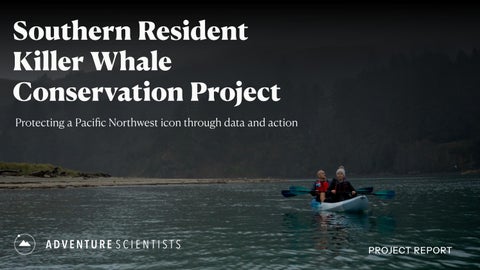
Southern Resident Killer Whale Conservation Project
Protecting a Pacific Northwest icon through data and action
Project Report
In partnership with
Table of Contents XX Summary XX Project Design XX Project Context XX Data Analysis XX Volunteer Experience XX Project Press XX Acknowledgements
Stats
93
active
volunteers
~500
total
observations
93%
positive intent to participate again
Summary The Southern Resident killer whale (Orcinus orca) is one of the Pacific Northwest's most iconic and culturally significant species, yet only 75 of this endangered species remain. Federally listed as Endangered under the U.S. Endangered Species Act since 2005, and protected under the Oregon Endangered Species Act as of February 2024, the Southern Resident killer whale is a symbol of both ecological fragility and the urgent need for conservation.
Unlike their transient cousins which roam widely and feed on marine mammals, Southern Resident killer whales are dietary specialists, relying almost exclusively on Chinook salmon. As salmon populations decline due to habitat loss, warming waters, overfishing, and migration barriers like dams and culverts, the whales' survival becomes increasingly precarious. Compounding these challenges are vessel noise, chemical pollutants, plastic contamination, habitat degradation, and human interactions such as boat strikes.
This project was born from a simple but critical realization: we cannot protect what we do not understand. Despite robust data collection in Washington, Canada, and California, Oregon's coastal waters remain a data blind spot.
Project Context
The Southern Resident killer whales' range extends along the Pacific Coast, from British Columbia to California, but their presence in Oregon's waters is poorly documented. This knowledge gap is more than an academic concern - it is a conservation emergency.
Oregon's coastal waters are a critical corridor for these whales, yet we lack the data needed to identify key foraging areas to protect them from human disturbance; to develop state and federal recovery plans that reflect the whales' actual habitat use; and to inform management decisions that balance conservation with human activity.
Without this information, efforts to recover the population are hampered by uncertainty. This project was designed to change that.
Methodology how were observations recorded? This project was the first of its kind in Oregon, documenting presence and absence information along with the location, behaviors, and identities of Southern Resident killer whales across the entire 362 miles of Oregon's coastline.
Volunteers conducted systematic observations from the coastline and nearshore open ocean; recorded location, presence and absence data, and photographic and video evidence of sightings; and documented behaviors, pod compositions, and interactions to build a comprehensive dataset.
What we achieved data that drives conservation The data collected through this project provides information that can contribute to federal and state recovery planning and help ensure Oregon’s waters are represented in ongoing assessments of critical habitat. It helps identify areas where whales are observed, provides additional evidence of coastal presence and habitat use, and helps address gaps in existing monitoring efforts.
The project also engaged and empowered Oregonians in the conservation of a species they care deeply about. It expanded scientific data collection beyond traditional research institutions, fostered stewardship among coastal communities, and demonstrated what collaboration between nonprofits, volunteers, and government agencies can produce.
This project didn't just collect data - it created a foundation for action.
Seagulls off the Oregon Coast
Data Analysis
Eleven people made double-digit observations, for a total of 255 - meaning 11 of 93 volunteers, 12% of the cohort, accounted for 51% of all observations.
The project launched on October 22, 2025. Our first in-person community event was on November 1, 2025 at the Hatfield Marine Science Center at Oregon State in Newport, with 34 of 66 registrants attending. The first killer whale sighting came on December 1 at Manzanita.
Project materials were made accessible in both English and Spanish, including the Survey123 form, protocols, training materials, and other project resources. A highly engaged core group of repeat volunteers formed, providing coverage across nearly the entire Oregon coastline.
255
51% Observation
observations from
11 volunteers
locations covered
of the project total
the Oregon coast
Volunteer Experience
“I had a passerby ask what I was looking for in the binoculars and I told him 'orcas.' We had a short chat about the types of whales on the Oregon coast. He was surprised, as I first was, that there are resident orca whales in Oregon. Hopefully the more people know the more they will also want to protect them.” Maria, Volunteer
Project Press KLCC
Here’s how to sign up to help search for killer whales on the Oregon Coast
December 31, 2025
OREGON WILD
Citizen science opportunities in Oregon
2026
LATINO OUTDOORS
How Searching for Killer Whales connected my roots to community science
2026
MOUNTAINEERS.ORG
Support thriving landscapes and ecosystems through community science projects
2026
Acknowledgements This project was made possible by the generosity of our donors and community of supporters, whose belief in science and commitment to protecting Southern Resident killer whales were essential to this work. We want to extend a special thanks to Eric Abel and Duncan Berry for their stunning in-kind art donations. We are also grateful to MiiR and Osprey, whose contributions kept our volunteers inspired and equipped throughout the project.
We would like to thank our scientific partners at Oregon Shores, the Oregon Department of Fish and Wildlife (ODFW), and the National Oceanic and Atmospheric Administration (NOAA) for their expertise, data stewardship, and collaboration.
Finally, we thank our incredible volunteers who gave their time, energy, and passion to reach rugged coastal terrain and collect the observations that make this work possible. Their dedication is the foundation of our work.
We acknowledge that the land where this project takes place is the ancestral and living homelands of many Indigenous Peoples, including ClatsopNehalem, Coquille, Coos, Siuslaw, Lower Umpqua, Kalapuya, and many others whose traditional territories remain regions of deep significance and care.
Thank you, Volunteers!