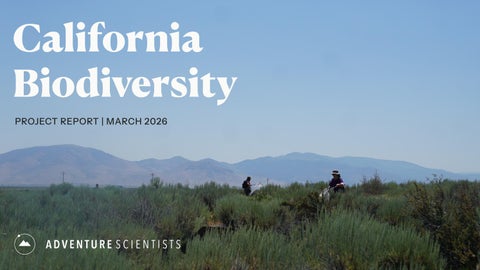
California Biodiversity Project Report | March 2026
In partnership with
Table of Contents 05
Summary
06
Project Context
08
Project Design
09
Data Analysis
11
Volunteer Experience
14
Project Press
15
Acknowledgements
Stats
3100 20
samples submitted
volunteer field day events
700+
Volunteer days in the field
112
Ecoregions sampled
Summary What lives in California? This foundational question inspired volunteers to spend more than 700 days in the field exploring California’s diverse ecoregions and collecting soil and insect samples. These soil samples contain environmental DNA (eDNA) that was sent to our scientific partners at the University of California, Santa Cruz for analysis. Insect analysis was completed at the Natural History Museum of Los Angeles County.
This project was part of a larger All Taxa Biodiversity Inventory and supports California’s ambitious 30×30 Pathways Strategy to conserve 30% of the state by 2030. To protect California’s biodiversity, we must first understand what it’s made of, and together, we’re building that knowledge.
The documentation of California’s insects and soil biodiversity, including fungi, nematodes, bacteria, and microbes throughout many diverse ecoregions, informs conservation priorities throughout the state.
Through a combination of volunteer field days with conservation-minded collaborators and motivated volunteers, over 3,100 samples were collected across 112 ecoregions in California. Each sample holds information about California and its inhabitants, adding to a growing body of knowledge across the entire state.
This project exemplified the power of citizen science, equipping community members with comprehensive training to collect high-quality data in the places they love, expanding what’s possible for conservation science.
Project Context The California All Taxa Biodiversity Inventory (CalATBI) was an initiative galvanizing like-minded organizations to discover the full scope of California’s biodiversity. Through this initiative, the California Institute for Biodiversity (CIB) partnered with Adventure Scientists to engage local communities in a citizen science project to gather soil and insect samples.
Soil samples were analyzed by scientific partners at the University of California, Santa Cruz, while insect samples were analyzed at the Natural History Museum of Los Angeles County.
Threats to biodiversity in California include increasing frequency of wildfires, population growth, and water shortage.
California is considered globally as a biodiversity hotspot, with high species diversity across the state. What is unclear is exactly what makes up this incredible biodiversity, and where. By recruiting, training, and mobilizing volunteers to collect meaningful data, a comprehensive database can be compiled to add to our scientific understanding of California’s biodiversity and to inform future management.
Volunteer collecting samples in the field
What is eDNA? As species interact with the environment, such as crawling through soil, DNA accumulates in their surroundings, which is called environmental DNA (eDNA). This kind of sample is collected from soil, water, or air rather than directly from an organism, which reduces the need to collect live specimens.
HOW IS eDNA ANALYZED? In the lab, each soil sample is carefully processed to reveal the DNA it contains. DNA is first extracted from the soil, then amplified using a technique called PCR, which makes many copies of specific “barcode” regions that help identify different groups of organisms — like insects, fungi, and bacteria. After the DNA from each sample is cleaned and tagged so they can be differentiated, samples are combined and sent for sequencing.
This process provides DNA barcodes from a wide variety of organisms, sometimes identifying species and other times broader groups, such as families. Researchers can then compare those results across habitats to explore how factors like elevation or wildfire influence which species are found where.
The most exciting part is that the DNA also provides clues to species that may not yet be represented in museum collections or scientific literature — hints of fungi or invertebrates waiting to be discovered and described.
Project Design
how were samples collected and recorded?
Volunteers followed a standardized protocol to ensure consistent, high-quality soil and insect sampling. They were trained through comprehensive online modules and a knowledge check. Volunteers were equipped with the tools necessary to plan a sample-collection trip, including all required samplecollection equipment and the opportunity to connect directly with Adventure Scientists Team members.
Soil Sample: Using a trowel and vial, volunteers collected soil from designated sample sites, then logged the sample in the Survey 123 application and the California Biodiversity Survey by scanning the sample vial's barcode and taking photos on location.
Insect Sample: Using a sweep net, aspirator, and ethanol-filled vial, volunteers collected insect samples from designated locations. Once sample collection was complete, the sample vial’s barcode was scanned in the Survey 123 application and the California Biodiversity Survey, and photos of the sample site were submitted.
Volunteers used nets to collect insect samples
where were samples collected? Volunteers registered their interest for the project on the Adventure Scientists website, then completed comprehensive training online to learn about the project goals, expectations, and sampling protocols. Once they completed the knowledge check, volunteers selected their preferred sample type and locations. Adventure Scientists then mailed all sampling equipment and a protocol manual for use in the field.
In total, volunteers collected samples across 112 distinct ecoregions across California, contributing more than 700 days of field work.
Each collected sample was shipped directly to the corresponding laboratory for analysis. Data analysis partners verified each sample using the Survey 123 records and completed quality assurance checks to ensure accuracy and consistency.
112 700
Distinct ecoregions Days of
field work
Samples collected
“Adventure Scientists have really expanded the amount of collecting and the areas that we were able to cover, and their samples have been hugely beneficial to understanding California biodiversity.” Austin Baker, Natural History Museum of Los Angeles County
Volunteer Experience
“As I was planning my kayaking adventures, I looked for places that also had the opportunity to collect samples. My friend Vlad (in the picture with me), and I are paddling buddies and this project gave us the opportunity to do what we love and contribute to the project as we took a break for lunch. Anytime I plan a kayaking trip, I now look for ways to be involved with scientific research. “ Darrel R., Volunteer
Volunteer Events Volunteers gathered throughout California to take part in field days, collect soil and insect samples, and build community. These gatherings added to the diversity of samples for our scientific partners.
Project Press SIERRA CLUB
Purpose, Power, and Hope in Nature | May 25, 2025 BIKE MAGAZINE
California Mountain Bikers are Asked to Ride in the Name of Science | June 20, 2025 THE MIDSMACKER PODCAST
Pushing Limits, Legacy, and The California Biodiversity Project | July 4, 2025 MONGABAY FEATURES
Turning outdoor exploration into environmental discovery | November 11, 2025 MONGABAY FEATURES
How ‘Adventure Scientists’ provide pioneering data for conservation |December 23, 2025
Acknowledgements Thank you to the Play Forever Foundation and our community of donors and supporters whose generosity made this work possible. Your commitment to our mission and your investment in sciencedriven conservation were essential to the success of the California Biodiversity project.
We would also like to thank our partners at AllTrails, MiiR, and Osprey for helping us express appreciation to our volunteers with great incentives throughout the field season.
Special thanks to our scientific partners: The California Institute for Biodiversity, The Natural History Museum of Los Angeles County, Stillwater Sciences, and The University of California, Santa Cruz.
This project was conducted across the ancestral lands of California's Indigenous peoples. We acknowledge their enduring presence and the generations of stewardship over the lands and species documented in this report.
Thank you, Volunteers!