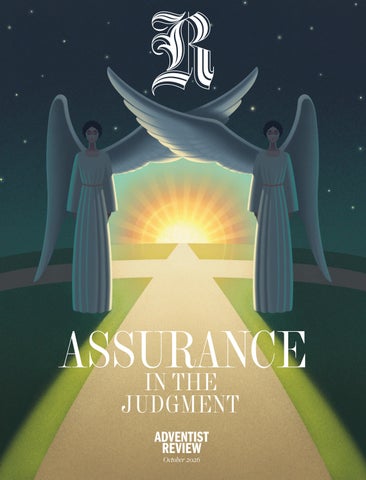
Assurance in the Judgment ADVENTIST REVIEW October 2026
Editorial
Cleansing of the Bath Cleansing that which remains dirty. JUSTIN KIM
8
Assurance in the Judgment RICHARD DAVIDSON
12 Lamb, Priest, King DAVID ASSCHERICK
16 The Greatest Offering HATSARMAVETH VENK AYA
24 Bella’s Bible SKY BRIDGER
28 Our Prophetic Heritage ALBERTO R. TIMM
15 Bible Questions Answered A BOGUS DOCTRINE?
19 Spirit of Prophecy WHAT TO DO WITH DOUBT
20 Sabbath School Reflection CHOSEN ON PURPOSE
31 President’s Perspective HOW, WHEN, AND WHO?
T
he Japanese have their sentō, while Koreans called theirs a jjimjilbang. The Islamic world has their hammam. Romans called theirs a thermae, while the Greeks a balneae. The Nahuatl natives in North America had their temazcal. The Western world is more familiar with the Finnish term sauna. Sometimes a steam room, sometimes a public bath, these facilities are found throughout the world where water and heat are utilized for cleansing and bathing the body. Many cultures tout their hydrotherapeutic health benefits, but they also have become places of socialization and relaxation. One unique practice at some public baths is a full body scrub. After soaking in hot water, the skin is exfoliated, removing dead skin cells, cleansing every pore, and encouraging blood circulation. One can see dead bits of the epidermal layer roll off the body like eraser bits. Everyone who comes to the bath is dirty. After a skin scrub, everyone who leaves the public bath is clean—squeaky clean. And at the end of the day there is only one thing that remains dirty: the bath itself. The sanctuary in heaven has been described as God’s house, as a temple, or as a throne room from which the decisions for the universe are made. But in a certain sense it is also like a public bath. The main attendant of this public bath welcomes all those in the camp to a spiritual cleansing. Through the medium of blood, sin is transferred from the sinner into the sanctuary. Every step of this transfer points to and represents Jesus’ death and ministry
in removing sin away from the sinner. In turn, every sinner who comes by faith to the entrance of the sanctuary is cleansed by the blood, death, and ministry of Jesus Christ. What remains is the composite record of sin in the sanctuary. Like the public bath at the end of the day that needs to be cleansed, the sanctuary is also cleansed once. While every other day of the year saw sins come into the sanctuary by the ministry of the priests in the holy place (also known as the daily), on one special day the sins were taken out of the sanctuary by the ministry of the high priest in the most holy place (also known as the yearly; see Lev. 16:16). Just like an announcement indicating that at 23:00 hours the public bath shall be cleansed, Daniel 8:14 prophesied thatin 2,300 years “the sanctuary shall be cleansed.” In other words, the composite record of sin in the sanctuary is removed once and forever. Not only is everyone who experiences the bath clean, but this public bath is the means by which all creation becomes restored and restituted. “Sin and sinners are no more. The entire universe is clean. One pulse of harmony and gladness beats through the vast creation.”* A cosmic and critical event happened in October of 1844. The cleansing process for the entire universe was led out by our High Priest, Jesus Christ, to remove sin once and for all. Yes, great; but no, not a disappointment at all. * Ellen G. White, The Great Controversy (Mountain View, Calif.: Pacific Press Pub. Assn., 1911), p. 678.
Visit our website, sign up for our newsletter, follow us on social media, watch Adventist videos, subscribe to our podcast, and read on WhatsApp. adventistreview.org/connect 2
October 2026
Cover illustration by Jon Krause
News in Brief
News in Brief provided by
76k The number of residents ordered to evacuate during the Spokane, Washington, United States wildfires. The North Pacific Union Conference organized a prayer vigil via Zoom to pray for those who had lost homes, for first responders, and for everyone who was serving the displaced. Adventist Community and Disaster Services also got involved in relief efforts, providing care packages and practical support.
“ There has never been a better time for young people to transform their smartphones into pulpits.” —Highten Hamweene, Southern Zambia Union Conference Youth director, who, during the Lusaka Conference Adventist Youth Big Sabbath Fellowship, preached a sermon and challenged young people to remain faithful to God’s mission and use technology responsibly. The event was attended by Zambian president Hakainde Hichilema, a Seventh-day Adventist church member, who donated K200,000 (US$11,000) and a bus to the Lusaka Conference to support their community service work.
General Conference president Erton Köhler joins content creators in producing digital content for OneVoice27. Photo: George Nelson
“It is a very big miracle. It is God who is doing the work. Our part is to give ourselves as vessels, and God keeps pushing us forward.” — Arop Daniel Otto Aligo, manager at Hope Channel South Sudan, commenting on the first online evangelism campaign run by the station in one of the world’s newest countries. Across the week they achieved more than 20,000 views, and it has provided encouragement to the small team there. “We believe South Sudan has a future, and through Hope Channel South Sudan we want to use every available platform to point people to Jesus Christ,” said Aligo.
“ The world is changing faster than our methods. We are slowly becoming missionaries to yesterday.” —Manny Artega, director of the General Conference’s Center for Urban Mission, challenging digital creators from around the world who had gathered for the Creator’s Summit at Silver Spring, Maryland, United States. During the summit Adventist Mission gave presentations on how digital content could reach those in the urban, post-Christian, and 10/40 windows. The gathering gave young creatives a sense of mission and how their digital influence could be used in the work of spreading the gospel around the world.
22
Number of countries in the West-Central Africa Division. More than 2,000 representatives from across those 22 countries gathered at Babcock University, Ogun, Nigeria, with flags and colorful attire to welcome Erton Köhler, president of the General Conference. “We always count on you to train the next generation of leaders who will be engaged in mission work, not only in Africa but throughout the world,” said Köhler. adventistreview.org
3
News in Brief
10% I am not sure
29% Agree
2% Disagree
2% Strongly disagree
57% Strongly agree
Do you think the doctrine of the sanctuary is vital to Adventist theology? Church members were asked if they think the biblical doctrine of the sanctuary is essential for the Seventh-day Adventist Church. Source: 2022-2023 Global Church Member Survey. Data provided by the General Conference Office of Archives, Statistics, and Research.
“ Mangroves are among God’s greatest gifts to humanity. They protect our coastlines from erosion, provide breeding grounds for fish and marine life, improve water quality, and help reduce the effects of climate change.” —Lonol Winnie, president of the Central Papua Conference (CPC), while attending the opening of the Bautama Mangrove Educational Boardwalk, a partnership between CPC and the Nature Conservatory. The project brings together the church, traditional landowners, local communities, government agencies, conservation organizations, and development partners in a shared effort to protect Papua New Guinea’s unique mangrove environment while promoting education, recreation, and community engagement.
3
“ One day, when I came home from church, I was praying at home, and I heard a voice in my heart that told me, ‘Go find someone to evangelize.’ That’s how I started inviting my friends.” —Valéria De Los Ángeles Hernandez Guayulpa, a Venezuelan girl who lives on the Brazilian border. An active member of her children’s small group, she decided to invite her classmates to attend and study the Bible with her. Four of her friends were baptized during the Evangelism Kids program at Pacaraima, Roraima, while more than 60 children from the area attended. 4
October 2026
The record number of awards the Advent Euphonic Chorale collected in a single day at the prestigious 2026 Llangollen International Musical Eisteddfod in Wales, United Kingdom. The group from Philippines completed the sweep, placing first in the Mixed Choir, Open Choirs, and Choir of the World categories. Advent Euphonic Chorale is composed of students and young professionals, most of whom come from the Adventist University of the Philippines.
Adventist Review Newsletter Do you want to keep up with what is happening in our church? If you want to receive our weekly newsletter that features news, inspirational stories, videos, and more, sign up today.
In-Depth News
Why Many Young People Decided Not to Get Baptized at the European Congress It’s not what you might think, regional church leaders explain.
A group of young attendees raise their hands in worship during the last day of the 2026 European Adventist Youth Congress in Valencia, Spain, August 8. Photo: Marcos Paseggi, Adventist Review
Marcos Paseggi, Adventist Review
T
he 2026 European Adventist Youth Congress closed on August 8, in Valencia, Spain, with a full-day program that included spiritual messages, congregational singing, and a moving baptismal ceremony. But while about 20 young people decided to commit to the Lord through baptism, many more answered the call but decided not to do it before their 3,500 coattendees. Why? There’s a reason for it, regional church leaders explained. And it’s not what you might think.
region also provided powerful researchbased insights into aspects of God’s truth. Attendees had ample time to interact with presenters, asking questions and for clarifications. An informal survey of attendees revealed a common response: “It was an extremely enriching experience; it opened my mind.”
“IT’S NOT OFTEN THAT THE LOCAL CONGREGATION CAN WITNESS A BAPTISM,” An Enriching Experience HE SAID. “AND THESE The mass gathering of Seventh-day AdventYOUNG PEOPLE FEEL ist young people from nearly 50 countries traveled to Valencia for several days of THEY WOULD LIKE TO GET back-to-back physical, mental, social, and BAPTIZED BY SOMEONE spiritual activities. Attendees participated CLOSE TO THEM, AS THEIR in physical challenges, chose between scores of workshops on various topics, and FAMILY AND FRIENDS had moments of Bible discussion and study WITNESS THE MOMENT.” in an environment that fostered international networking and connections. Once more the Adventist Church in Europe showed that mere numbers do not always tell the whole story. Workshops included not only some of the best theologians the Adventist Church has, but pastors who also serve as couples and family therapists, lay professionals who witness about God in extremely secular environments, and scientists who provide alternative questions to the dominant narrative about origins and evolution. Professors from various schools and seminaries across the
Morning devotionals, led by professor and pastor Ivana Mendez, and evening reflections, led by pastor and family therapist Damian Chandler, invited mostly college-aged attendees to reflect and go deeper into God’s Word in search for answers. The environment helped foster connections with fellow like-minded young people, with the church, and with God, organizers said. And yet, while scores of people made decisions for Jesus, not everyone who had
been studying and was ready got into the baptismal pool on August 8.
Focus on the Local Church Community
Daniel Duda, president of the Trans-European Division, shared the reason for these postponements. “Many young people decided not to get baptized here in Valencia because they would like to do it in front of those who have been significant in their lives, that is to say, at their local churches,” he explained. Somehow, he added, “they feel a very special connection with their local congregations and decided it would be better not to deprive them from witnessing that special moment.” Duda shared that in some of those local congregations, baptismal ceremonies took place only on very rare occasions. “It’s not often that the local congregation can witness a baptism,” he said. “And these young people feel they would like to get baptized by someone close to them, as their family and friends witness the moment.” Duda said it was an extremely positive and inspiring event, especially for young participants. “In some countries we do not have even 3,500 baptized church members, and very few of them are young,” Duda acknowledged. “Imagine what it was for these young people to study, laugh, and spend time with thousands of others just like them. They certainly felt that they are part of something bigger!” adventistreview.org
5
In-Depth News
Chinese Outreach Opens Door to the Pacific Evangelistic presentations seek to connect with residents across the region. Jesse Herford, Adventist Record
C
hinese-language television programs produced during Solomon Islands for Christ in July have opened new avenues for mission among Chinese communities across the Pacific. Daniel Jiao, president of the Chinese Union Mission, recently traveled from Hong Kong to the Solomon Islands to record a series of evangelistic presentations at the Solomon Islands Mission (SIM) Hope Channel studio. The programs were broadcast on local television, Facebook, and YouTube, with the aim of reaching Chinese people living and working in the Solomon Islands. “Our goal is to share the gospel message with Chinese people living in the Solomon Islands,” Jiao said. “Two weeks is very short, but we have been recording a sermon every day.” Rather than preaching at a local site, as the other Solomon Islands for Christ presenters have been doing, Jiao preaches a prerecorded message that is broadcast live every evening. “Most of the Chinese people here are business owners or are involved in business,” he said. “They’re very, very busy. They open their shops seven days a week. Usually on Saturday or Sunday, shops are closed. But the shops that are open are Chinese shops.” During their visit Jiao and his team visited many small business owners, workers, and teachers from different parts of China. Some had lived in the Solomon Islands for 20 or 30 years, while others had arrived
6
October 2026
only months earlier. Many of them hail from Chinese coastal provinces, such as Guangdong and Fujian. Born in China but now a Hong Kong local, Jiao said speaking Cantonese or other familiar Chinese dialects helped the team form connections. “They were very busy as we were talking to them. But I find they are also very eager to talk to people who can speak their own language.”
“THE ENVIRONMENT HERE IS VERY DIFFERENT FROM CHINA. PEOPLE HAVE MORE OPPORTUNITIES, THEIR MINDS ARE OPEN, AND THEY ARE MORE RECEPTIVE TO THE GOSPEL.” Among the locals Jiao connected with was a teacher who had moved to the Solomon Islands without his family. “I asked him, ‘What do you do in your free time?’ He said, ‘I just get online. I watch some videos.’ “I can sense that he’s probably lonely. So I exchanged contact details with him and said, ‘We are happy to talk to you.’ ” Jiao and the team visited him twice, inviting him and two other teachers to attend a Sabbath gathering and baptism.
“I can sense that he longs for that kind of happiness in his life,” he said after the man described seeing local Christians singing and worshipping together. Although many Chinese residents had learned Solomon Islands Pijin for business, Jiao said they often welcomed the opportunity to discuss their families, experiences, and the challenges of living away from home. The nightly broadcasts also generated a direct response from viewers. After several days without receiving feedback, the team prayed that someone would respond to the programs. Soon afterward they received a phone call from a group of 10 people requesting the free Bibles Jiao had offered during the broadcasts. “We were so thrilled,” he said. “This means the message is going out. People are listening and watching, and I believe God is going to move many people’s hearts.” Jiao said the experience had strengthened plans for longer-term Chinese ministry in the Solomon Islands. He has spoken with Solomon Islands Mission leaders about sending a Chinese missionary couple or family to work among the local Chinese community. Similar opportunities are also being considered in Papua New Guinea, Fiji, and other Pacific nations with established or growing Chinese populations. “The environment here is very different from China. People have more opportunities, their minds are open, and they are more receptive to the gospel.” Jiao shared with Adventist Record that while the China Union Mission
serves all China, only in Hong Kong can Seventh-day Adventist Christians share their faith openly. “In China the government places heavy restrictions on what can and cannot be shared, and in what circumstances. Chinese nationals outside of China, however, are subject to no such scrutiny. With China expanding its influence throughout the Pacific, new opportunities for mission are opening up like never before.” South Pacific Division president Glenn Townend is excited for the opportunities this could create: “There are thousands of Chinese businesspeople in the Pacific, including the Solomon Islands and Tonga. We have had missionaries in both places in the past—however, with limited results and loss of funding. Having the Chinese Union Mission leader see the potential in missionary work among the Chinese in the Pacific is important, as they gauge
interest in Chinese people all over the world. We are very grateful for the insights and partnership and will work to make this mission endeavor work.” The opportunity is great, as are the challenges. “There are Chinese communities not only here in the Solomon Islands but also in Papua New Guinea, Fiji, and other Pacific Island countries. We see many benefits in sending Chinese missionaries to these regions,” said Jiao. “Because of the restrictions in China, it can be difficult for our pastors there to do certain kinds of ministry. Coming here gives them the opportunity to experience a different culture and environment in which they can share the message of Jesus more freely. This is already a valuable experience for them, and I see great potential for reaching Chinese communities throughout the Pacific Islands. We have already met with the SIM president and agreed to work
together to send a missionary couple to the Solomon Islands. We hope to do the same in Papua New Guinea and other countries. “This works in two ways. First, it encourages our members and ministers from China. When they come here, they are exposed to a broader environment and see the potential to reach people. Second, the Chinese people living here have families back home. Yesterday we met a Chinese Christian who operates a restaurant. She said she was going back to China to be with her children, who are studying there. When people living overseas accept Jesus, they can influence their families back home. Even though ministry in China can be difficult, relatives living outside China who follow Jesus can bring that message home. “We see that God is using wonderful ways to share the gospel message with people in China,” he said. “We pray that God will continue to open doors for us.”
Daniel Jiao, president of the Chinese Union Mission, based in Hong kong. Photo: Adventist Record
adventistreview.org
7
Assurance in the Judgment
8
October 2026
How I lost my fear of heaven’s courtroom Richard Davidson
I
have not always considered the judgment as part of the assuring good news of the gospel.1 While growing up in the Seventh-day Adventist Church, I used to shudder at the mention of the investigative judgment. The thought of my name coming up in the heavenly judgment, with all my sins brought before God and the onlooking universe, caused me to feel, I’ll never make it! Please don’t let my name come up today. Imagine my surprise when, as a young pastor, I came across a number of prayers in the book of Psalms in which the psalmist actually welcomed—yes, even longed for—the judgment. The more general plea for judgment seemed shocking enough: “Arise, O God, judge the earth” (Ps. 82:8). Expressions of joy and exuberance at the coming judgment were beyond my comprehension: “Let the heavens be glad, and let the earth rejoice. . . . Then shall all the trees of the wood sing for joy before the Lord, for he comes, for he comes to judge the earth” (Ps. 96:11-13).2 Did he not understand the sinfulness of sin, the seriousness of the judgment? He understood. Note his prayer of repentance after the affair with Bathsheba and the murder of her husband: “For I know my transgressions, and my sin is ever before me. Against thee, thee only, have I sinned, and done that which is evil in thy sight, so that thou art justified in thy sentence and blameless in thy judgment” (Ps. 51:3, 4). David comprehended the heinousness of his sin and the reality of the judgment. But he also understood the message of righteousness by faith! David saw that, sinful though he was, his sins could be covered and cleansed by the blood of the Substitute. In joy he could cry out, “Blessed is he whose transgression is forgiven, whose sin is covered” (Ps. 32:1). Scripture consistently upholds the filthiness of sin and the certainty of the judgment. But it also reveals that the Lamb of God, our substitute, has been accepted in our place. As we receive Christ, we are covered with the robe of His righteousness. God says to the great accuser, “The Lord rebuke thee, O Satan!” (Zech. 3:2, KJV). We are acquitted, pardoned, cleansed. Illustration by Jon Krause
adventistreview.org
9
Assurance in the Judgment
The Christian church has long wrestled with how we can have assurance of salvation totally by grace and yet be judged by our works. Turning the Tables
In the judgment the tables are turned. No longer do we stand accused as a defendant, for Christ has paid the full price for our acquittal. Now we become the plaintiff, calling for vindication against the false charges of Satan. Now with David we can long for and welcome the judgment. We can pray, “Judge [vindicate, RSV] me, O Lord my God, according to thy righteousness” (Ps. 35:24, KJV). Vindication in the judgment! Assurance in the judgment! That’s good news—almost too good to be true! And I dared not believe it even as a theology major in college, as a seminary student, and as a young pastor. Statements such as the following kept ringing in my ears: “Those who accept the Saviour, however sincere their conversion, should never be taught to say or to feel that they are saved.”3 I didn’t understand that Ellen White was refuting the erroneous belief of “once saved, always saved.” I thought she meant that one could never have present assurance of salvation. How tragic that I did not see in the very same paragraph God’s assurance that we can “give ourselves to Christ and know that He accepts us”! For more than two years I preached sermons full of Christ, yet devoid of assurance. But finally, through a chain of marvelous providential leadings, the simplicity and beauty of the gospel began to dawn before my eyes The sublime promises jumped out at me from Scripture: “Truly, truly, I say to you, he who believes has eternal life” (John 6:47). “I write this to you who believe in the name of the Son of God, that you may know that you have eternal life” (1 John 5:13; cf. verses 11, 12). I found the same glorious revelation in the words of Ellen White: “If you give yourself to Him, and accept Him as your Saviour, then, sinful as your life may have been, for His sake you are accounted righteous. Christ’s character stands in place of your character, and you are accepted before God just as if you had not sinned.”4
Joy and Peace
The marvelous news that I was “accepted in the beloved” (Eph. 1:6, KJV), that Christ is my righteousness, brought to my soul a joy and peace like that described by the ones who heard the gospel message in the wake of the 1888 General Conference Session. Ellen White captured my own feelings as she depicted the experience of many at the Ottawa, Kansas, camp meeting in 1889: “Light flashed from the oracles of God in relation to the law and the gospel, in relation to the fact that Christ is our righteousness, which seemed to souls who were hungry for the truth, as light too precious to be received.”5 I felt like the young pastor at that Kansas camp meeting 10
October 2026
who “saw that it was his privilege to be justified by faith; he had peace with God, and with tears confessed what relief and blessing had come to his soul.”6 Since that experiential introduction to gospel assurance while I was a young pastor, the beauty of righteousness by faith has grown ever more precious. I must confess that sometimes it still seems almost too good to be true! I catch myself unconsciously falling back into old habit patterns of trying to be good enough to deserve salvation, and have to discover anew the joyous truth of “laying the glory of man in the dust” and trust wholly in Christ’s righteousness. Contrary to what I once thought, and to what many in 1888 feared, the message of assurance in Christ’s righteousness does not lead to cheap grace. “Its fruit is unto holiness” (cf. Rom. 6:22).7 I have found that only as I trust wholly in the merits of my Substitute and Surety can I truly obey God in spirit as well as in letter. Before internalizing the good news of justification by faith, I had tried to “depend upon watchfulness against temptation, and the performance of certain duties for acceptance with Him,” and discovered that indeed “there are no victories in this kind of faith.” Then came the glorious revelation: “There is need of constant watchfulness, and of earnest, loving devotion; but these will come naturally when the soul is kept by the power of God through faith. . . . God will accept every one that comes to Him trusting wholly in the merits of a crucified Saviour. Love springs up in the heart. . . . Duty becomes a delight, and sacrifice a pleasure.”8 I have also discovered that the Christian life is a matter of continual growth, and if in the growing process I make mistakes, this does not rob me of my assurance. Just as a child taking his first steps is not disowned by his father when he trips and tumbles, so my heavenly Father does not cast me off when I slip and fall (see Ps. 37:24). I’ve often had to bow down and weep at Jesus’ feet because of my shortcomings and mistakes, yet on divine authority I am not to be discouraged. Even if I am overcome by the enemy, I am not cast off, not forsaken, not rejected by God.9 Christ’s perfect holiness atones for my shortcomings; when I do my best, He becomes my righteousness.10 The Father beholds not my faulty character, but sees me as clothed in Christ’s perfection.11 As John the Beloved put it: “I am writing this to you so that you may not sin; but if any one does sin, we have an advocate with the Father, Jesus Christ the righteous” (1 John 2:1). What reassurance of assurance God has given! I am thankful that my assurance is not dependent upon my feelings. I cannot look within myself for evidence of my acceptance with God, for I will find there nothing but that which will discourage.
My only hope lies in looking to Jesus, my righteousness, my consolation, and my rejoicing (cf. Ps. 51; Isa. 6).12 I rejoice that as I continue to keep my eyes upon Christ, my righteousness, the promised result is inevitable: my repentance will ever deepen, and at the same time, by beholding I will become changed—“transformed into his likeness with ever-increasing glory” (2 Cor. 3:18, NIV).13
to holding in balance the relationship between grace and works, assurance and judgment. This balance is illustrated by the placement of the most crucial Day of Atonement passage, Leviticus 16. Recent studies have shown how the entire Pentateuch (the five books of Moses) is arranged in a chiastic, or “mountain,” structure, in which the “sides” of the Pentateuchal “mountain” match each other and the apex of the mountain contains the central focusing point of the whole.14 Observe the diagram that accompanies this article. Note that the central chapter of the book of Leviticus, and of the whole Pentateuch, is Leviticus 16, which focuses upon the Day of Atonement. If this chapter forms the apex of the entire Mosaic law of types and figures, certainly Adventists need not be ashamed to proclaim the antitypical day of atonement as the crucial and unique present truth for spiritual Israel at the end of time! But placement of the Day of Atonement in the heart of Leviticus has more to say to us than underscoring its importance. Notice from the diagram that the book of Leviticus is divided into two halves, each with a different emphasis. In chapters 1-15 the underlying theme is blood. Almost everywhere we find blood, sacrifice, and substitutionary atonement. But in the latter half of the book, chapters 17-27, blood is almost never mentioned. Instead, the overriding theme becomes holiness. And right in the middle stands chapter 16, the Day of Atonement. I am convinced that we can fully appreciate the significance of the Day of Atonement only when we see it in its setting in Leviticus. Building up to the Day of Atonement, we see blood, substitutionary sacrifice—in New Testament terms, justification. Assurance in the Day of Atonement is based solely upon the blood of the substitute. Yet from Leviticus 16 onward, the rest of the book presents a call to holiness, to sanctification. The Day of Atonement thus ties together blood and holiness, justification and sanctification. We are saved by blood, by grace; but we are judged by our works of holiness, the natural fruit of atoning grace. The efficacy of the blood becomes manifest to all by its holy fruit. Assurance and judgment—in the Day of Atonement these two concepts meet and take on ultimate meaning. Will you let them join and have ultimate meaning in your life?
Precious Doctrine
How precious the doctrine of Christian assurance is to me! But I also wish to underscore that the doctrine of the judgment is now just as precious! In the years following 1888, some proponents of Christian assurance (e.g., Albion Ballenger) felt that this doctrine could not be reconciled with the Adventist teaching concerning the pre-Advent investigative judgment of the saints, and consequently chose to retain the former and reject the latter. This view has again been championed by some Adventists in recent years. But the biblical evidence forthcoming (especially since 1980) from the Daniel and Revelation Committee and other sources is persuasive: it is not a matter of choosing either Christian assurance or the investigative judgment. Both are solid biblical doctrines. What is more, the judgment involves an examination of the saints’ works, as Adventists have consistently maintained. The Christian church has long wrestled with how we can have assurance of salvation totally by grace and yet be judged by our works. But I have become convinced that Seventh-day Adventists, with their unique message of the antitypical day of atonement now in heavenly session, can preach these two doctrines with greater harmony, clarity, and power than any preceding generation. The Day of Atonement contains the key
F
This article first appeared in the January 7, 1988, edition of the Adventist Review. Unless otherwise indicated, Bible texts are from the Revised Standard Version of the Bible, copyright © 1946, 1952, 1971, by the Division of Christian of the National Council of Churches of Christ in the U.S.A. Used by permission. 3 Ellen G. White, Christ’s Object Lessons (Washington D.C.: Review and Herald Pub. Assn., 1900, 1941), p. 155; Ellen G. White, Selected Messages, book 1 (Washington D.C.: Review and Herald Pub. Assn., 1958, 1980), p. 314. 4 Ellen G. White, Steps to Christ (Mountain View, Calif.: Pacific Press Pub. Assn., 1956), p. 62. (Italics supplied.) 5 E. G. White, Selected Messages, book 1, p. 356. 6 Ibid. 7 Ibid., p. 359. 8 Ibid., pp. 353, 354. 9 See E. G. White, Steps to Christ, p. 64. 10 See E. G. White, Selected Messages, book 1, p. 368. 11 See Ellen G. White, The Desire of Ages (Mountain View, Calif.: Pacific Press Pub. Assn., 1898, 1940), p. 357. 12 See E. G. White, Steps to Christ, pp. 64, 65. 13 See E. G. White, Christ’s Object Lessons, p. 160; Steps to Christ, p. 65. 14 See Yehuda Radday, “Chiasm in Tora,” Linguistica Biblica 19 [1972]: 21-23; and William Shea, “Literary Form and Theological Function in Leviticus,” in Frank Holbrook, ed., The Seventy Weeks, Leviticus, and the Nature of Prophecy, Daniel and Revelation Committee Series, vol. 3 (Washington, D.C.: Biblical Research Institute, 1968), pp. 131-168. 1
16
2
DAY OF ATONEMENT
E
E1
PRIESTLY LAWS 8-10 21-22
D1
BL B A
SANCTUARY LAWS
1-6 23-25 LEVITICUS
SS
C
D
NE
OO
D
LI
PERSONAL LAWS
HO
11-15 17-20
C1
EXODUS NUMBERS GENESIS DEUTERONOMY
DIAGRAM OF LEVITICUS
B1 A1
Richard Davidson is senior research professor of Old Testament interpretation at Andrews Theological Seminary. adventistreview.org
11
Title Here
Lamb, Priest, King With Jesus in His sanctuary David Asscherick
12
October 2026
E
arlier this year I met for breakfast with a young, gifted, and “on fire” Adventist pastor. He had requested a meeting, and I was happy to oblige. No sooner had I sat down than the questions came fast and furious: “What’s the deal with the sanctuary?” “Does it really matter?” “If it’s so important, and so biblically central, why is no one else emphasizing it the way we do?” “Is it just an artifact of our past that’s better left in the dustbin of history?” An excellent, lively two-hour conversation ensued. Happily, there were many “aha” moments for the young minister (and me too!) in the course of our time together, but none greater than when I said this: “The sanctuary is all about Jesus—as lamb, priest, and king—and about God’s longing desire to dwell personally and permanently with His beloved people.” The young man suddenly stopped, half-smiled, wrinkled his brow, shifted his eyes in obvious thought, and then, a few seconds later, blurted out, “Say that again!” So I did. And for more than a moment, he just sat there motionless, pensive, brow furrowed, taking it in. “Wow,” he exclaimed. “I’ve never heard it like that. Can we talk through that?” “Of course,” I responded. What follows is a summary of what we talked about, so pull up a chair and enjoy the conversation.
The Divine Desire to Dwell
God longs to be with and among His people. We see this beautiful truth about God’s heart unmistakably from Genesis to Revelation. In Genesis God fashions Adam and Eve in His own image, makes a garden for them to dwell in, and comes daily to visit them in their garden home. Furthermore, God creates the Sabbath, a day of rest, as a 24-hour “tabernacle in time.” As Sigve K. Tonstad observes in The Lost Meaning of the Seventh Day: “The seventh day brings to view God’s priorities. Seeing that human time ‘begins with a day of rest and not a day of work,’ the spiritual pursuit, living life in a relationship with the Creator that is mutually meaningful, stands out as the primary meaning in life.”1 Just one page later Tonstad writes, “The seventh day tells of the importance of human beings to God, and its primary message is not human duty but divine commitment.”2 These insights are sublime, calibrating us to a proper understanding of the Sabbath as a pre-sin revelation of God’s heart, priorities, and faithfulness. Photo by Biblebox / Lightstock
Unsurprisingly, the message of the Sabbath, a memorial of creation, is the same as the general message of creation: God loves and prioritizes His human children—those that specially bear His image—and accordingly He longs to be with them. Fast-forwarding to Revelation, we see that the grand climax of Scripture and of God’s redemptive plan is that He is, at long last, with His beloved children from all ages. Returning to the Old Testament, this time to Exodus, we again see God’s longing desire to be with and among His people, this time in the construction of the sanctuary: “And let them make Me a sanctuary, that I may dwell among them” (Ex. 25:8). Like creation and the Sabbath, the sanctuary brings to view God’s priorities. And what is among the highest of the divine priorities? To dwell with His people, to be among them. Before we move on, just let the beauty and profundity of this simple and biblically central truth wash over you: God wants to be with you! Yes, you! He not only loves you, He likes you and wants you, with your unique and irreplaceable personality, to inhabit both eternity and your day-to-day life alongside Him. As our loving heavenly Father, God is for us, all of us. And He has made a way! There is no better news than this. It’s how Scripture opens and closes.
Jesus is not just the one that so many Old Testament stories and symbols, including the sanctuary, point to. He is, Himself, the point! A Pattern
The verse immediately after Exodus 25:8 says, “According to all that I show you, that is, the pattern of the tabernacle and the pattern of all its furnishings, just so you shall make it” (verse 9). The sanctuary design and structure (“the pattern”) was not Moses’ idea—it was God’s.3 The divinely given pattern was a three-part structure. The technical word for this, sometimes used by theologians, is tripartite, which simply means composed of, or involving, three parts. Those three parts of the sanctuary are the courtyard, the holy place, and the most holy place. The courtyard was just what it sounds like: a large fenced-in area, or yard. There was a single entrance to the courtyard, symbolizing that there is only one way—or one door—to access the sanctuary and, most important, the God who dwells there. The courtyard contained two holy articles of furniture: a large altar and a basin of water called a laver. These, too, were designed by God, and again, the pattern was given to Moses. The holy place came next and contained three articles of furniture: a lampstand, a table with ceremonial bread, and a smaller altar for burning incense. The most holy place, which, curiously, was in the shape of a cube, contained a single article of furniture: the ark of the adventistreview.org
13
Lamb, Priest, King
covenant, which held, among other things, the Ten Commandment tablets, written by God’s own hand and given to Moses.4 Eventually, about 1,000 years before the time of Christ, this temporary and mobile sanctuary became a permanent, immovable structure with the construction of King Solomon’s expansive and opulent temple. This temple, like the sanctuary before it, was modeled on the divinely given pattern and was gloriously and unmistakably inhabited by God Himself. The sanctuary and its pattern communicated two grand realities: (1) God’s desire to be with His people and (2) His holiness requiring a certain way of dwelling with His people. Sin and uncleanness cannot come into the direct presence of God. As God told Moses: “You cannot see My face; for no [sinful] man shall see Me, and live” (Ex. 33:20). This being the case, God made a way for Him to dwell with His sinful people, and that way was the sanctuary, with its specific and God-given pattern. God knows that you are sinful and that you cannot rescue and restore yourself. So He made a way—a wonderful and wise way that doesn’t compromise His holiness or pretend that our sin isn’t real. It is a wondrous and beautiful solution that brings the sinner “up” to God through mercy, forgiveness, sacrifice, and restoration. God loves us dearly and is deadly serious (literally!) about saving us. Why? Because, again, He longs to be with us personally and permanently!
Jesus and the Sanctuary
The sanctuary, with all its beautiful and often mysterious symbolism, pointed to Jesus! It foreshadowed His incarnation, death, resurrection, and highpriestly ministry. Jesus is “the door” (John 10:7, 9) and “the way” (John 14:6), both references to Jesus as the one point of saving access to God, symbolized by the single entrance to the sanctuary. Jesus is the “Lamb of God who takes away the sin of the world,” as John the Baptizer boldly announced (John 1:29). Jesus is our “merciful and faithful High Priest” (Heb. 2:17) who “[sympathizes] with our weaknesses” and “was in all points tempted as we are, yet without sin” (Heb. 4:15). Jesus is the “bread of life” (John 6:35), a reference to both the manna in the wilderness and the ceremonial shewbread in the sanctuary. Jesus is “the light of the world” (John 8:12), a general reference to light and its illuminating properties, but also the sanctuary lampstand, which brought light to the interior of the sanctuary tent. Jesus is the “mercy seat,” the golden lid that covered the ark where the atoning blood was sprinkled by the high priest (also symbolizing Jesus) on the Day of Atonement (see Rom. 3:25, NET, and Lev. 16).5 In fact, Jesus is the whole sanctuary Himself! (See John 2:19-22; 1:14). One fascinating similarity between Jesus in His incarnation and the sanctuary is that both were rather plain and unimpressive viewed from the outside, but on the inside were filled with beauty, mystery, light, and holiness.6 One day Jesus told the astonished and utterly befuddled religious leaders of His time that “you search the Scriptures, for in them you think you have eternal life; and these are they which testify of Me. But you are not willing to come to Me that you may have life” (John 5:39, 40). On another occasion, following His resurrection, Jesus gave a Bible study to two of His bewildered and no-doubt thrilled disciples and said, “These are the words which I spoke to you while I was still with you, that all things must be fulfilled which were written in the Law of Moses and the Prophets and the Psalms concerning Me” (Luke 24:44). There can be little doubt that a large part of what Jesus meant on these two occasions (and others like them) is that the Old Testament sanctuary—its structure, various symbols, and overall message—pointed wonderfully and conclusively to Him: temple, door, lamb, high priest, bread, light, mercy seat, 14
October 2026
The sanctuary and its divinely given pattern communicated two grand realities. and more! Jesus is not just the one that so many Old Testament stories and symbols, including the sanctuary, point to. He is, Himself, the point! Is Jesus “a mere doctrine”? Of course not! He is the second person of the Godhead, “the Son of God,” “the Savior of the World,” “the Word made flesh,” our “great High Priest,” our soon-returning “King of kings,” and more.7 Jesus is the foundation and destination of the Christian faith, and the sanctuary points to Him and His various modes of ministry in multifarious and illuminating ways. This article continues online. Scan the QR code or visit adventistreview.org/theology/ teachings/doctrines-teachings/ lamb-priest-king to access it. Sigve K. Tonstad, The Lost Meaning of the Seventh Day (Berrien Springs, Mich.: Andrews University Press, 2009), p. 37. (Emphasis supplied.) 2 Ibid., p. 38. (Emphasis supplied.) 3 See also Exodus 25:40; 26:30; Acts 7:44; Hebrews 8:5. In 2025 Light Bearers, the ministry that I am privileged to be a director/speaker of, spent our annual “convocation” studying the sanctuary in a 10-part series titled Dwell: The Sanctuary and the Heart of God. I highly recommend you check it out on our YouTube channel, https://www.youtube.com/@Light_Bearers. 4 All of this—from the tripartite structure to the materials, the design and dimensions of the various holy articles to the priests and their garments—is highly symbolic. Fascinating and important books have been written on the sanctuary and its extraordinary symbolism. One such book not to be missed is Richard Davidson’s masterpiece, A Song for the Sanctuary: Experiencing God’s Presence in Shadow and Reality. 5 Texts credited to NET are from the New English Translation Bible, copyright © 1996, 2026, by Biblical Studies Press, L.L.C. All rights reserved. 6 See Isaiah 53:2 and note that the sanctuary’s beauty was largely on the inside. From the outside, it looked simply like a large but regular tent, to the degree that it could be seen at all by the tall and obscuring fence that bordered the courtyard. 7 See John 20:31; 1 John 4:14; John 1:14; Hebrews 4:14; Revelation 19:11-16. 1
David Asscherick is an ordained minister of the Seventh-day Adventist Church, a speaker for Light Bearers, cofounder of ARISE, and author of God in Pain.
BIBLE Q UE S T I ONS ANS W ER ED
A Bogus Doctrine? Was the sanctuary doctrine made up just to explain why Jesus didn’t come back in 1844?
T
he claim circulated widely in 1979. Was the sanctuary doctrine biblical, or was it just a convenient excuse to avoid embarrassment? The Daniel and Revelation Committee, with the Biblical Research Institute, addressed the issue with seven published volumes. These showed that the sanctuary doctrine is a solid Bible teaching. The early Adventist discovery is sound: The “cleansing of the sanctuary” in Daniel 8:14, rather than describing Christ cleansing the earth at His second coming, points to the cleansing of the heavenly sanctuary through a work of judgment. Daniel 2, 7, and 8 tell the same basic story, each chapter adding more detail. Four metals in an image represent four kingdoms in Daniel 2. Four unclean animals represent the same kingdoms in Daniel 7, but with the addition of a little horn that rises from the fourth beast (Dan. 7:8). Then a heavenly judgment begins, with the “Ancient of Days” (verse 9) and “One like the Son of Man” (verse 13) taking part. Daniel 8 repeats the same sequence but leaves out Babylon, because Babylon was near its end when the vision is given. This time clean animals—a ram and a goat—stand for Medo-Persia and Greece. The little horn in Daniel 8 comes from one of the four winds, or directions, and points to Rome. It shows pagan Rome in its earthly (horizontal) conquest (Dan. 8:9, 10) and papal Rome in its (vertical) attack on heaven, the Prince of the host,
and the place of God’s sanctuary (verses 11, 12). A clean animal would have been inappropriate to symbolize Rome, with its “transgression of desolation” (verse 13) or “abomination of desolation” (Dan. 11:31; 12:11; see also Matt. 24:15). Heaven’s answer to the Papacy’s attack on God’s sanctuary and people (symbolized by “the host” and “the stars” [Dan. 12:3]) comes in Daniel 8:14: After 2,300 “evening-mornings,” the sanctuary would
heavenly judgment. This judgment not only deals with the beasts and the little horn (Dan. 7:11, 12, 26; 8:13, 25) but also concerns God’s people (Dan. 7:9, 10, 13, 14, 22, 27; 8:13, 24, 25). The starting point of this judgment is connected with the 70-week prophecy of Daniel 9. Both time periods focus on Christ’s atoning work: The 70 weeks point to His sacrifice on the cross, and the 2,300 days point to His Day of Atonement
Before Christ returns, the subjects of His kingdom must be clearly identified through this heavenly judgment, which began in 1844. be cleansed. This points to a heavenly Day of Atonement. In the earthly sanctuary service both a ram and a goat were used on that day, and in that order (Lev. 16:3, 9). On that day the sanctuary was cleansed from the sins confessed during the year. The blood of the Lord’s goat was sprinkled first in the most holy place, on and before the mercy seat, to atone for the broken law inside the ark. When Daniel 7 and 8 are compared, Daniel 8:14 clearly describes the same
ministry in the heavenly sanctuary. Before Christ returns as “King of kings and Lord of lords” (Rev. 19:16), the subjects of His kingdom must be clearly identified through this heavenly judgment, which began in 1844. Only then can He “reward . . . every one according to his work” (Rev. 22:12).
Clinton Wahlen is an associate director at the Biblical Research Institute. adventistreview.org
15
The Greatest Offering God’s self-giving love transforms the way we worship and witness. Hatsarmaveth Venkaya
E
very morning before dawn, a missionary quietly unlocked the gate of a small Christian school in the Middle East. Before classes could begin, another responsibility awaited him. During the night, villagers piled their household rubbish against the wall surrounding the school and entrance. Rotting food, broken glass, plastic, and other refuse formed a heap that often stood more than a meter high. This was not an act of carelessness. In that cultural context, throwing garbage at someone’s property was a deliberate expression of rejection and contempt. The Christian school, along with the missionaries who served there, had become objects of disdain. Every pile of rubbish carried the same unspoken message: You are not welcome here. Many would have found such treatment reason enough to leave. Others might have appealed to the authorities, demanded justice, or requested a different assignment. But the missionary chose a different response. Each morning he quietly picked up a shovel and began cleaning. He never confronted the villagers or protested. What many would have considered a humiliating task, he came to view as an act of worship. As he removed the rubbish from the school entrance, he would sing and pray for the villagers, drawing inspiration from Jesus’ words: “The Son of Man did not come to be served, but to serve” (Matt. 20:28). Though the work was unpleasant, exhausting, and apparently unnoticed, he performed it dutifully. In those early
16
October 2026
mornings of humble service, he felt closer to Christ than ever before. True service is most Christlike when it is offered without recognition and without expecting anything in return. For months this was his daily routine. Constant exposure to decaying waste, foul odors, and disease gradually weakened his health. Anyone could have questioned why he continued. Surely there were limits to what a person should endure. Yet he understood that before the villagers would trust the message he preached, they first needed to encounter the character of the Savior he served in the way he lived. Gradually the piles of rubbish that once littered the school entrance vanished. People began greeting him warmly, and their initial suspicion transformed into genuine kindness. Over time families who had once rejected the Christian school entrusted their children to its teachers. No argument or public debate had
The Offering God Gave First
persuaded them. They had witnessed something far more compelling than eloquent preaching— the quiet persistence of Christlike love. This story captures the heart of the gospel. The missionary was doing far more than cleaning rubbish from the entrance of a school. His service became an offering of worship to the Lord, flowing naturally from his communion with Christ. In his quiet willingness to enter a place of rejection, remove what others had thrown there in resentment, and keep serving those who despised him, he was offering a living picture of the story of redemption. From Genesis to Revelation, “Scripture traces a consistent pattern: humanity fractures its relationship with God through disobedience, and God responds by entering into that brokenness to accomplish what humans cannot restore themselves.” 1 The gospel begins, not with humanity seeking God, but with God seeking humanity. Photo by wirestock / Magnific
After Adam and Eve sinned, shame and guilt drove them into hiding. The intimacy they had once enjoyed with their Creator gave way to fear. They attempted to cover themselves with fig leaves and concealed themselves among the trees of the garden. Yet while humanity hid, God came looking. The question “Where are you?” (Gen. 3:9) was not asked because God had lost sight of His children. It was an invitation to relationship.2 Before there was an altar, a sanctuary, or a sacrificial system, there was a God who crossed the distance that sin had created. Even the garments of skin with which He clothed Adam and Eve pointed forward to the day He Himself would provide the perfect sacrifice.3 This divine initiative reaches its fullest expression in Jesus Christ. “The Word became flesh and dwelt among us” (John 1:14). In those few words, John describes the greatest act of self-giving in history. The eternal Son of God entered a world disfigured by sin. He did not remain at a safe distance from human suffering, nor did He wait for humanity to become worthy of His presence. He stepped into our brokenness, bore our shame, and carried the consequences of our rebellion. The Incarnation, however, was not the final expression of Christ’s self-giving love. It was the path that led to Calvary. If Bethlehem reveals the depths to which God was willing to descend, Golgotha reveals how much He was willing to give. When Christians hear the word “offering,” we often think first of money placed in an offering plate or a gift given for the support of the church and the advancement of mission. Scripture begins somewhere deeper. Before God ever asks humanity to bring an offering, He reveals Himself as the great Giver (1 Chron. 29:14).4 Paul writes that Christ “has given Himself for us, an offering and a sacrifice to God for a sweet-smelling aroma” (Eph. 5:2). Jesus is not only the one who receives our worship; He is Himself the supreme offering, and in His self-giving love His worthiness to receive our worship is most fully revealed. Every sacrifice in the Old Testament anticipated Him. Every lamb placed upon the altar, every priestly act within the sanctuary, and every drop of sacrificial blood pointed forward to the day when God Himself would provide the offering no human being could provide.5 At the cross the sacrificial system reached its fulfillment in the One who gave Himself for the life of the world.6 John expresses this truth in one of Scripture’s best-known declarations: “For God so loved the world that He gave His only begotten Son” (John 3:16). God’s giving flows from His love. It was not a response to human worthiness, but the expression of who He is. The cross reveals that self-giving love is not merely something God does; it belongs to His very character. His grace precedes our obedience, and His sacrifice makes restored relationship possible. This revelation reshapes our understanding of worship and giving. Christian giving is not a means of securing God’s favor, but the grateful response of those who have already received grace they could never earn. We give, not because God depends on what we possess, but because His love has reordered our hearts. Every genuine offering therefore bears witness to the supreme offering made in Christ.
When Giving Becomes Worship
Jesus once observed worshipers as they brought their gifts to the temple treasury (Mark 12:41-44). Some gave large amounts. Then a poor widow approached and placed two small copper coins into the treasury. Financially, her gift seemed insignificant. Spiritually, it became unforgettable. Jesus declared that she had given more than all the others because heaven measures adventistreview.org
17
The cross reveals that self-giving love is not merely something God does; it belongs to His very character.
generosity differently from earth. People see gestures and amounts; God sees the motives of the heart. The same truth appears in the story of Mary of Bethany. When she broke her alabaster flask and poured its costly perfume upon Jesus, some immediately calculated its value. To them, it appeared excessive, even wasteful. To Jesus, it was an act of devotion (Matt. 26:6-13). Mary was expressing a heart overwhelmed by gratitude. Having encountered the grace of Christ, she gave Him her best because love had become the measure of her worship. The widow and Mary remind us that the value of an offering is never determined merely by its quantity. It is determined by the love from which it flows and the surrender it represents. This is why Christian giving must never be reduced to money alone. Tithes and offerings are sacred expressions of worship, but they belong within a larger offering of the whole life to God. Scripture calls us to present our bodies as “a living sacrifice, holy, acceptable to God” (Rom. 12:1). God desires not only what is in our hands, but the heart, the will, the time, the body, and the life from which every true offering comes. Paul understood this when he wrote, “The love of Christ compels us” (2 Cor. 5:14). To encounter that love is to see everything differently. Possessions no longer provide our security, achievement no longer determines our worth, and service is no longer driven by the desire to be noticed. Christian giving, therefore, is not confined to what we place in an offering plate; it is the surrender of the whole life to Christ. Here worship and mission converge. The Christ who crossed the distance between heaven and earth now calls His followers to cross the barriers that keep people from encountering His love. For some, this means crossing oceans; for others, simply crossing the street. Some proclaim the gospel to thousands, while others patiently guide a single searching person toward Christ. The expressions of the call may differ, but its heart remains the same: a life placed at God’s disposal for the sake of His mission.
A Life Offered to God
Mission shaped by such self-giving love inevitably carries a cost. It demands our presence, patience, and, at times, a willingness to be misunderstood. It calls us to love without assurance of return, to serve without recognition, and to remain faithful when the fruit of our labor is not immediately visible. Such compassion is not sustained by human feeling alone; it grows out of communion with Christ. Those who have received the self-giving love of God are thereby enabled to extend that love to others. 18
October 2026
Some of the greatest barriers to mission are not geographical, religious, or cultural, but lodged within the human heart. Pride, resentment, fear, prejudice, indifference, and self-protection can keep us at a distance from those whom Christ longs to restore.7 Yet the gospel calls us beyond these boundaries. It sends us to the nations, but also toward the neighbor, the estranged relative, the wounded relationship, and the person we would rather avoid. Mission begins wherever the love of Christ leads us beyond the limits of our own comfort. This is why Christian mission must be understood as worship. Worship is not confined to songs, prayers, sermons, or offerings presented during a service. These are sacred expressions of worship, but Scripture calls for something larger: a life presented to God. When we serve the broken, give sacrificially, care for our bodies, honor the Sabbath, use our influence for good, and enter another person’s pain with the compassion of Christ, we are not merely doing religious work. We are responding to the God who first gave Himself for us. The missionary’s repeated act of clearing the school entrance revealed far more than a willingness to perform an unpleasant task. It embodied the heart of Christ. Before the villagers understood his theology, they encountered the character of his Savior. Before they listened to his message, they witnessed its meaning through his compassion. Perhaps this is among the greatest gifts a believer can offer—not merely something placed in God’s hands, but a life so transformed by grace that others catch a glimpse of Christ through it. Such a life is always a response to the greater gift first given by God Himself: the One who entered our broken world, bore our shame, cleansed us from sin, and gave Himself to bring us home. Will Bankston and Cheri L. Pierson, Exploring Doctrine: A Theological English Curriculum (Carlisle, Cumbria, Eng.: Langham Global Library, 2019), p. 44. 2 Michael Carasik, ed., “Genesis: Introduction and Commentary,” trans. Michael Carasik, The Commentators’ Bible (Philadelphia: The Jewish Publication Society, 2018), p. 41. 3 Ellen G. White, The Upward Look (Washington, D.C.: Review and Herald Pub. Assn., 1982), p. 378. 4 John M. G. Barclay, “Gift,” in The Oxford Dictionary of the Christian Church, ed. Andrew Louth (New York: Oxford University Press, 2022), p. 779. 5 Charles T. Fritsch, “Biblical Typology,” Bibliotheca Sacra (1947), p. 94. 6 Ellen G. White, Faith and Works (Nashville: Southern Pub. Assn., 1979), p. 12. 7 Paul G. Hiebert, Anthropological Insights for Missionaries (Grand Rapids, Mich.: Baker Academic, 1985), p. 97. 1
Hatsarmaveth Venkaya, Ph.D. (Intercultural Studies and World Mission), serves as president of the New Caledonia Mission in the South Pacific Division. Photo by wirestock / Magnific
S PIRI T OF PROPHECY
What to Do With Doubt
M
any, especially those who are young in the Christian life, are at times troubled with the suggestions of skepticism. There are in the Bible many things which they cannot explain, or even understand, and Satan employs these to shake their faith in the Scriptures as a revelation from God. They ask, “How shall I know the right way? If the Bible is indeed the Word of God, how can I be freed from these doubts and perplexities?” God never asks us to believe, without giving sufficient evidence upon which to base our faith. His existence, His character, the truthfulness of His Word, are all established by testimony that appeals to our reason; and this testimony is abundant. Yet God has never removed the possibility of doubt. Our faith must rest upon evidence, not demonstration. Those who wish to doubt will have opportunity; while those who really desire to know the truth will find plenty of evidence on which to rest their faith. It is impossible for finite minds fully to comprehend the character or the works of the Infinite One. To the keenest intellect, the most highly educated mind, that holy Being must ever remain clothed in mystery. “Canst thou by searching find out God? Canst thou find out the Almighty unto perfection? It is as high as heaven; what canst thou do? deeper than hell; what canst thou know?”. . . The Word of God, like the character of its divine Author, presents mysteries that
Learning to trust what finite minds cannot fully explain Ellen G. White
can never be fully comprehended by finite beings. The entrance of sin into the world, the incarnation of Christ, regeneration, the resurrection, and many other subjects presented in the Bible, are mysteries too deep for the human mind to explain, or even fully to comprehend. But we have no reason to doubt God’s Word because we cannot understand the mysteries of His providence. In the natural world we are constantly surrounded with mysteries that we cannot fathom. The very humblest forms of life present a problem that the wisest of philosophers is powerless to explain. Everywhere are wonders beyond our ken. Should we then be surprised to find that in the spiritual world also there are mysteries that we cannot fathom? The difficulty lies solely in the weakness and narrowness of the human mind. God has given us in the Scriptures sufficient evidence of their divine character, and we are not to doubt His word because we cannot understand all the mysteries of His providence. . . . The Bible unfolds truth with a simplicity and a perfect adaptation to the needs and
longings of the human heart, that has astonished and charmed the most highly cultivated minds, while it enables the humblest and uncultured to discern the way of salvation. And yet these simply stated truths lay hold upon subjects so elevated, so far-reaching, so infinitely beyond the power of human comprehension, that we can accept them only because God has declared them. Thus the plan of redemption is laid open to us, so that every soul may see the steps he is to take in repentance toward God and faith toward our Lord Jesus Christ, in order to be saved in God’s appointed way; yet beneath these truths, so easily understood, lie mysteries that are the hiding of His glory—mysteries that overpower the mind in its research, yet inspire the sincere seeker for truth with reverence and faith. The more he searches the Bible, the deeper is his conviction that it is the Word of the living God, and human reason bows before the majesty of divine revelation. To acknowledge that we cannot fully comprehend the great truths of the Bible is only to admit that the finite mind is inadequate to grasp the infinite; that man, with his limited, human knowledge, cannot understand the purposes of Omniscience.
Seventh-day Adventists believe that Ellen G. White (1827-1915) exercised the biblical gift of prophecy during more than 70 years of ministry. This excerpt is taken from Steps to Christ, pp. 105-108. adventistreview.org
19
Chosen on Purpose Embracing God’s radical call Cindy Tutsch
I
t was December 1844 in Portland, Maine. A group of five women knelt in prayer, their hearts bruised by grief. Just two months prior, on October 22, their world had shattered. Thousands of Millerite Adventists had watched the sun set and rise again without the appearance of their Savior. The Great Disappointment had left them ridiculed, bewildered, and spiritually cast awry. In that room knelt a 17-year-old girl named Ellen Harmon. Weighing barely 80 pounds, chronically ill from a childhood head injury that had ended her formal education at age 9, and possessing a voice so damaged she could barely speak above a whisper, she was the epitome of human frailty. Yet, as she prayed, the room seemed to dissolve. She felt a power pass through her, lifting her
20
October 2026
above the dark world, where she saw a straight and narrow path casting a bright light behind the Advent people. Jesus was leading them toward the Holy City.1 This was the birth of a prophetic ministry that would span seven decades, shape a global movement, and provide a living template for how God communicates with a fallen world. But more than an isolated historical event, Ellen Harmon’s (later White’s) first vision illuminates an eternal truth that runs from Genesis to Revelation: When God calls an individual to His service, He is not looking for human résumés, cultural prestige, or societal validation. The Holy Spirit anoints whom He will, and whomever He calls is His absolute ideal—not a second choice or a desperate last resort.
S A B B AT H S C H O O L R E F L EC T ION
Forging Messengers From Flawed Clay
To understand the radical nature of divine calling, we must look backward into the biblical narrative. God has never chosen His representatives based on human standards of readiness. Rather, the history of salvation is a gallery of unlikely candidates, each called at a precise geopolitical and spiritual inflection point to realign a wandering people with the everlasting covenant and renew their characters to be as God’s character. ABRAHAM: THE FLAWED GUARDIAN OF THE PROMISE
Consider Abram, later renamed Abraham. God did not find him in a sanctuary of pristine theological purity; He called him out of Ur of the Chaldees, a metropolis steeped in polytheism and moon worship. When God called him to leave his country and his kindred for an unnamed inheritance, Abraham went, stepping into the dark on nothing but a divine promise (see Heb. 11:8). Adventist theology has long recognized that Abraham’s justification was rooted entirely in faith, akin to the righteousness by faith that anchors the three angels’ messages (Gen. 15:6; Gal. 3:6-9). Yet Abraham was a deeply flawed man. He lied about his wife to foreign kings out of sheer self-preservation, and he tried to engineer God’s promises through Hagar. But when the ultimate, excruciating test came on Mount Moriah—the command to offer Isaac— Abraham’s full submission was laid bare. As Seventh-day Adventist pioneer writer J. N. Andrews once noted, the sacrifice on Moriah was not merely a test of blind obedience, but a visceral revelation of the plan of salvation, showing the father of the faithful the agonizing depth of the sacrifice the heavenly Father would make in giving His own Son.2 Abraham was not God’s second-best option for founding a covenant nation; despite his flaws, his capacity for radical surrender made him the ideal instrument.
Whomever He calls is His ideal, designed precisely for the unique demands of the hour. ELIJAH: THE VOICE IN THE WILDERNESS OF APOSTASY
Centuries later, when Israel had succumbed to the cultural and spiritual rot of Baal worship under Ahab and Jezebel, God did not dispatch a polished diplomat or a high priest from Jerusalem. He called Elijah—a rugged, uncourtly Tishbite from the hills of Gilead. Elijah’s call was defined by confrontation. He stood on Mount Carmel, a solitary figure against 450 prophets of Baal and 400 prophets of Asherah, making a Spirit-filled appeal for national repentance (1 Kings 18:19-39). The Elijah message was simple yet devastating: How long will you falter between two opinions? Elijah was the ideal messenger because his complete detachment from courtly politics made him unbought and unbossed. He was a human lightning rod for the Holy Spirit, turning the hearts of the people back to the true God before the fire fell. ISAIAH: THE CLEANSED LIPS OF MAJESTY
When Isaiah beheld the terrifying majesty of God in the heavenly temple, his immediate reaction was not professional ambition, but a profound awareness of his own ruin. “Woe is me,” he cried, “for I am undone! Because I am a man of unclean lips” (Isa. 6:5). Isaiah could not fully serve until he experienced the agonizing, purifying touch of the live coal from the altar upon his mouth. Only after this radical cleansing, when the triune God asked, “Whom shall I send, and who will go for Us?” did Isaiah respond with those iconic words of absolute availability: “Here am I! Send me” (verse 8). Isaiah’s qualification did not rest in his natural eloquence, but in his willingness to be shattered and remade by the presence of Yahweh. JOHN THE BAPTIST: THE ASCETIC BRIDGE
At the threshold of the New Testament stands John the Baptist, a man whose clothing of camel’s hair and diet of locusts and wild honey intentionally mirrored Elijah. John’s calling required him to step outside every comfort zone of first-century Judean society. He rejected the traditional priestly career paths of his lineage to live in the desert, preaching a harsh but beautiful message of repentance to prepare the way for the Messiah (Mark 1:2-5). Photo by Fabian Kleiser / Unsplash
adventistreview.org
21
Chosen on Purpose
The Spirit’s Anointing: A Call to Every Believer
Even when imprisoned by Herod—battling the dark shadows of doubt that Satan uses against every tired messenger—John remained Christ’s ideal forerunner. Jesus Himself affirmed that among those born of women, there had not risen anyone greater than John (Matt. 11:11).
This brings us to the urgent, contemporary reality that addresses every person sitting in our pews today. The prophetic voice of the past is not merely a historical artifact to be admired from a distance; it is a mirror reflecting our own divine responsibilities. In the last moments of earth’s history, God’s people must understand that the call of God is not an elite privilege reserved for the few, but a universal mandate extended to all. We must let the Holy Spirit be the agency who calls and equips. Far too often our local churches fall into the trap of corporatization, attempting to box the Spirit’s anointing into categories of human prejudice, educational credentials, age brackets, or cultural backgrounds. But the economy of heaven operates on a completely different blueprint: “There are diversities of gifts, but the same Spirit. There are differences of ministries, but the same Lord. And there are diversities of activities, but it is the same God who works all in all. But the manifestation of the Spirit is given to each one for the profit of all” (1 Cor. 12:4-7). The apostle Paul’s words to the Corinthian church are an absolute declaration of spiritual inclusivity. The Holy Spirit is radically egalitarian in His distribution of gifts. He is gender-inclusive, age-inclusive, and race-inclusive. When the Spirit seeks an instrument to launch a global health ministry, a local community outreach, an innovative digital evangelism initiative, or a ministry of quiet, intercessory prayer, He does not consult our cultural hierarchies. He does not check whether an individual is male or female, a Ph.D. academic or an undereducated laborer, a septuagenarian or a 17-year-old youth. If you are sitting in a pew today feeling that your age renders you irrelevant, remember Ellen White at 17. If you feel that your lack of wealth or formal education disqualifies you, remember the fishermen of Galilee and the preacher in the desert. God has never been a respecter of persons (Acts 10:34). If He has placed a burden upon your heart for a specific task to advance His kingdom, you are not His fallback option because someone more qualified said no. You are His ideal choice for that specific sphere of influence.
When we transition from the biblical canon to the birth of the Seventh-day Adventist Church, the divine methodology remains stunningly consistent. In the wake of October 22, 1844, the shattered Millerite movement needed a voice to guide them through the theological fog. There were prominent men available—intellectual giants, eloquent preachers, and such capable administrators as Joseph Bates or James White. Instead, the Holy Spirit bypassed the strong, the educated, and the socially influential. God chose Ellen Harmon. Think of the staggering improbability of this choice. In 1844, American society was deeply patriarchal; women were denied the right to vote, legal autonomy, and the right to speak in most public religious assemblies. Furthermore, Ellen was only 17 years old—a teenager whose physical health was so compromised that her lungs were hemorrhaging, and physicians believed she had only weeks to live. She was poor and possessed a third-grade education. By every human metric of leadership, she was a noncandidate. When the call came, she shrank from it in terror, praying that God would lay the burden on someone else. When Ellen finally surrendered her weakness to God’s strength, her liability became the exact medium through which God’s power could be magnified without human pride obscuring the view. Because she was weak and possessed a limited education, no one could credit her profound theological insights, her sweeping historical visions, or her timeless counsels on health and education to her own genius. The beauty of her ministry was a living fulfillment of Pauline theology: God chooses the foolish things of the world to put to shame the wise (1 Cor. 1:27). Whomever He calls is His ideal, designed precisely for the unique demands of the hour. 22
October 2026
Photo by Mukaddes Neset / iStock / Getty Images Plus / Getty Images
An Unlikely Messenger for a Shattered Movement
A call from God is rarely an invitation to a path of least resistance.
Stepping Outside the Comfort Zone
Accepting this call, however, requires us to abandon the pursuit of a comfortable, sanitized Christianity. A call from God is rarely an invitation to a path of least resistance. Like the ancient prophets, our personal assignments will almost certainly push us far outside our comfort zones. It may require substantial material sacrifice; it will certainly demand deep humility and a daily, agonizing full submission of our personal wills to the sovereign will of God. You may not be called to the canonical or noncanonical prophetic office of a Daniel or an Ellen White. But you are called to be a living prophetic voice within your home, your workplace, your university, and your neighborhood. You are called to embody the Elijah message—to visually demonstrate the beauty of Christ’s righteousness in a world drowning in secular materialism and moral confusion. This work cannot be accomplished by human grit, intellectual acrobatics, or pastoral charisma. The task before us is humanly impossible. The cultural currents of our post-Christian era are too strong, the opposition too sophisticated, and our own resources too meager. But herein lies our enduring hope: He who calls you is faithful, who also will do it (1 Thess. 5:24). God qualifies the called. When we surrender our meager “five loaves and two fish” of talent, time, and identity to the Master, the Holy Spirit anoints that offering with infinite power. Let us stop hiding behind our perceived inadequacies. Let us silence the voice of the enemy that whispers we are too young, too old, too broken, or too uneducated to matter. The King of kings is walking down the aisles of our lives today, looking past our outward appearances directly into our hearts. He is asking once again, “Whom shall I send?” May we have the courage, the humility, and the faith to look up through our weakness and reply, “Here am I! Send me.” Ellen G. White, Early Writings (Washington, D.C.: Review and Herald Pub. Assn., 1882, 1945), pp. 13-15. 2 John N. Andrews, The Three Messages of Revelation 14:6-12 (Battle Creek, Mich.: Review and Herald Pub. Assn., 1892), pp. 45-47. 1
Cindy Tutsch is a retired associate director of the Ellen G. White Estate. She lives near Seattle, Washington, United States.
Preserving Friday Night Review+ has quality material for your family
W
e’ve all been there: It’s Friday night, you’ve already had worship, and you just kind of want to watch something—as a family. You’re not about to turn on the TV— not on Sabbath. You glance over at your aging Christian DVD collection for something appropriate, but you know that the theology isn’t quite like ours, and you’re going to have to carefully screen them to make sure that your kids aren’t going to be learning something we don’t believe—especially on Sabbath. Adventist Review has got you covered. Review+ is a free streaming platform designed for everyone in your home. You can watch Tell the World, the powerful story of how our movement began. Or The Evidence of Biological Machines, for the teen who asks hard questions about faith and science. Every moment is designed to be in harmony with Adventist principles—you don’t have to worry about what your children might learn. It’s one more way of stepping up our commitment to helping you deepen your faith and equip you for service. Review+ replaces ARTV, our old streaming platform. You can now safely delete the ARTV app from your devices, because this is the upgrade. It’s free. It’s our gift to you. You can likely already access it: it’s on Roku, Fire TV, Apple TV, LG, Android . . . and of course, the web. If you have a screen in your home, you have Review+. Search Review+ in your device’s app store, or watch right now at reviewplus.org. The install is . . . three minutes. This Friday night, you’ll be ready. Photo by Jacob Wackerhausen / iStock / Getty Images Plus / Getty Images adventistreview.org
23
Bella’s Bible The children’s Bible that opened doors Sky Bridger
24
October 2026
L
ittle Bella sat awkwardly on the stiff sofa, her face tired, her backpack hanging off her shoulders, and her children’s Bible clutched tightly to her chest. It had been a terribly long, frightening day, and as the darkness gathered outside the windows of the women’s shelter, a full 24 hours had passed since the nightmare began. But really, the fear, the poverty, the angry yelling, and sometimes violence had been part of her life for as long as she could remember. At 8 years old she had a worldly wisdom about her that helped her look after her 6-year-old sister and 2-year-old brother as a little mother. Papa never hurt her, but he would get loud and break things, sometimes treating her mother roughly. “Can you read to me?” Bella handed me the Bible as I sat next to her in the dimly lit waiting area of the women’s shelter. Bella loved the colorful photos and stories.
Photo by Anastasiia Stiahailo / iStock / Getty Images Plus / Getty Images
A Family in Crisis
After the family moved into the small, crumbling house at the top of our street, their two little girls were often romping with the other children in the street. Their mother, Yazemin, was a little wisp of a thing, heavily pregnant, with large, guarded brown eyes that scarcely looked at me when I greeted her. More than a year passed before I had the chance to get better acquainted with Yazemin, but soon after, she began opening up to me about her difficult life. She had eloped at 17 and given birth soon after. Her husband gambled, used substances, and sometimes hit her. Her parents, who lived just across the village, had more or less abandoned her to her fate. Many days I sat holding Yazemin’s hand as she cried, feeling helpless. I knew I couldn’t solve her problems, but I could be her friend through them. I told her God loved her, I prayed with her, and I tried to befriend her husband. One night I dreamed that I was holding Yazemin’s son against my chest as if he were my own child, and we were moving through some kind of trouble. Not long after my dream, Yazemin asked me if I would help her get to a shelter. The city was campaigning to combat domestic violence and had billboards everywhere with a hotline and an app to report abuse. We called the number and were instructed to wait at a meeting place: a local restaurant. While we waited, Yazemin’s little boy fell asleep on my chest, and I remembered the dream. Despite the public campaign, finding a safe place for Yazemin and the children proved much more difficult than we expected, and we were sent from one wrong place to another across the busy city until nightfall. Even when we finally reached the shelter, Yazemin was referred back to the same officers who had first sent us on this wild goose chase. While we waited for the domestic violence officers to return, I opened the children’s Bible to the page Bella showed me. In the story the Israelites were camped by the Red Sea, their enemies close behind and impassable water before them. In answer to Moses’ prayer of faith, the waters parted, and the frightened people walked across on dry land, away from their slave masters to a life of freedom. While the officers took Yazemin to the hospital for an examination, we were instructed to return to the police department. Yazemin joined us there, where we waited with other weeping women, and she finally gave a statement. Yazemin’s husband began calling me, and thinking it would be safe, I handed my phone to the police. To my surprise, they told him where she was and invited him to come. Not long after, I sat uncomfortably across from him and Yazemin’s mother in the waiting room as they argued with each other about who had treated her worse. When the officers were ready to take Yazemin and the children to the shelter, my heart broke watching adventistreview.org
25
Bella's Bible
her husband weep as he kissed his son goodbye. He was clearly less concerned about his daughters. “How could you do this?” He asked me. “How could you take my family from me?” I had thought he might be dangerous, but instead he looked broken. “I’m so sorry for you,” I told him honestly. “I did not do this. I only did what Yazemin asked me to do. You did this when you chose to put your hands on your wife. You did this when you chose not to give her money for food, and when you chose to use drugs. But you can get straight! God can help you. He loves you!” Yazemin’s mother, clearly ashamed by the ordeal, droned on about how difficult life was for her. Here were two people isolated from the powerful message of hope God sent through His Son, Jesus. I did not think I could do much to reach them, but with Yazemin safely out of their reach, I prayed for God to work in all of their lives.
Protected by the Shepherd
Two days after Yazemin and the children were accepted at the women’s shelter, red and blue police lights flashed in front of my house on a Sabbath morning. Yazemin and the children had been miserable in the shelter and had decided to return home, as her husband was supposed to have left to stay with his family. What followed was a day of stressful conflict: Yazemin’s father and in-laws trying to take the children, us trying to have our Sabbath worship, police officers coming and going, and Jacob and our big dog, Teddy, standing guard in front of the house. It was after dark when they came, after all our other guests had left except for one old teyze (aunt). Yazemin’s husband stood behind his brother, who was screaming and brandishing a small knife. “Don’t come in!” my husband, Jacob, shouted as they approached the gate. Teddy, our big dog—half German shepherd, half Turkish shepherd—who was usually so mellow, turned into a mass of snarling rage, hurling himself viciously at the gate, standing face-to-face with the man on the other side. “Yazemin, you have to call the police now!” I insisted again. 26
October 2026
The man tried again to open the gate, kicking it savagely, but the gate was jammed shut from the force of Teddy slamming into it. Finally giving up, he began to walk away, still yelling and hurling stones at the house. Once again the police came, but all they did was ask for statements. It was 10:00 p.m. when I sat in the bleak, whitewashed office across from a bored-looking officer who asked routine questions and tapped away at a computer. On the wall hung the familiar banner about domestic violence. “Did you want to do this job, or did you want a different career?” I asked the officer. In the local educational system students are funneled into careers based on testing rather than choice. Teaching and other public-service positions are often filled by those who score poorly on their exams. “I wanted to do something else,” he admitted. “I wanted to be in politics or something.” “That’s too bad,” I said, looking at the poster. “It’s too bad someone who really cared about helping women couldn’t be in this position.” He smirked and kept typing.
Teddy, our big dog—half German shepherd, half Turkish shepherd—who was usually so mellow, turned into a mass of snarling rage, hurling himself viciously at the gate, standing face-to-face with the man on the other side. The Seeds Continue to Grow
Yazemin’s family took her in, and she found a job in a factory. The children continued to see their father until he was imprisoned for drug trafficking. Meanwhile, we walked our children to school and remained alert. We prayed no one would seek revenge against our dog. One day Yazemin asked me to teach her more about our faith, which thrilled me. With her parents’ restrictions, it was not easy to meet for Bible study. When I finally had the opportunity, I went straight to the point. I shared the gospel with Yazemin and invited her to accept Jesus. She agreed without hesitation, and I led her in a simple prayer, inviting Jesus to be the Lord of her life. We met and studied a handful of times, and I encouraged her to use a Bible app on her phone to study on her own. I became acquainted with her parents and sisters and visited their small village home often. The home was full of tension and conflict. I struggled to know how to support Yazemin while maintaining healthy boundaries. “Jesus, You know I cannot meet all their needs,” I often prayed as I traveled to and from their home. “Please be sufficient for them!” When I could no longer do all for her that she wanted, Yazemin leaned more on her family, and I did not hear from her as much. Had I done the right thing? Had I failed the one friend
who was open to Jesus? Or was her interest more in material things than in eternal truth? Bella, now 9 going on 10, and her sister came regularly to the English class I taught with some other neighborhood girls. “My family said I can’t read the Bible,” Bella said one day. “I took it to school, and my teacher said it isn’t true. My aunt took it and told me she was going to throw it away.” Several times Bella had commented on the difference between our faiths and how she had been told mine was false. How could I encourage her without directly contradicting those who had the greatest influence in her life, people on whom she depended and whom she should respect? I explained just a little about the differences between Islam and Christianity and assured her that the Qur’an does indeed teach about Jesus. Otherwise, I said little. But one day when she brought it up again, I asked her, “Bella, have I ever lied to you?” I knew how much she hated being lied to and how often it happened in her family. “No,” she said. “Do you know why?” I asked. “It’s against my religion. My religion allows only truth. Does your family lie to you?” “Yes,” Bella frowned. I said no more, praying for the little seeds to germinate in Bella’s tender heart. One day I received a court summons to testify against Yazemin’s brother-in-law. “If you do not appear, we will come and bring you by force,” the notice threatened. On the appointed day, Jacob drove me to the city, and we wandered through the large courthouse until we found the right room. Soon Yazemin appeared. She looked healthy, despite the head covering her father now required her to wear. “I’m still following Jesus,” she told me. “I learn from Jacob’s lessons on YouTube.” I no longer had the privilege of studying with Yazemin, but I prayed that God would honor the prayer she had prayed when she gave her life to Jesus.
Photo by Anastasiia Stiahailo / iStock / Getty Images Plus / Getty Images
“ Bella,” I said, speaking words I had wanted to say before but hadn’t, “I believe we will meet again. Remember that Jesus loves you, and when you need anything, you can call out to Him and He will hear you.” The last time I saw Bella, we stood saying goodbye on the small veranda of her home. She stood with her grandmother, both weeping, and my heart ached. “Bella,” I said, speaking words I had wanted to say before but hadn’t, “I believe we will meet again. Remember that Jesus loves you, and when you need anything, you can call out to Him and He will hear you.” Somewhere in that home, I am pretty sure there is still a children’s Bible hidden away, and I pray that it will not return void. Sky Bridger is a pseudonym. All names have been changed to protect privacy. Sky and her family were church planters in the Middle East for many years.
adventistreview.org
27
Our Prophetic Heritage
Tracing the prophetic foundations of Adventist identity Alberto R. Timm
T
he Seventh-day Adventist Church emerged in the mid-nineteenth century, a period of remarkable social and religious ferment. From a purely sociocultural perspective, it could easily be regarded as just another religious experiment of that era. From a traditional Christian perspective, it might be dismissed as an unorthodox sect with unusual—or even controversial—beliefs. Yet when viewed through a historical-prophetic lens, the movement appears not merely as another nineteenth-century religious development but as the fulfillment of biblical prophecy and a divinely appointed instrument in God’s unfolding redemptive work at the close of earth’s history. EVANGELICAL INDEBTEDNESS
In his tract Apology and Defence William Miller explained that after his personal conversion—when in Jesus he “found a friend”—he laid aside his preconceived opinions and undertook a careful study of the Bible, comparing Scripture with Scripture with the aid of Cruden’s Concordance.1 Taken in isolation, this statement could easily lead one to conclude that Miller independently devised his interpretation of the 2,300 evenings and mornings of Daniel 8:14. Yet in the very same tract Miller 28
October 2026
emphasized that his prophetic conclusions were not the product of a novel or purely individual methodology. On the contrary, he insisted that he had built upon established interpretive traditions and widely accepted chronological calculations. Miller explained, “I saw that as the events predicted to be fulfilled in prophetic days had been extended over about as many literal years; as God in Numbers 14:34, and Ezekiel 4:4-6, had appointed each day for a year; as the seventy weeks to the Messiah were fulfilled in 490 years, and the 1260 prophetic days of the Papal supremacy in 1260 years; and as these prophetical days extending to the advent were given in connection with symbolical prophecy, I could only regard the time as symbolical, and as standing each day for a year, in accordance with the opinions of all the standard Protestant commentators.”2 In the same tract, Miller affirmed that he had “rested on received chronology” and even declared, “There is not a point in my belief in which I am not sustained by some one of the numerous writers who have opposed my views.”3 He then referred to several respected biblical expositors who endorsed the year-day principle, including George Bush (1796-1859), John Howard Hinton (1791-1873), and Nathaniel Jarvis (1787-1869).4 Even a cursory survey of Miller’s writings reveals that he was acquainted with many of the contemporary discussions on prophetic interpretation and consciously situated his own views within the broader historicist tradition. As perceptively noted by American historian Whitney R. Cross: “His [Miller’s] accumulating data pointed inescapably to a pre- instead of a postmillennial Advent. Aside from this change of emphasis, shared by several contemporaries, Miller achieved no startling novelty. His doctrine in every other respect virtually epitomized orthodoxy. His chronology merely elaborated and refined the kind of calculations his contemporaries had long been making but became more dramatic because it was more exact, and because the predicted event was more startling. On two points only was he dogmatically insistent: that Christ would come, and that He would come about 1843.”5 MILLER’S CONTRIBUTION
William Miller was not merely an inquisitive student seeking to make sense of the apocalyptic portions of Scripture. Rather, he was providentially called by God to play a significant role in reviving interest in the Bible’s end-time prophecies. According to Ellen White, God sent His angel to direct Miller’s attention to the prophetic Scriptures, and angels of God “repeatedly visited that chosen one, and guided his mind, and opened his understanding to prophecies which had ever been dark to God’s people.”6 Does this mean, however, that all of Miller’s prophetic calculations were accurate? Certainly not. Although the essential framework of his prophetic interpretation proved to be sound, some of his calculations and conclusions required correction and refinement. An analysis of the contemporary use of the year-day principle reveals two major interpretive extremes. One was the reductionist application of the principle exclusively to the 70 weeks of Daniel 9:24-27, interpreting them as 490 years while treating all the other prophetic time periods in the book of Daniel—the “time, times, and half a time” of Daniel 7:25 and 12:7, the 2,300 evenings and mornings of Daniel 8:14, the 1,290 days of Daniel 12:11, and the 1,335 days of Daniel 12:12—as literal rather than symPhoto by Pearl / Lightstock
bolic. Such an approach raises an obvious question: Why should only the 70 weeks be understood symbolically, whereas all the other time periods should be interpreted literally? Does this not reflect an inconsistent approach to the book of Daniel? The other extreme was reflected, to some extent, in the writings of William Miller. While he correctly applied the year-day principle to all the prophetic time periods mentioned above—as well as to the parallel periods in Revelation 11:2, 12:14, and 13:5—he also extended the principle beyond its proper limits by applying it to certain nonprophetic time references in Scripture. For example, in his Views of the Prophecies and Prophetic Chronology, Miller argued that the “seven times” of Leviticus 26:18, 21, 24, and 28 (KJV) represent a prophetic period of 2,520 years.7 James White later pointed out, correctly, that these “seven times” do not constitute a prophetic time period but rather describe a sequence of divine judgments increasing in severity. Accordingly, he concluded that those who find a prophetic period in Leviticus 26 “are simply beating the air.”8 Our discussion thus far has left two crucial questions unanswered. Does the appeal to Numbers 14:34 and Ezekiel 4:4-6 in interpreting the prophetic time periods of Daniel and Revelation amount to little more than a proof-text approach? And how can we determine when the year-day principle should be applied and when it should not? Several Bible expositors contemporary with William Miller addressed these important questions with remarkable clarity.
The heritage bequeathed to us by God’s providential leading is not merely a relic of the past to be admired, but a sacred trust to be preserved. MINIATURE SYMBOLIZATION
When William Miller appeared on the scene, several earlier Bible expositors had already placed the year-day principle on a fairly solid foundation. Yet, as I discuss elsewhere in greater detail,9 influential evangelical scholars in the first half of the nineteenth century identified a pattern of “miniature symbolization” that helps define more precisely which prophetic time periods should be interpreted according to the year-day principle. The criterion is quite simple: If a prophetic time period appears within a symbolic prophecy in which its principal entity—whether a person, an animal, adventistreview.org
29
Our Prophetic Heritage
or a horn—represents a larger collective reality, such as a tribe, a kingdom, or an empire, then the associated time period is likewise presented in miniature, and each prophetic day represents a literal year. For example, in 1812 Frederic Thruston, an Anglican minister, stated that “a symbolical prophecy is a picture; and all the objects being visible at one view, are of course in miniature. The times must, therefore, be also in miniature, as days for years.”10 In 1843 George Bush, professor of Hebrew and Oriental literature at New York City University, affirmed that “the grand principle into which the usage of employing a day for a year is to be resolved, is that of miniature symbolization. As the events are thus economically reduced, the periods are to be reduced in the same relative proportion.”11 Likewise, Edward Bishop Elliott, Fellow of Trinity College, Cambridge, argued that “if day means year in one miniature symbolic vision it seems reasonable so to construe it in all.”12 A careful reading of Numbers 14 and Ezekiel 4 reveals that the pattern of miniature symbolization is clearly present in both chapters. In Numbers 14 the 12 spies represent the 12 tribes of Israel; consequently, the 40 days spent spying out the land correspond to 40 years of Israel’s wandering in the wilderness (verse 34). In Ezekiel 4 the prophet Ezekiel first represents the house of Israel, and the 390 days symbolize 390 years (verse 5); he then represents Judah, and the 40 days symbolize 40 years (verse 6). Likewise, in Daniel 7, 8, and 11, 12, as well as in Revelation 11-13, symbolic entities such as beasts, horns, kings, and a woman represent larger kingdoms, empires, religious systems, and collective realities. Consequently, the associated time periods should also be interpreted according to the year-day principle. It therefore seems entirely coherent to regard Numbers 14:34 and Ezekiel 4:4-6 as providing the interpretive key for understanding other prophecies in which the same pattern of miniature symbolization is present. If this is indeed the case, why do almost all evangelicals—and even some Seventh-day Adventists—reject the year-day principle?
through repeated exposure, become tolerated, then accepted, eventually embraced, and finally advocated as something good and desirable. Something similar has occurred with the downplaying of historicism and its corollary, the year-day principle. In his insightful article “Making Sense of Bible Prophecy,”14 William H. Shea demonstrates how, in the sixteenth century, biblical historicism was challenged by Roman Catholic preterism and futurism; how, in the nineteenth century, many Protestants gradually accepted these alternative approaches; and how, toward the close of the twentieth century, some Seventh-day Adventists likewise embraced them. Today some Adventists openly reject the year-day principle, while others maintain that although it may have served the pioneers well, the church should no longer regard itself as bound by that hermeneutical principle. In these last days, when “every wind of doctrine” (Eph. 4:14) is blowing and many no longer “endure sound doctrine” (2 Tim. 4:3), a thorough understanding of our historical-prophetic roots is more essential than ever. The heritage bequeathed to us by God’s providential leading is not merely a relic of the past to be admired, but a sacred trust to be preserved. It is the responsibility of each generation of Seventh-day Adventists to understand it, cherish it, live it, and faithfully pass it on to the next until the prophetic mission of the church has been fulfilled and Christ returns in glory. William Miller, Apology and Defence (Boston: J. V. Himes, 1845), pp. 5, 6. Ibid., p. 11. Ibid., p. 34. 4 Ibid., pp. 34, 35. 5 Whitney R. Cross, The Burned-over District (Ithaca, N.Y.: Cornell University Press, 1950), p. 291. 6 Ellen G. White, Spiritual Gifts, vol. 1 (Battle Creek, Mich.: James White, 1858), p. 128. 7 William Miller, Views of the Prophecies and Prophetic Chronology (Boston: Joshua V. Himes, 1841), pp. 43-46. See also William Miller, “Synopsis of Miller’s Views,” Signs of the Times (Millerite), Jan. 25, 1843, p. 147. 8 James White, “The Seven Times of Lev. xxvi,” Review and Herald, Jan. 26, 1864, p. 68. 9 Alberto R. Timm, “Miniature Symbolization and the Year-Day Principle of Prophetic Interpretation,” Andrews University Seminary Studies 42, no. 1 (Spring 2004): 149-167; Alberto R. Timm, “Miniature Symbolization and the Year-Day Principle,” Reflections 44 (October 2013): 6-12. 10 Frederic Thruston, England Safe and Triumphant; or, Researches Into the Apocalyptic Little Book, and Prophecies, Connected and Synchronical, vol. 1 (London: Coventry, 1812), p. 145. (Emphasis original.) 11 George Bush, “Prophetic Designations of Time,” The Hierophant; or Monthly Expositor of Sacred Symbols and Prophecy 11 (April 1843): 246. (Emphasis original.) 12 E. B. Elliott, Horæ Apocalypticæ, or a Commentary on the Apocalypse, Critical and Historical, 2nd ed. (London: Seeley, Burnside, and Seeley, 1846), p. 224, n. 2. (Emphasis original.) 13 Alexander Pope, An Essay on Man (London: Cassell, 1891), pp. 31, 32. 14 William H. Shea, “Making Sense of Bible Prophecy,” College and University Dialogue 5, no. 2 (1993): 5-8. 1 2 3
Alberto R. Timm is retired after 43 years of ministry as a pastor, Ellen G. White Estate associate director, and BRI associate director.
MODERN CHALLENGES
There is a human tendency, over time, to surrender our distinctiveness and accommodate ourselves to the spirit of the age. This process was aptly expressed by Alexander Pope when he wrote: “Vice is a monster of so frightful mien, As to be hated needs but to be seen; Yet seen too oft, familiar with her face, We first endure, then pity, then embrace.”13 Pope’s observation captures the gradual nature of compromise. What initially shocks the conscience may, 30
October 2026
Photo by Marinela Malcheva / iStock / Getty Images Plus / Getty Images
PRE S IDE N T ’S PE R S PEC T I V E
ADVENTIST REVIEW Vol. 203, No. 10
How, When, and Who? The final sign
T
Founded 1849. Published by the General Conference of Seventh-day Adventists, Northern Asia-Pacific Divison PUBLISHING BOARD Erton Köhler, chair; Pierre E. Omeler, vice chair; Justin Kim, secretary; Audrey Andersson, G. Alexander Bryant, Zeno CharlesMarcel, Sabrina DeSouza, Paul H. Douglas, Mark A. Finley, James Howard, Leonard Johnson, Mario Martinelli, Richard E. McEdward, Magdiel Perez Schulz, Artur Stele, Alyssa Truman, Ray Wahlen, Todd R. McFarland, legal advisor MANAGEMENT BOARD BASED IN SEOUL, KOREA Soon Gi Kang, chair; Justin Kim, secretary; Todd R. McFarland; SeongJun Byun; Toshio Shibata; Tae Seung Kim; Ray Wahlen; Greg Scott; Ex-officio: Paul H. Douglas; Erton Köhler; Richard E. McEdward EDITOR Justin Kim ASSOCIATE EDITORS Shawn Boonstra, Sikhululekile Daco ASSOCIATE DIRECTOR Greg Scott
he question has not changed. It echoes from the Mount of Olives into every generation. When will Christ return? And how will we know? Jesus answered both, but maybe not in the way many expect. He redirected attention from speculation to mission. In Matthew 24 Christ presents a sequence of signs. Wars, famines, pestilences, earthquakes. “You will hear of wars and rumors of wars. . . . But the end is not yet” (verse 6). These realities intensify and disturb, yet they do not determine the end. “All these are the beginning of sorrows” (verse 8). They describe a world without God, not the timing of God. That distinction is decisive. Instead of being heaven’s initiative, these signs are the result of humanity’s distance from its Creator. Conflicts multiply, suffering expands, and disorder increases, yet the message of Jesus is unmistakable. The enemy may shake the world, but one thing he does not do is set the clock. Satan can’t determine the end of time, but God and mission do. Destruction won’t mark the final chapter of history. History will close when Christ’s purpose is fulfilled. Then comes the decisive statement: “This gospel of the kingdom will be preached in all the world as a witness to all the nations, and then the end will come” (Matt. 24:14). Not war, not crisis, not collapse. The final signal is proclamation! This changes everything. It answers the how, when, and who. Who will carry
that witness? All Christians are called to lift up Christ. The proclamation of His soon return, however, has been placed at the center of the Advent movement. Our pioneers were shaped by Scripture, tested by disappointment, and sent back with renewed clarity. The remnant church was called to prepare the world. Speculating about the latest headlines is not the focus. Scripture describes these people as those who “keep the commandments of God and have the testimony of Jesus Christ” (Rev. 12:17), and as being entrusted with the everlasting gospel for “every nation, tribe, tongue, and people” (Rev. 14:6). Rather than being a message of fear, it is a message of urgency and grace. Heaven does not delay, but waits in mercy. As Ellen G. White wrote: “To prepare a people to stand in the day of God”* was the purpose entrusted to God’s people. So where should our eyes be now? On rumors? On predictions? On headlines? Or on the unfinished map of mission and the millions still waiting to hear? How? When? And who? The answer is clear. The mission defines the moment. The message defines the movement. And the church defines the witness. If this is the final sign . . . who will proclaim it?
The enemy may shake the world, but one thing he does not do is set the clock.
ASSISTANT EDITORS Hannah Drewieck, Beth Thomas, Jonathan Walter EDITORS BASED IN SEOUL, KOREA Jae Man Park, JaeMyung Cho, SeongJun Byun NEWS CORRESPONDENT Marcos Paseggi FINANCE MANAGER John F. Feezer IV DIRECTOR OF SYSTEMS INTEGRATION AND INNOVATION Daniel Bruneau ART DIRECTION AND DESIGN Brett Meliti, Ellen Musselman/Types & Symbols CUSTOM TYPEFACE DESIGN RK Type COPY EDITOR James Cavil EDITORIAL ASSESSMENT COORDINATOR Marvene Thorpe-Baptiste KIDSVIEW DESIGN Merle Poirier AD SALES Glen Gohlke DISTRIBUTION Sharon Tennyson WEBSITE: www.adventistreview.org TO WRITERS: Writer’s guidelines are available at www.adventistreview.org at the footer. For further correspondence, email manuscripts@adventistreview.org. Unless otherwise noted, Bible texts in this issue are from the New King James Version. Copyright © 1979, 1980, 1982 by Thomas Nelson, Inc. All rights reserved. Bible texts credited to NIV are from the Holy Bible, New International Version. Copyright © 1973, 1978, 1984, 2011 by Biblica, Inc. Used by permission. All rights reserved worldwide. Bible texts credited to NRSV are from the New Revised Standard Version of the Bible, copyright © 1989 by the Division of Christian Education of the National Council of the Churches of Christ in the U.S.A. Used by permission. Scripture quotations marked ESV are from The Holy Bible, English Standard Version © 2001 by Crossway, a publishing ministry of Good News Publishers. ESV Text Edition: 2016. Used by permission. All rights reserved. Scripture quotations marked NASB are from the New American Standard Bible, copyright © 1960, 1971, 1977, 1995, 2020 by The Lockman Foundation. All rights reserved. The Adventist Review (ISSN 0161-1119) is the general paper of the Seventh-day Adventist® Church. It is printed simultaneously around the world in Argentina, Australia, Austria, Brazil, Germany, Indonesia, Korea, Mexico, South Africa, and the United States. It is published monthly by the General Conference of Seventh-day Adventists®, 12501 Old Columbia Pike, Silver Spring, MD 20904, U.S.A. The Korean editorial and business offices are located at the Northern Asia-Pacific Division, 67-20 Beonttwigi-gil, Paju-si, Gyeonggi-do 10909, Republic of Korea. Copyright © 2026, General Conference of Seventh-day Adventists®.
* Ellen G. White, The Great Controversy (Mountain View, Calif.: Pacific Press Pub. Assn., 1911), p. 311.
Erton C. Köhler is the president of the General Conference of Seventh-day Adventists. 31
Friday night. The remote. And for once, no hesitation. The sun is setting. The week is closing. The kids want to watch something—and this time, you hand over the remote without a flicker of worry. That’s Review+.
If you have a screen, you have Review+
THIS FRIDAY NIGHT, JUST PRESS PLAY.
Every title is selected with Adventist principles in mind—from stories of Adventist history to thoughtful science-and-faith content and Sabbathfriendly programs for children and families. Less time previewing. More time watching together.
ALWAYS FREE.
NO CREDIT CARD. NO CATCH.
ReviewPlus.org
MINUTES TO INSTALL.
SCAN TO ACCESS ↗