•
•
•
OFFICE FOR REGIONAL CONFERENCE MINISTRY IN NORTH AMERICA • •
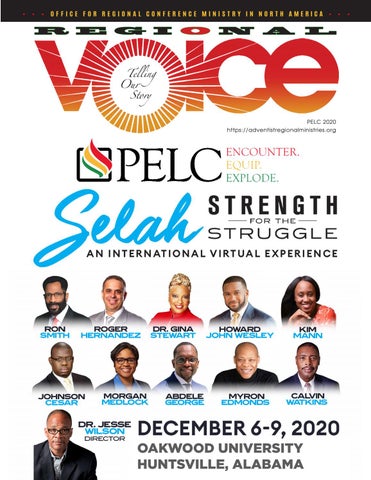
R E G I O N A L Telling
Our
Story
PELC 2020 https://adventistregionalministries.org
OAKWOOD UNIVERSITY HUNTSVILLE, ALABAMA
•
GONE It’s not IF you’ll experience loss, but WHEN.
SECURE YOUR COPY TODAY
T
his ABC Television Special, in collaboration with the Interfaith Broadcasting Commission (IBC), will feature a Christmas message from Dr. Carlton P. Byrd, Speaker/Director of the Breath of Life Television Ministry and Senior Pastor of the Oakwood University Church in Huntsville, Alabama. This special will also feature Grammy Award-winning Musical Artists, Michael W. Smith, Erica Campbell, and Kirk Whalum, along with the International Choir of the World, the Oakwood University Aeolians Concert Choir.
Michael W. Smith
Erica Campbell
Kirk Whalum
Dr. Carlton P. Byrd, Speaker/Director
Aeolians Concert Choir
256.929.6460 • www.breathoflife.tv
Watch on ABC on December 25, 2020 For a list of stations and times, call 256.929.6460 or visit breathoflife.tv
PUBLISHER’S COMMENTARY
Published by the Office for Regional Conference Ministry in the North American Division of Seventh-day Adventists 7000 Adventist Boulevard Huntsville, Alabama 35896 (256) 830-5002 Website: https://adventistregionalministries.org PUBLISHER Dana C. Edmond EDITOR Kyna Hinson ASSOCIATE EDITOR Bryant Taylor ART DIRECTOR/DESIGNER Howard I. Bullard COPY EDITOR Clarise J. Nixon CONSULTANTS Phyllis Ware Lee, Elaine Allston, Wanda Lott EDITORIAL For all correspondence and letters to the editors, write: OFFICE FOR REGIONAL CONFERENCE MINISTRY 7000 Adventist Boulevard Huntsville, Alabama 35896 or fax to (256) 830-5078 We reserve the right to publish and edit your submissions and letters.
REGIONAL CONFERENCE OFFICES
ALLEGHENY EAST CONFERENCE HENRY J. FORDHAM III, PRESIDENT LaTasha Hewitt, Communications Director P.O. Box 266 Pine Forge, PA 19548 (610) 326-4610. www.myalleghenyeast.org ALLEGHENY WEST CONFERENCE WILLIAM COX, PRESIDENT Benia Jennings, Communications Director 1080 Kingsmill Pkwy. Columbus, OH 43229 (614) 252-5271. www.awconf.org CENTRAL STATES CONFERENCE ROGER BERNARD, PRESIDENT Brittany Winkfield, Communications Director 3301 Parallel Parkway Kansas City, KS 66104 (913) 371-1071. www.central-states.org LAKE REGION CONFERENCE R. CLIFFORD JONES, PRESIDENT Paul Young, Communications Director 8517 South State Street Chicago, IL 60619 (773) 846-2661. www.lakeregionsda.org NORTHEASTERN CONFERENCE DANIEL LAMARTINE HONORÉ, PRESIDENT JeNean A. Lendor, Communications Director 115-50 Merrick Blvd. Jamaica, NY 11434 (718) 291-8006. www.northeastern.org SOUTH ATLANTIC CONFERENCE WILLIAM L. WINSTON, PRESIDENT James Lamb, Communications Director 3978 Memorial Drive Decatur, GA 30032 (404) 792-0535. www.southatlantic.org SOUTH CENTRAL CONFERENCE BENJAMIN JONES, PRESIDENT Anthony Chornes, Communications Director 715 Youngs Lane Nashville, TN 37207 (615) 226-6500. www.scc-adventist.org SOUTHEASTERN CONFERENCE GREGORY O. MACK, PRESIDENT Noel Grant, Communications Director 1701 Robie Avenue Mt. Dora, FL 32757 (352) 735-3142. www.secsda.org SOUTHWEST REGION CONFERENCE CALVIN WATKINS, PRESIDENT Taryan Ramsarran, Communications Director 2215 Lanark Avenue Dallas, TX 75203 (214) 943-4491. www.southwestregion. adventistchurchconnect.org 2018 REGIONAL DIRECTORS/COORDINATORS ROSTER Virgil Childs, Director Regional Ministries Pacific Union Conference 2686 Townsgate Road Westlake Village, CA 91361 (805) 413-7100. www.puconline.org Cell: 909-225-6438 Kingsley Palmer, Vice President African American Dept. Arizona Conference Cell: 775-338-0858 | genx58@gmail.com Frederick Anderson, Coordinator African American Ministries | Central California Conference (831) 262-3838 | famar@sbcglobal.net O’Neil Madden, Coordinator African American Dept. | Nevada-Utah Conference Cell 702-875-5979 | pastoromadden@aol.com Byron Dulan, Vice President North Pacific Union Conference 5709 N. 20th Street Ridgefield, WA 98642 (360) 857-7000. www.npuc.org Robert Edwards, V.P. Black Ministries Southeastern California Conference (909) 202-0147 | kinggm@seccsda.org Royal Harrison, Director G.L.A.R. | Southern California Conference (503) 819-1498 | hroyal2@yahoo.com
A CRISIS OR AN OPPORTUNITY?
O
ctober was Pastor’s Appreciation Month. I want to believe that many churches gave many different forms of affirmation and appreciation for the ministry of committed men and women of God, leaders who are making an eternal difference in the lives of their church members. It is important to remember that these men and women make up the overwhelming majority of pastors. These churches are to be commended for their affirmation of God’s servants. But the end of Pastor’s Appreciation Month coincided with several serious accusations of Pastoral misconduct across the North American Division. By now, some of these cases have been adjudicated. There is a process designed to adjudicate the rest. Candidly, there are a million land mines around this subject. I rely upon editors to prevent my stepping on any of them and making a bad situation worse. But not addressing issues that our church is facing is not an option. It just isn’t. The Regional Presidents Council has issued a statement that basically says the following: 1. While there cannot and will not be a rush to judgment in the cases that have come to the forefront, the Regional Presidents Council wants it to be absolutely clear that sexual misconduct has no place in the Seventh-day Adventist Church (As ORCM Director, I’m a member of this council as well) and there will be zero tolerance for it in the organizations that each of us leads. 2.The statement outlined the general process that will govern the adjudication of allegations of sexual misconduct. There were those who criticized the statement because the Regional Presidents Council has no female members. That is because all of the Regional Conference Presidents, the West Coast Union Vice Presidents and the President of Oakwood University are all males. These are the elected leaders of the Regional Conference work. These men did not elect themselves to the positions; they were elected by their constituents. To suggest that they should not stand up and make it clear that sexual misconduct has no place in the organizations they lead—that they should not speak out against misdeeds when they occur—is a misapplication. It is true, this classification of misconduct is most often committed against women. However, to say that the Regional Presidents’ statement against sexual misconduct is somehow invalid because none of the leaders are women—well, to use the words of a former Conference Treasurer, the first female Conference Administrator in the history of the South Central Conference, I am very “challenged” by that. It is like saying white people cannot speak out against racism because they are not black. In fact, it was white people speaking out against what happened to George Floyd that gave that particular tragedy such heightened attention. George Floyd was not the first black man to die from violence perpetuated by a police officer, but what made the George Floyd case different was that this time, large numbers of our Caucasian brothers and sisters—for the first time that I can remember—said, “This is wrong.” White people marched along side of us. There were even white people who chanted “Black lives matter.” I would never say to those white brothers and sisters that they could not speak out against racism unless they had some black people speaking with them; that they could make no statements condemning racism unless there were some black people signing statements as well. That white people could not take to the streets in protest over what happened to George Floyd unless they had some black people with them.
White people need to speak out against racism; black people can’t be the only ones saying that racism is wrong. It is exactly because the Regional Presidents Council are, by election of their constituents, the leaders of the black work, that they need to speak up and say: “We shall not tolerate sexual misconduct in our conference. If you as a Pastor are found to be guilty of abusing your sacred, God-given trust, you won’t be moved to another church or another conference—you’ll be moved out of ministry.” That’s exactly what the Regional Conference leaders should be saying. And there isn’t anyone else that can say that besides them. It is their responsibility as the leaders of God’s work to safeguard their constituents and the integrity of the ministry. How the Regional Conference leadership does that is through various processes that include authorized committees and boards. Those committees do include women and they (hopefully) include mental health professionals and other professionals. The implementation of the Regional Presidents’ statement is a shared responsibility. But the responsibility of setting a moral tone, the responsibility of saying, “Due process for the accused and zero toleration for sexual misconduct are not mutually ex-
clusive and will be the policy of this organization”—saying that is not a shared responsibility. It just isn’t. That’s on leadership. And it is a responsibility that the Regional Conference leadership has taken on. And the ownership that the Regional Conference leadership is taking for decisively addressing this issue will not stop with the making of a statement. It will be a major issue at the Regional Conference Summit March 5-7, 2021. We will ask for recommendations to be made to our conferences that will go beyond the removal of pastors from ministry when they are found to be abusive of their sacred trust. Now it needs to be said that those abusers make up a tiny fraction of the pastors in the Regional work. The overwhelming majority of our pastors are not doing the things that have been the subject of so much angst in recent days. That needs to be said. But one single pastor abusing his/her trust is one too many. Let it also be said that pastors who fall are souls for whom Christ died. And while we must say to them that they cannot remain in the Seventh-day Adventist professional ministry, we also must say, “We want you to be a part of the Seventh-day Adventist community.” We may not be able to employ them. But we must help them. They have families—those who also need to be helped. They need counseling. Everyone involved in these situations needs some form of ministry—in whatever ways they are willing to accept. The traumatic events of recent weeks have placed our church in a crisis. But it also gives our church an opportunity. An opportunity for all of us to say, “We want, and by God’s grace we shall have, the kind of church and the kind of clergy that rightly represents Who God is. We know that is what God requires of us. And it is what we require of us.” If that is what we say, as we ask God to help us back up what we say by what we do, then we shall look back on these last few weeks, not as a crisis that shook us, but as an opportunity that changed us. t Dana C. Edmond Director, Office for Regional Conference Ministry __________________________________ Please go to pages 20, 21 to read the NAD Regional Presidents Council Statement. R E G IO NA L V O IC E • P E L C 2 0 2 0
5
CONTENTS
RE G I O NAL VO I C E • P E L C 2 0 2 0
12
4
10
4 PUBLISHER’S COMMENTARY A Crisis or An Opportunity? Several serious accusations of Pastoral misconduct have come across the North American Division. Not addressing issues that our church is facing is not an option. It just isn’t. By Dana C. Edmond
and presenting fellow leaders with the facts they needed to take historic actions. Coverage by Melonie Gurley
8 Selah – The 2020 Theme for Virtual PELC Sessions Find favorite speakers and session topics here. 10 Passing the Torch Elder Alvin M. Kibble Though he has been away from pastoring churches for nearly 40 years, after serving as a conference president and division vice president, Elder Kibble never lost his passion for pastoral ministry and for the people of God. Coverage by Dana C. Edmond
14 IN TRANSITION Pastor Kimberly Mann Elected South Central Youth Director Pastor Mann becomes only the second female Regional Conference Youth Director. 15 IN TRANSITION Mrs. Dayami Valdespino Named Southeastern HR Director Mrs. Valdespino immigrated from Cuba with her family, learned English, studied to complete two degrees, accepted careful mentoring, and followed God’s leading all along the way.
dreds of pastors, congregations and church properties. Data Compiled by Dr. Sergio Romero 18
Latino Adventists Share a Dream
Like Dr. Martin Luther King, Jr., we dream of racial equality, but we also dream of seeing Jesus returning soon. Reported by Dr. Sergio Romero 20 Official Statement on Ministerial Misconduct The North American Division Regional Presidents Council issued this sobering statement. The entire document can be viewed at https://adventistregionalministries.org
16 The State of Black Adventists Though the pandemic has made a definite impact in Regional Conferences, God’s people continue to give faithfully. Data Compiled by Mrs. Phyllis Lee
22 The Great Disappointment Nothing could have prepared Black Seventh-day Adventist Church members for the debilitating breaking news in October of sexual misconduct by respected church leaders. Church members of all ages desired clarity, transparency, and answers. This Millennial scholar offers a serious discourse. By Claudia M. Allen Coverage coordinated by Dr. Bryant Taylor
17 The State of Latino Adventists Thousands of Latino members in Regional Conferences also faithfully give millions in tithe, which in turn supports hun-
25, 26. 27 In Memoriam Mrs. Dorothy Hudson Smith, accomplished soloist and musician, faithful church and conference administrative secretary; beloved dean of women,
14 and administrator, shared some powerful insights from God before her passing. Elder James H. Melancon offered decades of service to God and country as a dedicated pastor, meticulous theologian, gifted, generous scholar, and faithful chaplain from military duty in multiple branches to yes, the FBI. Elder Gregory O. Mack’s final assignment was as President, Southeastern Conference of Seventh-day Adventists. Tributes by The Hudson and Smith, Melancon, and Mack Families 30 Why We Can’t Wait, Part II The Regional Voice Publisher returns to complete his thoughts on the critical need for Regional Conferences— from education, to ministry (to benefit those in and outside Regional Conference ranks), to baptisms and growth. These crucial needs merit responses of quality. By Dana C. Edmond
15
22
Transparency. . .
32
36
36 OAKWOOD UNIVERSITY NEWS President Leslie Pollard Announces a Major Initiative Dr. Zavon Kanion (’75) and his wife Mrs. Jackie Kay Kanion (honorary alumna), major supporters of the university, are donating a matching gift of $100,000 to the Helen Miller Kanion Endowed Scholarship fund for the Nursing Department.
6
REG I ONA L VOI CE • P E L C 2 0 2 0
33 CORONA Stats The U.S. has reached and surpassed the awful death toll of 250,000. Millions in America and around the globe are infected. Millions more suffer
37 The Oakwood University Public Relations Program is Granted a National Charter A chapter of the Public Relations Student Society of America (PRSSA) on this campus will offer greater networking and internship opportunities, participation in national competitions, and job placements. Coverage by Patrice Thomas Conwell
26
Transparency. . .
from the health and economic effects. Work to follow proven guidelines—practice good hygiene; stay masked and sheltered when possible.
42
27
30
38
40
42 Adventist Sponsored Senior Housing Issued Occupancy Certificate The City of New York has issued a temporary certificate of occupancy for the newly completed Northeastern Towers Annex. The ten-story building will provide 159 units of affordable housing for seniors aged 62 years and up. By Dr. Daniel Honoré
38 REGIONAL NEWS Baptisms Still on the Rise Despite Pandemic The Allegheny East Conference Spanish Ministries were able to baptize 214 people in six separate locations in one weekend through one virtual appeal!
44 LEGACY SERIES A team of ministerial colleagues pay tribute to the life and legacy of Elder Raymond Saunders in the Northeastern Conference, known as “Big Thunder.” He had a big voice, a big heart and answered a big calling to evangelism.
40 AEC Responds to Increasing Demands from Pandemic Several thousand families are being served each week from the community service efforts in the six states that make up the Allegheny East Conference territory. LaTasha Hewitt – AEC Reports
47 FIRST SDA Church Gives Away Produce And Groceries Since April 2020, the First Seventh-day Adventist Church in Huntsville, Alabama, has sponsored free fresh fruit and vegetable giveaways and free grocery giveaways. Read this account to learn how this compassionate ministry continues. By Phyllis Jones
CONTENTS 12 Passing the Torch Elder Joseph W. McCoy A Regional Retirement Plan was not only feasible, but was in the best interest of Regional workers. Though it would take years to implement, this experienced youth director, conference secretary and conference president was no stranger to navigating intricate processes
32 THE 2020 VOTE A quick geographical purview of the U.S. Popular Vote Totals and the Electoral College Totals reveals why urban People of Color were so crucial to the successful Biden-Harris ticket.
25
47
52 52 HOPE SERIES Same Storm—Different Boats The pandemic, social unrest, and a failing economy all impact individuals, families, and communities differently—depending on resources available (or not). Because of these disparities, we are in different boats, but all in the same storm. It’s OK not to be OK. This author and highly trained clinical and forensic psychologist explains how and where to find help. By Dr. H. Jean Wright II Coverage coordinated by Dr. Bryant Taylor
R E G IO NA L V O IC E • P E L C 2 0 2 0
7
RV FEATURE
Event Schedule All times are Central Time
8
REG I ONA L VOI CE • P E L C 2 0 2 0
R E G IO NA L V O IC E • P E L C 2 0 2 0
9
REGIONAL NEWS
PASSING THE TORCH
E
lder Alvin M. Kibble was born in Hinsdale Hospital, just outside of Chicago, Illinois. He is a product of Seventh-day Adventist Christian Education, beginning with the elementary school that is Chicago Shiloh and then the former Broadview Academy. From there, he attended and graduated from Atlantic Union College in Lancaster, Massachusetts. After his graduation in 1967 he received a call from the late Elder W.A. Thompson, President of the newly formed Allegheny East Conference. The old Allegheny Conference-which was one of the first Regional Conferences formed-had just divided into the now-familiar Allegheny East and Allegheny West Conferences. Elder Kibble was called by Allegheny East and sent to Andrews University Theological Seminary, where he received his master’s degree in 1968. He began his pastoral ministry in Allegheny East as an intern under Elder John C. Smith, at the Baltimore Berea Temple SDA Church. After a short term there, he was assigned to his own district, the Inglewood/ Jersey City/Patterson, New Jersey district (which later was re-districted to the Inglewood/Patterson/Montclair, New Jersey district). There, he settled into what would become a familiar pattern: The Lord would bless him to pay off the indebtedness of the church, to raise funds for the building of a new church but be re-assigned before being able to build a new facility. From the assignment in New Jersey, he headed south to Newport News, Virginia, where he again was used by God to retire the indebtedness of the church, raise funds for the building of a new church but had to leave the actual construction to his successor. His next assignment was Trinity Temple in Newark, New Jersey. He was still in his 20s when the Conference entrusted this major responsibility to him upon the departure of Dr. Charles Joseph to the Lake Region Conference, where he had been elected President. He arrived in Newark at a crucial time. The Newark riots had recently occurred, devastating the inner city to the point where there were virtually no grocery stores in those neighborhoods. But the Lord looked with favor upon his ministry once again. He was preparing once again for a new church facility when the Allegheny East Conference elected him as Executive Secretary under then President Meade Van Putten. He served one term prior to being elected Vice President for Ministerial Affairs in 1988. When Elder Van Putten accepted a call to the North American Division to become its Associate Secretary, Elder Kibble was elected as the President of the Allegheny East Conference in 1988. He served as president for 12 years. One of his passions was excellence in ministry. He often said, “No one becomes a Seventh-day Adventist Pastor to become average.” But in order to have excellence, leaders must first define excellence; there must be clear standards. President Kibble worked with an outside firm—the Brown Consulting Firm—along with the pastoral staff of Allegheny East to develop standards in 12 areas of pastoral ministry. Each year, he and his administrate team would devote a few weeks to evaluate his pastoral team on those 12 tracks; “Excellence in ministry” became a byword. At the completion of his time as president, he received a call to become a Vice President in the North America Division. He was reluctant to accept at first, telling the then-North American President, the late Elder Donald Schneider, “I think I’ll pass.” “Well, what I am supposed to do?” asked President Schneider. “Go back to the committee,” said Elder Kibble, “and they will give you another name.” Elder Schneider went back to the committee, but they voted the same name: Elder Alvin Kibble. Elder Schneider asked Elder Kibble to pray over the call. He did, and this time, he accepted.
ELDER ALVIN M. KIBBLE RETIRES AFTER 51 YEARS OF SERVICE BY DA NA C. EDMOND
10
REGI ONAL VOI C E • P E L C 2 0 2 0
He has the rare gift of bringing value to his relationships while at the same time allowing the other person in the relationship to feel valued. Quoting author Steven Covey, he said, “Leadership is communicating to people their worth and their potential so clearly that they begin to see it themselves.”
One of his responsibilities has been the training and orientation of new conference presidents. Additionally, a few times each year, he assembles the current group of conference presidents for training and fellowship. One of the highlights of those meetings is the meal that he hosts; Elder Kibble is known for knowing where the good restaurants are in every city. Though he has been away from pastoring churches for nearly 40 years, Elder Kibble never lost his passion for pastoral ministry and for the people of God. “All I ever wanted to be,” he has said more than once, “was a good Pastor.” No longer in a position as church pastor, Elder Kibble transferred that passion to pastoring and mentoring church administrators. He has the rare gift of
bringing value to his relationships while at the same time allowing the other person in the relationship to feel valued. Quoting author Steven Covey, he said, “Leadership is communicating to people their worth and their potential so clearly that they begin to see it themselves.” That’s what Elder Kibble did for the church administrators who he pastored. After having mentored pastors and church administrators for 36 years, Elder Kibble was asked if he had a mentor. His list of mentors begins with his late father, Elder H.W. Kibble, a Seventh-day Adventist pastor and church administrator, who himself served as President in the Lake Region Conference from 19511961. That list of mentors continues on to include the six Conference Presidents he served under in the Allegheny East Con-
ference. He said that he had to “credit so much, to so many.” Elder Kibble retired on November 1, 2020, after 51 years of ministry to God’s remnant church. He will live in Southern California with his wife, the former Jewel Peck of Cleveland. They have two adult sons, Santo and Jason, and four grandchildren. Elder Kibble’s service has been a great blessing to the Seventh-day Adventist Church. To borrow from his quote where he said he had to “credit so much, to so many,” I would paraphrase: “So many owe so much” to Elder Kibble. Count me in that number. t _________________________ Elder Dana C. Edmond is Director of the Office for Regional Conference Ministry and Publisher of Regional Voice Magazine. _____________________________________ Editor’s Note – Staff members, past and present, and readers of Regional Voice Magazine owe a debt of gratitude to Elder Kibble for his dynamic, successful call to revive this publication after decades of hiatus, and for his staunch support thereafter. Godspeed, Elder Kibble. R E G IO NA L V O IC E • P E L C 2 0 2 0
11
REGIONAL NEWS
J
oseph W. McCoy is a native of New Orleans, Louisiana, the second of five children, born to John and Noela McCoy. He graduated from Ephesus Junior Academy and Oakwood Boarding School. He earned a Bachelor’s Degree in Religion from Oakwood College (now University) and went on to attend Andrews University. While at Andrews, Elder McCoy taught fifth grade at the Henry Morton School in the Benton Harbor City School System. In 1967, after completing one year at Andrews University, Elder McCoy accepted his first pastoral assignment under the leadership of Elder Charles E. Dudley, President of South Central Conference. He was assigned to the Paducah, Kentucky District, where he pastored three churches. After one year, Elder McCoy returned to Andrews University. While there he, along with Alvin Kibble (North American Division Vice President, retired) and the late Jonathan A. Thompson were chosen to work in an evangelistic crusade in London, England. In 1969, following his summer in London, Elder McCoy returned to South Central Conference where he pastored for three years in Greenville, Mississippi. He was next assigned for two years in Lexington, Kentucky. In 1974 Elder McCoy accepted a call to South Atlantic Conference under the leadership of President Robert L. Woodfork, Sr., where for 15 months he pastored six churches including the Bethany SDA Church in Macon, Georgia. From there, Elder McCoy accepted a call from President W.J. Cleveland to pastor the Houston Bellfort Church in the Southwest Region Conference. During his years in pastoral ministry, Elder McCoy gained a reputation for running strong youth programs, and in 1978 he transitioned into administrative work as Youth Director for the South Central Conference. While serving in this capacity, Elder McCoy conceived the format and Elder Dudley coined the name for United Youth Congress. Elder McCoy envisioned youth and youth leaders from all nine Regional Conferences gathering for worship, fellowship, and training in large convention centers, the first in 1984, at the Joe Lewis Arena in Detroit, Michigan. Soon after, the United Youth Congress Bible Bowl was launched. From 1984
to 1990 Elder McCoy served simultaneously as Conference Secretary and Youth Director. Elder McCoy succeeded Elder Dudley as President of South Central Conference in 1993. He served in this position for 12 years. In 2005, he was elected to his current role as Executive Director for the Region Conference Retirement Plan (RCRP). It was in the early 1980s, while in a meeting at the General Conference (GC) with the Secretaries from around the North American Division (NAD), that Elder McCoy would learn first-hand just how little the retired pastors were being paid. This confirmed what he knew of pastors at that time whose retirement income from the GC was so paltry they could barely cover their monthly expenses. This led him to ask questions—and the answers he received were unsatisfactory to him.
PASSING THE TORCH
12
REGI ONAL VOI C E • P E L C 2 0 2 0
success of the Retirement Plan to the handiwork of the Lord. He believes only God could have orchestrated the circumstances that led to this immense accomplishment. And of his role, Elder McCoy said, “When I look back over my life and the things the Lord
ELDER JOSEPH W. MCCOY A PROFILE IN COURAGE Another pivotal moment for Elder McCoy came when he discovered that if a retired individual ended up on medical sustentation benefits, he would earn even less per month. It was glaringly obvious to him that something had to be done to supplement retirement benefits. Workers who had committed their lives to spreading the gospel and growing the church, could retire with dignity. It took some convincing, but in 1984, Elder Dudley finally heed Elder McCoy’s recommendation that an actuarial study be commissioned to assess the risks and funding requirements for a Supplemental Retirement Plan. In 1985 Elder Dudley created the South Central Conference Supplemental Retirement Plan for all of its workers. However, it was not until 1993, under Elder McCoy’s presidential leadership, that South Central’s Supplemental Retirement Plan would actually be placed on firm actuarial footing. Based on his experience with South Central’s Supplemental Retirement Plan, Elder McCoy began to sound the alarm among his presidential colleagues for creating the Regional Conference Retirement Plan, when in the mid-1990s the GC began discussing a transition from an employer funded pension or Defined Bene-
Elder McCoy attributes the
BY MELONIE GURLEY
blessed me to do, I’m very thankful. It wasn’t easy.
fit Plan to an employee funded Defined Contribution Plan. In 1995, reports from a second actuarial study commissioned by South Central Conference and a legal study gave Elder McCoy the ammunition he needed to prove to the Regional Presidents that a Regional Retirement Plan was not only feasible, but was in the best interest of Regional workers. It would take Elder McCoy until 1999 to unite Regional Conference Presidents in support of the formation of the Plan. The Legacy Presidents who were in office and signed the documents that formed the Regional Conference Retirement Plan on December 5, 2000 included: • Charles Cheatham, Allegheny East Conference • Hector Mouzon, Allegheny West Conference • G. Alexander Bryant, Central States Conference • Norman Miles, Lake Region Conference • Vanard Mendinghall, South Atlantic Conference • Joseph McCoy, South Central Conference •Willie Taylor, Southeastern Conference • Bill Wright, Southwest Region Conference
The Northeastern Conference joined the Plan in 2002, under the presidential leadership of Don King. In addition to forming the RCRP, it was also in 2000 that the Regional Conference Presidents agreed to pull out from and to withhold the Regional subsidy to the GC Plan. After a turbulent dispute over how much of the money in the GC Retirement Fund rightfully belonged to the Regional Conferences, the GC agreed to the sum of $6M. A visionary, aggressive leader, Elder McCoy also fought to establish the Headquarters of the Office for Regional Conference Ministry (ORCM) in Huntsville. He was successful, and in 1996 ORCM began operating from a small house on the campus of Oakwood University, coordinating the ministries that Regional Conferences support, such as Message Magazine, Black Adventist Youth Directors Association (BAYDA), and Pastoral Evangelism and Leadership Council (PELC) and Regional Voice Magazine. Naturally, when the RCRP was created in 2000, it would be housed in Huntsville, along with ORCM. The Regional Conference Retirement Plan is funded by 10.25 percent of Regional Conference tithe dollars. That means $10.25 of every $100 in tithe goes
to fund the Plan. Currently there is approximately $275M in the Plan. The assets of the Plan are sufficient to provide for 80 percent of all of the accrued benefits owed. In 20 short years, the Plan has established an enviably healthy financial position. Elder McCoy attributes the success of the Retirement Plan to the handiwork of the Lord. He believes only God could have orchestrated the circumstances that led to this immense accomplishment. And of his role, Elder McCoy said, “When I look back over my life and the things the Lord blessed me to do, I’m very thankful. It wasn’t easy. When things landed at my door, I did the best I could to be true to good Christian principles, to be true to who I am, and at every point, to try to do things to help our people succeed.” After 15 years as Executive Director of the Regional Conference Retirement Plan, Elder McCoy will retire on December 31, 2020. When asked what his plans are in retirement, Elder McCoy shared that he’s working on something he considers to be spectacular, that perhaps will harness the black Seventh-day Adventist economy. Elder McCoy has been happily married to the former Judith Elaine Bryant for 54 years. They have three adult daughters, Meredith, Melanie, and Myla, and five grandchildren. t ________________________ Melonie Gurley is Executive Assistant for the Office for Regional Conference Ministry.
R E G IO NA L V O IC E • P E L C 2 0 2 0
13
IN TRANSITION
PASTOR KIMBERLY MANN ACCEPTS HISTORIC APPOINTMENT
14
REGI ONAL VOI C E • P E L C 2 0 2 0
IN TRANSITION
T
he South Central Conference Executive Committee voted the historic appointment of Pastor Kimberly Mann as their Youth Director on November 8, 2020. Pastor Mann becomes only the second female Regional Conference Youth Director. She succeeds Pastor Darriel Hoy in this position. Born Kimberly Pearson, she is a native of Hyattsville, Maryland. She is a product of Seventh-day Adventist Education from grade school to grad school, beginning with the G.E. Peters Adventist School in Adelphi, Maryland, continuing up the Adventist educational ladder to Pine Forge Academy, Oakwood University and the Andrews University Theological Seminary. Upon her graduation from Oakwood in 2005, she embarked upon a teaching career in the Florida Conference, teaching first and second grades in Jacksonville, Florida. While there, she encountered pastors who told her that they perceived the hand of God upon her life in the area of pastoral ministry. Ms. Pearson was already beginning to accept preaching engagements. She was also involved in drama ministry that began during her days at Pine Forge. She wrote scripts that were used at the United Youth Congress in Orlando. But the Lord had even more for her to do. She just did not know it. And the Lord was about to move in “mysterious ways,” to let her know what He wanted her to do. As she was completing her fifth year of teaching in Jacksonville, the staff was informed that the school would be closing at the end of the academic year for financial reasons. She no longer had a job. The next day, Pastor Kymone Hinds—who knew her from his days as the Youth Director for the Central States Conference—felt impressed by God to reach out to Ms. Pearson and encourage her to go to Andrews to pursue a graduate degree in Pastoral Ministry. With the door of her teaching career closed, suddenly, it seemed as if God was telling her “It’s time.” She applied and was accepted to the Andrews University Theological Seminary. Ironically, the day after she was accepted into the seminary, school administrators called the teachers together again—to reverse their decision to close. However by this time, Ms. Pear-
son had “a made up mind.” She “packed up [her] 1999 Toyota,” left her apartment that was near to both her job and the beach and headed north to Andrews University. There she pursued a Master of Arts in Youth and Young Adult Ministry. Just before her graduation, recruiters from Oakwood University came to Andrews looking to fill a position to expand their Chaplaincy Staff. Their normal procedure was to use a sign-up sheet for those wishing to interview for various open positions. The interviewees could select the time slots best for them. A friend thought Ms. Pearson would be a good candidate and signed her up. She got the job, which means that she was hired for a position after an interview when someone else signed her up. She served as the Associate Chaplain for Oakwood University for seven years before the South Central Conference called to serve as their Associate Youth Director in 2019. When the position was vacated, she was asked to fill that vacancy. In the early part of her time as a chaplain, she was asked to preach for the “Seven Last Words” series that occurs as part of the Oakwood University Alumni Weekend. Mosley Chapel was filled to capacity, so a young man named Robert Mann, Jr., started to leave. Just then, an usher said, “I have a seat for you.” She marched him down to the front of the chapel, directly in front of Chaplain Pearson, who was standing up to preach. They noticed each other, but they wouldn’t have had that chance if it weren’t for a dedicated usher who stopped Brother Mann from leaving by finding him the one remaining seat in the building—directly in front of Chaplain Pearson. He was the person God had chosen for her. That was the first step on the journey that led to Chaplain Pearson to become Chaplain Mann. They were married in 2014. Brother Mann is a “PK,” the son of retired South Central Pastor, Elder and Mrs. Robert Mann, Sr. The couple has four children, Robert, Carter, Judah and newest addition to the Mann household, 2-monthold Teagan. After having made history as the first female Youth Director in the history of South Central, Pastor Mann’s next goal is to go from making history, to making disciples. We know that she will. t
MRS. DAYAMI VALDESPINO BECOMES SOUTHEASTERN HUMAN RESOURCES DIRECTOR
T
he Southeastern Conference named Mrs. Dayami Valdespino as the new Human Resources (HR) Director for their conference on September 15, 2020. Mrs. Valdespino worked in the South Central Conference for seven years in the Multicultural and Latino Ministries Departments. Mrs. Valdespino, her husband and their child immigrated to the United States in 1999 from their native Cuba. After a short stay in Miami, they moved to Louisville, Kentucky. At that time, Mrs. Valdespino knew no English. She took an English as a Second Language (ESL) course. Even though her grasp of English was just beginning, she enrolled in Sullivan University to pursue a degree in accounting. In 2012, the family fell upon hard times and lost everything. During that bleak time, she was encouraged to join a prayer line which met each morning at 5:00 a.m. One day, a friend from that prayer line shared with Mrs. Valdespino that the South Central Conference was looking for a secretary for its Multicultural Ministries Department. She applied. During her interview, Elder Edgardo Herrea, then Director of the department, told her that he felt impressed that God was leading him to hire her. He recommended her to the conference administration, and she was hired. Though she felt that this opportunity was of God, it was still a daunting challenge. The work would require her to temporarily leave her family and move to Nashville. She would need to find housing and still was not very confident using conversational English. But the Lord opened doors. The conference owned a house a few doors down from the conference office that had just become available, but the rent was out of her price range. The conference president happened to ask her how her transition was going and when she mentioned her dilemma, he told her that he could not promise anything, but he would see if something could be done to make her rent more affordable. Shortly thereafter, she was informed that the rent was reduced by 25 percent, to a rate she could afford. But God was not finished with opening doors. In the typical conference office, of-
fice secretaries have multiple responsibilities. Some of those responsibilities—such as relieving the office receptionist when she was on break—terrified Mrs. Valdespino. It meant answering the phone and paging people in the building using English. She was still a beginner with the language. The Lord was with her and she was able to handle that particular aspect. In fact, her English improved to the point where she was able to continue her education— even as she worked full-time and parented her three children who had now joined her in Nashville. The hand of the Lord guided in her work assignments. In addition to being assigned to the Multicultural Ministries Department, Mrs. Valdespino also became the first office secretary working in the newly formed Human Resources Department. Though she did not know anything about HR, her supervisor, Mrs. Margaret Weathers, taught her the intricacies of the work and Mrs. Valdespino’s interest grew. When Mrs. Weathers left the department in 2015, Mrs. Valdespino missed her friend and mentor. However, the Lord was still at work in her life. The ascension of Ms. Jeannie Wright as the new HR Director for the conference proved to be another blessing to Mrs. Valdespino. She continued the mentorship that Mrs. Weathers had begun and expanded her duties. Ms. Wright was pursuing her Master’s Degree in Business Administration with an HR concentration and she encouraged Mrs. Valdespino to do the same. With the same drive that propelled her to pursue her first degree, become a United States citizen and work in evangelistic series in the Dominican Republic and in Argentina in, Mrs. Valdespino completed her master’s course requirements and received her Master’s in Business Administration from DeVry University in 2019. Additionally, she is pursuing a second master’s degree from Andrews University in pastoral ministry and has nearly completed the course requirements for that degree. Armed with her degrees and the experience that she had obtained from the HR mentorship of her supervisors, Mrs. Weathers and Ms. Wright, Mrs. Valdespino applied for the position of HR Director for the Southeastern Conference when
it became open this past spring. She was selected. Despite the challenges presented by transitioning during a pandemic, she has already re-located to the Orlando area and has found a house. Her new responsibilities bring new challenges—leaving the familiar surroundings of the conference that launched her denominational career; leaving her adult son behind in Nashville, who has just begun his own career, etc. But she is confident that the same God who brought her to the United States as a Cuban immigrant, who knew no English at all, to become a United States citizen with two degrees, who now heads a department in the second largest Regional Conference—that same God will be with her, just as He has always been. t R E G IO NA L V O IC E • P E L C 2 0 2 0
15
RV NEWS REPORT
THE STATE OF
BLACK ADVENTISTS 2020
Conference Allegheny East Allegheny West Central States Lake Region
Data Compiled by
Phyllis Lee
Northeastern South Atlantic South Central Southeastern Southwest Region
Mrs. Phyllis Lee is the Treasurer/ CFO for Regional Conference Ministries and the Seventh-day Adventist Regional Conference Retirement Plan. _________________ These figures are as of September 30, 2020, representing the end of the Third Quarter.
2020
23,806,441.00 5,136,801.00 3,386,842.00 7,734,337.00 31,983,888.00 18,007,979.00 16,454,579.00 19,696,310.00 8,977,033.00
2019
24,539,240.00 5,200,770.00 3,506,433.00 7,837,373.00 34,365,907.00 18,436,480.00 15,468,992.00 19,192,379.00 8,860,840.00
Variance Percentage (732,799.00) -3% (63,969.00) -1% (119,591.00) -3% (103,036.00) -1% (2,382,019.00) -7% (428,501.00) -2% 985,587.00 6% 503,931.00 3% 116,193.00 1%
135,184,210.00 137,408,414.00 (2,224,204.00) Updated September 30, 2020 Membership
Allegheny East Allegheny West Central States Lake Region Northeastern South Atlantic South Central Southeastern Southwest Region
16
RV NEWS REPORT
2020 31,883.00 17,198.00 9,198.00 31,382.00 60,355.00 50,757.00 37,368.00 57,605.00 27,320.00
Updated September 30, 2020
REGI ONAL VOI C E • P E L C 2 0 2 0
-2%
2019 42,290.00 16,897.00 8,785.00 31,595.00 59,432.00 49,816.00 36,575.00 55,178.00 26,986.00
Variance (10,407.00) 301.00 413.00 (213.00) 923.00 941.00 793.00 2,427.00 334.00
A
cross our nine Regional Conferences, our coordinators, leaders, pastors and members have decided not to rest until all of our communities have heard about the immense love of God and the soon coming return of Jesus our Savior. In 2019 we worked even harder than before to be able to do our part, and this is what we have been able to accomplish: Baptisms ……………………………………… 2,134
THE STATE OF
LATINO ADVENTISTS 2020
Data Compiled by
DR. SERGIO ROMERO
Tithe …………………………………………… $14,662,897.81 Pastors ………………………………………… 120 Membership…………………………………… 29,097 Congregations ……………………………….. 254 Properties……………………………………… 124 We have not finished our work yet, but we pray that soon we will be able to say, “When it comes to our Hispanic community: Mission Accomplished!”
Dr. Sergio Romero is President of the Regional Ministries Hispanic Caucus.
Percentage -25% 2% 5% -1% 2% 2% 2% 4% 1%
R E G IO NA L V O IC E • P E L C 2 0 2 0
17
L ATINO ANALYSIS
I HAVE A DREAM…TOO BY DR. SERGIO ROMERO
“I have a dream that one day this nation will rise up and live out the true meaning of its creed: ‘We hold these truths to be self-evident: that all men are created equal.”
T
he world stopped on April 4, 1968, when a coward gunshot ended Dr. Martin Luther King Jr.’s biggest dream—a dream of racial equality; a dream where men and women could live and where children could grow without being judged by their skin color (or background), but by their character. Dr. King shared ideas similar to those of Mahatma Gandhi, and they were to achieve his dream through non-violent activism, and the inspiration of the Bible, the Word of God. Many of us have a similar dream, and share a dream that is even bigger. . . . We dream of racial equality, but we also dream of seeing Jesus returning soon. Some of our brothers and sisters here in the United States have a history of struggle, suffering and discrimination. They left their countries looking for a safer place, a place where they could worship in peace and raise their children in a safe environment. In order to get here, in many cases their dream became a nightmare. They suffered abuse; many were abandoned in the middle of nowhere; others lost their loved ones on the way here. Some drowned trying to cross rivers; some died from dehydration. Many more were raped… but nothing stopped them from coming in search of their dream. Today you can see them on any given Sabbath, worshipping and praising God. But inside, many are deeply wounded. They have scars. Our duty is to bring peace to their lives, to show them the great love of God, so their dream can remain intact. When Dr. King was murdered, the whole world got quiet. We suffered, and we still suffer, because his dream wasn’t completely fulfilled. We are still looking for that dream. But one day, Jesus will return. Then there will be no silence in this world, but shouts of joy and voices singing praises to our Lord and Savior, Christ Jesus. Until that day, we continue working, knowing that the end is closer than before. t _________________________________________ Dr. Sergio Romero is President of the Regional Ministries Hispanic Caucus.
18
REGI ONAL VOI C E • P E L C 2 0 2 0
TIMELESS WORDS FROM DR. MARTIN LUTHER KING, JR. AUGUST 28, 1963
A
nd so even though we face the difficulties of today and tomorrow, I still have a dream. It is a dream deeply rooted in the American dream. I have a dream that one day this nation will rise up and live out the true meaning of its creed: "We hold these truths to be self-evident, that all men are created equal." I have a dream that one day on the red hills of Georgia, the sons of former slaves and the sons of former slave owners will be able to sit down together at the table of brotherhood. I have a dream that one day even the state of Mississippi, a state sweltering with the heat of injustice, sweltering with the heat of oppression, will be transformed into an oasis of freedom and justice. I have a dream that my four little children will one day live in a nation where they will not be judged by the color of their skin but by the content of their character. I have a dream today! I have a dream that one day, down in Alabama, with its vicious racists, with its governor having his lips dripping with the words of "interposition" and "nullification" -- one day right there in Alabama little black boys and black girls will be able to join hands with little white boys and white girls as sisters and brothers. I have a dream today! I have a dream that one day every valley shall be exalted, and every hill and mountain shall be made low, the rough places will be made plain, and the crooked places will be made straight; "and the glory of the Lord shall be revealed and all flesh shall see it together." This is our hope, and this is the faith that I go back to the South with. With this faith, we will be able to hew out of the mountain of despair a stone of hope. With this faith, we will be able to transform the jangling discords of our nation into a beautiful symphony of brotherhood. With this faith, we will be able to work together, to pray together, to struggle together, to go to jail together, to stand up for freedom together, knowing that we will be free one day. And this will be the day -- this will be the day when all of God's children will be able to sing with new meaning: My country 'tis of thee, sweet land of liberty, of thee I sing. Land where my fathers died, land of the Pilgrim's pride, From every mountainside, let freedom ring! And if America is to be a great nation, this must become true. And so let freedom ring from the prodigious hilltops of New Hampshire. Let freedom ring from the mighty mountains of New York. Let freedom ring from the heightening Alleghenies of Pennsylvania. Let freedom ring from the snow-capped Rockies of Colorado. Let freedom ring from the curvaceous slopes of California. But not only that: Let freedom ring from Stone Mountain of Georgia. Let freedom ring from Lookout Mountain of Tennessee. Let freedom ring from every hill and molehill of Mississippi. From every mountainside, let freedom ring. And when this happens, and when we allow freedom ring, when we let it ring from every village and every hamlet, from every state and every city, we will be able to speed up that day when all of God's children, black men and white men, Jews and Gentiles, Protestants and Catholics, will be able to join hands and sing in the words of the old Negro spiritual: Free at last! Free at last! Thank God Almighty, we are free at last! R E G IO NA L V O IC E • P E L C 2 0 2 0
19
REGIONAL NEWS
SSSEVENTH EVENTH--DAY -DAY DAYA DVENTISTO FFICEFFFOR ORR EGONALC ONFERENCEM MINISTRY INISTRY EVENTH AADVENTIST DVENTIST OOFFICE FFICE OR RREGONAL EGONAL CCONFERENCE ONFERENCE M INISTRY SEVENTH-DAY ADVENTISTOFFICE OFFICEFOR FOR REGIONAL REGONAL CONFERENCE MINISTRY SEVENTH-DAY ADVENTIST CONFERENCE MINISTRY Statement Statementfrom fromthe theNorth NorthAmerican AmericanDivision DivisionRegional RegionalPresident’s President’sCouncil Council Statement from the North American Division Regional President’s Council Clergy Sexual in Concerning Clergy SexualMisconduct Misconduct OurRanks Ranks StatementConcerning from the North American Division Regional President’s Council Concerning Clergy Sexual Misconduct ininOur Our Ranks Concerning Clergy Sexual Misconduct in Our Ranks Our OurModel: Model:the theGood GoodShepherd Shepherd Our Model: the Good Shepherd Our Model: the Good Shepherd As Asministers ministersof theGospel, Gospel,charged chargedwith withsupervising supervisingthe thework workof theChurch, Church,we weare arecalled calledto followthe the As ministers ofofthe the Gospel, charged with supervising the work ofofthe the Church, we are called totofollow follow the example of the Good Shepherd who is willing to give His life for the protection of the flock (John 10:11example of the Good Shepherd who is willing to give His life for the protection of the flock (John 10:11As ministers ofGood the Gospel, charged with supervising thelife work Church, we areflock called(John to follow example of the Shepherd who is willing to give His for of thethe protection of the 10:11-the 18). 18). example of the Good Shepherd who is willing to give His life for the protection of the flock (John 10:1118). 18). The TheGood GoodShepherd Shepherdcommands commandsus us“Beware “Bewareof falseprophets, prophets,which whichcome cometo toyou youin sheep'sclothing, clothing,but but The Good Shepherd commands us “Beware ofoffalse false prophets, which come to you ininsheep's sheep's clothing, but inwardly they are wolves” to and inwardly they areravening ravening wolves” (Matthew 7:15). Assuch suchitititis isour oursacred sacred responsibility protect and The Good Shepherd commands us (Matthew “Beware of7:15). falseAs prophets, come responsibility to you in sheep's clothing, but inwardly they are ravening wolves” (Matthew 7:15). As such iswhich our sacred responsibility totoprotect protect and nurture the members entrusted to our care against predators. nurture the members entrusted to our care against predators. inwardlythe they are ravening wolves” (Matthew 7:15). As such it is our sacred responsibility to protect and nurture members entrusted to our care against predators. nurture the members entrusted to our care against predators. Our OurChallenge: Challenge:Clergy ClergyMisconduct Misconduct Our Challenge: Clergy Misconduct Our Challenge: Clergy Misconduct In recent decades we have witnessed In recent decades we have witnessed thedamage damagecaused causedin theaftermath aftermathof clergysexual sexualmisconduct misconduct In recent decades we have witnessed the the damage caused ininthe the aftermath ofofclergy clergy sexual misconduct across denominational lines regardless of religious affiliation. Regrettably the Seventh-day Adventist across denominational lines regardless of religious affiliation. Regrettably the Seventh-day Adventist across denominational lines witnessed regardless the of religious Regrettably theofSeventh-day In recent decades we have damageaffiliation. caused in the aftermath clergy sexualAdventist misconduct Church is not immune as no human institution can claim a monopoly on vice or virtue. Church is not immune as no human institution can claim a monopoly on vice or virtue. Church is not immune aslines no human institution can claim a monopoly on vicethe orSeventh-day virtue. across denominational regardless of religious affiliation. Regrettably Adventist Church is not immune as no human institution can claim a monopoly on vice or virtue. The TheSpirit Spiritof Prophecycounsels counselsus usthat thatimmoral immoralacts actsare aremagnified magnifiedwhen whenperpetrated perpetratedby bythose thoseset setapart apart The Spirit ofofProphecy Prophecy counsels us that immoral acts are magnified when perpetrated by those set apart in Lord’s “The of matter thoughts [that] inleading leading theProphecy Lord’swork. work. “Theroot root thewhole whole matter isunchaste unchaste thoughts [that]are are entertained inThe leading the Lord’s work. “The root ofofthe the whole matter is unchaste thoughts [that] are entertained Spiritthe of counsels us that immoral acts are is magnified when perpetrated byentertained those set apart which lead to improper attentions and advances, then to improper actions. All this is bad enough in which lead to improper attentions and advances, then to improper actions. All this is bad enough men which lead the to improper attentions andofadvances, then to improper actions. All this is bad ininmen men in leading Lord’s work. “The root the whole matter is unchaste thoughts [that] areenough entertained who only aaacommon work but itititis worse those have sacred whohave have only common workto do, but hundredfold worsein thosewho who have accepted sacred who have only common work totodo, do, but isisaaahundredfold hundredfold worse inin those who have accepted sacred which lead to improper attentions and advances, then to improper actions. All this is accepted bad enough in men ." positions of trust”. Testimonies on Sexual Behavior, Adultery, and Divorce p. 193 positions of trust”. Testimonies on Sexual Behavior, Adultery, and Divorce p. 193 positions of trust”. Testimonies on Sexual Behavior, Adultery, and Divorce p. 193 who have only a common work to do, but it is a hundredfold worse in those who have accepted sacred positions of trust”. Testimonies on Sexual Behavior, Adultery, and Divorce p. 193 The Thephysical, physical,mental mentaland andspiritual spiritualhavoc havocresulting resultingfrom fromunethical unethicalsexual sexualbehavior behaviorleaves leavesits itsvictims victimswith with The physical, mental and spiritual havoc resulting from unethical sexual behavior leaves its victims with indelible scars having eternal consequences. Jesus warned “Woe to the world because of the things indelible scars having eternal consequences. Jesus warned “Woe to the world because of the things that indelible scarsmental having eternal consequences. Jesus warned “Woe tosexual the world because of the things that that The physical, and spiritual havoc resulting from unethical behavior leaves its victims with cause to stumble! Such things but woe the whom causepeople people stumble! Suchconsequences. thingsmust mustcome, come, but woeto theperson person through whomthey they come! cause people toto stumble! Such things must come, but woe toto the person through whom they come! indelible scars having eternal Jesus warned “Woe to the through world because of thecome! things that (Matthew 18:7). Inevitably our church will periodically encounter more incidents of clergy misconduct (Matthew 18:7). Inevitably our church will periodically encounter more incidents of clergy misconduct (Matthew 18:7). Inevitably our church will periodically encounter more incidents of clergy misconduct cause people to stumble! Such things must come, but woe to the person through whom they come! until untilJesus Jesusreturns. returns. until Jesus returns. (Matthew 18:7). Inevitably our church will periodically encounter more incidents of clergy misconduct until Jesus returns. Our OurPolicy Policyon onSexual SexualMisconduct: Misconduct: Our Policy on Sexual Misconduct: Our Policy on Sexual Misconduct: In respondingto allegationsof sexualmisconduct misconduct,we wefollow followthe theNorth NorthAmerican AmericanDivision DivisionPolicy Policyon on InInresponding responding totoallegations allegations ofofsexual sexual misconduct we follow the North American Division Policy on Sexual Harassment enacted by the 1993 Year End Meeting. Sexual Harassment enacted by the 1993 Year End Meeting. Sexual Harassment enacted by 1993 Year End Meeting. In responding to allegations ofthe sexual misconduct we follow the North American Division Policy on Sexual Harassment enacted by the 1993 Year End Meeting. (See: (See:https://documents.adventistarchives.org/Periodicals/RH/RH19940127-V171-04.pdf) https://documents.adventistarchives.org/Periodicals/RH/RH19940127-V171-04.pdf) (See: https://documents.adventistarchives.org/Periodicals/RH/RH19940127-V171-04.pdf) (See: https://documents.adventistarchives.org/Periodicals/RH/RH19940127-V171-04.pdf) This Thispolicy policydefines definesPastoral PastoralSexual SexualMisconduct. Misconduct.AAArange rangeof behaviorswhich whichincludes includessexual sexualharassment harassment This policy defines Pastoral Sexual Misconduct. range ofofbehaviors behaviors which includes sexual harassment (verbal and/or physical), sexual advances, and/or sexual contact between an ordained, licensed, or (verbal and/or physical), sexual advances, and/or sexual contact between an ordained, licensed, or (verbal and/or physical), sexual advances, and/orAsexual between anincludes ordained, licensed, or This policy defines Pastoral Sexual Misconduct. range contact of behaviors which sexual harassment
(verbal and/or physical), sexual advances, and/or sexual contact between an ordained, licensed, or
20
REGI ONAL VOI C E • P E L C 2 0 2 0
R E G IO NA L V O IC E • P E L C 2 0 2 0
21
RV FEATURE
T
he month of October blindsided the Black-Millennial Seventh-day Adventist Church membership in ways no one could have prepared us for. Scrolling through Facebook timelines we were met with striking allegations of ignored systemic sexual abuse and the debilitating news of sexual misconduct, pertaining to various wellknown and well-respected clergy persons. Social media soon ignited a firestorm of public shaming, memes, conversations, and posts surrounding many of the situations, with some users even bringing to light concerns from years past – even in territories outside of the North American Division. Ironically, the news continued to morph and spread coinciding with the historic date of October 22, 1844 – the day Adventist Pioneers believed Jesus was to return. This day now known as “The Great Disappointment” coincidently meshed with the overwhelming feelings many young adults were having concerning their pastors and leaders – great disappointment. Our grief and rage filled platforms as many of all age demographics desired clarity, transparency, and answers. For many, they wondered: what does transparency look like in the case of a pastor’s individual choices? What does transparency look like when dealing with criminal allegations? Why does it seem there is a pastoral code intentionally working to cover up sexual abuse and misconduct? What are the answers church members so desperately need in situations like this? Is it appropriate for church members to hold their clerical leadership accountable? If so, how? And most importantly, how can church members trust that the institution typically covering for such corruption will in fact handle these concerns appropriately this time? I by no means speak for all millennials, nor every person touched and saddened by these various claims. My aim here is to merely share with my church some of the frustrations that I felt and perceived, along with some suggestions on how we can improve the channels of communication between the leadership and the laity.
THE GREAT DISAPPOINTMENT:
How We Deal With Sexual Abuse and Misconduct Unfortunately, this is not the Seventh-day Adventist Church’s first run-in with allegations of sexual abuse against pastors or local church leaders. Some cases have become public knowledge due to their criminal implications and/or reaching the local news media, while others have remained quiet either locally or within the parameters of Adventist Risk Management. According to Marcos Paseggi in an article published in Ad22
REGI ONAL VOI C E • P E L C 2 0 2 0
Corruption and the Need for Transparency in the Church BY CLAU DI A M. A LLEN
ventist Review in May of this year, “leaders of the Seventh-day Adventist Church recently provided evidence that church regions (or divisions) are taking concrete steps to make sure church organizations and institutions will work unapologetically to prevent sexual abuse.” He continues, reporting that, “regional leaders pledged to keep working to craft detailed protocols to prevent or respond to any complaint of sexual abuse in the church.” While General Conference associate secretary Gary Krause acknowledges that “sadly, our church is not immune to incidents of sexual abuse,” amongst the laity some still have the feeling that such corruption and misconduct are not being appropriately handled. As the years have gone by, the General Conference has issued numerous official statements focusing on abuse and family violence, child sexual abuse, female genital mutilation, and a document calling for the end of violence against women and girls. In fact, the church at-large has gone so far as to establish an entire campaign entitled “End it Now” dedicated to helping churches create safe spaces for victims, break the silence around sexual abuse, and start tangibly opposing sexual and physical violence in our local churches and communities. In spite of these efforts, many feel as though they simply reveal the ideals of the church and its leaders, but they do not evidence the tangible measures taken to address and eradicate sexual abuse and misconduct from the ranks of church leadership. This is particularly felt due to the perception that many leaders accused of sexual abuse or misconduct are often placed on a temporary administrative leave and subsequently sent to new districts, sometimes resulting in the perpetuation of their inappropriate behavior. When our church’s approach to dealing with sexual abuse and misconduct has been to simply move people, and this is the action we have seen time and time again, it is not surprising that many distrust how the system is handling our most recent cases. Laity-Led Accountability Such has led to what I am seeing as laity-led accountability. No longer
trusting in the ability of our institutional leaders to appropriately handle these concerns, various church members are seeking justice for themselves in the public square. This is due in part to the lack of response many have received when placing formal complaints about the behaviors of certain pastors, contacting their conference officials by phone, email, or mail. Such perceived avoidance around these critical claims has caused many to use more public platforms such as social media to bring these grave injustices to light. With many ministers creatively establishing their voice on various social media platforms, pastors have come to speak out against everything from racial injustice to various cultural products and practices. Particularly, given our socially distanced condition, many spiritual leaders have turned to social media to stay in contact with their members and even gain new members on these global platforms. For many, this created an expectation that these same leaders would speak out against or at the least speak to the current allegations. Yet, as one lay member put it, “our leaders were eerily silent.”
That silence was deafening and difficult for many lay persons. It further deepened the wound around their disappointment in pastoral leadership. In fact, some survivors of sexual abuse felt retraumatized both learning of these incidents and noting the continued silence and inaction of their church.
T
his period of great disappointment was hard. People were desperately looking for leadership and guidance from pastors, and with most church leadership decentralized and engaged on social media, they were looking for those answers on Facebook. Where were the live events? Where were the panel discussions? Where were the articles? Where was the voice of church leadership when these allegations surfaced? It felt as if our leadership went dark. This darkness aided in the sweeping distrust of institutional leadership, and the feeling that these concerns were not being appropriately handled—again. Such distrust is leading to a deep chasm amongst Adventist millennials that leadership is either unaware of or seemingly unbothered by the crisis.
A Formula for Transparency 1. Communication: If you’re going to share statements on social media detailing administrative leave actions and/or allegations then you must be willing to provide follow-up information on those same platforms detailing with transparency: • Current steps being taken, if an investigation is in process, and • Whether or not an incident has been resolved. It is, in part, the open-ended nature of these situations and the decisions for mere administrative leave that has led to continued distrust. 2. Accountability: Where the laity believe there is no leadership, they will assume it. When the laity feel like a problem of injustice is not being handled, they will seek to handle it. And even greater, when there is the perception that there is systemic protection of abuse, violence, and misconduct the chasm of distrust only festers. We need to hear our pastors speak against injustice and misconduct within their ranks as loudly and boldly as they speak against injustice and misconduct in the world. We need to be able to see and hear our pastors and leaders holding those who behave criminally or inappropriately accountable. 3. Removal: The general consensus is that pastoral sexual abusers are being moved from district to district. In this current period of virtual connection and decentralized church leadership due to Coronavirus COVID-19, it is critical that lay members be able to trust their leadership – at all levels. It is critical that they know that if an individual has engaged in any kind of abuse of power during their pastoral tenure that they will be terminated. Such clear actions are the only way for individuals to begin trusting their local pastors who are not engaging in such behavior, as well as trusting that the institution will appropriately handle such gross misconduct currently and in the future. t
Where Do We Go From Here? The truth is, while America grows more divided so too does Adventism. She is divided not just by her history with racial injustice, or her privileging of certain worship styles over others. But she is also growing more divided generationally due to a lack of trust between Millennial leaders and laity and Pastors and church institutional leaders. With such deep-seated division, a perceived lack of transparency, and with no apparent plan to address these concerns, how does our church move forward? Allow me to briefly propose three tangible actions that I believe will help: 1. Communication. 2. Accountability. 3. Removal. Please see information in box. Jesus says, in John 17:20-21, Christian Standard Version, “I pray not only for these, but also for those who believe in me through their word. May they all be one, as you, Father, are in me and I in you. May they also be in us, so that the world may believe you sent me.” In other words, there is a certain degree of unity that Jesus is looking for amongst believers. And He says that this unity has the power to cause the world to believe in the validity, divinity, and sanctity of Jesus Christ. When we are divided on issues around sexual abuse and misconduct, when we do not send out clear messages denouncing and reviling sexual abuse and misconduct, when we impede accountability for pastors and ministers struggling in this area, we disrupt the unity Christ expects of His church and prevent others from believing in the truth that is Jesus Christ. My humble prayer in all these things, is that we find our voice and enact policies that protect the vulnerable. I request that every pastor and minister who needs help and support be relieved of their duties to receive it. And I ask that we come together, exercise a response to sexual violence that exemplifies the unity and care for humanity that Jesus prayed in John 17, and that we strive to exhibit those attributes. t ____________________ Claudia M. Allen is the Online Content Manager for Message Magazine and an avid speaker and writer on race, culture, and biblical social justice.
R E G IO NA L V O IC E • P E L C 2 0 2 0
23
Believe. Belong. BeHere. ✆ 256.726.7356
MRS. DOROTHY HUDSON SMITH
1927– 2020
24
REGI ONAL VOI C E • P E L C 2 0 2 0
D
orothy Mae Warren was born June 26, 1927, to Emmitt and Carrie (Rome) Warren in Columbus, Ohio. She was the eighth child of 11. The Warren family were Methodists until they were introduced to the Adventist message in 1942. Dorothy’s musical talent in voice was discovered early. She attended the Conservatory of Music/Capital University in Columbus, Ohio, and honed her talent as a Mezzo Soprano. Those who were guests in her home witnessed beauty in the food she served, in her home furnishings, in the way she dressed and in her demeanor. Dorothy was also well known for her sewing abilities. She created her own line of bedding called “Black Butterfly.” She designed the fashions highlighted in a fashion show in Washington, D.C. Dorothy created many of the props and wardrobe for the plays performed through Hot Spot Productions. In 1949, Elder R. T. Hudson heard Dorothy sing in a concert at Oakwood College and was quite smitten with her beautiful voice. Elder Hudson and Dorothy were married June 28, 1951. Their family grew to include three daughters, Ramona, Sharon, Robin and one son Ricardo (Ricky). Dorothy worked as Secretary for the Allegheny Conference, Ephesus Church and Northeastern Conference between 1951 and 1966. After Elder Hudson’s passing in 1966, she was called to Oakwood College as Dean of Carter Hall in 1967. Dean Hudson was Dean of Women for Carter Hall and Wade Hall, mentoring and influencing the lives of thousands of women. She served Oakwood College, now Oakwood University, for 24 years. She dedicated 36 years of service to the Adventist Church in various capacities until she retired from Oakwood in 1992. Dorothy married James Holloway in 1974 until his passing in 1975. She married Carvill Smith from 1980 until his passing in 2007. Dean Smith was also a caregiver for her aging sister-in-law A. V. Carethers until her passing. In 2016, Dorothy’s health deteriorated with a seven-day hospital stay that involved her final assignment from the Lord. Over the next two years, she and her daughter Robin documented a spe-
IN MEMORIAM
cial message to the world called “Dorothy’s Story.” Through a dream, the Lord instructed her to tell everyone that “He is coming soon, and sooner than He had planned.” Dorothy passed in the home of her daughter and son-in-law, Robin and George Daly, with Robin and Sharon by her side until she closed her eyes on Sabbath evening, November 7, 2020. The next face she will see will be that of Jesus. That is what she always wanted. Dorothy Hudson Smith is leaving behind one remaining sister, Catherine Chatmon (William), their children and grandchildren; daughter, Ramona Hudson Jones and her children, Clifton Mouzon, Kim Mouzon and Wilbur Hudson (Croquette) and their children; daughter, Sharon O’Bannon (Wayne) and their children Chane O’Bannon (Wesley) and Devin O’Bannon (Samantha); daughter Robin Daly (George) and their son William Ford; through her marriage to Carvill Smith, Charles Smith (Carol), David Smith, Zanetta Hairston (Ralph), Evon Hamilton (Terry) and their children; extended family, thousands of “her girls” from Carter Hall and Wade Hall (including Kyna Hinson, editor of this publication), and beloved friends. t ______________________________________ Regional Voice Magazine offers special thanks to the Hudson and Smith families for this tribute. R E G IO NA L V O IC E • P E L C 2 0 2 0
25
IN MEMORIAM
IN MEMORIAM
J
ames Henry Melançon was born on May 8, 1926, in Lutcher, Louisiana, to Ethel and Clifford Melançon, Sr., the oldest of 13 children. Following high school, he enlisted in the United States Navy, was honorably discharged in 1946, and re-enlisted in the U.S. Navy Reserve, serving until 1951. Although he graduated from the University of Southern California College of Aeronautics with an associate degree in Aeronautical Engineering, James felt called to pastoral ministry, and matriculated at Oakwood College, where he graduated with a Bachelor of Arts in theology. He then enrolled in the Seventh-day Adventist Theological Seminary at Andrews University, where he became the second African American (after his teacher Dr. E. E. Rogers) to receive a degree in Biblical Languages. James accepted a job teaching at the Los Angeles Seventh-day Adventist Academy, after which he accepted a post as associate pastor at the Compton Avenue Church in Compton, California. He was then appointed as pastor of the Holmes Avenue Church and successfully led this congregation to a new church home, known as the Miramonte Boulevard Church in Los Angeles. Elder Melancon was ordained into the Seventh-day Adventist ministry on November 1, 1958. It was in Los Angeles where Elder Melancon first saw and fell in love with Artie Helen Smith. The two were wed, and their union was blessed with the addition of two children, Teri and Marc. Elder Melancon’s inner-city program in the Watts neighborhood of Los Angeles was recognized by then California Governor, “Pat” Brown, who invited him to serve on the “Council for the Prevention of Juvenile Delinquency.” Following successful pastoral duties in California, Elder Melançon accepted a position to teach Biblical Languages at Union College in Lincoln, Nebraska. During his tenure, Elder Melancon developed technologically advanced learning resources for biblical language students, and continued his community engagement. He organized a broad-based tutorial program with Union College students serving as tutors, ferrying them to their locations in his 12-foot Shoreline Camper, which the students affectionately dubbed, “Noah’s Ark.”
ELDER JAMES HENRY MELANÇON 1926 - 2020
26
REGI ONAL VOI C E • P E L C 2 0 2 0
After seven years, Elder Melancon joined the Theology Department at Oakwood College. Here he built a state-of-theart language laboratory and was also active on campus with his professional photography skills. In 1985, Elder Melancon joined the United States Air Force Auxiliary Civil Air Patrol as a Chaplain to the Huntsville Composite Squadron, eventually becoming the National Chief of the Chaplain Corps. In this capacity he experienced his “greatest adventure”: spending time at sea on the USS Nimitz CVN 68 in 2004. He also served as a chaplain for the Federal Bureau of Investigation (FBI), assigned to the Bureau’s Huntsville Residential Agency. His service was nationally recognized with the FBI Director’s Community Leadership Award in 2005. He continued to minister to the spiritual needs of FBI agents until his death. Elder Melancon was a devoted husband and father. Over the years, the family would take weeks-long road trips to the country’s national parks. James Henry was also a master carpenter, a chef, fashion designer, and proud and patient grandfather. Although he considered his signal accomplishment to have spent more than six decades in Pastoral and Educational Leadership for the Seventh-day Adventist Church, in retirement he served as Senior Pastor for the congregation in Triana, Alabama, and as a never-ending source of pastoral care to anyone in need. On November 14, 2020, Elder James Henry Melançon went to sleep in Jesus, and is resting alongside his beloved, recently deceased wife, Artie. He is survived by his daughter, Artie Teresa Melançon Suri; his son, James Marc Melançon; his grandson, Sham Sunder Suri, II; his wife’s two surviving brothers; four surviving sisters; three surviving brothers; numerous nieces and nephews; colleagues in ministry, former students, and cherished friends. t ________________________________________ Special thanks to the Melançon family for this tribute. ________________________________________ Editor’s Note: Elder Melançon and my Dad, Elder Joseph Hinson, were roommates at Oakwood College. He was Best Man at my parents' wedding and took their wedding photos. He was priceless to the Hinson family for a lifetime. May God continue to comfort his children, grandson and family members.
ELDER GREGORY ORVILLE MACK 1955 - 2020
His Beginning Gregory Orville Mack, referred to by his peers as “Mack,” was born on March 5, 1955, in Camden, South Carolina, to the late Carrie Bell Marx and John Henry Mack. His early education began at Washington Shores Elementary School in Orlando, Florida; it continued in Miami, Florida at Robert E. Lee Junior High and Miami Jackson Senior High School where
he graduated in 1973. At the age of 19, he received Bible lessons from Elder Geneva Lewis, after which he accepted the Lord in his life. He was baptized into the Seventh-day Adventist Church and became a member of the Miami Bethany Seventh-day Adventist Church. His Education Gregory was studious, with a personal desire to achieve to the highest level possible. His aspiration and inner drive allowed him to journey to Oakwood College (now Oakwood University) in Huntsville, Alabama. He graduated with an Associate of Arts degree in Communication and a Bachelor of Arts degree in Theology in 1983. He later matriculated at Andrews University where he earned a Master of Divinity degree in 1987. His Love and Family In 1978, Gregory married his sweetheart, the former Verel Jean Johnson. This union was blessed with two handsome sons, Clint and Darren. Gregory loved serving God and his family. His Life’s Work and Career In 1983, Pastor Mack began his service with Southeastern Conference of Seventh-day Adventists as an Intern. In 1987, he became a licensed minister and was ordained in 1992. He began his pastoral ministry and pastored the following churches: Trinity Temple, Fitzgerald, Georgia; First Church, Hazlehurst, Georgia; Berea, St. Augustine, Florida; Progress Village, Tampa, Florida; Thonotosassa, Tampa, Florida; Salem, Pompano Beach, Florida; Ebenezer, Dania, Florida; Mt. Pisgah, Carol City, Florida; First Church, Riviera Beach, Florida; First Church, Loxahatchee Groves, Florida (now known as First Church, Royal Palm Beach) and Ephesus, West Palm Beach, Florida. Elder Mack successfully led the efforts to build and renovate several churches and schools. In addition, he initiated several youth groups that reaped thousands of souls into a relationship with Christ. In 2008, he was invited to serve as the Executive Secretary of Southeastern Conference under the leadership of Dr. Hubert Morel and was re-elected in 2012. As Executive Secretary Elder Mack served as the interim pastor of the Emmanuel SDA Church in Deland, Florida for almost a year while fulfilling his duties as Executive Secretary. As Ex-
ecutive Secretary, Elder Mack facilitated a smooth administrative operation of Southeastern Conference and its associated ministries As President On May 29, 2016, at the 11th Regular Session of the Southeastern Conference, Elder Mack was elected to serve as the sixth president of Southeastern Conference. He supported membership growth, evangelism, church growth, tithe and funding the mission, literature evangelism, K-12 education, healthcare ministry, as well as global missions, and faithfully reported results to the constituency. He also thoroughly enjoyed conducting evangelistic meetings. Under President Mack’s leadership tithes and baptisms increased. The Personal Ministries (PM) department was able to render services during the hurricanes that affected our neighboring Caribbean islands: to cite one major venture was the shipping of seven cargo containers of food and supplies to the Bahamas during Hurricane Dorian in support of affected families. Personal Ministries leaders managed a state-run Disaster Relief Warehouse in Tallahassee, Florida for Hurricane Michael for six months. This venture was a first in the history of Southeastern Conference. In addition, there was tremendous growth in Youth Ministry programs: a new zip line, rock wall, and skating rink were installed on the campgrounds, and a Youth Multi-Purpose Gymnasium was constructed. Mission trips to Jamaica, Haiti, and Bahamas were also conducted. To God Be the Glory! On Tuesday, November 10, 2020, the Master beckoned Elder Mack to his rest. He leaves to cherish his memories: his loving and devoted wife Verel Jean Mack; two sons: Clint Mack and Darren (Faith) Mack of Atlanta, Georgia; sister: Cynthia (William) Gravitt of Ft. Pierce, Florida; brother: Larry Mack of Ocala, Florida; two aunts: Velma Myers Pearson of Orlando, Florida and Juanita McQuiller of New York; a great aunt: Mary Ann Robinson of Orlando, Florida; nieces and a nephew; great nephews and great nieces; god children; a sister-in-law and brotherin-law, extended family members, longtime friends; the Miami Bethany Church family and the Southeastern Conference family. t _______________________________________ Regional Voice Magazine offers special thanks to the Mack family for this tribute. R E G IO NA L V O IC E • P E L C 2 0 2 0
27
28
REGI ONAL VOI C E • P E L C 2 0 2 0
R E G IO NA L V O IC E • P E L C 2 0 2 0
29
RV FEATURE
WHY WE STILL CAN’T WAIT
PART II
BY DA NA C. EDMOND
T We mentioned three major issues. Since that time, a fourth issue has erupted—the issue of morality in ministry and ensuring that it is forthrightly addressed. 30
his is (finally!) the conclusion to an editorial I began a year ago. Many years ago, the late Dr. Martin Luther King wrote a book entitled Why We Can’t Wait. The genesis of that book was his famous “Letter from A Birmingham Jail,” where he was answering some Caucasian pastors in the area. While they wanted to do the right thing, they wanted it done more slowly. They thought that Dr. King and those affiliated with him were moving too fast. These pastors thought Dr. King needed to wait. I remarked in my editorial that it was very ironic that people—albeit decent, well-meaning people—who had their rights would “instruct” people who couldn’t vote, couldn’t eat in restaurants, and had to drink from segregated water fountains. When these people marched peacefully to protest these conditions, they were beaten, jailed, attacked by police dogs and even killed. And all this was happening 300 years after they first arrived in this country. In essence, Dr. King said, “We have waited long enough.” I said one year ago that while Regional Conferences were alive and well and growing at a rate four times faster than the rest of the North American Division, that there were some challenges facing us. I listed some of those challenges and said that it was time to address them. In Part I of this two part series, I said, “We Still Can’t Wait.” That was rather ironic, because it has taken me over a year to circle back and address those challenges. An alert reader has reminded me (several times) of my delay to follow up. I am glad he did. You can read Part I in the 2019 Summer Edition of The Regional Voice. (Now 2019 seems like a century ago, instead of
REGI ONAL VOI C E • P E L C 2 0 2 0
trification has brought Caucasians back into what have been black neighborhoods. Who is going to carry the gospel to them?
a year ago.) Even though it has taken me more than a year to finish addressing these matters in this magazine, they are still pressing and largely unaddressed issues. We still can’t wait. We mentioned three major issues. Since that time, a fourth issue has erupted—the issue of morality in ministry and ensuring that it is forthrightly addressed. (Please see how we addressed that in this issue’s Publishers Commentary). But here are the three issues that we raised back then: 1. The Lack of Information and Education Among Our Own Constituents About the History of and the Continuing Need for Regional Conferences. 2. The Outmigration of Members of Color from Regional Conferences to State Conferences, e.g., “Black Flight.” 3.The growth in the area of baptisms in Regional Conferences—though still ahead of others in the NAD—has slowed significantly. The Need for Education After having had the privilege of being invited to speak and conduct seminars in churches in all nine Regional Conferences plus in churches in the Pacific Union and North Pacific Union (where there are no Regional Conferences), I can tell you firsthand that the vast majority of members in Regional Conferences do not know the history of Regional Conferences. There is a continuing need for Regional Conferences, marked by the historical and present contribution to our church by Regional Conferences. That is unfortunate because, by the grace of God, we have quite a story. Here are just a couple of highlights: • Over the 76 years since the first Regional Conference was started, these organizations have grown at a rate four times faster than the rest of the Division. The largest single demographic in the Seventh-day Adventist Church in North America (and the world) are people of African descent. • Regional Conferences were established 80 plus years after the first state conferences. They have approximately a third less revenue but generally operate over larger geographical areas (which increases Regional costs). And that’s just the beginning. But most of our members don’t know our story. And when you don’t know your story, you allow other people to tell that story from their perspective.
T
hen, we have to honestly address the things that I hear about our worship services: that they are too long (I happen to agree, even as someone who has sometimes been a cause!). Now COVID 19 may have solved that for us. Anyone who thinks people are going to tolerate getting out on Sabbath at 2:00 p.m. anymore is probably fooling themselves. And we have come up short for Children’s Sabbath School. I have visited too many churches where that is true. And yes, when churches re-open and if you are kind enough to start inviting me back to your churches, I will stick my head in to view your Children’s Sabbath School. But those things are fixable. We just can no longer wait to address them.
So, how do we fix that? Here are some suggestions:The ORCM needs to produce some sort of media presentation about the history of and the continuing need for Regional Conferences. PreCOVID 19, I had the privilege of going to churches all over the country and telling our story. Lately, we have shifted to doing that virtually. But the better way is to make a media presentation, post it on various social media platforms and invite people to view it. This was one of our unrealized goals for 2020. It will be a priority in 2021. • We need to tell our story to our students in our schools. I do not know how many of our schools include the history of Regional Conferences in their curriculum. My short answer is, “Not enough.” For too long, the history of our nation and of our church has been told from a European perspective—one that says, for example, that Christopher Columbus “discovered” America despite the fact that when he got here, what he really discovered that there were already populations living here. I was a grandparent before I heard the story of the “Black Wall Street” in Tulsa, Oklahoma, and the terrible things that were done to destroy it. I actually think (though I am sure some would disagree) that there is some value in hearing history from multiple perspectives. I just need one of those perspective to be ours.
That involves some adjustments to the curriculum in our schools. It is a conversation that I have already begun with our educators and will continue at our Regional Conference Summit, March 5-7, 2021. To that end, in the new Regional Conference Office Building that is being built as we speak on the campus of Oakwood University, the first Adventist African-American History Museum is being planned. There, we’ll be able to tell our story on our campus. The Outmigration of Black People from Regional Conferences to State Conferences Here again, education is important. Regional Conferences are the primary denominational source of funding for Oakwood. Students who graduate from Oakwood are probably unaware of the fact that state conference churches may be closer to where they live, but only Regional Conference churches and their affiliates directly contribute financially to the operation of Oakwood University. We also need to educate our members to the fact that while Regional Conferences have a responsibility to take the gospel to everyone, we have an historic and specific mission to people of color. We do not apologize for that; if we don’t do that, who will? Outmigration to State Conferences directs talent and resources away from those who need it most. Moreover, gen-
Our Slower Growth Rate I do not know if there is a way to grow our churches without the involvement of our members. When I was growing up in this church and even as a young pastor, a big part of how we grew meant that members were involved in bringing their friends to church and in giving Bible studies. That is not to cast stones at our church members and to say our declining growth is your fault. If members are not as involved as we need them, part of what we shall need from people like me to change that. At the end of the day, this problem can’t be—won’t be fixed—without all of us. That particularly includes our young adults. Far too few churches that I visited around this country pre-COVID 19 had a strong young adult presence, in the pews or up front leading out. Young adults have been involved in the decision-making and the funding of all levels of the church. The churches I have visited tell me the former isn’t happening nearly as much as needed. My research tells me the latter isn’t happening as much as it should, either. In conclusion, we still can’t wait. t _________________________ Dana C. Edmond is Director, Office for Regional Conference Ministry.
R E G IO NA L V O IC E • P E L C 2 0 2 0
31
U.S. ELECTION RESULTS
ELECTORAL COLLEGE UPDATE
JOSEPH BIDEN/KAMALA HARRIS
U.S. CORONA STATS
CORONAVIRUS PANDEMIC THE LATEST STATISTICS GLOBAL AND USA VIEWS 57,882,183 GLOBAL CONFIRMED CASES
1,377,395
GLOBAL CONFIRMED DEATHS
216
COUNTRIES, AREAS OR TERRITORIES WITH CASES Last update: 22 November 2020 DATA PROVIDED FROM THE WORLD HEALTH ORGANIZATION
USA 12,028,081 CASES
306 ELECTORAL VOTES
VOTES NEEDED TO WIN - 270 POPULAR VOTE UPDATE 79,843,207 DONALD TRUMP/MIKE PENCE 232 ELECTORAL VOTES POPULAR VOTE UPDATE 73,794,975 _______________________________ DATA FROM THE ASSOCIATED PRESS AS OF 22 NOVEMBER 2020 32
REGI ONAL VOI C E • P E L C 2 0 2 0
CDC | Updated: November 22, 2020 11:50PM EST
USA 255,076 TOTAL DEATHS (Exceeds 255,000) CDC | Updated: November 22, 2020 11:50PM EST
TOP 20 STATES - CASES
Jurisdiction Total Cases _______________________________ California .................... 1,087,714 Texas .......................... 1,085,524 Florida ........................ 918,240 Illinois ......................... 646,286 Georgia....................... 446,804 Wisconsin ................... 372,219 Ohio ........................... 343,286 Tennessee .................. 335,887 North Carolina ............ 332,261 Michigan .................... 329,021 Pennsylvania .............. 302,564 New Jersey ................ 302,039 New York* .................. 297,988 New York City*........... 296,450 Arizona ...................... 295,334 Indiana ...................... 289,183 Missouri ..................... 271,527 Minnesota .................. 262,952 Alabama ..................... 217,797
TOP 20 STATES - DEATHS State/Territory Total Deaths ________________________________ New York City*........... 24,207 Texas .......................... 20,467 California .................... 18,643 Florida ........................ 17,930 New Jersey ................ 16,746 Illinois ......................... 11,952 Massachusetts ........... 10,465 Pennsylvania .............. 9,801 New York* ................... 9,652 Georgia ...................... 9,179 Michigan ..................... 8,875 Arizona ....................... 6,457 Louisiana ................... 6,233 Ohio ........................... 5,984 Indiana ....................... 5,246 North Carolina ............ 5,005 Connecticut ................ 4,828 Maryland .................... 4,434 South Carolina ........... 4,274 Tennessee .................. 4,211
R E G IO NA L V O IC E • P E L C 2 0 2 0
33
OAKWOOD UNIVERSITY OFFERS FOUR GRADUATE DEGREES By John Anderson, Ph.D. In alignment with its mission to transform students through biblically-based education for service to God and humanity, Oakwood University currently offers four graduate programs: • The Master of Arts in Pastoral Studies (MAPS) is a professional degree designed to foster the spiritual development and integrative practical skills of pastors and lay leaders, with emphasis on the development of Christian identity, integrity, and service to others. • The Master of Arts in Urban Ministry (MAUM) is both a professional and academic degree that emphasizes the role of the Christian Church in ministry in and for the urban community. The MAPS and MAUM degrees are offered in hybrid formats where students complete elements of the coursework online (asynchronously) as well as in real-time settings (synchronously). Both degrees can be completed in as little as 18 months. • The Master of Public Health (MPH) degree prepares current or prospective health professionals with knowledge for providing innovative evidence-based nutrition education to diverse communities. Graduates will be able to articulate cultural approaches to food, nutrition and health with an emphasis on plant-based diets; assess population needs; and evaluate programs and health policies. • The Master of Business Administration in Leadership (MBA) degree is designed for anyone desiring to effectively meet the challenges of the global marketplace with application of sound ethical leadership and management principles, as well as practical skills for using a research-driven approach to address an array of leadership and management issues. The MBA and MPH degrees are offered fully online and can be completed in as little as 18 months. If you have any questions, contact Kenesha Bennett at (256) 726-8091. Click here to apply to Oakwood University’s Graduate programs, and send the required documents by email to: gradadmissions@oakwood.edu, or by U.S. mail to Office of Graduate Education Oakwood University 7000 Adventist Blvd. Huntsville, AL 35896 _______________________________________________ Dr. John Anderson is the Dean of the School of Business, and Associate Provost for Graduate Education and Online Learning, at Oakwood University.
34
REGI ONAL VOI C E • P E L C 2 0 2 0
R E G IO NA L V O IC E • P E L C 2 0 2 0
35
OU NEWS
OU PR PROGRAM
OAKWOOD UNIVERSITY
PRESIDENT POLLARD ANNOUNCES FOUNDERS DAY MATCHING CHALLENGE
Dr. Leslie Pollard 36
REGI ONAL VOI C E • P E L C 2 0 2 0
O
n November 16, 1896, 16 recently-freed slaves began their education at Oakwood Industrial School. God has miraculously guided the destiny of Oakwood through the ensuing 124 years in achieving its mission of transforming lives for service to God and humanity. During a special edition of “InsideOakwood with Dr. Leslie Pollard” on Monday, November 16, 2020, it was our distinct pleasure to announce an exciting Founders Day Matching Challenge, in honor of: • 2020 being the “Year of the Nurse;” • The late Mrs. Helen Miller Kanion, a student at Oakwood Academy (1930-34) and Oakwood Junior College Nursing Department (1934-36); and mother of Dr. Zavon Kanion, Dr. Sean Kanion, Will Kanion and Neva Kanion Artis; and • All of the nurses in the Kanion family. Dr. Zavon Kanion (’75) and his wife Mrs. Jackie Kay Kanion (honorary alumna), major supporters of the university, are donating a matching gift of $100,000 to their Helen Miller Kanion Endowed Scholarship fund for the Nursing Department. We are inviting you to match their gift to double the impact. Your matching gift may go to ANY scholarship you designate, OR you may start a new scholarship. Please contact Mrs. Cheri Wilson, Executive Director of Advancement, at cwilson@oakwood.edu, or (256) 726-7204 and we will be happy to assist you in setting up a scholarship. Visit online to donate at give.oakwood.edu to select the scholarship of your choice for the Founders Day match. Please join this phenomenal opportunity to match the generous gift from Dr. and Mrs. Zavon Kanion and double the gift to $200,000. This matching opportunity is extended to December 31, 2020. t
Dr. Zavon Kanion
Oakwood University Nurses 2019
A
20-year dream was realized when Oakwood University became the 20th Historically Black College and University (HBCU) in the nation, and the second HBCU in Alabama, to be granted a charter to form a chapter of the Public Relations Student Society of America (PRSSA) on its campus. PRSSA is the foremost organization for students interested in public relations and communications fields, comprised of nearly 375 college and university chapters, including 20 HBCUs. Founded in 1968 by its parent organization, the Public Relations Society of America (PRSA), PRSSA includes nearly 9,000 student members and advisers. Oakwood University will be the tenth school sponsored by the Alabama PRSA Chapter. Dawnette Chambers, an assistant professor in the Communication Department at Oakwood University and coordinator of its public relations program, shepherded the process to this milestone. “As an alumna of the Oakwood PR program, I am grateful for the opportunity to make our dream of a PRSSA chapter a reality,” says Chambers, who will serve as the chapter’s faculty adviser. The dream began from the vision of Patrice Thomas Conwell, formerly an associate professor of Communication at Oakwood. During her tenure, she expanded the PR curriculum to position the program for chapter eligibility. Unable to realize the dream before she resigned, she’s delighted to serve the new chapter as its professional adviser. Establishing a PRSSA chapter at Oakwood will open doors to many more resources for its PR students. This includes greater networking and internship opportunities, participation in national competitions, and job placements. For Dr. Rennae Elliott, chair of the Communication Department, these benefits for students are the best part of achieving the dream. “The Oakwood PRSSA charter is the latest evidence of our unrelenting efforts of the past 20 years to deepen resources for our communication students,” she says. “We embrace the opportunity to leverage PRSSA resources for greater benefit as we embrace our school mission, ‘to transform students through biblically-based education for service to God and humanity.’" t ______________________
OAKWOOD PR PROGRAM GRANTED NATIONAL CHARTER BY PATR ICE THOM AS CON W ELL
Patrice Thomas Conwell is a freelance writer for her own company, PeeTee Communications, LLC (www.ptcommunications.biz). She lives in Huntsville, Alabama, with her husband and son. R E G IO NA L V O IC E • P E L C 2 0 2 0
37
REGIONAL NEWS
ALLEGHENY EAST
AEC RESPONDS TO THE INCREASING DEMANDS CAUSED BY PANDEMIC BY LATASHA HEWITT
38
REGI ONAL VOI C E • P E L C 2 0 2 0
T
he pandemic has certainly taken its toll on individuals and families across the United States. Economic hardship has led many to look to charitable organizations for assistance with food and clothing. The community service teams across Allegheny East Conference have responded to the call with 32 food pantries and distribution centers in full operation. Several thousand families are being served each week from the community service efforts in the 6 states that make up the AEC territory. Although many of AEC’s food pan-
tries have been in operation for several years, at least 10 started during the pandemic to respond to the needs they saw in their communities. ACS teams were also able to shift from their normal operations to instituting COVID-safety measures to protect volunteers and the community. AEC’s ACS Director Robert Smith went into action requesting funds to purchase PPE for all volunteers, as well as assist pantries with additional food and supplies. “Due to the generous donations from organizations like FEMA, ADRA, the North American Division, the Columbia Union, and AEC, we were able to raise $500,000 to support growing ACS efforts in our territory,” says Smith. Conference-wide Adventist Community Service (ACS) programs have seen the needs increase exponentially since March and are geared up for the demands December will bring. The Ephesus Church in Richmond, VA has served 5560 families and a total of 12,031 individuals between March and October. Previously, Ephesus was only serving two zip codes, but now they respond to needs all over the state. Several members and volunteers deliver food to seniors, those who are sick and shut-in. They also distribute clothes to those in need and anticipate distributing hats, gloves, books and toys to the families as Christmas gifts. Many of our churches have garnered the attention of various news outlets because of their service to the community. The Berean Church in Newark, NJ was featured on MSNBC in April for their food distribution program. Their pantry has been in operation for several years, serving approximately 75-100 families twice a month, but when the
pandemic hit, they doubled their efforts, serving food every Sunday through July 2020. They are also responsive to emergency services for families in dire need. AEC’s Metropolitan Church in Hyattsville, Maryland was also featured on their local TV news station, NBC Washington for their drive-up food distribution. Prior to the pandemic, they served food biweekly, averaging 500 families per month. Now they are distributing weekly and serving 4000+ families each month! One of their members, Pamela Roberts Rubin was even awarded the Outstanding COVID-19 Response Collaborator by their local council in Prince George’s County. The Rehoboth Church in Reading, Pennsylvania chose to use the pandemic as opportunity to relaunch their food pantry ministry that had been dormant for a few years. Just starting out, they were able to serve 134 families and plan to continue to distribute food monthly, but also are on call as an emergency food distribution center for families in need. Their first distribution attracted the attention of their local newspaper, The Reading Eagle. In addition to this new effort, they also frequent their local homeless shelter by cooking breakfast and dinner. “It’s not about us, it’s about helping others. That’s why we do with we do,” says Catrice Ford, ACS leader at Rehoboth. Other churches have received prestigious awards for the acts of service. One such church was the Emmanuel Brinklow Church in Maryland that conducts their distribution program called “Grocery Grab & Go.” They were about to service 7,500 individuals with their bimonthly distributions, and were awarded the “Shauna Sorrells Memorial Inspire Award” by Montgomery County Housing Opportunities Commission (HOC) for their response to clients during the pandemic. The church also partnered with the Holy Cross Hospital in their area to hold a flu shot clinic during their last food distribution.
Another ministry recognized for its support to the community is the Mizpah Church in Philadelphia, PA/ Its ACS leader, Vernessa Wilson, was recognized by Bloomingdales in two local malls for being a “Frontline Super Heroes” due to her work with the church’s distribution program. During this pandemic they serve 200-300 people three days each week. “Our community service ministry is well known throughout Philadelphia. We serve any and all individuals in need of food, clothing or other necessities,” says Wilson. Smith believes ACS volunteers are what makes these distributions possible. “The success of all of our programs is due the faithfulness of its volunteers. They are hardworking and committed to putting service back in the community,” he shared. t
__________________________ LaTasha Hewitt is Communications Director for the Allegheny East Conference of Seventh-day Adventists. R E G IO NA L V O IC E • P E L C 2 0 2 0
39
REGIONAL NEWS
ALLEGHENY EAST
T BAPTISMS STILL ON THE RISE DESPITE PANDEMIC BY LATASH A HEW IT T
40
REGI ONAL VOI C E • P E L C 2 0 2 0
he pandemic has changed the landscape of how churches worship and participate in ministry. Yet with the gospel still going forth virtually, it was inevitable that some would desire to baptized. But what about the pandemic and safety? Several churches developed strategies to remain safe while still conducting baptisms. Donned in protective gear, baptisms were held in everything from backyard pools to rivers and beaches. AEC Spanish Ministries were able to baptize 214 people in six separate locations in one weekend through one virtual appeal! Consisting of 32 congregations and eight church plants, all of AEC’s Spanish congregations would normally worship together in one location for their annual “Fellowship Day.” Due to the pandemic, they were not able to come together face-to-face, but decided to proceed with the joint service virtually. Thousands from all over AEC’s territory tuned into the joint streamed service, resulting in close to 8,000 views. At midday, Pastor Ramon Escalante, AEC Spanish Ministries coordinator, made an appeal to viewers. “I shared with them that now was the moment to accept Christ. That He is waiting for them, and that although several places were closed, heaven was open to them.” Several viewers responded to the call and indicated their desire to be baptized. The pastoral team organized six baptismal sites, two in Philadelphia, two in Delaware, one in Maryland and one in Virginia. The baptisms were conducted simultaneously at 3:00 PM. When they came back together virtually that evening, each area reported on how many baptisms took place. As they began to total the numbers, the group was pleased to learn that 214 people had made the decision to be baptized, more than they had anticipated. “We were so happy with how God had blessed that day, we decided to come together every month for a joint service instead of just once a year,” shared Escalante. He even had the privilege of baptizing his father-in-law that day.
Several other churches within in AEC have also been conducting baptisms. The Emmanuel Worship Center (Alexandria, Virginia) hosted a drivein baptism using a temporary baptistry set up in a garage of the facility they are currently renting. Prior to their baptism, the pastor, Dr. D. Robert Kennedy, studied with the three baptismal candidates by Zoom and FaceTime. Once they expressed the desire to be baptized, Pastor Kennedy knew he had to find a way to make it possible. They planned for the special service over two weeks, making sure to include safety protocols. On the Sabbath of the baptism, church elders, deacons, and the health ministries team worked together to make sure the services ran smoothly. Those who wished to witness the baptism to made their way to the facility to view the service from their cars. “Even though physical distance had to be observed, one could feel the excitement of the members coming together to welcome and support those who were being baptized,” said Pastor Kennedy. The elders of the Angaza Sharon Church in Newark, Delaware, have not let COVID-19 keep them from winning souls for the Kingdom as well. In the absence of a pastor, they continued conducting Bible studies, leading to four baptism and one by profession of faith. “Glory to the Lamb of God! I admire the work of the elders and pray they will keep up the great work,” said Jimmie Gibson, the guest lay pastor who baptized the candidates. The Holy Spirit is continuing to do the work of converting souls, and AEC churches are poised and ready to facilitate those decisions to follow Jesus all the way, pandemic or not. t _______________________ LaTasha Hewitt is Director of Communications for the Allegheny East Conference of Seventh-day Adventists.
R E G IO NA L V O IC E • P E L C 2 0 2 0
41
REGIONAL NEWS
NORTHEASTERN
T NEW YORK CITY ISSUES OCCUPANCY CERTIFICATE FOR ADVENTIST SPONSORED SENIOR HOUSING BY DR. DANIEL HONORÉ 42
REGI ONAL VOI C E • P E L C 2 0 2 0
he City of New York has issued a temporary certificate of occupancy for the newly completed Northeastern Towers Annex. The ten-story building will provide 159 units of affordable housing for seniors aged 62 years and up. It consists of 100 one-bedroom units, 58 studio units and one two-bedroom apartment for the superintendent. The Northeastern Conference Administration conceived the project due to a growing backlog of applications in the original Northeastern Towers building, with waiting lists of up to five years. The new building is adjacent to the original 110-unit tower built nearly 40 years ago. The $90.6 million project was financed with federal, state and local financing earmarked for subsidized senior housing. The New York City Housing Development Corporation issued $50 million in tax-exempt bonds while the Department of Housing Preservation and Development added $13 million in local subsidies. Low-income housing tax credits generated another $37 million for the project. At the October 2018 groundbreaking, NEC President Daniel Honore stated, “The Northeastern Conference of Seventh-day Adventist is proud to stand with our neighbors to ensure that senior citizens, who have given so much to our community, enjoy safe, clean and affordable housing in their sunset years.” On October 7, 2020, the office staff joined conference administrators for a visit and inspection of the completed premises. Atlantic Union Conference President G. Earl Knight joined the group and offered a dedicatory blessing for the building. Guests then proceeded to visit the facilities. A formal ribbon cutting inauguration ceremony is being planned in the near future. The tenants were selected through a lottery process administered through the New York City Housing Authority. More than 37,000 applications were submitted for the 159 units, accentuating the need for affordable senior housing in New York City. Fifty-five units have been set aside to house previously homeless New York families. The Northeastern Conference encouraged as many eligible senior members as pos-
At the October 2018 groundbreaking, NEC President Daniel Honore stated, “The Northeastern Conference of Seventh-day Adventists is proud to stand with our neighbors to ensure that senior citizens, who have given so much to our community, enjoy safe, clean and affordable housing in their sunset years." sible to apply. Because of the governmental funding involved, there could be no discrimination on the basis of religion. “Several SDA families were selected through the process and we are delighted that some our own members will benefit from the project,” said Executive Secretary Oswald Euell. Families will begin moving in during the next few weeks. The Fifth Avenue Committee (FAC), which has an extensive background in managing subsidized senior housing projects throughout New York City built through tax credits, will manage the new building for 15 years. “The project has been a true partnership with the Northeastern Conference of Seventh-day Adventists from inception,” states Michelle de la Uz, FAC Executive Director. t ________________________
The NEC Towers Planning Committee.
Dr. Daniel Honoré is President of the Northeastern Conference of Seventh-day Adventists.
The Northeastern Conference Administrators.
R E G IO NA L V O IC E • P E L C 2 0 2 0
43
LEGACY SERIES
I REMEMBER. . . ‘BIG THUNDER’ THE LEGACY OF ELDER RAYMOND SAUNDERS
BY SA MUEL THOMAS, JR.
M
inistry is demanding labor, countered by a Divinely infused thirst for souls. Some who serve may never receive accolades they are due, nor recognition they deserve. Others saturate the spotlight of prominence, making those who give their all in uncelebrated sacrifice feel miniscule and insignificant. Each laborer for Christ, whether Pastor in service, director of a department, or lonely administrator, has a story that goes unrecorded in the annals of human history. Awards, once received yearly, grow dusty in a closet. Certificates of distinction become discolored. Over time, nine Regional Conferences were born, each distinguished through unique characteristics: the formidable territory of Southwest Region and Central States; the rural communities of South Central; the industrial centers of Lake Region; the urban sprawl of Allegheny East; the intentional growth and expansion of South Atlantic and Southeastern; the ‘little brother’ of a significant older sibling, in Regional Conference history, Allegheny West and the population dense, membership concentrated, Northeastern. A man who poured out himself in service for Northeastern, as a treasure, has almost been lost to the books of Regional Conference history. He poured out excellency for God, not for himself. His name: Elder Raymond Saunders, Jr. He was one of the most affable, congenial and easily engaged evangelists in any Regional Conference. Born on Long Island, New York, he had charm and a disarming personality. Elder Saunders entered ministry with a full
44
REGI ONAL VOI C E • P E L C 2 0 2 0
PHOTOGRAPHTY BY TIPLISTER LC - UNSPLASH
Within a short time after arriving at Oakwood College, Elder Saunders’ gifts were recognized. family included. His wife Ruth was actually expecting a child when he departed for Oakwood University in a Buick station wagon. He and Elder Larry Bailey, drove separate vehicles, as they began what would become a lifelong friendship. Elder Saunders was already proven as a successful manager of a retail establishment in Gordon Heights on Long Island. A former Baptist, his Seventh-day Adventist family encouraged him to enter ministry because his friendly manner drew people to him. Concerned about his family’s size and his corresponding age, he made the challenge of entering college as an adult, a matter of prayer. Within a short time after arriving at Oakwood College, Elder Saunders’ gifts were recognized. Soon he held the position of Chaplain, and students gravitated to his winsome personality. His supersized Sabbath School class proved a dominant presence in Ashby Auditorium. He was quick witted; famous for his quips and measured humor. Elder Saunders made a lasting impression and was viewed as ‘everybody’s friend.’ Upon returning to Northeastern Conference, he was assigned to the Gordon Heights R E G IO NA L V O IC E • P E L C 2 0 2 0
45
LEGACY SERIES
His preaching was memorable, but most compelling were his lengthy appeals. and New Rochelle churches. The New Rochelle congregation was located in West Chester County, an elite area, often referred to in the legendary television series the 1960s Dick Van Dyke Show. Elder Saunders’ pastoral assignments were short-lived. His gift was evangelism – soul winning! Bringing his wife into his evangelism team, combined with the vocal capabilities of David R. Willis, his singing evangelist, Elder Saunders began expanding the number of churches. David Willis favorably remembers: “everything involved in the evangelism process: from the songs, prayer box, special music, offerings, to the sermon, and Bible Classes; every aspect of the service was focused on baptism.” In 1980, Elder and Mrs. Saunders pastored the Faith SDA Church in Hartford, Connecticut. During his pastorate, an evangelism meeting brought more than 100 souls to the Lord. The success and maturity of the new members permitted Northeastern Conference to establish a new congregation: Hope SDA Church in Hartford. In 1983 he launched another evangelistic meeting in Manhattan, establishing another church, later named New Hope SDA Church. His preaching was memorable, but most compelling were his lengthy appeals. The strength of Elder Saunders’ pleas to the lost, combined with convictions from his heart, resonated with people, resulting in thousands of baptisms during his ministry, with the addition of seven new churches. His evangelism techniques, with his baritone voice, gave him the affectionate nickname: ‘Big Thunder.’ Elder Saunders died in 2013. The love of his life, Ruth, preceded him in death. Grief stricken and lonely, combined with lifestyle ailments, decreased his will to live. We remember Elder Saunders’ passion for ministry, his soul-winning focus, and commitment to church growth. 46
REGI ONAL VOI C E • P E L C 2 0 2 0
REGIONAL NEWS He is a model for each of us. He was a ‘vessel of honor’ for Christ! “Everybody can be great . . . because anybody can serve. You don’t have to have a college degree to serve. You don’t have to make your subject and verb agree to serve. You only need a heart full of grace. A soul generated by love.” Martin Luther King, Jr. t _________________________ Elder Samuel Thomas, Jr., is Senior Pastor of the Central Seventh-day Adventist Church in Columbus, Ohio.
T
NORTHEASTERN HISTORY
he Northeastern Conference has left a mark on all Regional Conferences and the larger Seventh-day Adventist Church. In recent history, leaders born and crafted in Northeastern have influenced every territory within Regional Conferences. There are those, whose giant reputations, have saturated dinner conversations and captured imaginations of fellow clergy. They dot the landscape of almost every Regional Conference. These men were tested in the crucible of million dollar church operations, while meeting the demands of the most discriminating parishioners. They stand as contemporary stalwarts of pastoral, administrative, and academic leadership. Dr. Dedrick Blue; Dr. Clifford Jones; Dr. John Nixon, Sr.; Dr. Ron Smith; and Dr. Abraham Jules, are a sampling of Northeastern Conference’s investment in Regional Conferences in particular, and the Seventh-day Adventist church, in general. The individual and collective professional experience of these, are a sampling of the extensive contribution of one Conference to the larger denominational work. Yet, before they rose to the level of household names, there were men from Northeastern, such as Elder Robert L. Lister, who served the conference from early 1972, as pastor, departmental director, and most importantly as “church planter.” Within 18 years of service in Northeastern, Elder Lister planted 25 congregations in the New York City area. He went on to serve as president of the Southwest Region Conference, where he led in planting 30 more congregations. This statistical sampling is reflective of the Northeastern commitment to substantive growth and numerical expansion, in the work of ministry. Today, Northeastern has more congregations in excess of 1,000 members than any other Regional Conference. Chance was not in their growth equation. Rather, they were distinctly intentional. Evangelism was their watchword, and baptisms were the benefit. Former Senior Pastor of the Moody Church in Chicago, Erwin W. Lutzer, challenges all of us with this timeless statement: “It is not enough to do God’s work; it must be done in His way and for His credit.” Pastor Lutzer reminds us of a profoundly important principle from the Apostle Paul. “For we preach not ourselves, but Christ Jesus the Lord; and ourselves your servants for Jesus’ sake. For God who commanded the light to shine out of darkness, hath shined in our hearts, to give the light of the knowledge of the glory of God in the face of Jesus Christ. But we have this treasure in earthen vessels, that the excellency of the power may be of God, and not of us” (2 Corinthians 4:5-7). t
JAN-FOLWARCZNY-LLGRITROSES-UNSPLASH
P
rior to Covid-19, there were heads of households who struggled just to put food on the table from week to week. Since COVID-19, the resources that were already limited became almost non-existent and the struggle to feed families increased even more. Only the essential food items were purchased and often, most likely there was no room for anything extra. Since April, the First Seventh-day Adventist Church in Huntsville, Alabama, has sponsored a free fresh fruit and vegetable giveaway and free grocery giveaways. Brother Artis Sidney, a First Church member, was instrumental in acquiring the fresh fruit and vegetables from a vendor in Atlanta, Georgia. Eric and Donna McCray (Committee Chairs – First Church Community Service Ministry) orchestrate the grocery giveaways. The groceries include, but are not limited to, pasta, rice, spaghetti sauce, peanut butter, raisins, assorted fresh fruit and vegetables, juice, canned tuna and chicken, cereal, snack bars, sugar, etc. Senior Pastor Debleaire Snell understands the toll that the COVID-19 pandemic has taken on people around the world. Even though he would not be able to address needs around the world, he believed he could definitely help address needs for families in the Huntsville community. “People are working through some difficult financial times,” Pastor Snell stated. “Earlier this year, there were food shortages. People are still experiencing job losses. Even those who have the finances to make purchases, decisions have to be made on what to purchase. For instance, do you spend extra money to purchase fresh produce, or do you save money by purchasing canned items that may be higher in sodium and can cost health issues down the road?” So, how can you measure the magnitude of the need for food in the Huntsville community? The first fresh fruit and vegetable giveaway that was held April 18 was scheduled to begin at 1:00 p.m., after First Church’s Virtual Divine Worship Service. However, by 10:30 a.m., people began arriving at PHOTOGRAPHY BY CARLA BLACK KELSAY
SOUTH CENTRAL
FIRST SDA CHURCH GIVES AWAY PRODUCE AND GROCERIES BY PH Y LLIS JONES
“Even in the midst of the pandemic, tithes have increased by 8 percent and there is a 5 percent increase in our local giving, because of the faithfulness of our members and supporters. We might not have church service, but the church can still remain active in service.” Debleaire Snell Senior Pastor First Seventh-day Adventist Church R E G IO NA L V O IC E • P E L C 2 0 2 0
47
REGIONAL NEWS the church and were willing to wait in line two and a half hours just to make sure they received the food they needed. Cars, some occupied with more than one household, were wrapped around the church’s perimeter. For this first giveaway, the initial goal was to distribute 250 food boxes. An hour and a half after the scheduled start time, approximately 360 food boxes had been distributed and the parking lot was still packed with people waiting to be served. After the fruit and vegetable giveaway in April, the financial and unemployment climate didn’t appear to be shifting in a positive way for the month of May. Pastor Snell gave approval for a grocery giveaway to be scheduled for May 2 and another fresh fruit and vegetable giveaway scheduled for May 16.
I
n order to help support our community’s ongoing needs, the Community Service Ministry has sponsored FREE grocery giveaways each month since then. Also in the month of May, our community support rose to another level. First Church established a partnership with the Legacy Center. For approximately six months now, this partnership has allowed us to provide weekly produce boxes for those in need. Recipients constantly express their gratitude and how impressed they are, regarding the quality and the quantity of the food items received. Not only do they receive physical food. Each package also includes spiritual literature. The First Church Prayer Ministry Team is always onsite, praying over each vehicle that comes through. Some of the recipients actually request prayer for specific needs. Additionally, our church location for fresh produce pick-ups has also doubled as a timely site for voter registration. In order to meet the Centers for Disease Control (CDC) social distancing requirements, these community events offer drive through services only. Members of First Church’s Youth and Young Adult Sabbath School Class volunteer to assist in packing the boxes and placing them inside the vehicles. All volunteers wear masks. First Church desires to help and to serve their community however they can. The grocery giveaways bless at least 500 families each month. The weekly produce boxes help fill the nutrition48
REGI ONAL VOI C E • P E L C 2 0 2 0
al gap for 100 to 150 families each week. These gestures have truly made a significant difference in the livelihood of those in the community and have given them hope. Pastor Snell expressed, “Even in the midst of the pandemic, tithes have increased by 8 percent and there is a 5 percent increase in our local giving, because of the faithfulness of our members and supporters. We might not have church service, but the church can still remain active in service.” t _____________________________________ Phyllis Jones is the Communications Director for the First Seventh-day Adventist Church in Huntsville, Alabama. _____________________________________ Photography of Mr. Sidney courtesy of Oakwood University IMPR Office. Mr. Sidney
Pastor Snell
PHOTOGRAPHY BY CARLA BLACK KELSAY AERIAL PHOTOGRAPHY BY MARTY SELLERS
R E G IO NA L V O IC E • P E L C 2 0 2 0
49
Cliff Harris DAP Co-Director
The miracle God worked for this man, God has worked for others. He can work a miracle for you. Call Us Anytime: 256.232.4400 Email Us at:
dapcalif@aol.com
Visit Our Website:
www.drugalternativeprogram.org
Christ leads Us to Help You, We’ll lead You to Christ for Help. DrUg AltErnAtiVE PrOgrAm 50 REGI ONAL VOI C E • P E L C 2 0 2 0
The J. L. Moran Alumni Chapter is a member of the Original Oaks Alumni Association This Association is independent from and not affiliated with Oakwood University. This Association may not and does not raise funds for or on behalf of Oakwood University. This Association raises funds for alumni activities that the Association sponsors. The Association also raises funds to donate directly to students who now attend, will attend, or have attended Oakwood University to provide assistance with educational expenses. R E G IO NA L V O IC E • P E L C 2 0 2 0
51
HOPE SERIES
T
here are so many stressful events happening in the world today: the seemingly never-ending pandemic; social unrest; failing economy and the ever-present weather-related tragedies (fires, hurricanes, etc.). It is understandable that so many are finding each day more difficult than the last and the ability to process what is happening increasingly more challenging! Regardless of where you live, you are likely inundated with daily, sometimes hourly, reports of the latest COVID-19 spread and/or casualties. You may be one of millions that find it difficult to turn away from the incessant news media reel of political and social unrest. You may be one of millions trying to figure out how best to support your children’s education in a world that has become unpredictable. Those things once familiar now seem like distant memories. To those who say that “we are all in the same boat,” I would make one correction: We are not all in the same boat. Although we are all dealing with a pandemic, social unrest, and a failing economy, these
issues impact individuals, families, and communities differently depending on resources available (or not) to make it through these difficult times. Because of these disparities, we are in different boats, but all in the same storm. To all of us, it is important to say: “it is okay to NOT be okay!” Because of being in “different boats” during these unprecedented times of uncertainty due to the pandemic and epidemic of systemic racism, many behavioral health challenges that were already most common in our society (i.e. anxiety, depression, dependence on drugs and alcohol, etc.) have increased exponentially. The National Alliance of Mental Illness (NAMI) estimates that over 40 million (19.1 percent) adults in the U.S. have anxiety disorder. Approximately 7 percent of children aged 3-17 experience issues with anxiety each year. Most people develop symptoms before age 21. Meanwhile, depression is the leading cause of disability in the U.S. for people between the ages of 15 and 44. Major depression affects over 15 million American adults. Childhood depression has recently been recognized as a serious and rampant condition. As of 2018, about
SAME STORM—
DIFFERENT BOATS
Because of being in “different boats” during these unprecedented times of uncertainty due to the pandemic and epidemic of systemic racism, many behavioral health challenges that were already most common in our society (i.e. anxiety, depression, dependence on drugs and alcohol, etc.) have increased exponentially.
BY DR. H. JEAN WRIGHT II
52
REGI E • PELC 2020 REG IONAL ONA L VOI C CE
R E G IO NA L V O IC E • P E L C 2 0 2 0
53
HOPE SERIES Pastoral care professionals have an expertise in providing healing and compassionate care to care-seekers most often in crisis situations and situations requiring long-term spiritual support.
19 million U.S. children aged 3-17 years have diagnosed depression. These numbers for children and adults have only increased during the pandemic with social distancing and sheltering in place taking a toll in households across the United States. As sheltering in place continues into the ninth month, there is mounting concern, and an expectation, that the pandemic will worsen as the weather turns colder and more time is spent indoors. Added to these concerns of spending more time in doors is a phenomenon called seasonal affective disorder (SAD), which manifests more during the winter months. SAD impacts some individuals more than others and for many the timing coinciding with the holiday season can be a double-dose of worry going into
2021. Different boats, same storm! “Different boats, same storm” also affects how individuals deal with everyday challenges. For example, as stress and panic mount during the pandemic, patience runs thin and tempers flare. As a result, domestic violence has increased, as well as an increase in physical abuse of children. These are the conditions that millions of Americans and those around the world are dealing with. So naturally the question arises as to where someone can get help and support to gain relief from stress, and for many, treatment for 54
REGI ONAL VOI C E • P E L C 2 0 2 0
behavioral health challenges such as depression and anxiety.
T
he short answer for the question of where to get help during these turbulent times is relatively simple. If you are experiencing serious mental health challenges (i.e. anxiety, depression, psychotic symptoms, etc.) you should seek the services of a mental health professional who is trained and certified to treat the specific mental health challenges you are experiencing. There are a variety of counselors, therapists, and mental health professionals available with expertise to treat a variety of behavioral health challenges. There are psychologists, psychiatrists, marriage and family therapists, and pastoral care professionals, to name a few. The question of “which professional should I see” depends upon several factors: the nature of the issue (as mentioned above) is the most important to start with. You want someone who has expertise in treating your condition. After that, it is important to determine your worldview in terms of philosophy in treatment, your comfort-level with caregivers, and need, whether it is healing, support, therapy, etc. For example, psychologists, psychiatrists, and other mental health clinicians specialize in treating serious mental illness and substance use/dependence. A marriage and family counselor seems self-explanatory in this regard. Pastoral care professionals have an expertise in providing healing and compassionate care to care-seekers most often in crisis situations and situations requiring long-term spiritual support. More often than not, professionals providing pastoral care are trained as chaplains and pastors with specific training in this field. Contrary to popular belief, being a pastor of a church, a Rabbi, or Iman, etc., does not automatically mean that this individual has the requisite training and expertise to provide pastoral care. This expertise is based on a specific curriculum and requires a certificate and/or terminal degree. In other words, not all seminaries and learning institutions that train clergy offer or require a specific emphasis in pastoral care training. Even fewer require, or offer, professional training in treating mental health conditions. Still, for many in the faith community, regardless of belief system or denomination, the first sources of support they
seek are clergy. This is a natural default choice for people who trust and believe in the God of their understanding. After all, clergy are usually familiar with members of their faith community and probably have had some positive interactions over time garnering trust and credibility. This is one reason I identify and include clergy as “first responders.” Similar to fire fighters who run into the building when others are running out, and police officers who run toward danger as others run away, clergy move toward people in trouble, not away from them. Clergy provide comfort in so many ways. The challenge becomes when the issues being brought by believers goes beyond the professional training of the pastor. Mental illness (anxiety, depression, bipolar, schizophrenia, etc.), substance use disorder, and co-occurring behavioral health challenges fall into the category going beyond the professional training of most pastors. However, the blessing is that God has provided the pastor and the faith community with professionals in mental health who the pastor can partner with, and refer to, when members in their faith communities are in need of treatment for mental illness and social services supports and resources.
T
his partnership between pastors and behavioral health professionals is blessed by God, as the Savior of the universe has instilled in each of us unique skills and abilities to partner with God in service to humanity. In this way, God allows human beings to participate in the miracles of healing that occur every day, whether this healing happens through medical technology, acts of kindness, or behavioral health counseling. In The Desire of Ages on the resurrection of Lazarus, Ellen G. White says it this way: Take ye away the stone: “Christ could have commanded the stone to remove, and it would have obeyed His voice. He could have bidden the angels who were who were close by His side to do this. At His bidding, invisible hands would have removed the stone. But it was to be taken away by human hands. Thus Christ would show that humanity is to co-operate with divinity. What human power can do divine power is not summoned to do. God does not dispense with man’s aid. He strengthens him, co-operating with him as he uses the powers and capabilities given him.” (Ch. 57, p. 535.3)
God has empowered human beings to help one another by utilizing the counseling skills and abilities in clinical practice He has provided. The pandemic has thrown everyone for a loop! The fears, anxiety, depression, and behavioral outbursts are a common result of increased stress, trauma, and all the uncertainty and feelings of helplessness and powerlessness. Although the challenges that accompany the pandemic and social unrest seem unpredictable from day-to-day, there are resources and supports in place and available where most people live and/or can access via telehealth technology. The first step is determining the nature of the symptoms you are experiencing: is it specific to a temporary crisis (i.e. bereavement, grief, loss, etc.)? Is it a more chromic and ongoing issue (i.e. mental illness, substance dependence, etc.)? Or is it possibly more along the lines of spiritual disillusionment as a result of questioning one’s faith tradition, etc.? Although the challenges related to the “storm” of pandemic, social unrest, and economic hardship are common to all of us, we are in different boats. Regardless of your individual experience, the good news is that there are professional caregivers trained to support you as you navigate your way through the storms in your life. Pray without ceasing and access the professional care God has ordained to do His work on this earth. Psalm 107:29, “He made the storm be still, and the waves of the sea were hushed” (NRSV). t
_________________________ H. Jean Wright II, Psy.D., is a transformational, highly experienced and professionally trained Clinical and Forensic Psychologist with more than 20 years of experience in behavioral health and proven success in passionately leading people and managing projects and initiatives in government; private practice; academia, and as Assistant Professor and Clinical Faculty for Temple University. As a behavioral health consultant, facilitator and trainer, Dr. Wright utilizes his ground-breaking approach—The Wright Method, to solve problems that adversely impact individuals, organizations, and communities. Dr. Wright is the author of the book: Find Strength in Your Struggle: Discover The Miracle in You, which highlights his concept of “spiritual depression” and how it impacts the spiritual core of people from all walks of life. He conducts interactive and highly charged seminars, workshops, and trainings on a variety of topics related to behavioral health and wellness, population health education, and trauma-informed care for a diverse group of clienteles throughout the United States. t _________________________ Bryant Taylor, D.Min., Associate Editor of Regional Voice Magazine, coordinated this coverage.
R E G IO NA L V O IC E • P E L C 2 0 2 0
55
KIA ANNOUNCEMENT: DO YOU NEED A CAR? IF YOU HAVE FINISHED A FOUR-YEAR COLLEGE OR UNIVERSITY WITHIN ONE YEAR, OR IF YOU ARE IN YOUR LAST SEMESTER AT A FOUR-YEAR COLLEGE OR UNIVERSITY, YOU MAY QUALIFY FOR A SCHOLARSHIP TO APPLY TO AN AUTO PURCHASE FROM KIA MOTORS OF AMERICA. FOR MORE INFORMATION, VISIT YOUR LOCAL KIA DEALER.