••• O F F I C E F O R R E G I O N A L C O N F E R E N C E M I N I S T R Y I N N O R T H A M E R I C A •••
FALL 2026 https://adventistregionalministries.org
EVANGELISM FOR JESUS THAT MAKES SENSE PELC IN SOUTH AFRICA
SOUTH ATLANTIC AND SOUTH CENTRAL REACH 80 YEARS FREEDOM OF CHOICE IMPACTS OUR CHURCH SCHOOLS
WHAT DOLLY DID, WHAT WE CAN DO
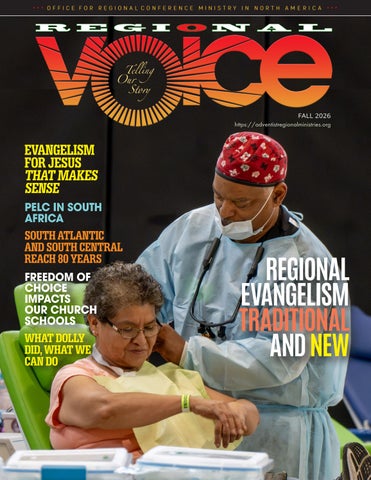
REGIONAL EVANGELISM TRADITIONAL AND NEW
PUBLISHER'S COMMENTARY
Published by the Office for Regional Conference Ministry in the North American Division of Seventh-day Adventists 5100 Adventist Boulevard NW Huntsville, Alabama 35896 (256) 830-5002 Website: https://adventistregionalministries.org PUBLISHER Roger A. Bernard EDITORIAL COORDINATOR Dana C. Edmond EDITOR Kyna Hinson ASSOCIATE EDITOR Bryant Taylor ART DIRECTOR/DESIGNER Howard I. Bullard COMMUNICATIONS DIRECTOR C. Anslem Paul COPY EDITOR Clarise J. Nixon PAGE PROOFING Patrice T. Conwell CONSULTANTS Elaine Allston, Ivona Bernard, Margaret Neckles
EDITORIAL For all correspondence and letters to the editors, write: OFFICE FOR REGIONAL CONFERENCE MINISTRY 5100 Adventist Boulevard NW Huntsville, Alabama 35896 or fax to (256) 830-5078 We reserve the right to publish and edit your submissions and letters. REGIONAL CONFERENCE OFFICES ALLEGHENY EAST CONFERENCE DR. TREVOR KINLOCK, PRESIDENT LaTasha Hewitt, Communication Director P.O. Box 266 Pine Forge, PA 19548 (610) 326-4610. www.myalleghenyeast.org ALLEGHENY WEST CONFERENCE MARVIN BROWN, PRESIDENT 1080 Kingsmill Pkwy. Columbus, OH 43229 (614) 252-5271. www.awconf.org CENTRAL STATES CONFERENCE CRYSTON JOSIAH, PRESIDENT Trevor Barnes Jr., Communications Director 3301 Parallel Parkway Kansas City, KS 66104 (913) 371-1071. www.central-states.org LAKE REGION CONFERENCE DR. ABRAHAM HENRY, PRESIDENT JeNean Lendor, Communication Director 19860 South La Grange Road Mokena, IL 60448 (773) 846-2661. www.lakeregionsda.org NORTHEASTERN CONFERENCE DR. ELDEEN KING, PRESIDENT Lavern Sturrup, Communications Director 115-50 Merrick Blvd. Jamaica, NY 11434 (718) 291-8006. www.northeastern.org OREGON CONFERENCE Regional Ministries Director Rodney Valentine PACIFIC UNION CONFERENCE DR. MARC K. WOODSON, PRESIDENT SOUTH ATLANTIC CONFERENCE CALVIN B. PRESTON, PRESIDENT James Lamb, Communications Director 3978 Memorial Drive Decatur, GA 30032 (404) 792-0535. www.southatlantic.org SOUTH CENTRAL CONFERENCE FURMAN F. FORDHAM, PRESIDENT Avrey Angerson, Communications Director 715 Youngs Lane Nashville, TN 37207 (615) 226-6500. www.scc-adventist.org SOUTHEASTERN CONFERENCE DR. MICHAEL OWUSU, PRESIDENT Arnaldo Cruz, Communications Director 1701 Robie Avenue Mt. Dora, FL 32757 (352) 735-3142. www.secsda.org SOUTHWEST REGION CONFERENCE DR. CARLTON P. BYRD, PRESIDENT Leslie Soupet, Communications Director 2550 Beckleymeade Avenue Dallas, TX 75203 (214) 943-4491. www.southwestregion.adventistchurchconnect.org REGIONAL DIRECTORS/COORDINATORS ROSTER Dr. Leon Brown, Vice President Black Ministries Pacific Union Conference J.P. Willis II, Vice President for Black Ministries 2686 Townsgate Road Westlake Village, CA 91361 (805) 413-7100. www.puconline.org Cell: 909-225-6438 Jonathan Smith, Assistant to the President Black Ministries, Arizona Conference Cell: 769-232-6664 | ismith@azconference.org James Scarborough, Coordinator African American Ministries | Central California Conference (831) 262-3838 famar@sbcglobal.net Oneil Madden, Coordinator African American Dept. Nevada-Utah Conference Cell 702-875-5979 pastoromadden@aol.com EuGene Lewis, Vice President North Pacific Union Conference 5709 N. 20th Street Ridgefield, WA 98642 (360) 857-7000. www.npuc.org Dr. Andrea Trusty-King, Vice President Black Ministries Southeastern California Conference (909) 202-0147 kinggm@seccsda.org Lawrence Dorsey II, Director G.L.A.R. | Southern California Conference (503) 819-1498
DANA C. EDMOND
MAKING CHANGE OUR FRIEND PART II
W
e began this discussion in our Spring Edition of Regional Voice. We moved away from it briefly, in our Summer Edition because that edition was devoted to Seventh-day Adventist Education. But in the words of General MacArthur, “We have returned!” We shared with you the “changing of the guard” that has taken place in the leadership of our church, our Regional Conferences and our school, Oakwood University. Of the individuals who were serving as presidents (of the General Conference, North American Division, regional conferences and Oakwood University) and vice presidents (of the Pacific and North Pacific Unions) when I became the Executive Director for the Office of Regional Conference Ministries and the Publisher of this magazine eight years ago, none of them hold those positions today. Not only has there been a complete change in leadership, but that change has been a generational shift—from leaders born in the 1950s to leaders born in the 1960s, 1970s, and in one case, the 1980s. We said that since leadership change is inevitable—the presidencies of all nine regional conferences has completely turned over twice in the past 16 years — preparing leaders to be leaders before they are leaders—as opposed to leaving them to learn through trial and error—needs to be more intentional. And we suggested some ways to do that don’t involve grooming certain leaders and pre-selecting them, which inevitably excludes other leaders and runs counter to black Adventist culture. This same thing needs to happen on the local church level. Indeed, one could make the argument that since ministry takes place at the local church, developing leaders at the local church level is even more important than developing them at the conference and union level. Not only does ministry for our church occur at the local level, but all the funding for our church takes place there as well. Local elders, treasurers, church clerks, children and youth ministries leaders all need to be developed and trained at the local church level with the same kind of intentionality that we use for church administrative leadership. Here’s why: I don’t anticipate there will ever be a time when a conference cannot fill the position of Conference President. But there are churches right now who cannot find anyone to fill key positions such as Church Treasurer or Youth Ministries leader.
"If you want people to be invested in your church/conference, they need to be included" What can be done? There are four ways to address this. We will share two in this edition and the last two in the conclusion of this series in the following edition later this year: 1. Intentionally Include Young Adults in Leadership Positions Look at the makeup of the governing bodies of your local church and local conference. Are they mostly filled with 50to70-year-old people? What I noticed in my years of traveling to different churches and working with conference executive committees for eight years is that, generally speaking, our church is led by people in their 50s, 60s and 70s. There are some exceptions, obviously, but this seems to be the norm. Given the natural human tendency to select people who we know and with whom we are familiar, I discovered that the best way to get young people on our Conference Executive Committee is to set aside a certain percentage of the seats on the Executive Committee to be filled by young adults. Back then, the North American Division leadership told me that 25% of the church membership in those days was young adults, so we said that 25% of the people on our committee had to be young adults. That is not the only way to ensure that young adults are included, but the point is to be intentional about including young people (along with women and minority groups) within the decision-making bodies. A diversity of opinions leads to better decisions. If you want people to be invested in your church/conference, they need to be included. 2. Identify Potential Young Leaders in Your Church and Get Them Involved In Ministry at an Early Age The late Elder Walter Pearson started putting me to work in my local church when I was about 12 or 13. Elder K.S. Smallwood made me a church elder when I was 18. Those opportunities had an enormously positive impact on my life and started
me down the road to a career in ministry that has spanned more than 47 years. The collapse of traditional AYS, Pathfinders, and youth-oriented organizations and activities is a huge detriment to developing young leaders and involving them in ministry the way we used to. But the departure (in many places) of those things is not an excuse for not doing anything. For the sake of the souls of our young people and for the sake of the long-term future of our church, young people/young adults must be involved and engaged in leadership and ministry in our local churches and conferences. And if that is not happening in your local church, then your church may be headed for some major challenges in the near future. Here’s why: Until recently, baby boomers were the largest demog raphic group in the United States, and by extension probably the largest demographic group in the church. But sociologists are saying that baby boomers are no longer the largest group. The oldest of the baby boomers are approaching 80, and since Father Time remains undefeated, the group that has been the large source of leadership and funding for the church for years is moving off the scene. So that potentially has some major repercussions for our church, including some financial ones. We already see some of these effects, including the fact that some of our major churches are beginning to age out. Who is going to lead the local church when Time does the inevitable, but Eternity has not yet arrived? We’ll finish this discussion here, next time. t ______________________________________________________________________ In this year of administrative transition, Elder Dana C. Edmond, former ORCM Director, has consented to maintain some editorial roles for Regional Voice magazine, including sharing his thoughts for this feature, the Publisher’s Commentary. REGIONAL VOICE | FALL 2026
5
CONTENTS 12
46
20
RV FA LL 2026
18 Mrs Alice Powell
26
Dr. Marc K. Woodson
Dr. Hubert J. Morel Jr.
4 4 PUBLISHER’S COMMENTARY Making Change Our Friend – Part II
There will always be candidates to fill major leadership positions in conferences. But are there candidates willing to fill major leadership positions in our local churches? There are ways to address this.
By Dana C. Edmond
8 COVER STORY Evangelism that Makes Sense, Part I
Jesus commanded us to make disciples. Are we developing people who know Jesus, understand His Word and recognize His claim upon the whole of their lives? That is evangelism that makes sense.
By C. Anslem Paul
Elder Dana C. Edmond
12 GLOBAL NEWS PELC South Africa
Every December, pastors, evangelists, Bible workers and other professionals descend upon the Oakwood University campus for three days of powerful preaching, inspirational singing, informative workshops and fellowship. Dr. Paul Shongwe, President of the South African Union, wanted to replicate that experience for the workforce of this union. And so it began.
By Dana C. Edmond
14 NAD BLACK CAUCUS Leaders Gather in Phoenix
The NAD Black Caucus provides a setting for prayer, planning, collaboration, accountability, and visioning around the mission of the church, particularly among African American communities and the broader communities served by Regional Conferences.
By C. Anslem Paul
COVER— Exam in progress at the AEC Deliverance Adventist Health Clinic in Philadelphia.
6
REGIONAL VOICE | FALL 2026
18 BREAKING NEWS Mid-America Union Names Dr. Hubert J. Morel Jr. President
President Hubert J. Morel Jr., newly-elected leader of the Mid-America Union, spoke briefly about the importance of the mandate to “occupy” until the coming of the Lord.
By Hugh Davis Coverage Coordinated by Dr. Bryant Taylor
20 BREAKING NEWS Leadership Transitions the Pacific Union Dr. Marc K. Woodson was elected president of the Pacific Union, the second largest union in the North American Division. Two African American Vice Presidents: Elder J.P. Willis II, Vice President for Education, and Dr. Leon Brown, Vice President for Black Ministries, were also elected or re-elected to their posts.
By Dana C. Edmond
22 BREAKING NEWS Lake Region Conference Delegates Elect Returning, and New Leaders President Abraham Henry was re-elected to a full term. Pastor Eliot Brooks was elected to serve as executive secretary, and Kent Nichols was re-elected as chief financial officer/ treasurer. Constituents elected a mixed slate of returning and new administrative officers to serve a five-year term.
By Kaara Harris
25 SOUTH CENTRAL Pastor Avrey Anderson Steps Into Communication Leadership
Regional Voice readers, meet Pastor Avrey Anderson, the new Communication Director for the South Central Conference of Seventh-day Adventists.
By Dr. Bryant Taylor
26 CELEBRATIONS South Central Marks 80th Anniversary
This special Camp Meeting session included great worship, great fellowship and great celebrations.
PHOTO ESSAY
52
28 South Atlantic Crosses into 80th Year
The South Atlantic Conference commemorated eight decades of ministry under the theme, “Faithful: Then, Now, Always” during its 2026 annual camp meeting, The theme highlighted God’s faithfulness to His people throughout the conference’s history and reaffirmed its commitment to the future.
By Dr. James Lamb
30 AEC HEALTH REPORT Deliverance Adventist Health Clinic Serves in Philadelphia
The Allegheny East Conference (AEC) recently hosted its first Deliverance Adventist Health Clinic in Philadelphia, bringing free health services and community resources to close to 500 residents.
Coverage Coordinated by LaTasha Hewitt Photography By Bryce Williams
34 AEC EVANGELISM
Please take a look at how God has worked throughout Allegheny East Conference evangelistic campaigns in the Jerusalem-Bethel French, Mizpah, North Philadelphia, Philadelphia Ghana, and Seaford Delaware churches.
Visual Coverage Coordinated by LaTasha Hewitt
38 SCC GALA CELEBRATION 42 SWRC EVANGELISM
There is the preaching of God’s Word, responses to His call, then prayers of dedication and consecration, the plunge of baptism, and the joys of new life for all believers.
Visual Coverage Coordinated by Dr. Carlton P. Byrd and Amparo Rumaldo
SCC 80th Anniversary
46 MILESTONE Mrs. Alice Powell Celebrates100 Years
Her children, grandchildren and church family gathered to mark this life of love, wisdom and faith, for Mrs. Alice Powell, in June 2026.
By Dr. Cynthia Powell-Hicks
48 RCRP/ADEL FEATURE
Be Involved, Not Bystanders How Retired Leaders Can Be Bridges Across the Generations If you’ve dedicated decades of your life to this church, speaking from the pulpit, teaching, working at a nurses’ station, managing an office, or caring for patients, it’s likely that more and more, you may walk into a room of unfamiliar faces. How you choose to manage that will make all the difference. By Dr. Delbert W. Baker
52 IN MEMORIAM Currine Harris
She became a baptized member of the Berean Seventh-day Adventist Church as a youth, and served throughout her adulthood in multiple departments, on the staff of the South Atlantic Conference and the Southern Union. She was the primary author of a HUD grant for her church, making possible the development of Berean Village, an affordable housing community for adults aged 55 and older.
By Staci J. Harris Cody, MSN, RN, CNM, FNP-C
Currine Harris
54 IN TRIBUTE What Dolly Did — A Life Beyond the Rhinestones
We may not have the wealth to distribute more 300 million books to children around the world the way Dolly Rebecca Parton Dean did over her 80 years, but we can fund books and supplies and share with the ones we do know who have needs we can help to meet.
By Kyna Hinson
56 SCHOLARLY FEATURE Freedom of Choice: The Unintended Consequences on Regional Conference Schools
In the 1960s and 1970s, Regional Church Schools had large enrollments, robust course offerings, and visions for expansion. Currently, a number of these once-prominent schools face declining enrollments, teacher shortages, school closures, and a reduction of services or grade offerings. Let’s take a closer look.
Coverage coordinated by Dr. Trevor Kinlock, President, AEC
62 HOPE SERIES CAMP MEETING 2026
View the joy, fun, fellowship and, of course, worship that refreshed and enriched the saints across multiple Regional Conferences this summer. Start planning now to enjoy yourself as well in 2027, for HOPE.
Visual Coverage from Lake Region Conference.
REGIONAL VOICE | FALL 2026
7
COVER FEATURE
F
EVANGELISM THAT MAKES SENSE, MAKES A DIFFERENCE, AND MAKES PEOPLE PART I B Y C . A N S L E M PAU L
"Jesus did not commission His church merely to collect converts. He commanded us to make disciples."
8
REGIONAL VOICE | FALL 2026
or generations, Regional Conferences have been extraordinarily serious about evangelism. We have pitched tents, rented auditoriums, planted churches, conducted Bible studies, preached prophetic truth and invited men, women and children to follow Jesus. We should keep doing it. But perhaps there is another question worth asking: What happens before the invitation? Ellen G. White’s familiar description of the ministry of Jesus deserves another hearing: “Christ’s method alone will give true success in reaching the people. The Saviour mingled with men as one who desired their good. He showed His sympathy for them, ministered to their needs, and won their confidence. Then He bade them, ‘Follow Me’” (The Ministry of Healing, p. 143). There is an entire theology of evangelism in those few sentences. Jesus ultimately called people to follow Him. There is no ambiguity about the destination. But before the invitation came presence, compassion, service and trust. The Gospels bear this out. Jesus proclaimed the Kingdom, but He also fed hungry people. He taught truth, but He also healed disease. He forgave sin, but He also restored people to community. He welcomed children, defended the vulnerable, and concerned Himself with what was happening in people’s homes, bodies and daily lives. The gospel Jesus preached was never less than salvation from sin. But its power became visible wherever the Kingdom of God collided with conditions that diminished human life. That matters for Regional Conferences because many of the communities we have been uniquely called to serve are asking urgent questions about life right now. • Can our children flourish? • Can our families be healthy? • Can our communities build wealth and economic stability? • Can our neighborhoods be safe and our systems just?•
• Can the places where we live be healthy places to breathe, grow and raise our children? Those are not distractions from evangelism. They may be some of the places where evangelism begins. Evangelism Should Make People There is another reason these questions belong in a conversation about evangelism. Evangelism should make people. Jesus did not commission His church merely to collect converts. He commanded us to make disciples. That distinction matters. The ultimate measure of evangelism cannot simply be how many people went down in the water. We must also ask who came up from it. Are we making disciples? Are we developing people who know Jesus, understand His Word and recognize His claim upon the whole of their lives? People capable of serving their families, strengthening their communities, confronting injustice, creating opportunity, caring for their neighbors and helping somebody else discover Jesus? That is evangelism that makes sense. That is evangelism that makes a difference. That is evangelism that makes people. But it also means that the conditions surrounding the people we seek to reach cannot be irrelevant to the
REGIONAL VOICE | FALL 2026
9
COVER FEATURE
mission of the church. Isaiah 58 will not allow it. God confronts a people who are intensely religious. They fast. They seek Him. They practice the forms of devotion. Yet God asks what their religion is doing about oppression, hunger, homelessness and human suffering. “Is not this the fast that I have chosen?” God asks, “to loose the bands of wickedness, to undo the heavy burdens, and to let the oppressed go free?” (Isaiah 58:6) He commands His people to share bread with the hungry, care for the poor and respond to the afflicted. Isaiah 58 refuses to permit worship to remain comfortably distant and piously aloof from the conditions that diminish people. Then Acts 6 takes us another step. A complaint arises in the early church because Hellenistic widows are being neglected in the daily distribution of food. An identifiable group within the community is experiencing an inequitable outcome. The apostles do not simply performatively condemn the inequity. They change how the church operates. Responsibility is assigned. People are selected. A structure is created. Resources are administered differently. The church organizes itself to produce a different outcome. Yeah, that was a thing. A biblical thing. Because some problems cannot be adequately addressed by occasional acts of compassion. Persistent problems may require persistent structures. And remarkably, the structure created
10
REGIONAL VOICE | FALL 2026
to address a community’s needs also develops the people within it. Stephen and Philip emerge from that moment not merely as administrators of assistance, but as powerful gospel witnesses. The church met a need. The church addressed an inequity. The church developed leaders. And “the word of God increased” (Acts 6:7). That sounds a lot like evangelism that makes sense. This biblical vision carries particular significance for the African American communities Regional Conferences have historically served. We find ourselves in a moment when questions about race, equality, representation and even how America tells its racial history are once again being contested in government, education, workplaces and public institutions. Policies designed to address historic inequities are being challenged or dismantled. Longstanding assumptions about affirmative action and diversity initiatives have shifted. Debates over voting districts, Black history, books, museum exhibits and public memory are no longer abstract conversations. Whatever one’s political affiliation, the church cannot become so absorbed in either the argument or in naval gazing that it overlooks the actual people living with the consequences. The Black church has been here before. There is an honorable and necessary tradition of protest in the African American experience. We have marched. We have boycotted. We have organized. We have petitioned government, challenged
unjust laws, and publicly declared that injustice must end. The Black church has frequently stood at the center of that work. But our resistance has never been limited to marching. We built schools. We created institutions. We educated children others neglected. We cared for the sick. We developed businesses. We organized communities. We sheltered people, fed people, employed people, mentored people, and created alternatives when existing systems refused to serve our communities justly. There are moments when resistance requires us to march against what is wrong, and there are also moments when resistance requires us to build what is right. That distinction may be particularly important now. The church cannot control every election, legislature, school board, courthouse, corporation, or federal agency. But the church is not powerless. We do not need permission from Washington or a statehouse to tutor a child. We do not need a corporate diversity initiative to mentor a student. We do not need an economic-development bill to teach entrepreneurship. We do not need criminal-justice legislation to intervene in the life of a teenager before incarceration or welcome a returning citizen afterward. We do not need an environmental mandate to clean a neighborhood, plant a garden, or advocate for healthy conditions where our people live. Government policy matters. Elections matter. Laws matter. Advocacy matters.
Protest matters. But the church possesses something beyond the ability to demand that others act. We possess the ability to act. And perhaps one of the most powerful things we can build is people. That brings us to five areas: education, community health, economic development, crime and justice, and environmental stewardship. They might be described as five pillars of community engagement that have a unique potential to help communities flourish. More importantly, each represents an accessible field of evangelistic ministry already waiting outside the doors of our churches. And each gives us an opportunity, not merely to describe disparities, but to help change outcomes. We will discuss the first two areas here and conclude with the last three in our next Regional Voice issue. Education: When the Church Helps a Child Flourish Scripture consistently connects the people of God with the formation of the next generation. “Teach them diligently unto thy children,” God commands in Deuteronomy 6:7. Proverbs calls us to train a child in the way he should go (Proverbs 22:6). Jesus welcomed children whom His own disciples regarded as an interruption and declared, “Suffer the little children to come unto me” (Mark 10:14). Education, therefore, cannot merely be somebody else’s concern. The latest National Assessment of Educational Progress shows why. In 2024, Black eighth graders nationally averaged 243 in reading, compared with 266 for White students— a 23-point gap. In eighthgrade mathematics, Black students averaged 251 compared with 284 for White students —a 33-point gap. These are not merely numbers on government reports. They represent children and futures. And surrounding many of those children are churches. Imagine what becomes possible when a congregation asks not simply, “How many children attend our church?” but “What is happening to the children who attend the schools around our church?”
Tutoring is evangelism when it is an expression of Christ’s love. So are literacy programs, mentoring, college-preparation workshops, STEM programs, vocational exposure, scholarships, school partnerships, and safe after-school spaces. And there is resistance in that work. Every child who learns to read better because a church opened its doors after school represents more than a successful tutoring session. Mentoring a young person whom others have underestimated is resistance. Helping a teenager complete a college application, discover a trade or imagine possibilities beyond the limitations that others have assigned to them is resistance. We do not merely protest unequal outcomes. Where God gives us capacity, we help create different ones. And then we develop those children into adults who can do the same for somebody else. That is evangelism that makes people. Community Health: When Healing Becomes Witness Few dimensions of Christ’s earthly ministry are more obvious than healing. Matthew summarizes His ministry this way: Jesus went throughout Galilee “teaching in their synagogues, and preaching the gospel of the kingdom, and healing all manner of sickness and all manner of disease among the people” (Matthew 4:23). He did not force a choice between preaching and healing. Neither should we. Health disparities remain consequential in African American communities. According to 2024 CDC data, 20.1 percent of non-Hispanic Black adults described their health as fair or poor. For Adventists, this should sound less like a new frontier than an old calling. Health ministry can move beyond the occasional health fair. Churches can become trusted centers for blood-pressure screening, diabetes prevention, nutrition
education, mental-health referral, exercise, cooking instruction, maternal-health support, health navigation, and partnerships with physicians, nurses, hospitals, and public-health agencies. A blood pressure screening will never appear on a protest sign. But helping someone identify hypertension before it produces a stroke can change a life. Teaching families to prepare healthier food, connecting someone with a physician, supporting a mother through pregnancy, or creating safe opportunities for exercise may seem ordinary. And that is precisely the point. Christian resistance does not always look dramatic. Sometimes it looks like quietly changing an outcome that did not have to be inevitable. We already possess a theological tradition that understands physical, mental and spiritual restoration as interconnected. The question is, do our neighborhoods get to actually translate that conviction to something more than doctrine? We have examined here the first two areas of community engagement, education and community health. We will discuss the final three—economic development, crime and justice, and environmental stewardship—in our next issue. These are pillars of evangelism that truly make sense. t ____________________________
C. Anslem Paul is the Communication Director for the Office for Regional Conference Ministry (ORCM), and he produced this thought-provoking coverage for Regional Voice magazine. _____________________________________________ Sources Ellen G. White, The Ministry of Healing, p. 143. National Center for Education Statistics, National Assessment of Educational Progress, 2024 Reading and Mathematics Results. Centers for Disease Control and Prevention, Health of Black or African American Non-Hispanic Population. REGIONAL VOICE | FALL 2026
11
GLOBAL NEWS
PELC
camp meetings and engaged in some other joint programs. Dr. Shongwe heard about PELC and decided to make the nearly 18,000-mile round trip to Huntsville to experience it for himself. He was blessed and wanted his team in South Africa to experience these meetings. He contacted Dr. Jesse Wilson, Assistant Professor at the School of Religion at Oakwood University and the Director of PELC. Then PELC South Africa was
SOUTH AFRICA BY DA N A C . EDMOND
"Dr. Shongwe heard about PELC and made the trip to Huntsville. He wasblessed and wanted his team in South Africa to experience these meetings."
12
REGIONAL VOICE | FALL 2026
T
he Pastors and Evangelists Leadership Conference (PELC) has offered a tradition of more than 50 years among the Regional Conferences in the Seventh-day Adventist church. Every December, pastors, evangelists, Bible workers and other professionals descend upon the Oakwood University campus for three days of powerful preaching, inspirational singing, informative workshops and fellowship. Dr. Paul Shongwe, President of the South African Union, wanted to replicate that experience for the workforce of this union. It began this way: Elder Lester Parkinson, currently a pastor in the Southeastern Conference, was then a pastor in South Africa. He heard that the regional conference presidents were meeting with church leaders from East Africa and West Africa, converging in Kenya for the historic African/African American Leaders Summit. He expressed a desire for a similar meeting with some of the South African leaders as well. As providence would have it, on their way to Kenya for the summit, I and my wife, Jill, were re-routed away from Kenya to Johannesburg, South Africa, because of an airline mix-up. I called Elder Parkinson, who graciously arranged for our housing and a meeting with him and Dr. Paul Shongwe, who was then President of the Trans-Orange Conference, headquartered in Johannesburg. At that meeting, Dr. Shongwe expressed his desire to connect with a regional conference to feature some exchange programs and training. I contacted Elder Benjamin Jones, Jr., then President of the South Central Conference. Eventually, Dr. Shongwe and Elder Jones preached at each other’s
DANA EDMOND
DR. JULIAN JONES
born in July of 2023. Dr. Wilson and Dr. R. Clifford Jones, then Dean of the School of Religion, brought a team from Oakwood University to Johannesburg, South Africa, where the first PELC South Africa was held. By this time, Dr. Shongwe had become President of the South African Union. He was led to move PELC around to various cities in South Africa to facilitate exposing as many of his team members to the PELC experience as
PASTOR AMANDA CROWLEY
DR. ORVILLE BRISSETT
ELDER BOBBY WATERS
possible. After the PELC debut in Johannesburg in 2023, the sessions moved on to Durban, South Africa, in 2024, and paused for General Conference in 2025. PELC came to Cape Town, South Africa, in 2026. The team from the United States for the 2026 PELC South Africa consisted of the following: • From Oakwood University School of Religion: Drs. Jesse Wilson, Patrick Campbell and Julian Jones-Campbell • From Allegheny East Conference: Dr. Orville Brissett and Pastor Amanda Hadley • From Central States Conference: Elder Bobby Waters • From Northern California Conference: Elder Rudolph Peters • From Northeastern Conference: Dr. Michelle Mota • Retired Former ORCM Executive Director Elder Dana C. Edmond The aforementioned group arrived, preached, and conducted workshops in various churches in Cape Town for Divine Worship on Sabbath. It was a wonderful experience. Dr. Wilson reports that when the United States team returned home, they decided to maintain contact with the PELC team in South Africa to fund building and ministry projects. PELC South Africa has been set for July 14-17 of 2027, and plans are already being made on both sides of the Atlantic for another blessed experience. t _______________________________ In this year of administrative transition, Elder Dana C. Edmond, former ORCM Director, has consented to maintain some editorial roles for Regional Voice magazine. He conducted special coverage on this global event, where he also preached the Word.
REGIONAL VOICE | FALL 2026
13
NAD BLACK CAUCUS
LEADERS GATHER IN PHOENIX FOR ANNUAL MEETINGS B Y C . A N S L E M PAU L
R
egional conference leaders from across North America gathered in Phoenix, Arizona, July 26-29, for the Annual North American Division (NAD) Black Caucus meetings, a convening marked by strong attendance, thoughtful reporting, strategic conversation, and a renewed sense of mission. The NAD Black Caucus brings together regional conference administrators, departmental leaders, pastors, ministry partners, and institutional representatives connected to the work of Regional Conference and Black Ministry across the North American Division. Its purpose is to provide a setting for prayer, planning, collaboration, accountability, and visioning around the mission of the church, particularly among African American communities and the broader communities served by Regional Conferences. Attendance at this year’s gathering was exceptional. The broad participation reflected the continued importance of the Caucus as a space where leaders can listen together, plan together, and strengthen the work entrusted to Regional Conferences. The daily format included morning devotional presentations, breakout caucuses, ministry reports, board meetings, and executive sessions. Breakout groups included presidents, executive secretaries and vice presidents, CFOs and treasurers, ministerial directors, pastors, millennial pastors, and administrative spouses. The meetings also included greetings from Dr. G. Alexander Bryant, president of the North American Division, and Elder Calvin Watkins, vice president for Evangelism and Regional Liaison for the North American Division. A number of ministry reports highlighted encouraging developments across the field. Leaders heard updates from the Pastoral Evangelism and Leadership Council (PELC), Oakwood University, Breath of Life, BAYDA, the Conscience & Justice Council, and other ministries serving the church and its communities. One significant moment came during the PELC report, which marked a transition in leadership. Dr. Jesse Wilson, who has served PELC faithfully for several years, was recognized as this leadership transitions to Dr. Emil Peeler, newly
14
REGIONAL VOICE | FALL 2026
L-R, Michael Owusu - SEC president, Roger Bernard-ORCMExecutive Director, Carlton Byrd - SWRC president, G. Alexander Bryant, NAD president. Kyoshin Ahn- Executive Secretary-NAD, Calvin Watkins, VP NAD
appointed dean of Oakwood University’s School of Theology. Oakwood University also shared historic news. Dr. Gina Brown, president of Oakwood University, announced that the university has been approved by the Southern Association of Colleges and Schools Commission on Colleges to elevate its accreditation status from a Level 3 to a Level 5 institution. This approval enables Oakwood to launch its first doctoral program, the
Doctor of Ministry with an emphasis in Community Development. The Caucus reports addressed a range of ministry and leadership concerns, including reaching emerging generations, strengthening discipleship models, and preparing for the search for a new editor of Message Magazine, one of the flagship publications connected to the Regional Conference work. Carmela Monk Crawford, who has served valiantly as editor for
14 years and is the longest-serving editor in the publication’s history, will continue in the role and provide support through the end of the 2026 calendar year. The Regional Conference Retirement Plan board meeting brought further encouragement. Under the leadership of Executive Director Dr. William Cox, the plan remains strong, with more than $400 million in retirement assets. Dr. Cox will retire at the end of the
"The broad participation reflected the continued importance of the Caucus as a space where leaders can listen together, plan together, and strengthen the work entrusted to Regional Conferences." REGIONAL VOICE | FALL 2026
15
NAD BLACK CAUCUS year, and a search committee has been appointed to identify his successor. The Office for Regional Conference Ministries (ORCM) board meeting also focused on the future of Regional Conference work. ORCM Executive Director, Elder Roger Bernard, shared a renewed emphasis on support for Oakwood University and on growing the Regional work among all communities, with particular attention to African American communities. As part of the ORCM Director’s Report, ORCM Communications Director Pastor Anslem Paul presented three
new initiatives designed to support that renewed focus. The first, MI:9, is a mission intelligence platform for the nine Regional Conferences. The platform is designed to help conferences more clearly and accurately see current capacities, present opportunities, and future possibilities for mission and ministry. The second, The Five Pillars of Community Engagement, positions ORCM to provide Regional Conferences and churches with tools and resources for meaningful community engagement in five key areas: education, economic development, crime and social justice, community health, and environmental stewardship. The third, The Dream Factory, is a Regional Conference innovation fellowship housed in the ORCM office on the campus of Oakwood University in Huntsville, Alabama. The fellowship will engage students in these and other initiatives, inviting them to help build, imagine, and dream the future of Regional Conference work in North America. The ORCM presentation concluded with an animated video produced by John Gaines, the first Dream Factory
Fellow, and Benton Hampton. The video was well received and provided a compelling visual summary of the vision being cast for the future. The meetings concluded ahead of schedule, with the full agenda completed before lunch on Wednesday. As a result, the Wednesday afternoon session was not needed, allowing participants additional time for fellowship and travel. Organizers were grateful that all attendees traveled home safely. While Phoenix’s July heat was memorable, the spirit of the meetings was even more so. Leaders left encouraged by the reports, strengthened by the fellowship, and grateful for God’s blessing on the work. The momentum from Phoenix now carries forward into the months ahead as Regional Conference leaders continue serving, building, and imagining the next chapter of ministry across North America. t ____________________________ Elder C. Anslem Paul is the ORCM Communications Director, and provided live coverage for this event.
Gina Spivey-Brown. OU President, EuGene Lewis - NPUC regional VP, Kenneth Manders - Bermuda Conference president
16
REGIONAL VOICE | FALL 2026
REGIONAL VOICE | FALL 2026
17
BREAKING NEWS
DR. HUBERT J. MOREL JR. ELECTED PRESIDENT, MIDAMERICA UNION CONFERENCE BY HUG H DAV I S
D
elegates to the Mid-America Union Conference’s 10th quinquennial constituency session elected administrators and executive committee members on September 13, 2026, to serve five-year terms. Nearly 320 representatives from the Central States, Dakota, Iowa-Missouri, Kansas-Nebraska, Minnesota and Rocky Mountain conferences gathered at the College View Seventh-day Adventist Church in Lincoln, Nebraska, under the theme “One In Christ: United For Service.” In addition to electing leaders, delegates also reviewed and voted changes to the union’s constitution and bylaws, largely editorial in nature. The session began with worship as Union Adventist University shared beautiful musical selections, followed by an inspiring devotional from North American Division resident Dr. G. Alexander Bryant. Bryant reminded delegates that God’s mission unites us, much like the interconnected roots of the great redwood trees, which draw strength from one another. The opening worship concluded with prayers for God’s presence and guidance throughout the session. The MAUC nominating committee, chaired by Bryant, met in person on August 2 to select names to present to delegates for the officer positions (president and two vice presidents). The committee met again a week later by Zoom to complete their work. Delegates received packets containing the nominating committee report and all other pertinent information for the session three weeks prior to the event. Delegates expressed strong confidence in the Union’s leadership, voting overwhelmingly to elect Dr. Hubert J. Morel Jr. as president and Dr. Craig Carr as vice president for administration for the next five years. Morel received 85 percent approval, while Carr received 89 percent. Elder Roy Simpson was returned to the position of vice president for finance with 98 percent approval. Voting for personnel was conducted using electronic voting devices. Morel is the 8th president to serve the Mid-America Union Conference. His term begins immediately. Morel spoke briefly about the importance of the mandate to “occupy” until the coming of the Lord. “We must utilize the resources we have to grow the kingdom of God until He returns,” stated Morel.
18
REGIONAL VOICE | FALL 2026
From left: Roy Simpson, VP of Finance; Melissa Simpson; G. Alexander Bryant, President North American Division, Desiree Bryant; Raquel Morel, Hubert J. Morel Jr., President; Carisa Carr, Mid-America Director of Education; Craig Carr, VP of Administration/Executive Secretary
Dr. Hubert J. Morel Jr.
SHARED ACCOUNTABILITY A constituency session is similar to a shareholder meeting of a publicly held company. Each local conference elects delegates for this session; the number they send is based on their membership size. They are also invited to submit agenda items for the session and suggestions for the constitution and bylaws committee. Reports on church membership showed a slight gain, and the union received a clean financial audit from auditors at the General Conference. All reports are available at outlook-
mag.org as articles or on OUTLOOK’s YouTube in video format. Dr. Yami Bazan, president of Union Adventist University also presented a report since their constituency session occurred on the same day, and attendees were delegates to both sessions. Additional representatives from the North American Division were in attendance, including Judy R. Glass, treasurer, and Kyoshin Ahn, secretary. SPIRIT OF COOPERATION Delegates expressed appreciation for the level of pre-planning and organization that made processes clear and easy to understand—from registration, to proposed changes to the bylaws, to financial business. “I liked that there was a spirit of cooperation and oneness of mission,” said a first-time delegate. “It was encouraging to see.” Thanks was expressed to retiring Dr. Gary Thurber for his leadership as
MAUC president for the past 11 years. During his final remarks, Thurber said. “It’s been an honor to serve you and I love you all…We are known as Christians when we love our neighbor. Let Mid-America be the place where the people love one another and the people trust God.” BEYOND REPORTS AND VOTES As always, there is more than business reports and votes at constituency sessions. The session is also a celebration highlighting mission, evangelism and the blessings of the Lord in the past five years. It is a time to reflect on the accomplishments and activities of the departments. It is also an opportunity to analyze the state of the MAUC—organizationally, financially and statistically—and consider how next to advance the work of the church throughout the region. The Mid-America Union is currently
comprised of 67,813 members, 554 congregations, 63 ECE/elementary/secondary schools and one university in its nine-state territory. In addition, there are 21 Adventist Community Services centers, 10 hospitals and 8 camps.* t ______________________________ Hugh Davis, Director of Communication Mid-America Union Conference of the Seventh-day Adventist Church. _________________________ Dr. Bryant Taylor, Associate Editor of Regional Voice magazine, coordinated this coverage. _____________________________________________ *as of June 30, 2026
REGIONAL VOICE | FALL 2026
19
BREAKING NEWS
LEADERSHIP TRANSITIONS IN THE PACIFIC UNION BY DANA C. EDMOND
D
r. Marc K. Woodson, former president of the Northern California Conference, was elected president of the 225,000 member Pacific Union, the second largest union in the North American Division. This union constituency session took place on August 17-18. Dr. Woodson succeeds Elder Brad Newton, who has retired. Dr. Woodson is a native of Los Angeles. He began his ministry 38 years ago as a youth pastor in the Southeastern California Conference. He served in Southeastern California for 19 years before accepting a call to the Northern California Conference to become the Executive Secretary. Upon the retirement of President Jim Pedersen in 2018, Dr. Woodson was elected president of the Northern Dr. Marc K. Woodson California Conference. He served there until becoming the second African American to serve as president of the Pacific Union. Dr. Woodson holds degrees from Oakwood University (a bachelor’s degree in theology), Andrews Theological Seminary (Master of Divinity) and Fuller Theological Seminary (Doctor of Ministry). For the last 15 years, he has been married to the former Marlene Rodriguez. His vision for Pacific Union is for it to be “spiritually and financially healthy and aligned with the
20
REGIONAL VOICE | FALL 2026
mission of the Seventh-day Adventist Church.” “The Great Advent Movement” continues with more leadership changes that affect the Regional work in the Pacific Union. At this same meeting, constituents elected/re-elected two African American Vice Presidents: Elder J.P. Willis II, Vice President for Education, and Dr. Leon Brown, Vice President for Black Ministries. Elder Willis is a native of Nashville, Tennessee. His father, the late Elder J.P. Willis, served as a pastor in the South Central and Northeastern Conferences. Elder Willis holds degrees from Oakwood University (a bachelor’s degree in religion); Loma Linda University (a master’s degree in curriculum and instruction) and La Sierra University (an Ed.S. degree). He began his ministry in the Northeastern Conference and has served in the Central States, South Central, Allegheny East, Southeastern California and Southern California Conferences. In South Central, Allegheny East and Southern California, he served in educational administrative roles prior to being elected as Vice President for Education for the Pacific Union in 2025. He and his wife of 48 years, Janice, have two children: a daughter, C.J., and a son, Pastor J.P. Willis III, who works in the Northern California Conference. Dr. Leon Brown is the new Vice President for Black Minis-
Elder J.P. Willis II
Dr. Leon B. Brown
tries for the Pacific Union. A native of Rochester, New York, Dr. Brown began his ministry at the Northern California Conference in Pittsburgh, California. From there, he went to serve as president of the Nevada/Utah Conference, where he worked for five years, prior to becoming Executive Vice President for the Pacific Union. Dr. Brown holds two bachelor’s degrees, two master’s degrees (a Master of Divinity and a Master of Business Administration), and a Doctor of Ministry degree. He and his wife, Julie, have two sons, Leon and Lawrence. Dr. Brown succeeds Elder Virgil Childs as Vice President for Black Ministries. Elder Childs is retiring after nearly 40 years in ministry. Elder Childs began his ministry at the Oakland Market Street SDA Church in the Northern California Conference. He served in Northern California for 20 years prior to
coming to the North Pacific Union to coordinate the Regional work, upon the retirement of Elder Bobby Mitchell. Elder Childs is already planning a busy retirement. He is nearing completion of a doctoral degree and he is beginning classes for CPE units for chaplaincy ministry. Most of all, he is looking forward to coming off the road and spending time with his wife, Pat. The “Great Advent Movement” continues. t _________________________ In this year of administrative transition, Elder Dana C. Edmond, former ORCM Director, has consented to maintain some editorial roles for Regional Voice magazine. He conducted interviews and gathered data for this coverage.
Pacific Union Office
REGIONAL VOICE | FALL 2026
21
LAKE REGION
LAKE REGION CONFERENCE DELEGATES ELECT RETURNING, AND NEW LEADERS AT CONSTITUENCY SESSION BY K A AR A HARRIS
L A K E U N I O N CO M M U N I C AT I O N S T E A M
O
n August 9, 2026, delegates to the 30th Lake Region Constituency elected a mixed slate of returning and new administrative officers to serve a five-year term. More than 500 representatives from Illinois, Indiana, Michigan, Minnesota and Wisconsin met at the Howard Performing Arts Center on the campus of Andrews University in Berrien Springs, Michigan, to determine leadership in a lively session covered with prayer. The meeting began with a stirring devotional message from Pastor Debleaire Snell, speaker/director of Breath of Life Ministries. Leading from the account of the sons of Issachar in 1 Chronicles 12:32, Snell, whose early days in ministry began in Lake Region, encouraged delegates to follow God’s lead in raising up individuals who understand the times, but aren’t intimidated by the challenges; who are willing to adapt methods for the times, and who understand how to fight battles through prayer. “Don’t choose the most popular, the person who will do what you like, the person you’re most familiar with,” he said, “but look for leaders who understand the times and know what Israel ought to do.” Election Results: Elden Ramirez, president of the Lake Union Conference, chaired the nominating committee and delegates voted on names for administrative officers and departmental directors. President Abraham Henry was re-elected to a full term. He assumed the role in February 2026 after former president Garth Gabriel retired. Henry previously served as executive secretary. After the results came in, he stood with his wife Rebecca to thank delegates for their support.
22
REGIONAL VOICE | FALL 2026
“Thank you so much for this honor. Every win is a kingdom win, a conference win. We look forward to working with everyone. We want to serve everyone…we are all family; we are all members. We canDr. Abraham Henry not do this mission without you…and so we’re looking forward to praying with you, to working with you and to serve with you.” Pastor Eliot Brooks was elected to serve as executive secretary, a role previously held by Harold Cleveland. Kent Nichols was re-elected as chief financial officer/treasurer for Lake Region. Eddie Allen was re-elected as vice president for multilingual ministries. Other Items: During the constituency session, several reports were given to provide updates from across the region. The president’s report focused on advances in Christian education and evangelism. He announced that the Lake Region now consists of more than 32,000 members in 126 churches across five states. Henry also spoke of the acquisition of 70 acres of land adjacent to Camp Wagner, in Cassopolis, Michigan. Lake Region administrators Harold Cleveland, executive secretary, and Eddie Allen, vice president of multicultural ministries, announced 15 new churches joined the conference. Administrators and delegates joined in giving God
Pastor Eliot Brooks
Elder Kent Nichols
Elder Eddie Allen
praise for the new additions and growth of the work in the region. Delegates approved the removal of four churches: Michigan City Voice of Hope; Muncie Philadelphia; Pembroke Ephesus (Hopkins Park, IL); and Robbins. An amendment to the constitution and bylaws, changing terms from four to five years was passed. Delegates approved to postpone a vote on additional proposed constitution and bylaws changes until the Lake Region camp meeting in 2027. Both the treasurer and the General Conference auditor shared updates on Lake Region’s financial condition. Despite inflation and other challenges, the conferREGIONAL VOICE | FALL 2026
23
SOUTH CENTRAL
LAKE REGION ence received a clean audit. The treasurer spoke of continued efforts to reduce costs and increase working capital going forward to further stabilize finances. Standing on Strong Shoulders: Throughout the session, leaders paused to acknowledge their colleagues’ contributions. Delegates gave Elder Garth Gabriel and his wife Rosita a standing ovation to express gratitude for his leadership and mentorship over 30 years of ministry. Outgoing ACS Director Debra Davis-Moody received a plaque to commemorate her longstanding service in Lake Region; earlier this year she was honored by the North American Division for more than 50 years in community service. Administrators and departmental directors also paused to recognize leaders who have died since the last gathering in 2022. t ___________________________________________________ Kaara Harris, a member of the Lake Union Communications Team, produced this live coverage.
The list of elected officials is as follows:
Administrators President: Dr. Abraham Henry Executive Secretary: Pastor Eliot Brooks Chief Financial Officer/ Treasurer: Elder Kent Nichols VP for Multilingual Ministries: Pastor Eddie Allen
Departmental Directors Adult Ministries: Pastor Darlene Thomas Youth Director: Pastor Earl Baldwin Jr. Associate Youth Director: Pastor Denry White Education: Deidre Garnett Health: Dr. Christina Wells Family Life Directors: Dr. and Mrs. Ainsworth and Gillian Joseph Public Affairs and Religious Liberty: Edward Woods III Men’s Ministry: Dr. Jason O’Rourke Women’s Ministry: Chaplain Dian Welch National Service Organization: Dr. Phillip Willis Jr. Adventist Services and Industries: Wilbur Minisee Sr. Prison Ministries: Pastor Christopher Clark Urban Ministries: Pastor Steve Bramwell Adventist Community Services: Camp Wagner Director: Communications: Human Resources: Media Ministry: Stewardship: Youth Adult Ministry: Conference Evangelist: Ministerial Director Children’s Ministry
24
REGIONAL VOICE | FALL 2026
Referred to executive committee Referred to executive committee Referred to executive committee Referred to executive committee Referred to executive committee Referred to executive committee Referred to executive committee Referred to executive committee Referred to executive committee Referred to executive committee
FROM MEDICINE TO MINISTRY
PASTOR AVREY ANDERSON STEPS INTO COMMUNICATION LEADERSHIP FOR THE SOUTH CENTRAL CONFERENCE B Y D R . B R YA N T TAY LO R
H
e grew up in Toronto. And somewhere between the church choir loft and the school drama stage, a young Avrey Anderson was quietly being shaped into a pastor. Regional Voice readers, meet Pastor Avrey Anderson, the new Communication Director for the South Central Conference of Seventh-day Adventists. If his story teaches us anything, it’s that God has a way of rerouting even the most carefully laid plans of humanity. Avrey arrived at Andrews University with a stethoscope in his future. His major was biology, pre-med all the way. He was ready to heal bodies, but by his senior year, another calling had grown too loud to ignore. He didn’t just adjust his plans; he rewrote them entirely. He walked away with a Bachelor of Arts in Religion in 2011 instead. Turns out, God wanted him preparing people, not writing prescriptions. From there, his training deepened. He began his theological foundation at Andrews Theological Seminary, and he later earned a master’s degree in Religion from Washington Adventist University in 2017, with an emphasis in Urban Ministry. This degree sharpened something else: his conviction that the gospel isn’t meant to stay locked behind stained glass. It’s meant to walk the streets, speak the language of real people, and show up wherever life is actually happening. That conviction didn’t stay in the classroom. It’s the same instinct now steering his next chapter — translating the mission of an entire conference into stories people want to hear. Then came June 2023—ordination–not the beginning of the call, but its confirmation. At that moment, the calling that started in a Toronto choir loft became official. Those who know him don’t describe Avrey as a man chas-
ing titles. They’ll tell you about a student leader who listened; a chaplain who showed up; a ministry coordinator who kept pointing young people back to their own God-given gifts. From Baltimore, Maryland, to Ellenwood, Georgia, his fingerprints are on communities, not just committees. He is building a ministry that’s rooted in relationships, not routine. And that energy? It doesn’t clock out. Basketball. Music. Photography. Videography. Technology. For most people, these are hobbies. For Avrey, they’ve been ministry tools hiding in plain sight, which makes his move into communication leadership feel less like a career pivot and more like destiny. Behind it all stands his family: his college sweetheart who became his wife, Christal, and their three children, Eden, Matea, and Judah. These are the ones who ground him when the calling gets loud. Pastor Anderson lives by 1 Corinthians 10:31: “Whatever you do, do it all to the glory of God.” It’s not just a verse he quotes. It’s the filter through which every role passes: pastor, mentor, husband, father, and now, storyteller-in-chief for the South Central Conference. And at the end of it all, there’s only one review he’s working toward: “Well done, good and faithful servant.” t ______________________________________________________
Dr. Bryant Taylor, Associate Editor of Regional Voice magazine, produced the interview and profile for this issue.
REGIONAL VOICE | FALL 2026
25
SOUTH CENTRAL
South Atlantic Conference administrators and leaders mark 80 years of progress at their 2026 camp meeting in the pavilion, Orangeburg, SouthCarolina.
26
REGIONAL VOICE | FALL 2026
REGIONAL VOICE | FALL 2026
27
SOUTH ATLANTIC
SAC 80TH ANNIVERSARY
“FAITHFUL: THEN, NOW, ALWAYS” REPORTED BY DR. JAMES L AMB
T
South Atlantic Conference administrators and leaders mark 80 years of progress at their 2026 camp meeting in the pavilion, Orangeburg, South Carolina.
"A variety of
he South Atlantic Conference celebrated its 80th anniversary during its 2026 annual camp meeting, commemorating eight decades of ministry under the theme “Faithful: Then, Now, Always.” The theme highlighted God’s faithfulness to His people throughout the conference’s history while reaffirming its commitment to the future. Throughout the weeklong camp meeting, attendees reflected on the conference’s rich history while participating in programs and activities designed to engage every generation. The Children’s Ministries Department welcomed between 150 and 200 children each day, which was open to both camp meeting attendees and members of the surrounding community. Darryl Howard, D.Min., who also serves as the Sabbath School Director, led volunteers in activities to instill God’s love into the children. On Friday, labeled “Fun Friday,” activities included water slides, basketball, outdoor activities, and board games. A petting zoo featuring traditional farm animals, along with a kangaroo, proved to be one of the day’s most popular attractions. The Adult Sabbath School program commemorated the Conference’s 80th anniversary by recognizing faithful longtime Sabbath School leaders with the David M. Jones Lifetime Achievement Award. Recipients included Clarence Hodges, Melvin Davis, and Betsy Davis. Youth and Young Adult Ministries remained a central focus throughout camp meeting, combining innovative programming, spiritual growth, and fellowship to engage the next generation. A new interactive competition, “The Gauntlet,” debuted this year for youth ages 13 to 19. Designed to keep participants engaged throughout the week, the program emphasized teamwork, discipline, responsibility, integrity, and Biblical principles while encouraging meaningful interaction with
28
REGIONAL VOICE | FALL 2026
conference administrators. Spiritually, the week featured programming designed specifically for youth and young adults. The young adult ministry continued its relaunch with speaker James Doggette Jr., DLT, while Timothy O’Leary presented messages for youth during the Friday and Sabbath services. The conference administrators inserted “Young Adult Night” in the adult pavilion with Taurus Montgomery, associate pastor of Atlanta Berean Church as the featured speaker. Club ministries also remained active throughout the week as more than 300 Pathfinders, directors, and coordinators participated in the annual Pathfinder Camporee. The week’s activities culminated with the annual Pathfinder parade immediately following the Sabbath worship service. The Sabbath service began with a Parade of Nations. Nearly 40 countries were represented, displaying the diversity of the Conference. Morning, afternoon, and evening worship services featured messages from several guest speakers, including former South Atlantic Conference President William L. Winston, North American Division Vice President Calvin Watkins Sr., and former General Conference Vice President Calvin B. Rock. Thursday evening’s Clergy Spouses Night featured Wendy Barkley, D.P.T., as the keynote speaker. James Doggette Jr., DLT, concluded the week as the vesper speaker. A variety of workshops offered throughout the week provided practical training and spiritual enrichment for camp meeting attendees. Ralph Peay, D.Min., Senior Ministries Director, sponsored a gardening workshop. The Women’s Ministries Department, under the direction of April Smith, offered several programs designed to promote physical, emotional and spiritual wellness. Monte Newbill, Sr., director of the National Service Organization, presented a leadership seminar that emphasized effective leadership principles and servant ministry. Everton
workshops offered throughout the week provided practical training and spiritual enrichment for camp meeting."
Ennis, D.Min., general vice president and director of Public Affairs and Religious Liberty (PARL), conducted workshops exploring the mission of PARL, nonprofit community engagement and practical conflict resolution strategies. Henry Cantrell, camp meeting music coordinator, facilitated a music seminar presented by Davaughn Miller, Ph.D., which focused on strengthening music ministry and enhancing excellence in worship. The Community Services Department under the leadership of Joshua Nelson, D.Min., organized two events emphasizing community preparedness and service to the community. The conference’s Community Emergency Response Team (CERT) training program graduated 16 participants who completed 21 hours of instruction over three days, combining classroom instruction with hands-on emergency response exercises. CERT instructor Victor Maddox, Adventist Community Services Director for the Southern Union Conference, also provided comprehensive training manuals and encouraged participants to register with their local fire departments and CERT coordinators for future deployment during emergencies. Another community outreach initiative focused on expressing appreciation to community residents throughout Orangeburg, South Carolina. The Youth Department partnered with Community Services, and youth volunteers as-
sembled 200 “Blessing Bags” containing personal care items, including lotion, tissues, candy, and notepads. Camp meeting attendees were encouraged to add personal messages before distributing them throughout the community. Sabbath afternoon featured three panel discussions centered on the camp meeting theme, “Then, Now, Always.” The discussions were moderated by conference pastors Austin Humphries and Jermaine Nelson. The “Then” panel reflected on the history and legacy of the conference. Panelists included Ralph Peay, D.Min.; Calvin B. Rock, D.Min., Ph.D.; former conference president William L. Winston; and current president Calvin B. Preston. Rock and Peay, who were roommates at Oakwood College, shared personal memories of the conference’s early years and discussed the challenges its pioneers faced in building the organization. The “Now” panel focused on the current state of the conference. C.B. Preston was joined by David A. Smith, Executive Vice President; Merkita Mosley, Treasurer; Everton Ennis, D.Min., General Vice President; Allen Baldwin, Ministerial Vice President; and Kim Gaiter, Education Vice President. Panelists highlighted the conference’s emphasis on evangelism, financial stability, and Adventist education. The “Always” panel gave young adult leaders an opportunity to share their vision for the future of the conference.
Panelists included Carldine Jean-Francois, Michael Taylor, J.D., DeShawn Preston, Ph.D., April Smith, Women’s Ministries Director, and Ishmael Wade, pastor of the Greenville-Spartanburg, South Carolina district. The discussion focused on engaging young adults in the mission of the conference and identifying ways to strengthen their involvement in ministry and leadership for future generations. The Office of Education showcased the talents of young people during its anniversary program and recognized retired educators for their years of service and featured video presentations highlighting former students who now serve in a variety of professional careers. A major emphasis of the anniversary celebration was raising funds to improve facilities for the conference’s Pathfinder ministry at the River Oaks Campground. Many who attended camp meeting purchased the official 80th Anniversary t-shirts, with all proceeds funding this project. By the close of camp meeting, $175,000 was contributed toward campground improvements that will benefit generations of Pathfinders and campers. t _____________________________ Dr. James Lamb is Communication Director for the South Atlantic Conference of Seventh-day Adventists. REGIONAL VOICE | FALL 2026
29
AEC CLINIC
DELIVERANCE ADVENTIST HEALTH CLINIC SERVES RESIDENTS IN PHILADELPHIA C O V E R A G E C O O R D I N AT E D B Y L ATA S H A H E W I T T
A
llegheny East Conference (AEC) recently hosted its first Deliverance Adventist Health Clinic in the city of Philadelphia, bringing free health services and community resources to close to 500 residents of the City of Brotherly Love. Held at the Alan Horwitz “Sixth Man” Center, the two-day community health initiative provided an opportunity for individuals and families to receive much needed services at no cost. Over the course of two days, attendees received dental care, such as cleanings, extractions and fillings; vision care including exams and glasses, along with medical consultations that came to an estimated value of $405,000 for medical services. The clinic was a vision of AEC President Dr. Trevor Kinlock after he observed a similar initiative in Baltimore, Maryland, last year. The pastors of the Delaware Valley ministerium and our Health Ministries Department formed a team to help bring the clinic to fruition. Betsy Johnson, BSN, RN, FCN and Kathleen Coleman, MPH, BSN, RN, both from the Emmanuel-Brinklow Church (Ashton, Maryland) served as clinic coordinators. AEC collaborated with organizations such as Love Heals, Hands International, Better Vision Better Hope, and Spin-nGo, offering a variety of services. These included dental and vision care, medical and preventive health services, and additional resources designed to meet practical needs within the community. No insurance or appointment was required, making the event accessible to those who may have otherwise faced barriers to receiving care. From the early morning hours, volunteers from local churches and beyond welcomed community members and helped guide them through the various services. “Serving alongside so many compassionate volunteers was truly an honor and a blessing. Together, we had the privilege of touching lives, meeting real needs, and bringing care, hope, and dignity to so many. This was more than a clinic—it was love in action,” said Kathleen W. Coleman, clinic co-coordinator.
30
REGIONAL VOICE | FALL 2026
"AEC collaborated with organizations such as Love Heals, Hands International, Better Vision Better Hope, and Spin-n-Go, offering a variety of services"
For organizers and volunteers, the clinic was an opportunity to demonstrate Christ-centered compassion through practical service. “I am deeply fulfilled. Together, our dental team cared for more than 130 patients, but what touched me most was the genuine compassion, kindness, and enthusiasm of every volunteer. Everyone came with one purpose: to serve and provide the very best care to every patient who walked through our doors,” said Dr. Joan Malcom, DMD, clinic dental director. “There was no greater joy than seeing and interacting with those who were blessed by having their medical needs met, as well as being able to provide the unhoused an opportunity to launder their clothing while awaiting medical care,” said Dr. Marleena Debrough, Delaware Valley Area Ministerium Leader. “The only disappointment was that we were not able to help more.” The long-term goal is to host a health clinic in each of AEC’s six areas over the next few years. t _____________________________________ LaTasha Hewitt is the Communication Director of the Allegheny East Conference, and she coordinated this live event coverage.
PHOTOGRAPHY BY BRYCE WILLIAMS
INFOGRAPHIC COURTESY AEC
REGIONAL VOICE | FALL 2026
31
AEC EVANGELISM
"Ellen G. White emphasized that evangelism is the heart of Christianity, requiring humility, diligence, and a Christ-centered approach to soul-winning."
34
REGIONAL VOICE | FALL 2026
REGIONAL VOICE | FALL 2026
35
AEC EVANGELISM
"Evangelism, the very heart of Christianity, is the theme of primary importance to those called to herald God’s last warning to a doomed world… the Advent message… must swell to a loud cry reaching the uttermost parts of the earth" (Evangelism, 1946)
36
REGIONAL VOICE | FALL 2026
REGIONAL VOICE | FALL 2026
37
SCC GALA
38
REGIONAL VOICE | FALL 2026
REGIONAL VOICE | FALL 2026
39
SCC GALA
40
REGIONAL VOICE | FALL 2026
REGIONAL VOICE | FALL 2026
41
SWRC EVANGELISM
"Those who have been most successful in soul-winning were men and women who did not pride themselves on their ability, but who in humility and faith sought to help those about them. Jesus did this very work. He came close to those whom He desired to reach" (GW 194.1)
42
REGIONAL VOICE | FALL 2026
REGIONAL VOICE | FALL 2026
43
SWRC EVANGELISM
44
REGIONAL VOICE | FALL 2026
REGIONAL VOICE | FALL 2026
45
FAMILY MILESTONE
MRS. ALICE POWELL CELEBRATES 100 YEARS B Y D R . C Y N T H I A P O W E L L- H I C K S
O
n June 15, we celebrated an extraordinary milestone. 100 years of life, love, wisdom and faith for Mrs. Alice Powell. She was born in Marion, Indiana, the seventh of eleven children. Throughout her life, she has been known as a strong, resilient, graceful and dedicated Christian woman. Reaching a century of life is a rare blessing and a testament to her journey of lives touched and a legacy built with cherished memories. Lady A, as her family affectionately calls her, has been a shining example of strength, resilience and dedication to family, friends, church and community. While attending Oakwood College in the 40s, she met the love of her life (the late Col. Joseph Powell), and together they built a beautiful family with two daughters (Dr. Cynthia Powell-Hicks and Mrs. JoAnne Powell Lightford) and three of her grandchildren pictured here, Dr. Allycin Powell Hicks White, Mrs. Shelby Powell Hicks Pang and Kyndall Powell Hicks Rodriguez, Esq. Mrs. Powell has enjoyed a fulfilling career as a librarian and educator with a Master’s degree and a lifetime teaching credential. A proud Oakwoodite whose birth year coincides with the founding of the alumni association in 1926, she devoted her career to serving others. Before retiring, she found herself a librarian at Oakwood where she went about enriching the lives of many students. Her story is embedded into the hearts of students, family and all whose lives have been blessed by her presence. We are grateful for all the prayers she has prayed and all the people her love has impacted. Lady A’s life continues to be a gift; her legacy is a treasure and will be remembered for generations. Her family church, the Kansas Avenue SDA Church in Riverside, California, honored her on June 13, 2026. Special thanks to the pastoral team, Pastors Eaton, Brooks, and Woods; event coordinator, Ms. Leslie, and church members for their thoughtfulness. May her life continue to be a blessing to others and may God richly bless Mrs. Alice Powell with peace, love and happiness. t ___________________________________________________________ Dr. Cynthia Powell-Hicks is a certified Mental Health, Child and Relationship therapist, an expert Forensic Psychologist, TV personality, and retired CEO for nonprofit residential care facilities and nonpublic educational centers. Centenarian Mrs. Alice Powell is her mother.
46
REGIONAL VOICE | FALL 2026
Three generations of Oakwoodites, left to right: Dr. Allycin Powell-Hicks-White, Mrs. Shelby Powell-Hicks-Pang, Mrs. JoAnne Powell Lightford, Mrs. Alice Powell, Dr. CynthiaPowell-Hicks, Mrs. Kyndall Powell-Hicks-Rodriguez, Esq.
Family members surround Mrs. Alice Powell.
Mrs. Alice Powell counts her blessings.
"A proud Oakwoodite whose birth year coincides with the founding of the alumni association in 1926, she devoted her career to serving others." PHOTOGRAPHY COURTESY DR. CYNTHIA POWELL-HICKS
REGIONAL VOICE | FALL 2026
47
RPRC-ADEL FEATURE
T BE INVOLVED, NOT BYSTANDERS How Retired Leaders Can Be Bridges Across the Generations BY D R . D EL B ER T W. B A K ER
48
REGIONAL VOICE | FALL 2026
he fellowship hall buzzed with overlapping conversations during the church potluck. A toddler darted between folding tables while someone’s phone played worship music from a back pocket. Pastor Reynolds stood near the dessert table with an untouched paper plate, doing something he never thought he’d do at his own church: counting strangers. He estimated that half or more of the room was unfamiliar to him, and from the polite smiles he received, it seemed they didn’t recognize him, either. After 31 years serving this congregation and its sister churches, he now felt like a visitor. If you’ve dedicated decades of your life to this church, whether speaking from the pulpit, teaching in a classroom, working at a nurses’ station, managing in a school office, or caring for patients on a hospital floor, there’s likely a version of that fellowship hall waiting for you. How you choose to engage with it, whether quietly retreating to the edges or actively finding a new place in the center, may be one of the most significant decisions you make in your retirement. This article emphasizes that the church doesn’t expect retired members to withdraw quietly. Instead, it encourages them to stay engaged in a new but genuine way. There is a definite need for this, along with a clear plan to make it happen.
"The church doesn’t expect retired members to withdraw quietly. Instead, itencourages them to stay engaged in a new but genuine way."
Four Generations, One Sanctuary Walk into most Regional Conference congregations on a given Sabbath and you’ll find four distinct generational cohorts sharing one room, one budget, and one mission, often without a shared vocabulary for any of it. The Boomers, many of whom are now retiring leaders, built the institutions that everyone else inherited. They tend to value loyalty, institutional memory, and earned authority. They want to be consulted, not simply thanked. Generation X, now carrying much of the load in local church leadership, grew up learning to be self-reliant and skeptical of easy answers. They rarely ask for help outright, but they respect a mentor who offers wisdom without demanding control over the outcome. Millennials, now raising the church’s youngest children, tend to value authenticity over polish and purpose over position. They REGIONAL VOICE | FALL 2026
49
RPRC-ADEL FEATURE entire cohort is a recipe for exhaustion and vague impact. Choosing one younger person and committing to walk with that person over months and years is a recipe for real formation on both sides. Show up to serve, not to be served. A retired leader who volunteers to set up chairs, drive the church van, or sit through a committee meeting as a participant rather than as a chairman earns a particular kind of credibility. It communicates, more clearly than any speech could, that the mission still matters more than the title. Learn the tools, even if you never master them. You do not need to run the church’s social media accounts. You do need to understand well enough what a younger leader is working with so your counsel lands as informed rather than nostalgic. A retired leader who asks a 25-year-old to teach him something communicates humility that opens far more doors than expertise ever could. Ask more questions than you answer. This may be the hardest discipline of all for someone who spent decades being paid, in part, to provide answers. But a well-placed question, offered without an agenda, often does more formative work for a younger leader than the best advice you could give.
"Millennials, now raising the church’s youngest children, tend to value authenticity over polish and purpose over position." are not impressed by titles. They are moved by leaders who are willing to be honest about failure, not just success. Generation Z, the newest members filling youth pews and, increasingly, church leadership pipelines, has grown up saturated with information yet starved for genuine relationships. They do not need another lecture. They need someone who will sit with them long enough to ask a second question. None of these groups, whatever their differences, are asking a retired member to condescend. None of them are asking for irrelevance, either. What every one of them is quietly open to, if it is offered rightly, is mentorship — the kind that
50
REGIONAL VOICE | FALL 2026
listens first and speaks second. Resist the Temptation to Withdraw The pull toward disengagement is understandable. After decades of being the one called on, consulted, and depended on, retirement can feel like permission to finally step back. And there is real wisdom in stepping back from a title, a schedule, or a level of responsibility that now genuinely belongs to a younger generation. At the same time, there is a difference between stepping back from a role and stepping out of the room entirely. Too many gifted, experienced leaders, once their names come off the office doors or
their name tags come off the staff wall, quietly conclude that their usefulness has expired along with their employment. They stop attending meetings where their perspective could still matter. They stop offering to meet with the younger colleague who could use an unhurried lunch conversation more than another seminar. They wait to be asked, and when the ask doesn’t come quickly enough, they assume it never will. That withdrawal is understandable. However, it is also a loss, and not only for the one retiring. The church loses decades of hard-won wisdom precisely when it needs it most, at the very moment when that institutional memory
could steady a generation facing challenges none of us faced in quite the same way. The absence is rarely announced. It simply accumulates, one skipped meeting and one uninitiated conversation at a time, until an entire generation’s insight has quietly left the building. Bridge-Building in Action The good news is that staying in the room does not require reclaiming a title or a schedule. It requires a handful of deliberate, consistently repeated, modest moves. Mentor one younger leader, not an entire generation. Trying to mentor an
Helpful Models Scripture presents multiple models for mentorship, but Paul’s relationship with Timothy is perhaps the clearest example of a strong cross-generational connection. Paul didn’t simply give Timothy instructions and then step back; he referred to him as “my own son in the faith” (1 Timothy 1:2). Paul brought Timothy into shared ministry, and maintained regular communication, offering guidance and correction with genuine affection until his final imprisonment. Timothy was more of a partner than a replacement for Paul, built through years of closeness rather than a one-time transfer of authority. Eli and Samuel recount a similar story in a more subdued tone. An older man, past his peak years of service but still present in the temple, listens as
a young boy is confused in the night. Eli assists Samuel in recognizing God’s voice (1 Samuel 3:1-10). Eli’s most significant contribution to Israel’s future may not have been his actions during his lifetime but the one night he stayed vigilant and attentive enough to help a young man discern the calling from God. Both relationships required the older man to remain genuinely present, not simply available in theory but actually in the room, paying attention, when it mattered. Do the Important Thing: Listen Here’s what I would tell any retiring member, like Pastor Reynolds, standing at the edge of a room full of unfamiliar faces: you haven’t lost your place. Instead, you’ve received an unexpected gift, the one resource your working years often lacked: time to truly listen. For many years, we were often too occupied with leading, teaching, or caring for others to truly listen. Tasks such as planning lessons, making rounds, preparing sermons, and handling crises filled our time. Now, after a long period, space has opened up, space to sit with a discouraged younger leader and listen without rushing to offer advice. It’s an opportunity to learn a name, a story, or a burden, one relaxed conversation at a time. Retirement doesn’t have to mean stepping away or withdrawing. Instead, it can be an opportunity to genuinely be present, humbly, patiently, and attentively listening in a way the entire church has long needed. t __________________________ Delbert W. Baker, Ph.D., serves as Director of Research and Development at Regional Conference Retirement Plan. He has been a pastor, professor, a former university president in the US and Kenya, and a General Conference Vice President. He has a Master of Divinity and a Ph.D. in Organizational Communication.
REGIONAL VOICE | FALL 2026
51
IN MEMORIAM
CURRINE HARRIS A Dedicated, Talented, Creative Life 19 4 9 – 2 0 2 6
Her Sunrise On November 10 in the winter of 1949, Geraldine “Gerri” Harris welcomed her daughter, Currine, into the world in Atlanta, Georgia. She was introduced with love to her older sister and extended family in the Historic Oakland City Community. Currine was the middle of three daughters. Her Education and Employment Currine grew up surrounded by the love of her grandmother, mother, siblings, cousins, and extended family. She attended Atlanta Public Schools, beginning at Emma Clarissa Clement (E. C. Clement) Elementary School through fifth grade, then Berean Junior Academy through seventh grade, and later Henry McNeil Turner Hight School, where she graduated in 1967. After high school, she enrolled at Oakwood College, now Oakwood University, in Huntsville, Alabama, where she became affectionately known as “Q.” In 1971, she earned a Bachelor of Arts in Marketing, becoming the first person in her family to graduate from college. While at Oakwood, her singing talent gained recognition, and she joined the Capelle Corale, the campus’s premier eight-part harmony ensemble at the time. Currine began working at just 13 years old as a summer clerical assistant at the South Atlantic Conference of Seventh-day Adventists, where she stayed through high school. In recognition of her dedication, the office matched the money she saved each summer and applied it toward her tuition at Oakwood. Over the years, she also worked for Sears and Roebuck, Nestle, Turner Associates, Jones Worley, the Atlanta Convention and Visitors Bureau, the Southern Union Office of Seventh-day Adventists (2005 – 2015), and finally, she returned
52
REGIONAL VOICE | FALL 2026
"Currine played a key role in writing and securing a HUD grant for to the South Atlantic Conference Berean Seventh-day ing, strong organizational skills, of Seventh-day Adventists from event planning, and a Adventist Church, creative June 2015 until her retirement in gift for bringing people together, December 2022. Currine was often called upon to making possible Her Family help lead important events and Currine grew up surrounded programs. Whenever she could, the development by the love of her immediate and she said yes, guided by her belief extended family members. She of Berean Village, that one should “do it right the first was briefly married, and from that time or not at all.” an affordable union came her only child, Staci Her Sunset Janyce Harris Cody, born in March housing community After a brief illness, Currine fell 1974. Staci was the light of her life asleep in Christ. Surrounded by and greatest joy. She made sure for adults aged 55 family, she went peacefully early that Staci and those around her Wednesday morning, June 10. Her knew how proud she was of her, and older." loving memory will be treasured and just how much she loved her.
Her Christian Journey As a young child, Currine and her family attended Little Rock Baptist Church in Oakland City. After moving from Oakland City in 1954, she attended the Hunter Hill A.M.E. Church and Hunter Hill First Missionary Baptist Church. In the summer of 1960, she and her family attended an evangelistic crusade led by Pastor E.E. Cleveland. By the end of that summer, she had become a baptized member of God’s remnant church, joining the Berean Seventh-day Adventist Church, along with her family. She remained a faithful member of Berean Seventh-day Adventist Church until her untimely passing. As a child, she served on the Junior Usher Board and sang in the Junior Choir. Gifted with a remarkable voice, she sang with several groups over the years as both a member and soloist, including the Black
Disciples, the Harmonizing Coeds, the Berean Women’s Choir, and the Capelle Corale. As an adult, she continued serving God and others in many roles, including on the Berean Church Board, the Berean Memorial Committee, Berean Women’s Ministry as both a member and leader, the Atlanta Chapter of the Oakwood College Alumni as a member and past president, and the Berean Village Board. Currine played a key role in writing and securing a HUD grant for Berean Seventh-day Adventist Church, making possible the development of Berean Village, an affordable housing community for adults aged 55 and older. This accomplishment was among her proudest, reflecting her desire to help others and to leave a lasting legacy for future generations. Known for her outstanding writ-
by her daughter, Staci Harris Cody; grandson Malik S. Cody; granddaughter MaKai S. Cody; niece MaKeyna Robinson; great-nephew, Xavier Weems; great-niece Khiya Weems; sister/cousin, Diona “Penny” McKenzie Walsh, and a host of cousins, relatives, friends, colleagues and acquaintances. She was preceded in death by her mother Geraldine Harris; her siblings Sherrion Harris and Belinda Gail Robinson, and her granddaughter, Isryeal M. Cody. t ________________________________________ Regional Voice magazine expresses great thanks to Staci J. Harris Cody, MSN, RN, CNM, FNP-C, for this fitting tribute to her mother, Currine Harris.
REGIONAL VOICE | FALL 2026
53
IN TRIBUTE
WHAT DOLLY DID THE LEGACY OF ONE LIFE BEYOND THE RHINESTONES BY K YNA HINSON
D
olly Rebecca Parton Dean lived from January 19, 1946, to August 25, 2026. Unless you’ve been shut off from the general media, you’ve already heard the story of the humble, poverty-stricken roots she enthusiastically embraced and drew from for a lifetime. You’ve seen the tributes, from presidents and a king to the everyday people on the streets who knew much of her music by heart all their lives. And we can all draw some solid lessons from Dolly’s life. She understood the entire spectrum from poverty and riches and chose to live generously when riches came. Her mother, Avie Parton, shared singing and music with her 12 children. Dolly never had a music or instrumental lesson in her life, but she shared the music her mother planted in her heart with the whole world. When Whitney Houston took her trademark song “I Will Always Love You” to the stratosphere of the charts and profits in 1992, Dolly in turn donated the royalties that came back to her to renovate a black neighborhood in Nashville. And though her father, Robert Lee Parton, never learned to read or write, she still believed he was one of the smartest men she ever knew. Dolly finished high school in 1964 and left her East Tennessee mountain cabin home the next day to seek fame and fortune. When she found both, she thought of her father. She started the Imagination Library in 1995 to honor him, with his enthusiastic support. Every child in her hometown would receive a new book each month from birth to school age. Then every child in Tennessee. Then every child whose family made the request, until she donated more than 300 million books by the time of her death. The number is still climbing. And her father took great joy in children who knew nothing about her
54
REGIONAL VOICE | FALL 2026
"When Whitney Houston took her trademark song “I Will Always Love You” to the stratosphere of the charts and profits in 1992, Dolly in turn donated the millions of dollars in royalties that came back to her to renovate a black neighborhood in Nashville."
"Though her father, Robert Lee Parton, never learned to read or write, she believed he was smart. She started the Imagination Library for children to honor him, with his enthusiastic support." fame and fortune, calling her “The Book Lady,” who would sit and read those books to them with that same joy. She quietly donated millions for scholarships, promising $500 to every student in her Sevierville hometown area who finished high school and to help get them started in college or learning a trade. She rebuilt and upgraded an amusement park in those mountains, and Dollywood opened in 1986. As of 2026, the park employs thousands, and generates an annual $1.8 billion—that’s with a B. When wildfire storms destroyed Gatlinburg, Tennessee, in 2016 (a small city near Dollywood), she donated at least $1,000 a month or more for five or six months to every family who was burned out. Some simply called it their “Dolly money.” She donated $1 million to the Vanderbilt University Medical Center in 2020 for COVID vaccine research and development, then took her own shot on camera. She donated $1 million when Hurricane Helene ravaged the mountains of North Carolina and wider areas in 2024. When she saw more need, she gave another $1 million. Then more. By now, you’re getting the picture. We may not have millions individually, but we do have unlimited ways to share the joys of generosity. • We can give books to the young children we know or sign them up with Dolly Parton’s Imagination Library Website. (It still functions!) • We can give good books or puzzles or games to older children, to keep them encouraged. • We can see to it that children in our churches and schools get the books and supplies they need. • We can step up in times of disasters—fires, floods, storms, accidents and illnesses—offering funds, food, or just listening ears and quiet support. Think about this. Pray about this. And give—as Jesus said in Matthew 25:40 KJV—to the “least of these.” t _________________________________________________ Kyna Hinson, Editor of Regional Voice magazine, found great inspiration in the generous spirit of Dolly Parton.
REGIONAL VOICE | FALL 2026
55
SDA EDUCATION
FREEDOM OF CHOICE: THE UNINTENDED CONSEQUENCES ON REGIONAL CONFERENCE SCHOOLS COV ER AGE BY DR . TRE VOR K INLOCK
R
eturning to their sanctuaries after being shut in during the COVID-19 pandemic was quite an experience for many of our church congregations. One of my church leaders put time and energy into designing some temporary furniture to modernize our sanctuary stage. They cut cardboard, painted it black, and creatively designed some fixtures to serve as the backdrop for the praise team and the individuals on stage. Also, the design team and I added floor lights to shoot beams off of the panels to create a more contemporary feel. We excitedly reopened the sanctuary doors with this modern look. However, for those who watched online, the in-house presentation did not translate because the stage lights caused a contrast with the cameras that resulted in dark pictures online. In an attempt to provide a contemporary feel to our stage, we inadvertently distorted the picture quality for our online viewers. This is what we call an unintended consequence. We wanted to create a contemporary worship experience; we did not intend to alienate our online audience. In like manner, the current Regional Conference SDA school crisis is a situation that our constituents have inadvertently created. Currently, a number of once-prominent Regional Conference schools face declining enrollments, teacher shortages, school closures, and a reduction of services or grade offerings. For instance, many junior academies who used to offer 9th and 10th grades now only offer classes up to 8th grade. Furthermore, in a number of cases, pastors, parishioners, and educators refuse to enroll their children in our schools. What seems so strange is that many accomplished alumni refuse to send their children to the same schools that educated them. This is a drastic
"What seems so strange is that many accomplished alumni refuse to send their children to the same schools that educated them."
56
REGIONAL VOICE | FALL 2026
"First and foremost, the research
participants acknowledged that the facilities were not up to par with the expected educational product that was provided". shift from the Regional Conference schools of the 1960s and 1970s, which had large enrollments, robust course offerings, and visions for expansion. This current educational quandary leaves many baffled and disillusioned about the pathway forward. During the fall semester of 2025, my research team, consisting of Aleya Willis and Dr. Jordan Boyd, and I, conducted a study on the educational experiences of alumni who attended Black private schools during the era of school segregation. A number of the research participants attended Regional Conference schools. For the
purpose of this article, I will highlight some of these quotes. For the sake of anonymity, I will use pseudonyms for the schools and the participants. These reflections reveal a generational shift in thinking regarding these schools when compared to many contemporary mindsets regarding Regional Conference schools. First and foremost, the research participants acknowledged that the facilities were not up to par with the expected educational product that was provided. For instance, Patrick shared: “It’s really strange because I don’t want to say we were isolated, but we
were so proud of our [school]. Believe it or not, my school was just a one room school. For a long time, [there was] one teacher, [and when there was] eighth grade, maybe two teachers for [the school], finally. And as I look back on it now, I mean, the building was the back of the church. I mean, when we moved to California Avenue (pseudonym), the church part was in the front and there was hope. There was a lot much better building in the back, but I don’t think we really thought very much about the segregated schools because we were so involved in our own schools.” Patrick revealed that the school he REGIONAL VOICE | FALL 2026
57
SDA EDUCATION
"Many of these participants highlighted the achievements of a number of their peers as evidence of the high quality of the education they received and their belief in the quality of their educators."
attended was in a one-room building in the back of the church parking lot. Furthermore, he highlighted that they only had one teacher covering every grade. Thus, the educational environment he was a part of did not have state-of-the-art facilities and was under-resourced. While reflecting on her educational experience, Lydia recalled that she went to school in a “grist mill, but it did have a couple classrooms downstairs and a couple upstairs, and it was not what I was accustomed to as a school building.”
58
REGIONAL VOICE | FALL 2026
Much like Patrick’s reflection, she recounted that the actual school facilities were woefully insufficient. Due to anti-Black, Jim Crow policies that racially segregated schools and the lack of state support for Black education, Black school buildings were insufficient without exceptional white benefaction (Anderson, 1988;1 Watkins, 2001)2. Furthermore, when considering these reflections, we must acknowledge that limited educational options informed the decision-making of parents in supporting Regional Conference schools. Although the school facilities were
insufficient, this did not hamper the achievement of their Black classmates. For instance, Dawn recalled a number of her friends as professional success stories: “All of us were successful. We all came out, went to college and are principals of schools, doctors, attorneys, architects, or teachers. We are somebody and comfortable enough with ourselves to go off to college, to succeed and to do well.” Thus, their peers were not hampered by being educated in inadequate facilities. Instead, a number of these alumni
went on to highly lucrative career fields. Allen shared a similar sentiment when reflecting on individual classmates: “Sam became a lawyer and hospital administrator for an Adventist hospital; David became a minister and kept acting; Brandon went on to develop programs used by the National Basketball Association.” Many of these participants highlighted the achievements of a number of their peers as evidence of the high quality of the education they received
and their belief in the quality of their educators. While these reflections lack statistical analysis, they reveal that a number of the alumni believed they received a superior education. Nancy’s reflection about something Elder C.D. Brooks used to say about Pine Forge Academy students confirmed this sentiment. Reportedly, he used to playfully say, “These kids coming down, acting like they came from palaces when everybody knew they were sleeping in barns.” A strong belief in the power of the Regional Conference education system was not merely a reflection the alumni had; it was an overwhelming community perception. Drew, raised in a charming southern city, recalled: “Everybody there believed in going to school. That was the big thing. And I imagine because of the association with the families in the church, that’s why a lot of Blacks sent their kids to our church school there in the early grades because it was sort of like, I guess a prestige sort of thing to do to go to the Adventist Church school in the first, second, third and fourth, maybe up to fifth grade.” His reflection reveals that the Regional Conference school in his community was held in such high regard that many Black professionals in the city would send their children to the church, and that the membership supported their school. This was not simply the case for this one school, but also for another northern Regional Conference school. Ethel, an alum from a large northern metropolitan city, recalled: “I found out that even at my church one of my friends, (we were in elementary school together), said, ‘Oh girl, we used to be so jealous of you. You were the only one whose parents could afford to send you.’” In this reflection, it is evident that Ethel’s friend revealed a community sentiment that had students and families desiring to enroll their children at this school. This was also something that the children themselves desired to experience. Families wanted their chil-
dren in these environments and in this school. Patrick shared this sentiment regarding his school when he said: “I just remember walking to school and we would pass. Sometimes people would say, ‘Where are you going?’ The Phyllis Wheatley school was just a block from my house, and we’d say, ‘We’re going to California Avenue SDA school.’ And we were so proud of it. We knew the public schools were fine, but I think we all felt like our schools were better, and we knew we could outperform any of those kids.” The communal pride became internalized into the psyche of the students. Patrick believed that he received an education that would allow him to go on to be successful. He perceived that the knowledge he was receiving was preparing him to be a high achiever. Herein lies the power of community sentiment in shaping the ideology of the masses regarding the education these students receive: it has the power to overwhelm the eye test so that students do not discount the quality of their education despite the condition of their facilities. During that era of Regional Conference schooling, the pastors, presidents, and congregations produced a similar message, one that reinforced the power of Regional Conference schools. In the aftermath of the formation of the Allegheny East Conference, the first president, Elder J.H. Wagner, would extol the excellence of the institution during camp meetings and garner constituent financial support despite the fact that students were sleeping in converted barns. It is evident that people believed in the vision beyond the current physical plant. However, the educational landscape has drastically changed over the last 60 years. The federal government has expanded educational options for Black children in America. Now that schools are racially integrated, America has charter schools, voucher programs to support families attending private schools, intradistrict school transfer options, and elite independent school options that provide families with REGIONAL VOICE | FALL 2026
59
SDA EDUCATION choices unavailable to previous generations. Much has been written about the negative impact of post-Brown v. Board of Education school integration policies and how these led to the demise of high-quality Black public schools (Siddle-Walker, 1996)3 and the mass firings of Black educators and administrators (Fenwick, 2022) 4. Yet, what is not discussed is how this radically undermined Black private schools (Hayes, 2019)5. In essence, prior to states providing Black students with funding equal to that of white students following the Brown decision, African Americans were dependent on white benevolence, such as the Rosenwald Fund, to subsidize their educational needs (Watkins, 2001)6. Thus, two phenomena emerged post-integration. First, Black people were less willing to pay for their children’s education because they now had access to a “high quality” education at no additional cost to them (Freeman et al., in press)7. Second, Black schools no longer required white benevolence, because funding was now a line item in Southern states’ budgets. Now that parity was introduced, the education once highly regarded by the African American community is no longer viewed as a viable option, and Black private schools that once had lush budgets were reduced to one emergency away from closing their doors. Thus, through the introduction of choice, I would argue that internalized racism caused many of our constituents to disinvest in our own educational product and send our kids into “better” educational options. This one-two punch has formed our current educational crisis. In reflection on my interviewees’ recollections, I noticed that a number of them have never considered Regional Conference schools to be Black schools. Instead, we simply conceptualized them as SDA schools. This thought pattern laid the seed for the undermining of our own Black institutions. Segregation is not simply a governmental phenomenon; it is an
60
REGIONAL VOICE | FALL 2026
"Black people were less willing to pay for their children’s education because they now had access to a “high quality” education at no additional cost to them." endemic to the SDA institutional way of life. As Ulysses put it while discussing the reason Black SDA schools were created: “Number one, they (White SDA schools) wouldn’t accept them (Black students) in most places in the country.” Thus, a number of Black SDA communities started schools for Black SDA kids, but not as distinctly Black institutions. This means that these were Adventist schools that happened to be Black, rather than Black SDA schools built on a decidedly different philosophical and pedagogical approach to Black SDA schooling. In the absence of this articulation, when better-furnished and more affluent educational options became available, many Black SDA families opted to attend these SDA institutions instead. Furthermore, on a number of occasions, Black SDA parishioners moved to intentionally integrate white SDA schools so that their race would not be excluded. Allen recalled: “When my sister graduated from high school, she went to (a white SDA College), and she was one of the first Black students to attend. She was met with a lot of racism, and I would hear about her experiences in the dorm and with the administration. She was a nursing student. They refused to graduate her in nursing after four years. So, she graduated with a secretarial degree, even though she had passed all
the required classes.” Allen’s reflection reveals that Black SDAs integrated anti-Black schooling environments. Unfortunately, this trend still remains to this day within predominantly white Seventh-day Adventist and evangelical schooling environments (Willis et al., 2024)8. In essence, Black parents and families have persisted in placing their children in educational environments that are like whitewashed tombs — stellar on the outside, but filled with the spiritual bones of Black child martyrs. Instead of walking through hallways and entering classrooms that celebrated Blackness, where children were fully loved and fully known, and where Black culture ways of being were normed; Black children entered classrooms where they would be called racial slurs, where teachers were disinterested in educating them, and where Black ways of being were demonized. Furthermore, this act of sending Black children into non-regional-conference schools undercuts Regional Conference education and creates a vicious
disinvestment cycle that inevitably kills our schools. This is not an article predicated on hate, but one that probes the Black SDA reader’s mind to think about the ultimate cost while we pursue what is “best” for our children. Black SDA children in Regional Conference schools still produce excellence. Could you imagine the collective power if we, as constituents, reinvested in our schools and not just in our own children? This article assumes that Black SDA parents want the best for their children and are actively pursuing it. However, this mirrors what happened with my church’s decorative decision upon our return from COVID-19: those actions inadvertently alienated our online viewers. Likewise, the decision to send our children to non-regional conference SDA schools inadvertently creates a crisis for our institutions and puts our children in the proverbial path of racial harm. The pathway forward is not disinvestment, but reinvestment, with a radical reimagining of how our schools should operate. t
_____________________________ Trevor Kinlock, PhD., M. Div., currently serves as President of the Allegheny East Conference of Seventh-day Adventists. He has more than 20 years of experience leading and supporting Black Adventist schools. He holds a PhD in Sociology and Criminology from Howard University, where he also teaches as adjunct professor. His specializations include race analysis, urban studies, social inequality and the sociology of education. Dr. Kinlock’s research and professional practice are directed toward ensuring equality and access for communities of color to quality systems of education. He coordinated this coverage. _____________________________________________ References: 1. Anderson, J. (1988). The education of Blacks in the south, 1860–1935. University of North Carolina Press. 2. Watkins, W.H. (2001). The white
architects of Black education: Ideology and power in America, 1865–1954. Teacher College Press. 3. Siddle-Walker, V. (1996). Their highest potential: An African American school community in the segregated south. The University of North Carolina Press 4. Fenwick, L. T. (2022). Jim Crow’s pink slip: The untold story of Black principal and teacher leadership. Harvard Education Press. 5. Hayes, W. K. (2019). Schools of our own: Chicago's golden age of Black private education. Northwestern University Press. 6. Watkins, W.H. (2001), Ibid. 7. Freeman, S., Willis, E., Gaither, C. (In press). Black boarding Schools. In K. Lomotey, Encyclopedia of African American Education (2nd Edition) Sage Publishing. 8. Willis, E., Miller, E., Williams, J., Mclean, K., Lewis, C. (2024). Plantation Economy Religion: Black male experiences with religious antiblackness in predominantly white Christian schools. Race, Ethnicity & Education. doi: 10.1080/13613324.2024.2328269
REGIONAL VOICE | FALL 2026
61
HOPE SERIES
LRC CAMP MEETING
PULL! Preaching.
Serious Cameraman Youth at work.
Great ride!
62
REGIONAL VOICE | FALL 2026
Ordination Service. Ordination
REGIONAL VOICE | FALL 2026
63
KIA ANNOUNCEMENT:
DO YOU NEED A CAR? IF YOU HAVE FINISHED A FOUR-YEAR COLLEGE OR UNIVERSITY WITHIN ONE YEAR, OR IF YOU ARE IN YOUR LAST SEMESTER AT A FOUR-YEAR COLLEGE OR UNIVERSITY, YOU MAY QUALIFY FOR A SCHOLARSHIP TO APPLY TO AN AUTO PURCHASE FROM KIA MOTORS OF AMERICA.
FOR MORE INFORMATION, VISIT YOUR LOCAL KIA DEALER.