OFFICE
FOR
REGIONAL
CONFERENCE
MINISTRY
IN
NORTH
AMERICA
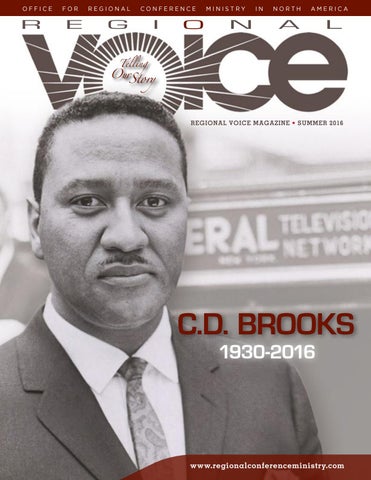
REGIONAL VOICE MAGAZINE • SUMMER 2016
C.D. BROOKS 1930-2016
www.regionalconferenceministry.com
FAQs Office for Regional Conference Ministry What is the Office for Regional Conference Ministry?
Established in 1996, the Office for Regional Conference Ministry (ORCM) coordinates presenting the passion and urgency of the Third Angel’s Message, primarily to urban and under-represented communities in the North American Division (NAD). More specifically the ORCM, headquartered at Oakwood University, Huntsville, Alabama, USA, provides guidance, influence and advocacy for Regional Ministry throughout the United States; it also provides the follow-through to the shared vision of the Regional Leadership for the advancement of the gospel and imminent return of Jesus Christ. Which SDA institutions affiliate with the ORCM?
At the core of the ORCM are nine Regional Conferences and the Bermuda Mission, the Regional Directors of the Pacific and the North Pacific Unions, as well as Oakwood University, Message and Regional Voice Magazines, the Annual Pastoral and Evangelism Leadership Conference, the Bradford-Cleveland-Brooks Leadership Center, the Breath of Life telecast, BAYDA (Black Advent-ist Youth
2
\
Regional Voice | 2016 Summer Edition
Directors Association) and the Regional Conference Retirement Plan. What is a Regional Conference?
Regional Conferences are similar in organizational structure to all other NAD conferences. However, a 1944 General Conference vote established Black-administered Regional Conferences. At that time, the catalyst for their formation was the segregationist policies, which, unfortunately, have had a lasting impact on American life. Yet, Regional Conferences have emerged as important leaders in the church’s mission in the United States. How do Regional Conferences benefit the SDA Church?
Regional Conferences benefit North America and the world church in several ways, namely: • The North American church has experienced exponential growth to such an extent that the ratio of “minority” membership in the church is significantly higher than that in the general US population. • Through the Annual Pastoral and Evangelism Leadership Conference, Regional Conferences hold the SDA Church’s largest annual professional growth seminar for pastors, and • Based upon our membership, evangelistic growth and tithing contributions, if one were to ask for a comparison, the Regional Work would
Read the magazine that tells our story. OFFICE
FOR
REGIONAL
CONFERENCE
MINISTRY
IN
NORTH
AMERICA
REGIONAL VOICE MAGAZINE • SUMMER 2016
www.regionalconferenceministry.com
rank as the NAD’s second largest union and the SDA Church’s fourth largest division.
Now that segregation is illegal in the United States, do we still need Regional Conferences?
Yes. Regional Conferences were established to fulfill a unique need in the church’s overall mission. Government policies have indeed changed, but sociological realities in America remind us constantly that the need for which Regional Conferences were formed is still very urgent in the 21st century.
Subscribe Today!
1930-2016
www.regionalconferenceministry.com
Are Regional Conferences just for African Americans?
No. Regional Conference membership includes not only African Americans, but actually 123 non-Black congregations (Korean, Brazilian, Portuguese, Asian, African, Indonesian and Latino, for example)—thus, sharing the everlasting gospel with “every nation, kindred, tongue and people.” t
C.D. BROOKS
M AG A Z I N E
Telling Our Story
Subscriber Information form: Become one of the first Regional Voice Magazine subscribers today—Pay only $9.95 today, for the 2016 Annual PELC/Fall, Camp Meeting/Summer, and all Special Issues – and have them delivered directly to your personal mailbox! Please Print:
Name __________________________________________________________________________________ Address_________________________________________________________________________________________________ City________________________________________ State/Province/Territory ____________________ Zip+4 ____________________________ - ___________________ Enclose Check Or Money Orders in Self Address Envelope; please, send no cash. Mail your contact information form and 2016 payment to: The Regional Voice Magazine Office For Regional Conference Ministry 7000 Adventist Boulevard Huntsville, Alabama 35896
Thank you for becoming an early-bird subscriber!
REGIONAL
NEWS Southeastern Conference Elects New Officers
I
n its 11th Session the delegates of the Southeastern Conference elected Gregory O. Mack to serve as their president. Mack has served Southeastern for 34 years, as a pastor and the past eight years as the executive secretary. He quotes, Ellen White, “The greatest want of the world is the want of men— men who will not be bought or sold, men who in their inmost souls are true and honest, men who do not fear to call sin by its right name, men whose conscience is as true to duty as the needle
Southern Union President Dr. Ron Smith introduces newly elected SEC Officers Gregory O. Mack, SEC President and wife, and Michael Owusu, Executive Secretary.
to the pole, men who will stand for the right though the heavens fall.” Education Pg. 57 The delegates also elected Michael Owusu as Executive Secretary. Owusu has served the Adventist church for 21 years and most recently pastored the Perrine church in Miami, Fl. Owusu has served on various Robert Patterson Jr. committees: Building, Education, Executive and Constitution/Bylaws. The delegates elected Robert Patterson Jr., as the Chief Financial Officer. Patterson has served the Adventist church for 25 years, he served 3 years as an accountant in South Atlantic and 22 years in Allegheny East Conference; 7 years as auditor, 7 years as assistant treasurer, and most recently 8 years as the under treasurer, Southeastern welcomes him with excitement and open arms. Those elected to serve as Ministry Directors: Communication/Technology: Bryant Taylor Community Service/Inner City: David Peay Education: Barbara Davis Family Life: Mark Brown Haitian Coordinator: Nicolas Louis Hispanic Coordinator: Roger Alvarez Ministerial: Clarence Wright Publishing: Theus Young
4
\
Regional Voice | 2016 Summer Edition
Childs selected as new Pacific Union Conference regional director
O
n February 1, 2016, Elder Virgil S. Childs began serving as the Director of Regional Affairs for the Pacific Union Conference of Seventh-day Adventists, replacing the retiring Elder Bobby Mitchell. Childs was born in Pensacola, Fla. He is the first-born of eight children, a graduate of Golden Gate Academy in Oakland, Calif., holds a B.A. degree in Theology from Oakwood University in Huntsville, Ala., and a Masters of Divinity Degree from Andrews University in Berrien Springs, Mich. Elder Childs is currently writing his Ph.D. dissertation for Trinity Theological Seminary in Newburgh, Ind. in the field of conflict resolution. Coming from the Northern California Conference of Seventh-day Adventists, he has served as an assistant pastor with the Market Street church (Oakland), senior pastor Pittsburg (Pittsburg), Elmhurst (Oakland), Mayfair (Stockton), Market Street (Oakland) churches. Elder Childs served for 10 years as director of African-American Ministries, Inner City Ministries, Men’s Ministries and Prison Ministries for the Northern California Conference. t
Sabbath School: Maxime Pape Stewardship/Trust Services: Juan Gonzales Women’s Ministies: Referred to Executive Committee Youth Ministries/ISO: Prince Lewis The session as one delegate stated was “hi-tech” in that it closely mirrored the General Conference Session with a few additions. Badges with a photo were scanned to enter & exit the building as well as to go to the microphone to speak, electronic voting was utilized giving instant tallied results. Those elected are energized to exemplify the session theme “Keepers of the Flame” and will continue to shine the light of Jesus Christ in Southeastern Conference Territory. t
Photojournalist Dr. Bryant Taylor, serves as Southeastern Conference communication director.
Published by the Office for Regional Conference Ministry in the North American Division of Seventh-day Adventists 7000 Adventist Boulevard Huntsville, Alabama 35896 Telephone (256) 830-5002 www.regionalconferenceministry.com PUBLISHER JAMES L. LEWIS EDITOR KYNA HINSON MANAGING EDITOR TIM ALLSTON ART DIRECTOR/DESIGNER HOWARD I. BULLARD COPY EDITOR CLARISE J. NIXON CONSULTANTS PHYLLIS WARE LEE, ELAINE ALLSTON EDITORIAL For all correspondence and letters to the editors, write: OFFICE FOR REGIONAL CONFERENCE MINISTRY 7000 Adventist Boulevard Huntsville, Alabama 35896 or fax to (256) 830-5078 We reserve the right to publish and edit your submissions and letters. REGIONAL CONFERENCE OFFICES ALLEGHENY EAST CONFERENCE HENRY J. FORDHAM III, PRESIDENT LaTasha Hewitt, Communications Director P.O. Box 266 Pine Forge, PA 19548 (610) 326-4610. www.myalleghenyeast.org ALLEGHENY WEST CONFERENCE WILLIAM COX, PRESIDENT Bryant L. Smith, Communications Director 1339 E. Broad Street Columbus, OH 43205 (614) 252-5271. www.awconf.org CENTRAL STATES CONFERENCE ROGER BERNARD, PRESIDENT Brittany Winkfield, Communications Director 3301 Parallel Parkway, Kansas City, KS 66104 (913) 371-1071. www.central-states.org LAKE REGION CONFERENCE R. CLIFFORD JONES, PRESIDENT Paul Young, Communications Director 8517 South State Street Chicago, IL 60619 (773) 846-2661. www.lakeregionsda.org NORTHEASTERN CONFERENCE Daniel Lamartine Honoré, President JeNean Johnson, Communications Director 115-50 Merrick Blvd. Jamaica, NY 11434 (718) 291-8006. www.northeastern.org NORTH PACIFIC UNION CONFERENCE ALPHONSO MCCARTHY, VICE PRESIDENT 5709 N. 20th Street Ridgefield, WA 98642 (360) 857-7000. www.npuc.org PACIFIC UNION CONFERENCE VIRGIL CHILDS, DIRECTOR African American Ministries 2686 Townsgate Road Westlake Village, CA 91361 (805) 413-7100. www.puconline.org SOUTH ATLANTIC CONFERENCE WILLIAM L. WINSTON, PRESIDENT James K. Lamb, Interim Communications Director 294 Hamilton E. Holmes Drive, NW Atlanta, GA 30318 (404) 792-0535. www.southatlantic.org SOUTH CENTRAL CONFERENCE DANA C. EDMOND, PRESIDENT Marvin Allison, Communications Director 715 Youngs Lane Nashville, TN 37207 (615) 226-6500. www.scc-adventist.org SOUTHEASTERN CONFERENCE GREGORY O. MACK, PRESIDENT Bryant Taylor, Communications Director 1701 Robie Avenue Mt. Dora, FL 32757 (352) 735-3142. www.secsda.org SOUTHWEST REGION CONFERENCE CALVIN WATKINS, PRESIDENT Kenn Dixon, Communications Director 2215 Lanark Avenue Dallas, TX 75203 (214) 943-4491. www.southwestregion. adventistchurchconnect.org 2015 REGIONAL DIRECTORS/COORDINATORS ROSTER Virgil Childs Director | Regional Ministries | Pacific Union Conference Cell: 909-225-6438 | bmitchell@puconline.org Kingsley Palmer V.P. African American Dept. Arizona Conference Cell 775-338-0858 | genx58@gmail.com Frederick Anderson Coordinator | African American Ministries | Central California Conference 831-262-3838 | famar@sbcglobal.net O’Neil Madden Coordinator | African American Dept | Nevada-Utah Conference Cell 702-875-5979 | pastoromadden@aol.com Dr. Leon Brown Coordinator | African American Dept. | Northern California 209-423-3335 | Leon.brown@nccsda.com Dr. George King V.P. Black Ministries | Southeastern California Conference (909) 202-0147 | kinggm@seccsda.org Royal Harrison Director | G.L.A.R. | Southern California Conference 503-819-1498 | hroyal2@yahoo.com
Managing Editor’s Notes
I
n our recent Spring issue entitled “Building Bridges Initiatives,” (www.regionalconferencerministry. com) we introduced the regional ministry’s new 5-Star Initiatives, i.e., our primary emphases on: • soul-winning/evangelism, • obtaining/maintaining/retaining millennials, • SDA education, • Pan-African/Pan-American bridge-building, and • leadership development in this North American Division. This summer/camp meeting issue will spotlight SDA education—the education uniquely for, about, and from Seventh-day Adventists. Seventh-day Adventist education occurs in both traditional (preK-18) classrooms, as well as in non-traditional venues such as Sabbath School, athletic fields, protest marches, Pan-African bridge-building, and even at National Historic Landmarks. For example: • Sabbath School represents a large, albeit undervalued, component of SDA education. This two-part roundtable interview will explore the challenges and best practices of “the University of Sabbath School”; • Immediate past Oakwood University president, Dr. Delbert Baker’s April installation as vice chancellor (president) of Adventist University of Africa in Kenya is consistent with #4 of our 5-Star Initiatives for regional ministries; • In 1977, Pine Forge Academy made national headlines when, attacked by Bunker Hill Monument neighborhood rowdies while visiting this National Historic Landmark near Boston, students and chaperones passively resisted fighting back and brought a spotlight and honor to SDA educational values; and our cover story • At press time, we learned of the passing of our beloved Elder C. D. Brooks; here, we reprint the announcement from the Adventist Review, the official publication of the Church. And much, much more. Each of these published articles underscore Isaiah 54:13: “And all thy children shall be taught of the Lord, and great shall be the peace of thy people.” As a result of God’s blessings, SDA education is more than just the world’s second largest private school system. SDA education is you living and role-modeling Christ in you, both with-in and with-out the traditional classroom. Now, let your Regional Voice Magazine refresh your memory, . . . Thanks. Sincerely,
Your Team RVM/Editorial
(Pictured left to right: Tim Allston, managing editor; Clair Nixon, copy editor; Kyna Hinson, editorin-chief; and Howard Bullard, art director)
Regional Voice | 2016 Summer Edition
/
5
contents
2016 Summer Edition www.regionalconferenceministry.com
20
16
26 8 5
16
Trace our deliberate coverage of the priceless benefits of Seventh-day Adventist education—from Sabbath School to higher education that spans life in this world to Life Eternal. By Tim Allston
South Central Conference celebrates 70 years, a Legacy of Legends. By Michael Harpe
Guest Commentary
Regional News
20
James Roddy Reaches Golden Milestone at Oakwood
8
Dr. Donald Blake, the Jackie Robinson of SDA Education
This trailblazer shares his memories and the impact of his legacy. By Tim Allston
12
C.D. Brooks (1930-2016)
C. D. Brooks Remembered as Great Adventist Evangelist of 20th Century. Reprint from Adventist News Network
He’s given half a century of service, shaping characters, cultivating athletic programs, multiple scholarships and yes, winning teams.
26
The Avondale SDA School
Read all about the remarkable progress of this school in Chattanooga, Tennessee. By Chavvah McCoy Lister
12 28
He holds dozens of patents, started multiple biotech companies, holds fast to his faith and enjoys being “one of the fellas.” Interview with Dr. Milton Brown
32
Succession Planning
Nothing as important as filling vital positions in church or secular work should ever just be left to chance or happenstance. Interview with Norman K. Miles, Jr.
34
REGIONAL NEWS Oakwood University Church Honors NBA Legend
Ervin “Magic” Johnson accepts award for humane endeavors. By Ramona L. Hyman
6
\
28
Scientist Makes Major Breakthroughs
34
38
36 42
40
36
40
42
Special Report and Photo Essay
North American Division Sabbath School Director Elder J. Alfred Johnson and Consultant Curtis Hall offer answers to contemporary questions.
Nearly 40 years ago, a group of Pine Forge Academy students and their chaperones faced violent attacks at this historic site--and lived out their faith. By LaTasha Hewitt
REGIONAL NEWS Breath of Life shares living waters in Flint, Michigan.
38
The Priceless Value of Sabbath School
Bunker Hill Revisited
Proverbs 31 Man
Maurice Gordon’s strong work ethic as a business owner and government contractor means a great deal to his wife Dr. Jacqueline Campbell Gordon. Regional Voice | 2016 Summer Edition
Regional Voice | 2016 Summer Edition
/
7
FEATURE
SDA HIGHER ED’S
“JACKIE ROBINSON” REMEMBERED AND REMEMBERS
\
8
Regional Voice | 2016 Summer Edition
years after its pioneering decision, Walla Walla University honors former science professor Dr. Donald F. Blake by creating the Donald Blake Center for the Study of Race, Ethnicity and Culture. In a context of civil unrest over race relations throughout the United States, Blake and his family moved to College Place, where he was one of the first black tenure faculty to be hired at a predominantly white SDA college or university. Blake taught general biology, anatomy and physiology, ornithology, mammalogy, herpetology, and fresh water ecology. From ‘68-‘69, he was director of the WWC marine biology station at Rosario Beach. Grant proposals Blake wrote during that time resulted in $5.5M in public grants for WWC. While at WWC, Blake was acIn 1965, following the tive in the Walla Walla County Human Rights League, a civil death of civil rights rights organization. In 1965, folactivist James Reeb lowing the death of civil rights activist James Reeb in Selma, in Selma, Alabama, Alabama, Blake helped orgaBlake helped organize and particated in a silent protest march from Whitman nize and particatCollege through downtown ed in a silent protest Walla Walla to the Walla Walla County Courthouse. At the march from Whitcourthouse, he and Whitman man College through College professor of religion George Bell spoke about civil downtown Walla rights to a small crowd. AlongWalla to the Walla side them on the march was then-WWC history professor Walla County CourtJohn Christian, son of thenhouse. WWC president Percy Christian who had been instrumental in bringing Blake to WWC. In 1969, Blake moved to Huntsville, Alabama, where he taught biology at Oakwood College. He has held teaching positions at the University of Rhode Island, Ohio State University, Mississippi Valley State University, Southern Illinois University, University of Kentucky, Kentucky State University, and University of Hartford. He has held administrative positions in higher education, including vice president for academic affairs at Kentucky State University and dean of instruction at Mississippi Valley State University. In September 1985, Blake was asked to become the president of Oakwood College. After much prayer and soul searching, he turned down the position. Grant proposals written by Blake have resulted in more than $15M in public and private grants for various colleges and universities. He has authored numerous articles published in national magazines and
54
Regional Voice | 2016 Summer Edition
/
9
Oakwood University Professor Emeritus E. E. Rogers, at left; current Oakwood Professor James Melancon, and Don Blake, Oakwood class of ‘53, who holds a doctorate in sociology and is a retired vice president of the Hartford Insurance Group, remember chapel programs in the auditorium of Moran Hall on the Oakwood campus. Melancon and Blake graduated in the auditorium on May 31, 1953. (Courtesy of Oakwood University / Tim Allston)
BLAKE WORKED FOR MANY YEARS TO DEVELOP COMMUNITY-BASED PROGRAMS THAT ADDRESS EDUCATION, HEALTH AND COMMUNITY DEVELOPMENT FOR ORGANIZATIONS SUCH AS CONNECTICUT CAMPUS COMPACT AND UPPER ALBANY NEIGHBORHOOD COLLABORATIVE. professional journals and has successfully steered two universities through academic accreditation. In 1999, he was awarded an honorary doctorate of health science from Briarwood College. Blake worked for many years to develop community-based programs that address education, health and community development for organizations such as Connecticut Campus Compact and Upper Albany Neighborhood Collaborative. In one such initiative under his direction, more than 12,000 student volunteers were placed in community service positions during one academic year. Blake has extensive experience in corporate management, organizational consulting and strategic planning with companies such as ITT Hartford Insurance Group, Agappe Consulting and the Center for Personal and Professional Excellence, where he continues to work alongside his current wife, Lillian, at the young age of 84. t _______________________________________________________________________________ Donald F. Blake, was a member of the faculty in the Walla Walla College (WWC) Department of Biological Sciences from 1962-1969. When he arrived on the WWC campus, he had a bachelor’s degree from Oakwood College, a bachelor’s and a master’s degree from Michigan State University, and was well on his way to completing a doctorate at the University of Rhode Island, which he finished in 1965. _______________________________________________________________________________ *Reprinted from the Center Unveiling’s printed program
10
\
Regional Voice | 2016 Summer Edition
CM YK
C1
Lifestyles looks at residents’ lives in the Valley since the 19th century
A look back at Tour of Walla Walla in photos
1
Wa l l a Wa l l a
Union Bulletin
Union-Bulletin.com Today
64 39
Monday
Sunday, april 24, 2016
64 41
7
59423 00002
8
$1.50
We bring T h e valley To you
Triumph of Donald Blake A new WWU center is named in his honor to atone for racism the retired biology professor fought during his tenure.
here,” said Maynard-Reid, who also is the university’s assistant to the president for diversity. It wouldn’t be the first time an Adventist college apologized for past racism. By ALFRED DIAZ MaYnard-reid And Maynard-Reid said it of the Walla Walla Union-Bulletin was such an apology that OLLEGE PLACE — Donald Blake led to the concept of the will be honored today at the same new center on campus. college campus where in the 1960s In February 2015, the trustees of Union he was often dishonored by his colCollege in Lincoln, Neb., approved a leagues and his students. written apology for past racism that, in “I had students who opposed me,” part, stated, “... We ask humbly that you Blake said in a phone interview last forgive the institution of Union College week. “I had a young lady on the first day for the wrongs committed against you ...” of class, when she saw me she turned When Maynard-Reid read of the apolaround and walked out.” ogy, he realized he wanted more for The very reason some used to oppose WWU than words on paper. And he Blake’s professorship at what was then urged campus officials to do something Walla Walla College is now one of the that would continue the fight. reasons Walla Walla University officials “I wanted something that would last,” today will inaugurate the Donald Blake Maynard-Reid said. “The center will take Center for the Study of Race, Ethnicity racism and propose what are the best and Culture. ways to deal with it, to do something.” “When Blake accepted the position at WWC, he was one of the first black local racism tenure-track faculty to be hired at a preBlake, now 84, said he did face racism dominately white Seventh-day Adventist here in the turbulent civil rights movecollege or university,” officials released in a statement last week. They also noted ment of the 1960s, but he also had a lot of silent community support. Blake was a local activist who worked For the most part, the majority of the through the 1960s to fight racism. There is, however, another purpose for people Blake encountered in College Place were not racists. But Blake added honoring Blake. For Pedrito Maynard-Reid, WWU pro- those who were racists were often louder than the rest — what he called the “vocal fessor of biblical and missiology, that minority.” purpose is to apologize. See FIGHT, Page A4 “He went through a lot after he moved
C Courtesy photo by Tim Allston
In this 2013 photo, Donald Blake displays an Oakwood University history book about the all-black Adventist college he attended in the early 1950s. Blake was one of several subjects featured in an article on the Oakwood Class of 1953.
Center to focus on student-led community service The new Donald Blake Center for the Study of Race, Ethnicity and Culture will focus on student-led acts of service and become an integral part of the community. Its inauguration ceremony will be at 9 a.m. today at the Heubach Chapel on the Walla Walla University campus. Center Director Tim Golden said one of the goals will be to encourage WWU students to volunteer in the community in areas where people of color would be served. At least once a year, Golden added, the center will hold a conference on issues of
race and bigotry. “We want it to be a place where there is a level of awareness,” Golden said. “We want to help people from the university to unify so that people don’t have to go through the racism and bigotry that Donald Blake
golden
had to face.” The center will also focus on pedagogical studies to teach future teachers how to stop racism.
Serenity rises from rock-bottom The addiction counseling agency is benefiting from a state effort to fold programs into a regional network.
Rural youths are among the highest users; early intervention is critical.
By SHEILA HAGAR
of the Walla Walla Union-Bulletin
Walla Walla’s Serenity Point Counseling Services two years ago was considering an exit plan due to a double blow — a lack of money and more clients than staffing could handle. Today it’s working with Walla Walla County health officials on how to best use funding to feed Serenity’s coffers. In 2014, the outpatient treatment service for chemical dependency, here for 13 years, was getting hammered. Historically low Medicaid reimbursement rates in the state had coupled with an influx of Medicaideligible patients due to the Affordable Care Act. Despite seeing more patients with deeper addictions — heroin and opiates were becoming bigger problems here — Medicaid’s skimpy reimbursement rate had caused a shortfall in late fall of 2013 and spring of 2014, Serenity founder and owner Pat Flores said then. With the agency at risk of closing, Walla Walla County commissioners allocated Serenity a portion of the county’s one-tenth of 1 percent sales tax committed to local mental health needs, Flores said. That move allowed the center to hang on, and earlier this year state
Campaign aims to snuff out smokeless tobacco By SHEILA HAGAR
of the Walla Walla Union-Bulletin
U-B file photo
Pat Flores sits in the lobby of Serenity Point in this March 2014 photo.
officials announced it would fold individual county substance abuse programs into regional managed behavioral health care systems on April 1. The change eliminated the pay-for-each-service model, and replaced it with per-member, permonth system. That means clients under state health insurance are eligible for any appropriate mental health or substance abuse program they need, said Ken Roughton, director of Greater Columbia Behavioral Health. His Kennewick-based organization is the network hub that serves as mental-health funding manager for 10 counties, including Walla Walla and Columbia.
Places such as Serenity will now have funding stability, instead of worrying about the cost of every urine test kit, noted Debbie Dumont, contracts manager for dUMont Walla Walla County Department of Community Health. Under Medicaid funding, Dumont said, Serenity Point and other centers were paid 46 cents for every dollar spent on medical services. The April 1 funding change has significant impact. In its previous contract for federal substance abuse
You’re Invited
See FUNDING, Page A4
If you’re white, young, male and live in a rural area, the federal government would like you to know something: smokeless tobacco use carries big consequences. Officials say every day nearly 1,000 U.S. males younger than 18 use smokeless tobacco for the first time, almost as many male teenagers who smoke their first cigarette. In Walla Walla County, more than 10 percent of 2014’s high school seniors reported trying smokeless tobacco products, such as chewing tobacco, snuff, snus, dissolvable lozenges, sticks and strips. Last week the U.S. Food and Drug Administration announced expansion of its “The Real Cost” campaign to educate teenagers nationwide about the health risks that come with the products: nicotine addiction, gum disease, tooth loss and multiple kinds of cancer.
nEW LIStIng
nEW LIStIng
2.86 ACRES W/WAtER
8.35 ACRES W/WAtER
SmokeleSS tobacco StatiSticS: Federal health agencies, including the Centers for Disease Control and Prevention, say the following about smokeless tobacco users nationwide, plus the products they use: ■ 15 percent of high school boys and an estimated 9 percent of all high school students use smokeless tobacco. ■ 3.5 percent of all adults over the age of 18 are users. ■ Men 18 to 24 years old and those with a high school education or less are more likely to use smokeless tobacco. ■ Among the 50 states and Washington, D.C., use was highest in Wyoming at 9.1 percent, West Virginia at 8.5 percent and Mississippi at 7.5 percent. ■ Data from 2013 indicates 4.6 percent of Oregon adults and 3.7 percent of Washington adults are users. ■ In the nation, use was significantly higher among men than women.
White, teen boys are using smokeless tobacco at a higher rate, but many don’t understand the harm in their actions, Mitch Zeller, director of FDA’s Center for Tobacco Products, said in a news release. “In communities where smokeless tobacco use is part of the culture, reaching at-risk teens with compelling messaging is critical to help change their See RISK, Page A5
OpEn 12-4
OpEn 9-5
1096 Falcon Dr 3 BR | 2 BA $449,500
8 Model Homes Open SE Whimbrel Loop $285,000 - $369,000
GRAND OPENING
Cherie & Lew Colón Jayne DiDario 639824 CL
Thursday, November 12th 4:00 – 6:30 PM
(509) 876.8646
East Main Main Street • Walla Walla,Walla WA 3 3East Street • Walla
Jayne DiDario
801 Betz Lane 4 BR | 3.5 BA $935,000
690 Valley Chapel Rd 3 BR | 2 BA $499,000
Walla Walla Sotheby’s International Realty
Don Blake, 81, Oakwood College class of ‘53, opens a history of Oakwood University book to point to a picture of himself when he worked in the dairy at Oakwood to pay his way through school. Blake, now a retired vice-president of Hartford Insurance Group, spent some time during alumni weekend at Oakwood University April 5-7, remembering some of the color lines that Oakwood graduates helped erase during the 1950s. (Courtesy of Oakwood University / Tim Allston)
WallaWallaSIR.com
Cherie and Lew Colón
Wine and Hors D’oeuvres Served
Regional Voice | 2016 Summer Edition
/
11
1930-2016
C.D. Brooks Remembered as Great Adventist Evangelist of 20th Century JUNE 05, 2016 | ANDREW MCCHESNEY, NEWS EDITOR, ADVENTIST REVIEW Charles D. Brooks, one of the foremost Seventh-day Adventist evangelists of the 20th century, succumbed to pancreatic cancer on Sunday, June 5, 2016. He was 85. Brooks, better known as C.D. Brooks, led a 60-year ministry that resulted in more than 15,000 baptisms on six continents and was known for its innovative methods of embracing new media to spread the gospel, including through the Breath of Life television ministry, where Brooks served as founding speaker for 23 years. Brooks, who disclosed earlier this year that he had been diagnosed with pancreatic cancer, died at 4:30 a.m. June 5 in Laurel, Maryland, said his son, Charles D. Brooks Jr. “Please keep my mother and family in prayer,” he said in an e-mail. Ted N.C. Wilson, president of the Adventist world church, paid tribute to Brooks as “an eminent and muchloved senior statesman in the Seventh-day Adventist Church.” “He was a highly dedicated and successful evangelist and biblical preacher,” Wilson said. “Elder Brooks loved the Lord, His prophetic church, and the Advent message.” Wilson said he counted Brooks and his wife, Walterene, as longtime family friends, noting that they had worked closely with his own parents. Wilson’s father, Neal C. Wilson, served as president of the Adventist world church from 1979 to 1990.
12
\
Regional Voice | 2016 Summer Edition
“He and his wonderful wife, Walterene, have dynamically influenced literally thousands and thousands of people worldwide. Elder Brooks has been a great encouragement to me personally,” Wilson said.
Mattie Brooks made a miraculous recovery and began keeping the seventh-day Sabbath in her home from midnight Friday to midnight Saturday. She knew of no other Sabbath-keepers for the next 10 years.
“The church is greatly saddened by this profound loss, and we wish Mrs. Brooks and the entire Brooks family our heartfelt sympathy and Christian love,” he said. “We look forward with great hope to Jesus’ soon coming when we will see Elder Brooks again.”
“Never heard of Adventists,” C.D. Brooks said in the interview. “She had no tracts, no teacher, no Bible study, no anything.”
Charles Decatur Brooks was born on July 24, 1930, outside Greensboro, North Carolina, as the 10th child of Marvin and Mattie Brooks. Six months later, his mother learned about the Seventhday Sabbath while lying on what she thought was her deathbed after an unsuccessful surgery. A bright light filled her hospital room at night, and a voice said, “Mattie, I want you to keep My commandments,” C.D. Brooks told the Adventist Review in 2006. Mattie Brooks, a faithful Methodist and the daughter of a pastor, was confused. “Lord, which one am I not keeping?” she said. She heard no answer. But suddenly the fourth commandment sprang to mind: “Remember the Sabbath day to keep it holy” (Exodus 20:8).
Her Methodist minister and others church members tried to dissuade her from keeping the Saturday Sabbath. But when the head deacon saw that she would not change her mind, he presented her with a wrapped copy of The Great Controversy by Adventist Church co-founder Ellen G. White. Young C.D. Brooks opened the package with a pair of scissors, and his mother read it with great interest. Then when C.D. Brooks was 10, a Seventh-day Adventist literature evangelist knocked on the family’s door with some books. The very next Sabbath the family was worshipping in an Adventist church for the first time. Brooks recalled that a large copy of the Ten Commandments had hung on the wall of the church, and that it had left a big impression on him. The family began to observe Sabbath from sundown Friday to sundown Saturday.
/
Regional Voice | 2016 Summer Edition
13
“When we think of lighthouses, we often forget those who work to keep them shining...” In 1971 Brooks become a general field secretary of the General Conference, the administrative body of the Adventist world church, but still led evangelistic meetings, eventually traveling to six continents.
How Brooks Became an Evangelist C.D. Brooks’ own conversion experience came when as a 17-year-old recent high school graduate he attended meetings by Adventist evangelist Earl E. Cleveland in Greensboro. Brooks had been planning to study dentistry in the fall. “Two Sabbaths before Cleveland closed, I was sitting in his tent by myself on a beautiful sunny day, and an overmastering impression came from the Lord that said to me, ‘This is what I want you to do, and I will help you to make truth clear,’ Brooks said. Brooks shook off the impression to become an evangelist as a “stray thought,” but it came again as he walked the mile from the bus stop to his home in the dark that night. His first thought upon wakening on Sunday morning was to become an evangelist, and he had the impression again on Monday. Finally on Tuesday he told his mother about what was happening. “I didn’t know the power of a mother’s prayers,” Brooks said. “Mother said these words to me: ‘Son, when you were born, I gave you to the Lord. Now He’s calling you.’ Wouldn’t you think she would have shouted, or shed tears, or something? She did none of that. She went on about her business, running a household and serving the Lord. And from that moment I have never looked back.” Brooks certainly never looked back. With unexpected financial support from his father, who previously had not showed interest in the Adventist message, Brooks enrolled in Adventist-operated Oakwood College (now Oakwood University) in Huntsville, Alabama, and completed four years of studies there. Upon graduation, the Adventist Church’s Allegheny Conference hired Brooks as a tentmaster for J. Dasent,
14
\
Regional Voice | 2016 Summer Edition
a former conference president serving as an evangelist in Delaware. Dasent asked Brooks to preach his first sermon. “I think it was a test,” Brooks said in a 2009 interview with the Adventist Review. “But the Lord blessed, and when we concluded the campaign and were returning to headquarters, Dasent was kind enough to give me the highest recommendation.” Brooks was asked to run his first full evangelistic series the next summer, in 1952, in Chester, Pennsylvania. “I had a great, exciting summer,” he said. “We had a little church there, 22 members. I love telling young guys, ‘First campaign we doubled the membership.’ They look at me in awe, then I tell them, ‘We had only 22 members.’”
“Loving Yet Uncompromising” Brooks led eight- to 10-week evangelistic meetings for the next dozen years in Delaware, Pennsylvania, New Jersey, and Ohio. He then accepted an administrative position as general field secretary of the Columbia Union Conference but continued to lead major evangelistic meetings in big cities such as Chicago, Cleveland, and Philadelphia. “If you have heard C.D. Brooks preach, it was most certainly an unforgettable experience,” authors Benjamin Baker and Harold L. Lee wrote in their 2013 biography C.D.: The Man Behind the Message. “His distinct voice trumpets truth with an authority rarely seen in today’s pulpits. The stories he skillfully weaves thrill the imagination and bring conviction to the heart. Loving yet uncompromising, Brooks delivers the Adventist message without apology. His appeals to accept Jesus reverberate in the mind long after they are over.”
“I didn’t want to go to Antarctica because there was no one to preach to,” he said. In 1974 Brooks was asked to be the founding speaker for Breath of Life, a television ministry being developed for African-American viewers. In that role Brooks led three or four evangelistic campaigns every year, establishing 15 congregations. His work at Breath of Life and elsewhere put him on the cutting edge of technology, according to C.D.: The Man Behind the Message. “A media trailblazer, Brooks has spread the gospel through every type of media, including cassette, radio, television, and Internet,” the book says. He led at least 15,000 people to Christ, the authors estimated. “When we think of lighthouses, we often forget those who work to keep them shining,” Carlton Byrd, the current speaker of Breath of Life, said by e-mail on Sunday. “Pastor C.D. Brooks kept the light shining. He attended the flame of truth, compassion, and love, and that ministry forever changed the world. He epitomized the words of Jesus, ‘Let your light so shine before men, that they may see your good works, and glorify your Father which is in heaven’ (Matthew 5:16).” Byrd said he would long remember many moments with Brooks but was most astounded at his faith as he struggled with cancer.
“The magnitude of his faith in the face of adversity is what I consider most outstanding,” Byrd said. “The most memorable moment for me with this great man of God was when I recently visited him and discussed the health challenges he was experiencing. He assured me, ‘Carlton, if God wills to heal me, He will heal me. If not, I accept His will. “I know in whom I have believed”(2 Timothy 1:12).’” C.D. Brooks is survived by his wife of 63 years, Walterene; two children, Charles “Skip” Jr., and Diedra; and three grandchildren. Brooks retired from active ministry in 1996 because of health issues but kept office hours at the General Conference for years. In 2007, Oakwood University named its Bradford-ClevelandBrooks Leadership Center in honor of him, Earl E. Cleveland, and Charles E. Bradford, former president of the North American Division. Brooks was appointed chaplain of the North American Division in 2013. Daniel R. Jackson, president of the North American Division, said he had watched Brooks with admiration as he walked the halls of the division, which shares its headquarters with the headquarters of the General Conference in Silver Spring, Maryland. “He was a great preacher and one of God’s true saints,” Jackson said. “I have watched him walk the halls of our office and used to repeat in my head, ‘He is a prince among men.’ I will miss him. But one day soon he will have eternal youth and live forever with his dear wife and family.” Story by Adventist News Network Cover Design & Layout by Contributing Designer, Jerry Ross
/
Regional Voice | 2016 Summer Edition
15
REGIONAL
NEWS
SOUTH CENTRAL CELEBRATES A
“LEGACY OF LEGENDS”
I
n 1865, after the Civil War, Ellen G. White counseled the Church to work in the South, the territory God chose to inaugurate a legacy filled with legends — the people He chose to spread the three angels’ messages. The General Conference (GC) voted that labor in the South among the colored people should be entered upon. Elbert B. Lane, commissioned by the GC, was the first Seventh-day Adventist minister to serve the South. He married Ellen S. Edmond, the first Adventist woman to receive her license to preach in 1868. He preached several weeks at Edgefield Junction L&N Railway Station, a few miles north of Nashville, Tennessee, in 1871, and left a company there. In 1873, Lane returned and organized the first Adventist church south of the Mason-Dixon Line. Harry Lowe, an African-American Baptist minister in Edgefield Junction, attended Lane’s meetings in1871, and later joined the Church in 1883. The congregation was biracial; however, because of heightened tension in the South, blacks at Edgefield Junction Church organized into a separate company called First Colored Seventh-day Adventist Church, by Samuel Fulton. It officially became a church on November 9, 1886. Among the 10 charter members was Jennie B. Allison, possibly the first African American woman to join the Adventist church. Ellen White was an occasional guest in her home. Two of her sons became ministers in the Adventist church. Marvin L. Allison Sr., current Conference communication director, is a descendant of the Allison family. The first colored Camp Meeting was held at Edgefield Junction in1901. Harry Lowe became an Adventist minister, and worked with Charles M. Kinney and Alonzo Barry. Barry organized the Louisville, Kentucky, Church on February 16, 1890 (now known as the Magazine Street Church). Led by the Holy Spirit, on March 21, 1891, Ellen White wrote “Our Duty to the Colored People.” On June 13, 1891, the Bowling Green, Kentucky, Church was organized with 10 members by Charles M. Kinney. Just a few years prior (1889), Kinney was the first black minister ordained in the Adventist church. He and his congregation were embarrassed by the way they were segregated at the ordination, and denied admission to Adventist institutions — and Kinney proposed separate conferences for blacks. This materialized
in 1946, and South Central and South Atlantic conferences were organized. The Nashville Church (now known as the Hillcrest Church) was organized September 15-16, 1894, by C. L. Boyd and Charles M. Kinney, who served as pastor. Edson White worked in the South for eight short years, 1895-1903, during which time God blessed him to open approximately 15 schools and churches, the Gospel Herald Publishing House, and the Nashville Colored Sanitarium. Edson opened his first school in Vicksburg, Mississippi, on the corner of Walnut Street and East First Avenue in 1895. Meanwhile, in Huntsville, Alabama, Oakwood Industrial School opened with 16 students on November 16, 1896. Ellen White visited Oakwood Manual Training School in 1904. Oakwood, a junior college in 1917, and a senior college in 1943, became a university in 2008. James L. Moran became the first black president in 1932; Leslie L. Pollard, Ph.D., D.Min., is the current president. On March 16-23, 1901, Ellen White visited Southern Missionary Society, incorporated by her son Edson in 1898 for education and evangelistic work. She dedicated the colored church in Vicksburg, Mississippi, on March 17, and spoke at the Memphis Church on March 18. The next two days she met Adventist leaders in Nashville, and then visited the new Gospel Herald Office and Nashville Colored Sanitarium. One month later the Southern Union Conference was organized. The First Black Youth Congress was held in Huntsville, Alabama, in 1934, on the campus of Oakwood Junior College, coordinated by Anna Knight, associate MV (Missionary Volunteer) director of the Southern Union. Knight, from Soso, Mississippi, was the first Adventist woman to serve as a missionary to India. She also served on the Colored Survey Committee that recommended
LED BY THE HOLY SPIRIT, ON MARCH 21, 1891, ELLEN WHITE WROTE “OUR DUTY TO THE COLORED PEOPLE.”
(REPRINTED FROM SOUTHERN TIDINGS, MARCH 2016)
16
\
Regional Voice | 2016 Summer Edition
BY MICHAEL A. HARPE
First South Central Conference office
formation of the South Atlantic and South Central conferences in 1944. In 1945, the South Central Conference was organized at a meeting in Birmingham, Alabama, with a territory covering Alabama, Mississippi, Kentucky, Tennessee, and the portion of Florida west of the Apalachicola River. The Conference was organized with 42 churches. Herman R. Murphy, former state man and Conference evangelist for the Alabama-Mississippi Conference, served as first president from 1946 to 1954. In 1946, South Central officially began operations in Nashville, Tennessee, at the Hawkins Street home of Louis B. Reynolds and his wife. Later, the Conference moved to their first office at 1914 Charlotte Street. The first Camp Meeting was held on the campus of Oakwood College, June 27-July 6, 1946, and was held there annually for the next 70 years. In 1954, Walter W. Fordham was elected the second president of the Conference. During that time, E. Earl Cleveland baptized 571 idividuals in Montgomery, Alabama, the largest baptism in Conference history. A new Conference office was erected in 1958 by Fordham, 715 Youngs Lane. The third president of the Conference was Frank L. Bland, elected in 1960. Two years later, 1962, Charles E. Dudley was elected the fourth president. He was the longest serving president in South Central history—31 years. More of his accomplishments may be gleaned in the Southern Union Southern Tidings archives online, article entitled, “A Great General of the Lord’s Army,” October 2010, pages 8-9. In 1976, as the nation celebrated 200 years of existence, the following are a few accomplishments during Dudley’s tenure: In Huntsville, the members celebrated the building of a grand church edifice on Oakwood’s
The Willie Allison family were the first Black Americans baptized into the Seventh-day Adventist Church in Edgefield Junction, Tennessee.
campus under the leadership of Eric C. Ward. In 1984, Dudley initiated the Supplemental Retirement Plan for workers. In 1988, women’s ministries began as the Women’s Commission. Laura Smith was selected to serve as the first commissioner. It became the Women’s Ministries Department in 1990. The current Conference office was erected for $2.5M in 1990, and was paid for in full in five years. The Archives Department was established the same year, with R. Steven Norman III as the first director. It preserved the history of South Central and sponsored Seventhday Adventist history tours. Joseph W. McCoy was elected the fifth president of South Central in 1993. In 1999, South Central voted to establish its own retirement plan. Other regional conferences followed suit, and formed the Regional Conference Retirement Plan. In 2003, South Central established the Latino Ministries Department, with Edgardo Herrera as coordinator. The first annual Latino Convention was held on Thanksgiving Day in 2003. Companies of Latino believers were organized at Russellville and Kilpatrick, Alabama. Benjamin P. Browne was elected the sixth president in 2005. At that time South Central had 147 congregations, a membership of 31,784, and tithe of more than 14 million dollars. A significant prayer emphasis was launched, and the Prayer and Men’s Ministries departments were established, with Roy Rugless as director. Dana Edmond, the seventh and current president of South Central, was elected in 2009. South Central experiences continued growth and development through diversity and trending ministries. In 2010 the administration approved the Youth Congress Mission Cruise held in Bahamas, and Lola Moore became the first woman pastor hired by South Central, and in-
Current South Central Conference office
stalled to the pastoral staff at the Oakwood University Church. The first female administrator, Merkita Mosley, treasurer, was added in 2011. Shawn Moss was hired in 2012, as the second female pastor, first of a congregation in Memphis, Tennessee. Breath of Life Television Ministry moves to the South Central territory in 2012, with Carlton Byrd, D.Min., Oakwood University’s newly installed pastor, as the director. Latino ministries became the Multi-cultural Ministries Department in 2012, and the Conference added a Haitian, African, and Korean focus. Tina Carriger, hired in 2013, was the third woman pastor and the first sponsored female seminarian. Oakwood Academy Gymnasium in Huntsville was erected in 2013. The first Women’s Pastoral Commissioning Service was held in 2015 for pastors Lola Moore and Shawn Moss. As 2015 closed, South Central reported a membership of 33,704, 159 congregations, a tithe increase of 4.6 percent, and total tithe of $20,115,299. In January 2016 the first Virtual Church Officer’s Meeting was launched and broadcast online. South Central’s legacy continues as God chooses His legends to fulfill the Gospel commission. During this year’s Camp Meeting, June 10-18, the Conference will celebrate 70 years of God’s blessings in service, evangelism, and education. Several ministry events will kick-off the celebration: 1,000 Praying Women, Mini Youth Congress, Prayer Summit, a Community Health Thrust, and a Breath of Life Crusade. t
Michael A. Harpe, is director of the Stewardship, Trust Services, and ASI departments at the South Central Conference.
/
Regional Voice | 2016 Summer Edition
17
Connect with us!
FIND SOMEONE
messagemagazine
message1898 Find the Message Magazine App on
iTunes
TO
WIN Look closely and you’ll see someone the Lord wants you to reach. Send them Message.
or
Google Play Subscribe through your church campaign for the campaign price. Subscribe on messagemagazine. com/subscribe Subscribe by calling us at: 1-800-456-3991
\
1-800-765-6955 18 Regional Voice | 2016 Summer Edition www.MessageMagazine.com
I
f you take a moment to reflect, I think you
wedge, and the tip of the spear. It's a chance just to
will recognize some unrealized opportuni-
share truth, wholeness and the gospel of peace with
ties, some chance to reach a relative, neighbor or
the people within our respective spheres of influ-
co-worker. As you're watching current events, the
ence. Blessings with no strings attached.
Spirit is nudging you. It's time to open your eyes
Ask for wisdom and use that winsome person-
and see the "invisible people" around you with
ality of yours and Find Someone
whom you can share your life and blessings.
To Win!
Message Magazine is still a ministry that starts with me (literally)! It's the foot in the door, entering
Carmela Monk Crawford Editor, Message magazine
Make Me a Audrey Weir Graham, a high school history teacher in central California, made friends with a new substitute named Helen at her school. She sent her Message anonymously. Helen wanted to know about Seventh-day Adventists. She enjoyed the magazine with such a positive Message. "I've never seen anything like it!" she said. Helen, Audrey, and the Capitol City SDA Church rejoiced to see Helen baptized in August of 2014. Likewise, we rejoice, knowing that Message is effective part of a personal evangelism portfolio!
Witness,
Lord /
Regional Voice | 2016 Summer Edition
19
BEST PRACTICES IN SDA EDUCATION
JAMES RODDY’S GOLDEN LEGACY AT OAKWOOD
Only one word captures James Allen Roddy’s legacy at Oakwood.
G
OLDEN: Oakwood’s first physical education instructor, coach and athletic director looked paternally at three national men’s basketball gold championship trophies (2008, 2012 and 2016—all achieved without athletic scholarships!), and quipped— “One for the Father; one for the Son; and one for the Holy Ghost!” GOLDEN: wife Norma recalled an incident when, during the mid-1970s, eldest son Brenden was surrounded by a group of Oakwood males, who asked, “Hey, boy: what color are you?” Glancing at his summer-tanned arms, the four-year old’s reply, “I guess I’m golden,” was affirmed with Black Power handshakes and, “You’re one of us, man.” GOLDEN: Coach’s August 15, 1965, continuous marriage to his college sweetheart Norma Jean Pervis matches his 1965 continuous employment at Oakwood (note: only now-retired Dr. Mervyn Warren’s 52.8 Oakwood employment years— nterrupted briefly by his on-site Michigan State University doctoral studies —surpass Roddy’s continuous 51 years of service on the Huntsville campus).
“I GUESS I’M GOLDEN,” WAS AFFIRMED WITH BLACK POWER HANDSHAKES AND, “YOU’RE ONE OF US, MAN.”
Slam-dunking double-edged prejudice “I needed a job,” he recalled emphatically at a Sabbath dinner, evidencing that this then-recent Southern Missionary College grad did not travel 123.1 miles with some dreamyeyed southern missionary idealism. Roddy remembers that, having begun his teaching career in northern Georgia, an SMC professor informed him that Oakwood needed a physical education instructor to secure its accreditation; at that time, upper-division student Joseph Redcross was teaching its lone PE course. After his November 1965 visit, “the rest was history; it has been my treat and joy to establish what we now have.” Initially, however, his Oakwood mentor, Dr. Gaines Partridge, pulled aside the rookie teacher and warned: “Roddy: don’t tell them you’re from Mississippi!” One Friday afternoon while washing their car for Sabbath behind Peterson Hall men’s dorm, “some well-meaning, I’m sure, students began to throw things from the top of the dorm, hitting the top of our car, splattering everywhere. When my wife became very frightened, I told her, ‘Norma Jean: don’t
20
\
Regional Voice | 2016 Summer Edition
/
Regional Voice | 2016 Summer Edition
21
Fresh is always best! We deliver throughout the U.S.
even look up. We’re not leaving; we’re here.’” And none of those missiles hit them. “I tell the Lord everyday that I’m willing to do what He wants me to do; we never came here with the idea of making this our home of longevity. To be very truthful, in 1965, I couldn’t imagine myself being at Oakwood College at that time; but now 50-plus years later, I can say that I cannot envision myself having been anywhere else.”
W
hile both set of parents affirmed the newlywed’s Huntsville decision, “some of them (other non-immediate family members) wanted to ‘question our judgment’—I’ll say that,” he smirked. But Mrs. Roddy recalls the October 2001 Oakwood College Church funeral service for Brenden who, while a second-year med school student in Belize, died from a seizure. “I want to thank my Oakwood family for its support over these years,” patriarch Roddy offered in closing remarks. And then motioning to the four rows of seated visiting Roddy family members, he asked them to turn around and to observe and to evidence his previous statement: a standing-room-only sanctuary audience of 2400+, arguably that church’s largest (and most diverse) funeral attendance. Ever and since.
Roddy Leadership Development 101 Two of this church’s most prolific 21st century evangelists were both Roddy-developed, but in dramatically different ways: • (January 14, 2012, installation sermon). In his preface Dr. Carlton Byrd, Breath of Life TV speaker/director and Oakwood Church senior pastor, footnoted: “And so I’m now returning [to Oakwood Church]. I saw Elder James Roddy, but not as his point guard on his basketball team”; and • (October 13, 2015, closing message, 2015 Oakwood Live!). To the 700+ Oakwood prospects and chaperones, Dr. MyRon Edmonds “con-fesstified”: “Can I testify for a second? When I came here, I was going to be a [professional] basketball player. Hahahahaha. Yo, I came to Oakwood, and I still had dreams. I was on
22
the Ambassadors [men’s basketball team], and thank God. God used Roddy—I thought it was the devil at that time!—but God used Roddy to make me ride the bench—for two years! And it was after year two that God finally got to me and said, ‘You ain’t goin’ to the NBA . . . not from Oakwood! And you really don’t even have the game!’” Several years ago Elder Leon Bryant, Sr., a 1980’s “Roddy villager,” told him, “You’re not white, and you’re not black—you’re clear.” Apparently, he believed the Lake Region Conference adult ministries leader. After all, what made Coach think that he could slip un-noticed into the 2016 Alumni Weekend Friday night 70s-80s concert at the Oakwood Church? Master of Ceremonies and celebrated Christian comedian Jonathan Slocumb spotted Roddy sliding into his traditional mid-fourth-row/leftside pew seat and queried aloud, “ . . . and there’s Coach Roddy: and you’re still white! How did that happen?” whereupon the grinning 74-year old stood up and flexed his left-arm bicep, Popeye-like. The audience erupted with fist-bumps and high-fives, baby boomers and millennials alike—why?—because most of them over these 51 years had been either Roddy-coached, Roddy-intramuralled, Roddy-taught or Roddy-prayed-over – or “letter C: all of the above.” The Final Chapter? Seven intercollegiate athletic programs, three men’s basketball national championships, a full-fledged health and exercise science academic department—what’s left? “The thing that we need the most, in my judgment, is a good facility that we can have not only all of our academic classes, but have intramural activities, intercollegiate sports and also be a gathering place for graduations, alumni weekend(s), for camp meetings and any other special events.” To that end, there’s been some not-so-quiet conversation about raising funds to name such a facility after James Roddy. Coach: how do you feel about that? t ___________________________________________________________________
Join Oakwood University in celebrating 120 years of academic excellence! You can also make any occasion a sweet celebration by purchasing an Edible Arrangements fruit bouquet. Proceeds from all sales placed at our Huntsville, Alabama, stores and on 1-844-FRUIT-OU go to support our students at Oakwood University. ®
Shar L vee Supp , o
Stud rt entS . Call our toll-free number to order! We deliver throughout the U.S.
1-844-FRUIT-OU 1 - 8 4 4 - 3 7 8 - 4 8 6 8
Pick fruit. It’s fresher.
TM
Check out his response at www.regionalconferenceministry.com
\
/
Containers may vary. Edible Arrangements ®, the Fruit Basket Logo, and other marks mentioned herein are registered trademarks of Edible Arrangements, LLC. All rights reserved.
Regional Voice | 2016 Summer Edition
Regional Voice | 2016 Summer Edition
120 OU button.indd 1
3/21/16 11:33 AM
23
BIBLE STUDY GUIDES iFollow is a series of six-week Bible studies created by the North American Division. Each study guide features suggested scripture readings, fundamental belief applications, questions for discussion, and additional study resources. iFollow is ideal for midweek meetings, small groups, and Sabbath School classes. NEW!
The Forgiveness Formula Take an in-depth look at the blessings, challenges, and complexities one encounters on the road to forgiveness. It may not be an easy journey, but it’s one that leads to peace, health, and wholeness. By Roberta Fish (AdventSource) #417862 $5.99
NEW!
Jesus in Samaria This book explores the process that transforms skeptics into believers, moving from an initial connection with Jesus into His community. By Kirk King (AdventSource) #417853 $5.99
NEW!
Make Me a Sanctuary Make Me a Sanctuary offers a practical take on a complex doctrine. The goal is for everyone to understand the heavenly sanctuary—and to apply its teachings to our walk with Jesus today. By Seth Pierce (AdventSource) #417858 $5.99
DEFINITIONS OF FORGIVENESS By Roberta Fish Adapted from The Forgiveness Formula
There are hundreds of definitions of forgiveness. Some are short, some are long, some are complicated, and some are simple. But, each definition has three main components: choice, giving up or letting go, and not based on the person’s deserving forgiveness. Here is a simple story told by a nine-yearold named Julie to help illustrate. “One day my friend, Karen, got angry with me. She yelled and shouted at me. She called me names. For two weeks I was angry with her. At the end of the first week, she asked me if I wanted to walk to school with her. I said no. Then one day I prayed and asked Jesus if He would help me not be angry. The next week Karen asked me again if I would walk with her, but I still said no. The third time she asked me, I said yes. I wasn’t angry, and we walked together from then on.” 1. Choice—forgiveness is a conscious, deliberate decision. Moving from one way of thinking to another is an unforced, chosen, intentional process. Julie made a decision to say no, to pray, and then to say yes. 2. Giving up or letting go—of resentment, blame, anger, and bitterness. There is a shift in thinking toward the person who has wronged us. We give up our resentment and our right to hurt them for hurting us. Julie let go of her anger. To forgive is to choose to live with the moral scales unbalanced. We surrender the right to get even. We relinquish the desire for revenge and move to grace 3. Not based on the person’s deserving forgiveness—instead, it is an act of love, mercy, and grace. It happens even if there is no apology or ownership of the offense. The number of times someone hurt us or whether they deserve forgiveness is not the issue. Apparently Julie’s friend did not apologize. She forgave her anyway. We don’t forgive someone for giving us money, fixing our car, or helping our grandmother cross a busy street. We forgive them when they abuse us, when they betray us, when they hurt us or someone we love. We forgive, whether or not the offense is, or ever could be, rectified by the offender.
Find more iFollow resources at www.adventsource.org or call 402.486.8800 | 2016 Summer Edition 24 Regional Voice
\
/
Regional Voice | 2016 Summer Edition
25
BEST PRACTICES IN SDA EDUCATION
“A” IS FOR ABOUTFACE; “A” IS FOR
AVONDALE
I
n a time when many Seventh-day Adventist schools are experiencing low enrollment, one regional conference school in East Tennessee is offering hope. The Avondale SDA School in Chattanooga has seen an increase in students for the past few years. However, things had not always been that way. Principal Nikkia Hampton remembers when she was working at a public school in the area while serving on Avondale’s board in September 2011. “We had our meeting with our conference president to decide whether or not our school would open or close,” she said. “That meeting, we only had 7 students enrolled.” Thankfully, the school remained open. Under the leadership of then-principal Mr. Victor Waller, the school grew to 13 students by the end of the 2011-2012 school year. When Ms. Hampton took the helm as principal/teacher of Avondale for the 2012-2013 school year, the enrollment increased to 31 students. Avondale continued to see growth as it ended 2014-2015 with 46 students, and is currently at 52 students for the 2015-2016 school year. “First of all, to God be the glory,” Ms. Hampton responded when asked how Avondale was able to turn things around. She then recounted the ways in which God enabled growth, not only in numbers, but in faith as well. In the summer of 2012, shortly after Ms. Hampton was hired as principal for the upcoming school year, Avondale held a constituency meeting in which she was asked to speak. “God just put [it] on my heart to say, ‘God is about to do amazing things, and you need to be a part of the journey that God’s going to take us on,’” she recalled. “God gave me the faith enough to say, ‘You’ll either be on the sidelines seeing how God blesses or you will be a part of God’s miraculous ministry at Avondale.’” Ms. Hampton referred to that moment as “crazy, blind faith,” and God used that same faith to help place Avondale on a new trajectory. Avondale, which opened in 1919, began to rebrand itself in 2012 through a new mission statement: Taking Christ to the Community through the Classroom. The shift came as a result of brainstorming how to make the best of what the school had. To deal with concerns about the school’s location, the board had to say, “We can’t change our location, so how can we make it benefit us?” noted Ms. Hampton. The strategy has been both evangelistic and effective, and Ms.
26
\
Regional Voice | 2016 Summer Edition
Ms. Hampton referred to that moment as “crazy, blind faith,” and God used that same faith to help place Avondale on a new trajectory. BY CHAVVAH MCCOY LISTER
Hampton readily recommends it to other Adventist schools facing similar situations. “If you’re in the heart of the community and people are afraid of coming to your school, think differently about what your school’s focus is,” Ms. Hampton shared. “We said, ‘Instead of continuing to try to find a building away from the community, make the community our focus.’ There are so many different things out there that can really help your school find a new brand or find a new niche.”
I
t took a lot of cooperation from various stakeholders to foster growth at Avondale. “You have to have a school leader, a board leader, and leadership from the churches all working together,” said Ms. Hampton, who is grateful for past and present pastors, board members and supporters who have strongly supported Avondale. She also believes that the hard
work done by teachers and other colleagues continues to raise the school to higher heights. “I’m not the only one who gives 150%; all of us do, and that makes a difference.” Another thing that has made a difference for Avondale is the partnership the school has with the Chattanooga Spanish Church, which happens to be in a state conference. Today, about one-third of the student population is Latino, creating a beautiful blend of Black American and Latino culture at Avondale. To meet the needs of the students, Avondale recently hired a Latino teacher and is hoping to add to the educational program by becoming a dual-immersion school. Avondale has also seen the benefits of helping to make Adventist education more affordable for families. This has been made possible through a generous subsidy to the school from constituent churches, donations from community partners, Title 1 funds and participation in the National School Lunch program.
That “crazy faith” Ms. Hampton experienced didn’t stop with her speech when she started at Avondale. She continues to add works to that faith—like 10-hour days, shopping for the school lunch program, and making home visits to recruit new students and encourage existing ones. “I can say with confidence today that God has truly blessed the school,” Ms. Hampton said. Ms. Hampton’s faith is helping to fill the faith of others, and she looks to God to continue making a way for Avondale SDA School. t Chavvah McCoy Lister earned degrees in Communication from Oakwood University (Bachelor of Arts) and The University of Tennessee (Master of Science). She lives with her husband and two children in Chattanooga, Tennessee.
/
Regional Voice | 2016 Summer Edition
27
BEST PRACTICES IN SDA EDUCATION
DR. MILTON BROWN
38
synthetic drug patents + 4 start-up biotech companies + 1 un-closeted faith = the 21st century’s George Washington Carver—at age 49! As he stood to deliver Columbia Community Center SDA Church’s October 10th Health Day message, you half-heard his introduction: African American Seventh-day Adven-
THE “IMPOSSIBLE” DOCTOR-DOCTOR
MILTON BROWN
28
\
Regional Voice | 2016 Summer Edition
tist male doctor • Married to his college sweetheart • Parents of multiple children—featuring one namesake • Living, working in greater Washington, DC, area • Noted for his 150+ publications and his 100+ inter/national speeches.
Milton Brown receives Oakwood University’s 2016 Distinguished Alumnus Award at Commencement from Advancement & Development Executive Director Miss Kisha R. Norris and President Dr. Leslie N. Pollard
Dr. Ben Carson? Wrong! Then, you remembered a few more details: • An MD, but also a Ph.D.—one of only five U.S. MD/PhDs in chemistry (lone Black) • Georgetown University Medical Center’s (GUMC) tenured professor in oncology, neuroscience, pharmacology and physiology, biochemistry, and molecular and cellular biology • He and his wife, optometrist Dr. Sandra Roper Brown, graduated together from Oakwood Academy (1983), Oakwood College (‘87) and the University of Alabama/Birmingham (‘95) • He prefaced his “Impossible” sermon (http://www.columbiacentersda.org/site/1/media/Dr%20Milton%20Brown%20Jr-101015.mp3) by acknowledging the presence of his three namesakes—grandfather (Sr.), father (Jr.) and teenage son (IV) • In less than 30 days, he would turn 50! Brown vs. Julian . . . or, Carver? When Brown received the 2015 Percy Julian Award—the “Nobel
/
Regional Voice | 2016 Summer Edition
29
Richard and Elisabeth von Matsch Endowed Chair in Experimental Therapeutics—a.k.a. neuroscience. The “Impossible” Sermon from that Mount Intoning a soft Alabama twang, professor Brown instructed his Divine Worship “students” to jot down these five Judges 16 “research findings”: 1. Impossibilities provide the stage for God to do His best work. 2. Impossible situations drive us to a vertical relationship with God. 3. God’s actions are always for His glory. 4. God has delivered you before. 5. Your failures will not un-do God’s purpose for your life.
Photo (left to right): Milton Brown, III; son Michael Brown; son Milton Brown, IV; Milton Brown, Sr.; and Milton Brown, Jr.
Prize” for black chemists, from the National Association for the Professional Advancement of Black Chemists and Chemical Engineers—he was compared immediately to the award’s namesake. Julian received 130+ patents for synthetic drugs, leading to the industry’s producing such medications as cortisone, corticosteroids and birth control pills; in 1973, he became the National Academy of Science’s first black chemist inductee. However, closer analyses pair Brown more favorably with George Washington Carver: (see sidebar chart) Perhaps the greatest Carver-Brown pairing is their unapologetic pairing of God and science. A little-known GWC factoid was the former’s unshakable faith in God, particularly when fellow scientists began viewing as mutually exclusive science and religion. Not only did he dub his world-famous lab “God’s little workshop,” but for more than 30 years, scientist Carver taught a Sunday Bible study class at Tuskegee; one of his students, Calvin Edwin Mosley, became a noted SDA evangelist for whom Oakwood’s C. E. Mosley Religion Complex was named. Decoding Milton’s DNA If you erred by reading first his 67-page curriculum vitae, you’d think him quite naturally a highbrow academician. But if you encounter him outside the ivies, this doctor-doctor dude would blend chameleon-like into any weekly smack-talkin’, fistbumpin’ barbershop in d‘hood. At Columbia Center this Sabbath, he chronicled briefly his 17-year trek. Climbing Mount – Neuroscience? Upon entering UAB in 1989, the department chairman con-
30
\
Regional Voice | 2016 Summer Edition
Different settings = same Brown faiththesis Six days later on October 23rd, Brown keynoted “Effective Medication Management for Older Adults” for the Huntsville Center for Aging’s inaugural conference. Addressing 374 seniors in the First Baptist Church Life Center, he opened unapologetically with prayer, then proceeded to science, but ended the 38-minute fireside chat with, “I’m just blessed to have a purpose to make new medicines, to impact the world.” On April 15, the Fifth Annual Conference of the National Academy of Inventors inducted its 2015 Class of Fellows— and the “Impossible” M.D.-Ph.D. Brown became its newest Fellow. Or in his lingo, one of d’fellas. t
A TALE OF TWO CENTURIES: GWC vs. MLB
fronted Brown; no UAB Black had ever earned an organic chemistry Ph.D. Later, his research advisor and dissertation committee mandated he create a drug in order to graduate. Brown felt inexperienced and self-declared the assignment “impossible”; then, wife Sandra encouraged him: “Go get in the lab and ask God to do it for you.”
W
ith backpack and sleeping cot, he camped out there until God revealed to him his unique gift: seeing molecules in 3-D, naturally—without IMAX glasses! Wow! he leaped, until presenting his finding to his professor, who declared, “That’s the dumbest thing I’ve ever heard.” Dejected, he returned home only to hear Sandra repeat her directive. He then sent his research to the National Institute for Neurological Disease and Stroke, which four months later proclaimed he’d made “the most powerful anti-seizure drug we’ve seen in a long time.” Now during his second UVA med school year, this Ph.D. flunked his neuroscience course and lost his full scholarship. Embarrassed and self-assigned to the rear of the class, he there encountered classmate Chris—also a flunkee. Summer “redemption” school in Vermont afforded him and Chris a non airconditioned back-of-hospital, near-loading-dock room. While praying to God for academic redemption and cool air, two other flunkees overheard the twosome’s prayer—by the opened window, a la Daniel—and joined them. This soon became a 20-flunkees’ ad hoc prayer group, forced now to relocate to the more spacious main lobby. Years later and now at GUMC where, in 2006, M.D.-Ph.D. Brown established its drug discovery center, the UVA-redeemed neuroscience student flunkee was awarded a $4.5M Edwin H.
Category
George Washington Carver
Milton Lang Brown, III
Birth Decade
1860s
1960s
College Education
Iowa State University (ISU)
Oakwood College (private Alabama HBCU)
Teaching/Mentoring
Tuskegee Institute (private Alabama HBCU)
University of Alabama/Birmingham, University of Virginia and Georgetown University
Notoriety
Created alternative crops for cotton
Creating synthetic drugs, medical compounds
Personal Relationships
Never married
Happily married (1989)
Black Firsts
ISU’s first black student (1891) and faculty member (1894)
UAB’s first black organic chemistry PhD (1995)
Game-changer
Booker T. Washington invited Carver to head Tuskegee’s agriculture department (1896)
GUMC invited Brown to establish its drug discovery program (2006)
Achievements
Credited with discovering 300+ peanut usages
38 patents, 450 medical compounds, started four biotech companies from own technology and discoveries, 150+ publications and 100+ presentations
Legacy
U.S. commemorative stamps (1948, 1998); George Washington Carver liberty ship (SS, 1943) and nuclear submarine (USS, 1966); and inductee, Hall of Fame for Great Americans (1977), National Inventors Hall of Fame (1990) and USDA Hall of Heroes (2000).
Stay tuned . . .
/
Regional Voice | 2016 Summer Edition
31
BEST PRACTICES IN LEADERSHIP DEVELOPMENT
MILES: My practice is focused on the full spectrum of advisory services: strategy, operations and activation. Succession is one of the services that is offered because it is fundamental to the holistic approach for leading organizations to optimal success.
for the future. It is very much in the present in attracting and retaining top talent. This year, 2016, five regional conferences (Central States, South Atlantic, South Central, Southeastern and Northeastern Conferences) will host constituency meetings, the primary objective of which will be to elect or re-elect its senior officers. RV: From your professional expertise (and personal observaWhat is succession planning? tions as the namesake of a former regional conference president), what are the positives, negatives, and areas for needed MILES: Succession planning by definition is improvement for our current succession planning model? a purposeful and systematic effort made by an organization to ensure leadership continuMILES: I believe the regional conferences are experiencing ity, retain and develop knowledge and intelsimilar challenges that exist in the secular business world: lectual capital for the future, and encourage developing talent in a progressive fashion. Developing spiritual individual employee growth and development. leaders still requires the same rigors we utilize in corporate This includes the recognition on the part of America. Leaders need to be developed and promoted outside senior executives of the importance of values, of the traditional models that are often tainted with nepotism competencies, intellectual/human capital, and and no qualitative and quantitative metrics to evaluate leaders. leadership in driving impactful and sustainable Succession planning requires the creation of “talent models” for businesses. The increased market complexities leadership positions. Those models are developed through third of Globalization, rapidly changing technolparty advisory firms that incorporate scientific talent measures that create successful leaders. Quite simply, you cannot have ogy, financial mandates, regulatory requirea meaningful succession planning strategy when you have no ments, and employee expectations have created clue of the required inputs. You must know your organizational imperatives to commit to develop and promote framework/markets/constituents/church communities and leaders in a systematic fashion. align talent accordingly. That is fundamental to succession planning. The clear recognition, evaluSUCCESSION PLANNING BY DEFINITION IS A PURPOSEFUL ation, and development of professionals must Norman Miles AND SYSTEMATIC EFFORT MADE BY AN ORGANIZATION TO include talent models that detail strengths and Norm has more than 17 years of executive experience in healthcare advisory services and operations management. Norm’s range of experience has talents required to exceed and excel in their roles. included capital investment/development, operations engineering, business ENSURE LEADERSHIP CONTINUITY, RETAIN AND DEVELOP development, financial analysis, and revenue management. RV: In an ideal world, what are the best apKNOWLEDGE AND INTELLECTUAL CAPITAL FOR THE Highlight of employers include: proaches to succession planning? Adventist Health System GALLUP FUTURE, AND ENCOURAGE INDIVIDUAL EMPLOYEE MILES: The best approaches are: Kaiser Permanente ADAMS Program Management • Engagement/involvement and advocacy of GROWTH AND DEVELOPMENT. PricewaterhouseCoopers LLP. Marshall Erdman Associates/Cogdell Spencer senior management Norm has consulted with companies in the healthcare, hospitality, • Targeted processes to focus on organizational pharmaceutical and biotechnology industries. Currently he is involved inRV: How important is it to an organization? developing service line leadership for key business segments specifically mission, vision, and culture Contact Information: on Second Curve/Population Health management. Norm has WITH NORMAN K. MILES, JR. focused For example, does it need to be formal or Email: normanmiles@hotmail.com been heavily invested in developing large scale multi-million dollar advisory • Comprehensive assessment programs based upon competenPhone: 410.245.4924 projects. Through his leadership he has ensured optimal organizational in risk management, finance and operations for mid-tier towritten down? Should it be rigid or fluid in its (MHSA/MRECM) performance cies Fortune 200 companies engagements implementation? • Creation of talent databases incorporating performance, Norm holds a Bachelor of Arts in History and Political Science from Oakwood University in Huntsville, Alabama; a Masters in Health Services MILES: Succession planning is a multi-phased assessment, demographic, education, experience, and career Administration from the University of Michigan in Ann Arbor, Michigan; and a Masters in Real Estate and Construction Management fromneeds the strategy that to be a formal process that is not just housed interests University of Denver in Denver, Colorado. leadership “pipeline” as well as incumbent leaders in the orgain Human Resources but at the Executive Level as well. The de• Identification of future talent requirements High Level Professional Highlights nization. However, my experience in developing leaders and velopment and promotion of any succession planning strategy • Development of “talent profiles” teams has spanned across my 20+ years in the corporate Managed arena. and developed strategic solutions to address key business issues, team productivity, and overall be formal and a part of an individuals profesprogram should • Structured and individualized development programs project effectiveness. There is absolutely a difference between leadership developsional plan. There are a number of best practices Operations management executive for six multi-specialty medical centers in northernperformance Virginia and the District of Columbia. Oversaw all enterprise wide clinical and non-clinical strategic and operational ment and leadership training, primarily when they are viewed initiatives. Led in the design and development of additional multi-specialty centers within the Mid-Atlantic that must be a part of any succession planning process but at its RV: How can one learn more about effective succession region. or implemented in a mutually exclusive manner. Leadership core every succession planning process must be: Program management and advisory services for capital improvement and development projects from $1M planning? development cannot exist without leadership training because $100M+ accounts. Key activities were defining complex capital investment, infrastructure and operational • Sustainable requirements and developing solutions for hospitals and large group practices. The focus was to enable • Cornerstone on Demand that is the foundational piece of developing leaders. Leadership clients to capitalize on market opportunities and to improve internal and • external Scalable operations/strategies/positioning. • GALLUP training, if not exercised in the systematic framework of leader• Rooted in Executive commitment Owners representation for healthcare clients developing capital projects which included procuring consultants, developing implementation processes to plan, design, deliver, and commission a facility. ship development, results in disconnected information transfer RV: What can happen to an organization if a succession plan is RV: Any final thoughts? Additionally, managed cost and risk, and taking responsibility for the performance of the team. that undermines true leadership development. Emerging leadnot in place, or adhered to? Just a couple of quotes I like about leadership: ers are the first to realize when there is a genuine and culturally “Managers are people who do things right, while leaders are people MILES: Organizations who do not commit to an “active” and ingrained practice to elevate their professional positioning. who do the right thing.” - Warren Bennis, Ph.D. on Becoming a “effective” succession plan will either become crippled in the Leader market or obsolete. Millennials are leveraging their talents with RV: Introduce us to your private consulting practice. Is “Courage—not complacency—is our need today. Leadership—not organizations who are committed to developing them profes“succession planning” a service that you offer? sionally in a progressive manner. Succession planning is not just salesmanship.” - John F. Kennedy t
“SUCCESSION
PLANNING”
Leaders in the Making? Oakwood College social vice president Norman Miles (right) listens to student body president Carlton “Buddy” Byrd, during Week of Prayer event (circa 1993).
RV: Mr. Miles: please tell us a bit about your education and professional training/experience. MILES: My education and training has primarily been in the area of healthcare. After completing my Masters degree in Health Management and Policy, I began a career in healthcare consulting for a number of boutique firms and a “Big Four” consulting firm. I have also worked for major healthcare systems and insurers. RV: More specifically now, tell us about your expertise in leadership development and training; for example, is there a difference between leadership development and leadership training? MILES: Most recently I was the Director of Leadership Development at Adventist Health System. I was responsible for administrating leadership development programs for the new executive
32
\
Regional Voice | 2016 Summer Edition
/
Regional Voice | 2016 Summer Edition
33
REGIONAL
NEWS
OAKWOOD UNIVERSITY CHURCH HONORS NBA LEGEND
MAGIC
JOHNSON
A
BY RAMONA L. HYMAN
nd here I am,” said Earvin “Magic” Johnson Jr. at the Oakwood University Seventh-day Adventist Church in Huntsville, Alabama. “I used to be a point guard for the Los Angeles Lakers, had those little shorts on, and I was doing my thing. I was happy, but I wasn’t fulfilled, so now I am the point guard
for the Lord.” “Magic” and his wife Earlitha “Cookie” Johnson make no secret their calling to walk boldly and compassionately into the worldwide vineyard as God-centered entrepreneurs and change makers, “following God’s leading.” On May 14 the Oakwood University church honored the couple with the 2016 Humanitarian Award. Carlton Byrd, senior pastor of the church, affirmed the Johnsons’ unwavering support of and commitment to underserved communities. “Brother ‘Magic’ and Sister ‘Cookie’ have done so much,” said Byrd. “It is important for our young people to be . . . exposed to people who are making a positive difference.” Byrd stated that the Johnsons have made an “indelible contribution” to America and the world. In 1991, the Johnsons inaugurated the Magic Johnson Foundation. Byrd shared that the foundation has three priorities: HIV and Aids awareness, scholarships, and community empowerment centers. Currently, “the foundation . . . serves more than 250,000 individuals each year,” said Byrd. “The foundation’s impact, moreover, is far-reaching.”* Joined by Magic Johnson’s family members, including his parents, Earvin Sr. and Christine Johnson, the couple was
34
\
Regional Voice | 2016 Summer Edition
“Magic” and “Cookie” Johnson with Pastor Carlton Byrd Photo by Ocie Maddox
Pastor Carlton Byrd presents Earvin “Magic” Johnson Jr. and Earlitha “Cookie” Johnson with the 2016 Oakwood University Humanitarian Award on May 14, 2016. Photo by Ocie Maddox
welcomed home. “So happy to be back home,” said Cookie, a native of Huntsville. “It makes me feel so good to be here . . . God has tremendously blessed us,” Cookie added. “Thanks for appreciating us. Our mission is to give back to those [in need]. . . . We know God has blessed us.” And in an effort to pass on the blessings, Johnson donated $500,000 to the Oakwood University Church Family Life Center and created a $50,000 scholarship in his mother's name for students attending Oakwood University. During the Saturday event, the National Basketball Association Hall of Fame legend announced the scholarship, and provided a narrative of his Christian journey from point guard for the Lakers to a God-inspired businessman. Raised in a Seventh-day Adventist home, Johnson expressed his appreciation
for his Adventist family. “My family has gone to this beautiful university. My mother made sure my sisters had no choice but to go to Oakwood,” he said, “and as a result, many of my family members were blessed to attend and graduate from Oakwood.” Johnson said the scholarship was given in appreciation for the university’s contribution to the education of his family. The Johnsons were truly at home on that Sabbath afternoon at the Oakwood University church. “I feel at home,” said Johnson, adding that Byrd inspired him. Announcing the half million-dollar gift, he said, “I believe in that man, [Dr. Byrd], and the work he’s doing.” The Johnsons are making a marked difference on the world stage; they are remarkable models of Christian evangelism. They are, indeed, ambassadorial “point guards for the Lord.”
Magic Johnson is surrounded by children at the Oakwood University church on May 14. Photo by Ocie Maddox
*The Magic Johnson Foundation, according to the foundation’s website, “works to develop programs and support community-based organizations that address the educational, health and social needs of ethnically diverse, urban communities.” These services and businesses include scholarships, HIV/ Aids eduation and testing assistance,“high quality” restaurants, theaters, sports teams, and the ASPiRE television network. t Ramona L. Hyman, Ph.D., an associate professor of English at Oakwood University, is a writer and speaker living in Huntsville, Alabama. Her articles have appeared in magazines such as Ministry; and she is the author of the collection of poetry titled I Am Black America.
/
Regional Voice | 2016 Summer Edition
35
REGIONAL
NEWS
BREATH OF LIFE WATER RALLY IN
FLINT
T
he ministry of Breath of Life is not limited to public evangelistic campaigns or our weekly television broadcasts, but in harmony with our mission—“to present the everlasting gospel of Jesus Christ to all people groups from a contemporary, urban perspective”—Breath of Life has a mandate to positively impact persons beyond the church setting in urban areas. One such area is the city of Flint, MI. As has been well documented in the media, Flint has been plagued by a water contamination crisis in recent years, forcing many residents to rely on municipal support to aid them in this calamity. At Breath of Life, we don’t believe reliance should be strictly limited to municipalities, but we believe God’s people should actively participate in providing help and hope to those in need. The counsel of our prophetess is clear: Christ’s method alone will give true success in reaching the people. The Savior mingled with men as one who desired their good. He showed His sympathy for them, ministered to their needs, and won their confidence. Then He bade them, “Follow Me.” There is need of coming close to the people by personal effort. If less time were given to sermonizing, and more time were spent in personal ministry, greater results would be seen. The poor are to be relieved, the sick cared for, the sorrowing and the bereaved comforted, the ignorant instructed, the inexperienced counseled. We are to weep with those that weep, and rejoice with those that rejoice. (Ellen G. White, Ministry of Healing, p. 143) With this ecclesiastical charge, Breath of Life went to Flint on Sunday, March 20, 2016, and distributed over 20,000 water bottles to Flint residents. This Breath of Life Water Rally was supported by the Lake Region Conference Youth Department, and the following churches:RV Fairhaven SDA Church (Flint, MI), Eternal Life SDA Church (Flint, MI), Burns SDA Church (Detroit, MI), Philadelphia, PA (Niles, MI), and the Central SDA Church (Columbus, OH). In addition to the distribution of water, demographic information from community residents who attended this rally was secured and these names have been forwarded to the Lake Region Conference Pastors in the Flint area for additional nurture and Bible Study. Please visit our website at www.breathoflife.tv to view video coverage of the Breath of Life Water Rally. t
36
\
Regional Voice | 2016 Summer Edition
/
Regional Voice | 2016 Summer Edition
37
PROVERBS
REGIONAL
31MAN
NEWS
MAURICE GORDON WITH DR. JACQUELINE CAMPBELL GORDON STORY AND PHOTOS BY GIANNA NORMAN SNELL
T
here is a popular theory that women tend to gravitate toward men who are just like their father and Jacqueline Campbell-Gordon tends to agree. Because her father, the late Dr. Charles Campbell, laid the foundation of being a hard worker—a devout Christian, a dentist by day and at-home dishwasher by night— Jacqueline learned at an early age that a good man is one who works hard in his career but is willing to get his hands dirty at home, too. Because of this wonderful example, she knew a good man when she saw one. Jacqueline’s husband, Maurice Gordon, is no stranger to hard work. At the young age of 8, he began cleaning and doing yard work to earn income. He was also a colporteur for Lake Region Conference, which paid for his Christian education. His mother gently enforced that giving to the family would make him a better man, so he gave money to his mom to help lighten her financial burden. Now, Gordon is a self-described “aggressive entrepreneur.” He owns several businesses, including a car dealership, Executive Auto, and works as a government contractor. He is currently finishing his second Master’s Degree in government contracting. While Maurice is a successful businessperson in his own right, his wife, “Jackie,” board certified obstetrician and owner of Babies, Etc. OB GYN PC (www.babiesetc.net) in Madison, Alabama, is the primary breadwinner in their home. Does it bother him? Not at all. “I’m very secure and I have always been,” said Maurice. “If I wasn’t comfortable with this dynamic, our relationship wouldn’t have made it this far. It doesn’t bother me because I just know I’m going to be a successful person.” Gordon’s work ethic has made this dynamic work well for the newlyweds. Jacqueline said the trait was a non-negotiable for her. “He has a great work ethic. I think he ultimately will make more money than me, so right now it’s not a big deal,” she explained. “But we have worked things out financially where he contributes to the household expenses and then he just gives me money. He doesn’t tell me what to do with it; he just wants me to manage it well. He trusts me. And I’m trying to be the Proverbs 31 woman because I want him to proud of me and what I’ve done with things.” The couple has been married only 6 months but say they work
38
\
Regional Voice | 2016 Summer Edition
it or I’ll hire someone to come do it if I can’t get to it,” said Gordon. “I don’t care what it is, whatever she needs or wants, I’m here to help.” “He reminds me a lot of my father,” Jackie added. “My father had no problem vacuuming and cleaning bathrooms, so we grew up with that. My father was a dentist and my mom was a nurse, but when it came to housework, they had no roles. He and my mom worked really well together. And that’s what I like about our relationship: even though we’ve only been together a short time, this is the way our relationship has started and I believe it will continue.”
A
very well together. Their team approach has allowed them to support one another’s careers while still balancing life at home. Both have very busy schedules, so juggling household roles could present a challenge. But Gordon says what has helped him is to leave the ego at the door. When things need to be done, he just takes care of it. “I wash dishes and if the house needs to be cleaned, I’ll do
s a busy obstetrician, Campbell-Gordon experiences many stressful days but she can count on Maurice’s support, who says he tries to do the basic things, such as listening and being honest. “He gives me excellent advice and he listens to me when I need to vent about some of the stressors that I deal with on a daily basis.” Many days Jackie has to be on call or work late hours, but communication is what keeps them on one accord. “When it happens, I text him and tell him, ‘I’m here at the hospital playing the waiting game.’” Gordon says that between school, paperwork and other responsibilities, when Jackie is busy delivering babies and seeing patients, he has plenty to occupy his time. While Campbell-Gordon is not short of praise for her Proverbs 31 man, Maurice admits that his wife is an answer to his prayer. “Jackie is godly…I can see myself going to heaven with her. I was in Babylon for a while and I needed an Israelite woman,” he said with a laugh. “She can also cook and is very nurturing.” With all of the challenges that come with any marriage, one key to making it work when the wife earns more than the husband is that the husband has to be confident in himself. And that’s what sealed the deal for Jackie. “He is secure in himself,” said Jackie of her new husband. “If he was not secure in himself, it would be a big issue. When I met him, he was his own man; not intimidated. That makes life easy. We were whole beings before we met each other. He had his life and I had mine and now we’re just coming together to make it work.” t Photojournalist Gianna Snell freelances from Huntsville, Alabama
Regional Director Leon Brown Elected as Navada-Utah Conference President
O
n Wednesday, May 4, Leon Brown, Sr., accepted the call to serve as the new president of the Nevada-Utah Conference. “We are really going to miss Leon, his talents, and his commitment to ministry in our conference,” said Northern California Conference President Jim Pedersen. “However, we know that he will do a wonderful job as president in Nevada-Utah, and we wish him all the best as he starts this next chapter in ministry.” Brown has served as the NCC’s African American ministries coordinator, urban ministries director, men’s ministries coordinator, and prison ministries coordinator since March 5, 2014. Before that, he served as senior pastor of the Sacramento Capitol City church from 2012-2014, pastor of the Fairfield Community church from 2006-2012, and pastor of the Pittsburg church from 1998-2006. Prior to pastoral ministry, he worked for a decade in business and education. Born in Jamaica, Brown grew up in Rochester, New York, and graduated from Pine Forge Academy. A firm believer in higher education, he graduated with a double major in theology and business from Oakwood University, and then went on to earn a Master of Divinity and a Master of Business Administration at Andrews University. He also holds a Doctor of Ministry from San Francisco Theological Seminary. Brown has been married for 28 years to Julie Albritton, who works as a program manager for the San Joaquin County Office of Education. They have two adult sons—Leon, II, a graduate of Oakwood University, and Lawrence, who will soon begin his third year of medical school at Meharry Medical College in Tennessee. t
/
Regional Voice | 2016 Summer Edition
39
BEST PRACTICES IN SDA EDUCATION
REBRANDING “THE UNIVERSITY OF SABBATH SCHOOL”: FROM
Q&A
UNDERVALUATION TO
EMPOWERMENT (North American Division’s Sabbath School director and a Sabbath School consulting coach discuss Sabbath School culture and how to advance it.) Panelists: • Elder J. Alfred Johnson, II (JAJ): director of Adult Ministries (Sabbath School, Personal Ministries, Prison Ministries) for the North American Division of Seventhday Adventists; and • Curtis Hall (CH): “I have a ministry entitled ‘Sabbath School Coaching’ where I travel around to different churches and for different conferences teaching how to make Sabbath School better.” RVM: Our overall church places a great degree of emphasis of SDA Christian education; however, are we missing a part when we talk about just the (academic) classroom? CH: Yes, we underestimate the value that our Sabbath schools have to educate our members in
40
\
Regional Voice | 2016 Summer Edition
the Bible. There’s no better vehicle for discipleship than Sabbath school. You reach more people; there’s no cost involved; and if we do it right, it has a real potential to really elevate not only the spiritual level of our members, but help us to be stronger Christians in the faith. RVM: In what ways can we look at Sabbath school as a tool for leadership development in our churches? CH: Sabbath school at my church [Atlanta Berean] is the largest department. It goes from people that are actually doing the weekly programs, or doing the recordkeeping; we have teachers, we have support staff, and if we do it right . . . we try to mentor people who don’t necessarily have experience in SS, or experience in leading out. But we take them step by step through the process . . . we develop our next generation of leaders. What we try to do is not to feel as though we only can have the teacher to lead out. Instead, let’s mentor some of the younger people, who have never learned how to lead out, on how to be leaders for tomorrow.
CURTIS HALL RVM: “Coach,” in what way can Sabbath school be a vehicle to bring our millennials back? CH: I think it’s important start earlier than when we get to that [millennial] age. My theory is that we spend too many years lining our children up in chairs and lecturing them—from the time they’re in Cradle Roll, Primary, Earliteens, Juniors. I believe we should change our mindset and have these young people lead these classes at an early age, so that they will have buy-in to the church. So now, when they’re 18, they have no buy-in to the church, no connection; they were just passive in the church, and now they’re out the door. But if they have become a part of the leadership of the church, the leadership of their class, I believe that will help to keep our young people engaged. RVM: From your experiences as local, conference and now division Sabbath School leader, how are you and your team seeking to rebrand “The University of Sabbath School” and empower its culture? JAJ: The truth is that people will come
ELDER J. ALFRED JOHNSON to Sabbath School and get meaningfully involved to the degree that their needs are being met. When we run a needs-based Sabbath School—as opposed to a did-you-study-your-Sabbath-School-lessonfor-six-days?-based Sabbath School then it is that you will not only get conversation that is more meaningful, you’re going to get behavior that is more meaningful. The other answer to this is that we have a motif that involves Sabbath School “small group families”—howdya like that concept, as opposed to coming to a class with a teacher? If you came to Sabbath School and had a facilitator whose responsibility it was to move forward a small-group process, as opposed to a teacher who decides to study all week, and just elucidate to his or her “students” all of the wonderful gems of truth that they have gathered all week . . . you can get something done. RVM: During your Sabbath school workshop this weekend, Coach, you mentioned the idea (shame on you!) that we should leave our quarterlies in the car on Sabbath. Please un-pack that for us. CH: (laughter) Before most people just get
terrified . . . I believe that a teacher should study every word that is in the quarterly. But when it’s time to teach, I believe you should teach using your Bible only! We should have a mindset that there are always visitors that are going to be in our classes and in our churches. We used to be known as “people of the Book.” I remember years ago, people used to say, “Oh, those Adventists . . . they are people of the Book.” But I believe that we should get back to that. The Bible itself says, “thy word is a lamp unto my feet,” and “thy word have I hid in my heart.” So, I believe as teachers, we should be using the Word to help our members understand the things we’re talking about from week to week. And I have found that if you would teach with your Bible, you wouldn’t limit your discussion to just people who have studied [the quarterly]. Now you can involve the stranger off the street because anyone can read John 3:16, and we can have a discussion. RVM: How else need we change the face of Sabbath School? JAJ: What if you came to Sabbath School and ran into a prayer ministry group . . . (or) a reclamation group . . . What church do we have in our [North American] Division that doesn’t have a challenge with needing – much less wanting—but needing to win individuals back to them? What if you came to church on Sabbath and ran into a fellowship ministry group . . . [or] a nurture process group . . . [or] an outreach ministry group, where that Sabbath School small group family organized every week, bundling together their own spiritual gifts and going into an area of ministry that was designed by God just for them to do, so that they may go out and win souls? What if you came to Sabbath School and ran into a Sabbath School leadership motif—a superintendent and staff—that were more interested in getting the entire group involved in the small group pro-
cess, as opposed to programming: having Uncle Sue and Aunt Jane and having my granddaughter playing her clarinet? Rather than spending all that time on the program, why not minimize the program and maximize the small group interaction time, where these individuals might be able to get involved and get the work done? Stay tuned . . . t
AND I HAVE FOUND THAT IF YOU WOULD TEACH WITH YOUR BIBLE, YOU WOULDN’T LIMIT YOUR DISCUSSION TO JUST PEOPLE WHO HAVE STUDIED [THE QUARTERLY]. NOW YOU CAN INVOLVE THE STRANGER OFF THE STREET BECAUSE ANYONE CAN READ JOHN 3:16, AND WE CAN HAVE A DISCUSSION.
/
Regional Voice | 2016 Summer Edition
41
I
t’s been close to 40 years since a group of 12 students and two chaperones from Pine Forge Academy ventured out for an unforgettable educational experience that led to them learning lessons they were not expecting to learn. Charles Battles, had just completed instruction of the Revolutionary War in his 11th grade sociology class at Pine Forge Academy. Having been inspired by that particular section of study, a student suggested a weekend field trip to experience firsthand some of the landmarks they had studied. After raising the funds and obtaining proper permissions, they loaded a van on a Friday evening for their trip to Boston, Massachusetts. The next day they worshipped at the Berea Temple Church and enjoyed some sightseeing. On Sunday they continued the tour, stopping by Lexington and Concord. “We were enjoying a wonderful class trip, seeing the actual sites we had learned about in class. We were well prepared and excited to travel throughout Massachusetts,” remembers Shirley Sims-Saldana, former PFA student. They were enjoying themselves so much that the students asked to stay for one more day so they could tour the freedom trail and visit the Bunker Hill National Monument. Permission was granted, and on Monday, November 14, 1977, the group headed to the square to catch the bus to Charlestown. It was at this point that things took a drastic turn. Previously unaware of the racial tenPart 1 sion that existed in Boston due to their fourth integration of schools, the group began to sense that they were not wanted. “Whenever we inquired about the bus to Charlestown, we kept getting the runaround,” shares Miriam Battles, who was a chaperone. On boarding the bus, the driver inquired if they were sure they wanted to go to Charlestown. “While we were on the bus a little white HEWITT boy gave me the finger, and I just keep feeling like something wasn’t right,” recalls Vivian English, one of the students. “As we were walking up the hill to the monument, people were cursing at us and making hand gestures, remembers former student, Mark Washington. While viewing the monument, students noticed a suspicious car circling the street several times. Although slightly uneasy, they continued their tour until it was time to return to the bus. As they pulled up several white passengers scurried to the bus ahead of the PFA group. Sensing what was going on, some group members began positioning themselves to board, as well. Suddenly, as if from no where, the suspicious car pulls up behind the bus and 3 young men armed with baseball bats, hockey sticks, and ax handles began wailing blows on the PFA group members. “When he saw what was going on, my then boyfriend John Perry pushed me onto the bus,” recalls Yvonne.
BUNKER HILL It’s been close to 40 years since a group of 12 students and two chaperones from Pine Forge Academy ventured out for an unforgettable educational experience that led to them learning lessons they were not expecting to learn. BY LaTASHA
Charles Battles
42
\
Shirley Sims
Regional Voice | 2016 Summer Edition
Mark Washington
Miriam Battles
John Jones
Yvonne Blake
Vivian English
/
Regional Voice | 2016 Summer Edition
43
“It was surreal, like watching a movie scene unfold,” says Mark. “I was standing in the doorway of the bus when they were striking us. I held my hands over my head as they were pelting me with blows, and I kept thinking, if I can just protect my head, I’ll be okay.” recalls John Jones, one of the students. As the blows were being thrown, two female students who were unable to make it on the bus ran down the street to thwart injury. The scene on the bus was pure pandemonium “I remember tears, blood, fear, panic, hysteria, and calling on God to help,” says Shirley. “We fell to our knees and prayed,” says Yvonne. When the blows finally came to an end, four students and one chaperone were injured. “I was so focused on making sure the students were okay, that I didn’t even realize that I had been hit and blood was dripping from my head,” says Charles Battles. The bus driver was convinced to retrieve the students who had run into neighborhood homes for shelter. He then drove them to the police station. Once they arrived at the police station, an ambulance was called to take the injured to the hospital. Once the injured arrived at the hospital and were all to observe each other’s injuries, the seriousness of the situation hit. “At the hospital is when the victimization hit, as I looked,” Mark remembers, “I just kept thinking, ‘Man, we didn’t deserve that.’” While those who were uninjured waited at the police station to give their statement, one of the students noticed the same vehicle of the boys who attacked them parked right outside the police station. It turns out one of them was in the building adjacent to the station paying his child support. One of the students was about to identify the dent on the side of car the car and the missing tooth of one of the assailants. The police apprehended him right away. The weapons used in the attack were still lying in the back seat. Once media caught a hold of the story, they flooded the police station to get the full scoop. They wondered who were these students who did not fight back when they were under attack. John Jones remembers them asking him what the city of Boston needs. I replied, “faith, hope and love…more brotherly love.” Still processing what had taken place, the “Boston 14,” as they became known, were thrust into the limelight, gaining national attention for their response to their attackers. The city of Boston put them up in the Parker House, an upscale hotel downtown for a week. Limousine service was provided by sympathizers in the Black community.
44
\
Regional Voice | 2016 Summer Edition
They received calls from several dignitaries, included Massachusetts governor and Robert Kennedy. They even received a standing ovation from state senators and delegates when introduced at a session. The senseless attacks on the students infuriated the Black community in the Roxbury section of Boston. Talks of riots were forming. “I felt like, ‘Wow! This community is angry because we were hurt and we look like them. I was proud that they were willing to fight for us,” remembers Vivian. Before things escalated any further, the students were asked to settle the tension by addressing the issue to the Roxbury community at the Freedom House, an equality and civil rights establishment. They shared with them that even though they were angry that violence was a response that spoke against their Christian faith. The principal at the time, Auldwin Humphrey also came to preach in the community. At the end of the week, the students returned to Pine Forge Academy to complete their school year. The following year they returned for the trial of the gentlemen accused in the case. Even though many of the students were able to identify their attackers, they were found not guilty. “Thoughts of the trial and the injustice of a system that did not work hard to penalize the criminals, even after we identified them still linger,” says Shirley. Even though the verdict did not end the way they wanted, there were a few positive results from the experience. The national coverage of the story raised awareness of Pine Forge Academy, a boarding school in the hills of Pennsylvania where young men and women are taught Christian values. Values that allowed them to stand in the face of adversity. As a result, enrollment climbed the following year. When the state of Pennsylvania heard about the experience of PFA students, they awarded the academy with a grant that allowed them to purchase kitchen equipment and furniture for their cafeteria. And maybe most of all, it also served to increase their faith. “I knew it was only God who intervened between those weapons and our bodies,” says Charles. Many of the Boston 14 echo the sentiments of their classmate Darlene Jones, “It was God who helped us then, and it is Him who helps us now.” t
LaTasha Hewitt is Director of Communications for the Allegheny East Conference of Seventh-day Adventists.
Southern Hosts July Missions Conference Global Community Development master’s degree program helps graduate students (and the rest of us) learn outside the classroom. By Sharon Pittman
T
he missionary work of yesteryear was significant in seeding a global Adventist church, but as times changed, Christians have rightly needed to evolve new strategies for end-time outreach. This topic is paramount for students in Southern’s Global Community Development graduate program. The July 1417 TEAMS Forum (Transforming and Educating Ambassadors for Missions and Service) at Southern will open the door for others to join this critical conversation. Nothing accomplished in short-term mission work is simple, but each year churches are getting better and more strategic in their approaches. Southern is eager to support congregations in capacity-building mission work by training future leaders through its master’s degree in Global Community Development, a two-year program consisting of both online and community-based instruction. Administrators are excited that the TEAMS Forum is another avenue for the university to use its resources in service to the world church. Churches and nonprofits interested in global missions must address certain challenges and opportunities before they outline their strategies for partnering with local communities in transformational and restorative difference-making. Key values need to be identified to ensure the motivation for serving these communities is in line with Christ’s mission while on Earth. Important items for personal reflection—and discussion at the forum in July—include mutual brokenness, serving locally first, using a holistic model, appreciative approaches, and strategic partnership.
Graduate students Albert Hernandez, left, and Breck Lang, worked with ADRA at a refugee camp in Tanzania as part of their academic work in the Global Community Development program.
Jeremy Weaver, a 2015 graduate of the Global Community Development program, mapped the impact of improved access to dairy cattle on rural Tanzanian families during site work associated with his studies.
Additional topics covered during TEAMS Forum will include best practices in engineering and infrastructure, agriculture and food security, enterprise and sustainability, emergency response, human rights and social justice, health and wellness, urban ministries, and logistics. Come see what a 21st century missionary looks like! Connect with people from across the North American Division and become equipped to make a greater difference in your local communities and abroad. To register for the conference, visit facebook. com/mgcdsouthern. -Sharon Pittman, PhD, is professor and coordinator for the Global Community Development program at Southern Adventist University in Collegedale, Tennesse.
/
Regional Voice | 2016 Summer Edition
45
Mission
OUR
Breath of Life’s mission is to present the everlasting gospel of Jesus Christ to all people groups from a contemporary, urban perspective.
In pursuit of this mission, religious education is important to us. Jesus
said in the great Gospel Commission, “Go ye therefore, and TEACH all nations, baptizing them in the name of the Father, and of the Son, and of the Holy Ghost. TEACHING them to observe all things whatsoever I have commanded you: and, lo, I am with you always, even unto the end of the world. Amen.” Through our weekly television broadcasts, public evangelistic revivals, and community outreach initiatives, we not only preach, but we also TEACH the Word of God and love of Jesus!
Filmed LIVE at the Oakwood University Seventh-day Adventist Church This ABC special features an Easter message from Dr. Carlton P. Byrd, Speaker/Director of the Breath of Life Television Ministry and Senior Pastor of the Oakwood University Church in Huntsville, Alabama. Music by Grammy Award winning vocalist CeCe Winans, violinist Jaime Jorge, and the internationally renowned Oakwood University Aeolians Concert Choir.
DVD Available Now!
$20
Join us in this teaching ministry by supporting the operation of our Bible School, the production of Bible Lessons, and the utilization of Bible Counselors with the goal of leading individuals into a saving relationship with Jesus Christ.
For more information, and/or to offer your financial support, please contact us at 256.929.6460, or www.breathoflife.tv
To Order Call 256.929.6460 or 256.837.1255
TUITION
is ON US. (You save $1,935.)
SmartStart: FREE tuition for first-time Southern
undergrads from July 25 to August 18, 2016. Apply NOW at southern.edu/smartstart.
Be a part of Southern Adventist University. You’re invited to try us out and get 3 free credit hours.
1.800.SOUTHERN • enrollment@southern.edu • southern.edu/enrollment • Collegedale, Tennessee