OFFICE FOR REGIONAL CONFERENCE MINISTRY IN NORTH AMERICA
Telling
Our
Story
SPRING 2016 www.regionalconferenceministry.com
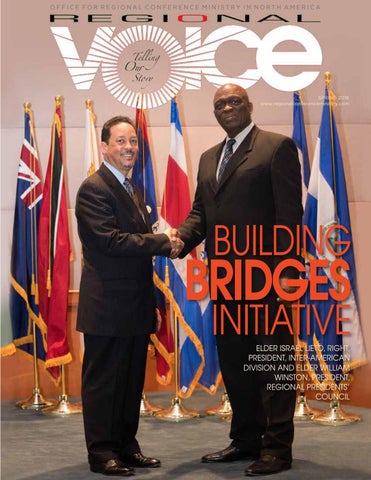
BUILDING
BRIDGES
INITIATIVE ELDER ISRAEL LIETO, RIGHT, PRESIDENT, INTER-AMERICAN DIVISION AND ELDER WILLIAM WINSTON, PRESIDENT, REGIONAL PRESIDENTS’ COUNCIL
YOUR SUCCESS STARTS HERE Come see what all the excitement is about!
Formerly known as College Days
October 5-9, 2016 OAkwOOd UnivERSiTY 7000 Adventist Blvd. nw Huntsville, AL 35896 For info call: 256-726-7356 visit: www.oakwood.edu OakwoodUniversity
@OakwoodU
OakwoodU
mama deserves the best!
Order now for Mother’s Day!
this year, give something Mom will really enjoy (and she may even share some with you). Edible Arrangements fruit bouquets are perfect for Mom, Grandma, Auntie, and Sis—a sweet way to share love. ®
Proceeds from all sales placed by calling 1-844 fruit-Ou go to support Oakwood university.
Call our toll-free number to order! We deliver throughout the U.S.
1-844-FRUIT-OU 1 - 8 4 4 - 3 7 8 - 4 8 6 8
Shar L vee Supp , o
Stud rt entS .
Pick fruit. It’s fresher.
TM
Containers may vary. Edible Arrangements ®, the Fruit Basket Logo, and other marks mentioned herein are registered trademarks of Edible Arrangements, LLC. All rights reserved.
FAQs Office for Regional Conference Ministry
What is the Office for Regional Conference Ministry? Established in 1996, the Office for Regional Conference Ministry (ORCM) coordinates presenting the passion and urgency of the Third Angel’s Message, primarily to urban and under-represented communities in the North American Division (NAD). More specifically the ORCM, headquartered at Oakwood University, Huntsville, Alabama, USA, provides guidance, influence and advocacy for Regional Ministry throughout the United States; it also provides the follow-through to the shared vision of the Regional Leadership for the advancement of the gospel and imminent return of Jesus Christ. Which SDA institutions affiliate with the ORCM? At the core of the ORCM are nine Regional Conferences and the Bermuda Mission, the Regional Directors of the Pacific and the North Pacific Unions, as well as Oakwood University, Message and Regional Voice Magazines, the Annual Pastoral and Evangelism Leadership Conference, the Bradford-Cleveland-Brooks Leadership Center, the Breath of Life telecast, BAYDA (Black Advent-ist Youth Di-
4
rectors Association) and the Regional Conference Retirement Plan.
What is a Regional Conference? Regional Conferences are similar in organizational structure to all other NAD conferences. However, a 1944 General Conference vote established Black-administered Regional Conferences. At that time, the catalyst for their formation was the segregationist policies, which, unfortunately, have had a lasting impact on American life. Yet, Regional Conferences have emerged as important leaders in the church’s mission in the United States. How do Regional Conferences benefit the SDA Church? Regional Conferences benefit North America and the world church in several ways, namely: • The North American church has experienced exponential growth to such an extent that the ratio of “minority” membership in the church is significantly higher than that in the general US population. • Through the Annual Pastoral and Evangelism Leadership Conference, Regional Conferences hold the SDA Church’s largest annual professional growth seminar for pastors, and • Based upon our membership, evangelistic growth and tithing contributions, if one were to ask for a comparison, the Regional Work would
Regional Voice Magazine | 2016 Spring Edition
www.regionalconferenceministry.com
rank as the NAD’s second largest union and the SDA Church’s fourth largest division. Now that segregation is illegal in the United States, do we still need Regional Conferences? Yes. Regional Conferences were established to fulfill a unique need in the church’s overall mission. Government policies have indeed changed, but sociological realities in America remind us constantly that the need for which Regional Conferences were formed is still very urgent in the 21st century. Are Regional Conferences just for African Americans? No. Regional Conference membership includes not only African Americans, but actually 123 non-Black congregations (Korean, Brazilian, Portuguese, Asian, African, Indonesian and Latino, for example)—thus, sharing the everlasting gospel with “every nation, kindred, tongue and people.” t
MANAGING EDITOR’S NOTES Published by the Office for Regional Conference Ministry in the North American Division of Seventh-day Adventists 7000 Adventist Boulevard Huntsville, Alabama 35896 Telephone (256) 830-5002 www.regionalconferenceministry.com
“MINING” OUR OWN BUSINESS, BY TELLING YOUR STORIES
PUBLISHER JAMES L. LEWIS EDITOR KYNA HINSON MANAGING EDITOR TIM ALLSTON ART DIRECTOR/DESIGNER HOWARD I. BULLARD COPY EDITOR CLARISE J. NIXON CONSULTANTS PHYLLIS WARE LEE, ELAINE ALLSTON EDITORIAL For all correspondence and letters to the editors, write: OFFICE FOR REGIONAL CONFERENCE MINISTRY 7000 Adventist Boulevard Huntsville, Alabama 35896 or fax to (256) 830-5078 We reserve the right to publish and edit your submissions and letters. REGIONAL CONFERENCE OFFICES ALLEGHENY EAST CONFERENCE HENRY J. FORDHAM III, PRESIDENT LaTasha Hewitt, Communications Director P.O. Box 266 Pine Forge, PA 19548 (610) 326-4610. www.myalleghenyeast.org ALLEGHENY WEST CONFERENCE WILLIAM COX, PRESIDENT Bryant L. Smith, Communications Director 1339 E. Broad Street Columbus, OH 43205 (614) 252-5271. www.awconf.org CENTRAL STATES CONFERENCE ROGER BERNARD, PRESIDENT Brittany Winkfield, Communications Director 3301 Parallel Parkway, Kansas City, KS 66104 (913) 371-1071. www.central-states.org LAKE REGION CONFERENCE R. CLIFFORD JONES, PRESIDENT Paul Young, Communications Director 8517 South State Street Chicago, IL 60619 (773) 846-2661. www.lakeregionsda.org NORTHEASTERN CONFERENCE Daniel Lamartine Honoré, President JeNean Johnson, Communications Director 115-50 Merrick Blvd. Jamaica, NY 11434 (718) 291-8006. www.northeastern.org NORTH PACIFIC UNION CONFERENCE ALPHONSO MCCARTHY, VICE PRESIDENT 5709 N. 20th Street Ridgefield, WA 98642 (360) 857-7000. www.npuc.org PACIFIC UNION CONFERENCE VIRGIL CHILDS, DIRECTOR African American Ministries 2686 Townsgate Road Westlake Village, CA 91361 (805) 413-7100. www.puconline.org SOUTH ATLANTIC CONFERENCE WILLIAM L. WINSTON, PRESIDENT James K. Lamb, Interim Communications Director 294 Hamilton E. Holmes Drive, NW Atlanta, GA 30318 (404) 792-0535. www.southatlantic.org SOUTH CENTRAL CONFERENCE DANA C. EDMOND, PRESIDENT Marvin Allison, Communications Director 715 Youngs Lane Nashville, TN 37207 (615) 226-6500. www.scc-adventist.org SOUTHEASTERN CONFERENCE HUBERT J. MOREL JR., PRESIDENT Bryant Taylor, Communications Director 1701 Robie Avenue Mt. Dora, FL 32757 (352) 735-3142. www.secsda.org SOUTHWEST REGION CONFERENCE CALVIN WATKINS, PRESIDENT Kenn Dixon, Communications Director 2215 Lanark Avenue Dallas, TX 75203 (214) 943-4491. www.southwestregion. adventistchurchconnect.org 2015 REGIONAL DIRECTORS/COORDINATORS ROSTER Bobby J. Mitchell, Sr. Director | Regional Ministries | Pacific Union Conference Cell: 909-225-6438 | bmitchell@puconline.org Kingsley Palmer V.P. African American Dept. Arizona Conference Cell 775-338-0858 | genx58@gmail.com Frederick Anderson Coordinator | African American Ministries | Central California Conference 831-262-3838 | famar@sbcglobal.net O’Neil Madden Coordinator | African American Dept | Nevada-Utah Conference Cell 702-875-5979 | pastoromadden@aol.com Dr. Leon Brown Coordinator | African American Dept. | Northern California 209-423-3335 | Leon.brown@nccsda.com Dr. George King V.P. Black Ministries | Southeastern California Conference (909) 202-0147 | kinggm@seccsda.org Royal Harrison Director | G.L.A.R. | Southern California Conference 503-819-1498 | hroyal2@yahoo.com
“
W
hat business am I in?” is the question that McDonald’s founder Ray Kroc posed in 1974, to MBA students at the University of Texas in Austin. At first, those future business leaders froze, then laughed nervously and one answered, finally, “Ray, who in the world doesn’t know that you’re in the hamburger business.” “That is what I thought you would say.” He chuckled, paused and then quickly said, “Ladies and gentlemen: I’m not in the hamburger business; my business is real estate.” Today, McDonald’s is one of the world’s largest real estate owners – surpassing even the Roman Catholic Church—owning some of the most valuable intersections and street corners in the world. Two thousand years earlier, an identical question was posed: “Who do men say that I am?” asked Jesus, the Greatest Founder, of His disciples, the future leaders of His father’s “business.” (Matthew 16:13). John the Baptist, Elijah, Jeremiah or some other prophet, were their replies. But Peter’s spot-on answer, “Thou art the Christ, Son of the living God” (v. 16), earned him both the rock and the kingdom keys (vv. 18, 19). Our Christian “business” is to replicate Christ is our lives and, thereby fast-forward His Second Coming. Regional Voice Magazine (RVM) accomplishes His business by re-telling your stories, and more broadly, across North America. Beginning now, RVM will ask and answer, “What are Your (Our) Best Practices?” For example, we will “mine” our own business, by digging more deeply beneath the surface and sharing best (local) practices in: • Soul-winning/Evangelism • Obtaining, Maintaining and Retaining Millennials • Seventh-day Adventist Education (both within and beyond the classroom) • Pan-African and Pan-American Bridge-building, and • Leadership Development & Training across the North American Division Locally, God is blessing you to perform best practices in these five aforementioned areas. Now, tell us and help RVM to share more broadly your successful witnessing and your best-practice stories. Together, let’s be about our Father’s “business” – so much so that no one will have to ask us that Ray Kroc question. Fast-forwarding His return, I am. t
Tim Allston Managing Editor
2016 Spring Edition | Regional Voice Magazine
5
Telling
Our
Story
2016 Spring Edition www.regionalconferenceministry.com
contents 4
ORCM Frequently Asked Questions The Office for Regional Ministry has posted this document to answer these questions.
5
Guest Commentary – Introducing The Five Best Practices These crucial areas explain our “marching orders” for growth in Regional Ministry that will benefit a hungry, dying world. By Tim Allston
8
Pan-American Bridge-Building View this photo essay and read all about the historic visit between the Regional Caucus leaders and the Inter-American Division administrators in Miami, Florida, and the new Best Practices Initiatives designed to ignite us! By Tim Allston Photo Essay By Bryant Taylor
10
The 2015 PELC Report The planners sought to honor lives of service and sacrifice, to preserve the spirit and momentum of previous sessions, and to build new areas of ministerial emphasis. By LaTasha Hewitt
12
Regional Voice Magazine | 2016 Spring Edition
10
North American Division— Proposed Changes to Structure? How would this work? How would the organization change? Keep reading. By Stephen Foster
14
Regional News— Changing of the Guard Meet the new leader in the Central States Conference Central States Report
15
In Memoriam We pay tribute to the life of Elder Randolph (Randy) Stafford. His ministry built bridges through evangelism all over the United States and in East Africa.
Our Cover records the historic, Bridge-building moment when the InterAmerican Division leaders welcomed Regional Conference officers and representatives from across North America, marking an initial step in joyous collaborations to come! Photography by Dr. Bryant Taylor.
6
8
12
32 14
28 30
16
36
16
30
22
32
Regional News – Northeastern Celebrates 70 Years Northeastern Conference, one of the earliest Regional conferences established in the United States, shares its 70th Anniversary Celebration with our readers. By President Honore
Best Practices—Evangelism Read all about this dynamic evangelistic outreach that has transformed the surrounding community and embraced an entire new congregation! Reprint from the Southern Tidings
22
24
Best Practices—Millennials What will it take to woo and win them? How about movies with biblical themes, and lots of TLC from homes! “If they haven’t visited [and been welcomed into] your home, you can’t bring them to the church!” Interview with MyRon Edmonds
Best Practices—Leadership Development – V COM There are ways to save time and money using state-of-the-art technology for meetings. Reprint from the Southern Tidings
24
34
Women’s Ordination Recap Roundtable, Part II What’s next? Are there any formal post-San Antonio Initiatives?
The Flint Water Crisis Timeline It’s worse than you think. Student reporters trace official actions that poisoned a city’s most basic resource.
28
36
The Adventist Imposition The Holy Spirit ordains and the church gives witness to what God has established. The church does not choose; the Spirit chooses, and the church supports who God has chosen. By Michael Polite
Best Practices—Education Principal and teacher, Ms. Janice Stevenson at the Abundant Life Academy in Las Vegas, Nevada, strives to live as a beacon of light for her students, and to offer the same strong support to them that she received as a youngster in church school herself. Interview by Chavvah McCoy Lister
2016 Spring Edition | Regional Voice Magazine
7
BEST PRACTICES: PAN-AMERICAN BRIDGE-BUILDING
WHAT HAPPENED IN SAN ANTONIO AND THE AFTERMATH Cover Story By Tim Allston
A
dmittedly, many of the 2015 General Conference session 70,000+ attendees—both predominantly people of color and female—exited San Antonio spiritually refreshed and globally connected, but socially depleted. Summarily: • Three world church leaders of African descent – General VPs Delbert Baker and Pardon Mwanza and PR director Garrett Caldwell—were removed from office; and • The vote to ordain women as pastors was defeated narrowly 1381-977. Weeks later the annual meeting of North American Division (NAD) Adventist Black Caucus—e.g., regional conference officers, combined with top-ranked Black SDA church officials—convened in Spokane, WA and, among other agenda items, hammered out its “5-Star Initiatives.” The un-apologetic intent of these initiatives was to fast-forward Christ’s second coming, by communicating and preserving the influence of the “Black work” in North America. The 5-Star Initiatives will promote: 1. Soul-winning and Evangelism 2. Obtaining/Retaining/Maintaining Millennials 3. SDA Education—both within and beyond the classroom 4. Pan-American and Pan-African Bridge-building and Collaborations
8
Regional Voice Magazine | 2016 Spring Edition
5. Leadership Development for the North American Division To support this five-point platform Regional Voice Magazine, as the official publication, will publish “Best Practices” columns and articles that communicate the many ways in which our constituents are already carrying out these soul-winning priorities. . . . and it began with the SDA “ABCs.” The “Alphabet Soup,” and . . . In January, Boca Raton, Florida, hosted this quarter’s regional conference officers’ meeting with invited guests. The Office for Regional Conference Ministry (ORCM) oversees broadly the operations of NAD’s nine regional conferences—Allegheny East (AEC), Allegheny West (AWC), Central States (CSC), Lake Region (LRC), Northeastern (NEC), South Atlantic (SAC), South Central (SCC), Southeastern (SEC), Southwest Region (SWC) Conferences, as well as the North Pacific Union (NPUC) and Pacific Union Conferences’ regional offices; additionally, ORCM supports Black Adventist Youth Directors Association, Breath of Life TV Ministry, Message Magazine, Oakwood University (OU) and Pine Forge Academy
– as well as ORCM workers’ Retirement Plan. Invited guests included Columbia Union Conference (CUC) treasurer Seth Bardu and LaDoverick Huggins of Mutual of America, which holds and invests the retirement funds. A highlight of this three-day session was the historic visit to and meeting with President Israel Leito of the Inter-American Division (IAD), at their headquarters in nearby Miami. . . . Now, the Numbers The world church’s most populous territory, IAD repre-
sents 3.5 million SDAs in Mexico, the Caribbean, Central America and the five northernmost countries in South America. By comparison, NAD’s 1.1 million members rank fifth behind IAD, East-Central Africa (2.5million), Southern African-Indian Ocean (2.1 million) and South American (2 million) Divisions. ORCM’s 1,174 churches account for 300,825 congregants. This ORCM-IAD visit inaugurated the 5-Star Initiative #4, Bridge-building The following photos highlight the historic meetings. Stay tuned, . . . t 2016 Spring Edition | Regional Voice Magazine
9
PELC 2015 REPORT
PREACHING, PRAISE, POWER BY L ATASHA HEWIT T
E
very December, Oakwood University welcomes pastors and ministry leaders from all over North America and the world for a 4-day gathering of powerful preaching, soulful singing, thought-provoking discussions, and like-minded fellowship. Pastoral Evangelism and Leadership Council, affectionately known as PELC, was held December 6-9, 2015, and welcomed more than 1,500 attendees. The 2015 theme Elijah 3.0: Ready, Restore, Reap challenged ministers to revisit the idea of restoration while embracing a fresher perspective. “The overriding theme has always been evangelism, but the planning committee felt the need to become more contemporary to engage a new generation,� explained Dr. Jesse Wilson, PELC coordinator. The four days were packed with moving seminars, worship experiences, exhibits, and more. Opening night included a special recognition service honoring notables 10
Regional Voice Magazine | 2016 Spring Edition
Gerald Penick and Phyllis Ware-Lee (administration); Pastor Helvius Thompson and T. A. McNealy (evangelism); Pastor Henry Wright and Elder Ben Jones (pastoral service); and Earl Moore, Fred Crowe, and E.E. Rogers (lifetime achievement). Early morning worship services started attendees off with an inspiring word. The service was followed by open forums that included discussion from a panel of conference and university presidents. The afternoons were dedicated to seminars on topics such as innovative evangelism and reaching and restoring young adults. Early evenings provided a power hour message followed by evening worship services. Featured speakers included Dr. Dedrick Blue (Oakwood University), Dr. Marcus D. Cosby (Wheeler Baptist Church, Houston, Texas), and Elder Marcellus Howard (New Hope Church, Ft. Lauderdale, Florida). New to PELC in 2015 was their evangelism shark tank
called The Appeal. Pastors and ministry leaders were able to pitch evangelistic ideas to a panel of experts for the chance to win a monetary prize and mentorship. Panelists included pastors Debleaire Snell, Carlton Byrd, Myron Edmonds, and Roger Hernandez. Entrants competed. The winning proposal came from Pastor Ester Edouard (Southwest Region) who seeks to expand his church’s food distribution center and eventually run an evangelistic series. Concurrently, the Hispanic track of PELC sessions were held in the Bradford Cleveland Brooks Leadership Center. All services, seminars, and meetings were conducted in Spanish for participants. Another special group gathered in Wade Hall during the conference—ministerial spouses. The theme for their workshops was The Family and the Calling. Ministerial spouse coordinator Shirley Benton shared, “Our sessions equip spouses to be able to handle their ministerial role and embrace their own calling.” Topics ranged from hair and skin care ideas to those on creating their own “war” (prayer) rooms. PELC began more than 37 years ago when several regional conference presidents and Oakwood personnel, led by Elder E.E. Cleveland, saw the need for ministers to come together to acknowledge commonalities, identify priorities, and strategize their evangelism efforts. The planning committee, which consists of ministers representing all of our regional conferences, seeks to maintain those original objectives, while also building on them.
“In addition to the original goals, we’ve since added an emphasis on leadership, church growth, and enhancing the worship service,” shared Wilson. So, what can attendees expect for PELC 2016? “We want to continue to emphasize community connection and crossing denominational lines,” Wilson explained. “We want them (ministers) to be more than faithful; we want them to be fruitful, doubling down,” he emphasized. t _______________________________________________________
For more information about PELC 2016, visit their website at www.pastorasleadership.org. _______________________________________________________ LaTasha Hewitt is Director of Communications for the Allegheny East Conference of Seventh-day Adventists.
2016 Spring Edition | Regional Voice Magazine
11
NAD PROPOSED STRUCTURE CHANGES
REORGANIZING THE NORTH AMERICAN DIVISION— A MATTER TO CONSIDER BY STEPHEN C. FOSTER
12 12
Regional RegionalVoice VoiceMagazine Magazine || 2016 2016Spring SpringEdition Edition
S
ince Seventh-day Adventism has its origins in the United States, it is for obvious reasons that the North American Division of Seventhday Adventists has long been recognized as the flagship Division of the Seventh-day Adventist Church. With the relatively explosive growth of church membership in recent decades in Africa, Inter-America and South America, the dynamics have changed; and perhaps so have the perceptions—if not the reality—that the North American Division (NAD) leads the church. However the discussions surrounding the reorganization of the North American Division have been engendered not as much a matter of global leadership perception, as a matter of effectiveness. Is this Division, as it has been organized for the past 70 years, structured for maximum mission effectiveness? That is what has driven the study and the discussion of reorganization. The reality is that there are dynamics at play in the Seventh-day Adventist Church in North America that are positive; and that have arguably resulted from the existing structure. On the other hand, it can also easily be argued that there are negative dynamics at play that may be addressed by means of structural, organizational changes. Examples of positive dynamics or developments in North America that might be attributed in some way to organization may include the fact that the SDA Church is among the fastest growing and most diverse denominations in North America. As of 2011, the Seventh-day Adventist Church which was then reported to have been growing at a 2.7 percent rate; was in fact the fastest growing denomination in the United States according to G. Jeffrey McDonald of the Religion News Service, as reported in USA Today. According to a report released last July (2015) by the Pew Research Center, and based on an analysis of data provided in 2014 by the Religious Landscape Study, the SDA Church is also the most racially diverse religious group in the United States as well. The relative growth and diversity of the church, which are results of its efforts to fulfill its mission—the dissemination of the gospel to every nation, kindred, tongue, and people—is a testament to God’s blessing on the mission. This is also evidence of the efficacy of some structural arrangements and decisions that have been implemented in pursuit of the mission, and that of its objectives. The flip side however is that much of the growth in North America is literally an outgrowth of the fact that the church has grown much faster outside of North America generally, and much faster outside of the United States specifically. Additionally, immigration to the United States by Seventh-day Adventists, particularly from the Caribbean and Latin America has inflated American SDA growth numbers to some extent. Dr. Ron Clouzet, director of the North American Divi-
sion Evangelism Institute at Andrews University is quoted in USA Today saying, ““We don’t feel that we’re growing very much, and that is a source of concern, especially for North America.” Hispanic Adventists are “the one group that is growing very well,” he added. “If we didn’t have that group, we would look even more dismal.” Dismal is a strong word in reference to describing growth; especially coming from the director of the North American Division Evangelism Institute. Since it represents a candid assessment of the efficacy of the status quo, even if it not necessarily intended to be one, it is that type of assessment that engenders talk of what can perhaps be done from an organizational standpoint to turn the trend in another direction. Former General Conference President Dr. Jan Paulsen said, “I’ve reminded myself many times that it’s impossible to walk backwards in to the future with eyes fixed on how things used to be. If as leaders we close our minds to new ideas, we become a hindrance to the church’s progress toward fulfilling its mission. We become mere protectors of ‘the way things have always been,’ and lose sight of what it means to be leaders of God’s people now.” Dr. Paulsen continued, “At the global leadership level, this attitude inevitably surfaces when we consider how the local church should function and when we consider organizational structures and ministries of our worldwide church.” For his part, North American Division President Dan Jackson has been refreshingly transparent in discussing his views with regard to reorganizational considerations and possibilities. For instance, when asked if we should get rid of conferences or unions, Elder Jackson is quoted in an Adventist Review interview with Chad Stuart shortly before last year’s General Conference session as saying “My goal would be to make every conference a regional conference, but we’d just have a lot fewer conferences, paying attention to the realities of ethnicity and race, so that we are perceived—and are—faithful and” then he was interrupted. Though incomplete, those comments however are intriguing; as they beg the question of what are “the realities of ethnicity and race” in the North American Division as we approach 2020? Of course one of these “realities” is that the church in North America is now comprised of members of ethnic and racial minorities. So, since existing regional conferences are now, and have always been, organizations of churches with majorities of ethnic and racial minorities, to what “realities of ethnicity and race” would we be paying attention? t ______________________________________________ Stephen C Foster, B.A., is a free lance writer and retired advertising executive from AT&T. He has a degree in History from Oakwood University, with graduate work in communications, journalism and religion at Andrews University.
2016 Spring Edition | Regional Voice Magazine
13
REGIONAL NEWS
ROGER BERNARD
CENTRAL STATES CONFERENCE ADMINISTRATIVE VICE-PRESIDENT AND INTERIM PRESIDENT
CHANGING OF THE GUARD CENTRAL STATES
P
astor Roger A. Bernard Jr., a Washington, D. C., native, was raised in New Orleans, Louisiana. He received his Bachelor of Art degree in Theology with a minor in History from Oakwood College in Huntsville, Alabama. He also received his Master of Divinity degree from the Seventh-day Adventist Theological Seminary, Andrews University, Berrien Springs, Michigan. His experience covers a range of areas that include teaching, mentoring, and both youth and pastoral ministries. Pastor Bernard has served as Assistant Youth Director, Youth Director and Director of Adult Ministries. In September 2009, he was elected Executive Secretary of the Central States Conference of Seventh-day Adventists. Pastor Bernard enjoys all sports, but his favorites are football and golf. He is married to his best friend, the former Ivona Roberts of New York, New York. They have two daughters,
14
Bria and Braelyn, who are the joys of their lives. His professional passion is spreading the gospel. His personal passion is helping young people learn to receive Christ as their savior. While the Bernards love to introduce as many people as they can to God, they share a special passion for telling young people about Jesus their Lord and Savior. Pastor Bernard’s favorite text is: “By faith the walls of Jericho fell down after they were compassed seven days,” Hebrew 11:30. It reminds him that God can reach any person, accomplish any goal, and make a way out of no way. God can do anything! t
Regional Voice Magazine | 2016 Spring Edition
Pastor Roger A. Bernard, Jr., and Ivona Bernard
We Have This Hope
RANDOLPH P. STAFFORD AUGUST 27, 1946 - FEBRUARY 4, 2016
R
andolph Poten Stafford (Randy) was the son born to Ellwood and Loretta, along with older sister Annette, in the small town of Hamlet, North Carolina. His mother later married Clarence Roary, and they had two additional sons, James and John Roary. The family later moved to Cleveland, Ohio, where Loretta accepted the Adventist message along with her children. Convinced that her children should be taught of the Lord, she sent Randy to Ramah Junior Academy until he completed the tenth grade. He then attended East High School where he graduated. His entrance into ministerial work was as a tent master for Pastor William Scales, where he was known to preach to the chairs after the nightly meetings. This experience was the first stepping stone. In 1965 he entered Oakwood College in Huntsville, Alabama, with a Behavioral Science major, but the Lord had other plans for this aspiring man of God. He did not complete his matriculation at Oakwood, but later finished his education at Wayne State University in Detroit, Michigan. He received a Master’s degree in Behavioral Science and doctoral degrees in Humane Letters and Divinity. In 1969 he used his educational background to work with youth as the director of Health Horizons program, under the direction of Harold Wright. His college friend, Debrah Wright, also worked in the Health Horizons program. As they became closer friends, he asked her to be his girlfriend. They dated for two weeks, then he asked her to marry him. Three months later, they were married on August 31, 1969. Randy never lost his desire to become a pastor, and in November 1969 he was invited to Nashville, Tennessee to preach. A tape of the sermon was sent to Elder Charles Dudley, then president of the South Central Conference. After hearing the sermon, Elder Dudley immediately gave Randy a call to pastor in one of the Mississippi districts. During his early ministry, he remained a
community activist, working with youth, the NAACP, SCLC and the Urban League. During his second year of ministry, he baptized more than 100 people, and was named “Pastor of the Year.” Each successive year, he was known as the “Century Man,” for always baptizing more than 100 souls. Three years after entering the ministry, he was ordained. His ministerial path led him to pastor in several regional conferences, including South Central, Lake Region, Central States and Allegheny East. He also held administrative positions, including AY Director in Southwest Region. In 1983, Randy was called to be Ministerial Director for the East African Union in Nairobi, Kenya. In 1985, while conducting a three-week evangelistic campaign in Kisii, Kenya, he baptized more than 3,000 souls. He was blessed to return to Kisii in November 2015 for the 30-year anniversary. and was pleased to learn that as a result of the 1985 meeting, the Kisii Central Church was started. That church in turn later produced more than 10 churches. In 1986, he was called to the Eastern Africa Division to be the Director of Church Growth, under the direction of then-president, Bekele Heye. After returning to the United States, he worked as an independent evangelist until accepting a call from Elder Alvin Kibble, president of Allegheny East Conference. In 1995, he was called back to South Central Conference, where he served as Assistant to the President for Public Evangelism. He pastored churches until he retired in August 2012. He pastored more than 31 churches in the United States and baptized more than 25,000 people during his 42 years of ministry. Pastor Randolph Stafford fell asleep in Jesus on February 4, 2016. He leaves to mourn his passing his wife of 46 years, Debrah Wright Stafford; two children, Randolph P. Stafford II and April Rolle (Jay); two grandchildren, Ashley Rolle and Jonathan Rolle II, a brother, John Roary (Kay) nieces and nephews, and a host of adopted daughters and sons in the ministry. t 2016 Spring Edition | Regional Voice Magazine
15
REGIONAL NEWS
NORTHEASTERN CONFERENCE
CELEBRATES 70 BY DANIEL HONORÉ
M
ore than 7,000 members and guests gathered at the Webster Bank Arena in Bridgeport Connecticut, to celebrate the 70th anniversary of the Northeastern Conference under the theme “Keys to the Past, Unlocking our Future.” The Northeastern Conference was organized on October 3, 1944, and began operations on January 1, 1945. At its inception the Conference consisted of 2,308 members in 15 organized churches. Today those numbers stand at 55,766 members in 179 organized churches. The celebration day began with a special Sabbath School program led by the Bridgeport-based Calvary Church, followed by a service of praise and remembrance, including a roll call of the churches in chronological order. As the church names were called, local members were invited to stand as each pastor presented a special anniversary offering from these congregations. These funds totaled approximately $150,000 and are earmarked for the construction of a new pavilion at Camp Victory Lake. United States Senate Chaplain and Retired Admiral, Barry Black, presented the Divine Worship Service sermon entitled “Avoiding the Perils of Self-Confidence” in which he challenged our churches to avoid becoming anonymous, self-absorbed social clubs, indifferent to the needs of surrounding communities. Prior to the message, Bridgeport Mayor Bill Finch, brought greetings to the large congregation and read a proclamation declaring August 1 Northeastern Conference of SDA Day in the City of Bridgeport. He in turn received a deluxe gift edition of Steps to Christ jointly presented by NEC President Daniel Honoré and SNEC President David Dennis. 16
Regional Voice Magazine | 2016 Spring Edition
General Conference President Ted N.C. Wilson also brought greetings through a pre-recorded video prepared for the occasion. From the North American Division Vice-President Alvin Kibble saluted the assembly on behalf of the division officers. Dr. Prudence Pollard, Oakwood University Vice President, congratulated the gathering on behalf of the University and her husband, Oakwood University President, Dr. Leslie Pollard. Dr. Avis Hendrickson, President, Atlantic Union College offered congratulations while announcing the reopening of the college this fall. Message Magazine Editor, Carmella Monk, thanked the Northeastern Conference for its steadfast support of the publication over the decades. President Honoré recognized former NEC conference presidents, as all three living officers were present. They include Donald G. King, current union president, Pastor Trevor Baker and Pastor George R. Earle. Pastor Earle recently celebrated his 97th birthday and travelled from Huntsville, Alabama, to participate in the festivities. Present also were former Executive Secretary Larry Bailey and former treasurers Ebenezer Agboka, who now serves as Greater New York Conference Treasurer and Seth Bardu, current treasurer of the Columbia Union Conference. Other highlights of the program included an intercessory prayer conducted in multiple languages spoken by NEC congregations: English, French, Haitian Creole, Spanish, Portuguese, Yoruba, Igbo, Twi, Karen and Mandarin. Participants also received a special one-hundred page commemorative booklet containing the history of Northeastern Conference and accentuating its current ministries. A baptism ceremony followed the sermon, and 46 souls gave their lives to the Lord. The purpose of this
YEARS baptism was to accentuate the fact that after 70 years the primary purpose of our existence is the salvation of souls. Fifteen pastors took part in the ceremony in addition to the presidents of the Atlantic Union Conference, Southern New England Conference and the Northeastern Conference. Following a lunch break, three pastors received ordination to the Gospel Ministry of the Seventh-day Adventist Church. These are Frantz D’Haiti, Pierre Vincent and Roger Williamson. Dr. Donald King delivered a special ordination sermon in which called on the ordinands and fellow pastors to live a life consecration and service to God. The NEC Health Ministries Department, led by Dr. Leroy Dailey conducted health screenings throughout the afternoon with our health van parked in the plaza. Concurrently, Pastor Roger Wade led the youth in three compassion activities to the city of Bridgeport. One group of youths ministered to residents of a local nursing home, another group prepared back to school backpacks for local children while the third distributed roses to city residents. The program ended with a multi-generational and multi-cultural concert featuring choirs, soloists and ensembles from the different geographic regions of the conference. t
PRESIDENT HONORÉ RECOGNIZED FORMER NEC CONFERENCE PRESIDENTS, AS ALL THREE LIVING OFFICERS WERE PRESENT. THEY INCLUDE DONALD G. KING, CURRENT UNION PRESIDENT, PASTOR TREVOR BAKER AND PASTOR GEORGE R. EARLE. PASTOR EARLE RECENTLY CELEBRATED HIS 97TH BIRTHDAY AND TRAVELLED FROM HUNTSVILLE, ALABAMA, TO PARTICIPATE IN THE FESTIVITIES.
Elder Daniel Honoré is President of Northeastern Conference of Seventhday Adventists.
2016 Spring Edition | Regional Voice Magazine
17
Your Story, Your Witness. Subscribe for these people now:
• Yourself! • Family members • Neighbors • Co-Workers • Professionals with whom you do business. • Businesses with waiting rooms • Incarcerated persons • Schoolmates
Step Up To The Mic We used to be able to talk to people. We were especially motivated when it came to pursuing a love interest. Ever heard a line designed to capture your attention?
FUTURECAST
RELATIONSHIP RX:
A MEMORIAL OF CREATION
LONG SUMMER DAYS AND SABBATH-KEEPING S P E C I A L
“Excuse me, I lost my number. May I have yours?” or “May I follow you? My parents always told me to follow my dreams!” or “Do you believe in love at first sight, or should I walk by again?”
I S S U E
Catch Your Breath It is on God’s day that we see His power to create, His power to transform, and the grace-filled, elevated place for you in His plan.
SO, What Ever Happened to the Sabbath?
Now we’ve become rusty, a little shy about our witnessing. Seriously, within our blessed assurance is the privilege of knowing the only Love there is. We know the peace of worshipping in spirit and in truth, and have a heart that beats for the coming of our Savior. It’s time to share your witness in a big way!
INVESTIGATE: A Question of Time
What a Difference a Day Makes www.messagemagazine.com MAY/JUN 2015
Everybody’s Got To Know
The Big 10 Never-Changing Purposes of the Sabbath
+
THE EXPERIENCE UNDERCOVER BOSS
Subscribe Now at Messagemagazine.com @message1898
@cmonkcrawford
messagemagazine
Vacation Bible School Xperience
W
elcome to Kidsville, where kids learn about Jesus and Xperience His love in a variety of unique ways. This program focuses on the truth that “Jesus loves others through me.” Each day the kids will not only learn what it means for Jesus to love them, but how Jesus can use them to love others. They will discover what this looks like in their daily lives and how they can be better friends to those around them.
These lessons were developed by a team of Seventh-day Adventist pastors, children’s ministry professionals, and VBX leaders with a passion for sharing Jesus’ love with children. Lessons will connect with community children while engaging Adventist children in learning about the Bible.
Kit Includes Station Guides • Kidsville Playground & Bounce-back • Adventures with Dr. Luke • The Clubhouse • Connection Station • Creation Station • Play Station • Snack Shack • Operation Kidsville Posters • Promotional • Stations • Daily Themes Multimedia • Music CD • Music DVD • Playground DVD
Order your kit from AdventistVBX.com or AdventSource at adventsource.org and 402.486.8800 or the Adventist Book Center at 800.765.6955
Order Your Kit Today! Save $20* English catalog #039424 Regular $159.99 SPECIAL $139.99* *If ordered before April 29, 2016 Spanish catalog #039426 Regular $159.99 SPECIAL $139.99* *If ordered before April 29, 2016
Scan to watch a preview of Kidsville or go to AdventistVBX.com
Created by the North American Division Children’s Ministries Department
Tasks for
Vacation Bible School Leaders 1
Get an up-to-date picture of your church’s VBX program. Research what has been happening; talk to current and former leaders. Take an inventory of supplies available and assess what new materials may be needed. Find out what has worked well in the past.
2
Select a curriculum for your program.
3
Recruit staff to lead the main areas—story time, games, crafts, etc.
4
Create a budget.
5
Conduct regular staff meetings where you can provide training and encouragement.
6
Train your staff in how to invite children to accept Jesus in an age-appropriate way.
7
Mentor a promising leader for future VBX leadership.
8
Share your plans, calendar, budget, and any other pertinent information with the children’s ministries committee and local conference.
9
Check with your conference for guidelines on child safety. Make sure your volunteers pass background checks and are trained in child safety procedures.
BEST PRACTICE: EVANGELISM
HUNTSVILLE’S FIRST SDA CHURCH
“SUNDAY MORNING SURGE” LEADS TO SECOND SATELLITE CAMPUS
W
hile preparing for their July 2013 grand opening, church members were cleaning, painting, and praying over their new 1303 Evangel Drive facility on Sunday mornings. The Sunday Morning Surge idea arose during this transition period. “When our ‘new’ community neighbors saw our cars in our ‘new’ church parking lot on Sunday mornings, many came to the building — some even wearing church attire—because they thought a service was being held,” explained Debleaire K. Snell, the 38-year old senior pastor, http://blog.al.com/livingtimes/2011/01/new_minister_pastor_debleaire.html. “If people were OK with coming to our church on a Sunday morning, why not use it as an opportunity to preach the truth? Sunday services are not unprecedented,” he continued. “Caribbean and Central American Adventists have held Sunday evening services historically. Having service on Sunday evening or Sunday 22
Regional Voice Magazine | 2016 Spring Edition
morning does NOT violate Sabbath principles, or validate attempts by other denominations to make Sunday a time of covenant. Sunday is a day of worship for the majority of Christian institutions, but it is NOT the day of covenant.” A Thumbs-up! from Conference officials . . . and Mrs. White Snell subsequently discussed his church’s Sunday morning evangelistic initiative with South Central Conference officials, who approved. “Why should First Church just concede Sunday, as a day for error to prevail?” SCC President Edmond added. On February 8, 2015, First Church instituted the Sunday morning Surge services, purposed to: • Teach the SDA 28 fundamental beliefs; • Serve as a first point of contact for the “un-churched,” who do not attend Saturday-Sabbath services, normally; and • Help new believers reinforce their new-found beliefs. Surge also offered Adventist believers and First Church
members a “spiritual jumpstart,” to begin their work week. Using the slogan “No suits. No ties. Just Jesus,” Surge utilized a onehour songs-and-sermon format, after which attendees enjoyed a continental breakfast before departing. Mrs. Ellen G. White counseled, “Whenever it is possible, let religious services be held on Sunday. Make these meetings intensely interesting. Speak on temperance and on true religious experience.” (Testimonies for the Church Vol. 9, p. 233). “Berry”-picking No one knew how God would use this eight-week series to build his Kingdom. One Sunday morning in late February Anthony Berry, Pastor of Christ Care Unit (CCU), a local Missionary Baptist Church, decided to attend the Sunday morning service. Berry reported that following Surge’s March 1 health message sermon, he trashed immediately his refrigerated pork products—and lost 20 pounds in four weeks! In April, Berry publicly thanked the First Church congregants and visitors, “for having a pastor that said, ‘I’m going to do something different’ . . . and (I’m) thankful that he had a congregation that decided to stand behind him, come what may . . .”On July 11, the Christ Care Unit Church started worshiping on Saturday instead of Sunday; and by July 22, CCU voted to dismantle their Baptist By-Laws and wrote Pastor Snell, formally seeking a Seventh-day Adventist church affiliation.Exactly one month later, First Church members voted CCU as its third worship site. To date, 11 CCU congregants are receiving baptismal classes; of those, seven have decided to accept the Adventist faith and have or will be baptized. In 2007, New Market, Alabama’s Abundant Life congregation became First Church’s first satellite campus.In August, South Central Conference’s New Pastors’ Orientation in Nashville warmly welcomed Pastor Berry, as he will continue to pastor the Huntsville satellite campus, located at 1626 Pulaski Pike. Berry also plans to enroll Oakwood University’s LEAP Church Leadership degree program in January 2016.Enthusiastically, First Church’s Sunday morning Surge initiative literally opened the 2015 Sºuth Central Conference camp meeting: • On June 12, Southern Union ministerial director and keynote speaker Roger Hernandez offered these words of encouragement: “God is not upset about the Surge; please withdraw your freak-outs . . .We should be evangelizing Sunday mornings and Sunday nights, Monday mornings and Monday nights, . . . Let things play out; if they’re from God, He will bless them. (And) He did bless it. God bless you, First Church!” • Just 16 hours later, Senior Pastor, Dr. MyRon Edmonds, from the Glenville SDA Church in Cleveland, Ohio, prefaced his June 13 Divine Worship message, saluting President Edmond, saying, “Listen: this president right here” (pointing to the front pew where Edmond was sitting) “showed cou-
rageous leadership, by supporting the work of this conference,. . . and you ought to be proud of what God is doing in this pacesetting field.” He continued, “you know, we all have heard about what has been transpiring in this field, in this area of the vineyard, some of the creative things,…(referring to Snell) that the Lord has been inspiring His leaders to do . . . But I was especially encouraged…by the kind of courageous leadership. . . . I thank God for the shift that is happening.” The third eight-week Surge series will re-start spring 2016. To date, 25 individuals have either been baptized or are currently participating in baptismal classes. First Church Milestones (2010-2015) • (2010) Baptized 81 Fall Revival candidates • (2011) Voted to purchase its new home at 1303 Evangel Drive • (2012) Began renovations on the 1500-seat, 54,000 sq. ft., 12-acre ministry complex • (2012) Senior Pastor named SCC Pastor of the Year, http://www.al.com/living/index.ssf/2012/07/first_sda_ minister_honor.html • (2013) Relocated from a 500-seat sanctuary, 26,000 sq. ft. facility on Stringfield Road, http://www.al.com/living/index.ssf/2013/07/first_sda_church_huntsville.html and http://www.southernunion.com/site/1/docs/Tidings/2013/Nov13.pdf • (2013) Renovated, dedicated 5500-sq. ft., 80-seat Youth Center, on complex’s lower level, http://www. southernunion.com/site/1/docs/Tidings/2014/Apr14.pdf • (2014) Senior Pastor named SCC Pastor of the Year, http://www.al.com/living/index.ssf/2014/07/debleaire_ snell_minister_of_ye.html • (2015) First Church established Sunday morning Surge initiative, http://www.al.com/living/index.ssf/2015/02/seventh-day_adventist_sunday.html • (2010-2016) Increased from 1173 to 1,916 members, 683 through baptisms – statistically, 2.43 baptisms each Sabbath! http://www.scc-adventist.org/huntsvilles-firstchurch-ministry-leaders-kickoff-leap-year-with-annual-visioningtraining-weekend/ Since initiating Surge, Snell and/or his pastoral team have presented this program to the Andrews University Theological Seminary (October 2015), Southern Union Evangelism Conference (December 2015) and the North American Division presidents and officers (February 2016(?). For President Edmond’s blog, “Why I Did Not ‘Just Say No’ to Surge,” go to http://www.scc-adventist.org/why-idid-not-just-say-no-to-surge/ For more on the First SDA Church Surge initiative, go to https://vimeo.com/126878622 . t ___________________________________________________ Reprinted from the Southern Tidings. Used by permission.
2016 Spring Edition | Regional Voice Magazine
23
RESPONSE
WOMEN’S ORDINATION RECAP ROUNDTABLE PART II
WHAT’S NEXT? ARE THERE ANY FORMAL POST-SAN ANTONION INITIATIVES? Recap from Part I:
F
rom July 2-11, 2015, global Adventdom converged on San Antonio, Texas—60,000-plus Seventh-day Adventists from 230 mission fields—to pray, praise and prepare corporately and personally for the promised return of the soon-coming Savior. It was the largest-ever gathering in America’s seventh-largest city. But at center stage was whether its delegates—each one representing 7,000 co-religionists—would corporately approve its trained females to become ordained pastors—a designation equivalent to being awarded full tenured professorship in higher education. Women as regional conference congregants comprise easily 60-70 percent—a number that is growing. As presented in Part I, our panelists are: • Claudia Allen (CA), University of Maryland/College Park, doctoral candidate specializing in 19th and 20th century African American Literature; • Brenda Billingy (BB), associate ministerial director, 24
Regional Voice Magazine | 2016 Spring Edition
North American Division, and senior pastor, Metropolitan SDA Church, Hyattsville, Maryland. • Pauline Christian (PC), president, Black Business Professional Association, Toronto, Ontario, Canada. RV: Is this (women’s ordination) now a dead, one-anddone issue? Why “yes,” or why “no?” PC: I don’t believe it is a dead issue, I believe that based upon the vote of 1381 – 977 against the issue, we are at a crossroad which could be viewed as a lack of readiness. The Seventh-day Adventist church has evolved over the years and is still evolving. As our community is going through social engineering at a rapid pace, the church will need to strategically reposition itself to meet the spiritual needs of the community, so we can remain spiritually relevant and current. Remember the Lord will rise up rocks to do the
work if we are not able to do what he calls us to do, and I am not sure if he is going to as the rocks if they are male or female. The result should not be viewed as a political statement whereby one group wins, while the other loses. Democracy allows us a church to function in a manner that will provide fairness, as long as no indirect or direct manipulation took place throughout the process. I believe that God is God all by Himself and He has us and the world in the palm of His hand. CA: No way! [Even in this group] 977 people believed women should be ordained! And they were only a fraction, a representation of the millions of people who believe women should be ordained. BB: This question is not going away. The train has left the station and we must deal with—what doth the Lord require of us? DO JUSTLY is the first requirement, and until we get to that train stop the Lord will continue to challenge our discriminatory practices in our beloved world church. RV: Claudia, as a young “millennial” professional, have you noticed over the years a growing interest in your female peers wanting to pursue SDA ministry as a career? CA: Having been born and raised in the Lake Region Conference of Seventh-day Adventists and a graduate of Andrews University Adventist education (Ruth Murdoch, Andrews Academy, Andrews University), I have been intimately connected to the Andrews University Theological Seminary for most of my life. From Bible teachers, to substitutes, to Seminarian interns at my home church, Niles Philadelphia SDA, I have grown up watching black men matriculate through and engage their pastoral calling. My grandfather, the late George Moses, was such a lover of the word he had seminarians at his house constantly talking about the word. Men. As a child and adolescent I did not come in contact with many women who felt the call to pastoral ministry. I met many who were chaplains, and deans, and bible teachers, and counselors, but in my youth I did not know their story or their true call. I only saw how they were ministering to me at the present in contrast to men’s ministry. I also did not see black women engaged in either of these calls. Not as bible teachers, chaplains, pastors, etc. My introduction to women in ministry was through white women. Around 2007 I had heard people complaining about an influx in female seminarian students and the talk was not positive. I heard people call these women thirsty, or
WOMEN HAVE BEEN ACCEPTING THE CALL TO MINISTRY FOR DECADES, THE ONLY DIFFERENCE IS THE MILLENNIAL GENERATION IS OLD ENOUGH TO WATCH THEM DO IT, SEE THEM REJECTED, AND ULTIMATELY FIND ISSUE WITH THAT REJECTION. assert “they’re only in seminary to find a man,” or state “women can’t preach.” So to be a woman interested in or actively pursuing pastoral ministry was greatly frowned upon, based on my teenage interpretation. These negative social views did not stop women though, that’s for sure! Women were going to seminary in droves. By the time I got to Andrews University as an undergraduate student I knew so many women interested in pastoral ministry, black women at that, it seemed as though the phenomenon dropped out of the sky or quickly sprouted out of the ground, rather than being the long struggle that it actually was. Just like black men have not started dying at the hands of police officers at more rapid rates, women invested in pastoral ministry have not all of a sudden hit a dramatic increase. Women have been accepting the call to ministry for decades, the only difference is the millennial generation is old enough to watch them do it, see them rejected, and ultimately find issue with that rejection. Our distaste for racial, gender, or any other form of inequality is at an all time high. So while it seems as though more women are pursuing pastoral ministry, it’s really just more millennials making sure their stories are told and heard around the world on as many platforms as possible. It has been from my own interaction with women in ministry that has caused me to develop such a passionate desire to champion their cause. During my first semester of college I fell and suffered a severe knee injury in both knees. It was so bad a doctor at Northwestern wanted to do bone reconstructive surgery. Instead, I experienced the physical therapy ministry of Pastor Tricia Wynn, MDiv, DPT. While she was waiting on the “call” to pastor a church, she healed my knees, literally, without the surgery. To top it off while I lay on her table getting electrodes shot into my knees she acknowledged my own spiritual and ministerial call to preach. She taught me that pastoral ministry was about more than having a church it was about actively healing people emotionally, spiritually, and physically. It was while sitting in a Friday night vespers listening to Dr. Morgan Medlock, MDiv., M.D., who is currently practicing medicine, [I heard her] preach with a tone, passion, depth, and syncopation akin to the authentic black preaching of old. I learned not only can women preach, but they can preach better than some men!
2016 Spring Edition | Regional Voice Magazine
25
RESPONSE
And it was a part of Pastor Brenda Billingy’s congregation during my graduate work at Georgetown University that I met and came in contact with what a black, female pastor looks like. And what an example! To watch a woman submit to God, while submitting her husband; to watch a woman don her communion rob and lead people in a remembrance of the sacrifice of Jesus Christ. But even greater, to watch a woman baptize people in the name of the Father, Son, and Holy Spirit, taught me that the Great Commission God gave in Matthew 28 did not reflect the commission given women in the Seventh-day Adventist Church. So many women are healing, praying, preaching, teaching, and baptizing in the name of Jesus that it’s shocking [that the] organization is unwilling to acknowledge their noble, self-less acts. No, I have not seen an influx in women’s desire to join pastoral ministry, but I have matured to see a sea of women who feel blessed to be in the service of God. A sea of women I did not see before. They are your doctors, your lawyers, your teachers, your physical therapists, your counselors, and so much more only because the SDA Church as an organization will not give many of them a church. But in spite of that, women are still ministering. RV: What now is their response? CA: One of grief. It is very difficult to dedicate your life, your talents, your 26
Regional Voice Magazine | 2016 Spring Edition
time, your temple to an organization that says we do not recognize any of the things you are sacrificing. With straight back, head up, and eyes locked on Christ, these women corrected all of us. With power and dignity they looked the SDA Church in the face and asserted their sacrifice is not for the good of the Seventh-day Adventist Church, but for the quickening of the Kingdom of God. Therefore, the approval, affirmation, and acknowledgement of SDA Church was not necessary because had already received such from God. #SayTheirNames: Brenda Billingy, Andrea TrustyKing, Paula Olivier, Dilys Brooks, Rebecca Davis, Tricia Wynn, Lola Moore, Shonda Nunes, Tacyanna Nixon, Shantel Smith, Sabine Rene, Everette B. Samuel, Kimberly Mann, Morgan Medlock, Cassandre Beccai, Tina Carriger, Amanda Hawley, Sydney Henry, Jeanne Mogosu, Loreal McInnes, Taylor Laurie, Nashra Marclein, Darchelle Worley, Kessia Reyne Bennett, Tammie Lindsey, Lindsay Syeh. RV: Pauline, as a Canadian “female”-preneur and association executive, in your overlapping circles, in what way does ministry attract or repel your peers? PC: In my roles as a community activist and entrepreneur, I do see an increasing number of women leaning towards ministry and many were disappointed with the outcome of the vote, however, they are still plowing ahead however,
SO MANY WOMEN ARE HEALING, PRAYING, PREACHING, TEACHING, AND BAPTIZING IN THE NAME OF JESUS THAT IT’S SHOCKING [THAT THE] ORGANIZATION IS UNWILLING TO ACKNOWLEDGE THEIR NOBLE, SELF-LESS ACTS.
creating opportunities for alternative career measures in fulfilling their gift to the planet. Many understand that they are Called however, we are all humans, who like to be appreciated, treated fairly and equitably. I believe GC leadership should devise a plan to ensure the aftermath of GC is managed accordingly to defuse negativity that might be brewing to discourage the work of our women. Each division may need to make special effort to ensure women are confident that that their service is valued, and that they are appreciated and loved in the church. In the social sphere this type of decision is not welcomed at all, since everything is based on equality and easy identification of discrimination. RV: Finally, what if any is the next step(s)? For example, is there any formal post-San Antonio effort? PC: GC leadership should open up more paying opportunities in the church for women who are called to serve (recruit, train, and hire), even though they will not be ordained at this juncture. This might be a way of showing women that they serve a true purpose based on their Calling. There should be an attempt made to provide the infrastructure to support and strengthen our women as we prepare our church for the next season.
BB: In the meantime, we must continue to do our individual assignments as God has called us to do. We will all have to give account to Him for the gifts/talents he has loaned to us. I don’t plan to be categorized with the “wicked servants” who buried the talent. Therefore, the GC vote has simply pushed me further into utilizing my gifts and helping as many women as I can to do the same. RV: Pastor Billingy, a final thought? BB: God is never limited by the mindset of man. His thoughts are not like ours, neither are His ways like ours (praise God). He also does not set His clock by our watch! My favorite slogan is “God will make a way somehow!” and He is already demonstrating that in a powerful way. In the Bible we note that there is an “appointed time” for everything. I can’t wait to see the explosion of Holy Ghost power when God’s initiatives and timing intersect with Man’s willingness to follow and be obedient. Until then—Forward March—this is not the time to get distracted—this is not the time to go off course— this is not the time to loose our focus—we have a work to do for the Lord! t
2016 Spring Edition | Regional Voice Magazine
27
RV FEATURE
THE ADVENTIST IMPOSITION:
REVISITING THE TOPIC
ORDINATION BY MICHAEL POLITE
28
Regional Voice Magazine | 2016 Spring Edition
im•po•si•tion (noun) Definition—“the ceremonial laying on of hands, as in confirmation.” 1
M
ost summaries of the vote on women’s ordination will read similar to this lead: “Delegates turned down a motion that would have allowed each division of the Seventh-day Adventist Church to decide for itself whether to ordain women to the gospel ministry in its territory.”2 But if you read closely, taking small bites of each word to ensure proper digestion, some of the language seems out of place, a tad arrogant, and surprisingly profane. It’s true; on July 8, 2015, delegates of the 60th General Conference session of Seventh-day Adventist voted not to authorize continental regions (better known as Divisions) the power to contextualize their ministry and ordain women where the pervading culture deems it appropriate. It was the hot button of the session! That’s why we cleared our schedules; that’s why we tuned-in for more than six hours; that’s why we booed or cheered each speaker’s passionate monologue, and that’s why we held our breath as hundreds of delegates plodded past limpid receptacles, placing their conviction into neatly arranged Tupperware bins. We knew what the pomp and circumstance was all about, but the violent swirling of tradition and ceremony may have distracted us from asking the most important question of the day: Does any human-made institution have the right to decide whether to ordain a woman or a man? The answer to the previous question will vary based on one’s definition of the term ordination. Traditionally, the term has been defined based on the ritual founded by our Catholic forefathers (although Seventhday Adventism has been critical of Catholicism, you’d be surprised how many Catholic practices we still embrace). It is derived from the Post-Augustan, Latin word ordinare which means “to appoint to office.” For centuries, Catholic leadership has assumed certain inalienable rights under the guise that God has endowed them with such authority. This authority has been used to excommunicate (determine the fate of the soul), change the divine law, and to determine who has or has not been called to serve as clergy within the institution (the term “clergy” is also a Catholic invention). They assume this authority without apology and believe that God favors their decisions. 3 Although we may be startled by such bombastic claims, I struggle to separate our vote on women’s ordination from the aforementioned tradition of claiming di-
OF
Editor’s Note – The historic, discriminatory vote taken at the 2015 General Conference session against women’s ordination in the Seventh-day Adventist Church has not shut down the discussion or the actual issue of discrimination. Chaplain Polite continues his careful discourse.
ORDINATION, AS PRACTICED TODAY, MORE CLOSELY REFLECTS CATHOLIC TRADITION THAN IT REFLECTS THE CEREMONIOUS “LAYING ON OF HANDS” DESCRIBED IN THE NEW TESTAMENT. vine authority where the Holy Spirit alone should lead. The early church left us an example concerning the ultimate ordaining authority: “’If therefore God gave them the same gift as He gave us when we believed on the Lord Jesus Christ, who was I that I could withstand God?’ When they heard these things they became silent; and they glorified God, saying, ‘Then God has also granted to the Gentiles repentance to life.’”4 The Holy Spirit ordains and the church gives witness to what God has established. The church does not choose; the Spirit chooses, and the church supports who God has chosen. Ordination, as practiced today, more closely reflects Catholic tradition than it reflects the ceremonious “laying on of hands” described in the New Testament. 5 While many publically debated over whether woman were fit to serve as ordained ministers, I waged a more private war within the confines of my heart. Should we be ordaining at all? Should delegates be determining the fate of women in ministry, or should they be gathering to see if God has already ordained any woman in their midst? Should men be accepting this practice or should we start boycotting it until it reflects the biblical ideal outlined in the New Testament? These were the questions arresting my attention while voters marched to the tune of hymns carrying white voting cards that meant so much too so many. This past July we all argued for, or against, gender inclusion, but it may be time to argue for, or against, ordaining anyone—male or female—as long as the ceremony uplifts the decisions of men above the confirmation of the Holy Spirit. t __________________________________________________________ REFERENCES 1. Definition taken from Dictionary.com. 2. McChesney, A., & Paseggi, M. (2015, July 8). Delegates Vote ‘No’ on Issue of Women’s Ordination. Retrieved from: http://www.advenistreview.org. 3 Hobbus, R. (2015, July 6). Pope Francis: God Has Instructed Me to Revise the Ten Commandments. Retrieved from: http//:www.realnewsrightnow.com. 4. Acts 11:17, 18 New King James Version 5. 1 Timothy 4:14, Hebrews 6:2 New King James Version
Michael Polite, MA, is the Associate Chaplain of Faith Development and Lead Pastor of the New Life Fellowship, at Andrews University, Berrien Springs, Michigan.
2016 Spring Edition | Regional Voice Magazine
29
Best in Obtaining/Maintaining/Retaining Millennials BESTPractices PRACTICES: IN OBTAINING/MAINTAINING/RETAINING MILLENNIALS
REAL TALK ON THE
MILLENNIALS’ WALK INTERVIEW WITH MYRON EDMONDS RV: Pastor Edmonds, one of the major challenges facing our Seventh-day Adventist church is the retention of millennials. In your congregation and in your work, have you been successful at it and, if so, why? ME: We’ve been improving, as this is definitely not a molehill, but a mountain of an issue to solve. A lot of people just assumed that we’ve lost millennials, (but) we’ve lost at least three generations of Adventists. And so we’re trying to rebuild that. Part of this is that you have to rebuild—and I’m going to use a modern terminology—we’re going to have to “re-brand” the culture of your church, as one of a grace orientation. A lot of the folks that left— and I hear the stories all the time— simply because they weren’t loved; or, they got pregnant; or, they made a mistake, and they were disciplined by the church, . . . for whatever reason, they just didn’t feel like the church was a place of acceptance and love. It is critical that we start making our churches to resemble the character of Jesus Christ. RV: How does our Christ differ from what we say we’re modeling? ME: Interestingly, Christ was always getting into confrontation with the church in antiquity. We’re kinda seeing the same thing now, from the 30
Q&A
standpoint of what a church values. For the most part, many churches value history, they value tradition and they don’t really value people. and it’s just hard to hide that. People will know, especially folks who are not a part of “church culture”; they can get a general sense if this is a place of a loving environment— where they really value people, more than they value their policies. And that’s a haaaaaard sell to a church which has history like mine (Glenville SDA Church, Cleveland, OH). But over time—through preaching and teaching, as well as through evangelism—you begin to see that break down. RV: A few years ago, you developed a bit of mild controversy with your application of “Noah’s Ark.” Tell us a little bit of what you did in Cleveland, and what was the after-effect with that movie? ME: Yeah, so, there’s this thing we have a passion about in Cleveland that we have with our young adults, . . . One of the things that we’re seeing is that the agnostic and the atheist population has increased significantly over the past few years—so we’re not dealing with a Christian or a theocentric mindset. For the most part, the mindset that a lot of our young adults and millennials are dealing with is a very indifferent mindset toward God—some are even
Regional Voice Magazine | 2016 Spring Edition
angry at God. So, your evangelism approach has got to change a little bit. (For example) A Revelation Seminar is not going to really appeal to them, because they don’t believe in the Bible. So you really have to consider: how do I get people to be interested in the Bible, who really have no reference for Scripture? So the big thing now is, people love film. So, when the “Noah’s Ark” movie came out, we kinda told our congregation from the beginning that, “we don’t believe that any movie can tell the story of the Bible; that’s just not what movies do; movies are for entertainment. But we do think that we can use this movie as a talking
point—even with the error—to invite friends and families and co-workers from our areas of influence to come out.” And that night, we had about 350 people, two-thirds of which are unchurched. And after the movie was over, we had a conversation about what the Bible actually says about Noah. As you know, the movie was a gross misrepresentation of what the scripture says. But even in that negative, we were able to make a positive, by then exposing them to what the Bible says. And it was a great success.
RV: How do you measure that success? ME: I think you measure that success, not based on the number of people that came, but based upon the number of relationships that were fostered and maintained from there. We saw (for example) about five people that were baptized as a result of that, and we saw a continuation of residual relationships where we have had other events where these people who don’t normally come to church are actually starting to get comfortable hanging out at Glenville. That’s a win.
AS A MATTER OF FACT, WE MADE A RULE: DON’T INVITE ANYBODY TO CHURCH, BEFORE YOU INVITE THEM TO YOUR HOME.
RV: So, it’s about relationships over memberships – ME: All day, you said it! It’s “relationships,” all day. That’s the lesson we need to learn from Christ. RV: So, what now can we expect from Glenville under your leadership – in terms of reaching that millennial audience? ME: So, the biggest thing right now that we’re starting to realize is that modern tradition church—especially in the Black church—there’s way too much emphasis on the pastor. And (therefore) what we’re starting to do now is to train lay pastors in our congregation to start house churches. We feel like house churches (are) . . . we feel that the best way to reach the millennial, who has a lot of misgivings about going into an institutional church. So we kinda feel like a young adult—who’s a lay pastor (has been trained); has a home (and) on a Tuesday night or a Sunday night or a Friday night; and has a meal; and has a religious or a spiritual discussion about the Bible, about God (that is) open non-judgmental . . . then that’s an entry point to invite them to – before you invite them to church. As a matter of fact, we made a rule: don’t invite anybody to church, before you invite them to your home. And we feel like if they grow comfortable with our members in their homes and in informal environ-
ments—and can see them living out the gospel—(then) it’ll be nothing to see them in church on Sabbath, and then ultimately making a decision (for Christ). RV: Then let me ask an old-fashioned question, Dr. Edmonds. Is there Scriptural validation for this approach that you’re using? ME: Oh yes, m’brotha . . . as a matter of fact, this is primitive Godliness! The book of Acts sets the model for us on small groups. Ellen White has a lot to say about small groups being a method, not only to maintain members, but also to reach those who don’t know the gospel. It’s relational ministry. This is the ministry of Christ, and it was the ministry of the apostles. It was under this ministry that the church grew most exponentially. RV: Thank you, very much. ME: Thank you. t _______________________________ Dr. MyRon Edmonds is Senior Pastor at the Glenville Seventh-day Adventist Church in Cleveland, Ohio. This interview was conducted and videotaped by Regional Voice Managing Editor Tim Allston. The video is available on the Regional Voice website.
2016 Spring Edition | Regional Voice Magazine
31
BEST PRACTICES: LEADERSHIP DEVELOPMENT
VIRTUAL CHURCH OFFICERS’ MEETING...
A NEW METHOD BY AULDWIN T. HUMPHREY
T
he South Central Conference in Nashville, Tennessee, will conduct its first Virtual Church Officers’ Meeting (V-COM) via the Internet from January 30 until February 7, 2016. The weeklong event will begin with a church officers’ rally that will transpire Sabbath, January 30, at 4:30 p.m. It will be streamed live from First Church in Huntsville, Alabama. South Central Conference church officers who reside in the Huntsville area will be invited to attend the live taping. This historical event will begin with a pre-recorded introduction presented by Dana Edmond, Conference president, and the South Central office workers. It will be highlighted by showing the Conference’s newly converted video studio in the office chapel. The week’s activities will include 30 pre-recorded workshops and seminars presented by the department directors of South Central. In addition to the department directors’ presentations, there will be special features such as intermittent health spots by Curtis and Paula Eakins; an evangelism workshop presented by Carlton Byrd, D.Min.; Edward Harden, pastor, will present a 32
Regional Voice Magazine | 2016 Spring Edition
workshop on church-to-church teleconferencing; and Craig Newborn, Ph.D., will present a seminar on “Understanding the Spirit of Prophecy.” Each presentation will be pre-recorded and will run for 45 minutes, with an additional 15 minutes of live questions and answers. Questions may be texted, emailed, or posted to GotoMeeting.com. A Virtual Viewing Guide may be accessed online at vcom.scc-adventist.org. The V-COM was envisioned by Dana Edmond. The idea was cost-saving and would provide continuity of training, as the presentations could be archived and used again throughout the year. It was a vision of faith, but the vision called for a video studio and a team of technicians. As they look back in time and view the gifts and talents of the workers who might provide the technical support for a viable video studio, the Conference officials can see God’s hand in this vision coming to pass. The vision exemplifies that faith is the evidence of the unseen. Three years ago, a small ad hoc committee of South Central staffers was asked to inspect the Conference office, and make recommendations on how they
Dorian Melo, pastor, and the production team, prepare to record the Prayer Ministries Training Seminar. Photo By: Truly Blessed Photography Dorian Melo, South Central pastor, and director of multicultural ministries and VCOM production manager
could improve the efficiency and usage of the facility. Touring the building, the group entered the Conference chapel. Upon entering, they were almost simultaneously struck by the thought, “We could turn this room into an evangelistic video studio.” However, this was such a “big ticket” item, the thought was not considered. So, the report back to administration was, for the most part, about things like replacing light bulbs with energy saving bulbs. However, God is a miracle worker, and He was not finished with these thoughts.
T
he pieces of this miracle began to come together two years ago when the Conference hired Jermaine Alexander, a young IT intern. Five years earlier, Edward Harden was hired, and his seminary training came after he pursued a career in engineering. While pastoring in his first district in Mississippi, he developed a system of connecting his three churches via the Internet, and sharing cross-district worship services. Another South Central pastor, Micah Weech, elected to go to film school so he could produce Christian motion pictures. Still another pastor, Earl Jones Jr., was skilled
in photography and production lighting. It was as if God was pulling the personnel pieces together to go virtual long before the vision was realized. However, the big surprise was the discovery that the multi-cultural coordinator, Dorian Melo, pastor, had spent many years, prior to becoming a pastor, in the field of film and video production. His contacts in the industry have made it possible for the Conference to get excellent discounts on high-end video equipment. The Conference officials know that God has many more surprises as they attempt to do His bidding with technology. Looking through the proverbial rearview mirror, what appeared to be isolated personnel acquisitions and placement of workers, was in fact the piecing together of a mosaic designed by the Master Artist. t __________________________________________________________ NOTE: Reprinted with permission from the Southern Tidings
__________________________________________________________ Elder Auldwin T. Humphrey is Executive Secretary of the South Central Conference of Seventh-day Adventists. Reprinted with permission from the Southern Tidings. 2016 Spring Edition | Regional Voice Magazine
33
THE FLINT WATER CRISIS TIMELINE • 1917- Flint built its first water treatment plant. • 1962- Flint had plans to build a pipeline from Lake Huron to Flint, but a real estate scandal caused the city commission to abandon the pipeline project and to buy water from the City of Detroit instead. • July 2011- Flint business, Rowe Professional Services completed a report on behalf of the city titled “Analysis of the Flint River as a Permanent Water Supply for the City of Flint.” The report stated that treating Flint River water on a continuous basis would be an ongoing challenge and more expensive than treating lake water. The study concluded it could be done if improvements were made to Flint’s water treatment plant. • March 2013- Flint City Council voted to switch their water supply from the Detroit Water and Sewerage Department (DWSD) to the new $233 million Lake Huron-sourced Karegnodi Water authority (KWA). The Flint Emergency Manager approved the switch. DWSD strongly opposed it. October 1, 2013After a stint as temporary mayor in 2002, Darnell Earley becomes Flint’s next Emergency Manager. • March 7, 2014: Earley turns down Detroit’s offer to continue to buy its water. • In a letter to the Detroit Water and Sewerage Department, Earley says Flint is expecting to get its water from the Flint River and there will be no need to continue to purchase water from Detroit. • April 9, 2014: State environmental regulators approve permits that allow the city to switch to the Flint River. • The city plans to use Flint River water until the KWA pipeline is done in 2016. • April 17, 2014 - the Detroit Water and Sewer Department gave its one-year termination notice to the city just days after the County and City rejected the DWSD’s last offer. The DWSD also expected that Flint pay them for past investments in the water system that benefited regional customers; Flint and Genesee County rejected such responsibility, although they indicated willingness to purchase some pipeline. • April 25, 2014- After the switch to Flint River water from its back up to temporary primary source, residents began complaining about water’s color, taste and odor. Boil-water advisories were issued by the city due to bacteria detection in August and September 2014. Cold weather, aging pipes and a population decline were considered the cause by the Michigan Department of Environmental Quality. • June 1, 2014: Flint residents begin complaining about the water. • August 14, 2014: Flint water tests positive for E. coli. Flint issues several boil water advisories two days later. • January 2, 2015- Flint officials say that Flint’s water contains such a high level of tri-
34
halomethanes (TTHM) and after attempting to treat for E. coli, Flint is found to be in violation of the Safe Drinking Water Act. • January 6, 2015- Flint Mayor Dayne Walling assures residents that people with normal immune systems have nothing to worry about. However, bottled water is delivered to Flint government officials • January 9, 2015: University of MichiganFlint finds some water samples on campus are high in lead. • January. 12, 2015- The Detroit Water and Sewage Department offers to reconnect Flint and waive the $4 million connection fee. Earley says no. • January 13, 2015- Earley leaves office as emergency manager to work with Detroit Public Schools and Jerry Ambrose takes his place. • January. 20, 2015 Flint Mayor Dayne Walling asks Gov. Snyder for help with several water problems, including lower rates for new customers and more frequent reporting on water test results statewide. • February 3, 2015- Gov. Snyder awards Flint $2 million to improve its water system. • February 18, 2015- Flint hires a consultant to investigate the water quality. They say it contains sediment and is discolored but is safe to drink. • February 25, 2015: A city test reveals high lead content in the water of a Flint resident’s home. • February 26, 2015: A manager at the U.S. Environmental Protection Agency tells Michigan officials that the chemistry of the river water means contaminants from pipes, including lead, are leaching into the water system. • March 2015: City council votes to “do all things necessary” to reconnect with Detroit water. Emergency manager Jerry Ambrose calls the decision “incomprehensible” and overrules it. • April 2015: Flint resident Lee Anne Walters discovers her child had lead poisoning. • April 29, 2015- Emergency manager Jerry Ambrose announces the end of Flint’s emergency financial management. • June 23, 2015: Judge rejects injunction to force a switch back to Detroit water. • June 24, 2015- EPA water expert Miguel del Toral sends an internal memo to his bosses flagging Flint’s failure to use chemicals to control corrosion, which can cause lead to leach from pipes into drinking water. The warning was not made public until the ACLU leaked a copy of the memo weeks later. • January to June 2015, the Department of Environmental Quality tells Flint to “optimize corrosion control.” • July 28, 2015- An epidemiologist for the state Health Department identifies a threemonth spike in lead levels in Flint during the previous summer, after the switch to river water.
Regional Voice Magazine | 2016 Spring Edition
• August 2015 - Jessica Owens brought a baby bottle filled with brown water that she said ran from her faucet. • August 20, 2015: The state revises a city report and invalidates two water samples high in lead. The dropped samples resulted in the city meeting a federal standard for lead. • Sept. 24-25, 2015- A group of doctors led by Dr. Mona Hanna-Attisha of Hurley Medical Center in Flint urges the city to stop using the Flint River for water after finding high levels of lead in the blood of children. State regulators insist the water is safe. • October 6, 2015: 24,000 water filters are dispersed to Flint residents. • October 2015- Flint water supply was switched back to Detroit. Flint started adding additional orthophosphate to the Detroit water in December 2015 to facilitate the buildup of the phosphate scale eroded from the pipes by the Flint River water. But the damage is done. • November 3, 2015: Dayne Walling loses re-election bid for Flint Mayor. • November 13, 2015: Flint residents file a federal lawsuit against the governor, the state of Michigan, MDEQ Director Wyant, the city of Flint and other defendants. • November 23, 2015- Karen Weaver is elected mayor. • December 14, 2015- Mayor Weaver declares a state of emergency. • Throughout 2015- Flint residents were continually billed for contaminated water • January 2016- Aid begins to flood Flint from all over the country • January 7,2016-The state’s chief medical executive advises Flint residents to use only bottled or filtered water • January. 12, 2016- Gov. Snyder sends the National Guard to hand out bottled water and filters in Flint. • January. 14, 2016 Gov. Snyder asks President Barack Obama for federal aid. • January 16, 2016- President Obama declares a state of emergency in the city and surrounding county, allowing the Federal Emergency Management Agency to provide up to $5 million in aid. • February 2, 2016 The FBI opens investigation into the contamination of Flint’s drinking water. • Federal Aid has put aside $5 million in an effort to assist with the water crisis. • Many families that are living in lowincome homes have been the most affected by this crises and protest have arisen in an effort to bring attention to this terrible ordeal. t ____________________________________________ Data researched and compiled by members of the Oakwood University Advanced Reporting Spring Semester class, Danielle Douglas, Davis Haywood, Lamar Howard, K. Dominic McKenzie, Mariah Scarver and Esther Smith.
The Value of
Partnerships S
outhern Adventist University models best practices for friendship evangelism and community advocacy work through relationships with local government agencies.
Southern Adventist University is honored to be the first school participating in a new internship program with the Chattanooga Police Department. Selected religion students will receive training for specific, tense situations and also real time advice regarding social nuances involved in the more subtle human interactions essential to effective chaplaincy. Interns perform a variety of duties, including reaching out to victims of domestic violence at Chattanooga’s Family Justice Center, conducting chapel services at the Chattanooga Police Department, and participating in a ride-a-long program as officers respond to a call. Many of these opportunities provide them with a chance to minister both to officers and to victims of crime. “At first it surprised me is that one of our primary tasks would be ministering to police officers, but it makes sense,” said John Felts, junior theology major. “They see a lot of darkness out there in order to keep us safe, and consequently they carry a heavy burden.” As Greg King, dean for Southern’s School of Religion, spread the word about this new opportunity among religion students, 11 excitedly signed up to be part of this inaugural group. They have the option of pursuing it as a practicum to get academic credit, or volunteering as part of a service-learning activity, something required of all students before graduation. Speaking with Southern students during internship orientation, the police chief underscored how important it was to have officers on his team who are emotionally, spiritually, and physically healthy. In an intense career where it is easy to become cynical and emotionally depleted, the uplifting presence of chaplains is critical. While many of the potential responsibilities may appear daunting for students, their primary task is simple: friendship evangelism. This “ministry of presence” allows them to get to know the officers, gain an understanding of their responsibilities and challenges, and provide encouragement. If the officer is open to talking about spiritual needs, it could lead to a conversation about Jesus. “We’re excited about this opportunity not only for our students to receive training, but also for our campus to have a chance to minister to the surrounding area,” King said. “We want to be a point of light going beyond Collegedale, finding meaningful ways to engage with the broader Chattanooga community and communicate the presence of Christ!”
Greg King, dean for Southern’s School of Religion, speaks with Chattanooga Police Department Chaplain Tuwan Ussery, right, prior to internship orientation for the students.
Family Justice Center Southern’s School of Social Work is collaborating with the Family Justice Center (FJC) in Chattanooga to provide research and technical assistance for both the FJC and local police. The arrangement allows students to apply academic theory in real-world situations both for their own benefit, and for that of the families they are serving. “Southern is a leader in social work research, and we are excited to partner with them,” said Chattanooga Mayor Andy Berke. Southern manages a student-learning clinic for the FJC that provides free social services/counseling services to clients, families, and groups. Students will also have the opportunity to learn in an extensive interdisciplinary internship program that prepares future professionals for working in law enforcement, social services, healthcare, and city government. Though her work with FJC has proved challenging at times, senior social work major Melissa Rodas believes this unique opportunity stretches and strengthens students’ skills. “I’m using what I learned in the classroom to serve survivors of domestic violence and other abuse,” Rodas said. “Because of this setting, I’m able to already see the importance of social workers and our core values.”
2016 Spring Edition | Regional Voice Magazine
35
BEST PRACTICE IN SDA EDUCATION
JANICE STEVENSON ABUNDANT LIFE CHRISTIAN ACADEMY, LAS VEGAS, NEVADA
BY CHAVVAH MCCOY LISTER
36 36
RegionalVoice VoiceMagazine Magazine || 2016 2016Spring SpringEdition Edition Regional
I
t’s remarkable how the influence of just one individual can help to positively change the course of another person’s life. For some, that person can be a family member. For others, a friend. For young Janice Stevenson, it was a teacher. “I found out about the Adventist church when I was in the sixth grade,” said Ms. Stevenson, who is now an educator. “My public school teacher was an Adventist and I learned about the message from her.” What she lacked in constructive and nurturing childhood parenting, she instead reversed to let the Son still shine more fully in her stewardship with her students and their parents and guardians. Many years later, Ms. Stevenson, principal and teacher at the Abundant Life Christian Academy in Las Vegas, strives to be a beacon of light to her students, just as her teacher was. “I want to be there for [my students],” said Ms. Stevenson, who also had other godly people to help her as she matured. “I just try to go the extra mile so I can show that love to them that was shown to me.” Going the extra mile sometimes means having additional snacks for those who need them. Or it may even mean writing plays with parts tailormade for the varied talents and temperaments of her students. One of Ms. Stevenson’s original plays, It’s About Time for the Midnight Cry, details various scenes of church history. Ms. Stevenson included sign language, black light musical renditions and poetry for the students to perform in the church history presentation. “The students are excelling and reaching higher heights through the incorporation of dramatic performances,” Ms. Stevenson noted. “The parents, and the children and the school officials are just amazed at what the children can do.” Ms. Stevenson has used her gifts to write an autobiography, The Son Still Shines Through Broken Windows, and she also uses her creativity to help her students to shine from the stage to other aspects of their studies. “Children love music and movement,” explained Ms. Stevenson, who added that she uses those strategies “to teach critical math facts, reading strategies, and science and social studies concepts.” Abundant Life Christian Academy has 27 students. Though the school doesn’t have a large enrollment compared to public schools, the teachers are committed to providing high-quality curriculum and care, just like many other Adventist schools in the same situation. “At our school, we always pre-test the children. They all come to get tested in the summer. . . You need to know what you’re dealing with,” she said. “We prepare student profiles that [tell] you what the child likes, what their strengths are, what their weaknesses are, and what type of strategies we’re going to use to help enrich them in the areas where they’re weak.”
Ms. Stevenson believes that Adventist school administrators have an important role in addressing the students’ needs and shaping the ways in which the wealth of knowledge is distributed throughout the school. “You need to look at your staff and evaluate each of them according to what their strengths are,” she said. “And as much as possible, let them operate in their strengths because that way, the children are getting the best of everybody.” Ms. Stevenson also believes that consistent parent participation will fortify Adventist education. “[Have] a good home and school connection and program so you have the parents totally buying in to what you’re doing,” she commented. “Then they can understand the whole picture of what teachers have to do on a day to day basis, and they appreciate what’s being offered and done more.” These approaches to education are producing favorable results at Abundant Life Christian Academy. One indicator is that the students are performing at two and three grade levels ahead on standardized tests. Another sign is the
JANICE STEVENSON’S LIFE OF CHILDHOOD NEGLECT-TURNED-ADULT TRIUMPH EMBODIES FULLY THE QUOTATION OF CHILEAN POETDIPLOMAT AND 1971 NOBEL PRIZE WINNER PABLO NERUDA, DECLARING, “YOU CAN CUT ALL THE FLOWERS BUT YOU CANNOT KEEP SPRING FROM COMING.”
______________________________________________________________________ From the Foreword of The Son Still Shines through Broken Windows, by Mrs. Zeola Allston
gradual change of the students’ hearts and minds as they encounter God and engage in spiritual conversations. “There [are] a lot of other things pulling for the children’s attention,” admitted Stevenson, who knows that God makes the difference in Adventist schools. “I am thankful to have the supportive staff, school board and church members aiding me with their gifts, talents and sacrificial giving. Without them, I could not do such an excellent job.” Throughout her 36 years in the Adventist school system, Ms. Stevenson has taught countless children, and though she has served in many schools, her goal remains the same. “I tell my children, ‘When Jesus comes, I want to see you in the kingdom’,” Ms. Stevenson shared. It’s very likely that many students will be looking for their teacher there, too. t
Chavvah McCoy Lister, B.A., M.S., is a freelance writer living in Chattanooga, Tennessee, and a Communication graduate of Oakwood University.
2016 Spring Spring Edition Edition || Regional Regional Voice Voice Magazine Magazine 2016
37
KINGDOM
Growth
When Jesus says in Matthew 28:19, 20 to make disciples everywhere, baptizing them in the name of the Father, Son, and Holy Spirit, we, at Breath of Life, take this mandate seriously.
In 2015, the Lord led us in planting two new churches. The new Breath of Life Church in San Antonio, TX is off to an amazing start with nearly 150 newly baptized members! The new Breath of Life Church in Stamford, CT is also off to an incredible beginning with nearly 100 newly baptized members! Already in 2016, the Lord has blessed us with 100 decisions for baptism in the Orlando, FL area, enabled us to have the ABC Television Easter Special broadcast across the United States, and we’re getting ready for major Evangelistic Campaigns in Huntsville, AL; Brooklyn, NY; and Las Vegas, NV!
For great Bible resources, an archive of past programs, to join our weekly prayer group, and/or to contribute financially to Breath of Life, please contact us today:
256.929.6460 • P.O. Box 5960 • Huntsville, AL 35814 For national and regional television broadcast schedules, please visit our website at www.breathoflife.tv
h
It’s one of the results when Christ’s followers carry out the Gospel Commission.
To join us in sharing the wonderful message of Jesus Christ, and to grow His kingdom by planting more churches in these exciting and challenging days, we ask for your continued prayers and financial support. Dr. Carlton P. Byrd Speaker/Director
TUITION
is ON US. (You save $1,935.)
SmartStart: FREE tuition for first-time Southern
undergrads from July 25 to August 18, 2016. Apply NOW at southern.edu/smartstart.
Be a part of Southern Adventist University. You’re invited to try us out and get 3 free credit hours.
1.800.SOUTHERN • enrollment@southern.edu • southern.edu/enrollment • Collegedale, Tennessee