OFFICE
FOR
REGIONAL
CONFERENCE
MINISTRY
IN
NORTH
AMERICA
Telling
Our
Story
2015 Spring Edition www.regionalministry.com
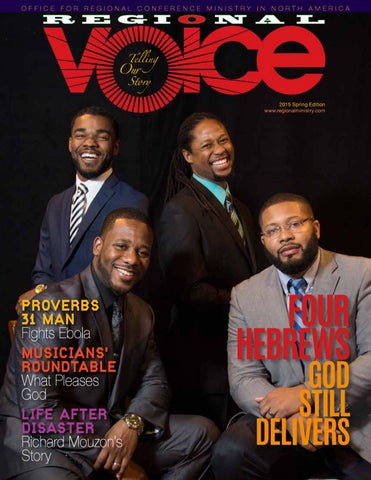
PROVERBS 31 MAN Fights Ebola MUSICIANS'’ ROUNDTABLE What Pleases God LIFE AFTER DISASTER Richard Mouzon’s Story
FOUR HEBREWS
GOD STILL DELIVERS
A is for Advanced! Read the magazine that tells our story.
Subscribe Today! O f f i c e f O r r e g i O n a l c O n f e r e n c e Mini s t r y in n O r t h a M e ri c a
OFFICE FOR REGIONAL CONFERENCE MINISTRY IN NORTH A MERIC A
R E G I O N A L
R E G I O N A L Telling
Our
Telling Our Story
Story
Telling
Our
FALL 2011 • www.regionALvoice.com
Story
www.regionalministry.org/
Regional Conference Treasurers
2014 Fall Edition
Subscriber Information form:
Your New Year’s Resolution for 2015 – and beyond: Become one of the first Regional Voice Magazine subscribers today—Pay only $9.95 today, for the 2015 annual PELC/Fall, Camp Meeting/Summer, and all Special Issues
– and have them delivered directly to your personal mailbox! Please Print:
Name ___________________________________________________________ Address____________________________________________________________________ City__________________________ State/Province/Territory ____________ Zip+4 _______________ - _________ Enclose Check Or Money Orders; please, send no cash. Mail your contact information form and 2015 payment to:
The Regional Voice Magazine
Office For Regional Conference Ministry 7000 Adventist Boulevard Huntsville, AL 35896 Thank you for becoming an early-bird subscriber!
FEATURE
A TRIBUTE TO HELEN HARRIS TURNER
FORDHAM
FINDING THE PATH TO TOTAL FULFILLMENT
SPECIAL FINANCIAL ISSUE
“Bring all the tithe into the storehouse...” How your funds are handled Are you unemployed? Crushed by debt? Look inside for real answers Economist Henry Felder offers revealing analysis
FEATURE
OAKWOOD ACADEMY STOCK MARKET WHIZ KIDS
MILLET
THE RESPONSIBLE EXECUTOR
t
EDITORIAL
Published by the Office for Regional Conference Ministry in the North American Division of Seventh-day Adventists 7000 Adventist Boulevard Huntsville, Alabama 35896 Telephone (256) 830-5002 www.regionalministry.org JAMES L. LEWIS PUBLISHER KYNA HINSON EDITOR TIM ALLSTON MANAGING EDITOR HOWARD I. BULLARD ART DIRECTOR/DESIGNER CLARISE J. NIXON COPY EDITOR CONSULTANTS PHYLLIS WARE LEE, ELAINE ALLSTON EDITORIAL For all correspondence and letters to the editors, write: Office for Regional Conference Ministry 7000 Adventist Boulevard Huntsville, Alabama 35896 or fax to (256) 830-5078 We reserve the right to publish and edit your submissions and letters. REGIONAL CONFERENCE OFFICES Allegheny East Conference HENRY J. FORDHAM III, PRESIDENT LaTasha Hewitt, Communications Director P.O. Box 266 Pine Forge, PA 19548 (610) 326-4610. www.myalleghenyeast.org Allegheny West Conference WILLIAM COX, PRESIDENT Bryant Taylor, Communications Director 1339 E. Broad Street Columbus, OH 43205 (614) 252-5271. www.awconf.org Central States Conference MAURICE R. VALENTINE II, PRESIDENT Philip Baptiste, Communications Director 3301 Parallel Parkway, Kansas City, KS 66104 (913) 371-1071. www.central-states.org Lake Region Conference JEROME L. DAVIS, PRESIDENT John Sconiers, Communications Director 8517 South State Street Chicago, IL 60619 (773) 846-2661. www.lakeregionsda.org Northeastern Conference DANIEL LAMARTINE HONORÉ, PRESIDENT JeNean Johnson, Communications Director 115-50 Merrick Blvd. Jamaica, NY 11434 (718) 291-8006. www.northeastern.org North Pacific Union Conference ALPHONSO MCCARTHY, VICE PRESIDENT 5709 N. 20th Street Ridgefield, WA 98642 (360) 857-7000. www.npuc.org Pacific Union Conference BOBBY MITCHELL, DIRECTOR African American Ministries 2686 Townsgate Road Westlake Village, CA 91361 (805) 413-7100. www.puconline.org South Atlantic Conference WILLIAM L. WINSTON, PRESIDENT James K. Lamb, Interim Communications Director 294 Hamilton E. Holmes Drive, NW Atlanta, GA 30318 (404) 792-0535. www.southatlantic.org South Central Conference DANA C. EDMOND, PRESIDENT Marvin Allison, Communications Director 715 Youngs Lane Nashville, TN 37207 (615) 226-6500. www.scc-adventist.org Southeastern Conference HUBERT J. MOREL JR., PRESIDENT Robert Henley, Jr., Communications Director 1701 Robie Avenue Mt. Dora, FL 32757 (352) 735-3142. www.secsda.org Southwest Region Conference SAMUEL L. GREEN, PRESIDENT Kenn Dixon, Communications Director 2215 Lanark Avenue Dallas, TX 75203 (214) 943-4491. www.southwestregion. adventistchurchconnect.org
To Our Readers—
W
elcome to the pages of our first-ever Regional Voice Magazine for Spring, our issue on God’s Deliverance! Our publisher, the Office for Regional Conference Ministry, made the crucial decision to allow this expansion to three issues for 2015. Their instincts were correct and timely. This edition is filled to the brim with news from various Regional Conferences and enterprises, along with contributions from across North America and around the globe. There is so much to share—we could not contain it all in our coming Summer edition for General Conference 2015. If you’d like to have our copies come right to your door, fill in one of our Subscription forms in this very issue! Over the years, you may have come to recognize our many “Daniels and Danielles,” a wide array of individuals committed to God and the Adventist Church, while working and contributing in the secular arena. Well this time, our Cover Story captures the saga of “Four Hebrews” among us. These young men faced considerable challenges to Sabbath observance from their employer, a huge media corporation—yet their steadfast faith, (and let’s not forget this part) excellent work ethics, prevailed to change those corporate policies. In this issue we also take up the second part of Dr. Calvin Rock’s presentation that we began in our Fall 2014 edition. His powerful premise concludes with strong reasoning for Regional Conferences in the Seventh-day Adventist Church—why they are needed to such a great extent, and why these institutions make a life-or-death difference for so many. Now if you want to have some fun, gather with us and some favorite, masterful Black Adventist musicians, and listen as they share insights, highlights, love of worship and praise in a wonderful roundtable discussion on music. This one rings with celebration! Our Proverbs 31 Man, Josiah Mamora, has challenged death in his work—and won. Then, take a look at Dr. Richard Mouzon. His testimony continues our Hope Series, and his life certainly does attest to God’s watch care and deliverance. We also celebrate the lives of some we’ve lost—one of our own young contributors, Temar Ellis. And we stand with the brave mother of shooting victim Trayvon Martin, who God has moved beyond bitterness to advocacy for young people. Now that’s deliverance. t
Kyna Hinson Editor
2015 Spring Edition | Regional Voice Magazine
3
Spring 2015 Edition www.regionalministry.com
CONTENTS
FEATURES 8
8
REGIONAL CONFERENCES— TOUTED AND DOUBTED:
THE NEED FOR BLACK THEOLOGICAL ENDEAVOR Part 2
14
What we urgently need are scholars who can free us from chains of social pessimism . . . scholars who will counter the portrayals of our Lord as a passive bystander to Roman oppression, the Apostle Paul as advising obedient suffering under the atrocities of government and Ellen White as the cautious seer of a “Better way.”
By Calvin B. Rock
14
MODERN-DAY DELIVERANCE
FOUR CONTEMPORARY “HEBREWS” HONOR GOD, AND HE HONORS THEM By Nadya Scott
COVER:
Front row, left to right: Jonathan Cantrell and Alexander Wade. Back row, left to right: James Bloodsaw and David Duggins.
4 Regional Voice Magazine | 2015 Spring Edition
Four Hebrews – God Still Delivers PHOTOGRAPHY BY KEITH RUSH
22 22
WHAT MUSIC PLEASES GOD’S EARS? Take an eclectic mix of gifted musicians, bring them to your Sabbath dinner table, and prepare yourself for a wonderful feast of concepts—across the spectrum!
30
Roundtable Coordinated By Patrice Thomas Conwell
30
PROVERBS 31 MAN
BRING THEM BACK FROM THE EDGE Ebola fighter, Josiah Mamora, Intensive Care Unit nurse, battles this killer disease and saves lives.
33
By Tim Allston
32
REGIONAL NEWS Learn all about the recent Allegheny East Conference Town Meeting that was webcast.
34
By LaTasha Hewitt.
33
FAREWELL Regional Voice pays tribute to gifted writer, Temar Ellis.
By Jyremy Reid
34
DELIVER US FROM APATHY AND BITTERNESS. . . Sybrina Fulton, the mother of fallen young man Trayvon Martin, brings her mission to the Oakwood University Church.
By Jennifer Miller and Tyler Roberts
35
IT’S ON!
Northeastern Conference’s Camp Victory Lake takes on a major renovation campaign.
36
HOPE SERIES
DELIVERANCE AFTER DISASTER Richard R. Mouzon has a story to tell. He has experienced God’s deliverance, personally! 2015 Spring Edition | Regional Voice Magazine
5
Y Coming From Pacific Press in
2015!
Contact Us Office of Strategy, Research, and Assessment
North American Division General Conference of Seventh-day Adventist 12501 Old Columbia Pike Silver Spring, MD 20904 (301) 680-6407 www.ReachNAD.org 6 Regional Voice Magazine | 2015 Spring Edition
Y Y
Finally!
YY YY YYY Something practical that YOU can use in YOUR church!!
Pastor tested
Researchbased
Loaded with real-life applications
Grounded in inspired writings
For churches large and small
Access to downloadable resources
A “must� for every local church officer
2015 Spring Edition | Regional Voice Magazine
7
t
FEATURE
REGIONAL CONFERENCES-TOUTED AND DOUBTED:
PART 2
t
BLACK THEOLOGICAL ENDEAVOR t
THE NEED FOR
BY CALVIN B. ROCK
8 Regional Voice Magazine | 2015 Spring Edition
t PRESENTATION OVERVIEW
When presenting the first installment which ran in our Fall 2014 issue, Dr. Rock began Day 1 with these words:
G
ood morning ladies and gentlemen, and thank you for the kind introduction. Thank you, Religion Faculty, for the honor of participation in this forum.” “I will attempt to focus the issue that I have been asked to address by first of all, today, identifying Black theology as having unique potential for examining the issues and answering the questions swirling around the continued existence of regional conferences.” He went on to set the stage for his final presentation the following day: “Secondly, tomorrow morning, I will identify several specific areas of Seventhday Adventist theology that I believe, require this unique perspective not only as a means of justification for regional conferences but for appropriate social attitudes and arrangements more generally within our Editor’s Note: This article is an excerpt from the last of two presentations Dr. Rock delivered at a forum at Oakwood University in April 2014. as promised in our previous issue from Fall 2014.
denomination; and I will make some recommendations for action moving forward.” We ended the first installment with these stunning statistics and imagery: From the time of the Quakers who first brought the slaves the liberating news of the true God, to the Abolitionists, whose efforts cracked open the foundations of slavery, to the marchers and martyrs who served in the Civil Rights movement, concerned White citizenry, then and even now, continue to sacrificially assist Black Americans in their progress. However, these contributions, as noble as they have been and are, have not prevented America from developing a sociality that is decidedly negative to the Black community. Reinhold Niebhur, was right when he assessed our landscape to be one of, “moral man but immoral society.” • And it is immoral, is it not, that Blacks, as a rule, are the last ones hired and the first ones fired; • It is immoral for certain states to suppress Black voting by devices as redistricting, demanding identification that older Blacks are less likely to have, by shrinking voting hours and lengthening voting doc-
She remarked that we were not supposed to do that; we are not supposed to fight. “But I wasn’ t fighting,” I said. I was marching and singing.”
2015 Spring Edition | Regional Voice Magazine
9
and membership’s failure to identify, justify and activate unique ways of making these happen. Could it be that the energies and reasoning that gave us the highly successful separate “regional retirement plan,” might also, if properly focused, create a specialized mechanism for protecting and inspiring our youth?
uments and eliminating colleges and university campuses as polling sites. • It is immoral for White America, still profiting from the ill-gotten gains of slavery and beyond, to shut down government programs that benefit the poor, while at the same time providing
q 4 percent of the lawyers, and q 1.8 percent of the engineers, and q A percentage of the physicists, paleontologists, chemists, and other natural scientists, either non-existent or too miniscule to compute. And such practical consequenc-
egional conference directors having been born and reared in the midst of these harsh realities, are uniquely prepared to lead boldly in such endeavors; Black theologians, in tandem with scholars from all the other disciplines, particularly history, and the other social sciences, are uniquely equipped to provide the theological justification for their doing so.
R
We are now, over half a century later, little advanced from that attitude, if at all. Why? Because our sociology is derived from our theology and our theology, highly Eurocentric and lightly influenced by perspectives of the oppressed, is today, just as it was then, sadly lacking in categories of social liberation. failed corporate executives millions of dollars to just go away! • It is immoral for city police to arrest young Black males and charge them with crimes they did not commit, knowing that if they “confess,” the judge will give them seven years, and if no—the jury will assign them twenty. • It is immoral that when more than 80 percent of White America has health insurance, and approximately 40 percent of Black America does, that the larger body of congress rebuffs the president’s or any efforts, for that matter, to rectify the situation. • It is immoral for White Americans, with a 300-year head start in legal privilege and wealth accumulation, to roll back Affirmative action acutely aware that Black Americans constitute q 13 percent of the population but [only]2.3 percent of the doctors; q 2.6 percent of the dentists;
es exist for circumstances within our church operations as well. I am not speaking of who holds what job at what level of church authority or of how much integration is being effected in local congregations, I am speaking of what is happening to our beautiful Black boys and girls who are being caught up in addictions, shot down on playgrounds, and street corners, lured out into the destructive vices of city life, a larger percentage of whom who might be saved—If only we had adequate facilities, and programs. f only we had more church schools and youth pastors and counselors available to them! (Emphasis supplied.) Here we resume this rich, thoughtprovoking treatise, in the final installment: That there are not, is a consequence, in my opinion, of Black leadership’s
I
10 Regional Voice Magazine | 2015 Spring Edition
What then, to be specific, are the categories of action suggested by these challenges? The first is continued modified self-determination that is, the ability to function as necessary with specified forms and procedures that differ from the church’s standard practices and policies. Black Americans cannot trust White, or any other historians and theologians to adequately decipher and design their vision and vehicles for progress. They must, themselves, take up the task of self identification, self affirmation and, as circumstances demand, self determination. The second primary action category is direct address to the economic, and physical deprivation that grips so many of our communities. The challenge that we face in this latter regard is Adventist theology’s discouragement of social activism. We are appropriately strong in the matter of treatment and
t
FEATURE
cure but weak to non-existent in the area of prevention or address to the systems that perpetuate social evil. Kenneth Wood, influential editor (1962-1983) of what was then the Adventist Review and Herald, gave clear expression to this mindset in commenting on his observations at the November 22 to December 10, 1975 session of the World Council of Churches in Nairobi, Kenya. His statement was: “...I could not approve of much that happened at Nairobi. I felt sad to see strong churches commit their resources and energies to programs that Christ never assigned to His church. In my opinion, millions of people will die un-evangelized and unsaved because the WCC and its member churches have been diverted from their true mission....However sincere they may be, they do no favor to the lost world by offering them the stones of political freedom, economic prosperity, or racial freedom, when they hunger for the Bread of Life.” I was made conscious of the effect of this philosophy as a 24-year-old pastor in Orlando Florida. It was a challenging and exciting time, the nation was in the process of dismantling “Separate but Equal” and the Civil Rights movement was gaining steam throughout the South. I thought it right and in fact honorable, to participate. To my surprise, however, I caused a mild up-set among the members when I hosted the Black ministerial coalition of the city in the conduct of one of our regular Tuesday night protest planning sessions in our facility. Such efforts, they believed were not consistent with the church’s mission. A second very similar lesson came some 10 years later in the middle 1960s during our pastorate in Detroit, when on one week day afternoon the church clerk, a deeply committed Christian woman, called and said, “Pastor would you like to hear something funny? “ ‘Why, yes,’ I said, never suspecting what would follow.”
“Someone,” she continued “said that they saw you on television marching with the protesters around the General Motors building down on Woodward Avenue.” “Would you like to hear something funny?” I asked. “Why, yes,” she responded. “Well,” I answered, “It was I!” She gasped in utter disbelief and remarked that we were not supposed to do that; we are not supposed to fight . “But I wasn’t fighting,” I said. “I was marching and singing.” e are now, over half a century later, little advanced from that attitude, if at all. Why? Because our sociology is derived from our theology and our theology, highly Eurocentric and lightly influenced by perspectives of the oppressed, is today, just as it was then, sadly lacking in categories of social liberation. The theology taught in our various devotional books, and our Sabbath school study guides, that is printed in our publications and preached from our pulpits, the theology that allows our members, White and Black, comfort in responding to crises with ADRA-like endeavors, supplying needed tourniquets to bleeding victims of injustice while saying and doing nothing about the systems that perpetuate their sufferings; and, it should be added, the theology that allows Black SDA’s guiltless enjoyment of the social and political advances gained by the sacrifices of others, Black and White, with little or no participation in efforts to acquire or sustain them-that theology—should not go uncorrected! The very fact that the vast majority of White SDAs are devoutly Republican and the vast number of Black SDA’s dedicated Democrats reflects the difference in the ways we view the socio-political circumstances of society. The fact that Black SDAs view social issues differently but are bound to standard SDA ethics (a natural con-
W
sequence of White theology) for solving them, is a major problem. It cannot be forgotten that the advantaged, even the Christian kind, rarely, if ever, prescribe and pass on to the disadvantaged strategies for their social freedom. They must be identified by the minority and then intentionally and vigorously pursued. What we urgently need are scholars who can free us from these chains of social pessimism, scholars who understand Du Bois’ concept of the duality or “twoness” of African American citizenship, scholars who will counter the portrayals of our Lord as a passive bystander to Roman oppression, the Apostle Paul as advising obedient suffering under the atrocities of government and Ellen White as the cautious seer of a “Better way” which has indeed come but which, given the socioeconomic conditions in most Black communities, leaves us far from parity. Such a construct will not only speak eloquently regarding the role of regional conferences, but as expressed above, it will illumine the whole range of our social responsibilities within and without the church. I am certain that there are other pertinent reasons to justify the call for Black theological endeavor. My hope is that this presentation and the one tomorrow will precipitate their mention and help focus and spark the efforts of those truly qualified to move forward in this essential endeavor. Thank you very much. t _______________________ Calvin B. Rock, D.Min., Ph.D., Seventh-day Adventist church leader, administrator and educator, frequently discusses a range of ethical issues. His service has ranged from beloved local pastor to respected church administrator, college president, university board chairman, General Conference vice president, and scholar.
2015 Spring Edition | Regional Voice Magazine
11
Fast. Flexible. Affordable. Busy adults CAN complete a degree! It’s not too late to finish strong. Oakwood’s Adult Degree Completion Program promises an opportunity to complete a bachelor’s degree in approximately 18 months. On us p Camor e Onlin
Oakwood University
Adult Degree Completion Program
12 Regional Voice Magazine |
(256) 726-7098 www.oakwood.edu/leap 2015 Spring Edition
Oakwood University • 7000 Adventist Blvd., NW • Huntsville, AL 35896
t
FEATURE
NEB
N The Four Hebrews. Back row left to right: James Bloodsaw and David Duggins. Front row left to right: Jonathan Cantrell and Alexander Wade.
14 Regional Voice Magazine | 2015 Spring Edition
DELI VERANCE FROM:
BUCHADNEZZAR CRACKING THE CORPORATE GLASS CEILING: FOUR SEVENTH-DAY ADVENTIST MEN CHANGE WORK POLICY BY CLINGING TO THEIR BELIEFS
“
B Y N A D YA S C O T T
“
N
Nebuchadnezzar: “Lo, I see four men loose, walking in the midst of the fire, and they have no hurt, . . .” Daniel 3:25 Many American workers may face compromising their religious beliefs in order to keep their jobs or to advance to higher positions. Seventh-day Adventist workers, in particular, often encounter times where they are asked to compromise their beliefs by working on the Sabbath. Sometimes these workers succumb to their employers’ requests and choose to discard their beliefs for paychecks or advancement opportunities. Others choose to trust God and choose not to compromise. Four young, Seventh-day Adventist men faced with this dilemma took a stand for their beliefs. These modern-day “Hebrew boys” were thrown into a “fiery furnace” with their beliefs tested time and time again; they were denied top positions because of their observance of the Sabbath. Jonathan Cantrell, Alexander Wade, James Bloodsaw and David Duggins all work for one of the largest satellite-TV providers in the nation. These four young, African-American males were asked to compromise their belief of keeping the Sabbath while attempting to advance to top positions in the company. The company had a policy at that time that kept Sabbath-keepers from being able to move past a certain position.
THESE MODERN-DAY HEBREW BOYS WERE THROWN INTO A FIERY FURNACE WITH THEIR BELIEFS TESTED TIME AND TIME AGAIN.
David Duggins was working in a position that was 2nd to the supervisor in the Quality Department and experienced no Sabbath scheduling conflicts. He later applied for a Team Leader position and that was when he was asked to compromise his religious beliefs. He knew that a lot of Seventh-day Adventists that worked for the company never moved up to Team Leader positions. Still he applied. During his second interview, Duggins was asked about his availability. He was direct with his interviewer, saying, “I’m Seventh-day Adventist. From sunset Friday to sunset on the Sabbath, I will not work.” His interview went well, and he got great feedback. However, he didn’t get the position. A Senior Manager told him, “We are creating 2015 Spring Edition | Regional Voice Magazine
15
a policy that will allow us to accommodate Team Leaders who hold Seventh-day Adventist beliefs.” Duggins’ stand against working on the Sabbath created the opportunity for this policy to be created. onathan Cantrell has worked for this company for 8 and a half years. He was working in the Coaching and Training Department for 7 and a half years before seeking an advanced position. He says, “I was never required to work on Sabbath, but in terms of advancement, I was never able to move up.” He applied for a supervisor position seven times. The last three times he applied, Human Resources told him they’d lost his application. Someone finally told him, “The reason they’re overlooking your application, is because you’re Seventh-day Adventist. You’re not available to work at anytime. Even though you may have the qualifications, we still won’t hire you because they’re so many other people here who are willing to work anytime and would love to have the position.” One supervisor chose to help him. The supervisor approached Cantrell and told him, “I’m going to get you to the next level.” Five months later, Cantrell moved up two positions. He enthusiastically declares, “God may not come when you want Him to, but you can always count on Him to come through for you.” His favorite verse that helped him during his test was Proverbs 3:5-6: ‘Trust in the Lord with all your heart and lean not on your own understanding. Acknowledge Him in all your ways, and He will direct your paths.” He admonishes those who hear his testimony to, “hold tight, take God at His word and watch Him work.” Alexander Wade has been working at the company for a year and a half. He came from another company and was direct when the question of his availability came up in the interview. He told his interviewers, “look, I’m a Seventhday Adventist; I do not work from sundown Friday to sundown Saturday. I need a schedule that would accommodate
J
16 Regional Voice Magazine | 2015 Spring Edition
that.” He also specified the salary he wanted and told them he’d be happy to work for them if those needs were met. A week or so later, he called the Human Resources department and was told they were really impressed with his interview. They then told him that there was a policy in place that those in leadership positions have to be available 7 days a week. Wade says, “They were so impressed with my interview, that the Human Resources manager told me that they were voting on whether or not to change that policy.” James Bloodsaw also works as a top agent for the company. He has seen many changes to company policy to accommodate Seventh-day Adventist workers. Before those changes were made he was told that he’d have to work on the Sabbath. Bloodsaw confidently said, “I will not.” Another shift opened up when a manager left the company and Bloodsaw was offered that position. He was not required to work during Sabbath hours in his new position. He says, “God has shown all of us that He will take care of us.” ll the young men’s stories are connected. Because they were unwilling to work on the Sabbath, a national company chose to change their policy. They changed the mind of such a large company because of their unwavering faith in God and by standing fast to their beliefs. Duggins declares, “It’s a blessing and testimony that by us standing for our beliefs, we were able to move that mountain. t” __________________________________________
A
Nadya Scott is an Oakwood University senior Communication major, veteran radio announcer, and intern for special projects with Managing Editor Tim Allston.
“
t
FEATURE
ALL THE YOUNG MEN'S STORIES ARE CONNECTED BECAUSE THEY WERE UNWILLING TO WORK ON THE SABBATH, A NATIONAL COMPANY CHOSE TO CHANGE THEIR POLICY.
“
2015 Spring Edition | Regional Voice Magazine
17
18 Regional Voice Magazine | 2015 Spring Edition
2015 Spring Edition | Regional Voice Magazine
19
By Drs. Claudio and Pamela Consuegra Help! I’m a Parent will inspire and encourage parents, grandparents, and caregivers as they journey toward becoming disciple-makers of their children. It addresses common challenges experienced when raising children from birth through age seven. This resource is ideal for use individually, as a couple, or in a small group. The complete set includes two participant books, two-DVD set, facilitator’s guide for small groups, and lapel pin. Facilitator’s Boxed Set
#351763
$69.95
Also Available in Spanish
Drs. Claudio & Pamela Consuegra NAD Family Ministries Hosts
Drs. Leslie & Prudence Pollard Oakwood University Topic: Relationships & Rivalry
Mike & Gail Tucker Faith for Today Topic: Firm Foundation
Additional Presenters: Dr. Christine & Pastor Kevin Bryne Dr. Rose Gamblin Dr. Katia Reinert Dr. Cesar & Carolann DeLeon Dr. John & Janice Mathews Edwin Neely & Carolann DeLeon Scan to watch a video or go to https://vimeo.com/86716931
Dr. Sung Kwon Adventist Community Services Topic: Sharing & Service
Available from AdventSource at www.AdventSource.org or 402.486.8800. For more information visit www.HelpImAParent.org.
20 Regional Voice Magazine | 2015 Spring Edition
FIVE EASY LESSONS ON SHARING The first place your child will learn to share with others is in the home. The reality is that sharing is a choice a child will need to make. They may choose to share a toy with their brother or sister, part of their candy bar, or a turn in a game. Sharing does not always come naturally. It is natural for a small child to tightly hold onto that beloved doll, stuffed animal, or toy truck to protect the few belongings they have. MAKE SURE YOUR CHILD HAS PLAY DATES Children who have no siblings or limited contact with other children tend to have more trouble learning to share. When it comes to sharing, practice makes perfect. Play dates are an opportunity for your child to put their sharing skills to the test. HELP YOUR CHILD LEARN TO NEGOTIATE Young children do better with hands-on examples. It’s much clearer to say, “You’ve had that ball a long time. Kevin’s been waiting. It’s time for his turn now.” Then, follow through. When Kevin is finished with the ball, point out, “Look, he’s finished. You can have it back now.” The lesson learned is twofold: “Kevin has feelings like yours, and what belongs to you will ultimately be returned.” In this way we help our children learn to negotiate by showing them how it’s done. HELP YOUR CHILD WITH SHARING A toddler’s anguish can be particularly acute if playmates touch their most precious things, like the bear she sleeps with or something that’s special because it’s new. Keep these treasures out of sight or tuck them away before others come over to play. CONTROL THE “GRABBIES” Put your young child’s feelings into words for him. For example, say, “I understand that you want that toy right now. But Jessica wants it too. You can have a turn when she’s finished.” Help them learn to use words instead of grabbing to convey their feelings to other children. SHARING, OF COURSE, BEGINS WITH YOU Share with your spouse or other household members in front of your child. Use sharing words often in the home. Point out when others share, and teach your toddler to thank children who share their things with them. And don’t forget to praise your own child when they are sharing. Appropriate praise will reinforce the behavior you are trying to teach. Soon sharing will just be a part of normal play. *Excerpts adapted from Help! I’m a Parent 2015 Spring Edition | Regional Voice Magazine
21
t
FEATURE
David Thomas
Victoria J. Miller
Wayne Bucknor
WHAT
MUSIC
PLEASES GOD'S EARS? Musicians Share Their Thoughts
F
or years debates have raged around Sabbath potluck dinner tables and den couches on what genre or style of music pleases God. Whether in personal worship or church worship, whether for praise or prayer, most people offer passionate opinions with “proof” from Bible and Spirit of Prophecy writings. What is the state of Black music in our churches today? Have on-going debates brought any consensus? Or is the subject destined to languish in personal opinion? The Regional Voice virtually assembled an eclectic group of Christian musicians who bravely agreed to discuss their thoughts on this never-dying issue. The panelists: Gail (Hamilton) Masondo, former manager of Take 6 and co-executive producer of “Handel’s Messiah−A Soulful Celebration”; David Thomas, original and current member of Grammy-award winning vocal group Take 6; Dr. Wayne Bucknor, chair of the Music Department at Oakwood University; and Paula Sanders, founder
22 Regional Voice Magazine | 2015 Spring Edition
C
Paula Sanders
Gail Masondo
of United Christian Artists Association and Our Faith Channel; with “shout-ins” from Gayle Jones Murphy, ???; Dr. Cedric Dent, professor of Music at Middle Tennessee State University; and Victoria Joiner Miller, former general manager of Oakwood University’s WJOU Radio.
RV: Let’s jump right in. Pastor Rick Warren, in his book Purpose Driven Life, posited, “There is no such thing as Christian music; there are only Christian lyrics. It is the words that make the song, not the tune, . . .” (p. 66). How is that an accurate or inaccurate statement? David Thomas: I can see how one would assert that. I actually believe it to be an accurate statement. The instrumentation isn’t necessarily good or bad, spiritually speaking. Victoria J. Miller: [Yet] I disagree greatly. I know many instrumentalists, in various genres, who dedicate their original pieces to the worship of the Most High. I have seen some extremely powerful instrumental pieces that were clearly spiritual and absolutely beautiful. Wayne Bucknor: I think that the statement is mostly accurate. Lyrics are definitely influential and great music is a wonderful avenue to spread the gospel message. Ellen White says, “There are few means more effective for fixing [God’s] words in the memory than repeating them in song. And such song has wonderful power… The value of song as a means of education should never be lost sight of. . .” Education, pgs. 167-168 Paula Sanders: While I see Pastor Warren’s point I think music is not only a combination of words to a melody but they are movements from the songwriter given by God. Since the beginning of gospel music it has always had a unique reach. No other music touches the heart and soul. So while I
G Jones Murphy
Cedric Dent
think the lyrics are important I disagree that is only about the words. Gail Masondo: For him it may be accurate. In the contemporary Christian music world, there are so many styles. There is the jazz, there is the R&B, there is the pop, and there is the rock style that is used to express the gospel. So I don’t want to look at it from a right or wrong perspective. This is just his experience. I believe there is Christian music, there is a Christian melody; there is something that makes you recognize, wait a minute−this music is different; this is a call to order, this is a call to worship, this is a call to pray. I was not born a Seventhday Christian; I grew up in the AME church, with the hand-clapping, soul-stirring gospel music, but I also head the hymn and the anthem. So I don’t if I want to say that he’s inaccurate making a statement like that; I think he’s speaking from his personal world view. I’m fortunate that my world view may be just a bit larger because of the world I grew up in, it wasn’t limited. RV: Is there a difference between “church”/ ”religious”/”sacred” music? Wayne Bucknor: In my opinion, no. However, the understanding of the meaning of these words is going to influence how one would categorize any song. What does “church” mean? One may want to consult their church manual for guidance for their particular church, although I feel that the SDA manual is biased to a certain culture. I do realize that the word “sacred” in the past has referred to music that is older, more classical and Western European in style. “Church” music is carefully selected to avoid the appearance of secular influences. This is difficult to do because music of all ages and styles has been used in and out of the church from Handel to Kirk Franklin. Handel and other composers, commonly used exact musical statements from his secular operas in his sa2015 Spring Edition | Regional Voice Magazine
23
t
FEATURE
cred oratorios. I understand the term “religious” to refer to any music that contains Christian lyrics. But my answer again is no. Victoria J. Miller: I believe there is a definite difference. Sacred music denotes music that is directed heavenward. It is to be an expression of worship to our Heavenly Father. Not about performance. I believe there are wonderful musicians who produce terrific music that is a part of Christian living and can be considered religious music but should not be considered always appropriate for worship. David Thomas: And I would agree, in the sense that most people know the difference semantically. Sacred music, for instance, is a term used for music that is used to invoke a spiritually meditative state. Some people might take “church” music to mean praise and worship, which is music designed to uplift, and energize spiritually. Again, I would qualify my statement by recognizing, while definite genres exist, to most, it’s subjective. Paula Sanders: There is some music that is considered religious music that I do not feel might be appropriate to be sung in the sanctuary or classified as sacred. There are some songs that have clean lyrics, and a wholesome message but aren’t sacred just religious. Gail Masondo: I haven’t been to a concert in a long time, but when I was growing up, there would be the “sacred” section and the “secular” section. The first part would be more classical, upper brow, and the second part would be more folk. But they would distinguish what was sacred and what was secular, and there was the intermission in between. Here in Africa, the same song that is sung at a funeral, can also be sung at a wedding, can also be sung at a baby’s blessing, can also be sung at a church service as a congregational hymn. There is a difference.
RV: What does the Bible say about music that pleases God? David Thomas: I don’t know of any reference in the Bible that specifically speaks of “music that pleases God.” Wayne Bucknor: But here are some scriptures that help to guide our thought. The style doesn’t seem to matter as long as you are glorifying God. hilippians 4:8 Finally, brothers and sisters, whatever is true, whatever is noble, whatever is right, whatever is pure, whatever is lovely, whatever is admirable—if anything is excellent or praiseworthy--think about such things. Psalms 150 tells us to use musical instruments to praise God Colossians 3:16 Let the word of Christ richly dwell within you, with all wisdom teaching and admonishing one another with psalms and hymns and spiritual songs, singing with thankfulness in your hearts to God. 2 Chronicles 5:13, 14…in unison when the trumpeters and the singers were to make themselves heard with one voice to praise and to glorify the LORD, and when they lifted up their voice accompanied by trumpets and cymbals and instruments of music, and when they praised the LORD saying,”He indeed is good for His lovingkindness is everlasting,” then the house, the house of the LORD, was filled with a cloud, 14so that the priests could not stand to minister because of the cloud, for the glory of the LORD filled the house of God. Gail Masondo: I don’t know; but I know the verse I love is Zephaniah 3:16 & 17 where God is saying I will rejoice over you with singing. In my mind I hear God saying that. The word “rejoice” in the Hebrew concordance is a very action word. So God is so excited, He’s singing and celebrating. He’s rejoicing. So I’m thinking that the thing that really pleases
P
24 Regional Voice Magazine | 2015 Spring Edition
Him is when we rejoice; when we’re praising Him. He adores praise. So I think that if we took a page from His example, that might be it. And I love trying to figure out what God’s voice sounds like. Is it a deep bass? There’s another verse where he actually whistles over Israel, and that’s so animated. Look at the 24 elders who are singing; they’re not being made to sing, they’re not being wound up to sing; they just can’t help it. They’re in His presence and they adore Him. If God rejoices over me, I think he’d want the same thing from me. I don’t think we really understand what kind of spiritual warfare we’re really in. In 2 Chronicles, He’s talking to Jehosaphat whose stressing about this great army that’s coming, and God tells him to get the singers together; appoint singers and let them go before your army. Their voices in singing will bring down certain walls in warfare. That’s really powerful, if we understood how significant spiritual music is able to do. When they’re walking around Jericho blowing trumpets, that’s not quiet. They were loud. The Bible talks about different instruments like tambourines that Miriam beat on after they crossed the Red Sea, and those tambourines are praise to God. RV: If the Bible says “to be in the world but not of the world” how does that relate to worldly music styles used for Christian music? i.e. Jazz, rock, R&B, classical, rap, etc. Paula Sanders: I think we should always guard our minds against the devil. However, I don’t think all music is evil or cause evil. But it can cause a mind to do things if the person isn’t connected to Christ. So I don’t agree that just because it’s not Christian music it’s bad. Wayne Bucknor: Too much emphasis is placed on style. A classical song can be changed into a different style but simply altering a straight twoeighth rhythm into a ‘cool’ swing rhythm by making one eighth note
slightly longer than the other. Is that now worldly, in terms of being negative? I don’t think so. But, I also believe that one should be careful of the associations that the music might bring if direct interpolations of lewd, secular songs are used with Christian lyrics. In other words, shy away from using direct, recognizable secular songs with Christian lyrics that could distract the listener into another place besides worship. Most worshipers will not have a problem with singing the popular verse, “May the good Lord bless you, may the good Lord bless you,” commonly sung to the secular song “Happy Birthday.” But if you put Christian lyrics to a popular ‘one night stand’ song, that would not be a wise choice. Cedric Dent: I have to shout-in here, because this is an intriguing, if not loaded, question because what is considered “worldly” music lies in the eye of the beholder. Church folk often confuse biblical principles with cultural preferences when distinguishing “church” music and “worldly” music. A case in point is the 1995 edition of the SDA Church Manual that states, “Any melody partaking of the nature of jazz, rock, or related hybrid forms… will be shunned by persons of true culture.” A careful examination of what is acceptable church music in the Adventist Church reveals that the term “true culture” is code for Euro-centrism. For while the church shuns the influence of jazz music, certain aspects of jazz are actually accepted and allowed in most white and black SDA church services. More specifically, jazz harmony, thought to be developed by white musicians, is readily welcomed in the church. However, elements associated with rhythm and the blues are just as fundamental to jazz yet, because they are viewed as Afro-centric, prove to be problematic. One only has to examine selections from the SDA Church hymnal to prove the point. The song “A Quiet
Place,” composed by Ralph Carmichael, is included in the church hymnal. Musically, it bears the same musical structure as songs from the Great American Songbook. I’m speaking of those “worldly” songs written by composers like Cole Porter, Irving Berlin (who penned “White Christmas,” the most recorded Christmas song of all time!), and George Gershwin to name a few. These songs were written primarily during the period 1924 to 1950 and most often comprised 32 measures of music that divided into four 8-measure units. Carmichael’s “A Quiet Place” closely follows this formula. Incidentally, Carmichael arranged and conducted Nat King Cole’s popular 1961 recording of “The Christmas Song,” which also exhibits the 32-bar song structure. What’s more, “A Quiet Place” uses harmony very much associated with the jazz tradition. But, other elements associated with the jazz tradition such as rhythmic syncopation, blues-influenced melody tones, and improvisation—those elements most associated with African American performance styles—are muted. am of the philosophy that there are characteristics and tendencies in African American music that are rooted in the African homeland, have survived the Middle Passage, and continue to inform African American music making. These characteristics include call-and-response devices, repetitive riffs and phrases (as in the case of vamps), blue notes, a metronomic beat that is commonly emphasized by percussion instruments, variety and distortion of vocal timbre, and other characteristics. And the term “true culture” signifies suppression of these musical (cultural) elements. So how does one “be in the world but not of the world” musically? By applying biblical principles that apply to all aspects of life including music and refraining from dictating cul-
I
tural mores. These principles include calling for virtue and praise-worthiness in our music as outlined in Phil 4:8. Other biblical principles include temperance, which is a fruit of the Spirit (Gal 5:23; 1 Cor 9:25), the balance of emotion and sound doctrine (John 4:23–24; 1 Cor 14:15, 33, 40), variety in types of songs (Eph 5:18– 19; Col 3:16), and tolerance (as expressed in 1 Cor 8:8–9). RV: Should the instruments used, and music styles, change to distinguish different types of worship services, i.e. Divine worship vs. AYS vs. Prayer meeting, etc., or should it not matter? Wayne Bucknor: Sure. But there is no certain prescription for what should be used. Liturgy is commonly known as ‘the work of the people.’ So this question in essence is referring to a mood that the people want to create in that particular worship service. I believe that many different moods are called upon in any worship service and most instruments and styles can be used to promote a balance that edifies the congregation and praises God. Certain sections of the liturgy (prayer, appeal) are more appropriate for certain instruments (strings, harp, less percussive instruments). Other sections (offering, a charge, or praise service) may require more percussive and brass elements. Psalms 150 is clear in its call for all musical instruments and I’ll throw in ‘styles’ to praise God. I think that balance and temperance is a biblical theme and ministers of music should attempt to achieve that in every service. I believe that when the bible speaks of psalms, hymns, and spiritual songs being employed, that could refer to different styles as well. David Thomas: I think it depends on the pastor’s and/or the congregation’s preference. As a rule of thumb, I think problems arise anytime we try to “legislate” preference. Paula Sanders: It shouldn’t matter in my opinion. I think most churches
2015 Spring Edition | Regional Voice Magazine
25
t
FEATURE
that have bands have them for all services based primarily on the church budget. Gail Masondo: For me personally, the worship time is to adore God and thank Him for what he’s done through the week, or for that morning. The AYS is the opportunity to talk and sing about the Christian experience. I cut my teeth on Victory Lake camp when it comes to music. A lot of what I’ve learned was as a 13, 14, 15, 16-year old at junior camp for those six weeks. The Maplewood Chapel was my school of music. I never remember Pastor Gilbert Foster or Elder Leon Davis, or the other counselors saying, “This is appropriate for this, or this isn’t appropriate for this.” I think we sang our lungs out, from “I’m On the Battlefield for my Lord,” to “Give Me that Ole’ Time Religion,” to syncopation, where all of the voices and harmony was there, and there was foot-stompin’ and some clappin’. And then there would be church service, and we would still sing the same songs on Sabbath. They did a wonderful job of making us feel like we were free to sing. When we sang our grace, I know that that was an offering to God for breakfast, lunch and dinner, Monday through Friday. When I look back on how I was introduced to a lot of things, there was a lot of liberty and a lot of freedom. The constraints came later in life when people would say, “No, this isn’t appropriate for that.” And then when I was with Take 6, it was another whole dimension because the church wasn’t accepting our music. RV: Is it biblical to distinguish music styles by ethnicity or culture, or anything else other than sacred/religious/Christian? David Thomas: —No. Enough said! [Lol] RV: Is it biblical to use different music styles of Christian music for different purpose or audiences, or not? Paula Sanders: I don’t think the bi-
ble says we should have worship styles we created that term. But every church has to determine their music style that uplifts their entire membership not just one fraction of it. I think having all styles is the best way; it ministers to everyone. I think any church that creates a balance for all styles of music is the best path. David Thomas: According to the Bible, music was used to coordinate the movements of armies. It was also used in worship. I don’t know if “style” was specified. ail Masondo: Col 3:16 says, “Let the word of Christ dwell in you richly in all that you teach and admonish one another with all wisdom through psalms, hymns, and songs from the Spirit, singing to God with gratitude in your hearts. NIV. Now it’s interesting, the whole day of Sabbath is supposed to be divine, but we’ve taken that period from 11:00 to 12:30 and through tradition and the passage of time, we’ve deemed that the “divine” hour. So if that is the divine hour – and I’m talking from a denominational perspective—then I suppose that’s the time when we adore God and bring him that sacrifice of praise, which means that we put down our own ideas about what God would like or what I like and I’m asking the Holy Spirit, “What would the Father like to hear today?” And I’ve been in three services where that happened. The pastor got up and said, “Let’s just sing today,” and it blew me away. And then there are some services where you know the protocol—from the doxology to the end. And there’s nothing wrong with order; personally I wonder, particularly on the Sabbath, are we giving Him what he wants or are we giving Him what we want. And to be honest, when I’ve been asked to sing a solo or duet, I don’t think I’ve ever asked, “Is this what God wants me to sing?” It’s always, “Well the person told me that this is the message, so let me find a
G
26 Regional Voice Magazine | 2015 Spring Edition
song that’s the message, whether I’m singing before the sermon or after the sermon. I’m so concerned about getting the congregation’s approval instead of seeking God’s approval. And that’s what made David so special. The whole book of Psalms is worship music. It’s songs of celebration; songs of falling prostrate; songs of defend me; songs of hide me. So I think what happens in a congregation setting, there has to be a call to order. Paul was real good about, “Bring a song, bring a hymn, bring a prophecy. Don’t forsake coming together because in this coming together we encourage each other, and there’s strength in each other.” I’m not always sure that happens, but that’s the purpose of coming together. This goes back to Acts 1 where Jesus told the disciples to “wait” for the Holy Spirit. And I’m not so sure that we aren’t supposed to “wait” for the Holy Spirit to enter our services. And He told them to get on one accord— and that’s very interesting when you talk about music—there’s E, there’s C, there’s D notes, that become a chord. When played together, they make somewhat of a melody. So when we’re all on one accord, we bring to God a true blessing. So yes, I think there are appropriate songs for the congregation as we come together for the divine hour. Gail Masondo: We don’t have a beatitude that says this, but blessed are the flexible. When the song talks about all tongues and nations and people, Africa was Sabbath-keeping continent until the missionaries came. There’s a denomination here called the Zionese and they worship from midday Friday, all day Sabbath, and this is not new. I’ve been embarrassed by the prideful arrogance that Americans tend to have that what we do is better, which I’ve personally experienced. When I got to South Africa, I was asked if I would help them put together a project similar to “Soulful Celebration” to help celebrate the new South Africa. I let them know that I didn’t know anything
about South African music. I knew a couple of artists, and had worked with Ladysmith Black Mambazu with Take 6, and they were going to be one of the groups on this album. Now, they’ve been around a long time, they’re world-renowned and very respected; and when I went into the studio and they started to sing, I’m sitting in the booth and they’re doing a rendition of Amazing Grace their way. It’s very rural, very cultural, very traditional. But to my ear, they sounded like they were out of tune. And I say to the producer, “”Are they in tune?” I was trying to be respectful. And I ask if we could do another take. And they were kind enough to do another take. And there were other South African singers who were singing the background vocals and even they sounded out of tune. But it was me who was out of tune. My hearing was out of tune because it was trained from what I was used to at home. So a lot of times, when we don’t understand something, we’ll dismiss it as something that doesn’t work, as opposed to being open enough to say, “I don’t understand; teach me.” RV: What criticisms have you received regarding how you use/have used your musical gift and how do you respond from a biblical perspective? David Thomas: Take 6 was criticized
for the style of music we sing. It happens less and less these days. It really seems to be a generational perspective. There are two perspectives I respond from: First, 1 Cor 10—I used to be offended, when people would criticize us, then I had to take a step back, and realize that me “forcing” my perspective on anyone else was / is just as bad. I’m ok with the fact that what we do isn’t for everyone. Second, it’s MY duty to “do all to the glory of God”. ayne Bucknor: I’ve been told that gospel/contemporary music and the use of drums is influenced by the Sub-Saharan culture of Africa and is inappropriate for use in the liturgy because of the influences of voodoo and other evils. This view is tainted with racism, bigotry, and a lack of understanding of culture. Without being overly technical, differences in culture and background are clearly seen between races. Tibetan praise music is not going to sound like African-American praise music. When an individual from a Western culture listens to the way that a musician from India would tune their instrument it will be slightly offensive and the uninformed westerner may say that the instrument is out of tune, not realizing that the Indian’s scale is based on
W
many more notes than the westerner’s twelve. The true question is are we going to tolerate each other’s differences. The biblical answer can be found in 1 Corinthians 13 and all throughout the bible because God is LOVE. RV: Why is music such a volatile issue in our churches—then, and now? David Thomas: I think preferences, especially cultural preferences, always create volatility. Paula Sanders: And because we all think we are right. Every elder or minister of music will argue their way. The best arguments have been over music in our churches for years. We have demonized music and that isn’t the issue. We should have focused on creating a way to balance both the Hymns and gospel and finding common ground to include many instruments. Instead we are still fighting about clapping in church and having drums. Wayne Bucknor: Because of pride, intolerance and sin in general. It is affected by a person’s upbringing, culture, and experience. Some individual’s exposure to music has been very narrow while others are broad. Some are from a culture that occupies the minority racial group. Most of the recognized Protestant religions, such as the SDA church, have a heavily influenced European beginning and has been governed likewise, with little respect to the peoples and cultures that have become its members through time. Music is very powerful, and should be used ultimately to glorify God. Gail Masondo: A lot of the times we’re talking about personal preferences; our personal histories dictate what we gravitate to and what we feel comfortable with; whether that’s in your home or your car. But when we’re talking about a congregation coming together, or you buying a ticket to do to a concert, that’s a different thing. And we need to stop edifying ourselves and edify God. And that’s why we keep having this conversation. RV: Well, let’s focus the last ques-
2015 Spring Edition | Regional Voice Magazine
27
t
FEATURE
tion inside the black SDA church. In past times, musicians from other faiths have marveled at the sound of “black Adventist” singing. Questions have popped up like, “What is it about your meatless diet that makes y’all sing so good?” Former A&M choral director Dr. Henry Bradford was overheard once saying, it’s the lack of nicotine in our lungs! Is it the diet, or the mandatory day of rest—or what? Gale J. Murphy: I’ve always joked that growing up Adventist meant we didn’t party, go to movies or clubs, smoke or drink, so all we did was make music: • We attended multiple choir rehearsals on Friday nights. The Adventist culture appreciates anthems, gospels and hymns, thus exposing our congregations to a balanced mix. (At least that’s the way it used to be) • We sang in family worship, Sabbath school, prayer meeting, Week of Prayer, church service, AYS (MV in my day) and church school, so we thought every child our age knew how to harmonize. • For fun, teenagers would form quartets, trios and small ensembles to sing all the Breath of Life Quartet, Blendwrights and Hawkins songs. • Children took piano lessons and recitals were held at the church. • Song Service—(my personal favorite) when somebody shouted out a hymn, a song, or just the page number, creating a spur of the moment music mix. The pianist needed to be able to play every song either by ear, or be one brilliant sight-reader. • Youth Federations and Congresses, Camp Meetings and Music Festivals allowed you to hear others churches perform with excellence inspiring you to appreciate the beauty of music. • Every tent effort, Bible School Institute, Breath of Life Crusade, Revelation Seminar NET meetings . . . all culminated with an appeal song to help people make a decision for Christ
and that solidified the spoken message that was just heard. • We memorized the EGW statement—“Music is as important to worship as is prayer.” Even with limited budgets, church hymnals could be found in the pews, you know those books with real music notes and not just lyrics projected on the screen. Cedric Dent: The distinction between SDA and non-SDA musicians is more distinct in performances of the older songs/hymns. There is more ingenuity in harmony and chord voicings in the SDA approach to the older material. SDA performances of the more contemporary songs is less unique. Why is there less distinction between SDA and non-SDA music these days? I’m speaking of the music itself (e.g., melody, harmony, rhythm, texture and tone color). Considering the texts/lyrics of songs is a separate issue. Gail Masondo: This isn’t a new discussion. When I was living in Nashville, there was conflict over whether or not we were contriving this music to win over the “unchurched.” The great commission to go and teach and preach doesn’t mean just speaking. In Matthew 6, Jesus said go and be salt and light in the world. And let’s talk about salt: there are different types of salt. There’s hard rock salt that you throw on the ground so that it will melt heavy ice; then there’s sea salt which is medicinal and has a healing property. Then there’s Chilean salt which has even more healing properties. When we’re part of song, we should ask God to help us be salt. And we wouldn’t be as confused as we are. The confusion comes when we’re trying to be all things to all people, as opposed to allowing the Holy Spirit to be that [to meet all needs]. And we [should] just be His vessels to be used. I would have to honestly say that I have been in the studio with various artists and it is contrived sometimes, [though] not all the time. But when
28 Regional Voice Magazine | 2015 Spring Edition
you’re in the business of music, the commercial bottom line is what the label is looking for. What helps that is seeking what God wants. Everyone is not sent into the world. A lot of times I don’t think that we trust that the Holy Spirit is able to speak to hearts. Instruments: 2 Sam 6:5; 2 Chron 5:12, Ps 155, percussion; cymbal; rattles, tambourines Job 21:12, Isa 5:12; timbrels; Lucifer had timbrels in his pipes, which means he didn’t just have a voice; he had instrumentation that came out of his mouth. String instruments—harp, zipher Dan 3:5, 15, lyre; violin—Ps 155, Isa 14:11. If all these instruments were used and were appropriate, then what does that mean about today? I always refer back to Eccl 3 that says there’s a time and a place for everything. For those who are involved in bringing music to a congregation, we’ve really got to be in tune with the Holy Spirit. We spend more time in rehearsal and less time in prayer about what God would like, and it’s just the opposite in some first-day churches. When we’re invited to go there, the people are in a group praying as the pastors are preparing, and they’re doing that through the week. So by the time service comes, everybody’s in tune. t ________________________ Patrice Thomas Conwell, MA, APR, who coordinated this marvelous discussion, is associate professor of Communication at Oakwood University, and author of an e-book, Nobody Ever Told Me I Might Not Get Married: One Woman’s Journey to Acceptance. She also is creator and host of Simply Single, a weekly Internet TV show. For more information, see www.nobodyevertoldme.net.
FAQs Office for Regional Conference Ministry
What is the Office for Regional Conference Ministry? Established in 1996, the Office for Regional Conference Ministry (ORCM) coordinates presenting the passion and urgency of the Third Angel’s Message, primarily to urban and under-represented communities in the North American Division (NAD). More specifically the ORCM, headquartered at Oakwood University, Huntsville, Alabama, USA, provides guidance, influence and advocacy for Regional Ministry throughout the United States; it also provides the follow-through to the shared vision of the Regional Leadership for the advancement of the gospel and imminent return of Jesus Christ. Which SDA institutions affiliate with the ORCM? At the core of the ORCM are nine Regional Conferences and the Bermuda Mission, the Regional Directors of the Pacific and the North Pacific Unions, as well as Oakwood University, Message and Regional Voice Magazines, the Annual Pastoral and Evangelism Leadership Conference, the Bradford-Cleveland-Brooks Leadership Center, the Breath of Life telecast, BAYDA (Black
Adventist Youth Directors Association) and the Regional Conference Retirement Plan.
What is a Regional Conference? Regional Conferences are similar in organizational structure to all other NAD conferences. However, a 1944 General Conference vote established Black-administered Regional Conferences. At that time, the catalyst for their formation was the segregationist policies, which, unfortunately, have had a lasting impact on American life. Yet, Regional Conferences have emerged as important leaders in the church’s mission in the United States. How do Regional Conferences benefit the SDA Church? Regional Conferences benefit North America and the world church in several ways, namely: • The North American church has experienced exponential growth to such an extent that the ratio of “minority” membership in the church is significantly higher than that in the general US population. • Through the Annual Pastoral and Evangelism Leadership Conference, Regional Conferences hold the SDA Church’s largest annual professional growth seminar for pastors, and • Based upon our membership, evangelistic growth and tithing con-
www.regionalministry.com
tributions, if one were to ask for a comparison, the Regional Work would rank as the NAD’s second largest union and the SDA Church’s fourth largest division. Now that segregation is illegal in the United States, do we still need Regional Conferences? Yes. Regional Conferences were established to fulfill a unique need in the church’s overall mission. Government policies have indeed changed, but sociological realities in America remind us constantly that the need for which Regional Conferences were formed is still very urgent in the 21st century. Are Regional Conferences just for African Americans? No. Regional Conference membership includes not only African Americans, but actually 123 non-Black congregations (Korean, Brazilian, Portuguese, Asian, African, Indonesian and Latino, for example)—thus, sharing the everlasting gospel with “every nation, kindred, tongue and people.” t
2015 Spring Edition | Regional Voice Magazine
29
t
PROVERBS 31 MAN
JOSIAH MAMORA SURGICAL ICU NURSE, EMORY HOSPITAL
EBOLA F I G H T E R cized outbreak, there were already a core RV: What inspired you to desire and of trained nurses. During the activation train to be a surgical Intensive Care phase however, it was determined that a Unit nurse? great majority of the original personnel JM: I became a registered nurse in were either physically incapable of perDecember 2009. I pursued nursing beforming the tasks required or had develcause I knew that my best attribute was oped too many bad habits that would my desire to help other people. Helping pose a risk to themselves and or othothers has always been a part of my life. ers. Only a very small number of veterMy mother is a registered nurse and I beans were left. It was then decided that a lieve that a lot of what inspired me to benew core of nurses would be trained to come a nurse was greatly due to her insupplement the need. There was a great spiration. I started my career in the fast number of unknowns and physical fitpaced ER. I honed my skills and once ness required to put on (don), to take off I moved to the city of Atlanta with my (doff), and to work in the required perwife, I decided then to try a new departsonal protective equipment (PPE) effecment as well. I soon called the surgical tively. The majority of the new core was intensive care unit, at Emory University filled with young newly experienced Hospital, my new home and continued to expand and hone the skills I had gar- Dr. Katie (Roddy) Mamora, is a pediat- critical care nurses from various intenric Cardio-thoracic anesthesiologist, at sive care units from multiple departnered from the ER. Children’s Hospital Atlanta Eggleston. RV: What specific training did you Her husband, Josiah Mamora, is a reg- ments. This was an all-volunteer assignment. need to handle the Ebola victims? istered nurse in the surgical/transplant JM: The training I received for the Se- ICU, Emory University Hospital/Clifton We were chosen from the cardiac, neuro, surgical, and medical intensive care rious Communicable Disease Unit (Eb- campus. units and a few from the emergency deola unit) was built on the foundation of all my ER experience and continued with my ICU training. partment as well. We all then were vetted through a rigorEvery skill, knowledge of pathophysiology, critical thinking, ous eight hour training session. We continuously donned and patience and calm in stressful situations—all were derived doffed our PPE, consisting of an impermeable coverall, boofrom the years of experience I had garnered through my ca- ties, inner and outer gloves, and a powered air purifier respireer. An important piece of the training however, was the fact rator (PAPR). Those who were not able to tolerate the PAPR, that you can build and adapt to new ideas and methods of learn the required skills quickly and unable to stick to protodoing things. . . . Practice does not make perfect, it makes cols without straying or cutting corners formed the new core permanent. And experience and habits may sometime be a of personnel of 20 nurses. Taking care of patients was what we did on a daily basis. detriment. RV: How many were on the team, and with what medical Dealing with the media and public hysteria was not. We dealt specialties? What if any special clothing did you have to with pressures from our families, friends, and even co-workwear? Did you work in normal or extended shifts? Was Jo- ers who were fed information and misinformation from the siah the oldest, youngest, newest, etc. - how and why were media on a 24-hour basis. There were many factors beyond our control; many other outside stressors. We depended on you selected for the team? JM: When the unit was founded, years prior to this publi- each other for solace and support. We all became fast and 30 Regional Voice Magazine | 2015 Spring Edition
WE ALL WANTquick friends. We needed to, not only because this was an opportunity to treat ED TO GO HOME treating, much of the world and even our country, will EVD patients in a more controlled situation, TO OUR LOVED and to see if the existing medical treatment never understand the difficulties of treating this disease—but [also] because in our full about Ebola virus disease rand ONES, KNOWING literature protective suit, we needed to be sure that we true. But knowing the logistics of every sinWE HAD NOT had each other’s trust and safety in mind. gle department involved in the process, from We all wanted to go home to our loved ones, to those dealing with waste, BEEN THE VEC- administration knowing we had not been the vector for this was what put my mind at ease. We had meetTOR FOR THIS disease. ings called “family huddles” every morning RV: Concerning the “Ebola mania” that with every department involved and had a DISEASE. swept the country for several months, what very open forum for new ideas or improveare perhaps the three biggest misconcepments in protocols. Anything of concern can tions that we the public have re Ebola and its victims? be brought up by any team member at any level. And knowJM: There were several things in the media that I and the ing that there was a multitude of other people keeping an team definitely did not agree with. The first is about safe- eye on us and supporting our treatment team put my mind ly repatriating citizens infected with Ebola Virus Disease at ease and that of my wife. (EVD) back to the United States and treating them here. The RV: Well, how did you all do -- what was the final outdisease needs to be stopped at the source or it will spread come? How many Ebola patients did you take care of? uncontrollably beyond the borders of its origin. And if we JM: I was part of the treatment team that successfully do not offer a way back for those who have risked their lives treated four EVD patients. We all walked away without the to fight this disease, then ultimately there will be no one disease and I owe that to our teamwork and trust on one anwilling to volunteer to combat this disease. This was echoed other. I remember praying to myself with each patient sucby the fact that if state and federal government officials en- cessfully treated patient and thanking him each day I was act quarantine for those treating American patients here, able to come home to my wife. there would be no one that would be willing to treat these During our down time in-between patients we have patients. Second was the fact that people in contact with monthly refresher training courses. We have also been doEVD patients were automatically infected with EVD. The vi- ing multiple training courses for other area hospitals on rus is spread with contact of bodily fluids: blood, semen, how they can use their existing equipment to develop prourine, feces, and in later phases sweat and saliva, with mu- tocols and processes in case an EVD patient walks through cous membranes: eyes, nares, mouth, genitalia, and anus to their emergency department or clinic. We have as well or non-intact skin. The virus is also only contagious when coordinated with the Centers for Disease Control to train one is actually symptomatic. The virus is relatively difficult and exchange ideas and protocols to a multitude of hospito catch. This was evident in case of Mr. Thomas Duncan, tals and designated facilities around the nation and interthe Liberian who passed in Texas of EVD, in the fact that nationally. the people who he lived with and those he had contact with RV: What’s next - a trip to the Ebola region in Africa? in the emergency department had contracted EVD. The bigJM: As much as I would love to go to Africa and try my gest risk comes to those that treat EVD and those that have hand at [the Ebola] ground zero, I have not lost sight of the contact with the deceased. Thirdly, the disease is localized realities and limitations that exist there. I am very fortunate to a few countries in Africa. Africa is not a country. Travel- to have been a part of the team here at Emory. And I will ing abroad does not automatically mean that you are at risk make the commitment as long as I am a part of this team, to for EVD. There was much hysteria at the time and people support those with the courage and have made the sacrifice really need to trust the science and support those who are to treat those unfortunate in West Africa. willing to place their lives on the line to treat this disease in RV: What three primary lessons, Josiah, did you learn ground zero. from this specific “Ebola experience”? JM: I have seen how RV: Were you apprehensive about doing this work? Was the world can react to such terrible suffering. How easy it is your wife? What was her first reaction when you told her to insulate ourselves and avoid perceived danger. But I reabout your taking on this assignment? member the faith and perseverance of our first patient Dr. JM: I remember calling my wife and asking her if she was Kent Brantly. He was faithful to his calling, faithful to his okay with me volunteering. She told me that it would be an duty, faithful to his family, and faithful that God will pull amazing opportunity. She said that regardless of what hap- him through and use him. In the end I believe his efforts pened, she loved me and that she was proud of me. We were to bring awareness to this fight in West Africa and to bring all volunteers. Anyone who was not confident in what we a new perspective to the situation, will ultimately catalyze wore, in our protocols, and with what we were doing did not our country and our people to help more people than he have to be a part of the team. It was always an option to opt could personally treat alone. And knowing that I had even out of the team at any point at time. We were all anxious but the smallest part to this larger story and struggle humbles excited as well. This was a once in career moment to treat me in more ways than one. We are all individuals but our EVD patients on American soil. Unlike the patients we were actions can affect multitudes. t 2015 Spring Edition | Regional Voice Magazine
31
t
REGIONAL NEWS
ALLEGHENY EAST CONFERENCE HOLDS
TOWN HALL MEETING BY L ATASH A HE WITT
A
lthough the subject of regional conferences is not a new one, leaders in the Allegheny East Conference (AEC) believe the discussion is still necessary. So on Saturday, February 28, 2015, the AEC hosted a symposium entitled “Are We Still Relevant?” Producer and host, Pastor Frank E. Legette, III said the purpose of the forum was three-fold: 1. To educate Adventists on how and why regional conferences were formed. 2. To recognize the contributions of African-Americans to Adventism, and 3. To highlight the struggles African-American leadership endured to secure racial equality in a segregated church. The live audience included AEC administrators, pastors, Pine Forge Academy students, constituents, and special guests Dr. Doug Morgan, history professor at Washington Adventist University and Dr. Emory Tolbert, history professor at Howard University. The streaming audience included viewers from more than 28 states, spanning Washington to Flordia. Intermingled throughout the broadcast were several poll questions for online viewers. Immediate results were displayed. Some questions were “Having a discussion about race issues is vitally important in the process of developing unity within the Seventhday Adventist Church in the 21st century, true or false?” An overwhelming majority (94 percent) responded “true”. “Are regional conferences ‘black conferences,’ or ‘ethnically diverse’ conferences?” Another majority, 62 percent responded, ”yes.” While the symposium was streaming from the conference’s website wwwvisitaec.org, online viewers were able to watch and comment via AEC’s YouTube channel’s chat module. This provided a simultaneous wave of dialogue on the subject. Some viewers expressed appreciation from learning about the history of African-Americans in the Adventist Church. “I cannot believe that open racism exist(s) in the Seventh-day Adventist church. I was naïve until today.” 32 Regional Voice Magazine | 2015 Spring Edition
“Sometimes when the history is told first-hand, many feel that we should be quiet. If we don’t know history we will repeat history.” Other commentators expressed their personal opinions about regional conferences. “The example set by segregating conferences does not promote racial unity. If leadership is content to be separate, it gives license to our members as well. Sad.“ “The idea behind the eradication of racebased conferences is that they are the fruit of racism. The hope, I believe, is that removing those conferences would aid in healing the racial divide.” Other chatters added some questions to the discussion. “If there were no “racebased” conferences, why does anyone think or feel that people would start attending more raciallymixed congregations?” This symposium, spearheaded by AEC, is not the end of the conversation. It was actually an introduction to an ongoing discussion in the form of a web series entitled “Are We Still Relevant: A Critical Look At Regional Conferences Past, Present, and Future.” These “webisodes” will provide multiple perspectives the relevance of regional conferences and continue to address racial equality in the church. The web series will feature interviews with President Dan Jackson, North American Division; Pastor Dwight Nelson, pastor of Pioneer Memorial Church at Andrews University, Elder Alvin Kibble, Dr. Benjamin Baker, Dr. Calvin Rock, and other regional and state conference presidents. As of March 6, 2015, more than 2,200 viewers tuned into the broadcast, and the live chat included more than 1,400 comments. The series can be found on the AEC website www.visitaec.org. t ___________________________ LaTasha Hewitt is the Communication Director for the Allegheny East Conference of Seventh-day Adventists.
L
t
OBITUARY
ife is so precious. Tomorrow is not promised. The next few minutes are not guaranteed to any of us. On Tuesday, January 13, 2015, a funeral service celebrating the life of Témar Lauren Ellis was held at the First Seventh-day Adventist Church in Huntsville, Alabama. Ellis, an Oakwood University graduate from the class of 2013, received her B.A. degree in English, and was well-known for her gift of the written word. Her talents were utilized during her time as editor-in-chief of the Spreading Oak, the student newspaper. In addition to her editorial work, Ellis became a reporter for the Regional Voice, and also had the pleasure of attending the prestigious Southampton Writers Conference. The congregation for her service was filled with individuals who were impacted by Ellis’s life. They included: family members, church members from different locations, along with administration, staff, students, and the Aeolians of Oakwood University. According to some close friends who spoke, Ellis was extremely influential over many. She exhibited an ambience of intelligence, humor, beauty, strength, grace, spirituality, love, and care. People, young and old, were drawn to her. After the Aeolians sang their signature piece, “Someday,” First Church Senior Pastor, Debleaire Snell, gave an encouraging eulogy. His words rang victorious to the hope we have in the Second Coming of Jesus Christ. “Death is not a period,” preached Snell. “It is a comma.” Following the eulogy, Témar’s sister, Hannah Ellis, played an emotional rendition of the song, “I Want Jesus to Walk with Me,” on the flute. There may not have been a dry eye in thc congregation, but everyone was well aware on the promise in Revelation 21:4. “And God shall wipe away all tears from their eyes; and there shall be no more death, neither sorrow, nor crying, neither shall there be any more pain: for the former things are passed away.” We are thankful for the life that Témar Ellis lived. Even so, Come Lord Jesus. Amen. t __________________________________________________
Tribute penned by Jyremy Reid, an Oakwood University Senior Communication Major, Print Emphasis, and Spring Semester 2015 Regional Voice intern.
2015 Spring Edition | Regional Voice Magazine
33
t
REGIONAL NEWS
Sybrina Fulton Honored Compiled from reports
S
By Jennifer Miller and Tyler Roberts ybrina Fulton never intended to be famous. “I was just like everyone else,” she said as she addressed thousands of people at the Oakwood University Church. But now she is one of the most famous mothers in the United States. “I became a voice for the voiceless. So, I stand before you today to tell you, and to proclaim that, I am Trayvon Martin.” Her words echoed throughout the church with a brutal honesty. Grief from the loss of her son lingered on her face as Dr. Carlton P. Byrd, pastor of the church and director of the Breath of Life television ministry, presented her with a Black History Achievement Award February 28, 2015. Stoic and dignified, Fulton wiped tears as she received a hug from the pastor. Fulton was thrust into the national spotlight when her son Trayvon Martin was killed by vigilante George Zimmerman. The case of the unarmed teen’s death at the hands of a self-appointed Community Watchman polarized American race relations and ignited a new millennial Civil Rights movement. Fulton said she was just “average” with two kids, a house, and a job. She said she would have never willingly signed up to become “a voice for the voiceless.” That is just what has happened. Through the Trayvon Martin Foundation, she has found a purpose and a calling to help prevent violence and racial profiling. Instead of shutting herself away in her own grief, she said, “I had just enough faith to tell God that I was listening to what He was commissioning me to do.” Fulton addressed the congregation with an impassioned plea to not just get upset when injustices happen. “We can’t afford to let another young man or woman to be shot and killed, and we still not act.” She continued, everyone gets upset for a while and then the entire furor dies down and nothing is done. “Trayvon was on the phone, unarmed, and minding his own business,” she said. Trayvon died and many believe there was no justice given for his death. George Zimmerman was acquitted for Trayvon’s death in a controversial court decision that created a firestorm of demonstrations and a subsequent Department of Justice investigation into the case. Ironically, the final decision from the Department of Justice came that week, proclaiming that no federal charges could be brought against George Zimmerman. The decision came almost exactly three years after Trayvon’s death. Fulton was not surprised by the Department of Justice’s decision. She believes the justice system failed her family. After Zimmerman’s acquittal she knew more had to be done. “I made up my mind to fight for all children,” she said. She and Trayvon’s father, Tracy Martin, started the Trayvon Martin Foundation to shine a spotlight on how violence affects families and to give support to victims of violent crimes and racial profiling. She shared a video about the work of the foundation with the Oakwood University Church, and accepted a check to support the work. Then Fulton charged the audience to become involved in something, to stop just talking about problems or being angry—and do-
34 Regional Voice Magazine | 2015 Spring Edition
Ms. Sybrina Fulton holds press conference at the Oakwood University Church.
Ms. Fulton stands with Dr. Carlton Byrd, Oakwood University Church Senior Pastor, Dr. Kenneth Anderson, Office of Diversity for the City of Huntsville, and Mr. David Person of WEUP Radio, Huntsville. ing nothing. “We can’t afford to let another young man or woman get killed and not act,” she said. She passionately urged everyone to find a church group or a non-profit organization to support and to become involved with that a group has the goal to save children. “Get upset, and continue to be involved.” She said, “Do something. Something is better than nothing.” In a poignant moment, Fulton she admitted that she would have never willingly chosen to lose her son to gun violence. “I would prefer to have my son,” she said. “What I have been commissioned to do, is not something I wanted to do. It’s an assignment. I have to be obedient. I have to do what God is telling me to do.” She quoted what she called her favorite text, Proverbs 3:5-6, “Trust in the Lord with all thine heart; and lean not unto thy own understanding. In all thy ways acknowledge him, and he shall direct thy path.” t _________________________________________________________________________________________________________________ Jennifer Miller and Tyler Roberts, both seniors in the Oakwood University Department of Communication, are already broadcasting veterans. PHOTOGRAPHY BY JENNIFER MILLER
t
REGIONAL NEWS
Huntsville’s Northeastern Conference “alumni” reception launches $40M Camp Victory Lake redevelopment campaign
I
f you closed your eyes tightly, while event chair Kenny Anderson led the 120 reception attendees in singing “For Balmy Sunshine,” accompanied by pianist Sister “Winnie” Rivers, you would’ve been transported (“translated,” more accurately) 976 miles to an ‘ol school Victory Lake camp meeting. Minus the menacing blood-thirsty mosquitoes. NEC president Dr. Daniel Honoré and Camp Victory Lake Development Committee members Milton Haynes, M.D. and New Life/Brooklyn pastor Nigel Lewis hosted the January 24th fundraising event at Oakwood University. Attendees were shown a video presentation of the proposed master plan and were given information packets promoting the project. During the program, several NEC alums shared their fond camp meeting and junior camp memories through the years. Tim and Mrs. Zeola Allston, Kenny Anderson, Preston and Stephen Foster, Dawn (Allston) Hovis, Dr. Andryna (Watson) Kuzmicic, Jacqui (Knight) Shipes and Clover (Nicholson) Williams organized this kickoff event. “I was delighted to have been introduced by Mrs. Wilma Germany, my 6th grade Berea/Boston teacher, now retired to her Birmingham childhood home,” recapped Honoré. Other notable guests included former Northeastern Conference president and first lady George
R. and Vernelle Earle, and former NEC treasurer Larry Word. For more information on how to make a contribution, go to http://www.campvictorylakenec.com/reservations/. t
From left: Pastor Nigel Lewis, Dr. Kenny Anderson, Dr. Jessie Bradley, President Honore, Dr. M. Haynes, and Mr. Tim Allston.
Elder and Mrs. George Earle 2015 Spring Edition | Regional Voice Magazine
35
t
HOPE SERIES
Deliverance after Disaster Profile of Richard R. Mouzon
T
he life of Richard R. Mouzon began in the loving home of his parents and six siblings in Charleston, South Carolina. He was the seventh child born to the late Elder Hector and Mrs. Thelma Mouzon, Sr. He graduated from Oakwood Elementary School in Huntsville, Alabama, and South Lancaster Academy in South Lancaster, Massachusetts. He later matriculated at Atlantic Union College in 1966. A bright-eyed, 19-year-old freshman, Richard anticipated an exciting and promising future. He was a strapping 6’3” athlete, and as a student, had great academic potential. After completing his first year of college at AUC, Richard made plans to transfer to North Carolina Central College in Durham, North Carolina. He realized he was becoming a man, and wanted to be closer, and to spend more time with his favorite person in the world, his mother! He took a road trip to visit what would be his new college in North Carolina, but fell asleep at the wheel—with a devastating outcome. He suffered a broken neck and a severed spine, paralyzing him from the neck down. Obviously, this changed his life forever. His care required hospitalization for about 10 months, multiple surgeries, intense therapy, and roundthe-clock attendant care. His family members have always pitched in with the professionals to become a vital, essential part of his care team. Two years after the accident, he resumed his studies, enrolling at Georgia State College, now Georgia State University. Because of his physical limitations, he was unable to write, so he sought the assistance of fellow students and office personnel to transcribe and type his papers and other assignments. Richard’s tenacity and strong desire to excel paid off, and resulted in his achievement of earning a total of four degrees: a B.A. in Sociology in 1971, a M.Ed. in Counseling and Psychological Services in 1973; a M.A. in Psychology in 1980, and a Ph.D. in Clinical Psychology in 1985. Richard became the first disabled student to achieve this degree at GSU, and he was the first African American student to earn a doctoral degree in the Department of Psychology. After earning his master’s degree, Richard first worked as a Rehabilitation Counselor for the Georgia Department of Human Resources division of Vocational Rehabilitation. At the time, there were no public transportation services for disabled persons. That meant those with disabilities were
36 Regional Voice Magazine | 2015 Spring Edition
The living children of Hector and Thelma Mouzon: Back row, left to right: Patricia, Milton and Clifton. Front row, left to right: Hector, Jr., Richard and Rachel. Mouzon daughters Patricia and Rachel, who have experienced open-heart and brain surgery, respectively—are also living testimonies of God’s deliverance!
either transported in personal cars, or [incredibly] driven in the back of hearses on stretchers or gurneys to hospitals for treatment. Through a raffle at GSU, Richard was able to raise nearly $4,000.00 to purchase a Chevrolet van equipped with an elevated roof and Maxon lift, which became the first public transportation for the disabled in the state of Georgia. This van allowed persons with disabilities to sit upright, and to be transported in a dignified manner. Dr. Mouzon currently operates Upreach International, Inc., a successful psychology practice. As founder and CEO, he provides diagnostic and therapeutic services for individuals and couples in the Atlanta area. He holds membership in many professional associations, and is a longtime member of the Berean Seventh-day Adventist Church. He loves his God, his family, his church, and his work. t __________________________________________________________________ Editor’s Note: The Berean SDA Church honored Dr. Mouzon as a Black History Achievement Award recipient in February 2015, and this profile is adapted with appreciation from the biographical sketch from The Berean Sabbath Celebration and Black History Emphasis publication for that occasion.
PHOTOGRAPH COURTESY OF KRISTINA SMITH
Students Create ‘Street Store’ for Homeless During Community Service Day Southern Adventist University took approximately 1,000 students and staff off campus for its 22nd annual Community Service Day on January 19 and several of those volunteers set up shop on sidewalks in downtown Chattanooga, building a temporary “Street Store” for the homeless. Clothing donated by the campus community hung neatly from cardboard hangers on fences as students rushed back and forth helping customers find exactly what they needed—shirts and shoes, dignity and hope. With origins in South Africa, Street Store is a project designed to provide clothing for the homeless while giving them the chance to decide for themselves what they want and need instead of blindly accepting handouts. More than 120 groups have participated in hosting their own Street Store worldwide since January 2014 when the project launched in Cape Town. More than 200 “shoppers” came through Southern’s Street Store. Students were excited about participating in the project and the experience exceeded expectations. “It was rewarding to see peoples faces when they found exactly what they were looking for,” said Carolita Claus, junior social work major, “especially when it came to winter clothes!” Street Store 2For Street Store, Southern partnered with the Salvation Army and made use of space in front of its building to host the pop-up event. The location was ideal since the homeless population was already accustomed to visiting the nonprofit and the Salvation Army had inside space for the event should it rain. But a dry, cool morning greeted the 200-300 shoppers who came through that morning. “If they couldn’t find what they were looking for, we had sorters on the other side of the fence who were restocking and were looking for different items,” said Andrew Anobile, senior social work major. “When they were finished we offered them a free meal we had prepared as well.” Street Store was just one of the projects available for students to select from as they chose to embrace the legacy of Martin Luther King, Jr. and volunteer in the community on the national holiday created in his honor. “The homeless were so grateful,” said Dora Desamour, Christian Service Program director at Southern. “They really appreciated the individual attention.” Loren Hall, senior biology major, helps a customer.
JONI DREHER-SMITH IS A CLAIM EXAMINER WHO HAS B E E N S E R V I N G T H E S E V E N T H - D AY A D V E N T I S T C H U R C H AT A D V E N T I S T R I S K M A N A G E M E N T ®, I N C . F O R 1 2 Y E A R S .
“ I am helping to continue the work of God by assisting those who are building churches, volunteering as teachers, missionaries and bringing the world closer to Christ. Just knowing that I am helping through Adventist Risk Management ®, Inc. encourages me daily. The feeling of helping to continue the mission of the church drives me. I can’t imagine doing anything else.”
“ Helping thro Manageme me daily. T to continue church drive This is Why We Serve You
ough Adventist Risk nt , Inc. encourages he feeling of helping the mission of the es me.” ®
With Adventist Risk Management®, Inc. the Seventh-day Adventist Church is served by a dedicated team of professionals who are not only interested in providing exceptional insurance products and services but are also dedicated to protecting the mission of the church. Our associates work to see your ministry protected from risk and restored after a loss, so that you can do what you do best—ministering to a world in need. Partner with us to prevent risk or injury in your ministry. To learn more about risk prevention and safety issues that are relevant to Seventh-day Adventist ministries, sign up for our free safety newsletter Solutions at www.adventistrisk.org
Join us on
7000 Adventist Boulevard, NW Huntsville, Alabama 35896
TuiTion
is on us. (You save $1,890.)
SmartStart: FREE tuition for first-time Southern
undergrads from July 27 to August 20, 2015. Apply NOW at southern.edu/smartstart.
Be a part of Southern Adventist University. You’re invited to try us out and get 3 free credit hours.
1.800.SOUTHERN • enrollment@southern.edu • southern.edu/enrollment • Collegedale, Tennessee