R
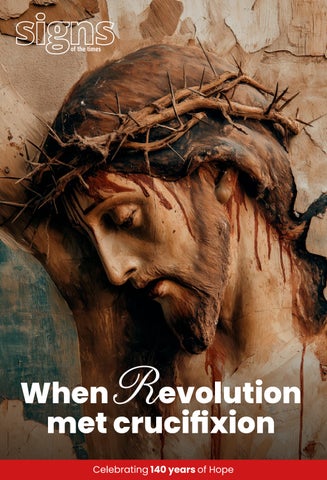
When evolution met crucifixion Celebrating 140 years of Hope
In this issue April 2026
WHAT IN THE WORLD 04 CHOCOLATE: SWEET TREAT OR HEALING REMEDY? 06 Research suggests that cocoa can be good for us, but how does that translate to a typical bar of chocolate?
AI 2027 AND THE END OF HUMANITY 12 The machines may inherit the stars—but the story of humanity isn’t finished yet.
WHY DOING THINGS WE’RE BAD AT IS GOOD FOR US 22 The upside of mistakes.
WHEN REVOLUTION MET CRUCIFIXION
What happens when a zealot meets the Messiah.
PAGE 32
THE GENUINE GOODNESS OF THAT SAMARITAN 24 And why it matters now more than ever.
HOPE IN THE ASHES 30 How a Seventh-day Adventist charity is making a difference after the Victorian bushfires.
ANZAC: LEST WE FORGET 40 Their sacrifice will never be forgotten.
SURVIVING LONG CAR TRIPS WITH KIDS 52 It can be fun—we promise.
WHY MUST WE SUFFER? 54 A world without choice isn’t a world worth living in.
WHEN WINTER BREAKS: WHY EASTER MATTERS Lessons from a daffodil.
PAGE 46
FIND US ON SOCIAL MEDIA 2
SIGNSMAG.COM • APRIL 2026
ARE VEGGIES BETTER COOKED? 60 The answer may surprise you.
SUDOKU AND CROSSWORD PUZZLE 62
@SIGNSMAG
Why Christians refuse to befriend death Throughout history, people from different times and cultures have all struggled to rationalise a fundamental aspect of life: that is, death. Hindus think of death as fundamental to Samsara—the endless cycle of death and rebirth. The ancient Mexica believed that death was fundamental to maintaining cosmological order. The Vikings believed warriors who died in battle would be granted the honour of spending eternity in Valhalla, feasting alongside the Æsir. Those who died of sickness or old age, on the other hand, would spend the afterlife in the frozen wastes of Hel. All these ideas existed to achieve the same goal. In their attempt to understand why people die, these people came up with all kinds of explanations for what death means and how to relate to it. By contrast, Jews and Christians saw death as an intruder, not as a friend or a necessary part of life. Ancient Jews believed death was a result of sin—the destructive force infecting God’s good world—and that a human is an integrated being, not a soul trapped in a body. This is what led the biblical king Solomon to write, “For the living know that they will die, but the dead know nothing; they have no further reward, and even their name is forgotten” (Ecclesiastes 9:5). Likewise, Christians saw the resurrection of Jesus as a foreshadowing to the greater resurrection that all creation would go through one day. This is why the apostle Paul taught that “the last enemy to be destroyed is death” (1 Corinthians 15:26). In this issue, we’ll explore some heavy themes—death, the future and the mess we all share. But we’ll also do so through a lens of hope—that the power of death has been broken, Jesus is alive and our ultimate future is not death, but new creation. Join me as we reflect on that hope together. JESSE HERFORD Associate Editor
VOL 140 NO 3
ISSN 1038-9733 EXECUTIVE PUBLISHER Brad Kemp EDITOR Jarrod Stackelroth ASSOCIATE EDITOR Jesse Herford ASSISTANT EDITOR Zanita Fletcher COPYEDITORS Melody Tan Tracey Bridcutt GRAPHIC DESIGN Theodora Pau’u Talia Valderrama PHONE +61 2 9847 2222 EMAIL info@signsmag.com WEBSITE signsmag.com ADDRESS Adventist Media PO Box 1115, Wahroonga New South Wales 2076 SUBSCRIPTIONS Kelli Geelan PHONE +61 3 5965 6300 Australia/New Zealand, $A28/$NZ30; South Pacific countries, $A41; Other countries $A51 Published since 1886, Signs of the Times is printed 11 times a year by the Seventh-day Adventist Church and is registered as a periodical. Seventh-day Adventist Church (SPD) Limited ABN 59 093 117 689 NOTE The inclusion of a person or their image within does not imply their endorsement of the Seventh-day Adventist Church or its beliefs. Unless otherwise stated, Bible verses are from the Holy Bible, New International Version®, Anglicised. Copyright © 1979, 1984, 2011 by Biblica, Inc®. Used by permission of Hodder & Stoughton. All rights reserved worldwide. COVER IMAGE: MIDJOURNEY
WHAT IN THE WORLD 50 degree summers to become the new normal for Aussies AUSTRALIA
LUKE DEAN, BOB BREWER, ISMAIL SALAD OSMAN-UNSPLASH
Until recently, temperatures in Australia exceeding 50 degrees Celsius only happened every 25 years. But climate scientists are worried that these heatwaves are about to become more commonplace. “If the globe warms up by up to three degrees, we could be seeing these extreme temperatures up to four times as often through parts of eastern Australia and southern Australia,” says Professor Andrew Watkins of the School of Atmosphere and Environment at Monash University. “As a person, I worry. As a climate scientist, I’m not surprised,” he said.—ABC News
4
SIGNSMAG.COM • APRIL 2026
The most dangerous countries to be a Christian WORLD
Open Doors has released its World Watch List 2026, charting the most dangerous places in the world to be a Christian. The top five are, in order, North Korea, Somalia, Yemen, Sudan and Eritrea. Of the top five nations, Christians in four of them face overwhelming persecution from Islamic extremism and tribal pressures. North Korea, the most dangerous place in the world to be a Christian, is dominated by the Kim family and their communist regime. Of the country’s 26 million inhabitants, 400,000 people are estimated to be practising Christians.–Open Doors
PNG churches confront sorcery violence PAPUA NEW GUINEA
Sorcery accusation related violence (SARV) is a widespread problem for Papua New Guineans. Misfortune, illness and death are often interpreted as the result of witchcraft, with accusations leading to beatings, torture, mob attacks and even murder. Women, children and the elderly are disproportionately targeted by such accusations.
Ten denominations have pledged to fight SARV, saying that it “is one of the most prevalent issues . . . destroy[ing] communities”. Australian High Commission law and justice counsellor Gina Wilson said, “Churches are often the first responders in instances of [SARV] . . . the great influence they wield in the communities mean they are enormously important partners in bringing an end to SARV.”—Australian High Commission Papua New Guinea
APRIL 2026 • SIGNSMAG.COM
5
MIDJOURNEY
6
SIGNSMAG.COM • APRIL 2026
Chocolate: sweet treat or healing remedy? Research suggests that chocolate can be good for us, but how does that translate to the eggs and bars most of us consume? ZANITA FLETCHER
I
f you’ve taken a trip down the confectionery aisle of the supermarket over the past year, you may have noticed that chocolate prices have skyrocketed. As I consume chocolate in some form daily, I had to investigate. In recent years, severe weather has disrupted chocolate production, limiting global supply.1 Chocolatier Igor Van Gerwen, who has been making chocolate in Tasmania since 1989, said that in 2024, “cacao prices increased fourfold”.2 In the lead-up to Easter, Australians have been joking that “everyone will be getting carrots this year”.3 In fear of what this price rise might do to my bank account, I’ve found myself ducking down the confectionery aisle each time I’m at the supermarket to check if my favourite products are on sale. After all, chocolate—at least the dark kind—is good for us, isn’t it? If this chocolate famine gets any worse, I want to be stocked up. But it’s usually around Easter that chocolate’s health claims start swirling, and I find myself more and more confused. A quick internet
search offers headlines of every opinion from “No, chocolate isn’t good for you, sorry” to “Chocolate, a cure for all ills.”
an illustrious past
Chocolate has a long and storied past, and for much of history, people have believed in its medicinal powers. The cacao bean—whose scientific name, Theobroma cacao, means “food of the gods”—was consumed as a drink for most of its past. More than 4000 years ago, the Mayans and Aztecs incorporated cacao into rituals, used it as currency, and relied on it as medicine for skin conditions, fevers and stomach problems, often mixing it with peppers, honey or tobacco juice.4 As cacao made its way to Europe in the 1600s, its reputation as a remedy followed. Antonio Colmenero de Ledesma wrote an immensely popular paper praising chocolate for aiding childbirth, improving digestion and curing everything from gut disease and jaundice to tuberculosis and “the green sicknesse” (anaemia).5 American founding father APRIL 2026 • SIGNSMAG.COM
7